Landlords

For the kids?

2

caitlin@sfbg.com

HERBWISE Mission District dispensary Medithrive has started doing home deliveries. Since Nov. 22 its medical marijuana patients can have buds, tinctures, Auntie Dolores’ brownie bits, and more delivered straight to their apartment doors.

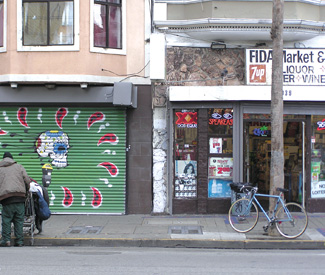
So why are Medithrive customers and staff members peeved? Because the new feature isn’t an expansion in services — it’s a forced shift in the co-op’s business structure. The dispensary was compelled to close its doors on 1933 Mission Street after a Sept. 28 letter from Department of Justice attorney Melinda Haag threatened its landlord with jail time if Medithrive didn’t cease operations in the space within 45 days. (Full disclosure: Medithrive is a Guardian advertiser)

The feds’ given reason was Medithrive’s proximity to Marshall Elementary School, located a 745-foot walk (according to Google Maps) from the dispensary door.

But Marshall’s principal Peter Avila wasn’t consulted on the matter. When called for comment by the Guardian, he said that he had bigger safety concerns.

“Right next door to Medithrive is a liquor store,” Avila said, adding that there is also a methadone clinic across the street from his school. “We have to deal with people passed out on the property, people smoking — those are more the issues than people buying medical marijuana.”

The principal says he patrols Marshall’s immediate neighborhood three to four times a day, dealing with drug addicts, people with mental problems, and the Mission’s homeless population. He called the dispensary “discreet” and never saw any cannabis usage by dispensary patients. Indeed: “They looked pretty much like the people who were coming out of the Walgreens [down the street].” In the past, Medithrive has offered to sponsor health education at Marshall.

Regardless, the dispensary’s Mission Streets doors are shuttered now. On many days, a staff member stands outside, handing out flyers announcing the delivery service to customers unaware that walk-up sales have ceased.

“We’re actually not in such a unique position,” said Medithrive community outreach liaison Hunter Holliman. The Tenderloin’s Divinity Tree and the Mission’s Mr. Nice Guy dispensaries also closed their doors this autumn in light of similar school zone notifications sent to their landlords. The landlord of Marin County marijuana activist Lynnette Shaw, founder of Marin Alliance for Medical Marijuana, was also hit. Shaw intends to fight to stay open.

Holliman says the shift to delivery services has been unexpectedly popular with Medithrive’s customers and allows the dispensary to service patients unable to physically access the storefront location — but it’s not without its challenges. Operations have been transient since the co-op is unable to even stage deliveries from the space on Mission Street. The day that the Guardian called, a voicemail informed patients that due to high call volume they’d have to leave a message so that dispensary staff could call them back. Once contacted by a helpful “budtender,” it took a little over an hour for the order to arrive.

Although Medithrive let go of many employees in its initial closure, it’s hired nearly all back in the transition to the labor-intensive delivery services. The dispensary is still hoping to secure another brick and mortar location, but permitting for new dispensaries has stalled at the city level.

Even if the dispensary’s been booted from its space, at least Medithrive patients still have access to medical cannabis — for now. Holliman is convinced that Bay Area dispensaries haven’t seen the end of legal challenges. “I’m sure there’s more to come,” he said grimly. “The feds are really serious about this.” 

Medithrive’s delivery-only menu is available at www.medithrive.com

Occupy movement targets foreclosed homes

14

Throughout the Bay Area on Tuesday (Dec. 6), Occupy activists and housing advocates launched what they said will be an ongoing effort to place families back into their foreclosed homes, seizing bank-owned homes to put pressure on the banking industry to cooperate with homeowners in loan trouble.

In San Francisco, San Jose, and Oakland, activists highlighted the nation’s foreclosure crisis by occupying foreclosed homes as part of the Occupy movement’s national day of action against foreclosures. Occupy Oakland activists said the tents are gone in downtown Oakland, but the move toward house occupations represents a new phase for the movement.

“I am here fighting for my home,” said Margarita Ramirez, addressing a crowd of 150 supporters at the West Oakland BART station. Ramirez said her family fell behind on their mortgage payments after her husband was laid off at the onset of the recession. The Ramirez family applied for a loan modification under the federally subsidized Home Affordable Modification Program(HAMP) hoping for some relief, but their lender, Bank of America, denied their request. Though HAMP is a federal program, it is administered though individual mortgage lenders.

According to Ramirez, with time left before her foreclosure, Bank of America urged them to explore other options to save their home. Then, inexplicably, Bank of America sold her home to Fannie Mae, leaving her family out of options despite what Ramirez says is Bank of America’s later admission to the error and willingness to work with the family. Fannie Mae however has held firm that the sale was valid, leaving the Ramirez family in an uncomfortable comprise of renting their own home.

In order to pressure Fannie Mae on behalf of the Ramirez family, activists with Occupy Oakland and Just Cause seized a vacant Fannie Mae owned foreclosure at 1417 Tenth street in West Oakland.

“This house is owned by the federal government, who we pay taxes to,” said Occupy Oakland activist Thaddeus Guidry, who said that he had struggled hard to get by during the recession. As he stood over a grill cooking hotdogs for the crowd gathered in the yard of the newly occupied house, he said he had found new inspiration and hope after becoming part of Occupy Oakland.

“Tonight will be the first night here in the house,” said Guidry. “This is my home now. We hope to house eight people here.”

Fannie Mae, which was effectively foreclosed on by the U.S. Treasury in 2008 under a process know as conservatorship, has received $169 billion in federal bailout money and remains under federal control.

The house on Tenth street is modest but spacious, with electricity and water. Downstairs, Just Cause is getting ready to start an eviction defense clinic. Just Cause organizer Maria Zamudio told the Bay Guardian that the group holds regular eviction defense clinics in San Francisco and Oakland, but the freshly occupied house in West Oakland would serve as a community space that people can drop into to learn their rights.

“We have been doing eviction defense for a long time. Since the recession, we have seen a change to tenants being pressured to leave by banks after landlords lose a house to foreclosure,” said Zamudio. “It is important for tenants to know that they do not need to leave a foreclosed property. The tenant has more rights in these situations then the homeowner.”

Only blocks away, Gayla Newsome stood in front of her house at 1536 Adeline St with another crowd of supporters from Occupy Oakland, and housing advocates from the Alliance of Californians for Community Empowerment(ACCE). She has been out of the house for six months after the foreclosure, leaving her and her children to stay with family in an overcrowded situation as the house sat vacant.

“This is the moment I take my house back. I’m a little scared, a little nervous, but I have to do this for my kids and grandkids. I have to do this for the other people who are going through this,” said Newsome.

Newsome said Chase Bank repeatedly denied receiving her HAMP loan modification paperwork. When she finally sent a copy by certified mail, they acknowledged the application and denied her eligibility in the program.

The eviction came swiftly. Unaware of the looming eviction, and believing she still had time to save her house even though Chase was outside the HAMP program, Newsome was called by her children while at work the morning of July 19.

“The kids were given 10 minutes to grab what they could before they were put on the sidewalk in their pajamas by the bank representative and the sheriff. They called me frantic,” recalled Newsome.

The recession has been hard on West Oakland. One out of 236 houses in West Oakland are in foreclosure, with many more families hard-pressed to hang on. Housing advocates say that foreclosures destabilize entire neighborhoods, as surrounding property values plummet and blight spreads.

“I’m not just here personally to reclaim my house, I’m here to say it is time to reclaim this neighborhood,” said Newsome, who laid the blame for the neighborhood’s sharp decline at the feet of the banks.

Residents of the neighborhood gathered for the rally shared stories of realtors cruising the neighborhood stopping to photograph even properties that are not in foreclosure or for sale.

“This was not an accident, this is redlining,” said Nell Myhand of Just Cause about West Oakland’s housing troubles.

“It’s time to take this to the politicians,” said ACCE organizer Shirley Burnell. “If they are not willing to help us, then they got to go. We will take them to the streets.”

Outside, activists signed up for shifts to help defend Newsome’s home from eviction, and started an emergency phone tree in case of trouble.

“The tents are gone but we are still here!” yelled an Occupy activist from the crowd as home defense clipboards circulated.

“I appreciate everyone doing this with me,” said Newsome. “That’s what Occupy is all about. We will take our homes back one at a time – no, five at a time.”

Get read!

0


ROCK AND ROLL ALWAYS FORGETS

By Chuck Eddy

Duke University Press

352 pp., paper, $24.95

Chuck Eddy glides through music criticism like a grumpy fanatic. Each article included in Rock and Roll Always Forgets — culled from Eddy’s vast back catalogue of music journalism articles, beginning with the early 1980s — is packed with cultural references, touchstones, facts, witty asides, a dash of snark, and acknowledgments of once-obscure acts. Yet, he approaches each band like he’s the first to have discovered it. He’s a musical anthropologist, but also, archeologist, digging up the remains of musicians past, lest we forget. Take a piece on a Marilyn Manson show, written in 1996. More than simply describing the stage and the crowd (which he does, expertly: “[they] wore too much black makeup, but they didn’t scare me — most seemed to be upper-middle-class Catholic school teens from the burbs…”). He wanders near profundity, dissecting Manson’s overall persona, his ticks, his own cultural references, and those who came before him, namely Alice Cooper, but a great many more. Most importantly, Eddy alludes to why that all matters in the least. (Emily Savage)


TROPIC OF CHAOS

By Christian Parenti

Nation Books

295 pp., hardcover, $25.99

Through historical research and on-the-ground reporting in Kenya, war-torn areas of Afghanistan, and other regions marked by intense conflict, Christian Parenti offers an unusual and compelling analysis of violence through the lens of the environment. Tropic of Chaos: Climate Change and the New Geography of Violence teases out the idea that increasingly unstable weather patterns stemming from climate change have fueled conflict throughout impoverished areas of the Global South. In the savannahs of northwest Kenya, for instance, deadly cattle raids have intensified as intertribal warfare heats up in the face of water scarcity. Recurring droughts and floods in Afghanistan have made it exceedingly difficult for farmers raise traditional crops, making them increasingly reliant drought-resistant poppy — the raw ingredient for heroin — for economic survival. Parenti also turns a sharp eye upon the repression, surveillance, and counterinsurgency that first-world nations have employed to combat growing violence in water-scarce, conflict-ridden regions, and calls for a more enlightened approach. (Rebecca Bowe)


CAFE LIFE SAN FRANCISCO

by Joe Wolff

Interlink Books

224 pp., paperback $20

Small quirks in this guide to the city’s cafes and coffeehouses — the sixth in a series that includes Sydney, New York, and Venice — will let you know its not strictly, strictly for locals. Java Beach is lumped in with more gearhead-oriented Mojo Bicycle Cafe and Ninth Avenue’s Arizmendi Bakery is filed under the catchall “Sunset District and vicinity.” The introduction’s discussion of “San Fran” versus “Frisco” versus “the City” is one that became boring long ago. But those things matter little. In-depth histories of some of your favorite cafes, from Java Beach to Philz’ to Caffé Baonecci are lucid looks at the facts and rewards of small entrepreneurship in the city. And Roger Paperno’s loving photography of velvet crema and foccacia sheets combines with words to create an ode to the city’s third spaces that any caffeine-laptop addict will appreciate in their stocking. (Caitlin Donohue)


LIONS OF THE WEST: HEROES AND VILLAINS OF THE WESTWARD EXPANSION

By Robert Morgan

Algonquin Books

497 pp., hardcover, $29.95

Biography can be the best history; stories of the people who changed the world (for better, and often for worse) are more compelling than turgid texts of dates and places. Lions of the West recounts the development of the American frontier from the end of the Revolutionary War to the Civil War era through the lives of 10 men. Yeah, all men. In fact, Morgan (by choice or by the longtime bias of American historians) makes it appear as if all of the great and evil deeds done as the nation moved Westward Ho were the province of the male of the species. At times, the profiles are a bit over the top (I don’t really care that much about Kit Carson’s personal life.) Overall, though, it’s a detailed, lively, and informative book that minces no words, especially when discussing the theft of much of the southwest from Mexico. San Franciscans will enjoy learning who Stockton, Sloat, Castro, Winfield, and a few other streets were named after. (Tim Redmond)


VHS: ABSURD, ODD, AND RIDICULOUS RELICS FROM THE VIDEOTAPE ERA

By Joe Pickett and Nick Prueher

Running Press

272 pp., paper, $14

Found Footage Festival founders and comedy writers Joe Pickett and Nick Prueher are apparently the Indiana Joneses of VHS, unearthing remarkable video package cover art that would otherwise be relegated to hoarder basements, bonfires, and anywhere else the worst (a.k.a., the best) videotapes go to die. I salute these dudes, even though the captions they tag each page with aren’t always funny or necessary. Truly, the covers (soft-focus and garish, tacky and baffling) speak for themselves, direct dispatches from ye olden days, long before YouTube brought WTF-ness to anyone with an Internet connection. You see, children, back in the 1980s or 90s, home viewers had to seek this shit out: instruction in squirrel-calling, chair-dancing, seduction, hairstyling (“What the Heck Am I Going to Do With My Hair?”), baby-proofing, spotting counterfeit Beanie Babies, etc. Straight-to-video masterpieces (F.A.R.T.: The Movie). Horrible exercise fads (“Bunnetics: The Buttocks Workout”). Well-meaning but also ghoulish-looking self-improvement vids (“Face Aerobics”). Every page is magical. Your mind will be blown. (Cheryl Eddy)


BI-RITE MARKET’S EAT GOOD FOOD

By Sam Mogannam and Dabney Gough

Ten Speed Press

297 pp., hardcover, $32.50

Bi-Rite Market is the ultimate neighborhood grocery. Shockingly small (with ambition to expand), it’s jam-packed with the best in organic produce, meats, cheeses, and artisan food products, much of it local. Now, Bi-Rite founder Mogannam has a new book loaded with recipes for such inviting delectables as white bean puree with prosciutto crespelle and strawberry rhubarb pie. But don’t relegate it to the cookbook category. Hewing to Bi-Rite’s mantra of creating community through food, the authors share extensive tips on shopping seasonally and locally for the healthiest and best-tasting products, no matter where you may live. You’ll learn what to look for at the grocery, storage and usage tips, and more. Well-illustrated sections feature produce (broken down by season), wine, beer, cheese, deli meats, butchery, baked goods, and even farmer profiles. Bonus: stay tuned for Sweet Cream and Sugar Cones, Bi-Rite’s ice cream and frozen treats recipe book from its renowned creamery, out this April. (No word yet on whether it’ll tell us how to beat the ever-present line outside.) (Virginia Miller)


DAMNED

By Chuck Palahniuk

Doubleday

247 pp., hardcover, $25

Welcome to Hell, as seen through the eyes of 13-year-old Madison Spencer, the daughter of a jet-setting yet eco-hyperconscious movie starlet and philanthropist. This is Dante’s Inferno meets The Breakfast Club, a film that overtly informs the plot and its main characters. As in Palahniuk’s breakout novel Fight Club, it’s hard distinguish between reality and perception as Maddy leads readers past the Vomit Pond, across Dandruff Desert, and right into Satan’s black Town Car. As she recalls her final weeks on earth, you’re pretty sure that she didn’t really die from a marijuana overdose. Clearly, things are not what they seem as the novel looses an American teenager’s perspective on modern life in both the underworld and earthly realm, with wry commentary on everything from pop culture and capitalist excess to the defeated religions whose fallen gods roam Hades. The gags alone — like the telemarketing and chatroom porn the damned deliver to Earth, and Hell’s endless loop of The English Patient — make this a tough book to put down, all the way to its slightly unsatisfying conclusion. (Steven T. Jones)


BEST AMERICAN COMICS 2011

edited by Alison Bechdel

Houghton Mifflin Harcourt,

352 pp., paperback $25

Chris Ware’s textbooky flowcharts; Angie Wang’s Technicolor, spiraling pistil-armed super-flower-heroine; Peter and Maria Hoy’s intricately plotted cause-and-effect grid art — the sixth year of this hardcover assemblage of the year in superlative strip art soars as a holiday gift for your fave comic nerd. Visual trickery and innovative page staging aside, many of the graphic narratives in this book hold up on plot alone. An excerpt from Kevin Mutch’s Fantastic Life effectively mines zombie philosophy, dating paranoia, and begging drinks off your service industry friends for comic gold. Many of the best pieces, perhaps indicative of the graphic novel mood these days, explore the darker side of the human psyche. But what graphic novel fan is unfamiliar with complicated? (Caitlin Donohue)


THE TIPSY VEGAN

By John Schlimm

Lifelong Books/Da Capo

164 pp., paper, $17

Every time I think we’re past the stereotype of the sullen, uptight vegan, I get another comment like, “Wait, don’t you only eat vegetables?” Why yes, I do eat plenty of veggies, but I also eat decadent dishes such as The Tipsy Vegan‘s Party Monster Pancakes, loaded with the sweet nectar of amaretto and drenched in syrup. This book is a carnivorous teetotaler’s nightmare, boasting 75 boozy recipes stuffed with everything from “beer to brandy” for the liquor-loving vegan cooks among us. It’s not, as I initially imagined, a book on vegan cocktails — that would be far too easy. Written by John Schlimm (Ultimate Beer Lover’s Cookbook), a member of “one of the oldest brewing families in the United States,” the book includes booze-infused treats for parties, brunch, and supper: fried avocados, slur-baaaaked peaches with Cointreau, “Bruschetta on a Bender” — all of which kind of sound like stoner food to me. An nice touch: glossy food porn shots on every page. (Emily Savage)


PROJECT DOG

By Kira Stackhouse

self-published

352 pp., hardcover, $34.99

Local photographer Kira Stackhouse experienced an inspiration so intense that she ditched her high-profile marketing job to pursue it: she would photograph specimens of the 50 most popular canine breeds officially registered with the American Kennel Club (“purebred dogs”) that had been purchased from professional breeders — and pair them with photos of the exact same kinds of dogs found in local dog rescues and shelters. The purpose was to start a dialogue about the effects of professional breeding and highlight the many kinds of dogs available for adoption (and also to change peoples’ perceptions about rescue dogs). But a major part of the story — and what makes this book so fantastic — is the wonderful doggy photography and sumptuous layout. Dogs are posed, or pose themselves, against iconic Bay Area backdrops, accompanied by often hilarious, always revealing, biographies and profiles. Project Dog became an online sensation: this book cements its reputation. Available at www.projectdog.net. (Marke B.)


LISTEN TO THIS

By Alex Ross

Picador

384 pp., paper, $18

In the expanded paperback edition of his absorbing and erudite collection of essays, Alex Ross of the New Yorker writes what could be called his mantra as critic: “I have always wanted to talk about classical music as if it were popular music, and popular music as if it were classical.” Ross listened exclusively to classical until he was 20, something he admits may sound “freakish.” But whether he’s describing Björk in her recording studio in Iceland, or composer John Luther Adams’ sound and light installation in Alaska, Ross draws from an immeasurable well of knowledge and plunges into his subject with gusto. He can find commonalities between Radiohead’s “Pyramid Song” and Stravinsky’s Firebird Suite, clear away the myths that have clouded both Franz Shubert and Bob Dylan, and thoroughly explain why OK Computer and John Cage’s 4’33” are equally astonishing. Informative, eye opening, Ross is every lover of music thrown harmoniously into one. (James H. Miller)


MY FAMILY TABLE

By John Besh

Andrews McMeel Publishing

272 pp., hardcover, $35

To know anything about New Orleans’ dining scene is to know John Besh. As one of Nola’s great chefs, he has a number of restaurants, including the acclaimed August, elevating local cuisine in forward-thinking ways. His original book My New Orleans is a striking post-Katrina tome to one of the greatest cities in the world and its vibrant culinary history. It’s a gorgeous coffee table volume packed with photos of the region’s people, places, and foods — more than 200 recipes from Mardi Gras specialties to gumbo, many with a contemporary twist. Besh just released, My Family Table, with welcoming, everyday recipes he cooks with his family that are healthy, fresh, simple, and heartwarming. Besh’s star power (Iron Chef champion and James Beard award-winner that he is) never dominates. Like New Orleans, it’s a visually beautiful book, but this time themed by “School Nights,” “Breakfast with my Boys,” and recipes like “Curried Anything” or “Creamy Any Vegetable Soup.” Closing with the key element of cooking, the communal, he writes: “If asked what my last meal would be, I’d reply, ‘Any Sunday supper at home, cooked with love, for people I love.'” (Virginia Miller)


FOUR SEASONS OF YOSEMITE: A PHOTOGRAPHER’S JOURNEY

By Mark Boster

Time Capsule Press

128 pages, hardcover, $34.95

John Muir would have loved this book, the spectacular result of a passionate love affair with Yosemite National Park involving all of the principals in this impressive project. Muir helped glorify and preserve Yosemite with his voice and pen. Robert Redford, who fell in love with Yosemite as an 11-year-old boy recovering from a mild case of polio, wrote an eloquent introduction to the book. Photojournalist, Mark Boster was smitten by the beauty and grandeur of the Yosemite when he first visited the park as a child with his family. He spent a year in the park detailing its seasonal changes in more than 100 magnificent pictures. “I felt the breezes, analyzed the light, listened to the sound of the rivers and falls, and tried to capture the images that moved me,” he writes in his introduction. Catherine Hamm’s delicate haiku add a poetic touch to many scenes. (The two principals who brought this project to life with loving care are Narda Zacchino, a former editor of LA Times and the Chronicle, and Dickson Louie, a former executive at both those papers. Zacchino serves as publisher and editor and Louie as president and CEO of Time Capsule Press, which specializes in creating books by using the archival content of newspapers and magazines.) Available at www.fourseasonsofyosemite.com (Bruce B. Brugmann)


THE PDT COCKTAIL BOOK

By Jim Meehan

Sterling Epicure

368 pp., hardcover, $24.95

Few bars have made as much impact on the New York cocktail (and thus the international) scene than PDT. Known as an early mover in the speakeasy trend, PDT revives classic recipes and invents new ones in the classic spirit. Bartender Jim Meehan put PDT on the map, and he’s since gone on to write about drink and educate bar managers and tenders everywhere. In the PDT Cocktail Book, he shares more than 300 cocktail recipes in a comprehensive collection inspired by classic tomes like The Savoy Cocktail Book. There are recipes from generations of hard-working bartenders, tips on glassware, bar tools, equipment, garnishes, techniques, a listing of seasonal ingredients, even a spirits primer. In keeping with PDT’s connection to neighboring Crif Dogs who serve creative dogs in the bar, there’s a section of hot dog recipes from big-name chefs who are regulars at the bar, including David Chang (Momofuku), Wylie Dufresne (WD-50), and Daniel Humm (Eleven Madison Park). From the comfort of home, cook up a Mason Dog fried in cornmeal and huitlacoche (corn smut/fungus, a Mexican specialty) to go with the Little Bit of Country cocktail, which mixes bourbon, maple, and jalapeño. (Virginia Miller)


EVERYTHING IS ITS OWN REWARD: AN ALL OVER COFFEE COLLECTION

By Paul Madonna

City Lights

240 pp., hardcover, $27.95

Like Ben Katchor’s classic “Julius Knipl, Real Estate Photographer,” local artist Paul Madonna’s “All Over Coffee” — published every Sunday in the Chronicle and on essential Web zine The Rumpus (www.therumpus.net) — draws me into a psychic space that is at once serene and troubled, surreal and hyperreal. The effect comes as much from the drawing style as the dreamlike non-narrative: both are direct descendants of Winsor McKay’s “Little Nemo.” Madonna gets an extra chills-up-the-spine boost from his illustrations of semi-familiar San Francisco architecture and intersections, lucid as etchings of bleached Kodachrome shots. For this second collection of the strip, he broadens his nib to include not only the City by the Bay, but Paris, Rome, Buenos Aires, and Tokyo. Overheard quotes, snatches of philosophical discourse, interior monologue snippets, existential doubts, random observations, and short stories are floated over the images to capture a peculiarly lovely eddies in the zeitgeist.


I DON’T WANT TO KILL YOU

By Dan Wells

Tor

320 pp., paperback, $11.95

Some of this is sick shit. You need a warped sense of humor and a love for random violence to enjoy the tale of a young man who lives with his mom in a mortuary and fights a demon made of black goo who takes over the minds and bodies of humans. But it’s a different type of thriller — complete with its own kinda sweet moments of teenage love and angst — and it’s packed with great detail. (Did you know that undertakers use Vaseline to fill up bullet holes? Cool.) John Wayne Cleaver, perfect name for a demon hunter, is a sociopath who is beastly to his mother and can’t get along with the other kids . Except for a super-hot chick who he thinks must be a demon, otherwise why would she like such a loser geek? The demon is nasty and gouges out eyes, cuts off tongues, sticks bodies on poles … you gotta check it out. (Tim Redmond)


RICE AND CURRY: SRI LANKAN HOME COOKING

S.H. Fernando, Jr.

Hippocrene Books

224 pp., paperback, $19.95

After a tongue-inflaming visit to the East Village’s fantastic Sigiri restaurant in NYC a couple weeks back, my interest in — and lust for — spicy Sri Lankan treats like kiri hodhi (coconut milk gravy), rossam (coriander-tamarind broth), kool (seafood soup), Jaffna goat curry, and ulundu vai (savory donuts) was, er, inflamed. Fortunately for me, author “Skiz” Fernando recently spent a year on the island rediscovering his roots and delving into the varied cuisine (later serving as a guide for that cheeky culinary colonist Anthony Bourdain). The punchy, informative Rice and Curry is the result, and includes nice introductions to Sri Lankan geography and history, as well as tips on what to stock in your cupboard to achieve the certain Sri Lankan “oomph” that sets the cuisine apart from Indian. A particular passage that profiles Leela, Fernando’s aunt’s ancient maid, offers some real insight into the island’s food tradition and customs — and yields a marvelous, corruscating crab curry from her hometown of Chilaw, just in time for Dungeness season. (Marke B.)


HEDY’S FOLLY: THE LIFE AND BREAKTHROUGH INVENTIONS OF HEDY LAMARR

By Richard Rhodes

Doubleday

261 pp., hardcover, $26.95

An author best-known for his 1986 Pulitzer-winning The Making of the Atomic Bomb, Richard Rhodes might seem like an unlikely biographer for movie stunner Hedy Lamarr, who lit up Golden Age films like Cecil B. DeMille’s 1949 epic Samson and Delilah. But her above-average qualities (she was called “the most beautiful woman in the world”) extended beyond the superficial. After escaping her gilded-cage marriage to an Austrian munitions magnate, Lamarr found success — and five more husbands — in Hollywood; between roles, she started inventing “to challenge and amuse herself.” During World War II, she got serious about her hobby. Showbiz circles led her to avant-garde musician George Antheil, renowned for his groundbreaking composition for 1924 short Ballet Mécanique. As Rhodes writes, “[Lamarr] began thinking about how to invent a remote-control torpedo to attack submarines just at the time she met Antheil, who knew quite a lot about how to synchronize player pianos.” Together, the “charming Austrian girl” and “the bad boy of music” worked on that torpedo, as well as “spread-spectrum radio,” an innovation that paved the way for contemporary wireless technology. Unlikely? Yes. Fascinating? Indeed. Never underestimate a beautiful woman — or a skilled writer’s ability to humanize complicated characters and bring drama to a tale loaded with tech-speak. (Cheryl Eddy)


COME, THIEF

By Jane Hirschfield

Knopf

98 pp., hardcover, $25

As it happens, one of Bay Area poet Jane Hirschfield’s passages currently adorns the famous Kahn and Keville auto repair shop’s marquee in the Tenderloin: “What some could not have escaped/ others will find by decision/ each we call fate.” Well, you could never blame her for not thinking big. As a well-known and approachable poet, she sports a blurb from O, The Oprah Magazine on this, her ninth collection, the first in six years since releasing her arresting After. And while her slightly witchy, be-scarved, grandiloquent persona screams marketable poetess, there’s some understated magic in her latest poems. These ones are full of plums and glass and vague Zen spells that give off, in their overall effect, an rueful, anticipatory sigh. Some childlike wonder seeps in: “Another year ends./ This one, I ate Kyoto pickles,” says “Washing Doorknobs,” my favorite from the collection. “But one thing you’ll never hear from a cat/ is Excuse me” goes “A Small-Sized Mystery.” Sometimes you can almost Hirschfield her straining for ambiguity, the poems’ heavy life lessons tearing through her delicate webs of observation. Still, each poem here showcases Hirschfield’s incisive power. (Marke B.)


PLENTY

By Yotam Ottolenghi

Chronicle Books

287 pp., hardcover, $35

Recently I returned to London, eating my way extensively through the city. One of my gustatory highlights was Yotam Ottolenghi’s beloved bakery and restaurant, Ottolenghi (with four locations). Not only were his baked goods otherworldly delights, his straightforward but elegant dishes using pristine ingredients were among the freshest and satisfying of my London travels. Plenty, his new cookbook, is a cleanly designed book with vivid photos of recipes like broccoli gorgonzola pie and mushroom herb polenta. Most impressive? Ottolenghi’s recipes are 100% vegetarian. The meat-free aspect is barely emphasized, and one feels no lack in the diverse range of flavors (with Middle Eastern influences) presented. Since 2006, Ottolenghi has penned the UK Guardian’s vegetarian column — and he’s not even a vegetarian! This speaks to how respected he’s become as a chef in his use of veggies and grains. Plenty shows this talent off, but most importantly delivers approachable, easy-to-replicate recipes to tickle our palates. (Virginia Miller)


HILLBILLY NATIONALISTS, URBAN RACE REBELS, AND BLACK POWER

By Amy Sonnie and James Tracy

Melville House

201 pp., paper, $16.95

Gazing back in time to the era when the Black Panthers were serving up free breakfast to low income youth and coming into the crosshairs of COINTELPRO, few may be aware that an interracial coalition of radical organizers included a contingent of poor white southerners bent on fighting capitalism in solidarity with communities of color. Written by a cofounder of the Center for Media Justice and a longtime San Francisco housing activist, this detailed bit of radical history spotlights the organizing efforts of poor whites, transplanted from rural Appalachia to the low-income Uptown neighborhood of Chicago, to build coalitions of poor people in solidarity with civil rights leaders. Groups like Jobs or Income Now (JOIN), the Young Patriots, and Rising Up Angry launched campaigns against neglectful landlords and cops who brutalized their youth. They represented the white arc of the multiracial Rainbow Coalition, initiated by the Black Panthers in Chicago as “a code word for class struggle.” Bizarre as it may seem, “It became common to see [Panther] Fred Hampton ‘give a typically awe-inspiring speech on revolutionary struggle, while white men wearing berets, sunglasses, and Confederate rebel flags sewn into their jackets helped provide security for him.'”

(Rebecca Bowe)


MR. KILL

By Martin Limon

Soho Press

376 pp., hardcover, $24

Korea in the 1970s. The United States has 50,000 troops in country, mostly near the Demilitarized Zone, and they don’t always behave. In general, the Korean authorities allow the military to police its own — but when a young Korean woman is brutally raped on a train to Seoul, and the assailant appears to be an American, all hell breaks loose. Martin Limon lived in Korea for ten years, and he does a (fairly) good job of presenting a portrait of the Cold War tensions between the two supposed allies. There’s a little bit of American bias — the author is former military himself — and his potrayal of Korean society isn’t as sensitive or oddly loving as John Burdett’s descriptions of Thailand in the Bankok 8 series. Limon’s great storytelling and his lively and compelling protagonists, Sergeants George Sureno and Ernie Bascom, pull readers past those issues. Perfect gift for someone who likes international crime thrillers. (Tim Redmond)


THE RECIPE PROJECT

By One Ring Zero

Black Balloon Publishing

116 pp., hardcover, $24.95

It’s part cookbook, part music journalism, part rock opus, and hell, part coffee table book. The Recipe Project (subhead “A Delectable Extravaganza of Food and Music”) is a concept spearheaded by New York-based gypsy-klezmer act One Ring Zero. The band’s co-founders, Michael Hearst and Joshua Camp, created songs using the recipes of well-known chefs (Mario Batali, Isa Chandra Moskowitz, Chris Cosentino) as the word-for-word lyrics. The meals themselves served as musical influence; each recipe inspired a different sound. While the songs are not likely ones you’d listen to say, on a long lonesome drive, they do have a glint of childlike glee. It’s conceptual. The true genius of this project is its overall cohesiveness. It’s an all-in-one package. Follow the recipe, listen to the song, get some interesting background factoids. The Recipe Project also includes full recipe playlists, articles by rock journalists, and some pretty interesting interviews with chefs. (Emily Savage)


CARY GRANT: DARK ANGEL

By Geoffrey Wansell

Arcade Publishing

192 pp., hardcover, $24.95

Back in print (it was originally released in 1996), this paen to the dapper star of North By Northwest (1959), An Affair to Remember (1957), Notorious (1946), His Girl Friday (1940), and approximately 10 zillion other classic films is somewhere between a biography and a coffee-table book. It’s worth picking up for the lavish black-and-white photos alone, illustrating the span of Cary Grant’s career with film stills, behind-the-scenes shots, and the occasional almost-candid image (did he ever take a bad picture)? The accompanying text is straightforward, but — as its title suggests — doesn’t shy away from Grant’s well-documented countercultural experiments. (“Grant became so enthusiastic about the value of LSD that he extolled its virtues during the shooting of his next picture.”) Nor does it gloss over Grant’s vices (he smoked 30 to 40 cigarettes a day) and sometimes troubled personal life (he was married five times). But the book’s chief focus is Grant’s brilliant career. As Stanley Donen, who directed him three times, remarks to author Geoffrey Wansell, “He’s thought of as a man who achieved a certain elegance and savoir faire. But in truth he was a fantastic actor.” (Cheryl Eddy)


NATURAL HISTORY OF SAN FRANCISCO BAY

By Ariel Rubissow Okamoto and Kathleen M. Wong

University of California Press

352 pp., paperback, $24.95

Drag queens, beat poets, burlesque dancers, hyphy rappers, dot com techies — the human species of the Bay Area have been well-documented, but information on the non-human dwellers of the bay itself has been left to scattered guidebooks, obscure blogs, and academic sources. Authors Rubissow Okamoto and Wong have collected a wealth of biological and environmental information in their book, published this November. The cross-country saga of the striped bass, the hidden beauty of eelgrass, the varied contentions of the California water wars are presented in highly readable, easily digestible sections. The emphasis here is on environmental impact and recent conservation developments — I did not know that it’s officially dangerous to eat more than one pound a month of fish from the bay! — and the history of decades of restoration triumphs and setbacks is related sleekly and straightforwardly. Absorbing all the information in this illuminating primer helped me appreciate the seething loveliness and churning forces that make up the place I call home. (Marke B.)


Homes for the 99 percent

0

news@sfbg.com

Pressed by foreclosures, evictions, and an economic crisis with the gnawing tenacity of an early winter flu, San Franciscans protested in neighborhoods throughout the city on Saturday, Dec. 3. Marches from four of the city’s most impacted neighborhoods merged in the Financial District to pressure landlords, banks, and what the Occupy movement has dubbed the 1 percent to ease the spreading hardship surrounding housing in San Francisco.

“The 99 percent tenants and homeowners can no longer let the 1 percent banks and real estate speculators destroy our city and our lives so we’re marching in the neighborhoods and on the streets today,” asserted the statement read by the Occupy SF Housing coalition to the crowd gathered in the Financial District. The message echoed through the glass and granite corridors in front of Wells Fargo, passed along in a thousand voices by the now ubiquitous “mic check” style of Occupy crowd communication.

Housing advocates warned that a steady stream of foreclosures, climbing rents, and lagging job opportunities are driving even native San Franciscans out of the city for the relatively affordable housing in the East Bay or forcing them out of the region altogether, transforming the face of San Francisco into an older, whiter, wealthier demographic.

Throughout the economic crisis, San Francisco as a whole has posted lower foreclosure rates than surrounding counties. At first glance, San Francisco, with one in 880 homes facing foreclosure, looks like a safe harbor in the state’s troubled residential real estate market compared with the statewide foreclosure rate of one home in 243, according RealtyTrac. That represents 55,312 residential units across the state. Nationally, one in 563 homes was in some stage of foreclosure as of October 2011, the most recently released numbers.

However, a near absence of foreclosures in affluent, stable, San Francisco neighborhoods like Pacific Heights and Noe Valley hide troubling foreclose rates in the city’s blue collar ZIP codes that far exceed national and statewide levels. In the 94124 zip code that includes the Bayview and Hunters Point, one in 180 homes received foreclosure filings, higher then Oakland’s overall average rate of one in 245 homes — levels that reflect the experience of some of the nation’s most hard hit areas.

Of the 1,513 homes currently listed on the San Francisco housing market, 1,255 were in the pre-foreclosure, auction, or bank-owned stages of the foreclosure process, representing roughly 82 percent of the available housing stock.

At the downtown headquarters of Wells Fargo, Occupy protesters were placing some of the blame for the deepening hardship at the feet of the big banks. According to the Occupy SF Housing coalition, Wells Fargo is the mortgage lender for 226 homes in San Francisco that are in some stage of foreclosure. That represents about 18 percent of the total homes in San Francisco under foreclosure.

In neighborhoods like Hunters Point, these evictions have turned into an economic cascade of household wealth in decline, even for those who have managed to hold onto their homes.

With foreclosures flooding the market, the median sales price for homes in Hunters Point from Aug. 11 to Oct. 11 was $167,500. This represents a decline of 13.2 percent, or $25,500 per home on average, compared to the prior quarter. Sales prices have depreciated 62.6 percent over the last five years in Hunters Point, wiping out equity families have built over years, and leaving those who hang on stuck in underwater mortgages, where their debt far exceeds the value of their home.

“Predatory equity loans make a quick profit (for the lender) at the expense of home owners in the Bayview,” said Grace Martinez of the Alliance of Californians for Community Empowerment (ACCE). “There are 11 homeowners on a two-block stretch of Quesada in default or have already lost their homes.”

While the Obama administration has tried to ease the foreclosure crisis through the federally subsidized Home Affordable Modification Program (HAMP), only a small percentage of people who apply through their mortgage holder for relief under the program receive a loan adjustment. At Wells Fargo, only one in five borrowers applying for HAMP relief have received a loan modification.

Protesters sitting in the streets in front of Wells Fargo demanded that the company establish a moratorium on all foreclosures until it reforms its loan modification practices, halts the eviction of homeowners who have faced foreclosure, and instead offers them a rental option to keep them in their homes — a solution they say will ease the suffering of those caught in the middle of the banking crisis.

The banking and real estate driven economic crash has lead to the largest drop in home ownership nationally since the Great Depression. At the same time that home ownership has become increasingly out of reach for many San Franciscans, increases in rental rates and high competition for rental units are driving out many blue collar San Franciscans from the transit-friendly Mission District, in favor of a generally younger, wealthier, more educated, tech-savvy population.

As rallies took place across the city Saturday in the lead up to the afternoon’s Wells Fargo protest, a group of concerned residents and community groups gathered at 24th and Mission to highlight San Francisco’s other housing crisis — the rental market. The other marches started in the Castro, the Bayview, and the Tenderloin.

Much of the turnover of long-occupied rent controlled housing units in San Francisco comes as a result of the Ellis Act, a state law that allows evictions when an owner’s family wants to move in or when the unit is taken off the rental market. Brenda Nedina’s family is facing an Ellis Act eviction at 874 Shotwell Street.

“I’ve lived in that unit my whole life. My family has lived in the unit for 28 years,” said the tearful, 25-year-old San Franciscan native. “We would love to stay here, but with rents so high, it is not likely that we would find a place in San Francisco.”

Nedina, who works a service industry job at Pier 39, says the economic crisis has made it more difficult for her survive in San Francisco. She has had to cut down her college course load to get by in the tough economy. The troubles will get more complicated if her family is priced out of the city, as critical health services that they rely on are available through their San Francisco residency.

“A lot of people suffer through this as a private problem, but we are making it a public problem, and if the problem belongs to all of us then so does the solution,” said Maria Poblet of Just Cause, hugging a tearful Nedina as she addressed a crowd gathered at 24th and Mission streets.

Latino families like Brenda’s continue to be forced out of the Mission District by rising rent, and less economic opportunity for them in the recession. According to the 2010 U.S. Census, the past decade has seen a 22 percent decrease in the Mission’s Latino population.

“Landlords often abuse the Ellis Act as a way to remove tenants from rent controlled units,” Just Cause organizer Maria Zamudio told the Guardian. “I’m occupying Kaleidoscope free speech zone art space on 24th and Folsom. My slumlord landlord is not down with that mission,” said artist and gallery proprietor Sara Powell, also facing a Ellis Act eviction after pressuring her landlord to address substandard building maintenance issues. Powell’s landlord withdrew a standard eviction process that housing advocates said was unlikely to succeed before launching the Ellis Act eviction.

“With the help off the 99 percent and with right on our side we are going to fight this and we are going to win,” said Powell, whose gallery next door to Philz Coffee is a cornerstone of the neighborhood’s multi-ethnic arts scene. The San Francisco Rent Board has received more than 4,000 petitions to remove rental units from the real estate market since 1999 through the Ellis Act. While Ellis Act evictions have seen some decline during the economic crisis, more Ellis Act evictions are now concentrated in the Mission District, where 40 percent of all Ellis Act petitions are now filed. At the same time, evictions based on breach of lease throughout the city are on track to double pre-recession numbers this year as more and more San Franciscans are have trouble earning enough to keep up with the city’s exorbitant rental rates. According to Just Cause, the average rent for a two-bedroom apartment in the Mission District is now $2,497. “The only way to keep our Chinese, Latino, Arabic, English speaking neighborhood is to fight like hell for our homes,” said Poblet. “Even before Wall Street was occupied, we have been defending this neighborhood. This is the neighborhood of the 99 percent.”

Alerts

0

alert@sfbg.com

WEDNESDAY, NOV. 30


Protesting Muni firings

Transport Workers Solidarity Committee hosts a press conference to highlight Muni operators who have recently been fired. The group claims SF politicians, the MTA, and the current Transit Workers Union Local 250A leaders are culpable in unfair and unjustified dismissals. TWSC — with support from the NAACP and United Public Workers for Action — says it hopes to spur the TWU to speak out against unfair contracts and bosses.

11 a.m., free

San Francisco Chronicle 5th & Mission, SF

415-867-3320

www.transportworkers.org


Occupying foreclosed homes

Occupy Santa Cruz is taking opposition to the 1 percent a step further. Congregate and picket in front of corporate banks in downtown Santa Cruz to show contempt for unfair capitalistic practices. A march toward the foreclosed homes in Santa Cruz will protest against banks and highlight how many properties are left empty and unused despite many citizens who struggle to find affordable shelter.

2-6 p.m., free

Meet at the Courthouse on Water Street March to banks at *:30 p.m.

www.occupysantacruz.org


SATURDAY, DEC. 3


OccupySF Housing

OccupySF Housing, a coalition comprised of the Housing Rights Committee, OccupySF, Asian Law Caucus, San Francisco Tenants Union, Eviction Defense Collaborative, Tenants Together, and other groups leads a protest to protect San Franciscans from predatory banks and landlords who degrade the 99 percent’s access to affordable housing. The protest will highlight equity loans designed to turn a fast profit at the expense of homeowners and illegal evictions financed by big banks and their role in contributing to the city’s affordable housing crisis. Delegations from four of the most affected SF neighborhoods will converge on the banks most responsible for foreclosures in the city.

11 am, 3rd and Palou (Bayview)

Noon, Market and Castro (Castro)

1 p.m., Mission and *4th (The Mission)

1 p.m., Civic Center (Tenderloin)

March will end @ 3 p.m. in Justin Herman Plaza

Contact Amitai Heller at 415-971-9664

amitai@sftu.org

SUNDAY, DEC. 4


Occupy Oakland Self Defense

Occupy Oakland ensures that the 99 percent can protect itself. Girl Army spearheads community development as a self-defense collective, run through Suigetsukan Dojo, a nonprofit martial arts school in Oakland. Women and queer people are especially welcome, but the class is also geared toward those who are occupying foreclosed homes and camping in protest of the 1 percent.

1-2:30 p.m., free

Oscar Grant Park/Frank Ogawa Plaza, Oakland

Meet at North Plaza near the flower shop

Contact Melissa at girlarmyoakland@gmail.com

www.girlarmy.org

Mail items for Alerts to the Guardian Building, 135 Mississippi St., SF, CA 94107; fax to (415) 437-3658; or e-mail alert@sfbg.com. Please include a contact telephone number. Items must be received at least one week prior to the publication date.

Some joy in Mudville

0

caitlin@sfbg.com

“I like the way you trim it/I got to bag it/Bag it up.” A ganja-fied version of Blackstreet’s “No Diggity” was playing over the speakers the night of Saturday, November 12 at 847 Lounge, an event space above the SoMa dispensary Green Door. The party’s mood was — yes — high as patients awaited the announcement of the winners in three categories of cannabis products at the Patient’s Choice awards ceremony, conversation with the activists and patients assembled in the room veered towards the serious.

Medical marijuana activist Mellody Gannon enjoyed the scene from a table in the center of the room: “As a patient, it’s really important right now that things like this are going on,” she said. Amid puzzling federal crackdowns, the future of her medicine is smoky. Recent pressure from the Department of Justice on landlords and banks has caused many dispensaries to consider shutting their doors (see “Feds crack down,” 10/12/11).

Which is why she was heartened to see cannabis connoisseurs coming together to celebrate the best of what California cannabis producers have to offer.

This year’s Patient’s Choice event was a much more intimate affair. Attendance was open to the public in 2010, but this year was limited to dispensary staff, activists, and the patients who had paid the $350 for a judge’s testing package. Judges had to sample over 30 strains (not to mention other products) in the 10 days leading up to Friday, when their votes were tallied and winners announced to stoned elation.

The event, sponsored by many of the city’s best-known dispensaries, was a fundraiser for Americans for Safe Access (ASA), an organization that promotes secure and available ways for prescribed patients to access medical marijuana.

Gannon, a patient since 1996, said that ASA’s advocacy is important — many times her doctors have turned up their nose at the medical efficacy of her marijuana prescription. “They tell you that you’re crazy or just a pothead,” she said.

After breaking a host of bones in a car accident, she relies on cannabis to mitigate chronic pain. “If they start closing these clubs, where are you going to go?” she asked.

Lynette Shaw sat nearby, smoking a strain home-grown buds she’s named Bonanza Jellybean. Shaw founded the Marin Alliance dispensary in Fairfax in 1997 after working on the Proposition 215 campaign the year before. She obtained special zoning from the city for the dispensary and insisted “we’ve done everything they told us to, even when the rules changed. We’re completely regulated to the satisfaction of the community.”

Nonetheless, one of the Department of Justice’s cease-and-desist letters landed in the mailbox of her landlord. Now unless something changes, Shaw’s dispensary — located in a county with one of the highest rates of breast cancer in the nation — will be out on the streets. Her landlord was threatened with 40 years in prison for renting to an illegal drug trafficker.

While others have pegged the Obama administration’s about-face on the tolerance of medical cannabis to election year grandstanding, Shaw thinks the persecution of state-legal marijuana operations like her own is a harbinger of much more dire civil rights violations.

“They’re trying to break the Constitution over marijuana. That’s why it’s important that we fight back now,” she said.

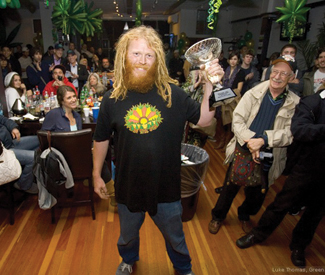
It was clear from the crowd at 847 Lounge that the medical marijuana movement wasn’t going to lose their meds without a fight. Perhaps strangely, the family producers that proudly hoisted their glass, Stanley Cup-looking trophies for best strain and other products still had an air of winning about them.

Survey shows Lee aligned with tenant advocates only half the time

The results of a mayoral candidates’ survey created by the Council of Community Housing Organizations (CCHO) offered some surprises. Based on candidates’ responses, venture capitalist Joanna Rees, one of the more conservative contenders, came across as a stronger advocate for affordable housing and tenants’ rights than interim Mayor Ed Lee, who previously defended tenants as an attorney with the Asian Law Caucus.

The survey posed 25 yes-or-no questions to mayoral hopefuls, formulated by CCHO, the San Francisco Tenants Union, and the Housing Rights Committee. A “Yes” answer meant the candidate was aligned with the housing advocates’ standpoint, a “No” response was frowned upon as contrary to advocates’ housing agenda, and a “?” signified the response, “I’ll consider it.”

All told, Lee responded “No” to six questions, “I’ll consider it” to seven questions, and “Yes” to 12 questions, demonstrating consistency with the housing advocates’ agenda about half the time. Rees, on the other hand, responded “No” to three questions, and “Yes” to every other question.

Other respondents included Public Defender Jeff Adachi, Sup. John Avalos, green party candidate Terry Joan Baum, Board President David Chiu, former Sup. Bevan Dufty, City Attorney Dennis Herrera, and Sen. Leland Yee.

Candidates who answered in the affirmative to every survey question were Avalos, Baum, and Yee. Dufty responded “No” to eight questions, and “I’ll consider it” to one. Chiu responded “Yes” to most questions and “I’ll consider it” to four questions, though there was some confusion as his response wasn’t listed every time.

There you have a summary of the scorecards. So what were the questions?

Every single candidate answered “Yes” to this one: “To make up for the huge State and Federal cutbacks in affordable housing funding, will you commit to placing a dedicated affordable housing funding measure on the November 2012 ballot of at least $100 million?”

So no matter who’s elected, housing advocates will have an opportunity to advance this idea.

Among the more divisive issues was the question of reforming condo conversion laws to regulate tenancies-in-common conversions, in order to stem depletion of affordable housing stock. Lee, Rees, and Dufty responded that they would not seek such reforms; Yee, Avalos, Adachi, and Baum said they would. Herrera declined to answer.

Candidates were also divided on whether the San Francisco Rent Board, which mitigates disputes between tenants and landlords, ought to be reformed to “increase tenant representation and balance appointments between the Mayor and Board of Supervisors?” Yee, Lee, Dufty, and Adachi rejected that idea.

And Lee stood alone in answering “no” to this question: “Will you enforce a balance between market-rate housing and affordable housing that fulfills the City’s adopted housing goals, even if such a linkage slows down the overproduction of luxury condos until a minimum level of affordable and middle income housing catches up?”

All others said they would, except Chiu, who said, “I’ll consider it.”

View the full results of the survey here.

The bad old days

0

tredmond@sfbg.com

Willie L. Brown, according to the Chronicle’s John Cote, is “a tremendously popular figure in the city, viewed by many as an avuncular man-about-town, elder statesman and a uniquely San Franciscan character.” The Ed Lee Story, a hagiographic campaign book, refers to Brown’s “characteristic showmanship and hypnotic charm.” Even Randy Shaw, the housing activist who clashed with Brown over gentrification once upon a time, now says in BeyondChron that Brown’s first term “was the most progressive of any mayor in modern San Francisco history.”

I feel as if I’m living in some sort of strange parallel universe, something out of Orwell or North Korea or the Soviet Union of the 1950s. It’s as if history never happened, as if the years between 1996 and 2004 have just vanished, have been deleted from San Francisco’s collective memory. It’s crazy.

I wonder:

What about the thousands and thousands of people who lost their homes and were tossed out of the city like refugees from a war? What about the rampant corruption at City Hall? What about the legions of unqualified political cronies who got good jobs and commission posts? What about the iron-fisted machine rule that kept local politics closed to all but the loyal insiders? Doesn’t any of that count?

Here are some things that absolutely, undeniable, demonstrably happened while Willie Brown was mayor:

Rents on the East Side of town, particularly in the Mission, tripled and sometimes quadrupled between 1996, when Brown took office, and 2004, when he left. Evictions more than tripled, too, and at one point more than 100 people a month were losing their homes. Most of those people were low-income, long-term tenants. They were forced out because richer people were moving into town during the dot-com boom and could pay more for those apartments. We called it the “Economic Cleansing of San Francisco.”

Every day, it seemed, we’d be out at another rally as the Tenants Union and the Mission Antidisplacement Coalition tried to save another family from the forces of gentrification. Every week, it seemed, another group house full of artists would be served an eviction notice. Everywhere you looked, nonprofits and small businesses were losing space to high-tech companies with plenty of money.

I watched the wrecking crew tear down a studio complex on Bryant Street, forcing more than 100 painters and photographers to leave, to make way for a high-tech office project that was approved even though it violated the local zoning laws — and then was never built. For two years, I walked to get my lunch past the empty hole in the ground that had once been a thriving community.

That was typical. Every developer who waved money in front of the mayor got a building permit, no matter how crazy, illogical or illegal the project was. The Planning Department and the Bureau of Building Inspection were little more than fronts for the lobbyists and Brown cronies who determined development policy in the city.

In October, 1999, the author Paulina Borsook wrote a famous piece in Salon called “How the Internet Ruined San Francisco.” I agreed with the sentiment; the influx of the dot-commers was wrecking all that was cool and weird about the city. But she got one point wrong: The Internet didn’t ruin anything. The Internet was, and is, a technology, a tool, something that, like most technological advances, can be used for good or evil.

Mayor Brown didn’t create the dot-com boom. Although he took credit for an awful lot of things, even Willie didn’t claim to have invented the Internet.

But what he did — and what ruined many San Francisco neighborhoods, and ruined the lives of many San Franciscans — was to let the economic cleansing of the city happen, without raising a finger to slow it down or prevent the evictions or protect the most vulnerable people in the city. Over and over, he encouraged it — by appointing commissioners and supervisors and department heads who allowed evictions and development and displacement in the name of growth and prosperity.

In fact, when reporters from the zine Maximum Rock ‘n’ Roll asked Brown about the problems facing poor people, he told them that the city had become so expensive that poor people would be better off living somewhere else.

Because he didn’t care about poor people, or tenants, or artists, or anyone who lacked money and flash and dazzle and clout. He was the worst kind of imperial mayor.

Here’s how we put in it in our 33rd anniversary issue in 1998:

“Let’s say the next major earthquake that hits San Francisco is of roughly the same magnitude of the Loma Prieta quake of 1989, or maybe just a bit stronger. Let’s say it wipes out right 1,000 houses and leave some 5,000 people homeless … and lets say a few unscrupulous profiteers take advantage of the shortages of critical supplies and charge desperate residents triple the normal rate for food, blankets and drinking water….

“The profiteers, speculators and charlatans would be exposed in the press and roundly, loudly denounced by every political and community leader in the city. The ones who didn’t wind up in jail would be forced to leave town in disgrace.”

Or else they wouldn’t. Because when an economic earthquake ravaged San Francisco during his term, Brown — the most powerful mayor in modern history, a guy who could have had an immense impact on what was happening — went to meet the speculators and profiteers with outstretched arms, welcomed them to the city and partied with them at night.

And when he ran for re-election, they thanked him by funding an astonishing $5 million campaign.

Then there was the corruption. Not only did Brown raise pay-to-play to a new art form, he filled the city payroll and key commissions with campaign workers, former political allies, and cronies, subverting the civil service system and undermining both the function of city agencies and public respect for local government. At least seven Brown appointees were indicted or investigated for criminal misconduct. While sentencing a Housing Authority official to five years in prison, U.S. District Judge Charles Legge decried what he called Third World-style corruption at San Francisco City Hall.

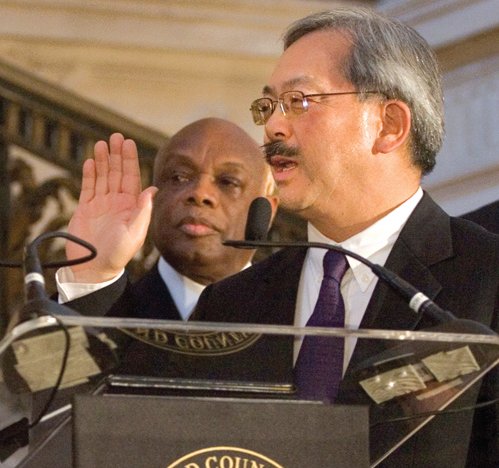
When Mayor Ed Lee, who is now seeking a full four-year term, was asked to give Brown a grade for his eight years in Room 200, Lee said: A-Plus.

Which makes us a little nervous. To say the least.

I’ve been going back through the Guardian archives over the past couple of weeks, picking out some great covers to reproduce (see page 18) and looking at four and a half decades of alternative news coverage of San Francisco. And if there’s one theme that emerges from the stacks and stacks and stacks of papers, it’s that local government matters.

In the 1960s, when the underground press was talking about sex, drugs and dropping out, the Guardian was talking about the ways big corporations were stealing the taxpayers’ money at City Hall. (Okay, the Guardian wrote about sex and drugs too. But sex and drugs and political scandals.)

The difference between the independent alternative press and the underground papers of the era was more than just thematic. The underground publishers were having a great time and celebrating culture, but none of those publications was built to last. From the day they published their first issue in October, 1966, Guardian founders Bruce Brugmann and Jean Dibble intended their paper to become a permanent part of San Francisco.

The Guardian quickly demonstrated that it had a different approach than a lot of the “New Left” — particularly when it came to electoral politics. At a time when some were saying that it made no difference whether Ronald Reagan or Pat Brown won the 1966 governor’s race, the Guardian made the key point about Reagan.

“California cannot afford the luxury of this kind of conservatism,” a Nov. 7, 1966 editorial stated. “Because of the millions of people coming to California, because San Francisco and Los Angeles soon will have the greatest concentration of urban power in history, because farm land and open space is vanishing at a suicidal rate, because technology is putting vast populations out of work, because of the social neglect of our cities and the uglification of our countryside, because we now have the knowledge to bridge the gap between the rich and the poor.”

And while the paper devoted considerable space to reporting on and opposing the war in Vietnam, it was also developing a reputation for local investigative reporting. One June 7, 1971 story showed how the city had all of its short-term deposits in local banks that paid no interest at all. The story parked an investigation by the city’s budget analyst, the resignation of the city treasurer — and a new investment policy that brought the city at least $1 million more revenue a year. (Adjusted for inflation, that’s about $5 million a year, times 40 years is a lot of money that the Guardian brought into the city coffers).

And from the start, the Guardian was a nonpartisan, independent foe of corruption, secrecy and undue influence at City Hall. So while the paper eagerly endorsed Phil Burton (and later his brother, John) for Congress and lauded their antiwar and environmental policies, the Guardian also blasted the Burtons for exercising undue influence back home. The paper strongly endorsed George Moscone for mayor — then denounced him when he fired Harvey Milk from a commission post after Milk had the gall to challenge the Moscone/Burton candidate for state Assembly.

The 1999 Sunshine Ordinance, which dramatically opened up City Hall records, was sponsored and promoted by the Guardian. Willie Brown and his cronies hated it.

It’s probably a misnomer to say that the Burtons, who were a dominant force in local politics in the 1970s and 1980s, ran an old-fashioned machine. They didn’t have the iron control over local politics and the patronage jobs system that the word “machine” implies.

But when Brown became mayor of San Francisco, he had all of that. Brown controlled eight solid votes on the Board of Supervisors (and through various political machinations, had managed to appoint most of them). “He ruled the building,” Assemblymember Tom Ammiano, who was a supervisor during those years, recalled. “If you defied him, you were radioactive.”

And one of the people who rose through the ranks as a loyal Brown appointee was Ed Lee. Who to this day thinks things in that administration were just dandy.


The Lee campaign complains about “guilt by association,” and that’s a legitimate point. Ed Lee isn’t Willie Brown. He’s a lot more open, a lot (a lot) more humble, and as numerous progressives have pointed out to us, his door is open. He doesn’t have the history of sleaze that pretty much defined Brown’s political career.

There will be no “Ed Lee Machine.” In fact, with district elections of supervisors pretty much guaranteeing more diffuse political power in the city, there will never be another mayor able to rule the way Brown did.

And these days, Brown’s clout could easily be overstated. Until he engineered the selection of Ed Lee as mayor, his power seemed to be waning. And even Mayor Lee hasn’t done everything that Brown wanted.

Of course, the Chronicle, which he helped immensely when Hearst Corp. bought the paper and had trouble with federal regulators, has helped Brown by giving him a column that created a new, sanitized persona.

But the important thing about the Brown administration was not so much who was in charge but who benefited. The landlords, the developers, the big corporations got pretty much what they wanted from City Hall. The rest of us got screwed.

And now those same interests — in some cases, the exact same people — who supported, promoted and worked with Willie Brown are backing Lee for mayor. If they thought he was going to be an independent progressive, that money and support wouldn’t be coming in. There are people who miss the machine days — and if they think Ed Lee is their guy, it’s reason to worry.

Corruption matters. When people lose faith in local government because they see the kind of sleaze that was daily business under Brown, then they stop wanting to pay taxes for public services. After all, the mayor is wasting our money already. Lee may be a decent guy — but some of the people he hangs out with, some of the people who are supporting him, have a long and very unpleasant history in this town. And all the time he was sitting there at City Hall, while Brown was running a corrupt operation that did lasting damage, Lee never raised a public finger in protest. I hate to see all the history forgotten when people decide who to support for mayor in November, 2011.

Feds crack down

8

steve@sfbg.com

HERBWISE Reversing its previous pledge to abide people’s rights to legally obtain medical marijuana in California and the 14 other states that have legalized it, the Obama Administration has launched a crackdown on the industry using several different federal agencies.

During an Oct. 7 press conference in Sacramento, California’s four U.S. attorneys announced their intention to go after the industry with raids on large-scale growing operations and big dispensaries and civil lawsuits targeting the assets of people involved in the cannabis business.

“We want to put to rest the notion that large marijuana businesses can shelter themselves under state law,” Melinda Haag, the U.S. attorney for Northern California, based here in San Francisco, said at the press conference.

That pronouncement is just the latest in a series of federal actions against those involved with the production and distribution of California’s top cash crop, an industry that the California Board of Equalization estimates to be worth about $1.3 billion in tax revenue annually. Sources in the medical marijuana business say the crackdown began quietly this summer.

Hundreds of dispensaries and other medical marijuana operations had their bank accounts shut down after the Treasury Department contacted their banks and warned them of sanctions for doing business with an industry that remains illegal under federal law. The Internal Revenue Service last month also notified many large dispensaries — including Harborside Health Center in Oakland, the largest in Northern California — that they cannot write off normal business expenses and must pay a 35 percent levy on those claims going back for three years.

Harborside’s Steve DeAngelo told us that would put Harborside — or any company with high overhead costs — out of business. “This is not an effort to tax us, it’s an effort to tax us out of existence,” he said, noting that Harborside paid the city of Oakland $1.1 million in taxes this year. In addition, the Department of Justice recently began sending 45-day cease-and-desist letters to hundreds of dispensaries around the state, including at least two in San Francisco, warning the clubs and their landlords that the operations violate federal law and could be subject to federal laws on the seizure of assets from the drug trade.

“It’s a multi-agency federal attack on patients’ access to this medication,” DeAngelo said. “It’s going to drive sick and dying patients back out onto the street to get their medicine.”

Haag claimed the state’s medical marijuana laws, which California voters approved back in 1996, have been “hijacked by profiteers.” Yet both local officials and people in the industry say that characterization is ridiculous, and that the federal government’s new stance will destroy an important industry — one that is very professional and well-regulated in San Francisco — and send legitimate patients back into the black market.

“I think it’s a step in the wrong direction and counter-intuitive to the Obama Administration’s contention that he would respect state’s rights,” said Sup. Ross Mirkarimi, who authored groundbreaking legislation regulating San Francisco’s two dozen dispensaries, a system that he said “is working well…But now the federal government is pulling the rug out from under us.”

Shortly after taking office in 2009, the Obama Administration released the “Ogden memo,” written by Deputy Attorney General David Ogden, stating the federal government would respect the rights of states to legalize and regulate medical marijuana. It was seen by cannabis activists as a sign that Obama was de-escalating the war on drugs, at least as it applied to marijuana.

But in June of this year, the DOJ release the “Cole memo,” by Deputy Attorney General James Cole, which it said “clarifies” the Ogden memo. In fact, it reversed the position, stating unequivocally that federal marijuana prohibition prevails and “state laws or local ordinances are not a defense to civil or criminal enforcement of federal law with respect to such conduct.”

“They’re bringing the hammer down,” said David Goldman, who works for Americans for Safe Access and sits on San Francisco’s medical marijuana task force. “This is not U.S. attorneys doing this on their own, this is coming from the top levels of the DOJ.”

Actually, Goldman and others suspect it goes even higher than that, right to Obama and his political team, who appear to be making a calculation that cracking down on medical marijuana is a good move before an uncertain reelection campaign.

“It’s political. It’s all about Obama appealing to the middle to win reelection,” Goldman said.

“I don’t think there’s any rational basis for what’s going on. It was clearly a political calculation,” DeAngelo said. “Why do they think it’s better for patients to buy their medicine from the black market?”

He said the crackdown will bolster the Mexican drug cartels, destroy a thriving industry that provides jobs and pays taxes, hinder efforts at better quality control and growing conditions (see “Green buds,” Aug. 16), and waste law enforcement resources to seize and destroy a valuable commodity.

“It’s a policy with all downsides and no upsides,” DeAngelo said.

Mirkarimi said that this crackdown could finally force cannabis activists to take on the federal prohibition of marijuana directly: “Bottom line, marijuana is the United States needs to be reformed so it’s not a Schedule 1 drug,” referring the federal government’s conclusion that marijuana is a dangerous drug with no medical applications.

But for now, DeAngelo said the industry will fight back: “We will fight it in the legal system, we will fight it in the court of public opinion, and we will appeal to Congress.”

The real Leland Yee

53

tredmond@sfbg.com

It’s early January 2011, and the Four Seas restaurant at Grant and Clay is packed. Everyone who is anyone in Chinatown is there — and for good reason. In a few days, the Board of Supervisors is expected to appoint the city’s first Asian mayor.

The rally is billed as a statement of support for Ed Lee, the mild-mannered bureaucrat and reluctant mayoral hopeful. But that’s not the entire — or even, perhaps, the central — agenda.

Rose Pak, who describes herself as a consultant to the Chinese Chamber of Commerce but who is more widely known as a Chinatown powerbroker, is the host of the event. She stands in front of the room, takes the microphone, and, in Cantonese, delivers a remarkable political speech.

According to people in the audience, she says, in essence, that the community has come out to celebrate and support Ed Lee — but that’s just the start. She also urges them not just to promote their candidate — but to do everything possible to prevent Leland Yee from becoming mayor.

She continues on for several minutes, lambasting Yee, the state Senator who lived in Chinatown as a child, accusing him of about every possible political sin — and turning the Lee rally into an anti-Yee crusade. And nobody in the crowd seems terribly surprised.

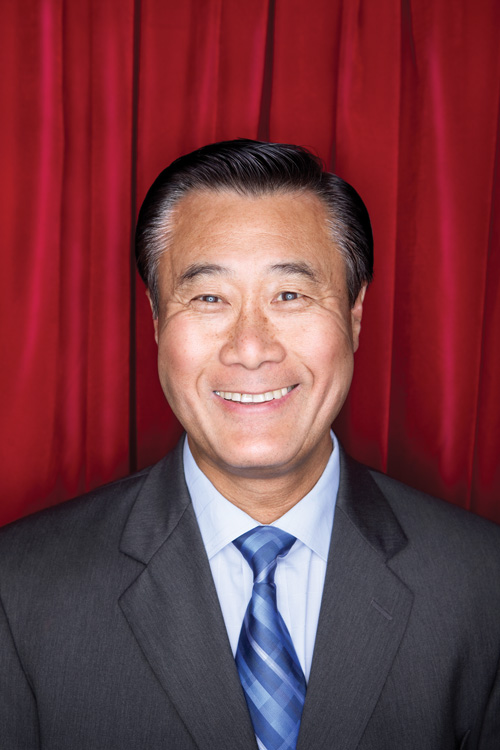
Across Chinatown, from the liberal nonprofits to the conservative Chamber of Commerce, there’s a palpable fear and distrust of the man who for years has been among San Francisco’s most prominent Asian politicians — and who, had Lee not changed his mind and decided to run for a full term this fall, was the odds-on favorite to become the city’s first elected Chinese mayor.

The reasons for that fear are complex and say a lot about the changing politics of Asian San Francisco, the power structure of a city where an old political machine is making a bold bid to recover its lucrative clout — and about the career of Yee himself.

Senator Leland Yee is a political puzzle. He’s a Chinese immigrant who has built a political base almost entirely outside of the traditional Chinatown community. He’s a politician who once represented a deeply conservative district, opposed tenant protections, voted against transgender health benefits and sided with Pacific Gas and Electric Co. on key environmental issues — and now has the support of some of the most progressive organizations in the city. He’s taken large sums of campaign money from some of the worst polluters in California, but gets high marks from the Sierra Club.

His roots are as a fiscal conservative — yet he’s been the only Democrat in Sacramento to reject budget compromises on the grounds that they required too many spending cuts.

He’s grown, changed, and developed his positions over time. Or he’s become an expert at political pandering, telling every group exactly what it wants to hear. He’s the best chance progressives have of keeping the corrupt old political machine out of City Hall — or he’s a chameleon who will be a nightmare for progressive San Francisco.

Or maybe he’s a little bit of all of that.


Leland Yin Yee was born in Taishan, a city in China’s Guangdong province on the South China Sea. The year was 1948; Mao Zedong’s Communist Party of China had taken control of much of the countryside and was moving rapidly to take the major cities. The nationalist army of General Chiang Kai-Shek was falling apart, and Yee’s father, who owned a store, decided it was time for the family to leave.

The Yees made it to Hong Kong, and since Mee G. Yee had previously lived in the United States and served in the U.S. Army during World War II, he was ultimately able to move the family to San Francisco. In 1951, the three-year-old Leland Yee arrived in Chinatown.

For four years, Yee lived with his sister and mother in a one-room apartment with a shared bathroom while his father worked as a sailor in the merchant marine. It was, Yee recalled in a recent interview, a tight, closed, and largely self-sufficient community.

“The movie theater, the shoe store, the barber shop, food — everything you needed you could get in Chinatown,” Yee said. “You never had to leave.”

Of course, after a while, Yee and his mom started to venture out, down Stockton Street to Market, where they’d shop at the Emporium, the venerable department store. “It was like walking into a different country,” he said. “If you didn’t know English, they didn’t have time for you.”

Yee, like a lot of young Chinese immigrants of his era, put much of his time into his studies — in the San Francisco public schools and in a local Chinese school. “My mom spoke a village dialect, and we had to learn Cantonese,” he said. “Every little kid had to go to Chinese school. We hated it.”

When Yee was eight, his parents managed to buy a four-unit building on Dolores Street, and the family moved to the Mission, where he would spend not only the rest of his childhood but much of his early adult life. He graduated from Mission High School, enrolled in City College, studied psychology and after two years won admission to UC Berkeley.

Berkeley in 1968 was a very different world from Chinatown and even the relatively controlled environment he’d experienced at home in the Mission. “You didn’t protest in school. You’d have been sent home, and your mother would kill you,” he said.

At Berekely, all hell was breaking loose, with the antiwar protests, the People’s Park demonstrations, the campaign to create a Third World College (which led to the first Ethnic Studies Department), and a general attitude of mistrust for authority. “I developed a sense of activism,” Yee said. “I realized I could speak out.”

That spirit quickly vanished when Yee lost faith in some of his fellow activists. “People would work with us, then get into positions of power and use that against you,” he recalled. “A lot of my friends said ‘forget it.’ I left the scene.”

Yee once again devoted his energy to school, earning a masters at San Francisco State University and a Ph.D in child psychology from the University of Hawaii. Along the way, he met his wife, Maxine.

With his new degree, the Yees moved back to San Francisco — and back in with his parents at the Dolores property, where he, Maxine and a family that would grow to four kids would live for more than a decade.


Yee worked as a child psychologist for the San Francisco Department of Public Health, starting the city’s first high school mental-health clinic. He went on to become a child psychologist at the Oakland Unified School District, then joined a nonprofit mental health program in San Jose.

In 1986, Yee decided to get active in politics for the first time since college, and ran for the San Francisco School Board. He lost — and that would be the only election he would ever lose. In 1988, he won a seat, and established himself as an advocate for students of color, fighting school closures in minority neighborhoods. He also tried to get the district to modify its harsh disciplinary rules, arguing against mandatory expulsions.

On fiscal issues, though, Yee was a conservative. For his first term, despite the brutal cutbacks of the recession of the late 1980s and early 1990s, he insisted that the district make do with the money it had. His solution to the red ink: Cut waste. Only in 1992, when he was up for re-election, did he acknowledge that the district needed more cash; at that point, he supported a statewide initiative to tax the rich to bring money to the schools.

The sense of fiscal conservatism — of holding the line on taxes, but mandating open and fair contracting procedures and tight financial controls — was a hallmark of much of his political career. When the Guardian endorsed him for re-election to the board in 1992, we wrote that “there’s real value in his continuing vigilance against administrative fat and favoritism in contracts.”

Over the next four years, Yee worked with then-Superintendent Waldemar “Bill” Rojas, a deeply polarizing figure who pushed his own personal theory of “reconstitution” — firing all the staff at low-performing schools — and later was enmeshed in a scandal that led to prison time for a contractor he’d hired. Yee told me he was the only board member to vote against hiring Rojas, but people who were watching the board closely back then say he didn’t always stand up to the superintendent.

He also became what some say was a bit too close with Tim Tronson, a consultant hired by the district as a $1,000-a-day facilities consultant. Tronson wound up getting indicted on 22 counts of grand theft, embezzlement, and conspiracy in a scheme to steal $850,000 from the schools, and was sentenced to four years in state prison.

In 1998, when some school board members wanted to build housing for teachers on property that the district owned in the Sunset, Yee led the opposition — with Tronson’s help. At one meeting at Sunset Elementary School, Yee went so far as to say, according to people present, that “Tim Tronson is my man, and I rely on him for advice.”

Yee acknowledged that he worked closely with Tronson to defeat that housing project. “He was the facilities manager,” Yee explained, “and I said that I trusted his judgment.”


Yee has either a great sense of political timing or exceptional luck. He ran for the Board of Supervisors in 1996, facing one of the weakest fields in modern San Francisco history. He was the only Chinese candidate and one of just two Asians (the other, appointed incumbent Michael Yaki, barely squeaked to re-election). In an at at-large election with the top five winning seats, Yee came in third, with 103,000 votes.

He was never a progressive supervisor. In 2000, the Guardian ranked the good votes of what we referred to as Willie Brown’s Board, and Yee scored only 43 percent. He was against campaign finance reform. He supported the brutal gentrification and community displacement represented by the Bryant Square development. He voted to kill a public-power feasibility study and opposed the Municipal Utility District initiative. He opposed a moratorium on uncontrolled live-work development.

In 2002, Yee was one of only three supervisors to oppose Proposition D, a crucial public-power measure that would have broken up PG&E’s monopoly in the city. He stood with PG&E (and then-Sups. Tony Hall and Gavin Newsom) in opposition to the measure, then signed a pro-PG&E ballot argument packed with PG&E lies.

When I asked him about that stand, Yee at first didn’t recall opposing Prop. D, but then said he “stood with labor” on the issue. In fact, the progressive unions didn’t oppose Prop. D at all; the opposition was led by PG&E’s house union, IBEW Local 1245.

Yee was particularly bad on tenant issues. He not only voted to deny city funding for the Eviction Defense Collaborative, which helped low-income tenants fight evictions; he actually tried to get the city to put up money for a free legal fund to help landlords evict their tenants. He opposed a ballot measure limiting condo conversions. He opposed a measure to limit the ability of landlords to pass improvement costs on to their tenants.

In 2001, Yee voted to uphold a Willie Brown veto of legislation to limit tenancies in common, a backdoor way to get around the city’s condo conversion ordinance. Only Hall and Newsom, then the most conservative supervisors on the board, joined Yee. At one point, he started asking whether the city should consider repealing rent control.

He opposed an affordable housing bond in 2002, joining the big landlord groups in arguing that it would raise property taxes. Every tenant group in town supported the measure, Proposition B; every landlord group opposed it.

I asked Yee about his tenant record, and he told me that he now supports rent control. But he said that he was always on the side of homeowners and small landlords, and that property ownership was central to Chinese culture. “I was responding to the Chinese community and the West Side,” he said.

He wasn’t much of an environmentalist, either — at least not in today’s terms. He was one of the only city officials to support a “Critical Car” rally in 1999, aimed at promoting the rights of vehicle drivers (and by implication, criticizing Critical Mass and the bicycle movement).

His record on LGBT issues was mixed. While he supported a counseling program for queer youth when he was on the school board, he also supported JROTC, angering queer leaders who didn’t want a program in the public schools run by, and used as a recruiting tool for, the military, which at that point open discriminated against gay and lesbian people.


Yee was also one of only two supervisors who voted in 2001 against extending city health benefits to transgender employees.

That was a dramatic moment in local politics. Nine votes were needed to pass the measure, and while eight of the supervisors were in favor, Yee and Hall balked. At one point, Board President Tom Ammiano had to direct the Sheriff’s Office to go roust Sup. Gerardo Sandoval, who was ducking the issue in his office, to provide the crucial ninth vote.

Yee didn’t just vote against the bill. According to one reliable source who was there at the time, Yee spoke to a community meeting out on Ulloa Street in the Sunset and berated his colleagues, quipping that the city should have better things to do than “spend taxpayer money on sex-change operations.”

It was a bit shocking to trans people — Yee had, over the years, befriended some of the most marginalized members of what was already a marginalized community. “There was one person at the rail crying, saying ‘Leland, how could you do this to us,'” Ammiano recalled.

The LGBT community was furious with Yee. “I didn’t speak to him for at least a year,” Gabriel Haaland, one of the city’s most prominent transgender activists, told me.

Yee now says the vote was a mistake — but at the time, he told me, he was under immense pressure. When he voted for the queer youth program, he said, “the elders of the Chinese community ripped me apart. They called my mother’s friends back in the village [where he was born] and said her son was embarrassing the Chinese community.”

That must have been difficult — and he said that “if I had known the pain I had caused, I wouldn’t have voted that way.” But it was hard to miss that pain his vote caused.

On the other hand, people learn from their experiences, attitudes evolve, we all grow up and get smarter, and the way Yee describes it, that’s what happened to him.

In 2006, when he was running for state Senate, Yee met with a group of trans leaders and formally — many now say sincerely — apologized. It was an important gesture that made a lot of his critics feel better about him.

“He didn’t have to do that,” Haaland said. “People change, and he paid for his crime, and that’s genuine enough for me.”

As a former school board member, Yee kept an interest in the schools — but not always a healthy one. At one point, he actually proposed splitting SFUSD into two districts, one on the (poorer) east side of town and one on the (richer) west. “We strongly opposed that,” recalled Margaret Brodkin, who at the time ran Coleman Advocates for Children and Youth. “Eventually he dropped the idea.”

For all the problems, in his time on the Board of Supervisors, Yee developed a reputation for independence from the Brown Machine, which utterly dominated much of city politics in the late 1990s. His weak 43 percent rating on the Guardian scorecard was actually third-best among the supervisors, after Ammiano and the late Sue Bierman.

In 1998, he was one of the leaders in a battle to prevent the owners of Sutro Tower from defying the city’s zoning administrator and placing hundreds of new antennas on Sutro Tower. He, Bierman, and Ammiano were the only supervisors opposing Brown’s crackdown on homeless people in Union Square.

When he ran in the first district elections, in 2000, against two opponents who had Brown’s support and big downtown money, the Guardian endorsed him, noting that while he “can’t be counted on to support worthy legislation … He’s one of only two board members who regularly buck the mayor on the big issues.”

(He never liked district elections, and used to take any opportunity to denounce the system, at times forcing Ammiano to use his position as president to tell Yee to quit dissing the electoral process and get to the point of his speech.)


In 2002, the westside state Assembly district seat opened up, and both Yee and his former school board colleague Dan Kelly ran in the Democratic primary. Yee won, and went on to win the general election with only token opposition.

His legislative record in the Assembly wasn’t terribly distinguished. Yee never chaired a policy committee — although he did win a leadership post as speaker pro tem. And he cast some surprisingly bad votes.

In 2003, for example, then-Assemblymember Mark Leno introduced a bill that would have exempted single-room occupancy hotels from the Ellis Act, which allows landlords to evict tenants for no reason. Yee refused to vote for the bill. Leno was furious — he was one vote short of a majority and Yee’s position would have doomed the bill. At the last minute, a conservative Republican who had grown up in an SRO hotel voted in favor.

When he ran for re-election in 2004, we noted: “What’s Leland Yee doing up in Sacramento? We can’t figure it out — and neither, as far as we can tell, can his colleagues or constituents. He’s introduced almost no significant bills — compared, for example, to Assemblymember Mark Leno’s record, Yee’s is an embarrassment. The only high-profile thing he’s done in the past several years is introduce a bill to urge state and local governments to allow feng shui principles in building codes.”

In 2006, Yee decided to move up to the state Senate, and he won handily, beating a weak opponent (San Mateo County Supervisor and former San Francisco cop Mike Nevin) by almost 2-1. His productivity increased significantly in the upper chamber — and in some ways, he moved to the left. He’s begun to support taxes — particularly, an oil severance tax — and when I’ve questioned him, he somewhat grudgingly admits that Prop. 13 deserves review.

He’s done some awful stuff, like trying to sell off the Cow Palace land to private developers. But he has consistently been one of the best voices in the Legislature on open government, and that’s brought him some national attention.

Yee has been a harsh critic of spending practices and secrecy at the University of California, and when UC Stanislaus refused in 2010 to release the documents that would show how much the school was paying Sarah Palin to speak at a fundraiser, Leland flew into action. He not only blasted the university and introduced legislation to force university foundations to abide by sunshine laws; he worked with two Stanislaus students who had found the contract in a dumpster and made headlines all over the country.

He’s fought for student free speech rights and this year pushed a bill mandating that corporations that get tax breaks for job creation prove that they’ve actually created jobs — or pay the tax money back. He’s also won immense plaudits from youth advocates and criminal justice reformers for his bill that would end life-without-parole sentences for offenders under 18.

Along the way, he compiled a 100 percent voting record from the major labor unions, including the California Nurses Association and SEIU, and with the Sierra Club. All three organizations have endorsed him for mayor.

Yee told me that he thinks he’s become more progressive over the years. “My philosophy has shifted,” he said.

Yet when you talk to his colleagues in Sacramento, including Democrats, they aren’t always happy with him. Yee has a tendency to be a bit of a loner — he’s never chaired a policy committee and in some of the most bitter budget fights, he’s refused to go along with the Democratic majority. Yee insists that he’s taken principled stands, declining to vote for budget bills that include deep service cuts. But the reality in Sacramento is that budget bills have until this year required a two-thirds vote, meaning two or three Republicans have had to accept the deal — and losing a Democratic vote has its cost.

“You have to give up all sorts of things, make terrible compromises, to get even two Republicans,” one legislative insider told me. “When a Democrat goes south, you have to find another Republican, and give up even more.”

In other words: It’s easy to take a principled stand, and make a lot of liberal constituencies happy, when you aren’t really trying to make the state budget work.


I met Rose Pak on a July afternoon at the Chinatown Hilton. She brought along her own loose tea, in a paper package; the waitress, who clearly knew the drill, took it back to the kitchen to brew. Pak and I have not been on the greatest of terms; she’s called the Guardian all kinds of names, and I’ve had my share of critical things to say about her. But on this day, she was polite and even at times charming.

After we got the niceties out of the way (she told me I was unfair to her, and I told her I didn’t like the way she and Willie Brown played politics), we started talking about Yee. And Pak (unlike some people I interviewed for this story) was happy to speak on the record.

She told me Yee had “no moral character.” She told me she couldn’t trust him. She told me a lot of stories and made a lot of allegations that we both knew neither she nor I could ever prove.

Then we got to talking about the politics of Chinatown and Asians in San Francisco, and a lot of the animosity toward Yee became more clear.

For decades, Chinatown and the institutions and people who live and work there have been the political center of the Chinese community. Nonprofits like the Chinatown Community Development Center have trained several generations of community organizers and leaders. The Chinese Chamber of Commerce, the Six Companies, and other business groups have represented the interests of Chinese merchants. And while the various players don’t always get along, there’s a sense of shared political culture.

“In Chinatown,” Gordon Chin, CCDC’s director, likes to say, “it’s all about personal connections.”

There’s a lively infrastructure of community-service programs, some of which get city money. There’s also a sense that any mayor or supervisor who wants to work with the Chinese community needs to at least touch base with the Chinatown establishment.

Yee doesn’t do that. “He doesn’t give a shit about them,” David Looman, a political consultant who has worked with many Chinese candidates over the years, told me.

Yee’s Asian political base is outside of Chinatown; he told me he sees himself representing more of the Chinese population of the Sunset and Richmond and the growing Asian community in Visitacion Valley and Bayview.

Pak is connected closely to Brown, who Yee often clashed with. For Pak, Brown, and their allies, strong connections to City Hall mean lucrative lobbying deals and public attention to the needs of Chinatown businesses. Then there’s the nonprofit sector.

CCDC and other nonprofits do important, sometimes crucial work, building and maintaining affordable housing, taking care of seniors, fighting for workers rights, and protecting the community safety net. Yee, Pak said, “has never shown any interest in our local nonprofits. We all work together here, and he doesn’t seem to care what we do.” Yee told me he has no desire to see funding cut for any critical social services in any part of town. But he has also made no secret of the fact that he questions the current model of delivering city services through a large network of nonprofits, some of which get millions of taxpayer dollars. And the way Pak sees it, all of that — the nonprofits, the business benefits, the contracts — are all at risk. “If Leland Yee is elected mayor,” she told me, “we are all dead.”

I ran into an old San Francisco political figure the other day, a man who has been around since the 1970s, inside and outside of City Hall, who remains an astute observer of the players and the power relationships in the local scene. At the time we talked, he wasn’t supporting any of the mayoral candidates, but he had a thought for me. “This town,” he said, “is being taken over by a syndicate. Willie Brown is the CEO, and Rose Pak is the COO, and it’s all about money and influence.”

That’s not a pleasant thought — I’ve lived through the era of political machine dominance in this town, and it was awful. In the days when Brown ran San Francisco, politics was a tightly controlled operation; only a small number of people managed to get elected to office without the support of the machine. Developers made land-use policy; gentrification and displacement were rampant; corruption at City Hall turned a lot of San Franciscans off, not only to the political process but to the whole notion that government could be a positive force in society.

A few years ago, I thought those days were over — and to a certain extent, district elections will always make machine politics more difficult. But when I see signs of the syndicate popping up — and I see a candidate like Ed Lee, who’s close friends with Brown, leading the Mayor’s Race — it makes me nervous. And for all his obvious flaws, at least Leland Yee isn’t part of that particular operation. If there’s a better reason to vote for him, I don’t know what it is.

YEE HOME PURCHASE RAISES SUSPICIONS

Rose Pak has a question about Leland Yee. “How,” she asked me, “did the guy manage to buy a million-dollar house on a $30,000 City Hall salary?”

Pak isn’t the only one asking — numerous media reports over the years have examined how Yee raised a family of four and bought a house in the Sunset on very little visible income. And while I’m not usually that interested in the personal finances of political candidates, I decided that it was worth a look.

Here’s what I found: Public records show that in July 1999, Yee and his wife, Maxine, purchased a house on 24th Avenue for $875,000 (it’s now assessed at slightly more than $1 million). At the time, Yee was a San Francisco supervisor, earning a little more than $30,000 a year. (The salary of the supervisors was raised dramatically shortly after Yee left the board and went to the state Assembly.) His wife wasn’t working. And his economic interest statements for that period show no other outside earnings. So the disposable, after-tax income of the entire Yee family couldn’t have been much more than $25,000.

That, by any normal standard, shouldn’t have been enough to float a mortgage that, records show, totaled $516,000. In fact, the interest payments alone on that mortgage alone would total $3,600 a month — more than Yee’s gross income.

Documents in the Assessor’s Office show another paper trail, too. In 1989, Jung H. Lee, Yee’s mother, transferred the deed on a four-unit Dolores St. building where the family had been living to Maxine and Leland Yee — for no money. And a few months before the Yees bought the Sunset house, they took out a $320,000 home-equity loan on that property. That was the down payment on the Sunset property.

Still: At that point, the Yees would have been paying off two mortgages, with a total nut of about $5,000 a month — and supporting four kids, in San Francisco. In 2002, Yee’s economic interest statement’s show some modest income from teaching at Lincoln University — but nowhere near enough to pay that level of expenses.

What happened? Yee explains it this way: “For more than 10 years, we were living rent-free in my parents’ property,” he told me I an interview. “We were a close Chinese family, and my parents provided the food and helped pay for the children’s clothing. So we had almost no expenses and we lived very frugally.”

During that period, Yee was working for the San Francisco Department of Public Health, the Oakland Unified School District, and a San Jose nonprofit, earning, he said, between $50,000 and $90,000 a year. If he saved almost all of that money, he would have had more than a half-million dollars in the bank when he bought the Sunset house.

There’s nothing on any of his economic disclosure forms showing any ownership of stocks or other reportable financial interests during that period, so he wasn’t investing the money. In fact, he says, it was, and is, all in simple savings accounts. A bit unusual for that large a sum of money.

How did he get a mortgage? “Back then,” he said, “banks were willing to lend a lot more freely than they do today.”

Starting in 2003, Yee was in the state Assembly, making a higher salary — but still not much in excess of $100,000 a year. After taxes, he was probably taking home about $75,000 — and $60,000 was going to the two mortgages.

How did he do it? “We have been supplementing our income with our savings,” he said. “We don’t take vacations, we are very careful with our money.” And they clearly aren’t desperate for cash — Yee’s daughter occupies two of the four units in the Dolores St. building they own, but the other two units are vacant.

It’s possible. It’s plausible. But I don’t blame people for wondering how he managed to pull it off. (Tim Redmond, with research assistance by Oona Robertson) 


BIG CORPORATIONS HAVE BACKED YEE

Yee became a prodigious fundraiser in Sacramento — and a lot of the money came from big corporations that had business in the Legislature. And while he has perfect scores from the Sierra Club and the big labor unions, he’s taken tens of thousands of dollars from some of the biggest corporations, agribusiness interests, and polluters in the state. And at times, he’s voted their way.

Since 1993, for example, campaign finance records show Yee has taken more than $20,000 from Chevron, ExxonMobil, Valero, Conoco Phillips, and BP. He’s received another $22,450 from the chemical industry (and industry employees). Most of it came from Clorox, Dow Chemical, and Dupont.

And while the Sierra Club may not have considered it a priority, Sen. Mark Leno has worked hard to pass a bill limiting chemical fire retardants in furniture. In 2008, Yee voted against Leno’s AB 706.

That year he also refused to support a bill that would prohibit the use of the chemical diacetyl in workplaces. The industries that opposed AB 514 (including Bayer, Abbott Laboratories, Pfizer, and Johnson & Johnson) have given Yee a total of more than $60,000.

In 2003, Yee voted against a crucial tenant bill, one that would have prevented the owners of single room occupancy hotels from using the Ellis Act to evict tenants. He received a campaign check for $2,500 from the San Francisco Apartment Association the next day. Landlords in general have given Yee close to $40,000.

Then there’s agribusiness. Yee gets a lot of money from the farming industry, despite the fact that there obviously aren’t many farms in his district. Why, for example, would the California Poultry Association, the California Cattlemen’s Association, and the California Farm Bureau give him money? The Poultry Association’s Bill Mattos told us that Yee “has taken a keen interest in California’s poultry industry.”

Yee also took immense flak from the San Francisco Chronicle and other papers over a 2003 vote against a bill to limit emissions from farm vehicles. In an editorial, the paper wrote that he was “doing dirty work for the lobbyists.” In the end, under immense public pressure, he switched positions and voted for the bill. I asked Yee about all that money from all those bad operators, and he told me — as most politicians will — that campaign cash has never influenced any of his votes.

So why do all these groups give him money? “It’s about whether you will sit down and listen,” Yee said. “I will talk to all sides and at least consider the arguments as a thoughtful human being. Then I vote my conscience.” (Tim Redmond, with research by Oona Robertson) 

What will the judges do?

1

Presiding judge Katherine Feinstein is being forced to cut radically the Superior Court staff in the wake of more state budget cuts. It’s a serious problem — among other things, the cuts will allow landlords to evict tenants on a fast track, but won’t allow tenants to sue landlords on the same timeline. But the whole thing raises another interesting question: What are they going to do with all the judges?


San Francisco has 51 Superior Court judges — and if half the courtrooms are going to be essentially shut down, what will all those people do all day? You can’t run a courtroom without staff; at the very least, for any real judicial work to go forward, there has to be a court reporter to create a legal record. So a lot of the wheels of justice will simply grind to a halt.


You can’t lay off judges, of course — they’re elected officials. So they have to go to work every day and get paid. For what?


Well, I asked Ann Donlan, a spokesperson for Judge Feinstein (who, by the way, sounds just like her mother — it’s uncanny), she agreed it was an issue. “It will be Judge Feinstein’s job to keep them busy,” she said.


And no, they won’t be sitting around watching videos to learn about judicial demeanor.


For starters, 11 court commissioners who are getting laid off will have to be replaced — and that means full-on Superior Court judges will be handling drug court, the community justice center, even — yes — traffic court. This is typically stuff that’s considered below the pay grade of the men and women in black robes, but hey: Someone’s got to do it. “We may have to double up some judges in courtrooms,” Donlan said (and I wonder how that will work out).


Feinstein is hoping that the judges can spend a lot of time in chambers, trying to meet with litigants and settle cases. And I suspect some people (particularly plaintiffs) are going to be much more ready to settle, since it may be five or more years before a case can go to trial. Defendants, on the other hand, may be happy to wait it out; they get to keep their money for five years or more. So I don’t know how much settling is really going to go on.


I dunno; I bet someone’s going to making money selling golf shoes over at 400 McAllister.

Deep court cuts favor landlords over tenants

37

When I read about the latest manifestation of California’s voluntary descent toward Third World status – in this case, the defunding of San Francisco’s civil court system thanks to the deep state budget cuts caused by Republicans – in this morning’s SF Chronicle, I tried to fight through my despair and search for a silver lining.

“With a few exceptions, only criminal cases will go to trial,” the article said, listing those exceptions as mostly family law cases, such as child abuse and neglect and domestic violence.

Hmmm, I thought, is there a way for the average San Franciscan to somehow benefit from this virtual shutdown of our justice system? Then, we at the Guardian had an idea: in a city where two-thirds of residents are renters, perhaps a civil court system that will now take years to get a hearing would be a boon to those contesting eviction proceedings.

Yay, we thought, free rent! And given that it’s mostly the property-owning class that has caused this decimation of basic government services, people who have benefited mightily by having Prop. 13 keep their property taxes artificially low but still block other efforts to increase tax revenues, there seemed to be a certain poetic justice in the possibility that the courts would stop helping them evict their tenants.

So I called San Francisco Tenants Union Director Ted Gullicksen to run our idea past him and find out if we were onto something, but he doused the idea with a bucket of ice-cold reality. It turns out that evictions will continue to move rapidly through the otherwise gutted civil court system (as I would have learned from the Bay Citizen article on the issue).

“Unfortunately, tenants and criminals are being fast tracked,” he told us. And it gets even worse than that because while landlords will still be able to demand action on their evictions within five days, tenants will find years-long delays when they seek justice from landlords acting illegally or unfairly. “While they will move quickly on evictions, they will move slowly on wrongful eviction lawsuits,” Gullicksen said.

Ann Donlan, spokesperson for the San Francisco Superior Court, told us that eviction proceedings will still move quickly because “it’s a statutory requirement.” But, I asked her, as a matter of fairness and equity, why the courts will still delay wrongful eviction suits for years, even though they often deal with the same set of facts as the eviction cases? Doesn’t that bias the courts toward landlords? She told me to please submit my question in writing and she’ll try to get me an answer.

But there really aren’t any good answers to the gross inequities that these deep cuts will cause in the court system, with a 40 percent overall cut being disproportionately focused on the civil side of the equation.

“This is pretty heavy duty,” attorney Stephen Sommers, who handles wrongful termination, civil rights, and other cases on behalf of the little guy. He said many businesses in San Francisco already wantonly disregard their employees’ rights. “They feel like they can get away with murder and now they’ll be highly incentivized to continue that.”

Attorneys facing five-year waits for a trial will be less likely to handle cases on contingent for poor plaintiffs, he said, and people in positions of power of all kind will be more likely to abuse their authority in myriad ways, knowing that their victims will have far less recourse in the courts.

“It’s going to be the wild west out there,” he said. “I wonder, if people can’t turn to the courts, whether they’ll take matters into their own hands and the crime rate will go up.”

But if there is any silver lining for the powerless at all, Gullicksen said the powerful will also find less recourse in an overwhelmed court system. So he suggested, “It might be a good time for a citywide rent strike because they don’t have many resources in the court system anymore.”

Don’t undo ballot measures

0

EDITORIAL The California initiative process is broken. The state’s too big, and it costs too much to gather signatures and mount a media campaign for or against a ballot measure.

But in San Francisco, the initiative process has traditionally been, and for the most part continues to be, a check on corrupt or ineffective political leaders and a chance for progressive reforms that can’t make it through City Hall. That’s why Sup. Scott Wiener’s proposal to allow the supervisors to amend (or, in theory, abolish) laws passed by the voters is a bad idea.

Since 1968, the San Francisco voters have approved 96 ordinances; that’s an average of about two a year. Obviously the pace has picked up since the 1970s. In 2008, there were eight measures approved; in 2010 there were four. The length and complexity of the ballot makes it appear that the supervisors aren’t doing their work, Wiener says. He notes that when he was campaigning, one of the most common complaints was that the voters were being asked to decide too many things that should have been handled at City Hall.

Some of that is the result of an unwieldy City Charter. Benefits for police and firefighters, for example, are specified in the charter, and any change needs voter approval. Wiener’s measure, aimed only at initiatives and not charter amendments, wouldn’t change that situation.

But some of it relates to the political alignments in San Francisco. For much of the past decade, the supervisors and the mayor were at odds over major issues. The mayor couldn’t get his (bad) proposals, like a ban on sitting on the sidewalks, through the board, and the progressives couldn’t get their proposals past a mayoral veto. So both sides went directly to the voters.

That’s a lot better than the paralysis we’re seeing in Sacramento. At least the issues are getting decided.

And over the years, some of the most important legislation in San Francisco — growth controls, tenant protections, protections for children’s programs, the city’s landmark open-government law — has come through ballot initiatives. The only way public power advocates have been able to get the issue on the agenda has been through ballot initiatives.

Those were issues that generations of supervisors and mayors wouldn’t take on — the developers and landlords and secrecy lobbyists and Pacific Gas and Electric Co. had too much power at City Hall. And those protections for the public, the environment, and the most vulnerable residents only survive today because they’re set in law and can’t easily be changed.

If Wiener’s measure has been in effect a decade ago, for example, Proposition M — the 1986 law that set neighborhood planning priorities and limits on office development, would have been summarily scrapped by Mayor Willie Brown and a pro-developer board. Key rent-control laws would have been repealed or amended to death. The ban on buildings that cast shadows on parks would be gone. Killing the Sunshine Ordinance would have been Brown’s first act.

Today’s district-elected board is far more accountable to the voters — but there’s hardly a reliable progressive majority. And the point of ballot initiatives is that you can’t predict who will control City Hall next year, or in 10 years.

We don’t think the initiative process in San Francisco is out of control. Sure, big money wins the day too often — but on balance, it’s a check that the Board of Supervisors should leave alone.

Editorial: Don’t undo ballot measures

3


The California initiative process is broken. The state’s too big, and it costs too much to gather signatures and mount a media campaign for or against a ballot measure.

But in San Francisco, the initiative process has traditionally been, and for the most part continues to be, a check on corrupt or ineffective political leaders and a chance for progressive reforms that can’t make it through City Hall. That’s why Sup. Scott Wiener’s proposal to allow the supervisors to amend (or, in theory, abolish) laws passed by the voters is a bad idea.

Since 1968, the San Francisco voters have approved 96 ordinances; that’s an average of about two a year. Obviously the pace has picked up since the 1970s. In 2008, there were eight measures approved; in 2010 there were four. The length and complexity of the ballot makes it appear that the supervisors aren’t doing their work, Wiener says. He notes that when he was campaigning, one of the most common complaints was that the voters were being asked to decide too many things that should have been handled at City Hall.

Some of that is the result of an unwieldy City Charter. Benefits for police and firefighters, for example, are specified in the charter, and any change needs voter approval. Wiener’s measure, aimed only at initiatives and not charter amendments, wouldn’t change that situation.

But some of it relates to the political alignments in San Francisco. For much of the past decade, the supervisors and the mayor were at odds over major issues. The mayor couldn’t get his (bad) proposals, like a ban on sitting on the sidewalks, through the board, and the progressives couldn’t get their proposals past a mayoral veto. So both sides went directly to the voters.

That’s a lot better than the paralysis we’re seeing in Sacramento. At least the issues are getting decided.

And over the years, some of the most important legislation in San Francisco — growth controls, tenant protections, protections for children’s programs, the city’s landmark open-government law — has come through ballot initiatives. The only way public power advocates have been able to get the issue on the agenda has been through ballot initiatives.

Those were issues that generations of supervisors and mayors wouldn’t take on — the developers and landlords and secrecy lobbyists and Pacific Gas and Electric Co. had too much power at City Hall. And those protections for the public, the environment, and the most vulnerable residents only survive today because they’re set in law and can’t easily be changed.

If Wiener’s measure has been in effect a decade ago, for example, Proposition M — the 1986 law that set neighborhood planning priorities and limits on office development, would have been summarily scrapped by Mayor Willie Brown and a pro-developer board. Key rent-control laws would have been repealed or amended to death. The ban on buildings that cast shadows on parks would be gone. Killing the Sunshine Ordinance would have been Brown’s first act.

Today’s district-elected board is far more accountable to the voters — but there’s hardly a reliable progressive majority. And the point of ballot initiatives is that you can’t predict who will control City Hall next year, or in 10 years.

We don’t think the initiative process in San Francisco is out of control. Sure, big money wins the day too often — but on balance, it’s a check that the Board of Supervisors should leave alone.


The problem with the yellow pages

5


Editors note: We ran an opinion piece this week opposing Sup. David Chiu’s proposal to limit delivery of yellow pages phone books. It’s gotten a lot of comments. Chiu asked if his supporters could respond.


By Michelle Myers and Janet Pomeroy
 
Tired of getting stacks of yellow pages books delivered to your front steps every year when you didn’t ask for them? Most people are.
 
Phone companies distribute 1.6 million phone book directories in San Francisco every year, which is two for every man, woman and child – producing 3,600 tons of waste annually, and costing residents as much as $1 million dollars a year. There are approximately 350,000 residential units in San Francisco and 80,000 businesses. If we had a single phone book in every home and office we would only need a third of what is currently being produced. That doesn’t even take into account the fact that many individuals no longer use the yellow pages to get information, and non-English language speakers don’t use the English print directory.
 
Does anyone in San Francisco need two five-pound yellow pages phone books delivered every year? No. So why does the industry do this? According to the Green Chamber of Commerce and independent research, the companies do it to pump up ad sales, which are based on inflated circulation numbers.
 
San Francisco’s attempt to restrict the mass over distribution of yellow pages, and to force an honest look at the industry, marks some of the most important environmental legislation of the last several years.
 
Supervisor David Chiu’s Yellow Pages legislation is supported by the Sierra Club, Rain Forest Action Network, The Green Chamber of Commerce, the Product Stewardship
Institute, Californians Against Waste, Senior Action Network, numerous small businesses, the San Francisco Small Business Commission, homeowners, tenants, and landlords.
 
The San Francisco city economist did an independent economic impact analysis of the legislation and found that this pilot program was good for business, good for the environment and would create 111 jobs while pumping $12 million dollars back into the local economy. The legislation is considered a no-brainer by serious economists, climate change experts and environmentalists who have examined it.
 
If you oppose this simple legislation, you are inviting a major corporation to come in, dump garbage on our front steps, and then volunteer to pay for the clean up. The financial loss of cleaning up over produced yellow pages is passed down to the residents and businesses of the city. And since the yellow pages are not produced locally the majority of the economic benefit of this industry accrues elsewhere.
 
The legislation will create a three year pilot program to reduce the waste of unwanted yellow page phone books. Under this legislation, anyone who wants a yellow page book can get one — but those who don’t want one won’t be responsible for the disposal of the books. Because this innovative and historic legislation is being set up as a test pilot for the nation, if San Franciscans see any negative impact we can adjust the program or end it altogether.
 
The paper industry is a massive polluter. It is the single largest consumer of water, has a toxic by-product, destroys trees we need to absorb carbon, and is the fourth largest manufacturing source of carbon dioxide in the United States. If we only distributed half as many yellow pages in San Francisco – to the people who actually need and want them — we would save 6,180 metric tons of carbon dioxide emissions each year.
 
Rather than being a good steward of the environment, the yellow page industry is producing far beyond the demand for their product. The companies do this as a way of inflating the amount they charge to the businesses that advertise with them. Today, this business model is wasteful and unnecessary. It is time to demand that these paper directories are only distributed to the people that want and need them.


Michelle Myers is with the Sierra Club and Janet Pomeroy is with the Green Chamber of Commerce.

Editor’s notes

8

tredmond@sfbg.com

I’m tired of stories about poor San Francisco landlords. Because residential landlords in San Francisco have a great gig — and almost none have any right to complain about it.

The latest tale appeared in The New York Times May 1, with a longer version in the Bay Citizen the same day. It involves Wayne Koniuk, who owns a building on Divisadero Street. He has a shop where he makes prosthetic devices and two units upstairs.

Koniuk inherited the building from his father. He cleared out one of the units and moved in one of his sons. Now he wants to evict the tenant in the remaining unit — Robert Murphy, a senior citizen and retired union worker living on a fixed income — so he can move in his other son. Turns out that’s not easy. Koniuk is upset, and the Times presents his case: after all, Koniuk owns the building. Why can’t his children live there?

It’s an interesting question that drives a lot of passions in this town (the Bay Citizen has almost 100 comments on the story; my blog post on the subject has 65). And it gets to the heart of what rent control and regulations on property and land use are about.

See, by law — and public policy — the fact that Koniuk owns the building and Murphy rents is largely irrelevant. A long-term tenant in a protected class (in this case, someone over 60) who pays the rent on time every month and has created no nuisance has a right to stay there, except in limited circumstances. Yes, that’s an infringement on the “ownership” right of the landlord — but those rights are already strictly limited. I own a house — but not the right to demolish it, or the right to build a second unit in the basement and rent it out, or the right to add three stories to the top, or the right to turn it into a gas station or a Burger King. I knew those things when I bought the place — and if I didn’t, I should have. In San Francisco — a dense city with tight zoning laws and a legally certified housing crisis — property owners have limited rights.

They also have low property taxes (under Prop. 13), and the value of their investments keeps rising. Not a bad deal at all.

When you buy, or inherit, a building with a tenant who qualifies for protection under the city’s Rent Stabilization Ordinance, you don’t have the right to raise the rent more than a certain percentage every year. And you don’t have the right to evict the person, except for what the law calls just cause. (Just cause, by the way, typically does allow eviction to move in a relative — but it’s harder if you’ve already done one such eviction and if the tenant is a senior or disabled.)

Koniuk has a place to live (in Belmont); both his sons have places to live. They are, by definition, better off than Murphy, who is facing the prospect of no place to live at all. I’m not shedding any tears for the poor landlord. 


The myth of the poor landlord

112

Early in my career at the Guardian, Bruce Brugmann, the editor, warned me about certain kinds of stories. “You know,” he said, “you can always find a welfare cheat.” It’s true: if you look hard enough, you can always find someone, somewhere, who’s getting an extra welfare check or scamming the system for a few bucks — and if that’s what you write about, you start to give the impression that everyone’s cheating on welfare, and that maybe we ought to crack down on the thieving bastards.


But the problem with welfare isn’t the handful of cheats — it’s the fact that most deserving people can’t get enough money to live on. And there are far more, bigger cheaters in the executive suites.


I thought about that when I read Elizabeth Lesly Stevens’ story in the Bay Citizen about poor Wayne Koniuk.


Listen:


By trade, Koniuk fashions artificial limbs for amputees. By habit, he fits prostheses at no charge for people who cannot pay. This has left him a less-than-wealthy man.


But he does have one substantial asset: a Divisadero Street building that his father, Walter, an orthotist, bought in 1970 and gave to his only son in 2001 so Wayne could run his business on the ground floor and Wayne’s adult children would always have a place to live.


For eternity,” Koniuk recalls his father saying, “my grandkids will always have a place they can go. No matter whatever happens, that building should stay in the family.”


A small problem has come up: Koniuk wants to evict his longtime tenant so his 24-year-old son can have the apartment. And since the tenant is over 60 — and has done nothing wrong, paid his rent on time and been well behaved for roughly 30 years — it’s not easy to get rid of him.


Koniuk, who himself lives in suburban Belmont, gave a half-interest in the building to his older son in 2007 so he could evict a tenant and move in himself. But under San Francisco’s extraordinarily pro-tenant housing laws, landlords can do this only once per building. 


I like that: extraordinarily pro-tenant housing laws.


The sob story of the poor landlord even registered with Sup. Ross Mirkarimi, who has never once voted against single piece of pro-tenant legislation:


Vacancy rates are going up because owners have decided to take their units off the market,” said Ross Mirkarimi, a progressive member of the Board of Supervisors. He attributes that response to “peaking frustrations in dealing with the range of laws that protect tenants in San Francisco that make it difficult for small property owners to thrive.”


Well: Where do I start?


Maybe with the obvious: San Francisco is, overall, an extraordinarily tough place to be a tenant right now — and an extraordinarily excellent place to be a landlord. Between soaring rents and Prop. 13, virtually anyone who owns rental housing in this city is doing well. The pitiful tales of the poor broke landlord who can’t afford the upkeep are, frankly, mostly tales. I have heard hundreds of them over the years. In every single case, it turns out the landlord was a lot better off than he or she claimed.


There’s a good reason for that: San Francisco residential property is immensely valuable. The city’s only 49 square miles, most of it is built up, and almost nobody’s building new rental housing. Yeah, there are dips, but over the past 50 years, property values have gone in only one direction — and thanks to Prop. 13, if you bought the building more than a week ago, your taxes are less than what they ought to be.


There are, indeed, tenants who pay less than market rent, mostly people who have lived in their apartments for a long time and have been protected by rent control — and have somehow avoided the fate that awaits Koniak’s tenant, Robert Murphy, which is eviction.


Murphy pays “only” $525 a month, which seems like nothing compared to the $2,000 or more that Koniuk could probably get for the unit today. But keep in mind: That rent was set 30 years ago, when it was more than adequate to cover his share of the landlord’s mortgage, property taxes and maintenance. When Koniak’s dad bought the place, the building was worth a fraction of its current value. I’m pretty sure the mortgage payments didn’t go up (not as many variable-rate deals back then) — and the property taxes are essentially frozen under Prop. 13. Why should Murphy’s rent go up?


That’s the whole idea of rent control — not to deny landlords a reasonable rate of return on their investments, but to ensure that tenants aren’t punished if property values soar out of control.


And let’s remember: Koniuk didn’t pay a penny for the place — he inherited it from his dad. And he owns it free and clear; he confirmed to me when we talked that the original mortgage was paid off long ago. He complained about the cost of maintenance, but read the story carefully — he gave one of the units to his son, which was lovely but was also his choice. He could have been getting rent from that unit if he wanted more maintenance money. By moving your kids into a building, you become in essence a single-family homeowner. When I have to do maintenance on my house, it comes out of my pocket. That’s just how it is.


And Stevens’ line about Koniuk being a “less than wealthy man” seems a bit of a stretch. He owns a home in Belmont. He owns (free and clear) a building in the city worth well over $1 million. His mother owns another rental building just down the street, as well as a home in the Sunset. “Over the years,” he told me, “my dad bought up properties in the city, and fixed them up and sold them or gave them to his kids.”


And why does he need to evict Murphy? Because, he told me, his son, who is now 24, has moved out of the family home, and Koniuk is paying $1,200 a month to cover his son’s rent. If he could just get more money out of Murphy, he said, he wouldn’t evict him — “I could just use that money to pay my son’s rent someplace else.”


Well: Good for Mr. Koniuk, paying his 24-year-old son’s rent. Again, though, it’s a choice — my parents didn’t pay my rent when I was 24. Most parents don’t. I’m glad this not-wealthy landlord feels he can afford it — but that doesn’t mean a 30-year tenant, a retired union worker who is living on a fixed income, should lose his home.


There’s a fundamental misunderstanding in all of this about the relations between a tenant and landlord and how rental housing is, and should be, treated in San Francisco. I’ll give you my bias, first: I believe that in a city with a world-class housing crisis, and that’s San Francisco, housing should be regulated like a public utility. Landlords should be allowed a reasonable rate of return on their investment, but should not be allowed speculative profit — and should have no financial incentive to evict long-term tenants.


That’s impossible thanks to state law, which bars rent controls on vacant apartments and allows landlords to evict tenants whenever they want and sell the units as tenancies in common, or backdoor condos.


So the best we can do is use the regulatory powers that we have — and they ought to start with the notion (well established in law, and not just in San Francisco) that a tenant who pays rent on time and creates no nuisance has as much right to his unit as the landlord does. It ought to be okay for people to rent apartments and live in them for 30 or 40 years — and know, just as homeowners do, what the monthly nut will be when they retire.


I feel bad for Wayne Koniuk, who seems like a nice guy and a good human being. I feel much worse for his tenant, who is decidedly NOT rich and will have a huge burden paying market rent in this city right now. In fact, if he’s evicted, I don’t know where he’s ever going to find a place to live. He certainly won’t find a comparable place.


Now onto the claim that landlords are holding units vacant because they don’t like tenant-protection laws. First, if that’s true, in this city, and this market, right now, it ought to be a crime — it’s like a store withholding food and water from local residents after an earthquake because it might be more valuable later. The city has the right in a housing emergency to make laws strongly discouraging landlords from keeping housing vacant. The Rent Board ought to study this, and the supervisors ought to act. At the very least, the city ought to have a special tax on vacant residential units.


But I’m not entirely sure how much of that is really going on. Ted Gullicksen at the San Francisco Tenants Union told me it’s pretty rare: “That’s always been a big myth that the property owners put out.” he said. (I remember in the early days of rent control, when landlords insisted that nobody would ever build new rental housing in a city with rent control laws. So San Francisco exempted all new housing from rent control. Didn’t make a damn bit of difference; nobody builds rental housing anyway, because condos are more profitable.)


Stevens, who was very nice and polite when I called her and is a professional reporter who has done some excellent work, told me she didn’t want to talk to me for the record but would be glad to respond to comments on the Bay Citizen website. She pointed to a map of census data showing vacant buildings in San Francisco.


Gullicksen says his read of the data shows that most of the vacant units tend to be unsold condos; the highest concentration is in the Soma/South Beach area where the new condos have been built (and it’s no secret that a lot of them are vacant).


Check it out for yourself. The map function isn’t easy to use, but unless I’m reading the data wrong, the census tract with the most vacant housing is in the Mission Bay area, and the tracts that cover the Mission, the Haight and other tenant-heavy areas have a much smaller percentage of vacancies.


Now, there probably are landlords who keep units vacant; as I say, that ought to be a crime, but it isn’t. But it’s a bid odd for Ross Mirkarimi to talk about this situation the way Stevens quoted him, particularly his line about laws that “make it difficult for small property owners to thrive.”


Mirkarimi told me that he got involved in the case because Koniuk is “a constituent.” (So, by the way, is Murphy.) He reminded me that he’s been one of the best pro-tenant votes on the board (absolutely true). And he told me, for the record, very clearly, that he does NOT favor any relaxation of tenant laws or changes in the restrictions on owner-move-in evictions. “I would never want to change the protections for tenants against evictions,” he said.


I reminded him of the bottom line: Small property owners in San Francisco ARE thriving. The vast majority are doing far better financially than their tenants. This myth of the poor starving property owner with the rich greedy tenants is, frankly, so much horsepucky it’s hard to hear it without screaming.


In the comments section of the story, Stevens goes further on her interview with Mirkarimi:


Mr. Koniuk showed Mr. Mirkarimi the letter demanding $70,000. Mr. Koniuk had offered $45,000. (TBC also has a copy of the letter, and I spoke with the attorney who wrote it). When speaking with me, Mr. Mirkarimi said that “my jaw dropped” when he read the letter. “That letter is negotiated extortion, legitimized,” he said, by the tenant/landlord laws as they have evolved in SF. The Koniuk episode “revealed how greed or special interest can shift [power] to the other [tenant] side.”


Mirkarimi and I went back and forth on this for a while, and in the end, he told me that the statements in the Bay Citizen story “do not reflect my views or my record.” I think that’s true; I think he just got caught up in this one story of this one guy with a situation that isn’t at all the way it looks at first.


I mean, “extortion?” Seriously? What’s wrong with Murphy asking for $70,000 to move out? I don’t think that’s anywhere near enough. As another commenter noted:


You portray the tenant as “greedy” for asking for $70k but is it fair to do so without also stating the fair market value of the property? $70k on a building worth 2 million doesn’t sound so “greedy” specifically when the displaced tenant has to try to find a equivalent unit at market rate; just a guess but that cost per month I’d estimate at close to $3,000/month… do the math $70/3= 2 years at the higher rent. Doesn’t appear so “greedy”, to me.


Here’s what’s fair: Koniuk wants Murphy out so he can move in his son (who presumably won’t be paying rent at all). Fine: he should offer his tenant enough money to rent a comparable apartment in the city for the rest of his life. That’s what Murphy has now — the right to live in his apartment, at a controlled rent, until he dies. And he has a legal, moral and public-policy right to stay there.


The way I see it, Koniuk wants to buy from Murphy the right to occupy that apartment. He wants to buy the unit for his son. He ought to pay fair market value — enough to allow Murphy to buy or rent a similar place at a similar monthly payment.


The commenters who says that’s not fair because Koniuk “owns” the building


Don’t forget Murphy does not OWN the building, he pays for the privilege to live there; he has no right to it otherwise.


are missing a fundamental point. Ownership of residential property in San Francisco is not a single, simple right. It’s a bundle of rights and restrictions. I, for example, own a house in Bernal Heights. I do not own the right to demolish it and replace it with a gas station. (In fact, I don’t have the right to demolish it at all unless I can make a very good case for doing so.) I don’t have the right to drill for oil under the house. I don’t have the right to open a dog kennel in the house. I don’t have the right to add a second unit in the basement and rent it out.


If you buy, or inherit, a building with a longtime tenant in it, your rights as an owner are restricted. You don’t have the right to evict that person or raise the rent except under very limited circumstances. Murphy’s right to live in that house is every bit as solid as the rights of my neighbors not to see my house torn down and replaced with a Burger King.


That’s been a basic principle of real property law for a long time now. Some libertarians don’t like it, but most of society has come to accept it.


It doesn’t matter what Koniuk’s dad wanted; he left his son a building with a tenant in it, and thus he left a property with use restrictions. His dad could have gone to his grave dreaming that his son would turn the place into an amusement park, but that wasn’t going to happen either.


If all of this makes it tough on the poor landlords, I’m sorry: they knew, or should have know, the rules when they got into the landlord business. And virtually all of them can get out easily by selling the building — at a profit — to somebody else who realizes that residential property in San Francisco is, and has always been, an excellent financial investment.


PS: Randy Shaw at Beyond Chron really went after Mirkarimi for his comments, which I understand — Shaw’s been a tenant lawyer all his life and he has every right to criticize an elected official who makes what appear to be anti-tenant comments. What disturbed me is that Shaw never called Mirkarimi for comment; that’s just basic journalistic practice (and always a good idea). I asked him why he didn’t call; my email said:


I have no complaint with what you wrote; as a longtime tenant advocate you have every right (and responsibility) to be critical of a politician who makes statements that appear to run counter to the tenant agenda. I just think it’s fair to call people before you go after them; sometimes, as you well know, quotes that appear in news accounts are incomplete or inaccurate. That’s why I always try to check before I write.


His response:


I see the issue very differently and disagree with your premise.


Which is really, really weak. Pick up the phone, Randy. It’s really not that hard.

Evicting hoarders

2

news@sfbg.com

People who collect massive amounts of stuff in their apartments often suffer from a mental disability that causes them to become hoarders. Even so, they can face eviction — despite state laws that protect renters with disabilities. And when hoarders get evicted, they usually become homeless.

“Hoarding behaviors may result in a landlord issuing an eviction notice on the basis that the tenant has created a nuisance, fire hazard, or other danger in the building. If the tenant is diagnosed as disabled, the tenant may notify the landlord of the disability and request the landlord provide a reasonable accommodation to enable the tenant to remain in the apartment rather than being evicted,” reads a recent report from San Francisco’s Mental Health Association, which is seeking to educate renters, landlords, and the general public on the issue.

Evictions in San Francisco are on the rise. Between March 1, 2010 and Feb. 28, 2011, 1,370 evictions were filed, an 8 percent rise from 1,269 evictions the previous year. The Federal Fair Housing Act (FHA) and California Fair Employment and Housing Act (FEHA) offer protections to those who have a disability, but landlords say there are liability issues associated with excessive hoarding.

Tenants can fight evictions by asking their landlords for a “reasonable accommodation” whose duration depends on the situation. A reasonable accommodation could be a plan that requires 30 days of cleaning and support service for hoarders in an effort to avoid eviction.

According to Mayoclinic.com, hoarding is labeled an obsessive-compulsive disorder (OCD). But many researchers consider it a distinct mental health problem that can be treated with therapy or counseling. California law defines a disability as a physical or mental impairment that limits one or more life activities, such as walking, seeing, hearing, working, learning, or caring for oneself.

Sandra Stark, 66, hasn’t allowed anyone in her home for five years. She collects kitchenware and antiques. Like most hoarders, she started collecting after a traumatic event. It occurred when she was in her 30s and was gaining weight. Stark had never heard of the term “hoarder” until she watched a special on The Oprah Winfrey Show.

She claims her hoarding is a symptom of depression and disability, not OCD. “I feel like, with my weight, the clutter is a barrier between me and the world that hurt me,” she told us.

Before TV shows uncovered the lives of hoarders, family and friends often were the ones to call for help. These days, hoarders often seek help themselves. A&E’s Hoarders receives 1,000 submissions every month. After we spoke to some hoarders, they were all willing to seek change.

MHA recognized the problem and created a task force in 2007. Its goal was to build a plan of action to combat compulsive hoarding in San Francisco. The task force puts the costs of compulsive hoarding at more than $6 million per year. In 2009, the task force completed its report and estimated that between 12,000 and 25,000 residents in San Francisco struggle with this condition.

Most landlords try not to evict hoarding tenants right away. “Landlords may be compassionate and, in many cases, I believe, try hard to prevent evictions. However, they still have liability insurance and strict guidelines to follow,” said Tim Ballard, a social work supervisor for the city. “It is their responsibility to protect the other tenants, and the painful result used as a means of harm reduction is often the legal option of eviction proceedings.”

He said the heavy cleaning required on a hoarder’s home can cost between $6,000 and $8,000 and can include removing trash to create safety in their home. The largest amount spent was $16,000. Currently, Ballard has 300 clients who are hoarders or clutterers in San Francisco.

On March 10, MHA hosted its 13th Conference on Hoarding and Cluttering. Keynote speaker Christiana Bratiotis, who has her doctorate in social work and is director of the Hoarding Research Project, defined compulsive hoarding as the “acquisition of, and failure to discard, a large number of possessions that appear to be useless or of limited value.”

Michael Badolato, administrative assistant of Broderick Street Adult Residential Facility, attended to find a reasonable approach to deal with a hoarding resident living in his facility. “The challenge of hoarding is the mental health issue involved,” he said. Other attendees included educators, landlords, healthcare workers, attorneys, and hoarders themselves.

One panel discussion topic was how hoarding and cluttering are portrayed in the media. The panel included Michael Gause, associate director of MHA; Robin Zasio, a physician on A&E’s Hoarders; and Kari Peterson, an organizer from Hoarding: Buried Alive. Hoarders was created to show people in crisis and prevent the behaviors through the show.

The panelists claim that in order to show what the crisis is, a sensational aspect is involved. Ceci Garnett, whose mother was featured in an episode of Hoarders, says knowing that others are out there is “worth it to let people know they are not alone.

“And at least now there is treatment,” she continued. “We have to risk sensationalism to start a conversation.”

Ray Cleary, who was on season one of TLC’s Buried Alive, also appeared on the panel. Featured before and after treatment, he is still in the process of recovering. “I didn’t have to throw everything away,” he says. “I still have boxes and don’t know what to do with them.”

Another hoarder, who asked to remain anonymous to avoid eviction, was critical of the media attention on hoarding. “It’s a cult. People are going to make a career off my circumstance — making it a disease.”

These people have “already decided it’s a pre-mental disease,” she continued.

Inside her home near Van Ness Avenue, a small path led from the door to her living room. By the door hung green bead necklaces from years of parades; yellowing stacks of paper filled every space in the rooms. An information junkie, she collects newspapers and books. A San Francisco resident for 45 years, she used to be homeless and has suffered from a head injury. “Throwing something away is like throwing away memory — and that means it’s gone forever,” she says.

When she was homeless, her belongings went to storage. But when she got housing, she couldn’t throw anything away. Everyone she knows who has suffered from a head injury has this problem as well, she says, claiming it comes from gradually mixed emotional issues from losses and her health.

For years she tried to find someone to help her recycle or donate items, but she couldn’t find the help she needed, even from her case manager. Other hoarders claim that most caseworkers aren’t aware of their condition and assume they just need to throw everything out at once — something hoarders don’t feel they can easily do.

Her landlord isn’t involved with the property and doesn’t know of the situation. She would like someone to sit and accompany her as she cleans, but she doesn’t know of any service that provides this. During the interview, she picked up a phone call from someone who was going to stop by later to help. “But they usually flake on me,” she acknowledged. Her hoarding, she says, is part of a physical health issue, not a mental health problem.

But San Francisco does offer places such as the MHA conference to discuss the issue. Hoarders‘ Dr. Zasio says the show helps the people who are willing to go on TV. In exchange for going public, the network pays for six months aftercare, including services such as home repairs and therapy sessions. Although the network recognizes that it gains ratings by sensationalizing the condition for 44 minutes, it also wants to raise public awareness.

Of the 1,370 evictions in San Francisco in the past year, 442 cases were prompted by a breach of rental agreement and 271 cases were for committing a nuisance. These cases could include hoarding, but the city doesn’t specify that in its statistics.

As Teresa Friend from the Homeless Advocacy Project said: “If the person with a disability including hoarding is without family or friends to turn to or is not part of a legal intervention process and evicted, they will end up homeless.”


This place

0

arts@sfbg.com

LIT Begun in part as a series of maps accompanying public lectures, Rebecca Solnit’s Infinite City: A San Francisco Atlas (University of California Press, 167 pages, $24.95) is a remarkable act of gathering, one that presents myriad versions and visions of San Francisco and its surrounding areas that can inform a reader’s experience.

Infinite City was recently selected by the Northern California Independent Booksellers as one of its 2011 winners. Duality is a fundamental aspect of the book’s breadth and depth and sense of sharply critical appreciation — structurally, Solnit pairs distinct maps with corresponding chapter-length essays. In keeping with that characteristic, and also with the book’s group spirit (though admittedly on a much smaller and less intensive scale), I asked different Guardian contributors to share appraisals of one, or in most cases two, of the 22 sections. The result provides just a hint of what can be found within Infinite City. (Johnny Ray Huston)

MAP 3. “Cinema City: Muybridge Inventing Movies, Hitchcock Making Vertigo

The map for this chapter tracks the San Francisco life of Eadweard (sic) Muybridge, alongside landmarks from Alfred Hitchcock’s Bay Area masterpiece Vertigo. In “The Eyes of the Gods,” Solnit, who won the National Book Critics Circle award for her 2003 Muybridge bio River of Shadows, writes of the 19th century artist’s breakthrough high-speed photography, “It was as though the ice of frozen photographic time had broken free into a river of images.”

Many such rivers flowed all over this fair city when Vertigo premiered at the Stage Door Theatre at 420 Mason St. on May 9, 1958. Alas, only 10 of the more than 60 single-screen venues extant that year, all demarcated on Shizue Seigel’s fine map, are still functioning. Solnit rightly describes the shift to watching films on various digital delivery mechanisms as leaving contemporary culture with a “curious imagistic poverty.” As she concisely describes watching Milk and Once Upon a Time in the West on the Castro Theatre’s giant screen, we’re reminded that there is no comparison between enjoying cinema in such a grand setting and staring at a laptop. The great 20th century memoirist and observer Quentin Crisp wrote, “We ought to visit a cinema as we would go to a church. Those of us who wait for films to be made available for television are as deeply suspicious as lost souls who claim to be religious but who boast that they never go to church.”

That applies to you too, Netflix subscribers! The Roxie, Castro, Red Vic, Clay, and a small number of other houses of worship are still in business, so what are you waiting for? (Ben Terrall)

MAP 4. “Right Wing of the Dove: The Bay Area as Conservative/Military Brain Trust”

In “The Sinews of War are Boundless Money and the Brains of War Are in the Bay Area,” Solnit argues that antiwar, green, and left Bay Area hotspots are well known and don’t need to be charted again — unlike military contractors and assorted other forces of reaction in the region.

Solnit notes that many military bases that used to operate in the Bay Area are closed, “but the research, development, and profiteering continue as a dense tangle of civilian and military work, technological innovation, economic muscle, and political maneuvering for both economic and ideological purposes.”

Among the hard-right compounds providing counterevidence for that demonstration chestnut “the people united will never be defeated”: Lawrence Livermore National Labs (birthplace of Star Wars — the Reagan era money pit, not the George Lucas movie); Lockheed Martin, world’s largest “defense” contractor; the Hoover Institution, Stanford’s reactionary think tank; and Northrop Grumman, missile component designer. It’s useful to have so many of them in one place, if queasy-making.

On the lower left of the map sits Sandow Birk’s beautifully warped code of arms, which features the Cicero quote (Nervi belli pecunia infinita) that Solnit cites in her chapter title, under a half eagle/half dove, a rifle-toting soldier, and a scythe-clutching skeleton. It should be on the door of every U.S. military recruiting center. (Terrall)

MAP 6. “Monarchs and Queens: Butterfly Habits and Queer Public Spaces”

“How thoroughly the lexical landscape of gay history is invested with [a] paradigm of emergence,” notes poet Aaron Shurin in “Full Spectrum,” the chapter accompanying Infinite City‘s sixth map. Like one of the dazzlingly-named butterfly species rendered by Mona Caron on the map, Shurin flits gracefully between memoir and historiography as he tracks San Francisco’s ongoing evolution as a locus for queer emergence.

From North Beach to Polk Gulch, from Folsom to Castro, LGBT folk — be they American painted ladies, Satyr angel wings, or Mission blues — have continually migrated to and within the city to shed their cocoons and show their true colors. Local faux-queen Fauxnique traced this metamorphosis at the 2003 Miss Trannyshack Pageant when she climatically emerged as a regal butterfly to Elton John’s “Someone Saved My Life Tonight” (apropos to Shurin’s royalty motif, she won the crown). So too did the late Age of Aquarius painter Chuck Arnett, who often nestled butterfly imagery into his portraits of SoMa’s leather demimonde, and whose murals once adorned some of the many now-extinct bars also denoted by Ben Pease’s cartography. Only more than half a dozen of these “wildlife sanctuaries,” in Shurin’s parlance, have survived, with the Eagle Tavern’s announced closure marking another loss of habitat. Queers, though, are if anything adaptive, and my hope is that the future fluttering tribes of San Francisco will keep alighting on new ground to unfurl their wings. (Matt Sussman)

MAP 7. “Poison/Palate: The Bay Area in Your Body”

“Food is part of the Bay Area you hear about nowadays, exquisite upscale food at famous restaurants and gourmet markets. But it’s so boring we couldn’t stay focused on it in this map.” These refreshing, if rarely uttered words come two-thirds of the way through the chapter that accompanies the “Poison/Palate” map, Rebecca Solnit’s “What Doesn’t Kill You Makes You Gourmet.”

The phony Tuscany of Napa and the once-orchard-filled, now-EPA-Superfund-site-speckled Silicon Valley are wisely singled out for derision, a convenient duality in both geography and culture and the perfect framework on which to hang a critique of the local culinary community’s smug, myopic self-indulgence, by raising the not-so-elite-specters in Bay Area food history (the It’s It, the Popsicle, the Hangtown Fry, the Rice-a-Roni), and reintroducing the politics of food into the conversation, in the form of the chemical tonnage used to produce wine grapes, food giveaways at community gardens, Diet for a Small Planet, and Black Panther breakfast programs for school-kids. The sprawling topic is almost given too short a shrift, threatening to leap its mutant-mermaid-bedecked map.

Better is the 18th chapter, “How to Get From Ethiopia to Ocean Beach.” Solnit begins by loosely charting the ingredients that go into your cuppa joe: the water from Hetch Hetchy, the milk from West Marin, the coffee that courses through the port of Oakland, and, impishly, the leavings that flow toward the Southeast Water Pollution Control Plant. All that’s missing from the equation is the sugar that I need to make the darkest, brandy-and-cherry-tinged brew palatable. SF’s cafe culture is also deservedly lionized — though some might want to hurl china due to the exclusions on the accompanying map: why, for instance, call out Blue Danube Coffee House and not the grungier, more Chinese-populated Java Source? (Kimberly Chun)

MAP 8. “Shipyards and Sounds: The Black Bay Area since World War II”

Though author Joshua Jelly-Schapiro opens this chapter, subtitled “High Tide, Low Ebb,” with an eloquent invocation of Otis Redding’s “(Sittin’ on) The Dock of the Bay” — penned in Sausalito, by the way — it was the slight mention of Lowell Fulson’s “San Francisco Blues” that most resonated with me. “Ohh, San Francisco,” the lyric goes, “Please make room for me.” The facts presented in “Shipyards and Sounds” record The City’s answer as a genteel and progressive “No nigger.”

Beginning at the start of WWII, when Southern blacks migrated to the Bay Area to build ships in Hunters Point, Jelly-Schapiro points out that the main areas of wartime shipbuilding (Richmond, Hunters Point, Marin City) are “places that today remain centers of black population and of black poverty.” Indicating, to me, that little has changed since the 1940s in some significant ways. Don’t get mad at me, I didn’t say it. Jelly-Schapiro did.

Jelly-Schapiro also shows how terms like “redevelopment” displaced black Fillmore District residents to housing projects they’d been banned from during the war and land-grab euphemisms like “urban renewal” decimated black neighborhoods such as West Oakland. Electoral laws mandating that the SF Board of Supervisors be elected by citywide contests and not by district allowed a city that desegregated its schools and transit system in the 1860s to remain progressive and very, very white.

Jelly-Schapiro’s conclusion contains a critique of Bay Area celebrations when “Negro president” Barack Obama was elected in 2008. What he won’t say is covered in Shizue Seigel’s map. A sidebar shows the dwindling soul of a city, while the headers cover the founding of the Black Panthers and Sylvester’s solo debut at Bimbo’s. (D. Scot Miller)

MAP 9. “Fillmore: Promenading the Boulevard of Gone”

After the damned disheartening facts presented in the previous chapter, it’s both merciful and hopeful that “Little Pieces of Many Wars” — though just as rage-inducing — establishes some kind of equilibrium.

Gent Sturgeon’s incredible Rorschach-inspired artwork opens a thoroughly-researched piece on Fillmore Street and its many incarnations. Mary Ellen Pleasant’s abolitionist work and her eucalyptus trees — which still stand on the corners of Bush and Octavia streets — are a starting point for a leisurely stroll with Solnit, who runs the voodoo down, “The war between the states left its traces here,” she says, “as did the Second World War, and the war on poverty, the war on drugs, the stale and ancient war of racism, and the various forms of freelance violence.”

She remembers San Francisco as an abolitionist headquarters, and Fillmore Street as the first place Allen Ginsberg read “Howl.” Recalling the Fillmore’s rich heritage of jazz, poetry, and art, Solnit takes it even further, adding, “The wealthy sometimes claim to bring civilization to rough neighborhoods, but the Upper Fillmore neighborhood that was so culturally rich when it was the property of poor people in the 1950s is smoothed over in significance now.”

The tragedy of Japanese internment, and the cross-cultural exchange that was demolished by it and redevelopment loom like white sheets over the city to this day. But Solnit closes with an optimistic sense of resurgence, even though Nickie’s has gone Irish.

Ben Pease’s cartography shows the cross-currents of culture of yesterday’s Fillmore Street, but not much else. That’s not a complaint, really. (Miller)

 MAP 13. “The Mission: North of Home, South of Safe”

Two 2009 shootings on 24th Street pop out, in blood red, on the map accompanying Adriana Camarena’s “The Geography of the Unseen,” in much the same way that the spate of shooting deaths the previous year marked my brief time spent living in the Mission. In ’08, I lived in a Victorian flat at Treat and 23rd, distinguished by the fact that it was a favorite hang for the teenaged homies — its steps were slightly tucked back off the street, ideal when it came to hiding out, smoking dope, and snacking out — until my landlords installed a fence, ostensibly to keep the steps free of spit.

We were on the same block as an appliance-loaded junkyard; the last stop of an ancient Mission industrial railroad; and the Parque Niños Unidos, with its swampy, grassy corner, so often cordoned off to keep the tots from wading in the mud, its circling ice cream carts and its de facto refreshment stand, El Gallo Giro taco truck; and the community garden, where the feral kittens tumbled and hid and fresh produce was given away free every Sunday afternoon.

The Parque likely was the last thing 18-year-old poet Jorge Hurtado saw when he was shot and killed on our corner at 1 a.m. that year. I remember waking up that night to what sounded like a cannon boom, only the first of a slew that sweltering, ominous summer — Mark Guardado, president of the SF chapter of the Hells Angels, was killed a little over a week later, down Treat, in front of Dirty Thieves. The tension was thick and gooey in the air — who was next? The beauty of Shizue Seigel’s Mission map lies in how intimate it is, how it’s threaded around the shaggy-dog snatches of yarns Camarena catches among the day laborers waiting at Cesar Chavez and Bayshore, from the long litany of splintered families, time spent in the refuge of gangs at 24th and Shotwell, and then, in Frank Pena’s case, lives cut sadly short farther up 24th at Potrero. The included stories, rarely straying beyond the tellers’ voices and the facts they choose to reveal, stay with you — even if her sources’ internal lives remain, as the chapter’s subtitle goes, “the Geography of the Unseen.” (Chun)


NORTHERN CALIFORNIA INDEPENDENT BOOKSELLERS 2011 BOOK OF THE YEAR AWARDS


FICTION


Gold Boy, Emerald Girl, stories, Yiyun Li (Random House, 240 pages, $25)

Nonfiction

Packing for Mars: The Curious Science of Life in the Void, Mary Roach (W.W. Norton and Company, 336 pages, $15.95)

Honorable Mention: Autobiography of Mark Twain, Vol. 1, (University of California, 760 pages, $34.95)


POETRY

Come On All You Ghosts, Matthew Zapruder (Copper Canyon, 96 pages, $16)

Food Writing

My Calabria: Rustic Family Cooking from Italy’s Undiscovered South, Rosetta Costantino, Janet Fletcher, and Shelley Lindgren (W.W. Norton and Company, 416 pages, $35)

Children’s Picture Book

The Quiet Book, Deborah Underwood and Renata Liwska (Houghton Mifflin Books for Children, 32 pages, $12.95)

Honorable mention: Zero, Kathryn Otoshi (KO Kids, 32 pages, $17.95)


TEEN LIT

The Sky is Everywhere, Jandy Nelson (Dial, 288 pages, $17.99)

Honorable mention: The Mockingbirds, Daisy Whitney (Little, Brown Books for Young Readers, 352 pages, $16.99)


REGIONAL TITLE

Infinite City: A San Francisco Atlas, Rebecca Solnit (University of California, 167 pages, $24.95)

Honorable mention: A State of Change: Forgotten Landscapes of California, Laura Cunningham (Heyday, 352 pages, $50)