Labor

God’s not on the side of the union busters

6


Dick Meister, former labor editor of the SF Chronicle and KQED/TV Newsroom, has covered labor and politics for a half-century. Contact him through his website, www.dickmeister.com, which includes more than 250 of his recent columns.


God may or may not be on the side of unions, but a Catholic scholars group says that being on the other side, that is being against unions, is a “grave violation” of the church’s social doctrine. Opposing unions is, in fact, a mortal sin. And should be.

Anti-union actions violate both the letter and spirit of Catholic social doctrine, declared the Massachusetts- based Catholic Scholars for Worker Justice in a document distributed recently by the Catholic News Service.

 Specifically, say the scholars, it violates church doctrine to try to block union organizing campaigns, stall in union contract talks, unilaterally roll back wages and benefits and violate existing labor contracts and other labor-management agreements.

Those tactics are far too common among the tactics used against unions by far too many employers, including many who are Catholic and presumably follow church teachings.  That’s not to mention the lay employers who operate Catholic hospitals and other facilities for the church and are openly – sometimes fiercely – anti union.

The Catholic scholars make an irrefutable case. As they say, Catholic social doctrine is “forthright and unambiguous ” in regard to unions. “It states boldly that they are essential to the universal common good.”

 The scholars note that in supporting unions, the church is supporting the vital philosophical principle of freedom of association and the vital moral principle of “a just and or living wage.”

From the scholars’ point of view, it boils down to this: “The right to form unions is rooted in divine law, ” and man-made law and the enforcement of it should reflect that.  Opposing unions – that is, opposing the workers’ natural right of free assembly and right to decent wages and benefits – harms not only the workers directly involved. It also hurts society-at-large by lessening overall income and social solidarity and thus diminishing the universal common good.

The scholars’ statement stemmed primarily from concern over an increase in the use of anti-union tactics in recent years by some Catholic dioceses and Catholic organizations that obviously are not practicing what they preach.

 “There are many Catholic institutions that live up to Catholic teachings,” said Joseph Fahey, a Manhattan College professor of Religious Studies who chairs the Catholic Scholars for Worker Justice. “But there are some, either by ignorance or by design, that ignore Catholic teaching.”

Those who violate workers’ rights of unionization, added Fahey, “are involved in the grave matter of mortal sin.”

Fahey and his fellow scholars are particularly critical of the sponsors and managers of Catholic institutions who hire “union avoidance firms” to help them block their employees from unionizing or to help employers oust – or “bust” – unions that previously won the legal right to represent their employees on setting pay, benefits and working conditions.

Ousting or breaking unions in that way – or any other way – amounts to “wage theft” and “the theft of the human right of free association,” say the scholars.

Whatever your religion, or lack of it, you have to agree they’re absolutely correct. You have to agree there’s a great need for the spread of unionization to bring about the truly just society that the Catholic scholars, the nation’s union leaders and members and so many others of varying backgrounds seek.

Dick Meister, former labor editor of the SF Chronicle and KQED/TV Newsroom, has covered labor and politics for a half-century. Contact him through his website, www.dickmeister.com, which includes more than 250 of his recent columns.

Voters are pissed

0

By Guardian News Staff

news@sfbg.com

After spending more than $70 million, two big corporations failed to convince Californians to vote their way. After spending nearly $70 million, the former head of a big corporation easily convinced Californians to vote her way. And that outcome is not as schizophrenic as it sounds.

On one level, the outcome of the June 8 election was a sign of the anti-corporate anger seething through the California electorate. “BP, Goldman Sachs, PG&E — anything that seems connected to a big corporation is in serious trouble right now,” one political insider, who asked not to be named, told us.

Yet two candidates who were very much corporate icons — Meg Whitman and Carly Fiorina — won handily in the Republican primaries and now have a real chance to become the state’s next governor and junior senator. What’s happening? It’s fascinating. The voters in the nation’s most populous state are pissed off — at big business, at government, at the oil spill, at 10 percent unemployment, at Washington, at Sacramento, at Wall Street. It’s an unsettled electorate, uncertain about its future and looking for something new, and definitely despising power.

There’s a populist fervor out there, and it’s going to define this fall’s expensive, dirty, and high-stakes battle for California’s future.


THE MAYOR GOES STATEWIDE

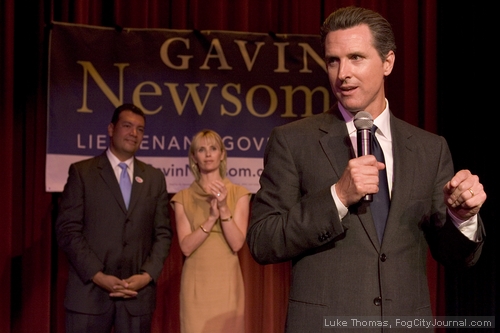
Addressing a crowd of supporters gathered at Yoshi’s San Francisco on election night, San Francisco Mayor Gavin Newsom — who easily beat opponent Janice Hahn to claim the Democratic nomination for lieutenant governor — said he was excited to be part of a crucial political year for the Golden State.

“We’re very proud to be in a position to be the Democratic nominee and to work with the other Democratic nominees,” Newsom told supporters. He lavished praise on the Democratic nominee for governor, Jerry Brown — the man who just last year he was trying to beat in a primary — telling stories about his father’s long relationship with the former governor and expressing his admiration. “I couldn’t be more proud to quasi- be on a ticket with Jerry Brown,” he said.

The race for lieutenant governor may prove one of the most interesting this election season — and not just because a victory for Newsom would transform San Francisco politics. Newsom’s opponent is Abel Maldonado, a moderate Republican who enjoys popularity among the growing, influential Latino community, and who Newsom’s team said will be a formidable challenge.

The campaign could revolve around an intriguing question. At a time when the Republican Party has been taken over by virulent anti-immigrant politicians — Whitman and Fiorina have both made harsh statements about illegal immigrants and vowed never to support “amnesty” (that is, immigration reform) — will Latino voters go for a white Democrat over a Latino Republican?

“You talk to them about all the same issues you talk to all voters about: jobs, education, and health care,” Newsom political strategist Dan Newman said when asked whether Newsom could win over Latino voters. “Latinos, like all voters, will appreciate someone with a proven record of success.”

Pollster Ben Tulchin also downplayed the trouble Newsom could encounter in winning the Latino vote. “With what’s going on in Arizona, they are very wary of Republicans,” Tulchin said, but then added: “We don’t want to underestimate the challenge we have. There’s never been a moderate Latino on the statewide ballot.”

Newsom sounded another alarm. If Whitman decides to help Maldonado, the race will get even tougher. “We’re running against Meg Whitman’s checkbook,” the mayor said.

“Expect to see Meg and Abel together a whole lot in the next few months,” one consultant predicted.

If Newsom wins, San Francisco will get a new mayor a year early — and the district-elected Board of Supervisors will choose the person to fill out the last year of Newsom’s term. Technically, the current board will still be in office then, but the task may well fall to the next board — which makes the local November elections even more important.

“Everyone is gaming this out and trying to figure out what happens,” political consultant Alex Clemens said during a post-election wrap-up at the San Francisco Planning and Urban Research Association office. “There will be a lot of dominoes to fall and deals to be cut.”

Meanwhile, Newsom’s nomination for lieutenant governor places many San Franciscans in an uncomfortable position, one that was illustrated well by Newsom’s victory speech, in which he proudly rejected taxes. Although most San Francisco progressives are disenchanted with their fiscally conservative mayor, few would rather vote for Maldonado.

Tim Paulson, the SF Labor Council president, was at the Newsom event gritting his teeth as he talked about the opportunity progressives now have to work with “a mayor of San Francisco we have issues with.” Now, he noted, “There is going to be a real campaign around this man. It could establish a narrative for what California is about.”


POWERFUL WOMEN

At Delancey Street on election night, San Francisco District Attorney Kamala Harris talked about getting “tough and smart on crime,” addressing gang-related criminal activity but also focusing on corporate criminals. She talked about cracking down on predatory lenders, supporting health care reform, and protecting California’s environment. And she made a point of dragging in BP.

“It must be the work of the next attorney general to ensure that the disaster and tragedy that happened in the Gulf of Mexico never happens in California,” she said, warning of attacks on AB 32, which set California’s 2020 greenhouse gas emissions reduction goal into law in 2006.

Of course, Harris now has to take on her southern counterpart, Los Angeles DA Steve Cooley, who is a moderate but comes in with much stronger law enforcement support. If Harris wins, it will go a long way to prove that opposition to the death penalty isn’t fatal in California politics, and that voters are finally ready for a women of color as the top law enforcement official — a first in state history.

But she and Newsom will both have to overcome likely attacks for the San Francisco’s crime lab scandal, one of many hits to be magnified by the size of Whitman’s war chest.

Whitman, who trounced opponent Steve Poizner in the primary, is riding the crest of a new wave of Republican-style “feminism,” starring her, Fiorina, and Fox news pundit Sarah Palin as female champions of the right-wing agenda. A few short months ago, it looked as if Brown was in serious trouble. But that was before Whitman and Insurance Commissioner Steve Poizner got into an $85 million bloodbath that left the winner of the GOP primary badly wounded. Whitman wants to play off the populist uprising by portraying herself as an outsider running against a career politician; Poizner gave her a huge scare by hammering her ties to Goldman Sachs.

That Wall Street narrative is one Democrats will push against Whitman and Fiorina. “I think it is stunningly politically tone deaf to nominate two Wall Street CEOs to the top of the ticket,” Newman said. Voters will decide whether they are fresh voices with new ideas or corporate hacks who laid off Californians and made fortunes with dubious stock market deals.

Brown leads in the polls — narrowly — but he’s vulnerable. He’s taken so many stands over so many years and Whitman’s fortune will hammer any openings they see. Brown is only slowly getting into campaign mode, but it’s no secret what he has to do. If the campaign is about Jerry Brown, unconventional politician, against Meg Whitman, Wall Street darling, then he wins.

But to take advantage of that, Brown has to offer some concrete solutions to the state’s problems — and he has to start acting like the progressive he once was. “If I were him, I’d run hard to the left,” a consultant who isn’t involved in any of the gubernatorial campaigns said.

The conventional wisdom had Barbara Boxer in trouble, too — but she’s a savvy campaigner who has beaten the odds before. And while the senator appears ripe for attack — almost 30 years in Washington, a voting record perhaps a bit more liberal than the state as a whole — her opponent, Fiorina, has baggage too.

For starters, Fiorina’s entire pitch is that she — like Whitman — would bring business-world savvy to politics. But as CEO of HP, “she was about perks and pink slips,” Newman said. “She laid off Californians and shipped those jobs overseas while enriching herself.”

Her own primary pushed her far to the right (at one point, in an embarrassing sop to the National Rifle Association, she actually argued that suspected terrorists on the federal no-fly list should be able to buy handguns). And speaking of feminist values, her anti-abortion positions won’t help her in a decidedly pro-choice state.


PROP. 16 GOES DOWN

The defeat of Proposition 16 will go down in history as one of the most remarkable campaigns ever. It was, Sup. Ross Mirkarimi noted, “a righteous win:” The No on 16 campaign spent less than $100,000 and still captured 52 percent of the vote. Another narrow corporate-interest measure, Mercury Insurance’s Prop. 17, faced a similar fate.

One reason: PG&E’s $50 million campaign backfired, making voters suspicious of the company’s propaganda. Another: it lost overwhelmingly in its own service area, the company rejected by those who know it best.

Now PG&E CEO Peter Darbee, who pushed to mount the expensive campaign, must return to his shareholders empty-handed — and that’s going to cause problems. “I assume the leadership of PG&E will be called to task,” Clemens said. “They truly rolled the dice.”

The day after the election, PG&E shares dropped 2.2 percent, a possible sign of shaken investor confidence. Mindy Spatt of the Utility Reform Network (TURN), a nonprofit that worked on the No on 16 effort, described the situation succinctly. “Peter Darbee’s got egg on his face,” she said. “Big-time.”

Mirkarimi has witnessed other battles with PG&E, and said this probably wouldn’t be the last. “PG&E, every time we want to have a seat at the table, tries to take us out, like assassins,” he said. “If they were smart, they would take us up on what we asked many years ago, and that is to abide by peaceful coexistence.”

On the statewide level, the bold and expensive deceptions pushed by PG&E and Mercury Insurance were countered by only a handful of super-committed activists and a broad cross-section of newspaper editorials, a reminder that newspapers — battered by the economy and technological changes — are neither dead nor irrelevant.

One of the wild cards of the election was Prop. 14, which will eliminate party primaries for state offices — and potentially shake up the state’s entire political structure. “This is a big deal even if we don’t know how it’s going to play out,” consultant David Latterman said at the SPUR event.

Interestingly, the only two counties that voted No on 14 were the most progressive — San Francisco — and the most conservative, Orange.

Progressives did well in San Francisco, expanding their majority on the Democratic County Central Committee. “In an environment where it was about hundreds of millions of dollars from PG&E and Meg Whitman and Chris Kelly outspending us, we showed that San Francisco is San Francisco and we support San Francisco values,” DCCC chair Aaron Peskin told us.

Money used to define the debates in San Francisco, but the dominant narratives are now being written by the coalition of tenants, environmentalists, workers, social justice advocates, and others who backed a progressive slate of DCCC candidates, which took 18 of the 24 seats on a body that makes policy and funding decisions for the local Democratic Party.

“This time it was the coalition that really made the difference,” DCCC winner Michael Bornstein said on election night. “Frankly, our people worked harder.”

Board of Supervisors President David Chiu agreed, telling us, “For the Central Committee, the message is people power wins.”

The lesson from this election is that people are starting to get wise to corporate deceptions. And they’re realizing that with hard work and smart coalition-building, the people can still prevail.

Steven T. Jones, Rebecca Bowe, Sarah Phelan, and Tim Redmond contributed to this report.


Welcome to Peter Darbee’s world

“The only thing worse than a thug is an ineffective thug,” a source, who has closely tracked Pacific Gas & Electric Co.’s activities for years, told us yesterday. “And that’s what [PG&E CEO] Peter Darbee is revealing himself to be.”

That’s pretty harsh, and isn’t just some hot air blown off by a disgruntled employee or a customer angry about a power shutoff. PG&E’s problem now is that since Darbee set out on the political adventure known as Proposition 16, this kind of characterization isn’t so far off from the sentiments publicly expressed by a number of powerful figures that the company must continue to work with.

California Public Utilities Commission President Michael Peevey wrote in an op-ed in the San Jose Mercury News that, “Pure and simple, Proposition 16 is a clever, brazen, buzzword-driven effort by one company to manipulate the California Constitution to protect its current monopoly.” Peevey isn’t exactly known as a PG&E hater –- green-power advocates have complained to the Guardian in the past that they think he’s too willing to honor the company’s requests. But Prop 16 clearly irked Peevey, who presides over the commission that decides whether PG&E will be allowed to raise rates.

Half a dozen state senators, including Senate pro tem Darrell Steinberg, rebuked PG&E over Prop 16, writing in a formal letter in December that it “calls into question your company’s integrity.”

On June 9, the day after voters shot down Prop 16, PG&E shares dropped 2.2 percent — the greatest decline of electricity utilities in the S&P 500 — possibly signaling a fluctuation in shareholder confidence. The Los Angeles Times ran a story pointing out (as the Guardian did) that the majority of counties that voted “no” on Prop 16 overlap with PG&E’s service territory, suggesting that the initiative dubbed by opponents as “PG&E’s power grab” was roundly rejected by its own customers.

Yet amid all the signs that PG&E had gone too far, despite all the indications that the utility had alienated regulators and political allies and royally pissed off its customers to boot, CEO Peter Darbee was patting himself on the back. While others were beginning to see Darbee as an unaccountable power-monger, Darbee evidently regarded himself as a fearless, courageous leader.

In a memo obtained by the Guardian that the CEO sent out to PG&E employees the day after Prop 16 was defeated, Darbee compares PG&E’s $46 million, failed quest to alter the state constitution through Prop 16 to the company’s decision to withdraw from the U.S. Chamber of Commerce. The utility won the respect of environmentalists when it dumped the national business organization last fall, denouncing its do-nothing approach to climate change.

Darbee suggests that PG&E’s willingness to take a stand in both instances is evidence of strong corporate leadership, but it’s an odd comparison to make. As Steinberg and other senators pointed out in their December letter, Prop 16 would’ve served to limit renewable energy development, not facilitate it. “It is unacceptable for a company that is falling behind in meeting state adopted goals for clean energy to impede the efforts of others who would attain those goals through innovative means,” Steinberg wrote.

Without further ado, here’s what Darbee had to say after Prop 16 went down. The essay, which was submitted as an opinion piece to the San Francisco Chronicle, is prefaced with a note to employees.

——————————————————————————————–
From: A Message From Peter Darbee
Sent: Wednesday, June 09, 2010 2:18 PM
To: All PG&E Mail Recipients; All PGE Corp Employees
Subject: After Election Day, A Reflection On Leadership

To All Employees:

As we look forward after the culmination of a hard campaign on Proposition 16, I wanted to share with you a short opinion essay that we submitted today to the San Francisco Chronicle. It addresses head on some of the questions we have all seen about PG&E’s stance on tough issues-from Proposition 16 to climate change, or any number of other examples many of us can no doubt recall. It makes clear that, in each case, our focus is on leadership, even-or maybe especially-when it requires tremendous courage.

I believe passionately that this is one of the aspects of our character that sets PG&E apart from many other companies. That’s been true throughout our history, and it’s even more true today.

As is always the case, the paper may or may not choose to print this piece. We hope they will. It’s an important and timely message for our customers. But it’s just as important and timely for all of us as employees. And, whether it appears in print or not, it’s a message we can all take heart in and carry forward proudly to others.

________________________________

The Price of Leadership

By Peter Darbee, Chairman, CEO and President, PG&E Corporation

Prime Minister Tony Blair said a few years ago, “I do not seek unpopularity as a badge of honour, but sometimes it is the price of leadership. And the cost of conviction.”

I was reminded of that observation this spring, as Pacific Gas and Electric Company came under widespread criticism for its support of Proposition 16, a statewide initiative to give people the right to vote on proposals to create risky new public agencies to provide electric power.

Many of those who criticized our support of Proposition 16 have long applauded our leadership at the state and national level on environmental issues and as a clean-energy provider. At the state level, PG&E helped champion passage of AB32, the Global Warming Solutions Act of 2006.

PG&E also supported California’s aggressive vehicle emissions standards, opposing efforts by a national business organization to overturn them.

At the national level, we were instrumental in forging an historic alliance of major utilities, other large businesses, national environmental groups and labor unions to support comprehensive and effective clean-energy and climate change legislation in Congress. The work of the U.S. Climate Action Partnership, of which PG&E has been a major contributor, is widely credited with inspiring major congressional initiatives on this vital issue.

While PG&E has been frequently honored for its environmental performance and commitment, including Newsweek magazine’s ranking as the country’s greenest utility in 2009, our environmental leadership has aroused controversy as well.

Last year, in a widely discussed move, PG&E withdrew its membership in a national business organization over fundamental differences on the need for climate change legislation. While a number of other major businesses followed our lead, others questioned why we broke ranks to support actions that could increase energy costs. We have explained, without apology, the science behind our stand and our careful choice of policies to utilize market forces to minimize costs.

Some of our longtime supporters, who decried Proposition 16, believe the PG&E they once admired lost its way somewhere along the line. I would tell them that their disagreement with us-which we respect-is the price of our leadership on important issues of the day. By staking out bold positions, we of course invite controversy. But the alternative is to be cowed by fear of criticism into ducking our leadership opportunities and responsibilities. Surely our society needs more leadership, not less.

After a lively debate, the voters have now spoken on Proposition 16 and we respect the outcome. We hope our critics will equally respect our willingness to participate in the system and engage on the important issues of the day. Through mutual engagement and mutual dialog, we can improve our company, our communities and our country.

Hyatt workers completing three-day strike

1

By Brittany Baguio
About 400 hotel workers are wrapping up a three-day strike at the Hyatt Regency that began Tuesday morning to protest increasing workloads and efforts to increase their health care costs. This was the fifth strike UNITE-HERE Local 2, a union comprised of hotel workers in San Francisco and San Mateo Counties, has called during nearly a year of negotiations since the last contract expired for 9,000 San Francisco hotel employees.

UNITE-HERE Local 2 initiated the walkout as a way of putting pressure on Hyatt management to offer a fair contract. Although the economy is still lagging, the hospitality industry has remained profitable. Union leaders say that with the cost of living going up, low income wages have made it harder to afford expenses.

The Hyatt Regency released a statement on Tuesday, stating, “Today’s action by Local 2 Leadership is a continuation of the harm they are committing to our associates, the tourism industry, and the city of San Francisco. It has been six months since Local 2 has agreed to return to negotiations. The union should refrain from activities aimed at jeopardizing business in San Francisco during this unprecedented economic downturn and instead expend this energy at the bargaining table, where it belongs.”

Yet union leaders blame management for the continuing labor impasse and they say the Hyatt and other national hotel chains have used the faltering economy as an excuse to justify increasing workloads on hotel employees. According to PKF Hospitality Research, revenue is estimated to grow to 3 percent for the next six months, 12 percent in 2011, and 14 percent in 2012. According to UNITE-HERE financial reports, when the Hyatt became a publicly traded corporation on November 2009, Hyatt owners netted more than $1 billion.

Unite-Here Local 2 representative Riddhi Mehta rejected Hyatt’s claim that the city of San Francisco was hurting in any way. “We’re not launching a boycott of San Francisco, but we’re asking folks to boycott eight specific hotels,” Mehta told the Guardian, “We’ve moved $7 million out of boycotted hotels and the majority of the money has stayed in San Francisco.”
The Grand Hyatt, Westin St. Francis, Palace Hotel, W Hotel, Hilton Union Square, and Hyatt Regency are all on the boycott list. Le Meridien Hotel and Hyatt Fisherman’s Wharf are also on Local 2’s boycott list, but for a different reason. Workers from these two hotels have been fighting for 2 years to obtain the right to choose whether or not to form a union without any intimidation from management.

The SF strike was one of several used as part of UNITE-HERE’s strategy to create a national campaign against Hyatt. Other notable strikes included one that was organized by Local 2 workers from the Grand Hyatt on Union Square and took place the same day Hyatt became a publicly-traded company.

On May 26, 400 hotel workers from the Hyatt Regency in Chicago protested against increasing workloads. Tuesday’s strike occurred a day before Hyatt’s first shareholder meeting in Chicago that was held on Wednesday. The meeting was exclusive to shareholders and banned all media outlets from attending.

Hotel workers and community supporters protested on Wednesday in the cities of San Francisco, Chicago, Vancouver, Honolulu, and Los Angeles. In solidarity, these workers hoped to persuade Hyatt majority owners to consider hospitality working conditions.

Mehta said the union’s experience in dealing with hotel management from 2004 to 2006, after the last contract impasse, has taught workers that they need to keep the pressure on in order to get a fair contract. “We’re happy to go back to the negotiating table but it’s not worth the time when Hyatt is saying that they don’t have the money. If you look at their financial statements, they have $1.3 billion in cash, but they’re spending money renovating hotels and improving their portfolios.” [Editor’s Note: This paragraph was changed from it original version to correct information].
Hyatt Regency workers from the walkout plan to go back to work on Friday.

Arizona getting you down? Here’s some activist inspiration.

0

Two things I learned about Rosario Dawson last night:

  1. When she was little, she spent time living in a San Francisco squat with her “free spirited” mother.

  2. She’s heading up one of the most important non partisan political organizations in the country.

Dawson was honored with a Redford Center “Art of Activism” award at the Sundance Kabuki Theaters last night — and definitely not (should I feel bad saying this?) because she is the kind of natural beauty that made the host of the program and other honorees stutter through their on stage exchanges with her.

Voto Latino is an organization that was co founded by Dawson, Maria Teresa Kumar, and Brandon Hernandez as a way to encourage Latino participation in democracy. Which, given all this insanity in the aftermath of Arizona’s Senate Bill 1070, strikes me as what’s been missing in the back and forth vitrol; what it means to the people that it explicitly denegrates.

Dawson told the Art in Activism audience last night that her group’s mission is to take back the immigration issue from the divide and separate tactics of conservatives. Voto Latino’s anti 1070 ad campaign, which is slated to debut on national televisions shortly, is “about us together,” says the actress-activist. Privileged or not, she emphasived, we’ve all gotten to where we are today based on the labor of our community, even gorgeous movie stars.

The organization has been a pioneer in young Latino involvement in politics. They put together one of the first text message based political campaign in 2006, sent Latino youth to report on the 2008 party conventions that the young people identified as important to them, and have produced a tongue in cheek telenovela series, La Pasión de la Desición, that interjects talk of voter registration into the florid embraces of the popular genre. To combat the negative messaging of Arizona’s legislation, Dawson says they’ll be assembling an online map of the country where Latinos can publish their stories, becoming visible in a debate that often leaves out their voice.

Rosario Dawson and Wilmer Valdarama star in an episode of Voto Latino’s La Pasión de la Desición

So yay, Rosario’s awesome. We’re all awesome.

Although I must say, some of us may be extra-super awesome. Dawson was definitely upstaged last night by another one of the evening’s honorees; East Oakland’s Mandela Food Co-op worker-owner (and last week’s SFBG interviewee), the inspirational James Berk.

Berk, wearing a crisp suit and glasses, took a no-nonsense approach to a ceremony that at times ran dangerously close to hyperbole. It was immensely refreshing, especially when the 19 year old cautioned the audience not to regard him as an anomaly in the social activism field on account of his youth (Dawson took the moment to compare his struggle to hers with the media’s insistence that celebrities are different from us in some way, evoking about zero sympathy on my part. Still love you, Rosario!).

In all the labored modesty of the evening, Berk came across as a man who knows the worth of what he and his team have been able to accomplish. This is a guy who has gone from a malnourished teen whose neighborhood’s sole food sources were the corner store’s nutritional garbage, to the co owner of a place that sells low cost, fresh local food to his neighbors.

When asked what he wanted the people sitting out in the audience to take away from the night of awe inspiring activist stories, he took a moment to fully gauge what he was about to say. When he spoke, his message was clear. “Don’t forget. And don’t forget my name,” he said. Unsure about what to do to make change in this country? Look to our true leaders, people; Berk’s not.

P.S. Definitely not trying to forget the night’s other honoree, Martha Ryan. Ryan, a nurse who had never headed up her own program, started the Homeless Prenatal Program for at risk women and their families. Half of her staff is comprised of women that were once in the program.

Newsom’s fiscal conservatism undermines his agenda

15

Gavin Newsom’s nomination for lieutenant governor places many San Franciscans in an uncomfortable position, one that was illustrated well by the victory speech that he gave last night just as our story our on his latest budget – in which he proudly rejected taxes in favor of deep spending cuts and future budget deficits — was coming off the presses.

Even though most San Francisco progressives don’t like our fiscally conservative mayor, few of us would rather vote for his Republican challenger, Abel Maldonado, despite the fact that this moderate Latino is actually fairly close to Newsom ideologically. “We don’t want to underestimate the challenge we have. There’s never been a moderate Latino on the statewide ballot,” Newsom pollster Ben Tulchin told me last night.

SF Labor Council President Tim Paulson was at the Newsom event gritting his teeth as he talked about the opportunity progressives now have to work with “a mayor of San Francisco we have issues with,” noting that, “What I find interesting in the easy win for Newsom is how there is going to be a real campaign around this man. It could establish a narrative for what California is about.”

And he’s right, but the danger is if Newsom sticks with his inflexible and longstanding “no new taxes” stance then the narrative could be that neither major political party’s top nominees are willing to tap millionaires, oil companies, and other entities that can afford it in order to fund education, health care, and the development of a green economy, which Newsom said are his top priorities. That and “jobs,” by which he means only private sector jobs, based on his past statements and actions and current failure to support new tax measures.

But Newsom doesn’t seem to see the glaring contradiction in his political philosophy, which he illustrated as he told a story about the potential to achieve strong economic growth while aggressively pursuing solutions to global warming and other environmental challenges, which he and progressives both seem to believe are not just possible, but “the opportunity of a lifetime.”

Newsom noted that the only four wealthy countries that signed the Kyoto Protocols and met their greenhouse gas reduction goals – Sweden, Denmark, United Kingdom, and Germany – have similar economic strategies. “All four of these countries had three things in common vis-a-vis the United States: Lower unemployment, higher growth, and lower income disparities,” he said.

Yet Newsom left out another key commonality that was even more central to their success, and big reason for two of Newsom’s three items: All have far higher tax rates than the U.S. and a more vibrant, respected, and well-funded public sector that was able to guide that economic transformation and ensure a smart, equitable distribution of the country’s wealth – something Newsom has been overtly hostile to as mayor and while campaigning for statewide office.

Nonetheless, he continued, “What’s interesting about these four countries is they dramatically shifted their framework in terms of economic growth and economic development towards a cleaner and greener energy future and they were rewarded with higher growth and lower unemployment. I think that’s suggestive, in the context of this debate.”

So do I, suggestive of the need for Newsom (and Jerry Brown) to finally realize it’s going to take money and a rejuvenated public sector to meet his stated goals for education, health care, and the environment. In San Francisco, his reluctance to challenge the Chamber of Commerce fallacy that taxes kill growth has left a legacy of dangerously diminished social services and increasing budget deficits running indefinitely into the future.

But the four countries that Newsom claims to admire don’t think that way. They don’t boast of cutting social services while proposing even more business tax cuts, and they don’t say things like, “It’ll take an entrepreneurial look at solving problems in this state.” He’s sounds like Meg Whitman and the Republicans.

What we need is the other Gavin Newsom, the one who last night also said, “Now is the time for serious problem solving in California….It is a time for California to fundamentally change.”

But first, Mr. Mayor, you’re going to need to embrace a few fundamental changes of your own.


Another bloody budget

6

rebeccab@sfbg.com

In the days since June 1, when Mayor Gavin Newsom unveiled his proposal for San Francisco’s $6.48 billion budget for the next fiscal year, public sector employees and community organizations have been poring over the hefty document to determine how their jobs, services, and programs survived cuts made to close a $483 million shortfall.

For police and firefighters, a key Newsom constituency, the news is good. There were no layoffs to San Francisco firefighters, and while members of the Police Officer’s Association gave up $9.3 million in wage concessions under the lucrative contract Newsom gave them a few years ago, police officers will still receive a 4 percent wage increase on July 1.

For others, the release of the mayor’s budget signified a tough fight looming before the Board of Supervisors, one with high stakes. Cuts to homeless services, mental health care, youth programs, and housing assistance, along with privatization proposals, have raised widespread concern among labor and liberal advocacy organizations. Public input on the budget will continue at the Board of Supervisors Budget and Finance Committee until July 15, when the amended document is considered by the full board.

At a June 1 announcement ceremony, Newsom asserted that the budget was balanced “without draconian cuts,” saying, “We were able to avoid the kind of cataclysmic devastation that some had argued was inevitable in this budget.”

Nearly a week later, Board President David Chiu told the Guardian that sort of cataclysm wouldn’t be staved off for long if the city continues on the course of repeatedly making deep budget cuts without proposing any significant new sources of revenue.

“Now that the smoke has cleared, it is clear that the mayor’s proposed budget is perfect for a mayor who is only going to be around for the short term, but it does not address the long-term fiscal crisis that our city is in,” Chiu said. “Next year, we’re looking at over a $700 million budget deficit. The year after that, we’re looking at almost an $800 million budget deficit. The budget proposal that Newsom put out balances the … deficit on many one-time tricks and assumptions of uncertain revenue.”

Meanwhile, advocates said even the cuts proposed this time would bring serious consequences, especially with unemployment on the rise, state programs being cut in Sacramento, and families feeling the pinch more than ever.

“Poor and working class families, and families of color in San Francisco, are facing kind of an assault on funding and on safety net services on multiple levels,” said Chelsea Boilard, family policy and communications associate for Coleman Advocates for Children and Youth. “I think a lot of it is that families are concerned about their ability to stay in the city and raise their kids here.”


“NO NEW TAXES”

During the budget announcement, Newsom emphasized the positive. He found $12 million in new revenue simply by closing a loophole that had allowed Internet-based companies to avoid paying that amount in hotel taxes. He said 350 currently occupied positions would be cut, but noted that it was less than a cap of 425 that public sector unions had agreed to. Cuts were inevitable since the ailing economy inflicted the city’s General Fund with significant losses, particularly from business and property tax revenues.

Nonetheless, Newsom’s budget is already coming under fire from progressive leaders. For one, there are no new revenue-generating measures in the form of general taxes, which could have averted the worst blows to critical safety-net services and might help remedy the city’s economic woes in the long-term.

“There are no new taxes in this budget,” Newsom declared. “I know some folks just prefer tax increases. I don’t.”

Yet Chiu said many of Newsom’s assumptions for revenue were on shaky ground, prompting City Controller Ben Rosenfield — Newsom’s former budget director — to place $142 million on reserve in case the projected revenues don’t pan out.

“These budget deficits continue as far as the eye can see,” Chiu noted. “Even if those amounts come in, something like 90 percent of them are one-time fixes. So even if the mayor is right, it doesn’t solve next year’s problem, or the year after. Which is why many of us at the board believe that we have to consider additional revenue proposals to think about the long-term fiscal health of the city.”

Sup. John Avalos, chair of the Budget and Finance Committee, described Newsom’s budget as “pretty much an all-cuts budget,” noting that he and Chiu planned to introduce revenue-generating measures. They were expected to introduce proposals — including an increase in the hotel tax and a change in the business tax — at the June 8 board meeting.

Because despite Newsom’s rosy assessment, many of his proposed cuts are deep and painful: the Recreation and Park Department would be cut by 42 percent (with its capital projects budget slashed by 90 percent), Economic and Workforce Development by 34 percent, Ethics Commission by 23 percent (basically eliminating public financing for candidates), Department of the Environment by 14 percent, Emergency Management by 10 percent, and the list goes on.


CUTS TO SOCIAL SERVICES

Progressives say Newsom’s budget reflects skewed priorities. While relatively little is asked of public safety departments, health and human services programs face major staffing and funding losses. “Poor people are being asked to shoulder the burden,” noted Jennifer Friedenbach, director of the Coalition on Homelessness.

Nearly $31 million would be slashed from the Department of Public Health, and more than $22 million would be cut from the Human Services Agency under Newsom’s proposed budget. While this reflects only 2–3 percent of the departmental budgets, there’s widespread concern that the cuts target programs designed to shield the most vulnerable residents.

Proposals that deal with housing are of special concern. “We have more and more families moving into SRO hotel rooms. We have families in garages. We have a really scary situation for many families,” Friedenbach said.

Affordable housing programs within the Mayor’s Office of Housing would get slashed from $16.8 million currently down to just $1.2 million, a 92 percent cut. Other cuts seem small, but will have big impacts of those affected. Newsom’s budget eliminates 42 housing subsidies, which boost rent payments for families on the brink of homelessness, for a savings of $264,000. Meanwhile, a locally funded program that subsidizes housing costs for people with AIDS would be cut, for a savings of $559,000.

Transitional housing would be affected, too, such as 59 beds at a homeless shelter on Otis Street, which Friedenbach says would be lost under Newsom’s budget proposal. “We’ve already lost more than 400 shelter beds since Newsom came to office, so that’d be a huge hit,” she said. Since the recession began, she added, the wait-list at shelters has tripled. The Ark House, a temporary housing facility that serves LGBT youth, would also be closed.

Overall, homeless services delivered by HSA would take a $12 million hit in Newsom’s budget, or about 13 percent, offset slightly by homeless services being increased by $2 million within the Mayor’s Office budget, a 71 percent increase.

Outpatient mental health services, such as Community Behavioral Health Services, would also be affected (See “Cutting from the bottom”), in violation of current city law. Several years ago, then-Sup. Tom Ammiano introduced legislation establishing a “single standard of care” to guarantee access to mental health services for indigent and uninsured residents.

“If timely, effective, and coordinated mental health treatment is not provided to indigent and uninsured residents who are not seriously mentally ill, those residents are at risk of becoming seriously mentally ill and hence requiring more expensive and comprehensive mental health care from San Francisco,” according to the ordinance, which was passed in June of 2005. Newsom’s budget proposes changing this legislation to enable cuts to those services, which would result in 1,600 people losing treatment, according to Friedenbach.

Unfortunately, advocates for the poor has gotten used to this ritual of trying to restore cuts made by Newsom. “There are some sacred cows that seem to survive year after year, and then we’re left fighting over what we can get,” said Randy Shaw, executive director of the Tenderloin Housing Clinic (THC).

The Central City SRO Collaborative, which supports tenants living in single-room occupancy hotels in the mid-Market Street area and is operated through THC, is slated to be cut by 40 percent along with three other similar programs — a replay from last year when the mayor proposed eliminating funding and the Board of Supervisors restored the cut.

“I think you’d see more fires, more people dying from overdoses. You’d see really bad conditions,” Jeff Buckley, director of the program, told us of the potential consequences of eliminating the inspections and resident training that is part of the program.

Funding was also eliminated for THC’s Ellis Eviction Defense Program, the city’s only free legal defense program with capacity to serve 55 low-income tenants facing eviction under the Ellis Act.


THREAT TO RENTERS

One of the most controversial proposals to emerge from Newsom’s budget is a way for property owners and real estate speculators to buy their way out of the city lottery that limits conversion of rental properties and tenants-in-common (TICs) to privately-owned condos if they pay between $4,000 and $20,000 (depending on how long they have waited for conversion), a proposal to raise about $8 million for the city.

“I went back and forth because I know the Board of Supervisors can’t stand this,” Newsom said as he broached the subject at the June 1 announcement. “I still don’t get this argument completely. Except it’s a big-time ideological discussion. It’s so darn ideological that I think it gets in the way of having a real discussion.”

Yet Ted Gullicksen, director of the San Francisco Tenants Union, said the argument is quite clear: making it easier to convert rental units into condos will accelerate the loss of rental housing in a city where two-thirds of residents are tenants, in the process encouraging real estate speculation and evictions.

“It will encourage TIC conversions and evictions because it makes the road to converting TICs to condos that much easier,” Gullicksen said. “It’s going to be a huge gift to real estate speculators.”

Newsom press secretary Tony Winnicker disputes that impact, saying that “these units were going to convert anyway, whether next year or six years. This merely accelerates that conversion without altering the lottery to protect jobs and services.”

But Gullicksen said the proposal obviously undermines the lottery system, which is the only tool tenant advocates have to preserve the finite supply of rent-controlled apartments, noting that even if the condos are later rented out, they will no longer to subject to rent control. That’s one reason why the Board of Supervisors has repeatedly rejected this idea, and why Newsom probably knows they will do so again.

Avalos said he and other progressive supervisors will oppose the proposal, despite the difficulties that will create in balancing the budget. “It’s kind of like putting a gun to our heads,” Avalos said of Newsom’s inclusion of that revenue in his budget.

To offset that revenue loss, Avalos has proposed a tax on alcohol sold in bars and Gullicksen is proposing the city legalize illegal housing units that are in habitable condition for property owners willing to pay an amnesty fee.

Some housing advocates were also struck by the timing of proposing condo conversion fees while also eliminating the Ellis Eviction Defense Program. “We’re really the only ones doing this,” Shaw noted. He said the program is crucial because it serves low-income tenants, many of whom are monolingual Chinese or Spanish speakers who lack the ability to pay for private attorneys to resist aggressive landlords.


PRIVATIZATION PROPOSALS RETURN

The Department of Children, Youth. and Families budget would be reduced by 20 percent under Newsom’s budget, with the greatest cuts affecting after school and youth leadership programs. Roughly a $3 million cut will result in the loss of around 300 subsidized slots for after school programs, said Boilard of Coleman Youth Advocates. Another $3 million is expected to come out of violence-prevention programs for troubled youth; an additional $1 million would affect youth jobs programs.

Patricia Davis, a Child Protective Services employee who lives in the Mission District with her two teenage sons, said she was concerned about the implications for losses to youth programs, particularly during the summer. “You can imagine what’s going to happen this summer,” she said. “I feel that a lot of kids are going to do a lot of things that they have no business doing.”

Davis, who says she’ll have to look for a new job come Sept. 30 because the federal stimulus package funding that supports her position will run out, said she was not happy to hear that police officers would be getting raises just as that summer school programs are being threatened with closure. “Couldn’t the 4 percent [raise] go somewhere else — like to the children?” she wondered.

Meanwhile, privatization proposals are causing anxiety for SEIU Local 1021 members, who recently gave millions in wage concessions and furloughs along with other public employees to help balance the budget. A proposal to contract out for jail health services cropped up last year and was shot down by the board, but it’s back again.

“When you make it a for-profit enterprise, the bottom line is the profit. It’s not about the health care,” SEIU Local 1021 organizer Gabriel Haaland told us. “It isn’t the same quality of care.”

Haaland said he believes the mayor’s assumption that the proposal could save $13 million should be closely examined. Other privatization schemes would contract out for security at city museums and hospitals.

Institutional police in the mental health ward at SF General Hospital and other sensitive facilities are well trained and experienced with difficult situations so, Haaland said, “the workers feel a lot safer” than they would with private contractors.

Regarding Newsom’s privatization proposal, Avalos said the board was “opposed last year and the year before, and we’ll oppose [them] this year.”

In the coming weeks, Avalos and other members of the Budget and Finance Committee will carefully go over Newsom’s proposed budget — which is now being sized up by Budget Analyst Harvey Rose’s office — and solicit input from the public. Chances are, they’ll get an earful.

“People are scared. They are scared to death right now,” Boilard said. “As it is, people’s hours are being reduced. And it’s getting harder and harder to find a job because so many people are out of work that the level of competition has gotten really fierce. This is the time that we need to invest in safety net services for young people and families more than ever — and all those services and programs and relationships that people depend on are disappearing.”

Steven T. Jones and Kaitlyn Paris contributed to this report.

Should Antonini recuse himself from Lennar vote?

1

As a Newsom appointee, Planning Commissioner Michael Antonini is expected to be a key vote today in favor of Lennar’s massive redevelopment plan at Candlestick Point-Hunters Point Shipyard.

And then there’s the fact that he wrote an op-ed for the San Francisco Business Times in December 18, 2009, suggesting that business, civic, labor and government leaders can keep the 49ers in town by “joining forces to assist in needed repairs and improvements to Candlestick Park and to expedite development of the Candlestick Point Hunters Point Shipyard, a project that features a “state-of-the art,” 69,000-seat football stadium.”
(The full text of Antonini’s op-ed is included at the end of this post to put his words into full context.)

But Antonini’s cheerleading has got some folks questioning his impartiality when it comes to the decisions that members of the Planning and Redevelopment Commissions will make today around certifying the project’s Final Environmental Impact Report (FEIR) and adopting related environmental findings.

In a June 2 letter to Planning Commission president Ron Miguel, Arthur Feinstein of the Sierra Club, Mike Lynes of the Golden Gate Audubon Society, Jennifer Clary of San Francisco Tomorrow and Jaron Browne of POWER (People Organized to Win Employment Rights) claim that “Commissioner Antonini has clearly prejudged the proposed project and become a strong advocate for locating a football stadium for the 49ers at the Hunters Point site as part of this project.”

“He has publicly urged others to support that stadium and cannot impartially review the record before him to determine whether the EIR is adequate, accurate and objective and whether adequate measures are required to protect the environment,” the foursome continue.

 Noting that he could have chosen to sign the December 2009 op-ed as a Member of the Republican County Central Committee, Feinstein, Lynes, Clary and Browne observe that Antonini “ instead identified himself in the capacity where the law requires him to act impartially – as a Planning Commissioner.”

With others arguing that Antonini’s right to express his opinion is protected by the First Amendment, and Antonini planning to read a rebuttal into the record at 1 p.m. today, it sounds like there’ll be plenty of drama at today’s hearing.

Antonini’s Op Ed in San Francisco Business Times

Friday, December 18, 2009
Business leaders can save the Niners
San Francisco Business Times – by Michael J. Antonini

“The 49ers are deeply and historically identified with San Francisco. San Franciscans Vic and Tony Morabito founded the team in 1946, many years before the Giants moved from New York and the Warriors from Philadelphia.

Hence business, civic, labor and government leaders are joining forces to assist in needed repairs and improvements to Candlestick Park and to expedite development of the Candlestick Point Hunters Point Shipyard, a project that features a “state-of-the art,” 69,000-seat football stadium. Leaders from the Committee on Jobs, the San Francisco Chamber of Commerce, Recreation and Park and others are asking businesses and individuals to help with funding of improvements at Candlestick in return for advertising. These improvements could translate into increased revenue for the contributor, the city and the team. Replacement of aging seats and a highly visible new luxury section are two concepts being studied.

Naming rights to Candlestick Park is an attractive opportunity for a company or an entity to gain nationwide exposure and local acclaim — and, perhaps, position itself to be a key contributor when a new stadium is built at Hunters Point. No new stadium can be built anywhere without significant private investment, in addition to $100 million assured from Lennar Corp. as a precondition of development rights and the amount which the 49ers ownership would invest.

On Thursday, Dec. 17, the San Francisco Planning Commission was to hear comment on the Draft Environmental Impact Report for the Candlestick Point Hunters Point Shipyard Plan. Because this plan features many diverse uses, particularly huge amounts of housing, funding is being rapidly obtained for greatly improved transit and traffic access.

San Francisco must avoid the errors of the past, when we failed to build an arena for indoor sporting, major conventions and entertainment events. Such a facility could have brought huge amounts of revenue to San Francisco businesses.

Leaders have twice stepped up to save the San Francisco Giants. One would expect no less from our leaders when dealing with our home grown, five- time Super Bowl champion San Francisco 49ers!

Michael J. Antonini is a planning commissioner for the City and County of San Francisco.”


Labor’s small business friends

0

Dick Meister, former labor editor of the SF Chronicle and KQED-TV Newsroom, has covered labor and politics for a half-century. Contact him through his website, www.dickmeister.com, which includes more than 250 of his recent columns.

The U.S. Chamber of Commerce and other outspoken foes of organized labor like to claim that small business owners are as anti-union as the notoriously anti-union Chamber and its big business members. But don’t you believe it.

Unfortunately, plenty of people do believe it. They accept the conventional wisdom that employers, large or small, don’t like unions in general and especially don’t like their employees joining or organizing unions to represent them in determining their working conditions.


Certainly many employers resist unionization. But what the Chamber of Commerce and its corporate friends don’t tell you is that many employers welcome unions for a variety of pragmatic as well as philosophical reasons.

Listen, for instance, to a small business owner in Virginia who was included in a representative sampling of some 1,200 small business owners and self-employed workers who were surveyed recently by American Rights at Work, a respected labor advocacy group:

“When workers form unions, they can secure benefits and rights in the workplace, including a decent wage and health care. They have economic and job stability. Unions lift workers and workers lift the economy. It’s as simple as that.”

The survey included much more that you’re not likely to hear from the Chamber of Commerce. “Unions,” said one small businessman, “help level the playing field for companies that voluntarily treat their employees right and compensate them fairly, When companies compete on equal footing, consumers fare better.”

Among the many other contradictions of the Chamber of Commerce ‘s anti-union line was this from a small businesswoman in Boulder, Colo.:

“The free market system is driven b y workers’ productivity and unions tend to produce more educated and well-trained – and therefore productive – employees. When competitors prevent their employees from forming a union, it is usually a pretty good indication that they are also underpaying their employees. That hurts our business and others in the industry because it allows them to unfairly undercut the market.”

Kimberly Freeman Brown, executive director of American Rights at Work, noted that unionization not only helps individual businesses and their employees, but also “makes the free market system stronger by increasing consumer purchasing power – which is good for their businesses’ bottom line.”

Eighty percent of the small business owners surveyed by Brown’s organization agreed. Other significant findings:

* About half of those surveyed expressed “strong concern that unions have been weakened so much our economy has actually been hurt.”

* More than half agreed that “strong unions make the free market system stronger.”

* Almost 60 percent “strongly agreed that labor unions are necessary to protect the working person.”

* Nearly 70 percent said it was very important for their businesses that Congress “enact legislation that rewards employers who respect their workers’ right to join a union.”

* More than 70 percent agreed that “a good business person can make a profit and respect their workers’ choice to form a union.”

* Eighty-two percent “strongly agreed that it’s morally wrong for employers to fire or threaten employees for wanting to form a union.”

So, despite conventional anti-union wisdom, many small businesses are quite aware that unionization benefits them, their employees and society in general.

The U.S. Chamber of Commerce and its anti-union members and allies know that, but their interest is not in benefitting those who do the work of society. Their interest, of course, is in maximizing the profits of big business.

Dick Meister, former labor editor of the SF Chronicle and KQED-TV Newsroom, has covered labor and politics for a half-century. Contact him through his website, www.dickmeister.com, which includes more than 250 of his recent columns.

Political juggernaut

3

sarah@sfbg.com

City officials are scrambling to secure final approvals to allow Lennar Corp. to move forward with its 770-acre Candlestick/Hunters Point Shipyard redevelopment of San Francisco’s impoverished and polluted southeast sector. But the community remains divided on the project, raising concerns that wary residents will end up being steamrolled by this politically powerful juggernaut.

Some groups say the project needs major amendments, but fear it will be rushed to the finish for political reasons. Others say they are hungry to work and desperate to move into better housing units, so they don’t want all the myriad project details to slow that progress. And Mayor Gavin Newsom’s administration is arguing that approving the project’s final environmental impact report by June 3 is crucial if San Francisco wants to keep the San Francisco 49ers in town.

But many observers fear Lennar wants its entitlements now before its project can be subjected to greater scrutiny that could come with the November elections. Newsom, who made Lennar’s project the centerpiece of his housing policy, will be replaced as mayor if he wins the lieutenant governor’s race. And a crowded field of candidates, many of them progressives concerned about the project’s impacts on the poor and the environment, are vying to replace termed-out Sup. Sophie Maxwell, whose district includes Lennar’s massive territory.

“It’s 180 percent about the 49ers,” land use attorney Sue Hestor told the Guardian, referring to the city’s proposed rush job, as evidenced by a rapid entitlement schedule that the Newsom’s administration wants city commissions and the board to follow.

Under that schedule, which Hestor procured from the Mayor’s Office, Planning and Redevelopment commissioners are expected to certify the project’s final 6,000-page EIR, adopt California Environmental Quality Act findings, approve amendments to the project’s original disposition and development agreement, and authorize land trust and open space reconfigurations — all during a June 3 meeting where public comment will likely last for many hours.

Saul Bloom, executive director of Arc Ecology, a community-based nonprofit that tracks the development, says this schedule stretches the credulity that this is a deliberative process. “There’s no way anyone could make a functional reasoned assessment,” Bloom told us. “How do you have any meaningful public conversation under those circumstances?”

Michael Cohen, Newsom’s chief economic advisor, asserted in an April 29 article in The New York Times that Lennar’s plan is a “really, really good project,” echoing the glowing praise he’s heaped on the project since its conception.

“But there’s nothing new in their proposal,” Bloom told us. “That’s because they haven’t been listening to the public’s concerns. [Cohen] says, ‘Haven’t we talked enough? The community’s been waiting all these years!’ But waiting to get what done?”

Lennar’s project — which had early backing from Newsom, U.S. Sen. Dianne Feinstein, and other political power brokers — was sold as creating “jobs, housing, and parks” and “revitalizing the abandoned shipyard” when voters approved the Lennar-financed Proposition G in 2008.

“Proposition G is from the community and for the community,” Lennar’s campaign promised. “You can turn the abandoned Hunters Point Shipyard into a clean, healthy, sustainable, livable neighborhood — a place where people can raise their children.”

The shipyard once employed thousands of workers, including African Americans who were recruited from the South in the 1940s and ’50s. But the district’s economic engine fell into disrepair when the military left in 1974. Today the neighboring Hunters Point and Bayview neighborhoods have the highest unemployment and crime rates and the largest concentration of African American families in the city.

But the city’s final EIR for the project, which the Planning Department released mid-May, shows that 68 percent of the developer’s proposed 10,500 new housing units will be sold at market rates unaffordable to area residents, and that many of these units will be built on state park land at Candlestick Point.

Lennar is also proposing to build a bridge across the environmentally sensitive Yosemite Slough, significantly changing the southeast waterfront. Lennar says it plans to develop the project’s remaining 3,000 units at below market prices, including one-for-one replacement of rundown Alice Griffith public housing units. Its proposal includes a dozen high-rise towers, 2.7 million square feet of commercial space, 1 million square feet of retail space, a performing arts theater, and an artists colony.

Lennar claims its proposal will create 1,500 construction jobs annually during the project’s 20-year build-out, along with 10,000 permanent jobs, thanks to a United Nations Global Compact Sustainability Center and a vaguely defined green technology office park.

The project and its impacts are already an issue in this year’s District 10 supervisor’s race (see “The battle for the forgotten district,” Feb. 23). Candidate Chris Jackson says Lennar’s proposal is weak when it comes to creating well-paying, low-skilled green collar jobs. He supports Arc’s proposal to including green maritime industrial use at the shipyard.

Arc recommends that the city’s final EIR allow recycling and repairing of ships, including the Suisun Bay Ghost fleet — decommissioned U.S. Navy, cruise, and ferry ships — arguing that “ship recycling and repair are resurgent strategic industrial activities yielding employment opportunities for our existing pool of skilled and unskilled workers.”

Jackson, who was elected to the Community College Board in 2008 and recently jumped into the District 10 race, wants the city to assert that the project is not a regional housing plan.

“It’s a local housing plan for local residents,” Jackson asserts. “It’s not here to provide housing for Silicon Valley. It’s for Bayview-Hunters Point and District 10 residents.”

Jackson understands why some local residents want no delays on final EIR approval: “I can never blame folks in Alice Griffith public housing for coming out and saying ‘no delays.’ They really want something real, housing that is not rat and cockroach infested.”

As a policy analyst (a position he’s quitting to focus on the District 10 race) for the San Francisco Labor Council — which gave key backing to the project in the 2008 election — Jackson knows labor is frustrated by all the project meetings. “I try to tell them it’s better to get this project right than rush it through and find out later that it goes against the interests of labor,” Jackson said.

In May 2008, the Labor Council signed a community benefits agreement (CBA) with Lennar. Since then labor leaders have urged no delays on the project’s draft EIR review. But Jackson believes the city must demand that financial consequences, such as liquidated damages, be a project approval condition if the developer reneges on the CBA.

“Right now the only push-back the city has is to threaten to kill the whole project if Lennar doesn’t meet its timeline,” Jackson said. “But people are really invested in this project, and I don’t believe anyone would pull the trigger and end the entire development. We don’t need to throw everything out; we just need to change them.”

Jackson wants to see the inclusion of a special-use district that would create a cooperative land trust to ensure affordability and home ownership opportunities for local residents. “I love open space and sustainability, but I also want affordable housing and real light-industrial opportunities that can employ people living in the district now.”

Special-use districts, Jackson argues, give city commissioners a way to amend this project to make it more acceptable.

Jackson wants to see strong tenant protections for public housing residents. “The vast majority of those residents are African American. At the end of the day, I want to see economic and environmental justice, so we can say we brought the right change to our community.”

Jackson also would like to see a more independent Mayor’s Office. “Don’t you feel like its 2002/2003, and that if you speak out against the project, it’s like you are speaking out against the Iraq war, and all of a sudden you are not patriotic?”

Fellow District 10 candidate Eric Smith concurred. “The powers that be are definitely moving this thing forward,” he said. “And this is a monster train, a juggernaut that is gathering steam. But how it shakes out down the road remains to be seen. My whole mantra is that there needs to be greater transparency down the line. If I become the sheriff, I’ll be shining a light on all this stuff.”

Smith warned that the community needs to work together or it won’t win a better deal. “It’s clear that folks in the city are hoping against all odds that Lennar can pull this stuff off so they can prove all the naysayers wrong and these community benefits can be realized, and that scrutiny of the projects can go on while all this happens,” he said.

But Arthur Feinstein, the Sierra Club’s political chair, worries that the city’s rush job is resulting in seriously flawed documents and decision-making. “It’s difficult for folks to digest 6,000 pages of comments and responses on the draft EIR in the three weeks since planning posted them online,” Feinstein said. “And nothing has changed despite all the comments, which is why it continues to be a nonsense process.”

Feinstein says the Sierra Club’s top concerns are the Parcel E-2 cleanup on the shipyard, a deal to transfer 23 acres at Candlestick Park for development, and the bridge over Yosemite Slough.

“You can cover most of the site,” he said. “But when it comes to Parcel E-2, where the dump burned for six months in 2002, that’s only 20 acres, it could and should be removed. This is the environmental justice issue that has the community up in arms.”

Feinstein worries about the precedent that selling a state park for condos sets. “This is our park, and they are shrinking it.” He is also concerned that the developer wants to bridge Yosemite Slough for cars.

How many of these concerns will be addressed at the June 3 hearing, which is just days before Santa Clara County voters decide whether to try to lure away the 49ers with a new publicly financed stadium? We’ll see.

Let the ICE picket begin

7

Members of the San Francisco Immigrant Rights Defense Committee launched a picket outside US Immigration and Customs Enforcement (ICE)’s Detention and Removal Operations office at 630 Sansome Street today to decry the activation of Secure Communities, which they describe as a “dangerous police-ICE collaboration program that threatens public safety.”


“In the wake of massive protests this weekend against Arizona’s anti-immigrant law, a broad coalition of immigrant rights advocates will stage a protest Tuesday in San Francisco against the implementation of a new police-ICE collaboration initiative which will harm public safety, the so-called ‘Secure’ Communities or S-Comm program,” SFIRDC’s press release states.

Concerned community members plan to form a picket line holding placards of enlarged fingerprints and multi-lingual messages “to expose the danger the program poses to the community.”

 “If we oppose Arizona’s SB1070, then we cannot stand aside while a dangerous policy with disturbing similarities to SB1070 is forced on our own city,” Carolina Morales of Community United Against Violence stated. “S-Comm gives dangerous discretion to police officers to falsely arrest or overcharge immigrant residents, who would then be automatically reported for deportation.”

The picket comes as a veto-proof majority of eight SF Supervisors stands poised to vote next week (there is no Board meeting today) on a resolution calling on local law enforcement to opt-out of S-Comm, noting that the policy “puts at risk even those subject to arrest for a minor infraction and those who did not commit any crime at all but were falsely arrested. “

To date, the Mayor’s Office has not indicated that Newsom has any concerns with the program.
But San Francisco Sheriff Michael Hennessey, who requested to opt out of the program, has stated that S-Comm “will widen the net (of people reported to ICE) excessively” and that ICE has a “record of secrecy.”

Last year, the California Dept. of Justice signed a memorandum with ICE on the S-Comm program; the cover letter indicated that counties needed to agree to the program by signing a “statement of intent.” But last week, Attorney General Brown denied the Sheriff’s request to opt out, so community and legal advocates continue to explore their options.
 
 “The Attorney General is mistaken in believing that this program will only affect people who have already been apprehended and deported by ICE or charged with serious offenses,” said Francisco Ugarte, an immigrant rights attorney with Dolores Street Community Services.

.
 According to ICE’s own data, 5  percent of the people identified under the S-Comm program were U.S. citizens, and some 9 out of 10 of the total identified were charged with low level offenses, including property and traffic violations, not serious crimes.
And then there’s the fact that ICE’s data does not indicate whether those deported were actually found guilty of crimes, or were simply charged with crimes—a key distinction for anyone who professes to believe in human rights.

 “Our city’s families are living in fear that if they report a threat to their own safety, they or their family member may risk deportation, “ Nour Chammas with the Arab Resource and Organizing Center stated in SFIRDC’s press release. “This policy will tear at the very fabric of San Francisco’s rich and diverse culture.”

And Bobbi Lopez of La Voz Latina observed that folks are working on a federal level for immigration reform because they know real solutions to a broken immigration system.  “However, we cannot just sit idly by and wait while ICE’s police collaboration schemes threaten our families daily,” Lopez warned. “ We are proud that city officials are standing with community members to halt this attack on our San Francisco community.” 

Today’s picket was called for by the following members of SFIRDC:
African Advocacy Network, Arab Resource and Organizing Center, Asian Law Caucus,
CARECEN, Causa Justa: Just Cause, Chinese for Affirmative Action, Chinese Progressive Association, Communities United Against Violence, Dolores Street Community Services, East Bay Alliance for Sustainable Economy, Immigrant Legal Resource Center, Instituto Familiar de la Raza, La Raza Centro Legal / SF Day Labor Program, La Voz Parents Council, Mujeres Unidas y Activas, National Lawyers Guild SF Bay Area Chapter, People Organizing to Demand Environmental & Economic Rights, People Organized to Win Employment Rights, SF Pride at Work, and South of Market Community Action Network.

Alerts

0

alert@sfbg.com

THURSDAY, JUNE 3

"Heather Has Cool Mommies"


In honor of Pride month and in light of current events around same-sex marriage, the San Francisco Public Library will be presenting a weekly documentary film series throughout June about LGBT parents. Films include Choosing Children, In My Shoes: Stories of Youth with LGBT Parents, Transparent, Transamerica, and Daddy and Pappa.

Noon, free

San Francisco Public Library

Main Branch

Koret Auditorium

100 Larkin, SF

(415) 557-4400

"Rape, Prostitution, and Trafficking"


Attend this discussion about the issue of consent in the occurrences of rape, prostitution, and trafficking worldwide and the growing international movement for women’s safety. The movement seeks to stop equating prostitution with rape, supports decriminalizing sex work, and opposes the use of trafficking laws to deport immigrant sex workers. Featuring keynote speaker Dr. Rita Nakashima Brock.

5:30 p.m., free

San Francisco Public Library

Main Branch

Latino Hispanic Room B

100 Larkin, SF

(415) 626-4114

FRIDAY, JUNE 4

Nuclear Abolition Day


In preparation for Nuclear Abolition Day on Saturday, Tri-Valley CAREs, United for Peace and Justice, and Peace Action West are organizing a protest at Bechtel Corporation, one of the top profiteers of the war in Iraq. Join protesters worldwide in demanding that governments begin negotiating a Nuclear Weapons Convention to ban all nuclear weapons.

Noon, free

Bechtel Corporation Headquarters

50 Beale, SF
www.trivalleycares.org

Respect for women


Join this conversation about violence against women and the need to foster shared respect and dignity. Featuring Elayne Doughty from Planet Breathe, Carolyn Thomas-Russell from A Safe Place, and Robert W. Plath from Worldwide Forgiveness Alliance. Proceeds benefit these organizations.

7 p.m., $5 suggested donation

Berkeley Fellowship of Unitarian Universalists Hall

1924 Cedar, Berk.

(415) 370-5466

SATURDAY, JUNE 5

Fight for Immigrant Rights


Attend this organizing meeting with the International Socialist Organization to demand amnesty and stop the racist scapegoating that Arizona’s anti-immigration law, AB 1070, encourages. A panel of immigrants’ rights and labor activists discuss what we can do to stop this civil injustice and to build a movement that can win justice and equality for all.

1 p.m., free

Redstone Building

Luna Sea Room, 2nd floor

2926-2948 16th St., SF

http://norcalsocialism.org

SUNDAY, JUNE 6

Grassroots House Collective


Attend this fundraiser for the Grassroots House Collective, a nonprofit community space and meeting place for grassroots organizations and projects like Copwatch, Prisoners Literature Project, Industrial Workers of the World, and more. Bay Area singer-songwriters will present new arrangements and interpretations of their songs.

3 p.m., $15-$25

Grassroots House Collective

2022 Blake, Berk.

www.grassrootshouse.org 2

Mail items for Alerts to the Guardian Building, 135 Mississippi St., SF, CA 94107; fax to (415) 437-3658; or e-mail alert@sfbg.com. Please include a contact telephone number. Items must be received at least one week prior to the publication date.

Newsom’s lousy economics

0

EDITORIAL Every major newspaper in California should have plastered the May 2010 report from the UC Berkeley Center for Labor Research across the front page. The headline: “Governor’s budget will destroy 331,000 jobs.”

It’s a stunning analysis. Ken Jacobs, who heads the center, and two associates used a sophisticated computer program to track exactly how the cuts would play out in the current California economy. If the governor’s proposals are adopted, the job losses would greatly exceed any new job creation, causing the unemployment rate in the state to rise by 1.8 percent.

On the other hand, the study shows, raising taxes on rich people and oil companies would save 244,000 jobs.

So if, as nearly every politician of every party in the state insists, the biggest policy goal in California today is job creation, Gov. Arnold Schwarzenegger is going about it entirely the wrong way.

The good news is that the Democrats in the state Legislature are finally talking seriously about an alternative budget plan that includes about $5 billion in new revenue. The plans by the Assembly and Senate leadership aren’t perfect and will still require significant cuts to cover the budget gap. But after years of cuts-only budgets and a pervasive fear of tax increases in Sacramento, the Democratic proposals are encouraging. (Jerry Brown, the Democratic candidate for governor, shouldn’t worry about associating himself with the plans: two-thirds of Californians favor increased taxes on wealthy people to pay for better public education, according to the most recent Public Policy Institute of California poll.)

So at the very least, the state Capitol — a place not known as a bastion of progressive thought — is going to have an intelligent debate over how to address the budget deficit without further damaging the economy. Yet in San Francisco, Mayor Gavin Newsom continues to cling to a no-new-taxes budget that will devastate community services — and add to the city’s unemployment rate.

That’s just disgraceful.

Every city-employee union has stepped up to the plate and offered concessions. City workers are taking furloughs (actually, pay cuts) and layoffs. They’re giving back scheduled raises. They’re making a good faith effort to be part of the solution — in fact, labor is now pushing for an increase in the hotel tax to help cover the costs of public services.

Newsom isn’t asking any of the wealthy businesses or individuals in town to give anything.

That’s not just bad politics, it’s bad economics.

The Berkeley study acknowledges that raising taxes on the rich and big corporations has an economic impact — an oil severance tax, for example, would raise $1.4 billion a year for the state, reduce economic output by $128 million, and lead to the loss of 400 jobs. A 1.5 percent increase in the top income tax rate for individuals who earn more than $250,000 would bring the state $2.1 billion, and lead to the loss of 13,000 jobs.

But on balance, both of those are a good deal for the state — because cutting that $3.5 billion from the budget would cost the state far, far more than 13,400 jobs. That’s because when you eliminate public sector jobs, particularly lower-paid jobs, there’s a direct, immediate impact on consumer spending. Although a rich person may spend slightly less if he or she has to pay slightly higher taxes, a middle-income worker who gets laid off stops spending much of anything — and the local merchants who relied on that person’s spending see the impact.

In fact, the Berkeley study points out, more than half the jobs that would be lost under Schwarzenegger’s plan would be in the private sector. The same goes for San Francisco: saving jobs requires new revenue solutions. And if Newsom’s budget doesn’t address that, the San Francisco supervisors must.

Newsom’s lousy economics

0

EDITORIAL Every major newspaper in California should have plastered the May 2010 report from the UC Berkeley Center for Labor Research across the front page. The headline: “Governor’s budget will destroy 331,000 jobs.”

It’s a stunning analysis. Ken Jacobs, who heads the center, and two associates used a sophisticated computer program to track exactly how the cuts would play out in the current California economy. If the governor’s proposals are adopted, the job losses would greatly exceed any new job creation, causing the unemployment rate in the state to rise by 1.8 percent.

On the other hand, the study shows, raising taxes on rich people and oil companies would save 244,000 jobs.

So if, as nearly every politician of every party in the state insists, the biggest policy goal in California today is job creation, Gov. Arnold Schwarzenegger is going about it entirely the wrong way.

The good news is that the Democrats in the state Legislature are finally talking seriously about an alternative budget plan that includes about $5 billion in new revenue. The plans by the Assembly and Senate leadership aren’t perfect and will still require significant cuts to cover the budget gap. But after years of cuts-only budgets and a pervasive fear of tax increases in Sacramento, the Democratic proposals are encouraging. (Jerry Brown, the Democratic candidate for governor, shouldn’t worry about associating himself with the plans: two-thirds of Californians favor increased taxes on wealthy people to pay for better public education, according to the most recent Public Policy Institute of California poll.)

So at the very least, the state Capitol — a place not known as a bastion of progressive thought — is going to have an intelligent debate over how to address the budget deficit without further damaging the economy. Yet in San Francisco, Mayor Gavin Newsom continues to cling to a no-new-taxes budget that will devastate community services — and add to the city’s unemployment rate.

That’s just disgraceful.

Every city-employee union has stepped up to the plate and offered concessions. City workers are taking furloughs (actually, pay cuts) and layoffs. They’re giving back scheduled raises. They’re making a good faith effort to be part of the solution — in fact, labor is now pushing for an increase in the hotel tax to help cover the costs of public services.

Newsom isn’t asking any of the wealthy businesses or individuals in town to give anything.

That’s not just bad politics, it’s bad economics.

The Berkeley study acknowledges that raising taxes on the rich and big corporations has an economic impact — an oil severance tax, for example, would raise $1.4 billion a year for the state, reduce economic output by $128 million, and lead to the loss of 400 jobs. A 1.5 percent increase in the top income tax rate for individuals who earn more than $250,000 would bring the state $2.1 billion, and lead to the loss of 13,000 jobs.

But on balance, both of those are a good deal for the state — because cutting that $3.5 billion from the budget would cost the state far, far more than 13,400 jobs. That’s because when you eliminate public sector jobs, particularly lower-paid jobs, there’s a direct, immediate impact on consumer spending. Although a rich person may spend slightly less if he or she has to pay slightly higher taxes, a middle-income worker who gets laid off stops spending much of anything — and the local merchants who relied on that person’s spending see the impact.

In fact, the Berkeley study points out, more than half the jobs that would be lost under Schwarzenegger’s plan would be in the private sector. The same goes for San Francisco: saving jobs requires new revenue solutions. And if Newsom’s budget doesn’t address that, the San Francisco supervisors must.


Live Shots: SF Bay Area Labor Heritage Rockin’ Solidarity Chorus, City College, 5/27/2010

0

My auntie Yam is the ultimate SF activist, along with my mom, a.k.a. Snorkel Mom. The two of them are always out together, advocating for single-payer health care, participating in anti-war rallies, sharing new organic gardening techniques with each other, and attending all day lectures on Earth Day. I’ve learned so much from both of them, and I’m always awed by their commitment to change and their strong visions for a better world. So when auntie Yam invited me to go see her Labor Chorus perform at City College, I knew I was in for an uplifting and exciting show.

The SF Bay Area Labor Heritage Rockin’ Solidarity Chorus is no ordinary chorus. Their songs are dynamic and at times even hilarious, crying our for peace and justice for every worker. Labor songs go back over a hundred years and are the perfect combination of melody and spunkiness to get union workers riled up and excited as they unite for their cause.

The performance at City College was no different. Some of my favorite sing-alongs were “Bring Back My Factory to Me,” based of the traditional Scottish folk song “My Bonnie Lies over the Ocean” and an adapted version of Ted Warmbrand’s “Who’s the Criminal Here” that included lines about the Arizona police and questions like “And you, now, were you native born?” It’s true that this chorus sings some classic, almost antiquey songs, and yet they are all so relevant and necessary to our world today.

Thank you auntie Yam and Snorkel Mom for teaching me how to be a strong and conscientious citizen!

And now, just as the performance ended last night, let’s all join together and sing solidarity forever!

http://www.youtube.com/watch?v=kYiKdJoSsb8

Public employees step up; when will Newsom and downtown?

7

With news that Muni union leaders are backing salary givebacks to help close San Francisco’s $483 million budget deficit, all city employees are now making sacrifices to preserve city services that we all rely on. But as we eagerly await the release of the mayor’s budget on June 1 – in which some city departments have been asked to make cuts of up to 30 percent – the question is whether Mayor Gavin Newsom will find the courage to ask other San Francisco entities to help.

For example, will he support the 2 percent increase in the hotel tax that labor is pushing (and which polls show would probably pass muster with voters if Newsom backed it), a real estate transfer tax that would hit the comfortably rich, or a downtown transit assessment district that would make corporations finally help pay for the transit services their employees rely on?

So far, it’s doesn’t look like it (and his Communications Office won’t respond to the question). Instead, Newsom has cynically engaged in deceptive blame games that scapegoat public employees for a problem he created (for example, by approving bloated police and fire contracts to win political support and then blocking efforts to seek new revenue sources), while still pushing gimmicky new spending programs designed to burnish his political image as he runs for state office.

This could be Newsom’s last chance to finally show some leadership, and now is the time when it’s needed most. After offering cuts-only city budgets his entire tenure in office, most city departments are unable to go any further without sacrificing needed services.

The situation has become dire, as workers said Wednesday during a budget rally outside City Hall. Guardian news intern Kaitlyn Paris was there covering the action and offers this report:

Community groups from around San Francisco rallied in front of City Hall on Wednesday to protest the drastic reductions that health and human services face in the Governor’s proposed state budget and Mayor Newsom’s impending city budget.

A graveyard of tombstones representing each of the organizations stuck out of the sand next to the grassy square where participants gathered. Identifiable by their maroon sweatshirts, the largest faction present was the Community Housing Partnership. The proposed budget would cut over $100,000 from the agency and its programs that provide help with employment, substance abuse, and habitation development.

“Supervisors need to be constantly reminded of the merits of these services,” CHP employee Gabriel Haywood told us.

The partnership runs a jobs retention program that Haywood says has exceeded its city-mandated job retention rate by 25 percent, keeping 75 percent of the people it serves employed for longer than three months. Still, Cameron McHenry told the Guardian the city thinks the groups services are duplicative. [Editor’s Note: information in this paragraph has been corrected since his article was posted].

The city’s OneStop employment service is suited to workers displaced by the recession, not the multiple-burdened clients helped by CHP, said McHenry: “We can’t take a 30 percent cut and still do the work we do.”

After speakers from various groups addressed the crowd from a flatbed truck, District 5 Sup. Ross Mirkarimi took to the stage to demand alternative ways of generating revenue. The progressive revenue tactics championed mainly involved increased hotel tax to reduce the budget burden felt by community service groups. Mirkarimi and members of the crowd also criticized the city for its continued funding of Sharp golf course in Pacifica.

“We’re trying to force the Mayor to have a fair budget,” Coalition on Homelessness Director Jennifer Fredenbach told us. “We believe he can do it through alternative revenue like the hotel tax, a more progressive tax base, and a property transfer tax on high end real estate. It has real consequences for poor San Franciscans, not only in quality of life, but in the ability to live.”

Fees rise in SF, but some supervisors prefer taxes

5

By Brittany Baguio

 The Board of Supervisors this week voted to impose non-resident fees for admission into Botanical Gardens in an effort to help alleviate the city’s $483 million budget deficit, as requested by the Mayor’s Office. But even supervisors who supported it say they hope to end the fees if they can find some general revenue sources, a process that will begin next week after Mayor Gavin Newsom releases his budget on June 1.

Sup. John Avalos, who chairs the Budget Committee, began Tuesday’s discussion by stating that he believed that this non-resident fee would stop the layoffs of Botanical Gardens staff and help offset the 30 percent drop in their budget. Despite supporting the fees, Avalos expressed hope that they could be replaced by a 2 percent increase in the hotel tax, something labor and community groups are pushing that would raise $38 million to $45 million per year.

He even amended the item to include a provision that the non-resident fee will be eliminated within 90 days from the effective date of the new tax. Despite Avalos’s amendment, AIDS Grove founder and volunteer community gardener Nancy McNally said she was appalled that Avalos would support a non-resident fee. “He is not committed to preserving significant public park commons that San Franciscan generations before him have paid taxes to preserve,” McNally told the Guardian. “No one wants to brainstorm and come up with creative options to alleviate this crisis that is not really a crisis. Greed is the crisis.”

One thing McNally did appreciate was sober assessments made at the hearing by Sup. Eric Mar, who stated that Botanical Gardens serves as a haven for low-income and immigrant families who can only enjoy the facilities because admission is free. He declared that once fees are attached to Botanical Gardens, it will lose its appeal. He also added that passing this fee will be the first step in initiating fees for all.

San Francisco resident Daniele Erville shared Mar’s concerns. “A fee acts as a deterrent to a place that by its very nature is welcoming,” Erville told us. “The place makes us feel at home, it reminds us that we are a part of nature and reminds us of our common humanity. Spirituality means that you are in touch with what unites us all, and so differentiating on any level just clashes.”

The imposition of fees – $7 for non-resident adults, $5 for seniors, and $2 for children – was approved on a 8-3 vote, with Sups. Mar, Bevan Dufty, and Ross Mirkarimi in dissent.

An extraordinarily good man

0

Dick Meister, former labor editor of the SF Chronicle and KQED-TV Newsroom, has covered labor and politics for a half-century. Contact him through his Web site, www.dickmeister.com, which includes more than 250 of his recent columns.

It was 40 years ago this month that Walter Reuther died in a plane crash. Forty years. Yet the auto workers leader remains an important inspirational figure – a man whose life holds crucial lessons for those who are today seeking to revitalize the American labor movement.
 
I came upon him late in his career, and to me he seemed verbose, distant and a bit pompous: a do-gooder who didn’t smoke, didn’t drink, didn’t wench; who did only good things, and always in the artfully arranged glare of publicity.
 
He couldn’t possibly be as good as those who had known the man for a long time claimed him to be. But they were right. Walter Reuther was an extraordinarily good man.
 
He was truly the conscience of organized labor – a crusader struggling very, very hard against the stagnation he found in a movement he had helped found, lead, and, finally, had tried to reform.
 
Reuther was the conscience as well of a lot of people who never paid union dues in their lives. I mean those who saw him as the embodiment of their hopes to change this imperfect society in ways that would better the lives of those at the bottom of its social, economic and political ladder.
 
It was Reuther, as much as any union leader, who brought dignity and economic security to the mass of Americans, expanding the country’s major concerns beyond the elementary economic concerns that preoccupied most people in the years before World War II.
 
Reuther’s specific contributions were many. There was the central role he played in establishing the United Auto Workers Union, over which he eventually presided.  There was his role in forging together the country’s industrial unions and in leading them, as president of the Congress of Industrial Organization – the CIO – in struggles for broad economic and social causes.
 
There was Reuther’s exceptional success in negotiating better wages, hours and working conditions for the auto workers that were pace-setting marks for workers in all industries and all occupations.
 
And there were Reuther’s many efforts to shift the labor movement in new directions.  His last attempt, and surely his boldest, came in 1969 when he led the United Auto Workers out of the AFL-CIO and into an “Alliance for Labor Action” with the then-unaffiliated Teamsters Union.
 
Reuther hoped the alliance of the country’s two largest unions could begin carrying out the programs he had suggested repeatedly to the AFL-CIO, only to be rebuffed by the former American Federation of Labor leaders who dominated the federation.
 
The alliance planned organizing drives among white-collar workers and other groups, particularly in the South, that the AFL-CIO had been neglecting. But the new organization hoped to go beyond organizing the unorganized, as important as that was.
 
The goals of the alliance were nothing less than a summary of the great needs of the country: Helping build low-cost housing, for instance; developing new job training programs; unifying the poor and minority groups; vastly improving education and health services; effectively attacking racial discrimination, poverty,  consumer fraud, and the particular problems of the young and the aged, and attacking urban decay, pollution and other environmental problems.
 
The alliance never really got going before Reuther’s death and dissolved shortly afterward.  Some of Reuther’s fellow labor leaders had scoffed, in any case, that it was actually nothing more than an attempt by Reuther to satisfy the ambitions for broad union leadership he had been unable to realize within the AFL-CIO.
 
“Walter,” they would tell you, “is just being Walter – all talk and no action.”
 
Well, they were right about one thing at least. The man could talk. Others were accustomed to it, after three decades of Reuther-watching, But he was new to me, and I marveled to see him hold audiences of thousands for an hour and more while speaking without a single note – strictly off the top of his head – and doing so with great and forceful eloquence.
 
I especially remember a talk he gave in 1966, in a dilapidated little auditorium in Delano, California, where vineyard workers led by Cesar Chavez just a few months before had begun the strike that someday would capture the attention of the entire country.
 
I played the sophisticate and smiled knowingly over Reuther’s wordy and dramatic promises to the farm workers. But then came the terrible news, four years later, of a plane down in Michigan, and I thought back to that cold December day in the grape country.
 
I remembered what those words had meant to the penniless, obscure and powerless band of farm workers who had gathered in the auditorium. There he was, one of the great leaders of America, promising to “stand with you until the end.”
 
I may have been fooled, but the farm workers were not fooled.  They knew that Walter Reuther meant exactly what he said.  He always did.
 
Dick Meister, former labor editor of the SF Chronicle and KQED-TV Newsroom, has covered labor and politics for a half-century. Contact him through his website, www.dickmeister.com, which includes more than 250 of his recent columns.

The chicken ‘n diet

0

le.chicken.farmer@gmail.com

CHEAP EATS We went down there, the Mountain and me, way down South of Market, and we found the little alley, placed our little order at the window, and sat on the loading dock, our feet dangling in the street. We sipped sweet tea and ate our breakfast out of boxes, with our hands. All my other friends, even Earl Butter, are fasting, doing cleanses, or otherwise flirting with vegetarianism by way of getting healthy — in response to which I have been eating nothing but chicken and waffles.

There’s good news out there. I’ll tell you what it is, and then I’m going on strike. But I wonder if I can trust the Guardian to print a blank page with just the words "Cheap Eats is on strike" in the middle of it. So maybe I’ll hold the spot with dada and gobbledygook … but wait, but that would be pretty much business-as-usual.

Hmm. It has also occurred to me of course to write restaurant reviews until my demands are met — to review the most boring restaurant(s) I can find, in the most boringly straightforward language I can mustard.

Think: completely unbuttered sentences without any grill marks whatsoever, stacked one on top of the other until you feel bricked in by important information, yet entirely unentertained.

Scary, innit?

Well, certainly flavorless, but I can do this, I think. The problem is it would be way more work than I am accustomed to, and I’m not sure that when you go on strike you’re supposed to work harder. Help me, labor organizers. It’s a topsy-turvy world, my world, and I am essentially (don’t forget) a chicken farmer. I don’t know anything about getting anything — except maybe eggs.

So …

Waffles. Chicken. Here’s what I know.

Farmerbrown’s Little Skillet is a good place to get greased, goo’d, and sweetened. And I mean all over your clothes, too, because there aren’t any tables to eat at. That’s OK, we’re human. This is why we have Laundromats. Not to mention napkins, but I don’t always remember about those.

You place your order at the window, then you eat across the alley on a loading dock or little wooden bench. And if you think that sounds just wonderful, wait’ll you crunch your teeth into that juicy fried chicken. It was the best I’d had since Auntie April’s, which was the best I’d had since Gravy’s. And suddenly we’re saying something.

Suddenly, chicken and waffles are alive and well — maybe even trendy — and not in Oakland this time, or even L.A., but right here in the city known as "The City." Where I live.

Auntie April’s Chicken ‘n’ Waffles is on Third Street in Bayview, and it’s an actual sit-down restaurant. Their Belgian-style waffles are about as satisfying as Gussie’s, but the chicken (fried to order, of course) is way, way better. And the combo is cheaper.

Even Farmerbrown’s Little Skillet, which is associated with Farmerbrown’s fancy-pants Tenderloin soul food restaurant, is cheaper than Gussie’s. Two pieces and a waffle for $8. Pick your pieces.

Not bad, considering one piece and a waffle at Gussie’s is $7.79, $9-something if you want a breast. (You don’t.)

Farmerbrown’s waffles, also Belgian style, were perfect: crispy outside with a soft middle. And their sweet tea was spectacularly sweet. Probably goes better with the pulled pork sandwich — which I think was the only other thing on the menu.

So I don’t know what to say. Slight edge to Auntie April for the fried. But Farmerbrown’s got her beat on the iron. Guess I’ve got two new favorite restaurants. Maybe more. There’s Frisco Fried, also in the Bayview, and Sockywonk says Hard Knox is doing chicken and waffles now too.

It’s an exciting time to be a restaurant reviewer. On a chicken-and-waffle fast. Send money. Someone. *

AUNTIE APRIL’S CHICKEN ‘N’ WAFFLES

Daily: 8 a.m.–3 p.m.

4618 Third St., S.F.

(415) 643-4983

Cash only

No alcohol

FARMERBROWN’S LITTLE SKILLET

Mon.-Sat. 9 a.m.–2:30 p.m.

360 Ritch, S.F.

(415) 777-2777

Cash only

No alcohol

May the tastiest critter-friendly cupcake win

0

Your chops sink into the rich, sweet fluff and your lips are left with a coat of luscious frosting; cupcakes are the things dreams are made of and especially the dozens that will be up for tasting this weekend at the Rock Paper Scissors Collective‘s 2nd Annual Vegan Cupcake Bake-off. No butter, no eggs people– all that delicious and they’re animal friendly…pretty sure that will be my excuse for chomping well over five cups.

This bake-off isn’t meant for observation– four bucks gets you a napkin, fork, plate, and a chance to nimble and snack on a the tantalizing entries of frosted vegan treats. Try them all and then vote for your poison. Will it be chocolate drizzle or peachy keen? Oh, the choices we must make.

vegan cupcakes

Last year’s winner, Laurie Ellen, dazzled taste buds with her vegan strawberry-lemonade cupcakes and earned not the typical loads of ridiculous fame and fortune, but a sweet sense of local pride and a good, sugary feeling on her insides. Yum! The taste testing, the baking and more taste testing– I’m guessing the labor of a baker is quite hard to bear and if only I were best friends with one of these candied cooks, I could surely help out.

This baker’s triumph needed to be further explained and luckily Ellen was up for hinting at a couple of her yummy secrets. 


SFBG: Tell me about the crafting of your Strawberry-Lemonade recipe? 

Laurie: The recipe last year came out of a last minute dinner at a friends house. I decided to make some cupcakes using lemons from the meyer lemon tree in my backyard that had been fruiting gloriously and some strawberries a coworker brought into work which I had recently made into preserves. It was a union between making something seasonally relevant and making something with items in my pantry.

SFBG: How many cupcakes did you eat in preparation?

Laurie: Well, I usually eat one from every batch and I made about 6 batches leading up to and including the competition, so 6, at least.

SFBG: Who else ate them?

Laurie: Friends, coworkers, strangers, anyone who wanted one, I was itching for feedback.

SFBG: What was the best part about your winning cupcake last year?

Laurie: The people that came up to me after the competition telling me it was the first vegan baked good they had eaten and that it really surprised and challenged the notion of what they thought a cupcake was or could be.

SFBG: What drink would pair best with the strawberry lemonade cakes? Vodka? Milk? 

Laurie: An icy cold Arnold Palmer.

SFBG: Do you always bake vegan?

Laurie: About half the time. Although I am not vegan I have friends and family in my life who have a variety of dietary differences and if I am making something, especially dessert, I want everyone to be able to enjoy it. I think it has come in pretty handy and people are surprised and excited when they realize that they can enjoy dessert too.

SFBG: Any hints as to what you’ve whipped up for this year’s contest?

Laurie: You’ll have to come out to RPSC to check it out, it is a refreshing summer cupcake, I hope people will enjoy it.


Besides the bake-sale itself, Paper Rock Scissors will have a bunch of crazy-cupcaked themed events, good for distracting sugar teeth from the pans of goodies. A cookbook of all the vegan treat recipes will be for sale, meaning you can attempt to replicate your favorites. Bring-Your-Own-Tee shirt/totebag or whatever and get it branded with a lovely screen printed cupcake or grin with your mouth full in the cupcake photo-booth. 


2nd Annual Vegan Cupcake Bake-off!

Sat/22, 2-5pm, $4

Rock Paper Scissors Collective

2278 Telegraph, Oakland

www.rpscollective.com


Progressives, labor, grassroots win in May 18 primaries

4

Forget all the talk of anti-incumbent (and by implication, anti-Democrat and anti-Obama) sentiment in the electorate. The primaries May 18, which I talk about here, actually sent a much more interesting message.


Yes, there was the election of Rand Paul, who is about as looney as they come , but Republicans have nominated looneys before. What’s interesting is that in most contested Democratic races, the more progressive candidate won. Randy Shaw points out that CNN had it all wrong, and refuses to acknowledge what actually happened. The Chron actually notes (in one of the few intelligent MSM post-election pieces) that labor, particularly the AFL-CIO, won big in Pennsylvania and Arkansas. In the only open house seat, the Democrats won.


In the Democratic primary in Kentucky, the more progressive candidate won. In Pennsylvania, the more progressive Democrat won. In Arkansas, a Democrat in name only is facing a runoff she might lose.


So the progressives and the grassroots organizers can get people to the polls — if there’s a candidate to vote for. What Nancy Pelosi needs right now is a good national issue to run on. Electoral reform, for example.

The Mitchell sister

3

sarah@sfbg.com

Porn heiress Meta Jane Mitchell Johnson is running a little late when I arrive at the Mitchell Brothers O’Farrell Theater, the adult entertainment establishment her father Jim Mitchell and uncle Artie Mitchell founded on the edge of the Tenderloin, just blocks from City Hall, July 4, 1969.

Johnson, 32, recently became co-owner of the theater and invited me over to discuss her vision for this notoriously hardcore strip club and the challenges she faces in an industry dominated by the Déjà Vu corporate strip club chain, in a town whose political leaders are still trying to figure out how best to regulate the clubs to ensure that their predominantly female workforce is properly compensated and protected from harassment in safe, sanitary conditions.

A young guy on the front register ushers me into a side room. The walls are decorated with photographs that recall the people and players who have made this club such a storied San Francisco institution and a landmark in the history of the sex industry.

There’s an image of a topless Marilyn Chambers, the star of Behind the Green Door, the porn film the Mitchell brothers shot and screened at the theater in 1972 and was a major hit after it became known that Chambers was also the wholesome face on Ivory Snow soap flakes box.

There is a photo of Artie with a young raven perched over his shoulder. It was taken in 1990 during a trip to Aspen, Colo., to support gonzo journalist Hunter S. Thompson, who worked at the club in the 1980s and was facing serious charges, including sexual assault and possession of drugs and explosives, that eventually got dropped.

Another shows both the Mitchell brothers, photographed when they were still young and rakish and battling the vice squad, even as they entertained the local political elite.

Today the brothers are dead, Artie from bullet wounds inflicted when Jim shot him with a rifle in February 1991; Jim from a heart attack in July 2007. And now Jim’s oldest son, James Mitchell, 28, is in jail awaiting trial for allegedly beating his ex-girlfriend Danielle Keller to death with a baseball bat in July 2009 and abducting their baby daughter, Samantha.

Unlike his father, who continued to run the Mitchell porn empire after serving less than three years for voluntary manslaughter, James is facing life behind bars.

“He is charged with six serious felonies and is facing life imprisonment with no possibility of parole,” Marin County Deputy Chief District Attorney Barry Borden said recently. Johnson told me that her brother no longer owns stock in Cinema 7, the corporation the Mitchell brothers founded to oversee their burgeoning sex business.

This latest family tragedy occurred in the wake of a $3.74 million class action suit that was settled in 2008. Brought by three MBOT dancers, the suit led to valid claims by 370 dancers who complained about Cinema 7’s “piece-rate” wage system. Under that system, the club compensated dancers solely for the number of private dances performed, waived meal and rest periods, and failed to reimburse dancers for costumes, props, and makeup.

Since then the club ended the piece-rate system, but introduced chips customers must buy to procure lap dances and encounters in small, curtained private rooms. On a recent night, the girls at the O’Farrell Theater remained smiling and bright-eyed as they succeeded in getting some customers to purchase chips for lap dances and private encounters. But the rest of the crowd remained largely silent and mostly tight-fisted as customers watched the club’s exotic dancers perform on its disco-balled stage.

All of which left me wondering if Johnson can succeed in overcoming her family history and reputation to make a difference for her workers and community while facing a nationwide recession in an industry dominated by an out-of-state chain.


THE UNLIKELY SAVIOR

Johnson greets me dressed in Ugg boots and jeans, apologizes for being tardy, and leads the way upstairs to the theater’s office so we can talk.

I first met Johnson in 2007 (“Behind the Mitchell’s Door,” 07/22/09) when she arrived at the theater in knee-high boots, clutching a massive lime handbag and a tiny dog named Baby. During that first encounter, three months after her father died, Johnson confided that when she took over the office, it was full of dildos dancers had given the Mitchell brothers. Placing her dog on the pool table that dominated the office, she said she planned to massage all this male energy toward femininity.

Today it looks as if she has started to deliver on that promise. The pool table is gone. The sofa where Hunter S. Thompson used to sit remains in the room. But now a clothesline runs between the office walls, draped with a stripper’s glove, stilettos, and a G-string emblazoned with the word “Gonzo,” presumably in honor of Thompson.

“It was a little thing we made to give away,” Johnson laughs.

She introduces her youngest brother and club co-owner, Justin. “Me and Justin are close. We are the owners and we are making some changes,” Johnson explains. “We are making the prices more reasonable so customers don’t have to spend an arm and a leg just to get a lap dance. And we’re going to hold events like poetry slams. We are trying to make the club fun again. We definitely see a hit due to the economy, but we’ve also been hit by the decision from the class action lawsuit.”

Johnson insists she and her brother aren’t “your typical strip club owners.”

Were in a symbiotic relationship with our dancers, she says. That sets us apart from other clubs. The dancers are our employees. We pay them minimum wage and workers comp. We cover their Healthy San Francisco costs. We incur a lot of expenses legally employing our dancers. But instead of crying about our handicap,’ she said, referring to treating dancers as employees, my goal is to show we can manage the club without a pimp mentality, without a How much can you shake them down for? approach.

“A lot of our employees have been here a long time and have had to deal with all the painful violent stuff too,” she continued. “And folks are still here, even though their hours got cut and they are not making as much money.

In 2007, Johnson told me that she resented the family business when she was growing up. “The boys could go inside, and I couldn’t,” she recalled. It wasn’t until 2004, when she was working as a mortgage consultant in a cubical farm in San Ramon that Johnson began to take pride in the business “as something that had taken care of us through the years.”

Johnson, who became the club’s scheduling manager in 2005, recalls the shock of losing her dad in 2007. “It was like being dumped in icy water,” she says. “At first we didn’t know how to handle it. But we learned. Five years ago, I was much more liable to listen to advice. But I need to be able to fall asleep feeling good. That involves treating people a certain way. I don’t think any other strip club in the country is being run the way this one is.”

Johnson got married and went on maternity leave in 2008. ” When my son was six months old, I came back for the club’s 40th anniversary party and I realized, they need me both of us [she and her brother]— as owners, steering the proverbial ship. No one else wants to be held accountable. We never discussed selling. Our father built this place. It’s completely shaped our lives. Good or bad, it’s ours.”


TOUGH INDUSTRY

As a nude strip club, Mitchell Brothers’ O’Farrell Theatre stands in direct competition with Crazy Horse on Market Street and the Déjà Vu-owned clubs including the Market Street Theaters, Gold Clubs and other spots in SoMa, and most of the clubs in North Beach. The exception is Lusty Lady, the only unionized, worker-owned peepshow in the country.

If you walk into the Gold Club in San Francisco, well, there are 50 other Gold Clubs in the country, so, its generic, Johnson says. But theyve got their business model. Were not trying to copy Déjà Vu or Crazy Horse. Were the Mitchell Brothers. Its been part of us and our whole history.

Dancers agree that the Lusty Lady isn’t in competition with Déjà Vu.

“They’re Walmart, and we’re the mom and pop store on the corner,” Lorelei*, a dancer at Lusty Lady, said. “At the Lusty, we pride ourselves on being alternative and having tattoos and piercings.”

Some dancers, who we’ve indicated with an asterisk after their altered names, voiced fear of being identified as critics of Déjà Vu’s business model.

“If Deja Vu found out I was shit-talking them I would probably get fired and be blacklisted from all their clubs,” Sugar* said. “If I were to get blacklisted, I’d be totally screwed because there are no other clubs in San Francisco,” where she doesn’t feel pressure to do more than dance, “which is not my thing.”

“Or the Lusty Lady, which doesn’t pay enough to cover my bills,” she continued. “But Deja Vu is notorious for being a terrible company to work for, mainly because of their outrageously high stage fees.”

Other dancers say they had to pay stage fees at the Déjà Vu-owned Hungry I, and sometimes went home empty-handed after eight-hour shifts when uninvited touching was common.

“The number one thing that would improve our work experience is if someone actually forced Deja Vu to stop charging us stage fees,” Amber* said. “Almost no one outside the industry knows that dancers pay money to go to work. A lot of customers think the clubs pay us, like, thousands of dollars. In San Francisco we pay between $100–$200 per shift, sometimes more.”

By law, dancers have the right to choose employee status, versus being considered independent contractors. “But that’s a joke,” Amber added. “If we choose employee status, we’re required to do a minimum of 10 lap dances per shift. The club keeps all that money, and we would get paid $12–$15 an hour.”

But Edi Thomas, counsel for Déjà Vus Centerfolds club, flatly denies that the dancers who perform at Centerfolds (the only nightclub in San Francisco authorized to operate as a Deja Vu Showgirls club) pay stage fees.

Rather, entertainers who perform at Centerfolds (and/or at Hungry I, the Condor, and Market Street) are paid a substantial percentage of the patron revenues generated from individual dance sales, Thomas stated.

The entertainers are issued Forms 1099 at year-end, reflecting the amounts they were paid by the nightclub, she said, which means the dancers are independent contractors, not employees. These nightclubs operate within the law and make every effort to assure that entertainers are well compensated and perform in safe and lawful environments.

There are, as in any industry, former and disgruntled workers carrying a desire to harm a nightclub or the industry for their own personal reasons, Thomas added. “But those workers do not represent the voice of the majority.


CENTER OF THE STORM

When the Mitchell Brothers founded their empire, it was against a backdrop of organized crime trying to exercise a monopoly on the porn industry. According to a 1977 U.S. Department of Justice report, members of La Cosa Nostra tried to request exclusive distribution of Mitchell Brothers’ porn films.

The Mitchells resisted for years, but DOJ claims they eventually entered into a contract with LCN’s Michael Zaffarano to distribute “Autobiography of a Flea.” the Mitchells also fought City Hall.

During the 1980s, Mayor Dianne Feinstein’s vice squad tried to close the Mitchell Brothers’ operations. But under Mayor Willie Brown, the former attorney for late Déjà Vu strip club owner Sam Conti, SFPD enforcement reportedly eased.

Then in 1997, Déjà Vu started to take control of the city’s sex clubs, introducing stage fees and private rooms. In 2002, three former MBOT dancers filed their suit against Cinema 7. The next year, three other dancers brought suits against Market Street Cinema and Century Theater. And in 2005, Deja Vu settled a class action labor suit with its dancers. Attorney Greg Walston, representing the dancers, said at the time that minimum pay rate would protect dancers from being forced into prostitution to make money.

Deja Vu threatened a counter-suit based on the allegations of prostitution at their clubs, but Walston told reporters: “The record speaks for itself.” Walston used police reports with prostitution allegations to bolster his case and said he was doing the job the District Attorney’s Office should have done.

In July 2008, when MBOT reached its $3.74 million class action settlement, Cinema 7 president Jeffrey Armstrong said that the corporation was “not able to pay the entire amount up front.” Instead, Mitchell matriarch Georgia Mitchell and her business partner John P. Morgan, then cotrustees of the Jim Mitchell 1990 Family Trust, which holds two-thirds of Cinema 7’s shares, pledged stock certificates as security interest.

But the debate about how to treat sex work in San Francisco continues. In November 2008, District Attorney Kamala Harris and Mayor Gavin Newsom opposed Proposition K, a local measure that tried to decriminalize prostitution by forbidding local authorities from investigating, arresting or prosecuting sex workers. They argued that the measure would increase prostitution on the streets, give pimps cover, and hamper efforts to stop sex trafficking. The measure failed.

At the time, Prop. K advocate Carol Leigh and cofounder of the Bay Area Sex Workers Advocacy Network said, “We feel that repressive policies don’t help trafficking victims, and that human rights-based approaches, including decriminalization, are actually more effective.”

Today, erotic dancers must identify which of a tangle of regulatory entities is the appropriate venue to lodge complaints. District Attorney spokesperson Erica Derryck said Harris is dedicated to prosecuting violent crimes committed against all San Franciscans, regardless of whether they happen in a club or an alley.

“If there are two drug dealers and one attacks the other, we’d prosecute. But that’s not to say there won’t also be consequences for underlying criminal behavior too,” she said. “But anyone who has been victimized should be confident of going to the police and reporting any incident.”

Derryck said public health and safety complaints can be lodged at entities that provide permits and licenses, including the Planning Department and Entertainment Commission.

“There might not be any criminal activity involved, but this route hits clubs in the pocket and is worth considering if dancers want to represent their grievances,” she said.

Meanwhile dancers say there is still pressure to do more than just dance in some clubs. “For some dancers, the clubs feel fine,” Lorelei says. “It’s a safe space where no ads are needed. They see it as a fair exchange. But if you just want to dance — when one girl is doing this, and another that, how are you supposed to make money?”

Other dancers wish managers wouldn’t abuse their power. “Sometimes they back you up,” Amber said. “Other nights, someone insults you and they won’t help.” And many wish management would try to make the clubs fun again.

“It used to be a party, but now it’s about the cheapest dirtiest fuck you can get,” Lorelei said. “Taking stage fees created a dark environment that carries over to the customers. It’s like we’re goats in a petting zoo begging, saying give me money, give me coke.”


FAMILY BUSINESS

Attorney Jim Quadra, who represented the dancers in the MBOT class action suit, said that for all the talk about treating dancers right, the Mitchells’ interest was money.

“At the time, a group of people thought the agenda was to get dancers to do more than dancing because that’s what brings in the revenue,” Quadra said. “But Meta comes off much better than the rest of her family.”

During the trial, Jim was asked if there were meetings where Cinema 7 personnel defined what they meant by a “lap dance” in the piece rate system.

“You need a lap for a lap dance,” Mitchell replied. “You are getting down to like, you know, lap dance, erotic theater, America. And your question is like just a waste of the public’s slender resources, like drop[ping] a basketball in the ghetto and asking, ‘Did you define what that is for them?'<0x2009>”

Johnson, who voluntarily took the witness stand, was asked if there was any reason dancers would be afraid of her father. “He can be a little gruff and he can be cranky, a grouchy old man,” she replied.

Today Johnson is moving ahead with a vision she began to outline in 2007, then put on hold until December 2009, when a law suit about the family trust fund was settled.

“We settled everything out of court in December with my grandmother, which was a nice Christmas present,” she says, confirming that she and her siblings succeeded in removing their 83-year grandmother, Georgia Mae Mitchell, as trustee of the Jim Mitchell family fund. They replaced her with their mother, Jim Mitchell’s ex-wife, Mary Jane Whitty-Grimm, who also has custody of James’s baby daughter, Samantha.

“Danielle’s mother has some personal problems … that made the court reluctant to give her custody of the baby. so they gave Samantha to Mary, who is a nice woman, who is married with a family,” former San Francisco D.A. Terence Hallinan told me, after James Mitchell replaced him with another private criminal defense attorney, Douglas Horngrad, in March.

In court filings related to the family trust fund, Mitchell matriarch Georgia Mae claimed her grandchildren’s lawsuit was intended to deny her jailed grandson James his share of the trust to defend against his serious felony charges.

“Justin asked me to take money out of the trust account of his brother James, and send it to his mother instead of paying his criminal defense attorney, Terence Hallinan,” the Mitchell matriarch claimed.

I asked Hallinan if the trust fund was the reason James Mitchell changed attorneys. “Yes and no,” Hallinan said. “It definitely had to do with money and who was going to run the club. The poor grandma, she is such a nice person. She was trying to play fair and be nice to all the kids. It’s not a really healthy family. ‘Rafe’ [James] is where he is. In my opinion, he is still not clear what happened or why.”

Johnson, for her part, says her brother James has mental health issues. “I don’t accept what he did,” she said. “I’m not making any excuses for it. He’s either insane or he’s a monster. But the family has an obligation to make sure he has legal defense. He was always a beneficiary of the trust. But he fired his lawyer, which is the worst thing he could have done.”

A restraining order Keller secured five days before she was murdered claims Mitchell abused her for years, had mood swings, used cocaine, and was addicted to methamphetamines.

“Danny should have left,” Johnson said.

It’s been painful to read the comments people leave,” she continued, referring to online reaction to her brother’s arrest that suggest the Mitchells are bad seed and should be wiped out. It’s not because James is a Mitchell, or because there’s some bad gene.”

Rather, she said he had serious unaddressed problems, “a time bomb that was going to explode and then it did in just about the most horrific way imaginable.”

“When I was 13, my father shot my uncle Artie. And when I was 31, James killed Danny,” she adds. “So I hope I don’t live to be 103.”


WOMEN’S WORK

In 1985, the O’Farrell Theater’s marquee famously read, “For show times call … ” followed by Mayor Feinstein’s phone number. But that was another era.

“I don’t know Dianne Feinstein,” Johnson says, as she shows me a cartoon R. Crumb drew in 1985 of then-Mayor Feinstein as Little Bo Peep, with a bunch of men, including political and law enforcement leaders, peeking out from under her skirts. “I know my father was never very fond of her. And I’m sure her reasons for wanting to shut the club down were based on the idea that women are being exploited and that we need to save them.”

Johnson says some of their dancers are single moms; some are young girls who can’t get enough work at retail jobs to pay their bills; and others are college students and graduates.

“There are as many stories as there are dancers. But the stereotype is that dancers are being exploited and have to be protected because they can’t protect themselves and no one really wants to dance. But when I came through the club door, I realized that many women want to do this and get upset if people try to save them. Some people feel that working in a strip club is bad, wrong, dirty. No. But it can be if you are pushed into it and don’t want to do it.”

Dancers the Guardian spoke to confirmed that they dislike being framed as victims. When we are painted as victims, we look stupid, Lorelei said. All we want is to make sure that folks are following the labor code and providing the same basic, decent working conditions youd get if you were working at a coffee shop.

But dancers know that some people are titillated by the idea of women being taken advantage of. “They don’t want that fantasy to go away, that she’s really a good girl and doesn’t want to do it,” Lorelei said. “If it turns out we are not traumatized, horrified, or disenfranchised, it ruins the whole fantasy.”

She fears that political leaders know bad things are happening but don’t want to talk about them for fear it implies they are permitting them. “The attitude is these women aren’t real, they are sex workers, so if they get raped or go missing, who cares?” Lorelei claimed. “We can’t admit they are the babysitter, the girl who sits next to you at the office.”

When Johnson began working at MBOT, she was shocked that the dancers were naked. “But no one is forcing anyone to be here,” she says. “Sure, some women dance out of necessity. But there are women who are really into it … What’s bad is the exploitation.”

It’s hard to tell from the outside whether the MBOT dancers are feeling better about their working conditions these days or whether having a woman in charge makes a big difference.

On a recent Saturday night, we were charged $40 to enter the club. The ticket gave us access to the theater’s main stage, where a succession of ethnically diverse and athletically built girls pranced, pole danced, and eventually took it all off — in tasteful fashion — as the customers threw tips on stage.

A friendly girl asked if we’d like some company but backed off gracefully when we declined to do more than chat. No one else tried to hustle us for the next hour, and we didn’t get the sense that these women were desperate to make more money. The private rooms remained empty during our visit. But there are VIP rooms that we didn’t have access to, and it’s possible more hardcore stuff was going on elsewhere in the club.

As we left, a tour bus pulled up outside, full of tourists who pressed their noses against the bus windows to eyeball the famed Mitchell Brothers establishment, drawn just to gawk at this titillating and complicated San Francisco institution.

Johnson and Mitchell believe their club gives women a path to financial independence and that having a female in charge makes a difference. They don’t need a man,” Johnson says. “In most strip clubs, the pay is all under the table, and the girls keep cash in shoe box under the bed.”

“Dodging the IRS,” Mitchell adds.

But they recognize that some dancers may be coming from abusive situations. Johnson said she realized one dancer was in trouble when she asked to be booked for every shift. “I looked at the situation and saw 16-hour days in stilettos and an exhausting schedule. It took a woman’s insight to work out what was going on.”

“It goes back to a woman’s touch, ” Mitchell says.

Johnson blames this nation’s puritanical roots for the abiding disapproval toward the sex industry and those who work in it.

“But it’s come a long way,” Mitchell interjects.” When this place first started, it got raided non-stop. Now it’s much more acceptable than 20 years ago. In the next 20 years, I’m optimistic that prostitution will be decriminalized, at least in our city, if not in our state.”

So is prostitution happening as much as some dancers say it is? “You can’t penalize people for surviving,” Johnson says. “What dancers do outside clubs is their business. We don’t have control over them. All we can do is worry about them. We don’t condone illegal activity inside the club. We don’t encourage or support it. That’s our official take.”

Johnson acknowledges the O’Farrell Theater may have the reputation for being perhaps the most hardcore club in the city. “But everything that happens here, happens elsewhere,” she says. “It’s the same exact deal except they don’t care at all, and we’re a family-run business.”

Mitchell observes that the O’Farrell Theater is huge part of the city’s tourism industry. “When conventions come through, we’re one of the prime tourist spots, along with Fisherman’s Wharf and the Golden Gate Bridge,” he said.

“San Francisco is known for its freewheeling sexuality, like the Folsom Street Fair,” Johnson adds. “People say San Francisco is Oakland’s slutty sister. And people come here because this club is an institution, a landmark in San Francisco.”

So can Johnson make a difference against this convoluted backdrop?

“It’s a benefit to have a female in management,” Johnson claims. “When we come up with an idea, I think: How will the dancers feel? We’re on the same team. I treat them like teammates. We’re not in a battle over who gets the most money. I can see through things. Women manipulate men, and dancers are in the business of manipulating men. It’s a sale. It’s a hustle. They have that mindset. But I say, no, you don’t need to make up situations. You just tell us what’s up. But that’s not the normal attitude. In most clubs, it’s ‘Shut up, do what we say, and pay your fees.'”

Johnson says she was recently at the AT&T store, and the girl asked where she worked. “I said, at a strip club. People find that incredibly interesting. This girl was 23 and she was not comfortable with the idea of dancing, but at the same time she was fascinated by it. And it’s not going away, women dancing and stripping, You can hate it; you can love it — it doesn’t matter.”

After so many years on the San Francisco scene, MBOT is striving to be a legitimate part of its neighborhood and the city’s business community. And to Johnson, some of that involves unfinished business.

Lou Silva was the artist who did the original mural of whales on the clubs wall. Thats what I remember as a child. My dad and uncle were connected to that community and the underground comic movement in the late 1970s. They made money, they wanted to spread the love around, so they did a giant art project on the side wall. And a couple of years before my uncle died, they started to redo it. But the project stopped when my uncle was shot. We are going to bring the whales back. Were working on it with an Academy of Art class. It will be far more peaceful and calm than a crazy jungle scene on the wall. We want to redo whales to demonstrate that we are interested in more than just sex and exploitation. We want to be connected to our community again.

Noting that the new mural is part of the beautification of Polk Street, Johnson concludes: The mural on the wall is unfinished because of Arties death. Now its time to finish it, not to have unfinished art on the wall because of some horrible, violent incident. Its an investment to show we are not the Mitchells everyone thinks we are.

Sheriff: ICE referrals will leap from 2,000 to 40,000

4

There was a strong showing of supervisors, activists and community members at today’s rally to urge San Francisco to opt out of the Secure Communities Initiative, an automated fingerprint screening system that U.S. Immigration and Customs Enforcement (ICE) plans to switch on, in San Francisco on June 1—just two weeks ago.

The program links local law enforcement agencies to the Department of Homeland Security’s biometric system through interoperability agreements with each state. Scott Lorigan in the California Department of Justice’s Bureau of Criminal Identification and Information reportedly signed such an agreement with John P. Torres, acting assistant Secretary of ICE, over a year ago, on April 10, 2009. And according to ICE, As April 2010, biometric identification has been activated in 169 jurisdictions in 20 states:

In California, the system has already been activated in Alameda, Contra Costa, Fresno, Imperial, Los Angeles, Monterey, Orange, Sacramento, San Bernadino, San Diego, San Joaquin, San Luis Obispo, Santa Barbara, Solano, Sonoma, Stanislaus, and Ventura.But as speakers pointed out at today’s rally, the supervisors and the communities they represent would not have even known that this system was about to go live in San Francisco, had it not been for San Francisco Sheriff Mike Hennessey, who spoke out after ICE informed local law enforcement agencies about the program three weeks ago.

Eric Quezada of Mission-based Dolores Street Community Services kicked off the rally with a rousing speech in which he warned that this “draconian Policy” was happening in the “shadow of Arizona.

Sup. Eric Mar warned that ICE’s proposed program will not make communities more safe.
”It was developed in the dead of night,” Mar said. “The police-ICE entanglement will hurt our communities and tear families apart.”

The Bush administration introduced the Secure Communities Initiative in March 2008. But as Mar observed, it is now being expanded under President Obama.“Many people accused of minor crimes will see families torn apart,” Mar said, citing statistics to show that  “90 percent of those IDed have been arrested for minor, less severe crimes.

“The shadow of Arizona is starting to cover other cities,” Mar continued. “We can’t let Arizona come to SF.”

Sheriff Hennessey told the crowd that he had written to California Attorney General Jerry Brown asking for his assistance in opting San Francisco out of the ICE program.“The Sheriff already has the authority to report foreign born folks charged with serious  felonies,” Hennessey explained.

In a May 18 letter to AG Jerry Brown, Hennessey wrote that he believed that Brown’s agency “has the technological capability to isolate by agency the information linked to ICE.”

““I ask that you isolate transactions from the San Francisco Sheriff’s Department because Secure Communities conflicts with local laws,” the Sheriff continued. “My department already has a system in place that reports individuals to ICE and I do not wish it to be replaced by Secure Communities.”

Hennessey also expressed concern about the unintended consequences of ICE technology interfacing with that of the Department of Justice’s fingerprint database, which also holds fingerprints collected for non-criminal justice purposes such as employment applications. And he warned that the number of ICE referrals could explode under the new system.
Under this system, we’ll be fingerprinting 35,000-40,000 persons annually, “ Hennessey said. “I think that’s excessive.”

Currently the Sheriff’s Dept. reports foreign-born individuals arrested on a felony crime or found during the booking process to have a felony of a previous ICE contact in their criminal histories.

‘Since 2007, the department has delivered more than 3,100 individuals to ICE, and has reported at least twice that number,” Hennessey wrote. “I would like to keep system that way.”

At the rally, Hennessey warned that the new system will widen excessively to include folks who were charged with misdemeanors, infractions and traffic violations, but failed to show up in court.

“ICE has a record of secrecy. They won’t tell me what happened to folks they picked up, they won’t say if they are still in custody, been released or deported,” Hennessey said.

Sup. John Avalos said the Secure Communities Initiative is yet another example of why the nation needs comprehensive immigration reform.
“I don’t know if we have the ability to opt out, there are a lot of obstacles in our oath, right now.”

But he warned that the nation is passing laws that “stand at odds” with the U.S. Constitution and the Bill of Rights “And we have rogue departments in the Obama administration, “ Avalos added. “ I consider ICE a rogue department. “
 
Rev. Phillip Lawson, a retired Methodist minister said he wanted to stand in solidarity with “resident aliens”.
“As black people, we know what it’s like to be aliens in our own land. And this enlarges the net of ICE. We will soon not be able to tell any difference between the police and ICE. And no one will trust the police.”

“I give thanks to the courage of folks here for instituting this attempt to say, no we will not cooperate…And we can also resist the law.”

Sup. David Campos, who provided much leadership in the last two years around the city’s sanctuary legislation, thanked Hennessey for blowing the whistle.

“None of us would have known this was happening,” Campos said. “This is the time for all San Francisco’s elected officials to stand up in support of the principles that led us to establish a sanctuary city. It’s not just the Board, but also the mayor who needs to step up and say that what just happened is not acceptable. This program eviscerates sanctuary city.”

Campos warned that the community has already lost trust in the local police, over the last two years, thanks to the city’s policy of referring juveniles to ICE when they are booked.

“If we cooperate [with SCI] that lack of trust will intensify,” he warned. “I applaud the sheriff, but we also need the police department to come forward.”

Campos laid the blame at Obama’s door.
“This is a Democratic president, who was elected with the support of the Latino and the immigrant community, but is engaging in practices worse than any other president.”

Tim Paulson, executive director of the Labor Council spoke on behalf of 150 unions in town. “Our work is dependent on the immigrant community,” He said. “Secure Communities is absolutely divisive and unconstructive. It pits worker against worker, families against families.”

Heidi Li of Asian Pacific Islander Legal Outreach warned that victims of domestic violence, trafficking and elder abuse would be at risk from ICE’s program.

“It will result in a situation where folks who need trust and assurance the most, will not feel safe and will no longer report to the police when they are the victims of abuse,” Li said.

At rally’s end, Hennessey told the Guardian, “The basis of Sanctuary city is to protect immigrants who are not doing anything wrong or serious. When ICE grabs someone who failed to pay a traffic ticket, and that person is supporting a family, I don’t think those crimes should rise to the level of deportation.”

Warning folks that folks did not know that SCI had been activated in Alameda and Contra Costa counties, Hennessey said all he can do is “raise the issue” of opting out. 

Sup. Mar told the Guardian that the request to opt out is a “unique and creative tactic.”

“We have the strong legal backing from organizations around the country, but SFPD Chief George Gascon doesn’t seem convinced,” Mar observed

Christine Gasparac, Attorney General Jerry Brown’s press secretary told the Guardian that they received Hennessey’s May 18 letter requesting to opt out and are reviewing it.

“To clarify, the California Department of Justice manages the statewide database of fingerprints that are essential to solving crimes, but we have no direct role in enforcing federal immigration laws,” Gasparac said. “We were informed by ICE yesterday that they will work with counties to opt out of their program. Because that is a process directly between the county and ICE, we are advising local authorities who want to opt out to contact ICE directly.

Virginia Kice, ICE’s Western Regional Communications Director said, “under Secure Communities jurisdictions can choose not to receive the immigration-related information on individuals who are fingerprinted, but that information will still be provided to ICE.

As April 2010, biometric identification has been activated in 169 jurisdictions in 20 states. Since it’s unclear, which communities know about the program, the Guardian is posting the list here:

In Arizona:  Cochise, Maricopa, Pima, Pinal, Santa Cruz, Yavapai and Yuma

In California Alameda, Contra Costa, Fresno, Imperial, Los Angeles, Monterey, Orange, Sacramento, San Bernadino, San Diego, San Joaquin, San Luis Obispo, Santa Barbara, Solano, Sonoma, Stanislaus, and Ventura

In Delaware: Kent, New Castle and Sussex

In Florida: Brevard, Browar, Charlotte, Clay, Collier, Duval, Escambia, Highlands, Hillsborough, Lake, Leon, Manatee, Marion,Miami Dade, Monroe, Orange, Osceola, Palm Beach, Pinellas, Polk
Sarasota, St. Johns, St. Lucie, Volusia

In Georgia: Clayton, DeKalb and Gwinnett

In Hawaii: Oahu

In Illinois: DuPage, Kane, Lake, Madison, McHenry, St. Clair, Will and Winnebago

In Lousiana: Jefferson Parrish

In Maryland: Frederick, Prince George’s, Queen Anne’s and St. Mary’s.

In Massachusetts: Suffolk

In Michigan: Wayne

In North Carolina: Brunswic, Buncombe, Cabarrus, Catawba, Columbus , Cumberland, Dare , Duplin, Durham, Gaston, Halifax, Harnett, Henderson, Jackson, Lee, Mecklenburg, New Hanover,
Orange, Transylvania, Union and Wake.

In New Mexico: Bernalillo, Dona Ana, Grant, Hidalgo, LunaOhio, Cuyahoga and Franklin

In Oklahoma: Oklahoma, TulsaOregon and Clackamas

In Pennsylvania: Bucks, Montgomery and Philadelphia

In Utah: Box Elder, Davis, Salt Lake, Utah and Weber

In Virginia: Alexandria City, Arlington, Fairfax, Fauquier, Henrico, Loudoun, Norfolk City, Prince William, Rappahannock. Richmond City and Virginia Beach City

In Texas: Bexar, Brazoria, Brewster, Brooks, Collin, Culberson, Dallas Dallas County Jail, Dallas Farmers Branch PD, Dallas Irving PD, Dallas and Collin Richardson PD, Dallas and Kaufman Mesquite PD, Dallas, Collin, Denton Carrollton PD, Denton, Dimmit, El Paso, Fort Bend, Galveston
Grayson, Harris, Hidalgo, Hudspeth, Hunt, Jeff Davis, Jefferson, Jim Wells, Johnson, Kaufman, Kenedy, Kinney, Kleberg, Maverick, McLennan, Montgomery, Nueces, Pecos, Presidio, Real, Starr, Tarrant, TDCJ, Terrell, Travis, Uvalde, Val Verde, Webb, Willacy, Williamson, Zapata and Zavala.