Labor

Adachi and the real politics of pension reform

71

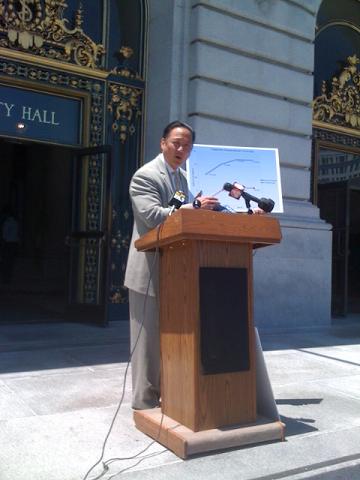
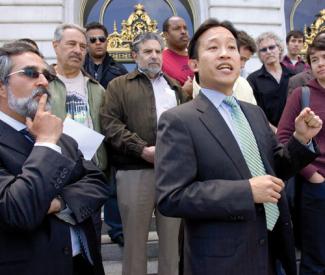
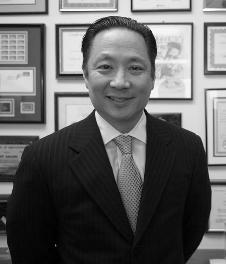
While downtown-oriented politicos and out-of-touch corporate columnists tout the political potential of targeting public employee unions with pay reductions and pension plan take-aways – and say the Public Defender Jeff Adachi may be mayoral material for doing so – they forget that electoral success requires coalitions, particularly in savvy San Francisco.

Unlike his cheerleaders, Adachi seems to understand this, downplaying the personal political upside when he talked to the Guardian and other media outlets. Sure, he might just be sandbagging, as his boosters hope he is, but there’s good reason to believe that this move could hurt Adachi’s chances of becoming mayor more than it helps it.

Much has been written and said about how Adachi’s move alienated labor unions and much of the progressive movement. “They urged me not to do it,” Adachi told the Guardian in the final days of his successful signature-gathering effort for a measure that would save the city about $167 million per year by taking that amount out of employees’ paychecks.

It’s not that pension reform isn’t needed. Indeed, San Francisco voters just approved a measure in June to increase the pension contributions for all new city employees, and politicians ranging from Sups. John Avalos and David Campos on the left to Sup. Sean Elsbernd and Mayor Gavin Newsom on the right all agree that more needs to be done, pledging to work with unions on the issue. And given the surly mood of the electorate, Adachi’s measure will probably pass.

But that still doesn’t make him mayoral material. Unlike Newsom, whose Care Not Cash initiative to take money from poor people helped propel him into Room 200, Adachi doesn’t have a strong constituency behind him, unlike the full strength of downtown and the Willie Brown machine that Newsom had behind him.

Downtown will never get behind a mayoral campaign for Adachi, a heavily tattooed defender of criminals who has a strong independent streak, even if they like the fact that he’s socking it to the public employee unions, an effort they helped fund. And progressives will now have a hard time ever trusting Adachi to work with them, seeing him now as someone hostile to political process and coalition-building, much like Newsom.

And even Newsom has come out against Adachi and his proposal, even though he loves the pension reform issue and shares some stylistic similarities with Adachi, including a certain political petulance. “Mayor Newsom has been clear that effective, long-term pension reform will come by doing it with our public employee unions, in partnership, not to and against them, in contrast to the Adachi measure,” Newsom Press Secretary Tony Winnicker wrote to the Guardian this week. It was a laughingly hypocritical statement from a mayor who has repeatedly demonized unions and refused to work cooperatively with them, but it’s a true statement nonetheless.

Finally, while socking it to public employees may be in vogue right now, during this moment of real economic uncertainty and political myopia, this sort of divisive politics might come to be seen more as opportunistic than courageous. And it’s hard to see how the approach that Adachi has taken will somehow add up to an effective political coalition capable of stealing the Mayor’s Office from wily politicians like Mark Leno, Leland Yee, or Aaron Peskin.

Consider the fact that even the Police Officers Association – the most conservative, downtown-oriented employee union in San Francisco – also opposes the Adachi measure and other efforts to blame the city’s fiscal problems on employees, rather than the large financial institutions that don’t even pay any kind of business tax to the city.

So I leave you with the words of POA President Gary Delagnes, writing in the May issue of the POA Journal, sounding a bit like a Guardian editorial writer on this politically sensitive issue: “Even more problematic is the rapidly developing notion that public employee pensions serve as the root of all evil, and are almost solely to blame for all of our economic woes.

“Opportunistic Wall Street insiders, politicians, and robber baron CEOs have manipulated and pilfered our country’s financial well-being. They have unconscionably – if not also illegally – lined their deep pockets with the hard-earned savings and pensions of the middle class working man and woman. Accountants from coast to coast have coached multi-millionaires on the art of avoiding paying their true tax obligations. Millions of people were allowed to qualify for mortgage loans by greedy bankers and mortgage brokers that led to trillions of dollars in bailout money. The result is a public incensed about fat cats taking advantage of them. Now, the backlash has set up public pensions and the unions that negotiated them as the scapegoats for his anger.

“Those of use who long ago made the decision to forgo large salaries in exchange for a life of public service, are now being portrayed as greedy and self-centered, taking unwarranted pensions and benefits after 30 years of service as firefighters, police officers, teachers, and nurses. These are shameful accusations, and utterly without merit.”

We couldn’t have said it better ourselves, but unlike one of our editorials, this is the perspective of cops and other unions and progressive constituencies that will shape their actions in elections to come.

The martyrdom of Mooney and Billings

0

Dick Meister , former labor editor of the SF Chronicle and KQED-TV Newsroom, has covered labor and politics for a half-century. Contact him through his website, www.dickmeister.com, which includes more than 250 of his recent columns.

It was an unusually hot July day in San Francisco.   There was a parade on that day in 1916 – a “Preparedness Day” parade organized by local Republican businessmen. It was intended to drum up support for U.S. entry into World War I and embarrass Democratic President Woodrow Wilson, who was running for re-election on a platform that stressed,  “He kept us out of war!”

A lot of people supported neither the war nor the parade, however. The opponents particularly included the union organizers who were the radicals of that period – “reds” who were trying to establish the right of unionization in the face of often violent opposition from the business interests who controlled the city and who most assuredly supported the war.

Many thousands of spectators, as many as 100,000 by some accounts, lined the parade route down Market Street, cheering and enthusiastically waving American flags. At precisely 2:06, less than a half-hour after the parade of more than 25,000 marchers had begun, just as contingents from the Grand Army of the Republic and Sons of the American Revolution were passing the crowded corner of Steuart and Market  streets. . . Boom!

It was the thunderous blast of a bomb that had either been thrown into the crowd or planted there.  The horrific explosion killed 10 bystanders and seriously wounded 40 others.

Within a few hours, the authorities had their culprits. Not surprisingly, all of those arrested as suspects were union organizers. Among them were two men who were especially despised by the city’s virulently anti-labor business establishment — Tom Mooney, 34, a burly Irish-American organizer for the International Molders Union who was one of San Francisco’s most prominent labor activists, and his close friend, slim, short, boyish Warren Billings, a 23-year-old shoe factory worker.

Mooney and Billings were San Francisco’s “most notorious reds,” declared the SF Chamber of Commerce in one of its typically frenzied assessments of those who dared challenge the status quo in which workers were treated as mere chattel.

The others who were arrested were soon freed, but Mooney and Billings were put on trial and eventually found guilty. Mooney was sentenced to death by hanging, Billings to life imprisonment.

There’s absolutely no doubt Mooney and Billings were framed. Federal investigators, investigative newspaper reporters and others proved that beyond any doubt.  The city’s famously corrupt district attorney, Charles Frickert, was found to have suppressed evidence that proved the pair’s innocence, joining with corrupt policemen to fabricate evidence that supposedly proved their guilt, and failing to call witnesses who, as he knew, had solid evidence that they were not guilty. Frickert hired other witnesses and coached them to give perjured testimony implicating Mooney and Billings.

Eventually, every major witness confessed to lying to the juries at both the Mooney and Billings trials. Some of them claimed to have seen the men plant the bomb on the day of the explosion, although it turned out the supposed eye-witnesses hadn’t even been in the city at the time.

Some gave their perjured testimony in exchange for such favors as the parole of relatives who were serving prison sentences, others for the pay District Attorney Frickert offered them. All were after the $17,500 reward posted for evidence leading to the conviction of Mooney and Billings.

 The judge who presided over Mooney’s trial told California’s governor he had determined through personal investigation that “every single witness who testified against Mooney had lied.” Mooney’s lawyer declared them “the weirdest collection of God-damned liars” he’d ever seen.

 A federal fact-finding commission concluded that “there was never any scientific attempt made by either the police or the prosecution to discover the perpetrators of the crime. The investigation was in reality turned over to a private detective, who used his position to cause the arrest of the defendants.” 

Fremont Older, the crusading editor of the San Francisco Bulletin, concluded that the authorities “conspired to murder a man with the instruments that the people have provided for bringing about justice. There isn’t a scrap of testimony that wasn’t perjured.”

The cases quickly drew widespread national attention, right up to the White House. President Wilson argued against Mooney’s hanging on grounds that there wasn’t a shred of evidence to support his guilt.

It was obvious that the Chamber of Commerce’s so-called Law and Order Committee had played a major role in framing Mooney and Billings as part of the chamber’s drive to change San Francisco’s status as one of the country’s most heavily unionized cities. 

Mooney and Billings, of course, had been attempting to enhance that status, in part by helping wage major organizing drives among the city’s vital transit workers and the equally vital employees of the company that supplied the city’s gas and electricity. Which was a very good reason the utility company – Pacific Gas & Electric – hired the private detective cited by federal fact-finders to help District Attorney Frickert and the police fabricate evidence against Mooney and Billings.  Not incidentally, Frickert was backed financially by Pacific Gas & Electric in his election campaigns for district attorney.

 The convictions prompted protests across the United States and worldwide, much like those raised five years later in behalf of two other union radicals, Nicola Sacco and Bartolomeo Vinzetti, who were executed in Massachusetts for a murder they clearly did not commit.

The Mooney and Billings case was dubbed internationally as “America’s Dreyfus Case,” a comparison to the famous French case that also drew worldwide protests. The protests stemmed from the rigged conviction of Jewish French Army Captain Alfred Dreyfus in 1894 for allegedly attempting to turn over secret military documents to the German government. Although the “Dreyfus Affair,” as it was called, was based on another issue – anti-Semitism – it similarly involved the use of false evidence against an innocent man by powerful authorities.

 Protestors in the United States and abroad quickly formed a network of defense committees in behalf of Mooney and Billings, and mounted rallies and other noisy and highly visible public demonstrations. 

 Freeing the two men became labor’s cause célèbre. Unions everywhere voiced loud and frequent protests, as did all other segments of the left, ranging from liberal to Communist. Eventually, they helped force California authorities to reduce Mooney’s death sentence to life imprisonment, ironically on the basis of evidence that should have freed him.

 President Wilson’s request that Mooney be spared was probably the main reason his sentence was commutated, but the heavy pressures of the Mooney-Billings defense committees and the American Federation of Labor, which Wilson most certainly felt, also had much to do with it.
   
Mooney finally was freed in 1939, twenty-one years later. Culbert Olson, California’s first Democratic governor in 44 years, granted him a full and unconditional pardon. Mooney, said Gov. Olson, was “wholly innocent,” and his conviction  “wholly based on perjured testimony.” 

Mooney’s release sparked great celebration among his supporters, who had fought so long for his freedom. Thousands paraded up Market Street behind Mooney shortly after his release, the street cleared for them by police, past the site of the explosion 23 years earlier that had sent Mooney to prison.

The next day, Mooney joined a picket line of striking department store employees on Market Street and donated to their cause half of the $10 the state had given him on his release from San Quentin Prison. Mooney sent the other half to Newspaper Guild members who were waging a major strike in Chicago.

Tom Mooney hadn’t much time to enjoy his freedom. His health had been broken in prison and he soon was hospitalized with a serious stomach ailment. He remained in a hospital bed until his death at age 60, less than two years later.

Billings got his freedom a few months after Mooney left San Quentin. Gov. Olson commutated his life sentence to time served – 23 years for a crime that no one really believed he or Mooney had committed.  Finally, in 1961, Gov. Edmund G. Brown granted Billings a full pardon. But, as Billings complained, it was granted on grounds that he had been “rehabilitated” rather than because he was innocent.

After leaving prison, Billings married and settled down in San Mateo, working in  San Francisco as a watch repairman, a trade he had learned in prison, and later set up his own repair business at home.  Billings quickly resumed his labor activism, as a member of the Watchmakers Union executive board and delegate to the San Mateo Labor Council. He was active as well in the anti-Vietnam War movement and various other political, economic and social causes. 

I interviewed Billings just before his death in 1972 at age 79. I expected to encounter a bitter, angry old man. Yes, he was old, but his spritely manner belied that basic fact of his life, and he showed absolutely no bitterness over the great injustice that had been done him – none! He talked instead of injustices that were being done to others, and of joining in efforts to help overcome them.

“I don’t have anything against anybody about anything,” Billings told me. “The people who testified against me were after that reward, but it all went to the police who arrested me. I’ve never felt any bitterness, but the fact that the witnesses against me didn’t get any of the reward money should make them bitter.”

Warren K. Billings was a great inspiration to me and others who knew him, and to many who just knew of him. He was a man possessing a spirit that could not be broken by circumstances far more severe than most of us have ever had to endure.  A man who would not even raise his voice in anger or bitterness against the terrible injustice that was done him. A man who maintained his convictions through it all. A strong and courageous man, but kind and gentle, and possessed of an incredible measure of tolerance and understanding.

The Preparedness Day bombing has never been solved.

NOTE: For more on the Mooney-Billings case, See “Frame-up” by Curt Gentry, an extraordinary work of investigative journalism book covering all aspects
of the case.

Dick Meister , former labor editor of the SF Chronicle and KQED-TV Newsroom, has covered labor and politics for a half-century. Contact him through his website, www.dickmeister.com, which includes more than 250 of his recent columns.

Hotel Fairness Initiative qualifies for fall ballot

10

By Brittany Baguio

The Department of Elections has announced that the Hotel Fairness Initiative was approved for the November ballot. Labor and community groups last week turned in 10,544 signatures, a little more than the required 7,168 signatures needed to put an initiative on the ballot. The Department of Elections did a sample of 500 signatures to check the validity and reported that 478 of the 500 signatures sampled were valid, resulting in a 95.6 percent accuracy rate.

The Hotel Fairness Initiative would increase revenue by imposing a 2 percent hotel tax on San Francisco hotel rooms temporarily for 4 years, with an average surcharge of $3 per hotel room per night, and close loopholes that let some visitors avoid paying the hotel tax. The hotel tax is currently 14 percent. According to the Controller’s Office, if the Hotel Fairness Initiative passes, it is expected to raise $25 million a year in revenue.

The hotel tax is one of five measures proposed to help close the budget deficit, which we discuss in more detail in this week’s paper. Mayor Gavin Newsom has also placed a measure of the ballot to also close the loopholes that lets airline employees and those who book hotels online avoid paying hotel taxes, as the Hotel Fairness Initiative would also do, but it includes a provision that would invalidate the hotel tax if his measure gets more votes.

Supporters of the Hotel Fairness Initiative claim that online booking companies and airline companies have been using corporate loopholes that have cost the city about $6 million per year. In total, online booking companies have escaped paying $70 million in hotel taxes through its loophole of taking the hotel tax out of a portion of the money the hotel receives, rather than the total amount the customer pays.

For example, Internet booking companies would charge customers $200 for a room and then pay the hotel $170. Internet booking companies argue that the hotel tax comes from a portion of $170, instead of $200. Similarly, airlines have avoided paying hotel taxes by renting blocks of rooms for its flight crews and claiming that airline companies are protected by the Permanent Resident Exclusion law. This law was originally intended to help the homeless and states that individuals who occupy a room for at least 30 days are tax exempted. However, airlines have been taking advantage of this law by moving different flight crews in and out of their hotel rooms rather than an individual person occupying the room for 30 consecutive days that is implied by the law.

Opponents of the Hotel Fairness Initiative, such as the San Francisco Chamber of Commerce and the Hotel Council, contend that the hotel tax would hurt tourism to San Francisco as well as cause job cuts. In a press release, Steve Falk, President & CEO of the San Francisco Chamber of Commerce said, “This misguided effort will discourage travel to San Francisco, hurt our city’s largest industry, and eliminate many of the union jobs the Labor Council seeks to protect. Raising city revenue at the expense of hotels and hospitality workers is not the answer to the city’s fiscal problems.”

A Hotel Council press release states that “the Hotel Fairness Initiative will lead to 7.3 jobs lost for every million dollars in revenue gained.” If this is true, about 182 jobs could be lost as a result of this initiative, offset by the city being able to save many public sector jobs and services with the revenue. The hotel industry already fluctuates in the number of positions available as a result of the market. According to California Labor Market Info’s latest data, the average amount of hotel jobs lost per month in 2009 was 143 jobs.

Although the Hotel Council and the Chamber of Commerce claim that the initiative would eliminate jobs, one of the biggest supporters of the hotel tax is UNITE HERE LOCAL 2, a union of hotel workers. UNITE HERE representative Ian Lewis emphasized that opponents of the issue are conveniently ignoring the lack of fairness in current hotel booking practices. “Hotel workers live in San Francisco,” Lewis told the Guardian, “We’re taxpayers like everyone else. We are in a severe budget crisis and everyone needs to carry their fair share.”

Community groups, retirees, and hospital workers all volunteered their time to collect signatures supporting the Hotel Fairness Initiative. Community groups such as UNITE HERE collected 1700 signatures, Keep the Arboretum Free collected 1000, and a collection of nonprofit groups collected more than 4000. With the efforts of these community groups, the coalition was able to collect an estimated 15,000 signatures.

Family health advocate for the Tenderloin Housing Clinic, Bobbi Lopez, said she found that those who signed the petition saw the hotel tax as a necessary step in closing the budget deficit, “They understood that the necessity of fighting the cuts, particularly the cuts to MUNI, to parks, and to hospitals,” Lopez told us, “I think that they were getting the idea that in desperate budget times, we need a temporary solution and long term solution and that’s exactly what the Hotel Fairness Initiative is.”

Community groups remain optimistic that this grass roots effort will pass. Brenda Barrows, a health care provider at San Francisco General Hospital, told the Guardian, “My hope is that in November it passes and the city’s financial situation gets better so that people who live in the city don’t have to suffer and also people who work for the city don’t have to suffer.”

Lopez told us she thinks that the initiative will pass if there is an ongoing effort on the issue. “We want to remind folks that this is just the beginning and now we have to embark on a long term campaign,” Lopez told us, “so it’s really about sustaining the energy that we had on June 1 when we kicked off and reminding folks that its going to necessitate all the same volunteers to work together and make it reality.”


Board accepts EIR, but vows to amend Candlestick-Shipyard plan

14

Text by Sarah Phelan, images by Luke Thomas


At the end of a ten-hour hearing to appeal the final environmental impact report  for the city and Lennar’s massive Candlestick-Shipyard redevelopment project, the Board voted 8-3 to accept the FEIR, with only Sups. John Avalos, Chris Daly and Eric Mar voting to reverse certification of what they said was a flawed document.


But the vote does not mean the Board has voted to accept the city and the developer’s final redevelopment plan. That plan will come before the Board on July 27, and the supervisors are expected to introduce a slew of amendments, in addition to  five amendments that Board President David Chiu introduced earlier this week.


These amendments are intended to address longstanding concerns about toxins at the shipyard, limited liability on the part of the developer, the questionable need for a bridge over Yosemite Slough, the reality that Bayview residents may be cut out of any upcoming jobs, and the desire to nail down efforts to use public power at the site


“We can’t do the amendments here, we are frozen out, all we can do is an up and down vote on the EIR for now,” Sup. Ross Mirkarimi told the Guardian last night. 
Mirkarimi anticipates that the Board will seek additional mitigations, such as requiring liquidated damages to shore up a community benefits agreement that Labor entered into with Lennar in May 2008.


Mirkarimi said the Board would also seek to increase workforce development benefits.
“Thirty percent of the target workforce population are ex-offenders, so while they might get training, currently they won’t get jobs other than construction,” Mirkarimi observed.


Mirkarimi was proud of the Public Power amendment that Chiu has already lintroduced, pointing to an ordinance that he and then Sup. Gerardo Sandoval introduced and Mayor Gavin Newsom signed into law, in March 2006. This public power ordinance established that “where feasible, the City shall be the electricity provider for new City developments, including military bases and development projects.”


“PG& E was ripped when we pushed that through,” Mirkarimi said.


During yesterday’s marathon hearing, the supervisors grilled city staff on issues that have proved to be key sticking points, as the city seeks to win final project approvals, even though they cannot address these issues with amendments until the July 27 meeting.


The Board questioned the wisdom of moving forward with development on the Shipyard, as the Navy continues to clean up radiological contamination and other toxins at the site, including Parcel E-2, which contains some of the nastiest pollution at the yard.


“Why not just wait until the CERCLA process is completed?” Sup. Campos asked, referring to the fact that the Navy is responsible for shipyard clean up, under CERCLA, which is also known as the Superfund Act.


Campos question came after acclaimed environmental scientist Wilma Subra and national environmental human rights lawyer Monique Harden, challenged the sanity of having the Navy digging out toxins while a developer simultaneously installs infrastructure at the same site.


Subra, who works in Superfund sites throughout the U.S, warned the Board that it’s very common to find contamination at these sites after they have been declared clean.


“So, the number of samples isn’t the magic answer,” Subra said, referring to the city’s constant refrain that the Navy has taken thousands of samples at the site. Subra also warned that it is not uncommon for a contractor to dig into an area that has been capped, thereby potentially exposing workers and the community to contamination and resulting in legal stand-offs, as various parties argue as to who has responsibility to fix the resulting mess.


Harden, who is based in New Orleans but also has an office in D.C., expressed concern over the plan to begin construction on some shipyard parcels, even as the Navy continues to remove radiologically contaminated sewers and other deep infrastructure at the site.
“That’s like a person jumping up and down on a bed that another person is trying to make up,” Harden said


But Michael Cohen, Mayor Gavin Newsom’s chief economic advisor countered that there was no scientific evidence to support Subra or Harden’s concerns.


“It’s a very common situation, especially on brownfields,” Cohen said, (though the Shipyard is a Superfund site that’s been contaminated with radiological waste that was sandblasted off ships returning from a Bikini Atoll atomic testing experiment gone awry.)


“It’s the basis for shipyard artists and the police being on the site for many years,” Cohen continued. “It’s safe based on an extraordinary amount of data.”


But Cohen did agree that language in Chiu’s Parcel E-2 amendment should be changed from “should” to “shall” to indicate that city oversight is a requirement, not a request, when it comes to final decisions over the transfer of this particular parcel.


Mark Ripperda of U.S. EPA assured the Board that his agency is not going to permit transfer of parcels for development until cleanup is completed.
“We are not going to allow any transfer until we are convinced it’s safe,” Ripperda said.


Sup. Eric Mar chastised the EIR for its apparent failure to adequately discuss the impacts of the proposed development on schools in the surrounding area.


“There is less discussion of the impacts on schools than there is of the A-Bomb, which was held at the Shipyard for 1 to 2 days,” Mar said. “The analysis seems very weak.”


And Daly expressed frustration that the Board was being asked to take a decision when it lacked sufficient information about and understanding of the project.


“How do we know it’s safe? ” Daly asked, noting that, “Money talks, bullshit walks.”
(His point resonated as City staff scrambled to find key information within the 7,000 pages of comments and responses in the massive FEIR documents, and Amy Brownell of the city’s Public Health Department rattled off a series of measurements and schedules that few on the Board seemed to understand.)


“The risks are acceptable,” Brownell said. “And the only people allowed on the property [during the development] will be the ones doing the work.”


The Board also challenged the need for a bridge over the environmentally sensitive Yosemite Slough, especially in the wake of the June 2010 election in which Santa Clara voters approved building a new stadium for the 49ers near Great America.


“One reason I’ve been given for [the need for the bridge] is the financial viability of this project,” Campos said.


Cohen replied that if the city does not to build the bridge, “it elevates the financial risk.”


“Parcel C [on the shipyard] has been zoned for green tech, and for major employers, having that direct connectedness to BART and the T-Third is very important.”


Cohen also indicated that, thanks to the project’s huge reliance on tax increment financing, the loss of the bridge would translate into lost property tax revenues.


“Some of the repayment comes from generation of tax increment financing, so the failure to have a bridge here, degrades the potential of property tax revenues, and so you get much less tax increment,” Cohen stated.


The Board also expressed concerned that under the current terms of the deal they are now set to consider July 27, the developer has limited liability—an arrangement that has got supervisors worried that the city, and Bayview residents whose increased property taxes will help pay for the development, could end up on the wrong end of the financial hook.


Campos pointed to the disposition and development agreement (DDA) that the city drew up with Lennar.
“I’m specifically worried about a provision that on the face of it limits the developer’s liability,” Campos said, pointing to language that seems to say that “monetary damages are inappropriate”—conditions that Campos deemed, “Very unusual.


Cohen responded that the deal reflects the reality that, “the Navy, not Lennar is responsible for the cleanup.”
He added that the city retains the legal ability to sue, various remedies and, ultimately, “the right of reverter” (which folks call the “nuclear option” since it involves kicking out the developer, but losing everything in the process.)


“This is an incredibly frontloaded project,  in which we have the ability to terminate the developer at the cost of millions of dollars,” Cohen said.


But while the city and the developer ultimately affirm EIR certification, the decision left the Bayview community deeply divided, with many concerned that the FEIR failed to address their concerns, while others rejoiced, believing that they will benefit from jobs that will be created during the development’s 10-15 year build out and beyond. Only time will tell how it all plays out, but stay tuned as the Board prepares to try and make the plan the best it can in face of all these competing concerns.


Appetite: With Campo de Encanto, SF gets its own pisco

0

You might have heard? There’s a new pisco on the streets “for bartenders, by bartenders”: Encanto Pisco, created by Duggan McDonnell of Cantina, sommelier and spirits guru Walter Moore, and Peruvian master distiller Carlos Romero. Although an authentically Peruvian pisco (distilled — and already making waves — in Peru), it’s a homegrown San Francisco product, a labor of love from locals who know their spirits.

I had the privilege of tasting this acholado (blended) pisco before its release and now with the finished product, am delighted at how balanced it is: floral, with hints of citrus and white pepper. It stands up on its own, going down smoothly much as a brandy or eau-de-vie would, but also an ideal base for cocktails, with a large number of bars around town already stocking it. Alembic was the first to do so, it’s also at pisco havens La Mar Cebichería and Pisco Lounge, while Carlos Yturria showcased it with fig, sage and lemon at the inaugural Pickled, in Absinthe’s back room.

Campo de Encanto means ‘Field of Enchantment’, a romantic spirit evident in gorgeous, vintage-style bottling to the artisanal production of this grape brandy in the Ica Valley of Peru, combining three different grape varietals: Quebranta (76%), Torontel (6%), and Italia (18%). Encanto is sustainably harvested and distilled without preservatives, sugar or even a drop of water.

San Francisco has a rich history and love affair with pisco, inventing some of pisco’s greatest drinks like the Pisco Punch, so it seems fitting that we now have a pisco to call our own. And one of the finer, more approachable piscos at that.

You can purchase Encanto at stores like Cask or The Jug Shop

www.encantopisco.com

Bad faith

3

steve@sfbg.com

Mayor Gavin Newsom and his business allies are actively trying to sabotage the various revenue measures that have been put forth by the labor movement and progressive members of the Board of Supervisors, employing deceptive rhetoric, sneaky tactics, and a refusal to bargain in good faith.

In fact, Newsom — the Democratic nominee for lieutenant governor — is so averse to supporting anything that could be called a “tax” that he rejected a hard-won compromise measure created by powerful developers, affordable housing advocates, a pro-business think tank, the building trades, and his own directors of housing and economic development.

Just as that story was breaking in the New York Times (produced by Bay Citizen) on July 9, members of the Board of Supervisors Budget and Finance Committee discovered that Newsom’s proposed ballot measure to close loopholes in the city’s hotel tax that favored airline employees and online travel companies — a widely supported change, but one worth just $6 million per year — contains language that would nullify any increases in the hotel tax. Earlier in the week, labor unions turned in signatures on an initiative to increase the hotel tax by 2 percent, which would bring in more than $30 million per year.

“This poison pill is an intentionally deceptive, underhanded move,” Gabriel Haaland, an organizer with Service Employees International Union Local 1021, which sponsored the hotel tax, told us. “It’s so frustrating. It’s not even a good faith fight. He’s trying to create confusion and fool the voters. If our measure passes fair and square, it should be implemented.”

Meanwhile, Newsom and business groups have been attacking a reform measure by Board President David Chiu that would make the currently flat payroll tax more progressive, exempt more small businesses from paying it, and create a commercial rent tax to spread the tax burden more widely than the 10 percent of businesses who now pay tax to the city.

Critics complained that the measure would hurt local businesses — but that’s just not true. The city’s Office of Economic Analysis concluded that Chiu’s original proposal would have no effect on private sector jobs and would generate $34 million annually for the city, preserving some government jobs and spending.

Then Chiu amended the measure to spare even more small businesses. Now the OEA says that the measure would actually create private sector jobs — and still bring $28 million in to the city. Yet Newsom and the business community are still withholding their support.

This trio of Machiavellian moves comes just a week after Newsom pulled out of budget negotiations with board progressives concerning about $40 million in board add-backs to programs that Newsom proposed to cut after they wouldn’t agree to his precondition that they withdraw unrelated measures proposed for the November ballot, such as splitting appointments to the Rent, Recreation and Park, and Municipal Transportation Agency boards and requiring police officers to do foot patrols.

The series of events has led many progressives to say that conservative ideological blinders — a knee-jerk opposition to anything that saves government jobs and services or that Republicans might criticize — is the only logical explanation for the intransigent stance adopted downtown and by Newsom.

“It’s ideological. It’s not economic, and it’s not even political,” said Calvin Welch, the affordable housing activist who helped negotiate the transfer tax compromise with developer Oz Erickson, San Francisco Planning Urban Research Association director Gabriel Metcalf, Mayor’s Office of Housing Director Doug Shoemaker, and others.

That measure would have created a transfer tax on sales of properties over $875,000 and generated approximately $50 million annually for affordable housing (funds that were drastically reduced in Newsom’s proposed 2010-11 budget) while cutting in half the current requirements and fees on market-rate developers to create below-market-rate units. The plan would have stimulated both types of housing and created desperately needed construction work — an approach those involved called an elegant solution to several problems.

“To me, this was a win-win, solving two problems that are each a big deal,” Metcalf told us. “I don’t know what his reasons were for not supporting it. I was surprised.”

But Welch said, “It collapsed straight up because the mayor didn’t want to support a tax.” Although Newsom told the Times it was because there wasn’t broad enough consensus yet, “the mayor’s reason is whole-cloth bullshit,” Welch said, noting the role of the Mayor’s Office in brokering the deal. “The mayor walks away from it because everyone wasn’t in the room? Well, it’s your room, motherfucker. Show some leadership.”

Newsom Press Secretary Tony Winnicker refused to discuss these issues by phone, responding to our written inquires by noting that Newsom opposes taxes and thinks the best way to address budget deficits are privatizing city services and pension reform (although he opposes Public Defender Jeff Adachi’s initiative, the only pension reform measure on the fall ballot).

“The mayor is opposed to the Board of Supervisors’ proposals to increase taxes because they’re not needed to balance the budget and they will strangle our still young economic recovery,” Winnicker wrote, refusing to answer follow-up questions or support a statement about Chiu’s measure that the OEA concludes is not accurate.

Like many political observers of all stripes, those from downtown and progressive circles, Welch criticized Newsom for his lack of engagement with city business and its long-term fiscal outlook, contrasting him with former Mayor Willie Brown, who met regularly with former Board of Supervisors President Tom Ammiano even as the two ran a bitter campaign for mayor against one another in 1999. “They dealt with the city’s business like two adults who cared about the city,” he said.

Welch acknowledged that there was still work to be done building political support for the transfer tax measure. He and other progressives would have had to win over city employee unions who wouldn’t like the budget set-aside aspect, and Erickson and Metcalf would need to placate some of their downtown allies who oppose taxes on ideological grounds. But given how downtown groups are behaving right now, that might not have been an easy sell.

“There are members of the small business community that are averse to any taxes,” said Regina Dick-Endrizzi, director of the city’s Office of Small Business and staffer to the Small Business Commission, which was withholding a recommendation on the Chiu measure but planned to meet again to consider it July 12 (look for an update on the sfbg.com Politics blog). She said the small business community is having tough times and “they are just not sensitive to keeping city workers employed.”

Larger commercial interests are being even more forceful in opposing the revenue measures. While a parade of workers, social service providers, and progressive activists testifying at the July 9 Budget Committee hearing implored supervisors to place all the proposed revenue measures on the ballot, representatives from the Building Owners and Managers Association (BOMA) and San Francisco Chamber of Commerce were the only two speakers urging supervisors to drop the measures and focus instead on creating private sector jobs.

“You’re trying to create a little revenue here and it’s not going to work,” said Ken Cleaveland, director of BOMA SF, arguing that big banks and financial services companies — entities exempt from the payroll tax that Chiu is hoping to target with the commercial rent tax — will buy their buildings to avoid paying the tax. “They aren’t going to create more jobs and they really aren’t going to create more revenue.”

Yet Chiu noted that it was the business community and fiscal conservatives who pushed to create the Office of Economic Analysis, whose work they have regularly used to attack progressive legislation. Now that the office has concluded that a piece of progressive legislation is good for the local economy, Chiu told Cleaveland and the Chamber spokesperson Rob Black at the hearing, “I ask you to respect the work this office has done.”

Black said the Chamber board will consider Chiu’s amended legislation, but said businesses are in no mood to help the city. “How many times have you gone to your neighborhood merchant and had them say, ‘Gee, my rent’s too cheap’?<0x2009>” he said during his testimony.

Yet Chiu said landlords of small tenants (those paying less than $65,000 in rent per year) are exempt from the rent tax and only 26 percent of SF businesses would pay any city business tax under his plan. “I hope the mayor will support this proposal and the business community will give it a good look,” Chiu said as the hearing ended.

At the beginning of the hearing, Chiu framed the dire situation facing San Francisco, citing Controller’s Office figures showing this year’s $500 million budget deficit (out of a $6 billion total budget) will be followed by a $700 million deficit next year and a $800 million gap the following budget cycle as a result of a deep structural budget imbalance.

“We have budget deficits as far as the eye can see,” Chiu said at the hearing. “We have to consider measures that will provide more stable sources of revenue.”

He also noted that city employee unions have agreed to give back about $250 million in salary and had their ranks reduced by about 2,000 workers in the last two years. So he and the other progressive supervisors say it’s time for the rest of San Francisco to help address the problem.

“We, as a city, should not be trying to balance this budget simply through cutting,” Sup. David Campos said.

Sup. John Avalos, the committee chair, amended his transfer tax measure in the wake of Newsom’s rejection of the deal by making it a simple 2 percent tax on properties that sell for more than $5 million, and 2.5 percent tax on properties over $10 million. He estimates it will bring in about $25 million per year from the city’s wealthiest corporations and landlords.

“That’s who we’re socking it to,” Avalos told us, saying he was disappointed the compromise fell through. “The amendment is going to be more progressive than what was originally planned.”

Even Sup. Sean Elsbernd, a strong fiscal conservative who announced early in the hearing, “You want to do that [balance future budgets] by adding taxes, but I want to do it through ongoing service cuts,” later told the Guardian that he was intrigued by the amendments Avalos and Chiu made to their measures and has not yet taken a position on them.

Sup. Ross Mirkarimi is also sponsoring a measure to increase the city’s tax on parking lot operators from 25 percent to 35 percent, the first change to that tax in 30 years, and will include valet parking for the first time. The measure would bring in up to $24 million per year, and OEA analysis shows it would decrease the number of cars trips by 1.3 percent, another benefit.

SFMTA supports the measure, with board member Cameron Beach testifying that the money will be used to subsidize Muni and “it links the use of private automobiles and is consistent with the city’s transit-first policy.” Mirkarimi, who chairs the Transportation Authority, also has proposed a $10 local vehicle license fee surcharge that would bring in another $5 million per year for Muni.

All the revenue measures require six votes by the full Board of Supervisors, which is scheduled to consider them July 20, after which they would need a simple majority approval by voters in November to take effect.

The mayor has the authority to directly place measures on the ballot, so the committee hearing on his hotel tax loophole measure and a $39 million general obligation bond that he’s proposing to create a revolving loan fund for private sector seismic improvements were mere formalities, so supervisors criticized aspects of each but were unable to make changes.

Avalos even grudgingly acknowledged the hotel tax poison pill was an effective way to kill that revenue source, saying at the hearing, “This is very smart. I don’t agree with it, but it’s very smart.”

Haaland was less charitable, criticizing a provision designed to confuse voters. “This kind of move means both measures won’t pass because now we have to oppose [Newsom’s measure],” he said, criticizing the mayor for running away from the hard decisions facing the city. “He won’t be around next year, when we have an even bigger structural budget deficit, to clean up this mess. Absent new revenue sources, this city starts to fall apart.”

Whitman criticized for opposing high-speed rail

10

By Brittany Baguio

Although Republican gubernatorial Meg Whitman claims job creation is one of her top priorities, she recently stated that she opposes the plan to build a high-speed rail system in California – a project that is being eagerly anticipated in San Francisco, its northern terminus.

Whitman says the state does not have enough money to fund the project because of the state’s current budget deficit, but labor, environmental, and other groups say it will be a boon to the state’s economy and environment. Voters approved Proposition 1A in November 2008, supporting the construction of a high-speed rail system with an initial investment of $9.95 billion in bond money.

Proponents say the project will alleviate freeway and airport congestion and provide a green transportation option that has both short- and long-term economic benefits. According to the California High-Speed Authority website, the project would create 160,000 constructed-related jobs as well as 450,000 more jobs by 2035. The construction of the rail system would also improve the movement of people, goods, and services throughout California and ultimately raise more than $1 billion in surplus revenue a year.

“We are eager to thoroughly brief whoever the next governor is on this project and work with him or her to make California’s high-speed rail system a reality,” California High-Speed Rail Authority representative Rachel Wall told the Guardian.

Supporters of the bullet train disagree with Whitman’s analysis and contend that the construction of a bullet train would create revenue and jobs. In a press release, California Labor Federation Executive Secretary-Treasurer Art Pulaski said, “In her glossy TV ads, Whitman says she understands the daily hardships facing our state’s unemployed, but it’s clear that’s just more campaign rhetoric. In opposing high-speed rail, she’s shown her true colors on jobs. It’s shocking that a candidate for Governor could be so detached from the economic hardships facing our state’s families. With one in eight Californians out of work, how can we afford not to invest in the creation of hundreds of thousands of permanent, good new jobs?”

Communications director of the California Labor Federation, Steve Smith, believed that Whitman’s opposition exhibited her political inexperience and uninformed decisions. “She’s out there talking a big game about job creation, but no specifics about how she would create jobs,” Smith told us. “Her proposals would be devastating to California and would lead to higher unemployment in California. She says that California can’t afford the project, but what we can’t afford is not to take advantage of improving our economy and environment.”

Whitman isn’t the only one opposing the project. Bay Area cities of Menlo Park, Palo Alto, Burlingame, Belmont, and Atherton have all voiced concerns about the project and the impact of trains move rapidly through those communities, filing a lawsuit seeking to halt the project.

The bullet train project was awarded $2.25 billion from the American Recovery and Reinvestment Act last January and is currently undergoing supplemental environmental reviews. Construction is scheduled to begin in 2012, with improvements such as rail electrification expected to improve rail service on the San Francisco peninsula even before the high-speed trains start running around 2020.

Assuming the public-private project isn’t derailed politically and can raise the estimated $40 billion total cost, the trains will travel at speeds of up to 220 mph and take passengers from the LA Union Station to San Francisco’s Transbay Terminal in less than 2 hours and 40 minutes.

On the cheap listings

0

On the Cheap listings are compiled by Paula Connelly. Submit items for the listings at listings@sfbg.com.

WEDNESDAY 14

Make Beer in Your Basement Bazaar Café, 5927 California, SF; (415) 831-5620. 7pm, free. Learn to make your own beer to both save money and get invited to more parties. Home brewer Caleb Shaffer presents an overview of the beer brewing process, complete with explanations on technique, equipment, and ingredients.

Vive le Film! Hotel Rex, 562 Sutter, SF; www.disposablefilmfest.com. 8pm, free. In honor of Bastille Day, the Disposable Film Festival will present a collection of disposable films with a French flare. Enjoy drink specials courtesy of Hotel Rex and valet bike parking provided by Globe Bikes.

THURSDAY 15

Hayes Valley Farm Tour Hayes Valley Farm, Laguna between Oak and Fell, SF; www.laborfest.net. 3pm, free. Attend this LaborFest sponsored tour of Hayes Valley Farm, an urban agriculture education and research project, and learn about the alliance of urban farmers, educators, and designers that comprise the Hayes Valley Farm Project Team and the innovative strategies used on the farm in order to meet the needs of our planet and the surrounding communities of San Francisco. Tours of the farm are held every Thursday and Sunday.

FRIDAY 16

Free Museum Weekend Various museums in San Francisco, visit www.onlyinsanfrancisco.com/target for exact dates and times. Fri.-Sun., free. The de Young Museum, Asian Art Museum, SFMOMA, Contemporary Jewish Museum, Museum of African Diaspora, Zeum, and the Yerba Buena Gardens Festival are all offering free admission days throughout the weekend for all ages along with hands-on art activities, and family friendly performances.

SATURDAY 17

“Art Show” Cat Club, 1190 Folsom, SF; (415) 703-8964. 5pm, $5 suggested donation. Watch interpretive drag performances devoted to the works of Keith Gaspari, who will be hosting along with the lovely Bebe Sweetbriar. Featuring works by local artists and performers, champagne toasts, a raffle, and special Bulleit bourbon cocktails to benefit Visual Aid, a non-profit that supports artists living with HIV.

“Beatles to Bowie” San Francisco Art Exchange, 458 Geary, SF; (415) 441-8840. 7pm, free. Attend the opening of this Rock n’ Roll photo exhibition displaying original photos showcasing the evolution of music from the British invasion to glam rock from 1962 to 1974. Featuring never before seen photos by Terry O’Neill.

Behind the Storefronts Chinese Cultural Center of San Francisco, 3rd floor, 750 Kearny, SF; (415) 252-2598. 2pm, free. Learn about how Art in Storefronts, a citywide project that temporarily places original art installations and murals into vacant storefront windows and exposed walls, from some of the artists and property owners who participated in the current Chinatown exhibition. An artist-led tour of the storefronts and murals will follow the discussion.

Night Light SOMArts Cultural Center, 934 Brannan, SF; (415) 552-1770. 9pm, $5 suggested donation. Get lost in a multimedia garden party featuring temporary multimedia, abstract sound, video, and film installation set in the garden of SOMArts. In conjunction with the current “Totally Unrealistic: the art of abstraction” exhibit.

Schools for Salone El Rio, 3158 Mission, SF; (415) 648-4767. 4pm, $10 suggested donation. Enjoy an afternoon of dancing, eating, drinking, and probable sunshine to benefit Schools for Salone, a non profit that build schools in Sierra Leone. Featuring music by DJs Marcos, Eschew, SpinCycle, PMS, and Ras Kanta, African food by Bissap Baobab, and raffle prizes.

Song and Poetry Swap The San Francisco Folk Music Club, 885 Clayton, SF; (415) 648-3457. 8pm, free. Join the Freedom Song Network to help keep the spirit of labor and political song alive in the Bay Area by bringing songs or poems to share at this swap of picket line, rally, and concert songs and poems. No musical training or talent required. Part of LaborFest 2010: www.laborfest.net.

Union Square Art Walk Participating galleries along Post and Sutter streets, SF; for exact locations visit http://artwalksf.com/. Noon-5pm, free. Take a free, self-guided walking tour of Union Square art galleries at this art walk featuring artist talks, performance art, live music, film screenings, refreshments, and more.

SUNDAY 18

Lots of Abundance Meet at CCA Farm, 8th St. at Hooper, SF; www.sfbike.org. 9:45am, $5 suggested donation. Discover local projects that reclaim abandoned lots and former freeways for public use and for the purpose of restoring connections to food on this two and a half hour bike tour led by TransitionSF and the San Francisco Permaculture Guild. The tour will highlight local efforts to create community and garner support for both the environment and the economy.

MONDAY 19

Ubu Roi Theater Pub, Café Royale, 800 Post, SF; www.sftheaterpub.wordpress.com. 8pm, free. Take in a one night performance of Alfred Jarry’s 1896 bawdy and nihilistic re-imagining of Macbeth, translated and modernized by Bennett Fisher. Enjoy this original work and workshop at the Café Royale bar featuring musical accompaniment by DJ Wait What.

For Lit, Talks, and Benefits listings, visit the Pixel Vision blog at www.sfbg.com/pixel_vision.

Board votes on Candlestick-Shipyard project EIR appeal today

3

All images by Luke Thomas

The Chronicle’s suggestion that the city’s massive Candlestick-shipyard project may be facing smoother sailing seems like wishful thinking to those who attended a July 12 noontime rally that was organized by POWER (People Organized to Win Employment Rights) and featured two Louisiana-based advocates who protested the project’s EIR and shared many of the longstanding concerns about project cleanup, infrastructure and financing.

The Chronicle was of course referring to five amendments to the city’s massive redevelopment proposal that Board President David Chiu introduced during yesterday’s July 12 meeting of the Board’s Land Use committee. The Chron interpreted these amendments as a sign that Chiu plans to approve the project’s environmental impact report, which comes before the Board today, after several groups appealed the final EIR that the Planning Commission approved last month.

But while city officials fear the developer will walk, if the Board does not approve the final EIR, some environmental advocates hope a better plan could be reached.

At POWER’s July 12 rally, nationally acclaimed environmental scientist Wilma Subra called on the District Attorney’s environmental justice department to “step up.” Subra claimed that the project’s final EIR “failed to evaluate and assess the cumulative impacts of exposure to children, adults and the environment as a result of exposure to all of the chemicals at the site.”

Monique Harden, co-director and attorney for Advocates for Environmental Health Rights (AEHR) of New Orleans, Louisiana, pointed to “deep flaws in the environmental regulation system,” as a reason why low-income communities of color should be concerned about the proposed plan.
“Why in the middle of an environmental crisis caused by BP in the Gulf am I coming to San Francisco?” Harden asked. “Because San Francisco is providing unequal environmental protection to its residents. As a resident of New Orleans, I’m concerned that San Francisco is careening towards making a decision that can crush the future of Bayview Hunters Point,”

But as local Bayview resident Jose Luis Pavon began talking about seeing gentrification occur in his lifetime within San Francisco, he and others got shouted down by a group of yellow and green-shirted project supporters, who were led by a guy calling himself Bradley Bradley and Alice Griffith public housing resident Stormy Henry.
“This is the devil’s trick in the last hour,” Henry said of the POWER rally.

Henry shared her heartfelt belief that if the Board approves the project’s final EIR, she and other Alice Griffith residents will get desperately needed new housing units. even if it takes some years to build them. Others in her group were unable to answer media questions: they had difficulty speaking in English, but were clutching neatly written statements in support of the project that they later read aloud at the Board’s Land Use Committee hearing.

As these project supporters prepared to move inside to attend the Land Use Committee meeting and lobby supervisors for their suppor, D. 10 candidate Tony Kelly shared his concerns that the Navy has a demonstrated history of finding nasty things at the shipyard years after they say everything’s clean, and that this pattern could jeopardize the plan.

“This happened at Parcel A,” Kelly said, referring to the first and only parcel of land that the Navy transferred to the city for development in 2004. “Since then, Parcel A has gotten smaller and as they found stuff on sites they then renamed as new parcels, like UC-3, which has radiological contamination in a sewer line that goes into the Bayview. So, that means the contamination is now in the Bayview.”

Kelly is concerned that the city is trying push through EIR certification before the Navy completes an environmental impact statement (EIS) related to shipyard cleanup activities. “The EIS is supposed to go before the EIR, as far as I know,” Kelly said

At the Land Use Committee meeting, Sup. Sophie Maxwell, whose district includes Candlestick and the Shipyard,said, the project was about “revitalization and opportunity.”

She noted that the certification of the project’s final EIR has been appealed to full Board’s July 13 meeting. She further noted that she intends to introduce legislation next week to address concerns that Ohlone groups have expressed.

The next two hours were full of testimony from a bevy of city officials, beginning with Michael Cohen, Mayor Gavin Newsom’s top economic advisor in the Office of Workforce and Economic Development.

“Every single element [of this project] has been discussed and debated at countless meetings,” Cohen claimed, as he sought to quell fears that the community had not been properly consulted with over the plan. “As we get closer to a vote, all of a sudden pieces of paper start circulating, criticizing project and suggesting that community involvement just began,” he continued. ” That’s factually untrue.”

He also sought to reassure the supervisors that the Board will have a say-so as to whether the city accepts early transfer of shipyard parcels from the Navy.
“Neither the city nor the developer have any specific authority over the cleanup,” Cohen said, noting that the cleanup is governed by specific rules set out in CERCLA [Comprehensice Environmental Response, Compensation and Liability Act, aka Superfund].

“Regardless of what we do, CERCLA will continue to be the regulatory tool,” Cohen said. ” I urge you not to be confused by CEQA and CERCLA.”

So, how can the city implement Prop. P, which voters overwhelmingly supported in 2000, urging the Navy to clean up the shipyard to highest attainable standards.
“Prior to any transfer, US EPA and DTSR have to concur in writing that the shipyard is safe,” Cohen explained, noting that, thanks to Speaker of the House Nancy Pelosi, the Navy has already spent over $700 million on shipyard cleanup efforts.

“We have 250 artists at the shipyard….but not a shred of scientific evidence to say that the shipyard is not safe,” Cohen claimed. “It’s safe to develop the shipyard in precisely the manner we are proposing.”

When Sup. Eric Mar raised the question of radiological contamination on Parcel UC-3, Cohen downplayed Mar’s concerns.
“The exposure levels are lower than watching TV,” Cohen claimed. “The primary source is very low level radiation from glow-in-the-dark dials.”
Indicating a map that showed a network of old sewers (in blue) and old fuel lines (in red) under the entire development area, Cohen said, “The radiological contamination that has and will be addressed at the shipyard is quite low level. You have radiation, you get nervous. We asked EPA to come out and do a scan to deal with the issue.”

IBI Group’s David Thom, the lead architect and planner for the project said the plan is designed “to connect new development back into the Bayview.”
“And this plan connects the Bayview through to the water.”

Tiffany Bohee, Cohen’s deputy in the Mayor’s Office of Economic and Workforce Development, insisted that project’s proposed bridge is better than Arc Ecology’s proposed alternative route, which would not involve constructing a bridge over an environmentally sensitive slough.
“The non-bridge route increases the number of intersections,” Bohee said, seeking to turn an environmental question (the impact of bridge on wildlife and nature experience) into a public safety issue.”
She claimed the BRT route over bridge was 5-10 minutes faster than Arc’s proposed alternative, “because there are fewer turns, it can go at higher speeds.” But Arc’s studies suggest the BRT route over the bridge is only a minute faster, and would cost over $100 million.

Bohee noted that $50 million from the sale of 23 acres of parkland for condos at the Candlestick Point State Recreation Area (CPSRA) will be “set aside for the state, and won’t be able to be raided by the city,” with $40 million going to improvements, and $10 million to ongoing operation and maintenance costs.

She also cited additional benefits that the project would bring to the community, including thousands of construction job opportunities.

“We are working with City Build to make sure they are for local residents,” Bohee said.“And there is absolutely no displacement for the rebuild,” Bohee continued referring to proposal to place current Alice Griffith public housing iresidents n new units, on a 1-1 basis

Eric Mar said he was impressed by many elements of the plan, but continued to express reservations.
“I’m still concerned that is seems to serve newcomers as proposed to existing residents,” he said. “And I’m still not convinced that the bridge is the best for existing residents.”

Rhonda Simmons, who works in Cohen’s Office of Economic and Workforce Development,  tried to flesh out details of the project’s job creation promises.
“The most immediate workforce is related to the construction site, and as you know, this project goes over a 15-20 year span,” Simmons said, pointing to green tech and retail as job opportunities that will exist once the project is built.

Mar expressed concern that the jobs may not be at the level of D.10 residents
“How is this gonna bring their skill level up?” he asked.
“The idea is that training gives first level entry at a variety of building trades,” Simmons said, pointing to the project’s large solar component.

“What about women?” Sup. Maxwell asked
Simmons pointed to retail opportunities,
“The idea of the training is to give folks job readiness skills, like getting there and showing up on time,” she said

Mar wanted to know who would have oversight of monitoring and compliance.
“In the city we have a tapestry of folks who do contract compliance,” she said. “The oversight will come from a variety of places.”

After Kurt Fuchs of the Controller’s Office listed the estimated economic benefits of the project, Board President David Chiu observed that the city is “at a crossroads.”

“I do not plan to prejudge,” Chiu continued, as he introduced his five amendments to regulate the Parcel E-2 cleanup, the size of a proposed bridge over the Yosemite Slough, expand healthcare access in the Bayview, create a workforce development fund and lay the groundwork for bringing public power to the project.

During public comment, Bayview resident Fred Naranjo pleaded for project support.  

“Please don’t let the train leave the station,” Naranjo said. “If Lennar leaves, the Bayview will never be developed.”

And Tim Paulson, executive director of the San Francisco Labor Council expressed hope that an agreement was getting closer.
“There really is a path to getting this done,” Paulson said. “This really is a model project in many ways for the rest of the United States.”
But D. 10 resident Linda Shaffer with the Yerba Buena chapter of the California Native Plant society indicated the huge pressure exerted on folks to support the project
“I do not want to be classified as an opponent, but we have concerns,” Shaffer said, noting that her group has filed an appeal of the project’s final EIR.

And while the Sierra Club’s Arthur Feinstein thanked Chiu for proposing to reduce the size of the bridge, he pointed out that Chiu’s amendment wasn’t really a compromise.
“That’s because it’s still a bridge,” Feinstein said, as he explained how noisy the area surrounding the slough will become as traffic whizzes by.

Connie Ford of the Labor Council accused some project critics of being “disrespectful.”
Ford took particular issue with claims that the project will gentrify the area
“The neighborhood is changing,” she said. “Since 1990, African American families have been leaving the Bayview in huge numbers. I encourage you to see this project as a good plan.”

Gabe Metcalfe of SPUR expressed his unconditional support for the plan,
“This plan is being asked to fix a huge number of problems,” he said.
Noting that the bridge continues to be a sticking point, Metcalfe said he sees opposition to every transportation project these days.
“We seem to be in a moment when you can’t build anything without it being opposed.”

But other speakers from the Sierra Club reiterated their stance that there are better and viable options to the bridge, noting that it is too costly, and that the surrounding community and wildlife would be better off without it.”

All these competing viewpoints suggest that whatever decision the Board makes today, it will take some time and create plenty of uproar. So, here’s hoping the Board votes in a way that will truly benefit the D. 10 community, not career politicians, city officials and out-of-state developers. It’s about time.

Meg, Jerry and the Latino vote

0

It’s easy for political analysts to talk about “the Latino vote” as if 15 million people in California all shared exactly the same views and cared about exactly the same issues. Which is nuts: Latino voters are a diverse group.


On the other hand, it’s safe to say that over the past 15 years or so, as the California Republican party has become more and more viciously anti-immigrant, Latinos have been rejecting GOP candidates. When Pete Wilson pushed Proposition 187 — which would have prevented undocumented Californians from receiving public health services and would have kicked their kids out of public schools — he wrote off an entire generation of Latino voters.


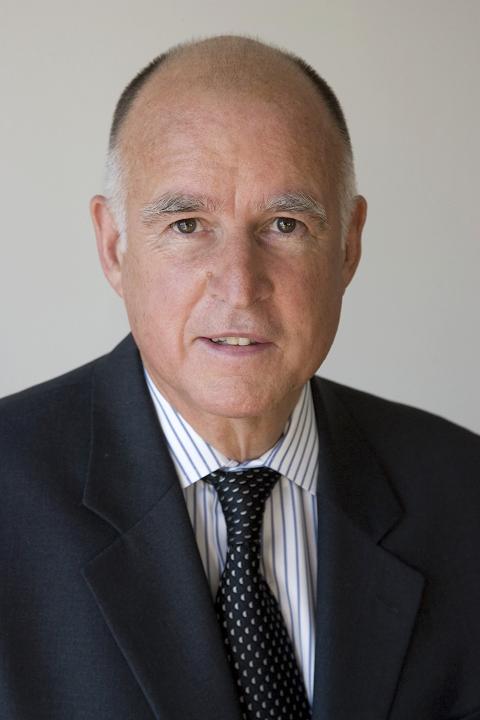
And Jerry Brown has a strong history of supporting causes that resonate with a lot of Latinos.


So in general, recognizing that not all Latinos remember Brown’s support for Cesar Chavez or cae about the creation of the Agricultural Labor Relations Board, it ought to be a good assumption that Brown will win the Latino vote by a pretty wide margin. The fact that Whitman is narrowing his lead among Latinos is, I think, a sign that Brown is resting too much on history and hasn’t offered much in the way of ideas about jobs, education, or any of the other crucial issues that middle-class voters of all ethnic groups care about.


Still, the Spanish language billboards were really dumb. For a campaign that’s been as disciplined and message driven as the Whitman effort, it’s kind of a surprise. All Meg has done is give Brown a nice weapon, a reason to talk about an area where she’s very weak. And the more he can keep playing on that — the more he can point out how far to the right she and her advisors really are on immigration — the more it hurts her.

Levi Strauss imprints on Valencia

15

It would appear they got in under the radar. After all, the Mission Mission blog post on the Levi’s pop-up store on Valencia didn’t hit until today, stirring up an American Apparel-sized storm of anti-capitalist harrumphs and hurrahs. There was even a press embargo on mentioning details about the space until yesterday.

But here it was, and here I was getting a tour of the store with various superlatively attractive employees, who were quick to remind me that the space is “not just a multi-national corporation opening up a store in a community.”

This according to Josh Katz, whose official title at Levi’s is Head of Collaborations, Partnerships, and Creative Concepts. I prefer to refer to him more succinctly as “hot man with shockingly blue eyes in striped cardigan and tie made of interesting material who had the controversial idea of opening up a corporate entity in the thick of indie-rama Valencia land.”

But where the devil were the clothes? Katz chuckles, adorably. “It’s a good question – we make clothes, don’t we?” Yes. But apparently that’s not all that sets Levi’s heart aflame. “Whether it’s providing products or not, it’s important to create physical manifestations of the brand,” says Katz. 

The company is pushing its association with American hard work – its 1900s Valencia Street denim factory, after all, was one of the first sites of workclothes manufacturing. Riffing on this image of industrial creativity, its stocked the 17th and Valencia storefront with all manners of vintage letterpresses and printers. Although there’s a rack of work clothes up for sale, the space is not meant so much as a point of purchase as much as a branded community art “hub.” Every Sunday, budding local artists can screenprint on free cardstock, churn out a zine on the cheerfully supplied Xerox machine, even cobble together a rack of words that a friendly staffer (some of them straight from their day gigs at the Center for the Book) will stick through the ancient letterpress on hand. As part of  a tie-in with its Go Forth ad campaign, the company’s planning another photography based pop up space in New York, due to open Sept 18.

You’d be hard pressed (ha!) to find a more attractive print shop staff

“This allows us to sustain an engagement with the community. We’ve maintained strong relationships with every aspect of San Francisco,” Katz tells me. Knee jerk reaction: scoff scoff scoff. But it gets “tricky,” as Mission Mission’s Ariel Dovas puts it, when you consider that the “printshop” is providing the Mission use of some pretty serious art equipment and space free of charge, and that those are both hot commodities in this neck of the woods. Plus, Katz and the company have scheduled workshops and other partnerships with a shockingly legitimate lineup of Bay area creative types, from Aaron Rose (who as far as I can tell is not really a Bay Area creative type, but I suppose that’s getting hung up on semantics) and Alice Waters to Craig Newmark, the most famous list maker in the world, and a slew of nonprofits who you wouldn’t think would throw in their lot with an evil company set to commodify and pablumize the Mission.

Right? I called Courtney Fink, who is the executive director of Southern Exposure, and whose community art-funding organization is one of the three to benefit from the proceeds generated at 580 Valencia (the other two are Plaza Adelante and the Women’s Building). I asked her if she was surprised that Levi’s sought out such locally rooted groups as partners for this venture. “I guess I’m not surprised,” she told me. “I feel like it’s a strategy that a lot of big companies are taking, forming these creative partnerships to support what they’re doing.” Fink said that Levi’s was backing Southern Exposure’s new postcard guide to the 45 art venues in the neighborhood, which they had been unsure where to find funding for. “As long as we can maintain our integrity, we’ll do what we can,” she said, pragmatically. Fink also noted that Levi’s had refurbished a building that otherwise might have sat empty, though she could see how there’d be numerous different opinions on their presence in the neighborhood. 

Of course, not everyone’s stoked. I got an email from one Elle Ko, who is launching a guerrilla assault on this corporate infiltration. Quoth she: “that evening i decided to graffiti the storefront. i wrote ‘SCAM’, ‘BUY USED’, and other similar wording on the storefront. the graffiti was promptly removed the next morning.  the following evening i wrote ‘UNEMPLOYED? KEEP SHOPPING’ on the pavement in front of the entrance of the building, also ‘LOCAL FARTISTS’ [author’s note: double ha!], ‘PLAGUE’ and a large red X across the door. i then dumped a pile of old clothes and rags in front of the entrance.” She says her actions led to the installation of a round-the-clock security guard at the site.

“Levi’s has been on Valencia for over 100 years,” Katz told me as we moseyed about his new to-do, bustling with a whole team of fresh-faced creative-type staffers. The company maintained a presence at Valencia and Brosnan (now the site of the SF Friends School) up until 2002. But to its assertion that they’ve maintained relationships with the area, I offer a hearty, resounding, whatever. Levi Strauss moved those jobs to countries with cheaper labor forces awhile ago. They haven’t had a single factory in the US, in fact, since 2003. But their corporate offices are still in the city…

Let’s go printin’ now, everyone is learnin’ how

I’m hollering at you though, Elle — all that talk about “American workmanship” and “community values” is a little problematic coming from a company that moved all their production not only out of the neighborhood and metro area, but our entire country, seven years ago. But hell, who am I to harsh on a good time? Not to mention a powerful benefactor for organizations that kick ass in our neighborhoods. So if you’re down, go and try out the toys, check out the admittedly cool workshops they’ve got coming. You might as well get some enjoyment out of it. It’s like digging the aesthetics of a cool-looking national ad campaign. Oh wait, that’s what it is.


Levi’s Workshop

public events and Sunday studio hours through Aug 28, free

580 Valencia, SF

www.workshops.levi.com


The good news for Jerry Brown

4

The press is all over the latest Field Poll, which shows Jerry Brown and Meg Whitman in a dead heat.  And it’s no surprise that, thanks to a campaign that thus far has been almost entirely negative, voters aren’t particularly thrilled with either candidate.


But I think there’s some good news for Jerry Brown here. Whitman has spent more than $90 million so far, and the voters like her less than they did six months ago. After all that money, some of which has gone for blistering attacks on Brown, Whitman is still not ahead. And it’s hard to see what she can do now to move the needle.


CallBuzz:


Moreover, it looks like the attack ads on Whitman by Brown’s labor allies — including California Working Families 2010 — have had their intended effect: to increase Whitman’s negatives and keep her from pulling away from Brown during the summer, before he can afford to put his own ads on TV.


Meanwhile, Brown’s favorability is only marginally changed from March. It’s 42-40% favorable today, compared to 41-37% favorable before. (Of course, Brown’s favorable was 50-25% back in March of 2009, but that was when he was just the new Attorney General and not a candidate for governor with rivals.)


At some point, Jerry’s got to start seriously campaigning, and he’s got a lot of work to do. He has to define himself to younger voters, who know a lot more about Ebay than about Brown’s tenure as governor, which was generally pretty good. He has to remind Latinos of how awful Whitman is on immigration. He’s got to spend some money.


But at this point, there’s hardly a voter in California (at least, not one with a TV set) who hasn’t seen multiple Whitman ads, defining her as a successful business person and attacking Brown as a failed politician. Those are powerful messages. The ads have been well produced, well targeted and should have been effective. And they haven’t gotten her over the halfway point yet — even against an opponent who is vulnerable to attack and hasn’t campaigned much at all.


Both candidates seem to be holding the party loyalists — the vast majority of the Republicans like Meg, the vast majority of the Democrats like Jerry. And there are more Democrats than Republicans. The independents aren’t breaking Meg’s way, either — she’s only slightly ahead, not enough to make up the difference.


Now if Brown can just get his people to care enough to go to the polls. …

Sorting out the Adachi initiative

37

Lots of press on the Adachi pension-reform measure, a proposal that would amount to cutting the pay of city workers during a recession. It turns out even Gavin Newsom doesn’t like the plan:


The mayor also attacked Adachi’s pension plan, arguing that the public defender never discussed it with the employee unions, city officials or others affected by the measure and that it could have “unintended consequences” for the city.


And while I think it’s a bit of a stretch to say that the Adachi measure “could reshape national politics,” Randy Shaw makes a good point:


Adachi’s measure would join with Sean Elsbernd MUNI charter amendment to create a one-two punch against public employees on San Francisco’s November ballot. The national media will have a field day with the prospect of “liberal” San Francisco, and Nancy Pelosi’s home turf, voting to cut public employee compensation.

While this is not the message Adachi wants to send, it will likely be the one that is heard. It emerges at a time when the entire Republican Party and corporate Democrats are in a full-fledged media campaign to redirect public anger over the fiscal crisis toward excessively compensated public employees, and away from banks, oil companies, hedge fund managers, and an under taxed and poorly regulated private sector.


Shaw also says that the campaign will “bitterly divide progressives,” and I’m not sure it has to turn out that way. There’s always the danger that liberal voters who work in the private sector, and are struggling to keep their jobs and health insurance, will be seduced by the notion that public-sector employees are too well paid already. And the donwtown folks, who will soon be fully on board with the Adachi measure, will seek to divide the nonprofit sector and labor by arguing that nonprofit workers don’t get the same benefits as city employees — and city funding for nonprofits is threatened by the budget deficit. Both those things are true, but it’s also true that there’s a growing movement to challenge that approach. This battle will be a test for the city’s progressive movement, but I think the overwhleming majority of progressive leaders, activists and nonprofits will stick together and oppose Adachi.


The more important political impact will be felt in the tightly contested district-election contests, where city-employee pensions could join the sit-lie measure as wedge issues that the moderates will use against progressives. When Adachi came down to see us, I asked him if he was worried about that; he didn’t really seem to think it was important.


But there’s a reason we talk about a “progressive movement” (and don’t start on the “machine” stuff again, we had that debate over here). We all ought to be concerned about how one campaign affects the larger goal of building a better and more sustainable city. And while I hate to say it, I have to agree with Gavin Newsom: This thing could have “unintended consequences.”


Transit troubles

0

rebeccab@sfbg.com

Peggy da Silva is an avid cyclist, public transit advocate, and member of the San Francisco Transit Riders Union — a new organization made up of several hundred San Franciscans who want to see improvements to Muni.

Yet even she admits that when it comes to getting to work, it takes just 15 minutes by car or an hour if she opts to go by bus. “I am committed to transit and cycling” for environmental reasons, she said, but “it gets really frustrating” to wait for the bus or light rail cars to arrive.

Da Silva could be considered lucky in that she can opt to drive if she feels it’s necessary, while many lower-income San Franciscans cannot afford a car and have no choice but to rely on Muni to get to work, buy groceries, or make doctor appointments. It’s even worse late at night when the buses run less frequently and the streets are dark and empty.

Speaking at a June 29 transit rally, the Rev. Norman Fong of the Chinatown Community Development Center joked that Chinatown is one of the city’s greenest neighborhoods — but “not by choice.” Most Chinatown residents just can’t afford to own a car, underscoring the point that Muni service cuts affect lower-income communities more significantly than those with more transportation options.

The perception that Muni is broken isn’t unique to transit advocates. Around City Hall, a number of proposals have been put forth to fix the ailing system, which has been mired in delays and overcrowding as fares have gone up and service was slashed. But determining what the root problems are, how they should be addressed, and what the best path forward may be has proved arduous.

Rather than a simple calculation or a study in efficiency, the debate surrounding Muni is spinning into an emotionally charged affair. For those aiming to protect low-income riders from service cuts or fare increases, it’s a discussion about social justice, calling into question why the city is asking more of bus riders than motorists in a city with a “transit-first” mandate in its charter.

The strong opposition to the cuts by supervisors and the public has led to a rollback. On June 30, the San Francisco Municipal Transportation Agency (SFMTA) announced that on Sept. 4, it would be able to restore half of the 10 percent systemwide service reduction that went into effect in May.

“Due to stronger than expected revenue streams, operational efficiencies, and new grant opportunities, staff is recommending the restoration of service on some routes and lines this fall,” according to an SFMTA press release. Buses that run all night would come more often, and the partial service restoration would help ease over-crowding.

While this was welcome news for anyone who takes transit, the expected improvement still leaves untouched many key issues plaguing the city’s public transit system. Two separate initiatives most likely destined for the November ballot seek to deal with systemic problems — but both have met with resistance.

On July 1, Sup. Sean Elsbernd announced that he had submitted some 75,000 signatures for a proposed charter amendment for the November ballot to change the way transit operator salaries are determined. Since they only needed 46,000 signatures, “presumably, we’ll qualify,” Elsbernd told us.

“It presses the reset button on all the [memorandums of understanding] and then puts the riders at the table,” he explained. “It also eliminates the side letters that allow the six leaders of the union to get full-time salaries and benefits without needing to drive.”

Elsbernd’s proposal would require operator wages and benefits to be set through collective bargaining, instead of the current guarantee that their wages be at least as high as the average wage rate for transit operators in the two highest paying comparable transit systems.

Yet his proposal is opposed by the city’s transit operators union, TWU Local 250-A, whose members feel they’ve been unfairly blamed for the MTA’s fiscal problems. Speaking at the June 29 rally, Ron Heintzman, the new international president of the Amalgamated Transit Union, summed up the attitude of drivers who feel they are being asked to give up hard-fought gains in the face of an economic downturn.

“I’ve been told that here in San Francisco, the mayor for some reason clearly has his head up his ass,” Heintzman said. “It’s time to tell him to stop trying to balance the damn budget on the backs of the workers.”

Speakers at the rally voiced support for federal legislation that would bolster municipal transit budgets nationwide with a $2 billion emergency infusion. A second federal bill would allow local governments greater flexibility with federal transit funding that currently can only be spent on capital projects, not day-to-day operations.

“We’re asking them not to make us buy a bus when we can’t hire a bus operator to drive it,” explained Harry Lombardo, international president of the Transit Workers Union. “There’s no point in spending hundreds of thousands on a bus and letting it sit in mothballs. And believe me, it’s happening all over the country.”

Sup. David Campos, a cosponsor of a competing ballot measure that aims for more comprehensive Muni reform, joined the rally and criticized the notion that drivers should be blamed a dysfunctional, underfunded transit system.

“Those of you who live in San Francisco know that right now there is a climate at City Hall that is pointing the finger at drivers, blaming drivers and blaming the workers for the problems that this system has,” Campos said at the rally. “Muni is broken. But Muni is not broken because of labor. And we have to say no to that push to somehow create a division between riders and drivers…. We can’t ignore the fact that we have a system that is getting money that is not being used well.”

Campos has joined with Sups. Ross Mirkarimi, Eric Mar, and Board President David Chiu to propose a reform package that would remove the pay guarantee for Muni driver, but also create split appointments to the MTA Board of Directors, allocate a share of property tax revenue to the city’s Transportation Fund, and establish an Office of the MTA Inspector General to help reduce waste and ramp up efficiency. The proposal would be subject to voter approval in November.

The proposal to give the supervisors some appointments to an MTA board that is now solely accountable to the Mayor’s Office became an issue at the eleventh hour of budget negotiations between the supervisors and Newsom on June 30. The mayor strongly opposed that and two similar charter amendments that would establish split appointments for the Recreation and Park Commission and the San Francisco Rent Board, as well as a ballot measure that would require the police department to engage in foot beat patrols.

Many saw his stance as a quid pro quo that inappropriately tied mayoral support for the budget — which included funding restorations to community programs that progressive board members wanted to preserve — to these unrelated ballot proposals.

Dave Snyder, who directs the SF Transit Riders Union, viewed the move as an affront on Muni riders. “This particular mayor has managed to screw up Muni service through his complete control over the agency,” Snyder said. “And whatever it takes, Muni riders want to see that fixed.”

While he said he thought a split appointment for the MTA Board was important, “the most important thing is more money. That’s the key issue,” he added, noting the reform package would create more funding for Muni.

Members of the Budget and Finance Committee resisted the mayor’s demand and forwarded a budget to the full board that included their high-priority restorations. The proposed ballot measures will be considered by the board this month.

“If you ask me, I would say we should have commission reform across the board,” Mirkarimi told the Guardian. “The idea of having [equally balanced appointments] is a smart way for us to share the responsibility and the consequences.”

MTA’s fiscal problems aren’t unique to San Francisco. On July 1, Caltrain announced a menu of undesirable options to deal with big financial troubles facing the commuter railroad. Elimination of weekend service and certain weekday train stops, or a 25-cent increase to base fares or zone fares, will be the subject of public hearings this summer.

Noting that all the different sources that fund Caltrain have been slashed, spokesperson Christine Dunn told us, “It’s frustrating to not be able to provide the service you want to provide.”

Closing the wealth gap

0

Dick Meister, former labor editor of the SF Chronicle and KQED-TV Newsroom, has covered labor and politics for a half-century. Contact him through his website, www.dickmeister.com, which includes more than 250 of his recent columns.


Although the wage gap between white and African-American workers remains wide, it has been shrinking. But that’s not so for the more significant black and white wealth gap.

A new study by researchers at Brandeis University shows that the wealth gap has been growing steadily, leaving African-American families with increasingly fewer resources than white families to cope with serious economic problems such as many families face today.

The Brandeis study found that in the quarter-century from 1984 to 2007, the African-American and white wealth gap more than quadrupled, from $20,000 to $95,000.

Middle-income white households had $74,000 in financial assets by 2007. That was far higher than even the average high income African-American family, which had only $18,000 in assets. At least 25 percent of the black families had no assets at all – no wealth, that is.

The study notes that wealth – “what you own minus what you owe” – is what “allows people to start a business, buy a home, send children to college, and ensure an economically secure retirement. Without wealth, families and communities cannot become and remain economically secure . . . The gap is opportunity denied and assures racial inequality for the next generation.”

The main reasons cited by the researchers for the four-fold increase in the African-American and white wealth gap are unfortunately not surprising: Racial discrimination and tax policies that favor the rich, who are disproportionately white.

The study noted the advantages given the wealthy through tax cuts on investment income and inheritances, retirement accounts, home mortgages and college savings. In contrast, African-American families typically face disadvantages – the disadvantages of “persistent discrimination.”

For example: During the period beginning in 1984, African Americans “were at least twice as likely to receive high cost home mortgages as whites with similar incomes. These high-cost loans unnecessarily impeded wealth building in minority communities and triggered the foreclosure crisis that is wiping out the largest source of wealth for minorities.”

Lacking sufficient assets, African Americans in general have had no choice but to rely heavily on expensive credit. The total amount of their debt just about doubled between 1984 and 2007 to at least $3,600 each.

To make it worse, African Americans, like other non-white credit users, generally have to pay more than white borrowers in interest payments and other charges. Many have no choice but to borrow from predatory lenders who charge exorbitant interest rates.

The study suggests several remedies, including creation of a Consumer Financial Protection Agency designed to ensure fairness for all in their financial dealings. That would include helping “equalize and regularize the terms on which cash-strapped families are borrowing to make ends meet.”

Efforts to help low and moderate income families increase their assets so as to gain economic stability and mobility have been increasing. But the study shows the efforts must be intensified, for they are “not yet strong enough or at a scale to make a significant difference in people’s lives.”

The study shows as well that the wealth gap between African Americans and whites persists even among African Americans who hold well-paying jobs.   Thus “wealth opportunities must be targeted to families of color whose lives are made even more precarious by not having enough assets to make ends meet when economic challenges arise.”

True enough, there are public policies now in place “that provide incentives and subsidies for asset building.” But reforms are needed to make certain that the policies benefit all Americans equally – reforms that might at last close the wealth gap between African-American and white workers and their families.

The Brandeis study has it right: “Public policies have played and continue to play a major role in creating and sustaining the racial wealth gap, and they must play a major role in closing it.”

Dick Meister, former labor editor of the SF Chronicle and KQED-TV Newsroom, has covered labor and politics for a half-century. Contact him through his website, www.dickmeister.com, which includes more than 250 of his recent columns.

Local ballot measure campaigns reach the finish line

5

The deadline for submitting enough valid signatures to quality local initiatives for the November ballot is today (July 6) at 5 p.m., which made for a busy holiday weekend for two San Francisco ballot measures that will be close calls: labor’s effort to increase the city’s hotel tax by 2 percent and the pension reform measure pushed by Public Defender Jeff Adachi.

“It’s going to be really close,” Adachi told the Guardian on Friday, referring to a measure to increase how much city employees contribute to their pensions and health care costs, which the labor movement is bitterly opposing.

But labor leaders say they have enough signatures for their Hotel Fairness Initiative after an all-hands-on-deck weekend of gathering and counting signatures, and they plan to hold a rally on the steps of City Hall at 1:45 pm on their way to turn the signatures in to the basement Elections Department. That initiative needed at least 7,168 valid signatures and officials say they turned in about 17,000.

Adachi says he’s also cleared the 44,799 signature threshold for qualifying a charter amendment and plans to turn them in at 4 p.m. He has yet to formally support the hotel tax increase (which could bring in about $30 million per year) or any of the other proposed revenue measures being considered by the Board of Supervisors, which still has a few more weeks to place measures on the ballot.

“It doesn’t deal with the train wreck that we’re in,” Adachi said of the proposed revenue measures, noting that they don’t come close to reaching the $167 million per year that he says his employee benefits reform measure would bring into the city, which labor leaders say will come directly out of the pockets of city employees and hurt the local economy.

But Adachi counters by telling us, “My message is there’s not going to be a city to run in a few years if we don’t do something.”

Meanwhile, Sup. Sean Elsbernd last week turned in about 76,000 signatures to remove Muni workers’ pay guarantees from the city charter, which would appear to easily qualify. The Board of Supervisors is working on a competing ballot measure that would also remove that guarantee, but include a more comprehensive reform that includes governance and oversight changes and new revenue.

D. 10 candidates DeWitt Lacy, Tony Kelly and progressive planners blast Lennar’s plan

8

Recently, I spent some time talking with D. 10 candidates DeWitt Lacy and Tony Kelly about Lennar’s redevelopment plan for the shipyard and Candlestick Point. I also attended a Progressive Planners forum that addressed the massive development proposal. Those conversations and the issues they raised seem timely in light of the city’s crazily tight schedule for trying to ram final approvals for the project past government agencies this summer. And in light of three appeals that have been filed against the city’s recently certified final environmental impact report for the plan, raising concerns that the city will get bogged down in expensive and time-consuming litigation if it doesn’t get the plan right, while it still can.

(Lest other D. 10 candidates complain that they weren’t interviewed, too, I’d like to clarify that I’ll be covering the race between now and November, and I look forward to hearing what they all think at the Board’s July 13 meeting to hear appeals of the city’s final environmental impact report (FEIR) for the project. )

Both Lacy and Kelly are critics of Lennar’s plan, but not in a knee-jerk obstructionist way. Instead, they bring considered and informed critiques to the table at a time when the community desperately needs good advice and a workable strategy, if residents are to get needed amendments and concessions, before the developer get the green light, or before the Board puts  a moratorium on the project until the city’s FEIR flaws are ironed out.

Lacy is a bright and earnest candidate who learned lessons from the school of life, while growing up in San Jose in a working class family. Lacy says his father worked in an Adidas warehouse until he was injured on the job, and his mother worked as a secretary in Atari’s corporate office, but was laid off after two years.

Lacy recalls how his parents opened their own janitorial business, in the hope of making a better life for their six children.  He says that it was while cleaning homes alongside his mother, that he began to recognize the need for working class improvement and growth.

 In 1995, Lacy moved to San Francisco, where he has worked in the District Attorney’s office and formed his own law practice—experience that could serve District 10 well, since it’s home to many working-class residents and will be ground zero in the battle for construction-related contracts and environmental and economic justice, if Lennar’s massive redevelopment plan goes ahead,

“I know how to craft legislation for social justice,” Lacy said.

Lacy observes how Michael Cohen, Gavin Newsom’s top economic advisor in the Mayor’s Office of Economic and Workforce Development, has repeatedly told folks that land transferred to Lennar will be subject to a “right of reverter.”
This means the Redevelopment Agency may re-take ownership of the land, if the developer fails to substantially complete the infrastructure in the time frame set forth in the city’s development and disposition agreement (the DDA)

But Lacy observes that this “nuclear option” isn’t likely to happen with so much riding on the Lennar deal, and he stresses that additional controls are needed, if the city is to ensure that the deal remains in the best interest of San Francisco, not just the developer.

Lacy’s probably right about that. (Remember how hard the community had to fight to just get an extra 15 days to read and comment on the project’s six volume draft EIR over the winter holidays?)

And how much political pressure was exerted to ram the city’s EIR for this project across the certification line on June 3, five days before Santa Clara voters decided to support a stadium for the 49ers near Great America.

“What’s needed is an impartial arbiter,” Lacy said. “The city needs regulatory controls and the capacity to fine Lennar if it breaks promises to build affordable housing, create jobs and hire locals. You’re not going to be able to hold their feet to the fire without that.”

“I’m not saying that we should be obstructionists, critics who are trying to prevent stuff for the sake of a political battle,” Lacy added. “But we need new blood. The benefit of my campaign is that I’m not downtown’s candidate. I’m a civil rights attorney, who can help the district by figuring out what battles we need to be fighting and which battles are winnable. And I want to make sure there are jobs and business opportunities for working-class folks in San Francisco. You shouldn’t have to be a doctor or lawyer to afford to live here.”

Lacy believes the Navy should remove the radiologically impacted landfill on the shipyard’s Parcel E2.
“That ground has to be taken out of there,” Lacy said. “I would hope the City Attorney’s Office would get involved and advocate for the people. But leadership is about taking a stance when no one else is.”

With the city suggesting that it can still win back the 49ers, Lacy said that he too, would love it if the 49ers decided to stay.
 
“But not at the cost of our health and safety,” Lacy said, referring to the city’s repeated claim that it needed to rush certification of the final EIR for Lennar’s project, if there was to be any hope of winning back the team.

“ I don’t think the solution is the rush,” Lacy said. “I say, let’s make sure we clean up the shipyard properly—and bring back the Warriors [a professional basketball team that relocated to San Francisco in 1962, until 1971, when it moved to Oakland].”

I also hung out with D. 10 candidate Tony Kelly, at an event that POWER hosted as part of a Progressive Planners Forum, the day after Lacy and I unsuccessfully tried to access the shipyard, and the same day that POWER was also blocked from the yard.

Kelly has been tracking issues in and around District 10 for years, and, much like Lacy,  he’s not afraid to speak his mind on the issues.

For instance, Kelly is incensed by the city’s attempt to ram through approval of the final EIR for Lennar’s development, when the Navy has yet to complete an environmental impact statement related to its proposed clean up activities at the shipyard..
“Is the EIS ever a trailer to the EIR?” Kelly asked. “It’s like planning on Mars.”

Kelly has also expressed concern over the developer’s plan to build two peaker plants in the community.

And he is worried about the consequences of the city’s plan to turn the entire Bayview into a project survey area for Lennar’s Candlestick/Shipyard plan.

“How do you pay for any other improvements in the Bayview, when the shipyard redevelopment plan sucks all the air out of the room?” Kelly said

But Kelly’s biggest concern right now is that once Lennar gets its final approvals this summer, “the developer will never talk directly to the community again.”

At the Progressive Planners Forum that Kelly attended, speakers also voiced measured criticisms of Lennar’s plan.

“The plan has some important elements, especially in the job areas, but I think it adds up to gentrification, which is disruptive to the surrounding community, families and the last bastion of the black community in San Francisco,” said Chester Hartman, who has authored over 18 books on race and urban planning, including the acclaimed City For Sale: The Transformation of San Francisco.

“There is a need for a response in terms of an alternative approach,” Hartman advised.
“It doesn’t have to be a detailed, but it should include a basic philosophy and goals, and retain good parts of the original plan.”

Peter Marcuse, Professor of Urban Planning at Colombia University, said the situation at the shipyard reminded him of the ongoing oil disaster in the Gulf.

“Cap the land sounds like cap the spill,” Marcuse said, noting that in both cases the community is fighting to get folks who dumped toxins to clean them up.

Marcuse criticized the privatization of the planning process, as illustrated by the City’s claim that it has entered into a “public-private” partnership with Lennar,  and the community’s experience that the city and the developer keep ignoring or dismissing the public’s feedback and opinions.

 “There should have been a range of alternatives open for discussion,” Marcuse said. “Instead, there is a sense, of this mega project’s inevitability. And once the developer has title to the land, the city has to negotiate what should be a public matter.”

Marcuse critiqued the use of tax increment financing, which will use increased taxes on property throughout the Bayview to finance improvements in one relatively small area, the 770 acres of land that, as Marcuse put it, “got sold to Lennar for $1.”

“This is a form of government subsidy,” Marcuse warned.

“There have been some negotiations,” Marcuse continued. He pointed to the community-led Prop. F, which in the spring of 2008 sought to establish 50 percent affordable housing in the development. And the community benefits agreement (CBA) that the San Francisco Labor Council hammered out at in May 2008, in an attempt to nail down benefits for the community in exchange for the Council’s support for the Lennar-financed Prop. G in June 2008.

“But these negotiations with Lennar start on basis that Lennar’s interests have to be protected equally with those of the City and its residents,” Marcuse commented. “It ought to be a public responsibility to show the community what the alternates to Lennar’s vision are.”

Marcuse concluded by suggesting a moratorium on Lennar’s plan to allow for a community-based visioning process, in which residents could express their desire for housing, diversity, open space and protection against environmental hazards

‘The City should then come up with an alternative to Lennar’s plan—and listen to Lennar,” he said. “But this is a public responsibility, rather than a private negotiation with a corporation that has been a beneficiary of a huge subsidy and starts to make a huge profit, the minute its housing units begin to sell.”

Miriam Chion, who works for the Association of Bay Area Governments (ABAG), also expressed concerns with Lennar’s massive plan, which proposes to build thousands of mostly luxury condos at Candlestick Point, with a smaller number on the shipyard.

“We are in the 21st century, how can we continue to use same mechanisms of displacement?” Chion said. “And how can we do that to the African American community, which we have displaced over and over, and which has managed to build a community here, in spite of everything?”

According to Lennar’s plan, 68 percent of its proposed 10,000 units will be built at market rate. Of the remaining 32 percent of units, only 15 percent will be built at truly affordable rates, with an additional 15 percent geared towards the working middle-class income levels, such as those enjoyed by police, fire fighters, nurses and teachers.

But two Bayview residents who attended POWER’s progressive planners’ forum expressed frustration at what they perceived as outsiders trying to tell locals what’s best.

“If you haven’t lived here, you don’t know about the Bayview,” one resident said. “If they are going to do what they are going to do, they should do it all the way, and change things for the better. I’m tired of seeing kids under 12, playing outside at 11 p.m. So, if you are not from here, you can’t come on my ground and pass judgment. If you’d been and lived here, I don’t think you’d see this negatively.”

“$700 million has been spent on cleaning up shipyard, and producing highly technical reports on it,”  another local resident said. “Highly intellectual discussions are not helping, we need some action today.”

“No one here is against development,” countered long-term Bayview resident Espanola Jackson, while a Bayview resident named Nyese resurrected longstanding concerns that the developer fatally broke community trust when it failed to control asbestos dust at the site, when it began grading the shipyard’s Parcel A .

“Four years ago, I found out that they were sending home workers at the shipyard, without informing the surrounding community,” Nyese recalled. “My son was having excessive nosebleeds, so it was phenomenally insulting that they didn’t not notify us.”
“Lennar is just a name, a conglomeration of shareholders,” Nyese further noted. “We need development. But we don’t need it on chemically toxic land.”

These competing concerns indicate that all the candidates in the D. 10 race are going to have to be asking critical questions as they track the progress of Lennar, the city and the Navy’s plans this summer. Failure to do so will cost them credibility within the community—and possibly the supervisor’s race this fall, though downtown money will pour in to support whichever candidate is deemed most likely to rubberstamp present and future development and contracting plans. Stay tuned. It’s going to be a (politically) hot July.


Demon amulets and building codes: a sound installation that’ll “bowl” you over

0

At a recent sunny day preview of The Bowls Project at YBCA, I was very confused. I had spoken with Jewlia Eisenberg of the group Charming Hostess a few days earlier on the phone, and she had given me the impression her new sound installation at the gallery was about ancient Babylonian incantation bowls used to summon demons for help in the domestic arena. “I refer to it as apocalyptic intimate,” she told me, “they’re things from the home, but they have angels and demons, things you have to deal with.” She read to me from wild inscriptions she’s found through research on these bowls, which serve as some of our only records of female voices from the era. They include curses against gossips that their “tongue should cling to the roof of their mouths,” calls for Anwar next door to become “inflamed, heated” for the commissioner of the bowl – even an ode to the overthrow of the heavens. It was rad. But there I was, at the YBCA, listening to the description of — a sustainable architecture project?

Michael Ramage is a muscular, clean cut man in an orange Cambridge University sweatshirt. He looks roughly approximate to his profession, which is teacher of architecture and structural engineering at aforementioned school. How he and Jewlia Eisenberg, who is the theatric, charismatic creator of an experimental music ensemble, came together is perhaps testament to the mesmerizing pull of the past.

The two met at MIT, where Ramage was studying the construction of  masonry domes using traditional methods and non traditional materials. Eisenberg was taking part in an artist residency program at the university, and had just discovered the bowls’ existence in a “fusty dissertation from 1972.” She wanted to recreate the bowls’ magic for a modern day audience – how amazing would it be to stage the exhibit in a bowl-like space on which actual inscriptions could be etched? She says she “told [Ramage] about the project, and four years later we’re doing it.”

Many art installations involve some sort of structure to stage the work within, but none I’ve ever seen can match the forethought, and fortitude of The Bowl Projects’ domes. Ramage specializes in a style of building called Catalan vaulting, a school of building perfected thousands of years ago in ancient Egypt, and used well into the approximate modern day by architects like Rafael Guastavino and Gaudi. It requires little by way of materials; the bricks in Catalan vaulting are held up largely by the pressure they exert on each other.

Charming Hostess (Jewlia Eisenberg second from right) is laying down the welcome mat at the Bowls Project. Photo by Robin Hultgren Esprite Photographie

Of course, that was a bit difficult to describe to the Department of Building Inspection, who allowed the structure to be built on two conditions; it be reinforced, somehow, and it be earthquake ready. These seem to have been but piddling roadblocks for Ramage – the architect hit upon a light, sustainably produced mesh to reinforce the air bubble filled concrete bricks, and set the structure atop a remarkable system of bowls (natch) and ball bearings so that, should the big one hit, the whole thing will just roll around and surf the tremors out. The two connected domes form an elegant mix of low-tech, lightweight, and environmentally sound; nearly all the energy expended on the project was powered by human muscle. Prince Charles, Eisenberg told me, wants Ramage to build one like it in the Prince of Wales’ own garden.

Which is all really cool. But what exactly will be happening inside this fabulously produced space (which is for sale after The Bowl Project is packed up in August for what one of the project’s engineers pinned at “a low, low price of we’ll talk about it.” Incidentally, he thought it’d make a great winery tasting room – any takers?) once it opens to the public? Bring it back to the demon bowls. Much as women back in the day would endow the amulets with their domestic secrets, Eisenberg is currently collecting hidden truths from the public on her website and hotline. These will be projected as a 360 degree sound experience within the domes.

But that’s not all. The bowls represent “that ecstatic exploration of sex and magic,” says Eisenberg, and to that end, she hopes they’ll be used for self-reflection and celebration by the community. She’s planned a full slate of musical performances, art workshops, meditation days, and public rituals by such local holy people as the Sisters of Perpetual Indulgence for the space. 

So, all kinds of cool stuff. But the truly amazing thing about the Bowl Project may just be that it was made at all. Architects, engineers, union masonry workers who have been contributing their labor pro bono, museum folk; a new band of partners-in-crime for this concept musician. “The collaboration has been intense, and amazing, and I’ve learned a ton,” says Eisenberg. A sentiment which begs for a bowl inscription of its own.


The Bowls Project

Opening night ceremony: 

Tues/6 6-8 p.m., free

(through Aug 22, $7 YBCA gallery admission)

Yerba Buena Center for the Arts Sculpture Court

700-701 Mission, SF

(415) 978-2787

www.ybca.org


Powder keg

5

news@sfbg.com

Ask any pollster, political consultant, or academic who studies the American electorate about the mood of the voters this year and you’ll get the same one-word answer: Angry.

Everyone’s pissed — the liberals, the conservatives, the moderates, the people who don’t even know where they fit in. It’s an unsettled time and, potentially, very bad news for a progressive agenda that seeks to address issues ranging from poverty and war to the long-term health of the public and the planet.

The Democrats, who swept into power with an enormously popular president just 18 months ago, may lose control of Congress. The tea partiers have driven the Republicans so far to the right that some candidates for Senate are openly talking about eliminating Social Security. The unemployment rate — the single most important factor in the politics of the economy — remains high and doesn’t show any signs of improving.

And the progressive left seems frustrated and demoralized, particularly in California. The Golden State, which once led the nation in innovation and enlightened social policy, now seems to be leading the politically dysfunctional race to the bottom.

The nation could be headed for a dangerous era, rife with the potential for right-wing demagoguery and other nasty political schisms. The state of the economy could easily fuel a more powerful movement to shrink the scope of government and a continuing backlash against the public sector — and the financial backers of the antitax and antiregulation movement are drooling at the prospect.

But there’s also a chance for progressives to seize a populist narrative and shift the discussion away from traditional disagreements and toward those areas, particularly the destructive influence on government by powerful corporations, where the grassroots right and grassroots left might actually agree.

The anger that voters feel toward a government that isn’t meeting their needs is starting to find other outlets. People are as mad about the abuses of big business — the Wall Street meltdown, the bailouts, the BP oil spill, the political manipulation — as they are about the failures of Congress and the president. If you ask Americans of every political stripe who they least trust — big government or big business — even conservatives aren’t so sure anymore.

For 30 years, the central narrative of American politics has revolved around the size and effectiveness of government. Now there’s a chance to shift that entire debate in American politics toward the largely unchecked power of corporations. It is, populist writer Jim Hightower told us, “an enormous opportunity handed to us by the bastards.”

But so far, none of the Democratic leaders in California are taking advantage of it to start dispelling damaging myths and crafting political narratives that might begin to create some popular consensus around how to deal with society’s most pressing problems.


THE PEOPLE WANT TAXES

There have been many polls gauging voter anger, but one of the most comprehensive and interesting recent ones was “Californians and Their Government,” a collaborative study by the Public Policy Institute of California and the James Irvine Foundation that was released in May.

It shows that Californians are mad about the state’s fiscal problems, disgusted with their political leaders, divided by ideology, and deeply conflicted over the best way forward. An astounding 77 percent of respondents say California is headed in the wrong direction and 81 percent say the state budget situation is a “a big problem.”

But the anti-incumbent message isn’t necessarily an anti-government message. Most Californians are willing to put more of their cash into public-sector programs, even during this deep recession. When asked to name the most important issues facing the state, 53 percent mentioned jobs and the economy . The state budget, deficit, and taxes only got the top billing of 15 percent.

And contrary to the conventional wisdom espoused by moderate politicians and political consultants, most voters say they are willing to pay higher taxes to save vital services. “Californians tell us they continue to place a high value on education and want education to be protected from cuts. And they’re willing to commit their money to help fund that,” PPIC director Mark Baldassare told the Guardian.

The survey found that 69 percent of respondents say they would pay higher taxes to protect K-12 education from future cuts, while 54 percent each say they would pay higher taxes to prevent cuts to higher education and to health and human services programs. In other words, voters seem to recognize where we’ve cut too deeply — and where we haven’t cut enough: only 18 percent of respondents would be willing to pay higher taxes to prevent cuts to prisons and corrections.

Baldassare said the June primary results also showed that people are willing to pay more in taxes for the services they value. “Around the state, there was a lot of evidence that people responded favorably to requests by their local governments for money, particularly for schools,” he said.

Both the California Legislature and Gov. Arnold Schwarzenegger are held in very low esteem with voters, according to the PPIC study, and Schwarzenegger’s 23 percent rating is the lowest in the poll’s history.

Barbara O’Connor, political communications professor who heads the Institute for the Study of Politics and the Media at Sacramento State University, told us that voter unhappiness with elected leaders is no surprise. Right now, most people are afraid that their basic needs won’t be met over the long run.

“The common narrative is fear, and fear channels into anger,” O’Conner said.

And that fear is being tapped into strongly this year by the Republican candidates, who are trying to scare voters into embracing their promises to gut government and keep taxes as low as possible.

“If there’s any lesson to be learned from Meg and Carly’s early ads, it’s fear-mongering, fear-mongering all the time — and that doesn’t create a very positive narrative,” O’Connor said of gubernatorial candidate Meg Whitman and U.S. Senate candidate Carly Fiorina.

O’Connor noted that Barack Obama’s campaign had great success in using a positive, hopeful message and said she believes the right leader can also do so in California. “I talked to Jerry [Brown]’s people about it and said you can’t just run a negative campaign because that’s what Meg is doing.”

Despite the tenor of the times, O’Connor said she’s feeling hopeful about hope. She also believes Californians would respond well to a leader like Obama who tried to give them that hope — if only someone like Brown can pick up that mantle. “I think the environment is right for a positive message. But the question is: do we have people capable of delivering it?”

She said the no-new-taxes, dismantle-government rhetoric has started to wear thin with voters. “The real fiscal conservatives are badly outnumbered in Californian,” O’Connor said. As for the corporate sales jobs, O’Connor said voters have really started to wise up. “They aren’t going to be scammed.”

The results of the June primary election showed that voters across the spectrum were also disturbed by big special-interest money. Proposition 16, backed by $46 million from Pacific Gas and Electric Co., went down to defeat — even in counties that tend to vote Republican.

And this fall, with two rich former CEOs spending their personal wealth to win two of California’s top elected offices and energy companies pushing a measure to roll back California’s efforts to combat global warming, there could be great opportunity in a narrative targeting those at the top of our economic system.


THE TOP AND THE BOTTOM

Some observers say that whatever their shared feelings about corporate scams, conservatives and liberals in the state are just too far apart, and that there’s little hope for any substantive agreement. “People are becoming more polarized,” said consultant David Latterman, who often works for downtown candidates and interests. “I think we’re beyond compromise.”

Allen Hoffenblum, a Los Angeles-based Republican strategist, agreed. “The voter are all mad, but they’re mad at different things. I just don’t see where they come together.”

But Hightower, who has spent a lifetime in politics as a journalist, elected official, author, and commentator, has a different analysis.

“As I’ve rambled through life,” he wrote in a recent essay, “I’ve observed that the true political spectrum in our society does not range from right to left, but from top to bottom. This is how America’s economic and political systems really shake out, with each of us located somewhere up or down that spectrum, mostly down.

“Right to left is political theory; top to bottom is the reality we actually experience in our lives every day — and the vast majority of Americans know that they’re not even within shouting distance of the moneyed powers that rule from the top of both systems, whether those elites call themselves conservatives or liberals.”

In an interview, he told us he sees a lot of hope in the fractured and potentially explosive political ethos. “There’s all this anger,” he said. “People don’t know what to do. And I think the one focus that makes sense is the arrogance and abuse of corporate executives.”

In fact, Hightower pointed out, the teabaggers didn’t start out as part of the Republican machinery. “Wall Street and the bailouts sparked the tea bag explosion,” he said. It wasn’t until big right-wing outfits like the Koch brothers, who own oil and timber interests and fund conservative think tanks, started quietly funding tea party rallies that the anti-corporate, anti-imperial edge came off that particular populist uprising.

“At first, the teabaggers didn’t even know where the money was coming from,” Hightower said. “You can’t be mad at the teabaggers; we should have been out there organizing them first.”

There’s plenty of evidence that anger at big business is growing rapidly — and rivals the distrust of big government that has defined so much of American politics in the past 30 years. The bailouts were “the first time in a long time that people have been slapped in the face by collusion between big business and its Washington puppets,” Hightower noted.

Then there’s the Supreme Court decision in Citizens United v. Federal Elections Commission. In January, a sharply divided court ruled 5-4 that corporations had the right to spend unlimited amounts of money supporting or opposing political candidates. Progressives were, of course, outraged — but conservatives were, too.

Polls show that more than 80 percent of Democrats think the decision should be overturned. So do 76 percent of Republicans. “This is a winner for our side,” Hightower noted. “But our side’s not doing anything about it.”

Sure, President Obama denounced the ruling in his State of the Union speech and promised reform. But the bill the Democrats have offered in response does nothing to stop the flow of money; it would only increase disclosure requirements. And in response to furor from the National Rifle Association, it’s been amended and is now so full of holes that it doesn’t do much of anything.

Political consultants advising Whitman are clearly looking for ways to direct the voter unhappiness into a demand for lower taxes and smaller budgets. She’s already vowed to fire 40,000 state workers, and her most recent campaign ad attacks Brown for expanding public programs and raising the state deficit.

So far Brown hasn’t challenged that narrative — and some Democrats say he shouldn’t. It would be safer, they say, for Brown to get out front and demand his own cuts in Sacramento. “Going after public-sector pensions is a winner,” one Democratic campaign consultant, who asked not to be named, told us. “If Whitman beats Brown on those issues, she wins.”

But that approach is never going to be effective for Democrats. If the argument is over who can better cut government spending, the GOP candidates will always win. The better approach is to see if progressives can’t shift the debate — and the anger — toward the private sector.

As Hightower put it: “You can yell yourself red-faced at Congress critters you don’t like and demand a government so small that it’d fit in the backroom of Billy Bob’s Bait Shop and Sushi Stand, but you won’t be touching the corporate and financial powers behind the throne.”

That’s where the discussion has to start. And there’s no better place than California.

The Golden State is a great example of what happens when the tax- cutters win. In 1978, the liberals in Sacramento, operating with a huge state budget surplus, couldn’t figure out how to derail the populist anger of property tax hikes. So Proposition 13, the beginning of the great tax revolt, passed overwhelmingly. Over the next decade, more antitax initiatives went before the voters, and all were approved.

Now the state is heading toward fiscal disaster. The schools are among the worst-funded in the nation. The world-famous University of California system is on the brink of collapse. Community colleges are turning away students. The credit rating on California bonds have fallen so far that it’s hard for the state to borrow money. And there’s still a huge budget gap.

The tax-cut mentality that led to the so-called Reagan revolution started in California; a political movement that shifts the blame for many of the state’s problems away from government and onto big business ought to be able to start here as well. And it’s potentially a movement that could bring together people who normally find themselves on opposite sides of the fence.

A case in point: the measure the oil companies have put on the November ballot to repeal the state’s greenhouse gas limits. The corporations backing the initiative, led by Valero, argue that California’s attempts to slow climate change will cost jobs. That’s a line we’ve heard for decades. Every tax cut, every move toward deregulation, is defended as helping spur job growth.

But the past four presidents have done nothing but cut taxes and reduce regulations — and the result is facing Americans on the streets every day. There is also growing evidence that even Republican voters don’t believe everything big businesses tell them anymore. And they’re starting to grasp that sometimes deregulation leads to outcomes like larcenous CEOs and unstoppable oil leaks.

So the potential for a successful progressive populist movement is out there. But it’s not going to happen by spontaneous combustion.


SF SHOWS THE WAY

On the national level, one of the factors creating this gloomy electorate is the failure of President Obama to keep the coalition that elected him active and engaged. The intense partisanship in Washinton has turned off many independent Obama voters, while his progressive supporters have been disappointed by issues ranging from his escalation in Afghanistan to tepid reforms on health care and Wall Street.

“One of the narratives now is where are the Obama voters and will they participate?” Jim Stearns, a San Francisco political consultant who works mostly on progressive campaigns, told us. “They still love Obama but they’re not moved by him anymore.”

Perhaps more important, they have lost the sense of hope that he once instilled. The Republican Party’s descent into right-wing extremism and the strong anticorporate narratives that have emerged in the last year — from BP’s oil spill to PG&E’s political manipulation to Goldman Sachs’ self-dealing to the prospect of unrestricted corporate campaign propaganda unleashed by the Citizens United ruling — have created the possibility that the negative narratives by the left may crowd out the positive ones.

“Meg Whitman is someone you can hate. She’s the rich Republican CEO trying to buy her way into office,” Stearns said. “But it’s a depressing message.”

But Stearns said there is another, most hopeful political narrative that is emerging in San Francisco, one that might eventually grow into a model that could be used at the state and federal levels. “We’re lucky in San Francisco. Progressive voters are engaged.”

He noted that San Francisco’s voter turnout was higher than expected in the June primary, and far higher than the record low state number, even though there really weren’t any exciting propositions or closely contested races on the local ballot — except for the Democratic County Central Committee, where progressives maintained their newfound control. And it’s because of the organizing and coalition-building that the left has done.

“What you’ve seen over the last few years is a coalition of labor, neighborhood groups, environmentalists, and the progressives now operating through the Democratic Party. That’s a great coalition with a lot for people to trust,” Stearns said.

Meanwhile, downtown has all but collapsed as a unified political force. “They don’t really have a political infrastructure,” Stearns said of downtown. “Normally it would be the mayor who gets everyone in line and working together.”

Even Latterman, the downtown-oriented consultant, agrees that the business community is no longer setting San Francisco’s agenda because it’s become fractured and unable to push a consistent political narrative: “There’s certainly been a lack of coordination.”

He also agrees that progressives have become more organized and effective. “Clearly, the Democratic Party of San Francisco has become a conduit for progressive politics and politicians, but not issues,” Latterman said. “What a lot of people get wrong in the city is the difference between politics and policy.”

Part of the reason is economic. With scarce resources, a high threshold for approving new revenue sources, and a fiscally conservative mayor unwilling to talk taxes, it’s been difficult to move a progressive agenda for San Francisco. And in Sacramento, it’s barely part of the discussions.

“The people of California have been held hostage by a handful of Republicans who are making us cut everything we care about,” while in San Francisco “Newsom is taking an entirely Republican approach to the budget,” Stearns said.

Looking toward the fall races, Stearns said the progressive coalition and majority on the Board of Supervisors will be tested on issues such as Muni reform, and the question will be whether fiscal conservatives like Sup. Sean Elsbernd can blame Muni’s problems on drivers, or whether progressives can create and sell a broader package that includes new revenue and governance reforms.

“The drivers are going to get their guarantee taken out of the charter, that’s going to happen. But people know that isn’t all that’s wrong with Muni,” Stearns said.

But to craft a more comprehensive solution, he said the progressives are going to need to use their growing coalition to connect the dots for voters. “We need to run a citywide campaign around a whole constellation of issues,” Stearns said, citing Muni, schools, taxes, resistance to mean-spirited measures like sit-lie, and the larger issues raised by the Brown and Barbara Boxer campaigns. “We need to figure out a way to put all that in the same coalition and run one campaign around it. And we can do that because progressives retained control of the DCCC.”


THE STRUGGLE AHEAD

Although they’ve made great strides, San Francisco progressives are still struggling with a mayor who sees the solution to every budget crisis as cuts — and with a growing number of efforts to blame public employees for the city’s fiscal problems. Even Jeff Adachi, the public defender once considered a standard-bearer for progressive causes, is pushing a ballot measure that would require city workers to pay more for their pensions.

Gabriel Haaland, who works with Service Employees International Union Local 1021, made the right point in the pension debate. “Big financial institutions crashed the stock market,” he said recently, “and now they want to blame city workers.”

In a blog post on the political website Calitics, Robert Cruickshank put it clearly: “The notion that ‘everyone needs to give back’ just doesn’t make sense given our economic distress. We’ve already given back too much. We gave back our wages. We gave back our ability to afford health care and housing and transportation. We gave back the robust public- sector services that created widespread prosperity in the 1950s and 1960s. We gave back affordable, quality education. And too many of us have given back our future.

“No, it’s time for someone else to give back. It’s time for the wealthiest Californians and the large corporations to give back. For 30 years now they have benefited from economic policy designed to take money and benefits from the rest of us and give it to those who already have wealth and power.”

That’s a message that ought to appeal to anyone who’s hurting from this recession. It ought to cross red and blue lines. It ought to be the mantra of a new progressive populism that can channel voter anger toward the proper target: the big corporations that created the problems that are making us all miserable.

If Jerry Brown could adopt that narrative, he could change the state of California — and the state of the nation.


Kaiser workers seek election between rival unions

34

Thousands of Kaiser Permanente workers have filed petitions to change unions in what could be the biggest battle yet between Service Employees International Union and its upstart rival National Union of Healthcare Workers. If called by federal regulators, the election would involve more than 45,000 workers, the biggest private sector organization since Ford Motors employees joined United Auto Workers in 1941.

“This is the election everyone has been anticipating for the last year and a half,” NUHW spokesperson Sadie Crabtree told us.

That was when Sal Rosselli and other former leaders of the Oakland-based United Healthcare Workers were ousted by former SEIU President Andy Stern and other leaders of their parent union, SEIU, and formed NUHW. Since then, the two unions have clashed bitterly and regularly, in various workplaces, through the media, in leadership battles, and in a San Francisco court case that ended in April.

“The NUHW petition, if the National Labor Relations Board agrees it was filed appropriately, could force an election between SEIU-UHW and NUHW at Kaiser. Voting for NUHW would risk all the gains SEIU-UHW members made in a hard-fought four-month contract campaign against takeaways by Kaiser,” was how an SEIU-UHW press release cast today’s action.

NUHW opted for a nod to the Fourth of July in its release: “Thousands of Kaiser healthcare workers fired the first shot today in a long-anticipated battle for independence that will determine the future of California’s largest union, SEIU. They filed a petition that will trigger elections for 45,000 SEIU members to choose between the troubled incumbent and the state’s fastest-growing union, the new National Union of Healthcare Workers.”

About 2300 Kaiser workers – representing three of the seven bargaining units – already voted in January to join NUHW, but the petitions now being turned in by the remaining four unions represent the most significant segment of Kaisier workers, including the 44,000-member service, technical, and clerical unit.

Federal law calls for elections when at least 30 percent of a union’s members ask for one, and Crabtree told us, “We have more than we need.” Now, the NLRB must verify the petitions and schedule the election.

On the Cheap listings

0

On the Cheap listings are compiled by Paula Connelly. Submit items for the listings at listings@sfbg.com.

THURSDAY 1

Laborfest At venues throughout the Bay Area. Through July 31, visit www.laborfest.net for more information. Attend one of the many exciting events at this annual labor cultural, film and arts festival featuring talk, movies, walking tours, bike tours, book readings, discussions, and more. Most events are free or donation based.

FRIDAY 2

BAY AREA

Fuck the Fourth Sale AK Press Warehouse, 674-A 23rd St., Oakl.; (510) 208-1700. 4-10pm, free. Head down to the Anarchist Press warehouse and browse discounted shirts, DVDs, CDs, books, and more in dishonor of the 4th of July. AK Press collective members will be there offering companionship and complimentary refreshments.

SATURDAY 3

Fillmore Jazz Festival Fillmore between Jackson and Eddy, SF; www.sresproductions.com. Sat.-Sun. 10am-6pm, free. Groove to the sounds of live music, browse arts and crafts, enjoy food from the street vendors, and witness all sorts of new and classic talent from Bay Area performers at this weekend long street festival.

POSIBILIDAD, or Death of the Worker Dolores Park, 18th St. at Dolores, SF; (415) 285-1717. Sat.- Mon. 2pm, free. The San Francisco Mime Troupe is back with a new production about a small U.S. factory about to shut down and how the workers accidentally occupy the factory.

SUNDAY 4

FOURTH OF JULY CELEBRATIONS:

All American Concert Music Concourse, Golden Gate Park, 55 Hagiwara Tea Garden Drive, SF; (415) 831-5500. 1pm, free. The Golden Gate Park Band will perform music of all styles and eras from by American composers.

San Francisco Waterfront Celebration and Fireworks Aquatic Park, Jefferson at Hyde, SF; www.pier39.com. 3pm-9:30pm, free. Featuring live music on Pier 39 and fireworks launching from the foot of the Municipal Pier and barges in the bay starting at 9:30pm. To get there by public transit take the Cable Car, F, 9x, 10, 30, 45, 47, or 49.

BAY AREA

Anti- 4th of July Picnic Carmen Flores Park, 1637 Fruitvale, Oakl.; (510) 848-1196. 1-6pm, $5-$25 suggested donation. Attend this anti-4th of July BBQ and picnic where you can meet other revolutionaries and discuss strategies for putting a national campaign for revolution on the map. Bring a dish to share.

Berkeley Marina Celebration and Fireworks Berkeley Marina, 201 University, Berk; (510) 548-5335. Noon-10pm, free. Enjoy live music, performances, arts and crafts, massages, sail boat rides, and more culminating in a fireworks display off the end of the Berkeley Pier at 9:30pm.

East Bay Symphony and Fireworks Craneway Pavilion, Ford Point Building, Richmond; www.craneway.com. 5pm, free. Enjoy food vendors on the dock, and local jazz and gospel music, followed by a patriotic performance by the Oakland East Bay Symphony at 8pm, culminating in a grand finale fireworks display over the water at 9:15pm.

Frederick Douglass Day Humanist Hall, 390 27th St., Oakl.; (510) 835-5348. 7pm, $15. Attend this alternative 4th of July celebration featuring excerpts from Frederick Douglass’ speech, selections from John Brown’s Truth, a musically improvised opera, the Frederick Douglass Youth Ensemble, Vukani Mawethu, and more.

Oakland Family 4th Jack London Square, Franklin at Water, Oakl.; www.jacklondonsquare.com. Noon-4pm, free. Featuring food, live music, wine bar, DJs, magician and jugglers, Kinetic Art’s Youth Circus Troupe, petting zoom, farmers’ market, bicycle rentals, and more.

Orinda Parade and Celebration Orinda Community Park, Orinda; www.orindaassociation.org. 7:30am-2:30pm, free. Featuring pancake breakfast, family activities, book sale, parade at 11am, and more.

Patriotic Picnic and Stereopticon Ice Cream Social Pardee Home Museum, 672 11 St., Oakl.; (510) 444-2187. Noon-4pm, $10. Pay homage to your grandmother at this costumed patriotic picnic and ice cream social featuring live rag time, croquet, lawn tennis, and more. Period dress (1890-1919) strongly encouraged.

San Jose Fireworks Celebration San Jose Municipal Stadium, 10 St. at Alma, San Jose; www.sjgiants.com. 7pm, $9.75. Enjoy 95.3 KRTY’s All American Country Music Jam followed by a fireworks display starting at 9:30 p.m. Watch for free from the San Jose State campus and neighboring parks.

San Ramon’s Picnic and Fireworks Central Park, 12501 Alcosta, San Ramon; www.sanramon.org. 1pm-10pm, free. Bring family and friends for an early evening picnic and stake out a spot for the fireworks display, which will be synchronized to music, at 9:30 p.m. Accompanying music can also be heard on 101.7 KKIQ radio.

Sausalito Parade and Fireworks Parade begins at 2nd and Main and ends at Dunphy Park, 10am, free; Dunphy Park picnic, Caledonia Street, 10am-5pm, free; Fireworks at Gabrielson Park, Sausalito, 6:30pm, free. Enjoy live music, food, dancing and family activities all day at Dunphy Park followed by fireworks off Spinnaker Point that will be visible from Gabrielson Park.

Summer Festival and Chili Cook-off Mitchell Park, 600 East Meadow Dr., Palo Alto; www.cityofpaloalto.org/recreation. Noon-5pm, free. With live Music, chili tastings, kids area, food and drink vendors, and more.

USS Hornet USS Hornet, 707 W. Hornet, Pier 3, Alameda; (510) 521-8448 ext. 282. 11am-10pm, $25. Celebrate Independence Day on board the USS Hornet and enjoy great views of all the Bay Area fireworks, live music from the ship deck, food, beer, and wine. Tours of the historic ship will be available throughout the day.

Fiscal solidarity

0

OPINION As Mayor Gavin Newsom prepares to skip town for the bleak limelight of Sacramento, he has left a resounding parting shot with massive budget cuts to those San Franciscans most in need of public aid: seniors, youth, homeless people, folks with mental illnesses, health clinic patients … the list goes on.

Newsom has balanced his final budget (and his campaign for lieutenant governor) largely on the backs of the poor, working-class, multiracial, and immigrant San Franciscans, as well as the nonprofits and city workers who deliver vital services.

The Newsom budget actually adds costs: by cutting services for the treatment and prevention of substance abuse and for youth crime prevention and supportive housing, for instance, it destabilizes lives and forces people right back into the treatment systems that are being cut — adding new human and fiscal costs.

"Every cut has a constituency," Newsom’s PR people say repeatedly. And that’s precisely what the mayor is counting on — that each "constituency" will fight on its own, for its own fiscal scraps. He’s wrong.

As members of a broad coalition of community and neighborhood-based organizations, labor unions, and civic leaders and residents across the city, we stand together in opposition to Newsom’s cuts-only budget and his attempts to divide "constituencies."

Fiscal solidarity means we recognize that an injury to one is an injury to all. "Constituencies" are in fact people whose lives cut across multiple budget line items. Cutting city parks is also a senior issue, as well as a youth issue. Closing mental health programs for the poor is not only an unnecessary moral outrage — it’s a public health and safety issue.

As members and supporters of unions and nonprofits, which are sometimes pit against each other in budget cut wars, we declare mutual support. The mayor’s cuts will mean drastically reduced services for those who need them most and deep staff cuts for city employees and nonprofit workers. We may work for different institutions under different budget line-items, but we’re fighting together as one community — one big "constituency."

Budget wars artificially divide communities that overlap and intermingle. Expressions of unity are put to the test by the budget "add-back" process that forces community groups to scuffle for scraps of cash — groups serving populations in critical need are set against each other, and whole communities are reduced to line-items.

We’re standing against fiscal wedge politics and demanding a real alternative. The budget must protect those most in need and be balanced by cutting first from the top instead of the bottom.

We are united for solutions — progressive tax measures on key wealth sectors that can and must pay their fair share to keep San Francisco the beautiful, thriving, diverse, and culturally rich city it is. We’re standing up for the city Newsom’s leaving, for the communities he’s cutting, and for progressive revenue — a tax to make downtown hotels pay their fair share, and a gross receipts tax on large businesses for starters.

Mayor Newsom: if you cut one of us, you cut us all.

This statement was signed by Christopher Cook, Budget Justice Coalition; Gabriel Haaland, SEIU 1021*; Gordon Mar, Jobs with Justice*; Eric Quezada, Dolores Street Community Services*; N’Tanya Lee, Coleman Advocates for Children and Youth*; Jennifer Friedenbach, Coalition on Homelessness; Guiliana Milanese, Jobs with Justice*; Christina Olague, Senior Action Network*; Sheila Tully, California Faculty Association, SF State*; Chelsea Boilard, Coleman Advocates for Children and Youth*; Joseph Smooke, Bernal Heights Neighborhood Center*; Carl Finamore, delegate, SF Labor Council*

* names for ID purposes only

25 ideas for our queer future

1

What does the future hold in store for us? In an age of mainstream assimilation and aspiration, is there even such a thing as the queer future? We asked 25 queer leaders, artists, and activists to offer visions in their areas of expertise. The results — philosophical, poetic, practical, and priceless — are inspiring. One thing’s for sure, we’ll never lose our creative spark. Nor will we lose our motivational zeal. Fate is for the lazy: take action now. (Marke B.)

>>Click here for ideas from our amazing 2010 Hot Pink List

>>Click here for our Pride listings, and get out there!

THE FUTURE OF QUEER ACTIVISM We need to take back the power and stop being led by what the other side is doing. We need to empower ourselves enough so that we are no longer reacting but acting. We must use online social networks the way we used the streets and bullhorns to show our strength, speak out against wrongdoing, change minds, and win back our rights. We also must unite with our allies in other communities that are underrepresented and maligned in much of the same ways we are. When we stand with one another, we have that much stronger a voice.

Kelly Rivera Hart is the founder of Poz Activists Network (pansf.blogspot.com).

THE FUTURE OF QUEER COMMUNITY The difference between straight and gay cultures seems to be breaking down more and more, which is one of our goals, but we still need to support our own businesses, nonprofits, and leaders. We need to continue interacting with each other in the real world and not lose sight of who we are and what we share. Despite how the rest of the world sees us, there is still a lot of loneliness and isolation in the queer community. I think many of us have forgotten even simple things, like how to make actual friends, not just online. And it’s so easy! Renewing that spirit of interaction, freeing ourselves from fear of judgment, and moving outside our “safe zone” can lead to the greatest rewards.

Mark Rhoades is a charitable event planner and fundraiser who throws the annual Cupid’s Back and City Hall Pride parties.

THE FUTURE OF QUEER FASHION The past decade has witnessed an obsession with bulky, voluminous silhouettes disguised as “futuristic avant-garde” and inspired by GaGa and the ’80s. Let’s move on. Through clean lines, elegance, and wearable pieces, the future of queer fashion will shine light on socially relevant issues like bottom shame, positive-negative status reinforcement, and elite subcultures by using gay textiles and forgotten, non-era-specific imagery.

Allán Herrera is the design head of fashion house Homo Atelier (www.homoatelier.com) and a founder of HomoChic (www.homochic.com).

THE FUTURE OF QUEER FILM Future queer film will depend on the gays being at the forefront of distribution technology in the same way we pioneered social networking 15 years ago, spreading provocative and sexually honest/explicit films beyond the film festival circuit and toward a global audience. Special attention must be paid to the creeping homophobia of cultural and technological juggernauts like Apple. Our stories will need to bust through the pigeonhole, weaving our traditional themes (AIDS, coming-of-age) into larger storylines that are relevant to multicultural and transcontinental viewers.

Leo Herrera is a video artist, filmmaker, and a founder of HomoChic (www.homochic.com).

THE FUTURE OF QUEER YOUTH To be a true leader, one must envision the future. The future is a diverse society where LGBTQQ youth are embraced for who they are and encouraged to be who they want to be. In my pursuit for LGBTQQ youth rights, leadership has been about fostering the awareness in LGBTQQ young people about their own power as individuals and as a group, supporting them to access, develop, and master the skills and knowledge they need to transform their power into action, and building bridges to opportunities where their action can create just communities.

Jodi Schwartz is the executive director of LYRIC Lavender Youth Recreation and Information Center (www.lyric.org).

THE FUTURE OF QUEER LABOR Storm of protest drives Congress to pass trans-inclusive ENDA! Support by labor unions critical to passage of this landmark legislation. Screaming, “We’re too queer for this bullshit!” workers hold drag-runway picket lines at transphobic companies across the country. Activists redefine the crisis of trans poverty and unemployment as the most critical queer civil rights issue of our time.

Bad hotel boycott forces Hyatt to sign a fair contract and treat their employees with respect. LGBTQ organizations rally with labor unions for immigration reform, hold signs reading “No borders on my cunt, no border on our countries!

Jane Martin is a queer labor activist and community organizer with SF Pride at Work (www.sfprideatwork.org).

THE FUTURE OF QUEER DRAG (PART ONE) My vision for the future of queer drag requires you to take a moment, stop, look, and listen to our past. We have such a rich history of fierce and amazing queens to learn from. The key is to get involved with a queer family that supports and loves you and what you do. Next, figure out your niche — whether it’s high drag or low camp, just be sure to always do it like you don’t need the money! Then pull it together and serve it up with lots of love and generosity. And, of course, top it all off with a fabulous wig!

Juanita More! (www.juanitamore.com) is the queen. Attend her boisterous Pride party on Sun/27 (see Pride listings), benefiting Bay Area Young Positives (www.baypositives.org).

THE FUTURE OF QUEER DRAG (PART TWO) Meg Whitman will become president of the United States and hire Lady Bunny as one of her speech writers. Oprah and Gayle will finally come out, and gender illusionist shows will dominate the OWN Network — every other channel will follow. In 2050, Heklina will clone herself, twice, and perform the hospital-convalescent home circuit as the Del Rubio Triplets. Apple will come out with a product called the iDrag, that transforms anyone into anything.

Fudgie Frottage is the king. He puts on the annual, wonderful SF Drag King Contest (www.sfdragkingcontest.com).

THE FUTURE OF QUEER DANCE FLOORS Lets start with a nice, clean piece of paper. Black paper. A clean slate. Say, for example, a deliriously rich and tasteful daddy were to buy the Stud. Step one: a deep, five-stage gay cleaning. Step two: gut the interior, maybe keep the bar and choo-choo train intact, they are cute. Otherwise keep it simple. Step three: install an exact copy of the sound system used by Dave Mancuso at the Loft parties in New York City. The tasteful daddy would have a matte gray private jet at our disposal to bring guests of our choosing. For the launch party we would have an all Kenny line-up: Kenny Dixon Jr., Kenny Hawkes, Kenny Carpenter, and Ken Collier (back from the dead) would DJ. Live PA by Kenny Bobien. Oh, and Kenny Kenny on the door. At the end, everyone would get together and cry like they do on those exploitative renovation reality shows. Daddy would miss the ribbon-cutting, but that’s OK — he sent flowers and bought an $80 Diptyque candle for the new bathroom. That would be a good start.

Honey Soundsystem is a future-past DJ collective. Catch the old-school house Honey Pride party on Sun/27 (see Pride listings).

THE FUTURE OF QUEER COMEDY The future is here. And now that gay marriage is mandatory for everyone, queer and straight, the same goes for comedy. All comedians, regardless of sexual orientation, are now required to do at least 75 percent queer comedy in their acts unless they obtain Permit No. 758219B through the Comedy Board, allowing for the special provision to do only 50 percent queer material. That’s right: comedy is now regulated by law. No jokes are allowed to have homophobic content, especially if you’re performing for tourists. Remember, you are ambassadors now. If you’re straight and have no queer material, just ask your aunt or your second cousin or your bachelor uncle whose best friend of 40 years, Bruce, comes to all the family functions.

Lisa Geduldig (www.koshercomedy.com) is a comic and MC who puts on such shows as Kung Pao Kosher Comedy, Funny Girlz, and Comedy Returns to El Rio!

THE FUTURE OF QUEER HOUSING It is beyond time for us queers to focus our fabulous and substantial God-given talents toward a vision of the future of queer housing. We are the trailblazers, the social entrepreneurs, the avant-garde. Imagining and creating the future is what we do best. Let’s put those substantial talents to work to realize our very own “No Place Like Home” dream of a home for our LGBT elders, our homeless LGBT youth, our people with HIV/AIDS, our artists, our activists, and everything in between. I’ll show you mine: the largest affordable housing for people with HIV/AIDS in the nation next to the Castro Theater and an LGBT homeless shelter at Geary and Polk. Now you show me yours.

Brian Basinger is the director of AIDS Housing Alliance/SF (www.ahasf.org).

THE FUTURE OF QUEER COMICS The future of LGBT comics will be about creators moving out of the traditional queer media ghetto and into new digital undergrounds, indie markets, and even the publishing mainstream. Web comics, graphic novels, minicomics, and zines … Queer comics will have to continue to diversify their formats to survive. At the core, though, remains the need to tell good stories! Look for more poignant narratives about the intersection of queer identities and the human condition. Also, robo-dykes, super-powered trannies, bisexual Lotharios, and zombie fags!

Justin Hall, a queer and erotic comics artist, runs All Thumbs Press (www.allthumbspress.com).

THE FUTURE OF QUEER LAW We would like to see the law catch up with the reality of transgender lives. Your gender identity is an innate and deeply felt sense of who you are. Whether you feel male, female, both, or neither, we envision a future where your legal gender will be exclusively determined by you and not by doctors or lawyers. By respecting your autonomy and your ability to know yourselves better than anyone else, the law will finally reflect society at large. The law is not far from fully recognizing that fact of life, but there is still work to be done. So break out your queer legal briefs and join in the fight for transgender civil rights!

Executive Director Masen Davis and the staff of the Transgender Law Center (www.transgenderlawcenter.org)

THE FUTURE OF QUEER SPIRIT As I look toward the future, I want to see the consciousness shift that Harry Hay and other gay pioneers were pushing for manifest itself more fully in both the gay culture and the larger hetero culture. As queer liberationists, we’ve already taught the world that we are a people. I want to see us recognized as always having been a people. I want to see us given the opportunity to cocreate a new, more beautiful world. To paraphrase: what if there were no “faggots,” only master healers, teachers, shamans? I hope to see the end of shame.

Zac Benfield is the president of the radical faerie Church of Nomenus. Attend his “Woo 101 for Hipster Faggots” workshop, part of the Faetopia Festival (See “Ongoing” in our Pride listings)

THE FUTURE OF QUEER SCIENCE

The alien scientist pipettes liquid
Into a flask to be shaken vigorously.
The origins of gay life.

On Earth, planets align, exposing
Realities once thought to be utterly impossible:
Gays are outta this world!

Queer scientists make the future
Always brighter, cleaner, sexier, and more fabulous
Stopping only for a cocktail.

Quietly, the gay scientist works,
Inching closer to the final answer that
Will change the world forever.

In the future of science
We see the world with different eyes,
All judged by ability alone.

Chris Waddling is a PhD scientist at UCSF.

THE FUTURE OF THE QUEER PAST The future of the queer past has always been fragile — and despite some positive developments in the past 25 years, it remains fragile today. The legacy of LGBT people is still largely invisible in the settings where our society formalizes its history. Our stories are rarely told in high school classrooms, in the galleries of museums, on the plaques of public monuments. Supporting the efforts and the growth of such organizations as the GLBT Historical Society and other pioneering queer history institutions will be key to ensuring that the memory of LGBT lives, struggles, setbacks, and triumphs can inform and inspire future generations.

Writer, editor, and antiquarian book dealer Gerard Koskovich is a founding member of the GLBT Historical Society and a member of the board of directors of the Mémorial de la Déportation Homosexuelle, a French national group that commemorates the homosexual victims of the Nazis.

THE FUTURE OF THE QUEER FUTURE My future selves are always popping back from the year 2023 or 2034 for the weekend, mostly because they know I’ll be their sex slave. They remember what 2010-me was like. (And apparently in the mid-2020s, time-traveling self-flagellation becomes a big fetish.) They’re not supposed to tell me anything about The Future, but they let slip wee details here and there — the 20-teens are a troubling time, but then we discover queer telepathy, and everybody starts secreting empathy endorphins and building communal gardens in the upper atmosphere. Hang in there until we get the first queer president, they always say. Once she comes out during her second term, that’s when the government really starts building something.

Charlie Anders is the managing editor of science fiction-forward site io9.com