Labor

Dick Meister: Black Porters Led the Way

0

Dick Meister, formerly labor editor of the SF Chronicle and KQED-TV Newsroom, has covered labor, politics and other matters for a half-century.


February is Black History Month, a good time to honor the Brotherhood of Sleeping Car Porters, one of the most important yet too often overlooked leaders in the long struggle for racial equality.

The union, the first to be founded by African Americans, was involved deeply in political as well as economic activity. It joined with the NAACP to serve as the major political vehicle of African Americans from the late 1930s through the 1950s.

Together, the two organizations led the drives in those years against racial discrimination in employment, housing, education and other areas, and in doing so, laid the groundwork for the civil rights movement of the 1960s.

The need for a porters’ union was painfully obvious. Porters commonly worked 12 or more hours a day on the Pullman Company’s sleeping car coaches for less than $100 a month. And out of that, they had to pay for their meals, uniforms, even the polish they used to shine passengers’ shoes. They got no fringe benefits, although they could ride the trains for half-fare on their days off – providing they were among the very few with the time and money to do so. And providing they didn’t ride a Pullman coach.

In order to meet their basic living expenses, porters had to draw on the equally meager earnings of their wives, who were almost invariably employed as domestics.
 
It was a marginal and humiliating experience for porters. They were rightly proud of their work, a pride that showed in their smiling, dignified bearing. But porters knew that no matter how well they performed, they would never be promoted to higher-paying conductors’ jobs. Those jobs were reserved for white men.

Porters knew most of all that their white passengers and white employers controlled everything. It was they alone who decided what the porters must do and what they’d get for doing it.

When a passenger pulled the bell cord, porters were to answer swiftly and cheerfully. Just do what the passengers asked – or demanded. Shine their shoes, fetch them drinks, make their beds, empty their cuspidors. And more. No questions, no complaints, no protests. No rights. Nothing better epitomized the vast distance between black and white in American society.

Hundreds of porters who challenged the status quo by daring to engage in union activity or other concerted action were fired. But finally, the administration of President Franklin D. Roosevelt granted workers, black and white, the legal right to unionize. And finally, in 1937, the Brotherhood of Sleeping Car Porters won a union contract from Pullman.

The contract was signed exactly 12 years after union president and founder A. Philip Randolph had called the union’s first organizing meeting in New York City. It was a long arduous struggle, but it brought the porters out of poverty. It won them pay at least equal to that of unionized workers in many other fields , a standard workweek, and full range of fringe benefits. Most important, porters won the right to continue to bargain collectively with Pullman on those and other vital matters.

Union President Randolph and Vice President C.L. Dellums, who succeeded Randolph in 1968, led the drive that pressured President Roosevelt into several important actions against discrimination, including the creation of a Fair Employment Practices Commission in housing as well as employment. FDR agreed to set up the commission – a model for several state commissions – and take other anti-discrimination steps only after Randolph and Dellums threatened to lead a march on Washington by more than 100,000 black workers  and others who were demanding federal action against discrimination.

Dellums and Randolph struggled as hard against discrimination inside the labor movement, particularly against the practice of unions setting up segregated locals, one for white members, one for black members.

Randolph, elected in 1957 as the AFL-CIO’s first African-American vice president, long was known as the civil rights conscience of the labor movement, often prodding federation President George Meany and other conservative AFL-CIO leaders to take stands against racial discrimination.

The sleeping car coaches that once were the height of travel luxury have long since disappeared, and there are very few sleeping car porters in this era of less-than-luxurious train travel. The Brotherhood of Sleeping Car Porters is gone, too. But before the union disappeared, it had reached goals as important as any ever sought by an American union – or by any other organization anywhere.

Dick Meister, former labor editor of the SF Chronicle and KQED-TV Newsroom, has covered labor and politics for a half-century. Contact him through his website, www.dickmeister.com, which includes more than 250 of his columns.

Saving Lyon-Martin

0

rebeccab@sfbg.com

When word got out that the Lyon-Martin Health Services clinic faced imminent closure, Luette Chavez’s cell phone started ringing off the hook. Her friends were going into panic mode.

“It’s shocking to think that something that’s so important to so many people could just be lost so easily,” Chavez told us. The clinic serves nearly 2,500 patients, regardless of their ability to pay for health care. It offers specialized services for queer women and transgender people, providing everything from primary care to mental health services to hormone treatment. A Hurricane Katrina survivor, medical school student, and part-time sex worker, Chavez volunteers at the clinic and relies on it for health care. Her dream is to someday start a free clinic in New Orleans that is cast in the mold of Lyon-Martin. But for now, all of her energy is consumed with the widespread effort to raise enough money to keep the clinic afloat. To survive, Lyon-Martin must pay off a $250,000 debt immediately.


CASH FLOW PROBLEM

As one volunteer among many, Chavez has adopted the mindset that failure is not an option. “I have absolutely every confidence that we will be able to save it ourselves because we’re running ourselves into the ground doing it,” she said.

Lyon-Martin’s board of directors initially voted to shut down the clinic at the close of business Jan. 27, citing insurmountable financial problems. That decision was rescinded, however, following an emergency meeting held at the LGBT Center shortly after news of its pending closure went viral. By Jan. 28, an emergency fund drive had netted close to $100,000 in pledges and cash donations. A fundraiser held Jan. 30 at El Rio drew nearly 700 supporters and roped in another $28,000.

Despite the outpouring of support, the long-term future of the 30-year-old clinic remains uncertain. Lyon-Martin can restructure and avoid shutdown if it manages to clear the $250,000 urgently owed, but it must find $500,000 to continue operating in the same capacity as it has. It has stopped accepting new patients, but will likely be able to serve current patients until at least the end of February.

“Without Lyon-Martin, a community that is historically marginalized won’t have anywhere to turn,” stated an open letter to supporters from Board Chair Lauren Winter, who was unavailable for comment.

A combination of state funding cuts, increased demand, and poor financial management created a perfect storm for Lyon-Martin. A key source of the trouble was that the clinic had not been keeping up with its billing, and after a certain amount of time, it could no longer claim reimbursements from Medi-Cal. Yet external factors such as state and local budget cuts contributed to the problem, too, and Lyon-Martin is not alone in that respect.

All across San Francisco, community clinics that serve low-income and uninsured people are struggling to do more with less. Jim Illig, president of the San Francisco Health Commission, told us that he knows of several other clinics in dire financial straits.

“There are a lot of clinics on the edge because they have dedicated their mission to serving the uninsured,” he said. “Any nonprofit clinic that you see — they’re struggling.” The Haight Ashbury Free Clinics, another nonprofit healthcare organization serving the uninsured, recently announced a merger with Walden House, a substance-abuse treatment center. The merger allowed the venerable health-care nonprofit to continue offering services after its budget was slashed by 50 percent due to reduced support from the city’s General Fund. Even as the cuts took effect, demand for the free clinic’s services rose 10 percent from 2009 to 2010.

“Every time I look into the waiting room, it’s full,” said Jeff Schindler, chief development officer.

If Lyon-Martin closes, its patients will have to be transferred to other clinics, but there’s high demand everywhere. Such an outcome might evoke a sense of dèjá vu for some. Last fall, when an LGBT-focused clinic called New Leaf shut down due to crippling financial problems, many of its clients were transferred to Lyon-Martin.


COMMUNITY SURPRISED, UPSET

The front office manager at Lyon-Martin, who wished to be identified only as Braz, said she’d had no warning that closure was imminent. “Just closing down like that seemed impossible. We couldn’t ethically do that,” she said. “Our patients are freaking out right now.”

Once people became aware that the clinic was on the brink of closure, some aired the criticism that the board should have been more forthright about financial troubles. The Bay Area Reporter, a San Francisco publication covering LGBT issues, published an editorial calling for the resignation of the six-member board, and several sources told the Guardian they expected the board members to step down.

Meanwhile, health officials and elected representatives have stepped into the mix, but no promises of governmental financial assistance had been secured by the time the Guardian went to press.

Department of Public Health Director Barbara Garcia was unavailable for comment, but released a prepared statement: “The Department of Public Health has been in close discussions with Lyon-Martin and the pressing need to make immediate changes to the way they conduct their financial affairs. We value the important health care services they deliver and will continue to work with them to find the best long-term outcome for the clinic and the patients.”

Sup. Scott Wiener told the Guardian that he’d been in discussions about Lyon-Martin with Garcia and Sup. David Campos. Sups. Ross Mirkarimi and Jane Kim also attended the emergency meeting, and California Sen. Mark Leno was said to be attempting to secure some state funding for the clinic. As the push to save the clinic continues, a parallel effort is moving forward to craft a contingency plan for how Lyon-Martin’s nearly 2,500 patients can access care in the event that it doesn’t survive.


COMPETENT CARE

Lyon-Martin patients and others familiar with its services stressed that the women’s clinic is a critical resource for lesbians and the transgender population, because medical staff are trained in that specialized area of care.

“The service there is incredible,” noted Cheryl Simas, who has been a patient there for three years. “They explain everything to you, you’re listened to, and you’re treated with care and respect.” Simas said it was a dramatic difference from an experience she’d had in the mid-1990s, when her healthcare provider was barely comfortable pronouncing the word “lesbian.”

Lyon-Martin medical staffers receive training on transgender patient care, and it even offers training in that realm for medical professionals from cities throughout the United States. “They are internationally renowned as a model for what it means to offer transgender care,” noted labor organizer Gabriel Haaland, who said he was once denied health care due to his transgender identity. “The healthcare system is a fairly traumatic experience for most transgender people,” he added.

If Lyon-Martin closed, “it’d be pretty tragic,” noted Carlina Hansen, executive director of the Women’s Community Clinic, which works closely with Lyon-Martin. When it comes to health care, “We live in an unusual city, in that there is a lot of need among low-income people, due in part to a high cost of living. “Every clinic in San Francisco provides an integral part of that network,” and each clinic fills a specific need, Hansen noted. “The diversity of the clinics matches the diversity of our community.”

Division of labor

0

sarah@sfbg.com


In the wake of a three-day protest by unemployed workers outside UCSF’s Mission Bay hospital construction site — and under pressure from city leaders — UC officials have announced voluntary local hiring targets at the $1.5 billion complex.


Targets start at hiring 20 percent of the project’s workers in San Francisco during 2011 and increase that by 5 percent each year until the hospital complex is completed, UCSF news director Amy Pyle told us. But she denies that UC was pressured into its decision. UC is a state agency that is exempt from local rules when it builds facilities for UCSF and other campuses.


“Our voluntary goals are not a result of their protest,” Pyle insisted. “We have been aware of the local hire concerns since before they were protesting.”


The protests have focused on the need to hire workers for southeast San Francisco, where unemployment rates are the highest in the city, particularly among the city’s African American population.


“Of course we are looking to be good neighbors and hire people from an area we know has been hard hit,” Pyle said, clarifying that under the University of California’s hiring program, “local residents mean people who live in San Francisco generally.”


Mission Bay Hospitals Projects executive director Cindy Lima said uproar at the site stemmed in part from perceptions that lots of work is available now, but she said that isn’t true.


“Job opportunities should ramp up in May, but right now, they are installing structural piles,” Lima said. “So if there is an opportunity for a carpenter or a laborer to get decks built, we call the union.” UC’s voluntary local hire announcement came after Mayor Ed Lee urged UC officials to formalize a community hiring plan for Mission Bay, and Aboriginal Blackmen United (ABU) president James Richards agreed to call off his group’s protest outside UC’s Mission Bay hospital complex, at least for now.


ABU member Fred Green, an unemployed construction worker who has lived in the Bayview for 50 years and has five children, said the protesters tried to remain peaceful. “But an empty belly makes you do strange things,” Green said. “If there’s enough work for everybody, why should we be stuck at home while someone comes into my community and takes food out of my kids’ mouths?”


Troy Moor, who has lived in the Bayview for 47 years and has two kids, speculated that if ABU blocked both gates to the project, it would cost UC thousands of dollars a day in lost productivity. “Here at the front gates, we are visible. But we figure that if by next week, nothing is happening, we’ll start making them lose money,” he said.


Michelle Carrington is a 58-year-old flagger and operating engineer from the Bayview who has been unemployed for 10 years. She said Dwayne Jones, who worked in the Mayor’s Office and helped her graduate from Young Community Developers, was “working to try and get us jobs.”


Jones, who is now with Platinum Advisors as a consultant to DPR Construction, UC’s prime contractor at its Mission Bay site, put in an appearance on day three of ABU’s protest. But he said his work with DPR had nothing to do with the ABU protest.


“UC is very committed to maximizing local hire where we can,” Lima told the Guardian. “It’s unfortunate there is a protest because it gives the sense we haven’t been working with the community when in fact we have been working with the Mayor’s Office, CityBuild, and every stakeholder interested in this project, including ABU.”


Richards said ABU mounted its protest to challenge UC’s claims that it has hired more local residents at the site. They were also angry over a flyer that encouraged residents interested in working at the site to sign up with the San Francisco Workforce Collaborative, in partnership with Rev. Arelious Walker’s BayView Hope Community Development Corporation, feeling as if the UC was trying to divide their community. Walker did not return our calls for comment.


“We were with Walker when he was fighting the Nation of Islam’s attempt to stop development at the shipyard, so it hurts so bad to see this,” Richards said. “Never again will we stand by and let people come into the southeast community and take our jobs. We’re going to fight until the end. If the community doesn’t work, no one works.”


But even as UC announced its voluntary Mission Bay goals, community advocates pressed UCSF to set higher targets, citing the city’s failure to attain 50 percent local hire goals under San Francisco’s decade-long policy of seeking to hit that goal.


Joshua Arce of the Brightline Defense Project said he is glad Lee expressed support for Sup. John Avalos’ local hire legislation, “but we are waiting to see if he implements the law as written or a watered-down version.”


Then-Mayor Gavin Newsom allowed Avalos’ legislation to become law without signing it, bowing to the veto-proof 8-3 majority that approved it. But in a 12/23/10 letter explaining his position, Newsom recommended modifications to accommodate the concerns of the building trades, whose members come from across the Bay Area.


“I know the passage of this policy has created high expectations among some residents of San Francisco,” Newsom wrote. “The city owes it to them to implement this policy in a way that will result in a successful program that is fiscally responsible and reflects the best thinking of the many stakeholders invested in San Francisco.”


But with Newsom moving to Sacramento, California Assembly member Tom Ammiano and Sens. Mark Leno and Leland Yee are urging legislators to support San Francisco’s newly approved local hire law as approved.


In a Jan. 25 letter that Leno and Yee signed, Ammiano encouraged Bay Area officials to work with the city to explore mutually beneficial “reciprocity agreements” in which local cities would support one another’s programs “aimed at providing disadvantaged job seekers opportunities in the construction sector.”


“In neighborhoods like the Bayview, the Mission, and the Western Addition, the promise of jobs — particularly living wage construction jobs — has been an unfulfilled promise for generations,” Ammiano wrote.


But in a Jan. 28 press release, UC officials clarified that “as one of 10 campuses of a statewide constitutional corporation and public trust,” UCSF is not subject to Avalos’ mandatory requirement and is prohibited from adopting mandatory requirements based upon residency.


Instead, UC promised to do more community outreach and try to carve out financial incentives to encourage contractors to hit UC’s targets at Mission Bay.


Lima said the hospital complex is a historic opportunity to put as many San Franciscans to work as possible. “We have set an ambitious hiring target but we recognize that the economic activity generated by the project can significantly benefit our neighbors and local residents,” she said


After his Jan. 27 meeting with UC, Richards told ABU members that “when DPR needs someone for a job, they’re gonna call Dwayne Jones, and then Dwayne will let us know. There are hundreds of jobs, but I don’t know if they are in every trade. So, I feel good. But not so good that I can say that 10 carpenters will be hired tomorrow. There’s not enough need for that right now. But the work that’s there, when they call, you’re going to know it.”


Lima said UC’s meeting with Richards was “positive”.


“We clarified some misunderstandings and made some progress,” Lima said, noting that work at the site will become increasingly available starting in May. “Our goal is still to create jobs for San Francisco residents and make this project happen. We are continuing to try and match people who need to go to work with available job opportunities. The bottom line is that there are a lot of people in this city who are out of work and a lot of groups with different intentions in mind and we get tangled in that process.”


Lima vowed to work closely with DPR Construction and major subcontractors to ensure qualified local residents — including those from neighborhoods closest to the site — can access the construction jobs. And she promised that results will be reported regularly and the size of the workforce will increase steadily, peaking with 1,000 workers in 2012.


“We are mindful that while these goals challenge us, they are also within reach,” Lima said, noting that UCSF has been engaged in creating job opportunities in the construction trades for San Franciscans since 1993. “Our success will depend on the participation and commitment of the broader community and the trade unions.”


UC’s move comes less than two weeks after Lee announced at the annual San Francisco Labor Council Martin Luther King Jr. Day breakfast that one of his top priorities is implementing Avalos’ mandatory local hire policy.


Lee’s comments suggest a different approach from Newsom’s, but it’s still not clear whether Lee intends to follow the “critical steps” that Newsom felt the city should take “to ensure the responsible and successful implementation of Avalos’ legislation.”


Arce said he was happy to see Lee address the issue at the MLK Day event. “Lee said that if we are using local dollars to create local jobs, those jobs should go to local workers,” Arce recalled, noting that the following week Lee started to coordinate with the Office of Economic and Workforce Development and CityBuild to engage community stakeholders and lay out a road map to implement Avalos’ legislation.


“They set a deadline of March 25 as the target date by which the language of Avalos’ mandatory legislation must be included in all public bids and contracts,” Arce said. “And it’s our understanding that Mayor Lee called UC Chancellor Susan Desmond-Hellmann directly on the morning of Jan. 27 [before ABU’s Richards met with UC officials] to ask that UCSF formalize a community hiring plan for Mission Bay as soon as possible.”


Avalos said he was “very encouraged” by Lee’s remarks. “To say that at the Martin Luther King Labor Breakfast was a big deal,” Avalos said, noting that the building trades were also in the room. “I feel Ed Lee wants to implement the legislation how it is written. He needs help doing that. He needs to create a process to make it happen, and I believe the folks who helped draft the legislation will be ready to do that. That’s not to say that this couldn’t go wrong, but I feel pretty confident that he will implement as strong a local hire model as possible.”

Our Weekly Picks: February 2-8

0

WEDNESDAY 2

MUSIC

Billy and Dolly

Have you noticed? Like clockwork, the buds on the ornamental plum trees are starting to power pop their thin pink petals, making sidewalks more poetic all across the city. Ephemeral yet impressive, the changing season awakens melodies of Billy and Dolly, the local singing and songwriting duo formerly of the Monolith. The guy-girl combo is backed by the Tell-Tale Hearts, a sonic unity of 20 Minute Loop’s rockin’ guitar-bass team and the Monolith’s drummer. The harmonies are deliciously poppy and achingly bittersweet, reminiscent of Elliott Smith, were he not so chronically bummed and had a lovely lady voice as a complement. Beware: between the trees and the tunes, it’s all so pretty, it just might hurt your heart. (Kat Renz)

With Tristen and the Corner Laughers

8 p.m., $10

Rickshaw Stop

155 Fell, SF

(415) 861-2011

www.rickshawstop.com


MUSIC

Hymn For Her

You think living in a studio apartment with two roommates is cozy? Well, think again. ‘Cause you’ve got nothing on Lucy Tight and Wayne Waxing, of Americana duo Hymn For Her that live, record, and tour in their 16-foot, 1961 Bambi Airstream trailer — along with a baby and dog. And they somehow manage to fit a three-stringed, broom-handle cigar box, banjo, dobro, bass drum, hi-hat, and harp in there, too. In true Hymn For Her fashion, its newest release, the cleverly spelled Lucy and Wayne and the Amairican Stream, was recorded at various campgrounds and friends’ driveways while on tour. Better catch them before they pack up Bambi and hit the road. (Jen Verzosa)

With Tippy Canoe

Wed/2, 7 p.m., free

Mama Buzz Café

2138 Telegraph, Oakl.

(510) 465-4073

www.mamabuzzcafe.com

With That Ghost

Thurs/3, 9 p.m., call for price

Amnesia

853 Valencia, SF

(415) 970-0012

www.amnesiathebar.com

Sun/6, 9 p.m., $6

Hemlock Tavern

1131 Polk, SF

www.hemlocktavern.com


THURSDAY 3

DANCE

Jess Curtis/Gravity

Jess Curtis/Gravity is a company that lives up to, and defies, the connotations in that noun attached to the name of its artistic director. Choreographer-performer Curtis and his eclectic collaborators display an alternately cool and passionate, always irreverent intelligence, wholly immersed in the unfathomable ocean of the human body. They’re the Jacques Cousteaus of this deep: its champions and endlessly curious, enthralled students. For audiences, that means a good time, a weird time, a heavy-breathing and emotionally up-heaving time, and a time to question things we thought we knew. The company’s latest voyage, Dances for Non/Fictional Bodies, is a sprawling work whose central event — a subjectivity-shifting convergence of “nontraditional” dancer-bodies — sets sail this weekend. (Robert Avila)

Thurs/3–Sat/6, 8 p.m., $25

Yerba Buena Center for the Arts

701 Mission, SF

(415) 978-2787

www.ybca.org


MUSIC

Ozzy Osbourne

Though he’s backed by a new lead guitarist (Greek virtuoso Gus G.) and brandishing a new album, Ozzy Osbourne isn’t likely to conquer much new territory on his 2011 Scream tour. Nor does anyone want him to. The Prince of Fucking Darkness is still revered by a healthy portion of the headbanging public, a polity that will undoubtedly spend the show demanding a hearty helping of songs from his ant-snorting, dove-decapitating, “Crazy Train”-riding salad days. Whatever your opinion on the world’s most incomprehensible celebrity, his charisma can still get an arena rocking. Whether that’s because of — or in spite of — his infallible propensity for mooning the audience, no one can say. But as the Blizzard of Ozz would no doubt put it: “who fucking cares?” (Ben Richardson)

With Slash featuring Myles Kennedy

7:30 p.m., $44–$92

H.P. Pavilion

525 West Santa Clara, San Jose

(408) 287-7070

www.hppsj.com


FRIDAY 4

EVENT

“San Francisco Bike Party February 2011 Ride: Love Your Bike”

It’s prettiest much the buzziest thing on SF bikes since American-made handlebar beer can — uh, cup — holders: the SF Bike Party, spawned from the San Jose Bike Party and a member of the same family as the East Bay Bike Party. Sources say the mass bike ride, which makes complete stops for traffic lights and the occasional drink-and-mingle sidewalk party, marks a logical evolution for the city bike activism. Despite what the comments on SF Gate say, cycles in the city are no longer the purview of a handful of iron-calved fixie followers — there’s room for a little softness among the two-wheeled, which explains this month’s V-Day-ready ride theme: “love your bike.” A map of the route will be available on the group’s website closer to push-off. (Caitlin Donohue)

7:30 p.m., free

www.sfbikeparty.wordpress.com


MUSIC

Madlib

Titles are de rigueur in hip-hop. O.D.B. once attended a debutante ball that ended before his introduction finished. (His date was devastated.) Otis Jackson Jr., best known as Madlib and other variations (Madvillain with fellow schizo MF Doom, Jaylib with late sobriquet champion J Dilla) has racked up numerous names over the last two decades. For Madlib, the aliases are appropriate given the diverse projects he tackles as DJ, producer, MC, and uber stoner (expect at least a contact high.) His latest release, Madlib Medicine Show, is a gargantuan monthly series of 12 albums that attempt to fill in the blanks on your understanding of hip-hop. (Ryan Prendiville)

With Robot Koch, Change the Beat, and more

10 p.m., $15

103 Harriet, SF

(415) 431-1200

www.1015.com


DANCE

“Rotunda Dance Series: Leung’s White Crane Chinese Lion Dancing”

Just a day after Chinese new year begins, the blaring drums, clashing cymbals, soaring lions, and dancing dragons of Leung’s White Crane Chinese Lion Dancing appear in San Francisco City Hall, bringing the colorful ancient tradition to the free lunchtime Rotunda Dance Series, copresented by Dancers’ Group and World Arts West. The three Leung brothers — Kuen, Kwan and Allen — moved to SF in the 1970s, carrying the Lion Dancing teachings of their master Kwong Boon Fu from Hong Kong. Performing internationally and teaching in Chinatown for more than 35 years, they are treasured for their larger-than-life performances in the city’s Chinese New Year Parade. (Julie Potter)

Noon, free

San Francisco City Hall

One Dr. Carlton B. Goodlett Place, SF

(415) 720-8830

www.dancersgroup.org


SATURDAY 5

EVENT

“Free University of San Francisco Teach-in”

An idea this crazy just might work! Sick of the gouge-y tuition hikes in our public and private education systems, a band of merry SF radicals have decided to launch an ambitious campaign to free learnin’. After a surprisingly light number of planning meetings, this is the first of the Free University’s offerings: a weekend of classes to inspire and hopefully serve as a community-builder for those who think our current university system is broken. On the lectern: beat poet Diane di Prima on 19th century visionary poetry, revolutionary poet Bobby Coleman on SF labor history, classes on criminal procedure, paganism, Kerouac, and more. (Donohue)

Sat/5, 9:30 a.m.–4 p.m.;

Sun/6, 9 a.m.–4 p.m., free

Viracocha

998 Valencia, SF

www.fusf.wordpress.com


SUNDAY 6

FILM

Every Man for Himself

Forever the enfant terrible of cinema, Jean-Luc Godard is skipping the lifetime achievement lineup at this year’s Oscars. This has stirred up a predictably dumb controversy in the American press over bullshit claims that Godard is anti-Semitic. Never mind the philistines — we’re still awaiting a local screening of the maestro’s 2010 Film Socialism. In the meantime, a 35mm restoration of 1980’s Every Man for Himself at the Red Vic does nicely. Godard called this lyrical examination of art and commerce intertwined his second first film, and its formal ingenuities and philosophical knots remain refreshing. Support the Red Vic by ponying up for extra popcorn! (Max Goldberg)

Sun/6–Mon/7, 7:15 and 9:15 p.m.

Also Sun/6, 2 and 4 p.m., $6–$9

Red Vic Movie House

1727 Haight, SF

(415) 668-3994

www.redvicmoviehouse.com


MONDAY 7

EVENT

Replikaaa Silent Happening: A Multimedia Performance Art Event”

Sometimes you just don’t have much to say. Or perhaps your ears are ringing from all those noisy bars. To exercise the other senses visit this chic silent cocktail party where guests practice the art of nonverbal communication, watching and connecting without words. The unusual and participatory social experience presented by Al’Myra Communications includes a preview screening of Tayeb Al-Hafez’s silent film Replikaaa, a mysterious and futuristic work about five DNA and organ traffickers, to be followed by local artist performances. Reserve a free ticket online and then shut your mouth. Whether you wink, gesticulate, or show some funky dance moves is up to you. Chatty Cathys discouraged. (Potter)

7 p.m., free

Z Space

450 Florida, SF

(415) 891-9544

www.replikaaathemovie.com


TUESDAY 8

MUSIC

Sebadoh

In the vein of Guided By Voices and Pavement, Sebadoh has been dubbed “the quintessential indie rock band of the 1990s” — and like that decade’s flannel-shirt trend, they’re back. After getting the heave-ho in 1988 as bassist of alt-rock band Dinosaur Jr. (he rejoined in 2005), multi-instrumentalist Lou Barlow focused on the DIY project he had started with Eric Gaffney. Sebadoh soon became infamous for its bipolar swings from lo-fi, touchy-feely folk to experimental noise rock. With the addition of bassist Jason Loewenstein, the three-piece became a hit among the hip. Eventually Gaffney jumped ship (he rejoined in 2007) and was replaced by drummer Bob Fay. This lineup recorded the band’s most accessible albums, 1994’s Bakesale and 1996’s Harmacy, both of which are being re-released by Sub Pop Records this year and are the reason for the current tour. (Verzosa)

With Quasi

7 p.m., $20

Great American Music Hall

859 O’Farrell, SF

www.gamh.com


FILM

The Ipcress File

Move over, Christopher Walken: there’s a new star du jour for celebrity imitation freaks. You can’t help but try your hand at Michael Caine’s Cockney accent after watching the hilarious clip from the BBC show The Trip of comedians Steve Coogan and Rob Brydon engaging in a rousing round of dueling Caine-jos. (Search “This is how Michael Caine speaks” on YouTube. You’re welcome.) Polish your early-period Caine impersonation by checking out a rare screening of 1965 secret-agent thriller The Ipcress File, which showcases the legendary actor in his first starring role. The film plays as part of four nights of highlights from the “Mostly British Film Festival,” with other entries hailing from New Zealand and Australia. (Cheryl Eddy)

7 p.m., $10.25

Christopher B. Smith Rafael Film Center

1118 Fourth St., San Rafael

(415) 454-1222

www.cafilm.org


The Guardian listings deadline is two weeks prior to our Wednesday publication date. To submit an item for consideration, please include the title of the event, a brief description of the event, date and time, venue name, street address (listing cross streets only isn’t sufficient), city, telephone number readers can call for more information, telephone number for media, and admission costs. Send information to Listings, the Guardian Building, 135 Mississippi St., SF, CA 94107; fax to (415) 487-2506; or e-mail (paste press release into e-mail body — no text attachments, please) to listings@sfbg.com. Digital photos may be submitted in jpeg format; the image must be at least 240 dpi and four inches by six inches in size. We regret we cannot accept listings over the phone.

Haute pot

9

steve@sfbg.com

CANNABIS Marijuana edibles have come a long way in a short time.

Just a few years ago, the norm was still brownies of uncertain dosage that tasted like eating weed, right down to the occasional stem or lump of leaf, served in a wax paper envelope. But now the foodies have gotten into the game, producing a huge variety of tasty treats that are incredibly delicious even before the munchies kick in.

San Francisco could be on the verge of a culinary revolution that would parallel those being experienced in the realms of boutique eateries, gourmet coffee, and high-end street food vendors — except for the fact that makers of cannabis edibles still reside in a legal limbo.

As long as they’re operating under the umbrella of a cannabis collective, getting marijuana from its growers and selling through its dispensaries, then the weed bakers are in compliance with state law. But they’re still illegal under federal law, and even California law doesn’t allow them to operate independently as wholesalers, making it difficult to scale up operations and do more than just break even financially.

Judging from the skittishness of some of San Francisco’s top edibles producers — who didn’t want to be identified by their real names and were wary of letting us know too much about their operations — they perform this labor of love under a cloud of understandable paranoia.

“Unfortunately, secrecy is a rule we have to live by, day in and day out,” said the founder of Auntie Dolores, who we’ll call Jay. She makes a line of popular, strong, and yummy products that include pretzels, chili lime peanuts, caramel corn, and cookies of all kinds.

Yet the legal threats haven’t stopped producers from professionalizing the edibles industry — in terms of quality control, packaging, consistency, and innovation — and drawing on foodie sensibilities and their own culinary training to develop creative new products that effectively mask or subtly incorporate that bitter cannabis taste.

“We’re all about masking the flavor of the cannabis because I really don’t like the flavor that much,” Jay said of products that are stronger than most but somehow without a hint of weed in them. “People here have a high standard. It’s their medicine and their food, and we have a lot of foodies who are really into our products.”

Choco-Potamus is an example of this new generation of edibles, combining gourmet chocolate-making with the finest strains of cannabis, using only the best buds rather than the leaves and other plant matter that have often gone into edibles. Mrs. Hippo, the pseudonym of the chief baker, has worked for a national company in the food industry for about a decade, mostly doing branding, and it shows in this eye-catching product.

“I’m kind of a foodie. We have friends who roast whole pigs and brew their own beer, that kind of thing,” she said. “Really good high-grade marijuana has some really great flavor qualities, particularly when combined with cocoa. I really want the patients to enjoy the flavor, not just the feeling.”


EAT YOUR MEDICINE

Steve DeAngelo, founder of Oakland’s Harborside Health Center, one of the Bay Area’s biggest dispensaries, said edibles have been increasingly popular, particularly among older users, patients with medical conditions that make smoking problematic, or those who prefer the longer body highs of eating it.

“Our sales of edibles has trended steadily upward since we opened,” DeAngelo said, noting that last year the club sold $1.2 million in edibles, about 5.5 percent of total sales, compared to $306,000 (3.2 percent) after they opened in 2006. “As an absolute amount, we’ve seen the amount of edibles quadruple in the last four and a half years. As percentage of sales, we’ve seen it double.”

He said the main difference between eating and smoking marijuana is duration and onset. Smoking it brings on the high within minutes and it usually last for less than two hours, whereas eating it takes about 45 minutes for the effects to kick in, but they can then last for six to eight hours.

“There are different forms for different symptoms,” he said, noting that edibles are perfect for someone with insomnia or other symptoms that disturb normal sleep patterns, while someone who needs marijuana in the morning can smoke or vaporize it and have the effects mostly gone by the time they go to work.

“When you eat it, it goes through your limbic system, so it hits your brain differently,” said Jay of Auntie Dolores, saying that she and many others prefer the subtle differences in the high they get from eating cannabis. Others who prefer edibles are those looking to just take the edge off without being too stoned. “A lot of the people who like the edibles are moms. They don’t want to smell like pot or be too high,” Mrs. Hippo said.

She noted that her chocolates are not as strong as many of the edibles out there, with each candy bar containing two doses. “It’s a personal preference for how I want the bars to taste,” she said, although she has been working on making a stronger version as well, which many dispensaries and their customers prefer.

But Mr. and Mrs. Hippo say they think taste is becoming as important as strength, calling it an emerging area of the market. “I have a dream that there could be just an edibles dispensary,” Mr. Hippo said, envisioning a pot club with the look and feel of a high-end bakery.

For now, demand for edibles is still driven by “potency and packaging,” says SPARC founder Erich Pearson. “I think people eat food to eat food and enjoy. They don’t eat to get high.” Yet as long as they’re getting high in this competitive marijuana marketplace, the edibles makers have been making better and better tasting products.

Jade Miller makes 12 flavors of cannabis-infused drinks under the Sweet Relief label, with spiced apple cider being her top seller. She draws other training at New York City’s Institute for Culinary Education to make some of the best-tasting drinks on the market.

“I got into it because I needed alternative pain relief when I had whooping cough and a torn shoulder muscle,” Miller told us.

She was injured while on a cooking job with Whole Foods Catering in September 2006. She hated the opiates that she was prescribed for her shoulder pain, preferring marijuana. But when she contracted whooping cough, she couldn’t smoke pot anymore without painful coughing, so she got into making edibles.

At the time, many of the pot-laced foods out there weren’t very good or professionally made. “Some edibles were inedible,” she said. “I became a one-woman campaign against brownies.”


QUALITY CONTROL

With a background in homeopathy and appreciation for marijuana, Jay started making edibles 10 years ago, informally helping two aunts battling cancer. But in the last couple of years she’s honed her recipes, improved her packaging, and transformed her Auntie Dolores snacks into some of the best on the market, available in several local dispensaries, such as Medithrive, SPARC, Bernal Heights Dispensary, and Shambhala.

“I just knew I could make stronger and better-tasting stuff,” she said. “The demand from the patients is really high for great products.”

Horror stories abound about users who overdosed on edibles and ended up being incapacitated all day or night, but that’s mostly been a problem of dosage, which modern technology has helped overcome. Choco-Potamus and other makers routinely send their batches to a lab for testing.

“The idea is we can be helping an edibles producer or a tincture maker quantify the cannabis in the product,” said Anna Ray Grabstein, CEO of Steep Hill Laboratory in Oakland, which tests cannabis and related products for strength and purity. “They’re able to use that information to create consistency in their recipes.”

It’s been difficult to meet the rising demand given the current legal framework.

“Yes, we would love to scale up. I’d love it if more people had access to our product. We’d love to sell it outside of California,” Jay said. “But it’s tricky because there’s so many gray areas,”

Larry Kessler is the program manager for the San Francisco Department of Public Health’s Medical Cannabis Dispensary Inspection Program, which reviews the procedures of edibles makers and requires those who work with one than one dispensary to get a certified food handler license from the state.

“We just want to make sure they know what they’re doing,” Kessler told us.

San Francisco has some unique rules, banning edibles that require refrigeration or other special handling, granting exceptions on a case-by-case basis. Unlike Oakland and some other jurisdictions, San Francisco also requires edibles to be in opaque packaging. “It was to get rid of the visual appeal to children,” he explains.

All the edible makers say they can live with those local rules, and they praise San Francisco as a model county for medical marijuana regulation. The problem is that state law doesn’t allow them to be independent businesses.

“It’s against state law. There’s no wholesaling allowed, and that’s a big issue around edibles,” Kessler said. “It’s a complicated issue.”

All the edibles makers in this story say they are barely getting by financially, and all have other jobs to support themselves. Jay says she’s thought about giving up many times, but she’s been motivated by stories they’re heard from customers about the almost miraculous curative properties of their products, particularly from patients with cancer and other serious illnesses.

“I get an e-mail like this and then it’s back to the kitchen,” Jay said, referring to a letter from a customer who credits her with saving his life. “There are so many positive properties it has. There’s really no other plant like it.”

Lyon Martin clinic facing closure

7

Lyon Martin Health Services — a legendary health clinic that specializes in women’s and LGBT health, celebrating its 30th anniversary last year — is having serious financial problems and could close down as soon as Thursday.

Rumors of the closure have been circulating all day, with Sup. Scott Wiener telling the SF Appeal that a source told him the clinic was closing. And the Guardian has now learned that at least one patient, health educator Catie Magee, had an appointment for Monday canceled by the clinic and was told, “We have to cancel your appointment because Lyon Martin is closing.”

The clinic is the only free-standing community clinic in California that serves to women and transgender people in a place sensitive to sexual and gender identity. The non-profit closure of the clinic would be a great loss to the community since it also provides healthcare regardless of one’s ability to pay.

“If you’re uninsured and your trans or a lesbian, you’ve probably been to Lyon Martin,” transgender labor organizer Gabriel Haaland, who used the clinic for his transition in 1997, told us. Unlike most medical providers, he said Lyon Martin offered hormone shots and other services to anyone who sought them “without making you jump through a whole bunch of hoops.”

Haaland and other supporters of the center plan to gathered tonight at 7 pm in Room 301 of the LGBT Center (1800 Market) to discuss the center and what can be done to save it.

The clinic’s namesakes, pioneering lesbian and feminist activists Del Martin and Phyllis Lyon, were the first same-sex couple to be issued a marriage license by the city back in 2004, and they were married by then-Mayor Gavin Newsom on Feb. 16, 2004,

In the past year, the clinic served 2,500 patients. Elizabeth Sekera, the clinic director told us that the clinic even sees patients outside the county of San Francisco and unfortunately if the clinic closes, those patients won’t even be covered under the city’s health access program, Healthy San Francisco, since they do not live here.

Sekera said she was unable to comment on why and when the clinic will be closed. She also did not give any information on where patients would be referred to but did say that the staff at Lyon Martin has opposed the closure of the clinic because there isn’t a transition of care plan and the abandonment of patients is unethical.

It is uncertain whether the clinic, which is funded solely by donations, is closing due to funds. The clinic is run by about 23 staff members, interns, and lots of volunteers. The support section in its website pleads, “We need your help! We need it now.”

Magee said the loss of Lyon Martin would be huge blow to the city, particularly after New Leaf, which also served an LGBT clientele, closed last year. “It’s a shame,” Magee said, noting Lyon Martin’s excellent “reputation as a place for women’s and LGBT healthcare.”

Charlene Hawek, who has been a patient at the clinic for two years, expressed concern for where she will go if the clinic does close. When asked if there is any other option she responded, “There’s the Tom Waddell center but it’s not the same.”

Sekera hopes to see the clinic “remain open, possibly under a different name, or a full institution to exist in the same state, live for another 30 years.”

Republicans worry about their “brand”

12

Like every political junkie in this state, I was fascinated to hear that Republican operatives think there’s a problem with their “brand.” It’s simple: Even when the state’s voters approve horrible right-wing anti-tax measures, they don’t seem willing to vote for Republicans. The way the operatives discuss the situation, it’s all about messaging; I think Robert Cruickshank at Calitics has a better analysis: “The CAGOP has made itself unelectable by being a white man’s party.”


It runs even deeper, though. In order to win a statewide GOP primary, you have to:


1. Oppose all taxes


2. Oppose gun control, even to the point of insanity


3. Support harsh crackdowns, bordering on open racism, on immigration and immigrants


4. Either be rich or toady up to the rich


And those positions aren’t winners in a statewide race.


The Democratic Party, for better or for worse (often for worse) has no such litmus tests. Yeah, it’s hard to get elected without labor support, but the Demos are much more of a “big tent” these days. Jerry Brown is more of a fiscal conservative than a lot of Republicans (who love to cut waste as long as it doesn’t hurt their rich supporters), but the tax-and-spend types like me all voted for him. Our senior senator, who happens to be the most popular politician in California in poll after poll, is only barely to the left of Joe Lieberman.


As long as the far right controls the part in what’s very much a centrist kind of state, the GOP isn’t going anywhere. Brand or no brand. 

CA Labor stats: Bay Area schools shed jobs, department stores hire

A new set of labor market data released Jan. 21 by California’s Employment Development Department reveals that unemployment in San Francisco was 9.2 percent in December 2010, compared with 12.3 percent for California and 9.1 percent for the nation during the same period.

Marin County had the lowest unemployment rate of all California counties in that month, and San Francisco had the fifth lowest. Worst off was Imperial County, with an unemployment rate of 28.3 percent.

In San Francisco, Marin, and San Mateo counties, there were 800 more jobs than in the previous month, according to the data. Yet while some sectors actually hired new employees, others continued to let people go.

Government in the three counties cut back by 2,200 jobs — mostly in local public schools. Around 700 jobs in construction were slashed. Some 200 jobs in arts, entertainment, and recreation were lost.

Retail, especially clothing and department stores, added 1,700 jobs — but that fell short of the average gain of 3,000 new retail jobs during the holiday season. Leisure and hospitality gained 500 jobs, restaurants and bars added another 500, and hotels added 200 jobs.

The big picture for the three-county area from December 2009 to December 2010 is sobering, with a total loss of 12,800 jobs, or 1.4 percent. The greatest losses occurred in finance, construction, transportation and utilities, government (especially schools), and health services. 

On a positive note, manufacturing recorded its first net gain — 100 jobs — since 2007.

On the whole, the Bay Area’s employment situation continues to look pretty grim. To all the job seekers out there: Good luck.

Snap Sounds: Wovenhand

0

WOVENHAND
The Threshingfloor
(Sounds Familyre)

Whether it be the western plains or the Appalachian highlands, David Eugene Edwards of Wovenhand has long looked to the American landscape for inspiration, crafting songs which weave these diverse geographies together into a bold tapestry of richly textured sound. And yet, dating all the way back to the early days of 16 Horsepower, Edwards has never shied away from sifting a few foreign elements into his bold Americana. With The Threshingfloor (Sounds Familyre, 2010), he sets his gaze eastward, blending elements of Eastern European, Middle Eastern, and Romani gypsy music into his stark melodies and faith-layered lyrics.

From the driving oud of the title track, to the celestial Hungarian flute of “Terre Haute,” from the singing grass to the orchard gate, The Threshingfloor is the musical incarnation of the toil and bonebreak of a late-summer harvest: a passionate reverberation of hard physical labor and a harder metaphysical reward.

Wovenhand, “The Threshingfloor”:

Conjuring sheaves of wheat from desert drone, and scorched earth from fertile finger-picking, Wovenhand continues to establish itself as the thinking fan’s indie band, constantly morphing musically yet never losing touch of its essential intention or intonation. As always there are a couple of songs that poke into the nether edges of its versatility: in this case “The Truth” plays like one of Edward’s early new wave-styled tracks from his Bloodflower days, and the straight-up cow-town rockabilly of “Denver City” serves up war whoops and vocal distortions. But the tracks that linger long after the CD ends definitely rank among the most rooted in devotion, particularly “A Holy Measure,” “Behind Your Breath,” and “Terre Haute.”
 
WOVENHAND
With Git Some and Common Eider, King Eider
Tues/25, 9 p.m.; $13
Bottom of the Hill
1233 17th St., SF
(415) 621-4455
www.bottomofthehill.com
www.soundsfamilyre.com

Dick Meister: Ronald Reagan’s Law of the Jungle

11

Dick Meister, formerly labor editor of the SF Chronicle and KQED-TV Newsroom, has covered labor, politics and other matters for a half-century.

The 100th anniversary of Ronald Reagan’ s birth is coming up in February, and before the inevitable gushing over what a wonderful leader he was begins, let me get in a few words about what sort of a leader he really was.

Ronald Reagan was, above all, one of the most viciously anti-labor presidents in American history, one of the worst enemies the country’s working people ever faced.

Republican presidents never have had much regard for unions. But until Reagan, no Republican president had dared challenge labor’s firm legal standing, gained through Democratic President Franklin D. Roosevelt in the mid-1930s.

Reagan’s Republican predecessors treated union leaders much as they treated Democratic members of Congress – as adversaries to be fought with at times, but also as people to be bargained with at other times. Reagan, however, engaged in precious little bargaining. He waged almost continuous war against organized labor and the country’s workers from the time he assumed office in 1980 until leaving the presidency in 1988.

Reagan had little apparent reason to fear labor politically. Opinion polls at the time showed that unions were opposed by nearly half of all Americans, and that nearly half of those who belonged to unions had voted for Reagan in both his presidential campaigns.

Reagan, at any rate, was a true ideologue of the anti-labor political right. Yes, he had been president of the Screen Actors Guild, but he was notoriously pro-management in that position. He led the way to a strike-ending agreement in 1959 that greatly weakened the union and finally resigned as union president under heavy membership pressure before his term ended.

Reagan’s war on labor as U.S. president began in the summer of 1981, when he fired 13,000 striking air traffic controllers and destroyed their union.

As Washington post columnist Harold Meyerson noted, that was “an unambiguous signal that employers need feel little or no obligation to their workers. Employers got that message loud and clear, illegally firing workers who sought to unionize, replacing  permanent employees  who could collect benefits with temps who could not, and shipping factories and jobs abroad.”

Reagan gave dedicated union foes direct control of the federal agencies that were originally designed to protect and further the rights of workers and their unions. Most important was Reagan’s appointment of three management representatives to the five- member National Labor Relations Board.

The appointees included NLRB Chairman Donald Dotson, who declared that “unionized labor relations have been the major contributors to the decline and failure of once healthy industries” and have caused “destruction of individual freedom.”

A House committee found that under Dotson, the NLRB abandoned its legal obligation to promote collective bargaining, in what amounted to “a betrayal of American workers.”

The NLRB settled only about half as many complaints about employers’ illegal actions as did the board during the previous administration of Democrat Jimmy Carter. Most of the complaints were against employers who responded to organizing drives by illegally firing union supporters. The employers were well aware that, under Reagan, the NLRB was taking an average of three years to rule on complaints, and the board did no more than order that the discharged unionists be reinstated with back pay – which was much cheaper than if the employers had been operating under a union contract.

The board stalled as long before acting on petitions from workers seeking union representation elections, and generally stalled for another year or two after such votes before certifying winning unions as the workers’ bargaining agents. Also under Reagan, employers were allowed to permanently replace workers who dared exercise their legal right to strike.

Reagan’s Labor Department was as one-sided as the NLRB. It became an anti-Labor Department, virtually ignoring, for example, the union-busting consultants that many employers hired to help them fend off unionization.

Very few consultants and very few of those who hired them were asked for the financial disclosure statements that the law demands, Yet all unions were required to file the statements that the law required of them – and that could be used to the advantage of their opponents. Although the department cut its overall budget by more than 10 percent, it increased the budget for such union-busting activities by almost 40 percent.

Among Reagan’s many other outrages, there were his attempts to lower the minimum wage for younger workers, weaken the child labor and anti-sweatshop laws, tax fringe benefits, and cut back programs to train unemployed workers for available jobs. He also tried to replace thousands of federal employees with temporary workers who would not have civil service or union protection.

Reagan all but dismantled programs that required affirmative action and other steps against discrimination by federal contractors. And he seriously undermined job safety programs.  He closed one-third of the Occupational Safety and Health Administration’s field offices, trimmed the agency’s staff by more than one-fourth and decreased the number of penalties assessed against offending employers by almost three-fourths.

Rather than enforce the laws, Reagan appointees sought “voluntary compliance” from employers on safety matters – and generally didn’t get or expect it. Reagan had so tilted the safety laws in favor of employers that safety experts declared them virtually useless.

The same could have been said of all other labor laws in the Reagan era. A statement issued at the time by the leaders of several major unions concluded that it would have been more advantageous for those who worked for a living to ignore the laws and return to “the law of the jungle” that prevailed a half-century before.

The suggestion came a little late. Ronald Reagan had already plunged the nation’s labor-management relations deep into the jungle.

Yet Reagan will nevertheless be honored in centennial celebrations throughout the United States, in Europe and elsewhere in coming days.  He’s become a much beloved mythical figure, and nothing will change that, certainly not the unheard or unacknowledged facts of his presidency and its disastrous effects on America’s working people, many of whom ironically will be among the celebrants.

Dick Meister, former labor editor of the SF Chronicle and KQED-TV Newsroom, has covered labor and politics for a half-century. Contact him through his website, www.dickmeister.com, which includes more than 250 of his columns.

Alerts

0

alert@sfbg.com

WEDNESDAY, JAN. 19


Money and politics

Alex Gibney’s 2010 documentary Casino Jack: The United States of Money discusses the relationship between politics and money and how the almighty dollar is used to manipulate government decisions. The film uses the well known story of lobbyist Jack Abramoff to illustrate the greed, lies, and corruption in U.S. politics by following Abramoff’s money trail around the world.

7:30–9:30 p.m., $5 suggested

Humanist Hall

390 27th St., Berk.

(510)681-8699


March for Oscar Grant

Join the struggle for justice and reparations for the family of Oscar Grant, who was killed by a BART cop on New Year’s Eve 2009. Meet at the West Oakland BART station and march through the historic sites of Marcus Garvey and the Black Panther movement. A rally is planned for after the march.

Noon ( 2 p.m. rally), free

West Oakland BART station

1451 Seventh St., Oakl.

www.inpdum.org

THURSDAY, JAN. 20


Become a climate leader

Free training for anyone interested in providing climate change workshops. Receive the tools and materials to lead community members in calculating and reducing their carbon footprint and in creating positive change throughout their communities.

6:30–9 p.m. The Ecology Center

2530 San Pablo, Berk. www.ecologycenter.org/climatechange

SATURDAY, JAN. 22


Pro-choice parade

Celebrate and defend the 37th anniversary of Roe v. Wade. March through downtown and rally for the cause — which also happens to be a counter demonstration for the annual pro-life Walk for Life parade. Bring your signs, costumes, creativity, and SF pride.

11a.m.–1 p.m.

Harry Bridges Plaza (in front of the Ferry Building)

Market and Embarcadero, SF

www.bacorr.org


Commemorate the Triangle Fire

Help build and plan the March 2011 events for the 100th anniversary of the Triangle Shirtwaist Factory fire, the most disastrous industrial event in New York City history. The fire led to legislation requiring improved factory safety standards and helped spur the growth of the International Ladies Garment Workers Union.

11a.m.–1 p.m., free

City College of San Francisco, Mission campus

1125 Valencia, Room 277, SF

(415) 867-0628


Talking truth

Cambiz A. Khosravi’s film A Really Inconvenient Truth goes a step beyond Al Gore’s popular documentary by framing the current climate crisis within the context of capitalism.

7–9 p.m., free

Niebl-Proctor Marxist Library

6501 Telegraph, Oakl.

(510) 595-7417

SUNDAY, JAN. 23


Radical roots sing-a-long

Sing along to your favorite old-timey songs of struggle and dissent. This session focuses on songs from the civil rights and labor movements. Don’t know the words? Lyric sheets provided.

5 p.m., donation

Modern Times Book Store

888 Valencia, SF

(415) 282-9246


To Haitian women

Ayana Lobossiere, Judith Mirkinson, and Leslie Mullin — who recently visited Haiti and interviewed hundreds of Haitian women — report on the remarkable grassroots women’s groups working to rebuild Haiti, end the cholera epidemic, fight for democracy, and advocate for the people.

5:30–8:30 p.m., free

Albany United Methodist Church

980 Stannage, Albany

(510) 526-7346 2

Mail items for Alerts to the Guardian Building, 135 Mississippi St., SF, CA 94107; fax to (415) 437-3658; or e-mail alert@sfbg.com. Please include a contact telephone number. Items must be received at least one week prior to the publication date.

SF’s new political era

31

news@sfbg.com

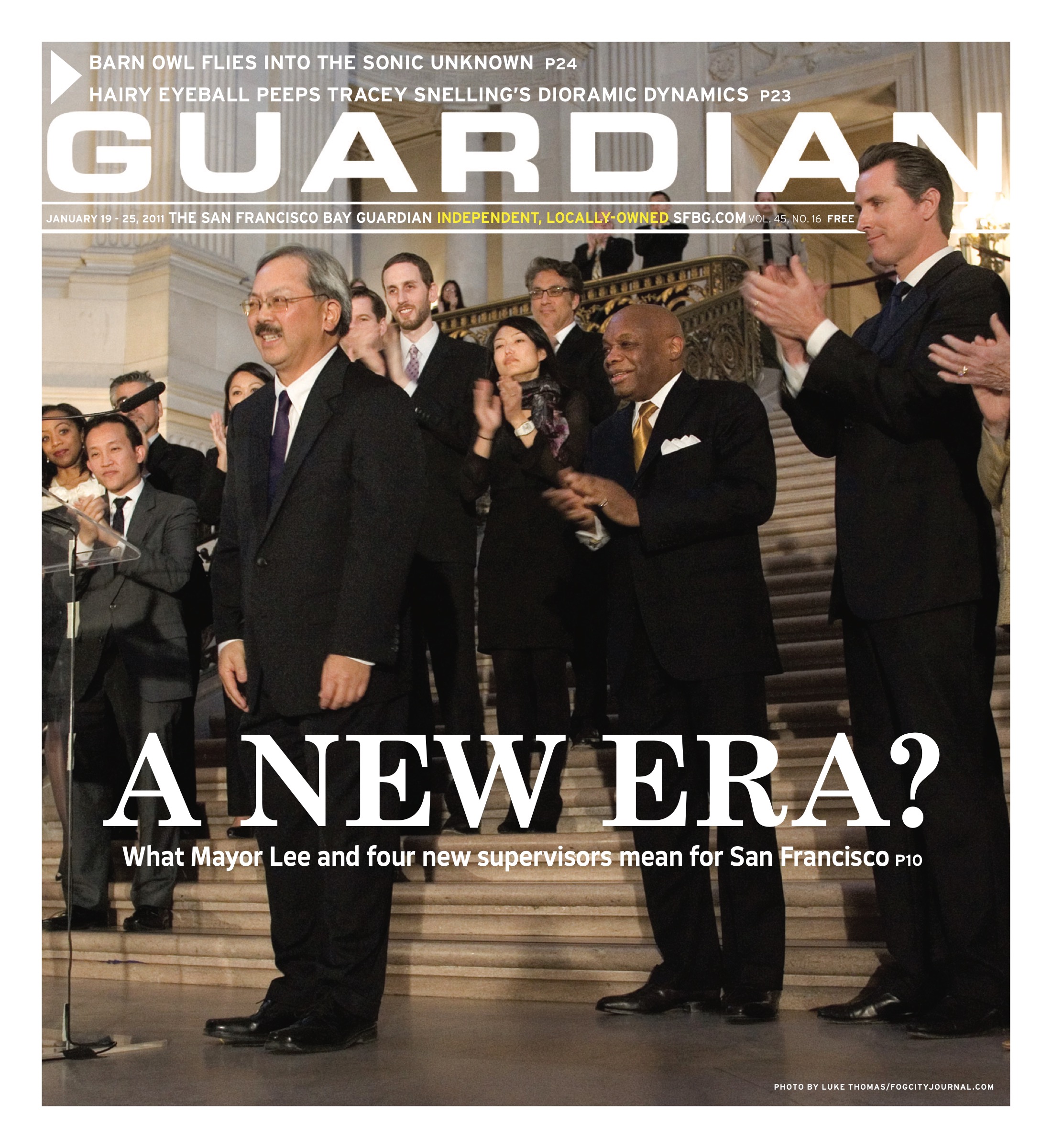
You can argue about what the word “progressive” means, and you can argue about the process and the politics that put Ed Lee in the Mayor’s Office. And you can talk forever about which group or faction has how much of a majority on the San Francisco Board of Supervisors, but you have to admit: this city has just undergone a significant political realignment.

Some of that was inevitable. The last members of the class of 2000, the supervisors who were elected in a rebellion against the sleaze, corruption, and runaway development policies of the Willie Brown administration, have left office. Gavin Newsom, the mayor who was often at war with the board and who encouraged a spirit of rancor and partisanship, is finally off to Sacramento. For the first time since 1978, the supervisors will be working with a mayor they chose themselves.

For much of the past 15 years, progressive politics was as much about stopping bad things — preventing Brown and then Newsom from wrecking the city — as it was about promoting good things. But the “politics of anti,” as San Francisco State political scientist Rich DeLeon describes is, wasn’t a central theme in the November elections, and this generation of supervisors comes into office with a different agenda.

Besides, one of the clear divisions on the board the past seven years was the Newsom allies against the progressives — something that dissipated instantly when Lee took over.

But the realignment goes deeper.

Until recently, the progressives on the board had a working majority — a caucus, so to speak — and they tended to vote together much of the time. The lines on the board were drawn almost entirely by what Newsom disparagingly calls ideology but could more accurately be described as a shared set of political values, a shared urban agenda.

There are still six supervisors who call themselves progressives, but the idea that they’ll stick together was shattered in the battle over a new mayor — and the notion that there’s anything like a progressive caucus died with Board President David Chiu’s election (his majority came in part from the conservative side, with three progressives opposing him) and with Chiu’s new committee assignments, which for the first time in a decade put control of key assignments in the hands of the fiscal conservatives.


A PROGRESSIVE MAJORITY?

The progressive bloc on the board was never monolithic. There were always disagreements and fractures. And, thanks to the Brown Act, the progressives don’t actually meet outside of the formal board sessions. But it was fair and accurate to say that, most of the time, the six members of the board majority functioned almost as a political party, working together on issues and counting on each other for key votes. There was, for example, a dispute two years ago over the board presidency — but in the end, Chiu was elected with exactly six votes, all from the progressive majority that came together in the end.

That all started to fall apart the minute the board was faced with the prospect of choosing a new mayor. For one thing, the progressives couldn’t agree on a strategy — should they look for someone who would seek reelection in November, or try to find an acceptable interim mayor? The rules that barred supervisors from voting for themselves made it more tricky; six votes were not enough to elect any of the existing members. And, not surprisingly, some of the progressives had mayoral ambitions themselves.

When state Assemblymember Tom Ammiano — who would have had six votes easily — took himself out of the running, there was no other obvious progressive candidate. And with no other obvious candidate, and little opportunity for open discussion, the progressives couldn’t come to an agreement.

But by the Jan. 4 board meeting, five of the six had coalesced around Sheriff Mike Hennessey. Chiu, however, was supporting Ed Lee, someone he had known and worked with in the Asian community and whom he considered a progressive candidate. And once it became clear that Lee was headed toward victory, Sup. Eric Mar announced that he, too, would be in Lee’s camp.

A few days later, when the new board convened to choose a president, the progressive solidarity was gone. Sups. David Campos, John Avalos, and Ross Mirkarimi, now the solid left wing of the board, voted for Avalos. Chiu won with the support of Mar, Sup. Jane Kim, and the moderate-to-conservative flank.

Now the Budget Committee — long controlled by a progressive chair and a progressive majority — will be led by Carmen Chu, who is among the most fiscally conservative board members. The Land Use and Development Committee will be chaired by Mar, but two of the three members are from the moderate side. Same goes for Rules, where Sup. Sean Elsbernd, for years the most conservative board member, will work with ideological ally Sup. Mark Farrell on confirming mayoral appointments, redrawing supervisorial districts, and promoting or blocking charter amendments as Kim, the chair, does her best to contain the damage.

You can argue that having independent-minded supervisors who don’t vote as a caucus is a good thing. You can also argue that a fractured left will never win against a united downtown. And both arguments have merit.

But you can’t argue any more that the board has the same sort of progressive majority it’s had for the past 10 years. That’s over. It’s a new — and different — political era.

What happens now? Will the progressives hold enough votes to have an influence on the city budget (and ensure that the deficit solutions include new revenue and not just cuts)? What legislative priorities will the supervisors be pushing in the next year? How will the votes shake out on difficult new proposals (and ongoing issues like community choice aggregation)?

Mayor Lee has pledged to work with the board and will show up for monthly questions. How will he respond to the sorts of progressive legislation — like tenant protections, transit-first policies, immigrant rights measures, and stronger affordable housing standards — that Newsom routinely vetoed?

How will this all play out in a year when the city will also be electing a new mayor?


IDENTITY POLITICS?

When Sups. Chiu, Mar, and Kim broke with their three progressive colleagues to support Chiu for board president — just as Chiu and Mar helped clear the path for Ed Lee to become mayor days earlier — it seemed to many political observers that identity had trumped ideology on the board. There’s some truth to that observation, but it’s too simple an explanation. There’s also the fact that Chiu strongly supported Kim, who is a personal friend and former roommate, in her election, so it’s no surprise she went with him for board president.

And the phrase itself is so laden with baggage and problems that it’s hard to talk about. It has come to signify a wide range of political activity and theorizing founded in the shared experiences of injustice of members of certain social groups. “Rather than organizing solely around belief systems, programmatic manifestoes, or party affiliation, identity political formations typically aim to secure the political freedom of a specific constituency marginalized within its larger context,” says the Stanford Encyclopedia of Philosophy, an ongoing research project by the students and faculty at Stanford University.

Although the notion of identity politics took hold during the social movements of the 1960s and ’70s — when liberation and organizing movements among women and various ethic and other identity groups fed a larger liberal democratic surge that targeted war, economic inequity, social injustice, and other issues — it’s also a political approach that has divided the populace.

“One of the central charges against identity politics by liberals, among others, has been its alleged reliance on notions of sameness to justify political mobilization,” says the Stanford Encyclopedia. “Looking for people who are like you rather than who share your political values as allies runs the risk of sidelining critical political analysis of complex social locations and ghettoizing members of social groups as the only persons capable of making or understanding claims to justice.”

Mar explains that the reality of identity politics and whether it’s a factor in the current politics at City Hall is far more complex.

“With me, David Chiu, and Jane Kim as a block of three progressive Asians — and I still define David Chiu as a progressive though I think some are questioning that — we all come out of what I would call a pro-housing justice, transit-first, and environmental sustainability [mindset],” Mar told us. “But I think because of our ethnic background and experiences, we may have different perspectives at times than other progressives.”

For example, Mar said, many working class families of color need to drive a car so they’ll differ from progressives who want to limit parking spaces to discourage driving. He also has reservations about the proposed congestion pricing fee and how it might affect low-income drivers.\

“I think often when progressive people of color come into office — Jane Kim might be one of the best examples — that sometimes there’s an assumption that her issues are going to be the same as a white progressive or a Latino progressive,” he said. “But I think kind of the different identities that we all have mean that we’re more complex.”

Campos, a Latino immigrant who is openly gay, noted that “as a progressive person of color, I have at times felt that the progressive movement didn’t recognize the importance of identity politics and what it means for me to have another person of color in power.”

But, he added, “I don’t think identity politics alone should guide what happens. A progressive agenda isn’t just about race but class, sexual orientation, and other things. It’s not enough to say that identity politics justifies everything.”

University of San Francisco political science professor Corey Cook told the Guardian that identity has always been a strong factor in San Francisco politics, even if it was overshadowed by the political realignment around progressive ideology that occurred in 2000, mostly as a reaction to an economic agenda based on rapid development and political cronyism.

“I’m not sure that identity wasn’t relevant, but it was swamped by ideology,” Cook told the Guardian. Now, he said, another political realignment seems to be occurring, one that downplays ideology compared to the position it has held for the last 10 years. “I’m not sure that ideology is dead. But the dynamics have definitely changed.”

Cook sees what may be a more important change reflected in Chiu’s decision to put the political moderates in control of key board committees. But he said that shift was probably inevitable given the difficulties of unifying the diverse progressive constituencies.

“It’s hard to hold a progressive coalition together, and it’s amazing that it has lasted this long,” he said.

There’s another kind of identity politics at play as well — that of native San Franciscans, who often express resentment at progressive newcomers talking about what kind of city this is, versus those who see San Francisco as a city of immigrants and ideas, a place being shaped by a wider constituency than the old-timers like to acknowledge.

“I’m honored to join Sups. Elsbernd and Cohen in representing the neighborhoods they grew up in,” Sup. Mark Farrell said during his opening remarks after being sworn in Jan. 8., sobbing when he thanked his parents for their support.

As he continued, he fed the criticism of the notion of ideology-based politics that has been a popular trope with Gavin Newsom and other fiscal conservatives in recent years, telling the crowd he wanted “to turn City Hall into a place based on issues and ideas, not ideology.”

Cohen also placed more importance on her birthright than on her political philosophy, telling stories about entering board chambers through the back door at age 16 when she was part of a youth program created by then-Mayor Frank Jordan, and with former Mayor Dianne Feinstein coming to speak at Cohen’s third-grade class. “I am a San Francisco native, and that is a responsibility I take seriously,” said Cohen, who graduated from the Emerge Program, which grooms women for political office,

“We will have another woman as president of the Board of Supervisors, and we will have a woman as mayor of San Francisco,” she added. And as the sole African American on the board, she also pledged, “I will be working to add more members of the African American community to the elected family of San Francisco.”

But what issues she plans to focus on and what values she’ll represent were unclear in her comments — as they were throughout her campaign, despite the efforts of journalists and activists to discern her political philosophy. In her public comments, her only stated goal was to build bridges between the community and City Hall and let decisions be guided by the people “not political ideologies.”

Oftentimes in recent San Francisco history, identity and ideology have worked in concert, as they did with former Sup. Harvey Milk, who broke barriers as the first openly gay elected official, but who also championed a broad progressive agenda that included tenants rights, protecting civil liberties, and creating more parks and public spaces.

Sup. Scott Wiener, shortly after being sworn into office, acknowledged the legacy of his district, which was once represented by Milk and fellow gay progressive leader Harry Britt, telling the crowd: “I’m keenly aware of the leadership that has come through this district and I have huge shoes to fill.”

Yet Wiener, a moderate, comes from a different ideological camp than Milk and Britt and he echoed the board’s new mantra of collaboration and compromise. “I will always try to find common ground. There is always common ground,” he said.


GETTING THINGS DONE?

Chiu is making a clear effort to break with the past, and has been critical of some progressive leaders. “I think it’s important that we do not have a small group of progressive leaders who are dictating to the rest of the progressive community what is progressive,” he said.

While he didn’t single out former Sup. Chris Daly by name, he does seem to be trying to repudiate Daly’s leadership style. “I think that while the progressive left and the progressive community leaders have had very significant accomplishments over the past 10 years, I do think that there are many times when our oppositional tactics have set us back.”

When Chiu was reelected board president, he told the crowd that “none of us were voted into office to take positions. We were voted into office to get things done.”

Some progressives were not at all happy with that comment. “I thought that was a terrible thing to say,” Avalos told the Guardian, arguing the positions that elected officials take shape the legislation that follows. As an example, he cited the positions that progressive members of Congress took in favor of the public option during the health care reform debate.

Talking about getting things done is “a sanctimonious talking point that fits well with what the Chronicle and big papers want to hear,” Avalos said. He said the Chronicle and other downtown interests are more interested in preserving the status quo and blocking progressive reforms. “It’s what they want to see not get done.”

Campos even challenged the comment publicly during the Jan. 11 board meeting when he said, “It’s important to get things done, but I don’t think getting things done is enough. We have to ask ourselves: what is it that we’re getting done? How is it that we’re getting things done? And for whom is it that we’re doing what we’re doing? Is it for the people, or the downtown corporate interests? I hope it’s not getting things done behind closed doors.”

Chiu said that, for him, getting things done is about expanding the progressive movement and consolidating its recent gains. “I think we all share a political goal. As progressives, we all share a political goal of getting things done and growing mainstream support for our shared progressive principles so that they really become the values of our entire city.”

To do that, he said, progressives are going to need to be more conciliatory and cooperative than they’ve been in the past. “I think it’s easy to slip into a more oppositional way of discussing progressive values, but I’m really pushing to move beyond that.”

The biggest single issue this spring will be the budget — and it’s hard to know exactly where the board president will draw his lines. “I have spoken to Mayor Lee about the need for open, transparent, and community-based budget processes and he’s open to that,” Chiu told us — and that alone would be a huge change. But the key progressive priority for the spring will be finding ways to avoid brutal budget cuts — and that means looking for new revenue.

When asked whether new general revenue will be a part of the budget solution, instead of Newsom’s Republican-style cuts-only approaches, Chiu was cautious. “I am open to considering revenues as part of the overall set of solutions to close the budget deficit,” he said. “I am willing to be one elected here that will try to make that argument.” But with his political clout and connections right now, he can do a lot more than be one person making an argument.

Chiu has always been open to new revenue solutions and even led the way in challenging the cuts-only approach to both the city budget and MTA budget two years in a row, only to back down in the end and cut a deal with Newsom. When asked whether things will be better this year given his closer relationship to Lee, Chiu replied, “I think things are going to be different in the coming months.”

During the board’s Jan. 7 deliberation on Lee, Sup. Eric Mar also said that based on his communications with Lee, Mar believed that the Mayor’s Office is open to supporting new revenue measures. He echoed the point later to us.

In addition to supporting the open, inclusive budget process, Mar called for “a humane budget that protects the safety net and services to the most vulnerable people in San Francisco is kind of the critical, top priority.

“I think it’s going to be difficult working with the different forces in the budget process,” he added. “That’s why I wish it could have been a progressive who was chairing the budget process.”

Mar said progressive activism on the budget process is needed now more than ever. “The Budget Justice Coalition from last year I think has to be reenergized so that so many groups are not competing for their own piece of the pie, but that it’s more of a for-all, share-the-pain budget with as many people communicating from outside as possible, putting the pressure on the mayor and the board to make sure that the critical safety net’s protected.”


CUTS WILL BE CENTER STAGE

But major cuts — and the issue of city employees pay and benefits — will also be center stage.

At the board’s Jan. 11 meeting, before the supervisors voted unanimously to nominate Lee as interim mayor, Sup. Elsbernd signaled that city workers’ retirement and health benefits will once again be at the center of the fight to balance the budget.

Elsbernd noted that in past years he was accused of exaggerating the negative impacts that city employees’ benefits have on the city’s budget. “But rather than being inflated, they were deflated,” Elsbernd said, noting that benefits will soon consume 18.14 percent of payroll and will account for 26 percent in three years.

“Does the budget deficit include this amount?” he asked.

And at the after-party that followed Lee’s swearing-in, Public Defender Jeff Adachi, who caused a furor last fall when he launched the ill-considered Measure B, which sought to reform workers’ benefits packages, told us he is not one to give up lightly.

“We learned a lot from that,” Adachi said. “This is still the huge elephant in City Hall. The city’s pension liability just went up another 1 percent, which is another $30 million”

Chu agreed that worker benefits would be a central part of the budget-balancing debate. “Any conversation about the long-term future of San Francisco’s budget has to look at the reality of where the bulk of our spending is,” she said.

Avalos noted that he plans to talk to labor and community based organizations about ways to increase city revenue. “I’m going to work behind the scene on the budget to make sure the communities are well-spoken for,” Avalos said, later adding, “But it’s hard, given that we need a two-thirds majority to pass stuff on the ballot.”

Last year, Avalos helped put two measures on the ballot to increase revenue: Prop. J, which sought to close loopholes in the city’s current hotel tax and asked visitors to pay a slightly higher hotel tax (about $3 a night) for three years, and Prop. N, the real property transfer tax that slightly increased the tax charged by the city on the sale of property worth more than $5 million.

Prop. N should raise $45 million, Avalos said. “I’ve always had my sights set on raising revenue, but making cuts is inevitable.”


THE IDEOLOGY ARGUMENT

Newsom and his allies loved to use “ideology” as a term of disparagement, a way to paint progressives as crazies driven by some sort of Commie-plot secret agenda. But there’s nothing wrong with ideology; Newsom’s fiscal conservative stance and his vow not to raise taxes were ideologies, too. The moderate positions some of the more centrist board members take stem from a basic ideology. Wiener, for example, told us that he thinks that in tough economic times, local government should do less but do it better. That’s a clear, consistent ideology.

For much of the past decade, the defining characteristic of the progressives on the board has been a loosely shared urban ideology supported by tenants, immigrant-rights groups, queer and labor activists, environmentalists, preservationists, supporters of public power and sunshine and foes of big corporate consolidation and economic power. Diversity and inclusiveness was part of that ideology, but it went beyond any one political interest or identity group.

It was often about fighting — against corruption and big-business hegemony and for economic and social equality. The progressive agenda started from the position that city government under Brown and Newsom had been going in the wrong direction and that substantive change was necessary. And sometimes, up against powerful mayors and their well-heeled backers, being polite and accommodating and seeking common ground didn’t work.

As outgoing Sup. Daly put it at his final meeting: “I’ve seen go-along to get along. If you want to do more than that, if you think there’s a fundamental problem with the way things are in this world, then go-along to get along doesn’t do it.” When Chiu announced that the new progressive politics is one of pragmatism, he was making a break from that ideology. He was signaling a different kind of politics. He has urged us to be optimistic about the new year — but we still don’t know what the new agenda will look like, how it will be defined, or at what point Chiu and his allies will say they’ve compromised and reached out enough and are ready to take a strong, even oppositional, stand. We do know the outcome will affect the lives of a lot of San Franciscans. And when the budget decisions start rolling down the pike, the political lines will be drawn fairly clearly. Because reaching across the aisle and working together sounds great in theory — but in practice, there is nothing even resembling a consensus on the board about how the city’s most serious problems should be resolved. And there are some ugly battles ahead.

They have issues: Members of the new Board speak

20

Board President David Chiu touched off a broad political discussion in recent weeks with his statement that officials were elected “not to take positions, but to get things done.” Delivered just before his reelection as Board President with the solid backing of the board’s moderate faction, Chiu’s comment has been viewed in light of City Hall’s shifting political dynamic, a subject the Guardian explores in a Jan. 19 cover story. Politics aside, Chiu’s statement also begs the question: Just what do members of the board hope to get done, and how do they propose to accomplish the items on their agenda?
Last week, Guardian reporters tracked down every member of the board to find out. We asked, what are your top priorities? And how do you plan to achieve them? Some spoke with us for 25 minutes, and others spoke for just 5 minutes, but the result offers some insight into what’s on their radar. Not surprisingly, getting the budget right was mentioned by virtually everyone as a top priority, but there are sharp differences in opinion in terms of how to do that. Several supervisors, particularly those in the moderate wing, mentioned ballooning pension and healthcare costs. Aiding small business also emerged as a priority shared by multiple board members.

Sup. Eric Mar
District 1

Issues:
*Budget
*Assisting small businesses
*Programs and services for seniors
*Food Security
*Issues surrounding Golden Gate Park

Elected in 2008 to represent D1, Sup. Eric Mar has been named chair of the powerful Land Use & Economic Development Committee and vice chair of the City Operations and Neighborhood Services Committee.

Asked to name his top priorities, Mar said, “A humane budget that protects the safety net and services to the must vulnerable people in San Francisco is kind of the critical, top priority.”

It’s bound to be difficult, he added. “That’s why I wish it could have been a progressive that was chairing the budget process. Now, we have to work with Carmen Chu to ensure that it’s a fair, transparent process.”

A second issue hovering near the top of Mar’s agenda is lending a helping hand to the small businesses of the Richmond District. “There’s a lot of anxiety about the economic climate for small business. We’re trying to work closely with some of the merchant associations and come up with ideas on how the city government can be more supportive,” he said. Mar also spoke about the need to respond to the threat of big box stores, such as PetCo, that could move in and harm neighborhood merchants. “I’m worried about too many of the big box stores trying to come in with an urban strategy and saying that they’re different — but they sure have an unfair advantage,” he noted.

Programs and services for the senior population ranked high on his list. Mar noted that he’d been working with senior groups on how to respond to a budget analyst’s report showing a ballooning need for housing – especially affordable housing – for seniors. “It’s moving from the Baby Boom generation to the Senior Boomers, and I think the population, if I’m not mistaken, by 2020 it’s going up 50 percent,” he said. “It’s a huge booming population that I don’t think we’re ready to address.”

Addressing food security issues through the Food Security Task Force also ranked high on Mar’s list, and he noted that he’s been working with a coalition that includes UCSF and the Department of Public Health to study the problem. “We’ve had a number of strategy meetings already, but we’re trying to launch different efforts to create healthier food access in many of our lowest income neighborhoods,” Mar said.

Finally, Mar talked about issues relating to the park. “I do represent the district that has Golden Gate Park, so I’m often busy with efforts to preserve the park, prevent privatization, and ensure enjoyment for the many residents not just in the Richmond but throughout the city that enjoy the park.” Although it’s not technically in his district, Mar noted that he is very supportive of HANC Recycling Center – and plans to advocate on their behalf to Mayor Lee.

Sup. Mark Farrell
District 2
Issues:
*Pension reform
*Long-term economic plan for city
*Job creation
*Quality-of-life issues

Elected to replace termed-out D2 Sup. Michela Alioto-Pier, Farrell has been named vice-chair of the Government Audits & Oversight Committee and a member of the Rules Committee. A native of D2, Farrell told the Guardian he believes his roots in the city and background as a venture capitalist would be an asset to the city’s legislative body. “I know at the last board, Carmen [Chu] was the only one who had any finance background,” he said. “To have someone come from the private sector with a business / finance background, I really do believe … adds to the dialogue and the discussion here at City Hall.”

Along those lines, Farrell said one of his top priorities is the budget. “I’m not on the budget and finance committee this time around, but given my background, I am going to play a role in that,” he said.

So what’s his plan for closing the budget deficit? In response, he alluded to slashing services. “In the past, there have been views that we as a city don’t provide enough services and we need to raise revenues to provide more, or the perspective that we first need to live within our means and then provide more services. Everyone’s going to disagree, but I’m in the latter camp,” he said. “I do believe we need to make some tough choices right now – whether it be head count, or whether it be looking at …pension reform. I do believe pension reform needs to be part of the dialogue. Unfortunately, it’s unsustainable.”

He also said he wanted to be part of “trying to create and focus on a framework for a long-term financial plan here in San Francisco.”

Secondly, Farrell discussed wanting to put together a “jobs bill.”

“Jobs is a big deal,” he said. “It’s something I want to focus on. There are only so many levers we can pull as a city. I think the biotech tax credits have spurred a lot of business down in Mission Bay.”

Next on Farrell’s agenda was quality-of-life issues, but rather than talk about enforcing San Francisco’s sit/lie ordinance – supported by political forces who organized under the banner of maintaining ‘quality-of-life’ – Farrell revealed that he is incensed about parking meter fines. “It is so strikingly unjust when you are 1 minute late to your parking meter and you have a $65 parking fine,” he said.

Farrell also mentioned development projects that would surely require time and attention. “CPMC is going to be a major dominant issue,” he said. He also mentioned Doyle Drive, and transitional age youth housing projects proposed in D2 – but as far as the housing project planned for the King Edward II Inn, which has generated some controversy among neighborhood groups, he didn’t take a strong position either way, saying he wanted to listen to all the stakeholders first.

Board President David Chiu
District 3
Issues:
*Budget
*Preserving neighborhood character
*Immigrant rights
*Preserving economic diversity
*Transit

Elected for a second two-year term as President of the Board, D3 Sup. David Chiu is rumored to be running in the mayor’s race, after he turned down former Mayor Gavin Newsom’s offer to appoint him as District Attorney. That offer was made after Kamala Harris won the state Attorney General’s race this fall. And when Chiu turned it down, former Mayor Gavin Newsom shocked just about everybody by appointing San Francisco Police Chief George Gascon, who is not opposed to the death penalty and was a longtime Republican before he recently registered as a Democrat, instead.

A temporary member of the Board’s Budget acommittee, Chiu is also a permanent member of the Board’s Government Audits & Oversight Committee.

Asked about his top priorities, Chiu spoke first and foremost about  “ensuring that we have a budget that works for all San Franciscans, particularly the most vulnerable.” He also said he wanted to see a different kind of budget process: “It is my hope that we do not engage in the typical, Kabuki-style budget process of years past under the last couple of mayors, where the mayor keeps under wraps for many months exactly what the thinking is on the budget, gives us something on June 1 for which we have only a couple of weeks to analyze, and then engage in the tired back-and-forth of debates in the past.” Chiu also spoke about tackling “looming pension and health care costs.”

Another priority, he said, was “Ensuring that our neighborhoods continue to remain the distinctive urban villages that they are, and protecting neighborhood character,” a goal that relates to “development, … historic preservation, [and] what we do around vacant commercial corridors.”

*Immigrant rights also made his top-five list. “I was very sad that last November we didn’t prevail in allowing all parents to have a right and a voice in school board elections,” he said, referencing ballot measure Proposition D which appeared on the November 2010 ballot. “I think we are going to reengage in discussion around Sanctuary City, another topic I have discussed twice already with Mayor Lee.”

Another issue for Chiu was  “ensuring again that hopefully San Francisco continues to remain an economically diverse city, and not just a city for the very wealthy.” He spoke about reforming city contracts: “In particular, dealing with the fact that in many areas, 70 to 80 percent of city contracts are awarded to non-San Francisco businesses. … I think there is more significant reform that needs to happen in our city contracting process.” Another economic-diversity measure, he said, was tax policy, “particularly around ensuring that our business tax is incenting the type of economic growth that we want.”

Finally, Chiu spoke about “Creating a transit-first city. This is not just about making sure MUNI is more reliable and has stable funding, but ensuring that we’re taking steps to reach a 2020 goal of 20 percent cycling in the city. Earlier this week I called for our transit agencies to look at pedestrian safety, because we are spending close to $300 million a year to deal with pedestrian deaths and injuries.”

Sup. Carmen Chu
District 4
*Budget
*Core Services
*Jobs
*Economy

Chiu has just named Sup. Carmen Chu as chair of the powerful Board and Finance Committee. And Chu, who worked as a budget analyst for Newsom’s administration, says the budget, core services, employment and the economy are her top priorities.

“My hope is that this year the budget is going to be a very collaborative and open process,” Chu said.

Chu believes workers benefits will be a central part of the budget-balancing debate.
“Any conversation about the long-term future of San Francisco’s budget has to look at the reality of where the bulk of our spending is,” she said.

Chu noted that the budget debate will have to take the state budget into account.
“At the end of the day, we need to take into account the context of the state budget, in terms of new cuts and taxes, because anything we do will be on top of the state level.

“We need to ask who do these measures really impact,” she added, noting that there were attempts to put revenue measures on the ballot last year.

Sup. Ross Mirkarimi
District 5
* Local Hire / First Source / Reentry programs
* Budget / generating revenue
* Infrastructure improvements
*Reversing MTA service cuts

With only two years left to serve on the Board, D5 Sup. Ross Mirkarimi has been named chair of the Board’s Public Safety Committee and vice-chair of the Budget and Finance Committee.

“One of my top priorities is building on and strengthening the work that I’ve already done and that Avalos is doing on mandatory local hire and First Source programs,” Mirkarimi said. He also spoke about “strengthening reentry programs for those coming out of the criminal justice system, because we still have an enormously high recidivism rate.”

The budget also ranked high on Mirkarimi’s list, and he stressed the need for “doing surgical operations on our budget to make sure that services for the vulnerable are retained, and looking for other ways to generate revenue beyond the debate of what’s going on the ballot.

“For instance, I helped lead the charge for the America’s Cup, and while the pay-off from that won’t be realized for years, the deal still needs to be massaged. What we have now is an embryonic deal that still needs to be watched.”

Mirkarimi mentioned safeguarding the city against privatization, saying one of his priorities was “retooling our budget priorities to stop the escalating practice of privatizing city services.”

 He spoke about “ongoing work citywide to make mixed-use commercial and residential infrastructure improvements, which coincide with bicycle and pedestrian improvements.”

Finally, Mirkarimi said he wanted to focus on transportation issues. “As Chair of the Transportation Authority, if I even continue to be chair, to take the lead on signature transit projects and work with the M.T.A. to reverse service cuts.”

Sup. Jane Kim
District 6
Issues:
*Jobs
*Economic Development
*Small Business
*Pedestrian Safety
*Legislation to control bedbug infestations

Elected to replace termed-out D6 Sup. Chris Daly, Kim has been named chair of the Rules Committee and a member of the Budget & Finance committee.

Kim believes that she will prove her progressive values through her work and she’s trying to take the current debate about her allegiances on the Board in her stride.

“The one thing I learned from serving on the School Board was to be really patient,” Kim told me, when our conversation turned to the issue of “progressive values.”

“I didn’t want to be President of the School Board for the first few years, because I loved pushing the envelope,” Kim added, noting that as Board President David Chiu is in the often-unenviable position of chief negotiator between the Board and the Mayor.

But with Ed Lee’s appointment as interim mayor, Kim is excited about the coming year.
“There are a lot of new opportunities, a different set of players, and it’s going to be very interesting to learn how to traverse this particular scene.”

Kim is kicking off her first term on the Board with two pieces of legislation. The first seeks to address bedbug infestations. “Particularly around enforcement, including private landlords,” Kim said, noting that there have also been bedbug problems in Housing Authority properties.

Her second immediate goal is to look at pedestrian safety, a big deal in D6, which is traversed by freeways with off-ramps leading into residential zones.
“Pedestrian safety is a unifying issue for my district, particularly for all the seniors,” Kim said, citing traffic calming, speed limit enforcement and increased pedestrian traffic, as possible approaches.

Beyond those immediate goals, Kim plans to focus on jobs, economic development and small businesses in the coming year. “What can we do to create jobs and help small businesses? That is my focus, not from a tax reduction point of view, but how can we consolidate the permitting and fees process, because small businesses are a source of local jobs.”

Kim plans to help the Mayor’s Office implement Sup. John Avalos’ local hire legislation, which interim Mayor Ed Lee supports, unlike his predecessor Mayor Gavin Newsom.

“Everyone has always liked the idea of local hire, but without any teeth, it can’t be enforced,” Kim observed. “It’s heartbreaking that young people graduate out of San Francisco Unified School District and there’s been not much more than retail jobs available.”

She noted that jobs, land use and the budget are the three overarching items on this year’s agenda. “I’m a big believer in revenue generation, but government has to come half-way by being able to articulate how it will benefit people and being able to show that it’s more than just altruistic. I think we have to figure out that balance in promoting new measures. That’s why it’s important to be strong on neighborhood and community issues, so that folks feel like government is listening and helping them. I don’t think it’s a huge ask to be responsive to that.”

Kim said she hoped the new mayor would put out a new revenue measure, enforce local hire, and implement Sup. David Campos’ legislation to ensure due process for immigrant youth.

“I think Ed can take a lot of the goodwill and unanimous support,” Kim said. “We’ve never had a mayor without an election, campaigns, and a track record. Usually mayors come in with a group of dissenters. But he is in a very unique position to do three things that are very challenging to do. I hope raising revenues is one of those three. As a big supporter of local hire, I think it helps having a mayor that is committed to implement it. And I’m hoping that Ed will implement due process for youth. For me, it’s a no brainer and Ed’s background as a former attorney  for Asian Law Caucus is a good match. Many members of my family came to the U.S. as undocumented youth, so this is very personal. Kids get picked up for no reason and misidentified. People confuse Campos and Avalos, so imagine what happens to immigrant youth.”

Sup. Sean Elsbernd
District 7
Issues:
*Parkmerced
*Enforcing Prop G
*Pension & healthcare costs
*CalTrain

With two years left to serve on the Board, D7 Sup. Sean Elsbernd has been named vice-chair of the Rules Committee and a member of the City Operations & Neighborhood Services Committee. He was congratulated by Chinatown powerbroker Rose Pak immediately after the Board voted 11-0 to nominated former City Administrator Ed Lee as interim mayor, and during Lee’s swearing-in, former Mayor Willie Brown praised Elsbernd for nominating Lee for the job.

And at the Board’s Jan. 11 meeting before the supervisors voted for Lee, Elsbernd signaled that city workers’ retirement and health benefits will be at the center of the fight to balance the budget in the coming year.

Elsbernd noted that in past years, he was accused of exaggerating the negative impacts that city employees’ benefits have on the city’s budget. “But rather than being inflated, they were deflated,” Elsbernd said, noting that benefits will soon consume 18.14 percent of payroll and will account for 26 percent in three years. “Does the budget deficit include this amount?” he asked.

And at the afterparty that followed Lee’s swearing in, Public Defender Jeff Adachi, who caused a furor last fall when he launched Measure B, which sought to reform workers’ benefits packages, told the Guardian he is not one to give up lightly. “We learned a lot from that,” Adachi said. “This is still the huge elephant in City Hall. The city’s pension liability just went up another 1 percent, which is another $30 million.”

As for priorities, Elsbernd broke it down into district, city, and regional issues. In D7, “Hands-down, without question the biggest issue … is Parkmerced,” he said, starting with understanding and managing the environmental approval process. If it gets approved, he said his top concerns was that “the tenant issue. And the overriding concern of if they sell, which I think we all think is going to happen in the near-term – do those guarantees go along with the land?”

Also related to Parkmerced was planning for the traffic conditions that the development could potentially create, which Elsbernd dubbed a “huge 19th Avenue issue.”

Citywide, Elsbernd’s top priorities included enforcing Proposition G – the voter-approved measure that requires MUNI drivers to engage in collective bargaining – and tackling pension and healthcare costs. He spoke about “making sure that MTA budget that comes to us this summer is responsive” to Prop G.

As for pension and healthcare, Elsbernd said, “I’ve already spent a good deal of time with labor talking about it, and will continue to do that.” But he declined to give further details. Asked if a revenue-generating measure could be part of the solution to that problem, Elsbernd said, “I’m not saying no to anything right now.”

On a regional level, Elsbernd’s priority was to help CalTrain deal with its crippling financial problem. He’s served on that board for the last four years. “The financial situation at CalTrain – it is without question the forgotten stepchild of Bay Area transit, and the budget is going to be hugely challenging,” he said. “I think they’ll survive, but I think they’re going to see massive reductions in services.”

Sup. Scott Wiener
District 8
Issues:
*Transportation
*Reasonable regulation of nightlife & entertainment industry
*Pension reform

Elected in November 2010 to replace termed-out D8 Sup. Bevan, Wiener has been named a temporary member of the Board’s Budget and Finance Committee and a permanent member of the Land Use and Economic Development Committee.

“Transportation is a top priority,” Wiener said. ‘That includes working with the M.T.A. to get more cabs on the street, and making sure that the M.T.A. collectively bargains effectively with its new powers, under Prop. G.”

“I’m also going to be focusing on public safety, including work around graffiti enforcement, though I’m not prepared to go public yet about what I’ll be thinking,” he said.

“Regulating nightlife and entertainment is another top priority,” Wiener continued. “I want to make sure that what we do is very thoughtful in terms of understanding the economic impacts, in terms of jobs and tax  revenues, that this segment has. With some of the unfortunate incidents that have happened, it’s really important before we jump to conclusions that we figure out what happened and why. Was it something the club did inappropriately, or was it just a fluke? That way, we can avoid making drastic changes across the board. I think we have been very reactive to some nightclub issues. I want us to be more thoughtful in taking all the factors into consideration.”

“Even if we put a revenue measure on the June or November ballot, we’d need a two-thirds majority, so realistically, it’s hard to envision successfully securing significant revenue measure before November 2012,” Wiener added. “And once you adopt a revenue measure, it takes time to implement it and revenue to come in, so it’s hard to see where we’ll get revenue that will impact the 2012 fiscal year. In the short term, for fiscal year 2011/2012, the horse is out of the barn”

“As for pension stuff, I’m going to be very engaged in that process and hopefully we will move to further rein in pension and retirement healthcare costs.”

Sup. David Campos
District 9
Issues:
*Good government
*Community policing
*Protecting immigrant youth
*Workers’ rights and healthcare

Elected in 2008, D9 Sup. David Campos has been named chair of the Board’s Government Audit & Oversight Committee and a member of the Public Safety Committee. And, ever since he declared that the progressive majority on the Board no longer exists, in the wake of the Board’s 11-0 vote for Mayor Ed Lee, Campos has found his words being used by the mainstream media as alleged evidence that the entire progressive movement is dead in San Francisco.

“They are trying to twist my words and make me into the bogey man,” Campos said, noting that his words were not a statement of defeat but a wake-up call.

“The progressive movement is very much alive,” Campos said. “The key here is that if you speak your truth, they’ll go after you, even if you do it in a respectful way. I didn’t lose my temper or go after anybody, but they are trying to make me into the next Chris Daly.”

Campos said his overarching goal this year is to keep advancing a good government agenda.

“This means not just making sure that good public policy is being pursued, but also that we do so with as much openness and transparency as possible,” he said.

As a member of the Board’s Public Safety Committee, Campos says he will focus on making sure that we have “as much community policing as possible.

He plans to focus on improving public transportation, noting that a lot of folks in his district use public transit.

And he’d like to see interim mayor Ed Lee implement the due process legislation that Campos sponsored and the former Board passed with a veto-proof majority in 2009, but Mayor Gavin Newsom refused to implement. Campos’ legislation sought to ensure that immigrant youth get their day in court before being referred to the federal immigration authorities for possible deportation, and Newsom’s refusal to implement it, left hundreds of youth at risk of being deported, without first having the opportunity to establish their innocence in a juvenile court.
‘We met with Mayor Lee today,” Campos told the Guardian Jan. 18. “And we asked him to move this forward as quickly as possible. He committed to do that and said he wants to get more informed, but I’m confident he will move this forward.”

Campos also said he’ll be focusing on issues around workers’ rights and health care.
“I want to make sure we keep making progress on those fronts,” Campos said.

“It’s been a rough couple of days,” Campos continued, circling back to the beating the press gave him for his “progressive” remarks.“But I got to keep moving, doing my work, calling it as a I see it, doing what’s right, and doing it in a respectful way. The truth is that if you talk about the progressive movement and what we have achieved, which includes universal healthcare and local hire in the last few years, you are likely to become a target.”

Sup. Malia Cohen
District 10
Issues:
*Public safety
*Jobs
*Preserving open space
*Creating Community Benefit Districts
*Ending illegal dumping
Elected to replace termed-out D10 Sup. Sophie Maxwell, Cohen has been named chair of the City & School District committee, vice chair of the Land Use and Economic Development Committee and vice chair of the Public Safety Committee.

Cohen says her top priorities are public safety, jobs, open space, which she campaigned on, as well as creating community benefits districts and putting an end to illegal dumping.

“I feel good about the votes I cast for Ed Lee as interim mayor and David Chiu as Board President. We need to partner on the implementation of local hire, and those alliances can help folks in my district, including Visitation Valley.”

“I was touched by Sup. David Campos words about the progressive majority on the Board,” she added. “I thought they were thoughtful.”

Much like Kim, Cohen believes her legislative actions will show where her values lie.
“I’d like to see a community benefits district on San Bruno and Third Street because those are two separate corridors that could use help,” Cohen said. 

She pointed to legislation that former D10 Sup. Sophie Maxwell introduced in November 2010, authorizing the Department of Public Works to expend a $350,000 grant from the Solid Waste Disposal Clean-Up Site trust fund to clean up 25 chronic illegal dumping sites.
“All the sites are on public property and are located in the southeast part of the city, in my district,” Cohen said, noting that the city receives over 16,000 reports of illegal dumping a year and spends over $2 million in cleaning them up.

Sup. John Avalos
District 11
*Implementing Local Hire
*Improving MUNI / Balboa Park BART
*Affordable housing
*Improving city and neighborhood services

Sup. John Avalos, who chaired the Budget committee last year and has just been named Chair of the Board’s City Operations and Neighborhood Services Committee, said his top priorities were implementing local hire, improving Muni and Balboa Park BART station, building affordable housing at Balboa, and improving city and neighborhood services.

“And despite not being budget chair, I’ll make sure we have the best budget we can,” Avalos added, noting that he plans to talk to labor and community based organizations about ways to increase city revenues. “But it’s hard, given that we need a two-thirds majority to pass stuff on the ballot,” he said.

Last year, Avalos helped put two measures on the ballot to increase revenues. Prop. J sought to close loopholes in the city’s current hotel tax, and asked visitors to pay a slightly higher hotel tax (about $3 a night) for three years. Prop. N, the real property transfer tax, h slightly increased the tax charged by the city on the sale of property worth more than $5 million.

Prop. J secured only 45.5 percent of the vote, thereby failing to win the necessary two-thirds majority. But it fared better than Prop. K, the competing hotel tax that Newsom put on the ballot at the behest of large hotel corporations and that only won 38.5 percent of the vote. Prop. K also sought to close loopholes in the hotel tax, but didn’t include a tax increase, meaning it would have contributed millions less than Prop. J.

But Prop. N did pass. “And that should raise $45 million,” Avalos said. “So, I’ve always had my sights set on raising revenue, but making cuts is inevitable.”


SFBG Radio: Truth and MLK Day

2

Today Johnny and Tim talk about how Martn Luther King Jr. Day celebrations tend to ignore the history of the civil rights leader who was also a progressive on labor and economic issues — and an outspoken opponent of the Vietnam war. Listen after the jump. 

sfbgradio1182011 by endorsements2010

Gascon shocker

0

Gavin Newsom’s appointment of his police chief, George Gascón, as district attorney wasn’t just a slap in the face to the D.A.’s office, it reversed a long tradition in which the city’s top prosecutors have pledged their opposition to the death penalty. It broke an unwritten rule that the district attorney should have some independence from the Police Department. And it suggests that Newsom’s decision was about his own future and not about San Francisco’s.

Gascón, who has a law degree from Western State University in Fullerton, has been a member of the state bar since 1996 and has handled labor and bankruptcy cases for a year and a half. But he’s never prosecuted a criminal case.

He still believes he has the necessary organizational skills. “Running a D.A.’s office is not the same as prosecuting cases on the floor,” he said at his Jan.9 swearing-in.

He sees the D.A. post as a way to build closer relationships between various law enforcement agencies, including the police department and the public defender’s office. “We have to find a way to bring law enforcement together,” Gascón said.

But so far the response to his appointment in those circles has been less than favorable, even though City Attorney Dennis Herrera issued a press release praising Gascón’s help in moving ahead with gang injunctions in Visitacion Valley.

Attorney Elliot Beckelman, who worked in the D.A.’s office until a few months ago, said people in the office were stunned because no one thought Gascón was a good candidate. “It’s like taking a lawyer who has been working for 20 years, and has done a stint as the D.A., and graduated from the police academy, and appointing them as police chief when they never worked as a police officer, arrested anyone, or saw a dead body,” he said.

Beckelman said he wonders if Gascón’s Jan. 9 comment that he is not “philosophically opposed to the death penalty” indicates that Newsom picked him to boost his own popularity with law enforcement groups and improve his chances at getting elected to higher office.

“It’s very cynical to make your final political move one that disassociates you from San Francisco, but it’s a big move nationally in terms of where Newsom hopes to land five moves from now,” Beckelman said. “It’s a politician appointing another politician.”

Former District Attorney Terence Hallinan said Gascón’s appointment was stupid. “Maybe it’s Gavin’s comeback after gay marriage to appoint someone who will say, ‘Okay, let’s kill people.’ But this is not a well-thought-out move,” he said. “OK, Gascón’s a lawyer, but he has never practiced law. The D.A. and the police work together, yes, but you have to try a lot of cases before you work out which are worth prosecuting and which deputies to assign.

‘It’s the responsibility of the D.A.’s office to supervise the police,” he added.

Public Defender Jeff Adachi notes that the choice of Gascon’ has energized this fall’s D.A.’s race , when Gascón will have to stand for election to keep his new job. “What was a sleepy race looks like it will take center stage” Adachi said. “Other candidates are now outsiders and will have to distinguish themselves.”

One such opportunity could arise if Gascón seeks the death penalty in the coming year. Matt Gonzalez, who was the first candidate to oppose the death penalty when he ran against then-D.A. Terence Hallinan, said he thinks Gascón’s views on the death penalty should have eliminated him. “That alone should have made him ineligible. This is a step backward.”

Gonzalez thinks Gascón’s appointment trivializes what the D.A.’s office does. “This was a real opportunity to pick a professional prosecutor who was familiar with the office and knew San Francisco,” he said. “Instead, this is like me thinking I should be police chief because I’ve seen a lot of fingerprints.”

Adachi worries that little is known about Gascón’s legal abilities. “He does not have a track record in terms of felony and homicide experience,” he said. “That’s not to say he wouldn’t run the office well, but it leaves us without an important knowledge base. He does bring many years of experience as a police officer, but the responsibilities are very different.”

Adachi observes that while police bring cases to the D.A. based on probable cause, the D.A. reviews those cases and only brings cases that are deemed justified. “But will Gascón file more cases for the sake of wanting to justify arrests by the police?” Adachi mused.

Goal difference

0

cheryl@sfbg.com

YEAR IN FILM Making a mistake on the playing field can haunt an athlete for the rest of his or her career. For Colombian soccer star Andrés Escobar, a particularly heartbreaking blunder — an own goal during the 1994 World Cup — proved fatal. Just two weeks after Colombia’s first-round defeat in the tournament they’d been favored to win, team captain Escobar was shot after leaving a nightclub in his hometown of Medellín. There were rumors the killer yelled “Goal!” as he unloaded.

Presented merely as a sports-history anecdote, Escobar’s demise is sad and senseless. But his murder wasn’t an isolated incident, just a particularly high-profile one; it was part of an unimaginable tide of violence that swept Colombia in the 1980s and ’90s. If you watched the 2010 World Cup on ESPN, you probably saw commercials for The Two Escobars, presented as part of the channel’s “30 for 30” documentary series. Participants included genre pioneer Albert Maysles, whose film was about Muhammed Ali; Ice Cube, who used his own South Central childhood to reflect on the Raiders’ 1982 move from Oakland to Los Angeles; and brothers Jeff and Michael Zimbalist, whose longer entry The Two Escobars sifted through years of Colombian history to trace the corresponding lives of Andrés “The Gentleman of Football” Escobar and drug kingpin Pablo Escobar.

At 32, Jeff, who lives in San Francisco, is the older brother by 17 months. In 2005, he codirected the award-winning Brazilian music doc Favela Rising. Michael, an actor and writer who ran a theater company in Mexico for several years, lives in New York City. Though they’re Americans, the Zimbalists feel a strong connection to Colombian culture. They were researching another film in the country (previous endeavors included a project with Colombian superstar Shakira) when ESPN asked them to pitch an idea for “30 for 30.” Though the shared last name of the unrelated Andrés and Pablo makes for a memorable title, the brothers didn’t use the coincidence as a starting point.

“We didn’t choose the title until really late, actually, because it felt like it was more of a portrait of a time period. It was about the hopes and dreams of the Colombian people as told through the vehicle of these two characters,” Jeff says. “The choice to use the two characters came about more organically than that, too. Initially we had the assignment to go find story ideas for the ESPN series that were about the impact of sports on society, and vice versa.”

After learning more about Andrés, they knew they’d found a captivating subject. They also realized that they would need to contextualize his story in order to tell it properly.

“We didn’t want to make a whodunnit about who pulled the trigger,” Jeff says. “It was a lot more interesting to ask the question of how an athlete gets killed for making a mistake. But in order to understand that, you need to understand what narco-soccer is. We quickly realized that hadn’t been covered before. And that meant that people were very reluctant to talk about it for a number of reasons: out of fear, shame, or they didn’t want to revisit a traumatic time period.”

The idea of “narco-soccer” led the filmmakers directly to their other subject. “You can’t really explain the whole context of narco without understanding Pablo Escobar. And it also felt unwieldy to not tie the societal story to a subject, or to a personal narrative,” Jeff explains. “So using Pablo as the tool through which we could explain society, and Andres as the tool through which we could understand sports, the next challenge was finding their overlaps. They only literally overlap a number of times in their lives. So how does the story justifies the use of these two characters? It has to be thematic — and there was tons of great, thematic overlap, and parallel and contrast, between the two Escobars.”

If you weren’t among the millions who watched The Two Escobars‘ repeat showings on ESPN (or caught it at the Sundance Kabuki as part of the San Francisco Film Society’s “SFFS Screen” programming), here’s a crash course in narco-soccer, as explained by the movie: during the ’80s and ’90s, Colombian drug lords invested in soccer teams as a way to launder their ill-gotten gains. As teams’ coffers grew, so did their ability to hire top-notch players. Sides flush with dirty cash racked up victories and corruption behind the scenes grew to outlandish proportions. Referees could easily be bought — or eliminated. A huge soccer fan who’d risen from poverty, then used his wealth to build fields in the slums, Pablo was one of these investors. Andrés, of course, was one of the league’s stars.

Using no narrator, The Two Escobars instead weaves its account with contemporary interviews (the exhaustive list of talking heads includes soccer legends, jailed gangsters, coaches, cops, and the sisters of both Escobars) and expertly edited archival footage that enables the viewer to witness just about everything discussed: the might of Colombia’s national team in the run-up to the 1994 World Cup; the sight of Pablo enjoying soccer on both his palatial estate and, incredibly, while incarcerated; the horrific violence that became an everyday occurrence during Pablo’s war on Colombia’s government.

Obtaining these hours of interviews and footage — only a fraction of which made it into the final cut — posed various challenges. “[Subjects] were reluctant to talk for many reasons: it’s taboo; it’s often felt to be dangerous still,” Jeff says. “So there is fear. And also, it is traumatic to go back and visit those emotions. A lot of people would rather bottle that up. I’m not one to judge because I didn’t live during the reign of Pablo Escobar and [anti-Escobar vigilante group] Los Pepes in Colombia. But I do believe that expressing that stuff and getting it out can be cathartic.”

Culling the archival footage used in The Two Escobars took months of plowing through broadcast vaults, the private archives of both Escobars, and films shot by military police and amateur videographers. “We knew it wasn’t gonna be as powerful a film, as accessible a film, if we just rooted it in present-day talking head interviews,” Jeff says. “We needed to transport the viewer back into that time period. A lot of our decision to tell both the narratives of Pablo and Andrés, and make it bigger than just the ESPN assignment, to make it a theatrical movie, was hanging on whether or not we were able to find enough compelling visuals to create real scenes. We had myself, my brother, and a team of people just going through tapes.”

Editing was a monumental task, proving both labor-intensive and emotionally trying. “It was very difficult to whittle down the story,” Michael says. “At one point, we had a film that was sort of focused on being the first exposé of this secret world of narco-soccer. We had hours of anecdotes that really blew our minds. We ended up reducing that whole part of the story to what you could call act one of the movie, and that was certainly difficult. You’re just sorry to see things go.”

Though The Two Escobars screened worldwide, not just on ESPN but at the Tribeca and Cannes film festivals, one place it hasn’t been seen is, ironically, Colombia. Due to the sensitive subject matter, and objections to the final product by Andrés Escobar’s family — who didn’t appreciate being associated with Pablo Escobar — “it’s been completely censored,” Jeff says, noting that he and his brother did not intend to mislead anyone during the filming.

“We always knew it was going to be extremely controversial,” Michael says. “I was nervous in terms of what the reactions from Colombians would be, because obviously it’s very delicate, very loaded subject matter. There’s so much visceral emotion for any Colombian who went through that period of time. Virtually everyone who lived there in the ’80s and ’90s was touched by that violence.”

Though the brothers are disappointed the film hasn’t been shown in Colombia, that doesn’t mean no Colombians have seen it.

“Everywhere we’ve shown the film and done a Q&A, there have been Colombians present,” Michael says. “That’s been a really rewarding experience.”

“For Colombians, it’s not an easy 100 minutes to sit through,” adds Jeff. “But by the end, [the Colombians we’ve met] do feel that it’s an accurate portrayal, that it’s balanced journalism, and that the message is an important one about Colombia moving forward. It presents a lot of hope through Andrés’ family. That was our goal, to create a portrayal of Andrés that was heroic. We made sure the voice of his family is the takeaway from the movie. I think it couldn’t be more clear once you see the film how opposite Pablo and Andrés are in terms of who they are and what they stand for. I hope that Colombians get a chance to see the film because they’ll realize that.” 

www.the2escobars.com

Get out of the way, Mr. Mayor

4

EDITORIAL Let us begin with the obvious: Mayor Gavin Newsom has absolutely no business deciding who should replace him. His petulant statements suggesting that he will delay taking office as lieutenant governor until the supervisors pick a candidate he likes are an embarrassment to the city. If he actually refuses to take the oath of office Jan. 3, when his term in Sacramento begins, it will damage his reputation and political career.

Newsom knew when he decided to seek higher office that he’d be leaving the city early if he won. He knew that under the City Charter, the Board of Supervisors would choose a new mayor. He knew that a progressive majority on the board was likely to elect someone whose political views differ from his. If he didn’t want that to happen, he should have stayed in town and finished his term.

Instead, his ambition and ego drove him to Sacramento, and he needs to accept that he is now out of the process. He should publicly agree to follow the state Constitution and join Governor-elect Jerry Brown for a timely swearing-in ceremony. Meanwhile, the supervisors need to make it very clear that they won’t accept this sort of political blackmail and will choose the next mayor on their own terms.

There’s only one more regularly scheduled meeting of the current board, on Tuesday, Jan. 4, the day after Newsom’s term as lieutenant governor begins. It’s unfortunate that the progressive majority on the board hasn’t been able to find a consensus candidate, and it’s appearing more and more likely that the next mayor will be a short-termer, a caretaker who agrees to fill out Newsom’s term. We’ve consistently argued that Newsom’s successor ought to be someone who can run for a full term in November, but there’s certainly a case to be made for the right person to take on the job for just 11 months. A progressive caretaker could fire all the failed managers left over (at high salaries) from Newsom’s tenure and make cuts to sacred cows like the police and fire departments without worrying about reelection. We’d still rather see a candidate with the courage and skill to make the tough choices and run in November on that record. But if that’s not possible, it’s important that an interim mayor be chosen carefully.

It’s also important that the progressive supervisors consider the long-term implications of their choice: If the next mayor only serves out Newsom’s remaining time, who’s going to run in November — and what will the interim mayor do to promote the prospects of a progressive candidate?

A number of names are floating around as possible caretakers, and several would do at least an adequate and perhaps an exceptional job. Former Board President Aaron Peskin has brilliant political instincts and knows how to run the city; he’s let us down on a few votes, but would work well with the progressive board majority. Sheriff Mike Hennessey is popular with the voters and has good progressive credentials (other than the move to privatize jail health services, which makes him somewhat unpalatable to labor), but he’s never faced anything resembling the political nightmare of the city’s current fiscal crisis. Sup. Ross Mirkarimi has a great legislative record and has hinted that he’d consider the job, but he still has two years to go as supervisor and would have to give up his seat and put his political career on hold. Former Mayor Art Agnos is the only one on the list who’s actually run the city at a time of crisis and would certainly be willing to make the tough decisions. If he could run an open office and listen to a diverse constituency, he might make up for the mistakes he made his first time in the job.

None of these candidates could do the job alone — and if they want to serve a short term as mayor, they need to start talking openly about it, explaining what their plans would be and give San Franciscans (and not just six supervisors) a reason to support them.

EDITORIAL: Get out of the way, Mr. Mayor

36

 Let us begin with the obvious: Mayor Gavin Newsom has absolutely no business deciding who should replace him. His petulant statements suggesting that he will delay taking office as lieutenant governor until the supervisors pick a candidate he likes are an embarrassment to the city. If he actually refuses to take the oath of office Jan. 3, when his term in Sacramento begins, it will damage his reputation and political career.

Newsom knew when he decided to seek higher office that he’d be leaving the city early if he won. He knew that under the City Charter, the Board of Supervisors would choose a new mayor. He knew that a progressive majority on the board was likely to elect someone whose political views differ from his. If he didn’t want that to happen, he should have stayed in town and finished his term.

Instead, his ambition and ego drove him to Sacramento, and he needs to accept that he is now out of the process. He should publicly agree to follow the state Constitution and join Governor-elect Jerry Brown for a timely swearing-in ceremony. Meanwhile, the supervisors need to make it very clear that they won’t accept this sort of political blackmail and will choose the next mayor on their own terms.

There’s only one more regularly scheduled meeting of the current board, on Tuesday, Jan. 4, the day after Newsom’s term as lieutenant governor begins. It’s unfortunate that the progressive majority on the board hasn’t been able to find a consensus candidate, and it’s appearing more and more likely that the next mayor will be a short-termer, a caretaker who agrees to fill out Newsom’s term. We’ve consistently argued that Newsom’s successor ought to be someone who can run for a full term in November, but there’s certainly a case to be made for the right person to take on the job for just 11 months. A progressive caretaker could fire all the failed managers left over (at high salaries) from Newsom’s tenure and make cuts to sacred cows like the police and fire departments without worrying about reelection. We’d still rather see a candidate with the courage and skill to make the tough choices and run in November on that record. But if that’s not possible, it’s important that an interim mayor be chosen carefully.

It’s also important that the progressive supervisors consider the long-term implications of their choice: If the next mayor only serves out Newsom’s remaining time, who’s going to run in November and what will the interim mayor do to promote the prospects of a progressive candidate?

A number of names are floating around as possible caretakers, and several would do at least an adequate and perhaps an exceptional job. Former Board President Aaron Peskin has brilliant political instincts and knows how to run the city; he’s let us down on a few votes, but would work well with the progressive board majority. Sheriff Mike Hennessey is popular with the voters and has good progressive credentials (other than the move to privatize jail health services, which makes him somewhat unpalatable to labor), but he’s never faced anything resembling the political nightmare of the city’s current fiscal crisis. Sup. Ross Mirkarimi has a great legislative record and has hinted that he’d consider the job, but he still has two years to go as supervisor and would have to give up his seat and put his political career on hold. Former Mayor Art Agnos is the only one on the list who’s actually run the city at a time of crisis and would certainly be willing to make the tough decisions. If he could run an open office and listen to a diverse constituency, he might make up for the mistakes he made his first time in the job.

None of these candidates could do the job alone and if they want to serve a short term as mayor, they need to start talking openly about it, explaining what their plans would be and give San Franciscans (and not just six supervisors) a reason to support them.