Labor

By demons driven

0

arts@sfbg.com

SAN FRANCISCO INTERNATIONAL ASIAN AMERICAN FILM FESTIVAL A few years ago, much was being made of the “new wave” of Asian horror films. Western audiences were being introduced to the long-haired, vengeful spirits and women on the verge of murderous rampages that had been scaring moviegoers in Japan, South Korea, and Southeast Asia for much of the late 1990s and early aughts. Companies such as Tartan and Lionsgate rushed to make the latest bloodbaths from directors such as Takashi Miike and Kim Ji-woon available on DVD, and Hollywood began to voraciously buy up story rights and churn out English-language remakes. Then Saw (2004) and Hostel (2005) came along.

But while the new wave of Asian horror may have crested as a Western phenomena, SFIAAFF’s retrospective “After Death: Horror Cinema from South East Asia” proves that using regional ghost stories as a springboard for Romero-worthy blood feasts is still a winning formula for many Southeast Asian directors. Nang Nak (1999), the oldest of the three films in the series, reenvisions the Thai folktale of a wife whose love for her family chains her to the earthly realm long after death. Histeria (2008) loosely bases its six-girls-tormented-by-an-evil-spirit variation on the classic slasher narrative on actual cases of mass hysteria among Malaysian schoolgirls. And 2008’s Affliction (the only film unavailable for preview) pits a father against his daughter as he fights to prevent her transformation into an Aswang, a blood-sucking monster of Filipino legend.

To be honest, there might be a reason these titles have received less attention abroad than the output of the Pang brothers (2002’s The Eye), for example. For all its flashy cinematography and folkloric source material, Nang Nak drags for most of its 100 minutes (when we already know long before the protagonist does that his dutiful dearest is not all she appears to be, waiting for him to finally catch on feels like an eternity). Histeria has more fun at least with its set-up, sketching out the hierarchy at work in its clique of schoolgirls sentenced to a long weekend of janitorial labor at their rural boarding school before dispatching them in unsavory ways one by one. The film even features what’s touted to be Malaysian cinema’s first same-sex onscreen kiss; although a “half-peck” might be more accurate. Still, the film’s special effects are imaginative — especially its creature design — and its scares are genuine even if the twist ending doesn’t pack much surprise. Indeed, the films in “After Death” are perhaps SFIAAFF’s most familiar offerings, but that doesn’t make them any less enjoyable for, say, date night.

SAN FRANCISCO INTERNATIONAL ASIAN AMERICAN FILM FESTIVAL

March 10–20, most shows $12

Various venues

www.caamedia.org


Mother courage

0

arts@sfbg.com

STAGE As outrage mounts at the vicious repression of civilians in Libya, Lynn Nottage’s 2009 Pulitzer Prize-winning play Ruined reminds us of the ongoing crimes against humanity — in particular the strategic use of sexual violence against women — carried out routinely for years in the Democratic Republic of the Congo. The devastating civil war that began there in 1998 continues today as one of the most destructive on the planet, having taken well more than 5 million lives.

Despite its title, Ruined is as much a tribute to the persistence of life amid the most unspeakable atrocities. The play gets a strong, well-acted Bay Area premiere in a coproduction between the Berkeley Rep, Huntington Theatre Company, and La Jolla Playhouse. Directed with sharp timing and a keen eye by Liesl Tommy, it uses a small circle of characters to draw attention to the horrendous ordeal, as well as the enduring fortitude and resilience, of hundreds of thousands of Congolese women whose bodies, as one character puts it, have been used as battlegrounds in a ruthless and terrifying conflict.

Mama Nadi (an expansive and canny Tonye Patano) runs a modest little bar and brothel in a mining town somewhere in the lush and lawless countryside of eastern Congo. Her clientele are exclusively men: a dangerous mixture of miners, soldiers, rebel militiamen, and shady merchants. Not unlike the title character in Brecht’s Mother Courage (which was indeed the inspiration for Nottage’s protagonist and a starting point for her play as a whole), Mama does her best to keep the conflict outside in the name of doing business, insisting that her customers unload their weapons before entering and smoothly managing any potential unrest with a swift flow of alcohol or some proffered female companionship.

But in truth, the best Mama can hope for is an uneasy negotiation with the usually heavily-intoxicated and power-drunk marauders who inevitably bring the evils of war with them as they come looking for respite. And Mama is not all business either. She’s reluctantly kind-hearted, a trait that creates (or recapitulates) conflict where she would prefer there was none.

Four years sober but soon pushed off the wagon, Mama’s friend Christian (a compelling Oberon K.A. Adjepong) brings over two young war refugees as new labor for her business. She finally accepts both, even though the shy, limping Sophie (a moving Carla Duren) is “ruined” by the sexual assaults she’s suffered, and thus of limited use to the proprietress. The other woman, Salima (Pascale Armand), is a former wife and mother cast off by her husband and community in the wake of her abduction and rape by a group of soldiers. (Her soldier husband, played by Wendell B. Franklin, eventually comes looking for her, having reconsidered, but he doesn’t realize she’s pregnant.)

The Brooklyn-born Nottage — whose earlier play Fabulation, or the Re-Education of Undine is also running in the Bay Area this month in a production by the Lorraine Hansberry Theatre — traveled to Africa to hear firsthand from Congolese women who had suffered the various forms of violence, exploitation, and exclusion depicted here. There is a strong sense of authenticity in the stories that Ruined elaborates, despite the conventions of the dramatic form she has chosen. It’s an emotive and sturdily constructed drama, if also a traditional and familiar-feeling one.

The tension arises less from the storyline — which is dispersed across several overlapping plot points — than the palpable threat of violence and fearful gloom permeating the stage, an open-air barroom enshrouded by vaunting jungle in scenic designer Clint Ramos’ impressive rendering.

It’s a venomous atmosphere dispelled strategically, here and there, in merciful moments of humor, tentative affection, and bursts of lovely, joyful song delivered by Sophie (backed by an understated but terrific pair of musicians acting as Mama’s house band: Adesoji Odukogbe and Alvin Terry). This dynamic — the contrast between the memory and promise of happiness contained in the music, and the toxic physical and mental forces bearing down on the characters — might be Ruined‘s most tangible illustration of the perversion of life by war. 

RUINED

Through April 10

Berkeley Rep, Roda Theatre

2025 Addison, Berk.

(510) 647-2949

www.berkeleyrep.org

Our Weekly Picks: March 9-15

0

WEDNESDAY 9

FILM

San Francisco Ocean Film Festival

Featuring more than 50 fascinating films about the ocean and its importance in nature, along with the role it plays in our society, the San Francisco Ocean Film Festival features programs ranging from documentaries on marine life and environmental science to surfing videos and panel discussions on International Marine Protected Areas. Highlights for this year’s fete include a program dedicated to sharks (and the ongoing debate over the sale of shark fins) and a chance to meet the filmmakers who work among the denizens of the deep at a special opening night benefit fundraiser. (Sean McCourt)

Wed/9–Sun/13

Tonight, 6:30–9:30 p.m., $60 (most festival programs $5–$12)

Theatre 39 and Aquarium of the Bay

Pier 39, SF

(415) 561-6251

www.oceanfilmfest.org


MUSIC

Damien Jurado

Despite a start with Sub Pop in the late 1990s and a steady stream of beautiful, literate albums ever since, Damien Jurado has always flown a bit further under the radar than some of his contemporaries. The Seattle-based singer-songwriter recalls echoes of Nick Drake’s sparsely intimate folk and combines it with modern arrangements full of strings, pianos, and clanking percussion, all of which is perfectly displayed on his 2010 LP, Saint Bartlett. The higher registers and slight twang that creep up in Jurado’s voice help bring his character-driven songs to life with a hushed, fragile clarity that can make you want to hang on his every word. (Landon Moblad)

With Viva Voce and Campfire OK

9 p.m., $12

Bottom of the Hill

1233 17th St., SF

(415) 621-4455

www.bottomofthehill.com


MUSIC

Castanets

Spawned from the quirky, vintage-clad loins of the early-aughts freak-folk movement, Castanets is sort of like psychedelic country without too much acid trippy-ness. Portland, Ore., (by way of San Diego) bandleader Raymond Raposa works with a merry-go-round of accompanists; his latest release, Texas Rose, the Beasts, and the Thaw, is just shy of 39 minutes — though a review posted on label Asthmatic Kitty’s website insists it is “Pink Floyd gone epic.” The review also notes, in case you were worried, that Texas Rose is “not a hippie record.” Even squares can have a ball. (Jen Verzosa)

With Holy Sons and Dolorean

9 p.m., $8

Hemlock Tavern

1131 Polk, SF

www.hemlocktavern.com


PERFORMANCE

The Islanders

Ever want the words you read to leap off the page and come to life? Word for Word Performing Arts Company makes it happen, and in this book-loving city they are truly at home. Known for staging performances of top-notch literary fiction, Word for Word presents The Islanders, a story about the bonds of friendship as two women reunite for a trip to Ireland, by best-selling author Andrew Sean Greer and directed by Sheila Balter. If you’re feeling fancy, come for Friday’s performance, which includes a champagne reception with the artists and a post-show conversation between Andrew Sean Greer and Daniel Handler (the face of the mysterious Lemony Snicket). (Julie Potter)

Wed/9–Fri/11, 8 p.m.;

Sat/12, 3 and 7 p.m., $15–$40

Z Space

450 Florida, SF

(415) 626-0453

www.zspace.org


THURSDAY 10

FILM

Human Rights Watch International Film Festival

On its opening night, the 2011 Human Rights Watch International Film Festival premieres “Youth Producing Change,” a collection of short films by teenagers from across the globe who’ve candidly captured their day-to-day experiences. As they document their realities on film, they give a face to important human rights and social issues: child labor, LGBT acceptance, the struggles associated with seeking political asylum, environmental contamination, land and water rights, refugee life, and ethnic persecution. Several of the young artists will be on hand to discuss their experiences. (Verzosa)

March 10–31

Tonight, 7 p.m., $6–$8

Yerba Buena Center for the Arts

701 Mission, SF

www.ybca.org


MUSIC

Triumph of Lethargy Skinned Alive to Death and Cave Singers

Though the Murder City Devils haven’t released a new record in almost 10 years and only play the occasional reunion show now and then (and are sorely missed by fans!), most of the band members have gone on to form other outstanding groups,. Two of these come to town tonight on the heels of recent excellent releases. Singer Spencer Moody appears with Triumph of Lethargy Skinned Alive To Death, whose Some Of Us Are In This Together came out in January, while Derek Fudesco brings the Cave Singers, whose No Witch was released last month. (McCourt)

With Lia Ices

8 p.m., $15

Great American Music Hall

859 O’Farrell, SF

(415) 885-0750

www.gamh.com


PERFORMANCE

Atlacualto (The Ceasing of Water)

José Navarrete and Violeta Luna, SF artists originally from Mexico City, summon the figures of the Aztec god and goddess of water for their multimedia performance, Atlacualto (The Ceasing of Water), which sheds light on the serious ecological issues of water rights and shortages. Highlighting the roles of water as sacred and as a commodity, Navarrete and Luna shift between striking ritualistic tableaus and humorous yet compelling scenes including an overzealous street vendor. The work combines contemporary dance, performance art, new music, visual art installation and video, stirring thought about this life-sustaining substance in the modern world. Water anyone? (Potter)

Thurs/10–Sat/12, 8 p.m., $25

Yerba Buena Center for the Arts

701 Mission, SF

(415) 978-2787

www.ybca.org


FRIDAY 11

DANCE

13th Floor Dance Theater

If you like weird, Jenny McAllister is your woman. I mean, would you want to make a piece about the fun of being hit by lightening several times? Even the extreme weather nuts run for cover when Zeus starts throwing his thunderbolts. But then McAllister is not exactly your workaday choreographer: she has shared her skewed — and at times hilariously funny — perspective on weddings, Christmas, and everything that creeps, crawls, and walks. McAllister was half of Huckabay McAllister Dance for 15 years; last summer she started her own company, the 13th Floor Dance Theater. The current program, a collaboration with writer Kim Green and visual designer Michael Oesch, presents two works: Lighting Strikes Anonymous and Under the (Periodic) Table. (Rita Felciano)

Fri/11–Thurs/13, 8 p.m., $15–$18

ODC Theater

3153 17th St., SF

(415) 863-9834

www.odctheater.org


EVENT

Star Trek Convention

Bay Area Trekkers (Don’t call them “Trekkies!”) should set their coordinates for San Francisco this weekend as an official Star Trek convention takes over the Airport Hyatt. Joining them will be two of the most esteemed names in the Trek universe — Leonard Nimoy (Mr. Spock) and Nichelle Nichols (Lt. Uhura) — make appearances, chatting on stage about their careers and meeting with fans. Other notables set to participate include Rene Auberjonois (Odo), Bobby Clarke (the Gorn), and Grace Lee Whitney (Yoeman Janice Rand). Fans also will be able to peruse a galaxy of vendors and participate in seminars, workshops, and parties. Live long and prosper! (McCourt)

Fri/11–Sun/13, times and prices vary (general admission, $20–$40)

Hyatt Regency

San Francisco International Airport

1333 Bayshore, Burlingame

www.creationent.com


MUSIC

Pogo

Electronic music has an obvious relationship with technology, but South African Nick Bertke, a.k.a. Pogo, is indebted to one specific medium, YouTube. Pogo first gained attention with a video-based on Alice in Wonderland, which mined the 1951 Disney classic for new sounds, chords, and lyrics to create hypnotically familiar original music. The formula led to further sanctioned work from studios including Pixar. But if that all sounds a little too twee princess, Pogo’s selections surprise, taking musical inspiration from films as wide-ranging as The Terminator (1984) and The Apartment (1960). As previewed in “Gardyn,” a video recorded in his mum’s flower patch, Pogo hopes to extend the project to sample the world. (Ryan Prendiville)

With Lynx

9 p.m., $16

Slim’s

333 11th St., SF

(415) 255-0333

www.slims-sf.com


SATURDAY 12

MUSIC

Red Fang

Rock and roll! Hoochie coo! Truck on out and spread the news: Three bands, spawned from two cities of skinny-jeaned, tatted-up, new-boho meccas. One stage. My guess is Portland, Ore.’s, Danava, with its harmonized fuzz and searing synth, will flow seamlessly from the shreddy, Dixie-prone assault of Lecherous Gaze, an Oakland band boasting members of the now-defunct Annihilation Time and boldly claiming to embody “the future of rock and roll.” With tones of Black Flag, Thin Lizzy, and Queens of the Stone Age, can we up the rock ante any further? Yep: headliners Red Fang, also hailing from Portlandia, culminate a rawk-ous, piss-beer soaked night. Lordy mama, light my fuse. (Kat Renz)

With Danava and Lecherous Gaze

10 p.m., $12

Bottom of the Hill

1233 17th St., SF

(415) 621-4455

www.bottomofthehill.com


DANCE

“Dance Repertory 2011 Showcase”

As a professional dancer and educator, Donnette Heath became painfully aware of the gap between student dancer-choreographers and the professional world. So for the last 11 years, her dRep company has offered young artists performance opportunities through the yearly Vision Series Dance Festival. Participants are chosen on a first-come, first-served basis, and the festival has attracted participants from Northern California high schools, private studios, and colleges from as far as Modesto. What was initially a modest event has become an intriguing showcase for those interested in what the next generation is up to. Now Heath is taking the next step by putting four of these high-caliber student groups — chosen by adjudication — on the same stage with professionals such as Kunst-Stoff. (Felciano)

8 p.m., $15–$20

Cowell Theater

Fort Mason Center

Marina at Laguna, SF

(415) 345-7575

www.fortmason.org


MUSIC

Slough Feg

Cultivating a vaudevillian approach that knows no equal or analog in the world of metal, Slough Feg is a San Francisco treasure. Though the strength of its recent album Animal Spirits has seen the band’s profile rise toward a more deserved apex, you can still catch the quartet in the close confines of the Hemlock Tavern, where the inimitable Mike Scalzi — the Lord Weird Slough Feg Himself — will be within spitting distance. The promised presence of incendiary Washingtonian NWOBHM troupe Christian Mistress and Portland, Ore., doom merchants Witch Mountain just adds to the already burgeoning excitement. (Ben Richardson)

With Christian Mistress and Witch Mountain

9:30 p.m., $8

Hemlock Tavern

1131 Polk, SF

(415) 923-0923

www.hemlocktavern.com


The Guardian listings deadline is two weeks prior to our Wednesday publication date. To submit an item for consideration, please include the title of the event, a brief description of the event, date and time, venue name, street address (listing cross streets only isn’t sufficient), city, telephone number readers can call for more information, telephone number for media, and admission costs. Send information to Listings, the Guardian Building, 135 Mississippi St., SF, CA 94107; fax to (415) 487-2506; or e-mail (paste press release into e-mail body — no text attachments, please) to listings@sfbg.com. Digital photos may be submitted in jpeg format; the image must be at least 240 dpi and four inches by six inches in size. We regret we cannot accept listings over the phone.

Mystery of the school lunches — revealed!

0

Editors note: My son, Michael, constantly complains that none of the reporters who cover the public schools (including me) ever talk to the students. We listen to school board members, adminstrators, parents, sometimes teachers — but the kids never get a voice. I agree — it’s a problem. So when his sixth grade Language Arts class at Aptos came by the Guardian for a field trip (thanks, Ms. Oryall), I decided to let them write their own story, about whatever was bothering them. Here’s the result; I have edited it only for style.

Did you know that the school lunches are made in Illinois? They’re not always organic; in fact, at best they’re only organic once a month.


The district spends $18 million a year on about 4 million lunches.

They’re shipped in a refrigerated truck about 2,000 miles – releasing CO2 emissions.

We got this information by calling Nancy Waymack, executive director of policy and operations for SFUSD.

The lunches are made, she said, by human beings but are packaged by machine. The salads are grown in California and the bread is made in the Bay Area, but those are the only local parts of the lunch.

Aleta Oryall, sixth grade teacher who has worked at Aptos for 12 years, said that for the first nine years she was at the school, food was made at the cafeteria. “They would bake real chickens,” she said. “They served turkey over sweet potatos. It was good.”

Why has it changed?

Waymack said the reason the district can’t go back to local cooking is that it would take more labor, more time and more money. “The district would have to charge $5 or $6 for lunches.”

Students at Aptos are not thrilled with the quality of the lunches. “Most lunches are good, but they are not priced well,” said Jimmy Paterson. “They should be made in the kitchen.”

Jie Tao Tan said that “some are good, but the ones that aren’t good are disgusting because they are soggy.”

Emmanuel Nwabueze said that they lunches were “bad because they’re cold, and they should be made by real people.”
 
Editor’s PS: When Margaret Brodkin was running for school board, she proposed the district do a bond act to pay for a new central kitchen so all the district’s lunches could be made locally. She didn’t win, but it’s still a good idea.

Hilton breaks ranks and reaches a deal with its workers

1

After an 18-month contract impasse, hotel workers in San Francisco landed a breakthrough deal when Hilton decided to settle with its union’s negotiating team, which was announced by both parties in a press conference today.

The tentative contract, which is to last until August of 2013 if ratified by a final union vote, secures healthcare and pension benefits as well a pay increase for more than 800 workers at Hilton San Francisco Union Square, the city’s largest hotel. The deal doesn’t cover other Hilton hotels in the city, whose management Hilton contracts out to other companies.

“With this agreement, workers and the company alike can look forward with confidence as the hospitality sector continues to emerge from the recent recession,” said UNITE HERE Local 2 President Mike Casey.

Hilton General Manager Michael Dunn said, “We are glad to have a contract that is fair to the hotel and the union.”

The settlement includes provisions for continued, fully-paid health benefits, pension improvements, a $2 per hour wage increase and workload reductions. Union leaders would be able to take up to four days off a year specifically for leadership trainings as well

As for why they reached a settlement at this moment, both sides pointed to the recent increase in occupancy rates and the length of the stalemate.

But Casey also stressed the importance of the unified struggle by workers. “By and large it is the workers’ determination to go one day longer than the bosses. [Management] settles when the cost of the fight exceeds the cost of settlement. It is a business decision for them.”

About 8,000 hotel workers in San Francisco still await a resolution to their negotiations and the Hilton contract is largely seen as the blueprint for all pending deals. Hilton broke rank with the other big hotels in the city in a move that many said is characteristic of its “leadership.” Dunne said, “the decision is strictly for Hilton” and was not made in coordination with other hotels.

The Hotel Council of San Francisco has yet to respond to requests for comment. The union officially called an end to the boycott against Hilton and will now focus on winning contracts in the remaining campaigns. “While this is a watershed event in this campaign, the fight is by no means over,” Casey said. “There are still 50 plus hotels that need to come to their senses and settle with us.”

The rank and file of the union echoed the same sentiments. Weary after a prolonged struggle they are nevertheless determined to extend support to other workers. Jacov Awoke, a Hilton doorman for 20 years said, “Our struggle continues with other corporations. Our sisters and brothers need the same contract.”

Connie Hibbard who has been a server for almost 30 years at the Westin St Francis Hotel, said she was “hopeful. I have the confidence they understand and respect their employees.”

It is unclear at this point whether the Starwood Hotels and Resorts Worldwide, owner of the Westin St Francis, plans to follow suit, however, since they canceled scheduled labor negotiations at the last minute, after hearing about the Hilton deal. Casey said they “continue to be extremely hostile to interests of workers.” But that the “boycott that is going to escalate,” using resources freed up by the Hilton deal. He also said that the campaign to pressure Hyatt would also be important in the coming weeks.

Neither hotel chain had yet responded to requests for comment. Casey recognized the importance of this win for labor in the midst of a massive struggle for unionized public employees all over the county. He said, “We are one movement. What happens in one industry affects other industries.”

Keep David Crane away from your government

24

Sen. Leland Yee continues to strongly push his case against confirming San Francisco venture capitalist David Crane to the UC Board of Regents, finding allies among labor unions and Sen. Ted Lieu (D-Torrance), chair of the Senate Labor Committee, but failing so far to win over legislative leaders that Yee has alienated himself from with his quixotic budget stands of recent years.

It’s a sign of just how bad things have gotten for public employee unions that Crane, a last minute appointment by former Gov. Arnold Schwarznegger, wasn’t immediately rejected by Legislature after writing an op-ed siding with right-wing attacks on public employees in Wisconsin and calling for an end to public employee union’s collective bargaining rights in California.

After all, Crane – while he considers himself a Democrat – is little more than a right-wing shill wielding misleading data to justify his thinly veiled contempt for the public sector. He didn’t return my call about the latest controversy, but I did interview him a few years ago as he and Arnold tried to torpedo the California high-speed rail project before voters could approve it.

I didn’t expect much from a corporate Democrat who was working for a Republican governor, but I was still fairly astounded by his arrogant condemnation of public officials and agencies and his indignation at being challenged in his basic belief in the infallibility of capitalists. Simply put, the guy was a world-class jerk (an opinion that’s widely shared) who has no business working for government agencies because his only interest in them seems to be to weaken or destroy them.

George W. Bush loved to put guys like this in charge of government agencies, which is why Halliburton fleeced taxpayers, FEMA utterly failed New Orleans after Hurricane Katrina, oil companies ran dangerously amuck, and on and on. But in California under Gov. Jerry Brown and a big Democratic majority in the Legislature, someone like David Crane should have the door to government quickly slammed in his face if there’s any integrity left to the political system.

UPDATE: Crane just returned my call, but he did little to forthrightly answer my questions, instead referring me to his interview with KGO’s Ronn Owens last week. When I asked whether he thinks it’s fair that his critics are calling him hostile to the public sector, he told me to read his op-ed. And when I said that I did and the he seemed to be siding with the Republican governor of Wisconsin, he said disdainfully, “That’s an interesting interpretation.”

That seemed to be the clear intention of his piece, to tell readers that they’re simply wrong in seeing Wisconsin (and then Ohio, and other states that might eventually include California) as a right-wing attack on public employee unions, which is itself part of a long-running attack on the public sector by conservative capitalists like Crane. As Crane wrote in his first sentence, “The battle in Wisconsin is not over collective bargaining rights generally but rather the appropriateness of those rights in the public sector.”

Sure, this former attorney tries to couch his narrow, convoluted argument in legalisms and distorted history lessons, but the message seems clear, even if he acts as people just aren’t smart enough to understand his wise point (one that he didn’t use the opportunity of our interview to clarify). And when I noted that he has a history of anti-government animus, including trying to derail the high-speed rail project, he said indignantly, “I’m responsible for that thing making the ballot.”

By which he probably means that after trying and failing to delay the vote, he led the effort to require more detailed financial analysis of the project’s fiscal challenges, which he helped execute — and which had nothing to do with voters approving a measure that the Legislature had placed on the ballot years earlier, only to go along with Arnold’s efforts to delay it twice.

Or maybe I’m wrong and this self-described libertarian really just wants to make government stronger and more efficient. What do you think?

Domestic workers celebrate Women’s Day with call for justice

3

On the fifth floor of a building in Chinatown salty porridge, fried pastry, and oranges were being passed for at a special Women’s Day meeting of the Chinese Progressive Association. Of course, the day itself is Tuesday, but as member Wen Lan Rong told me (through an interpreter), in China the holiday is a much bigger deal: women often get the day off work to go out to special meals or outings with their lady friends. Staff and volunteers passed out roses and folic acid vitamins to the females in the room, but the morning played host to a discussion of a campaign that, if successful, could be a much more substantial way of honoring women in our society: the Domestic Workers’ Bill of Rights and attendant legislative drive.  

Rong said that she first heard of the domestic worker campaign when the CPA went to the US Social Forum last summer in Detroit. New York was a month away from passing the bill, which now guarantees overtime pay, rest days, and protection against harassment from employers in an industry that mainly employs immigrant women and that used to be subject to negligible oversight. An ex-restaurant worker that is currently involved in the CPA’s struggle for labor law enforcement in the service industry, Rong is ready to be an ally in the campaign’s new struggle to become law in California. “We fight not just for our rights, but the rights of all men, women, and children,” she said, mentioning the CPA’s support of the Filipino caregivers who fought for and won $70,000 in back pay from unfair employers last year.

And after a CPA organizer’s Power Point presentation on California’s plan to mimic New York’s results – and even improve on them, as our state’s proposed bill includes the right to advance notice of termination, an uninterrupted eight hours of sleep for live-in workers, and the right to cook one’s own food at work – many of Rong’s fellow community activists agreed. 

Which is how we found ourselves making an activist day of it – heading from Chinatown meeting to the Women’s Building for the domestic workers’ campaign kick-off. Originally slated to be in Dolores Park, the California Household Workers Rights Coalition of women’s and other community groups – including Mujeres Unidas y Activas, Filipino Advocates for Justice, and Hand in Hand, a coalition of domestic worker employers – packed itself into the community center’s Audre Lorde room (forced by the drizzle outside) for skits, songs, testimonials from local domestic workers, and the warm, fuzzy feeling of female solidarity. 

Among the guest speakers were several domestic worker employers, one of whom testified from her wheelchair that her success in life wouldn’t be possible without the help her domestic workers provide her in getting her ready for her days. “Without my attendants, I never would have been able to get my master’s degree.” A representative of the female clergy community read a letter about the significance of the campaign on the 100th anniversary of the holiday to promote women’s rights, on behalf of her colleagues that couldn’t attend (apparently they’re busy on Sunday). “Some think there are no battles to be won, but let us not be decieved. One arena where the struggle still exists in the US is that of the domestic workers, who work without many rights in the workplace.”

Cuz let’s be frank, there are definitely male domestic workers – I should know, in my younger days I worked on SEIU’s childcare and homecare worker campaign up in Oregon and there were lots of engaged, awesome men that worked in other peoples’ homes. But cooking, cleaning, and caring for the young, the old, and the differently-abled has traditionally been regarded as “women’s work” in our society – and as such, minimized and denigrated to the point where workers in these fields rarely receive the respect and compensation they deserve. Not to mention the fact that unlike most workers, domestic workers tend to only have a coworker or two, if any, at their worksite, making organizing campaigns like this one all the more difficult. 

So it was nice to see that not only is California responding to New York’s cue, but that the charge is being led by women’s groups themselves. Go on, ladies. After Maria Luna, a member of Mujeres Activas y Unidas, gave a shout-out to the three generations of females in her family in the audience, she sang a song she’d composed for the occasion, sung to the tune of  “Cielito Lindo.” 

Ay yi yi yi, somos mujeres (Ay yi yi yi, we are women)

Mujeres haciendo cambios en nuestras vidas (Women making changes in our lives)

Somos mujeres (We are women)


California domestic workers expert tribunal

April 1 1:30-5 p.m., free

State Office Building

455 Golden Gate, SF

www.nationaldomesticworkeralliance.org


The future of the San Francisco left

72

That, at least, was the title of the Milk Club forum March 1. Quite a panel, too: Sups. Avalos, Campos, Chiu, Kim and Mar. Tim Paulson from the Labor Council. Former Milk Club Prez Jef Sheehy. Tiny from Poor Magazine. And me.


I told the assembled that it was worth reminding ourselves how far we’ve come — when I started in this business, in 1982, Dianne Feinstein was mayor, there was exactly one reliable progressive on the Board of Supervisors (Harry Britt) and it was impossible for grassroots types without big gobs of money to get elected to high office. I’ve lived through Feinstein, Agnos, Jordan and Brown, all (until the end of the Brown Era) with at-large boards. It was awful trying to get anything good done; all we could do was fight to prevent the truly horrible from happening. Under Brown, as Sheehy noted, San Francisco politics was locked down, tight; the machine ruled, the Democratic Party was not a force for progressive issues and only a few exceptional leaders, like Tom Ammiano, kept the spirit alive.


Today, the very fact that five supervisors showed up at a Milk Club event to talk about progressive politics shows how district elections has transformed the city and how far we’ve come.


That said, we’ve still failed to make much progress on the most important issue of the day — the gap between the rich and the poor, the fact that this city has great povery and great wealth and the utterly unsustainable economic and tax system that has made us the most socially unequal society in the industrialized world.


Sheehy talked about the schools (both he and are are parents of kids in the public schools). Good schools, he said, are one of the most important socialequalizers; with a good education, poor kids have a chance. But while our local billionaires enjoy nice tax breaks, we’re starving the schools.


Kim talked abou the need for summer school and longer school years (I would add longer school days). These are things San Francisco can do — if we’re willing. “We’re talking about taxes,” Sheehy said, and he’s right.


In the past five years, I think we’ve cut about a billion dollars out of the General Fund, labor has given back more than $300 million — and we’ve raised $90 million in new taxes. Not good enough, not even close.


Yes, the bad economy is to blame for our fiscal problems, but so is the fact that we have a tax structure that systematically underfunds the public sector. (And yes, my conservative friends, cops shouldn’t retire with $250,000 a year pensions. Got it.)


Tiny made a strong statement about the essential problem facing the city when she asked, “who isn’t here?” She didn’t just mean that there were too many white people in the room (althought that was true); she meant that there were were too many working-class and poor people who can no longer live in San Francisco.


Sheehy was even more blunt: “In five years,” he said, looking out at the room, “none of us are going to be here.”
And my essential message to the crowd (and the elected officials on the panel) was: We don’t have to accept that. These are problmes we can address, right here in San Francisco. If we want to, we can shift the burden of paying the costs of society at least a little bit off the backs of the poor and middle class and onto the rich.


Nobody directly disagreed with me. In fact, Chiu announced that “income inequality is something all of us care about.”
How agressively he and others try to turn that concern into legislation will tell us something.


Two other interesting moments:


1. Every single person on the panel talked about how important Tom Ammiano was to the modern progressive movement. One by one, every panelists described the 1999 Ammiano for Mayor campaign as a defining moment in their lives and in the emergence of today’s progressive politics. Good to see the guy get the recognition he so richly deserves.


2. Campos, who was sitting next to Chiu, made a point of saying that there’s no longer a progressive majority on the board, and he pointed to the committee assignments that gave conservatives control of some key panels. Chiu responded: “At the end of the day, we have a progressive majority on the board that will serve as a backstop” to anything bad that comes out of committees.


It was curious; it sounded almost as if Chiu was disappointed in his own assignments. Why would you need a “backstop” if the committees were good in the first place?


So I called him the next day and asked him about it. First he said he thought the commitees were balanced and it was all going to be fine. But when I asked him directly — why not appoint progressive majorities on the key committees? — he responded:


“I wish the board presidency vote hadn’t turned out the way it did.”


In other words: If the progressives had all voted for Chiu, he wouldn’t have appointed conservatives to key posts of power. Instead, some progressives voted for Avalos, and Chiu won with the votes of Carmen Chu, Scott Wiener, Sean Elsbernd and Mark Farrell (along with Kim and Mar). The payback, the deal, the whatever you want to call it, means that bad decisions will be made at Land Use and Rules and maybe in the Budget Committee, and Chiu as much as admitted that the progressive majority will have to go to unusual lengths to undo them.


I know how politics works; I know you have to dance with the ones that brung you and all that. But it would be nice if every now and then someone would do something just because it was the right thing to do, and to hell with the political consequences.


I suppose that’s too much to ask.


Local hire victory party a political who’s who

2

The atmosphere at the local hiring victory party that Laborers Local 261 held at its Union Hall this week  was positively elated. Beer, wine and yummy pupusas flowed, commendations were made, and live drumming gave the event a playful edge. And it didn’t hurt that the place was crammed with political candidates, past, present and future, as San Francisco gears up for a a mayor, D.A. and sheriff’s race, this fall.

Sup. David Campos, who hasn’t thrown his hat in the mayor’s race, at least not yet, described the mood as “exciting.” “Who would have thought a year ago that we’d be having this victory,” Campos said, crediting fellow progressive Sup. John Avalos and the community for “great legislative work.”

Sup. John Avalos, who isn’t showing signs of running in the mayor’s race despite his legislative victories, saw implementation and resistant building trades as the biggest hurdles, moving forward. But he felt city departments will lead the way in showing how to implement the new law, when it kicks in March 25. “The San Francisco PUC has shown that local hire can be successful,” he said. “The new PUC building is at 48 percent local hire across all trades.”

Avalos hoped the building trades will come to see local hire in a more positive light. “They need to understand that it’s good for this city, their unions and union membership,” he said.

Avalos noted that he recently met with members of the San Mateo Board of Supervisors to address concerns that SF’s local hire would lead to job losses in San Mateo.Just before Christmas, the San Mateo supes voted unanimously to urge Newsom to veto Avalos’ local hire policy, but it turns out they had been misled around the law’s impacts. ”I met with [County Sups.] Carole Groom and Adrienne Tissier and said, ‘We have a huge misunderstanding,” Avalos said, noting that Jerry Hill’s recent grandstanding against local hire appears to be going nowhere.

Mayor Ed Lee, who insists he’s not planning to run for mayor in November, urged folks to focus on implementation of Avalos’ legislation.
“We are not just here to celebrate a legislative victory but the first jobs we create,” Lee said. “The world does not just turn by signing legislation.”

Board President David Chiu, who dropped by towards the end of the party with Sup. Jane Kim,Board President David Chiu, said he is “still thinking” about running for mayor, and acknowledged that the road to implementing local hire could be challenging. “But during this Great Recession, we have to do everything we can to make sure San Francisco residents get put to work, and local hire is an important part of that.”

Sup. Ross Mirkarimi, who has just announced that he is running for sheriff, linked high recidivism rates in San Francisco to the need to do a better job of hiring local residents. “We have a 70 percent repeat offender rate,” Mirkarimi said. “That’s 3 out of 4 folks.” Noting that there are 1800 parolees in San Francisco daily, Mirkarimi observed that if folks can’t get a job when they come out of the criminal justice system, they are way more likely to re-offend.

Bayview resident Deanna Rice, who got out of a federal penitentiary a year ago, and is still looking for work, said unemployment is another barrier in the way of her trying to regain custody of her kids, who are 9 and 10 years old.

Laborers Local 261 Business Manager Ramon Hernandez acknowledged that more work needs to be done to make local hire a go.
“We will try to do the best we can to get everyone on the same page,” he said

Local 261 Secretary-Treasurer David De La Torre said their membership is struggling and hurting, existing members and residents are not working
“Local hire is not about a sense of entitlement,” he said. “We gotta put people to work and build the local economy. It’s not about race. It’s about community, a disadvantaged community.”

Greg Doxey of the Osiris Coalition pointed to the economic benefits of local hire.
“If you hire local, people are going to shop two, three blocks from home, the economy will get stronger, they’ll be more tax revenue, and folks could even qualify to buy homes

CityBuild’s Guillermo Rodriguez praised the Board, department heads and Mayor Ed Lee “for getting together with labor” to pass Avalos local hire legislation.

But despite the happy vibes at the party, I left wondering if there is going to be adequate investment in workforce development side come budget time, if folks will try to game the system by using the address of locally-based subcontractors to establish local residency, and whether local efforts to sabotage the legislation are going to escalate now that the San Mateo Board no longer seems opposed to the law. But I also left knowing that folks like James Richards, President of Aboriginal Blacks United, have made it clear that if local hire doesn’t get  implemented, they’ll keep protesting until it does. So, stay tuned….


Back to the streets

2

Coronel knew an old man in Granada who said

(who often said):

“I wish I were a foreigner, so that I

Could go home

— Zero Hour, Ernesto Cardenal

I first came into contact with the work of poet Roberto Vargas a couple of years ago, when I saw his face, projected several stories tall, on a wall just off Valencia Street.

I was riding my bike to the Day of the Dead procession when I came across filmmaker Veronica Majano screening historical footage of the old Mission District on the wall of Dog Eared Books. The footage of Vargas was from a movie called Back to the Streets, and it showed a Latino hippie fest in Precita Park circa-1970. Long-haired Chicanos smoked weed and danced and played bongos on the grass while Vargas read from a stage. On today’s Valencia Street, Vargas was a ghost returned from a long-lost Mission, now standing twenty feet tall on the bookstore’s wall, reading a powerful poem that angrily denounced the SFPD for the mysterious death of a Mission Latino youth in police custody.

The film of Vargas was a beautiful snapshot of Latino youth culture in the neighborhood before gang violence and gentrification, like a Mission High School yearbook scene from an exhilarating era of Latino self-determination. In 1970, the Free Los Siete movement was feeding the community at a free breakfast program out of St. Peter’s Church on Alabama Street and had started free clinics and legal aid programs in the Mission. In the years to follow, the neighborhood would see the founding of the Mission Cultural Center and Galeria de la Raza and the inception of many of the neighborhood’s now world-famous mural projects.

Looking at the groovy scene in the park, it was hard to imagine that just a few short years later, Vargas and other kids from the Mission would be fighting alongside the Sandinistas in the jungles and mountains of Nicaragua. Yet the utopian promise of the era’s poetry, art, and youth culture in many ways culminated in the guerrilla war in which Vargas and other poets from San Francisco would fight and ultimately — in 1979 — help defeat the forces of Nicaraguan dictator Anastasio Somoza.

On Feb. 24, the day of his 70th birthday, Roberto Vargas makes a rare return to San Francisco to perform in a poetry event at the Mission Cultural Center in honor of that Nicaraguan solidarity movement of the 1970s. A video will be shown of footage from that struggle — classic scenes of Vargas and others taking over the Nicaraguan consulate in San Francisco; of the famed nightly candlelight vigils at 24th and Mission BART Plaza in support of the Sandinistas — and Vargas will be reunited on stage to read with old poet friends like Lawrence Ferlinghetti, Diane di Prima, Alejandro Murguía, and Vargas’ old compañero from San Francisco State University’s Third World Liberation Front, actor Danny Glover. The event is not open to the public. Invitations have been given out and the small MCC theater’s 150 seats have already been filled. Yet the event provides an opportunity to publicly honor Roberto Vargas’ contributions to the Mission, and to reflect on the hopes and dreams of Mission past.


POETRY AND REVOLUTIONARY VISION

Poetry was a part of Vargas’ world from the beginning. Vargas was born in Nicaragua, but came to the United States when he was a small child. In his 1980 collection of poems Nicaragua Te Canto Besos, Balas, y Sueños, he writes of “living in an offbeat alley called Natoma Street (where I always imagined a lost Mayan city existed beneath the factories).” By the late 1950s, Vargas may have been the first Mission District Latino Beat poet. “I graduated from Mission High School in 1958 and used to hang out in North Beach, going around to see all the poets,” he says. “I met Allen Ginsberg when I was just a 19-year-old kid running around in North Beach. Diane di Prima, Bob Kaufman, Ted Berrigan — all the major poets knew me when I was in my teens.”

After a stint in the U.S. Marine Corps and an attempt at a boxing career that ended with a detached retina (an injury that also helped him avoid the Vietnam-era draft), Vargas went to SF State, where he was heavily active in the student strike of 1968-69. Students walked out of campus and battled riot police while standing on picket lines for five months to demand an ethnic studies program at the university.

In the spirit of the times, Vargas and other poets — including a young Mission Chicano named Alejandro Murguía — joined the Pocho-Che Collective to publish poetry by local Latino poets. The poets went to cut sugar cane in the Venceremos Brigade in Cuba. They put out small poetry chapbooks in the Mission, full of poems that linked Che Guevara’s call for Third World revolution with the experience of the Chicano barrios of the United States in a new vision tropical. In the era after the SF State strike, the city started funding community arts projects in the ghettos. Like all classic zines, the first copies of Pocho-Che were scammed, in this case late at night at Vargas’ new job in the Mission’s Neighborhood Arts Program. In the years to come, the group would eventually publish hardbound books by Vargas, Nina Serrano, and others.

Today, Murguía is a professor in the ethnic studies program at SF State that the strikers fought to originate. He is the author of the American Book Award-winning short story collection This War Called Love (2002) and the memoir The Medicine of Memory (2002). He remembers, “The poetry scene was incipient, very young, and the readings weren’t always very formal. Sometimes they were at community events or protest rallies. But we had contact with Latin America. We knew people who had been in Chile, like Dr. Fernando Alegría.”

Alegría was a poet who had been the cultural attaché to the U.S. under Allende in Washington. Vargas recalls, “Alegría had myself and some other young poets come to Chile and spend a month or two studying with [Pablo] Neruda. But, of course, our plans were canceled by the coup in Chile.”

Murguia remembers the September 1973 coup in Chile that overthrew the popularly elected Socialist democracy of Salvador Allende caused the young poets to organize rare formal readings at Glide Memorial Church in protest. “We had several big ones there,” he says. “There was a broad range of poets — Michael McClure, Fernando Alegría, Jack Hirschman, Bob Kaufman, Janice Mirikitami all read. There was a line going down the block to get in.”

In addition to their mentor, Alegría, Vargas, and Murguía also knew one of their heroes, the Nicaraguan Marxist poet and priest, Ernesto Cardenal. Cardenal lived under the Somoza dictatorship in a sort-of internal exile in a religious artist commune called Solentiname. Vargas wanted to bring Cardenal to read in the United States, but Somoza would not allow the poet, who was critical of the Nicaraguan dictator, to travel outside the country. Vargas went to his old pal Ginsberg for help.

“Because Allen knew me when I was a kid, he helped me with my organizing for Nicaragua,” says Vargas. “Allen was part of PEN, and in 1973 or ’74 he went to the State Department with other writers to put pressure on [Anastasio] Somoza. Eventually Somoza relented and we brought Cardenal to New York for a reading.”

The poetry of Cardenal was a north star to the young Mission poets. Cardenal’s epic 1957-60 masterwork Zero Hour is perhaps the literary foundation of revolution in Nicaragua. Influenced formally by Ezra Pound, Zero Hour weaves a sprawling history of Somozan oppression and U.S. intervention in Nicaragua together with lyrical imagery of Nicaragua’s natural beauty and wildlife. The poem creates a poignant sense that Nicaraguans, unable to enjoy and own these natural riches, had under Somoza become exiles within their own country.

Of particular interest to the young Mission poets, though, was Cardenal’s Homage to the American Indians (1969), a book-length meditation on the glory of Mayan and North American native civilizations. “For us, the work of Cardenal was very important,” says Murguía. “Homage to the American Indians is a continental vision of Native Americans — everything from the San Blas Indians of Panama to the Indians of Omaha to the Indians of Mexico City and Peru.”

In Homage, Cardenal evokes a lost Indian Utopia “so democratic that archaeologists know nothing about their rulers,” where “their pyramids were built with no forced labor, the peak of their civilization did not lead to an empire, and the word wall does not exist in their language.” He writes:

But how to write anew the hieroglyph,

How to paint the jaguar anew,

How to overthrow the tyrants?

How to build our tropical acropolis anew

Cardenal’s poems of this lost glorious past were to Vargas more pointedly a vision of a Latin American utopia that can also be regained in the future. In Cardenal’s work, says Vargas, “There is a longing for the simplicity of that civilization — the creativity, the innocence, the tribalism. Can we get it back after all the dictatorships, after all that capitalism has done? Cardenal showed us what we were, what we had, what we lost.”

Under Cardenal’s influence, the Mission poets turned seeing lost Mayan cities beneath the city’s factories into a literary movement. By 1975, members of Pocho-Che had started a magazine called El Tin Tan with Murguia as editor and Vargas as contributor. El Tin Tan presented a sweeping utopian vision of a borderless invisible Latino republic united culturally and politically under the sign of the palm tree. The poets situated the capital of this world right here in the Mission District.

“To tropicalize the Mission — to see it as a tropical pueblo — was a political act of defiance and self-determination,” says Murguía. “We were saying that we put this particular neighborhood — our pueblo, in a way — not in a context of North American history but in the context of Latin American history. The history of the eastern U.S. doesn’t affect California until 1848 when the first illegal immigrants came to California — not from the South, but from the East.

El Tin Tan,” Murguía continues, “was probably the first magazine that was intercontinental in scope, a combination of politics and literature and art and different trends from the Mission to Mexico City to Argentina and everywhere in between.” He proudly recalls that it ran the first North American essays on Salvadoran poetry, and translated and printed a short story by Nelson Marra, a writer imprisoned by the Uruguayan dictatorship.

Yet for all its international perspective, El Tin Tan remained firmly rooted in the Mission. Columns by Nuyorican poet Victor Hernández Cruz and news of the assassination of Salvadoran guerrilla poet Roque Dalton ran side by side with the first comics by future Galeria de la Raza founder Rene Yáñez, all folded between wildly colorful cover art by neighborhood favorites like the famed Chicano artist Rupert Garcia and the muralist Mike Rios.

“The magazines were colorful — tropical — on the outside, but very political on the inside,” says Murguía. “That was a metaphor for our own work.”

By this time, Vargas had become an Associate Director at the SF Arts Commission. From within City Hall, he started to pump city arts money into the Mission, helping to fund projects like Mike Rios’ mural of the people holding BART on their backs at 24th and Mission BART Plaza and the Balmy Alley Mural Project — art that can still be seen in public today.

Once, Vargas commissioned a Chuy Campesano mural for the Bank of America building at 22nd and Mission. “I read a poem called “Boa” and had the crowd dancing and chanting, Es la Boa, Es la Boa,” says Vargas. “We were trying to say, ‘You made your millions off our farmers, but now you are on our turf in the Mission here in occupied Mexico. So we’ll put hieroglyphics on the walls of your bank like we used to do!’ Someone from the bank tried to take the mic from me and cops came and escorted us out.”

Vargas’s story of the mural’s dedication ceremony captures the bravado of the era. “It was a beautiful time, all of us young and thinking we were going to change the world. We wanted to change the world through culture.”

The poets organized the community to demand a neighborhood’s arts center, too. In 1977, the dream was realized when the City, with pressure from Vargas from within City Hall in the Arts Commission, purchased an old, five-floor furniture store at 24th and Mission to be made into the Mission Cultural Center. Murguia became the center’s first director.

The Mission utopia was becoming a reality for Vargas. In Nicaragua Te Canto, he wrote:

We used to drive

Our lowered down Plymouths and Chevys

On top of the breast of a mountain to

Make love and drink wine… Never

Knowing what was going to happen after

Mission High School

The Mission is now an expression of real culture, a many-faceted being … both plus and minus with the soul of a human rainbow…My people watching slides of Sandino and Nica history … White children wearing guarachas and afros trippin’ down the streets to party. Young Salvadoran poets discussing the assassination of Roque Dalton … The Mission is now an implosion/explosion of human color, of walls being painted by muralistas. There is a collective feeling of compassion for each other Nicas Blacks Chicanos Chilenos Oppressed Indios. The sense of collective survival, histories full of Somozas, Wounded Knees written on the walls.

In Zero Hour, Cardenal wrote of Nicaragua’s trees and birds and lakes, and their call to revolution, as seen from its mountains:

What’s that light way off there? Is it a star?

Its Sandino’s light shining in the black mountain


Vargas, the excited Mission kid, echoed in his work:


Tonight I am sitting on a mountain called Bernal Hill

Tonight I see the flames of America Latina spreading from here …


STRUGGLE AND VICTORY — AND STRUGGLE

Perhaps inevitably, the Latin American Utopia Vargas and company created in poetry would seem so tantalizingly close to actualization that they would be forced to pick up the gun and fight for its existence.

When the enormous earthquake of 1972 left Nicaragua’s capital, Managua, in ruins, Nicaraguan refugees flocked to SF’s Mission District. Soon, San Francisco was home to more Nicaraguans than any place on Earth outside of Nicaragua. The family of Anastasio Somoza had controlled Nicaragua with brutal repression for generations. Somoza’s embezzling of relief funds for earthquake victims led to increased revolutionary activity against his rule. Taking their name from Augusto Sandino, a Nicaraguan revolutionary who led resistance against U.S. occupation of Nicaragua in the 1930s, La Frente Sandinista de Liberacion Nacional (FSLN) — or the Sandinistas, as they were popularly known — began guerrilla activities in late 1974 by taking government officials and Somoza relatives hostage in a raid on the house of the minister of agriculture. They received a $2 million ransom and had their communiqué printed in the national newspaper. Thus was born the Sandinista revolution.

In the Mission, Vargas, Murguía, and others were in touch with La Frente, and began organizing Sandinista solidarity rallies to coordinate with La Frente’s actions in Nicaragua. Out of offices in the Mission Cultural Center, along with El Tin Tan, the poets published a newspaper called La Gaceta about the situation in Nicaragua. The paper had a circulation of 5000 copies and was available for free all over the district. The sight of pro-Sandinista rallies at 24th and BART Plaza became so common that the plaza was popularly nicknamed Plaza Sandino.

Vargas organized takeovers of the Nicaraguan consulate in San Francisco and traveled the US, speaking about Nicaragua. Yet, soon, this kind of support didn’t seem like enough. In Cardenal’s poetry, victory was inevitable. Cardenal had written that Indian time was circular, that “history became prophecy,” and that therefore the “empire will always fall.” He had also written, “The hero is reborn when he dies. And the green grass is reborn from the ashes.” In poetry, Vargas and Murguia found inspiration to go to war.

In 1976 and 1977, Mission District residents, in solidarity with the FSLN, began quietly leaving San Francisco to join up with La Frente and pick up the gun in the Sandinista Revolution. Among them were Roberto Vargas and Alejandro Murguía.

“It was very romantic,” says Murguía. “If you grew up in the time after Che’s death, when you had Che’s figure calling for “1,2,3, many Vietnams” and a lot of different armed struggles going on all over Latin America, then it would seem logical, I think, if you were kind of young and crazy, that you would want to participate in some of these situations besides just doing solidarity work or organizing rallies. Also, the coup in Chile crushed our generation’s hope for electoral change in Latin America.”

Today, Murguía tries to situate the poets’ embrace of armed struggle within the spirit of those long ago times, but one senses that Vargas would not hesitate to join a guerrilla war tomorrow morning. When I ask him how the young poets made the leap from verse to bullets, he is incredulous at the question.

“We had to fight! There was no other way!” Vargas says. “We had the historical perspective and as a people we were worthless if we let that situation stand. We had our own books out. But are we really revolutionary poets if we just sit back and collect our laurels?”

Murguía compares the Sandinista war with the Spanish Civil War, when there were many international brigades in which writers had been involved. He suggests the poets went to war because they were poets. “If you knew the situation intimately in Nicaragua and you were reading Cardenal’s poems,” he says, “it was easy to see the connection between poets and political necessity.”

Vargas began organizing small, tight-knit cadres for battle in Nicaragua, recruiting his Sandinista guerrillas right off of the streets of the Mission. “I was secretive and I found them one by one,” he explains. “We were very clandestine and very compartmentalized. We never had more than a dozen people in our committee at once.”

Men who were menial laborers in San Francisco would one day be among the most respected heroes of the Nicaraguan Revolution. “When I recruited Chombo [Walter Ferretti], he was a cook at the Hyatt Regency,” says Vargas. “Later, Chombo would become a head of national security in Nicaragua. Another recruit was a former pilot, so I went to talk to him where he pumped gas at 21st and South Van Ness. That was Commandante Raúl Venerio. After the triumph of 1979, he would become the Chief of the Nicaraguan Air Force.”

When in San Francisco, Venerio later served as the editor of La Gaceta. In Nicaragua, the former gas station attendant became a real hero. “They got an airplane and attacked the National Palace,” says Vargas, laughing. “They hit it and split, and got away — real Mission boys!”

Before heading off to join La Frente, Vargas’ recruits would undergo a regimen of training and political education, an informal boot camp largely hidden in plain sight in the Bay Area.

“It was primitive,” remembers Murguía. “We didn’t really have someone with a military background to train us. We got just guns at pawn shops on Mission Street and practiced shooting at the firing range in Sharp Park down in Pacifica. We worked out with a friend who was a black belt in karate.”

Murguía says the most difficult part of training was the daily pre-dawn run of five laps around Bernal Hill. “We would run up the hill counter-clockwise — because that way is more difficult,” he says, “and we would wear these combat boots we bought at Leed’s Shoes on Mission.”

Besides being a part of physical conditioning, the run was a litmus test of the recruits’ commitment. “Doing activity like that is almost impossible if you’re not really psychologically into it,” says Murguía. “Try running five times around Bernal Hill! You start wondering after your third lap, ‘Goddamn! Why am I doing this?‘ Especially when no one is forcing you to do it!”

When I ask if the daily jog of 10 or 12 Latino men in combat boots on the hill at sunrise did not attract any, uh, attention, Murguía shrugs. “There were less people on the hill in those days,” he says. He recalls that the Mission cadres trained in complete anonymity: “We got money to rent planes and we took turns learning to fly the planes around the Bay Area. Nobody suspected anything because nobody knew anything about Nicaragua then.”

When I try to imagine a phalanx of Sandinistas at dawn on today’s Bernal Hill, surrounded by a crowd of early morning dog walkers, I can’t help but laugh. But the cadre’s training was deadly serious, and Murguía says its value was far more than psychological. “What I discovered when I went to the Southern Front was that our San Francisco cadres were some of the most advanced in the war,” he explains. “We understood the political situation and the tactic of insurrection and we had a minimum of physical conditioning. But some of these other cats, man! They literally just walked in off the street!”

For a time, Murguía remained the director of the Mission Cultural Center, while making regular trips to fight in Nicaragua. In 1977, Vargas resigned from the Arts Commission and went to battle for six or seven months. He and Murguía would spend the next couple of years rotating back and forth from the war front in Nicaragua to their solidarity work in the Mission. Murguía describes his entry into Nicaragua, his stay in various guerrilla safe houses in Costa Rica, and his experiences in the war in his 1991 American Book Award-winning fictionalized memoir, Southern Front.

Though Murguía says the actual military war on the ground was largely a stalemate between the Sandinistas and the Somozas’ National Guard, the Sandinistas were at last able to triumph through international pressure, strategic military victories, and a general strike. Somoza fled in July of 1979, and the Sandinistas entered Managua victorious on July 19 of the same year. Cardenal’s poem “Lights” describes the city as seen from a plane that brought the elder poet into a Managua free from the Somoza family’s rule for the first time in 43 years. In Managua, street graffiti declared, El triunfo de la revolución el triunfo de la poesía.

Vargas and Murguía, however, did not enter Managua with the victorious army. The Southern Front did not go to Managua, and Vargas had recently been sent back to the U.S., to coordinate a simultaneous take over of the Nicaraguan consulates in major U.S. cities from coast to coast to coincide with the victory in Managua.

Vargas’ work for Nicaragua did not end with victory. The Mission High kid now found himself serving in the new revolutionary government as cultural attaché to the United States. “I was jailed in the takeover of the DC consulate,” Vargas says, laughing, “but then I came back several months later to serve there!”

The voluble poet grows uncharacteristically silent when I ask him what it felt like to actually win the war.

“To win?,” he asks, pronouncing the word as if he was hearing it for the very first time. “Well … it’s like taking off a huge load, man. Like taking mountains off your back.” He is silent for a bit and then adds, “But what do you win? You win the right to continue the struggle.”

“To win was to reach the objective of getting rid of the Somoza family once and for all,” Vargas says. “But it was not really a win/lose situation.” Indeed, the Sandinistas inherited a country in ruins and in debt, with an estimated 50,000 war dead, and 600,000 homeless. Nicaragua’s left-wing powers would become an obsession for the Reagan Administration, who for the next ten years offered heavy financial assistance and training to the Contras, a coalition of pro-Somoza and anti-Sandinista guerrillas who fought to overthrow the revolutionary government. The U.S. strangled Nicaragua’s economy with a trade embargo like it employed against Cuba. In reality, for the Sandinistas, the war literally never ended.

“Somoza bombed everything in Nicaragua before he left the country. Reagan was spending — what? — $100 million a year annually against us at that time?” says Vargas. “They spent so much for a decade to destroy our little country.”

Nonetheless, poetry remained in the forefront of the Nicaraguan revolution. Cardenal was named Ministry of Culture, and he instituted poetry workshops across Nicaragua as part of a highly successful literacy campaign that raised literacy from just 12 percent to over 50 percent in the first 6 months of the revolutionary government. Soon, poetry was being written and taught in the tiniest villages and in the fields.

“We tried,” Vargas says bluntly. “We were doing very important land reform, incredible stuff for the economy. But it was dangerous to be a good example. We had the potential, but we had to hold off this enormous power [of the U.S.] for decades. Ultimately, we had to step back so they would not destroy Nicaragua.”

In 1990, Nicaraguan voters, weary of war and economic misery, chose to elect FSLN President Daniel Ortega’s U.S.-backed opponent, Violetta Chamorro, in the presidential election. “We lost the elections,” says Vargas. “But we had to allow them to demonstrate that we were not like Cuba or other revolutions. We lost beautiful young men and women to get that liberty.”

I ask Vargas to consider the successes and failures of the Nicaraguan revolution. He pauses and then seemingly changes the subject, excitedly telling me of the time he brought Ginsberg to meet the Sandinista soldiers. “Ginsberg was fascinated by the Sandinistas,” says Vargas. “And he wanted to see what he had been supporting on my behalf all these years. So I took him to the fighting along the Honduras border in 1984, during the Contra war.”

When Ginsberg went to the war zone, he brought not a rifle but a concertina. “I took him to meet these young soldiers in a trench. They see Allen with the concertina and they were like, ‘Who the hell is this guy?’ I told them he was a very famous poet. At once, they all started taking bits of paper out of their pockets that they had written poems on and started reading them to Allen. So there we are, with these soldiers in the trench with their rifles reading poetry, and Allen just wailing away on this concertina!”

I think of the strange road from Cardenal’s vision of lost Mayan cities to Vargas’ dreams of a Bernal Hill utopia to Ginsberg listening to soldiers’ poetry in a Nicaraguan trench, and I see that Vargas has answered my question with his own, the question asked by revolutionary poetry.


LOST CITIES, AND NEW ONES

The lost moment with Ginsberg in the trenches is like a missing chapter out of Roberto Bolaño’s Savage Detectives. Indeed Vargas’ story in many ways embodies that of Bolaño’s exile poet generation, of which he wrote, “They dreamed of a Latin American paradise and died in a Latin American hell.” Except for one crucial difference: Vargas is very much alive and still fighting.

Today, Vargas still puts in a tireless 50-hour work week as a labor organizer for the American Federation of Teachers in San Antonio, TX. During our conversation, he excitedly tells me of an action he is organizing for next month, a march of teachers on the Texas capital to protest budget cuts to education. “I camp out in the teacher’s lounge and talk to them when they are on break,” he says. “I signed up 50 new members last week!”

As he nears 70, the poet shows no signs of slowing down. “I can’t afford to!” he says. “My youngest son is only 17. When I get finished putting him through college, then maybe I can take a break.”

But work seems like more than necessity to Vargas; political struggle is the central theme of his life’s work. “Work, work, work, Erick,” he tells me. “That is what we have to do. I could go back and forth about what went wrong in Nicaragua, but there is more work to do and I have to stay positive. It is all part of the process.”

When Vargas comes back to the Mission Cultural Center this week, he will literally return, full circle, to a building he helped build. “We had no money to hire laborers, so we’d be there with our kids every weekend, building the place,” he remembers.

One of those kids was Vargas’ son, Mission poet Ariel Vargas, who will read in public with his father for the first time this week. “Cardenal baptized him when Ernesto came to bless the new Mission Cultural Center in 1977,” Vargas says. “He had offered to baptize any children who also might be there. In the end, there was a line of families around the block on 24th Street who had brought their children for Ernesto Cardenal to baptize. Ariel had already been there every weekend on his hands and knees sanding those huge gymnasium-like floors with us. The Mission Cultural Center is still there and that is our monument.” As he discusses the Mission, Vargas forgets the problems of the Nicaraguan revolution and begins talking nonstop again at last. He comes back to the stories that started our conversation. “You know, I lived at 110 Mullen on Bernal Hill,” he says, his excitement gathering. “Mike Rios was my neighbor. Rene Yáñez lived on the block. So it was all happening right there! Carlos Santana lived down the block at around 180 Mullen or something. We used to hear him and his band jamming all the time. The Arts Commission had a stage truck and I’d take it out to Precita Park and put the stage down for Carlos to play on.” I think of Cardenal’s vision of the repeating cycle of time, the promise that the empire will always fall and the hero will always be reborn. Much in the Mission has changed. But Vargas, the old poet, still looks out from Bernal Hill today and sees lost cities beneath the surface.




Meet the new boss

3

news@sfbg.com

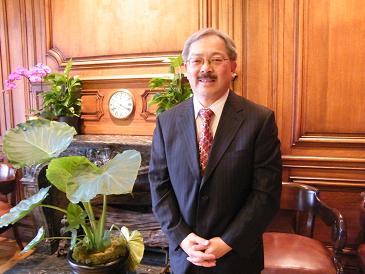
The Guardian hasn’t been invited into City Hall’s Room 200 for a long time. Former Mayor Gavin Newsom, who frequently criticized this newspaper in his public statements, had a tendency to freeze out his critics, adopting a supercilious and vinegary attitude toward any members of the press who questioned his policy decisions. So it was almost surreal when a smiling Mayor Ed Lee cordially welcomed two Guardian reporters into his stately office Feb. 15.

Lee says he plans to open his office to a broader cross-section of the community, a move he described as a way of including those who previously felt left out. Other changes have come, too. He’s replaced Newsom’s press secretary, Tony Winnicker, with Christine Falvey, former communications director at the Department of Public Works (DPW). He’s filled the Mayor’s Office with greenery, including giant tropical plants that exude a calming green aura, in stark contrast to Newsom — whose own Room 200 was sterile and self-aggrandizing, including a portrait of Robert Kennedy, in whose footsteps Newsom repeatedly claimed to walk.

When it comes to policy issues, however, some expect to see little more than business-as-usual in the Mayor’s Office. Democratic Party chair Aaron Peskin, a progressive stalwart, said he sees no substantive changes between the new mayor and his predecessor. “It seems to me that the new administration is carrying forward the policies of the former administration,” Peskin said. “I see no demonstrable change. And that makes sense. Lee was Willie Brown and former Mayor Gavin Newsom’s handpicked successor. So he’s dancing with the guys that brought him in.”

Sup. David Campos, viewed as part of the city’s progressive camp along with Peskin, took a more diplomatic tack. “So far I’ve been very pleased with what I’ve seen,” Campos noted. “I really appreciate that he’s reached out to the community-based organizations and come out to my district and done merchant walks. I think we have to wait to see what he does on specific policy issues.”

But while Lee has already garnered a reputation for being stylistically worlds apart from Newsom, he still hews close to his predecessor’s policies in some key areas. In our interview, Lee expressed an unwillingness to consider tax-revenue measures for now, but said he was willing to take condo conversions into consideration as a way to bring in cash. He was unenthusiastic about community choice aggregation and dismissive of replacing Pacific Gas & Electric Co. with a public-power system. He hasn’t committed to overturning the pending eviction of the Haight Ashbury Neighborhood Council’s recycling center, and he continued to argue for expanding Recology’s monopoly on the city’s $206 million annual trash stream, despite a recent Budget and Legislative Analyst’ report that recommended putting the issue to the voters.

Public Defender Jeff Adachi, who met Lee in 1980 through the Asian Law Caucus, said Lee would be facing steep challenges. “It’s a fascinating political karmic outcome that he is now our appointed mayor. He didn’t seek it out, as he says, but the opportunity he has now is to focus his efforts on fixing some of the problems that have gone unaddressed for decades, pension reform being one of them. I think he realizes he has a limited time to achieve things of value. The question I and others have is, can he do it?”


THE RELUCTANT MAYOR

Lee identified as a non-politician, patently rejecting the notion that he would enter the race for mayor. In meetings with members of the Board of Supervisors at the end of 2010, he said he didn’t want the job.

Yet while vacationing in Hong Kong, Lee became the subject of a full-court press. “When the lobbying and phone calls started … clearly they meant a lot to me,” Lee told us, adding that the choice “was very heavy on my mind.” He finally relented, accepting the city’s top post.

Although rumors had been circulating that Lee might seek a full term, he told the Guardian he’s serious about serving as a caretaker mayor. “If I’m going to thrust all my energy into this, I don’t need to have to deal with … a campaign to run for mayor.”

Adachi offered an interesting take on Lee as caretaker: “Somewhere along the way, [Lee] became known as the go-to guy in government who could take care of problems,” Adachi said, “like the Wolf in Pulp Fiction.”

Sounding rather unlike Harvey Keitel’s tough-talking character, Lee noted, “One of my goals is to rebuild the trust between the Mayor’s Office and the Board of Supervisors. I think I can do that by being consistent with the promises I make.”

Lee’s vows to keep his promises, mend rifts with the board, and stay focused on the job could be interpreted as statements intended to set him apart from Newsom, who was frequently criticized for being disengaged during his runs for higher office, provoking skirmishes with the board, and going back on his word.

The new mayor also said he’d be willing to share his working calendar with the public, something Newsom resisted for years. Kimo Crossman, a sunshine advocate who was part of a group that began submitting requests for Newsom’s calendar in 2006, greeted this news with a wait-and-see attitude. “I’ve already put in a request,” Crossman said. “Politicians are always in support of sunshine — until they have to comply with it.”


THE ELEPHANT IN THE ROOM

Pointing to the tropical elephant-ear plants adorning his office, Lee noted that elephants are considered lucky in Chinese culture. With the monstrous issues of pension reform and a gaping budget deficit hitting his mayoral term like twin tornadoes, it might not hurt to have some extra luck.

Pension reform is emerging as the issue du jour in City Hall. A round of talks on how to turn the tide on rising pension costs has brought labor representatives, Sup. Sean Elsbernd, billionaire Warren Hellman, City Attorney Dennis Herrera, labor leaders, and others to the table as part of a working group.

Gabriel Haaland, who works for SEIU Local 1021, sounded a positive note on Lee. “He’s an extraordinarily knowledgeable guy about government. He seems to have a very collaborative working style and approach to problem-solving, and he is respectful of differing opinions,” Haaland said. “Where is it going to take us? I don’t know yet.”

Lee emphasized his desire to bring many stakeholders together to facilitate agreement. “We’re talking about everything from limiting pensionable salaries, to fixing loopholes, to dealing with what kinds of plans we can afford in the health care arena,” he noted. Lee said the group had hashed out 15 proposals so far, which will be vetted by the Controller’s Office.

A central focus, Lee said, has been “whether we’ve come to a time to recognize that we have to cap pensions.” That could mean capping a pension itself, he said, or limiting how much of an employee’s salary can be counted toward his or her pension.

Since Lee plans to resume his post as city administrator once his mayoral term has ended, he added a personal note: “I want to go back to my old job, do that for five years, and have a pension that is respectable,” he said. “At the same time, I feel others who’ve worked with me deserve a pension. I don’t want it threatened by the instability we’re headed toward and the insolvency we’re headed toward.”


BRACING FOR THE BUDGET

If pension reform is shaping up to be the No. 1 challenge of Lee’s administration, tackling the city budget is a close second. When Newsom left office, he passed Lee a budget memo containing instructions for a 2.5 percent reduction in most city departments, part of an overarching plan to shave 10 percent from all departments plus another 10 percent in contingency cuts, making for a bruising 20 percent.

Lee said his budget strategy is to try to avert what Sup. David Chiu once characterized as “the typical Kabuki-style budget process” that has pitted progressives against the mayor in years past. That means sitting down with stakeholders early.

“I have opened the door of this office to a number of community groups that had expressed a lot of historical frustration in not being able to express to the mayor what they feel the priorities of their communities are,” Lee said. “I’ve done that in conjunction with members of the Board of Supervisors, who also felt that they weren’t involved from the beginning.”

Affordable-housing advocate Calvin Welch said Lee’s style is a dramatic change. “I think he’s probably equaled the total number of people he’s met in six weeks with the number that Newsom met in his seven years as mayor,” Welch said.

Sup. Carmen Chu, recently installed as chair of the Budget & Finance Committee, predicted that the budget will still be hard to balance. “We are still grappling with a $380 million deficit,” Chu told us, noting that there are some positive economic signs ahead, but no reason to expect a dramatic improvement. “We’re been told that there is $14 million in better news. But we still have the state budget to contend with, and who knows what that will look like.”

Sup. John Avalos, the former chair of the Board’s powerful Budget Committee, said he thinks the rubber hasn’t hit the road yet on painful budget decisions that seem inevitable this year — and the outcome, he said, could spell a crashing halt to Ed Lee’s current honeymoon as mayor.

“We are facing incredible challenges,” Avalos said, noting that he heard that labor does not intend to open up its contracts, which were approved in 2010 for a two-year period. And federal stimulus money has run out.


DID SOMEONE SAY “CONDO CONVERSIONS”?

Asked whether he supported new revenue measures as a way to fill the budget gap, Lee initially gave an answer that seemed to echo Newsom’s inflexible no-new-taxes stance. “I’m not ready to look at taxes yet,” he said.

He also invoked an idea that Newsom proposed during the last budget cycle, which progressives bitterly opposed. In a conversation with community-based organizations about “unpopular revenue-generating ideas,” Lee cautioned attendees that “within the category of unpopular revenue-generating ideas are also some that would be very unpopular to you as well.”

Asked to explain, Lee answered: “Could be condo conversion. Could be taxes. I’m not isolating any one of them, but they are in the category of very unpopular revenue-generating ideas, and they have to be carefully thought out before we determine that they would be that seriously weighed.”

Ted Gullicksen, who runs the San Francisco Tenants Union, said tenant advocates have scheduled a meeting with Lee to talk about condo conversions. Thanks to Prop. 26’s passage in November 2010, he said, any such proposal would have to be approved by two-thirds of the board or the voters. “It’s pretty clear that any such measure would not move forward without support from all sides,” Gullicksen said. “If anyone opposes it, it’s going to go nowhere.”

Gullicksen said he’d heard that Lee is willing to look at the possibility of significant concessions to renter groups in an effort to broker a condo conversion deal, such as a moratorium on future condo conversions. “If, for example, 1,000 TICs [tenants-in-common] became condos under the proposal, then we’d need a moratorium for five years to minimize and mitigate the damages,” Gullicksen explained.

More important, some structural reform of TIC conversions may be on the table, Gullicksen said. “And that would be more important than keeping existing TICs from becoming condos.”

Gullicksen acknowledged that Lee has the decency to talk to all the stakeholders. “Newsom never attempted to talk to tenants advocates,” he said.


GREEN, WITHIN LIMITS

Lee’s two children are in their early 20s, and the mayor said he takes seriously the goal of being proactive on environmental issues in order to leave them with a more sustainable San Francisco. He trumpeted the city’s green achievements, saying, “We’re now on the cutting edge of environmental goals for the city.”

Leading bicycle activist Leah Shahum of the San Francisco Bicycle Coalition had praise for Lee on bike issues. “I’m really encouraged by his very public support of the new green separate bikeways on Market Street and his interest and commitment to creating more,” she said. “I believe Mayor Lee sees the value of connecting the city with cross town bicycle lanes, which serve a wide range of folks, including business people and families.”

Yet some proponents of green causes are feeling uncertain about whether their projects will advance under Lee’s watch.

On the issue of community choice aggregation (CCA), the ambitious green-energy program that would transfer Pacific Gas & Electric Co. customers to a city-run program with a cleaner energy mix, Lee — who helped determine rates as city administrator — seemed lukewarm. “I know Mr. [Ed] Harrington and his staff just want to make sure it’s done right,” he said, referring to the general manager of the city’s Public Utilities Commission, whose tepid attitude toward the program has frequently driven him to lock horns with the city’s chief CCA proponent, Sup. Ross Mirkarimi.

Lee noted that CCA program goals were recently scaled back. He also said pretty directly that he opposes public power: “We’re not in any day getting rid of PG&E at all. I don’t think that is the right approach.”

The controversial issue of the Haight Ashbury Neighborhood Council Recycling Center’s pending eviction from Golden Gate Park still hangs in the balance. The Recreation and Park Commission, at Newsom’s behest, approved the eviction despite overwhelming community opposition.

Lee said he hadn’t looked at the issue closely. “I do know that there’s a lot of strong debate around the viability, what that operation attracts and doesn’t attract,” he said. “I had the owner of HANC here along with a good friend, Calvin Welch, who made a plea that I think about it a bit. I agreed that I would sit down and talk with what I believe to be the two experts involved in that decision: Melanie Nutter at the Department of the Environment and then Phil Ginsburg at the Rec and Park.” Nutter and Ginsburg supported HANC’s eviction.

Welch, who is on the board of HANC, noted that Lee could be swayed by his staff. “The bunch around Newsom had old and bad habits, and old and bad policies. In dealing with mayors over the years, I know how dependent they are on their staff. They’re in a bubble, and the only way out is through a good staff. Otherwise, Lee will come to the same conclusions as Newsom.”

HANC’s Jim Rhoads told the Guardian he isn’t feeling reassured. “He said he would keep asking people about it. Unfortunately, if he asked his own staff, it would be a problem because they’re leftovers from Newsom.”

Speaking of leftovers, Lee also weighed in on the debate about the city’s waste-management contract — and threw his support behind the existing private garbage monopoly. Campos is challenging a perpetual waste-hauling contract that Recology has had with the city since 1932, calling instead for a competitive-bidding process. When the Department of the Environment recommended awarding the city’s landfill disposal contract to Recology last year, it effectively endorsed a monopoly for the company over managing the city’s entire waste stream, at an estimated value of $206 million per year.

The final decision to award the contract was delayed for two months at a February Budget & Finance Committee hearing. Campos is contemplating putting the issue to the voters this fall, provided he can find six votes on the Board.

“I know that Sup. Campos had given his policy argument for why he wants that revisited,” Lee said. “I have let him know that the Recology company in its various forms has been our very dependable garbage-hauling company for many, many decades. … I feel that the company has justified its privilege to be the permit holder in San Francisco because of the things that it has been willing to do with us. Whether or not we want to use our time today to revisit the 1932 ordinance, for me that wouldn’t be a high priority.”


UNFINISHED BUSINESS

In the last week of 2010, Avalos pushed through groundbreaking local-hire legislation, without the support of then Mayor Gavin Newsom or his chief of staff, Steve Kawa, who wanted Avalos to back off and let Newsom takeover the task.

With Lee now in Room 200, things appear to be moving forward on local hire, in face of misleading attacks from Assemblymember Jerry Hill (D-San Mateo), who wants to make sure no state money is used on local-hire projects, presumably because the building trades are upset by it. And Kawa, whom Lee has retained as chief of staff, doesn’t really support the legislation. Indeed, Kawa’s presence in the Mayor’s Office has his detractors believing that the new boss in Room 200 is really the same as the old boss.

“I feel like things are moving forward in the right direction around local hire, though a little more quietly than I’d like,” Avalos told the Guardian. Avalos noted that he is going to hold a hearing in March on implementing the legislation that should kick in March 25.

Welch said he believes that if Lee starts replacing staff wholesale, it could indicate two things: he’s a savvy guy who understands the difficulties of relying on Newsom’s chief of staff Steve Kawa for a budget, and he’s not ruling out a run for mayor.

“If I was in his position, the first thing out of my mouth would be, ‘I’m not running.’ I think he’s very focused in the budget. And it’s going to make or break him. But if he starts overriding Kawa and picks staff who represent him … well, then I’d revisit the question of whether he’s contemplating a run for mayor, say, around June.”

Is Adachi’s pension reform a Tea Party initiative?

54

With all eyes on Wisconsin, local labor leaders are suggesting that Public Defender Jeff Adachi’s proposed retirement/health plan reforms are really Tea Party initiatives, even as Adachi threatens to place another Measure B-like initiative on the fall ballot if city leaders can’t agree on a fix for the city’s fiscal problems

Last fall, Adachi started a war with the local labor movement when he placed Measure B on the November ballot. Measure B proposed increasing employee contributions for retirement benefits, decreasing employer contributions for heath benefits for employees, retirees and their dependents, and changing rules for arbitration proceedings about city collective bargaining agreements,

Measure B ultimately failed, but not after both sides spent a ton of cash. And now labor is refusing to have Adachi sit in on their pension reform talks with Mayor Ed Lee, former SEIU President Andy Stern is describing the fight in Wisconsin as a ’15 state GOP Power grab,” and SEIU Local 1021 leader Gabriel Haaland is pointing to Wisconsin as a reason for excluding Adachi from pension reform talks

“Adachi’s obviously scapegoating a group that’s part of a national agenda,” Haaland said, noting that in the states where Republicans gained statehouse control in 2010, there’s talk about eliminating collective bargaining, and ending defined benefit plans and paycheck protection.

“The problem is that pension reform has been blowing on the anti-public sector worker winds that are blowing in Wisconsin and other states, whether progressives want to acknowledge it or not,” Haaland continued. “There is a reason that Adachi got so much money last year, and the corporate interests behind him are part of this effort to bash public sector workers.”

Prop. B’s campaign finance records show the campaign raised $1.125 million in 2010, and that the lion’s share came from wealthy individuals.

Billionaire venture capitalist, former Google board member and Obama supporter Michael Moritz gave $245,000. Author Harrier Heyman, Moritz’ wife, donated $172,500. financial analyst Richard Beleson donated $110,000. George Hume of Basic American Foods donated $50,000. Gov. Schwarzenegger’s former economic policy advisor David Crane gave $37,500. Philanthropist Warren Hellman donated $50,000. Republican investor Howard Leach, who co-hosted a Prop. B fundraiser with former Mayor Willie L. Brown, gave $25,000. Investor Joseph Tobin gave $15,750. Maverick Capital partner David Singer gave $15,000. JGE Capital Partners donated  $15,000; Bechtel owner  Stephen Bechtel Jr gave $10,000: Matthew Cohler, a general partner of Benchmark Capital, donated $10,000; the California Chamber of Commerce donated $5,000 and philanthropist Dede Wilsey gave $1,000.

But records also show that Measure B opponents, which included San Francisco Firefighters, SF Police Officers Association, SF First Responders, the California Nurses Association, United Educators, San Francisco Gardeners, San Francisco Teachers, Library Workers, laguna Honda Workers, donated over $1 million in their successful bid to squash Adachi’s reform. And that just about every elected Democrat, including Assemblymember Tom Ammiano, then mayor Gavin Newsom, Sheriff Mike Hennessey, and Board President David Chiu, came out against Adachi’s original plan.
 
Haaland acknowledged that the argument could be made that the progressives’ version of the hotel tax didn’t pass and less attention was paid to the district elections last fall, because labor focused primarily on defeating Adachi’s Measure B.

“But at the end of the day, we did get the real estate transfer tax and we defeated Measure B,” Haaland observed. “So, we need to keep fighting anti-worker pressure. It’s challenging times, but I feel like the connections need to be made.”

Adachi was swift to refute Haaland’s claim that his Measure B pension reform is and was a Tea Party initiative.
“What’s not been reported is the fact that there are all these people supporting pension reform who are progressive Democrats,” Adachi said, pointing to Moritz, Crane and former Board President and Green Party member Matt Gonzalez, who all supported Measure B last fall.

“You are talking about saving basic services and that’s a progressive cause,” Adachi continued. “You might argue that pension reform isn’t a progressive solution. But then you are saying that the needs of one group of workers are subservient to the needs of other workers. And even if you raised every tax in the city, you’d not be able to keep up with pension and healthcare costs.”

“Even if we could raise parking tickets to $200 a pop, and tax folks who make more than $100,000 a year, that still wouldn’t solve the problem, because the problem is so huge,” Adachi added. “When you look at this crisis, you can’t simply redbait and say, you are a Republican, or Sarah Palin. Matt Gonzales has always spoken for progressive values, but because he supports pension reform, he’s suddenly a member of the Tea Party? At a certain point, it begins to become absurd.”

Haaland countered that he’s  “challenged by the notion that thousands show up in Wisconsin to fight some of the same people behind Measure B, but our discourse has lowered to whether or not Jeff Adachi is a good guy.”

And Adachi expressed doubt that Mayor Ed Lee can come up with a suitable pension reform plan.

“I’ve heard Lee say there has to be a solution involving pension reform and underfunded healthcare benefits that would save $300 million to $400 million in annual savings, and that corresponds with the solution he needs to come up with to close the budget deficit,” Adachi said.

Adachi said that he has met with Lee on his own to discuss pension reform, but the new mayor did not list specifics.
“He didn’t tell me what his plan was,” Adachi said, “The Prop. B supporters have a plan, but Lee did not ask what that was. But he said he sincerely wants to solve that problem, and that his preference would be one ballot initiative that everyone would agree on. And I fully support a solution that is going to truly solve the problem. I’ve always believed it’s important for the public to understand the gravity of the situation. For too long, it’s been the elephant in the room and there hasn’t been enough public information.”

Adachi said he had a beef with the idea of “groups of labor unions holding meetings at City Hall and deciding who can participate.”

“It’s also troubling that there is no information publicly available about what the ideas on the table are, no explanation of how they got there, and no documenting of the extent of the problem,” Adachi continued. “And that’s what got us here in the first place: a lack of transparency, and voters being asked to weigh in without the full information.”

Adachi said he has an upcoming meeting with Lee, the Department of Human Resources and Sup. Sean Elsbernd about pension reform that is separate from the working group that includes labor and philanthropist Warren Hellmann.

And Elsbernd told the Guardian he believes the pension reform process would go smoother if Adachi were at the table.
“I have no problem with Jeff at the table, it makes sense to have him there to avoid two ballot measures,” Elsbernd said.

Elsbernd added that it was too early to cite numbers when it comes to talk of capping pensions.
“It’s a mistake to pick a number right now because you don’t know what it’s worth,” he said, noting that the pension reform working group has sent a bunch of different scenarios to retirement actuaries to crunch the numbers to see how much they would save the city.

“I can see a case being made for asking the highest paid city workers to contribute higher amounts for healthcare benefits,” Elsbernd said. “But I’m not sure that’s equitable on retirement benefits, though I could see a situation where safety pays more, regardless, because they have better pensions.”

Stage Listings

0

THEATER

ONGOING

The Dog and Pony Show The Marsh, 1062 Valencia; 826-5750, www.themarsh.org. $15-35. Thurs, 8pm; Sat, 8:30pm; Sun, 7pm. Through Sun/27. No horses in this show, actually, and no people either, just dogs. That’s the claim anyway. But while she manages to largely steer clear of ponies, in her new solo show, Michigan-based performance artist and NEA Four alum Holly Hughes ultimately segues not so subtly from her lifelong obsession with dogs to the life lessons we might glean from them. Treats along the way can take the form of amusing personal observations about Dorothy and Toto’s misadventure in the Wizard of Oz, a clip of the Obamas wagging the White House dog on Barbara Walters, or Hughes and her partner of 16 years at home in cozy domesticity—just two women, nine animals, and one sectional sofa. Her own family’s love for animals developed in the absence of much love for anyone else, Hughes tells us. Fortunately her monologue, directed by Dan Hurlin, resists being a bummer thanks to Hughes’ indomitable good nature. It’s her very cute and talented Norfolk terrier who steals the show, however, via a video segment at a Michigan dog competition. Maybe that’s as it should be in this unabashed bow to the bowwow. (Avila)

*Farragut North NOHSpace, 2840 Mariposa. www.opentabproductions.com. $25. Thurs-Sat, 8pm. Through March 5. Former Howard Dean speechwriter Beau Willimon’s formulaic but solidly crafted 2008 play about backroom politics and the seamy side of what’s euphemistically called the American democratic process seems like it’d make a good George Clooney movie. George Clooney thought so too. He’s making it now under the title The Ides of March. You can see it sooner and without all those goddamn movie stars in this low-budget, high-octane staging by OpenTab Productions (Fishing). Stephen (Ben Euphrat) is a 25-year-old wiz of a press secretary for a “maverick” governor heading into a major primary battle on the road to the White House. But an unexpected phone call leads “idealistic” power-lover Stephen into temptation, even as it reveals the real dynamics of the electoral system he thought he’d mastered. A battle for career survival ensues with his former boss (Alex Plant), in which loyalty is a password and decency the first sandbag to drop. Opening night had one or two timing issues and some actors lost in shadow, but director Dave Sikula builds the action well and gets strong performances from an uneven but generally winning cast. Particularly nice work comes from a convincingly unraveling Euphant, a coolly compassionate Carla Pauli (as precocious intern–turned–unwitting pawn), and the formidable Nathan Tucker as Stephen’s slickly conniving counterpart and Mephistopheles of the moment.

*The Last Night of the Barbary Coast SOMArts,934 Brannan; (800) 838-3006, www.brownpapertickets.com. $20. Thurs-Fri, 8pm; Sat, 5 and 9pm. Through Sat/26. A fresh theatrical breeze blows in from the rank and churlish alleyways of Gold Rush San Francisco’s notorious red light district in writer/director Jessa Brie Berkner and Idora Park Theatre Company’s beautifully detailed musical tale. Set on and around a gorgeous rotating roulette-wheel stage (crafted by Simon Cheffins and Jack Ruszel, and hauntingly illuminated by lighting designer Zoltan DeWitt), Last Night of the Barbary Coast tells the story of a young Midwestern woman (Tristan Cunningham) who joins a traveling troupe of vaudevillians, searching for an unknown freedom in the chaotic landscape of the Old West as a performer and prostitute. A set of 49er archetypes (smartly outfitted by costumer Lucid Dawn) overflow the ample SOMArts stage with the all the flouncing brawn, sashaying bodices and boozy bluster of a saloon floorshow, alongside live musical accompaniment from vocalist-instrumentalist Freddi Price’s lush and moody nine-piece Alchemical Orchestra. Told in snatches of dialogue, song and pantomime (smooth choreography by Ena Dallas), Berkner weaves an inspired narrative from personal family legend and characters derived from the tarot deck’s Major Arcana. The result is a dynamically staged, alternately somber and spirited exploration of the precarious freedom possible in life and art. (Avila)

Party of 2 – The New Mating Musical Shelton Theater, 533 Sutter; (800) 838-3006, www.partyof2themusical.com. $27-29. Sun, 3pm. Open-ended. A musical about relationships by Shopping! The Musical author Morris Bobrow.

*Pearls Over Shanghai Thrillpeddlers’ Hypnodrome, 575 Tenth St; 1-800-838-3006, www.brownpapertickets.com. $30-69. Sat, 8pm. Through April 9. Thrillpeddlers’ acclaimed production of the Cockettes musical continues its successful run.

Treefall New Conservatory Theatre Center, 25 Van Ness; 861-8972, www.nctsf.org. $24-40. Call for dates and times. Through Sun/27. New Conservatory Theatre Center presents a tale of erotic attraction by Henry Murray.

What We’re Up Against Magic Theatre, Fort Mason Center, bldg D; 441-8822, www.magictheatre.org. Wed-Fri, 8pm; Sat, 2:30 and 8pm; Sun, 2:30pm; Tues, 7pm. Through March 6. Following the popularity of Theresa Rebeck’s Mauritius in 2009, Magic Theatre brings the New York playwright back for the world premiere of a decidedly flimsy comedy about sexual discrimination at a busy architecture firm. Eliza (Sarah Nealis) is the bright and brash new employee who finds herself shut out by an old boys network. Sodden boss Stu (Warren David Keith) resents her heartily for her competence and ambition, while ass-kissing power-jockey Weber (James Wagner) uses the leverage for all its worth. Gender solidarity with sole (but soulless) sister Janice (Pamela Gaye Walker) doesn’t get Eliza very far either. One guy at the firm, Ben (Rod Gnapp), alone knows better (among what amounts to an unbelievably inept staff). Eliza, meanwhile, crafts a form of revenge from her well-guarded solution to the otherwise stymieing “duct problem” in the plans for a new mall, a major account hitting the skids. Ben’s obsession with ducts is something of a key joke here, which ends up being characteristic of a play that stretches its not-very-new conceits thinly over two acts. The glass ceiling, ducts and all, is a bit too transparent in this bloodless production (helmed by artistic director Loretta Greco), leaving precious little to wonder or worry about. (Avila)


BAY AREA

The Agony and the Ecstasy of Steve Jobs Berkeley Rep, Thrust Stage, 2025 Addison, Berk; (510) 647-2949, www.berkeleyrep.org. $14.50-73. Call for dates and times. Through Sun/27. In his latest monologue (playing in repertory with another, The Last Cargo Cult), Mike Daisey explores the deeper implications of his own, and our, obsession with technology through a parallel look at the career of Apple’s megalomaniacal founder, and Daisey’s own reconnaissance trip to Apple’s manufacturing center in southern China. The story is well-crafted, Daisey’s delivery dependably expert—even if his humor occasionally strays into the more obvious, belabored humor of the office water-cooler wag—and the real-world vision of hell he paints in a behemoth suicide-ridden factory called Foxconn (apt if understated name there) all too salient. But the story gives us back as revelation what we already know, surely, about the horrifying labor system behind our various electronic gizmos and much else besides. It’s a kind of liberal conceit to play along with the indignation and head back out into the world fully willing to do battle against corporate capital, or at least sign an online petition. As a performer, meanwhile, Daisey has not budged from the formula he originally borrowed from Spalding Gray but made it even more his own. Indeed, to call his approach “indebted” to Gray is like saying the black market iPhone knock-offs he describes are merely an homage to Apple’s product. Beside his professed love for the latest high tech wizardry comes this uncanny attachment to the utterly low-tech, analog-monologue style of the late master.

Collapse Aurora Theatre, 2081 Addison, Berk; (510) 843-4822, www.auroratheatre.org. $34-55. Wed-Sat, 8pm; Sun, 2 and 7pm; Tues, 7pm. Through March 6. Aurora Theatre presents a comedy by Allison Moore.

Seagull Wed, 7:30pm, Thurs-Sat, 8pm; Sun, 7pm; Tues, 8pm. Through Sun/27. Marin Theatre Company presents a new translation of Chekhov’s great play from former Oregon Shakespeare Festival artistic director Libby Appel. The translation feels crisp and lucid, but artistic director Jasson Minadakis’s production remains fairly unmoving despite some effective moments among a skilled cast, including the dependably charismatic Howard Swain (as the doctor). The surprising lack of connection or spark between the principal characters—especially the jaded writer (Craig Marker) and the infatuated, soon-to-be-ruined Masha (an otherwise vivacious Liz Sklar)—results in a dutiful production without that pent-up Chekhovian atmosphere that should envelop and follow you for hours if not days to come. (Avila)

World’s Funniest Bubble Show The Marsh Berkeley, 2120 Allston Way, Berk; (800) 838-3006, www.themarsh.org. $8-11. Sun, 11am. Through April 3. The Amazing Bubble Man extends the bubble-making celebration.

PERFORMANCE/DANCE

BAY AREA

Marga’s Funny Mondays The Cabaret at The Marsh Berkeley, 2120 Allston; (800) 838-3006, www.themarsh.org. Mon/28, 8pm. $10. Marga Gomez hosts a Monday night comedy series.


Stage listings are compiled by Guardian staff. Performance times may change; call venues to confirm. Reviewers are Robert Avila, Rita Felciano, and Nicole Gluckstern. Submit items for the listings at listings@sfbg.com. For further information on how to submit items for the listings, see Picks. For complete listings, see www.sfbg.com.


Wisconsin, unions, and defunding the left

21

Mother Jones mag this month has a GREAT story about the battle in Wisconsin, the history of unions and the Democratic Party, and the real aim of the move to bust public-sector unions. Writer Kevin Drum notes:

In the past, after all, liberal politicians did make it their business to advocate for the working and middle classes, and they worked that advocacy through the Democratic Party. But they largely stopped doing this in the ’70s, leaving the interests of corporations and the wealthy nearly unopposed. The story of how this happened is the key to understanding why the Obama era lasted less than two years.

He describes the history of the post-War era and the rise of the New Left, explains how the rift between big labor and the hippie/radical/antiwar folks culminated in the AFL-CIO refusing to endorse George McGovern in 1972, the decline of private-sector union membership and power and thed shift rightward of the Democratic Party.

At one point, he explains, unions were the only organized force with the resources to act as a counterforce to corporate America in political campaigns. Once that went away, the Dems had no choice:

In the real world, political parties need an institutional base. Parties need money. And parties need organizational muscle. The Republican Party gets the former from corporate sponsors and the latter from highly organized church-based groups. The Democratic Party, conversely, relied heavily on organized labor for both in the postwar era. So as unions increasingly withered beginning in the ’70s, the Democratic Party turned to the only other source of money and influence available in large-enough quantities to replace big labor: the business community.

You can blame the Sixties radicals for not understanding the importance of labor (and you’d be right). you can blame George Meany and the AFL-CIO folks for not realizing that those acid-abortion-gay rights folks were their real allies (and you’d be right). But in the end, the bad guys took advantage of the split, and of sweeping changes in the economy, and now we live in the most economically unequal society in the Western world. (Remember: Unions bring up wages and improve working conditions not just for their own members but for everyone else, too.)

So now the only major sector where organized labor is healthy and growing is the public sector — and that’s why the Republicans want to get rid of public-sector unions. In San Francisco, it’s often the case that the city employee unions (excluding police and fire) are the major donors to progressive causes — and are often the only institutional base with the kind of money to counter the Chamber of Commerce/Committee on JOBS/downtown developer bloc. Bust that up and you get corporate hegemony.


Dick Meister: Shades of the Thirties

4

Dick Meister, formerly labor editor of the SF Chronicle and KQED-TV Newsroom, has covered labor, politics and other matters for a half-century.

By now, there’s can be no doubting it: What’s happening in Wisconsin is one
of the most important labor developments in decades. It’s of major
importance to unions and their members, of major importance to working
people generally ­ of major importance to us all.

In  many ways, it’s the 1930s again. Just as then, workers and their
political allies and other  supporters are demonstrating, picketing,
marching, striking and otherwise forcefully demanding the basic civil right
of collective bargaining ­ the unfettered right for workers’ representatives
to negotiate with employers on setting their wages, hours and working
conditions.

Eventually, workers and their millions of supporters won the 1930s struggle.
Congress, acting closely with President Franklin D. Roosevelt, granted the
legal right of collective bargaining to most workers. Farm workers,
domestics and a few other groups were excluded from the law, but all others
finally had that vital right.

The 1930s struggle arose primarily because of the economic pressures of the
Great Depression that led to massive protests, just as today’s struggle can
be traced to the pressures of the Great Recession that also have led to
massive protests.

There are key differences between then and now, however. In the thirties,
the struggle was to win union rights for workers in the face of strong
opposition from large financial interests, powerful conservative politicians
and other anti-labor forces. Today, the struggle is to keep union rights
from being taken away from workers by today’s anti-union forces. Their main
targets are public employees and the pensions and other benefits they won in
past bargaining with their government employers.

The governments’ aim, of course, is to use the savings from that to make up
for budget shortfalls resulting from the recession and, in many cases, from
poor government management.

But there’s another important reason: Public employees have become the
vanguard of the labor movement. Their numbers and the percentage of them
belonging to unions have been growing steadily, while the number and
percentage of unionized workers in private employment have been shrinking.
That’s caused anti-union forces to shift their major efforts into attempting
to curb the escalating spread of unionization among public employees.

Which explains what’s happening in Wisconsin, where Republican Gov. Scott
Walker has moved to all but eliminate the bargaining rights of most state
employees.
Walker is pushing bills through the GOP-controlled Legislature that would
bar state employees from bargaining on anything except their pay, and limit
any pay increases to the level of Consumer Price Index increases.

Employees would have no say in determining  their benefits or working
conditions, although most would have to increase their contributions to
pension and health care funds by up to 50 percent. What’s more, their
contracts would have to be re-negotiated yearly, and union dues could no
longer be deducted from employee paychecks.  It’s hard to imagine a union
surviving under such restraints.

The pay and benefits of Wisconsin state workers may be too high, or too low,
depending on who’s measuring. But that could be addressed through
negotiations between Gov. Walker and union representatives. But like some
petty dictator, Walker insists, “I don’t have anything to negotiate.”

Peaceful negotiations are how it’s done in civil societies, but that’s not
the style of union-busting Walker and his cohorts.  And if anyone doesn’t
like Walker’s approach, look out! He’s alerted the National Guard to be
armed and ready should Wisconsin state workers strike, disrupt state
services or otherwise rise in protest.

Shades, again, of the 1930s. In fact, the last time the Guard was called out
to quell a labor dispute in Wisconsin was during a United Auto Workers
strike in 1934.

Workers eventually won that and many other struggles of the thirties, thanks
to their courage and fierce determination and the broad public support they
inspired. And that’s precisely what it will take to overcome today’s
anti-worker onslaught by Walker and others like him.

The good news ­ and it’s very good news ­ is that such help is here and
growing fast. Crowds of as many as 70,000 labor supporters have been
gathering daily outside the Wisconsin State Capital in Madison to demand
that Walker and his fellow reactionaries return to the 21st century.

But give Walker this: Like the anti-labor politicians of the 1930s, he has
aroused public outrage that has brought important new strength and
solidarity to the cause of working people and their unions nationwide.

Certainly they’ll need all the strength they can muster, with major efforts
similar to Walker’s in Wisconsin underway in at least 17 other states.  In
more than a dozen. , Republican anger over labor’s strong support for
Democrats in last year’s elections have led directly to measures curbing
union political activities.

President Obama is correct. There is indeed a nationwide “assault on
unions.” But as the assaults increase, so will the public outrage that’s
winning unions the broad support they so badly need ­ and so richly deserve.

Dick Meister is a San Francisco-based columnist who has covered labor and
politics for a half-century as a reporter, editor, author and commentator.
Contact him through his website, www.dickmeister.com

Warren Hellman: The rich are undertaxed

31

I couldn’t reach financier Warren Hellman before I wrote my column in this week’s paper talking about the employee pension discussions. But he called me yesterday (Feb. 16) after he’d seen it, and I expected he’d give me some shit.


Wrong.


In fact, Hellman had only one problem with my analysis: “Your article is didn’t go far enough.” Turns out he thinks I was a bit too easy on the billionaires.


“When you compare upper-echelon tax rates [in America] to any developed country in the world,” Hellman said, “the rich pay very low taxes here. You’re article is exactly correct — the wealthy are undertaxed.” He told me that he’s stopped trying to amass more personal wealth (“it’s all going into a foundation”) because he realizes that he couldn’t possibly spend all the money he has “and all that happens if you leave it all to the next generation is that you spoil your kids.” 


Quite a statement coming from one of the city’s richest and most influential business leaders.


Of course, putting all the money in a foundation isn’t the only answer.   The only way to address the wealth gap, and the decline in social, education and infrastructure spending, to for the government to get more involved — and that means collecting more tax money from the people who can afford to pay it. Hellman told me that he’s not about to accept a reduction in his lifestyle — but we both agreed that he doesn’t have to. He could pay a lot more in taxes and still be really, really rich.


So we talked about my proposal, which goes like this:


I’ve got a suggestion for the pension reform negotiators. Why not talk a little about parity.


 Yes, pensions have to be fixed; let’s start at the top. Maybe nobody should have a pension of more than $100,000 a year; certainly, a former police chief shouldn’t get $250,000 a year for life. Maybe the highest-paid city employees should have to pay more into the pension system to protect the pensions of the people who make less. I could easily support progressive pension reform that would save the city money.


 I just think tax reform should also be part of the equation.


 Hellman wants $300 million in pension savings? Good — how about pairing it with $300 million in new taxes on the wealthy? How about big business and rich people give up something this time around, instead of all of the cuts falling on public employees and poor San Franciscans?


And Hellman, to his credit, didn’t disagree with the concept. His problem he said, was with the politics. “Taxes are the third rail of politics,” he said. “I’ve gotten my head handed to me three times now when I’ve supported tax increases.” 


But I still think there’s a way to move forward here. The city employee unions agree to some sort of pension reform, which starts with a pension cap and higher payments from higher earners (not with what amounts to a pay cut for lower-wage employees who have already taken pay cuts in the past few years). Then Hellman, Mayor Ed Lee and Sup. Sean Elsbernd agree to support a progressive tax measure that would bring in badly needed revenue for public services and education.


It’s possible that the tax measure would have to wait until Nov. 2012, when it would only require a 50 percent vote. Maybe both measures go on that ballot. And Hellman, Elsbernd and Lee use their clout with downtown to push the Chamber of Commerce and the Commitee on JOBS to at least stay neutral and cut off any big-money campaign against the tax measure. Then they all agree to help raise money and campaign to pass it. And labor agrees to work for both measures.


Hellman said he feared that “one would kill the other” and both measures might fail. But I believe the people of San Francisco are willing to support new taxes — progressive new taxes — if they don’t think the money’s going to waste. And pairing pension refrom with new taxes sends a strong message: We’re all sharing the pain. Particularly if Hellman, Elsbernd and Lee can sell the tax package part of the deal to the business community.


It’s worth a try. Because otherwise, we’re going to have another Prop. B battle, both sides are going to spend a ton of money, and nobody’s going to walk away happy.


“It’s worth thinking about,” Hellman told me. I hope so.

Adachi and Ballard’s pension reform gloves come off

64

Yesterday, I talked to Public Defender Jeff Adachi about the latest efforts to address pension reform in San Francisco. Readers may remember that Adachi roused the ire of the labor unions last year, with the ultimately unsuccessful Proposition B. At the time, most folks felt Adachi’s measure didn’t have a snowball’s chance because it asked public employees to bear the brunt of the city’s ballooning retirement and health plan costs. Yet, they all praised Adachi as a great city leader who has been on the right side of many other battles in this city’s rich political history.
But the pension reform issue hasn’t gone away, and now that Adachi is threatening to introduce another measure this fall, the gloves have apparently come off, as witnessed by a Bay Citizen article that reported that union leaders don’t want Adachi to be part of a pension-reform working group at City Hall
In that Bay Citizen article, Nathan Ballard, who served as communications director for former Mayor Gavin Newsom from 2007 to 2009, said, “Inviting Jeff Adachi to our talks would be like inviting Sarah Palin to speak at the Democratic convention.”
The Bay Citizen characterized Ballard as “a Democratic strategist who has been involved in the working group since its inception.” And it noted that Mayor Lee had reached out to Adachi—an effort that it framed as a “complicating move.”
But it didn’t get Adachi’s thoughts on Ballard’s comments. So, I asked Adachi how he felt about being compared to Sarah “Moose in the headlights” Palin.
“It’s ironic that a spokesperson from Burson-Marsteller, which is headed by Republican operatives such as President Bush’s former press secretary (Dana Perino) and represents some of the most reactionary corporate interests, such as USA Blackwater, is accusing me of being a Republican for trying to solving our city’s pension crisis,” Adachi replied, referring to the fact that Burson-Marsteller, a global public relations firm, appointed Ballard as a managing director in March 2010.
“This is a company that is known for representing the worst corporate criminals in modern history,” Adachi continued. “They organized a campaign against civil rights in Argentina, supported a government massacre in Indonesia and tried to justify the killing of over 2,000 people in India’s Bhopal disaster. You have a hired mouthpiece, Nathan Ballard, who’s been paid $50,000 out of union member dues deciding who can attend meetings at City Hall. “
Asked for his thoughts on Adachi’s response, Ballard replied, “Burson-Marsteller employs talented operatives from both sides of the aisle. Although I won’t speak to the specifics of Jeff Adachi’s allegations, Burson is well known as the world’s go-to firm for crisis communications, and that tends to involve handling high-stakes disputes for controversial clients. As a criminal defense lawyer, Jeff Adachi should resist the temptation to assign blame to an advocate for accusations made against a client.”

So, buckle your seats, ladies and gentlemen. The pension reform battle is ON. And if the exchange posted above is any indication, it’s only going to get uglier

Editor’s Notes

1

tredmond@sfbg.com

In a heartwarming Valentine’s Day blog, Paul Krugman, the Nobel Prize-winning economist, talks about an old cartoon that ran in the 1980s showing Democrats trying to develop a centrist economic policy that cut spending on social programs. “How is this different from Republicans?” one Democrat asks. The answer: “We care about the victims of our policies.”

That, Krugman says, “is pretty much my reaction to the Obama budget.” The president talks about how awful the cuts will be, how programs he cares about will have to go, how painful this all is for him. Not that he’s going to miss any meals or wind up homeless, but whatever: we can all feel his pain.

It’s also pretty much my reaction to The Bay Citizen report that ran in The New York Times Feb. 13 on the pension reform negotiations going on at City Hall and in the office of billionaire financier Warren Hellman.

Hellman, Mayor Ed Lee, Sup. Sean Elsbernd, and some labor leaders are talking about how to avoid another bruising ballot measure fight this fall. Hellman backed off from supporting Public Defender Jeff Adachi’s Proposition B last year after some labor folks convinced him they could come up with a better plan.

Hellman’s new bottom line: the group needs to find between $300 million and $400 million in savings. He is quoted as saying: “I hate that it comes out of the hide” of city workers. “It is going to be really painful.”

Warren Hellman’s not a bad guy. I’ve met him, he’s polite and friendly, sometimes even almost sort of a liberal on some issues, and I think he does feel bad about cutting the pensions of low-level city employees. I even agree with him that the pension system needs reform.

But here’s the problem: nothing ever comes out of the hides of the rich.

Over the past five years, San Francisco has cut hundreds of millions in city spending. City employees have given back many millions more in concessions. Nonprofits have cut back services to the poor, the disabled, the sick.

But we haven’t asked big business and wealthy people to give up anything. Hellman hasn’t had to tighten his belt. Corporate executives in the city still make huge salaries. They’re not closing the swimming pool at the Olympic Club.

I could support pension reform — if Hellman, Elsbernd, and Lee would support tax reform. Then we can all feel each other’s pain. For once.

Stage Listings

0

THEATER

ONGOING

Clue Boxcar Playhouse, 505 Natoma; 776-1747, www.boxcartheatre.org. $15-35. Wed-Fri, 8pm; Sat, 7 and 10pm. Through Sat/19. A play based on a film based on a board game is just the kind of tangled genealogy much goodtime theater is made of these days. So there’s nothing too new about Boxcar’s stage adaptation of the manic 1985 comedy derived from a once popular Parker Bros. diversion. In fact, it’s at least the second stage adaptation of same to be offered in San Francisco. (Impossible Productions remounted its version at the Dark Room just last year.) Nevertheless, led by adapter-director Nick A. Olivero, Boxcar’s production pursues its vision like a mad yen, with a loving fidelity and self-referential glee that are not so much inspired as just plain zealous (although Olivero’s scenic design does reach new heights: a TV-toned board-game set that the audience peers down on from six-feet-high balconies ringing the stage). Performances are dutiful and solid for the most part, with especially nice work from Brian Martin (as the butler) and J. Conrad Frank (as Mrs. Peacock). Although there’s something vaguely and not unpleasantly hypnotic about it all, groups of cult-film line-gleaners may be the best audience for this one. (Avila)

*Farragut North NOHSpace, 2840 Mariposa. www.opentabproductions.com. $25. Thurs-Sat, 8pm. Through March 5. Former Howard Dean speechwriter Beau Willimon’s formulaic but solidly crafted 2008 play about backroom politics and the seamy side of what’s euphemistically called the American democratic process seems like it’d make a good George Clooney movie. George Clooney thought so too. He’s making it now under the title The Ides of March. You can see it sooner and without all those goddamn movie stars in this low-budget, high-octane staging by OpenTab Productions (Fishing). Stephen (Ben Euphrat) is a 25-year-old wiz of a press secretary for a “maverick” governor heading into a major primary battle on the road to the White House. But an unexpected phone call leads “idealistic” power-lover Stephen into temptation, even as it reveals the real dynamics of the electoral system he thought he’d mastered. A battle for career survival ensues with his former boss (Alex Plant), in which loyalty is a password and decency the first sandbag to drop. Opening night had one or two timing issues and some actors lost in shadow, but director Dave Sikula builds the action well and gets strong performances from an uneven but generally winning cast. Particularly nice work comes from a convincingly unraveling Euphant, a coolly compassionate Carla Pauli (as precocious intern–turned–unwitting pawn), and the formidable Nathan Tucker as Stephen’s slickly conniving counterpart and Mephistopheles of the moment.

Next to Normal Curran Theatre, 445 Geary; (888) SHN-1799, www.shnsf.com. $30-99. Call for dates and times. Through Sun/20. Diana Goodman (Alice Ripley) is a woman too restlessly witty and big-souled to sit easy in the suburban home she shares with her husband (Asa Somers), 16-year-old daughter (Emma Hunton), and 18-year-old son (Curt Hansen). What’s worse, the 18-year-old died as a baby about 17 years ago, and has not been taking the news lying down. A mother’s grief winds through this sometimes clever, mostly sappy, and ultimately tedious Broadway rock musical about a bipolar woman and the impact of her illness on her family. Director Michael Greif’s (Rent) kinetic staging takes place across a three-level industrial-box set that houses musicians in its outer corners as well as the stereotypical family dwelling in its center. The set’s outer façade (moving panels featuring giant eyes and mouth) meanwhile suggests the whole thing as a model of the mind we’re witnessing come apart. The 2008 musical by Brian Yorkey (book and lyrics) and Tom Kitt (music) won a Pulitzer for its supposedly bold depiction of mental illness. But despite reasonable scoffing at the paternalistic, pharmacologically fueled regime of mainstream treatment (embodied by Jeremy Kushnier’s various doctors), neither Tony-winner Ripley’s jagged performance nor Yorkey’s book transcends a stultifying and finally grating set of narrative clichés, which the driving, mostly generic-sounding score only makes more obvious. A Woman Under the Influence this isn’t. (Avila)

Party of 2 – The New Mating Musical Shelton Theater, 533 Sutter; (800) 838-3006, www.partyof2themusical.com. $27-29. Sun, 3pm. Open-ended. A musical about relationships by Shopping! The Musical author Morris Bobrow.

*Pearls Over Shanghai Thrillpeddlers’ Hypnodrome, 575 Tenth St; 1-800-838-3006, www.brownpapertickets.com. $30-69. Sat, 8pm. Through April 9. Thrillpeddlers’ acclaimed production of the Cockettes musical continues its successful run.

Spalding Gray: Stories Left to Tell Gough Street Playhouse, 1620 Gough; (510) 207-5774, www.custommade.org. $10-25. Thurs-Sat, 8pm. Through Sat/19. Originally conceived as a one-off benefit show by Gray’s widow, Kathleen Russo and director Lucy Sexton, Spalding Gray: Stories Left to Tell intersperses segments of some of Gray’s most famous works—Swimming to Cambodia, Gray’s Anatomy, Monster in a Box—with excerpts from his journals, the stories left to tell. The original concept to have five actors representing five aspects of Gray’s words—adventure, career, family, journals, and love—seems to have been crafted with the specific purpose of allowing several people the opportunity to “speak for” Spalding, without actually performing “as” Spalding, appropriate enough for a celebratory memorial, but hard to accept as a capital-P play. It’s a conundrum that Custom Made Theatre cannot solve. Half the cast convey by their tone and manner the casual ease of campfire story-tellers, while the other half take a more performative approach to their recitations, particularly a smooth Patrick Barresi as “Career” and the likable Richard Wenzel as “Love.” The stories themselves are often hilarious, including Gray’s turns as a “Bowery Bum,” a jailbird in Nevada, and a sweat lodge initiate, while the stories that are not side-splittingly funny are poignant, painful, and even unflinchingly sentimental, especially in regards to his young sons. But as a work of theatre, they underwhelmed. (Gluckstern)

Treefall New Conservatory Theatre Center, 25 Van Ness; 861-8972, www.nctsf.org. $24-40. Call for dates and times. Through Feb 27. New Conservatory Theatre Center presents a tale of erotic attraction by Henry Murray.

What We’re Up Against Magic Theatre, Fort Mason Center, bldg D; 441-8822, www.magictheatre.org. Wed-Fri, 8pm; Sat, 2:30 and 8pm; Sun, 2:30pm; Tues, 7pm. Through March 6. Following the popularity of Theresa Rebeck’s Mauritius in 2009, Magic Theatre brings the New York playwright back for the world premiere of a decidedly flimsy comedy about sexual discrimination at a busy architecture firm. Eliza (Sarah Nealis) is the bright and brash new employee who finds herself shut out by an old boys network. Sodden boss Stu (Warren David Keith) resents her heartily for her competence and ambition, while ass-kissing power-jockey Weber (James Wagner) uses the leverage for all its worth. Gender solidarity with sole (but soulless) sister Janice (Pamela Gaye Walker) doesn’t get Eliza very far either. One guy at the firm, Ben (Rod Gnapp), alone knows better (among what amounts to an unbelievably inept staff). Eliza, meanwhile, crafts a form of revenge from her well-guarded solution to the otherwise stymieing “duct problem” in the plans for a new mall, a major account hitting the skids. Ben’s obsession with ducts is something of a key joke here, which ends up being characteristic of a play that stretches its not-very-new conceits thinly over two acts. The glass ceiling, ducts and all, is a bit too transparent in this bloodless production (helmed by artistic director Loretta Greco), leaving precious little to wonder or worry about. (Avila)


BAY AREA

The Agony and the Ecstasy of Steve Jobs Berkeley Rep, Thrust Stage, 2025 Addison, Berk; (510) 647-2949, www.berkeleyrep.org. $14.50-73. Call for dates and times. Through Feb 27. In his latest monologue (playing in repertory with another, The Last Cargo Cult), Mike Daisey explores the deeper implications of his own, and our, obsession with technology through a parallel look at the career of Apple’s megalomaniacal founder, and Daisey’s own reconnaissance trip to Apple’s manufacturing center in southern China. The story is well-crafted, Daisey’s delivery dependably expert—even if his humor occasionally strays into the more obvious, belabored humor of the office water-cooler wag—and the real-world vision of hell he paints in a behemoth suicide-ridden factory called Foxconn (apt if understated name there) all too salient. But the story gives us back as revelation what we already know, surely, about the horrifying labor system behind our various electronic gizmos and much else besides. It’s a kind of liberal conceit to play along with the indignation and head back out into the world fully willing to do battle against corporate capital, or at least sign an online petition. As a performer, meanwhile, Daisey has not budged from the formula he originally borrowed from Spalding Gray but made it even more his own. Indeed, to call his approach “indebted” to Gray is like saying the black market iPhone knock-offs he describes are merely an homage to Apple’s product. Beside his professed love for the latest high tech wizardry comes this uncanny attachment to the utterly low-tech, analog-monologue style of the late master.

Collapse Aurora Theatre, 2081 Addison, Berk; (510) 843-4822, www.auroratheatre.org. $34-55. Wed-Sat, 8pm; Sun, 2 and 7pm; Tues, 7pm (also Feb 19, 2pm). Through March 6. Aurora Theatre presents a comedy by Allison Moore.

Grapes of Wrath Marion E. Green Black Box Theater, 531 19th, Oakl; www.theatrefirst.com. $10-30. Thurs-Sat, 8pm; Sun, 2pm. Through Sun/20. TheatreFIRST presents Frank Galati’s stage adaptation of the John Steinbeck novel.

Heartbreak House Live Oak Theatre, 1301 Shattuck, Berk; (510) 649-0999, www.berkeleyrep.org. $12-15. Fri-Sat, 8pm (also Thurs/17, 8pm). Through Sat/19. Actors Ensemble of Berkeley presents the George Bernard Shaw comedy set just before World War I.

The Last Cargo Cult Berkeley Repertory Theatre, Thrust Stage, 2025 Addison, Berk; (510) 647-2949, www.berkeleyrep.org. $14.50-73. Call for dates and times. Through Sun/20. As fans of J. Maarten Troost have learned, life on an island “paradise” is far less idyllic than the imagination yearns to believe. So it’s hardly surprising that Mike Daisey’s monologue The Last Cargo Cult begins with a white-knuckle ride in a prop plane piloted by a man with a milky eye. Daisey’s destination, the Pacific island of Tanna, is the location of one of the world’s last so-called “cargo cults”, and their big celebration “John Frum Day” is approaching. Daisey’s intention to hang out at the festivities smacks a little of entitled voyeurism, but the parallel he manages to draw between the complexities of a religion dedicated to a mythical cargo of “awesome shit”, and our own dedication to the acquisition of same, is a striking one. From our almost blind faith in the value of basically valueless currency, to our even blinder faith that indenturing ourselves by debt will enrich us, the foundations of our own “cargo cult” are revealed smartly by Daisey to be just as precarious as if built at the base of a volcano as in Tanna. Still, I found the most revealing thing about the evening to be the moment when the couple next to me took off with a $100 bill they’d acquired free-of-charge at the door, to which I can’t help but ask them: “Did you get your money’s worth?” (Gluckstern)

Not a Genuine Black Man The Marsh Berkeley, TheaterStage, 2120 Allston, Berk; 826-5750, www.themarsh.org. $20-50. Fri, 8pm. Through Fri/18. Brian Copeland brings back his long-running solo show.

Seagull Wed, 7:30pm, Thurs-Sat, 8pm; Sun, 7pm; Tues, 8pm. Through Feb 27. Marin Theatre Company presents a new translation of Chekhov’s great play from former Oregon Shakespeare Festival artistic director Libby Appel. The translation feels crisp and lucid, but artistic director Jasson Minadakis’s production remains fairly unmoving despite some effective moments among a skilled cast, including the dependably charismatic Howard Swain (as the doctor). The surprising lack of connection or spark between the principal characters—especially the jaded writer (Craig Marker) and the infatuated, soon-to-be-ruined Masha (an otherwise vivacious Liz Sklar)—results in a dutiful production without that pent-up Chekhovian atmosphere that should envelop and follow you for hours if not days to come. (Avila)

Strange Travel Suggestions The Marsh Berkeley, Cabaret, 2120 Allston Way, Berk; (800) 838-3006, www.themarsh.org. $15-35. Thurs-Fri, 8pm; Sat, 5pm. Through Sat/19. Jeff Greenwald stars in a one-man show about the vagaries of wanderlust.

World’s Funniest Bubble Show The Marsh Berkeley, 2120 Allston Way, Berk; (800) 838-3006, www.themarsh.org. $8-11. Sun, 11am. Through April 3. The Amazing Bubble Man extends the bubble-making celebration.

PERFORMANCE/DANCE

BAY AREA

Marga’s Funny Mondays The Cabaret at The Marsh Berkeley, 2120 Allston; (800) 838-3006, www.themarsh.org. Mon/14, 8pm. $10. Marga Gomez hosts a Monday night comedy series.


Stage listings are compiled by Guardian staff. Performance times may change; call venues to confirm. Reviewers are Robert Avila, Rita Felciano, and Nicole Gluckstern. Submit items for the listings at listings@sfbg.com. For further information on how to submit items for the listings, see Picks. For complete listings, see www.sfbg.com.


Political activists still oppose Chiu’s handbill regulation

12

Progressive political activists and First Amendment advocates continue to have concerns about how Sup. David Chiu’s legislation to regulate handbill distribution will affect low-budget political campaigns, despite Chiu’s efforts to address the criticism.

Two weeks ago, he delayed deliberation on the measure, saying it wasn’t his intention to curtail political speech. The measure returns to the Board of Supervisors tomorrow (Tues/15), but the activists are asking that it be sent back to committee for more work.

Chiu and the Department of Public Works Menu and Flyer Littering Task Force introduced the legislation in an effort to clean up littering and to effectively penalize handbill distribution that doesn’t meet the new regulations of securing literature and ensuring it does not become litter. The new law would require handbills to be securely fastened on doorways or placed under doormats preventing them from becoming litter on the sidewalks and streets.

“You can’t just throw something on a stoop that can be blown away,” Catherine Rauschuber, one of Chiu’s legislative aides who worked on the measure, told us. Handbills can be anything from a menu for a local restaurant to a flyer promoting a community event to campaign advertising and political information. Newspapers are exempt.

But critics of the measure, including California First Amendment Coalition Director Peter Scheer, say it needs a lot more work to pass constitutional muster and safeguard free speech rights.

“The proposed amendment to the San Francisco ordinance is not a ‘reasonable’ regulation of handbills and leaflets because it leaves the distributor of such constitutionally protected materials in doubt as to how to comply,” he told the Guardian. “Specifically, the materials are required to be ‘secured.’ However, the most efficient means of doing so—using tape or other adhesive—is itself prohibited.”

Littering a neighborhood with unsecured handbills is already a criminal infraction, one that is rarely enforced, and Chiu’s legislation would make it an administrative penalty managed at the discretion of DPW. Rauschuber said the penalty would usually be a fine of around $100.

The DPW requested the authority to administer the penalties because it wasn’t a priority of the District Attorney’s Office to prosecute violators, and DPW officials said it would be more effective in lowering the instances of littering, Rauschuber told us.

Political activists such as Karen Babbitt worry about the effect the new legislation will have on grassroots campaigns. She believes that the language of the ordinance creates a disadvantage to political candidates with low-budget campaigns.

“If you place a piece of literature under a doormat and it still somehow ends up on the sidewalk, the campaign can be fined,” she told the Guardian. “I can’t think of a way that I, as a volunteer, could prove that I’d initially placed the piece of lit securely. I try to place them securely, but the wind sometimes still blows them away—especially in windy neighborhoods like Diamond Heights.”

The board’s Land Use and Economic Development Committee approved the measure on Jan. 24, and while political activists say it needs more work, those concerned about litter welcome the change.

Dawn Trennart, a member of the Middle Polk Neighborhood Association and the Menu and Flyer Littering Task Force, saw the handbills become a litter problem in her neighborhood last spring and brought it to Chiu’s attention.

“It is a litter and security problem,” said Trennart said. “The handbills get stuck in doors and cannot lock properly.”

The law would also allow buildings to post a smaller “no handbills” sign with 30-point font, instead of the current requirement of eight square inches, to prohibit distribution. Babbitt believes the ordinance is superfluous to the efforts political volunteers already make.

“Most folks I’ve volunteered with over the years already try to place pieces of literature in ways that keep them from blowing away. It makes your candidate look bad, after all, to have her or his literature blowing all over the neighborhood,” she said.

But she and other activists complain that the new law would presume the campaigns are guilty without offering proof. Scheer also pointed to a 1943 U.S. Supreme Court ruling in the case of Martin v. City of Struthers, which found that litter is not a compelling enough argument to regulate handbill distribution.

Scheer believes that, in order to satisfy the First Amendment, the ordinance should not only state what handbill distributors cannot do, but also state what they can do to avoid penalties, which is commonly called a “safe harbor” provision.

Still, political activists complain that they were not involved in the drafting of the ordinance. While the Sierra Club, ACLU, SF Labor Council, and other groups that distribute political handbills were not consulted, the activists note that Golden Gate Restaurant Association and other business groups were brought in to help shape the legislation.

By asking for the measure to be sent back to committee, where public testimony is taken, the political activists hope their concerns will finally be addressed.

Dick Meister: Scapegoating Public Empoyees

7

Dick Meister, formerly labor editor of the SF Chronicle and KQED-TV Newsroom, has covered labor, politics and other matters for a half-century.

Let’s pause for a moment to recognize some of our most important, yet most maligned workers. They are teachers and librarians. Police officers and firefighters. Bus drivers, doctors and nurses. Judges, lawyers, gardeners. They’re laborers and other maintenance and construction workers, and many others who provide us vital services.

They are public employees. There are millions of them, who every day do the essential work that keeps our country going.

It is they who keep our streets and highways, our parks and playgrounds safe and clean, who collect our trash. It is they who help educate our children, who provide emergency health care, who convey us to our jobs and back home after our day’s work, who sometimes risk their very lives to protect us from harm.

Yet despite all that – and more – public employees have come under heavy bipartisan attack by politicians who find them easy targets to blame for the budget shortfalls that have beset government at all levels.  Labor costs, after all, make up the bulk of government spending everywhere.

There’s no way around that basic fact. So if we want all those vital services public employees provide – and we do – that’s the price we must pay, and should be happy to pay. Certainly no group of workers has done more for us, none who are more important to our welfare, none more deserving of their wages.

Yet we seriously shortchange many of those workers. And some people, including political leaders who obviously know better, ludicrously cite public employees as a major cause of the economic recession that just won’t go away.

The blame, of course, clearly rests elsewhere. The culprits, as the Portside Labor website noted, include “the super-rich who will continue to enjoy immensely lucrative tax breaks enacted during the Bush administration,” and the Defense Department officials who want “a budget blowing $78 billion over the next year to fund the endless wars in Iraq and Afghanistan and maintain a military machine that spends more than all its rivals combined.”

No, it’s not obscenely wealthy tax-dodging greedheads or the war-happy folks at the so-called Defense Department who’ve caused  record budget deficits. Oh, no. It’s that “greedy public employee who pulls in an outrageous $19,000-a-year pension.” You know, one of those public employees Gov. Mitch Daniels of Indiana actually characterized as members of  “a new privileged class.”

Public employee unions are striking back at such foolishness. For instance, the American Federation of State, County and Municipal Employees is waging a nationwide “Stop the Lies” campaign. Union President Gerald McEntee has been arguing that “hundreds of thousands of public employees, just like private sector employees, have been laid off, and taken pay and benefit cuts – even as Wall Street executives lined their pockets with taxpayer money and took home huge bonuses.”

The union’s retirees, meanwhile, are getting rich on pensions of, indeed, $19,000 a year.

There’s this, too: Government workers generally get less in pay and benefits than workers holding similar jobs in the private sector. As Portside Labor and others have pointed out, public sector workers don’t seem to resent the fact that their pay lags behind pay in private employment, “because most choose public service for other reasons than pay.” That’s obvious, and another reason to quit scapegoating the under-compensated workers who are among our most valuable.

The latest and perhaps best defense of the scapegoated public employees has come from President Harold Schaltberger of International Alliance of Firefighters .

Schaltberger notes the attacks on public employees are “like a tsunami rolling across the country.” He says the attacks have never been greater, more serious or as vicious.”  As he says, “Wall Street’s recklessness, not public employee pensions, caused our nation’s financial collapse. Scapegoating workers won’t solve anything.”

In a full-page newspaper ad, Schaltberger noted that “Firefighters and paramedics are dedicated to the lives of our neighbors. Whether it’s a natural disaster, terrorist attack or another tragedy, we answer the call. We understand that many Americans are hurting because of the recession, but we will not apologize for putting our lives on the line, the dangerous work we do, or the pensions we’ve earned.”

Part of the reason for the strong attacks on public employee unions is that they have become the vanguard of the labor movement. They’ve been growing as unions in private employment have declined. Union membership overall dropped by about 600,000 last year, lowering the percentage of union members in private and public employment combined from just above12 percent to slightly below that figure.  The percentage of public employees belonging to unions also shrunk slightly, but still stood at about 36 percent.

So, more than one-third of the country’s public employees now belong to unions, but only about 7 percent of workers in private employment are unionized.  Which explains why the country’s anti-union forces are concentrating so heavily on public employees, and seeking to enlist broad public support for their anti-unionism by blaming public employees for our serious economic troubles.

Dick Meister, former labor editor of the SF Chronicle and KQED-TV Newsroom, has covered labor and politics for a half-century. Contact him through his website, www.dickmeister.com, which includes more than 250 of his columns.

Hyatt targeted as labor impasse drags on

0

Hundreds of Hyatt hotel workers and supporters represented by the UniteHere Local 2 union continued their 18-month long struggle against the Hyatt Corporation yesterday (Thu/10) by protesting outside the Hyatt Regency Hotel near the Embarcadero.

The Hyatt Regency was one of six hotels where demonstrations took place in a National Day of Action against Hyatt management. Local 2 said many issues still need to be negotiated, such as decreasing the current health care costs of $200 a month for a family plan, raising pensions from $900 to $1200 a month, and taking steps to reduce injuries to Hyatt employees.

“We want to draw attention to the injury rate that Hyatt has been witness to,” Local 2 spokeswoman Riddhi Mehta-Neugebauer said.

The protest, which started at 4:30 p.m., surrounded the front entrance of the Hyatt Regency on Drumm and Market Streets, with protestors sitting in front of its turnstile doors. About two dozen protestors were arrested, cited and released on charges of misdemeanor trespassing.

The Hyatt Corporation’s statement on yesterday’s actions tried to turn the blame on the union, stating they haven’t been willing to come to the bargaining table. “Once again, the leadership of UniteHere Local 2 is putting its own agenda ahead of the needs of its members,” the statement said.

Cynthia Reed, a telephone operator with the Hyatt for 22 years, who was a part of the protest, was angered that she has been without a fair contract since August 2009.

“I feel as though we are being oppressed,” she told the Guardian. “We, the workers, are living off $38,000 a year with $12,000 in taxes. We can’t live like this in San Francisco. We just want a living wage.”

Reed noted that some of her co-workers include parents of multiple children and cancer patients, while others are over retirement age. “If the union doesn’t stand up for us, who will?” Reed asked. “Why patronize these facilities when all the money is going to a few at the top?” she wondered before going back to a line of picketers chanting, “Union bustin’ is disgustin’!”

Peter Hillan, a spokesman that represents the Hyatt, was at the scene to give the corporation’s point of view. “It’s street theater,” he said of the event. “It’s taking revenue away from the business that could be going to the employees.”

Hillan said that over the past 18 months, the protests and the union’s call to boycott the hotels have taken about $10 million of convention business away from San Francisco’s Hyatts.

A meeting to discuss contract negotiations with the Hyatt Corporation and Local 2 is set for Feb. 24.

Come drink and put Lyon Martin over the top

0

Labor and transgender activist Gabriel Haaland reports that supporters of Lyon Martin Health Services have almost reached their $250,000 to save the clinic. Almost. Come help put them over the top on Wed/9 when I and other “celebrity bartenders” will be pouring stiff ones in a benefit event at the Buck Tavern (aka Daly’s Dive), 1655 Market, starting at 6 pm. Donation of $5-$20 requested. See you there.