Labor

Dick Meister: Rebuilding the American Middle Class

0

Dick Meister, formerly labor editor of the SF Chronicle and KQED-TV Newsroom, has covered labor, politics and other matters for a half-century.

Of all the many comments, pro and con, that have been made about the widespread attempts to weaken American unions, none have been clearer or more on the mark than the words of President Bob King of the United Auto Workers Union.

King, of course, is on the union side of the argument. But as King made very clear, that’s the side to be on if you believe working people should have full collective bargaining rights and the decent wages, hours and working conditions that result from fair bargaining.

King’s comments came in an exceptional column in the latest issue of Solidarity, the UAW’s official magazine.  The column is titled, simply, “Do Justice.”

To Bob King, “doing justice does not mean trying to reduce the wages, benefits and standard of living of all workers in America,” as far too many Republican politicians at all levels of government are trying to accomplish, with their main target – for now  – public employees.

“Doing justice to me,” said King, “means that everyone has an equal opportunity, and if they make the individual decision to work hard and live by the rules, then they will be able to live a middle-class standard of living and retire with dignity and maintain their middle-class standard of living.”

I know, and you know, that can’t happen if working people are denied the essential right to unionization – the essential right to a strong bargaining voice in determining their pay and benefits through their unions. That’s obvious, for unionization is the main reason for the rise of an American middle class,  beginning with the granting of union rights to most workers by federal law in the 1930s.

But as Bob King warned, those rights and the middle class they established are under serious attack by anti-union politicians and others who “preach the vision of scarcity, the vision of division and the vision of fear.”

Ours is a country gifted with great abundance, with plenty to give each of us a fair share. But union opponents preaching “the vision of scarcity” deny that. They act as if there’s not enough in this, the world’s richest country, to give a fair share to all.

Yet there is enough to go around, as we should know, and unions are the primary vehicles for guaranteeing that working people get their fair share of our abundance.

Which is why greedy corporate interests and other anti-labor forces that want a larger share at the expense of others argue selfishly against unions and, indeed, against the very concept of collective bargaining.

Dick Meister, former labor editor of the SF Chronicle and KQED-TV Newsroom, has covered labor and politics for a half-century. Contact him through his website, www.dickmeister.com, which includes more than 250 of his columns.

No cuts-only pension deal

5

EDITORIAL Mayor Ed Lee has released a draft set of proposals for pension reform, and union leaders continue to meet with financier Warren Hellman to try to craft an alternative. Meanwhile, Public Defender Jeff Adachi is narrowing his options and appears ready to move forward to put his own plan on the ballot.

Everyone involved claims to be interested in a compromise, in some proposal that would reduce the city’s burden of paying $350 million this year (and potentially as much as $790 million in five years) into the employee pension fund. We support that idea, too — there are plenty of necessary, progressive moves to fix the city’s pension system and free up more cash for local programs.

But so far, none of the proposals on the table include any new revenue sources — which means, in effect, that the mayor, Hellman, and Adachi all want city workers to bear the entire brunt of the impact of a Wall Street-driven recession. The message: only city employees should share the pain; the wealthiest San Franciscans and biggest, richest businesses don’t have to contribute at all.

It’s a dangerous part of the tax mythology that Pulitzer Prize-winning reporter David Cay Johnston discusses in his article in the Guardian this week. He notes that the argument in favor of tax cuts for the rich — that lower taxes will lead to more investment and thus more jobs — has been tested in this country for 30 years. And it hasn’t worked.

Most San Franciscans probably realize that. Most city officials vote for Democrats, opposed the Bush-era tax cuts on the rich, and argue for more federal aid to cities. This is a progressive town.

But when it comes to something as fundamental as local economic policy — who pays for city services and who gets the benefits — the story becomes completely different.

The mayor and eight of the 11 supervisors are celebrating a broad-based tax cut as a way to create jobs in the Tenderloin and mid-Market (although the evidence that tax cuts don’t create jobs is overwhelming). The mayor is looking at the equivalent of a cuts-only budget (although everyone at City Hall opposes the notion of a cuts-only budget in Sacramento). And while it’s almost certain that some sort of pension reform will be on the November ballot, none of the players involved in the negotiations have openly taken what seems to us to be the only logical position:

Pension reform has to be linked to tax reform — a commercial rent tax, a progressive gross receipts tax, a city income tax, an increase in the Pacific Gas and Electric Co. franchise fee or something else that hits those who can afford to pay. Otherwise, we can’t support it.

Even the city employee unions are being awfully quiet about the need for a deal that includes new taxes. They ought to be leading the charge here, telling everyone that a cuts-only pension deal isn’t going to be acceptable. (The tax measures could hold until the November 2012 budget, when they’ll be easier to pass — if there’s a firm assurance that the mayor, Hellman, Adachi, the supervisors, and all the other players will support them.)

City employees are being asked to take what amount to pay cuts — which will reduce their purchasing power and have a depressing impact on the local economy. Taxing the wealthy (who spend a much smaller percentage of their income) has no such depressing impact. Those are hard, cold facts. They need to be part of the discussion.

Robert Reich, the former labor secretary who now teaches at the University of California, Berkeley, has an interesting essay on his blog April 9 that discusses Obama’s budget capitulations. The president, he notes, “is losing the war of ideas because he won’t tell the American public the truth: that we need more government spending now — not less — in order to get out of the gravitational pull of the Great Recession. That we got into the Great Recession because Wall Street went bonkers and government failed to do its job at regulating financial markets … That the only ways to deal with the long-term budget problem is to demand that the rich pay their fair share of taxes.

“And that, at a deeper level, the increasingly lopsided distribution of income and wealth has robbed the vast working middle class of the purchasing power they need to keep the economy going at full capacity.”

That’s as true here as it is in Washington. And if city officials want progressive support for pension reform, they need to acknowledge it.


Film Listings

0

Film listings are edited by Cheryl Eddy. Reviewers are Kimberly Chun, Michelle Devereaux, Peter Galvin, Max Goldberg, Dennis Harvey, Johnny Ray Huston, Louis Peitzman, Lynn Rapoport, Ben Richardson, and Matt Sussman. For rep house showtimes, see Rep Clock. For first-run showtimes, see Movie Guide.

OPENING

An Affirmative Act A lesbian couple fights for their right to stay married in this narrative courtroom drama. (1:33) Four Star.

*Circo The old notion of “running away with the circus” seldom seemed appealing — conjuring images of following an elephant around with a shovel — and it grows even less so after watching Aaron Schock’s warm, touching documentary. The kids here might one day run away from the circus. They’re born into Grand Circo Mexico, one of four circuses run by the Ponce family, which has been in this business for generations; if they’re old enough to walk, they’re old enough to perform, and help with the endless setup and breakdown chores. (Presumably child labor laws are an innovation still waiting to happen here.) Touring Mexico’s small towns in trucks with a variety of exotic animals, it’s a life of labor, with on-the-job training in place of school — arguably not much of a life for child, as current company leader Tino’s wife Ivonne (who really did run away with the circus, or rather him, at age 15) increasingly insists. Other family members have split for a normal life, and Tino is caught between loyalty to his parents’ ever-struggling business and not wanting to lose the family he’s raised himself. This beautifully shot document, scored by Calexico and edited by Mark Becker (of 2005’s marvelous Romantico), is a disarming look at a lifestyle that feels almost 19th century, and is barely hobbling into the 21st one. (1:15) Lumiere, Shattuck. (Harvey)

The Conspirator It may not be your standard legal drama, but The Conspirator is a lot more enjoyable when you think of it as an extended episode of Law & Order. The film chronicles the trial of Mary Surratt (Robin Wright), the lone woman charged in the conspiracy to assassinate Abraham Lincoln. It’s a fascinating story, especially for those who don’t know much of the history past John Wilkes Booth. But while the subject matter is compelling, the execution is hit-or-miss. Wright is sympathetic as Surratt, but the usually great James McAvoy is somewhat forgettable in the pivotal role of Frederick Aiken, Surratt’s conflicted lawyer. It’s hard to say what it is that’s missing from The Conspirator: the cast — which also includes Evan Rachel Wood and Tom Wilkinson — is great, and this is a story that’s long overdue to be told. Still, something is lacking. Could it be the presence of everyone’s favorite detective, the late Lennie Briscoe? (2:02) Embarcadero, Piedmont. (Peitzman)

Henry’s Crime See “Breaking Point.” (1:48) California, Embarcadero.

Meet Monica Velour Kim Cattrall stars as an aging porn star in this comedy. (1:37)

Rio Jesse Eisenberg and Anne Hathaway lend their voices to this animated bird adventure. (1:32) Presidio.

Scre4m It’s kinda fun to just look at the cast list and wonder which demi-star will suffer the most hideous death at the hands of ol’ Ghostface: Emma Roberts? Adam Brody? Shanae Grimes? (run time not available)

Some Days Are Better Than Others First-time director Matt McCormick doesn’t break any new stylistic or thematic ground with his ensemble drama, but Some Days Are Better Than Others does boast an interesting bit of stunt casting. Indie rock fans will recognize the Shins’ James Mercer as mopey Eli, who drifts between temp jobs trying to earn enough money to go back to school because he hates working so much; fellow musician Carrie Brownstein appears as Katrina, a recently-dumped, reality TV-obsessed dog-shelter worker; her character is the kind of emo thrift-shopper that Portlandia would had no trouble poking fun at. Other points on this sad-sack square are a lonely woman ((Renee Roman Nose) who finds an erstwhile cremation urn, and an elderly man (David Wodehouse) obsessed with the kaleidoscope-like patterns he captures while filming soap bubbles. Moments of wry humor (Katrina checks messages at “mumblemail.net”) and some Ghost World-ish jabs at mainstream go-getters (including a moving-company douchebag who hires Eli to help clean out a recently-deceased woman’s house) keep Some Days from being a total downer, but be warned: this is one melancholy movie. Shins fans will enjoy the scene where Eli, alone in his room, rehearses for a yearned-for karaoke date with a Bonnie Tyler classic. (1:33) Roxie. (Eddy)

ONGOING

The Adjustment Bureau As far as sci-fi romantic thrillers go, The Adjustment Bureau is pretty standard. But since that’s not an altogether common genre mash-up, I guess the film deserves some points for creativity. Based on a short story by Philip K. Dick, The Adjustment Bureau takes place in a world where all of our fates are predetermined. Political hotshot David Norris (Matt Damon) is destined for greatness — but not if he lets a romantic dalliance with dancer Elise (Emily Blunt) take precedence. And in order to make sure he stays on track, the titular Adjustment Bureau (including Anthony Mackie and Mad Men‘s John Slattery) are there to push him in the right direction. While the film’s concept is intriguing, the execution is sloppy. The Adjustment Bureau suffers from flaws in internal logic, allowing the story to skip over crucial plot points with heavy exposition and a deus ex machina you’ve got to see to believe. Couldn’t the screenwriter have planned ahead? (1:39) 1000 Van Ness, Shattuck, Sundance Kabuki. (Peitzman)

Arthur (1:45) Empire, Four Star, Marina, 1000 Van Ness, SF Center, Sundance Kabuki.

*Battle: Los Angeles Michael Bay is likely writhing with envy over Battle: Los Angeles; his Transformers flicks take a more, erm, nuanced view of alien-on-human violence. But they’re not all such bad guys after all; these days, as District 9 (2009) demonstrated, alien invasions are more hazardous to the brothers and sisters from another planet than those trigger-happy humanoids ready to defend terra firma. So Battle arrives like an anomaly — a war-is-good action movie aimed at faceless space invaders who resemble the Alien (1979) mother more than the wide-eyed lost souls of District 9. Still reeling from his last tour of duty, Staff Sergeant Nantz (Aaron Eckhart) is ready to retire, until he’s pulled back in by a world invasion, staged by thirsty aliens. In approximating D-Day off the beach of Santa Monica, director Jonathan Liebesman manages to combine the visceral force of Saving Private Ryan (1998) with the what-the-fuck hand-held verite rush of Cloverfield (2008) while crafting tiny portraits of all his Marines, including Michelle Rodriguez, Ne-Yo, and True Blood‘s Jim Parrack. A few moments of requisite flag-waving are your only distractions from the almost nonstop white-knuckle tension fueling Battle: Los Angeles. (1:57) 1000 Van Ness. (Chun)

*Bill Cunningham New York To say that Bill Cunningham, the 82-year old New York Times photographer, has made documenting how New Yorkers dress his life’s work would be an understatement. To be sure, Cunningham’s two decades-old Sunday Times columns — “On the Street,” which tracks street-fashion, and “Evening Hours,” which covers the charity gala circuit — are about the clothes. And, my, what clothes they are. But Cunningham is a sartorial anthropologist, and his pictures always tell the bigger story behind the changing hemlines, which socialite wore what designer, or the latest trend in footwear. Whether tracking the near-infinite variations of a particular hue, a sudden bumper-crop of cropped blazers, or the fanciful leaps of well-heeled pedestrians dodging February slush puddles, Cunningham’s talent lies in his ability to recognize fleeting moments of beauty, creativity, humor, and joy. That last quality courses through Bill Cunningham New York, Richard Press’ captivating and moving portrait of a man whose reticence and personal asceticism are proportional to his total devotion to documenting what Harold Koda, chief curator at the Costume Institute at the Metropolitan Museum of Art, describes in the film as “ordinary people going about their lives, dressed in fascinating ways.” (1:24) Embarcadero, Shattuck. (Sussman)

*Cedar Rapids What if The 40 Year Old Virgin (2005) got so Parks and Rec‘d at The Office party that he ended up with a killer Hangover (2009)? Just maybe the morning-after baby would be Cedar Rapids. Director Miguel Arteta (2009’s Youth in Revolt) wrings sweet-natured chuckles from his banal, intensely beige wall-to-wall convention center biosphere, spurring such ponderings as, should John C. Reilly snatch comedy’s real-guy MVP tiara away from Seth Rogen? Consider Tim Lippe (Ed Helms of The Hangover), the polar opposite of George Clooney’s ultracompetent, complacent ax-wielder in Up in the Air (2009). He’s the naive manchild-cum-corporate wannabe who never quite graduated from Timmyville into adulthood. But it’s up to Lippe to hold onto his firm’s coveted two-star rating at an annual convention in Cedar Rapids. Life conspires against him, however, and despite his heartfelt belief in insurance as a heroic profession, Lippe immediately gets sucked into the oh-so-distracting drama, stirred up by the dangerously subversive “Deanzie” Ziegler (John C. Reilly), whom our naif is warned against as a no-good poacher. Temptations lie around every PowerPoint and potato skin; as Deanzie warns Lippe’s Candide, “I’ve got tiger scratches all over my back. If you want to survive in this business, you gotta daaance with the tiger.” How do you do that? Cue lewd, boozy undulations — a potbelly lightly bouncing in the air-conditioned breeze. “You’ve got to show him a little teat.” Fortunately Arteta shows us plenty of that, equipped with a script by Wisconsin native Phil Johnston, written for Helms — and the latter does not disappoint. (1:26) Shattuck. (Chun)

Certified Copy Abbas Kiarostami’s beguiling new feature signals “relationship movie” with every cobblestone step, but it’s manifestly a film of ideas — one in which disillusionment is as much a formal concern as a dramatic one. Typical of Kiarostami’s dialogic narratives, Certified Copy is both the name of the film and an entity within the film: a book written against the ideal of originality in art by James Miller (William Shimell), an English pedant fond of dissembling. After a lecture in Tuscany, he meets an apparent admirer (Juliette Binoche) in her antique shop. We watch them talk for several minutes in an unbroken two-shot. They gauge each other’s values using her sister as a test case — a woman who, according to the Binoche character, is the living embodiment of James’ book. Do their relative opinions of this off-screen cipher constitute characterization? Or are they themselves ciphers of the film’s recursive structure? Kiarostami makes us wonder. They begin to act as if they were married midway through the film, though the switch is not so out of the blue: Kiarostami’s narrative has already turned a few figure-eights. Several critics have already deemed Certified Copy derivative of many other elliptical romances; the strongest case for an “original” comes of Roberto Rossellini’s Voyage to Italy (1954). The real difference is that while Rossellini’s masterpiece realizes first-person feelings in a third-person approach, Kiarostami stays in the shadow of doubt to the end. (1:46) Opera Plaza, Shattuck, Smith Rafael. (Goldberg)

*Hanna The title character of Hanna falls perfectly into the lately very popular Hit-Girl mold. Add a dash of The Boys from Brazil-style genetic engineering — Hanna has the unfair advantage, you see, when it comes to squashing other kids on the soccer field or maiming thugs with her bare hands — and you have an ethereal killing/survival machine, played with impassive confidence by Atonement (2007) shit-starter Saoirse Ronan. She’s been fine-tuned by her father, Erik (Eric Bana), a spy who went out into the cold and off the grid, disappearing into the wilds of Scandinavia where he home-schooled his charge with an encyclopedia and brutal self-defense and hunting tests. Atonement director Joe Wright plays with a snowy palette associated with innocence, purity, and death — this could be any time or place, though far from the touch of modern childhood stresses: that other Hannah (Montana), consumerism, suburban blight, and academic competition. The 16-year-old Hanna, however, isn’t immune from that desire to succeed. Her game mission: go from a feral, lonely existence into the modern world, run for her life, and avenge the death of her mother by killing Erik’s CIA handler, Marissa (Cate Blanchett). The nagging doubt: was she born free, or Bourne to be a killer? Much like the illustrated Brothers Grimm storybook that she studies, Hanna is caught in an evil death trap of fairytale allegories. One wonders if the super-soldier apple didn’t fall far from the tree, since evil stepmonster Marissa oversaw the program that produced Hanna — the older woman and the young girl have the same cold-blooded talent for destruction and the same steely determination. Yet there’s hope for the young ‘un. After learning that even her beloved father hid some basic truths from her, this natural-born killer seems less likely to go along with the predetermined ending, happy or no, further along in her storybook life. (1:51) Empire, 1000 Van Ness, Presidio, SF Center, Sundance Kabuki. (Chun)

Hop (1:30) 1000 Van Ness, Presidio, Shattuck.

I Am File in the dusty back drawer of An Inconvenient Truth (2006) wannabes. The cringe-inducing, pretentious title is a giveaway — though the good intentions are in full effect — in this documentary by and about director Tom Shadyac’s search for answers to life’s big questions. After a catastrophic bike accident, the filmmaker finds his lavish lifestyle as a successful Hollywood director of such opuses as Bruce Almighty (2003) somewhat wanting. Thinkers and spiritual leaders such as Desmond Tutu, Howard Zinn, UC Berkeley psychology professor Dacher Keltner, and scientist David Suzuki provide some thought-provoking answers, although Shadyac’s thinking behind seeking out this specific collection of academics, writers, and activists remains somewhat unclear. I Am‘s shambling structure and perpetual return to its true subject — Shadyac, who resembles a wide-eyed Weird Al Yankovic — doesn’t help matters, leaving a viewer with mixed feelings, less about whether one man can work out his quest for meaning on film, than whether Shadyac complements his subjects and their ideas by framing them in such a random, if well-meaning, manner. And sorry, this film doesn’t make up for Ace Ventura: Pet Detective (1994). (1:16) Shattuck. (Chun)

*In a Better World Winner of this year’s Best Foreign Language Film Oscar, this latest from Danish director Susanne Bier (2004’s Brothers, 2006’s After the Wedding) and her usual co-scenarist Anders Thomas Jensen (2005’s Adam’s Apples, 2003’s The Green Butchers) is a typically engrossing, complex drama that deals with the kind of rage for “personal justice” that can lead to school and workplace shootings, among other things (like terrorism). Shy, nervous ten-year-old Elias (Markus Rygaard) needs a confidence boost, but things are worrying both at home and elsewhere. His parents are estranged, and his doting father (Mikael Persbrandt) is mostly away as a field hospital in Kenya tending victims of local militias. At school, he’s an easy mark for bullies, a fact which gets the attention of charismatic, self-assured new kid Christian (William Jøhnk Nielsen), who appoints himself Elias’ new (and only) friend — then when his slightly awed pal is picked on again, intervenes with such alarming intensity that the police are called. Christian appears a little too prone to violence and harsh judgment in teaching “lessons” to those he considers in the wrong; his own domestic situation is another source of anger, as he simplistically blames his earnest, distracted executive father (Ulrich Thomsen) for his mother’s recent cancer death. Is Christian a budding little psychopath, or just a kid haplessly channeling his profound loss? Regardless, when an adult bully (Kim Bodnia as a loutish mechanic) humiliates Elias’ father in front of the two boys, Christian pulls his reluctant friend into a pursuit of vengeance that surely isn’t going to end well. With their nuanced yet head-on treatment of hot button social and ethical issues, Bier and Jensen’s work can sometimes border on overly-schematic melodrama, meting out its own secular-humanist justice a bit too handily, like 21st-century cinematic Dickenses. But like Dickens, they also have a true mastery of the creating striking characters and intricately propulsive plotlines that illustrate the points at hand in riveting, hugely satisfying fashion. This isn’t their best. But it’s still pretty excellent, and one of those universally accessible movies you can safely recommend even to people who think they don’t like foreign or art house films. (1:53) Embarcadero, Shattuck. (Harvey)

Insidious (1:42) 1000 Van Ness.

*Jane Eyre Do we really need another adaptation of Jane Eyre? As long as they’re all as good as Cary Fukunaga’s stirring take on the gothic romance, keep ’em coming. Mia Wasikowska stars in the titular role, with the dreamy Michael Fassbender stepping into the high pants of Edward Rochester. The cast is rounded out by familiar faces like Judi Dench, Jamie Bell, and Sally Hawkins — all of whom breathe new life into the material. It helps that Fukunaga’s sensibilities are perfectly suited to the story: he stays true to the novel while maintaining an aesthetic certain to appeal to a modern audience. Even if you know Jane Eyre’s story — Mr. Rochester’s dark secret, the fate of their romance, etc. — there are still surprises to be had. Everyone tells the classics differently, and this adaptation is a thoroughly unique experience. And here’s hoping it pushes the engaging Wasikowska further in her ascent to stardom. (2:00) Albany, Embarcadero, Piedmont, Sundance Kabuki. (Peitzman)

Kill the Irishman If you enjoy 1970s-set Mafia movies featuring characters with luxurious facial hair zooming around in Cadillacs, flossing leather blazers, and outwitting cops and each other — you could do a lot worse than Kill the Irishman, which busts no genre boundaries but delivers enjoyable retro-gangsta cool nonetheless. Adapted from the acclaimed true crime book by a former Cleveland police lieutenant, the film details the rise and fall of Danny Greene, a colorful and notorious Irish-American mobster who both served and ran afoul of the big bosses in his Ohio hometown. During one particularly conflict-ridden period, the city weathered nearly 40 bombings — buildings, mailboxes, and mostly cars, to the point where the number of automobiles going sky-high is almost comical (you’d think these guys would’ve considered taking the bus). The director of the 2004 Punisher, Jonathan Hensleigh, teams up with the star of 2008’s Punisher: War Zone, Ray Stevenson, who turns in a magnetic performance as Greene; it’s easy to see how his combination of book- and street smarts (with a healthy dash of ruthlessness) buoyed him nearly to the top of the underworld. The rest of the cast is equally impressive, with Vincent D’Onofrio, Val Kilmer, Christopher Walken, and Linda Cardellini turning in supporting roles, plus a host of dudes who look freshly defrosted from post-Sopranos storage. (1:46) Lumiere. (Eddy)

The King’s Speech Films like The King’s Speech have filled a certain notion of “prestige” cinema since the 1910s: historical themes, fully-clothed romance, high dramatics, star turns, a little political intrigue, sumptuous dress, and a vicarious taste of how the fabulously rich, famous, and powerful once lived. At its best, this so-called Masterpiece Theatre moviemaking can transcend formula — at its less-than-best, however, these movies sell complacency, in both style and content. In The King’s Speech, Colin Firth plays King George VI, forced onto the throne his favored older brother Edward abandoned. This was especially traumatic because George’s severe stammer made public address tortuous. Enter matey Australian émigré Lionel Logue (Geoffrey Rush, mercifully controlled), a speech therapist whose unconventional methods include insisting his royal client treat him as an equal. This ultimately frees not only the king’s tongue, but his heart — you see, he’s never had anyone before to confide in that daddy (Michael Gambon as George V) didn’t love him enough. Aww. David Seidler’s conventionally inspirational script and BBC miniseries veteran Tom Hooper’s direction deliver the expected goods — dignity on wry, wee orgasms of aesthetic tastefulness, much stiff-upper-lippage — at a stately promenade pace. Firth, so good in the uneven A Single Man last year, is perfect in this rock-steadier vehicle. Yet he never surprises us; role, actor, and movie are on a leash tight enough to limit airflow. (1:58) Empire, Red Vic, Shattuck. (Harvey)

*Limitless An open letter to the makers of Limitless: please fire your marketing team because they are making your movie look terrible. The story of a deadbeat writer (Bradley Cooper) who acquires an unregulated drug that allows him to take advantage of 100 percent of his previously under-utilized brain, Limitless is silly, improbable and features a number of distracting comic-book-esque stylistic tics. But consumed with the comic book in mind, Limitless is also unpredictable, thrilling, and darkly funny. The aforementioned style, which includes many instances of the infinite regression effect that you get when you point two mirrors at each other, and a heavy blur to distort depth-of-field, only solidifies the film’s cartoonish intentions. Cooper learns foreign languages in hours, impresses women with his keen attention to detail, and sets his sights on Wall Street, a move that gets him noticed by businessman Carl Van Loon (Robert DeNiro in a glorified cameo) as well as some rather nasty drug dealers and hired guns looking to cash in on the drug. Limitless is regrettably titled and masquerades in TV spots as a Wall Street series spin-off, but in truth it sports the speedy pacing and tongue-in-cheek humor required of a good popcorn flick. (1:37) California, 1000 Van Ness, SF Center, Sundance Kabuki. (Galvin)

*The Lincoln Lawyer Outfitted with gym’d-tanned-and-laundered manly blonde bombshells like Matthew McConaughey, Josh Lucas, and Ryan Phillippe, this adaptation of Michael Connelly’s LA crime novel almost cries out for an appearance by the Limitless Bradley Cooper — only then will our cabal of flaxen-haired bros-from-other-‘hos be complete. That said, Lincoln Lawyer‘s blast of morally challenged golden boys nearly detracts from the pleasingly gritty mise-en-scène and the snappy, almost-screwball dialogue that makes this movie a genre pleasure akin to a solid Elmore Leonard read. McConaughey’s criminal defense attorney Mickey Haller is accustomed to working all the angles — hence the title, a reference to a client who’s working off his debt by chauffeuring Haller around in his de-facto office: a Lincoln Town Car. Haller’s playa gets truly played when he becomes entangled with Louis Roulet (Phillippe), a pretty-boy old-money realtor accused of brutally attacking a call girl. Loved ones such as Haller’s ex Maggie (Marisa Tomei) and his investigator Frank (William H. Macy) are in jeopardy — and in danger of turning in some delightfully textured cameos — in this enjoyable walk on the sleazy side of the law, the contemporary courtroom counterpart to quick-witted potboilers like Sweet Smell of Success (1957). (1:59) Four Star, 1000 Van Ness, SF Center, Sundance Kabuki. (Chun)

Max Manus One of Norway’s most expensive films to date, Max Manus follows the rise to infamy of the title character, a charismatic World War II resistance fighter whose specialty was blowing up German ships docked in occupied Oslo harbor. Again, I emphasize: this is a World War II movie about Norway made by Norwegians — though the Brits play a role, there’s nary a mention of the United States. That fact is the single most refreshing part of a movie that’s nonetheless clearly been inspired by stateside war epics, with traumatic flashbacks, male bonding, sadistic Nazis, rousing if familiar-sounding dialogue (“Being a commando takes more than courage!”), etc. Star Aksel Hennie anchors a film that’s painted in pretty broad strokes with a nuanced performance befitting the real-life Manus’ legacy as an everyman who became a hero. (1:58) Balboa. (Eddy)

Miral (1:42) Opera Plaza.

*Of Gods and Men It’s the mid-1990s, and we’re in Tibhirine, a small Algerian village based around a Trappist monastery. There, eight French-born monks pray and work alongside their Muslim neighbors, tending to the sick and tilling the land. An emboldened Islamist rebel movement threatens this delicate peace, and the monks must decide whether to risk the danger of becoming pawns in the Algerian Civil War. On paper, Of Gods and Men sounds like the sort of high-minded exploitation picture the Academy swoons over: based on a true story, with high marks for timeliness and authenticity. What a pleasant surprise then that Xavier Beauvois’s Cannes Grand Prix winner turns out to be such a tightly focused moral drama. Significantly, the film is more concerned with the power vacuum left by colonialism than a “clash of civilizations.” When Brother Christian (Lambert Wilson) turns away an Islamist commander by appealing to their overlapping scriptures, it’s at the cost of the Algerian army’s suspicion. Etienne Comar’s perceptive script does not rush to assign meaning to the monks’ decision to stay in Tibhirine, but rather works to imagine the foundation and struggle for their eventual consensus. Beauvois occasionally lapses into telegraphing the monks’ grave dilemma — there are far too many shots of Christian looking up to the heavens — but at other points he’s brilliant in staging the living complexity of Tibrihine’s collective structure of responsibility. The actors do a fine job too: it’s primarily thanks to them that by the end of the film each of the monks seems a sharply defined conscience. (2:00) Albany, Opera Plaza. (Goldberg)

Paul Across the aisle from the alien-shoot-em-up Battle: Los Angeles is its amiable, nerdy opposite: Paul, with its sweet geeks Graeme (Simon Pegg) and Clive (Nick Frost), off on a post-Comic-Con pilgrimage to all the US sites of alien visitation. Naturally the buddies get a close encounter of their very own, with a very down-to-earth every-dude of a schwa named Paul (voiced by Seth Rogen), given to scratching his balls, spreading galactic wisdom, utilizing Christ-like healing powers, and cracking wise when the situation calls for it (as when fear of anal probes escalates). Despite a Pegg-and-Frost-penned script riddled with allusions to Hollywood’s biggest extraterrestrial flicks and much 12-year-old-level humor concerning testicles and farts, the humor onslaught usually attached to the two lead actors — considered Lewis and Martin for pop-smart Anglophiles — seems to have lost some of its steam, and teeth, with the absence of former director and co-writer Edgar Wright (who took last year’s Scott Pilgrim vs. the World to the next level instead). Call it a “soft R” for language and an alien sans pants. (1:44) 1000 Van Ness. (Chun)

*Poetry Sixtysomething Mija (legendary South Korean actor Yun Jung-hee) impulsively crashes a poetry class, a welcome shake-up in a life shaped by unfulfilling routines. In order to write compelling verse, her instructor says, it is important to open up and really see the world. But Mija’s world holds little beauty beyond her cheerful outfits and beloved flowers; most pressingly, her teenage grandson, a mouth-breathing lump who lives with her, is completely remorseless about his participation in a hideous crime. In addition, she’s just been disgnosed with the early stages of Alzheimer’s, and the elderly stroke victim she housekeeps for has started making inappropriate advances. Somehow writer-director Lee Chang-dong (2007’s Secret Sunshine) manages not to deliver a totally depressing film with all this loaded material; it’s worth noting Poetry won the Best Screenplay Award at the 2010 Cannes Film Festival. Yun is unforgettable as a woman trying to find herself after a lifetime of obeying the wishes of everyone around her. Though Poetry is completely different in tone than 2009’s Mother, it shares certain elements — including the impression that South Korean filmmakers have recognized the considerable rewards of showcasing aging (yet still formidable) female performers. (2:19) Balboa, Opera Plaza, Shattuck, Smith Rafael. (Eddy)

Potiche When we first meet Catherine Deneuve’s Suzanne — the titular trophy wife (or potiche) of Francois Ozon’s new airspun comedy — she is on her morning jog, barely breaking a sweat as she huffs and puffs in her maroon Adidas tracksuit, her hair still in curlers. It’s 1977 and Suzanne’s life as a bourgeois homemaker in a small provincial French town has played out as smoothly as one of her many poly-blend skirt suits: a devoted mother to two grown children and loving wife who turns a blind eye to the philandering of husband Robert (Fabrice Luchini), Suzanne is on the fast track to comfortable irrelevance. All that changes when the workers at Robert’s umbrella factory strike and take him hostage. Suzanne, with the help of union leader and old flame Babin (Gerard Depardieu, as big as a house), negotiates a peace, and soon turns around the company’s fortunes with her new-found confidence and business savvy. But when Robert wrests back control with the help of a duped Babin, Suzanne does an Elle Woods and takes them both on in a surprise run for political office. True to the film’s light théâtre de boulevard source material, Ozon keeps things brisk and cheeky (Suzanne sings with as much ease as she spouts off Women’s Lib boilerplate) to the point where his cast’s hammy performances start blending into the cheery production design. Satire needs an edge that Potiche, for all its charm, never provides. (1:43) Clay, Shattuck, Smith Rafael. (Sussman)

*Rubber This starts out just on the right side of self-conscious prank, introducing a droll fourth-wall-breaking framework to a serenely surreal central conceit: An old car tire abandoned in the desert miraculously animates itself to commit widespread mayhem. Credit writer-director-editor-cinematographer-composer Quentin Dupieux for an original concept and terrific execution, as our initially wobby antihero wends its way toward civilization, discovering en route it can explode (or just crush) other entities with its “mind.” Which this rumbling black ring of discontent very much enjoys doing, to the misfortune of various hapless humans and a few small animals. Rubber is an extended Dadaist joke that has adventurous fun with filmic and genre language. Beautifully executed as it is, the concept tires (ahem) after a while, reality-illusion games and comedic flair flagging by degrees. Still, it’s so polished and resourceful a treatment of an utterly peculiar idea that no self-respecting cult film fan will want to say they didn’t see this during its initial theatrical run. (1:25) Lumiere. (Harvey)

Soul Surfer (1:46) 1000 Van Ness, SF Center.

*Source Code A post-9/11 Groundhog Day (1993) with explosions, Inception (2010) with a heart, or Avatar (2009) taken down a notch or dozen in Chicago —whatever you choose to call it, Source Code manages to stand up on its own wobbly Philip K. Dick-inspired legs, damn the science, and take off on the wings of wish fulfillment. ‘Cause who hasn’t yearned for a do-over — and then a do-over of that do-over, etc. We could all be as lucky — or as cursed — as soldier Colter Stevens (Jake Gyllenhaal), who gets to tumble down that time-space rabbit hole again and again, his consciousness hitching a ride in another man’s body, while in search of the bomber of a Chicago commuter train. On the upside, he gets to meet the girl of his dreams (Michelle Monaghan) — and see her getting blown to smithereens again and again, all in the service of his country, his commander-cum-link to the outside world (Vera Farmiga), and the scientist masterminding this secret military project (Jeffrey Wright). On the downside, well, he gets to do it over and over again, like a good little test bunny in pinball purgatory. Fortunately, director Duncan Jones (2009’s Moon) makes compelling work out of the potentially ludicrous material, while his cast lends the tale a glossed yet likable humanity, the kind that was all too absent in Inception. (1:33) Marina, 1000 Van Ness, Sundance Kabuki. (Chun)

Sucker Punch If steampunk and Call of Duty had a baby, would it be called Baby Doll? That seems to be the question posed by director-cowriter Zack Snyder with his latest edge-skating, CGI-laden opus. Neither as saccharine and built-for-kids as last year’s Legend of the Guardians, nor as doomed and gore-besotted as 2006’s 300, Sucker Punch instead reads as a grimy Grimm’s fairy tale built for girls succored on otaku, Wii, and suburban pole dancing lessons. Already caught in a thicket of storybook tropes, complete with a wicked stepfather and vulnerable younger sister, Baby Doll (Emily Browning) is tossed into an asylum for wayward girls, signed up for a lobotomy that’s certain to put her in la-la land for good. Fortunately she has a great imagination — and a flair for disassociating herself from the horrors around her —and the scene suddenly shifts to a bordello-strip club populated by such bad-girls-with-hearts-of-gold as Sweet Pea (Abbie Cornish) and sister Rocket (Jena Malone). There Baby Doll discovers yet another layer in the gameplay: like a prospective hoofer in Dancing with the Stars, she must dance her way to the next level or next prize — while deep in her imagination, she sees herself battling giant samurai, robot-zombie Nazis, dragons, and such, assisted by the David Carradine-like, cliché-spouting wise man (Scott Glenn) and accompanied by an inspiring score that includes Björk’s “Army of Me” and covers of the Pixies and Stooges. Things take a turn for the girl gang-y when she recruits Sweet Pea, Rocket, and other random stripper-‘hos (Vanessa Hudgens and Real World starlet Jamie Chung) in her scheme to escape. Why bother, one wonders, since Baby Doll seems to be a genuine escape artist of the mind? The ever-fatalistic Snyder obviously has affection for his charges: when the shadows inevitably close in, he delicately refrains from the arterial spray as the little girls bite the dust in what might be the closest thing to a feature-length anime classic that Baz Luhrmann would give his velvet frock coat to make. (2:00) 1000 Van Ness. (Chun)

Super Naive, vaguely Christian, and highly suggestible everyman Frank (Rainn Wilson) snaps when his wife (Liv Tyler) is seduced away by sleazy drug dealer Jacques (Kevin Bacon). With a little tutoring from the cute girl at the comic store, Libby (Ellen Page), he throws together a pathetically makeshift superhero costume and equally makeshift persona as the Crimson Bolt. Time to dress up and beat down local dealers, child molesters, and people who cut in line with cracks like, “Shut up, crime!” Frank’s taking stumbling, fumbling baby steps toward rescuing his lady love, but it becomes more than simply his mission when Libby discovers his secret and tries to horn in on his act as his kid sidekick Boltie. Alas, what begins as a charming, intriguing indie about dingy reality meeting up with violent vigilantism goes full-tilt Commando (1985), with all the attendant gore and shocks. In the process director James Gunn (2006’s Slither) completely squanders his chance to peer more deeply into the dark heart of the superhero phenom, topping off this vaguely Old Testament reading of good and evil with an absolutely incoherent ending. (1:36) Lumiere. (Chun)

*Win Win Is Tom McCarthy the most versatile guy in Hollywood? He’s a successful character actor (in big-budget movies like 2009’s 2012; smaller-scale pictures like 2005’s Good Night, and Good Luck; and the final season of The Wire). He’s an Oscar-nominated screenwriter (2009’s Up). And he’s the writer-director of two highly acclaimed indie dramas, The Station Agent (2003) and The Visitor (2007). Clearly, McCarthy must not sleep much. His latest, Win Win, is a comedy set in his hometown of New Providence, N.J. Paul Giamatti stars as Mike Flaherty, a lawyer who’s feeling the economic pinch. Betraying his own basic good-guy-ness, he takes advantage of a senile client, Leo (Burt Young), when he spots the opportunity to pull in some badly-needed extra cash. Matters complicate with the appearance of Leo’s grandson, Kyle (newcomer Alex Shaffer), a runaway from Ohio. Though Mike’s wife, Jackie (Amy Ryan), is suspicious of the taciturn teen, she allows Kyle to crash with the Flaherty family. As luck would have it, Kyle is a superstar wrestler — and Mike happens to coach the local high school team. Things are going well until Kyle’s greedy mother (Melanie Lynskey) turns up and starts sniffing around her father’s finances. Lessons are learned, sure, and there are no big plot twists beyond typical indie-comedy turf. But the script delivers more genuine laughs than you’d expect from a movie that’s essentially about the recession. (1:46) Bridge, California, Piedmont, SF Center. (Eddy)

Winter in Wartime (1:43) Smith Rafael.

Your Highness One of the dangers of reviewing a film like Your Highness is that stoner comedies have a very specific intended audience. A particular altered state is recommended to maximize one’s enjoyment. I tend not to show up for professional gigs with Mary Jane as my plus-one, so I had to view the latest from Pineapple Express (2008) director David Gordon Green through un-bloodshot eyes. While Express was more explicitly ganja-themed, Your Highness is instead a comedy that approximates the experience of getting as high as possible, then going directly to Medieval Times. Never gut-bustingly funny, Your Highness still reaps chuckles from its hard-R dialogue and plenty of CG-assisted sight gags involving genetalia. James Franco and Danny McBride star as princes, one heroic and one ne’er-do-well, who quest to save a maiden kidnapped by an evil wizard (Justin Theroux). Natalie Portman turns up as a thong-wearing warrior, just ’cause it’s that kind of movie. Forget the box office; only time and the tastes of late-night movie watchers will dictate whether Your Highness is a success or a bust. Case in point: nobody thought much of Half Baked (1998) when it was released, but in certain circles, it’s become a bona fide classic. Say it with me now: “Fuck you, fuck you, fuck you, you’re cool, and fuck you. I’m out!” (1:42) 1000 Van Ness, Presidio, SF Center, Sundance Kabuki. (Eddy) 

 

Editorial: Link pension reform to tax reform (Second in a series on pension reform)

14

Mayor Ed Lee has released a draft set of proposals for pension reform, and union leaders continue to meet with financier Warren Hellman to try to craft an alternative. Meanwhile, Public Defender Jeff Adachi is narrowing his options and appears ready to move forward to put his own plan on the ballot.

Everyone involved claims to be interested in a compromise, in some proposal that would reduce the city’s burden of paying $350 million this year (and potentially as much as $790 million in five years) into the employee pension fund. We support that idea, too — there are plenty of necessary, progressive moves to fix the city’s pension system and free up more cash for local programs.

But so far, none of the proposals on the table include any new revenue sources — which means, in effect, that the mayor, Hellman, and Adachi all want city workers to bear the entire brunt of the impact of a Wall Street-driven recession. The message: only city employees should share the pain; the wealthiest San Franciscans and biggest, richest businesses don’t have to contribute at all.

It’s a dangerous part of the tax mythology that Pulitzer Prize-winning reporter David Cay Johnston discusses on page 10. He notes that the argument in favor of tax cuts for the rich — that lower taxes will lead to more investment and thus more jobs — has been tested in this country for 30 years. And it hasn’t worked.

Most San Franciscans probably realize that. Most city officials vote for Democrats, opposed the Bush-era tax cuts on the rich, and argue for more federal aid to cities. This is a progressive town.

But when it comes to something as fundamental as local economic policy — who pays for city services and who gets the benefits — the story becomes completely different.

The mayor and eight of the 11 supervisors are celebrating a broad-based tax cut as a way to create jobs in the Tenderloin and mid-Market (although the evidence that tax cuts don’t create jobs is overwhelming). The mayor is looking at the equivalent of a cuts-only budget (although everyone at City Hall opposes the notion of a cuts-only budget in Sacramento). And while it’s almost certain that some sort of pension reform will be on the November ballot, none of the players involved in the negotiations have openly taken what seems to us to be the only logical position:

Pension reform has to be linked to tax reform — a commercial rent tax, a progressive gross receipts tax, a city income tax, an increase in the Pacific Gas and Electric Co. franchise fee or something else that hits those who can afford to pay. Otherwise, we can’t support it.

Even the city employee unions are being awfully quiet about the need for a deal that includes new taxes. They ought to be leading the charge here, telling everyone that a cuts-only pension deal isn’t going to be acceptable. (The tax measures could hold until the November 2012 budget, when they’ll be easier to pass — if there’s a firm assurance that the mayor, Hellman, Adachi, the supervisors, and all the other players will support them.)

City employees are being asked to take what amount to pay cuts — which will reduce their purchasing power and have a depressing impact on the local economy. Taxing the wealthy (who spend a much smaller percentage of their income) has no such depressing impact. Those are hard, cold facts. They need to be part of the discussion.

Robert Reich, the former labor secretary who now teaches at the University of California, Berkeley, has an interesting essay on his blog April 9 that discusses Obama’s budget capitulations. The president, he notes, “is losing the war of ideas because he won’t tell the American public the truth: that we need more government spending now — not less — in order to get out of the gravitational pull of the Great Recession. That we got into the Great Recession because Wall Street went bonkers and government failed to do its job at regulating financial markets … That the only ways to deal with the long-term budget problem is to demand that the rich pay their fair share of taxes.

“And that, at a deeper level, the increasingly lopsided distribution of income and wealth has robbed the vast working middle class of the purchasing power they need to keep the economy going at full capacity.”

That’s as true here as it is in Washington. And if city officials want progressive support for pension reform, they need to acknowledge it.

Is Burning Man going communal or selling out?

60

“Man on the move,” the headline I gave to my current Guardian article and an extended personal blog post on the announcement that Burning Man will next month form a nonprofit group to eventually run the event, raises a number of interesting issues that are likely to be vigorously debated within this huge, active burner community in the coming months and years.

How should Burning Man be governed? What is the event worth – if it can even be quantified – and who created and should benefit from that value? Are Black Rock City LLC board members being selfless stewards of the culture in giving up control or are they being greedy control freaks in holding on for six more years and expecting a big payoff in the end? Or, like much about this dynamic culture, is the truth somewhere in the middle?

Event founder Larry Harvey’s big announcement last week, made during a speech that was unusual for its insights into the thoughts and internal dynamics of the BRC board, stressed how to value an event whose central ethos opposes such commodification.

“I thought it was time the owners stepped out from behind the veil of secrecy,” Harvey told me during a follow-up interview this week. He repeatedly emphasizes the benevolence of a corporate board voluntarily giving up control over its assets and revenue stream. “What we’re doing, as far as normal capitalism, is aberrant…What we’re doing is giving up a lot of money.”

But the way that Harvey is trying to frame this issue seems antithetical to how most burners see the event and culture that they’ve spent decades helping to create, from using the term “owners” to describe the six board members to suggesting Burning Man has any relation to “normal capitalism,” even to the claim that there’s “a lot of money” to give up, and that they might be more entitled to that money than the thousands of burners who have contributed their sweat equity to the event.

“We have people who have 10,000 volunteer hours at Burning Man,” says Chicken John Rinaldi, a longtime burner and critic of how Harvey and the board have run the event, believing that they have always overstated their importance considering Black Rock City is built each year almost entirely by its participants. “This event throw itself.”

Yet Harvey and the other board members, such as Michael Mikel and Marian Goodell, insist that the board plays an important role in shepherding the event and the culture that has grown up around it, which is why they plan on waiting three years to turn control of the event over to the new nonprofit, the Burning Man Project, and another three years after that until they liquidate their ownership of the name and associated trademarks and are paid for their value.

“We want it to get on its feet and be able to raise money on its own,” Harvey said of the nonprofit. The board is also creating a committee called the Philosophical Center “to ensure the cultural continuity as we pour Burning Man into a new vessel.” Mikel said he insisted on that because “for me, it’s not about the art. It’s really about the culture.”

The nonprofit board will be comprised of the six LLC board members and at least seven more members that those six members will select, and Harvey said they are doing interviews now, including talking to many longtime burners who were represented at last week’s summit of Burning Man regional leaders from around the world. Chicken said it was offensive that Harvey would tell this gathering that it would take six years before they’d have full control over Burning Man.

“What they’re saying is it’s going to take years to pass the torch over, and they’re saying this to a room full of people who have been involved in Burning Man for decades,” Chicken said. He was particularly critical of Harvey’s statement that the board discussed coming up with a value for Burning Man and dividing that by six. “Once that comes out of someone’s mouth, the bets are off.”

Chicken’s conclusion: “They’ve turned Burning Man into a commodity. They’re selling the event.”

Burning Man doesn’t have much by way of assets now, and its roughly $12 million annual revenue stream from selling tickets goes almost entirely to staging the annual event and supporting the year-round operations of the organization.

But once the nonprofit forms up and starts taking tax-exempt donations and finding other ways of diversifying its revenue stream for the three years before the current board members cash out, Chicken predicts the board members will walk away with about $1 million each. “But I’m not going to let them get away with it,” pledged Chicken, who has already starting agitating and rabble-rousing in online forums, just as he did in 2004 when he launched the rebellion that became known as Borg2.

Harvey has confirmed the board members will walk away with well more than the $20,000 that they’re currently entitled to if they resign, “but we’ll have to work for a living,” he said. Mikel told me, “It’s never been about the money, for me it was there was no succession plan. I really want Burning Man to continue beyond my involvement with it.”

Yet they also said that the bitter divisions on the board have evaporated since the new plan was developed. “Now that we can all see the future,” Mikel said, “we’re getting along wonderfully.”

But Chicken says he’s determined not to let these six board members, who have been getting the highest salaries for the last six years anyway “simply for ordering the PortaPotties,” profit from an event he helped created that has always been been about communal effort and decommidified relationships.

“Burning Man should be a labor of love,” he said. “I think Burning Man should exist outside of commerce.”

Guardian City Editor Steven T. Jones is the author of The Tribes of Burning Man: How an Experimental City in the Desert is Shaping the New American Counterculture.

Photos of Larry Harvey from April 1 speech by

Ana Grillo Photography and Multimedia Productions

Progressive pension reform

5

EDITORIAL It’s entirely possible that San Francisco voters will see three different pension proposals on the November ballot. Public Defender Jeff Adachi, who failed to pass a harsh pension-reform plan last year, is determined to try again. A working group headed by investment banker Warren Hellman is working on a plan, and Sup. Sean Elsbernd expects some version of that to move forward. And organized labor may do its own initiative.

But before any of those efforts are finalized, it’s worth understanding where this so-called crisis originated — and how to fashion a progressive approach to the issue.

The idea behind San Francisco’s fixed-benefit system is simple. Every year, the city and it’s employees contribute to a pension fund, which is invested under strict rules, and when an employee retires, he or she gets paid a predetermined amount out of that fund. Until the financial system imploded and the stock market crashed in 2008, San Francisco’s pension fund was solid. The reserves more than covered expected payouts. In fact, the fund was so healthy, and growing so fast, that some years the city didn’t have to contribute anything at all.

Under Mayors Willie Brown and Gavin Newsom, the city used its flush pension fund as a way to avoid tough decisions on employee pay. Instead of giving raises, for example, the city offered to pick up the contributions some workers were making to the fund (which would cost the city nothing as long as the stock market kept booming).

Now things aren’t so rosy, and the city’s having to put hundreds of millions a year into the fund to keep it solvent. For the record, that’s not the fault of the city employees who negotiated their contracts in good faith — and who weren’t players in the Wall Street greed and corruption that wrecked the economy. In fact, if the city had continued paying into the fund in good times, the costs would be far lower now.

The various pension proposals look at a wide range of approaches, but in essence, both Adachi and Hellman’s group are going to ask city employees to put more of their paychecks into the pension fund. That’s the equivalent of a pay cut — they’ll be taking home less money for the same benefits they currently receive.

It’s true that city employees now get better pensions than most private-sector workers (a result in part of the fact that corporate American, aided by Congress, shifted most retirement plans to the 401(k) model, which puts all the risk on the employees and leaves employers largely off the hook). And there’s some horrendous abuse, particularly by senior police and fire staffers (former Police Chief Heather Fong is getting $229,000 a year for life, which is ridiculous).

It’s also true that the average midlevel city worker gets a pension between $20,000 and $24,000 a year.

Labor has already given back some $500 million in concessions over the past four years (and most of that money has come from lower and midlevel workers) City programs and services have been cut, by most estimates, by close to $1 billion.

The city has raised only $90 million in new taxes.

The bottom line is that over the past four years, the rich and big corporations, which are radically undertaxed in our society, have given back almost nothing to the city, have felt almost no pain. Unless pension reform takes that into account, it won’t be fair or acceptable.

The first element of any new pension plan should be progressive in scale: capping pensions at, say, $100,000 (or lower); eliminating pension spiking; and requiring high-paid employees to contribute a higher percentage to the fund than low-paid workers would make sense. Policy makers should treat this as what it is, a pay cut — and any cuts should fall disproportionately on those who are more able to afford it. Requiring the city to put its share into the fund every year, even if the market is booming, would help ease the pain in bad years.

But there should be no pension reform without tax reform. If San Francisco is going to ask its employees to do more to balance the local budget — and that probably has to happen — then city officials should be willing to ask the richest residents and businesses to share the pain too.

Why I’m pushing pension reform

5

OPINION Some have questioned why I, as a long-time supporter of progressive policies and programs, chose to venture into the uncharted waters of pension reform. The answer is simple: I believe in the value of government, particularly in providing a safety net for the poor and those who need help. When the government no longer has the ability to provide these services, everyone suffers.

I became aware of San Francisco’s pension problem through advocating for my department’s budget. Beginning in 2005, year after year, I saw pension and benefits costs rise, while services and programs were cut or eliminated. Funding for education, parks, street repair, AIDS, senior and after-school youth programs, mental health clinics, drug treatment programs and other basic services have evaporated while pension costs continue to escalate. Today, we spend $1 out of every $7 on pension and benefit costs for city employees; in five years, it will be one out of every $4.

In the next 12 months, pension costs are projected to increase by nearly $100 million more than last year. Think of the number of jobs, programs, and services that will have to be cut to pay this debt. These costs come at a time when the city faces a $360 million budget deficit.

Some may argue that taxes should be raised to pay for these costs. Yet progressives have shied away from tax measures in these difficult economic times. Even if there is a planned tax measure this November, it would have to raise $300 million — 10 times what last November’s millionaire real estate transfer tax raised — over the next three years to keep pace with pension costs.

While conservatives have seized on rising pension and benefit costs as a vehicle to push their anti-union agenda, we cannot cede the responsibility for addressing this fiscal challenge to the right. We must protect collective bargaining for workers, while presenting a solution that strikes an appropriate balance between our obligations to retired workers and the need for continued city services.

Shortly, I will be introducing a new ballot initiative that will help reduce costs while ensuring that the pension and health benefit system is there for future generations of workers. And the initiative will do so in a manner that is fair and equitable. The highest-earning workers, including elected officials, will be asked to contribute more while the lowest-earning workers will be entirely exempt, a lesson learned from the last pension reform effort. The reforms will help eliminate the abuses of the pension system that benefit a few workers at the expense of others. Residents, elected officials, city employees, and labor leaders are invited to review the proposals at www.sfsmartreform.com and provide any comments or ideas.

The fact that pension reform is one critical component of a more comprehensive solution that may include changes to our tax policy, generation of other revenue, and even state or federal cooperation, is no reason to excuse supporting real reform.

Jeff Adachi is San Francisco’s public defender.

Scumlords settle

1

news@sfbg.com

Five years after the Guardian’s award-winning, three-part series about how representatives for the Lembi family allegedly engaged in illegal and unethical tactics intended to force protected renters from their homes (“The Scumlords,” March 2006), City Attorney Dennis Herrera has concluded contentious negotiations to reach a multimillion dollar settlement with CitiApartments and other Lembi-controlled corporations.

The two sides have agreed on a settlement worth anywhere between $1 million and $10 million to the city, depending on the crumbling real estate empire’s future worth and whether the Lembi family decides to “forever cease property management operations within the City and County of San Francisco — permanently and irrevocably,” as the City Attorney’s Office put it.

That agreement and an injunction barring the landlords from future harassment of tenants was scheduled for submission to San Francisco Superior Court on March 29 and still must be approved by a judge, although that is usually pro forma in cases like this in which both sides have agreed to the terms.

In its lawsuit, the city alleged that the defendants “employed a business model that systematically and unlawfully dispossessed long-term residential tenants of their rent-controlled apartments, leaving defendants free to make significant unpermitted renovations and to re-rent those newly renovated units at dramatically increased market rates.

“Ostensibly, this illegal business model enabled Lembi family interests to aggressively outbid competing investors for perhaps hundreds of residential properties throughout San Francisco,” the complaint continued, further alleging that the defendants’ business entities were organized and operated in such a way that they were “the alter egos of defendants Frank Lembi, Walter Lembi, and David Raynal.”

The defendants disputed those claims, the injunction notes, “by reaching a settlement and agreeing to injunctive terms and payment of civil penalties, defendants are not admitting any wrongdoing or making any admission of liability.”

But the City Attorney’s Office said that this is “the most exhaustively detailed settlement in memory, and the strongest possible agreement to protect the public interest.” And Herrera told us that the settlement reflects “the pervasiveness of the conduct” the city looked at, regarding tenant treatment and the litigation process.

“So, it was necessary to get as tough and detailed an injunction as possible to ensure that tenants will be protected going forward, and in terms of trying to extract a maximum dollar settlement,” Herrera told us. “For us, their conduct is the most important thing, but the financial penalties are not insignificant. This ensures they do business under strict circumstances, play by the rules, and do not present a threat to tenants. But if they want to leave, obviously, there’s a dollar amount connected to that.”

The lowest possible settlement, $1 million, requires the Lembi companies to quickly get out of the rental business in San Francisco. The settlement comes almost five years after Herrera first filed suit against CitiApartments — and 18 months after former CitiApartments’ tenants sued the Lembi empire (see “SF vs. Frank Lembi,” 10/6/2009), following a financial crash that involved banks foreclosing on dozens of the group’s properties (see “Triumph of tenacity,” 6/1/2010).

The City Attorney’s litigation included evidence from tenants and other witnesses identified by former Guardian reporter G.W. Schultz, and Herrera credited the Guardian with originating the case. CitiStop, a coalition of labor and tenants groups, also referred tenants and helped the case, and almost 300 tenants and witnesses came forward after the city’s 2006 filing.

The City Attorney’s Office noted that Herrera amended his original complaint three times to fully capture the Lembi family’s “byzantine array of business entities, trusts, and partnerships within the scope of the lawsuit,” fighting through corporate stall tactics that were the subject of fines issued by the courts.

Even after their unscrupulous tactics were exposed, the Lembis continued to be celebrated by business groups such as the San Francisco Apartment Association, although city officials told us “real estate observers had long speculated that the Lembi family’s unlawful business model was ultimately unsustainable. And the severe economic downturn that began in late 2008 appears to have been cataclysmic for the aspiring real estate empire.”

Editorial: Toward progressive pension reform

11

It’s entirely possible that San Francisco voters will see three different pension proposals on the November ballot. Public Defender Jeff Adachi, who failed to pass a harsh pension-reform plan last year, is determined to try again. A working group headed by investment banker Warren Hellman is working on a plan, and Sup. Sean Elsbernd expects some version of that to move forward. And organized labor may do its own initiative.

But before any of those efforts are finalized, it’s worth understanding where this so-called crisis originated — and how to fashion a progressive approach to the issue.

The idea behind San Francisco’s fixed-benefit system is simple. Every year, the city and it’s employees contribute to a pension fund, which is invested under strict rules, and when an employee retires, he or she gets paid a predetermined amount out of that fund. Until the financial system imploded and the stock market crashed in 2008, San Francisco’s pension fund was solid. The reserves more than covered expected payouts. In fact, the fund was so healthy, and growing so fast, that some years the city didn’t have to contribute anything at all.

Under Mayors Willie Brown and Gavin Newsom, the city used its flush pension fund as a way to avoid tough decisions on employee pay. Instead of giving raises, for example, the city offered to pick up the contributions some workers were making to the fund (which would cost the city nothing as long as the stock market kept booming).

Now things aren’t so rosy, and the city’s having to put hundreds of millions a year into the fund to keep it solvent. For the record, that’s not the fault of the city employees who negotiated their contracts in good faith — and who weren’t players in the Wall Street greed and corruption that wrecked the economy. In fact, if the city had continued paying into the fund in good times, the costs would be far lower now.

The various pension proposals look at a wide range of approaches, but in essence, both Adachi and Hellman’s group are going to ask city employees to put more of their paychecks into the pension fund. That’s the equivalent of a pay cut — they’ll be taking home less money for the same benefits they currently receive.

It’s true that city employees now get better pensions than most private-sector workers (a result in part of the fact that corporate American, aided by Congress, shifted most retirement plans to the 401(k) model, which puts all the risk on the employees and leaves employers largely off the hook). And there’s some horrendous abuse, particularly by senior police and fire staffers (former Police Chief Heather Fong is getting $229,000 a year for life, which is ridiculous).

It’s also true that the average midlevel city worker gets a pension between $20,000 and $24,000 a year.

Labor has already given back some $500 million in concessions over the past four years (and most of that money has come from lower and midlevel workers) City programs and services have been cut, by most estimates, by close to $1 billion.

The city has raised only $90 million in new taxes.

The bottom line is that over the past four years, the rich and big corporations, which are radically undertaxed in our society, have given back almost nothing to the city, have felt almost no pain. Unless pension reform takes that into account, it won’t be fair or acceptable.

The first element of any new pension plan should be progressive in scale: capping pensions at, say, $100,000 (or lower); eliminating pension spiking; and requiring high-paid employees to contribute a higher percentage to the fund than low-paid workers would make sense. Policy makers should treat this as what it is, a pay cut — and any cuts should fall disproportionately on those who are more able to afford it. Requiring the city to put its share into the fund every year, even if the market is booming, would help ease the pain in bad years.

But there should be no pension reform without tax reform. If San Francisco is going to ask its employees to do more to balance the local budget — and that probably has to happen — then city officials should be willing to ask the richest residents and businesses to share the pain too.


Maine’s labor mural not the first time we’ve wiped off workers’ history

1

At a certain point, you kind of have to wonder what the end goal is. What did Maine governor Paul LePage stand to benefit from taking down a painting in the state’s Labor Department building that glorifies the history of American workers?

For the record, here’s a piece of what Mainers aren’t going to get to see anymore when they’re getting their Labor Department errands done (you can click the image below to see the whole 36-foot piece):

LePage’s press secretary said that the governor feels that the 11 panel piece, which was painted by artist Judy Taylor in 2007 to represent the history of labor, is too sympathetic with labor. Also this, from HuffPo:

LePage’s office originally said that the governor made his decision after complaints from businesses owners, eventually pointing to a single anonymous letter, in which the author said that when looking at the mural, he or she felt like it was something from “communist North Korea.”

Sigh. Apparently, he’s looking to achieve a little visual parity in the building with the “side” of business, which apparently is not fairly done by works that honor the history of people working in them. That’s also why he called to rename the Labor Department’s conference rooms, which are labeled with the names of famous union leaders like Cesar Chavez of the United Farm Workers and — gasp! — Frances Perkins, the first woman to be appointed secretary in the U.S. cabinet who was Secretary of Labor in the 1930s-’40s. 

The issue has its historical precedent, of course (and I’m not making the totalitarian jump that some are quick to launch into).

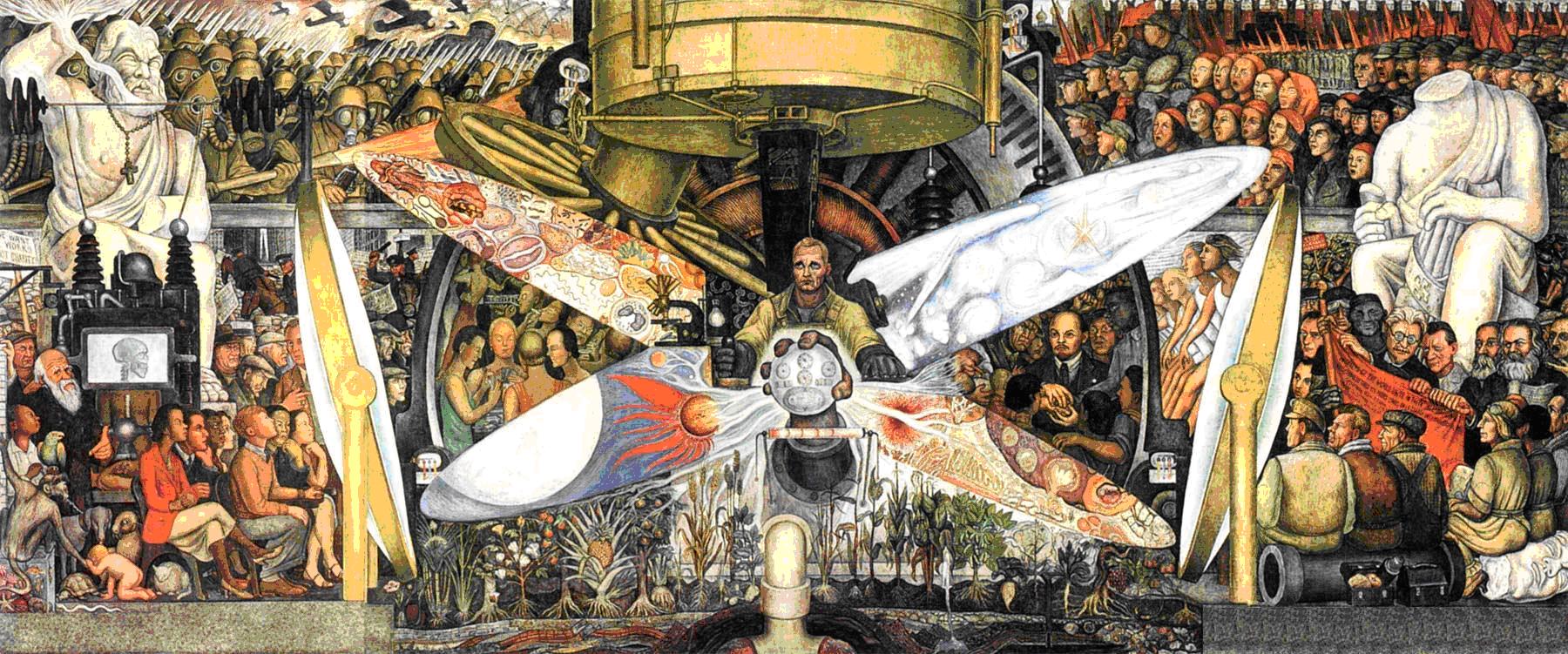
Artist Ben Wood, whose plan to recreate a centuries-old Ohlone mural on the Mission Market we covered in the paper a few weeks ago, made a short film on the Rockefeller Center Diego Rivera mural that was ordered removed because Rivera had snuck a portrait of Lenin into the fresco’s depicted multitudes.

Goes to show you how much we’ve progressed – now, you don’t even have to show Communist Party leaders, the reality and triumphs of working class people are enough to be considered unpalatable (and unfair?) by business leaders. 

And don’t get me started on Italian street artist Blu’s dollar bill-draped coffins, whitewashed from a wall the Museum of Contemporary Art in Los Angeles a day after he painted the thing. Dead soldiers = not on our walls. Not mention a poorly-executed gambit by Vancouver, Canada to remove an anti-Olympic art installation on a gallery’s storefront.

“Man at the Crossroads” (here, a partial view of the mural) was not a big hit with the business set either 

The removal of Blu’s MOCA piece incited artist protests

SF muralists, which side are you on? How does it make you feel to see this kind of thing happen to art?

A creative way out of the state budget mess

36

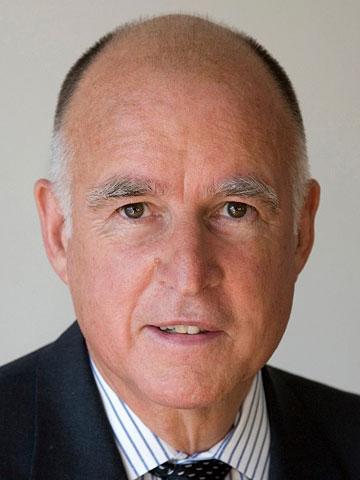
With no Republicans willing at this point to go along with the governor’s June election plans, Jerry Brown has quite the problem on his hands. There never really was a Plan B. And now he’s got to find one, fast. He’s already made the cuts, and they’re awful. He’s not going to get his own party to go along with much more. But it’s legally dubious whether he can put taxes on a special election ballot without any Republican support, and he clearly doesn’t want to.


So what’s the best option? Well, the deep thinkers over at CalBuzz have a brilliant scheme. The idea: Pass an all-cuts budget, a devastating, ugly, puke-inducing thing — then


gather signatures to place that on the November ballot, with a provision that if the measure fails the cuts will not occur because the 2009 taxes and fees will be re-instated for five years. As a practical matter, cuts can be delayed to occur after November. And costs can be shifted to local government for local responsibilities whether the measure wins or loses.


Then let Grover Norquist, Jon Fleischman, radio heads John and Ken and the rest of their not-our-problem cadre be forced to argue for the budget ballot measure while Democrats and labor argue against it.


It’s much easier to get a vote against something in California — particularly when that something contains provisions that nobody wants. A No vote means Yes on taxes and No on cuts.


Man, why aren’t these guys running for office?


5 Things: March 24, 2011

0

>>BEES ARE BACK IN TOWN On March 24, Hayes Valley Farm welcomes back the bees. Hives previously kept at the urban farm were wiped out by a mysterious pesticide sabotage, but head beekeeper Karen Peteros, co-founder of San Francisco Bee-Cause, has stayed busy bringing the pollinators back. Tonight’s oddly matched Return of the Bees event at the Korean American Community Center will feature a discussion about the new hives, as well as a meet-and-greet with San Francisco Sups. Jane Kim (D-6) and Scott Wiener (D-8) and Ross Mirkarimi (D-5). Catching the buzz of urban farming politics? Become a budding apiarist by signing up for an urban beekeeping workshop.

>>A NEW KIND OF NINJA  A recent New York Times editorial by 24-year-old Matthew Klein started out by drawing a parallel between Western youth and those young people in the Arab world who keep fomenting uprisings. “We all enjoy speculating about which Arab regime will be toppled next, but maybe we should  be looking closer to home. High unemployment? Check. Out-of-touch elites? Check. Frustrated young people?” he wrote. “About one-fourth of Egyptian workers under 25 are unemployed, a statistic that is often cited as a reason for the revolution there. In the United States, the Bureau of Labor Statistics reported in January an official unemployment rate of 21 percent for workers ages 16 to 24.” What all these unemployed young’uns do with all their free time? Apparently, they re-imagine themselves as ninjas on YouTube.

>>GENDER MYSTIC Didik Nini Thowok, a popular dancer, choreographer and comedian from Indonesia, will be in San Francisco April 21 through 24. According to a post on the Asian Art Museum website, “Didik is one of the few remaining Indonesian dancers today who explores transgender culture and its historical connection with mystical practices in Indonesia.” Didik will give a short talk about his creative process and a dance performance, followed by audience Q&A, on Saturday, April 23 at the Asian Art Museum. The talk is free with museum admission. 

You know your spring closet is begging for this Dry Bones “Hep Cat” button-down from Self Edge. Buy it Saturday AND help out communities in Japan? Me-yow. 

>>LAND OF THE RISING CREDIT CARD BILL Bust out those pocketbooks, cause it’s time to lend a hand across the Pacific. Local retailers like Valencia Corridor holder-downers Five and Diamond, Self Edge, and The Summit are among those participating in Saturday’s worldwide Shop For Japan event. So open up that studded hand-tooled leather clutch, dive into the pocket of your artisan Japanese jeans, indulge your soy mocha addiction — whatever, just do it to it, moneybags.

>>UGLY DOG, PRETTY CAUSE Can’t hardly wait for this summer’s Petaluma Sonoma-Marin Fair ugliest dog contest? The O.G. ugly dog pagaent has spawned its share of imitation events and Associated Press kowtows, and now there’s a kooky little documentary about the bonkers owners that parade their boxers with underbites and Chinese crested with… well, the typical Chinese crested attributes, with a little extra wartage and askew tounge thrown into the mix. Assuage your barely contained anticipation with tonight’s Worst in Show screening in Berkeley. Bonus: half of your ticket price goes to help out East Bay furry friends! That’s enough to make us wanna grab some fuzzy hips and f’in conga:

Fruits of labor

0

arts@sfbg.com

FILM One of the first things cinema learned to say was “you are there.” The Lumières sent their lightweight cameras around the world and were soon able to transport their Parisian audience to remote settings — a fine flexing of industrial capitalism. If Werner Herzog used to have the market on art-cinema primitivism cornered, the recent films making up the “First Person Rural” series at the Pacific Film Archive take a different tack, disavowing outlandish narratives of madness and expedition for reality-hungry visions of work and rough beauty. As a group, they privilege phenomenal experience to exposition; affective texture to intelligibility; nonverbal utterance to patent explication. They often seem more in line with epic poetry than documentary realism.

Argentine director Lisandro Alonso’s stoic debut La Libertad (2001) led the way to many of the decade’s shorn agricultural narratives. To begin, we watch a young man work a tree into lumber and eat and nap in a lean-to a few shades rougher than Thoreau’s Walden. In the film’s second half, the man turns his labor into capital, transporting, selling, and spending before returning to camp to eat a freshly caught armadillo as lightning flashes in the distance. The slow time of the man’s routines defines the temporality of the film, and Alonso’s bold compositions in turn monumentalize the man’s tasks. What to make of this aesthetic surplus of the man’s labor remains an open question.

The issue of poetic license is even more pressing in Agrarian Utopia (2009), a work of social (hyper) realism focused on a family of Thai subsistence farmers. In contrast to their crushing penury is the rich HD cinematography: every grain of rice and droplet of water makes its stunning mark. Hitching scripted social drama to a loose documentary style joining scenes, director Urophong Raksasad proposes three possible utopic frameworks for the farming family: urban demonstrations calling for political reform, a hippie neighbor’s sustainable farming practices, and the ecstatic vision of the camera itself. The limitations of the first two should give us pause over the third; this is the rare film about poverty that doesn’t imagine its lyricism as a redemptive force.

There’s no question of any kind of utopia in Eugenio Polgovsky’s Tropic of Cancer (2004), a video report from the Mexican desert that’s bruising and cunning in equal measure. Polgovsky shows us the hard lives of peasants who scour the arid landscape for (unfriendly) critters they can sell alongside a godforsaken highway. Their middle-class customers seem primarily concerned with animals’ living conditions — one of many bitter ironies registered in Polgovsky’s sharply assertive montage.

Strong as it is, Tropic of Cancer doesn’t cry out for repeat viewings — not the case with Sweetgrass (2010) and Alamar (2009), both among the finest films of recent years. With Sweetgrass especially, it’s only after you’ve surrendered to its sensory richness as a recording (the multichannel sound mix combines with the physical camerawork for a nearly Whitmanesque extension of perception) that you can begin to digest its cross-purposed contemplation of the final sheep drive across a mountainous western-mythic landscape.

Writing about Jean-François Millet’s peasant subjects, the critic John Berger observed that the French painter’s personal nostalgia extended to history: “Most of what he knew about peasants was that they were reduced to a brutal existence, especially the men. He sensed, it seems to me, two things which, at the time, few others foresaw: that the poverty of the city and its suburbs; and that the market created by industrialization, to which the peasantry was being sacrificed, might one day entail the loss of all sense of history.” The “First Person Rural” films mark this loss with immersion, and in so doing leave us with the lingering sense that it is we and not the films’ subjects who are “out of time.”

“FIRST PERSON RURAL: THE NEW NONFICTION”

March 26–April 27, $5.50–$9.50

Pacific Film Archive

2575 Bancroft, Berk.

(510) 642-5249

www.bampfa.berkeley.edu

Is the California GOP done?

16

The folks at CalBuzz — veteran political reporters who know their shit — thing the CAGOP is teetering on the brink of irrelevance:


Like a herd of wooly mammoths at the end of the Pleistocne epoch, the California Republican Party is on the verge of extinction.


It may still recover. The CRP has come back from near death before. And redistricting, alongside the top-two primary system may yet revive it. But judging from the infighting, narrow thinking and rigid ideological positioning on display at the party’s organizing convention last weekend in Sacramento, the signs are not good.


But that assumes that the party wants to recover, wants to be part of governing the state and actually has a plan to do that. Right now, Republicans in Sacramento are standing up and denouncing some of Gov. Brown’s proposed cuts — while refusing to even allow a public vote on extending taxes.


Over at Calitics, David Atkins suggests another perspective:


In reality, the GOP at a national and state level exists to 1) deliver money from the poor and middle class to the rich; and 2) feed enough red meat to their prejudiced and unthinking base to garner just enough votes to continue achieving objective #1. That’s pretty much it.


Right now, the GOP doesn’t actually need to win any of the statewide elections in order to accomplish those goals. Winning them would be helpful, but is ultimately unnecessary. Knowing that the chances of anyone overturning Prop 13 and the 2/3 requirement on revenues are slim to none, all they need is at least 1/3 of the members of just one of the statehouse chambers. To ram through all cuts budgets and destroy faith in government, they need do nothing more.


In fact:


There’s nothing that serves Republican interests at a state and national level more than to see California fiscally collapse. That means shock doctrine, a transfer of wealth from the middle class to the rich, an ability to end all state labor contracts in a way Governor Walker would only dream of, and ultimately the ability to crush the belief of the People in the power of their government to do good on their behalf.


I’m not sure everyone in the GOP thinks this way, but on a macro level, it certainly makes sense. That’s exactly what the Repubicans are doing in Congress — make it impossible for the Obama Administration to succeed, and you’ve done your job. It doesn’t hurt that Obama is allowing that to happen.


Brown continues to say that he doesn’t want to pull any legal chicanery, that he wants Republican support for his plan to but the tax extensions before the voters in June. But if this is the game they’re playing, he may have to reconsider.

Jaded activist attends rally in Madison

3

Jess Brownell is a freelance writer living in Milwaukee.

So here you are, 75 years old, tired, bitter, after many years of political semi-activism deeply cynical about that process (and most others as well), in a car on a blustery March morning on the way to Madison, Wisconsin, a town you’ve never much liked, to participate in a goddamn protest rally. Why are you doing this?

Could be that the celebratory “Walker Wins” headline in what passes locally for a daily newspaper, the Milwaukee Journal-Sentinel (your Bay Guardian publisher once worked in those precincts, but that was long, long ago) had something to do with it. “Packers Win” is fine any time it happens. Everybody loves the Packers. Everybody does not love Scott Walker. On the other hand, the paper actually endorsed Walker, so what could you have expected?

Your wife, with you today, has been here several times before to protest Walker’s budget, as have many friends and neighbors. You could say that you owe them this one. But then, you owe a lot of people a lot of things, and it doesn’t often get you off the couch.

Maybe you’re just looking for a chance to call a Republican legislator an ass-licking whore; there would be some satisfaction in that. But it’s the weekend and the ass-licking whores will all be in some safe place where crazy old men can’t call them names. And that’s probably for the best. You have always tried to be a mannerly person and a phrase like “ass-licking whore” is hard to work into polite conversation.

Or maybe it’s the involvement in Wisconsin of the Koch brothers, those strange and malevolent creatures who have burst in a most unseemly way into the national spotlight. Time enough on the ride to consider the eagerly gobbled-up myths they have spread about themselves. They are Libertarians, they claim, and global warming skeptics. If they are Libertarians, why are they spending millions of dollars in the hope that government will restrict the freedom of people in Wisconsin? As Libertarians, shouldn’t they just leave us alone? And if they are global warming skeptics, why are they so anxious to destroy whatever vestiges of the labor movement are left in the Great Lakes states? Have they not in fact realized that as the south and southwest become less and less habitable the real money will have to be made in places with ample water? Sure they have. They’re evil, not stupid. They are not here, though, to vocally accost, and are not likely ever to be.

Hey, it’s tractorcade day. Are you by any chance here to see the tractors? There’s a long parade of them. Haven’t seen this many tractors since the Centennial in your hometown in Nebraska. Some of them are huge, today’s models, designed as much for combat as agriculture, it seems, and thus in the right place today — or would be if there were any ass-licking whores here to run over. Others are vintage and have names you had all but forgotten – Case and Oliver and Massey-Ferguson. A little twinge of nostalgia there, yes, but hardly enough to justify your presence.

All of them seem to be driven by real farmers, too, and it’s nice to think so many farmers took the time and effort to show support for the rights of teachers and public employees. But you grew up on a farm. You’ve seen a lot of farmers. Not here for that.

Tony Shalhoub is at the rally today. He’s the actor best known for starring in “Monk,” though his career would be substantial without that. He’s from Green Bay and has a sister who’s a teacher there. Apparently he doesn’t like the way Scott Walker and the Republicans are fucking over his sister. Not that they care about anybody’s sister. Dalai Lama got a sister? Bring her on. (Have they thought ahead on this? Scott Walker has promised to create 250,000 jobs. What if the teachers take 59,000 of them? What then, Scott?)

Good for Tony Shalhoub, but you have worked in the theater and met a lot of actors and liked most of them. You’re not here to see another one.

Is it the Capitol itself, that beautiful and venerable building? On the whole you think not. Your most vivid recollection of the Capitol is of a day spent years ago as part of a group lobbying for money for the arts, a laughable notion in today’s political climate but not unthinkable at the time. You had a sore back, spent hours walking those marble floors, and as far as you can remember the only tangible result was the worst case of sciatica you have ever had. Don’t want to go back in. Might not want to go in even if there were ass-licking whores in there to yell at.

If it’s not actors or tractors, buildings or buddies, what is it? Might as well face the facts. It’s the people. You’ve always had a taste for low-life, for cheap saloons and marginal characters. You’re really here to mingle with the thugs and slobs who have turned out in full force – some 70,000 or more – to march and protest and chant. These greedy parasites are your kind. You are one with the venal and self-serving pair carrying that Solidarity banner around Capitol Square, one with the misfits in the firemen’s uniforms and the drop-outs pretending to be retirees. Don’t let the friendly smiles fool you, all this “excuse me” and “thank you” business. These are the dregs of society, unproductive at best, vicious when aroused, in need of a firm hand. Why, if there were still a Welfare program you could all be Welfare cheats together. You have found your place, you fall into step, you stride out purposefully . . .

Damn. Felt that in the back, didn’t you?


SFBG Radio: Good news from Wisconsin — maybe

0

A judge in Wisconsin has tossed out the governor’s anti-labor law — but does that just mean the Republicans are going to go back and do it again? And what’s going on in Michigan, where the governor wants to get rid of labor contracts by taking control of local government? Check out our discussion after  the jump.


sfbgradio3182011 by endorsements2010

Hip-hop heroes

3

I’m rolling with the big timers: the executive director and founder of a community circus arts program, an after-school program b-boy teacher, the most beautiful family in Bay Area hip-hop, and my boyfriend, who is snapping photos on his Nikon of the rest of us. We’re standing under the high ceiling of Acrosports, in a room filled with trapezes, a balancing beam, an over-sized trampoline, and the contorting, jack-knifing bodies of young, aspiring circus professionals. The people assembled (minus me and my man) are using the power of hip-hop to bring a cultural skill swap to underprivileged youth in Zanzibar.

It’s a feel good moment, particularly because it comes during a week that hosted some of the darkest days in the past century of the labor movement, the start of unimaginable hardship in Japan, and disheartening scenes from our nation’s leaders’ announced Muslim witch hunt. But enough of that for now, Zumbi’s talking:

“This is the first time we’ve done a tour that benefited charities, which is cool… but it’s like, why has this taken so long to do? Why don’t more people do this?”

The emcee from Zion I is makes uplifting Bay Area hip-hop without major label representation, and now it’s been announced that his, DJ Amp Live, and the Grouch’s upcoming tour will be benefiting local community organizations at each of its 36 gigs on its “Healing of the Nation” tour — which is named after the artists’ second collaboration album, Heroes in the Healing of the Nation.

In the Acrosport’s basement, breakdancing students get their new skills battle-ready. Photo by Erik Anderson

“This album, it’s more focused, it’s about communities, families, self. It’s needed! These days, you’ve got Charlie Sheen occupying more time onscreen than the Middle East. Everybody’s all caught up on tiger blood,” Zumbi tells me. It’s positive music, much like the first Zion I-grouch collab, 2006’s Heroes in the City of Dope, but it’s far from Public Enemy-style protest rap. 

Track eight on the new album is entitled “Be A Father To Your Child,” in the chorus of track two the Grouch asserts “I’m a leader/I don’t want to be a follower,” pledging allegiance to self-motivation. There’s a song called “I Used to Be Vegan” on the album that I find particularly resonant given my own struggles with evading cheese. The message is: be a positive force, don’t get swept up in the forces that try to disempower you and make you sad. It’s conscious music, but conscious music meant to have a good time to.

Today we also meet Zumbi’s beautiful partner Tiffany and their three-month old prince, Kodi Shaddai. They pose prettily by the catapulting acrobats behind them and Zumbi tells me that Kodi may well make a cameo appearance in the album’s upcoming music video. He tells me he used to do capoeira himself and jokes about his bad knees with B-Boy Black, a.k.a. Ed Johnson, Acrosports’ outreach director and breakdance teacher who will be one of the leaders on the Zanzibar trip.

Acrosports’ professional track performers practice across the street from Kezar Stadium. Photo by Erik Anderson

Is Zion I’s hip-hop philanthropy new? Certainly not, but what is novel is the group’s maturing image. Zumbi says that Heroes in the City of Dope was “more commentary, more getting fresh.” Heroes in the Healing of the Nation focuses more on creating positive space — reflective of the three men’s new roles as fathers and, gulp, role models. Looking into the future (though he’s far from hanging up his touring hat), Zion I’s emcee tells me that he sees his role in hip-hop as that of mentor to youngsters coming up in the ranks. 

My star-struckedness aside, I should probably be spending more of this article talking about Acrosports and its planned trip to Africa. You wanna see bringing uplift to the people? The place is pretty incredible, offering classes in breakdancing, capoeira, tumbling, and parkour to community members from 10 months of age and up. They run after-school programs in over 20 school, YMCAs, and Boys & Girls Clubs whose philosophy is to empower kids through positive motivation and access to non-traditional sports. 

Community activist Dorrie Huntington founded the place 20 years ago when she realized the building she lived next door to was sitting empty after years as a high school, and then a homeless shelter. Some unemployed members of the Moscow Circus proposed that they start teaching tumbling classes. Soon the team was repurposing sleeping mats from the homeless shelter and donated paint to create the center, all with very little resources. “It took a lot of sweat equity,” Huntington smiles. But that was 20 years ago and the perspiration paid off – now the city has a place where people of all ages and levels of fitness can come to learn how to move their bodies in joyous, creative ways. 

In 2009, Huntington went to Africa to volunteer in a Tanzanian orphanage, and on a vacation ran into some kids flipping out on a beach in Zanzibar. “Their skills were so amazing. They had this truck tire wedged in the sand and they were doing flips off of it.” She struck up a friendship with the amateur acrobats and vowed to return with teachers that could help the kids develop their performance skills. 

It’s a mission that resonates with her staff. “Growing up in a black community,” says Johnson, “going to Africa was seen as learning about your roots. I want to go out there and meet these amazing artists.” I ask him how he felt when he learned that Zion I and the Grouch were dipping into ticket sales to help him and his team realize the dream and he gets a little bashful. “I had to keep my composure,” he tells the group, and turns to Zumbi. “I have the vinyl record of The Bay! I don’t even have a record player, I was just like, I got to have that album!”

Inspiring people creating space for each other to make great things happen. Like a little feedback loop of positivity, it was. And a real good break from the heartache of the news channels.


Zion I and the Grouch

Sat/19 9 p.m., $25

The Fillmore 

1805 Geary, SF

www.zioniandthegrouch.com


Unregistered lobbyist

0

tredmond@sfbg.com

In 2007 and 2008, Pacific Gas and Electric Co. paid former Mayor Willie Brown a total of $480,000 for consulting work. Since Brown has never been utility lawyer, it’s almost certain that money has bought political advice and access.

Brown is also working for the owners of the Fairmont Hotel, which wants to tear down one of its towers and build as many as 180 luxury condos.

His public affairs institute shares office space with one of the most powerful lobbying firms in town. He meets with or talks regularly with the mayor and members of the Board of Supervisors.

Yet unlike dozens of others who seek to influence public policy for hire, Brown is not registered as a lobbyist at City Hall.

On the surface, it’s a fairly modest issue — all Brown would have to do to comply with the letter and spirit of the city’s law is to fill out a form, list his clients, and reveal which officials he’s been talking to. It would take him 10 minutes.

But the fact that someone who is widely acknowledged to be among the most influential power brokers in San Francisco refuses to disclose whom he’s working for leaves city officials and the public in the dark — and raises a long list of questions about the effectiveness of the city’s ethics laws.

There’s a reason city law requires people who seek to influence city officials for money to disclose what they’re up to. When elected officials, commissioners, or department heads meet with advocates, they need to know who’s paying the bills. If, for example, Sup. Jane Kim has breakfast with Brown (which Brown himself reported on in a recent column in the San Francisco Chronicle), she needs to know: Does he have a client with an agenda? If he asks her to meet with someone, is he just looking out for the interests of the city — or is he pushing a paid special interest?

When Brown has dinner with Mayor Ed Lee (as he did several weeks ago) the voters need to know: Is this dinner companion pushing the mayor to make policy decisions that might help a private interest?


THE RULES

The definition of “lobbyist” in city law is designed to avoid putting special requirements on advocates who push issues on their own or for purely political reasons. A neighborhood activist pushing for a stop sign or better police patrols doesn’t have to register. Neither does a restaurant owner looking for a permit to put tables on the street. The only people who have to register are those who represent a client who pays them more than $3,000 in any given three-month period.

Lawyers are exempt if they’re contacting city officials purely about specific pending litigation or claims. Labor leaders are exempt if they’re talking about wages or benefits for their union members.

The requirements aren’t onerous. Lobbyists simply disclose their clients, the issues they’re working on, the city officials they have contacted, and any campaign contributions they’ve made.

There’s no doubt Brown meets the financial threshold in at least one instance. Documents on file with the state Public Utilities Commission show that PG&E paid him $280,000 in 2007 and almost $200,000 in 2008. And although Brown is a lawyer, there’s no indication that he is representing PG&E in any litigation against the city.

On the other hand, PG&E is fighting hard to derail the city’s community choice aggregation program. Is Brown part of that effort? There’s no way to know.

It’s clear he talks to local officials regularly. Most members of the Board of Supervisors we contacted said they had talked to Brown at some point in the past year. “He called me to ask how he could help with the local hire legislation,” Sup. John Avalos told us. “I told him he could call (then-Sup.) Bevan Dufty. He said he would, but I don’t know if it ever happened.” Sup. Sean Elsbernd told us he speaks to Brown about “the state of local political dynamics,” but said he can’t remember being lobbied on any particular issue.

Insiders say that’s typical — Brown rarely lets anyone know exactly what his interests are. “The talent of Willie is his ability to create plausible deniability,” one city official, who asked not to be named, told us.

But when Brown is involved, things have a funny way of happening. Take the Fairmont Hotel.


FRONT OF THE LINE

The Fairmont’s owners, who include the Saudi royal family and a group of American investors, want to tear down one of the hotel’s towers, eliminate several hundred hotel rooms, and replace them with high-end condominiums. That requires a city permit — legislation by former Sup. Aaron Peskin limits the number of hotel rooms that can be converted to condos and requires applicants to submit to a lottery for the right to convert.

The Fairmont applied for a permit in 2009, and won tentative approval. But in October 2010, the Planning Commission refused to certify the project’s environmental impact report. With no valid EIR, the permits expired, meaning the hotel would have to go back and reenter the lottery, with no guarantee of success.

So the Fairmont owners are seeking special legislation that would allow them to submit a new EIR without going to the back of the line — in essence, an exemption from the lottery. So far there’s no champion on the Board of Supervisors, and the hotel workers union has been dubious about the project, fearing it will cost union jobs in the long run.

But early in March, Mayor Lee quietly submitted his own legislation to the board, offering the Fairmont everything the owners want.

Who’s working for the owners? Willie Brown.

Bill Oberndorf, part of the local ownership group, told us Brown was an “advisor” to the project. “Nobody in the city has more knowledge about how to get things done than Mayor Brown,” he said.

So did Brown talk to Lee before the mayor introduced his Fairmont bill? And isn’t that a valid question? At press time, Lee’s office hadn’t responded to my questions. But if Brown was a registered lobbyist, he’d have to report that information.

Who else are Brown’s clients? Since he doesn’t register, there’s no list. But there are some clues.

For example, the headquarters of the Willie Brown Institute is situated at One Market Plaza, Suite 2250. That’s the same address as Platinum Advisors, the high-powered lobbying firm founded by Darius Anderson. Among the firm’s clients: AECOM, the engineering and construction giant, which has a $147 million contract on the Chinatown subway project; PG&E; and Sutter Health, which wants to build a $1 billion hospital on Van Ness Avenue.

Others who lobby regularly at City Hall don’t always register. Rob Black, who works for the Chamber of Commerce, is a constant presence.

Black told us the chamber used to be considered a “registered lobby entity” that was required to report all contacts with public officials and the issue involved. But the Board of Supervisors changed that law last year, requiring lobbyist registration only from individuals who are paid at least $3,000 per quarter for lobbying. Furthermore, the definition of lobbying doesn’t include attending or speaking at public hearings or writing letters. So while the SF Chamber’s Black, Steve Falk, and Jim Lazarus all lobby city officials, Black said, none have exceeded that threshold. “If we hit the monetary threshold, we’ll start filing individually,” he said.

The fact that Brown is a lawyer doesn’t excuse him from registering, said Ethics Commission director John St. Croix “If someone is paid specifically to lobby government, they should register,” St. Croix said.

Sup. Ross Mirkarimi told us that the city needs to take a look at the lobbyist registration law to make sure that everyone who has private interests is properly registered.

Elsbernd said that others — particularly labor leaders and union staffers — also regularly lobby but don’t register. And while the law may allow them to skate underneath (like Black), there’s a huge difference between, say, Labor Council Executive Director Tim Paulson appearing at City Hall and Brown meeting with city officials.

When Paulson appears, there’s no doubt in anyone’s mind whom he represents. The same could be said of Black. Although the chamber has many members, it’s clear that he’s pushing the interests of the big-business community.

On the other hand, Ken Cleaveland, public affairs director of the Building Owners and Managers Association, is duly registered with the Ethics Commission.

Brown — as is his typical practice — didn’t return my calls seeking comment. But by flouting the rules, he’s able to operate completely behind the scenes, influencing policy decisions in secrecy, with no accountability whatsoever. That’s a violation of the exact reason the lobbyist registration laws exist.

Dick Meister: Teachers Need Strong Unions

5

Like many people, I’m sure, Washington Post writer Matt Miller is confused about, “where to come down on the question of who should ‘win”” in the struggle of public employees against attempts to strip them of collective bargaining rights and otherwise weaken them.

I know which side I’m on – the public employees and their unions.  But though highly sympathetic to the public employees cause, Matt Miller is not against the employees and their unions losing some of their powers and benefits – with one major exception: Teachers.

Again, I make no exceptions. I think we should rally around the cause of all public employees. But though Miller doesn’t necessarily agree, he does make a strong argument for making special efforts in behalf of teachers. For “the  future of the country depends on the public-sector workers known as teachers.”

I guess I should make a full disclosure here:  I was formerly a member of the AFL-CIO’s American Federation of Teachers and my wife Gerry is a current member. So I’m probably prejudiced. And should be.

Anyway, Miller makes a very strong case for paying close attention to the needs and demands of teachers. As he says, “We’ll never attract the kind of talented young people we need to the teaching profession unless it pays more than it does today.”  With starting teachers pay averaging  $39,000 a year nationally and rising to a maximum of merely  $67,000, it’s no surprise to Miller that “we  draw teachers from the bottom two-thirds of the college class. For schools in poor neighborhoods, teachers come largely from the bottom third.”

Adds Miller: ” We’re the only leading nation that thinks it can stay a leading nation with a ‘strategy’ of recruiting mediocre students and praying that they’ll prove to be excellent teachers.”

Miller may not be an outright supporter of teacher unions, but he does point out that the highest performing school systems in the world all have strong teacher unions. He means the systems in countries such as Finland, Singapore and South Korea, where school administrators work closely with unions to continually improve their schools’ performances.

Stanford University’s Linda Darling-Hammond, a leading expert on the subject, says the highest performing countries have educational systems that are built around attracting, rigorously training and retraining top talent for teaching. The stress is on supporting good teachers – not on getting bad teachers out. That’s partly because there just aren’t that many bad teachers in those countries.

I agree with Matt Miller that what’s clearly needed is a national strategy to make teaching the career of choice for talented young people. Wisconsin’s math scores, for instance, put its students not only behind Korea, Finland and Taiwan, but behind Slovenia, Estonia and Lithuania. But, hey, they still outpace students in Latvia and Bulgaria . . . though barely.

As Miller notes, the only people who can change that, the only ones who can provide decent educations to Wisconsin’s children, are public employees , teachers  – teachers, furthermore, who must be given a strong voice, a unionized voice in setting their pay, benefits and working conditions.

Teachers need the firm right to collective bargaining no less than Wisconsin’s other public employees, no less than the public employees of every other state.


Dick Meister, former editor of the SF Chronicle and KQED-TV Newsroom, has covered labor and politics for a half-century. Contact him through his website, www.dickmeister.com, which includes more than 250 of his columns.

What has happened to America?

13

I’m serious. I listened to the news this morning on the radio, and I started to wonder if I hadn’t gone through some kind of a time warp, back to the 1950s. The House Homeland Security Committee is actually holding hearings on whether members of a certain religion have become too radical — and what the U.S. government can do about it.


Richard Nixon used to say that the Jews were part of the Commie Radical Conspiracy, and J. Edgar Hoover thought that black religious leaders, including the Rev. Marting Luther King, Jr, were linked to the Communist Party, but it’s been a while since the U.S. government officially investigated an entire religion on the grounds that it might contain radical elements.


Of course, as Rep. Loretta Sanchez (D-Calif.) notes:


Yet, since September 11, 2001, there have been at least 78 terrorist attacks around the world which did not involve Muslim perpetrators. During the same period, there were 45 incidents connected to Islamic radicals.


Same thing in the United States. Timothy McVeigh? Not a Muslim.


Here’s Rep. Dan Lundgren (R-Calif.) telling us all about this particular scare:


I think moderate voices in this country are intimidated by the radicals. If we hide this and pretend that it doesn’t exist, we’re ignoring reality.


It’s funny — I could make that same argument about the Republican Party. The moderates (if any are left) are intimidated by the Tea Party and anti-tax radicals. Now we have a HUAC-style investigation of the Muslims.


And then in Wisconsin, one of the birthplaces of the modern labor movement in America, the state Legislature is stripping public employees of almost all collective bargaining rights. Forget wages and benefits, which the unions have already agreed to open up for discussion. This is about the most central tenet of organized labor — the right to collective bargaining. It’s as if all the victories we’ve won in the past half century (or more) are going away. With a Democrat in the White House.


It’s funny: I was drinking beer with my neighbor the other night and talking about tax policy (you wonder why I have so many friends) and he told me he’d  given up any thoughts of socialist revolution or radical change: “I’d just take the 1950s,” he said.


Because in the 1950s, the rich people paid taxes.


So now we’ve got the worst of both worlds: We have 50s-era witch hunts and union busting — and we don’t even have 50s-era taxes. What the fuck?   


Is David Crane just another Kochhead?

24

This week the Chronicle majorly attacked State Sen. Leland Yee, claiming Yee tried “to distort the words” of billionaire investment banker and UC Regent David Crane on collective bargaining.

The Chron’s attack came on the heels of Yee’s attempt to block Crane’s UC Regents confirmation. And Yee’s attempt to block Crane came in response to an op-ed Crane wrote for the Chron titled “Should public employees have collective bargaining rights?”

In its counter-counter attack editorial this week, the Chronicle accused Yee of falsely claiming that Crane had “called for an end to collective bargaining rights for California teachers, nurses, firefighters, university employees and other public sector worker.”

“What the former adviser to Gov.Arnold Schwarzenegger did was present a history of collective bargaining in California and explain how a 1977 law had changed the balance of power by giving public employees power over their compensation and benefits,” the Chronicle stated. “Crane did assert that extending collective bargaining to employees who already have civil service protections ‘serves to reduce benefits for citizens and to raise costs for taxpayers. Anyone who would argue with that fact has not been paying attention to what is happening with state and local budgets lately.”

The Chronicle finished by praising Crane, who is currently a lecturer on Public Policy at Stanford University and is reportedly working with former Fed Chairman Paul Volcker to form a task force to examine current state budget practices. Crane, the Chron asserted, has “long been widely respected as a teller of inconvenient truths about the rising costs of public-employee pensions and benefits. He should not be silenced – or misquoted by opportunistic politicians. The Senate should vote to confirm him as regent.”

Now, when Schwarzenegger appointed Crane as a UC Regent in December 2010 as one of his last acts as Governor, the Sacramento Bee described Crane as Schwarzenegger’s “chief public employee pension critic.” But here in San Francisco, the Chron didn’t bother to flesh out Crane’s history of employment, campaign contributions, prior statements on collective bargaining, and financial investments.

Maybe it was because these public records reveal Crane to be less a dyed-in-the-wool Democrat and more of a Bushocrat, an ultra-rich investor who supported G.W. Bush through two elections, and repeatedly frames the collective bargaining rights of government employees as an obstacle standing in the way of pension reform and budget balancing.

Campaign finance records show that in March 1999, when Democrats were trying to hang onto the White House in the wake of Clinton’s sex scandals, Crane gave $1,000 to Bush. And in June 2003, just three months after Bush invaded Iraq on a false pretext, Crane saw fit to give Bush another $2,000.

The good news? Crane didn’t support Sarah Palin and John McCain in 2008. But he did donate $7,200 to Republican Tom Campbell’s unsuccessful 2010 bid for US Sen. Barbara Boxer’s seat. And here in San Francisco, Crane was one of several billionaires who wrote big fat checks last fall in support of Measure B, which sought to curb the pension and health benefits of city workers, most of whom will make a fraction in their lifetime of what Crane rakes in each year from his widely diversified financial portfolio.

Crane’s 2009 statement of economic interest shows he has over $1 million invested in Farallon Capital Partners, one of the world’s largest hedge funds, many of whose investors include top university endowments.

Crane also has over $1 million invested in Acacia Partners, over $1 million in Bislett Partners, over $1 million in Kensico Partners, over $1 million in Semper Vic Partners, over $1 million in Berkshire Hathaway, whose CEO is Warren Buffet, over $1 million in the HCP Absolute Return Fund, whose Board includes Warren Hellman, and up to $1 million in Hall Capital Management, whose Board includes Hellman and Gap heir John Fisher. Crane also owns several million dollars stake in real estate investments, and has sizeable stock in Wells Fargo, Chesapeake Energy, Microsoft, Google, Pangloss Oil, Whole Foods Market, M&T Bank Corp., IBM, American Express, WalMart and Exxon.

And he gets income from Acacia Partners and Babcock & Brown, where he was a former partner from 1979 to 2003. While at Babcock, Crane reportedly brokered a controversial jet-lease deal between Arnold Schwarzenegger and Singapore Airlines that allowed Schwarzenegger to defer taxes on millions of dollars. And in 2004, Crane went to work for then Republican Gov. Schwarzenegger as special advisor for Jobs and Economic Growth. The Terminator returned the favor by appointing Crane to the California Commission in Economic Development and the California High Speed Rail Authority. But Crane was rejected in Senate confirmation proceedings for a position on the board of California State Teachers Retirement System.

Now, clearly it’s not a crime to be a billionaire, even though the way some folks make their billions is criminal. But you have to wonder if UC really needs another ultra-rich Regent on its Board. You also have to wonder why the wealthy Crane sought reimbursements of $2,812 from UC in 2009, if he cares about saving the state money.

And Crane has made plenty of statements about collective bargaining rights and pension reform in recent months that seem to frame government employees as the bogey men, not just in California, but across the entire nation.

Take his April 2010 comments to the Los Angeles Times: “State legislators are afraid even to utter the words ‘pension reform’ for fear of alienating what has become — since passage of the Dills Act in 1978, which endowed state public employees with collective bargaining rights on top of their civil service protections — the single most politically influential constituency in our state: government employees,” Crane said.

Or what he said in August 2010 to the Fox Business Network: “Even if you took care of every one of these spiked above the iceberg level pensions in California, you would not take care of the pension problem in California, which is true of virtually every state in the country, at least those where, you know, government employees have collective bargaining rights,” Crane said

In December 2010, he told the L.A. Times that the year 1978, ”wasn’t notable just because of Proposition 13. That was also the year public employees gained a power Franklin D. Roosevelt had warned against: collective bargaining rights.”

“California hasn’t been the same since,” Crane continued. “Public workers have gained at the expense of private workers as government spending was redirected from infrastructure and education to higher salaries, pensions and other benefits.”

And in his Feb. 27 Chronicle op-ed, Crane claimed that, “The battle in Wisconsin is not over collective bargaining rights generally but rather the appropriateness of those rights in the public sector ”

“Collective bargaining is a good thing when it’s needed to equalize power, but when public employees already have that equality because of civil service protections, collective bargaining in the public sector serves to reduce benefits for citizens and to raise costs for taxpayers,” Crane continued. “Citizens and taxpayers should consider this as they watch events unfold in Madison.”

As of today, letters are circulating in Sacramento opposing Crane’s confirmation. And Sen. Ted W. Lieu (D-Torrance), Chair of the Labor and Industrial Relations Committee in Sacramento, has already signaled his opposition.

“I cannot support someone for the powerful post of UC Regent who continues to perpetuate the myth that collective bargaining caused our state economic crisis and has a fundamental misunderstanding of how our state budget operates,” Lieu said in a statement. He noted that in the Chron op-ed Crane claimed that because of collective bargaining, “general fund spending on higher education, parks and environmental protection was flat or lower.” 
“As a matter of historical fact, that is false,” Lieu countered. “ Our general fund spending generally declined because of a national economic recession.  The recession was not caused by collective bargaining or public sector unions, but by private sector, out of control Wall Street firms at the time.”

“The specific reason our general fund spending sharply declined was because the person Mr. Crane advised, former Gov. Arnold Schwarzenegger, reduced the Vehicle License Fee and replaced it with . . . nothing,” Lieu continued. “As a result, the state general fund lost over $5 to $6 billion in revenues per year for every year Mr. Schwarzenegger was in office.  The VLF reduction has resulted in a total loss of over $30 billion to the state, an amount in excess of the current California budgetary shortfall.  How conveniently Mr. Crane forgot to mention that critical fact when it doesn’t suit his ideological assault on public sector unions.”

“Now that Mr. Crane senses his confirmation may be in jeopardy, he attempts to marginalize his own Op-Ed by releasing a new statement saying he really didn’t mean to attack all public sector unions, just those who happen to have statutory civil service protections,” Lieu added. “For those in Ivory Towers that distinction may have some academic meaning, but for everyone else in the real world that is a distinction without a difference. Civil Service protections do not prevent employees from being terminated or laid off, they provide standards for government to follow when firing or disciplining employees. Such protections do not guarantee appropriate wages or benefits, nor address a plethora of other issues, such as workforce safety issues.”
 
“Mr. Crane’s Op-Ed also discusses political spending by public sector unions, “Lieu concluded. “In his world view, political spending by the California Teachers Association is inappropriate, but the massive political spending by the Koch Brothers would presumably be acceptable. I cannot, and will not, support someone for the post of UC Regent who blames public sector employees, such as teachers, for somehow being responsible for our economic crisis or the resulting decline in general fund spending.  We need UC Regents who are interested in solving problems, not those who twist historical facts to suit an ideological agenda.”

So, as I wait for Crane to return my call, I’ll leave you with something reporter Peter Byrne, who authored the award-winning investigative series ‘Investor’s Club” How the Regents of the University of California spin public funds into private profit,” said to me yesterday when I asked him about the wisdom of putting investment bankers on the UC Regents Board. “Putting investment bankers in front of a plate of $63 billion is like putting a pound of hamburger in front of a bunch of feral cats. They are going to eat it. It’s in their nature.”

So, would confirming Crane be like adding another feral cat to the mix? Is he just another Kochhead? Or is he just maligned and misunderstood, as the Chron vehemently implies?