Labor

Dick Meister: Labor Day began in San Francisco

16

By Dick Meister

By some reckoning, this is the 117th Labor Day, since it was first observed as a national holiday in 1894. But the observation actually began a quarter-century earlier in San Francisco.

It was on Feb. 21, 1868. Brass bands blared, flags, banners and torch lights waved high as more than 3000 union members marched proudly through the city’s downtown streets, led by shipyard workers and carpenters and men from dozens of other construction trades.

“A jollification,” the marchers called their parade – the climax of a three-year campaign of strikes and other pressures that had culminated in the establishment of the eight-hour workday as a legal right in California.

New York unionists staged a similar parade in 1882 that is often erroneously cited as the first Labor Day parade, even though it occurred 14 years after the march in San Francisco.

Honors for holding the first official Labor Day are usually granted the state of Oregon, which proclaimed a Labor Day holiday in 1887 – seven years before the Federal Government got around to proclaiming the holiday that is now observed nationwide.

But Oregon’s move came nearly a year after Gov. George Stoneman of California issued a proclamation setting aside May 11, 1886, as a legal holiday to honor a new organization of California unions – the year-old Iron Trades Council.

That, said renowned labor historian Ira. B. Cross of the University of California, was “the first legalized Labor Day in the United States.,

San Francisco also played a major role in that celebration of 1886. The city was the scene of the chief event – a march down Market Street by more than 10,000 men and women from some 40 unions, led by the uniformed rank-and-file of the Coast Seamen’s Union. Gov. Stoneman and is entire staff marched right along with them.

The process was seven miles long, took more than two hours to pass any given point and generated enthusiasm that the San Francisco Examiner said was “entirely unprecedented – even in political campaigns.”

Dick Meister, former labor editor of the SF Chronicle and KQED-TV Newsroom, has covered labor and politics for more than a half-century. Contact him through his website, www.dickmeister.com, which includes more than 350 of his columns.


Dick Meister: Busting the union busters, a labor day lament

2

By Dick Meister

This is not a very happy Labor Day for labor, considering the continued heavy attacks on public employee unions, which have become the vanguard of organized labor. More than one-third of public employees are now in unions, while only about 7 percent of private sector workers are unionized.

Probably nothing could be more damaging to the labor movement in general than the attempts by anti-union forces to weaken unions at all levels of government by trying to limit– if not withdraw – their collective bargaining rights and right to strike, in addition to unilaterally cutting the pay and pensions, health care and other benefits their unions have won in bargaining.

Although that’s all been done in the name of budget balancing, it’s more accurately described as union busting, spurred on by the steady increase in public employee union members, even as the number of private sector unionists has been declining.

It hasn’t helped unions, either, that President Obama has turned out to be far less friendly to labor than he’d promised while securing lots of union money and lots of union supporters to help him win the presidency. Ironically, the key role unions played in Obama’s election has led to moves by anti-union forces to try to also weaken unions’ political rights.

The best example of the heavy pressures public employees and their unions are feeling is in Wisconsin, where the movement to strip public employees of their union rights began, under notoriously anti-labor Gov. Scott Walker.

Republican Walker is not only seeking to deny unionization to most state, county and municipal employees. He’s also been pushing measures that would increase the employees’ contributions to pension and health care funds by up to 50 percent, require their contracts to be re-negotiated yearly, and no longer allow unions to deduct dues from employee paychecks. It’s hard to imagine a union surviving under such restraints. Certainly Gov. Walker and his political friends don’t imagine it.

Wisconsin is but one of at least 18 states, including several once considered union friendly, where public employees are under heavy attack. On the federal level, supposedly labor-friendly Obama has imposed a federal pay freeze.

Ohio’s Republican governor, John Kasich, is trying to outdo Walker. He’s proposing, among other anti-union measures, to eliminate the bargaining rights of more than 35,000 of Ohio’s public employees, to outlaw teacher strikes, prevent child care and home care workers from unionizing and repeal a rule that requires paying union wages to non-union workers on public construction projects.

Gov. Walker, however, remains the poster boy for anti-labor stalwarts. His most outrageous act has been to back a new state law that requires about two-thirds of Wisconsin’s school districts to use employee handbooks to replace collective bargaining agreements that for decades outlined the teachers’ pay and duties.

Substituting the handbooks for negotiated contracts gives school administrators the authority to dictate broad changes in the teachers’ working conditions without so much as consulting the teachers. In some school districts, even the administrators were not consulted before the handbooks with their stringent new conditions were issued.

Teachers are probably our most important public employees. Yet despite their great importance – or maybe because of it – Gov. Walker is eagerly supporting, not only a withdrawal of teachers’ collective bargaining rights, but also an end to teacher tenure, which protects them from unwarranted attacks by union foes such as Walker.

Walker also wants a substantial increase in the already high contributions to their health insurance by teachers and teacher retirees and changes that curtail the teachers’ basic rights and security by allowing them to be hired on a year-to-year basis. The new rules also mandate that in times of financial constraint, seniority can no longer be a basis for deciding which teachers to lay off.

Some Wisconsin school districts are even trying to reduce the number of sick days allowed teachers, however unwise it may seem to have teachers with possible communicative illnesses remain in the classroom because they can’t afford to take days off.

Other districts are doing away with at least some paid holidays or changing extra days used for professional development into workdays and cutting paid lesson preparation periods in half. The Wisconsin Journal Sentinel’s Erin Richards quotes one of Wisconsin’s major teacher union leaders as noting that teachers across the state have been most concerned with losing prep time, which can have a direct effect on the quality of lessons and student performance.

Gov. Walker and other leading Republicans don’t seem to be much concerned about that. What’s more important to them is cutting Wisconsin’s education budget, the influence of teachers on education policy and, of course, all but eliminating the union rights of teachers and all other public employees.

But Walker may very well have gone too far. The negative reaction has been strong and growing in Wisconsin and elsewhere. It’s widely realized that if the public employee union busters are successful, private sector unions throughout the country will feel even stronger opposition. And it’s clear that if anti-union forces can weaken the public employee unions that are the strongest segments of today’s labor movement, it’s more than likely that private sector unions will be the next target.

The good news is that recently, Wisconsin voters easily turned back a GOP attempt to recall two strong pro-worker state senators who had helped lead the fight against Walker’s anti-worker legislation. The fight began in the spring when Republicans targeted eight Democratic senators for recall – and lost. There have been nine recall elections since then and labor has won five of them.

Labor and the Democrats had hoped to wrest control of the State Senate from the GOP. But though failing to do so, they did narrow the Republicans Senate majority to a razor-thin 17-16.

Democrats and union leaders are rightly celebrating the pro-labor election victories as a possible opening shot against anti-labor extremism nationwide, which could in turn lead to an attempt to recall Gov. Walker or at least force him to back off.

Actually, Walker has done his labor enemies a great favor by provoking public outrage that has brought important new strength and solidarity to the cause of working people and their unions everywhere.

So it may be a happy Labor Day after all, thanks to a labor opponent.

Dick Meister, former labor editor of the SF Chronicle and KQED-TV Newsroom, has covered labor and politics for more than a half-century. Contact him through his website, www.dickmeister.com, which includes more than 350 of his columns.

Dick Meister: What Charlie wanted, Charlie got

0

By Dick Meister

(Part five of a five part daily series on the farmworkers)

As SF Chronicle labor editor, I had been among the first to report on the campaign to win union rights for farm workers that had been launched under the leadership of Cesar Chavez, after I determined that he and his followers were dead serious about what so many others had tried and failed to do.

I devoted much of my time to covering what turned out to be a major worldwide story. But, as I soon found out, Chronicle management thought I was spending too much time on the story. Publisher Charles de Young Thieriot was angered about my stories on the poor state of farm workers and the emerging United Farm Workers union.

The miserable conditions of farm workers didn’t seem to trouble Thieriot. He was concerned above all with the interests of his fellow Burlingame Country Club members, and they included some of the state’s wealthiest agribusiness interests – the UFW’s chief targets. No one, including the publisher, accused me of slanting my stories in favor of the UFW. They were simply concerned that my stories, pro or con, called attention to Chavez and the union.

As the secretary of Chronicle Executive Editor Scott Newhall told me, Theriot often stormed into the editor’s office and slammed on his desk the morning’s paper which carried my UFW coverage. “We’ve got to Forget Chavez!”said Theriot. “Ignore him! He’s nothing but a damned agitator!”

Soon, my suggestions for stories on the farm workers – or anything else– were being ignored and labor coverage generally was reduced drastically. I was told by my immediate supervisor, City Editor Abe Mellinkoff, to quit complaining about it – or else.

The end came after I got word that the UFW was about to make peace with the state’s grape growers after five years of highly visible strikes and boycotts. Since I had already done a story on the generally undisclosed terms of the union contracts the UFW and growers were about to sign, Mellinkoff agreed I should do a color story from Delano, covering the feelings of the growers and farm workers as well as the general atmosphere.

I wrote such a story and dictated it by phone. But unknown to me, Mellinkoff turned immediately to a reporter at the Chronicle and had my story rewritten so it became little more than a reiteration of the contract terms I had disclosed the day before.

Mellinkoff apparently was not happy that my story from Delano had noted at some length the poor treatment of farm workers by the publisher’s grower friends that had led to the strikes and boycotts and eventually to contracts guaranteeing them decent treatment.

It was just one of many examples of how the Chronicle was abandoning balanced and thorough coverage of labor-management affairs in favor of coverage that downgraded, distorted or ignored labor’s side of the story. That’s how Charlie Theriot wanted it, and that’s how it was going to be.

I was left with no other choice. I quit.

Dick Meister, former labor editor of the SF Chronicle and KQED-TV Newsroom, has covered labor and politics for more than a half-century. Contact him through his website, www.dickmeister.com, which includes more than 350 of his columns.

Dolores Huerta: “Don’t be a marshmallow! Stop being vegetables! Work for justice!”

1

By Dick Meister

(Part four of a five part daily series on the Farmworkers)

“When I think of Dolores Huerta,” playwright and filmmaker Luis Valdez once said, “I think of earth. Powerful, beautiful, fecund, challenging, conscious, yet so incredibly delicate.”

She’s been all of that in a remarkable career that has spanned more than a half-century. Huerta, now 80, is probably best known for her work with Cesar Chavez in the founding and operations of the United Farm Workers. But that’s just been a part of her lifelong and extraordinarily successful and courageous fight for economic and social justice.

Huerta, five-foot-two, 110 pounds, hardly looks the part. What’s more, she’s had 11 children to raise along the way, much of the time as a single mother.

She’s traveled the country, speaking out and joining demonstrations in behalf of a wide variety of causes. She’s lobbied legislators to win gains for Latino immigrants and others. She was a key leader in the worldwide grape boycott that forced growers to agree in 1970 to some of the country’s very first farm union contracts – which she negotiated despite her utter lack of experience in union negotiating. She remains a leading Latina, feminist, labor and anti-war activist and a role model for women everywhere.

Huerta started out as an elementary school teacher in Stockton in 1955, but quickly tired of “seeing little children come to school hungry and without shoes.” That and her anger “at the injustices that happened to farm workers” in the area, led Huerta to quit teaching and join the Community Services Organization (CSO) which helped local Chicanos wage voter registration drives and take other actions to win a strong political and economic voice.

Chavez, who was general director of the 22-chapter CSO, stressed “grass roots organizing with vengeance” above all. Huerta agreed and generally agreed as well on tactics – including an unwavering commitment to non-violence. But where Chavez was shy, she was bold and outspoken. She had to be if she was to assume the leadership to which her commitment had drawn her. Mexican American men did not easily grant leadership to women, most certainly not to diminutive, attractive women like Huerta.

She was assigned to the State Capitol as the CSO’s full-time lobbyist. It was an unfamiliar task, but during two years in Sacramento, Huerta pushed through an impressive array of legislation, including bills that extended social insurance coverage to farm workers and immigrants and liberalized welfare benefits. I worked in the capitol as an Associated Press reporter and counted Huerta as one of the best – and certainly most principled – lobbyists in Sacramento.

Huerta soon realized, however, that legislation “could not solve the real problems” of the poor that she represented. What they needed was not government aid passed down from above to try to ease their poverty, but some way to escape the poverty. The way out, Huerta concluded, was farm labor organizing.

Chavez agreed, and in 1962, when the other CSO leaders and members rejected his plans for organizing farm workers, he quit to start organizing on his own, Huerta followed, helping create the organizations that eventually evolved into the UFW, with Chavez as president and Huerta as vice president and chief negotiator, later as secretary-treasurer. Like Chavez, she was paid but $5 a week plus essential expenses.

Huerta has paid a heavy physical price for her militancy. She nearly died in 1988 after being clubbed by a policeman while demonstrating with about 1,000 others outside a fund raiser in San Francisco for then Vice President George H.W, Bush, who had ridiculed the UFW and its grape boycott. Huerta’s spleen was ruptured and had to be removed, leading to a near-fatal loss of blood.

She was operated on for other serious problems in 2000. Huerta, long an active Democrat, stepped down as a UFW officer that year to join Democrat Al Gore’s presidential campaign, but remained active in Democratic Party affairs. She continued to lobby for immigrant rights, helping train a new generation of organizers and joining campaigns to improve the lot of janitors, nursing home employees and other highly exploited workers.

Dolores Huerta has shown us, beyond doubt, that injustice can be overcome if we confront it forcefully, if we heed the demand she has been known to shout in urging passers-by to join UFW picket lines:

“Don’t be a marshmallow! Stop being vegetables! Work for justice!”

Dick Meister, former labor editor of the SF Chronicle and KQED-TV Newsroom, has covered labor and politics for more than a half-century. Contact him through his website, www.dickmeister.com, which includes more than 350 of his columns.


Dick Meister: VIVA EL BOICOTTEO!

2

By Dick Meister

(Third part of a five part daily series)

Although the United Farm Workers initially relied solely on strikes in its drive to win union contracts for California’s farm workers, it soon switched to the much more effective weapon of the boycott.

Growers could easily replace strikers, and often did. But they couldn’t do much about customers – individuals and institutions – who heeded the UFW’s call to not buy any grapes, lettuce or wine from growers who continued to rebuff the UFW demands for union recognition.

The boycotts helped forge a potent coalition of clergymen, industrial unionists, young activists and civil rights advocates, liberal Democratic politicians, socially conscious shoppers and others. They also waved crimson banners, sang the farm workers’ songs, chanted their slogans and espoused non-violence, on city streets, outside supermarkets, in meeting halls, wherever they could. There were an estimated 17 million of them worldwide between 1968 and 1975, including 10 to 12 percent of all U.S. adults. Later boycotts drew less support but were nevertheless effective in winning new contracts.

John Giumarra Jr., a young lawyer who spoke for the grape growers who signed the first UFW contracts, declared that boycott pressures had been threatening to “destroy a number of farmers.” Lionel Steinberg, a major Coachella Valley grape grower who was the first to agree to a UFW contract, urged others to quickly reach an agreement, lest they continue losing millions of dollars in sales.

Steinberg told his fellow growers, “It is costing us more to produce and sell our grapes than we are getting paid for them. We are losing maybe 20 percent of our market. The boycott is illegal and immoral, but it also is a fact.”

The signing of the union contracts with grape growers in Delano signaled the inevitable. California’s farm workers were going to be organized, and the next target would be those in the nearby Salinas and Santa Maria valleys, which produced 70 percent of the nation’s iceberg lettuce and much of its other vegetables. It was called “America’s Salad Bowl,” a flat, fertile place where morning fog hung heavy over land carpeted green for miles.

Men and women hovered over the land, gripping hoes so short their handles scarcely protruded above their fast-moving hands as they stooped and cut, stooped and cut. Most worked under the supervision of men with the broad accents of Texas, Oklahoma and Arkansas who had wielded hoes for small independent growers before giant corporations bought up the land and hired them to manage their new holdings. These men were among the Dust Bowl Refugees of the 1930s who had made their own violently opposed demands for better working lives during the Great Depression.

Many of the former Dust Bowl Refugees were lured into urban employment when the depression ended, but those who remained as managers joined the farm corporations to oppose the demands of the Chicano and Filipino American farm workers who replaced the at the bottom of the economic totem pole.

The demands were for union recognition elections in which the UFW seemed a certain winner. But if they didn’t agree to elections, the growers faced the certain prospect of a boycott like that which had been so costly to grape growers.

There was, however, an alternative that the growers had overlooked until the inevitability of unionization arrived with the UFW demands. They might arrange to bypass elections and sign with another union that would demand less than the aggressive, unorthodox UFW and at the same time ease the sting of a boycott by enabling by enabling growers to point out that their workers were unionized.

The growers found their alternative in the Teamsters Union, which feared that UFW strikes and boycotts would endanger the flow of produce handled by truck drivers, cannery workers and other Teamster members. What’s more, Teamster officials were eager for representation rights that would allow them to control the field workers. The potential was immense: more than 30,000 farm workers in the two valleys alone. That would bring a lot of new money into the dues and pension funds used by leaders of the corruption-ridden Teamsters to gain power, influence and fat salaries for themselves.

Virtually all the 170 growers in the two valleys soon announced they had signed Teamster contracts, even though the Teamsters had no farm worker members. The growers and Teamsters hadn’t even agreed on specific contract terms. They were in so great a rush to head off the UFW, they merely signed agreements that the terms would be filled in later. The terms, however, would not be decided in consultation with the workers or their union. Terms were left solely to grower and Teamster representatives.

The workers were not even allowed to ratify the contracts, although they would be required to join the Teamsters and have union dues deducted from their paychecks. If they didn’t join the Teamsters, they’d be fired. Most workers got basic pay raises of 10 to 50 cents an hour in return for forced membership in the Teamsters and some minimal health and welfare benefits – but that was all.

Teamster recognition was a very small price for growers to pay in exchange for maintaining their ability to make decisions on pay and working conditions in isolation from the direct collective demands of their employees. Since the Teamsters’ main interest lay elsewhere, in transportation and food processing, growers also could expect that even the minimal terms of the contracts would not be fully enforced and that strikes and boycotts were hardly a possibility. But on the slim chance that the growers might still feel insecure, the contracts were written to stand for five years.

Chavez was outraged at the Teamsters’ “act of treason against the legitimate aspirations of farm workers.” He declared “all-out war against the Teamsters and the bosses ” and marched into Salinas with several hundred farm workers and an AFL-CIO contingent headed by Organizing Director Bill Kircher. Pickets went immediately to a farm where 250 workers had been fired for not joining the Teamsters. Hundreds of workers struck at other farms and the UFW began preparing for legal action and a nationwide lettuce boycott.

Growers got a court order against what was ruled an illegal jurisdictional dispute, but the pickets and boycotters kept marching nevertheless and Chavez began “a penitential fast against injustice.”

In less than two weeks, the Teamsters were asking for a treaty with the UFW. It was quickly reached. The Teamsters agreed to reallocate jurisdiction over field workers to the UFW and agreed that growers who had signed with the Teamsters could switch to the UFW without penalty.

But there was a catch. Growers who had signed Teamster contracts would not give them up. Finally, UFW members voted to strike. It was, at the start, the largest and most effective farm strike since the mid-1930s. More than 5000 workers left their jobs at nearly 150 farms, and produce shipments were cut from 200 carloads a day to 75 or less. Growers were losing an average of $500,000 a day.

Unlike the vineyard strike, this dispute was violent, with beatings suffered by UFW and Teamster partisans alike. Some of the turmoil was caused by officials of a Teamster cannery workers local who were charged with using $25,000 in union funds to hire some of the local’s burly members to “guard” fields from UFW organizers.

A judge ruled there could only be one informational picket at 22 of the Salinas Valley farms that made up the strikers’ main targets, none at the eight others. Nor would the UFW be allowed to call a boycott against any of the 170 growers who held Teamster contracts. The union nevertheless called a boycott. Officially, the strike continued, but the major effort was at food markets in 64 cities across the country, where UFW members and supporters urged shoppers to bypass lettuce from the struck growers.

A judge ordered Chavez arrested. He went to jail accompanied by more than 2000 UFW members and supporters, including Coretta King and Ethel Kennedy. They cheered Chavez’ parting advice to “boycott the hell out of them!” and then began a series of prayer vigils and other highly publicized demonstrations. After three weeks, Chavez was released, pending the outcome of a UFW appeal.

The boycott continued at an intensified pace throughout the early months of 1971 until a committee of Catholic bishops mediated a settlement between national Teamster and AFL-CIO leaders. But growers still refused to give up their Teamster contracts. They held them for a half-dozen years more, until the Teamsters, beaten badly in a series of union representation elections under California’s new farm worker bargaining law, finally abandoned as futile the fierce fight they had waged against the UFW for more than a decade.

Meanwhile, the boycott continued, as the UFW expanded its organizing efforts to Florida and Arizona. The UFW’s victory in California was truly spectacular. Imagine, one of the youngest and smallest unions in the country, representing the most oppressed of American workers, decisively beating the country’s largest and most powerful union.

It was the UFW’s incredible use of the boycott that did it,  the major non-violent weapon available to all who would seek justice from an oppressor.

Dick Meister, former labor editor of the SF Chronicle and KQED-TV Newsroom, has covered labor and politics for more than a half-century. Contact him through his website, www.dickmeister.com, which includes more than 350 of his columns.


A lame attack on Avalos and Adachi

30

The Examiner headline today is about as misleading as you can get: “Labor leaders unite against mayor candidates Jeff Adachi, John Avalos.”


That’s pretty ridiculous, since Avalos has the endorsement of the largest city employee union (SEIU Local 1021) and the local teachers union and is about the most pro-labor person in the race. And when you look at what’s actually going on, only three “labor leaders” (out of 150 unions represented in the San Francisco Labor Council) are going after Adachi and Avalos — and they’re among the most conservative labor unions in the city. Who are these “labor leaders?” The cops, the firefighters and the plumbers.


The plumbers, I guess, are mad about Avalos’ local-hire law. The cops and firefighters are mad that Avalos doesn’t give them everything they want. And the fact that they’re going to raise money to go after Adachi and Avalos suggests that they think one or both of them is a serious threat to Mayor Ed Lee.


Or else they’re just blustering and throwing money around because they can.


The reality is that Avalos will have strong labor support, as he always has. Adachi will have a lot more than the cops and firefighters and plumbers to worry about — nobody in organized labor is happy with his pension-reform legislation. So this little rump group making a fuss and getting Examiner headlines means very little.

Editor’s Notes

6

tredmond@sfbg.com

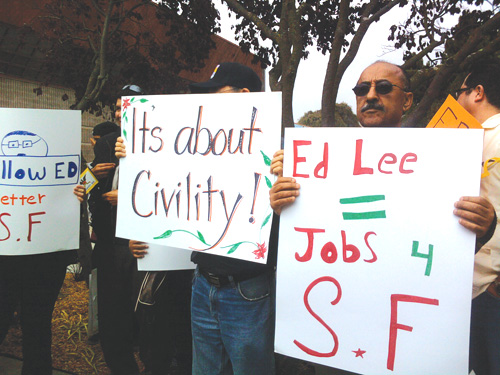
I have friends — progressives, activists, good people — who support Ed Lee for mayor. They tell me that Lee is accessible, that he listens to labor and grassroots community groups, that he’s going to be good on a lot of issues and that, compared to the mayors we’ve had in the past 30 years or so, he won’t be all that bad.

I respect that. I understand. But I try to remind them, and anyone else who’s listening, that the years when Willie Brown ran this town were really, really bad.

At the height of the Brown era, during the dot-com boom, hundreds of evictions were filed every single month. Thousands and thousands of low-income and working-class tenants were displaced, tossed out of San Francisco forever. Blue-collar jobs were destroyed as high-tech offices took over industrial space. Every single developer who waved money at the mayor got a permit, no matter how ridiculous, dangerous or crazy the project was.

In 1999, Paulina Borsook wrote a famous piece for Salon called “How the Internet ruined San Francisco.” But the Internet was just technology; what damaged this city so badly was a mayor who didn’t care what happened to the most vulnerable populations. At one point, Brown even said that poor people shouldn’t live in this city. We called his policies “the economic cleansing of San Francisco.”

He controlled local politics — brutally. If you didn’t kiss the mayor’s ring, you were crushed. He announced one day that the supervisors (then elected citywide) were nothing but “mistresses who have to be serviced” — and since most of them were utterly subservient to Brown, they didn’t even complain. Only one person on the board — Tom Ammiano — regularly defied the mayor; occasionally, Leland Yee and Sue Bierman joined him. But that was it.

The corruption was rampant. People who paid to play got in the door; nobody else came close. You did a favor for Brown and you got a commission appointment or a high-paid job, even if you weren’t remotely qualified.

The ones who suffered most were the poorest residents, particularly tenants, particularly on the east side of town. Brown didn’t seem to care that his appointments, deals and policies were causing terrible pain on the ground; it was as if politics was just a fun game, as if he were some sort of royal potentate, partying in the executive suites and ignoring what was happening on the streets.

There are people who believe that Ed Lee can be independent of Brown, and I hope they’re right. But Lee and Brown are close, and Brown helped put him in office — and the thought of even a small part of that rotten era of sleaze coming back makes me very, very nervous.

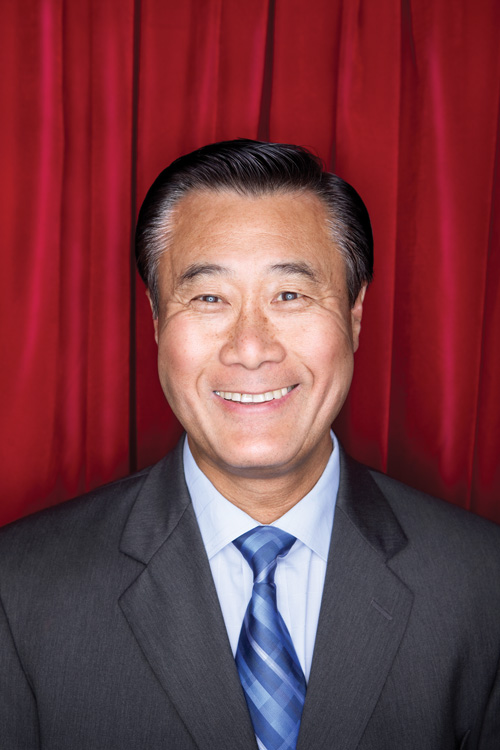
The real Leland Yee

53

tredmond@sfbg.com

It’s early January 2011, and the Four Seas restaurant at Grant and Clay is packed. Everyone who is anyone in Chinatown is there — and for good reason. In a few days, the Board of Supervisors is expected to appoint the city’s first Asian mayor.

The rally is billed as a statement of support for Ed Lee, the mild-mannered bureaucrat and reluctant mayoral hopeful. But that’s not the entire — or even, perhaps, the central — agenda.

Rose Pak, who describes herself as a consultant to the Chinese Chamber of Commerce but who is more widely known as a Chinatown powerbroker, is the host of the event. She stands in front of the room, takes the microphone, and, in Cantonese, delivers a remarkable political speech.

According to people in the audience, she says, in essence, that the community has come out to celebrate and support Ed Lee — but that’s just the start. She also urges them not just to promote their candidate — but to do everything possible to prevent Leland Yee from becoming mayor.

She continues on for several minutes, lambasting Yee, the state Senator who lived in Chinatown as a child, accusing him of about every possible political sin — and turning the Lee rally into an anti-Yee crusade. And nobody in the crowd seems terribly surprised.

Across Chinatown, from the liberal nonprofits to the conservative Chamber of Commerce, there’s a palpable fear and distrust of the man who for years has been among San Francisco’s most prominent Asian politicians — and who, had Lee not changed his mind and decided to run for a full term this fall, was the odds-on favorite to become the city’s first elected Chinese mayor.

The reasons for that fear are complex and say a lot about the changing politics of Asian San Francisco, the power structure of a city where an old political machine is making a bold bid to recover its lucrative clout — and about the career of Yee himself.

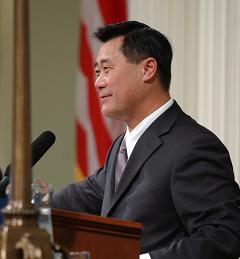
Senator Leland Yee is a political puzzle. He’s a Chinese immigrant who has built a political base almost entirely outside of the traditional Chinatown community. He’s a politician who once represented a deeply conservative district, opposed tenant protections, voted against transgender health benefits and sided with Pacific Gas and Electric Co. on key environmental issues — and now has the support of some of the most progressive organizations in the city. He’s taken large sums of campaign money from some of the worst polluters in California, but gets high marks from the Sierra Club.

His roots are as a fiscal conservative — yet he’s been the only Democrat in Sacramento to reject budget compromises on the grounds that they required too many spending cuts.

He’s grown, changed, and developed his positions over time. Or he’s become an expert at political pandering, telling every group exactly what it wants to hear. He’s the best chance progressives have of keeping the corrupt old political machine out of City Hall — or he’s a chameleon who will be a nightmare for progressive San Francisco.

Or maybe he’s a little bit of all of that.


Leland Yin Yee was born in Taishan, a city in China’s Guangdong province on the South China Sea. The year was 1948; Mao Zedong’s Communist Party of China had taken control of much of the countryside and was moving rapidly to take the major cities. The nationalist army of General Chiang Kai-Shek was falling apart, and Yee’s father, who owned a store, decided it was time for the family to leave.

The Yees made it to Hong Kong, and since Mee G. Yee had previously lived in the United States and served in the U.S. Army during World War II, he was ultimately able to move the family to San Francisco. In 1951, the three-year-old Leland Yee arrived in Chinatown.

For four years, Yee lived with his sister and mother in a one-room apartment with a shared bathroom while his father worked as a sailor in the merchant marine. It was, Yee recalled in a recent interview, a tight, closed, and largely self-sufficient community.

“The movie theater, the shoe store, the barber shop, food — everything you needed you could get in Chinatown,” Yee said. “You never had to leave.”

Of course, after a while, Yee and his mom started to venture out, down Stockton Street to Market, where they’d shop at the Emporium, the venerable department store. “It was like walking into a different country,” he said. “If you didn’t know English, they didn’t have time for you.”

Yee, like a lot of young Chinese immigrants of his era, put much of his time into his studies — in the San Francisco public schools and in a local Chinese school. “My mom spoke a village dialect, and we had to learn Cantonese,” he said. “Every little kid had to go to Chinese school. We hated it.”

When Yee was eight, his parents managed to buy a four-unit building on Dolores Street, and the family moved to the Mission, where he would spend not only the rest of his childhood but much of his early adult life. He graduated from Mission High School, enrolled in City College, studied psychology and after two years won admission to UC Berkeley.

Berkeley in 1968 was a very different world from Chinatown and even the relatively controlled environment he’d experienced at home in the Mission. “You didn’t protest in school. You’d have been sent home, and your mother would kill you,” he said.

At Berekely, all hell was breaking loose, with the antiwar protests, the People’s Park demonstrations, the campaign to create a Third World College (which led to the first Ethnic Studies Department), and a general attitude of mistrust for authority. “I developed a sense of activism,” Yee said. “I realized I could speak out.”

That spirit quickly vanished when Yee lost faith in some of his fellow activists. “People would work with us, then get into positions of power and use that against you,” he recalled. “A lot of my friends said ‘forget it.’ I left the scene.”

Yee once again devoted his energy to school, earning a masters at San Francisco State University and a Ph.D in child psychology from the University of Hawaii. Along the way, he met his wife, Maxine.

With his new degree, the Yees moved back to San Francisco — and back in with his parents at the Dolores property, where he, Maxine and a family that would grow to four kids would live for more than a decade.


Yee worked as a child psychologist for the San Francisco Department of Public Health, starting the city’s first high school mental-health clinic. He went on to become a child psychologist at the Oakland Unified School District, then joined a nonprofit mental health program in San Jose.

In 1986, Yee decided to get active in politics for the first time since college, and ran for the San Francisco School Board. He lost — and that would be the only election he would ever lose. In 1988, he won a seat, and established himself as an advocate for students of color, fighting school closures in minority neighborhoods. He also tried to get the district to modify its harsh disciplinary rules, arguing against mandatory expulsions.

On fiscal issues, though, Yee was a conservative. For his first term, despite the brutal cutbacks of the recession of the late 1980s and early 1990s, he insisted that the district make do with the money it had. His solution to the red ink: Cut waste. Only in 1992, when he was up for re-election, did he acknowledge that the district needed more cash; at that point, he supported a statewide initiative to tax the rich to bring money to the schools.

The sense of fiscal conservatism — of holding the line on taxes, but mandating open and fair contracting procedures and tight financial controls — was a hallmark of much of his political career. When the Guardian endorsed him for re-election to the board in 1992, we wrote that “there’s real value in his continuing vigilance against administrative fat and favoritism in contracts.”

Over the next four years, Yee worked with then-Superintendent Waldemar “Bill” Rojas, a deeply polarizing figure who pushed his own personal theory of “reconstitution” — firing all the staff at low-performing schools — and later was enmeshed in a scandal that led to prison time for a contractor he’d hired. Yee told me he was the only board member to vote against hiring Rojas, but people who were watching the board closely back then say he didn’t always stand up to the superintendent.

He also became what some say was a bit too close with Tim Tronson, a consultant hired by the district as a $1,000-a-day facilities consultant. Tronson wound up getting indicted on 22 counts of grand theft, embezzlement, and conspiracy in a scheme to steal $850,000 from the schools, and was sentenced to four years in state prison.

In 1998, when some school board members wanted to build housing for teachers on property that the district owned in the Sunset, Yee led the opposition — with Tronson’s help. At one meeting at Sunset Elementary School, Yee went so far as to say, according to people present, that “Tim Tronson is my man, and I rely on him for advice.”

Yee acknowledged that he worked closely with Tronson to defeat that housing project. “He was the facilities manager,” Yee explained, “and I said that I trusted his judgment.”


Yee has either a great sense of political timing or exceptional luck. He ran for the Board of Supervisors in 1996, facing one of the weakest fields in modern San Francisco history. He was the only Chinese candidate and one of just two Asians (the other, appointed incumbent Michael Yaki, barely squeaked to re-election). In an at at-large election with the top five winning seats, Yee came in third, with 103,000 votes.

He was never a progressive supervisor. In 2000, the Guardian ranked the good votes of what we referred to as Willie Brown’s Board, and Yee scored only 43 percent. He was against campaign finance reform. He supported the brutal gentrification and community displacement represented by the Bryant Square development. He voted to kill a public-power feasibility study and opposed the Municipal Utility District initiative. He opposed a moratorium on uncontrolled live-work development.

In 2002, Yee was one of only three supervisors to oppose Proposition D, a crucial public-power measure that would have broken up PG&E’s monopoly in the city. He stood with PG&E (and then-Sups. Tony Hall and Gavin Newsom) in opposition to the measure, then signed a pro-PG&E ballot argument packed with PG&E lies.

When I asked him about that stand, Yee at first didn’t recall opposing Prop. D, but then said he “stood with labor” on the issue. In fact, the progressive unions didn’t oppose Prop. D at all; the opposition was led by PG&E’s house union, IBEW Local 1245.

Yee was particularly bad on tenant issues. He not only voted to deny city funding for the Eviction Defense Collaborative, which helped low-income tenants fight evictions; he actually tried to get the city to put up money for a free legal fund to help landlords evict their tenants. He opposed a ballot measure limiting condo conversions. He opposed a measure to limit the ability of landlords to pass improvement costs on to their tenants.

In 2001, Yee voted to uphold a Willie Brown veto of legislation to limit tenancies in common, a backdoor way to get around the city’s condo conversion ordinance. Only Hall and Newsom, then the most conservative supervisors on the board, joined Yee. At one point, he started asking whether the city should consider repealing rent control.

He opposed an affordable housing bond in 2002, joining the big landlord groups in arguing that it would raise property taxes. Every tenant group in town supported the measure, Proposition B; every landlord group opposed it.

I asked Yee about his tenant record, and he told me that he now supports rent control. But he said that he was always on the side of homeowners and small landlords, and that property ownership was central to Chinese culture. “I was responding to the Chinese community and the West Side,” he said.

He wasn’t much of an environmentalist, either — at least not in today’s terms. He was one of the only city officials to support a “Critical Car” rally in 1999, aimed at promoting the rights of vehicle drivers (and by implication, criticizing Critical Mass and the bicycle movement).

His record on LGBT issues was mixed. While he supported a counseling program for queer youth when he was on the school board, he also supported JROTC, angering queer leaders who didn’t want a program in the public schools run by, and used as a recruiting tool for, the military, which at that point open discriminated against gay and lesbian people.


Yee was also one of only two supervisors who voted in 2001 against extending city health benefits to transgender employees.

That was a dramatic moment in local politics. Nine votes were needed to pass the measure, and while eight of the supervisors were in favor, Yee and Hall balked. At one point, Board President Tom Ammiano had to direct the Sheriff’s Office to go roust Sup. Gerardo Sandoval, who was ducking the issue in his office, to provide the crucial ninth vote.

Yee didn’t just vote against the bill. According to one reliable source who was there at the time, Yee spoke to a community meeting out on Ulloa Street in the Sunset and berated his colleagues, quipping that the city should have better things to do than “spend taxpayer money on sex-change operations.”

It was a bit shocking to trans people — Yee had, over the years, befriended some of the most marginalized members of what was already a marginalized community. “There was one person at the rail crying, saying ‘Leland, how could you do this to us,'” Ammiano recalled.

The LGBT community was furious with Yee. “I didn’t speak to him for at least a year,” Gabriel Haaland, one of the city’s most prominent transgender activists, told me.

Yee now says the vote was a mistake — but at the time, he told me, he was under immense pressure. When he voted for the queer youth program, he said, “the elders of the Chinese community ripped me apart. They called my mother’s friends back in the village [where he was born] and said her son was embarrassing the Chinese community.”

That must have been difficult — and he said that “if I had known the pain I had caused, I wouldn’t have voted that way.” But it was hard to miss that pain his vote caused.

On the other hand, people learn from their experiences, attitudes evolve, we all grow up and get smarter, and the way Yee describes it, that’s what happened to him.

In 2006, when he was running for state Senate, Yee met with a group of trans leaders and formally — many now say sincerely — apologized. It was an important gesture that made a lot of his critics feel better about him.

“He didn’t have to do that,” Haaland said. “People change, and he paid for his crime, and that’s genuine enough for me.”

As a former school board member, Yee kept an interest in the schools — but not always a healthy one. At one point, he actually proposed splitting SFUSD into two districts, one on the (poorer) east side of town and one on the (richer) west. “We strongly opposed that,” recalled Margaret Brodkin, who at the time ran Coleman Advocates for Children and Youth. “Eventually he dropped the idea.”

For all the problems, in his time on the Board of Supervisors, Yee developed a reputation for independence from the Brown Machine, which utterly dominated much of city politics in the late 1990s. His weak 43 percent rating on the Guardian scorecard was actually third-best among the supervisors, after Ammiano and the late Sue Bierman.

In 1998, he was one of the leaders in a battle to prevent the owners of Sutro Tower from defying the city’s zoning administrator and placing hundreds of new antennas on Sutro Tower. He, Bierman, and Ammiano were the only supervisors opposing Brown’s crackdown on homeless people in Union Square.

When he ran in the first district elections, in 2000, against two opponents who had Brown’s support and big downtown money, the Guardian endorsed him, noting that while he “can’t be counted on to support worthy legislation … He’s one of only two board members who regularly buck the mayor on the big issues.”

(He never liked district elections, and used to take any opportunity to denounce the system, at times forcing Ammiano to use his position as president to tell Yee to quit dissing the electoral process and get to the point of his speech.)


In 2002, the westside state Assembly district seat opened up, and both Yee and his former school board colleague Dan Kelly ran in the Democratic primary. Yee won, and went on to win the general election with only token opposition.

His legislative record in the Assembly wasn’t terribly distinguished. Yee never chaired a policy committee — although he did win a leadership post as speaker pro tem. And he cast some surprisingly bad votes.

In 2003, for example, then-Assemblymember Mark Leno introduced a bill that would have exempted single-room occupancy hotels from the Ellis Act, which allows landlords to evict tenants for no reason. Yee refused to vote for the bill. Leno was furious — he was one vote short of a majority and Yee’s position would have doomed the bill. At the last minute, a conservative Republican who had grown up in an SRO hotel voted in favor.

When he ran for re-election in 2004, we noted: “What’s Leland Yee doing up in Sacramento? We can’t figure it out — and neither, as far as we can tell, can his colleagues or constituents. He’s introduced almost no significant bills — compared, for example, to Assemblymember Mark Leno’s record, Yee’s is an embarrassment. The only high-profile thing he’s done in the past several years is introduce a bill to urge state and local governments to allow feng shui principles in building codes.”

In 2006, Yee decided to move up to the state Senate, and he won handily, beating a weak opponent (San Mateo County Supervisor and former San Francisco cop Mike Nevin) by almost 2-1. His productivity increased significantly in the upper chamber — and in some ways, he moved to the left. He’s begun to support taxes — particularly, an oil severance tax — and when I’ve questioned him, he somewhat grudgingly admits that Prop. 13 deserves review.

He’s done some awful stuff, like trying to sell off the Cow Palace land to private developers. But he has consistently been one of the best voices in the Legislature on open government, and that’s brought him some national attention.

Yee has been a harsh critic of spending practices and secrecy at the University of California, and when UC Stanislaus refused in 2010 to release the documents that would show how much the school was paying Sarah Palin to speak at a fundraiser, Leland flew into action. He not only blasted the university and introduced legislation to force university foundations to abide by sunshine laws; he worked with two Stanislaus students who had found the contract in a dumpster and made headlines all over the country.

He’s fought for student free speech rights and this year pushed a bill mandating that corporations that get tax breaks for job creation prove that they’ve actually created jobs — or pay the tax money back. He’s also won immense plaudits from youth advocates and criminal justice reformers for his bill that would end life-without-parole sentences for offenders under 18.

Along the way, he compiled a 100 percent voting record from the major labor unions, including the California Nurses Association and SEIU, and with the Sierra Club. All three organizations have endorsed him for mayor.

Yee told me that he thinks he’s become more progressive over the years. “My philosophy has shifted,” he said.

Yet when you talk to his colleagues in Sacramento, including Democrats, they aren’t always happy with him. Yee has a tendency to be a bit of a loner — he’s never chaired a policy committee and in some of the most bitter budget fights, he’s refused to go along with the Democratic majority. Yee insists that he’s taken principled stands, declining to vote for budget bills that include deep service cuts. But the reality in Sacramento is that budget bills have until this year required a two-thirds vote, meaning two or three Republicans have had to accept the deal — and losing a Democratic vote has its cost.

“You have to give up all sorts of things, make terrible compromises, to get even two Republicans,” one legislative insider told me. “When a Democrat goes south, you have to find another Republican, and give up even more.”

In other words: It’s easy to take a principled stand, and make a lot of liberal constituencies happy, when you aren’t really trying to make the state budget work.


I met Rose Pak on a July afternoon at the Chinatown Hilton. She brought along her own loose tea, in a paper package; the waitress, who clearly knew the drill, took it back to the kitchen to brew. Pak and I have not been on the greatest of terms; she’s called the Guardian all kinds of names, and I’ve had my share of critical things to say about her. But on this day, she was polite and even at times charming.

After we got the niceties out of the way (she told me I was unfair to her, and I told her I didn’t like the way she and Willie Brown played politics), we started talking about Yee. And Pak (unlike some people I interviewed for this story) was happy to speak on the record.

She told me Yee had “no moral character.” She told me she couldn’t trust him. She told me a lot of stories and made a lot of allegations that we both knew neither she nor I could ever prove.

Then we got to talking about the politics of Chinatown and Asians in San Francisco, and a lot of the animosity toward Yee became more clear.

For decades, Chinatown and the institutions and people who live and work there have been the political center of the Chinese community. Nonprofits like the Chinatown Community Development Center have trained several generations of community organizers and leaders. The Chinese Chamber of Commerce, the Six Companies, and other business groups have represented the interests of Chinese merchants. And while the various players don’t always get along, there’s a sense of shared political culture.

“In Chinatown,” Gordon Chin, CCDC’s director, likes to say, “it’s all about personal connections.”

There’s a lively infrastructure of community-service programs, some of which get city money. There’s also a sense that any mayor or supervisor who wants to work with the Chinese community needs to at least touch base with the Chinatown establishment.

Yee doesn’t do that. “He doesn’t give a shit about them,” David Looman, a political consultant who has worked with many Chinese candidates over the years, told me.

Yee’s Asian political base is outside of Chinatown; he told me he sees himself representing more of the Chinese population of the Sunset and Richmond and the growing Asian community in Visitacion Valley and Bayview.

Pak is connected closely to Brown, who Yee often clashed with. For Pak, Brown, and their allies, strong connections to City Hall mean lucrative lobbying deals and public attention to the needs of Chinatown businesses. Then there’s the nonprofit sector.

CCDC and other nonprofits do important, sometimes crucial work, building and maintaining affordable housing, taking care of seniors, fighting for workers rights, and protecting the community safety net. Yee, Pak said, “has never shown any interest in our local nonprofits. We all work together here, and he doesn’t seem to care what we do.” Yee told me he has no desire to see funding cut for any critical social services in any part of town. But he has also made no secret of the fact that he questions the current model of delivering city services through a large network of nonprofits, some of which get millions of taxpayer dollars. And the way Pak sees it, all of that — the nonprofits, the business benefits, the contracts — are all at risk. “If Leland Yee is elected mayor,” she told me, “we are all dead.”

I ran into an old San Francisco political figure the other day, a man who has been around since the 1970s, inside and outside of City Hall, who remains an astute observer of the players and the power relationships in the local scene. At the time we talked, he wasn’t supporting any of the mayoral candidates, but he had a thought for me. “This town,” he said, “is being taken over by a syndicate. Willie Brown is the CEO, and Rose Pak is the COO, and it’s all about money and influence.”

That’s not a pleasant thought — I’ve lived through the era of political machine dominance in this town, and it was awful. In the days when Brown ran San Francisco, politics was a tightly controlled operation; only a small number of people managed to get elected to office without the support of the machine. Developers made land-use policy; gentrification and displacement were rampant; corruption at City Hall turned a lot of San Franciscans off, not only to the political process but to the whole notion that government could be a positive force in society.

A few years ago, I thought those days were over — and to a certain extent, district elections will always make machine politics more difficult. But when I see signs of the syndicate popping up — and I see a candidate like Ed Lee, who’s close friends with Brown, leading the Mayor’s Race — it makes me nervous. And for all his obvious flaws, at least Leland Yee isn’t part of that particular operation. If there’s a better reason to vote for him, I don’t know what it is.

YEE HOME PURCHASE RAISES SUSPICIONS

Rose Pak has a question about Leland Yee. “How,” she asked me, “did the guy manage to buy a million-dollar house on a $30,000 City Hall salary?”

Pak isn’t the only one asking — numerous media reports over the years have examined how Yee raised a family of four and bought a house in the Sunset on very little visible income. And while I’m not usually that interested in the personal finances of political candidates, I decided that it was worth a look.

Here’s what I found: Public records show that in July 1999, Yee and his wife, Maxine, purchased a house on 24th Avenue for $875,000 (it’s now assessed at slightly more than $1 million). At the time, Yee was a San Francisco supervisor, earning a little more than $30,000 a year. (The salary of the supervisors was raised dramatically shortly after Yee left the board and went to the state Assembly.) His wife wasn’t working. And his economic interest statements for that period show no other outside earnings. So the disposable, after-tax income of the entire Yee family couldn’t have been much more than $25,000.

That, by any normal standard, shouldn’t have been enough to float a mortgage that, records show, totaled $516,000. In fact, the interest payments alone on that mortgage alone would total $3,600 a month — more than Yee’s gross income.

Documents in the Assessor’s Office show another paper trail, too. In 1989, Jung H. Lee, Yee’s mother, transferred the deed on a four-unit Dolores St. building where the family had been living to Maxine and Leland Yee — for no money. And a few months before the Yees bought the Sunset house, they took out a $320,000 home-equity loan on that property. That was the down payment on the Sunset property.

Still: At that point, the Yees would have been paying off two mortgages, with a total nut of about $5,000 a month — and supporting four kids, in San Francisco. In 2002, Yee’s economic interest statement’s show some modest income from teaching at Lincoln University — but nowhere near enough to pay that level of expenses.

What happened? Yee explains it this way: “For more than 10 years, we were living rent-free in my parents’ property,” he told me I an interview. “We were a close Chinese family, and my parents provided the food and helped pay for the children’s clothing. So we had almost no expenses and we lived very frugally.”

During that period, Yee was working for the San Francisco Department of Public Health, the Oakland Unified School District, and a San Jose nonprofit, earning, he said, between $50,000 and $90,000 a year. If he saved almost all of that money, he would have had more than a half-million dollars in the bank when he bought the Sunset house.

There’s nothing on any of his economic disclosure forms showing any ownership of stocks or other reportable financial interests during that period, so he wasn’t investing the money. In fact, he says, it was, and is, all in simple savings accounts. A bit unusual for that large a sum of money.

How did he get a mortgage? “Back then,” he said, “banks were willing to lend a lot more freely than they do today.”

Starting in 2003, Yee was in the state Assembly, making a higher salary — but still not much in excess of $100,000 a year. After taxes, he was probably taking home about $75,000 — and $60,000 was going to the two mortgages.

How did he do it? “We have been supplementing our income with our savings,” he said. “We don’t take vacations, we are very careful with our money.” And they clearly aren’t desperate for cash — Yee’s daughter occupies two of the four units in the Dolores St. building they own, but the other two units are vacant.

It’s possible. It’s plausible. But I don’t blame people for wondering how he managed to pull it off. (Tim Redmond, with research assistance by Oona Robertson) 


BIG CORPORATIONS HAVE BACKED YEE

Yee became a prodigious fundraiser in Sacramento — and a lot of the money came from big corporations that had business in the Legislature. And while he has perfect scores from the Sierra Club and the big labor unions, he’s taken tens of thousands of dollars from some of the biggest corporations, agribusiness interests, and polluters in the state. And at times, he’s voted their way.

Since 1993, for example, campaign finance records show Yee has taken more than $20,000 from Chevron, ExxonMobil, Valero, Conoco Phillips, and BP. He’s received another $22,450 from the chemical industry (and industry employees). Most of it came from Clorox, Dow Chemical, and Dupont.

And while the Sierra Club may not have considered it a priority, Sen. Mark Leno has worked hard to pass a bill limiting chemical fire retardants in furniture. In 2008, Yee voted against Leno’s AB 706.

That year he also refused to support a bill that would prohibit the use of the chemical diacetyl in workplaces. The industries that opposed AB 514 (including Bayer, Abbott Laboratories, Pfizer, and Johnson & Johnson) have given Yee a total of more than $60,000.

In 2003, Yee voted against a crucial tenant bill, one that would have prevented the owners of single room occupancy hotels from using the Ellis Act to evict tenants. He received a campaign check for $2,500 from the San Francisco Apartment Association the next day. Landlords in general have given Yee close to $40,000.

Then there’s agribusiness. Yee gets a lot of money from the farming industry, despite the fact that there obviously aren’t many farms in his district. Why, for example, would the California Poultry Association, the California Cattlemen’s Association, and the California Farm Bureau give him money? The Poultry Association’s Bill Mattos told us that Yee “has taken a keen interest in California’s poultry industry.”

Yee also took immense flak from the San Francisco Chronicle and other papers over a 2003 vote against a bill to limit emissions from farm vehicles. In an editorial, the paper wrote that he was “doing dirty work for the lobbyists.” In the end, under immense public pressure, he switched positions and voted for the bill. I asked Yee about all that money from all those bad operators, and he told me — as most politicians will — that campaign cash has never influenced any of his votes.

So why do all these groups give him money? “It’s about whether you will sit down and listen,” Yee said. “I will talk to all sides and at least consider the arguments as a thoughtful human being. Then I vote my conscience.” (Tim Redmond, with research by Oona Robertson) 

Dick Meister: si se puede!

0

By Dick Meister

(The second part of a daily five part series)

For me, it all began on a hot summer night in 1965 in the little Kern County town of Delano. I’d been told repeatedly by people whose judgment I respected that, as the SF Chronicle’s labor editor, I should talk with some guy named Chavez who was pitting together an honest-to-God farm workers’ union in Delano.

I scoffed, but I went. Chavez, shining black hair trailing over the edge of a face brushed with traces of Indian ancestry, wearing a green plaid shirt that had become almost a uniform, sat behind a makeshift desk topped with bright red Formica.

“Si se puede!” he said repeatedly to me as we talked into the early morning hours there in the cluttered shack that served as headquarters for Chavez and the others who were trying to create an effective farm workers union.

“Si se puede – it can be done!

But I would not be swayed. Too many others, over too many years, had tried and failed to win for farm workers the union rights they had to have if they were to escape the severe economic and social deprivation inflicted on them by their grower employers.

The Industrial Workers of the World who stormed across western fields early in the last century, the Communists who followed, the socialists, the AFL and CIO organizers – all their efforts had collapsed under the relentless pressure of growers and their powerful political allies.

I was certain this effort would be no different. I was dead wrong. I had not accounted for the tactical brilliance of Cesar Chavez, a sad-eyed, disarmingly soft-spoken man who talked of militancy in calm, measured tones; a devout Roman Catholic; a gentle and incredibly patient man who hid great strategic talent behind shy smiles and an attitude of utter candor.

Chavez grasped the essential fact that farm workers had to organize themselves. Outside organizers, however well-intentioned, could not do it. Chavez, a farm worker himself, carefully put together a grass-roots organization that enabled the workers to form their own union, the United Farm Workers, which then sought out – and won – widespread support from influential outsiders, including major labor, religious and political figures.

The key weapon of the newly formed UFW was the boycott. The union’s boycotts against grape and lettuce growers and wineries in the late 1960s won the UFW union contracts that had been denied farm workers for more than a century.

That led ultimately to enactment of the California law that requires growers to bargain collectively with workers who vote for unionization, despite the workers exclusion from the federal law that grants most non-farm workers the legal right of collective bargaining. And with that came substantial improvements in the pay, benefits, working conditions and general status of the state’s farm workers.

The struggle was extremely difficult for the impoverished workers, and Chavez risked his health – if not his life – to provide them extreme examples of the sacrifices necessary for victory. Most notably, he engaged in lengthy, highly publicized fasts that helped rally the public to the farm workers cause and that may very well have contributed to his untimely death in 1993 at age 66.

Fasts, boycotts. It’s no coincidence that those were among the principal tools of Mohandas Gandhi, for Chavez drew much of his inspiration from the Indian leader. Like Gandhi and another of his models, Martin Luther King Jr., Chavez believed fervently in the tactics of non-violence. Like them, he showed the world how profoundly effective they can be in seeking justice from even the most powerful of opponents.

What the UFW accomplished, and how the union accomplished it, will never be forgotten – not by the millions of social activists who have been inspired and energized by the farm workers’ struggle, nor by the workers themselves.

The struggle continues, for despite the UFW’s successes, most farm workers are still mired in poverty. But because of the union, they have a genuine hope of bettering their condition.

The UFW won important legal rights for them. But more than union contracts, and more than laws, farm workers now have what Cesar Chavez insisted was needed above all else. That, as he told me so many years ago, “is to have the workers truly believe and understand and know that they are free, that they are free men and women, that they can stand up and say how they feel.”

Freedom. No leader has ever left a greater legacy.


Dick Meister, former labor editor of the SF Chronicle and KQED-TV Newsroom, has covered labor and politics for more than a half-century. Contact him through his website, www.dickmeister.com, which includes more than 350 of his columns.


Dick Meister: the farmworkers are marching to Sacramento

4

By Dick Meister

(Part one of a five part daily series on the farmworkers)

It’s hot, very hot, in the Central Valley, but still they march on toward Sacramento, thousands of members and supporters of the United Farm Workers union. They’ve been at it since August 22nd, when the 13-day, 200-mile trek began. The UFW has done it before, and for good reason. Like the others in the past, this march has drawn public attention to the union’s cause, energized its members and current supporters and doubtless added to its many supporters worldwide.

But will the march accomplish its immediate goal? That’s to win passage of the Fair Treatment for Farm Workers Act that would overcome serious obstacles to farm worker unionization, and another bill that would grant farm workers the right to be paid overtime after eight hours a day, 40 hours a week like non-agricultural workers.

That is largely up to Gov. Jerry Brown, who in June vetoed the Fair Treatment for Farm Workers Act for being “too drastic,” despite direct pressure from more than 1000 workers during the 12 days he deliberated before acting on the bill. They fasted, held vigils outside his office and rallies on the capitol grounds, complaining loudly about the desperate need for firm union rights to improve their miserable pay and working conditions, including the great need to protect them from the severe – sometimes deadly – heat in which they must work.

As a Kern County vineyard worker, Eva Orozco, explained:

“The pay is very low, they pressure us heavily to produce, they don’t respect us and we have to run and drink water quickly and use the bathroom quickly because if we take long we could be fired. Sometimes I’m afraid to show up for work for fear that that I will not work fast enough and I will be fired.”

The marchers will bring their complaints and demands directly to Brown when their march ends Sept. 4 outside Brown’s office. Like his father, former Gov. Pat Brown, Jerry Brown once was one of the UFW’s closest allies. In his earlier term as governor, Jerry Brown pushed through the Legislature the pioneering bill that granted California farm workers the union rights denied them elsewhere.

Ironically, the first of the UFW’s marches to Sacramento, in 1966, was aimed at pressuring Gov. Pat Brown to sponsor a bill that would grant union rights to farm workers. He refused, despite the urgings of more than 8,000 UFW members and supporters who gathered outside the Capitol at the end of the 25-day march.

Farm workers did not get those rights until his son won passage of the bill – the Agricultural Labor Relations Act or ALRA – that granted the rights nine years later after a week long march from San Francisco to the Modesto headquarters of the huge Gallo winery, which had rebuffed vineyard workers’ demands for a union representation election.

More than 15,000 people marched into Modesto, convincing Jerry Brown and state legislators that the UFW retained a sizable and influential constituency and great organizational ability. That had very much to do with passage of the ALRA and the consequent success of the UFW in winning union contracts, The law, however, was barely enforced by Democrat Brown’s successors as governor, Republicans George Deukmejian and Pete Wilson and Democrat Gray Davis.

The latest march could very well convince Jerry Brown to come to the aid of some of the state’s neediest, yet most broadly supported workers. He did it before and he can do it again.


Dick Meister, former labor editor of the SF Chronicle and KQED-TV Newsroom, has covered labor and politics for more than a half-century. Contact him through his website, www.dickmeister.com, which includes more than 350 of his columns.


Bestivals

0

caitlin@sfbg.com

FALL ARTS Now that even the quaintest neighborhood block parties publish music lineups in advance and big beat fests give as much shine to snack vendors as secondary stages, it’s becoming clear that the events on our fall fair and festival listings are all just part of one big movement. Leading to what, you might ask? Leading to you having a celebrate-good-times kind of autumn in the Bay Area. Seize the day, pack your sunscreen, bring cash: from film to activism to chocolate, here comes the sun.


NOW-SEPT. 25

Shakespeare in the Park Presidio’s Main Post Parade Ground Lawn, between Graham and Keyes, SF. (415) 558-0888, www.sfshakes.org. Times vary, free. Whilst thou be satisfied with the Bard’s hits in the open air, free for you and the clan? The line-up, from Cymbeline to Macbeth, suggests that it won’t be so hard.


AUG. 27

J Pop Summit Japantown Peace Plaza, SF. www.newpeopleworld.com. 11 a.m.-6 p.m., free. Enter the kaleidoscope of anime, manga, Lolita, androgynously cute boys in tuxedo jackets, keyboard theatrics, and Vocaloid (a computer program that creates complete songs, vocals and all) contests at this unique festival marathon of Japanese pop culture.

Rock The Bells Shoreline Amphitheatre, Mountain View. www.rockthebells.net. 10:55 a.m.-10:25 p.m., $55.50-281.00. Lauryn Hill, Nas, GZA, Common, Black Star — the country’s biggest hip-hop festival hits the Bay, bigger than ever.


SEPT. 3

International Cannabis and Hemp Expo Telegraph from 16th to 20th sts. and Frank Ogawa Plaza, Oakl. intche.eventbrite.com. Noon-8 p.m., $18-300. 120 different strains of Mary Jane should be enough to get you through eight hours of festival — if not, there will be three stages of music and educational speakers for pot pals to trip on.


SEPT. 3-4

Zine Fest SF County Fair Building, 1199 Ninth Ave., SF. www.sfzinefest.org. 11 a.m.- 6 p.m., free. If arbiter of Bay indie comic cute Lark Pien’s original kitty cat Zine Fest 2011 poster doesn’t hook you (how?), you’re sure to find something that tickles your cut-and-paste among the aisles at this assemblage of DIY publishers and comic heads.

Millbrae Art and Wine Festival Broadway between Victoria and Meadow Glen, Millbrae. (650) 697-7324, www.miramarevents.com. 10 a.m.- 5 p.m., free. Celebrate Labor Day at this multi-faceted celebration of artisan comestibles, classic cars, live tunes, and hundreds of crafters — it even has a kids talent show.


SEPT. 4

EcoFair Marin Marin County Fairgrounds, San Rafael. www.ecofairmarin.org. 10 a.m.-7 p.m., $5. The keynote speaker at this expo of all things green and cutting-edge is Temple Grandin, Ph.D., one of the world’s leading autism advocates.


SEPT. 7-18

Fringe Festival Various locations, times, prices. www.sffringe.org. This festival’s egalitarian method of stage assignments mean that there’s no better time of year in the city to check out first-time playwrights and original (yes, sometimes wonky) scripts.


SEPT. 8-11

Electronic Music Festival Brava Theater Center, 2789 24th St., SF. www.sfemf.org. The Bay’s new music artists pop off together for this long weekend of exploration of the sonic spectrum.


SEPT. 10

Brews on the Bay Pier 45, SF. www.sfbrewersguild.org. Noon-5 p.m., $45. The city’s biggest brewers: Magnolia, Beach Chalet, Anchor, and Speakeasy among others, pour out endless tastes at this Bay-side swigfest


SEPT.10-11

Ghirardelli Square Chocolate Festival Ghriradelli Square, North Point and Larkin sts., SF. (415) 775-5500, www.ghirardellisq.com. Noon-5 p.m., $20 for 15 samples. A benefit for chronically ill and housebound elderly folks, chocolatier demonstrations and ice cream sandwich-eating contests sprinkle over this day of chocolate tasting par excellence.


SEPT. 14-18

Berkeley Old Time Music Convention Times, locations, and prices vary. www.berkeleyoldtimemusic.org. Loosen up them joints — it’s time to get goofy and gangly to some banjos and flat-footin’ at this multi-day Americana celebration of film screenings, concerts, open jams, and more.

Power and Sailboat Expo Jack London Square, Broadway and First St., Oakl. (510) 536-6000, www.ncma.com. Wed.-Fri., noon — 6 p.m.; Sat.-Sun., 10 a.m.-6 p.m., $10. In the market for a rubber inflatable raft? Wanna scope haute yachts? Sail away to this family-friendly event on the Bay.


SEPT. 15 — DEC. 18

SF Jazz Fest Times, locations, and prices vary. (866) 920-5299, www.sfjazz.org. Esperanza Spalding, Booker T., Aaron Neville, and performances by SF’s most talented high school jazz players mark this season of innovative concerts and jazz appreciation events.


SEPT. 23-25

Eat Real Jack London Square, Broadway and First St., Oakl. (510) 250-7811, www.eatrealfest.com. Fri, 1-8 p.m.; Sat, 11 a.m.-8 p.m.; Sun, 11 a.m.-7 p.m., free. A celebration of all foods local and sustainable, you can enter your prize pickles in a contest at this burgeoning fest, learn how to be a backyard farmer, and of course, eat good food til you burst.


SEPT. 23 — OCT. 16

24 Days of Central Market Arts www.centralmarketarts.org. Most events are free. The heart of the city organizes this smorgasboard of art events — from world class dance to circus to quirky theater pieces. Take your brown bag (lunch? something else?) down to Civic Center for one of the free performances.


SEPT. 24

Lovevolution Oakland Coliseum, 7000 Coliseum Way, Oakl. www.sflovevolution.org. Noon- 8 p.m., $25. The days of prancing neon-ly down Market Street are over but hey, Oakland’s got better weather! This year’s massive outdoor rave stages its traditional parade around the circumference of the coliseum’s parking lot.


SEPT. 25

Folsom Street Fair Folsom between Seventh and 12th sts., SF. www.folsomstreetfair.org. 11 a.m.- 6 p.m., $10 suggested donation. Sure, it’s touristy, but this kink community mega-event has its heart in the right place (between its legs). The premier place to get whipped in public, hands down.


SEPT. 30 — OCT. 2

Hardly Strictly Bluegrass Speedway Meadows, Golden Gate Park, SF. www.strictlybluegrass.com. Sure this homegrown free twangfest gets more crowded by the year — but attendance numbers are directly tied to the ever-more-badass lineup of multi-genre legends. This year: Emmylou Harris, Bright Eyes, Broken Social Scene, Robert Plant — and yes, MC Hammer.

Oktoberfest By the Bay Pier 48, SF. 1-888-746-7522, www.oktoberfestbythebay.com. Fri, 5 p.m.-midnight; Sat, 11 a.m.-5 p.m. and 6 p.m.-midnight; Sun, 11 a.m.-6 p.m., $25-65. Oompah, it’s time for some bratwurst! Raise your stein to this boozy celebration of German culture.


OCT. 1

Wildlife Conservation Expo Mission Bay Conference Center, 1675 Owens, SF. www.wildnet.org. 10 a.m.- 6 p.m., $30-60. Save the Botswanan cheetahs and okapis! Learn from leading conservationists about innovative environmental projects around the world.


OCT. 1-2

World Vegetarian Day County Fair Building, 9th Ave. and Lincoln, SF. (415) 273-5481, www.worldvegfestival.com. 10 a.m.-6 p.m., $10 suggested donation, free before 10:30 a.m. The 40-year old SF Vegetarian Society sponsors this expo of veggie livin’ — expert speakers talk science and advocacy, and there’ll even be a round of vegan speed dating for those hoping to share their quinoa with a like-minded meatless mama.

Alternative Press Expo (APE) Concourse Exhibition Center, 635 Eighth St., SF. (619) 491-1029, www.comic-con.org/ape. Check website for times and prices. The indie version of Comic-Con offers a weekend designed to give budding comics a leg up: workshops, keynote talks by slammin’ scribblers, issue-based panel discussions, and tons of comics for sale.


OCT. 2

Castro Street Fair Castro and Market, SF. (415) 841-1824, www.castrostreetfair.org. 11 a.m.- 6 p.m., free. This is no standard block party — big name acts take the stage at our historic homo ‘hood’s neighborhood get down, and along the curbs, crafters and chefs park alike.


OCT. 7-15

Litquake Times, locations, and prices vary. www.litquake.org. Our very own literary festival has grown a lot — the Valencia Street LitCrawl tradition has even spread to Austin and New York — check out its schedule for a chance to see one of your favorite scribes live and reading.


OCT. 9

Italian Heritage Day Parade Begins at Jefferson and Stockton sts., SF. (415) 703-9888, www.sfcolumbusday.org. 12:30 p.m., free. Peroni floats and courts of teenaged “Isabellas” reign supreme at this long-running North Beach cultural day.

Decompression Indiana outside Cafe Cocomo, SF. www.burningman.com. Check website for times prices. The Burning Man after-after-after party will be slammin’ this year, what with all the playa peeps that couldn’t score a ticket in the sell-out.


OCT. 15

Potrero Hill Festival 20th St. between Missouri and Arkansas, SF. potrerohillfestival.eventbrite.com. 9 a.m.- 4:30 p.m., free. $12 for brunch. A New Orleans-style mimosa brunch with live music kicks off this neighborhood gathering, also featuring a petting zoo and traditional Chinese dancers.

Noe Valley Harvest Festival 24th St. between Sanchez and Castro, SF. www.noevalleyharvestfestival.com. 10 a.m.- 5 p.m., free. Your little pumpkins can get their faces painted at this neighborhood fest, while you cruise the farmer’s market and meet the neighbors.


OCT. 15-16

Treasure Island Music Festival Treasure Island, SF. www.treasureislandfestival.com. $69.50-219.50. Indie fever takes a hold of the island this weekend, with a varied lineup this year featuring Aloe Blacc, Death Cab for Cutie, Empire of the Sun, and Dizzee Rascal.


OCT. 22

CUESA Harvest Festival In front of the Ferry Building, Embarcadero and Market, SF. www.cuesa.org. 10 a.m.-1 p.m., free. Butter churning, cider pressing, weaving demonstrations, and a chance to pick the mind of Bi-Rite Market founder Sam Morgannam.


NOV. 12-13

Green Festival SF Concourse Exhibition Center, 635 Eighth St., SF. www.greenfestivals.org. Sat, 10 a.m.- 7 p.m.; Sun, 11 a.m.- 6 p.m. Check website for prices. What would the sustainability movement be without endless halls of hemp backpacks and urban farming lectures? Keep up with the (Van) Joneses at this marquee environmental event.

Workin’ at the car wash

Worker advocates with La Raza Centro Legal and the San Francisco Day Labor Program are partnering with city officials for a creative approach to addressing the pervasive issue of wage theft: A worker-owned car wash.

On Aug. 17, attorneys from La Raza joined with City Attorney Dennis Herrera to announce that a lawsuit had been filed against the owners of Tower Car Wash for longstanding labor law violations that resulted in workers earning less than minimum wage. The complaint, filed jointly with the city and La Raza, seeks to recover up to $3 million in compensation, penalties, and interest for the cheated workers.

The Tower Car Wash lawsuit, along with other high-profile complaints alleging wage theft that the city has filed against the owners of Dick Lee Pastry and Danny Ho, who allegedly cheated day laborers out of the money they were owed, would never have come to fruition if low-wage workers hadn’t come forward. Individuals like Tower Car Wash employee Rosa Ochoa, who’s involved with La Raza’s Colectiva de Mujeres, have publicly challenged their employers for labor violations, a tough stand in a state with exceptionally high unemployment in the midst of a recession.

“What we feel like is really important about this lawsuit is that for us, it’s about worker empowerment,” says Workers’ Rights Coordinating Attorney Kate Hegé of La Raza. “It wouldn’t be possible without these workers being able to come forward.”

The idea for a worker-owned car wash emerged out of a desire to advance the goal of worker empowerment, Hegé notes. With help from Sup. David Campos, interim Mayor Ed Lee, and pro bono assistance from the law firm Orrick, Herrington & Sutcliffe, La Raza and the San Francisco Day Labor Program hope to establish a regular car wash on weekdays in the city-owned lot on Bayshore and Alemany boulevards, the location of the Alemany Farmer’s Market and the Alemany Flea Market on Saturdays and Sundays.

“We’ve been working with the city for the past several months to start a green, worker-owned car wash cooperative where workers of the San Francisco Day Labor Program would not only administer it, but work and gain benefits,” Renee Saucedo, Community Empowerment Coordinator at La Raza, told the Guardian. “The main thing about this day labor car wash is that it’s going to be run by the workers themselves.”

The project comes on the heels of a broader local effort to improve protections for low-wage workers. Earlier this month, the Board of Supervisors approved the Wage Theft Prevention Ordinance, crafted in partnership with the Progressive Workers Alliance to strengthen the the city’s Office of Labor Standards & Enforcement.

Inside the V.I.P. cocktail party with Willie Brown

The Alliance for Jobs and Sustainable Growth hosted a V.I.P. reception just before a mayoral candidate forum held at UCSF Aug. 16, and former Mayor Willie Brown appeared to be the guest of honor. Although the theme of the event was technically “honoring San Francisco’s mayors” — former Mayor Frank Jordan was there, someone indicated that former Mayor Art Agnos was in the room, former Mayor Gavin Newsom was invited but didn’t show, and Mayor Ed Lee was of course in attendence — Brown seemed to be given more prominent recognition than any of the others.

The moment he strolled in, Sup. Mark Farrell, who was doing introductions for the the affair, scrambled onstage to announce Brown’s presence and deliver a warm welcome, and everyone applauded. Within minutes, the former mayor was seen chatting with a crowd that included Mayor Lee and several others. Soon after, Brown and former Mayor Frank Jordan were summoned to the stage to say a few words.

Once in the limelight, Brown cracked a few jokes. He said he felt for the 36 mayoral candidates, who are forced to campaign in an era when the Internet threatens to reveal videos and photos of them at any time to thousands of online viewers. “I’m glad they didn’t have that kind of communication system when I was running,” he said. “I can’t imagine the photographs you’d have of me floating around doing things I shouldn’t have been doing.”

As for his own time in Room 200, “I enjoyed every single solitary minute of it, and if I really thought I had great skills, I would be number 37,” he said, drawing more applause.

Then again, common wisdom says it isn’t necessary for Brown to bother campaigning in order to gain access to Room 200 these days. Later that same evening, during his own turn in the spotlight at the mayoral debate, Mayor Lee came under fire from Board President David Chiu, who revealed that Lee had privately confided to him about a week before he announced his candidacy that he was having a difficult time saying no to Brown and influential Chinatown business consultant Rose Pak when it came to launching a campaign for a full term.

Chiu’s pointed question for the mayor was what had changed in his mind since that conversation, but Lee referenced neither Brown nor Pak in his answer. Instead, he said he’d changed his mind after witnessing his success in changing the tone of government and getting things done in City Hall.

Back at the V.I.P. reception, Brown and Jordan were invited onstage again, this time to receive awards presented by the Alliance for Jobs and Sustainable Growth. But first Steve Falk, president and CEO of the San Francisco Chamber of Commerce, reminded the crowd that there was still time to buy a drink before the debate got underway. He said, “Debates are much more interesting after three drinks.”

Before Falk presented Brown with a commemorative plaque, he said, “It’s tough to put in a few sentences the life and times of Willie Brown,” and proceeded to note that, with his term in the California Assembly and time serving as mayor of San Francisco behind him, Brown “has now followed his friend Herb Caen into an honest line of work as a columnist for the San Francisco Chronicle.”

Being a newspaper columnist doesn’t mean Brown is always kind to members of the local media. While mixing through the crowd minutes after receiving his award, he fired some harsh words at a well-known City Hall reporter who had recently published some unflattering articles about the “Run, Ed, Run” effort to encourage Lee to seek a full term.

In recent months, Brown’s columns have provided the public at large with a rare glimpse into Mayor Lee’s dining experiences in San Francisco. In February, Brown wrote in one of his columns that he went out to North Beach Restaurant at sat at the window table with Lee, Brown’s “friend” Sonya Molodetskaya, and Jack Baylis, who serves as the US Group Executive of Strategic Development for AECOM, one of the city’s largest contractors and a sponsor of the Alliance for Jobs and Sustainable Growth Event. (Baylis was on the invite list for the V.I.P reception, too.)

Apparently, AECOM had something to celebrate that same day — according to an Aug. 16 press release, an AECOM joint venture was just awarded a $150 million contract for program management services for the San Francisco Public Utilities Commission’s wastewater improvement program.

The V.I.P. reception had representation from many key players in the downtown business community, with sponsorship from AT&T, AECOM, Pacific Gas & Electric Co., Wells Fargo, Motorola, California Pacific Medical Center, the San Francsico Chamber of Commerce, the Building Owners and Managers Association, the San Francisco Police Officer’s Association, Shorenstein Properties, and others. Several labor unions, including the United Association of Plumbers & Pipefitters Union Local 38, United Brotherhood of Carpenters and Joiners of America Local Union No. 22, and United Food and Commercial Workers Union Local 5 were also listed as sponsors. Guests included district supervisors, developers, lobbyists, business owners, mayoral candidates, media spokespeople, executives from the health care industry, and other political insiders.

Clearly, there were many people in the room who wanted to get on Brown’s good side.

So much for civility

0

rebeccab@sfbg.com

The San Francisco mayor’s race went from a lackluster affair to a dynamic match as the Aug. 12 filing deadline drew near and two prominent city officials who had previously said they wouldn’t run tossed their hats into the ring.

Mayor Ed Lee’s Aug. 8 announcement that he’d seek a full term prompted several of his opponents to use their time onstage at candidate forums to decry his reversal and question his ties to the moneyed, influential backers who openly urged him to run. Several days later, Public Defender Jeff Adachi’s last-minute decision to run for mayor signaled more tension yet to come in the debates.

At this point, eight current city officials are running campaigns for higher office, and the dialogue is beginning to take on a tone that is distinctly more biting than civil. Adachi, who had not yet debated onstage with his opponents by press time, told reporters he was running because he wanted “to make sure there’s a voice in there that’s talking about the fiscal realities of the city.”

Adachi authored a pension reform ballot measure that rivals the package crafted by Lee, labor unions, and business interests (see “Awaiting consensus,” May 31, 2011). At an Aug. 11 candidate forum hosted by the Alice B. Toklas Democratic Club, the San Francisco Young Democrats, and the City Democratic Club, all of the top-tier candidates who were present indicated that they would support Lee’s pension reform measure and not Adachi’s.

“The reforms that I have championed are reforms that are absolutely needed, along with action,” Adachi told reporters moments after making his candidacy official. He added that after watching the mayoral debates, “I became convinced that either the candidates don’t get it, or they don’t want to get it.”

Those fighting words will likely spur heated exchanges in the months to come, but until Adachi’s entrance into the race, it was Lee who took the most lumps from opponents. Even Board President David Chiu, a mayoral candidate whose campaign platform is centered on the idea that he’s helped restore civility to local government, had some harsh words for Lee during an Aug. 11 mayoral debate.

“I do regret my decision to take Ed Lee at his word when he said he would not run,” Chiu said in response to a question about whether he regretted any of his votes. He also said his first interaction with Lee after the mayor had announced his candidacy was “a little like meeting an ex-girlfriend after a breakup.”

Lee, whose pitch on the campaign trail features a remarkably similar narrative about transcending political squabbling in City Hall, became the target of boos, hisses, and noisemaker blasts when a boisterous crowd packed the Castro Theater for an Aug. 8 candidate forum. He received one of the most forceful rebukes from Sen. Leland Yee, an opponent whom Lee supporters are especially focused on defeating.

“Had the mayor said that he would in fact run, he may not have gotten the votes for interim mayor,” Yee said. “Will you resign from your post,” he asked, challenging Lee, “in order to then run for mayor?” Days later, Yee had developed a new mantra about throwing power brokers out of City Hall instead of “wining and dining with them.”

Yet Lee said his decision to enter the race wasn’t because of the push from his backers, but because of how well things have gone during his brief tenure in Room 200. “Things have changed at City Hall, particularly in the last seven months,” he told reporters Aug. 8. “And because of that change, I changed my mind.”

In yet another twist, former Mayor Art Agnos — whom progressives had looked to as a potential appointee to the vacant mayor’s seat back in December, before Lee was voted in to replace former mayor and Lieutenant Governor Gavin Newsom — delivered a surprise endorsement of City Attorney Dennis Herrera shortly after Lee declared. The decision was particularly significant since Agnos first hired Lee to serve in city government, and has a long history of working with him.

“[Herrera] is an independent person who will empower neighborhoods … and won’t be beholden to power brokers,” Agnos said. He also told the Guardian he wasn’t surprised that Lee had opted to run, given the role former Mayor Willie Brown and influential business consultant Rose Pak had played in orchestrating Lee’s appointment.

“Anybody who is an astute political observer saw the signs from the very beginning,” Agnos said. In response to a comment about his unique vantage point as a would-be caretaker mayor, he said, “I would’ve kept my word and not run for reelection.”

Intense focus on Lee’s flip-flop, and on the Progress for All-backed “Run, Ed, Run” effort that was the subject of an Ethics Commission discussion that same week, stemmed at least in part from the threat the incumbent mayor represents to other candidates. A CBS 5-SurveyUSA poll suggested he became an instant front-runner.

Yet questions about “Run, Ed, Run” — some raised by observers unaffiliated with any campaigns — also served to spotlight the candidate’s longstanding ties with backers closely connected to powerful business interests that stand to lose big if their links to city government aren’t preserved.

Retired Judge Quentin Kopp issued an open letter to District Attorney George Gascón Aug. 1 urging him to convene a criminal grand jury to investigate whether illegal and corrupt influencing had occurred when Pak — a close friend of Lee’s and a key driver behind the “Run, Ed, Run” effort — reportedly recruited executives of Recology to gather signatures urging Lee to run.

Recology, which handles the city’s waste, was recently awarded a $112 million city contract, and Lee’s scoring of the company and recommendation to raise rates in his previous capacity as city administrator benefited the company. Brown received substantial campaign donations from Recology in previous bids for mayor. Kopp is the coauthor of a ballot initiative asking San Francisco voters if the company’s monopoly on city garbage contracts should be put out to bid.

“A criminal grand jury is vital in order to put people under oath and interrogate them,” Kopp said. “They would put Willie Brown under oath, put Pak under oath, put [Recology President Mike Sangiacomo] under oath, put [Recology spokesperson Sam Singer] under oath … That’s the course of action that should be pursued by this.”

Although Kopp told the Guardian that he hadn’t yet received a response from Gascón, DA candidates Sharmin Bock, Bill Fazio, and David Onek nevertheless seized the opportunity to publicly and jointly call for Gascón to recuse himself from any investigation into Progress for All. Gascón has a conflict of interest, they argued, since he reportedly sought Pak’s advice when deciding whether to accept Newsom’s offer to switch from his previous post as police chief to his current job as top prosecutor.

The Ethics Commission determined unanimously Aug. 8 that the activities of Progress for All, the committee that was formed to encourage Lee to run, had not run afoul of election laws despite director John St. Croix’s opinion that it had filed improperly as a general purpose committee when it ought to have been a candidate committee, which would have placed caps on contribution limits.

“The Ethics Commission has spoken, and they’ve supported our position,” Progress for All consultant Enrique Pearce of Left Coast Communications told the Guardian.

St. Croix did not return Guardian calls seeking comment, but an Ethics Commission press release included a caveat: “Should facts surface that coordination occurred between Mayor Lee and [Progress for All], such allegations will be investigated under the Commission’s enforcement regulations.”

At a Lee support rally organized by his official campaign team on Aug. 11, volunteers who arrived with “Run, Ed, Run” materials produced by Progress for All were told they could not display those signs and T-shirts; the same people were on a first-name basis with one of Lee’s campaign team members.

Pressed on the question of whether there was any coordination between agents of Progress for All and Lee, Pearce said the Ethics Commission discussion had focused on whether Lee had been a candidate. “Whether or not he’s a candidate has nothing to do with whether or not he has dinner with Rose [Pak],” Pearce noted. He insisted that there had not been coordination, and that the efforts to encourage Lee to run and to support Lee as a candidate were totally separate.

Sup. John Avalos, who is running for mayor on a progressive platform, recalled at an Aug. 8 candidate forum how things unfolded when Lee’s name first came up as an appointee for interim mayor.

Avalos reminded people that he had called for postponing the vote back in December because he hadn’t even had a chance to sit down and meet with Lee, who was in Hong Kong at the time. With behind-the-scenes deals orchestrating his appointment, Avalos said, “We saw City Hall turning into one big back room.”

The post-labor world

8

The engineers at Intel are thinking about the future, and they’ve hired sci-fi writers to help them imagine what the next few generations of chips will need to do. We’re talking about cars that drive themselves and space stations with AI — and, of course, about a future where robots do most of the work:


In one of the stories in “The Tomorrow Project,” a couple dash from Paris to the south coast of France to provide an injured relative with a blood transfusion. They travel in a car that navigates and drives itself. Medical information is wirelessly beamed to the vehicle’s dashboard and into mobile-phone-like ear studs. In another story, robotic automation has rendered jobs a thing of the past, and one human ponders what to do with his free time.


What to do with your free time. Imagine that.


Got me thinking about Player Piano, the first Vonnegut novel (and the first one I read, back in high school). In Vonnegut’s world, there are rich, educated people who control the machines — and then there’s everyone else, poor and frustrated and marginalized because there’s no meaningful work to do.


Seem familiar? Sound a little tiny bit like our jobless recovery?


Let me suggest something radical, something that a few futuristic writers have discussed but that’s no longer part of our national political consciousness. We may soon be heading for an economic system that involves massive structural unemployment. There may not be a need for as many human beings to do as much labor, particularly manual labor, as there has been in all of the history of civilization. That’s not necessarily a bad thing — but it will require us as a society to be willing, at a certain level, to divorce labor from income.


In other words, we’ll have to accept that the productive wealth of society will have to be distributed in part on the basis of need, not just on work. I know that sounds awful Marxist, but it’s also the only way a post-labor world can actually work. It’s that or massive starvation and global warfare.


This stuff wasn’t all that crazy a generation ago. In 1973, with Nixon in the White House, Daniel Patrick Moynihan wrote “The Politics of a Guaranteed National Income,” and he wasn’t remotely a commie. But with the “end of welfare as we know it” and the Reagan-Bush II tax cuts and the worship of wealth that passes for civil discourse in the United States today, it seems hard to imagine how anyone can talk seriously about giving people money — for the long term, for life — even if they aren’t employed in compensated labor as we know it today.


The dystopian novels like “Player Piano” assume that there’s some inherent value in labor — that people who can’t find meaningful work that requires skill and pride and offers the rewards of craftsmanship — will become morose and depressed. That’s only true if you assume that work and pay are connected in a 2011-style model. There’s plenty of good work to do in the world; shit, I could put 200 people to work today, researching and writing articles and reports that would add to the base of civic knowledge and do at least some good for the world. I just can’t afford to pay them. There’s so much else that the world needs — work that can only be done by humans and that will enrich us all, but that has no “value” in the modern economic paradigm. That is, it’s good work — and nobody will pay anyone to do it.


I’ll give you a good example: San Francisco alone could probably use 500 full-time people to take care of seniors. I don’t mean people with medical training; I mean people who can cook and clean — and, more important, sit around and talk to lonely single seniors, give them company, make their lives more full. There’s absolutely no economic model for that work right now — the seniors who need it can’t afford to pay for it, there’s nowhere near enough government money (thank you, tax cuts) and no conceivable private-sector role. Good, meaningful work that needs to be done. Lots of qualified people around with no jobs. No functional way to pair them.


Now, you ask me, we raise taxes profoundly on the wealthy and big business and create government jobs to do all the work that needs to be done. Redistribute enough wealth and create enough public-sector employment and we’ll be able to keep modern capitalism going for a while longer.


But we also need to start thinking about the post-labor world, about whether we want people to “ponder what to do with their free time” (which isn’t such an awful thing) and then think about good uses for that free time (acknowleging that there will always be some freeloaders who get money and don’t do jack shit for anyone) — or whether we want large number of people to starve in the streets because there’s no paying work.


When robots do the labor, who gets the paycheck? If it’s the small class of people who own all the robots, we’re looking at a pretty damn ugly future.

City workers union backs Yee — and Avalos

18

The press release I got from Leland Yee’s campaign made it sound as if Yee had won a major victory over progressive supervisor John Avalos:


SAN FRANCISCO – Senator Leland Yee has landed the first choice endorsement of the largest organization of city workers – Service Employees International Union (SEIU 1021) – in his campaign for San Francisco Mayor. The move by the 54,000 member union is a complete rejection of the city’s top official, interim Mayor Ed Lee.


The endorsement comes after Yee has landed virtually every major labor endorsement in the race, including the California Nurses Association, California School Employees Association, International Brotherhood of Electrical Workers, San Francisco Building and Construction Trades Council, Laborers International Union, United Brotherhood of Carpenters, Communication Workers of America, and the American Federation of State, County, and Municipal Employees, among others.


Yee has also been endorsed by the major environmental groups, including the Sierra Club and San Francisco Tomorrow.


“I am proud to be the labor candidate in this race and honored to receive the endorsement from SEIU 1021 and our city’s workforce, who run our city and provide us essential services,” said Yee. “SEIU 1021 represents some of our lowest paid and hardest working employees, including healthcare workers, nurses, and janitors. Together, we have fought to ensure greater transparency and accountability at City Hall and within state government. I look forward to working with SEIU as we move San Francisco forward.”


Local 1021 is among the most progressive unions in the city — and when it comes to local politics, one of the most effective. Candidates backed by 1021 get the union’s volunteer work and wealth of political organizing skill, and it can make a huge difference.


Avalos, the leading progressive in the race, would seem a natural for the SEIU nod, and at first glance, it appeared that one of labor’s best friends at City Hall had been stiffed. You don’t learn until the end of the Yee release what really happened:


SEIU 1021 also endorsed John Avalos as a first or second choice and Bevan Dufty as a third choice.


Yep — Yee didn’t win the endorsement outright. Local 1021 was split between Yee supporters and Avalos supporters, and wound up doing a dual endorsement. Here’s what the official 1021 statement says:


The delegates were in support of both Supervisor John Avalos and State Senator Leland Yee, both progressives with strong labor credentials and records, both having been in SEIU at one time, and both friends. The delegates reasoned that with so many candidates in the race, neither could win without the others second votes, so they made a dual endorsement of them, asking members and supporters to vote their choice of first or second between them.


Dufty came in third in part because he did (and does) really well in these kinds of interviews. Watch the candidates on the trail — Dufty is funny, relaxed, personable … the kind of guy you want to go have a beer with. The others often come off as stiff and scripted. That doesn’t mean I’m necessarily voting for Dufty, who has been on the wrong side of too many issues. But in a crowded field, his personality stands out.


What does this mean? It means that SEIU members can and will work for both Yee and Avalos, which is good news for Avalos and probably better news for Yee. The senator has been working hard to get as many Avalos/Yee dual endorsements or 1-2 endorsements as he can, since any apparent connection between the two helps Yee with the progressive vote. And while I understand and appreciate the rights of candidates to promote themselves and hype every endorsement they get in the best terms possible, this one was a bit misleading. 

It’s official: Adachi’s in the race (VIDEO)

Public Defender Jeff Adachi filed to run for mayor of San Francisco on Aug. 12, the last possible day to enter the race.  Adachi said he’d decided to run in order to “make sure there’s a voice in there that’s talking about the fiscal realities of our city.”

At a mayoral candidate forum Aug. 11, every single contender — Mayor Ed Lee, Sup. John Avalos, venture capitalist Joanna Rees, Assessor Recorder Phil Ting, Board President David Chiu, City Attorney Dennis Herrera, former Sup. Michela Alioto-Pier, former Sup. Bevan Dufty, and Sen. Leland Yee — said they would support the pension reform package that was placed on the ballot after discussion with labor unions, the mayor’s office, and business interests, and not the pension reform measure authored by Adachi.

Here’s a video of Adachi explaining his decision to members of the press moments after filling out the paperwork.

Video by Rebecca Bowe

Adachi jumps in and the slugfest begins

94

With the Examiner reporting that Public Defender Jeff Adachi this morning unexpectedly pulled papers to run for mayor, the wide-open race – now with 11 top-tier candidates who are either office-holders or strong fundraisers – just got a bit more interesting and will probably get a lot more nasty.

While Mayor Ed Lee has the advantage of incumbency and support from powerful players like former Mayor Willie Brown and Chinatown fixer Rose Pak, he also has the biggest target on his back and decades of patronage politics dirt to be dug up on him, a process that has already begun and will get far worse in the coming months.

Previously, Leland Yee and his history as a political weather vane had been the biggest target for op-shop research and popular derision, but Adachi might now displace him as the second-biggest target of political ire after his back-to-back campaigns of pushing pension reform proposals that didn’t have buy-in from labor.

The only certain thing about this year’s mayor’s race, which has so far been marked by downright boring levels of civility, is that it is likely to turn into slugfest, ranked-choice voting be damned. Sure, Lee’s camp will labor mightily to sell its unofficial “it’s all about civility” motto, but perhaps they should have thought about that before naming Gavin Newsom’s prickly and belittling former press secretary, Tony Winnicker, as its spokesperson.

So buckle up, everyone, with today’s deadline for filing to run passing by, it’s game on!

Shelter from the storm

0

rebeccab@sfbg.com

Ms. Li has a petite build, but she’s physically strong. Hauling around dish bins and boxes of produce weighing 50 pounds was part of her daily routine when she worked shifts lasting 12 hours a day, six days a week, at a San Francisco Chinatown eatery that later made headlines for its poor labor standards.

Li, who did not share her full name for fear of retaliation, says things have improved slightly since the days she worked at King Tin Restaurant, which closed its doors abruptly in 2004 after workers who hadn’t seen paychecks in months filed an onslaught of complaints. At the time, her husband was unemployed and she was struggling to support her two teenagers on a single paycheck totaling $950 a month.

It took about five years before the San Francisco Office of Labor Standards Enforcement (OLSE), the City Attorney’s Office, and grassroots advocates with the Chinese Progressive Association (CPA) finally succeeded in forcing the restaurant’s previous owner to grant Li and other workers the back wages they were owed.

Now, she’s working 12 hour shifts, five days a week at a different restaurant, but says she still isn’t receiving minimum wage or overtime pay. Li aided in the efforts of the Progressive Workers Alliance (PWA) to urge members of the Board of Supervisors to pass the Wage Theft Prevention Ordinance, which aims to strengthen enforcement of local labor standards by empowering OLSE to take a more proactive role against employers who don’t pay workers what they’re owed.

As a kitchen worker at a high-end restaurant in downtown San Francisco, Li receives a monthly paycheck totaling a little more than $1,400 before taxes. Take-home pay is less, because the employer deducts for meals, a requirement that cannot be dodged even if employees bring their own food.

Li told the Guardian her coworkers are angry about the working conditions, but fear of job loss keeps them silent. “Some of my coworkers work so hard that they cry,” she said, speaking through a translator. “One worker was burned badly in the kitchen, and didn’t receive worker’s compensation or paid sick leave.” That person uses their own ointment to treat the burns, she added.

As she described her predicament at the CPA office in Chinatown, student volunteers were creating a banner to be displayed during a press event at City Hall. They arranged folded red and yellow petitions signed by workers in similar situations to spell out PWA, for Progressive Worker’s Alliance, to urge city officials to crack down on employers who violate local labor laws.

PWA has been meeting regularly since last year, but the organizations that are part of the advocacy group have been engaged in organizing low-wage workers for much longer. Over the course of more than three years, CPA interviewed hundreds of restaurant workers in Chinatown, and their surveys revealed that about half were not receiving San Francisco’s minimum wage, while about 75 percent weren’t being paid overtime when they worked more than 40 hours a week. Yet the problem of wage theft in San Francisco extends well beyond Chinatown.

PWA includes representatives from CPA, the Filipino Community Center, Young Workers United, People Organized to Win Employment Rights (POWER), the San Francisco Day Labor Program, and Pride at Work, among others. On August 2, workers and organizers with PWA burst into thunderous applause after the Board of Supervisors voted unanimously to pass the Wage Theft Prevention Ordinance on first reading. This represented a major victory.

“With the economic crisis, and the backlash against workers, we felt that as a small grassroots organization, we needed to have a more powerful voice and a specific space for worker issues to be brought to light,” CPA lead organizer Shaw San Liu said of the impetus behind PWA.

“You’re talking about workers who are pretty vulnerable — not knowing the laws, not speaking the language. People who need a job and cannot afford to lose it are vulnerable to exploitation,” Liu said.

While labor laws in San Francisco are uniquely strong, with mandatory paid sick leave and local minimum wage established at $9.92 per hour, “When it comes to implementation and enforcement, there’s still a lot left to be desired,” Liu said. As things stand, investigation of employer violations are predicated on worker complaints, and it can take years for a worker to get a hearing if they’re owed back wages.

The Wage Theft Prevention Ordinance doubles the fines for employers who retaliate against workers who file complaints. It allows OLSE investigators to issue immediate citations if they detect a problem in a workplace. When an employer comes under investigation, it requires them to post a notice informing workers that they have a right to cooperate with investigators — and imposes a fine for failing to post the notice. It also establishes a one-year timeline in which cases brought to OSLE’s attention must be resolved.

Under the new law, employers would also be required to provide contact information to their workers, an important change for day laborers who are sometimes taken to job sites where they perform manual labor, only to be dropped off later without payment and no way to get in touch with their temporary bosses.

“You have raised awareness about the crisis of wage theft,” OLSE director Donna Levitt told workers at an Aug. 2 rally outside City Hall. “And we have made it clear that wage theft will not be tolerated in our city.”

The ordinance was spearheaded by Sups. David Campos and Eric Mar, with Sups. Jane Kim, John Avalos, Ross Mirkarimi, and Board President David Chiu signing on as co-sponsors. Members of PWA met with supervisors to win their support, and even succeeded in bringing on board the influential Golden Gate Restaurant Association.

“The fact is that even though we have minimum wage laws in place, those laws are still being violated not only throughout the country, but here in San Francisco,” Campos told the Guardian. “Wage theft is a crime, and we need to make sure that there is adequate enforcement — and that requires a change in the law so that we provide [OLSE] more tools and more power to make sure that the rights of workers are protected.”

Victoria Aquino, 66, spent several years working 16-hour hours without minimum wage or overtime pay as the sole live-in caregiver for six disabled patients at a San Francisco care center. Her duties included feeding patients, bathing them, changing diapers, and cleaning.

“The patients would knock to wake me up and ask me for cigarettes or food in the middle of the night,” she recounted, “and I wasn’t paid for that.” She first complained to OLSE after one of the patients physically attacked her, leaving her black and blue with a permanently injured finger, and later sought the help of the Filipino Community Center to file a claim demanding back wages. It took months, but her employer eventually settled, agreeing to pay $60,000 in back wages and reduce her shifts to eight hours a day.

Aquino said she became involved with the Filipino Community Center because “there are a lot of caregivers still suffering, and more than I suffered — especially those who don’t know the laws. I sympathize for them. It hurts me when I hear some caregivers who are no longer supposed to work. They’re past their 70s, and they’re still working.”

Dick Meister: Labor’s unhappy anniversary

5


By Dick Meister

It was 30 years ago this month that Ronald Reagan struck the blow that sent the American labor movement tumbling into a decline it’s still struggling to reverse.

Reagan, one of the most anti-labor presidents in history, set the decline in motion by firing 11,500 of the overworked and underpaid air traffic controllers whose work was essential to the operation of the world’s most complex aviation system.

Reagan fired them because they dared respond to his administration’s refusal to bargain fairly on a new contract by striking in violation of the law prohibiting strikes by federal employees. What’s more, he virtually destroyed their union, the Professional Air Traffic Controllers Organization (PATCO).

Public and private employers everywhere treated Reagan’s 1981 action as a signal to take an uncompromising stand against the unions that they had accepted and bargained with, however reluctantly, as the legitimate representatives of their workers.

At that time, one-fourth of the U.S. workforce was represented by unions. Today, largely because of employer actions since then – often openly illegal actions – the percentage of workers with union bargaining rights is less than half that.

Ironically, PATCO had broken with other AFL-CIO affiliates to endorse Reagan’s successful run for president in 1980. The union did so because Reagan had promised to “take whatever steps are necessary” to improve working conditions and otherwise “bring about a spirit of cooperation between the president and the air traffic controllers.”

Yet PATCO negotiators were rebuffed a year later when they asked for a reduction in working hours, lowering of the retirement age and other steps to ease the controllers’ extraordinary stress, plus a substantial pay raise and updated equipment.

PATCO was faced with either abandoning its demands or striking to try to enforce them. And when the union struck, Reagan, certain of broad public support because of his great popularity, issued an ultimatum to the strikers: Return to work within 48 hours or be fired and replaced permanently by non-union workers.

Faced with millions of dollars in fines for violating Reagan’s order and the anti-strike injunctions that his administration and airlines had sought, and stripped of its right to represent the controllers, PATCO declared bankruptcy and went out of business.

Reagan’s ban on re-hiring strikers was later lifted by Bill Clinton, and three unions, including a revived PATCO, now represent controllers, among them hundreds of those who had been fired. But safety experts say the air traffic control system remains understaffed and the controllers still under far too much stress.

Part of the blame for that rests with Clinton’s successor, George W. Bush, who was as anti-labor as Reagan. The Bush administration, in fact, imposed an onerous new contract on the controllers that cut their pay and pensions.

It’s not likely that other employers will soon abandon the crippling anti-labor practices that were inspired and furthered by Reagan. Hiring and permanently replacing strikers, previously a rare occurrence, has become a relatively common employer tactic. And strikes – an indispensable weapon for workers in collective bargaining – have become relatively rare post-Reagan.

It isn’t just strikers who face penalties for exercising their legal rights. Some employers also have taken to firing or otherwise penalizing workers who seek union recognition, despite the law that promises them the right to freely choose to unionize. Many employers have also hired “management consultants” who specialize in Reagan-style union busting.

It’s no coincidence that, as union ranks have shrunk under the relentless anti-labor pressures first applied to air traffic controllers three decades ago by Ronald Reagan, the ranks of the middle class also have shrunk –– as has the ordinary American’s share of the country’s wealth.

The situation for air traffic controllers has stayed much the same. They’re still demanding longer rest periods during working hours and between shifts and other improved working conditions that are clearly necessary for their well-being and that of those they serve. And they’re still being rebuffed by the Federal Aviation Administration (FAA).

Republican leaders in Congress have made it even more difficult for the controllers and many others by insisting that a measure making it more difficult for workers to unionize be attached to the current bill that would continue the FAA’s funding for another year. A congressional stalemate over that was the principal reason for the recent partial shutdown of the FAA, which cost the government millions of dollars in lost airline taxes, threw several thousand airport construction workers and FAA employees out of work, and forced airline safety inspectors to work without pay throughout the two-week stalemate.

Although air traffic controllers and other FAA employees are back on the job, that could be only a temporary respite. The stalemate could very well resume when Congress returns from its current recess on September16th and again takes up FAA funding.

The attempt by congressional Republicans to weaken FAA employees’ basic union rights – and their willingness to shut down the air traffic system in order to further that goal ­– is yet another aspect of the legacy of Ronald Reagan, one of the most damaging and successful union-busters of all time.


Dick Meister, former labor editor of the SF Chronicle and KQED-TV Newsroom, has covered labor and politics for more than a half-century. Contact him through his website, www.dickmeister.com, which includes more than 350 of his columns.


The man, the myth, the legend

0

LIT To comics cognoscenti, Grant Morrison is something of a superhero himself. He is the scribe behind such subversions of comics convention as the avant-garde super team adventures of Doom Patrol and the confoundingly, sinisterly cartoonish Seaguy. But he’s also taken on the heavy hitters, from Batman to the X-Men, winning new fans and pissing off purists in the process.

In his new venture into prose nonfiction, Supergods: What Masked Vigilantes, Miraculous Mutants, and a Sun God from Smallville Can Teach Us About Being Human, Morrison presents what he calls “a personal overview of the superhero concept from 1938 until the present day.” In some ways, it’s a mystifying text, tumbling as it does between cultish history, autobiography, and the pop philosophy suggested by its title. Undoubtedly a labor born of immense passion, Supergods gives the impression of a transcribed walking tour through the Hall of Justice, narrated by an obsessively knowledgeable fanboy-made-good.

The work is founded on the conceit that superheroes are manifestations not only of mythic principles (shades of Joseph Campbell) but of thoroughly utopian humans. Morrison posits this as a reason that the superhero genre has endured decades of changing public sentiment, and he furthermore wholeheartedly endorses it as a metaphysical truth. Stories are real in themselves, he concludes — “the paper skin of the next dimension down from our own.”

Morrison’s text is organized chronologically, taking as its starting point the blistering novelty of Superman’s first appearance in 1938’s Action Comics No. 1. Morrison dissects the subliminal symbolism of its cover with shamanic wisdom, and goes on to contrast Superman with his eternal counterpart, Batman. From there, he embarks upon a whirlwind of descriptions of the editors, artists, and writers who shaped the form, from the rough visionary mythos of Jack Kirby to the psychoanalytic preoccupations of Superman editor Mort Weisinger. Morrison’s accounts of their works are ecstatic, often deconstructing the minutiae of the comics page to get at the effects these sacred texts had on young contemporary readers; the descriptions become weirdly, repetitiously formal as Morrison details each creator’s transcendent improvement over his predecessors.

Woven throughout this historical review are anecdotal references to Morrison’s youthful encounters with superhero comics, as a child of Scottish pacifists living in constant fear of the bomb. But as the narrative catches up to his earliest work as a comics writer and artist, the content resolutely shifts towards his feverish autobiographical account of adolescent displacement and punk-influenced experimentation. Suddenly Supergods is about Grant Morrison, the writer-as-superhero-as-human. From here on out, he is inextricably bound to even the historical portions, as he becomes a major player in DC and Marvel superhero comics.

After Morrison experiences visions in Kathmandu that reveals to him the 5D nature of reality, and writes himself into a comic to become “semifictional,” his perspective changes radically. Morrison definitely gets that each reader’s mileage may vary as to the real source of his “magical” visions, but he insists on their symbolic usefulness in understanding that fictional universes are just as real as ours, and can translate into inspiration for real change.

Morrison makes no effort to separate his personal philosophy from his narration of comics history, tending towards polemic in the book’s second half. The observations about superheroes are generally brilliant, as one would expect from Morrison’s fantastic comics output, but the book’s structural inconsistency and forced New Age-y conclusions are a bit disappointing. The book works as yet another profession of Morrison’s love for superheroes as a form of life-changing magic, but it’s neither a complete history nor a coherent statement of how to make superheroes work for you, self-help style. But it makes you desperately want to read the books he describes, and perhaps that’s enough. 


GRANT MORRISON


Fri/5, 7 p.m.
Book Passage
51 Tamal Vista, Corte Madera
www.bookpassage.com

All-ages signing, Sat/6, 2-5 p.m., $28 (includes copy of Supergods) 

Supergods celebration, Sat/6, 8 p.m.-midnight, $40 (includes copy of Supergods)

Isotope

326 Fell, S.F.

www.isotopecomics.com