Labor

A song and dance at City Hall

It was a lively scene on the steps of City Hall Aug. 2, as back-to-back press events featured live performances, lots of cheering, and support for new legislation that supporters hope will benefit low-wage workers, small businesses, and musicians.

Spirits were high at the Progressive Workers’ Alliance (PWA) rally, as organizers anticipated strong support for an ordinance they helped craft which aims to prevent wage theft by strengthening the powers of the city’s Office of Labor Standards & Enforcement (OLSE).

The Wage Theft Prevention Ordinance would double fees for employers who retaliate against employees seeking to have labor laws enforced, impose a timeline in which employee complaints must be addressed, and create new penalties for employers who fail to adhere to local labor standards. During the rally, workers speaking in various languages described their experiences of working long hours without receiving minimum wage or overtime pay.

Organized under PWA as part of a number of organizations including the Chinese Progressive Association, Young Workers United, the Filipino Community Center, the San Francisco Day Laborer’s Program, and others, the crowd of PWA members crammed into the Board Chambers and exploded into applause when the board voted unanimously to pass the ordinance on first reading.

Following a noon rally, youth with the Chinese Progressive Association’s high school program treated supporters and members of the press to a dance performance.

http://www.youtube.com/watch?v=X7CVb4K3tcw

Directly afterward, District 5 Supervisor Ross Mirkarimi appeared at the podium to drum up support for legislation he’d proposed to create a more affordable permit for cafes and restaurants wishing to host live performances in their establishments. He described it as a business-friendly idea that could “put musicians to work,” adding that more music in smaller venues could help dispel the notion that San Francsico isn’t as supportive of the arts as Chicago, Boston, New York, or even Paris. A preliminary survey found that some 700 restaurants could benefit from having access to less expensive live performance permits, he said.

Supervisors showed unanimous support for Mirkarimi’s idea, but Sups. David Chiu and Mark Farrell each added amendments to ensure that live performances couldn’t go past 10 p.m. in certain neighborhoods in their districts.

Mirkarimi invited Jazz Mafia to play a tune before the board meeting started. Here’s what they sounded like.

http://www.youtube.com/watch?v=WjRbGBTEdMk

Videos by Rebecca Bowe

The Performant: Serf’s Up!

0

The Weill Project and Will Kaufman’s Woody Guthrie sing out.

“A pamphlet, no matter how good, is never read more than once, but a song is learned by heart and repeated over and over.” –Joe Hill

As this year’s annual LaborFest draws to an end, and the organized labor movement is facing an uncertain future as exemplified by the recent Republican victory in Wisconsin regarding collective bargaining, and the disappointing conclusion to the Mott’s strike of 2010, it does the socialist spirit good to soothe the savage breast with music created with an ulterior motive. Political convictions as entertainment have had their misses, but it’s the hits we remember more, whether “learned by heart,” or not.

Though probably best known for the unrepentantly dark murder ballad “Mack the Knife,” Bertolt Brecht collaborator Kurt Weill was a staunch socialist firmly on the side of the underdog. The two pioneered theatrical works about and for the working class, and critical of “business as usual,” in life as well as in theatre. Under the direction of Allan Crossman and Harriet Page-March, the Weill Project, explored a set of seafaring songs from familiar Brecht/Weill musicals like “The Threepenny Opera” to more obscure tunes such as “Youkali: Tango Habanera,” which made an orchestral appearance in a mostly forgotten Weill side-project called “Marie Galante.”

“Marie,” sung in French by soprano Sibel Demirmen, was one of the evening’s most striking offerings. Another was mezzo-soprano Meghan Dibble’s rendition of “Pirate Jenny,” a song which exemplifies the divide between the working classes and their careless capitalist oppressors. Two other vocalists, Harriet March Page and Justin March rounded out the vocal mix, ably accompanied by Martha Cooper on piano and John Bilotta on accordion. Presented as part of Stage Werx Theatre’s <www.stagewerx.org> new music series, Underground Sound, the Weill Project set the bar high for shows to come, and is an ensemble to watch out for.

A staunch socialist closer to home, one Woody Guthrie, came to life in the hands of Will Kaufman whose solo performance “Woody Guthrie: Hard Times and Hard Travellin’” (as well as his book, Woody Guthrie: American Radical) followed the dusty road of Guthrie’s political awakening through music.

A mean finger-picker, Kaufman played not just Guthrie tunes such as “I Ain’t Got No Home” and “So Long, It’s Been Good to Know You” as he described Woody’s visits to the migrant camps and the extra-legal liberties taken by the LAPD and a slew of union-busting vigilantes, but also songs that inspired him towards reaction. Songs like Joe Hill’s “The Preacher and the Slave,” Agnes Cunningham’s “How Can You Keep Movin’ (Unless You Migrate Too),” and Irving Berlin’s “God Bless America” — a song that galled Guthrie so much he wrote an angry counterpoint “God Blessed America,” which became his best known song, sans the political verses, as “This Land is Your Land.”

Kaufman, an American living in England, was inspired to tackle Woody Guthrie as a subject back in 2006 during a time when “George Bush and Dick Cheney were speaking for America,” in an attempt to connect with and portray an all-American voice closer to his own point of view. I can’t speak to whether or not he’s got the British convinced, but in San Francisco, his sentiments were welcome.

Alerts

0

alert@sfbg.com

WEDNESDAY, JUNE 27


Discussion of contemporary Afghan women

To mark the publication of the book Land of the Unconquerable: The Lives of Contemporary Afghan Women, coeditor and sociologist Ashraf Zahedi and contributor Amina Kator discuss this portrait of a misunderstood people. The book features essays from scholars, humanitarian workers, politicians, and journalists who abandon stereotypes or clichés, focusing on the women’s struggle for peace and justice instead.

5:30–7:30 p.m., $5 members/$10 nonmembers

Russ Building

235 Montgomery, SF

www.imow.org

THURSDAY, JUNE 28


Unsung heroes of U.S. history

This event spotlights the lesser-known Philippine heroes of U.S. history and features stories told by descendants of the Buffalo Soldiers who helped the U.S. win World War II; a discussion of the Filipino farm workers in Delano who fought fair wages and ethical working conditions; and a tribute to Al Robles —SF’s Manilatown community leader who was instrumental in the fight against the eviction and demolition of the famed I-Hotel — a refuge for Filipino laborers.

5–9 p.m., free

Manilatown Center

868 Kearny

www.laborfest.net

Operation Recovery: Right to Heal tour

Support the Iraqi Veterans Against the War, a nonprofit that fights for adequate medical and mental health care as well as G.I. rights for returning soldiers. The organization is on tour to share their stories while on the road fighting to win veterans “the right to heal.” The events also features musical performances by Ryan Harvey and Nomi.

7–10 p.m., sliding scale donation

766 Fell, SF

www.ivaw.org

SATURDAY, JUNE 30


Walk through labor history

Revisit the sites involved in the 1946 strike that was started spontaneously by the mostly women retail clerks at Kahn’s and Hastings department stores in Oakland. More than 100,000 workers strong, the so-called “Work Holiday” strike shut down all city commerce for 54 hours. Also, along the way you can learn about the five other general strikes across the U.S. that same yea — the year that set the record for the most strikes in our country’s history.

10:30 a.m.–12:30 p.m., free

Latham Square fountain

Broadway and Telegraph, Oakl.

www.laborfest.net 2

Mail items for Alerts to the Guardian Building, 135 Mississippi St., SF, CA 94107; fax to (415) 437-3658; or e-mail alert@sfbg.com. Please include a contact telephone number. Items must be received at least one week prior to the publication date.

Best of the Bay 2011: BEST CELL PHONE SAGE

0

Get back, consumerist hoo-ha! Popular wisdom tells us that iPhones, like love and Goldfish crackers, are ephemeral. Crack your screen? Time for a new iPhone. Drop it in the toilet? Wassup, Apple store. But Shakeel the iPhone Guy sees through the capitalist flapjaw. The enterprising, customer service-oriented, cash-only Apple wizard operates out of a South San Francisco storage unit, stocks replacement parts, and can fix things we didn’t know were fixable, even waterlogged cell phones. He gives you a one-year guarantee on parts and labor — and all for prices way below what you’d find anywhere near official Mac Death Star retailers. No wonder the man’s a Yelp celebrity.

160 S. Spruce, Suite C001, South San Francisco. (650) 861-2810

Dick Meister: Workers gaining in fight for union rights

0

This year marks the 76th anniversary of the National Labor Relations Act, the Depression-era law that was essential in building an American middle class – and which remains essential to the well-being of all working Americans. 

But you know what? Powerful corporate interests and their Republican buddies in Congress are nevertheless trying mightily to cripple what has so long been one of the most important U.S. laws of any kind.

Their main target currently is the National Labor Relations Board – the NLRB –which administers the National Labor Relations Act and takes seriously the act’s stated purpose of encouraging collective bargaining between workers and their employers.

The five-member labor board did very little to carry out its task of encouraging unionization during the notoriously anti-union Bush administration. But under President Obama, the NLRB has been doing its job – or has been trying to do its job — in the face of stiff Republican opposition.

The Republican opponents claim – what else? – that under Obama, the NLRB has become a tool of organized labor, Big Labor, as they like to call it.

It’s impossible to take those charges seriously. The labor board obviously has not been acting as an agent of unions, big or small. It’s merely been enforcing the law. But that, of course, means anti-labor forces no longer have the firm cooperation of the NLRB in their attempts to weaken unions as much as possible. They no longer have an ally in the White House. Bush is gone.

Imagine that. The National Labor Relations Board is actually doing what the law says it should do. And unions are actually getting a more or less even break vis-à-vis the corporate interests with whom they collectively bargain – or with whom they try to bargain.

What’s really got the anti-labor crowd sputtering lately is a ruling by the NLRB’s acting general counsel, Lafe Solomon,  against the Boeing Aircraft Company. Boeing was charged with breaking the labor law by moving a major assembly line from a unionized plant in Washington State to South Carolina, a notably anti-union state, in response to a machinist strike at the Washington plant. 

Moving the assembly line was done in violation of a provision in the National Labor Relations Act that bans companies from punishing striking unions by withholding or transferring jobs. Thus, said the NLRB’s Solomon, the assembly line should be moved back to Washington State.

Oh, boy, those union-hating Republicans in Congress didn’t like that at all. They threatened to defund the NLRB if it doesn’t withdraw its order to Boeing, trotting out their usual tired response to just about anything done in favor of unions these days. You’ve undoubtedly heard it – thousands of  times, maybe. Yes, that’s right. A ruling in favor of labor and labor law would be . . . Ah, yes, a job killer. Sure.

GOP House members have actually introduced something called – really – “The Protecting Jobs From Government Interference  Act.” that would void the NLRB order against Boeing  and prohibit future such orders. The proposed law undoubtedly has the approval of the union-hating U.S. Chamber of Commerce, which has led the right-wing charge against the NLRB. It complains that the labor board is “out of control.”

Actually, the NLRB is out of control  – out of control of the right-wingers who had  their way throughout Bush’s two terms and are miffed that, unlike Bush, Obama doesn’t think their way is the only way to handle labor-management relations.

Much to the chagrin of the right-wingers, the labor board has come back strong under Obama. One of the board’s most important steps has been to develop rules to streamline the workplace elections that are held to determine if workers want to unionize. 

The board has cut short the pre-election periods that employers have used to harass workers into voting against unionization, approaching them individually and in mass meetings, frequently threatening to fire or otherwise penalize workers who vote for union representation. Obama’s NLRB also has cut back the time for management to appeal the outcome of a vote for unionization.

The changes, as one union attorney noted, are “common sense changes that drag labor law into the 21st century.” 

Common sense often doesn’t mean much to anti-labor Republicans. Sensible or not, they plunge onward on the anti-labor path that’s always been theirs. According to a count by Politico.com’s Joseph Williams, House Republicans have convened oversight hearings on the NLRB or summoned board members to Capitol Hill 14 times since the midterm elections to answer harassing questions and have threatened to severely cut the NLRB’s budget to “bring the board to heel.”

So, it’s still not easy for unions and workers who want to join unions, despite the progressive change in the NLRB’s attitude and operations. 

But the situation is looking much better since the change has come, since the law that promises American workers the right of unionization – and the important benefits that come from it – -is now being enforced by people who believe that their mission is not to hamper unions, but to encourage their growth for the benefit of all Americans.


Dick Meister, former labor editor of the SF Chronicle and KQED-TV Newsroom, has covered labor and politics for more than a half-century. Contact him through his website, dickmeister.com, which includes more than 350 of his columns.


Dick Meister: New hope for domestic workers

0


With a lot of luck, we may finally take decisive action to guarantee decent treatment for the world’s highly exploited housekeepers, maids, nannies and other domestic workers. There are an estimated 100 million of them, working in more than 180 countries.

Their pay is generally at the poverty level, and very few have fringe benefits such as pensions and employer-paid health care. Few have the protection of unions or labor laws, and they’re often at the mercy of unscrupulous labor contractors.  Almost half of them are not entitled to even one day off per week. About a third of the female workers are denied maternity leave.

The hope for improving the domestics’ slavery-like conditions has arisen from action taken in Geneva this month at the annual meeting of the United Nation’s International Labor Organization – the ILO.

Delegates representing unions, employers and governments voted 396 to 16  for what’s called a “Convention on Domestic Workers.” The non-binding convention spells out how domestics should be treated in UN member countries – most importantly in the pace-setting United States.

In the U.S., as in most other countries, an estimated 80 percent of the domestics are women of color, subject to racial discrimination and physical and sexual abuse.  In the United States, most of them are immigrants as well . They’re easy targets for exploitation, especially since, as elsewhere, domestics mainly work in private unregulated households, usually alone.

What’s more, U.S. domestics lack most of the protections of state and federal labor laws that are granted most U.S. workers outside of agriculture . Most other non-agricultural workers at least have the right to unionize. But domestics don’t even have that basic right.

The National Labor Relations Act specifically denies union rights to anyone “in the domestic service of any family or person.” That’s right. The Depression-era law that was designed to pull poverty-stricken workers out of poverty and build a middle class does indeed prohibit an entire group of exceptionally needy workers  from taking a major step to improve their extremely poor working conditions. The word for that is “un-American.” 

That outrageous legal prohibition has its roots in racism. Pressures from southern states, which objected to granting union rights to the mainly black domestics, was the main reason domestics were excluded from the National Labor Relations Act.

 Some domestics have nevertheless formed union-like organizations to seek better treatment. But they need the force of law behind them.

The ILO convention calls for guaranteeing domestic workers in the United States and everywhere else some of the key rights that unionized workers invariably have, among them, regular working hours, vacations, maternity leaves and Social Security benefits.

Domestics would be promised what amount to contracts with employers that would make clear just what they would be expected to do, for how long, and for how much pay.  Their working conditions would have to include time off of at least 24 hours a week.

Migrant workers would have to be provided with a written job offer of employment or a contract before crossing  the border into another country to work.

It took several years for ILO representatives to adopt the domestic workers convention. It was finally adopted as a direct result of campaigning here and aboard by groups of activists from unions and other organizations. They will  be working for the next few years to get as many nations as possible to implement the ILO convention with their help.

The effort in this country is being led by the National Domestic Workers Alliance, with major support from the AFL-CIO, which has arranged to have some domestic workers represent themselves in ILO meetings and voting.

Among other things, proponents hope to make it clear that “domestic workers are real workers, NOT powerless individuals who are expected to remain in quiet servitude and endure long hours without overtime pay, along with hazardous working conditions without access to health and safety protections.”

Proponents also hope to end the “cultural relativity excuse that sleeping on a mattress in an unheated garage is better than he or she would get in their home country, or that the poor treatment of domestics is a tradition.”  The ILO convention says otherwise and workers in the United States and other countries where it is adopted  “will be armed with the knowledge that there is an international standard that protects them.”

Domestics already are granted labor rights in New York State, and California legislators are considering a proposal to bring them under that state’s labor laws. But winning basic rights for the badly exploited domestic workers elsewhere will be very difficult. But so was convincing ILO representatives to take on the task, the long needed task of granting domestic workers union rights and, with them, the decent wages, hours and working conditions that come with unionization.

Yes, winning the union rights for domestics worldwide will be very difficult. But we know it can be done.  And certainly we know that it should be done. 


Dick Meister, former labor editor of the SF Chronicle and KQED-TV Newsroom, has covered labor and politics for more than a half-century.  He can be reached through his website, dickmeister.com, which includes more than 300 of his columns.


Recology president Mike Sangiacomo disses the Guardian as landfill agreements head to full Board

4

Dressed in neon- yellow vests, a crowd of Recology employees filed into the Board’s Chambers to witness the Board’s Budget and Finance subcommittee, which Sup. Carmen Chu chairs, vote to forward the Department of Environment’s proposal to award the city’s landfill disposal and facilitation agreements to Recology (formerly NorCal Waste, Inc), to the full Board.

The B&F vote wasn’t exactly a surprise. In the past six months, Recology’s top brass have been exerting pressure on the committee members to approve the agreements, which got delayed after folks started raising questions about the lack of a franchise fee and competitive bidding on all other aspects of San Francisco’s multimillion dollar municipal solid waste stream. And lobbyist Alex Clemens reported $17, 134.25 in promised payments from Recology between January and June 2011 for services that included contact with B&F subcommittee vice-chair Ross Mirkarimi in mid-June.

If the full Board goes ahead and gives the green light July 26, that approval would authorize Recology, which Waste Age’s June 2011 issue named as the 10th largest waste management company in the U.S.,  to start transporting and disposing up to 5 million tons of municipal solid waste in its Ostrom Road Landfill in Wheatland, Yuba County, once the city’s agreement at Waste Management’s Altamont landfill in Livermore expires, which is expected to happen some time in 2014 or 2015.

The initial refusal of Mirkarimi and fellow B&F subcommittee member Sup. Jane Kim to agree to Chu’s suggestion that they forward the proposed agreements “with recommendation” appeared to be indications that both supervisors harbored some concerns about the deal. UPDATE: But According to DoE communications director Mark Westlund, before yesterday’s meeting was over, Mirkarimi called to rescind the vote on the landfill item asking for it to go to the full Board with recommendation. Jane Kim concurred, and so now it goes to the Board with unanimous committee support. 

“Overall, I think this was a good contract,” Kim said during the July 20 hearing.

Kim added that she thinks “We need to continue the dialogue,” about the city’s 1932 refuse collection and disposal ordinance, which resulted in Recology gaining a monopoly over every aspect of the city’s $225 million-a-year waste stream, except the $11-million-a-year landfill disposal agreement.

Kim noted that under the arrangement that grew out of the 1932 ordiance the city doesn’t get a  franchise fee. And she claimed that San Francisco is getting half of what other Bay Area cities, which all have franchise fees, get from their waste contractors. “So, I’m really interested in continuing that conversation, but I think it’s a separate conversation,” Kim said.

Mirkarimi, who is running for sheriff this fall, noted that he has been “the most outspoken member” of the committee on the Recology item, and that his concerns were what led the committee to “put a pause” on the deal, until the committee could “undertake more homework.”

Thanks to that pause, the city’s LAFCO committee was able to commission a report on what other jurisdictions do around transporting and disposing of their solid waste in landfills, and Mirkarimi noted that his office “held a number of meetings” and he tried to leverage this opportunity to “reanimate activity at the Port.”

“I was hoping we might be able to arrive at something much more deliverable,” Mirkarimi said, presumably referring to the fact that these efforts only resulted in DoE unveiling a last-minute amendment to include two “possible changes” to operations and facilities at the Port of San Francisco in the agreements.

These possible changes, which DoE director Melanie Nutter presented during the July 20 hearing, involve a) utilizing modes of transportation, including barges, other than, or in addition to, the rail haul plan proposed in the agreement, b) developing new facilities at the Port for the handling of waste, recyclables, organics and other refuse, meeting no later than the fifth anniversary of the agreement to discuss the feasibility of such changes, and c) incorporating into the rates, or otherwise financing, the cost of implementing such transportation alternatives and the cost of such facilities.

“I think that cost-effectively we may be able to insert the Port into this equation, but it’s not ready for prime-time yet,” Mirkarimi observed.

Mirkarimi concluded by noting the many innovative things Recology has done in terms of making the city’s waste disposal system more environmentally friendly. “This should be a front-burner conversation,” Mirkarimi said noting that Mayor Gavin Newsom made it a focus of his administration to make San Francisco the greenest city. Referring to the fact that San Francisco claims to have a 77 percent diversion rate—the highest in the U.S—Mirkarimi said, “That comes at a cost, it doesn’t come for free.”

Mirkarimi’s comments came in the wake of Nutter’s claims that Recology’s bid for the landfill disposal agreement will save ratepayers $130 million, over the 10-year course of the agreement, compared to the bid that Waste Management submitted. “This is the best deal for San Francisco,” Nutter said.

Nutter’s estimates were repeated by Jim Lazarus, who spoke on behalf of the SF Chamber of Commerce and the Alliance for Jobs and Sustainable Growth. “This is the right contract for the people of San Francisco,” Lazarus said.

But Nutter’s $130 million estimate was thrown into question by Yuba County Sup. Roger Abe, who had driven the 130 miles from Wheatland to alert San Francisco  that Recology’s bid is based on the assumption that Yuba County will only charge San Francisco a $4.40 per ton host fee.

As Abe pointed out, Yuba’s rates have not changed in 14 years, and his county is considering increasing them later this year by up to $20 or $30 a ton.
Such an increase, multiplied by the 5-million tons of garbage in the agreement, could dramatically increase the cost to San Francisco ratepayers over the course of 10 years, Abe observed..

[If Yuba County approves an increase, and diesel fuel prices also increase, it could eliminate much of the cost differential between Recology’s and WM’s bid: a recent Budget and Legislative Analyst report shows that Recology would charge $58.94 a ton, ($28.53 for tipping and other fees + $30.14 transportation cost per ton), while WM would charge $66.79 for tipping and other fees + $18.33 transportation costs per ton.). But if diesel rises above $2:30 a gallon, SF ratepayers could also get hit with a fuel surcharge.]

Also speaking at the hearing was former D10 supervisorial candidate Tony Kelly, who along with retired Judge Quentin Kopp, David Gavrich’s SF Bay Railroad, and other concerned citizens, recently gathered 12,000 signatures to qualify a petition to require all aspects of San Francisco’s $225-million-a-year waste services to be put out to bid, and to require the winning bidder to pay San Francisco an annual franchise fee.

Kelly et al were originally aiming to qualify their petition for the 2011 ballot, but they blame what Kelly described during public comment as, “a very expensive advertising campaign,” by Recology, plus harassment of petition gatherers and signers, as why they ultimately had to delay qualifying their initiative until the June 2012 election cycle.

Kelly urged the committee to probe the details of a $10 million Special Reserve fund, which Recology could access, under the terms of its facilitation agreement, to cover all its expenses that have not yet been reimbursed through rate hikes. “You’d think the Budget and Finance sub-committee would want to explore those things,” Kelly said.

David Gavrich, who is also President & CEO of Waste Solutions Group, which has hauled 6 million tons of waste in the last 20 years, said approving the landfill disposal agreement, without knowing what rates Yuba County are about to set, was tantamount to “opening up San Francisco’s check book to Yuba County.”

“Recology has never moved a single ton by rail,” Gavrich also asserted.

But while none of the supervisors asked for any clarification of details in the proposed agreements, including the last-minute amendment, during the hearing, Chu was quick to comment about Gavrich’s “blank check” comment, noting that any county can increase its rates. “Alameda County already charges a lot more, so there are no guarantees either way,” Chu said.

She also claimed that the agreements had been subjected to a “very extensive, competitive and open process, especially around tipping fees.” What Chu didn’t mention is that earlier this week, WM filed a writ of mandate with San Francisco Superior Court to prevent the final award of a new long-term solid waste transportation agreement and landfill disposal contract to Recology ordinances, on the grounds that the deal violates the City’s competitive procurement laws.

Instead, Chu urged moving on the deal as soon as possible, by invoking the specter of a disaster hitting San Francisco before a landfill agreement is reached.
“Imagine if we had to go to the open market,” Chu said, apparently ignoring the fact that WM has stated that it would take SF’s waste in an emergency.

After the vote, Kelly expressed concern that the agreements are not competitive, but cost-plus, which means all costs get passed along to ratepayers. And that the city continues to lack a contract and ensuing franchise fees. “They are running this as if it’s still the 1950s,” Kelly said.

Kelly claimed that Recology Vice President John Legnitto, who is the 2011 Chair of the SF Chamber of Commerce’s Board, told him that Recology had been in negotiations with City Hall around a $4 million franchise fee, but that the money would now be spent opposing Kelly et al’s competitive bidding initiative.
But when the Guardian approached Legnitto after the hearing, he refused to comment, telling me my questions should go to Recology’s Robert Reed.
And Recology President Mike Sangiacomo, who was speaking to Chronicle reporter Rachel Gordon rudely told me, “Not today thank you,” when I approached him seeking comment on the Board committee’s vote.

“What did you do to him?” Gordon asked, as she followed Sangiacomo into a corner of City Hall. Er, nothing. Except what any self-respecting reporter would do. Like ask questions, read documents, and challenge the spin.

But that something clearly has ruffled the feathers of Recology’s top brass.
 “It’s like Godzilla, it’s like Monster Island, they can’t help themselves,” Beyond Chron’s Eric Smith commented to me during the hearing. “I’m disgusted by how money, labor and all these different entities can influence what happens. They don’t care about the little people. They care about the bottom line.”

Smith, who ran for D10 supervisor in 2010, spoke to the huge pressure that has been exerted on those supervisors who have publicly raised questions about Recology’s monopoly over all other aspects of the city’s $225 million-per-year waste stream. “Big corporations like Recology throw big money around and intimidate the electeds,” Smith said.

Meanwhile, DoE deputy director David Assmann confirmed that the City Attorney’s Office is looking at WM’s writ of mandate. But Assmann added that it is too early to respond to questions about the implications of that legal action on the Recology agreements.

Assmann also responded to a number of questions I’d already raised on the Guardian’s blog about the juicy details buried in the Recology agreements, beginning with a special reserve fund that was established in 1988, as part of Recology’s facilitation agreement that governed the transportation of waste to WM’s Altamont landfill, which is where San Francisco has been depositing its trash since 1987, and that will be rolled over to form the basis of a new special reserve fund.

Assmann said the fund currently contains almost $29 million, but only needs a baseline of $15 million. The extra funds will be the subject of a hearing this fall, he said, to determine how to use the balance, including exploring the possibility of using the funds, which were collected through a 1.3 percent surcharge on ratepayers, to lower the garbage rates.

Assmann also noted that while there is no limit on how much Yuba County can theoretically increase its host fees, “there has to be a nexus with associated costs,” and that Yuba County supervisors would have to bring any such proposed increase, which would also apply to all their other landfill users, to their voters.

Assmann further noted that the idea behind developing new facilities relates to the city’s 2020 goal of zero waste is “to get to zero waste we need new methods of handling waste,” Assmann told me explaining that San Francisco wants to be able to take residual material and process it so it could be recycled and wouldn’t end up in the landfill.

Assmann said a consultant is comparing the feasibility of building those facilities on land next to Recology’s Tunnel Road facility in Brisbane, or on land the Port owns in San Francisco, and the report should be completed later this year. He also noted that the transportation amendment would allow the City to switch or improve its transportation mode, during the life of the agreement, should cleaner technologies be developed, “including trains that run on less polluting fuel.”

Assmann clarified that San Francisco ratepayers won’t be footing the cost of building a new rail spur in Yuba County. “We’re not paying capital costs. The rail spur is not a cost that Recology can charge because it’s out of county. And if San Francisco only produces 2 million tons during the life of the agreement, we are under no obligation beyond that.”

And he noted that a potential $10 million contingency payment would only go into play if the City gave Recology the green light, and the company incurred costs related to rail haul, and the City then reneged on its deal, at which point Recology could then use its incurred costs to justify why it needs up to $10 million to included in the garbage rates.

All interesting details as we approach the Board’s July 26 vote—with a lawsuit hanging over the City’s head. So stay tuned…

Wage theft prevention ordinance moves forward

Supervisors expressed strong support July 20 for an ordinance that a San Francisco coalition of labor advocates is pushing for to prevent wage theft and shore up protections for low-income workers. Spearheaded by Sups. Eric Mar and David Campos with Sups. Ross Mirkarimi, Jane Kim, John Avalos, and David Chiu as co-sponsors, the legislation would enhance the power of the city’s Office of Labor Standards and Enforcement (OLSE) and double fines for employers who retaliate against workers.

Dozens of low-wage restaurant workers, caregivers, and day laborers turned out for a July 20 Budget & Finance Committee meeting to speak in support of the Wage Theft Prevention Ordinance, which was drafted in partnership with the Progressive Workers Alliance. The umbrella organization includes grassroots advocacy groups such as the Chinese Progressive Association, the Filipino Community Center, Pride at Work, Young Workers United, and others.

A restaurant worker who gave his name as Edwin said during the hearing that he’d been granted no work breaks, no time off, and had his tips stolen by his employer during a two-and-a-half year stint in a San Francisco establishment, only to be fired for trying to take a paid sick day. “When I was let go, I did not receive payment for my last days there,” he said.

His experience is not uncommon. An in-depth study of labor conditions in Chinatown restaurants conducted by the Chinese Progressive Association found that some 76 percent of employees did not receive overtime pay when they worked more than 40 hours in a week, and roughly half were not being paid San Francisco’s minumum wage of $9.92 an hour.

“People who need a job and can’t afford to lose it are vulnerable to exploitation,” Shaw San Liu, an organizer with the Chinese Progressive Association who has been instrumental in advancing the campaign to end wage theft, told the Guardian.

The ordinance would increase fines against employers from $500 to $1,000 for retaliating against workers who stand up for their rights under local labor laws. It would establish $500 penalties for employers who don’t bother to post notice of the minimum wage, don’t provide contact information, neglect to notify employees when OLSE is conducting a workplace investigation, or fail to comply with settlement agreements in the wake of a dispute. It would also establish a timeline in which worker complaints must be addressed.

“The fact is that even though we have minimum wage laws in place, those laws are still being violated not only throughout the country but here in San Francisco,” Campos told the Guardian. “Wage theft is a crime, and we need to make sure that there is adequate enforcement — and that requires a change in the law so that we provide the Office of Labor Standards and Enforcement more tools and more power to make sure that the rights of workers are protected. Not only does it protect workers, but it also protects businesses, because the vast majority of businesses in San Francisco are actually … complying with the law, and it’s not fair for them to let a small minority that are not doing that get away with it.”

So far, the ordinance is moving through the board approval process with little resistance. Mayor Ed Lee has voiced support, and Budget Committee Chair Carmen Chu, who is often at odds with board progressives, said she supported the goal of preventing wage theft and thanked advocates for their efforts during the hearing. The item was continued to the following week due to several last-minute changes, and will go before the full board on Aug. 2.

Alerts

0

alert@sfbg.com

WEDNESDAY 20

Hotel Frank picket line

Since being foreclosed on by Wells Fargo and taken over by a union-busting management team, Hotel Frank has unilaterally subjected its workers to new working condition and benefits and fired two labor representatives who resisted the changes (see “Lembi’s legacy,” 9/21/10, and “Hotel Frank fires key union organizer,” SFBG Politics blog, 10/4/10). Join UNITE HERE Local 2 members and other supporters of Hotel Frank workers in picketing the hotel and calling for management to respect workers’ rights. Repeats each Wednesday, and on Fridays from 1–5:30 p.m.

3–5:30 p.m., free

Hotel Frank, Geary and Mason, SF

www.hotelfranksf.info


THURSDAY 21

Summer of Choice kickoff

Concerned about how budget cuts and new campaigns against abortion rights, the Bay Area Coalition for Our Reproductive Rights is launching the Summer of Choice with an event featuring Shawna Pattison of New Generations Health Center, Loren Dobkin of UCSF Nursing Students for Choice, and Belle Taylor-McGhee, president of California Coalition for Reproductive Freedom.

7–9 p.m., $3 donation

Quaker Meeting House

65 Ninth St, SF

bacorrinfo@yahoo.com


FRIDAY 22

Living Wage Awards dinner

The San Francisco Living Wage Coalition, which has sponsored several successful local campaigns protecting and expanding the rights of workers, is holding the first of what is intended to be an annual awards ceremony honoring labor’s local heroes. Conny Ford, the secretary-treasurer of Office and Professional Employees Local 3, will be named Labor Woman of the Year, while San Francisco Labor Council Executive Director Tim Paulson will receive Labor Man of the Year honors. The event is part of this year’s Laborfest, a month-long commemorate of San Francisco’s 1934 General Strike. And for details on a pair of labor mural tours on Saturday, July 23, visit www.laborfest.net/2011/2011schedule.htm

6:30 p.m., $35 or $300 for a table of nine

Third Baptist Church

1399 McAllister, SF

415-863-1225

sflivingwage@riseup.net

www.livingwage-sf.org


SUNDAY 24

Mirkarimi for Sheriff fundraiser

Join supporters of Ross Mirkarimi in a fundraiser for his campaign to succeed longtime Sheriff Michael Hennessey, who has endorsed Mirkarimi. In addition to serving on the Board of Supervisors, Mirkarimi is graduate of the San Francisco Police Academy and former investigator with the San Francisco District Attorney’s office. He’s running against a field of police officers and sheriff’s deputies.

2–4 p.m., $25+ suggested donation

Park 77

77 Cambon, SF

www.rossmirkarimi.com

Chiu blocks health-care bill (for now)

22

Sup. David Chiu has blocked a health-care reform bill from advancing to the full Board of Supervisors. And it’s particularly ironic since he’s a cosponsor of the measure.


The bill, by Sup. David Campos, is a key labor priority this year. It modifies the Healthy San Francisco program, which requires businesses with more than 20 employees to either offer health insurance, pay about $1.09 an hour into a fund for the city’s own health-care system, or set aside money to reimburse workers for health-care expenses. The last option is the least effective; asthe Chron points out


Part of the problem, said Matt Goldberg of the city’s labor office, is that some individual employers tailor their plans so restrictively that it’s difficult for workers to tap into their accounts. At some businesses, he said, employees can’t get reimbursed for such expenses as dental work and health insurance premiums.


The other part of the problem: Employers set aside the money, and at the end of the year, if the workers haven’t used it, they simply take it back. The payments (which, frankly, are an alternative to benefits that an employee would consider part of his or her compensation) don’t roll over to the next year. Campos wants to change that (and in the process, perhaps, discourage businesses from using the benefits-account option, which doesn’t work very well for employees). The bill would require businesses to make the money they put aside in one year available for the next year.


The Chamber of Commerce hates it, of course, but Campos had six co-sponsors. Until July 14.


At the Government Audit and Oversight Committee, Campos — the committtee chair — sought to get the bill approved and sent on to the full board. Committee member Mark Farrell, of course, opposes it, so the swing vote was the third committee member, Chiu — who, to the surprise of Campos, insisted on holding it in committee.


Chiu told me that he still supports the idea of the legislation, but thinks it needs a little more work, and that it’s better to amend bills in committee than send them on to the full board with changes pending. His main concern, he said, was potential job loss.


The city’s economist, Ted Egan, concluded that there could be job loss — but not really. What he said was that the city could expect 20,000 new jobs next year, and 15,000 the year after — but this legislation might mean a loss of as many as 400. So instead of 20,000 new jobs, SF might wind up with 19,600. Since the 20,000 is clearly an estimate, the actual impact seems pretty minor. Chiu told me that 400 jobs lost out of 700 businesses wasn’t minor — but the reality is that this isn’t a huge economic deal for the businesses. Just for the employees.


Campos said he thinks Chiu “wants to water it down.”


Henoted: “from a public policy standpoint, the Health Care Security law was designed to relieve the burden on the taxpayers of coveirng the costs of uninsured employees, who wind up at the public hospital emergency room.” He noted that the health care accounts, which can amount to about $4,000 a year, are of only limited use for a lot of people — “that doesn’t even cover one night in the hospital.” (Tell me about it — when I broke my hand, I wasn’t even in the hospital overnight, but I had two surgeries, one to put pins in the bone and one to take them out, and the cost, before my insurance payments, was close to $20,000. I’d still be typing with one hand if I didn’t have real insurance.)


“I don’t know what the hesitation is,” Campos said. “That money is for the workers, it belongs to the workers, and in some restaurants, customers are being asked to pay extra fees to cover the cost of healthcare that isn’t being provided. The businesses that play by the rules are at a competitive disadvantage.”


It takes four votes to pull a measure out of committee and bring it to the board. Campos so far has three — himself, John Avalos and Eric Mar. I’ll keep you posted. 


Alerts

0

alert@sfbg.com

WEDNESDAY 13

“Community Organizing in Radical Times”

James Tracy and Amy Sonnie discuss the forthcoming book Hillbilly Nationalists, Urban Race Rebels, and Black Power: Community Organizing in Radical Times, following the trend of young activists reflecting on and writing about U.S. activist history. Also, Roxanne Dunbar-Ortiz speaks on the extraordinary Rainbow Coalitions built in Chicago and other cities in the late 1960s.

7–9 p.m., free

Modern Times Bookstore

2919 24th St., SF

www.laborfest.net


FRIDAY 15

Art of Fumiaki Hoshino

In 1971 Tokyo, Fumiaki Hoshino led the demonstration against Japan hosting and maintaining U.S. bases with nuclear arsenals. As the leader of the movement, he was blamed and given a life sentence for the deaths of a trade unionist and a policeman there, making him the longest-held political prisoner in Japanese history. His wife, Akiko, whom he met during his imprisonment, has been fighting for his release. She will present the watercolors he painted in prison and speak about their international solidarity campaign.

1–6 p.m., free

518 Valencia

518 Valencia, SF

www.laborfest.net


Geronimo Ji-Jaga memorial

Honor and celebrate the extraordinary life of Elmer “Geronimo Ji-Jaga” Pratt — a Black Panther, political prisoner, human rights activist, revolutionary, and godfather to Tupac Shakur — who died of a heart attack in Tanzania June 3. Pratt was the target of the FBI in numerous COINTELPRO investigations and was wrongfully accused and convicted of kidnap and murder in 1972. He spent 27 years in prison, eight of them in solitary confinement before his conviction was vacated and he was released in 1997.

6–11 p.m., free

East Side Arts Alliance

2277 International Blvd., Oakl.

(510) 533-6629

www.itsabouttimebpp.com


SUNDAY 17

Irish labor walk

Many Irish people immigrated to the U.S. in the early years of the 20th century due to political unrest in Ireland at the time, and many early Irish settlers made the Bay Area their home. This walking tour focuses on the role of Irish workers in the history of San Francisco’s waterfront and includes a discussion of the labor frame-up of Tom Mooney and Warren Billings in 1916 and other historic markers.

12–2 p.m., free

Marine Fireman’s Hall

420 2nd St., SF

www.laborfest.net


Mail items for Alerts to the Guardian Building, 135 Mississippi St., SF, CA 94107; fax to (415) 437-3658; or e-mail alert@sfbg.com. Please include a contact telephone number. Items must be received at least one week prior to the publication date.

Upcoming summer festivals

0

July 14-24

Midsummer Mozart Festival Various Bay Area venues. (415) 627-9141, www.midsummermozart.org . Prices vary. You won’t be hearing any Beethoven or Schubert at this midsummer series — the name of the day is Mr. Mozart alone.


July 16-17

Connoisseur’s Marketplace Santa Cruz between Camino and Johnson, Menlo Park. (650) 325-2818, www.miramarevents.com. 10am-6pm, free. Let the artisans do what they do best — you’ll polish off the fruits of their labor at this outdoor expo of artisan food, wine, and craft.


July 21-Aug 8

SF Jewish Film Festival Various Bay Area venues. www.sfjff.org. Times and prices vary. A three week smorgasbord of world premiere Jewish films at theaters in SF, Berkeley, the Peninsula, and Marin County.


July 22-Aug 13

Music@Menlo Chamber Music Festival Menlo School, 50 Valparaiso, Atherton. (650) 330-2030, www.musicatmenlo.org. Classical chamber music at its best: this year’s theme “Through Brahms,” will take you on a journey through Johannes’ most notable works.


July 23-Sept 25

 SF Shakespeare Festival Various Bay Area venues. www.sfshakes.org. Various times, free. Picnic with Princess Innogen and her crew with dropping a dime at this year’s production of Cymbeline. It’s by that playwriter guy… what’s his name again?


July 30

Oakland A’s Beer Festival Eastside Club at the Oakland-Alameda Coliseum, 7000 Coliseum Way, Oakl. www.oakland.athletics.mlb.com. 4:05-6:05pm, free with game ticket. Booze your way through the Oakland A’s vs. Minnesota Twins game while the coliseum is filled with brewskies from over 30 microbreweries, there for the chugging in your souvenir A’s beer mug.


July 30-31

 Berkeley Kite Festival Cesar Chavez Park, 11 Spinnaker, Berk. www.highlinekites.com. 10am-5pm, free. A joyous selection of Berkeley’s coolest kites, all in one easy location.


July 31

Up Your Alley Dore between Folsom and Howard, SF. www.folsomstreetfair.com. 11am-6pm, $7-10 suggested donation. Whether you are into BDSM, leather, paddles, nipple clamps, hardcore — or don’t know what any of the above means, this Dore Alley stroll is surprisingly friendly and cute once you get past all the whips!


Aug 1-7

SF Chefs Various venues, SF. www.sfchefs2011.com. Times and prices vary. Those that love to taste test will rejoice during this foodie’s paradise of culinary stars sharing their latest bites. Best of all, the goal for 2011’s event is tons of taste with zero waste.


Aug 7

SF Theater Festival Fort Mason Center. Buchanan and Marina, SF. www.sftheaterfestival.org. 11am-5pm, free. Think you can face about 100 live theater acts in one day? Set a personal record at this indoor and outdoor celebration of thespians.


Aug 13

San Rafael Food and Wine Festival Falkirk Cultural Center, 1408 Mission, San Rafael. 1-800-310-6563, www.sresproductions.com. Noon-6pm, $25 food and wine tasting, $15 food tasting only. A sampler’s paradise, this festival features an array of tastes from the Bay’s best wineries and restaurants.


Aug 13-14

Nihonmachi Street Fair Post and Webster, SF. www.nihonmachistreetfair.org. 11am-6pm, free. Founded by Asian Pacific American youths, this Japantown tradition is a yearly tribute to the difficult history and prevailing spirit of Asian American culture in this SF neighborhood.


Aug 20-21

Oakland Art and Soul Festival Entrances at 14th St. and Broadway, 16th St. and San Pablo, Oakl. (510) 444-CITY, www.artandsouloakland.com. $15. A musical entertainment tribute to downtown Oakland’s art and soul, this festival features nationally-known R&B, jazz, gospel, and rock artists.


Aug 20-22

* SF Street Food Festival Folsom St from Twenty Sixth to Twenty Second, SF. www.sfstreetfoodfest.com. 11am-7pm, free. All of the city’s best food, available without having to go indoors — or sit down. 2011 brings a bigger and better Street Food Fest, perfect for SF’s burgeoning addiction to pavement meals.


Aug 29-Sept 5

Burning Man Black Rock City, Nev. (415) TO-FLAME, www.burningman.com. $320. This year’s theme, “Rites of Passage,” is set to explore transitional spaces and feelings. Gather with the best of the burned-out at one of the world’s weirdest, most renowned parties.


Sep 10-11

* Autumn Moon Festival Street Fair Grant between California and Broadway, SF. (415) 982-6306, www.moonfestival.org. 11am-6pm, free. A time to celebrate the summer harvest and the end of summer full-moon, rejoice in bounty with the moon goddess.


Sept 17-18

SF International Dragon Boat Festival California and Avenue D, Treasure Island. www.sfdragonboat.com. 10am-5pm, free. The country’s largest dragon boat festival sees beautiful man-powered boats take to the water in 300 and 500 meter competitive races.


Sept 23-25

SF Greek Food Festival Annunciation Cathedral. 245 Valencia, SF. www.sfgreekfoodfestival.org. Fri.-Sat., 11am-10pm; Sun., noon-9pm, free with advance ticket. Get your baba ghanoush on during this late summer festival, complete with traditional Greek dancing, music, and wine.


Sept 25

Folsom Street Fair Folsom between 7th and 12th St., SF. www.folsomstreetfair.org . 11am-6pm, free. The urban Burning Man equivalent for leather enthusiasts, going to this expansive SoMa celebration of kink and fetish culture is the surest way to see a penis in public (you dirty dog!).


Sept 30-Oct 2

Hardly Strictly Bluegrass Speedway Meadows, Golden Gate Park, SF. www.strictlybluegrass.com. 11am-7pm, free. Pack some whiskey and shoulder your banjo: this free three day festival draws record-breaking crowds — and top names in a variety of twangy genres — each year.


Items with asterisks note family-fun activities.

Competing claims mark the final pension reform ballot push

43

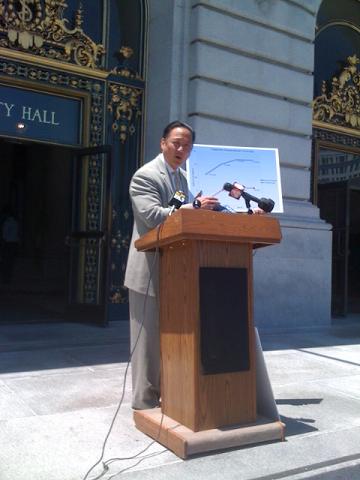
Public Defender Jeff Adachi held a press conference on the steps of City Hall this afternoon, talking about how his pension reform measure is on track to qualify for the November ballot, calling for the Board of Supervisors to strengthen a rival measure so he can drop his, and wielding a series of colorful charts showing how his measure would save the city far more money.

But those involved with crafting the measure that has come out of City Hall – including Mayor Ed Lee and Sup. Sean Elsbernd – tell the Guardian that Adachi is misrepresenting the numbers in a way that amounts to lying, and that he’s employing a legally risky strategy that could either sink pension reform for the year or set a troubling legal precedent that diminishes the vested rights of all public employees.

The conflict – with its complex claims and counter-claims and dizzying array of big numbers derived from speculative actuarial tables and predictions of future economic realities – offers a preview of what is likely to be a bruising yet bewildering battle if both measures make the ballot.

“We have to have real reform,” Adachi told assembled journalists and activists. “If we had real reform coming from this building, City Hall, I wouldn’t be standing here right now.”

But Elsbernd and Lee each told us that the event had more to do with grabbing headlines with sensational yet misleading claims during the final six days of signature-gathering than it did with Adachi’s claim that his measure will save $138 million annually by 2014-15 compared to a $84 million in the city’s plan.

“It is critical people understand the difference in these costs,” Adachi said.

Lee called the event “weak antics in trying to get a headline,” and said, “His claims are false.” Elsbernd said he spoke with Adachi on the phone for an hour yesterday trying to convince him that his fiscal claims were wrong, but to no avail. “Facts don’t seem to matter to him anymore,” Elsbernd said. “He’s not playing straight with the facts.”

Two issues are central to Adachi’s claims of a big cost savings: his plan’s requirement that employees pay more into their pensions without the city’ plan’s promise of lessening that burden during good years – which city officials say is legally dubious because it simply takes away something to which current employees are entitled to under their contracts – and the deal that the city cut last week with public safety unions to give them the 4 percent raise they were scheduled to receive this year but to increase their pension contributions by a similar amount.

“It’ll cost taxpayers even more than the amount of the raise,” Adachi argued, wielding charts and figures to show that the higher pension payouts due to the increased salaries of cops and firefighters will cost the city $45 million over the next 10 years, and as much as $381 million by 2042.

But Elsbernd said that the raises were part of a contract approved back in 2007 and can’t be just unilaterally taken away. “The raises have been incorporated into pension projections,” Elsbernd said, accusing Adachi of essentially double-counting them in his calculations. “He’s saying this action increases the costs, and that’s just wrong. This deal lowers those costs.”

When we asked Adachi about that point during the press conference, he argued that in these dire fiscal times, all public employee contracts should be renegotiated from scratch and therefore his fiscal claims were correct. “Why should we be talking about a 4 percent raise for anyone when we’re cutting basic services?” Adachi asked.

But simply invalidating approved contracts puts Adachi’s measure on shaky legal ground, Elsbernd said. But it’s ground that the wealthy funders of Adachi’s measure are anxious to plow because if the measure survives a legal challenge, it will weaken the ability of current employees to get the benefits they were promised.

“He wants to challenge the issue of vested rights, and in the end, that’s what this is about,” Elsbernd said, noting that if Adachi’s measure gets more votes and is invalidated, as he thinks it will be by the courts, than the city’s pension problem gets worse as the solution gets pushed back a year.

Adachi claimed during the press conference that he has privately been offered support by some union leaders who are attracted to the big cost savings and what it would mean to the city’s future fiscal health, but he wouldn’t name them or indicate whether they will go public at some point. But Lee said Adachi is just desperately looking for allies.

“He’s looking for someone to support his view of this, but we’re very confident that our proposal is better,” Lee told us, noting how important it was to develop the measure with input and help from the unions. “We’ve done it the right way. You do it with people, not to people.”

But Elsbernd also said Adachi’s pushing of pension reform last year and again this year is a big factor in the union givebacks that the city has received: “We would not be in the place we are with labor if not for Jeff Adachi.”

The board is set to consider the city plan next week, while Adachi says he has 60,000 signatures and plans to gather 5,000 more by the deadline of Monday at 5 pm, which should be enough meet the threshold of about 47,000 valid signatures.

Dick Meister: Farm workers need drastic change

0

No workers are more in need of union protection than the nation’s miserably treated farm workers. Yet a promising new effort to ease their path to unionization has been blocked by one of their former champions, Gov. Jerry Brown.

Brown was rightly hailed for signing, in an earlier term as governor, the 1975 law that granted farm workers in California the collective bargaining rights denied them nationwide. It’s the weapon farm workers must have if they are to escape poverty and the arbitrary and often harmful actions of grower employers.

But now, Brown has vetoed a bill sponsored by the United Farm Workers union, the UFW, that would have made it much easier for farm workers to unionize. Currently, they can be granted bargaining rights only if a majority working for a particular grower votes for unionization. The vetoed measure, the so-called Card-Check Bill, would have granted bargaining rights simply on the showing of union membership cards or petitions for union recognition signed by a majority of workers.

Farm workers, of course, are among our most important workers. They help feed us, after all. Their pay nevertheless averages less than $10,000 a year, and most lack employer-paid health care and other benefits. They work hard, frequently under the blazing sun, with few  – if any – rest breaks and without even such simple on-the-job amenities as fresh drinking water and toilets.

The UFW, which sponsored California’s 1975 law, has been trying for many years to remedy farm workers’ conditions by leading them in drives aimed at winning union contracts that promise them decent treatment and an effective voice in determining their wages, hours and working conditions.

 It’s not been easy for the UFW, even with the law in effect. Thanks mainly to employer intimidation and high worker turnover, the union has been able to sign up only a small part of California’s farm labor force and to win only a relatively few contracts from growers. But it’s an important start. Without the law, it would have been nearly impossible.

So why in the world did self-proclaimed farm worker advocate Jerry Brown veto the bill that would have strengthened the union rights granted farm workers in the bill he signed 36 years earlier?

Well, Brown didn’t say much, but did say he didn’t like the bill because it called for “drastic change.”  Which it did, of course. That, as Brown must know, is exactly what’s needed.

Requiring union rights to be granted only by elections gives growers a great opportunity to unfairly pressure workers into voting against unionization – and many take full advantage of the opportunity.

It’s common for growers faced with elections to require workers to attend meetings at which they rail against unions, threaten to fire union supporters and warn that they might have to go out of business if their farms are unionized, or at least greatly curtail operations and thus job opportunities.

“You’re talking about voting on the employer’s site, with foremen and supervisors making eye-contact with you after they’ve alluded to or flat out threatened you with the loss of your job or your housing,” notes a UFW vice president, Armando Elenes. “It takes a lot of strength to even vote.”

There’s plenty of evidence that employers do indeed put lots of pressure on workers to vote against unionization. UFW President Arturo Rodriguez notes, for example, instances of growers pulling guns on workers who were trying to organize.  That may seem exaggerated – but not to anyone who’s experienced the superheated grower-worker confrontation up close.

The UFW is not giving up the struggle for Card-Check recognition. The union will soon re-introduce the Card-Check bill in Congress with the strong backing of the nation’s labor leaders. Some of them call it the single most important labor bill in the country this year.

It certainly is for farm workers and should be for workers in other industries throughout the country who also seek Card-Check rights, and for anyone who wants decent treatment for those whose vital work helps put food on our tables.


Dick Meister is co-author of “A Long Time Coming: The Struggle to Unionize America’s Farm Workers” (Macmillan). He can be reached through his website, www. dickmeister.com.


Alerts

0

alert@sfbg.com

THURSDAY, JULY 7


Two years after the coup

Andrés Thomas Conteris, founder of Democracy Now! En Español, along with Adrienne Aron and Theresa Carmeranesi, will share observations from their recent trips to Honduras, specifically the well-organized resistance movement against the repressive coup that ousted their democratically-elected president in 2009.

7–9 p.m., free

First Unitarian Universalist Church

Thomas Starr King Room

1187 Franklin, SF

www.soaw.org


Saving labor murals

All over the country, many of the murals created during the WPA-era that depict the history and struggles of the U.S. labor movement are threatened of permanent removal, like the hidden labor history mural in the Maine Labor Department Building. At this event, noted New Deal historians Gray Brechin and Harvey Smith will speak about the unremitting war on labor art and history occurring closer to home.

7–9 p.m., free

Berkeley City College Auditorium

2050 Center, Berk.

www.laborfest.net

SATURDAY, JULY 9


Stop the Libya bombing!

NATO intervention in Libya: a massive outpouring of humanity or a blatant display of U.S. imperialism? If you agree with the second viewpoint, stand up against the bombings in Libya, where civilians have been caught in the crossfire. The bombings also cost the U.S. $10 million a day, outrageous at a time when workers in the public and nonprofit sectors are being fired due to a nationwide budget crisis. There will also be a joint action the same day in Washington, D.C. in front of the White House.

12–2 p.m., free

Meet at Powell and Market, SF

(415) 821-6545

www.answersf.org

TUESDAY, JUNE 12


Who built San Francisco?

Learn about San Francisco history and 120 years of its architecture from the perspective of the people — the union workers who built these massive artifacts — not from the architectural firms that usually get all the credit. In two hours, you will see 30 buildings, from famous skyscrapers and little-known treasures, that tell a story about the rich labor and political history of the city, as well as the design trends that helped change the concrete face of America.

10 a.m.–12 p.m., free

Meet at Stockton and Maiden lane, SF

www.laborfest.net 2

Mail items for Alerts to the Guardian Building, 135 Mississippi St., SF, CA 94107; fax to (415) 437-3658; or e-mail alert@sfbg.com. Please include a contact telephone number. Items must be received at least one week prior to the publication date.

The nonconformist

0

arts@sfbg.com

FILM Marxist, aesthete, padrone, Oscar winner, supreme screen sensualist — the list of contradictions goes on, onscreen as well as off, for Bernardo Bertolucci. Earlier this year he emerged from a long creative hibernation (attributable, it turns out, to back pain so severe it prevented any work) to accept an honorary Palme d’Or at the Cannes International Film Festival and begin work on his first film in nearly a decade, a claustrophobic drama about a withdrawn teen who secretly sequesters himself in the family basement. It will be filmed in 3-D — an idea so daft it just might prove brilliant.

Because, after all, it is lunacy and excess as well as intelligence, beauty, instinct, and so forth that have led Bertolucci to some of his most extraordinary as well as dubious achievements, nearly all of them debatable as falling into either category.

Now that he’s reaching a half-century spent in the director’s chair, it is clear what an unpredictable, erratic, even arbitrary career this has been; the line between the sublime and silly in his films is easily felt but almost impossible to define. What makes 1972’s Last Tango in Paris, for instance, a genuine fever dream of mad desire, while two later films equally about eros and yearning — 1996’s Stealing Beauty and 2003’s The Dreamers — are fussy, false, a little embarrassing? Trained as a poet (whatever that means), he surrenders to cinema time and again as someone intoxicated by images as he once was to words, taking each sustained impulse to its logical (or illogical) endpoint, whether to transcendence or off an artistic cliff.

The Pacific Film Archive’s summer retrospective “Bernardo Bertolucci: In Search of Mystery” provides an opportunity to weigh most of the exhilarating highs and a couple of the baffling lows in a wayward trajectory one hopes is nowhere near complete. (Only 71, he can surely spare us another three decades — look at Manoel de Oliveira, wildly prolific at 102, yet without a single film as memorable as a half-dozen or more of Bertolucci’s.) All 13 features will be offered in new prints, a big lure for a director whose best movies — particularly those shot by the incomparable cinematographer Vittorio Storaro — it would be criminal to view in any but the most pristine visual condition.

After a promising literary start as a teenager — his father, notably, was a well-regarded poet, art historian, and film critic — Bertolucci apprenticed to family friend Pier Paolo Pasolini on 1961’s Accattone!. When Pasolini moved on to another project, Bertolucci made his own directorial debut at age 21 with similarly gritty The Grim Reaper (1962). That tale of a prostitute’s murder, cowritten with Pasolini, as well as 1964’s Before the Revolution (a presumably somewhat autobiographical mélange about a young bourgeois torn between tentative radicalization and pleasures of the flesh as represented by Bertolucci’s then-wife Adriana Asti) reflected his heavy early influencing by the ebbing Italian neorealist movement and still-current French New Wave.

Inspired by Dostoyevsky, 1968’s Partner was a transitional work, straddling Godardian dialecticism and pure extravagance. When 1970’s Jorge Luis Borges-drawn puzzle The Spider’s Strategem found Bertolucci discovering his sumptuous mature style (as well as Storaro’s rapturous lighting and camera movement), Godard denounced him as a sellout. The international breakthrough was that same year’s The Conformist, a Moravia story about the individual surrender to fascism — passivity turning to criminality being a frequent Bertolucci subject — that somehow became a baroque tone poem of saturated color, hedonistic suggestion, and damp paranoia. It announced the arrival of a great artist, albeit one for whom style would always trump political content, and whose literary sources were often twisted nearly past recognition by his own overwhelming authorial stamp.

The 1970s were a dazzling high-wire decade for Bertolucci. Last Tango was an X-rated scandal and sensation, an experience so psychologically (and literally) naked for Marlon Brando that he didn’t speak to the director for years afterward. Bertolucci explained: “He felt that I stole something from him, that he didn’t know what he was doing … I like to have very famous, important actors because it is a challenge to find out what they are hiding.”) Its tale of two people with only compulsive coitus in common is still berserk, implausible, off-putting, and completely enveloping.

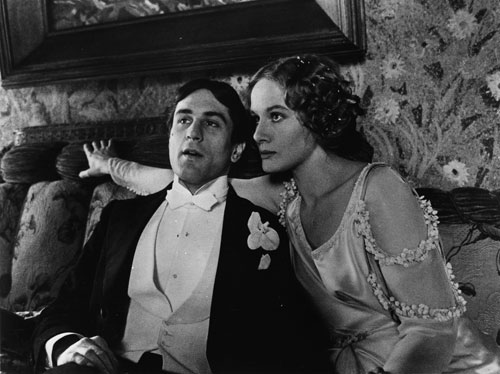
The epic, multinational cast (Robert De Niro, Gerard Depardieu, Donald Sutherland, Dominique Sanda, Burt Lancaster, even some Italians) 1900, a film originally over five hours long, offered the first half of Italy’s 20th century as a class struggle, as well as a conceptual one, between idealism and decadent pageantry — Pasolini wrestling with Luchino Visconti. Few knew what to make of the contrastingly intimate (yet, again, stylistically gaga) 1979 La Luna, an Oedipal drama based on a dream Bertolucci had about Maria Callas. Fervently loved by a slim cult following, it was otherwise so ridiculed and loathed that 32 years later 20th Century Fox still hasn’t coughed up a U.S. home-format release.

With the new decade, the limbs Bertolucci went out on became less reliably inspirational, perhaps partly because Storaro had developed conflicting allegiances to other directors (Francis Ford Coppola, Carlos Saura, Warren Beatty). Tragedy of a Ridiculous Man (1981) is dispirited and dull. Little Buddha (1993) was a silly idea nonetheless spiked by enchanted storybook scenes with Keanu Reeves as Siddhartha — ludicrous-sounding stunt casting that is somehow perfect. Stealing Beauty and The Dreamers found this uneasily homophilic director reduced to ogling young bodies of both sexes like a dirty old professor.

On the other hand, 1990’s The Sheltering Sky was difficult, ravishing, another masterpiece if a great commercial disappointment. Another leap into exotica, 1987’s The Last Emperor had the opposite fate — winning all nine of its nominated Oscars in a slow year, a staggering spectacle widely admired yet loved by few (least of all the Chinese), elephantine yet wry, and closer to David Lean respectability than auteurist idiosyncrasy. Then after all this 1998’s Besieged, a tiny story of unrequited love and noble sacrifice shot with two actors and hand-held camera, felt rejuvenative — as if the increasingly burdened composer of massive symphonies had discovered the joy in a piano miniature.

The curio in the PFA’s series is 1967’s The Path of Oil — a three-part Italian documentary about petroleum production, apparently undertaken in a funk when two failed first features had temporarily reduced his career prospects. It’s handsome, if clearly less than a labor of love. But for the Bertolucci fetishist, no film is so impersonal or underwhelming (or on the other hand beloved) that it might not yet spring surprises, whether on a first viewing or an umpteenth. 

BERNARDO BERTOLUCCI: IN SEARCH OF MYSTERY

July 8–Aug. 18, $5.50–$9.50

Pacific Film Archive

2575 Bancroft, Berk.

(510) 642-5249

bampfa.berkeley.edu

Stage Listings

0

Stage listings are compiled by Guardian staff. Performance times may change; call venues to confirm. Reviewers are Robert Avila, Rita Felciano, and Nicole Gluckstern. Submit items for the listings at listings@sfbg.com. For further information on how to submit items for the listings, see Picks. For complete listings, see www.sfbg.com.

THEATER

OPENING

Act One, Scene Two SF Playhouse, Stage Two, 533 Sutter, SF; (415) 869-5384, www.un-scripted.com. $10-20. Opens Thurs/7, 8pm. Runs Thurs-Sat, 8pm. Through Aug 20. Un-Scripted Theater Company hosts a different playwright each night, performing the first scene of an unfinished play and then improvising its finish.

Not Getting Any Younger Marsh San Francisco, 1062 Valencia, SF; www.themarsh.org. $15-50. Opens Thurs/7, 8pm. Runs Thurs, 8pm; Sat, 8:30pm; Sun, 7pm. Through July 24. Marga Gomez presents a workshop production of her new comedy, her ninth solo show.

Salty Towers Exit Theatre, 156 Eddy, SF; (415) 673-3847, www.theexit.org. $15-25. Opens Thurs/8, 8pm. Runs Thurs-Sat, 8pm; Sun, 3pm. Through July 23. Thunderbird Theatre Company performs a farce that combines Greek mythology with a tale of sea creatures running a two-star hotel.

Twilight Zone Live: Season 8 Dark Room, 2263 Mission, SF; www.ticketturtle.com. $20 ($5 discount if you use the code word “maggie”). Opens Fri/8, 8pm. Runs Fri-Sat, 8pm. Through July 29. The Dark Room Theater presents its eighth annual tribute to classic Twilight Zone episodes.

BAY AREA

Macbeth Dominican University of California, Forest Meadows Amphitheater, 1475 Grand, San Rafael; (415) 499-4488, www.marinshakespeare.org. $20-35. Previews Fri/8-Sun/10, 8pm. Opens July 15, 8pm. Performance times vary; check website for schedule. Through Aug 14. Marin Shakespeare Company takes on the Scottish play, opening under a full moon, no less.

The Verona Project Bruns Amphitheater, 100 California Shakespeare Theater Way, Orinda; (510) 548-9666, www.calshakes.org. $35-66. Previews Wed/6-Fri/8, 8pm. Opens Sat/9, 8pm. Runs Tues-Thurs, 7:30pm; Fri-Sat, 8pm (also July 30, 2pm); Sun, 4pm. Through July 31. California Shakespeare Theater performs a world-premiere play (inspired by The Two Gentlemen of Verona) by Amanda Dehnert.

ONGOING

All Atheists Are Muslim Stage Werx, 533 Sutter, SF; www.brownpapertickets.com. $20. Sun/10, 7pm. Zahra Noorbakhsh returns with her timely comedy.

Assisted Living: The Musical Imperial Palace, 818 Washington, SF; 1-888-88-LAUGH, www.assistedlivingthemusical.com. $79.59-99.50 (includes dim sum). Sat-Sun, noon (also Sun, 5pm). Through July 31. Rick Compton and Betsy Bennett’s comedy takes on “the pleasures and perils of later life.”

Billy Elliot Orpheum Theater, 1192 Market, SF; www.shnsf.com/shows/billyelliot. $35-200. Tues-Sat, 8pm (also Wed, 2pm); Sun, 2pm. Through Sept. 17. As a Broadway musical, Billy Elliot proves more enjoyable than the film. The movie’s T. Rex score may have been a major selling point, but it was a bit maudlin for a story that needed no help in that department. The musical naturally has a sentimental moment or three, but it’s much more often funny, muscular in its staging (with repeatedly inspired choreography from Peter Darling), and expansive in its eclectic score (Elton John) and well-wrought book and lyrics (Lee Hall). Moreover, Stephen Daldry (who also directed the 2000 film) plays up bracingly the too-timely class politics of the modest 1980s English mining town besieged by Margaret Thatcher’s neoliberal regime in the latter’s ultimately successful bid to crush the once-powerful miners union. The cast is likewise very strong, beginning with opening night’s impressive J.P. Viernes in the title role. Broadway’s Faith Prince is an especially engaging presence as the ballet teacher who takes an interest in Billy’s inherent talent, setting him on a course out of the doomed town and into London’s Royal Ballet School — much to the violent disgust of his predominantly male and prickly household. The first act is a nearly perfect balance of bawdy humor, aggressive staging, adept scene-setting and character development and a potent tide of song and group choreography that is hard to resist. There are some unfortunate choices later on, like a bit of Peter Pan wire work that has Billy twirling over the stage (an excessive display that hovers awkwardly over dullsville) and in general the second act is not as strong as the first. It’s also the point where the working-class politics paid homage to by the script gets seriously blunted by a concomitant streak of middle-class individualism. But as crowd-pleasing entertainment the musical burrows deep and more often than not comes up with gold. (Avila)

The Book of Liz Custom Made Theatre, 1620 Gough, SF; www.custommade.org. $10-29. Thurs-Sat, 8pm; Sun, 7pm. Through July 31. Custom Made Theatre performs David and Amy Sedaris’ comedy about an unconventional nun.

“Fury Factory 2011” Various venues and prices; www.brownpapertickets.com. Through Tues/12. Over 30 Bay Area and national companies participate in this bi-annual theater festival.

Indulgences in the Louisville Harem Phoenix Theatre, 414 Mason, SF; 1-800-838-3006, www.offbroadwaywest.org. $20-40. Thurs-Sat, 8pm. Through July 30. Two spinster sisters find unlikely beaux in Off Broadway West Theatre’s production of John Orlock’s play.

The Pride New Conservatory Theatre Center, 25 Van Ness, SF; (415) 861-8972, www.nctcsf.org. $24-40. Wed/6-Sat/9, 8pm; Sun/10, 2pm. New Conservatory Theatre Center performs the West Coast premiere of Alexi Kaye Campbell’s love-triangle time warp drama.

*Vice Palace: The Last Cockettes Musical Thrillpeddlers’ Hypnodrome, 575 10th St; (800) 838-3006, www.brownpapertickets.com. $30-35. Fri-Sat, 8pm; Sun, 7pm. Through July 31. Hot on the high heels of a 22-month run of Pearls Over Shanghai, the Thrillpeddlers are continuing their Theatre of the Ridiculous revival with a tits-up, balls-out production of the Cockettes’ last musical, Vice Palace. Loosely based on the terrifyingly grim “Masque of the Red Death” by Edgar Allan Poe, part of the thrill of Palace is the way that it weds the campy drag-glamour of Pearls Over Shanghai with the Thrillpeddlers’ signature Grand Guignol aesthetic. From an opening number set on a plague-stricken street (“There’s Blood on Your Face”) to a charming little cabaret about Caligula, staged with live assassinations, an undercurrent of darkness runs like blood beneath the shameless slapstick of the thinly-plotted revue. As plague-obsessed hostess Divina (Leigh Crow) and her right-hand “gal” Bella (Eric Tyson Wertz) try to distract a group of stir-crazy socialites from the dangers outside the villa walls, the entertainments range from silly to salacious: a suggestively-sung song about camel’s humps, the wistful ballad “Just a Lonely Little Turd,” a truly unexpected Rite of Spring-style dance number entitled “Flesh Ballet.” Sumptuously costumed by Kara Emry, cleverly lit by Nicholas Torre, accompanied by songwriter/lyricist (and original Cockette) Scrumbly Koldewyn, and anchored by a core of Thrillpeddler regulars, Palace is one nice vice. (Gluckstern)

What Mamma Said About Down There SF Downtown Comedy Theater, 287 Ellis, SF; www.sfdowntowncomedytheater.com. $15. Thurs-Sat, 8pm. Through August 20. Sia Amma returns with her solo comedy.

BAY AREA

All My Children Cabaret at Marsh Berkeley, 2120 Allston, Berk; www.themarsh.org. $20-50. Fri, 8pm; Sat, 8:30pm. Through July 23. Not the soap opera — it’s Seattle Improv co-founder Matt Smith in his comedy about a middle-aged man with boundary issues.

East 14th: True Tales of a Reluctant Player Marsh Berkeley, 2120 Allston, Berk; www.themarsh.org. $20-50. Sat, 8:30pm; Sun, 7pm. Through Aug 7. Don Reed’s hit solo comedy receives one last extension before Reed debuts his new show (a sequel to East 14th) in the fall.

Metamorphosis Aurora Theatre, 2081 Addison, Berk; (510) 843-4822, www.auroratheatre.org. $10-55. Tues and Sun, 7pm (also Sun, 2pm); Wed-Sat, 8pm. Through July 17. Aurora Theatre Company performs a terrifying yet comic adaptation of Kafka’s classic by David Farr and Gísli Örn Gardarsson.

A Raisin in the Sun Pear Avenue Theatre, 1220 Pear, Mtn. View; (650) 254-1148, www.thepear.org. $15-30. Thurs/7-Sat/9, 8pm; Sun/10, 2pm. Lorraine Hansberry’s classic play comes to life on the Pear Avenue Theatre stage.

2012: The Musical! Cedar Rose Park, 1300 Rose, Berk; www.sfmt.org. Free. Sat/9-Sun/10, 2pm. Continues through Sept. 25 at various Bay Area venues. San Francisco Mime Troupe mounts their annual summer musical; this year’s show is about a political theater company torn between selling out and staying true to its anti-corporate roots.

*Working for the Mouse La Val’s Subterranean, 1834 Euclid, Berk; www.impacttheatre.com. $10-20. Thurs/7-Fri/8, 8pm. It might not come as a surprise to hear that even “the happiest place on earth” has a dark side, but hearing Trevor Allen describe it during this long overdue reprise of 2002’s Working for the Mouse, will put a smile on your face as big as Mickey’s. With a burst of youthful energy, Allen bounds onto the tiny stage of Impact Theatre to confess his one-time aspiration to never grow up — a desire which made auditioning for the role of Peter Pan at Disneyland a sensible career move. But in order to break into the big time of “charactering,” one must pay some heavy, plush-covered dues. As Allen creeps up the costumed hierarchy one iconic cartoon figure at a time, he finds himself unwittingly enmeshed in a world full of backroom politics, union-busting, drug addled surfer dudes with peaches-and-cream complexions, sexual tension, showboating, job suspension, Make-A-Wish Foundation heartbreak, hash brownies, rabbit vomit, and accidental decapitation. Smoothly paced and astutely crafted, Working for the Mouse will either shatter your blissful ignorance or confirm your worst suspicions about the corporate Disney machine, but either way, it will probably make you treat any “Casual Seasonal Pageant Helpers” you see running around in their sweaty character suits with a whole lot more empathy. (Gluckstern)

PERFORMANCE/DANCE

Front Line Theatre CounterPULSE, 1310 Mission, SF; www.brownpapertickets.com. Fri/8-Sun/10, 8pm. Also July 21-23, 8pm, Garage, 975 Howard, SF; www.brownpapertickets.com. Both venues, $20. The company presents the world premiere of Rare Earth, a verse-and-movement comedy about waste and the past.

Miguel Gutierrez Garage, 975 Howard, SF; www.brownpapertickets.com. Fri-Sun, 8pm. $15. The choreographer performs his 2010 work Heavens What Have I Done as part of Verge, the Garage’s workshop series.

LINES Ballet Summer Program Cowell Theater, Fort Mason Center, Marina at Laguna, SF; www.linesballet.org. Tues/12, 7:30pm. $15. The LINES Ballet Summer Program celebrates its 10th anniversary with the first of two student showcases.

“OMFG! The Internet Dating Musical” ODC Theater, 3153 17th St, SF; www.odctheater.org. Fri-Sat, 8pm; Sun, 2pm. Through July 17. $15-18. ODC Theater Resident Artist Chris Winslow presents his new comedy about a couple who both fear they can’t live up to reality after meeting online.

“Project Bust” Z Space, 450 Florida, SF; www.brownpapertickets.com. Wed/6 and Aug 3, 8pm. $15. Malinda LaVelle presents her evening-length dance-theater piece.

“Sympathetic: An Aerial Dance Performance Honoring Labor” Rincon Annex Post Office, 121 Spear, SF; (415) 564-4010. Sat, 1 and 3pm. Free. The Labor Archives and Research Center, San Francisco State University, and Flyaway Productions present this work honoring the 1934 San Francisco General Strike by choreographer Jo Kreiter and musician Pamela Z.

“The Tinker Show” Stage Werx, 533 Sutter, SF; www.thetinkershow.com. Thurs-Fri, 8pm. $18-20. “Old school immaturity” via live sketch comedy and improv, plus original short films.

Yubiwa Hotel Performing Arts Company NOHspace, 2640 Mariposa, SF; www.sfiaf.org. Fri, 8pm; Sun, 3pm. $12. The company performs the play Mesujika Doe, a Japanese-American collaboration from Shirotama Hitsujiya and Trista Baldwin.

Here’s tax reform, Jerry

14

Everyone knows I’m a fan of taxing the rich and that I think most of the economic problems in our country have their roots in the growing inequality of the past few decades, so it should come as no surprise that I enjoyed the Cruickshank piece on Calitics. He’s got exactly the right idea: Tax reform that benefits the wealthy (or, in fact, tax reform that doesn’t force the wealthy to pay more) isn’t tax reform at all.


I was on a houseboat at Lake Shasta over the 4th of July, arguing with some very smart people about why the economy is so fucked up (yeah, for relaxation I go someplace beautiful — then sit around and talk about economic policy), and we covered a lot of ground. My friend the investment banker and corporate executive said that out-of-control CEO pay — and bonus payments for failure, and lack of corporate accountability — were a bit part of the problem. “If corporations succeed, then everyone — all the people who work there, at every level — ought to benefit,” he pointed out. True: In the early post-War era, labor union clout in major industries (automotive, for example) forced corporations to pay a decent middle-class wage — that is, to share the fruits of success with the workers. That’s all gone now. “Corporations don’t pay enough taxes,” my friend the corporate salesman said — and he’s right, too.


And all of us agreed that higher taxes won’t drive corporations out of the country or out of states or even out of cities; the actual numbers of businesses that pick and and move because of taxes (as opposed to labor-force issues, rents, land availablity, access to transportation etc.) is so minor it’s not even worth talking about.


But those are just pieces of the puzzle. Here’s what I always come back to: Over the past couple of decades, the size of the U.S. economy has doubled — and real wages have been essentially flat. All that new money has gone to the very, very top. Robert Reich explain this brilliantly in exactly two minutes — and I don’t care how busy you are, you have two minutes to watch this video.


That, really, is the root of everything, the reason we’re still in a recession, that people are losing their homes, that government debt is soaring … it’s all because this country, as a matter of public policy, has allowed the very, very rich to take almost all of our wealth. We have become a banana republic, a corporate kleptocracy, a place so badly managed that it we weren’t the United States, the news media would be reporting on our utter lack of economic democracy. And they’d be saying that the system is so unsustainable that one way or the other, it’s going to collapse.


Jerry Brown must know this. He’s not going to run for another term. There’s no excuse at all for not at least proposing a modest tax increase on the highest earners and the most profitable big businesses. Come on, guv: What are you waiting for?


Dick Meister: Paid sick leave is good for us all

5

The latest figures show that some 44 million workers in private employment  – more than 40 percent of the private sector workforce – do not have paid sick days that they could use to recover from illnesses, including contagious illnesses such as the flu, or worse.

It should be of particular concern that those occupations which are currently least likely to provide paid sick days include occupations most likely to have regular contact with the public – most importantly and most disturbingly, food service and food preparation.

That raises serious health problems – especially in these tight economic times, when workers need to stay on the job as much as they can, no matter how ill they are, to earn as much money as they can. Which, of course, endangers the health of those who come in contact with them, as well as delaying their recovery from their illness.

Public health experts note that the fewer the number of workers who are able to stay at home when sick, the more likely it is that diseases will spread. In addition to the increased suffering of the public and other workers which that causes, it also causes significant economic losses.

Laws have been proposed in several states and in Congress that would require employers to grant paid sick leaves to their employees, but it seems unlikely that the measures, however much they are needed, will pass any time soon – if at all.

But there has at least been a start, however slight, toward what’s broadly needed. That’s a paid sick leave law that was adopted by the city of San Francisco five years ago – the first citywide such law in the country. If nothing else, the San Francisco ordinance proves that such laws are quite feasible, and not the “job killers” that anti-labor forces contend they would be.

San Francisco business groups fought fiercely against adoption of the ordinance and thankfully lost big time. The ordinance was approved by 61 percent of the voters in a citywide election in 2006.

Under the ordinance, workers in businesses with fewer than 10 workers can earn up to five paid sick days a year, while workers in larger businesses can earn up to nine paid sick days.  Workers accrue one hour of paid sick leave for every 30 hours they work. They may use the sick time to recover from their own illnesses, care for a sick family member, or seek routine medical care.

A recent independent survey of nearly 1,200 San Francisco workers and nearly 700 employers by the Institute for Women’s Policy Research came up with findings that the city ordinance was, in the words of the California AFL-CIO, “overwhelmingly positive for workers, businesses and the public.”

The labor federation called the study “further evidence policies that help working families meet their responsibilities at work and at home are good for everyone.”

The study shows, in short, that the San Francisco ordinance has had a great impact on workers’ lives but little or no impact on the city’s businesses.  They overwhelmingly report that the law has not cut into their profits. Two-thirds of them reported no problems implementing the law.

It seems likely that the reason for the slight impact on businesses business can be attributed to the fact that most workers take sick leave days only when they need them.  Even though the law allows workers five to nine sick days a year, San Francisco workers used a median of just three days a year. And one-quarter of the workers didn’t take a single sick day.

Even the major opponent of the law prior to its passage, the local, politically powerful restaurant association that led the political fight against the city ordinance, now concedes it hasn’t led to employee abuses or hurt restaurants or other business.

Most important, as the state AFL-CIO noted, the survey proved that having paid sick days makes a substantial difference for working families.  More than half the workers surveyed said they’ve benefitted from the law. Among other important things, the law has given workers who need paid sick days the most, including parent and workers with chronic health conditions, the time they need to care for their health and that of their children.

The labor federation reports that it hears regularly “the stories of parents who are forced to choose between their children’s health and the financial well-being of their family . . . who have put off visits to the doctor and sacrifice their health to avoid losing their jobs.

Washington, D.C. and Milwaukee have followed San Francisco’s lead and adopted ordinances providing paid sick leave for workers.  And some states, California, New Jersey and Connecticut among them, have adopted similar though less extensive laws.

But what’s most needed is a federal law – a law that, if properly enforced, would grant sick leave pay to all workers, helping them, their families and anyone else who might be exposed to their illness.

It’s obviously the sensible thing to do.


Dick Meister, former labor editor of the SF Chronicle and KQED-TV Newsroom, has covered labor and politics for more than a half-century as a reporter, editor, author and commentator. Contact him through his website, www.dickmeister.com, which includes more than 300 of his columns.


Don’t privatize public safety

3

Four weeks ago, surgeon Dimitry Nikitin walked out of Florida’s Orlando Regional Medical Center to his car and was shot dead by a disgruntled patient who then turned his gun on himself and committed suicide. Last September, a doctor at Baltimore’s Johns Hopkins was shot and killed by a patient distraught over his mother’s terminal diagnosis.

There is an epidemic of violence in America’s health care facilities. Many of the scenarios are familiar — the news is full of stories of combatants in gang fights following wounded rivals into hospital emergency rooms to finish them off. But the full depth of the problem is largely unreported and extends to hospital wards, clinics, and long-term care facilities

A recent report from the U.S. Department of Labor based on 2009 statistics says health care providers rank third in the likelihood of being assaulted on the job — just behind police and correctional officers. In 2009, there were 38 assaults per 10,000 nurses aides.

Despite this troubling trend, the San Francisco Department of Public Health is asking the Board of Supervisors to approve its proposal to replace institutional police officers in some public health facilities with low-paid private security guards.

Here are two reasons this is a profoundly bad idea.

1. Health care is a stressful environment and growing more stressful every day.

As the providers of last resort, public hospitals and clinics often face a perfect storm of patients who are involved in violence, alcohol and drug abuse, or are suffering from untreated mental illness. But even outside emergency wards, health care workers must work up-close with patients and family members pushed to the breaking point by an overburdened delivery system.

As health care costs spiral, public health budgets shrink and access to high quality care dwindles, many hospitals and clinics are reporting assaults by patients and family members upset by long lines, half-day waits, and unaffordable care.

According to a September report by CNN on rising violence in health care facilities, violence caused by patients’ frustration with health care services is on the rise.

“People are just tired of waiting, or they are just angry that they’re not getting the care they feel is acceptable,” nurse Rita Anderson told CNN. “Instead of saying something, their response is yelling, hitting, screaming, and spitting.”

2. Well-screened and trained security officers reduce health care violence.

According to a study on reducing violence in hospitals by the National Crime Prevention Council, three top strategies for keeping health care facilities safe include reducing patient wait-times through well-organized and managed patient processing; controlling facilities through locked wards, staff ID badges, and security cameras; and hiring carefully selected and well-trained security personnel.

Currently, San Francisco’s hospitals and health care facilities are protected by highly trained San Francisco Sheriff’s deputies and institutional police officers. The Department of Public Health wants to replace some of these officers with private security guards.

But the private security industry is notoriously bad at screening recruits and plagued with turnover, in part because of low salaries. As a result, the use of private security creates unsafe working conditions for employees who deal with difficult or violent patients, such as those in San Francisco’s psychiatric emergency wards.

Unlike institutional police officers, private security guards cannot make arrests. Instead, they must involve the San Francisco Police Department, accumulating costs that quickly defeat the budget savings of using low-paid private guards to do work that should be done by highly trained officers.

Everyone who uses San Francisco’s public health system should contact the San Francisco Board of Supervisors and ask them to make the right choice to keep our hospitals, clinics, and long-term care facilities safe.

Ed Kinchley is an emergency room social worker at San Francisco General Hospital.


On the Cheap Listings

0

On the Cheap listings are compiled by Jackie Andrews. Submit items for the listings at listings@sfbg.com. For further information on how to submit items for the listings, see Picks.

WEDNESDAY 29

Support SF Pride At Work Women’s Building, 3543 18th St., SF; www.sfprideatwork.org. 6-8pm, sliding scale donation. Help support the LGBTQ arm of the labor movement at SF Pride at Work’s annual fundraiser featuring art, music and karaoke, and tasty treats. This year, in addition to a silent auction and art sale featuring work from the Beehive Collective, Jamie Q, Lex Non Scripta, and others, DJ BootyKlap will take the decks to get you dancing.

THURSDAY 30

“Small” Creativity Explored, 3245 16th St., SF.; www.creativityexplored.org. 7-9pm, free. You won’t find “Guernica”-sized works at this art exhibition. “Small” is all about artwork that can fit in the palm of your hand, and features over 100 pee wee stylings from 40 big talents. There will be smatterings from art modes from ceramics to woodblock prints, and mixed-media pieces exploring a wide variety of themes – the only parameter given to the artists was the size (seven by seven inches) allowing them to either interpret life’s minutia or immensity in any media they choose.

FRIDAY 1

“Homebrew” Rare Device, 1845 Market, SF; www.raredevice.net. 7-9pm, free. Artist and founder of Born Ugly skate mag Mickael Broth shows all new work at this opening reception for the former hooligan (as a young’n, he enjoyed graffiti and stealing beer from neighbors’ garages, and later spent 10 months in the slammer for vandalism.) The show, up all month, features an installation composed of drawings, paintings, and photographs that follow the theme of the home – which helped Broth overcome a crippling fear of one day coming home to his house in flames with his dog trapped inside. However morbid the inspiration, the result is inspiring and surprisingly optimistic.

SATURDAY 2

Fillmore Jazz Festival Fillmore between Jackson and Eddy, SF; www.fillmorejazzfestival.com. Sat/2 and Sun/3, 10am-6pm, free. Celebrate the rich history and jazz tradition of San Francisco’s Fillmore District with two days, and three stages of up-and-coming acts and seasoned crooners – like Mingus Amungus, Scary Larry and many others. Of course there will also be arts and crafts to check out, eclectic cuisine from a variety of food vendors, and other goods to purchase.

SUNDAY 3

Neko Case at the Stern Grove Festival Stern Grove, 19th Ave. and Sloat, SF; www.sterngrove.org. 2pm, free. Enjoy a free concert at this beautiful outdoor amphitheater in the park. Singer-songwriter Neko “Lungs for Days” Case headlines this 74 year-old tradition of free performing arts at the Grove. Also performing is local faves the Dodos, and to occupy the kiddies, Magik Magik orchestra (the Tiny Telephone recording studio’s official house orchestra) will get them making music together at the “build a band” workshop.

These Colors Don’t Run SOMArts Cultural Center, 934 Brannan, SF; www.squart.eventbrite.com. 3-11:30pm, $10. There’s a lot going on at this nine hour party – a mini-Hard French complete with BBQ, an experimental drag show, live bands including Dave End, Night Call, and Double Dutchess, and something called – ahem — squart performances. Not to be confused with the flatulent surprise known as a shart, squarting involves glitter, nudity, adult diapers, and spandex and works like this: artists break into randomly assigned teams and receive a list of theme criteria, for which they have two hours to assemble a piece and face a panel of judges for anything-goes spontaneous performance art.

East Bay Symphony and fireworks Craneway Pavilion, 1414 Harbor Way South, Richmond; www.oebs.org. 6:30pm, free. Enjoy live music, food, and fireworks for this Independence Day weekend celebration. Oakland East Bay Symphony will perform patriotic standards and popular movie scores to fireworks and breathtaking views of the San Francisco skyline. The venue will host a Fourth of July-themed concession menu, and you’ve got options: the adjacent Boiler restaurant will remain open during the event.

MONDAY 4

Pier 39 July Fourth celebration Pier 39, Embarcadero, SF; www.pier39.com. 1pm, free. Take the family to Pier 39 for this year’s Independence Day celebration featuring live music, fireworks, and all the attractions that Pier 39 always has to offer (sea lions!) Live performances lined up for this event are beach pop-y Ruby Summer and Tainted Love, everyone’s favorite ’80s cover band. There will also be a Club 90 dance party featuring club hits from back in the day. After the sun goes down, be sure to stick around for the fireworks display.


Alerts

0

WEDNESDAY 29

Moon Tides and the women of Jeju Island

Photographer Brenda Paik Sunoo presents her book Moon Tides, an homage to the female divers of Jeju-do between the ages of 39 and 93. Through photographs and interviews, the author presents the lives of these remarkable South Korean women who dive for seaweed and shellfish with little more than a knife and no breathing apparatus. This practice is common throughout coastal Korea and Japan, usually leaving the men to stay at home and care for the family. The film focuses on the older generations who still do it. The evening includes a wine reception; tickets can be purchased online.

5:30–7:30 p.m., $10

Russ Building

235 Montgomery, 12th Floor, SF

(415) 543-4669

www.imow.org


SATURDAY 2

Immigration history and Angel Island

Like a Left Coast Ellis Island, Angel Island was an immigration station for newly arrived immigrants and war prisoners. It was also the location of the 1939 trial to deport Australian-born International Longshore and Warehouse Union (ILWU) President Harry Bridges for allegedly being a member of the Communist Party. ILWU historian Harvey Schwartz and ironworker Mike Daly discusses the island’s history — from the trial of Harry Bridges to the Pearl River Delta Taishan people of China, who were largely responsible for building the early infrastructure of California. Check the website for ferry and shuttle information.

11 a.m., free

Angel Island Immigration Post

Mess Hall

Northeast side of the island

www.laborfest.net


SUNDAY 3

Labor attacks in California

The McCarthy-era “witch hunts” in California that targeted trade union members and their right to make a living also helped shape the future of the labor movement. The backlash included a large protest and sit-in at the House Un-American Activities Committee (HUAC) hearings in San Francisco, which resulted in ending the HUAC hearings and their attack on the labor movement. Hear about that tumultuous time from those who were involved, including Phil Mezey (the San Francisco State University professor who was fired for not signing a loyalty oath), labor historians, and a handful of retired workers and protestors.

2 p.m., free

ILWU Local 34

801 Second St., SF

www.laborfest.net 


Mail items for Alerts to the Guardian Building, 135 Mississippi St., SF, CA 94107; fax to (415) 437-3658; or e-mail alert@sfbg.com. Please include a contact telephone number. Items must be received at least one week prior to the publication date.

Dick Meister: Can a woman beat Hoffa?

0


A woman as president of the macho Teamsters Union that was once headed by supermacho Jimmy Hoffa? It could happen. 

Sandy Pope thinks so, and she’s going to try as hard as she can to make it happen – going to try as hard as she can to succeed Hoffa’s lawyer son, Jimmy junior, as head of one of the country’s largest and most powerful unions.

If a majority of delegates at the Teamster convention that opened today in Las Vegas vote for Pope to unseat Hoffa, who was first elected a dozen years ago, she’ll be only the third woman to ever head an international union.

Randi Weingarten, the highly regarded president of the American Federation of Teachers, who took office in 2008, is one of the others. The third is Mary Kay Henry, who just recently succeeded the controversial Andy Stern as president of the country’s largest union, the 1.3 million-member Service Employees International Union, the SEIU.

The Teamsters comes in at number two, with 1.2 million members. Hoffa’s supporters argue that Sandy Pope is not up to handling such a huge and diverse union. Her record, however, seems to indicate otherwise.

For 33 years, the 54-year-old Pope has held her own in the union’s macho culture, as a driver of big long haul freight trucks and as a warehouse worker.  For seven years she’s been president of a New York Teamster local of drivers and warehouse workers, one of only 16 of the Teamster’s 407 locals nationwide to be headed by a woman.

Before that, Pope was an international union representative in the Teamster’s warehouse division. She’s been a longtime leader of the Teamsters for a Democratic Union (TDU), which has exposed much of the corruption that’s been common in the union since the days of Hoffa senior as president.

The TDU’s work has led to some important corrections in union operations, but much remains to be done, and it’s unlikely that Hoffa junior would do much about it.  As the incumbent, he’s running a status quo campaign. Some local level Teamster officials fear retaliation from Hoffa and his allies if they campaign for Pope.

But Pope certainly isn’t backing off one bit. She’s promising to halt or at least slow the concessions that Teamster negotiators have granted employers in recent years.  Under her, she says, the union” will close the concessions stand.”

It also would push the union’s officers off the gravy train. In one Minnesota Teamsters local closely allied with Hoffa, for instance, the principal officer is paid $200,000 a year. Hoffa himself is paid $363,000.  And that’s going on at the same time that many rank-and-file Teamsters are taking pay and benefit cuts and otherwise feeling the effects of a declining economy.

It’s what the pro-labor magazine “Labor Notes” quite accurately calls “the union leadership’s back-scratching, pocket-lining culture.”

Generally speaking, Pope’s promising to return to the basics of union operations – to build public support, mobilize the union’s current members and wage a major organizing drive to recruit new members. Pope also promises that some 20,000 of the union’s members whose jobs have been downgraded to part-time can expect a drive to make those jobs full-time.

It’s clear that, like many dissident Teamsters, Sandy Pope is “sick of having a lawyer with a big name hijack our union.”


Dick Meister, former labor editor of the SF Chronicle and KQED-TV Newsroom, has covered labor and politics for more than a half-century. Contact him through his website, www.dickmeister.com, which includes more than 300 of his columns.