Kids

Event Listings

0

Event Listings are compiled by Paula Connelly. Submit items for the listings at listings@sfbg.com.

WEDNESDAY 5

California Nights: Cinco de Mayo California Historical Society and Museum, 678 Mission, SF; (415) 357-1848. 6pm, free. Celebrate Mexico’s victory over invading French troops in 1862 and the continuous changes and developments in Latino communities throughout California since that time. Featuring complimentary Cinco de Mayo refreshments, DJ music, and admission to the museum’s Think California exhibit.

BAY AREA

Arctic Images David Brower Center, 2150 Allston, Berk.; (510) 550-6700. 6pm; free, RSVP at www.earthjustice.org/arctic. See the beauty of the Arctic along with the impending threats to this iconic region at this photo presentation with acclaimed wildlife photographer Florian Schulz.

THURSDAY 6

Fair Trade Wine Night Participating bars around the city, SF; www.fairtradewinenight.com. 7pm, free admission. Drink wine that tastes good and does good, where $1 from every glass you order will go to TransFair USA, a non profit dedicated to ensuring fair wages, safe working conditions, education for workers’ kids, and health care access for all workers.

Letters from the Other Side ATA, 992 Valencia, SF; (415) 821-6545. 7:30 p.m., $6 suggested donation. Watch this film that documents the realities of immigration and the families left behind through video letters carried across the U.S.-Mexico border, putting a human context onto the immigration debate. Sponsored by the A.N.S.W.E.R. Coalition.

FRIDAY 7

BAY AREA

Oakland Art Murmur Centered around 23rd St. and Telegraph, Oak.; oaklandartmurmur.com. 7pm, free. Wander between 19 Oakland galleries enjoying local art, free wine and snacks, occasional outdoor movies and other surprises. Participating galleries include Front Gallery, Mercury 20, Chandra Cerrito, Rock Paper Scissors Collective, and more. For a full list of participating galleries and for a map visit, oaklandartmurmur.com/map.

SATURDAY 8

Aorta Magazine Million Fishes Arts Collective, 2501 Bryant, SF; www.aortamagazine.com. 8pm, $5-10 sliding scale. Enjoy radical readings of poetry and prose, visuals, live music, and a dance party with DJ Puppet at the release party for the new issue of Aorta Magazine, Cardiac Unrest. Aorta is a self-produced, collectively-created publication that features emerging and established female, queer and transgender artists.

Art, Om, and Fortune Cookies Meet at sculpture on Patricia’s Green, Octavia at Hayes, SF; www.sfbike.org. 11am, $5 donation. Join local artists Erin Augustine and Colleen Mauer for a biking tour of the best outdoor sculptures in SF, followed by a mini-tour of the Golden Gate Fortune Cookie Factory and some light yoga. Bring a sketch book, camera, and thermos of tea.

Bacon Camp Chez Poulet, 3359 Cesar Chavez, SF; baconcamp.org. Noon, free. Share and learn about bacon in an event filled with discussions, demos and participant interaction centered around the uniting theme…bacon. Everyone is encouraged to participate by presenting food, art, demonstrations, judging contests, or volunteering.

Family Art Workshop The Imagine Bus Project, 342 9th St., SF; (415) 252-9125. 1pm, free. Explore an art exhibition from students who participate in the Imagine Bus Project’s after school programs, join in an art workshop led by Marcela Florez, and help create a short illustrated story about "The River of Things I Dream About," that will be included with the exhibit for its duration.

Meet the Animals Randall Museum, 199 Museum Way, SF; (415) 554-9600. 11am, free. Meet a variety of interesting creatures, from rodents to reptiles to birds of prey, that the Randall Museum provides a home to because they can no longer survive in the wild, and learn about California’s diverse and disappearing wildlife. This event is happening every Saturday in May.

BAY AREA

Pagan Festival Martin Luther King Jr. Civic Center Park, Berk.; thepaganalliance.org. 10am, free. Noon parade through Berkeley. Enjoy a procession, interfaith ritual, traditional dance, music, poetry, crafts, authors circle, vendors, food, altars, and more. This year’s theme is "Spiral of Life," which focuses on the turning of the wheel through the seasons and the stages of our lives.

Sweet and Savory Festival Jack London Square, 20th St. at Webster, Oak.; www.sweetshoppefests.com. Sat. 11am-10pm, Sun. 11am -6pm; $12. Celebrate all that is sweet at this two-day confectionary festival featuring goodies from SF Bay Area pastry chefs, confectioners, cupcake fairies, local restaurants, cheese makers, and more including a Champagne Bubble Bar.

SUNDAY 9

How Weird Street Faire Centered at Howard and 2nd St, 37° 47′ 12.4? N x 122° 23′ 53.7? W
San Francisco, Earth; howweird.org. Noon – 8pm; $10 suggested donation, $5 in costume. Enjoy ten blocks of art and celebration, and ten stages of music playing electronica, downtempo, dubstep, breaks, drum and bass, and more. Also featuring performances, colorful costumes, vendors, food and drinks, and a chance to take part in the setting of a new world record at 7:40pm, when all the stages broadcast a special peace song and revelers are invited to join in on the World’s Largest Bollywood Dance.

Walk the Tenderloin Meet at Powell, Eddy, and Market Streets, SF; www.sfcityguides.org. 9am, free. Explore the Tenderloin that evolved from an isolated rural village to it’s crucial role in the start of the California movie industry. Learn about famous madams, see where Billie Holiday was busted for opium, and discover the neighborhood poker clubs.

MONDAY 10

"Leaders at the Lab" Margaret Jenkins Dance Lab, Suite 200, 301 8th St., SF; (415) 861-3940. 7pm, free. Choreographers, dancers, dance-makers, and enthusiast are invited to take part in an intimate conversation with choreographer Simone Forti, where she will discuss the innovative career choices she made in order to flourish in the ever-changing climate of dance-making.

Welcome to Elm Street: The Remake

0

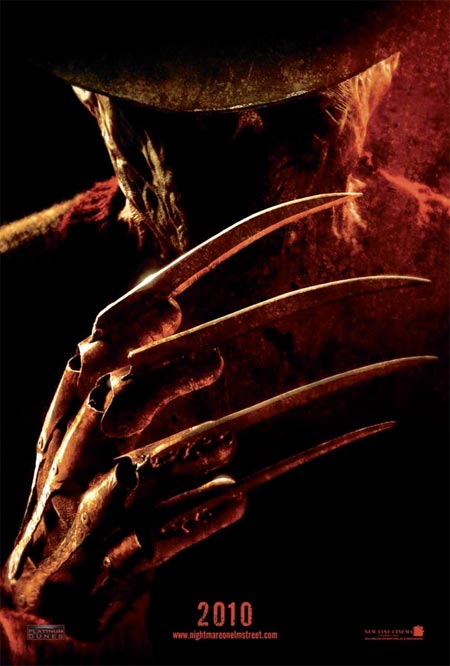
I’ll say this about the remake of A Nightmare on Elm Street: it could have been worse. Yes, it’s pointless and unimaginative and producer Michael Bay should still be ashamed, but I didn’t hate every minute of it. I can’t say the same for Rob Zombie’s dreadful take on Halloween (2007) or the unholy mess that is 2009’s Friday the 13th.

Don’t get me wrong, A Nightmare on Elm Street is not good. It’s not terrible, if only because it has a few decent scares — all of which are, of course, shamelessly lifted from the original. (Tina’s death is still Tina’s death, even if her name is Kris and she’s played by Katie Cassidy.) It’s clear that this remake — like all of the other recent horror rehashings — was designed to bring new fans to the series. And how do you appeal to kids today? Lots of jump scares, apparently.

And here’s where I have to admit something: I was more startled watching the 2010 A Nightmare on Elm Street than I ever was watching the original. Jump scares are effective, because they are loud and jarring and — in this case — constant. So is the new Nightmare scary? Sure. I wasn’t exactly on the edge of my seat: it would be more accurate to say I was slumped down in my seat with my fingers in my ears. But yes, I jumped. A lot. Does that mean the remake is somehow more successful than the original? Please. I may have been freaked watching that movie on the big screen, but it’s never going to, you know, give me nightmares. In contrast, the original haunted my childhood to the extent that I had to make a pact with my subconscious never to dream about Freddy Krueger. (This is entirely true and adorable.)

Jump scares are cheap and they’re easy to avoid. When you’ve seen them once, they’re ruined forever. Good horror may employ a jump scare or two, but it doesn’t rely on them. In the 2010 Nightmare, they are relentless. I will concede that there one or two memorable visuals: Kris being tossed around in the air and dragged onto the ceiling, Nancy seeing her dead friend taunt her from a body bag, Freddy’s glove emerging from the bathtub. But wait, we’ve seen these already. Yep, they’re nearly shot-for-shot “borrowed” from the 1984 original. Lazy. Oh, and the classic shot of Freddy emerging from the wall above Nancy? Ruined by half-assed CGI. When will they learn?

The cast is passable. I’ve always liked Kyle Gallner and Thomas Dekker, and Katie Cassidy somehow didn’t turn me off forever with her role on (the remade) Melrose Place. (Actually, she was one of the few good things about that show.) Rooney Mara takes on Nancy, and she’s fine but forgettable. All of these talented young actors have the misfortune of appearing in a film that doesn’t let them do much of anything. Maybe the next Johnny Depp is among the bunch, but no one gives anything resembling a breakout performance.

And where to begin with Jackie Earle Haley’s Freddy? Haley was doomed from the moment he was cast, just by virtue of not being Robert Englund. It’s one of the major problems with this remake. No one cares who’s under Jason’s hockey mask or wielding Michael Myers’ knife. But Freddy Krueger is Freddy Krueger — accept no imitations. If the film wanted to completely recreate the character, then why use the familiar striped sweater and fedora? It only makes Haley’s status as not-Robert-Englund more noticeable. This Freddy is more brutal, to be sure, but he’s also far less fun. The nightmares he creates are means to an end, lacking any sense of irony or humor. He only speaks one pun (I know, right?), and it’s lifted shamelessly from part five. Wisecracking is essential to Freddy’s persona. Just imagine if Jason or Michael suddenly got chatty: it would be equally jarring and, well, stupid.

But, much as it pains me to admit this, Englund’s Freddy isn’t scary anymore. The franchise fell apart with sequels that were too campy to be taken seriously. Even Freddy vs. Jason (2003), which ups the gore, is mostly just silly. To which I say, so what? I’d rather have another preposterous sequel that’s messy and fun than a soulless adaptation. Or hey, no more sequels at all. Let’s make some good new horror — brutal, sharp, original. The French have been doing it for years. But I digress.

Here’s the part where I tell you to look away if you care about getting spoiled, because I’m about to give away the ending. Normally, I wouldn’t, but a) I don’t give a crap, and b) so many of this movie’s problems are located in its final act.

Let’s start with the big reveal that’s obvious after the first five minutes: the victims in the 2010 A Nightmare on Elm Street were abused by Fred Krueger as children. That’s right, he wasn’t a child killer in this version — he messed around with them instead. Now don’t get me wrong, that’s still really fucked, but it also destroys any semblance of logic the original had. (‘80s horror: not big on making sense.) In the 1984 movie, the parents had to kill Freddy before he killed more of their own. The legal system had let them down, and they were forced to take matters into their own hands. The parents here, however, never even bothered reporting Krueger to the police — they just chased and torched him. Maybe this is supposed to be commentary on our desensitization to violence or the threat of mob rule, but it’s a huge and improbable leap. Anyone who’s seen Last House on the Left — the 1972 original, damn it — knows that parents only kill psychos as revenge for murder. Eye for an eye, duh.

But more importantly, all this child molestation nonsense is icky. It’s uncomfortable for the wrong reasons. There’s a whole bit with Nancy and Quentin (Gallner) deciding that they made it all up. You know, like kids do. I’m sorry, but implying that kids aren’t to be trusted when it comes to reporting the bad touch is tacky — even if, eventually, they realize Krueger really was a creep. That scene is equally awkward, with Nancy looking through a series of dirty Polaroids taken of her at age five. The audience squirms for all the wrong reasons. This kind of shock factor is manipulative and, honestly, more distracting than anything else.

And then there’s the ending, which is similar to the original’s except somehow more nonsensical. My main issue with it? Quentin, Nancy’s would-be boyfriend, lives. This is the problem in most ‘80s horror updates. The originals almost always have one survivor, the so-called Final Girl. (Just read Carol Clover’s Men, Women, and Chain Saws, if you haven’t already.) But new horror can’t seem to do this, as though the idea of one teenage girl outlasting a movie monster is too much to believe. Instead, the boyfriend has to come to the rescue, as in the aforementioned Friday the 13th remake. How can there ever be another “scream queen” a la Jamie Lee Curtis if we keep sheltering our final girls? The slasher movie doesn’t need a hunky male hero (or Gallner, who is more cute than hunky) to protect its female lead. Perhaps, as Cheryl suggested while we were talking about this, it’s just easier for a modern male audience to identify with a dude than — God forbid — a girl. To which I say, man up and take it like a woman.

Look, I’m obviously very attached to the Nightmare on Elm Street series. I’ve spent the past week rewatching and reviewing the films to the extent that I’m (almost) burned out. And this review-turned-rant is fast approaching 1300 words. So, yes, I’m passionate and any remake was bound to disappoint me on some level. The new Nightmare may not be the worst ever, but it’s still a misguided mistake. And if I have to sit here and blather on so that New Line (a.k.a. “The House that Freddy Built,” now a part of Warner Bros.) doesn’t make another sequel — because they care — then so be it.

If you’ve read all the way through — not just this epic post, but also the ones preceding it — then many thanks. I hope Cheryl and I were able to help you remember or discover horror’s greatest series.

For now: good night, folks. Sweet dreams.

http://www.youtube.com/watch?v=B-tSvrkKx2Y

Let’s talk

0

SUPEREGO The last time I got on the horn with scaldingly hilarious comedian Sandra Bernhard — one of the few people who can make me blush without pulling down their pants — it was the tail-end of that heady year, 2007. Remember then? Baby electro-hipsters were tiring of Justice, shutter shades caused several horrible traffic accidents, and Sandra was just about to blossom into a full-fledged political scandaleuse, among the first to publicly call out Sarah Palin for her anti-woman stance. (“A turncoat bitch whore in cheap-ass fucking New Vision plastic glasses” — those were fightin’ words back then.) I seem to recall we ranted about tight-fisted lesbians who won’t pay for extra corn bread. Things seemed so innocent …

Sandra’s coming into town to host a star-studded fundraiser for one of my favorite HIV/AIDS charities, Maitri, which cares for people severely debilitated by the disease. Although she’s settled down in New York City with her partner, daughter, and new dog, George, her sharp sense of outrage hasn’t dimmed one whit. This time, our goats were got and blazing over the just-passed, heinous Arizona “immigration law” that effectively criminalizes walking while brown. I love Real America! It’s like a marshmallow with a mullet. And not the hip kind of pony-hair mullet with shaved patches all the kids in Mexico are rocking this year.

“What the fuck is wrong with these people?” Sandra warmed up. “Nobody wants to say that these Teabaggers are racist, but, honey, let there be no question, they are racists. Here we have a handsome, incredibly intelligent black man as president, with a smart, beautiful wife and two great children — and these people are fucking losing their shit over it. They just can’t deal! All these creepy white men in their little super-secret militias who are freaking out because there are so many hot, chic people of color around them.

“Seriously, it makes me want to hurl. ‘Brown people get out!’ All I can say is, they better look into their family tree. We all started brown, honey. You want to take your country back? Back to what? Slavery? When women had to shut up? When we were all sharecroppers? Go have your little fantasy backwards country on the Internet or something. Look, I pay a lot more money in taxes than most of these tea people, and I am just fine with helping people afford health care, helping people get educated, fixing the infrastructure. Whatever happened to compassion? The world is so out of balance. We need to pull together and do what we can to make things better for everyone.”

BLISS

Hosted by Sandra Bernhard

Sunday, May 2, 6 p.m.–10 p.m., $150

Golden Gate Club

135 Fisher Loop, SF

www.maitrisf.org

MEAT VS. DEATH GUILD

Retro madness will surely be the fly on the windscreen, the fetus on your breath when SF’s biggest goth and industrial nights black-celebrate four years of unnerving collaboration. DJs Decay, BaconMonkey, Melting Girl, and more are your skinny puppies.

Fri/30, 8:30 p.m.–late, $8. DNA Lounge, 375 11th St., SF. www.meatsf.com

QUEENSDAY 2010

Did you know that, on one magical day a year, Dutch kids wear bright orange and dance around to Tiësto trance and Hollandaise hip-hop in honor of Queen Beatrix van Oranje-Nassau’s birthday? Neither-lands did I. DJ Marcus brings the hiep hiep hoera.

Fri/30, 8 p.m., $10/$20. Apartment 24, 440 Broadway, SF. www.mjdjevents.com

DEVOTION

Old school househeds will be in soul heaven when this long-awaited reunion of local rhythm giants Ruben Mancias and David Harness smokes out the EndUp, in honor of the ninth anniversary of Mancias’ Devotion party. Peace in the valley, people.

Sunday, May 2, 8 p.m.– 4 a.m., $12. The EndUp, 401 Sixth St., SF. www.theendup.com


Welcome to Elm Street (and Crystal Lake): Part Eight

0

In honor(?) of the new A Nightmare on Elm Street, we’re recapping all of the Elms so far. Find more on the Pixel Vision blog.

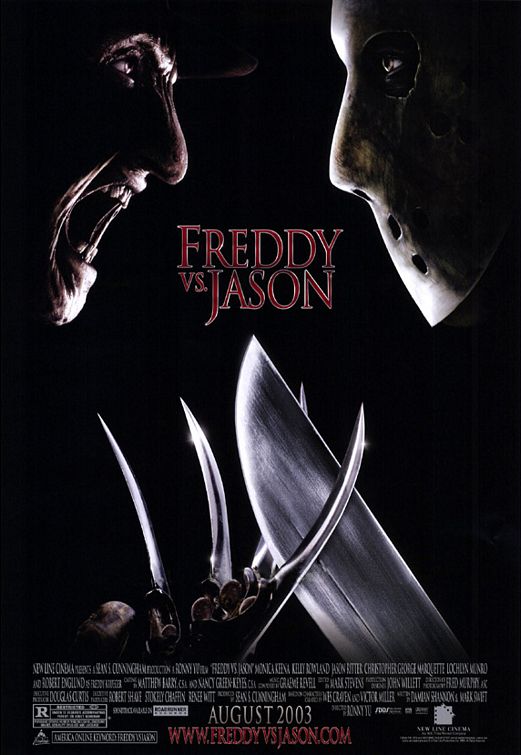
The stage was set for Freddy vs. Jason (2003) long before Freddy’s glove made a cameo at the end of Jason Goes to Hell: The Final Friday (1993) — yet another in a long line of misleadingly-titled films promising the last stand of the boogeyman in question (lest ye forget, Jason X came out in 2001). Who didn’t want to see the wisecracking scourge of Springwood go glove-to-machete with Camp Crystal Lake’s burly maniac? Truly, it would be a grudge match for the ages, with two of the most franchise-able movie monsters (combined total in 2003: 17 films) poised to lure both long-standing loyalists and new blood into the theaters. (And even if the entire film was simply a canny marketing tactic, it worked — Freddy vs. Jason was a huge hit, earning $82 million in the United States alone.)

It goes without saying that all viewers must choose a side. And I don’t mean choosing the side of the generic teen actors (Monica Keena, Jason Ritter, Destiny’s Child-er Kelly Rowland)  — after all, it’s only fun when the bodies start dropping, so that ain’t even an option. I remember attending the Freddy vs. Jason press screening and being outraged that the promotional giveaway item was a paper Jason mask. Hold the (tongue-twisting) phone! No glove bedecked with cardboard razors? No disposable fedora? Clearly, favoritism was being displayed! UNFAIR TO FREDDY!

Um, anyway. Nearly 10 years later, I still have that paper hockey mask, but I hadn’t re-watched the movie since its release. Looking at it again last night, I remembered why: it’s just sort of blah. A huge amount of exposition — wherein we learn that the powers of Freddy (Robert Englund) have been nullified because Springwood grown-ups have taken drastic steps to make all the wee ones forget about him, and if nobody remembers him, they can’t fear him, and if they don’t fear him, he has no strength to sweeten anyone’s sleepytime, etc. etc. — leads to Freddy rousing his fellow hell-dweller, Jason (Ken Kirzinger), from whatever stasis the superhuman killing machine happens to be in this year. (For the record, I kinda liked Jason X. Jason in outer space was such an awesome idea, I didn’t really mind that the movie was so insanely formulaic otherwise.)

Anyway, Jason rises, again, lumbers over to Elm Street, and starts taking out the local under-18 population. Word gets out, thanks to some indiscreet cops and a couple of kids who’ve been institutionalized and medicated for the sole purpose of silencing the Ballad of Freddy Krueger. Oops. There are slicings, dicings, a rave in a corn field (wait — a rave? With glow sticks? In 2003? I hope this is a sign of the sense of humor that enabled director Ronny Yu to helm 1998’s Bride of Chucky), and all manner of bloodshed; at a certain point, Freddy gets pissed at Jason (“That hockey puck!”) for killing wide-awake kids he was hoping to slaughter in their dreams. Important lesson, everyone: it’s hard to reason with a voiceless, soulless, heavily armed killing machine.

SO. One thing leads to another, and Jason gets tranquilized. Freddy goes into his dream, and pretends to be Jason’s nagging-from-the-grave mother, kind of a Mrs. Bates in a turtleneck. Despite all efforts, Jason won’t die, of course. (Is it possible Freddy never saw a Friday movie? That’s Jason’s magic power! He is evil immortal! Like, duh!) The kids intervene by driving Jason’s snoozing body to Camp Crystal Lake. (All this time it was terrifyingly close to Springwood — who knew?)

Elm Street dweller Lori (Keena, whose character’s name may or may not be a reference to Laurie Strode from the Halloween movies) has the bright idea of bringing Freddy into the real world, which is exactly what happened in Freddy’s Dead (1991) and probably a few other Nightmares as well, but at this point, I’m having trouble keeping track. Pretty much, it’s breasty Lori’s only contribution to the film, even though she’s positioned as a Nancy Thompson-style last girl standing. Oh, how times have changed … and gotten worse.

Anyway, at last, Freddy and Jason have it out on the shores of Crystal Lake. There is fire, there are explosions, there’s a beheading, and if you really want to know, neither guy wins. There’s no winner! Haha, sucker! Argh. But, I suppose, the end result was convincing enough to pave the way for another clash of horror titans, Alien vs. Predator (2004), which in turn brought us Aliens vs. Predator: Requiem (2007), which in turn probably helped this summer’s Predators get made, and Predators looks awesome, so I’m not complaining. However, the success of Freddy vs. Jason also no doubt inspired last year’s Friday the 13th remake, which was utter shit (in 3-D), and the brand-new A Nightmare on Elm Street, which opens tomorrow, featuring Jackie Earle Haley instead of Robert Englund in the striped-sweater hot seat. How will Freddy fare? Stay tuned for Louis Peitzman’s review!

Welcome to Elm Street: Part Six

0

In honor(?) of the new A Nightmare on Elm Street, we’re recapping all of the Elms so far. Find more on the Pixel Vision blog.

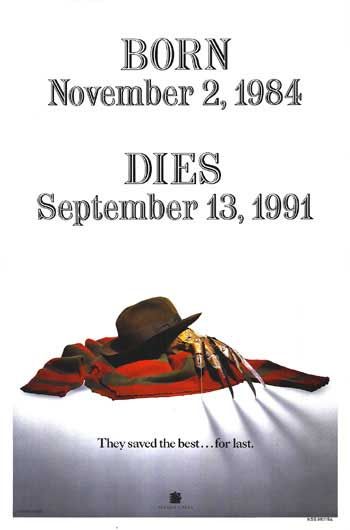
By 1991, when the optimistically-titled Freddy’s Dead: The Final Nightmare rolled around, the Elm Street series was still making money, but delivering few scares. Not like the series’ beloved hero cared, really — Freddy Krueger was as popular as ever. Just look at the opening credits of Freddy’s Dead, which equate Krueger and Nietzsche as quotable icons (“Welcome to prime time, bitch!” remains a phrase of note among philosophers, I’m sure.)

The only Nightmare film directed by a woman (Rachel Talalay, who made her directing debut; she later made 1995’s Tank Girl and has since helmed a shit-ton of TV shows), and the only to utilize 3-D (more on that later), Freddy’s Dead is set ten years in the future (so, 2001?) Freddy has slaughtered every kid in Springwood; the adults who remain are bonkers. The sole survivor is a height-phobic teen (Shon Greenblatt) we only ever know as John Doe; the film’s opening sequence pays homage to both The Twilight Zone and The Wizard of Oz (1939) as John ejects from a freaky airplane ride into a house spinning through a wind storm. Do I really have to tell you Freddy sails by on a broom stick? “I’ll get you, my pretty — and your little soul, too!”

John lives, but barely — battered and with no memory, he’s picked up by cops in Depressed Americatown, USA, and taken to a run-down shelter for troubled teens staffed by Maggie (Lisa Zane — yes, Billy’s sister!) and Doc (the Yaphet Kotto). In short order, we’re introduced to a ragtag crew of Dream Warriors 2.0: dope-smoking video game addict Spencer (future movie and TV semi-star Breckin Meyer); tough bitch Tracy (Lezlie Deane); and hearing aid-wearing Carlos (Ricky Dean Logan). In keeping with a series theme that’s especially pronounced here, all three have abusive parents.

The fact that John Doe has violent, vivid nightmares is intriguing to both Doc — who specializes in “dream therapy” — and Maggie, who suffers her own disturbing dreams. When it becomes apparent that Maggie and John are having variations on the same dream (though Maggie’s play out more like flashbacks, or sinister home movies), she hustles him into the youth center’s comically beat-up van for a visit to Springwood. Hey, maybe it’ll jog his memory — or hers.

OF COURSE, the three reckless youths with obviously identifiable weaknesses happen to stow along for the ride. Bad move. Springwood proves to be empty, save for a few insane adults (including Roseanne and Tom Arnold, at the height of their tabloid fame). While Maggie and John search for clues to their dark pasts, Spencer, Tracy, and Carlos explore an abandoned house — on Elm Street. Freddy appears and immediately begins fucking with all involved: for example, the deaf kid gets a Freddy-style hearing aid that makes everything painfully loud, and is then subjected to the sound of Freddy gleefully scratching his claws along a chalkboard. Needless to say, Carlos’ head explodes; needless to add, Freddy’s kiss-off is “Nice hearin’ from ya!”

Spencer’s death is far more humorous, and is probably the best example of how un-terrifying Freddy has become by now. As the stoner dozes, a busted TV comes to life. Johnny Depp does a rememberin’-my-roots cameo in a fake TV commercial, which is interrupted by Freddy. “Hey Spence — let’s trip out!” Droopy-eyed Spence grins as Iron Butterfly plays and psychedelic waves suck him into the set. Suddenly, he’s a character in a video game, being pounded first by his domineering father (“Be like me!”) and then Freddy himself, who’s also manning the joystick in some alternate reality to this alternate reality. As Maggie and Tracy watch in horror (and, presumably, the audience howls in delight), Spence sleepwalks all over the house, punching walls and bouncing into the ceiling. “Great graphics,” gamer Freddy murmurs in approval.

Anyway. Spence dies, and a sleeping John Doe can’t be roused to prevent his own untimely end (it involves a parachute and a bed of nails). Earlier, he and Maggie had learned from Springwood’s orphanage that Freddy Krueger’d had a kid, current whereabouts unknown. John had thought he was Krueger Jr., safe from Freddy’s wrath. But no! His last words, to Maggie: “It’s not a boy!”

So, Maggie the nightmare-having doctor realizes what we’ve known all along: Freddy Krueger is her father! ZOMG! Freddy’s Dead takes the opportunity to sketch in a backstory for our favorite child killer: he’s seen pulverizing a hamster as his eight-year-old classmates chant “Son of a hundred maniacs!”; he’s seen enjoying a beating from his stepfather (the Alice Cooper); he’s seen, through Maggie’s eyes, murdering his wife after she discovers a secret room in their Springwood house (contents: gloves, weird things in jars, cookies). Young Maggie, or Katherine, or whatever her birth name was, was sent to the orphanage soon after, giving Freddy further motivation to kill every kid in town. Or something. Apparently he was a devoted father.

Meanwhile, back at the shelter, Doc immediately understands the situation, unlike every other authority figure in the series EVER: “He’s fucking with the line between dreams and reality!” Seems Freddy is also trying to get Maggie to bring him more victims, allowing for this crowd-pleasing exchange:  “But this isn’t Springwood!” “Every town [dramatic pause] has an Elm Street!”

It is soon decided that Maggie, being Freddy’s spawn, is the only one who can enter his thoughts, get ahold of him in dreamville, and bring him into the real world, where he can be killed the fuck dead. “You’ll use these,” Doc says, pulling out a pair of 3-D glasses. While it might’ve been easier for the filmmakers to just insert a title card reading “PUT ON THE GLASSES NOW Y’ALL,” I suppose this was a somewhat more subtle way to issue the same orders.

Anyway, there’s an extended tussle in shoddy 3-D. Freddy finally dies (Maggie spears him with his own glove, for maximum irony). The end credits, which offer a memorializing highlight reel of Freddy’s greatest kills, unspool over what has to be Iggy Pop’s least-popular song of all time, “Why Was I Born? (Freddy’s Dead).” And horror fans finally know the answer to the question that’d gripped their dreams for nearly a decade: how do you kill Freddy Krueger? You could believe the movie’s harebrained plot. Or you could believe the evidence presented by the movie itself: kill the monster by transforming him into a campy, cackling, comedian.

Don’t worry — there are two more Freddy movies, plus the new flick, to go on our series. Grab a cup of coffee, kids!

http://www.youtube.com/watch?v=YmdityGT-R8&feature=related

alt.sex.column: Rubber soul

0

Dear Andrea:

I have memories from early childhood onward of masturbating. (I’m a woman.) I’m talking when I was four years old or possibly even younger. I remember doing it in public too, like in front of family members.

It always took the form of rubbing myself against objects or the floor. I’m pretty sure I experienced orgasm too. Is it normal for a child to experiment sexually like this? And do you think it’s appropriate to discuss it with my boyfriend? I’m sure I wasn’t harmed by the experiences, but it seems like I started sexually expressing myself awfully young!

Love,

Rub It In

Dear Rub:

Pish tosh. Four-year-old (and younger) girls are well-known frotteurs, and often show an interest in ride-on toys, coin-operated bucking broncos, broomstick ponies, and the like keen enough to discomfit nearby adults. The fact that we, the adults, may be discomfited oughtn’t in any way imply that the kids are doing anything wrong. You certainly weren’t.

Every child develops on his own schedule, of course, but it’s well-documented that male fetuses can get erections in utero, and certainly infants produce them regularly (although infants are too busy learning where their feet are to bother much with genitals yet). Toddler and preschool boys, will proudly indicate theirs while crowing “Penis! Penis!” and they won’t stop without some sort of (gently diplomatic) intervention. With boys or girls, it’s best to show no emotional reaction but simply suggest that erections or frotting be achieved, displayed, and investigated in private. Adults are certainly entitled to their reactions (often amusement, sometimes shock or dismay) but in the interest of not scarring one’s children for life, it’s best to hide those.

What you were doing as a kid was perfectly normal and totally harmless and I’m really sorry you had to go through that whole guilt and repression phase. I’m kind of cheered, though, to see that it didn’t take. While it probably wouldn’t be great for either you or your boyfriend for you to have only one route to orgasm, and that rather solitary. Rubbing is a perfectly good addition to one’s repertoire.

So, yes, it was normal to do what you did when you were doing it, and many adult women continue the practice, and I can’t think of a single reason not to mention it to your boyfriend. I imagine he will counter with some similar confession and you will both laugh and yet find yourselves just a bit turned on as well. I can’t promise that either of you will be able to come up with a good, non-awkward way to incorporate rubbing against inanimate objects into your partnered sex, but have you by any chance considered adapting your formerly solitary practice to your current situation? That is to say, you have a perfectly good object for your rubbing right there next to you, provided he doesn’t mind being called an object. If he is anything like any other heterosexual male I have encountered either personally or professionally, he will not mind in the least having an attractive and in this case already beloved female grind her pelvis against him.

Love,

Andrea

Got a question? E-mail Andrea at andrea@altsexcolumn.com


Benefits: April 28-May 4

0

Ways to have fun while giving back this week


Wednesday, April 28

Save the Waves
Attend this benefit for Chile, where donations will go to directly aid small coastal areas that were hit hardest by the Feb. 27th earthquake and following tsunamis, featuring free food, surf flicks, raffles, and DJs Paul McNitt and Paul Hobi spinning soul, funk, house, breaks, and reggae.
8 p.m., free
Riptide
3639 Taraval, SF
www.savethewaves.org

Thursday, April 29

Hospitality House Art Auction
Help support Hospitality House’s Community Arts Program (CAP), a free fine arts studio and gallery space that provides professional instruction, materials, and sales and exhibition support for poor and homeless Tenderloin artists. This 25th anniversary auction will feature more than 150 unique pieces of art from a diverse collection of regional artists.
6 p.m., $30
Andrea Schwartz Gallery
525 2nd St., SF
www.hospitalityhouse.org

Toe to Toe
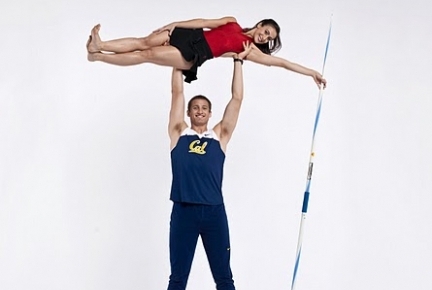
Attend this benefit for ODC Dance Commons and Cal Athletics featuring a live competition between ODC/Dance’s contemporary dance company and top student athletes from UC Berkeley to see who’s the better athlete: dancers or sports stars. Judges to include San Francisco 49ers Ronnie Lott, Harris Barton, Nate Clements, MC Hammer, and more. Hosted by Warren Hellman.
6:30 p.m., $125
Herbst Pavilion
Fort Mason Center, SF
www.slimstickets.com

Friday, April 30

Blue Ribbon Luncheon
Help support the San Francisco Child Abuse Prevention Center, an organization dedicated to the prevention of child abuse and neglect, at this luncheon featuring three-time Super Bowl champion and former 49er Riki Ellison, and Emmy-award winning co-anchor of ABC 7/KGO TV Cheryl Jennings as master of ceremonies.
Noon, $250
Westin St. Francis Hotel
335 Powell, SF
www.sfcapc.org

Hold the Light for Haiti and Chile
Join Bay Area poets as they gather in support of efforts to assist the men, women, and children in Haiti and Chile who have been devastated by the recent earthquakes. Poets to include Diane di Prima, Al Young, Devorah Major, Mary Rudge, Deborah Grossman, and many more. Proceeds will be donated to Doctors Without Borders.
6 p.m., $5-10 suggested donation
Islamic Cultural Center
1433 Madison, Oak.
www.penoakland.org

Noe Valley Uncorked
Learn about and sample Argentinean wine at this wine event featuring on-hand experts and hors d’ oeuvres. Door proceeds benefit the Noe Valley Ministry.
6 p.m., $35
Noe Valley Ministry
1021 Sanchez, SF
www.noevalleyministry.org

Saturday, May 1

Bay Area Brain Tumor Walk
Attend this inspirational, all-ages fundraising walk to support the fight against brain tumors, featuring food, music, prizes, and more.
9 a.m.; raise a minimum amount of $350 or donate what you can
Speedway Meadow
Golden Gate Park
299 Tansverse, SF
www.bayareawalk.org

Sunday, May 2

Bliss 2010
Help support Maitri, the only AIDS-specific residential care facility left in the Bay Area, at this gala and auction featuring stand-up comedian Sandra Bernhard and designer Carmen Marc Valvo and food from top SF restaurants, drinks, live music, and more.
6 p.m., $150
Golden Gate Club
Presidio, Fisher Loop, SF
www.maitrisf.org

Mother’s Day Diaper Drive
Bring your kids to this fundraiser family day to benefit Help a Mother Out (HAMO), a grassroots advocacy campaign dedicated to improving the lives of mothers, children, and families, featuring games, crafts, pizza, cupcakes, and complimentary kiddie photo sessions. Proceeds will be used to purchase diapers for HAMO’s Bay Area partners. 
3 p.m., $40 per family
Peekadoodle Kidsclub
900 North Point, suite F100, SF
www.helpamotherout.org

Wanderlust at the Fillmore
In the spirit of the Wanderlust festival in North Lake Tahoe, this yoga and music festival will offer yoga classes during the day courtesy of Yoga Tree and live music performances featuring Rupa and the April Fishes at night. A portion of the proceeds benefit
Off the Mat, Into the World.
4 p.m. yoga, 7 p.m. concert; $25-$55
Fillmore
1805 Geary, SF
www.yogatreesf.com

Monday, May 3

“Aurora Borealis”
Wine and dine for a cause at this fundraiser for the Aurora Theater Company’s live performances, education program, and the Global Age Project, featuring specialty wines, silent auction, three-course meal, live entertainment, and more.
6 p.m., $200
Hotel Shattuck Plaza
Crystal Ballroom
2086 Allston, Berk.
(510) 843-4042, ext. 312

North Beach and Chinatown lift forks for Noodlefest 2010

1

I do love me some noodles. As do we all — just ask the cooks carving them from a solid, gyro like block of pasta at the Seattle Chinese restaurant I once blissfully attended, or the happy fettuccine eaters at the sidewalk cafes on Columbus Avenue. The world would be a better place if we could all put down our weapons and pick up our forks and spoons.

Which is roughly what is happening at this weekend’s Noodlefest 2010 (Sun/2). Sure, the days of armed warfare between North Beach and Chinatown may be safely behind us (were they ever in existence), but the two adjacent neighborhoods rarely come together to plan community happenings. Harken to the candlelit dinner scene in The Lady and the Tramp — it takes a pasta strand to break the ice, and bring you snout to snout.

But why eat a strand when you can sample six different pasta meals? Entry to Noodlefest gets you a taste of three steaming mountains of Chinatown noodles, and three from North Beach, in addition to live noodle making demonstrations and entertainment of all stripes.

So grab a fork. And to reinforce what this peaceful coexistence of culinary traditions signifies in the history of our city, two long time residents of the neighborhoods, Reverend Norman Fong of the Chinatown Community Development Center, and Dan Macchiarini of the North Beach Merchants’ Association, sent us their memoirs of growing up in the city’s historically Chinese and Italian ‘hoods. If the following tales of downtown SF life in the ‘50s and ‘60s don’t make you feel all noodley inside, then I don’t know what will.


Noodlefest 2010
Sun/2 3-7pm, $15
Grant, between Pacific & Vallejo, SF

www.chinatowncdc.org
———————-

The yin and yang of Chinese-Italian relationships
By Reverend Norman Fong, Chinatown Community Development Center


During the 1950s and 1960s,  it wasn’t all fine and dandy growing up in Chinatown and North Beach, although I wouldn’t trade my life experience for anything. In my younger elementary school years, I was a Chinatown kid; all my classmates were Chinese-Americans.

Then I had to cross Washington Square to head to Francisco Jr. High, where I learned about other races.  I remember having a crush on one very cute girl who lived in North Beach but I was too shy to ever ask her out and there weren’t too many cross-cultural relations back then. I also remember some very negative moments when groups of Italian boys would harass me.

One time I was chased by these boys who screamed “let’s get the Chinaman” and they tied me to the fence near St. Peter & Paul and they threw water balloons at me. I went home and I told my mom “I hate italians” and explained what happened.

My mom said life was about balance. “Did you know our landlord is Italian? He only charges us $90 rent and never raised the rent?” I didn’t fully understand at the time just how much that meant, but I do now. Years later, when I was about 18 years old, we were evicted from our home — by a Chinese landlord who bought the building.

Life is about balance, the Yin and Yang of life. Dan Macchiarini and Kathleen Dooley of the North Beach Merchants Association are friends because we shared the same block at the Chinatown Community Development Center office at 1525 Grant. I bought my Valentine’s Day flowers from Kathleen for my wife a number of years.

This Noodlefest is not just about noodles, spaghetti versus chow mein… It’s about relationships… and building cultural bridges… and “balance.”

Fireworks and noodles
By Dan Macchiarini, North Beach Merchants’ Association


Back in the day of the day, back when I was around 9 years old in the early 1960’s, I was among a bunch of kids my age from North Beach and Chinatown who would regularly play pick up games of football in Washington Square. Park Saturdays, Sundays, and whenever we could during the summer. We would have played baseball but the adults using the park wouldn’t let us and we could only play softball down at the Joe DiMaggio playground.

This was also a time when there were no real playgrounds at all in Chinatown, so a lot of the Chinese kids would come across Broadway to play in North Beach at Washington Square Park with us Italian kids. Some kids from Chinese ancestry lived in North Beach already. We got along fairly well too, considering the nonsensical historic animosity between a lot of our parents from our two distantly different racial and ethnic backgrounds.

We also hung out and played tennis dodge ball in the alley streets in both communities. These alleys during the day were very safe and were the kind of the place where car drivers looked out for and expected us kids to be.   Chinatown and North Beach both share a network of smallish streets and alleys. We made these “kids turf” when we weren’t in the park.

However, the most fun time for us was around mid February every year. It was always rainy and cold but this is the time of Chinese New Year. None of us Italian kids, even on the fourth of July, had access to fire works like the Chinese kids did. This made for a great trading relationship between us, everything from baseball cards to candy and sometimes even money changed hands for us to get the fireworks and use them. We had great contests blowing up tin cans, setting off stings of fire crackers to see how much noise and smoke we could make, until we got nailed by our parents who would attempt to restrict our alley pyrotechnics antics, commerce and careers on both sides of the ethnic divide.

The Chinese kids seemed to be at greater liberty to get and use these fireworks than we Italian kids were. It didn’t seem fair to me. I asked my father why this was. He said it was part of their culture and explained the “lunar new year.” He and my mother regularly took us to the Chinese New Year parade during the late 1950s and early 1960s. There were massive fireworks and firecrackers there, mostly still in the rain but spectacular at night during the parade of dragons and lions.

Before the parade, my parents would take my sister and I to dinner in their favorite Chinese restaurant and they would order all kinds of exotic dishes.  The restaurant, still there, was up Washington Street just off Grant Ave., three block off of Broadway and, literally, under the building. You walk down concrete steps to the doorway. Very “old school” Chinatown. My father knew all the waiters and the owner would greet us with broad smile.  Somehow, they knew each other back in their day, the 1930s, when everyone was struggling just to survive. So we got the VIP treatment there.

The food was incredibly good, although as a nine year old, I was somewhat picky — which my father had a VERY low tolerance for. I loved the Chinese noodles, all the chow mien dishes, and was okay with the rice dishes, but I had a lot of trouble with egg fu yung types; they tasted runny and raw to me. My mother insisted that my sister and I “try everything” they ordered, and my father would cuff me in the head to get my attention and tell me to “eat all your food.” I evolved a plan through; it involved a conspiracy with my sister because she loved egg fu yung. When my parents were distracted and not looking, we would change plates under the table. This all worked out fairly well until one time when we dropped one of the plates we were exchanging under the table. The food hit the floor and my father hit the ceiling. I was good at ducking, though. Luckily, the waiters and the owner were in fits laughter over this so my father’s temper cooled off fast but my mother made us kids sit through the rest of the meal without ANY more food as well as having to help the waiters picked up the mess.

I complained to my father, asking him why I couldn’t just eat the chow mien, like the pasta we made and ate at home. He told me that he brought me out to a Chinese restaurant so “you can learn” the taste of the way other people make food — and beside, the Chinese invented pasta too.

He said it was part of history, that about 800 years ago Marco Polo, an Italian merchant, went to China from Europe to Asia along the silk road to trade — and brought the idea of pasta to Italy and Europe (along with gunpowder).

He went on about this history, lecturing about how food was part of culture and we, as kids, should experience all kinds of food to learn about all kinds of cultures.  This lasted about ten minutes, but it still didn’t get me to like egg fu yung — although a thought pushed itself into my nine year old mind that those Chinese kids I played and “traded” with in the alleys of North Beach and Chinatown for fireworks were my “Silk Road,” and going between North Beach and Chinatown was truly great adventure.

ENDORSEMENTS: National and state races

15

Editor’s note: the file below contains a correction, updated May 5 2010. 


National races


U.S. SENATE, DEMOCRAT


BARBARA BOXER


The Republican Party is targeting this race as one of its top national priorities, and if the GOP can dislodge a three-term senator from California, it will be a major blow for the party (and agenda) of President Obama. The pundits are happily talking about how much danger Barbara Boxer faces, how the country’s mood is swinging against big-government liberals.


But it’s always a mistake to count out Boxer. In 1982, as a Marin County supervisor with little name recognition in San Francisco, she trounced then-SF Sup. Louise Renne for an open Congressional seat. Ten years later, she beat the odds and won a hotly contested primary and tough general election to move into the Senate. She’s a fierce campaigner, and with no primary opposition, will have a united party behind her.


Boxer is one of the most progressive members of the not-terribly progressive U.S. Senate. She’s been one of the strongest, most consistent supporters of reproductive rights in Washington and a friend of labor (with 100 percent ratings from the AFL-CIO and National Education Association). We’ve had our disagreements: Boxer supported No Child Left Behind, wrote the law allowing airline pilots to carry guns in the cockpit, and was weak on same-sex marriage when San Francisco sought to legalize it (although she’s come around). But she was an early and stalwart foe of the war in Iraq, split with her own party to oppose a crackdown on illegal immigration, and is leading the way on accountability for Wall Street. She richly deserves reelection, and we’re happy to endorse her.


CONGRESS, 6TH DISTRICT, DEMOCRAT


LYNN WOOLSEY


It’s odd that the representative from Marin and Sonoma counties is more progressive by far than her colleague to the south, San Francisco’s Nancy Pelosi. But over the years, Lynn Woolsey has been one of the strongest opponents of the war, a voice against bailouts for the big Wall Street banks, and a foe of cuts in the social safety net. We’re proud to endorse her for another term.


CONGRESS, 7TH DISTRICT, DEMOCRAT


GEORGE MILLER


George Miller has been representing this East Bay district since 1974, and is now the chair of the Education and Labor Committee and a powerhouse in Congress. He’s too prone to compromise (with George W. Bush on education policy) but is taking the right line on California water (while Sen. Dianne Feinstein is on the wrong side). We’ll endorse him for another term.


CONGRESS, 8TH DISTRICT, DEMOCRAT


NANCY PELOSI


We’ve never been terribly pleased with San Francisco’s most prominent Congressional representative. Nancy Pelosi was the author of the bill that created the first privatized national park at the Presidio, setting a horrible standard that parks ought to be about making money. She was weak on opposing the war, ducked same-sex marriage, and has used her clout locally for all the wrong candidates and issues. But we have to give her credit for resurrecting and pushing through the health care bill (bad as it was — and it’s pretty bad — it’s better than doing nothing). And, at a time when the Republicans are trying to derail the Obama presidency, she’s become a pretty effective partner for the president.


Her fate as speaker (and her future in this seat) probably depends on how the Democrats fare in the midterm Congressional elections this fall. But if she and the party survive in decent shape, she needs to take the opportunity to undo the damage she did at the Presidio.


CONGRESS, 9TH DISTRICT, DEMOCRAT


BARBARA LEE


Barbara Lee, who represents Berkeley and Oakland, is co-chair of the Progressive Caucus in the House, one of the most consistent liberal votes in Congress, and a hero to the antiwar movement. In 2001, she was the only member of either house to oppose the Bush administration’s Use of Force resolution following the 9/11 attacks, and she’s never let up on her opposition to foolish military entanglements. We’re glad she’s doing what Nancy Pelosi won’t — represent the progressive politics of her district in Washington.


CONGRESS, 13TH DISTRICT, DEMOCRAT


PETE STARK


Most politicians mellow and get more moderate as they age; Stark is the opposite. He announced a couple of years ago that he’s an atheist (the only one in Congress), opposed the Iraq war early, called one of his colleagues a whore for the insurance industry, and insulted President Bush and refused to apologize, saying: “I may have dishonored the commander-in-chief, but I think he’s done pretty well to dishonor himself without any help from me.” He served as chair of the House Ways and Means Committee for exactly one day — March 3 — before the Democratic membership overruled Speaker Pelosi and chucked him out on the grounds that he was too inflammatory. The 78-year-old may not be in office much longer, but he’s good on all the major issues. He’s also fearless. If he wants another term, he deserves one.


State races


GOVERNOR, DEMOCRAT


EDMUND G. BROWN


Jerry Brown? Which Jerry Brown? The small-is-beautiful environmentalist from the 1970s who opposed Pacific Gas and Electric Co.’s Diablo Canyon nuke and created the California Conservation Corps, the Office of Appropriate Technology, and the Farm Labor Relations Board (all while running a huge budget surplus in Sacramento)? The angry populist who lashed out at corporate power on a KPFA radio talk show and ran against Bill Clinton for president? The pro-development mayor of Oakland who sided with the cops on crime issues and opened a military academy? Or the tough-on-crime attorney general who refuses to even talk about tax increases to solve the state’s gargantuan budget problems?


We don’t know. That’s the problem with Brown — you never know what he’ll do or say next. For now, he’s been a terribly disappointing candidate, running to the right, rambling on about preserving Proposition 13, making awful statements about immigration and sanctuary laws, and even sounding soft on environmental issues. He’s started to hit his stride lately, though, attacking likely GOP contender Meg Whitman over her ties to Wall Street and we’re seeing a few flashes of the populist Brown. But he’s got to step it up if he wants to win — and he’s got to get serious about taxes and show some budget leadership, if he wants to make a difference as governor.


LIEUTENANT GOVERNOR, DEMOCRAT


JANICE HAHN


Not an easy choice, by any means.


Mayor Gavin Newsom jumped into this race only after it became clear that he wouldn’t get elected governor. He sees it as a temporary perch, someplace to park his political ambitions until a better office opens up. He’s got the money, the statewide name recognition, and the endorsement of some of the state’s major power players, including both U.S. Senators and House Speaker Nancy Pelosi. He’s also been a terrible mayor of San Francisco — and some progressives (like Sup. Chris Daly) argue, persuasively, that the best way to get a better person in Room 200 is to ship Newsom off to an office in Sacramento where he can’t do much harm and let the supervisors pick the next mayor.


But it’s hard to endorse Newsom for any higher office. He’s ducked on public power, allowing PG&E to come very close to blocking the city’s community choice aggregation program (See editorial, page 5). His policies have promoted deporting kids and breaking up families. He’s taken an approach to the city budget — no new revenue, just cuts — that’s similar to what the Republican governor has done. He didn’t even bother to come down and talk to us about this race. There’s really no good argument for supporting the advancement of his political career.


Then there’s Janice Hahn. She’s a Los Angeles City Council member, the daughter of a former county supervisor, and the sister of a former mayor. She got in this race way before Newsom, and her nightmare campaign consultant, Garry South, acts as if she has some divine right to be the only Democrat running.


Hahn in not overly impressive as a candidate. When we met her, she seemed confused about some issues and scrambled to duck others. She told us she’s not sure she’s in favor of legalizing pot, but she isn’t sure why she’s not sure since she has no arguments against it. She won’t take a position on a new peripheral canal, although she can’t defend building one and says that protecting San Francisco Bay has to be a priority. She won’t rule out offshore oil drilling, although she said she has yet to see a proposal she can support. Her main economic development proposal was to bring more film industry work to California, even if that means cutting taxes for the studios or locating the shoots on Indian land where there are fewer regulations.


On the other hand, she told us she wants to get rid of the two-thirds threshold in the state Legislature for passing a budget or raising taxes. She supports reinstating the car tax at pre-Gov. Arnold Schwarzenegger levels. She supports a split-roll measure to reform Prop. 13. She wants to see an oil-severance tax to fund education. She’s one of the few statewide candidates who openly advocates higher taxes on the wealthy as part of the solution to the budget crisis.


We are under no illusions that Hahn will be able to use the weak office of lieutenant governor to move on any of these issues, and we’re not at all sure she’s ready to take over the top spot. But on the issues, she’s clearly better than Newsom, so she gets our endorsements.


SECRETARY OF STATE, DEMOCRAT


DEBRA BOWEN


Debra Bowen is the only Democrat running, a sign that pretty much everyone in the party thinks she’s doing a fine job as Secretary of State. She’s run a clean office and we see no reason to replace her.


CONTROLLER, DEMOCRAT


JOHN CHIANG


Like Bowen, John Chiang has no opposition in the primary, and he’s been a perfectly adequate controller. In fact, when Gov. Schwarzenegger tried two years ago to cut the pay of thousands of state employees to the minimum wage level, Chiang defied him and refused to change the paychecks — a move that forced the governor to back down. We just wish he’d play a more visible role in talking about the need for more tax revenue to balance the state’s books.


TREASURER, DEMOCRAT


BILL LOCKYER


Bill Lockyer keeps bouncing around Sacramento, waiting, perhaps, for his chance to be governor. He was attorney general. Now he’s treasurer seeking a second term, which he will almost certainly win. He’s done some good things, including trying to use state bonds to promote alternative energy, and has spoken out forcefully about the governor’s efforts to defer deficit problems through dubious borrowing. He hasn’t, however, come out in favor of higher taxes for the rich or a change in Prop. 13.


ATTORNEY GENERAL, DEMOCRAT


KAMALA HARRIS


There are really only two serious candidates in this race, Kamala Harris, the San Francisco district attorney, and Rocky Delgadillo, the former Los Angeles city attorney. Harris has a comfortable lead, with Delgadillo in second and the others far behind.


Delgadillo is on his second try for this office. He ran against Jerry Brown four years ago and got nowhere. And in the meantime, he’s come under fire for, among other things, using city employees to run personal errands for him (picking up his dry-cleaning, babysitting his kids) and driving his car without insurance. On a more significant level, he made his reputation with gang injunctions that smacked of ethnic profiling and infuriated Latino and civil liberties groups. It’s amazing he’s still a factor in this race; he can’t possibly win the general election with all his baggage.


Harris has a lot going for her. She was among the first California elected officials to endorse Barack Obama for president, and remains close to the administration. She’s a smart, articulate prosecutor and could be one of the few women atop the Democratic ticket this year. We were never comfortable with her ties to Willie Brown, but he’s no longer a factor in state or local politics. These days, she’s more closely allied with the likes of State Sen. Mark Leno.


That said, we have some serious problems with Harris. She’s been up in Sacramento pushing Republican-style tough-on-crime bills (like a measure that would bar registered sex offenders from ever using social networking sites on the Internet) and forcing sane Democrats like Assembly Member and Public Safety Committee Chair Tom Ammiano to try to tone down or kill them (and then take the political heat). If she didn’t know about the problems in the SFPD crime lab, she should have, and should have made a bigger fuss, earlier.


But Harris has kept her principled position against the death penalty, even when it meant taking immense flak from the cops for refusing to seek capital punishment for the killer of a San Francisco police officer. She’s clearly the best choice for the Democrats.


INSURANCE COMMISSIONER, DEMOCRAT


DAVE JONES


Two credible progressives are vying to run for this powerful and important position regulating the massive — and massively corrupt — California insurance industry. Dave Jones and Hector De La Torre are both in the state Assembly, with Jones representing Sacramento and De La Torre hailing from Los Angeles. Both have a record opposing insurance industry initiatives; both are outspoken foes of Prop. 17; and either would do a fine job as insurance commissioner. But Jones has more experience on consumer issues and health care reform, and we prefer his background as a Legal Aid lawyer to De La Torre’s history as a Southern California Edison executive. So we’ll give Jones the nod.


BOARD OF EQUALIZATION, DISTRICT 1, DEMOCRAT


BETTY T. YEE


Betty Yee has taken over a job that’s been a stronghold of progressive tax policy since the days of the late Bill Bennett. She’s done well in the position, supporting progressive financial measures and even coming down, as a top tax official, in favor of legalizing (and taxing) marijuana. We’re happy to endorse her for another term.


SUPERINTENDENT OF PUBLIC INSTRUCTION


TOM TORLAKSON


Two prominent Democratic legislators are running for this nonpartisan post, state Sen. Gloria Romero of Los Angeles and Assembly Member Tom Torlakson of Martinez. It’s a pretty clear choice: Romero is a big supporter of charter schools who thinks parents should be able to move their kids out of one school district and into another (allowing wealthier white parents, for example, to abandon Los Angeles or San Francisco for the suburban districts). She’s been supported in the past by Don and Doris Fisher, who put a chunk of their GAP Inc. fortune into school privatization efforts. Torlakson wants more accountability for charters, opposes the Romero district-option bill, and has the support of every major teachers union in the state. Vote for Torlakson.


STATE SENATE, DISTRICT 8, DEMOCRAT


LELAND YEE


Sen. Leland Yee can be infuriating. Two years ago, he was hell-bent on selling the Cow Palace as surplus state property and allowing private developers to take it over. In the recent budget crisis, he pissed off his Democratic colleagues by refusing to vote for cuts that everyone else knew were inevitable (while never making a strong stand in favor of, say, repealing Prop. 13 or raising other taxes). But he’s always been good on open-government issues and has made headlines lately for busting California State University, Stanislaus over a secret contract to bring Sarah Palin in for a fundraiser — and has raised the larger point that public universities shouldn’t hide their finances behind private foundations.


Yee will have no serious opposition for reelection, and his campaign for a second term in Sacramento is really the start of the Leland Yee for Mayor effort. With reservations over the Cow Palace deal and a few other issues, we’ll endorse him for reelection.


 Correction update: Yee’s office informs us that the senator suports an oil-severance tax and a tax on high-income earners and “believes that Prop. 13 should be reformed,” although he hasn’t taken a position on Assemblymember Tom Ammiano’s reform bill. 


STATE ASSEMBLY, DISTRICT 12, DEMOCRAT


FIONA MA


Fiona Ma’s a mixed bag (at best). She doesn’t like Pacific Gas and Electric Co. and supports public power, but comes up with strange bills that make no sense, like a 2009 measure to limit rent control in trailer parks. Why does Ma, who has no trailer parks in her district, care? Maybe because the landlords who control the mobile home facilities gave her some campaign cash. She faces no opposition, and we’re not thrilled with her record, but we’ll reluctantly back her for another term.


STATE ASSEMBLY, DISTRICT 13, DEMOCRAT


TOM AMMIANO


When the history of progressive politics in modern San Francisco is written, Tom Ammiano will be a central figure. His long-shot 1999 mayoral campaign against Willie Brown brought the left to life in town, and his leadership helped bring back district elections and put a progressive Board of Supervisors in place in 2000. As a supervisor, he authored the city’s landmark health care bill (which Newsom constantly tries to take credit for) and the rainy day fund (which saved the public schools from debilitating cuts). He uses his local influence to promote the right causes, issues, and candidates.


And he’s turned out to be an excellent member of the state Assembly. He forced BART to take seriously civilian oversight of the transit police force. He put the battle to reform Prop. 13 with a split-role measure back on the state agenda. And his efforts to legalize and tax marijuana are close to making California the first state to toss the insane pot laws. As chair of the Public Safety Committee, he routinely defies the police lobbies and the right-wing Republicans and defuses truly awful legislation. We’re glad Ammiano’s still fighting in the good fight, and we’re pleased to endorse him for another term.


STATE ASSEMBLY, DISTRICT 14, DEMOCRAT


NANCY SKINNER


Nancy Skinner has taken on one of the toughest, and for small businesses, most important, battles in Sacramento. She wants to make out-of-state companies that sell products to Californians collect and remit sales tax. If you buy a book at your local bookstore, you have to pay sales tax; if you buy it from Amazon, it’s tax-free. That not only hurts the state, which loses hundreds of millions of dollars in tax revenue, it’s a competitive disadvantage to local shops. Skinner’s a good progressive vote and an ally for Ammiano on the Public Safety Committee. We’re happy to endorse her for another term.


STATE ASSEMBLY, DISTRICT 16, DEMOCRAT


SANDRE SWANSON


Sandre Swanson represents the district where BART police killed Oscar Grant, but he wasn’t the one out front pushing for more civilian accountability; that was left to SF’s Ammiano. And while Swanson was generally supportive of Ammiano’s bill, he was hardly a leader in the campaign to pass it. This is too bad, because Swanson’s almost always a progressive vote and has been good on issues like whistleblower protection (a Swanson bill that passed this year protects local government workers who want to report problems confidentially). We’ll endorse him for another term, but he needs to get tougher on the BART police.

The residue

0

arts@sfbg.com

MUSIC “Drug boys steady shooting. The streets don’t give a damn. They’re filled with such pollution,” sings B.o.B on “Kids,” an interpolation of the coda from Vampire Weekend’s self-titled indie-pop gem. “The kids don’t stand a chance.”

But does B.o.B stand a chance? The Adventures of Bobby Ray (Atlantic) is pop, pop and more pop, embracing the current electro-pop-with-a-hip-hop-attitude zeitgeist with a smothering squeeze. If Kid Cudi took notes from Kanye’s 808 and Heartbreak on his intermittently fascinating Man on the Moon: End of Day; then B.o.B seems to channel Lupe Fiasco’s The Cool, with a dollop of Gym Class Heroes and Fall Out Boy thrown in.

B.o.B’s hip-pop excursion flies right into a raging debate over presence in hip-hop music, and whether there’s any left. The mainstream vanguard belongs to those willing to embrace rock and R&B clichés, whether it’s Lil Wayne fake-strumming a guitar on “Prom Queen” or, more nobly, Phonte Coleman crooning on Foreign Exchange’s “Daykeeper.” The hardcore underground belongs to growlers who can spit “16 hot bars” for days over “hit” beats lifted like Just Blaze’s “Exhibit C.” (For the uninitiated: a “bar” is a stanza in a verse.) Each camp seems to disappear into its chosen musical backdrop, driving the beat with narratives and themes, yet rarely emerging with an MC’s distinctly authoritative voice.

The recent death of Keith “Guru” Elam, who passed away April 20 after years spent battling cancer-related illnesses, underscores the stakes. On his work with Gang Starr, Guru not only excelled at storytelling, but at delivering classic lines that burned in your memory. Everyone knows “DWYCK” and “Lemonade is a popular drink and it still is/ I get more props and stunts than Bruce Willis.” Or how about this one (my personal favorite) from “The ? Remains”: “As the world revolves, wack crews lick my balls.”

Peace to one of the best to ever do it. And to be fair, Lil Wayne, DOOM, Mos Def, and a handful of others still deliver those prized “hip-hop quotables.” As for B.o.B? This may seem like a heavy burden for a 21 year-old kid who just released his first official album after years spent hyping himself with mixtapes like The Future and Hi! My Name is B.o.B. Once a hip-hop artist makes a best-seller, he becomes fodder for cruelly dismissive rap addicts clogging up chat boards, snarky rock critics penning capsule reviews for magazine slicks, and old-head journalists who slum down the media mountain to judge the latest craze against their idealized B-boy childhood. Each side will argue noisily and violently whether The Adventures of Bobby Ray spells the death or rebirth of hip-hop.

The turning point is “Nothin’ on You,” a shaggy-dog ballad that reached the summit of the Billboard singles chart. B.o.B leaves the hook to cowriter Bruno Mars, whose production crew the Smeezingtons (Flo Rida’s “Right Round,” K’naan’s “Wavin’ Flag”) aims to be the new-school version of the Neptunes. “Beautiful girls, all over the world/ I could be chasin’ but my time would be wasted/ They got nothin’ on you, baby,” sings Mars in a creamily soft voice.

In conversation, B.o.B is a likeable guy who doesn’t have much to say about the artistic process. Some musicians are erudite Questloves who can philosophize on any and every studio session, while others are Ghostface Killahs who just do it and let the historians sort out the details. B.o.B acknowledges that The Adventures of Bobby Ray is a sharp departure from his early mixtape material.

“I treated the early mixtapes like albums, but I was always holding back. I was holding back the alternative side,” he says, adding that rock bands like Coldplay are an influence. “I don’t want to be in one genre because doing that would be limiting me as an artist, if I was only being exposed to the pop crowd, or just to the urban crowd.”

Growing up Bobby Ray Simmons in Decatur, Ga., he was first discovered at 16 while performing at Club Crucial, a nightclub in Atlanta’s rough Bankhead neighborhood. As he subsequently signed deals with producer Jim Jonsin (Cypress Hill’s “Armada Latina”) and his Rebel Rock imprint, and then T.I.’s Grand Hustle camp, B.o.B toyed with idioms. His breakthrough single, the regional hit “Haterz Everywhere,” matched ATL bravado with a memorable hook. On The Future, he playfully riffed over a loop of Sam Cooke’s “Only Sixteen.” During appearances on the 2008 Rock the Bells tour, he interrupted his brief sets by bringing out a guitar and strumming an acoustic version of his marijuana ode, “Cloud 9.”

By B.o.B vs. Bobby Ray, he graduated to writing full-fledged pop songs, though none were as good as those found on The Adventures of Bobby Ray. Throughout his mixtapes, which were kind of a woodshedding process, B.o.B presented himself as an alien, a prodigal kid who doesn’t quite fit in with the teacher’s pets or the playground thugs. He frequently noted skipping high school to smoke weed and hang out on the streets. On “My Story,” he rapped, “Rebellion is just a side effect. Homicidal? Maybe. Suicidal? Yes.”

Today, B.o.B says, “It’s not as dark as it was. There’s still the residue there; the residue is on all my memories. It makes me who I am. It’s the strikes and blows that carve me as a person.” Finding success with a passion he nurtured since the third grade has undoubtedly helped. And career demands keep him out of trouble. “As I become more successful, it requires me to work more. I’ve got to be on my p’s and q’s. I gotta go to bed earlier. I can’t stay up as late as I used to. Sometimes I do party, but I’m like, alright, I gotta wake up in the morning.”

B.o.B may have grown out of his depression, but the ADD-manic energy remains. On The Adventures of Bobby Ray, the mixtape hiss and “down South” hood raps have been buffed away, leaving charismatic emotion and arena-ready entreaties like “Ghost in the Machine,” “Fame,” and “Airplanes.” A chorus line of high-profile guests, from Rivers Cuomo of Weezer and Hayley Williams of Paramore to Eminem and Lupe Fiasco, appear to ease the transition.

“Everyone listens to everything. Whatever’s going on in the hip-hop community, the pop people can see, and vice versa,” B.o.B says. When everything’s mixed up and genre lines blur, he adds, “Change is inevitable.” *

B.O.B

with Lupe Fiasco

Tues/4, 8 p.m. $34.50

Warfield

982 Market, SF

(415) 345-0900

www.ticketmaster.com

Warriors, come out and play! (with this squeaky mouse)

0

Blossompaw jumped down from the wall and headed past the plants Jayfeather had carefully nurtured. The scent of them made Ivypaw’s mouth water, but she knew the warning given to every Clan cat: Stay away from the catnip.

Worry not for our youth in the post-Harry Potter era; there’s a new line of young adult fiction that’s got all the kids a’ reading. And it’s about fighting clans of kitties — my favorite! The Warriors, a series which to date includes over thirty titles, is a lot like Brian Jacques’ Redwall books — a small universe of carefully plotted minutiae following the escapades of animals in epic form.

But we’re going to the next level here.The Warriors see the Redwall sci-fi/fantasy nerd love of quests, battles, and prophecies, then raises it an all kitteh cast of characters. Oh yes, whiskers and all.

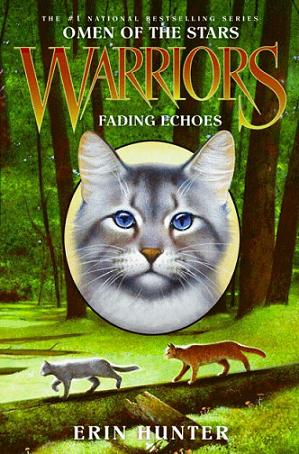
Warriors’ slightly confusing authorship (the books’ byline, Erin Hunter, actually refers to four women, none of them named Erin) begins each book with a comprehensive listing of each kitty in all four of the forest’s clans. Kits to clan leaders, pelt and eye colors included. For example, Dovepaw, one of the protagonists of Fading Echoes (book number two in the Omen of the Stars sub-series), is an apprentice of Shadow Clan, “a pale she-cat with blue eyes,” who is mentored by Lionblaze, “a golden tabby tom with amber eyes.” Leaving aside the complex belief structure and social hierarchy of the Warriors’ world, with 113 cats in the four mortal (oh yeah, it goes there) clans alone, it’s important to keep track of these details.

And readers do. Oh, but they do! A quick foray to The Warriors website reveals the true depths of fandom the kitties muster. Message boards require one to select a kitty avatar  to chat with the other kitties.

Which I did, all in the name of journalism of course (a golden she-cat with yellow eyes I named “Quillpaw”), and regardless of the fact that many of the conversation threads were a bit beyond my reckoning, most having to do with complex spoiler theories and desperate purrs for a single tom to mate with. Scandalous!

I meowed at my kitty friends online about why they liked this magical, mystical world of claws and fresh-kill, and I found Twilightfoot (who appears to be a fan fic writing, gender neutral black deputy cat with green eyes from he/she’s profile picture)’s answer to be the most endearing. I quote:

What do I like about Warriors?:

They are VERY interesting, and have a good plot that I can relate to.

It is NOT a G-rated series, which I <3!

I get very, um, connected with the characters, which I can rarely do with a book.

In this day and age, connection is really the pith of the matter, isn’t it? Cheers to you, Twilightfoot. And cheers to you, Warriors books — I never really liked reading about people, anyway.

Welcome to Elm Street: Part Four

0

In honor(?) of the new A Nightmare on Elm Street, we’re recapping all of the Elms so far. Find more on the Pixel Vision blog.

In the immortal words of the Fat Boys: are you ready for Freddy?

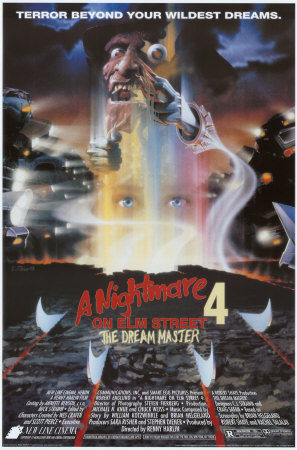
Well, duh. By 1988’s A Nightmare on Elm Street 4: The Dream Master, everyone and their (human-faced) dog was ready for Freddy, whose status as a grinning, quotable pop culture icon would only be enhanced by his latest film. The Dream Master is the first of the Nightmare movies to basically do away with any semblance of a plot; instead, the film exists to provide variously surreal, outlandish, and repulsive nightmare sequences that inevitably end in the death of whatever character is chiefly involved.
And that ain’t such a bad thing. Though the behind the scenes credits are sorta impressive, actually — Renny Harlin, who’d go on to make Die Hard 2 (1990), Cliffhanger (1993), and Deep Blue Sea (1999), directed; Brian Helgeland, who shared a screenwriting Oscar with Curtis Hanson for 1997’s L.A. Confidential, and was later nominated for adapting 2003’s Mystic River, is among its co-writers — this movie is utterly ridiculous anytime Freddy’s not the center of attention.

Thankfully, that’s not often. As Louis described in his post on Nightmare 3, the remaining Elm Street kids/Dream Warriors — now more or less integrated into Springwood’s normal high school population —  are the first to go, and they go fast. But wait, you say! Didn’t Freddy get buried in consecrated ground, etc. etc., at the end of Dream Warriors? Yeah, but no matter: before Kincaid (Ken Sagoes) dies, he dreams his dog, Jason (zing!), turns demonic and pees a fiery stream into Freddy’s junkyard grave. Naturally, Freddy comes back to “life,” except he was already dead, or undead, or something, to begin with, wasn’t he? “You shouldn’t have buried me. I’m not dead!” Whatever, he’s back.

Before you can sing a slo-mo jump rope rhyme, Kincaid gets gloved, and ever-horny Joey (Rodney Eastman) drowns in his waterbed. Kristen (now played by Tuesday Knight, who’s no Patricia Arquette) meets a fiery end, but not before courteously extending Freddy’s nightmare-entering capabilities beyond the Elm Street circle: she pulls innocent, mousy Alice (Lisa Wilcox) into her fatal dream. (Freddy’s response: “How sweet! Fresh meat!”) Logically, of course, this means Freddy can now terrorize Alice and all of her friends, including her kung fu-fighting brother, Rick (Andras Jones); asthmatic nerd Sheila (Toy Newkirk); bug-phobic workout-aholic Debbie (Brooke Theiss); and letter-jacketed love interest Dan (Danny Hassel).

The death scenes benefit from what appears to be a bigger special-effects budget than previous films, with Debbie’s transformation into a giant cockroach remaining my personal favorite. There’s also a nice bit where Alice gets pulled into a movie screen, and an attempt at near-artsyness when a scene repeats multiple times to slow Alice and Dan from saving one of their imperiled, snoozing friends. I’m also a huge fan of the scene where Freddy visits Alice’s workplace, the Crave Inn (zing!) diner. Seems Freddy, in a particularly sassy mood, has ordered himself a pizza. A pizza covered in heads! Screaming heads! Freddy spears a head-meatball with one of his claws and excitedly smacks his lips: “My faaaaavorite!” The chewing sounds are amazing.

Later, Alice turns Perseus and “kills” Freddy by showing him his reflection in a piece of stained glass (but not before Freddy reminds us that “I. Am. Eternal!”) And since Freddy has now become not just a slaughterer-of-the-sleeping, but a taker-of-souls (when and how did that happen, exactly?), his captives sail to freedom past Alice in a wash of white light, as if Zelda Rubenstein was showing them the way. Yeah, that’s the end of him, for sure! Er … one more thing about Dream Master is its determined-to-be “hip” soundtrack, with Sinead O’ Conner, Dramarama, Blondie, and other artists contributing tunes. But you can’t go wrong with the Fat Boys.

Welcome to Elm Street: Part Three

0

In honor(?) of the new A Nightmare on Elm Street, we’re recapping all of the Elms so far. Find more on the Pixel Vision blog.

“Live together, die alone.” I stole that line from Lost, but it sums up A Nightmare on Elm Street 3: Dream Warriors (1987) all too well. The remaining Elm Street kids — you know, the ones whose parents enacted mob justice on Fred Krueger — find themselves locked in a psych ward. They’re not really crazy: they’re just having bad dreams. But these teens are (mostly) smarter than their predecessors, and they refuse to go down without a fight. The “dream warriors” pick up on two important facts: there’s safety in numbers, and you can do awesome shit when you’re dreaming. I believe The Simpsons’ Ralph Wiggum said it best: “Sleep! That’s where I’m a Viking.”
No Vikings in this bunch, sadly, but these kids do have pretty nifty powers and thus a fighting chance against Freddy. In case you’re planning on assembling your own team of dream warriors — and honestly, it’s not a bad idea — I thought I’d break down the pros and cons of part three’s heroes. Yes, most of them end up dead and those that don’t (spoiler alert) are offed in part four. But hey, it’s good to know what skills to look for and what faults to avoid when you’re trying to save your ass.

Presenting the dream warriors, in the order in which they bite it.

Phillip (Bradley Gregg)
Pros: Bitchin’ ‘80s hair.
Cons: Sleepwalker. First to die, with the most disturbing death scene by far. He really doesn’t have a lot going for him.

Jennifer (Penelope Sudrow)
Pros: Has a (somewhat painful) system for staying awake. Burning oneself with cigarettes shows serious motivation.
Cons: Smoker. Thinks she’s going to be an actress — yeah, she’s one of those. And, of course, the second to die. “Welcome to prime time, bitch.”

Taryn (Jennifer Rubin)
Pros: Stands her ground. That means not putting out for skeezy orderlies. Gets the best line of the movie: “In my dreams, I’m beautiful. And bad.” Switchblades.
Cons: Attitude. Really needs to comb that hair. Pesky heroin addiction, which Freddy exploits with terrifying fingerneedles.

Will (Ira Heiden)
Pros: Nerdy charm. In his dreams, he can walk — not to mention be the Wizard Master. That’s right, he can blow up evil wheelchairs with green lightning (in the name of Lowrek, Prince of Elves).
Cons: Even as a wizard master, he’s still just a dweeb. And eventually, a dead one.

Nancy Thompson (Heather Langenkamp)
Pros: She’s been here before. Check out that grey streak: it screams “survivor.” Prescription for Hypnocil. Won’t take getting killed lying down.
Cons: Lots of baggage. Dead friends, dead boyfriend, dead mom — rewatch the first Nightmare on Elm Street if you need a refresher. Kind of naïve, inevitably. You really thought ghost dad was legit?

Kristen (Patricia Arquette)
Pros: Good at art. Marvel at her popsicle stick recreation of Nancy’s house! Does flips. Can bring people into her dreams.
Cons: Can bring people into her dreams. Hey, that’s a bad thing when you’re trying to avoid getting murdered. Poor common sense. All the Freddy fan-art is asking for it, don’t you think?

Kincaid (Ken Sagoes)
Pros: Tells it like it is, which means more great lines: “Let’s go kick the motherfucker’s ass all over dream land!” “Yo, Freddy! Where you hidin’ at, you burnt-face pussy?” Also, dreams give him super strength!
Cons: Gets thrown in the quiet room a lot, so you know he’s bad news. Nasty habit of antagonizing Freddy Krueger.

Joey (Rodney Eastman)
Pros: Knows to wake up his friends when necessary. Dream scream can break mirrors and banish the boogeyman.
Cons: But mostly quiet. Too quiet. Ball of teenage hormones, which inspires him to follow the hot nurse from hell and get himself comatose.

Dr. Neil Gordon (Craig Wasson)
Pros: The only doctor who actually believes that his patients are being killed by Freddy Krueger. Master hypnotist. Sees dead people — or dead nuns, at least.
Cons: Not a teenager. Might we say he’s getting too old for this shit? Can’t even fight a skeleton.

So there you have it. Now you can — I’m so sorry for this — pick your own dream team. And if you’d like to recruit me as a dream warrior, you should know that I’ve seen countless horror movies and know how to survive relatively unscathed. On the other hand, I’m pee-my-pants frightened of Freddy, so let’s call it a draw.

The Daily Blurgh: Terrorists get Triscuits, fascists get beans, gingers get MIA

0

Curiosities, quirks, oddites, and items from around the Bay and beyond.

Today in refried beans: from ingredient of burrito indulgence, to bane of the greenhouse, to weapon of protest. Even Dennis Herrera is (rightfully) pissed. Arizona goddam!

*****

In “Calfornia lawmakers with no grip on reality” news: this again? When will you learn, Maude Flanders of Sacramento? Whatever kids won’t be able to glean from Left 4 Dead 2 because of your “good intentions,” they can easily pick up in any one of the Saw films (or the evening news). What you gonna do when the zombies come, anyway?

*****

Debate: If a street artist who has already sold out (but is hip to that fact, so “selling out” becomes a meta-commentary on selling out), goes shopping for pricey, “heritage” jeans spun from the souls of kodama on looms built from the remnants of the true cross, is he still a sell out?

*****

It doesn’t matter what your favorite crackers or cookies are. They are not more important than the hegemonic wars the West is fighting against Islam.”

*****

“Walter Benjamin, or rather, the now-beloved figure of Benjamin — shuffling, myopic, mustachioed, fat, unhealthy, small round glasses glinting like flashlights — was largely unattractive in his own lifetime.” I smell an Oscar-in-waiting for Richard Dreyfuss.

*****

98 years ago: man in drunk-tank saved from fiery death by boozy ways, Providence.

*****

Yes, but what, exactly, is she getting political about? (Besides swiping that riff from Suicide — sampling kills!) NSFW, unless W is Xe.

Welcome to Elm Street: Part One

0

In honor(?) of the new A Nightmare on Elm Street, we’re recapping all of the Elms so far. Find more on the Pixel Vision blog.

It’s with a certain sense of outrage, but not surprise, that horror fans greet the remake of 1984’s A Nightmare on Elm Street. Truly, nothing is sacred anymore. (I mean, Michael Bay’s do-over-ator already had its way with that holiest of holys, 1974’s The Texas Chainsaw Massacre, in 2003.) I can only guess that Freddy Krueger is frikkin’ pissed off right now. (Jackie Earle Haley may be an Oscar nominee, and, OK, a pretty cool actor — but Robert Englund’s the only rightful Krueger in my book.) Pretty much the only thing you can do right now is pull that A Nightmare on Elm Street box set off the shelf and start watching ‘em all. (There are seven, plus 2003’s Freddy vs. Jason, which of course you purchased separately.) Get to it!

Alternatively, you can simply follow Guardian movie geek Louis Peitzman and myself as we recap each film in the week leading up to the new A Nightmare on Elm Street’s release Fri/30. Since I have a little bit of a Freddy obsession (just part of my collection pictured here), I’ll be getting the ball rolling, with a post by Louis on A Nightmare on Elm Street 2: Freddy’s Revenge (1985) to follow later today. Whatever you do, don’t fall asleep! (Or be surprised by spoilers, because these movies are like two decades old, people.)

The sporadically inaccurate but nonetheless helpful (and gloriously illustrated) volume The Nightmare Never Ends: The Official History of Freddy Krueger and the Nightmare on Elm Street Films, by William Schoell and James Spencer, is dedicated to “Jason and Michael — because they’ll always be second best.” And indeed, when Freddy Krueger was introduced to the world, audiences were already familiar with Misters Voorhees and Myers. (Hell, Friday the 13th was already up to part four, the hilariously misnomered The Final Chapter, by 1984.) But Freddy had something neither of those dudes had: a voice. He actually spoke to his victims! With a sense of humor to boot! (Though by mid-series he was communicating mostly in bad rhymes and even worse puns. But I digress.)

Legend states that Nightmare writer-director Wes Craven named his most famous character after a junior high rival (no word if the real Freddy ever realized his influence on movie-monster history). The last name came from Krug, the evil prison escapee from Craven’s first film, 1972’s Last House on the Left. Nightmare’s opening credits, which depict Krueger fashioning his trademark glove, feature the immortal words “introducing Johnny Depp;” they also present Englund as “Fred” Krueger. In later films, Englund would get above-title billing. But in 1984, nobody knew who Freddy was, or that they and everyone they knew would probably dress up as him for Halloween at least once. Certainly young Nancy Thompson (Heather Langenkamp), who lives in the white house with the red door on Elm Street in Springwood, Ohio, has never heard of him. But her bitterly divorced parents (Ronee Blakley, loopy star of 1975’s Nashville, plays her drunk mom; cult actor John Saxon plays her cop dad) know a little something about a child killer named Krueger. Seems they executed mob justice on his sweater-clad ass some years before. So why are Nancy and her friends (including Depp as her boyfriend, cut-off sweatshirt-clad Glen) meeting the allegedly dead Freddy in their dreams?

Freddy seeks revenge, of course, and little did those murderin’ parents know their quarry had supernatural powers: when the kids die in their dreams, they die in real life. Even though the parents know all about Krueger, they act like they don’t believe their bratty, rebellious teenagers. (With that rakish fedora, how could they even pretend to forget such a character?) This is a recurring theme in the Nightmare films: parents just don’t understand. Sometimes, they’ll even put bars on your bedroom window to “protect” you after they tuck you into bed, not realizing that growing up is hard, man. Especially when there’s a creepy creep chasing you with fingerknives through your dreams.

Nancy’s the wisest character here (evidenced in part by the gray streak that suddenly appears in her voluminous ‘80s coif after a harrowing Freddy encounter). Not only does she start mainlining caffeine to stay awake, she obtains a militia handbook (“I’m into survival!”) and begins plotting her naps with battlefield-worthy precision (with plenty of booby traps in place). Meanwhile, since Nancy actually doesn’t save anyone except herself, Craven’s behind-the-scenes team does wonders with special effects. Glen being sucked into, and bloodily vomited out of, his own bed is particularly memorable.

The film’s ending is the worst thing here. According to The Nightmare Never Ends, Craven and producer Robert Shaye disagreed on how to wrap up the story, with Craven believing it should end after Nancy defeats Freddy by taking back the power she’s unknowingly given him. Bam! End of Freddy. Shaye wanted more of a “Gotcha!”, which every other slasher movie in the history of the world has, and will always have. Guess who won? Eight — no, now nine movies later — we’re still expecting Freddy to come back.

Brass, Bows & Beats sweeps over Yoshi’s

1

By Lilan Kane

Brass, Bows & Beats, a local 45-piece orchestra that bridges genres and generations, is back. After a sold out performance last year at the Palace of Fine Arts, composer and band leader Adam Theis (of Jazz Mafia) is ready to take this show on the road (coming to Yoshi’s SF on Sun/25). 

Brass Bows & Beats is a 45 piece orchestra that bridges genres and generations. With an innovative mélange of jazz, soul, hip hop, funk, and electronica, BBB creates its own musical niche that has caught the attention of locals and even Jazz heads like Bill Cosby. The group will play two shows this Sunday at Yoshi’s to support their tour this summer.

Other members of the ensemble include rising stars Karyn Paige, Joe Bagale, and emcees Dublin and Lyrics Born.  VIP tickets include passes to the exclusive afterparty.

http://www.youtube.com/watch?v=tyyVofis3Ak

BRASS BOWS & BEATS

Sun/25, 3pm, $10 (kids), $35 (adults) and 7pm, $25/$75 VIP

Yoshi’s SF

1330 Fillmore Street, SF

(415) 655-5600

www.yoshis.com

Big kids appreciating little movies — “Celestial Navigations” explores the work of Al Jarnow

0

It was science disguised by fun, flashy animation, and people everywhere ate that stuff up like it was a bowl of chocolate-covered bran. Filmmaker Al Jarnow is a dude who managed to make learning fun on Sesame Street and far more intersting than the overbearing bird and crabby monster in a can. Most people had no idea who was creating the incredible shorts that appeared on that show, but if you were a kid or parented one in the past 50 years, you’re bound to recognize his work. And now with an escavation of over 45 films, Celestial Navigations — playing Thurs/22 at Red Vic Movie House — brings Jarnow’s magic back for some instant reminiscing.

Colors flashed, stop motion and time-lapse techniques mystified, and simple, beautiful cartoons turned every day objects and topics into a beautiful experiment gone right. Jarnow’s films played for years and expanded minds in the wee morning hours prior to the school bell’s ring and the punch of the time card. Jarnow educated through psychadelic hypnosis, the eyes of eager audiences glazed over while the fast-paced, brightly-colored animations whizzed across the television screen. I was an ’80s tyke who rolled out of bed excited to watch Sesame Street’s “cool” movies (and Kermit, of course) and when I found them years later on You Tube, the situation is nearly identical: bowl of cereal, blanket, couch and eyes glued to the flashing screen.

Celestial Navigations is the Numero Group‘s first foray into the world of cinema and they’ve collected, color corrected and remastered a flashy bunch of classic Jarnow. The film also includes a 30-minute documentary on Jarnow’s creative process, which I’m hoping boils down his steps in a 3-2-1 Contact Style.


Celestial Navigations: The Short Films of Al Jarnow

Thurs/22, 7:15pm, 9:30pm, $6-9

Red Vic Movie House

1727 Haight, SF

www.redvicmoviehouse.com


John Ross: Time travelling down the Mississippi

1

 Editors note: John Ross is wandering the country on a book tour, sharing his observations of Obamalandia, 2010. You can read his previous dispatches here and here  

I. Role models


When I finally made Chicago, they were all waiting for me down there two blocks south of the end of the Blue Line, through the wrought-iron gates of Forest Home Cemetery, past the ostentatious mausoleums of fabulous gypsies and clustered around the heroic monument to the Haymarket Martyrs: Red Emma, looking a little dingy these days; Elizabeth Gurley Flynn, the Rebel Girl; William Z. Foster, the CPUSA’s most rigid ideologue and the leaders of its black sector Henry Winston and William Patterson; the anarchist femme fatal Voltairine de Cleyres; hobo-ologist Ben Reitman; and, of course my personal role model, Lucy Parsons, who outlived her Albert (hung by the State for the Haymarket frame-up) by 50 years, traveling this poisoned landscape from sea to stinking sea speechifying to the masses and hawking her incendiary pamphlets to make ends meet. A single wilted rose adorned the soft granite pillow that bears her name and dates.


Scattered amidst the tombstones of the 70-plus anarchists and communists, radicals and rabble-rousers that Irving Abrams and the Pioneer Aid Society planted here are the DNAs of Joe Hill and Big Bill Haywood and Eddie Balchowsky, the one-winged barrelhouse piano player who gave up his arm to Franco’s fascists in the Spanish Civil War. Irving himself has a box seat at the foot of the Haymarket marker, now a National Historical Landmark managed by the government that these brave souls in residence once sought to overthrow.

Emma Goldman and her condescending epitaph (“a people must rise up to liberty”) was unquestionably Irving’s greatest steal, having won the bidding war for her cadaver after she croaked up in Toronto, to bring her home to the country from which she had been deported decades before for counseling young men not to sign up for the First Imperialist War. But despite the old-time luminaries in repose, I had journeyed down to Forest Home to visit with a recent implant, Franklin Rosemont, the anarchist writer and majordomo of Charles Kerr, the oldest radical publishing house in the U.S., now being sustained by his widow Penelope.  

“Surrealism Forever!” reads Franklin’s slab, in keeping with the celebratory tone of this section of the old boneyard. Franklin, who passed abruptly last year, is buried within the arc of the Haymarket monument.  The Cottons, Clara and Warren (not known to be subversives), keep him company.    

I doubt that our current president, whose adopted city Chicago is, has ever communed with these noble spirits, but it would be an educational experience if ever he should make his way down to Forest Home. Enveloped by deal-making devotees of Chicago’s backroom Democratic Party politics like Rahm Emmanuel, Valerie Jarrett, and Education Secretary Arne Duncan (now neck-deep in a hometown scandal for A-listing the scions of the influential in Chicago’s elite public schools), the examples set by Lucy Parsons and Emma Goldman might have stiffened Obama’s shaky backbone and taught him to stand up for the principles he has abandoned as the CEO of the planet’s longest-running criminal conspiracy.

Michael James rules the venerable Heartland Café in Rogers Park in the extreme northwest of this windy metropolis, a schmooze and booze venue for the left side of the local Democratic Party machine for the past three decades.  Both Obama and Bill Ayers have crossed its threshold occasionally at the same time, and Michael, the facilitator of “Rising Up Angry,” a militant Uptown youth group at the tail end of the turbulent ’60s, is now the chairperson of the local Demo ward committee. Although he will never concede that Baracko has squandered the faith that millions invested in him, I sense growing disappointment with Hope Man’s wishy-washy performance 15 months into his tainted term in office.  

As always, I bunked with the James Gang — Paige, the kids, and the estimable Che, a Labrador with a most dignified demeanor — and plunged into Chicago’s stimulating cultural mix. Also in residence: the foot-stomping Irish fiddler Paddy Jones, just in from Tralee — three years ago, Mike dragged Paddy and I off to the Korean baths where the local political class conspires. We sat buck naked in the sauna and Paddy insisted I regale him with the cautionary tale of El Che (the revolutionary martyr not the mutt).  

This time around, Michael escorted me to the late Nelson Algren’s birthday party in a church close by this quintessential Chicago scribbler’s beloved Division Street neighborhood, during which mash notes from his lover Simone de Beuvoir were read, lending credence to Frankie Lyman’s pointed inquiry “Why Do Fools Fall In Love?”

Yet another highpoint of my weeklong pilgrimage to the Hog Butcher of the World were a pair of meetings in Pilsen, an industrial enclave where the U.S. Communist Party first convened hard by Blue Island Avenue back in 1919 and now the most pertinent barrio in Mexico’s second U.S. city. More than a hundred Latino activists showed up to hear me rant and rave about the prospects for a new Mexican revolution and plot this year’s May 1st march in a city where immigrant workers first took to the streets 124 years ago to demand redress for crimes inflicted upon the working class by the bosses of industry and commerce. Four years ago, a half million immigrant workers marched here to demand recognition of their rights and despite the broken promises encapsulated in the Schumer-Graham proposed Immigration “Reform” bill, Chicago’s Mexican community is warming up for another red-hot May Day.  

II.  Resurrection

I followed the contours of the mighty Mississippi from Chicago to St. Louis through rich bottomland that is now the domain of Archer Daniels Midland. St. Louis is an urban hub that features wide, well-kept lawns and bushels of dirty money — Monsanto, Boeing, Peabody Energy, and Talx, which counsels greedy congloms on unemployment compensation, are all headquartered here.  

Yet, despite the capitalist connivance, the city has its own sui generis radical history. The 1877 railroad strike spread from the east to St. Louis and set the style for labor strife in the west, and the anarchist Flores Magon brothers published “Regeneracion,” the bible of the 100 year-old Mexican revolution, here before they were run out of town in the teens of the past century.

My days in St. Louis were well spent. I preached an Easter Sunday sermon at the Mid Rivers Ethical Society, sharing my vision of resurrection and insurrection in the aforementioned Forest Home boneyard, and offered up my palaver at a Black Green Party forum in a soul food parlor off Delmar, spreading the news of the Mexican government’s execrable persecution of  electrical workers pushed out of their workplaces last October at bayonet point by the military and police in a scheme to privatize electricity generation south of the border.  

I walked the St Louis Walk of Fame, stepping over the stars of the likes of William Burroughs, Chuck Berry, Walker Evans, and Fontella Bass, all of whom had to leave town to achieve a modicum of notoriety. I even encountered my very first St. Louie Cardinal, a crimson-hued bird perched in a sapling, spring zephyrs ruffling its crest, from which the Anheuser Busch dynasty drew the logo for the local nine in this beisbol-intoxicated town (they were previously dubbed the “Perfectos” after a popular cigar.)

III. Black & Brown

Further down river, the scrublands of Mississippi spread into the horizon beneath the cramped commuter flight in from Memphis. I had not touched down in the state since Freedom Summer 1964, when I arrived on the very day that the bodies of three civil rights workers (Michael Schwerner, Andrew Goodman, and James Chaney) were unearthed beneath a dam in Philadelphia, Miss.  

Although Black and White speak more cordially to each other these days and there are few black bodies swinging from the poplar trees, Mississippi God Damn (dixit Nina Simone) is still moldering down below. I could feel the heat at my hotel just off the Millsaps College campus in Jackson, where a statewide PTA meeting was in progress. In the conference rooms, black parents squared off against white school administrators over curriculums and the unequal quality of education. This is a commemoration year for black activism, the 40th anniversary of the killings at Jackson (and Kent) State and the 50th for SNCC — and old grievances burn long and deep.

The old civil rights movement achieved only token parity in this the poorest state in the union. Now a new civil rights movement is focusing on the flood of Mexican and Latino workers who poured into Mississippi in the wake of Katrina, and brown people are today’s niggers down at the bottom of the food chain.

Only 34,000 “Hispanics” were officially counted in the 2000 state census but Bill Chandler, a veteran of the Texas farm workers union and spokes for the Mississippi Immigrant Rights Alliance (MIRA), thinks that three times as many undocumented workers, lured to the state by casino construction, were overlooked back then. In 2010, Chandler calculates that the immigrant numbers have swelled to 200,000, nearly 10% of the state population, and taken together with close to a 40% Afro-American share, Mississippi now verges on becoming a majority People of Color entity. A similar equation is at work throughout the Deep South with Alabama and South Carolina and Georgia also hanging in the balance. Such changing demographics help to explain the vitriol the Teabaggers and White Citizen Council types shower upon the newcomers.

Back in August 2008, Immigration Control and Enforcement broke its own despicable workplace raid record by imprisoning (in Jena La., the site of other racist outrages) and deporting 595 Mexican and Latino workers who had been employed by Howard Industries down in Laurel. Chandler thinks the pogram was accomplished with the complicity of the company which was intent on cheating workers out of their wages. MIRA eventually won checks for most of those detained and deported.

An even more outrageous incidence of lingering Mississippi bigotry was the treatment of Cirila Balthazar Cruz, a mono-lingual Chatino indigena from Oaxaca who was picked up by police as she stumbled along the highway shoulder trying to get to a local hospital to give birth. Her baby daughter Ruby was subsequently stolen from her by child welfare authorities who deemed her an unfit mother because she couldn’t speak English and given to a well-appointed childless white couple. As might be anticipated, such blatant racism struck a tender nerve south of the border and a year later, Ruby was returned to her birth mother.  

Justice in Mississippi, as in much of Obamalandia, remains elusive but every once in a while the push of the people from down below captures such small prizes.

On their East Coast swing, John Ross & “El Monstruo” will visit Washington/Baltimore (Red Emma’s April 19th/ University of Maryland – Baltimore on the 20th/ Institute for Policy Studies the 21st); New York (NYU the 22nd/ Sixth Street Community Center the 23rd/Bluestockings the 25th); and Boston (Harvard Coop the 27th/David Rockefeller Center for Latin American Studies the 28th/Mass Global Action the 29th/IPS-Jamaica Plains the 30th/ topped of by a May 1st rally on the Boston Commons between Noon & Two.) All events are all free.


Rolling forward

7

By Adrian Castañeda

news@sfbg.com

San Francisco’s Potrero del Sol Skatepark is often packed with skaterboarders, a testament to the sport’s popularity and to the dearth of places in the city where it’s legal to skate. But that will soon change with the city’s commitment to build two new skateparks: one in SoMa and the other in the Haight.

Both have been tentatively approved by the Board of Supervisors. But before any concrete is poured, the skaters will have to overcome budget crises, angry homeowners, and their own bad reputations, particularly in the Haight, where the proposed park has gotten caught up in the furor over vagrants and the proposed sit-lie ordinance.

San Francisco has long been a skateboarding hub, yet there’s always been friction with police, businesses, and everyday city life. Even though it’s legal, there just aren’t that many places to do it anymore, partially because the city and property owners routinely attach barriers to any surfaces that might be appealing to skaters.

Skateboarders, long accustomed to being ignored and disenfranchised, have responded in their usual DIY fashion, such as building a few obstacles in an empty parking lot under a freeway overpass. The city took notice of the demand and after three years of planning and meetings, the newest of San Francisco’s skate parks has finally been allotted the necessary funds to begin construction around the end of summer.

The Central Freeway Skate Park will be located in what is now a parking lot at the intersection of Duboce and Stevenson streets in the north Mission District area. With $2 million collected through the Central Freeway Corridor Housing and Transportation Improvement Act of 1999, which provides for the sale and lease of parcels of city land that were under the now-demolished freeway, officials plan to develop the park to eventually include basketball courts and a dog run.

Rich Hillis of the Mayor’s Office of Economic Development said the city is considering a variety of improvements, but confirmed that “we think the skate park is the priority.” He attributes the park’s relatively unopposed approval to the demands of the city’s skaters and to the community as a whole. “They embraced the idea of a skatepark early on,” Hillis said of the forward-thinking residents of the area. He jokingly adds that the park should be named “Hornbeck Park” after Bryan Hornbeck, director of the San Francisco Skateboard Association. Hornbeck and his associates started the SFSA to push the city to build new parks designed with skaters in mind.

“San Francisco has to have a world-class skatepark,” Hornbeck said at one of the many skate events his group organizes. Hornbeck said the city has been receptive, working with skaters on the design of the park, but left SFSA to organize skaters and raise the funds. “It’s bake sale; it’s lemonade stand; it’s the best we can do,” Hornbeck said. “We’re not trying to take anything, we’re trying to make our own thing.”

Plans for the park, drawn up by notable skatepark design firm New Line Skateparks, are currently under review by civil engineers. After the plans are finalized, the project will be bid out to find a contractor. Tentative 3-D renderings have been online for months, sparking heated debate on skateboarding Web sites.

When the acclaimed Potrero del Sol Skatepark opened in 2008, many skaters felt that while it was well-designed and enjoyable, it didn’t have enough terrain that mimicked street riding. New Line has designed a number of skating plazas, most recently in Los Angeles. Its involvement gives many skaters hope that the new park will incorporate obstacles that represent the city’s rich street skating history.

But things are not moving as swiftly for the city’s other planned skate park, just beyond where Waller dead-ends at Stanyan in the Haight, which doesn’t have the same guaranteed funding stream. While bids for a design have been submitted, the Recreation and Park Department needs to get approval for $1 million–$2 million in construction funds before moving forward. The city proposed the 120,000-square-foot cul-de-sac at the end of Waller and next to SFPD’s Park Station after the original site near the Golden Gate Park horseshoe pits was found to be too small and lacking the necessary sight-lines for safety. But according to some residents groups, the parking lot is less safe for youths.

Citing police incident reports, Lena Emmery, president of the Cole Valley Improvement Association, told us the Waller park would be in an area with a high number of reported assaults and drug arrests and would add to noise pollution. “This location puts a skateboard park too close to a dense residential area, as well as some businesses that would be negatively impacted by the noise from the skaters,” she wrote via e-mail.

While the lot is occasionally used for bicycle safety classes and overflow parking at Kezar Stadium, it sits empty most of the year, although a farmers market will hold its grand opening there April 28. Will Keating, a Waller Street resident and skateboarder who works on Haight Street, is excited about the proposed park. He disagrees with claims that the park would be a negative impact on his neighborhood. “I hear homeless mutants going crazy outside my window every night, I would much prefer skateboards,” Keating said of the current noise pollution.

The Haight Ashbury Improvement Association, which is leading the charge for a sit-lie ordinance, conducted a survey on its Web site and found that many of its visitors feel the skatepark would increase noise and safety problems in the Haight. Visitors to the site also said the lot would be better used as a farmers market. Yet city officials say the two are not mutually exclusive, and early designs for the project are said to include a large public plaza adjacent to the park intended for community events.

“We realize this is going to be a multiuse space,” said Nick Kinsey, property manager for the Recreation and Park Department. “Throughout San Francisco there are thousands and thousands of skateboarders but only two places where it is legal to skate.” Kinsey called the park is “a done deal,” citing a 2007 ordinance introduced by Sup. Ross Mirkarimi that mandates the department build a skatepark on the cul-de-sac.

Kent Uyehara, merchant chair for the HAIA and owner of FTC skateshop on Haight, said the community’s fears about pedestrian safety are understandable, but that fears of increased violence and drug use are irrational. “If you can’t have a skate park next to a police station, then basically you are saying you can’t have it.”

If the city enacts the sit-lie ordinance, which Uyehara supports, it would be easy to imagine that a skate park would be a magnet for homeless and others looking to escape police harassment. But Uyehara is adamant that the park would not become a haven for Haight Street refugees. “Skateboarders self-police their own areas,” he said. “We’re not trying to kick the homeless out,” he added. “We’re trying to make the neighborhood attractive for everyone, whether they’re buying something or not.”

Uyehara is no stranger to opposition. When his shop first moved to the Haight in 1994, he had to deal with threats from residents and a neighborhood organization, similar to the one he is now a part of, because of what skateboarding represented to them. Since then skateboarding and his business have prospered, and FTC now has four locations worldwide. “For a city that hosted the X-Games, it’s pathetic how skateboarding has been treated.”

Uyehara says the Waller park, along with the Central Freeway and Potrero del Sol parks, are part of a plan developed by the San Francisco Skate Task Force, created in 2002 by then-Sup. Gavin Newsom to address the growing friction between the city and its skateboard population. The task force envisioned “a series of five parks located in a star pattern, and one in the middle of the city, [that] would make it possible for users to easily get to a park within at least two miles of their home.”

All the meetings and fundraising will be in vain if the park is poorly designed and built, said Jake Phelps, editor-in-chief of Thrasher Magazine. He says locals should design the park “so we have no one to blame but ourselves,” and avoid another flawed park like Crocker Amazon in Sunnydale where, he says, “the fence costs more than the skatepark.” Unimpressed with preliminary designs for the park on Duboce, the notoriously blunt Phelps says, “They’re going to come to our town, drop a turd, and leave.”

The veteran skater is wary of “landscape designers” with grandiose ideas. “There are people who get too involved. They don’t skate. Who are they to tell anybody what it is?” Newer skateparks are too crowded with obstacles trying to please all different kinds of skaters, he said. Instead, he urges a simple design similar to the streets of downtown. “The whole idea of skating is being utilitarian with your environment.” Regardless of the design, he believes it won’t have a dramatic effect on the Haight community: “Homeless people are gonna sleep there,” he said. “People are gonna tag on it and think it’s theirs.”

“The whole city’s a park, but people need somewhere to go when they get kicked out of everywhere,” says pro skater Tony Trujillo, who is able to skate to the Potrero park from his house and thinks others should have the same proximity to hassle-free skating. Julien Stranger, another local pro, feels a park in the Haight would benefit youth in the area by giving them a healthy, creative outlet, something the Haight symbolizes to many. “I don’t think that the neighborhood should be complaining about the energy a skate park will bring,” he said. “Skate parks are pretty positive.”

Earlier this month, an informational meeting hosted by the Haight Ashbury Neighborhood Council, Kinsey, Hornbeck, and other residents raised concerns that noise pollution and property damage would increase because of the skate park. “There’s been no public outreach,” said Martha Hoffman, who lives across from where the park is slated to be built. “If we’d known about it sooner, we would have opposed earlier.”

Thuy Nguyen of the SF Skate Club, an after-school program that promotes skateboarding as a safe and positive activity, urged residents to look beyond their property values and consider the benefits for the city’s youth. “It’s important for kids who feel that traditional sports aren’t for them.” Her partner, Shawn Connolly, added that skateboarding has grown in popularity with children. “It’s right after baseball,” he said.

“If the city doesn’t have a skatepark, the city is the skatepark,” Hornbeck said of the Waller Street lot where he often hosts skate events with donated ramps to ease the community into the idea of skateboarders using the area. But until the city budget can provide for skateboarders, the debate over the park will rage — and the underused parking lot at the end of Waller will remain just that.

Live Shots: Passion Pit, The Warfield, 04/15/2010

0

Immediately as Passion Pit took the stage, I felt like I stepped into hipster church for the masses. The synths hummed as the band members took their places, the electronic buzz replacing a pipe organ’s call before mass. The over-produced stage lighting blinded my retinas like a messiah’s second coming and shone a halo of white above front-man Michael Angelakos (even his name sounds heavenly). The kids roared with excitement, shouting hallelujahs in the form of song titles, all hands in the air, praising the dance party to rain down the beats.

The set began with “Moth’s Wings”, followed by “The Reeling” and “Little Secrets.” With unwavering energy, the all-but-happy tracks sounded incredibly similar to the band’s recorded sound and people were eating up each note with shovel-sized spoons. Angelakos got the crowd extra pumped when he announced that they were filming the evening’s performance and needed everyone to dance extra hard. The congregation answered his prayer with more cheering, a whole lot more dancing and even a bit of crowd surfing. Prior to the encore, the crowd begged for “Sleepyhead” and when the band returned for their final two, request granted! Everyone may have came in a sinner, but we all left as sweaty saints. 

Beach House holds the keys to comfort

0

Children often favor a stuffed animal or blankie as a source of comfort, but as an adult, security is found in much less predictable places. Maybe it’s your favorite cup of tea, your lover’s dirty t-shirt, a night-time drive or an album that never fails to help you regain balance. For me, it’s Beach House — playing tonight at Bimbo’s 365 — and for the band’s members, their comfort comes by a collection of keys. 

Not the kind that open doors or link to a chain, Beach House’s keys are the kind you press and pound, caress and strike; the kind you learn to love with an unwavering appreciation for the sound they produce. The Baltimore duo, comprised of Victoria Legrand and Alex Scally, own over a dozen different dusty keyboards and organs, each with a unique, grandiose quality that moans and speaks with a slow, Southern drawl.  

“They’re not very expensive, vintage organs,” Legrand says from her sunny Baltimore home. “They’re ones we’ve inherited or found in junk shops.” Some are broken, while others ring pure; all random, unplanned finds, thanks to a keen eye and a bit of good luck. “You can’t really expect to find them– they kind of find you. Like this keyboard I found in Brighton that I really didn’t expect. I guess it’s a kind of luck. Like finding someone to hook up with that ends of being really good.”

Legrand and Scally have always had an affliction for the rows of black and white and both took piano lessons when they were kids. “I’ve been playing since I was seven. Keyboard is definitely my instrument– something I was always drawn to and that’s something Alex and I share.”

Beach House was born in 2004, their brand of delicately woven dream-pop/indie rock soothing and cooing fans with their self-titled debut [Carpark, 2006], followed byDevotion [Carpark, 2008] and their latest, Teen Dream [Sup Pop, 2010]. New songs like, “Norway” and “Zebra” are fantastically whimsical. Legrand’s deep vocals consoling as they are creepy, soaring over her band mate’s naked guitar strums; the light, hissing percussion gently pushing and pulling the album’s tide.

The organs and synth sounds give way to a more balanced, full sound on Teen Dream, but their importance is never denied. 

“Monetarily, our keyboard collection may have not be of much value, but each set may have just one or two sounds that are so inspiring for us, so we’ll buy it or hold onto it,” she says. “We don’t just write esthetically- it’s not just about the sound. It’s about song crafting. A very, from-the-inside-out process. Not just pieces that are cut and pasted together. It’s something more real than that.”

Big, bulky, electronic and strange, their collection of music making machines take up a lot of space and time, meaning not everyone gets to travel along during the tour. This time around, Beach House has packed up four organs, and while they may not have pet names, Legrand says they have their quirks. 

“They each have their little problems, just like humans do. Some are extra finicky, some you have to bang on. Some won’t turn off.”

And she definitely has her favorites. 

“My primary keyboard- the white Yamaha,” she recalls with a soft voice. “I can’t believe I still use it– not in a bad way. It’s just that I bought it for $50 seven years ago. It’s really been so loyal. Its value to me is in millions. It’s crazy how much an object means so much in your life and how much of Beach House is tied into that keyboard.”

While tonight’s show is sold out, it’s quite possible to get a dreamy Beach House experience right in your own room. Just close your eyes, press play on Teen Dreamand let your fingers do the dancing on an imaginary white Yamaha of your own. 


Beach House

Wed/14, 7pm, $18

Bimbo’s 365 Club

1025 Columbus, SF

www.Bimbos365club.com