Kids

Now that we’re older

0

By Peter Galvin

arts@sfbg.com

MUSIC There’s a civil war afoot in the Hot Chip camp. Caught between tongue-in-cheek club-fillers and more melodic balladry, the U.K. electro-pop act continues to divide its audience by refusing to choose a definitive side and sound.

Duo and long-time friends, Alexis Taylor and Joe Goddard have been plagued by the impression that they are largely a singles band, earmarking playlist-ready tracks like “Boy From School” and “Ready For The Floor” from otherwise uneven albums. Such is the scarlet letter left by Coming On Strong, their initial 2004 release with DFA Records, whose name is indelibly linked to a number of playlist-ready remixes. Following the band’s subsequent jump to EMI Records, around the 2008 release of their third album Made in the Dark, it became clear that the pair were ready to take a step away from the ephemeral nature that plagues not only their band’s first two releases, but much of modern dance music. Made in the Dark saw the band begin to experiment with more personal narratives, such as in the standout “We’re Looking For a Lot of Love.” Still, the collection of songs was more suggestive of growing pains than graduation.

After Dark‘s mixed advances, the release of One Life Stand represents the important moment in every successful band’s career, the point where it finally decides whether it’s going to continue rehashing a fruitful formula or take a risk, commit to something new and hope that the audience will stick around. As album opener “Thieves in the Night” comes over the speakers with the lyrics “happiness is what we all want,” it’s tough to find traces of the Hot Chip that was “sick of motherfuckers trying to tell me that they’re down with Prince.” The album title itself announces a band seeking something more real and permanent than an album that college kids bump at their summer parties.

Perhaps fearful that long-time fans might initially be turned off by the new direction, Taylor and Goddard make sure to hit you with the bangers right off the bat, four songs that recall their previous work in tempo if not content. But even these songs are free of the band’s trademark irony. They explore love and yearning rather than ride high on the repetition of goofy catch-phrases. In addition to a distinct lyrical maturity, the new songs are also increasingly densely layered. While they imply an enormous backdrop of influences, you get the impression Hot Chip has moved past paying homage, instead simply wishing to explore new territory in an accessible way.

Past this initial burst of bluster, One Life Stand introduces what may well be the new sound of Hot Chip — ballads. Deeply personal and largely humorless, songs like “Brothers,” “Alley Cats,” and “Slush” show that the band wants to connect with its audience on a more profound level — and they’re willing to drop the irony to do it. “Brothers” is candidly about Taylor loving his friends like brothers, a sentiment that might have embarrassed him had it appeared on Coming Up Strong. Hot Chip has matured, moved beyond posturing and caring what people think, making the album a refreshing reintroduction to a band that some dismissed as a couple of smart alecks.

It can be bittersweet watching a band grow up and define itself. Though One Life Stand is not without its missteps, I’m glad Hot Chip is doing what it wants rather than pandering to the expectations of an established audience. They like dancing and they like ballads, why should they have to choose? As lines are being drawn regarding the band’s inevitable shift away from sardonic dance music, it’s hard not to wonder whether Hot Chip even cares. If it does, it probably feels that its listeners are the ones having a hard time growing up.

HOT CHIP

with the xx

Fri/16, 8 p.m., $29.50

Fox Theatre

1807 Telegraph, Oakl.

1 (800) 745-3000

www.myspace.com/hotchip

Emerald city

0

GREEN ISSUE Walk out your front door today and you won’t find a corner store that doesn’t sell “organic food,” a restaurant whose we-buy-sustainable addendum reads “whenever possible,” a trash can with a precious separate compartment for your all-natural soda cans. It’s hard to forget that it’s not all another secret plan from the government to make your life less fun. But it’s not! Below, please find assembled an all-star list of resources that are honest-to-goodness designed to help you help out our little ball, spinning all terrestrially out in space.

RECYCLING
They’ve tried to make it easy on you. Compost goes in green! Beer bottles in blue! Devil Styrofoam — where’d you get that? — in black! But still, you have questions. What about the bottle caps? Can I recycle the bag my Korean taco came in? Can I get a new green bin without a rat-hole in it? (Yes! No, that’s compost! Yes, but work on that vermin problem!) One quick stop at the Recology SF Web site has you sorted. You’ll also find info on the dump’s sculpture garden — the world’s only garbage company’s art park.

GROWING THAT GREEN
Because that window box in your bedroom hasn’t contributed anything to dinner in way too long, SF Garden Resource Organization maintains a database on everything you need to grow your own sustenance in the city. Find within its welcoming Internet embrace info on cheap local classes to turn that idle thumb green, all kinds of gardening pointers, and the lowdown on which community gardens are accepting new plot tenders.

PESTICIDES AND JUNK MAIL
They’re awful, aren’t they? And they’re all around us, which is why the Environmental Health Association of Nova Scotia’s toxicity guide for everyday lotions, cleaners, and pet products is so nice to have on hand. Thanks, Nova Scotia! For up close and personal commerce, the friendly worker-owners at Rainbow Grocery can steer you toward natural household products. An there are a bajillion lovely shops like Marie Veronique Organics (1790 Fifth St., Berk.) that’ll sell you the good local stuff. Kill your junk mail with the support of the helpful folks at Bay Area Recycling Outreach Coalition.

SHOPPING
Go organic or go secondhand. For natural fiber or recycled fabric gear, the Bay’s got lots of flash spots like Ladita (827 Cortland, SF. 415-648-4397 www.shopladita.com) or Eco Citizen (1488 Vallejo, SF. 415-614-0100. www.ecocitizenonline.com). Little Otsu (849 Valencia, SF. 415-255-7900 www.littleotsu.com) is all you need for gift shopping, with unique posters, books, and various assorted preciousness. But for the broke environmentalists, wait for the $2 per item of clothing sales at Goodwill (Various locations, www.goodwill.com), Mission Thrift (2330 Mission, SF. 415-821-9560), or even one of the several consignment stores along Fillmore like Repeat Performance (2436 Fillmore, SF. 415-563-3123) or Seconds to Go (2252 Fillmore, SF. 415-563-7806) to feel good about confounding consumerism. The big fish in our green pond, however, remains the invaluable Green Zebra coupon book, with hundreds of deals on earth-lovin’ spas, goods, and adventures.

OUT ON THE TOWN
There are oodles of spots to help you make a night of it without playing our environment for a fool. Terroir (1116 Folsom, SF. (415) 558-9546, www.terroirsf.com) serves elegant, chemical-free wines that taste even better if the wine-bar’s adorably scruffy owners pour them. Thirsty Bear Brewpub (661 Howard, SF. (415) 974-0905. www.thirstybear.com) has a stellar system of low-waste operation and serves only organic brews through its taps. For the club kids, the eco spot de rigueur is Temple (540 Howard, SF. (415) 978-8853 www.templesf.com), where owner Paul Hemming’s Zen Compound concept is expanding to include a roof garden, global art gallery, and dance floor that harnesses the energy expended on beats.

ACTIVISM
Of course, you could always do something outside your day’s normal scope. Hit up the following organizations to make change in your little corner of the world: Roots of Change for food sustainability issues, Livable City for hopes of a future outside our cars, and Planning and Conservation League for work on issues like global warming and water usage.

Ghost, writers

0

arts@sfbg.com

FILM Conor McPherson’s The Eclipse is not to be confused with that imminent third Twilight movie of (almost) the same name. But it, too, is a supernatural romance of sorts. Michael Farr (Ciarán Hinds) is a widower with two kids. From the wife’s post-chemo look in family photos scattered around the house, we glean she died of cancer. He once had writerly ambitions but is now a woodworking teacher. Since school’s out, he’s jobbing as a driver for the annual literary festival in their seaside town of Cobh, a County Cork location not far from where Irish revolutionary hero Michael Collins was born and killed.

It’s a driver’s task in such circumstances to take the bad with the good, as far as chauffeuring around celebrity authors goes. The good being London guest Lena Morelle (Iben Hjejle), a modest, attractive, and gracious scribe of purportedly nonfiction ghost stories. The bad being best-selling American novelist Nicholas Holden (Aidan Quinn), who hits the ground whining — his ride’s slight delay has forced him to endure the hotel-bar enthusiasms of actual fans, a prime target for his all-embracing condescension — and whose subsequent emotional displays run the unctuous to the apoplectic.

Excepting, that is, when he’s attempting to charm Lena, with whom he had a recent one-night-stand at a similar event. Cornered over lunch, Lena keeps a polite arm’s length from his renewed ardor, reminding him “I thought we were going to behave like nothing ever happened.” He is, after all, married. Nicholas rather too readily pipes that he doesn’t love his wife, and, anyway, even if they’re still officially together (he fibbed about that previously), he “never felt more separated” from her than when experiencing brief, torrid, probably drunken passion with Lena.

This is none of Michael’s business, and Lena wishes it wasn’t hers, but circumstances keep driver and guests colliding. Michael tours Lena around to all the terribly quaint and picturesque local sights, bonding over shared experiences (notably, both are under the strong impression that they’ve seen ghosts) and mutual frisson. Rubbing each the wrong way, meanwhile, is every ensuing encounter with Nicholas, who starts showing up plastered at Lena’s accommodations to howl at the moon and/or picks fight with Michael, whom he sneeringly calls “that stalker” — the others being too polite to point out his obvious hypocrisy.

So far, so good: The Eclipse‘s bulk mixes deft satire of literary ego and salesmanship with middle-aged romance in a travelogue setting (beautifully photographed by Ivan McCullough), plus enough domestic nuance to remind that no family life is perfect when a spouse and parent has recently died. But McPherson, better known here for his widely produced plays (The Weir, Shining City, The Seafarer), is not one to leave reality well enough alone. Instead he (helped by the abrupt crescendos of alarm in Fionnuala Ni Chiosain’s score) jars us with elements of the macabre. Michael is burdened with an angry, ailing father-in-law (Jim Norton) he’s turned over to a rest home. Perhaps as punishment, he suffers visions of a ghastly specter that look a whole lot like a zombiefied Jim Norton. These are, hopefully, just nightmares. But what do they mean?

It’s to McPherson’s credit (coadapting a short story by fellow Irish playwright Billy Roche) that his elegantly controlled movie gets away with not quite providing an answer while juggling a lot of mismatched elements with deceptive ease. In a less quirky film, Hinds, atypically cast as the nice guy (he played an arrogant literary prick himself in 2008’s Margot at the Wedding), would have swapped roles with Quinn. The gambit benefits them both, especially Quinn, who is terrific as the kind of tantrum-prone pretentious blowhard who’ll never be a grownup, but is just talented enough to get away with it — commercially if not socially. The Eclipse barely seems to have gotten going before it’s over, and no movie post-1970 should be ever allowed to end on a freeze-frame. Still, these 88 minutes are like some heavy (green of course) liqueur; just a thimbleful leaves you agreeably off-center, flushed, and a little spooked.

THE ECLIPSE opens Fri/16 in San Francisco.

The dawn of Earth Day

2

tredmond@sfbg.com

GREEN ISSUE The heavens welcomed Earth Day to America. All over the country, April 22, 1970 dawned clear and sunny; mild weather made it even easier to bring people into the streets. The Capitol Mall was packed, and so many members of Congress were making speeches and appearing at events that both houses adjourned for the day.

Mayors, governors, aldermen, village trustees, elementary school kids, Boy Scout troops, labor unions, college radicals, and even business groups participated. In fact, the only organization in the nation that actively opposed Earth Day was the Daughters of the American Revolution, which warned ominously that "subversive elements plan to make American children live in an environment that is good for them."

By nightfall, more than 20 million people had participated in the First National Environmental Teach-In, as the event was formally known. It established the environmental movement in the United States and helped spur the passage of numerous laws and the creation of hundreds of activist groups.

It was, by almost all accounts, a phenomenal success, an event that dwarfed the largest single-day civil rights and antiwar demonstrations of the era — and the person who ran it, 25-year-old Denis Hayes, wasn’t happy.

His concern with the nascent movement back then says a lot about where environmentalism is 40 years later.

Gaylord Nelson, a mild-mannered U.S. senator from Wisconsin, came up with the idea of Earth Day on a flight from Santa Barbara to Oakland. Nelson was the kind of guy who doesn’t get elected to the Senate these days — a polite, friendly small-town guy who was anything but a firebrand.

A balding, 52-year-old World War II veteran who survived Okinawa, Nelson was a Democrat and generally a liberal vote, but he got along fine with the die-hard conservatives. He kept a fairly low profile, and did a lot of his work behind the scenes.

But long before it was popular, Nelson was an ardent environmentalist — and he was always looking for ways to bring the future of the planet into the popular consciousness.

In August 1969, Nelson was on a West Coast speaking tour — and one of his mandatory stops was the small coastal city that seven months earlier had become ground zero for the environmental movement. Indeed, a lot of historians say that Earth Day 1970 was the coming out party for modern environmentalism — but the spark that made it possible, the event that turned observers into activists, took place Jan. 28, 1969 in Santa Barbara.

About 3:30 on a Tuesday afternoon, a photographer from the Santa Barbara News Press got the word that something had gone wrong on one of the Union Oil drilling platforms in the channel just offshore. The platforms were fairly new — the federal government had sold drilling rights in the area in February 1968 for $603 million, and Union was in the process of drilling its fourth offshore well. The company had convinced the U.S. Geological Survey to relax the safety rules for underwater rigs, saying there was no threat of a spill.

But shortly after the drill bit struck oil 3,478 feet beneath the surface, the rig hit a snag — and when the workers got the equipment free, oil began exploding out. Within two weeks, more than 3 million gallons of California crude was on the surface of the Pacific Ocean, and a lot of it had washed ashore, fouling the pristine beaches of Santa Barbara and fueling an angry popular backlash nationwide.

Nelson received an overwhelming reception at his Santa Barbara talk — and horrified as he was by the spill, he was glad that an environmental concern was suddenly big news. But, as he told me in an interview years ago, he still wasn’t sure what the next steps ought to be — until, bored on an hour-long flight to his next speech in Berkeley, he picked up a copy of Ramparts magazine.

The radical left publication, once described as having "a bomb in every issue," wasn’t Nelson’s typical reading material. But this particular issue was devoted to a new trend on college campuses — day-long "teach-ins" on the Vietnam War.

Huh, Nelson thought. A teach-in. That’s an intriguing idea.

Hayes was a student in the prestigious joint program in law and public policy at Harvard. He’d been something of a campus activist, protesting against the war, but hadn’t paid much attention to environmental issues. He needed a public-interest job of some sort for a class project, though, so when he read a newspaper article about the senator who was planning a national environmental teach-in, he called and offered to organize the effort in Boston. Nelson invited him to Washington, was impressed by his Harvard education and enthusiasm, and hired him to run the whole show.

The senator was very clear from the start: the National Environmental Teach-In would not be a radical Vietnam-style protest. The event would be nonpartisan, polite, and entirely legal. Hayes and his staffers chafed a bit at the rules (and the two Senate staffers Nelson placed in the Earth Day office to keep an eye on things), and they ultimately set up a separate nonprofit called the Environmental Action Foundation to take more aggressive stands on issues.

Meanwhile, Hayes did the job he was hired to do — and did it well. Everywhere he turned, from small towns to big corporations, people wanted to plug in, to be a part of the first Earth Day. Many wanted to do nice, noncontroversial projects: In Knoxville, Tenn., students decided to scour rivers and streams for trash to see if they could each clean up the five pounds of garbage the average American threw away each day. In dozens of communities, people organized tree-plantings. In New York, Mayor John Lindsay led a parade down Fifth Avenue.

A few of the actions were more dramatic. A few protesters smashed a car to bits, and in Boston, 200 people carried coffins into Logan International Airport in a symbolic "die-in" against airport expansion. In Omaha, Neb., so many college students walked around in gas masks that the stores ran out. But it was, Hayes realized, an awful lot of talk and not a lot of action. The participants were also overwhelmingly white and middle-class.

Hayes wasn’t the only one feeling that way. In New York, author Kurt Vonnegut, speaking from a platform decorated with a giant paper sunflower, added a note of cynicism.

"Here we are again, the peaceful demonstrators," he said, "mostly young and mostly white. Good luck to us, for I don’t know what sporting event the president [Richard Nixon] may be watching at the moment. He should help us make a fit place for human beings to live. Will he do it? No. So the war will go on. Meanwhile, we go up and down Fifth Avenue, picking up trash."

Hayes finally broke with the politics of his mentor early on Earth Day morning when it was too late to fire him. The next day, the National Environmental Teach-In office would close and the organization would shut down. From that moment on, he could say what he liked and not worry who he offended.

"I suspect," he told a crowd gathered at the Capitol Mall, "that the politicians and businessmen who are jumping on the environmental bandwagon don’t have the slightest idea what they are getting into. They are talking about filters on smokestacks while we are challenging corporate irresponsibility. They are bursting with pride about plans for totally inadequate municipal sewage plants. We are challenging the ethics of a society that, with only 6 percent of the world’s population, accounts for more than half the world’s annual consumption of raw materials.

"We are building a movement," he continued, "a movement with a broad base, a movement that transcends traditional political boundaries. It is a movement that values people more than technology and political ideologies, people more than profit.

"It will be a difficult fight. Earth Day is the beginning."

I first met Hayes in 1990, near the office in Palo Alto where he was planning the 20th anniversary of Earth Day. He’d continued his environmental work inside and outside government, at one point running the National Energy Laboratory under President Jimmy Carter. Earth Day 20 was shaping up as a gigantic event, one that would ultimately involve 200 million people around the globe. Earth Day was becoming the largest secular holiday on the planet.

Hayes was excited about the event, which he was running this time without the moderating influence of a U.S. senator. And he was aiming for a much more activist message — in fact, at that point, he was pretty clear that the U.S. environmental movement was running out of time.

"Twenty years ago, Earth Day was a protest movement," he told a crowd of more than 300,000 in Washington, D.C. "We no longer have time to protest. The most important problems facing our generation will be won or lost in the next 10 years. We cannot protest our losses. We have to win."

And now another 20 years have passed — and by many accounts, we are not winning. Climate change continues, and even accelerates; an attempt at a global accord just failed; and Congress can’t even pass a mild, watered-down bill to limit carbon emissions.

And Hayes, now president of the Bullitt Foundation, a sustainability organization in Seattle, thinks the movement has a serious problem. "Earth Day has succeeded in being the ultimate big tent," he told me by phone recently. "To some rather great extent, is had some measure of success."

But he noted that "in American politics these days, it’s not the breadth of support, it’s the intensity that matters. Environmentalists tend to be broadly progressive people who care about war and the economy and health care. They aren’t single-issue voters. And somehow, the political intensity is missing."

Hayes isn’t advocating that environmentalists forget about everything else and ignore all the other issues — or that the movement lose its broad-based appeal — but he said it’s time to bring political leaders and policies under much, much sharper scrutiny and to "stop accepting a voting record of 80 percent."

It’s hard today to be bipartisan, and compromise is unacceptable, Hayes told me. "I was probably right [in 1990]," he said. "If what you’re aspiring to do is stop the greenhouse gases before they do significant damage to the environment, it’s too late." At this point, he said, it’s all about keeping the damage from turning into a widespread ecological disaster.

"I would like to see Earth Day 50 be a celebration," he said. "I would like to see by then a real price on carbon, nuclear power not proliferating, and a profound, stable investment in cost-effective, distributed renewable energy." But for that to happen, "we need to have a very intense core of environmental voters who realize that these threats to life on the planet are more important than a lot of other things."

Tim Redmond is the author, with Marc Mowrey, of Not In Our Back Yard: The People and Events that Shaped America’s Modern Environmental Movement (William Morrow, 1993) which can still be found in the remainder bins of a few used book stores.

Alerts

0

alert@sfbg.com›

WEDNESDAY, APRIL 14

Organize against General Atomics


Attend this organizing meeting to learn how you can join the upcoming protest against General Atomics, scheduled for May 18–19 in San Diego, and take a stand against this manufacturer of defense drones that have caused the deaths of many innocent civilians in Afghanistan and Pakistan.

7 p.m., free

Global Exchange Office

2017 Mission, Suite 200, SF

codepinkalert.org

Rally Against Carbon Trading


Protest carbon trading and carbon offsets as false solutions to climate change outside the Navigating the American Carbon World conference attended by bankers, oil industry representatives, financial speculators, and big environmental groups.

Noon, free

San Francisco Marriott Marquis

55 Fourth St., SF

west.actforclimatejustice.org

THURSDAY, APRIL 15

Bike to School Day


Whatever kind of student you are, biking is an easy, healthy way to get to school. Encourage kids to take part in this city wide Bike to School Day with group ride locations throughout San Francisco.

All day, free

Throughout the city

Visit, sfbiketoschoolday.org for more information.

SATURDAY, APRIL 17

Berkeley Shore Cleanup

In preparation for Earth Day, help clean up the planet by taking part in one of the many cleanup activities being organized by Berkeley Earth Day and Shorebird Park Nature Center.

Various times and locations, free

(510) 654-6346

www.bayareaearthday.org

Building Bridges


Take part in this conference to build strategies and plans for successful protest, community organizing, civil disobedience, and direct action on LGBTQ, questioning, intersex, asexual, and related social justice issues. Help build solidarity, connections, and momentum.

10 a.m., free

Mission Cultural Center

2868 Mission, SF

(415) 821-1155

www.lgbtbridges.org

Counter Recruitment Training


Whether you’re a teacher, student, activist, parent, veteran, or family member, learn about the resources and materials on the realities of military service, aggressive military recruitment, and alternative options for youth.

9 a.m.; free, donations accepted

War Memorial Veteran’s Building

401 Van Ness, SF

(415) 565-0201, ext. 24

TUESDAY, APRIL 20

Building Materials You Wish You Never Used

Hear a presentation about commonly used building materials that are more hazardous than others and the risk that they pose to the environment and to personal health and safety. Dr. Arlene Blum and Tom Lent discuss the perils of these materials, like PVC vinyl and chemical flame retardants, and offer alternatives.

7 p.m., $10 donation

AIA San Francisco

130 Sutter, sixth floor, SF

(510) 845-1000

International Cannabis Smokers Day


Herb enthusiasts are invited to join fellow ganja smokers in defiant solidarity against the impracticality of enforcing current marijuana laws and to publicly show your support of the upcoming November 2010 statewide ballot initiative to legalize, control, and tax recreational use of marijuana.

4:20 p.m. sharp, free

Hippie Hill

Golden Gate Park, SF

cannabisculture.com

Mail items for Alerts to the Guardian Building, 135 Mississippi St., SF, CA 94107; fax to (415) 255-8762; or e-mail alert@sfbg.com. Please include a contact telephone number. Items must be received at least one week prior to the publication date.

The Daily Blurgh: That cat should have won the prize

0

Curiosities, quirks, oddites, and items from around the Bay and beyond

“We offer a kind of grittiness you can’t find much anymore,” said Randy Shaw, a longtime San Francisco housing advocate and a driving force behind the idea of Tenderloin tourism. “And what is grittier than the Tenderloin?”

Now that San Francisco is going to court the tourist dollars of baby boomers descending upon the TL in search of reawakening the pleasure centers of their youth – the music! the drugs! the picturesque squalor! – perhaps City Hall should also consider starting up tourism franchises in other “gritty” parts of the city? 

(But gawking humorously at the poor, addicted, and metally challenged makes for such a sensational blog post! –Ed.)

Also: Drubbing! This headline is the second Google hit that comes up for the search: “slumming San Francisco.” Take that, spendy New York Times (which seems to have a long history of reporting on slumming in other cities).


There are too many golden nuggets to choose from in Roger Ebert’s account of working on the Russ Meyer-directed Sex Pistols film that never was, but this exchange is one of them:
 
Meyer opened up by informing Johnny Rotten that with his stovepipe arms he wouldn’t have survived one day in the army.

“What do I want with the fucking army?” Rotten said.

 “You listen to me, you little shit. We won the Battle of Britain for you!”

I reflected that America had not been involved in the Battle of Britain, and that John Lydon (his real name) was Irish, and therefore from a non-participant nation. I kept these details to myself.


The anxiety of influence: The debate going on in the comments on this Fecal Face interview with local artist Maxwell Loren Holyoke-Hirsch is heated. Holyoke-Hirsch doesn’t seem to lack faith in his abilities (he is quoted as referring to himself as, “the hardest working illustrator and artist based in San Francisco, California”), although irony is sometimes lost in transcription. Hubris aside, there is still the question of whether or not his art, as some comments posit, swagger-jacks Chris Johansson and Barry McGee. But kids, it’s OK. Put down those rocks! Didn’t you know street art has already jumped the balaclava’d shark?

(Kidding!)


We love our cat
for her self
regard is assiduous
and bland

 
Congrats to personal fave Rae Armantrout for winning this year’s Pulitzer Prize in poetry. Cat people, this may be finally be your salve for the incredibly raw wounds from our canine-centric Pets issue.

Youth Speaks’ young poets roar

2

“Poetry’s made a big difference in my life. It’s allowed me to express myself in ways that I never would have been able to,” says Erica McMath Sheppard, 17, one the winners of Sat/3’s Youth Speaks Teen Poetry Slam at the Warfield Theater.

Her victory was the culmination of many years of hard work. Erica started participating in the Youth Speaks program when she was 13, and competing in the yearly slam competition at 14 years old. On Saturday, before a sold out crowd at the Warfield, she spoke with a light borne of a difficult adolescence, one spent in the cold bureaucracy of Child Protective Services, but through which she has nonetheless thrived academically.

“You look at America in the 21st century, who is the voice? What does it look like?” Youth Speaks executive director James Kass founded the non-profit in 1996 to provide public school kids with access to arts education in a state where such programs are rapidly being downsized into nonexistence. He says that, although professional artists have emerged from Youth Speaks’ programs, what the YS assemblies, after school workshops, and guest speakers really want to accomplish is the development of teens’ creativity, and by extension, their ability to think critically about the problems of the day. “Some kids go into teaching, go into non profit work,” he says. “This is about developing leaders.”

It’s a mission that resonates. One need only consider last Saturday’s event at the Warfield. Rows of cheering fans, hanging on their every word — would that this rapt attention were always present when youth spoke.

“It was an exciting experience,” says McMath-Sheppard, whose two poems focused on eating issues and the fallacies of Child Protective Services, whose care has shuffled her from homes in Potrero Hill, to the Tenderloin, to the Mission — where she is legally required to move from the day she turns 18. “It was so inspiring to share that love from the stage, and get the hugs and kind words afterwards. It was amazing.”

McMath will join Youth Speaks winners Bryant Phan (Oakland, age 17), Hadeel Ramadan, (San Bruno, 19), Jasmine Williams (Daly City, 19), Dominic Nicholas (Oakland, 18), and Natasha Huey (Berkeley, 19) in representing the Bay area at the Brave New Voices Festival in Los Angeles on July 23rd.


“I don’t really title my poems,” says McMath. “I know a lot of poets do, I just don’t label them like that.” Below, her untitled slam winning case against Child Protective Services.

Yesterday I had a meeting with my social worker

Katie said, “Children and family services will only house you until you’re 18 if you have your high school diploma or GED.”

She asked when I turn 18. I said, “June 18 th.”

I asked when I had to leave. She said “June 18th”

On my 18 th birthday I could be homeless

the only exception to this rule is if I were to decide to drop out of high school, but if I was gonna drop out, it would’ve been in 9 th grade—not 65 days before I graduate.

I just found out I will be booted from my house

Happy birthday Ericka get the fuck out

Correction—Happy birthday number 35876-b

We need you to get your shit and leave immediately

and I was angry

and I am scared

because it’s hard to recognize your own potential when know one else wants to let the fire inside of you burn

she told me if I was to get pregnant additional services would be offered

I asked if this was her suggestion

She replied, “No, but I did want you to have this information though…”

On my 18 th birthday, I could be homeless

You do not become an adult because you turn 18

you just get to buy a pack of cigarettes to deal with this shit

Why cant CPS understand that I am still a child

Or I was never allowed to be

Because I was always too busy

working

paying bills

Being active at my little sister’s back to school night

And now finding a place to stay

This is the reason that three percent of foster youth go to college and only one of that three percent graduates

My last roommate was a prostitute

And as much as I wanted to giver her a speech about how precious her body was

I couldn’t

Because she was in the same position I am in now

She was a number

and I am number 35876-b

I am not as strong as I make myself out to be

I don’t learn how to magically do shit when I turn 18

I am disorganized

have time management issues

have a hard time code switching when I need to

I need help and this system refuses to help me

And you could believe that I can help my damn self ‘cause I been helping my dam self my entire life

But why doesn’t Katie acknowledge how important it is for me to go to college (slowly)

At 18 my number turns into what’s called inactive dependency

Emancipation

Lincoln freed the slaves

Katie is freeing me

This system was set up for

People

excuse me

numbers like me live off of welfare checks,

And taste crack instead of their degree

and lay on there black and make babies

Then we can be the black Brady bunch and live on food stamps

Or purposely go to jail after all it is three hots and a cot

How do u expect us to fly with broken wings

Numbers like me are notorious for failing

Because I am black

A women

Disabled

Broke/lower class

don’t live with her mother and doesn’t know her father

And in this shady as child protective services system

But no protecting will be offered when I turn 18

I don’t want to be 35876-b

I just want Katie and the whole protective services system to notice me

Katie did you know that I will be the 1 st generation in my family to get my degree

Katie did you know that I go to two different schools one at day another by night just to guarantee that I will graduate on time

did you know that I am a poet

Katie did you know that I am a person

that my name is Erica Sheppard McMath not 35876-b

Katie I wish you where here to hear this but you don’t get paid on Saturdays (pause)

and please excuse my unpleasant attitude but on behalf of every other foster youth I need to tell you that abandonment is not a joyful feeling

I understand that to you this is just a 9-5

but for me this is my life that is being put on the line

we are in this system because we were abandon

once again I am being abandon

and I will be ok because I’ve always done what I have needed to do therefore I will survive Katie

but no thanks to you

Fashion Armageddon? Nah, it’s just the great American Apocalypse

3

By Chhavi Nanda

The majority of mankind is under the misconception that an apocalypse is primarily associated with the end of the world – some sort of eschatological final battle. Perhaps it’s the slew of movies such as 2012 or The Road influencing our mind to veer into that territory. But an apocalypse doesn’t necessarily mean an ending — even adherents of the Book of Revelations know there’s a next chapter. An apocalypse is defined as “the lifting of a veil or a revelation.”  Late last month, a fashionable veil was lifted: a new collective Web site of vintage fashion, entitled American Apocalypse, was exposed to the world.

I attended the first editorial shoot for American Apocalypse. The motif of the shoot was “Clown, Chola”. Although Urban Dictionary defines chola as “the girls my brother gets pregnant,” there’s much more to a chola than that, obviously. The chola aesthetic includes thick eyeliner, thin drawn on eyebrows, lip liner, gelled hair, high pony tails, gold chains, piercings, tattoos, flannel shirts, Converse or Nikes. And of course she has to be a ruthless gangbanger. You know, like that Lean Like a Chola song says “lean like a chola way up high, thick eye liner in my eye, cruise all day, drink all night, got four kids with three guys.”

I walked down Geary Street at around 11:30am; the models were standing outside of Harput’s Union smoking their cigarettes in anticipation for the shoot to start. None of them had their makeup on yet and their hair wasn’t done either. I didn’t feel as guilty walking into the shoot hung over from the Friday night before. The owner of the store, Gus, greeted me kindly. Then the models, photographers, clothing stylist, make up artist, and the rest of the crew scurried down to the gritty basement of Harputs, where the shoot took place.

There were boxes, bags, and racks full of beautiful clothes and accessories. I was overwhelmed, and for a brief second wanted to jeopardize everything to run away with all these clothes, hoping no one would notice, but in my better judgment, I just stuck around for the shoot. The hairsprays, gels, doorknocker earrings, and – yes! — the paisley bandanas came out. As hair and make-up was being done, a nice mix of Spice Girls, Gucci Mane, and indubitably Bone Thugs and Harmony played in the background, to get the girls in a “Thug Life” mood.

Witnessing all the make-up and hair getting done I could finally see the vision coming in clearly. Envision this scenario with me: Bozo the Clown meets Frida Kahlo, if Frida Kahlo lived in this day in age and was a little more badass. After hours and hours (and several eyeliners), the girls were ready.  They modeled both in the basement and on the busy streets around Union Square. People in traffic and pedestrians watched curiously.

The shoot included some of San Francisco most exclusive models; Fernanda Toledo, Alexis Hutt, Alexandra Kammen, Annalise Lundeen, and Ali Lovell. The mastermind that painted their faces so they were ready to perform in the Chola Circus was Matt Wanaraksa. The hair was a collective effort from the models and stylists.

The creative minds behind the shoot were Sam Banks along with Brooke Candy, also assisting on the set was Rachel Esterline. Esterline has been a stylist for the last six years and has generously opened up not only her own wardrobe, but also several of her clients’ to give a helping hand while American Apocalypse builds up its stock. Her clients include some of San Francisco most elite and fashion-conscious women that strut down Maiden Lane after their weekly yoga and meditation classes. Although Rachel is a prominent stylist, Brooke Candy and Sam Banks were the visionaries behind this shoot. Sam and Brooke, coordinated, conducted creative direction, and styled the models head to toe, while Rachel directed and did the photography for the shoot.

At some point in this decade, the word vintage was added to the fashion bible. Vintage used to be a word that was applied to wines or some grandfather’s Bentley. But somehow between drinking vintage wine and driving vintage cars, a woman walking in to a room with a vintage dress suddenly gained the right to have a holier-than-thou persona. If you admire my dress, I would retort with a smirk, “I know you want it, but too fucking bad, it’s vintage.  You can’t have it. “  There is just something about rummaging through an obscure thrift shop or junk yard, or the closet of a underground fashionista that gives one a thrill of being an individual. American Apocalypse gives us the opportunity to have those pieces in our closet that we know no one else out there has, while still remaining fashionable. It isn’t the end of the world, just a fashion revelation.  

AMERICAN APOCALYPSE

www.americanapocalypse415.com

Hey kids! It’s Panique time!

0

CULT DVD Alejandro Jodorowsky and Fernando Arrabal have overlapped their whole lives. The Chilean Jodorowsky and Spanish Arrabal arrived in Paris is the mid-1950s, eventually cofounding (with late, lesser remembered artist French artist Roland Topor) the Mouvement Panique — a post-surreallist group named after the god Pan and dedicated to “terror, humor, simultaneity.” The two initially focused on theatrical performance and have in subsequent decades created massive bodies of plays, poetry, novels, visual art (paintings for Arrabal, comic books for Jodorowsky), and more. Internationally, they’ve been most widely experienced as filmmakers of some notoriety whose sporadic work in that medium was busiest during the wide-open late 1960s and early ’70s.

Jodorowsky, of course, rates high on any cineaste’s list of cult idols for the blood-soaked spaghetti western Christ parable El Topo (1970) and mystical-baroque colossus The Holy Mountain (1973), both recently freed from decades of legal trouble for legitimate DVD release. Arrabal’s films have been even harder to see and have fallen into comparative obscurity, partly because they’re less “fun” despite sharing much in the way of striking, shocking, and frequently blasphemous imagery.

In 2005 Cult Epics brought out a collection comprising his first three features: Viva la muerte (1970) and The Guernica Tree (1975), two violently grotesque fantasias about the Spanish Civil War whose dead included his own assassinated painter father, a loyal Republican; plus I Will Walk Like a Crazy Horse (1972), a no-less surreal yet strangely touching love story of sorts between an urban playboy on the run and the three-foot-tall male desert hermit.

Given their penchant for full-frontal nudity, antifascist politics, desecration of religious iconography, and other MPAA-unratable themes, perhaps the weirdest overlap between the two most famous “Panique” insurrectionists is that each once strayed into the alien realm of family entertainment. (They no doubt seized this inapt moment as a respite from perpetual funding woes, which famously scuttled Jodorowsky’s ready-to-go Dune and his El Topo sequel.)

Unsurprisingly, the results did not send Disney into a market-dominance panique. In fact, Jodorowsky’s 1978 for-hire project Tusk was, at least until recently. one of the most infamously unseen movies ever made, a literally and figuratively elephantine India adventure deemed unwatchable for any audience. Check out the cruddy French-language dupe with Spanish subtitles on YouTube and see how far curiosity gets you.

Arrabal’s kid flick wasn’t quite so fully buried, but it too has remained an obscure object of completist desire. Fortunately his second and final DVD collection from Cult Epics just arrived to fill that need. Nominally released in 1982, French-Canadian coproduction The Emperor of Peru stars Mickey Rooney — there goes the scenery in one big chew — as a wuvvable wheelchair-bound eccentric found living in the forest by three children on summer holiday. A former steam train engineer, he teaches them to run an abandoned locomotive so they can take their Cambodian-refugee friend back home to his parents. Never mind that there’s probably not much rail linking the South of France and Phnom Penh, let alone that in 1982 the Khmer Rouge remained very active.

How many children’s films would have dialogue like “Father’s in a concentration camp”? Emperor‘s real raison d’être, in any case, is its myriad fantasy sequences, sprung from the childish imagination of Toby (Jonathan Starr). In his daydreams he’s a firefighter or astronaut whose heroic deeds are applauded by such bystanders as Napoleon Bonaparte. Amid the goofy, mostly innocuous proceedings are stray moments of unmistakable Arrabal — as when Rooney, in full Arabian Nights regalia, is surrounded at imperial court by dwarf attendants. (Arrabal has a thing for little people.)

The new collection also includes Car Cemetery, a 1983 New Wave “punk” pose fest with Gallic pop king Alain Bashing as a postapocalyptic rock star Christ (ouch indeed). Among other rarities are Arrabal’s delightful hour-long 1992 video Farewell, Babylon!, a collage of past works, impish narrative, and sampled New Yorkers including Spike Lee and Melvin Van Peebles.

Twin stars

0

arts@sfbg.com

MUSIC Can two voices get any closer — or be laid any more bare — than those of the xx’s Romy Madley Croft and Oliver Sim? The band’s spare, pared-down pop is so minimally cloaked, with either instrumentation or pretense, that you could swear the pair were scarily close-knit sibs: the Chang and Eng of U.K. rock — the doubled letters of the xx seem less like a set of female chromosomes than a symbolic representation of Croft and Sim’s doubling.

But then what else would you expect from two 20-year-olds who’ve known each other since they were 3, growing up together and into their roles as music-makers? “We went to kindergarten together,” Sim says of their early childhood bonding. “I don’t remember a time in my life when she wasn’t in it.”

The twosome met the xx producer-percussionist Jamie Smith when they were all of 11, forging a tightness that has outlasted the coming and going of keyboardist-guitarist Baria Qureshi — and has comforted Sim during the group’s current journey round the globe. “I’m so glad I’m doing this with my best friend,” Sim says, complaining of the lack of creativity and privacy on the road (he’s been taking refuge in Polaroid picture-taking). “I can imagine it being very lonely being this far from home.”

Far they are. The mild-mannered bassist-vocalist-songwriter has to struggle to make himself heard, against all odds, in a loud North Carolina bar carved out of an old train car, where the xx is performing that night. The success of The xx (Young Turks/XL, 2009) — which landed with a soft yet palpable thump atop critics’ best-of lists last year — has sent Sim, Croft, and Smith off around the world for far longer than Sim feels comfortable with. As for the recording, “I don’t think we even intended to perform it,” Sim explains now. “Going from that to a world tour is very weird.”

Weird because the xx’s bone-piercing, emotionally perceptive music — crafted by two barely legal 20-year-olds who likely wouldn’t get past the bouncer at many of the bars they’ve played — has spoken to so many. Few have used so few tools — an old Casio kids’ keyboard, a drum machine, guitar, and bass — to say so much, so intimately: The xx‘s plangent, eerie spaces and iChat-honed lyrics echo the aural landscapes of Young Marble Giants and kindred student of London’s Elliott School, Will Bevan of Burial. Taking barely traceable cues from the latter as well as from 1990s R&B performers like Aaliyah (who the xx has covered, along with Womack and Womack), the xx is the rare band that makes the space between the sounds, the pauses between the words, speak just as loudly as lyrics. “We’re big fans of subtleties of music,” Sim says. “If you give it room to breathe, you can bring forth a different sort of drama in them.”

At first the sparse arrangements were all they were capable of. “The synchronicity of it came partly from us just trying to play our instruments,” Sim says. “We couldn’t have complemented it if we tried, and as time has gone on, it’s been about restraint, and we try to go for simplicity for itself. Me and Romy don’t have particularly loud voices as well. It wouldn’t make sense to make a overwhelming sound that we had to contend with vocally.”

And in many ways breaking these songs down to their bare pop parts — crystallizing its elements in such boiled-down beauties as “Crystalised” — is a way of distilling the intensity of adolescence, and the cacophonous overwhelm of 21st century experience, down to its very vivid essence. Or a way of capturing on 11 tracks, a few fleeting moments from age 16 — when Sim and Croft wrote “VCR” — to 20. “For me it’s quite strange looking back at the album,” says Sim. “Even though the three or four years doesn’t seem like so much time, going from 16 to 20 is such a big change. I kind of see myself growing up in the whole album. It’s a bit of a diary.” *

THE XX

With Hot Chip

April 16, 8 p.m., $29.50

Fox Theater

1807 Telegraph, Oakl.

1 (800) 745-3000

www.apeconcerts.com

Where’s teacher?

4

By Brady Welch

news@sfbg.com

Horace Mann Middle School principal Mark Sanchez sounded exhausted when we reached him on March 26. It wasn’t because Horace Mann is such a tough school, although the Mission District campus does have a disproportionate number of at-risk students. And it wasn’t because it was the Friday before spring break, although that might have had something to do with it.

All week Sanchez had been reeling from news that a whopping 10 out of his 20 full-time teachers had been issued pink slips by the San Francisco Unified School District. Including counselors, a vice principal, and other staff, the budget cuts essentially lopped off 24.6 percent of the school’s workforce, an unprecedented blow that speaks volumes about the state of California public education.

“A lot of the kids were wondering if the school was getting shut down,” Sanchez said. And although Horace Mann isn’t closing, with so many axed teachers, it might seem like a new school to many students come August. “If a significant number [of teachers] are moved, we don’t know what we’re in for.”

There is a legend that you will meet the person who will seal your fate long before the final event happens. And in an interesting turn of events, it was Sanchez who, as president of the Board of Education in 2007, hired current SFUSD Superintendent Carlos Garcia. Attempting to close a staggering $113 million budget gap over the next two years, it fell to Garcia on Feb. 23 to send out 645 layoff notices across the district in a list that included 163 administrators, 239 elementary school teachers, 124 high school teachers, and 104 middles school positions. Horace Mann was hit particularly hard because so many of its staff lacked seniority. Final decisions on layoffs will be made next month by the school board.

The first indications of this massive fiscal blood-letting came Jan. 20, when Garcia sent a letter to the entire district on learning of Gov. Arnold Schwarzenegger’s budget. The document was a glaring reminder of how bad things had gotten in Sacramento, and the superintendent wrote candidly of what he saw and what it meant for the district. “These numbers are large, and they will be devastating.”

Aside from the extraordinary blow to personnel, the proposed SFUSD budget will increase class sizes, freeze salaries, cancel summer school except for those who need credits to graduate, and reduce the number of days of classroom instruction to 175 annually, putting the district in conflict with a state law mandating at least 180 days. Given its deep cuts, Sacramento probably won’t enforce the statute.

“The state itself is in such a budget crisis,” Sanchez told us. “And [it’s] refusing to raise taxes. The fix has to be at the state level.”

But that’s been difficult since the passage of Proposition 13, the 1978 measure that limits property tax increases and gives control of whatever revenue is generated directly to the state. Because all state budgets must pass the Legislature with a two-thirds super-majority vote, a disciplined minority of virulently antitax Republicans block budgets that adequately fund education nearly every time.

Yet now, the bill for that political stalemate is coming due at schools like Horace Mann.

Beyond the numbers and politics, the Guardian wanted to get a closer look at how this regular cycle of cuts and layoffs is affecting teachers and students, so we spoke to a couple of eighth grade English teachers at Horace Mann who described it as dismal.

“I try to put it at the back of my mind, to be honest,” said Matt Borowsk, one of the 10 teachers at Horace Mann who received a pink slip. Borowsk reiterated a common sentiment that all teachers — potentially laid off or not — just want to do their jobs and focus on their classes. “I want to be able to stay and do my work and make improvements. And I want to do what I can for the school community and work with students,” he said. “I’m still in it, and I’m in it for the long run, despite what issues the district has about keeping their teachers.”

Gail Eigl, a teacher at Horace Mann for eight years who is tenured and therefore not at risk of a layoff, concurred. “No one I know who got a pink slip has changed their attitude. People are trying to stay focused on the present and teach.”

It’s an admirable response, and one Eigl understands well. She was laid off after her first year there in 2001. “Six of us got pink slips,” she recalled. “It was terrible.” She went looking for a job in South San Francisco, but in a strange turn of events, SFUSD called and offered her a job at Argonne Elementary in the Richmond District. A year later, she was back where she started at Horace Mann, and until now, she hadn’t really looked back.

“It’s like the school keeps having problems,” she said, an opinion that also hints at SFUSD’s skewed notion of teaching as a stable career path.

Borowski offers a similar story. This year’s pink slip is his second. Last year he received one after teaching only a year in Burlingame, which is how he ended up in San Francisco. Such rampant doling out of pink slips has nothing to do with Borowski’s performance. Rather, it has everything to do with seniority. And because the state is in such a crunch, it’s hard to stay in any school long enough before the budget’s grim reaper comes to collect.

“People who are able to stick through the first five years, they genuinely want to be a good teacher, make seniority, and not have to worry about it,” he said. And “because Horace Mann is a school where new teachers go, because it’s a tough school, then they’re the most vulnerable to layoffs. Which starts this vicious cycle.”

It’s classic Catch-22. Facing such a budget shortfall, how does SFUSD keep teachers who have little or no seniority teaching in the very schools whose litany of needs put those teachers there in the first place? In many ways, these are the most committed and passionate teachers the district has, and they represent for their classes a level of discipline and stability absent in many of their students’ home lives.

Many of Eigl’s students are low-income, speak English as a second language, or both. Some of their parents are deceased, others are undocumented immigrants, and a few are in jail.

“I honor tenure,” she told us. “I know there’s a reason for it. But right now, it doesn’t seem to be working for us.” Eigl brings up the case of a new parent liaison the school received this year, a critically important position that takes time building solid relationships with students’ families. “She got a pink slip too,” Eigl told us, the exasperation evident in her voice.

“I think people are really defeated inside. It’s so frustrating,” she continued. When asked what she meant by that, Eigl became heated. “It’s California! We’re supposed to be the richest economy. We should have money for schools. Why are other states doing so much more? We’re at the bottom. Where’s the money?” She suggested that Horace Mann should be granted special status because of its high-needs student body.

“It’s almost predictable that students who have a lot of unpredictability in their lives will suffer for this,” Sanchez told us. “It will be destabilizing for them. Teachers will get disrupted as well. A lot of what you do in schools has so much to do with outside the classroom, and it takes a lot of time to get acclimated.” At a tough school like Horace Mann, he says, “there’s been a lot of professional development and new programs.”

Borowski stresses the sentiment forcefully. “It’ll be devastating if the pink slips go through. It’ll be a huge mess.”

Both teachers participated in the massive statewide protests against the cuts on March 4. But other than letting Sacramento know how public educators feel, nothing concrete has come out of it. Sanchez suggested that it might be possible to sue the state for violating its statute on the minimum number of school days. Even SFUSD, at the last Board of Education meeting on March 23, didn’t rule out the possibility of suing the state for lack of adequate funding.

Negotiations are ongoing between the district and the United Educators of San Francisco teachers union about final layoffs. Those will be finalized May 15. Meanwhile, teachers at Horace Mann and across the district will continue to do their jobs despite how grim the outlook may be. As Eigl puts it, “It’s like out of a book from a bad future.”

Access denied

3

rebeccab@sfbg.com

If tuition goes up to $40 per course unit at the community college where Dielly Diaz is working toward her associate of arts degree, she’s not sure she’ll be able to afford it. But Diaz isn’t just worried about her own shot at an education. She also wonders what’s in store for her 19-year-old daughter, a student at Laney Community College in Oakland. For parents scrambling in the face of the economic downturn even as their kids prepare for the future, she said, “it’s like we’re getting hit both ways.”

Diaz, who is 39 and originally from Venezuela, says she decided to enter Berkeley City College’s adult education program to earn her degree because the recession threw her into a precarious position, shaking the stability of her job as a mortgage loan officer. When she started just a year ago, tuition was $20 per course unit. It has since gone up to $26, and now the California Legislative Analyst’s Office is recommending ratcheting it up to $40.

Even as students are being asked to shell out more, California’s community colleges are reeling from the impacts of budget cuts: faculty layoffs, swelling class sizes, fewer available courses, and reductions in student services. For students hoping to transfer to other public institutions in the California State University (CSU) or University of California (UC) systems — or even for those seeking to develop a skill set that can garner a living wage — maneuvering the shredded educational framework can be frustrating. This past year, roughly 250,000 students statewide were denied access to community colleges due to a lack of course availability, according to education advocacy group Against Cuts.

“When you see all that, it’s like OK, I feel like I really need to do something,” Diaz said. “It’s not like we can just sit and wait, letting the cuts happen. I think we can really get organized.”

Between school, work, and being a mom, Diaz started pitching in on community outreach for Against Cuts, a grassroots effort that took shape last fall in the wake of devastating education cutbacks. It was one of hundreds of organizations that collectively launched mass demonstrations decrying funding slashes to education on March 4. The newly energized education movement plans to propel another mass rally to descend on Sacramento in the fall, Diaz noted, in the meantime focusing on awareness-raising efforts like an April 17 teach-in at Berkeley City College.

California’s community colleges are unique among the state’s higher education institutions in that they represent a gateway for nontraditional students to get a foothold for career advancement or a fresh start for people trying to improve their lives. They also offer an affordable option to complete lower-division coursework before transferring, a path that’s starting to become a bottleneck since courses needed to meet transfer requirements have been affected by cuts.

Yet even as fees climb and class sizes balloon, more people are opting to go the community college route, and demand for enrollment is only expected to increase. Some are college-age students whose families have been priced out of other institutions.

“We’re having this flood of people from the CSUs and UCs now trying to do their freshmen and sophomore year with us and then transfer,” notes Berkeley City College faculty member Joan Berezin. Others are individuals who can’t find work in an economic climate marked by 12.5 percent unemployment. “When we get hog-tied and cut and restricted, we close off possibilities to everyone,” Berezin says. “People who’ve just lost their jobs, people whose parents have lost their jobs, they’re all coming to us.”

Of the nearly 3 million students attending community college statewide, women and people of color are in the majority, and 80 percent work while attending school. It’s still a relative bargain for education, but fees are keeping pace with the rising costs of housing, transportation, childcare, and food.

“I have students who are homeless, who are living in their cars,” Berezin notes. “So we can say, oh, $40 a unit, that’s not a big deal. But if you’re taking 12 units and you have no income — and you don’t qualify for financial aid ’cause you don’t have an address … that’s a huge amount of money.”

Financial aid is available, but with narrow eligibility requirements — and even some of that funding may be headed for sacrifice on the budgetary chopping block. Gov. Arnold Schwarzenegger’s budget for the 2010-11 fiscal year proposes suspending new awards for the Competitive Cal Grant Program, for a savings of $45.5 million. About 70 percent of Cal Grant award recipients attend community colleges.

“This award is dispersed according to income and GPA,” explained Theresa Tena, director of fiscal policy at the Community College League of California. “Many of our students have a high GPA and a low income.” Some 22,500 students receiving this financial help would be affected by the proposal — and Tena says more than 150,000 eligible students already compete for the award packages.

Research increasingly shows that students from working-class families are being priced out of college — even community college — and that it’s harder to pay their own way without taking on serious amounts of debt. A California Postsecondary Education Commission (CPEC) report found that in 1975, a community college student would have earned well over the amount needed for a year of school, including housing and other expenses, by working a summer job in retail. Today that same student would only be able to scrape together about two-thirds of the needed amount — and that’s assuming every single penny was saved.

“In the old days, going to community college was a break-even proposition,” notes Adrian Griffin, assistant director of research and policy development for the CPEC. “With stagnating wages at the low end of the job market, it doesn’t work this way anymore.”

The blow to community colleges caused by a loss in state revenue and consequential budget cuts mirrors the damage done to the entire public education system. While the recession has triggered especially hard times, this low point follows a long-term trend of diminishing state funding for education. In 1965, the state general fund provided $15 for every $1 paid in fees by UC or CSU students, according to the CPEC. By 2009–10, that state contribution had declined to $1.40 for every dollar paid in fees. “We’ve gone from a taxpayer-supported system to a semi-privatized system,” Griffin observed.

This point hasn’t been lost on the education advocates at Against Cuts, who are pushing for reform in tax policy as a solution for restoring public education in California. An information packet created by the group highlights a nearly 50 percent decline in the share of corporate income paid in taxes since 1981, even as corporate profits have shot up.

“There is no reason for education to be cut in California, the world’s eighth-largest economy,” Diaz said. “We can’t just continue to accept and accept and accept. Having a population that does not have access to education is dangerous.”

Big Wheel + Big Hill = Big Fun

1

After barely surviving a brush with city bureaucracy last year, Bring Your Own Big Wheel yesterday returned to the steep streets of San Francisco for its 10th year in a row, once again proving that incredible stupidity can be incredibly fun.

Hundreds of costumed participants riding Big Wheels and other plastic-wheeled kids toys braved driving rain to race in packs down steep and curvy Vermont Street on Potrero Hill, offering colorful crashes and zaniness galore and eliciting big dumb grins from both participants and spectators, who were there in roughly equal numbers.

And for such a crazy event with throngs of people, it was remarkably problem-free and required almost no police presence. Last year, after the SFPD threatened to cancel the event and arrest anyone riding Big Wheels, a citizens’ group (including many from the Burning Man world) stepped up to manage an event that has gotten exponentially larger since its early days on Lombard Street.

City officials including Neighborhood Services Director Mike Farrah brokered last year’s compromise and helped facilitate this year’s event, for which volunteers made all riders fill out waiver forms and get wrist bands to minimize the city’s liability. With minimal official involvement, this was crazy fun by the people, for the people, with what costs there were (such as Porta-potties) covered by passing the hat.

It was a great day to live in San Francisco.   

Unfortunately, print and still photography just don’t do this race justice, so check out this video from VidSF and the folks over at Mission Mission (but pay no attention to that first guy that correspondent Sunny Angulo interviews because he’s clearly insane) to get a sense of the action.

Why does the Catholic Church still exist?

6

Johnny Angel Wendell, who wrote a piece for us this week about talk radio, does a show Sunday night on LA’s KTLK radio called Southern California Live, and this week — on Easter Sunday — he had a great rant about the Catholic Church. You can listen to it here — it starts about 22 minutes into the show. (Full disclosure — I’m often a guest on the show, and was on last night, and you can listen to me talk about Meg Whitman and Gavin Newsom at the end of the session, but Johnny’s bit on the church was better).


His question: Why does the Catholic Church still exist?


If any other major institution was caught doing what the Catholic hierarchy did — allowing, or even encouraging, the abuse of children by its frontline workers — nobody would go there any more. Imagine if Disneyland had this sort of scandal; no parent would ever take a kid there again. No school, or club, or program that involves or caters in any way to kids would survive a scandal like this.


I know, I know: It’s about religion and faith that’s supposed to transcend the foibles of the humans who run the show. But Jesus — how can even devout Catholics allow this to continue? The pope and all the corrupt, sleazy bishops and cardinals ought to be thrown out like the devils cast from heaven in the Bible — and until that happens, maybe all those devout Catholics should stop putting money in the collection plate.

The Daily Blurgh: Splinters of the cross

0

Curiosities, quirks, oddites, and items from around the Bay and beyond

An unbelievably hermetically sealed spherical inalienable maze of light and sound seeing imagery expand in every direction.”

I was reminded of the words of visionary architect and late SF resident Achilles Rizzoli – who spent his life drafting gorgeous symbolic portraits of friends, family, and loved ones as fantastic buildings, the cornerstones of which would never be laid – when I saw this Wired video that Boing Boing posted about Rohnert Park artist Scott Weaver’s enormous sculpture of San Francisco done entirely in toothpicks.

Weaver has been at work on his creation for nearly three decades, having turned down multiple offers last year from Ripley’s Believe It or Not! Museum to buy what he views as an example of, as he told KGO at the time, “what can be done in life if you create and use your imagination.”

“But is toothpick art woodworking?” asks Fine Woodworking Senior Editor, Tom McKenna, in an article from last August about artist Steven J. Backman, who he describes as, “perhaps the preeminent toothpick sculptor in the country.” If Weaver’s accomplishment evokes Bosch’s Garden of Earthly Delights by its fantastic condensation, Backman’s pieces – many of which are based on local landmarks and attractions, such as the Golden Gate Bridge or a trolley car – go the route of Picasso’s early still life paintings, their forms connoted through pared down lines and simple, pronounced shapes. Even SF Mayor Gavin Newsom gave his seal of approval back in 2005, proclaiming January 11th of that year to be Steven J. Backman Day.

Backman’s art is a wonder of engineering. But Weaver’s is simply wondrous.


But what wonders of mental engineering also lurk in the virtual-pet analogue world?


And now, again, just in time for Easter, we turn to an Andy Rooney-inspired feature I’d like to call: “You got my goat!”

Do you Want Men Dressed as Women Teaching Your Kids?”

Hell yes!

But listen up, Traditional Values Coalition. We need to talk about your look. It’s busted. Don’t you know ominous, dark clouds went out of fashion after everyone and their mother mocked the National Organization for Marriage’s “Gathering Storm” ad? Weak. Sauce.

What you need is some drag queen valkyries or some shit like that thundering out of the heavenly maw, ready to swoop down and piss on the souls of those studious young folk, whose preciousness is so inviolate as to make Justin Bieber look like the next jailbait-hungry mark to get punked on To Catch a Predator (just give him time).

If you want fierce, bitch, you gotta go Wagner.

Start your “Vinyl Addiction”

1

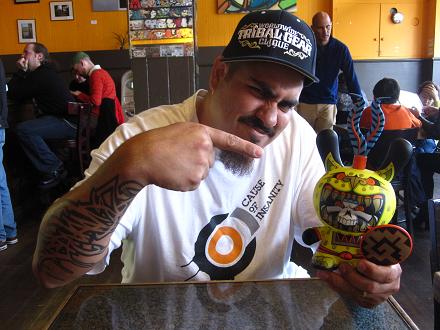
“Here’s my Jaguar Warrior.” Jesse Hernandez pulls out his toy, and sets it on our café table with a broad smile. Two women at the next table over are immediately intrigued. “Oh, that’s beautiful! What is that?” they coo. Hernandez seems flattered by the compliments, and patiently explains that it’s a vinyl toy and that he designed the elaborate yellow cat figurine with the sweeping blue plumes and fierce, fanged skull peering out of its face. And yes, it’s pretty cool.

One gets the impression that, as host of MYX TV’s new show “Vinyl Addiction,” (who celebrates its launch party and the release of an exclusive Hernandez toy Sat/3 at New People) Hernandez is used to explaining to people just what these cute/creepy little dolls are. He certainly got me to understand their appeal.

“There’s a multi-faceted quality to [vinyl toys],” Hernandez explains. The toys, which are often designed by well known artists, are manufactured in runs ranging from the mass release to the limited edition, to the one-off “custom,” hand painted by the artist themselves. Springing initially from the heavy character culture in Japan and Hong Kong in the late nineties, their designs can range from precious to unsettling, from manga to menacing. “They’re usually both,” says Hernandez “they’re cute, but really messed up. Or it’s dangerous and cute.” 

It’s easy to see why the seniors at the next table were intrigued by Hernandez’s design. The “jaguar” design is painted onto a bunny doll, the cat ears superimposed on the floppy rabbit ones. Though simplified from many of his custom runs, the artwork on the doll is at once, fierce, tribal and modern. It’s only slightly adorable when taken in with its globular cartoon rabbit form.

Hernandez has dubbed his style “urban Aztec,” and he deploys it in a dizzying array of mediums. He creates beautiful drawings (“everything I do is based on drawing,” he says) and fine art paintings of Aztec warriors and mythological figures, reflecting his Yaqui/Chicano heritage. “You have to push the limits,” he says. “I wanna make something timeless.”

He shows a slightly more city-oriented side in his animated sequences, painting a picture of life in the Bay Area, where he grew up, with “The Nutshack,” his original MYX series that he art directs and co-created. Hernandez says many artists come to vinyl toys as an offshoot of their production of other kinds of art. “Vinyl toys can be a stepping stone, a rite of passage for an artist to have something [mass produced].”

With all these projects, it baffles the mind that Hernandez could take on another job. But it’s clear that “Vinyl Addiction” sprang from his respect for the vinyl toy movement- and a desire that an artist be the one to tell their story. 

Most episode shoots, it’s just him and the cameraman. Though he now holds the titles of the show’s host/producer/creater/director/editor/animator, Hernandez was loathe, at first, to become the oncamera host of “Vinyl Addiction.” But now that two years after shooting the pilot with co-field producer Roland Posadas, he sees his involvement as key to part of the show’s effectiveness. “I think it brings out that level of authenticity,” he says. “This is my culture. Everyone knows I’m a part of it, and I want everyone to be shown in the best light possible.” 

His expertise of the topic is evident in the preview reels of the program, which will air nationwide through On Demand and in MYX’s three urban markets of the Bay, Orange County and Northern Virginia. Hernandez goes to his colleagues’ gallery and custom shows, profiling artists and companies involved in making the toys. 

“The hardest challenge,” he says, was to figure out a way to cover the topic in a way that made sense to people who didn’t know much about vinyl toys, to educate them on the art form. He resoved the issue with “Vinyl Vocab” segments, which take a moment to teach viewers the definition of one of the scene’s specialty terms. Hernandez’s voiceovers during the lessons are done in a faux British accent, which seems to poke fun at the concept of codifying a scene that, up to now, has been pretty esoteric.

But Hernandez is sure that the popularity of vinyl toy art is on the rise in America. He says mainstream companies are picking up on the toys’ aesthetic to appeal to consumers. “So many people are into the look [of vinyl toys], even if they don’t understand it. It’s an unknown art form.” Two years ago, he told MYX that they had to produce “Vinyl Addiction” to be in on the first wave of the toys’ growing US popularity.

I’m going to have to agree with him that it’s hard not to love the vinyl doll. Even I, with whom the verb “collect” and the concept of the “collectible” sit poorly due to my inveterate nomadism, couldn’t help but paw at some of the more striking pieces. Hernandez met me at Kidrobot, a store on Haight street that’s been selling it’s own line of vinyl toy figurines and T-shirts since 2002. He tells me he always used to love coming here to see the new releases. 

Inside, the stark white walls are lined with glass cases full of nicely displayed vinyl friends. Here, a couple of blasé kids sumple, only their shaggy heads and limbs protruding from cans labeled “Boring Juice,” there, an adorable rhino brandishing a revolver. Not to mention all the spikey, snarling things that are just… so cute. 

Suddenly, I can understand the motivation of all the friends I have with vast toy collections. They’re witty. They’re creative. They’re art. I like them. And, judging from the drive of Hernandez and “Vinyl Addiction,” I don’t think I’ll be the only one.


“Vinyl Addiction” launch party

Sat/3 7-10 p.m., free

New People

1740 Post, SF

www.vinyladdiction.tv


Alice Waters protested for supporting using human waste as compost

8

By Brady Welch

In a story that continues to amuse and fascinate, it appears that the human biosolids compost shit show we wrote about last week has left town… and ended up in, of all places, Alice Waters’ own backyard garden. That’s right: the seasonal, local, and cage-free proprietor of Berkeley’s fabled Chez Panisse has emerged as a staunch and unlikely defender of fertilizing your garden with sewage sludge compost, which San Francisco officials have recently discontinued giving away because of environmental concerns.

It all started when the Organic Consumers Association found out that Francesca Vietor, executive director of Chez Panisse’s non-profit arm promoting safe and healthy food for kids, was the same Francesca Vietor who is vice president of the SFPUC Board of Commissioners, which had until very recently been pawning off toxic compost made from human waste contaminated with industrial chemicals and heavy metals.

The news was like finding Mom (Chez Panisse) in bed with a Hells Angel (the SFPUC).

But we understand organizational slip-ups happen, and we trusted Waters to do the right thing, issue an apology, and figure out what to do with Vietor. But it turns out that the Bay Area’s advocate for a slow food economy that is “good, clean, and fair,” has decided instead to stand in defense of a system that is, frankly speaking, fast, cheap, and out of control.

On March 23, OCA National Director Ronnie Cummins wrote a letter to Waters asking how this could be. The letter reads, in part:

“Considering that the sludge was given to several local schools for use on their educational gardens, your work with the Edible Schoolyard should especially elicit your concern. This is certainly in direct opposition to the standards that Chez Panisse Foundation and the Edible Schoolyard encourage and uphold. It seems to us a clear conflict of interest that Francesca Vietor should serve as both the Executive Director of the Chez Panisse Foundation and the Vice President of the PUC.”

Waters wrote back March 30:

“I have been involved with the organic garden movement for 40 years. I believe in the transparency of public institutions and count on the government to offer the highest standards outlined by the Organic Consumers Association and other reliable advocates. I look forward to reviewing the science and working with the SFPUC to ensure the safety of composting methods.”

Well, the science is already in, and as we reported, it isn’t pretty; and more, our public institutions aren’t that transparent either, especially when it comes to sewage sludge compost. So on April 1, the OCA plans to hold a protest at noon to commemorate Chez Panisse Café’s 30th anniversary and perhaps remind the East Bay bastion of sustainability why diners have patronized them for so long.

Ross on the road: The great white north

1

Editors note: Guardian correspondent John Ross is traveling across the nation pomoting his new book, El Monstruo — Dread & Redemption in Mexico City, and is sending us dispatches from the road. This week: Twin Cities, Madison and Northern Michigan.


 1. BLUE IGLOO


As I deplaned the Southwest Shuttle from Denver wrapped in my blue igloo, a puffed up garment that doubles my skeletal girth, a sudden spasm of panic punched me in the gut. Had I slept through my stop and disembarked in Fargo, North Dakota instead?
Minneapolis might just as well have been Fargo. The dead winter landscape lay frozen under week-old snowdrifts and the Twin Cities shivered in negative wind chill numbers beneath a leaden sky from which a cold hard rain would pelt down for a week. Fargo or Minneapolis? It didn’t much matter where I had landed – just don’t toss me into the wood chipper.


On my first evening in this desolate region, I was invited to dialogue with the Minnesota Immigrant Freedom Network at a community center in St. Paul. About 15 transplanted Mexicans, many of them related by marriage or friendship, pulled together in a circle in the gymnasium while the kids romped in the other room. Each called out his or hers’ “patria chica,” their home state or region or town. I talked about Mexico down on the ground today in the cheerless winter of 2010, the 100th anniversary of a distant revolution. How four out of every ten heads of households are out of work. 10,000 farmers and their families forced to abandon their milpas as millions of tons of NAFTA corn inundate the country. 19,000 dead in Felipe Calderon’s disastrous attempt to beat down the drug cartels. Who will be next?


Those in the circle leaned forward on their folding chairs, bending into my words as if I was a messenger bringing bad news from home. One woman began to weep and another rose to comfort her.


Later, I pulled out my book, El Monstruo – Dread & Redemption in Mexico City to show them what I had written. Families who would probably not eat meat for a week if they bought one snapped up three Monsters and asked me to sign them for their children — Alejandra, Yesica, Jeni, Alfonso, Jonaton — so that they could learn about the country they had been forced to abandon, in their new language.


As the session wound down, Mariano (not his real name) invited the families to a Jewish Seder the next week at a progressive Minneapolis schul. Then they would get on the buses and head for Washington D.C., a 150 hour round trip, to march for immigration reform on March 21st, the first day of spring. In the nooks and crannies of Obama’s America, Mexicans were beginning to come out of four years of social hibernation to rally for immigration reform, not a hot button issue in this economically strewn landscape.


I hung up with my old camarada Tomas Johnson, one of the apostles of fair trade Zapatista coffee — similar dispensaries like Just Coffee in Madison and Higher Grounds in Michigan are sprinkled over the frigid Midwest. Café has played a diminished role in the slender Zapatista economy ever since Muk’Vitz, a Tzotzil Indian cooperative, imploded when coffee prices soared — coyotes, bottom-feeder speculators, started showing up on the members’ doorsteps offering a few pesos more than the fair trade price.


Coffee is not an ideal resource upon which to build Zapatista autonomy — the price is set far away on commodity exchanges in London and New York and the product itself is destined for the jaded palettes of the connoisseur class in the cities of the north. Moreover, the coffee crop soaks up corn land and adds nothing to indigenous nutrition.


I marked my journey into my 73rd year at a house fiesta hosted by Tomas’s steady squeeze, an audiologist who gifted me with a hearing aid so that I might be able to decipher that questions hurled at me from the small audiences I address. This time last year, I was being wheeled into a green, antiseptic operating room for a round of chemotherapy that would k.o. the tumor that had taken over my liver. This birthday is the real gift.


I entertained privileged white students at several universities during my stay in the Twin Cities, got hopelessly lost in a frigid wasteland trying to find a Lutheran college, told tall tales to a handful of Raza at the U. of Minn, and attended a showing of the Benny More bio-pic at a jam-packed local theater. Benny’s scintillating calor radiating from the screen in waves of tropical heat juxtaposed oddly against the backdrop of the frozen north. Minneapolis-St Paul, with their new populations of color – Somalis, Ethiopians, Eritreans, Hmung, and Latinos – spice up this staid old state with exotic flavors. The music has changed: Reggaeton and Rancheros have replaced Spider John Koerner. I drink in the Albert Ayler-like contortions of a longhaired white boy at a jam session downstairs at the Clown Lounge.


Politics too are not as usual in this once-upon-a-time farmer-labor socialist paradise: Keith Ellison is the nation’s first Muslim congress person and a middle-of-the-road Democrat comedian stands small in the shoes of Paul Wellstone. In the other corner, the pit viper Michelle Bachman spits her venom into the black lagoons of Obamalandia.


II. TURKEY MOLE


I’m back on the Big Dog — there are plenty of Mexicans here but no Mexican bus. On the jump over to Madison, I chat with a well-seasoned black man during a smoke break. He wants to know where I’m headed. I’m on a low-rent book tour, I explain, I move from city to city to sell my books. “I’m on a book tour myself,” he laughs, “I get off where I want to and see if I like it or not. Hung up in Oswego for eight days but wasn’t anything there for me…”


There is a down-at-the-heels traveling class — the evicted and foreclosed, laid off and uprooted — rolling around the underbelly of this damaged country with no fixed destination in mind, looking for a place to light, some place that feels like home.


Norm Stockwell, who keeps WORT-FM, the Voice of Madison’s Voiceless, choogling, picks me up at the Greyhound depot, a furniture-less warehouse that resembles an immigrant detention center on the outskirts of town, and drives me over to the once-a-month Socialist pot-luck, but only scraps and few stained paper plates are left. A few hours earlier, the Madison P.D. visited the premises at the behest of the Wisconsin Socialist Party to remove a truculent member who had been abruptly expelled from its ranks, an astonishingly unpolitical resolution to a political dispute.


Madison is a city that doesn’t leave much up to chance. Cops are ever at the ready to surveil radical meetings. One cannot post a hand-scrawled street sign protesting injustice without first obtaining a permit from the city. No household is allowed to house more than three chickens (no roosters), a law that necessitates chicken inspectors and has given birth to the Chicken Liberation Front.


The State Capitol, a knock-off the Nation’s, is forever on the eyeline in Madison to remind one of the power of the State, I expect. The city is laid out on a grid so that all avenues spoke off from its monstrous dome – you have to move out of town to escape the radiation.


On Saturday, March 20th, a fistful of eternal protestors gathered at the foot of this granite beast to mark the start of the eighth year of the illegal invasion and occupation of Iraq and the decimation of millions of its people. As I trudged up State Street towards the Capitol, I flashed back to our feverish days as Human Shields in Baghdad in March 2003 and thought about Sasha for whom the war never goes home, climbing the hills of Amman, delivering collateral repair from dawn to dusk to the million Iraqi refugees that forgotten war has exiled to the Jordanian capitol.


Our presidents invade so many foreign countries that they can’t even remember the name of the last one they destroyed. Iraq has been erased from the North American mind screen in favor of Afghanistan, the Good War on Obama’s agenda. Last month, Sasha and Mary’s Collateral Repair Project took in just $50 in donations and CRP is in danger of folding. Send them some Yanqui shekels at (www.collateralrepairproject.org.)


The annual commemoration of the Iraqi genocide draws smaller and smaller knots of humanity each year — 80 or so souls in Madison, 500 in San Francisco, not 10,000 in Washington. But the next day, as Baracko’s Dems braved the racist jibes and hard fruit of the Teabaggers to enter the hallowed halls of Congress and narrowly vote up a phony health care reform bill that excludes immigrants from coverage and leaves the insurance congloms on top, 200,000 assembled outside to back up a proposed immigration reform that smells just as cheesy as Obamacare.


The rally proved to be the largest confluence of immigrant workers since that miraculous May 1st four years ago when millions came out of the shadows to shout “aqui estamos y no nos vamos.” After that milestone moment, the immigrant rights movement was driven into the underground by Bush’s ICE raids, Lou Dobbs, the Minutemen, real-time Mexico bashing with knives and bottles, Sheriff Joe’s Arizona storm troopers, good ol’ American-as-apple-pie racism, and the squeamish response of the official Latino leadership.


Now the indocumentados are taking their first baby steps back into the maelstrom of U.S. politics. Hundreds of grassroots groups like the Minnesota Immigration Freedom Network rented buses and drove off to Washington on the first day of spring and May 1st, the day on which immigrant workers first took to the streets of America 124 years ago in the battle for the eight hour day, now looms large on the calendar of resistance.


Lester Dore is a graphic artist who operates under the influence of the king of the calaveras Jose Guadalupe Posada, the brothers Flores Magon, and the breathtaking explosion of popular art that detonated on the walls of Oaxaca during the 2006 uprising in that southern city. Lester whips up a pair of prints to celebrate the publication of “El Monstruo” and the life after death of Praxides G. Guerrero, the first anarchist to fall in the 100 year-old-this-year Mexican revolution. He serves up a big pot of Mole de Guajalote (Turkey) and invites us over. Three compas from Toluca in Mexico State share the sumptuous repast and the conversation quickly slides into Mexican. I learn the origin of the Chilango-ismo “teparocha” (falling down drunk) but eschew the vino (the liver lives on.)


III. SANCTUARY IN THE HEARTLAND


Driving the long route around Lake Superior into northern Michigan, the first tentative fingers of spring have brought a thawing to the land. The cherries that draw thousands of migrant workers to the Lower Peninsula are threatening to burst into bud. Gladys Munoz (her real name) directs Migrant Health Services for seven northern Michigan counties. She is based in Traverse City, a comfortable upper crust enclave — the billion buck mansions out on the peninsula are in the El Chapo Guzman category of ostentation (Michael Moore is rumored to be in residence in the environs ensconced in a lavish log cabin roughly the size of downtown Flint.)


Gladys knows where the bodies are buried. We ply the backroads to the labor camps hidden away down in the dank gullies. Guatemalans and Mexicans stream into this region each spring to do the stoop labor no gringo will do and pick the Maraschinos that top off the parfaits of the few upwardly mobile Americans left in the wake of the ravaged economy (Michigan unemployment clocks in around 15%.) Gladys tells me about three babies born without brains — she suspects pesticides. She speaks about a man from Chiapas who hung himself when he found out that he had contacted AIDS — a priest was called upon to perform an exorcism at the house where he expired. And a young Triqui Indian mother from Oaxaca picking cucumbers for a Vlasic pickle contractor who was stranded in a country that doesn’t recognize her language after her husband went fishing for supper without a license and Fish & Game turned him over to the Migra.


We visit with Liliana (not her real name) from the drug war-riddled hot lands of Guerrero state. The patron is a kindly old farmer who has installed cable TV for the workers and we watch Barack Obama extol the wonders of his tarnished health care bill. Liliana’s husband is picking oranges in Florida but will soon return to work the cherry. She says he doesn’t much believe that an immigration reform measure will make it out of congress – “just some more blahblahblah…” But Liliana will march this May 1st if she can get a ride — undocumented workers are not permitted drivers’ licenses in the state of Michigan.


Traverse City is good to me. I perform at a local organic coffee roaster for a roomful of social change agents. The next morning, Jody T. who gave up her life to drive this garrulous old gaffer around the bioregion, steers the Viva into a trepidatious triangle. Cadillac was once the home base for Timothy McVeigh and the Michigan Militia, a recent flashback on the Ten O’clock News after a Christian posse purportedly targeted cops for blood sacrifice in preparation for the appearance of the Anti-Christ. To the west, small towns with Dutch-inflected names like Holland and Zeeland and Vreland dot the lakeside.


White clapboard outposts of the Dutch Reform Church, the architect of South African apartheid, their steeples spiring piously into the spring breeze, hug the highway. The Dutch Reform Church is the spiritual home of the Prinz family whose most celebrated spawn, Eric, is the go to guy at Blackwater. Further south we slide into Grand Rapids where the similarly affiliated DeVos dynasty’s Amway holds sway. The Prinzes and the DeVoses (a good reason not to root for the Orlando Magic) finance such repositories of right-wing fanaticism as Focus On The Family and Operation Rescue. The largesse of Dick DeVos rivaled the Mormon Church in putting California’s homophobic Proposition 8 over the top.


Grand Rapids, once the furniture capitol of the known universe and now the home of the Gerald Ford Museum of Presidential Imbeciles, is a good boxing town (Buster Mathis and Roger Mayweather have gyms here) and a swelling Latino population has changed the complexion of the city. Despite the downturn, Grand Rapids is trying to upgrade its downtown but the further one gets from the core of the city, the seedier things look.


Koinonia House is a sanctuary near the old demolished heart of Grand Rapids — in fact, it is the only structure left standing on its block. Established by disaffected seminarians like Jeff Smith in the early 1980s when the U.S. waged war on Central America, K House became a station on the underground railroad built by the Sanctuary Movement. The first refugees were Guatemalan Indians fleeing the scorched earth genocide of Efrain Rios Montt. In recent years, K House has taken in Mexicans fleeing that “desgraciada pobreza” back home, like Carlos and Alynn (their real names) who have brought their remarkable art with them to El Norte.


Jeff kicks back and reminisces about the fates of former tenants. The big-bellied wood stove belches out waves of warmth on a chill late March morning. The big arms of the fluffy old lounger envelop a weary traveler and hold him close. K House remains a sanctuary deep in the heart of a wounded land.


Stay tuned. Chicago, St Louis, Jackson Mississippi – there is still a whole lot of traveling to do as the Monstruo tour moves eastwards.               


FIN


John Ross and “El Monstruo – Dread & Redemption in Mexico City” will visit St. Louis April 4th-7th, and Millsaps College Jackson Mississippi April 9th for a symposium on Mexico City – he will tour Baltimore, Washington, New York, and Boston April 19th through May 1st. For details write johnross@igc.org.

Is BARFing good for your pet?

1

tredmond@sfbg.com

It’s called the BARF diet — and it’s the hottest thing in San Francisco pet stores these days. No, it’s not food that makes your pet throw up; BARF stands for biologically appropriate raw food. And its advocates are passionate about its advantages over old-fashioned commercial pet food.

“Dogs and cats in the wild would eat raw meat,” said Susan Yannes, who co-owns Pawtrero pet store and bathhouse on Mississippi Street. “They didn’t have doggie barbecues.”

The idea is to mimic as closely as possible what your pets would have eaten way back when — in the natural state, before they became so close to humans that they started eating the same sort of processed food (some would say processed crap) many of us eat.

And the trend is growing — fast. Matt Koss, who owns Primal Pet Foods, a supplier of frozen raw animal feed, reports 20 percent annual growth. He cites a massive pet food recall in 2007 as a spur to his business, adding that “there’s more and more consumer awareness about pet food.” Primal Pet supplies food to 2,000 pet stores nationwide, 15 in San Francisco.

But the BARF diet also has its critics — and not just in the multibillion dollar pet food industry.


A BETTER DOG IN JUST WEEKS

Yannes got into the raw food business when one of her dogs developed skin problems. “We were feeding him standard dry dog food, and the vet said it was fine,” she said. “His coat had all these bumps, so they gave him allergy medicine.”

Instead, she tried shifting the dog to an all-natural diet — “and a week later, he was fine.”

That’s a common story among some pet owners, who say that raw meat, combined with raw bones and some specially prepared grain and vegetable matter, makes dogs and cats healthier and happier. “Business is growing,” Yannes said. “People who try this don’t go back.”

The argument is similar to what you hear from people who have given up processed human food in favor of fresh fruits and vegetables and organic, free-range meat. It’s more natural; all that processing (and even heat) destroys essential nutrients.

A summary published on Pawblog that Yannes passed on to me sums it up: “When switching your pet to a raw food diet, there are many differences you will notice in a few weeks, including improved breath and white teeth, better digestion resulting in much smaller and firmer stools, less itching, scratching, and allergies, increased energy, healthy skin, and a shiner coat.”

The reason? “Dogs and cats stomachs are designed to digest raw meat and soft bones, utilizing the very strong concentrations of hydrochloric acid as well as the short length of their gastrointestinal tract. Any bacteria are taken care of with this acid.”

But some vets — including those that support and practice non-Western medicine — are more cautious.

“A raw diet is fine,” said Dr. Randy Bowman, a vet at Pets Unlimited. “Dogs were meant to eat raw food in the wild. But we’ve come far beyond that. Their gastrointestinal system has evolved, and they don’t need it.”

Adds Dr. Jeffrey Bryan, a veterinary oncologist who teaches at the University of Washington: “I think highly processed foods are problematic, but I wish we had more scientific evidence on the value of the raw diet.”


NOT FOR ALL

I think it’s safe to say that the raw food diet isn’t for everyone. For one thing, it’s more expensive — but if it winds up keeping our dog out of the vet’s office, it will more than pay for itself over time. More important, it requires a fair amount of work — and a lot of attention.

Raw meat has to be handled carefully. All the preparation surfaces have to be washed, and the pets’ dishes need to be washed with soap and water after every meal. That’s because raw meat — even organic, free-range stuff — contains bacteria that can carry diseases to pets and humans.

And according to Bowman, even the best grade of meat can carry diseases: “Even human-grade meat that’s processed and shipped distances carries bacteria, and it’s not meant for raw consumption.” Bowman suggests that pet owners at least sear the meat first, since the bacteria tend to be on the surface.

Dr. Rebecca Remillard, a veterinarian and pet nutritionist, is one of the harshest critics of the raw diet. “This is not a safe practice,” she writes on her Web site. “Dogs fed raw meat or eggs may develop mild to severe gastrointestinal disease from consuming products contaminated” with disease-causing bacteria.

Koss says that’s just misinformation. “Bacteria and pathogens are a concern in the entire food industry,” he said. “But if the food is handled properly, there is no danger at all to pets.”

Susan Lauten, who has a master’s degree in animal nutrition and a doctorate in biomedical science, runs a veterinary consulting business in Knoxville, Tenn. She agrees that, for the most part, healthy dogs and cats can safely eat raw food. But she’s less enthusiastic about comparisons to the diet these creatures ate in the wild.

“In the wild, dogs didn’t live very long,” she told me. “And one reason was that they got sick from eating contaminated meat.”

Lauten has a different concern about the raw diet. Animals that eat raw meat can release salmonella and other dangerous pathogens in their stool. “You don’t want that around if you have kids or immune-compromised people,” she said. “You can clean up after your dog, but you might not get everything.”

And she raised another issue: economics. “Do you tell people that they can’t have a cat unless they can afford the most expensive kind of food?”

Dr. Hannah Good, who practices holistic veterinary medicine in Santa Cruz, argues that “there’s a lot that can be accomplished by going in a different direction than kibble.” She noted that “a lot of diets are 100 percent garbage.”

But she also said that high-grade kibble diets are balanced to include all the nutrients an animal needs.

And what do the vets feed their pets? Good said her dog “eats whatever I eat”; she prepares a version of her own meals for her canine companion. Lauten’s dog has inflammatory bowel disease “and does very well on a commercial veterinary diet.”

Bryan, who thinks what a dog eats is an important factor in its health, doesn’t do the BARF thing either: “I give my dog Science Diet.”

Radio: It’s about local, dammit

8

By Johnny Angel Wendell


arts@sfbg.com

As the 2010 midterm elections approach, so rises the heat level in one of the American news media’s most vitriolic battlegrounds: AM (and increasingly FM) news/talk radio. Dominated almost entirely by the American right in all its permutations, the genre is part of what Hillary Clinton once deemed a "vast right-wing conspiracy." And while she may have overstated the case somewhat, talk radio is the angry white male’s jungle drum. As the broadcast point for the economic and social theorizing emanating from billionaire-funded think tanks like the Heritage Foundation and American Enterprise Institute, as well as repeating anti-government (when the government is not being run by Republicans) doggerel whose roots run all the way back to Father Coughlin’s screeds in the 1930s, it’s as effective a tool for mounting outrage (which is never aimed at corporate America, a telling sign, populism-wise).

Because of this obvious one-sidedness masquerading as news, many media critics on the left have demanded the reinstatement of the Fairness Doctrine — a law enacted in 1949 that required the holders of broadcast licenses to present issues of public importance in a way that a government commission deemed fair and equal, so both sides of an issue got equal time. The doctrine remained the standard by which talk radio operated until it was repealed in the late 1980s. Shortly after that, Rush Limbaugh began his ascent to the summit of talk radio, becoming its most popular voice. If the Fairness Doctrine was still in place, however, that might never have happened.

President Obama has said that he has no interest in restoring the doctrine, claiming it’s a distraction. Despite the fact that reinstating it would personally benefit yours truly as a left-leaning talk show host, I’m also opposed to it — it does not solve what truly ails talk radio today.

What’s really wrong with talk isn’t the imbalance between right and left — it’s local vs. national, live vs. syndicated. Tune in to nearly 80 percent of talk outside of morning and afternoon drive time, and it’s one national show after another: Rush Limbaugh, Sean Hannity, Glenn Beck, Dr. Laura. Their politics are irrelevant — they’re broadcasting on local frequencies and not discussing local events.

Talk radio does not need partisan balance. At this point, half the country gets its news from the Internet, where thousands of Web sites provide every conceivable point of view. What talk does need — and badly — is a requirement that stations devote at least half their time to local issues. Most of the day or part of the evening should be devoted to what actually affects the audience — schools, traffic, cops, corruption, our kids, our money, what we see and hear right in front of us.

Radio chains might scream bloody murder at this because syndication is cheaper. But the two most popular AM stations in the state — KFI AM640 in Los Angeles and KGO 810 in San Francisco — are locally-based stations. KGO has no syndicated programming at all Monday through Friday, and consistently has been the top-rated station in the city.

A Fairness Doctrine would be seen (rightfully so) as a way to shut up the right. But a 50/50 Doctrine would not — and given that the polarity of opinion on local issues is less (because it’s real and present), the blatant disregard for fact would evaporate quickly. This is worth lobbying for — if anything meant "bringing it all back home," local talk would be the optimal place to begin. *

Johnny Angel Wendell is a talk show host at KTLK AM 1150 in Los Angeles and has been on Green 960 and KIFR 106.8 in SF.