Jerry Brown

Tony Serra weighs in on the election

10

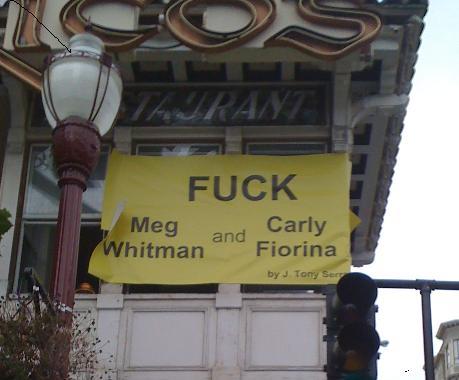
Tony Serra, the legendary local lawyer and one of my favorite members of the legal profession, sent us this photo with his commentary on the Nov. 2 election. It’s hanging from his office out at 506 Broadway.


I just talked to Serra, and he said he’s had great feedback. “Channel Five came out and did a story,” he said. “They managed to shoot it so the lightpost covered up the U and the C. They interviewed people on the street, and a lot of them were cheering me on.”


His critique of the GOP candidates doesn’t mean he’s a Jerry Brown supporter; Serra has sworn off electoral politics, which he told me is part of the corruption of capitalism. But he’s happy to go after Meg and Carly: “I’m not going to let those two motherfuckers buy the election.”


I told Serra he’s always been one of my heroes. Still is. 

Editor’s notes

0

Tredmond@sfbg.com

At a certain point, you have to stop trying to project what’s going to happen and just wait for the election results. Because what matters now isn’t the $140 million Meg Whitman has spent or Carly Fiorina’s record at Hewlett-Packard or which aide to Jerry Brown called Whitman a whore. It’s who shows up to vote.

If I were Meg Whitman’s campaign manager, I’d stop spending money. Go into hiding. Pretend there’s nothing going on here, no big deal next Tuesday morning — and then pray for rain. Because the way Whitman wins — possibly the only way she wins — is if huge numbers of Californians don’t bother to vote.

If the turnout is reasonable — that is, if enough Democrats realize the danger posed by of the GOP candidate and go to the polls — then Jerry Brown is in. And if that happens, chances are good that the rest of the Democratic ticket — including Gavin Newsom and Kamala Harris — squeaks in, too. And then we can all start to have fun figuring out the future of San Francisco politics.

That, of course, depends on the same factor: Who’s going to show up to vote? Will all the tenants in District 8 — many of them unexcited about Jerry Brown — take the time to vote for Rafael Mandelman for supervisor? Will the progressive voters who have lived in District 6 for a while get to the polls in greater numbers than the conservative newcomers in the pricey condos? Will the next Board of Supervisors — which could be choosing the next mayor — be as progressive as the current board (which also might wind up choosing the next mayor?)

And who’s even on the mayoral short list?

At the Haight Ashbury Neighborhood Council forum Oct. 14, former Supervisor (and potential mayoral contender) Aaron Peskin noted that the person in Room 200 year “is going to have to take out the garbage.” The city’s going to face another awful budget deficit and a progressive interim mayor will have to make a lot of enemies. Who wants to face the voters in November 2011 after making more cuts and raising taxes?

Well, somebody needs to — because the “caretaker” mayor some people are pushing for won’t have the clout to make tough decisions. And frankly, a progressive with the power of incumbency might actually be able to win a full term, even up against a huge downtown war chest.

Fun stuff. Go out and vote.


The myth of the overpaid public employee

31

Lots of press — as there should be  — on the new UC Berkeley study that debunks the myth of the overpaid public employee. The Chron had a decent story this morning, The Bay Citizen, which has been reporting pretty heavily on high wages and pensions in the public sector, acknowledged the study today. It’s a pretty big deal: Since much of the poltics of 2010 seems to be about bashing public employees and complaining about bloated pensions, some hard reality — backed up with a sophisticated regression analysis — was badly needed.

And the study is prettty clear: public employee salaries and pensions are not the cause of California’s (or San Francisco’s) budget problems:

The Great Recession continues to leave a great deal of economic pain and scarring in its wake. But, the
vilification of government workers is sorely misplaced and has left the real culprits of this devastating
downturn off the hook. Compensation received by public sector employees is neither the cause—nor can
it be the solution—to the state’s financial problems. Only an economic recovery can begin to plug the hole
in the state’s budget. Unfortunately, the current budget balancing efforts in California are anti-simulative
and further act to depress demand in an economy already operating way below capacity. Budget cuts have
helped to keep California’s unemployment rate well into the double-digits for over a year and a half—and
there is no end in sight. Thousands of California public employees have lost their jobs and many more
have forgone pay through forced furloughs and their families have experience considerable pain and disruption.
All the workers who have lost their jobs or took cuts in pay or benefits were made to do so not
because of their work performance, or because their services were no longer needed, nor because they were
overpaid. They were simply causalities among a list of millions of hard working innocent victims of a financial
system run amuck. Public sector workers help our communities to thrive and provide services that
make it worthwhile to live in them—it is wrong to blame them for the fallout from the greatest economic
downturn since the Great Depression. 

The study’s out in enough time to make a potential difference in the election — on both the state and the local level, attacks on public employees are driving major campaigns. Meg Whitman is all about tying Jerry Brown to those evil unions, and Prop.B, the measure to cut health care and pensions for city employees, is a wedge issue. A little logic shows that it’s not only misleading but factually wrong to blame the public-sector workers for the recession.

Get angry and make ’em do it!

9

After crashing the country’s economy and turning the world against us, Republicans are clawing their way back into power by stoking voter anger at political and economic systems that are stacked against the common citizen, a tactic that progressives need to adopt if we ever hope to move our agenda forward.

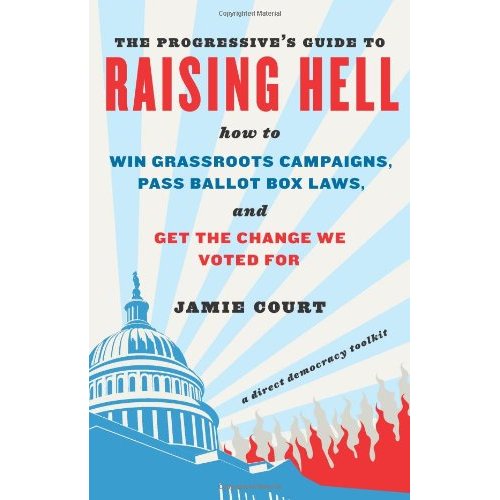
“Anger, not hope, is the fuel of political and economic change,” Jamie Court, head of Consumer Watchdog, writes in his new book, The Progressive’s Guide to Raising Hell: How to win grassroots campaigns, pass ballot box laws, and get the change we voted for (Chelsea Green Publishing, 2010).

Court writes that progressives are rightfully disappointed and disillusioned that after helping to elect President Barack Obama, he and Congressional Democrats turned around and gave Wall Street, the military-industrial complex, and the health insurance companies everything they wanted, with Obama even caving in on requiring all Americans to purchase health insurance, something he opposed as a candidate.


Yet Court said politicians never do the right thing and push progressive political change unless they’re forced to do so. He opened the book with a scene in which President Franklin Delano Roosevelt met with progressive political leaders, listened to their proposals, and then told them, “I agree. I am all for your plan. Now make me do it.”

It’s a concept that the conservative Tea Party movement understands well, and even though they may be crazy and wrongheaded in their utterly unsustainable and destabilizing policy agenda, they have effectively used anger as a political tool, and as a result, the NY Times reports they are poised to wield a disproportionate amount of political power after this election.

It’s the same story on the local level, where the only real anger in this election cycle is coming from those mad at public employee unions and their pension deals, and vagrants who sit uncivilly on sidewalks. These people will keep pushing for what they expect, but many progressives act as if it’s enough to prevent truly heinous Republicans like Meg Whitman from taking power, rather than trying to push Jerry Brown or Board of Supervisors’ progressives from day one to start empowering people over corporations.

“After the vote, power vacuums fill with familiar values, if not faces. Promises give way to fiscal realities, hope succumbs to pragmatism, and ambition concedes to inertia. The old tricks of interest group – confuse, diffuse, scare – prevail over the better angels of American nature,” Court writes, relaying a familiar electoral pattern.

Yet in this election, when the best outcome seems to be simply dodging a bullet, is there any hope for progressive political change? Isn’t the system just too broken? I asked Court these questions when he stopped by the Guardian office for a chat recently, and he retains a belief that with the right kind of tactics and agenda, progressives can still seize the political initiative and power.

http://www.youtube.com/watch?v=J3RD0YObHok

“I wrote it to reengage progressives because they are so despondent,” Court told me. “It’s about how to use anger and focus anger…Politicians don’t answer polite mobs, they only answer angry mobs and the Tea Party is the only angry mob in the room.”

Progressive have understandable doubts about the responsiveness of the current political system, but Court said, “I know if we don’t try to make it work, we’re never going to get there.”

And his book lays out the path to get there, step by step, based on some of the legislative and political successes that Consumer Watchdog and other progressives have had in recent years, such as rejecting the well-funded corporate con jobs in Propositions 16 and 17 earlier this year. Yet it involves an approach based on principle and not parties, and with being relentless in pursuing the kind of world we need.

“If you want to fight corporate power, you have to fight Democrats and Republicans,” Court said.

Specifically, Court is calling for progressives to push a California ballot measure that would establish a public health care option here, the very thing that Obama and the Democrats failed to include in their health reform package, and which will dash any hopes of it working if the people are forced to rely on unregulated insurance company products.

“The biggest thing is mandatory health insurance, which is a ticking time bomb,” Court said, one set to go off in 2014 when that aspect of Obama’s health care reform kicks in.

Corporate and political power working together seem to be a force too strong to overcome, but as Court writes, “Public opinion is the most powerful force in the world. While it can be muted, distracted, and co-opted, it cannot be controlled, except by the public.”

More on the “whore” gaffe

By now, you’ve probably heard about the campaign gaffe in which an unidentified female associate of Jerry Brown (possibly Brown’s wife) called his opponent Meg Whitman a “whore” during a conversation that neither realized was being recorded over voice mail.

The comment was made in reference to Whitman’s offer to cut a deal over the pensions of a police officer’s union in exchange for an endorsement. Soon after the tape went public, Whitman’s campaign seized the opportunity to issue a press release slamming the remark as “an appalling and unforgivable smear,” and a slur. Sparks flew over the comment at Tuesday’s gubernatorial debate.

Yet a number of reactions from feminist organizations and bloggers suggest that despite Whitman’s ire, women haven’t started hating on Brown as a result of the dumb mistake. And in the meantime, the controversy has generated some pretty interesting discussions out there in the blogosphere.

Shortly after the remark went live, Brown secured the endorsement of the California chapter of the National Organization of Women (NOW), which in turn prompted conservative bloggers everywhere to start foaming at the mouth, madly accusing NOW of being partisan and anti-woman.

“We definitely felt that putting the announcement out today was important to refocus on the real issue in the campaign,” such as “what are the two candidates going to do for women and their families,” the chapter’s president, Patty Bellasalma, told the Sacramento Bee. “The use of the word ‘whore’ is offensive,” she added. “There’s no mincing words about that.”

Chloe, a blogger at Feministing.com, had this to say:

“When candidates and their aides use highly gendered derogatory terms to refer to the opponent, and when that opponent responds by appealing to women’s personal-is-political feminism, we are having a national discussion about gender. … But it doesn’t feel like a particularly productive one — it’s more a case of one camp screwing up by revealing underlying sexism and the other capitalizing on that mistake to score a few points. It’s not an honest discussion of structural and cultural sexism in America and how it affects people of all genders. I want to make it clear that I think what Jerry Brown’s aide said was unacceptable, as was Brown’s seemingly tacit endorsement of the word. It’s not acceptable, obviously, to call anyone a whore. But I’m trying hard to remember what Jay Smooth taught us: condemn the action, not the person, or the campaign.”

Hanna Rosin, a blogger writing for Slate.com and the DoubleX factor, had this take on it:

“Now it’s unclear exactly what the aide meant, but it’s perfectly clear he or she did not mean that Whitman was a hussy who had slept with half the legislators west of the Mississippi. Since this was an endorsement call, he or she meant that Whitman was whoring herself for the endorsement. In one way, we could see this as progress, that the word ‘whore’ is so far removed from its original sex-shaming role that it gets thrown around in the context of political power trading.”

But if the phrase weren’t so wrapped up in sexism, would we even find ourselves in the midst of this controversy? Technically, “whore” can be used to refer to a man or a woman, and it can also mean “a venal or unscrupulous person” or some one who is “considered as having compromised principles for personal gain.” But do alternate definitions remove the sting of an offensive word?

A few questions. Should the gender of the person using the word (in this case, a woman) change our analysis of how it was used? When the remark has everything to do with politics and nothing to do with sex, should it be taken as a sign that we’re making progress on gender equality? Or would real progress be when the term “whore” goes the way of an archaic insult you’d find in a Shakespearean play?

There are signs, meanwhile, that the word “whore” isn’t universally regarded as a gendered insult. Just check out the roughly 200 definitions offered on Urban Dictionary. Like this one, posted by some one named Megan:

“Minor annoyance. You’re not really mad at them, but still kinda pissed.
‘Hey, who ate the last doughnut?’
‘I did.’
‘Whore.’”

Big Oil’s false choice

0

rebeccab@sfbg.com

Tapping into voters’ economic insecurities at a time of record high unemployment rates, out-of-state oil interests say addressing global warming will cost California more jobs. But a broad coalition that includes environmentalists and top business groups argue that just the opposite is true, saying the economy will suffer if we suddenly kill the incentives now driving the clean energy industry, one business sector that actually grew during the recession.

Proposition 23 would indefinitely suspend Assembly Bill 32, California’s Global Warming Solutions Act. Texas oil companies are bankrolling the initiative, spending millions of dollars to convince voters that they must choose between saving jobs and saving the environment. Since jobs are more important right now, they argue, the environment will have to wait.

But the other side — which includes groups such as the Chamber of Commerce, whose top priority is always job creation — is promoting the compelling idea that the path to economic recovery lies in rising to the challenge of climate change. They argue that addressing global warming now isn’t just about avoiding more out-of-control wildfires, diminishing crop yields, prolonged intense droughts, coastal flooding, and other calamities that climate scientists say global warming will bring to California. It’s also about creating jobs now and trying to lower California’s 12.4 percent unemployment rate, the third highest nationwide.

The push to defeat Prop. 23 has brought together prominent business people, public-health advocates like the American Lung Association, big green organizations such as the Sierra Club, and environmental-justice advocates who are pushing for green jobs as a way to fend off poverty and tackle air quality problems in disadvantaged neighborhoods. If the coalition of unlikely allies is successful, Big Oil’s comfortable lock on the energy market could be thrown off balance by California’s emerging green economy.

“Ultimately, we think it’s going to be a David vs. Goliath battle, because they have very deep pockets,” said No on 23 campaign spokesperson Steve Maviglio. “The proponents are playing to the fears of those most affected by the economy.”

When voters decide on this one, it will signify a choice to proceed down one of two paths at an important crossroads. A global climate summit in Copenhagen late last year failed to produce an effective response to climate change. A push for a federal cap-and-trade system to combat global warming yielded similarly disappointing results. AB32 presents a third chance to set a new standard, and a precedent, for curbing greenhouse gas emissions. But if Prop. 23 passes, environmentalists will have struck out.

A report issued in July by the National Academy of Sciences lays bare the far-reaching implications of policy decisions around climate change. “Emissions reductions choices made today matter in determining impacts experienced not just over the next few decades,” the report notes, “but in coming centuries and millennia.”


CLOSE RACE

In 2006, Gov. Arnold Schwarzenegger signed AB32, mandating a statewide reduction of greenhouse gases to 1990 levels by the year 2020. The law is slated to go into full effect in January 2012, when a cap-and-trade system will make it more costly and burdensome for major polluters to continue burning high quantities of fossil fuels, among other strategies.

The law helps alternative energy companies and creates incentives for large and small businesses to green their operations. Prop. 23, deceptively titled the “California Jobs Initiative,” would suspend AB32 until the state’s unemployment rate drops to 5.5 percent for four consecutive quarters. A decade could pass before such a market condition is in place — in the past 40 years, it’s occurred just three times.

Speaking at the Commonwealth Club in Santa Clara in September, Schwarzenegger blasted Texas-based oil companies Tesoro Corporation and Valero Energy Corporation, which have contributed a combined $5.6 million to the Prop. 23 campaign, for trying to deceive California voters. “They are creating a shell argument that this is about saving jobs,” Schwarzenegger said. “Does anybody really believe that these companies, out of the goodness of their black oil hearts, are spending millions and millions of dollars to protect jobs? It’s not about jobs at all, ladies and gentlemen. It is about their ability to pollute and thus protect their profits.”

Prop. 23 has been unpopular even among many traditional right-wing and business interests. Oil giants Chevron and BP have remained neutral on it. Republican gubernatorial candidate Meg Whitman also renounced it, but straddled the fence by vowing to suspend AB32 for a year anyway.

According to a breakdown of campaign spending issued by opponents, oil interests contributed 97 percent of the funding for Prop. 23, while out-of-state interests were responsible for 89 percent. Kansas-based Koch Industries, run by billionaire siblings David and Charles Koch, dropped $1 million into the effort. The Koch brothers have been singled out as the financial backbone of the Tea Party.

Yet despite bipartisan opposition in Sacramento, polls suggest Prop. 23 could be a close race. A recent Los Angeles Times poll showed a dead heat among California voters, with 40 percent in favor, 38 percent opposed, and about one-fifth of likely voters undecided. The television commercials advocating Yes on 23 drive home a simple yet misleading message: “Save jobs. Stop the energy tax.” A spokesperson from the Yes on 23 campaign did not return the Guardian’s calls seeking comment.

Ironically, jobs are also the cornerstone of the No on 23 campaign’s arguments. “We have very heavy hitters who see this as a job killer,” Maviglio said. The campaign is highlighting the fact that the only economic area that has experienced growth amid the recession is green tech.

Democratic gubernatorial candidate Jerry Brown referenced green jobs as a bright hope for economic recovery in a televised debate against Whitman, and the prospect of green job creation as a way to alleviate poverty is clearly articulated in The Green Collar Economy, a widely influential book by Green for All founder Van Jones. Green for All has joined the Greenlining Institute and a host of 80 organizations statewide in a united front against Prop. 23, called Communities United Against Prop. 23, which is part of the larger opposition campaign dubbed Communities United Against the Dirty Energy Prop.

Low-income communities and communities of color will be disproportionately affected if Prop. 23 wins, said Orson Aguilar, executive director of the Greenlining Institute. “The communities we represent are feeling a double impact,” Aguilar noted. “They’re suffering from pollution,” since power plants and polluting industries tend to be sited in low-income communities, “and they’re suffering from unemployment and the economic crisis. There definitely is a double-whammy.”


LOCAL MOMENTUM

At a recent green business symposium hosted by Urban Solutions, a nonprofit that aids small businesses and seeks to create job opportunities in low-income communities, a Castro District merchant explained her decision to enter green-business certification process. “I’m dedicated to going green because, No. 1, it’s the right thing to do,” said Elaine Jennings, who runs Small Potatoes Catering & Events. “No. 2, it’s the right thing to do. And No. 3, it’s the right thing to do.”

But the moderator of the panel, a business reporter, wasn’t as interested in the moral rationale — instead, she followed up by asking whether going green was a wise financial move. Anthony Tsai, green business program manager at Urban Solutions, made the case that it is. Water bills have gone up 40 percent since 2000, Tsai said. Electricity costs have gone up 60 percent and waste disposal fees have increased 250 percent. By conserving energy and water and reducing waste, small businesses can save money during tough economic times.

Aguilar sees energy-efficiency building retrofits as an opportunity to create jobs for disadvantaged populations. In order to comply with the climate regulations under AB32, energy-efficiency retrofits would have to be completed to hit conservation targets. “We have thousands, if not millions, of buildings in California that need to be retrofitted,” he said. “A lot of people who are out of work are in the construction industry. Latinos and African Americans were hit hard when construction fell.” With energy retrofits and solar-panel installations on the agenda, AB32 could be good news for electricians, too, Aguilar said.

There are signs that AB32 is already giving green business a lift. A manufacturer of electric delivery trucks, for example, relocated from Mexico to California’s Central Valley late last year. A wind-energy company recently relocated to San Diego from Spain. The solar industry is growing faster in California, particularly in the Bay Area, than anywhere else nationwide. And in the past five years, roughly $9 billion in venture capital investment has gone into clean tech industries, with more going to California than any other state.

“Prop. 23 would essentially pull the rug out from under this explosive growth, which we’re experiencing during a recession,” Maviglio noted.

Jeanine Cotter, CEO of Luminalt, an independently owned San Francisco solar and installation company, is active in the campaign to defeat Prop. 23. “There is an entire ecosystem that feeds off of good policy,” Cotter said. If Prop. 23 passes, “we will lose the spark that we have and we will go backward.”

Despite the economic downturn, Luminalt experienced its best year in 2009 in the six-year history of the company, and if AB32 goes into effect in 2012 as planned, the demand for new solar installations will only grow. But with less than a month to go before the election, Cotter said she was alarmed by the lack of awareness about Prop. 23, even among environmentalists.

“We were at West Coast Green with No on 23 literature,” she said, referencing a widely attended green-business conference, “and I was shocked at how many people didn’t know what it is.”


RISKING IT

Small business owners and conscience-driven activists aren’t the only ones touting this theory of a new energy economy. The San Francisco Chamber of Commerce, a fiscally conservative business association that is often at odds with environmentalists and progressives, is actively campaigning against Prop. 23 — and it’s not out of any sense of moral duty.

If Prop. 23 succeeds, explained Chamber spokesperson Rob Black, it will scare off the venture capitalists. “For them, water’s like money,” he explained. “It will flow to the easiest place to invest.” Regulation like AB32 guarantees a return on investment for climate-friendly technology, he added. But if that regulatory structure is thrown into question, investors may flee overseas because investing would be too risky. “If we walk away from clean tech, the next Microsoft will be a Chinese company,” Black said.

Donnie Fowler, a political consultant who has worked for Al Gore and other top Democrats, is a senior adviser to the Clean Economy Network and a leader in the effort to defeat Prop. 23. Oil companies “went to Washington and spent hundreds of millions” lobbying against climate change regulations, Fowler pointed out. “Now they’ve opened up a second front. If California goes backward, all of those senators and Congressional representatives will say, ‘No way … I’m surely not taking a political risk. If they went backward, there’s no reason we should go forward.'”

Fowler said that for environmentalists, voting No on 23 could be seen as an affirmation of statewide efforts to address climate change in a meaningful way. “This is a real opportunity,” he said, “for Californians to stand up and say we’ve had enough. We are going to take a stand — right now.”

www.stopdirtyenergyprop.com

www.communitiesagainstprop23.com

OFA opens SF office, hosts debate watch party

12


President Obama’s political operation, Organizing For America, is opening its first San Francisco office today (Tues/12), just in time to hold a watch party for this evening’s final California gubernatorial debate between Jerry Brown and Meg Whitman. So stop by 1406 Valencia at 6:30 for the debate, or stop by at 4 pm to watch Obama greet the crowd via video hookup.

Emily Dulcan, OFA’s California communications director, said the office will be focused on get-out-the-vote efforts for the Nov. 2 election, including phone banking and precinct walking for races that include Brown for Governor, U.S. Sen. Barbara Boxer’s reelection effort, Congressional races, and even some local measures.

“A lot of our volunteers hover between local races and the big races,” said Dulcan, who said she was starting to feel good about the chances of Democrats doing well at the polls. “People are really starting to see what’s at stake in this election. We can go back to the failed policies of the Republicans and President George W. Bush, or we can move forward under President Obama.”

While history and many pundits predict the Democrats will lose seats in Congress this fall – mostly because of the stubbornly bad economy and the fact that the party in power usually loses ground in the midterm elections – recent computer modeling by the New York Times showed there’s an almost unprecedented amount of uncertainty in forecasting how this election will really go. And that it could largely depend on which party can get out the vote in a fairly lackluster election season.

Lacy’s face disfigured on Dem/Labor doorhanger

31

With only three weeks to go until the election. the dirty campaign tricks get stickier.

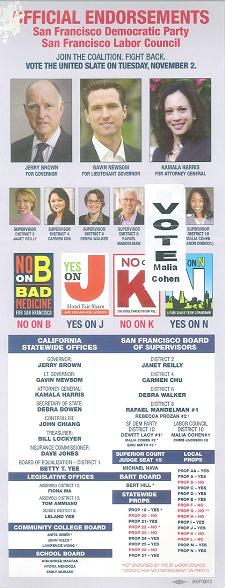
Top of the list of dirty tricks this week is the person(s) who pasted “Vote Malia Cohen” stickers atop the image of D10 candidate Dewitt Lacy on door hangers that the SF Democratic Party and the SF Labor Council produced  jointly for the November 2010 election. According to Lacy supporters, the offending stickers cropped up primarily on door hangers distributed on Potrero Hill, where Lacy lives, works and has a strong following.

The door hanger features a photo of Jerry Brown for Governor on one side—and thumbnails of the Dem/Council’s local picks on the other. These local picks include Newsom for Lt. Governor, Kamala Harris for Attorney General, Janet Reilly for D2 Supervisor, Carmen Chu for D4 supervisor, Debra Walker for D6 supervisor, Rafael Mandelman for D8 Supervisor and Dewitt Lacy and Malia Cohen for D10–except you can’t see Lacy’s face on the doorhangers that have been disfigured by Cohen stickers.

Historically, the SF Democratic Party only includes the picture of its top ranked candidate on door hangers, and this fall, the DCCC (the endorsing body of the local Dem Party) endorsed Lacy as its first-ranked candidate, Cohen as its second ranked candidate and Eric Smith as its third ranked candidate.

“But we included both Dewitt and Malia on this door hanger because we are doing it with the Labor Council and we have two different first-ranked candidates,” former Board President and current DCCC chair Aaron Peskin told the Guardian, noting that the Labor Council endorsed Cohen as top-ranked and Chris Jackson as its second-ranked candidate.

Cohen’s campaign manager Megan Hamilton told the Guardian that the Cohen campaign was “aware” of the stickers.
“But we did not put the stickers there,” Hamilton said.

Lacy, who dropped by the Guardian with dozens of defaced door hangers in hand, said a stream of supporters have complained about this latest dirty trick.

‘It’s misleading,” Lacy said. ‘If folks haven’t been paying attention, they won’t understand that I have been endorsed as the Democratic Party’s top choice.”

Lacy said the door hangers were distributed a couple of weeks ago at the DCCC’s election season kick-off event to people who were going to walk precincts.
”Of course, at that time, the door hangers weren’t terribly disfigured by someone sticking a ‘vote for Malia Cohen’ sticker over my smiling face,” Lacy added. “But it shows that these folks are nervous about the inroads my campaign has been making in this race. After each forum we have had folks come up to us and say they are excited by our campaign because they are looking for hope and leadership that really represents them.”

So what does Lacy, the top choice of the Democratic Party, look like when he doesn’t have a sticker over his face?

All smiles, after he completed his interview with the Guardian, which gave him its second-ranked endorsement in the D10 race, with Tony Kelly in top place and Chris Jackson in third.

Endorsements 2010: State races

24

GOVERNOR

EDMUND G. BROWN

We have issues with Jerry Brown. The one-time environmental leader who left an admirable progressive legacy his first time in the governor’s office (including the Agricultural Labor Relations Board, the California Conservation Corps, and the liberal Rose Bird Supreme Court) and who is willing to stand up and oppose the Diablo Canyon nuclear power plant has become a centrist, tough-on-crime, no-new-taxes candidate. And his only solution to the state budget problems is to bring all the players together early and start talking.

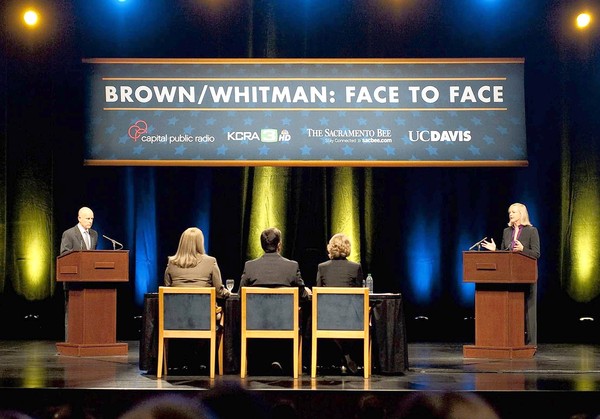
But at least since he’s started to debate Republican Meg Whitman face to face, he’s showing some signs of life — and flashes of the old Jerry. He’s strongly denouncing Whitman’s proposal to wipe out capital gains taxes, reminding voters of the huge hole that would blow in the state budget — and the $5 billion windfall it would give to the rich. He’s talking about suing Wall Street financial firms that cheated Californians. He’s promoting green jobs and standing firm in support of the state’s greenhouse-gas emissions limits.

For all his drawbacks (his insistence, for example, that the Legislature shouldn’t raise any taxes without a statewide vote of the people), Brown is at least part of the reality-based community. He understands that further tax cuts for the rich won’t solve California’s problems. He knows that climate change is real. He’s not great on immigration issues, but at least he’s cognizant that 2 million undocumented immigrants live in California — and the state can’t just arrest and deport them all.

Whitman is more than a conservative Republican. She’s scary. The centerpiece of her economic platform calls for laying off 40,000 state employees — thereby greatly increasing the state’s unemployment rate. Her tax plan would increase the state’s deficit by another $5 billion just so that a tiny number of the richest taxpayers (including her) can keep more of their money. She’s part of the nativist movement that wants to close the borders.

She’s also one of the growing number of candidates who think personal wealth and private-sector business success translate to an ability to run a complex state government. That’s a dangerous trend — Whitman has no political experience or background (until recently she didn’t even vote) and will be overcome by the lobbyists in Sacramento.

This is a critically important election for California. Vote for Jerry Brown.


LIEUTENANT GOVERNOR


GAVIN NEWSOM

Why is the mayor of San Francisco running for a job he once dismissed as worthless? Simple: he couldn’t get elected governor, and he wants a place to perch for a while until he figures out what higher office he can seek. It’s almost embarrassing in its cold political calculus, but that’s something we’ve come to expect from Newsom.

We endorsed Newsom’s opponent, Janice Hahn, in the Democratic primary. It was hard to make a case for advancing the political career of someone who has taken what amounts to a Republican approach to running the city’s finances — he’s addressed every budget problem entirely with cuts, pushed a “no-new-taxes” line, and given the wealthy everything they wanted. His immigration policies have broken up families and promoted deporting kids. He’s done Pacific Gas and Electric Co. a nice favor by doing nothing to help the community choice aggregation program move forward.

Nevertheless, we’re endorsing Newsom over his Republican opponent, Abel Maldonado, because there really isn’t any choice. Maldonado is a big supporter of the death penalty (which Newsom opposes). He’s pledged never to raise taxes (and Newsom is at least open to discussion on the issue). He used budget blackmail to force the awful open-primaries law onto the ballot. He’s a supporter of big water projects like the peripheral canal. In the Legislature, he earned a 100 percent rating from the California Chamber of Commerce.

Newsom’s a supporter of more funding for higher education (and the lieutenant governor sits on the University of California Board of Regents). He’d be at least a moderate environmentalist on the state Lands Commission. And he, like Brown, is devoting a lot of attention to improving the state’s economy with green jobs.

We could do much worse than Newsom in the lieutenant governor’s office. We could have Maldonado. Vote for Newsom.


SECRETARY OF STATE


DEBRA BOWEN

California has had some problems with the office that runs elections and keeps corporate filings. Kevin Shelley had to resign from the job in 2005 in the face of allegations that a state grant of $125,000 was illegally diverted into his campaign account. But Bowen, by all accounts, has run a clean office. Her Republican opponent, Damon Dunn, a former professional football player and real estate agent, doesn’t even have much support within his own party and is calling for mandatory ID checks at the ballot. This one’s easy; vote for Bowen.


CONTROLLER


JOHN CHIANG

Chiang’s been a perfectly decent controller, and at times has shown some political courage: When Gov. Arnold Schwarzenegger tried to cut the pay of state employees to minimum-wage level, Chiang refused to go along — and forced the governor to back down. His opponent, state Sen. Tony Strickland (R-Los Angeles), wants to use to office to promote cuts in government spending. Vote for Chiang.


TREASURER


BILL LOCKYER

Lockyer’s almost certain to win reelection as treasurer against a weak Republican, Mimi Walters. He’s done an adequate job and pushed a few progressive things like using state bonds to promote alternative energy. Mostly, though, he seems to be waiting for his chance to run for governor — and if Jerry Brown loses, or wins and decides not to seek a second term, look for Lockyer to step up.


ATTORNEY GENERAL


KAMALA HARRIS

This is going to be close, and it’s another clear choice. We’ve had our differences with Harris — she’s trying too hard to be a tough-on-crime type, pushing some really dumb bills in Sacramento (like a measure that would bar sex offenders from ever using social networking sites on the Internet). And while she shouldn’t take all the blame for the problems in the San Francisco crime lab, she should have known about the situation earlier and made more of a fuss. She’s also been slow to respond to serious problem of prosecutors and the cops hiding information about police misconduct from defense lawyers that could be relevant to a case.

But her opponent, Los Angeles D.A. Steve Cooley, is bad news. He’s a big proponent of the death penalty, and the ACLU last year described L.A. as the leading “killer county in the country.” Cooley has proudly sent 50 people to death row since he became district attorney in 2001, and he vows to make it easier and more efficient for the state to kill people.

He’s also a friend of big business who has vowed, even as attorney general, to make the state more friendly to employers — presumably by slowing prosecutions of corporate wrongdoing.

Harris, to her credit, has refused to seek the death penalty in San Francisco, and would bring the perspective of a woman of color to the AG’s office. For all her flaws, she would be far better in the AG’s office than Cooley. Vote for Harris.


INSURANCE COMMISSIONER


DAVE JONES

Jones, currently a state Assemblymember from Sacramento, won a contested primary against his Los Angeles colleague Hector de la Torre and is now fighting Republican Mike Villines of Fresno, also a member of the Assembly. Jones is widely known as a consumer advocate and was a foe of Prop. 17, the insurance industry scam on the June ballot. A former Legal Aid lawyer, he has extensive experience in health-care reform, supports single-payer health coverage, and would make an excellent insurance commissioner.

Villines pretty much follows right-wing orthodoxy down the line. He wants to replace employer-based insurance with health savings accounts. He argues that the solution to the cost of health insurance is to limit malpractice lawsuits. He wants to limit workers compensation claims. And he supports “alternatives to litigation,” which means eliminating the rights of consumers to sue insurance companies.

Not much question here. Vote for Jones.


BOARD OF EQUALIZATION, DISTRICT 1


BETTY YEE

The Board of Equalization isn’t well known, but it plays a sizable role in setting and enforcing California tax policy. Yee’s a strong progressive who has done well in the office, supporting progressive financial measures. She’s spoken out — as a top tax official — in favor of legalizing and taxing marijuana. We’re happy to endorse her for another term.


SUPERINTENDENT OF PUBLIC INSTRUCTION


TOM TORLAKSON

We fully expected a November runoff between Torlakson and state Sen. Gloria Romero. Both Democrats had strong fundraising and political bases — and very different philosophies. Romero’s a big charter school and privatization fan; Torlakson has the support of the teachers unions. But to the surprise of nearly everyone, a wild-card candidate, retired Los Angeles educator Larry Aceves, came in first, with Torlakson second and Romero third. Now Aceves and Torlakson are in the runoff for this nonpartisan post.

Aceves is an interesting candidate, a former principal and school superintendent who has the endorsement of the San Francisco Chronicle and the San Francisco Green Party. But he’s too quick to take the easy line that the teachers’ unions are the biggest problem in public education, and he wants the unilateral right to suspend labor contracts.

Torlakson wants more charter-school accountability and more funding for primary education. He’s the far better candidate.


STATE SENATE


DISTRICT 8

Leland Yee

Yee’s got no opposition to speak of, and will easily be re-elected. So why is he spending money on a series of slick television ads that have been airing all over San Francisco, talking about education and sending people to his website? It’s pretty obvious: The Yee for state Senate campaign is the opening act of the Yee for San Francisco mayor campaign, which should kick into high gear sometime next spring. In other words, if Yee has his way, he’ll serve only a year of his next four-year term.

Yee infuriates his colleagues at times, particularly when he refuses to vote for a budget that nobody likes but everyone knows is necessary to keep the state afloat. He’s done some ridiculous things, like pushing to sell the Cow Palace as surplus state property and turn the land over to private real estate developers. But he’s always good on open-government issues, is pushing for greater accountability for companies that take tax breaks and then send jobs out of state, has pushed for accountability at the University of California, and made great progress in opening the records at semiprivate university foundations when he busted Stanislaus State University for its secret speaking-fees deal with Sarah Palin.

With a few strong reservations, we’ll endorse Yee for another term.


STATE ASSEMBLY, DISTRICT 12


FIONA MA

A clear hold-your-nose endorsement. Ma has done some truly bad things in Sacramento, like pushing a bill that would force the San Francisco Unified School District to allow military recruiters in the high schools and fronting for landlords on a bill to limit rent control in trailer parks. But she’s good on public power and highly critical of PG&E, and she has no opposition to speak of.


STATE ASSEMBLY, DISTRICT 13


TOM AMMIANO

Ammiano’s a part of San Francisco history, and without his leadership as a supervisor, we might not have a progressive majority on the Board of Supervisors. Ammiano was one of the architects of the return to district elections, and his 1999 mayoral campaign (against Willie Brown) marked a turning point in the organization, sophistication, and ultimate success of the city’s left. He was the author of the rainy day fund (which has kept the public schools from massive layoffs over the past couple of years) and the Healthy San Francisco plan.

In Sacramento, he’s been a leader in the effort to legalize (and tax) marijuana and to demand accountability for the BART Police. He’s taken on the unpleasant but critical task of chairing the Public Safety Committee and killing the worst of the right-wing crime bills before they get to the floor. He has four more years in Sacramento, and we expect to see a lot more solid progressive legislation coming out of his office. We enthusiastically endorse him for reelection.


STATE ASSEMBLY, DISTRICT 14


NANCY SKINNER

Skinner’s a good progressive, a good ally for Ammiano on the Public Safety Committee, and a friend of small business and fair taxation. Her efforts to make out-of-state companies that sell products in California pay state sales tax would not only bring millions into the state coffers but protect local merchants from the likes of Amazon. We don’t get why she’s joined with Berkeley Mayor Tom Bates to try to get rid of Kriss Worthington, the most progressive member of the Berkeley City Council, but we’ll endorse her for re-election.


STATE ASSEMBLY, DISTRICT 16


SANDRE SWANSON

Swanson’s a good vote most of the time in Sacramento, but he’s not yet the leader he could be — particularly on police accountability. The BART Police murdered Oscar Grant in Swanson’s district, yet it fell to a San Franciscan, Tom Ammiano, to introduce strong state legislation to force BART to have civilian oversight of the transit cops. Still, he’s done some positive things (like protecting state workers who blow the whistle on fraud) and deserves another term.


>>BACK TO ENDORSEMENTS 2010

Opinion: For Democratic unity

6

We ran out of space in today’s print edition and couldn’t publish either of the two opeds I wanted to run, so I’m posting them here. The first one is by the chairman of the SF Democratic Party.

By  Aaron Peskin

As one of the most Democratic cities in California, San Francisco has a special responsibility to make sure we help elect a Democratic ticket on November 2nd.  We always take that responsibility seriously – but this year we will have the pleasure of helping elect our own to statewide office: Gavin Newsom as Lt. Governor, Kamala Harris as Attorney General and even native son Jerry Brown as California’s next Governor.

Because so many of our nominees are from San Francisco – and because San Francisco is so Democratic – and because so many of the statewide elections are so, so close – what we do to turn out the vote here in San Francisco could very well be the difference between victory and defeat for many statewide candidates. 

A quick look at the numbers shows just how important San Francisco could be in this year’s statewide races. In November of 2008, a total of 388,112 San Franciscans cast ballots. In November of 2006, the last gubernatorial contest, just 253,719 San Franciscans voted. That is a difference of 134,393 votes.

Local Democratic Party leaders agree a coordinated campaign could turn out at least 20% of these “occasional” voters and probably many more.  That means we could add a minimum of more than 25,000 votes from this Democratic base to the statewide total.

In a year in which the polls show razor-thin margins separating the winners from the losers, a 25,000 vote margin could make the difference between Democratic policies like support for schools, investing in green jobs and protecting a woman’s right to choose and the Republican reaction supported by Meg Whitman, Carly Fiorina, Steve Cooley and Able Maldonado.
Considering how important Democratic unity is to our city and our state – we need to pay it more than lip service. And that’s what our local party is trying to do.

It is certainly true that there are important local issues upon which we disagree. For example, I certainly take issue with some of Mayor Newsom’s positions – such as his so-called Sit/Lie ordinance. I know that he takes issue with many of my positions.

There are many in our party unhappy with Newsom for putting an attack on the ballot on the elected members of the local party in this crucial election.  Again, I know Mayor Newsom has expressed his displeasure with the local party for not supporting some of his candidates and positions.

But these local disagreements are small in comparison to what is at stake for Californians. They are actually small compared to what is at stake for San Franciscans – a city that relies on state aid to support our schools and colleges, much of our local health services and many other important programs.

That’s why unity is the only sensible policy in this crucial 4-weeks of voting until the November 2nd election. And that’s why I have a simple and genuine invitation to Mayor Newsom and the other statewide candidates.

Come help us help you.

We are gathering every day at our headquarters at 1261 Howard Street to knock on doors, register voters and make phone calls to get out the vote.  Come show with your presence that turning out the vote is so important that we will turn aside both petty differences and legitimate policy disagreements on local concerns.

Across California our opponents are attacking “San Francisco” Values. Come show that a core value of San Francisco Democrats is uniting to support the greater good.

Brown or Whitman? No contest

3

Sidebar to The pummeling of SF Labor

Jerry Brown or Meg Whitman? Barbara Boxer or Carly Fiorina? For labor voters, the choice should be obvious.

All too often, we’re faced with choosing between the lesser of two political evils, but not this time. Democrat Jerry Brown has proven throughout his long political career to be one of the best friends labor has ever had, and shows no sign that he’d be anything else if returned to the governorship in November.

I particularly recall the great political skill Brown demonstrated in convincing the State Legislature to enact what is still the only law outside Hawaii guaranteeing farm workers the collective bargaining rights granted most non-agricultural workers in the 1930s.

It’s impossible to imagine Brown’s Republican challenger having the will or the skill to do something like that. Whitman’s position on labor is precisely the opposite of Brown. She has made union bashing, and especially the bashing of public employee unions, a major theme of her campaign.

On the national level, Democratic Senator Boxer has long been a solid labor supporter and surely merits re-election in November. Like Brown, she’s in a contest against a mediocre Republican candidate, but one with many, many bucks to spend on her campaign.

Some of the nine initiatives on the state ballot would be good for labor, some not so good.  Prop. 25 is easily the best of the bunch for labor and just about everybody else. It would require a simple majority vote of the Legislature to adopt the annual state budget rather than the current requirement of a two-thirds majority.  The great difficulty of lining up two-thirds support has often resulted in legislative stalemates that have forced some state operations to be cut back or even temporarily shut down for days, sometimes weeks. No money, as they say, no service.

Prop. 23 is bad news. The measure, backed by Big Oil and other major polluters,  would suspend the state air pollution laws that limit  omission of greenhouse gases known to cause global warming until statewide unemployment drops to 5.5 percent or lower for one year, which – surprise! –  is not about  to happen. Not for a long time, anyway.

Corporate greedheads could lose big, however, with passage of Prop. 24. It would repeal $1.7 billion in tax breaks granted big corporations during last year’s budget negotiations, or “backroom budget deals,” in the impolite but quite accurate words of the California Federation of Teachers (CFT).

The CFT, an AFL-CIO affiliate, and the rival California Teachers Association  (CTA), an affiliate of the National Education Association, are both campaigning for the excellent Democratic candidate for State Superintendent of Public Instruction, Assemblyman and former State Sen. Tom Torlakson of Antioch.

They stress Torlakson’s experience as a longtime high school science teacher and part-time community college teacher and his commitment to increasing badly needed funding for the state’s schools, as shown by the bills he authored that have provided more than $3 billion in school aid.

— Dick Meister

Whitman calls out SF and immigrants, and karma calls back

22

During last night’s gubernatorial debate, Republican nominee Meg Whitman bashed “illegal” immigrants and singled out San Francisco as the state’s worst coddler of those without proper immigration papers. But today, it was revealed that Whitman employed an undocumented Mexican immigrant as her housekeeper and nanny from 2000 until last year. Ah, karma, the great leveler.

After being asked what California should do about immigration issues, Democratic nominee Jerry Brown gave a reasonable answer that should have appeal to people of all political stripes, calling for halting illegal immigration by securing the border with fences and modern technology that electronically verifies the status of visitors, but bringing the state’s 2 million undocumented immigrants out of the shadows by creating a way for them to achieve legal residency status.

“We can’t just round them up and deport them like they did in Eastern Europe,” Brown said, an incendiary analogy that was nonetheless true, reminding voters of the police state implications of the right-wing approach to the immigration issue.

Yet Whitman then essentially called for doing just that with increased enforcement, albeit with a slightly more polished approach than most angry nativists, saying the presence of “illegal immigrants” was a serious threat to California. “We have got to eliminate sanctuary cities,” Whitman said, naming San Francisco as the worst culprit, and saying, “We have to hold employers accountable for hiring undocumented workers.”

So should Whitman be held accountable for employing Nicandra Diaz-Santillan for almost a decade? Maybe not to legal authorities, but certainly to voters who will now question her integrity and whether she has been hypocritically grandstanding on such a politically divisive issue.

Whitman’s excuse is that she didn’t know her housekeeper was undocumented because she was provided false paperwork, an excuse that most California employers could also offer, showing just how ridiculous Whitman is for pretending that being “tough” can solve this “problem.”

That was one of many Whitman forays into fantasyland, such as equating with “independence” a campaign funded almost entirely with her Wall Street windfalls, one she is using to advocate for aggressively cutting taxes on big business and the rich. And then pretending that’s somehow a plan to close the state’s massive budget deficit. Pure nonsense.

By contrast, Brown seemed firmly grounded in reality, leveling with viewers that the state faces difficult problems that will require hard work and experience fighting with the “sharks in Sacramento” and calling for “the powerful to sacrifice first.” On the whole, the debate made clear the stark differences between these two candidates, which is perhaps the best we can hope for during a dismal political year.

Newsom campaign also plugging Sparks

9

UPDATED WITH RESPONSE FROM SPARKS.

Gavin Newsom’s campaign for lieutenant governor might have a tough time beating moderate Latino Republican Abel Maldonado – indeed, even many of his local allies privately tell us they fear he’s going to lose – but it is still using some of its significant resources and energy to promote the candidacy of Theresa Sparks, whom Newsom endorsed to replace Chris Daly on the Board of Supervisors.

“I’m hoping we can count on your vote for Gavin Newsom for lieutenant governor and Theresa Sparks for District 6 supervisor,” a volunteer with the Newsom campaign said during a call that I received today, the first I’ve gotten from the Newsom campaign.

As of Sept. 23, the Sparks campaign reported having $29,361 in the bank, about half of what her main District 6 rival Debra Walker had on hand on that date ($57,895), even though Sparks has out-fundraised Walker $124,000 to $110,000, according to the most recent campaign finance reports.

Yet even these strong local fundraising totals pale in comparison to what a statewide candidate like Newsom can pull down. As of the last full campaign report that extended through June 30, Newsom’s campaign had $494,000 in the bank after raising $1.4 million, and his recent late contribution reports show hundreds of thousands of dollars more rolling in since then.

Among the recent Newsom contributors are downtown political players such as the San Francisco Apartment Association ($3,500 on 9/16), Shorenstein Realty Services ($6,500 on 9/16), Recology (the company bidding on SF’s big garbage contract, $2,500 on 9/16), San Francisco Building Owners and Managers Association ($5,000 on 9/1), and Sen. Dianne Feinstein ($5,000 on 9/4) – all of which far exceeds the $500 local limit on campaign contributions

It’s unusual for a local and statewide candidate to share a phone-banking operation, and clearly a sign that Newsom would really like to deal with a more ideologically friendly (that is, less progressive) Board of Supervisors if he doesn’t move to Sacramento in January. And from a campaign finance perspective, both campaigns will probably need to document where the resources came from for this shared campaigning when the next pre-election statements are due on Oct. 5.

“Generally speaking, if they share resources they should be apportioning those costs,” Mabel Ng, deputy director of the San Francisco Ethics Commission, told the Guardian. Yet she also noted that California Gov. Code Section 84310 makes a distinction between automatic robo-calls and the kind of live “volunteer” that the caller identified himself as. “If it’s a live person, some of these rules don’t apply,” Ng said. If that’s the case, Sparks might be in for lots of no-cost campaigning during the final pre-election push.

The Newsom campaign has not responded to a Guardian inquiry about the issue, but Sparks returned our call after this article was initially posted. Although she took issue with the implication that there was anything wrong with her benefitting from calls by the Newsom campaign, comparing it to the support Walker has received from the Democratic County Central Committee, she admits to the coordination on the matter between her campaign and Newsom’s.

“Newsom had a volunteer phone bank and he asked if he shoudl add my name to it and I said yes,” Sparks told the Guardian, adding that she’s been pleased with the response to this effort and her own campaign’s phonebanking efforts.

Meanwhile, while Sparks just got a boost from above today, so did Newsom, who was the subject of an e-mail blast from former President Bill Clinton, who wrote, “We have a tremendous opportunity in Jerry Brown and Gavin Newsom, two leaders who realize the promise of their state and will get it back on track. Please join me in helping these candidates win in November.”

Editor’s Notes

0

tredmond@sfbg.com

California politics starts early. The campaigns in this state were underway long before the traditional Labor Day launch of the fall campaign season. Except for Jerry Brown, who only in the past week has started acting like a candidate for governor of the most populous state in the nation.

And that’s not a mistake.

Here’s how I’m seeing things shape up at what is more accurately described as a midpoint in the campaign season:

Jerry Brown’s starting to hit back. The once and maybe future governor has much of the state’s political class mystified; with Meg Whitman blanketing the airwaves, promoting herself and whacking away at him, why has he waited so long to fight back? Actually, it’s a calculated strategy, Jerry’s version of the old Muhammed Ali rope-a-dope. He knew he couldn’t match Whitman blow for blow — and he also suspected that at a certain point, she’d start to punch herself out. It’s been working: after spending more than $100 million, Whitman hasn’t cracked 45 percent in the polls. And some polls now show that the more people view her ads, the less they like her.

So now Jerry Brown appears — a 72-year-old career politician who’s going to look like a fresh face. And all he has to do is knock her back a little and the race is his.

Barbara Boxer’s nailed Carly Fiorina where she’s most vulnerable. Boxer’s got incumbency trouble — that is, everyone’s sick of incumbents. But she has an opponent who has something even worse — a record of sending jobs offshore while collecting $100 million for herself. Boxer hammered that point home in the first and only Senate debate — and I can see that clip appearing in TV ads all fall.

And I hate to say it, but those two campaigns are going to eat up all the statewide campaign oxygen between now and November. Between those four candidates, we’ll see upwards of $120 million in TV spending — and the rest of the campaigns probably won’t even be able to buy much time in major markets.

That could be good for Gavin Newsom and Kamala Harris. They’re Democrats in a state where Democrats way outnumber Republicans, and Republicans only win when they make a strong case that the Democrat sucks. Whitman can try to do that, and so can Fiorina, but even if they had the money, I don’t see Abel Maldonado or Steve Cooley, the GOP candidates for lieutenant governor and attorney general, getting their messages heard in the cacophony that will be the top of the ticket.

So maybe Whitman is not only hurting herself with her excessive spending. Maybe she’s hurting the rest of the party, too. Not that she cares.

ICE suggests SF Secure-Comm opt-out possible

1

U.S. Immigration and Customs Enforcement (ICE) spokesperson Lori K. Haley sent the Guardian a statement today that suggests that ICE might change the city’s Secure-Communities activation status, after all.
“Once ICE receives the correspondence from the San Francisco County Sheriff, we will review the request and convene a meeting with the other agencies involved, including the California Department of Justice, to discuss the Sheriff’s specific issues and concerns.  Based upon those discussions, ICE and its partners will examine the options and seek a feasible resolution, which may include changing the jurisdiction’s activation status,” ICE stated.

ICE’s statement came in the wake of a conference call from SF Sheriff Mike Hennessey and SF Police Commissioner Angela Chan, who have been leading the charge to opt-out of a program that is supposed to be voluntary.

“Secure-Comm is not a federal law, it’s a program and it’s voluntary,” Chan told the Guardian.

Chan says she considers ICE’s statement a positive sign, but she insists that San Francisco be at the negotiating table, moving forward.
 “I think it’s important that ICE does not simply meet again with Attorney General Jerry Brown and not include San Francisco. Sheriff Mike Hennessey needs to be at the table,” Chan said.

ICE notes that since Secure-Comm’s activation in San Francisco in early June, the program has resulted in ICE taking custody of “89 potentially removable aliens, including 25 individuals with prior convictions for serious or violent offenses.”

“Secure Communities continues to be a vital tool for identifying potentially removable criminal aliens who’ve come into local law enforcement custody and expediting their removal from the United States,” ICE stated. “It’s a major step forward in ICE’s ongoing efforts to work with local law enforcement to prevent potentially dangerous criminal aliens from being released to our streets.”

But Chan points to an article in Bay City News, in which Hennessey clarifies that he does not have a problem with cooperating with ICE around serious criminal offenders.
“I am not unwilling to cooperate with ICE with regard to serious [offenders] charged with felonies,” Hennessey reportedly said  during today’s conference call with ICE. He also clarified that he had reported felony suspects believed to be in the country without paperwork before Secure-Comm was implemented and will continue to do so under SF’s sanctuary ordinance.

SecureComm is currently in effect in 35 California counties, including all nine Bay Area counties, Los Angeles and San Diego. Under the program, California Attorney General Jerry Brown’s Justice Department shares fingerprints of anyone booked into jail after an arrest, be it for felony or misdemeanor charges, with ICE’s databases to determine if that person is here legally.

In May, when Brown rejected Hennessey’s initial opt-out request, San Francisco Mayor Gavin Newsom backed Brown up, but police Chief George Gascon has reportedly indicated that he would like to see those arrested for minor crimes be exempted.

Today, Hennessey reminded reporters that he has already taken all the steps that ICE is recommending today to try to opt out, but that he was told in that previous go-around–by phone, no less–that opting-out was not an option.
“No meeting was held, no meeting was called, and they did not give me the courtesy of a written response,” Hennessey said.

ICE statistics’ also show that of the ten people already deported from San Francisco under Secure-Comm, only one had been convicted of a serious crime, and six had non-criminal backgrounds.
ICE’s Virginia Kice reportedly told BCN those with non-criminal histories may have had “extensive” histories of immigration-related arrests, which are typically handled administratively.

But Chan says that ICE’s latest statistics seem to prove that the program should be renamed Insecure Communities.
“This actually hurts public safety,” Chan said


Hennessey to Brown and ICE (again): SF wants out of Secure-Comm

7

Sheriff Mike Hennessey has sent a letter to California Attorney General Jerry Brown and Department of Homeland Security officials David Venturella and Marc A. Rapp, reaffirming San Francisco’s desire to opt out of Secure-Communities, a program U.S. Immigration and Customs Enforcement (ICE) activated in San Francisco in June.

In his August 31 letter, Hennessey observes that on August 17, ICE issued a communication that suggests there is now a procedure to address opt-out requests.

‘The ICE communication, Secure Communities: Setting the Record Straight, specifies that, ‘If a jurisdiction does not wish to activate on its scheduled date in the Secure Communities deployment plan, it must formally notify its state identification and ICE in writing (email, letter of facsimile),” Hennessey states. “Upon receipt of that information, ICE will request a meeting with federal partners, the jurisdiction, and the state to discuss any issues and come to a resolution, which may include adjusting the jurisdiction’s activation date in, or removing the jurisdiction from, the deployment plan.”

Hennessey acknowledges that San Francisco County has already been activated in accordance with ICE’s Secure-Comm deployment plan.

“However, as you know, I sought to opt out, in writing, to both the California Department of Justice and Secure Communities,” Hennessey wrote. “I was told at that time in a telephone conversation with Mr. Rapp that there was no provision for a local jurisdiction to opt out. The information provided in Secure Communities: Setting the Record Straight would suggest that there is now a procedure in place to address such requests.”

Hennessey ends his letter by saying he is looking forward to meeting all parties and “coming to a mutually agreeable resolution.”

So, stay tuned….

The more Whitman spends, the more people hate her

7

Johnny Angel and I have been talking about this trend for months, and now there’s evidence to support our conclusion: Meg Whitman’s massive blitz of campaign ads is doing her more harm than good.


From Calitics:


Jerry Brown’s campaign manager, Steve Glazer, took to the campaign’s blog today to offer his thoughts on the state of the race. In that post, Glazer offered this fascinating nugget of information:


    A survey we completed three days ago found most people who have seen a Whitman ad don’t believe her claims are true. When we asked whether these ads have improved or worsened their opinions of the candidates for Governor, the results were as follows:


    Attorney General Jerry Brown: 6% improved; 4% worsened; 58% unchanged


    Meg Whitman: 8% improved; 27% worsened; 31% unchanged


    In more than 30 years of working on campaigns, I have never seen a candidate’s ads have such a negative effect on that same candidate.


Amazing, but it makes sense. The ads are becoming annoying — you can’t turn on the radio or TV in California without being assaulted by Meg, Meg, Meg — and her mesage is so flat and lacking in credibility that the voters can apparently see through it.


There’s an interesting possibility that Whitman will lose and Prop. 23 will lose, and combined with PG&E losing on Prop. 16 this spring, the notion that money alone can buy a California election may be changing. A little.

Two steaming non-scandals

24

The political press is all over two of the big non-scandals of the day, Jerry Brown’s pension and Jeff Adachi’s budget. Let’s start with ol’ Jer’.


You can say a lot of things about Jerry Brown, and I’ve said a lot of them myself, but the guy has never tried to enrich himself off the public dollar. Fact is, Jerry’s about as cheap as you can get, and hates to spend money — his money, campaign money, public money. In some ways, he’s responsible for Prop. 13, because he was such a cheapskate as governor in the 1970s that he ran up a huge billion-dollar-plus surplus in Sacramento at a time when property taxes were soaring.


But Matt Drudge, playing off public anger at state employee pensions, decided that Brown was “double dipping,” citing and OC Register report, and suddenly, the former gov’s secret pension was big news. But wait, the Chron actually figured it out: Brown isn’t drawing any pension at all right now. If he were to retire after about 25 years of service as secretary of state, governor, mayor of Oakland, attorney general and a Supreme Court clerk, he’d be eligible for a pension of $78,450 — considerably less than your average San Francisco cop or firefighter. Knowing Jerry, he’ll probably decline it anyway.


In other words: No story.


Then there’s Jeff Adachi’s budget. I know, it looks bad for a guy who’s trying to cut worker pensions and health care to be seeing budget increases and still leave the city with a $2 million legal tab for work he refused to handle. But really, this is old news — Adachi’s been warning for a couple of years that he was going to have to decline cases (and thus stick the city with a private legal bill). And let’s remember: The staff in the Public Defender’s Office handles almost twice as many cases as they ought to.


Adachi’s ballot initiative annoys me — he’s going after city employee benefits instead of looking at where the city can raise new revenue. And he’s acting like a lone wolf, demanding that his office is properly staffed and launching an initiative that attacks public employee unions instead of trying to work with them.


But I don’t blame him for being agressive in pushing for adequate funding for his shop — I wish the director of public health was willing to try as hard to avoid cutbacks instead of going along with whatever the mayor proposes. And his current budget is nowhere near as scandalous as what happens every single year with police and fire.


SFBG Radio: Meg’s poll slide and Jerry’s green plan

6

In today’s episode, Johnny and Tim talk about Meg Whitman’s poll slide, Jerry Brown’s green-jobs plan — and why affordable housing is key to the city’s future as a center for cutting-edge arts. You can listen after the jump.

sfbgradio8/15/2010 by jangellw

PayPal freezes out other groups, who turn to WePay (UPDATED)

11

PayPal has lost customers and credibility after freezing the accounts of Burning Man’s Temple Flux – a story we broke this week that triggered an overwhelming response that caused the company to back down – with many of them flocking to the more community-based alternative WePay.com. But the publicity has also unearthed even more stories of nonprofit groups getting their assets frozen by PayPal.

Groups ranging from the National Association of Injured Workers to Burning Man camps Comfort and Joy and Black Rock Diner tell the Guardian they’ve recently had their assets frozen without warning by PayPal, a multinational company owned by eBay that reported $2.2 billion in revenue last year and makes its profits mostly from interest and other returns from the money it holds for others.

“There was never a time they said this was going to affect our ability to access our funds,” Temple of Flux treasurer Colinne Hemrich said of the group’s fairly impersonal dealings with PayPal, which froze the group’s funds just as it was leaving for the playa to build the project. Under public pressure, the company freed the funds, letting Temple members know “they were doing us a big favor,” project manager Catie Magee told us, yet the delay soured these burners and others on PayPal.

But smaller groups haven’t been so lucky. “It’s not on the same scale as the Temple, but proportionately and to us, it’s still a really big deal,” Michael Williams said of his Black Rock Diner camp, which is in final preparations for heading to Burning Man and said PayPal recently froze their account, also because they weren’t able to prove their nonprofit status.

“It’s just people in our camp who have been using PayPal to send us dues, so this is very frustrating,” he said. “I’m never going to use PayPal ever again.”

Sam Gold, founder of the National Association of Injured Workers, a nonprofit that helps workers navigate the complex system for filing nonprofit claims, has been fighting PayPal for months since it froze the group’s account, in the meantime learning more about their business practices and preparing to file a lawsuit.

“There are all sorts of people they’re doing this to, thousands and thousands of people…And it’s all about collecting interest of their money,” Gold said, citing stories on websites such as PayPalSucks.com about how the company falls through the cracks of serious regulation by any government agency and routinely settles legal claims before they grow into larger problems for the company.

“PayPal is taking small charitable nonprofits and making them jump through all kinds of hoops and face long delays to get their money. They can get away with it because nobody knows who’s supposed to be regulating these guys,” Gold said. “I want to see their dirty wash on the public clothesline because only then will [Attorney General] Jerry Brown and the district attorneys take note of this scam.”

PayPal spokesperson Anuj Nayar, who spoke to the Guardian earlier this week as the company decided to release the Temple funds, couldn’t be reached for comment on the latest allegations and told us he couldn’t go into detail on why they freeze accounts, saying only “we are under certain regulations.”

But he did note that the company has 87 million accounts and moves about $2,600 per second. “When there are issues that come up, we do our best to address them as quickly as possible,” he said. That volume of transactions and the difficulty in getting any kind of personal attention from the company (which does not list telephone numbers on its website) is part of the criticism from small groups, and why Rich Aberman (who we reached quickly and easily) says he started WePay (ironically, with funding from PayPal founder Max Lezchin, who Aberman said was concerned that PayPal became too big and impersonal after it was acquired by eBay in 2002).

“At this point, PayPal’s main business is setting up purchase accounts for online businesses. So they treat all their customers as if they’re businesses,” Aberman said. “Our ideal customer is a normal person who is collecting money for some project.”

While Aberman said he understand PayPal trying to protect its interests by making sure its nonprofit clients have filed all the necessary paperwork, the scale of the company makes it difficult to work with groups doing good things and taking in money from people who clearly want to support those groups.

“Since our customers are different, we handle them differently,” Aberman said, noting how they simply ask for the Social Security number of a project principal in case any tax issues arise later, rather than freezing a group’s assets. “At the end of the day, we’re just trying to get people set up as quickly as possible so they can do their thing.”

UPDATE: PayPal spokesperson Anuj Nayar just responded to my latest inquiry and said, “There are a number of reasons why we may put a hold on an account, particularly concerning 501c3 [nonprofits].” Yet when I asked for specific regulations and agencies that would require all a customer’s assets to be frozen — rather than holding a smaller deposit or simply reporting the information — he said that he would need to check on that and get back to me. As to whether the company’s practices slip through the regulatory cracks, he said the company operates in 36 states and 190 markets and faces regulations in each one.

Immigrant advocates accuse ICE of “pattern of dishonesty”

13

A coalition of national civil rights organizations held a August 10 press conference to discuss recently released internal government documents that they say reveal “a pattern of dishonesty” regarding Immigration and Customs Enforcement (ICE)  “Secure Communities” (S-Comm) program.

Representatives with the National Day Laborer Organization Network (NDLON), the Center for Constitutional Rights (CCR), and the Kathryn O. Greenberg Immigration Justice Clinic of the Benjamin N. Cardozo School of Law noted that though ICE officials have declared their intention to expand S-Comm into every jurisdiction in the country by 2013, information about the program has been scarce, and development of its operational details has been shrouded in secrecy.

The coalition also pointed to a July 27 letter that U.S. Congresswoman Zoe Lofgren recently wrote to Secretary Janet Napolitano and Attorney General Eric Holder as evidence that ICE led Congress to believe that SecureComm is a voluntary, and not a mandatory, program.

In her letter, Lofgren, who is chair of the House of Representatives’ subcommittee on Immigration, Citizenship, Refugees, Border Security and International Law,  asks for “a clear opt-out procedure for municipalities that do not wish to participate in the S-Comm program.”

“As we discussed, Secure Communities is a voluntary program that relies upon the resources of both of your agencies [referring to DHS and DOJ] in order to provide State, local, and federal law enforcement agencies with information related to the immigration status of persons booked into our nation’s jails and prisons,” Lofgren wrote.

“I am aware that some local law enforcement agencies have expressed concern that participating in Secure Communities will present a barrier to their community policing efforts and will make it more difficult for them to implement a law enforcement strategy that meets their community’s public safety needs,” Lofgren observed.

“There appears to be significant confusion about how local law enforcement agencies may ‘opt out’ of participating in Secure Communities,” Lofgren continued.

Lofgren notes that staff from her House subcommittee were briefed on this program by ICE and were informed that localities could opt out simply by making such a request to ICE, while subsequent conversations with ICE and FBI CJIS added  to the confusion by suggesting that this might not be so.

“Please provide me with a clear explanation of how local law enforcement agencies may pot out of Secure Communities by having the fingerprints they collect and submit to the SIBs checked against criminal, not immigration, databases,” Lofgren concludes.

To date, Lofgren has not received a reply, a press spokesperson in her office confirmed.

Immigration rights advocates charge that S-Comm, which is operative in 544 jurisdictions in 27 states, functions like the controversial 287(g) program and Arizona’s SB1070, making state and local police central to the enforcement of federal immigration law.

They say the program, which automatically runs fingerprints through immigration databases for all people arrested, targets them for detention and deportation even if their criminal charges are minor, eventually dismissed, or the result of an unlawful arrest.

After reviewing the recently released ICE documents and other information, advocates for NDLON said they found evidence supporting their claim that ICE has been dishonest with the public and with local law enforcement regarding S-Comm’s true mission and impact.

“While ICE markets S-Comm as an efficient, narrowly tailored tool that targets ‘high threat’ immigrants, it actually functions as a dragnet for funneling people into the mismanaged ICE detention and removal system,” stated a NDLON press release. “ICE’s own records show that the vast majority (79 percent) of people deported due to S-Comm are not criminals or were picked up for lower level offenses.”

They also charge that the program serves as a smokescreen for racial profiling, allowing police officers to stop people based solely on their appearance and arrest non-citizens, knowing that they will be deported, even if they were wrongfully arrested and are never convicted.

“Preliminary data confirms that some jurisdictions, such as Maricopa County Arizona, have abnormally high rates of non-criminal S-Comm deportations,” NDLON continued.

 “Lastly, the impression ICE fosters that S-Comm is not mandatory and jurisdictions can opt out is riddled with questions,” they conclude.

 “These records reveal a dangerous trend,” said NDLON Executive Director Pablo Alvarado. “This program creates an explosion of Arizona-like enforcement at a time when the results have proven disastrous. Thanks to S-Comm, we face the potential proliferation of racial profiling, distrust of local police, fear, and xenophobia to every zip code in America.”

 “S-Comm co-opts local police departments to do ICE’s dirty work at significant cost to community relations and police objectives,” said CCR attorney Sunita Patel. “Without full and truthful information about the program’s actual mission and impact, police are operating in the dark. The bottom line is that thrusting police into the business of federal immigration enforcement isn’t good for anyone.”

 “ICE is racing forward imposing its S-Comm program on new states and localities every day, without any meaningful dialog or public debate,” warned Bridget Kessler, a teaching fellow at the Immigration Justice Clinic of the Benjamin N. Cardozo School of Law.

The three organizations vow to litigate for the release of more data and records “to uncover the truth behind S-Comm and other ICE efforts to draft local police into immigration enforcement.”

Also speaking at the Aug. 10 press conference was San Francisco Sheriff Mike Hennessey. Earlier this summer, Hennessey blew the whistle on S-COmm, after attending a meeting in May at which ICE revealed it was going to switch the program on in San Francisco in June.

But despite Hennessey’s efforts to opt San Francisco out of the program, S-Comm went live June 8 in San Francisco.

“We were told we could opt out through the State Attorney General’s Office,” Hennessey said, recalling how AG Jerry Brown’s office told him that San Francisco could only opt out through the feds.

“We were given the run around,” Hennessey said.“It’s a program forced upon individual local law enforcement agencies, no matter what the local community wants,” Hennessey said.

Henessey worries that the program is having a chilling effect on community policy efforts.

“Witnesses and victims of crime won’t come forward for fear they will be deported,” he said.

Henessey notes that ICE has detained folks who were arrested for minor traffic violations, and whose charges were subsequently dropped, as well as folks with no criminal records.

“My Board of Supervisors, my Police Commission and my mayor have said they would rather not participate in deportations at that level,” Hennessey noted.

He worries that the program could be expanded to include employment record checks.

“They say the program won’t be used for civil purposes, but it’s already being used for federal employment checks,” Hennessey said. “This further isolates minority communities from the mainstream.”

Finally, some logic on same-sex marriage

0

EDITORIAL Judge Vaughn Walker’s historic decision overturning Proposition 8 was remarkable not so much for its conclusion, but because it has taken so long for a federal court to conclude that same-sex marriage does no conceivable harm to anyone.

The legal scholars can debate whether this particular civil rights issue deserves strict scrutiny or must meet only a rational-basis test. And everyone knows the case will eventually wind up in the U.S. Supreme Court, where nine justices will decide whether official discrimination can be legal in the United States of America.

But what Walker did was crucial — he devoted the vast majority of his 138-page decision to discussing the facts of the case. As Bob Egelko notes in a nice San Francisco Chronicle piece Aug. 8, Walker provided a forum for the public debate that should have happened around the ballot measure but never did. Prop. 8 was decided after political consultants used carefully honed messages designed to play on people’s emotions; the real facts of the matter were hardly ever discussed on a statewide level.

The facts of the matter, as the record clearly shows and Walker eloquently related, are simple: there’s nothing wrong with same-sex marriage. The ability of same-sex couples to marry has no impact on the rights of opposite-sex couples. There is also no legal reason to believe that something rooted in an old tradition — from a time when gender roles were rigidly prescribed — has, in and of itself, any validity. "Tradition alone," Walker noted, citing a 1970 U.S. Supreme Court case, "cannot form a rational basis for a law." Furthermore, studies show that children brought up by same-sex couples fare just as well (and in some studies, better) than children raised in traditional households.

In fact, the judge concluded, the only real reason Prop. 8 supporters put the measure on the ballot is that they don’t like gay and lesbian people: "Proposition 8 was premised on the belief that same-sex couples simply are not as good as opposite-sex couples. Whether that belief is based on moral disapproval of homosexuality, animus toward gays and lesbians, or simply a belief that a relationship between a man and a woman is inherently better than a relationship between two men or two women, this belief is not a proper basis on which to legislate."

That record of factual evidence will make it harder for the Ninth Circuit Court of Appeals or Supreme Court to overturn Walker’s ruling. And the very essence of his decision — that no harm comes to anyone in society when same-sex couples are allowed to wed — is ample reason for him to deny any stay while the case is on appeal. A stay, which would leave Prop. 8 in effect for several more years while the case works its way through the system, would make sense only if some irreparable harm would come to some party. There’s no such harm — real or potential or imaginable — to anyone or anything except institutional and personal bigotry.

The decision demonstrates another crucial factor, one that politicians of both parties should pay attention to this fall. Courts tend to (slowly) reflect changing attitudes in society. And while the polls are still inconclusive, the demographics are not: Almost nobody under 30 opposes same-sex marriage, and every year that passes, California and the country come closer to the day when Prop. 8 will seem as silly as anti-miscegenation laws.

Both Attorney General Jerry Brown and Gov. Arnold Schwarzenegger have asked Walker not to stay his ruling. Sen. Barbara Boxer has hailed the decision. But Republican gubernatorial candidate Meg Whitman and Senate contender Carly Fiorina remain adamantly opposed to same-sex marriage. Brown and Boxer shouldn’t be afraid to make this part of their campaigns. There’s not a whole lot to bring young people to the ballot this fall, and making Prop. 8 an issue can only help the Democrats.

It’s also worth remembering that nearly every Democratic leader in the nation blanched when San Francisco, under Mayor Gavin Newsom did the right thing and legalized same-sex marriage in 2004. We warned then that Sens. Boxer and Dianne Feinstein, Speaker Nancy Pelosi, and the rest of the Washington crew would wind up on the wrong side of history. And now that a judge who has never been known as a leftist (or even a liberal) has made the case that marriage is a civil right and discrimination is never legally acceptable, they ought to admit they were wrong.

Finally, some logic on same-sex marriage

11

Same-sex marriage does no conceivable harm to anyone

EDITORIAL Judge Vaughn Walker’s historic decision overturning Proposition 8 was remarkable not so much for its conclusion, but because it has taken so long for a federal court to conclude that same-sex marriage does no conceivable harm to anyone.

The legal scholars can debate whether this particular civil rights issue deserves strict scrutiny or must meet only a rational-basis test. And everyone knows the case will eventually wind up in the U.S. Supreme Court, where nine justices will decide whether official discrimination can be legal in the United States of America.

But what Walker did was crucial — he devoted the vast majority of his 138-page decision to discussing the facts of the case. As Bob Egelko notes in a nice San Francisco Chronicle piece Aug. 8, Walker provided a forum for the public debate that should have happened around the ballot measure but never did. Prop. 8 was decided after political consultants used carefully honed messages designed to play on people’s emotions; the real facts of the matter were hardly ever discussed on a statewide level.

The facts of the matter, as the record clearly shows and Walker eloquently related, are simple: there’s nothing wrong with same-sex marriage. The ability of same-sex couples to marry has no impact on the rights of opposite-sex couples. There is also no legal reason to believe that something rooted in an old tradition — from a time when gender roles were rigidly prescribed — has, in and of itself, any validity. “Tradition alone,” Walker noted, citing a 1970 U.S. Supreme Court case, “cannot form a rational basis for a law.” Furthermore, studies show that children brought up by same-sex couples fare just as well (and in some studies, better) than children raised in traditional households.

In fact, the judge concluded, the only real reason Prop. 8 supporters put the measure on the ballot is that they don’t like gay and lesbian people: “Proposition 8 was premised on the belief that same-sex couples simply are not as good as opposite-sex couples. Whether that belief is based on moral disapproval of homosexuality, animus toward gays and lesbians, or simply a belief that a relationship between a man and a woman is inherently better than a relationship between two men or two women, this belief is not a proper basis on which to legislate.”

That record of factual evidence will make it harder for the Ninth Circuit Court of Appeals or Supreme Court to overturn Walker’s ruling. And the very essence of his decision — that no harm comes to anyone in society when same-sex couples are allowed to wed — is ample reason for him to deny any stay while the case is on appeal. A stay, which would leave Prop. 8 in effect for several more years while the case works its way through the system, would make sense only if some irreparable harm would come to some party. There’s no such harm — real or potential or imaginable — to anyone or anything except institutional and personal bigotry.

The decision demonstrates another crucial factor, one that politicians of both parties should pay attention to this fall. Courts tend to (slowly) reflect changing attitudes in society. And while the polls are still inconclusive, the demographics are not: Almost nobody under 30 opposes same-sex marriage, and every year that passes, California and the country come closer to the day when Prop. 8 will seem as silly as anti-miscegenation laws.

Both Attorney General Jerry Brown and Gov. Arnold Schwarzenegger have asked Walker not to stay his ruling. Sen. Barbara Boxer has hailed the decision. But Republican gubernatorial candidate Meg Whitman and Senate contender Carly Fiorina remain adamantly opposed to same-sex marriage. Brown and Boxer shouldn’t be afraid to make this part of their campaigns. There’s not a whole lot to bring young people to the ballot this fall, and making Prop. 8 an issue can only help the Democrats.

It’s also worth remembering that nearly every Democratic leader in the nation blanched when San Francisco, under Mayor Gavin Newsom did the right thing and legalized same-sex marriage in 2004. We warned then that Sens. Boxer and Dianne Feinstein, Speaker Nancy Pelosi, and the rest of the Washington crew would wind up on the wrong side of history. And now that a judge who has never been known as a leftist (or even a liberal) has made the case that marriage is a civil right and discrimination is never legally acceptable, they ought to admit they were wrong.

Legal Brahmins organize against Nava

19

Some of the most prominent lawyers in San Francisco, including two high-ranking judges, have launched a full-scale political campaign to protect Judge Richard Ulmer, a straight white former Republican and Schwarzenegger appointee, against a challenge by a gay Latino Democrat.


Among the Ulmer supporters, who have vowed to raise a substantial amount of money for the fall judicial election, are J. Anthony Kline, presiding justice of the state Court of Appeal in San Francisco and James McBride, presiding judge of the San Francisco Superior Court. They’re joined by a surprising number of leading liberal lawyers, including James Brosnahan, senior partner at Morrison and Foerster, Joe Cotchett, the widely known trial lawyer, and Sid Wolinsky, a founder of Disability Rights Advocates and a lifelong public interest attorney.


And John Burton, the chair of the California Democratic Party, is contacting members of the San Francisco County Central Committee to try to get that panel to rescind its endorsement of Ulmer’s opponent, Michael Nava.


It is, by any standard, an astonishing amount of political firepower for a local judicial race – and it’s all being done in the name of avoiding politicizing the judiciary.


Nava, a former prosecutor who now works as a staff attorney for state Supreme Court Justice Carlos Moreno, finished first among three candidates in the June primary election, and will face Ulmer in a November runoff. Nava finished with 45 percent of the vote, Ulmer with 42. Dan Deal, also a gay man, won 11 percent of the vote, and most observers agree that if he hadn’t been in the race, Nava would have exceeded 50 percent of the vote and won the seat outright.


So Ulmer heads into the fall with a significant disadvantage — Nava needs only another five percent to put him over the top, and has the endorsement of the local Democratic Party, a major factor in a race that typically doesn’t attract much public attention.


That, by all accounts, has given the local judiciary a bit of a scare. Judges by law serve six-year terms, and can face a challenge when they come up for election, but it doesn’t happen often. And there aren’t many elections for open seats. That’s because the vast majority of Superior Court judges retire or step down in mid-term, giving the governor the opportunity to appoint somenone to the post.


And judges typically don’t like running for re-election; it forces them to raise money from people who might appear in their courtroom and makes them get out and about and glad hand in the community — something that isn’t a normal part of a judge’s life.


Ulmer’s only been on the bench a little more than a year, and hasn’t done anything unprofessional or inappropriate; most attorneys who’ve appeared before him consider him an honest, competent judge. But he was appointed by a Republican governor to a bench that critics say is not reflective of the diversity of San Francisco, and if a local Democrat can unseat him, a lot of other judges could be vulnerable.


That’s what drove McBride, who told me he normally avoids politics, into the fray. Early in July, McBride sent an email to every past president of the Bar Association of San Francisco, inviting (some would say summoning) them to a July 7th meeting at the law office of Pillsbury, Madison and Sutro. The tagline talked about the “independence of the judiciary,” but the event turned out to be something of a pep talk and rally for Ulmer.


According to several accounts, Kline made the main pitch: He called this a “game-changing judicial election,” and made the arguments he would publish two days later in an opinion piece in the Recorder, a legal newspaper.


“The unseating of Judge Ulmer, widely considered an outstanding judge, would have a far greater politicizing effect than many realize,” his piece stated.


He added:


“If challenges to sitting judges without regard to their competence and character become acceptable in California, the consequences for our judiciary will be transformative. Exceptionally able but politically inexperienced lawyers will be less likely to seek judicial appointment. Lawyers who do seek appointment might feel it necessary to seek and obtain the political support of well-financed or influential groups, which may want to know where they stand on issues courts decide. Governors will favor judicial candidates possessing the political skills and financial resources necessary to defend themselves. Some judges may think twice about ruling against politically influential parties, lawyers, or interest groups. Judges may establish campaign funds to discourage potential challengers, and lawyers who appear before such judges may feel compelled to contribute.”


And in a move that disturbed some of those present, Kline argued, in essence, that the local court already has considerable diversity, and that the fact that Ulmer is a straight white male shouldn’t be an overriding factor in the race.


“With the election of Linda Colfax,” his Recorder article states, “25 of the court’s 51 members will be women, 10 gay men or lesbians, 9 Asian-Americans; 3 Latinos; and 3 African-Americans. The court must already be the most diverse in the United States.”


McBride told the group that Ulmer would need money — substantial sums of money — to compete against Nava, and made it clear that he needed help raising it. According to some accounts, there was discussion of seeking a war chest of $350,000. The presiding judge also asked the former bar presidents to sign a letter asserting that the election of Nava would be an attack on the judiciary.


Peter Keane, dean emeritus of the Golden Gate University Law School, was among those invited, and the meeting left him deeply disturbed. “It was something disgraceful, the tone of opposition from people like Kline,” he told me. “It felt like a Dick Cheney weapons of mass destruction speech, this fear about the independence of the judiciary. I raised my hand and said I disagree.”


Keane said that “to frame this as an independence of the judicary question cheapens that argument.” Nava, he said, has every legal right to run and make the case that he’d be a better judge than Ulmer. “Ulmer’s been endorsed by the Republicans,” Keane said. “So what’s wrong if Nava is endorsed by the Democrats?”


Keane said he’d voted for Ulmer in June, but was switching to supporting Nava this fall, in part because he sees a powerful attack coming down against the challenger. “A lot of Brahmins in the legal society have gotten stampeded into the lynch mob against Michael,” he said.


In the end, the bar presidents agreed to what Keane called a mild statement saying that party affiliation shouldn’t be the sole basis for making judicial election decisions.


Kline, a former judicial appointments secretary for Gov. Jerry Brown who is widely considered one of the most liberal judges in the state, told me that he barely knows Ulmer, but knows of his pro bono work cleaning up the California Youth Authority. But he said he will continue to speak out for the incumbent because he fears the election of Nava would open the floodgates to challenges against judges on purely political grounds.


McBride confirmed that he called the July 7th meeting and was happy to discuss what happened and his perspective. He told me that it’s difficult and often inappropriate for judges to raise money for campaigns, since the people most likely to be interested in those races — lawyers — often have business before the courts. And he argued that the fear of a challenge could make judges hesitant to rule against powerful interest groups.


“One of the things that came up at the meeting,” he said, “is that judges are the only public officials who are required by the Constitution and their oath of office to act against their constituents.”


But Nava points out that state law provides for judges to face the voters — and potential opponents — once every six years. “This is simply the judges trying to establish standards for the voters to decide when and under what circumstances a judge can be challenged,” he told me. “They want to decide what qualifies someone to be a judge and what doesn’t.”


He said that the argument that the court is already diverse is “offensive.” The court’s own statistics, he noted, show that 70 percent of the judges are white and “most have been appointed by governors of a particular partisan and ideological bent.”


That, of course, is one reason Nava is running against an incumbent: He thinks (probably correctly) that Gov. Schwarzenegger would never appoint him to the bench, and unless Jerry Brown wins this fall, he’ll be essentially unable to become a local judge for years. Of course, if more judges retired at the end of their terms, and create more openings, there’d be less of a problem; lawyers who want to ascend to the bench would have a fair shot at running without taking on any incumbents.


Nava agreed that it was unpleasant and unseemly for judges, or judicial candidates, to go around raising money — but he thinks there’s another solution. “Why don’t they work to make all judicial campaigns fully publicly financed?” he asked. “If Justice Kline wants to do that, I’ll be happy to join him.”


Although McBride said he hopes the Ulmer campaign will be able to raise enough money to reach the voters directly this fall, the focus right now is on the DCCC. “Since the Democratic Party is so dominant in this town, having the endorsement of the party shifts the balance way towards Nava,” McBride told me. Everybody knows the party won’t endorse Ulmer, who was a Republican until he was appointed to the bench, at which point he switched his registration to decline to state. But McBride hopes enough DCCC members will agree to reverse the Nava endorsement to leave the local party neutral in the race.


That’s going to be difficult – it takes a two-thirds vote to change an endorsement. But Ulmer supporters are pulling out all the stops – Burton has written a letter, prominent local lawyers who support Ulmer are calling DCCC members,  and in some cases, cornering them in person.


“I was at an event the other day, and Joe Cotchett comes up and tells me he needs to talk to me,” DCCC member Alix Rosenthal told me. “He corners me and starts talking about how I need to reverse the endorsement of Nava.”


And the power of the Brahmins seems to be having at least some impact – a few of the members who supported Nava in the spring appear to be wavering, and some newly elected progressives are still undecided.


Reversing an endorsement would be highly unusual. “I’ve never seen anything like this done in my eight years on the committee,” member Gabriel Haaland told me.


But no matter what happens at the DCCC in August, when the issue will come up, the relatively low-profile race for Superior Court judge is going to get heated this fall – and Nava will be in the crosshairs.