Jerry Brown

Newsom’s delay tactic would create a legal mess

22

In this week’s Guardian, I lay out the latest political dynamics surrounding who will become San Francisco’s next mayor. But in reporting out that story, I stumbled across some interesting potential implications to Mayor Gavin Newsom’s petulant promise to delay his swearing in as lieutenant governor.

There is little precedent and scant caselaw on the legality of Newsom’s gambit, as most lawyers and political observers have said, so Newsom would be taking the city and state into uncharted territory just the deny his nemesis, Sup. Chris Daly, a chance to vote on the successor mayor. And it could backfire on Newsom.

For example, what if the excitement of returning to the governor’s office gives Jerry Brown, 72, a fatal heart attack after he and the rest of the state constitutional officers (except Newsom) are sworn in on Jan. 3? If Newsom had taken the oath of office as he was supposed to, he would realize his dream of becoming governor.

Instead, here’s what California Government Code 12058 says would then happen: “In case of vacancy in the office of Governor and in the office of Lieutenant Governor, the last duly elected President pro Tempore of the Senate shall become Governor for the residue of the term,” so Darrell Steinberg would become governor. Having covered Steinberg when I worked in Sacramento, I think he’d make a far better governor anyway, so this is probably a good outcome.

Here’s another unlikely scenario I like even better: what if Gov. Jerry Brown suddenly remembers all the nasty things that Newsom said about him while running for the Democratic Party gubernatorial nomination and declares the lieutenant governor’s office vacant because of Newsom’s no-show at the constitutionally mandated swearing-in ceremony and decides to appoint a grown-up to the office.

Newsom’s stand also carries risks for San Francisco, beyond just the sudden transfer of power that Newsom and moderate supervisors have already created. The City Charter calls for the newly elected Board of Supervisors to be sworn into office at noon on Jan. 8. But, as I’ve learned in interviews with officials in the Clerk the Board of Supervisors Office, there’s a strange quirk in the charter that makes it unclear who the president of the board is between when the new supervisors are sworn in and when they elect a new president, which is their first order of business.

After all, oftentimes the outgoing president isn’t even a supervisor anymore, as was the case two years ago when Aaron Peskin yielded his D3 supervisorial seat to David Chiu. This year, the Clerk’s Office says Chiu will preside over the Jan. 8 meeting for ceremonial reasons until a new president is elected (which could take minutes, hours, or days depending on a nominee’s ability to get six votes).

Now, under normal circumstances, the city would have a duly elected or appointed mayor during that transition period, so it’s not terribly important that there is a gap in who serves as president of the board. Even when the mayor moves on to higher office, as is the case this year, the City Charter calls for the president to serve as acting mayor until the board can appoint an interim mayor.

But because of Newsom’s extralegal meddling in city affairs after his scheduled departure, Chiu doesn’t become acting mayor as he should for those five days. So what happens if Brown has his sudden heart attack at 12:05 pm on Jan. 8 and Newsom, seeing that his stunt may cost him the chance to be governor, rushed to Sacramento to take his oath of office before Brown flatlines?

In that circumstance, the Mayor’s Office would be vacant and so would the board presidency, leaving San Francisco leaderless until the board can come up with six votes each for a new mayor and board president.

Now, is any of this likely? No, but this and lots of other hypothetical possibilities illustrate just how selfish and irresponsible that Newsom and the downtown-based instigators of this drama are being, despite their hypocritical public claims to caring about the city and trying to prevent political games.

But as Sacramento Bee columnist Dan Walters recently wrote: “It’s impossible to predict how Newsom’s power play will turn out. It’s a stormy beginning for his new career in state politics – but given the irrelevance of his new office, it may also be the high point.”

Could California go bankrupt?

41

Not today, not under current federal law. But Calitics alerts me to a really disturbing story that I didn’t know about: Congressional Republicans are pushing legislation that would allow (and actually encourage) state bankruptcies. The idea, of course, is to break public-employee unions and wipe out pensions that people have paid into and earned.

Oh, and by the way: The bill would almost certainly make it harder for states to borrow money for infrastructure projects. The cost of bonds would go up, California would have less money to build new schools, roads, high-speed rail etc. Again, something the Republicans like.

It’s crazy: California is such a wealthy state, and should be nowhere near bankruptcy. I heard on the radio the other day that Jerry Brown is going to have to do now what he should have done in 1978: Make Californians feel the affects of Prop. 13. Back then, after warning that the tax-cutting measure would have calamitous results, he used state money to bail out local governments and prevent the impacts from being felt. Now, when there’s no state money left, local governments are going to get hit really hard. The disaster that Prop. 13 opponents warned about 32 years ago is finally going to hit.

At the very least, if that’s Brown’s approach, he’s going to have to work to allow local governments more freedom to raise revenue on their own. Unless he wants cities and counties (which by law CAN go bankrupt) to follow that route. And I don’t think he does.

Newsom tries to defy City Charter

31

Gavin Newsom knew that if he got elected lieutenant governor, the supervisors would be able to choose his replacement. That was part of the deal. Now he wants to game the system, and delay his swearing in until the new board takes over. The claim: “The board should pick a caretaker, not a politician.”


A politician? In the mayor’s office? Um, dude: What are you?


This is not only annoying and dubiously legal, but stupid. Does Newsom really think the incoming board is more likely to choose a caretaker? No such luck. The incoming board is likely to choose David Chiu — a politician who will likely run in November.


Besides, the state Constitution says the lite guv takes office Jan. 3rd. So if Newsom refuses to take the oath of office, one could certainly argue that he has vacated that position, meaning the governor, Jerry Brown, could appoint a replacement. I think if Newsom carries through with his lame threat that Jerry should do exactly that.


PS: Newsom also said he “can’t just walk away and see everything blow up and there are a few politicians in this town that want to serve on ideological agenda.” Let’s be clear here: Newsom also has an ideological agenda. He thinks same-sex marriage should be legal and taxes should be low. He thinks it should be illegal to sit on the sidewalk. He’s got plenty of ideology.


He just doesn’t want a mayor whose ideology he disagrees with. Too late, Gav: You decided to leave the city. Now leave the rest of us alone to deal with the consequences. 


The politics of the last great depression

4

The American economy’s worse now than at any time since the Great Depression — and whatever the Republicans say in Congress (and the president signs on to) the private sector alone can’t possible pull us out. The only reason we’re not at 1930s levels of unemployment is that we’ve had some modest federal stimulus money over the past two years.


But we’ve got this dilemma: Although every smart economist agrees that it will take more massive federal spending to turn things around, all we’re getting out of Washington is the worst kind of spending — tax cuts for the rich, which will cost $900 billion and do very little to help the economy.


Part of what’s going on — and Jerry Brown talked about it at his education summit — is that the public doesn’t trust government to spend their money wisely. Brown cited a poll saying that nearly half of Californians still think we can solve most of the budget problems in the state by getting rid of government waste.


The Pew Research Center has put together a couple of fascinating papers on attitudes toward the public sector, and they’re worth a rad. (Thanks, Gabriel Metcalf at SPUR for tipping me off about this.) The first one is called “How a different America responded to the Great Depression.” Researcher Jodie Allen’s conclusion:


Quite unlike today’s public, what Depression-era Americans wanted from their government was, on many counts, more not less. And despite their far more dire economic straits, they remained more optimistic than today’s public. Nor did average Americans then turn their ire upon their Groton-Harvard-educated president — this despite his failure, over his first term in office, to bring a swift end to their hardship. FDR had his detractors but these tended to be fellow members of the social and economic elite.


More:


The most striking difference between the 1930s and the present day is that, by the standards of today’s political parlance, average Americans of the mid-1930s revealed downright “socialistic” tendencies in many of their views about the proper role of government.


True, when asked to describe their political position, fewer than 2% of those surveyed were ready to describe themselves as “socialist” rather than as Republican, Democratic or independent. But by a lopsided margin of 54% to 34%, they expressed the opinion that if there were another depression (and fears of one were mounting), the government should follow the same spending pattern as FDR’s administration had followed before.


And, those surveyed said they supported Roosevelt, the architect of the New Deal’s expansive programs, over his 1936 Republican opponent, Alfred Landon by more than two-to-one (62%-30%).


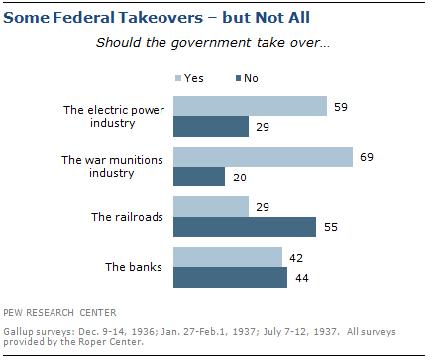
The charts are fascinating. A full 73 percent of Americans polled in 1936 thought government should provide free medical care to the poor. Sixty-four percent thought government should regulate and control war-time profits. In fact, 59 percent thought the government should take over the electric power industry and 69 percent favored nationalizing the wartime munitions industry.


And the people who were polled in these early surveys were overwhelmingly white, male and relatively well off. They were also socially conservative — 60 percent favored the death penalty and 67 percent wanted to deport all immigrants who were on public relief. Allen:


Is there a message in this for today’s America? Two possible lessons: First, it’s worth remembering that the social programs and banking controls that the New Deal era produced stood the nation in good stead over many decades of unprecedented prosperity. Second, Depression-era Americans’ faith in the country and its guiding institutions steeled them against the challenges of a double-dip recession and, years later, World War II. They had it worse, but they also expected it to get better, faster.


Compare that to a 1983 poll taken in the depth of the Reagan Recession, when 65 percent said that government had gone too far in regulating business, 62 percent rarely trusted the government in Washington and 78 percent opposed raising income taxes.


Fifty years, two generations, and the entire attitude of the American public toward government was turned on its head. It’s one of the fundamental dilemmas of American life, and one of the central reasons we’re in this mess.

SFBG Radio: Can Callifornia wake up?

0

In today’s episode, we talk about Jerry Brown’s challenge: Can the new old governor wake the state out of a California dream that has become utterly unconnected to reality? Check it out after the jump.

sfbgradio12/15/2010 by endorsements2010

80 billionaires — and California’s broke?

67

Jerry Brown’s message to educators was framed as bleak — but as I pointed out, there were some bright spots. At least the new gov mentioned that this is a rich state that ought to be able to afford education. Robert Cruickshank at Calitics has a nice post on the point:


A tax increase of about $20 billion would secure our public services for years to come with a very tiny impact on our economic activity. Surely 1% of our GDP can be harnessed to fund the services that we must have for broadly shared prosperity in this state.


Let me take it a step further. I just went through the Forbes 400 list of the richest Americans and started counting, and guess what? A full 80 of the 400 live in California. That’s one out of every five billionaires in America, living right here in a state that can’t afford to educate its kids.


Then I took out my calculator and added up a long row of numbers and got a big one: The total net worth of the billionaires in California is $231.8 billion. Ten percent of that wipes out the budget deficit. And that doesn’t even count the folks worth $900 million or less; they didn’t make the list.


Folks: This is a very, very rich state. A very modest tax increase on a very tiny number of people could solve our budget problems not just today but into the foreseeable future.


This is the message Brown needs to deliver to the people of the state — and if the antitax people (or my trolls) want to argue that all the rich people would leave if we taxed them just a little bit, let me say: That’s ridiculous. David Geffen is going to move out of Malibu because he has to pay a teeny bit more of his income, money he won’t miss, in taxes? Ain’t happening.


That’s it, Jerry. That’s your answer. Now get to work.

School kids and Muni

6

So SFUSD just decided to cut half of its school bus routes (including, I believe, one that my son sometimes takes to Aptos Middle School). I should be outraged — but I’m not. Jerry Brown has made it clear that even if he raises taxes, it’s going to be an ugly year for schools and everyone else, and I’d rather see cuts in transportation than in teachers and classes.


But if this is the approach, then the city and the school district need to do a better job coordinating around Muni.


Elementary school kids shouldn’t be on Muni; I’d save the school bus routes for them. But older kids can use the city system, and many do — and more would, if it were just a little easier.


My son often takes Muni after school — to the library, to his Tae Kwon Do class — and soon I’ll let him ride the bus home. But to buy him a youth pass, I have to take him personally to a Muni pass outlet, once every month, and it’s a pain. I understand why they won’t sell me a youth pass for my kid; I could cheat (well, nobody would really believe I was under 18, sigh; I don’t even get carded in bars). But why don’t they sell youth passes in the schools? 


It would be pretty simple: Muni issues a number of youth passes to each middle school and high school, the schools sell them out of the office and hand kids Muni maps with routes near the school marked off. I can use Nextbus to tell my son when to head out to the bus stop; there’s no reason the schools couldn’t do that, too. Post the schedules; sell the passes. Maybe even change a few Muni routes to make them more convenient for students.


It seems silly for a city as geographically small as San Francisco to have two parallel transportation systems. With a little creativity Muni could work for the schools, too. 

Let’s get budget priorities straight

0

OPINION Who will pay for California’s budget woes? For the last three years, Californians have put up with cuts to programs that are critical to our state’s future and our social safety net. Public education, HIV and AIDS programs, state universities, and CalWORKs have all come under the knife. The elephant in the room, as state and federal governments try to balance budgets on the backs of the working and middle class, is the billions of dollars we are wasting on a misguided war in Afghanistan.

Fresh evidence that the war in Afghanistan is failing rolls in on a daily basis. While the administration justifies the cost in lives and dollars as necessary to fight Al Qaeda, it also acknowledges that there are only 50 to 100 Al Qaeda fighters in Afghanistan. Every soldier in Afghanistan costs U.S. taxpayers $1 million per year. With 100,000 soldiers on the ground, that means we’re spending as much as $2 billion a year on each Al Qaeda fighter.

Would we dream of spending $2 billion on every needy child in California? Or even $1 million? As U.S. and Afghan casualties rise along with the dollar amounts, with little success to show for it, we need to get our priorities in check.

At Governor-elect Jerry Brown’s budget forum this week, we were staring down a $28.1 billion budget deficit over the next 18 months. Compare that to the $46.4 billion Californians have already spent on the war in Afghanistan — $1.2 billion of that right out of San Franciscans’ pockets.

The Obama administration is conducting a strategy review this month that is expected to rubber stamp an approach that keeps soldiers in harm’s way — when doing so is not likely to make Americans or Afghans safer. At the same time, the president’s deficit commission chairs are also passing down recommendations to save money by cutting benefits for our most vulnerable citizens.

I would like to tell the taxpayers in my district who are shelling out these dollars that there’s a light at the end of the tunnel, but the president is now proposing ending the “combat mission” in 2014, which could mean there will be tens of thousands of troops on the ground even after four more years have passed.

I will continue to fight for our real needs in Sacramento. But it’s time for our representatives in Washington to put an end to this disastrous war and bring our troops home as quickly and responsibly as possible. Our tax dollars should be making life in California sustainable and safe for all. We can’t afford any other way.

Assemblymember Tom Ammiano represents the 13th District.

Ammiano wants to change bike laws

29

Assemblymember Tom Ammiano wants to change the way bicycles and cars are treated under state traffic laws.


He’s responding in part to the furor over the bike crackdowns in Berkeley, but it’s nothing new for Ammiano — he also tried to get bicycle traffic legislation through last year. This time, though, he told me, “I think we’re going to be able to pass something.” And incoming Gov. Jerry Brown ought to be willing to sign it.


Matt Bunch, an Ammiano staffer, told me that the bill isn’t final, but will certainly address the penalty for cars hitting bicycles. “A lot of these are preventable, but they’re treated as accidents,” he said. “They aren’t punished adequately.”


The measure could also address the wide disparity in traffic fines that bicyclists face in different cities and take on the Berkelely problem. “The fine you get depends on what they charge you with, and it’s all over the map,” Bunch said.


Bunch also suggested that Ammiano might be looking at the way some police officers in some jurisdictions charge bicyclists with vehicle-code violations that were written to apply to cars. “The vehicle code isn’t specific to bikes,” he said. “There’s a clear deficiency in law, and we’re going to look at it.”


One of the things they ought to be checking out: Why is it okay to make a biker get a point on his or her drivers license when he or she isn’t driving a motor vehicle?


Go, Tom. I’ll keep you posted when the bill is introduced.


SFBG Radio: What will Jerry do?

0

When Jerry Brown goes to UCLA to talk about education, what’s he going to say? How’s he going to promote the UC system when he’s facing a $25 billion budget crisis? Johnny and Tim talk abou that (and the Obama health care law and a few other things) after the jump.

sfbgradio12132010 by endorsements2010

Supervisors punt mayoral decision back a week

11

The San Francisco Board of Supervisors today voted to delay until Dec. 14 the process of choosing a mayor to succeed departing Mayor Gavin Newsom after taking about 40 minutes worth of public testimony, most of it calling on supervisors to act quickly to choose a public-spirited mayor to deal with a variety of neglected issues.
After Assembly member Tom Ammiano announced earlier today that he would not accept the board’s nomination to become mayor, it seemed unlikely that anyone could get the required six votes. But Sup. Chris Daly, who led the campaign to recruite Ammiano, argued for beginning the process today as agendized.
“While the Board of Supervisors is not prepared today to appoint someone as successor mayor of San Francisco, we shouldn’t truncate the conversation,” Daly argued, reiterating his call last week for a mayor who is experienced, compassionate, and willing to work cooperatively with the board.
But Sup. Sophie Maxwell didn’t want to have that conversation, making the motion to continue the item for one week, a motion seconded by Sup. Bevan Dufty. Neither offered reasons or arguments for the action.
Yet Daly noted that the board has an approved process for selecting a new mayor and “it might be a good idea to try it out and see how it works,” even if six votes aren’t there yet to approve a nominee. “I’m prepared to make a nomination.”
He addressed calls for delaying the mayoral succession decision by noting that Oakland Mayor-elect Jean Quan and Governor-elect Jerry Brown have both put together transition teams to prepare for taking power at the same time that Newsom will resign as mayor to become lieutenant governor.
“Typically, a mayor would have had about a month to put together a transition team,” Daly said, also noting, “We are now borrowing time against the next administration of San Francisco.”
Sups. David Campos and Eric Mar also spoke in support of this board making the mayoral succession decision “sooner rather than later,” as Campos put it. “We do have a very tough budget year we will be facing and many challenges in front of us,” he said. Campos said he was open to the delay, but he said “it would be a mistake” not to begin dealing with the decision in earnest next week.
Mar said he was open to the delay because he was interested to read the “Values-based Platform for the next Mayor” that a coalition of labor and progressive groups called San Francisco for All distributed at the meeting. The four-page document called for a mayor to value accessibility, consensus-building, making appointments who are accountable to the community, more equitable budget priorities, and transparency.
The motion to delay was approved on a 9-2 vote, with Daly in Sup. John Avalos in dissent.

The prop. 8 hearing

2

Watching the hearing was a couple of hours well spent; it’s not often that you get to see an actual live oral argument before a federal appeals court. And it’s not often that you get to see three judges, not all of them liberals by any stretch, take apart the fundamental claims of the anti-gay-marriage folks.


There’s a nice live-blog and analysis here.


One of the most interesting elements in this case is the possibility that the legality of same-sex marriage in California may hinge on whether a deputy clerk in Imperial County has the right to represent the people of California in a legal appeal. See, the governor and the attorney general usually defend state laws when they’re challenged in court, but in this case, both Arnold Schwarzenegger and Jerry Brown declined. In essence, they both said they thought Judge Vaugh Walker’s decision overturning Prop. 8 was just fine.


So the supporters of Prop. 8 have to make the case they have legal “standing” to appeal — and the judges seemed more than a little dubious about that. The political group that backed Prop. 8 was in trouble from the start, and couldn’t really demonstrate what legal authority it had to handle the appeal. The deputy clerk from Imperial County, which has a population of 166,000, argued through her lawyer that she would have to sign marriage certificates, and that Prop. 8 directly affects her job. That didn’t get very far, either. And if the appeals court tosses the case on the standing issue, nothing else matters. Walker’s ruling is affirmed and same-sex marriage is legal in California.


Then to the meat of the case. Judge Hawkins instantly asked Charles Cooper, attorney for the Prop. 8 proponents, if the voters of the state of California could legally amend the state Constitution to re-segregate the public schools. Cooper: No. The point was pretty clear: The voters have the right to amend the Constitution, but not in a way that violates fundamental rights.


Cooper went on with what rapidly devolved into lunacy, eg: “When a relationship between a man and a woman becomes sexual, society has a profound interest.” In other words, a man and a woman have sex; they might conceive a child, who might be born “out of wedlock” and raised by a single parent, which would be a bad thing. Judge Reinhardt: That’s a good argument for prohibiting divorce — but isn’t really on point here.


Theodore Olson, representing the plaintiffs, pretty much knocked it out of the park in his first few minutes, noting that California has effectively engineered discrimination into the Constitution by eliminating a right that the U.S. Supreme Court has said repeatedly (14 times, according to Olson) is fundamental. He pointed out that in Lawrence v. Texas, which overturned the sodomy laws, the U.S. Supremes determined that sexual conduct between consenting adults of any gender is protected. So how, he asked, can you take away marriage rights because of a Constitutionally protected activity?


Since the Prop. 8-ers have argued that same-sex marriage would force children to have “a premature interest in sexual activity,” Olson suggested that the court would have to “ban comic books, video games and conversations with other children.”


The judges, as is typical, interrupted all the lawyers to ask questions — until Theresa Stewart stood up, representing the San Francisco City Attorney’s Office. She was sharp, quick on her feet, perfectly prepared — and for most of her short presentation, the judges simply listened. Her point: When it comes to children, family law in California treats same-sex couples and opposite-sex couples precisely and exactly the same; why should marriage be any different?


In the end, what I saw was three judges struggling not with the outcome of the case — Walker’s decision seems likely to be upheld — but with how broad they want the final decision to be. Based on the questioning at the end, it seemed as if they’d rather uphold Walker’s ruling without making a sweeping statement that gay marriage is Constitutionally protected and must be the law of the land everywhere in the United States.


But unless they try to duck the real issues and rule only on standing, that’s going to be a stretch. Any honest, logical ruling can only come to one conclusion — that treating lesbians and gay men differently than straight people violates the Equal Protection provisions of the U.S. Constitution. And if the Supreme Court agrees, it will be the end of gay marriage bans, the end of Don’t Ask, Don’t Tell and the beginning of a new era in America.


UPDATE (thanks to Nichole Dial for research);


Lots of news media coverage on the some good, some lame. The Prop. 8 Trial Tracker website had some of the best breaking stuff. The Mercury News did a live blog by Howard Mintz that was full of details. SF Weekly covered the more amusing accounts such as the crowd outside the court room.  The Bay Citizen also had a live blog and analysis.


Brian at Calitics had one of the best quick analyses and the Chron’s Bob Egelko came out with a really fast story that touches on the major themes of the case.


The AP postings on the Huffington Post covered the highlights as well as an overview of the background of prop 8. The New York Times used the same article, then later added a short, fairly superficial piece by Jesse McKinley  (what, the Times had no live blogger on this?)


Editor’s notes

0

Tredmond@sfbg.com

The pollsters like to call it the Santa Claus effect, and we’ve seen it over and over in surveys of California voters in the past few months. I think of it more as some sort of deep political pathology, a schizophrenia combined with delusions that underlies the state’s inability to get anything done.

Here’s what the data shows:

California voters don’t want cuts to higher education; in fact, they want to see more money spent on the University of California system, the California State University system, and local community colleges. They don’t want cuts to K-12 education either. Nor do they want to shut down state parks, release prisoners early, close public hospitals, stop building high-speed rail, reduce state support of local government … or do anything else that would save a significant amount of money.

And they don’t want tax increases.

If you ask people how they think the state should balance the budget, they talk about cutting waste — even though the current Republican governor admits there’s not that much waste left to cut.

I could spend hours talking about how we got here, how decades of corruption and bad governmental priorities soured people so much on the public sector that they don’t believe the state can be trusted to spend their money properly. But part of the issue is that the news media (which love to find a little waste here and there to trumpet) are very bad at presenting the choices.

Nobody in Sacramento’s going to do anything serious about the budget until Jerry Brown takes office; that’s just how it is. So this psycho-financial nightmare is going to fall in his lap — and I wonder sometimes if he ought to force us all to make the choices we want to avoid.

Maybe Brown ought to call a special election in February or March and put two — and exactly two — measures before the voters. Both would balance the state budget. One would do it almost entirely with cuts, and those cuts would be clearly defined: public schools would shut down all over the state. Class size would rise to 40 or more kids. UC would close half its campuses and admit half the number of qualified students it does today. At least 100,000 prisoners would be released as several prison are mothballed. The entire state park system would be shuttered. And that’s just the start. Consumer protection agencies would be abolished, public health devastated — there wouldn’t be a single thing that Californians take for granted that would survive.

Because that’s what a cuts-only, no borrowing budget would look like.

The other proposition would save those services by closing tax loopholes that benefit big business and raising income taxes on the wealthiest people in the state. Brown would have to travel up and down the state and make it clear: these are the choices we face. You can’t solve a $20 billion budget crisis without either tearing the state apart or raising taxes.

No more ducking. No more pretending. No more looking around for Santa Claus. Make the choice, folks: accept new taxes on a small percentage of the population, or give up on the state.

It’s a scary thought, but it may have to come to that.


Ragazza

0

paulr@sfbg.com

DINE Ragazza is the younger sorella of Sharon Ardiana’s Gialina in Glen Park and, as is so often the case with siblings, the two restaurants do and do not resemble each other. Much of the differences are traceable to the respective neighborhoods. Glen Park (where we find Gialina) has in recent years become an annex of city’s baby belt, whose big, shiny buckle is just over the hill in Noe Valley. Kids like pizza, and Gialina has fine pizza, along with a selection of pastas, a roast or two, and a selection of contorni. Eating at Gialina is a little like waiting to check in for a flight on Southwest Airlines: the environment is lively, lighthearted, and swarming with small children. (Shouldn’t shrieking children be flown on their own airline, perhaps Screaming Babies Airways, with a big screaming baby head painted on the tail of every plane. But if they want to eat at Gialina, okay.)

Ragazza, by contrast, brings haute pizza culture to a vortex of the Haights (lower and upper) and NoPa that so far shows few signs of turning into kiddieland. The restaurant opened recently in a space that’s worn quite a few masks over the past decade; 10 years ago, it was a bistro called Metro Café, then became a fine Nepalese restaurant called Metro Kathmandu, reverted briefly to Metro Café, and now this.

There is nothing distinctive about the mid-block, storefront setting. The glowing red paint scheme of the Kathmandu era has been dialed back to milder earth tones. Otherwise, the look of the restaurant is little different. (In this aesthetic continuity, too, Ragazza differs from its older sibling, whose neglected space was heavily made over before its opening in early 2007.)

Ragazza’s menu is somewhat less pizza-pie-centric than Gialina’s. The new place offers a number of antipasti choices and small plates, along with several roasted items. (Gialina offers one antipasto and one roast.) You could make do very nicely here without having a pizza at all. But the bulk of the clientele seems to understand Ragazza to be a pizzeria at heart, and so the pies emerge from the kitchen in a steady stream, with at least one seeming to turn up on virtually every table. It’s like watching a quarterback spread the ball around to eight different receivers.

Although Ragazza doesn’t offer Gialina’s fabled chili-bomb pizza, the aptly named atomica, it does have a spicy pie of its own, the moto, fired with Calabrian chilis. (These have an aromatic fume all their own and haven’t really been given their due.) The amatriciana pizza ($16), festooned with a sunny-side-up egg, also offered a noticeable nasal kick. And even the pies that aren’t armed with chili heat tend to be bracingly fragrant — a potato version ($15), for instance, topped with red onion and gorgonzola cheese and liberally laced with thyme. No hint of starch overload here, despite the potentially smothering presence of the spud.

Herbal perfumes, along with chili heat, are a recurrent theme. We were particularly aware of the oregano breath wafting from a crock of corona beans ($6) simmered with oven-roasted tomatoes. Oregano is the quintessential pizza smell, but I’d never come across corona beans before and, from their pale chubbiness, would have guessed them to be cannellini or flageolet. They’d been cooked just right and still offered nominal tooth resistance before yielding an interior creaminess.

Purely creamy, on the other hand, was the soft polenta ($9). Polenta can be bland, and it is sometimes enlivened by sautéed mushrooms and gorgonzola — and given Ragazza’s obvious gusto for big flavors, I wouldn’t have been surprised to find those players here. Instead the boost came from a medallion of tomato mascarpone cream, freighted with basil and set atop the polenta like a rosette.

The real test of any restaurant’s food is whether it can hold your attention even if, say, Mark Zuckerberg is sitting at the next table, making moony eyes with a comely ragazza. Was that really Mark Zuckerberg at the next table, an actual person as opposed to the character in the movie The Social Network and the subject of far too much quacking in the key of same from The New York Times’ waddling line of op-ed ducks? We weren’t sure. Zuckerberg is said to live in the wilds of the Peninsula, sleeping on a mattress on the floor of some faceless apartment, just as Jerry Brown did during his first go-round as governor. Yet there he was — maybe — in Ragazza, having come for the girl and stayed for the (pizza) pie. He didn’t friend us, alas, alack. *


RAGAZZA

Dinner: Sun.–Thurs., 5–10 p.m.;

Fri.–Sat., 5–10:30 p.m.

311 Divisadero, SF

(415) 255-1133

www.ragazzasf.com

Beer and wine

AE/MC/V

Noisy

Wheelchair accesssible

A fitting end to Dellums’ mayoral tenure

3

Oakland Mayor Ron Dellums has announced that he won’t give his final State of the City speech tomorrow in person as scheduled, instead performing the legally required duty by simply sending in a written report and video, a fitting end to his terrible tenure as mayor.

“In lieu of a public address this Wednesday, Mayor Dellums has opted to provide a comprehensive, printed State of the City report and accompanying video chronicling his four-year administration. These will be available on line at www.oaklandnet.com on November 17, 2010,” read a memo released yesterday by the Mayor’s Office.

It will be an ignominious end for a legendary political figure who rose from the black power movement of the ’60s to serve a remarkable 13 terms in Congress, where he was a leading voice against war and wasteful military spending. But as mayor, Dellums simply failed to lead a city that desperately needed him, ducking the city’s biggest problems and any sense of public accountability.

When Dellums came to the Bay Guardian offices four years ago to seek our endorsement (which we gave him, hoping he would be better than then-frontrunner Ignacio De La Fuente), Executive Editor Tim Redmond asked him what qualified him to be mayor and whether he was up for coming out of retirement to take on such a demanding job. Dellums responded with fiery indignation – how dare we question his fitness for such a piddling office after such a distinguished political career.

In retrospect, it was a good question, and a telling non-answer. Luckily for Oakland, after two mayors in a row that were legendary if imperious political figures, the city will now have a mayor – Jean Quan (who narrowly beat a man who would have followed in the Jerry Brown/Ron Dellums model: Don Perata) – who is committed to doing the hard work on this very difficult job. We wish her well.

Gavin Newsom, Republican

1

I mean, isn’t this exactly what the Republicans have been saying in Sacramento, paralyzing the state by refusing to accept any new taxes? Is that the attitude Newsom wants to bring to his new job? What’s he going to do when Jerry Brown announces a package of tax hikes for the June ballot and wants his loyal Lt. to go around the state and campaign for them? Or is there a different standard for the state budget?


I don’t get it, Gav. 

The next mayor

108

tredmond@sfbg.com

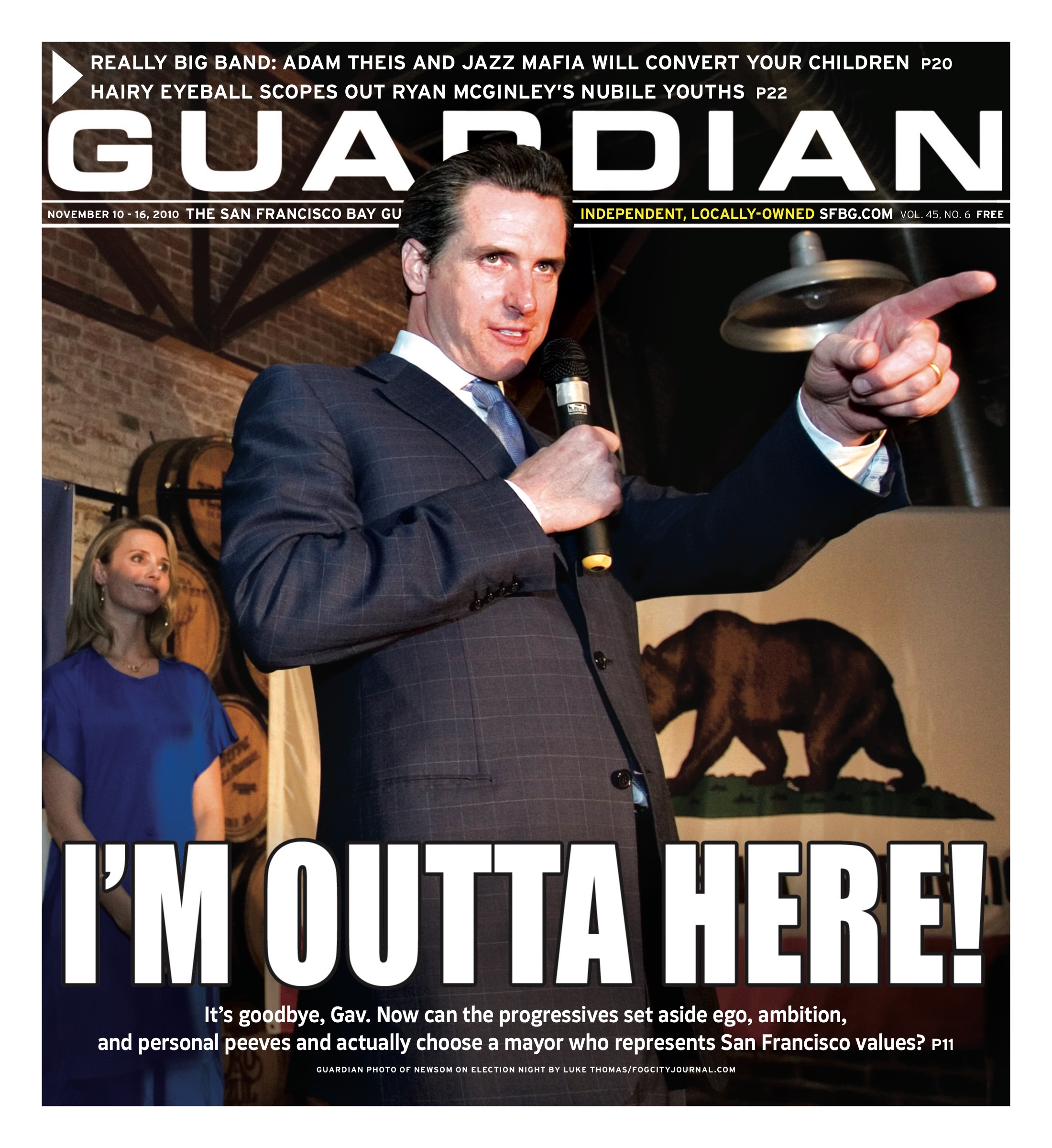
By the time a beaming Mayor Gavin Newsom took the stage at Tres Agaves, the chic SoMa restaurant, on election night, enough results were in to leave no doubt: the top two places on the California ballot would go to the Democrats. Jerry Brown would defeat Meg Whitman in the most expensive gubernatorial race in American history — and Newsom, who once challenged Brown in the primary and dismissed the office of lieutenant governor, would be Brown’s No. 2.

It might not be a powerful job, but Newsom wasn’t taking it lightly anymore. “We can’t afford to continue to play in the margins,” he proclaimed proudly, advancing a vague but ambitious agenda. “There is absolutely nothing wrong with California that can’t be fixed with what’s right with California.”

But around the city, as results trickled in for the local races, the talk wasn’t about Newsom’s role in the Brown administration, or the change the Democrats might bring to Sacramento. It was about the profound change that could take place in his hometown as he vacates the office of mayor a year early — and opens the door for the progressives who control the Board of Supervisors to appoint a chief executive who agrees with, and is willing to work with, the majority of the district-elected board.

At a time when the Republican takeover of Congress threatens to create gridlock in Washington, there’s a real chance that San Francisco’s government — often paralyzed by friction between Newsom and the board — could take on an entirely new direction. It’s possible that the progressives, long denied the top spot at City Hall, could put a mayor in office who shares their agenda.

This could be a turning point in San Francisco, a chance to put the interests of the neighborhoods, the working class, small businesses, the environmental movement, and economic justice ahead of the demands of downtown and the rich. All the pieces are in place — except one.

To make a progressive vision happen, the fractious (and in some cases, overly ambitious) elected leaders of the progressive movement will have to recognize, just for a little while, that it’s not about any individual. It’s not about David Chiu, or Ross Mirkarimi, or Chris Daly, or John Avalos, or Eric Mar, or David Campos, or Jane Kim, or Aaron Peskin. It’s not about any one person’s career or personal power.

It’s about a progressive movement and the issues and causes that movement represents. And if the folks with the egos and personal gripes and career designs can’t set them aside and do what’s best for the movement as a whole, then the opportunity of a generation will be wasted.

Folks: this is a hard thing for politicians to recognize. But right now it’s not about you. It’s about all of us.

It’s an odd time in San Francisco, fraught with political hazards. And it’s so confusing that no one — not the elected officials, not the pundits, not the lobbyists, not the insiders — has any clear idea who will occupy Room 200 in January.

Here’s the basic scenario, as described by past opinions of the city attorney’s office:

Under the state Constitution, Newsom will take office as lieutenant governor Jan. 3, 2011. The City Charter provides that a vacancy in the Mayor’s Office is filled by the president of the Board of Supervisors until the board can choose someone to fill the job until the end of the term — in this case, for 11 more months.

So if all goes according to the rules (and Newsom doesn’t try to play some legal game and delay his swearing-in), David Chiu will become acting mayor on Jan.3. He’ll also retain his job as board president.

On Jan. 4, the current members of the Board of Supervisors will hold a regularly scheduled Tuesday meeting — and the election of a new mayor will be on the agenda. If six of the current supervisors can agree on a name (and sitting supervisors can’t vote for themselves) then that person will immediately take office and finish Newsom’s term.

If nobody gets six votes — that is, if the board is gridlocked — Chiu remains in both offices until the next regular meeting of the board — a week later, when the newly elected supervisors are sworn in.

The new board will then elect a board president — who will also instantly become acting mayor — and then go about trying to find someone who can get six votes to take the top job. If that doesn’t work — that is, if the new board is also gridlocked — then the new board president remains acting mayor until January 2012.

There are at least three basic approaches being bandied about. Some people, including Newsom and some of the more conservative members of the board, want to see a “caretaker” mayor, someone with no personal ambition for the job, fill out Newsom’s term, allowing the voters to choose the next mayor in November, 2011. That has problems. As Campos told us, “The city has serious budget and policy issues and it’s unlikely a caretaker could handle them effectively.” In other words, a short-termer will have no real power and will just punt hard decisions for another year.

Then there’s the concept of putting in a sacrificial progressive — someone who will push through the tax increases and service cuts necessary to close a $400 million budget gap, approve a series of bills that stalled under Newsom, take the hits from the San Francisco Chronicle, and step out of the way to let someone else run in November.

The downside of that approach? It’s almost impossible for a true progressive to raise the money needed to beat a downtown candidate in a citywide mayor’s race. And it seems foolish to give up the opportunity to someone in the mayor’s office who can run for reelection as an incumbent.

Which is, of course, the third — and most intriguing — scenario.

The press, the pundits, and the mayor have for the past few months been pushing former Sup. Peskin as the foil, trying to spin the situation to suggest that the current chair of the local Democratic Party is angling for a job he wouldn’t win in a normal election. But right now, Peskin is no more a front-runner than anyone else. And although he’s made no secret in the past of wanting the job, he’s been talking of late more about the need for a progressive than about his own ambitions.

“If the board chose [state Assemblymember] Tom Ammiano, I would be thrilled to play a role, however small, in that administration,” Peskin told us.

In fact, Peskin said, the supervisors need to stop thinking about personalities and start looking at the larger picture. “If we as a movement can’t pull this off, then shame on us.”

Or as Sup. Campos put it: “We have to come together here and do what’s right for the progressive movement.”

Two years ago, the San Francisco left was — to the extent that it’s possible — a united electoral movement. In June, an undisputed left slate won a majority on the Democratic County Central Committee. In November 2008, Districts 1, 3, 5, and 11 saw consensus left candidates running against downtown-backed opponents — and won. In D9, three progressives ran a remarkably civil campaign with little or no intramural attacks.

The results were impressive. As labor activist Gabriel Haaland put it, “we ran the table.”

But that unity fell apart quickly, as a faction led by Daly sought to ensure that Sup. Ross Mirkarimi couldn’t get elected board president. Instead that job went to Chiu — the least experienced of the supervisors elected in that class, and a politician who is, by his own account, the most centrist member of the liberal majority.

This fall, the campaign to replace Daly in D6 turned nasty as both Debra Walker and Jane Kim openly attacked each other. Walker sent out anti-Kim mailers, and Kim’s supporters charged that Walker was part of a political machine — a damaging (if silly) allegation that created a completely unnecessary rift on the left.

And let’s face it: those fights were all about personality and ego, not issues or progressive strategy. Mirkarimi and Daly have never had any substantive policy disagreements, and neither did Walker and Kim.

In the wake of that, progressives need to come together if they want to take advantage of the opportunity to change the direction of the city. It’s not going to be easy.

“We’re good at losing,” Daly said. “I’m afraid we’re doing everything we can to blow it.”

The cold political calculus is that none of the current board members can count on six votes, and neither can Peskin or any of the other commonly mentioned candidates. The only person who would almost certainly get six votes today is Ammiano — and so far, he’s not interested.

“I know you never say never in politics, but I’m happy here in Sacramento. Eighty-six percent of the voters sent me back for another term, and I think that says something,” he told us.

It’s hardly surprising that someone like Ammiano, who has a secure job he likes and soaring approval ratings, would demur on taking on what by any account will be a short-term nightmare. The city is still effectively broke, and next year’s budget shortfall is projected at roughly $400 million. There’s no easy way to raise revenue, and after four years of brutal cuts, there’s not much left to pare. The next mayor will be delivering bad news to the voters, making unpleasant and unpopular decisions, infuriating powerful interest groups of one sort or another — and then, should he or she want the job any longer, asking for a vote of confidence in November.

Yet he power of incumbency in San Francisco is significant. The past two mayors, Newsom and Willie Brown, were reelected easily, despite some serious problems. And an incumbent has the ability to raise money that most progressives won’t have on their own.

Chiu thus far is being cautious. He told us his main concern right now is ensuring that the process for choosing the next mayor is open, honest, and legally sound. He won’t even say if he’s officially interested in the job (although board observers say he’s already making the rounds and counting potential votes).

And no matter what happens, he will be acting mayor for at least a day, which gives him an advantage over anyone else in the contest.

But some of the board progressives are unhappy about how Chiu negotiated the last two budget deals with Newsom and don’t see him as a strong leader on the left.

Ross Mirkarimi is the longest-serving progressive (other than Daly, who isn’t remotely a candidate), and he’s made no secret of his political ambitions. Then there’s Campos, an effective and even-tempered supervisor who has friendly relationships with the board’s left flank and with centrists like Bevan Dufty. But even if Dufty (who I suspect would love to be part of electing the first openly gay mayor of San Francisco) does support Campos, he’d still need every other progressive supervisor. Campos also would need Chiu’s vote to go over the top. Which means Chiu — who needs progressive support for whatever his political future holds — would have to set aside his own designs on the job to put a progressive in office.

In other words, some people who want to be mayor are going to have to give that up and support the strongest progressive. “If there’s someone other than me who can get six votes, then I’m going to support that person,” Campos noted.

Then there are the outsiders. City Attorney Dennis Herrera has already announced he plans to run in the fall. If the board’s looking for a respected candidate who can appeal to moderates as well as progressives, his name will come up. So will state Sen. Mark Leno, who has the political gravitas and experience and would be formidable in a re-election campaign in November. Leno doesn’t always side with the left on local races; he supported Supervisor-elect Scott Wiener, and losing D6 candidate Theresa Sparks. But he has always sought to remain on good terms with progressives.

All that assumes that the current board will make the choice — and even that is a matter of strategic and political dispute. If the lame duck supervisors choose a mayor — particularly a strong progressive — you can count on the San Francisco Chronicle, Newsom, and the downtown establishment to call it a “power grab” and cast doubt on the legitimacy of the winner.

“But choosing a mayor is the legal responsibility of this board and they ought to do their jobs,” Peskin said.

The exact makeup of the next board was still unclear at press time. Jane Kim is the likely winner in D6 and has always been a progressive on the School Board. She’s also close to Chiu, who strongly supported her. If Malia Cohen or Lynette Sweet wins D10, it’s unlikely either of them will vote for a progressive mayor.

Newsom also might try to screw things up with a last-minute power play. He could, for example, simply refuse to take the oath of office as lieutenant governor until after the new board is seated.

Chiu’s allies say it makes sense for the progressives to choose a mayor who’s not identified so closely with the left wing of the board, who can appeal to the more moderate voters. That’s a powerful argument, and Herrera and Leno can also make the case. The progressive agenda — and the city — would be far better off with a more moderate mayor who is willing to work with the board than it has been with the arrogant, recalcitrant, and distant Newsom. And if the progressives got 75 percent of what they wanted from the mayor (as opposed to about 10 percent under Newsom), that would be cause to celebrate.

But to accept that as a political approach requires a gigantic assumption. It requires San Franciscans to give up on the idea that this is still, at heart, a progressive city, that the majority of the people who live here still believe in economic and social justice. It means giving up the dream that San Francisco can be a very different place, a city that’s not afraid to defy national trends and conventional wisdom, a place where socioeconomic diversity is a primary goal and the residents are more important than the big companies that try to make money off them. It means accepting that even here, in San Francisco, politics have to be driven by an ever-more conservative “center.”

It may be that a progressive can’t line up six votes, that a more moderate candidate winds up in the Mayor’s Office. But a lot of us aren’t ready yet to give up hope.

Additional reporting by Noah Arroyo.

Election over, what next?

0

Dick Meister is a San Francisco-based columnist who has covered political and labor issues for a half-century as a reporter, editor , author and commentator. Visit him at his website, www.dickmeister.com.

OK, the election is over and labor, Democrats and the other good guys came up a bit short. But what now? What next for the good guys?

 Well, for starters, organized labor and its Democratic Party allies must be ready to block Republican plans to try to enact legislation that would cut taxes for the very wealthy, slash Medicare funding, and possibly even privatize Social Security. I know that may sound alarmist and far-fetched. But that’s what Republican leaders are actually talking about.

After all, the GOP’s anti-labor corporate allies spent nearly a billion dollars on the election and they damn well want their money’s worth.  Larry Cohen, president of the communications workers union, thinks it’s getting like the way elections were 100 years ago when the big trusts and robber barons made sure their voices were the only ones heard during election campaigns.

Not yet, Larry. Not quite. Unions were able to make a lot of highly effective noise that helped elect some important pro-labor Democrats and defeat several Tea Party candidates and other anti-labor wackos who argued, as the AFL-CIO’s Mike Hall notes, “that government should do nothing to improve the economy or protect working families during the worst economic crisis since the Great Depression.”

Let’s me take a little closer look at how the election went for organized labor and its political friends in two of the country’s most important states politically, numbers one and two in population, California and Texas.

In California, as the AFL-CIO says, unions were a key factor propelling notably pro-labor Democrat Jerry Brown to the governorship and pro-labor Democrat Barbara Boxer to a third term in the Senate. Those victories were especially sweet, since the opponents of Governor-elect Brown and Senator Boxer were former business executives with tons of money, including their own, to spend on their campaigns.

Former eBay CEO Meg Whitman spent more than $141 million of her own money on her losing campaign against Jerry Brown for governor. And though Carly Fiorina, former Hewlett-Packard CEO, spent several million of her own money on her campaign, the total was nowhere near the obscene amount that Whitman pulled from her own pocket for her campaign.

Anyway, Meg Whitman lost, and good for Californians for making that happen.  Labor couldn’t imagine a worse anti-labor governor than Meg Whitman, or more labor-friendly governor than Jerry Brown, a worse anti-labor senator than Carly Fiorini, or more labor-friendly senator than Barbara Boxer.

It was a bit different in most other states. As Executive Director Rose Ann DeMoro of the California Nurses Association notes, the election of Democratic, pro-labor candidates in California “provided a national alternative to the conservative, corporate-oriented economic program that won so many other races nationwide.”

DeMoro praised California’s voters “for seeing through the fool’s gold promises that the path to economic recovery and job creation is through corporate tax breaks and shifting more wealth and resources to those who need it the least.”

The news isn’t so good out of Texas, where, as Jim Lane of the People’s World  says, “the second largest delegation to the U.S. House of  Representatives, already heavily leaning to the right, tilted drastically further on November 2 – plus, many of the most popular Texas Democratic leaders were defeated.

The re-election of Gov. Rick Perry was more bad news for labor and its allies, given what the People’s World’s Lane notes as Perry’s “far-right, anti-worker vision.” Reporter Lane says “progressive Texans are not looking forward to extending the years of being shamed about their home state, as we have been since GW Bush took the national stage.”

But at least the Texas labor movement was able to run what Lane calls “a strong and largely independent political campaign.”  Unions even dared to run “one of their own,” former national AFL-CIO official Linda Chavez-Thompson, for lieutenant governor. But, as Lane notes, “Like all other statewide Democratic candidates, Chavez-Thompson’s campaign was buried by big money.”

So, what next for Texas, California – the whole country?

What’s next should be in large part to carry out what AFL-CIO and Democratic Party leaders have been advocating for many years – rebuilding of our long crumbling infrastructure

 President Obama has a plan that calls for rebuilding 150,000 miles of roads, laying and maintaining 4,000 miles of railway tracks, restoring 150 miles of airport runways and , in doing so, providing badly needed jobs for many of the country’s millions of unemployed workers.
 
That’s how labor and political leaders can – and must – begin to deliver on their election campaign promises to, above all, do what it takes to create “jobs, jobs, jobs.”

Dick Meister is a San Francisco-based columnist who has covered political and labor issues for a half-century as a reporter, editor , author and commentator. Visit him at his website, www.dickmeister.com.

Election 2010: Wait is on for Labor-Dems

0

Labor Council executive director Tim Paulson isn’t quite ready to give up the ghost on this one, despite a reported 196 Republican seats already won in the House.  “We really don’t know what the final answers are… some things are going well, some things are going not as well.” Most of labor’s most pressing local races – Paulson cited Measure B and the District 6 and District 8 races as examples – have yet to be decided and may possibly not have a confirmed winner until tomorrow. Measure B is going down at the moment, by the way – 51.6 percent “no” votes, still not enough reported at this point to call the race.

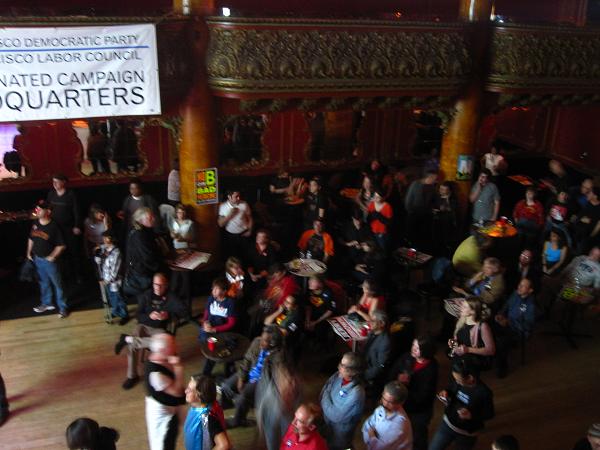
So for now, the Labor Council-Democrat Party party at the Great American Music Hall is contenting itself with crudites and tunes by young rock-women, The She’s. Fiona Ma made it up to congratulate everyone who got out the vote for the Dems – Jerry Brown, Pelosi, and Boxer have cinched their races — but Aaron Peskin of the DCCC hasn’t yet made an appearance. Maybe it’s just the dedication showing. “Aaron doesn’t know the polls closed awhile ago,” Paulson announces. 


Election 2010: Well, there goes $160 million

1

CNN, using exit polls, just called the governor’s race for Jerry Brown. Meg Whitman spend $160 million and is getting trounced. Think of what else that money could have gone for. 

Train tangle

1

The California High-Speed Rail Authority Board of Directors is scheduled to meet Nov. 4 in Sacramento to approve criteria for selecting which of four sections of track will be built first — but the federal government appeared to predetermine that outcome Oct. 28 by awarding the project $715 million in economic stimulus funds that can only be used in the Central Valley.

A classic north-south political battle has been brewing for months as advocates for the San Francisco-to-San Jose section and those for the Anaheim-to-Los Angeles section each sought to get their project going first. But with both sections mired in political and design problems, the feds decided that only the Merced-to-Fresno or Fresno-to-Bakersfield sections could break ground quickly enough to qualify for the funds.

However, San Francisco will still see $16 million of that money, which was allocated to the current Caltrain Station at Fourth and King streets, a station that will also serve the high-speed rail project and the proposed Transbay Terminal downtown.

CHSRA board member Quentin Kopp, who helped create the project as a San Francisco-based state legislator back in the 1990s, had been engaged in a behind-the-scenes conflict with current chairman Curt Pringle, the outgoing mayor of Anaheim, whose dual roles seem to violate state conflict-of-interest rules. But Attorney General Jerry Brown has been dragging his feet on issuing an opinion in the matter while running for governor.

The southern California section is more expensive that the Bay Area one, and there are significant right-of-way issues in Los Angeles County, as well as problems with choosing a site for the station in Anaheim. By contrast, the Bay Area line would use the existing right-of-way for Caltrain, which has been pursuing electrification of its track to improve service and mesh with high-speed rail.

“This is the only section in which the right-of-way is owned by a public entity,” Kopp told the Guardian, although he was careful not to state a preference to avoid improperly predetermining his vote.

But the Bay Area section is also the target of a lawsuit by the cities of Palo Alto, Atherton, Brisbane, Menlo Park, and other jurisdictions that have complained about the fast-moving trains and challenged the project’s environmental impact report. There are also looming issues in San Francisco, where the impending release of this section’s EIR is also raising controversial design issues.

For example, city officials have complained about plans that call for the intersection of 16th and Seventh streets and other streets along the current Caltrain corridor to be grade-separated from the rail line, essentially lowering the streets into sunken culverts. “It seems like that issue is going to come to a head at some point,” Joshua Switzky, a city planner who has worked on it, told the Guardian.

CHSRA spokesperson Rachel Wall called the Central Valley earmark “a game changer. They have predetermined that it could only be used in the Central Valley.” But she also said the allocation was just the beginning of the $17–$19 billion the project hopes to get in federal funding.

“That’s what the private investors are looking for — is the federal government committed?” Wall said, noting that California voters stepped up last year by approving a $10 billion bond measure that will go toward the $40 billion project.

Plans call for the entire Anaheim to San Francisco project to be completed by 2020, with trains traveling at up to 220 mph and making the SF-to-L.A. trip in two hours and 40 minutes.

Kopp said he wasn’t too disappointed that the feds restricted the initial funds to the Central Valley. “It wouldn’t offend me if that is our ultimate decision,” Kopp said. “The Central Valley loves high-speed rail.”

Editor’s Notes

1

tredmond@sfbg.com

Here’s what really scares me about Republicans in Washington: they don’t want the economy to get better.

I’m not just saying that they’re wrong on the issues, or that their prescriptions — tax cuts for the rich, fewer regulations for big business, privatization of health care and Social Security — will only make things worse. I’m saying that, right now, in November 2010, the GOP leaders want continued high unemployment. They want Americans to suffer. They want conditions to get worse and worse — because all they really care about right now is defeating Barack Obama in 2012. And they know and I know and everyone else knows that if the economy improves, he’ll be a two-term president.

I’m not the only one who sees this open conspiracy. Former Secretary of Labor Robert Reich has been Twittering about it, and bloggers have been floating it out, but the mainstream news media doesn’t’ seem to want to take the risk of saying what’s right in front of everyone’s face: Republicans are lying, outright. They’ve campaigned on the promise that their ideas and agenda will put America back to work — but they know that’s not true. What the agenda is going to be is obstruction.

The Democrats have never done that, at least not in recent history. Oh, they fought W. on all sorts of policy issues, but they never tried to make sure that the country collapsed. That’s a big difference between the two parties, and it comes down to a basic question: How many people are you willing to hurt, how much suffering are you willing to promote, just to get back in power??

I’ve been talking to a lot of political activists, elected officials, and outside agitators of late about the next president of the Board of Supervisors (with all that implies) and I keep hearing the same name: David Campos.

Campos has been one of the great success stories of the class of 2008, an effective legislator who can work with just about everyone. He’s a solid progressive, but with a gentle personality — someone who sticks to his principles but doesn’t pick personal fights. I don’t know how he puts together six votes, but he might surprise us.

I’m writing this the day before the election and it comes out the day after, by which time Jerry brown will be the governor-elect, Barbara Boxer will have won another Senate term, and the Giants will be holding their World Series victory parade. You read it here last.

California’s secret death drug

0

news@sfbg.com

California was forced to postpone the execution of convicted murderer Albert Greenwood Brown in September because the state had run out of sodium thiopental, part of the death drug cocktail used in lethal injections.

The last batch of the drug expired Oct. 1 and the manufacturer won’t have more until 2011. So as of early October, all executions had been postponed until next year.

But on Oct. 6 the state Department of Corrections and Rehabilitation announced in a court filing that it had obtained 12 grams of sodium thiopental, also known as sodium pentothal, with an expiration date of 2014. That could mean some swifter executions.

But it also raises a critical legal question: where did the drug come from, and did the state violate federal or international laws obtaining it?

CDCR isn’t talking. Terry Thornton, deputy press secretary, refused to identify the source of the newly acquired drug. But it clearly didn’t come from the manufacturer Hospira. The company, the only U.S. manufacturer of sodium pentothol, says it has none available and is in no rush to sell it to the CDCR. In a statement released by Hospira, company spokesperson Daniel Rosenberg announced that “the drug is not indicated for capital punishment and Hospira does not support its use in this procedure.”

Natasha Minsker, death penalty policy director for the ACLU of Northern California, said it would be tricky for the state to buy the drug from anyone else. “Hospira is the only approved manufacturer in the U.S.,” she said.

But there’s a hint of where California’s supply might have come from. Arizona also recently obtained some of the death drug — Arizona Attorney General Terry Goddard told the Arizona Republic that it was delivered from an unidentified source in Britain.

But the British press has raised questions about the deal. No European country has the death penalty and both British and European Union laws bar exporting for profit materials used for executions.

Both the Arizona and California batches have the same expiration date.

Ty Alper, associate director of the Death Penalty Clinic at Boalt Hall School of Law, explained that to his knowledge, “California got [the sodium thiopental] from a foreign source,” He raised questions about the possible risks of obtaining the drug from an unknown outfit.

“If the drug is not FDA approved, could it have contaminants in it? Could it perform differently?” Alper asked. “If that drug doesn’t work right then, everybody knows the execution will be horribly painful and torturous.”

So far, the U.S. Supreme Court hasn’t bought that argument. Oct. 25 the court voted 5-4 to clear the way for Arizona to execute Jeffrey Landrigan, a convicted murderer. “There is no evidence in the record to suggest that the drug obtained from a foreign source is unsafe … There was no showing that the drug was unlawfully obtained, nor was there an offer of proof to that effect,” the unsigned opinion stated.

Landrigan was executed Oct 27.

However, we can’t find any evidence that California obtained the drug legally. There are no FDA-approved importers, and federal law strictly limits the ability of anyone to bring powerful drugs directly into the country. Title 21 United States Code of the Controlled Substances Act, Section(b) states: “It shall be unlawful to import into the customs territory of the United States from any place outside thereof (but within the United States), or to import into the United States from any place outside thereof, any nonnarcotic controlled substance in Schedule III, IV, or V, unless such nonnarcotic controlled substance … (1) imported for medical, scientific, or other legitimate uses”

Sodium pentothal is a Schedule III drug.

Executing a human being clearly doesn’t count as a “medical or scientific” use — no doctor is involved in administering the lethal drugs. Of course, there might be an opinion from the state attorney general concluding that killing a condemned prisoner is an “other legitimate use” but the office won’t produce one. When we asked if obtaining the drug from a foreign supplier was legal, Christine Gasparac, a spokesperson for Attorney General Jerry Brown, stated in an e-mail that “You’ll have to contact the California Department of Corrections and Rehabilitation for a response to your questions” and that “this office was not involved in the procurement of the drug.”

CDCR hasn’t presented any import license, purchase order, chain of custody documents, or anything else to show where the deadly stuff originated. We’ve filed a written request under the California Public Records Act for the data, but have not received a reply.

That bothers state Sen. Mark Leno (D-SF), who chairs the Public Safety Committee. “I am concerned that a state agency, using taxpayer money, is buying something and refusing to disclose where the money went,” he told us.

Procuring sodium thiopental may become even harder in the future — it has only limited use in medicine.

Dr. Philip Lumb, chair of department of anesthesiology at the University of Southern California medical school, said that over the past few years the drug Propofol has replaced sodium thiopental in the majority of surgical cases. (Propofol is the same drug Michael Jackson overdosed on.)

“It is still available — we still have it,” Lumb said. “It is used sometimes for brain procedures.”

But if Hospira isn’t making much and doesn’t want to sell it to prisons for executions, and European companies can get in trouble for exporting it, California may find that a drug it relies on to kill people isn’t available from any legitimate source. Which means the custodians of our prison system could, in effect, be buying lethal drugs on the black market.

They put other people in prison for that.

Election Night Parties

7

These are heady days to live in San Francisco, what with the Giants’ World Series victory last night, Halloween festivities the night before, and today’s Dia de los Muertos, which I believe is Spanish for Election Night (okay, we know they’re different, but given this year’s electoral slate, we couldn’t resist). It’s also a big election for The City, with our own Gavin Newsom and Kamala Harris seeking statewide office, a pivotal Board of Supervisors election, and some controversial propositions.

As usual, we’ll be covering and blogging all the election action live on this site. But if you’d like to get out there and mix and mingle with the politicos yourself, here’s the list of parties, which will be updating as we learn about more of them:

Board of Supervisors

D2

Janet Reilly – La Barca Restaurant, 2036 Lombard St. @ Fillmore

D6

Debra Walker- 8-10pm Outsider (894 Geary) and 10-12:30am, Great American Music Hall, 859 O’Farrell

Jane Kim: Public Works, 161 Erie Street @ Mission

Jim Meko- Campaign HQ, 364 10th Street

James Keys- Amsterdam Cafe (937 Geary, between Larkin and Polk)

Theresa Sparks: Don Ramon’s, 225 11th Street

Glendon “Anna Conda” Hyde: Eagle Tavern, 12th and Harrison

D8

Rafael Mandelman – Pilsner Inn, 225 Church St., @ Market

Scott Weiner: Harvey’s. 500 Castro @ 18th

Rebecca Prozan: Noe Valley Tavern, 4054 24th St., between Noe and Castro

D10

Lynette Sweet: Campaign HQ, 1 Rhode Island

Chris Jackson: Campaign HQ, 93 Leland Ave.

Dewitt Lacy: Bloom’s Saloon, 1918 18th @ Missouri

Steve Moss: Goat Hill Pizza, 300 Connecticut

Tony Kelly, Potrero Hill Neighborhood House, 953 DeHaro,

Malia Cohen: Poquito’s, 2368 3rd Street

SF School Board

Kim-Shree Maufas – Circulating with stops at Walker Democratic Party parties.

Hydra Mendoza: Mercury Lounge, 1582 Folsom St., @ 11th St.

Margaret Brodkin: home, 45 Graystone Terrace

Emily Murase: 6-9pm 142 Clearfield Drive (Between Ocean and Eucalyptus

Interest Groups

SF Labor Council/Democratic Party: Great American Music Hall, 859 O’Farrell St.

League of Pissed Off Voters: El Rio, 3158 Mission

Conservatives/Tea Party California Council: Pirro’s Restaurant, 2244 Taraval

SF Propositions

No on B – Great American Music Hall, with Dems/Labor

Yes on Prop B/Adachi: Lava Lounge, 527 Bryant Street

Yes on D, Mercury Lounge, 1582 Folsom @ 12th

No on L: Great American Music Hall, with Dems/Labor

Yes on L: Hobson’s Choice, 1601 Haight

State and Federal Races

John Dennis for Congress: Nectar Wine lounge, 3330 Steiner (off Lombard)

Jerry Brown for Governor: Fox Theater, 1807 Telegraph Ave, Oakland

Gavin Newsom for Lt. Gov: Tres Agaves – La Plaza De Agave Room, 130 Townsend @ 2nd

Kamala Harris for Attorney General, Delancey Street Foundation, 600 Embarcadero


Rebecca Kaplan for Oakland Mayor: Everett & Jones BBQ, 126 Broadway, Oakland