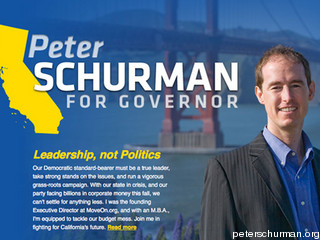
Jerry Brown

Immigrant advocates protest AZ law and Jerry Brown’s SecureComm support

0

SF Pride’s Gabriel Haaland reports that the California Highway Patrol made them take down their “No One is Illegal” drop banner at 9.a.m.
 
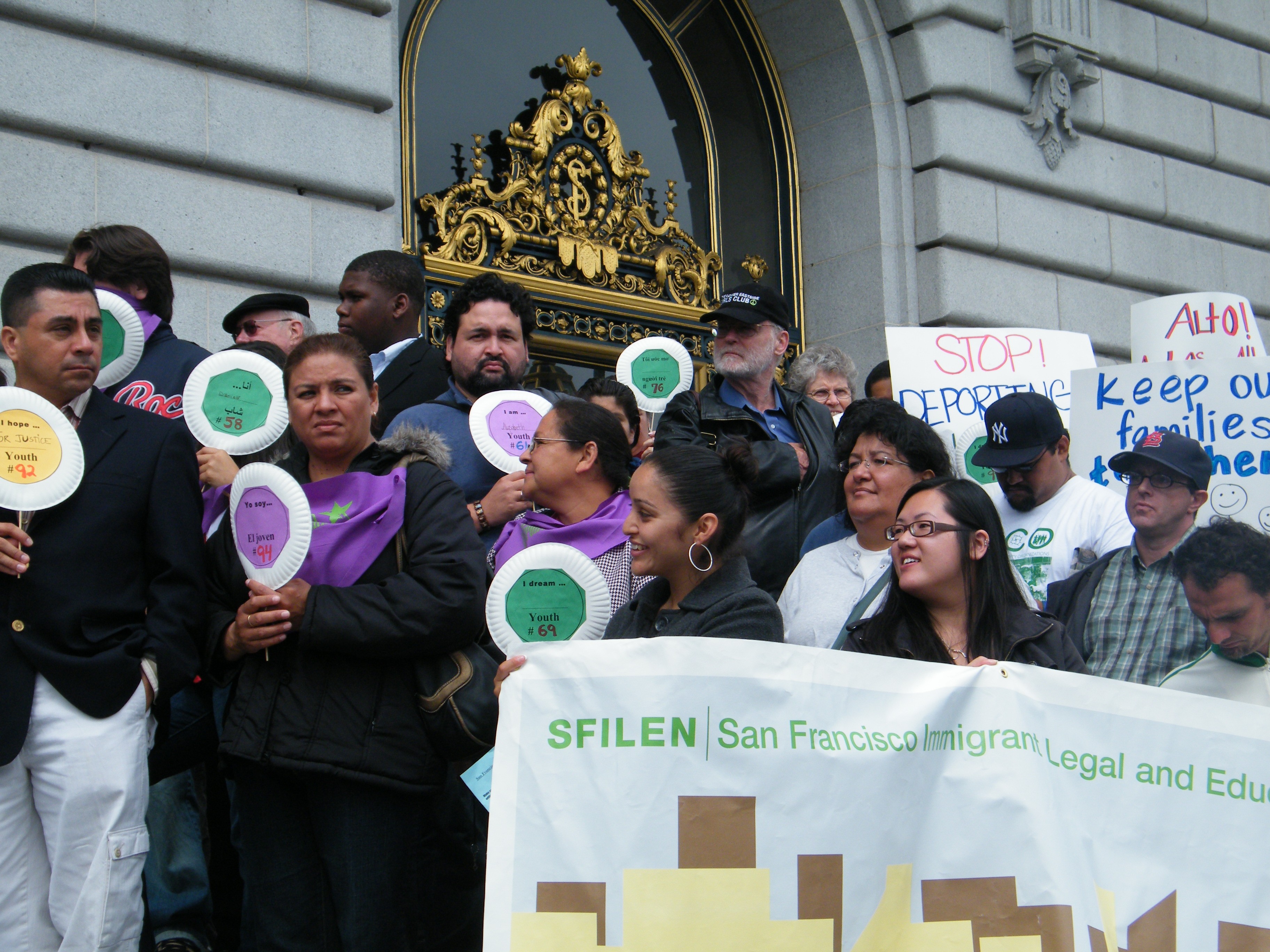
The SF Pride action came on the heels of yesterday’s protest in which over a hundred people gathered in front of the federal building to rally for comprehensive immigration reform, oppose AZ’s SB 1070 law and to oppose the fingerprinting program that was imposed on SF known as S-Comm (i.e., Secure Communities), effectively undermining the city’s sanctuary ordinance. Nineteen people were arrested for engaging in civil disobediance and blocking Seventh Street.

Today, several more immigrant rights rallies are taking place, including one outside the San Francisco office of gubernatorial candidate and Attorney General Jerry Brown. The protest, which was organized by the SF Day Labor Program and the Women’s Collective, targets Brown for not supporting San Francisco Sheriff Mike Hennessey’s request to opt San Francisco out of the  S-Comm program. 

Meanwhile, over at City Hall, San Francisco Mayor Gavin Newsom said he doesn’t see any problem with the SecureComm program.
“There is no reason to opt out,”Newsom told reporters at a budget signing press conference.

DCCC seats are fine for Newsom, just not supervisors

3

Mayor Gavin Newsom is seeking to be seated on the San Francisco Democratic County Central Committee when it swears in newly elected members tonight, even though the body’s legal counsel says he’s not entitled to a seat and Newsom has put a measure of the November ballot that would prohibit local officials from serving on that body.

Newsom and his supporters, most prominently DCCC member and District 8 supervisorial candidate Scott Wiener – who fears the progressive-dominated body will endorse and support his more progressive opponent, Rafael Mandelman – argue that being the Democratic nominee for lieutenant governor should give him a seat on the DCCC.

But the longtime legal counsel for DCCC, Lance Olson, doesn’t agree, citing bylaws that indicate that only nominees for statewide offices currently held by Democrats get seats on the body. So District Attorney Kamala Harris, the Democratic nominee to succeed Attorney General Jerry Brown, gets an ex officio seat (those held by state and federal elected officials and regional party leaders) but Newsom doesn’t because he’s running against incumbent Lieutenant Governor Abel Maldonado, a Republican.

DCCC chair Aaron Peskin, a political opponent of Newsom, told us the rules are the rules and that if Newsom thinks that it’s in the interests of the Democratic Party for him to have a seat, “He’s going to need to make an argument why we should amend the rules.” Peskin even offered to introduce a rule change for discussion if Newsom does so.

While Wiener wrote (in a letter quoted by the Chronicle) that seating Newsom would be about party unity, Peskin notes that Newsom has actually been a practitioner of the “politics of spite and division,” particularly after he responded to the success of the progressive DCCC slate in the June election by trying to ban local officeholders from the body (several progressive members of the Board of Supervisors successfully ran for the DCCC), claiming the body should be like a farm team for building the party.

“It really begs the question: why is he seeking to do himself what he doesn’t want others to do?” Peskin asked.

Newsom’s office didn’t respond to our inquires about the matter. BTW, in his letter to Peskin, Newsom proposed that attorney John Shanley be his proxy and journalist and political gadfly Warren Hinckle be his alternate. The meeting begins at 7 p.m. in the state building at 455 Golden Gate.

SFBG Radio: Meg’s taxes, Jerry’s campaign, Linda’s music

4

In today’s episode, Johnny and Tim talk about why Meg Whitman wants to avoid paying taxes, why Jerry Brown is so late in getting a campaign started … and why the oldies stations never play Linda Rondstadt songs. You can check it out after the jump.

sfbgradio7/21/2010 by johnnywangel

Meg, Jerry and the Latino vote

0

It’s easy for political analysts to talk about “the Latino vote” as if 15 million people in California all shared exactly the same views and cared about exactly the same issues. Which is nuts: Latino voters are a diverse group.


On the other hand, it’s safe to say that over the past 15 years or so, as the California Republican party has become more and more viciously anti-immigrant, Latinos have been rejecting GOP candidates. When Pete Wilson pushed Proposition 187 — which would have prevented undocumented Californians from receiving public health services and would have kicked their kids out of public schools — he wrote off an entire generation of Latino voters.


And Jerry Brown has a strong history of supporting causes that resonate with a lot of Latinos.


So in general, recognizing that not all Latinos remember Brown’s support for Cesar Chavez or cae about the creation of the Agricultural Labor Relations Board, it ought to be a good assumption that Brown will win the Latino vote by a pretty wide margin. The fact that Whitman is narrowing his lead among Latinos is, I think, a sign that Brown is resting too much on history and hasn’t offered much in the way of ideas about jobs, education, or any of the other crucial issues that middle-class voters of all ethnic groups care about.


Still, the Spanish language billboards were really dumb. For a campaign that’s been as disciplined and message driven as the Whitman effort, it’s kind of a surprise. All Meg has done is give Brown a nice weapon, a reason to talk about an area where she’s very weak. And the more he can keep playing on that — the more he can point out how far to the right she and her advisors really are on immigration — the more it hurts her.

Boxer’s better off than Brown

0

I know this is political heresy, but I was encouraged by the results of the Field poll on Boxer and Fiorina. I remember back in 1982, when Milton Marks, then a liberal Republican state senator, challenged incumbent Congressmember Phil Burton — the legendary Democratic leader — with an anti-incumbent message fairly similar to what Fiorina is throwing at Boxer. “The arrogance of power” was the slogan, and while Marks didn’t try to say that Burton was too liberal (this was, after all, a San Francisco seat) the basic push was that an entrenched incumbent had grown stale and was unpopular. And in fact, the early polls showed Burton losing.

But a campaign consultant who was there at the early Burton strategy meetings told me a few years ago what the mood was like when the numbers came in: “We saw that he was down ten points, and we all breathed a sigh of relief. Because we knew we could make that up.”

Some thing when Silicon Valley whiz kid Ed Zschau took on incumbent senator Alan Cranston in 1986. Cranston, the polls showed, had been around too long, was old and boring, an entrenched incumbent … all the same messaging. Zschau was young, exciting, a moderate Republican who everyone thought was a shoo-in to unseat the incumbent. And Cranston ran a great campaign and beat him.

Boxer’s negatives are too high, but she hasn’t really reminded Californians yet of what she’s been doing in Washington and who she really is. And she hasn’t even begun to remind voters that Fiorina is anti-choice — a position that really, really doesn’t play in California.

Jerry Brown also has some good news from the Field poll, but he’s not the campaigner that Boxer is. And he’s got more trouble with younger voters. Frankly, he’s worse off right now than she is. In fact, if I were in Boxer’s camp right now, I’d be heaving a sigh of relief: She can turn this around.


The good news for Jerry Brown

4

The press is all over the latest Field Poll, which shows Jerry Brown and Meg Whitman in a dead heat.  And it’s no surprise that, thanks to a campaign that thus far has been almost entirely negative, voters aren’t particularly thrilled with either candidate.


But I think there’s some good news for Jerry Brown here. Whitman has spent more than $90 million so far, and the voters like her less than they did six months ago. After all that money, some of which has gone for blistering attacks on Brown, Whitman is still not ahead. And it’s hard to see what she can do now to move the needle.


CallBuzz:


Moreover, it looks like the attack ads on Whitman by Brown’s labor allies — including California Working Families 2010 — have had their intended effect: to increase Whitman’s negatives and keep her from pulling away from Brown during the summer, before he can afford to put his own ads on TV.


Meanwhile, Brown’s favorability is only marginally changed from March. It’s 42-40% favorable today, compared to 41-37% favorable before. (Of course, Brown’s favorable was 50-25% back in March of 2009, but that was when he was just the new Attorney General and not a candidate for governor with rivals.)


At some point, Jerry’s got to start seriously campaigning, and he’s got a lot of work to do. He has to define himself to younger voters, who know a lot more about Ebay than about Brown’s tenure as governor, which was generally pretty good. He has to remind Latinos of how awful Whitman is on immigration. He’s got to spend some money.


But at this point, there’s hardly a voter in California (at least, not one with a TV set) who hasn’t seen multiple Whitman ads, defining her as a successful business person and attacking Brown as a failed politician. Those are powerful messages. The ads have been well produced, well targeted and should have been effective. And they haven’t gotten her over the halfway point yet — even against an opponent who is vulnerable to attack and hasn’t campaigned much at all.


Both candidates seem to be holding the party loyalists — the vast majority of the Republicans like Meg, the vast majority of the Democrats like Jerry. And there are more Democrats than Republicans. The independents aren’t breaking Meg’s way, either — she’s only slightly ahead, not enough to make up the difference.


Now if Brown can just get his people to care enough to go to the polls. …

Weird Uncle Jerry

0

I’m starting to feel as if Jerry Brown is that strange old uncle who comes over for dinner and says things that make you cringe — and you can’t really tell if he’s just a loveable old character, a bright guy with a weird sense of humor, or someone who’s completely losing his marbles.


Check this out: First he makes a very valid, even insightful statement that’s right on target:


“Were I a CEO and someone said, ‘You know what, I’ve never been in this company, I never saw the product and I want to be a boss,’ I’d say, ‘Hey, why don’t you start at the bottom and work your way up,’ ” he said. “That’s the same way with government — you can’t wake up one morning and say, ‘Gee, I’ve got a billion dollars and I want to be governor.’ You got to learn something because those people up in Sacramento are sharks.”


Then he goes completely off the deep end:


Brown discussed his implementation of Prop. 13 despite his earlier opposition to it, as well as support for the 2nd Amendment and same-sex marriage. He said he opposed efforts to legalize marijuana, which will be on the November ballot.


“We got to compete with China, and if everybody’s stoned, how the hell are we going to make it?” he said.


Jerry, pal, I’ve got news for you: The people who are the most successfully competing with China, the brilliant high-tech visionaries you love so much? They’re already stoned. All we can do now is get some tax money out of it.


Besides, China can’t compete with this:


Powder keg

5

news@sfbg.com

Ask any pollster, political consultant, or academic who studies the American electorate about the mood of the voters this year and you’ll get the same one-word answer: Angry.

Everyone’s pissed — the liberals, the conservatives, the moderates, the people who don’t even know where they fit in. It’s an unsettled time and, potentially, very bad news for a progressive agenda that seeks to address issues ranging from poverty and war to the long-term health of the public and the planet.

The Democrats, who swept into power with an enormously popular president just 18 months ago, may lose control of Congress. The tea partiers have driven the Republicans so far to the right that some candidates for Senate are openly talking about eliminating Social Security. The unemployment rate — the single most important factor in the politics of the economy — remains high and doesn’t show any signs of improving.

And the progressive left seems frustrated and demoralized, particularly in California. The Golden State, which once led the nation in innovation and enlightened social policy, now seems to be leading the politically dysfunctional race to the bottom.

The nation could be headed for a dangerous era, rife with the potential for right-wing demagoguery and other nasty political schisms. The state of the economy could easily fuel a more powerful movement to shrink the scope of government and a continuing backlash against the public sector — and the financial backers of the antitax and antiregulation movement are drooling at the prospect.

But there’s also a chance for progressives to seize a populist narrative and shift the discussion away from traditional disagreements and toward those areas, particularly the destructive influence on government by powerful corporations, where the grassroots right and grassroots left might actually agree.

The anger that voters feel toward a government that isn’t meeting their needs is starting to find other outlets. People are as mad about the abuses of big business — the Wall Street meltdown, the bailouts, the BP oil spill, the political manipulation — as they are about the failures of Congress and the president. If you ask Americans of every political stripe who they least trust — big government or big business — even conservatives aren’t so sure anymore.

For 30 years, the central narrative of American politics has revolved around the size and effectiveness of government. Now there’s a chance to shift that entire debate in American politics toward the largely unchecked power of corporations. It is, populist writer Jim Hightower told us, “an enormous opportunity handed to us by the bastards.”

But so far, none of the Democratic leaders in California are taking advantage of it to start dispelling damaging myths and crafting political narratives that might begin to create some popular consensus around how to deal with society’s most pressing problems.


THE PEOPLE WANT TAXES

There have been many polls gauging voter anger, but one of the most comprehensive and interesting recent ones was “Californians and Their Government,” a collaborative study by the Public Policy Institute of California and the James Irvine Foundation that was released in May.

It shows that Californians are mad about the state’s fiscal problems, disgusted with their political leaders, divided by ideology, and deeply conflicted over the best way forward. An astounding 77 percent of respondents say California is headed in the wrong direction and 81 percent say the state budget situation is a “a big problem.”

But the anti-incumbent message isn’t necessarily an anti-government message. Most Californians are willing to put more of their cash into public-sector programs, even during this deep recession. When asked to name the most important issues facing the state, 53 percent mentioned jobs and the economy . The state budget, deficit, and taxes only got the top billing of 15 percent.

And contrary to the conventional wisdom espoused by moderate politicians and political consultants, most voters say they are willing to pay higher taxes to save vital services. “Californians tell us they continue to place a high value on education and want education to be protected from cuts. And they’re willing to commit their money to help fund that,” PPIC director Mark Baldassare told the Guardian.

The survey found that 69 percent of respondents say they would pay higher taxes to protect K-12 education from future cuts, while 54 percent each say they would pay higher taxes to prevent cuts to higher education and to health and human services programs. In other words, voters seem to recognize where we’ve cut too deeply — and where we haven’t cut enough: only 18 percent of respondents would be willing to pay higher taxes to prevent cuts to prisons and corrections.

Baldassare said the June primary results also showed that people are willing to pay more in taxes for the services they value. “Around the state, there was a lot of evidence that people responded favorably to requests by their local governments for money, particularly for schools,” he said.

Both the California Legislature and Gov. Arnold Schwarzenegger are held in very low esteem with voters, according to the PPIC study, and Schwarzenegger’s 23 percent rating is the lowest in the poll’s history.

Barbara O’Connor, political communications professor who heads the Institute for the Study of Politics and the Media at Sacramento State University, told us that voter unhappiness with elected leaders is no surprise. Right now, most people are afraid that their basic needs won’t be met over the long run.

“The common narrative is fear, and fear channels into anger,” O’Conner said.

And that fear is being tapped into strongly this year by the Republican candidates, who are trying to scare voters into embracing their promises to gut government and keep taxes as low as possible.

“If there’s any lesson to be learned from Meg and Carly’s early ads, it’s fear-mongering, fear-mongering all the time — and that doesn’t create a very positive narrative,” O’Connor said of gubernatorial candidate Meg Whitman and U.S. Senate candidate Carly Fiorina.

O’Connor noted that Barack Obama’s campaign had great success in using a positive, hopeful message and said she believes the right leader can also do so in California. “I talked to Jerry [Brown]’s people about it and said you can’t just run a negative campaign because that’s what Meg is doing.”

Despite the tenor of the times, O’Connor said she’s feeling hopeful about hope. She also believes Californians would respond well to a leader like Obama who tried to give them that hope — if only someone like Brown can pick up that mantle. “I think the environment is right for a positive message. But the question is: do we have people capable of delivering it?”

She said the no-new-taxes, dismantle-government rhetoric has started to wear thin with voters. “The real fiscal conservatives are badly outnumbered in Californian,” O’Connor said. As for the corporate sales jobs, O’Connor said voters have really started to wise up. “They aren’t going to be scammed.”

The results of the June primary election showed that voters across the spectrum were also disturbed by big special-interest money. Proposition 16, backed by $46 million from Pacific Gas and Electric Co., went down to defeat — even in counties that tend to vote Republican.

And this fall, with two rich former CEOs spending their personal wealth to win two of California’s top elected offices and energy companies pushing a measure to roll back California’s efforts to combat global warming, there could be great opportunity in a narrative targeting those at the top of our economic system.


THE TOP AND THE BOTTOM

Some observers say that whatever their shared feelings about corporate scams, conservatives and liberals in the state are just too far apart, and that there’s little hope for any substantive agreement. “People are becoming more polarized,” said consultant David Latterman, who often works for downtown candidates and interests. “I think we’re beyond compromise.”

Allen Hoffenblum, a Los Angeles-based Republican strategist, agreed. “The voter are all mad, but they’re mad at different things. I just don’t see where they come together.”

But Hightower, who has spent a lifetime in politics as a journalist, elected official, author, and commentator, has a different analysis.

“As I’ve rambled through life,” he wrote in a recent essay, “I’ve observed that the true political spectrum in our society does not range from right to left, but from top to bottom. This is how America’s economic and political systems really shake out, with each of us located somewhere up or down that spectrum, mostly down.

“Right to left is political theory; top to bottom is the reality we actually experience in our lives every day — and the vast majority of Americans know that they’re not even within shouting distance of the moneyed powers that rule from the top of both systems, whether those elites call themselves conservatives or liberals.”

In an interview, he told us he sees a lot of hope in the fractured and potentially explosive political ethos. “There’s all this anger,” he said. “People don’t know what to do. And I think the one focus that makes sense is the arrogance and abuse of corporate executives.”

In fact, Hightower pointed out, the teabaggers didn’t start out as part of the Republican machinery. “Wall Street and the bailouts sparked the tea bag explosion,” he said. It wasn’t until big right-wing outfits like the Koch brothers, who own oil and timber interests and fund conservative think tanks, started quietly funding tea party rallies that the anti-corporate, anti-imperial edge came off that particular populist uprising.

“At first, the teabaggers didn’t even know where the money was coming from,” Hightower said. “You can’t be mad at the teabaggers; we should have been out there organizing them first.”

There’s plenty of evidence that anger at big business is growing rapidly — and rivals the distrust of big government that has defined so much of American politics in the past 30 years. The bailouts were “the first time in a long time that people have been slapped in the face by collusion between big business and its Washington puppets,” Hightower noted.

Then there’s the Supreme Court decision in Citizens United v. Federal Elections Commission. In January, a sharply divided court ruled 5-4 that corporations had the right to spend unlimited amounts of money supporting or opposing political candidates. Progressives were, of course, outraged — but conservatives were, too.

Polls show that more than 80 percent of Democrats think the decision should be overturned. So do 76 percent of Republicans. “This is a winner for our side,” Hightower noted. “But our side’s not doing anything about it.”

Sure, President Obama denounced the ruling in his State of the Union speech and promised reform. But the bill the Democrats have offered in response does nothing to stop the flow of money; it would only increase disclosure requirements. And in response to furor from the National Rifle Association, it’s been amended and is now so full of holes that it doesn’t do much of anything.

Political consultants advising Whitman are clearly looking for ways to direct the voter unhappiness into a demand for lower taxes and smaller budgets. She’s already vowed to fire 40,000 state workers, and her most recent campaign ad attacks Brown for expanding public programs and raising the state deficit.

So far Brown hasn’t challenged that narrative — and some Democrats say he shouldn’t. It would be safer, they say, for Brown to get out front and demand his own cuts in Sacramento. “Going after public-sector pensions is a winner,” one Democratic campaign consultant, who asked not to be named, told us. “If Whitman beats Brown on those issues, she wins.”

But that approach is never going to be effective for Democrats. If the argument is over who can better cut government spending, the GOP candidates will always win. The better approach is to see if progressives can’t shift the debate — and the anger — toward the private sector.

As Hightower put it: “You can yell yourself red-faced at Congress critters you don’t like and demand a government so small that it’d fit in the backroom of Billy Bob’s Bait Shop and Sushi Stand, but you won’t be touching the corporate and financial powers behind the throne.”

That’s where the discussion has to start. And there’s no better place than California.

The Golden State is a great example of what happens when the tax- cutters win. In 1978, the liberals in Sacramento, operating with a huge state budget surplus, couldn’t figure out how to derail the populist anger of property tax hikes. So Proposition 13, the beginning of the great tax revolt, passed overwhelmingly. Over the next decade, more antitax initiatives went before the voters, and all were approved.

Now the state is heading toward fiscal disaster. The schools are among the worst-funded in the nation. The world-famous University of California system is on the brink of collapse. Community colleges are turning away students. The credit rating on California bonds have fallen so far that it’s hard for the state to borrow money. And there’s still a huge budget gap.

The tax-cut mentality that led to the so-called Reagan revolution started in California; a political movement that shifts the blame for many of the state’s problems away from government and onto big business ought to be able to start here as well. And it’s potentially a movement that could bring together people who normally find themselves on opposite sides of the fence.

A case in point: the measure the oil companies have put on the November ballot to repeal the state’s greenhouse gas limits. The corporations backing the initiative, led by Valero, argue that California’s attempts to slow climate change will cost jobs. That’s a line we’ve heard for decades. Every tax cut, every move toward deregulation, is defended as helping spur job growth.

But the past four presidents have done nothing but cut taxes and reduce regulations — and the result is facing Americans on the streets every day. There is also growing evidence that even Republican voters don’t believe everything big businesses tell them anymore. And they’re starting to grasp that sometimes deregulation leads to outcomes like larcenous CEOs and unstoppable oil leaks.

So the potential for a successful progressive populist movement is out there. But it’s not going to happen by spontaneous combustion.


SF SHOWS THE WAY

On the national level, one of the factors creating this gloomy electorate is the failure of President Obama to keep the coalition that elected him active and engaged. The intense partisanship in Washinton has turned off many independent Obama voters, while his progressive supporters have been disappointed by issues ranging from his escalation in Afghanistan to tepid reforms on health care and Wall Street.

“One of the narratives now is where are the Obama voters and will they participate?” Jim Stearns, a San Francisco political consultant who works mostly on progressive campaigns, told us. “They still love Obama but they’re not moved by him anymore.”

Perhaps more important, they have lost the sense of hope that he once instilled. The Republican Party’s descent into right-wing extremism and the strong anticorporate narratives that have emerged in the last year — from BP’s oil spill to PG&E’s political manipulation to Goldman Sachs’ self-dealing to the prospect of unrestricted corporate campaign propaganda unleashed by the Citizens United ruling — have created the possibility that the negative narratives by the left may crowd out the positive ones.

“Meg Whitman is someone you can hate. She’s the rich Republican CEO trying to buy her way into office,” Stearns said. “But it’s a depressing message.”

But Stearns said there is another, most hopeful political narrative that is emerging in San Francisco, one that might eventually grow into a model that could be used at the state and federal levels. “We’re lucky in San Francisco. Progressive voters are engaged.”

He noted that San Francisco’s voter turnout was higher than expected in the June primary, and far higher than the record low state number, even though there really weren’t any exciting propositions or closely contested races on the local ballot — except for the Democratic County Central Committee, where progressives maintained their newfound control. And it’s because of the organizing and coalition-building that the left has done.

“What you’ve seen over the last few years is a coalition of labor, neighborhood groups, environmentalists, and the progressives now operating through the Democratic Party. That’s a great coalition with a lot for people to trust,” Stearns said.

Meanwhile, downtown has all but collapsed as a unified political force. “They don’t really have a political infrastructure,” Stearns said of downtown. “Normally it would be the mayor who gets everyone in line and working together.”

Even Latterman, the downtown-oriented consultant, agrees that the business community is no longer setting San Francisco’s agenda because it’s become fractured and unable to push a consistent political narrative: “There’s certainly been a lack of coordination.”

He also agrees that progressives have become more organized and effective. “Clearly, the Democratic Party of San Francisco has become a conduit for progressive politics and politicians, but not issues,” Latterman said. “What a lot of people get wrong in the city is the difference between politics and policy.”

Part of the reason is economic. With scarce resources, a high threshold for approving new revenue sources, and a fiscally conservative mayor unwilling to talk taxes, it’s been difficult to move a progressive agenda for San Francisco. And in Sacramento, it’s barely part of the discussions.

“The people of California have been held hostage by a handful of Republicans who are making us cut everything we care about,” while in San Francisco “Newsom is taking an entirely Republican approach to the budget,” Stearns said.

Looking toward the fall races, Stearns said the progressive coalition and majority on the Board of Supervisors will be tested on issues such as Muni reform, and the question will be whether fiscal conservatives like Sup. Sean Elsbernd can blame Muni’s problems on drivers, or whether progressives can create and sell a broader package that includes new revenue and governance reforms.

“The drivers are going to get their guarantee taken out of the charter, that’s going to happen. But people know that isn’t all that’s wrong with Muni,” Stearns said.

But to craft a more comprehensive solution, he said the progressives are going to need to use their growing coalition to connect the dots for voters. “We need to run a citywide campaign around a whole constellation of issues,” Stearns said, citing Muni, schools, taxes, resistance to mean-spirited measures like sit-lie, and the larger issues raised by the Brown and Barbara Boxer campaigns. “We need to figure out a way to put all that in the same coalition and run one campaign around it. And we can do that because progressives retained control of the DCCC.”


THE STRUGGLE AHEAD

Although they’ve made great strides, San Francisco progressives are still struggling with a mayor who sees the solution to every budget crisis as cuts — and with a growing number of efforts to blame public employees for the city’s fiscal problems. Even Jeff Adachi, the public defender once considered a standard-bearer for progressive causes, is pushing a ballot measure that would require city workers to pay more for their pensions.

Gabriel Haaland, who works with Service Employees International Union Local 1021, made the right point in the pension debate. “Big financial institutions crashed the stock market,” he said recently, “and now they want to blame city workers.”

In a blog post on the political website Calitics, Robert Cruickshank put it clearly: “The notion that ‘everyone needs to give back’ just doesn’t make sense given our economic distress. We’ve already given back too much. We gave back our wages. We gave back our ability to afford health care and housing and transportation. We gave back the robust public- sector services that created widespread prosperity in the 1950s and 1960s. We gave back affordable, quality education. And too many of us have given back our future.

“No, it’s time for someone else to give back. It’s time for the wealthiest Californians and the large corporations to give back. For 30 years now they have benefited from economic policy designed to take money and benefits from the rest of us and give it to those who already have wealth and power.”

That’s a message that ought to appeal to anyone who’s hurting from this recession. It ought to cross red and blue lines. It ought to be the mantra of a new progressive populism that can channel voter anger toward the proper target: the big corporations that created the problems that are making us all miserable.

If Jerry Brown could adopt that narrative, he could change the state of California — and the state of the nation.


Solstice fun: Brown and Whitman’s birthday personalities

0

I’m probably going to get into all kinds of trouble for this post, but seeing as today is the summer solstice, and I have hay fever, now (as I wait for the antihistamine to kick in) feels like the perfect moment for fun with politicians’ personalities, beginning with California’s gubernatorial candidates, Jerry Brown and Meg Whitman.

“Many people have long suspected, as astrologers believe, that the day you were born affects your personality,” states the dust jacket of The Secret Language of Birthdays (Penguin, 1994). This weighty 832-page tome claims to be a guide to personality based on “psychology, history, numerology, tarot and astrology.”

So, what light, if any, does this tome shed on Brown and Whitman?

We learn that Brown and the Buddha were both born April 7, a birthday this tome characterizes as The Day of Enthusiastic Belief. (William Wordsworth, Billie Holiday, and Francis Ford Coppola apparently also emerged on this day)

Whitman, who was born August 1, shares a birthday with Yves St. Laurent, Jerry Garcia, Moby Dick author Herman Melville and Claudius 1, (who became Roman emperor after Caligula’s murder), a day the Secret Language of Birthdays characterizes as The Day of Original Style.

“It is not uncommon for April 7 people to reach a point in their lives when they can spiritually progress no further and have to make a very big change,” states the tome, which actually includes Brown in its list of famous April 7 folks. “If April 7 people pass through this crossroads, well, they are capable of even greater success in their life. They may feel less impelled to throw themselves at the world, and instead allow the world to come to them.”

“April 7 people do well in public positions in which they can inspire others to higher achievement through their own example,” the tome concludes. “They should continually work toward being realistic in their view of everyday life, and must not be carried away by illusions. They should also avoid reacting in an angry fashion if their expectations are not met by others.”

As for Whitman and other August 1 people, the tome claims that, “Not content with the knowledge that they are the best in what they do, they must force others to this realization either through the quality of their work or the sheer persuasiveness of their personalities. They may suffer many setbacks, frustrations and disappointments along the way, but rarely give up on their endeavors.”

‘Those born on August are not the easiest people to get along with,” the tome warns. “Since they themselves are the only boss they tolerate, they are generally unsuited for jobs where they must work with superiors…Those born in August 1 are often caught up in the middle of a swirling world of controversy. No matter what they do, they seem to arouse the interest and sometimes antagonism of others.”

Okay, well there you have it with the fun stuff. And now that the antihistamine finally feels like it’s working, I’m ready to enjoy some politically meatier stuff at Politics Verbatim, a website California Watch and the Center for Investigative Reporting just launched “to hold California’s two major gubernatorial candidates accountable in the most straightforward way possible: by collecting and categorizing the promises, proposals, arguments and attacks that they make on the campaign trail.”  (But don’t forget to watch out for the personalities behind the promises: They could just be each campaign’s (not so) secret weapon.)


=

And now, the race to replace Kamala Harris

2

David Onek, who has strong political connections and little courtroom experience, sent out a email today announcing that he wants to be San Francisco’s next district attorney:


As many of you know, District Attorney Kamala Harris is very likely to become California’s next Attorney General. DA Harris is a friend and I would never run against her, but her victory in November will open up the office as early as the end of this year. This means the time to get organized is right now.


He adds his name to the list of people, including former chief homicide prosecutor Jim Hammer, who want the job. But it’s going to be an unconventional campaign, to say the least. Because if Harris wins, her successor won’t be chosen by the voters of San Francisco.


There are three relevant scenarios here.


1. Harris loses the AG race. Entirely possible; she’s got a tough campaign ahead of her. Then all of this talk is moot; Onek clearly isn’t going to run against her, although Hammer might.


2. Harris wins the AG race, and Newsom loses his race for lieutenant governor. In that case, Newsom will be mayor of San Francisco when Harris resigns to move up to Sacramento — and under the City Charter, he will appoint someone to serve out the rest of Harris’s term.


3. Harris and Newsom both win — in which case there’s a fascinating legal issue. Do Harris and Newsom leave at the same moment — in which case the Board of Supervisors appoint the next mayor, who appoints the next DA? Or does Newsom try to fill Harris’s job before he resigns himself? In the end, Matt Dorsey, spokesperson for City Attorney Dennis Herrera told me, “that’s a question that will be answered by the attorney general. Theoretically, it could get very complicated.”


Under the state Constitution, the governor, lt. governor and attorney general all take office the same day, the first monday after Jan. 1st, which in this case is Jan. 3. The constitution doesn’t say what time of day that happens. In theory, then, Harris could take the oath of office at 9 am, Newsom could wait until 10 am, and appoint a new DA in between. Then somebody who didn’t get appointed (or, frankly, any angry citizen of San Francisco) could sue — because if Newsom’s term technically starts at 12:01 am Jan. 3d, then at that moment, by city law, the president of the Board of Supervisors instantly becomes mayor, meaning David Chiu should be the one making the DA appointment.


Or Harris and Newsom (and whatever other parties wanted to play ball) could cut a deal. Harris could resign a day early, and Newsom could appoint her replacement with no legal consequences at all. That would look sleazy as hell and be a rotten way for the mayor to start his term as lieutentant governor, but he could do it.


Of course, that will all depend on an interpretation from the attorney general on when the AG and lt. gov. terms actually begin — and the AG at that point will be Jerry Brown, who may have just been elected governor on a ticket with Newsom and Harris.


What a clusterfuck.


At any rate, David Onek now has to build a campaign aimed not really at winning an election, but at convincing either Newsom or Chiu (or, potentially, the next mayor, who would be named by the supervisors) that he ought to be district attorney. Part of that calculation will hinge on whether he can hold onto the job when it comes up for a real election in November.


If it’s a simple deal with Newsom, Onek will be relying on his political allies. He notes:


A broad range of leaders in government, in law enforcement and in the broader criminal justice community have already pledged their support – including former San Francisco City Attorney and Police Commission President Louise Renne, former state Treasurer Phil Angelides, Supervisor Carmen Chu, School Board Commissioner Hydra Mendoza, former Mayor Art Agnos, former Police Chief Heather Fong, Berkeley Law School Dean Christopher Edley, Jr., Police Commission President Joe Marshall and former Chief Probation Officer Jeanne Woodford. 


Although I’m not sure that Newsom cares much these days what Louise Renne, Art Agnos or Phil Angelides think.


So what Onek — and anyone else who wants to be the next DA — needs to do is convince the next mayor that he’s not only going to be a good chief prosecutor (already a hurdle for someone with no background as a prosecutor) but that he has the political ability to convince the actual voters that he’s qualified. Otherwise he’s just another Kim Burton waiting to happen.


I haven’t been able to reach Onek yet to discuss all of this, but the minute he calls me I’ll post an update.

Voters are pissed

0

By Guardian News Staff

news@sfbg.com

After spending more than $70 million, two big corporations failed to convince Californians to vote their way. After spending nearly $70 million, the former head of a big corporation easily convinced Californians to vote her way. And that outcome is not as schizophrenic as it sounds.

On one level, the outcome of the June 8 election was a sign of the anti-corporate anger seething through the California electorate. “BP, Goldman Sachs, PG&E — anything that seems connected to a big corporation is in serious trouble right now,” one political insider, who asked not to be named, told us.

Yet two candidates who were very much corporate icons — Meg Whitman and Carly Fiorina — won handily in the Republican primaries and now have a real chance to become the state’s next governor and junior senator. What’s happening? It’s fascinating. The voters in the nation’s most populous state are pissed off — at big business, at government, at the oil spill, at 10 percent unemployment, at Washington, at Sacramento, at Wall Street. It’s an unsettled electorate, uncertain about its future and looking for something new, and definitely despising power.

There’s a populist fervor out there, and it’s going to define this fall’s expensive, dirty, and high-stakes battle for California’s future.


THE MAYOR GOES STATEWIDE

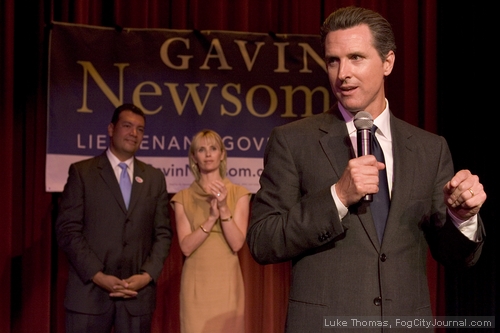
Addressing a crowd of supporters gathered at Yoshi’s San Francisco on election night, San Francisco Mayor Gavin Newsom — who easily beat opponent Janice Hahn to claim the Democratic nomination for lieutenant governor — said he was excited to be part of a crucial political year for the Golden State.

“We’re very proud to be in a position to be the Democratic nominee and to work with the other Democratic nominees,” Newsom told supporters. He lavished praise on the Democratic nominee for governor, Jerry Brown — the man who just last year he was trying to beat in a primary — telling stories about his father’s long relationship with the former governor and expressing his admiration. “I couldn’t be more proud to quasi- be on a ticket with Jerry Brown,” he said.

The race for lieutenant governor may prove one of the most interesting this election season — and not just because a victory for Newsom would transform San Francisco politics. Newsom’s opponent is Abel Maldonado, a moderate Republican who enjoys popularity among the growing, influential Latino community, and who Newsom’s team said will be a formidable challenge.

The campaign could revolve around an intriguing question. At a time when the Republican Party has been taken over by virulent anti-immigrant politicians — Whitman and Fiorina have both made harsh statements about illegal immigrants and vowed never to support “amnesty” (that is, immigration reform) — will Latino voters go for a white Democrat over a Latino Republican?

“You talk to them about all the same issues you talk to all voters about: jobs, education, and health care,” Newsom political strategist Dan Newman said when asked whether Newsom could win over Latino voters. “Latinos, like all voters, will appreciate someone with a proven record of success.”

Pollster Ben Tulchin also downplayed the trouble Newsom could encounter in winning the Latino vote. “With what’s going on in Arizona, they are very wary of Republicans,” Tulchin said, but then added: “We don’t want to underestimate the challenge we have. There’s never been a moderate Latino on the statewide ballot.”

Newsom sounded another alarm. If Whitman decides to help Maldonado, the race will get even tougher. “We’re running against Meg Whitman’s checkbook,” the mayor said.

“Expect to see Meg and Abel together a whole lot in the next few months,” one consultant predicted.

If Newsom wins, San Francisco will get a new mayor a year early — and the district-elected Board of Supervisors will choose the person to fill out the last year of Newsom’s term. Technically, the current board will still be in office then, but the task may well fall to the next board — which makes the local November elections even more important.

“Everyone is gaming this out and trying to figure out what happens,” political consultant Alex Clemens said during a post-election wrap-up at the San Francisco Planning and Urban Research Association office. “There will be a lot of dominoes to fall and deals to be cut.”

Meanwhile, Newsom’s nomination for lieutenant governor places many San Franciscans in an uncomfortable position, one that was illustrated well by Newsom’s victory speech, in which he proudly rejected taxes. Although most San Francisco progressives are disenchanted with their fiscally conservative mayor, few would rather vote for Maldonado.

Tim Paulson, the SF Labor Council president, was at the Newsom event gritting his teeth as he talked about the opportunity progressives now have to work with “a mayor of San Francisco we have issues with.” Now, he noted, “There is going to be a real campaign around this man. It could establish a narrative for what California is about.”


POWERFUL WOMEN

At Delancey Street on election night, San Francisco District Attorney Kamala Harris talked about getting “tough and smart on crime,” addressing gang-related criminal activity but also focusing on corporate criminals. She talked about cracking down on predatory lenders, supporting health care reform, and protecting California’s environment. And she made a point of dragging in BP.

“It must be the work of the next attorney general to ensure that the disaster and tragedy that happened in the Gulf of Mexico never happens in California,” she said, warning of attacks on AB 32, which set California’s 2020 greenhouse gas emissions reduction goal into law in 2006.

Of course, Harris now has to take on her southern counterpart, Los Angeles DA Steve Cooley, who is a moderate but comes in with much stronger law enforcement support. If Harris wins, it will go a long way to prove that opposition to the death penalty isn’t fatal in California politics, and that voters are finally ready for a women of color as the top law enforcement official — a first in state history.

But she and Newsom will both have to overcome likely attacks for the San Francisco’s crime lab scandal, one of many hits to be magnified by the size of Whitman’s war chest.

Whitman, who trounced opponent Steve Poizner in the primary, is riding the crest of a new wave of Republican-style “feminism,” starring her, Fiorina, and Fox news pundit Sarah Palin as female champions of the right-wing agenda. A few short months ago, it looked as if Brown was in serious trouble. But that was before Whitman and Insurance Commissioner Steve Poizner got into an $85 million bloodbath that left the winner of the GOP primary badly wounded. Whitman wants to play off the populist uprising by portraying herself as an outsider running against a career politician; Poizner gave her a huge scare by hammering her ties to Goldman Sachs.

That Wall Street narrative is one Democrats will push against Whitman and Fiorina. “I think it is stunningly politically tone deaf to nominate two Wall Street CEOs to the top of the ticket,” Newman said. Voters will decide whether they are fresh voices with new ideas or corporate hacks who laid off Californians and made fortunes with dubious stock market deals.

Brown leads in the polls — narrowly — but he’s vulnerable. He’s taken so many stands over so many years and Whitman’s fortune will hammer any openings they see. Brown is only slowly getting into campaign mode, but it’s no secret what he has to do. If the campaign is about Jerry Brown, unconventional politician, against Meg Whitman, Wall Street darling, then he wins.

But to take advantage of that, Brown has to offer some concrete solutions to the state’s problems — and he has to start acting like the progressive he once was. “If I were him, I’d run hard to the left,” a consultant who isn’t involved in any of the gubernatorial campaigns said.

The conventional wisdom had Barbara Boxer in trouble, too — but she’s a savvy campaigner who has beaten the odds before. And while the senator appears ripe for attack — almost 30 years in Washington, a voting record perhaps a bit more liberal than the state as a whole — her opponent, Fiorina, has baggage too.

For starters, Fiorina’s entire pitch is that she — like Whitman — would bring business-world savvy to politics. But as CEO of HP, “she was about perks and pink slips,” Newman said. “She laid off Californians and shipped those jobs overseas while enriching herself.”

Her own primary pushed her far to the right (at one point, in an embarrassing sop to the National Rifle Association, she actually argued that suspected terrorists on the federal no-fly list should be able to buy handguns). And speaking of feminist values, her anti-abortion positions won’t help her in a decidedly pro-choice state.


PROP. 16 GOES DOWN

The defeat of Proposition 16 will go down in history as one of the most remarkable campaigns ever. It was, Sup. Ross Mirkarimi noted, “a righteous win:” The No on 16 campaign spent less than $100,000 and still captured 52 percent of the vote. Another narrow corporate-interest measure, Mercury Insurance’s Prop. 17, faced a similar fate.

One reason: PG&E’s $50 million campaign backfired, making voters suspicious of the company’s propaganda. Another: it lost overwhelmingly in its own service area, the company rejected by those who know it best.

Now PG&E CEO Peter Darbee, who pushed to mount the expensive campaign, must return to his shareholders empty-handed — and that’s going to cause problems. “I assume the leadership of PG&E will be called to task,” Clemens said. “They truly rolled the dice.”

The day after the election, PG&E shares dropped 2.2 percent, a possible sign of shaken investor confidence. Mindy Spatt of the Utility Reform Network (TURN), a nonprofit that worked on the No on 16 effort, described the situation succinctly. “Peter Darbee’s got egg on his face,” she said. “Big-time.”

Mirkarimi has witnessed other battles with PG&E, and said this probably wouldn’t be the last. “PG&E, every time we want to have a seat at the table, tries to take us out, like assassins,” he said. “If they were smart, they would take us up on what we asked many years ago, and that is to abide by peaceful coexistence.”

On the statewide level, the bold and expensive deceptions pushed by PG&E and Mercury Insurance were countered by only a handful of super-committed activists and a broad cross-section of newspaper editorials, a reminder that newspapers — battered by the economy and technological changes — are neither dead nor irrelevant.

One of the wild cards of the election was Prop. 14, which will eliminate party primaries for state offices — and potentially shake up the state’s entire political structure. “This is a big deal even if we don’t know how it’s going to play out,” consultant David Latterman said at the SPUR event.

Interestingly, the only two counties that voted No on 14 were the most progressive — San Francisco — and the most conservative, Orange.

Progressives did well in San Francisco, expanding their majority on the Democratic County Central Committee. “In an environment where it was about hundreds of millions of dollars from PG&E and Meg Whitman and Chris Kelly outspending us, we showed that San Francisco is San Francisco and we support San Francisco values,” DCCC chair Aaron Peskin told us.

Money used to define the debates in San Francisco, but the dominant narratives are now being written by the coalition of tenants, environmentalists, workers, social justice advocates, and others who backed a progressive slate of DCCC candidates, which took 18 of the 24 seats on a body that makes policy and funding decisions for the local Democratic Party.

“This time it was the coalition that really made the difference,” DCCC winner Michael Bornstein said on election night. “Frankly, our people worked harder.”

Board of Supervisors President David Chiu agreed, telling us, “For the Central Committee, the message is people power wins.”

The lesson from this election is that people are starting to get wise to corporate deceptions. And they’re realizing that with hard work and smart coalition-building, the people can still prevail.

Steven T. Jones, Rebecca Bowe, Sarah Phelan, and Tim Redmond contributed to this report.


Newsom’s fiscal conservatism undermines his agenda

15

Gavin Newsom’s nomination for lieutenant governor places many San Franciscans in an uncomfortable position, one that was illustrated well by the victory speech that he gave last night just as our story our on his latest budget – in which he proudly rejected taxes in favor of deep spending cuts and future budget deficits — was coming off the presses.

Even though most San Francisco progressives don’t like our fiscally conservative mayor, few of us would rather vote for his Republican challenger, Abel Maldonado, despite the fact that this moderate Latino is actually fairly close to Newsom ideologically. “We don’t want to underestimate the challenge we have. There’s never been a moderate Latino on the statewide ballot,” Newsom pollster Ben Tulchin told me last night.

SF Labor Council President Tim Paulson was at the Newsom event gritting his teeth as he talked about the opportunity progressives now have to work with “a mayor of San Francisco we have issues with,” noting that, “What I find interesting in the easy win for Newsom is how there is going to be a real campaign around this man. It could establish a narrative for what California is about.”

And he’s right, but the danger is if Newsom sticks with his inflexible and longstanding “no new taxes” stance then the narrative could be that neither major political party’s top nominees are willing to tap millionaires, oil companies, and other entities that can afford it in order to fund education, health care, and the development of a green economy, which Newsom said are his top priorities. That and “jobs,” by which he means only private sector jobs, based on his past statements and actions and current failure to support new tax measures.

But Newsom doesn’t seem to see the glaring contradiction in his political philosophy, which he illustrated as he told a story about the potential to achieve strong economic growth while aggressively pursuing solutions to global warming and other environmental challenges, which he and progressives both seem to believe are not just possible, but “the opportunity of a lifetime.”

Newsom noted that the only four wealthy countries that signed the Kyoto Protocols and met their greenhouse gas reduction goals – Sweden, Denmark, United Kingdom, and Germany – have similar economic strategies. “All four of these countries had three things in common vis-a-vis the United States: Lower unemployment, higher growth, and lower income disparities,” he said.

Yet Newsom left out another key commonality that was even more central to their success, and big reason for two of Newsom’s three items: All have far higher tax rates than the U.S. and a more vibrant, respected, and well-funded public sector that was able to guide that economic transformation and ensure a smart, equitable distribution of the country’s wealth – something Newsom has been overtly hostile to as mayor and while campaigning for statewide office.

Nonetheless, he continued, “What’s interesting about these four countries is they dramatically shifted their framework in terms of economic growth and economic development towards a cleaner and greener energy future and they were rewarded with higher growth and lower unemployment. I think that’s suggestive, in the context of this debate.”

So do I, suggestive of the need for Newsom (and Jerry Brown) to finally realize it’s going to take money and a rejuvenated public sector to meet his stated goals for education, health care, and the environment. In San Francisco, his reluctance to challenge the Chamber of Commerce fallacy that taxes kill growth has left a legacy of dangerously diminished social services and increasing budget deficits running indefinitely into the future.

But the four countries that Newsom claims to admire don’t think that way. They don’t boast of cutting social services while proposing even more business tax cuts, and they don’t say things like, “It’ll take an entrepreneurial look at solving problems in this state.” He’s sounds like Meg Whitman and the Republicans.

What we need is the other Gavin Newsom, the one who last night also said, “Now is the time for serious problem solving in California….It is a time for California to fundamentally change.”

But first, Mr. Mayor, you’re going to need to embrace a few fundamental changes of your own.


The Brown/Whitman debates

7

Jerry Brown’s the official frontrunner now, after Meg Whitman endured Steve Poizner’s assault and saw her positives knocked way back. And typically the frontrunner in a campaign tries to avoid direct debates; they can’t help and, with a mistake or two, they can wind up hurting.


But Jerry being Jerry, he’s already challenging Whitman to a series of ten debates, and Whitman is already ducking. That’s because Whitman wants this entire campaign to be about TV ads — the only area in which she has a clear, indisputable advantage.


Brown’s a little unpredictable in debates. He’s smart and can be charming and is certainly experienced — but he can also veer off on tangents and make some remarkable statements, not all of which are good sound bites. Whitman would be carefully, perfectly scripted. But in the end, it would force her to deal directly with journalists and her opponent — and she doesn’t want to do that.


What Whitman plans to do is start right away, tomorrow, airing a blizzard of ads attacking Brown — as too liberal, too flakey, too inconsistent — whatever she can get away with. She’s been knocked down in the polls, and now she wants to knock him down, too.


She can’t get too far with ads promoting herself — California has seen those ads, over and over, and people are getting sick of them. We know her line; she’s gotten about all the positive impressions she’s ever going to get. And she’s not breaking 50 percent in the polling.


The only way she can win is to tarnish Brown — and in the end, he’s going to have to swing back and attack her. It’s going to be a long, ugly summer.


SFBG Radio: Johnny and Tim on the election results

1

Today, Johnny and Tim talk about the stunning defeat of Props. 16 and 17, the future of Gavin Newsom and why the governor’s race is Jerry Brown’s to lose. You can listen after the jump.

sfbgradio6/9/2010 by sfbgradio

At the Newsom party

0

Gavin Newsom stopped short of declaring victory until the numbers are final, but said he was excited to be a part of a crucial political year in California. “We’re very proud to be in a position to be the Democratic nominee and to work with the other Democratic nominees.” He lavished praise on Jerry Brown, telling stories about his father’s long relationship with the former governor and expressing his admiration. “I couldn’t be more proud to quasi-be on a ticket with Jerry Brown,” he said, adding, “We are proud he has decided to do this, and we’re all the beneficiaries of his commitment.”

He also praised his opponent, Janice Hahn, and said she was a worthy adversary in a mutually respectful campaign. “We ran a very positive campaign, we stayed focused on the issues and focused on tomorrow.”

 He acknowledged that it will be a tough race in the fall (“we’re running against Meg Whitman’s check book”), and is already trying to paint Abel Maldonado as a Sacramento insider. “I’ll be running against a guy who’s been up in Sacramento for 12 years, a 12 years when we’ve seen college tuitions double.”

OMG Jerry Brown …

0

From Calitics:


Jerry Brown speaking now in LA. LA County Sheriff Lee Baca introduced him as the man who “implemented Prop 13.” Oh great. This campaign season is gonna suck. Back to the 1970s for Jerry Brown: we need “discipline, humility, live within our means.” Brown sounds like he’s going to run as the apostle of austerity.

Three words: Vote June 8

1

The problem with the June 8th ballot is that the Democrats aren’t fighting with each other.


I mean, it’s great that Jerry Brown and Barbara Boxer will emerge from the primary season unscathed, flush with money and ready to go after opponents who have been battered and beaten mercilessly in their own primaries. It’s great that Steve Poizner drove down Meg Whitman’s positives and made her look so bad that she’s now behind Jerry Brown (who isn’t even campaigning yet) in the polls. It’s great that Carly Fiorina was forced so far to the right that she had to endorse allowing people on the no-fly list to buy handguns. The expensive and ugly GOP primary battles may have saved Boxer’s job and put Brown in the governor’s office.


But around the state, Democrats don’t have as much reason to vote. Fiorina, Poizner, Whitman — they’re all spending millions to bring Republicans to the polls. There’s no similar statewide GOTV operation on the Democratic side. So the electorate could wind up skewing considerably to the right — and that’s going to hurt us on the ballot propositions.


Johnny Angel and I were talking on our radio show today about the fact that Republicans — those who aren’t complete idiots — ought to oppose Prop. 16 and Prop. 17. Those aren’t partisan measures; they’re just corporate scams. And nobody from any political party likes Pacific Gas and Electric Co. these days.


But the reality is, PG&E has aimed its Prop. 16 campaign directly at the heart of the more conservative electorate, with its anti-government message. And Mercury insurance has aimed its campaign at the better-off consumers who aren’t likely to drop their car insurance any time soon. I don’t see Prop. 16 winning big in any constituency — but it will do better among Republicans.


So Democrats have to get to the polls — and get their friends to the polls, and their families to the polls, and their neighbors to the polls, and a few dead people, too, if they can find them (just kidding, Arthur Evans, lighten up).


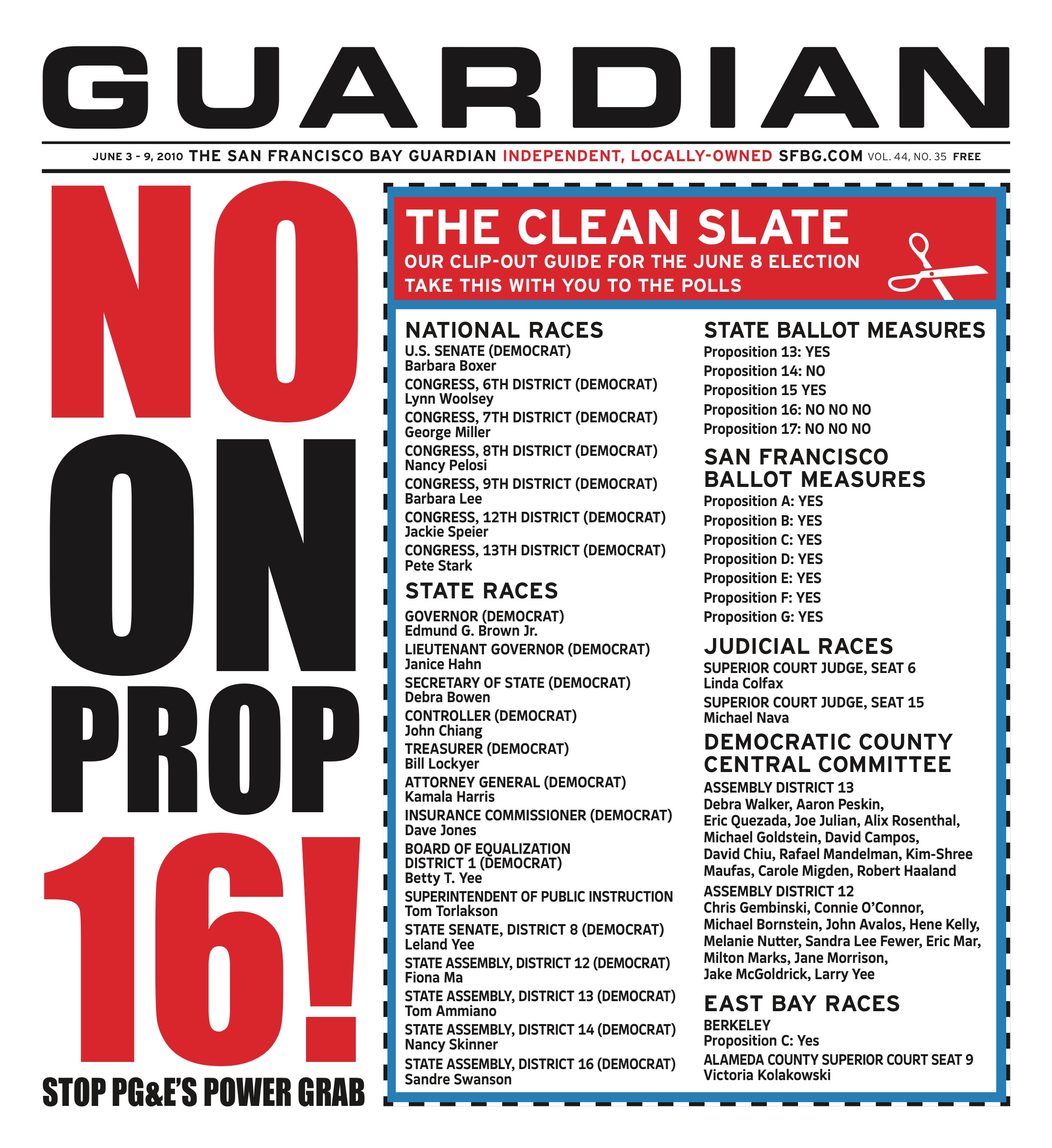
And in San Francisco, where there are no races for mayor or supervisor, it’s easy to want to sit this one out — but that would be a major mistake. The election for Democratic County Central Commitee alone is worth a trip to the polling place, since the makeup of that body will have a significant impact on the fall supervisorial races.


So you have to vote, folks. Here’s our endorsements.


Newsom’s lousy economics

0

EDITORIAL Every major newspaper in California should have plastered the May 2010 report from the UC Berkeley Center for Labor Research across the front page. The headline: “Governor’s budget will destroy 331,000 jobs.”

It’s a stunning analysis. Ken Jacobs, who heads the center, and two associates used a sophisticated computer program to track exactly how the cuts would play out in the current California economy. If the governor’s proposals are adopted, the job losses would greatly exceed any new job creation, causing the unemployment rate in the state to rise by 1.8 percent.

On the other hand, the study shows, raising taxes on rich people and oil companies would save 244,000 jobs.

So if, as nearly every politician of every party in the state insists, the biggest policy goal in California today is job creation, Gov. Arnold Schwarzenegger is going about it entirely the wrong way.

The good news is that the Democrats in the state Legislature are finally talking seriously about an alternative budget plan that includes about $5 billion in new revenue. The plans by the Assembly and Senate leadership aren’t perfect and will still require significant cuts to cover the budget gap. But after years of cuts-only budgets and a pervasive fear of tax increases in Sacramento, the Democratic proposals are encouraging. (Jerry Brown, the Democratic candidate for governor, shouldn’t worry about associating himself with the plans: two-thirds of Californians favor increased taxes on wealthy people to pay for better public education, according to the most recent Public Policy Institute of California poll.)

So at the very least, the state Capitol — a place not known as a bastion of progressive thought — is going to have an intelligent debate over how to address the budget deficit without further damaging the economy. Yet in San Francisco, Mayor Gavin Newsom continues to cling to a no-new-taxes budget that will devastate community services — and add to the city’s unemployment rate.

That’s just disgraceful.

Every city-employee union has stepped up to the plate and offered concessions. City workers are taking furloughs (actually, pay cuts) and layoffs. They’re giving back scheduled raises. They’re making a good faith effort to be part of the solution — in fact, labor is now pushing for an increase in the hotel tax to help cover the costs of public services.

Newsom isn’t asking any of the wealthy businesses or individuals in town to give anything.

That’s not just bad politics, it’s bad economics.

The Berkeley study acknowledges that raising taxes on the rich and big corporations has an economic impact — an oil severance tax, for example, would raise $1.4 billion a year for the state, reduce economic output by $128 million, and lead to the loss of 400 jobs. A 1.5 percent increase in the top income tax rate for individuals who earn more than $250,000 would bring the state $2.1 billion, and lead to the loss of 13,000 jobs.

But on balance, both of those are a good deal for the state — because cutting that $3.5 billion from the budget would cost the state far, far more than 13,400 jobs. That’s because when you eliminate public sector jobs, particularly lower-paid jobs, there’s a direct, immediate impact on consumer spending. Although a rich person may spend slightly less if he or she has to pay slightly higher taxes, a middle-income worker who gets laid off stops spending much of anything — and the local merchants who relied on that person’s spending see the impact.

In fact, the Berkeley study points out, more than half the jobs that would be lost under Schwarzenegger’s plan would be in the private sector. The same goes for San Francisco: saving jobs requires new revenue solutions. And if Newsom’s budget doesn’t address that, the San Francisco supervisors must.

Newsom’s lousy economics

0

EDITORIAL Every major newspaper in California should have plastered the May 2010 report from the UC Berkeley Center for Labor Research across the front page. The headline: “Governor’s budget will destroy 331,000 jobs.”

It’s a stunning analysis. Ken Jacobs, who heads the center, and two associates used a sophisticated computer program to track exactly how the cuts would play out in the current California economy. If the governor’s proposals are adopted, the job losses would greatly exceed any new job creation, causing the unemployment rate in the state to rise by 1.8 percent.

On the other hand, the study shows, raising taxes on rich people and oil companies would save 244,000 jobs.

So if, as nearly every politician of every party in the state insists, the biggest policy goal in California today is job creation, Gov. Arnold Schwarzenegger is going about it entirely the wrong way.

The good news is that the Democrats in the state Legislature are finally talking seriously about an alternative budget plan that includes about $5 billion in new revenue. The plans by the Assembly and Senate leadership aren’t perfect and will still require significant cuts to cover the budget gap. But after years of cuts-only budgets and a pervasive fear of tax increases in Sacramento, the Democratic proposals are encouraging. (Jerry Brown, the Democratic candidate for governor, shouldn’t worry about associating himself with the plans: two-thirds of Californians favor increased taxes on wealthy people to pay for better public education, according to the most recent Public Policy Institute of California poll.)

So at the very least, the state Capitol — a place not known as a bastion of progressive thought — is going to have an intelligent debate over how to address the budget deficit without further damaging the economy. Yet in San Francisco, Mayor Gavin Newsom continues to cling to a no-new-taxes budget that will devastate community services — and add to the city’s unemployment rate.

That’s just disgraceful.

Every city-employee union has stepped up to the plate and offered concessions. City workers are taking furloughs (actually, pay cuts) and layoffs. They’re giving back scheduled raises. They’re making a good faith effort to be part of the solution — in fact, labor is now pushing for an increase in the hotel tax to help cover the costs of public services.

Newsom isn’t asking any of the wealthy businesses or individuals in town to give anything.

That’s not just bad politics, it’s bad economics.

The Berkeley study acknowledges that raising taxes on the rich and big corporations has an economic impact — an oil severance tax, for example, would raise $1.4 billion a year for the state, reduce economic output by $128 million, and lead to the loss of 400 jobs. A 1.5 percent increase in the top income tax rate for individuals who earn more than $250,000 would bring the state $2.1 billion, and lead to the loss of 13,000 jobs.

But on balance, both of those are a good deal for the state — because cutting that $3.5 billion from the budget would cost the state far, far more than 13,400 jobs. That’s because when you eliminate public sector jobs, particularly lower-paid jobs, there’s a direct, immediate impact on consumer spending. Although a rich person may spend slightly less if he or she has to pay slightly higher taxes, a middle-income worker who gets laid off stops spending much of anything — and the local merchants who relied on that person’s spending see the impact.

In fact, the Berkeley study points out, more than half the jobs that would be lost under Schwarzenegger’s plan would be in the private sector. The same goes for San Francisco: saving jobs requires new revenue solutions. And if Newsom’s budget doesn’t address that, the San Francisco supervisors must.


Is Secure Communities opt-out still an option?

5

Immigrant rights attorney Francisco Ugarte, who works for SFILEN,  just talked to me about why it’s critical that folks raise their concerns about immigrant rights with their elected officials in the face of Secure Communities, a program ICE is planning to bring to San Francisco June 1, and to all U.S. jails by 2013, without the openness and transparency that we have come to expect under the Obama administration.

“There’s a rise in xenophobia and the economy is going down, so this is the time when people should be speaking up for immigrants,” Ugarte said. “ICE is among the least transparent governmental agency in the U.S. It’s hard enough for lawyers to get information about their clients, let alone a member of the public who is trying to get information about an ICE program like Secure Communities.”

Ugarte notes that ICE’s own MOA (Memorandum of Agreement) with individual states prohibits them from providing information about Secure Communities to the media, without first getting the consent of ICE.

“ICE needs to be asked, whose confidentiality are you protecting, your own, or that of the members of the public that are being detained under this program?” Ugarte said.

He believes ICE is being so secretive because it doesn’t want to tell the stories of deportations and trauma that have created in the local community.

I asked Ugarte if he’d support the idea of a national I.D. card, based on the premise that if ICE is going to fingerprint and I.D. everyone anyways, then why not parlay this into giving folks who aren’t found guilty of a felony some kind of I.D. Card as a first step towards amnesty? (Provided folks aren’t found guilty of a felon, in which case ICE would deport them.)

“I’m not sure if we can support a national I.D. card,” Ugarte said. ‘The point is that ICE is intent on removing folks who they deem ‘dangerous,’ but they are not offering any relief for the millions of people who work hard and pay taxes yet remain second-class citizens. We need some kind of commensurate relief.”

Ugarte worries that a national I.D. card program would allow the federal government to become an even bigger Big Brother.
“But it’s crystal clear that there has to be some relief provided for the millions who have worked hard and contributed to their communities,” Ugarte said.

He noted that ICE deported 400,000 folks last year alone.
‘That’s more folks than in any of the Bush administration’s years,” he said. “This is affecting us directly. We did not elect Obama to destroy our community.”

Ugarte said that he doesn’t believe that Obama is controlling ICE, but that he should start doing so now.
“Obama needs to assert more control. He has the power through executive order to stop the deportation of people who have U.S. citizens in their families. He has the power to reform the system to prevent the destruction of people who live here. Right now, we’re seeing enforcement only, and it’s creating a human rights crisis.”

And Ugarte has not given up on the notion that San Francisco can opt out of Secure Communities, no matter what AG (and gubernatorial candidate) Jerry Brown says.

“Right now, it appears that the Department of Justice is resisting the opt-out idea from San Francisco, but the Attorney General did not cite any legal authority in his letter,” Ugarte observed. “All he said was based on policy reasons, in contrast to San Francisco Sheriff Mike Hennessey’s concerns, which were based on the impact of the program on public safety.”

Summing up Jerry Brown’s missive as a “political letter,” Ugarte says folks need to double their efforts to ensure that folks in Sacramento understand the implications of local police-ICE collaborations and their similarities to Arizona’s immigration law.

“We need to ensure that our voices are heard. Three people in D. C. and three people in Sacramento should not be dictating policy for millions.”

Immigration update: good news, bad news

7

Yesterday, the Board of Supervisors unanimously appointed tireless immigrant rights advocate Angela Chan to the San Francisco Police Commission.
That’s the good news.
The bad news? Attorney General and gubernatorial candidate Jerry Brown declined San Francisco Sheriff Mike Hennessey request to allow San Francisco to opt out of Secure Communities, ICE’s latest federal-local law enforcement collaboration.
“I think this program serves both public safety and the interests of justice,” Brown said. “ICE’s program advances an important law enforcement function by identifying those individuals who are in the country illegally and who have a history of serious crimes or who have previously been deported.”
“ Before the inception of Secure Communities allowing fingerprint identification, if a county suspected an arrestee was in the country illegally, the county submitted the person’s name to ICE for a background check,” Brown stated.

What Brown’s letter didn’t say was that, up until now in San Francisco, the county only submitted folks’ names to ICE if they were charged with a felony. Nor did he address why the federal government is sneaking around, switching this program on, without openly and transparently announcing their intentions to the local community.

Eileen Hirst, spokesperson for the San Francisco Sheriff’s Office said that, as a result of Brown’s letter, “As far as we know, San Francisco will be a part of Secure Communities as of June 1.”
In a statement, Sheriff Hennessey said, “I am disappointed with the Attorney General’s position and continue to be concerned that U.S. citizens and minor offenders will be caught up in the broad net of Secure Communities, and I will be studying the issue further to see how this program can be applied as fairly as possible and in the spirit of the sanctuary ordinance.”

So far, ICE’s data reveals the number of folks caught up in the Secure Communities net, plus a brief breakdown of the deportees’ level of crime.

It would be helpful, as several immigrants rights groups have suggested, if ICE revealed the nationality of these deportees, clarified if these folks were convicted of crimes or simply charged with them, and had to make frequent reports to Congress in which they included this data along with evidence that the program actually deports convicted criminals rather than folks simply arrested. Otherwise, the program could potentially be abused by renegades who realize that all you have to do to get someone deported is arrest them on trumped up charges

Anyways, you can read the rest of AG Brown’s letter below. My favorite line from Brown’s letter is, “Many of the people booked in local jails end up in state prison or go on to commit crimes in other counties or states.”  

Hmm. Does that mean that folks charged with crimes in this state are presumed guilty then, until proven otherwise? Or is that just the presumption about immigrants?


AG Brown’s letter:
“Dear Sheriff Hennessey:

I am writing in response to your letter regarding the Secure Communities program developed by U.S. Immigration and Customs Enforcement (ICE). The program is scheduled to be rolled out in San Francisco next month. You requested that the California Department of Justice (DOJ) block ICE from running checks on the fingerprints collected in San Francisco. The Secure Communities program is up and running in 169 counties in 20 states, including 17 counties in California. Because I think this program serves both public safety and the interest of justice, I am declining your request.

The DOJ Bureau of Criminal Identification and Investigative Services is the entity designated by California law to maintain a database of fingerprints used in the state for law enforcement purposes. When someone is arrested, the county forwards the fingerprints to the DOJ to identify the person, determine his or her criminal history and to discover any outstanding warrants. As in every other state, the DOJ forwards those fingerprints to the FBI to check for a history of criminal activity outside of the state. Under the Secure Communities program, the FBI forwards fingerprints collected at arrest to ICE. If ICE finds a match to prints in its database, ICE notifies the county. ICE’s stated intent and practice is to place holds on those individuals who are in the country illegally and who have a history of serious crimes or who have been previously deported.

Prior to the Secure Communities program, the name, but not the fingerprint, provided by an individual on arrest was run through ICE’s database of people known by ICE to be in the country illegally. Often, individuals with a criminal history were released before their immigration status was discovered. Using fingerprints is faster, race neutral and results in accurate information and identification.

In these matters, statewide uniformity makes sense. This is not simply a local issue. Many of the people booked in local jails end up in state prison or go on to commit crimes in other counties or states.

I appreciate your concern. But I believe that working with the federal government in this matter advances important and legitimate law enforcement objectives.

Sincerely,

EDMUND G. BROWN JR.
Attorney General.”

Insecure Sanctuary

9

Sarah@sfbg.com

The Board of Supervisors is urging San Francisco officials not to participate in Secure Communities, a controversial federal-local fingerprinting collaboration set to be activated June 1. But opting out of a program that threatens to make debates over “sanctuary city” protections of immigrants irrelevant may not be easy.

Speaking at a May 18 rally, Sup. Eric Mar warned that the use of Secure Communities by U.S. Immigration and Customs Enforcement (ICE) could cause the deportation of innocent residents and destroy local community policing efforts. “The police-ICE entanglement will hurt our communities and many people accused of minor crimes will see families torn apart,” Mar warned, as he urged the city to opt out of the Department of Homeland Security initiative, which identifies immigrants who are sitting in U.S. jails and may be deportable under federal immigration laws.

Cosponsored by Sups. John Avalos, David Campos, David Chiu, Chris Daly, Bevan Dufty, Sophie Maxwell, and Ross Mirkarimi, Mar’s resolution was scheduled for a May 25 vote that would make San Francisco the first jurisdiction in the nation to pursue withdrawing from the system.

“The shadow of Arizona is starting to cover other cities,” Mar said, referring to Arizona’s anti-immigrant legislation, SB 1070. “We can’t let Arizona come to San Francisco.”

ICE spokesperson Virginia Kice said the program’s focus is on criminal aliens. “These are folks who have been charged with or found guilty of felonies and have ignored deportation orders,” Kice said.

But ICE statistics show that the program mostly deports those with minor offenses. Between October 2008 and March 2010, Secure Communities submitted 1.9 million sets of digital fingerprints and deported 33,326 people nationwide. Fifteen percent of those deported (4,903 people) had criminal histories that included major drug and violent offenses such as murder, manslaughter, rape, robbery, and kidnapping (Level 1 crimes). The other 85 percent (28,423 people) were deported for less serious drug and property offenses (Level 2 crimes) and other minor charges (Level 3 crimes).

Kice admits that Level 2 and 3 offenders constitute the largest percentage of SC cases. “That’s because representatively more people are arrested for Level 2 and 3 offenses than Level 1,” she said. “That’s probably fortunate, because Level 1 crimes are very serious.”

But American Civil Liberties Union legislative counsel Joanne Lin warns that Secure Communities allows the federal government to circumvent local sanctuary policies and fast-track deportation. “It allows the Department of Homeland Security to identifty everyone who is booked, whether they are here lawfully or their charges are subsequently dropped or dismissed,” Lin said.

Mayor Gavin Newsom said he has no reservations about the program, which the Bush administration first announced in March 2008. “Sanctuary city policies were never meant to protect criminal behavior,” mayoral spokesperson Tony Winnicker said May 7, when San Francisco Sheriff Mike Hennessey blew the whistle on the federal-local fingerprinting collaboration. “At the end of the day, federal officials should enforce immigration laws. We report — we don’t deport.”

The program links local law enforcement databases to the Department of Homeland Security’s biometric system through interoperability agreements with states, allowing instantaneous information-sharing among local jails, ICE, and the FBI.

ICE implemented the program in North Carolina and Texas in October 2008. Under President Obama, the program has been activated in 169 jurisdictions in 20 states. ICE plans to have a Secure Communities presence in each state by 2011, and in each of the 3,100 state and local jails nationwide by 2013, according to its Web site.

Under the program, participating jails submit fingerprints of arrestees to immigration and criminal databases, thereby giving ICE a technological presence in prisons and jails. An overview conducted by the Washington, D.C.-based nonpartisan National Immigration Law Center observes that “the critical element” of the program is that, during booking in jail, arrestees’ fingerprints will be checked against DHS databases, rather than just against FBI criminal databases.

“ICE asserts that the purpose of the Secure Communities program is to target violent criminals for removal,” NILC observed. “Advocates had criticized the program’s operation because it took place at the beginning of the criminal process and therefore indiscriminately targeted persons arrested for crimes of all magnitudes, rather than persons convicted of serious crimes.”

“The underlying purpose may be to lay the groundwork for real immigration reform,” NILC concludes. “But the mechanisms put in place will be difficult to dismantle, and the civil rights violations they produce cannot be undone.”

Scott Lorigan of the California Department of Justice’s Bureau of Criminal Identification and Information signed an interoperability agreement with ICE’s John P. Torres in April 2009. Since then, the system has been activated in Alameda, Contra Costa, Fresno, Imperial, Los Angeles, Monterey, Orange, Sacramento, San Bernardino, San Diego, San Joaquin, San Luis Obispo, Santa Barbara, Solano, Sonoma, Stanislaus, and Ventura counties. Now it’s set to get switched on in San Francisco.

Campos thanks Hennessey for blowing the whistle, and lays the blame at Obama’s door. “None of us would have known this was happening,” Campos said. “This is the time for all San Francisco’s elected officials to stand up in support of the principles that led us to establish a sanctuary city. It’s not just the board, but also the mayor who needs to step up and say what just happened is not acceptable. This program eviscerates sanctuary city.”

Hennessey has written to California Attorney General Jerry Brown asking for assistance in opting out of the ICE program. Brown’s office is reviewing his request. “The California Department of Justice manages the statewide database of fingerprints that are essential to solving crimes, but we have no direct role in enforcing federal immigration laws,” Brown’s press secretary Christine Gasparac clarified. “We were informed by ICE that they will work with counties to opt out of their program. Because that is a process directly between the county and ICE, we’re advising local authorities who want to opt out to contact ICE directly.”

But it’s not clear what opting out will achieve. ICE’s Kice said jurisdictions can choose not to receive the immigration-related information on individuals who are fingerprinted, but that information will still be provided to ICE, which can act on it. Kice said that after an arrestee’s biometrics are forwarded to the feds, the information is bounced off FBI and DHS databases, and the information that comes back says if they have a record.

“What comes out is a recap of whatever relevant information is in the database,” she said. “For example, whether there has been a prior formal deportation or a prior arrest. It also shows if they have an adjusted status — whether they have legal permanent status. It will indicate if they are naturalized, in which case they are not subject to removal. That’s the information the community could cut off.”

“ICE always did these checks, but it was only available to local law enforcement agencies if they queried the system themselves, which required them to take a couple of extra steps,” Kice continued. “And it was name based. And that could be problematic, given duplicate names in system. That’s what fingerprints eliminate. Our concern is that municipalities are dependent to a large extent on information provided by the individual at the moment of arrest. We think the use of biometrics will ensure that folks who provide false information to local law enforcement officials don’t escape detection.”

Kice acknowledged that not everyone in the database is a violator. “The fact of having a record does not mean that you are a deportable alien,” she said. “And we understand that someone may get arrested and may not get convicted on their current charges. But what about a prior history? We know that folks have eluded detection, escaped, or been released from custody. So the individual may be someone who has other prior convictions. It’s the totality of their record that we are talking about here.”

At present, the San Francisco County Sheriff’s Department only reports noncitizens who are booked on felony charges. Hennessey expressed concerns about the unintended consequences of ICE technology interfacing with that of the Department of Justice’s fingerprint database.

He also warned that the 2,000 or so ICE referrals his office makes annually could explode. “We’ll be fingerprinting 35,000-40,000 persons annually,” Hennessey claimed. “And ICE has a record of secrecy. They won’t tell me what happened to folks they pick up. They won’t say if they are still in custody, been released or deported. The basis of sanctuary city is to protect immigrants who are not doing anything wrong or serious. When ICE grabs someone who failed to pay a traffic ticket and that person is supporting a family, I don’t think those crimes should rise to the level of deportation.”

Editor’s Notes

1

Tredmond@sfbg.com

Even the San Francisco Chronicle, which is not know for its fiery progressive editorials, took all of the major candidates for governor to task May 22 for failing to offer any real solutions to the horrific budget problem: “[A]ll three are presenting the types of phantom savings (‘Let’s slash waste, fraud, and abuse! Cut across the board!’) and the panacea of collaboration (‘Everyone to the table! Appoint a blue-ribbon commission!’) that substitute for real leadership on the campaign trail.”

It makes me want to throw up. This is not a game; there are literally people’s lives in the balance. Even Jerry Brown, the Democrat’s best hope, is ducking madly. Jerry says that the folks “with the biggest belts should tighten them.” Sounds good, but what the hell does it mean?

Well, according to his press spokesman, it means nothing at all. I called the Brown for Governor campaign last week, and asked Sterling Clifford, who handles press for Jerry (that’s got to be a tough job) whether his boss was talking about higher taxes. No: “I think he has been very clear that there will be no new taxes unless the people vote on them.” (Actually, since the Public Policy Institute says two-thirds of Californians would support raising taxes on the rich to pay for education, a vote would likely be positive — but the campaign would be expensive and Brown would have to lead it.)

But he’s not willing to commit to any specific cuts in any specific programs. He’s not saying which belts he wants to tighten.

Here’s the hard, cold fact: You can’t solve California’s budget crisis by cuts alone, not unless you want to utterly abandon the state’s commitment to public education and social services (oh, and let about half the people in prison go free). Meg Whitman wants to lay off thousands of state workers (and create more unemployment). But even if you fired every single one of the 238,575 people who work for the state of California, you still wouldn’t cover a $19 billion hole. (The state’s total payroll in April was about $1.4 billion, or $17 billion a year.)

And we’re still stuck with billions in debt from the past few years when the governor couldn’t deal with reality and bumped it off into the future.

Maybe Brown thinks the economy will magically improve when he takes office, and the problem will solve itself. But it won’t. This is a structural issue, and until everyone, including the news media, accepts that, we’re just going to get into deeper and deeper doo-doo.

And it was over before it really began

1

MoveOn.org co-founder Peter Schurman has dropped out of the governor’s race. What, you didn’t know Schurman was in the governor’s race? Well, you aren’t alone, but it is true that he was seeking the Democratic nomination, jumping into the race in March “in response to a widespread call for a stronger, more issues-based campaign than Jerry Brown was running at the time,” he wrote today in his withdrawal announcement.

I was among those at the time pointing out that Brown wasn’t exactly bringing his A-game, but Brown was still a lock for the nomination and Schurman never really did get much attention or run a very strong campaign. Yet he says that his work here is done, so he’s getting out and endorsing Brown: “Jerry Brown has begun to do what it will take to win: speaking up on issue [sic] like green jobs, reaching out to voters, and confronting the Republicans on their ties to Wall Street.  At the same time, the Republicans in this race are tearing each other apart.”

And speaking of work, Schurman closes his announcement with an appeal for some: “Of course, this means I’m looking for regular work again.  Please let me know if you hear of anything.”