

Another candidate for judge, another interview, another sound file for your listening pleasure. This is incumbent Judge Richard Ulmer, who is facing two challengers, Michael Nava and Dan Dean.
Judge Ulmert by Endorse2010

Another candidate for judge, another interview, another sound file for your listening pleasure. This is incumbent Judge Richard Ulmer, who is facing two challengers, Michael Nava and Dan Dean.

By Christopher D. Cook
In a mixed ruling this morning (April 9), a nine-member U.S. District Court jury awarded $1.5 million to the Service Employees International Union in its ongoing campaign to stymie a rival union created by former SEIU staffers, in a mixed ruling that’s unlikely to resolve the unions’ protracted battle over members and leadership in the labor movement.
Coming after a tense and bruising two-week trial and several days of jury deliberations, the verdict includes a $724,000 penalty against the insurgent National Union of Healthcare Workers, led by Sal Rosselli, former long-time president of SEIU’s United Healthcare Workers West (UHW). Rosselli and 15 of his NUHW colleagues were also hit with smaller penalties ranging from $30,000 to $74,000.
The SEIU lawsuit originally sought $25 million in damages for an array of allegations that its former staffers, who launched NUHW a day after the local was put in trusteeship, had stolen union funds and used SEIU resources and staff time to build their rival organization.
In the process of litigating the case, SEIU deployed four law firms at an expense of $5 million, according to SEIU-UHW communications director Steve Trossman (NUHW’s attorneys estimate the figure at closer to $10 million)—so if the award is upheld, SEIU stands to lose at least $3.5 million on the case.
“It’s absolutely worth it,” said Michelle Ringuette, SEIU’s strategic affairs director. “There’s no price tag on justice.” She called the verdict “an enormous slam-dunk victory for SEIU members, who wanted to hold [NUHW] accountable…they are exhilarated today.”
But in an interview a few hours after the verdict, Rosselli said he and NUHW are undaunted by the ruling. “Their goal was to destroy NUHW, and they failed,” he said. “They wanted us to walk away from NUHW, that’s what this is all about…This will go on for more than a year before they can try to see a dime” of NUHW money, Rosselli added, noting NUHW’s attorneys will ask Judge William Alsup to set aside the verdict, and if he doesn’t they’ll press on to the U.S. Court of Appeals.
According to Rosselli, SEIU “said I was in jail, they said that I stole $3 million, and it hasn’t resonated…This has the potential to backfire on them—what we got dinged for is fighting the trusteeship, fighting for democracy, and fighting for a voice.”
Meanwhile, on the ground, where the two unions are locked in a tough fight for members, a different verdict is playing out. In nine hospital elections over the past year, NUHW has won seven, mostly by resounding margins. The new union has won elections for more than 3,000 workers so far, while more than 100,000 have signed petitions requesting NUHW representation. The biggest organizing prize is Kaiser, where 50,000 workers will decide which union they want in an election this June. “Once we win the Kaiser election, it’s going to be all over for SEIU healthcare,” Roselli said.
Rosselli said there are 100 union elections pending, and SEIU has moved to block all but 30 elections at nursing homes where staff turnover has been nearly 100 percent in the past year. “The only reason they’re blocking is because they think they’re going to lose,” he said.
As the ruling came down, prominent California leaders such as United Farm Workers co-founder Dolores Huerta and former California State Senate pro tem John Burton issued statements supporting NUHW. “Tens of thousands of healthcare workers are organizing with NUHW for a real voice at work and a democratic voice in their union, and that will continue in spite of this verdict,” Huerta said. “These reformers stood up for workers’ right to vote when SEIU tried to take it away, and that’s the only thing they’re guilty of.”
The answer is yes, yes it will be. And how did the madness begin? “I was in the neighborhood and I saw this wall. And me being me, I got really excited and wanted to paint it.” And so it started, Brian Barneclo’s latest SOMA mural project, whose launch will be celebrated alongside “Systematics,” his solo (indoor art) show at fabric8 on Sat/10.
See a wall, paint it; It’s a common enough story in SF — until you look at one small variable; Barneclo’s wall is 600 feet long and 40 feet tall. And he intends to cover the whole thing. That’s 24,000 square feet, making Barneclo’s “Systems” the largest mural yet in a town filled with them. “That was recently pointed out to me,” he told me in a recent interview. “It’s an interesting thing because, yeah, its going to be helpful [for fundraising], people like to hear that stuff, ‘it’s the loudest, it’s the biggest.’ But it really has no… [the size] is such a byproduct.”
Barneclo’s known for his ambitious projects. The artist — in whose aesthetic fabric8 gallery owner and long time associate, Olivia Ongpin, detects traces of both the Mission school and the Bay area figurative movement from the ’50s and ’60s — has installed large scale pieces all over town, from Nopa, to the inner Mission, even on the side of our humble Guardian building. His most well known works are urban cultural/architectural jumbles, representational maps of the iconic streetlamps, restaurants, and skylines that we call our city. “Systems” will be a reflection of Barneclo’s recent meditations on interconnectivity; in our society, our city, and in our own bodies.

A mock up of “Systems,” slated to be completed by June
It’s easy to see why this particular wall caught the muralist’s eye. The 7th St. and Townsend building, owned by Crescent Cove Apartments, plays a visible role in the neighborhood. Barncelo’s wall can be seen from both I-80 commuters and Caltrain passengers, the train tracks passing at the wall’s base. Barneclo thinks it’s high time such a prominent canvass was utilized for art. “I think when we’re done, people will be like, ‘I can’t imagine that without a mural.”
But the mural’s not done yet. There’s the matter of funding, though Barneclo has already secured a $10,000 grant from Adobe and thinks “people are inclined to get behind the project once they see some action happening.” Barneclo has already put in nearly two years of permission getting and permit securing into the project, along with partner Christi Azevedo. And of course, there’s still a whole lot of wall to be painted.
But that will be the easy part. Barneclo completed “Food Chain,” his 200 by 25 foot mural on Shotwell between 14th and 15th Street in ten days, with only one helper. His goal is to maintain that same pace for “Systems,” completing the mega mural in one month with a team of three helpers. Barneclo doesn’t sound too stressed about the task ahead. “I’ll sleep when I’m dead. If I have a chance to take a month and paint one big mural, what more can I ask for? I mean, my girlfriend probably won’t like it, it’s probably going to be all I’m talking about and thinking about.”
Will he make it? Ongpin thinks so. “This might seem like a daunting prospect,” she said. “But if you look at the scope, and amount of murals he’s done around the city for the past six or seven years, I’m sure he can do it and do it well.”
So get ready, San Francisco, because “Systems” is set to be one of the first things some commuters see when they hit SOMA. “It’s almost a welcome to SF to people who are riding the train,” Barneclo imagines. “Or a farewell. Its like a port. Treat it like a “Boom! Welcome to San Francisco.”
Brian Barneclo‘s “Systems” Mural launch party/ “Systemics” exhibition
Sat/10 5-9 p.m., free
Fabric8 Gallery
3318 22nd St., SF
(415) 647-5888
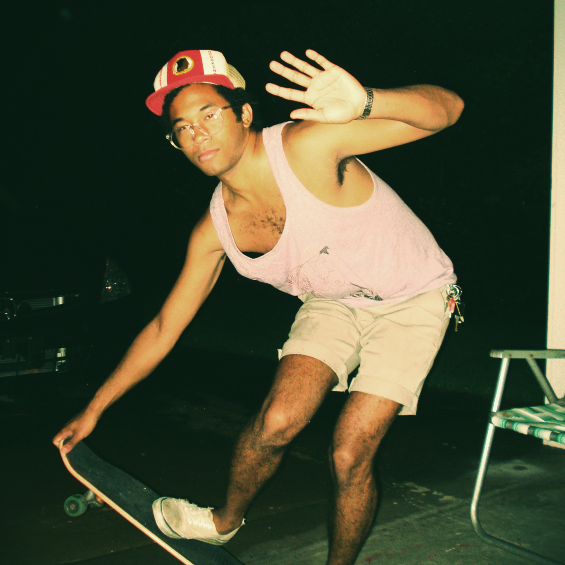
When you come out of the womb and your mama names you Chaz, life is going to be pretty cool. Mr. Chazwick Bundick is a child of the south, who from the sound of his uber laid-back synth melodies, must have grown up poolside, full pitcher of sweet tea attached at the hip. The electro-musician goes by the moniker Toro y Moi— playing Mon/12 at Bottom of the Hill– and fully embodies the chillwave scene at its core, with layer upon layer of ambient wonder. And of course, Chaz is way chill.
Growing up in Columbia, South Carolina, Bundick layed low and created music in his bedroom as a young guy, taking inspiration from his parent’s luscious vinyl collection. Electronic and experimental elements of late ’70s new wave combined with his favorite artists, Animal Collective, Sonic Youth, J Dilla, Flying Lotus, and Daft Punk, for an antiqued space sound.He likes to think of himself as a composer, as opposed to a songwriter, producing complex layers of buried bass, fairytale melodies, surf guitars, and bewitching vocals.
His latest LP, Causers of This [Carpark, 2010] was released in February and is a total treasure box; a more electronic take on the usual beach soundtrack. Toro y Moi’s whimsical songs sound like they’re floating 10,000 leagues under the sea; cool, calm, and unaffected by gravity. Funny, because I soon find out that the guy doesn’t like water.
Talking to Bundick over the phone was interesting– his mellow, musical stylings are a definite reflection of the 23-year-old’s unhurried, aloof temperament. Setting up the stage for a Philadelphia performance that evening, Bundick causally answered a few questions about life as a Southern Chaz and avoiding the sharks that loom.
SFBG: I read in a previous interview that if you could be any animal, it would be a dog or a shark. So, what kind of canine?
Bundick: I like French Bulldogs, black Pugs, mutts, Jack Russell Terriers and wieners.
SFBG: And what about sharks– I hear they freak you out.
Bundick: Well, I’m not a fan of jumping in the ocean. The water has to be clear, with light sand. I grew up going to a beach that had unclear water and I didn’t like going in– I like to see what’s in the water. I’m also afraid of sting rays. My friend stepped on one. And jellyfish.
SFBG: Funny, because your sound is so easily compared to ocean-characteristcs. Yet you’re not an ocean fan.
Bundick: If I had to choose between living in the mountains or the beach, I’d definitely choose the mountains.
SFBG: So what’s your music-writing process like? Do you dream of wooded slopes, crystal-clear streams and mountain lions?
Bundick: When I write songs I literally lock myself in my room. I won’t go out or talk to anyone. I go into songwriting mode.
SFBG: For how long? Like a day? A week?
Bundick: Weeks or months. I think the longest was two months of not talking to anyone– OK, well, not in a crazy person way. That would make for a cool story, but basically, people ask me to hang out and I say, no sorry. I mean, I see my parents and stuff.
SFBG: So what have you been listening to while on tour?
Bundick: Let me grab my iPod and see…lots of soul and funk. Some weird house music. Riz Ortolani, an Italian composer from the ’70s who wrote the music to the movie Cannibal Holocaust. They show animals being killed– it’s bad. It was banned in a lot of places. Oh, and no, I didn’t watch it. My friend did. He told me. I wouldn’t watch it.
SFBG: What have you been doing in between shows?
Bundick: Working on interviews. Drawing in my sketchbook.
SFBG: What do you like to draw?
Bundick: Numbers.
SFBG: Uh, what? That sounds boring. Explain.
Bundick: I like to draw numbers. Particularly the number two and the number five. Sometimes the number three. I’m not obsessed…I went to school for design, so I like the work with the shape and counter space, their arms and feet and different fonts.
SFBG: Wow, that actually makes sense. So what now?
Bundick: I feel kinda weird. I feel like I might be kinda sick. And so I drank a bunch of orange juice and now I’ve got that gross, too much orange juice feeling.
I didn’t have any orange juice today, but I think I understand the feeling. Maybe he should’ve added a little vodka?
Toro y Moi w/The Ruby Suns and dreamdate
Mon/12, 8:30pm, $10
Bottom of the Hill
1233 17th Street, SF

johnny@sfbg.com
MUSIC Sonny Smith is sitting at a window table at the Latin with a cap on his head and a small glass of red wine and some 7-inch single cover art by Stephanie Syjuco in front of him. I get a whiskey and sit down to talk about the matter at hand: art, music, mythologies, and “100 Records,” the gargantuan yet in some ways quite local show of sounds and images he’s putting together at Gallery 16. One man, 100 records — with help from dozens of artists, a number of musicians, a carpenter, and an electrician, Smith not only has created a number of 45s by fictional musicians and bands, he’s built a jukebox to play them.
The due date for Smith’s mammoth creation is a week away, and he’s in the final stages of assembling it. “I’ve been struggling to write down all the bios,” he says, as we talk about some of his imaginary recording acts, which range from New Orleans drag queens to Utah nature lovers. “They’re not Wikipedia-esque, but more like entries in a Rolling Stone Encyclopedia [of Rock & Roll]. At the beginning, I was swapping names and titles all the time — if a surf jam turned out to be a folk song, I could give it to another character. But now, with the last three [records], it has to be what it is.”
What is it? An open-ended project, not solo and self-enclosed in the manner of the Magnetic Fields’ 1998 69 Love Songs, where Stephin Merrit’s formulaic writing reached its apex. Instead, Smith is allowing “100 Records” to form itself as he assembles it. “I’ve only brushed up against the edges of it all becoming interwoven,” he explains over the post-work barroom din. “It’s almost as if I’d rather it not be — if you read the Harry Smith Anthology [of American Folk Music], or a biography of a musician, it’s enjoyable that there are so many loose ends.”
The visual artists contributing to “100 Records” — including William T. Wiley, Alicia McCarthy, Harrell Fletcher, Paul Wackers, and Mingering Mike (who knows a thing or two about creating folk musical figures) — have responded to Smith’s call for cover art in a variety of ways. “Alice Shaw was this character Carol Darger, and I was Jackie Feathers,” Smith says, to give one country-tinged example. “Their biography is that they’ve gotten married and been divorced twice. We took photos together for cover art. And Jackie Feathers also has solo records with art by different artists.”
When one thinks of Sonny Smith, band names don’t come to mind, though his latest endeavor Sonny and the Sunsets plays wittily off of his current San Francisco neighborhood. For years, Smith has put his plain name forward rather than come up with musical monikers. “100 Records” changed all that. “What’s weird is that I tried for years to come up with cool band names,” he says. “I’d come up with one and think, ‘That’s dumb.’ I’ve never had a knack for it. But because [the acts in “100 Records” are] fictional, it was easy to come up with band names — the names came left and right. A lot of the names that came to me I’d be happy to use as real band names. In fact, I’m trying to get a couple of the bands to become real bands.”
Indeed, one of the groups on “100 Records,” the Loud Fast Fools, will soon make the transition from fiction to the reality of today with a gig at the Knockout. Smith’s recording process for the project has been varied. He’s taken instrumental passages from obscure ’50s, ’60s, and ’80s songs, patched and lopped them with Guitar Hero, and put vocals on top. He’s recorded solo. He also knocked out dozens of songs with a multi-instrumentalist group of largely San Francisco musicians, some of whom he refers to by last name: Stoltz, Dwyer.
“There are a couple of balls-out, crazy ‘Louie Louie’-type numbers, and Spencer [Owen] played drums on those,” Smith says, describing the sessions. “It was some of the best drumming I’ve ever played with. He had these bizarre beats and fills. I thought, ‘This is so perfect — this is probably how a song like “Louie Louie” happened.'”
A spaghetti-narrative project like “100 Records” is a natural for Smith, a storyteller who has documented his life in comic book form and written plays. Later in the interview, with the Rolling Stones’ Tattoo You on the stereo at my apartment, he tells me that one of the first singles he bought was by Mick Jagger. “I didn’t buy it because I knew anything — the guy at the record store just told me to buy it,” he says. “It was a record store in Fairfax that was Van Morrison’s parents’ record store. He just bought the store and put his parents there to run it.” This anecdote then spirals into a funny one that a member of Morrison’s band told him about being stuck playing an endless version of “Domino” on a darkened arena concert stage while Morrison secretly caught a cab and a plane to L.A.
Smith has a keen eye for the mythologizing involved in music, and how a college radio DJ can build the guy down the street into a mysterious cult figure. Around the release of one album, his label pestered him to write a fake Pitchfork review, but he declined. “I’d be more into writing a fake Playboy interview,” he says. Ironically, Pitchfork has come calling of late, writing about Sonny and the Sunsets.
Internet career-makers come and go. For now, Smith is more concerned with opening night of “100 Records” and the debut of his own art contribution to the show, a customized jukebox. “It’s a hell of a thing, ” he says, after breaking down the differences between Wurlitzers and other brands, and explaining that a rat-infested jukebox buried under stacks at Adobe Books first inspired the idea. “My friend who is a master carpenter used this German ’50s jukebox as a reference. It’s almost like a joke — like making a stove from scratch. Why would someone do that? But someone did.” That someone is Smith, and he’s hosting a jukebox party this week.
SONNY SMITH: 100 RECORDS
With music by the Sandwitches and Sonny and the Sunsets
Fri/9, 6–9 p.m. (through May 14), free
Gallery 16
501 Third St., SF
(415) 626-7495
marke@sfbg.com
MUSIC “In a time when people are becoming more and more isolated every day by the Internet, alone at their computers and staring at the tiny, sad glowing screens in their cellular hands, it only makes sense to me that we are all feeling a slight sense of loneliness and (hopefully) the desire for connection with others … Whereas 1980s groups responded to implicit cold, colorless alienation of the repressive regimes of Reagan-Thatcher-era politics and culture, today’s groups I think express a similar frustration responding to what I call ‘the culture of isolation.'”
That’s Pieter Schoolwerth, founder of Wierd Records, a New York City label dedicated to releasing records by contemporary acts that eerily mimic the sounds of obscure electronic new wave, in a recent interview with Austrian music journal Skug. Oddly in the context of connection, he’s talking about some of the most deliberately cold, enigmatic, bleak yet beguiling music ever produced — “lost” underground European and American music that came out roughly between 1979 and 1986 (if it came out at all), was inspired by goth, industrial, and synthpop giants like Throbbing Gristle, Joy Division, Bauhaus, the Cure, and Depeche Mode, and is only being rediscovered now.
It’s igniting fierce interest, with musicological fanatics digging up spooky swaths of unknown angular gems and a slew of current bands channeling the sound. Originally made in decaying urban centers with then-newly-affordable analog synthesizers and drum machines by dozens of often untraceable musical mavericks — Ausgang Verboten, Esplendor Geometrico, Das Kabinette, Eleven Pond, Nine Circles, Zwischenfall, Gerry and the Holograms — these unearthed and unearthly tunes from decades ago are beginning to seep into the Bay Area scene via a handful of excellent compilations, club nights, and musical visionaries. Can something be retro if hardly anyone heard it the first time? That’s just one of the intriguing questions that springs to mind. Meanwhile, humans are dancing. Here’s a mix of some of the originals:
ANGULAR COLDWAVE LAUNCH MIX by Angular Recording Co
This bracingly unfamiliar music (or rather, slightly familiar — you think you’re hearing some bizarre 1981 B-side by Soft Cell or Visage but it turns out to be a crazy one-off from Columbus, Ohio from that same year) was usually grouped at the time into three fuzzy genres that overlapped at many points, sharing among them a DIY spirit, a dystopian view of the future, an urge to map the melodramatic onto the automatic, erotic astringency, and pretension without pretentiousness. Yes, much of it veers into “Sprockets” territory, but that’s actually part of the appeal.
Dark wave was an umbrella term for goth rock, early industrial, and darker synthpop. It grafted lamentation and cavernous basslines over post-punk’s angular angst and icebox oddity, and was popularized by groups like Fad Gadget, Front 242, and Chris and Cosey and at clubs like London’s seminal Batcave. Cold wave was the French version of dark wave that skewed toward more Pong-like synth figures, fizzling chords, studied malaise, and gnomic haiku. (“Business man/Yet you kill the boss/Computer programs/Shadows in the night,” Lyonnaise duo Deux disaffectedly intone on 1983’s unshakeable “Game and Performance.”) Synth wave, or minimal synth, was a kind of prickly disco: chromatic, sparsely produced, brooding and moody, yet often quite catchy and dance floor-oriented.
All three genres are now generally lumped together as “wave” (or sometimes “retrograde”), which can include a vast array of other period sounds, from John Zorn-like no-wave jazz explosions to Dead Can Dance spooky-tribal incantations. Basically, if it feels like you’re listening to a late-night college radio program somewhere in the Midwest in 1984, one possibly called “Flash Frequencies” or “Shadow Talk,” you’ve caught the uncanny wave gist. If you imagine yourself a fishnet-gloved extra in the movie Liquid Sky who pronounces “paradise” as “pah-rahd-eyes,” then you definitely have.

Dark wavers Brynna and Domini at Club Shutter. Photo by Sadie Mellerio
But just because the sound aimed for frigidity doesn’t mean it didn’t build community. Wave acts may have been what some would call “unbranded,” but they operated within close-knit networks: cassettes were passed hand-to-hand, recording studios were shared in warehouse-based artists’ communes, fans around the world braved dangerous parts of town to attend wave-centric club nights. The music itself attempted to humanize the arctic pitch of analog synths by infusing it with longing, restlessness, ennui, and gloom.
Vice Angular “This is Cold Wave” Mix
Today, that naive sincerity, refreshing lack of self-conscious irony, and marketplace virginity translate into authenticity, appealing to retro aficionados who vomit a tad at goth’s Hot Topicality, the macho posturing that torpedoed industrial, or the Polly Estherization of new wave. (Like techno, soul, and disco before it, new wave retro is finally purging itself of excess baggage and mainstream complications by going minimal and original.) Dusted-off waveforms and hyperactive web forums attract a network of virtual seekers and posters who salivate at each discovery. Schoolwerth may be right about wave’s cry against a culture of Internet isolation — and the turn toward analog is a specific rejection of the digital — but like an anxious clan gathered around a silicon-chip fire, its current fans watch anxiously online for freshly exhumed and re-chilled visions to appear. Then they go play them at clubs. Here is something old that seems truly new.
Wierd Records’ contemporary roster of disquieted simulators, including the almost paranormally attuned Xeno and Oaklander and Led er Est, has been gaining global club-play traction — something many of the original artists, who drifted off into other, often fascinatingly mundane lives, could only have hoped for. (One example: Lidia the Rose, one half of Dutch act Nine Circles, abandoned musicmaking in the early ’80s to raise “a half dozen” children in a commune-like setting. It was only after one of her sons Googled her name that she realized there were fans of her extremely limited, cassette-only output. She has since started making music again.) And wave affectations have garnered larger attention from the breakthrough of experimental synthpop band Cold Cave, which draws on the sound’s pallid idiosyncrasies. “Hear sounds about yesterday’s pain today,” the band’s MySpace deadpans.
Notable contemporary Bay Area wave acts include the excellently jerky Muscle Drum, founded by long-term wave-proponent Rob Spector of the group Bronze, fog-shrouded darkwave duo Sleeping Desiress, cinematic dirgers After Dark, and exquisitely anguished quintet Veil Veil Vanish. The East Bay’s Katabatik Sound System has been producing lurching experimental-industrial music and events for a while, and V. Vale’s Re/Search crew has been exhuming rare tunes forever. A particular favorite around the Bay Guardian office lately is the Soft Moon, a melancholic, pitch-perfectly crepuscular project of punk veteran and graphic designer Luis Vasquez.

The Soft Moon
“Honestly, being associated with the wave phenomenon was a little surprising to me at first,” Vasquez told me, balking, like many retro-contemporizers I talked to, at being associated with any kind of scene. “But I think I understand why. My instrumental formula is similar because of the use of drum machines, synthesizers, rhythmic bass lines, and somber melodies. It could also just be the overall feeling my music has. I’m still not quite sure.”
http://www.youtube.com/watch?v=Ufcfo9K1yfI
On the classic side of things, two just-released, high profile compilations — The Minimal Wave Tapes (Minimal Wave/Stones Throw) and Wierd-curated Cold Waves and Minimal Electronics Volume 1 (Angular) — along with recent German comp Genotypes (Genetic Records) have made underground synth rarities more accessible to potential wavers.
“I was exposed to new wave at a young age via my older brother’s small collection of cassettes,” NYC’s Veronica Vasicka of the Minimal Wave label wrote in an e-mail. “Later I’d sneak out of my parents’ apartment at night to go dancing in the East Village. I really associate those teenage days of first discovering record shops and old VHS tapes of bands like Throbbing Gristle with the inspiration that led me to launch the Minimal Wave label.”
Vasicka coined the term minimal wave to encompass her fascination with both cold wave and minimal synth sounds. Her long-running Sunday night East Village Radio show has served as a beacon for American synth fans, and the incredible response to her extensive Web site (www.minimal-wave.org) has established her as the point-person for the movement. She has her own theory about why the sound seems right:
“On one hand, I am surprised that minimal wave has been so easily welcomed in this day and age. But on the other, and when looking at things from an economic standpoint, there’s a distinct parallel between what was happening during the late 1970s and early ’80s and now. The weak economy that led to the recession peak in 1983 is similar to what has been happening during the past several years. And it seems that cultural and artistic output tend to be affected by economic and social struggle. So perhaps this context has provided the openness necessary to embrace minimal, DIY synthesizer music.”
I’ve just entered Sub Mission Gallery for underground queer punk party Sissy Fit. The energy is edgy. Clouds of smoke drift in from outside. Patrons in black sway on the dance floor and eye each other from the benches lining the bare walls. DJ Pickle Surprise, whose style ranges from hardcore blasts to camp classics, puts on a throbbing track by early ’80s Marseille synthers Martin Dupont and I’m instantly transported back to my shadowy youth, spent skulking around the checkerboard dance floors of downtown Detroit clubs Bookie’s, Todd’s, and Liedernacht. I whip an imaginary cigarette holder to my pursed lips, checking to make sure my phantom pillbox hat is properly tilted. He follows that up with a selection of wave tracks old and new, including Storüng, Oppenheimer Analysis, and 2VM, that transforms the joint into an electro-sepulchral time portal. The added twist to this nostalgia trip is mystery — the music ventures beyond the “‘remember the 80s party” canon and into some uncanny partial-recall state.

DJ Pickle Surprise
“I find I’m playing this sound more and more,” Pickle Surprise, a.k.a. Joe Krebs, told me. He got into wave after attending one of the parties Wierd has been throwing in Brooklyn since 2003. “It can call up visions of lasers and line-dancing robots, but after getting to know it more, there’s something less cold or android about it, more of a human touch. It’s analog. There’s something supernatural as well. Like Videodrome, where you’re up in the middle of the night and get pulled into something on television. Something haunting that recalibrates you.”
“Did the passions of the artists shape the way the technology was used, or did the technology shape the people using it? NERD!” DJ Nary Guman, a.k.a. Joe Polastri, teased over e-mail. Along with DJ Inquilab, a.k.a. Nihar Bhatt, he puts on the monthly wave-friendly Warm Leatherette. They started their own party early last year because they found their tastes didn’t quite fit in anywhere. “Once I started digging I found out just how vast the field was,” Bhatt added. “It’s exciting to have something that can be danceable, experimental, popular, and punk at the same time.”
Other San Francisco parties that have embraced the sound include the monthly Shutter (www.myspace.com/clubshutter) at Elbo Room, which packs in the kohled and the beautiful with hits from Sisters of Mercy and Fields of the Nephilim among rarer tracks. Local band Jonas Reinhardt’s Synth City, every last Thursday of the month at the Attic (www.jonasreinhardt.com) mixes a wave feel into atmospheric krautrock and new age rambles. And the Radioactivity happy hour at 222 Hyde (www.222hyde.com) celebrates “low-budget synths and Cold War dance parties.”
LE DECADENCE ELECTRONIQUE
The party most faithful to the retrograde spirit, however, is the energetically opaque Nachtmusik, put on by DJs Josh Cheon, Justin, and Omar. Chilly green lasers strobe live performers, wave-o-philes gather in corners to trade track knowledge, and open-minded dancers try out new-old moves to alien beats. (Surprisingly, this insular music sounds really good loud in a crowd.)

Josh Cheon of Dark Entries Records. Photo by Jon Rivera
If anyone’s the heart of the Bay wave scene, it’s Cheon. One of our most important amateur musicologists, he was integral to the disco revival of the ’00s, tracking down and conducting in-depth interviews with gay bathhouse-era survivors and then moving on to international wave. For him, the music summons youthful memories of dancing at NYC’s the Bank to Clan of Xymox, Q Lazzarus, Cetu Javu, Wolfshiem, Beborn Beton, and VNV Nation. “From the first notes of Ministry’s With Sympathy and Depeche Mode’s Speak and Spell, I’ve been a sucker for synths,” he told me, laughing.
Death Domain by darkentriesrecords
In 2009, Cheon started Dark Entries Records (www.darkentriesrecords.com) to release some of his finds, including Second Decay, Zwischenfall, Those Attractive Magnets, and upstate New York’s Eleven Pond, whose “Watching Trees” has become a wave anthem of sorts. (He found Eleven Pond through a comment one of the members posted on SF synth collector Goutroy’s A Viable Commercial blog, goutroy.blogspot.com.)
Staying true to the “DIY vinyl retrograde” spirit, Dark Entries releases come in hand-numbered batches of 500, and for the most part the digital rights are kept by the artists themselves. There are no CDs.
He shrugs off the possibility that there’s little left to discover. “It’s like gold mine after gold mine,” Cheon told me. “There’s just so much out there — even the artists themselves are surprised to be reminded of this time in their lives that they’d mostly forgotten. It’s actually really touching when they find out there’s an intense interest in what they did in their youth. They’re just amazed.”
Later this year he’ll be releasing a Bay Area Retrograde (BART) compilation, highlighting our own historical wave purveyors. “What many people forget is San Francisco’s rich synthpop and new wave history, with bands like Voice Farm, Tuxedomoon, the Units, and the Club Foot scene for starters. [Factrix, Minimal Man, and Los Microwaves are some others.] But that’s just scratching the surface. I mean, who knows what great tracks are waiting to be heard? And what amazing stories behind them.”
NACHTMUSIK
Wed/14 and second Wednesdays, 10 p.m., $3
The Knockout
3223 Mission, SF
WARM LEATHERETTE
Fri/16 and third Fridays, 9 p.m., free
Space Gallery
1141 Polk, SF
www.myspace.com/warmleatherettesf
THE SOFT MOON
Tue/20, 8 p.m., pay what you can
21 Grand
416 25th St., Oakl.

Dan Dean is one of two candidates challenging Superior Court Judge Richard Ulmer in the June primary election. You can listen to our editorial board interview with him here.

news@sfbg.com
If you wake up every morning and begin your day with a leisurely stroll to the park to spend time frolicking with your beloved pup and other pup friends, you’re blessed. But if your schedule isn’t so flexible — and you’ve got a little cash to spare — there’s an easy way to keep your BFF (best furry friend) exercised, socialized, trained, and happy.
Hundreds of dog walkers in this city are looking for your business. There are companies and independent walkers, playgroups and privates. Some pet sit, some don’t. Some even bathe your pooch if it happens to get too dirty while out on the town.
But there are also some operators who cram too many dogs into small vehicles, pay little attention to them while they run amok on public land, and don’t show much concern for your pet’s overall health. So it’s important to take some time finding someone who has a good reputation, a good rapport with your dog, and has a training philosophy you either share or would like to learn.
Start with your doggie’s temperament. If she thrives with other dogs, go playgroup. If not, one-on-one time is best. Endless energy and in need of a vigorous workout? Maybe a daily jogging session is required. Dogs who don’t get along with other dogs won’t be accepted by most dog walkers — although some specialize in behavior problems.
Next, pick a setting. It’s not always the case that off-leash park romps are the best option. If your pooch has anxiety in new places, say due to poor eyesight, maybe a neighborhood haunt is best. If she is limited by arthritis, a stroll close to home might be ideal.
Then go observe the dog walkers in action. Find someone whose energy fits your dog’s and start asking questions. Ask for references. Ask happy dog owners or your veterinarian’s office for recommendations.
Transparency, friendliness, and willingness to spend time answering your questions are good signs; nevertheless, the proof is in the meeting. Make sure you have an interview with all potential dog walkers. Most dogs get driven together to parks, so make sure the vehicle is safe, large, and cool enough.
Good dog walkers train their charges during their time with them. Great ones become extended family members. And remember: you’re trusting this person with the keys to your home. There’s no state or city licensing required, so make sure your dog walker is bonded and insured. Top-end dog walkers are often members of the Association of Pet Dog Trainers and have taken classes in animal behavior.
I recently spent an hour romping around in the Presidio with 10 ecstatic dogs and walker Andrew Frye. Frye is the newest partner of Who Let the Dogs Out (WLTDO). Lauren Goldboss, who started the company seven years ago after deciding she’d rather be outside with dogs than inside with bankers, calls Frye "the best dog walker in the city."
Frye takes out two playgroups a day, and Goldboss says people beg to be in his group. After 30 minutes of picking up the pups and getting to the park — favorites are Crissy Field, the Presidio, Bernal Heights, and McClaren Park — he runs around with the dogs playing ball and teaching them tricks. He taught Birdie the cattle dog to weave in and out of his legs as he walks.
Frye loves his job and is great at training the pups to behave while showing them a fabulous time. He has no formal education in dog training, but reads extensively about classical conditioning and spends his free time talking to other people and dog walkers about tips for making the animals learn and behave.
Goldboss says the most important thing she looks for when hiring dog walkers is the way they interact with the dogs. They need to be willing, able, and happy to run around with the dogs everyday — rain or shine.
For an hour of park time five days a week WLTDO charges a monthly rate of $385 — a relative bargain. Some independent walkers I spoke with charge $15– $30 per trip, depending on the details, so you can spend as much as $600 a month for a daily walk. Typically, there are discounts for households with multiple dogs.
One benefit of hiring an established company is consistency. If your dog walker gets sick or takes a vacation, other staff can fill in, leaving your schedule is undisturbed.
But if your own schedule is flexible or is subject to sudden changes, make sure your dog walker is open to that and won’t charge you for days when you don’t need the services. Individual dog walkers are often willing to be accommodating.
Finally, different companies offer different services: SF Puppy Prep, for example, (sfpuppyprep.com) specializes in adolescent dogs.
On a beautiful, sunny Tuesday, it definitely didn’t suck going out to the park to bounce around with the dogs. As Ernie the bulldog rolled around on the beach, covering his wrinkly face with a thin brown mask of sand, I knew he had found the perfect dog walker in Frye. Earlier that morning, I saw the same honest grin on Jack the standard poodle as he wrestled with his neighborhood friends in the run. That’s one of the best standards of all — your dog walker is having fun, and so is your BFF.
arts@sfbg.com
FILM Looking at a map of Paris, the city’s rings resemble those of the giant Sequoia cross-section in Vertigo (1958), the one Kim Novak points to saying, “Somewhere in here I was born … and here I died.” It’s a touchstone scene for Chris Marker, one he recasts in both La Jetée (1962) and Sans Soleil (1983), though the Paris metaphor is prompted by his lesser known essay film, Le joli mai (“May the beautiful,” filmed with the venerable cinematographer Pierre Lhomme). The usual critical operations fail a filmmaker so fruitfully difficult to pin down, so:
C is for cat, Marker’s spirit animal from the beginning. Grinning or otherwise, “a cat is never on the side of power.” The feline kind presents respite and provocation in his films, and solidarity only glimpsed. To quote Montaigne, Marker’s ancestor in essay, “When I play with my cat, how do I know that she is not passing time with me rather than I with her?”
H is for happiness, the pop-survey platter on which Le joli mai turns. “Are you happy?” “Will you go on being happy?” The questions are pointedly pat, but Marker’s sync sound inquests press into speculative existentialism.
R is for Rouch, Jean, whose Chronicle of a Summer (1961, codirected with Edgar Morin) is Le joli mai‘s most obvious predecessor. In this film, ethnographer-poet Rouch turns the lightweight 16mm camera (a then-new invention) back on his own means of gathering information about “this strange tribe living in Paris.”
I is for interview: insistence and incredulity.
S is for statistics and the survey, the source of Le joli mai’s troubled lyricism. A concluding litany of figures (4,000 kilograms of butter, 600 tons of falling dust, 14 suicides) holds a strange mirror up to the urban organism. S is also for the spider crawling us across a dully pontificating Parisian’s shoulder—breaking decorum, the camera zooms in on the arthropod, delightfully bored. And also: Simone Signoret’s voice; scavenging the street’s interruptions and silences; the situationists, especially Guy Debord’s psychogeographic maps of Paris; and the speed of thought.
M is for May, the month of Le joli mai‘s game of hopscotch. It seems an auspicious choice given the famous Paris May still to come, but then again, as Marker argues in A Grin without a Cat (1977), 1968 came late. M is also for Michel Legrand’s drizzly score and Masculin féminin (1966) — Godard’s film owes a clear debt to Le joli mai‘s upended reportage.
A is for Algeria, Le joli mai‘s structuring absence. Filmed as military operations drew to a close, the shadow of occupation hangs over the stock market trading floor, a young couple’s difficulty talking about themselves, and, finally, the devastating testimony of a young Algerian man living in France. As for contemporary parallels of a civilian population’s repressing atrocities carried out in its name, let us simply say the complacency documented in Le joli mai still needs toppling.
R is for revolution, an endeavor in form and content. We love Marker for being the rare eyewitness not to reduce the 1960s to disavowal or twinkling hagiography, and for his willingness to draw different lines in the sand.
K is for Krasna, Sandor, one of Maker’s most reliable aliases, a migrant intellectual. Lately he has taking to posting elegant black-and-white stills of Paris street protestors, circa 2003, on his Flickr account. Five decades on, Marker still dissects the crowd, searching the “sum of solitudes” described in Le joli mai.
E is for essay, the quicksilver genre straddling verb and noun. The fact that La Jetée is still Marker’s best known film means he’s not well known (in the States, anyway), but how many consciousnesses has he burned?
R is for revision since “You never know what you may be filming.”
POETRY MEETS POLITICS: THE ESSAY — CHRIS MARKER’S LE JOLI MAI
Thurs/1, 7 p.m., $5
Phyllis Wattis Theater
San Francisco Museum of Modern Art
151 Third St., SF

There are two contested races for judge in San Francisco — one open seat, and one incumbent who’s facing a direct challenge. We’ll be interviewing the candidates over the next few weeks, and posting the interview tapes so you can listen in. The first interview: Michael Nava, who’s running for Seat 15, challenging incumbent Judge Richard Ulmer. Daniel Dean is also in that race. We asked Nava to explain why he’s challenging a sitting judge (not a common practice, although Nava thinks perhaps it should be more common) and how his background as an openly gay Latino man would bring a different perspective to the bench.
Taking with Nava were Tim Redmond, Bruce Brugmann and Steven T. Jones.
You can listen to the interview here:
Just as Downtown 81 is worth watching for its live DNA footage, the Japanese avant-garde music documentary We don’t care about music anyway… is worth a look for the five minutes of two-piece noise rock band Umi No Yeah!. The boy/girl duo jams on a trash-filled beach in Tokyo- — he bent over an old Casio and drum machine and her flailing in a silver body suit while thrashing on a blown-out guitar. The song begins in a swell of noise and ends with an intoxicating dance groove and the girl shed to a polka-dot bikini bottom. The rest of Cédric Dupire’s and Gaspard Kuentz’s documentary intersperses the John Cage-like practice of various male musicians with Koyaanisqatsi-like clips of Tokyo’s industrialized megapolis. Interesting reinterpretations of instruments are revealed — a human heart gets used as a signal and the cello is reclaimed from the bourgeois — but it’s the bikini that distorts the dryness usually associated with avant-garde music.
Beyond Impanema will be fun for anyone who’s still naive to Tropicalia music. Guto Barra’s film has a rich blend of live footage and interviews with the originators from the late-1960’s movement, but for those already convinced and obsessed, it provides little more than a Wikipedia-type history gloss with cool YouTube-like clips. Your enjoyment depends on how difficult it is to find those clips — the ones of Carmen Miranda and Os Mutantes being some of the best — and how much you’re interested in hearing about the import of Tropicalia to America via David Byrne and Arto Lindsay. I could have done with a little more rigor and a little less CSS, Bonde Do Role, and MIA, but because of the great Tom Zé interview three-quarters through, I can’t complain.
North Korea is disturbing. Everyone from CNN to Vice Magazine has revealed this fact with video coverage from inside the Hermit Kingdom. In Red Chapel, Danish journalist and film director Mads Brüger takes this realization a step further by exposing the ideological insides through comedy. Accompanied by two Danish-Koreans — one disabled, the other sumo-wrestler fat — Brüger convinces the DPRK to not only let them into their country but also welcome and embrace them with an open, breast-filled hug that only a desperate, lonely mother could provide. The result is both terrifying and beautiful: blinding naïveté and endearing sincerity get exposed via irony and socio-political concern. Red Chapel goes beyond the pointed-finger approach of “OMG, look at those N. Korean crazies and their anti-US terrorist campaign” and into a genuine, individualized concern that offers a priveleged glimpse into the contradictions of both Cold War-retained communism and post-modern democratic capitalism.
Between the pre-salers and the at-the-door buyers, Pentagram fans shelled out around $20 each for the DNA Lounge show Wed/24. Though the complications of the band’s discography could fill the pages of a sizable book, suffice to say that they are not promoting a new album — the concert-goers in attendance were universally excited for a healthy portion of Pentagram classics (especially those diehards who saw July 2009’s command performance, also at the DNA).
The set that followed was a sham. It started auspiciously with “Forever My Queen” and “Review Your Choices” — two of the favorites that everyone expected. Then singer Bobby Liebling, 56-year-old butt poured into turquoise skinny jeans, reached for his harmonica.
What followed could hardly be called a “song,” and would be more appropriately and unfortunately be called a “jam.” It was the most ham-handed attempt at concert filler I’ve ever witnessed. Despite a half-hearted attempt to evoke ZZ Top’s “La Grange” somewhere around the middle of its bloated, 20-minute run time, it was largely an exercise in poorly-rehearsed, poorly-performed 12-bar-blues, packed start-to-finish with Liebling’s unsettling attempts at being “sexy” onstage (read: lots of cunnilingus-style tongue waggling and Robert Plant crotch diddling). After two more songs (the well-received “Sign of the Wolf” and “20 Buck Spin”), Pentagram bugged the fuck out, without playing an encore.
Turns out the band’s long-time lead guitarist, Russ Strahan, quit under mysterious circumstances right before the current tour was about to start. According to a statement posted on his MySpace page, Strahan felt he had to walk away “Due to communication breakdowns and inner band issues,” refusing to “compromise [his] values and love of playing music.” He cryptically concluded: “True fans of Pentagram … will understand the ongoing internal turmoil that has haunted this band from its inception & I refuse to air dirty laundry to the public.”
As tempting as it is to speculate, the exact nature of the stains on the band’s “dirty laundry” is likely to remain unknown. It is telling, nevertheless, that Liebling is the sole constant in a band that lists no fewer than 23 “former members” on Wikipedia. The singer is notoriously difficult to get along with, though, to his credit, he has recently kicked a long-running and devastating drug habit, thanks in large part to his relationship with 23-year-old wife Hallie, a fresh-faced, fashion-forward blonde who ironically blogs and twitters under the name “Halcoholic.”
In order to continue with their current tour, the band recruited axeman Johnny Wretched (formerly of under-appreciated Mid-Atlantic doomsters Unorthodox) to fill in for Strahan. Though a competent guitarist, he was apparently unable to learn a sufficient amount of Pentagram material in the short time frame available, leading to the debacle that transpired onstage at the DNA Lounge last night. It would certainly behoove the band to be more forthright (one pre-set apology aside) with their short-changed fans in the future. More importantly, those intending to attend one of the shows later in the tour should “Be Forewarned.”
For further reading, check out this fascinating interview with Liebling on metal blog The Obelisk.

Miniature scrunchies, neon-colored jumpers and babysitters who insisted the tube stay tuned to MTV— awwwww, weren’t ‘80s babies the coolest? I may be partial, due to the fact that I was born in said decade, but so was Alan Palomo, a.k.a. the synth-wizard behind Neon Indian— playing Fri/26 at Mezzanine— and he’s an ’88 boy whose cheeks and beats I always wanna squeeze.
Fuzzy, freaky and so videogame-esque, Neon Indian is Palomo’s solo project, following the rapid success of his other electro gig, VEGA. The debut album, Psychic Chasms [Lefse 2009], is a charming mix of steady beats with whirling lasers and wired hiccups. “Should Have Taken Acid With You” is genius— Palomo’s baby-smooth vocals romping around the electronic rattles and laser toys.
I called up Palomo on a Sunday afternoon while he was in Austin, laying low before the SXSW storm that would take over the following day. Even through his use of big, fancy words, I thoroughly enjoyed being distracted with the thought of his full head of baby curls blowing in the Texas breeze (slightly creepy, yes).
SFBG- How would you describe Neon Indian’s sound using verbs?
Palomo– Reactive. Warped. Like solving a sudoku. And this is going to sound like a L’Oreal commercial, but translucent and shimmering. Klodisesphocick?
SFBG- Ok, now you’re just making up cool words…
Palomo– How about pastel-nauseating?
SFBG- Tell me about another art form that has influenced your music?
Palomo– I’ve been renting a lot of movies and they seem to be following a pattern: meandering characters, though well intentioned. Like Vagabond (1985)– a French film about a female hobo traveling through various towns.
(Palomo stops to admire an old couple cruising around him on a tandem bike).
SFBG- Sometimes your lyrics seem pretty obscure, or maybe I just get distracted by the lasers— what do you like to write songs about?
Palomo– Nothing makes for better art than relationships. Yikes. They’re fascinating. My music comes off as effervescent, people describe it as happy, but I have to have a little ambivalence in there, too.
SFBG- So when you make music, it’s in your bedroom and it’s just you. How does this transfer to a live show?
Palomo- We’ve done a lot of recontextualizing. I’ve had to sacrifice a little bit here and there so people have something to look at. It’s alienating if not— go to a live show, get a drink and look at your watch. So we’ve really worked on making it palpable.
(The tandem goes by again—followed by an obnoxiously loud motorcycle).
Palomo- Wow that guy’s motorcycle is ridiculous. Really? Those machines don’t bring pleasure to anyone but yourself, sir.
SFBG- Have people been dancing at your shows?
Palomo– At first they have quixotic looks on their faces, but then three or four songs in they realize this requires some physical movement, like ok, I’m not on the couch, wearing headphones and my Snuggie. And then yes. They dance— in a Peyote-dazed way.
SFBG- So ‘80s baby, what are some ‘80s elements have weaseled their way into your music? Favorite culture-tid bits from that era?
Palomo- Definitely Sega Genesis, Sonic (The Hedgehog) 3. All that rushing music in the underwater level. Brings about such a primitive mechanism in my brain. I really liked the Sega soundcard. It’s like a crappy sampler, condensed, crunchy, weird— a great, low quality sampler.
SFBG- What are you going to do the rest of afternoon?
Palomo– Some some weed and watch Kids in the Hall.
SFBG- Ah, I hate that show.
Palomo– What? (He says with complete shock). I used to take sick days in middle school so I could stay home and watch it.
Neon Indian
Fri/26, 9pm, $15
444 Jessie, SF
Hank Plante ends a three-decade run as a political journalist with tonight’s (March 24) broadcast of the CBS 5 Eyewitness News, where he has worked since 1986 after starting his career with newspapers in Washington DC. So we took the occasion to talk politics with him, learning that his loyalties lie downtown.
Plante agreed that politics has become ugly these days. “It’s just so much more acrimonious, that’s one thing that’s changed. The other is just the money that’s involved,” Plante told us, marveling at Meg Whitman’s plans to spend $40 million of her own money to run for governor and the $1 million per day that corporations spent lobbying against the health reform bill signed by President Obama.
But the changes haven’t gotten Plante down, as they have many political junkies, who decry the crippling of government’s ability to combat corporate power and address real social and economic problems. “I’ve never become a cynic, and I think that’s one thing that sets me apart from many political journalists,” he said, adding, “I still think politicians can make a difference.”
Yet like many political journalists, when I ask who his favorite politicians have been, he rates them based on whether they’ve made good stories, not whether they good for the people. For journalists, bad is often good, whether it be natural disasters or disgraceful politicians.
“Arnold is a great story. Willie Brown was a great story. Gray Davis was a dull story until he got recalled, then he was a good story,” Plante said.
What about Mayor Gavin Newsom, who has often given Plante exclusive access (including Newsom’s first extended interview after his 2007 sex scandal), but who has also angrily walked out in the middle of an interview with Plante.
“Personally, I like the mayor. But I have to ask him tough questions, so he can be mercurial. Right now, he’s running for office again, so he’s charming,” Plante said.
In fact, for a journalist, Plante makes clear his preference for Newsom over the progressive majority on the Board of Supervisors, joking, “If I had a month to live, I’d spend it with the Board of Supervisors because it would seem like five years.”
Plante also said that he opposes district elections — which he said have prevented the emergence of big-stature political figures like Dianne Feinstein and Quintin Kopp — and Plante said he doesn’t see the value of district elections in counteracting the political power of downtown corporations. “I’m a capitalist and I have no problem with people making money,” he said.
Yet Plante acknowledges the divide between downtown and progressives is San Francisco’s dominant political dynamic, noting, “You see how afraid downtown is of the Board of Supervisors appointing the new mayor.”
While Plante said he believes in the importance of politics, he does decry how political science and public relations have been manipulated in recent years.
“They’re taken a page out of the Karl Rove playbook to talk over the journalists right at the public,” Plante said, noting how many politicians no longer feel the need to be accessible to journalists or honestly and directly answer their questions. “They really want to control the message, so the accessibility is diminished.”
Nonetheless, Plante said he regularly emphasizes the importance of political engagement: “In a place like the Bay Area, where people are inundated with lots of information sources, you have to keep saying it over and over again.”
Plante, 63, is retiring and moving to his home in Palm Springs with his partner, Roger. Among the many awards and accolades he earned during his career are several Emmys and a prestigious Peabody Award. His station sent out a press release praising Plante, including this comment by anchor Dana King: “There is an entire population of politicians breathing a sigh of relief at the news of Hank’s retirement. Hank was the consummate professional, never combative but he did his homework and asked tough, pointed questions. Politicians, love him or hate him, respected and answered them, every single time. Our newsroom will suffer a huge intellectual void when he leaves.”
FILM The people in Atom Egoyan’s movies have a tendency to be hiding things — pieces of their history, damages inflicted along the way, and complex motivations that are keys to our understanding of how the lives in a knotted web intersect and affect one another. We follow these expressive yet withholding characters, often back and forth through time, and collect subjective and fractional versions of the truth. Like the films themselves, Egoyan’s touch can be heavy — the characters saddled with exposition, the presence of coincidence at the intersections verging on the magical. He’s also proved that his intricate planning can backfire spectacularly (see: 2005’s Where the Truth Lies). But the results of his maneuverings rarely feel inconsequential: we are told, and have reason to believe, that our actions, our ideas, and even our untrustworthy narrations are freighted with meaning, for ourselves and those around us, in our peripheral vision and far out of sight.
The theme of undependable narrative surfaces in Egoyan’s newest film, Chloe (a remake of French director Anne Fontaine’s 2003 Nathalie), but here the artifice — of the premise itself — is so hard to move past as to feel at times like a barrier, rather than a passageway into the interior of a handful of lives. We do see interiors, in the beautiful, chilly household of Catherine (Julianne Moore), a Toronto doctor who suspects that her professor husband, David (Liam Neeson), may be cheating on her. And one of the more haunting images in the film is the painful sight of Catherine drifting through their home at night, barred from the rooms where her husband and teenage son (Max Thieriot) carry on their private, unknowable lives.
Why this unbearable situation would lead her to contact Chloe (Amanda Seyfried), a beautiful young call girl she just met, and hire her to engineer an interaction with David to test his fidelity, is not quite clear. Nonetheless, one masochistic transaction leads to another, and in a series of lavish and exquisite settings, we, along with Catherine, are treated to the erotic details of Chloe’s encounters with David, which begin to charge the connection between the two women as well.
Moore’s work is as fine as ever, and she invests with pathos the role of a woman anxiously examining both her marriage and herself for signs of frailty and decay. But Egoyan has settled for something here: trying to beguile and seduce us. And in the end, this is more disturbing, and surprising, than the rather sharp turn Chloe makes into the landscape of the erotic thriller, where it takes the shape of an unbelievable story we’ve been told many times before. (Lynn Rapoport)
CHLOE opens Fri/26 in Bay Area theaters.
To read Mara Math’s interview with Atom Egoyan, go here.
By Skyler Swezy
news@sfbg.com
The Haight-Ashbury is out-of-control, according to some recent news reports and testimony by cops and other backers of the proposed sit-lie ordinance. They report street toughs brazenly smoking crack, blocking sidewalks, spitting on babies, and intimidating citizens with pit bulls.
As this story goes, dangerous thugs have replaced harmless beggars. They’ve gone from annoying to menacing, a change police say they’re helpless to address without legislation banning sitting or lying on sidewalks, which Mayor Gavin Newsom and Police Chief George Gascón introduced March 1.
Proponents and opponents have attended City Hall meetings and voiced their arguments in the media. The police, homeless rights advocates, Haight Street business owners, residents, Newsom, and columnists have spoken their piece. But what do the street kids, who haven’t been heard from in this debate, have to say for themselves?
So on March 19, I spent the day walking the Haight to get the perspective from the street, asking kids what they think is going on?
It’s 3 p.m. and I’m standing on the southwest corner of Central and Haight streets next to a Bob Marley mural painted on the side of a liquor store. A cop car cruises by. With no thugs or panhandlers in sight, I head toward Golden Gate Park along the south side of the street.
On the corner of Masonic and Haight, there are some well-kept teens perched against the wall of X-Generation. Clutching shopping bags, they are not panhandlers, but they sit on the ground because Haight Street doesn’t have benches, except for one on Stanyan facing the park.
These kids clearly aren’t the targets of this ordinance, so I move on to the notorious Haight-Asbury intersection, which is also devoid of vagabonds. An old woman and young boy, both well-dressed, squat in front of Haight Asbury Vintage, watching shoppers pass by.
Almost at the end of the block, outside a closed storefront, a scruffy young man is perched on a back pack holding a battered piece of cardboard that reads “SMILES/HAVE A NICE DAY!? OR NIGHT.”
“You have a beautiful smile,” he croons to passersby. Most stare straight ahead, some smile without making eye contact; a woman in her 30s asks to take his picture. Jay is 18, has a scarce beard and crust in the corners of his sleepy pale blue eyes. He is from Ohio and says he has been bumming on Haight and sleeping in the park for about three months. He hitchhiked to San Francisco because his sister is “a back-stabbing crack head, so I left.”
He doesn’t think panhandling has become more aggressive recently, but that business owners “just want to be asses.” He’s not much of a talker and more interested in smiles, so I leave Jay to his work.
On the next block I meet Kevin Geoppo, 31, cupping a handful of coinage, sitting on the window ledge of a storefront under renovation. Kevin says he’s a heroin addict who grew up in Orlando, Fla., and made his way to San Francisco years ago. He’s obtained an SRO and primary care doctor, but can’t get a job.
He sees both sides of the sit/lie law debate. “Those who sit and lie do cause a lot trouble, stir up energy that isn’t needed to [hurt] tourism, and [threaten] violence, so I can understand why this is being talked about,” he says.
At the same time, he is wary of how the police would use the law and at whom it would be directed. He doesn’t think things are getting worse, but he says the panhandling and menacing attitudes of some kids ebb and flow as different groups pass through the city.
“A lot of these yuppie, rich, bureaucrat people are trying to clean up everything because if you take a left or a right anywhere off Haight Street, it’s rich people living in those houses,” he says. I let him get back to business and proceed down the street.
I decide to drop into Aub Zam Zam cocktail lounge for a veteran bartender’s opinion. Owner Bob Harpe is behind the horseshoe bar, slicing limes and chatting with long-time Haight resident Paul Zmudzinski.
Harpe doesn’t have problems with aggressive or congregating street kids. “If you ask them to move and treat them with a general level of respect, they go on their way.”
He believes the rising number of homeowners in the neighborhood and businesses catering to a more affluent clientele are behind the recent uproar. “The rents on Haight Street have escalated dramatically, so boutique owners have to pump up their prices. Then you get more affluent shoppers who are turned off by the skuzzy-looking street kids coming through,” Harpe says. “The whole thing is kind of disgusting.”
Back outside, I head to the next block and come across Kasper who is “flying a sign” that reads “SEX!!! NOW THAT I HAVE YOUR ATTENTION, SPARE ANY $$$?”
He is a 33-year-old traveler who just landed back on Haight, having spent the last three weeks in Berkeley. He’s headed north to a 420 Rainbow gathering and then to Idaho for work. With combat boots, Army pants, and a neck tattoo, he’s a tough-looking guy with a soft-spoken voice.
“They don’t understand all the money they’ll lose. We panhandle money in the street and then spend it in the stores here,” Kasper says. “Those liquor stores rely on street people.”
He says many tourists come to the Haight to see people playing guitars, banging drums, and selling their hemp trinkets. And when it comes to instances of violence or aggressiveness, those are limited to a few of the community and could happen anywhere, regardless of a sit-lie law.
“These things are heavy,” he says nodding to his backpack. “To have to stand, hold your straps, and fly a sign to get something to eat is just ridiculous.”
McDonalds is the last establishment before Golden Gate Park, which serves as a three-mile squatter haven stretching to the Pacific Ocean. Beneath the golden arches, three guys are singing an improvised McDonalds song, but two busted guitar strings kills their burger ballad hustle.
The three agree to an interview and form a semicircle on the sidewalk. Stoney, 19, the guitar player, is wearing sunglasses, a backwards cap, and is heavily scarred on his arms and neck. “Are you against weed?” he asks, before hitting a pipe carved from a deer antler.
Angelo, 23, is a self-dubbed vagabond originally from Virginia. He just got out of jail for selling weed to a cop in the Tenderloin. Nick, 18, wears a mighty Afro and says almost nothing.
Two bike cops zip up and tell us to move it. “You’re blocking the sidewalk,” one cop says. Everyone stands up. “It’s not illegal yet, dude!” Stoney yells back toward the cops as we cross Stanyan to enter the park.
Stoney and Angelo agree with each other that lawmakers are focusing on the bad actions of a few to push all street kids off Haight. “We have the right to use the sidewalk just like anyone else,” Angelo says. “It’s crazy, man. We’re all just fuckin’ a bunch of cells put together, floating around a ball of fire in space.”
The sit-lie ordinance could be considered by the Board of Supervisors next month. For details on a March 27 citywide protest of the measure, visit www.standagainstsitlie.org.
news@sfbg.com
For several years, the Guardian has been running regular stories chronicling what we’ve dubbed the Death of Fun, a trend of official crackdowns and shakedowns on people who throw parties and festivals in San Francisco. In the last year, that trend has started to morph into an often brutal War on Fun, with a growing list of atrocities and casualties associated with this overzealous new approach to killing the city’s entertainment industry.
Why this is happening is baffling to those most affected: nightclub owners and workers, party promoters, DJs and VJs, fundraising activists, and people just out to have a good time without being harassed by a cop. But in recent months, we’ve learned much more about what’s happening and who the main perpetrators are.
Two undercover enforcers have been at the center of just about every recent case of nightclubs or private parties being raided without warrants and aggressively shut down, their patrons roughed up (see “Fun under siege,” 4/21/09) and their money, booze, and equipment punitively seized “as evidence” (see “Police seize DJs laptops,” 11/24/09) even though few of these raids result in charges being filed in court.
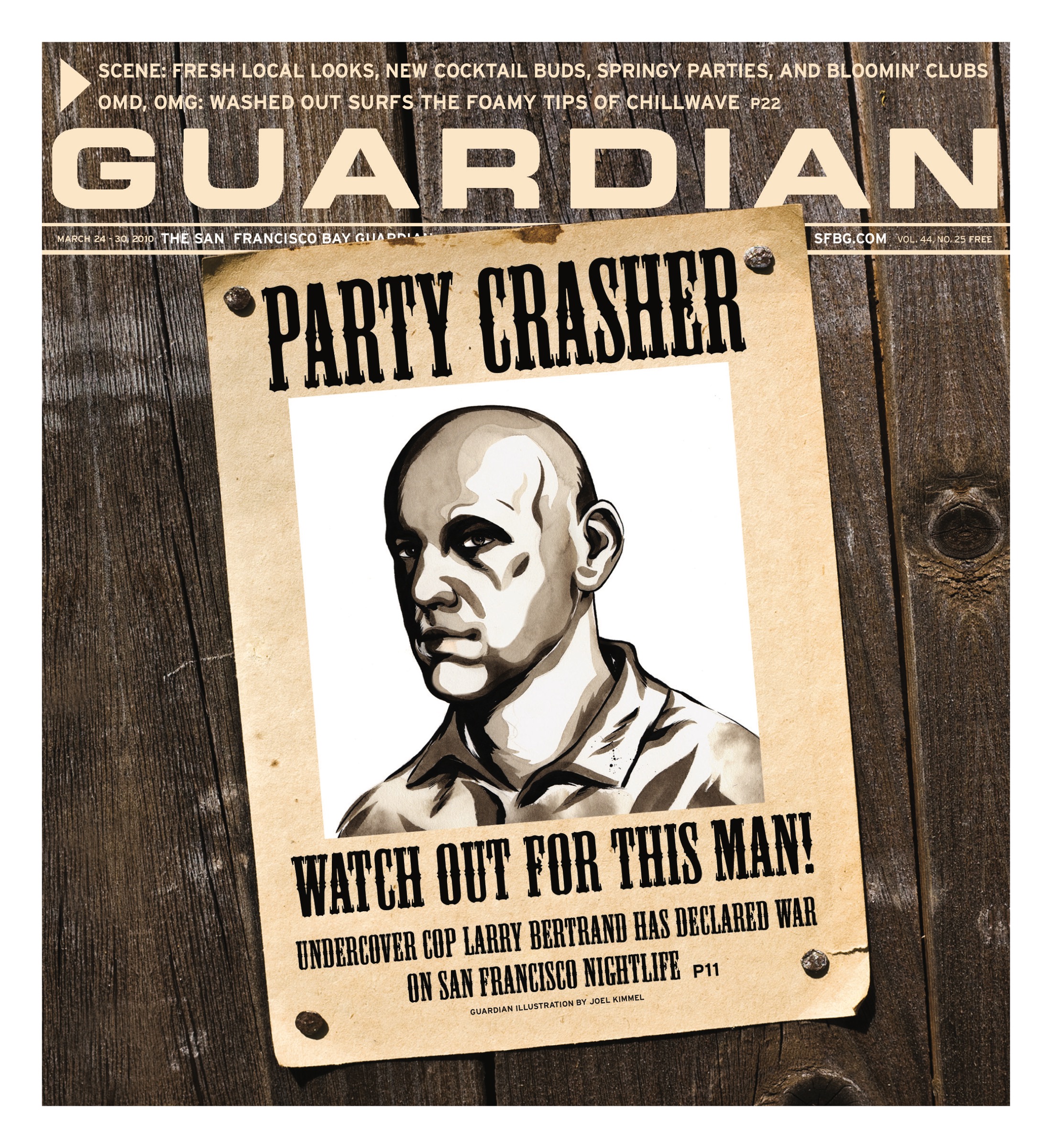
Officer Larry Bertrand of the San Francisco Police Department’s Southern Station and Michelle Ott, an agent with the California Department of Alcoholic Beverage Control, are plainclothes partners who spend their weekends undercover, crashing parties, harassing disfavored nightclubs, brutalizing party-goers, and trying to send the unmistakable message that they’re in charge of San Francisco nightlife. Neither responded to our interview requests.
Isolated incidents of intolerant cops and NIMBY citizens who repeatedly complain about certain clubs or festivals has been a problem for years (see “Death of fun,” 5/24/06 and “Death of fun, the sequel,” 4/24/07). Top city officials have opted to cancel events such as Halloween in the Castro District rather than try to manage them better, and the nightlife community has tried to organize in defense of its interests (see “Fighting for the right to party,” 7/1/08) with mixed results.
But the personal War of Fun by Bertrand and Ott seems to have galvanized and united the nightlife and festival community like never before, leading to the creation of a new California Music and Culture Association and prompting threats of a federal lawsuit alleging the ABC-SFPD collaboration is a racketeering scheme designed to harass, disrupt, and extort people engaged in otherwise lawful activity.
The myriad horror stories associated with Bertrand and Ott have also finally begun to draw attention from the Mayor’s Office, which has quietly pushed the SFPD to rein in Bertrand and change its policies on raiding parties and seizing property. State Sen. Mark Leno also has gotten involved, brokering a March 12 meeting between club owners and Steve Hardy, director of ABC (which, in addition to cracking down on nightclubs — see “Busting bars,” 6/23/09 — has recently announced a campaign against fruit-infused liquor).
“They were going to see how they could unwind this a bit,” Leno told us, adding that he was “infuriated” by stories of abusive treatment of the public. “The fear that it spreads through the community is unacceptable.”
The question now is what Hardy, Mayor Gavin Newsom, and Police Chief George Gascón — who has ordered some crackdowns and wants greater authority to discipline problem officers — is going to do about it.
It was after midnight on Jan. 31 when Krystal Peak, a journalist with San Francisco State University’s Golden Gate Xpress, received a call from her managing editor. There was a commotion and a swarm of police cars outside a student party at Seventh and Minna streets near her home, and she was asked to investigate.
She came upon the aftermath of a melee between police and partygoers that had taken place after a fundraising event at a SoMa warehouse art space was upended. The benefit was organized to raise legal funds for students who staged a building occupation at the University of California at Berkeley, in defiance of budget cuts.
The event was clearly chaotic, and it’s hard to sort out exactly what happened and when. City officials say the partiers were throwing bottles and firecrackers at the police; people at the event say the cops started it all.
But the tales partygoers tell about the behavior of Bertrand and Ott, the undercover enforcers, are similar to a series of other stories involving the pair, stories published in the Guardian and elsewhere.
There had been multiple arrests by the time Peak arrived on the scene. Numerous witnesses asserted that things were going along without incident until a fire marshal arrived in response to a complaint, and in short order, two officers who’d been there in plainclothes for hours — Bertrand and Ott — began shouting, tackling people, and kicking in doors.
Police Chief George Gascón acknowledged that the department has been targeting underground parties. “We get a lot of resident complaints about it,” he said in a recent Guardian interview. “We’re talking about a lot of the underground parties, or the parties where the promoters are exceeding their authorities to a number of people.”
Several hundred attended this particular party. Of the 11 people arrested, eight were either detained or cited and released. None faced underage drinking or drug charges. At least five were charged with resisting arrest. One individual was charged with vandalism, two were charged with battery on an officer, and two detained for being drunk in public.
Peak began photographing the scene: busted-up chairs, uniformed officers guarding the entrance, police cars everywhere. She zoomed her lens to capture the wreckage inside. None of the uniformed officers seemed to have a problem with her — but when she spotted the undercover officers with exposed badges, that changed.
The cops broke through the door, yelling. “They said, ‘This is an investigation, you’re not allowed to be here.'<0x2009> she said. “We told them we were with the press.” They threatened to arrest her.
Shortly after, the plainclothes officers crossed in front of her to an unmarked car. She took another picture. Bertrand, a tall guy with a shaved head, allegedly turned and grabbed her arm, and both officers shouted at her. “[Ott] said to me, ‘Your flash has impeded my investigation,'” Peak recounted. She was cuffed and arrested on the spot, and her camera was confiscated.
She was cited for obstruction of justice, but the charges were dropped. And she got her camera back — but says the SD memory card, where all the photos were stored — was missing.
“I flipped [the camera] open … and found the SD card was missing,” she said. She asked Bertrand where it was. “He said, ‘I don’t know what you’re talking about,'” Peak recalled. Bertrand, she recalled, then looked around at a group of officers watching the exchange, and announced, “This woman is refusing to leave. I’m going to have to re-arrest her.” Ott appeared, according to Peak, and insisted that there was no evidence the memory card had been in the camera in the first place.
“My camera will not ignite a flash unless there’s a memory card in there,” Peak explained. In the end, she left empty-handed — without photos of the undercover officers.
Earlier, when the party was in full swing, a 24-year-old California State University, Fullerton student visiting from Los Angeles says when the fire marshal entered, Bertrand flashed his badge, yelling at everybody to get out. “It was really aggressive from the get-go,” said the Fullerton student, who spoke on condition of anonymity because he had a pending legal case. “It’s very hard for me to describe the intensity to which this guy was busting down doors.”
Later, the young man from L.A. said, he was following people who left in a rush, and ran to catch up. “Shortly after, I felt a blow to the back right of my head,” he said. “My glasses flew off, and I was tackled to the ground. My forehead was being pushed straight into the ground and they were holding my hair. I kept repeating … please, I can’t see — I’m legally blind. I thought three or four officers were on top of me, and they were saying, ‘Fuck you, you little anarchist punk.'<0x2009>”
That’s when he said he felt a sensation like “a bunch of really intense bee stings on my left side, just above my hipbone.” He thought he was Tasered — and photos he showed us depict a skin burn. SFPD officers are not authorized to carry Tasers.
“It sounds like a stun gun, not a Taser gun,” Ken Cooper, a firearms and Taser instructor based in New York, noted when the incident was described to him.
When we shared the photos with SFPD’s media relations department, Lt. Lyn Tomioka noted, “I can tell you that we do not have any tool that would produce the type of wounds shown in the picture that you attached, or produce a stinging sensation.”
The L.A. visitor said he was delivered this explanation from an officer while in the holding cell: “One of your anarchist buddies must’ve had a Taser, ran over to you trying to get one of our officers, got you instead, and ran away.”
Cooper Brislain, a Web developer from Santa Cruz, told us his iMac was destroyed that night. A friend of the owners of the art space, he was there doing video mixing for the party, he explained. After the trouble started, he began carrying his computer and mixing equipment toward the door. “The uniformed officers were going to let me go. I told them, ‘I just came here to perform.’ They seemed OK,” he said. Then he encountered Bertrand.
“He … grabbed me by the collar, led me over toward the wall, and sat me down,” Brislain told us. He says Bertrand and Ott seized his computer. Brislain says no charges were filed against him.
The morning after, he found that his computer had been smashed up. His friends found it in pieces at the bottom of the stairs. To this day, he says he has not been able to retrieve his ID, which was seized that night. “I tried calling [Bertrand] on his extension to leave a message and never heard back,” he says. “They told me he probably wouldn’t return voicemails.” The District Attorney’s Office has a different perspective. D.A. spokesperson Brian Buckelew said the partygoers were drunk and “going nuts on police.” People were throwing firecrackers, he said. “It obviously got out of hand, and people were throwing bottles at police,” he said.
The student from L.A. allegedly shoved a female officer, Buckelew said. According to the report, he said, police officers were taking someone into custody, and he tried to pull them free.
Nevertheless, even Chief Gascón agrees that it’s not okay to destroy someone’s personal property. “If in fact the allegations were proven to be the case that an officer took somebody’s laptop and threw it down the stairs,” Gascón told us, “that would be inappropriate, and that officer would be sanctioned accordingly.” He noted that he met with an attorney from the Electronic Frontier Foundation about a recurring trend of officers — Bertrand in particular — seizing DJ laptops at underground parties. “We’ve met with them and we’ve agreed to actually tighten up the protocols in how this would be handled,” Gascón noted.
The list of local nightclub clubs that have been recently targeted by Bertrand and Ott or subjected to ABC sanctions is long. It includes Great American Music Hall, Slim’s, DNA Lounge, Mist, Whisper, the Room, Vessel, Azul, Butter, and Club Caliente (which closed down after its mostly Latino customers were scared away by repeated raids).
“Using the now familiar pattern and ruse of ABC authority, these raids have been without warrant and without probable cause, under the pretext of finding liquor violations,” attorney Mark Webb wrote in a claim against the city, describing the harassment of Caliente owner Maurice Salinas and later adding, “Despite numerous raids, the invading officers [Bertrand and Ott] managed to ‘uncover’ a single infraction: one customer used his brother’s ID card, claiming he was over 21 to gain entry. For this reason, Mr. Salinas was cited and fined, bullied, intimidated, and yelled at on the spot.”
Webb said such behavior isn’t legitimate police work, but unlawful harassment. In fact, this experienced litigator said it’s far closer to the shakedowns and extortion rackets familiar to him from the start of his legal career in the late 1970s prosecuting organized crime cases in New York City.
That’s why he’s threatening to bring a novel lawsuit against the city and ABC under federal Racketeer Influenced and Corrupt Organization (RICO) Act, a law designed go after the mob, but which has since been adapted to target entities ranging from the tobacco industry to the Los Angeles Police Department.
Webb told us that interference with legitimate business operations, such as running a nightclub, is the essence of RICO suits. As part of the case, Webb plans to submit a surveillance video that shows Bertrand kneeling on the neck of bartender Javier Magallon from The Room and twisting his arm. Webb gave us a copy of the video.
Another element of making a RICO case is the use of intimidation and retaliation against those who complain — which was central to a March 17 SF Weekly story about promoter Arash Ghanadan being inappropriately singled out for arrest by Bertrand as retaliation for filing a complaint against the officer with the Office of Citizen Complaints.
Webb says he has a strong case that he intends to file soon, but that most of his clients just want the SFPD to rein in Bertrand and stop facilitating ABC actions. “I want to have a sit-down with Gavin Newsom,” Webb said. “I am calling on Mayor Newsom to come in and mediate what would be an expensive, divisive fight that will generate national interest … I think this thing can go way quickly without litigation.”
Newsom press secretary Tony Winnicker, who said Newsom has brought concerns about Bertrand to the chief’s attention, didn’t immediately embrace Webb’s offer. “The mayor would rather leave it to the chief,” Winnicker said.
So the question for Gascón is whether he’s willing to take on the cowboy cops within the SFPD’s ranks. After all, Bertrand is also on the San Francisco Police Officers Association Board of Directors.
The nightlife community is organized like never before and plotting its next move in fighting a war it didn’t initiate and barely understands. Whether that war continues now seems to be a question for the party crashers and their supervisors.
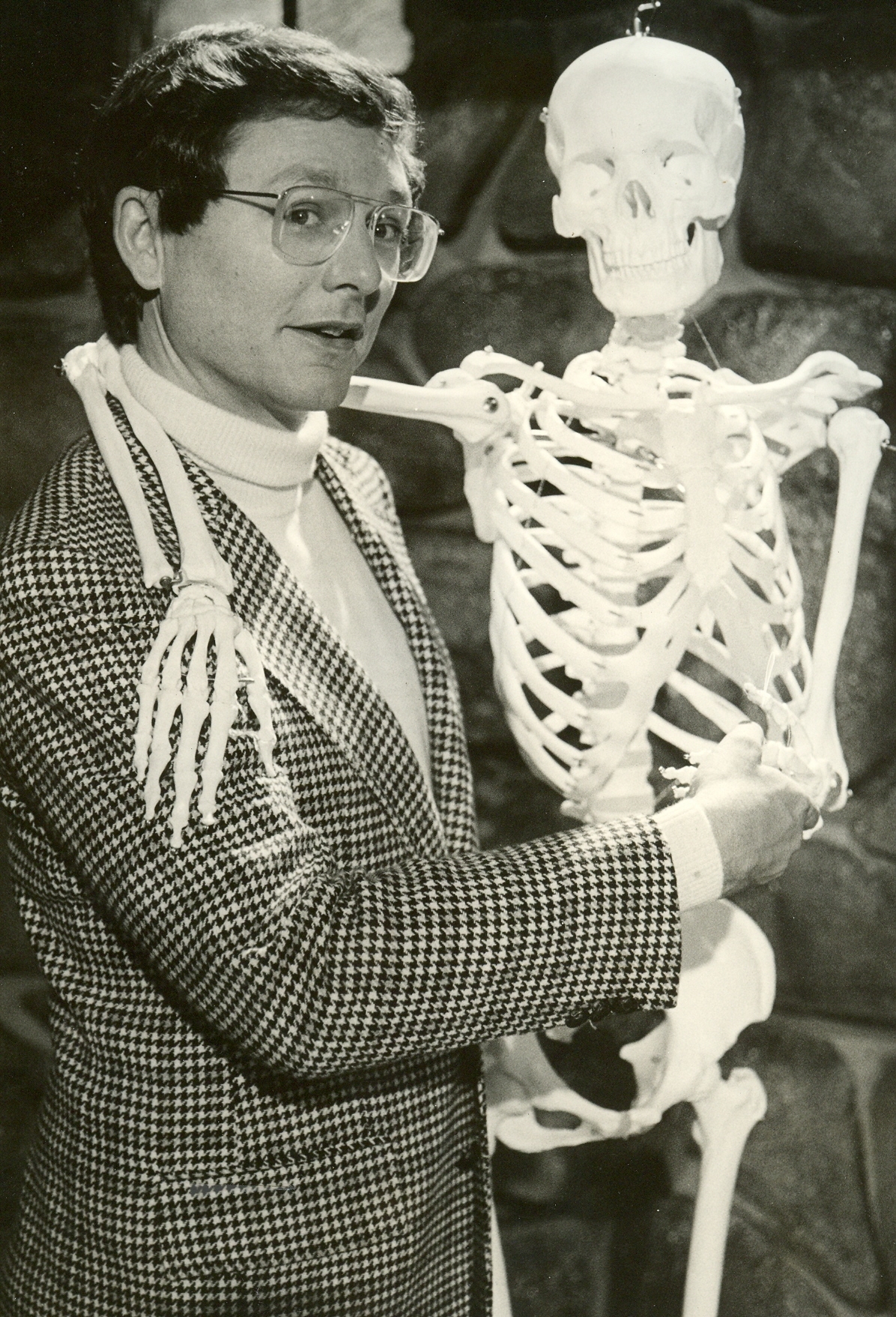
Seemingly rising from the grave like so many of the monsters and ghouls that it showcased over a 14-year run on local television, the beloved Bay Area show Creature Features is being resurrected once again to satiate fans’ undying thirst for the creepy, kooky and campy.
On Thursday night, John Stanley (who took over hosting the program from the late Bob Wilkins in 1979) will be on hand at the Balboa Theater for a recreation of what an original “Creature Features” episode would have been like circa the early 1980s, including a full feature film, interview segments, mini-movie, and even the vintage commercials that ran during the breaks. This particular show is a rare treat, as many of the original tapings were simply recorded over once they aired, as was the common practice by television stations in those days to save money.
Several of the interviews and segments have survived over the years, however, thanks to Stanley asking for certain tapes to be saved, and also in part to now-official Creature Features archivist Tom Wyrsch collecting tapes and reels during the show’s initial run from 1971 to 1984.
“You have to remember, the show started when there was no VCR, so no one was really thinking in terms of ‘we can get these on tape some day,’” says Stanley. “I was just thinking ‘maybe someday I’ll want to replay that interview,’ if it was with an important actor like Christopher Lee or something.”
One such interview that Stanley is particularly fond of, and will be shown at the event, is an entertaining multi-part chat with Frank Gorshin, perhaps best known for his work playing “The Riddler” in the 1960s “Batman” TV show. “He seemed to just be totally relaxed,” says Stanley. “I think he was quite surprised when he saw I had all these photographs of him, and the amount of preparation that we had put into the interview.”
The main feature will be Horror Express, a 1972 flick starring Christopher Lee, Peter Cushing and Telly Savalas, featuring a monster terrorizing a continent-crossing train, and the evening will also feature one of Stanley’s mini-movies, The Demon Strikes Back, a short not seen since 1980. Fans attending the event can also pick up a new series of DVDs that Stanley and Wyrsch have put together, to take home and relive the experience in their own living rooms on a late Saturday night.
Though it’s been more than 25 years since the show left the air, the people behind it still find a faithful following at event after event throughout the Bay Area.
“It’s amazing to me that Creature Features lives as never before,” says Stanley. “But when those who used to watch the show see it now, they are suddenly transported back through time—it’s like looking through an old photo album or reliving happy moments of one’s adolescence.”
CREATURE FEATURES
Thu/25, 7 p.m., $6.50-$9
Balboa Theater
3630 Balboa, SF
(415) 221-8184
www.balboamovies.com
www.stanleybooks.net
The deep piles of used goods can be a bit daunting at some of the best thrift stores, but when you find that shimmering prize, the fuzzy feeling is relative to winning a race or seeing your worst enemy trip into a puddle. For the sole member of tUnE-yArDs, musician Merrill Garbus— playing Sat/20 at Bottom of the Hill— her ultimate find was a white purse with row after row of luscious beads.
“I was in high school, living in Connecticut and we’d take trips into New York City to shop at thrift stores,” she recalls, talking to me over the phone while walking in her Oakland neighborhood. “I used to collect purses, even though I never used them.”
Recently she bought up a desk and an entire wardrobe of tour clothes, all without spending more than 20 bucks. Garbus says she uses thrift stores as a way to try on different personalities and I’m guessing she finds a little inspiration in there, too.
Plainly stated, Garbus’ music is lo-fi, indie-folk, but beneath the glorious yodeling and ukulele strumming are lyrical melodies, strong heart beats and interesting percussion made from banging and clanking on found objects. Her latest album, BiRd-BrAiNs (Marriage, 2009) was recorded through a hand-held voice recorder and mixed on her laptop— total DIY style.
http://www.youtube.com/watch?v=AwDEQWaSiEU
Dig through her multitude of songs and you’ll find outside sounds, children talking about fruit and all sorts of one-of-a-kind clips that wear just like your favorite Goodwill-adopted sweatshirt. She’s a one-woman version of Yeasayer and you can hear Garbus’ love of African music, more specifically notes borrowed from her visit to Swahili.
As I talked to her, Garbus was getting ready for the launch of the tour— the car needed an oil change and she needed to get rid of a nasty cold.
“I’m struggling with being human right now— sick, tired and overworked,” she said with a cough. “But I think I’ll be fine and remarkably, my singing voice comes from a different place.”
Still thinking about thrifting and the old white purse, I wondered if Garbus had ever thought about who was the bag’s previous owner. I like to imagine who bought the item new and I always hope to channel some sort of energy through the garment– to see if I can stake out any secrets from its past life. I asked Garbus if she puts subliminal messages into her music for a similar effect.
“I don’t think so,” she laughs. “But maybe a really cheesy message of love? These songs take time and sort of fold and unfold, exposing miniature worlds inside each of them. They’re a labor of love and I guess that’s the message. Yes, love…. Sorry to cheese out.”
tUne-yArDs w/Xiu Xiu
Sat/20, 8:30pm, $12
Bottom of the Hill
1233 17th Street, SF
www.bottomofthehill.com

In this week’s issue of the Guardian, I finally got the total fanboy pleasure of writing about, and talking to, one of my true DJ inspirations, electro-funk originator and dance edit king Greg Wilson. (He’ll be performing at Triple Crown on Fri/19). Kicking his career off in 1975, the man has the kind of stamina and skills most spinners can only dream about. (And I didn’t even get into the fact that he was the first professional DJ hired for a regular gig at the hugely influential Hacienda club in Manchester.) In the late ’70s and early ’80s, Wilson provided a crucial link between the often segregated black soul and white dance scenes — he was known as a “black music specialist,” eek — and his panoramic edits were the fruitful results of his colorblind cross-pollination. Here’s our email chat in full, his replies coming after a “brilliant night in Melbourne,” Australia.
http://www.youtube.com/watch?v=zY-EgzcN6_k
SFBG: It’s such perfect timing to have you come to SF for the tour. We’re finally getting an edit fan scene going here, as well as our usual host of groove revivalists and analogue equipment fetishists. As to the US edit scene in general, I’m wondering if you’ve heard and what you think of some of the newer acts and labels like Wolf + Lamb, Soul Clap, Tensnake, and SF’s own King & Hound. I’m also curious as to your thoughts on more established soul re-editors like Moodymann. Are there any other Americans you particularly admire? I’d like to try to tease out some of the influence you’ve had here in the past 20 years.
Greg Wilson: I suppose it’s been more the other way around, with me editing or mixing tracks by US artists. On [recently released compilation] Credit To The Edit Vol 2, a third of the album is made up of US tracks — “Don’t Turn it Off” by 40 Thieves, “Starlight” By Escort, “Oh Snap!” by Nick Chacona & Anthony Mansfield and ‘One Life Time To Live’ by Gary Davis. I’ve obviously picked up on some of the US edits, via Prince Language, Rong, Rvng Of The Nrds etc, but there’s probably loads of good stuff I’m missing out on.
http://www.youtube.com/watch?v=AWiKEBuFiNY
SFBG: Can you tell me the story of your relationship with [musician, DJ, and Green Gorilla crewmember] Anthony Mansfield? You talk about it a bit in the liner notes for Credit to the Edit Vol 2. I’m hoping you can expand upon that a bit, since he’s such an integral part of the scene here.
GW: Anthony introduced me to a lot of the people on the San Francisco scene when I was last over. The remix I did of ‘Oh Snap!’ was a big tune for me, and we’ve become friends as a result. When I came over in 2008 he took me to Haight-Ashbury, which, being a ’60s obsessive, was the first place on my to go to list. He also took me across the Golden Gate bridge and right up to where you look out over the Pacific. The fog was rolling in and it felt like we were at the edge of the world, which I suppose we were in a sense. It really was one of the most incredible sights I’ve ever seen.

Greg in one of his 1984 electro promos
SFBG: Obviously and strangely for the US, it was the excellent BBC Essential Mix that reintroduced you to many of the heads here, even though you’d been active again for years before that. Of course, the only way we heard that mix was over the Internet, which brings me to my question. One of the differences from when you were DJing before your retirement period has got to be the ways in which DJs and music-makers distribute music and promote themselves. I know you’re open to using the latest technology to make tracks. How do you feel about the current digital distribution era, and can you talk a bit about what it was like in the past? It seems a far cry from the record pool and radio days.
GW: Yes, two very different times — back in the 70s and early 80s, I received promo copies from all the UK companies, and bought US imports from a shop called Spin Inn in Manchester, which was the only place in the North to shop if you wanted to be taken seriously as a black music specialist. It was these two sources that kept me ahead of the game back then. During the Electro era I also began receiving promos from a few New York labels, which gave me exclusives on a few tracks like ‘E.T Boogie’ by the Extra T’s and Indeep’s ‘Last Night A DJ Saved My Life’.
Nowadays most of the stuff I pick up on is sent directly to me online. I still buy stuff from places like Juno and Piccadilly, and have records and CDs posted to me, but the majority of newer tracks I play come to me via online contacts. The Internet is key to everything I do, without it I could never have returned to deejaying in the way I have, and certainly not toured around the world.
I think it’s an exciting time. Some people pine for the old days, but, as great as they were, I don’t like to dwell on the past too much in a nostalgic way, but use it to inform the future. I like the way younger people, who didn’t have direct experience of the original disco era are drawing influence from it and re-shaping from their own perspective here and now. For me, music, not matter how old it might be, is always alive and evolving, so I’m all for bringing it into a new context.
My Essential Mix illustrated this, balancing the past with the present. This is what I always strive for — connecting back, but moving on. I was shocked at the overwhelming positivity response to the Essential Mix. I’d expected it to appeal to some, but not to others, but it was almost totally positive. I also hadn’t taken into account that within days of it being broadcast in England, it would be uploaded onto blogs worldwide. I had no idea that it would have global impact.

Greg in 1976
SFBG: One of the reasons I think the edit scene is so hot in the US right now is not just because editing technology is so readily available, but because edits are a slight technological tweak to classics that serve to introduce these songs to a new generation in a relatable way. They’re not the exhaustive distortions of techno dance remixes, but neither are they the technophobic “rare grooves” Holy Grails of the purists. The sound seems to be a perfect balance of creative manipulation and relaxed classicism, which seems right for the times. Am I just pissing on myself theoretically?
GW: For me, it’s as simple as putting together a version of a track to play out yourself. This may be a straightforward edit, or a little bit more involved, bringing in outside elements. It might be a simple extension, or it could be a track you love everything about, but for one part, which you can now cut out. It gives older music a contemporary twist, which I’m all for if it’s done with love and respect for the original.
http://www.youtube.com/watch?v=PMhnX0En9eQ
SFBG: About that wonderful Revox B77 of yours. Can you get a bit wonky about it — what’s the model, how do you store it and transport it, and how do you keep it up? Fanboys are dying to know!
GW: I have my own B77s (flight-cased) for UK gigs and we hire them in when I play overseas (Revox R99’s also work for me). I used to take my own on the flights around Europe, but it could be steep on the XS. It can give the promoters a bit of a headache tracking them down, but everyone has managed to find a unit somewhere. People would be disappointed if I turned up without one, as it’s an essential part of what I do – spinning sounds, samples, and textures over the tracks I play, and creating dub fx. It’s become my trademark and on the rare occasions when I do DJ without it I feel really weird. I don’t know where to put my hands!

arts@sfbg.com
MUSIC “There are great artists and musicians who will never be discovered,” says Herman Eberitzsch Jr. III “That’s the way it is,” he reasons. “There’s only so much room at the top.”
That’s why you’ve most likely never heard of Eberitzsch (pronounced “eh-bur-itch”) despite his remarkable music talent. He has a name straight out of a gothic fairy tale — far from the iconic, slick-sounding syllables associated with San Francisco’s psychedelic soul renaissance during the late 1960s and ’70s. Yet his recordings hold up to the best of them. “We had a strong conviction that we were the next big thing,” Eberitzsch says. “But we weren’t.”
Each generation harbors a certain aesthetic mood that mutates and evolves under the prescient vision of a limited number of innovators. Their fresh styles, resonant at first, then become formulated and stagnant, disseminated in the norm. We then await the next genius, or at least a movement of collective creativity, to shake things up. But what attunes us to one artistic strand, pregnant with a world of open-ended meaning and feeling, rather than another with just as much potential richness? How do we come to discern between the vanguard and the wayward? And what if we miss something in the process?
Eberitzsch’s unlikely story might just read like a rediscovery of what we overlooked. He recorded hours of bluesy soul fueled by free-form jazz throughout the ’70s that never saw commercial release. He arranged, wrote, sang, and funkified the keys on dozens of songs with mainstays of Santana’s circuit (Coke Escovedo, Linda Tillery), Lee Oskar of War, and Sly Stone’s drummer, Greg Errico, among many others. Most of the musicians who recorded on Eberitzsch’s own arrangements were, by and large, no-namers, yet it’s their music which now stands out.
Eberitzsch’s songs leap and wander. They gracefully move the spirit while grounding the body in rich, earthy grooves. They are a naive and inspiringly audacious attempt at channeling the sort of raw expression that challenges, mesmerizes, fights, and loves. In the midst of so much experimental and groundbreaking sound, Eberitzsch’s music either missed the ears of the right A&R rep or was just not the right kind of different.
Now Eberitzsch is sitting across from me in a café near his former Potrero district home, excited to tell his story. He greets me as Allen Ginsberg (my look-alike visage intact, masked in dark beard and glasses), and I feign appreciation for the well-meaning reference, knowing that although Ginsberg had quite a poetic sharpness, he wasn’t the best-looking fellow. But Eberitzsch’s generous charm and earnest happiness with the course his life has taken, despite the disappointments, quickly win me over. Waves of amiable energy overtake the slightly weathered rasp in his voice. A youthful, idealistic Eberitzsch naturally emerges in the course of minutes. In a way, he’s been waiting for this interview for 40 years.
“Atlantic told me, ‘We don’t hear it at this time,'<0x2009>” Eberitzsch says, highlighting the elusive way a record company executive might elongate time, stretching the curt word like a worn rubber band. “But when you invest your life and your heart and soul into a project of your own creation, your own little children of songs, you don’t throw them away. You don’t send them down the River Styx,” he says, laughing. “So I put ’em in the basement.”
That’s where record collector Daniel Borine mistakenly found the two-inch apex tapes, 35 years later, while doing photo research for a reissue project on lost Bay Area modern soul. What those tapes hid — a dusty time capsule of relentless insight and vigor — amazed Borine. In a move away from the prideful hoarding that typically characterizes collectors, Borine wanted to share the tapes with a larger audience and finally do justice to Eberitzsch’s music. He pursued the new and quickly growing business of recorded music archaeology and preservation, an endeavor that mirrors what so many archivists have done already for literature, film, and visual art. Borine had the tapes mastered and organized the tracks into coherent volumes. He plans to put out four full-length records of Eberitzsch’s brilliant efforts, titled the HE3 Project, over the coming years on his own upstart Family Groove Records.
The first chapter of the compilation is set for release on March 30. It focuses on Eberitzsch’s trailblazing efforts from three distinct recording sessions between 1971 and 1974. These recordings capture Eberitzsch’s far-reaching artistry — a grounded and soulful angle on space-jazz psychedelia, informed as much by Weather Report as by Robert Johnson. This is the story of the man behind the HE3 Project.
Herman Eberitzsch Jr. III was born in San Francisco’s colorful Portola neighborhood in 1947. He grew up in a German household, where he learned to play the classical composers — Mozart, Bach, Beethoven, and Brahms — at a young age. But somewhere along the way Eberitzsch caught the funk and couldn’t let go. “In my room I listened to James Brown,” he recalls. “When I grooved and played the boogie, I had a powerful left foot that shook the ground. My left foot took down the house, so I eventually had to move out.”
Eberitzsch conjured doo-wop on the corner with the young funky drummer Greg Errico, who lived down the street. He was enraptured by the blues in Oakland, danced to jazzy R&B grooves in San Francisco, and witnessed the emergence of a new psychedelic sound at the Fillmore and in the streets. Immersed in the Bay Area’s magnetic music community, he naturally gravitated to the keys again. “I figured out how to play funky style clavinet and piano,” Eberitzsch says. “They called me Funky Knuckles for short.”
At 21, the freshly-dubbed Funky Knuckles joined a band with Boots Hughston called Sword and the Stone, and was booked by Bill Graham to perform at the Fillmore. The outfit transitioned into a quartet, Shane, with Santana’s David Brown on bass. They hustled around the city making $10 an hour and all the beer they could drink. The city bubbled over with an unparalleled creative force. The time was electric.
That same year — 1968 — Eberitzsch attended UC Berkeley to study psychiatry. But he quit after one semester to pursue music as a career, preferring the organic therapeutic powers of rhythm and melody to the structured treatment of question and answer. “Music is a much more pure form of psychiatry. It has two potentials: it either incites you to create, or it soothes the savage beast,” he says. “I became a knowledgeable person of people through music.” And cyclically, Eberitzsch’s improvisational music erupted from kinetic relationships with people.
superego@sfbg.com
SUPER EGO “Don’t you think that scratching records might annoy the people who spent a long time in the studio making them?”
I’m snickering at a jaw-droppingly antiquated — yet actually quite relevant — video from 1983 titled “1st UK DJ to Mix Live on TV.” It features famous, fresh-faced turntablist Greg Wilson, gracefully fending off tin-eared questions from Tube program host Jools Holland while demonstrating to an antsy, angular-haired audience what this whole “mixing records” thing is about.
The scratching bit’s a hoot because Wilson — who recently emerged from an 18-year retirement and will be performing at Triple Crown on Friday — isn’t scratching at all. He’s merely cueing up the record, a simple act that draws gasps. “Well, that’s it, that’s the danger,” Wilson replies to Holland, poker-faced, his soft brown Afro unshaken. “But when a record’s been played in the club for a long time, people get a bit fed up hearing it, and it’s nice to hear it in a different way. And that’s why I kind of … play about with them a bit.”
Wilson goes on to blow post-punk minds by phasing on two — two — tables at once. Then he takes it to a whole other level by revving up his trademark, Steampunk-prophesying Revox B77 reel-to-reel effects machine, real-time sampling David Joseph’s Jheri curl-slick classic “You Can’t Hide (Your Love From Me),” filling out the back-end with sly loops and layering on psychedelic dub echoes. It’s a wondrous bit of analog theater that I imagine, in this “digital age” I keep hearing about, would cause the same kind of pop-culture rupture if played out on American Idol today.
Or maybe not so much. Two of the big nightlife media hooks of the past few years have been the disco revival and the vinyl resurgence — twinned digital-reactionary movements that recall the late-1990s hip-hop and soul crate-digging of hometown heroes like DJ Shadow and Ren the Vinyl Archeologist, a fruitful response to the CD reissue mania of that time. Every technology carves out an implicit niche for its own backlashes. Now, it swallows them too. Despite all the retro nostalgia, DJs need the Internet to get their mixes out and research rare tunes. Plastic and silicon moving in tandem — it’s a real mishmash.
Wilson, who spent his decks hiatus pursuing his production career, may still keep one hand on the vintage — that Revox B77 still travels with him — but he’s made no secret of his enthusiasm for new fad gadgets, and felt that with the simultaneous rise of disco re-fever and software hijinks, a comeback was due.
“I think it’s an exciting time,” he e-mailed me from Australia, in the midst of a bonkers world tour to support his latest compilation of rejiggers, Credit to the Edit, Vol. 2 (Tirk). “Some people pine for the old days. But great as they were, I don’t like to dwell on the past too much in a nostalgic way, but use it to inform the future. I like the way younger people, who didn’t directly experience the original disco era, are drawing influence from it, reshaping it from their own perspective here and now. For me, music — no matter how old it might be — is always alive and evolving, so I’m all for bringing it into a new context.”
Wilson made his name in the ’70s and ’80s by birthing the electro-funk movement in the U.K. (www.electrofunkroots.co.uk), which pipelined many hard-to-find American dance releases to British crowds, and he came of age in a world of DJ record pools — strategic vinyl-sharing cabals that hooked cash-strapped DJs up with record companies eager to get their releases heard. Record pool culture opened the doors for innumerable disco and funk edits: DJs wanted to sound unique, so they mixed (or had someone else mix) their own versions of hits, stamping them with an individual sonic imprint. Thus the hugely influential edit scene was born, paving the way for a spectrum of club remixes from genius and egregious.
No one handled edits quite like Wilson, whose pitch-perfect additions, stretches, and overlaps and live technique proved to be a bulletproof blueprint. The disco edit scene, a subsection of disco revivalism that also digs up more contemporary “lost” tracks, keeps looping back into view, the most recent fanatic attack including acts like Wolf + Lamb, Soul Clap, Les Edits Du Golem, and Tensnake, and labels like Rong, Wurst, and Ugly.
Our very own rulers of the local edit scene are King & Hound (www.myspace.com/garthgrayhound), a collaborative effort between two SF DJ legends, Garth and James Glass, on the Golden Goose label. The two met in the early ’90s at the notorious Record Rack music store and have lately released tasty versions of David Ian Xtravaganza’s kiki 1989 “Elements of Vogue” and Can’s space-groovy “A Spectacle.”
“I have quite a few of Greg’s records,” Garth told me over e-mail. “I recently rediscovered one of his early hip-hop records called ‘We Don’t Care’ by Ruthless Rap Assassins, which I bought in 1987!” Glass joined in, “I grew up in London listening to Greg’s mixes and I’d hear him out and about.” Both of them shake off suggestions of Wilsonian influence, however. “But we’re all doing the same thing — taking out the cheese and respecting the quality,” Glass said.
Wilson’s brilliant 2009 Essential Mix mix for the U.K.’s BBC1 radio found Massive Attack and Talking Heads sharing space with Geraldine Hunt and Chic, and reintroduced him to American ears (“I think that mix illustrates what I always strive for: connecting back but moving on,” he told me. “I was shocked at the overwhelmingly positive response.”) But to Bay players he was always in the loop, working with the invaluable Anthony Mansfield of the Green Gorilla crew and Qzen and even visiting Haight Street a few years back to feed his ’60s obsession.
I recently had the opportunity to explore a bit of the Bay Area’s record pool and disco edit past with DJ Jim Hopkins of the ubiquitous Twitch Recordings, and who currently spins eclectic sets at venues like 440 Castro and Trax. He’s no stranger to the edit scene, becoming one of the youngest edit contributors in the early ’80s to San Francisco disco and Hi-NRG record pool Hot Tracks and later, after Hot Tracks owner Steve Algozino passed away from AIDS, Rhythm Stick, helmed by Algozino’s protégée Jenny Spiers. (He also namechecks the Bay’s Disconet and New Wave-friendly Razor Maid.) Hopkins got his edit start as a teen in the ’70s, using the pause button on his dad’s tape deck to make his own edits, and soon grabbed professional attention. “Record companies wanted several versions of their records available for DJs, and record pools wanted to put out compilation issues for subscribers that featured unique takes on tracks, so I happily provided,” he told me. “It’s funny that those things are worth a fortune today.”
Hopkins just started an online organization called the San Francisco Disco Preservation Society (find it at www.twitchrecordings.com) to collect and celebrate Bay-centric edits and reel-to-reel mixes. “As for the edit scene now, there seem to be two kinds being produced. There are easy-sounding ones that just extend the good parts. Then there are more serious ones that take the original and make it into something new and more moody. I think that’s good for the future — because sometimes I have to laugh. Disco kids these days are pulling anything out of vinyl resale bins from 20 years ago and calling it ‘classic’ when most of it is crap. It was crap back then, too. Making it into anything different is doing it a favor, really.”
Read Marke B.’s full interview with Greg Wilson here.
GREG WILSON: CREDIT TO THE EDIT TOUR
Fri/19, 10 p.m.–4 a.m., $15/$20
Triple Crown
1772 Market, SF
HONEY SUNDAYS PRESENTS JIM HOPKINS
Sun/21, 10 p.m., $3
Paradise Lounge
1501 Folsom, SF

Big blonde hair, rosy cheeks, and an adorable little frame … folk-pop songstress Camaron Ochs — who’ll be performing Wed/17 at Cafe Du Nord — is a doll. Coincidentally, she is also being stalked by one— the Oakland singer-songwriter has seen quite a lot of Barbie in the past year, the long plastic limbs have been spotted at two East Bay venues where Ochs took the stage: the Stork Club, where the bar is decorated with stacks of cased holiday Barbies and Mama Buzz, the coffee shop/art gallery that hosted an art exhibit of the dolls in adult-style dioramas.
“There’s a Bat Girl Barbie at the Stork Club and I want it,” she says with a warm smile. “And I really liked the Barbie on the unicorn at Mama Buzz.”
Besides the constant grin, Ochs has nothing in common with her 11.5-inch stalker. An extensive travel record and a day job as a lab manager for emotion research means this pretty lady’s personality is far from plastic. Ochs’ brand of folk-pop is light and sweet, with genuine lyrics that ask listeners to live with their “heartforward”; a term Ochs coins as her philosophy on life and the title of her debut album.
“I came up with the term when I was living in Nepal. I was learning all about the seven chakras— the heart is the fourth,” she explains at a coffee shop in her sunny Temescal neighborhood. Skipping a few details, Ochs summarizes that being ‘heart forward’ literally means setting yourself up to take in the endless possibilities that surround us. “It’s about putting yourself out there, not just in a romantic sense, but in a life-sense.”
Bright guitar strums and a beautiful, rich voice flutter throughout Ochs’ songs, lyrics exploring relationships and offering insightful snapshots into lessons she’s learned while visiting cities around the world. Inspiration stems from other indie-folk blends, like The Weepies and yet also carry a more country tone, like that of her other favorite artist, Patsy Cline. There’s an audible optimistic bliss in her music and an honest indication that the woman behind the strings is a solid, well-rounded being.
Born a California girl, Ochs grew up with an interest in music, taking notes from her grandparent’s love of classic country and learning to sing in multiple languages. In college Ochs started her own A Cappella group, but it wasn’t until her study abroad experience in the Netherlands that she picked up a guitar.
“I decided to do the college thing— get a guitar. But I wasn’t any good at it. I would play on the streets of Amsterdam and then I even tried to sell it on the street, but no one wanted it.”
Eventually she gave it to a boyfriend and headed back home. A few months later, Ochs realized she missed her box of strings.
“So I borrowed a backpacker, basically just the neck of a guitar without the body, and brought it with me into the mountains of Nepal.” The trip included a flight over Kathmandu, a six-hour bus ride, five hours in a taxi and a ten-hour walk straight up into the mountain to where she would take residency for the next six weeks.
A girl on her own in a foreign land, Ochs had no choice but to keep an open mind and her ‘heartforward.’
“The first two weeks, I cried and cried. All I could focus on was how much different everything was there,” she says recalling the trip. “And then I realized that when you strip away everything you’ve ever had in your entire life, that’s when you see what you really are and who you really want to be.”
She met a couple of traveling Canadians and together they would play music, battling the inconsistent electricity with late night guitar parties. Building on that experience and developing her own relationship with the instrument once she returned home, Ochs is now playing confidently and taking on stages across the Bay with a full band. She couldn’t have been happier when her CD release party sold out.
“I think I’m really lucky. But I’m working really hard, so I guess it’s really not luck afterall.”
Camaron Ochs
Wed/17, 8:30pm, $12
Café Du Nord
2170 Market, SF
It’s a good week for hip-hop. After my interview with Chilean rapera Ana Tijoux, I caught this vid, thanks to the homeboys over at Mission Mission.
So thanks to you, Seattle based beat box yuckster Reggie Watts, for reaffirming my sense that hip-hop is alive, well, and still has a sense of humor about it all. In this video, he releases an extensive daisy chain of expletives onto walls and into glass bowls, then nicely illustrates and explicates the consumerism and chauvinism in mainstream rap/muck. It’s nice, you’ll like it.