Housing

San Francisco’s untouchables

64

Rebecca@sfbg.com

In one sense, San Francisco’s homeless residents have never been more visible than they are in this moment in the city’s history, marked by rapid construction, accelerated gentrification, and rising income inequality. But being seen doesn’t mean they’re getting the help they need.

Not long ago, Lydia Bransten, who heads security at the St. Anthony’s Foundation on 150 Golden Gate, happened upon a group of teenagers clustered on the street near the entrance of her soup kitchen. They had video cameras, and were filming a homeless man lying on the sidewalk.

“They were putting themselves in the shot,” she said.

Giggling, the kids had decided to cast this unconscious man as a prop in a film, starring them. She told them it was time to leave. Bransten read it as yet another example of widespread dehumanization of the homeless.

“I feel like we’re creating a society of untouchables,” she said. “People are lying on the street, and nobody cares whether they’re dead or breathing.”

Condominium dwellers and other District 6 residents of SoMa and the Tenderloin are constantly bombarding Sup. Jane Kim about homelessness via email — not to express concern about the health or condition of street dwellers, but to vent their deep disgust.

“This encampment has been here almost every night for several weeks running. Each night the structure is more elaborate. Why is it allowed to remain up?” one resident wrote in an email addressed to Kim. “Another man can be found mid block, sprawled across the sidewalk … He should be removed ASAP.”

In a different email, a resident wrote: “The police non-emergency number is on my quick dial because we have to call so often to have homeless camps removed.”

It’s within this fractious context that the city is embarking on the most comprehensive policy discussions to take place on homelessness in a decade.

In 2004, city officials and community advocates released a 10-Year Plan to Abolish Chronic Homelessness. One only needs to walk down the street to understand that this lofty objective ultimately failed; people suffering from mental illness, addiction, and poverty continue to live on the streets.

Most everyone agrees that something should be done. But while some want to see homelessness tackled because they wish undesirable people would vanish from view, others perceive a tragic byproduct of economic inequality and a dismantled social safety net, and believe the main goal should be helping homeless people recover.

“The people living in poverty are a byproduct of the system,” said Karl Robillard, a spokesperson for St. Anthony’s. “We will always have to help the less fortunate. That’s not going to go away. But we’re now blaming those very same people for being in that situation.”

sabrina

Sabrina: “The streets can be mean.”

Guardian photo by Rebecca Bowe


HOMELESS MAGNET?

A common framing of San Francisco’s “homeless problem” might be called the magnet theory.

The city has allocated $165 million to homeless services. Over time, it has succeeded in offering 6,355 permanent supportive housing units to the formerly homeless. Nevertheless, the number of homeless people accounted for on the streets has remained stubbornly flat. The city estimates there are about 7,350 homeless people now living in San Francisco.

Since the city has invested so much with such disappointing results, the story goes, there can only be one explanation: Offering robust services has drawn homeless people from elsewhere, like a magnet. By demonstrating kindness, the city has unwittingly converted itself into a Mecca for the homeless, spoiling an otherwise lovely place for all the hardworking, law-abiding citizens who contribute and pay taxes.

That theory was thoroughly debunked in a Board of Supervisors committee hearing on Feb. 5.

“The idea of services as a magnet, … we haven’t seen any empirical data to support that,” noted Peter Connery of Applied Survey Research, a consultant that conducted the city’s most recent homeless count. “The numbers in San Francisco are very consistent with the other communities.”

He went on to address the question on everyone’s mind: Why haven’t the numbers decreased? “Even in this environment where there have obviously been a tremendous number of successes in various departments and programs,” Connery said, “this has been a very tough economic period. Just to stay flat represents a huge success in this environment.”

As former President Bill Clinton’s campaign team used to say: It’s the economy, stupid.


LIFE OUTSIDE

For Sabrina, it started with mental health problems and drug addiction. She grew up in Oakland, the daughter of a single mom who worked as a housecleaner.

“Drugs led me the wrong way, and eventually caught up with me,” she explained at the soup kitchen while cradling Lily, her Chihuahua-terrier mix.

“I had nothing, at first. You have to learn to pick things up. Eventually, I got some blankets,” she said. But she was vulnerable. “It can get kind of mean. The streets can be mean — especially to the ladies.”

She found her way to A Woman’s Place, a shelter. Then she completed a five-month drug rehab program and now she has housing at a single room occupancy hotel on Sixth Street.

“You don’t realize how important those places are,” she said, crediting entry into the shelter and the drug-rehab program with her recovery.

Since the 10-year plan went into effect, Coalition on Homelessness Director Jennifer Friedenbach told us, emergency services for homeless people have been dramatically scaled back. Since 2004, “We lost about a third of our shelter beds,” she explained. About half of the city’s drop-in center capacity was also slashed.

“Between 2007 to 2011, we had about $40 million in direct cuts to behavioral health,” she said at the Feb. 5 hearing, seizing on the lack of mental health care, one of the key challenges to reducing homelessness.

“The result of all three of these things, I can’t really put into words. It’s been very dramatically negative. The increase in acuity, impact on health,” she said, “those cannot be overstated.”

The need for shelters is pressing. The city has provided funding for a new shelter for LGBT homeless people and a second one in the Bayview, but it hasn’t kept up with demand. And for those who lack shelter, life is about navigating one dilemma after another, trying to prevent little problems from snowballing into something heinous.

Consider recent skirmishes that have arisen around the criminalization of homelessness. Department of Public Works street cleaning crews have sprayed homeless people trying to rest on Market Street. Sitting or lying on the sidewalk can result in a ticket. There are few public restrooms, but urinating on the street can result in a ticket. There are no showers, but anyone caught washing up in the library bathroom could be banned from the premises. Sleeping in a park overnight is illegal.

“The bad things that happen are when people don’t see homeless people as people,” said Bevan Dufty, the mayor’s point person on homelessness. “That’s the core of it — to be moved away, to be pushed away, citing people, arresting people.”

Friedenbach said the tickets and criminalization can ultimately amount to a barrier to ending homelessness: “You’re homeless, so you get a ticket, so they won’t give you housing, because you wouldn’t pay the ticket. And so, you’re stuck on the streets.”


ORDINARY EMERGENCIES

A man slumped over his lunch tray and fell to the floor. Within minutes, a medical crew had arrived on the scene, set up a powder-blue privacy screen, and cleared away a table and chairs to administer emergency care.

Throughout the dining hall, most continued lifting forkfuls of mashed potatoes, broccoli, and shredded meat to their mouths, unfazed. Volunteers clad in aprons continued to set down heaping lunch trays in front of diners who held up laminated food tickets. At St. Anthony’s, where between 2,500 and 3,000 hot meals are served daily to needy San Franciscans, this sort of thing happens all the time.

“A lot of our guests are subject to seizures, for one reason or another,” Robillard told me by way of explanation. Behind him, a pair of medics hovered over the man’s outstretched body, his face invisible behind the screen. “In almost all cases, they’re fine.”

Seizures are just one common ailment plaguing the St. Anthony’s clientele, a mix of homeless people, folks living on the economic margins, and tenants housed in nearby single room occupancy hotels.

Jack, an elderly gentleman with a gray beard and stubs on one hand where fingers used to be, told me he’d spent years in prison, battled a heroin addiction, and sustained his hand injury while serving in the military. He previously held jobs as a rigger and a train operator, and said he became homeless after his mother passed away.

St. Anthony’s staff members mentioned that Jack had recently awoken to being beaten in the head by a random attacker after he’d fallen asleep on the sidewalk near a transit station.

A petite woman with a warm demeanor, who introduced herself as Kookie, said she’d been homeless last August when she faced her own medical emergency. “I was in the street,” she said. “I didn’t know I was having a stroke.”

She’d been spending nights on the sidewalk on Turk Street, curled up in a sleeping bag. When she had the stroke, someone called an ambulance. Her emergency had brought her unwittingly into the system. At first, “They couldn’t find out who I was.”

She said she’d stayed in the hospital for six months. Once she’d regained some strength, care providers connected her with homeless services. Now Kookie stays at a shelter on a night-by-night basis, crossing her fingers she’ll get a 90-day bed. She’s on a wait-list to be placed in supportive housing.

Kookie unzipped a tiny pouch and withdrew her late husband’s driver’s license as she talked about him. Originally from Buffalo, NY, she lived in Richmond while in her early 20s and took the train to San Francisco, where she worked as a bartender. She’s now 60.

“When I was not homeless, I used to see people on the ground, and I never knew I would live like that,” she said. “Now I know how it is.”

kookie

Kookie: “I used to see people on the ground, and I never know I would live like that.”

Guardian photo by Rebecca Bowe

HOUSING, HOUSING, HOUSING

Way back in 2003, DPH issued an in-depth report, firing off a list of policy recommendations to end homelessness in San Francisco once and for all. The product of extensive research, the agency identified the most important policy fix: “Expand housing options.”

“Ultimately, people will continue to be threatened with instability until the supply of affordable housing is adequate, incomes of the poor are sufficient to pay for basic necessities, and disadvantaged people can receive the services they need,” DPH wrote. “Attempts to change the homeless assistance system must take place within the context of larger efforts to help the very poor.”

Fast forward more than a decade, and many who work within the city’s homeless services system echo this refrain. The pervasive lack of access to permanent, affordable housing is the city’s toughest nut to crack, but it doesn’t need to be this way.

At the committee hearing, Friedenbach, who has been working as a homeless advocate for 19 years, spelled out the myriad funding losses that have eviscerated affordable housing programs over time.

“We’ve had really huge losses over the last 10 years in housing,” she said. “We’ve lost construction for senior and disability housing. Section 8 [federal housing vouchers] has been seriously cut away at. We’ve lost federal funding for public housing. There were funding losses in redevelopment.”

A comprehensive analysis by Budget and Legislative Analyst Harvey Rose found the city — with some outside funding help — has spent $81.5 million on permanent supportive housing for the formerly homeless.

That money has placed thousands of people in housing. Nevertheless, a massive unmet need persists.


WAITING GAME

Following the hard-hitting economic downturn of 2008 and 2009, San Francisco saw a spike in families becoming homeless for the first time. Although a new Bayview development is expected to bring 70 homeless families indoors, Dufty said 175 homeless families remain on a wait-list for housing.

Yet the wait-list for Housing Authority units has long since been closed. And many public housing units continue to sit vacant, boarded up. Sup. London Breed said at a March 19 committee hearing that fixing those units and opening them to homeless residents should be a priority.

DPH’s Direct Access to Housing program, which provides subsidized housing in SROs and apartments, was also too overwhelmed to accept new enrollees until just recently. Since the applicant pool opened up again in January, 342 homeless people have already signed up in search of units, according to DPH. But only about a third of them will be placed, the results of our public records request showed.

Meanwhile, the city lacks a pathway for moving those initially placed in SROs into more permanent digs, which would free up space for new waves of homeless people brought in off the street.

City officials have conceptualized the need for a “housing ladder” — but if one applies that analogy to San Francisco’s current housing market, it’s a ladder with rungs missing from the very bottom all the way to the very top.

In the last fiscal year, HSA allocated $25 million toward subsidized housing for people enrolled in the SRO master-lease program. “It’s often talked about as supportive housing,” Friedenbach notes. “But supportive housing under a federal definition is affordable, permanent, and supportive.”

In SROs, which are notoriously rundown — sometimes with busted elevators in buildings where residents use canes and wheelchairs to get around — people can fork over 80 percent of their fixed incomes on rent.

“An individual entering our housing system should have an opportunity to move into other different types of housing,” Dufty told the supervisors. “It’s really important that people not feel that they’re stuck.”

Amanda Fried, who works in Dufty’s office, echoed this idea. “Our focus has to be on this ladder,” she told us. “If people move in, then they have options to move on. What happens now is, we build the housing, people move in, and they stay.”


START OF THE CYCLE

Homelessness does begin somewhere. For Joseph, a third-generation San Franciscan who grew up in the Mission and once lived in an apartment a block from the Pacific Ocean, the downward spiral began with an Ellis Act eviction.

After losing his place, he stayed with friends and family members, sometimes on the streets, and occasionally using the shelter system (he hated that, telling us, “I felt safer in Vietnam”). He now receives Social Security benefits and lives in an SRO.

Homelessness is often a direct consequence of eviction. Last year, the city allocated an additional $1 million for eviction defense services. Advocates hope to increase this support in the current round of budget talks. The boost in funding yielded measurable results, Friedenbach pointed out, doubling the number of tenants who managed to stave off eviction once they sought legal defense.

There’s also a trend of formerly homeless residents getting evicted from publicly subsidized housing. Since 2009, the Eviction Defense Collaborative has counted 1,128 evictions from housing provided through HSA programs. Since most came from being homeless, they are likely returning to homelessness.

Dufty said more could be done to help people stay housed. “Yes, we’re housing incredibly challenged individuals. And we have to recognize that allowing those individuals to be evicted, without the city using all of our resources to intervene to help that person, that’s not productive,” he said. “It’s debilitating to the person. It’s just not good.”

Fried said the city could do more to provide financial services to people who were newly housed. “You were homeless on the street — you know you didn’t pay some bill for a long time. Really that’s the time, once you’re housed and stable, to say, ‘let’s go back and pull your credit.’ Once we have people in housing, how are we increasing their income?”

Gary

Gary: “If I knew how to fix it, I would.”

Guardian photo by Mike Koozmin

SEARCH FOR SOLUTIONS

The reopening of [freespace], a community space at Sixth and Market temporarily funded by a city-administered grant, attracted a young, hip crowd, including many tech workers. A girl in a short white dress played DJ on her laptop, against a backdrop where people had scrawled their visions for positive improvements in the city. Some of the same organizers are helping to organize HACKtivation for the Homeless, an event that will be held at the tech headquarters of Yammer on March 28. The event will bring together software developers and homeless service providers to talk about how to more effectively address homelessness.

“The approach we’re talking about is working with organizations and helping them build capacity,” organizer Ilana Lipsett told us. The idea is to help providers boost their tech capacity to become more effective. And according to Kyle Stewart of ReAllocate, an organization that is partnering on the initiative, “The hope is that it’s an opportunity to bridge these communities.”

Other out-of-the box ideas have come from City Hall. Sup. Kim, who stayed at a homeless shelter in 2012 during a brief stint as acting mayor, said she was partially struck by how boring that experience was — once a person is locked into a shelter, there is nothing to do, for 12 hours.

She wondered: Why aren’t there services in the shelters? Why isn’t there access to job training, counseling, or medical care in those facilities? Why are the staffers all paid minimum wage, ill-equipped to deal with the stressful scenarios they are routinely placed in? Her office has allocated some discretionary funding to facilitate a yoga program at Next Door shelter, in hopes of providing a restorative activity for clients and staff.

More recently, Sup. Mark Farrell has focused on expanding the Homeless Outreach Team as an attempt to address homelessness. Farrell recently initiated a citywide dialogue on addressing homelessness with a series of intensive hearings on the issue. He proposed a budgetary supplemental of $1.3 million to double the staff of the HOT team, and to add more staff members with medical and psychiatric certification to the mix.

But the debate at the March 19 Budget and Finance Committee hearing grew heated, because Sup. John Avalos wanted to see a more comprehensive plan for addressing homelessness. “I’m interested in people exiting homelessness,” he said. “I’d like there to be a plan that’s more baked that has a sense of where we’re going.”

Farrell was adamant that the vote was not about addressing homelessness in the broader sense, but expanding outreach. “We have to vote on: do we believe, as supervisors, that we need more outreach on our streets to the homeless population or do we not?” he said.

Sup. Scott Wiener defined it as an issue affecting neighborhoods. “When we’re actually looking at what is happening on our streets, it is an emergency right now,” he said. “It’s not enough just to rely on police officers.”

When other members of the board said homeless advocates should be integrated into the solution, Wiener said, “The stakeholders here are not just the organizations that are doing work around homelessness, they are the 830,000 residents of San Francisco … It impacts their neighborhoods every day.”

Asked what she thought about it, Kim told us she believed sending more nurses and mental-health service providers into the city’s streets was a good plan — but she emphasized that it had to be part of a larger effort.

“If you’re just going to increase the HOT team, but not services,” she said, “then you’re just sending people out to harass homeless people.”


STILL OUT THERE

Mike is 53, and he’s lived on the streets of San Francisco for five years. He was born in Massachusetts, and his brothers and sisters live in Napa. We encountered him sitting on the sidewalk in the Tenderloin. “I don’t like shelters,” he explained. “I got beat up a couple times, there were arguments.” So he sleeps under a blanket outside. “It’s rough,” he said. “I do it how I can.”

A few blocks away we encountered Gary, who said he’s been homeless in San Francisco for 17 years. He was homeless when he arrived from Los Angeles. He said he’d overdosed “a bunch of times,” he’s gone through detox five times, and he’s been hospitalized time and again. “Call 911, and they’ll take care of you pretty good.”

Gary is an addict. “If I knew how to fix it, I would,” he said. “Do yourself a favor, and lose everything. It’s like acting like you’re blind.”

Gary and Mike, chronically homeless people who have been on the streets for years, are HOT’s target clientele. “My slice of the pie is the sickest, the high-mortality, they’re often the ones that are laid out in the street,” said Maria Martinez, a senior staff member at DPH who started the HOT program.

“I went through years of the 10-Year plan,” she added. “Do I feel like I could take this money [the HOT team supplemental] and do something effective with it? Yes. Do I think there’s a lot of other things that we could address? Yes.”

Pressed on what broader solutions would look like, she said, “There has to be an exit into permanent housing. I’ve seen that we’ve been creative around that. We can make lives better. I say that vehemently. And permanent housing is critical to exiting out of homelessness.”

Mike

Guardian photo by Mike Koozmin

The sordid saga of Airbnb — a $10 billion “outlaw middleman” — continues

103

SF-based Airbnb is making news again this week, from the San Francisco Chronicle following up our stories about how landlords are sending eviction notices to tenants who are breaking their leases and local laws in using the short-term rental services to national outlets trumpeting Airbnb’s estimated $10 billion in valuation, which is more than some of the biggest hotel chains.

But nobody seems to be calling out how those two things are connected, except perhaps in ValleyWag’s passing but spot-on reference to the SF-based company as an “outlaw middleman.” That’s a good label for a scofflaw company that is making buckets of money by openly flouting tenant and tax laws in San Francisco, New York City, and other cities around the world.

Meanwhile, as the City Attorney’s Office continues preparing to take legal action against Airbnb, new companies are popping up to make it even easier for residents to illegally monetize their rent-controlled apartments, such as AirEnvy.com, which encourage people to “profit from your home or apartment by renting out unused space through a full service management marketplace.”

The company charges people 18 percent to manage their Airbnb rentals, checking guests in and out, cleaning up, and whatnot. And most of its testimonials are from San Franciscans, such as Rob, who writes, “I used to spend hours managing my Airbnb, exchanging keys with guests, and cleaning. Now, Airenvy does all that for me.”

Breaking local laws against short-term rentals has never been easier! All this infuriates Janan New of the San Francisco Apartment Association, who tells the Guardian that more than 1,100 rent-control apartments are listed on Airbnb at any time, and she’s been working with landlords to identify and evict such tenants.

Yet she denies that many landlords are using Airbnb to get around rent-control laws — such short-term rentals are also usually illegal, even for owners — and told us, “If people are breaking the law on our side, I want to know who it is.”

And as this highly lucrative clusterfuck continues, Board of Supervisors President David Chiu is still mired in his year-long efforts to create a legislative remedy for all of this. But Airbnb seems to be taking its local political problems seriously, this week hiring David Owen — a well-connected former legislative aide to Chiu’s predecessor, Aaron Peskin — away from Platinum Advisors to work on public policy for the company.

Stay tuned, folks, there’s lots more to come on an issue that the Guardian started covering years ago when few were paying attention to how an illegal business model was being used to create a multi-billion-dollar company.   

Seeking technology and economic/social justice columnists

78

The Bay Guardian is looking for a pair of new freelance writers to do separate monthly columns covering the technology industry and economic/social justice issues. The two new columns would go into a rotation we’re tentatively calling Soul of the City, along with Jason Henderson’s Street Fight column and a new environmental column by News Editor Rebecca Bowe that we’ll debut in our Earth Day issue.

For the technology column, we want someone with a deep understanding of this industry, its economic and personality drivers, and the role it could and should play in the civic life of San Francisco and nearby communities. We aren’t looking for gadget reviews or TechCrunch-style evangelizing or fetishizing of the tech sector, but someone with an illuminating, populist perspective that appeals to a broad base of Guardian readers. 

The other column, on economic and social justice issues, would cover everything from housing rights to labor to police accountability issues, with an eye toward how San Francisco can maintain its diversity and cultural vibrancy. We want someone steeped in Bay Area political activism and advocacy, but with an independent streak and fearless desire to speak truth to power.

We envision the columns running on a monthly rotation at around 1,100-1,400 words each, with the potential to sometimes run longer and to even be featured on our cover when circumstances warrant. Columns can focus on a single issue or multiple items. Pay is 10-15-cents per word depending on the depth of reporting required. We strongly encourage candidates of color, young people, and those representing communities that need a stronger voice in the local political discourse to apply.

If you’re interested, please sent your qualifications and concepts, along with one sample column and ideas for future columns, to Editor-in-Chief Steven T. Jones at steve@sfbg.com. Help us escalate this fight for the soul of the city by adding your voice to the Guardian’s mix.    

Bicycling and equity: Heed the call, expand the movement

87

STREET FIGHT In the face of increased gasoline prices and congestion, more public awareness of the relationship between greenhouse gas emissions and driving, and interest in physical activity, bicycling has experienced a mini-boom throughout the US. Chicago, Minneapolis, New York, Pittsburgh, Portland, Seattle, Washington, DC, and many smaller university cities, such as Boulder and Madison, have seen impressive increases in utilitarian bicycling.

In San Francisco, 3.5 to 6 percent of all trips are made by bicycle, amounting to roughly 150,000 bicycle trips in the city each day, a jump from around 1 percent of trips in the 1990s. The majority of these trips are for utilitarian purposes such as shopping and commuting, not recreation. Stand on Market and 10th streets on any weekday and you’ll see that bicycling has surged in San Francisco. In parts of Hayes Valley, the Mission, and Upper Market, over 10 percent of commuting is by bicycle. The city’s official goal — 9 percent of all citywide trips by 2018 and 20 percent in the next decade — is important for making San Francisco more livable.

But it’s also fundamental for making San Francisco more equitable. That’s right, equitable.

In many respects, bicycling is among the most equitable forms of urban transportation because it is affordable and accessible to almost everyone. Bicycling is far cheaper, safer, healthier, and cleaner than driving, and when considering global equity, far saner for a national climate policy. And for many low income workers, bicycling is also an affordable conveyance that enables not just physical mobility but also financial stability.

Indeed, US Transportation Secretary Anthony Foxx points out that nationally, a third of all bike trips are made by adults making under $30,000 and that the bicycle can have a substantial role in reducing the overall cost of living for the working class. But unfortunately lower class, non-white cyclists are also more likely to be in fatal collisions.

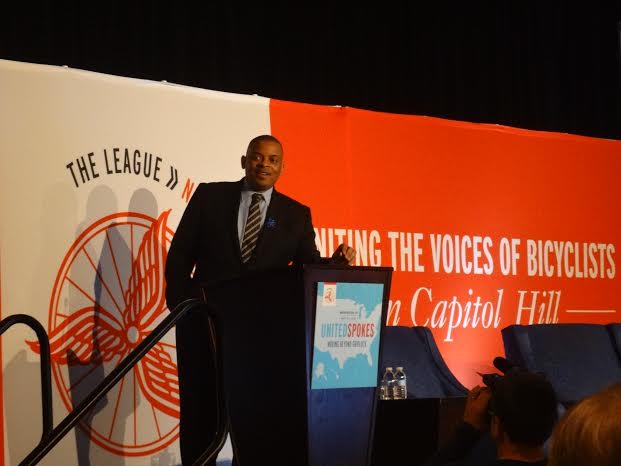
Speaking at the annual National Bicycle Summit in Washington, DC, earlier this month, Foxx, an African American former mayor of Charlotte, N.C., said that the federal government needs to devote more attention to making bicycling part of everyday life for the working class. Emphasizing the need for safety and convenience, Foxx was especially enthused about cycletracks — bikeways that are fully separated from automobiles and offer space for women, children, and older Americans to safely navigate cities by bike.

Foxx’s address followed a day of equity-themed panels and plenaries attended by more than 700 people. The League of American Bicyclists, focused on lobbying Congress and the White House, announced a new equity agenda to reach out to women, people of color, and to focus on reinvigorating a more progressive and egalitarian tone for bicycle advocacy.

Social justice advocates and community organizers had a strong presence at the summit, which has historically reflected a whiter, upper-middle-class male constituency. One presenter discussed bicycling and women’s prison rehabilitation, sharing how women who suffered from abuse, drug addiction, and imprisonment found bicycle riding to be normalizing and helpful for personal growth and for managing depression and anxiety.

A panel session titled “Learning from Los Angeles” showed how advocacy for bicycling can also come from community-based organizations, not just bicycle groups. Social justice issues are fundamental to LA’s inner city bicycle movement; over a third of South Central Los Angeles households are car free, and community organizers there have made a clearer connection between economic inequity and environmental problems.

Advocates from New York City chimed in that it was time for a “minority bicycle coalition” to advocate for women, minorities, and immigrant bicycle delivery workers. They pointed out that New York’s new and much-vaunted bike infrastructure has mainly spread in more affluent, white parts of Manhattan and Brooklyn, while Queens is overlooked. A speaker from the NAACP put obesity and public health at the center of the civil rights agenda and remarked on how the bike lifestyle should be brought to African American neighborhoods.

A discussion of emerging bike share systems asked how to expand to minority populations, and provided examples of how Boston subsidizes bike share membership for low income members. Boston also relaxes the charges for exceeding 30-minute rides and is figuring out ways to enable those without credit cards to participate.

Once a cynic about bike share, I experienced firsthand the benefits of a truly extensive, practical bike share system in Washington, DC (note to San Francisco — it was NOT covered in Wells Fargo or Google corporate logos). If bike share is extended to the Excelsior, Bayview, Balboa Park, Daly City, and SF State, it will work for the working class and students.

One of the most inspiring personas at the Bike Summit was Terry O’Neill, director of the National Organization for Women, who asked that bicycle advocates get beyond simply advocating for bikes. O’Neill prodded cyclists to ask: What do we need to do to make bicycling useful to women? And then she laid it out eloquently. Build affordable housing — lots of it — in areas where it is most needed, such as affluent Montgomery County, a suburb of DC, or in places like Hayes Valley and Silicon Valley. By creating the spatial proximity that makes cycling practical, women (and men) can incorporate cycling while balancing jobs, household chores, and children. This would do more to increase bicycling (and equity) than simply striping new bike lanes.

Her point is that for cycling to be logical for women, especially in complex metropolitan areas like DC or the Bay Area, well-planned and centrally located affordable housing is key. Perhaps it is time for the San Francisco Bike Coalition and Silicon Valley Bike Coalition, with their wealth of talent and donors, to create staff positions focusing on the bicycle-housing nexus and build strong partnerships with those who are fighting to build and preserve affordable housing in job- and amenity-rich areas.

Dovetailing from that, the newly elected mayor of Pittsburgh, Bill Peduto, himself a convert to bicycling, urged bicycle advocates to be an active partner in local progressive political coalitions and to work with non-bike groups such as labor unions and housing advocates. Peduto was among a handful of prominent politicians, mostly mayors and members of Congress, espousing the wisdom of linking bicycling and equity as part of the urban agenda.

The overall message is clear. Cities need to move beyond the neoliberal creative class storyline about bicycling, which says that a successful city is one that has a youthful, fit, but affluent stratum for bicycles. We need to be careful about praising the bicycle as a profitable economic development strategy for Realtors who up the rent as part of a commodified package of livability.

Sure, it’s great to see a bike lane on mid-Market, and there should definitely be more. But a successful city is not one where developers and Realtors see bike lanes and gentrify the neighborhood. A successful city is one where working class women feel safe to bike, where teachers, construction workers, and nurses can use the bicycle for many local trips, where African Americans and Latinos feel included in the bicycling movement, and where service workers and immigrants can safely maneuver the city and region by bicycle without fear of being hit by a car or truck. And the true mark of success is when all of these people can afford to live in the city and travel by bicycle.

Uber adjusts insurance policy in wake of fatal collision

0

Transportation Network Companies, more commonly known as “rideshares,” have operated in legal limbo regarding their insurance since their creation. This came to a head on New Year’s Eve with the death of six-year-old Sofia Liu, who was killed in a collision with an Uber car driven by a man named Syed Muzzafar. Uber claimed in a blog post that because Muzzafar was not ferrying a passenger at the time, and only using the app to search for fares, that he was not officially covered by their insurance.

That insurance gap left Muzzafar on the hook for the little girl’s death and the injuries of her family, the subject of a lawsuit that could end up seeking some $20 million in damages.

So far, Uber has not provided any compensation to Liu’s family. But it has revised its insurance policy, suggesting future collisions may be covered.

In a blog post, Uber announced that “in order to fully address any ambiguity or uncertainty around insurance coverage for ridesharing services,” it would expand drivers’ insurance “to cover any potential ‘insurance gap’ for accidents that occur while drivers are not providing transportation service for hire but are logged onto the Uber network and available to accept a ride.”

Uber’s new policy will cover up to $100,000 per incident for bodily injuries and $25,000 per incident for property damage. But the blog specifies that the money will not kick in if a driver’s personal insurance covers a collision, as appears to be the case with the New Year’s Eve incident.

In an interview with the San Francisco Chronicle, Uber CEO and co-founder Travis Kalanick said that the Syed Muzzafar’s personal insurance policy had offered to pay the claim, but had not yet followed through.

Uber’s spokesperson Andrew Noyes declined to comment when we asked him about this.

Notably, a coalition of rideshares including Lyft and Sidecar and a handful of insurance companies banded together to develop new insurance policies. The group’s work is ongoing, though the intent looks positive — new insurance policies specific to Transportation Network Companies developed by a coalition of industries would be a great step for driver, passenger and pedestrians alike.

But for now, commercial and personal insurance policies rarely, if ever, cover TNC drivers. And Uber’s new insurance? It’s great, as long as Uber follows through. (Joe Fitzgerald Rodriguez)

Indecisive Democrats let real-estate developers win

By a slim margin, the governing body of the San Francisco Democratic Party voted Wed/12 to oppose a controversial June ballot measure, Proposition B, concerning waterfront height limits.

The initiative would require city officials to get voter approval before approving new building projects that are taller than what’s legally sanctioned under a comprehensive waterfront land-use plan. Prop. B stems from an effort last November, authored by the same proponents, to reverse approval for a luxury waterfront development project called 8 Washington, which exceeded building height limits. In the run-up to that election, the DCCC sided against the 8 Washington developers, and aligned itself with those seeking to strike down the 8 Washington height-limit increase in order to kill the project.

But this time, under the leadership of chair Mary Jung — who is employed as a lobbyist for the San Francisco Association of Realtors — the DCCC came down on the side of powerful real-estate developers.

The vote was surprising to some longtime political observers, given that until recently the DCCC was known as a progressive stronghold in San Francisco politics. Its slate cards are distributed to Democrats throughout San Francisco, and Democrats make up the vast majority of city voters.

In a politically significant outcome, the DCCC’s opposition to Prop. B was decided by a slim 13 to 12 vote. The threshold for it to pass or fail was much lower than usual, because so many DCCC members simply refused to take a stand.

San Francisco Board of Supervisors President David Chiu — who not only opposed 8 Washington but helped gather signatures for the referendum to challenge it — was among those who abstained. Chiu’s decision to abstain sets him apart from Campos, his opponent in the upcoming Assembly race, who voted to endorse Prop. B. Had Chiu voted, Prop. B’s opponents would not have had the votes to get the upper hand.

When reached for comment, Chiu told the Bay Guardian he still hasn’t formed an opinion on the measure, and that he’s waiting on a pending city analysis and the outcome of a lawsuit challenging it.

“There’s been very little analysis and I could take money away from affordable housing and cost the city money fighting a lawsuit,” he said, citing the money that developers would be spending on political campaigns as the potential source of affordable housing money.

“I am open to supporting the measure, as someone who passionate about waterfront development,” he added, citing the lead role he took in opposing the 8 Washington project. (Rebecca Bowe)


Local support for national LGBT housing rights

At the Tue/11 Board of Supervisors meeting, Sup. David Campos introduced legislation to encourage large-scale developers to protect the housing rights of the LGBT community.

Same-sex couples nationwide are more likely to experience discrimination in their search for senior housing, a study by the Washington, D.C. based Equal Rights Center found.

To investigate, testers posed as gay or straight couples with otherwise nearly identical credentials, then submitted inquiries on senior housing in 10 different states. They discovered that in 96 out of 200 tests, those posing as lesbian, gay or bisexual residents experienced at least one type of adverse, differential treatment.

Meanwhile, according to the National Center for Transgender Equality, one in five transgender U.S. residents has been refused a home or apartment, and more than one in ten has been evicted, because of their gender identity.

Federal law does not expressly prohibit discrimination based on sexual orientation or gender identity. California law does, as do laws in 19 other states. Given these gaps in legal protection, real-estate providers can adopt their own policies to prohibit LGBT discrimination.

Campos’ proposal would require large-scale developers who wish to build in San Francisco to prove their commitment to equal housing opportunities.

“We want to know whether a developer hoping to build in San Francisco is protecting LGBT housing rights when they own or manage housing in states where legal protections don’t exist,” Campos explained. “By collecting this information, we can highlight best practices and urge those who do not have these policies to do the right thing.”

Alerts: March 19 – 25, 2014

0

WEDNESDAY 19

Get educated with affordable housing experts St. Philip’s Church, 725 Diamond, SF. 7pm, free. Hosted by the Noe Valley Democratic Club, this public forum on (the lack of) affordable housing in the Bay Area will bring together a host of experts coming to the table from a variety of perspectives. Panelists will include Doug Shoemaker of Mercy Housing, Teresa Yanga of the San Francisco Mayor’s Office of Housing, Tim Colen of the San Francisco Housing Action Committee, Fernando Marti of the Council on Community Housing Organizations and Sara Shortt of the Housing Rights Committee of San Francisco. It’s a tight squeeze out there, but knowledge is power — and this is an opportunity to get educated, ask questions and join forces with longtime community members who are searching for answers. For more info, contact molly@ffrsf.com.


Meeting on the future of the Tenderloin Tenderloin Police Station, 301 Eddy, SF. 11am-noon, free. San Francisco’s Tenderloin neighborhood has been at the center of many community dialogues recently as rising rents have placed tremendous pressure on nonprofits and arts organizations in the surrounding area. Neighborhood residents, social service providers, arts groups, and local businesses may wish to attend this meeting, which will include presentations on the arts center at 950 Market Street, current projects associated with the Civic Center Community Benefit District, and other updates. For more information, call (415) 820-1412.


THURSDAY 20

How to deal with your debt once and for all The Green Arcade, 1680 Market, SF. www.thegreenarcade.com. 7-9pm, free. George Caffentzis — a contributor the newly released The Debt Resisters’ Operations Manual, and author of In Letters of Blood and Fire: Work, Machines, and the Crisis of Capitalism — will speak at the Green Arcade on providing tools for debtors everywhere who want to understand how the system really works. In the past 30 years, wages have stagnated nationwide and average household debt has more than doubled. This new book offers detailed strategies, resources, and insider tips for dealing with some of the most common kinds of debt, including credit card debt, medical debt, student debt, and housing debt.


SATURDAY 22

Bay Area Anarchist Book Fair The Crucible, 1260 7th Street, Oakl. 10am-6pm, free. www.bayareaanarchistbookfair.net. Now hosted in new East Bay digs, the 19th annual Bay Area Anarchist Book Fair is free and open to the public. It’s a gathering for folks who are interested and engaged in radical movements and organizing around social and economic justice. The book fair provides a space to connect, learn and discuss, through book and information tables, workshops, panel discussions, skill-shares, films, and more.

MONDAY 24

East Bay forum on raising the minimum wage Ed Roberts Campus, 3075 Adeline St. Berk. www.tonythurmond.com/march_24. 6-8pm, free. Join District 15 Assembly Candidate Tony Thurmond for an open panel on raising the minimum wage. With the state minimum wage to reach $10 in early 2016, this discussion will take into account that, as big of step that may be, it still won’t amount to a living wage for many Bay Area residents. Join in to have your say, share a personal story, and connect with community members who are pushing for higher wages across the board.

The unanswered question: How do we bridge SF’s affordable housing gap?

186

Nobody has a good answer to San Francisco’s most basic housing problem: How do we build the housing that existing city residents need? It was a question the Guardian has been posing for many years, and one that I again asked a panel of journalists and housing advocates on Friday, again getting no good answers.

The question is an important one given Mayor Ed Lee’s so-called “affordability agenda” and pledge to build 30,000 new housing units, a third of them somehow affordable, by 2020. And it’s a question that led to the founding 30 years ago of Bridge Housing, the builder of affordable and supportive housing that assembled Friday’s media roundtable.

“There really isn’t one thing, there needs to be a lot of changes in a lot of areas to make it happen,” was the closest that Bridge CEO Cynthia Parker came to answering the question.

One of those things is a general obligation bond measure this fall to fund affordable housing and transportation projects around the Bay Area, which Bridge and a large coalition of other partners are pushing. That would help channel some of the booming Bay Area’s wealth into its severely underfunded affordable housing and transit needs.

When I brought up other ideas from last week’s Guardian editorial for capturing more of the city’s wealth — such as new taxes on tech companies, a congestion pricing charge, and downtown transit assessment districts — Parker replied, “We’d be in favor of a lot of that.”

Yet it’s going to take far more proactive, aggressive, and creative actions to really bridge the gap between the San Francisco Housing Element’s analysis that 60 percent of new housing should be below-market-rate and affordable to those earning 120 percent or less of the area median income, and the less than 20 percent that San Francisco is actually building and promoting through its policies.

Stated another way, about 80 percent of housing we’re building is for a small minority of city residents, or the wealthy people that these developers hope to attract to the city. And we’re not building housing for the vast majority of city residents. That is a recipe for gentrification, displacement, and destruction of San Francisco as a progressive-minded city.

Parker parroted Lee and other pro-development boosters, including SPUR, in arguing that city needs to make it easier and faster for developers to build new housing of all types. “In San Francisco, we do need to expedite the [housing] entitlement process,” Parker said.

But when asked whether meeting or exceeded Lee’s housing production goals would ever bring the price of market-rate housing down to the level where someone more 120 percent of AMI — which HUD recently set at $81,550 for single San Franciscans, or $116,500 for a family of four — Parker conceded that it wouldn’t.

The bottom line for San Francisco and its overheated real estate market is we can never built our way to affordability. The only way to build housing that most people can afford is with public subsidies, and San Francisco just isn’t asking enough from its wealthy individuals, corporations, and developers to create an Affordable Housign Trust Fund that is anywhere near big enough to meet the real demand.

That kind of assertion seems radical by the standards of today’s skewed political (and online) discourse. But when I raised it to a panel that included Bridge Housing officials, members of SPUR and HOPE SF, and a panel of journalists from such pro-development outlets as San Francisco Business Times, San Francisco Magazine, SocketSite, The Registry SF, KQED, and TechCrunch (as well as the more Guardian-aligned Mother Jones), nobody had any good answers or remedies to that basic question that we’ve raised again and again.

Instead, some of the business journalists offered a more sober assessment of what’s to come than most of this city’s pro-development boosters, noting a few signs of irrational exhuberance in the local economy.

The Registry’s Vladimir Bosanac said he’s observed a recent trend of developers buying up unentitled land, indicating more optimism in the sustainability of this development boom than market conditions might warrant. Adam Koval of SocketSite, an early predicter of the last dom-com crash, also voiced sketicism in the pervasive “this time is different” faith in the tech sector, noting how realms such as gaming and online coupons are losing steam and predicting that commercial rents are plateauing.

“I think there are some real gut checks coming up,” Koval said of the tech sector and the sustainability of its growth and valuations.

Perhaps it’s also time for a gut check by Mayor Lee and others who argue that we can build our way to housing affordability without any major new efforts to capture more of the wealth now being generated in San Francisco, wealth that might not be here later if we continue avoiding the question of how to provide the housing that San Francisco needs. 

Democratic party rejects bid to make waterfront development more democratic (UPDATED)

Note: This story has been updated (see below).

The governing body of the San Francisco Democratic Party voted Wed/12 to oppose a controversial June ballot measure concerning waterfront height limits, despite voting last year to support a strikingly similar measure on the November ballot.

By a slim 13-to-12 vote, the Democratic County Central Committee voted to oppose Proposition B, which would require city officials to get voter approval before approving new building projects that are taller than what’s legally sanctioned under a comprehensive waterfront plan.

The vote breakdown was surprising to some because until recently, the DCCC was known as a progressive stronghold in San Francisco politics. Its slate cards are distributed to Democrats throughout San Francisco, and Democrats make up the vast majority of city voters.

Now, under the leadership of a chair who is employed as a lobbyist for the San Francisco Association of Realtors, the DCCC has aligned itself with powerful real-estate developers hoping to build along the city’s waterfront. 

District 8 Sup. Scott Wiener came under scrutiny recently because he called for a formal evaluation on the impact of Prop. B after developers who oppose the measure sent emails urging him to do so. Wiener, who emphasized at the time that he merely sought an “impartial analysis” of the measure, voted against Prop. B.

Also opposing Prop. B were Assmeblymember Phil Ting, Attorney General Kamala Harris, and Bevan Dufty, a former District 8 supervisor who now leads the mayor’s initiatives on homelessness. 

Twelve members voted to endorse the measure, including Sups. John Avalos, David Campos, Eric Mar, and Malia Cohen, as well as California Sen. Mark Leno and Assemblymember Tom Ammiano. 

But the threshold for this vote to pass or fail was much lower than usual, because so many DCCC members simply refused to take a stand one way or the other.

Prop. B comes on the heels of voters’ rejection last November of Props. B and C, dueling initiatives which concerned the fate of a controversial luxury high-rise tower, the 8 Washington project. 

Although that project won Board of Supervisors approval, opponents brought a referendum to the ballot to ask voters to decide whether to uphold or reject a building height increase that went above the established limit.

The rejection of 8 Washington at the ballot was interpreted as a politically significant turning point, because voters flushed a luxury condo tower down the tubes at a time when the housing affordability crisis was getting into full swing. Soon after that victory, 8 Washington opponents returned to file paperwork for a new referendum on the ballot, to require voter approval for all waterfront height-limit increases.

San Francisco Board of Supervisors President David Chiu – who not only opposed 8 Washington but helped gather signatures for the referendum to challenge it – did not take a position on the waterfront height limit measure. Chiu’s decision to abstain sets him apart from Campos, his opponent in the upcoming Assembly race. Had Chiu voted to endorse Prop. B, its opponents would not have had the votes to get the upper hand.

UPDATE: Chiu said he still hasn’t formed an opinion on the measure, and that he’s waiting on a pending city analysis and the outcome of a lawsuit challenging it. 

“There’s been very little analysis and it could take money away from affordable housing and cost the city money fighting a lawsuit,” he said, citing the money that developers would be spending on political campaigns as the potential source of affordable housing money. 

“I am open to supporting the measure, as someone who passionate about waterfront development,” he added, citing the lead role he took in opposing the 8 Washington project. (End of update.)

Others who abstained (or did so by proxy) included Alix Rosenthal (who is working as a consultant on the waterfront Warriors arena project), Sen. Dianne Feinstein, Rep. Jackie Speier, and Rep. Nancy Pelosi. California Sen. Leland Yee – whose representative at the meeting, John Rizzo, reportedly did not show up to cast Yee’s vote – was reportedly also planning to abstain.

Jon Golinger, who is leading the Prop. B campaign to require voter approval for waterfront height-limit increases, said he wasn’t terribly concerned about the DCCC vote, since early polling was favorable to his campaign. But he found it telling that the same cast of characters who had opposed 8 Washington were now voting to oppose a measure that would have extended voters’ will on 8 Washington to all waterfront development proposals.

“The key difference,” between Prop. B and last November’s 8 Washington vote, he told the Bay Guardian, “is that there are more big money interests that have something to lose here.”

Clean Up The Plaza run by political consultant with ties to developers

168

Neighborhood and progressive political activists have long been suspicious of the shadowy Clean Up The Plaza campaign and its possible connections to a massive housing development proposed for 16th and Mission streets — and the Guardian has now confirmed that developer-connected political consultant Jack Davis is playing a key role in that campaign.

Asked by the Guardian whether he is being paid by the developers — Maximus Real Estate Partners, which has submitted plans to build a 10-story, 351-unit housing complex overlooking the 16th Street BART plaza — Davis told the Guardian, “That’s between me and the IRS.”

Our exchange with Davis and Gil Chavez, a Davis roommate who runs the Clean Up The Plaza campaign, occurred yesterday outside the LGBT Center where they and three other campaign workers (who refused to speak to us) were promoting their cause and collecting signatures on petitions calling for crackdowns on the plaza before the debate inside between Assembly District 17 candidates David Chiu and David Campos.

Clean Up The Plaza has been refusing to return calls from the Guardian or other local journalists for months, and the group hasn’t filed any paperwork with the San Francisco Ethics Commission in association with its political fundraising or lobbying efforts.

Asked about the group’s relationship with the project developers, Chavez told us, “They’re in communication with us and we’re in communication with them, but they haven’t funded us.” Asked who paid for the group’s website, mailers, window signs, and other expenses, Chavez said it was him and other donors that he wouldn’t identify.

Davis has been the go-to political consultant on big campaigns backed by real estate interests in San Francisco, working on the successful mayoral campaigns of Frank Jordan, Willie Brown, and Gavin Newsom, as well as a number of high-profile development projects, including the 1996 ballot measure approving construction of AT&T Park.

He and Chavez say they live together in the neighborhood and their only motivation in running the group is improving public safety. “I’m happy to to talk about what Clean Up The Plaza is,” Davis told us. “I live at 17th and Mission and I’ve been mugged.”

But housing activist Sara Shortt of the Housing Rights Committee isn’t buying it, calling the group “a fake grassroots campaign that is misleading this community.”

“If you didn’t know Jack Davis’ history in politics in San Francisco, you might be able to take that at face value,” Shortt said of Davis’ claims to be simply a concerned citizen. “Given his ties to big developers, it’s not very believable.”

Willie Brown even heralded Davis’ return to political work two years ago in his San Francisco Chronicle column, entitled “Political consultant Jack Davis back on S.F. scene,” writing that he has returned to local political circles following a hiatus in Wales the previous few years.

“You political types, be warned. Jack Davis is back in town,” the column began, ending with, “I think that after watching from the sidelines for a while, he’s ready to return. Can’t wait to see whom he decides to work for. Stay tuned.”

Is Davis working on fake grassroots campaign designed to smooth the way for a massive gentrifying housing projects in one of the city’s last remaining neighborhoods that still welcomes poor people? Stay tuned.

San Francisco Ethics Commission Director John St. Croix told the Guardian that the group should be registered if it has raised more than $1,000 or if it is lobbying at City Hall — indeed, the group has boasted on its website of efforts to influence Campos and other city officials to increase police patrols and cleansing of the plaza — particularly if it is being paid by a third party to do so.

“If they’re lobbying, obviously we want to know,” St. Croix told us, saying that he planned to personally follow-up with the group on its activities.

Davis denies that the group is in violation of any disclosure laws, claiming it is simply a small neighborhood group, and he referred our inquiries to the group’s attorney, James Perrinello, a partner at the high-powered and politically connected law firm of Nielson Merksamer Parrinello Gross & Leoni, who hasn’t yet returned our calls.

For more on Clean Up The Plaza and other campaigns to “clean up” poor neighborhoods as a precursor to gentrification and market rate housing development — including the ongoing efforts to do so in the Tenderloin and Mid-Market areas — read next week’s Bay Guardian. 

[UPDATE 3/18: Former Guardian Editor/Publisher Tim Redmond’s 48 Hills site just posted a long report by reporter Julia Carrie Wong that includes an admission by Davis that he is indeed a paid consultant for Maximus, as well as interesting conflicting statements from Maximus and Chavez about a meeting they held. Check it out.] 

SF bans water bottles

27

San Francisco continues to lead the way in the nation’s environmental policy, with the Board of Supervisors on March 4 voting unanimously to bar the city from buying plastic water bottles and to ban distribution of plastic water bottles smaller than 21 ounces on city property starting Oct. 1. The ban excludes city marathons and other sporting events.

"We all know with climate change, and the importance of combating climate change, San Francisco has been leading the way to fight for our environment," Board President David Chiu, who authored the legislation, said at the hearing. "That’s why I ask you to support this ordinance to reduce and discourage single-use, single-serving plastic water bottles in San Francisco."

Chiu held up a water bottle at the board meeting, a quarter of the way full with oil, to illustrate how much oil is used in the production and transport of plastic water bottles. He also reminded San Franciscans that the current fad of buying bottled water only started in the 1990s when the bottled water industry mounted a huge ad campaign that got Americans buying bottled water.

Somehow, Chiu noted, "for centuries, everybody managed to stay hydrated." (Francisco Alvarado)

Mass action against Keystone XL

Nine environmental activists were arrested in San Francisco for marching through the financial district and entering One Spear Tower on March 3, the building that houses local offices of the State Department, to express opposition to the proposed Keystone XL pipeline.

A day earlier, a mass protest against the oil pipeline was staged outside the White House in Washington, D.C. Roughly 200 protesters were arrested after using plastic zip ties to lock themselves to the White House fence.

Meanwhile, thousands more have made a vow — at least in the sense of clicking to add their name to a petition — to engage in peaceful civil disobedience if President Barack Obama grants ultimate approval for the oil infrastructure project, which would transport 830,000 barrels of crude oil from Canada to the Gulf Coast.

Nonprofit Credo Action has created an online petition urging people to get ready to respond with peaceful civil disobedience if the pipeline wins final approval. (Rebecca Bowe)

City weighs lawsuit over Airbnb

The San Francisco City Attorney’s Office is finally preparing to take action against the illegal short-term housing rentals facilitated by Airbnb, something we’ve been hearing that the Examiner also reported on March 6 ("SF landlords could face legal fight over rentals on Airbnb, other services"), an action that would address the company’s apparent stall tactics.

Despite a business model that violates a variety of San Francisco laws — most notably zoning, planning, and tenant regulations — and Airbnb’s flagrant flouting of a two-year-old city ruling that it should be collecting and paying the city’s transient occupancy tax (see "Into thin air," Aug. 6), the City has appeared unwilling or unable to enforce its laws or address these issues.

"We’re aware of multiple housing allegations, including some that community leaders have brought to us," City Attorney’s Office spokesperson Matt Dorsey told the Guardian, confirming that the office is considering taking legal action to enforce local laws governing short-term housing rentals but refusing to provide details.

Board of Supervisors President David Chiu took on the problem over a year ago, working with the company and its critics to develop compromise legislation that would legalize and tax the activities of Airbnb and its hosts, but the multi-layered legal and logistical challenges in doing so have so far proven too much for the otherwise effective legislator.

"My staff has held meetings with Planning staff and its enforcement team to discuss enforcement and related challenges. We’ve also been in touch with the City Attorney’s Office on these issues," Chiu told the Guardian, saying he and his staff have recently been focused on other tenants and secondary unit legislation, but they "plan to refocus on our shareable housing efforts soon." (Steven T. Jones)

Blaming pedestrians

ABC7 News Investigative Team’s new "investigative report" on pedestrian safety stirred controversy last week as street safety advocates called out the video for its insensitivity towards pedestrian deaths and lax attitude towards unsafe drivers.

Streetsblog SF and others in San Francisco said the report engaged in "victim blaming."

ABC7’s pedestrian safety coverage comes on the heels of a number of high-profile traffic collision deaths, including that of 6-year-old Sofia Liu, killed on New Year’s Eve. Since then, the Walk First program to create safer streets has garnered more attention, culminating in Mayor Ed Lee’s announcement today to partially fund safety improvements to the city’s most dangerous intersections, to the tune of $17 million — improvements that languished due to funding gaps since the program was announced in April.

But making all the needed improvements though would cost $240 million, according to city estimates, and that funding has yet to be identified. Suffice to say, the traffic enforcement debate still rages in San Francisco, with emphasis on the word ‘rage.’

"We’ve seen ‘blame the pedestrians’ from police and in the media," Leah Shahum, executive director of the San Francisco Bike Coalition, said at a pedestrian safety hearing in January. Police Chief Greg Suhr that night apologized for his officers’ lax enforcement of drivers, and focus on pedestrians, and pledged to change policies to focus on drivers going forward.

It’s too bad ABC 7’s I-Team didn’t get that memo.

"In San Francisco, simply stepping off the curb can be deadly," ABC reporter Dan Noyes narrates in their video report. The word ‘deadly’ is capped off with a Hollywood-style musical flourish, like a horror movie moments before the big scare.

"Pedestrians are making mistakes over and over again," Noyes narrates. The video cuts to pedestrian after pedestrian looking at cell phones, jaywalking, or otherwise engaging in unsafe behavior. It’s fair to say the piece, headlined "I-Team investigates what’s causing pedestrian deaths," places responsibility of pedestrian safety squarely on the shoulders of pedestrians. (Joe Fitzgerald Rodriguez)

High-speed challenges

The California High Speed rail project has been facing resistance that threatens to derail the project. Not only has public support for the $68 billion project wavered in recent years, now the project faces a legal battle that could delay the project before the first rail is laid.

On March 4, Sacramento County Superior Court Judge Michael Kenny ruled that a lawsuit brought on by King County can go to trial. The lawsuit raises questions about the legality of using 2008’s voter-approved Prop 1A funding, $9.95 billion worth of bonds, to upgrade and electrify Caltrain’s tracks and incorporate them into the high speed system.
Another concern was that the proposed high-speed system would not be able to pull through with its promise of a 2 hour 40 minute nonstop ride from downtown San Francisco to Los Angeles’ Union Station if the high speed system had to share tracks with Caltrain.

The lawsuit also threatens to leave San Francisco’s new $4.5 billion Transbay Terminal without its planned underground high speed rail station, which could be disastrous for that project as well.

None of this seems to faze Rod Diridon, executive director of the Mineta Transportation Institute based out of San Jose State University and former founding board member of the California High-Speed Rail Authority Board. He told the Guardian: "I think that [the project] will happen now. I think that our wonderful governor and our legislative leaders are going make it happen now…. If it was delayed it would only be a matter of time before it came back." (Francisco Alvarado)

Alerts: March 12 – 18, 2014

0

WEDNESDAY 12

San Francisco Neighborhoods on the Brink Bird and Beckett Books and Records, 653 Chenery, SF. www.birdbeckett.com. 7pm, free. A panel discussion on displacement, gentrification, rising rents, and the loss of affordable housing. Join us to discuss the dilemma facing longtime residents and renters of modest means — and the gutting and gentrification of San Francisco — as real-estate speculation and a quickly widening income gap drive rents to dizzying heights while the rental supply dwindles. Ellis Act evictions are buffeting many of our neighbors, and the lack of affordable housing affects us all.


THURSDAY 13


Screening: Terms and Conditions May Apply Unitarian Universalists Hall, 1924 Cedar, Berk. www.bfuu.org. 7pm, $5-10 donation, no one turned away for lack of funds. Have you ever read the “Terms and Conditions and Privacy Policies” connected to every website you visit, phone call you make, or app you use? Of course you haven’t. But those agreements allow corporations to do things with your personal information you could never even imagine. What are you really agreeing to when you click “I accept”? Find out in this disquieting exposé.


FRIDAY 14


Visual Activism Symposium Brava Theater Center, 2781 24th St., SF. www.sfmoma.com/events. 9am-7pm, free with pre-registration. Join us for a symposium exploring the relationship between visual culture and activist practices. Art can take the form of political and social activism, and activism often takes on specific, and sometimes surprising, visual forms. How is our broader visual culture shaped by activist practices that circulate in public space? Scholars, artists, and activists address these and related questions in a series of presentations, performances, workshops, and interactive projects.

SATURDAY 15  

International Day Against Police Brutality Arroyo Park, 7701 Krause, Oak. www.march15oak.noblogs.org. 12pm, free. March 15th has been designated as International Day Against Police Brutality since 1997, as an initiative by radical groups in Montréal and Sweden. Police brutality is nothing new to Oakland, and for the second year in a row we will observe the International Day Against Police Brutality with a demonstration beginning at Arroyo Park in east Oakland. A rally will start at noon, followed by a march starting at 1pm.

SUNDAY 16

Anonymous Internet Communication Niebyl Proctor Marxist Library, 6501 Telegraph, Oak. cuyleruyle@mac.com. 10:30am-12:30pm, free. It’s no secret that the NSA was and is secretly spying on people here at home and around the globe. The justification given for this activity is that it can prevent terrorism and crime. While we wait for Congress or the courts to do something, we can right now actively protect our individual privacy, using freely available technical tools and best practices. Keith Davis will discuss the motivations for Internet Anonymity and the different levels of privacy that can be obtained. He also will provide caveats and warnings associated with the use of privacy tools and practices.

Soda tax is social justice issue

129

Eric.L.Mar@sfgov.org, John.Avalos@sfgov.orgtom@tomammiano.com

OPINION

We are fighting for a soda tax because public health leaders have sounded the alarm that sugary drinks are a serious threat to our public health. Now is the time to get the word out about the latest facts that tell the story.

Our work on the issue began when community leaders and medical experts started educating us on the impact of sugary drinks. The resulting legislation that we crafted along with four other members of the Board of Supervisors will not only slow soda consumption, but it will fund the anti-hunger and physical activity programs we dearly need.

Most folks know soda is bad for you, but not how bad. Many are also unaware that Big Soda is specifically targeting communities of color and children. Our task is to spread the word about the health disparities this creates.

The lack of healthy food choices is an injustice that is hitting communities of color the hardest. Fully three-fourths of adult Latinos and African Americans in San Francisco are obese or overweight and one in three Americans will soon be diabetic, including one in two Latinos and African Americans.

The disparities are geographic as well. The highest rates of diabetes hospitalizations and emergency room visits are among residents of the Bayview, Tenderloin, SoMa, and Treasure Island. Close behind are the Excelsior and Visitacion Valley. These are also the neighborhoods that lack access to healthy food and are among those consuming the most soda.

We are already paying the high price of soda consumption. San Franciscans spend at the very least $50-60 million a year in health care costs and sick days due to obesity and diabetes attributable to sugary drinks. The fact that sugary drinks are the biggest single source of added sugar in our diets sets it apart from other unhealthy foods.

The revenue generated has tight controls and must be used to mitigate the harm Big Soda causes. Steered by an independent committee and targeted to communities suffering the most from health inequities, the tax will bolster funding for everything from school meals, healthy food retailer incentives, physical education, and other deserving programs.

Big Soda has hired high-priced lobbying firms and public relations folks who are employing a small army of young people, deploying them into the Bayview, the Mission, and Chinatown — those communities most impacted by diabetes and soda consumption. They’ve set up a front group — San Franciscans for an Affordable City — to capitalize on the anger in SF about the cost of housing and living.

But think about it: Have Big Soda companies helped us in our fight for affordable housing? Are they fighting for a living wage for communities of color in San Francisco? They have never cared about an affordable city. They care about protecting their profits, period.

We need affordable housing, healthy foods, and physical activity — issues we are working on every single day. On the other hand, our communities need affordable soda as much as we need cheap cigarettes and booze. It only makes us sick.

There are things our communities are doing to promote good health, like transforming corner stores into healthy retailers, building community gardens, and expanding physical and nutrition education. The soda tax as it is written now can provide these programs and dramatically improve our communities’ health.

This isn’t a ban but a reasonable first step to decrease soda consumption. This is a research-proven way of getting people to use less of an unhealthy product — it worked with cigarettes and it worked with alcohol. Finally, the tax will fund a range of great programs that will actually provide healthy choices for everyone.

It’s time we make the healthy choice the easy choice for low-income communities and all San Franciscans.

John Avalos represents District 11 (Outer Mission, Excelsior) and Eric Mar represents District 1 (the Richmond District) on the San Francisco Board of Supervisors, Tom Ammiano represents Assembly Dist. 17 (eastern San Francisco) in the California legislature.


Lee must pay for his promises

19

EDITORIAL

Mayor Ed Lee has made a lot of promises to San Franciscans, but he has been unwilling to pay for them with money from the city or his wealthy backers, transforming these statements in hollow political platitudes — or, less charitably, calculated lies meant to mask the true state of the city.

Lee pledged to build 30,000 units of new housing — a third of it affordable to those with moderate incomes and below — by 2020. By that same year, Lee set the goal of increasing bicycling to 20 percent of all vehicle trips in the City. Lee also directed city departments to develop strategies for reducing pedestrian deaths by 50 percent by 2021. And so Muni’s aging fleet can keep up with population growth, Lee’s SF2030 Transportation Task Force said the transportation system needs a $10 billion capital investment over the next 15 years, a target Lee endorsed.

These were all admirable goals, and in each case, city agencies studied the problems and developed detailed strategies for getting there. And in each case, Mayor Lee chose to fund just small fractions of what the city would need to make his promises come true.

Actually, the housing problem is still being studied, but nobody thinks this goal will be met — as even the pro-development San Francisco Business Times said in a recent editorial — particularly given how the Mayor’s Office structured the business tax reform and Affordable Housing Fund ballot measures in 2012, with giveaways to developers and favored economic sectors, such as tech.

Lee’s WalkFirst program would need $240 million to meet his modest goals — far more to actually realize the VisionZero goal of eliminating all pedestrian deaths, which Lee said he supports — and the Mayor’s Office has only pledged $17 million in funding. The cycling goals would take more than $500 million, not the $30 million currently pledged. Even with approval of the two transportation ballot measure proposed for this fall, and those planned for future years, that only gets the city about a third of the way to meeting San Francisco’s future transportation needs.

Meanwhile, a downtown SF congestion pricing charge that has been studied using federal funds — which would reduce traffic and pedestrian deaths while raising $80 million annually — is being ignored by Lee, as is the once-promising idea of downtown transit assessment districts. Lee is refusing to seek the city’s share of the tremendous wealth now be generated in this city.

As a result, Lee is making promises that he knows he won’t deliver on. And last week, in the five-year budget projection his office is required to issue, we all saw the results of Lee’s economic policies: growing budget deficits for this booming city. Next year’s $67 million deficit is projected to balloon to $340 million by 2017-18. Mr. Mayor, “getting things done” requires more than just words, it requires the political courage to make your promises comes true.

Housing round-up: LGBT tenants, a singing protest, and a very sad mural

At today’s (Tue/11) Board of Supervisors meeting, Sup. David Campos is introducing legislation to encourage large-scale developers to protect the housing rights of the LGBT community.

Same-sex couples nationwide are more likely to experience discrimination in their search for senior housing, a study by the Washington, D.C. based Equal Rights Center found.

To investigate, testers posed as gay or straight couples with otherwise nearly identical credentials, then submitted inquiries on senior housing in 10 different states. They discovered that in 96 out of 200 tests, those posing as lesbian, gay or bisexual residents experienced at least one type of adverse, differential treatment.

Meanwhile, according to the National Center for Transgender Equality, one in five transgender U.S. residents has been refused a home or apartment, and more than one in ten has been evicted, because of their gender identity.

Federal law does not expressly prohibit discrimination based on sexual orientation or gender identity. California law does, as do laws in 19 other states. Given these gaps in legal protection, real-estate providers can adopt their own policies to prohibit LGBT discrimination.

Campos’ proposal would require large-scale developers who wish to build in San Francisco to prove their commitment to equal housing opportunities.

“We want to know whether a developer hoping to build in San Francisco is protecting LGBT housing rights when they own or manage housing in states where legal protections don’t exist,” Campos explained. “By collecting this information, we can highlight best practices and urge those who do not have these policies to do the right thing.”

Under the legislation, developers would indicate whether they have national policies prohibiting LGBT discrimination. The Human Rights Commission would compile those policies and present it annually to the Board of Supervisors.

Elsewhere on the housing front, POOR Magazine founder Lisa Gray-Garcia (aka “Tiny”) led a group of anti-eviction activists into City Hall this morning, where they broke into song to call attention to the eviction of a family from a public-housing unit in the Fillmore neighborhood. They linked the eviction with a broader trend of African American out-migration from San Francisco, and sang spirituals.

Gray-Garcia reported that the group, which she estimates at roughly 30 people, encountered resistance from the Sheriff’s deputies who provide security in City Hall. “They said we were an unlawful assembly because we were singing,” she said. So the protesters proceeded upstairs, whispering, to stand outside Mayor Ed Lee’s office. Then they broke into song again, she said.

“We’re talking about a family about to be evicted tomorrow, that’s how serious this is,” Gray-Garcia told us. She said she’d spoken to someone from the mayor’s office, Carl Nicita, who “to his credit, he listened to us and he said ‘I’m going to tell the mayor.’” (We’re working on finding out more about the eviction and how the city will respond.) 

As a final housing-related tidbit, head over to the Mission to check out the new Clarion Alley “Wall of Shame” mural, featuring a list of what the artists perceive to be the root forces of gentrification (Both Google buses and corporate giveaways to tech companies made the list).

Inscribed on some tombstones near the bottom: “So long San Francisco, As We Knew It. (Historic Counter-Culture & All.)”

On the flip side, the artists also included a list of solutions.

Bryan Augustus contributed to this report.

Three upcoming events on housing in San Francisco

There are a few upcoming opportunities to have your say in the ongoing dialogue about the San Francisco tenants’ struggle as long-term renters grapple with rising rents and the threat of displacement.

Amid the housing pressure, a thriving tenants’ rights movement has unfolded in the city to spur multiple legislative pushes for reform. These conversations (and the art exhibit to piece these issues together on a deeper level) are timely.

Wed/12: San Francisco Neighborhoods on the Brink: A Panel Discussion on Displacement, Gentrification, Rising Rents & the Loss of Affordable Housing

Hosted by San Francisco Poet Laureate Alejandro Murguia, this panel discussion will feature comments by District 11 Sup. John Avalos, Public Policy Director of the Chinatown Community Development Center Gen Fujioka, and SFUSD teacher and Ellis Act target Sarah Brant.

An announcement description says the discussion will focus on the “dilemma facing long-time residents and renters of modest means — and the gutting and gentrification of San Francisco — as real estate speculation and a quickly widening income gap drive rents to dizzying heights while the rental supply dwindles.”

Details here.

“There’s a difference between a neighborhood changing—which is natural and organic—versus the destruction of a neighborhood, its history and legacy, which is what is happening right now in the Mission District.” Alejandro Murguía

Wed/12: “Sólo Mujeres: HOME / inside out” – An interdisciplinary exhibit at the Mission Cultural Center for Latino Arts

Curated by Susana Aragón and Indira Urrutia, this exhibition features 24 women artists in exploring the symbolic space of home through a variety of mediums, including installation, painting, photography, sculpture, poetry, video and mixed media. Artists include Yolanda Lopez, Xuchi Eggleton, Ximena Sosa, Windsong, Susana Aragón, Sofía Elías, Tina Escaja, Tanya Marie Vlach, Rebeca García Gonzales, Solange Bonilla Leahy, Natalia Anciso, Melanie Lacy Kusters, Marta R, Zabaleta, Mariella Zevallos, Indira Urrutia, Gabriela Luz Sierra, Flor Khan, Fan Warren, Cristina Ibarra, Clara Cheeves, Carmen Lang, Camila Perez-Goddard, Anna Simson, Alejandra Rassvetaieff, Adriana Camarena.

From the announcement: “A home is a place that is close to our heart, it triggers self-reflection, thoughts about who someone is or used to be or who they might become. Each room or space is connected to memories, feelings, ideas, dreams, etc. As part of the exhibit, the gallery will be transformed into a house which rooms will be delimited by see through fabric to show the fragility of housing in The San Francisco’s Mission District.

It opens at 7pm with a live performance by María José Montijo and Diana Gameros. Details here.

Wed/19: Affordable housing from multiple perspectives

The Noe Valley Democratic Club is hosting what it calls “a distinguished and authoritative panel of experts” who will speak about affordable housing in the Bay Area. What’s interesting about this event is that it will bring together folks who are leading a citywide push at the grassroots level to strengthen tenants’ rights, as well as people from more developer-friendly entities such as SPUR (San Francisco Bay Area Planning and   Research Association) and the San Francisco Housing Action Committee.

The panelists will include:

Sarah Karlinsky, (panel moderator), Deputy Director of SPUR (San Francisco Bay Area Planning and   Research Association)

Douglas Shoemaker, President of Mercy Housing California, a non-profit dedicated to affordable      housing development, fundraising and services.

Teresa Yanga, Deputy Director of the Mayor’s Office of Housing

Tim Colen , Executive Director of San Francisco Housing Action Committee

Fernando Martí, Co-Director of the Council of Community Housing Organizations (CCHO)

Sara Shortt, Executive Director of the San Francisco Housing Rights Committee 

Details here.

One final tidbit, tangentially related at best. Salon has a great article, Gentrifying the dharma” How the 1 percent is hijacking mindfulness, which thoughtfully examines a trend that has led Buddhists to fear that their religion is turning into a designer drug for the elite.”

(A few weeks ago activists with Eviction Free San Francisco disrupted a Google panel about mindfulness, triggering a decidedly unenlightened onstage tug-of-war over a banner.)

Best quote is from the Dalai Lama, who sees things this way: “Capitalism only takes the money. Then, exploitation.”

Climate fight is a street fight

41

STREET FIGHT

Prolonged warm-weather droughts seem a normal part of California life, but the intensity of drought impacts — shrinking snowpack, intense wildfires, crop failures, and the devastation of wildlife habitat and fisheries — is likely accentuated by global warming.

So it’s not enough to simply save water. In this drought, our sense of urgency about global warming should be ramped up. The science from the Intergovernmental Panel on Climate Change, respected scientists like James Hansen, and even the World Bank (historically no friend to radical ecologists) all stress that droughts will get worse unless greenhouse gas emissions peak in the next decade.

The science is clear. If we are to avoid a disastrous future of ecological upheaval, violence, and forced mass migrations of hundreds of millions of people (many of whom produce the least amount of carbon emissions) then we must dramatically reduce emissions now, and we must do it in a globally fair and equitable way. And to be fair and equitable, we must reduce driving. Here’s why.

Globally, transportation is the fastest growing sector of greenhouse emissions, owing in large measure to the expansion of global automobility. Presently 500 million passenger cars are in use (approximately one-third of them in the United States), but by 2030, this figure is expected to reach 1 billion worldwide.

This increase in automobility will contribute substantially to the “trillionth ton” of cumulative carbon emissions, which is an emissions threshold signaling global climate catastrophe. Today we are more than halfway there (556 billion tons). At current rates of consumption, including America’s ownership of 800 cars and trucks per 1,000 persons, we hit the trillionth ton in 28 years.

To avoid this, we must keep as much fossil fuel as possible in the ground. Because the United States is disproportionately responsible for at least 27 percent of the cumulative carbon emissions since industrialization, and has a disproportionate number of cars compared to the rest of the world, we in the United States have a particular responsibility to keep carbon in the ground.

If China, which has produced 10 percent of global emissions so far, had the same per capita car ownership rate as the United States, there would be over 500 million more cars, doubling the current worldwide rate. This would be madness. It would be worse than building the Keystone pipeline, which is what Hansen called “game over” for the global climate because it’s a spigot into the sticky, tarlike oils in Alberta which, if fully tapped, would be a carbon time bomb.

Ask yourself this: If China (and possibly India) successfully copy American-style driving, how much tar sands would that require? What kind of world would that look like? And if Americans (and especially environmentalists) expect the global middle class in China and India to stand aside while we keep on driving, that is stark, crass, and inequitable.

Many well-meaning environmentalists and progressives think that driving a Prius or buying an electric car will be adequate in mitigating this conundrum. They must reconsider. There is no “green” car when a global middle class replicates American driving patterns.

If the world’s fleet of gasoline-powered automobiles magically shifts to electric, hydrogen fuel cells, or biofuels, the change will draw resources away from industrial, residential, and food systems, or it will have to involve an entirely new layer of energy production (more tar sands). Massive quantities of coal and petroleum will be needed to scale-up to wind turbines, solar panels, nuclear, and other arrays of energy, as well as for all the new “clean cars.”

Are environmentalists still planning to drive around the Bay Area while waiting for this magic? I sure hope not.

In these global warming days, with drought on everyone’s mind, we must avoid wasting precious water washing cars, and we must reallocate street space with fewer cars in mind. A critical piece of the puzzle is to prioritize public transit and bicycles over automobiles by building exclusive transit and bicycle lanes, remove the lanes and curbside parking available to cars, install signal prioritization for transit and bicycles at intersections, queue-jumping so that transit can bypasses traffic stalled at intersections, restrictions on turns for automobiles, and transit stop improvements including bus stop bulb-outs and amenities.

Reconfigured streets must furthermore exclude car-oriented land uses like more off-street parking in the 92,000 new housing units projected for San Francisco by Plan Bay Area. These units, whatever size or income, should be completely car-free. And this must include removal of existing parking beneath homes, replacing garages with housing and returning the privatized curb cut to the public.


VISIONS FOR HAIGHT

In many respects, the Haight Street corridor is a model for the kind of global warming mitigation strategy the rest of America should follow. The corridor has high density, transit dependent, and car-free households (over 30 percent in the Upper Haight and almost 50 percent in the Lower Haight/Hayes Valley) It has several walkable neighborhood commercial districts, as well as several hundred units of new housing (some of which are below market rate) under construction in Hayes Valley. Almost 25,000 passengers take the Haight buses (6-Parnassus and 71-Haight Noriega) daily, making it one of the busiest combined transit corridors in the city.

But the buses are crowded and often stuck in traffic, so the SFMTA has plans to improve service by increasing frequency, converting more of the existing route into faster “limited” service whereby some buses stop only at key points and removing the “jog” at Laguna and Page which adds delay to the inbound buses.

As I’ve written before, the Muni staff has a good plan known as the Transit Effectiveness Project, with a modest reallocation of street space for higher transit reliability, attracting more ridership, and potentially enabling San Franciscans to conveniently reduce driving to half of all trips by 2018 (it was at 62 percent in 2012). But on both ends of Haight Street, the city has fumbled. While not a disaster, hopefully Muni can learn some lessons and tweak the plans.

On the eastern end, Muni will shift buses off Page Street, converting a short segment of Haight back to two-way. The new two-way Haight includes a transit-only lane between Laguna and Gough/Market streets, which will dramatically improve travel times and reliability. Part of it will enable buses to bypass queues of cars making the right turn from Haight onto Octavia.

Where this scheme falls short is in the plans to simply give former bus stops on Page to private cars for parking. A more progressive plan would instead use the space to help make room for needed bicycle improvements on Page between Laguna and Market. Nearby are multiple housing construction sites where curbside parking has been temporarily removed — such as at the 55 Laguna site. The city has a great opportunity to innovate with transit-first policies at all of these construction sites.

Instead of turning space over to private cars when construction concludes, the city could instead build more bus lanes, pedestrian space, curbside car sharing, and bicycle space. The city could also return some of the space to parking, but only in exchange for parking removal upstream, such as at Haight and Fillmore, where bus stop improvements are sorely needed.

Throughout the city, there are block-by-block opportunities like these, where the city can help the climate instead of giving away parking. As the city discontinues bus stops and sees more housing construction, the policy should be to use curbside space for bicycles, pedestrians, or curbside car share — not simply giving it away to private car parking.

Meanwhile, at the other end of Haight, the city has also fumbled in proposing to reroute the 6-Parnassus, an important electric trolley bus line, off the Frederick-Cole-Parnassus segment. Bus riders in the Upper Haight are incensed. At a recent public meeting, a crowd of 90 people balked at the cut. Muni planners defended the proposal, arguing that ridership is low in the hilly segment above, and that a less productive segment would be shifted to the more crowded Haight Street.

This might seem logical but it may also be shortsighted, especially since the existing segment has overhead trolley wires. Drought notwithstanding, the electric trolley buses are the greenest motorized mobility in San Francisco, propelled by hydroelectricity from Hetch Hetchy.

Taking a longer and more progressive view, it might be useful to think of the debate over the 6-Parnassus this way: If the city is hoping to wean motorists from their cars by achieving the laudable goal of having 30 percent of all trips in the city by transit (up from 17 percent today), cutting service, even in relatively low ridership routes, is counterproductive. It raises the question: Is the ridership level low because the service was poor to begin with, including such irritating factors as less frequency, less reliability, or fewer hours of service? What would ridership levels look like if these less-crowded routes had high frequency, all-day and late-night service with high reliability?

Moreover, what would demand for these routes look like if parking were substantially reduced throughout the city while car-travel lanes were removed, creating space for bicycle lanes and transit lanes? Or what if there were a regional gasoline tax, a congestion charge, or other measures that priced automobility closer to its real social cost, thus producing higher demand for transit?

Surely, reducing the footprint of transit service, however inefficient that service might seem now, is not creating a template necessary for carrying 1.4 million daily passengers in the future, which is what it would take to reach significant emissions reduction goals and 30 percent mode share. Removing segments like the 6-Parnassus on Frederick will only make it harder to rebuild and accomplish that goal. And for political expediency it will also make it harder for Mayor Ed Lee to sell his transportation funding ballot proposals to progressive voters in November.

Muni planners ought to ditch the proposal to reroute the 6-Parnassus, and instead focus on maximizing improved reliability and transit efficiency on the other end of Haight Street by removing parking and prioritizing transit and bicycling on Haight and Page respectively.

Thinking globally about climate change means acting locally, on the streets of San Francisco.

Street Fight is a monthly column by Jason Henderson, a professor at San Francisco State University’s Department of Geography and Environment.