History

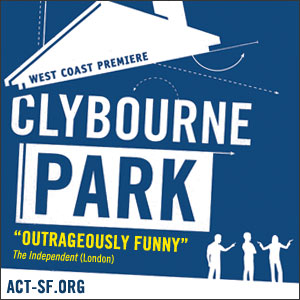
The Guardian Art Series Presents: Clybourne Park

0

Clybourne Park, the most acclaimed new comedy of the year!

Winner of the 2010 London Evening Standard Theatre Award for Best New Play and a “Top 10 of 2010” selection for Entertainment Weekly, the New York Times, and the Washington Post, Clybourne Park offers “completely audacious, architecturally ingenious entertainment” (Entertainment Weekly).
Home is where the heart—and history—is in Clybourne Park, which cleverly spins the events of A Raisin in the Sun to tell an unforgettable new story about race and real estate in America. A “buzz-saw sharp new comedy” (The Washington Post) from an adamant provocateur, this riveting play explores the gentrification plans and community uproar that galvanize a middle-class Chicago neighborhood in both 1959 and 2009.

Enjoy $10 Balcony seats through January 30. Live it up with 10UP—world-class theater at happy-hour prices! Visit act-sf.org/clybourne or call 415.749.2228.

Thursday, January 20 at 7PM at ACT
Join SFBG and A.C.T. for a complimentary happy-hour in A.C.T.’s Sky Bar serving Bear Flag wine and Cabot Cheese with the purchase of a 10UP ticket.

ENTER TO WIN
a pair of tickets to the January 20th performance of Clybourne Park by sending your full name to promos@sfbg.com (subject line: Clybourne Park) no later than midnight on Monday, January 17th.  Winners will be contacted via email.  Tickets will be held under the winners name at will call; you must provide a valid photo ID for entry.

Congratulations to Ed Lee

5

Congratulations to Ed Lee, who, unless Gavin Newsom still refuses to leave or the next board does something terribly surprising, will be the city’s first Asian mayor. This, as Sup David Chiu pointed out, is an historic moment, a watershed event in San Francisco history. And we shouldn’t forget that.


Now Lee will face a massive challenge, starting with a terrifying city budget — and a need to reassure progressives that he can be trusted. It’s not Lee’s fault that Rose Pak and Willie Brown settled on him as their candidate — but starting from Day One, he is going to have to demonstrate independence.


I have no doubt that, true to his roots, he will be solid on sanctuary city and local hire — two major issues that the supervisors mentioned today. And on those issues, and on civil rights in general, he will be vastly better than Newsom. He won’t deport high school kids and break up families.


But I have to wonder if he’ll be true to progressive values on the city budget — because the willingness to accept that, as Chris Daly just said, something is very wrong in this country and this world, and it includes (perhaps starts with) the vast income and wealth disparities that are making our society unsustainable, and that it’s the responsibility of every official at the federal, state AND local level to try to address that problem … that’s what separates out the real progressives.


Good luck, Mayor Lee, we sincerely wish you the best, look forward to working with you and can’t wait to hear your ideas on new city revenues.

Leno will not run for mayor

1

Just as the supervisors were meeting to select a successor mayor, Mark Leno called me to tell me that, after a lot of thought, he has decided he won’t be a candidate for mayor in November. He’s going to be running the state Senate Budget Committee, dealing with the worst fiscal crisis in California history, and “I just wouldn’t have the time to run a campaign.”


Leno would have brought a lot to the race, particularly as it’s shaking down now, but I certainly understand his choice.

Chinese community out in force for Lee

5

Well, Rose Pak promised a big demonstration and she’s got one: City Hall is mobbed with Ed Lee supporters pushing the supervisors to vote for the city’s first Asian mayor. Lee is still out of town, so he can’t answer questions, although he’s talked to several supervisors by phone. One said he seemed a little overwhelmed by all of this; he wasn’t even sure he wanted the job until Pak and Willie Brown talked him into it.


The revelations that the vote for Lee was a backroom deal orchestrated by Pak and Willie Brown (and from years of Brown watching, I can you this was a classic Brown move) will put Lee supporters like David Chiu and Eric Mar in a tough situation. Aaron Peskin, former supervisor, wasn’t mincing words when I talked to him jost before the meeting started:


“This is no so much about left and right, it’s about democracy and how power is transitioned,” he said. “This is disgusting, not because Ed Lee is or isn’t left or right or a progressive or a liberal. This is about the politics of power, and conservatives and moderates should be just as revolted as anyone.”


Meanwhile, my old friend Rev. Norman Fong, a leading Chinatown progressive, says he supports Ed Lee, as do a lot of progressives in the Asian communtity. I get that, and he’s a decent guy with a good history as a civil rights and housing lawyer, and he might even be a decent mayor. But this process stinks. There’s no other way to put it.

Expert opinion: how best to love your Oregon Ducks

1

There are sports fans who watch every game, know all the stats, own all the gear, take it upon themselves to achieve championship-level drunk status upon every win and loss their team achieves — and then there are real sports fans. Those are the guys that cobble together high-quality parodic hip-hop videos with their buddies that become their football team’s anthem and Youtube blockbusters, getting them flown around the country to perform — and getting star-struck coeds to swoon at the tailgate.

That’d be Jamie Slade, Brian McAndrew, and Michael Bishop, whose Supwitchugirl team starred in and edited the Eugene, Oregon party anthems “I Love My Ducks” and “I Love My Ducks (Return of the Quack),” as well as a host of other tunes dedicated to frat juicin’ brobots and bathroom water conservation — even at the price of party foul.  Lucky us, SFBG had the inside line on these young bucks and got Jamie Slade, the group’s tallest member with its curliest hair, to email with us about ways you can be the ultimate Ducks fan at the team’s championship title run on Mon/10 against Auburn University — or front like you are, at least.


San Francisco Bay Guardian: What’s the most important thing that someone unacquainted with them should know about the Oregon Ducks’ season this year?

Jamie Slade: This is Oregon’s very first run at the national title and last year was the first year since 1995 we went to the Rose Bowl so both this year and last year are monumental years for Duck football history. That’s why Oregon has been getting so much hype lately on TV — that and head coach Chip Kelly has only lost three games in his whole career — which has only been two years, but it’s still very impressive.


SFBG: An all-purpose line to make yourself sound like a real fan?

JS: I LOVE MY DUCKS


SFBG: The season highlight? Lowlight?

JS: The season highlight was beating Tennessee. They’re in the SEC conference, which is known for being the best conference, historically, in college football. Also, beating Oregon State and solidifying our spot in the national championship game. Also the Stanford game, they’re now the best one-loss team in the nation and WE beat them. They just won their bowl game which makes us look GOOD. Lowlight? I guess the Cal game where we only won by two points when we were favored to win by 30-plus.


SFBG: How can you tell who the Ducks fans are?

JS: We have the loudest stadium in college football — literally, the decibels in Autzen Stadium have been recorded as louder than a fighter jet taking off and that isn’t because of how the stadium is engineered and built, it’s because we yell our asses off. Duck fans are loud and will be happy to yell in your face if you’re an opposing fan.


SFBG: Have you met the team? Which player made the biggest impression on you and why?

JS: Yeah we’ve met the team, well most of the players at least. Two players that have been really nice to us has been DJ Davis, our wide receiver and defensive end Kenny Rowe. DJ Davis is just an all-around nice guy with a really sincere personality and Kenny Rowe is a really funny dude. Every time I see him he always says “Man, I wanna be just like you” even though he leads the Pac-10 in sacks and is a menace on the field.


SFBG: How’d Supwitchu Girl get together? What was the first video you guys made?

JS: We met in the dorms. Michael and Brian have been longtime friends and I met them when I was on the Oregon track team my freshmen year. Because of Saturday practices I would stay in the dorms on Friday nights and Michael and Brian coincidentally stayed in as well and our personalities just clicked. Our first video is called “Just Don’t Flush It” and it’s a music video about water conservation. It was an inside joke at first about how Brian would never flush the toilet in our tiny apartment during our senior year. 


SFBG: Are you super stars in Eugene at this point? 

JS: We’re more sex symbols if anything, Caitlin. Just kidding haha. I wouldn’t say we are super stars at all — we get recognized just because the video is so popular but we don’t get star treatment or anything, we still had to go to school and do everything else every other student has to go through. Sometimes people say “Hey are you that “I Love My Ducks” guy?” and I say yes…but we are so much more than JUST the “I Love My Ducks” guys.


SFBG: Do you have plans to extend your reign of terror to other college towns?

JS: NO. We are die-hard Duck fans. That’s where we find inspiration for these songs…out of true emotion and love for this team.


SFBG: Future video plans? Or are you done with the UO scene now that you’re graduating?

JS: Yep we have a video coming out after the BCS game called “Pogs” and it is about that childhood fad of throwing Pogs and slammers etc. Should be funny. But we all plan on travelling for a few months and reconvening afterwards to figure out what our next step will be.


SFBG: What line from your songs do you hear people repeat the most?

JS: From the first song: “Holy Moly, is that my boy Masoli?” From the second song: “Eatin chips ‘n’ dip with the brain Chip Kelly!”


You can yell your ass off (or get yelled at in your face) with the rest of the Oregon fans at The Independent (628 Divisadero, SF. www.theindependentsf.com), which will be playing the national championship game on their pull-down movie screen.


BCS National College Football Championship Game: University of Oregon vs. Auburn University

Mon/10 5:30 PST, FOX Sports


Chris Daly’s Final Say

18

As part of my effort to compile a list of most roastable moments of Sup. Chris Daly‘s decade-long career at City Hall, I asked the termed-out D6 supervisor if he would sit down for an exit interview. And shortly before Christmas, when there was still hope the Board would select a progressive interim mayor, and Daly had not yet vowed to politically haunt Board President David Chiu with shouts of, “It’s on like Donkey Kong” , we arranged to meet me at the Buck Tavern on Market Street, which Daly, who now holds the liquor license, is threatening to rename “Daly’s Dive.”

As it happens, the lion’s share of our conversation ended up taking place by cell, since Daly got stuck in late afternoon commuter traffic, as he drove to San Francisco from Fairfield, where his wife and children have lived since April 2009, making him a fitting symbol of the East-Bay-and-beyond migration pattern of couples who live in San Francisco, until they have more than one kid.

Except not all couples with two small kids get to move into one of two foreclosed properties that the in-laws bought with $545,000 cash in spring 2009. At the time, Daly’s critics accused him making such a mess of governing the city that he had decided against raising his own family here. Daly predictably disagreed. “There are few people who think about the future of San Francisco and the health of the city more than me,” Daly told reporters, explaining that his wife wanted family support raising their children, so she had moved to the same cul-de-sac as her parents, as Daly continued to live in a condo in San Francisco with roommates and to see his family on weekends.

Anyways, on the dark and stormy night that I interviewed Daly in mid-December, he acknowledged that he was going to be in for one helluva roast at the Independent on Jan. 5. in the worst possible sense of the tradition.
“Will there be controversial subjects, things that on the face of it, are not very nice? Yes,” Daly said.

And then he claimed he had agreed to this ordeal, because, under the roast’s traditional format , he would get to go last—and thus would get to have the last word.
“Why would I want to end my City Hall career like this? Because I get to go last, and can really say what’s on my mind,” Daly said. “Unless the D.J. wants to say something as he’s spinning.”

Daly’s comment suggests that folks who attend his roast at the Independent will witness a historically vicious verbal drubbing on all sides, since no one has ever accused Daly of holding back from saying what was on his mind. Even if it has led to seemingly counterproductive “We are shocked, SHOCKED!” responses. Like the time Sup. Michela Alioto Pier introduced an ultimately doomed etiquette ordinance, after Daly swore at a constituent during a City Hall meeting, in 2004.

Daly said at the time that he comes from a background as a housing-rights organizer on the streets of Philadelphia and San Francisco, where confrontation was an effective political tool. But he also claimed that he had learned an important lesson.
“In the future it’s going to be better for me personally and politically to focus my energy positively on the people I care about instead of negatively on the people I think are doing them harm,” Daly reportedly said.

Fast forward six years, and Daly is unrepentant about his record of fighting for low-income people, while openly defying City Hall’s unwritten rules of etiquette.
“Etiquette always seemed a little silly, something for the ‘other’ San Francisco, for the prim and the proper and that’s not what I am concerned about,” Daly said. “I’m aware of the turn-the-other-check philosophy, and, if I were religious, I’d be out of the Old Testament. I’d be, if someone pokes you in the eye, I’d poke back.”

Daly says he stopped caring about etiquette towards the end of his first year in office. “When those in power use that power to put down those who are less advantaged, when I see that, I respond quickly and with as much force as I can to prevent them from doing that kind of thing again,” he said. “ If you want to attack homeless people for political advantage, I’m going to attack you right back. That’s not ‘proper,’ but I think it’s just.”

Daly says he also soon realized tthat the truth wasn’t the driver.
“I already knew that money, power and significant forces would be pushing back against me but then I discovered that the actual truth wasn’t what played out there in the world of spin. It’s like when the Examiner’s Josh Sabatini asked me how I want to be remembered, and I said, “Not as the caricature the Examiner created of me.”

Daly, who moved to San Francisco in 1993 to work on homeless and affordable housing issues, was at the heart of the movement around Ammiano’s 1999 write-in campaign for mayor, and part of the progressive sweep onto the Board, in 2000.

“For me, it’s never been about being a ‘good’ vote. I breathe leftist progressive politics,” Daly said. “Where I can make more of a mark is in terms of setting the stage for those votes and holding the line in districts that are not progressive. I’m very proud of my attempts to hold the line on issues, but the work doesn’t make any friends.”

Daly noted that after he made comments about Newsom’s alleged cocaine use during the 2007 Mayor’s race, downtown interests threw everything they had left at him.
‘They got a lot of hits in, but no total blows,” he opines. “Last time I checked, I saved the city $150 million on the Americas Cup deal that they were going to ram rod through.”

And so, as he prepares to begin life as a bar owner, don’t expect Daly to pass up opportunities to launch verbal attacks, if he believes they are warranted, political consequences be damned.

“People want to have the power without any of the negativity they associate with all the shit we have to deal with to build this power,” Daly added. “So, it’s all, Daly and [former Board President Aaron] Peskin took control of the Democratic Party at midnight. Well, how did you want us to take over? “

Daly claims if you take away “negatives” attributed to him, you take away his wins. “People call me a lot of things, but I’m not a loser, I win a lot” Daly added, noting that Democrats being nice to Republicans has led to losses in D.C., not gains. “So, yes, I’ve got a lot of negatives, and they’ve clearly been made into a target, but if I can take the hits, and help people I care about, I’m happy to do it. That’s what I’ve done for ten years.”

Daly says he’s become “pretty desensitized to criticism,” even as he admits to being a sensitive person, deep inside. “I don’t think I’d have quite the visceral response to poverty and oppression, if I wasn’t sensitive,” he said. “I care deeply about people’s struggles. That’s why I’m here, but I also have a pretty solid critique of capitalism and I know how to follow the money, so when I get criticized by some downtown mouthpiece, I know what time it is.”

Daly says he started the Daly Blog several years ago, to push back against what he felt was unfair treatment in the media. And he says he endorsed outgoing mayor Newsom for Lt. Governor, despite their long and antagonistic history, so progressives could have a shot at installing a mayor in Room 200.

“My money now is on the selection of the mayor going to the new Board, and Avalos getting it in the 13th round of voting,” Daly said.

Daly made that prediction three weeks before the progressives on the Board seem poised to hand the keys to R.200 to City Administrator Ed Lee—thereby eliciting Daly’s ballistic “Donkey Kong” outburst.

With the outgoing Board set to meet Friday to make a selection, here’s another Daly roastable moment, this time from Peskin, related to the fall-out that ensued after Daly made two appointments to the SFPUC, while serving as acting mayor for one day, while then Mayor Willie Brown was out of the country, on a trip to Tibet.

“When Mayor Willie Brown left office, Charlotte Schultz had an unveiling ceremony of Brown’s picture. Newsom, who by then was mayor, was presiding. And Charlotte had a beautiful easel with a golden drape over it. When she pulled back the curtain there was a picture of Daly, who was listed as “41st and a half” mayor presiding from 9 a.m. to 2 p.m. on October 22,” Peskin recalled, noting that under Daly’s picture there was another curtain that contained Brown’s actual portrait.”

And while Daly’s controversial statements and outbursts always make headlines, there is no denying that he helped make the progressive agenda, including establishing mandatory paid sick days, universal healthcare, and forcing developers to contribute in affordable housing or services for poor, an integral part of city policy.
 “The Chronicle used him as the poster child to try and dissuade anyone from supporting a progressive agenda,” former Sup. Jake McGoldrick observed. “He was used to smear any of our good ideas. And Chris never seemed to understand that some of us needed to be a little more sensitive, since we needed to get re-elected and didn’t represent districts that were as progressive as his. Personal attacks make the whole situation smell bad.”

Sup. John Avalos, who served as Daly’s legislative aide until he was elected as D11 supervisor, acknowledged that a lot of folks have accused Daly of doing irreparable harm to the progressive movement and being a gift to Newsom and the moderates at City Hall.
“People try and make hay out of it,” he said. “But his antics have probably hurt him more than anyone,” Avalos added, noting that he ran in 2008 as Daly’s former legislative aide.
‘And it didn’t hurt me, and I made no bones about where I came from.”

And then there’s the fact Daly defeated the Chamber ’s Rob Black in the 2006 election. “We don’t do enough to have better relationships between ourselves,” Avalos added , reflecting on the divided progressive movement. “It’s more than just one person.”
 
Peskin for his part acknowledges that Daly will be missed on the Board.
 “He sucked the oxygen out of the room and made it all super lefty and caustic, and it certainly did not allow a better conversation to evolve,” Peskin said. “But it’s still going to be a pretty profound loss.”

Backroom Ed Lee mayoral deal raises suspicions

11

Last night’s dramatic eight-hour Board of Supervisors meeting, at which six supervisors suddenly came together around naming City Administrator Ed Lee to succeed Gavin Newsom as mayor, was a classic case of backroom dealing making, the full results of which the public still doesn’t know. And it is those unknowns that have progressives rightfully pissed off and distrustful of the choice.
On the surface, both Lee and the progressives’ preferred pick, Sheriff Michael Hennessey, are similar figures who fit Newsom’s demand for a nonpolitical caretaker mayor. He has publicly said both would be acceptable, and both have some impressive progressive credentials as well.
Lee was a civil rights attorney who help run the Asian Law Caucus before being hired by then-Mayor Art Agnos as an investigator for whistleblower complaints, and he’s worked for the city ever since, serving as executive director of the Human Rights Commission and director of the Department of Public Works. Newsom moved him in the powerful post of city administrator in 2005 and he was recently approved for a second five-term for that job, unanimously approved by the Board of Supervisors.
Sup. Bevan Dufty and other supervisors had even talked to Lee about being interim mayor, and he has consistently said that he didn’t want it – until a couple days ago. That’s when Newsom and the fiscal conservatives on the board suddenly coalesced around Lee, who apparently changed his mind while on a trip to China, from which he is scheduled to return on Sunday, although that might be moved up now that the board has delayed the vote choosing him until Friday afternoon.
That delay was won on a 6-5 vote, with moderate Sup. Sophie Maxwell heeding progressive requests for an opportunity to at least be able to speak with Lee before naming him the city’s 43rd mayor. “I don’t think we should make such a decision blindly,” Sup. John Avalos said.
It was a reasonable request that neither the fiscal conservatives nor Board President David Chiu, the swing vote for Lee in what his progressive supporters angrily call a betrayal, would heed. And the question is why. What exactly is going on here? Because it’s not just progressive paranoia to think that a deal has been cut to maintain the status quo in the Mayor’s Office, as Newsom’s downtown allies have desperately been seeking.
Just consider how all of this went down. Sources have confirmed for the Guardian that Chiu met with Newsom at least twice in recent days, and that Newsom offered Chiu the district attorney’s job, hoping to be able to put a fiscal conservative into the D3 seat and topple a bare progressive majority on the board. Chiu reportedly resisted the offer and tried to influence who Newsom would name to succeed him, and we’ll find out as soon as today who the new district attorney will be.
Closed door meetings also apparently yielded Lee as Newsom’s choice for successor mayor, with both Chiu and Sup. Eric Mar initially inclined to back Lee, who would be the city’s first Chinese-American mayor. After pushing his colleagues for weeks to name a new mayor, Daly tried to thwart the Lee pick by initially seeking a delay, then finally persuading Mar to go with Hennessey as his first choice.
“Politically, he will work for the other side, my progressive colleagues,” Daly said at the hearing, calling it “the biggest fumble in the history of progressive politics in San Francisco.”
As the deliberations began, Mar called Lee his mentor at the Asian Law Caucus and someone whom he respects, but that he preferred to keep Lee in his current post and to support Hennessey, who got five votes on the first round, while Lee got four, including Chiu.
Dufty – who said that he would be supportive of Hennessey for mayor – and Sup. Sophie Maxwell abstained from voting for anyone during the first round. On the second round, Maxwell went with Lee, leaving Dufty as the kingmaker. But rather than decide, he asked for a recess at 8:45 pm, and he and Maxwell went straight to Room 200 to confer with Newsom.
When the board reconvened, Dufty announced his support for Lee. Dufty denies that Newsom offered him anything, but he did confirm that Newsom indicated a preference for Lee and a willingly to help Lee return to his current post next year, which requires some tricky maneuvering around city ethics laws. Similarly, Chiu denies that his support for Lee was anything less than his unconditional preference.
But it’s hard to know. After weeks of Newsom playing games with leaving the Mayor’s Office to assume his duties at lieutenant governor (a stand egged on by his downtown allies and Chronicle editorial writers), it seems likely that Lee has given them some kind of assurance that he won’t rock the boat or side with board progressives on key issues.
Some progressives aren’t ready to accept that Lee will be our next mayor, believing that Chiu, Dufty, or Maxwell can still be shamed into changing their minds, but that seems unlikely. Instead, progressive Sups. John Avalos, David Campos, and Ross Mirkarimi just want to talk to Lee and they hope to be convinced that he’ll work cooperatively with the board and not simply be a Newsom puppet.
“I have been open and I remain open to supporting Ed Lee,” Campos said in support of the motion to continue the meeting to Friday at 3 pm, the day before the new Board of Supervisors is sworn in.
But he and the other progressives are openly questioning the Lee power play. After all, Campos said, his nomination of Hennessey was already an olive branch to Newsom’s side, saying he wasn’t the progressives’ first choice but simply the most acceptable from Newsom’s list. “It was in the spirit of one side of the political spectrum saying to the other side, ‘We want to come together,’” Campos said.
Instead, it was a backroom political deal with carried the day, a deal that Chiu went along with.
“I feel amazingly betrayed right now,” Jon Golinger, Chiu’s campaign manager, told us after the meeting. “It’s a shock…Process-wise, Ed Lee came out of nowhere.”
And that’s antithetical to the progressive values on transparency and public process. So now, it’s up to Lee, Chiu, and the other involved in this deal to fill in a few of the many blanks, and to assure the public that this choice is in the best interests of the whole city.

A swing to Lee — Daly ballistic

45

Bevan Dufty emerged from his meeting in the mayor’s office to say he was ready to vote for Ed Lee. The deal was cut; we don’t know what it is, but that’s what happened. And Sup. Chris Daly is ballistic.

“This is,” he just said, “the biggest political fumble in the history of progressive politics in San Francisco” and he put the blame directly on Board President David Chiu, the sixth progressive vote who went with Lee over Hennessey. As much as he liked Ed Lee as a person, Daly said, “politically, he will work for the other side.” He then told Chiu he would “haunt” him politically and announced, “it’s on like Donkey Kong.”

Then Avalos asked for a recess “to go in some back room” and with minor disagreements, the board is in recess until 10:15.

Wow. What a moment. What a totally bogus way for a new mayor to be chosen for this city. Ed Lee wasn’t even on the radar, wasn’t under consideration, had said he didn’t want the job, until some deal was cut at the last minute. Nothing against Ed Lee, but you can’t be an effective mayor of this city when you jump into things at the last minute, with no chance for anybody to talk about or evaluate your credentials. And he’s clearly the mayor of the conservative board members — and David Chiu has joined them.

I’m not as angry as Chris Daly — that would be hard — but I’m disappointed.


On the Cheap Listings

0

On the Cheap listings are compiled by Caitlin Donohue. Submit items for the listings at listings@sfbg.com. For further information on how to submit items for the listings, see Picks.

WEDNESDAY 5

Concierto de Reyes Mission Cultural Center for Latino Arts, 2868 Mission, SF; (415) 643-5001, www.missioncultural.org. 2pm, free. The Coro Hispano of San Francisco, a chorus comprised of Spanish-speaking community members, has been celebrating Latin America through song since 1975. Join ’em for their annual kids holiday concert, which will cover turf as varied as renaissance motets and aguinaldos (Christmas folk music) from Peru, Venezuela, Puerto Rico, and more.

Glen Canyon habitat restoration Glen Park Recreation Center, 70 Elk, SF; (415) 337-4705, www.sfrecpark.org. 9am-noon, free. Sure, you’ve made “that” resolution for the millionth time. But how about you snap out of that pudgy pity party and truck out to a little exercise that benefits more than just your waist line? SF parks are in need of TLC if they want to fend off invasive species and you can join in on the action at this morning of weeding, planting, and pruning. Dress to get muddy and active – and indulge in the free snacks provided free of your Christmas cookie guilt.

FRIDAY 7

Jaime Cortez: “Universal Remote” Southern Exposure, 3030 20th St., SF; (415) 863-2141, www.soex.org Through Feb. 19. Opening reception 7-9pm, free. It’s been months, but we still have a big in our hearts the size of a glittery glove. Thankfully, here comes visual artist Jaime Cortez’s solo exhibition, which calls out the tragic, tremendous pop culture whorl that was MJ – and highlights the King of Pop’s fluid moves through race, sexuality, and zombie-human relations.

Oakland Art Murmur Telegraph and 23rd St., Oakl.; www.oaklandartmurmur.com. 6-10 p.m., free. Rediscover what downtown Oakland’s got going on art-wise with this monthly show-and-tell by the neighborhood’s best and brightest art galleries. This week, catch Jennie Ottinger’s book art at Johansson Projects (excerpt from her truncated version of As I Lay Dying: “Holy shit, this family is cursed! Very National Lampoon’s Vacation.“)

SATURDAY 8

Parent-child snow globe class Randall Museum, 199 Museum Way, SF; (415) 554-9600, www.randallmuseum.org. 1-4pm, $6 for children; $10 for parent-child duos. The holidays are over, and yeah it’s still cold and rainy. But take heart! Winter can be time for good cheer even after Santa’s packed up the sleigh and gone north. Make a shakable wonder with your wee one and enjoy the rest of Randall Museum’s “Saturdays are Special” event (10am-4pm), which includes railroad exhibits, live animal feedings, and the rest of the science-y wonders present throughout the rest of this always-free museum.

Vintage Paper Expo Hall of Flowers, Golden Gate Park, Lincoln and Ninth Ave., SF; (328) 883-1702, www.vintagepaperfair.com. 10am-6pm, free. (Also Sun/9, 10am-4pm) Postcards, photos, brochures, stereoviews, and so much more! What’s a stereoview, you ask? Why, nothing less than an antique 3D image – something you can acquaint yourself with at this fair of all things printed and retro. The Vintage Paper Expo’s got over 100 vendors this year, all primed to sell you affordable scraps of history.

Writers With Drinks The Make Out Room, 3225 22nd St., SF; (415) 647-2888, www.writerswithdrinks.com. 7:30-9:30pm, $5-10 sliding scale. Writers? Drink? Well, I guess there’s a first time for everything! This long-standing lit night series pairs local scribes (this month’s are girl group Gogos founder Jane Wiedlin and socio-writer Ethan Watters) with a crowd that’s anything but stiff for readings, skits, and stand-up.

MONDAY 10

Cinema Drafthouse: Machete The Independent, 628 Divisadero, SF; (415) 771-1421, www.theindependentsf.com. 9pm, free. A deliberately silly revenge plot that’s both spot-on vintage homage and semi-serious commentary on America’s ongoing immigration debate gets the Indy’s free movie night treatment. Watch the film with a beer in hand (or two) – and feel free to shout advice to the characters on-screen. You’re in a music venue, for chrissakes.

TUESDAY 11

Pecha Kucha 330 Ritch, 330 Ritch, SF; www.pecha-kucha.org. 7pm, $5 donation suggested. Embarking as we are on month number one of year two-thousand-and-one-one, the theme of this month’s installation of this cross-discipline art night series is, yes, “one.” Not the most specific theme, sure – but that’s the way artists like it, and when you’ve assembled a passel of them from fields as varied as industrial design, animation, and fashion, sometimes it’s best just to step back and watch them unify.

Eat, pray, defend chick lit

1

caitlin@sfbg.com

LIT I read Eat, Pray Love a while ago, and I’m nervous to tell you that I liked it. Ever since bottle blonde Julia Roberts assumed her best worried-kitten face for the book’s film version, no self-respecting lit snob would ever admit to having enjoyed Elizabeth Gilbert’s account of her year of finances-be-damned travel, healing from divorce, and fulminations on the belabored pursuit of love.

The release of her follow-up, Committed (Viking Adult), a socio-historical look at marriage couched in the story of Gilbert’s own unexpected union to her green card-challenged hubby Felipe — and the announcement of her Jan. 14 appearance at the Yoga Journal Conference — goaded me to examine just why people are down on Gilbert. After perusing the con side (a blog called Drink Curse Hate was enlightening) I found that the ire seems to hinge on two precepts: that she is self-centered, and that her writing is what we diminutively refer to as chick lit. Well three, if you count complaints about her flippant usage of Eastern spirituality for self-help. But I’m not sure I have much to answer back to on that front.

First, a self-centered writer? Well stomp my keyboard and call me Danielle Steele. Writers write because we think we have something interesting and important to say. There are plenty of writers who write about themselves, and only themselves, and whom people fall over themselves to love. Hey, David Sedaris. Eat, Pray, Love is indeed all about Gilbert, but that doesn’t make it uninteresting. Glamorous travel writer leaves unsatisfying marriage, mends heart with an empowering trek around the world, yoga, Italian food, and impressively hunky Brazilian men encountered along the way. Hate on, haters, you’d write about it if it happened to you.

Second, chick lit. Literature written for chicks, by chicks, about chicks — am I getting the definition right? This term can stop being a pejorative one yesterday, as far as I’m concerned. And really, any book that teaches women that it’s okay to long for more than children and complete kitchen sets (which EPL does in spades) should be applauded in these uncertain times.

The funny thing about Gilbert is that before Eat, Pray, Love, she had a thriving writing career. Her creative nonfiction books were about men, of all things: an account of the macho culture of a Maine fishing village (named Stern Men) and the tale of an awe-inspiring, if prickly master outdoors-man (this titled The Last Man in America). Gilbert was a regular contributor at Spin and GQ, for which she penned the article on her days bartending at one of Manhattan’s most testosterone-heavy dives, Coyote Ugly Saloon. There was a movie based on that one, by the way.

“I couldn’t believe that Disney wanted to buy this story, it was so raunchy,” Gilbert tells me over the phone from the converted New Jersey church where she and Felipe had set up shop just prior to the onset of Eat, Pray, Love fever. “I still don’t know how they did it — I was like no! I can still smell the vomit.”

No, she could never have anticipated the last book’s zeitgeist-level success. No, she doesn’t expect Committed to replicate those sales numbers. The Eat, Pray, Love mania was “like a big circus parade going on just outside my door nonstop. I spend my day washing dishes and doing laundry and then I look out the window and go, ‘Wow, there’s that circus out there — they have dancing bears!’ and then I go back to doing what I’m doing.”

As far as she’s concerned, the book was the pinnacle of her career — and that’s fine. “The definition of a phenomenon is that it only happens once and you don’t know why it happened.”

But my money’s on Committed to be a success in its own right. The premise: Gilbert’s just not that into marriage. But marry she must, to secure Brazilian hubs Felipe the right to live in the country they’ve made their home, so she embarks on finding out what the hell it is about societally recognized partnership that people down through history have found acceptable, even appealing. She comes up with divergent and fascinating tidbits: that early Christians eschewed marriage, a socially conservative writer’s thesis that marriage is in itself a subversive act.

I read the book in a day. Gilbert’s conversational flow carries you through her life’s intimate details, like the transcribed list of personal faults she complied for Felipe. (She includes her need for attention and overly enthusiastic cold shoulder, yet leaves out the inevitability that every iota of their relationship will at one point be discussed by book clubs around the country.) A tone as engaging as hers has rarely been applied to the question of what marriage means in this day and age, and it’s refreshing to see that matter given some thought — even if her research is by her own admission not exhaustive. Hey, I probably wouldn’t have read the book if it had been.

I wanted to give the book to my newly sprouted crop of married friends, see how my mom reacts to Gilbert’s conclusions on child rearing, copy a chapter on the importance of solo travel for my boyfriend to read.

But they’d probably make fun of me. Elizabeth Gilbert? Please, that’s chick lit.

YOGA JOURNAL CONFERENCE: AN EVENING WITH ELIZABETH GILBERT

Jan. 14, 7:30 p.m.,

$29–$39 conference attendees, $49–$59 regular admission

Hyatt Regency

5 Embarcadero Center, SF

(800) 561-7407

www.yjevents.com


2010 Offies!

0

tredmond@sfbg.com

When a major conservative political movement starts using a name that typically refers to the act of scrotal fellatio, you know it’s morning again in America. In 2010, the teabaggers came home. They nominated candidates who think masturbation is selfish and wonder why monkeys aren’t still evolving into humans. They held rallies urging the government to “get out of my Medicare,” which happens to be a government program. Their leaders praised dictators and urged women who had been raped to look at the bright side of things.

And those were just the headlines.

It’s hard to imagine a year that could be worse than 2010 — but it was a great vintage for the Offies.

Presenting the Off Guard awards for the silliest, most insane, and absolute worst of the year that was.

AND SHE FIGURES IF WE ARREST EVERYONE WITH BROWN SKIN, WE CAN FINALLY GET THIS SORT OF BEHAVIOR UNDER CONTROL

Arizona Governor Jan Brewer told reporters that illegal immigration resulted in beheadings in the desert.

BUT AS LONG AS YOU DON’T TOUCH YOURSELF WHEN YOU THINK OF THE DEVIL, IT’S GOING TO BE OKAY

Christine O’Donnell, the Republican candidate for Senate in Delaware who decried masturbation as a “selfish act,” said she only dabbled in witchcraft and had just one date on a satanic altar.

EXCEPT THAT WE ALREADY ARE, AND WE ALREADY ARE

Jerry Brown said he opposed the state’s marijuana legalization measure because “we can’t compete with China if we’re all stoned.”

LOOK BUSY

A Pew Research Center poll showed that 41 percent of Americans think Jesus will return in the next 40 years.

HEY, IF WE’D JUST CREATED THE WORST ENVIRONMENTAL DISASTER OF THE DECADE, WE’D WANT A LITTLE BREAK, TOO

A few days after the worst oil spill in U.S. history, BP Chief Executive Tony Hayward complained that he wanted his life back.

BUT HE SWEARS HE’LL STOP AT BEHEADINGS

Insurance Commissioner Steve Poizner said if he were governor he’d give the National Guard live ammunition to shoot at immigrants on the border.

AFTER ALL, IF THEY’RE NOT IN AN AIRPLANE, THEY CAN’T DO ANY DAMAGE

GOP Senate candidate Carly Fiorina said that people on the federal no-fly list should have the right to own guns.

OOH, WHEN YOU TALK TOUGH LIKE THAT YOU ALMOST SOUND LIKE SOMEONE WHO COULD STAND UP TO THE REPUBLICANS. OR MAYBE NOT

President Obama asked whose ass he should kick at BP.

IT’S OKAY, THOUGH, AS LONG AS THEY WEREN’T ENGAGING IN ANY SELFISH ACTS

Staffers at the Securities and Exchange Commission got caught spending as much as eight hours a day downloading porn at the office.

AND SOMETIMES GOP CANDIDATES ARE NITWITS

Nevada GOP Senate candidate Sharron Angle praised Chilean dictator Augusto Pinochet for his efforts to privatize that country’s retirement system, saying “sometimes dictators have good ideas.”

YEAH, COME ON, WHY CAN’T YOU LOOK AT THE BRIGHT SIDE OF THINGS?

Sharron Angle said that women who have become pregnant as the result of rape or incest should “turn lemons into lemonade.”

DAMN GUMMINT TRYING TO INTERFERE WITH PRIVATE BIDNESS

GOP Congressman Joe Barton of Texas apologized to BP for a White House “shakedown.”

YES, AS A MATTER OF FACT I DO OWN THE WHOLE GODDAM SCHOOL

Meg Whitman’s son threw softball equipment over a fence to kick a group of computer science and physics students off the Princeton rugby field.

NICE, SINCE THOSE GROUPS ALL GOT ALONG SO WELL

GOP Senate candidate Chuck DeVore compared Palestinian activists to Nazis, Fascists, and Communists.

AND OF COURSE, THAT WORKS SO WELL WITH MODERN MANAGED CARE

Nevada banned chicken costumes from the polls after Nevada Senate candidate Sue Lowden said that people should barter with doctors for health care the way “our grandparents would bring a chicken to the doctor.”

ANOTHER GREAT MOMENT IN THEOLOGY FROM THE MAN WHO BROUGHT YOU THE PEDOPHILE PRIEST COVER UP

Pope Benedict said it was okay for male prostitutes to wear condoms.

SO HE’S GOT THAT GOING FOR HIM. WHICH IS NICE

Formerly classified State Department cables revealed that the premier of Korea is still an excellent drinker.

ACTUALLY, THEY TOOK ONE LOOK AT THE TEA PARTY AND DECIDED THEY WERE BETTER OFF AS THEY ARE

Senate candidate Christine O’Donnell said that evolution was a myth; after all, she wondered, “why aren’t monkeys still evolving into humans?”

THE CHURCH HAS ALWAYS BEEN KNOWN FOR ITS SENSE OF PERSPECTIVE

The Vatican announced that the ordination of women and the abuse of children were both “grave crimes.”

THAT’S OKAY, IT WILL LOOK GOOD ON HIS RESUME

Gavin Newsom decided to run for lieutenant governor after saying he didn’t know what the job was.

YOUR TAX DOLLARS AT WORK, CIA EDITION

The United States held high-level negotiations with a supposedly senior Taliban operative who turned out to be a Pakistani shopkeeper.

BUT WAIT — HOW WILL WE KNOW IF WE’RE SUPPOSED TO WORRY OR NOT?

The Department of Homeland Security abandoned color-coded safety alerts.

THE INTELLIGENCE AND CULTURAL TASTE OF THE AMERICAN PEOPLE IS SIMPLY STAGGERING

Sarah Palin’s daughter, Bristol, made it to the final round of Dancing with the Stars.

WHICH MAKES HIM ENTIRELY QUALIFIED TO SERVE AS A REPUBLICAN POLITICIAN

Dan Quayle’s son ran for Congress in Arizona and admitted that he had been posting on “dirty Scottsdale” under the name of Brock Landers, a sidekick to porn star Dirk Diggler.

IS HE ONE OF THE NAZI FASCIST COMMUNISTS, TOO?

Rand Paul said Obama’s criticism of BP was “un-American.”

WAIT — WAS THAT A BROWN ALERT?

The California Highway Patrol shut down its South Lake Tahoe office after officers found an anal vibrator and thought it was a bomb.

HONESTY IS JUST PART OF THE PROCESS OF RECOVERY

Tiger Woods admitted that he sucked.

EXCEPT THAT IT MOSTLY BENEFITS THE INSURANCE INDUSTRY

Vice President Joe Biden called the health reform bill “a big fucking deal.”

IT’S THOSE CUTE WOODEN SHOES, YOU SEE

NATO Commander John Sheehan said Dutch soldiers were too gay.

DAMN, AND HE’S SUCH AN ATTRACTIVE MAN. I’M SURE THE TSA FOLKS WERE REALLY LOOKING FORWARD TO IT

John Tyner told Transportation Security Administration officials in San Diego that if “you touch my junk, I’ll have you arrested.”

AND HE WASN’T EVEN TALKING ABOUT HER

Sarah Palin demanded that Rahm Emanuel apologize for using the term “fucking retarded.”


SINCE WE ALL KNOW THOSE PEOPLE DON’T KNOW HOW TO SPEAK IN PUBLIC

MSNBC Host Chris Matthews was so excited by an Obama speech that he said he “forgot he was black.”

THE CUSTOMER IS ALWAYS RIGHT

Pacific Gas & Electric Co. spent $50 million on a ballot initiative to stop public power, and lost after getting soundly defeated in every county where the utility has customers.

YOU MAY BE PART OF THE FAMILY, BUT WHEN IT COMES TO MY POLITICAL CAREER, HONEY, YOU’RE OUT THE DOOR

Meg Whitman fired her housekeeper when she found out she was in the country illegally.

BUT THEY’RE ALIKE ANYWAY, RIGHT?

Sharron Angle defended a campaign ad depicting menacing-looking Hispanic men by telling members of the Hispanic Student Union at the University of Nevada, Las Vegas that many of the members looked Asian.

OF COURSE, SHE SKIPPED THE FIRST FEW AMENDMENTS — BOOORING!

Christine O’Donnell said she couldn’t find anything about the separation of church and state in the Constitution.

BECAUSE IN A FIREFIGHT, THE FIRST THING ANYONE WOULD BE THINKING ABOUT IS HIS SERGEANT’S CUTE ASS

Sen. John McCain said he opposed ending “don’t ask, don’t tell,” talked about all the soldiers and Marines who lost limbs, and said that “when your life is on the line, you don’t want anything distracting.”

SINCE WE ALL KNOW THAT HEALTH INSURANCE MAKES YOUR PEE SMELL FUNNY

Federal judge Henry Hudson asked Obama administration officials whether the new health care plan was similar to forcing all Americans to eat asparagus.

SO IT’S JUST AS WELL THOSE PEOPLE ON THE NO-FLY LIST HAVE THE RIGHT TO KEEP AND BEAR ARMS

Sharron Angle said that the Obama administration’s policies might require “Second Amendment solutions.”

IT’S PERFECTLY FINE FOR HOMOSEXUALS TO ATTEND MARRIAGE CEREMONIES, AS LONG AS THEY’RE JUST THE HIRED HELP

Sir Elton John played at Rush Limbaugh’s wedding.

SURE, GREAT FUN. JUST LIKE SHOOTING YOUR FRIENDS WITH A HUNTING RIFLE

Dick Cheney said he had been a “big supporter of water boarding.”

DAMN, SUPERVISOR, THE OFFIES WILL MISS YOU

Chris Daly vowed to say “fuck” at every single board meeting in 2010.

How Brown can save California

4

EDITORIAL There are two things Gov. Jerry Brown has to do to get California back on track, and he needs to start right away. He has to restore at least a degree of public faith in state government — and he has to put a series of tax increases on the June ballot.

The first step ought to be right in the Brown playbook. The public is fed up with the secrecy, lies, machinations, and policy failures of the Schwarzenegger administration, and Brown can start off by telling people the truth. The budget situation is frightening; it can’t all be solved by cuts without destroying the state of California as we know it. But it also requires an understanding that the taxpayers don’t want to see their money wasted.

Brown has done the right thing by offering to cut his own staff by 25 percent and by denouncing the demands of the highest-paid University of California staffers who want even larger pensions. He might also take a look at some of the outmoded, expensive commissions in the state (do we really need a 21-member California Film Commission?) None of these are big money-savers, and none address the budget crisis in any meaningful way. But they’ll show that Brown’s cautious with a buck.

Then he needs to tell the voters that the state does, indeed, have a revenue problem, not just a spending problem. And he should start right away with a blue-ribbon panel of tax experts to look at what reforms ought to go on the June ballot.

It’s crazy to say that solving a $28 billion budget shortfall is easy, but a few basic changes could go a very long way to balancing the books. If the voters approve an oil severance tax (something every other oil-producing state in the nation has), an end to the commercial property loophole in Prop. 13, and the restoration of the vehicle license fee that Arnold Schwarzenegger abolished, the state would be about $10 billion richer. A modest increase in the income tax on the very richest Californians would add a few billion more. And suddenly the problem wouldn’t look so insurmountable.

Brown has an advantage: he’s taking over for a terribly unpopular governor. He will be able to work with a Legislature that now has the ability to pass a budget with a simple majority. And while his victory in November was hardly a landslide, it was substantial enough that he’s got a valid mandate for change.

He and the legislative leaders should adopt a budget that includes the expected revenue from a June tax package — and then offer an alternative budget that doesn’t. Give the voters a clear choice. Do they want to eliminate hundreds of public schools, raise elementary school class sizes to 40, shut down a couple of University of California campuses, shutter the state parks, and let 30,000 prisoners go free? Of do they want the oil companies and the richest Californians to pay a little bit more to keep the state functioning?

Brown can make history this spring. The passage of Prop. 13, during his last term as governor, set off a nationwide tax-cutting frenzy that’s damaged the entire country. By pushing back just a little bit, and demanding a little bit of tax fairness, he can demonstrate that California is still a leader in progressive public policy.

He’ll have to put his political capital, his credibility, and all the money he can raise behind the effort. If he doesn’t, his administration, and the state, will be a total failure.

Editorial: How Brown can save California

0

There are two things Gov. Jerry Brown has to do to get California back on track, and he needs to start right away. He has to restore at least a degree of public faith in state government and he has to put a series of tax increases on the June ballot.

The first step ought to be right in the Brown playbook. The public is fed up with the secrecy, lies, machinations, and policy failures of the Schwarzenegger administration, and Brown can start off by telling people the truth. The budget situation is frightening; it can’t all be solved by cuts without destroying the state of California as we know it. But it also requires an understanding that the taxpayers don’t want to see their money wasted.

Brown has done the right thing by offering to cut his own staff by 25 percent and by denouncing the demands of the highest-paid University of California staffers who want even larger pensions. He might also take a look at some of the outmoded, expensive commissions in the state (do we really need a 21-member California Film Commission?) None of these are big money-savers, and none address the budget crisis in any meaningful way. But they’ll show that Brown’s cautious with a buck.

Then he needs to tell the voters that the state does, indeed, have a revenue problem, not just a spending problem. And he should start right away with a blue-ribbon panel of tax experts to look at what reforms ought to go on the June ballot.

It’s crazy to say that solving a $28 billion budget shortfall is easy, but a few basic changes could go a very long way to balancing the books. If the voters approve an oil severance tax (something every other oil-producing state in the nation has), an end to the commercial property loophole in Prop. 13, and the restoration of the vehicle license fee that Arnold Schwarzenegger abolished, the state would be about $10 billion richer. A modest increase in the income tax on the very richest Californians would add a few billion more. And suddenly the problem wouldn’t look so insurmountable.

Brown has an advantage: he’s taking over for a terribly unpopular governor. He will be able to work with a Legislature that now has the ability to pass a budget with a simple majority. And while his victory in November was hardly a landslide, it was substantial enough that he’s got a valid mandate for change.

He and the legislative leaders should adopt a budget that includes the expected revenue from a June tax package and then offer an alternative budget that doesn’t. Give the voters a clear choice. Do they want to eliminate hundreds of public schools, raise elementary school class sizes to 40, shut down a couple of University of California campuses, shutter the state parks, and let 30,000 prisoners go free? Of do they want the oil companies and the richest Californians to pay a little bit more to keep the state functioning?

Brown can make history this spring. The passage of Prop. 13, during his last term as governor, set off a nationwide tax-cutting frenzy that’s damaged the entire country. By pushing back just a little bit, and demanding a little bit of tax fairness, he can demonstrate that California is still a leader in progressive public policy.

He’ll have to put his political capital, his credibility, and all the money he can raise behind the effort. If he doesn’t, his administration, and the state, will be a total failure.  


Best restaurant openings of 2010, San Francisco

0

In a ridiculously rich year of new restaurant openings, the most prolific I’ve seen yet, it is harder than ever to name the top ones. There are many noteworthy places, from the “Mad Men”-esque vibe of Thermidor, to the stratospheric prices and fabulous snapping turtle veloute at Benu. Some of our best cafes (Ma’velous) and cocktail bars (Burritt Room) were added to the SF scene. Gourmet comfort food is a worn-out trend but places like Citizens Band and Grub infused it with new life.

As ever, my goal is to include cheaper and upscale openings, making it trickier to list every worthy candidate within the limits of 2010. The good news is, our already incredible dining scene only continues to explode, despite trying economic times. We have some of the most affordable, high-caliber food in the world, as Michelin Guide’s director noted. Here’s to more creativity, diversity and fine meals with good friends in 2011.

**The first 10 restaurants are in San Francisco proper — a part two highlighting the Bay Area can be found here. Restaurants are in alphabetical order.**

COMMONWEALTH. Photo by Virginia Miller

>>BAKER AND BANKER Baker and Banker technically is a 2009 opening (11/09), but I include it as an exemplary destination neighborhood restaurant. With dark brown walls and booths, the space exudes a modern, warm elegance. Husband-and-wife team, Jeff Banker and Lori Baker, get it right from start to finish with his dishes, like vadouvan curry cauliflower soup or brioche-stuffed quail in a bourbon-maple glaze, and her memorable desserts, like famed XXX triple dark chocolate layer cake (awarded a 2010 Guardian Best of the Bay) or warm pumpkin cobbler with candied pumpkin seed ice cream. Since the debut of their bakery next door, you can get Baker’s goods all day long.

>>BARBACCO Yes, Barbacco is usually obnoxiously noisy and crowded. But it improves upon its parent restaurant, Perbacco, with gourmet quality at a great value ($3-14 per dish). Reminiscent of enotecas I’ve dined in throughout Italy, heartwarming food and a thoughtful wine list make it an ideal urban trattoria. Order a glass of Lambrusco, fried brussels sprouts, and raisin/pine nut-accented pork meatballs in a tomato sugo, then marvel at the minimal bill.

>>COMMONWEALTH Anthony Myint and chef Jason Fox are re-inventing fine dining, along with a few key players in San Francisco (see Sons and Daughters below). Myint was one of the masterminds behind Mission St. Food and Mission Chinese Food, but at Commonwealth delves into molecular gastronomy. Taste your way through deliciously experimental creations for a fraction of the price at comparable restaurants – no dish is over $15. Dine on goat cooked in hay while sipping a liquid nitrogen aperitif, finish with porcini thyme churros with huckleberry jam. You may be packed in tight in the spare, modern space, but you’ll leave glowing from stimulating flavors and presentation.

COMSTOCK. Photo by Virginia Miller

>>COMSTOCK SALOON The Barbary Coast comes alive in this bar/restaurant gem that feels like a timeless classic. From Victorian wallpaper and wood-burning stove, to restored dark woods, the spirit and history of the space charm immediately. Filling up on rich beef shank/bone marrow pot pie or bites like whiskey-cured gravlax on rye toasts with dill sour cream is happy respite on chilly nights. Pair with a perfect Martinez cocktail or a barkeep’s whimsy (bartender’s creation based on your preferences). Comstock exemplifies the best of what a modern-day saloon (with old world sensibilities) can be.

>>CURRY VILLAGE When husband-and-wife owners Kamal Barbhuyan and Nimmi Bano left the Tenderloin’s Little Delhi, I mourned the loss of their divine butter chicken and made-from-scratch eats. Thankfully, this year brought them to the Inner Sunset with Curry Village. With the highest concentration of great Indian food in the ‘Loin, it feels right to spread the love across the city. Whether it’s daal (lentils) enriched with spiced beef, or the ultimate eggplant curry, baingan bharta, this couple prepares what could otherwise be standard Indian fare with love and lush flavor.

>>HEIRLOOM CAFE The menu (less than ten starters and entrees) is so simple I’m almost bored reading it. But upon first visit to the Victorian, country kitchen dining room (circa the Mission 2010), each dish was so well-executed as to diminish scepticism. Reminding me more than a little of Chez Panisse in ethos, ultra-fresh, pristine ingredients make a basic dish a revelation. Take a mountain of Heirloom tomatoes piled over toasted bread with pickled fennel, cucumbers and feta, or a flaky bacon onion tart loaded with caramelized onions. Heirloom’s added strength is owner Matt Straus’ thoughtfully chosen wine lists covering wines from Lebanon to Spain.

SONS & DAUGHTERS. Photo by Virginia Miller

>>PROSPECT Though I’m not won over by the semi-corporate look of Prospect’s large space, this hot newcomer shines in everything that passes through your lips: wine, cocktails and food. Chef Ravi Kapur’s exploratory dishes reveal impeccable technique with funky attitude. Garlic-roasted quail with roasted almonds, preserved lemon and Black Mission figs is exemplary, while Summer beets meld with vadouvan yogurt, candied pistachios and onion rings. Pair with a glass of wine recommended by wine director Amy Currens or bar manager Brooke Arthur’s elegantly layered cocktails and you have a meal that is the whole culinary package.

>>THE SYCAMORE
I feel like a kid again eating The Sycamore’s “famous” roast beef sandwich. A glorified Arby’s roast beef on grocery store-reminiscent sesame buns with BBQ sauce and mayo, the sandwich tributes the native Bostonian owners’ roots. But this humble Mission eatery, which doubles as a cozy beer and wine bar, doesn’t only shine there. Pork belly-stuffed donut holes in Maker’s Mark bourbon glaze are pretty near orgasmic. A slab of pan-fried Provolone cheese is enlivened by chimichurri sauce and roasted garlic bulb. I applaud all-day hours and $9 being the most expensive menu item.

>>SONS & DAUGHTERS
Like Commonwealth (above), Sons and Daughters is another opening where young, visionary chefs create molecular, fine dining-worthy fare at reasonable prices ($48 for four course prix fixe, a la carte from $9-24). Though service can be unfortunately erratic, the intimate black and white space evokes a romantic European bistro with youthful edge. Dishes are inventive and ambitious, like an acclaimed eucalyptus herb salad of delicate curds and whey over quinoa, or seared foie gras accompanied by a glass of tart yogurt and Concord grape granite.

>>UNA PIZZA NAPOLETANA Pre-opening hype could easily have made the debut of Una Pizza a letdown. Pizzaiolo Anthony Mangieri closed his beloved New York institution, moving cross-country to a mellow SoMa street. As in NY, Una Pizza is a one-man show with Mangieri solely crafting each pie, explaining the no take-out policy and long waits. Though this may make it hard to frequent Una Pizza, when you go, you are rewarded with doughy heaven. With only five vegetarian pies available, I dream of the Filetti: cherry tomatoes soaking in buffalo mozzarella, accented by garlic, extra-virgin olive oil, basil, sea salt. New York’s loss is certainly our gain.

–Subscribe to Virgina’s twice monthly newsletter, The Perfect Spot.

Boogie blows up

2

“It was an honor to be a part of history. The rest is history.” Spray paint artist Chor Boogie (www.chorboogie.com) is hanging out amid spurts of December rain in Clarion Alley, standing before his mural debut in the heralded Mission community art space. But he’s talking about a different piece, on a different chunk of creative community space, in a city halfway around the world: The Eyes of the Berlin Wall, which Boogie painted on an actual section of the Berlin Wall and was reported to have sold for 500,000 euros this fall.

The real story is a bit more complicated — and perhaps speaks to the uncertain position in which street art finds itself. After all, we’re at the close of a few years of pop culture re-ascendance, during which Banksy made a stencil art photographer of every major city tourist and that are ending with Brazilian muralist Blu’s commission of a massive mural facing a World War II memorial by Los Angeles’ Museum of Contemporary Art that was subsequently whitewashed when he painted a wall of coffins draped with dollar bills.

What is street art’s role today? A form once used by inner city youth to reintroduce their stifled voices into their surroundings is now heralded in the upper echelons of the art world and hipsterdom alike. Still, many so-called street artists are getting stuck in stale, reductive modes of being presented to the public — stale because many do public art as a form of getting known, fluidly moving back and forth between the corner and the gallery. What are we to call these artists?

I know one name for them: Chor Boogie. After a tough youth spent tagging in San Diego, Boogie, borne on the wings of a technique and style that pushes the capabilities of the aerosol can (he never paints without it) has achieved artistic notoriety. His low pressure, inverted style of spraying and rejection of stencils and other tools gives birth to kaleidoscopic psychoscapes — but why don’t we let Boogie describe Boogie?

“A surrealistic expressionism of a street romantic voodoo. Emotional landscapes of a melodic symphony through color therapy — that’s my style in a nutshell,” he tells me, pointing up at the twisted face-in-purgatory that he recently completed in Clarion, a piece that extends a full foot above the boundary delineated by the alley’s mural collective and onto the high priced condo above.

Boogie has painted at the Beijing Olympics, done portraits for Hugh Hefner and Jay-Z, has vast, stained glass-cosmos murals all over town, and gallery shows up and down the coast. His name gained widespread recognition when some kids tried to steal a few of his cans while he painted a Market Street mural in late 2009. He chased them into a dark alley and was stabbed twice. “I didn’t feel it at all because I was drawing,” he says, despite one wound landing an inch from his lower intestine.

His distinctive style may have been what drew the fateful attention of Patrice Lux at Berlin’s Stroke Urban Art Fair. For two days, the German art collector had scrutinized Boogie while painting at his festival booth. Boogie had no idea who the guy was. “He was studying my every move — finally, he walked up to me, asked me what my name was, and asked me if I’d like to paint the Berlin Wall. He took me up to his studio and he had a piece of the wall with Michael Jackson painted on it. I was like, ‘You want me to paint over that? Because I will!’ I think he thought it was kind of cool to have an American artist painting over this American pop star.”

Boogie was signing up to paint on a piece of graffiti history. When first erected, artists came from around the world to cover the western side of the wall in color, often working under the ominous gaze of East Berlin patrollers who kept the eastern surface sterile. “Artists risked their lives painting that wall. You went there at night and painted quickly,” says James Prigoff, an international street art photographer.

But by his visit in 1985, Prigoff was underwhelmed by what he saw. “It had become a funny zoo,” he remembers, tourists gawking at East Berliners and tagging the wall with shout-outs to relatives in Des Moines.

Although Keith Haring and Quick subsequently created memorable pieces on the wall, Prigoff thinks the site’s sociopolitical significance has shrunk. “Chor Boogie is a great artist, he deserves all the attention he gets. But [his painting on the wall] doesn’t do anything for me in the context of art. There are a lot of walls in the world, and that’s just one of them.”

Not everyone agrees. Lux tipped off Die Bunte Zeitung, one of Berlin’s major newspapers, that he would be looking for 500,000 euros for the piece of the wall Boogie had painted — dwarfing sales of individual wall pieces in the past. The day after the article ran, they had an offer. The piece still wasn’t finished. After that, Boogie had an audience of 100-plus people watching him complete his cash cow.

Back in San Francisco among the streets he’s helped to make more beautiful, Boogie’s not sure what’s going on with the deal — and perhaps almost as important, all that cash — vagaries of “contracts and commissions,” he says. Improbably, he’s washing his hands clean of the matter, for now.

“What’s the next one?” He smiles, possibilities dancing across his face. “The Great Wall of China!” He’s joking, but the future for Boogie — and street art in general — will invariably include larger canvasses. 


CHOR BOOGIE’S URBAN OSMOSIS NYE OPENING PARTY

Fri/31 7 p.m.–late, free

Space Gallery

1141 Polk, SF

www.spacegallerysf.com

Our Weekly Picks: December 29, 2010-January 4, 2011

0

WEDNESDAY 29

STAGE

John Oliver

Emmy-award winning writer and comedian John Oliver has lent a familiar Dickens-esque face to American TVs since he began his role as the senior British correspondent on Comedy Central’s The Daily Show in 2006. In addition to a large body of satirical news work overseas that you don’t care about, he is a regular on NBC’s Community and had a role in 2008’s The Love Guru, which was not his fault. To this day, and as a credit to his commitment to dry humor, he insists on telling every joke with a funny English accent. (Ryan Prendiville)

Wed/29-Thurs/30 and Sat/1, 8 p.m. (also Sat/1, 10:15 p.m.);

Fri/31, 7 and 9:45 p.m., $35.50–$60.50

Cobb’s Comedy Club

915 Columbus, SF

(415) 928-4320

www.cobbscomedyclub.com


THURSDAY 30

MUSIC

San Francisco Chamber Orchestra

Bottoms Up! is a series of free concerts around the Bay Area featuring 17-year-old internationally renowned cellist Nathan Chan. Chan made his debut at the age of three conducting the San Jose Chamber Orchestra. Although he has grown a bit since then, his prodigious musical ability remains intact. Chan joins bassist Michel Taddei and the rest of the San Francisco Chamber Orchestra in selections by Mozart, Jon Deak, and Tchaikovsky. Advanced reservations are strongly recommended. (Emmaly Wiederholt)

Through Jan. 3

Tonight, 5:30 p.m., free (check website for complete schedule)

Intercontinental Hotel

888 Howard, SF

www.sfchamberorchestra.org


MUSIC

Primus

What could be better than catching one of the two upcoming Primus shows to close out your 2010? How about seeing a run through of the classic 1991 album, Sailing the Seas of Cheese? The album, which first introduced a mainstream audience to Les Claypool’s bizarrely innovative bass playing and the band’s self-described brand of “psychedelic polka,” will be performed front-to-back. And just to add to the nostalgia, Jay Lane, one of the band’s original drummers, will be joining in for the first time since 1989. The novelty of the “band playing its classic album” craze might be wearing off a tad, but it’s tough to argue with this one. (Landon Moblad)

With the Residents

Thurs/30–Fri/31, 8 p.m., $42.50

Fox Theater

1807 Telegraph, Oakl.

(510) 302-2277

www.thefoxoakland.com


MUSIC

MarchFourth Marching Band

We here at the Guardian are collecting predictions for wonderful (only wonderful) things that will occur in 2011. Let me kick off the convo with an easy lay-up: the continued resurgence of vaudevillian entertainment. The thrift store baroque aesthetic of SF’s circus-burlesque-klezmer whorl has also been fermenting in darkly fantastic corners about the country — and happily, the hobohemians love to tour! MarchFourth Marching Band is one of the O.G.s of this scene, having burst onto (and off of) Portland, Ore., stages in their full be-stilted, brass band flag-twirling fury back in 2003. Let them blast you into your end of the year orbit with 360 degrees of their wily, high-stepping ways. (Caitlin Donohue)

With Bodice Rippers and DJ Shawna

9 p.m., $17

Independent

628 Divisadero, SF

(415) 771-1421

www.theindependentsf.com


FRIDAY 31

PERFORMANCE

BATS Imrov’s New Year’s Eve Special

Both a school and a professional company, BATS Improv is the most awarded, largest, and longest-running improvisational theater group in Northern California. Join BATS this New Year’s Eve to usher in 2011 with a hilarious comedy improv show followed by an after-party complete with tasty snacks and a beer-wine-champagne bar. One complimentary beverage comes with admission. The cast, which includes John Remak, Kasey Klemm, Kimberly MacLean, Rafe Chase, Regina Saisi, and Tim Orr, will perform a variety of scenes and songs inspired by (and possibly even including) members of the audience. What better way to begin 2011 than with laughter and good cheer? (Wiederholt)

Fri/31, 8 p.m., $40

Bayfront Theater

Fort Mason Center, Marina at Laguna, SF

(415) 474-6776

www.improv.org


EVENT

Vampire Tour of San Francisco

You’ll probably wake up with marks all over your neck anyway — you might as well have a good excuse for how they got there. Before 2011’s first fling vacuum-sucks your neck into the new year, head over to what is possibly the only event in SF that doesn’t increase ticket prices by 200 percent just because it’s the 31st: Mina Harker’s vampire tour. A self-proclaimed convert by none other than Count Dracula himself back in 1897, Harker now flits about Nob Hill sharing facts from our city’s long involvement with enterprising ghouls of her ilk. A fangtastic early evening plan, particularly if you like biters. (Donohue)

8–10 p.m., $15–$20

Departs from corner of California and Taylor, SF

(650) 279-1840

www.sfvampiretour.com


MUSIC

Chris Isaak

Contemporary crooner Chris Isaak really needs no introduction to Bay Area music fans — the longtime San Francisco resident has been performing his retro-rockabilly tinged tunes for more than 25 years now, scoring a multitude of hit singles along the way. It’s only fitting that he come back home to help ring in the New Year here with a gig that promises to be one hell of a party. There should be enough up tempo rockers like “Gone Ridin'” to keep the guys happy and plenty of hauntingly beautiful love ballads sure to make the ladies swoon — “Wicked Game” ought to do nicely as the soundtrack for that first tender New Year’s kiss. (Sean McCourt)

9 p.m., $99

Fillmore

1805 Geary, SF

(415) 346-6000

www.livenation.com


PERFORMANCE

“The Marga Gomez New Year’s Eve Spectacular”

Not for nothing is Marga Gomez known as “San Francisco’s queer queen of New Year’s Eve.” For the past seven years, she’s performed at Theatre Rhinoceros’ popular Dec. 31 extravaganza. But the whip-smart, no-holds-barred comedian and playwright has announced that this’ll be her final NYE gig; Gomez fans, temper this bittersweet revelation with the knowledge that she’ll be sure to go out with a mega-bang. The bill is rounded out by transsexual comedian Natasha Muse, Pirate Cat Radio Morning Show host Casey Ley, and Theatre Rhino’s own John Fisher as host with DJ OJ. Plus: balloon drop at midnight! (Cheryl Eddy)

7 and 9 p.m., $30–$35

Victoria Theatre

2961 16th St, SF

1-800-838-3006

www.therhino.org


FILM

The Phantom of the Opera

As any Hollywood history buff knows, both of Lon “Man of 1,000 Faces” Chaney’s parents were deaf. Having honed his pantomime skills since birth, Chaney’s success as a silent movie star should’ve surprised nobody (except that one sourpuss studio executive who, according to Wikipedia, told Chaney “You’ll never be worth more than $100 a week.”) One of the actor’s greatest triumphs, as the title role in 1925’s The Phantom of the Opera, is this year’s pick for Grace Cathedral’s annual New Year’s Eve silent movie. Go earlier if you have party plans, or for maximum spookiness, attend the later show, which lets out just before midnight. Musician Dorothy Papadakos accompanies both showings on the cathedral’s Aeolian-Skinner organ, itself almost as old as the Phantom film. (Eddy)

7 and 10 p.m., $10–$20

Grace Cathedral

1100 California, SF

(415) 392-4400

www.cityboxoffice.com


MUSIC

Slackers

New York City’s Slackers got unfairly lumped in with all of the punk-tinged, third-wave ska groups that blew up briefly in the mid-1990s. Look closer and you’ll see a band whose musical maturity (if not its lyrics) has always seemed a little classier and less concerned with current trends. And whether touching on rocksteady, soul, dub, reggae or old-fashioned rock and roll, Slackers shows always keep up-tempo, danceable rhythms and a party vibe throughout. Speaking of which — rumor has it the band throws a hell of a New Year’s Eve bash. (Moblad)

With Boss 501 and Lord Loves a Working Man

9 p.m., $35

Great American Music Hall

859 O’Farrell, SF

(415) 885-0750

www.gamh.com


SATURDAY 1

MUSIC

Breakfast of Champions

Saint Patrick’s Day, Halloween, New Year’s Eve: As my uncle Greg and pretty much any alcoholic will tell you, these are generally considered amateur hour when it comes to the drinking. This block party, the first thrown by the Space Cowboy DJ collective, provides an opportunity to celebrate New Year’s Eve, even if you skip out on the countdown, hoping to not have drunk bro vomit on your shoes as soon as the ball drops. Again. Or, it’s the opportunity to just roll straight through the night and keep dancing into next year. Conveniently, it starts when it’s legal to sell booze again. (Prendiville)

6 a.m., $25

Mighty

119 Utah, SF

(415) 762-0151

www.breakfast-of-champions.eventbrite.com


MUSIC

Pinback

Pinback is a great example of a band finding its own niche and mastering it. Since 1998, Rob Crow and Armistead Burwell Smith IV have made perfectly precise indie-rock albums, full of snaky bass lines and subtle time signature shifts. The songs can often sound so intricately crafted that they seem mechanical. But luckily, the pair are both gifted in the art of finding strong melodic hooks, counteracting the machine-like production with adequate amounts of human touch and catchy choruses. In a live setting, Pinback is expanded to a five-piece, with collaborators from its albums filling in the empty gaps. (Moblad)

With JP Inc.

10 p.m., $20

Bottom of the Hill

1233 17th Street, SF

(415) 621-4455

www.bottomofthehill.com

SUNDAY

JANUARY 2


Edgar Winter

One of two albino brothers. A child prodigy and multi-instrumentalist known to go from keys to saxophone to drums to synths and beyond in a single song. Among hits like “Free Ride,” had a No. 1 with face-melting, synthesizer-pioneering instrumental track “Frankenstein.” A Scientologist, he recorded Mission Earth, an album based on directions from L. Ron Hubbard. Still active into his 60s, Winter frequently tours with Ringo Starr, likely his favorite Beatle. If I had made up Edgar Winter, would you believe me? (Prendiville)

7 p.m., $38

Yoshi’s San Francisco

1330 Fillmore St., SF

(415) 655-5600

www.yoshis.com 


The Guardian listings deadline is two weeks prior to our Wednesday publication date. To submit an item for consideration, please include the title of the event, a brief description of the event, date and time, venue name, street address (listing cross streets only isn’t sufficient), city, telephone number readers can call for more information, telephone number for media, and admission costs. Send information to Listings, the Guardian Building, 135 Mississippi St., SF, CA 94107; fax to (415) 487-2506; or e-mail (paste press release into e-mail body — no text attachments, please) to listings@sfbg.com. Digital photos may be submitted in jpeg format; the image must be at least 240 dpi and four inches by six inches in size. We regret we cannot accept listings over the phone.

Past imperfect

0

arts@sfbg.com

YEAR IN FILM We’re all media scavengers now, but archival sounds and images remain a tantalizing lure for both the documentary profile and its surrealistic double, the found footage film. The first repackages capsules of the past while the second hijacks them — different economies of exchange, to be sure, though perhaps less starkly contrasted to those accustomed to hyperlinking their way through the dustbin.

The use of obscure footage as leverage is exceedingly clear in Jean-Michel Basquiat: The Radiant Child, a film structured around director Tamra Davis’ intimate camcorder interview with the artist in 1985. The close-up portrait gives us Basquiat’s sly intelligence, spacey charisma, and tragic oversensitivity to judgment — all to the good, but Davis’ inability to reckon with the exchange value of her insider access is disappointing. Selling and chronicling are inextricably linked with the celebrity artist, but Basquiat’s early graffiti partner Al Diaz is the only interviewee who addresses the issue of the golden goose frankly.

The Rolling Stones have always excelled at selling themselves, so it’s no surprise to see Mick and Keith’s executive producer credits on Stones in Exile. Fortunately for us, director Stephen Kijack (2006’s Scott Walker: 30 Century Man) recognizes 1972’s Exile on Main Street as a masterpiece of vibe and accordingly focuses great attention on the zonked record’s mise-en-scène. But the strictly MOR slate of interviewees — alas, no Pussy Galore here — makes the scraps of Robert Frank’s long suppressed Cocksucker Blues (1972) feel all the more bowdlerized.

The bankable aura of the rarely seen supplants Frank’s prickly immediacy, and the dream of a rock ‘n’ roll cinema is the poorer for it. If it’s easier to accept the brief stream of Jonas Mekas’ New York City film-diaries borrowed in LennonNYC, that’s because the footage serves a narrow expositional purpose in establishing the bohemian milieu that John Lennon and Yoko Ono embraced — and also because Mekas is himself interviewed. The PBS-produced doc’s failings are the conventional ones, but its archival trove does illuminate Lennon and Ono’s creative collaborations, especially insofar as their art hinged upon probing self-consciousness and the redemptive potential of intimacy.

On the other side of the archival aisle, the mad detectives and film theorists who whisper hidden truths in our ears have become increasingly ambitious storytellers. Johan Grimonprez’s inventive Double Take slips into the realms of the unreal by characterizing the Cold War as a literally Hitchcockian play of ciphers, while Yael Hersonski’s A Film Unfinished submits an oft-cited, little-understood Nazi propaganda film to ontological deliberation. Adam Curtis introduces his most recent raid of the archive, It Felt Like a Kiss, with print titles that speak for all these projects: “When a nation is powerful it tells the world confident stories about the future/ The stories can be enchanting or frightening/ But they make sense of the world/ But when that power begins to ebb the stories fall apart/ And all that is left are fragments which haunt you like half-forgotten dreams.”

As with Curtis’ earlier multipart films, It Felt Like a Kiss registers history as a shifting series of simultaneities and unforeseen consequences. The only slightly tongue-in-cheek cast includes Doris Day, Rock Hudson, Saddam Hussein, Enos the cosmonaut chimp, and everyone above level seven in the CIA. Initially conceived as a multichannel promenade, the film is named for the singularly disturbing pop song Carole King penned for Phil Spector and his Crystals. It’s one of four ’60s sides Curtis builds out as deeply personal, but emblematic chronicles of anguish and dread (the others are “I’ll Be Your Mirror,” “River Deep, Mountain High” and “Wouldn’t It Be Nice?”). In each case, Curtis surveys the decade’s interlocking horror shows with something like poignancy — a new feature of his work.

Atop all the uncanny déjà vus and dream-life convergences, It Felt Like a Kiss also serves up one of the greatest WTF endings in recent memory. After revealing a bunker’s worth of government computers (repurposed from Cold War fighting to credit card debt), Curtis cuts to Pillow Talk (1959). Doris Day is a vision of contentment going to bed, but then something disturbs her — on the soundtrack, a soaring engine noise is followed by a hard cut to black silence. Amazed at how economically Curtis suggests the coming impact, we cue the sequence up again and let our jaws drop when we see Day’s room number: 2001.

To be sure, there’s no rule that found footage films must generate conspiratorial heat. Jay Rosenblatt’s The Darkness of Day materializes a reserved contemplation of suicide using industrial discards — the forgotten nature of these older films itself becoming a token of loss in an elegiac context. Oblique images float upon fragmented suicide stories narrated from many different vantages: near and far, first-person and third, male and female, young and old, anonymous and notable. We hear excerpts drawn from 10 years of a diary of depression, read of an ancient Egyptian’s dispute with his own soul, and learn about the first man to jump off the Golden Gate Bridge.

This last story surfaces with a montage of the bridge’s construction — a monument, but to what? — and might be read as a critique of The Bridge (2006), which unaccountably turned us into voyeurs of suicide. The Darkness of Day travels the path of Night and Fog (1955), regarding trauma indirectly, as traces and shadows. Industrial footage is not the most obvious resource to make darkness visible, but Rosenblatt’s use of mass-produced materials subtly underscore the film’s suggestion that while suicide is always discrete and thus unknowable, it is also a social phenomenon.

For a more concrete cultural history glazed with Debordian wit, Andrei Ujica’s The Autobiography of Nicolae Ceausescu is matchless. After opening with a thoroughly demystified, inquisitorial video of Ceausescu and his wife Elena in 1989 — previously seen in Ujica’s 1992 collaboration with Harun Farocki, Videograms of a Revolution — we double back to the spectacular public funeral for the Romanian leader’s predecessor, Gheorghiu-Dej, in 1965. From here, Ujica proceeds more or less chronologically (and without voice-over) through Ceausescu’s decades in power, collecting speeches, press conferences, soft debates, home movies, inspections of factories and construction sites, and trips abroad to Communist countries and Hollywood (a letdown after the stupefying parades in China and North Korea).

One of the director’s most cunning insights is that since the totalitarian state stages reality to furnish proof of its own dominion — the problem with measuring Triumph of the Will (1933) as documentary — the resulting footage might be considered as if dictated by the leader. But by letting these “autobiographical” materials run at length, Ujica also opens a space for the accidents and lacunae that surely would have been excised from the official record. The fact that it’s so easy to imagine the propaganda version of this footage is part of the point: we calculate where the cuts would have been to “correct” Ceausescu’s diminutive posture and speechmaking, and in that gap lies much of 20th century history. The closest Ujica comes to giving the game away is when he cuts from one of Ceausescu’s baroque rhetorical performance (filmed in black-and-white, as with everything else we’ve seen up to this point) to his cheating at volleyball in a color home movie. It’s a wonderfully rude swipe at rulers everywhere and likely the single most smashing edit of the year.

Goal difference

0

cheryl@sfbg.com

YEAR IN FILM Making a mistake on the playing field can haunt an athlete for the rest of his or her career. For Colombian soccer star Andrés Escobar, a particularly heartbreaking blunder — an own goal during the 1994 World Cup — proved fatal. Just two weeks after Colombia’s first-round defeat in the tournament they’d been favored to win, team captain Escobar was shot after leaving a nightclub in his hometown of Medellín. There were rumors the killer yelled “Goal!” as he unloaded.

Presented merely as a sports-history anecdote, Escobar’s demise is sad and senseless. But his murder wasn’t an isolated incident, just a particularly high-profile one; it was part of an unimaginable tide of violence that swept Colombia in the 1980s and ’90s. If you watched the 2010 World Cup on ESPN, you probably saw commercials for The Two Escobars, presented as part of the channel’s “30 for 30” documentary series. Participants included genre pioneer Albert Maysles, whose film was about Muhammed Ali; Ice Cube, who used his own South Central childhood to reflect on the Raiders’ 1982 move from Oakland to Los Angeles; and brothers Jeff and Michael Zimbalist, whose longer entry The Two Escobars sifted through years of Colombian history to trace the corresponding lives of Andrés “The Gentleman of Football” Escobar and drug kingpin Pablo Escobar.

At 32, Jeff, who lives in San Francisco, is the older brother by 17 months. In 2005, he codirected the award-winning Brazilian music doc Favela Rising. Michael, an actor and writer who ran a theater company in Mexico for several years, lives in New York City. Though they’re Americans, the Zimbalists feel a strong connection to Colombian culture. They were researching another film in the country (previous endeavors included a project with Colombian superstar Shakira) when ESPN asked them to pitch an idea for “30 for 30.” Though the shared last name of the unrelated Andrés and Pablo makes for a memorable title, the brothers didn’t use the coincidence as a starting point.

“We didn’t choose the title until really late, actually, because it felt like it was more of a portrait of a time period. It was about the hopes and dreams of the Colombian people as told through the vehicle of these two characters,” Jeff says. “The choice to use the two characters came about more organically than that, too. Initially we had the assignment to go find story ideas for the ESPN series that were about the impact of sports on society, and vice versa.”

After learning more about Andrés, they knew they’d found a captivating subject. They also realized that they would need to contextualize his story in order to tell it properly.

“We didn’t want to make a whodunnit about who pulled the trigger,” Jeff says. “It was a lot more interesting to ask the question of how an athlete gets killed for making a mistake. But in order to understand that, you need to understand what narco-soccer is. We quickly realized that hadn’t been covered before. And that meant that people were very reluctant to talk about it for a number of reasons: out of fear, shame, or they didn’t want to revisit a traumatic time period.”

The idea of “narco-soccer” led the filmmakers directly to their other subject. “You can’t really explain the whole context of narco without understanding Pablo Escobar. And it also felt unwieldy to not tie the societal story to a subject, or to a personal narrative,” Jeff explains. “So using Pablo as the tool through which we could explain society, and Andres as the tool through which we could understand sports, the next challenge was finding their overlaps. They only literally overlap a number of times in their lives. So how does the story justifies the use of these two characters? It has to be thematic — and there was tons of great, thematic overlap, and parallel and contrast, between the two Escobars.”

If you weren’t among the millions who watched The Two Escobars‘ repeat showings on ESPN (or caught it at the Sundance Kabuki as part of the San Francisco Film Society’s “SFFS Screen” programming), here’s a crash course in narco-soccer, as explained by the movie: during the ’80s and ’90s, Colombian drug lords invested in soccer teams as a way to launder their ill-gotten gains. As teams’ coffers grew, so did their ability to hire top-notch players. Sides flush with dirty cash racked up victories and corruption behind the scenes grew to outlandish proportions. Referees could easily be bought — or eliminated. A huge soccer fan who’d risen from poverty, then used his wealth to build fields in the slums, Pablo was one of these investors. Andrés, of course, was one of the league’s stars.

Using no narrator, The Two Escobars instead weaves its account with contemporary interviews (the exhaustive list of talking heads includes soccer legends, jailed gangsters, coaches, cops, and the sisters of both Escobars) and expertly edited archival footage that enables the viewer to witness just about everything discussed: the might of Colombia’s national team in the run-up to the 1994 World Cup; the sight of Pablo enjoying soccer on both his palatial estate and, incredibly, while incarcerated; the horrific violence that became an everyday occurrence during Pablo’s war on Colombia’s government.

Obtaining these hours of interviews and footage — only a fraction of which made it into the final cut — posed various challenges. “[Subjects] were reluctant to talk for many reasons: it’s taboo; it’s often felt to be dangerous still,” Jeff says. “So there is fear. And also, it is traumatic to go back and visit those emotions. A lot of people would rather bottle that up. I’m not one to judge because I didn’t live during the reign of Pablo Escobar and [anti-Escobar vigilante group] Los Pepes in Colombia. But I do believe that expressing that stuff and getting it out can be cathartic.”

Culling the archival footage used in The Two Escobars took months of plowing through broadcast vaults, the private archives of both Escobars, and films shot by military police and amateur videographers. “We knew it wasn’t gonna be as powerful a film, as accessible a film, if we just rooted it in present-day talking head interviews,” Jeff says. “We needed to transport the viewer back into that time period. A lot of our decision to tell both the narratives of Pablo and Andrés, and make it bigger than just the ESPN assignment, to make it a theatrical movie, was hanging on whether or not we were able to find enough compelling visuals to create real scenes. We had myself, my brother, and a team of people just going through tapes.”

Editing was a monumental task, proving both labor-intensive and emotionally trying. “It was very difficult to whittle down the story,” Michael says. “At one point, we had a film that was sort of focused on being the first exposé of this secret world of narco-soccer. We had hours of anecdotes that really blew our minds. We ended up reducing that whole part of the story to what you could call act one of the movie, and that was certainly difficult. You’re just sorry to see things go.”

Though The Two Escobars screened worldwide, not just on ESPN but at the Tribeca and Cannes film festivals, one place it hasn’t been seen is, ironically, Colombia. Due to the sensitive subject matter, and objections to the final product by Andrés Escobar’s family — who didn’t appreciate being associated with Pablo Escobar — “it’s been completely censored,” Jeff says, noting that he and his brother did not intend to mislead anyone during the filming.

“We always knew it was going to be extremely controversial,” Michael says. “I was nervous in terms of what the reactions from Colombians would be, because obviously it’s very delicate, very loaded subject matter. There’s so much visceral emotion for any Colombian who went through that period of time. Virtually everyone who lived there in the ’80s and ’90s was touched by that violence.”

Though the brothers are disappointed the film hasn’t been shown in Colombia, that doesn’t mean no Colombians have seen it.

“Everywhere we’ve shown the film and done a Q&A, there have been Colombians present,” Michael says. “That’s been a really rewarding experience.”

“For Colombians, it’s not an easy 100 minutes to sit through,” adds Jeff. “But by the end, [the Colombians we’ve met] do feel that it’s an accurate portrayal, that it’s balanced journalism, and that the message is an important one about Colombia moving forward. It presents a lot of hope through Andrés’ family. That was our goal, to create a portrayal of Andrés that was heroic. We made sure the voice of his family is the takeaway from the movie. I think it couldn’t be more clear once you see the film how opposite Pablo and Andrés are in terms of who they are and what they stand for. I hope that Colombians get a chance to see the film because they’ll realize that.” 

www.the2escobars.com

Deportation hotel

1

By David Bacon

news@sfbg.com

MEXICALI, Mexico — Last year, almost 400,000 people were deported from the United States. That’s the largest wave of deportations in U.S. history, even larger than the notorious Operation Wetback of the 1950s, or the mass deportations during the Great Depression.

Often the Border Patrol empties buses of deportees at the border gates of cities like Mexicali in the middle of the night, pushing people through at a time when nothing is open and no services are available to provide them with food or shelter. Most deportees are young people. They had no money in their pockets coming to the United States, and have nothing when they return to Mexico.

These are invisible people. In the wave of anti-immigrant hysteria gripping the United States, no one asks what happens to the deportees once they’re sent back to Mexico.

In Mexicali, a group of deportees and migrant rights activists have taken over an old abandoned hotel, formerly the Hotel Centenario (or Hundred Year Hotel). They’ve renamed it the Hotel Migrante, or the Migrant Hotel. Just a block from the border crossing, it gives people deported from the United States a place to sleep and food to eat for a few days before they go home or try to cross the border again. The government gives it nothing. Border Angels, the U.S.-based immigrant rights group, provides what little support the hotel gets. A cooperative of deportees cooks the food and works on fixing the building.

During the winter, about 50 or 60 people live in the hotel at any given time, while five or six more knock on its doors every night. Last summer, at the peak of the season when people try to cross the border looking for work, the number of deportees seeking shelter at the hotel rose to more than 300. “A lot of people get hurt trying to walk through the mountains around Mexicali,” says Benjamin Campista, a cooperative member. “It’s very cold there now, and when they get caught and deported, many are just wearing a T-shirt and tennis shoes. Some get sick — those we take to the hospital. The rest stay here a few days until their family can send them money to get home, or until they decide to try to cross again.”

Border Angels and the hotel collective agreed to pay the landlord 11,000 pesos a month in rent (about $900), but they’re already six months behind. Every day hotel residents go out to the long lines of people waiting to cross through the garita (the legal border crossing). They ask for money to support the hotel, and each resident gets to keep half of what he or she is given. The other half goes mostly for food for the evening meal. Deportees have plenty of time to explain their situation to people standing in line, since on a recent afternoon the wait to get through the garita was two hours.

Every day Campista hears deportees tell their stories. “Three brothers stayed here last summer, before they tried to cross. A month later, one came back. I saw him on the roof, crying as he looked at the mountains where the other two had died from the heat. A woman came here with her two-month-old baby. Her husband had died in the desert too.”

“We’re human beings!” Campista exclaims. “We’re just going north to try to work. Why should we die for this? Our governments should end these violations of human rights. Then our hotel wouldn’t even be necessary.”

David Bacon is the author of Illegal People — How Globalization Creates Migration and Criminalizes Immigrants (Beacon Press, 2008) and Communities Without Borders (Cornell University/ILR Press, 2006)


Appetite: 2010, the year in absinthe

0

Read up, absinthe seekers… whether you’re intrigued by the (false) claims of hallucinogenic effects or an aficionado taken in by the culture surrounding the green fairy, a little reading will take you deeper. This year has produced three new absinthe books furthering knowledge of an artful drink best enjoyed with leisure and attention.

Absinthe Cocktails
by Kate Simon
This pretty little tome is an elegant black and grey with hints of green. Kate Simon is editor-at-large for the ultimate drink magazine, Imbibe. Her drink knowledge is used to educate on what absinthe is and isn’t in Absinthe Cocktails‘ brief primer section. A handy buying guide recommends fine absinthes made in the US (Viuex Carre, Leopold Bros.) and Switzerland (the incredible Duplais), France (Vieux Pontarlier) and Spain (Obsello). The majority of the book is cocktail recipes, from classics like the absinthe frappe (which I crave on a hot day in New Orleans), to “The New Guard”, a section on modern classics from a number of the world’s best bartenders (including some of our own like The Alembic’s Daniel Hyatt and Brian MacGregor formerly of Jardiniere). Photos are lush, the romantic look making it an ideal coffee table book.

A Taste for Absinthe by R. Winston Guthrie with James F. Thompson

I wrote about this book upon its October release, my top pick of the three and another coffee table looker. With lovely photography by Liza Gershman, it offers a wide range of cocktail recipes, more in-depth history, lore and cultural references. A Taste for Absinthe is also a welcome primer on the green fairy but goes deeper with details on the culture that grew around it: poster art, spoons, glasses, fountains, even film references. The book is broken down into five recipe sections: classics, fruit and citrus, whiskey and gin, liqueurs and bitters, and modern classics compiled from some of our country’s best bartenders, again including many SF locals. This one is a necessary addition to the library of any absinthe geek.

The Little Green Book of Absinthe by Paul Owens and Paul Nathan
Minus photos, The Little Green Book of Absinthe is a simpler, straightforward recipe reference book. In its initial pages lie interesting details on absinthe’s history, including early formulas, louching tips, and background on key brands. But for me the lack comes in the recipes which make up a majority of the book. Their chosen mixologist, Dave Herlong, is from a Vegas hotspot, apparent in the common inclusion of nasty ingredients like Red Bull, Blue Curacao, sweet and sour mix, or Apple Schnapps. These ingredients appeal to the masses and general American sweet tooth, but a drink aficionado or basically anyone who has developed a taste for authentic flavors versus unnaturally processed, will find less to appeal here. A handful of intriguing recipes are present, including bubbly cocktails under “Decadent Concoctions.” There’s worthwhile material in the factual sections of this book but I could not recommend as a recipe reference.

–Subscribe to Virgina’s twice monthly newsletter, The Perfect Spot

The Year in Film: Guardian critics on 2010’s best!

0

Dennis Harvey’s Top 20 of 2010

Note: because this was generally such a crap year, a “best” list seemed too much of a stretch. Ergo this is a Top 20 list, in no particular order, of films I enjoyed most one way or the other (The Killer Inside Me, Everyone Else, and I Spit on Your Grave definitely representing the other). No doubt The King’s Speech, The Social Network, and several other currently awards-baiting titles have finer qualities than some here, but they’re not what I’d gladly watch again right now.

Fish Tank (Andrea Arnold, UK/Netherlands)
The Tillman Story (Amir Bar-Lev, USA)
The Killer Inside Me (Michael Winterbottom, USA/Sweden/UK/Canada)
The Desert of Forbidden Art (Tchavdar Georgiev and Amanda Pope, Russia/UK/Uzbekistan)
Mother (Bong Joon-ho, South Korea)
City Island (Raymond De Felitta, USA)
OSS 177: Lost in Rio (Michel Hazanavicius, France)
Daddy Longlegs (Ben Safdie and Joshua Safdie, USA/France)
The Kids Are All Right (Lisa Cholodenko, USA)
Let It Rain (Agnès Jaoui, France)

http://www.youtube.com/watch?v=G18Y-S8YrQ0

Anton Chekhov’s The Duel (Dover Koshashvili, USA)
Everyone Else (Maren Ade, Germany)
Babies (Thomas Balmès, France)
Prodigal Sons (Kimberly Reed, USA)
I Spit on Your Grave (Steven R. Monroe, USA)
Life During Wartime (Todd Solondz, USA)
Get Him to the Greek (Nicholas Stoller, USA)
MacGruber (Jorma Taccone, USA)
Genius Within: The Inner Life of Glenn Gould (Michèle Hozer and Peter Raymont, Canada)
[rec] 2 (Jaume Balagueró and Paco Plaza, Spain)

http://www.youtube.com/watch?v=bE_X2pDRXyY

Cheryl Eddy’s Top 10 of 2010

(1) Winter’s Bone (Debra Granik, USA)
(2) Fish Tank (Andrea Arnold, UK/Netherlands)
(3) Black Swan (Darren Aronofsky, USA)
(4) The Social Network (David Fincher, USA)
(5) True Grit (Ethan Coen and Joel Coen, USA)
(6) The Two Escobars (Jeff Zimbalist and Michael Zimbalist, Colombia/USA)
(7) The Tillman Story (Amir Bar-Lev, USA)
(8) The Ghost Writer (Roman Polanski, France/Germany/UK)
(9) Scott Pilgrim vs. the World (Edgar Wright, USA/UK/Canada)
(10) Toy Story 3 (Lee Unkrich, USA)

http://www.youtube.com/watch?v=cm-mfxOiUXI

Jesse Hawthorne Ficks’ top films of 2010

Jesse Hawthorne Ficks teaches Film History at the Academy of Art University and curates-hosts the film series “Midnites for Maniacs,” which emphasizes dismissed, underrated and overlooked films in a neo-sincere way.

(1) Meek’s Cutoff (Kelly Reichardt, USA)
(2) Another Year (Mike Leigh, UK)
(3) Alamar (Pedro González-Rubio, Mexico)
(4) Sweetgrass (Ilisa Barbash and Lucien Castaing-Taylor, France/UK/USA)
(5) Winter’s Bone (Debra Granik, USA) and True Grit (Ethan Coen and Joel Coen, USA)
(6) The Last Exorcism (Daniel Stamm, USA/France)
(7) Tiny Furniture (Lena Dunham, USA) and The Freebie (Katie Aselton, USA)
(8) Somewhere (Sofia Coppola, USA) and Daddy Longlegs (Ben Safdie and Joshua Safdie, USA/France)
(9) Shutter Island (Martin Scorsese, USA) and Blue Valentine (Derek Cianfrance, USA)
(10) White Material (Claire Denis, France/Cameroon)
(11) Life During Wartime (Todd Solondz, USA)
(12) Machete (Ethan Maniquis and Robert Rodriguez, USA)
(13) 127 Hours (Danny Boyle, USA/UK) and Buried (Rodrigo Cortés, Spain/USA/France)
(14) Trash Humpers (Harmony Korine, USA/UK/France) and Jackass 3D (Jeff Tremaine, USA)
(15) Cyrus (Jay Duplass and Mark Duplass, USA) and Greenberg (Noah Baumbach, USA)
(16) Scott Pilgrim vs. the World (Edgar Wright, USA/UK/Canada)
(17) Uncle Boonmee Who Can Recall His Past Lives (Apichatpong Weerasethakul,
Thailand/UK/Germany/France/Spain)

bonus round…

(18) You Will Meet a Tall Dark Stranger (Woody Allen, UK) and Film Socialism (Jean Luc Godard, France)
(19) Please Give (Nicole Holofcener, USA)
(20) Boxing Gym (Frederick Wiseman, USA)

http://www.youtube.com/watch?v=2fnojZw54ls

Louis Peitzman’s Top 10 of 2010

(1) The Social Network (David Fincher, USA)
(2) Blue Valentine (Derek Cianfrance, USA)
(3) Inception (Christopher Nolan, tk)
(4) Rabbit Hole (John Cameron Mitchell, tk)
(5) Black Swan (Darren Aronofsky, USA)
(6) Toy Story 3 (Lee Unkrich, USA)
(7) The Kids Are All Right (Lisa Cholodenko, USA)
(8) Never Let Me Go (Mark Romanek, UK/USA)
(9) Joan Rivers: A Piece of Work (Ricki Stern and Anne Sundberg, USA)
(10) The Ghost Writer (Roman Polanski, France/Germany/UK)

http://www.youtube.com/watch?v=Jk-EoUb0nvg

Max Goldberg’s Top Films of 2010

The Autobiography of Nicolae Ceausescu (Andrei Ujica, Romania)
Boxing Gym (Frederick Wiseman, USA)
Cold Weather (Aaron Katz, USA)
Foreign Parts (Verena Paravel and J.P. Sniadecki, USA)
In the Shadows (Thomas Arslan, Germany)
The Oath (Laura Poitras, USA)
The Social Network (David Fincher, USA)
Uncle Boonmee Who Can Recall His Past Lives (Apichatpong Weerasethakul,
Thailand/UK/Germany/France/Spain)
You Are All Captains (Olivier Laxe, Spain/France)
Wednesday Morning Two A.M. (Lewis Klahr, USA)/Union (Paul Clipson,
USA)/Pastourelle (Nathaniel Dorsky, USA)

Kimberly Chun’s Top 11 of 2010

True grit, girl style: Winter’s Bone (Debra Granik, USA), Easy A (Will Gluck, USA)
True camp, with a heaving side of eye candy: Black Swan (Darren Aronofsky, USA), Enter the Void (Gaspar Noe, France/Germany/Italy)
Indie family comedies for adults: Cyrus (Jay and Mark Duplass, USA), The Kids Are All Right, (Lisa Cholodenko, USA), Tiny Furniture (Lena Dunham, USA)
Indie crime family that eats its young: Animal Kingdom (David Michod, Australia)
Indie entrepreneurs run amok: The Social Network (David Fincher, USA)
“Made it, ma! Top o’ the world!” — border-crossing crime stories: A Prophet (Jacques Audiard, France/Italy, 2009), Carlos (330-minute version, Olivier Assayas, France/Germany)