

arts@sfbg.com
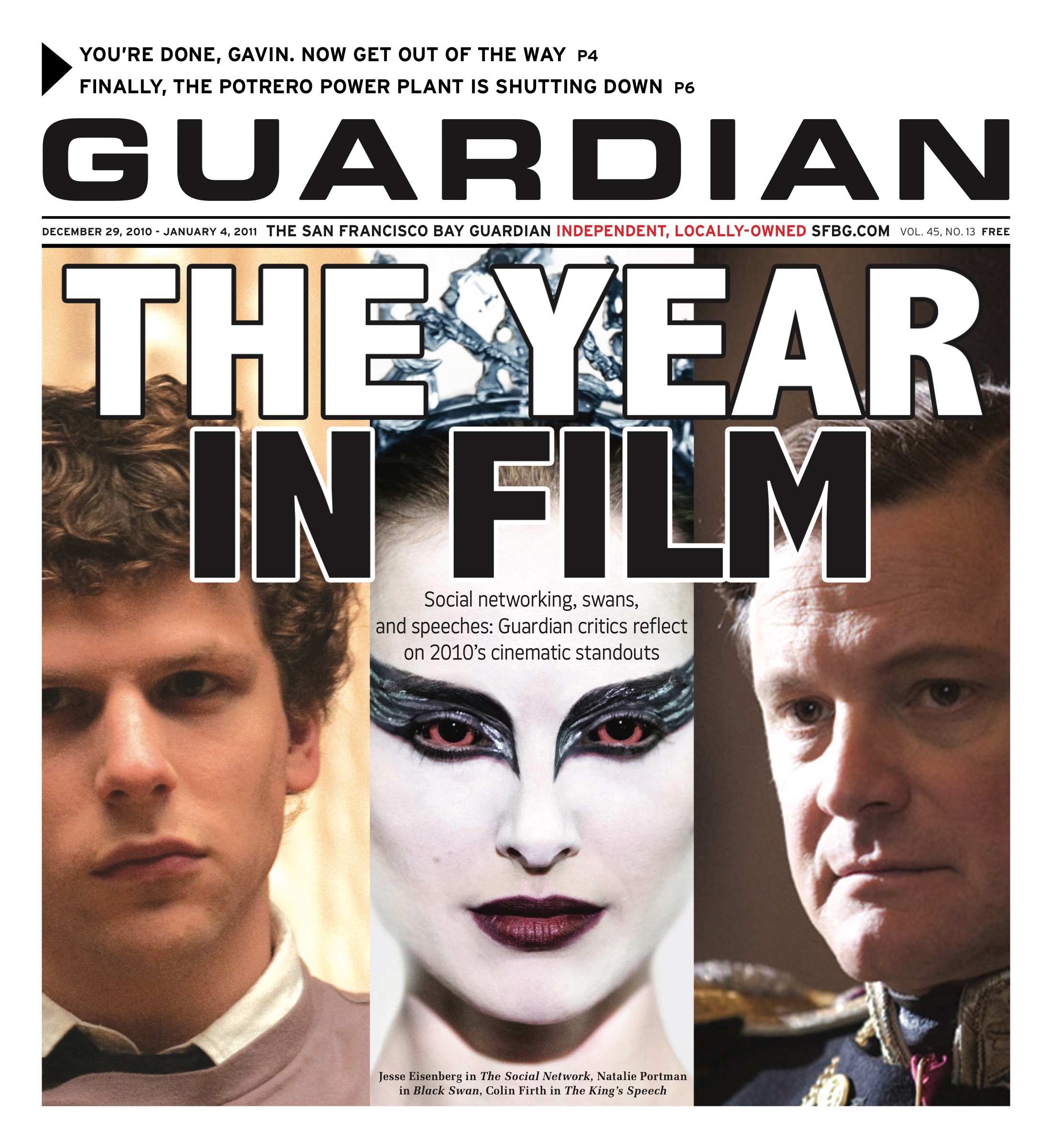
YEAR IN FILM Despite being a sharp, compelling look at the founding of Facebook, The Social Network paints an unrealistic picture of Mark Zuckerberg. No, really. Just ask Mark Zuckerberg.
OK, maybe he’s not the most reliable source. In the film, Zuckerberg (Jesse Eisenberg) is an awkward, snotty outcast. By the end, he may be a billionaire, but he’s also kind of a friendless loser. Screenwriter Aaron Sorkin has made a point of saying that The Social Network‘s protagonist is not the real Zuckerberg as much as a fictional interpretation of him. But when the names, places, and events are taken from an allegedly factual account of Facebook’s development, how do you separate the truth from the cinematic flourishes?
The easy answer: you don’t. The actual Zuckerberg can contest the version of history that The Social Network presents, with Zuckerberg borrowing his idea from the Winklevoss twins (Armie Hammer) and eventually screwing over his best friend and cofounder Eduardo Saverin (Andrew Garfield). But Zuckerberg can’t change our viewing experience. He can’t — no matter how many billions he has — erase The Social Network from existence. With conflicting versions of reality, it’s up to us to pick and choose what we believe.
For those of us who have spent the last several years of our lives on Facebook — we millennials who came of age along with the Internet — separating fact from fiction is nothing new. Online social networking has long been associated with deceit. We create profiles that reflect the best version of ourselves. Sometimes we create profiles that have very little bearing on reality at all. It seems appropriate that a film about Facebook would generate a controversy over truth. Because sure, there’s a good chance the buxom blonde you’re chatting with is who she says she is — but it’s just as likely that you’ve been Catfish-ed.
Not familiar with the term? Fair enough; it’s relatively recent. Catfish refers to the film of the same name, a documentary in which filmmakers Henry Joost and Rel Schulman follow Schulman’s brother Nev through an online relationship. “Don’t let anyone tell you what it is,” the film’s poster warned. At this point, you either know or you don’t care, so I’ll throw caution to the wind (in other words, spoiler warning): Megan, the girl Nev falls for, turns out to be a complete fantasy. The mastermind behind this complex Facebook deception is Angela, a lonely less-than-knockout with a vivid imagination and access to the Internet.
The Social Network may be “the Facebook movie,” but Catfish is perhaps the best reflection of social networking that any film has yet to offer. The Social Network speaks in broad strokes and metaphors. Zukerberg can’t connect with the real people around him, so he invents a new method of interaction. Software that should, ideally, bring us all together actually pulls us apart. But Catfish pushes past the theoretical to the kind of real-life Facebook experience a fictional feature like The Social Network can’t replicate.
That is, if you believe Catfish itself to be true. As soon as the documentary was screened at the Sundance Film Festival, disbelieving critics and audience members loudly proclaimed it to be fake. I can understand the impulse to dismiss it; the story progresses with all-too-convenient twists and turns. The characters’ reactions often feel unbelievable. And the fact that the filmmakers were already documenting Nev’s life — isn’t that a little too good to be true?
I actually choose to take Catfish at face value. I’ve encountered enough Facebook trickery on my own to know that people with too much time on their hands will go to great lengths to deceive. Stranger things have happened than one underappreciated mom creating an elaborate fantasy world. But as is the case with The Social Network, I’d argue that the reality is somewhat beside the point. Our viewing experience is what counts. Our perception of these films — our interpretation of the truth — is something no one can contest.
Then what of the documentary we know to be fake? I’m Still Here, Casey Affleck’s look at Joaquin Phoenix’s foray into hip-hop, was revealed to be a hoax long after most people had already reached that conclusion. Why should we have ever believed that Phoenix had essentially lost it and given up on acting? We saw the viral video of his disastrous appearance on The Late Show With David Letterman. We read all the gossip blogs attempting to dissect Phoenix’s bizarro behavior. (“What is he on?”) But we know better than to take anything at face value. We’ve been Catfish-ed before.
“But wait!” you protest. “I thought truth wasn’t the point.” I did say that, and thanks for paying attention! Here’s the thing: fact or fiction, The Social Network and Catfish succeed as films. I’m Still Here, not so much. The Affleck-Phoenix collaboration is a failed experiment that does inspire some discussion but certainly not the kind it was aiming for. It’s a half-baked satire on Hollywood, born from the misguided notion that acting like an asshole is inherently funny. Critics and audiences didn’t reject I’m Still Here because it wasn’t true, they rejected it because it’s really, really shitty.
In a Facebook era, we are all uniquely able to choose how best to represent ourselves. These films rest on how they’ve been received, not on the questionable truth behind them. It’s about putting your best foot forward, whether that’s as whiz kid Mark Zuckerberg or Catfish’s impossible princess Megan Faccio. And let’s face it: no one wants to get poked by bearded freak show Joaquin Phoenix.