History

Housing for the rich moves forward — fast

39

A proposal to build the most expensive condos in San Francisco history will come before the Board of Supervisors May 15 — and then before the Port Commission May 16, and then before the Board’s Finance Committee May 16, a jumble of hearings and votes that may make it more difficult for critics to be heard.

The 8 Washington project will be one of the most critical votes the board will face in 2012 and will make a lasting statement about the city’s housing policy. And it’s on an odd fast track.

At the board’s May 15 meeting, the supervisors will consider an appeal to the certification of the project’s environmental impact report, and will vote on approving the conditional use authorization for the building complex. If either of those is rejected — that is, if project sponsor Simon Snellgrove can’t line up six votes to approve the EIR and the CU — then the whole thing goes down in flames. The project would still exist in theory, but in practice it would be another two years before it could come back again.

If both of those approvals get through, then the actual development agreement and the financial documents for the project come before the Port Commission the next day — May 16 — at a highly unusual special hearing set for 9am. That’s a tough time to get people to come out and speak against a project, but the Port says it’s necessary, and here’s why:

One hour later, at 10am, the board’s Budget and Finance Committee will consider the same thing. And the Port wants this to get through Budget and Finance before that panel is entirely consumed with the next city budget.

So there will be two nearly simultaneous hearings, both at City Hall, on the same topic, early in the morning. A little difficult for people who want to testify at both. What if the Port hearing goes on until, say, 11:30 or noon (there have been plenty of three-hour hearings on contentious land-use issues in this city)? What if the Budget Committee starts discussion on the item before the Port is through with it?

Brad Benson, the Port’s special projects director, told me that his agency was “in touch with the chair of the Budget Committee. We get the point that people can’t be in two places at the same time.” 

But still, it all seems awfully rushed — particularly since, according to project opponent Sue Hestor, the state Lands Commission also has to sign off on this, and that won’t happen until July.


A brief transgender punk heroes primer

16

The web is all abuzz — rightly — about the bravery of Against Me! singer Tom Gabel “coming out” to Rolling Stone as transgender and beginning to live her life as Laura Jane Grace (while remaining legally married to her wife and raising their child. Take that, North Carolina!). ‘Tis a wonderful thing indeed, and most of the commentary on the high school hearthrob band’s website has been positive.

As much as it pains me to call any band that came after Fugazi “punk,” Against Me! wasn’t half bad to soundtrack your 2000s teenage mall rebellion, carrying on the legacy of punks through the ages. And Grace’s transformation carries on another legacy as well — that of famous transgender rockers.

I’ve lately been rereading one of my favorite books, Please Kill Me: The Uncensored Oral History of Punk — if ever there was a book to make your life seem utterly boring shite, that’s it. It’s full of hyperenergetic boys donning frocks, from punk founders the Dead Boys and the New York Dolls to the glam heroes that punk was meant to take down, like David Bowie and Gary Glitter. And of course many fierce women of the early scene were shaving their heads and kitting out in “mens’ clothes.” (There was actually a time when Robert Mapplethorpe’s cover shot for Patti Smith’s Horses was a scandal, really.)

But all that was mere transgression, welcome as it may have been to the oppressed queers of the day — and now for that matter. Being transgender is something different, having the courage to reconcile your physicality with the mental and emotional image you carry of yourself inside. And then to rock the fuck out? Cool. Here are some of my transgender punk heroes:


>>Jayne County

She became famous in the late ’70s, kicking against the pricks in London as Wayne County (with band the Electric Chairs) — but was an NYC underground mainstay before then, taking part in the 1969 Stonewall Riots, hanging with the Warhol crew, and starting one of the first punk-like bands Queen Elizabeth in 1972. (“God Save the Queen” indeed.). She soon rechristened herself Jayne County, performing unabashedly before punk audiences as a transgender woman. As an actress, she starred in seminal underground queer films like Derek Jarman’s Jubilee and Rosa von Praunheim’s City of Lost Souls. She’s still raging.    

http://www.youtube.com/watch?v=tiih9H29pDM


>>Genesis P-Orridge

The outrageous and outrageously talented founder of ’70s experimental industrial-noise-punk-electronic outifts Psychic TV and Throbbing Gristle, Genesis approaches gender in an experimental vein as well. Already well into his own gender recalibration, he and his wife Lady Jayne Breyer P-Orridge began an odyssey of physical transformation in the 2000s to become a single pandrogynous entity to be called “Breyer P-Orridge.” Sadly, Lady Jayne died in 2007 of stomach cancer, but Genesis continues to challenge gender expectations, as the recent release of lauded doc The Ballad of Genesis and Lady Jaye attests to.

http://www.youtube.com/watch?v=GPpet98Hick


>>Lynn Breedlove

The indispensable local trans man was instrumental in the punk revival of the ’90s with his insane dyke outfit Tribe 8, and now helps keep queers safe on the streets of SF with his Homobiles on-call transportion service. He’s also an accomplished author and performer in his own right. Queers fight (and write) back!!


UPDATE: In the comments below, readers below have pointed out two very important transgender punks: Sarah Kirsch, formerly Mike Kirsch, guitarist and vocalist seminal East Bay outfit Pinhead Gunpowder, Fuel, and a ton more including Fuel and Sawhorse (and who is currently recovering from cancer). I couldn’t find a good vid of Sarah in her current incarnation, but here’s a recent one of Pinhead Gunpowder at 924 Gilman. 

PLUS the incredible Ginger Coyote of the White Trash Debutantes, who was pretty essential to the Mabuhay Gardens punk scene here.

And of course, there is a thriving, vibrant, now-decades-old underground of scrappy queer and transgender punk rock bands — and wonderful local trans musicians like Christine Beatty and Justin Bond and even lounge singer Veronica Klaus who keep the proud and outspoken transgender musical flame alight. In the immortal words of Jayne County, “If you don’t want a piece of the action, take a walk!”


On the Cheap May 9-15, 2012

0


WEDNESDAY 9

They Make Us Dangerous author reading and chitchat Modern Times Bookstore Collective, 2919 24 St., SF. (415) 282-9246, www.mtbs.com, 7-10pm, free. Step onto the Cold War battlefield that was Bolivia from 1964 to 1980, as you listen to the first hand account of a Catholic nun from the US’s Midwest whose doctoral research takes her to this mesmerizing but poverty-stricken region. As revolution clashes with oppression and boils over in dictatorship, author Frances Payne closes the book to answer and discuss your thoughts and inquiries.

Local Authors Night Hayward Area Historical Society, 22380 Foothill Blvd., Hayward. (510) 581-8172, www.haywardhistory.org, 7pm, free. Prepare your have your hairs stand on end as East Bay author Alec Nevala-Lee reads part of his thriller, The Icon Thief, and buckle up for an emotional ride as David Teves, also of the East Bay, reads his novel, A Matter of Time, and takes you one man’s journey through his own personal hell.


THURSDAY 10

Plantosaurus Rex prehistoric plant exhibition and time warp Conservatory of Flowers, 100 JFKennedy Dr., SF. (415) 831-2090, www.conservatoryofflowers.org, 10am-4pm Tuesdays-Sundays, $5 general for youth, seniors, students and those with proof of SF residency. $7 general. Today, the Conservatory kicks off a five-month exhibit (ending Oct. 21) that transports you 250-65 million years back in time on a journey through the living plant life and model animals of the Mesozoic Era.


FRIDAY 11

MFA Graduate Student Art Exhibition opening reception Phoenix Hotel, 601 Eddy St., SF. www.sfai.edu. noon-10pm, free. The San Francisco Art Institute introduces you to the love-labors of 100 MFA grad students to tantalize your senses with work from across the artistic disciplines, as you meander through the open guestrooms and poolside courtyard of this funky hotel.

SFAI MFA Student Film Screening SFMOMA, Phyllis Wattis Theater, 151 3 St., SF. www.sfai.edu. 1pm-3pm, free. From an experimental documentary about the Occupy movement to an animated short starring an otter and lemur living in a submarine, these works by graduating MFA film students will introduce you to the filmmakers of the future.


SATURDAY 12

Making Mothers Visible Pop-Up Photography Arts Event San Francisco Main Public Library, Civic Center, 100 Larkin St., SF. www.imow.org. 10am-3pm, free. Just in time for Mother’s Day, the International Museum of Women invites you to celebrate moms the world around. Watch as volunteers install more than 50 large-scale photographs of mothers and midwives on the exterior of the library. This family-friendly day also features free art activities including face painting for kids and a hands-on art workshop for adults.

Paradigm Shift Pagan Festival and Parade Martin Luther King Jr., Civic Center Park, 2151 Martin Luther King Jr. Way, Berkeley. www.thorncoyle.com. 10am-5:30pm, free. March amid belly dancers, storytellers, music, and merriment in the eleventh annual procession of the Pagan Festival. You and your brood could win a best costume award if you arrive decked out in your finest tribal attire.

Rocket Dog Rescue Happy Hour Benefit Bliss Bar, 4026 24 St., SF. (877) 737-3647, adopt@rocketdogrescue.org. 5pm-7:30pm, free with $10 recommended donation. Bliss out at the bar with fellow K-9 lovers as you enjoy the music of Bright Side Band. All proceeds will benefit dogs in need via Rocket


SUNDAY 13

How Weird Street Faire, Electronic Music Festival Howard and 2nd St., SoMa SF. www.HowWeird.org. 12pm-8pm, $10 donation requested. When the Dalai Lama was asked what the average person could do to promote world peace, he replied, “They can make festivals, bring people together.” So: 13 stages of music will dot 13 city blocks for this 13th annual party to celebrate peace and creativity via technical sounds, visual innovations and thousands of people.


MONDAY 14

Coit Tower celebrate historic murals at Booksmith The Booksmith, 1644 Haight St., SF. (415) 863-8688, www.booksmith.com. 7:30pm, free. On the June 5 ballot, local voters will consider Prop. B, an initiative asking the city to prioritize restoration and preservation of 27 New Deal-era murals at Coit Tower atop Telegraph Hill. This literary evening is dedicated to reading about and reliving the history of Coit Tower and its art-laden walls.

SHOUT Storytelling Grand Lake Coffee House, 440 Grand Ave., Oakl. www.theshoutstorytelling.com. 7:30pm, $5–<\d>$20, pay what you will. Listen to true but incredible 10-minute stories from the lives of local raconteurs in an informal coffee house setting that will feel like a party in your own living room (that you don’t have to clean up). Feeling the gift of gab? Throw your name into the hat in hopes of getting picked for one of the six-minute wild card slots.


TUESDAY 15

Feast of Words; A literary potluck to laugh with a funny lady SOMArts Cultural Center, 934 Brannan St, SF. Feastofwords.somarts.org, feastofwords@somarts.org. 7pm-9pm, $10 advance, $5 with potluck dish, $12 at door. Following a nationwide tour, Oakland-based funny girl writer, Cassie J. Sneider, reads from her new book Fine, Fine Music at this monthly potluck. This intimate party brings writers, foodies, and any combination of the two, together to — well — eat, write, and laugh.

Film Listings May 9-15, 2012

0

Film listings are edited by Cheryl Eddy. Reviewers are Kimberly Chun, Max Goldberg, Dennis Harvey, and Lynn Rapoport. For rep house showtimes, see Rep Clock at www.sfbg.com. Complete film listings also posted at www.sfbg.com.

OPENING

Dark Shadows Conceptually, there’s nothing wrong with attempting to turn a now semi-obscure supernaturally themed soap opera with a five-year run in the late 1960s and early ’70s into a feature film. Particularly if the film brings together the sweetly creepy triumvirate of Tim Burton, Johnny Depp, and Helena Bonham Carter and emerges during an ongoing moment for vampires, werewolves, and other things that go hump in the night. Depp plays long-enduring vampire Barnabas Collins, the undead scion of a once-powerful 18th-century New England family that by the 1970s — the groovy decade in which the bulk of the story is set — has suffered a shabby deterioration. Barnabas forms a pact with present-day Collins matriarch Elizabeth (Michelle Pfeiffer) to raise the household — currently comprising her disaffected daughter, Carolyn (Chloë Grace Moretz), her derelict brother, Roger (Jonny Lee Miller), his mournful young son, David (Gulliver McGrath), David’s live-in lush of a psychiatrist, Dr. Hoffman (Carter), and the family’s overtaxed manservant, Willie (Jackie Earle Haley) — to its former stature, while taking down a lunatic, love-struck, and rather vindictive witch named Angelique (Eva Green). The latter, a victim of unrequited love, is the cause of all Barnabas’s woes and, by extension, the entire clan’s, but Angelique can only be blamed for so much. Beyond her hocus-pocus jurisdiction is the film’s manic pileup of plot twists, tonal shifts, and campy scenery-chewing by Depp, a startling onslaught that no lava lamp joke, no pallid reaction shot, no room-demolishing act of paranormal carnality set to Barry White, and no cameo by Alice Cooper can temper. (2:00) California, Four Star, Presidio.

Darling Companion When the carelessness of self-absorbed surgeon Joseph (Kevin Kline) results in the stray dog adopted by Beth (Diane Keaton) going missing during a forest walk, that event somehow brings all the fissures in their long marriage to a crisis point. Big Chill (1983) director Lawrence Kasdan’s first feature in a decade hews back to the more intimate, character-based focus of his best films. But this dramedy is too often shrilly pitched and overly glossy (it seems to take place in a Utah vacation-themed L.L. Bean catalog), with numerous talented actors — including Richard Jenkins, Dianne Wiest, Mark Duplass, Elisabeth Moss, and Sam Shepard — playing superficially etched characters that merely add to the clutter. Most cringe-inducing among them is Ayelet Zurer’s Carmen, a woman of Roma extraction who apparently has a crystal ball in her psychic head and actually speaks lines like “My people have a saying….” (1:43) Embarcadero. (Harvey)

First Position Bess Kargman’s documentary follows a handful of exceptional young ballet dancers, ranging in age from 10 to 17, over the course of a year as they prepare for the Youth America Grand Prix, the world’s largest ballet scholarship competition. Those who make it from the semifinals (in which some 5,000 dancers aged 9 to 19 perform in 15 cities around the world) to the finals (which bring some 300 contestants to New York City) compete for scholarships to prestigious ballet schools, dance-company contracts, and general notice by both the judges and the company directors in the audience. The film’s subjects come from varied backgrounds — 16-year-old Joan Sebastian lives and studies in NYC, far from his family in Colombia; 14-year-old Michaela was born in civil war-torn Sierra Leone and adopted from an orphanage by an American couple in Philadelphia; 11-year-old Aran, an American, lives in Italy with his mother while his father serves in Kuwait. The common threads in their stories are the daily sacrifices made by them as well as their families, whose energies and other resources are largely poured into these children’s single-minded pursuit. We get a vague sense of the difficult world they are driving themselves, in nearly every waking hour, to enter. But the film largely keeps its focus on the challenges of preparing for the competition, offering us many magnificent shots of the dancers pushing their bodies to mesmerizing physical extremes both on- and offstage. (1:34) Embarcadero, Piedmont, Shattuck, Smith Rafael. (Rapoport)

God Bless America Middle-aged office drone Frank (Joel Murray) is not having a good day-week-month-year-life. His ex-wife is about to happily remarry; his only child is a world-class brat who finds father-daughter time “boring;” his neighbors are a young couple who only get more loudly obnoxious when politely asked to keep the noise down. When that and insistent migraines keep Frank awake night after night, the parade of pundit and reality stupidities on TV only turn his insomnia into wide awake fury. Then he’s fired from his job for unjust reasons — on the same day he gets a diagnosis of brain cancer. Mad as hell, not-gonna-take-it-anymore, he impulsively decides to make a “statement” by assassinating a viral-video poster child for “entitlement.” This attracts admiring attention from extremely pushy, snarky teen Roxy (Tara Lynne Barr), who appoints herself Bonnie to his reluctant Clyde. They drive around the country bestowing “big dirt naps” on other exemplars of what’s wrong with America today, including religious hate mongers, rude moviegoers, and the purveyors of American Idol-type idiotainment. Comedian Bobcat Goldthwait’s latest feature as writer-director has its head in the right place, and so many good ideas, that it’s a pity this gonzo satire-rant runs out of steam so quickly. Aiming splattering paintball gun at the broadest possible targets, it covers them with disdainful goo but not as much wit as one would like. Plus, Barr’s hyper precocious smart mouth is yet another annoying Juno (2007) knockoff — never mind that she counts Diablo Cody among her (many) pet peeves. If God Bless winds up closer to Uwe Boll’s Postal (2007) than, say, Network (1976) in scattershot impact, it nonetheless almost makes it on sheer outré audacity and will alone. A movie that hates everything you hate should not be sneezed at; if only it hated them with more parodic snap, thematic depth and narrative structure. (1:44) Bridge, Shattuck. Harvey)

Here Sparks fly when a satellite-mapping expert (Ben Foster) meets a photographer (Lubna Azabal) while traveling in Armenia. (2:00) SF Film Society Cinema.

Last Call at the Oasis If you like drinking water, or eating food, or using mass-produced physical objects, and you also enjoy not being poisoned by virulent chemicals such as hexavalent chromium and atrazine, you probably want to see — but most likely won’t much enjoy — Jessica Yu’s latest documentary, about the impending global water crisis. Or rather, the crisis, the film makes clear, that has already arrived in many parts of the world and — in the sense that it’s about a shortage of safe drinking water — in many parts of the United States. The Academy Award–winning Yu, whose previous films include the 2004 Henry Darger documentary In the Realms of the Unreal, invites various experts to lay out the alarming facts for us, as we sit in the theater clutching our bottles of Dasani. Last Call’s talking heads include UC Irvine professor Jay Famiglietti, the Pacific Institute’s Peter Gleick (who, regardless of February’s firestorm over an ethical lapse, speaks eloquently here), journalist Alex Prud’homme, whose book The Ripple Effect the documentary is based on, and Erin Brockovich. An unexpected appearance by Jack Black in the role of potential future spokesperson for potable recycled water (one name under consideration: Porcelain Springs) adds levity to a film that is short on silver linings, as well as solutions. The title conveys the sort of gallows humor occasionally displayed by Yu’s subjects — one of whom ponders for a moment the situation he’s just described and then offers this succinct summary: “We’re screwed.” (1:45) Embarcadero, Shattuck. (Rapoport)

Michael Michael follows a few months in the lives of a pedophile (Michael Fulth) and his captive (David Rauchenberger). It is no surprise that Austrian director Markus Schleinzer previously worked for Michael Haneke: the film’s cold, inanimate aesthetic is the means for psychological torture, on the part of both Michael’s prisoner, and the audience. Michael, a sociopath who works in an office by day, keeps the boy, a pensive 10-year-old named Wolfgang, in a basement behind a bolted door. He visits him nightly, and allows the boy to dine with him. As master and slave go about their mundane routine their level of comfort with one another is just as unsettling as the off-screen sex. Equally disturbing is how Michael manages to maintain such a normal life on the surface. After he tries to bring a new victim home and fails, Wolfgang starts to find ways to push his captor’s buttons. In spite of the loud subject, rarely has such formal reticence registered as this horrifying. (1:36) SF Film Society Cinema. (Ryan Lattanzio)

Otter 501 A young woman comes to the aid of an orphaned otter pup in this narrative-doc hybrid shot in the Bay Area. (1:24) Presidio.

The Perfect Family Having survived years of hardship by dint of her faith, devout Catholic Eileen Cleary (Kathleen Turner) now lets nothing stand between her and the heavy-handed pursuit of grace — including her own family’s perceived imperfections. The past, in which long-sober husband Frank (Michael McGrady) was an abusive alcoholic, is not discussed. The present — in which ne’er-do-well son Frank Jr. (Jason Ritter) is not yet divorced yet already involved with a Protestant manicurist (Kristen Dalton), while otherwise exemplary daughter Shannon (Emily Deschanel) insists on marrying and child-raising with another woman (Angelique Cabral) — is ignored when it can’t be nagged into submission. These modern aberrations from the Pope-embraced allowable lifestyles must be addressed, however, when Eileen’s endless charitable toil gets her nominated as Catholic Woman of the Year. This would be her crowning achievement, but naturally something’s gotta give: either her family’s going to at least pretend it’s “normal,” or she’s got to grow more accepting at the potential loss of her big moment in the spotlight. Directed by Anne Renton, written by Paula Goldberg and Claire V. Riley, The Perfect Family is an ensemble dramedy (also encompassing Richard Chamberlain and Elizabeth Peña) that trundles as effortfully as its stressed-out protagonist from sitcomish humor to tearjerking, leaving no melodramatic contrivance unmilked along the way. Its intentions (primarily gay-positive ones, in line with the scenarists’ prior features) are good. But the execution is like a sermon whose every calculated chuckle and insight you anticipate five minutes before you hear it. To see Turner really excel as a controlling mother, rent 1994’s Serial Mom again. (1:24) Sundance Kabuki. (Harvey)

The Road It’s rare that a film from the Philippines gets a commercial release in the US, and The Road is the first horror movie to be widely distributed here. The story is inspired by the tragic tale of the Chiong sisters, allegedly raped and murdered in 1997. The case inspired a sensational, controversial trial, explored in detail in the excellent recent doc Give Up Tomorrow (which screened at the 2012 San Francisco International Asian American Film Festival). Unfortunately, the true story is better than the fictional one; though Yam Laranas’ backwoods creep show has plenty of atmosphere, its flashback-within-a-flashback structure can feel a bit incoherent. Also bummers: the identity of the villain — who comes packaged with a tidy, here’s-my-motivation back story — is patently obvious well before the final reel, and once you get used to The Road‘s silent corpse-ghosts popping up amid the foliage, they cease to wield much shock value. (1:50) Presidio. (Eddy)

ONGOING

The Artist With the charisma-oozing agility of Douglas Fairbanks swashbuckling his way past opponents and the supreme confidence of Rudolph Valentino leaning, mid-swoon, into a maiden, French director-writer Michel Hazanavicius hits a sweet spot, or beauty mark of sorts, with his radiant new film The Artist. In a feat worthy of Fairbanks or Errol Flynn, Hazanavicius juggles a marvelously layered love story between a man and a woman, tensions between the silents and the talkies, and a movie buff’s appreciation of the power of film — embodied in particular by early Hollywood’s union of European artistry and American commerce. Dashing silent film star George Valentin (Jean Dujardin, who channels Fairbanks, Flynn, and William Powell — and won this year’s Cannes best actor prize) is at the height of his career, adorable Jack Russell by his side, until the talkies threaten to relegate him to yesterday’s news. The talent nurtured in the thick of the studio system yearns for real power, telling the newspapers, “I’m not a puppet anymore — I’m an artist,” and finances and directs his own melodrama, while his youthful protégé Peppy Miller (Bérénice Béjo) becomes a yakky flapper age’s new It Girl. Both a crowd-pleasing entertainment and a loving précis on early film history, The Artist never checks its brains at the door, remaining self-aware of its own conceit and its forebears, yet unashamed to touch the audience, without an ounce of cynicism. (1:40) Opera Plaza, Shattuck. (Chun)

The Best Exotic Marigold Hotel (1:42) Albany, SF Center, Sundance Kabuki.

Bully Anyone who’s ever been a kid on the wrong side of a bully — or was sensitive and observant enough not to avert his or her eyes — will be puzzling over the MPAA’s R rating of this doc, for profanity. It’s absurd when the gory violence on network and basic cable TV stops just short of cutting characters’ faces off, as one blurred-out bus bully threatens to do to the sweet, hapless Alex, dubbed “Fish Face” by the kids who ostracize him and make his life hell on the bus. It’s a jungle out there, as we all know — but it’s that real, visceral footage of the verbal (and physical) abuse bullied children deal with daily that brings it all home. Filmmaker Lee Hirsch goes above and beyond in trying to capture all dimensions of his subject: the terrorized bullied, the ineffectual school administrators, the desperate parents. There’s Kelby, the gay girl who was forced off her beloved basketball team after she came out, and Ja’Maya, who took drastic measures to fend off her tormenters — as well as the specters of those who turned to suicide as a way out. Hirsch is clearly more of an activist than a fly on the wall: he steps in at one point to help and obviously makes an uplifting effort to focus on what we can do to battle bullying. Nevertheless, at the risk of coming off like the Iowa assistant principal who’s catching criticism for telling one victim that he was just as bad as the bully that he refused to shake hands with, one feels compelled to note one prominent component that’s missing here: the bullies themselves, their stories, and the reasons why they’re so cruel — admittedly a daunting, possibly libelous task. (1:35) Metreon, Smith Rafael. (Chun)

The Cabin in the Woods If the name “Joss Whedon” doesn’t provide all the reason you need to bum-rush The Cabin in the Woods (Whedon produced and co-wrote, with director and frequent collaborator Drew Goddard), well, there’s not much more that can be revealed without ruining the entire movie. In a very, very small nutshell, it’s about a group of college kids (including Chris “Thor” Hemsworth) whose weekend jaunt to a rural cabin goes horribly awry, as such weekend jaunts tend to do in horror movies (the Texas Chainsaw and Evil Dead movies are heavily referenced). But this is no ordinary nightmare — its peculiarities are cleverly, carefully revealed, and the movie’s inside-out takedown of scary movies produces some very unexpected (and delightfully blood-gushing) twists and turns. Plus: the always-awesome Richard Jenkins, and in-jokes galore for genre fans. (1:35) Four Star, Metreon, 1000 Van Ness, Shattuck. (Eddy)

Chimpanzee (2:00) Metreon, 1000 Van Ness, Shattuck.

The Day He Arrives Korean auteur (Woman Is the Future of Man, 2004) Hong Sang-soo’s latest exercise in self-consciousness, this black-and-white, fable-like study of a frustrated filmmaker (Yu Jun-sang), returning home to Seoul to visit an old friend after spending time in the countryside teaching, adds up to a kind of formal palimpsest. Surrounded by sycophants, vindictive former leading men, and women who seem to serve a purely semiotic purpose, he participates in an endless loop of drink, smoke, and conversation in a series of dreamlike scenes that play on the theme of coincidence and endless variation. Hong’s layering of alternate scenarios at times feels like a bit of a gimmick, but the way he infuses specific urban spaces with forlorn significance in mostly static shots is affecting — even if the film’s ultimate narrative slightness has the cut-and-paste haphazardness of fridge poetry magnets. (1:19) SF Film Society Cinema. (Michelle Devereaux)

The Deep Blue Sea Caught between the devil and the deep blue sea, filmmaker Terence Davies, much like his heroine, chooses a mutable, fluid sensuality, turning his source material, Terence Rattigan’s acclaimed mid-century play, into a melodrama that catches you in its tide and refuses to let go. At the opening of this sumptuous portrait of a privileged English woman who gives up everything for love, Hester (Rachel Weisz) goes through the methodical motions of ending it all: she writes a suicide note, carefully stuffs towels beneath the door, takes a dozen pills, turns on the gas, and lies down to wait for death to overtake her. Via memories drifting through her fading consciousness, Davies lets us in on scattered, salient details in her back story: her severely damped-down, staid marriage to a high court judge, Sir William (Simon Russel Beale), her attraction and erotic awakening in the hands of charming former RF pilot Freddie Page (Tom Hiddleston), her separation, and her ultimate discovery that her love can never be matched, as she hazards class inequities and ironclad gender roles. “This is a tragedy,” Sir William says, at one point. But, as Hester, a model of integrity, corrects him, “Tragedy is too big a word. Sad, perhaps.” Similarly, Sea is a beautiful downer, but Davies never loses sight of a larger post-war picture, even while he pauses for his archetypal interludes of song, near-still images, and luxuriously slow tracking shots. With cinematographer Florian Hoffmeister, he does a remarkable job of washing post-war London with spots of golden light and creating claustrophobic interiors — creating an emotionally resonant space reminiscent of the work of Wong Kar-wai and Christopher Doyle. At the center, providing the necessary gravitas (much like Julianne Moore in 2002’s Far From Heaven), is Weisz, giving the viewer a reason to believe in this small but reverberant story, and offering yet another reason for attention during the next awards season. (1:38) Opera Plaza, Smith Rafael. (Chun)

The Five-Year Engagement In 2008’s Forgetting Sarah Marshall, viewers were treated to the startling, tragicomic sight of Jason Segel’s naked front side as his character got brutally dumped by the titular perky, put-together heartbreaker. In The Five-Year Engagement, which he reunited with director Nicholas Stoller to co-write, Segel once again sacrifices dignity and the right to privacy, this time in exchange for fake orgasms (his own), ghastly hand-knit sweaters, egregious facial-hair arrangements, and various other exhaustively humiliating psychological lows — all part of an earnest, undying quest to make people giggle uncomfortably. Segel plays Tom, a talented chef with a promising career ahead of him in San Francisco’s culinary scene (naturally, food carts get a cameo in the film). On the one-year anniversary of meeting his girlfriend, Violet (Emily Blunt), a psychology postgrad, he asks her to marry him in a meticulously planned, gloriously botched proposal scene coengineered by Tom’s oafish friend Alex (Chris Pratt), little realizing that this romantic gesture will soon lead to successive frozen winters in the Midwest (Violet gets offered a job at the University of Michigan), loss of professional stature, cabin fever, mead making, bow-hunting accidents, the titular nuptial postponement, and other, more gruesome events. The humor at times descends to some banally low depths as Segel and Stoller explore the terrain of the awkward, the poorly socialized, and the playfully grotesque. But Segel and Blunt present a believable, likable relationship between two warm, funny, flawed people, and, however disgusted, no one should walk out before a scene in which Violet and her sister (Alison Brie) channel Elmo and Cookie Monster to elaborate on the themes of romantic idealism and marital discontent. (2:04) Marina, 1000 Van Ness, SF Center, Vogue. (Rapoport)

Footnote (1:45) Opera Plaza, Shattuck.

Friends With Kids Jennifer Westfeldt scans Hollywood’s romantic comedy landscape for signs of intelligent life and, finding it to be a barren place possibly recovering from a nuclear holocaust, writes, directs, and stars in this follow-up to 2001’s Kissing Jessica Stein, which she co-wrote and starred in. Julie (Westfeldt) and Jason (Adam Scott) are upper-thirtysomething New Yorkers with two decades of friendship behind them. He calls her “doll.” They have whispered phone conversations at four in the morning while their insignificant others lie slumbering beside them on the verge of getting dumped. And after a night spent witnessing the tragic toll that procreation has taken on the marriages of their four closest friends — Bridesmaids (2011) reunion party Leslie (Maya Rudolph), Alex (Chris O’Dowd), Missy (Kristen Wiig), and Ben (Jon Hamm), the latter two, surprisingly and less surprisingly, providing some of the film’s darkest moments — Jason proposes that they raise a child together platonically, thereby giving any external romantic relationships a fighting chance of survival. In no time, they’ve worked out the kinks to their satisfaction, insulted and horrified their friends, and awkwardly made a bouncing baby boy. The arrival of significant others (Edward Burns and Megan Fox) signals the second phase of the experiment. Some viewers will be invested in latent sparks of romance between the central pair, others in the success of an alternative family arrangement; one of these demographics is destined for disappointment. Until then, however, both groups and any viewers unwilling to submit to this reductive binary will be treated to a funny, witty, well crafted depiction of two people’s attempts to preserve life as they know it while redrawing the parameters of parenthood. (1:40) Sundance Kabuki. (Rapoport)

Gerhard Richter Painting O to be a eye in the studio, simply taking in a master’s process. Anyone who’s wondered how artist Gerhard Richter makes his monumental paintings — or even just idly pondered art making in general — gets that rare chance with this fascinating, elegant portrait of a man and his method. After capturing Richter for the first time in 15 years in her 2007 short on his stained glass window at the Cologne Cathedral, filmmaker Corinna Belz was entrusted with pointing a camera at the artist as he worked a new series of abstractions and prepared for a major retrospective. Through unusual archival footage, brief discussions of his past, and glimpses of everyone from Richter’s wife to his US dealer Marian Goodman, we end up with a privileged window in the German maker’s world and utterly riveting footage of Richter in the studio — applying color to canvas; taking a squeegee to the blobs and splotches; scraping, manipulating, and morphing the hues with a mesmerizing combination of improvisation and consideration; and then stepping back to study the results, occasionally out loud. Even more than a glance into a workspace, it’s a light into the mind of the man who has recharged painting and its myriad approaches, techniques, and ideas with new relevance. (1:37) Roxie. (Chun)

Headhunters Despite being the most sought-after corporate headhunter in Oslo, Roger (Aksel Hennie) still doesn’t make enough money to placate his gorgeous wife; his raging Napoleon complex certainly doesn’t help matters. Crime is, as always, the only solution, so Roger’s been supplementing his income by stealthily relieving his rich, status-conscious clients of their most expensive artworks (with help from his slightly unhinged partner, who works for a home-security company). When Roger meets the dashing Clas Greve (Nikolaj Coster-Waldau of Game of Thrones) — a Danish exec with a sinister, mysterious military past, now looking to take over a top job in Norway — he’s more interested in a near-priceless painting rumored to be stashed in Greve’s apartment. The heist is on, but faster than you can say “MacGuffin,” all hell breaks loose (in startlingly gory fashion), and the very charming Roger is using his considerable wits to stay alive. Based on a best-selling “Scandi-noir” novel, Headhunters is just as clever as it is suspenseful. See this version before Hollywood swoops in for the inevitable (rumored) remake. (1:40) Clay, Piedmont, Shattuck. (Eddy)

Hit So Hard Along with Last Days Here, which screened earlier this year as part of the San Francisco Independent Film Festival, Hit So Hard is one of the most inspiring rock docs in recent memory. Patty Schemel was the drummer for Hole circa Live Through This, coolly keeping the beat amid Courtney Love’s frequent Lollapalooza-stage meltdowns after Kurt Cobain’s 1994 death. Offstage, however, she was neck-deep in substance abuse, weathering several rounds of rehab even after the fatal overdose of Hole bandmate Kristen Pfaff just months after Cobain (who appears here in Schemel’s own remarkable home video footage). P. David Ebersole’s film gathers insight from many key figures in Schemel’s life — including her mother, who has the exact voice of George Costanza’s mother on Seinfeld, and a garishly made-up, straight-talking Love — but most importantly, from Schemel herself, who is open and funny even when talking about the perils of drug addiction, of the heartbreak of being a gay teen in a small town, and the ultimate triumph of being a rock ‘n’ roll survivor. (1:43) Roxie. (Eddy)

The Hunger Games Katniss Everdeen (Jennifer Lawrence) is a teenager living in a totalitarian state whose 12 impoverished districts, as retribution for an earlier uprising, must pay tribute to the so-called Capitol every year, sacrificing one boy and one girl each to the Hunger Games. A battle royal set in a perilous arena and broadcast live to the Capitol as gripping diversion and to the districts as sadistic propaganda, the Hunger Games are, depending on your viewpoint, a “pageant of honor, courage, and sacrifice” or a brutal, pointless bloodbath involving children as young as 12. When her little sister’s name comes up in the annual lottery, Katniss volunteers to take her place and is joined by a boy named Peeta Mellark (Josh Hutcherson), with whom she shares an old, unspoken bond. Tasked with translating to the screen the first installment of Suzanne Collins’s rabidly admired trilogy, writer-director Gary Ross (2003’s Seabiscuit, 1998’s Pleasantville) telescopes the book’s drawn-out, dread-filled tale into a manageable two-plus-hour entertainment, making great (and horrifying) use of the original work’s action, but losing a good deal of the narrative detail and emotional force. Elizabeth Banks is comic and unrecognizable as Effie Trinket, the two tributes’ chaperone; Lenny Kravitz gives a blank, flattened reading as their stylist, Cinna; and Donald Sutherland is sufficiently creepy and bloodless as the country’s leader, President Snow. More exceptionally cast are Woody Harrelson as Katniss and Peeta’s surly, alcoholic mentor, Haymitch Abernathy, and Stanley Tucci as games emcee Caesar Flickerman, flashing a bank of gleaming teeth at each contestant as he probes their dire circumstances with the oily superficiality of a talk show host. (2:22) 1000 Van Ness, SF Center, Sundance Kabuki. (Rapoport)

Jeff, Who Lives at Home The failure-to-launch concept will always thrive whenever and wherever economies flail, kids crumble beneath family trauma, and the seduction of moving back home to live for free with the parental units overcomes the draw of adulthood and individuation. Nevertheless brotherly writing and directing team Jay and Mark Duplass infuse a fresh, generous-minded sweetness in this familiar narrative arc, mainly by empathetically following those surrounding, and maybe enabling, the stay-at-home. Spurred by a deep appreciation of Signs (2002) and plentiful bong hits, Jeff (Jason Segel) decides to go with the signals that the universe throws at him: a mysterious phone call for a Kevin leads him to stalk a kid wearing a jersey with that name and jump a candy delivery truck. This despite the frantic urging of his mother (Susan Sarandon), who has set the bar low and simply wants Jeff to repair a shutter for her birthday, and the bad influence of brother Pat (Ed Helms), a striving jerk who compensates for his insecurities by buying a Porsche and taking business meetings at Hooters. We never quite find out what triggered Jeff’s dormancy and Pat’s prickishness — two opposing responses to some unspecified psychic wound — yet by Jeff, Who Lives at Home‘s close, it doesn’t really matter. The Duplass brothers convince you to go along for the ride, much like Jeff’s blessed fool, and accept the ultimately feel-good, humanist message of this kind-hearted take on human failings. (1:22) Sundance Kabuki. (Chun)

Jiro Dreams of Sushi Celebrity-chef culture has surely reached some kind of zeitgeist, what with the omnipresence of Top Chef and other cooking-themed shows, and the headlines-making power of people like Paula Deen (diabetes) and Mario Batali (sued for ripping off his wait staff). Unconcerned with the trappings of fame — you’ll never see him driving a Guy Fieri-style garish sports car — is Jiro Ono, 85-year-old proprietor of Sukiyabashi Jiro, a tiny, world-renowned sushi restaurant tucked into Tokyo’s Ginza station. Jiro, a highly-disciplined perfectionist who believes in simple, yet flavorful food, has devoted his entire life to the pursuit of “deliciousness” — to the point of sushi invading his dreams, as the title of David Gelb’s reverential documentary suggests. But Jiro Dreams of Sushi goes deeper than food-prep porn (though, indeed, there’s plenty of that); it also examines the existential conflicts faced by Jiro’s two middle-aged sons. Both were strongly encouraged to enter the family business — and in the intervening years, have had to accept the soul-crushing fact that no matter how good their sushi is, it’ll never be seen as exceeding the creations of their legendary father. (1:21) Embarcadero, Shattuck. (Eddy)

The Lady Luc Besson directs Michelle Yeoh — but The Lady is about as far from flashy action heroics as humanly possible. Instead, it’s a reverent, emotion-packed biopic of Nobel Peace Prize winner Aung San Suu Kyi, a national hero in Burma (Myanmar) for her work against the country’s oppressive military regime. But don’t expect a year-by-year exploration of Suu’s every accomplishment; instead, the film focuses on the relationship between Suu and her British husband, Michael Aris (David Thewlis). When Michael discovers he’s dying of cancer, he’s repeatedly denied visas to visit his wife — a cruel knife-twist by a government that assures Suu that if she leaves Burma to visit him, they’ll never allow her to return. Heartbreaking stuff, elegantly channeled by Thewlis and especially Yeoh, who conveys Suu’s incredible strength despite her alarmingly frail appearance. The real Iron Lady, right here. (2:07) Lumiere. (Eddy)

Letters From the Big Man Don’t fear the yeti. Filmmaker Christopher Munch (1991’s The Hours and Times) gets back to nature — and a more benevolent look at the sasquatch — with the engrossing Letters From the Big Man. Sarah (Lily Rabe, Jill Clayburgh’s daughter, perhaps best known for her ghostly American Horror Story flapper) is a naturalist and artist determined to get off trail, immerse herself in her postfire wilderness studies in southwestern Oregon, and leave the hassles and heartbreak of the human world behind. She’s far from alone, however, as she senses she’s being tailed — even after she confronts another solo hiker, Sean (Jason Butler Harner), who seems to share her deep love and knowledge of the wild. What emerges — as Sarah lives off the grid, sketches soulful-eyed Bigfoots, and powers her laptop with her bike — is a love story that might bear a remote resemblance to Beauty and the Beast if Munch weren’t so completely straight-faced in his belief in the big guys. The question, the mystery, isn’t whether or not sasquatch exist, according to the filmmaker, who paces his tale as if it were as big and encompassing as an ancient forest — rather, whether we can hold onto a belief in nature and its unknowables and coexist. (1:44) Smith Rafael. (Chun)

A Little Bit of Heaven Kate Hudson goes without make-up (but keeps her flowing curls) to play Marley, a New Orleans advertising exec whose social life of drunken good times and booty calls is rudely interrupted by a colon cancer diagnosis. Her movie-perfect friends (Lucy Punch as the artsy one; Rosemarie DeWitt as the pregnant one; Romany Malco as the gay one) and worried parents (Kathy Bates, Treat Williams) gather ’round as Marley undergoes various treatments and works on her personality flaws. Once Gael García Bernal shows up to play her doctor (and yes, that’s some icky boundary-crossing, but come on — it’s GGB!), a romance conveniently enters the mix as well. This is the kind of Hollywood-disease flick where God appears in the wisecracking, champagne-sipping guise of Whoopi Goldberg — and the talented Peter Dinklage (also of Game of Thrones) appears in one scene as an escort whose sole purpose is reveal his nickname, thereby giving the movie its title. (1:46) Metreon. (Eddy)

The Lucky One Iraq War veteran Logan (Zac Efron) beats PTSD by walking with his German shepherd from Colorado to the Louisiana bayou, in search of a golden-haired angel in cutoff blue jean short shorts (Taylor Schilling). His stated (in soporific voice-over) aim is to meet and thank the angel, who he believes repeatedly saved his life in the combat zone after he plucked her photograph from the rubble of a bombed-out building. The snapshot offers little in the way of biographical information, but luckily, there are only 300 million people in the United States, and he manages to find her after walking around for a bit. The angel, or Beth, as her friends call her, runs a dog kennel with her grandmother (Blythe Danner) while raising her noxiously Hollywood-precocious eight-year-old son (Riley Thomas Stewart) and fending off the regressive advances of her semi-villainous ex-husband (Jay R. Ferguson). Logan’s task seems simple enough, and he’s certainly walked a fair distance to complete it, but rather than expressing his gratitude, he becomes tongue-tied in the face of Beth’s backlit blondness and instead fills out a job application and proceeds to soulfully but manfully burrow his way into her affections and short shorts. Being an adaptation of a Nicholas Sparks novel, The Lucky One requires some forceful yanking on the heartstrings, but director Scott Hicks (1999’s Snow Falling on Cedars, 1996’s Shine) is hobbled in this task by, among other things, Efron’s wooden, uninvolved delivery of queasy speeches about traveling through darkness to find the light and how many times a day a given woman should be kissed. (1:41) SF Center. (Rapoport)

Marley Oscar-winning documentarian Kevin Macdonald (1999’s One Day in September; he also directed Best Actor Forest Whitaker in 2006’s The Last King of Scotland) takes on the iconic Bob Marley, using extensive interviews — both contemporary (with Marley friends and family) and archival (with the musician himself) — and performance and off-the-cuff footage. The end result is a compelling (even if you’re not a fan) portrait of a man who became a global sensation despite being born into extreme poverty, and making music in a style that most people had never heard outside of Jamaica. The film dips into Marley’s Rastafari beliefs (no shocker this movie is being released on 4/20), his personal life (11 children from seven different mothers), his impact on Jamaica’s volatile politics, his struggles with racism, and, most importantly, his remarkable career — achieved via a combination of talent and boldness, and cut short by his untimely death at age 36. (2:25) California, Embarcadero, Smith Rafael. (Eddy)

Marvel’s The Avengers The conflict — a mystical blue cube containing earth-shattering (literally) powers is stolen, with evil intent — isn’t the reason to see this long-hyped culmination of numerous prequels spotlighting its heroic characters. Nay, the joy here is the whole “getting’ the band back together!” vibe; director and co-writer Joss Whedon knows you’re just dying to see Captain America (Chris Evans) bicker with Iron Man (a scene-stealing Robert Downey Jr.); Thor (Chris Hemsworth) clash with bad-boy brother Loki (Tom Hiddleston); and the Hulk (Mark Ruffalo) get angry as often as possible. (Also part of the crew, but kinda mostly just there to look good in their tight outfits: Jeremy Renner’s Hawkeye and Scarlett Johansson’s Black Widow.) Then, of course, there’s Nick Fury (Samuel L. Jackson) running the whole Marvel-ous show, with one good eye and almost as many wry quips as Downey’s Tony Stark. Basically, The Avengers gives you everything you want (characters delivering trademark lines and traits), everything you expect (shit blowing up, humanity being saved, etc.), and even makes room for a few surprises. It doesn’t transcend the comic-book genre (like 2008’s The Dark Knight did), but honestly, it ain’t trying to. The Avengers wants only to entertain, and entertain it does. (2:23) Balboa, Marina, Metreon, 1000 Van Ness, Presidio, Sundance Kabuki. (Eddy)

Mirror Mirror In this glittery, moderately girl-powery adaptation of the Snow White tale (a comic foil of sorts to this summer’s gloomier-looking Snow White and the Huntsman), Julia Roberts takes her turn as stepmom, to an earnest little ingenue (Lily Collins) whose kingly father (Sean Bean) is presumed dead and whose rather-teeny-looking kingdom is collapsing under the weight of fiscal ruin and a thick stratum of snow. Into this sorry realm rides a chiseled beefcake named Prince Alcott (Arnie Hammer), who hails from prosperous Valencia, falls for Snow White, and draws the attentions of the Queen (Roberts) from both a strategic and a libidinal standpoint. Soon enough, Snow White (Snow to her friends) is narrowly avoiding execution at the hands of the Queen’s sycophantic courtier-henchman (Nathan Lane), rustling up breakfast for a thieving band of stilt-walking dwarves, and engaging in sylvan hijinks preparatory to deposing her stepmother and bringing light and warmth and birdsong and perennials back into fashion. Director Tarsem Singh (2000’s The Cell, 2011’s Immortals) stages the film’s royal pageantry with a bright artistry, and Roberts holds court with vicious, amoral relish as she senses her powers of persuasion slipping relentlessly from her grasp. Carefully catering to tween-and-under tastes as well as those of their chaperones, the comedy comes in various breadths, and there’s meta-humor in the sight of Roberts passing the pretty woman torch, though Collins seems blandly unprepared to wield her power wisely or interestingly. Consider vacating your seats before the extraneous Bollywood-style song-and-dance number that accompanies the closing credits. (1:46) Metreon. (Rapoport)

Monsieur Lazhar When their beloved but troubled teacher hangs herself in the classroom — not a thoughtful choice of location, but then we never really discover her motives — traumatized Montreal sixth-graders get Bachir Lazhar (Fellag), a middle-aged Algerian émigré whose contrastingly rather strict, old-fashioned methods prove surprisingly useful at helping them past their trauma. He quickly becomes the crush object of studious Alice (Sophie Nelisse), whose single mother is a pilot too often away, while troublemaker Simon (Emilien Neron) acts out his own domestic and other issues at school. Lazhar has his own secrets as well — for one thing, we see that he’s still petitioning for permanent asylum in Canada, contradicting what he told the principal upon being hired — and while his emotions are more tightly wrapped, circumstances will eventually force all truths out. This very likable drama about adults and children from Quebec writer-director Philippe Falardeau doesn’t quite have the heft and resonance to rate among the truly great narrative films about education (like Laurent Cantet’s recent French The Class). But it comes close enough, gracefully touching on numerous other issues while effectively keeping focus on how a good teacher can shape young lives in ways as incalculable as they are important. (1:34) Lumiere, Piedmont, Shattuck, Smith Rafael. (Harvey)

The Pirates! Band of Misfits Aardman Animations, home studio of the Wallace and Gromit series as well as 2000’s Chicken Run, are masters of tiny details and background jokes. In nearly every scene of this swashbuckling comedy, there’s a sight gag, double entendre, or tossed-off reference (the Elephant Man!?) that suggests The Pirates! creators are far more clever than the movie as a whole would suggest. Oh, it’s a cute, enjoyable story about a kind-hearted Pirate Captain (Hugh Grant) who dreams of winning the coveted Pirate of the Year award (despite the fact that he gets more excited about ham than gold) — and the misadventures he gets into with his amiable crew, a young Charles Darwin, and a comically evil Queen Victoria. But despite its toy-like, 3D-and-CG-enhanced claymation, The Pirates! never matches the depth (or laugh-out-loud hilarity) of other Aardman productions. Yo ho-hum. (1:27) 1000 Van Ness, SF Center. (Eddy)

The Raven How did Edgar Allan Poe, dipsomaniac, lover of 13-year-old child brides, and teller of tales designed to make the flesh creep and crawl, wind up, at age 40, nearly dying in the gutter and spending his last days in a Baltimore hospital, muttering incoherent imprecations about a mysterious fellow named Reynolds? In The Raven, director James McTeigue (2006’s V for Vendetta) makes the case for a crafty, sociopathic serial killer having played a role in the famous yet impoverished writer’s sad, derelict demise. Recently returned to the dark, thickly fog-machined streets of Baltimore, Poe, vehemently embodied by John Cusack, is chagrined to learn from one Detective Fields (Luke Evans) that someone has begun using his macabre stories (“The Pit and the Pendulum” to particularly gory effect) to enact a series of murders. When the killer successfully gains Poe’s full attention by seizing his ladylove, Emily Hamilton (Alice Eve), the pileup of bodies inspires a few last outbursts of genius. The trail of literary clues feels a bit forced, and Cusack’s Poe possesses an admirable quantity of energy, passion, and general zest for life for one so roundly indicted — by everyone from his editor to his barkeep to his sweetheart’s roundly repellent father (Brendan Gleeson) — as a useless, used-up slave to opiates and alcohol. But the script is smart enough and the action absorbing enough to keep us engaged as Poe attempts to rescue Emily and the film attempts to rescue Poe’s reputation through imagined heroics of both the pen and the sword. (1:50) 1000 Van Ness, SF Center. (Rapoport)

Safe The poster would be slightly more on-point if its suave thug of a star, Jason Statham, were hiding behind the scrunched-faced Catherine Chan rather than the other way around — because at times it’s tough to see this alternately enjoyable and credibility-taxing action flick as more than some kind of naked play for the Chinese filmgoer. Jamming the screen with a frantic kineticism, director-writer Boaz Yakin seems to be smoothing over the problems in his vaguely stereotype-flaunting, patchy puzzle of a narrative with a high body count: the cadavers pile like those in an old martial arts flick — made in Asia, it’s implied, where life is cheap and spectacle is paramount. Picking up in the middle, with flashbacks stacked like firewood, Safe opens on young math prodigy Mei (Chan) on the run from the Russian mafia. A pawn and virtual slave of the Chinese mob, she holds a number in her head that all sorts of ruthless crime factions want. To her rescue is mystery man Luke Wright (Statham), who has had his own deadly tussle with the same Russian baddies and is now on the street and on the verge of suicide, believe it or not. It’s tough to wrap your head around the fact that any of Statham’s rock-hard tough guys could possibly crumble — or even have a sense of humor. You’ll need one to accept the ludicrous storyline as well as the notion that a jillion bullets could be fired and never hit his superhuman street-fighting man. (1:35) Metreon, 1000 Van Ness. (Chun)

Salmon Fishing in the Yemen In Lasse Hallström’s latest film, a sheikh named Muhammed (Amr Waked) with a large castle in Scotland, an ardent love of fly-fishing, and unlimited funds envisions turning a dry riverbed in the Yemeni desert into an aquifer-fed salmon-run site and the surrounding lands into an agricultural cornucopia. Tasked with realizing this dream are London marketing consultant Harriet Chetwode-Talbot (Emily Blunt) and government fisheries scientist Alfred Jones (Ewan McGregor), a reluctant participant who refers to the project as “doolally” and signs on under professional duress. Despite numerous feasibility issues (habitat discrepancies, the necessity for a mass exodus of British salmon, two million irate British anglers), Muhammed’s vision is borne forward on a rising swell of cynicism generated within the office of the British prime minister’s press secretary (Kristin Scott Thomas), whose lackeys have been scouring the wires for a shred of U.K.-related good news out of the Middle East. Ecology-minded killjoys may question whether this qualifies. But putting aside, if one can, the possible inadvisability of relocating 10,000 nonnative salmon to a wadi in Yemen — which is to say, putting aside the basic premise — it’s easy and pleasant enough to go with the flow of the film, infected by Jones’s growing enthusiasm for both the project and Ms. Chetwode-Talbot. Adapted from Paul Torday’s novel by Simon Beaufoy (2009’s Slumdog Millionaire), Salmon Fishing is a sweet and funny movie, and while it suffers from the familiar flurried third-act knotting together of loose ends, its storytelling stratagems are entertaining and its characters compellingly textured, and the cast makes the most of the well-polished material. (1:52) Opera Plaza, Piedmont, Shattuck. (Rapoport)

A Separation Iran’s first movie to win Berlin’s Golden Bear (as well as all its acting awards), this domestic drama reflecting a larger socio-political backdrop is subtly well-crafted on all levels, but most of all demonstrates the unbeatable virtue of having an intricately balanced, reality-grounded screenplay — director Asghar Farhadi’s own — as bedrock. A sort of confrontational impartiality is introduced immediately, as our protagonists Nader (Peyman Moadi) and Simin (Leila Hatami) face the camera — or rather the court magistrate — to plead their separate cases in her filing for divorce, which he opposes. We gradually learn that their 14-year wedlock isn’t really irreparable, the feelings between them not entirely hostile. The roadblock is that Simin has finally gotten permission to move abroad, a chance she thinks she must seize for the sake of their daughter, Termeh (Sarina Farhadi). But Nader doesn’t want to leave the country, and is not about to let his only child go without him. Farhadi worked in theater before moving into films a decade ago. His close attention to character and performance (developed over several weeks’ pre-production rehearsal) has the acuity sported by contemporary playwrights like Kenneth Lonergan and Theresa Rebeck, fitted to a distinctly cinematic urgency of pace and image. There are moments that risk pushing plot mechanizations too far, by A Separation pulls off something very intricate with deceptive simplicity, offering a sort of integrated Rashomon (1950) in which every participant’s viewpoint as the wronged party is right — yet in conflict with every other. (2:03) Four Star, Opera Plaza. (Harvey)

Sound of My Voice Gripped with the need to do something important before they shrivel up and turn 30, Peter (Christopher Denham) and Lorna (Nicole Vicius) pretend to join a mysterious cult with the aim of making a documentary exposé. Their target: an alluring woman named Maggie (co-writer Brit Marling) — all golden hair and new-age wisdom — who lives in a basement and claims to be from the future. What Maggie is preparing her followers for is never quite explained, with their secret handshakes and all-white attire, but director and co-writer Zal Batmanglij builds up plenty of subtle dread: there’s a visit to a shooting range (shades of last year’s Martha Marcy May Marlene), Maggie’s whispery references to an impending civil war, and Peter’s diminishing ability to resist his faux-guru’s prove-your-faith demands. Just when you think you have Maggie figured out (as when she’s put on the spot to sing a song “from the future”), Batmanglij and Marling add another layer of ambiguity. An intriguing presence, Marling also wrote herself a juicy role in 2011’s Another Earth; it’ll be interesting to see if she can hold her own in a movie that doesn’t paint her character as the center of the universe. (1:25) Lumiere. (Eddy)

Think Like a Man (2:02) Metreon, 1000 Van Ness, Shattuck, Sundance Kabuki.

The Three Stooges: The Movie (1:32) Metreon.

Titanic 3D (3:14) Metreon, 1000 Van Ness.

21 Jump Street One of the more pleasant surprises on the mainstream comedy landscape has to be this, ugh, “reboot” of the late-’80s TV franchise. I wasn’t a fan of the show — or its dark-eyed, bad-boy star, Johnny Depp — back in the day, but I am of this unexpectedly funny rework overseen by apparent enthusiast, star, co-writer, and co-executive producer Jonah Hill, with a screenplay by Scott Pilgrim vs. the World (2010) co-writer Michael Bacall. There’s more than a smidge of Bacall’s other high school fantasy, Project X, in the buddy comedy premise of nerd (Hill’s Schmidt) meets blowhard (Channing Tatum’s Jenko), but 21 Jump Street thankfully leapfrogs the former with its meta-savvy, irreverent script and har-dee-har cameo turns by actors like Ice Cube as Captain Dickson (as well as a few key uncredited players who shall remain under deep cover). High school continues to haunt former classmates Schmidt and Jenko, who have just graduated from the lowly police bike corps to a high school undercover operation — don’t get it twisted, though, Dickson hollers at them; they got this gig solely because they look young. Still, the whole drug-bust enchilada is put in jeopardy when the once-socially toxic Schmidt finds his brand of geekiness in favor with the cool kids and so-called dumb-jock Jenko discovers the pleasures of the mind with the chem lab set. Fortunately for everyone, this crew doesn’t take themselves, or the source material, too seriously. (1:49) Metreon, 1000 Van Ness, Sundance Kabuki. (Chun)

Warriors of the Rainbow: Seediq Bale The head count — as in decapitated noggins — of this epic thrashathon almost rivals that of 2010’s 13 Assassins (hell, maybe even 1976’s Master of the Flying Guillotine), so, er, does that make this high-minded endeavor by Wei Te-Sheng (2008’s Cape No. 7) any more or less worth squirming through? The feeling is mixed — part disgust, part fascination — when it comes to this little-known part of Taiwan’s indigenous history. Moura Rudo (first-time aborigine actor Lin Ching-tai, he of the superheroically muscular calves) is the leader of the once-fierce, now-barely contained Seediq tribe — here depicted as the almost supernaturally gifted hunters of Taiwan’s mountainous jungles. As a young man he waged a valiant guerrilla war of resistance, armed with only shotguns and machetes and the like, against the Japanese colonizers, who took over the island from 1895 to 1945. But the indignities and humiliations his tribesmen suffer at the hands of the police finally spur them to action. Embarking on what would become known as the Wushe Incident Rebellion, the men form a coalition with other aboriginal tribes to undertake a clearly suicidal mission, standing up for their identity and becoming “Seediq Bale,” or true men, capable of crossing a rainbow bridge to meet their ancestors in the next world. All of which sounds noble — and the filmmaker interjects moments of grace, as when Mouna intones a folk ballad alongside his dead father, and foregrounds the intriguing cultural similarities between the Seediq and Japanese warrior codes of honor. Yet as compelling Warrior‘s concept is — and as heartfelt as it seems — it fails to rise above its treatment of violence, at the unnerving center of everything: the cheesily bug-eyed gore, overwrought sentimentality, and sheer bloody body count come off as closer to classic drive-in exploitation than that of a lost, vital history that needs to be remembered. (2:30) Metreon. (Chun)

Wrath of the Titans Playing fast and loose with Greek myths but not agile enough to kick out a black metal jam during a flaming underworld power-grab, Wrath of Titans is, as expected, a bit of a CGI-crammed mess. Still, the sword-and-sandals franchise has attracted scads of international actorly talent — the cast is enriched this time by Édgar Ramírez (2010’s Carlos), Bill Nighy, and Rosamund Pike — and you do get at least one cool monster and paltry explication (Cerberus, which bolts from earth for no discernible reason except that maybe all hell is breaking loose). Just because action flicks like Cloverfield (2008) have long dispensed with narrative handlebars doesn’t mean that age-old stories like the Greek myths should get completely random with their titanic tale-spinning. Wrath opens on the twilight of the gods: Zeus (Liam Neeson) is practically groveling before Perseus (Sam Worthington) — now determined to go small, raise his son, and work on his fishing skills — and trying to persuade him to step up and help the Olympians hold onto power. Fellow Zeus spawn Ares (Ramírez) is along for the ride, so demigod up, Perseus. In some weird, last-ditch attempt to ream his bro Zeus, the oily, mulleted Hades (Ralph Fiennes) has struck a deal with their entrapped, chaotic, castrating fireball of a dad Cronus to let them keep their immortality, on the condition that Zeus is sapped of his power. Picking up Queen Andromeda (Pike) along the way, Perseus gets the scoop on how to get to Hell from Hephaestus (Nighy playing the demented Vulcan like a ’60s acid casualty, given to chatting with mechanical owl Bubo, a wink to 1981 precursor Clash of the Titans, which set the bar low for the remake). Though there are some distracting action scenes (full of speedy, choppy edits that confuse disorientation for excitement) and a few intriguing monsters (just how did the Minotaur make it to this labyrinth?), there’s no money line like “Release the Kraken!” this time around, and there’s way too much nattering on about fatherly responsibility and forgiveness —making these feel-good divinities sound oddly, mawkishly Christian and softheaded rather than mythically pagan and brattily otherworldly. Wasn’t the appeal of the gods linked to the fact that they always acted more like outta-hand adolescents than holier-than-thou deities? I guess that’s why no one’s praying to them anymore. (1:39) Metreon. (Chun) *


 

Appetite: More Upper highs and Valley loves

0

In this week’s Appetite column in the paper, I ran down my picks for the best spots to eat a quality meal (without the expense of other areas) in the Upper Haight and Cole Valley region. Below are more of my favorites from my home ‘hood, including picks for coffee, brunch, and cocktails — including delicious sangria, a cheese gem, and a woeful tale of a hot dog scramble to avoid.

COFFEE: Coffee has long been rough in the Haight. Until Haight Street Market opened a Blue Bottle kiosk in their store, one couldn’t get a proper cup. While appealing cafes like Reverie boast a welcome back patio, and the La Boulange chain on Cole serves substantial pastries, none offers a cappuccino or espresso to satisfy coffee snobs. But just in the last week or so, there’s a quiet coffee revolution afoot with two new cafes. Flywheel Coffee Roasters looks like a hipster Mission coffee spot with a handful of laptops and industrial-stark interior. Though they aren’t going the foam art/microfoam route at this point and they have not begun roasting their own beans in-house as they plan to, initial cups are promising. The other new spot is Stanza in the Coco Luxe space. They’ll be doing coffee cuppings on the first Thursday of each month (7pm) and have their coffee roasted by Augies in Southern California. They DO have foam art and proper cappuccinos. A welcome neighborhood addition.

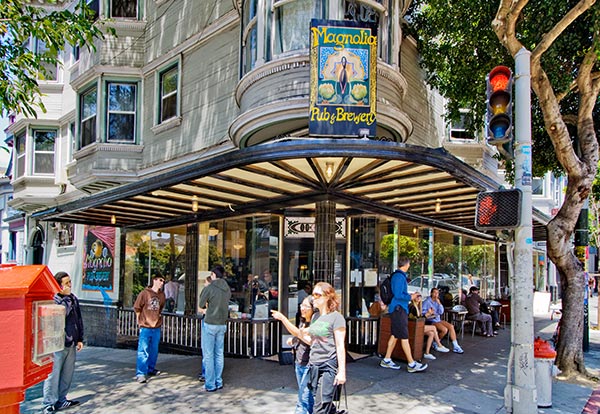
BRUNCH: I’ve never gotten Zazie‘s endless brunch waits. Sure, it’s a charming, little Parisian space, though I’ve had better luck with non-brunch meals. But for 1-2 hour waits (they do have a nice system now that alerts you when your table is ready), it’s amazingly mediocre. Personally, I wouldn’t wait any amount of time for mediocre. There are so many delicious brunches in the city, I am flummoxed as to why, after all these years, this remains many locals’ favorite. The original Pork Store Cafe likewise has waits (though not as painful as Zazie’s) which I likewise don’t find worth it. I once had a “sausage” scramble here that was hot dog slices. What it does have is quirky, old school diner charm and clientele. My brunch recommend in the ‘hood, though, is always Magnolia. Arriving before noon, I’ve never had a wait and the food is quality (plus there’s Blue Bottle coffee and beers).

FOOD: Kezar Bar (the one on Cole, not the pub on Stanyan) can occasionally surprise with above-average bar food, like giant potato pancakes with Andouille sausage, applesauce, sour cream – in a cozy, pub atmosphere. Despite the crowds and its faded glory, there’s still something appealing about the original Cha Cha Cha. Maybe it’s Mother Mary presiding over the bar, plants surrounding tables for that tropical effect, the festive atmosphere, plantains and black beans, or that damn tasty sangria. Citrus Club‘s food is pretty hit and miss – downright average, really (who has time for that in this city?) – but many adore it because it’s cheap and easy Asian “fusion” (they mix and match Asian cuisines with abandon).

For burgers, if you’re not eating Magnolia’s fab burger, local chain Burgermeister is the best bet as Burger Urge just doesn’t cut it. Since the ’70s, Say Cheese is a tiny Cole Valley gem of a market. Their small selection of cheeses, meats, wines, chocolates, is well curated, the staff are responsive and they make worthy deli sandwiches (like Cajun turkey, creole mustard, pepperoncini, pepper havarti), ideal to take to nearby parks.

DRINK: Us spirits and cocktail lovers have a soft spot for Aub Zam Zam. This is not cutting edge cocktails. It’s a slice of SF history, with a strong spirits selection and older, seasoned bartenders who are knowledgeable and sweet (since lovably cantankerous Bruno passed away, God rest his soul, there’s no kicking people out on a whim anymore). They make a mean gin martini, boozy and bright. The space evokes the Art Deco era with an exotic, Moroccan slant. Divey and dingy, it’s a classic I hope we’ll never lose.

Subscribe to Virgina’s twice-monthly newsletter, The Perfect Spot, www.theperfectspotsf.com

A teachable moment

2

caitlin@sfbg.com

HERBWISE On the occasion of leaving our gentle green bubble in the Bay, I often find myself in the position of explaining what it is I write about. Sometimes I am satisfied with focusing on my federally legal interests as the Guardian’s culture editor. But other times I am compelled to stretch the limits of my extended family’s imagination, which usually leads to some pretty interesting conversations.

I’m sure I’m not the only person interested in demystifying cannabis issues to their loved ones. Which is why I’m happy to introduce you to a 2011 documentary that might prove useful: Lynching Charlie Lynch, a DVD release you can find on Amazon or director Rick Ray’s website (www.rickrayfilms.com). The film even starts with a world history of cannabis usage: look guys, early Mormons used the stuff!

Charlie Lynch is a total goober (a word I use lovingly.) A suburbanite from Arroyo Grande, Calif., Lynch takes pleasure in winning stuffed animals from claw machines and rocking out to self-penned anti-drunk driving ballads in his DIY home studio. When he began medicating for his atrocious migraines with cannabis, Lynch decided to open a dispensary close to his home town, eventually starting one in 10,000-person Morro Bay. It was the only dispensary in San Luis Obispo County.

http://www.youtube.com/watch?v=ZzFsSx84EE4

Ray shows us Lynch’s adorably earnest and thorough process of setting up shop. Lynch goes so far as to call the DEA office, and is directed to four different numbers before an agent gruffly tells him that cities and counties are tasked with “dealing” with such enterprises. Thus enthused, Lynch obtains proper permitting from city and county administrations and holds a ribbon-cutting ceremony. The mayor and other city officials attend, the chamber of commerce is represented in cheerful photos from that day.

At this point one might pause the film and explain to friends and family that the California medical marijuana industry is not without its complicated issues, and that despite his phone calls, Lynch might have expected trouble from the federal government. But these caveats aside, what happens next is awful enough that “might-haves” and “could-dos” will probably dissipate from their minds.

A San Luis Obispo sheriff’s RV surveils patients and staff coming and going from Central Coast Compassionate Caregivers until sufficient evidence is gathered to obtain a federal search warrant. Your educational audience will cringe as law enforcement raids not just Lynch’s dispensary, but his home. He is taken into federal custody and released only when his family posts $400,000 in bail. There’s a media storm, the feds threaten his landlord, the business is ruined, and finally, Lynch puts his house — the same one where he once warbled cautionary notes to drunk drivers — on the market.

It is worthwhile to note that the Morro Bay raid occurred in 2007, and as an update to the fam you might want to mention the Oaksterdam debacle last month. (A scene from the Oakland cannabis school is included in Lynching Charles Lynch — prophetically, it is an in-class roleplay meant to teach students how to interact with federal agents.)

We say in the Bay Area that we are the epicenter of the cannabis movement, which in some senses may be true. But in some ways it’s not. Regardless of how conscious we are in Oakland, Marin, and San Jose of the hypocrisy of the federal government, national change is not going to take place until awareness of the issue is raised nationally.

Or maybe I’m just trying to justify that post-Lynching joint with my aunt in Maryland. Meh!

Our Weekly Picks May 2-8, 2012

0

WEDNESDAY 2

Loom of Ruin reading

Sam McPheeters has a way with language that has translated from lyrics to journalism and now: his first official solo novel, The Loom of Ruin. The former frontperson of a trilogy of punk and experimental acts (Born Against, Men’s Recovery Project, Wrangler Brutes) has long written columns for the likes of Vice, and put out his own fanzines. But his first published output came at age 12 — a local legends book assembled with a pal. Now he comes full circle, back to book publishing, though this time it’s a bit different. He’s rather grown, and writing exquisitely detailed dark Los Angeles fiction about the angriest man in the world. Far from grumpy himself — the facetious gent was once known to recite Patrick Henry’s famous speech — McPheeters brings his words to the Bay this week on a book tour, including a spoken word stop at the Secret Alley tonight at 7pm after Needles+Pens. (Emily Savage)

5-7pm, free

Needles+Pens

3253 16th St., SF

(415) 255-1534

www.needlesandpens.com


Thu/3, 7:30pm, free

1234Go Records

420 40 St., Oakl.

(510) 985-0325

www.1234gorecords.com


Edward Sharpe & the Magnetic Zeros

If Alex Ebert were the best version of himself (a selfless hero akin to Superman or Jesus) he’d be Edward Sharpe. Ebert, Edward Sharpe & the Magnetic Zero’s crazy-haired front man/only guy I’ve seen successfully pull off the shirtless blazer look, dreamt up this alternate identity after getting over a serious drug addiction and shirking his reverence to the punkish concept of rebellion. On stage this ten-piece folky, psychedelic rock tribe looks like a ragtag flurry of ecstasy. There’s a lot going on when these guys perform, but somehow it’s always hard to take your eyes off Jade Castrinos, whose sultry voice and free form movements lull you into a blissful, calming trance. (Mia Sullivan)

With Aaron Embry

8pm, $32.50

Fox Theater

1807 Telegraph, Oakl.

(510) 302-2250

www.thefoxoakland.com


El Clásico: More Than a Game

Spain may have won the last World Cup, but as a new documentary by Kelly Candaele and students from Chico State University shows, there’s no love lost between passionate fans of the country’s two biggest club teams. When Real Madrid and FC Barcelona clash (in a game so monumental it is referred to as “El Clásico”), they bring to the field some of the world’s greatest players (Messi! Ronaldo!) — and decades of history that go way beyond fútbol and into weighty areas of national identity and politics. Even Barça fans still reeling from certain late-April results will enjoy this 55-minute exploration of one of Europe’s greatest sports rivalries. (Cheryl Eddy)

7pm, $5–$10

Mission Cultural Center

2868 Mission, SF

www.missionculturalcenter.org


THURSDAY 3

Electric Shepherd & OUTLAW

When Bay Area psychedelic rock groups Electric Shepherd & OUTLAW get together, their sound is something like the Doors meeting up with Jimi Hendrix on a tribalistic march and then starting to jam with a death metal version of Phish. If you carry deep-seated nostalgia for the epic rock shows you missed during the ’60s — or listen to the Velvet Underground’s Bootleg series on repeat — you should probably check these guys out. Expect luscious guitar riffs, sexy bass lines, compulsory dancing, and a wonderfully spaced out experience. (Sullivan)

With Blues for Carl Sagan, and Douglas

9pm, $6

Hemlock Tavern

1131 Polk, SF

(415) 923-0923

www.hemlocktavern.com


FRIDAY 4

Predator and The Thing

Though it may be hard to believe for those of us who grew up watching them, two classic sci-fi flicks from the 1980s have come upon major milestones anniversaries. To celebrate, Jesse Hawthorne Ficks’ Midnites For Maniacs series is hosting a night not to be missed, with a 25th anniversary screening of Predator and a 30th anniversary screening of John Carpenter’s The Thing. Featuring some of the best creature designs and special effects of the era thanks to visionaries Stan Winston and Rob Bottin, both films re-defined the genre, and have continued to stand the test of time. A Boy & His Dog (1975) also screens.(Sean McCourt)

7:30pm, $13

Castro Theatre

429 Castro St., SF

(415) 621-6120

www.midnitesformaniacs.com


JackHammer Disco with Tiga, Damian Lazarus, & Light Year

Let’s indulge in some squelchiness, shall we? Montreal-based Tiga and UK-born, Los Angeles resident Damian Lazarus share an affinity for acid-y, electro house. In the early 2000s, Lazarus played a prominent role at the UK label City Rockers, where he oversaw the release of Tiga & Zyntherius’ cover of Corey Hart’s “Sunglasses at Night.” Since gaining fame from that release, Tiga has been a busy producer and remixer, keeping a Euro-glam tone reminiscent of the synth-y works Giorgio Moroder pushed in the ’70s. Recent Lazarus works have a more stripped-down, minimal feel that sometimes wander into leftfield, like in his 2009 album Smoke the Monster Out. (Kevin Lee)

With Light Year 10pm, $15–<\d>$20 Public Works 161 Erie, SF (415) 932-0955 www.publicsf.com


FRIDAY 4

It’s Casual

Here in the Bay Area, we like to complain about public transportation. There are BART horror stories and Muni diaries tossed around like old war stories, used as social currency. But really, when you compare our rapid transit systems with the snarled mess of cars elsewhere in California, we come out on top. That’s why LA-based hardcore group It’s Casual got so much traction with an ode to its own local bus line, “The Red Line.” The song, and sentiment, struck a nerve: “The freeways/are not so nice.” The band itself is growly loud, with classic Southern California punk hooks. Tonight it opens for beloved shit-stirrers Early Man (note: the two bands will release a split seven-inch come May 22). Take the 22 Fillmore to the show and write a song about it. (Savage)

With Early Man, Shock Diamond, Satya Sena

9pm, $8

Thee Parkside

1600 17th St., SF

(415) 252-1330

www.theeparkside.com


SATURDAY 5

CreaturesCon

Seemingly rising from the grave like so many of the monsters and ghouls that it showcased over a 14-year run on local television, the beloved Bay Area show Creature Features is being resurrected once again to satiate fans’ undying thirst for the creepy, kooky, and campy. John Stanley, who hosted the KTVU program from 1979-’84, will be on hand for CreaturesCon One, a day of special screenings, Q&As, and more, along with archivist and documentary filmmaker Tom Wyrsch and Ernie Fosselius of Hardware Wars fame. For all you monster kids out there, this will be a nightmare, er, dream come true. (McCourt)

3-10pm, $10

Historic Bal Theater

14808 East 14th St., San Leandro

www.creaturescon.com


Father John Misty

I always wonder about the drummer. They’re usually the life of the party but, at the same time, are often concealed behind a wall of instruments, and you rarely hear them sing, or say, anything. Ex-Fleet Foxes drummer Joshua Tillman has said that drumming for his former superstar band began to bore him. So he exited, took up the moniker “Father John Misty,” and started creating lush, lyrically based Americana folk ballads laden with lucid imagery and social commentary. He played SXSW this year, made a surprise appearance at Café Du Nord in April, and his debut, Fear Fun, came out Tuesday. (Sullivan)

With Har Mar Superstar, Worth Taking

10pm, $12

Bottom of the Hill

1233 17th St., SF

(415) 621-4455

www.bottomofthehill.com


SUNDAY 6

Omar Sosa Afreecanos Quartet

Talk about versatility. Cuban pianist and composer Omar Sosa splits his time between Oakland and Spain and incorporates musical influences from just about everywhere in between. On last year’s Calma: Solo Piano &… Sosa displayed his introspective and meditative side with floating piano melodies flanked by the occasional electronic accent or sampled sound. Contrast the solo effort on Calma with Sosa’s performance as lead of the Afreecanos Quartet, where technical dynamism becomes the name of the game. At live shows, Sosa becomes a grinning whirlwind, playing classical piano on one hand and electronic piano on another, trading looks and body language with his fellow musicians, and fostering a joyful, collective, improvisational spirit. (Lee)

With Marque Gilmore, Childo Tomas and Peter Apfelbaum

1pm, free

Yerba Buena Gardens

760 Howard, SF

(415) 543-1718

www.ybgfestival.org


MONDAY 7

“La Bamba: Latinos in Vintage Rock, Pop, and Soul”

Local rock music historian and author Richie Unterberger, whose books include White Light/White Heat: The Velvet Underground Day by Day and Music USA: The Rough Guide, will once again share his extensive knowledge with music fans at his presentation “La Bamba: Latinos in Vintage Rock, Pop, and Soul.” Featuring film clips of performers such as Ritchie Valens, Santana, Linda Ronstadt, and Los Lobos, the evening promises to be a unique look at the contributions of Latinos in rock from the earliest days of the 1950s up through the ’80s. (McCourt)

6:30-8:30pm, free

SF Public Library, Mission Branch

300 Bartlett, SF

www.sfpl.org


TUESDAY 8

Steve Coll

Longtime journalist Steve Coll won a Pulitzer Prize and widespread acclaim for his 2004 account on the CIA and the agency’s history in Afghanistan leading up to 9/11. In his latest investigative effort, Private Empire: ExxonMobil and American Power, Coll explores the global influence of the Texas-based oil corporation. According to Coll, big-money donations and a sophisticated DC lobbying machine have allowed ExxonMobil to shift the debate on climate change. At the same time, the oil corporation continues to expand its foothold in developing countries. A two-time Pulitzer Prize winner, Coll currently serves as president of the New American Foundation, a nonprofit, nonpartisan think tank that maintains a significant presence in California. (Lee)

In conversation with Greg Dalton

6pm, $7–$20

Commonwealth Club

595 Market, SF

(415) 597-6700

www.commonwealthclub.org


The Guardian listings deadline is two weeks prior to our Wednesday publication date. To submit an item for consideration, please include the title of the event, a brief description of the event, date and time, venue name, street address (listing cross streets only isn’t sufficient), city, telephone number readers can call for more information, telephone number for media, and admission costs. Send information to Listings, the Guardian Building, 135 Mississippi St., SF, CA 94107; fax to (415) 487-2506; or e-mail (paste press release into e-mail body — no text attachments, please) to listings@sfbg.com. Digital photos may be submitted in jpeg format; the image must be at least 240 dpi and four inches by six inches in size. We regret we cannot accept listings over the phone.

A street art festival in Baltimore?

2

Ever since I visited the Wynwood neighborhood of Miami during the shock and awe of Art Basel 2011, the concept of street art as an agent of neighborhood change has been loitering around my brain space. What does it mean that an art that was once deemed outsider is now on the radar of bankers and real estate brokers alike as a means of increasing property value?

Perhaps no one has looked more into the matter than Gaia, sociological wheatpaste artist and 23-year old organizer of Baltimore’s first large-scale public arts festival Open Walls. Since March, Gaia has coordinated walls by over 23 artists in his neighborhood of half-vacant blocks of row houses and factory buildings, Greenmount West (and the adjacent, less economically-depressed Charles North.) The area has been pegged as an arts district by Baltimore’s cultural organizations – and perhaps more importantly, the bank sponsors of Open Walls. The festival culminates in a Final Friday celebration on May 25.

Gaia thinks a lot about where his murals are placed. For a wheatpaste series he called his Legacy Project, he installed the faces of developers throughout history — Robert Moses, Le Corbusier — often alongside their most damning quotes, on the very urban areas they irrevocably altered with slum clearance. 

I sat down with him to talk in his studio and festival mission control, a ramshackle converted factory space where the bulk of Open Walls’ artists bunk on air mattresses and sometimes – I can personally attest – in the building’s freight elevator. We talked about what the murals would mean to Baltimore, and geeked out on social contradiction.

SFBG: Tell me about Open Walls.

G: It’s not very community involved. It is more of a street art, public art situation where a lot of material for the work is being generated from the neighborhood. But a lot of it is not specific, it’s just about mural-making. I’ve been trying to find a balance as a curator of site-determined work and work that’s not generated by the context of Baltimore.

SFBG: Why is site-specific street art important for a festival like this?

G: One, it provides more access to the artwork for the initial introduction of the piece to the neighborhood. Advertising and street art, we utilize the same signifiers and tools. The difference being, the artwork attempts to communicate beyond the place of sale. The less specific your work is, the closer to guerrilla branding it is, rather than street art or genuine public art. So by working with the history of a place in a manner that’s determined by the space you’re working in, you circumvent the problem of promoting yourself. You’re not just plastering a single image all over the city – that’s a graffiti mentality that is more like straight advertisement.

SFBG: Why do you like living in Baltimore?

G: I like how tough this city is. It feels almost human in scale. You can be on a first name basis with the neighbors. Plus, I can make a living and not have to work two jobs or be a barista rather than focusing on my art. And it has all these secrets that take a million years to find. All the cutty neighborhoods, all the cutty streets…

SFBG: Do you think that there’s any way current residents will be able to keep their space here in Greenmount West, what with all the arts and revitalization movement?

G: Most of the vacant buildings are owned by the government. It all depends on the government. A significant portion of the neighborhood is subsidized housing. When the government decides to flip this neighborhood, that’ll change everything. Most everything you see that is vacant is vacant for a reason – it’s not this mysterious, mystical, organic situation. A lot of them are being held by speculators, Many public, private organizations are responsible for holding onto them so that something could be done to them. For the most part, it’s decades of the waiting game.

SFBG: Did you talk to neighborhood groups before painting started?

G: We talked to the New Greenmount West Community Association. There was a plan that was presented to them, there was an idea of these are the artists and this is where we want to paint. We worked on lining up landlords with an artist that they dig. Balancing that local aesthetic and the more spectacular aesthetic. We’ve definitely had a little negative feedback and a lot of positive feedback. I think people are wary of it because its the most visible aspect of this process of gentrification. People never walk up to a contractor and say ‘Hey you cant build this building,’ but people walk up to murals all the time. It becomes a lightning rod. There’s a latent fear of this being one aspect of a shifting neighborhood.

SFBG: What does Open Walls mean for Baltimore?

G: We’re coming at this project from a lot of different angles. We want to put Baltimore on the map, at least give it some shine. We want to fuel more interest in the local art scene and make visible what happens invisibly inside. Putting it out on the streets, so you know exactly where you’re at. Really it’s just about pushing the envelope in Baltimore. You know, we have so many vacant properties. But this is also about cooperation between stakeholders in this neighborhood.

A year and a half ago my block was two rows of vacant buildings, the abandoned coat factory, and an abandoned green space in front of my house. Now there’s City Arts, which is subsidized living for artists. There’s a lot going on in the neighborhood, a lot of reinvestment.

There’s so many abandoned buildings in Baltimore. I mean it’s suburbanization fueled by the flow of capital and racism. The city went from one million people to a city of 640,000 so there’s a lot of empty space and not much to do with it. The flow of capital comes back around. We have this aesthetic conjuncture of people moving back to the city. We’ve been experiencing divestment for sixty, seventy years now, so its about time.

SFBG: Is that the goal of the festival, to reverse suburbanization?

G: The goal is to make good art work. The goal is to find a balance between interesting, really inspiring, and also intriguing art on the walls – but also to find a balance between that and something that speaks to the neighborhood. I’ve been [placing] the more spectacular, flashy murals on Charles Street. The theater is there, that’s where all the nightlife is. I’ve been keeping it more local on the west side. It’s all about trying to understand the sliding scale of subjectivity. I try to shy away from artwork “by consensus” if you will. 

Watch this space for Caitlin Donohue’s continued coverage of Open Walls including — duh — shots of the actual murals

FCC complaint filed on BART cell phone service shut-off and today’s the last day to comment

1

Back in August, in the midst of protests, BART shut off its cell phone service.

At the time, we said in an editorial that “The bizarre move by BART officials Aug. 11 to shut down cell phone service in the underground train stations made headlines around the world — and for good reason. It was, Wired Magazine reported Aug 15, apparently the first time in United States history that a public agency sought to block electronic communications as a way to prevent a political protest.”

One of the BART protesters, Colin G. Gallagher, has filed a complaint with the Federal Communications Commission (FCC) about BART shutting off cell phone service, and its public comment period ends today. Starting May first, there will be a limited comment period, restricted only to those represented by a lawyer or government officials, according to Gallagher. You can add your comment to the filing on the FCC website.

This is far from the first complaint on the subject filed with the FCC, and BART has since outlined a policy about cutting off cell phone service.

But it’s another chance to comment on the potentially illegal action by BART that drew rage and claims that BART had violated the first amendment. Gallagher agrees, and wrote in his filing comment that communication should go “unhindered by bureaucracies, agencies, and the measures of dubious legality employed by those who would restrain or cut off access.”

What’s going on for Bay Area May Day?

6

UPDATE: The Golden Gate Labor Coalition has announced a change of plans. Instead of Golden Gate Bridge pickets, the coalition will be supporting a strike of ferry workers, who plan to bring all morning ferry service to a standstill. They have announced that the actions at the Golden Gate Bridge are cancelled, and instead workers will be demonstrating in solidarity with ferry workers in Larkspur- specific locations will be announced later today.

May 1, International Workers Day — May Day — used to strike fear into the hearts of bosses. The first May Day in 1867 was a fight for the eight-hour workday in Chicago (see more history at Citizen Radio at the Occupy Oakland Tribune). Since then, May 1 has remained a day when grievances are aired, when students and workers party in the street, when people strike in ways that shows whose really boss (you can’t have that work that keeps everything running without all those workers.) But mostly in other countries.

In the US, the day has diminished in importance, although it has resurged in recent years focused on immigrants rights. But what with Occupy Wall Street, labor and union organizing ramping up, and student strikes, and all these people working more and more closely together, May Day is coming back to the US.

The Bay Area certainly won’t be left out. Here is a list of May Day events, starting tonight and ending–well, who knows when. If you know of others, write them in the comments: it wouldn’t be a decentralized massive attempt at a full-on general strike without you!

THE NIGHT BEFORE (Mon/30)

5:30pm, San Francisco:

City workers from SEIU Local 1021 will gather at City Hall in a continued offensive surrounding their ongoing contract negotiations. The program runs until 7:30 pm, but the protest will go on “until they kick us out!”

8pm, San Francisco:

“The strike starts early” with a gathering at Dolores Park. According to a press release, demonstrators will meet “for a ruckus street party to counter gentrification, capitalism, and the policing of our communities.” www.strikemay1st.com/the-strike-starts-early

MAY DAY (Tue/1)

All day:

National Nurses United/California Nurses United is on strike at Sutter Health locations throughout the Bay Area. According to a press release, “some 4,500 RNs will be affected by the planned walk-out.”

ILWU Local 10, which worked in solidarity with Occupy Oakland in two port shutdowns last fall, is planning another one. They say that a work stoppage will halt the Port of Oakland’s operations all day.

7-10am, San Francisco:

The Golden Gate Bridge labor coalition, representing several unions of workers on the bridge, have been without a contract since April 2011. They originally called for a strike and resulting shut down of the bridge- and had massive support behind them. They’re now saying the protest will involve picketing at the bridge instead. So come join a picket, or if you cross the bridge don’t take the workers for granted- the bridge doesn’t work without them. www.occupythebridge.com

7am, San Francisco:

Meet at 16th st and Mission to be a part of the first SF Bike Cavalry of the day, a critical mass that will ride to the Golden Gate Bridge in solidarity with the picket. www.sfbikecavalry.org

8:30am – 12pm, Oakland:

Occupy Oakland will join others protesting, picketing, and generally striking at three (or four?) “action stations.” Meet at Snow Park for a “flying picket” that will “shut down banks and the Chamber of Commerce.” Meet at First and Broadway to “occupy Child Protective Services” in response to a decision they made to de-grant custody of one woman’s children based in part on her involvement in Occupy Oakland. Meet at 22nd and Telegraph to cause mayhem at uptown and downtown business associations. www.strikemay1st.com/119/

10am, San Francisco:

A rally and march for immigrants rights (the people who have been holding down US May Day for years.) Meet at 24th St Mission Bart for a march to 16th St. 

11am, San Francisco:

Janitors and retail workers at Westfield Mall are engaged in an ongoing labor dispute, and they’ll be picketing in solidarity at 5th and Market. 

11am, San Francisco:

A second SF Bike Cavalry will convene at Justin Herman Plaza to support the janitors strike, the immigrants’ rights march, and the Peoples Street Festival

11:30am, Hayward:

The Amalgameted Transit Union Local 192 will protest “substandard conditions” and “institutionalized racism” (according to a press release) at the operators of AC Transit, A-Para Transit Corporation, 22990 Clawiter Rd in Hayward.

12pm, San Francisco:

All the San Francisco students who walk out of school, workers who call in sick, people who usually do all the housework, who, for the day, say screw it, and other “general strike” participants will converge at Montgomery and Market for the People’s Street Festival. Music, performance, art and fun for the whole family. 

Noon-1pm, Oakland:

A mass rally in Oakland, at 14th and Broadway, with food, speakers, music, activities, and generally a lot to do that you can’t if you’re at work. 

1-3pm, Oakland:

According to Occupy Oakland “After the rally, those in attendance have the opportunity to stay downtown or join one of the autonomous actions that will be departing from 14th & Broadway to continue shutting down various capitalist institutions in the downtown area.”

3pm, Oakland:

Meet at Fruitvale Plaza (next to the Fruitvale Bart station) for likely the biggest action of the day. The March for Dignity and Resistance is being called the Bay Area’s regional protest and supporters will be there from all over the area. mayday2012.blogspot.com

6pm, San Francisco:

Celebrate workers rights at a fundraiser for Young Workers United, a self-described “multi-racial and bilingual membership organization dedicated to improving the quality of jobs for young and immigrant workers.” The party is at El Rio, 3158 Mission. www.occupysf.org

On May Day, local groups who have taken to occupying spaces in ways other than public square-camping will be ramping up their efforts. The occupied farm at Gill Tract will push on, and in a message from Occupy San Francisco: “On May Day, the SF Commune will open it’s doors and conduct another Open Occupation in solidarity with the May 1st General Strike.” So if you’re looking for someone to sleep while protesting a complex web of oppressive forces Tuesday night, you may be in luck.

For more information, see www.strikemay1st.com, a clearinghouse for Bay Area May Day plans.

Also see:

www.occupythebridge.com

www.occupysf.org

mayday2012.blogspot.com

www.decolonizeoakland.org

www.occupyoakland.org

Fly Benzo sentenced to three years probation

16

Debray Carpenter, aka Fly Benzo, was sentenced in court April 27. He received three years of probation with a long list of conditions.

Benzo, student at City College, was arrested at an Oct. 18 rally in Mendell Plaza. During that incident, police officers John Norment and Joshua Fry of the Bayview precinct apparently unplugged a boombox that they said was not authorized in a street outlet. Then, when officers began videotaping Benzo, he took out his camera phone and began videotaping them as well. He was convicted of misdemeanor assault of a police officer and misdemeanor resisting arrest by Judge Jerome Benson on Feb 22.

April 27, in a courtroom with dozens of supporters, the judge announced that Benzo would serve six months each in county jail for three counts of which we was convicted, but as the six-month sentences for counts one and three could be served concurrently, the jail time would add up to a year total.

However, these sentences were suspended, and barring a change, Benzo will not serve that jail time.

The conditions include a ban on the possession of weapons, a requirement to submit to any search and seizure by police officers with or without a warrant, an order to complete anger management classes, a stay-away order from Third St. between Oakdale and Quesada, a requirement that he be enrolled full time in school and/or work, a requirement to obey all lawful orders by a police officer as well as remain arms-length away from all police officers, and about $1,000 in fees for expenses like booking and court assessment.  

The judge also ordered 30 days in country jail, although 11 days already served brought the sentence to 19. However, Benzo will likely serve those days through the sheriff’s work alternative program (SWAP)—that means 19 days sweeping up the sidewalks in an orange vest. 

Benzo served the 11 days before he was released on $95,000 bail.

Judge Benson also ordered that Benzo apologize to SFPD officers Norment and Fry, although the apology is not a condition of probation.

“A true apology comes from within, and it would not be a true apology if I order it,” said the judge, who came out of retirement to preside over Benzo’s case.

Benzo’s lawyer Severa Keith stated objections to two of the conditions: the requirement to submit to searches and the stay-away order. Keith objected to the search requirement on the grounds that neither contraband nor weapons plays no part in his case, and Benzo was not in the possession of either at the time of his arrest.

The area of the stay-away order includes Mendell Plaza.  An important public square in Bayview, the plaza’s meaning was given new weight when it was the site of the killing of Kenneth Harding, Jr

Harding, 19, was killed in August 2011. Harding was leaving a T train when police asked to see his transfer. Harding presumably panicked and ran away from the police. Officers shot at him as he ran, then, in a video that has circulated widely, stood around him as he bled to death.

Mendell Plaza is directly across the street from the Joseph P. Lee recreation center and the Bayview Opera House, some of the main neighborhood venues for entertainment and community gatherings. This street that divides the plaza from the opera house and rec center- Oakdale- is the cut-off for the stay-away order, so both Keith and Benzo asked Judge Benson to specify whether these locations were included in the stay-away. 

After studying a map of the area, Judge Benson concluded that the opera house and rec center are outside the bounds of the stay-away order. 

“We just did an event a few weekends ago where we fed over 100 people at that location,” said Benzo to the judge. “This order will prevent me from serving the community in the way that I do, as well as providing entertainment and education for the community.”

According to Benson, there’s a chance that the stay-away condition will revoked or altered when it is brought up again at Benzo’s SWAP hearing, scheduled for June 8. 

Keith said of the sentence, “It’s not bad. I was working for probation, not jail time.”

However, she still plans to appeal, in large part due to what she sees as crucial evidence that was excluded from the trial surrounding Benzo’s history with the officers Fry and Norment. 

According to Keith, the jury didn’t hear evidence about “racist and unprofessional things” that the officers said to Benzo on occasions leading up to the incident.

“They deliberated for a long time- four days. And what I heard from the jury was that they though police were baiting him, and didn’t condone the police behavior, but they thought Debray’s reaction was too much under the circumstances,” said Keith.

But Keith said those circumstances include a long history of police harassing Benzo.

“It wasn’t a one-time thing,” she said. “And we have witnesses ready to testify to that.”

As for Benzo, he’s relieved not to be serving jail time, but wary of many of the conditions. 

“They gave me a stay-away order, which they usually don’t give unless you’re caught dealing drugs,” Benzo told the Guardian.

“It will drastically affect my life. Now I can’t even organize in the community.”

The Bay Citizen divorces NYT to marry CIR

2

This Sunday is the last day The Bay Citizen – the nonprofit San Francisco newsroom started two years ago by Warren Hellman, the local philanthropist who died in December – will be producing content for The New York Times, as it has been doing throughout its existence. The question now is what are Bay Area citizens losing and what are we gaining?

The Bay Citizen was taken over by the Berkeley-based Center for Investigative Reporting, creating the country’s largest nonprofit news organization, a merger that will be completed next week. Under the direction of veteran local journalists Phil Bronstein, Robert Rosenthal, and Mark Katches, the combined newsrooms won’t be covering breaking news or press conferences, focusing instead on investigations and “accountability journalism” delivered under those two brands and CIR’s California Watch, in collaboration with newspapers and broadcast outlets around the state (read our previous stories for more details on each entity).

“In the end, how does journalism survive and how do you define journalism?” Bronstein told us, relaying the questions his organization is trying to answer. “We’re betting on the idea that quality journalism is something people are willing to pay for.”

But with CIR focused on an inclusive model of partnering with news outlets to do deep reporting and widely offering the resulting work, and The Bay Citizen providing content to The New York Times under an exclusive contract, the new entity decided to end that contract and focus The Bay Citizen on CIR’s mission.

“The Bay Citizen has done a lot of things really well – accountability, watchdog journalism – but they’ve also done breaking news and tried to do too many things,” Katches, the editorial director for the merged newsrooms, told us. “We want to figure out what our lane is and stay in it.”

CIR, with a 35-year history of award-winning investigations, undoubtedly has strong journalistic chops and a talented team of reporters. Its “On Shaky Ground” series on the seismic vulnerabilities of schools throughout the state won a number of big awards and was a finalist for this year’s Pulitzer Prize in Public Service. But in many ways, this is the biggest and best newsroom that most people have never heard of.

“People on the street might know The Bay Citizen, but not the Center for Investigative Reporting,” Bronstein said. That was something that he hoped the merger would help compensate for, with CIR also benefiting from the base of donors and technological expertise that The Bay Citizen had developed.

“CIR isn’t the brand, its stories are the brand, which it distributes to scores of publications,” said Peter Lewis, an longtime journalist who joined The Bay Citizen at its inception.

Lewis spent 18 years with The New York Times and seven with Fortune magazine, then he studied and taught journalism and new media at Stanford University before joining The Bay Citizen. During merger talks, he advocated for a marriage of equals and was “disappointed” that CIR took the lead role, and that it subsequently didn’t create a position for him (veteran local reporter John Upton and a few others were also let go).

While Lewis said that The Bay Citizen has had about eight times the Web traffic as CIR, which is pretty astounding given the age difference in the two entities, it’s unclear how much of The Bay Citizen’s brand identity – something that Rosenthal and Bronstein cited as an important component of the merger – had to do with its now-severed relationship with the Old Gray Lady.

“The decision was made to launch The Bay Citizen simultaneously with The New York Times relationship. That gave it an instant cache and respectability that most startups don’t get,” Lewis said, but it was a “double-edged sword” that also strained the resources of the nascent newsroom to the limits of its capabilities.

“To be honest, The Bay Citizen never reached its potential. It never had time to establish its own voice,” Lewis said. And now that the decision was made to eliminate much of the focus that it has had, covering breaking news and local happenings, Lewis says he unsure what it will mean: “Anytime you reduce coverage, it’s not good for citizens, but they’ll be doing a different kind of journalism.”

Rosenthal said he’s excited about the merger’s possibilities, drawing on the strengths of each entity, but that it will be a work in progress. “It’s going to be a very inclusive model, and it’s going to keep evolving,” he said. “The real measure is not three to six months, but looking at this a year from now will be very interesting.”

“It’s uncharted territory for both of us, but there’s an air of excitement,” Katches said. “We may do some things that are fabulous and some things that flop.”

He said the decision to drop The New York Times was the result of “a thoughtful process,” and they ultimately concluded, “We feel like we can reach even more readers in the Bay Area in a non-exclusive way…If the goal of your work is impact, then you broaden the impact if you broaden your readership.”

The model has worked well at CIR and its California Watch project, which has sought to beef up statehouse coverage that had been waning for years. Katches noted that the “On Shaky Ground” series had the impact it did precisely because it ran in so many media outlets around the state (many of which did localized stories based on the research) and reached millions of readers and viewers.

But CIR wasn’t as successful as The Bay Citizen in creating a stable, long-term financial base. Starting with Hellman and a handful of his wealthy friends, The Bay Citizen sought donations from a wide variety of sources that totaled more than $15 million. By contrast, CIR had limited term foundation funding for a staff of talented journalists.

“How we sustain that and can we do it long term was not something we thought out,” Bronstein (president of the CIR board) said of the efforts he and Rosenthal (CIR’s executive director) made to beef up CIR’s newsroom with foundation funding a couple years ago. “We didn’t have a business structure, we had a journalism structure.”

As newspapers have been hurt by the Internet and corporate consolidations and cuts, Bronstein said said the mission of news organizations has never been more vital.

“With fewer journalists, everything is harder, but it also becomes more important,” he said. Bronstein said the basic question that their journalists will address in San Francisco are: “Who are the people controlling our lives and how are they doing it?”

We spoke to Bronstein on the same day that the Guardian announced Publisher Bruce Brugmann is stepping down from day-to-day operations and that we’re negotiating the Guardian’s sale to a consortium that also owns the San Francisco Examiner. Despite a history of clashes between him and the Guardian, which has always done media coverage and often criticized Bronstein and his newspapers, he had only positive things to say.

“You cannot underestimate Bruce’s affect on San Francisco,” Bronstein said, calling him one of the most influential San Francisco journalists of his era.

“I have a lot of respect for Bruce. He’s yelled at me, like everyone else – it’s a rite of passage in San Francisco. But you’ve stuck to your ideological roots,” he said.

As for advice to the Guardian during this period of transition, Bronstein offered a few questions to ponder: “Can you afford to stick with the base of readers you’ve got? Can you be more digital? Can you give readers more than you’re giving them?”

While he was the editor of the Examiner, Bronstein said his mantra to reporters was, “You have to have an intense curiosity about things and an open mind.” It was something that fit his own belief about the world he was covering.

“Life is never like Walt Disney,” he said, eschewing the idea that there are clear heroes and villains. “The truth is more complicated, but also more interesting.”

The (latest) battle of KPFA

2

yael@sfbg.com

If you’re a member of KPFA, the progressive Berkeley radio station, you’ll be receiving a ballot in the mail shortly with one issue at hand: the recall of Tracy Rosenberg. She’s an elected member of the Local Station Board, and her critics want her removed from office.

Rosenberg is also the former chair of the Finance Committee at Pacifica Network, the nonprofit that owns KPFA. And she has become the face of a conflict at KPFA that is about issues much bigger than Rosenberg herself. The petition to recall Rosenberg accuses her of stealing an email list of KPFA supporters, of election fraud in a 2011 Local Station Board election, and of orchestrating the cancellation of the station’s beloved Morning Show. But there’s a deeper issue here: How should the famously fractious KPFA handle a downturn in financial support — and should the station rely more on volunteer programming and less on paid professional staff? How will the station, which is an essential part of the Bay Area left, face a changing media landscape?

As the staff at KPFA—administrative and broadcaster, paid and unpaid, union and non-union—try to answer these questions, most of them with a real commitment to progressive radio, they are also mired in a political dispute that’s been draining for everyone involved.

KPFA has a long history of providing news and critique that supports progressive efforts and questions the status quo. But, like most businesses, it took a hit in the 2008 financial crisis.

That came a decade after some dramatic governance changes. In July 1999, Pacifica put all the local staff on administrative leave and brought in staff from Houston affiliate KPFT to run the station. In response, hundreds protested in the streets, and the establishment of a detailed democratic governing structure came out of the dispute. Soon after, listener donations took off—parties on both sides attribute this to an increased demand for progressive content in the wake of 9/11 and the war on Iraq. But around 2007, KPFA started to use up the last of its reserves.

According to data provided by the station, listener contributions peaked at more than $4 million during fiscal year 2005, and then began to level off. By 2010, donation income was back below $3 million —still more than 2001 levels. As donations dropped significantly during those five years, salaries and related personnel expenses continued a slow and steady increase, and KPFA managed to avoid outright staff and programming cuts.

That is, until September 2008, when the hosts and producers of the Morning Show were laid off and the show cancelled.

According to the recall campaign, the lay offs were retaliatory (the Morning Show staff had criticized Pacifica management on the air). According to defenders, canceling the Morning Show was a necessary budget decision. The recall campaign argues that the dire financial situation has stabilized after the Morning Show was cancelled; the recall people say that the local board had already balanced it through buyouts. The recall crowd says donations have gone down; the other crowd, they’ve shifted, but remain about the same. According to Brian Edwards-Tiekert, one of the forces behind the recall effort, “At the start of the dispute were these retaliatory firings a year and a half ago. It became a recall because of how they dealt with it.”

The Pacifica Foundation has partnered with KPFA since they were both founded out of anti-war movements in the late 1940s, but their relationship has evolved over the years. As it stands, KPFA and Pacifica’s four other member stations pay yearly dues to the foundation; Pacifica, in turn, provides program that is syndicated over many stations such Free Speech Radio News and Democracy Now!

The Save KPFA campaign website makes the case that Pacifica “uses KPFA as a cash cow,” and notes money KPFA loaned to Pacifica around 2000, from which Pacifica apparently still owes KPFA $1.4 million.

As a staff-elected representative on KPFA’s Local Station Board, Edwards-Tiekert pushed back on attempts by Pacifica to seize station funds. The Morning Show invited Pacifica’s executives onto to the airwaves and “challenged them about how much they were taking from KPFA, and about Pacifica’s spending priorities,” the site reads.

“All of those charges are somewhat overstated. There’s a certain percentage of KPFA’s budget that goes to overall expenses,” Rosenberg told us. In fact, according to Rosenberg’s allies, the situation was reversed; KPFA had run out of funds and was threatening to bankrupt Pacifica. In response to budget shortfalls, Pacifica’s executive director Arlene Engleheart “asked all five Pacifica stations to cut down on paid staff 2-3 years ago, as the only way to meet escalating deficits, KPFA’s 4 “sister” Pacifica stations have already done this. Only KPFA continued to employ more paid staff than it can afford.”

According to the website of a campaign against the recall, Support KPFA, in the fall of 2010, KPFA owed Pacifica more than $100,000 in unpaid dues. “At that time I was the representative from KPFA at the national Finance Committee, which does the budget from KPFA after it comes back from the local level,” said Rosenberg. She claims that the budget that the board came up with came short of meeting expenses.

“So as a board member I went to the station and said, where’s the budget? So I pushed for a couple of meetings saying look, a budget has to come up here that makes sense and is balanced. I told the executive director it was her responsively to make sure a plan for a balanced budget went forward. I would say that I put some pressure on the executive director to make some hard decisions.”

Communication Workers of America Local 9415, a union that represents KPFA’s paid workers, brought the issue to the National Labor Relations Board in late 2011, and the federal agency dismissed five charges of retaliation and layoffs out of the seniority order. Edwards-Tiekert, however, was reinstated as the result of a successful union grievance.

The other charges on the recall petition include putting forward two motions to overturn Jan 2011 local station board elections under fraudulent auspices and for specious reasons and misappropriating a list of KPFA members’ personal email addresses.

The election fraud charge refers to a motion Rosenberg brought disqualify Dan Siegel, an attorney who was elected to the Local Station Board, from holding his seat, based on Pacifica policy barring individuals who hold a public office from serving on the board.

“I pointed out that this seemed to be a violation of the bylaws. That’s all I did,” she said.

But the incident turned into a court battle, and a judge eventually issued an injunction reinstating Siegel.

The email theft charge refers to an email blast that Rosenberg sent out concerning the Morning Mix, the Morning Show’s replacement.

The Morning Show provided an in-depth look at stories from around the Bay Area. It had, and still has, a large following. “The corporate media doesn’t cover real issues as they really affect people,” said Sasha Futran, a listener member of the Local Station Board. With its cancellation, she said, “I want to know what’s going on. I want intelligent analysis.”

Democracy Now!—the foremost example of professional progressive journalism in the country—is now KPFA’s highest donation-generating show. And in style and content, the Morning Mix is distinctly not a Bay Area version of Democracy Now!

Instead, it is a show with rotating hosts Dennis Bernstein, Davey D Cook, JR Valrey, Andres Soto, Anita Johnson, Peter Phillips and Mickey Huff. The content and approach varies depending on the host.

Henry Norr, a listener and elected member of the Local Station Board, is pleased with the format, and thinks it might represent a good path for KPFA. “The station should be more community-oriented. We should have a diversity of voices, and lots of people on who aren’t skilled or paid but represent progressive voices and active movements,” said Norr. The new show has increased coverage of Richmond politics and has provided a forum for Valrey and Cook to talk about left-wing politics from an African-American perspective.

But cutting the Morning Show had its financial implications: The old format brought in significantly more donations than the Morning Mix. According to KPFA documents, donations have increased in other time slots that air more traditional-sounding journalism, including during Letters and Politics, Flashpoints, and the Evening News.

So the recall is about the Morning Show, but it’s also about the future: Should KPFA seek to retain a traditional structure, with paid staff who can earn a decent living and focus on making news programs whose quality compares to that of more mainstream outlets? Or should the station solve its budget woes by relying on more community volunteers with more wide-ranging content?

And should the people who work at KPFA have the right to discuss the station’s finances, policies and future openly, on the air, without fear of retaliation?

Rosenberg or not, those issues aren’t going away.


Our Weekly Picks April 25-May 1

0

WEDNESDAY 25

>> Norm Talley

It’s been a good decade since the Detroit Beatdown sound was unleashed on the world via an eponymous triple-disc release on the UK’s Third Ear Records, which collected the works of several integral Motor City dance music producers. In truth, the Beatdown sound wasn’t so much a cohesive style — although it did reflect the spinetingling synthesis of Detroit’s hypnotic, unhurried house sound with the Zen-like disco-funk loopiness that was earning Moodymann and Theo Parrish rabid followers at the time — than a foray into bumpin’ erotic grooviness, no matter the tempo or sample source. An uptick in Beatdown sound reverence has lead to recent tours by many of the original players, including Norm Talley, who will bring almost 30 years worth of decks magic to the incredibly welcoming Housepitality weekly party. (Marke B.)

9pm, $5 before 11pm, $10 after

Icon

1192 Folsom, SF

(415) 626-4800

www.housepitalitySF.com


>> Eric Erlandson

As the guitarist for Hole, Eric Erlandson was at the center of alternative rock explosion of the early ’90s, a member of one of the most popular bands of the time, and a friend and confidant to one of the scene’s most influential players, Nirvana’s Kurt Cobain. With the 18th anniversaries of both the suicide of Cobain and the release of Hole’s hit record Live Through This passing this month, Erlandson has just released his first book, Letters To Kurt (Akashic Books) a touching and enlightening collection of prose poems addressed to his departed friend. He’ll read from the book and do an acoustic performance tonight. (Sean McCourt)

7:30pm, free

Moe’s Books

2476 Telegraph, Berk.

(510) 849-2087

www.moesbooks.com


In conversation with Andi Mudd

Thu/26, 7pm, free

City Lights

261 Columbus, SF

(415) 362-8193

www.citylights.com


>> “A Change of the World: In Memory of Adrienne Rich”

The iconic contemporary poet — how many of those have we got left, friend? — passed away at her home in Santa Cruz last month. But Adrienne Rich’s legacy of strong-willed, powerfully voiced feminism, radical lesbian activism, perfectly illuminated quotidian details, and, hopefully, incredible control of poetic form, is set to be carried on for generations, beginning with this huge tribute at the SF Main Library from notable Bay Area wordsmiths. Join Elana Dykewomon, Aaron Shurin (whose latest volume, Citizen, is a stunner), Jewelle Gomez, Justin Chin, Kevin Killian, Toni Mirosevich, and oodles more as they resurrect Rich’s voice and offer their own oblations on the rough altar of her inspiring genius. OMG she would hate that I got all over-dramatic with the language back there. (Marke B.)

6pm, free

Hormel Gay and Lesbian Center at the SF Main Library

100 Larkin, SF

www.sfpl.org


>> “John Waters in Conversation”

Oh hell yes. Sometimes San Francisco resident John Waters (if you’ve spotted him on Muni, I am sooo jealous) visits California College of the Arts to screen 2004 sex-com A Dirty Shame, which features a typically eclectic cast (including Waters regulars Mink Stole and Patricia Hearst, and Selma Blair’s memorable, uh, udders). The “Pope of Trash” (he’s also an author, occasional actor, hilarious solo performer, and photographer) hangs out after to chat about his filmmaking career — and the fact that this killer event is free (part of CCA’s Cinema Visionaries program and Design and Craft Lecture Series) is just icing on the poo. Er, cake. (Cheryl Eddy)

7-9pm, free

Timken Lecture Hall

California College of Arts

1111 Eighth St., SF

(415) 703-9563

www.cca.edu


THURSDAY 26

>> “Bloomsbury/It’s Not Real”

In the early part of the 20th century and for a short period only, the London neighborhood of Bloomsbury became a center of civilized thought. In their salons its members argued about poetry, painting, and history. They passionately believed in Art and embraced total freedom — artistic, sexual, personal. Some of them became famous; others dropped by the wayside. Yet in retrospect, Bloomsbury looks like a small Shangri-la. Or was it? Jenny McAllister has been popping the balloons of pretense for close to 20 years, creating dance theater pieces that are as witty as they are humorous. In “Bloomsbury Group/It’s Not Real” she and her 13th Floor Dance Theater introduces us to some of those peculiar characters that called Bloomsbury home. (Rita Felciano)

Thu/26-Sun/29, 8pm, $18–$23

ODC Theater

3153 17th St., SF

(415) 863-9834

www.odctheater.org


>> The Touré-Raichel Collective

Israeli pianist Idan Raichel and Malian guitarist Vieux Farka Touré forged a friendship after crossing paths at a Germany airport in 2008. The Israeli pop star, known for culling from many worldly influences, had been a fan of Vieux’s father, legendary guitarist Ali Farka Touré. Raichel beckoned the younger Touré to visit him in Tel Aviv for a jam session. Their serendipitous collaboration resulted in The Tel Aviv Session, an acoustic, improvisational masterwork. Throughout Tel Aviv, Touré sets the stage with dramatic strumming and guitar-picking, while Raichel engages with his own meticulous, twinkling ripostes. The duo’s casual chemistry facilitates a rare and absolutely mesmerizing interplay fused together by impeccable technique. (Kevin Lee)

8pm, $25–$85 Herbst Theatre 401 Van Ness, SF (415) 392-4400

www.cityboxoffice.com


>> Trippple Nippples

Poised to make a splash at SXSW this year with its hyperkinetic live show, Tokyo’s Trippple Nippples unfortunately had to cancel due to visa complications. The band is now making up for lost time with a string of West Coast shows that includes a Thursday stop at Thee Parkside. A mix of psychedelic performance art, electronics. and in-your-face noise rock, the group has caused a stir in Japan, in addition to finding endorsements from American artists such as Pharrell, who recently championed it in Vice’s mini-documentary, Tokyo Rising. Check out the Dan Deacon-esque slice of kaleidoscopic electropop “LSD” for a taste. (Landon Moblad)

With Ass Baboons of Venus and Ghost Town Refugees

9pm, $10

Thee Parkside

1600 17th St., SF

(415) 252-1330

www.theeparkside.com


>> Afrolicious Five-Year Anniversary

Give it up for unstoppable, adorable DJ brothers Señor Oz and Pleasuremaker, a.k.a. Oz and Joey McGuire. A half-decade ago, when the idea of mixing as many global dance music styles into one party as possible was still pretty radical, the bros’ Afrolicious party went one better with live instrumentation (often courtesy of Joey’s band, Pleasuremaker, which drops a new full-length later this year), remarkable guest stars, and a fantasy Latin funk sheen. Best of all, Afrolicious pumped a welcoming, soulful, old-school smiley vibe — free of the slightly sour, scene-y sting of other such endeavors. Afrolicious anniversary parties burst apart at the seams with guest-star goodies and span two wild nights. This one is no exception, with resident percussionists Qique and Diamond, Brazilian drum troupe Fogo Na Roupa, DJs New Life and Sergio, and more. (Marke B.)

Thu/26-Fri/27, 9:30pm, $10

Elbo Room

647 Valencia, SF

(415) 552-7788

www.elbo.com


FRIDAY 27

>> “First Breath — Last Breath”

Bad Unkl Sista, participators in arts-party mega-fare (like Maker Faire, for instance), take over Z Space this weekend for the world premiere of a new performance work, “First Breath — Last Breath,” directed, choreographed, and costumed by founder and artistic director Anastazia Louise, a Butoh-trained dancer and dance teacher who honed her skills in the “wearable art” costuming department as a core member of the Carpetbag Brigade from 2000 to 2009. A sensory-stimulating meditation on life and death, the piece promises an apt element of the unscripted in its hybrid spectacle of dance, Butoh, aerial work, couture, percussive scenic design, film, and music. (Robert Avila)

Fri/27, 8pm; Sat/28, 2 and 8pm, $35

Z Space

450 Florida, SF

(415) 209-5569

www.badunklsista.com


SATURDAY 28

>> Jim Gaffigan

Comedian and actor Jim Gaffigan could pontificate on any subject, but his delightful treatises on bacon bits, Cinnabons, and other dubious delectables rank as fan favorites. “I’ve never eaten a Hot Pocket and been like, ‘I’m glad I ate that,'” he opines during a popular sermon on the sloppy snack. Followers gravitate toward his languid style and natural inclination to poke fun at his own comedy, especially through whiny, one-line asides he whispers as an aghast faux audience member. New 75-minute stand-up routine “Mr. Universe” is available for $5 as an online stream, $1 of which will go toward The Bob Woodruff Foundation in support of veterans and their families. (Lee)

Sat/28, 7:30 and 10pm; Sun/29, 7pm, $39.75–$49.75 Warfield 982 Market, SF (415) 567-2060 www.thewarfieldtheatre.com


>> “Dear Howard, I Love You But I’m Leaving You For Bryant”

You know how friends get your help moving with a little beer and a few laughs? Artists go all out in this regard. This joint fundraiser between the Garage and THEOFFCENTER benefits the new home for the Garage at 715 Bryant. The current Garage space at 975 Howard was literally that in 2007 when Joe Landini moved in and converted it into his “safehouse” for local artists, an ambitious low-rent breeding ground for dance, theater, and performance. The name stays but the venue changes to a more accommodating space nearby. In celebration, the Garage plays, parades, parties, and moves this Saturday in cunningly pragmatic programming that starts at 975 Howard and ends, via “procession,” with a bash at the new digs. (Avila)

The Garage

6pm, performance

975 Howard, SF

8pm, procession

8:30pm, party

715 Bryant, SF

www.715bryant.org


MONDAY 30

>> Marshall Crenshaw

Singer-songwriter-guitarist extraordinaire Marshall Crenshaw has been writing and making records for more than 30 years now, first gaining mainstream exposure with his 1981 hit “Someday, Someway.” In 1987, he portrayed Buddy Holly in the film La Bamba, playing an excellent cover of Holly’s then-obscure outtake “Crying, Waiting, Hoping,” virtually turning the song into his own, one which remains a staple in his live shows to today. The past few years have seen Crenshaw nominated for a Golden Globe for Best Original Song for the title track he wrote for the movie Walk Hard: The Dewey Cox Story, and the release of the album Jaggedland—don’t miss your chance to see him at this unique solo performance. (McCourt)

8pm, $18

Yoshi’s

1330 Fillmore, SF

(415) 655-5600

www.yoshis.com


TUESDAY 1

>> Treat Social Club

On a blustery evening in March, organizers Finn Kelly and Adam Theis invited their friends to converge inside a hangar-like space in the Mission for Treat Social Club’s inaugural event. No one knew quite what to expect but once inside revelers found themselves swaying to Realistic Orchestra’s moody silent film score, awed by fabulous visuals, and mesmerized by the aerial choreography Amanda Boggs. It was an auspicious start for the monthly series and with performances by tap dancer Tyler Knowlin, and an aerial piece that will be influenced by crowd participation, the second edition promises to be just as tantalizing as the first. (Mirissa Neff)

7:30pm, $10-20

Go Game Headquarters

400 Treat (Suite F), SF

www.treatsocialclub.com


The Guardian listings deadline is two weeks prior to our Wednesday publication date. To submit an item for consideration, please include the title of the event, a brief description of the event, date and time, venue name, street address (listing cross streets only isn’t sufficient), city, telephone number readers can call for more information, telephone number for media, and admission costs. Send information to Listings, the Guardian Building, 135 Mississippi St., SF, CA 94107; fax to (415) 487-2506; or e-mail (paste press release into e-mail body — no text attachments, please) to listings@sfbg.com. Digital photos may be submitted in jpeg format; the image must be at least 240 dpi and four inches by six inches in size. We regret we cannot accept listings over the phone.

Guardian endorsements for June 5 election

34

>>OUR ONE-PAGE “CLEAN SLATE” PRINTOUT GUIDE IS HERE. 

As usual, California is irrelevant to the presidential primaries, except as a cash machine. The Republican Party has long since chosen its nominee; the Democratic outcome was never in doubt. So the state holds a June 5 primary that, on a national level, matters to nobody.

It’s no surprise that pundits expect turnout will be abysmally low. Except in the few Congressional districts where a high-profile primary is underway, there’s almost no news media coverage of the election.

But that doesn’t mean there aren’t some important races and issues (including the future of San Francisco’s Democratic Party) — and the lower the turnout, the more likely the outcome will lean conservative. The ballot isn’t long; it only takes a few minutes to vote. Don’t stay home June 5.

Our recommendations follow.

PRESIDENT

BARACK OBAMA

Sigh. Remember the hope? Remember the joy? Remember the dancing in the streets of the Mission as a happy city realized that the era of George Bush and The Gang was over? Remember the end of the war, and health-care reform, and fair economic policies?

Yeah, we remember, too. And we remember coming back to our senses when we realized that the first people at the table for the health-policy talks were the insurance industry lobbyists. And when more and more drones killed more and more civilian in Afghanistan, and the wars didn’t end and the country got deeper and deeper into debt.

Oh, and when Obama bailed out Wall Street — and refused to spend enough money to help the rest of us. And when his U.S. attorney decided to crack down on medical marijuana.

We could go on.

There’s no question: The first term of President Barack Obama has been a deep disappointment. And while we wish that his new pledge to tax the millionaires represented a change in outlook, the reality is that it’s most likely an election-year response to the popularity of the Occupy movement.

Last fall, when a few of the most progressive Democrats began talking about the need to challenge Obama in a primary, we had the same quick emotional reaction as many San Franciscans: Time to hold the guy accountable. Some prominent left types have vowed not to give money to the Obama campaign.

But let’s get back to reality. The last time a liberal group challenged an incumbent in a Democratic presidential primary, Senator Ted Kennedy wounded President Jimmy Carter enough to ensure the election of Ronald Reagan — and the begin of the horrible decline in the economy of the United States. We’re mad at Obama, too — but we’re realists enough to know that there is a difference between moderate and terrible, and that’s the choice we’re facing today.

The Republican Party is now entirely the party of the far right, so out of touch with reality that even Reagan would be shunned as too liberal. Mitt Romney, once the relatively centrist governor of Massachusetts, has been driven by Newt Gingrich and Rick Santorum so deeply into crazyland that he’s never coming back. We appreciate Ron Paul’s attacks on military spending and the war on drugs, but he also opposes Medicare and Social Security and says that people who don’t have private health insurance should be allowed to die for lack of medical care.

No, this one’s easy. Obama has no opposition in the Democratic Primary, but for all our concerns about his policies, we have to start supporting his re-election now.

U.S. SENATE

DIANNE FEINSTEIN

The Republicans in Washington didn’t even bother to field a serious candidate against the immensely well-funded Feinstein, who is seeking a fourth term. She’s a moderate Democrat, at best, was weak-to-terrible on the war, is hawkish on Pentagon spending (particularly Star Wars and the B-1 bomber), has supported more North Coast logging, and attempts to meddle in local politics with ridiculous ideas like promoting unknown Michael Breyer for District Five supervisor. She supported the Obama health-care bill but isn’t a fan of single-payer, referring to supporters of Medicare for all as “the far left.”

But she’s strong on choice and is embarrassing the GOP with her push for reauthorization of an expanded Violence Against Women Act. She’ll win handily against two token Republicans.

U.S. CONGRESS, DISTRICT 2

NORMAN SOLOMON

The Second District is a sprawling region stretching from the Oregon border to the Golden Gate Bridge, from the coast in as far as Trinity County. It’s home to the Marin suburbs, Sonoma and Mendocino wine country, the rough and rural Del Norte and the emerald triangle. There’s little doubt that a Democrat will represent the overwhelmingly liberal area that was for almost three decades the province of Lynn Woolsey, one of the most progressive members in Congress. The top two contenders are Norman Solomon, an author, columnist and media advocate, and Jared Huffman, a moderate member of the state Assembly from Marin.

Solomon’s not just a decent candidate — he represents a new approach to politics. He’s an antiwar crusader, journalist, and outsider who has never held elective office — but knows more about the (often corrupt) workings of Washington and the policy issues facing the nation than many Beltway experts. He’s talking about taxing Wall Street to create jobs on Main Street, about downsizing the Pentagon and promoting universal health care. He’s a worthy successor to Woolsey, and he deserves the support of every independent and progressive voter in the district.

U.S. CONGRESS, DISTRICT 12

NANCY PELOSI

Nancy Pelosi long ago stopped representing San Francisco (see: same-sex marriage) and began representing the national Democratic party and her colleagues in the House. She will never live down the privatization of the Presidio or her early support for the Iraq war, but she’s become a decent ally for Obama and if the Democrats retake the House, she’ll be setting the agenda for his second term. If the GOP stays in control, this may well be her last term.

Green Party member Barry Hermanson is challenging her, and in the old system, he’d be on the November ballot as the Green candidate. With open primaries (which are a bad idea for a lot of reasons) Hermanson needs support to finish second and keep Pelosi on her toes as we head into the fall.

U.S. CONGRESS, DISTRICT 12

BARBARA LEE

This Berkeley and Oakland district is among the most left-leaning in the country, and its representative, Barbara Lee, is well suited to the job. Unlike Pelosi, Lee speaks for the voters of her district; she was the lone voice against the Middle East wars in the early days, and remains a staunch critic of these costly, bloody, open-ended foreign military entanglements. We’re happy to endorse her for another term.

U.S. CONGRESS, DISTRICT 13

JACKIE SPEIER

Speier’s more of a Peninsula moderate than a San Francisco progressive, but she’s been strong on consumer privacy and veterans issues and has taken the lead on tightening federal rules on gas pipelines after Pacific Gas and Electric Company killed eight of her constituents. She has no credible opposition.

STATE SENATE, DISTRICT 11

MARK LENO

Mark Leno started his political career as a moderate member of the Board of Supervisors from 1998 to 2002. His high-profile legislative races — against Harry Britt for the Assembly in 2002 and against Carole Migden for the Senate in 2008 — were some of the most bitterly contested in recent history. And we often disagree with his election time endorsements, which tend toward more downtown-friendly candidates.

But Leno has won us over, time and again, with his bold progressive leadership in Sacramento and with his trailblazing approach to public policy. He is an inspiring leader who has consistently made us proud during his time in the Legislature. Leno was an early leader on the same-sex marriage issue, twice getting the Legislature to legalize same-sex unions (vetoed both times by former Gov. Arnold Schwarzenegger). He has consistently supported a single-payer health care system and laid important groundwork that could eventually break the grip that insurance companies have on our health care system. And he has been a staunch defender of the medical marijuana patients and has repeatedly pushed to overturn the ban on industrial hemp production, work that could lead to an important new industry and further relaxation of this country wasteful war on drugs. We’re happy to endorse him for another term.

STATE ASSEMBLY, DISTRICT 17

TOM AMMIANO

Ammiano is a legendary San Francisco politician with solid progressive values, unmatched courage and integrity, and a history of diligently and diplomatically working through tough issues to create ground-breaking legislation. We not only offer him our most enthusiastic endorsement — we wish that we could clone him and run him for a variety of public offices. Since his early days as an ally of Harvey Milk on gay rights issues to his creation of San Francisco’s universal health care system as a supervisor to his latest efforts to defend the rights of medical marijuana users, prison inmates, and undocumented immigrants, Ammiano has been a tireless advocate for those who lack political and economic power. As chair of Assembly Public Safety Committee, Ammiano has blocked many of the most reactionary tough-on-crime measures that have pushed our prison system to the breaking point, creating a more enlightened approach to criminal justice issues. We’re happy to have Ammiano expressing San Francisco’s values in the Capitol.

STATE ASSEMBLY, DISTRICT 19

PHIL TING

Once it became abundantly clear that Assessor-Recorder Phil Ting wasn’t going to get elected mayor, he started to set his eyes on the state Assembly. It’s an unusual choice in some ways — Ting makes a nice salary in a job that he’s doing well and that’s essentially his for life. Why would he want to make half as much money up in Sacramento in a job that he’ll be forced by term limits to leave after six years?

Ting’s answer: he’s ready for something new. We fear that a vacancy in his office would allow Mayor Ed Lee to appoint someone with less interest in tax equity (prior to Ting, the city suffered mightily under a string of political appointees in the Assessor’s Office), but we’re pleased to endorse him for the District 19 slot.

Ting has gone beyond the traditional bureaucratic, make-no-waves approach of some of his predecessors. He’s aggressively sought to collect property taxes from big institutions that are trying to escape paying (the Catholic Church, for example) and has taken a lead role in fighting foreclosures. He commissioned, on his own initiative, a report showing that a large percentage of the foreclosures in San Francisco involved some degree of fraud or improper paperwork, and while the district attorney is so far sitting on his hands, other city officials are moving to address the issue.

His big issue is tax reform, and he’s been one the very few assessors in the state to talk openly about the need to replace Prop. 13 with a split-role system that prevents the owners of commercial property from paying an ever-declining share of the tax burden. He wants to change the way the Legislature interprets Prop. 13 to close some of the egregious loopholes. It’s one of the most important issues facing the state, and Ting will arrive in Sacramento already an expert.

Ting’s only (mildly) serious opponent is Michael Breyer, son of Supreme Court Justice Breyer and a newcomer to local politics. Breyer’s only visible support is from the Building Owners and Managers Association, which dislikes Ting’s position on Prop. 13. Vote for Ting.

DEMOCRATIC COUNTY CENTRAL COMMITTEE

You can say a lot of things about Aaron Peskin, the former supervisor and retiring chair of the city’s Democratic Party, but the guy was an organizer. Four years ago, he put together a slate of candidates that wrenched control of the local party from the folks who call themselves “moderates” but who, on critical economic issues, are really better defined as conservative. Since then, the County Central Committee, which sets policy for the local party, has given its powerful endorsement mostly to progressive candidates and has taken progressive stands on almost all the ballot issues.

But the conservatives are fighting back — and with Peskin not seeking another term and a strong slate put together by the mayor’s allies seeking revenge, it’s entirely possible that the left will lose the party this year.

But there’s hope — in part because, as his parting gift, Peskin helped change state law to make the committee better reflect the Democratic voting population of the city. This year, 14 candidates will be elected from the East side of town, and 10 from the West.

We’ve chosen to endorse a full slate in each Assembly district. Although there are some candidates on the slate who aren’t as reliable as we might like, 24 will be elected, and we’re picking the 24 best.

DISTRICT 17 (EAST SIDE)

John Avalos

David Campos

David Chiu

Petra DeJesus

Matt Dorsey

Chris Gembinsky

Gabriel Robert Haaland

Leslie Katz

Rafael Mandelman

Carole Migden

Justin Morgan

Leah Pimentel

Alix Rosenthal

Jamie Rafaela Wolfe


DISTRICT 19 (WEST SIDE)

Mike Alonso

Wendy Aragon

Kevin Bard

Chuck Chan

Kelly Dwyer

Peter Lauterborn

Hene Kelly

Eric Mar

Trevor McNeil

Arlo Hale Smith

State ballot measures

PROPOSITION 28

YES

LEGISLATIVE TERM LIMITS

Let us begin with a stipulation: We have always opposed legislative term limits, at every level of government. Term limits shift power to the executive branch, and, more insidiously, the lobbyists, who know the issues and the processes better than inexperienced legislators. The current system of term limits is a joke — a member of the state Assembly can serve only six years, which is barely enough time to learn the job, much less to handle the immense complexity of the state budget. Short-termers are more likely to seek quick fixes than structural reform. It’s one reason the state Legislatures is such a mess.

Prop. 28 won’t solve the problem entirely, but it’s a reasonable step. The measure would allow a legislator to serve a total of 12 years in office — in either the Assembly, the Senate, or a combination. So an Assembly member could serve six terms, a state Senator three terms. No more serving a stint in one house and then jumping to the other, since the term limits are cumulative, which is imperfect: A lot of members of the Assembly have gone on to notable Senate careers, and that shouldn’t be cut off.

Still, 12 years in the Assembly is enough time to become a professional at the job — and that’s a good thing. We don’t seek part-time brain surgeons and inexperienced airline pilots. Running California is complicated, and there’s nothing wrong with having people around who aren’t constantly learning on the job. Besides, these legislators still have to face elections; the voters can impose their own term limits, at any time.

Most of the good-government groups are supporting Prop. 28. Vote yes.

PROPOSITION 29

YES

CIGARETTE TAX FOR CANCER RESEARCH

Seriously: Can you walk into the ballot box and oppose higher taxes on cigarettes to fund cancer research? Of course not. All of the leading medical groups, cancer-research groups, cancer-treatment groups and smoking-cessation groups in the state support Prop. 29, which was written by the American Cancer Society and the American Heart Association.

We support it, too.

Yes, it’s a regressive tax — most smokers are in the lower-income brackets. Yes, it’s going to create a huge state fund making grants for research, and it will be hard to administer without some issues. But the barrage of ads opposing this are entirely funded by tobacco companies, which are worried about losing customers, particularly kids. A buck a pack may not dissuade adults who really want to smoke, but it’s enough to price a few more teens out of the market — and that’s only good news.

Don’t believe the big-tobacco hype. Vote yes on 29.

San Francisco ballot measures

PROPOSITION A

YES

GARBAGE CONTRACT

A tough one: Recology’s monopoly control over all aspects of San Francisco’s waste disposal system should have been put out to competitive bid a long time ago. That’s the only way for the city to ensure customers are getting the best possible rates and that the company is paying a fair franchise fee to the city. But the solution before us, Proposition A, is badly flawed public policy.

The measure would amend the 1932 ordinance that gave Recology’s predecessor companies — which were bought up and consolidated into a single behemoth corporation — indefinite control over the city’s $220 million waste stream. Residential rates are set by a Rate Board controlled mostly by the mayor, commercial rates are unregulated, and the company doesn’t even have a contract with the city.

Last year, when Recology won the city’s landfill contract — which was put out to bid as the current contract with Waste Management Inc. and its Altamont landfill was expiring — Recology completed its local monopoly. At the time, Budget Analyst Harvey Rose, Sup. David Campos, and other officials and activists called for updating the ordinance and putting the various contracts out to competitive bid.

That effort was stalled and nearly scuttled, at least in part because of the teams of lobbyists Recology hired to put pressure on City Hall, leading activists Tony Kelley and retired Judge Quentin Kopp to write this measure. They deserve credit for taking on the issue when nobody else would and for forcing everyone in the city to wake up and take notice of a scandalous 70-year-old deal.

We freely admit that the measure has some significant flaws that could hurt the city’s trash collection and recycling efforts. It would split waste collection up into five contracts, an inefficient approach that could put more garbage trucks on the roads. No single company could control all five contracts. Each of those contracts would be for just five years, which makes the complicated bidding process far too frequent, costing city resources and hindering the companies’ ability to make long-term infrastructure investments.

It would require Recology to sell its transfer station, potentially moving the waste-sorting facility to Port property along the Bay. Putting the transfer station in public hands makes sense; moving it to the waterfront might not.

On the scale of corrupt monopolies, Recology isn’t Pacific Gas and Electric Co. It’s a worker-owned company and has been willing to work in partnership with the city to create one of the best recycling and waste diversion programs in the country. For better or worse, Recology controls a well-developed waste management infrastructure that this city relies on, functioning almost like a city department.

Still, it’s unacceptable to have a single outfit, however laudatory, control such a massive part of the city’s infrastructure without a competitive bid, a franchise fee, or so much as a contract. In theory, the company could simply stop collecting trash in some parts of the city, and San Francisco could do nothing about it.

As a matter of public policy, Prop. A could have been better written and certainly could, and should, have been discussed with a much-wider group, including labor. As a matter of real politics, it’s a messy proposal that at least raises the critical question: Should Recology have a no-bid, no contract monopoly? The answer to that is no.

Prop. A will almost certainly go down to defeat; Kopp and Kelly are all alone, have no real campaign or committee and just about everyone else in town opposes it. Our endorsement is a matter of principle, a signal that this longtime garbage deal has to end. If Recology will work with the city to come up with a contract and a bid process, then Prop. A will have done its job. If not, something better will be on the ballot in the future.

For now, vote yes on A.

PROPOSITION B

YES

COIT TOWER POLICY

In theory, city department heads ought to be given fair leeway to allocate resources and run their operations. In practice, San Francisco’s Department of Recreation and Parks has been on a privatization spree, looking for ways to sell or rent public open space and facilities as a way to balance an admittedly tight budget. Prop. B seeks to slow that down a bit, by establishing as city policy the premise that Coit Tower shouldn’t be used as a cash cow to host private parties.

The tower is one of the city’s most important landmarks and a link to its radical history — murals painted during the Depression, under the Works Progress Administration, depict local labor struggles. They’re in a bit of disrepair –but that hasn’t stopped Rec-Park from trying to bring in money by renting out the place for high-end events. In fact, the tower has been closed down to the public in the past year to allow wealthy patrons to host private parties. And the city has more of that in mind.

If the mayor and his department heads were acting in good faith to preserve the city’s public spaces — by raising taxes on big business and wealthy individuals to pay for the commons, instead of raising fees on the rest of us to use what our tax dollars have already paid for — this sort of ballot measure wouldn’t be necessary.

As it is, Prop. B is a policy statement, not an ordinance or Charter amendment. It’s written fairly broadly and won’t prevent the occasional private party at Coit Tower or prevent Rec-Park from managing its budget. Vote yes.


Rep Clock

0

Schedules are for Wed/25-Tue/1 except where noted. Director and year are given when available. Double and triple features are marked with a •. All times pm unless otherwise specified.

ARTISTS’ TELEVISION ACCESS 992 Valencia, SF; www.atasite.org. $6. “Other Cinema:” “Cinematic Psychedelia,” with Christian Divine, Sat, 8:30.

BERKELEY FELLOWSHIP OF UNITARIAN UNIVERSALISTS 1924 Cedar, Berk; www.reelwork.org. $5-10. “Reel Work Labor Film Festival:” Brothers on the Line (Reuther, 2012), Fri, 7.

BOLLYHOOD CAFÉ 3372 19th St, SF; catchingbabiessf.eventbrite.com. $12. Catching Babies: Celebrating the Power of Birth, Women, and Midwives (Qaasim, 2011), Mon, 7.

CASTRO 429 Castro, SF; (415) 621-6120, www.castrotheatre.com. $7.50-11. San Francisco International Film Festival, Wed and Fri-Sat. See www.sffs.org for tickets and schedule. •Paper Moon (Bogdanovich, 1973), Thu, 3, 7, and Glengarry Glen Ross (Foley, 1992), Thu, 4:55, 9. Corpus Christi: Playing With Redemption (2012), Sun, 2. Sneak preview screening; more info at www.corpuschristi-themovie.com. •Koyaanisqatsi (Reggio, 1982), Sun, 5:30, 9, and Monumental: David Brower’s Fight for Wild America (Duane, 2005), Sun, 7:15. Pina (Wenders, 2011), May 1-2, 7, 9:15 (also May 2, 2:30, 4:45).

CHRISTOPHER B. SMITH RAFAEL FILM CENTER 1118 Fourth St, San Rafael; (415) 454-1222, www.cafilm.org. $6.75-10.25. Bully (Hirsch, 2012), call for dates and times. The Deep Blue Sea (Davies, 2011), call for dates and times. The Island President (Shenk, 2011), call for dates and times. Jiro Dreams of Sushi (Gelb, 2011), call for dates and times. Letters From the Big Man (Munch, 2011), call for dates and times. Monsieur Lazhar (Falardeau, 2011), call for dates and times. Marley (Macdonald, 2012), April 27-May 3, call for times. Straight Outta Hunters Point 2 (Epps, 2012), Sun, 7. Filmmaker Kevin Epps in person.

GOETHE-INSTITUT 530 Bush, SF; www.goethe.de. $5. “2011 International Short Film Festival Oberhausen On-Tour,” Wed/25 (German competition program) and May 2 (music videos made in Germany), 7.

PACIFIC FILM ARCHIVE 2575 Bancroft, Berk; (510) 642-5249, bampfa.berkeley.edu. $5.50-9.50. “Film 50: History of Cinema, Film and the Other Arts:” Dracula: Pages From a Virgin’s Diary (Maddin, 2002), Wed, 3:10. With a lecture by Marilyn Fabe. San Francisco International Film Festival, Wed-Tue. See www.sffs.org for tickets and schedule.

ROXIE 3117 and 3125 16th St, SF; (415) 863-1087, www.roxie.com. $6.50-10. Letters From the Big Man (Munch, 2011), Wed-Thurs, 6:45, 8:45. Hit So Hard (Ebersole, 2011), April 27-May 3, 7:15, 9:30 (also Sat-Sun, 2:30, 4:30. Director P. David Ebersole and film subjects Patty Schemel and Eric Erlandson in person Fri-Sat evening shows.

VORTEX ROOM 1082 Howard, SF; www.myspace.com/thevortexroom. $7 donation. “Starship Vortex:” •Turkish Star Wars a.k.a. Dünyayi Kurtaran Adam (Inanç, 1982), Thu, 9, and Voyage to the End of the Universe (Polák, 1963), Thu, 11.

YERBA BUENA CENTER FOR THE ARTS 701 Mission, SF; (415) 978-2787, www.ybca.org. $6-8. “Great Directors Speak:” HHH: A Portrait of Hou Hsiao-Hsien (Assayas, 1996), Thu, 7:30; Notes on an American Film Director at Work: Martin Scorsese (Mekas, 2005-08), Sat, 7:30. “New Films About Architecture:” The Pruitt-Igoe Myth (Friedrichs, 2011), Sun, 2 and 4.

Film Listings

0

Film listings are edited by Cheryl Eddy. Reviewers are Kimberly Chun, Max Goldberg, Dennis Harvey, Lynn Rapoport, and Matt Sussman. For rep house showtimes, see Rep Clock.

SAN FRANCISCO INTERNATIONAL FILM FESTIVAL

The 55th San Francisco International Film Festival runs through May 3; most shows $13. Venues: Castro Theatre, 429 Castro, SF; Pacific Film Archive, 2575 Bancroft, Berk.; SF Film Society Cinema, 1746 Post, SF; and Sundance Kabuki Cinema, 1881 Post, SF. For additional info, visit www.sffs.org.

OPENING

The Five-Year Engagement Jason Segal and Emily Blunt star in this Judd Apatow-produced rom-com as a couple whose dilemma is pretty adequately summed up by the movie title. (2:04) Marina.

*Hit So Hard Along with Last Days Here, which screened earlier this year as part of the San Francisco Independent Film Festival, Hit So Hard is one of the most inspiring rock docs in recent memory. Patty Schemel was the drummer for Hole circa Live Through This, coolly keeping the beat amid Courtney Love’s frequent Lollapalooza-stage meltdowns after Kurt Cobain’s 1994 death. Offstage, however, she was neck-deep in substance abuse, weathering several rounds of rehab even after the fatal overdose of Hole bandmate Kristen Pfaff just months after Cobain (who appears here in Schemel’s own remarkable home video footage). P. David Ebersole’s film gathers insight from many key figures in Schemel’s life — including her mother, who has the exact voice of George Costanza’s mother on Seinfeld, and a garishly made-up, straight-talking Love — but most importantly, from Schemel herself, who is open and funny even when talking about the perils of drug addiction, of the heartbreak of being a gay teen in a small town, and the ultimate triumph of being a rock ‘n’ roll survivor. (1:43) Roxie. (Eddy)

*The Hunter See “Tiger Woods.” (1:41) Shattuck.

*Natural Selection The Lord taketh away — and the Lord giveth, with the damnedest good-bad sense of timing. That might be one takeaway from this likable, gently mirthful indie comedy — writer-director Robbie Pickering’s debut feature. Working in sweetly mysterious ways, devout, childless Christian haus-maus Linda (Rachael Harris, renowned as The Hangover‘s harpy and here resembling a beleaguered Laura Linney dragged over miles of bad road) discovers that hubby Abe (John Diehl) has been leading a secret life after he suffers a stroke: he’s been regularly spreading his seed hither and yon, via a local sperm bank, all while preaching abstinence at home. To fulfill his final wishes, his dutiful wifey sets out on a journey to find his eldest offspring, who turns out to be a grimy, habitually misbehaving hairball of an ex-con (Matt O’Leary) with a genuine distaste for holy rolling. His past is catching up with him, so he sets off with Linda on a road trip back to “that bilateral father of mine.” On the way home, both the wannabe mom and the prodigal spawn uncover a thing or two about themselves, and we learn that not only is it “time for the meek to inherit the girth,” as one sperm clinic Christian porno puts it, but it’s high time that Harris got a role like this, one that shows us the sweet, select stuff she’s made of. (1:30) Lumiere, Shattuck. (Chun)

The Pirates! Band of Misfits Aardman Animations, home studio of the Wallace and Gromit series as well as 2000’s Chicken Run, are masters of tiny details and background jokes. In nearly every scene of this swashbuckling comedy, there’s a sight gag, double entendre, or tossed-off reference (the Elephant Man!?) that suggests The Pirates! creators are far more clever than the movie as a whole would suggest. Oh, it’s a cute, enjoyable story about a kind-hearted Pirate Captain (Hugh Grant) who dreams of winning the coveted Pirate of the Year award (despite the fact that he gets more excited about ham than gold) — and the misadventures he gets into with his amiable crew, a young Charles Darwin, and a comically evil Queen Victoria. But despite its toy-like, 3D-and-CG-enhanced claymation, The Pirates! never matches the depth (or laugh-out-loud hilarity) of other Aardman productions. Yo ho-hum. (1:27) Presidio. (Eddy)

The Raven John Cusack stars as Edgar Allan Poe in this murder mystery from James McTeigue (2009’s Ninja Assassin). (1:50) California, Presidio.

Safe Jason Statham, man of action, doin’ what he does best. (1:35)

Warriors of the Rainbow: Seediq Bale The head count — as in decapitated noggins — of this epic thrashathon almost rivals that of 2010’s 13 Assassins (hell, maybe even 1976’s Master of the Flying Guillotine), so, er, does that make this high-minded endeavor by Wei Te-Sheng (2008’s Cape No. 7) any more or less worth squirming through? The feeling is mixed — part disgust, part fascination — when it comes to this little-known part of Taiwan’s indigenous history. Moura Rudo (first-time aborigine actor Lin Ching-tai, he of the superheroically muscular calves) is the leader of the once-fierce, now-barely contained Seediq tribe — here depicted as the almost supernaturally gifted hunters of Taiwan’s mountainous jungles. As a young man he waged a valiant guerrilla war of resistance, armed with only shotguns and machetes and the like, against the Japanese colonizers, who took over the island from 1895 to 1945. But the indignities and humiliations his tribesmen suffer at the hands of the police finally spur them to action. Embarking on what would become known as the Wushe Incident Rebellion, the men form a coalition with other aboriginal tribes to undertake a clearly suicidal mission, standing up for their identity and becoming “Seediq Bale,” or true men, capable of crossing a rainbow bridge to meet their ancestors in the next world. All of which sounds noble — and the filmmaker interjects moments of grace, as when Mouna intones a folk ballad alongside his dead father, and foregrounds the intriguing cultural similarities between the Seediq and Japanese warrior codes of honor. Yet as compelling Warrior‘s concept is — and as heartfelt as it seems — it fails to rise above its treatment of violence, at the unnerving center of everything: the cheesily bug-eyed gore, overwrought sentimentality, and sheer bloody body count come off as closer to classic drive-in exploitation than that of a lost, vital history that needs to be remembered. (2:30) Metreon. (Chun)

ONGOING

American Reunion Care for yet another helping of all-American horn dogs? The original American Pie (1999) was a sweet-tempered, albeit ante-upping tribute to ’80s teen sex comedies, so the latest in the franchise, the older, somewhat wiser American Reunion, is obliged to squeeze a dab more of the ole life force outta the class of ’99, in honor of their, em, 13th high school reunion. These days Jim (Jason Biggs) is attempting to fluff up a flagging postbaby sex life with wife Michelle (Alyson Hannigan). Kevin (Thomas Ian Nicholas) yearns to get in touch with his buried bad boy. Oz (Chris Klein) has become a sportscaster-reality competition star and is seemingly lost without old girlfriend Heather (Mena Suvari). Stifler (Seann William Scott) is as piggishly incorrigible as ever—even as a low-hanging investment flunky, while scarred, adventuring biker Finch (Eddie Kaye Thomas) seems to have become “the most interesting man in the world.” How much trouble can the gang get into? About as much of a mess as the Hangover guys, which one can’t stop thinking about when Jim wakes up on the kitchen floor with tile burns and zero pants. Half the cast—which includes Tara Reid, John “MILF!” Cho, Natasha Lyonne, and Shannon Elizabeth — seems to have stirred themselves from their own personal career hangovers, interludes of insanity, and plastic surgery disasters (with a few, like Cho and Thomas, firmly moving on), and others such as parental figures Eugene Levy and Jennifer Coolidge continuing to show the kids how it’s done. Still, the farcical American franchise’s essentially benign, healthy attitude toward good, dirty fun reads as slightly refreshing after chaste teen fare like the Twilight and High School Musical flicks. Even with the obligatory moment of full-frontal penis smooshing. (1:53) Metreon, 1000 Van Ness. (Chun)

*Bully Anyone who’s ever been a kid on the wrong side of a bully — or was sensitive and observant enough not to avert his or her eyes — will be puzzling over the MPAA’s R rating of this doc, for profanity. It’s absurd when the gory violence on network and basic cable TV stops just short of cutting characters’ faces off, as one blurred-out bus bully threatens to do to the sweet, hapless Alex, dubbed “Fish Face” by the kids who ostracize him and make his life hell on the bus. It’s a jungle out there, as we all know — but it’s that real, visceral footage of the verbal (and physical) abuse bullied children deal with daily that brings it all home. Filmmaker Lee Hirsch goes above and beyond in trying to capture all dimensions of his subject: the terrorized bullied, the ineffectual school administrators, the desperate parents. There’s Kelby, the gay girl who was forced off her beloved basketball team after she came out, and Ja’Maya, who took drastic measures to fend off her tormenters — as well as the specters of those who turned to suicide as a way out. Hirsch is clearly more of an activist than a fly on the wall: he steps in at one point to help and obviously makes an uplifting effort to focus on what we can do to battle bullying. Nevertheless, at the risk of coming off like the Iowa assistant principal who’s catching criticism for telling one victim that he was just as bad as the bully that he refused to shake hands with, one feels compelled to note one prominent component that’s missing here: the bullies themselves, their stories, and the reasons why they’re so cruel — admittedly a daunting, possibly libelous task. (1:35) Metreon, Shattuck, Smith Rafael. (Chun)

*The Cabin in the Woods If the name “Joss Whedon” doesn’t provide all the reason you need to bum-rush The Cabin in the Woods (Whedon produced and co-wrote, with director and frequent collaborator Drew Goddard), well, there’s not much more that can be revealed without ruining the entire movie. In a very, very small nutshell, it’s about a group of college kids (including Chris “Thor” Hemsworth) whose weekend jaunt to a rural cabin goes horribly awry, as such weekend jaunts tend to do in horror movies (the Texas Chainsaw and Evil Dead movies are heavily referenced). But this is no ordinary nightmare — its peculiarities are cleverly, carefully revealed, and the movie’s inside-out takedown of scary movies produces some very unexpected (and delightfully blood-gushing) twists and turns. Plus: the always-awesome Richard Jenkins, and in-jokes galore for genre fans. (1:35) California, Metreon, 1000 Van Ness, Presidio. (Eddy)

Chimpanzee (2:00) Metreon, 1000 Van Ness, Shattuck.

*Damsels in Distress Whit Stillman lives! The eternally preppy writer-director (1990’s Metropolitan; 1994’s Barcelona; 1998’s The Last Days of Disco), whose dialogue-laden scripts have earned him the not-inaccurate descriptor of “the WASP Woody Allen,” emerges with this popped-collar take on girl-clique movies like Mean Girls (2004), Clueless (1995), and even Heathers (1988). At East Coast liberal-arts college Seven Oaks (“the last of the Select Seven to go co-ed”), frat guys are so dumb they don’t know the names of all the colors; the school newspaper is called the Daily Complainer; and a group of girls, lead by know-it-all Violet (Greta Gerwig), are determined to lift student morale using unconventional methods (tap dancing is one of them). After she’s scooped into this strange orbit, transfer student (Analeigh Tipton) can’t quite believe Violet and her friends are for real. They’re not, of course — they’re carefully crafted Stillman creations, which renders this very funny take on college life a completely unique experience. Did I mention the musical numbers? (1:38) SF Center. (Eddy)

*The Deep Blue Sea Caught between the devil and the deep blue sea, filmmaker Terence Davies, much like his heroine, chooses a mutable, fluid sensuality, turning his source material, Terence Rattigan’s acclaimed mid-century play, into a melodrama that catches you in its tide and refuses to let go. At the opening of this sumptuous portrait of a privileged English woman who gives up everything for love, Hester (Rachel Weisz) goes through the methodical motions of ending it all: she writes a suicide note, carefully stuffs towels beneath the door, takes a dozen pills, turns on the gas, and lies down to wait for death to overtake her. Via memories drifting through her fading consciousness, Davies lets us in on scattered, salient details in her back story: her severely damped-down, staid marriage to a high court judge, Sir William (Simon Russel Beale), her attraction and erotic awakening in the hands of charming former RF pilot Freddie Page (Tom Hiddleston), her separation, and her ultimate discovery that her love can never be matched, as she hazards class inequities and ironclad gender roles. “This is a tragedy,” Sir William says, at one point. But, as Hester, a model of integrity, corrects him, “Tragedy is too big a word. Sad, perhaps.” Similarly, Sea is a beautiful downer, but Davies never loses sight of a larger post-war picture, even while he pauses for his archetypal interludes of song, near-still images, and luxuriously slow tracking shots. With cinematographer Florian Hoffmeister, he does a remarkable job of washing post-war London with spots of golden light and creating claustrophobic interiors — creating an emotionally resonant space reminiscent of the work of Wong Kar-wai and Christopher Doyle. At the center, providing the necessary gravitas (much like Julianne Moore in 2002’s Far From Heaven), is Weisz, giving the viewer a reason to believe in this small but reverberant story, and offering yet another reason for attention during the next awards season. (1:38) Embarcadero, Smith Rafael. (Chun)

Footnote (1:45) Albany, Opera Plaza.

4:44 Last Day on Earth Abel Ferrara’s latest imagines what the end of the world might be like for a volatile Lower East Side couple — he’s an ex-junkie (Ferrara favorite Willem Dafoe), she’s a young painter (Shanyn Leigh, Ferrara’s real-life companion). The film’s title refers to the predicted instant that an environmental catastrophe will completely dissolve the ozone layer, but 4:44 is mostly set indoors, specifically within the headspace of Dafoe’s character. It’s a gritty film that veers between self-indulgence and stuff that honestly seems pretty practical (sure, there’s a lot of Skyping, but if the world were ending, wouldn’t you?); as far as inward-looking disaster movies go, anyone planning an apocalypse film festival could double-bill 4:44 nicely with 2011’s Melancholia. (1:25) Balboa. (Eddy)

*Friends With Kids Jennifer Westfeldt scans Hollywood’s romantic comedy landscape for signs of intelligent life and, finding it to be a barren place possibly recovering from a nuclear holocaust, writes, directs, and stars in this follow-up to 2001’s Kissing Jessica Stein, which she co-wrote and starred in. Julie (Westfeldt) and Jason (Adam Scott) are upper-thirtysomething New Yorkers with two decades of friendship behind them. He calls her “doll.” They have whispered phone conversations at four in the morning while their insignificant others lie slumbering beside them on the verge of getting dumped. And after a night spent witnessing the tragic toll that procreation has taken on the marriages of their four closest friends — Bridesmaids (2011) reunion party Leslie (Maya Rudolph), Alex (Chris O’Dowd), Missy (Kristen Wiig), and Ben (Jon Hamm), the latter two, surprisingly and less surprisingly, providing some of the film’s darkest moments — Jason proposes that they raise a child together platonically, thereby giving any external romantic relationships a fighting chance of survival. In no time, they’ve worked out the kinks to their satisfaction, insulted and horrified their friends, and awkwardly made a bouncing baby boy. The arrival of significant others (Edward Burns and Megan Fox) signals the second phase of the experiment. Some viewers will be invested in latent sparks of romance between the central pair, others in the success of an alternative family arrangement; one of these demographics is destined for disappointment. Until then, however, both groups and any viewers unwilling to submit to this reductive binary will be treated to a funny, witty, well crafted depiction of two people’s attempts to preserve life as they know it while redrawing the parameters of parenthood. (1:40) SF Center. (Rapoport)

*House of Pleasures Set in a fin de siècle French brothel, Bertrand Bonello’s lushly rendered drama is challenging and frequently unpleasant. Bonello sees the beauty and allure of his subjects, the many miserable women of this maison close, but rarely sinks to sympathy for their selfish and sometimes sadistic clients. Bound as they are by their debts to their Madame, the prostitutes are essentially slaves, held to strict and humiliating standards. All they have is each other, and the movie’s few emotional bright spots come from this connection. The filmmaking is wily and nouvelle vague-ish, featuring anachronistic music and inventive split-screen sequences. Additionally, there is a spidery complexity to the film’s chronology, wherein certain scenes repeat to reveal new contexts. This unstuck sense of newness is perhaps didactic — this could and does happen now as well as then — but it also serves to make an already compelling ensemble piece even richer and more engaging. (2:02) SF Film Society Cinema. (Sam Stander)

The Hunger Games Katniss Everdeen (Jennifer Lawrence) is a teenager living in a totalitarian state whose 12 impoverished districts, as retribution for an earlier uprising, must pay tribute to the so-called Capitol every year, sacrificing one boy and one girl each to the Hunger Games. A battle royal set in a perilous arena and broadcast live to the Capitol as gripping diversion and to the districts as sadistic propaganda, the Hunger Games are, depending on your viewpoint, a “pageant of honor, courage, and sacrifice” or a brutal, pointless bloodbath involving children as young as 12. When her little sister’s name comes up in the annual lottery, Katniss volunteers to take her place and is joined by a boy named Peeta Mellark (Josh Hutcherson), with whom she shares an old, unspoken bond. Tasked with translating to the screen the first installment of Suzanne Collins’s rabidly admired trilogy, writer-director Gary Ross (2003’s Seabiscuit, 1998’s Pleasantville) telescopes the book’s drawn-out, dread-filled tale into a manageable two-plus-hour entertainment, making great (and horrifying) use of the original work’s action, but losing a good deal of the narrative detail and emotional force. Elizabeth Banks is comic and unrecognizable as Effie Trinket, the two tributes’ chaperone; Lenny Kravitz gives a blank, flattened reading as their stylist, Cinna; and Donald Sutherland is sufficiently creepy and bloodless as the country’s leader, President Snow. More exceptionally cast are Woody Harrelson as Katniss and Peeta’s surly, alcoholic mentor, Haymitch Abernathy, and Stanley Tucci as games emcee Caesar Flickerman, flashing a bank of gleaming teeth at each contestant as he probes their dire circumstances with the oily superficiality of a talk show host. (2:22) 1000 Van Ness, Presidio, SF Center, Sundance Kabuki. (Rapoport)

*The Island President The titular figure is Mohamed Nasheed, recently ousted (by allies of the decades long dictator he’d replaced) chief executive of the Republic of Maldives — a nation of 26 small islands in the Indian Ocean. Jon Shenk’s engaging documentary chronicles his efforts up to and through the 2009 Copenhagen Climate Summit to gather greater international commitment to curbing greenhouse gas emissions. This is hardly do-gooderism, a bid for eco-tourism, or politics as usual: scarcely above sea level, with nary a hill, the Maldives will simply cease to exist soon if waters continue to rise at global warming’s current pace. (“It won’t be any good to have a democracy if we don’t have a country,” he half-jokes at one point.) Nasheed is tireless, unjaded, delightful, and willing to do anything, at one point hosting “the world’s first underwater cabinet meeting” (with oxygen tanks, natch) as a publicity stunt. A cash-strapped nation despite its surfeit of wealthy vacationers, it’s spending money that could go to education and health services on the pathetic stalling device of sandwalls instead. But do bigger powers — notably China, India and the U.S. — care enough about this bit-part player on the world stage to change their energy-use and economic habits accordingly? (A hint: If you’ve been mulling a Maldivian holiday, take it now.) Somewhat incongruous, but an additional sales point nonetheless: practically all the film’s incidental music consists of pre-existing tracks by Radiohead. (1:51) Smith Rafael. (Harvey)

*Jeff, Who Lives at Home The failure-to-launch concept will always thrive whenever and wherever economies flail, kids crumble beneath family trauma, and the seduction of moving back home to live for free with the parental units overcomes the draw of adulthood and individuation. Nevertheless brotherly writing and directing team Jay and Mark Duplass infuse a fresh, generous-minded sweetness in this familiar narrative arc, mainly by empathetically following those surrounding, and maybe enabling, the stay-at-home. Spurred by a deep appreciation of Signs (2002) and plentiful bong hits, Jeff (Jason Segel) decides to go with the signals that the universe throws at him: a mysterious phone call for a Kevin leads him to stalk a kid wearing a jersey with that name and jump a candy delivery truck. This despite the frantic urging of his mother (Susan Sarandon), who has set the bar low and simply wants Jeff to repair a shutter for her birthday, and the bad influence of brother Pat (Ed Helms), a striving jerk who compensates for his insecurities by buying a Porsche and taking business meetings at Hooters. We never quite find out what triggered Jeff’s dormancy and Pat’s prickishness — two opposing responses to some unspecified psychic wound — yet by Jeff, Who Lives at Home‘s close, it doesn’t really matter. The Duplass brothers convince you to go along for the ride, much like Jeff’s blessed fool, and accept the ultimately feel-good, humanist message of this kind-hearted take on human failings. (1:22) SF Center. (Chun)

Jiro Dreams of Sushi Celebrity-chef culture has surely reached some kind of zeitgeist, what with the omnipresence of Top Chef and other cooking-themed shows, and the headlines-making power of people like Paula Deen (diabetes) and Mario Batali (sued for ripping off his wait staff). Unconcerned with the trappings of fame — you’ll never see him driving a Guy Fieri-style garish sports car — is Jiro Ono, 85-year-old proprietor of Sukiyabashi Jiro, a tiny, world-renowned sushi restaurant tucked into Tokyo’s Ginza station. Jiro, a highly-disciplined perfectionist who believes in simple, yet flavorful food, has devoted his entire life to the pursuit of “deliciousness” — to the point of sushi invading his dreams, as the title of David Gelb’s reverential documentary suggests. But Jiro Dreams of Sushi goes deeper than food-prep porn (though, indeed, there’s plenty of that); it also examines the existential conflicts faced by Jiro’s two middle-aged sons. Both were strongly encouraged to enter the family business — and in the intervening years, have had to accept the soul-crushing fact that no matter how good their sushi is, it’ll never be seen as exceeding the creations of their legendary father. (1:21) Embarcadero, Piedmont, Shattuck, Smith Rafael. (Eddy)

*The Kid with a Bike Slippery as an eel, Cyril (Thomas Doret) is the bane of authorities as he tries to run away at any opportunity from school and a youth home — being convinced that the whole adult world is conspiring to keep his father away from him. During one such chase he literally runs into hair-salon proprietor Samantha (Cécile De France), who proves willing to host him on weekends away from his public facility, and is a patient, steadying influence despite his still somewhat exasperating behavior. It’s she who orchestrates a meeting with his dad (Jerémié Renier, who played the child in the Dardennes’ 1996 breakthrough La Promesse), so Cyril can confront the hard fact that his pa not only can’t take care of him, he doesn’t much want to. Still looking for some kind of older male approval, Cyril falls too easily under the sway of Wes (Egon Di Mateo), a teenage thug whom everyone in Samantha’s neighborhood knows is bad news. This latest neorealist-style drama from Belgium’s Dardenne Brothers treads on very familiar ground for them, both in themes and terse execution. It’s well-acted, potent stuff, if less resonant in sum impact than their best work. (1:27) Opera Plaza. (Harvey)

*The Lady Luc Besson directs Michelle Yeoh — but The Lady is about as far from flashy action heroics as humanly possible. Instead, it’s a reverent, emotion-packed biopic of Nobel Peace Prize winner Aung San Suu Kyi, a national hero in Burma (Myanmar) for her work against the country’s oppressive military regime. But don’t expect a year-by-year exploration of Suu’s every accomplishment; instead, the film focuses on the relationship between Suu and her British husband, Michael Aris (David Thewlis). When Michael discovers he’s dying of cancer, he’s repeatedly denied visas to visit his wife — a cruel knife-twist by a government that assures Suu that if she leaves Burma to visit him, they’ll never allow her to return. Heartbreaking stuff, elegantly channeled by Thewlis and especially Yeoh, who conveys Suu’s incredible strength despite her alarmingly frail appearance. The real Iron Lady, right here. (2:07) Lumiere, Shattuck. (Eddy)

Letters From the Big Man Don’t fear the yeti. Filmmaker Christopher Munch (1991’s The Hours and Times) gets back to nature — and a more benevolent look at the sasquatch — with the engrossing Letters From the Big Man. Sarah (Lily Rabe, Jill Clayburgh’s daughter, perhaps best known for her ghostly American Horror Story flapper) is a naturalist and artist determined to get off trail, immerse herself in her postfire wilderness studies in southwestern Oregon, and leave the hassles and heartbreak of the human world behind. She’s far from alone, however, as she senses she’s being tailed — even after she confronts another solo hiker, Sean (Jason Butler Harner), who seems to share her deep love and knowledge of the wild. What emerges — as Sarah lives off the grid, sketches soulful-eyed Bigfoots, and powers her laptop with her bike — is a love story that might bear a remote resemblance to Beauty and the Beast if Munch weren’t so completely straight-faced in his belief in the big guys. The question, the mystery, isn’t whether or not sasquatch exist, according to the filmmaker, who paces his tale as if it were as big and encompassing as an ancient forest — rather, whether we can hold onto a belief in nature and its unknowables and coexist. (1:44) Roxie, Smith Rafael. (Chun)

Lockout Just when you thought Luc Besson was turning over a new, serious-minded leaf with Aung San Suu Kyi biopic The Lady, Lockout arrives to remind you that this is the dude whose earliest efforts (1990’s La Femme Nikita, 1997’s The Fifth Element) have since been subsumed beneath piles of dispose-o-flicks that resemble outtakes from the Transporter movies (which he produced, natch). That’s not to say there aren’t certain pleasures to be found in tossed-off action flicks; Lockout, which inexplicably needed two directors (James Mather and Stephen St. Leger, who co-wrote with Besson), is enjoyable enough in the moment, in addition to being completely, consistently ludicrous throughout. Guy Pearce plays the wisecracking Snow, a wrongfully-convicted government agent who’s about to suffer the Punishment of the Future: being sedated and then blasted to space prison for 30 years. That is, until the First Daughter (Maggie Grace) finds herself trapped aboard the facility when a riot breaks out. Naturally, reluctant rescuer Snow is chosen for prison-break-in-reverse duties. The rest goes like this: Boom! Quip! Boom! Quip! Lockout purports to be from an “original idea” by exec producer Besson, a bold claim considering the movie is more or less Con Air (1997) pasted over the Die Hard series and John Carpenter’s Escape movies. (1:35) 1000 Van Ness, SF Center. (Eddy)

The Lucky One Iraq War veteran Logan (Zac Efron) beats PTSD by walking with his German shepherd from Colorado to the Louisiana bayou, in search of a golden-haired angel in cutoff blue jean short shorts (Taylor Schilling). His stated (in soporific voice-over) aim is to meet and thank the angel, who he believes repeatedly saved his life in the combat zone after he plucked her photograph from the rubble of a bombed-out building. The snapshot offers little in the way of biographical information, but luckily, there are only 300 million people in the United States, and he manages to find her after walking around for a bit. The angel, or Beth, as her friends call her, runs a dog kennel with her grandmother (Blythe Danner) while raising her noxiously Hollywood-precocious eight-year-old son (Riley Thomas Stewart) and fending off the regressive advances of her semi-villainous ex-husband (Jay R. Ferguson). Logan’s task seems simple enough, and he’s certainly walked a fair distance to complete it, but rather than expressing his gratitude, he becomes tongue-tied in the face of Beth’s backlit blondness and instead fills out a job application and proceeds to soulfully but manfully burrow his way into her affections and short shorts. Being an adaptation of a Nicholas Sparks novel, The Lucky One requires some forceful yanking on the heartstrings, but director Scott Hicks (1999’s Snow Falling on Cedars, 1996’s Shine) is hobbled in this task by, among other things, Efron’s wooden, uninvolved delivery of queasy speeches about traveling through darkness to find the light and how many times a day a given woman should be kissed. (1:41) Marina, 1000 Van Ness, SF Center, Shattuck. (Rapoport)

*Marley Oscar-winning documentarian Kevin Macdonald (1999’s One Day in September; he also directed Best Actor Forest Whitaker in 2006’s The Last King of Scotland) takes on the iconic Bob Marley, using extensive interviews — both contemporary (with Marley friends and family) and archival (with the musician himself) — and performance and off-the-cuff footage. The end result is a compelling (even if you’re not a fan) portrait of a man who became a global sensation despite being born into extreme poverty, and making music in a style that most people had never heard outside of Jamaica. The film dips into Marley’s Rastafari beliefs (no shocker this movie is being released on 4/20), his personal life (11 children from seven different mothers), his impact on Jamaica’s volatile politics, his struggles with racism, and, most importantly, his remarkable career — achieved via a combination of talent and boldness, and cut short by his untimely death at age 36. (2:25) California, Embarcadero, Smith Rafael. (Eddy)

Mirror Mirror In this glittery, moderately girl-powery adaptation of the Snow White tale (a comic foil of sorts to this summer’s gloomier-looking Snow White and the Huntsman), Julia Roberts takes her turn as stepmom, to an earnest little ingenue (Lily Collins) whose kingly father (Sean Bean) is presumed dead and whose rather-teeny-looking kingdom is collapsing under the weight of fiscal ruin and a thick stratum of snow. Into this sorry realm rides a chiseled beefcake named Prince Alcott (Arnie Hammer), who hails from prosperous Valencia, falls for Snow White, and draws the attentions of the Queen (Roberts) from both a strategic and a libidinal standpoint. Soon enough, Snow White (Snow to her friends) is narrowly avoiding execution at the hands of the Queen’s sycophantic courtier-henchman (Nathan Lane), rustling up breakfast for a thieving band of stilt-walking dwarves, and engaging in sylvan hijinks preparatory to deposing her stepmother and bringing light and warmth and birdsong and perennials back into fashion. Director Tarsem Singh (2000’s The Cell, 2011’s Immortals) stages the film’s royal pageantry with a bright artistry, and Roberts holds court with vicious, amoral relish as she senses her powers of persuasion slipping relentlessly from her grasp. Carefully catering to tween-and-under tastes as well as those of their chaperones, the comedy comes in various breadths, and there’s meta-humor in the sight of Roberts passing the pretty woman torch, though Collins seems blandly unprepared to wield her power wisely or interestingly. Consider vacating your seats before the extraneous Bollywood-style song-and-dance number that accompanies the closing credits. (1:46) Metreon, 1000 Van Ness. (Rapoport)

*Monsieur Lazhar When their beloved but troubled teacher hangs herself in the classroom — not a thoughtful choice of location, but then we never really discover her motives — traumatized Montreal sixth-graders get Bachir Lazhar (Fellag), a middle-aged Algerian émigré whose contrastingly rather strict, old-fashioned methods prove surprisingly useful at helping them past their trauma. He quickly becomes the crush object of studious Alice (Sophie Nelisse), whose single mother is a pilot too often away, while troublemaker Simon (Emilien Neron) acts out his own domestic and other issues at school. Lazhar has his own secrets as well — for one thing, we see that he’s still petitioning for permanent asylum in Canada, contradicting what he told the principal upon being hired — and while his emotions are more tightly wrapped, circumstances will eventually force all truths out. This very likable drama about adults and children from Quebec writer-director Philippe Falardeau doesn’t quite have the heft and resonance to rate among the truly great narrative films about education (like Laurent Cantet’s recent French The Class). But it comes close enough, gracefully touching on numerous other issues while effectively keeping focus on how a good teacher can shape young lives in ways as incalculable as they are important. (1:34) Albany, Embarcadero, Smith Rafael. (Harvey)

*My Way South Korean director Kang Je-gyu (2004 Korean War epic Taegukgi) returns to the battlefield for another bombastic action flick with a very complicated bro-down at its center. This time, it’s World War II, and the head-butting protagonists are not actually brothers, but lifelong frenemies: Japanese Tatsuo (mega-idol Joe Odagiri) and South Korean Joon-sik (Taegukgi star Jang Dong-gun). They meet in occupied South Korea, where class and country lines amp up their frequent confrontations as competitive long-distance runners. When WW2 breaks out, Joon-sik is forced to join the Japanese army, with guess who ordering him around; during My Way‘s meaty war-is-hell section, the men’s relationship endures a Soviet labor camp, knife (and fist) fights, blizzards, gunshot wounds, deafness, countless explosions (including lots of exploding bodies), sprints on the beach, bellowing arguments, runaway tanks, grenades, Nazis, D-Day, and moments of heroism, cowardice, insanity, weepy emotion, and dumb luck. Somehow, Kang keeps the pace between “frenetic” and “superfly TNT” for a solid two hours — the man may not care much for subtlety, but My Way is nothing if not insanely entertaining. (1:59) SF Center. (Eddy)

*The Raid: Redemption As rip-roaring as they come, Indonesian import The Raid: Redemption (from, oddly, a Welsh writer-director, Gareth Huw Evans) arrives to reassure genre fans that action films are still being made without CG-embellished stunts, choppy editing, and gratuitous 3D. Fists, feet, and gnarly weapons do the heavy lifting in this otherwise simple tale of a taciturn special-forces cop (Iko Uwais) who’s part of a raid on a run-down, high-rise apartment building where all the tenants are crooks and the landlord is a penthouse-dwelling crime boss (Ray Sahetapy). Naturally, things go awry almost immediately, and floor-to-floor brawls (choreographed by Uwais and co-star Yayan Ruhian, whose character is aptly named “Mad Dog”) comprise nearly the entirety of the film; of particular interest is The Raid‘s focus on pencak silat, an indigenous Indonesian fighting style — though there are also plenty of thrilling gun battles, machete-thwackings, and other dangerous delights. Even better: Redemption is the first in a planned trilogy of films starring Uwais’ badass (yet morally rock-solid) character. Bring it! (1:40) Metreon. (Eddy)

*Salmon Fishing in the Yemen In Lasse Hallström’s latest film, a sheikh named Muhammed (Amr Waked) with a large castle in Scotland, an ardent love of fly-fishing, and unlimited funds envisions turning a dry riverbed in the Yemeni desert into an aquifer-fed salmon-run site and the surrounding lands into an agricultural cornucopia. Tasked with realizing this dream are London marketing consultant Harriet Chetwode-Talbot (Emily Blunt) and government fisheries scientist Alfred Jones (Ewan McGregor), a reluctant participant who refers to the project as “doolally” and signs on under professional duress. Despite numerous feasibility issues (habitat discrepancies, the necessity for a mass exodus of British salmon, two million irate British anglers), Muhammed’s vision is borne forward on a rising swell of cynicism generated within the office of the British prime minister’s press secretary (Kristin Scott Thomas), whose lackeys have been scouring the wires for a shred of U.K.-related good news out of the Middle East. Ecology-minded killjoys may question whether this qualifies. But putting aside, if one can, the possible inadvisability of relocating 10,000 nonnative salmon to a wadi in Yemen — which is to say, putting aside the basic premise — it’s easy and pleasant enough to go with the flow of the film, infected by Jones’s growing enthusiasm for both the project and Ms. Chetwode-Talbot. Adapted from Paul Torday’s novel by Simon Beaufoy (2009’s Slumdog Millionaire), Salmon Fishing is a sweet and funny movie, and while it suffers from the familiar flurried third-act knotting together of loose ends, its storytelling stratagems are entertaining and its characters compellingly textured, and the cast makes the most of the well-polished material. (1:52) Four Star, Opera Plaza, Piedmont, Shattuck. (Rapoport)

*A Separation Iran’s first movie to win Berlin’s Golden Bear (as well as all its acting awards), this domestic drama reflecting a larger socio-political backdrop is subtly well-crafted on all levels, but most of all demonstrates the unbeatable virtue of having an intricately balanced, reality-grounded screenplay — director Asghar Farhadi’s own — as bedrock. A sort of confrontational impartiality is introduced immediately, as our protagonists Nader (Peyman Moadi) and Simin (Leila Hatami) face the camera — or rather the court magistrate — to plead their separate cases in her filing for divorce, which he opposes. We gradually learn that their 14-year wedlock isn’t really irreparable, the feelings between them not entirely hostile. The roadblock is that Simin has finally gotten permission to move abroad, a chance she thinks she must seize for the sake of their daughter, Termeh (Sarina Farhadi). But Nader doesn’t want to leave the country, and is not about to let his only child go without him. Farhadi worked in theater before moving into films a decade ago. His close attention to character and performance (developed over several weeks’ pre-production rehearsal) has the acuity sported by contemporary playwrights like Kenneth Lonergan and Theresa Rebeck, fitted to a distinctly cinematic urgency of pace and image. There are moments that risk pushing plot mechanizations too far, by A Separation pulls off something very intricate with deceptive simplicity, offering a sort of integrated Rashomon (1950) in which every participant’s viewpoint as the wronged party is right — yet in conflict with every other. (2:03) Four Star, Lumiere, Shattuck. (Harvey)

A Simple Life When elderly Ah Tao (Deanie Ip), the housekeeper who’s served his family for decades, has a stroke, producer Roger (Andy Lau) pays for her to enter a nursing home. No longer tasked with caring for Roger, Ah Tao faces life in the cramped, often depressing facility with resigned calm, making friends with other residents (some of whom are played by nonprofessional actors) and enjoying Roger’s frequent visits. Based on Roger Lee’s story (inspired by his own life), Ann Hui’s film is well-served by its performances; Ip picked up multiple Best Actress awards for her role, Lau is reliably solid, and Anthony Wong pops up as the nursing home’s eye patch-wearing owner. Wong’s over-the-top cameo doesn’t quite fit in with the movie’s otherwise low-key vibe, but he’s a welcome distraction in a film that can be too quiet at times — a situation not helped by its washed-out palette of gray, beige, and more gray. (1:58) Metreon. (Eddy)

Think Like a Man (2:02) Metreon, 1000 Van Ness, Shattuck.

The Three Stooges: The Movie (1:32) Metreon, 1000 Van Ness.

Titanic 3D (3:14) Metreon, 1000 Van Ness.

*21 Jump Street One of the more pleasant surprises on the mainstream comedy landscape has to be this, ugh, “reboot” of the late-’80s TV franchise. I wasn’t a fan of the show — or its dark-eyed, bad-boy star, Johnny Depp — back in the day, but I am of this unexpectedly funny rework overseen by apparent enthusiast, star, co-writer, and co-executive producer Jonah Hill, with a screenplay by Scott Pilgrim vs. the World (2010) co-writer Michael Bacall. There’s more than a smidge of Bacall’s other high school fantasy, Project X, in the buddy comedy premise of nerd (Hill’s Schmidt) meets blowhard (Channing Tatum’s Jenko), but 21 Jump Street thankfully leapfrogs the former with its meta-savvy, irreverent script and har-dee-har cameo turns by actors like Ice Cube as Captain Dickson (as well as a few key uncredited players who shall remain under deep cover). High school continues to haunt former classmates Schmidt and Jenko, who have just graduated from the lowly police bike corps to a high school undercover operation — don’t get it twisted, though, Dickson hollers at them; they got this gig solely because they look young. Still, the whole drug-bust enchilada is put in jeopardy when the once-socially toxic Schmidt finds his brand of geekiness in favor with the cool kids and so-called dumb-jock Jenko discovers the pleasures of the mind with the chem lab set. Fortunately for everyone, this crew doesn’t take themselves, or the source material, too seriously. (1:49) Balboa, Metreon, 1000 Van Ness, Shattuck, Sundance Kabuki. (Chun)

We Have a Pope What if a new pope was chosen … but he didn’t want to serve? In this gentle comedy-drama from Italian writer-director Nanni Moretti (2001’s The Son’s Room), Cardinal Melville (veteran French actor Michel Piccoli) is tapped to be the next Holy Father — and promptly flips out. The Vatican goes into crisis mode, first calling in a shrink, Professor Brezzi (Moretti), to talk to the troubled man, then orchestrating a ruse that the Pope-elect is merely hiding out in his apartments as the crowds of faithful rumble impatiently outside. Meanwhile, Melville sneaks off on an unauthorized, anonymous field trip that turns into a soul-searching, existential journey; along the way he hooks up with a group of actors that remind him of his youthful dreams of the stage — and help him realize that being the next Pope will require a performance he’s not sure he can deliver. Back at the Vatican, all assembled are essentially trapped until the new Pope is publicly revealed; the bored Cardinals kill time by playing cards and, most amusingly, participating in a volleyball tournament organized by Brezzi. Irreverent enough, though I’m not sure what kind of audience this will draw. Papal humorists? (1:44) Opera Plaza. (Eddy)

Wrath of the Titans Playing fast and loose with Greek myths but not agile enough to kick out a black metal jam during a flaming underworld power-grab, Wrath of Titans is, as expected, a bit of a CGI-crammed mess. Still, the sword-and-sandals franchise has attracted scads of international actorly talent — the cast is enriched this time by Édgar Ramírez (2010’s Carlos), Bill Nighy, and Rosamund Pike — and you do get at least one cool monster and paltry explication (Cerberus, which bolts from earth for no discernible reason except that maybe all hell is breaking loose). Just because action flicks like Cloverfield (2008) have long dispensed with narrative handlebars doesn’t mean that age-old stories like the Greek myths should get completely random with their titanic tale-spinning. Wrath opens on the twilight of the gods: Zeus (Liam Neeson) is practically groveling before Perseus (Sam Worthington) — now determined to go small, raise his son, and work on his fishing skills — and trying to persuade him to step up and help the Olympians hold onto power. Fellow Zeus spawn Ares (Ramírez) is along for the ride, so demigod up, Perseus. In some weird, last-ditch attempt to ream his bro Zeus, the oily, mulleted Hades (Ralph Fiennes) has struck a deal with their entrapped, chaotic, castrating fireball of a dad Cronus to let them keep their immortality, on the condition that Zeus is sapped of his power. Picking up Queen Andromeda (Pike) along the way, Perseus gets the scoop on how to get to Hell from Hephaestus (Nighy playing the demented Vulcan like a ’60s acid casualty, given to chatting with mechanical owl Bubo, a wink to 1981 precursor Clash of the Titans, which set the bar low for the remake). Though there are some distracting action scenes (full of speedy, choppy edits that confuse disorientation for excitement) and a few intriguing monsters (just how did the Minotaur make it to this labyrinth?), there’s no money line like “Release the Kraken!” this time around, and there’s way too much nattering on about fatherly responsibility and forgiveness —making these feel-good divinities sound oddly, mawkishly Christian and softheaded rather than mythically pagan and brattily otherworldly. Wasn’t the appeal of the gods linked to the fact that they always acted more like outta-hand adolescents than holier-than-thou deities? I guess that’s why no one’s praying to them anymore. (1:39) Metreon, 1000 Van Ness. (Chun) 

Get your hands up: Wild Flag at Fillmore

0

San Franciscans faced a sort of litmus test Wednesday night: which popular band would they see live when given copious quality options, what does that say about their whole being, and who among us chose best? Thanks to Coachella and just lucky circumstance, there were major acts playing sold out or close-to-it shows all around town last night: Godspeed, Gotye, Refused, and Wild Flag.

So the city split open. Shows were carefully chosen based on sound, legacy, fun-factor, and proximity. Massive carved doors swung open, and venues were crowded on this refreshingly warmish midweek night. We’ll have more on the other offerings about town. But here’s what went down at the Fillmore.

Top 15 moments during Wild Flag and EMA’s Fillmore appearance:

1. EMA’s stylish ’80s dancing-with-myself movement techniques and matching ’80s ensemble (billowy T-shirt, tights with shorts)

2. EMA’s fiddler. Electro-pop begs for more violin.

3. Janet Weiss’ showy drum solo during “Glass Tambourine.” Had there been such an item, it would’ve shattered into tiny glittery bits.

4. More glitter: the matchy-not matchy sparkle-accented red, black, and white ensembles on all four Wild Flag ladies.

5. A proggy new song with Carrie Brownstein’s vocals sublimely echoing into the deep effects abyss.

6. The song “Racehorse” played before “Romance,” and being about not being able to love another. “You can’t love no one/you don’t love know one.”

7. “None of those other songs were about love, but this one is” — the introduction to final pre-encore song and fan favorite, “Romance.”

http://www.youtube.com/watch?v=JrDYiOWZXUA

8. The awesome, yet expected, but still very welcome close interplay and noodling interactions between the four Wild Flag members, particularly Brownstein and Mary Timony.

9. Timony’s feedback fetish, and the moments when she crumbled to her knees in showmanship.

10. Brownstein holding her guitar straight up in the air, in another statement on instrument worship.

11. The David Cross-alike in the crowd’s not-as-stylish interpretative dance techniques, with awkward shoulder jerks and fluttering hands matching Wild Flag’s riffs.

12. The Fillmore’s chandeliers timed to match the aforementioned hard riffs. Light ’em up big.

13. The DC/Portland based band again using its encore for awesome covers, including Television and Fugazi. Though no Misfits this time unless I missed it. Did I miss it?

14. The feeling that this band will undoubtedly go down in history as shattering preconceived notions of femininity, musicianship, and rock’n’roll, just as its predecessors Sleater-Kinney and Helium.

15. Supposedly, Fred Armisen was there, which make sense as he and his Portlandia co-star, Brownstein, were at a 826 Valencia benefit earlier in the day. 


Where would Jesus park?

31

The Examiner’s big front-page head, “Pay to Pray,” reflects the opposition of some religious folk, including the Rev. Amos Brown, who was one of the worst supervisors in San Francisco history, to Sunday afternoon meter enforcement. OMG! People won’t be able to go to church because they’ll have to feed the meter! It’s sexist, too, since: Women go to church! And, apparently, none of the Rev. Brown’s parishoners walk or take the bus.

But let’s put a little reality into this. First of all, the meters are good for four hours, and if you’re listening to Rev. Brown preach for that long, you need to take a break to feed the meter anyway. But in all seriousness, we know exactly what’s going to happen here: The cops and meter-readers who patrol the areas around the churches aren’t going to issue tickets while services are going on. They never do. Anywhere. 

Drive along Valencia some Sunday morning — the church-goers just park in the middle of the street. It’s fine — no tickets. It annoys the hell out of me, since you can’t go to, say, yoga on Sunday and park in the middle of the street without getting a ticket, maybe because Jesus never did yoga or something, but the reality is, nobody in any of these churches is going to have to pay anything.

At least, the ones who drive won’t. The poor souls who take the bus to church don’t get free passes on Sunday. They have to fork over the full fare like the rest of us.

And shouldn’t all these people of the cloth be encouraging their flocks to be good Christian citizens and avoid driving when they don’t need to? Aren’t all the bishops and stuff denoucing global warming? Isn’t God an environmentalist?

Pay to pray. As they say at the churches back where I came from, Yougoddabefuckinkiddin.

Rep Clock

0

Schedules are for Wed/18-Tue/24 except where noted. Director and year are given when available. Double and triple features are marked with a •. All times pm unless otherwise specified.

ARTISTS’ TELEVISION ACCESS 992 Valencia, SF; www.atasite.org. $6. "Other Cinema:" "Ken Adams’ Terence McKenna Experience," Sat, 8:30.

CASTRO 429 Castro, SF; (415) 621-6120, www.castrotheatre.com. $7.50-11. •Red Desert (Antonioni, 1964), Wed, 2:20, 7, and Zabriskie Point (Antonioni, 1970), Wed, 4:40, 9:20. San Francisco International Film Festival, Thu and Mon. See www.sffs.org for tickets and schedule. "James Bond 50th Anniversary:" Dr. No (Young, 1962), Fri, 2, 7, and On Her Majesty’s Secret Service (Hunt, 1969), Fri, 4:10, 9:05; •From Russia With Love (Young, 1963), Sat, 9:20, 2:20; and Diamonds Are Forever (Hamilton, 1971), Sat, 4:45; The Spy Who Loved Me (Gilbert, 1977), Sat, 7:05; •Thunderball (Young, 1965), Sun, 1, 8:15; Live and Let Die (Hamilton, 1973), Sun, 3:30; For Your Eyes Only (Glen, 1981), Sun, 5:50.

CENTURY 9 835 Market, SF; dosomethingreelsf.eventbrite.com. $10. "Whole Foods Market Do Something Reel Film Festival:" The Apple Pushers (Mazzio, 2011), Sun, 3.

CHRISTOPHER B. SMITH RAFAEL FILM CENTER 1118 Fourth St, San Rafael; (415) 454-1222, www.cafilm.org. $6.75-10.25. The Deep Blue Sea (Davies, 2011), call for dates and times. The Island President (Shenk, 2011), call for dates and times. Jiro Dreams of Sushi (Gelb, 2011), call for dates and times. Monsieur Lazhar (Falardeau, 2011), call for dates and times. The Salt of Life (de Gregorio, 2010), call for dates and times. Bully (Hirsch, 2012), April 20-26, call for times. Letters From the Big Man (Munch, 2011), April 20-26, call for times.

DELANCEY STREET 600 the Embarcadero, SF; www.theinstitutemovie.com. $10. The Institute (McCall, 2012), Fri, 8. Also Sat, midnight, Grand Lake, 3200 Grand, Oakl.

MISSION CULTURAL CENTER FOR LATINO ARTS 2868 Mission, SF; www.writerscorps.org. Free. "Poetry Projection Project," short films based on youth poems, Sat, 2.

PACIFIC FILM ARCHIVE 2575 Bancroft, Berk; (510) 642-5249, bampfa.berkeley.edu. $5.50-9.50. "Film 50: History of Cinema, Film and the Other Arts:" Adaptation (Jonze, 2002), Wed, 3:10. With a lecture by Marilyn Fabe. "Documentary Voices:" Granito: How to Nail a Dictator (Yates, 2011), Wed, 7. San Francisco International Film Festival, Fri-Tue. See www.sffs.org for tickets and schedule.

ROXIE 3117 and 3125 16th St, SF; (415) 863-1087, www.roxie.com. $6.50-10. Bad Fever (Guy-Defa, 2011), Wed-Thu, 7, 9. The Ballad of Genesis and Lady Jaye (Losier, 2011), Wed-Thu, 8:45. The Hunter (Pitts, 2010), Wed-Thu, 7. "The Dark Side of Oz:" The Wizard of Oz (Fleming, 1929), Fri, 8. With a certain Pink Floyd album providing accompaniment. Letters From the Big Man (Munch, 2011), April 20-26, 6:45, 8:45 (also Sat-Sun, 2:55, 4:15).

SF FILM SOCIETY CINEMA 1746 Post, SF. $10-11. The Turin Horse (Tarr, 2011), Wed-Thu, 2, 5:30, 8:30.

VORTEX ROOM 1082 Howard, SF; www.myspace.com/thevortexroom. $7 donation. "Starship Vortex:" •Star Pilot (Francisci, 1966), Thu, 9, and Star Odyssey (Brescia, 1979), Thu, 11.

YERBA BUENA CENTER FOR THE ARTS 701 Mission, SF; (415) 978-2787, www.ybca.org. $6-8. How Much Does Your Building Weigh, Mr. Foster? (López Amado and Carcas, 2011), Sun, 2 and 4.

Our Weekly Picks: April 18-24

0

WEDNESDAY 18

Wild Flag

Though it could be called an all-star band based on previous groups and collaborations, which include Sleater-Kinney, Helium, Quasi, and the Minders, the members of Wild Flag have made sure their new project stands firmly on its own solid ground. Last September saw the release of the band’s excellent self-titled debut album on Merge Records, highlighted by the singles “Future Crime” and “Romance,” proving that Carrie Brownstein, Rebecca Cole, Mary Timony, and Janet Weiss have a special chemistry and searing musical bond that comes across on both tape and stage. (Sean McCourt)

8pm, $20

Fillmore

1805 Geary, SF

(415) 346-6000

www.thefillmore.com


THURSDAY 19

Anoushka Shankar

“The daughter of legendary sitar player Ravi Shankar.” It must be a daunting label to perform under, but after training and performing extensively with her father beginning at age nine, Anoushka has carved out her own following. The younger Shankhar recorded a live album in New York’s Carnegie Hall at 19 and has received two nominations for Grammy Awards. She uses classical Indian instruments and techniques to delve into other genres, including jazz and electronica. Her sixth studio release, Traveler, recently released stateside, is an exploration into the relationship between sitar and flamenco that features a variety of Spanish artists and vocalists. (Kevin Lee)

7:30pm, $25-$60

Herbst Theatre

401 Van Ness

(415) 392-4400

www.sfjazz.org


“Tease-O-Rama”

In a celebration of all things sultry, seductive, sexy and saucy, “Tease-O-Rama 2012” promises four days and nights of the best in burlesque, showcasing the brightest modern talents awhile also honoring several legends of the scene. Boasting live shows, workshops, meet and greets, and more, the festival features standouts of today such as Catherine D’Lish and performers from Cirque Du Soleil’s Zumanity, and appearances by icons such as Satan’s Angel, who started her career back in 1961 here in San Francisco. (McCourt)

$12–$45 per event; $150 for a festival pass

Multiple venues, SF

www.teaseorama.com


Madness

British two-tone ska act Madness has enjoyed considerable commercial success in its native UK, charting numerous hit songs over a more than 35 year career, but it seems to be best known here in the states for one hit single, 1982 release “Our House,” which exposed the band to American audiences via radio and MTV’s heavy rotation of the tune’s cheeky video. Local fans will want to make sure to catch the group when it comes to the city tonight between its two slots at Coachella, and hear the full breadth of the band’s varied ace catalog. (McCourt)

With DJ Harry Duncan.

8pm, $35–$42.50

Warfield

982 Market, SF

(415) 567-2060

www.thewarfieldtheater.com


FRIDAY 20

Cuba Caribe Festival

Perhaps we are a little too smug about living in the “second largest” dance community in the country. But then arrives — for the eighth year — another Cuba Caribe Festival. Where else would you see, in one program, companies such as Las Que Son’s jubilant women dancers; storyteller Muriel Johnson; Cunamacué’s Afro-Peruvian music and dance, and Grupo Experimental Nagó’s East-Cuban traditions? On weekend two, at Laney College Theater in Oakland, Ramón Ramos Alayo, who synthesizes tradition with modernism, is premiering “Oil and Water,” his perspective on the despoiling of the oceans. Also workshops, lectures, and film presentations. (Rita Felciano)

Fri/20-Sat/21, 8pm; Sun/22, 3 and 7pm, $10–$24

Dance Mission Theater

3316 24th St., SF

(415) 826-4441

www.cubacaribe.org


School of Seven Bells

The rejiggered School of Seven Bells marches on with vocalists Alejandra Deheza and producer Benjamin Curtis after Alejandra’s twin Claudia left the band a couple of years back for “personal reasons.” Ghostory, the first SVIIB LP since the lineup shift, has more of a free flow and electronic feel than previous releases; think of a Ladytron-like sound rather than the melodious pop heard in the band’s first release, Alpinisms. Alejandra’s ethereal voice takes on a plaintive tone that melds especially well with Curtis’ low-slung shoegaze atmospherics on highlight track “Love Story.” (Lee)

With Exitmusic

9pm, $15

Rickshaw Stop

155 Fell, SF

(415) 861-2011

www.rickshawstop.com


STS9

I’m gonna go out on a limb here and suggest that there may be a general correlation between interest in 2012 phenomena and smoking a righteous amount of pot. If getting supremely baked and attributing significance to arbitrary dates is your thing, then truly the stars align this 4/20 with Sound Tribe Sector 9 performing at the Fox. As if the popular electronic jam band wasn’t reason enough for stoners to organically celebrate, STS9 will be bringing its Great Cycle Spectacles — featuring a glowing LED Mayan pyramid — to the already dazzling venue. End of the world or beginning of the next stage? Either way, smoke up. (Ryan Prendiville)

With Nosaj Thing (4/20), Mimosa (4/21)

8pm, $29.50

Fox Theater

1807 Telegraph, Oakl.

(510) 548-3010

www.thefoxtheater.com


SATURDAY 21

Cesar Chavez Festival

For too many of us, Cesar Chavez Day passes by in a blur of I’m-not-at-work (or dammit-I’m-at-work) chaos. We don’t really stop to celebrate the man, and that’s a shame because as you can tell from the way Rainbow Grocery shuts its door to celebrate him, he was a seminal figure in California history, Chicano history, and labor movement history. Luckily, we all get a hall pass this and every year if we didn’t observe the man on his state-sanctioned holiday. Today, the Mission will be marked by a parade in his honor, leading to a street fair on 24th Street with live music by Carlos Santana’s son Salvador, local hip-hop phenom Bang Data, and the Cuicacalli Youth Ballet Folklorico, among many other acts. (Caitlin Donohue)

11am parade; noon-6pm fair, free

Street fair: 24th St. between Bryant and Treat, SF

(415) 621-2665

www.cesarchavezday.org


MONDAY 23

All Tiny Creatures

There are a lot of voices on Harbor, the debut album from Wisconsin’s All Tiny Creatures, some from the quartet itself — featuring musicians from Collections of Colonies of Bees and Volcano Choir — and then a number of guest collaborators, most notably Bon Iver’s Justin Vernon (who All Tiny Creatures also open for at the Bill Graham) and members of Megafaun. Given the number of vocalists, it’s surprising how restrained they are in the mix, lightly drawing on their instrumental quality instead of normal lyrical structuring. The result — from the driving opener “Holography” to the scattered march of “Aviation Class” — is an immediately catchy album of prog pop that moves along weightlessly. (Prendiville)

With Minor Kingdom, Kill Moi

9pm, $10

Bottom of the Hill

1233 17th St., SF

(415) 621-4455

www.bottomofthehill.com


TUESDAY 24

Real Estate

While listening to the dazed, sun-baked surf rock of Real Estate, the pulse of Southern California comes to mind. But, wait. These guys are describing New Jersey? Yes. Childhood buddies Martin Courtney, Matt Mondanile, and Alex Bleeker started making music a few summers back in their hometown of Ridgewood, N.J. and have cited the state itself as a major influence. Now the band is based in Brooklyn (phew!), but the bliss and nostalgia attached to carefree, suburban teenage summers of partying discretely in parents’ basements and spending long days with a first love permeates its freshman and sophomore albums. Congratulations, New Jersey! You were due for this type of artistic beautification. (Mia Sullivan)

With the Twerps, Melted Toys

8 p.m., $17

Great American Music Hall

859 O’Farrell St.

(415) 885-0750

www.slimspresents.com


Neon Indian

When your debut album features ADHD-affected sampling, retro arpeggios, and tracks like “Should Have Taken Acid With You”, “(AM)”, and “Mind, Drips” it can be hard to sustain that level of weirdness. Despite its title, Era Extraña — the sophomore release from Denton, Texas’s Neon Indian — is a comparatively straightforward record, with Italo influenced, electro dance tracks more attuned to a club performance as a band than the product of fiddling around in a bedroom. But rather than running out of or exhausting its oddball energy, Neon Indian seems to have just redistributed it to the fringe, releasing a freak EP with the Flaming Lips as well as recording a future-vintage VHS manual for its limited release toy synth, the PAL198X. (Prendiville)

With Lemonade

8pm, $25

Fillmore

1850 Geary, SF

(415) 346-6000

www.thefillmore.com


Rusko

Leeds native Christopher Mercer chose to go the retrospective route with new release Songs, bringing dubstep back to its, well, roots. The artist popularly known as Rusko pays homage to the UK two-step garage popular in the ’90s with tracks “Pressure” and “Whistle Crew.” Mercer fills out the album with dub-like tracks that feature a healthy serving of Jamaican vocals and a moderate indulgence in full-on wobbliness. As a whole, Songs is more likely to invoke respectful head-nodding, rather than the injury-inducing cranium-banging that has become the dubstep norm these days. (Lee)

With Sigma

8pm, $33

Warfield

982 Market, SF

(415) 567-2060

www.thewarfieldtheatre.com

The Guardian listings deadline is two weeks prior to our Wednesday publication date. To submit an item for consideration, please include the title of the event, a brief description of the event, date and time, venue name, street address (listing cross streets only isn’t sufficient), city, telephone number readers can call for more information, telephone number for media, and admission costs. Send information to Listings, the Guardian Building, 135 Mississippi St., SF, CA 94107; fax to (415) 487-2506; or e-mail (paste press release into e-mail body — no text attachments, please) to listings@sfbg.com. Digital photos may be submitted in jpeg format; the image must be at least 240 dpi and four inches by six inches in size. We regret we cannot accept listings over the phone.

Meister: The obvious solution to our social security problem

3

By Dick Meister

Dick Meister, former labor editor of the SF Chronicle and KQED-TV Newsroom, has covered labor and politics for more than a half-century. Contact him through his website, dickmeister.com, which includes more than 350 of his columns.

Guaranteeing America’s working people a decent retirement has become increasingly difficult with the decline of traditional pension plans and the glaring inadequacy of the 401 (k) savings accounts that have replaced them.

So what to do? The answer is obvious to the AFL-CIO, and should be to everyone else: Increase Social Security benefits.

As AFL-CIO President Richard Trumka notes, “Social Security is a phenomenally successful program that represents the very best in American values and has virtually no waste, no corruption and almost no overhead.”

The program does have one serious problem, however – “its benefits are too low.”

Trumka certainly has that right. The average Social Security payout for men is only about $16,000 a year, barely above the minimum wage. Payouts for women average only about $12,000 a year, barely above the poverty line.

Most of those drawing benefits earned much more during their working days. The retirement programs in most other industrialized countries pay retirees benefits in amounts far closer to what they made while working.

It’s for very good reason that the AFL-CIO has taken an official position calling for “an across the board increase in Social Security benefits,” including adjustments to account for retirees’ steadily escalating health care costs and, among other economic setbacks, “the loss of home equity experienced by millions of Americans in the Great Recession.”

Remedial action is clearly needed. As the AFL-CIO says, “Our retirement system is falling apart at the seams. Millions of Americans are afraid to retire because they know they can’t maintain their standard of living in retirement, and more and more seniors have to keep working well past the age when they should be retiring.”

Democratic Senator Tom Harkin of Iowa, who calls Social Security “the most successful program in history,” has introduced a bill – the Rebuild America Act – that includes changes in the program such as the AFL-CIO is advocating.

Harkin’s bill would increase benefits by about $60-$70 a month and guarantee that the trust fund from which benefits are drawn would remain solvent and able to pay out full benefits for at least another 40 years, in large part by removing the $110,100 cap on income subject to Social Security deductions.

Quite a contrast to what’s been discussed in Washington, where most of the talk about Social Security has been about Republican proposals to cut benefits. That has especially included increasing the retirement age and cutting back cost-of-living adjustments.

Harkin’s measure would not only revitalize the Social Security system. It also calls for modernizing transportation and energy infrastructures and education systems, increasing access to quality child care, expanding time-and-a-half overtime pay, raising the minimum wage, increasing the availability of paid sick leave, expanding union rights and increasing opportunities for disabled workers. The bill also would end tax breaks for companies that ship jobs overseas.

Increasing Social Security benefits remains a top priority with Harkin and other Democrats. As the AFL-CIO sees it, “the overwhelming majority of working Americans of every political persuasion in every part of the country ‘get’ the absolutely critical importance of adequate Social Security benefits, but our elites don’t seem to get it. Social security is the solution, not the problem.”

Dick Meister, former labor editor of the SF Chronicle and KQED-TV Newsroom, has covered labor and politics for more than a half-century. Contact him through his website, dickmeister.com, which includes more than 350 of his columns.