Health

Supervisors ban illegal SFPD spying, but veto threat looms

15

The Board of Supervisors today gave initial approval to legislation that would prevent the San Francisco Police Department from working with the FBI to spy on law-abiding citizens, but the 6-5 vote wouldn’t be enough to overcome a possible veto by Mayor Ed Lee, which would take eight votes.

SFPD officials have said the measure is unnecessary because Police Chief Greg Suhr and the Police Commission last year approved a Department General Order requiring officers to obey state and local privacy laws, which they say supercedes the MOU that the SFPD secretly signed with the FBI in 2007 placing local officers under federal control. That secret document was unearthed last year by the ACLU, causing a local furor.

But supervisors who support the measure and the broad coalition that is supporting it, ranging from the Asian Law Caucus to groups representing Muslims who have been targeted with federal surveillance since 9/11, say it is important to enshrine these protections in city law and they don’t understand the SFPD resistance to doing so.

“If this is that important to us, if we believe in these values, then it deserves to be codified in our laws,” said Sup. Jane Kim, the measure’s main sponsor. “I was shocked to discover our city entered into a secret agreement with the FBI,” said President David Chiu, adding that while he trusts Suhr to oppose illegal spying, this legislation was about ensuring successive chiefs and members of the Police Commission uphold that standard.

Sups. Scott Wiener, Malia Cohen, Sean Elsbernd, Mark Farrell, and Carmen Chu voted against the measure, but Wiener was the only one who tried to explain his vote, much to the disappointment of the large coalition that showed up to support the legislation.

“This has been a tough issue for me and I’ve struggled with it,” Wiener said, sharing Chiu’s outrage over the secret memo and his position on the government spying on citizens who aren’t suspected of a crime. “We have our own local policies that SFPD officers are required to comply with,” Wiener said. “The question for me is whether this needs to be legislated.”

The legislation is set to receive final approval at next week’s board meeting, after which Mayor Lee will have 10 days to sign it or issue the second veto of his run as mayor (the first, also controversial, was over legislation to close a loophole in the Health Care Security Ordinance that allows businesses to at the end of the year raid employee health savings accounts they set up to comply with city law requiring employee health coverage).

Before the vote, as he was leaving his monthly Question Time session with the board, I asked Lee about his position on the SFPD spying measure and he said, “I’ll be getting an update. The chief who I appointed has been working directly with the supervisor on this and he’ll be reporting to me all his efforts soon so I can make a determination. I’d like to have input for our Police Commission as well before announcing what we’re going to do about it.”

After the vote, I asked Kim about the threat of a veto and she said, “It’s definitely a concern and we as a community need to think about what our next steps are.” Activists said they plan to lobby supervisors who opposed the measure and the Mayor’s Office. “Talk to your communities, let them know the supervisors who supported it and the supervisors who didn’t support it,” Fairuz Abdullah, former president of the Bay Area Association of Muslim Lawyers, told the group of about two dozen. “This is a great showing, but it needs to continue.”

Alerts

0

yael@sfbg.com

WEDNESDAY 14

Protest Wells Fargo

Occupy Bernal is at it again, fighting for neighborhood residents facing foreclosure. Organizers surveyed foreclosures in their neighborhood and found that the bank that owned most of them was none other than Wells Fargo, a bank that happens to have a largely San Francisco-based Board of Trustees. They recently took their indignation to the home of Wells CEO John Stumpf (see “Save Our Homes,” 2/28/12.) Now, they’ll bring it to the offices of Dignity Health, where board member Lloyd H. Dean is CEO. 

Noon, free

185 Berry, SF

www.occupybernal.org


Rebooting the rainbow

Before the 99%, and before Jesse Jackson’s Rainbow PUSH Coalition, there was the original Rainbow Coalition: a 1960s partnership between the Puerto Rican Young Lords, the White Young Patriots Organization, and the Black Panther Party for Self Defense. These visionaries hoped to bring together people fighting to protect their communities towards a united goal of justice for all. In this talk, part of the Shaping San Francisco series, three activists from back in the day– Pam Tau Lee, Joe Navarro, and Kiilu Nyasha—will discuss that history. They’ll also speak to “what it’s going to take to keep the 99 percent together for the long haul.”

7:30 p.m., free

CounterPULSE

1310 Mission, SF

www.shapingsf.org


SATURDAY 17

Homes not jails benefit

This homeless advocacy organization is fiercely dedicated to making sure those who want it have a roof over the heads at night, and many San Franciscans won’t sleep in the cold tonight due to their efforts. Come celebrate their efforts at this benefit. There will be live music from local favorites Little Wolves, Shakes Gown, Molly and the Mad Science and LPD, not to mention new zines and Homes Not Jails t-shirts. 

7 p.m., donation suggested

Redstone Building

2940 16th St., SF

www.indybay.org


SUNDAY 18

Dream Memoirs of a Fabulist

It’s queer, surreal, and will probably blow your mind. This book hints of ghosts, photography, gender, and language. In a review, Janice Lee says the book includes, “the dizzying abyss of self-imposed identity, and the gravitational field of language itself, the pronouns textually speaking to one another, dragging memory from one space into another.” To truly understand it, head to Modern Times for a reading and talk with author Doug Rice and artist Stephanie Sauer. 

7 p.m., free

Modern Times Bookstore

1919 24th St., SF

www.mtbs.com/events

Sisters unite: Hyatt workers picket on International Women’s Day

5

About 80 protesters from a coalition of women workers yesterday staged a peaceful protest demanding that Hyatt reinstate two workers, Martha and Lorena Reyes, who were fired in October. 

The Reyes sisters claim they were fired after Martha tore down photoshopped images of the sisters’ heads tacked onto the cartoon images of women’s bodies in bikinis. These images were displayed in their workplace, the Hyatt Santa Clara, along with similar images of 70 fellow housekeepers. Hyatt has denied that tearing down the picture was the cause for the Reyes’ sisters’ termination. 

The protest, planned for International Women’s Day, was also meant to draw attention to what the demonstrators see as widespread disregard for the health and safety of women workers at Hyatt, as well as an ongoing contract dispute between UNITE HERE and Hyatt hotels.

“Underpaid, Underrated”

Demonstrators formed a picket line outside the Grand Hyatt Hotel at Union Square, chanting “women united will never be defeated.” The protest was accompanied by a creative project; a “clothesline” displaying more than 50 garments on which workers and allies had painted solidarity slogans. 

Women: 51 percent of world’s population, 70 percent of world’s poor, 66 percent of world’s workers, produce 50 percent of food, earn 10 percent of the income. Underpaid, underrated” read one puff-painted t-shirt.

“We are taking out the dirty laundry and talking about the injustices that Hyatt has done,” Martha Reyes told the Guardian.

Groups such as Mujeres Unidas y Activas, the Day Labor Program, the Chinese Progressive Association, and Gabriela USA (an coalition advocating for the rights of Filipino women workers), and the Progressive Jewish Alliance represented at the rally. 

Sup. John Avalos also marched in the picket line supporting the workers.

“I’m here to support the workers on International Women’s Day,” said Avalos. He decried the bikini pictures, which he said “create a hostile work environment,” and remarked that hostile work environments for women are all too common.

Inspired by the large turn-out, which Labor Council representative Conny Ford called “a multi-generational, multi-ethnic group of community and labor,” UNITE HERE Local 2 decided to enter the Grand Hyatt in an attempt to meet with General Manager David Nadelman. He conceded, and spoke with a delegation of about 30 women.

In a polite and non-confrontational meeting, Nadelman listened as each woman in the delegation took a minute to tell her story. 

Nadelman, who has managed 16 different Hyatt locations, gave a supportive response. 

“I appreciate and respect each and every one of you, and I want you to know your words will not go unheard. I will share the message, because that’s the least I can do,” Nadelman told the group.

Ford, who helped facilitate the meeting, responded that “the proof will be in the pudding.”

In a debrief about the meeting that closed the rally, the group expressed uncertainty that Nadelman’s promise to help would be fruitful. Some suggested ramping up tactics in the future, and potentially demanding that Nadelman call the Hyatt Santa Clara and ask them to reinstate the Reyes’s. 

The rally closed with chants of “we’ll be back.”

When asked to clarify his positions, Nadelman reiterated to the Guardian that “the message will be brought back to the folks I report to and beyond.”

He also expressed frustration with UNITE HERE Local 2, who was been locked in a contract battle with several Bay Area Hyatt locations since 2009.

Conflicted history

In an ongoing contract negotiation, the Hyatt wants to remove a part of the hotel workers’ contract that allows workers to vote on whether or not new hotels built in San Francisco or San Mateo will be unionized, on their terms. 

“Workers did 53-day lockout to win that language in 2005,” said Wong. “They’re not going to give it up.”

UNITE HERE is requesting a “solidarity clause,” which would allow workers to protest if they feel any Hyatt in the US or Canada is mistreating its workers. Currently, the contract contains a clause prohibiting workers from striking, boycotting or picketing while the contract is in place. 

Neither party seems likely to give up their demand. Since 2009, UNITE HERE and other supporters have spread a boycott of Hyatt hotels throughout the country, which they claim has cost Hyatt $25 million worth of business. 

Hyatt has made strides to counter UNITE HERE in their contract campaign as well as claims that Hyatt mistreats workers. They created a website, devoted largely to countering claims made by UNITE HERE. 

Hyatt representatives have also issues statement alleging that a 2010 peer-reviewed, UNITE HERE-funded study entitled Occupational Injury Disparities in the US Hotel Industry  “distorted data to achieve a result that was negative to the hotel industry.”

The report compared injuries of workers at 50 hotel properties owned by five companies, and found that Hyatt housekeepers had the highest rate of injury.

Workers report being injured while lifting heavy mattresses that often exceed 100 pounds in order to change the sheets and cleaning slippery bathrooms. According to Wong, these issues could be addressed in part if housekeepers were given proper tools. Fitted sheets, for example, would halve the work involved in bed-making, but housekeepers are provided only with flat sheets, according to Wong.

“When the Hyatt bought their location in Santa Clara, they took away the long-handled mops and replaced them with kneepads,” she says. 

The Hyatt Santa Clara has since provided long-handled mops to its housekeepers.

But Nenita Ibe, 70, is still angry that she was made to clean the bathroom on her hands and knees.

“I would always bump my head on the sink,” Ibe told the Guardian. “It’s completely wrong.”

Ibe has also lost full use of her left arm due to the repetitive motion involved in making beds.

A similar protest at the Hyatt Santa Clara the morning of March 8 brought more than 150 supporters. A delegation also successfully met with that location’s general manager, Dania Duke. 

After meeting with the delegation, Nadelman expressed frustration to the Guardian.

“It would make a lot of sense for both Hyatt and Local 2 to sit down at the table and negotiate a new, fair contract,” he said.

“We keep asking them for dates to do this, and have yet to be given one.”

But according to Wong, UNITE HERE is willing to negotiate, but not to concede some aspects of the agreement.

“As far as this contract, they know what we are demanding and they know how to get in touch with us. We’re just going to keep fighting until that happens,” said Wong.

Sisters in struggle

UNITE HERE’s campaign against the Hyatt covers working conditions and contracts all over the country. Now, they’re also hoping to get Martha and Lorena Reyes they’re jobs back, and the campaign has galvanized support. 

The sisters filed complaints with the Equal Employment Opportunities Commission in November. 

Jan. 7, they met Gloria Steinem at a conference at Stanford on the future of feminism and told her their story; she signed on to the nationwide Hyatt boycott. 

The women, who worked in the hotel for decades, say they will continue to fight until they are rehired.

“We want to have respect at work and to be treated fairly and equally. WE want to also put pressure on Hyatt for us to be able to return to work.  And we want to be able to make sure that Hyatt respects women and gives them safe working conditions and job protection, not get fired like we were,” said Martha Reyes.

The truth hopes: A preview of the Magic Johnson ESPN doc

0

The votes are in: Magic Johnson is one of the most amazing human beings to walk the earth. The basketball player’s announcement on November 7,1991 that he had the HIV virus forever changed the face of the disease. As the Nelson George-directed ESPN documentary, The Announcement — which premieres Sun/11 — tells us, after Johnson came out, suddenly everyone knew someone with HIV.

Hey, you just got diagnosed with a life-threatening mystery disease. Now go tell the world!

Most people know the basic plot of The Announcement. This was one of the league’s most talented players, a young pointguard who led his team, the Los Angeles Lakers. But Johnson’s five NBA championships required a lot of celebrating and he partied hard, without a condom, with a lot of women, at the chagrin of his long-suffering college sweetheart Cookie Kelly, who he later married. 

The movie’s candid treatment of Magic’s infidelities serve as the right dash of reality to temper Nelson’s film’s hero worship. You need a little texture to your protagonist, even if he is by most any definition The Man, which I mean in the awesome way and not in the don’t-let-him-get-you-down way. Seriously, that smile? Look at Magic Johnson’s smile. He is clearly the most handsome man who has ever lived. 

And then he got HIV. 

“This is not like my life is over, because it’s not.” When Johnson stood in front of cameras at that now-infamous press conference, most people probably didn’t believe those words. Back then, HIV was seen as a death sentence. The movie does a superlative job of capturing the fear tornado that surrounded the disease. 

Not to mention the crippling ignorance that led fellow NBA players like Karl “The Postman” Malone of the Utah Jazz to question whether it was safe to even play basketball with an HIV-positive person. Malone emerges as the movie’s villan, unrepentent about his harsh words even in the interviews director George shot recently. “He manned up,” he says of Johnson’s continued health after 20 years of living with the disease, a statement that caused boos to emerge spontaneously from the group I watched the advance copy of the movie with. The NBA developed “infection control procedure” inspired by Johnson’s diagnosis. Humiliating treatment for a player who used to be the king of LA. 

So yes, The Announcement is a heartstring-tugger. The musical score is a bit after-school special. (It’s actually the only thing about the movie that I just COULDN’T, with its treacle-y manipulation. The scene after Arsenio Hall recounts how he heard the big news for the first time — the driving piano chords made me laugh out loud, like a total asshole who is laughing out loud at a movie about AIDS.) There is one scene from an educational TV special Johnson made in which he is talking to HIV-positive children about what it’s like to live with the virus that is emotionally crushing. 

That the movie is good should come as no surprise — ESPN’s been making some phenomenal films over the last few years, most notably The Two Escobars, the Zimbalist brothers’ look at the braided paths of Colombia’s drug empire and its professional soccer scene. Sports serve as an epic canvas on which to make points about society, and that’s clearly being explored in some of the productions coming out of the media company. George is a budding film talent himself, and has proven himself to be an apt documentarian of the African American experience in his books on hip-hop culture and the intersections of art and sociology.

Humans triumphing over adversity! In The Announcement, George portrays Johnson as a preternaturally positive individual, smiling that god-like smile throughout a trial that would have sunk, if not killed someone less proactive. Johnson’s All-Star Game MVP award, won during the same season as “the announcement,” his Olympic gold medal, the way he calls Elizabeth Glaser, AIDS activist and wife of Paul Michael Glaser, a.k.a. Dectective David Starsky of Starsky and Hutch, for advice on living with the disease. Even before he is diagnosed with AIDS, his moves! His off-court outfits! Those belted purple short-shorts, the fur coat that looks like he’s wearing the largest lion’s mane of all time. 

The main emotion evoked by the film is relief. HIV, even AIDS, is no longer a death sentence. People no longer protest HIV-positive children in public schools or think the virus can be transmitted through sweat. It’s no considered a problem exclusive to gays. Johnson was the man most involved in changing those perceptions, so if the background music gets a little dramatic when he’s onscreen in The Announcement, that’s okay — the guy earned it. 

The Announcement premieres on ESPN Sun/11 at 9 p.m. For information on other screening times go here 

Occupying the Capitol

5

It’s an unseasonably hot day at UC Davis, and student activists are milling around a tent city, set up especially for 100 people arriving from a four-day March on Education. The school, one of the hubs of the Occupy movement, gained notoriety when public safety Officer John Pike casually pepper sprayed a line students during a sit-in back in November. Now, officers bike through the idyllic scene, smiling and chatting up occupiers.

Everyone is preparing for the next day, March 5, the statewide day to defend education that will bring thousands of students and teachers to Sacramento to demand an end to budget cuts and fee hikes at California’s schools, community colleges, and universities.

Those on the march hope to highlight the importance of this issue, marching 79 miles from the Bay Area. The first night, the march stayed in Richmond, and the next day Richmond’s Mayor Gayle McLaughlin came out to welcome them.

Students march annually on Sacramento, and say they won’t stop until education is affordable (or, as some would demand, free). A climate of worldwide protest over disparities in wealth and opportunity, including Occupy protests in the United States, helped fuel a larger than usual turnout this year.

More than 5,000 people converged in Sacramento March 5 and marched to the Capitol building, occupying the Rotunda all day. Many chanted “no cuts, no fees, education must be free.”

Community college student throughout the state are reeling from the cuts, and resulting fee hikes—course units, once free, were raised from $26 to $36 per unit last year, and will be increased another $10 this summer. These costs go towards closing the state budget deficit, and not toward a bigger course catalogue; classes continue to be slashed.

Frances Gotoh of San Bernardino Valley College is back at school after being laid off from her longtime job at Bank of America. She said she desperately needs the retraining; without it her job prospects look dim. She needs to support her family—her 20-year-old son is also a college student—but says she can’t afford the increasing fees. “Why is education being taken away?” asked Gotoh. “It belongs to the people.”

Josselyn Torres, a psychology major at Sonoma State University, felt similarly. “Every year, the fees are getting higher but the class size is getting bigger,” said Torres, who noted that many of her friends won’t be graduating with her because so many of the classes they needed were cut. “The politicians have all gone to college. If they keep cutting our education, how can we make it as far as them?”

When the march reached the Capitol, student and state government leaders spoke on the importance of education. Students demanded an end to fee hikes and budget cuts. Assembly Speaker John Perez (D-Los Angeles) and Senate President Pro Tem Darrell Steinberg (D-Sacramento) praised student activists and expounded on the necessity of accessibility to education. Almost all speakers decried the two-thirds majority needed to raise taxes, allowing just a few Republicans to block them.

Lt. Gov. Gavin Newsom also spoke, describing the need to support education in staunchly free-market terms: “You can’t have an economic development strategy without a workforce development strategy.”

Periodically, the crowd interrupted Newsom and other politicians in the midst of making promises with chants of “show us.” They also chanted this election year threat: “You’ll hear us out or we’ll vote you out!”

Around 12:30 p.m., the permitted rally ended and thousands dispersed. About 400 stayed to “Occupy the Capitol.” The group streamed into the building and into the rotunda. California Highway Patrol officers, responsible for policing the Capitol, blocked more than 150 from entering the central area. So, communicating via the Peoples Mic with several rounds of crowd repetition for every sentence spoken, the group participated in a statewide general assembly.

Some building employees showed support, but the only politician to sit down with the protesters was Newsom, who sits on the UC Board of Regents and CSU Board of Trustees. He chatted with students, some of whom requested that he ask police to stop blocking students from meeting in the same area; he didn’t do so, but was able to convince them to give protesters in the rotunda access to bathrooms.

The group managed to collectively decide on demands of the state: support the Millionaire’s Tax ballot initiative, repeal Prop. 13, cancel all student debt, fund all education through college, and democratize the Board of Regents. When building closed at 6 p.m., officers declared the assembly unlawful and arrested 70 who refused to disperse.

Meanwhile, another 400 or so attended a permitted rally on the Capitol lawn called by several Sacramento labor unions to support Occupy the Capitol.

Over the past five years, education funding in California has been cut drastically. Spending per K-12 student per year has gone down by almost $2,000 and higher education has seen program cuts and tuition hikes. Gov. Jerry Brown’s latest budget proposal includes still more cuts to California colleges and universities.

Several proposed ballot initiatives are designed to address this. An initiative sponsored by Brown would bring spending per student per year up by $1,000, stabilizing at $7,658 (it was $7,096 in 2011-12) and reversing a five-year slide. But it would still be less than 2007-08, according to a report from the California Budget Project (CBP).

That report shows K-12 education spending is the biggest piece of the state budget, although California ranks dismally low compared to other states for spending on K-12 education: 47th in the country.

The governor’s proposal would raise funds with a combination of a tax increase for those earning $250,000 and over per year and a sales tax increase. But critics say the increase in the sales tax, which is notoriously regressive, would hurt lower and middle income families.

The measure is up against other potential ballot initiatives that would raise revenue strictly from the wealthiest Californians. The so-called Millionaire’s Tax, for example, would raise funds for education by increasing taxes on those making $1 million or more per year. The Millionaire’s Tax also has the advantage of resulting in a permanent change in the law, while Brown’s measure would apply only for the next five years.

“California’s problems have also been exacerbated by tax cuts, one-time ‘solutions,’ overly optimistic assumptions, and the fact that the two-thirds vote requirement for the legislature to approve any tax measure has blocked adoption of a balanced approach towards bridging the budget gap,” according to the CBP report.

Teachers’ unions are divided over the best ballot measure. The California Teachers’ Association has endorsed Brown’s measure, emphasizing that it includes a plan to close the budget deficit.

“The governor’s initiative is the only initiative that provides additional revenues for our classrooms and closes the state budget deficit, and guarantees local communities will receive funds to pay for the realignment of local health and public safety services that the Legislature approved last year,” said Dean Vogel, CTA president, in a press release.

But the Millionaire’s Tax was sponsored by the California Federation of Teachers, and it has now been endorsed by this student general assembly. John Rizzo, president of the City College of San Francisco Board of Trustees, also endorsed the measure.

“We’ve got to tell the state of California that we cannot continue this. We cannot continue the cuts to our community colleges, to UCs, to the California State Universities,” said Rizzo, speaking at a March 1 rally in San Francisco.

According to a recent report, of five polls conducted throughout California, each initiative has majority support, but voter prefer the Millionaire’s Tax, with a recent Field Poll showing 63 percent support.

Legislators are also at work trying to increase education funding. Assembly Speaker Perez has introduced a bill that would slash tuition fees by two-thirds at CSU and UC schools for students of families making less than $150,000 per year. The bill would also allocate funding to city colleges throughout the state, for them to determine how to best use the money.

The cost of the plan, about $1 billion, would be paid by eliminating a corporate tax loophole that the Legislature approved in 2009, which would allow companies to choose the cheaper of two formulas for calculating their taxes. Critics have called the legislation bad for business, saying that removing tax incentives would hurt California companies.

“The California Middle Class Scholarship Act is very simple,” Perez told students at UC Davis when he unveiled the bill on Feb. 3. “Too many families are getting squeezed out of higher education. For students whose families make $150,000 a year or less, too much to qualify for our current financial aid system, but not enough to be able to write a check for the cost of education, without feeling that pinch, the Middle Class Scholarship Act reduces fees at the UC system and at the CSU system by two-thirds, giving tremendous assistance to those families to make college affordable again.”

Education advocates say California needs to do something to reverse the spiraling cost of higher education in California, which could do long-term damage to the state, affecting young people and businesses that need skilled workers and spiraling out from there. And these advocates say this short-sighted strategy is easily preventable if there is the political will to address it.

“There are a lot of sources of revenue that are not being taken advantage of,” Lisa Schiff, a member of Parents for Public Schools of San Francisco, told us.

Even if tuitions were lowered or—as the most ambitious of protesters demand—higher education was made free, most former students would still be saddled with massive debt. As costs have risen, debts of hundreds of thousands of dollars are commonplace. With the job market recovery slow and painful, graduates often feel helpless to pay back their debt.

Robert Meister, a professor of Political and Social Thought at UC Santa Cruz and president of the Council of UC Faculty Associations, has long argued that the state’s higher education systems ought to focus on keeping tuitions low and student debt in check (see “In the red,” 1/11/11).

Yet he told us that growing income inequality makes people even more desperate for a college education and willing to accept levels of student debt that limit their ability to become anything more than corporate cogs after graduation. “Their ability to raise tuition is a function of the growth of income inequality,” he told us.

In his speech at UC Davis, Perez cast the issue as one of a disinvestment in the state’s future: “California’s public colleges and universities has been one of our most prestigious institutions, and, unfortunately, because of the collapse of the economy, we’ve moved away from fully investing in those universities and colleges.”

A month later, the school again served as a backdrop for illustrating the problem and calling for reform. Dani Galietti, a MFA student at UC Davis who was setting up a performance art piece when I arrived, greets everyone cheerfully and is thrilled about the Occupy movement.

“I wanted to share myself and my work with the movement,” Galietti tells me while taping a “paper trail” to the sidewalk; she plans to walk on it with home-made stamps attached to the bottoms of her shoes.

But her mood darkens when I ask about her student debt. “I came out of five years of education $100,000 in debt,” says Galietti, “and I’m not the only one.”

She is a first generation college student, she explains, who helped pay for school with McNair scholarships.

“I grew up one of five, with a single mother,” Galietti explains. “We struggled my whole life, as a lot of people have, financially.”

“So many people are graduating with so much debt. There’s this looming fear, fear and hopelessness. The economy’s bad, the job market sucks. I’m so thankful that they’re out here. People are active, they’re making a difference.”

“We need education,” Galietti says. “I mean, knowledge is power.”

 

Here’s lookin’ at you, kids

1

arts@sfbg.com

SFIAAFF As the mainstream movie industry undergoes a senior moment and tips toward grandfatherly nostalgia, this year’s San Francisco International Asian American Film Festival seems to be in the throes of a youth movement. You can trace the growth spurt from Eduardo W. Roy Jr.’s reproduction production line Baby Factory and the childhood Xmas fantasy of Kim Sung-Hoon’s Ryang-Kang-Do: Merry Christmas, North! to Wang Xiaoshuai’s coming-of-age snapshot 11 Flowers and the teen gang wars of Byron Q’s Bang Bang. A closer look at three — Christopher Woon’s Hmong hip-hopper doc Among B-Boys, Akira Boch’s girl-band indie The Crumbles, and Takashi Miike’s tot action farce Ninja Kids — finds the disparate troika taking aim at shared themes of bonding and identity.

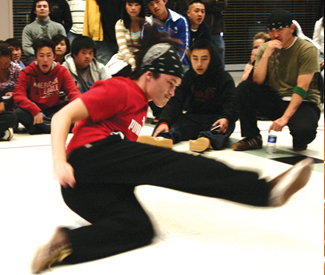
Among B-Boys gives outsiders an hour-long, respectful immersion in the lives of Hmong breakdancers, here “getting lost” in their impressively athletic moves and speaking for themselves, away from the flinty-eyed filter of Gran Torino (2008). In his quest to follow the Velocity/Soul Rivals and Underground Flow crews, Woon takes his camera from Oklahoma to Left Coast exurbia where the kids are attempting to dream with acrobatic handstands, freezes, and crazy-fancy footwork — and finding their efforts rewarded with trophies.

Their triumphs in gritty gyms and community centers are made that much more poignant in the context of their parents’ memories of war, displacement, and poverty. The elders’ stealth contributions to the CIA’s shadowy adventures in Laos casts a pool of lingering darkness on these hip-hoppers, who are striving to carve out a life for themselves while coping with the unique challenges that the Hmong have encountered in the states. As Joua Xiong, the rare B-girl in the Soul Rivals Crew, explains, “Hmong mean ‘the Free,’ and that’s basically what we are: we don’t have a certain country, but we don’t really know our original customs because we’re so mixed up. We have a lot of Thai, Lao, Chinese in us, and we’ve been running away so much from people trying to destroy our customs and make us conform with them.”

Cast away in a semi-rural Merced, Fresno, and Sacto, these kids appear to be finding another kind of freedom. “It’s not just breaking,” says Soul Rivals’ Kyle Vong. “It’s the culture of hip-hop — it’s about teaching yourself to understand life in general and expressing yourself.”

The awkward slackers and damaged hipsters of The Crumbles seem to be worlds away from the humble, proud B-boys of the Central Valley: theirs is a sun-strafed, paved-over Los Angeles habitat of coffee shops, taco trucks, bookstores, budding filmmakers, and living room-bound band practice. Darla (Katie Hipol) is slouching nowhere fast when her zany, charismatic cool-girl chum Elisa (Teresa Michelle Lee) enters the picture, looking for a place to crash.

Elisa’s wacky, erratic, and unreliable, but she’s also capable of generating real excitement — and a mean little keytar hook — and the girls’ band, the Crumbles, gets off the couch and threatens to get all involved to bust out of their shells. Though director Boch never quite dips into the deep background of his characters’ various dysfunctions — the threatened readings of Darla and Elisa’s psychic friend never quite sheds light — the first-time feature filmmaker has a real feel for the drifting, up-for-anything quality of Cali 20-somethings and an appreciation for their highs and lows that makes this familiar, loving, lets-put-on-show-kids update compelling.

With kindred ultraviolence vet Martin Scorsese throwing himself into his own kiddie roller-coaster of a cinematic ride with last year’s Hugo, it makes some sense that Takashi Miike — whose 2010 13 Assassins might have bested both Ichi the Killer (2001) and 1999’s Audition for sheer bloodletting — would enter the children’s field with such gusto. Manga fans will appreciate Miike’s broadly farcical, spoofy élan with comic book touches — down to the freeze-frame mucus drips, the CGI hatched-background stills denoting way-ramped-up action, and fourth-wall-bust-outs/pop-up trivia interludes by your “friendly ninja trivia commentator.”

http://www.youtube.com/watch?v=HVjoh-jG36o

Rantaro — your archetypal geek toddler, complete with thick glasses and bad haircut — has left the family farm and been sent off to ninja nursery school to learn all about deadly boomeranging stars, big-headed villains with testicular chins, and ninja master-slash-hair stylists. Does Rantaro, er, find himself amid the rigors of class, attacks from dastardly ninja outfits, and a final challenge that has him literally biting the dust? And does it matter when Miike digs in with such glee to lampoon the samurai genre, and kick up dust with the ankle-nibblers in this insanely comical alternate universe of ninja mini-mes?

SAN FRANCISCO INTERNATIONAL ASIAN AMERICAN FILM FESTIVAL

March 8-18, various Bay Area venues, most shows $12

www.caamedia.org

DOCS AND SHOCKS: MORE FROM THE SF INTERNATIONAL ASIAN AMERICAN FILM FESTIVAL

SFIAAFF Documentary fans, prioritize Give Up Tomorrow, Michael Collins’ probing examination of a high-profile murder case in the Philippines. If the Paradise Lost films got your blood boiling, expect to rage even harder at the unbelievably shifty way the events detailed here unfolded.

As with the West Memphis Three, the crime at Tomorrow‘s heart is horrific: in 1997, two sisters in their early 20s were kidnapped, raped, and murdered. Or were they? Only one body was found, and it was never quite confirmed that the dead woman was actually one of the missing sisters. Of course, that didn’t stop authorities (almost all of whom had ties to a local drug lord, who was also connected to the victims’ family) from fingering a group of local teens, including Paco Larrañaga — who became the case’s main target, despite the fact that dozens of his culinary-school classmates swore he was with them, hundreds of miles from the crime scene, at the time of the alleged murders.

Give Up Tomorrow offers a searing study of a corrupt court system, and the heartbreak that happens when a cause célèbre falls victim to the short attention span of the international activist community. Without spoiling all of its twists and turns, know that this story is better than any fictionalized crime drama, and more powerfully wrenching for being true.

Other docs worth checking out include Mr. Cao Goes to Washington, an insightful look at the American political system via Joseph Cao, who was the first Vietnamese American elected to Congress. But that wasn’t the most unique thing about him: he was a Republican, elected amid post-Katrina disarray in one of New Orleans’ traditionally African American and staunchly Democratic districts. S. Leo Chiang’s film follows Cao as he makes hard choices in the year leading up to his battle for re-election, including voting first for, then against, President Obama’s health care reform bill. (Reason for the switch: he’s passionately anti-abortion.) Even if you don’t agree with his views, Cao puts a human (and surprisingly honest) face on the great divide between the political parties in this country.

More hopeful is No Look Pass, Melissa Johnson’s quite enjoyable documentary about first-generation Burmese American Emily Tay, a basketball superstar who turns pro after graduating Harvard (eat your heart out, Jeremy Lin), and, oh yeah — happens to be a lesbian. No Look Pass also screened at the San Francisco Independent Film Festival, and it’s not hard to see why it appeals to a wide range of audiences: Tay is an inspiring figure on the court, and endearingly awkward off it, especially when trying to relate to her deeply traditional parents.

Even more uplifting, and perfectly compressed at 39 minutes, is Lucy Walker’s Oscar-nominated The Tsunami and the Cherry Blossom, which examines the “beauty and terror” of nature, as perceived by Japanese survivors of the recent earthquake and tsunami — and the spiritual significance of the cherry blossom, which is shown to be a key element in the country’s healing process.

Genre fans! I Am a Ghost, the world-premiere latest from prolific local H.P. Mendoza (2006’s Colma: The Musical), starts slowly but — holy ghost! — stick with it, and you’ll be shriekingly rewarded. And another recent IndieFest selection, Marlon N. Rivera’s satirical The Woman in the Septic Tank, returns to delight another wave of crowds with its tale of three ambitious filmmakers (and a hell of a leading lady) determined to make the most popular Filipino movie of all time. Best line: “Fuck Cannes, bro! We’re talking Oscars!” (Cheryl Eddy)

On the Cheap Listings

0

On the Cheap listings are compiled by Soojin Chang. Submit items for the listings at listings@sfbg.com. For further information on how to submit items for the listings, see Picks.

WEDNESDAY 7

San Francisco Green Film Festival closing night film and party San Francisco Film Society Cinema, 1746 Post, SF. (415) 742-1394, www.sfgreenfilmfest.org. 5:30 p.m., $12 per film. Whether you’ve had the chance to check out the second annual Green Film Fest’s activist-making movie screenings, make sure to check out its final night celebrating sustainable living and the fight to save our environment. The closing film Just Do It is a tale of modern-day outlaws and illegal activism in England.

THURSDAY 8

International Women’s Day March sign-making party New Valencia Hall, 747 Polk, SF. (415) 864-1278, www.radicalwomen.org. 7 p.m., $7.50 suggested donation for dinner. Sisters United Front is having a rally on March 10 to oppose budget cuts that have hit poor women the hardest. In anticipation of the march, Radical Women is hosting this evening of food and sign-making.

FRIDAY 9

Make Do! recycling exhibit and fashion show K Gallery at Rhythmix Cultural Works, 2513 Blanding, Alameda. (510) 865-5060, www.rhythmix.org. 6 p.m.-9 p.m., free. Recycling is not only something that happens when sorting out your garbage, but is also when finding creative ways to create functional treasures out of seemingly useless trash. The opening night of Make Do! will feature vintage vendors, delicious treats, and an upcycle-oriented fashion show.

SF Beer Olympics Impala Bar and Ultra Lounge, 501 Broadway, SF. (415) 982-5299, www.impalasf.com. 8:30 p.m., free to play; $10 to drink. Are you a lover of beer games with friends who hate them? Come make a mess with like-minded individuals who are more than ready to ditch the overpriced cocktails for a duel over brew.

Avant-garde sound and visual night with Edmund Campion Berkeley Art Museum and Pacific Film Archive, Gallery B, 2626 Bancroft, Berk. (510) 642-0808, www.bampfa.berkeley.edu. 7 p.m., $7. Edmund Campion is a pioneer of computer-enhanced performance practice and is the special guest for this week’s BAM/PFA Friday Late Night event. He promises to deliver a truly tripped-out experience through a mix of video projections, a choir scattered throughout Gallery B, and his unique take on electronic tunes.

SATURDAY 10

Lawrence Ferlinghetti’s Out of Chaos opening reception Kala Gallery, 2990 San Pablo, Berk. (510) 841-7000, www.kala.org. 4 p.m.-6 p.m., free. The friend and publisher of many Beat writers, Ferlinghetti drew from his well of experiences when working on his poetry and art. Come meet the one-time poet laureate of San Francisco as he launches Out of Chaos, a portfolio that showcases his original artwork and poetry.

“Sweeping of Giants” abstract ink artwork opening reception Old Crow Tattoo and Gallery, 362 Grand, Oakl. (510) 834-2769, www.oldcrowtattoo.com. Through April 9. 8 p.m., free. There are always samples of previously inked designs in the albums and on the walls of tattoo shops, but they’re usually small renderings or unsatisfying snapshots. Come see how visually orgasmic it is when detail-attentive ink artists really let loose in a surrealist painting, design-oriented composition, or a geometric field of color.

World Naked Bike Ride San Francisco edition Northeast corner of Justin Herman Plaza, 1 Market, SF. www.sfbikeride.org. 11 a.m.-4 p.m., free. Take a naked stance against our society’s global dependency on oil cartels in this mobile protest. Feel the liberating breeze as you ride as bare as you please through San Francisco’s favorite spots. Fingers are crossed for outstanding weather.

“Reflecting on his Politics, Music, Fighting Capitalism, and Cancer” jazz performance and panel discussion Multicultural Community Center in the Associated Student Union Center Building at UC Berkeley, Bancroft and Telegraph, Berkeley. (510) 548-2350, www.asiabookcenter.com. 2 p.m., free. Fred Ho is a saxophonist and social activist who underwent intense surgery and chemotherapy and came out of the battle with a new understanding of what “true healing” means. Join Ho as he discusses health, sustainability, raw foodism, and of course, indulges us with a little jazz.

Kiteboarding party and benefit event Rickshaw Stop, 155 Fell, SF. (415) 861-2011, www.rickshawstop.com. 6 p.m.-9 p.m., $10 donation. San Francisco is kind of the perfect place for kiteboarding because of the ever-present wind and the beautiful scenery. Help keep our city beautiful by supporting nonprofit Baykeeper’s work in preventing pollution in the Bay Area — you might even win some cool kite gear in the process.

SUNDAY 11

“Lazy Sunday Shopping Day”: Opening weekend of Chronicle Books at the Metreon Chronicle Books, 165 4th St., SF. (415) 369-6271, www.chroniclebooks.com. 10:30 a.m., free. Sunday should be for strolling and snacking, and Chronicle Books is honoring this sacred ritual with coffee and Top Pot doughnuts at its shop opening in downtown’s Metreon.

MONDAY 12

Bargain Basement Concert Night Bottom of the Hill, 1233 17th St., SF. (415) 621-4455, www.bottomofthehill.com. 8:30 p.m., free. The weekend might have drained your pockets but there’s not reason you can still dance. Local bands and DJs totally understand — they are hosting a cover-free night of surprisingly eclectic music. Think how delicious your moves will feel when you’re rocking them to Arms and Legs, Jackal Fleece, Surf Shit, and Junkdrawer sans financial damage.

Herbwise: Shambhala Healing Center next on the federal chopping block

1

When Al Shawa, founder of Shambhala Healing Center, was asked about what he was going to do now that the federal government is trying to shut down his business, he was (understandably) irresolute. 

“I have no idea. Who comes first, the chicken or the egg? Do I blame the federal government or the city? Somebody did me wrong.”

Shawa opened his medical cannabis dispensary one short year ago on Mission Street. He knew he was close to Jose Coronado Playground, but that’s why he underwent an 18-month permitting process with the city, which assured him that the playground’s clubhouse was not being used. In late February, his landlord received a letter from US attorney Melinda Haag that asserted illegal trafficking of drugs were taking place near a children’s playground. His landlord, Haag informed, risked criminal prosecution, imprisonment, fines, and civil forfeiture if Shawa’s business wasn’t out of the space in 40 days. Similar letters were sent out to roughly 12 dispensaries last autumn. Those dispensaries are now closed.

But on Saturday morning, Shawa seemed confused, and not entirely hopeless that his small business could be saved. He sat in his back office, a man trimming weed one room over. “I would hope the city would stand firm and protect these entities,” he said from behind his desk, next to a bank of security cameras. “I don’t understand where it stands on this – it should be taking a leading role.”

Posted: these signs now greet patients at the Shambhala Healing Center. Guardian photos by Caitlin Donohue

Though the SF Board of Supervisors passed a resolution in support of cannabis dispensaries’ right to operate without federal persecution last October, Mayor Ed Lee has yet to speak out on the federally-compelled closures, besides to comment that he’ll kow-tow to the authorities on the matter of marijuana’s medicinal efficacy. We asked Lee’s office for comment when the Department of Justice requested Department of Public Health records for 12 Bay Area dispensaries in February (a move that preceded the previous round of letters from Haag), to no avail. 

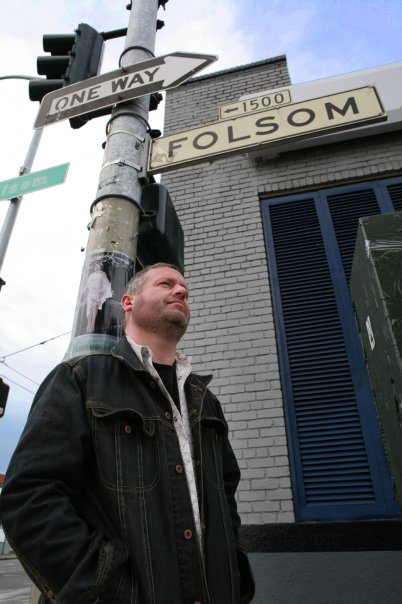
Shawa had previously operated a clothing store named Privilege at the address, but opened up Shambala when a fire damaged his inventory. Since opening, he said he’s become attached to many of the regular patients. “You feel like your responsible for their wellbeing,” he said, before talking about how his dispensary passed out 200 turkeys to the community on Thanksgiving, and gave the nearby Folsom Street firehouse $5,000 worth of toys to distribute during the holiday season. 

Throughout the recent travails of the medical cannabis industry, one of the more frustrating issues has been the seemingly random way businesses have been targeted by federal agencies. Shawa’s is a case in point. While he grapples with the notion of shutting his doors, the owner of a restaurant across the street, Gus Murad of Medjool Restaurant and Lounge, is applying for a permit to open a new dispensary on the same block (as reported by Mission Local). 

Lupe Ruiz, who has been floor manager at Shambala since the dispensary opened, seemed likewise shaken and frustrated with the city’s lack of response in the matter. 

“I’m kind of devastated,” she told me in between helping patients. “How do you allow someone to open and then when things get hot you don’t say anything about it?” She recalled a picnic in Dolores Park Shambala recently organized for its patients at which people played ball games and got to meet each other.

The dispensary does seem to be a gathering place of sorts – on the morning I interviewed Ruiz and Shawa, patients consulted budtenders about the right strain of cannabis for them, joking and friendly-like. Shawa says that more than one patient has teared up when he told them that the dispensary’s future was uncertain. 

“Who listens to these stories?” Ruiz concludes sadly, with a sentiment that the rest of the medical marijuana community can surely sympathize with. “People are not being heard.”

Dame good fun

0

arts@sfbg.com

FILM What with the internet, the paparazzi, Rupert Murdoch’s CIA-level spy techniques, and the general displacement of actual news by “celebrity news,” it’s pretty hard these days for a star of any sort to keep their debauchery private. Not like the good old days, when Hollywood carefully stage-managed publicity and only those who’d become a real liability risked having their peccadilloes exposed.

Such rare windfalls aside, the public were mostly restricted to watching beautiful people behave badly onscreen — a pastime that took a big blow once the censorious Production Code was instituted in 1934. Elliot Lavine’s latest Roxie retrospective of movies from that golden-shower period of post-silents, pre-Nannywood licentiousness — this time entitled “Hollywood Before the Code: Nasty-Ass Films for a Nasty-Ass World!” — provides plentiful early talkie titillation. Now that the bodies involved are long buried, we also know a few tales of their stars’ off-screen misadventures, too.

The week-long series of double bills sports its share of familiar titles, notably Howard Hawks’ terrific original Scarface (1934); Edgar G. Ulmer’s Karloff vs. Lugosi smackdown The Black Cat (1934); and the first, probably best version of H.G. Welles’ prescient biotech fable Island of Lost Souls (1932). There are women in prison (1931’s Ladies of the Big House), women in Faulkner (1933’s The Story of Temple Drake, a watered-down adaptation of W.F.’s then-notorious Sanctuary), women in everything else (1932’s Three On a Match, whose Depression-era Valley of the Dolls-esque trio includes a very young Bette Davis), and just plain Joan Blondell (1933’s Blondie Johnson).

http://www.youtube.com/watch?v=hzxnEDEY2Hs

It’s a few choice dames in lesser-remembered pictures that provide the biggest “nasty-ass” discoveries this go-round, however. March 4 offers a shocking double dose of pure white femininity finding themselves in, ahem, “Yellow Peril” — miscegenation being something Hollywood could only begin to embrace a few decades later. Frank Capra’s atypically erotic The Bitter Tea of General Yen, with Barbara Stanwyck alllllmost surrendering the white flag to a “charismatic Chinese warlord” (Swede Nils Asther, eyes narrowed), has become a minor classic since flopping in 1933.

No such luck for The Cheat (1931), a remake of Cecil B. DeMille’s 1915 shocker that was part of Paramount’s brief, failed attempt to make stage sensation Tallulah Bankhead a movie star. Her gambling-addicted socialite gets branded (literally) in lieu of repayment not by the original’s Far East businessman (dashing Sessue Hayakawa) but by a mere rich Caucasian perv with Sinophile pretensions (Irving Pichel). The big courtroom climax is a notable howler.

Bankhead remained a Broadway star and a popular “personality,” her throaty voice hinting at a semi-private life that included a great deal of bourbon, a fondness for unexpected nudity, and sexual appetites all along the Kinsey scale. After two decades off screen she arguably found her camp métier as a berserk Bible-clutching hag terrorizing Stefanie Powers in 1965’s Die! Die! My Darling.

Much less of a survivor was poor Clara Bow, who was beloved when she played the wild thing yet unduly punished when it turned out that role had relevance in real life. The quintessential flapper and “It Girl” (“it” meaning sex appeal) was never much of an actress, but an incandescent, live-wire screen presence.

Call Her Savage (1932) is a pre-Code jaw-dropper that was supposedly her personal favorite. Running an A-to-Z gamut of emotions (and hairstyles), her Texas heiress heroine Nasa “Dynamite” Springer is “never two minutes the same” — a nice way of saying she’s nuts. In 88 minutes she rides a horse like it’s something else, plays with her mastiff likewise, is near-raped by an estranged husband, turns streetwalker, causes a brawl in Greenwich Village café catering to “wild poets and anarchists,” gets in two catfights, hits the bottle, and finds peace upon discovering she’s a part Indian “half-breed,” which apparently explains all.

Emotionally unstable, due in part to a pretty horrific upbringing, Bow must have related. At the time she was enduring myriad problems, notably some embarrassing public revelations spilled by a blackmailing secretary. Savage would be her next-to-last film, after which she retired into a deep and troubled seclusion.

Heading thataway as well was Juanita Hansen, a silent star who’d gone down in flames a decade earlier thanks to a “Queen of Thrills” image that unfortunately she enacted a little too enthusiastically in real life. She quit cocaine, got hooked on morphine, quit that, and became an anti-drug crusader — but nothing re-ignited her career. Certainly not lone comeback vehicle Sensation Hunters, a 1933 Poverty Row exploiter in which she was fifth-billed as “Trixie Snell,” manager-slash-madam to a troupe of “Hot-Cha Girls” who kinda dance, kinda sing, but mostly roll customers at Panama City’s “Bull Ring Club.” It was a sad exit. Puffy and peroxided, Hansen is all too convincing as a woman with too many hard miles on her to go anywhere but further downhill.

Waaaay uptown — glittering Broadway via glossy Paramount — 1934’s Murder at the Vanities offered the last hurrah for pre-Code naughtiness. And what a hurrah: chorus girls in pasties and less (at one point they simply clutch boobs as if on a latter-day Vanity Fair cover); production numbers like “The Rape of the Rhapsody” (the “rape” being Duke Ellington’s “colored” jazz musicians and dancers invading a classical orchestra with something called “Ebony Rhapsody” — until a white gangster jokingly machine-guns them all down); plus sexual humor so blunt that Jack Oakie ends the film telling a giggly blonde “Come on, let’s do it,” meaning exactly what you think.

http://www.youtube.com/watch?v=xCoj855Vdo8

On the side of the angels — definitely for losers here — there are numerous horrible songs (excepting standard “Cocktails for Two”), gag-inducingly sweet romantic leads, and kitschy-great ideas like having stage impresario Earl Carroll’s patented “Most Beautiful Girls in the World” pose en masse as tropical waves and cosmetics products. Representing Satan and evening gown-wearing pot smokers everywhere is villainous Gertrude Michael, who infamously sings torch song “Sweet Marijuana.” Michael was an elegant stage and radio star whose own recreational taste leaned more toward cocktails for one. Indeed, she was fictionalized as the hard-drinking love object in one-time lover Paul Cain’s 1932 novel Fast One, an early classic of hard boiled American pulp.

Saving the sleaziest for last, the series will truly flabber your gast with its closer. Normally prim MGM found itself reviled in early 1932 with the fleeting release of Tod Browning’s Freaks (playing the Roxie March 3), a much-misunderstood, now celebrated fable starring actual circus sideshow performers. It was considered so grotesque and unsettling that Freaks was banned in many areas — Britain didn’t see it until 1963.

Yet there’s no evidence of any similar backlash to the infinitely scuzzier Kongo, unleashed by Metro a few months later. A remake of Browning’s 1928 Lon Chaney vehicle West of Zanzibar, it stars Walter Huston as wheelchair-bound “Deadlegs” Flint. He’s used cheap magic tricks to appoint himself fearsome white-man “god” amongst spear-carrying tribesmen in a “dunghill” African outpost, all part of an elaborate, insidious plan to wreak vengeance on the rival who stole his wife and health long ago.

What this revenge eventually encompasses reads like a list of nearly everything the Production Code would soon bar from the screen: depicted or suggested drug addiction, alcoholism, prostitution, rape, sadism, and a convent-bred ingénue (Virginia Bruce) recalling “hot hairy hands pawing and mauling” her unwilling virginal body. Not to mention human sacrifice and a unique substance abuse “cure” using leeches.

One can almost hear the censuring voice of Will Hays, the Code’s original enforcer, when one character tells Deadlegs “The swamp’s wholesome compared to you!” It would arguably be 40 years before MGM distributed another movie so flagrantly perverse — and even then the studio was so ashamed they put it (Paul Bartel’s 1972 Private Parts) out under a fake subsidiary’s auspices.


HOLLYWOOD BEFORE THE CODE: NASTY-ASS FILMS FOR A NASTY-ASS WORLD!

March 2-8, $11

Roxie Theater

3117 16th St., SF

www.roxie.com

Nightlife: Fun plus jobs

8

By Supervisor Scott Weiner

OPINION We all know the cultural benefits of nightlife. It’s fun. We get to meet people — friends, lovers, and all the rest. We build community. We hear great music. We dance. We spend time outside on our streets. For LGBT people, we meet other LGBTs and keep our community strong. The list goes on: Without a strong entertainment scene, including bars, clubs, live music venues, arts venues, night-time restaurants, and street fairs, our city would be a less interesting and less diverse place.

But the undisputed cultural importance of nightlife isn’t the whole story. Nightlife is a significant economic contributor to San Francisco. It creates jobs, particularly for working-class and young people. It generates tax revenue that helps fund Muni, health clinics, and parks. It allows creative entrepreneurs to start businesses. It generates tourism. It draws foot traffic into neighborhoods to the benefit of other neighborhood businesses.

This is all pretty intuitive. Yet, as a city, we’ve never actually measured the economic impact of our nightlife scene. One of my first acts a member of the Board of Supervisors was to request the city economist to conduct an economic impact study doing just that.

The study is almost done, and we already have a few preliminary results. Nightlife in San Francisco generates $4.2 billion a year in spending, with $1 billion of that amount coming from bars, clubs, performance venues, and art spaces. Some 48,000 people are employed in nightlife businesses, and these businesses contribute $55 million a year in local taxes. On March 5, we’ll announce the full results of the study at a hearing of the Land Use and Economic Development Committee.

This data will help us make smart public policy around nightlife. In the past, those decisions frequently have been driven by anecdote and over-reaction to isolated events. Trouble near a small number of nightclubs? The city responds by making it difficult for all nightclubs to operate, even those with excellent safety records and despite the dramatic improvement in the Entertainment Commission’s oversight. Or, the city goes even further and proposes requiring all clubs, even small ones, to scan ID cards of everyone who enters. (That proposal, thankfully, was roundly rejected.)

When we make these decisions, we should do so with a full understanding not just of the downsides of nightlife but of the positives, including cultural and economic benefits.

Entertainment is under pressure in San Francisco. There are neighborhoods with significant friction between housing and nightlife. Some of that friction results from a small number of problem venues. Other times, a good venue is jeopardized for simply conducting its business within the limits of San Francisco law — for example, a single neighbor got Slim’s shut down for a few weeks for noise, despite the club’s compliance with our noise ordinance.

We also continue to have bizarre Planning Code restrictions that undermine entertainment, such as the Mission Alcohol Special Use District, which makes it difficult or impossible to start creative new businesses in the Mission if alcohol is involved. This provision almost prevented a new bowling alley from locating at 17th and South Van Ness. Similarly, some are concerned that the Western SoMa Plan, as currently written, will undermine nightlife on 11th Street by surrounding clubs with new housing and by reducing the number of venues.

A thriving nightlife scene is key to our city’s cultural identity and economic future. Now that we have the data on its benefits, we can take a more balanced and thoughtful approach.

Supervisor Scott Wiener represents District 8 on the Board of Supervisors. The March 5 hearing will start with a noon rally on the steps of City Hall followed by the hearing at 1 p.m. in City Hall Room 263.


Occupy and Castlewood Workers to join up for “perhaps the biggest and most vibrant march Pleasanton has ever seen”

10

Organizers hope for a big turnout Feb. 25 for the latest protest in a two-year saga to demand a better contract.

Food service workers at Castlewood Country Club were put on lockout on Feb. 25, 2010 when they refused the terms of a contract with the club. The contract stipulated that workers pay $849 per month for health care, a change from the free health care the contract had previously provided.

Lockouts, when employers refuse to let employees come back to work until they agree to contract terms, are a rare but powerful tool used against unions.

“A lockout is the opposite of a strike,” said Sarah Norr, organizer with UNITE HERE local 2850, which represents the Castlewood workers.

Since the lockout began, the club has hired non-union replacement workers and most of the union workers have taken other jobs. But, in order to end the lockout legally, the company must resolve the contract issues.

According to Norr, “It’s illegal to permanently replace locked out workers.”

Workers brought the case to the National Labor Relations Board (NLRB), which filed a complaint against Castlewood August 30, 2010. The complaint states that the club “has been interfering with, restraining, and coercing employees in the exercise of the rights guaranteed in Section 7 of the [National Labor Relations] Act” and “has been failing and refusing to bargaining [sic] collectively and in good faith with the exclusive bargaining representative of its employees.”

An ongoing NLRB hearing on the case is expected to conclude on March 1.

Meanwhile, workers have been picketing daily since the lockout began two years ago. This has sometimes resulted in dramatic clashes with the club members.

One of the workers’ protests last June. Golfers’ reponses, complete with property desctruction, begin around 1:35

“Members of the club harass them on a daily basis. Hitting golf balls at them, throwing racial slurs at them. Some of them are really supportive but some are not so nice,” said Norr.

But workers persevere, and tomorrow they hope for a larch march on the club, joined by OccupySF and Occupy Oakland.

Said Norr, “It’s going to be a big, vibrant march, perhaps biggest and most vibrant march Pleasanton has ever seen. There will be a babies’ and children’s brigade.”

For Occupy organizers, joining up with the protest makes perfect sense.

“Many of Castlewood’s member-owners spent $25,000 for their memberships,” said Ann Worth, a longtime union member and participant in Occupy Oakland, in a press release. “They can justify spending that kind of money to play golf, but they still think it’s okay to squeeze more out of the people who work for them for $10 or $12 an hour. They expect workers to subsidize their expensive game by giving up affordable health care for their kids. It’s a perfect example of what’s been going wrong in this country: the rich are getting richer by denying everyone else their share in the American Dream.”

Bounce to this: Rusty Lazer does Mardi Gras

1

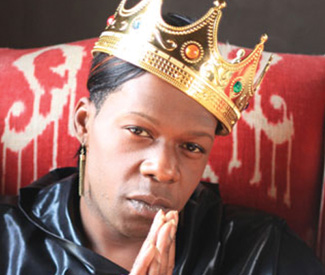
Due to health problems, Big Freedia had to cancel her and Rusty Lazer’s Noise Pop gig at Public Works Sat/25. The event been transmutated into a big gay dance party with Double Duchess, DJ Bus Station John, and more. You should still read this interview, though.

With all its technicolor thrift flair, Mardi Gras costumes in state of midway-preparedness, and sleepy passels of breakfast-cooking houseguests, Jay Pennington’s New Orleans clapboard house is pretty hallucinatory on the Saturday afternoon of Carnaval weekend. Staring out the window waiting for the bounce DJ to call me up for our interview, I was to be excused for imagining that the shed in the side lot was producing actual chords while the New Orleans monsoon that raged outside hit it.

When I come across him in his bedroom, Pennington – who is also known as Rusty Lazer, and is the now-famous transgender NOLA bounce artist Big Freedia’s DJ and informal manager – is threading colored paper onto a string. He was going to be Hanuman the monkey god at the Mardi Gras parades on Sunday, his day off from work over Mardi Gras weekend. Around him, the city has ballooned with tourists and locals chucking beads at targets, high-stepping through brass numbers, eating frosted king cake, and peeing in inappropriate places.

I braved the rain that afternoon to talk about bounce music and Mardi Gras with Pennington, so it was kind of a surprise when our conversation swerved into the intricacies of 501(c)3 registration. It shouldn’t have been. He is a lot like New Orleans itself, a town that counts as a centuries-old melting pot, where the frat boys hang at the same bars as the career jazz musicians hang at the same bars as the pretty queer kids who sometimes party at dark gay leather bars (I was privy to this last comingling within six hours of landing in the Big Easy, at Daddy Aki’s Peacock party at the Phoenix Eagle Leather Bar where Pennington and his new managee Nicky Da B spun). [Correction: An earlier version of this article identified Peacock as Jay Pennington’s party. It is actually organized by Daddy Aki. Our bad.]

If you are a NOLA entertainer, Mardi Gras weekend counts among the most hectic of the year. Pennington had evenly informed me that my suggested meet-up time of noon was at least two hours too early considering the aftermath of the night shift on the decks he’d pulled before and that he would surely pull again that evening. But it’s two thirty now and for the moment, he’s able to focus on Hanuman, and attempt to tell me what’s so special about his city.

Hands-on Hanuman: Rusty Lazer in mid-Mardi Gras repose. Guardian photo by Caitlin Donohue

Though the DJ is playing less and less a role in Big Freedia’s career as she blows up and sells out shows around the country, Pennington continues to be a driving force in bounce’s dispersal outside NOLA. He signed his first official managerial contract with Nicky Da B, an adorable local whose track with Diplo hit Soundcloud last week. Bounce is indigenous to New Orleans — like Chicago’s juke and Detroit’s jit — a Caribbean-inflected dance music that is well known for the way its dancers pop their hips at machine gun rates.

Pennington is also is the co-founder along with Delaney Martin of New Orleans Air Lift, an international program he made to support local artists post-Katrina. This loosely-incorporated organization (it’s not 501(c)3 and relies instead on private donations, like the sales of the work of Swoon, one of the few females in the upper echelons of the street art world – her intricate, delicate wheatpastes blanket the fence next to Pennington’s house.) The Airlift Project has sponsored trips by New Orleanian artists to Berlin, even the import of Siberian breakdancer Ivan Stepanov to New Orleans.

This last story illustrates one of Pennington’s biggest turn-ons — fostering the artistic combustion that happens when a bunch of different energies get together. As illustration, he shows me a high fashion video shoot made by Lady Gaga’s stylist Nick Knight featuring the 19-year-old local bounce dancer Quack. 

After seeing a video of the improbably Barbie-bodied dancer, Knight contacted Pennington to ask if she’d care to do the same dance wearing Alexander McQueen for a fashion film series. Quack didn’t have a passport, but she went and got one with Pennington. The next day they went to London, found themselves “sitting in a room with nothing but Amazonian models.” Quack danced for eight hours to make the video, which turned out to be a testament to not just the extreme sexuality of bounce music, but also its athleticism, and emotional panacea. 

“This is the music that makes people forget that they’re hungry,” Pennington tells me, excitedly clicking through videos of schoolkids bouncing in rec centers, and endless YouTube clips of home bounce practice, done against a wall, ass to the camera. “It’s finally tuned to helping you forget your problems.” He wants to “take a New Orleans plane full of people all over the world,” to teach bounce to the masses. “In case anybody around here has forgotten how to have fun.”

The music lends itself to teaching — singers often give specific commands in songs, a popular request being for everbody to bend over and keep their ass popping. “Bounce is all instructions,” Pennington says.

The ability to move among social groups is one of the reasons why Pennington fell in love with New Orleans. 

“Here, you’re part of a community, not just part of a scene,” he reflects. “The difference is that the communities include all the people in your community. I don’t feel that in Portland or Austin.” He says the young arrivals in other artsy, liberal towns “hang out in mirrored social groups. I don’t know if that means anything, but it makes sense to me.” Pennington considers the neighborhood connections he’s made through participating in NOLA’s famous informal second line parades as, if not more, crucial than the ones he’s made with fellow travelers who have alit upon New Orleans as a haven for weirdos and music freaks. “New Orleans black community is nothing if not family-oriented,” he says.

Those mirrored social groups are a concept that should make sense to those beyond DJ Rusty Lazer. Part of what makes gentrification such a bummer is that when young bohos move into low-rent, family-oriented neighborhoods, they don’t form connections with the existing culture, imposing their own wacky adventures on top of the landscape as though they’re the first to really enjoy it. 

This missed connection leads newcomers away from frequenting established neighborhood businesses, and doesn’t provide for enough interconnectedness to get any kind of organizing come when rents start to rise and the condos come in. So good for New Orleans, and especially the rapidly changing Bywater neighborhood if they can avoid the typical storyline of minority community attracting broke artists attracting yuppies who can pay first, last, second, and third months’ rent in cash. 

Not the town doesn’t have other defense mechanisms. “The heat, the bugs, that lack of industry, the violence — that keeps it from growing out of control,” says Pennington. “It keeps the excessively ambitious away. When this place piles it on, it really piles it on. You can’t just casually live in New Orleans.” Wise words to the San Franciscan exodus that will surely come in the next months after tech boom 2.0

And for the record, I wasn’t hallucinating the house making music. The Ninth Ward’s musician mad scientist Quintron installed a rain organ into the Music Box, a small village of structures built in Pennington’s sideyard by 70 people to be played like a symphony, complete with Quintron playing conductor and a capacity crowd crammed into bleacher seating and crouching amid the structures themselves. At recent performances during last fall, 750 people showed up to watch the show. There was space for 250 in the sidelot. 

Heated debate

1

emily@sfbg.com

YOGA Open source is all the rage these days, from platforms to beverages to biotech. And when it comes to yoga, the East’s oldest standby for health and well-being, open source has been the way for thousands of years. But all changed when yoga won over the capitalistic West, and the West Coast became a hotbed for many of today’s popular yoga trends.

But for Bay Area yogis who can’t afford $92 pants to enhance their assets or $18 drop-in classes, there’s Yoga to the People (www.yogatothepeople.com): the East Coast invention of Greg Gumucio, which operates on a donation-based model.

Besides studios in New York and Seattle, YTTP has spaces on both sides of the Bay — in Berkeley and the Mission — and it has plans to open a hot studio in Berkeley as well. There, 90-minute classes will feature a familiar series of 26 poses in a sweltering 105-degree room.

But it’s not Bikram Yoga, the “hot yoga” that’s won its Indian founder a worldwide following.

Instead, it’s what YTTP calls “traditional hot yoga.” It’s already on the docket at four of the group’s five New York studios, and late last year, it landed them in hot water with Bikram Choudhury, who sued YTTP for infringing on his intellectual property.

While the class is similar to what Bikram-ites have come to expect when they walk into any one of the modern guru’s more than 900 studios worldwide, “traditional hot yoga” doesn’t rely on Bikram certified teachers or Bikram’s copyrighted class dialogue, and Bikram receives no money.

Which makes the whole issue a little sticky: if YTTP were billing the classes as Bikram Yoga, they’d have to play by Bikram’s rules: from teacher trainings and re-certifications to registering and paying studio dues — in fact, right down to the Bikram-required carpet on the floor.

But as Gumucio and his lawyers pointed out in an answer to Bikram’s suit, they’re not.

Furthermore, the response argues, copyright protection is limited to original works of authorship, from which the copyright statute expressly excludes “procedures, systems and methods of operation” — such as exercise systems.

In a December letter to YTTP’s lawyers, the copyright office concurred, writing that the selection and ordering of exercises in the public domain (which Bikram’s poses, having been taught by his teacher’s teachers for generations, clearly are) “do not constitute the subject matter that Congress intended to protect.”

Of course, there remains the slight problem of the office already having issued the copyright, a fact that Bikram’s lawers have not failed to notice.

After a slew of articles hit New York presses, Yoga to the People has decided that they will no longer comment on the case, but Gumucio is taking the letter as the decisive answer to the question he posed on his website, Yogatruth.org: “Can yoga be owned?”

“Copyright office makes it official,” he wrote in exuberant red print. “Yoga belongs to all people!”

It’s easy to see the saga as a David and Goliath story — Yoga to the People, proclaiming,” There will be no proper payment; there will be no right answers; no glorified teachers; no ego no script no pedestals,” versus the Rolls Royce-collecting, sequined Speedo-wearing, wealthy, and self-promoting Beverly Hills-based Choudhury, purveyor of what many call “McYoga.”

But Juicy Sanchez, who owns and teaches at the Bikram-certified studio Mission Yoga (www.missionyoga.com) with her husband Steve, points out that some of the hype surrounding Bikram’s larger-than-life personality and shady business practices are overblown.

For instance: claims that studios are required to pay monthly dues and franchising fees of more than $10,000, in addition to the cost of teacher trainings, which are required every three years.

“First, we’re not a franchise,” she says. “We’re a loose affiliation.”

“And it’s just like any profession — doctor, lawyer, massage therapist — you’re required to get re-certified periodically,” she says. As for as the franchising fee, she says that because she and her husband bought an existing studio, they were not required to pay anything beyond their teacher training to open their business.

Though that may soon change. In April, Bikram will require studios to pay $300 a monthy for the right to use his name, which has people “freaking out.”

“I suppose some people are always going to feel exploited,” she says, “But personally, I think it’s a bargain. How else do you buy into a brand?”

Of course, Bikram wasn’t always considered a brand. Sanchez explains that when he arrived in the U.S. in the 1970s, he slept on the floor of his studio. He taught for free until the actress Shirley MacLaine, a student of his, took him aside and told him that if he didn’t charge money, no one would value what he did.

But if yoga is truly about a practice, not a product, why continue to replicate this one man’s 26 poses?

Brian Monnier, of the California Yoga Company (www.calyogacompany.com), says of Gumucio, “I support his right to fight for this, but if your teacher doesn’t want you teaching what he taught, why not grow and change the practice?”

Monnier points to his teacher Tony Sanchez, who learned directly from Bikram, but wasn’t certified by Bikram’s Yoga College of India. Instead, Sanchez returned to Bikram’s own guru, Bishnu Gosh, in Calcutta. It was from him that Sanchez drew his practice, creating a new style of hot yoga altogether.

Even Bikram has said that the power should lie with the practitioner — not the teacher. The very idea for Yoga to the People came when Bikram asked Gumucio, then a student of his, to review another teacher. Gumucio gave a negative review, and Bikram chastised him, saying “You are your own teacher. You are responsible for your own experience.”

How that plays out in the Bay Area remains to be seen. Katite Gumucio, Greg’s sister and owner of Hot Yoga Ocean Ave., (www.hotyogaoceanave.com) believes that yoga isn’t so different from many other types of big business with the opportunity to change paths. “Yoga can segue into a new way of doing business. YTTP is clear that you’re the center of it all; you don’t need to realize through anyone else. People can lead us, they can grow and do great work, but when they reach the point where they can only lead by force, it’s time to redistribute the power instead of trying to hold on.”

Justin Vivian Bond talks Occupy Wall Street, the power of language, and the politics behind the music

1

When Justin Vivian Bond was a little kid, v (more about that unique pronoun below) confidently wore Iced Watermelon lipstick to school and, inspired by feminist movements of the time, brandished a sign reading “Kids Lib!” Adults told the young Mx. Bond that these things were wrong, but v knew how right they felt, and represents for queer pride and radical poltics to this day. The writer, singer and activist is best known for v’s role as Kiki DuRane in Kiki and Herb, a drag cabaret show with partner Kenny Mellman. The show started in San Francisco and made it to Broadway, and was nominated for a 2007 Tony award. V’s memoir Tango: My Childhood, Backwards and in High Heels was released this year (wherein Bond tells the lipstick story and a lot more about growing up gender-free). Bond is still touring and will be back in San Francisco Feb. 23, performing from v’s new album, Dendrophile. I talked with v about the upcoming concert, v’s recent performance at Occupy Wall Street, and how music can bring people together.

SFBG What can people expect at your upcoming concert?

JVB I’m going to be performing songs from Dendrophile. I did my release concert when I was in the Bay Area in the spring. So some songs from that, some others songs, and some monologues about contemporary political observations. Also– 20 years ago I married a local performer by the name of Leigh Crow, aka Elvis Herselvis, and she and her band the Whoa Nellies are going to be opening. So it’s going to be an anniversary celebration.

SFBG You performed at Occupy Wall Street. What was that like?

JVB It was really awesome. I performed for the Trans-form the Occupation rally Nov. 13. It was a lot of trans activists talking about trans issues and establishing a presence of trans people within the revolution. It was so inspiring, empowering and exciting for me to perform my song on the Peoples’ Mic. The song, New Economy, is about the current obsession with whether people have enough and who has it. It was such a great experience.

Of course, the next day the police came in and closed Zuccoti park down. In my show I joked that once the queers and the trans people started making their presence known the police they realized they’d better shut it down. They were probably having flash backs to the ACT UP and Queer Nation days!

SFBG Do you think there has been a good presence of queer and trans issues in the Occupy movement?

JVB There certainly was that day. We didn’t get to see how that manifested within the community at the park. But I do feel that there are a lot of queer and trans people involved in raising awareness about social and economic disparities within our culture, so I think that its an inevitability that the subjects are going to be part of the Occupy conversation. Because trans people are constantly being oppressed and harassed.

SFBG How do you think music can help bring that kind of political awareness?

JVB I think that music is a way of bringing people together, especially people that may not realize how much they have in common, or may not have an excuse to be in the same space. If there’s an artist who starts voicing thoughts, ideas, and political sentiments, that’s one person making a statement, and people all of a sudden find themselves in a room with like-minded people. Community is formed. That community can become a larger voice, and that’s a powerful way of affecting the culture. Historically, music and artists have been a rallying potent for great and powerful change.

SFBG What’s your most powerful political song?

JVB Probably New Economy, this song that I did at occupy Wall Street . There’s also my cover of 22nd Century, which was written by Exuma, whose a Bahamian voodoo priest and spiritual revolutionary writer. That one really seems to get people going.


SFBG What inspired New Economy?

JVB I wrote it when the stock market was collapsing and everybody was freaking out. People were losing their 401k plans or health insurance. As an artist, I’ve never had those things. So seeing people freaking about something I’m so used to dealing with was kind of comforting. It was like, we are all going to be on a similar level for a while and try to figure out how to solve peoples problems. The song is about our commonality. The final line is “take what you need and give a little back,” because I believe there is enough out there for everybody.

SFBG
You’ve been involved with Radical Faeries, a group that celebrates queer sexuality, connection with the earth, and community. Have you been involved recently, and what does it mean to you?
 

JVB I haven’t been to a Faerie Gathering since the fall, but yes, I’m still involved. Its about community, and its about finding alternative economies, and ways of sharing and supporting each other on a very human, person-to-person level. That’s as opposed to having your reality dictated by the mass media and corporations.

SFBG Last year, you announced your official pronoun: V. You also use the honorific Mx. The move raised awareness for genderqueer and non-gender-conforming people, and also created backlash. It’s been a year now—how are you feeling about your pronoun decision?

JVB It’s been really great for me. Of course there’s frustration with people who somehow feel like they know me or my trip better than I do. But in general its been really liberating. And on a social level, I’ve met a lot of wonderful people who are going through similar experiences, that are not interested in being part of a fundamentalist or gender-fascist paradigm. So it’s nice to meet other people who feel this same way, and amazing to find out how many of those people there are out there.

SFBG
I know some writers don’t like using gender-neutral pronouns (some commonly-used pronouns that don’t signify a particular gender include ze and they.) But as a writer who has used the incorrect pronoun for somebody in the past, then edited the piece, I feel– it’s not that hard to respect how people identify!

JVB
I’ve been shocked to find out how heavily invested some writers are are in what they’re used to. For people that make their living using words, I’m almost shocked at how inflexible they can be. As for me, I love language and the power of it. The conversation that the pronoun provokes has been a great conversation to have with so many people. There have been times when people have done that same thing with me, then they fix it online and apologize, so that’s a nice thing.

SFBG Well thank you, and we’re excited for your concert.

JVB It’s going to be really fine show. It’s going to be a celebration, and I’m looking forward to it.

A taxing situation

1

HERBWISE It’s happening again. Last autumn when your favorite dispensary got shut down in the wake of receiving a threatening cease-and-desist letter from the Department of Justice — well there’s warning signs that the remaining 21 cannabis collectives in San Francisco won’t be 21 for much longer. The DOJ requested the Department of Public Health records for 12 dispensaries in January, a move that preceded its last round of forced dispensary shut-downs.

It’s a time of a lot of uncertainty for the medical marijuana (although you could make a compelling argument that it’s never been on completely solid footing). Various tactics are being taken to shore up its legality, including a passel of proposed ballot initiatives that have varying chances of presenting themselves to California voters in November, from bids to legalize weed entirely to proposals for a statewide regulatory body for the existing medical system. Hey, there’s even reality TV shows (the Discovery Channels Weed Wars, which focused on Oakland’s Harborside Health Center) out there on which earnest dispensary staffers let the United States public in on just how above-board working in a cannabis center can be.

Henry Wykowski is not a signature collector. Nor is he a television producer. Wykowski is actually a San Francisco-based trial attorney, one that specializes in the field of cannabis tax law. This fact makes him the perfect candidate for the endeavor he is currently embarking on: to kickstart a nationwide campaign to convince the federal government to change a part of the national tax code that disallows cannabis dispensaries from deducting business expenses on their taxes — a tactic recently harnessed by the IRS to demand $2.4 million from Harborside in “owed” taxes (Wykowski represented Californians Helping to Alleviate Medical Problems in a similar case in 2007, in which a court decided that business expenses were deductible for cannabis dispensaries except where they pertained to the actual dispensing of marijuana).

How does Wykowski hope to enthuse a nation over tax code quibbles? The Guardian contacted him via email to find out. His answers were somewhat tax lawyerly — which definitely doesn’t mean we don’t applaud his efforts. 

San Francisco Bay Guardian: What’s the goal of the 280E reform campaign?

Henry Wykowski: To have IRS Section 280E modified to exclude state authorized medical cannabis dispensaries. 280E was instituted to deprive drug dealers from being able to deduct their business expenses before any states passed laws authorizing the sale of medical marijuana. There are now 16 states and the District of Columbia that have authorized the use of medical marijuana. It was not intended to deprive dispensaries of the right to deduct ordinary and necessary expenses and should not be used to do so.

SFBG: How do you plan to make this campaign go forward?

HW: By letting people know that there is an organized effort to change this punitive provision and enlisting their support in doing so.

SFBG: Do you imagine it’ll be difficult to get people behind an imitative to change the tax code?

HW: No. The majority of people support the legalization of medical cannabis. Once the patients and other supporters learn that the unfair application of 280E could tax dispensaries out of business, the support will come. Right now most people aren’t aware of Section 280E or its potential consequences.

SFBG: How will you activate people that aren’t cannabis’ traditional base? Will you need to?

HW: By getting the message out. We welcome everyone’s support.

Find out more about Wykowski’s campaign at www.280ereform.org


Bounce with me

0

Editor’s Note: Unfortunately this show has been cancelled due to Big Freedia’s health. We wish her well and hope to see her again soon! Please read this revealing interview with her multi-talented DJ and producer, Rusty Lazer.

arts@sfbg.com

NOISE POP Despite its continual popularity in New Orleans for the last 20 odd years, it’s been a while since the regional, uptempo, call and response driven style of dance music known as bounce has appeared on a national level. The Juvenile (featuring an adorably young Lil Wayne) track “Back That Azz Up” may be the most recognizable hit, but not the most representative of the genre, especially the rising queer-friendly subsection that Big Freedia rules as “Queen Diva.”

Appearing in her nationwide debut performance on Jimmy Kimmel Live! last month, Big Freedia, born Freddie Ross, possibly brought bounce back into the lives and sets of people outside of NOLA, but they may not have been getting the whole picture. “I get a lot dirtier when it’s a club performance, and I can really get raw,” Big Freedia said in a phone interview last week, “but that was for TV so it was a little more PG.” Freedia, who answers most questions with Southern politeness and a “Yes, sir,” is nothing but grateful for the experience in which her dancers worked with “one of Beyonce’s choreographers,” Frank Gatson, for the segment, but to an observer at all familiar with her reputation for wild live performances, it was pretty tame.

In part it was just a matter of skin. One of Big Freedia’s signature songs at this point is “Azz Everywhere” and it’s the scantily clad dancers in particular that bring the idea to life, making moves and taking positions not unlike a 2 Live Crew show (or the Kama Sutra). We’re talking booty bumping, full splits floor humping, upside down synchronized air thrusting, and other gyrations typically reserved for strip clubs near airports and really great office Christmas parties.

For Big Freedia, who comes with her own crew of male and female dancers, call and response isn’t just lyrical — meaning that when she yells “I got that gin in my system” you should probably retort “somebody gonna be my victim” — but also that people might get called out for not getting down on the dance floor. At her shows, “everyone is involved.” Big Freedia said. “Whoever wants to get onstage can get a chance to come on stage. I’m very connected with the audience so I try to make everyone involved.” This interaction with her audience was the other thing missing from the Jimmy Kimmel performance, where a crowd looked on more as spectators than participants. For her part, Freedia tries to meet people at her shows halfway, saying “I can’t put them all on stage so I have to put myself on the floor with them.”

Effort means a lot for Big Freedia, who has long been known for doing shows at least six nights a week in New Orleans and continues to run a successful decorating company. She considers it part of her message that one can “Make the impossible happen being gay. Working really hard at things you have dreams behind and succeeding no matter what color, creed, walk of life.” Idealistic as that is, it also explains in part her egalitarian approach to dancing. Unlike some artists (::cough:: Sir Mix-A-Lot ::cough) it’s not about a certain type of butt; everyone’s got one, you just have to know how to bounce it. And if you don’t know that, well, she also offers classes.


WITH HARD FRENCH DJS, VOGUE & TONE, DOUBLE DUCHESS

Feb. 25, 9 p.m., $16; Culture Club bounce session, 11:30 a.m., $10

Public Works

161 Erie, SF

2012.noisepop.com

Alerts

0

yael@sfbg.com

WEDNESDAY 15

Which way forward?

Four panelists will speak on their approach to creating progressive change in the United States. Speakers include Rocky Anderson, former mayor of Salt Lake City and presidential candidate with the Justice Party; Margaret Flowers of Physicians for National Health Program and organizer with Occupy DC; Tom Gallagher, former state legislator in Massachusetts; and Dave Welsh of the San Francisco Labor Council. With moderator Rose Aguilar of KALW’s Your Call radio. A forum organized by the 99% Coalition, a group focused on anti-war and non-violence activism working alongside Occupy San Francisco.

7 p.m., $10 suggested donation

Unitarian Universalist Church

1187 Franklin, SF

(415) 710-7464

www.sf99percent.org


Black history film and discussion

A screening of Freedom Riders, the film detailing the story of 400 groundbreaking Civil Rights Movement activists that rode on integrated buses throughout the South despite violent resistance everywhere they turned.

7pm, $5 suggested donation

2969 Mission, SF

415-821-6545

answer@answersf.org


FRIDAY 17

Join the Un-Conference

Reverend Billy Talen, the performance artist pastor of the anti-consumerist Church of Life After Shopping, will give a sermon Friday evening. That part is $10, and all proceeds go to whistleblower Bradley Manning’s defense. But that’s just the first night of a free, three-day “un-conference.” Participants will set their own agenda, and range from experts and stars like Daniel Ellsberg, Annie Sprinkle, and Colonel Ann Wright to your run-of-the-mill folks interested in justice for whistleblowers.

6 p.m., $10

UC Berkeley International House

2299 Piedmont, Berk

www.freshjuiceparty.com


MONDAY 20

Stand with prisoners

A demonstration to protest racism and economic injustice perpetuated by mass incarceration and the prison-industrial complex and to stand in solidarity with prisoners and their families. This event is called by prisoners and sponsored by Occupy Oakland, reminding us that “there are more African Americans under correctional control today — in prison or jail, on probation or parole — than there were enslaved in 1850.” It will feature speakers and musical performances.

10 a.m., free

1540 Market, SF for bus and carpool

www.occupuy4prisoners.org


Occupying elders

The Gray Panthers present a discussion with participants in Occupy Bernal and the Wild Old Women, Occupy Oakland, and Occupy San Francisco. How can elders contribute to Occupy? Come find out from the people on the ground, including Ginny Jordan of the Wild Old Women, who have shut down more banks than any other Bay Area Occupy group, and Tova Fry of Occupy Oakland.

1 p.m., free

Unitarian Universalist Center

1187 Franklin, SF

graypanther-sf@sbcglobal.net

Dick Meister: The plight of the pregnant worker

0

By Dick Meister

Dick Meister, former labor editor of the SF Chronicle and KQED-TV Newsroom, has covered labor and politics for more than a half-century. Contact him through his website, www.dickmeister.com, which includes more than 400 of his columns.

Dina Bakst of the Work and Family Legal Center reminds us of an important fact that few people seem to realize  – – that getting pregnant can cause a woman to lose her job, despite the laws banning employment discrimination against women and the disabled.

Bakst asked, in a recent New York Times column, that we imagine a woman who, seven months pregnant, was fired from her job as a cashier because she needed a few extra bathroom breaks.

That actually happened. So did the firing of a pregnant worker from her retail job after she gave her supervisors a doctor’s note asking that she not be required to do any heavy lifting or climbing of ladders during the month- and- a-half before she went on maternity leave.

A federal judge ruled in that case that firing the woman was fair because her employers were not legally obligated to accommodate her needs. A peculiar interpretation of the law, no? If that wasn’t illegal discrimination, then what is?

Bakst said that sort of thing happens regularly to pregnant workers. But why? Bakst blames it on a gap between anti-discrimination and disability laws.

It’s true enough that state and federal laws specifically ban discrimination against pregnant workers, and that those laws include the Americans With Disabilities Act. That law requires employers to provide reasonable accommodations to disabled employees, including, those with medical complications stemming from pregnancy.

But there’s a catch–– a big catch. Since pregnancy itself is not considered a disability, employers are not required to accommodate most pregnant workers in any way – – not in any way whatsoever.

The result, said Bakst, is that “thousands of pregnant women are pushed out of jobs that they are perfectly capable of performing – put on unpaid leave or simply fired –when they request an accommodation to help maintain a healthy pregnancy.”

Many of the women involved are single mothers or a family’s main breadwinner. And a high number of them are low-income women, many in physically demanding jobs.

A couple of New York legislators have come up with bills that would greatly lessen the problems facing pregnant workers in their state, and hopefully set a pattern for enactment of similar laws elsewhere. Lord knows, they’re badly needed.

The proposed New York law would require employers to provide reasonable accommodations for pregnant women whose health care providers say they need them – – unless that would be an undue hardship for the employer.

A few states have enacted laws requiring private employers to provide at least some accommodations such as providing a seat for employees who must spend long periods standing, allowing more frequent restroom breaks, limiting heavy lifting, or transferring pregnant employees to less strenuous or less hazardous jobs.

Bakst said those laws “have been used countless times to help pregnant women keep their jobs.”

Bakst, and no doubt others, see such laws as a public health necessity. Which they certainly are. Without such protections, pregnant workers fear asking for the accommodations they need for their own health and that of their unborn children, lest they be fired for asking.

Bakst also pointed out that “women who can work longer into their pregnancies often qualify for longer periods of leave following child birth, which facilitates breastfeeding, bonding with and caring for a new child and a smoother and healthier recovery from childbirth.”

Women who are forced early into unpaid maternity leaves lose pay, of course, and possibly lose chances for promotions that may be available during the period they are off work. It’s even worse for pregnant workers who are simply fired. They not only lose pay, but they also have a tough time finding new jobs in today’s weak economy.

There are some important pluses for employers who provide accommodations for pregnant employees. Less turnover, for instance, and greater worker loyalty and productivity. What’s more, Bakst noted, “With minor job modifications, a woman might be able to work up until the delivery of her child and return to work fairly soon after giving birth.”

That would save her employer the time and cost of finding a replacement. There’s this, too: “Employers could be responsible for much higher medical costs if their workers were afraid to ask for accommodations and instead continued doing work that endangered their pregnancies.”

This is hardly a minor matter. Three-fourths of the women now entering the workforce will become pregnant on the job. None of them – not a one – should have to face the blatant discrimination that’s now commonly faced by pregnant workers.

Dick Meister, former labor editor of the SF Chronicle and KQED-TV Newsroom, has covered labor and politics for more than a half-century. Contact him through his website, www.dickmeister.com, which includes more than 400 of his columns.

Federal government sets its sights on 12 more SF dispensaries

19

Bad news for medical marijuana patients in the Bay Area: as reported by the SF Examiner, the DEA has requested records from the city’s Department of Public Health for 12 of San Francisco’s existing 21 cannabis dispensaries. This is the same move the DEA made before sending the threatening letters to five other cannabis collectives last fall. Those five dispensaries are now closed.

In fall of 2010, US Attorney Melinda Haag targeted five SF dispensaries in school zones with letters declaring them in violation of federal law. In the face of potential jail time for dispensary staff and even the landlords of the buildings that housed the dispensaries, they shut their doors. Now, more than 50 percent of the city’s dispensaries could have to follow suit. 

The really upsetting part about all of this? The sheer randomness of it all. In our recent Cannabis Issue, the Guardian interviewed Assemblymember Tom Ammiano, who said that in his meeting with Haag over the matter, the US Attorney said the orders to persue the dispensaries came from above. “She said she was only doing what the boss was telling her to do,” Ammiano told the Guardian. “We had a hard time with that.” The Obama Administration has been frustratingly opaque about the motives behind, and future plans for, persecuting an industry that Attorney General Eric Holder once called a “low priority” for federal law enforcement. 

The Guardian has sent an email to Mayor Ed Lee for his comments on the request for records, and will update this post when we hear back. Even then-Mayor Gavin Newsom, as the Examiner pointed out, sent a letter in 2008 to Congress to encourage it to act against the DEA’s attempts to intervene in California’s medical marijuana industry.

Assemblymember Ammiano and Senator Mark Leno are leading the efforts to establish a statewide regulatory board cannabis that would, among other things, demonstrate to the feds that the industry is being well-regulated in California. Americans for Safe Access and UFCW (the union representing cannabis workers in California) have also introduced a ballot initiative called the Medical Marijuana Regulation, Control, and Taxation Act that would establish a regulating board made of patients, government representatives, medical professionals, and cannabis industry folks. A poll conducted by Probolsky Research recently put voter support for that measure at 59.2 percent.  

But who knows if California voters will get a chance to regulate marijuana as they see fit. If these requests for records proceed as the last round of them did, SF could be down to nine dispensaries in a city with not only a large base of cannabis patients, but also a thriving cannabis culture. 

The dispensaries whose records were requested by the DEA were: 

Bay Area Safe Alternatives Collective

Emmalyn’s

Good Fellows Smoke Shop

Grass Roots

The Green Cross

Hope Net

Re-Leaf Herbal Center

SF Medical Cannabis Club

Shambala Healing Center

Valencia Street Caregivers

Vapor Room

Waterfall Wellness

Campaign to regulate health insurance premiums launched in SF

68

Representatives from Consumer Watchdog and other groups today launched a ballot measure campaign to regulate health insurance rates in California with an event outside the San Francisco headquarters of Blue Shield of California, which is in the process of substantially increasing health premiums for a second consecutive year despite sitting on billions of dollars in cash reserves.

Consumer Watchdog President Jamie Court told us the measure and the campaign to gather the 505,000 valid signatures needed to qualify it for the November ballot would be similar to the group’s landmark 1988 campaign to pass Prop. 103, which regulated car insurance rates. That will include an extensive effort to mail petitions directly to voters and seek donations for the efforts, supplemented this time by an e-mail campaign.

“On 103, they got all but 100,000 signatures that way,” Court said, adding, “This is Prop. 103 for health insurance.”

The 800-word measure would require health insurance companies to publicly justify their rate increase requests, make the company CEOs affirm that financial data under penalty of perjury, and make the rate increases subject to approval by California’s Insurance Commissioner.

Significantly, the first person to sign the petition was U.S. Sen. Dianne Feinstein, who Court told us is co-chairing the campaign. “She has a real passion for the issue,” he said, describing how she was so outraged by a Blue Shield executive’s testimony to Congress over its double-digit proposed rate hike last year that she sponsored legislation to regulate health insurance premiums, which was defeated.

Blue Shield is officially a nonprofit company, and Court said its public filings show it has $3.4 billion in reserves, with is about 1400 percent more than the state requires. He also said many Blue Shield customers will be hit with a 15 percent rate hike on March 1, and he cited California Healthcare Foundation figures showing health insurance premiums have increased 153 percent in the last decade, while inflation increased by just 29 percent.

Calls to Blue Shield’s press office have not been returned, but I’ll update this post if/when they call.

Catholic hospitals and birth control

7

I’m glad Sen. Barbara Boxer, along with Sens. Patty Murray and Jeanne Shaheen, are supporting the Obama administration’s decision to mandate contraceptive coverage at Catholic hospitals. I read the Wall Street Journal editorial denouncing it as an assault on religious freedom, and I think there’s something that is too easily overlooked here.

Religious institutions like the Catholic Church are not just churches these days; they’re major employers and the operators of major health-care facilities that are intertwined with insurance companies. And for a lot of employees and patients, there isn’t any choice.

People who work for the hundreds of nonprofit social-service agencies run by the Catholic Church aren’t necessarily Catholics, or even religious. They might be receptionists, or janitors, or computer systems operators, or counselors who needed a job and happened to get hired by an agency that needed their (secular) skills. Jobs are hard to come by these days; a person who works in an administrative job at a Catholic nonprofit and is trying to pay the rent and support a family may not have the option of simply leaving because she doesn’t agreed with the Church’s position on birth control. She’s got a health plan paid for by her employer, just like most of the rest of us, and if that plan doesn’t cover contraception, she’s SOL. It’s not fair.

My health-insurance plan recently decided not to do business any more with Brown and Toland medical group and instead contract with Hill Physicians. I had nothing to do with that decision, which was based on some financial negotiations around reimbursement rates that were entirely out of my control, part of an ongoing fight between major hospital groups, physician groups and insurance companies that leave patients entirely out of the loop.

So I had to leave the doctor I’d been seeing for many years (who was a member of Brown and Toland and affiliated with the Sutter-owned California Pacific Medical Center) and I was reassigned to a new doctor, who is a member of Hill — and because of economic issues that have nothing to do with religion, my Hill doc is affiliated with Catholic Healthcare West. So now any major medical treatment I need is at St. Mary’s, or St. Francis, or Seton — all excellent hospitals, and I have no complaints. My new doctor is great, and frankly, the medical staff who are part of what happens to be a Catholic Church affiliated hospital chain aren’t a whole lot different from the medical staff at the secular CPMC — skillful, devoted, caring, and so far as I can tell, entirely free of any type of evangelism. I have no idea what, if any, religious affiliation the doctor who patched my broken hand back together last year had; it wasn’t an issue. Who cares?

But still: It’s a Catholic hospital chain. With all the issues that creates. And it’s part of the city’s public-health infrastructure. A lot of us didn’t choose a religious-based medical center; our insurance company did that for us.

Catholic Healthcare West just changed its name to Dignity Health, apparently for marketing reasons (interesting that they chose the name of a longtime group of gay Catholics) but according to the group’s website:

All of our Catholic hospitals, as well as those that may join the system at a later date, will continue to be Catholic and follow the Ethical and Religious Directives for Catholic Health Care Services (ERDs).

Among the rules that guide those ERDs:

First, Catholic health care ministry is rooted in a commitment to promote and defend human dignity; this is the foundation of its concern to respect the sacredness of every human life from the moment of conception until death. … Catholic health care does not offend the rights of individual conscience by refusing to provide or permit medical procedures that are judged morally wrong by the teaching authority of the Church.

I’m all for religious freedom. But under our current healthcare system, a lot of people have no choice as to their employer or their health-care system. And as long as that’s the case, I don’t see why the Church (which has to pay payroll tax on its employees and abide by the state’s employment laws) shouldn’t fall under the same health-insurance rules as everyone else.