Governor

SoCal secede? Why is this bad?

48

I’ve been talking for years now about how Californians would be better off if we split up the state. Why should those of us who want to live in a civilized society be held hostage to a small cadre of right-wing nuts who have paralyzed the Legislature and are interested only in destroying the public sector?


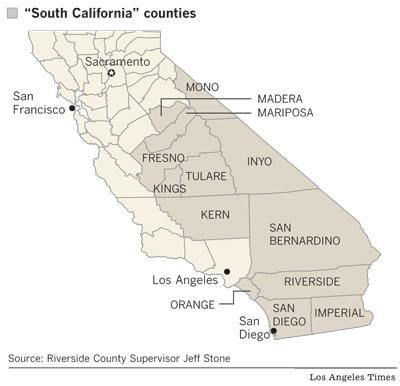
And now, one of those wingnuts seems to agree with me. A Riverside County supervisor named Jeff Stone wants to take 13 conservative counties from the south and the inland empire and create a new state of South California. I say: Why not?


Those counties vote for Republicans who vow to cut taxes and spending — and, of course, those counties also get more in state money than they contribute in taxes. That is, San Franciscans and people in Los Angeles are subsidizing with our tax dollars counties that elect people who don’t want taxes.


Fine. Leave us. Without those counties, California would have a two-thirds Democratic majority in both houses, easy. The state would be able to raise taxes to balance the budget. California’s credit rating would improve and the cost of bonds would drop. A Democrat could run for governor without pandering to the conservatives. Maybe we could even get rid of the death penalty.


South California would be an economic basket case — but it would still be part of America, so the Democrats and sane people who are stuck living there would be able to move north without worrying about ICE. I’d even propose setting aside a state fund (maybe equal to some percentage of what California now spends subsidizing the tax haters) to help pay relocation expenses for low-income liberal refugees.


Seriously: They want to leave, we don’t want them here … why not make everybody happy and let South California go?  

SFBG Poll: Abolishing the death penalty

0

State Sen. Loni Hancock is moving to abolish the death penalty. It’s something others, including Sen. Mark Leno, have pushed in the past, but it’s a tough political scrap — the move would require a statewide vote, and it’s not clear that the money or organizational effort is there for this fall. Of course, the governor could solve the problem with a stroke of his pen, by simply commuting all death sentences to life without parole — but I don’t think he’s going to do that. The best move might well be a coordinated campaign in the fall of 2012, putting together the growing number of law enforcement types who don’t like the current system, the traditional death penalty foes, and the more conservative people who just think it’s too much of a waste of money.


Is it time to get rid of the death penalty? When and how? Vote after the jump.


Free polls from Go2poll.com

Dick Meister: Farm workers need drastic change

0

No workers are more in need of union protection than the nation’s miserably treated farm workers. Yet a promising new effort to ease their path to unionization has been blocked by one of their former champions, Gov. Jerry Brown.

Brown was rightly hailed for signing, in an earlier term as governor, the 1975 law that granted farm workers in California the collective bargaining rights denied them nationwide. It’s the weapon farm workers must have if they are to escape poverty and the arbitrary and often harmful actions of grower employers.

But now, Brown has vetoed a bill sponsored by the United Farm Workers union, the UFW, that would have made it much easier for farm workers to unionize. Currently, they can be granted bargaining rights only if a majority working for a particular grower votes for unionization. The vetoed measure, the so-called Card-Check Bill, would have granted bargaining rights simply on the showing of union membership cards or petitions for union recognition signed by a majority of workers.

Farm workers, of course, are among our most important workers. They help feed us, after all. Their pay nevertheless averages less than $10,000 a year, and most lack employer-paid health care and other benefits. They work hard, frequently under the blazing sun, with few  – if any – rest breaks and without even such simple on-the-job amenities as fresh drinking water and toilets.

The UFW, which sponsored California’s 1975 law, has been trying for many years to remedy farm workers’ conditions by leading them in drives aimed at winning union contracts that promise them decent treatment and an effective voice in determining their wages, hours and working conditions.

 It’s not been easy for the UFW, even with the law in effect. Thanks mainly to employer intimidation and high worker turnover, the union has been able to sign up only a small part of California’s farm labor force and to win only a relatively few contracts from growers. But it’s an important start. Without the law, it would have been nearly impossible.

So why in the world did self-proclaimed farm worker advocate Jerry Brown veto the bill that would have strengthened the union rights granted farm workers in the bill he signed 36 years earlier?

Well, Brown didn’t say much, but did say he didn’t like the bill because it called for “drastic change.”  Which it did, of course. That, as Brown must know, is exactly what’s needed.

Requiring union rights to be granted only by elections gives growers a great opportunity to unfairly pressure workers into voting against unionization – and many take full advantage of the opportunity.

It’s common for growers faced with elections to require workers to attend meetings at which they rail against unions, threaten to fire union supporters and warn that they might have to go out of business if their farms are unionized, or at least greatly curtail operations and thus job opportunities.

“You’re talking about voting on the employer’s site, with foremen and supervisors making eye-contact with you after they’ve alluded to or flat out threatened you with the loss of your job or your housing,” notes a UFW vice president, Armando Elenes. “It takes a lot of strength to even vote.”

There’s plenty of evidence that employers do indeed put lots of pressure on workers to vote against unionization. UFW President Arturo Rodriguez notes, for example, instances of growers pulling guns on workers who were trying to organize.  That may seem exaggerated – but not to anyone who’s experienced the superheated grower-worker confrontation up close.

The UFW is not giving up the struggle for Card-Check recognition. The union will soon re-introduce the Card-Check bill in Congress with the strong backing of the nation’s labor leaders. Some of them call it the single most important labor bill in the country this year.

It certainly is for farm workers and should be for workers in other industries throughout the country who also seek Card-Check rights, and for anyone who wants decent treatment for those whose vital work helps put food on our tables.


Dick Meister is co-author of “A Long Time Coming: The Struggle to Unionize America’s Farm Workers” (Macmillan). He can be reached through his website, www. dickmeister.com.


Hunger strike highlights horrible prison conditions

14

In a state that’s still floundering for ways to comply with court orders to drastically reduce the number of inmates in a prison system that has long been severely overcrowded, people in prison face unconstitutionally inhumane and degrading treatment on a daily basis. And now a group of inmates is highlighting the problem with a hunger strike that begins this Friday, July 1.

Lawyers for and supporters of the group of inmates from the Secure Housing Unit at the notorious Pelican Bay prison will hold a press conference tomorrow (Thu/30) at 11 am outside the state building at 1515 Clay Street in Oakland to announce the hunger strike to back up a list of demands they have submitted to the warden and Gov. Jerry Brown. Their demands include an end to long-term solitary confinement, collective punishment, and forced interrogation on gang affiliation, and they say they will continue their hunger strike until their demands are met.

“The prisoners inside the SHU at Pelican Bay know the risk that they are taking going on hunger strike,” Manuel LaFontaine of All of Us or None said in a prepared statement. “The CDCR must recognize that the SHU produces conditions of grave violence, such that people lose their lives in there all the time.”

The anti-war group World Can’t Wait is also supporting the hunger strike and calling for a supportive demonstration on Friday at 11 am outside the state building in San Francisco at Van Ness and McAllister streets. California officials have for years defied judges’ orders to reduce the prison population, which is at 180 percent of capacity, and the Supreme Court this year upheld the order and is requiring the state to reduce the prison population to 109,000 inmates, of 137.5 percent of the levels the prisons were designed to house.
The Brown Administration is seeking an extension of the deadline as it wrestles with political gridlock and a budget debacle that has stymied the governor’s efforts to transfer more prison inmates to county jails. But that plan avoids the reality that the U.S. has by far the highest incarceration rate in the world, a situation that is both inhumane and fiscally unsustainable.

Jerry’s bad budget

19

The Democrats in the Legislature did what they had to do, and passed the only budget that the governor would agree to. But Jerry’s Budget — and this will always be Jerry’s budget, since he’s the one who insisted on the terms — is pretty bad news.


I could have told the governor six months ago that he’d never, ever get Republican support for tax extensions. I could have told him that things are very different from the 1970s, when he was last governor. Back then, Republicans were actually interested in governing and would work with Democrats. Now they’re only interested in obstructing — and in sticking to a “no taxes” pledge that has severely damaged the state.


But no: Jerry had to be Jerry, and veto the budget the Democrats passed the first time, because he still thought he’d get his way.


Now he has a budget that (a) won’t work unless the economy continues to pick up and (b) protects prisons at the expense of education.


Imagine: The Democratic governor of California saying that he is willing to cut a week out of the school year — but isn’t willing to make comparable cuts in the state prison system.


Oh, and guess what? It gives Republicans the ability to crow about how California didn’t need those tax extensions in the first place.


Way to go, Guv.

Cleaning up UC’s mess

5

news@sfbg.com

By 7 a.m., when engineering students begin to trickle into Cory Hall at UC Berkeley, Arnold Meza has already scrubbed the floors, wiped clean the chalkboards, and emptied the trash of 30 offices and many of the classrooms and hallways of the six-floor building.

His early shift as a custodian is a gift, he says, because it is steady compared to his former swing-shift schedule, but Meza is still barely making rent. And he is a single father of four. Like many service workers in the University of California system, Meza wonders how the university can refuse to give him a 3 percent wage increase while top UC executives receive six-figure bonuses every year.

“It falls on broken promises,” Meza said while tying up a bag of trash, one of hundreds he would take out that week. Meza was referring to an agreement in 2009 between the university and its service workers unions, including Meza’s union, AFSCME (American Federation of State, County and Municipal Employees). At that time, the administration established a minimum wage (currently $13 per hour) for the more than 7,000 service workers and agreed, if funding was available, to increase wages annually to bring their low-wage workers out of poverty.

But the university is going back on its promise, refusing to increase wages with the funding dedicated for that very purpose, the East Bay Alliance for a Sustainable Economy and the Partnership for Working Families (EBASE) notes in its recent report titled “Bad Budgeting, Broken Promises.”

As the UC Office of the President sees it, the 2009 discussion was not an agreement at all, but a “conditional memorandum of understanding” that would only be effective if state funding was available, said UCOP spokeswoman Dianne Klein.

“We’ve already taken $500 million in cuts. We’ll have to take another $500 million in cuts. Because there is no new money, the memorandum of understanding is moot,” Klein told us.

The state budget vetoed by Governor Jerry Brown last week would have set the UC system back $150 million in cuts on top of the $500 million in cuts approved by Brown in January. How much more will actually be cut from UC funding remains to be seen, but the forecast is not promising.

Despite the cuts, the proposed budget bill states that $3 million in distributed state funds should go toward the salaries and benefit of service workers in the UC system. In a March 24 letter to the governor, UC President Mark Yudof requested that the governor veto that restriction so the university could use the dedicated $3 million “to preserve our flexibility in dealing with the $500 million reduction.”

Compared to the total UC budget of $21.8 billion, that $3 million makes up only 0.014 percent — nickels and dimes to give employees a living wage.

Meanwhile, Meza and his fellow coworkers struggle to put food on the table, making ends meet by working two jobs. After his 4 a.m. to noon Monday through Friday shift, Meza works eight-hour shifts as a car mechanic on weekends. Similarly, many UC service workers collect cans to get a few dollars from the recycling center.

“When I started here 20 years ago, I was making close to $9 an hour. That wasn’t enough,” recalled Meza, who put his four children through public high school on that salary. Today, Meza brings home about $2,400 a month, barely enough to cover rent and a few bills at his El Cerrito home.

“I want my kids to go to college. But financially, I can’t afford it,” he said. “For me, it’s a sad reality.”

Meza’s union, AFSCME, is working with UC to lower the workers’ contribution to retirement pensions to 1.5 percent. The university proposes a 3.5 percent pension plan to go into effect this July and 5 percent in July 2012—the same amount requested from top UC executives. At their low wage, that would cost the service workers the equivalent of one biweekly paycheck a year.

Some UC executives, such as UC Berkeley Chancellor Robert Birgeneau, receive additional retirement perks. Roughly 200 highly paid UC executives receive a supplemental retirement benefit of 5 percent of their annual pay, said Nikki Fortunato Bas, the executive director of EBASE. That’s a total annual cost to UC of $4 million.

“If UC gets its way in 2011, instead of getting to climb that next rung on the ladder out of poverty, [the low wage workers] will take a step backward through a combination of increased contributions to retirement and healthcare and UC withholding a 3 percent raise,” Bas said. “All the while, UC is showering already highly-paid executives with six-figure bonuses.”

In an infamous budget battle that has required the UC system to restructure its quickly diminishing funding from the state, more than 100,000 employees’ paychecks have been reduced while top execs like UCLA Ronald Reagan Medical Center CEO David Feinberg receive thousands of dollars in bonuses. In September 2010, Feinberg’s base pay was increased by 22 percent and he received a $250,000 “retention bonus,” for a total compensation of $1.33 million.

These astounding numbers, as part of a $3.1 million package in bonuses for 37 UC executives last September, were quoted in the EBASE report, using data from the UC Regents website (www.universityofcalifornia.edu/regents).

UCOP says the retention bonuses are necessary “because we pay below market as it is [for top executives’ salaries],” said Klein, and the UC needs to offer huge bonuses to keep the executives from moving to higher paying universities. “You have two options: sayonara or we’ll match it,” Klein said. “You can’t recruit in the classifieds for these people … and you’ll have to replace them for the same money, anyway.”

The bonuses are not state-funded, said Klein, but are taken from research grants, patient care, and even federal funding. But Bas said the problem is with UC’s priorities: “Time and again, they have shown that they can find money to give bonuses or backfill sports programs,” she said. “UC may look at this as a matter of technicalities, but we cannot ignore the stories of employees and their families who are struggling to get by.”

As it stands, UC is short-staffed when it comes to service workers. “We’ve been short-staffed for the last 10 years,” said Meza, who estimates that UC Berkeley employs about 140 custodians, less than one-third of the 460 or so custodians the university employed in the 1980s. The result is that the students suffer, said Meza. “The students are getting the short end of the stick because we can only clean once a week in some classrooms because we’re short staff. We see the students pay a lot with tuition, and they’re getting less.”

Already, student fees have increased by more than 32 percent, and another 8 percent fee increase is pending, reported EBASE. As the state continues to make cuts, students and low wage service workers suffer the consequences.

According to the California Budget Project, a single-parent family needs to make $68,375 a year just to make ends meet in Alameda County. “UC workers have reduced-cost healthcare, so this number could be adjusted downward to $58,544,” said Bas. “For a custodian at UC Berkeley or UC San Francisco making $30,000 or even $40,000 a year, this means working two jobs and collecting cans just to scrape by.”

When his oldest was nine years old, Meza remembers, he used to drive his family to the recycling center to get cash for cans he had taken out of the garbage. “The kids were happy in the car because I was going to get money for food when I recycled cans,” which meant there would be dinner on the table that night, Meza said, apologizing for getting teary-eyed at the memory.

“I just don’t want people who work here to go through what I went through to raise a family,” he said.

No matter how many cars Meza fixes on the weekend, he never seems to have a break from the stress of trying to cover fuel, rent, heating bills, doctors’ bills, and other necessities. He’s only 43, but he feels much older after 20 years of working two jobs, seven days a week, providing for four children on his own.

UC workers, unions like AFSCME and other stakeholders have proposed $600 million in budget alternatives such as reducing the excessive 7-to-1 employee-to-management ratio (at UC Berkeley, the average is four employees to one manager). Yet UC does not appear to be seriously considering these alternatives; its current goal is to take back the $3 million dedicated to its low-wage service workers.

“We think this is a matter of finding the will within the UC administration to do what’s right by honoring their word to protect working families’ a path out of poverty,” Bas said.

Two months ago, Meza and his fellow union members marched into UC Berkeley’s Chancellor Robert Birgeneau’s office and asked him to spend one day in the life of a service worker on campus. He still hasn’t answered their request.

“People are really struggling here. We are committed to working and we give 110 percent — that should be accounted for,” said Meza. “Give us our 3 percent. We earned it.”


The guv’s veto — WTF Jerry?

17

Nobody — least of of the Democrats in the state Legislature — quite knows why Gov. Jerry Brown vetoed the state budget. In fact, he didn’t even tell Legislative leaders what he was about to do. “There was no heads up, and that’s the most annoying part of it,” Assemblymember Tom Ammiano told me.


Brown knew exactly what the Democrats were doing. He also knew (or ought to know) that getting any Republicans ever to vote for his tax extensions was, and is, a pipe dream. If he didn’t like the Dems proposal, he could have asked for changes. But no: Jerry is Jerry, and he did his own thing. (Just like Arnold, he complained about the “can being kicked down the road.”) His veto message talks about how “strong medicine must be taken” to solve the deep fiscal crisis; without taxes (which the GOP won’t allow) I guess he’s talking about more cuts. I guess he’s talking about Californians really feeling the deep pain of another $10 billion cuts to services, so maybe they’ll wake up and demand more revenue and oust the Republicans.


But in the meantime, the governor won’t miss any meals.


Brian at Calitics looks at the bright side — at least that sale/leaseback idea is gone. And yes, the budget that the Democrats put forward was ugly and far from perfect. But I don’t see where we go from here. The Democrats in the Legislature aren’t going to vote for another $10 billion in cuts; no way. And the Republicans aren’t going to vote for tax extensions. And the existing taxes expire at the end of the month.


If there’s a good alternative out there, I don’t see it.


Ten good bills for 2011

2

The news in Sacramento is mostly bad — Jerry Brown still can’t find the Republicans he needs to pass a budget, although maybe the redistricting process will help him. But it’s not all bad. Some important bills passed their houses of origin in the past week, and with Democrats controlling both the Senate and the Assembly and a Democratic governor, there’s actually a chance they could become law.


At the top of my list is the measure by Darrel Steinberg that could allow counties and school districts to raise a wide range of taxes. It is, as Sen. Mark Leno notes, a “game changer.” And it only requires a simple majority of both houses. (I wonder: Could the San Francisco supervisors put a tax measure on the ballot in November on the assumption that the Steinberg bill will be in effect by then?) If the GOP won’t budge on the budget, the Dems need to at least give local government the chance to find the resources to keep essential services running.


Assemblymember Tom Ammiano got AB 9, also known as Seth’s Law, approved on the Assembly floor. The measure, named in memory of Seth Walsh, a 13-year-old gay student from Tehachipi who suffered years of harassment and abuse, gives school districts the tools (and the mandate) to address bullying.


The Assembly also approved Ammiano’s AB 889, the Domestic Workers Bill of Rights, which gives domestic workers the same basic labor-law protections as other California workers, and AB 1081, the TRUST Act, which would allow California counties to opt out of S-Comm, the awful federal law that seeks to force local cops to become ICE agents.


Over at the state Senate, Mark Leno won approval for 11 bills, including SB 914, which would mandate that police get a warrant before searching the data on a person’s cell phone. It’s crazy that SB 914 is even necessary, but the state Supreme Court has ruled that, while you need a warrant to search a personal computer, you don’t need one to search a cell phone. SB 790 makes it easier for local agencies to form Community Choice Aggregation systems. SB 819 would give the state more authority to take firearms away from people who have committed felonies or have been institutionalized for mental illness. (The NRA’s going to hate this bill — felons have the right to guns, too …) SB 233 — another one I really like — gives local government the right to impose vehicle license fees.


Sen. Leland Yee won overwhelming support for SB 8, which mandates that foundations affiliated with the University of California, Cal State or community college campuses abide by the same public records laws as the schools themselves. (The Sarah Palin speaking fees bill.) SB 364, which requires corporations that get tax breaks for job creation to prove they’ve actually created jobs. SB 9 — another one that ought to be a no-brainer — ends the practice of giving juvenile offenders sentences of life without parole.


Seems likely all of these will emerge from the remaining house — and then we’ll see whether Brown is willing to sign progressive legislation.


Sacramento deadline: Some key bills

0

A bunch of key bills come up in the state Legislature this week — and some of them are going to be very close. Assemblymember Tom Ammiano is pushing hard to get AB 1017, which would eliminate mandatory felony charges for pot cultivation, throught the Assembly floor (in fact, when I called his press secretary, Quintin Mecke, today (June 1) at about 11 a.m., Ammiano was on the floor making his 1017 pitch.) Ammiano also has a key tenant bill, AB 265, which would allow tenants who are a few days late with the rent to avoid eviction.


Dean Preston, executive director of Tenants Together, has a great rundown on the major tenant bills here. Sen. Mark Leno’s bill, SB 184, which is critical to protecting the rights of cities to demand affordable housing as part of a development deal, is going to be very close. So is Assemblymember Mike Feuer’s AB 934 — a nobrainer that simply clarifies tenant protections that have been threatened by recent court cases. (Preston told me that San Francisco Assemblymember Fiona Ma is not among the bill’s supporters at this point; you can call her office at  557-2312 and let her know you want her to vote for it.)


Sen. Leland Yee has gotten two bills through, one that would allow pharmacies to sell sterile syringes without a prescription and one that mandates more sunshine in the courts. His bill forcing the University of California to open up its foundation records will almost certainly clear the Senate now that UC had dropped its opposition. Tougher going, I expect, for SB 9, which would end life without parole sentences for juveniles.


Leno’s bill legalizing infusion drinks at bars cleared the Senate. He’s also pushing a Community Choice Aggregation bill, SB 790, and  the long-awaited, much-fought-over cell phone, SB 932, which would require modest disclosure of cell-phone radiation.


The difference between this session and the last one is that a lot of these bills might actually get the governor’s signature.

Our Weekly Picks: June 1-7, 2011

0

THURSDAY 2


MUSIC

Architecture in Helsinki

Some bands like to have fun. Not in trashing hotel rooms or humiliating groupies with fish, but actually in the music. OK Go, Los Campesinos!, and Of Montreal: different tones, different levels of schizophrenia, but always a pervasive sense of enjoyment in making music. Australia’s Architecture in Helsinki has always had a random streak: shifting vocal harmonies of its members atop music that might emerge from a glockenspiel one second, an mbira the next. The latest album, Moment Bends, finds the group embracing a more polished, electronic sound. But one thing remains true: no matter what adjective precedes it, any description of the band is still going to contain the word “pop.” (Ryan Prendiville)

With Hooray For Earth

9 p.m., $21

Great American Music Hall

859 O’Farrell, SF

(415) 885-0750

www.gamh.com

9 p.m., $21

Slim’s

333 11th St., SF

(415) 255-0333

www.slims-sf.com


EVENT

Fred Armisen

One of the brightest stars on the roster of players on Saturday Night Live, Fred Armisen has created a host of hilarious characters and is a master of side-splitting celebrity impersonations, channeling people such as President Obama, Larry King, and former New York governor David Paterson. Armisen’s latest project is the outstanding Portlandia, which he cocreated and costars in with former Sleater-Kinney guitarist Carrie Brownstein. Fans won’t want to miss tonight’s special event, where Armisen will engage in an on stage conversation with Mythbusters host Adam Savage about his career and life. (Sean McCourt)

8 p.m., $23

Herbst Theatre

401 Van Ness, SF

(415) 392-4400

www.cityarts.net


DANCE

Zeropoint

Choreographer Sara Shelton Mann and media artist David Szlasa join forces for Zeropoint, a multimedia performance event presented by Z Space and Mixed Bag Productions, tackling nuclear meltdown, perception, and world healing. Composed of dance, video, and social experiment, this world premiere rises on the heels of the team’s powerful recent production, Tribes/Dominion. Shelton Mann, the longtime leader of Contraband (a group of artists working together during the 1980s and ’90s who profoundly influenced Bay Area dance), continues to employ cross-disciplinary work addressing human potential in a time of global change. Don’t miss the latest creation by this dynamic duo layering video and contemporary performance. (Julie Potter)

Thurs/2–Sat/4, 8 p.m., $25

Z Space

450 Florida, SF

(415) 626-0453

www.zspace.org


FRIDAY 3


DANCE

Embodiment Project

Nicole Klaymoon’s Embodiment Project bridges modern dance with the longstanding cultural tradition of street dance in Of Her Rib, a hip-hop drama. Singer-songwriter Valerie Troutt performs live vocals and special guest performances include L.A. funk and hip-hop band, the Elevaters as well as Bay Area hip-hop dance company, Mix’d Ingrdnts to open the evening. Having worked with Rennie Harris and Marc Bamuthi Joseph, Klaymoon is among a growing number of artists folding street dance into theatrical contexts. Through song, movement, and spoken word, the Embodiment Project initiates a conversation about unity, action, and strength. (Potter)

Fri/3–Sun/5, 8 p.m., $20–$28

Dance Mission Theater

3316 24th St., SF

(415) 826-4441

www.dancemission.com


DANCE

Anne Bluethenthal and Dancers

Anne Bluethenthal’s work is so embedded in San Francisco’s dance culture that we tend to take it for granted. Not a good idea. She started out as a gorgeous dancer making exquisite solos for herself and expanded into choreography grounded in the vulnerable human heart. A few years ago, producing had become financially so onerous that she almost gave up. Fortunately, she didn’t. Somewhere she picked up more energy and has been as productive as ever. In its 26th year, her company is presenting a triple bill, Goin’ Gaga, which looks at generational differences between queer women; ABD’s Year of Guerrilla Art, a documentation of weekly public dance making; and excerpts from Daughters Untold, a work that examines violence and sexual exploitation. A rich program by a rich artist. (Rita Felciano)

Fri/3–Sat/4, 8 p.m.; Sun/5, 6 p.m., $15–$20

CounterPULSE

1310 Mission, SF

1-800-838-3006

www.counterpulse.org


DANCE

Rotunda Dance Series

Long before the gold rush settlers and Spanish missionaries descended on the Bay Area, the Ohlone people populated the region, living in a hunter-gatherer society with a culture of sweat lodges, talking circles, and healing ceremonies. The tribe shares their traditions with a free Rotunda Dance Series performance by Rumsen Ohlone Tribe’s Humaya Singers and Dancers presented by Dancers’ Group and World Arts West. As the kickoff for the 2011 Ethnic Dance Festival, this special opening ceremony illustrates an important part of Bay Area history and the Ohlone’s enduring heritage, presence, and cultural life. (Potter)

Noon, free

San Francisco City Hall Rotunda

1 Dr. Carlton B. Goodlett, SF

(415) 920-9181

www.dancersgroup.org


SATURDAY 4


FILM

The Love Bug

Featuring the wacky adventures of Herbie, the beloved Volkswagen Beetle with a mind of its own, Walt Disney’s 1968 movie The Love Bug remains an endearing family favorite. Set in San Francisco and boasting shots of a variety of local landmarks and locations, the film is a great selection for an afternoon matinee to help celebrate the 75th anniversary of Cliff’s Variety, the neighborhood store that stands in the Castro Theatre’s original location. Tickets, soda, and popcorn are all 75 cents, and as an added treat, kids and kids at heart will be able to have their pictures taken with ol’ No. 53 himself. (McCourt)

Noon, 75 cents

Castro Theatre

429 Castro, SF

(415) 621-6120

www.castrotheatre.com


MUSIC

Saturn Returns

Unlike our frantic Earth, with its 365- day orbit, the ringed planet Saturn moseys through the cosmos, revolving around the sun only once every 29 years. Some say this three-decade cycle symbolizes a person saying astrological sayonara to one major phase of existence and entering another, a.k.a. your “Saturn return.” Saturn Returns — a localized super group made up of members of Old Grandad, Acid King, and Night After Night, all bands with various metallic tendencies — might be melodically embodying this starry maxim. With a softness unlike any of their other projects, it’s almost as though they’ve rocked across some fiery threshold and into a focused, dare I say, pretty, melancholy on the other side. Heavy mellow. (Kat Renz)

With Walken and Aerial Ruin

9:30 p.m., $7

Thee Parkside

1600 17th St., SF

(415) 252-1330

www.theeparkside.com


SUNDAY 5


VISUAL ART

“Court Sketches From the New Frontier”

Best known ’round these parts as a David Lynch-inspired singer-songwriter after her critically-acclaimed 2008 album The Ideal Hunter, Kira Lynn Cain originally trained as a fine artist at the San Francisco Art Institute. Her first solo art show hangs in the site that hosted her first musical performance, the appropriately noir-ish Rite Spot. The highly detailed pen-and-ink drawings in “Court Sketches From the New Frontier” are indeed inspired by a new frontier — Cain’s recent move from the Mission District to the historic town of Nevada City, a gold rush-meets-New Age hideout in the Sierra foothills. Cain’s surreal, playfully grim works incorporate strange creatures, even stranger landscapes, and a distinctively dreamlike sensibility. Come out, and be enchanted. (Cheryl Eddy)

Through Aug. 6 (reception tonight, 6–8 p.m., free)

Rite Spot

2099 Folsom, SF

(415) 552-6066

www.ritespotcafe.net


MONDAY 6


MUSIC

Winter’s Bone: The Complete Musical Score”

Get ready for a musical journey deep into the Ozarks, steeped in the rich traditions of classic Americana as the musicians behind the stellar soundtrack to the Oscar-nominated 2010 movie Winter’s Bone come to the city tonight as part of their first-ever national tour. Marideth Sisco, Blackberry Winter, Bo Brown, Van Colbert, Dennis Crider, Tedi May, and Linda Stoffel will all perform the songs — including “Missouri Waltz” and “High On A Mountain” — that helped set the stark tone and created a rich backdrop for the excellent film. (McCourt)

8 p.m., $20

Great American Music Hall

859 O’Farrell, SF

(415) 885-0750

www.gamh.com


TUESDAY 7


MUSIC

Gates of Slumber

It may have taken bruising Indianapolis power trio Gates of Slumber awhile to unleash its full potential, but now that it’s untrammeled, nothing can stand in its way. New platter The Wretch features a new, more thunderous drummer, improved production, and a stripped-down, somber songwriting style that showcases singer-guitarist Karl Simon’s haunting vocals. Lyrics about barbarians with battle-axes — a staple of the band’s previous offerings — make way for tortured, introspective ruminations on life’s many vicissitudes. Also augmented is the presence of bassist Jason McCash’s languid, groovy low-end. Touring in support of UK legends Orange Goblin, these mournful Midwesterners are a must-see. (Ben Richardson)

With Naam and DJ Rob Metal

9 p.m., $14

Bottom of the Hill

1233 17th St., SF

(415) 621-4455

www.bottomofthehill.com 


The Guardian listings deadline is two weeks prior to our Wednesday publication date. To submit an item for consideration, please include the title of the event, a brief description of the event, date and time, venue name, street address (listing cross streets only isn’t sufficient), city, telephone number readers can call for more information, telephone number for media, and admission costs. Send information to Listings, the Guardian Building, 135 Mississippi St., SF, CA 94107; fax to (415) 487-2506; or e-mail (paste press release into e-mail body — no text attachments, please) to listings@sfbg.com. Digital photos may be submitted in jpeg format; the image must be at least 240 dpi and four inches by six inches in size. We regret we cannot accept listings over the phone.

SFBG Radio: The hopeless GOP hopefuls

0

Is there anyone in the Republican presidential field who can actually win both the primaries and the general election? Could we be facing another Texas governor trying for the White House? Check out the discussion after the jump.

NoHopeGOP by endorsements2010

Kucinich v. Palin: Guess who wins?

5

Boy, wouldn’t this be fun?


 Trump is not the weakest Republican in the two hypothetical match ups we tested with Dennis Kucinich. Kucinich’s lead over Sarah Palin if they were to face off would be 43-36. In that scenario Kucinich gets 16% of Republicans to Palin’s 12% of Democrats and leads her by 10 points with independents at 42-32.


I think Rep. Kucinich has enough to worry about just keeping his own seat, but it shows how weak the GOP field is right now. (On the other hand: Two years before the 1992 election, Bush The First was considered unbeatable and no less an authority than the Almanac of American Politics said it was “ridiculous” that anyone would take the young governor of Arkansas seriously as a candidate for president.)


Still: Not good news for Sarah Palin. 

The case for local taxes

8

When state Sen. Darrell Steinberg introduced SB 653, a bill that would allow cities to impose an income tax, a car tax and excise taxes, I called his press office and asked if the senator was serious. Me, I thought this was one of the best ideas I’d ever heard of out of Sacramento, but I couldn’t believe Steinberg was actually going to push it.


After all, Steinberg has been in heated discussions with the Republicans over the state budget, and they’ve been refusing to bend, even an inch, on new revenue. And the Democrats can’t pass a budget alone; the two-thirds requirement for new taxes means at least four members of the recalictrant GOP have to go along.


But if Steinberg could threaten the jerks with a bill that requires only a majority vote but would open the door to all kinds of new taxes up and down the state, maybe they’d start to come around. That seemed like the theory.


But his staff told me that he was entirely serious — and to my astonishment (and perhaps his) the bill is moving forward. We did an editorial endorsing it two weeks ago, and all of a sudden, it’s getting a lot of attention. And it’s exposed a fascinating political debate in the state and raised a lot of questions that ought to be part of the political conversation.


Jerry Brown’s been talking for months about “realignment” — sending more state services back to local government. It’s part of the populist side of the guv, and it flies in the face of 50 years of liberal thought. The federal government used to be our friend — the feds enforced civil rights laws in the racist South. The feds put money into inner cities. The state of California enforced equality, too — the famous Serrano v. Priest decision, in state court, guaranteed that public schools in all areas, not just rich ones, had the resources to provide a quality education to all. “State’s rights” was the cry of segregationists; rich people in conservative communities wanted school funding to be a local decision.


But things are different now, and the political stars are realigned. The most important civil rights moves are coming from cities (see: San Francisco, same-sex marriage) and progressive communities are defying the feds on issues from immigration to medical pot. (The flip side is also happening, see: Arizona and SB 1070).


Right now, today, the single most important issue in the United States (with the possible exception of stupid foreign wars) is the wealth gap and taxation. So much flows from that — the collapse of social services, the cost of health care, unemployment, the crisis in state budgets, the decline in public education … name an issue, and it has at least some roots in the way the nation handles money. And two things have happened in the last 15 years or so, at least at the national level:


1. The Republican Party has been taken over by the far right.


2. The Democratic Party has been taken over by Wall Street.


So nothing good’s going to happen in Washington. And in California, thanks to our two-thirds rule, nothing good’s going to happen in Sacramento as long as a tiny minority of really bad Republicans can hold the state hostage.


Which means that the only hope for progressive economic policy is going to come from local government — and the best thing the Democrats can do in the state Legislature is to stand back and allow it to happen. Which is exactly what the Steinberg bill would do.


Now, the San Francisco Chronicle has come out against the Steinberg bill, saying it would


mark a regrettable retreat from the notion that Californians of many lifestyles and cultures – city dwellers, beach-goers, farmers, ranchers, techies, loggers, entrepreneurs – share a common bond. The delegation of a greater tax burden and government duties to 58 counties and hundreds of cities would only compound the disparities that make this state nirvana for some and Appalachia for others.


The problem is, that notion — that romantic vision of One California — is already gone. California isn’t one state any more; it’s too big to be a state, and it ought to be at least three states. The Democrats control both houses of the Legislature and the governor’s office — and it’s almost impossible even to pass a state budget. There’s nothing resembling a political consensus in California, and we might as well admit it.

I understand the problem of economic disparity — but you can’t address it under the current system. There are, indeed, a few counties that have very little tax base, and that will need substantial state aid; I’m good with that. I’m happy to have my tax money go to the poorest counties. But I’m not seeing the Steinberg bill as a reason to cut state spending; I think we ought to increase state spending. I just think that what comes out of Sacramento should be a floor, not a ceiling. If people in San Francisco want to spend more on their public schools — and do it in a progressive way — what’s wrong with that?

The problem with local taxes is that the most progressive, fair revenue solutions aren’t available to cities. Income taxes are far better than sales taxes; ad valorem property taxes are better than parcel taxes. But cities can’t impose traditional income taxes, and are hobbled by Prop. 13 on property taxes. So when cities DO try to impose their own taxes, the results aren’t fair — the poor pay more than the rich.

Interestingly, Dan Walters of the SacBee, who is by no means considered a liberal, likes the Steinberg bill:

California’s experiment in centralized budgeting, the unintended consequence of Propostition 13’s approval in 1978, has been an abject failure. California is simply too diverse for one-size-fits-all decision making from Sacramento, especially when the Capitol can’t even decide what that size should be.

And City Attorney Dennis Herrera, who is running for mayor, likes the idea, too:


California communities that view government as a needless intrusion into people’s lives are morally entitled to limit their local government, and to pay less for fewer services.   Conversely, California communities that see government’s potential to improve the lives of their residents deserve to fully realize the benefits of the public services they’re paying for.


But the notion that we must bind the fate of 37 million Californians to the governance of lowest common denominator is absurd. 


Steinberg’s bill isn’t perfect — it doesn’t include corporate income taxes. But it’s a lot better than what we have now.

I realize that we’re in tricky territory here — should counties where 80 percent of the voters want mandatory prayer in schools and a curriculum that says God doesn’t like homosexuality have the right to overrule state and federal law and ignore the Constitution in the name of local control? Of course not.

But I think you can argue that local government, after meeting the basic federal and state requirements, has the right to go a step further in the pursuit of civil and Constitutional rights. Just as cities, after receiving their minimum allotment of stae money, have the right to raise more. And do it in a fair way.

At the very least, the bill creates a discussion that we all ought to be having. Cuz the way we’re running the state right now isn’t working.

Campos urges Lee to implement entire due process law

12

Text by Sarah Phelan. Photographs by Luke Thomas


After the Guardian broke the news that Mayor Ed Lee was planning to only partially implement Sup. David Campos’ due process legislation, we headed to City Hall to witness Lee announce his partial shift during question time. And afterwards, Lee told reporters that he spent the months since he was appointed reviewing the policy and talking with leaders in the city’s juvenile justice departments.


“I looked at the difference between youth with family here and youth who did not,” Lee said, noting that his decision to let youth that have family here to have their day in court is in keeping with his policy of focusing on family reunification and getting families more involved.


Lee stressed that youth with family here will still need to be enrolled in school and not be repeat offenders in order to have their day in court.


“It will be decided upon on a case by case basis,” he said.


Lee said he has had conversations with the federal government and US Immigration and Customs Enforcement (ICE) about the policy shift. “We have discussed this,” Lee said. “And we did get a very strong feeling that the federal government is a bit confused.”


Asked how far he is willing to go to defend this latest policy shift, Lee said, “I’ll take that up as it comes. President Obama is struggling with immigration right now.”


Reminded that his predecessor Mayor Gavin Newsom refused to implement any aspect of Campos’ due process legislation, even though a super-majority of the Board passed the ordinance in 2009, Lee said, “I don’t compare myself with the former mayor.”


Asked what percentage of immigrant youth that end up getting booked are “unaccompanied,” Lee said he did not have those statistics. “Check with Siffermann,” he said, referring to the head of the city’s Juvenile Probation Department.”


Lee’s announcement was met with mixed reviews among immigrant advocates.


Civil rights groups applauded Lee’s decision to immediately begin implementation of Campos’ legislation, which was passed in November 2009, restores due process for immigrant youth in the city’s juvenile justice system and ensures that innocent youth are not torn from their families for deportation.  But they also expressed disappointment that Lee will only be implementing the policy for youth who have immediate family here, and not for unaccompanied youth.  And they all urge him to fully implement what they described as Campos’ “duly-enacting, common-sense law so that all innocent youth receive protections.”


They noted that implementation of Campos’ broadly-supported law, which has been endorsed by over 70 organizations, had been stalled until today due to former Mayor Newsom’s refusal to enact the law. 


Under Newsom’s direction, Juvenile Probation reported over 160 youth to ICE at the point of arrest, prior to the youth receiving due process, based only on a juvenile probation officer’s “reasonable suspicion” that a youth is undocumented. 


Civil rights advocates note that Newsom’s problematic policy was responsible for tearing innocent youth from their families and spreading fear among immigrant residents around coming forward to cooperate with police, either as witnesses or victims of crime.  


And they observe that the policy that Juvenile Probation Department has been enforcing since the summer of 2008, and which involved reporting youth for life-altering deportation at arrest, went well above and beyond any obligations under federal law. 


They noted that, as a cadre of legal scholars, including University of San Francisco Law Professor Bill Ong Hing, have repeatedly made clear, there is no requirement imposed on city officials under federal law to ask about immigration status or to report individuals suspected of being undocumented.”


Ana Perez, executive director of Central American Resource Center, agreed.“While we appreciate Mayor Lee taking action to finally begin implementation, we are concerned that he is only implementing the policy for accompanied youth and not for youth who may be unaccompanied because they are trafficked to this country, are orphans, or are escaping persecution.”


“I’m certain it’s not for all youth,” Pérez continued. “So, it’s a small win. But what about the kids who are victims of human trafficking? The fact is we spent so much time developing a policy that was approved by a majority of the Board. So, this is bitter sweet.”


Asked what became of the criminal grand jury investigation that then US Attorney Joe Russoniello initiated in 2008, when Mayor Gavin Newsom was running for governor, and news first broke that the city was accompanying youth who weren’t here with family back to their home country, Pérez suppressed a snort. “It seems that was a bunch of empty threats to try and get the city to move to a more conservative position,” she said. “It’s been a whole new day with Obama.”


Angela Chan, staff attorney at the Asian Law Caucus said that Juvenile Probation’s prior policy of reporting innocent youth exacerbated the impact of a broken federal immigration system on local immigrant families. “We appreciate that Mayor Lee has taken this long awaited step forward because he values family unity and due process for youth,” Chan said. “However, we ask that the Mayor not exclude unaccompanied youth from receiving due process protections.”


Patricia Lee, managing attorney in the Juvenile Unit at the Public Defender’s Office also supported the demand for complete implementation of Campos’ legislation. “If you want the immigrant community to feel safe enough to cooperate with police and probation, then those agencies should not be viewed as representatives of immigration,” she said. “My clients and their families are scared of probation, they are scared of police. Selective implementation of the due process policy for only accompanied youth and not to unaccompanied youth does not solve this problem.” 


And Charles Washington, the Muni bus driver and longtime San Francisco resident, whose wife and 14 year old son were almost separated from him as a result of the prior Juvenile Probation policy, expressed concern that the policy would only be implemented for some youth. “I’m glad to see Mayor Lee is doing the right thing by implementing the due process policy,” he said. “However, he should not leave any youth, especially those who are most vulnerable, behind.”


Sup. Campos applauded the Mayor for implementing the policy while expressing disappointment that it is only partial implementation. As Campos’ stated during the Board meeting, but after Lee had already left, “This body enacted that law and that law needs to be respected.  It is not up to the executive branch to second guess the legislative branch.” 


Sup. Eric Mar added that he supports full implementation for all youth.


 And Sup. Jane Kim, who asked the Mayor during the Board’s Question Time about his plans for implementation, stated, “My hope is that he will commit to full implementation of this policy.”


But in the end, the burden fell on Campos to explain why partial due process is unjust. “This is a good first step, but it doesn’t go far enough,” Campos explained. “As I understand it, the decision Mayor Lee has taken is, that if you are a minor, and are accused of a felony, you will be given due process if you have family here. But if you are charged with a felony, but don’t have family here, then you will not be given due process. Let me begin by thanking Mayor Lee for at least taking one step in the right direction. That said, we still will not have full compliance with a law that was duly enacted by this body. Full compliance means giving every child that interacts with the juvenile justice system due process. So, {Mayor Lee’s first step] is simply not sufficient.”


Campos noted that when mayors are sworn in, they agree to uphold laws that the Board enacts. “So, the law needs to be respected,” Campos said. “It’s not up to the executive branch to second guess the legislative body. That second guessing can only be done by the courts. Therefore, we, once again, ask the mayor of San Francisco to comply with full implementation.”


Noting that a bedrock of the U.S.’ justice system is the principle that we are innocent until proven guilty, Campos said that if the mayor does not fully implement the law, as approved by the Board, “There’s a very real possibility that children that we are reporting [to ICE for possible deportation] are not guilty of what they have been accused of. So, once again, I ask the mayor to reconsider his opinion.”


Campos also noted that there are already procedures in place, within the existing juvenile justice system, to ensure that “we do not have individuals released who should not be.”


After the meeting, Campos noted that the format for the Board’s question time with the mayor currently leaves something to be desired: an opportunity for the Board to reply.


“It would be better if it would allow for some exchange, though obviously, we don’t want it to be a ‘gotcha’ game. But at this moment, it’s too rigid.”


 Asked who drafted the current Question Time format, Campos replied, “Board President David Chiu.”

Ross for boss (of the sheriff’s department)

3

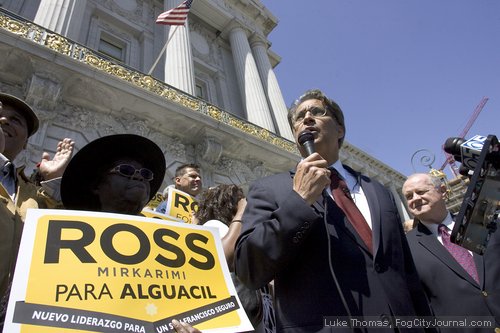
City Hall’s steps were awash in multi-lingual black and yellow “Ross Mirkarimi for Sherrif” signs at noon today, as Mirkarimi supporters watched Sheriff Mike Hennessey, who is stepping down after 31 years of service and eight elections, endorse Sup. Mirkarimi as the next sheriff.  “New Leadership for a Safe San Francisco” was printed on the English version of the signs that Mirkarimi’s supporters carried. They included former Mayor Art Agnos, Sups. David Campos and Eric Mar, Tim Paulson of the Labor Council, Debra Walker, Linda Richardson, Sharen Hewitt, Terry Anders, and Mirkarimi’s partner Eliana Lopez and their almost two-year old son Theo. And everyone had plenty of great things to say about outgoing sheriff Hennessey and sheriff candidate Mirkarimi. And Hennessey even pinned a shiny toy sheriff’s badge onto the T-shirt of Mirkarimi’s son Theo, making him the happiest kid in town. At least for the day.

Campos kicked off the event by honoring Hennessey as the “most progressive and most effective sheriff in the country.”
“Mike Hennessey is also my neighbor in District 9. I see him taking out the trash so I know he’s a good neighbor,” Campos joked, as he listed the many achievements in Hennessey’s long career as an elected official in San Francisco. These achievements included Hennessey’s pioneering innovations in criminal justice and culminated in his decision to blow the whistle in 2010 on the federal government’s plan to activate its controversial Secure Communities program in San Francisco—without telling the public.
“He’s not afraid to stand up for what’s right,” Campos said.

‘This is the time for me to move on,” Hennessey announced, as he laid out his reasons for endorsing Mirkarimi as Sheriff, over other candidates in the field.
Hennessey described the Sheriff’s Department as a “large enterprise” that has over 1,000 employees, a $150 million budget and whose jail houses an average population of 2,000 folks in custody, on a daily basis.
“It’s not something that can be handled lightly,” Hennessey said. “That’s why I’m here to endorse Ross Mirkarimi as the next sheriff.”

Hennessey listed the many endeavors that he and Mirkarimi have worked closely on, including a number of criminal justice issues, and he cited Mirkarimi’s extensive law enforcement background, his significant legislative accomplishments in the areas of criminal justice and public safety, and his ability to find innovative solutions and overcome obstacles to progress, as reasons to support Mirkarimi.

Hennessey observed that criminal justice is “one of the thornier issues” that members of the Board of Supervisors are often asked to get involved in, but often duck.”But Ross has not shied away from working on them,” Hennessey said, citing Mirkarimi’s involvement in shaping the “No Violence Alliance Project” and his leadership in creating the Safe Communities Re-entry Council.

Hennessey also noted that in face of AB 109, the Governor’s plan to transfer state inmates to county jails, “it’s vitally important to have person in charge of sheriff’s office that understands these alliances and can make them work more effectively.”

Hennessey concluded by observing that the Sherrif’s Department has to deal with a lot of bureaucracy, so it’s important to understand how the Board, the budget process and other city departments, including the District Attorney’s office and the police, work.
‘And that’s why I’m endorsing Ross as Sheriff,” Hennessey said

Then it was the turn of Mirkarimi, who graduated from the San Francisco Police Academy, did Naval Reserve training and worked for more than 8 years as an investigator for the District Attorney’s office, to speak.

“I have never been at a loss for words,” Mirkarimi acknowledged, as he launched into a speech that began by thanking everyone for showing up at short notice “for one of the most important occasions of my political career.”

Mirkarimi did a great job of giving Hennessey the praise he deserves.
“He is a living legend,” Mirkarimi said. “It’s completely impossible to fill his shoes.”
Citing Hennessey’s integrity and his ability to innovate, Mirkarimi warned that, “Maybe it’s come to the point where we have taken him for granted. He’s the longest serving elected official in the history of San Francisco, and he’s probably the most understated.”

“And the most important endorsement in this race is that of Mike Hennessey,” Mirkarimi added, as he gave Hennessey his commitment “to build upon your legacy as effectively as possible.”

Mirkarimi cited some of the most immediate and serious challenges that face the next sheriff. These include AB 109, which Gov. Jerry Brown just signed, which. Mirkarimi said, threatens to increase the reentry prisoner level by 30 percent in California. “It will take creative ingenuity and resources to make sure we are effective in taking care of this population,” he said.

Mirkarimi also touched on the rising number of veterans that are ending up in the prison system, talked more about the No Violence Alliance Project, and suggested that certified deputy sheriffs could help serve warrants, transfer prisoners, and patrol Muni, “when the police department finds itself understaffed” so as to ensure that San Francisco is safe.

“For every four people arrested and jailed in San Francisco, three out of four are repeat offenders in a three-year period,” Mirkarimi warned, by way of explaining why he wants to advance a more collaborative spirit between SPPD and the Sheriff’s department.

Mirkarimi also noted that one out of every 15 African American males are in jail, at any time in the year, compared to I out of 300 males who are not black or brown. “So, we must step up our game in dealing with poverty,” he said, as he recommended increased access to job training and good jobs, “so work doesn’t become a seasonal hope but a permanent job.” He also made the connections between a lack of good housing, childcare, and schools and a rise in poverty, crime and recidivism.

Mirkarimi concluded by crediting Hennessey for “walking that fine pirouette” between upholding the principles of public safety and understanding the power of redemption at the same time.

I asked Sheriff Mike Hennessey what he considers to be the biggest challenges of running for sheriff/
“Letting people know what you are going to do, and what your issues are,” Hennessey said, noting that San Francisco has an intelligent, issues-driven electorate.

And Mirkarimi’s supporters weren’t shy about letting folks know the issues that the current D5 Supervisor has helped them with, over the years.

“Ross, as a supervisor and me, as someone who comes from a community of color, we know the habits that ex-offenders can bring with them, if there are no safety nets,” said Terry Anders who sits with Mirkarimi on the Safe Communities Reentry Council. “And I believe in what Ross stands for and the integrity of his person. He’s one of the first people to show up when there are crimes and victims, and he attends basketball games and boxing matches.”

Paulette Brown, whose son Aubrey Abraska Jr, was murdered in August 2006, but whose killers have still not been brought to justice.
“We shouldn’t have to run and leave our families, we should be protected,” Brown said. “Ross is my district supervisor and if he can get in, and do something about crime and solve unsolved homicides, then I’m for him. Maybe if he gets in, he’ll have more pull to do something about these unresolved cases.”

And then it was back to work, which for Mirkarimi now includes the somewhat daunting task of trying to raise money in an election year that also includes a mayor’s race, but does not include the help of public financing, at least not for the sherrif’s race….

Editorial: Let counties raise taxes

3

The president of the state Senate, Darrell Steinberg (D-Sacramento), has a bill that could profoundly change that way California pays for government. At lot of insiders think it’s just a ploy, a way to force Republicans to come to the table and accept some tax measures, but Steinberg appears serious. He’s presenting the bill to the Governance and Finance Committee May 4, and a simple party-line majority vote could get it to the governor’s desk.

The bill, SB653, would allow counties and school districts to approve taxes — a wide range of taxes, the type that are now entirely under the control of the state. Local governments could impose an income tax, a transactions and use tax, an oil severance tax, a vehicle license fee, or a tax on alcohol, cigarettes, or marijuana. It’s part of what Gov. Jerry Brown calls “realignment” — returning more authority to local government, which is complicated and has advantages and disadvantages. But on its own, the tax measure makes perfect sense: if the residents of San Francisco want to pay a higher car tax, or income tax, or tax on booze, and use the money for better schools and public services, why shouldn’t they be allowed to do it?

San Franciscans pay far more in state taxes than the city gets in state money. That’s one of the great ironies of California finance: the more liberal counties, where the voters support adequate public services, wind up subsidizing the more conservative areas that demand tax cuts. A certain amount of that is inevitable, and even laudable: richer areas should be helping pay for schools, police, and roads in poorer areas. It’s certainly true in the arena of public education, where the courts have, properly, ruled that that state has to make sure every school district gets adequate funding so that kids in Marin County don’t get better educational opportunities than the kids in Tulare County.

And there’s always the risk that realignment will push the state back to the days when geographic inequality was even more dramatic, that California will wind up being, as Sen. Mark Leno (D-SF) once put it: “Hollywood next to Mississippi.”

But Steinberg’s bill doesn’t cut state funding at all; in fact, he’s among the Democrats working to avoid more budget cuts. SB653, properly administered, wouldn’t mean less money for any local agency. It would just remove the ceiling.

California is becoming too big to govern effectively with the current rules — and under the state Constitution, written in a very different era with a smaller, more homogeneous population, even a tiny number of Republicans can hold the budget process hostage. That means, for better or worse, that cities like San Francisco, where residents want decent services and a credible social safety net, are on their own. And if Brown’s proposals to put more of the service burden on the counties (for example, by shifting thousands of state prisoners into county jails) move forward, local governments are going to need the ability to raise their own resources.

Unfortunately, many of the taxes that state law currently allows local government to impose (sales taxes, for example) are regressive. Taxes on income and motor vehicles are far more fair and progressive, and ought to at least be available to cities and counties.

The Democrats in Sacramento need to take this seriously and work for its passage. It’s not the entire solution to the budget crisis and to economic inequality — but it’s an excellent start.

Mirkarimi running for sheriff

27

OPINION Serving as San Francisco Sheriff is a huge civic responsibility. The sheriff has 1,000 employees, more than 2,000 pretrial and sentenced prisoners daily, and management responsibility for a budget of more than $150 million. And, like all department heads, the sheriff’s involved in a lot of politics.

I believe Sup. Ross Mirkarimi is the person best prepared to serve as San Francisco’s next sheriff.

Mirkarimi has the law enforcement experience of graduating from the San Francisco Police Academy (as class president) and more than eight years of on-the-job experience as an investigator for the San Francisco District Attorney. He was the lead investigator in one of the city’s all-time biggest white collar crime cases, against Old Republic National Title Insurance Company.

As a union labor representative in the D.A.’s office, he picked up some significant experience negotiating contracts for public safety personnel under the CALPERS retirement system.

He’s no stranger to the training and discipline of a paramilitary institution, having been certified in advanced environmental crime forensics from the Federal Law Enforcement Training Center in Glynco, Ga., as well as earning an honorable discharge from the U.S. Navy for serving in the reserves.

Equally important, Mirkarimi has demonstrated the progressive values required to maintain and expand San Francisco’s outstanding track record of diversity in hiring, innovation in criminal justice, and commitment to rehabilitation San Francisco deserves in our next sheriff.

Elected supervisor in 2004, and reelected in 2008 with 77 percent of the vote, Mirkarimi has been a very effective advocate for his district and for San Francisco — especially on public safety issues.

As a member of the Budget Committee for five years and twice chair of the Public Safety Committee, he is intimately familiar with the complicated issues confronting all partners in San Francisco’s criminal justice system, whose combined budgets account for well over $1 billion.

Mirkairmi and I have worked together on many criminal justice issues, including the creation of San Francisco’s Reentry Council and an innovative community-based program that provides case management services to ex-offenders who have a history of violence. That program — the No Violence Alliance — has significantly reduced recidivism among the program’s participants. It was a risky venture to take on violent offenders as a case management study, but both Mirkarimi and I felt that it was time San Francisco expanded its approach toward effective reentry.

It is this type of thoughtful, yet courageous approach to our criminal justice challenges that leads me to endorse Ross Mirkarimi to be my successor.

The San Francisco Sheriff’s Department has many difficult challenges ahead: a diminishing budget; the governor’s “prison realignment,” which will put many state prisoners in the county jail; preserving the jail’s rehabilitation programs; and finding cost-effective ways of managing the 40,000 individuals who come through San Francisco’s jails each year.

I believe Ross Mirkarimi brings the right combination of law enforcement training, legislative experience, and political acumen to meet these challenges. I am proud to support him in his bid to become our next sheriff.

Mike Hennessey is sheriff of San Francisco.

Let counties raise taxes

2

EDITORIAL The president of the state Senate, Darrell Steinberg (D-Sacramento), has a bill that could profoundly change that way California pays for government. At lot of insiders think it’s just a ploy, a way to force Republicans to come to the table and accept some tax measures, but Steinberg appears serious. He’s presenting the bill to the Governance and Finance Committee May 4, and a simple party-line majority vote could get it to the governor’s desk.

The bill, SB653, would allow counties and school districts to approve taxes — a wide range of taxes, the type that are now entirely under the control of the state. Local governments could impose an income tax, a transactions and use tax, an oil severance tax, a vehicle license fee, or a tax on alcohol, cigarettes, or marijuana. It’s part of what Gov. Jerry Brown calls “realignment” — returning more authority to local government, which is complicated and has advantages and disadvantages. But on its own, the tax measure makes perfect sense: if the residents of San Francisco want to pay a higher car tax, or income tax, or tax on booze, and use the money for better schools and public services, why shouldn’t they be allowed to do it?

San Franciscans pay far more in state taxes than the city gets in state money. That’s one of the great ironies of California finance: the more liberal counties, where the voters support adequate public services, wind up subsidizing the more conservative areas that demand tax cuts. A certain amount of that is inevitable, and even laudable: richer areas should be helping pay for schools, police, and roads in poorer areas. It’s certainly true in the arena of public education, where the courts have, properly, ruled that that state has to make sure every school district gets adequate funding so that kids in Marin County don’t get better educational opportunities than the kids in Tulare County.

And there’s always the risk that realignment will push the state back to the days when geographic inequality was even more dramatic, that California will wind up being, as Sen. Mark Leno (D-SF) once put it: “Hollywood next to Mississippi.”

But Steinberg’s bill doesn’t cut state funding at all; in fact, he’s among the Democrats working to avoid more budget cuts. SB653, properly administered, wouldn’t mean less money for any local agency. It would just remove the ceiling.

California is becoming too big to govern effectively with the current rules — and under the state Constitution, written in a very different era with a smaller, more homogeneous population, even a tiny number of Republicans can hold the budget process hostage. That means, for better or worse, that cities like San Francisco, where residents want decent services and a credible social safety net, are on their own. And if Brown’s proposals to put more of the service burden on the counties (for example, by shifting thousands of state prisoners into county jails) move forward, local governments are going to need the ability to raise their own resources.

Unfortunately, many of the taxes that state law currently allows local government to impose (sales taxes, for example) are regressive. Taxes on income and motor vehicles are far more fair and progressive, and ought to at least be available to cities and counties.

The Democrats in Sacramento need to take this seriously and work for its passage. It’s not the entire solution to the budget crisis and to economic inequality — but it’s an excellent start.


Now just end the death penalty

2

Jerry Brown is going to save the state $356 million by scrapping plans to build a new Death Row. Go, Jerry. Now if he really wants to save money he can scrap the death penalty.


It’s actually one thing a governor can do on his own; he can just issue a blanket stay of execution to all condemned inmates. He can, without ever having to get a single Republican vote in the Legislature, call off executions in California. I know he’s not personally a fan of the death penalty. Wouldn’t it be wild if Jerry became the first governor in the country to get rid of it not because of morals or questions about innocence (both of which are excellent reasons to stop the state from killing people) but because it was a waste of money?


Most people on death row die of old age. Life without parole IS a death sentence; you’re going to die behind bars. Call it off on fiscal grounds, guv — and Let the Republicans defend this wasteful state spending.

PG&E CEO Peter Darbee stepping down

Word’s out that Peter Darbee, the Chief Executive Officer of Pacific Gas & Electric Corporation, is stepping down. Darbee’s departure comes amid a federal investigation into the deadly San Bruno pipeline explosion, which resulted in tragic loss of life, devastated an entire neighborhood, and served to highlight safety issues with the utility’s vast network of underground gas transmission pipelines.

Longtime energy industry observer John Geesman, who blogged about PG&E’s bid to eliminate community choice aggregation last year with the statewide ballot initiative Proposition 16, offered some rather interesting insights on Darbee in a series of posts last year. In one titled, “How Much of the Goldman Sach’s Kool-Aid did PG&E’s Peter Darbee Drink?”, he reflected on Darbee’s past experience on Wall Street: “Peter Darbee has been CEO of PG&E Corporation since 2005. He was an investment banker at Goldman Sachs from 1989 to 1994.”

Darbee was one highly paid CEO. Geesman pointed out that he “massaged PG&E’s internal system to produce a $10.6 million gusher for himself in 2009 — that’s 74 percent above the median for large utility CEOs measured in the Wall Street Journal’s annual compensation survey.”

Prop. 16 went down in flames, of course, after a majority of voters from PG&E’s service territory rejected it (Darbee had this to say for himself in the aftermath). Yet that entire debacle was soon forgotten once the tragic Sept. 9, 2010 pipeline explosion occurred.

Michael Peevey, president of the California Public Utilities Commission, issued this statement soon after Darbee’s resignation announcement: “The CPUC today learned of the resignation of Mr. Darbee from PG&E Corp. While obviously the company under his leadership has been responsible for several poor and consequential decisions, Mr. Darbee’s commitment to PG&E and its constituents is unquestioned. As PG&E’s Board of Directors recruits a successor, the CPUC urges the company to return to its roots by hiring the most technically competent person; someone with a long-standing history of performance in the energy industry.”

The Chronicle’s reporting that Darbee’s retirement package will total $34.7 million.

When former PG&E Senior Vice President Nancy McFadden resigned at the end of last year, she was awarded a severance payment of $1,040,400, plus an undisclosed payout in stocks. McFadden was the architect behind Prop. 16, and she wasn’t unemployed for long. In January, she was appointed to serve as Gov. Jerry Brown’s Executive Secretary for Legislation, Appointments and Policy in the Office of the Governor. That job pays $175,000 per year.

This post has been updated from an earlier version.