Governor

SF’s bike injunction becomes absurd

14

By Steven T. Jones

The three-year-old injunction against any bicycle-related improvements in San Francisco has gotten downright surreal. There was a court hearing yesterday before Judge Peter Busch, at which city officials and bike advocates hoped the unusually broad injunction would finally be lifted.

Instead, the judge indicated he may wait until early next year for a full hearing on whether the San Francisco Bicycle Plan’s Environmental Impact Report – developed over the last two years at a cost of more than $1 million – fully complies with the California Environmental Quality Act (the city originally didn’t do a full-blown EIR on the bike plan, which was what led to the injunction).

The city will prepare a list of planned near-term improvements for the judge by this Friday, and both sides will be submitting briefs before another hearing on Nov. 12, addressing whether changes could be undone if the injunction is partially lifted now and the judge later rules the EIR is inadequate. Streetsblog SF has a good discussion of the issue, including input from Rob Anderson, who brought the lawsuit that led to the injunction.

But there’s an even more basic absurdity here. Installing bike racks or painting sharrows on the road doesn’t hurt anyone, and it promotes activity that is unquestionably good for the environment, which was the intention of CEQA. Meanwhile, the Legislature and governor have waived CEQA entirely for a massive proposed football stadium in Southern California (which may be used to lure away the 49ers).

So, San Francisco has now completed and certified an EIR, but we’re still not allowed to even put in a single bike rack. Yet a massive new stadium and billions of dollars worth of federal spending on local freeway expansions get approved with no consideration given to their environmental impacts. Does this strike anyone else as surreal?

Why the Campos legislation matters

4

By Tim Redmond

The mayor doesn’t like the Campos sanctuary legislation, and won’t even debate Campos over it (chickenshit; no wonder he couldn’t get elected governor).

So here’s what the mayor doesn’t want to talk about: Kids who are doing nothing wrong — good kids, San Francisco kids going to high school and getting good grades — winding up hauled off the streets and shipped to out-of-town detention centers for possible deportation.

in mid-september, an 18 year old client of mine, let’s call him carlos, went missing for two days. he was waiting for his uncle at a bus stop on 9th and market where a witness told his uncle that the police took him away. his family called the police to locate him, but could not find him. finally, carlos called his family and told them he was in an ICE detention center in arizona. apparently, an undercover police officer tackled him from behind and started asking him questions in english. he didn’t understand and this seemed to upset the police officer more. carlos said the officer hit him, put him in a police car, and took him to 850 bryant. he didn’t get a phone call until he was in arizona.

Thanks to MissionMission for that story. I can tell you, there are many, many more like it in San Francisco.

Newsom’s out

10

By Tim Redmond

So Gavin Newsom made official what so many have been speculating on for so long: He’s out of the governor’s race.

And I suspect that means he’ll be in the city until his term ends in 2012.

There’s been a lot of talk of him running for lieutenant gov, but one source in City Hall who is close to Newsom told me that’s unlikely — because if he won the second-tier post and left the city for Sacramento, the Board of Supervisors would be able to choose his replacement.

“His supporters here would be furious,” the source said. “It’s one thing to turn the city over to David Chiu and Aaron Peskin to take over as governor of California. But to do it for the worthless lieutenant governor job? The money people would never forgive him.”

Cal-ISO still won’t approve full shutdown of Potrero power plant

1

A group of San Franciscans who’ve been pushing for complete closure of the Mirant Potrero Power plant traveled to Folsom, Calif. today to testify before the California Independent System Operator (Cal-ISO), a quasi-governmental agency that has required the plant to stay open for reliability purposes despite longstanding opposition from elected officials and grassroots organizations.

“I keep hearing the word ‘stakeholders,’” noted Marie Harrison, an organizer with San Francisco-based Greenaction for Health and Environmental Justice, following comments delivered by the Cal-ISO’s Board of Governors. “I simply want to let you know that your biggest stakeholders are not at the table — and that be us,” she said. “I realize that the grammar is not quite correct, but I did that purposely, because I needed to have your attention when I say that. Unless we are at the table with, quote, the stakeholders, you don’t really have a true representation.”

The aging power plant has been opposed by multiple community organizations, Boards of Supervisors, and San Francisco mayors, but it remains in full operation. And as of today’s Board of Governor’s meeting, the most the Cal-ISO would commit to is removing the largest unit by the middle of next year, despite an agreement that the San Francisco City Attorney’s office struck with Mirant to shutter the entire plant by the end of 2010.

Others who turned out from San Francisco included John Lau, an aide to Sup. Sophie Maxwell; Theresa Mueller, representing the San Francisco City Attorney’s Office; and two representatives from the Brightline Defense Project, a nonprofit organization that focuses on environmental justice.

“We really are almost there,” Mueller told the ISO Board of Governors. “We would like to push you as much as we can on the Unit 3 closure.” As for the other units, “We’ve submitted comments to you over the course of the last few months based on work that PG&E has done, work that we’ve done, and work that the ISO staff has done, and we believe those units will not be needed after 2010,” she added.

Unit 3 is the primary electric generating unit at the plant. Powered by natural gas, it operates close to 24 hours a day, and community organizers say it has contributed to health problems in the city’s Southeast sector. At today’s meeting, Cal-ISO representatives said that Unit 3 could be released from a requirement to stay in operation by the middle of next year — provided the TransBay Cable comes online as scheduled. That’s much later than San Francisco activists and elected officials had hoped for.

The gov’s f-bomb explodes

10

By Tim Redmond

Wow, even the San Francisco Chronicle is critical of Gov. Schwarzenegger’s elementary-school-level prank. (My ten-year old son saw the letter on my desk yesterday and read it and said: “Is that guy really the governor of California?”)

It’s been fun watching the national news media go gaga over this, in part because nobody wants to use the word “fuck.” Here’s the New York Times:

The message can be seen only by a careful reading of the printed version of the veto statement. By taking the first letter of each line, beginning with the third line, two words emerge: The first is obscene; the second is “you.”

The Times also had trouble with Ammiano telling the guv to “kiss my gay ass.” That came out like this:

Mr. Ammiano, who is gay and was upset over cuts to state-financed AIDS programs, shouted at the governor, calling him a liar. Mr. Ammiano also apparently shouted another — more vulgar — insult.

Most of the news coverage, though, has missed one of the key points — this was a bill that would have helped San Francisco finance port repairs. It was uncontroversial, he no opposition, and would have cost the state nothing. So the Guv not only made an ass of himself; he hurt the city of San Francisco in the process.

Naomi Klein on The Shock Doctrine, California style

0

By Rebecca Bowe

Naomi Klein showed a portion of this film clip during her lecture at UC Berkeley last night. In it, Arnold talks about how Milton Friedman changed his life.

Speaking at the University of California at Berkeley yesterday evening, award-winning journalist and author Naomi Klein lamented the sweeping budgetary cuts to education, women’s shelters, and a host of critical social services that have rocked California in recent months.

“When these cuts are imposed, it’s constantly portrayed in the media as if it’s an unfortunate and painful necessity,” she said. On the contrary, she argued, the gutting of the public sector in California is no coincidence.

Klein pointed to an overarching conservative agenda that touts free-market capitalism and limited government, and resists raising revenues with tax increases. (We referenced Klein’s book, The Shock Doctrine: The Rise of Disaster Capitalism, in our cover story last week. So it’s also not a coincidence that our cover package, “The California Nightmare,” touched on many of the same themes.)

Klein showed a brief film clip that included footage of California Gov. Arnold Schwarzenegger praising the ideas of conservative free-market economist Milton Friedman. “What you always have to remember in this discussion is that your governor is a hardcore ideologue,” Klein said after showing a clip in which Schwarzenegger is seen gushing, “Dr. Friedman changed my life!”

“These pet Republican policies have been lying around,” Klein said. “These ideas are still incompatible with democracy, still deeply unpopular.” Nonetheless, they’re being rolled out in uncertain times and unstable places, according to Klein, while masquerading as emergency measures.

The odds of Arnold’s Fuck You

17

By Tim Redmond

Wow, this thing got a lot of attention — I think it shows how much fascination the world has with our lame, incompetant and famous governor. Check out the comments and you’ll notice something else: The minute Matier and Ross on sfgate picked this up, the right-wing nuts started weighing in, which makes you wonder (or not wonder) who exactly reads the San Francisco Chronicle.

At any rate, Supervisor David Chiu has done the math and concludes that it’s highly unlikely this was a mistake:

Assuming it was real, I calculated the probability that this is pure
chance. Assuming it’s a 1/26 chance for each particular letter, the
probability that this is random is one out of 8,031,810,176.

Editor’s Notes

0

Tredmond@sfbg.com

The new police chief, who started out with a lot of promise, has been sending some very bad signals the past week.

Chief George Gascón told us earlier this month that he was sympathetic to the efforts of Sup. David Campos to protect immigrant kids from deportation. He also said he agreed that the cops and probation officers shouldn’t be deciding when to call in the federal immigration authorities. Yet now that the mayor said he will defy the Campos legislation (see page 11), Gascón told the San Francisco Chronicle he’s siding with Newsom. That’s a pretty cosmic wimp-out — and it only took a few days.

Then there’s the shake-up of top staff — which looks to me like a total cave-in to the Police Officers Association. The POA types (who have been associated with a lot of bad stuff over the years) got tough-guy cop Greg Corrales assigned back as captain of Mission Station (where he got in trouble during the Fajitagate scandal, but ultimately faced no discipline. They got Greg Suhr, who had been demoted on a pretty bogus technicality, a new career shot as captain of the Bayview station.

Paul Chignell, one of the rare almost-liberals in the department who was doing a good job at Taraval Station, has been exiled to the night shift. Al Casciato, who supported community policing, has been bounced out as captain of Northern Station in the Western Addition. "This completely belies Gascón’s promises about community policing," Sup. Ross Mirkarimi told me. "These unannounced and unplanned rotations (of district captains) undermine the whole community-policing idea."

And perhaps most alarming, the chief wants to bring back the old SFPD intelligence unit — once again turning local cops into spies.

The intelligence squad was a nightmare. Back in the early 1990s, an intel cop was spying on Arab American and Palestinian groups and passing along the data to the private Anti-Defamation League of B’nai B’rith. Cops were spying on peace activists and protesters. They even had a file on me. When all that started to come out, the city properly shut the spy shop down.

Now Gascón wants to bring it back, citing fears about terrorism. As if there aren’t enough government agencies spying on people already. And SFPD has enough trouble solving murders and keeping its own house in order — opening a spy agency is a really, really bad idea.

Gascón is also refusing to tell Mirkarimi and the other supervisors how much taxpayer money gets spent sending officers around with the mayor as he campaigns up and down the state. I could argue that the Newsom for Governor campaign ought to reimburse the city for those expenses — but Gascón won’t even produce a gross figure. His claim: Telling the taxpayers how much the mayor’s security detail costs threaten Newsom’s security.

I don’t buy it. We’re not asking for protection plans, schedules, deployments, or anything else — just a bottom-line cash number. SFPD doesn’t need spies or a black budget. If Gascón thinks that style is going to work here, he’s going to run into trouble, quick.

Gavin Newsom, lawbreaker

0

EDITORIAL Mayor Gavin Newsom has set off something of a crisis in San Francisco government by insisting that he will defy the city law that seeks to protect immigrant youth from deportation. While Newsom claims that the sanctuary policy approved 8-2 by the supervisors last week violates federal law (something the same-sex marriage advocate hasn’t worried so much about in the past), this is really a matter of politics. Newsom, candidate for governor of California, doesn’t want to seem soft on crime — so Newsom, mayor of San Francisco, is siding with the federal immigration authorities.

He’s also putting out a misleading message about the law.

The sanctuary legislation, by Sup. David Campos, is an attempt to deal with a very real — and serious — problem. Under the city’s current policy, any time a young person is arrested and the juvenile probation department thinks he or she might lack documentation, the officers involved contact Immigration Control and Enforcement. That means kids who have lived in this country for years and have no ties to their birth nation can be deported — just on the basis of an arrest that could turn out to be groundless.

Campos’ law establishes a city policy that prohibits local law enforcement from reporting juvenile offenders to ICE until they’ve been convicted of a crime. That’s just basic due process.

Newsom insists (and the city attorney’s office agrees) that no city employee can be penalized for contacting ICE. But that’s not the point of this law. Right now, juvenile officers are required to call ICE when they have someone in custody who may be undocumented. There’s no federal law saying this has to happen. And it’s perfectly legal — and appropriate — to lift that mandate and to say, in effect, that no city employee should be penalized for declining to turn a kid over to the feds.

At this point, the city attorney hasn’t argued that the Campos bill is illegal or unenforceable, and no judge has overturned it. When, as expected, the supervisors override Newsom’s certain veto, the bill will become city law — presumptively valid until a court rules otherwise. And Newsom has a legal obligation as mayor to abide by and enforce that law.

City Attorney Dennis Herrera is in something of a bind here since he has to represent both the mayor and the supervisors. But he needs to make clear, in public, that while he warned of possible legal implications of the Campos legislation, right now there is nothing preventing the law from taking effect — and that the mayor, like any other city official, is required to follow it.

The supervisors need to keep pushing the issue, too. And they need to be prepared to go to court to seek a writ mandating that the city’s chief executive follow his sworn oath and faithfully execute the law.

None of this needs to happen. Newsom could have worked with Campos on the legislation. Instead, the mayor continues to defy the board and act like the sort of imperial executive who is utterly unqualified for any higher office. For the sake of innocent kids facing the horrors of deportation, San Francisco’s reputation as a sanctuary city and Newsom’s own political future, he needs to back off and agree to abide by the city’s own laws.

Arnold to SF: Fuck You

201

By Tim Redmond

It was hardly a bill of cosmic import, but Assemblymember Tom Ammiano’s AB 1176 would have helped the Port of San Francisco with some financing issues. It’s the kind of bill that legislators offer on behalf of their cities all the time — and generally, they are non-controversial. This one was the same — no substantive opposition, it passed both houses easily — and normally, the governor would sign it with little fanfare.

But no: Arnold Schwarzenegger vetoed the bill — and sent Ammiano and the legislators a remarkable veto letter. The letter says nothing about the substance of the bill; in fact, the language is really convoluted and it’s hard to figure out what the gov is really saying.

Here’s the official message:

1027arnold.jpg

But wait — there’s a real message, an actual missive from the Gov to Tom, embedded in this text. And it’s not hard to find — in fact, it’s hard to believe it could have been a coincidence.

Read down the letters on the left side of the message

1027fu.jpg

Well, maybe Arnold is still mad at being told to “kiss my gay ass”, but this is a rather puerile way for the governor of California to be spending his time.

Let’s not forget — there was a substantive bill here that would have helped San Francisco. So the gov is not just telling the entire Legislature Fuck You, he’s also saying it to the city and county of SF.

What an asshole. No wonder it’s hard to get anything done in Sacramento; the gov’s office is full of frat boys spending hours (and it would have taken hours to get this exactly right) making stupid little-boy jokes.

(His press office hasn’t returned my call seeking comment on this; I’ll let you know if they do.)

More on SFBG:

>>The lesson of California: The Golden State that invented the tax revolt is failing, but the conservative movement presses on

>>Attack of the right-wing nuts: The manipulations and media machine behind the assault on progressive ideas

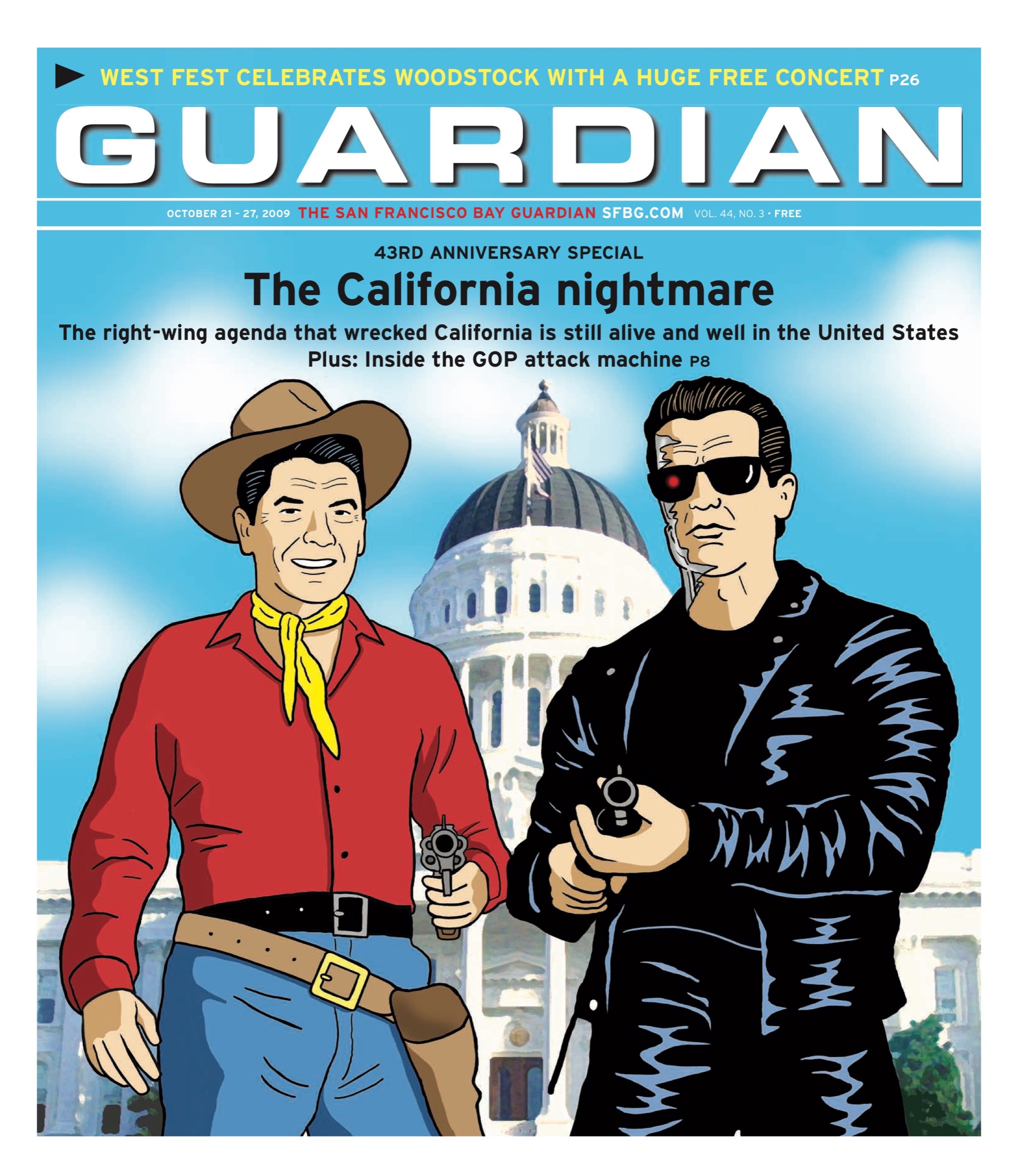
Guardian graphic by Ben Hopfer

Editorial: Gavin Newsom, lawbreaker

2

Gavin Newsom, candidate for governor of California, doesn’t want to seem soft on crime, so Newsom, mayor of San Francisco, is siding with the federal authorities on deporting immigrant youth

EDITORIAL Mayor Gavin Newsom has set off something of a crisis in San Francisco government by insisting that he will defy the city law that seeks to protect immigrant youth from deportation. While Newsom claims that the sanctuary policy approved 8-2 by the supervisors last week violates federal law (something the same-sex marriage advocate hasn’t worried so much about in the past), this is really a matter of politics. Newsom, candidate for governor of California, doesn’t want to seem soft on crime — so Newsom, mayor of San Francisco, is siding with the federal immigration authorities.

He’s also putting out a misleading message about the law.

A revealing Newsom interview

2

By Tim Redmond

It’s taken me a few days to find the time to listen to the whole thing, but the Calitics interview with Gavin Newsom is interesting — for what he says and for what he doesn’t.

Most of the time, Newsom talks in sound bites and platitudes, much as you would expect from a candidate for governor. (“We need order of magnitude change, I’m not running to fail more efficiently.”)

And he says, toward the end of the interview, that he supports and oil severance tax and a $1.50 a pack cigarette tax to fund education. He also says that California should tax services and lower the overall sales tax rate. And like many Democrats, he would restore the vehicle license fee that Gov. Schwarzenegger cut. Which all makes perfect sense.

But on the larger issue about revenue and services, he’s awfully squirrelly. He talks about how San Francisco funds universal health care and universal preschool — “we value these programs by funding them, finding the resources and funding them.” But then talks about “reform” — redirecting money from one program to another. (For example, right now he’s redirecting money away from front-line health-care workers).

And he proclaims:

“Let’s not accept the parameters that we have to tax or cut.”

Actually, that’s bullshit. Because in the end, you can find some waste and redirect it (we could, for example, release all drug offenders from prison and save a few billion dollars), but it’s almost impossible politically to do anything that saves that kind of money. The waste and redirection gets you pennies. In the end, the state’s actual spending hasn’t even kept up with population growth — and that’s at a time when federal services have been cut and state and local government has had to take up the slack.

So actually, Mr. Mayor, you DO have to tax or cut. And what I haven’t heard him say yet is exactly how he’s going to make those decisions.

I also really like this line: “My number on priority in San Francisco has been job creation.” This from a mayor who has been responsible for about 1,000 layoffs of public-sector workers. Guess those jobs don’t count.

The old Gov. Moonbeam shit

1

Okay, I’ve got a lot of problems with Jerry Brown. He was an awful mayor of Oakland, sided with the developers and the cops, and seemed to lose almost all of his progressive insticts. He’s against raising taxes on the rich. He won’t even support marijuana decriminalization.

There are good reasons to criticize the guy, and I’m right there at the front of the line.

But I fear that’s not what the press is going to do over the next year. It’s way too much fun to dredge up the old Gov. Moonbeam shit

Check out Carla Marinucci today:

now’s a good time to re-introduce you to author Jerry Brown, whose ’90s book “Dialogues” also contains a few memorable quotes that may end up in some 2010 gubernatorial campaign ads …. For Brown fans, the material illustrates the intellectual curiousity and independence that they say set him apart in the current pack of pols. For conservatives, it’s more proof he’s still that ultra-liberal, wacky “Moonbeam” character.

(btw, ultra-liberal is the Chron’s disparaging term for progressive. Although C.W. Nevius seems to like “militantly liberal.”)

So here are some of the examples of questions Brown asked in his interviews that the Chron thinks are utterly wacky:

*To author and philosopher Noam Chomsky:

*”How would you compare the propaganda system in the so-called free world to an authoritarian system? What are the differences?”

Umm, Chomsky is a brilliant linguist, an expert on the use of words. That’s a perfectly legit question to ask him. And it’s based on what anyone who follows the news media knows very well — that a lot of what is presented as unbiased news is actually slanted to promote a point of view. Why is that strange or wacky?

OR:

*To Judi Bari, late “Earth First!” enviromental activist:

*”None of us is an isolated monad with this bundle of private property rights outside the fabric of these larger obligations. So I very much believe that it’s time to take another step in the evolution of capitalism. Right now, I don’t think the federal government can make that happen…it can’t even operate what it owns, so that’s not the answer. But we’re on a track of real destruction socially and ecologically and we have to understand that as clearly as we can in order to come up with a better set of rules.”

*To Wolfgang Sachs, author and enviromental researcher:

*”As you observe modernizing projects in the world today that are operated by multinational corporations without much interference from national governments, do you see fascistic elements there? There are certainly enormous changes imposed without the consent of the governed.”

Again: Brown’s points are pretty basic, pretty clear — and almost indisputably correct.

The Sacramento Bee has had fun with some of Brown’s old lefty stuff on KPFA, but again, I have to ask: What did he say that was wrong?

He called capital punishment “state murder” and said U.S. Sens. Dianne Feinstein and Barbara Boxer, both Democrats, had “sold out” U.S. truck drivers by letting their Mexican counterparts drive uninspected vehicles into the United States.

In one of the most controversial excerpts, Brown called the prison system a racket that pumped profits out of the poor’s misfortunes and into the pockets of prison guards.

“The big lockup is about drugs,” Brown stated in an excerpt from late 1995. “Here’s the real scam. The drug war is one of the games to get more convictions and prisoners. There’s a lot of chemicals out there and when certain ones are made illegal, they become a huge profit opportunity and bring violence, crime and more people to imprison.”

Again: What, exactly, is wrong with anything he said? It’s all perfectly true.

More from the Bee:

Garry South, a top strategist for Democratic gubernatorial candidate Gavin Newsom, said the KPFA (94.1 FM) broadcasts would make Brown vulnerable if he reaches the general election.

Brown opened an exploratory committee for a gubernatorial run last month but has not officially announced his candidacy.

“California Democrats need to ponder very seriously the prospect of putting up a candidate for governor who comes with reams of radio-show rantings and ravings like Brown,” South wrote in an e-mail.

Rantings and ravings? Does Newsom support the death penalty? NAFTA? The drug war? If he does, that’s a bigger problem than Brown’s off-the-cuff radio remarks.

Does Newsom protest too much?

2

By Tim Redmond

Gavin Newsom is strongly denying the “swirling rumors” that he might drop out of the race for governor and settle for second fiddle. He kind of has to do that if he wants to keep raising money — although all these reports, some of which come from his own shop, aren’t going to help him. And the more vocally he insists he will never drop out of the governor’s race, the more embarrassing it will be if he gets to the point where he has no choice. I don’t think he’ll stay in the race to the bitter end if the polls and the money show him getting clobbered; nothing worse for a political career than a 20-point loss in a primary.

I agree that the polls at this point are pretty meaningless — it’s mostly about name ID and the few issues Newsom is known for, like same-sex marriage (which plays badly with older voters, who are the ones most likely to be contacted by pollsters. Newsom’s voters all use cell phones.) What’s more significant is that our mayor is having trouble raising money — and sadly, in California, it take tens of millions to reach voters who might not know much about you (and need to change their opinions pretty radically).

So I can understand why some Newsom allies think he should just cut a deal with Jerry Brown and run for lieutenant gov. It makes a certain amount of political sense: Newsom is young, and the Lt. job is perfect for him — it’s all about holding press conferences and cutting ribbons. Four years of that, plenty of time to make statewide connections, build a donor base and create the image he wants, and he’ll be ready to go for the top job — which might very well be open. Brown is 71; by the time he’d be up for re-election he’d be 76, and looking at serving in one of the toughest jobs in American into his 80s. One term might be all he’s up for.

And besides, not to be ghoulish or anything, but whenever you take the Number Two spot behind a septuagenarian office holder, the possibility that you’ll wind up Number One is always on your mind. Brown is pretty damn healthy; all that meditation and stuff is good for you. But you never know.

The problem is that someone else will want the LT job, and if he waits too long, it looks like he’s taking the consolation prize and doesn’t really care about it, and all these quotes will come back to haunt him. Imagine how much it would suck to agree to be the understudy — and then get beat for that job.

Conspiracy to get deported

2

By Tim Redmond

1021exam.jpg

I was arrested once for “Conspiracy to Loiter.”

Think about that, for a second. Try to figure out what that exact crime entails. Then consider that it took place in the Federal Building in San Francisco, and under federal law, conspiracy to commit a misdemeanor can be charged as a felony. So my crime, as it were, could have landed me in a federal pen, serving five years hard time.

I was actually just a reporter, wearing an press pass issued by the SFPD, covering a demonstration that involved some activists chaining themselves to the front door of the Federal Building. Most of the reporters were outside, trying to do interviews as the cops blocked off access to the protesters. So I walked around to the side door, walked into the (public) building and started doing interviews as the chain gang was broken up and taken into custody.

An infuriated member of the Federal Protective Service pointed to me and told his assistant to “arrest that man.” When the younger cop asked what the charge would be, the red-faced officer blurted out “uh, conspiracy to loiter.”

So that’s what went down on the paperwork, and as a suspected felon, I was chained to a radiator in the FPS office while they figured out what to do with me next. It took an hour or two for some U.S. attorney to get involved and realize that there was no such crime as conspiracy to loiter, and if there was I hadn’t committed it, and eventually I was unchained and released. I still had to get a lawyer to get the charge formally dismissed.

All these years later, it’s just a funny story — but if I had been a young person with brown skin who had arrived in the United States with his parents at age two and never attained proper legal status, I could have been deported, to a country I’d never known where I had no ties or connections and might not even speak the language.

That’s one of the problems with deporting people just on the basis of an arrest — sometimes people get arrested by mistake. Sometimes they turn out to be not guilty.

That’s why the Examiner’s front page headline — “Commit a crime, stay in The City” — is so crazy. You don’t have to commit a crime to get arrested. Any young man with black or brown skin in this country knows that.

There’s a reason why people have the right to a preliminary hearing and a trial before they have to pay for a crime. Maybe they didn’t do it.

All that David Campos’ legislation does is move the time when you refer someone for potential deportation (which, frankly, is worse punishment than most of the sentences most people will get for the crimes in question) from the arrest period to the conviction period.

It’s pretty simple, really. And I remain convinced that the only reason Mayor Newsom opposes it is that he’s running for governor and doesn’t want to look soft on crime.

The lesson of California

0

news@sfbg.com

Much of the right-wing agenda that has thrown this nation into economic chaos can be traced back to what was once called the Golden State.

The tax revolts that started here under Gov. Ronald Reagan and continued to sweep the country and the world under President Reagan never abated. Indeed, they have only been strengthened by the big business power that created and benefited from them.

But now that California is showing signs of being the country’s first failed state — caught in fiscal freefall and mired in political gridlock as a generation’s worth of neglected problems surge to the surface — this state has become a cautionary tale for that anti-government ideology.

Trends in America tend to start out west, and the economic and political disaster that California has become contains critical lessons for the rest of the country.

Lewis Uhler — president and founder of the National Tax Limitation Committee — speaks candidly and proudly of his key early role in helping build a conservative movement to limit the size of government and do battle with those who want the public sector to actively promote social and economic justice.

Uhler, a UC Berkeley Boalt Hall School of Law graduate who did legal work for conservative causes in the 1960s, was tapped by then-Gov. Reagan in 1970 to be the director of the Office of Economic Opportunity, a federally-funded legal assistance program created as part of President Lyndon Johnson’s war on poverty.

While that may seem like a strange role for an avowed conservative and former member of the John Birch Society, Uhler says Reagan basically brought him in to wreck the program and fight the feds. “I was asked to put my money where my mouth was for my conservative philosophy,” Uhler told the Guardian. “OEO was set up to ensure conflict and confrontation … The mission of legal services was to change public policy through lawsuits they decided to file. I thought it was a corruption of the legal system.”

At the time, public-interest law and liberal economic and social policies were on the rise in California and spreading to the rest of the nation. So the Reaganites fought back.

Rather than helping poor plaintiffs file environmental, consumer protection, equal rights, or other types of lawsuits designed to level the playing field with powerful interests, Uhler blocked lawsuits brought by attorneys he calls “ambulance-chasers” and gutted the program. “Ultimately,” he said, “we vetoed funding for California Rural Legal Assistance.”

And for his efforts, Uhler was rewarded with a cabinet-level position: assistance secretary of the Health and Welfare Agency. Again, his role wasn’t to make the agency more effective, but to make it less effective in a realm where he believes government was too big and too active.

“The problem was uncontrolled state and local spending,” Uhler said. “Intuitively, everyone who gathered around Reagan shared the same philosophy that government doesn’t really contribute anything to economic growth.”

In 1972, Reagan gave Uhler the opportunity to work more directly on the mission of cutting taxes and shrinking the size of government, naming him chair of the Governor’s Tax Reduction Task Force. It was, in many ways, the beginning of the vast right-wing conspiracy.

“I asked to be given the chance to go across the country and find the best free market minds in the country to develop these policies,” Uhler said, explaining that he wanted to borrow the liberal strategy of giving an academic veneer to their ideas, as presidents Kennedy and Johnson had done in the realm of foreign policy. “Our side had never really done that.”

Uhler’s first stop was the University of Chicago School of Economics, where he met with noted free market economists Milton Friedman, James Buchanan, and George Stigler, who were brought into the cause.

Today’s vast network of conservative think tanks didn’t exist at that time, so Uhler tapped conservative thinkers from the American Enterprise Institute and the Hoover Institute at Stanford University, as well as other conservative economists such as Peter Drucker from Claremont McKenna College.

“There were 35 people who helped us design the first effort at a constitutional initiative in California to limit year-over-year growth of the state’s general fund,” Uhler said. “All of us as free market enthusiasts and economists all shared the belief that government beyond a certain level eats the seed corn of the nation and doesn’t produce anything.”

While voters narrowly rejected their group’s first effort to cap government growth — Proposition 1 on the November 1973 ballot — the ground had been prepared and the seeds had been sown for the tax revolts that would sweep the country in the late 1970s, with many of the campaigns coordinated by Uhler and the organization he formed for that purpose in 1975, the National Tax Limitation Committee, and a rapidly growing network of similar, interconnected organizations.

As Uhler worked with Reagan to weaken California’s government from within, his fellow travelers were developing national and international strategies to create aggressive, coordinated, well-funded campaigns to attack government and spread the free market dogma.

In August 1971, Lewis Powell — a conservative corporate attorney who President Richard Nixon had just nominated to the U.S. Supreme Court (where he served from 1972-87) — wrote a confidential memorandum to the leadership of the U.S. Chamber of Commerce titled “Attack on the American Free Enterprise System.”

He sounded the alarm that the ascendant environmental and consumer movements were going to destroy capitalism in the country unless corporate America aggressively fought back in a coordinated fashion, which he spelled out in great detail.

He called for all major corporations to develop aggressive legal and public relations strategies for fighting the left, creation of a network of think tanks and media outlets to push the conservative message, manipulation of the legal system, and sponsorship of university programs to study conservative ideas and incubate future leaders — which all came to pass in the coming decades.

“American business [is] ‘plainly in trouble’; the response to the wide range of critics has been ineffective and has included appeasement: the time has come — indeed, it is long overdue — for the wisdom, ingenuity, and resources of American business to be marshaled against those who would destroy it,” Powell wrote.

Part of that strategy involved having the federal government promote and popularize free market economic theories being developed by Friedman and his colleagues at the University of Chicago, a movement that is well-documented by journalist Naomi Klein in her book The Shock Doctrine: The Rise of Disaster Capitalism.

In 1971, Friedman and his colleagues began working with rich conservatives in Chile who were allied with Gen. Augusto Pinochet, who in turn were conspiring with the CIA to overthrow and assassinate the democratically elected, leftist President Salvador Allende, which they successfully did on Sept. 11, 1973.

Friedman’s economic theories called for a radical restructuring of society — slashing taxes and social spending; removing most regulation and trade restrictions; crushing labor unions; promoting economic growth at any cost — and Pinochet executed the strategy in brutal fashion, ordering the death of at least 3,200 of his political opponents, including the car-bomb assassination of economist Orlando Letelier in Washington, D.C., in 1976.

Friedman and Pinochet consulted openly and shared a basic disdain for social programs and progressive taxation. “The major error, in my opinion,” Friedman wrote in a letter to Pinochet in 1975, referring to the government antipoverty programs Pinochet dismantled, was “to believe that it is possible to do good with other people’s money.”

The model Pinochet and Friedman developed in Chile would eventually go global — promoted by its top cheerleaders, Reagan and British Prime Minister Margaret Thatcher — and be implemented (with disastrous results for most citizens but creating huge profits for wealthy individuals and corporations) in Indonesia, Bolivia, Argentina, Peru, Russia, Poland, South Africa, Japan, and elsewhere.

But with the corporate media and conservative opinion-shapers focused mostly on economic growth — ignoring persistent poverty and the brutal tactics used to suppress the popular movements that tried to resist Friedman’s “economic shock therapy” — Friedman had become a sort of free-market prophet by the time he died in 2006.

“In the torrent of words written in eulogy to Milton Friedman, the role of shocks and crises to advance his worldview received barely a mention,” Klein wrote. “Instead, the economist’s passing provided an occasion for a retelling of the official story of how his brand of radical capitalism became government orthodoxy in almost every corner of the globe.”

California’s fiscal shackles have been in place since 1978, when Proposition 13 and subsequent measures capped property taxes and required an undemocratic two-thirds vote to either raise taxes or pass the annual budget.

A Republican landlord lobbyist named Howard Jarvis charged onto the field that Reagan, Uhler, and their team had prepared and took advantage of a gaping hole in political leadership to set off a movement that would cripple the United States of America.

There was some logic to it then. Times were good in California in the 1970s, good enough that people were flocking to the state by the millions. That was driving up property values — and thus property taxes.

Jarvis bought his home for $8,000 in 1946; 30 years later, it was assessed at $80,000. In fact, inflation was running at close to 10 percent a year in California. Homeowners were getting huge tax hikes each year, and tenants were getting huge rent hikes at a time when state government had a budget surplus.

Homeowners saw millions of dollars sitting in the coffers in Sacramento while they couldn’t pay their tax bills. Yet nobody in the Legislature or governor’s office came up with a solution.

So when Jarvis showed up with petitions to roll back property taxes and prevent future increases, he found a broad base of support. Even tenants went along — Jarvis and his gang promised that property-tax cuts would be passed on to tenants and would mean the end of the escautf8g rent hikes.

Jarvis collected signatures for a radical measure that essentially blocked all property tax increases and allowed new assessment only when a parcel sold. It was, in the end, a huge tax giveaway to major corporations. Since commercial property turned over far less often than residential property (and since commercial sales could be hidden as stock transfers), big businesses wound up paying far less of the state’s tax burden. Corporations used to pay about two-thirds of the state’s property taxes, and individuals one-third; now that is reversed.

It didn’t help tenants, either. Few of the landlords who saw the benefits of Prop. 13 passed the money along to their renters. Most just kept it. San Francisco activist Calvin Welch likes to say that Howard Jarvis was “the father of rent control.”

The campaign against Prop. 13 warned of the dangers of cutting local government; police and fire chiefs appeared in ads opposing it. But the No on 13 folks never talked about the huge windfall big corporations would get from the measure, or the huge disparities in wealth that would be created by defunding government and dereguutf8g corporations.

If the goal was to skew the concentration of wealth in the state, it worked brilliantly. According to the California Budget Project (CBP) of the Franchise Tax Board, recent data taken before the current economic recession illustrates an ever-widening chasm between the wealthiest taxpayer and the working-class person.

The total adjusted personal income for Californians rose by nearly $64 billion in 2006-07 — with approximately three-quarters of that increase going to the top fifth of wealthiest taxpayers, and 30 percent going to the top 1 percent. That left only $19 billion for everyone else.

“The average taxpayer in the top 1 percent experienced a $128,261 increase in AGI [adjusted gross income] between 2006 and 2007, which was more than three times the total AGI of the average middle-income taxpayer in 2007 ($36,115),” stated the June 2009 report.

This continues a long-term trend in which the wealthy continue to leave the average income-earner behind in a trail of dollar-sign dust. From 1995 to 2007, income gains for that top 1 percent come to a whopping 117.3 percent increase — nearly 13 times more than the gains of the middle-income taxpayer.

The nation’s income gap has reached a “level higher than any other since 1917,” according to a paper by University of California, Berkeley economic professor Emmanuel Saez. According to Saez’s analysis of census data, there’s been a steady increase in the income gap since the 1970s, rising 20 percent over the years.

Yet even today, the defenders of Prop. 13 continue to sound the same consistent themes. “Those who are directly involved in government are a militant special interest,” Howard Jarvis Taxpayer Association executive director Kris Vosburgh told us. “They don’t like anything that limits their revenue stream.”

While that last statement could be applied equally to corporations or other private sector enterprises, as Vosburgh reluctantly admitted when asked, he continues to imply malevolence to those who defend government. He said the state’s current fiscal collapse can only be solved by slashing government expenditures.

“It is not valid to be talking about revenue-side solutions,” he said. “Our position is the state has enough money to accomplish its goals.”

People have never liked paying taxes, but the antitax movement is about far more than just that basic individual desire to hold onto our money.

The attacks were well planned, carefully targeted, and part of a much larger effort aimed at maintaining corporate and conservative power, undermining the New Deal, reducing taxes on the rich, and radically reducing the size and scope of the public sector.

As Powell called for, corporations have aggressively challenged, in legal courts and those of public opinion, every significant progressive advance — from San Francisco’s attempt at universal health care to California’s tentative first steps to address global warming.

With a level of discipline unheard of on the left, conservative opinion-shapers pound their talking points and enforce party unity through mechanisms like the “no new taxes” pledge that every Republican in the California Legislature has signed and heeded, under the very real threat of recall.

Opposition to taxes is now so deeply embedded into the psyche of the California electorate, and such a core tenet of today’s Republican Party, that elected officials who tout fiscal responsibility allowed the state’s debts to go unpaid (destroying its credit rating in the process) and its education and transportation systems to be decimated rather considering new revenues.

Gov. Arnold Schwarzenegger’s spokesperson Aaron McLear told us, “He believes we ought to live within our means and pay for only the programs we can afford.”

That simple talking point gets repeated no matter how the question is asked, or when we point out that it means we’re being forced to live within historic lows this year. But they claim the people support them.

“We had tax increases on the May ballot and they were rejected by a 2-1 margin. We should listen to the will of the voters,” McLear said.

Never mind that this regressive, dishonest package of temporary tax hikes was opposed by the Guardian and a variety of pro-tax progressive groups. McLear wouldn’t even admit that point or respond to it honestly.

And he’s certainly right that most polls show a majority of Californians don’t want new taxes. But these polls also show that people want continued government services, more investment in our neglected state infrastructure, and a whole bunch of other contradictory things.

That’s why newspapers and analysts around the world are looking at California, the world’s eighth largest economy, and wondering (as the Guardian of London headline asked Oct. 4): “Will California become America’s first failed state?”

In many ways, it already is. The question now is whether we’ll try to learn from and correct our mistakes. Ryan Riddle contributed to this report. ———–

THE CONSERVATIVE RELIGION

When I asked Lewis Uhler, one of the architects of the Reagan revolution, what Americans believed in these days — where the people he likes to talk about who hate the government (but are also admittedly disillusioned with Wall Street) turn — he answered simply: religion.

It should come as no surprise that many religious fundamentalists tend to side with the free market conservatives — both ideologies require a leap of faith and ignoring certain troubling facts, such as increasing disparities of wealth, natural resource depletion, and global warming.

Their arguments mostly make sense — until these inconvenient truths come up.

Certainly, turning over more public resources to free market capitalists, cutting taxes, and slashing government regulation will spur private sector economic growth, just as advocates claim.

But that growth has a cost. The wealth won’t be shared by everyone. Indeed, poverty has persisted even through even the economic boom of the 1990s — but almost everyone will be affected by underfunded road, education, public safety, and other essential systems.

As the conservative movement has successfully limited taxes and cut regulation over the last 40 years, working class wages have stagnated as the rich have gotten richer. Many of the world’s oil reserves have peaked and gone into decline, and rapidly increasing carbon emissions have collected in the atmosphere and caused global warming.

So how do conservatives respond to these realities as they argue for the continued dismantling of government, which is the only entity with the scope and incentive to deal with these problems? They simply deny them.

Uhler decried the “pseudoscience of climate change” as hindering economic progress and claimed that there’s actually been a global cooling trend in the last 10 years. (Actually the last 10 years have been some of the hottest on record, causing glaciers around the world to melt, according to data and observations from a consensus of the world’s climate scientists, including NASA, the Union of Concerned Scientists, and the United Nations Climate Change Conference.)

It’s the same story with the consolidation of wealth, which hurts the free market fantasy that letting the super-wealthy keep more money will eventually trickle down to benefit us all. Uhler simply denied the growing disparity of wealth, saying the “movement between quintiles is significant.”

He was talking about people’s ability to go from poor to rich with a little hard work and initiative, the core idea of free market conservatives. But data from the U.S. Census Bureau and many other entities indicate that median wages have been stagnant for decades (which wouldn’t be true if there was lots of upward mobility) and that most of the wealth created in the U.S. over the last 40 years has pooled with the top 1 percent.

In fact, when it comes to measuring social impacts, Uhler has simply one metric: “Governments at all levels are twice the size they should be to maximize economic growth.” (Steven T. Jones)


 

The Chron, the guv and the issues

3

By Tim Redmond

It’s as if the San Francisco Chronicle didn’t recognize that there are real issues facing California — and that the governor is acting like a thug, threatening the future of the state and clowning around like it doesn’t matter.

Check this out: The Chron’s editorial page criticizes Tom Ammiano for standing up to the governor:

But Assemblyman Tom Ammiano crossed the line when he shouted “You lie!” at Gov. Arnold Schwarzenegger during a Democratic fundraiser in San Francisco on Wednesday night. Ammiano reportedly went even further on the crass-o-meter when he suggested that the governor could kiss his posterior.

.

(By the way, this is San Francisco — it’s okay for the daily newspaper to say “ass.”)

And then suggests that this was just a nice event at which

The governor was invited for a brief visit to a Democratic Party event by former Mayor Willie Brown

(By the way, Brown is also a San Francisco Chronicle columnist)

without ever saying that Brown had no business bringing the governor — who is so openly threatening the Democrats with mass bill vetoes that Sen. Mark Leno is forced to ask “are we dealing with the Mob or the governor of California?” — to a Democratic party fundraiser.

Brown was playing his normal games, goofing around and ignoring the life-and-death issues at stake. He and Arnold are buds, and Brown backed Schwarzenegger for governor over a Democrat. He knew bringing the guy into that room would create a furor, and he knew that the governor would love it (it helps him with his conservative base to get booed by San Francisco Democrats.)

Ammiano knows all that, too, and frankly, was somewhat reserved in his comments. I would have gone further; I would have called out Willie Brown for a back-stabbing political stunt.

And don’t the Chron editorial writers have any sense of humor? “You lie” was a joke, guys, a parody. Please: Lighten up, and get a clue.

The Democrats wild night

24

By Tim Redmond

Well, I’m really sorry I missed the Democratic Party gala Wednesday night. Apparently it was quite a show. Brian Leubitz has a great report at Calitics on the unexpected appearance of Gov. Schwarzenegger and the overwhelmingly negative response by the attendees, including Assemblymember Tom Ammiano, who stood up and shouted “You Lie!”

“It was political theater of the type we love,” Ammiano told me.

Seriously, though: Former Mayor Willie Brown apparently told the guv that the event was happening, and since Schwarzenegger was in the same hotel for a President’s Cup event, he decided (perhaps at Brown’s invitation, it’s not entirely clear) just to drop by. And everyone was supposed to act all nice and pretend that they’re aren’t real, serious issues in Sacramento and that the governor isn’t really, really screwing up the state and hurting a lot of people.

“This wasn’t the Legislative Chambers, where you have to put up with this shit,” Ammiano said.. “It’s like this guy just showed up and took a big dump in my living room.”

Labor folks weren’t happy, either, and a bunch of them walked out. Then Ammiano (and we should all give thanks that he’s in the Legislature, reminding everyone what San Francisco stands for) accepted an award and made a speech:

And then he proceeded to bludgeon the Governor’s record. He questioned why he was holding bills hostage to get a bad water deal. He questioned why a Governor who has vetoed the Harvey Milk Day bill would stand up in front of a room that was at least 25% LGBT. He politely asked Mayor Brown to send a message to the governor to sign the bills already.

And finally, Senator Mark Leno closed the proceedings for the evening. Leno took a different tack than Ammiano’s passion. He simply stated the facts. He said that the events of this evening were all funny and stuff, but the fact is that this Governor had cut state workers salaries by 15% with the furloughs. This Governor wanted to cut IHSS salaries to minimum wage. This Governor illegally used the line item veto to slash funding for domestic violence shelters. And that he, and the Senate Democrats, were going to fight him tooth and nail.

And to a loud applause, Leno stepped off the stage and the crowd began to thin. And everybody was saying, “um, wow.”

The other thing Ammiano said in his speech was that Democrats have gotten a little lax on standing up for their friends — and he mentioned both ACORN and Kim-Shree Maufas, and both times was met with huge applause.

And, of course, the Chron’s Carla Marinucci focused her reporton Willie Brown’s comments about how inappropriate this all was and how everyone needed to make nice to poor Arnold. But there are serious issue here that aren’t just fun and games, and when the stakes are as high as they are here, I’m glad to see them Democrats (or at least some of them) deciding not to play so nice with a governor who is smiling while he drives the state into bankruptcy and despair.

PS: Ammiano told me that when Marinucci called him, she seems astounded that he had said “kiss my gay ass” while walking out of the governor’s speech. “I told her, I don’t remember, but I probably did say that,” Ammiano said. “After all, it’s safe sex.”

The Monster

0

El Monstruo: Dread & Redemption In Mexico City is a perverse love letter to the most contaminated, crime-ridden, corrupt and conflictive urban stain on the western side of the planet, where I have been touched to live for the past quarter of a century. My life is now hopelessly entangled with the life of this monster of a megalopolis.

El Monstruo was indeed a monstrous book to write. The slagheap of materials that I sucked up — hundreds of volumes of history, slagheaps of newspapers, mountains of personal recollections — fill my threadbare room at the Hotel Isabel in the old quarter of this city from floor to ceiling. The narrative I have assembled spans 50,000,000 years give or take a few minutes, dating from the Paleocene to last spring’s Swine Flu panic with significant stops for the doomed Aztec empire, the war of liberation from Spain, the Mexican revolution of 1910-1919, the student massacres of the ’60s, the Great 1985 earthquake, and the erratic governance of the electoral left for the past 12 years.

It is a long story.

The Mexican Revolution was in many ways a war against Mexico City, a capital for which the rest of the country was named and from which all power continues to radiate. The great revolutionary leaders Emiliano Zapata and Pancho Villa viewed Mexico City as a Sodom & Gomorrah that had to be destroyed if the country was to be redeemed and they did their best to do so. The excerpt that follows speaks to the Monstruo on the eve of the downfall of dictator Porfirio Diaz and the inception of the first great revolution of the landless in the Americas.

WHAT THE LAND WAS LIKE

Back home in Morelos, Emiliano Zapata was elected village leader, entrusted to recover Anenecuilco’s lost lands, granted to the Indians by the Crown in the 17th century. The sugar planters, many of whom were foreigners, had gobbled up the Nahuas’ land and water without remorse.

“Land and Water” was in fact the slogan of Madero ally Vicente Leyva’s campaign for governor of Morelos in 1909 against Díaz’s gallo (rooster), Pablo Escandón, the scion of an immensely wealthy criollo family that had first struck it rich in real estate during Juárez’s Reform, and also a sugar planter who rarely bothered to visit the tiny state. Zapata aligned Anenecuilco’s fortunes with Leyva and Madero. Escandón won by a landslide of course, without ever having to leave El Monstruo. To Zapata, Escandón WAS El Monstruo.

By 1910, 2 percent of all Mexicans owned all the land—save for 70 million hectares held by foreigners with family names like Rockefeller and Hearst and Morgan. One hundred percent of the good farming land in Morelos was occupied by 17 haciendas operated by absentee patrones (bosses). The haciendas sucked up all the groundwater, leaving villages like Anenecuilco dry as a bone. The unequal distribution of water continues a century hence. Wealthy Chilangos have overrun Morelos with their golf courses and palatial second homes, leaving the villages just as thirsty as they were in 1910.

Years ago, I rented a large house in Olintepec, a colonia that shares ejido land (communal farmland) with Anenecuilco, and was able to see how the land must have looked to Zapata when he rode through these fields. I walked out through the tall sugar cane along the irrigation canals to the Caudillo’s humble adobe home, now a museum, on a back street in Anenecuilco, and each young horseman barreling down the country lanes could have been the Caudillo all over again.

But an hour and fifty-five minutes later, when I stepped down off a bus in the belly of the Monstruo, the urban hurly-burly swirling all around me, I always got a whiff of the profound culture shock Emiliano Zapata must have suffered when he was forced to visit this city he so detested.

MADERO’S REVOLUTION

Francisco Madero’s call for the revolution to commence November 20, 1910, stirred sparse response. Up in Puebla, Díaz’s agents murdered Madero’s lieutenant, the revolutionary shoemaker Aquiles Serdán, and his family, two nights before the festivities were slated to kick in. In Morelos, Zapata and the peasant army he had assembled bided their time, waiting to see who would make the first move first.

Mexicans are never on time. Finally, in January, Doroteo Arango AKA Francisco “Pancho” Villa, a popular Chihuahua desperado of Hobsbawmian proportions, and his ruthless cohort Pascual Orozco, declared themselves in revolt and were immediately joined by the Maderista governor of Coahuila, Venustiano Carranza and his “Constitutionalist” Army. Díaz’s Federales were beaten back at Ciudad Guerrero, Mal Paso, and Casas Grandes. Villa laid siege to Ciudad Juárez on the border, the vital railhead that linked Mexico City to the United States and was the lifeblood of the country’s commercial transactions.

By February 1911, with the synchronicity that sometimes made the Mexican Revolution work, the Zapatistas had advanced to Xochimilco. Workers in the heart of the city suffering from what the Porfirian rag El Imparcial tagged ”huelga-manía” or strike fever, declared seven major strikes that paralyzed the Monstruo in 1910–1911. Demonstrators were emboldened enough to assemble in the Zócalo and shout “Death to the Dictator!” beneath Don Porfirio’s balcony by spring. Others menaced his mansion on Cadena Street in the Centro Histórico and were repelled by the gendarmes.

Pablo Escandón fled Mexico for Europe, kvetching to the press that Mexico had fallen into “niggerdom.” Don Porfirio’s class of people was stunned by this threat to their carefree lives and comforts. Indeed, the leisure class had not changed all that much from when the criollos and Gachupines cowered inside the city as Hidalgo’s Indiada advanced on El Monstruo.

After three and a half decades in power, the Dictator remained a figure of adoration in the mansions of La Condesa. For the university students, largely the sons of the ruling class, Don Porfi was the epitome of modernity. To them, Villa and Orozco and Carranza were the Barbarians of the North, Zapata the Attila of the South, and they cast the Dictator as the savior of civilization as they knew it.

But the old man was 81, and it hurt just to keep a stiff upper lip. The medals weighed heavily on his chest. He knew in his heart of hearts what his adorers could not admit—the jig was really up. Ciudad Juárez was days away, even via the modern rail system he had built, and the army’s mobility to supply his troops was restricted. Don Porfiriopochtli, as political cartoonists were drawing him now, had, like the Aztecs, expanded his empire to a point where he could no longer defend it.

In May, the Dictator sent his vice president, Francisco León de la Barra, to the north to negotiate an easy exit to his 34 years on the throne of Mocuhtezuma, and on May 24, 1911, having brokered an agreement with Madero that León de la Barra would remain as provisional president for the next six months, the old man set sail from Puerto, México, for Paris, France, aboard the German steamer Ypringa with this famous caution: “The wild beasts have been loosed. Let us see who will cage them now.”

Wild celebrations broke out in Mexico City as if to underscore the old man’s dictum—15,000 workers invaded the Chamber of Deputies and marched on the National Palace, where the Dictator’s police opened fire, wounding scores. The offices of the Porfirian mouthpiece El Imparcial were set afire. By July, the Monstruo was shut down by a general strike. The wrath of the Mexicans had indeed been loosed, and Madero’s intentions to cage it up again would dictate the next phase of Mexico’s cannibal revolution.

THE GODS ARE SKEPTICAL

After a discreet pause to make sure the old man was really gone, Francisco Madero started off on the long train ride from Ciudad Juárez to Mexico City in early June. There were many treacheries up ahead and he had plenty of time to consider his options as the train lurched from state to state. As he passed through Zacatecas and Aguascalientes, jubilant mobs overran the train depots waving Mexican flags and shouting “¡Vivas!” until they were hoarse and Madero’s train long out of sight.

The presumptive president of Mexico arrived in the capital at Buenavista terminal, the great northern station, on the morning of June 9, and the tumult was overwhelming. Kandell compares it to Juárez’s return to rekindle the republic. I stare at the news photographs. People are excited, even exhilarated. They push and jostle for a view of the little Lenin look-alike. But some are more reserved. They stand back from the jubilant throng. They have come more out of curiosity than conviction. Their faces seem to ask, what next?

From Buenavista, Madero rode through the city in a Dupont motorcar, the sidewalks bursting with well-wishers and flag wavers. Many residents of the metropolis were relieved not so much because of the hope the little man brought with him as for the fact that this change of power had taken place with a minimum of damage to themselves and their city.

When Madero entered the old city for the final jog to the National Palace, he mounted a white horse. In the Palacio, he met with León de la Barra and they reaffirmed their bargain—Porfirio’s stooge would govern for the next six months while Madero campaigned for presidential elections set for November 2. The two emerged on the president’s balcony and “¡Vivas!” erupted from the joyous mob that filled the Zócalo below.

But the old Gods of Tenochtitlán were skeptical about Francisco Madero’s grasp on the presidency. At 6:00 that afternoon they rendered their verdict, upstaging his triumphal arrival in the capital with a deadly earthquake that surged out of the Pacific Ocean along the Jalisco coast and wrought havoc throughout that western state, killing 400 in Zapopan and setting off the Volcano of Colima before smashing into the north of Mexico City and leveling Santa María de la Ribera and San Cosme. There were no Richter scales in those days to measure the quake, but an uncounted number of lives were lost in the capital—perhaps hundreds, reported El Imparcial, which published three extras that day but paid scant attention to Madero’s arrival, burying the story beneath the fold.

Hear Ross read from El Monstruo and sign copies Nov. 18 at Modern Times, 888 Valencia, 7:30 p.m.

Editor’s Notes

0

Tredmond@sfbg.com

The folks at SEIU Local 1021 have been getting the mayor’s panties in a bunch lately — and it’s caused Newsom to make something of an ass of himself.

The union, which represents city employees, is still seething about the mayor’s failure to follow through on a deal he cut during the summer budget crunch. The way it was supposed to work, the union members gave $38 million in concessions, and Newsom agreed to hold off on major layoffs until this November — when he was going to support a measure to raise new revenue for San Francisco.

That never happened, and the layoff notices — more than 600 of them — have gone out, mostly to women of color who work on the front lines in the Department of Public Health. At the same time, the city’s forcing some skilled workers into lower-paid job classifications, in essence slicing their pay by more than 20 percent.

So the union put out a flyer demanding that Newsom stop the layoffs — and when a Local 1021 member handed it to the mayor at an event Sept. 28, Newsom went ballistic. According to union member (and certified nursing assistant assistant) Evalyn Morales, the mayor "said, ‘this is a lie,’" referring to the flyer. He then went on to say: "I don’t want to do anything to deal with the union. I hate Robert [SEIU organizer Robert Haaland]. What you’re doing now is hurting me … I hate Robert. I don’t want to do anything for the union."

Which is all too typical of how Newsom responds to criticism — particularly when the critics are going around to his gubernatorial campaign events and reminding people that this is the mayor who, like (Republican) Gov. Arnold Schwarzenegger, produced an all cuts, no-new-taxes budget. He gets pissy. He loses his shit. He looks like … well, like someone who isn’t quite ready to be the governor of the nation’s most populous and probably most complex and contentious state.

Higher ground

0

arts@sfbg.com

LIT What Susan Sontag wrote about illness in 1978’s Illness as Metaphor and 1989’s AIDS and Its Metaphors holds for disaster as well: all too often, widespread devastation is made to serve moralistic meanings. Perhaps the primary virtue of Rebecca Solnit’s clear-headed new book, A Paradise Built in Hell: The Extraordinary Communities That Arise in Disaster (Viking, 353 pages, $27.95), is that it does not simply swap one interpretation of disaster — as anticonsumerist reckoning, for instance — for another, such as Jerry Falwell-style damnation. Solnit is interested in how people act in the aftermath, for better and for worse.

By tallying stories from a century’s worth of disasters, Solnit mounts a passionate argument that altruism and solidarity are the norm, no matter what the media or authorities might report. Early in A Paradise Built in Hell, she reflects on the unexpected joy found in the wake of the Loma Prieta earthquake in 1989: "We don’t even have a language for this emotion in which the wonderful comes wrapped in the terrible, joy in sorrow, courage in fear. We cannot welcome disaster, but we can value the responses, both practical and psychological."

Solnit collects evidence of commonplace resilience from bottom-up accounts of earthquakes in San Francisco and Mexico City, the London Blitz, 9/11, Katrina, and the Halifax Explosion of 1917. She marshals these anecdotes against the Hobbesian view, often taken by those in power, that ordinary people will backslide into chaotic violence without strict social controls. A ruling class’s authority is disrupted in disaster, and this tends to put them in a preemptive, paranoid mood. The helpful term for this displacement is "elite panic." The predictability of warrantless crackdowns is depressing. In Solnit’s history, we see Louisiana governor Kathleen Blanco ("These troops know how to shoot and kill, and they are more than willing to do so if necessary, and I expect they will") echoing the brutal edict issued by San Francisco’s mayor, Eugene Schmitz, in 1906 ("The Federal Troops, the members of the Regular Police Force, and all Special Police Officers have been authorized by me to KILL any and all persons engaged in looting"). People matter more than property, except when they don’t.

It’s to Solnit’s credit as a journalist that she departs from her script in New Orleans for a harrowing account (with an assist from former Guardian reporter A.C. Thompson) of the murder of several black men by heavily armed white vigilante groups. One wonders, however, if these ragtag brigades—which certainly cannot be called "elite" — aren’t filling a similar vacuum, in their way, as the informal groups that set to feeding the hungry. How does Solnit’s goodness match up with the mass-complicity required of genocide? It’s telling, after all, that Jan T. Gross’ 2001 book about a massacre of Jews in World War II was titled Neighbors.

A Paradise Built in Hell is a little didactic and a lot repetitious in the typical nonfiction style, and for someone obviously concerned with the impact of words, Solnit never really explains the Christian tuning of her title. But these are only chinks in the book’s broad spirit of inquiry. Solnit’s sources include Carnival, Russian anarchist thinker Peter Kropotkin, the reactionary politics of disaster movies like Dante’s Peak (1997), and William James, who was visiting Stanford during the ’06 quake. Her most intriguing proposition is that the civic temper — James’ phrase — loosed by disaster represents a kind of desire. We’re so used to thinking of desires, both as they’re expressed and repressed, as a private matter of sexuality and identity that it’s almost shocking to hear the word in this social context.

One can easily think of Solnit’s look at hope regained as a kind of parable of the Bush-Obama transition, but if A Paradise Built in Hell is a product of its time, it’s not because it channels our new president’s good tidings. Instead, Solnit’s work is best read as a sustained critique of the degraded view of ordinary citizens taken by the Bush administration: in its eyes we were craven, greedy, vindictive, and worse. Solnit says no, not when it counts. It takes real imagination to answer the intellectual crisis provoked by the reign of W with a study in altruism. What’s even more surprising, she succeeds.

Tax reform plan goes nowhere

2

By Tim Redmond

The governor’s tax-reform commission released its report today, and it probably won’t amount to much, because nobody seems to like it.

But the report shows how badly skewed the whole notion of “tax reform” has been warped in this state. The central premise of the report is that the top income tax rate — the rate that the very rich pay — should be reduced, and the overall income tax structure flattened. The argument: Since the income of the richest Californians changes with the economy, flattening out the tax structure will give us more budget stability.

But that’s an utter crock. As Lenny Goldberg, the director of the California Tax Reform Association, notes:

1. The top personal income tax rate should not be lowered, since figures presented to the Commission demonstrate clearly that the volatility problem is a function of the distribution of income, not a steeply progressive tax. In fact, the tax is relatively flat, assessing the same marginal rate on the upper-middle class (90k +) as the very rich, with a very quick ride through the brackets. If anything, the bracket structure should reflect the federal structure, which has increasing brackets and rates at $137,000, $208,000, and $372,000.

As Phil Spilberg’s presentation on March 16 pointed out, the top 1% take an extraordinary share of income (25%), nearly doubling since the early 1990’s. Their tax burden moves consistently with their share of income, so their disproportionate share of taxes is a function of their disproportionate share of income. That fact alone is what leads to volatility, but lowering their tax burden only exacerbates the mal-distribution of income. And any tax cuts share income with the federal government at a marginal rate of 35%, likely to become 39.6%, so are effectively a capital outflow.

In other words, the reason that tax receipts drop off so much during recessions is that the very rich have too much of the state’s total income. If anything, the tax rate is too flat now.

I’m somewhat intrigued by the new business tax proposals, which amount to what the Europeans call a “value added tax.” You take the total sales of a business, subtract its total costs, and tax the net proceeds, which are supposed to represent the value added during production. It’s a little trickier when you apply that to services, but I don’t think any sane person watching the state’s tax system disagrees with the concept that services ought to be taxed.

But overall, the tax reform commission has offered a very limited perspective — which is too bad, because California’s tax system is a mess and badly needs a comprehensive overhaul.

Will Arnie’s ‘park closure solution’ save Candlestick Point?

3

Text and photo by Sarah Phelan

Monsterskies0925.JPG
Does San Francisco really need to sell Candlestick Point park for Lennar condos?

Governor Arnold Schwarzenegger has unveiled a plan to allow for all state parks to remain open without increasing Parks and Recreation budget appropriation. Does this mean the Bayview’s only major park can be saved? Developers are arguing that if the state sells a chunk of the waterfront property for $50 million, the rest of the park can be saved. But environmentalists disagree, noting that Lennar simply wants the land for luxury condos.

“Working closely with my Departments of Finance and Parks and Recreation, we have successfully found a way to avoid closing parks this year,” Schwarzenegger said in a press release today. “This is fantastic news for all Californians.”

But does this mean that Sen. Mark Leno’s SB 792 is no longer necessary?

Leno’s bill would allow the state to sell a chunk of Candlestick Point State Recreation Area for $50 million, so that developer Lennar, which has entered into a nebulous public-private partnership with the city of San Francisco, can build luxury condos on this waterfront parkland.

Leno’s bill, which the Assembly and the Senate have approved, is sitting on Arnie’s desk awaiting the governor’s signature. But it has faced stiff opposition from environmental groups in recent months.

And their neutrality was only recently secured, based on the spurious argument that, without the bill’s approval, Candlestick Point SRA would have to closed in its entirerity.

But now the Governor is proposing to reduce ongoing maintenance for the remainder of 2009-10, eliminate all major equipment purchases, and reduce hours and/or days of operation at most State Park units, expenditures on seasonal staff, and staffing and operations at State Parks headquarters.

According to Arnie’s proposal, some facilities could close weekdays and be open on weekends and holidays, or portions of a unit could be closed, such as the back loop of a campground. For a park with multiple campgrounds, one whole campground or day use facility could be closed while the rest of the park remains open, while parks that already close due to seasonal conditions could see longer closures.

“Service reductions will be planned to minimize disruptions to visitors, achieve cost savings and maintain park fee revenues,” the memo says.

Hmm. Seems like Arnie’s memo just gave Candlestick Point park supporters more ammo in their ongoing quest to challenge Lennar’s plan to take 23 acres of Candlestick Point SRA.

Lennar never spelled out this plan to take a chunk of the Bayview’s only major park, when they asked voters to approve Prop. G in 2008.

Instead, Prop. G was billed as a way to clean-up the abandoned Hunters Point shipyard and “create” hundreds of new acres of parkland.

It wasn’t until after Prop. G passed, that Lennar began publicly arguing that they would need 42 acres of the existing parkland, if the rest of their plan, which involves building 10,500 housing units on 770 acres of former industrial/ military land, is to pencil out. As for the new acres of parkland, that turned out to be acres of polluted shipyard that Lennar was proposing to cap with a cement cover and convert into a park.

Understandably angered, park advocates beat Lennar down to 23 acres, this fall, during the most recent round of the “parks for condos” battle.

Now, in light of Arnie’s plan and the soon-to-be released environmental impact report for Lennar’s massive redevelopment plan, those battlelines are perhaps, once again about to be redrawn. Only this time in favor of the park.

Stay tuned.

Stopping PG&E’s fraudulent initiative

0

EDITORIAL A ballot measure that could spell the end of public power in California is headed for either the spring or fall 2010 ballot — and so far, the opposition is missing in action. This is a profoundly important issue, and every elected official, city council, board of supervisors, and utility agency in the Bay Area needs to immediately come out in opposition and start organizing to defeat it.

The source of the proposition, of course, is Pacific Gas and Electric Co. PG&E is facing political wildfires all over the state as communities rebel against bad service and high rates. In Marin County, a community choice aggregation (CCA) plan is moving along, full speed. In San Francisco, CCA is a little slower, but still on track. These efforts could turn two of PG&E’s most profitable territories into public power beachheads. Meanwhile, in San Joaquin County, a public power movement is trying to take over part of PG&E’s service area, and PG&E just spent millions of dollars fighting a similar effort in Davis.

So the utility has decided to fight back — not just in the local communities where activists can beat PG&E back, or in the state Legislature, where the giant company has fewer and fewer friends, but with a ballot initiative that has a misleading name, a misleading political message — and tens of millions of dollars to back it up.

Signature-gatherers are out in force already, collecting names for a measure called "New two-thirds requirement for local public electricity providers." The paid petition crews are describing it as a "right to vote" measure, giving the public a chance to weigh in on government action.

What the measure would really do is require a two-thirds affirmative vote before any public power agency could add new customers, or any local agency could get into the power business. It would force the existing CCA movements to get two-thirds of the local voters to approve their efforts.

That’s an almost impossible standard — particularly when PG&E spends millions to block public power efforts everywhere they appear.

The two-thirds voting requirement is increasingly being assailed as undemocratic. The state Legislature has been paralyzed by its own two-thirds requirement for passing a budget, and there are multiple moves to reduce that threshold. The two-thirds mandate for passing local taxes has been widely blamed for driving cities and counties to the brink of fiscal ruin.

And yet PG&E is trying to add a new, crushing mandate — aimed entirely at snuffing out public power advances. The impact on the state will be enormous. As Megan Rawlins reports on page 8, high PG&E rates and the lack of public power cost the San Francisco economy alone as much as $2.8 billion a year. Multiply that by a factor of 10 or 20, and you see what a devastating financial blow this PG&E move would be to California’s crumbling economy.

So where, exactly, is the opposition?

Sup. Ross Mirkarimi called a meeting last week at the offices of the Utility Reform Network (TURN) to try to get other public power communities involved in a statewide campaign. But it’s been slow going.

That’s not going to work. Every elected agency in the Bay Area needs to get this on the agenda — now. Every city official (starting with Mayor Gavin Newsom, who wants to be governor) and every state official (starting with Attorney General Jerry Brown, who also wants to be governor) needs to loudly and publicly denounce this move, help establish a high-level coalition to beat it back, and start raising money for the campaign.

There may be a legal strategy, too. The law that authorized cities and counties to set up CCAs bars PG&E and other private utilities from interfering with local CCA efforts — and it’s pretty clear that this initiative is designed to do exactly that. City Attorney Dennis Herrera needs to immediately investigate the possibility of suing to get this disastrous initiative off the ballot. *