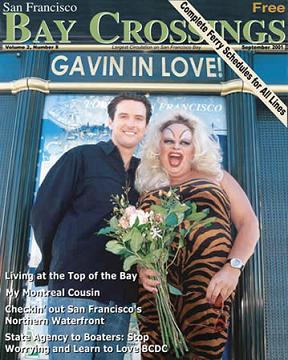
Governor

Making the protests count

37

It was wonderful to see so many people all over the state taking to the streets to protest cuts in education and public services. The rally at San Francisco’s Civic Center wasn’t just young radical agitators, either — most of the people there were parents with kids, families, people who are just fed up with the threats to the future of this state and don’t want to take it any more.


And now that the press and public and maybe even the elected officials are focused on the issue, it’s time to move to the next step. Politicians can talk all they want about “standing with the families” and supporting education, but in the end, there’s only one way to adequately fund K-12 and higher education in California. And that’s to raise taxes.


You can talk about waste all you want, and there’s certainly waste at the University of California. But we’re looking at a need that runs into the billions, multiple billions, tens of billions — and eliminating a few million bucks of waste here and there isn’t going to solve the problem.


You’re not going to solve it by reallocating the state’s budget money, either, since there’s no single large pot of cash that can be taken and given to the schools without devastating another necessary public service. The only real possibility is the prison system, a financial sink hole if ever there were one — but again: You can’t just cut prison spending by eliminating services to prisoners. They get so little as it is — and the federal courts won’t allow any reductions in health care and the state’s already under court order to reduce overcrowding.


You could probably solve half of the schools’ fiscal problems by releasing from prison every single inmate serving time for a drug offense; that’s the kind of dramatic steps we’re talking about. And if anyone wants to launch a political campaign to let 30,000 prisoners free tomorrow, I’m with you.


But it’s not going to happen, not in this climate. So the only real option is to get more revenue. That means raising taxes at the state level, repealing Prop. 13 to allow local property tax hikes, or raising taxes at the city level.


And here’s who the protesters need to be targeting:


1. The governor. Arnold Schwarzenegger not only refuses to allow new taxes as part of the budget, he vetoed Sen. Mark Leno’s bill that would have allowed local government to raise its own car taxes. He’s at (916)-445-2841.


2. The Republican leadership of the state Legislature. These folks go into the budget talks with the power of a minority that can block the two-thirds vote required for tax hikes, and they’ve both signed “no new taxes” pledges. These two people are among the single largest reason that the California school are facing such huge cuts. Assemblymember Martin Garrick,  916-319-2074. Senator Dennis Hollingsworth, (916) 651-4036.


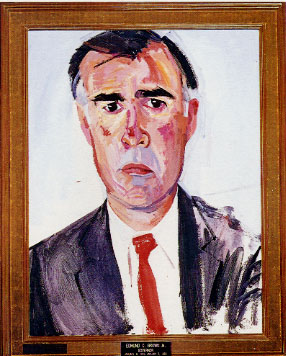
3. Attorney General Jerry Brown. He’s running for governor as the Democratic candidate, and he has already announced that he won’t raise taxes and that Prop. 13 is untouchable. He won’t even support Assemblymember Tom Ammiano’s bill to legalize and tax marijuana. He needs to hear from his constituents that those positions won’t fly. (916) 322-3360


4. The mayor of San Francisco. Gavin Newsom is happy to announce that he supports education funding, but he’s never come forward with a single significant new tax increase for the city. Local taxes could be split between the general fund and the schools, and the progressives on the Board of Supervisors are looking for revenue options. Call the mayor and tell him: If Sacramento won’t raise taxes to educate our kids, we’d like to do it at home, in San Francisco. 415-554-6141.


5. Any state or local official who claims to support the schools but won’t publicly endorse and work for higher taxes. Folks, there’s no other way out of this.


And at the next rally, let’s chant: Repeal Prop. 13, Now! Tax the rich in San Francisco — Now!

Jerry Brown and the Rose Bird factor

16

Jerry Brown hadn’t even formally announced that he was running for governor when the San Francisco Chronicle brought up the name of Rose Bird.


It’s fine to talk about where Brown is vulnerable, and there’s no shortage of material. The guy has a long public record; anyone who served two terms as governor in the 1970s and early 1980s, and two terms as mayor of Oakland, and one term as chair of the state Democratic Party, and did a couple of years as a KPFA talk show host, is going to have baggage. He’s also got a wealth of experience.


But the Rose Bird stuff is a cheap shot.


Here’s how the Chron describes it:


Rose Bird: As governor, Brown appointed Bird to be chief justice of the state Supreme Court. After she invalidated the death sentence of every case she reviewed, voters in 1986 made her and two others the first judges unseated from the court. To voters older than 45, Bird’s name is shorthand for “liberal judges.”


Actually, voters ousted her after a savage campaign funded by big business interests who were mad at her pro-labor and pro-free speech rulings. The death penalty was their weapon, and even then it was pretty bogus: The Bird Court consistently upheld the constitutionality of the death penalty.


But in the early 1980s, death-penalty law was unsettled in the United States; the U.S. Supreme Court had in 1977 ruled that executions were legal in America, but set strict standards for states to follow. Most states were struggling to sort out what the ruling meant and to figure out how to comply. By 1986, when Bird was under assault, 38 states had adopted death-penalty laws, but only 13 had actually executed anyone. In conservative states like Arkansas, Kentucky, Mississippi and Tennessee, judges were trying to determine if the laws fit the Supreme Court’s standards — essentially what the Bird Court was doing in California.


And in California, the death-penalty statute had been written by John Briggs, the guy who wanted to keep gay people from teaching in the schools. The Briggs law was, by all accounts, poorly drafted, unclear and convoluted, and applying it under the federal standard was a challenge.


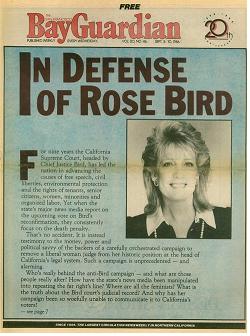
In other words, as we wrote at the time (In Defense of Rose Bird, Sept. 3, 1986):


The charge that the Bird court has refused to enforce the death penalty is simply inaccurate … the California Supreme Court has simply been doing what most state and federal courts have done over the past ten years: carefully scrutinizing death sentences to ensure that they are valid under the federal and state constitutions and complex and ever-changing standards of the U.S. Supreme Court.


The real issue didn’t make the press. Again, from our cover story at the time:


For nine years, the California Supreme Court, headed by Chief Justice Bird, has led the nation in advancing the causes of free speech, civil liberties, environmental protection and the rights of tenants, senior citizens, women, minorities and organized labor.


 Big-business interests organized and funded a massive campaign to get rid of Bird — not because of the death penalty but for purely economic reasons.


The Chronicle got it wrong back then, and is getting it wrong again today.

Expanding movement

1

rebeccab@sfbg.com

When University of California Berkeley students staged building occupations last fall, their furious, brazen response to startling tuition hikes and staff cutbacks captured the attention of the world, recalling the radical actions of earlier generations.

Yet the thrust behind the March 4 Strike and Day of Action, a mass mobilization for public education and services that is reaching into all corners of the state and spreading nationwide, appears to stem from widespread agitation that extends well beyond the flare-ups on college campuses.

"What’s historic about this is that pre-K through PhD has never walked together," said Lillian Taiz, president of the California Faculty Association, which represents faculty in the California State University system. "We have often been pitted against one another, and I think everyone feels finally, in the end, there is no difference in importance between pre-K and PhD. We need it all."

The historic new alliance faces an uphill climb in an environment characterized by a devastating budget crisis at the state level. California — the world’s eighth-largest economy — hovers around 47th in the nation in terms of per-pupil spending, and the most recent wave of budget rollbacks has cut to the bone.

Students and teachers across the Bay Area argue that with dramatic slashes in funding, the educational system is failing youth. Class sizes are ballooning to claustrophobic levels, students are unable to take their desired courses, fees are going up, bathrooms are getting cleaned less frequently, and staffers are getting stressed by overwhelming workloads. "Classes are jam-packed," Taiz says. "You have kids sitting on the floor. You have students just begging to be allowed in a class."

As University of California students decry a 32 percent hike in fees, the California State University system is suffering from damage inflicted by 2,000 faculty layoffs over the past year. The San Francisco Unified School District, meanwhile, is staring down an estimated $113 million budget deficit over the next two years, and 900 layoff notices recently were issued to teachers, librarians, secretaries, and other school employees to warn them that their jobs could be slashed by the end of the school year.

When San Francisco’s school district faced a gaping budget shortfall during the last budget cycle, it was propped up by a combination of Rainy Day Fund reserve dollars and stimulus funding from the American Recovery and Reinvestment Act. With no such safety nets in place this time around, anxiety levels are higher and the outlook is uncertain.

March 4 is shaping up to be more than an opportunity to vent frustrations to elected leaders. Instead, organizers describe it as a rallying point for a movement to defend public education that has caught on like wildfire, uniting people from different worlds. Pickets and rallies will be staged throughout the region. Thousands are expected to swarm Civic Center Plaza in San Francisco. Students from a handful of East Bay campuses are organizing marches to Frank Ogawa Plaza in downtown Oakland. Students and faculty from Berkeley will be boarding buses to take the message to Sacramento. The Oakland Unified School district will host a districtwide mock "disaster drill" to call attention to the disastrous budget. Even public transit activists opposed to the latest round of Muni service cuts and fare hikes are joining the protests, hoping to expand the discussion to support vital public services (for details on these and other events, see "Alerts" opposite this page).

"We’ve never gotten this level of activism over anything in SF since I’ve been here," says Matthew Hardy, communications director for United Educators of San Francisco. "There’s a growing movement for progressive taxation and budget reform instead of draconian cuts."

Taiz, who teaches history at Cal State Los Angeles, described March 4 as an opportunity to fill a void in leadership. "Historically, in these moments where ordinary people step up to the plate, you end up leading the leaders," she said. "We are kind of shocked, but in truth, we do know what has to be done." Quality education isn’t just important for young people, but for society as a whole, she argued. "I am a baby boomer, and if the folks coming up behind me don’t have really, really good jobs, I’m going to be eating dog food. Because those are the people who pay Social Security and pay the taxes."

In the week preceding March 4, teachers and students throughout the Bay Area were in a frenzy of preparation.

Carlos Baron, a theater professor at SF State, was wondering whether the grand procession of papier-mâché puppets his theater students will unveil on the March 4 Day of Action should take a V-shape or some other form. "The main puppet is the Draculator," explained Baron, a Chilean who directed plays in the Salvador Allende era before he began teaching at SF State in 1978. "It’s a cross between the Terminator-Governor and Dracula. But also it doubles as a banker and a general."

When asked how funding cutbacks affect students, Baron didn’t hesitate. "It impedes the creation of a positive vision for themselves and this society," he said. It stunts "the development of the imagination," he added. "We are trained as individuals to accept our failure and our smallness because we’re familiar with it. They don’t want an educated population, a sensitive population, a dreaming population. Would we select Schwarzenegger?"

Nicole Abreu Shepard, a first-grade teacher at Buena Vista Elementary in San Francisco’s Mission District, was collecting permission slips from parents to take her students to a rally and march down 24th Street. "The entire school is walking out," Abreu Shepherd said. Buena Vista’s art program exists solely because parents volunteer their time, she explained. More than half the students qualify for free or reduced lunch, and many incoming kindergarteners or preschoolers are new to the English language. Now there are proposals on the table to increase kindergarten class sizes to 25 or possibly even 30 students. "It’s sort of tying their hands behind their back and asking them to teach on one foot," she noted, and worried about the eventual result. "It’s going to be harder and harder to keep parents who could afford private school in a public school system."

Meanwhile, at the UC Berkeley campus, Krystof Cantor was sitting behind a table heaped with piles of radical literature bearing titles such as "After the Fall: Communiques from an Occupied California." Cantor, who earned his PhD in vision science in 2005, was joining student organizers in making one last push to drum up student interest in March 4 events at a multi-faceted event called "Rolling University." Late on the evening of Feb. 26, a dance party on the Berkeley campus morphed into a street riot — replete with ignited Dumpsters — in downtown Berkeley. The incident attracted media attention and drew public criticism from administrative officials.

The radicalized student movement that has erupted on the UC Berkeley campus is "very much about seizing power," Cantor told the Guardian several days before. "It’s been disruptive, it’s been militant, and it’s been creative. That’s very scary," to the administrators the movement is targeting, he added.

That focused pressure on UC administrators sets these students apart from the coalition of UC Berkeley faculty members and student government members and allies who are coordinating bus trips to protest in Sacramento March 4, he explained. "Sacramento’s not innocent, but it’s not like the administrators are just doing what they have to do," he charged, pointing to new construction projects on campus even as workers are hit with layoffs and furloughs, plus an increasing trend of privatizing on-campus jobs and services. "You can save the public sector by pouring money into it. But it won’t work if the people in charge … want to privatize everything."

Jasper Bernes, a graduate student in English who was seated next to Cantor, noted that the occupation tactic is catching on at other campuses. "I have no doubt that March 4 will greet us with news of many occupations," he said.

Baron, the Chilean theater professor, noted that some SF State students had occupied a business school building in protest of budget cuts. "They were pissed," he said. "They wanted to do something radical. They really inconvenienced a lot of people — but they took chances nonetheless. I went there, and I locked arms with them for awhile." At the same time, he wondered about how effective it was, he said.

And for all the months of preparation and visioning, Baron said he also wonders what will ultimately be borne out of the marches, rallies, pickets, and procession of lovingly crafted street puppets he helped breathe life into. For all the hard work and planning, he says, "My problem is not so much March 4. It’s March 5."

Jerry Brown releases forceful announcement speech

6

Jerry Brown announced his candidacy for governor by posting a three-minute speech on You Tube that was forceful and direct, making the case that California is in crisis and needs experienced, knowledgeable leadership, not an anti-government outsider who’s new to politics.

“We tried that and it doesn’t work. We found out that not knowing is not good,” Brown said in a veiled swipe at both Gov. Arnold Schwarzenegger and likely Republican nominee Meg Whitman, a former CEO with no political experience who has rarely even voted.

This speech was right on the money, and a sharp contrast to his recent Sierra Club speech, which I criticized here – demonstrating that when Brown gets his game face on, he’s still a formidable political pro.

“It’s no secret that Sacramento isn’t working today. Partisanship has become poisonous, political posturing has replaced leadership, and the budget: it’s always late, it’s always in the red, and it’s always wrong,” he said.

It was short on specifics, but that’s probably understandable at this stage. He talked about created a “leaner” state government, but also decried the cuts in education spending, and ended up staking out an interesting position on the critical issue of taxes, pledging, “No new taxes unless you the people vote for them.”

Perhaps Brown is just the guy to begin to persuade Californians that we can’t have it all, and that we’ll have to raise taxes on rich individuals and corporations if we want to do something about our underfunded infrastructure and declining public services. After all, he described our current situation as “a crisis” and said, “You deserve the truth and that’s what you’ll get from me.”

If he wins, this will likely be this septuagenarian’s last job in politics, one in which he’ll hopefully be willing to push for what needs to be done, even if that hurts his popularity. “At this stage in my life, I’m prepared to focus on nothing else but fixing the state I love.”   


Ethics for political consultants?

1

I got an email from Garry South today. He’s the guy who used to run Gavin Newsom’s campaign for governor. Now he’s turned on his previous client. And he’s sent out a message to political reporters explaining why Newsom — the guy he was pushing for governor of California — is actually a worthless hack.


Here’s the mail:


STATEMENT BY GARRY SOUTH


CHIEF STRATEGIST, JANICE HAHN FOR LT. GOVERNOR


FORMER SENIOR ADVISOR, GAVIN NEWSOM FOR GOVERNOR


I am surprised and perplexed that my friend and former client Mayor Gavin Newsom apparently has decided to jump into the lieutenant governor’s race at the last minute – especially against an already-announced candidate who would be the first woman lieutenant governor in California history.


In every one of several conversations we had about the job while he was running for governor, the Mayor expressed nothing but disinterest in and disdain for the office of lieutenant governor. In fact, he was derisively dismissive of Gray Davis’s decision to run for and serve as lieutenant governor prior to running for governor (“I’m not a Gray Davis,” he said). On a couple of occasions, he directed me to repudiate publicly in the strongest terms that he had any interest in ever running for lieutenant governor.


The Mayor himself told the Chronicle in October that rumors he may run for lieutenant governor were “absurd” and “a complete lie,” and angrily accused Jerry Brown of personally spreading false information to that effect. As recently as December, he himself said flatly “no” when asked directly on a San Francisco radio show whether he intended to run for lieutenant governor.


In addition, when he precipitously pulled out of the governor’s race in late October – against my advice – he said he couldn’t continue as a statewide candidate because he was a husband, a new father and the mayor of San Francisco. So far as I know, he’s still a husband, a new father and the mayor of San Francisco. So it’s pretty hard to see what’s changed over the last four months that would now allow him to run for another statewide office.


If the Mayor does run, it is his responsibility to explain why he now claims to want an elected office he summarily dismissed publicly numerous times over the last several months, and which just earlier this year he called “a largely ceremonial post” … “with no real authority and no real portfolio.”


Now, if Garry South were an attorney, I think he could be disbarred for that statement. Lawyers can’t discuss anything that transpired between them and their ckients.And it sounds to me like he’s taking confidential conversations between himself and his client — talks that occured during campaign strategy sessions — and passing them along to the world.


But since political consultants have no regulations, nothing will happen to him.


Now, there is a code of ethics of the American Association of Political Consultants, which you can read here. It says, in part:


  • I will treat my colleagues and clients with respect and never intentionally injure their professional or personal reputations.

  • I will respect the confidence of my clients and not reveal confidential or privileged information obtained during our professional relationship.

  • Of course, the AAPC is just a trade group, with no enforcement. (Just as journalism codes of ethics are not enforceable by anyone.) But if you ask me, it’s a little slimy.


    Editor’s Notes

    0

    Tredmond@sfbg.com

    Gavin Newsom never got any traction in the race for governor, in part because he completely alienated the progressive base in his hometown. And when you have unionized city employees holding protests outside your campaign fundraisers — and you’re in a Democratic primary in California — you’ve got serious problems.

    And now, oddly enough, the progressives in San Francisco may be his biggest allies in the race for the second-place job of lieutenant governor.

    There are some good reasons for that.

    For starters, a lot of us thought that Newsom, whatever his positions on issues, wasn’t ready to run California — to deal with all of the massive problems the state faces and to take on the brutal politics of Sacramento. And I think his behavior during his brief gubernatorial campaign demonstrated that we were right.

    But the Lite Guv job is a lot different. You don’t have to balance a state budget that’s $20 billion in the red; you don’t have to solve water problems. It’s a place where you can learn about state politics on the job, without really screwing things up.

    And if his real goal is to run for U.S. Senate down the road, say, when Dianne Feinstein retires, he’ll be in a good place to launch that campaign.

    But let’s face it. A lot of this is practical politics. With either Jerry Brown or Meg Whitman in the Governor’s Office, the state will continue to be screwed up and it will be even more important that cities take on their own economic destinies. And Newsom, as a bitter lame duck, simply can’t do that.

    The progressive political community isn’t unanimous at all. But a lot of people are thinking that if Newsom’s ascension to Sacramento means that the district supervisors will have a chance to appoint a progressive mayor, it’s worth the trade-off.

    The war on suburbs? Huh?

    10

    Joel Kotkin, the author and urban scholar, was on KQED’s Forum this morning talking about what he called “the war on the suburbs.” He’s got a new book out, called The Next Hundred Million: America in 2050, and he’s arguing, among other things, that the election of Scott Brown in Massachusetts signals that the Democratic Party and progressives in America have lost touch with the suburbs and are being mean to the poor suburbanites.


    He talked, for example, about Tracy, California, and noted that a suburbanite living in Tracy doesn’t want to pay taxes because he doesn’t see what he’s getting for his money. Kotkin sugggestes that the state ought to go back to the Pat Brown era, and focus on spending money on infrastructure, instead of on “state employee pensions.”


    Never mind that when Pat Brown was governor, the population of California was less than half what it is today — and the state was far less diverse, had far fewer immigrants, far fewer residents whose primary language is not English and, frankly, was a lot more tolerant of poverty.


    That was also before the passage of Prop. 13, so the state didn’t have to spend money on schools and local government; local property taxes covered those things.


    In fact, I think what’s going on is just the opposite of what Kotkin is talking about. (He, by the way, says that suburbs are going to be more and more sustainable as more jobs relocate and we start using natural gas in our cars.) I realize that suburban voters can easily shift to the Republican party if the Democrats aren’t careful, but I also think that what’s happening in the United States today is not a war on suburbs but a war on cities.


    The state and federal governments have systematically defunded urban America for more than 30 years now, and we’re paying the price. The hypothetical suburbanite in Tracy may think he’s not getting his money’s worth, but the truth is just the opposite; the suburbs — typically, not always but typically — have better-funded schools, better maintained streets, better sewage systems, less crime … and less of an income gap among residents.


    Cities are, and will remain, America’s future, and we ignore that at our peril.  


    Notes from the Sierra Club’s gala dinner

    0

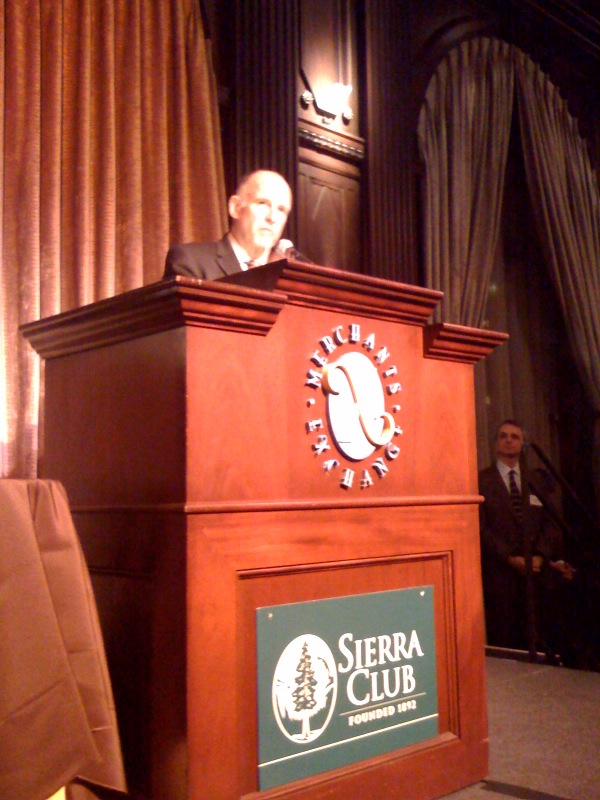
    While I focused on Jerry Brown’s disappointing speech to the Sierra Club San Francisco Bay Chapter’s gala dinner on Wednesday night, there are a few more notable nuggets in my notebook worth posting here, starting with what appears to be the collapse of plans for a California Constitutional Convention.

    The Guardian recently reported on the difficulties that the campaign was having, but consultant Clint Reilly told me that the effort is basically over, with fundraising shortfalls being the final nail in the coffin. That’s one more reason why “hope” seems to be in such short supply on the political landscape.

    The event was held in the Merchant Exchange, a building owned by Reilly, who helped underwrite the gathering. So it was no surprise that the evening was MCed by his wife, Janet Reilly, who is running a strong campaign to replace Michela Alioto-Pier on the Board of Supervisors.

    There were lots of political luminaries at the event (list to follow), but there was one particularly notable attendee and particularly notable absence. Los Angeles City Council member Janice Hahn was one of the few politicos from down south, making the rounds in support of her run for lieutenant governor. But Mayor Gavin Newsom, who is considering challenging her, didn’t show up.

    Also a no-show was U.S. Sen. Barbara Boxer, who appeared by video to address the gathering and express appreciation for being the recipient of the Sierra Club’s first Phillip Burton Badge of Courage Award for environmental stewardship. Accepting the award on her behalf was California Democratic Party chair John Burton, who was his usual salty self, taking a dig at the San Francisco Chronicle by referring to someone who wrote “for the Chronicle back when that was a newspaper,” and describing the award’s namesake thusly: “My brother was an outstanding environmentalist who didn’t like the outdoors much.”

    He also made this funny, self-effacing crack at the start of his speech: “I think a third of the people in this room would like to see the accelerator stuck on the rug of my Prius.” I was not among that third.

    There was a strong turnout of local political leaders, but tellingly, only from the left side of the political spectrum. The members of the Board of Supervisors who turned out were David Chiu, Chris Daly, Ross Mirkarimi, Eric Mar, and John Avalos. Other political luminaries on hand included City Attorney Dennis Herrera, Sen. Leland Yee (Yee and Herrera are each running for mayor) City College trustee John Rizzo (who introduced Brown), Senator-turned-Oakland mayoral candidate Don Perata, District Attorney Kamala Harris, Rep. Jerry McNerney, and Sen. Loni Hancock.

    Rambling Jerry Brown speech raises fear among Dems

    22

    If Jerry Brown’s keynote speech last night to a gala environmentalist dinner is any indication, the Democratic Party faces an uphill battle to win this year’s governor’s race. The rambling, alternately vague and academic, and often pointless address did little to inspire or excite a large, sympathetic crowd that was loaded with top Democrats. In fact, some party luminaries were openly aghast at the poor performance, with one making this succinct (if off-the-record) assessment: “We’re fucked.”

    Brown has never been a dynamic speaker, but the unscripted, half-hour speech – given at the Sierra Club San Francisco Bay Chapter’s David Brower Dinner in San Francisco, a $250 per head affair that drew top Bay Area Democrats – illustrates the danger of letting a primary be decided by legend and money rather than political persuasion.

    Brown’s fundraising prowess and strong poll numbers chased Gavin Newsom and other potential rivals out of the Democratic Party gubernatorial primary, even though Brown hasn’t really outlined his political vision for California, given many extended speeches since being discussed as a candidate for governor, or even officially declared his candidacy (he and others have until March 12 to do so).

    “This thing is really daunting,” Brown said of the governor’s race toward the end of the speech, seemingly unsure that he was ready to run, but saying he would make an announcement sometime in the next couple weeks.

    Brown started his speech by telling the crowd that he didn’t know what he was going to talk about, so when he arrived (late) for the speech, he asked San Francisco Democratic Party chair Aaron Peskin what he should say, and Peskin told him to talk about how there were more salmon in the streams and better overall environmental health back when Brown was governor in the ‘70s.

    But rather than taking that advice and giving a forceful call to strengthen environmental regulation or conjure up California’s better days, Brown meandered around and mused on that and other topics, feeding fears that the 71-year-old candidate might come off as a nostalgic, slightly senile former-Governor Moonbeam rather than an effective agent of needed change.

    “During that period when I was governor, I’m not going to call it the golden age because some people think I’m in the golden age, so I don’t want to get people confused. That’s why I don’t want to talk about way back then, because there are a number of people I can see weren’t even born then, so it gets a little embarrassing and I like to pretend it was just yesterday. But in that period, California created almost twice as many jobs as the nation did. We created jobs at about 24 percent over eight years and the nation grew jobs at 13 percent, so almost twice as much. And then Deukmejian did pretty good, he had about the same, maybe half a percent more,” Brown rambled, ticking off statistics, hedging his point by noting how little governors can really do to create jobs, before working up to a decent line that was flatly delivered: “It was a time when the environment got its biggest boost, as far as public policy.”

    Nobody applauded, so he continued. “I was thinking tonight, I was trying to figure out that if I did announce, what the hell would I say? And so I decided to go back and read my first announcement, January 24, 1974. I was 35 then, it was another time, I’m now a little older than that. But I talked about clean air, I talked about the energy crisis and getting new sources of energy. I talked about statewide land use planning” – that last item drawing some applause – “and I talked about jobs. And I was thinking, wow, we still got a jobs problem, we got an energy problem, we have a land use problem that feeds into the energy problem, and while the air is cleaner in many respects, it’s not clean enough, or it isn’t healthy enough.”

    On substance, Brown had his moments. But even on the need for better statewide land use planning, he went off on a tangent, saying he didn’t even know what that meant when he filled out a Sierra Club questionnaire back in the ‘70s, and he’s not sure how to accomplish it now. 

    “You have to make it easier to live closer to where you work,” Brown said in what of his few lines of the night that drew applause, although he didn’t begin to explain how he might achieve this goal. And on a controversial subject that is easily attacked by the right – big government wants more control over private property – Brown’s lackadaisical discussion of the issue was disconcerting.

    He even rankled a few Sierra Club members by vaguely criticizing East Bay growth controls designed to reduce sprawl, which the Attorney General’s Office is seeking to overturn: “Pleasanton wants to create 50,000 jobs, but they have a housing cap – for all I know, Sierra Club probably supported that housing cap, so I want to just rub your nose in the housing cap for just a minute – the trouble with the housing cap is they want to create all these jobs.”

    Brown tried to argue that allowing more housing in Pleasanton is a strategy for combating global warming because there are jobs there and it would reduce commutes, but he’s going to need to be more on his game than he is right now to win that argument. Instead, we get his fairly dismissive summary of this important issue: “Land use is a big deal, it’s difficult, lots to do on that.”

    Against businesswoman Meg Whitman, the Republican gubernatorial primary frontrunner, there is real potential in Brown’s basic belief that markets need to be regulated and that running the government isn’t just like running a business. And somehow, Brown will need to find a way to better distill and deliver that message to counter the right’s pro-business sound bites. 

    “There are people saying business knows best,” Brown said, meandering off about companies and widgets for a minute before continuing his point. “But when you look at what we really have to deal with, it’s not just about economics and the market. It’s also about ecology and morality, and morality is about customs, it’s about traditions, it’s about our deepest patterns of how we all relate to one another and that can’t just be assimilated into market incentives. The market assumes honesty, you meet your promises, and also assumes there’s a framework, because things can just run off the cliff and that’s exactly what’s happening. As you add more people, you have more cars, and when you have more cars, they burn fossil fuel and what’s happening in California is you have cars reproducing faster than people…That’s the real challenge here, that we’re trying to get the idea out that we’re trying to save the future.”

    Loose in Obamalandia: Dead man walking through CA

    1

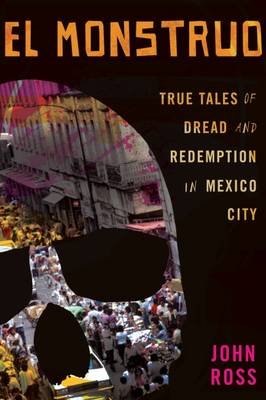
    I am on a low-rent book tour with my new cult classic El Monstruo – Dread & Redemption In Mexico City.  For the next three months, I will stumble across this land from sea to stinking sea probing the underbelly of Obama’s America.  The findings will be posted on these pages.

    1.
    First stop was the near north woods, Humboldt County USA, to wheedle the medicos into granting me a clean bill of health before I hit the road.  A year ago this February, my doctor who has poked and probed my old broken cadaver for nearly 20 years, pronounced me dead. “Liver Cancer” he parsed gravely — but I am still alive and kicking. The class enemy be warned: I am not dead yet.

    Humboldt had just been wracked by a 6.5 earthquake that cut a swath through Oldtown Eureka’s antique shops but was not quite Haiti.  Nonetheless, the shake-up worked its usual bad mojo and implanted the seeds of fear and loathing in every soul.  On January 22nd, three separate police agencies shut down the north end of Arcata and evacuated hundreds of residents after a scruffy hippie-type tried to fed ex a suspicious package to Berkeley that leaked, according to the clerk at Kinko’s, “a chemical odor.” The offending package was blown up in a back alley.

    The next day, the local rag commonly known as the Times-Slander conceded in front-page headlines that the “bomb” was “Actually a brake light.” The paranoia was symptomatic.  A commercial jetliner to Kentucky was forced down by air force jet fighters after an orthodox Jewish kid pulled out his Tefillin to pray and, in a spasm of extreme religious irony, the panicked stewardess took him for some Muslim terrorist and confused the leather straps and little prayer boxes with bomb components that would blow the paying customers to kingdom come. 

    Nine years ago, just weeks after 9/11, I got on the road to preach Zapatismo to the North Americanos. Flags flew from every home, a sort of Talisman against the terrorist devils.  It was not a healthy ambiance for spreading revolution and resistance in Amerikkka.  Prospects for the Monster Tour suddenly turned ominous.

    2.  
    San Francisco’s Mission District gets shabbier day by day as the “Great Recession” (read “Depression”) gallops towards economic Armageddon. The Miracle Mile is lined with empty storefronts and 98 Cent Stores (marked down from 99.)  The homeless sleep under their shopping carts – the Mission Local reports that 40 homeless families are living in 16th Street Single Room Occupancy hotels, twice the occupancy rate of a year ago.  In this Sanctuary City for the rich, the yuppie Mayor, who now aspires to be nothing more than a yuppie clerk in a yuppie wine store, is deporting undocumented teenagers convicted of no crime and the class divide seems more brutal than ever.

    We posted up on Market Street in front of the Commonwealth Club, where torture enabler John Yoo was hawking his new book to the City’s elite. Financial District drones en route back to the ‘burbs asked Yoo Who?
    I checked my watch.  It was time to hit the rails.

    3.
    The Central Valley was the first stop on the Monster Tour, the most deadly stretch of soil in North American California. The water plumes are all poisoned by agrochemicals and when one turns on the faucet on the west side of the valley, deformed babies pop out. 

    This cesspool of chemical effluvia is populated by perhaps the most ethnically diverse crazyquilt in all of Obama’s America.  Anglo bigwigs and white Armenians rule the roost but down below Mixteco is spoken on the radio, communicating the bad news to the out-of-work Oaxacans who once toiled in the fields and packing sheds. The humongous Hmung community is up in arms over the FBI’s harassment of their spiritual leader, General Vang Pau who authorities accuse of conspiring to overthrow the doctrinaire Communist government of Laos.  Unemployed Palestinians and Pakistanis, Filipinos, white trash, and historic enclaves of Blacks, survive in this fulminating chemical stew by their wits. On every street corner, the down-at-the-heels don shabby green gowns and sagging Styrofoam Statue-of-Liberty crowns, holding up cardboard arrows pointing towards strip mall tax return scammers.

    I stepped out into Catherine Campbell’s unplanted garden.  Police helicopters hovered overhead, searching out suspected gangbangers. Catherine is a veteran prison rights attorney who pays particular attention to what goes on behind bars at Corcoran and Chowchilla, two of the cruelest his & her lock-ups in the state. Recently, she put her know-how to work defending anarchists who had been beaten into the sidewalk by the Fresno pigs for handing out graphic leaflets depicting the torture of elephants during Ringling Brothers Barnum & Bailey’s annual visit to town, and she and a gaggle of advocates have been trying to keep the cops off a venerable homeless encampment. Now the City Council is seeking to felonize panhandling on Fresno’s median strips as a “safety hazard.” 

    The Fresno gendarmes are particularly keen on persecuting young adults of color for alleged gang activities. An article in the Morning Bee reported on the so-called “Bulldog Gang” (the bulldog is the icon of the Fresno State football team so gang colors are readily available) whose members were accused of smashing windows and barking at the cops over on the decrepit west side.  Catherine says the bulldogs’ bark is more a growl.  Such are the sounds of hope in the second year of Obama’s lacerated reign.

    Sam Stoker is a child of the Valley. One night last summer, I bought him a beer at the counter of my beloved Café La Blanca back home in the Centro Historico of Mexico City.  Sam, an acculturated Chicano, had journeyed to Mexico to connect with his family in Tamaulipas and bum around, sniffing out what was left of the 2006 rebellion in Oaxaca. When he went home to Winton near Merced, he spoke enough Spanish to delight his grandma. 

    Sam is also an anarchist and a budding journalist who has been up to his neck in the struggle for justice for Oscar Grant in Oakland. Now he had come to the Valley to spread the virus of anarchism. Rebellion in the fields could bring California to its knees, he confided. I was only too happy to help out. 

    Anarchism has a beachhead in Fresno at the Infoshop where 70 folks turned out to hear me preach revolution. Not all of the fellow workers were young punks. One gentleman in attendance told me he had been an organizer for Cuauhtemoc Cardenas’s foiled presidential campaign in 1988 in Sinaloa and fled Mexico when dozens of his companeros were gunned down by the mal gobierno.  He was still here, still waiting for the revolution. 

    Over in Merced, I shouted out my poems in a long dark bar, The Partisan, on Superbowl Sunday.  A “digital remix” of Guy Debord’s “Society of The Spectacle ” preceded my incendiary words.  Maybe Sam Stoker’s pipedream is not as wacky as it sounds.

    4.
    So it was goodbye to Fresno and hello to Hollywood. I accessed the City of Fallen Angels over the Grapevine with a pit stop at Bob Hope airport and a bar in Santa Monica to watch the Lakers kick booty. My gigs were spread out all over this pedestrian unfriendly megalopolis and the signs of hard times were hard to avoid.  On the beach in Santa Monica, excruciatingly gaunt old men jogged against debilitating cancers and aging hippies scoured the sands with metal detectors for spare change.

    Even out in ritzy Claremont, where I hobnobbed with a Palestinian restaurateur about the Nakba, Obama’s America seemed out of synch.  A student at Pomona College where I spieled had just been handcuffed and interrogated by transit security cops in Philadelphia for transporting 200 Arabic-English flashcards across state lines and some cad ripped off my cane down at the train station.  The Inland Empire, which abuts this restricted enclave, has the fifth highest mortgage foreclosure rates in the nation.

    In Hollywood, where I spent a night on my favorite sofa, the glitz was tempered by the homeless with all their possessions piled high atop their shopping carts around the new Metro station. How many of them were out-of-work script doctors is not yet known.

    Down in South Central, where anger is endemic, I spoke to a handful of Afro-Americans at Eso Won, an admirable black bookstore. The proprietor sported a prototypical pork pie hat and told me that when he sees the Mexicans coming over the border, he sees black people. We talked animatedly for a few hours about Afro-Mexicans who were a third of the population of Mexico at liberation from Spain in 1810 and whose history has been pointedly ignored south of the border.             

    L.A. is gearing up for the trial of killer BART cop Johannes Mehserle, Oscar Grant’s assassin, that will be held in the same court house where O.J. won acquittal — if it’s not moved to Ensenada, taking a cue from outgoing Governor Terminator’s plan to build California prisons south of the border.

    Students at Cal State L.A., the most Chicano university in Califas, honed in attentively when I expounded on the revolution that is brewing down south.  1810-1910-2010 – every hundred years on the tenth year of the century, Mexico explodes in violent social upheaval and even the Wall Street Journal is worried (see WSJ front pager January 15th.)

    Looking at Obamalandia through the eyes of students is a useful handle for understanding what comes next.  Classes and services have been bludgeoned by budget cuts and the profs at Cal State furlough one day a week to make ends meet in this damaged economy that the President lies is booming again because only a half a million workers filed first time unemployment claims last month.  The light at the end of the tunnel is a bullet train pointed straight at the heart of the people.

    All of this bad news is healthy for fightback.  The day I hit El Ley, Muslim students at U.C.-Irvine rose up against the Israeli consul ten times in a single speech until the university president sicced the campus cops on them. The next day a whole coast away, kids at Georgetown shouted down General Betrayus. Throw in the cutbacks and the furloughs and the hopelessness and it could be a long, hot spring semester and it won’t be just because of global warming.  I will do my best to fan the flames as I stumble front one campus to the next in the coming months.

    On my last days in the late great golden state, I slept in a yoga house under a colorful banner of Ganesh, the elephant guy who gets fat eating others’ obstacles.  Lets hope he’s on my side. A year ago I was sentenced to death and although I’m still kicking, the future is laced with sharpened punji sticks, not the least of which incubates on my liver.

    Talking truth to power is still the best medicine to beat back Nuestra Senora Santa Muerte.

    John Ross and The Monstruo will be visiting the Narciso Martinez Cultural Center in the heart of the Rio Grande Valley Sat. Feb 20th. The Monster Tour plays El Paso, Las Cruces, and Albuquerque from Feb. 21st-28th.  Consult the Nation Books page for details or write johnross@igc.org

    The people vs. corporate power

    2

    steve@sfbg.com

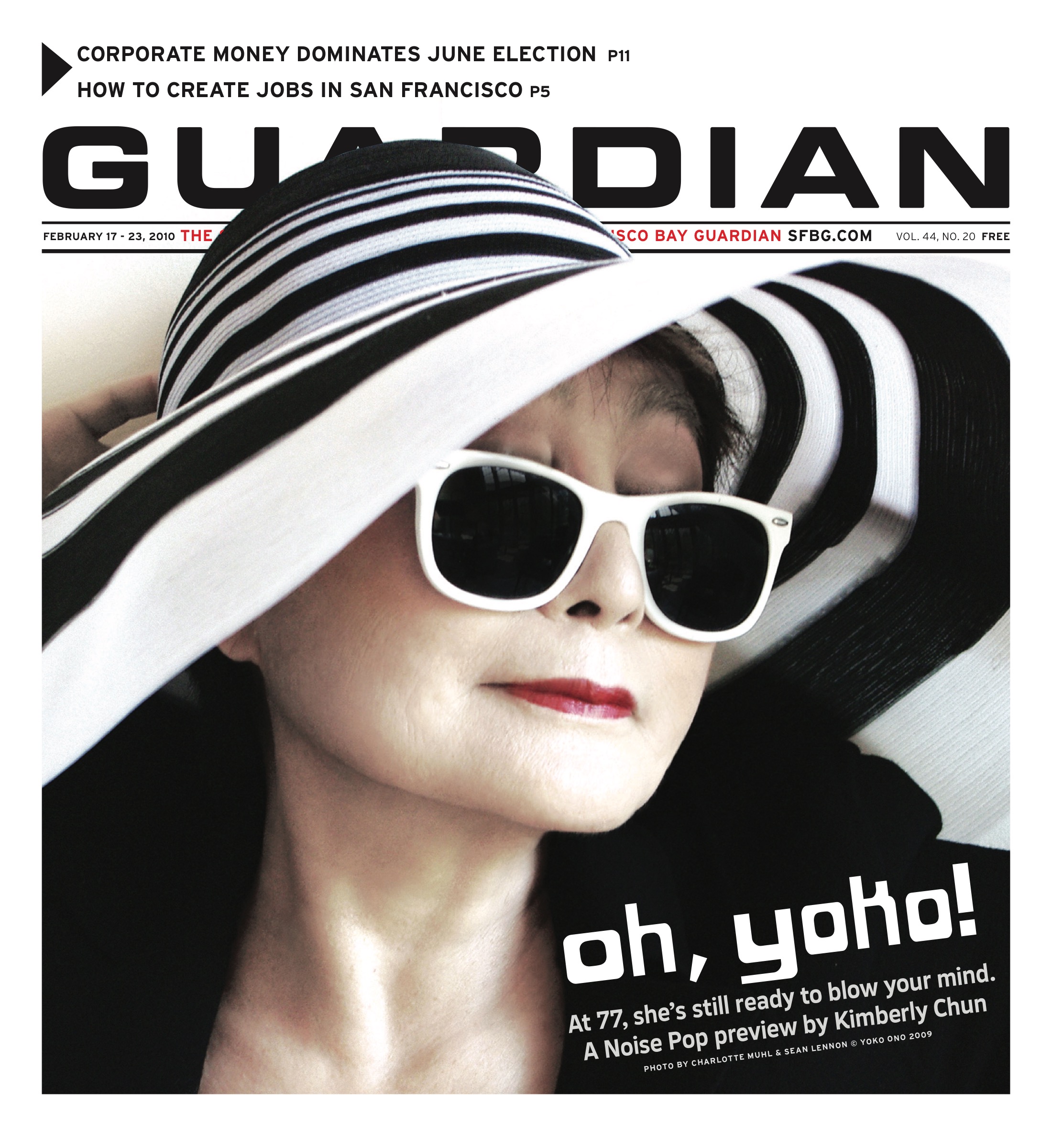
    The June 8 election is shaping up to be one that pits the people against powerful business interests, a contest that will demonstrate either that money still rules or that growing public opposition to corporate con-jobs has finally taken root.

    On the state level, the five ballot measures include two brazen money-making schemes and two experiments in election reform, along with primary races that are still in flux. In San Francisco, where the ballot measures still have a few more weeks to shake out, the election will feature two rarely contested judges races, recession relief for renters, City Hall fiscal reforms, and a fight for control of the local Democratic Party.

    So far, only four local measures have qualified for the San Francisco ballot, all placed there by members of the Board of Supervisors. Progressives qualified the Renters Economic Relief package (which limits rent increases during recessions and sets conditions for landlords passing costs to tenants), an initiative establishing community policing standards, and one affirming city support for making Transbay Terminal the northern high-speed rail terminus. Supervisors were unanimous in supporting a charter amendment governing the Film Commission.

    But the board is still hashing out changes to the more controversial ballot proposals, a debate that will continue at its Feb. 23 meeting. They include an overhaul of how the city funds its pension program and an effort to remove Muni salary minimums from the city charter, both by Sup. Sean Elsbernd; a $652 million seismic safety bond proposed by Mayor Gavin Newsom; and a Sup. John Avalos charter amendment that would prevent the mayor from unilaterally defunding certain budget expenditures. All measures must be approved by March 5.

    Also still forming up in the coming weeks are primary races for legislative seats (although no incumbents appear to be facing strong challenges) and all eight state constitutional offices, including governor (where Attorney General Jerry Brown seems poised to easily win the Democratic nomination), lieutenant governor, and attorney general (which District Attorney Kamala Harris is running for).

    Candidates have until March 12 to declare themselves for statewide and legislative offices, as well as for the San Francisco Democratic County Central Committee, which could play a key role in this fall’s Board of Supervisors elections. Two years ago, a slate of progressives led by Aaron Peskin and Chris Daly launched a surprise attack to wrest control of the board away from the moderates who have long controlled it. Newsom, U.S. Sen. Dianne Feinstein, and their downtown allies are expected to try hard to regain control over their party’s purse-strings and endorsements.


    JUDGING THE JUDGES

    Another struggle from two years ago is also being replayed. In 2008, then-Sup. Gerardo Sandoval successfully challenged Superior Court Judge Thomas Mellon, arguing the Republican-appointed jurist was too conservative (and the entire court is not diverse enough) for San Francisco. This time the target is Judge Richard Ulmer, a conservative appointed by Gov. Arnold Schwarzenegger. Ulmer is being challenged by two LGBT attorneys, Daniel Dean and Michael Nava, the latter endorsed by Sen. Mark Leno, Assembly Member Tom Ammiano, and Peskin, who chairs the Democratic Party and could be helpful in the race. “He’s a brilliant guy,” Leno said of Nava.

    Leno also has endorsed deputy public defender Linda Colfax, a Latina lesbian, in a four-way race to replace retiring Judge Wallace Douglass. The other candidates are Harry Dorfman, Roderick McLeod, and Robert Retana. If no candidate wins a majority of votes, the top two finishers square off in a runoff election in November.

    Leno said he’s thrilled to see a diverse crowd of attorneys seeking judgeships: “This governor has failed horribly in his appointments, not only with the LGBT community, but with communities of color as well.”


    TWO COMPANIES TRY TO BUY CALIF.

    The struggle between the broad public interest and the wealthy power brokers that have long-dominated California politics is most apparent in the state propositions, which have been certified and for which ballot arguments are now being collected by the California Secretary of State’s Office.

    Two of those ballot measures, Propositions 16 and 17, are blatantly self-serving efforts by a pair of powerful corporations to increase their profitability, however deceptively and with overwhelming amounts of campaign cash they are presented.

    Prop. 16, sponsored by Pacific Gas & Electric Co., would require local governments to get two-thirds of voters to approve creation of energy programs like Clean Power SF, San Francisco’s plan for developing renewable energy projects and selling that power directly to citizens.

    As we’ve reported (“Battle royale,” Jan. 13, and “PG&E attack mailer puts City Hall on defensive,” Dec. 22, 2009), PG&E placed the measure on the ballot to avoid having to repeatedly crush public power initiatives around the state with multimillion dollar campaigns, even though political leaders like Leno and Sup. Ross Mirkarimi say the measure violates the state’s community choice aggregation law. That law allows local governments to create energy programs and prohibits PG&E from interfering with those efforts.

    “The unregulated behavior of corporate arrogance is killing our democracy. Prop. 17, sponsored by Mercury Insurance, would let companies increase car insurance premiums for a variety of reasons that are now prohibited by the 1988 measure Prop. 103. Mercury has continuously attacked that landmark law, using lawsuits, huge political contributions, sponsored legislation, and, according to newly released documents from the California Department of Insurance (see “The malevolence of Mercury Insurance,” Feb. 10, Guardian Politics blog), blatantly illegal activity in setting premiums and excluding certain customers, such as artists, bartenders, and members of the military.

    “The Mercury initiative is even more pernicious than what it was doing before,” Harvey Rosenfield, who wrote Prop. 103 and works for Consumer Watchdog, told the Guardian. “Under Mercury’s initiative, if you’ve never had prior insurance, you can be surcharged for the first time. Then they’ve thrown in some other tricks and traps.”

    Mercury spokesperson Coby King told us the company has been unfairly maligned and denies that the measure is simply about boosting its profits: “Prop. 103 is the law of the land, but to the extent there are improvements that can be made that are pro-business and pro-consumer, Mercury has not been shy about acting in the public interest.”

    Yet few public interest groups or public officials believe the claims being made by Mercury or PG&E, and they hope that the public won’t be fooled.

    “These are measures designed to give a financial advantage to a specific industry or company,” U.S. Rep. John Garamendi, who battled Mercury as California’s first insurance commissioner, told us. He strongly opposes both measures, but did say, “Money talks. It always has, particularly in propositions.”

    Yet Leno said he’s a bit more hopeful: “Californians have been savvy in the past, and I do believe they’ll be able to see through the tens of millions of dollars in misleading ads.”

    “To me, it’s a classic case study of what’s going on with the initiative process in California and with politics in general,” said Derek Cressman, western regional director of California Common Cause. “There are two initiatives literally sponsored by corporations to push very narrow interests.”

    Yet Cressman said recent events could help. There’s been a big public outcry in recent weeks over the U.S. Supreme Court’s decision to allow unlimited corporate spending to influence elections, the role that insurance companies played in sinking federal health care reform efforts, and the way businesses interests are hindering efforts to deal with global warming.

    “It makes people aware of the overwhelming role corporations are playing in dictating government policy,” Cressman said.


    TAKE OUT THE MONEY

    A pair of election reform measures might help lessen the influence of money and political parties. Prop. 14 is an open primaries measure that Sen. Abel Maldonado (R-Santa Maria) got placed on the ballot as a condition for breaking last year’s budget stalemate. It would create a single primary ballot and send the top two finishers to the general election, regardless of party.

    Prop. 15, the California Fair Elections Act, takes direct aim at the corrupting influence of money in elections, creating a pilot public finance program in the secretary of state races for 2014 and 2018. The measure, which has broad support from politicians and good government groups in the Bay Area, is modeled on successful programs in Maine and Arizona.

    “No elected official should be in the fundraising game the way they are now,” campaign chair Trent Lange told us. “This is a way to change how we fund elections.”

    The idea is to create a model that will eventually be used for other offices. The campaign fund would be generated by a $350 annual fee on lobbyists, lobbying firms, and lobbyist employers. Currently lobbyists pay just $12.50 per year to register, which Lange said, “just shows the power of lobbyists in Sacramento.” *


    The “Newsom wins” merry-go-round: What fun

    10

    Gavin Newsom still hasn’t said for sure that he’s in the race for lt. governor, although just about everyone in town now thinks he’s going for it.

    But the very prospect of the mayor leaving office before his term is up has the political classes speculating: Who gets that job? And how does it happen?

    It’s actually pretty interesting.

    Under the City Charter, the president of the Board of Supervisors becomes acting mayor in the event that the mayor leaves office before the end of his or her term. Then the supervisors, by a six-vote majority, can appoint someone else to the job.

    Melissa Griffin lays out one piece of the scenario, which is that the board could appoint a new mayor in advance, without anyone serving as acting mayor.

    But there’s much more to the story.

    According to a fascinating city attorney’s opinion issued in 1978 (PDF), when George Moscone and Harvey Milk were killed and Dianne Feinstein was board president, no supervisor is allowed to vote on his or her own appointment. Which would mean that if, say, Board President David Chiu wanted the job, he’d need six votes not including his own.

    Now the plot thickens. Suppose nobody can round up six votes — that is, a majority of the supervisors can’t agree on a new mayor? Well, Chiu, as board president, would be acting mayor — potentially for the entire duration of Newsom’s term, roughly a year. He’d also remain as board president. It’s the same as if the mayor goes out of the state and names an acting mayor in his place; that person is still a supervisor. So Chiu would have all the powers of both the mayor and the board president — and immense amout of clout for one person at City Hall.

    But wait, there’s more: Chiu is board president only until the board elected in November of this year takes office, which would be about five days after Newsom would become lite guv. So unless the current board can choose a new mayor, with six votes (not including the vote of any supervisor being nominated), the new board would elect a new board president — who would instantly become acting mayor at the same time.

    And since supervisors are allowed to vote for themselves for board president, any member would be allowed to vote for him- or herself for acting mayor.

    Confused yet? Clearly, the folks who wrote the City Charter never actually envisioned this scenario (or didn’t think about it very much).

    Of course, what that means that with the current board split the way it is, with exactly six solid progressive votes, someone who isn’t currently on the board (say, Aaron Peskin — or Tom Ammiano, or Mark Leno, or whoever) would have a better chance of getting a majority than a current member, who would need at least one of the moderate bloc votes.

    And if Newsom runs, it will make the fall supervisorial elections even more important, because potentially those newly elected supes will be choosing not only a board president but a mayor.

    Here’s another fun twist: If District Attorney Kamala Harris is elected attorney general, the mayor gets to appoint a new D.A. But suppose Newsom also wins and is sworn in a few minutes before Harris. Presumably acting mayor David Chiu (a former prosecutor who rumor has it might like to be D.A. himself someday) would choose the new D.A. — and suppose Chiu knows he doesn’t have six votes to be mayor. There’s no reason why he couldn’t appoint himself D.A., leaving a vacancy on the board and a vacancy for board president, which would be filled by anyone who could get six votes, who would then be acting mayor and could appoint a new supervisor to Chiu’s seat. Who could then be the deciding vote on who gets to be mayor.

    Whoa. I can’t wait. Run, Gavin, Run.

    Stage Listings

    0

    Stage listings are compiled by Molly Freedenberg. Performance times may change; call venues to confirm. Reviewers are Robert Avila, Rita Felciano, and Nicole Gluckstern. Submit items for the listings at listings@sfbg.com. For further information on how to submit items for the listings, see Picks. For the complete listings, go to www.sfbg.com.

    THEATER

    OPENING

    Bay One Acts Festival Boxcar Theatre, 505 Natoma; 776-7427, www.threewisemonkeys.org. $12-$24. Dates and times vary. Opens Thurs/18. Runs through March 13. Three Wise Monkeys presents eleven short plays by Bay Area playwrights, including Cris Barth, Stuart Bousel, and Lauren Yee.

    The Gilded Thick House, 1695 18th St. www.thegilded.com. $18-$30. Opens Thurs/18. Runs Thurs, 7pm; Fri-Sat, 8pm; Sun, 2pm. Through March 7. The Curiouser Group presents a new musical by Reynaldi Lolong.

    Mahalia Lorraine Hansberry Theatre, 450 Post; 474-8800, www.lhtsf.org. $18-$40. Previews Thurs/18-Fri/19. Opens Sat/20. Runs Thurs-Sat, 8pm; Sun, 4pm. Through Feb 28. Lorraine Hansberry Theatre presents the inaugural production of Tom Stolz’s gospel musical.

    Suddenly Last Summer Actors Theatre, 855 Bush; 345-1287, www.actorstheatresf.org. $15-$35. Opens Thurs/19. Runs Thurs-Sat, 8pm. Through March 27. Actors Theatre presents one of Tennessee Williams’ finest and most famous plays.

    What Just Happened? The Marsh, 1062 Valencia; (800) 838-3006, www.themarsh.org. $20-$50. Opens Fri/19. Runs Fri-Sat, 8pm. Through March 13. The Marsh presents Nina Wise’s improvisation-based sow about personal and political events which have transpired over the previous 24 hours.


    BAY AREA

    An Anonymous Story by Anton Chekhov Berkeley City Club, 2315 Durant, Berk; (510) 558-1381, centralworks.org. $14-$25. Previews Fri/19. Opens Sat/20. Runs Thurs-Sat, 8pm; Sun, 5pm. Central Works presents a new play adapted from the Checkhov novella.

    *East 14th Laney College Theatre, 900 Fallon St, Oakl. www.east14thoak.eventbrite.com. $10-$50. Opens Fri/19. Runs Fri-Sat, 8:30pm. Through Feb 27. Also at the the Marsh Berkeley in March. Don Reed’s solo play, making its Oakland debut after an acclaimed New York run, is truly a welcome homecoming twice over. It returns the Bay Area native to the place of his vibrant, physically dynamic, consistently hilarious coming-of-age story, set in 1970s Oakland between two poles of East 14th Street’s African American neighborhood: one defined by his mother’s strict ass-whooping home, dominated by his uptight Jehovah’s Witness stepfather; the other by his biological father’s madcap but utterly non-judgmental party house. The latter—shared by two stepbrothers, one a player and the other flamboyantly gay, under a pimped-out, bighearted patriarch whose only rule is “be yourself”—becomes the teenage Reed’s refuge from a boyhood bereft of Christmas and filled with weekend door-to-door proselytizing. Still, much about the facts of life in the ghetto initially eludes the hormonal and naïve young Reed, including his own flamboyant, ever-flush father’s occupation: “I just thought he was really into hats.” But dad—along with each of the characters Reed deftly incarnates in this very engaging, loving but never hokey tribute—has something to teach the talented kid whose excellence in speech and writing at school marked him out, correctly, as a future “somebody.” (Avila)

    Learn to be Latina La Val’s Subterrnean, 1834 Euclid, Berk. impacttheatre.com. $10-$20. Previews Thurs/18-Fri/19. Opens Sat/20. Runs Thurs-Sat, 8pm. Impact Theatre continues its 14th season with the world premiere of Enrique Urueta’s play.


    ONGOING

    Animals Out of Paper SF Playhouse, 533 Sutter; 677-9596, www.sfplayhouse.org. $30-$40. Tues, 7pm; Wed-Fri, 8pm; Sat, 3 and 8pm. Through Feb 27. SF Playhouse presents Rajiv Joseph’s quirky comedy.

    Beauty of the Father Phoenix Theatre, 414 Mason; (800) 838-3006, www.offbroadwaywest.org. $30. Thurs-Sat, 8pm. Through March 13. Off Broadway West Theatre Company presents Nilo Cruz’s Pulitzer Prize-winner.

    Bright River Brava Theater Center, 2781 24th St; (800) 838-3006, thebrightriver.com. Thurs/18-Sat/20, 8pm. From the imagination of Tim Barsky comes a journey through a dystopian uderworld.

    Eat, Pray, Laugh! Off-Market Theaters, 965 Mission; www.brownpapertickets.com. $20. Wed, 8pm. Through Feb 24. Off-Market Theaters presents stand up comic and solo artist Alicia Dattner in her award-winning solo show.

    Eccentrics of San Francisco’s Barbary Coast: A Magical Escapade San Francisco Magic Parlor, Chancellor Hotel Union Square, 433 Powell; 1-800-838-3006. $30. Fri-Sat, 8pm. Ongoing. This show celebrates real-life characters from San Francisco’s colorful and notorious past.

    Fabrik: The Legend of M. Rabinowitz Jewish Theatre, 470 Florida; 292-1233, www.tjt-sf.org. $20-$45. Thurs-Sat, 8pm; Sun, 2 and 7pm. Through Feb 28. The Jewish Theatre San Francisco presents a Wakka Wakka Productions presentation of this story of a Polish Jew who immigrated to Norway, told with hand-and-rod puppets, masks, and original music.

    Fiddler on the Roof Golden Gate Theatre, 1 Taylor; 512-7770, www.shnsf.com. $30-$99. Wed/17-Sat/20, 8pm; Wed/20, Sat/21, 2pm. Harvey Fierstein, who played Tevye in the recent critically acclaimed Broadway production, reprises the role as part of the Best of Broadway series.

    Fiorello! Eureka Theatre, 215 Jackson; 392-4400, www.cityboxoffice.com. $10-$30. Sat/20, 2pm. The San Francisco Arts Education Project celebrates the ninth year of its musical theater company with three weekend performances of Broadway’s Pulitzer Prize winning play.

    The Greatest Bubble Show on Earth Marsh, 1062 Valencia. (800) 838-3006, www.themarsh.org. $7-$50. Sun, 11am. Through April 3. The Amazing Bubble Man returns with his extraordinary family-friendly show.

    Hearts on Fire Teatro ZinZanni, Pier 29; 438-2668, www.zinzanni.org. $117-$145. Wed-Sat, 6pm; Sun, 5pm. Through May 16. Teatro ZinZanni celebrates its 10th anniversary with this special presentation featuring Thelma Houston, El Vez, and Christine Deaver.

    *Loveland The Marsh, 1074 Valencia; 826-5750, www.themarsh.org. $15-$50. Sat, 8:30pm; Sun, 7pm. Through April 11. Los Angeles–based writer-performer Ann Randolph returns to the Marsh with a new solo play partly developed during last year’s Marsh run of her memorable Squeeze Box. Randolph plays loner Frannie Potts, a rambunctious, cranky and libidinous individual of decidedly odd mien, who is flying back home to Ohio after the death of her beloved mother. The flight is occasion for Frannie’s own flights of memory, exotic behavior in the aisle, and unabashed advances toward the flight deck brought on by the seductively confident strains of the captain’s commentary. The singular personality and mother-daughter relationship that unfurls along the way is riotously demented and brilliantly humane. Not to be missed, Randolph is a rare caliber of solo performer whose gifts are brought generously front and center under Matt Roth’s reliable direction, while her writing is also something special—fully capable of combining the twisted and macabre, the hilariously absurd, and the genuinely heartbreaking in the exact same moment. Frannie Potts’s hysteria at 30,000 feet, as intimate as a middle seat in coach (and with all the interpersonal terror that implies), is a first-class ride. (Avila)

    Oedipus el Rey Magic Theatre, Building D, Fort Mason Center; 441-8822, www.magictheatre.org. $20-$55. Days and times vary. Through Feb 28. Luis Alfaro transforms Sophocles’ ancient tale into an electrifying myth, directed by Loretta Greco.

    Pearls Over Shanghai Hypnodrome, 575 Tenth St.; 1-800-838-3006, www.thrillpeddlers.com. $30-69. Sat, 8pm; Sun, 7pm. Through April 24. Thrillpeddlers presents this revival of the legendary Cockettes’ 1970 musical extravaganza.

    *The Position Studio 250, 965 Mission; www.applyfortheposition.com. $20. Thurs-Sat, 8pm; Sun, 7pm. Through Feb 28. From the ready pen of notable local playwright William Bivins comes a witty dystopic thriller too good not to be (essentially) true: In the USA’s not-too-distant future, after “the Great Downturn,” there’s 80% unemployment, the population lives by scavenging, despair is in the water and air, and there are no more dogs (those little four-legged ambassadors of hope). But there are still one or two job openings in the ultra-powerful, totemic, life-giving corporate universe of The Concern. A recent search has narrowed the candidates down to six (types played to perfection, while imbued with palpable soul, by Kate Jones, Asher Lyons, Gabi Patacsil, Eric Reid, Dan Williams, and Laura Zimmerman). They’re flown to an exclusive island, paradisial in its accommodations and distance from dismal American society at large, totalitarian in its panoptic surveillance and haughty obscurantism. Greeted by the icy hot Mrs. Radcliffe (Jessica Cortese) and her deliriously accommodating man-servant Baylian (a joyously loopy Even Winchester)—both nattily futuristic in coordinated turquoise business wear—the candidates find there are no rules but two over the course of the evaluation, and no explanation of what they might be evaluated on. The contest begins and, in PianoFight’s low-budgeted but high-spirited production, it makes no difference how familiar might be the themes or the scenario—very adeptly riffing on classics new and hoary, from “Survivor” and “The Apprentice” to “The Most Dangerous Game”—”The Position” never feels merely derivative, let alone dull or predictable. Instead, it’s inspired, rebellious lovemaking with our doom-clouded moment, realized by an engrossing cast unerringly directed by PianoFight’s Christy Crowley. Assume nothing, not even “the position,” unless it be that of butt-to-seat—this is a great ride. (Avila)

    Ramona Quimby Zeum: San Francisco Children’s Museum, 221 Fourth St; (510) 296-4433, aciveartstheatre.org. $14-$18. Sat/20-Sun/21, 2 and 4:30pm. Active Arts Theatre for Young Audiences presents a theatrical production based on the novels of Beverly Cleary.

    The Real Americans The Marsh, 1062 Valencia; 826-5750, www.themarsh.org. $15-$50. Thurs-Fri, 8pm; Sat, 5pm. Through April 18. The Marsh presents the world premiere of Dan Hoyle’s new solo show.

    Red Light Winter Next Stage, 1620 Gough; (800) 838-3006, custommade.org. $18-$28. Thurs/18-Sat/20, 8pm. There’s a moment in the second act of Red Light Winter that eerily recalls the plotline of Fugard’s Coming Home, currently playing the Berkeley Rep, but unlike Fugard, playwright Adam Rapp can’t help but to ratchet up the despair without tempering it with a shred of hope, and the resultant script comes off more like misery porn than an authentic exploration of the human spirit. You can’t fault the fearless cast of Custom Made Theatre’s production of it for the script’s overall flaws though; they inhabit their characters wholly, firing off volleys of “dude-speak” “nerd-speak” and “unrequited love-lament” without a hitch, imbuing each scene with subtle quirk and nervous tension. Steve Budd, as Davis, channels the restless energies of a hedonistic jackass (whose brash exterior sadly does not hide a heart of gold), and the neurotic, OCD sorrows of the hopelessly heartbroken Matt are brought to acutely uncomfortable life by Daveed Diggs. But it is the shape-shifting, name-changing, unreliable Christina (powerfully rendered by Britanny K. McGregor) who remains the play’s greatest enigma and bears the brunt of Rapp’s punishing pen, like the weary subject of a Tom Waits ballad, minus the comfort of a redemptive moment, or even just a bottle of whiskey. (Gluckstern)

    Rent Southside Theatre, Fort Mason Center; www.jericaproductions.com. $25-$35. Fri/19, 8pm; Sat/20-Sun/21, 2 and 8pm. The Royal Underground presents A Jerica Productions Company rendition of Jonathan Larson’s Tony Award and Pulitzer Prize-winning rock opera.

    Tick, Tick … Boom! Eureka Theatre, 215 Jackson. (800) 838-3006, www.therhino.org. $15-$30. Wed-Sat, 8pm; Sun, 3pm. Through Feb 28.Theatre Rhinoceros presents Jonathan Larson’s rock musical.

    What Mama Said About ‘Down There Our Little Theater, 287 Ellis; 820-3250, www.theatrebayarea.org. $15-$25. Thurs-Sun, 8pm. Through July 30. Writer/performer/activist Sia Amma presents this largely political, a bit clinical, inherently sexual, and utterly unforgettable performance piece.

    Wicked Orpheum Theatre, 1182 Market; 512-7770, www.shnsf.com. $30-$99. Tues, 8pm; Wed, 2pm; Thurs-Fri, 8pm; Sat, 2 and 8pm; Sun, 2pm. Ongoing. Assuming you don’t mind the music, which is too TV-theme–sounding in general for me, or the rather gaudy décor, spectacle rules the stage as ever, supported by sharp performances from a winning cast. (Avila)


    BAY AREA

    Antigone Live Oak Theatre, 1301 Shattuck, Berk; (510) 649-5999, www.aeofberkeley.org. $12-$15. Fri/19-Sat/20, 8pm. Actors Ensemble of Berkeley presents Jean Anouilh’s adaptation of the ancient Greek tragedy.

    Coming Home Thrust Stage, Berkeley Repertory Theatre, 2025 Addison; (510) 647-2917, www.berkeleyrep.org. Tues, 8pm; Wed, 7pm; Thurs-Sat, 8pm; Sun, 2 and 7pm. Through Feb 28. $33-$71. The rags to riches fantasy of the small town girl who hits the big time after abandoning her hometown for the brighter lights of a big city is one of the most well-worn yet perennially beloved plotlines. Less popular are the tales of the girls who return to their hometowns years later still in rags, their big city dreams crumbled and spent. Such a tale is Athol Fugard’s Coming Home, a cautious sequel to Valley Song, which follows Veronica Jonkers (a versatile Roslyn Ruff) to her childhood home in the Karoo, her own small child in tow and little else. The tragedy of her ignominious return is further compounded by her secret knowledge that she is HIV-positive, and her young son’s future therefore precarious. The slow-moving yet tenacious script stretches over a period of four years, following both the progression of Veronica’s dread decline in health, and the flowering intellectual development of her son, Mannetjie (played by Kohle T. Bolton and Jaden Malik Wiggins), who keeps his “big words” in his deceased Oupa’s pumpkin seed tin. Almost superfluous appearances by the ghost of Oupa (Lou Ferguson) are made enjoyable by Ferguson’s quiet mastery of the role, and Thomas Silcott parlays great empathy and range in his performance as Veronica’s irrepressible childhood companion and circumstantial caretaker Alfred Witbooi. (Gluckstern)

    The First Grade Aurora Theatre, 2081 Addison, Berk; (510) 843-4822, auroratheatre.org. $15-$55. Tues, 7pm; Wed-Sat, 8pm; Sun, 2 and 7pm. Through Feb 28. Aurora Theatre Company presents the world premiere of Joel Drake Johnson’s new play.

    DANCE

    Akram Khan Company YBCA, 700 Howard; 978-2787, ybca.org. Thurs-Sat, 8pm. $22-$27. YBCA presents bahok, a profound meditation on national identity.

    “The Butterfly Lovers” Palace of Fine Arts Theatre; 392-4400, www.cityboxoffice.com. Wed, 7:30pm. $35-$70. Chinus Cultural Productions and China Arts and Entertainment Group present the U.S. premiere of China’s Romeo and Juliet, performed by the Beijing

    Dancemakers’ Forum San Francisco Conservatory of Dance, 301 Eighth St. Sun, 2pm. Free. Alyce Finwall Dance Theater hosts this workshop and showing of works-in-progress.

    “It Never Gets Old” The Garage, 975 Howard; (510) 684-4294, dancetheatershannon.org. Thurs, 7pm. $25-$250. Dance/Theater Shannon presents an evening length performance exploring how different relationships provide context to intentions of touch.

    “When Dreams are Interrupted” City Hall Rotunda. Wed, noon. Through Feb 24. Purple Moon Dance Project presents a special performance of this inspiring work about the forced removal of Japanese Americans in San Francisco.


    BAY AREA

    “Ecstatic Dance” Sweets Historic Ballroom, 1933 Broadway, Oakl; 505-1112, info.ecstaticdance@gmail.com. Sun, 9:30am; Wed, 7pm. Ongoing. Move however you feel inspired with this freeform journey of movement.

    “here, look” Shawl-Anderson Dance Center, 2704 Alcatraz, Berk; (510) 654-5921, www.shawl-anderson.org. Fri-Sat, 8pm; Sun, 6pm. Through Feb 28. The Shawl-Anderson’s Dance Up Close/East Bay Series, ahdanco, presents an evening of new works by Abigail Hosein.

    “Saints and Angels” Temescal Arts Center, 511 48th St, Oakl. www.danceelixir.org. Fri, 6:30 and 9pm. Through Feb 26. Dance Elixir presents an evening of beautiful, austere, athletic, and comic contemporary dance.


    PERFORMANCE

    “All Star Magic & More” SF Playhouse, Stage 2, 533 Sutter; 646-0776, www.comedyonthesquare.com. Sun, 7pm. Ongoing. Magician RJ Owens hosts the longest running magic show in San Francisco.

    30th Anniversary Celebration of New Works African American Art and Culture complex, 762 Fulton; 292-1850, www.culturalodyssey.org/tickets. Thurs-Sat, 8pm; Sun, 3pm. Through March 14. $20. In celebration of Black History Month and National Women’s Month, Cultural Odyssey presents a festival featuring The Love Project, The Breach, and Dancing with the Clown of Love.

    “Barbary Coast Comedy” Shine, 1337 Mission. www.barbarycoastcomedycom. Sun, 7:30pm. Ongoing. $5. The popular weekly production spotlights the best comedians in the Bay Area.

    BATS Improv Theatre Bayfront Theater, Fort Mason Center, B350 Fort Mason; 474-6776, www.improv.org. Fri-Sat, 8pm. $17-$20. The Theatresports show format treats audiences to an entertaining and engaging night of theater and comedy presented as a competition.

    Bijou Martuni’s, 4 Valencia; 241-0205, www.dragatmartunis.com. Sun, 7pm. $5. The eclectic live cabaret showcase features a night of love songs in honor of Valentine’s Day.

    City Solo Off-Market Theaters, 965 Mission. www.brownpapertickets.com. Sun, 7pm. $20. Off-Market Theaters presents an all new show featuring a culturally diverse collection of the finest solo artists in the Bay Area.

    “Cora’s Recipe for Love” EXIT Theatre, 156 Eddy; 673-3847, www.theexit.org. Fri-Sat, 8pm. $15-$25. Sean Owens’ wacky alter ego returns to address love and longing through the eyes of Gas and Gulp regulars.

    “Fauxgirls!” Kimo’s Penthouse Lounge, 1351 Polk; 885-4535, www.fauxgirls.com. Sat, 10pm. The producers of En Drag present this female impersonation revue.

    “Happy Forever: The Life and Death of an Italian Cat” Dark Room Theater, 2263 Mission; 401-7987. Tues, 7, 8, and 9pm. $10. Dark Room Theater presents a play by Spy Emerson and narrated by Hal Robins.

    “Hot Summer Night” Eureka Theatre, 215 Jackson. www.therhino.org. Mon, 7pm. Donations accepted. Theatre Rhinoceros and Grooviness Productions presents a reading of Jerry Metzker’s impertinent and queerified adaptation of Shakespeare’s Midsummer Night’s Dream.

    “Kids of Emily and Walt” Make-Out Room, 3225 22nd St; 647-2888, www.makeoutroom.com. Thurs, 7pm. Jack Foley, Sharon Doubiago, Whitman McGown, Margery Snyder, Marvin Hiemstra, and Ingrid Keir present a night of poetry and music honoring Walt Whitman and Emily Dickinson.

    “Le Petit Mort: The Sex Show” Verdi Club, 2424 Mission; 861-9199, www.verdiclub.net. Mon, 7pm. $15-$25. Porchlight presents stories from Bawdy Storytelling Series maven Dixie de La Tour and more.

    “The Lieutenant Governor from the State of Confusion” Rrazz Room, Hotel Nikko, 222 Mason; 781-0306, www.therrazzroom.com. Mon, 8pm. $25. Will Durst is back with his quiver chock full of fresh topical barbs.

    “No Holds Barrio” Magic Theatre, Fort Mason Center; 441-8822, www.magictheatre.org. Fri, 10pm. $25. Luis Alfaro performs an evening of poetry, performance, and tequila slamming.

    PianoFight Studio 250 at Off-Market, 965 Mission; www.painofight.com. Mon, 8pm. Through March 29. $20. The female-driven variety show Monday Night ForePlays returns with brand new sketches, dance numbers, and musical performances.

    “Unscripted: unscripted” Off-Market Theater, Studio 205, 965 Mission; 869-5384, www.un-scripted.com. Thurs-Sat, 8pm. Through March 13. The Un-Scripted Theater Company kicks off its eighth season with an improvised improv show.


    BAY AREA

    “Death as a Salesman” Jellyfish Gallery, 1286 Folsom. Deathasasalesman.org. Humanist Hall,, Oakl. Sat, 7:30pm. Also March 12-13 in San Francisco. Teahouse Productions presents Douglass Truth’s one-woman show.

    “Eve Ensler: I am an Emotional Creature” King Middle School, 1781 Rose, Berk; (510) 644-6280, www.mlkmiddleschool.org. Thurs, 7pm. $12-$15. KPFA Radio 94.1 presents the bestselling author of The Vagina Monologues .

    “Once Upon a Mattress” Julia Morgan Center for the Arts, 2640 College Ave, Berk; (510) 595-5514, www.ymtcberkeley.org. Feb 20, 26, and 27, 7:30pm; Feb 21, 27, 2pm; Feb 28, 3pm. $10-$20. Young Musical Theater Company presents the Broadway classic.

    Upright Citizens Brigade Pan Theater, 2135 Broadway, Oakl; www.pantheater.com. Fri, 8 and 9:10pm. Ongoing. $14-$18. Upright Citizens Brigade Touring Co. brings the NYC funny to Oakland with this improve comedy show with guest performing troupes.


    COMEDY

    “4 Ever Laughing with the Nutballs” SF Playhouse, 533 Sutter; 646-0776, www.comedyonthesquare.com. Sun, 8:30pm. $20. SF Playhouse presents refreshingly offbeat alternative comedy including impressions, stories, sound effects, and videos.

    Annie’s Social Club 917 Folsom, SF; www.sfstandup.com. Tues, 6:30pm, ongoing. Free. Comedy Speakeasy is a weekly stand-up comedy show with Jeff Cleary and Chad Lehrman.

    “All Star Comedy and More with Tony Sparks” SF Playhouse, 533 Sutter; 646-0776, www.comedyonthesquare.com. Sun, 8:30pm. Ongoing. SF’s favorite comedy host brings a showcase of the Bay’s best stand-up comedy and variety.

    “Big City Improv” Shelton Theater, 533 Sutter; (510) 595-5597, www.bigcityimprov.com. Fri, 10pm, ongoing. $15-$20. Big City Improv performs comedy in the style of “Whose Line Is It Anyway?”

    Brainwash 1122 Folsom; 861-3663. Thurs, 7pm, ongoing. Free. Tony Sparks hosts San Francisco’s longest running comedy open mike.

    Club Deluxe 1511 Haight; 552-6949, www.clubdeluxesf.com. Mon, 9pm, ongoing. Free. Various local favorites perform at this weekly show.

    Clubhouse 414 Mason; www.clubhousecomedy.com. Prices vary. Scantily Clad Comedy Fri, 9pm. Stand-up Project’s Pro Workout Sat, 7pm. Naked Comedy Sat, 9pm. Frisco Improv Show and Jam Sun, 7pm. Ongoing.

    Cobbs 915 Columbus; 928-4320. Thurs, 8pm; Fri, 8 and 10:15pm. $20.

    “Comedy For a Cause” San Francisco Comedy college, 414 Mason. Clubhousecomedy.com. Wed, 8pm. $15-$50. The best comedians in the Bay Area have come together to raise money for the Bonnie J Addario Lung Cancer Foundation.

    “Comedy Master Series” Blue Macaw, 2565 Mission; www.comedymasterseries.com. Mon, 6pm. Ongoing. $20. The new improv comedy workshop includes training by Debi Durst, Michael Bossier, and John Elk.

    “Danny Dechi and Friends” Rockit Room, 406 Clement; 387-6343. Tues, 8pm. Free. Danny Dechi hosts this weekly comedy showcase through October.

    “Frisco Fred’s Comedy Hour” Chancellor Hotel in the Luques Restaurant, 433 Powell; 646-0776, www.comedyonthesquare.com. Sat, 7 and 8:30pm. Through March 27. $25. Frisco Fred presents this fun-filled hour of comedy, magic, crazy stunts and special guests.

    “Galeria de la Laughter: Comedy Showcase” Galeria de la Raza, 2857 24th St; (209) 740-7522, www.galeriadelaraza.org. Wed, 8pm. $5. Evert Villasenor, Nato Green, Jabari Davis, Aundre the Wonderwoman, and Tony Sparks join up for socially conscious comedy.

    “Improv Society” Shelton Theater, 533 Sutter; www.improvsociety.com. Sat, 10pm, ongoing, $15. Improv Society presents comic and musical theater.

    Punch Line San Francisco 444 Battery; www.punchlinecomedyclub.com. Featuring Jim Jeffries Wed-Sat.

    Purple Onion 140 Columbus; (800) 838-3006, www.purpleonionlive.com.

    Rrazz Room Hotel Nikko, 222 Mason; 781-0306, www.therrazzroom.com.

    “Raw Stand-up Project SFCC, 414 Mason, Fifth Flr; www.sfcomedycollege.com. Sat, 7pm, ongoing. $12-15. SFCC presents its premier stand-up comedy troupe in a series of weekly showcases.

    BAY AREA “Comedy Off Broadway Oakland” Ms. Pearl’s Jam House, 1 Broadway, Oakl; (510) 452-1776, www.comedyoffbroadwayoakland.com. Thurs-Fri, 9pm. Ongoing. $8-$10. Comedians featured on Comedy Central, HBO, BET, and more perform every week.


    Gavin watch: The Lt. Gov. rumors

    14

    The rumors that Newsom is going to announce imminently that he’s running for Lt. Governor turned out to be a bit premature.

    But I am still hearing from very solid sources that he’s seriously considering jumping into the race — and while the San Francisco left didn’t back his run for governor, this would be a very different campaign. The Lt. Gov. isn’t really in charge of anything, but has a certain amount of power, not just from the platform and the ability to issue press statements (one of Newsom’s favorite hobbies), but because that person gets a seat on the state Lands Commission (offshore oil drilling) and the U.C. Regents (education cuts). Newsom would most likely be fine on both issues.

    And the truth is, we all know Newsom doesn’t really want to be a wine clerk.

    And lieutenant governors are often well positioned to move on to higher offices it worked for John Kerry, for example (and for Gray Davis, if you call that working). I think Newsom would love to position himself to run for U.S. Senate when Dianne Feinstein, who will be 79 when her current term expires in 2012, decides to retire.

    And, of course, from the perspective of progressives infuriated with what he’s done as mayor, it would get him out of town a year early, and let this district-elected board appoint a new chief executive.

    That’s got all sorts of talk started, with the typical Chronicle-style “Oh My God Aaron Peskin could be mayor” stuff (and let’s be serious — Peskin would be a way better mayor than the current occupant of Room 200) to serious discussion about how this will affect the 2011 mayor’s race.

    If any of the current contenders could round up six votes, it would be a major boost; that person could then run as an incumbent.

    I don’t think this board would ever choose state Sen. Leland Yee, who is positioning himself for the run. City Attorney Dennis Herrera? Maybe — but given how pissed some of the progressives are about the Sanctuary Ordiance, it would be a stretch.

    Sfist is running a poll, and right now it looks like the readers like Ross Mirkarimi but think Peskin or David Chiu is a more likely winner.

    And trust me, even the thought of Gavin leading town has that scramble already heating up.


    Editor’s Notes

    1

    Tredmond@sfbg.com

    I have been watching and listening to the Meg Whitman for Governor ads, and they all seem to have the same basic message, one we’ve heard many times before from rich former executives wanting to get into politics. Whitman thinks that her experience in private business will make her a good governor, that she can run the state the same way she ran eBay.

    Her policy proposals are horrible (just check out what she wants to do to the schools and how she plans to cut the state workforce by 40,000 people, a brilliant move in a recession). But beyond that, there’s a serious disconnect here.

    See, California isn’t a business. And private-sector training, private-sector models, and private-sector management don’t translate very well.

    At eBay, Whitman’s goal was to make money for shareholders. The idea was to expand markets, grow market share, increase revenue, and keep expenses low enough that at the end of the year, there’s a nice profit left over. Not to go all Marxist or anything, but you had to pay every employee a bit less than actual value of their work; that’s how investors make money.

    California is — at best — a nonprofit, and even that model doesn’t directly apply. Forget the political skills it takes to work with the Legislature and thousands of interest groups and stakeholders. Just consider the basic economics.

    The state doesn’t exist to make money, but to provide public services. Fiscal prudence may be necessary to keep things afloat, but it’s not the point. As the late, great David Brower used to say, any environmental group that isn’t busting its budget, isn’t doing enough work. Revenue doesn’t exist to pay dividends, or even big salaries. In a well-run state, just about every dollar that comes in gets spent. And many of the outcomes — the results that CEOs are always looking for — can’t be easily quantified, certainly not in the short term. (Spend an extra $20 billion on public education and you’ll definitely get better schools — but you might not get better test scores, certainly not for the first few years.)

    There’s a reason that CEOs don’t tend to do well in politics. It’s a different game.


    The Gavin and Leah Show

    0

    With rampant rumors that Mayor Gavin Newsom will announce his candidacy for lieutenant governor as soon as today – and with San Francisco Bicycle Coalition executive director Leah Shahum today announcing a leave of absence – it’s interesting to see the two paired up in Newsom’s latest You Tube video.

    While Newsom has been a terrible mayor in many ways – from his frustrating fiscal conservatism to his petulant approach to politics and working with progressive supervisors – he’s actually not too bad on some of the greening initiatives he discusses in this video (which was the subject of our Nov. 18 cover story, “Seizing space”).

    Newsom’s gonna run? That’s what we’re hearing

    2

    Gavin Newsom’s going to announce his campaign for Lt. Governor in a few days.

    That’s what inside sources are telling us, anyway. (And the rumor’s been circulating for a bit.) The mayor has been making a lot of phone calls in the past few days, checking in with supporters and lining up allies. And he’s ready to make the leap.

    (Other sources say just the opposite, but such is San Francisco politics.)

    The move makes a lot of sense from Newsom’s point of view; he’ll be termed out of office in two years, with nothing much to do on the horizion. And for a politician with heavy ambitions, that’s a bad place to be.

    In the Lite Gov’s spot, he can keep a high profile, push education issues (the Lt. Gv. is a member of the UC Regents), make a bunch of speeches — and have no responsibility at all for actual follow through, which was never his strong suit.

    And he’ll be positioned to run for an office like U.S. Senate should Dianne Feinstein decide to retire.

    The issue has always been the local impact: If Newsom wins — and he would enter the race as the odds-on favorite — then he’d have to resign his job as mayor with a year left, and the supervisors would pick an new mayor, who could then run for re-election as an incumbent. Newsom’s money guys have never been happy with the prospect of leaving the city in the hands of a mayor appointed by a progressive majority on a district-elected board, but Newsom’s over that, our sources say. He’s thinking of his own future, and it looks like Sacramento.

    So no confirmation, this is still at the rumor stage, but I’m betting he goes for it.

    L.A. Times writer takes on PG&E initiative

    0

    Los Angeles Times writer Michael Hiltzik weighs in again on the PG&E initiative, which is now on the ballot as Prop. 16.


    He argues that the deck is stacked in PG&E’s favor here — the utility can spend all the money it wants — $30 million, $40 million, whatever — and the public agencies that will be hurt by the measure have no ability to fight back since they can’t spend taxpayer money that way PG&E can spend ratepayer money.


    His conclusion:


    Every candidate for governor should be required to state, for the record, whether he or she thinks it’s OK for PG&E to subvert the electoral process by spending $6.5 million (and counting) exclusively for its own corporate benefit. Thus far the GOP candidates, Meg Whitman and Steve Poizner, have been silent as far as I can tell, as has the putative Democratic nominee, Attorney General Jerry Brown.

    And the rest of us should turn out to vote June 8, by the millions, to make a statement about who owns the state of California: the people, or PG&E?


    Let’s push Jerry Brown on PG&E initiative

    3

    When the state Legislature approved the law allowing cities to create local public power co-ops, the bill specifically barred private utilities from interfering. So it’s easy to argue that Pacific Gas and Electric Co.’s ballot initiative to squash public power is, in fact, direct interference.

    After all, the measure would create an almost insurmountable obstacle to creating community choice aggregation.

    And the attorney general of California ought to be making that precise argument in court and trying to get this ballot initiative thrown out.

    Sen. Mark Leno, a strong foe of the measure, told us he’s been in touch with Attorney General Jerry Brown’s staff, and is urging them to take action. He said he’s been assured the office is looking into the issue.

    It will be interesting to see what Brown does. As governor, he was a strong opponent of PG&E’s Diablo Canyon nuclear power plant, and spoke at anti-nuclear rallies, but since then, he’s been awful wishy washy (and has, for example, never been an open supporter of public power.)

    Now, however, he’s running for governor — and PG&E is one of the most hated institutions in the state. The old Jerry took on corporate power and positioned himself as a populist; this latest incarnation of Jerry could pick up a lot of progressive support (which he badly needs) and force Meg Whiman into a corner (what, is she going to support PG&E?).

    So how about it, Jerry?

    (And by the way, the San Francisco supervisors ought to pass a resolution calling on Brown to sue to get this evil measure off the ballot.)


    The malevolence of Mercury Insurance

    9

    Yesterday’s San Francisco Chronicle reports on a long history of illegal practices by Mercury Insurance – including discrimination against soldiers, artists, bartenders, and other professions in auto insurance coverage and rates – and the long-overdue political and regulatory attention being paid to the company.

    But that’s just the tip of the iceberg. The real story of Mercury’s dealings in California is even more insidious, and it has implications to the health care reform legislation being pushed by President Obama and congressional Democrats, which would require all Americans to buy health insurance, just as all California motorists are required to buy car insurance from Mercury and other companies.  

    Documents from the California Department of Insurance (275 pages worth, which we also obtained and which you can download here) detail the Mercury’s deceptive practices, but it was hardly a secret how Mercury operated, brazenly and openly defying standards and regulations that voters created in 1988 by approving Prop. 103.

    The author of that measure, respected activist Harvey Rosenfield of Consumer Watchdog, has been sounding the alarm about Prop. 17, a measure that Mercury has placed on the June ballot that would overturn key parts of Prop. 103, allowing insurance companies to jack up premiums for those who haven’t been loyal and continuous insurance customers that paid every bill on time.

    Rosenfield recently stopped by the Guardian and offered a fascinating history of insurance regulation in California – and his battles with his number one nemesis, Mercury Insurance.

    “Prior to the passage of Prop. 103, which the voters approved in 1988, insurance companies were not regulated in California. They could basically get away with anything and they did. In 1984, the state Legislature mandated that people buy auto insurance and guess what happened? After that, everyone in the marketplace is required to buy insurance and there’s no protection against how much insurance companies could charge you for it or even if they refused to sell it to you because of where you lived or the color of your skin, there were just no protections,” Rosenfield told us.

    “One of the most pernicious practices after the Legislature said you have to buy insurance was that when you went to the insurance companies and said, ‘OK, I’m required by law to buy insurance, now sell it to me.’ They’d say, well you didn’t have it before, so we’re not going to sell it to you now. Or, you didn’t have it before so therefore we’re going to surcharge you and double the price of insurance. Talk about a Catch 22.”

    So consumer groups sued and Rosenfield started writing Prop. 103. In 1987, the courts said this was a legislative issue, not a judicial one, so the groups turned to the California Legislature.

    “Of course, the Legislature was too beholden to the insurance lobbyists to do any of the proposals that we were offering, so we went to the ballot box in 1988. Prop. 103 did many things: it called for a rollback, requires insurance companies to open up their books and justify premiums, it requires auto insurance companies to base your premium on your driving record, the number of miles you drive every year, and your driving experience. No longer would your ZIP code be the dominant determinant for how much you pay. And that battle, just to get that put it in place, we didn’t win that until 20 years after 103 began. We won in basically in 2006, 18 years later, after court challenges and going to the commissioner.”

    While Prop. 103 allows the insurance commissioner to set additional reasonable factors in setting insurance premiums, Rosenfield said, “The one rating factor that Proposition 103 prohibits is the one that insurance companies used before. Prop. 103 says you cannot base insurance premiums or refusing to insure somebody on the absence of prior insurance.”

    But as the new documents and other court findings showed, Mercury ignored that provision and used it as a factor anyway, setting a surcharge of about 45 percent of the premium price if you hadn’t had insurance before, for which they were again sued.

    “Mercury realizes they’re going to lose the civil suit, goes to Sacramento, spreads a fortune in campaign contributions, and lo and behold, gets a bill passed overriding this provision of Prop. 103, legalizing its surcharges. [Gov. Gray] Davis vetoes it in 2002 on the grounds that it violates Prop. 103. Another year goes by, Mercury spreads even more money around, and this time Davis is up in a recall election and needs Mercury’s money. So he takes the money, it’s $100,000 or more, and Davis signs the bill. We have to go to court and challenge the bill as an unconstitutional amendment to Proposition 103, which we finally succeed in doing and it’s upheld by the Court of Appeals in 2005. All that time, Mercury is overcharging people. Ultimately, Mercury is told, the law you sponsored is invalid and you can’t do it anymore, so it stops in 2005 – 10 years of wanton, brazen violation of the law. And that brings us to the Mercury initiative.”

    But because these surcharges are so lucrative – in some states, a Consumer Watchdog investigation found, doubling or tripling premiums – Mercury decided to spend millions of dollars to place Prop. 17 on the June ballot, and it will spend millions more to fool consumers into believing that its somehow good for them.  

    “The Mercury initiative is even more pernicious than what it was doing before, and here’s why. Under Mercury’s initiative, if you’ve never had prior insurance, you can be surcharged for the first time. It overturns the Prop. 103 provision and legalizes these surcharges. Then they’ve thrown in some other tricks and traps, as you’d expect an insurance company to do on a ballot measure.”

    What are those tricks and traps? How have they been able to get away with this for so long? Why did Attorney General Jerry Brown, a candidate for governor, give the measure such a favorable and misleading ballot title and summary? Why has the Democratic Party been so unwilling to challenge them? We’ll have much more on Mercury and its corrupting corporate influence in future issues of the Guardian.

    Coby King, Mercury’s vice president and spokesperson, wouldn’t speak directly about the newly revealed documents or the concerns they’re causing among regulators and politicians, sending us the same prepared statement he send to Chronicle, which says consumer groups are trying to “mislead consumers and rehash old allegations.”

    Yet I pressed him on why Mercury has for decades shown such contempt for the regulatory framework created by Prop. 103, which the company has now challenged through lawsuits, sponsored legislation, lavish political contributions, the new ballot measure, and even through blatant violations of the law. He tried to refer me to Kathy Fairbanks, who headed the Mercury-backed front group, Californians for Fair Auto Insurance Rates, which is pushing Prop. 17.

    But when I noted that the group is supposedly independent of Mercury, and it is the company’s hostility to Prop. 103 that I was asking about, he finally said this: “Prop. 103 is the law of the land, but to the extent there are improvements that can be made that are pro-business and pro-consumer, Mercury has not been shy about acting in the public interest.”

    Ah, so it’s the public interest that Mercury has been acting in. Got it.


    The “jobs” shell game

    0

    Written with Nima Maghame

    news@sfbg.com

    While many San Francisco city officials have been trying to figure out how to close a projected budget deficit of more than $520 million, Mayor Gavin Newsom has spent the last month trying to make that spending gap even larger by aggressively pushing a variety of business tax cuts that economists say will do little to improve the local economy and could actually make it worse.

    Newsom first proposed his so-called “local economic stimulus package” a year ago during his ill-fated run for governor, just as President Barack Obama was pushing his own economic stimulus plan. But unlike the federal government’s $787 billion plan, about a third of which involved tax cuts demanded by conservatives, Newsom proposed to cut local business taxes while also deeply slashing local government spending and laying off hundreds of city workers.

    Most economists say that’s a terrible idea. In fact, a report issued at the time by Moody’s Investor Services made it clear that every dollar of direct government spending adds about $1.60 into the economy (or $1.73 if it’s on food stamps, the most stimulative spending government can make), whereas business tax cuts add only about $1 to the economy for every dollar spent.

    We clashed with the Mayor’s Office at the time on our Politics blog (see “Mayor Newsom doesn’t understand economics,” 2/13/09), with Newsom’s spokesperson telling us the mayor was relying on the input of City Economist Ted Egan. But when we interviewed Egan about the issue, he agreed that it’s a bad idea to slash government spending to pay for tax cuts.

    “We were in no way saying you should cut taxes to stimulate the economy, particularly if it means reducing government spending,” Egan told us then. And when we asked directly whether it’s better for San Francisco’s economy for the city to directly spend a dollar on payroll or to give that dollar away in a private sector tax break, he told us, “The consensus among economists is that most of the time government spending stimulates the economy more.”

    The Board of Supervisors basically ignored Newsom’s proposal. But he revived it last month, expanding the proposals with even more private sector subsidies and making them the centerpiece of his Jan. 13 State of the City speech, publicly pushing it since then with a series of public events at businesses located in the city.

    And this time — with the local economy still slow, projected city budget deficits bigger than ever, and little serious talk about how the city can bring in more money — it appears the proposals will be the subject of a series of hearings before Board of Supervisors’ committees in the coming weeks.

    Newsom’s tax cut proposals include a proposal to waive the 1.5 percent payroll tax (the city’s main business tax) for all new hires; extend and expand the payroll tax exemption for biotech companies (see “Biotech’s bonanza,” p. 12); give small businesses tax credits for their spending on health plans; and allow developers to pass one-third of their affordable housing in-lieu fees onto future homeowners.

    Newsom and his Press Secretary Tony Winnicker have spoken euphorically about the proposals, saying they’re desperately needed to spur the local economy. “We believe that enacting these tax incentives, particularly the payroll tax credit for new hires, is one of the single biggest things we can do for economic growth,” Winnicker said.

    Despite repeated questions about the economists’ concerns over financing tax cuts with government spending cuts, we couldn’t get them to address the tradeoff directly. “The mayor will support critical public services,” was all Winnicker would say about the deep cuts that Newsom is expected to announce in his June 1 budget.

    Sup. John Avalos, who chairs the Board of Supervisors Budget and Finance Committee, expressed more skepticism about the mayor’s proposals. “Do tax breaks have the intended effect of stimulating the economy? As we underfund government services, are we getting a net gain or are we getting something taken away? For the very small businesses in my district, it’s going to be trickle-down economics. It’s very unrelated and unmeasurable in benefit,” he told us.

    David Noyola, board aide to President David Chiu, said his boss is supporting the biotech tax credit but reserving judgment on the rest. “It’s going to be a cost-benefit analysis,” Noyola said. “When we’re talking about jobs, we’re talking about public and private sector jobs, always.”

    While Egan’s economic analysis predicts tax cuts will encourage some economic growth, even he is circumspect about the good it will do, particularly without finding a way to avoid deep cuts in city spending. “The truth of the matter is that our stimulus efforts are small because the city has relatively small power to affect the local economy,” Egan told us.

    That’s the consensus economic opinion. Huge federal spending can help a national economy a little bit, but local economies are just different animals that local governments are largely powerless to really alter, particularly through tax cuts.

    “I agree with Egan: city government has little power over the local economy,” Mike Potepan, an urban development economist at San Francisco State University, told the Guardian.

    Both economists agree that tying tax cuts to job creation or development stimulus is better than general tax cuts, but that neither is good if it means laying off more city workers.

    “Research shows that by cutting taxes you have more business activity where studies show it is likely to effect employment,” Potepan said. “On the other side, you have to think about revenue. Cities are going to have to balance their budgets, which could mean a cut in services.”

    Author Greg LeRoy expresses a more critical perspective in his book The Great American Jobs Scam: Corporate Tax Dodging and the Myth of Job Creation (1995, Berrett-Koehler), amassing evidence from economic studies and CEO surveys that corporate tax breaks, even those tied to new job creation, have almost no effect on private companies’ decisions about where to locate and whether to hire.

    “How can companies get away with this? Because the system is rigged. Corporations have it down to a science. They have learned how to chant ‘jobs, jobs, jobs’ to win huge corporate tax breaks — and still do whatever they wanted all along,” LeRoy writes. “That’s the Great American Jobs Scam: an intentionally constructed system that enables corporations to exact huge taxpayer subsidies by promising quality jobs — and lets them fail to deliver. The other benefit often promised — higher tax revenues — often proves false as well.”

    While proposing to forgo collecting millions of dollars in payroll taxes (the Controller’s Office is still working on a projected total for the tax cut package), the Mayor’s Office also wants to spur development of new housing with a proposal that would delay collection of needed affordable housing money by more than a decade.

    After hearing mostly from a large crowd of desperate developers and construction workers during a Jan. 21 hearing on the proposal, the Planning Commission approved the package on a 4-3 vote, with the mayor’s appointees in agreement and the board’s appointees in dissent. It will be considered by the Board of Supervisors Land Use Committee sometime after Feb. 12.

    The most controversial part of the fee reform package involves reducing the fee developers pay to support affordable housing by 33 percent, then charging a 1 percent transfer tax to subsequent buyers of those homes. Egan estimates developers would save almost $20,000 per housing unit, and that it would take an average of 16 years for the city to recover that money. But for high-rise luxury condos, the city would eventually recover about $27,000 per unit.

    “It’s a classic make-an-investment-now-to-get-more-later strategy,” Michael Yarne, who crafted the policy for the Mayor’s Office of Economic and Workforce Development at Newsom’s direction, told the Guardian.

    “If it makes it feasible for projects to be started, then it is worth passing,” Tim Colen, a representative of San Francisco Housing Action, said at the Planning Commission hearing, expressing hope that it will help create desperately needed construction jobs and new market rate housing.

    But affordable housing advocates and some progressives criticize the policy as completely backward, saying that affordable housing development is desperately needed now, during these tough economic times, rather than a policy that encourages more market rate housing and bails out bad investments made at the height of the real estate bubble.

    “What the city needs to do is directly build affordable housing, for which there is a demand,” affordable housing activist Calvin Welch told us. “The problem is that the banks don’t want to lend these guys money because they know nobody can afford to buy houses at the prices that these guys are demanding.”

    Debra Walker, who is running for supervisor from District 6 and voted against the proposal when it came before the Building Inspection Commission (the sole vote on a commission dominated by mayoral appointees), agrees.

    “The whole argument is that it stimulates development, but it doesn’t,” Walker said, arguing that the incremental gains (about 25 housing units per year, Egan estimates) will be offset by delayed affordable housing construction. “There would be more economic stimulus by using the fee to build more affordable housing.”

    Instead, it simply shifts resources to favored entities: from home owners to developers, in the case of the affordable housing fees, or in the case of the tax credits, from the public to the private sector. But Newsom’s office just doesn’t see it that way.

    “The Guardian believes in protecting public sector employees over private sector employees,” was how Winnicker formulated our understanding of what the economists are saying. “Most people don’t work for the city, and if we can support private sector jobs, that adds to sales tax revenues and benefits the economy. Despite a short-term impact of the tax credit, that’s a benefit.”

    Adam Lesser contributed to this report


    Stage Listings

    0

    Stage listings are compiled by Molly Freedenberg. Performance times may change; call venues to confirm. Reviewers are Robert Avila, Rita Felciano, and Nicole Gluckstern. Submit items for the listings at listings@sfbg.com.

    THEATER

    OPENING

    The Greatest Bubble Show on Earth Marsh, 1062 Valencia. (800) 838-3006, www.themarsh.org. $7-$50. Opens Sun/14. Runs Sun, 11am. Through April 3. The Amazing Bubble Man returns with his extraordinary family-friendly show.

    Ramona Quimby Zeum: San Francisco Children’s Museum, 221 Fourth St; (510) 296-4433, aciveartstheatre.org. $14-$18. Opens Sat/13. Runs Sat-Sun, 2 and 4:30pm. Through Feb 21. Active Arts Theatre for Young Audiences presents a theatrical production based on the novels of Beverly Cleary.

    Tick, Tick&ldots;Boom! Eureka Theatre, 215 Jackson. (800) 838-3006, www.therhino.org. $15-$30. Previews Wed/10-Fri/1Opens Wed/10. Runs Wed-Sat, 8pm; Sun, 3pm. Through Feb 28.Theatre Rhinoceros presents Jonathan Larson’s rock musical.


    ONGOING

    Animals Out of Paper SF Playhouse, 533 Sutter; 677-9596, www.sfplayhouse.org. $30-$40. Tues, 7pm; Wed-Fri, 8pm; Sat, 3 and 8pm. Through Feb 27. SF Playhouse presents Rajiv Joseph’s quirky comedy.

    Beauty of the Father Phoenix Theatre, 414 Mason; (800) 838-3006, www.offbroadwaywest.org. $30. Thurs-Sat, 8pm. Through March 13. Off Broadway West Theatre Company presents Nilo Cruz’s Pulitzer Prize-winner.

    Bright River Brava Theater Center, 2781 24th St; (800) 838-3006, thebrightriver.com. Thurs-Sat, 8pm; Sun, 7pm. Through Feb 20. From the imagination of Tim Barsky comes a journey through a dystopian uderworld.

    Eat, Pray, Laugh! Off-Market Theaters, 965 Mission; www.brownpapertickets.com. $20. Wed, 8pm. Through Feb 24. Off-Market Theaters presents stand up comic and solo artist Alicia Dattner in her award-winning solo show.

    Eccentrics of San Francisco’s Barbary Coast: A Magical Escapade San Francisco Magic Parlor, Chancellor Hotel Union Square, 433 Powell; 1-800-838-3006. $30. Fri-Sat, 8pm. Ongoing. This show celebrates real-life characters from San Francisco’s colorful and notorious past.

    Fabrik: The Legend of M. Rabinowitz Jewish Theatre, 470 Florida; 292-1233, www.tjt-sf.org. $20-$45. Thurs-Sat, 8pm; Sun, 2 and 7pm. Through Feb 28. The Jewish Theatre San Francisco presents a Wakka Wakka Productions presentation of this story of a Polish Jew who immigrated to Norway, told with hand-and-rod puppets, masks, and original music.

    Fiddler on the Roof Golden Gate Theatre, 1 Taylor; 512-7770, www.shnsf.com. $30-$99. Tues-Sat, 8pm; Wed, Sat, and Sun, 2pm. Through Feb 21. Harvey Fierstein, who played Tevye in the recent critically acclaimed Broadway production, reprises the role as part of the Best of Broadway series.

    Fiorello! Eureka Theatre, 215 Jackson; 392-4400, www.cityboxoffice.com. $10-$30. Sat-Sun, 2pm. Through Feb 20. The San Francisco Arts Education Project celebrates the ninth year of its musical theater company with three weekend performances of Broadway’s Pulitzer Prize winning play.

    Frankie and Johnny in the Clair de Lune Royce Gallery, 2901 Mariposa; (866) 811-4111, www.frankieandjohnnysf.com. $28. Thurs/11-Sat/13, 8pm. Royce Gallery presents Terrence McNally’s award-winning play.

    Hearts on Fire Teatro ZinZanni, Pier 29; 438-2668, www.zinzanni.org. $117-$145. Wed-Sat, 6pm; Sun, 5pm. Through May 16. Teatro ZinZanni celebrates its 10th anniversary with this special presentation featuring Thelma Houston, El Vez, and Christine Deaver.

    Oedipus el Rey Magic Theatre, Building D, Fort Mason Center; 441-8822, www.magictheatre.org. $20-$55. Days and times vary. Through Feb 28. Luis Alfaro transforms Sophocles’ ancient tale into an electrifying myth, directed by Loretta Greco.

    Pearls Over Shanghai Hypnodrome, 575 Tenth St.; 1-800-838-3006, www.thrillpeddlers.com. $30-69. Sat, 8pm; Sun, 7pm. Through April 24. Thrillpeddlers presents this revival of the legendary Cockettes’ 1970 musical extravaganza.

    The Real Americans The Marsh, 1062 Valencia; 826-5750, www.themarsh.org. $15-$50. Thurs-Fri, 8pm; Sat, 5pm. Through March 6. The Marsh presents the world premiere of Dan Hoyle’s new solo show.

    Red Light Winter Next Stage, 1620 Gough; (800) 838-3006, custommade.org. $18-$28. Thurs-Sat, 8pm. Through Feb 20. There’s a moment in the second act of Red Light Winter that eerily recalls the plotline of Fugard’s Coming Home, currently playing the Berkeley Rep, but unlike Fugard, playwright Adam Rapp can’t help but to ratchet up the despair without tempering it with a shred of hope, and the resultant script comes off more like misery porn than an authentic exploration of the human spirit. You can’t fault the fearless cast of Custom Made Theatre’s production of it for the script’s overall flaws though; they inhabit their characters wholly, firing off volleys of "dude-speak" "nerd-speak" and "unrequited love-lament" without a hitch, imbuing each scene with subtle quirk and nervous tension. Steve Budd, as Davis, channels the restless energies of a hedonistic jackass (whose brash exterior sadly does not hide a heart of gold), and the neurotic, OCD sorrows of the hopelessly heartbroken Matt are brought to acutely uncomfortable life by Daveed Diggs. But it is the shape-shifting, name-changing, unreliable Christina (powerfully rendered by Britanny K. McGregor) who remains the play’s greatest enigma and bears the brunt of Rapp’s punishing pen, like the weary subject of a Tom Waits ballad, minus the comfort of a redemptive moment, or even just a bottle of whiskey. (Gluckstern)

    Rent Southside Theatre, Fort Mason Center; www.jericaproductions.com. $25-$35. Fri, 8pm; Sat-Sun, 2 and 8pm. Through Feb 21. The Royal Underground presents A Jerica Productions Company rendition of Jonathan Larson’s Tony Award and Pulitzer Prize-winning rock opera.

    *The Wave The Marsh, 1062 Valencia; 826-5750, www.themarsh.org. $7-$50. Sat/13-Sun/14, 2pm. The Marsh Youth Theater’s teen troupe propels a wholly worthwhile, surprisingly sophisticated world premiere musical, directed with loving attention by Cliff Mayotte, and written by Marsh stage veteran Ron Jones ("Say Ray"), after his own infamous experience as a young history teacher at Palo Alto’s Cubberley High School in 1967. In a year marked by the Summer of Love, an annihilating war in Vietnam, and a Civil Rights Movement that saw, among much else, Cubberley’s first "integrated" student body, Jones (played by Mark Kenward) crafted a lesson plan on the Holocaust that called for the creation of his own authoritarian movement, dubbed the Third Wave. Students—and teacher—soon found their susceptibility to a sense of belonging and the acquisition of power altogether intoxicating, enough to forgo some basic human decencies, and the experiment went infamously out of control, ending Jones’s career as a history teacher where it began. But the lesson—that fascism is a modern social danger present to all and not confined to some aberrant past—has never subsided. Indeed, the real wave proved to be the story’s powerful resonance worldwide for over four decades—inspiring multilingual treatments in articles, literature, teleplays, and films, including a 2008 German drama and a forthcoming English-language doc. There’s palpable heart and a knowing freshness to the staging of this adept musical, however, which features a rewarding score (from David Denny, Kathy Peck and MYT creative director Emily Klion, under the sharp direction of Frederick Harris), bright choreography (by Patricia Lam), and memorably spirited performances by a diverse, versatile cast. It won’t be surprising to see a version of "The Wave" reach Broadway in the near future, but it’s real power lies in the kind of community project beautifully realized right here at the Marsh. (Avila)

    What Mama Said About ‘Down There Our Little Theater, 287 Ellis; 820-3250, www.theatrebayarea.org. $15-$25. Thurs-Sun, 8pm. Through July 30. Writer/performer/activist Sia Amma presents this largely political, a bit clinical, inherently sexual, and utterly unforgettable performance piece.

    Wicked Orpheum Theatre, 1182 Market; 512-7770, www.shnsf.com. $30-$99. Tues, 8pm; Wed, 2pm; Thurs-Fri, 8pm; Sat, 2 and 8pm; Sun, 2pm. Ongoing. Assuming you don’t mind the music, which is too TV-theme–sounding in general for me, or the rather gaudy décor, spectacle rules the stage as ever, supported by sharp performances from a winning cast. (Avila)


    BAY AREA

    Antigone Live Oak Theatre, 1301 Shattuck, Berk; (510) 649-5999, www.aeofberkeley.org. $12-$15. Fri-Sat, 8pm. Through Feb 20. Actors Ensemble of Berkeley presents Jean Anouilh’s adaptation of the ancient Greek tragedy.

    Coming Home Thrust Stage, Berkeley Repertory Theatre, 2025 Addison; (510) 647-2917, www.berkeleyrep.org. Tues, 8pm; Wed, 7pm; Thurs-Sat, 8pm; Sun, 2 and 7pm. Through Feb 28. $33-$71. The rags to riches fantasy of the small town girl who hits the big time after abandoning her hometown for the brighter lights of a big city is one of the most well-worn yet perennially beloved plotlines. Less popular are the tales of the girls who return to their hometowns years later still in rags, their big city dreams crumbled and spent. Such a tale is Athol Fugard’s Coming Home, a cautious sequel to Valley Song, which follows Veronica Jonkers (a versatile Roslyn Ruff) to her childhood home in the Karoo, her own small child in tow and little else. The tragedy of her ignominious return is further compounded by her secret knowledge that she is HIV-positive, and her young son’s future therefore precarious. The slow-moving yet tenacious script stretches over a period of four years, following both the progression of Veronica’s dread decline in health, and the flowering intellectual development of her son, Mannetjie (played by Kohle T. Bolton and Jaden Malik Wiggins), who keeps his "big words" in his deceased Oupa’s pumpkin seed tin. Almost superfluous appearances by the ghost of Oupa (Lou Ferguson) are made enjoyable by Ferguson’s quiet mastery of the role, and Thomas Silcott parlays great empathy and range in his performance as Veronica’s irrepressible childhood companion and circumstantial caretaker Alfred Witbooi. (Gluckstern)

    The First Grade Aurora Theatre, 2081 Addison, Berk; (510) 843-4822, auroratheatre.org. $15-$55. Tues, 7pm; Wed-Sat, 8pm; Sun, 2 and 7pm. Through Feb 28. Aurora Theatre Company presents the world premiere of Joel Drake Johnson’s new play.

    Rosencrantz and Guildenstern Are Dead Marion E. Green Black Box Theatre, 531 19th St, Oakl; www.theatrefirst.com. $10-$30. Thurs/11-Sat/13, 7:30pm; Sun/14, 2pm. Tom Stoppard’s sensational first play will probably never have the impact it had in 1966—partly because it proved so influential—but TheatreFIRST’s generally sturdy production wades in enthusiastically and the results remain ultimately, if more quietly, contagious. In a cheeky, knowing meld of Beckett and Shakespeare, Stoppard crafts a heady as well as deeply silly existential comedy, told from the perspective of two hapless minor characters in Hamlet—the somewhat interchangeable and finally expendable Rosencrantz (Kalli Jonsson) and Guildenstern (Michael Storm)—whose sealed fate is signaled by a changeless sky (manifest in Rick Ortenblad’s scenic design), coins that only come up heads, and their inexplicable inability to leave the stage. Nevertheless, our bemused protagonists—preoccupied with nameless anxiety, word games, and endless summarizing—are the last ones to figure it all out. Leave it to a roving thespian (the excellent Andrew Hurteau) and his amusing caravan of out-of-work players, strutting and fretting along, to gradually drop some knowledge on our heroes. If the first act runs slow and rough, Mary Cavanaugh’s firm direction, graceful choreography, and shrewd use of live and recorded music contribute to a general warming by acts two and three. Meanwhile, the play’s bandying of philosophical ideas and fertile metaphors ensures the monkey business does not escape some poignancy by the end. (Avila)

    DANCE

    "The Butterfly Lovers" Palace of Fine Arts Theatre; 392-4400, www.cityboxoffice.com. Tues-Wed, 7:30pm. $35-$70. Chinus Cultural Productions and China Arts and Entertainment Group present the U.S. premiere of China’s Romeo and Juliet, performed by the Beijing

    "It Never Gets Old" The Garage, 975 Howard; (510) 684-4294, dancetheatershannon.org. Fri-Sun, 8pm. $15-$20. Dance/Theater Shannon presents an evening length performance exploring how different relationships provide context to intentions of touch.

    "Love Everywhere" Various locations; www.dancersgroup.org. Fri, 12pm; Sun, 9 and 11am. Erika Chong Shuch Performance Project presents this new, large-scale work as part of Dancers’ Group’s ONSITE series.


    BAY AREA

    "Ecstatic Dance" Sweets Historic Ballroom, 1933 Broadway, Oakl; 505-1112, info.ecstaticdance@gmail.com. Sun, 9:30am; Wed, 7pm. Ongoing. Move however you feel inspired with this freeform journey of movement.


    PERFORMANCE

    "All Star Magic & More" SF Playhouse, Stage 2, 533 Sutter; 646-0776, www.comedyonthesquare.com. Sun, 7pm. Ongoing. Magician RJ Owens hosts the longest running magic show in San Francisco.

    30th Anniversary Celebration of New Works African American Art and Culture complex, 762 Fulton; 292-1850, www.culturalodyssey.org/tickets. Thurs-Sat, 8pm; Sun, 3pm. Through March 14. $20. In celebration of Black History Month and National Women’s Month, Cultural Odyssey presents a festival featuring The Love Project, The Breach, and Dancing with the Clown of Love.

    "Assuming the Ecosexual Position" The Lab, 2948 16th St. 864-8855, www.thelab.org. Sat, 8pm. $7-$10 Acclaimed performance artist and sex educator Annie Sprinkle and her partner Elizabeth Stephens explore, generate, and celebrate love through art during this special event that includes an erotic cake contest. Bring your own!

    BATS Improv Theatre Bayfront Theater, Fort Mason Center, B350 Fort Mason; 474-6776, www.improv.org. Fri-Sat, 8pm. $17-$20. The Theatresports show format treats audiences to an entertaining and engaging night of theater and comedy presented as a competition.

    Bijou Martuni’s, 4 Valencia; 241-0205, www.dragatmartunis.com. Sun, 7pm. $5. The eclectic live cabaret showcase features a night of love songs in honor of Valentine’s Day.

    "Bee’s Knees" Bollyhood Café, 3372 19th St. Thurs, 7pm. $3. This night of poetry, storytelling, and music celebrates performers who are post-democratic, humanist, sensual, and dedicated artists in the tradition of Walt Whitman.

    "Best Feeding" EXIT Theatre, 156 Eddy; 673-3847, StageWerx Theatre, 533 Sutter. www.brownpapertickets.com. Fri, 8pm. $15. W. Kamau Bell presents this comedy written and performed by Martha Rynberg.

    "Cora’s Recipe for Love" EXIT Theatre, 156 Eddy; 673-3847, www.theexit.org. Fri-Sat, 8pm, through Feb 20. $15-$25. Sean Owens’ wacky alter ego returns to address love and longing through the eyes of Gas and Gulp regulars.

    "Emergency Cabaret Relief: Haiti" Community Music Center, 544 Capp. Sfcmc.org. Mon, 7pm. $15-$20. Accidentally Double Booked Presents Jessica Coker, Soila Hughes, and Leanne Borghesi in a benefit for Partners in Health.

    "How We First Met" Herbst Theatre, 401 Van Ness; 392-4400, www.howwefirstmet.com. Sat-Sun, 8pm. $25-$40. Real audience stories are spun into a comedy masterpiece in this one-of-a-kind show, now in its 10th year.

    "I Heart Hamas: And Other Things I’m Afraid to Tell You" Off Market Theaters, 965 Mission; www.ihearthamas.com. Thurs-Sat, 8pm. $20. An American woman of Palestinian descent, San Francisco actor Jennifer Jajeh grew up with a kind of double consciousness familiar to many minorities. But hers—conflated and charged with the history and politics of the Middle East—arguably carried a particular burden. Addressing her largely non–Middle Eastern audience in a good-natured tone of knowing tolerance, the first half of her autobiographical comedy-drama, set in the U.S., evokes an American teen badgered by unwelcome difference but canny about coping with it. The second, set in her ancestral home of Ramallah, is a journey of self-discovery and a political awakening at once. The fairly familiar dramatic arc comes peppered with some unexpected asides—and director W. Kamau Bell nicely exploits the show’s potential for enlightening irreverence (one of the cleverer conceits involves a "telepathic Q&A" with the audience, premised on the predictable questions lobbed at anyone identifying with "the other"). The play is decidedly not a history lesson on the colonial project known as "the Israeli-Palestinian conflict" or, for that matter, Hamas. But as the laudably mischievous title suggests, Jajeh is out to upset some staid opinions, stereotypes and confusions that carry increasingly significant moral and political consequences for us all. (Avila)

    "Justin Bond: Close to You" Castro Theatre, 429 Castro; 863-0611, www.thecastrotheatre.com. Sun, 8:15pm. $35-75. Accompanied by a lush 10-piece orchestra, the Tony nominee recreates sweet sounds from your favorite Carpenters hits. The evening also features the Thrillpeddlers as special guests.

    "The Lieutenant Governor from the State of Confusion" Rrazz Room, Hotel Nikko, 222 Mason; 781-0306, www.therrazzroom.com. Mon, 8pm. Through Feb 22. $25. Will Durst is back with his quiver chock full of fresh topical barbs.

    "Life Unfolding" NOHspace, 2840 Mariposa; www.brownpapertickets.com/event/95864. Fri-Sat, 8pm. $20-$100. This benefit performance for the Tamalpa Institute features the works of Dohee Lee, G Hoffman Soto, Iu-Hui Chua, and special guest artists.

    "Love Bites: All That Jazz" Women’s Building, 3543 18th St; womensbuilding.org. Fri-Sat, 8pm. Through Sat. $15-$30. The Lesbian/Gay Chorus of San Francisco presents its seventh annual Anti-Valentine’s Day cabaret and musical extravaganza.

    "Marga’s Laugh Party" Café Du Nord, 2170 Market; 861-5016, www.cafedunord.com. Wed, 8pm. $10. DJ Chelsea Starr spins and host Marga Gomez presents some of the hottest acts in comedy.

    "MediaARTS 2010: Algo-rhythms of heart/break/beats" Ninth Street Independent Film Center, 145 Ninth St; www.mediaarts2010.com. Fri, 7pm. $10-$20. Ninth Street Independent Film Center presents an exhibition of the intersection of emerging technology, performance, and the moving image attempting to compute what it means to love and lose.

    "Mortified: Doomed Valentine’s Show" Make-Out Room, 3225 22nd St.; www.makeoutroom.com. Thurs-Fri, 8pm. $12-$15. Share the pain, awkwardness, and bad poetry associated with love as performers read from their teen angst artifacts.

    "On the Periphery of Love: A Solo Performance Festival with Valentine’s Day Implications" StageWerx Theatre, 533 Sutter. www.stagewerx.com. Fri-Sat, 8pm; Sun, 7pm, $15-$30. StageWerx presents five new visions of romance, featuring work by Martha Rynberg, Thao P. Nguyen, Zahra Noorbaksh, Bruce Pachtman, and Paolo Sambrano.

    PianoFight Studio 250 at Off-Market, 965 Mission; www.painofight.com. Mon, 8pm. Through March 29. $20. The female-driven variety show Monday Night ForePlays returns with brand new sketches, dance numbers, and musical performances.

    "Salute to the World Soccer Cup" Cocomo Café Club, 650 Indiana. 334-0106, www.friendsofbrazil.org. Sat, 9pm. $30. The Bay Area Brazilian Club cast their mystic and joyous spell for the 43rd Carnaval Ball.

    "Strange Love" Actors Theatre, 855 Bush; 345-1287, www.natashamuse.com. Sun, 6:30pm. $10. The Valentine’s Day edition of "A Funny Night for Comedy" features Will Franken, Wegent and Page, and host Natasha Muse.

    "Things We Made" Off-Market Theater, 965 Mission; www.thingswemade.com. Sat, 10:30pm. Ongoing. $20. The longest-running alternative comedy show premieres an all-new weekly show in its new home.

    "Wegent and Page Draw the Line" The Dark Room, 2263 Mission; 401-7987, www.darkroomsf.com. Fri-Sat, 8pm, $10. Sammy Wegent and Allison Page present new comedic material about breaking up, breaking down, and breaking barriers.

    Gas and Gulp regulars.


    BAY AREA

    Upright Citizens Brigade Pan Theater, 2135 Broadway, Oakl; www.pantheater.com. Fri, 8 and 9:10pm. Ongoing. $14-$18. Upright Citizens Brigade Touring Co. brings the NYC funny to Oakland with this improve comedy show with guest performing troupes.

    "The Vagina Monologues" La Pena Cultural Center, 3105 Shattuck Ave, Berk; (510) 849-2568, www.lapena.org. Thurs, 8pm. Also Sun at The Warehouse. V-Day East Bay presents a two-night benefit reading of Eve Enselr’s award-winning play.

    "Whipped" La Pena Cultural Center, 3105 Shattuck Ave, Berk; (510) 849-2568, www.lapena.org. Fri. $8-$12. Mango w/ Chile presents true life stories of love through music, spoken word, theater, dance, burlesque, drag, and video.


    COMEDY

    Annie’s Social Club 917 Folsom, SF; www.sfstandup.com. Tues, 6:30pm, ongoing. Free. Comedy Speakeasy is a weekly stand-up comedy show with Jeff Cleary and Chad Lehrman.

    "All Star Comedy and More with Tony Sparks" SF Playhouse, 533 Sutter; 646-0776, www.comedyonthesquare.com. Sun, 8:30pm. Ongoing. SF’s favorite comedy host brings a showcase of the Bay’s best stand-up comedy and variety.

    "Big City Improv" Shelton Theater, 533 Sutter; (510) 595-5597, www.bigcityimprov.com. Fri, 10pm, ongoing. $15-$20. Big City Improv performs comedy in the style of "Whose Line Is It Anyway?"

    Brainwash 1122 Folsom; 861-3663. Thurs, 7pm, ongoing. Free. Tony Sparks hosts San Francisco’s longest running comedy open mike.

    Club Deluxe 1511 Haight; 552-6949, www.clubdeluxesf.com. Mon, 9pm, ongoing. Free. Various local favorites perform at this weekly show.

    Clubhouse 414 Mason; www.clubhousecomedy.com. Prices vary. Scantily Clad Comedy Fri, 9pm. Stand-up Project’s Pro Workout Sat, 7pm. Naked Comedy Sat, 9pm. Frisco Improv Show and Jam Sun, 7pm. Ongoing. Valentine’s Day special features Reggie Steele and JJ Johnson.

    Cobbs 915 Columbus; 928-4320. Thurs, 8pm; Fri, 8 and 10:15pm. $20. Featuring "Arabs Gone Wild," including Dean Obeidallah, Aron Kader, and Maysoon Zayid. Also Robert Schimmel with Mark Pitta on Sat and Sun.

    "Comedy Master Series" Blue Macaw, 2565 Mission; www.comedymasterseries.com. Mon, 6pm. Ongoing. $20. The new improv comedy workshop includes training by Debi Durst, Michael Bossier, and John Elk.

    "Danny Dechi and Friends" Rockit Room, 406 Clement; 387-6343. Tues, 8pm. Free. Danny Dechi hosts this weekly comedy showcase through October.

    "Frisco Fred’s Comedy Hour" Chancellor Hotel in the Luques Restaurant, 433 Powell; 646-0776, www.comedyonthesquare.com. Sat, 7 and 8:30pm. Through March 27. $25. Frisco Fred presents this fun-filled hour of comedy, magic, crazy stunts and special guests.

    "Improv Society" Shelton Theater, 533 Sutter; www.improvsociety.com. Sat, 10pm, ongoing, $15. Improv Society presents comic and musical theater.

    "Legwork!" Mama Calizo’s Voice Factory, 1519 Mission; www.brownpapertickets.com/event/96616. Fri, 8pm. New comedic work from Beth Lisick and Tara Jepsen, Kirk Read, and Erin Markey.

    Punch Line San Francisco 444 Battery; www.punchlinecomedyclub.com. Featuring Grant Lyon on Wed and Dana Gould Fri-Sat.

    Purple Onion 140 Columbus; (800) 838-3006, www.purpleonionlive.com.

    Rrazz Room Hotel Nikko, 222 Mason; 781-0306, www.therrazzroom.com.

    "Raw Stand-up Project SFCC, 414 Mason, Fifth Flr; www.sfcomedycollege.com. Sat, 7pm, ongoing. $12-15. SFCC presents its premier stand-up comedy troupe in a series of weekly showcases.

    BAY AREA

    "Comedy Off Broadway Oakland" Ms. Pearl’s Jam House, 1 Broadway, Oakl; (510) 452-1776, www.comedyoffbroadwayoakland.com. Thurs-Fri, 9pm. Ongoing. $8-$10. Comedians featured on Comedy Central, HBO, BET, and more perform every week.
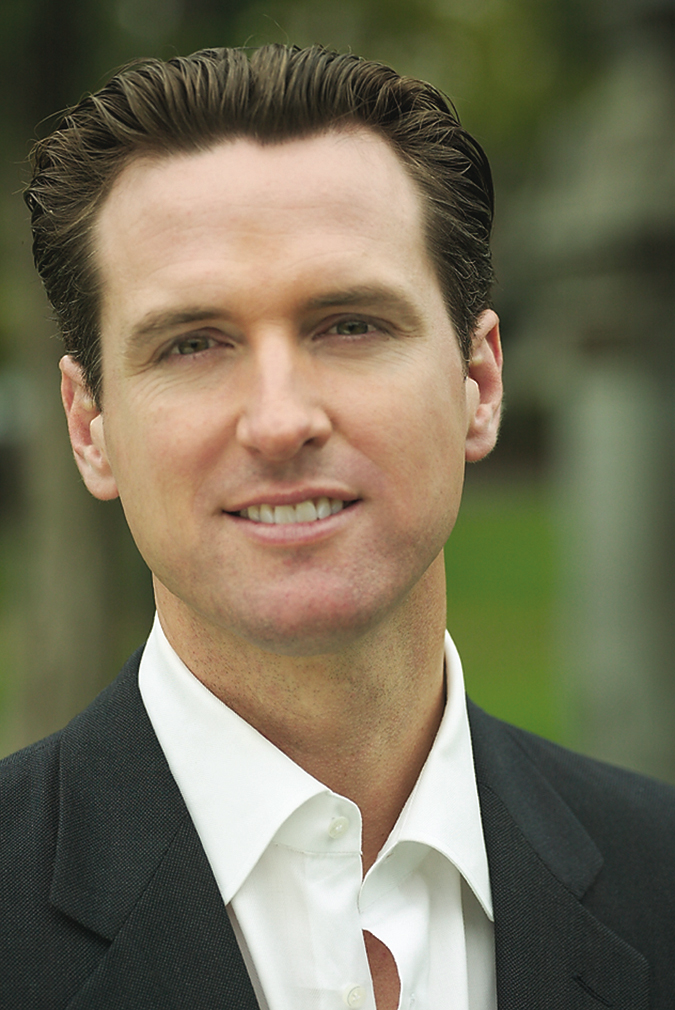
    "Identity Crisis Tour" Oracle Arena, 7000 Coliseum Way, Oakl; (510) 569-2121, www.coliseum.com. Sun, 5pm. $45.50. Celebrate Valentine’s Day with Jeff Dunham.

    SPOKEN WORD
    "Grateful Tuesday" Ireland’s 32, 3920 Geary; 386-6173, www.myspace.com/thegrasshoppersongs. Tues, 8pm. Ongoing. Grasshopper hosts this weekly open mic featuring folk, world, and country music.
    "Literary Death Match" Elbo Room, 647 Valencia. Fri, 6:30pm. $5-$10. A lineup of all-star judges pit writers against each other.
    "Writers with Drinks" Make-Oput Room, 3225 22nd St; www.writerswithdrinks.com. Sat, 7:30pm. $5-$10. Charlie Jane Anders hosts this spoken word variety show, this time featuring Vikram Chandra, Cherie Priest, James Rollins, Andrew Porter, and Derek Powazek.

    Memorial for Charles Lee Smith (1925-2010), passionate pamphleteer

    1

    Memorial services for Charles Lee Smith, a classic liberal activist whose hero was Tom Paine and whose passion was pamphleteering, will be held at 3 p.m. on Friday, Feb. 12, at the Friends Meeting House, Walnut and Vine, in Berkeley. He died at his Berkeley home on Jan. 7 at 84.

    His wife Anne said that Charlie, as we all called him, fell in December and never fully recovered. She brought him home under hospice care on Jan. 5 and she and his two sons Greg and Jay were with him his last three days.

    Charlie first contacted me in the early days of the Guardian in the late l960s. I soon realized that he was my kind of liberal, always working tirelessly, cheerfully, and quietly to make things better for people and their communities. He was a remarkable man with a remarkable range of interests and causes that he pursued his entire life.

    He campaigned endlessly for causes ranging from the successful fight to stop Pacific Gas and Electric Co. from building a nuclear power plant on Bodega Bay to integrating the Berkeley schools to third brake lights for cars to one-way tolls on bridges to disaster preparedness to traffic safety and circles to public power and keep tabs on PG@E and big business shenanigans.


    When he first began sending tips our way, he was working with, among many others, UC Berkeley Professor Paul Taylor with his battles with the agribusiness interests. He was helping UC Berkeley professor Joe Neilands on his public power campaigns. I remember a key public power meeting that Joe and Charlie put together in a Berkeley restaurant. It brought together the sturdy public power advocates of that era. Charlie did much of the staff work and was seated at the speaker’s table next to the sign that read, Public Power Users Association.

    I credit that event and its assemblage of public power activists as inspiring the Guardian to make public power and kicking PG@E out of City Halls a major crusade that continues to this day. Charlie and Joe rounded up, among others, then CPUC commissioner Bill Bennett, consumer writer Jennifer Cross, William Domhoff, the UC Santa Cruz political science professor who was the main speaker, and Peter Petrakis, a student of Neilands’ in biochemistry who researched and wrote the Guardian’s early pioneering stories on the PG@E/Raker Act scandal. (See Guardian stories and editorials since l969.) The room was also full of veteran public power warriors from PG@E battles in Berkeley, San Francisco, and around the bay.

    Charlie was a lifelong volunteer for the Quakers and pamphleteered on many of their projects.

    My favorite story was how he was helping Dr. Ben Yellen, a feisty liberal pamphleteer in Brawley. Yellen and Charlie were political and pamphleteering soulmates, but Charlie was operating in liberal Berkeley and Yellen was in very conservative Imperial County.

    Yellen was blasting away at the absentee land owners who were cheating migrant laborers on health care, on high private power costs of city dwellers, and the misuse of government water subsidies. And so he had trouble getting his leaflets printed in Brawley. He would send leaflets up to Charlie and Charlie would get them duplicated and then send the copies back to Yellen. Yellen would distribute them, mimeographed material on legal-sized yellow construction paper, under windshield wipers during the early morning hours and into open car windows on hot afternoons.

    Charlie relished promoting Yellen as a classic in the world of pamphleteering and loved to talk about how Yellen followed up his pamphleteering with several pro per lawsuits, an appearance on CBS’ 60 Minutes television show, and a case that went to the U.S. Supreme Court.

    Charlie liked to talk about his triple play of information distribution. He pamphleteered on street corners, prepared more than 50 bibliographies of undiscussed issues (including the best bibliography ever done on San Francisco’s Raker Act Scandal), and circulated his personal essays and cut and pasted newspaper articles. Almost every day, he would take the newspapers from the sidewalk near his house and put them on the front porches of his neighbors. He got some exercise, since his house was on a Berkeley hill, and he endeared himself to his neighbors. He was given the title of “Mayor of San Mateo Road.”

    Charlie pamphleteered on more than l50 “undiscussed subjects,” as he called them, in Berkeley, Oakland and San Francisco. He sometimes went out to Palo Alto, Santa Rosa, and Napa, with occasional excursions to Boston and London. His subjects were practical and straightforward but breathtaking in their range: humanizing bureaucracy, employee suggestions, penal reform, illiteracy, migant labor, water, energy, land reform, ombudsmen, coop issues, library use, land value taxation, transportation, disaster recovery planning. He handed out KPFA folios and an occasional Bay Guardian.

    He often combined pamphleteering with doing bibliographies to spread the word about the undiscussed subjects.  On the first Earth Day in l970 at California State University, Hayward, Charlie spoke about the evils of automoblies. Then he distributed his bibliography of the Automobile Bureaucracy. In recognizable Charliese, he produced a blizzard of numbered citations on a summary of his speech so the audience could read further on his issues.

    He considered pamphleteering as a noble form of communication that “went on during the colonial Period for a l00 years before the revolution and the arrival of Tom Paine in l775,” as he put it in his own pamphlet, “Pamphleteering: an old tradition.” He wrote that his main contribution “is the novel use of sandwich boards to screen out the disinterested while reaching the already-interested and open-minded persons with leaflets on the street, but not invading anyone’s privacy.”

    Sometimes, Charlie had news close to home.

    He said that giving out pamphlets to one or two people at a time was like holding a meeting with those persons and thus it was possible to have a “meeting” with several hundred people nearly anywhere within reasonable limits. He concluded that pamphleteering was “basic to building support for worthwhile projects” and claimes that it “may even be more effective than other forms of expensive communication.”

    Charlie knew how to work the streets, but he also knew how to work inside the bowels of the bureaucracy. He worked for the California Division of Highways (now Caltrans) from l953 to 1987, mostly in an Oak Street office in San Francisco. I admit when Charlie talked to me about fighting bureaucracy, as he often did, I had trouble understanding how he was going about it. But Charlie had his ways.

    Executive Editor Tim Redmond recalls that Charlie worked for Caltrans back in the days when the very thought there might be transportation modes other than highways was heresy.

    He was an advocate of bicycles, carpools and public transit and Redmond thought that, when he first met Charlie in l984, “he must be like the monks in the middle ages, huddled in a corner trying to preserve knowledge. Nobody else at Caltrans wanted to talk about getting cars off the roads. Nobody wanted to shift spending priorities. Nobody wanted to point out that highrise development in San Francisco was causing traffic problems all over the Bay Area–and that the answer was slower development, not more highways.

    “But Charlie said all those things. He told me where the secrets of Caltrans were hidden, what those dense environmental impact reports really showed, and how the agency was failing the public. I had a special card in my old l980s Rolodex labeled ‘Caltrans: Inside Source.’ The number went directly to Smith’s desk.” Charlie usually carpooled from Berkeley to his San Francisco office.

    Charlie wrote a leaflet about the “Work Improvement Program” that then Gov. Pat Brown instituted in l960. It was, he wrote, a “novel program to get all state employees to submit ideas to improve their work.” Charlie labeled it “corrupt” and laid out the damning evidence. No appeal procedure. No protection for the employee making suggestions that the supervisor or organization didn’t want to use. No requirement for giving the employee credit for the idea or for following up the idea.

    Charlie noted that he was a generalist with lots of ideas, read lots of publications, and was “sensitive to the problems that bother people.” He noted that there were l,500 employees in his Caltrans district who submitted 236 suggestions. Charlie submitted 35 of them.  But, he noted wryly, “my supervisor, Charles Nordfelt, did not respond at all to any of my suggestions.” And then, to make neatly make his point, Charlie listed a few of his suggestions, all of them practical and useful.

    Many were adopted without Charlie ever getting credit. Others were adopted decades later. For example, he pushed the then-heretical idea of collecting tolls on a one-way basis only, instead of collecting them two ways. He noted that the tolls are now  being collected on the wrong side of the bridge. They should, he argued,  be collected coming from  the San Francisco side, where the few lanes of the bridge open up to many lanes. This would reduce or eliminate congestion. .

    He listed other suggestions that showed his firm and creative grasp of the useful idea. Putting the third stop light on vehicles (which was finally put into effect in 1985). Numbering interchanges. Installing flashing red and yellow lights at different rates. (He  explained that his wife’s grandfather was color blind and drove through a flashing red light when she was with him.) Getting vehicle owners to have reflective white strips on the front bumpers of their cars, helping police spot stolen vehicles. Some of his suggestions are still percolating deep in the bureaucracies and may yet go into effect.

    Charlie never got the hang of the internet but he covered more territory and reached more people in his personal face-to-face way than anybody ever did on the internet.

    Charlie was born on a homestead farm eight miles from Weldona, Colorado. He attended a one-room school house and then moved on to a middle and high school in Ft. Morgan, Colorado. He got “ink in his blood,” as he liked to say, by working on the school paper called the Megaphone and then as a printer’s devil at the weekly Morgan Herald.

    He was drafted into the army in l943 and served as an infantryman with the 343rd regiment, 86th Infantry Division. He was severely sounded in 1945 in the Ruhr Pocket battle near Cologne, Germany, the last major battle of the war. He suffered leg and hip injuries and had a l6 inch gouge  out of his right hip that cut within a quarter inch of the bone. He spent six months in the hospital. He was recommended for sergeant but he refused the promotion and ended the war as a private first class.

    After his recovery, Charlie came to the Bay Area and took his undergraduate work at Napa Community College and San Francisco State, then did graduate work in sociology at the University of Washington, and in city and regional planning at the University of California-Berkeley.

    In 1949, Charlie joined the American Friends Service Committee and became a lifelong volunteer, working on a host of projects. He did everything from helping with a clothing drive in Napa to being part of the crew that built the original Neighborhood House in Richmond.

    Charlie met Anne Read in l954, a college student in Oregon, when she was on an AFSC summer project in Berkeley. Charlie visited the project, spotted Anne, and double dated with her. When she returned to Oregon State for her senior year, Charlie wrote her every single day. The two were married the following summer in June of l955.

    Charlie is survived by Anne, two sons Greg and Jay, daughter-in-laws Karen Vartarian and Andrea Paulos, and granddaughter Mabel.

    The family asks that, in lieu of flowers, please send a donation in Charlie’s name to the American Friends Service Committee, 65 9th St., San Francisco, Calif. 94l03.

    I asked Anne why Charlie, the inveterate communicator, had not taken to the internet. Charlie, she replied, was a print guy and simply could not understand the internet. “He never ever used email,” she said. “He still thought he had to go to a library to make up a bibliography. I think Charlie was so sure that making a bibliography meant a lot of hard work, he couldn’t possibly do it on the internet.”

    Well, Charlie, you may have missed the internet but you covered more territory and reached more people in your direct personal way with good ideas than anybody ever did on the internet.

    Here are some of Charlie’s favorite pamphlets:
    Governor Pat Brown’s Work Improvement Program
    Pamphleteering: An Old Tradition
    Short Statement on Plamphleteering

    Gavin for Lite Guv?

    1

    Willie Brown thinks it’s a good idea. And you can tell Newsom wants to consider it, since he knows there’s nothing else obvious for him to do once his term as mayor is up — and there are going to be a lot of options not too far down the road. Sen. Dianne Feinstein isn’t getting any younger, and at some point she’ll retire. If Jerry Brown doesn’t get elected governor, the Democrats will be looking for someone very different in four years. But once a politician like Newsom is out of office and out of the spotlight, he’ll have a hard time coming back.

    So he could sit up there in the Lite Gov’s office, doing what John Garamendi did — taking on issues like cuts to the University of California (the Lt. Gov. sits on the Board of Regents) and making speeches about reform, and maybe he could get out in front of this constitutional convention stuff, and keep his name in the news, without having to make a single difficult or unpleasant decision that he can be blamed for later.

    You know he wants to do it ….

    But there’s this problem, and for Newsom, it’s very real.

    As people close to the mayor have told me repeatedly, the money people who helped put the mayor in office — and who would have to be around to help him run for any other office — are not at all pleased with the prospect of Newsom leaving San Francisco a year early. See, that would give the district-elected supervisors the chance to fill the mayor’s job for the last year of Newsom’s term, and the person they appointed would be able to run as an incumbent.

    And while it’s not clear who could get six votes (David Chiu? David Campos? Ross Mirkarimi? Aaron Peskin?) it’s pretty clear that the new mayor would not be an ally of Newsom’s pals.

    Sure, when he was running for governor, it seemed fine — having their guy in charge of the state was worth the loss of the San Francisco mayor’s office. But for a relatively powerless job? I think they’d crucify him.