


Today, Johnny and Tim talk about the stunning defeat of Props. 16 and 17, the future of Gavin Newsom and why the governor’s race is Jerry Brown’s to lose. You can listen after the jump.
sfbgradio6/9/2010 by sfbgradioGovernor
Everyone hates PG&E
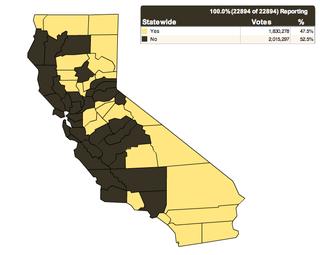
Well, maybe not everyone, but the results from last night’s election are fascinating. A $50 million campaign, with the opposition struggling to come up with $100,000 — and PG&E still lost. Calitics has a fun comparison that makes one of the key points: The company lost most heavily in its own service areas. People who have to deal with PG&E — and its high rates, poor service, blackouts, botched smart-meter program and financial greed — voted strongly against allowing the company to further entrench its monopoly power. In essence, PG&E lost at home.
A couple of other interesting factors: The results show, I think, that whatever you say about the decline of newspapers, their endorsements still matter. Every major newspaper in the state opposed Prop. 16, and that clearly had an impact. The No on 16 campaign didn’t have the money for any media buys; the press coverage and strong anti-PG&E endorsements had to carry the message.
TURN, Ross Mirkarmi, Mark Leno, Tom Ammiano and consultant Gail Kaufman deserve credit for raising what little money they could and leveraging it into a stunning statewide victory. Considering that the turnout skewed heavily Republican, the defeat of Prop. 16 will go down as one of the great progressive victories in California history.
The local numbers were astounding: In San Francisco, Prop. 16 went down 2-1, with 67 percent of the voters rejecting PG&E’s ploy. That’s the strongest mandate for public power I’ve ever seen. Same for the rest of the Bay Area: Alameda County, 64 percent No. San Mateo County, 60 percent No. Marin County, 61 percent No. Mayor Gavin Newsom ought to take a look at the map on the Secretary of State’s website; it shows that the voters he needs to get elected lieutenant governor have rejected PG&E and want a public-power option.
The collapse of PG&E’s attempt to buy democracy in California gives San Francisco some breathing room on its community choice aggregation contract, which is excellent news. The supervisors can now take some time to go over the details — and prepare for the next major battle, the marketing campaign to education local residents about the value of community-controlled green energy.
PG&E is clearly on the run — CEO Peter Darbee has driven the company to a point where it has no friends left. Could be a great era for public power efforts.
At the Newsom party
Gavin Newsom stopped short of declaring victory until the numbers are final, but said he was excited to be a part of a crucial political year in California. “We’re very proud to be in a position to be the Democratic nominee and to work with the other Democratic nominees.” He lavished praise on Jerry Brown, telling stories about his father’s long relationship with the former governor and expressing his admiration. “I couldn’t be more proud to quasi-be on a ticket with Jerry Brown,” he said, adding, “We are proud he has decided to do this, and we’re all the beneficiaries of his commitment.”
He also praised his opponent, Janice Hahn, and said she was a worthy adversary in a mutually respectful campaign. “We ran a very positive campaign, we stayed focused on the issues and focused on tomorrow.”
He acknowledged that it will be a tough race in the fall (“we’re running against Meg Whitman’s check book”), and is already trying to paint Abel Maldonado as a Sacramento insider. “I’ll be running against a guy who’s been up in Sacramento for 12 years, a 12 years when we’ve seen college tuitions double.”
The GOP’s Wall Street ticket
Steven T. Jones reports that the folks at the Newsom victory party aren’t just celebrating Gavin’s overwhelming win; they’re looking forward to the fall. The Republicans have nominated two big-business executives for governor and senate — and that’s not a good political position to be in these days. “I think it’s stunningly politically tone deaf to nominate two Wall Street CEOs at the top of the ticket,” noted Dan Newman, a Newsom communications advisor.
Three words: Vote June 8
The problem with the June 8th ballot is that the Democrats aren’t fighting with each other.
I mean, it’s great that Jerry Brown and Barbara Boxer will emerge from the primary season unscathed, flush with money and ready to go after opponents who have been battered and beaten mercilessly in their own primaries. It’s great that Steve Poizner drove down Meg Whitman’s positives and made her look so bad that she’s now behind Jerry Brown (who isn’t even campaigning yet) in the polls. It’s great that Carly Fiorina was forced so far to the right that she had to endorse allowing people on the no-fly list to buy handguns. The expensive and ugly GOP primary battles may have saved Boxer’s job and put Brown in the governor’s office.
But around the state, Democrats don’t have as much reason to vote. Fiorina, Poizner, Whitman — they’re all spending millions to bring Republicans to the polls. There’s no similar statewide GOTV operation on the Democratic side. So the electorate could wind up skewing considerably to the right — and that’s going to hurt us on the ballot propositions.
Johnny Angel and I were talking on our radio show today about the fact that Republicans — those who aren’t complete idiots — ought to oppose Prop. 16 and Prop. 17. Those aren’t partisan measures; they’re just corporate scams. And nobody from any political party likes Pacific Gas and Electric Co. these days.
But the reality is, PG&E has aimed its Prop. 16 campaign directly at the heart of the more conservative electorate, with its anti-government message. And Mercury insurance has aimed its campaign at the better-off consumers who aren’t likely to drop their car insurance any time soon. I don’t see Prop. 16 winning big in any constituency — but it will do better among Republicans.
So Democrats have to get to the polls — and get their friends to the polls, and their families to the polls, and their neighbors to the polls, and a few dead people, too, if they can find them (just kidding, Arthur Evans, lighten up).
And in San Francisco, where there are no races for mayor or supervisor, it’s easy to want to sit this one out — but that would be a major mistake. The election for Democratic County Central Commitee alone is worth a trip to the polling place, since the makeup of that body will have a significant impact on the fall supervisorial races.
So you have to vote, folks. Here’s our endorsements.
Newsom and his commissioners just love Candlestick/Shipyard report
Text by Sarah Phelan, photos by Luke Thomas

Today, I’m dedicating Michael Franti’s “Say hey, (I love you)” to the entire Redevelopment Commission and the four Planning Commissioners who approved the City’s final Environmental Impact Report plan for Lennar’s Candlestick/ shipyard development. I’m doing so, not because I love these commissioners, who are all mayoral appointees, but because they all seem to love everything about the final report, despite ongoing concerns about building a bridge over an environmentally sensitive slough, taking park land for luxury condos and unresolved questions about the Navy’s cleanup of the shipyard.(Yes, the EIR doesn’t address the toxic cleanup, but does it make sense to approve it before the Navy has completed its cleanup assessment plan?)
I’m also dedicating Franti’s bubbly soul-lifting song to Planning Commissioners Christina Olague. Kathrin Moore and Hisashi Sugaya for refusing to rubberstamp the final EIR or the related CEQA findings. Thanks guys for having some moral backbone!
Mayor Gavin Newsom, presumably tweeting while leaving town again on the Lt. Governor campaign trail, hailed yesterday’s rubberstamping process as a critical milestone.
“This is a major milestone for our efforts to transform the shipyard from an environmental blight to a showcase of jobs, affordable housing, parks and green-technology investment for the Bayview and our entire City,” Newsom said in a press release. “The approvals of the EIR and Redevelopment Plan reflect the years of hard work, rigorous study and extensive community involvement invested in revitalizing our City’s Southeastern Waterfront…our progress today is a testament to their leadership and commitment to thoroughly cleaning up the Shipyard so we can forge ahead towards a new vision for Hunters Point.”

One of the key points to emerge from last night’s hearing is the bifurcated nature of the process, which yesterday let the city push the EIR certification through, before the Navy completes a related EIS (environmental impact statement) about the cleanup on the shipyard—including areas of land where Lennar hopes to develop homes if the 49ers leave.
Fog City Journal’s Luke Thomas told me today that during public comment, the Nation of Islam’s Minister Christopher Muhammad called the commissioners “paid prostitutes” and “political whores” and said there would be a “political earthquake” if the commissioners go forward with EIR.

“However, I don’t think he understood that the EIR and the EIS (which deals with the toxic cleanup) are two separate documents,” Thomas said, accurately noting that the joint commission was only voting on the EIR yesterday.
(According to Thomas, the Minister also promised that coalition of activists that would dog Newsom up and down the State during his campaign for Lt. Governor to expose Newsom’s record, so expect more fireworks along the campaign trial this summer.)
Another key fact to emerge from yesterday’s hearing was the lack of public comment on the part of almost all the candidates running to replace D. 10 Sup. Sophie Maxwell, whose district includes this massive development. Only Kristine Enea, Tony Kelly and Espanola Jackson spoke on the record—with Enea in favor of the plan with amendments, and Kelly and Jackson opposed as things currently stand.
Now, you’d think that everyone running in this race would be eager to show D. 10 constituents (and beyond) that they were at the meeting, not only silently tracking, but also publicly expressing their opinions. And while it’s true that Marlene Tran and DeWitt Lacy filled in speaker cards, Chris Jackson showed up during the proceedings, and Lynette Sweet got ushered into the press box by Sup. Bevan Dufty, none of these D. 10 candidates got their thoughts in the public record. Now, no doubt Cedric Akbar, Bill Barnes, Isaac Bowers, James Calloway, Malia Cohen, Ed Donaldson, Marie Franklin, Rodney Hampton Jr., La Vaughan Moore, Geoffrea Morris, Steve Moss, Jacqueline Norman, Nina Pickerrell, Dwayne Robinson, Diane Wesley Smith, Eric Smith, (and the many others rumored to be running) had their reasons for not being there, and I’d be happy to hear all about it from all of them between now and the November election.
But it doesn’t instill confidence in candidates when they won’t say in public what they are only too willing to say off the record. So, kudos to Enea, Kelly and Jackson for taking that leap and refusing to act like politicians before they have even been elected.
“So much of it was shocking but not surprising,” Tony Kelly told me today, after he recovered from last night’s meeting which lasted until 2 a.m. ‘Everyone knew there would be a snappy 4-3 decision by the Planning Commission on the stuff that mattered. And in a way, I can see why the mayoral appointees on the Commission would decide that they would leave it to the elected officials on the Board to stop this plan. But there was zero excuse for the lameness of the Redevelopment Commission [who are all mayoral appointees]. Still, it showed what the Planning Commission [which today consists of four mayoral appointees, and three Board appointees] must have been like before it was reformed [and still consisted solely of mayoral appointees].”
“It was heartbreaking to see the endless parade of Bayview Hunters Point residents saying, ‘I need a job,’ or ‘ I need to live in a new house,’ as they argued in favor of certifying the project’s final EIR, despite all the flaws,” Kelly acknowledged.
Still, as Kelly points out, the city could have pushed to acquire foreclosed housing in D. 10 so residents in substandard public housing could be relocated into decent units now, instead of having to stay at least another five years, or longer, in rat, cockroach and sewage inundated units, under Lennar’s plan.
Kelly also notes that the city could have used the Redevelopment Agency’s “massive power” to do stuff up and down Third St, where unemployment is especially visible.
“Having done planning elsewhere, this plan [for Candlestick and the shipyard] is like planning on Mars,” Kelly said. ‘This is a bigger badder version of 555 Washington.”
Last but not least, Kelly voiced concern that a couple of peaker plants will be built within Lennar’s project area.
.“There are going to be two combustion turbines generating steam heat, but not electricity within the project boundaries,” Kelly clarified. “That means they don’t have to register as a power plant, but they will be generating greenhouse gases. The only difference is they won’t be generating electricity.”
So, now the charade of approvals heads to the Port Commission, which has got some folks asking whether Port Commissioner Stephanie Shakofsky, another Newsom appointee should recuse herself , given that her non-profit is clearly such a fan of the project.
Political juggernaut

sarah@sfbg.com
City officials are scrambling to secure final approvals to allow Lennar Corp. to move forward with its 770-acre Candlestick/Hunters Point Shipyard redevelopment of San Francisco’s impoverished and polluted southeast sector. But the community remains divided on the project, raising concerns that wary residents will end up being steamrolled by this politically powerful juggernaut.
Some groups say the project needs major amendments, but fear it will be rushed to the finish for political reasons. Others say they are hungry to work and desperate to move into better housing units, so they don’t want all the myriad project details to slow that progress. And Mayor Gavin Newsom’s administration is arguing that approving the project’s final environmental impact report by June 3 is crucial if San Francisco wants to keep the San Francisco 49ers in town.
But many observers fear Lennar wants its entitlements now before its project can be subjected to greater scrutiny that could come with the November elections. Newsom, who made Lennar’s project the centerpiece of his housing policy, will be replaced as mayor if he wins the lieutenant governor’s race. And a crowded field of candidates, many of them progressives concerned about the project’s impacts on the poor and the environment, are vying to replace termed-out Sup. Sophie Maxwell, whose district includes Lennar’s massive territory.
“It’s 180 percent about the 49ers,” land use attorney Sue Hestor told the Guardian, referring to the city’s proposed rush job, as evidenced by a rapid entitlement schedule that the Newsom’s administration wants city commissions and the board to follow.
Under that schedule, which Hestor procured from the Mayor’s Office, Planning and Redevelopment commissioners are expected to certify the project’s final 6,000-page EIR, adopt California Environmental Quality Act findings, approve amendments to the project’s original disposition and development agreement, and authorize land trust and open space reconfigurations — all during a June 3 meeting where public comment will likely last for many hours.
Saul Bloom, executive director of Arc Ecology, a community-based nonprofit that tracks the development, says this schedule stretches the credulity that this is a deliberative process. “There’s no way anyone could make a functional reasoned assessment,” Bloom told us. “How do you have any meaningful public conversation under those circumstances?”
Michael Cohen, Newsom’s chief economic advisor, asserted in an April 29 article in The New York Times that Lennar’s plan is a “really, really good project,” echoing the glowing praise he’s heaped on the project since its conception.
“But there’s nothing new in their proposal,” Bloom told us. “That’s because they haven’t been listening to the public’s concerns. [Cohen] says, ‘Haven’t we talked enough? The community’s been waiting all these years!’ But waiting to get what done?”
Lennar’s project — which had early backing from Newsom, U.S. Sen. Dianne Feinstein, and other political power brokers — was sold as creating “jobs, housing, and parks” and “revitalizing the abandoned shipyard” when voters approved the Lennar-financed Proposition G in 2008.
“Proposition G is from the community and for the community,” Lennar’s campaign promised. “You can turn the abandoned Hunters Point Shipyard into a clean, healthy, sustainable, livable neighborhood — a place where people can raise their children.”
The shipyard once employed thousands of workers, including African Americans who were recruited from the South in the 1940s and ’50s. But the district’s economic engine fell into disrepair when the military left in 1974. Today the neighboring Hunters Point and Bayview neighborhoods have the highest unemployment and crime rates and the largest concentration of African American families in the city.
But the city’s final EIR for the project, which the Planning Department released mid-May, shows that 68 percent of the developer’s proposed 10,500 new housing units will be sold at market rates unaffordable to area residents, and that many of these units will be built on state park land at Candlestick Point.
Lennar is also proposing to build a bridge across the environmentally sensitive Yosemite Slough, significantly changing the southeast waterfront. Lennar says it plans to develop the project’s remaining 3,000 units at below market prices, including one-for-one replacement of rundown Alice Griffith public housing units. Its proposal includes a dozen high-rise towers, 2.7 million square feet of commercial space, 1 million square feet of retail space, a performing arts theater, and an artists colony.
Lennar claims its proposal will create 1,500 construction jobs annually during the project’s 20-year build-out, along with 10,000 permanent jobs, thanks to a United Nations Global Compact Sustainability Center and a vaguely defined green technology office park.
The project and its impacts are already an issue in this year’s District 10 supervisor’s race (see “The battle for the forgotten district,” Feb. 23). Candidate Chris Jackson says Lennar’s proposal is weak when it comes to creating well-paying, low-skilled green collar jobs. He supports Arc’s proposal to including green maritime industrial use at the shipyard.
Arc recommends that the city’s final EIR allow recycling and repairing of ships, including the Suisun Bay Ghost fleet — decommissioned U.S. Navy, cruise, and ferry ships — arguing that “ship recycling and repair are resurgent strategic industrial activities yielding employment opportunities for our existing pool of skilled and unskilled workers.”
Jackson, who was elected to the Community College Board in 2008 and recently jumped into the District 10 race, wants the city to assert that the project is not a regional housing plan.
“It’s a local housing plan for local residents,” Jackson asserts. “It’s not here to provide housing for Silicon Valley. It’s for Bayview-Hunters Point and District 10 residents.”
Jackson understands why some local residents want no delays on final EIR approval: “I can never blame folks in Alice Griffith public housing for coming out and saying ‘no delays.’ They really want something real, housing that is not rat and cockroach infested.”
As a policy analyst (a position he’s quitting to focus on the District 10 race) for the San Francisco Labor Council — which gave key backing to the project in the 2008 election — Jackson knows labor is frustrated by all the project meetings. “I try to tell them it’s better to get this project right than rush it through and find out later that it goes against the interests of labor,” Jackson said.
In May 2008, the Labor Council signed a community benefits agreement (CBA) with Lennar. Since then labor leaders have urged no delays on the project’s draft EIR review. But Jackson believes the city must demand that financial consequences, such as liquidated damages, be a project approval condition if the developer reneges on the CBA.
“Right now the only push-back the city has is to threaten to kill the whole project if Lennar doesn’t meet its timeline,” Jackson said. “But people are really invested in this project, and I don’t believe anyone would pull the trigger and end the entire development. We don’t need to throw everything out; we just need to change them.”
Jackson wants to see the inclusion of a special-use district that would create a cooperative land trust to ensure affordability and home ownership opportunities for local residents. “I love open space and sustainability, but I also want affordable housing and real light-industrial opportunities that can employ people living in the district now.”
Special-use districts, Jackson argues, give city commissioners a way to amend this project to make it more acceptable.
Jackson wants to see strong tenant protections for public housing residents. “The vast majority of those residents are African American. At the end of the day, I want to see economic and environmental justice, so we can say we brought the right change to our community.”
Jackson also would like to see a more independent Mayor’s Office. “Don’t you feel like its 2002/2003, and that if you speak out against the project, it’s like you are speaking out against the Iraq war, and all of a sudden you are not patriotic?”
Fellow District 10 candidate Eric Smith concurred. “The powers that be are definitely moving this thing forward,” he said. “And this is a monster train, a juggernaut that is gathering steam. But how it shakes out down the road remains to be seen. My whole mantra is that there needs to be greater transparency down the line. If I become the sheriff, I’ll be shining a light on all this stuff.”
Smith warned that the community needs to work together or it won’t win a better deal. “It’s clear that folks in the city are hoping against all odds that Lennar can pull this stuff off so they can prove all the naysayers wrong and these community benefits can be realized, and that scrutiny of the projects can go on while all this happens,” he said.
But Arthur Feinstein, the Sierra Club’s political chair, worries that the city’s rush job is resulting in seriously flawed documents and decision-making. “It’s difficult for folks to digest 6,000 pages of comments and responses on the draft EIR in the three weeks since planning posted them online,” Feinstein said. “And nothing has changed despite all the comments, which is why it continues to be a nonsense process.”
Feinstein says the Sierra Club’s top concerns are the Parcel E-2 cleanup on the shipyard, a deal to transfer 23 acres at Candlestick Park for development, and the bridge over Yosemite Slough.
“You can cover most of the site,” he said. “But when it comes to Parcel E-2, where the dump burned for six months in 2002, that’s only 20 acres, it could and should be removed. This is the environmental justice issue that has the community up in arms.”
Feinstein worries about the precedent that selling a state park for condos sets. “This is our park, and they are shrinking it.” He is also concerned that the developer wants to bridge Yosemite Slough for cars.
How many of these concerns will be addressed at the June 3 hearing, which is just days before Santa Clara County voters decide whether to try to lure away the 49ers with a new publicly financed stadium? We’ll see.
Newsom’s lousy economics
EDITORIAL Every major newspaper in California should have plastered the May 2010 report from the UC Berkeley Center for Labor Research across the front page. The headline: “Governor’s budget will destroy 331,000 jobs.”
It’s a stunning analysis. Ken Jacobs, who heads the center, and two associates used a sophisticated computer program to track exactly how the cuts would play out in the current California economy. If the governor’s proposals are adopted, the job losses would greatly exceed any new job creation, causing the unemployment rate in the state to rise by 1.8 percent.
On the other hand, the study shows, raising taxes on rich people and oil companies would save 244,000 jobs.
So if, as nearly every politician of every party in the state insists, the biggest policy goal in California today is job creation, Gov. Arnold Schwarzenegger is going about it entirely the wrong way.
The good news is that the Democrats in the state Legislature are finally talking seriously about an alternative budget plan that includes about $5 billion in new revenue. The plans by the Assembly and Senate leadership aren’t perfect and will still require significant cuts to cover the budget gap. But after years of cuts-only budgets and a pervasive fear of tax increases in Sacramento, the Democratic proposals are encouraging. (Jerry Brown, the Democratic candidate for governor, shouldn’t worry about associating himself with the plans: two-thirds of Californians favor increased taxes on wealthy people to pay for better public education, according to the most recent Public Policy Institute of California poll.)
So at the very least, the state Capitol — a place not known as a bastion of progressive thought — is going to have an intelligent debate over how to address the budget deficit without further damaging the economy. Yet in San Francisco, Mayor Gavin Newsom continues to cling to a no-new-taxes budget that will devastate community services — and add to the city’s unemployment rate.
That’s just disgraceful.
Every city-employee union has stepped up to the plate and offered concessions. City workers are taking furloughs (actually, pay cuts) and layoffs. They’re giving back scheduled raises. They’re making a good faith effort to be part of the solution — in fact, labor is now pushing for an increase in the hotel tax to help cover the costs of public services.
Newsom isn’t asking any of the wealthy businesses or individuals in town to give anything.
That’s not just bad politics, it’s bad economics.
The Berkeley study acknowledges that raising taxes on the rich and big corporations has an economic impact — an oil severance tax, for example, would raise $1.4 billion a year for the state, reduce economic output by $128 million, and lead to the loss of 400 jobs. A 1.5 percent increase in the top income tax rate for individuals who earn more than $250,000 would bring the state $2.1 billion, and lead to the loss of 13,000 jobs.
But on balance, both of those are a good deal for the state — because cutting that $3.5 billion from the budget would cost the state far, far more than 13,400 jobs. That’s because when you eliminate public sector jobs, particularly lower-paid jobs, there’s a direct, immediate impact on consumer spending. Although a rich person may spend slightly less if he or she has to pay slightly higher taxes, a middle-income worker who gets laid off stops spending much of anything — and the local merchants who relied on that person’s spending see the impact.
In fact, the Berkeley study points out, more than half the jobs that would be lost under Schwarzenegger’s plan would be in the private sector. The same goes for San Francisco: saving jobs requires new revenue solutions. And if Newsom’s budget doesn’t address that, the San Francisco supervisors must.
Newsom’s lousy economics
EDITORIAL Every major newspaper in California should have plastered the May 2010 report from the UC Berkeley Center for Labor Research across the front page. The headline: “Governor’s budget will destroy 331,000 jobs.”
It’s a stunning analysis. Ken Jacobs, who heads the center, and two associates used a sophisticated computer program to track exactly how the cuts would play out in the current California economy. If the governor’s proposals are adopted, the job losses would greatly exceed any new job creation, causing the unemployment rate in the state to rise by 1.8 percent.
On the other hand, the study shows, raising taxes on rich people and oil companies would save 244,000 jobs.
So if, as nearly every politician of every party in the state insists, the biggest policy goal in California today is job creation, Gov. Arnold Schwarzenegger is going about it entirely the wrong way.
The good news is that the Democrats in the state Legislature are finally talking seriously about an alternative budget plan that includes about $5 billion in new revenue. The plans by the Assembly and Senate leadership aren’t perfect and will still require significant cuts to cover the budget gap. But after years of cuts-only budgets and a pervasive fear of tax increases in Sacramento, the Democratic proposals are encouraging. (Jerry Brown, the Democratic candidate for governor, shouldn’t worry about associating himself with the plans: two-thirds of Californians favor increased taxes on wealthy people to pay for better public education, according to the most recent Public Policy Institute of California poll.)
So at the very least, the state Capitol — a place not known as a bastion of progressive thought — is going to have an intelligent debate over how to address the budget deficit without further damaging the economy. Yet in San Francisco, Mayor Gavin Newsom continues to cling to a no-new-taxes budget that will devastate community services — and add to the city’s unemployment rate.
That’s just disgraceful.
Every city-employee union has stepped up to the plate and offered concessions. City workers are taking furloughs (actually, pay cuts) and layoffs. They’re giving back scheduled raises. They’re making a good faith effort to be part of the solution — in fact, labor is now pushing for an increase in the hotel tax to help cover the costs of public services.
Newsom isn’t asking any of the wealthy businesses or individuals in town to give anything.
That’s not just bad politics, it’s bad economics.
The Berkeley study acknowledges that raising taxes on the rich and big corporations has an economic impact — an oil severance tax, for example, would raise $1.4 billion a year for the state, reduce economic output by $128 million, and lead to the loss of 400 jobs. A 1.5 percent increase in the top income tax rate for individuals who earn more than $250,000 would bring the state $2.1 billion, and lead to the loss of 13,000 jobs.
But on balance, both of those are a good deal for the state — because cutting that $3.5 billion from the budget would cost the state far, far more than 13,400 jobs. That’s because when you eliminate public sector jobs, particularly lower-paid jobs, there’s a direct, immediate impact on consumer spending. Although a rich person may spend slightly less if he or she has to pay slightly higher taxes, a middle-income worker who gets laid off stops spending much of anything — and the local merchants who relied on that person’s spending see the impact.
In fact, the Berkeley study points out, more than half the jobs that would be lost under Schwarzenegger’s plan would be in the private sector. The same goes for San Francisco: saving jobs requires new revenue solutions. And if Newsom’s budget doesn’t address that, the San Francisco supervisors must.
Finally, some talk of taxes in Sacramento
With the state careening toward another fiscal meltdown, and a new study showing (pdf) that the governor’s proposed budget cuts would cost California 330,000 jobs, increase the unemployment rate by 1.8 percent and deepen the recession, the Democrats in Sacramento are finally talking about serious new revenue sources.
The tax plans proposed by the Senate and Assembly leadership aren’t perfect, but they’re a very good start. The state Senate plan would raise $4.9 billion by eliminating corporate tax breaks (which generally don’t produce jobs anyway), raising the Vehicle License Fee and keeping a modest income surtax. The Assembly plan, announced by Speaker John Perez, relies on repealing tax loopholes and imposing an oil-severance tax.
Public employees step up; when will Newsom and downtown?
With news that Muni union leaders are backing salary givebacks to help close San Francisco’s $483 million budget deficit, all city employees are now making sacrifices to preserve city services that we all rely on. But as we eagerly await the release of the mayor’s budget on June 1 – in which some city departments have been asked to make cuts of up to 30 percent – the question is whether Mayor Gavin Newsom will find the courage to ask other San Francisco entities to help.
For example, will he support the 2 percent increase in the hotel tax that labor is pushing (and which polls show would probably pass muster with voters if Newsom backed it), a real estate transfer tax that would hit the comfortably rich, or a downtown transit assessment district that would make corporations finally help pay for the transit services their employees rely on?
So far, it’s doesn’t look like it (and his Communications Office won’t respond to the question). Instead, Newsom has cynically engaged in deceptive blame games that scapegoat public employees for a problem he created (for example, by approving bloated police and fire contracts to win political support and then blocking efforts to seek new revenue sources), while still pushing gimmicky new spending programs designed to burnish his political image as he runs for state office.
This could be Newsom’s last chance to finally show some leadership, and now is the time when it’s needed most. After offering cuts-only city budgets his entire tenure in office, most city departments are unable to go any further without sacrificing needed services.
The situation has become dire, as workers said Wednesday during a budget rally outside City Hall. Guardian news intern Kaitlyn Paris was there covering the action and offers this report:
Community groups from around San Francisco rallied in front of City Hall on Wednesday to protest the drastic reductions that health and human services face in the Governor’s proposed state budget and Mayor Newsom’s impending city budget.
A graveyard of tombstones representing each of the organizations stuck out of the sand next to the grassy square where participants gathered. Identifiable by their maroon sweatshirts, the largest faction present was the Community Housing Partnership. The proposed budget would cut over $100,000 from the agency and its programs that provide help with employment, substance abuse, and habitation development.
“Supervisors need to be constantly reminded of the merits of these services,” CHP employee Gabriel Haywood told us.
The partnership runs a jobs retention program that Haywood says has exceeded its city-mandated job retention rate by 25 percent, keeping 75 percent of the people it serves employed for longer than three months. Still, Cameron McHenry told the Guardian the city thinks the groups services are duplicative. [Editor’s Note: information in this paragraph has been corrected since his article was posted].
The city’s OneStop employment service is suited to workers displaced by the recession, not the multiple-burdened clients helped by CHP, said McHenry: “We can’t take a 30 percent cut and still do the work we do.”
After speakers from various groups addressed the crowd from a flatbed truck, District 5 Sup. Ross Mirkarimi took to the stage to demand alternative ways of generating revenue. The progressive revenue tactics championed mainly involved increased hotel tax to reduce the budget burden felt by community service groups. Mirkarimi and members of the crowd also criticized the city for its continued funding of Sharp golf course in Pacifica.
“We’re trying to force the Mayor to have a fair budget,” Coalition on Homelessness Director Jennifer Fredenbach told us. “We believe he can do it through alternative revenue like the hotel tax, a more progressive tax base, and a property transfer tax on high end real estate. It has real consequences for poor San Franciscans, not only in quality of life, but in the ability to live.”
Editor’s Notes

Tredmond@sfbg.com
Even the San Francisco Chronicle, which is not know for its fiery progressive editorials, took all of the major candidates for governor to task May 22 for failing to offer any real solutions to the horrific budget problem: “[A]ll three are presenting the types of phantom savings (‘Let’s slash waste, fraud, and abuse! Cut across the board!’) and the panacea of collaboration (‘Everyone to the table! Appoint a blue-ribbon commission!’) that substitute for real leadership on the campaign trail.”
It makes me want to throw up. This is not a game; there are literally people’s lives in the balance. Even Jerry Brown, the Democrat’s best hope, is ducking madly. Jerry says that the folks “with the biggest belts should tighten them.” Sounds good, but what the hell does it mean?
Well, according to his press spokesman, it means nothing at all. I called the Brown for Governor campaign last week, and asked Sterling Clifford, who handles press for Jerry (that’s got to be a tough job) whether his boss was talking about higher taxes. No: “I think he has been very clear that there will be no new taxes unless the people vote on them.” (Actually, since the Public Policy Institute says two-thirds of Californians would support raising taxes on the rich to pay for education, a vote would likely be positive — but the campaign would be expensive and Brown would have to lead it.)
But he’s not willing to commit to any specific cuts in any specific programs. He’s not saying which belts he wants to tighten.
Here’s the hard, cold fact: You can’t solve California’s budget crisis by cuts alone, not unless you want to utterly abandon the state’s commitment to public education and social services (oh, and let about half the people in prison go free). Meg Whitman wants to lay off thousands of state workers (and create more unemployment). But even if you fired every single one of the 238,575 people who work for the state of California, you still wouldn’t cover a $19 billion hole. (The state’s total payroll in April was about $1.4 billion, or $17 billion a year.)
And we’re still stuck with billions in debt from the past few years when the governor couldn’t deal with reality and bumped it off into the future.
Maybe Brown thinks the economy will magically improve when he takes office, and the problem will solve itself. But it won’t. This is a structural issue, and until everyone, including the news media, accepts that, we’re just going to get into deeper and deeper doo-doo.
Arizona strikes out
By Adrian Castañeda
The backlash over Arizona’s recently enacted Senate Bill 1070, which requires law enforcement to demand proof of citizenship if an individual is suspected of being in the U.S. illegally, is spreading faster than crude in the gulf, bringing America’s favorite pastime to the political battlefront.
In nearly every city the Arizona Diamondbacks have played baseball in during the last month, they have been met by hundreds of activists protesting the law as unjust. Beginning May 29, the San Francisco Gigantes will host the unintended ambassadors of bigotry for a three-game series. San Franciscans are already gearing up for a strong show of force with a protest march that begins at Justin Herman Plaza at 4 p.m. and follows the waterfront to AT&T Park.
Although batter’s box may be far removed from the governor’s desk, as David Zirin of The Nation reported May 10 in “Diamondbacks Owner Ken Kendrick Continues to Support SB1070,” Kendrick has stated his opposition to SB1070 but held a May 20 fundraiser for Republican Arizona State Sen. Jonathan Paton. The fundraiser for Paton, a supporter of the bill who is now running for Congress, was reportedly held inside the owner’s box during the Diamondbacks 8-7 win over the Giants in Phoenix.
Even before The Nation broke the story of using the publicly-funded stadium as a hub for Republican fundraising, bloggers and commentators were railing against Kendrick for his half-hearted attempts to distance the team from the political uproar. “The fallout from recent state legislation has a direct impact on many of our players, employees, and fans in Arizona, not to mention our local businesses, many of which are corporate partners of ours,” says a press release on the team’s Web site. Many take the statement as a sign that the demonstrations are working.
Articles on Kendrick’s political activities spurred the nationwide protests, but every city’s protest seems to be locally and spontaneously organized. Brian Cruz, part of the May 1st Coalition for Worker and Immigrant Rights, said that although the May 29 event may not have much economic impact on the Diamondbacks, it is a political statement: “We are boycotting the game because we need to do what we can to stop the state from implementing this law.”
Cruz hopes the protests draw national attention to the issue and force President Obama to take action. Cruz advocates for immigration reform and amnesty for those in the country without papers. “We believe in a world without borders,” Cruz told us. Cruz believes that U.S. foreign and economic policies are to blame for immigrants leaving their home countries, and that America’s rich people are merely using undocumented people as scapegoats. “We see it as a racist attack against immigrants that demonizes those who come to this country to work,” Cruz says of SB 1070.
Jevon Cochran, a student at Oakland’s Laney College, has been organizing along with others to boycott the law he says is racist against all people of color, not just Hispanics. Cochran says the protest is crucial in overturning Arizona’s law and preventing similar laws from spreading to other states. College campuses have been huge sources of support for immigrants’ rights with a wide variety of student groups coming out against the law. Most recently, Alpha Phi Alpha fraternity, the largest black fraternity in the U.S., cancelled its 40,000-member convention in Phoenix. The move came at great personal cost to the group but represents an even greater loss in revenue for Arizona businesses. “We want to strangle Arizona financially,” Cochran said.
In addition to the city’s resolution to boycott Arizona, Sup. Chris Daly called on the city and fans to protest at the Giants games against the Diamondbacks, home and away, and asked the Giants to wear their Gigantes jerseys in solidarity with the protestors.
But the Diamondbacks aren’t the only team facing scrutiny. Many teams, including the Giants, are being asked by immigrants’ rights groups to boycott Arizona by relocating their spring training camps to other states. The site (www.movethegame.org) hosts an online petition demanding MLB move its 2011 All-Star Game to another state. According to the site, there is a historical precedent for targeting professional sports for social change. In 1987, Arizona decided to ignore the Martin Luther King Jr. holiday. The NFL responded by moving the 1993 Super Bowl to from Tempe to California, costing Arizona millions in lost revenue. When Arizona later began recognizing the holiday, the 1996 Super Bowl was held in Phoenix.
And it was over before it really began

MoveOn.org co-founder Peter Schurman has dropped out of the governor’s race. What, you didn’t know Schurman was in the governor’s race? Well, you aren’t alone, but it is true that he was seeking the Democratic nomination, jumping into the race in March “in response to a widespread call for a stronger, more issues-based campaign than Jerry Brown was running at the time,” he wrote today in his withdrawal announcement.
I was among those at the time pointing out that Brown wasn’t exactly bringing his A-game, but Brown was still a lock for the nomination and Schurman never really did get much attention or run a very strong campaign. Yet he says that his work here is done, so he’s getting out and endorsing Brown: “Jerry Brown has begun to do what it will take to win: speaking up on issue [sic] like green jobs, reaching out to voters, and confronting the Republicans on their ties to Wall Street. At the same time, the Republicans in this race are tearing each other apart.”
And speaking of work, Schurman closes his announcement with an appeal for some: “Of course, this means I’m looking for regular work again. Please let me know if you hear of anything.”
Who’s afraid of taxes?
Well, the candidates for governor are, but apparently the people of California are not. The latest Public Policy Institute poll makes it pretty clear:
Of the four main spending categories of the state budget, Californians are the most willing to consider a tax increase to spare K–12 education from budget cuts (69%), while just over half would pay higher taxes to maintain current funding levels for higher education (54%) or for health and human services (54%). A large majority (79%) opposes paying higher taxes to spare prisons and corrections from budget cuts.
Californians would consider some other ways to raise revenues: 67 percent favor raising the top rate of the state income tax paid by the wealthiest Californians and 58 percent would favor raising state taxes paid by California corporations. Residents are much less likely to support extending the state sales tax to services that are not currently taxed (35%) or increasing the vehicle license fee (28%).
More than two-thirds of the voters want to raise the top tax rate for the rich. Almost 60 percent want to raise corporate taxes. Why is this not part of anyone’s platform?
I want to throw up
I’ve gotten a pretty strong stomach after 25 years of political reporting, but when I read stuff like this, I reall want to throw up. It’s not just pandering or corruption or sleaze — that shit’s common enough, and I can deal. It’s this utter, blatant, mind-boggling lack of reality that makes me start to lose my lunch.
(Pretty good lunch, too — I made myself a nice turkey sandwich with havarti cheese and mayo, on a crispy roll, bag o’ chips, bottle of sparkling Calistoga — hate to see it come back up again.)
But please, folks: Cannot anyone running for governor of California be remotely honest about the budget problem? These people are not fools; Meg Whitman and Steve Poizner have run businesses. Jerry Brown has been governor before, and has been a mayor. They know how budgets work. And they know this:
You cannot — cannot — solve a $19 billion budget deficit by reducing waste and fraud. Even Schwarzenegger admits that:
Shortly after taking office, Schwarzenegger also promised to find billions in fraud through a top-to-bottom review of state government. But after the 2006 review, Schwarzenegger admitted his advisers “did not find the kind of abuse that I thought there is.”
There’s not $19 billion worth of bureaucratic waste, either. It’s just not there.
There are only two options to make this state fiscally sound again: Fundamentally restructure what the state of California does (that means, for example, eliminating most of the social safety net, giving up on public education and releasing about half the prison population), or raise taxes.
Only two options. Anyone with any sense knows that; as my friend and colleague Johnny Angel Wendell likes to say, it’s just simple math.
And yet nobody’s talking about it. Nobody’s even coming close. And the press isn’t pushing all that hard, either.
I was pleased to see that my old pal Jerry Brown saying that “those with the biggest belts” should tighten them. At least that has a tiny nod to the notion that some people are better off than others and the rich ought to pay more than the poor. But what the hell does it mean?
I called Jerry’s campaign office this afternoon and asked Sterling Clifford, his press person, to help me out a little. Is Brown saying that he thinks the wealthy should pay more taxes?
Actually, no: “I think he has been very clear that there will be no new taxes unless the people vote on them,” Clifford told me.
Okay, so does that mean he’s going to cut the budget of the biggest departments — say, the prison system? Well, no: “He intends to enter the budget negotiations with the Legislature with all options on the table.”
Shit. How about restoring the Vehicle License Fee to what it was before Schwarzenegger rolled it back? That a good Jerry Brown issue, environmentally sound. How about it? “I don’t know,” Clifford said. “I’ve never asked him about it.”
Well, you should, Sterling, and so should every reporter who sees him at every press event and every activist who sees him at every rally. And the same goes for Meg and Steve. These people are acting delusional — and we just have to call them on it.
The Governor and the condemned man
Dick Meister, a San Francisco-based columnist, covered the Caryl Chessman case as a reporter for The Associated Press, correspondent for The Nation
magazine, and commentator for Pacifica Radio, which won a Peabody Award for its coverage. Contact him through his website, www.dickmeister.com.
It’s February 19, 1960. Caryl Chessman, tall, broad-shouldered, hawk nosed, sits on the edge of a hard, narrow bed. Clenching his fists and biting his lips, he stares at the bare walls of Cell 2455, Death Row, then out through a small, barred window and across the dark waters of San Francisco Bay – from San Quentin Prison to the lights of the city.
One-hundred miles north, Edmund G. (Pat) Brown, the pudgy, owlish 32nd governor of California, also sits alone, perched on the edge of an overstuffed arm chair. Puffing incessantly on a cigar, he studies the ornate design in the pale green wallpaper that covers the walls of the Victorian parlor of the governor’s mansion in Sacramento, as he agonizes over whether to spare Caryl Chessman from execution the next morning. Outside, I and a half-dozen other reporters, chilling in the harsh night air, anxiously await his decision.
It’s been fifty years. Yet the events of that cold February evening and those immediately preceding and following them, remain vivid in my memory, and surely in the memories of many others, as among the most dramatic in modern California history. Californians weren’t alone in their concern over whether Chessman should be executed, for the Chessman case had become a major issue internationally, with millions urging Gov. Brown to spare Chessman.
Pat Brown was one of California’s finest governors. He was, as he once said of John Kennedy, a chief executive who carried out a strong belief “in people and the political process for solving human problems.” Brown’s contributions were many, and among the most important were those stemming from that agonizing night. The evening was as significant for Chessman, whose courage and determination inspired people throughout the world to actively oppose capital punishment. His actions, as those of Brown, had a profound and lasting impact.
Brown was convinced that Chessman had been unjustly condemned. “They got him on technicalities,” the governor noted – not on charges of killing anyone, but under a law, since repealed, that made kidnapping for the purpose of robbery, with bodily harm a capital offense. Two cases were involved. In both, Chessman was charged with sexually attacking women, taking money from them and “kidnapping” them by, in one case, forcibly moving the woman from one room in a house to another and, in the other case, driving the alleged victim a few miles in a car.
Chessman insisted, at any rate, that he was not guilty, and for almost a dozen years up until that night 50 years ago, he had fended off execution. Six other times he had been scheduled for death but each time he had won reprieves from the courts, largely on the basis of his own carefully researched arguments against errors in the trial proceedings that had led to his death sentence. Finally, as he faced his seventh appointment in San Quentin’s gas chamber, Chessman appealed to the governor for executive clemency that would free him at last from the threat of execution.
Pat Brown was an avowed foe of the death penalty. But he insisted that as long as capital punishment was on California’s statute books, he had no choice but to “uphold and faithfully execute” the law, even including its unjust technicalities.
That’s what Brown had done earlier in his political career as district attorney for San Francisco and later as state attorney general, calling for the death penalty in legally appropriate cases. True, Brown had granted clemency to 22 of the 62 people who were scheduled for execution during his two terms as governor, but none of them attracted the public attention that Chessman drew.
None of the other condemned men had so loudly, so arrogantly and so eloquently proclaimed their innocence and disdain for the law that threatened them with death. Only Caryl Chessman had managed to stave off a death sentence for so long, damning and exposing in court and in the books he wrote from his prison cell, the serious failings of a legal system that relied on the gas chamber. Only Caryl Chessman rallied millions of people to support him and to oppose the law and those pledged to “uphold and faithfully execute” it.
Chessman, Brown complained at the time, sought “only vindication.” That the governor would not grant. Nor would he grant clemency to Chessman – because, said Brown,”the evidence of his guilt is overwhelming.” Many who were familiar with the case, including prominent lawyers and law enforcement, disagreed strongly with that assessment. But like the complaint that Chessman’s death sentence was based on “technicalities,” that was almost beside the point.
Much more important were the political considerations involved. Politically, Brown’s course was by far the wisest he could have taken. Virtually every newspaper in the state, virtually every politician and a clear majority of the general public were clamoring for the death of a man who so boldly had defied their system of justice, a man who had in effect dared them to “kill me if you can.”
“The mob may applaud treating me arbitrarily and arrogantly, history won’t,” Chessman wrote the governor. “But, then, history can’t vote.”
Chessman obviously had little reason for hope, as he sat on the edge of his hard prison bed on that February night a half-century ago, awaiting the morning and death.
But Gov. Brown was having second thoughts as he sat staring at the parlor wall in Sacramento. Brown flipped through a tall stack letters and telegrams from all over the world urging clemency for Chessman, some from close political allies such as Eleanor Roosevelt.
There also were petitions, including one from Brazil with more than two million signatures. Among the hundreds of telegrams was one from an assistant secretary of state warning there might be anti-American rioting throughout South America if Chessman went to the gas chamber. There was a telephone call from Brown’s 22-year-old son Jerry – who would one day be governor, too – arguing that Chessman be spared.
Most of all, there was Brown’s very troubled conscience. He began ‘”doubting the righteousness” of his position, he later told some reporters privately, now that he was “the one man on God’s green earth between another man and death.” Brown knew very well, however, that sparing Chessman would subject him to severe criticism that could do great harm to his extremely promising political career.
Finally, after two hours of hard, painful thought, Brown reached a decision.
The governor could not commute Chessman’s death sentence to life imprisonment or to any other lesser penalty. Under California law that would have required approval by the State Supreme Court, since Chessman had been convicted of more than one felony. And the court had previously voted 4-3 against commutation. But the governor was able to grant Chessman a 60-day reprieve, in the meantime calling the State Legislature into special session to consider Brown’s proposal for abolition of the death penalty in California.
The furor was immediate and fierce. Letters poured into Brown’s office at the rate of 1,000 a day, attacking the governor and Chessman in foul, violent language. Newspaper editorialists were as outraged over Brown’s reprieve of a man they called a “depraved fiend . . . filthy monster . . . psychopath,” an example of “the scum among us which should be pushing up the daisies.”
Abortive movements for Brown’s impeachment or recall were begun, and legislators from both parties complained bitterly because the governor had in effect tossed the Chessman case to the Legislature, where 100 of the 120 seats were to be contested in the fall elections later that year.
Brown’s political influence dwindled rapidly, and he backed off on his promise to “do everything in my power” for the abolition proposal. He merely submitted it for the Legislature’s consideration.
The abolition bill didn’t make it out of committee, even after Chessman urged that, if necessary, it be amended “in such a way as to exclude me.” He told legislators, “I am willing to die if that will bring about this desperately needed social reform.”
Caryl Chessman was executed 50 years ago this month, on May 2, 1960.
Dick Meister covered the Caryl Chessman case as an Associated Press reporter.
Drills, baby, drills

rebeccab@sfbg.com
The disastrous Deepwater Horizon oil spill in the Gulf of Mexico should be viewed as a wakeup call for the San Francisco Bay Area, Pacific Environment’s Jackie Dragon noted at a May 11 forum on oil spill preparedness and prevention.
The forum was planned even before the April 20 explosion of BP’s rig, triggering the onset of an out-of-control oil spill that has continued to wreak havoc in the Gulf for nearly a month. Up to 100,000 barrels of oil a day could be gushing from undersea pipeline, according to the highest estimates, which would dwarf the damage caused by the 1989 Exxon Valdez spill in Alaska.
Investigative reports in the New York Times in the wake of the spill revealed that the Minerals Management Service (MMS) had issued deep water drilling permits in the Gulf without obtaining permits from a federal agency that assesses threats to endangered species — in violation of federal law — and that MMS routinely overruled staff biologists’ safety concerns. The reports suggest the failure of not only a mechanical device, but an entire regulatory system, in which oil company interests appeared to take precedent over public safety and environmental concerns.
Here in California, environmentalists breathed a sigh of relief when Gov. Arnold Schwarzenegger withdrew his support for Tranquillon Ridge, a controversial offshore oil drilling project planned off the coast of Santa Barbara. Yet the governor’s change of heart doesn’t safeguard California’s coastal territories from a spill. Millions of gallons of oil are transported in and out of the ports every year, and refinery infrastructure dots the coastline.
“It’s all about the initial timeframe,” noted Fred Felleman, an environmental consultant who spoke at the forum. Shaken by BP’s colossal blunder and wary of the string of failures that led up to last year’s Dubai Star oil spill, environmental groups are now pushing for legislation they hope will slash response time by requiring ships to deploy protective boom before pumping fuel, so potential spills could be sopped up immediately.
The precaution would do little to remedy a major spill, however, and it’s just a small piece of a wider response puzzle that entails coordination among volunteers, community groups, and multilevel government agencies to accomplish everything from containing the slick, to cleaning beaches, to caring for impacted wildlife.
Although established protocols and a chain of command are in place for responding to oil spills, several speakers at the forum noted that vigilance tends to wane between these catastrophes. The environmental devastation in the Gulf could prove to be a catalyst for investing more energy and resources into safeguarding against the worst.
LESSONS LEARNED?
Fortunately, the Bay Area has been spared from the sort of devastating blow that is blackening Gulf of Mexico waters, crippling fisheries, and sending tar balls ashore. However, the bay has weathered two comparatively minor oil spills in the last three years, which could be viewed as learning experiences for a bigger incident.
The Cosco Busan spill occurred in late 2007, when a cargo ship hit the Bay Bridge under foggy conditions and released 58,020 gallons of bunker fuel into the bay. According to a detailed account of the incident response, the vessel collided with the Bay Bridge at 8:30 a.m., and the fuel leaked out in a matter of minutes. Two hours later, the estimated amount spilled was reported at 10 barrels (420 gallons), and hours passed before the actual quantity was revealed. The state official who determined how much had leaked arrived at Yerba Buena Island at 9:45 a.m. to perform an assessment but had to wait more than two hours to be transported to the ship.
Speaking at the forum, Zeke Grader, of the Pacific Coast Federation of Fishermen’s Associations, said fishing boat captains with vessels at Fisherman’s Wharf were ready to be deployed instantly to help contain the spill — but the Coast Guard initially turned them away. “This was a relatively minor spill in a bay, and we were totally unprepared to deal with it,” Grader charged. “That is really egregious.” Commercial fishing vessels were finally deployed to help with efforts, most venturing out on day five — long after the damage had been done.
San Francisco Baykeeper, a pollution watchdog group, was inundated with thousands of phone calls from volunteers, but the lack of an overarching volunteer coordination plan between governmental agencies and community organizations made it difficult to plug people in, executive director Deb Self noted. The Office of Spill Prevention and Response (OSPR) is the state agency under the Department of Fish and Game that works in conjunction with the U.S. Coast Guard and the financially responsible polluter to react when a spill occurs. Carol Singleton, an OSPR spokesperson, acknowledged that better communication during the Cosco Busan would have made the response more effective.
The spill affected the Bay Area’s biologically rich ecosystem. Just 421 of the roughly 1,000 oiled birds recovered by volunteers were successfully rehabilitated and released back into the wild, according to the Golden Gate Audubon Society, while nearly 7,000 are estimated to have died. Even a small drop of oil on the feathers of a bird can destroy the animal’s natural insulation, resulting in hypothermia.
Singleton said a well-established oil-spill response strategy is in place. “Every vessel and every facility has a contingency plan,” she noted. “We’re constantly practicing.” Since the Cosco Busan, a volunteer coordination plan has been crafted, she said. Ecologically sensitive areas are mapped out and prioritized, and a network of wildlife care facilities stand ready to take in oiled animals.
Following the Cosco Busan spill, members of the Legislature put forth a suite of proposals that came to be known as the “spill bills,” resulting in a few stronger protections such as spill-response equipment stationed and ready for deployment in high-risk areas, enhanced funding to care for oiled wildlife, and grants to local governments for oil-spill response tools. However, some ideas for stronger protection got killed by Schwarzenegger’s veto pen.
Former Sen. Carole Migden proposed a mandatory spill response time of two hours, but that was vetoed. Sen. Loni Hancock proposed beefing up the state’s Oil Spill Prevention Administrative Fund, which is derived from fees on barrels of oil transported into California ports, by upping the charge from 5 cents to 8 cents per barrel. That was also struck down, as was Sen. Mark Leno’s proposal to establish grants to develop better containment and cleanup technology.
As the disaster in the Gulf continues to unfold, Dragon of Pacific Environment said grassroots environmental organizations might renew pressure for stricter regulations on some of these fronts.
TIMING IS EVERYTHING
Another piece of legislation, inspired by the Dubai Star oil spill, is expected to go before the Senate Environmental Quality Committee in early June. The Dubai Star mishap occurred last October when at least 400 gallons of bunker fuel was released into open water near Alameda.
Far smaller than the Cosco Busan incident, the Dubai Star spill still resulted in the deaths at least 100 shorebirds. It happened at Anchorage 9, two miles south of the Bay Bridge, during a fuel transfer — a routine fill-up that occurs roughly 800 times per year.
The official investigation report hasn’t been released, but U.S. Coast Guard Captain Paul Gugg noted that a faulty valve was to blame. Some 2,000 gallons of oil overflowed, but went unnoticed until someone aboard a tugboat pointed it out, according to Gugg’s account. Most of the oily mess was contained on board, but between 400 and 800 gallons spilled over the port side, instantly creating a toxic plume.
“This particular vessel is equipped with high-level alarms, and high high-level alarms, which did not activate,” Gugg noted.
Under state regulations, vessels are required to respond to spills by deploying 600 feet of boom within 30 minutes, and 600 more feet more within one hour. In the case of the Dubai Star, that didn’t happen, a report released by the San Francisco Estuary Partnership noted. Instead, the slick was allowed to spread.
Assembly Member Jared Huffman (D-San Rafael) introduced AB 234 to establish a requirement for vessels to deploy boom before beginning a fuel transfer, so that a spill could be contained without losing time. The state of Washington has a similar law, noted legislative aid Paige Brokaw, “and their current conditions are pretty similar to our current conditions.” Booming is only effective at slower currents, which makes things difficult since a fuel transfer can take more than eight hours, and currents may shift in that time.
Huffman’s office received a letter of opposition to the bill from OSPR. “Booming is a good method to contain a spill, but it’s not a foolproof method,” said Singleton, the OSPR spokesperson. “To use that one method, it just may or may not work in certain circumstances.” Nonetheless, proponents of the bill say that even partial oil containment in higher currents is better than having no precautionary measures at all.
While the lessons of the past can be instructive, forum participants noted that continuous coordination, communication, and vigilance is the surest path to being able to respond if another oil spill occurs in the Bay Area. Grader, meanwhile, said he knew the best solution of all. “The ultimate prevention,” he said, “is basically getting off our oil addiction.”
Editor’s Notes
Tredmond@sfbg.com
The governor of California released his last official state budget proposal May 14, just a few weeks before Mayor Gavin Newsom releases what might be his last official city budget proposal. The guv’s is truly ugly, so bad it’s almost hard to imagine what would happen if it passes. The mayor’s may not be a whole lot different.
Here’s why Gov. Schwarzenegger’s budget is so hypocritical. In his message, Schwarzenegger said that "employment remains the biggest source of concern" as the state emerges from the Great Recession. Then he moved to guarantee more unemployment.
I remember when a Democratic Assembly Member from San Francisco first proposed the idea that would later become the philosophical basis for the CALWORKS program. Art Agnos, who went on to serve as mayor of this city, suggested that it wasn’t such a bad idea to make welfare recipients work — as long as the state offered education, training, and, most important, affordable child care. A lot of us complained about it, warning that it would never get fully funded; it costs a lot up front to provide the services that allow long-term unemployed to transition into the workforce. Ultimately, however, most states have now created some sort of welfare-to-work program.
Now Schwarzenegger wants that completely eliminated. Along with all state-subsidized child care. So how are low-income people with kids supposed to get a job?
They’re not. They’re supposed to become a permanent underclass in a rich state. That’s exactly what the governor is talking about — destroying opportunities for hundreds of thousands of people, keeping them from joining in the productivity boom we’re going to need to get the economy going again, forcing them to live a third-world existence, at a massive cost to the state’s future. All to avoid modest taxes on the rich. If that’s not class warfare, I don’t know what is.
So how are we going to respond in San Francisco? Will Newsom’s budget — the one he will have to answer for as he runs for lieutenant governor — be cuts only? Or does he have the courage to tell the truth — that the only way the state and the city are ever going to emerge from this recession is if the folks on top of the economic pyramid chip in a little more? Well, I asked his press person, Tony Winnicker, and here’s what he said: "The mayor’s budget will not rely on taxes to achieve balance."
Nice.
UC, CSU chiefs need to quit the Chamber of Commerce board
The California Chamber of Commerce is one of the most consistently right-wing organizations in the state, particularly on economic issues. The Chamber’s against pretty much all taxes and supports pretty much all cuts in government spending.
So why are the heads of the three largest public educational institutions in California, the University of California, California State University, and the California Community Colleges, members of the Chamber board?
It’s a tradition at the Chamber to put the UC president and the CSU and CCC chancellors on the board, which has about 100 members. But the three educators came under fire recently when the Chamber put out a blatantly partisan ad attacking Jerry Brown
And in fact, UC President Mark Yudof told the Chamber’s fundraising chair last year that he couldn’t donate to the CalChamberPAC because that group was trying to make sure that Democrats don’t win enough seats in the Legislature to hold a two-thirds majority. “As president of a public institution that is both in practice and in policy nonpartisan, I must decline your request for a contribution,” Yudof wrote in an Oct. 9, 2009 letter, a copy of which I obtained under the state’s Public Records Act.
But Yudof also stated: “As a member of the Board of Directors, I appreciate the Chamber’s engagement in the political process and its advocacy for a strong and vibrant California economy.”
The truth is, the Chamber’s “engagement in the political process” is almost always adversarial to the interests of the state’s public education system. The fundraising letter Yudof was responding to specifically sought money to block Democrats from holding enough seats to raise taxes — and the refusal of the governor and his GOP colleagues to seek any new revenue sources has been the major reason the state’s budget is so horribly messed up. And that’s the main reason the University of California and CSU have faced such alarming budget cuts.
Why are the people in charge of promoting public higher education willingly putting their names, and their credibility, behind what’s really a Neanderthal institution? Because that’s what’s going on here — Yudof, CSU Chancellor Charles Reed and CCC Chancellor Jack Scott aren’t on the Chamber board to offer advice. They’re on the board to give the Chamber more credibility. They help make the organization seem more friendly, more concerned with the public interest.
They help make an organization devoted to reducing the role of the public sector in this state seem supportive of public education. They help propagate a political lie.
I asked Yudof, Reed and Scott why they’re still on the board, and got pretty weak responses. Here’s Yudof’s spokesperson, Peter King:
[President Yudof] considers the California business community to be one of several key constituency groups that are important to the University, which is why traditionally higher education leaders in California have held seats on the Chamber board. In general, President Yudof has found the Chamber to be highly supportive of higher education in California. He cannot recall in his tenure as President a single Chamber proposal to reduce funding for higher education.
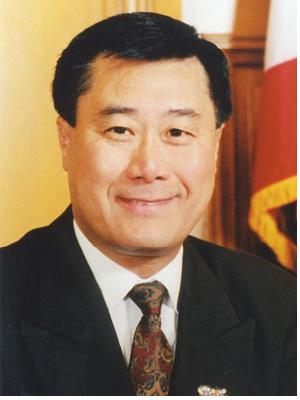
Um, actually that’s not true at all. The Chamber just released its 2010 “job killer” list — a roster of bills that the organization will oppose on the grounds that they’re bad for business. Among them: Assemblymember Tom Ammiano’s bill to fix a loophole in Prop. 13 (and provide more money for public education), and a bill by Sen. Leland Yee that would allow the state to recapture tax-credit money if the company that got the credits (for increasing employment in the state, for example) winds up leaving California or shipping jobs elsewhere. That money would be available for higher education.
Passage of those bills would allow the state to stop cutting UC and CSU. The Chamber wants to kill them.
King did say, however, that after the Brown ad aired, he “has informed the Chamber that he will continue to serve on the board only if his status is changed to that of an ex officio member.” But that doesn’t mean anything; it’s his name on the letterhead that matters.
Reed’s press person, Erik Fallis, was even more vague. He would only refer me to a statement Reed and Yudof issued after the Brown ad controversy, which said, in part:
We value our inclusion on the Chamber board, which provides an opportunity to interact with business leaders on issues that are of vital importance to the future of California. This is a dialogue that has been of great benefit to higher education, the business community and the state as a whole.
Actually, the inclusion of top state education officials is detrimental to the public interest, detrimental to public education and really bad form. Particularly now, when the Chamber is going out of its way to make sure that the state budget crisis is solved with nothing but cuts.
Scott has been openly complaining about budget cuts (PDF) but his office hasn’t responded to my questions.
Yee, a frequent critic of UC management, responded, though, and he didn’t mince words:
It would be one thing if President Yudof and Chancellor Reed used their positions on the California Chamber of Commerce board to support more revenue for our beleaguered public universities. Unfortunately, the CalChamber is categorical in its opposition to new revenues and has become nothing short of a mouthpiece for the Republican Party. The Chamber benefits from the prestige that Yudof and Reed bring to the table, and uses it to advance a right-wing agenda that includes questioning the validity of global warming (AB 32, 2006) and the need to protect workers from discrimination (AB 793, Jones, 2009), blocking universal health care (SB 810, Leno, 2010), and holding corporations accountable to their promises to create jobs (SB 1391, Yee, 2010). It is outrageous that Yudof and Reed would serve as accomplices to killing bills that would increase revenue for higher education.
The top education executives need to resign from the Chamber board, now.
Arnold’s attack on the poor

As usual, Robert Cruickshank at Calitics has it exactly right: The governor’s budget isn’t just bloody and brutal, it’s a direct attack on poor people — and an effort to divide the interests of the poor and the middle class. If the new round of budget cuts had continued to hit public schools, higher education, state parks and other things that benefit the middle class and the people who are slightly better off, there might be a huge public backlash. Instead, almost everything that he’s hacking away is a program that helps the most needy:
Arnold is implicitly telling the middle-class “either you screw these poor families or we’re cutting something you want” and counting on the middle-class to react the same way they did in the ’80s and ’90s – by saying “go ahead, we won’t stop you.”
In a sick way, it’s brilliant; it worked so well for Ronald Reagan, and Schwarzenegger figures it might work for him, too.
So this budget battle will not just be a test of whether the Democrats have the spine to stand up to the guv and the political skill to outflank the Republicans; it will be a test of whether they — and the better-off among the voters — are willing to go beyond narrow self-interest and stand up for the people at the bottom.
If not, what the governor is proposing will be the creation of a permanent underclass in California.
Never mind the budget, Gavin’s worried about himself
So this afternoon, the governor released a truly horrifying mid-year budget revise, a bloody proposal that would eliminate CALWORKS, the state’s major welfare program, and cut billions out of other essential services. Calitics puts it nicely:
At today’s press conference unveiling the May Revise of the 2010-11 budget, Arnold Schwarzenegger said “the budget should be a reflection of California’s values.” If that’s the case, then California’s values are protecting the wealthy and the large corporations from having to contribute anything to this society while making old people and children suffer. Arnold’s California is a place where if you aren’t wealthy, you don’t deserve to have health, food, or any other form of economic security.
And about an hour later, the mayor of San Francisco sends a text to Assemblymember Tom Ammiano, who represents the city. Was he asking for Ammiano’s help in fighting the budget cuts? Was he suggesting they work together on strategy to save the city’s most needy from the governor’s axe? No. Here’s what the text from Newsom, who is running for Lt. Governor, said:
I hear you voted for Hahn at the convention.
That’s right — a month after the state Democratic Convention, Newsom is complaining that Ammiano voted for his opponent in the endorsement derby. That’s what he cares about? More than the worse budget in state history?
Ammiano’s response:
And what???
Good question.
Muni reform that might actually work

EDITORIAL The 2007 ballot measure that was supposed to give Muni more political independence and more money has failed to provide either. It’s time to say that Proposition A, which we supported, hasn’t worked — in significant part because the administration of Mayor Gavin Newsom hasn’t allowed it to work. It’s time for a new reform effort, one that looks at Muni’s governance structure, funding, and the way it spends money.
There are several proposals in the works. Sup. David Campos has asked for a management audit of the Municipal Transportation Agency, which runs Muni, and that’s likely to show some shoddy oversight practices and hugely wasteful overtime spending. Sup. Sean Elsbernd wants to change the way Muni workers get paid, and Sups. Ross Mirkarimi and David Chiu are talking about changing the way the MTA board is appointed. There are merits to all the reform plans, but in the end, none of them will work if they don’t address the fundamental fact that Muni doesn’t have enough money to provide the level of transit service San Francisco needs.
The basic outlines of what a progressive Muni reform measure would look like are pretty obvious. It ought to include three basic principles: work-rule and overtime reform; a change in the way other departments, particularly the police, charge Muni for work orders — and a sizable new source of revenue.
The work orders are, in many ways, the easiest issue. Last year, the San Francisco Police Department charged Muni more than $12 million in work orders. For what? Well, for doing what the Police Department gets paid to do anyway: patrolling Muni garages, putting cops on the buses, and dealing with Muni-related traffic issues. And a lot of that $12 million is police overtime.
The labor and revenue issues are trickier — mostly because they’re being addressed separately. Elsbernd, for example, wants to Muni workers to engage in the same collective bargaining that other city unions do, which makes a certain amount of sense. But he’s wrong to make it appear that the union and the workers are the major source of Muni’s financial problems — and that approach won’t get far. The bus drivers and mechanics didn’t make millions on large commercial developments that put a huge strain on the transit system — and the developers who profit from having bus service for the occupants of their buildings have never paid their fair share. Nor is it the fault of the union that car traffic downtown clogs the streets and makes it hard for buses to run on time.
We agree that the transit union needs to come to the table and talk, seriously, about work-rule changes. Every other city union, particularly SEIU Local 1021, whose members are among the lowest-paid workers in the city, has given something up to help the city’s budget problems.
But any attempt to change Muni’s labor contract needs to be paired with a serious new revenue program aimed at putting the transit system on a stronger financial footing — and traffic management plans that give buses an advantage over cars. The city can add a modest fee on car owners now, and if a Democratic governor wins in November, it’s likely that state Sen. Mark Leno’s bill to allow a local car tax will become law. That’s part of the solution, as is expanded parking meter hours. (And someone needs to talk about charging churchgoers for parking in the middle of the streets on Sundays.) But Muni also needs a regular stream of income from fees on developers.
And a seven-member MTA appointed entirely by the mayor does nothing for political independence; at the very least, the supervisors should get three of the appointments.
The city badly needs Muni reform — and the elements are all in place. But it can’t be a piecemeal approach.