Governor

Bad faith

3

steve@sfbg.com

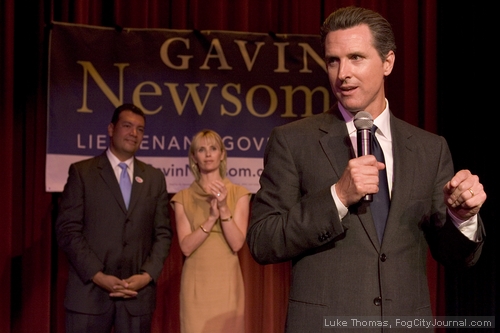
Mayor Gavin Newsom and his business allies are actively trying to sabotage the various revenue measures that have been put forth by the labor movement and progressive members of the Board of Supervisors, employing deceptive rhetoric, sneaky tactics, and a refusal to bargain in good faith.

In fact, Newsom — the Democratic nominee for lieutenant governor — is so averse to supporting anything that could be called a “tax” that he rejected a hard-won compromise measure created by powerful developers, affordable housing advocates, a pro-business think tank, the building trades, and his own directors of housing and economic development.

Just as that story was breaking in the New York Times (produced by Bay Citizen) on July 9, members of the Board of Supervisors Budget and Finance Committee discovered that Newsom’s proposed ballot measure to close loopholes in the city’s hotel tax that favored airline employees and online travel companies — a widely supported change, but one worth just $6 million per year — contains language that would nullify any increases in the hotel tax. Earlier in the week, labor unions turned in signatures on an initiative to increase the hotel tax by 2 percent, which would bring in more than $30 million per year.

“This poison pill is an intentionally deceptive, underhanded move,” Gabriel Haaland, an organizer with Service Employees International Union Local 1021, which sponsored the hotel tax, told us. “It’s so frustrating. It’s not even a good faith fight. He’s trying to create confusion and fool the voters. If our measure passes fair and square, it should be implemented.”

Meanwhile, Newsom and business groups have been attacking a reform measure by Board President David Chiu that would make the currently flat payroll tax more progressive, exempt more small businesses from paying it, and create a commercial rent tax to spread the tax burden more widely than the 10 percent of businesses who now pay tax to the city.

Critics complained that the measure would hurt local businesses — but that’s just not true. The city’s Office of Economic Analysis concluded that Chiu’s original proposal would have no effect on private sector jobs and would generate $34 million annually for the city, preserving some government jobs and spending.

Then Chiu amended the measure to spare even more small businesses. Now the OEA says that the measure would actually create private sector jobs — and still bring $28 million in to the city. Yet Newsom and the business community are still withholding their support.

This trio of Machiavellian moves comes just a week after Newsom pulled out of budget negotiations with board progressives concerning about $40 million in board add-backs to programs that Newsom proposed to cut after they wouldn’t agree to his precondition that they withdraw unrelated measures proposed for the November ballot, such as splitting appointments to the Rent, Recreation and Park, and Municipal Transportation Agency boards and requiring police officers to do foot patrols.

The series of events has led many progressives to say that conservative ideological blinders — a knee-jerk opposition to anything that saves government jobs and services or that Republicans might criticize — is the only logical explanation for the intransigent stance adopted downtown and by Newsom.

“It’s ideological. It’s not economic, and it’s not even political,” said Calvin Welch, the affordable housing activist who helped negotiate the transfer tax compromise with developer Oz Erickson, San Francisco Planning Urban Research Association director Gabriel Metcalf, Mayor’s Office of Housing Director Doug Shoemaker, and others.

That measure would have created a transfer tax on sales of properties over $875,000 and generated approximately $50 million annually for affordable housing (funds that were drastically reduced in Newsom’s proposed 2010-11 budget) while cutting in half the current requirements and fees on market-rate developers to create below-market-rate units. The plan would have stimulated both types of housing and created desperately needed construction work — an approach those involved called an elegant solution to several problems.

“To me, this was a win-win, solving two problems that are each a big deal,” Metcalf told us. “I don’t know what his reasons were for not supporting it. I was surprised.”

But Welch said, “It collapsed straight up because the mayor didn’t want to support a tax.” Although Newsom told the Times it was because there wasn’t broad enough consensus yet, “the mayor’s reason is whole-cloth bullshit,” Welch said, noting the role of the Mayor’s Office in brokering the deal. “The mayor walks away from it because everyone wasn’t in the room? Well, it’s your room, motherfucker. Show some leadership.”

Newsom Press Secretary Tony Winnicker refused to discuss these issues by phone, responding to our written inquires by noting that Newsom opposes taxes and thinks the best way to address budget deficits are privatizing city services and pension reform (although he opposes Public Defender Jeff Adachi’s initiative, the only pension reform measure on the fall ballot).

“The mayor is opposed to the Board of Supervisors’ proposals to increase taxes because they’re not needed to balance the budget and they will strangle our still young economic recovery,” Winnicker wrote, refusing to answer follow-up questions or support a statement about Chiu’s measure that the OEA concludes is not accurate.

Like many political observers of all stripes, those from downtown and progressive circles, Welch criticized Newsom for his lack of engagement with city business and its long-term fiscal outlook, contrasting him with former Mayor Willie Brown, who met regularly with former Board of Supervisors President Tom Ammiano even as the two ran a bitter campaign for mayor against one another in 1999. “They dealt with the city’s business like two adults who cared about the city,” he said.

Welch acknowledged that there was still work to be done building political support for the transfer tax measure. He and other progressives would have had to win over city employee unions who wouldn’t like the budget set-aside aspect, and Erickson and Metcalf would need to placate some of their downtown allies who oppose taxes on ideological grounds. But given how downtown groups are behaving right now, that might not have been an easy sell.

“There are members of the small business community that are averse to any taxes,” said Regina Dick-Endrizzi, director of the city’s Office of Small Business and staffer to the Small Business Commission, which was withholding a recommendation on the Chiu measure but planned to meet again to consider it July 12 (look for an update on the sfbg.com Politics blog). She said the small business community is having tough times and “they are just not sensitive to keeping city workers employed.”

Larger commercial interests are being even more forceful in opposing the revenue measures. While a parade of workers, social service providers, and progressive activists testifying at the July 9 Budget Committee hearing implored supervisors to place all the proposed revenue measures on the ballot, representatives from the Building Owners and Managers Association (BOMA) and San Francisco Chamber of Commerce were the only two speakers urging supervisors to drop the measures and focus instead on creating private sector jobs.

“You’re trying to create a little revenue here and it’s not going to work,” said Ken Cleaveland, director of BOMA SF, arguing that big banks and financial services companies — entities exempt from the payroll tax that Chiu is hoping to target with the commercial rent tax — will buy their buildings to avoid paying the tax. “They aren’t going to create more jobs and they really aren’t going to create more revenue.”

Yet Chiu noted that it was the business community and fiscal conservatives who pushed to create the Office of Economic Analysis, whose work they have regularly used to attack progressive legislation. Now that the office has concluded that a piece of progressive legislation is good for the local economy, Chiu told Cleaveland and the Chamber spokesperson Rob Black at the hearing, “I ask you to respect the work this office has done.”

Black said the Chamber board will consider Chiu’s amended legislation, but said businesses are in no mood to help the city. “How many times have you gone to your neighborhood merchant and had them say, ‘Gee, my rent’s too cheap’?<0x2009>” he said during his testimony.

Yet Chiu said landlords of small tenants (those paying less than $65,000 in rent per year) are exempt from the rent tax and only 26 percent of SF businesses would pay any city business tax under his plan. “I hope the mayor will support this proposal and the business community will give it a good look,” Chiu said as the hearing ended.

At the beginning of the hearing, Chiu framed the dire situation facing San Francisco, citing Controller’s Office figures showing this year’s $500 million budget deficit (out of a $6 billion total budget) will be followed by a $700 million deficit next year and a $800 million gap the following budget cycle as a result of a deep structural budget imbalance.

“We have budget deficits as far as the eye can see,” Chiu said at the hearing. “We have to consider measures that will provide more stable sources of revenue.”

He also noted that city employee unions have agreed to give back about $250 million in salary and had their ranks reduced by about 2,000 workers in the last two years. So he and the other progressive supervisors say it’s time for the rest of San Francisco to help address the problem.

“We, as a city, should not be trying to balance this budget simply through cutting,” Sup. David Campos said.

Sup. John Avalos, the committee chair, amended his transfer tax measure in the wake of Newsom’s rejection of the deal by making it a simple 2 percent tax on properties that sell for more than $5 million, and 2.5 percent tax on properties over $10 million. He estimates it will bring in about $25 million per year from the city’s wealthiest corporations and landlords.

“That’s who we’re socking it to,” Avalos told us, saying he was disappointed the compromise fell through. “The amendment is going to be more progressive than what was originally planned.”

Even Sup. Sean Elsbernd, a strong fiscal conservative who announced early in the hearing, “You want to do that [balance future budgets] by adding taxes, but I want to do it through ongoing service cuts,” later told the Guardian that he was intrigued by the amendments Avalos and Chiu made to their measures and has not yet taken a position on them.

Sup. Ross Mirkarimi is also sponsoring a measure to increase the city’s tax on parking lot operators from 25 percent to 35 percent, the first change to that tax in 30 years, and will include valet parking for the first time. The measure would bring in up to $24 million per year, and OEA analysis shows it would decrease the number of cars trips by 1.3 percent, another benefit.

SFMTA supports the measure, with board member Cameron Beach testifying that the money will be used to subsidize Muni and “it links the use of private automobiles and is consistent with the city’s transit-first policy.” Mirkarimi, who chairs the Transportation Authority, also has proposed a $10 local vehicle license fee surcharge that would bring in another $5 million per year for Muni.

All the revenue measures require six votes by the full Board of Supervisors, which is scheduled to consider them July 20, after which they would need a simple majority approval by voters in November to take effect.

The mayor has the authority to directly place measures on the ballot, so the committee hearing on his hotel tax loophole measure and a $39 million general obligation bond that he’s proposing to create a revolving loan fund for private sector seismic improvements were mere formalities, so supervisors criticized aspects of each but were unable to make changes.

Avalos even grudgingly acknowledged the hotel tax poison pill was an effective way to kill that revenue source, saying at the hearing, “This is very smart. I don’t agree with it, but it’s very smart.”

Haaland was less charitable, criticizing a provision designed to confuse voters. “This kind of move means both measures won’t pass because now we have to oppose [Newsom’s measure],” he said, criticizing the mayor for running away from the hard decisions facing the city. “He won’t be around next year, when we have an even bigger structural budget deficit, to clean up this mess. Absent new revenue sources, this city starts to fall apart.”

Whitman criticized for opposing high-speed rail

10

By Brittany Baguio

Although Republican gubernatorial Meg Whitman claims job creation is one of her top priorities, she recently stated that she opposes the plan to build a high-speed rail system in California – a project that is being eagerly anticipated in San Francisco, its northern terminus.

Whitman says the state does not have enough money to fund the project because of the state’s current budget deficit, but labor, environmental, and other groups say it will be a boon to the state’s economy and environment. Voters approved Proposition 1A in November 2008, supporting the construction of a high-speed rail system with an initial investment of $9.95 billion in bond money.

Proponents say the project will alleviate freeway and airport congestion and provide a green transportation option that has both short- and long-term economic benefits. According to the California High-Speed Authority website, the project would create 160,000 constructed-related jobs as well as 450,000 more jobs by 2035. The construction of the rail system would also improve the movement of people, goods, and services throughout California and ultimately raise more than $1 billion in surplus revenue a year.

“We are eager to thoroughly brief whoever the next governor is on this project and work with him or her to make California’s high-speed rail system a reality,” California High-Speed Rail Authority representative Rachel Wall told the Guardian.

Supporters of the bullet train disagree with Whitman’s analysis and contend that the construction of a bullet train would create revenue and jobs. In a press release, California Labor Federation Executive Secretary-Treasurer Art Pulaski said, “In her glossy TV ads, Whitman says she understands the daily hardships facing our state’s unemployed, but it’s clear that’s just more campaign rhetoric. In opposing high-speed rail, she’s shown her true colors on jobs. It’s shocking that a candidate for Governor could be so detached from the economic hardships facing our state’s families. With one in eight Californians out of work, how can we afford not to invest in the creation of hundreds of thousands of permanent, good new jobs?”

Communications director of the California Labor Federation, Steve Smith, believed that Whitman’s opposition exhibited her political inexperience and uninformed decisions. “She’s out there talking a big game about job creation, but no specifics about how she would create jobs,” Smith told us. “Her proposals would be devastating to California and would lead to higher unemployment in California. She says that California can’t afford the project, but what we can’t afford is not to take advantage of improving our economy and environment.”

Whitman isn’t the only one opposing the project. Bay Area cities of Menlo Park, Palo Alto, Burlingame, Belmont, and Atherton have all voiced concerns about the project and the impact of trains move rapidly through those communities, filing a lawsuit seeking to halt the project.

The bullet train project was awarded $2.25 billion from the American Recovery and Reinvestment Act last January and is currently undergoing supplemental environmental reviews. Construction is scheduled to begin in 2012, with improvements such as rail electrification expected to improve rail service on the San Francisco peninsula even before the high-speed trains start running around 2020.

Assuming the public-private project isn’t derailed politically and can raise the estimated $40 billion total cost, the trains will travel at speeds of up to 220 mph and take passengers from the LA Union Station to San Francisco’s Transbay Terminal in less than 2 hours and 40 minutes.

Get rid of the water bond, now

0

OPINION A Field Poll released last week showed decent support among progressives for Proposition 18, the $11 billion water bond on the November ballot. We shouldn’t let the bond’s cheery name fool us. Prop. 18 is a con job.

Sold as the Safe, Clean, and Reliable Drinking Water Act, Prop. 18 has been getting a lot of press recently for the “pork” that was added to it to gain votes when it went before the Legislature last November. But for progressives, the real concern isn’t the pork; it’s the other meat in the bond. Prop. 18 would maintain a status quo that’s bad for our budget and water supply.

With polls showing lagging support for the bond, Gov. Schwarzenegger asked the Legislature to delay the measure until 2012. Bay Area residents have nothing to gain from the measure — this year or in two years. We need our legislators to fight for the bond’s termination, now.

Prop. 18 provides a $2 billion downpayment for a peripheral canal to send more water from the Sacramento Delta to deep-pocketed interests to the south. In 1982, Northern Californians overwhelmingly rejected the peripheral canal; we should do the same with the bond. The Westlands Water District, Beverly Hills billionaire-owned Paramount Farms and other megafarms stand to gain immensely from any additional water these projects might bring. The Bay Area does not.

Worse, some of these landholders skip farming altogether in order to resell the water we’ve subsidized at a huge profit to real estate developers. They pay about $25 to $50 per acre-foot of water, but can easily resell the water for over $200 per acre-foot. Corporate giant Cargill is looking to buy water from landowners in Kern County to supply its proposed 12,000-unit housing development on bay salt marshes in Redwood City.

The meat of Prop. 18 is $3 billion for the construction of more dams, an expensive and inefficient way to manage water. California’s rivers already have hundreds of dams. The water that evaporates from them each year is enough to supply 4 million people.

With interest, Prop. 18 would add $24 billion in debt to the state’s General Fund — roughly $16 million a week for 30 years. Already facing a $19 billion deficit, California has made drastic cuts to vital public services like education, housing, and healthcare — and this bond will make things worse.

Although there is some money in the bond for projects that could actually benefit us, it’s too little, too late. And the state still has $7 billion available from past water bonds that has not been spent. When the Legislature passed a bill in 2009 to invest that money in regional water projects, the governor vetoed the bill. The same will likely be true here. And even if we do see that money someday, will the trade-offs be worth it?

There is no question that California needs to invest billions in rebuilding and upgrading our vital water infrastructure. Here in the Bay Area, we are already spending billions on rebuilding our sewer and drinking water systems. Unfortunately, the bond provides only a trickle of money for such important investments or to boost conservation and efficiency in the urban and agricultural sectors. It’s no wonder that the Sierra Club, Food & Water Watch, San Francisco Baykeeper, Clean Water Action, the California Teachers Association, and United Farm Workers all oppose the bond.

Fortunately, state Sens. Mark Leno, Leland Yee, and Ellen Corbett and Assembly Members Tom Ammiano, Loni Hancock, and Nancy Skinner all voted against placing this bond on the ballot. We now need them to step up and urge their colleagues not just to delay but to repeal this bond, now. *

Elanor Starmer is the western region director for the consumer advocacy nonprofit Food and Water Watch (www.foodandwaterwatch.org).

The good news for Jerry Brown

4

The press is all over the latest Field Poll, which shows Jerry Brown and Meg Whitman in a dead heat.  And it’s no surprise that, thanks to a campaign that thus far has been almost entirely negative, voters aren’t particularly thrilled with either candidate.


But I think there’s some good news for Jerry Brown here. Whitman has spent more than $90 million so far, and the voters like her less than they did six months ago. After all that money, some of which has gone for blistering attacks on Brown, Whitman is still not ahead. And it’s hard to see what she can do now to move the needle.


CallBuzz:


Moreover, it looks like the attack ads on Whitman by Brown’s labor allies — including California Working Families 2010 — have had their intended effect: to increase Whitman’s negatives and keep her from pulling away from Brown during the summer, before he can afford to put his own ads on TV.


Meanwhile, Brown’s favorability is only marginally changed from March. It’s 42-40% favorable today, compared to 41-37% favorable before. (Of course, Brown’s favorable was 50-25% back in March of 2009, but that was when he was just the new Attorney General and not a candidate for governor with rivals.)


At some point, Jerry’s got to start seriously campaigning, and he’s got a lot of work to do. He has to define himself to younger voters, who know a lot more about Ebay than about Brown’s tenure as governor, which was generally pretty good. He has to remind Latinos of how awful Whitman is on immigration. He’s got to spend some money.


But at this point, there’s hardly a voter in California (at least, not one with a TV set) who hasn’t seen multiple Whitman ads, defining her as a successful business person and attacking Brown as a failed politician. Those are powerful messages. The ads have been well produced, well targeted and should have been effective. And they haven’t gotten her over the halfway point yet — even against an opponent who is vulnerable to attack and hasn’t campaigned much at all.


Both candidates seem to be holding the party loyalists — the vast majority of the Republicans like Meg, the vast majority of the Democrats like Jerry. And there are more Democrats than Republicans. The independents aren’t breaking Meg’s way, either — she’s only slightly ahead, not enough to make up the difference.


Now if Brown can just get his people to care enough to go to the polls. …

SFBG Radio: The guv’s minimum wage scam

0

In today’s installment, Johnny and Tim talk about the governor’s attempts to cut state employee pay to the federal minimum wage level — and how that will affect the fall election. You can listen after the jump.

sfbgradio 7/7/2010 by jangel

Newsom and the board’s challenge

0

Newsom needs to decide whether he’s serious when he says he wants to work with the supervisors on a budget

EDITORIAL The San Francisco supervisors took a huge step with the city budget this year: they essentially told the mayor that his approach was unacceptable, and that they were going to do it themselves.

The result — the document that the board’s Budget Committee approved and sent back to Mayor Gavin Newsom — isn’t perfect. But the members of that panel saved $40 million worth of programs from the mayor’s budget ax and got rid of two particularly bad plans: privatizing health care at the county jails and allowing more condominium conversions.

The board members are also looking seriously at putting as much as $100 million in new taxes — progressive taxes — on the November ballot. Current plans include a modest increase in the hotel tax, an increase in the real-estate transfer tax on high-end properties, and a tax on commercial rents of more than $200,000 a year, which would be paired with a reduction in the payroll tax for small businesses.

Now Newsom, who is busy running for lieutenant governor, needs to decide whether he’s serious when he says he wants to work with the supervisors on a budget everyone can accept.

On one level, the mayor doesn’t have a lot of choice — if he vetoes the proposal the board sent him, there’s a good chance the supervisors will override the veto. What he’s more likely to do is simply refuse to spend the additional money the board wants to allocate — allowing his cuts to take effect, allowing critical services to die and community-based nonprofits to close, while that money just sits in a reserve fund (or gets allocated to the mayor’s other priorities).

That would be a terrible statement for someone who claims he can be a positive force in Sacramento and who clearly wants to run for governor some day. The board has presented a budget that’s still fairly moderate — the tax hikes aren’t included in the spending plan, and most of what Newsom asked for is. It’s the kind of plan that a Democrat who wants to run California some day ought to be embracing. Unfortunately, Newsom insists on running on the Republican platform of cuts only, no new taxes. (Although he’s stuck a lot of hidden taxes, called fees, on small businesses.)

The mayor also has tried to use the budget process to kill some several ballot measures he doesn’t like. He wants the supervisors to get rid of proposals that would give the board shared appointments to the Rent Board and the Recreation and Park Commission along with a plan mandating community policing. In essence, he’s asked the supervisors to abandon other good-government reform policies in exchange for saving critical public services. That’s apparently not illegal (although offering to trade votes is). At the very least, however, it’s unseemly, and the board needs to make clear that it won’t accept this sort of hostage-taking.

It the mayor wants to have any kind of a productive year — and show that he can actually work with legislators — he needs to sign the budget the board sends to him and agree to spend the money the way it’s earmarked. Otherwise he’ll be acting like the governor of California — and that politician’s approval rating is about the lowest on record.

Newsom and the board’s challenge

1

EDITORIAL The San Francisco supervisors took a huge step with the city budget this year: they essentially told the mayor that his approach was unacceptable, and that they were going to do it themselves.

The result — the document that the board’s Budget Committee approved and sent back to Mayor Gavin Newsom — isn’t perfect. But the members of that panel saved $40 million worth of programs from the mayor’s budget ax and got rid of two particularly bad plans: privatizing health care at the county jails and allowing more condominium conversions.

The board members are also looking seriously at putting as much as $100 million in new taxes — progressive taxes — on the November ballot. Current plans include a modest increase in the hotel tax, an increase in the real-estate transfer tax on high-end properties, and a tax on commercial rents of more than $200,000 a year, which would be paired with a reduction in the payroll tax for small businesses.

Now Newsom, who is busy running for lieutenant governor, needs to decide whether he’s serious when he says he wants to work with the supervisors on a budget everyone can accept.

On one level, the mayor doesn’t have a lot of choice — if he vetoes the proposal the board sent him, there’s a good chance the supervisors will override the veto. What he’s more likely to do is simply refuse to spend the additional money the board wants to allocate — allowing his cuts to take effect, allowing critical services to die and community-based nonprofits to close, while that money just sits in a reserve fund (or gets allocated to the mayor’s other priorities).

That would be a terrible statement for someone who claims he can be a positive force in Sacramento and who clearly wants to run for governor some day. The board has presented a budget that’s still fairly moderate — the tax hikes aren’t included in the spending plan, and most of what Newsom asked for is. It’s the kind of plan that a Democrat who wants to run California some day ought to be embracing. Unfortunately, Newsom insists on running on the Republican platform of cuts only, no new taxes. (Although he’s stuck a lot of hidden taxes, called fees, on small businesses.)

The mayor also has tried to use the budget process to kill some several ballot measures he doesn’t like. He wants the supervisors to get rid of proposals that would give the board shared appointments to the Rent Board and the Recreation and Park Commission along with a plan mandating community policing. In essence, he’s asked the supervisors to abandon other good-government reform policies in exchange for saving critical public services. That’s apparently not illegal (although offering to trade votes is). At the very least, however, it’s unseemly, and the board needs to make clear that it won’t accept this sort of hostage-taking.

It the mayor wants to have any kind of a productive year — and show that he can actually work with legislators — he needs to sign the budget the board sends to him and agree to spend the money the way it’s earmarked. Otherwise he’ll be acting like the governor of California — and that politician’s approval rating is about the lowest on record.

Weird Uncle Jerry

0

I’m starting to feel as if Jerry Brown is that strange old uncle who comes over for dinner and says things that make you cringe — and you can’t really tell if he’s just a loveable old character, a bright guy with a weird sense of humor, or someone who’s completely losing his marbles.


Check this out: First he makes a very valid, even insightful statement that’s right on target:


“Were I a CEO and someone said, ‘You know what, I’ve never been in this company, I never saw the product and I want to be a boss,’ I’d say, ‘Hey, why don’t you start at the bottom and work your way up,’ ” he said. “That’s the same way with government — you can’t wake up one morning and say, ‘Gee, I’ve got a billion dollars and I want to be governor.’ You got to learn something because those people up in Sacramento are sharks.”


Then he goes completely off the deep end:


Brown discussed his implementation of Prop. 13 despite his earlier opposition to it, as well as support for the 2nd Amendment and same-sex marriage. He said he opposed efforts to legalize marijuana, which will be on the November ballot.


“We got to compete with China, and if everybody’s stoned, how the hell are we going to make it?” he said.


Jerry, pal, I’ve got news for you: The people who are the most successfully competing with China, the brilliant high-tech visionaries you love so much? They’re already stoned. All we can do now is get some tax money out of it.


Besides, China can’t compete with this:


Stories highlight Newsom’s hypocrisy

4

A pair of interesting stories in today’s Chronicle paint Mayor Gavin Newsom as a self-serving hypocrite, highlighting how his cuts-only budget proposals ignore the city’s long-term needs and have led Moody’s to lower the city’s credit rating, and how his green rhetoric is belied by his oil industry investments, including in the company responsible for the ongoing oil leak in the Gulf.

The Guardian has long noted how fiscally irresponsible Newsom’s budgets have been, with our latest editorial calling for Newsom to finally offer support for some of the revenue measures now being explored by the Board of Supervisors, which will need strong support from everyone in City Hall to have a chance of winning voter approval.

The Controller’s Office and now Moody’s have confirmed that Newsom’s reckless and gimmicky budget leaves a long-term budget hole even as it does short-term damage to the city’s social safety net and public health programs. But instead of acknowledging that reality, Newsom flak Tony Winnicker is still offering snide, Republican-style put-downs of the supervisors who are actually working hard to improve the city’s fiscal health while Newsom is out running for state office, afraid he will be criticized for supporting the tax revenue this city desperately needs.

As for Newsom’s oil industry investments, well, they speak for themselves. His whole political career, and even the restaurant and bar career before that, was built on a foundation of oil money heaped upon him by the Gettys. And even after he found there was political gold to be mined from green rhetoric, he has continued to financially support and profit from the oil industry.

Many Guardian readers have long said that we should just give up on Newsom, calling him a shameless and self-serving politician of the very worst sort. Maybe they’re right. But if Newsom wants to earn our support in his race for lieutenant governor – whose most important responsibilities are his key votes in deciding whether to support new offshore oil drilling in California and whether to continue pushing myopic cuts-only budgets for the public university systems – then now is the time for him to show some political courage by disinvesting from the oil industry and supporting a responsible city budget that includes new revenue measures for which he should actively campaign this fall.

Editorial: Put new taxes in the budget

5

Mayor Gavin Newsom still wants to balance this year’s municipal budget with no new taxes (although he’s happy to raise the fees to use city facilities). The supervisors are looking at a different approach: John Avalos, chair of the budget committee, told us he’d like to see $100 million in new revenue on the table.

Some of that might come from a fee on liquor sales. There’s a hotel tax measure being circulated, and the supervisors are also looking at a raising the real estate transfer tax on high-end properties and imposing a commercial rent tax. All but the liquor fee would require a majority vote on the November ballot.

So far, Newsom hasn’t given any indication that he’ll support any new taxes — and that’s due in significant part to his campaign for lieutenant governor. The mayor doesn’t want to get hit by his Republican opponent as a tax-and-spend liberal, so he’s holding the line, cutting essential services instead of looking for progressive ways to bring in new revenue.

But voters up and down the state have shown their willingness to approve new taxes to save essential services, and it’s likely that San Franciscans will do the same — particularly if the folks at City Hall are united in their support.

So here’s an idea for the supervisors: why not include that new revenue as part of this year’s budget?

There’s no legal reason the budget can’t be balanced in part on the assumption of new income. November is almost halfway through the fiscal year, but more than $50 million of that revenue would be available for the 2010-11 budget.

There are distinct advantages to including that money in the budget, starting with fewer budget cuts and layoffs now. There’s also a clear political advantage: if the voters realize what’s at stake — that the money has already been earmarked and that voting it down would mean immediate reduction in vital services — the message of the importance of approving the tax measures would be even stronger.

Equally important, it would force the mayor to show his hand. Newsom would almost certainly prefer to duck the issue, to take a neutral stand on the tax measures (“let the voters decide”). He might wind up opposing all of them. But if the money’s already in the budget, what can he do? Without that tax money, the budget won’t be legally balanced. Without his support, that tax money might not come through.

It’s a risky move. If the voters reject the tax hikes, the supervisors and the mayor would be forced to make painful midyear cuts. But they’ll have to make those cuts anyway, either now or in November. And once you shut down services or eliminate nonprofit contracts, it’s much harder and more expensive to start them up again.

So this might be the year to take the calculated gamble: assume that money’s going to be there. Then everyone, including the mayor, can help make sure that it actually is.

Put new taxes in the budget

2

EDITORIAL Mayor Gavin Newsom still wants to balance this year’s municipal budget with no new taxes (although he’s happy to raise the fees to use city facilities). The supervisors are looking at a different approach: John Avalos, chair of the budget committee, told us he’d like to see $100 million in new revenue on the table.

Some of that might come from a fee on liquor sales. There’s a hotel tax measure being circulated, and the supervisors are also looking at raising the real estate transfer tax on high-end properties and imposing a commercial rent tax. All but the liquor fee would require a majority vote on the November ballot.

So far, Newsom hasn’t given any indication that he’ll support any new taxes — and that’s due in significant part to his campaign for lieutenant governor. The mayor doesn’t want to get hit by his Republican opponent as a tax-and-spend liberal, so he’s holding the line, cutting essential services instead of looking for progressive ways to bring in new revenue.

But voters up and down the state have shown their willingness to approve new taxes to save essential services, and it’s likely that San Franciscans will do the same — particularly if the folks at City Hall are united in their support.

So here’s an idea for the supervisors: why not include that new revenue as part of this year’s budget?

There’s no legal reason the budget can’t be balanced in part on the assumption of new income. November is almost halfway through the fiscal year, but more than $50 million of that revenue would be available for the 2010-11 budget.

There are distinct advantages to including that money in the budget, starting with fewer budget cuts and layoffs now. There’s also a clear political advantage: if the voters realize what’s at stake — that the money has already been earmarked and that voting it down would mean immediate reduction in vital services — the message of the importance of approving the tax measures would be even stronger.

Equally important, it would force the mayor to show his hand. Newsom would almost certainly prefer to duck the issue, to take a neutral stand on the tax measures ("let the voters decide"). He might wind up opposing all of them. But if the money’s already in the budget, what can he do? Without that tax money, the budget won’t be legally balanced. Without his support, that tax money might not come through.

It’s a risky move. If the voters reject the tax hikes, the supervisors and the mayor would be forced to make painful midyear cuts. But they’ll have to make those cuts anyway, either now or in November. And once you shut down services or eliminate nonprofit contracts, it’s much harder and more expensive to start them up again.

So this might be the year to take the calculated gamble: assume that money’s going to be there. Then everyone, including the mayor, can help make sure that it actually is.

Fiscal solidarity

0

OPINION As Mayor Gavin Newsom prepares to skip town for the bleak limelight of Sacramento, he has left a resounding parting shot with massive budget cuts to those San Franciscans most in need of public aid: seniors, youth, homeless people, folks with mental illnesses, health clinic patients … the list goes on.

Newsom has balanced his final budget (and his campaign for lieutenant governor) largely on the backs of the poor, working-class, multiracial, and immigrant San Franciscans, as well as the nonprofits and city workers who deliver vital services.

The Newsom budget actually adds costs: by cutting services for the treatment and prevention of substance abuse and for youth crime prevention and supportive housing, for instance, it destabilizes lives and forces people right back into the treatment systems that are being cut — adding new human and fiscal costs.

"Every cut has a constituency," Newsom’s PR people say repeatedly. And that’s precisely what the mayor is counting on — that each "constituency" will fight on its own, for its own fiscal scraps. He’s wrong.

As members of a broad coalition of community and neighborhood-based organizations, labor unions, and civic leaders and residents across the city, we stand together in opposition to Newsom’s cuts-only budget and his attempts to divide "constituencies."

Fiscal solidarity means we recognize that an injury to one is an injury to all. "Constituencies" are in fact people whose lives cut across multiple budget line items. Cutting city parks is also a senior issue, as well as a youth issue. Closing mental health programs for the poor is not only an unnecessary moral outrage — it’s a public health and safety issue.

As members and supporters of unions and nonprofits, which are sometimes pit against each other in budget cut wars, we declare mutual support. The mayor’s cuts will mean drastically reduced services for those who need them most and deep staff cuts for city employees and nonprofit workers. We may work for different institutions under different budget line-items, but we’re fighting together as one community — one big "constituency."

Budget wars artificially divide communities that overlap and intermingle. Expressions of unity are put to the test by the budget "add-back" process that forces community groups to scuffle for scraps of cash — groups serving populations in critical need are set against each other, and whole communities are reduced to line-items.

We’re standing against fiscal wedge politics and demanding a real alternative. The budget must protect those most in need and be balanced by cutting first from the top instead of the bottom.

We are united for solutions — progressive tax measures on key wealth sectors that can and must pay their fair share to keep San Francisco the beautiful, thriving, diverse, and culturally rich city it is. We’re standing up for the city Newsom’s leaving, for the communities he’s cutting, and for progressive revenue — a tax to make downtown hotels pay their fair share, and a gross receipts tax on large businesses for starters.

Mayor Newsom: if you cut one of us, you cut us all.

This statement was signed by Christopher Cook, Budget Justice Coalition; Gabriel Haaland, SEIU 1021*; Gordon Mar, Jobs with Justice*; Eric Quezada, Dolores Street Community Services*; N’Tanya Lee, Coleman Advocates for Children and Youth*; Jennifer Friedenbach, Coalition on Homelessness; Guiliana Milanese, Jobs with Justice*; Christina Olague, Senior Action Network*; Sheila Tully, California Faculty Association, SF State*; Chelsea Boilard, Coleman Advocates for Children and Youth*; Joseph Smooke, Bernal Heights Neighborhood Center*; Carl Finamore, delegate, SF Labor Council*

* names for ID purposes only

Supreme Court rejects Healthy SF challenge

1

The U.S. Supreme Court has decided not to consider a challenge to the Healthy San Francisco program that provides low-cost health coverage to city residents, partially funded by employers who refuse to provide health insurance for their employees, a mandate that prompted a lawsuit from the Golden Gate Restaurant Association.

The decision was a big victory for low-wage workers in the city, as well as California Assembly member Tom Ammiano, who was the driving force behind the program as a member of the Board of Supervisors, taking abuse from the business community for almost a year and holding firm on the need for employers to take responsibility for their employees. Without that mandate, Ammiano successfully argued, businesses that didn’t offer health benefits would enjoy a competitive advantage and their employees’ health care costs would often end up be paid by city taxpayers.

“Today’s Supreme Court decision is an affirmation of San Francisco’s landmark efforts to provide affordable health care to the uninsured. With over 50,000 people receiving health care services and prescription drugs, Healthy San Francisco is a national model for what can be accomplished when the public and private sector work in partnership towards a common goal”, Ammiano said in a prepared statement.

Mayor Gavin Newsom was eventually persuaded to support the mandate and he worked with Ammiano in crafting the final program, which he has since trumpeted as his own while campaigning for governor and then lieutenant governor, for which he won the Democratic nomination.

“The Supreme Court’s rejection of the challenge to Healthy San Francisco is a victory for the 53,000 San Franciscans who have healthcare today through our groundbreaking universal healthcare program. Healthy San Francisco is a model for healthcare reform that works. The High Court’s decision today ensures we can continue providing health care coverage to thousands who would otherwise go without care,” Newsom said in a prepared statement.

Newsom is a former restauranteur and GGRA member, but he did little to dissuade the group from bringing the lawsuit or in urging them to drop it. Many restaurants in San Francisco have taken to adding surcharges on customers’ bills, explicitly citing the increased cost of offering health insurance. But no restaurants that I know of include explicit surcharges for the membership dues they pay to GGRA or the extra contributions some restaurants made to continue pushing this lawsuit after the Ninth Circuit Court of Appeals ruled in the city’s favor.

City Attorney Dennis Herrera, who personally lobbied the Obama Administration to change the federal government stance on whether employer mandates violate federal law, also released a statement thanking the relevant players and singling out businesses that opposed the GGRA lawsuit: “I applaud Assemblymember Tom Ammiano and Mayor Gavin Newsom for their leadership in crafting this policy.  We should be very thankful to the Ninth Circuit Court of Appeals, too, whose thorough decision powerfully affirmed our arguments that Healthy San Francisco’s spending provisions were reasonable, fair and legal.  I would finally express my gratitude to all those from the business community who voiced their support for this program — especially Zazie and Medjool Restaurants, and Nibbi Construction, which filed amicus briefs on our behalf.”

Agnos: “I think Gavin’s gonna lose”

11

Former San Francisco Mayor Art Agnos told the Guardian last night that he’d welcome the chance to be appointed a “caretaker mayor” for a year if Mayor Gavin Newsom wins his race for lieutenant governor, but he doesn’t think he’ll get that chance because “I think Gavin’s gonna lose.”

Agnos is one of several names that have been bandied about in the discussions of who the Board of Supervisors might appoint as acting mayor for a year if none of the top candidates running for mayor in 2011 – such as Aaron Peskin, Mark Leno, Leland Yee, or Dennis Herrera – are able to get six votes on the board in January 2010, when Newsom would vacate the Mayor’s Office if he moves on to Sacramento.

“I’m available, but I don’t need it,” Agnos said, noting that he would agree to not run for a full-term in 2011, which would be the main criteria for a caretaker mayor, a concept that would prevent any mayoral candidate from gaining the advantage of incumbency.

But Agnos said that Abel Maldonado, the Republican nominee for lieutenant governor, will be a tough challenge for Newsom, both because he’s a moderate Latino with a compelling personnel story, and because rich Republican gubernatorial nominee Meg Whitman will likely give Maldonado all the money and support he needs so she doesn’t have a Democratic rival as lieutenant governor.

As Agnos told us, “She will give him whatever he need to bury Newsom.”

SF mayoral analysis in the NY Times misses the mark

4

I have praised Bay Citizen’s early work and I think Gerry Shih is a smart young reporter, but I think their analysis of who will be San Francisco’s next mayor – which ran in today’s New York Times – was off the mark and shows they don’t yet have a good grasp of this city’s political dynamics. And a big reason for that is – just like the Examiner and the Chronicle – they relied too much on downtown players who consistently misread those dynamics, at least in recent years.

The one thing it got right was naming Aaron Peskin as one of the frontrunners to succeed Newsom if he is elected lieutenant governor. Peskin is really the only politico in town he has been putting big plays together these days, whether it be keeping Democratic Party leadership in progressive hands or defeating the 555 Washington project. So he might be the only one who can count to six with this current progressive-dominated board.

But nobody really thinks David Chiu is a frontrunner, despite Shih’s claim. Chiu has been a pretty good board president, but remember that he was elected as a compromise candidate (with lots of help from Peskin) after the then-frontrunners, Ross Mirkarimi and Bevan Dufty, couldn’t put the votes together. And since then, he has disappointed his progressive colleagues on several votes, making them unlikely to support him for mayor.

Besides, it will be difficult for any supervisor to get six votes when they can’t vote for themselves, which also makes me scoff at Shih’s contention that John Avalos and David Campos are running for mayor (two supervisors who are close to the Guardian and have never indicated to us that they’re running, even when we’ve asked, although they might each eventually become mayors). Ross Mirkarimi is more likely and wants the job, but would have a tough time getting a board majority to give is to him.

Shih told the Guardian that he’s been getting lots of critical feedback on his article today, and while he said Chiu and Peskin are names that kept coming up in his interviews, Shih admits that the attractive narrative of the protege challenging his mentor perhaps skewed the final analysis: “The relationship between those two guys ended up getting played up in the story.”

The article makes several other mistakes as well (and not just the obvious factual errors, like getting the mayoral election year wrong, as well as the year Feinstein left office, both of which have since been corrected online). It left City Attorney Dennis Herrera’s name out entirely, despite the fact that he’s already declared his intention to run for mayor and could certainly be a compromise candidate. Public Defender Jeff Adachi also wasn’t mentioned, even though he has a better chance than half the people on Shiu’s list, such as Willie Brown or Ed Harrington, who downtown may like but progressives really don’t.

Two strong possibilities for mayor – Mark Leno and Leland Yee – were given only passing mention in the article even though they are far more likely choices than Chiu. Both Leno and Yee have aggressively worked both the centrist and progressive sides of the aisle and are in great positions to run for mayor or be appointed by the board.

The hopes for a Chinese-American mayor that Shih placed with Chiu are probably better placed with Yee, who has worked with Rose Pak and other business interests while also having a history of endorsing progressive candidates, which he’ll be able to call in when he runs (and yes, unlike other candidates on Shih’s list, Yee has actually declared his intention to run).

Similarly, Leno has good relations with progressives on the board, which will be tested a bit this fall as he campaigns for moderate supervisorial candidate Scott Wiener and navigates the wedge issue minefield, but it’s easy to see how with the right outcomes this fall and key deals cut, Leno could emerge as the frontrunner.

The dynamics of this thing are incredibly complicated, but if I was in Shih’s shoes and was asked to name the two frontrunners, I’d probably say Peskin and Leno, with Yee a close third and Herrera as an outside possibility. Or it could be none of them if nobody can count to six and the option of a caretaker mayor who agrees not to run later (such as an Art Agnos) seems like the only way forward.

As politicos Alex Clemens and David Latterman said in their post-election analysis on June 10, this is very complicated and will be the subject of many deals by experienced insiders (of which Chiu really isn’t one just yet). “Everyone is gaming this thing out and trying to figure out what happens,” Clemens said.

But there is one scenario in which I could see Chiu figuring prominently, and that’s in what happens if both Newsom and Kamala Harris win their respective state races. Chiu has expressed a desire to be District Attorney, a chance that he might get if he can help play kingmaker with whoever becomes our next mayor.

So perhaps that qualifies him as a frontrunner of sorts after all.

Turning Clinton’s words into Brewer and Whitman’s problem

9

“Obama Admin has decided to sue AZ and we had to learn about it through Ecuadorean TV. Outrageous!”
So tweeted accidental Arizona Governor Jan Brewer, after Sec. of State Hillary’s Clinton admitted that the US DOJ has decided to sue Arizona over SB 1070. 
Brewer, who faces a gubernatorial primary August 24,  is betting that  talk about immigration, will help her win the race.
“This is no way to treat the people of Arizona,” Brewer said.

But wasn’t that exactly the point Clinton was making?

And isn’t it about time that the Dems figured out ways to counter the right’s “illegal alien” meme?

Not just in Arizona, but also in California where Republican gubernatorial nominee Meg Whitman recently told reporters in San Francisco that, “We have to prosecute illegal aliens and criminal illegal aliens in all of our cities, in every part of California.”

As far as I’m concerned, (and I’m speaking as an immigrant to North America) the only beings on the planet who can truly be defined as “aliens” are extra terrestrial visitors. The rest of us are humans, thank you very much. And most of us immigrants are economic refugees, not subhumans who somehow deserve to be  treated like shit by a bunch of white folks who turn red in the California and Arizona sun, and whose ancestors came here for similar reasons–and without paperwork–not so very long ago.

Newsom’s plan for DCCC domination

4

Gavin’s not quite ready to take over the world, or even California, but he’s not leaving office without trying to mess up the progressive majority on the Democratic County Central Committee. The plan he hatched June 15: Ban elected city officials from sitting on the DCCC. The idea: Get rid of Supervisors David Campos, David Chiu, John Avalos and Eric Mar. The overall plan: With the progressive supervisors — who have high name recognition and thus get easily elected — gone, the Newsom allies can take back control of the local Democratic Party.


It’s a pretty blatant move — far beyond Aaron Peskin’s so-called coup. And I must say, it’s a bit hypocritical.


See, the DCCC isn’t just made up of 24 elected members. Every San Francisco Democrat who holds state or national office — or who is a candidate for state or national office — is also an automatic member. So Senator Diane Feinstein is a DCCC member; so is House Speaker Nancy Pelosi, Assemblymember Tom Ammiano and Sen. Mark Leno. And guess who gets a seat this fall? Lt. governor candidate Gavin Newsom. People like Feinstein and Pelosi never show up; at best, they send a proxy. They rarely pay much attention to the local party, don’t help out much with party fundraising, don’t even come to the party’s annual dinner (Newsom didn’t show this year, even though he’s the mayor of a Democratic city.)


There have been members of the Board of Supervisors on the DCCC for years. The late Sue Bierman was always a member, and actually cared about and paid attention to the local Democratic Party. Leslie Katz was a member as a supe, and still is. It’s never been that big a deal to anyone — until the progressives starting winning seats. Then suddenly it’s a horrible conflict.


The real conflict has nothing to do with city officials sitting on the committee; it’s the fundraising issue. The city’s campaign finance rules don’t apply to DCCC races, so candidates for DCCC who are also running for supervisor — Scott Wiener, Rafael Mandelman, Debra Walker — can raise unlimited money for their DCCC races and use that additional name recognition for the fall elections. The thing is, I think most of the candidates who benefit from this loophole agree that it needs to be fixed; Mandelman certainly does, and he’s told me that several times. I couldn’t reach Walker or Wiener this morning, but I’d be very surprised if both of them wouldn’t endorse some kind of contribution limits for DCCC races.


I asked Newsom’s press spokesperson, Tony Winnicker, if the mayor would support fundraising limits. Apparently he doesn’t (or at least, he doesn’t want to push the issue):


“For this November’s local ballot, which the Mayor can place an initiative on, we propose eliminating the potential conflict that exists between City officeholders also holding office as elected County Party Committee members.”


How about getting rid of all the elected officials, and creating a real grassroots county committee? No, that won’t fly with Newsom either. Winnicker:


It’s appropriate for state and federal Democratic elected officials from San Francisco to serve on the Democratic County Central Committee.


The city/local offices — Mayor, Board, Treasurer, Assessor, City Atty, Sheriff, District Atty, Public Defender — are nonpartisan offices who have direct oversight over City business. That’s the difference and conflict. This is a local initiative, so our focus and concern is local good government and local conflicts or appearance of conflicts.


From everything I can figure, Newsom doesn’t want campaign-finance reform and doesn’t want to put the party in the hands of local activists; he just wants to get rid of the supervisors who take positions he doesn’t like. That seems like a pretty bad way to make public policy. 


UPDATE: Just talked to Scott Wiener, who told me he agrees that the whole issue of DCCC campaign spending ought to be on the table. And he said he is not at this point prepared to support Newsom’s initiative. “I have concerns with the number of elected officials on the DCCC,” he said, “but there are times when it’s entirely appropriate to have people who have a demonstrated commitment to the DCCC and then get elected supervisor to stay on it.”

Elsbernd blocks state budget resolution

1

The Democratic leadership in the state Assembly has a budget plan that challenges the entire approach Gov. Schwarzenegger is taking on the state budget. It’s not perfect; it relies on borrowing (although it’s borrowing against the revenues from a new oil severance tax). But it will, Speaker John Perez says, save more than 400,000 jobs. And it’s way, way better than what the governor wants to do. “It’s good,” Assembly member Tom Ammiano, who has always been willing to challenge party leadership and take progressive stands. “It’s something we can support.”

Among other things, it would bring San Francisco another $40 million next year as part of a plan to end the raids on city and county treasuries.

So the Dems in the Assembly are trying to get cities, counties and school boards to endorse their plan. Sup. David Chiu did the honors in San Francisco, asking the supes to approve, on consent calendar, a fairly innocuous resolution endorsing the so-called “Jobs Budget.” Nobody objected — except Sup. Sean Elsbernd, who demanded that the measure be sent to committee for further review.

I don’t get that; San Francisco’s support won’t determine the future of this budget, and it’s not a huge deal — but Elsbernd’s a Democrat, he doesn’t like what the governor is doing, and if this could help even a little bit with the forces pushing for an alternative, what’s the big deal?

Well, I talked to Elsbernd about it (one of the things I respect about Elsbernd is that he never ducks questions; unlike some politicians I know, he always returns my calls, always responds, is willing to have an intelligent discussion and doesn’t try to hide). His argument: “I’m not following the details of the state budget yet. I would love to hear a little more about it.” His concern is with the borrowing; “I’m sure,” he said (perhaps a bit sarcastically) “that President Chiu will be able to explain to me why this isn’t just kicking the can down the road.”

He went further: “If the mayor tried to balance the budget by borrowing money with general obligation bonds, you guys would blast him, right?” Well, not necessarily, I told him. Sometimes, governments ought to borrow money, to save and create jobs during an economic downtown. In fact, that’s exactly what President Obama did, borrowing heavily and adding to the already massive federal debt with a stimulus plan that probably prevented the recession from becoming another depression.

I mean, didn’t Sup. Elsbernd support the Obama stimulus package?

“Frankly, Tim,” he said, “I’ve been too busy trying to do my job in San Francisco to be taking a stand on state and federal issues.”

Okay, Sean — it’s a good line. But every elected official in every city in America was paying attention to the Obama economic plans. And SF supervisors have to be paying attention to the state budget. Counties are, in part, the local arms of the state; making sure there’s money to do what the state tells us is part of the job.

And now, the race to replace Kamala Harris

2

David Onek, who has strong political connections and little courtroom experience, sent out a email today announcing that he wants to be San Francisco’s next district attorney:


As many of you know, District Attorney Kamala Harris is very likely to become California’s next Attorney General. DA Harris is a friend and I would never run against her, but her victory in November will open up the office as early as the end of this year. This means the time to get organized is right now.


He adds his name to the list of people, including former chief homicide prosecutor Jim Hammer, who want the job. But it’s going to be an unconventional campaign, to say the least. Because if Harris wins, her successor won’t be chosen by the voters of San Francisco.


There are three relevant scenarios here.


1. Harris loses the AG race. Entirely possible; she’s got a tough campaign ahead of her. Then all of this talk is moot; Onek clearly isn’t going to run against her, although Hammer might.


2. Harris wins the AG race, and Newsom loses his race for lieutenant governor. In that case, Newsom will be mayor of San Francisco when Harris resigns to move up to Sacramento — and under the City Charter, he will appoint someone to serve out the rest of Harris’s term.


3. Harris and Newsom both win — in which case there’s a fascinating legal issue. Do Harris and Newsom leave at the same moment — in which case the Board of Supervisors appoint the next mayor, who appoints the next DA? Or does Newsom try to fill Harris’s job before he resigns himself? In the end, Matt Dorsey, spokesperson for City Attorney Dennis Herrera told me, “that’s a question that will be answered by the attorney general. Theoretically, it could get very complicated.”


Under the state Constitution, the governor, lt. governor and attorney general all take office the same day, the first monday after Jan. 1st, which in this case is Jan. 3. The constitution doesn’t say what time of day that happens. In theory, then, Harris could take the oath of office at 9 am, Newsom could wait until 10 am, and appoint a new DA in between. Then somebody who didn’t get appointed (or, frankly, any angry citizen of San Francisco) could sue — because if Newsom’s term technically starts at 12:01 am Jan. 3d, then at that moment, by city law, the president of the Board of Supervisors instantly becomes mayor, meaning David Chiu should be the one making the DA appointment.


Or Harris and Newsom (and whatever other parties wanted to play ball) could cut a deal. Harris could resign a day early, and Newsom could appoint her replacement with no legal consequences at all. That would look sleazy as hell and be a rotten way for the mayor to start his term as lieutentant governor, but he could do it.


Of course, that will all depend on an interpretation from the attorney general on when the AG and lt. gov. terms actually begin — and the AG at that point will be Jerry Brown, who may have just been elected governor on a ticket with Newsom and Harris.


What a clusterfuck.


At any rate, David Onek now has to build a campaign aimed not really at winning an election, but at convincing either Newsom or Chiu (or, potentially, the next mayor, who would be named by the supervisors) that he ought to be district attorney. Part of that calculation will hinge on whether he can hold onto the job when it comes up for a real election in November.


If it’s a simple deal with Newsom, Onek will be relying on his political allies. He notes:


A broad range of leaders in government, in law enforcement and in the broader criminal justice community have already pledged their support – including former San Francisco City Attorney and Police Commission President Louise Renne, former state Treasurer Phil Angelides, Supervisor Carmen Chu, School Board Commissioner Hydra Mendoza, former Mayor Art Agnos, former Police Chief Heather Fong, Berkeley Law School Dean Christopher Edley, Jr., Police Commission President Joe Marshall and former Chief Probation Officer Jeanne Woodford. 


Although I’m not sure that Newsom cares much these days what Louise Renne, Art Agnos or Phil Angelides think.


So what Onek — and anyone else who wants to be the next DA — needs to do is convince the next mayor that he’s not only going to be a good chief prosecutor (already a hurdle for someone with no background as a prosecutor) but that he has the political ability to convince the actual voters that he’s qualified. Otherwise he’s just another Kim Burton waiting to happen.


I haven’t been able to reach Onek yet to discuss all of this, but the minute he calls me I’ll post an update.

Voters are pissed

0

By Guardian News Staff

news@sfbg.com

After spending more than $70 million, two big corporations failed to convince Californians to vote their way. After spending nearly $70 million, the former head of a big corporation easily convinced Californians to vote her way. And that outcome is not as schizophrenic as it sounds.

On one level, the outcome of the June 8 election was a sign of the anti-corporate anger seething through the California electorate. “BP, Goldman Sachs, PG&E — anything that seems connected to a big corporation is in serious trouble right now,” one political insider, who asked not to be named, told us.

Yet two candidates who were very much corporate icons — Meg Whitman and Carly Fiorina — won handily in the Republican primaries and now have a real chance to become the state’s next governor and junior senator. What’s happening? It’s fascinating. The voters in the nation’s most populous state are pissed off — at big business, at government, at the oil spill, at 10 percent unemployment, at Washington, at Sacramento, at Wall Street. It’s an unsettled electorate, uncertain about its future and looking for something new, and definitely despising power.

There’s a populist fervor out there, and it’s going to define this fall’s expensive, dirty, and high-stakes battle for California’s future.


THE MAYOR GOES STATEWIDE

Addressing a crowd of supporters gathered at Yoshi’s San Francisco on election night, San Francisco Mayor Gavin Newsom — who easily beat opponent Janice Hahn to claim the Democratic nomination for lieutenant governor — said he was excited to be part of a crucial political year for the Golden State.

“We’re very proud to be in a position to be the Democratic nominee and to work with the other Democratic nominees,” Newsom told supporters. He lavished praise on the Democratic nominee for governor, Jerry Brown — the man who just last year he was trying to beat in a primary — telling stories about his father’s long relationship with the former governor and expressing his admiration. “I couldn’t be more proud to quasi- be on a ticket with Jerry Brown,” he said.

The race for lieutenant governor may prove one of the most interesting this election season — and not just because a victory for Newsom would transform San Francisco politics. Newsom’s opponent is Abel Maldonado, a moderate Republican who enjoys popularity among the growing, influential Latino community, and who Newsom’s team said will be a formidable challenge.

The campaign could revolve around an intriguing question. At a time when the Republican Party has been taken over by virulent anti-immigrant politicians — Whitman and Fiorina have both made harsh statements about illegal immigrants and vowed never to support “amnesty” (that is, immigration reform) — will Latino voters go for a white Democrat over a Latino Republican?

“You talk to them about all the same issues you talk to all voters about: jobs, education, and health care,” Newsom political strategist Dan Newman said when asked whether Newsom could win over Latino voters. “Latinos, like all voters, will appreciate someone with a proven record of success.”

Pollster Ben Tulchin also downplayed the trouble Newsom could encounter in winning the Latino vote. “With what’s going on in Arizona, they are very wary of Republicans,” Tulchin said, but then added: “We don’t want to underestimate the challenge we have. There’s never been a moderate Latino on the statewide ballot.”

Newsom sounded another alarm. If Whitman decides to help Maldonado, the race will get even tougher. “We’re running against Meg Whitman’s checkbook,” the mayor said.

“Expect to see Meg and Abel together a whole lot in the next few months,” one consultant predicted.

If Newsom wins, San Francisco will get a new mayor a year early — and the district-elected Board of Supervisors will choose the person to fill out the last year of Newsom’s term. Technically, the current board will still be in office then, but the task may well fall to the next board — which makes the local November elections even more important.

“Everyone is gaming this out and trying to figure out what happens,” political consultant Alex Clemens said during a post-election wrap-up at the San Francisco Planning and Urban Research Association office. “There will be a lot of dominoes to fall and deals to be cut.”

Meanwhile, Newsom’s nomination for lieutenant governor places many San Franciscans in an uncomfortable position, one that was illustrated well by Newsom’s victory speech, in which he proudly rejected taxes. Although most San Francisco progressives are disenchanted with their fiscally conservative mayor, few would rather vote for Maldonado.

Tim Paulson, the SF Labor Council president, was at the Newsom event gritting his teeth as he talked about the opportunity progressives now have to work with “a mayor of San Francisco we have issues with.” Now, he noted, “There is going to be a real campaign around this man. It could establish a narrative for what California is about.”


POWERFUL WOMEN

At Delancey Street on election night, San Francisco District Attorney Kamala Harris talked about getting “tough and smart on crime,” addressing gang-related criminal activity but also focusing on corporate criminals. She talked about cracking down on predatory lenders, supporting health care reform, and protecting California’s environment. And she made a point of dragging in BP.

“It must be the work of the next attorney general to ensure that the disaster and tragedy that happened in the Gulf of Mexico never happens in California,” she said, warning of attacks on AB 32, which set California’s 2020 greenhouse gas emissions reduction goal into law in 2006.

Of course, Harris now has to take on her southern counterpart, Los Angeles DA Steve Cooley, who is a moderate but comes in with much stronger law enforcement support. If Harris wins, it will go a long way to prove that opposition to the death penalty isn’t fatal in California politics, and that voters are finally ready for a women of color as the top law enforcement official — a first in state history.

But she and Newsom will both have to overcome likely attacks for the San Francisco’s crime lab scandal, one of many hits to be magnified by the size of Whitman’s war chest.

Whitman, who trounced opponent Steve Poizner in the primary, is riding the crest of a new wave of Republican-style “feminism,” starring her, Fiorina, and Fox news pundit Sarah Palin as female champions of the right-wing agenda. A few short months ago, it looked as if Brown was in serious trouble. But that was before Whitman and Insurance Commissioner Steve Poizner got into an $85 million bloodbath that left the winner of the GOP primary badly wounded. Whitman wants to play off the populist uprising by portraying herself as an outsider running against a career politician; Poizner gave her a huge scare by hammering her ties to Goldman Sachs.

That Wall Street narrative is one Democrats will push against Whitman and Fiorina. “I think it is stunningly politically tone deaf to nominate two Wall Street CEOs to the top of the ticket,” Newman said. Voters will decide whether they are fresh voices with new ideas or corporate hacks who laid off Californians and made fortunes with dubious stock market deals.

Brown leads in the polls — narrowly — but he’s vulnerable. He’s taken so many stands over so many years and Whitman’s fortune will hammer any openings they see. Brown is only slowly getting into campaign mode, but it’s no secret what he has to do. If the campaign is about Jerry Brown, unconventional politician, against Meg Whitman, Wall Street darling, then he wins.

But to take advantage of that, Brown has to offer some concrete solutions to the state’s problems — and he has to start acting like the progressive he once was. “If I were him, I’d run hard to the left,” a consultant who isn’t involved in any of the gubernatorial campaigns said.

The conventional wisdom had Barbara Boxer in trouble, too — but she’s a savvy campaigner who has beaten the odds before. And while the senator appears ripe for attack — almost 30 years in Washington, a voting record perhaps a bit more liberal than the state as a whole — her opponent, Fiorina, has baggage too.

For starters, Fiorina’s entire pitch is that she — like Whitman — would bring business-world savvy to politics. But as CEO of HP, “she was about perks and pink slips,” Newman said. “She laid off Californians and shipped those jobs overseas while enriching herself.”

Her own primary pushed her far to the right (at one point, in an embarrassing sop to the National Rifle Association, she actually argued that suspected terrorists on the federal no-fly list should be able to buy handguns). And speaking of feminist values, her anti-abortion positions won’t help her in a decidedly pro-choice state.


PROP. 16 GOES DOWN

The defeat of Proposition 16 will go down in history as one of the most remarkable campaigns ever. It was, Sup. Ross Mirkarimi noted, “a righteous win:” The No on 16 campaign spent less than $100,000 and still captured 52 percent of the vote. Another narrow corporate-interest measure, Mercury Insurance’s Prop. 17, faced a similar fate.

One reason: PG&E’s $50 million campaign backfired, making voters suspicious of the company’s propaganda. Another: it lost overwhelmingly in its own service area, the company rejected by those who know it best.

Now PG&E CEO Peter Darbee, who pushed to mount the expensive campaign, must return to his shareholders empty-handed — and that’s going to cause problems. “I assume the leadership of PG&E will be called to task,” Clemens said. “They truly rolled the dice.”

The day after the election, PG&E shares dropped 2.2 percent, a possible sign of shaken investor confidence. Mindy Spatt of the Utility Reform Network (TURN), a nonprofit that worked on the No on 16 effort, described the situation succinctly. “Peter Darbee’s got egg on his face,” she said. “Big-time.”

Mirkarimi has witnessed other battles with PG&E, and said this probably wouldn’t be the last. “PG&E, every time we want to have a seat at the table, tries to take us out, like assassins,” he said. “If they were smart, they would take us up on what we asked many years ago, and that is to abide by peaceful coexistence.”

On the statewide level, the bold and expensive deceptions pushed by PG&E and Mercury Insurance were countered by only a handful of super-committed activists and a broad cross-section of newspaper editorials, a reminder that newspapers — battered by the economy and technological changes — are neither dead nor irrelevant.

One of the wild cards of the election was Prop. 14, which will eliminate party primaries for state offices — and potentially shake up the state’s entire political structure. “This is a big deal even if we don’t know how it’s going to play out,” consultant David Latterman said at the SPUR event.

Interestingly, the only two counties that voted No on 14 were the most progressive — San Francisco — and the most conservative, Orange.

Progressives did well in San Francisco, expanding their majority on the Democratic County Central Committee. “In an environment where it was about hundreds of millions of dollars from PG&E and Meg Whitman and Chris Kelly outspending us, we showed that San Francisco is San Francisco and we support San Francisco values,” DCCC chair Aaron Peskin told us.

Money used to define the debates in San Francisco, but the dominant narratives are now being written by the coalition of tenants, environmentalists, workers, social justice advocates, and others who backed a progressive slate of DCCC candidates, which took 18 of the 24 seats on a body that makes policy and funding decisions for the local Democratic Party.

“This time it was the coalition that really made the difference,” DCCC winner Michael Bornstein said on election night. “Frankly, our people worked harder.”

Board of Supervisors President David Chiu agreed, telling us, “For the Central Committee, the message is people power wins.”

The lesson from this election is that people are starting to get wise to corporate deceptions. And they’re realizing that with hard work and smart coalition-building, the people can still prevail.

Steven T. Jones, Rebecca Bowe, Sarah Phelan, and Tim Redmond contributed to this report.


Reading the June election tea leaves

0

Everyone’s reading the tea leaves after the local election. The November supes races will be a huge deal, and it’s really tempting to try to figure out what the DCCC results mean for the fall. Paul Hogarth at BeyondChron takes it on here. Chris Daly (no surprise) disagrees.


Let me see if I can sort some of this out.


Hogarth’s basic argument is that the progressives didn’t really do so well in the election:


“In District 8, moderate Scott Wiener finished 1,400 votes ahead of progressive Rafael Mandelman – as the two face the same electorate in November. The renters’ financial hardship measure, Proposition F, lost badly citywide – and finished far worse in neighborhoods that are usually pro-tenant. Debra Walker fared well in her run for DCCC, but most of her votes were not in District 6 – and results there suggest that another candidate for Supervisor could make such a race highly competitive.”


Hogarth is completely upfront and honest about disclosing that he’s a supporter of one of Walker’s opponents, Jane Kim — a former Green who is now a Democrat (and is very much a progressive), but wasn’t in the DCCC race. Theresa Sparks wasn’t in the DCCC race either. Nor was Jim Meko. There are several strong candidates in that race, and they don’t break down along easy political lines. So looking at how many votes Walker got in D6 seems a little off point; there’s nobody to compare her to.


Back to D8. Hogarth:


“Now we know [the D8 breakdown], and the numbers are even worse for Mandelman. Scott Wiener finished approximately 1,400 votes ahead in District 8 (my vote count shows him at 5,954 to Mandelman’s 4,561.) As a comparison, in December 2002 – the last time District 8 saw a hotly contested race on “moderate v. progressive” lines – Bevan Dufty got 11,000 votes, Eileen Hansen 10,000.”


That would seem to make Wiener the much stronger candidate going into the fall.


But there’s another key factor here: turnout. Low-turnout races are mostly (not always, but mostly) better for the more conservative candidate, and in this case, the turnout was really low. Just 32 percent of the voters went to the polls.


Let’s take a look at the 2002 election, the last time we had an open seat in D 8 with a progressive and a moderate running. In the general election in November, progressive Eileen Hansen came in first, with 9,820 votes to Bevan Dufty’s 8,795. But another progressive, Tom Radulovich was also in the race, and this was before ranked-choice voting. Radulovich got 5,221 votes, the majority of which probably would have gone to Hansen.


Turnout was a little over 50 percent.


In the runoff, in December, turnout dropped to 38.8 percent. Dufty got 11,096 votes, and Hansen 9,995. You could argue that most of the Radulovich votes went to Dufty — possible — but more likely, in the runoff, the more liberal voters who had come out in November to vote for Gray Davis for governor and also voted for Hansen just stayed home in December.


And this fall, Wiener will be more in the position that Hansen was in: There’s a third candidate in the race, Rebecca Prozan, and she’s more likely to take votes from Wiener than from Mandelman. And, of course, there’s RCV this time around — and with two gay men and a lesbian in the race, nobody really knows how the second-choice votes will play out.


Daly plays with the turnout numbers:


For the sake of argument, let’s concede that Mandelman starts out 1000-1400 votes behind Wiener among the 11,000 or so District 8 Democrats who voted for DCCC last week. Given that over 31,000 District 8 residents voted in the 2006 Supervisor race (in a contest that was not the most competitive,) we can assume that at least 20,000 additional people will vote this November. In a 2-person contest, Mandelman would need to win 53.5% of these votes in order to win. Given that less frequent voters trend significantly more progressive, and with the addition of Democratic Party branding and the weight of its mail program, 53.5% is almost assured.


Well, I dunno — in 2002, with a contested governor’s race and a contested D8 race, only 26,600 people voted, but it’s safe to say the numbers will be well above 11,000. And it’s not a two-person contest. But I think it’s also safe to say that those higher-turnout voters are the votes most likely to swing toward Mandelman.  


Jim Stearns, a political consultant with long experience in San Francisco (and no candidate in the D8 race), has another interesting analysis he sent over to me:


“Mandelman’s strategy was to spend his limited resources as part of a team effort to maintain progressive leadership on the DCCC. In so doing, he focused more heavily on slate cards that went district-wide than on mailers in District 8 promoting his own candidacy.


 Wiener, on the other hand, abandoned his fellow moderates and spent his money mostly on his own candidacy. This shortsighted strategic blunder will be extremely costly for Wiener in November.


 The result? Wiener got more votes in District 8, but lost his bid to regain his position as chair of the DCCC. Mandelman got fewer votes, but has significantly increased his chances of winning the Democratic Party endorsement this November. That endorsement is worth far more than the mere 1,000 vote difference between Wiener and Mandelman today.”


None of this means Walker will beat Kim and Sparks in November, or that Mandelman will beat Wiener and Prozan. It just means that I suspect the DCCC results don’t really say much about the relative strengths of any of the candidates when it comes to a focused, district-centered race in a high-turnout fall election.


I emailed Hogarth and ran the turnout argument by him. His response:


I tried to caution in my piece that there’s only so much you can see in the numbers — and that you’re right; voter turnout in November will be a lot higher.  Maybe I should have made this a bigger point.  But progressives are deluding themselves if they think turnout will be as high as it was in November 2008.  And if I were Rafael, I would have reason to worry that Scott did so much better than me in D8.  Also keep in mind that, despite the drop-off of DCCC voters, 48% of people in D8 who participated in this election cast a ballot for Scott Wiener.


Correct — turnout won’t be as high as it was in the presidential race. But it might very well be as high as it was in 2002, when there was a contested race for governor, as there will be this fall. Lots of Democratic candidates — particularly Gavin Newsom and Kamala Harris — will be doing GOTV operations in the city, and while Newsom and Harris won’t be supporting Mandelman, I don’t think either of them will limit their turnout efforts to precincts that run toward Wiener. The more liberal dems who vote in November, the better Harris and Newsom do against Republicans; that’s what they care about.


There’s no question that Scott Wiener will be a formidable contender in November. He’s got money, he’s got Mark Leno, and he’s running in a district that has elected moderate gay men since the return of district elections. But it’s remarkable how well the progressives have done in swing districts of late (see: Eric Mar, John Avalos), and Mandelman will, as Daly says, be the consensus candidate of every progressive group in town. He’ll almost certainly have the Democratic Party — which matters even more when Democrats at the top of the ticket are driving turnout. And he’ll have the same sort of boots on the ground that gave Mar a victory in a very tight race.


At this point, I think Mandelman and Wiener both have a shot at finishing first; it will probably be very close. And Rebecca Prozan runs third.


Oh, and the tenant measure? It lost because there wasn’t an effective campaign behind it. Tenant measures don’t automatically win in tenant-heavy San Francisco; time and again over the years we’ve seen that when there’s a measure that pushes the edge (and face it, I strongly supported Prop. F, but it was pushing the edge) and there’s landlord money against it, you need a full-scale concerted campaign for it. Progressives were paying a lot of attention to the DCCC, and to defeating Props. 16 and 17. Prop. F got lost. I’m not happy about that, but I’m not terribly surprised, either — and I don’t think it means much in the long run.


Chris Daly went a bit too far attacking Hogarth for his connections to Mark Leno, who is a Wiener supporter, and suggesting that the folks at BeyondChron — who are, after all, first and foremost tenant lawyers — are going to be backing Scott Wiener in the fall. I don’t see that happening; I can’t imagine it happening. I just think they read a little too much into the DCCC results.

Death and (estate) taxes

14

There’s an interesting story in the NY Times about a Texas billionaire whose entire estate will be passed along tax-free, thanks to a rather silly act of Congress. It’s obviously a bit of a scandal that a guy worth $9 billion will pay no estate tax at all, but the really interesting tidbit was deep in the story:


The United States enacted an estate tax in 1916, and when John D. Rockefeller, America’s first billionaire, died in 1937, his estate paid 70 percent. Since then, the rates have fluctuated, but this is the first time the tax has been repealed altogether.


John D. Rockefeller’s estate was taxed at 70 percent.


Of course, since the guy died with a couple of billion to his name, his kids had to make do with a paltry few hundred million — and oh, how it crimped their lifestyles. I grew up about five miles from the Rockefeller estate in Pocantico Hills, New York, and I can tell you: The family owned 7,000 acres of pristine, beautiful land only 30 miles north of New York City. Chauffers drove the brothers, Nelson and David, to their offices every day. Security guards armed with salt guns patrolled the property to keep kids like me out. Nelson managed to get elected governor of New York and became vice-president of the United States (before dying of a heart attack while having sex with his secretary). David was the chairman of Chase Manhattan Bank. The brothers donated an original Chagall window to their tiny church in the nearby town, and bought their wives brand new Rolls Royces every year.


Their kids have managed to survive on the tiny remants of that fortune, too. And their kids’ kids.


The point is, the 70 percent estate tax didn’t wipe out John D. Rockefeller’s wealth or harm his family’s future. There was plenty left. That’s the thing to remember when we talk about taxing the rich: They always wind up with plenty left.

Newsom’s fiscal conservatism undermines his agenda

15

Gavin Newsom’s nomination for lieutenant governor places many San Franciscans in an uncomfortable position, one that was illustrated well by the victory speech that he gave last night just as our story our on his latest budget – in which he proudly rejected taxes in favor of deep spending cuts and future budget deficits — was coming off the presses.

Even though most San Francisco progressives don’t like our fiscally conservative mayor, few of us would rather vote for his Republican challenger, Abel Maldonado, despite the fact that this moderate Latino is actually fairly close to Newsom ideologically. “We don’t want to underestimate the challenge we have. There’s never been a moderate Latino on the statewide ballot,” Newsom pollster Ben Tulchin told me last night.

SF Labor Council President Tim Paulson was at the Newsom event gritting his teeth as he talked about the opportunity progressives now have to work with “a mayor of San Francisco we have issues with,” noting that, “What I find interesting in the easy win for Newsom is how there is going to be a real campaign around this man. It could establish a narrative for what California is about.”

And he’s right, but the danger is if Newsom sticks with his inflexible and longstanding “no new taxes” stance then the narrative could be that neither major political party’s top nominees are willing to tap millionaires, oil companies, and other entities that can afford it in order to fund education, health care, and the development of a green economy, which Newsom said are his top priorities. That and “jobs,” by which he means only private sector jobs, based on his past statements and actions and current failure to support new tax measures.

But Newsom doesn’t seem to see the glaring contradiction in his political philosophy, which he illustrated as he told a story about the potential to achieve strong economic growth while aggressively pursuing solutions to global warming and other environmental challenges, which he and progressives both seem to believe are not just possible, but “the opportunity of a lifetime.”

Newsom noted that the only four wealthy countries that signed the Kyoto Protocols and met their greenhouse gas reduction goals – Sweden, Denmark, United Kingdom, and Germany – have similar economic strategies. “All four of these countries had three things in common vis-a-vis the United States: Lower unemployment, higher growth, and lower income disparities,” he said.

Yet Newsom left out another key commonality that was even more central to their success, and big reason for two of Newsom’s three items: All have far higher tax rates than the U.S. and a more vibrant, respected, and well-funded public sector that was able to guide that economic transformation and ensure a smart, equitable distribution of the country’s wealth – something Newsom has been overtly hostile to as mayor and while campaigning for statewide office.

Nonetheless, he continued, “What’s interesting about these four countries is they dramatically shifted their framework in terms of economic growth and economic development towards a cleaner and greener energy future and they were rewarded with higher growth and lower unemployment. I think that’s suggestive, in the context of this debate.”

So do I, suggestive of the need for Newsom (and Jerry Brown) to finally realize it’s going to take money and a rejuvenated public sector to meet his stated goals for education, health care, and the environment. In San Francisco, his reluctance to challenge the Chamber of Commerce fallacy that taxes kill growth has left a legacy of dangerously diminished social services and increasing budget deficits running indefinitely into the future.

But the four countries that Newsom claims to admire don’t think that way. They don’t boast of cutting social services while proposing even more business tax cuts, and they don’t say things like, “It’ll take an entrepreneurial look at solving problems in this state.” He’s sounds like Meg Whitman and the Republicans.

What we need is the other Gavin Newsom, the one who last night also said, “Now is the time for serious problem solving in California….It is a time for California to fundamentally change.”

But first, Mr. Mayor, you’re going to need to embrace a few fundamental changes of your own.


The Brown/Whitman debates

7

Jerry Brown’s the official frontrunner now, after Meg Whitman endured Steve Poizner’s assault and saw her positives knocked way back. And typically the frontrunner in a campaign tries to avoid direct debates; they can’t help and, with a mistake or two, they can wind up hurting.


But Jerry being Jerry, he’s already challenging Whitman to a series of ten debates, and Whitman is already ducking. That’s because Whitman wants this entire campaign to be about TV ads — the only area in which she has a clear, indisputable advantage.


Brown’s a little unpredictable in debates. He’s smart and can be charming and is certainly experienced — but he can also veer off on tangents and make some remarkable statements, not all of which are good sound bites. Whitman would be carefully, perfectly scripted. But in the end, it would force her to deal directly with journalists and her opponent — and she doesn’t want to do that.


What Whitman plans to do is start right away, tomorrow, airing a blizzard of ads attacking Brown — as too liberal, too flakey, too inconsistent — whatever she can get away with. She’s been knocked down in the polls, and now she wants to knock him down, too.


She can’t get too far with ads promoting herself — California has seen those ads, over and over, and people are getting sick of them. We know her line; she’s gotten about all the positive impressions she’s ever going to get. And she’s not breaking 50 percent in the polling.


The only way she can win is to tarnish Brown — and in the end, he’s going to have to swing back and attack her. It’s going to be a long, ugly summer.