Gentrification

Making it fit

300

joe@sfbg.com

San Francisco’s overheating housing market has polarized the city. While progressive activists push to protect rent-controlled apartments and encourage construction of new below-market-rate housing, moderates, Realtors, and developers say any new housing helps keep prices in check, calling on the city to build 5,000 units per year.

But there is a hidden side to the housing issue in San Francisco, one that offers both complex challenges and enormous potential as a source of housing for low-income city residents, and it’s getting a fresh look with desperate eyes.

Secondary units — also known as granny flats or in-law housing — dot the city by the thousands, and are for the most part illegal. They’re tucked behind garages, in basements, or in backyards, most of them single serving sized and largely ignored.

Such units are legal under California law, and the reasons they’re quasi-legal in San Francisco are complex. It mostly boils down to the fact that often these units aren’t up to Building or Planning codes, but there have also been decisions to deliberately limit density in some neighborhoods, sometimes driven by concerns about more competition for street parking spaces.

Tenants in such units can be reluctant to report housing code violations for fear of losing cheap apartments in this rapidly gentrifying city, even if that means living in substandard housing. And the owners of those units often can’t afford to bring them up to code or pay the fines. It remains an underground industry with few watchdogs.

Caught between conflicting realities of housing shortages, poverty, and safety, the city has largely turned a blind eye to in-law units, adopting what housing advocates call a “don’t ask, don’t tell” policy around inspecting in-law units. Now that may change.

Board of Supervisors President David Chiu and Sup. Scott Wiener have plans in the works that could spur development of secondary units in the city. San Francisco has been there and done that though, and the bodies of failed past granny flat campaigns litter the political wasteland.

“In-law legalization has been for a lot of housing advocates the holy grail, but for a lot of politicians, it’s been a third rail,” said Tom Radulovich, executive director of Livable City, a nonprofit group that advocates for a more walkable, livable San Francisco.

Despite the many failed jump starts over the years, Radulovich sees hope in the prospects of legalizing more secondary units because “it’s a good, cheap, and green way to add housing.”


BUILD SMALL

So what’s different now? First off, unlike past efforts, the politicians involved are taking some small but significant steps.

Wiener’s plan could directly spur the creation of new secondary units, but it’s limited to only the Castro District. It basically lifts caps on the number of units that can be built in a single residence, waiving some density and other Planning Code requirements.

Wiener views his plan as a pilot program. “I decided to try a more limited geographic area to show that it can work,” he told us, saying that the past failed campaigns tried to force the issue citywide.

The Castro is a prime candidate for more affordable housing. The neighborhood has many tenants who are single, Wiener said. And as gentrification slammed the Castro, the vulnerable were hurt as well. Jeremy Mykaels, a 17-year Castro tenant living with AIDS, recently fought back an Ellis Act eviction that would have cost him his home.

“I am not looking for pity,” Mykaels wrote on his website, addressing his eviction. “I just want to shed a light on a growing problem in this city for many senior and disabled tenants like myself.”

Wiener’s office declined to say how many secondary units could be built. But as he introduced the legislation to the Board of Supervisors on Oct. 22, he said that many longtime residents in the Castro, in terms of housing, “are living on the edge.”

Castro residents like Mykaels have lived under rent control for years, and once folks like him are pushed out, they often can’t afford to stay in the city.

Fair market rent in the Castro for a two-bedroom apartment is $3,295 a month, according to the Department of Public Health. According to its rental affordability map, a tenant would need 6.2 full-time minimum wage jobs to afford to live there.

“It’s a neighborhood in desperate need of additional housing options,” Wiener said.

Enter in-law units, which are often more affordable. Though there have been no citywide studies of their affordability, a study this year by the Asian Law Caucus, “Our Hidden Communities,” said the average cost of those units in the Excelsior neighborhood is between $1,000–$1,249 a month, way below average rents.

Wiener’s legislation was turned over to the Land Use and Economic Development Committee, where it will be evaluated for impacts to the neighborhood. The supervisors will hear it again in 30 days.


GO BIG

One housing advocate thinks Wiener is thinking too small and needs to expand his vision.

“I think Wiener’s proposal is creating a patchwork of regulation, but this will create a mess, which the board is accomplished at doing,” Saul Bloom, head of Arc Ecology, told the Guardian. He thinks a citywide proposal to legalize in-law units is the only way go to — because the city is in a housing crisis right now, he said, and we don’t have time for just a pilot.

One big advantage is the units are far cheaper to construct than traditional houses or condominiums. Bloom notes the Lennar Urban will be spending about $400,000 for each of the thousands of homes it will build at Hunters Point Shipyard and surrounding areas, but that small secondary units can be built in existing neighborhoods for $75,000 to $200,000 each.

“We’re not expanding units in affordable housing through existing strategies,” Bloom said, and he’s right.

San Francisco has mostly built about 1,500 new housing units a year, which is much less than needed to keep up with demand, according to San Francisco Planning and Urban Research Association (SPUR) and the Housing Action Coalition.

To keep up with the frantic demand, San Francisco would need to build 5,000 new units a year, the groups argue. If the city could keep up with demand for housing, the price of housing itself could go down — meaning lower rents for everyone.

“If we want to actually make the city affordable for most people — a place where a young person or an immigrant can move to pursue their dreams, a place a parent can raise kids and not have to spend every minute at work — we have to fix the supply problem,” SPUR Executive Director Gabriel Metcalf wrote in a recent article for The Atlantic (“The San Francisco Exodus,” Oct. 14).

Yet progressive housing activists have long said that the city can’t build its way to affordability, arguing that demand for market rate units is essentially insatiable, and that what the city needs to do is build housing specifically for low-income residents.

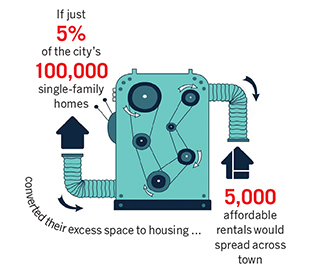
Bloom put out a study from Arc Ecology, suggesting that if just 5 percent of the city’s 100,000 single family homes converted their excess space into in-law units, an additional 5,000 affordable rentals would spread across town.

Wiener’s proposal looks at making new units in just a slice of the city, but another proposal will look at the issue citywide. Chiu’s legislation seeks to take that sea of hidden and unlawful granny flats and bring them up to code, but it wouldn’t look to build new ones.

“The big picture is that we’re exploring legalizing existing [in-law] units that are illegal, to make sure they become safe and protect residents there,” said Amy Chan, an aide in Chiu’s office.


UP TO CODE

Safety isn’t the only consideration, as this could also help the housing supply in the city, those involved told the Guardian. Often these in-law units are rented out to friends and family, and once up to code they’d open up to the market.

But safety is important because these units also often lack city permits because they’re dangerously constructed. Sometimes that can lead to death.

“A lot of time (the units) may not have proper egress for an emergency,” said Dan Lowrey, deputy director of inspection services at the Department of Building Inspection. “We just had a fire last month where three people died because of that.”

Lowrey is part of Chiu’s workgroup that’s navigating the complexities of his new legislation. Just how do you make these units legal? There’s a number of challenges, he said.

When looking at a unit, housing inspectors have a checklist to look through, and some of it is real garden variety stuff. Smoke detectors? Check. Proper floor covering? Check. Those are easy. The real challenge is when there are ceilings that are too low, hallways not wide enough to navigate in an emergency, or the unit has no windows from which to escape in a fire.

That’s when you have an in-law apartment that requires total reconstruction to be brought up to code, a straight up illegal unit. As the law stands now, the only recourse for the city in that case is to evict the people living there.

“That’s the challenge, what do we do with the [in-law apartments] that can’t be legalized?” said Bill Strawn, a spokesperson for DBI. Those are some of the questions that Chiu’s workgroup is tackling now.

The good news, he said, is that there are a good number of units that are up to the Building Code, but not the Planning Code — that’s a much easier hurdle to clear.

The Planning Code basically separates neighborhoods of the city into zones for one, two, or three families in a housing unit. This looks at the amount of available free space, sunlight, air, and parking. With those lifted, many units could be more easily converted to living use.

But finding the units that aren’t up to code is important, said Omar Calimbas, a senior staff attorney at the Asian Law Caucus.

He led the “Our Hidden Communities” study that revealed 33 percent of homes in the Excelsior district contained in-law units, far above the city’s estimates.

His team went door to door and found out for itself. What Calimbas saw was that those living in unregulated units often lived in substandard conditions with nowhere to go for help.

There are some units with no heating, he said. Other times the in-law unit is in a basement barely renovated for use as a living space. Sometimes the bathrooms and shower are really tiny cubes. There are mold and dampness problems.

“You’re living in a space that doesn’t make you feel protected from the elements,” he said. And when the units are made without permits, tenants feel they can’t go to the city for help.

To put it in a nutshell, they are in dire need of regulation. Calimbas is also working with Chiu on his legislation to do just that. But ultimately, each of the two ordinances around secondary units takes small bites out of the housing pie.

Bloom is calling for the city to move aggressively on this issue. “We’re rapidly becoming a more expensive city to live in, more and more so every year.” As more and more San Franciscans are priced out of their homes, time may soon run out.

Activists score big victory as Jack Spade gives up on the Mission

275

Score one for people power. Anti-gentrification activists in the Mission scored a major victory last night in their months-long battle to keep Jack Spade, an upscale men’s clothing chain, from opening a store on 16th Street — first by winning over the Board of Appeals, then by convincing the company to just give up.

So Jack Spade won’t be opening in the site of the old Adobe Book Store location near Valencia Street, an outcome engineered by the grassroots activism of the Stop Jack Spade Coalition, Valencia Corridor Merchants Association, and progressive politicians who supported the cause.

At issue at last night’s packed hearing was an appeal of the Planning Department’s ruling that Jack Spade didn’t fall under formula retail rules because it had one short of the 11 stores needed to meet the definition, even though it’s an expanding part of 5th and Pacific Co. and a brother brand to Kate Spade, which has dozens of stores around the country.

Activists considered it a long shot given the supermajority needed to overrule the decision and force a conditional use permit hearing before the store could open, particularly after falling short with the board in August. But this time, the activists won, with the board voting 4-1 to set a full rehearing for Dec. 11.

As representatives of the corporation left the hearing, they told a few activists and business owners that they “were done.” And when the Guardian reached 5th and Pacific CEO Bill McComb by email today, he confirmed that the company is giving up on this controversial location, where activists were concerned its deep-pocketed presence would accelerate gentrification of the neighborhood.

“[We’re] not going to war with the neighbors. We like those people and their neighborhood and we are not fighting the issue. There are many a fine location for Jack Spade. Peace to the city!” McComb wrote to us.

It was a thrilling surprise for the activists that have been organizing against the project for months, and it was reminiscent of the successful 2009 effort to stop American Apparel from opening up shop on Valencia, involving some of the same activists and organizing tactics.

“We’re very pleased about last night,” said Andy Blue, an activist working with local merchants. “We saw a significant shift in momentum and a tremendous community showing. It was clearly a victory for the neighborhood.”

It was a big turnaround from just a few weeks ago, when it looked like Jack Spade had won, and a sign of the rising importance of gentrification issues to San Franciscans who face rising residential and commercial rents fueled by the latest dot-com boom and Mayor Ed Lee’s corporate welfare policies.

“Six months ago, a lot of people in San Francisco felt powerless with the rapid displacement of residents,” said Blue. “It was like, ‘What can we do, you know?'”
But then, as Blue said, “the resistance started boiling up.”

The local merchants decided to appeal the Planning Department decision that would have allowed Jack Spade to simply open its doors with no public hearing. “So many people who were being affected by it started sharing their stories, and things started happening. People had had enough,” said Blue. “The San Francisco that we love is this diverse, unique place and we were watching  it transform into something totally different.”

Simply getting to yesterday’s hearing was a huge step for the activist population standing up against the retailer, Blue said. But after the rehearing request was granted, the local merchants still needed to prove that “manifest injustice” had taken place during Jack Spade’s permit acquisition process if the merchants wanted the actual rehearing. 

This presented a problem to the VCMA and others. To prove “manifest injustice” had taken place during the permit application process, the merchants needed to prove that Jack Spade not only applied for their permits under a dubious guise, but that they were well aware of just how dubious it was. To be manifestly unjust, the unfairness must be “direct, obvious and observable,” a list that isn’t always easy to satisfy. 

While the two sides can’t seem to come to a consensus on how much the rent will actually increase in the surrounding area due to Jack Spade’s arrival, this controversy arose at a time when neighborhoods throughout the city have been rising up against gentrification.

And this may not be the last time that this company is in the crosshairs of that concern. Asked whether its decision applies to the whole city or just this one location, McComb told us, “Just that spot. We have many brand fans in SF.” 

Friends in the shadows

36

rebecca@sfbg.com, joe@sfbg.com

It’s a simple fact of life: Money buys influence. But in San Francisco, despite strict sunshine laws to illuminate donations to city agencies and gifts to the regulators from the regulated, money still circulates in the shadows when it flows through the coffers of “Friends” in high places.

Major real estate developers, city contractors, and large corporations often lend financial support to San Francisco city departments, to the tune of millions of dollars every year. But the money doesn’t just flow directly to city agencies, where it’s easily tracked by disclosure laws. Instead, it goes through private nonprofits that sometimes label themselves as “Friends Of…” these departments.

They include Friends of City Planning, Friends of the Library, a foundation formerly known as Friends of the San Francisco Department of Public Health, Friends of SF Environment, and Friends of San Francisco Animal Care and Control.

The Friends pay for programs the departments supposedly cannot cover on their own. Bond money can build a skyscraper, but sometimes not fill it with furniture. Agencies are barred by law from funding an employee mixer or a conference trip, so departments turn to their Friends to fill in the gaps. Adding bells and whistles to city websites, holding lunchtime lectures, hiring a grant writer — or, in the case of the Department of Public Health, bolstering health services for vulnerable populations — these are all examples of what gets funded.

The extra help can clearly be a good thing, but the lack of transparency around who’s giving money raises questions — especially if it’s a business gunning for a major contract or a permit to build a high-rise.

City agencies receive outside funding from a wide variety of sources. Sometimes grants are made by the federal government, or a well-established philanthropic foundation — and according to city law, gifts of $10,000 or higher must be approved by the Board of Supervisors. But in the case of organizations like Friends, which are created specifically to assist city government agencies, the original funders aren’t always identifiable. And the collaboration is frequently much closer, with city staff members serving on Friends boards in a few cases.

the circle of donations to "friends of" foundations

Friends board members told the Guardian that their partnership with government helps bolster city agencies in a time of increasing austerity, in service of the public good. But do the special relationships these influential insiders hold with high-ranking city officials come into play when awarding a contract, issuing a permit, making a hiring decision, or determining whether a developer’s request for a rule exemption should be honored? Without more transparency, it’s tough to tell.

City disclosure rules state that any gift to a department must be prominently displayed on that department’s website, along with any financial interest the donor has involving the city. But Friends and other outside funders are under no obligation to share their supporters’ names, much less financial ties, when they distribute grants. Meanwhile, the disclosure rules that are on the books seem to be frequently ignored, misunderstood, or unenforced, our investigation discovered.

How are donors repaid for their support? Consider the controversy earlier this year around Pet Food Express, which won approval in June for another store in the Marina District despite opposition from four locally owned pet stores in the area that fear competing with a large national chain. Pet Food Express won the unlikely support of the city’s Small Business Commissioners, some of whom reversed their 2009 positions opposing the chain’s previous application.

SF Animal Care and Control Director Rebecca Katz personally lobbied the commission to support Pet Food Express, at least partially because the company has donated pet supplies valued at $50,000 to $70,000 per year to the department. That’s a lot of money for a cash-strapped city department, but a pittance compared to the profits of an expanding national chain.

It’s moments of clarity like those, when the public can easily trace the line from donations to political influence, that show why disclosure is so crucial. But those moments are few and far between when trying to trace the funders of private foundations and Friends organizations, where deals often happen in the dark.


WHEN DEVELOPERS ARE FRIENDS

At the Merchant Exchange Building in May, a crowd of high-profile real-estate developers mixed and mingled with city planners, commissioners, and even Mayor Ed Lee, wine glasses in hand. Sources told the Guardian that most of the planning staff was present, and not all were happy about having ribbons and name tags affixed to their shirts, as if they were being auctioned off.

With around 500 in attendance, the event was an annual fundraiser hosted by the Friends of San Francisco City Planning, a nonprofit organization that accepts contributions of up to $2,500 per individual to lend a helping hand to the Planning Department. This year’s event was titled “Incubator Startups, New Jobs for the Future,” hinting that the development community shares the mayor’s affinity for new tech startups and the droves of high-salaried IT professionals they’ve attracted to the city.

Some Friends of City Planning board members are major real-estate developers who routinely seek approval for major construction projects. Others are former planning commissioners, or have a background in community advocacy.

Amid widespread concern about displacement, gentrification, and the overall character of San Francisco’s built environment, no city department has greater influence than Planning. An individual’s interpretation of the Planning Code can carry tremendous weight; it’s a series of small decisions that shape a project’s profits and the look and feel of San Francisco’s future. And with cranes dotting the city’s skyline and market-rate construction catering to the wealthy while middle income residents get priced out, the amount of capital flowing through the development sector these days is astonishing.

In this dizzy climate, there might seem to be something askew about affluent developers and land-use attorneys rubbing elbows with city regulators, all eager to pass the hat for the Planning Department. Whiff of impropriety or no, the fundraiser appears to be totally legal.

“We aren’t violating the law — that I know,” Friends of City Planning Chair Dennis Antenore told the Guardian. “We’ve had legal advice on that for years.”

There is close collaboration between Friends of San Francisco City Planning and the Planning Department — a partnership so entrenched that it’s almost as if the nonprofit is an unofficial, private-sector branch of the agency.

“We are certainly thankful and appreciative,” Planning spokesperson Joanna Linsangan told the Guardian. “They’ve helped us for many, many years.” The additional funding is needed, she said, because “there isn’t a lot of wiggle room” in the departmental budget.

Each year, Planning Director John Rahaim submits a wish list to the Friends, outlining projects he wants funding for. This year, he requested $122,000 for a variety of initiatives, including training support to help planners assess proposals for formula retail (read: chain stores). That’s a hot-button issue lately, and one that shows how seemingly small decisions by planners can have big impacts.

When the department’s zoning administrator ruled that Jack Spade, a high-end clothing chain that opened up in the old Adobe Books location on 16th Street, wasn’t considered formula retail and therefore didn’t need a conditional use permit, neither widespread community outrage nor a majority vote by the Board of Appeals could reverse that flawed decision. It was a similar story with the Planning Commission’s Oct. 3 approval of the 555 Fulton mixed use project, where Planning Department support for exempting the grocery store for the area’s formula retail ban made it happen, to the delight of that developer.

Even though the planning director makes specific funding requests each year to the Friends and pitches the projects in person at their meetings — and the Friends publishes a list of the grants it awards to the department online — the Planning Department is not reporting those gifts to the Board of Supervisors.

“I confirm that the Planning Department did not receive any gifts,” Finance and IT Manager Keith DeMartini wrote in official gift reports submitted to the Board of Supervisors for the years 2011-12 and 2012-13. Those reports were sent to the board on Oct. 7 and Oct. 4, respectively, well after the July filing deadline and after the Guardian requested the missing reports.

The Friends typically funds two-thirds of the requests, said board member Alec Bash, totaling around $80,000 a year. In 2012, the Friends awarded a $25,000 grant to make the department’s new online permit-tracking system more user-friendly, making life a lot easier for developers.

When asked what safeguards are in place to prevent undue influence when the director is soliciting funding from a nonprofit partially controlled by developers, Linsangan responded, “those are two very separate things. One does not influence the other.”

She stated repeatedly that planners are not privy to information about individual contributors — but the fundraisers are organized by a board that includes identifiable developers, and anyone who attends can plainly see the donors in attendance. Nevertheless, Linsangan insisted that planners would not be swayed by this special relationship, saying, “That’s simply not the way we do things around here. We do things according to the Planning Code.”

But as the ruling on Jack Spade shows, as well as countless rulings by planners on whether a project is categorically exempt from the California Environmental Quality Act, interpreting the codes can involve considerable discretion.

The public can’t review a list of who wrote checks to the Friends of San Francisco City Planning for the May fundraiser. Since the organization waits a year between collecting the money and disbursing grants, donors stay shielded from required annual disclosures in tax filings.

But Antenore says the system was established with the public interest in mind. “We don’t reveal the contributors, because we don’t want anybody to have increased influence by a donation,” he insisted. Bash echoed this idea, saying the delay was to “allow for some breathing room.”

Unlike some of his fellow board members from the high-end development sector, Antenore has a history of being aligned with neighborhood interests on planning issues, helping author a 1986 ballot measure limiting downtown high-rise development. He emphasized that the developers on the Friends board are balanced out by more civic-minded individuals.

Still, developers who regularly submit permit applications for major construction projects sit on the Friends board. Among them are Larry Nibbi, a partial owner of Nibbi Bros.; Clark Manus, CEO of Heller Manus Architects; and Oz Erikson, CEO of the Emerald Fund development firm.

“We’re not making use of [the funding] in a way that benefits these people,” Antenore said. “I wouldn’t do this if I thought otherwise. I have been careful to maintain the integrity of this organization.” The money is meant to facilitate better planning, he added. “I don’t think there’s any conspiracy,” he said. “We’re not financing anything evil.”

Both the Planning Department and its Friends dismissed the idea that the donations could open the door to favoritism or undue influence. So why isn’t the department reporting gifts it receives from the Friends to the Board of Supervisors, or disclosing them on its website, as required by city law?

According to a 2008 City Attorney memo on reporting gifts to city departments, when an agency receives a gift of $100 or more, it “must report the gift in a public record and on the department’s website. The public disclosure must include the name of the donor(s) and the amount of the gift [and] a statement as to any financial interest the contributor has involving the city.”

John St. Croix, director of the San Francisco Ethics Commission, confirmed that’s the current standard, telling us, “The actual disclosure should be on the website of the department that received the gift.”

Linsangan said records of the gifts are indeed available — listed as “grants” in the department’s Annual Report. But while the 2011-12 report lists grants from sources such as the Metropolitan Transportation Commission and the Environmental Protection Agency, there was no mention of Friends of City Planning.

The memo also says any gift of $10,000 and above must first be approved by a resolution of the Board of Supervisors. But last year, when the Friends provided $25,000 to upgrade the permit-tracking system, it wasn’t sanctioned by a board resolution. Asked why, Linsangan made it clear that she was not aware of any such requirement.

As is common, when it comes to adhering to disclosure laws, confusion abounds. And sometimes, only sometimes, politicos get caught.


READING UP ON DISCLOSURE LAWS

When the head of a city agency fails to report gifts totaling $130,000, how much do you think he is fined?

City Librarian Luis Herrera failed to report receiving that amount in gifts and he was fined exactly $600 by the California Fair Political Practices Commission on Sept. 19. Specifically, Herrera had to file a form 700 with the FPPC to state the gifts he received. From 2008-2010, the forms he turned in had the “no reportable interests” box checked.

The money was used in what he calls the City Librarian’s Fund, which is the money he keeps on hand to pay for office parties and giving honorariums to poets and speakers who perform at the library’s branches, money that wasn’t disclosed on the very forms designed for reporting it.

There are two stories of how the fine came about. Longtime library advocate James Chaffee said that it was the result of a complaint he filed with the FPPC in April, and indeed, he sought and obtained many public documents revealing the money trail. San Francisco Public Library spokesperson Michelle Jeffers disagreed, saying that the fine was the result of an ongoing conversation with the FPPC to figure how exactly to file the gifts appropriately.

“The law wasn’t clear around these forms and it wasn’t clear if he had to report them,” she told the Guardian. “For amending the reports you have to pay a $200 fine for every year it was proposed. We keep scrupulous records on every pizza party we have.”

When government officials receive “gift of cash or goods,” they must report them annually in statements of economic interest, known as a Form 700, to the city Controller’s Office. The form is kind of a running tally of who is receiving gifts from whom, a way for the public to track money’s influence in government.

The gifts came from the Friends of the San Francisco Public Library, another nonprofit that bolsters city agency funding. Now Herrera has to list the $130,000 gifts from fiscal years 2008-09 and 2009-10 on his website.

What exactly does that accomplish? As it turns out, not a whole lot.

City Administrative Code 67.29-6 defines the reporting of gifts to city departments, and one of those requirements is to make a statement of “any financial interest the contributor has involving the city.” Now that Herrera lists the Friends of the San Francisco Public Library as donors on the department website, the statement of financial interest by the friends group is this: “none.”

There are myriad donors to the Friends of the SFPL, and the group doesn’t have to state the economic interests of its donors, or even mention who its donors are. The code requires gifts be reported to the controller, and the deputy city controller told us this doesn’t apply to the “friends of” organizations, or any nonprofit foundation arms of city departments.

“If gifts are made to a department, yes, they have to disclose, so people don’t get preferential interest in getting city contracts,” Deputy Controller Monique Zmuda told us. “I know it’s a fine line. The foundations don’t provide us with anything.”

Friends of the SFPL doesn’t provide money just for pizza parties. A breakdown of a funding request from the library to its Friends shows requests up to $750,000 to advertise the library on Muni and in newspapers, funding for permanent exhibits, and the City Librarian’s personal fund. That’s just the money it gives to the library. Other monies are spent directly on activities supporting the library.

As Jeffers pointed out to the Guardian, the money isn’t spent on “trips to Tahiti.” Friends of the SPL do good city works, from a neighborhood photo project in the Bayview branch library to providing books for children. But the question is: Who’s buying that goodwill and why?

The millions of dollars in donations made to the Friends of the SFPL don’t need to be approved by the Board of Supervisors, like gifts to departments do. They’re not checked for conflicts of interest or financial interest by any governmental body. Donors give and the Friends of SFPL spend freely, financial interest or not.

When our research for this story began, no financial statements were available of the Friends of the SFPL website. After a few days of inquiries, the most recent year’s financial statements from 2011-12 were posted to the website.

Ultimately, the San Francisco Public Library is one of the smaller city departments, with an annual budget that hovers around $86 million. The Department of Public Health is a much bigger beast, with a 2011-12 budget of around $1.5 billion.

One of its main foundations, the San Francisco General Hospital Foundation, is also one of the largest nonprofits that supplements city spending. In many ways, it could be described as the model of disclosure for city foundations, although its disclosures are not by law, but by choice.


FOUNDATION OF FRIENDS

The Department of Public Health relies on a few entities that fundraise on its behalf: the San Francisco Public Health Foundation, the Friends of Laguna Honda Hospital, and the San Francisco General Hospital Foundation.

“They’re private nonprofit entities that are separate from the department,” CFO Greg Wagner told us. “But their roles are to support the department in its efforts.” He cited examples such as sending its staff to conferences or hosting meetings, “things that we don’t have the budget for or don’t have the staff or resources.”

The lion’s share of the DPH’s gifts are funneled through the SFGHF. Unlike many of the assorted Friends groups or foundations that support city services, the SFGHF extensively reports the sources of its $5 million in donations. The donors include a veritable who’s who of San Francisco: the Giants, Sutter Health, Xerox, Pacific Union, and Kohl’s all donated between $1,000 and $10,000 in the past two years.

But the largest gifts to the SFGHF came from Kaiser Permanente, and its financial interests in the city run deep. Kaiser came into the city’s crosshairs in July, when the Board of Supervisors passed a resolution calling on Kaiser to disclose its pricing model after a sudden, unexplained increase in health care costs for city employees. Kaiser holds a $323 million city contract to provide health coverage, and supervisors took the healthcare giant to task for failing to produce data to back up its rate hikes.

In the meantime, Kaiser has also been a generous donor. It contributed $364,950 toward SFGHF and another $25,000 to SFPHF in fiscal year 2011-12.

The funding from Kaiser and a host of other contributors — which include Chevron, Intel, Genentech, Macy’s, Wells Fargo (another city contractor), and a pharmaceutical company called Vertex — does support needed programs. They include research into the health of marginalized communities, services through Project Homeless Connect, screening for HIV, and immunization shots for travelers.

But because DPH doesn’t count much of this support as “gifts” formally received by the city, it isn’t subject to prior approval by the Board of Supervisors, or posted on the department’s website along with the contributors’ financial interests. Major contributions are disclosed in a report to the Health Commission, something Wagner described as a voluntary gesture in response to commissioners’ requests.

“Most gifts to foundations are donations to a nonprofit and do not come through the city or DPH at all,” he noted.

This distance is maintained on paper despite close collaboration with the department. In the case of Project Homeless Connect, a program that holds a bimonthly event to aid the homeless, it supports programs headquartered in city facilities. Penny Eardley, executive director of SFPHF— which used to be called Friends of San Francisco Public Health — noted that her organization occasionally makes grants or seeks funding in response to department requests. And Deputy Director of Health Colleen Chawla is a foundation board member. It’s almost like these foundations are extensions of the department, except they’re not.

SFPHF also earns revenue as a city contractor. When DPH received a grant from the Centers for Disease Control, it contracted with SFPHF to manage subcontracts with about a dozen community-based organizations.

The web gets even more tangled. The president of SFPHF is Randy Wittorp — who’s also Director of Public Affairs for Kaiser Permanente’s San Francisco Service Area. It’s a similar story with SFGHF, whose board includes several General Hospital administrators, including CEO Susan Currin.

Former Health Commissioner James Illig said people shouldn’t worry, that hospital the staff would never direct foundation funds to pet projects or mishandle funds. They maintain a separation and a firewall,” he said, for example noting, “Sue Currin is not directing funds to her own hospital.”

But he did admit that since SFGHF’s minutes are not public documents, that “raises a few concerns,” arguing the public should be able to inspect financial documents to decide if the foundations are directing funds lawfully to city departments.

Even when the public by law has a right to access financial records of a city department, rooting out corruption can be like pushing a boulder up a San Francisco hill.


FROM PATIENTS TO PARTIES

In 2010 and 2011, Laguna Honda Hospital administrators and staff used money from the hospital’s patient gift fund to throw a party. And then they spent it on airfare. And then they gave laser-engraved pedometers to the staff. All told, they spent nearly $350,000 meant for the dying and the infirm, nearly half of the total funds.

The incident was big, messy, and out in the public eye. It was an all-too-rare glimpse into the shady use of public funds by public officials. But when hospital staff members Dr. Derek Kerr and Dr. Maria Rivero blew the whistle on Laguna Honda’s misuse of patient funds in 2010, they were drummed out of their jobs.

Eventually litigation on behalf of the whistleblowers and their complaints of corruption were found to have merit.

Kerr’s vindication came at a meeting of the Health Commission in April 2013. In the packed City Hall meeting room, the public watched as Laguna Honda Executive Director Mivic Hirose read her apology to Kerr and Rivero aloud, even announcing a plaque in Kerr’s honor.

“The hospital will install the plaque in the South 3 Hospice,” she read, stiltedly, from a written statement, surrounded by microphones at the podium. “The plaque will say: In recognition of Derek Kerr MD of his contributions to the Laguna Honda’s hospice and palliative care program 1989-2010.”

Kerr received a settlement of $750,000 and something more important: His good name cleared.

But that conflict of interest was rooted out only after years of litigation that revealed the financial abuse through legal discovery of the department’s documents — documents that should’ve been public in the first place. ABC 7’s I-Team broke the story and did much of the reporting at the time, otherwise the entire affair may have been swept under the rug.

The misuse of funds was only brought to light with the revelation of public documents — revelations not possible with most Friends groups. The Laguna Honda Hospital Foundation has also had financial dealings with potential conflicts and a lack of transparency.

The now-defunct LHHF’s board chair, former City Attorney Louise Renne, made an interesting choice for her vice chair after she formed the nonprofit in 2003. Derek Parker was vice chair of the LHHF while simultaneously heading architecture firm Anshen-Allen, with a $585 million city contract to rebuild the hospital.

So he was not only rebuilding Laguna Honda under city contract, but soliciting and spending donations meant to supplement his project. Renne wrote to the Health Commission in December 2011 that LHHF’s purpose was to manage over $15 million in donations meant to furnish the hospital with beds, chairs, and other necessities. Eventually, then-Mayor Willie Brown found funding for the hospital, reducing the foundation’s role.

In a phone interview with the Guardian, Renne said the goals of the LHHF were only ever to furnish the newly christened hospital. “Our purpose was to fill the void, if you will, for what the city and its services could not do,” she said.

But in her letter, Renne advocated for LHHF to take an active role in fundraising for the hospital for years to come. “Today, the members of the Board of Directors of the Foundation continue to assist the hospital in various phases of its new projects and operations with projects approved by the City and/or the hospital administration,” she wrote to the Health Commission.

And Parker would have potentially managed millions of dollars flowing through donations for countless other hospital projects, while heading an architectural firm with contracts to build in San Francisco. We were unable to reach Parker for comment.

“I never saw Derek use his position as an architect or position for any political gain, I never saw it,” Renne told us. But no one else would see it either, because organizations like the now closed Laguna Honda Hospital Foundation operate without public oversight.

The Health Commission itself even noted this in its March 2012 meeting, the minutes describing then-commissioner James Illig as critiquing the foundation for not being open about its source of funding.

“Commissioner Illig thanks Ms. Renne and Mr. Parker for coming to the Commission,” the minutes read. “Because (LHHF) is a project of Community Initiatives, a fiscal sponsor for nonprofits, it is not possible to find basic financial information about the Foundation or its activities.”

Divided interests on hospital board

Due to a quirk of her foundation being under the “umbrella” of a separate entity, Community Initiatives, Illig was never able to even get the LHHF’s IRS forms, he told us. “We tried to get information and reports, and the Community Initiatives [Form] 990 was giant,” Illig said. “It didn’t separate anything out.”

Illig told us that it made sense to have Parker on the board because he is monied and well connected, making it easier to solicit donations. But insiders close to the board told us that Parker’s position may have made it easier to swing getting other contracts for his firm.

Parker got another city contract building the UCSF Benioff Children’s Hospital at Mission Bay, slated to open in 2015. No doubt his firm got the job partly due to his reputation as pioneering architecture that leads to healthy patient outcomes — but then again, the board he served on also approved donations to research at UCSF.

Laguna Honda Hospital Foundation may now be defunct, but it serves to illustrate the lack of controls and oversight of the foundations beyond even gift disclosure.


OFF THE BOOKS

It might be characterized as a web of influence, cronyism, or just the way business is done. But is there something improper about all of this?

Private funding often represents a needed boost that allows for important work to take place beyond what could happen under ordinary budgeting. At the same time, it smacks of privatization. While departments and funders point to lean times in the public sector to justify the need for this help, the funding continues to flow whether it’s a good year or a bad year for city government. And at the end of the day, the most glaring issue of all seems to be the lack of transparency.

Are city departments ever tempted to bend the rules to lend a little help to their Friends? As long as the funding is in the dark, the public has no way of knowing.

Ethics chief St. Croix told us his office lacks the resources to visit every city website and check up on whether departments are following the disclosure rules. “If someone brought it to my attention that a department received a gift and didn’t post it [on the website],” he said, “we would look into it.”

But if the watchdogs need watchdogs, citizens who can’t even review documents that should be publicly available, then these quasi-governmental functions and the people who fund them will remain in the shadows.  

Danielle Parenteau contributed to this report.  

ADDENDUM  

When city funders operate in the dark, one of the best ways to learn about corrupt influence, misuse of funds, and other transgressions is from whistleblowers. If you have a tip for us, send us snail mail at SAN FRANCISCO BAY GUARDIAN, 225 Bush, 17th Floor, San Francisco, CA 94104. Or email us at news@sfbg.com. Just make sure not to use an email address provided by your workplace, which is less secure.


Help us keep raising hell

70

EDITORIAL The last couple years have been some of the most difficult and precarious in the Guardian’s 47 years of printing the news and raising hell in San Francisco. We’ve been struggling to survive and thrive, both the newspaper and the larger progressive political and alternative arts communities the Guardian is a part of, at a moment when this city needs us more than ever.

But the good news is that people are awakening to what has been lost as our resources have waned. We see it in the resurgent movements against evictions and gentrification and for better transit and bike lanes, in a rare referendum campaign challenging the 8 Washington project and its lies, in the lively online discussions we facilitate, and in the community support that the Guardian and other nascent progressive media projects are receiving.

Most people don’t trust the mainstream political, economic, and media institutions to understand or explain what’s happening to San Francisco and the greater Bay Area. Technology has created an explosion of new media outlets, but it’s come at the price of common narratives and gathering places where we can join together, discuss the issues, and then assert our collective will.

This is where the Guardian comes in, and it’s why we must find the way to grow through these tough years and regain our standing as the premier forum for discussing and promoting San Francisco’s values and needs. And for that, we need your help and support.

In some ways, it’s a situation similar to when Bruce B. Brugmann and Jean Dibble started the Bay Guardian in October 1966, when San Francisco was at the epicenter of social movements and technological innovation that were challenging entrenched economic interests and the inertia of the status quo.

The Guardian gave voice to new ideas about human rights and responsibilities, sexuality and identity, art and expression, diversity and tolerance, and many of the other issues and values that have animated San Francisco for the last half-century. Along with papers such as the Village Voice, Boston Phoenix, and Chicago Reader, the Guardian helped create the model for alternative newsweeklies that came to proliferate in every major US city, expanding the political and cultural dialogue in the country.

But that model is faltering. The Phoenix, which was founded the same year as the Guardian, closed its doors earlier this year, falling victim to the same economic pressures that are plaguing the entire newspaper industry. And the Voice soldiers on as a relatively apolitical corporate clone of its former feisty self after being bought out by a Phoenix-based chain driven by the kind of bottom-line Wall Street values that alt-weeklies were originally launched to oppose.

Regular readers of the Guardian know how we’ve fought for our independence and sustainability over the last year (see “On Guard,” June 19, and “New Guardian leadership wants your input,” July 23), and that we’ve approached it in a way that was consistent with our values on transparency, fearless truth-telling, and partnership with our progressive community.

And now, on the Guardian’s anniversary, we are recommitting to the mission stated on our masthead, “to print the news and raise hell,” while updating that mission for the digital age in myriad ways, some of which we’ll be announcing soon. This region is at a crossroads, choosing between greedy, myopic elitism and egalitarian sustainability, and we need strong media voices like the Guardian to clarify that choice.

For that, we need your help. Read the paper and then pass it to a friend. Post our stories to your favorite online forum. Buy an ad to promote your business, event, or cause. Participate in our community forums, including our Oct. 23 discussion of high-rises and waterfront development at the LGBT Center. Send us good story tips. And, most importantly, help us promote the idea that an informed and engaged citizenry is the foundation of democracy — and the only way to save the soul of San Francisco.


Chess-in defies SFPD crackdown

By Christina Aanestad

More than 50 people crowded Market Street with tables, chairs, chess and other board games Sunday for a “Chess-in,” a response to the San Francisco Police Department’s closure of a decades-long San Francisco tradition of sidewalk chess.

“We had no say in the decision,” said Marvin Boykins, a 35 year veteran chess player.

Last month, police ended the open and public chess games at Fifth and Market Streets, citing crime as the reason. A nearby shopkeeper, who declined to provide their name, told the Guardian that drug dealers sometimes use the chess tables to conceal their business dealings. There’s no doubt crime occurs around the neighborhood, which marks the intersection of the Tenderloin and SoMa. Just three doors down from the chess games, a woman stood in the doorway of a closed business holding a crack pipe. Nevertheless, chess players like Boykins say crime happens in all neighborhoods—and it’s no reason for the police to stop a decades-old tradition.

“SFPD made a very grave mistake in their administrative capacity not acknowledging the true problem—that we have nothing to do with nor do we condone [crime],” he said.

Other shopkeepers, like Phil Gatdula, manager of sustainable soul food restaurant Farmer Brown on Market Street, said he enjoyed the chess players, who encompass people from all walks of life including business owners, youth, and elders.

Many attendees of the Chess-in voiced concerns about gentrification in the city, pointing to sidewalk chess as its latest casualty. Activists with the Coalition on Homelessness said blaming the removal on crime is merely a cover for an underlying agenda.

“To suggest that a long-time community of elder chess players engaging in a fun, public event is creating a public safety issue is a thinly veiled move to push poor people from public space,” said Jennifer Friedenbach, Executive Director of the Coalition On Homelessness.

Just days after the police kicked the chess players off Market Street, a new rent-a-bike station with gleaming identical bikes took their place. Bay Area Bike Share is a newly launched program that rents out bicycles, with nearly three dozen locations in San Francisco. Having opened in August, it’s a partnership with San Francisco, San Mateo, and Santa Clara Valley transportation authorities, offering “access to shared bicycles 24 hours a day, 7 days a week, for use in the cities of San Francisco, Redwood City, Palo Alto, Mountain View and San Jose,” according to the company’s website.

Lisa Alatorre, another staff member with the Coalition on Homelessness, sees the chess crackdown as part of a larger plan to appeal to techies and tourists in the area. It’s also no coincidence that a new shopping mall and condo development are going in right across the street from where chess players gathered for decades before the recent displacement, she said.

Josh Shadlen, 28, moved to San Francisco a few years ago as part of the second dot-com wave. Despite working within the tech industry that critics like Alatorre say is the cause of high rents in San Francisco, Shadlen spent his day sitting on the sidewalk, playing chess in the sun to support reclaiming public space. He said that while 90 percent of his colleagues don’t care about impacts they are having on the local community, he does.

Josh Shadlen, a tech dude who’s siding with the chess players.

“It seemed basically like an attack on the residents of this neighborhood and part of a plan to turn this neighborhood into fancy office buildings where maybe I might work at some point, but I don’t want that to happen here or anywhere,” he said.

Shadlen said the police should do a better job at policing rather than throwing out chess players.

Organizers like Alatorre say it’s unlikely chess will return to Fifth and Market Streets. For now, the players have moved to Yerba Buena Park. Alatorre and others are still hopeful that things could change—but they believe the political will doesn’t exist among current members of the Board of Supervisors. Asked whether she thought people would continue to gather at Fifth and Market streets to play chess next Sunday, she said, “I hope so.”

Mayor Lee responds to political furor with more funding to fight evictions

136

We’re not sure whether it was the high-profile recent protests against the eviction of the Lee family, our well-read “City Hall must address rising rents” editorial or eviction and gentrification coverage last week, our earlier focus on record eviction rates, or just the growing view that City Hall is too friendly to landlords and neglectful of tenants, but the Mayor’s Office has finally awoken to the biggest issue facing this city.

With skyrocketing rents — and with increasingly common efforts by the landlords of rent-controlled apartments to take advantage of that market by forcing out their tenants — Mayor Lee this afternoon announced that he’s tripling funding to fight illegal Ellis Act evictions, making populist statements along the way.

Now, spending an additional $700,000 to fight greedy, deep-pocketed landlords is not exactly going to change the playing field, but it’s a nice gesture and an indicator that Mayor Lee is starting to notice the problem. Hopefully, with pressure by progressive politicians and activists, this will be just the first of many such actions.

His press releases follows in it entirety:

*** PRESS RELEASE ***

MAYOR LEE ANNOUNCES ADDITIONAL RESOURCES FOR EVICTION PREVENTION IN SAN FRANCISCO

San Francisco to increase resources to support residents and families affected by illegal Ellis Act evictions and releases Eviction Prevention Funding from Housing Trust Fund

San Francisco, CA—Mayor Edwin M. Lee announced San Francisco will triple the amount of funding to prevent illegal Ellis Act evictions and that the City will release $700,000 in funding for other eviction prevention services from the Housing Trust Fund.

“San Francisco must remain a viable place to live and work for people at all levels of the economic spectrum,” said Mayor Lee. “That’s why I am providing additional resources to stop unlawful evictions and provide tenant counseling for our residents, so that San Francisco remains a City for the 100 percent.”

The Human Services Agency (HSA) currently provides nearly $8 million in homeless prevention and eviction defense services, an increase of $1.3 million from last year’s budget. In this year’s budget, the City was providing nearly $125,000 to fund free legal advice and represent 55 San Francisco families who have been affected by illegal Ellis Act eviction threats. Today, Mayor Lee tripled the amount of funding with an additional $250,000, which will immediately be available to eligible organizations that provide Ellis Act prevention legal work and will help more families and people at all levels of the economic spectrum remain in San Francisco.

“Providing resources to stop unlawful evictions has proven to be one of the most effective strategies to prevent displacement and homelessness in our City,” said Trent Rhorer, Director of the San Francisco Human Services Agency. “This additional $250,000 will help keep San Francisco families in their homes.”

The Mayor’s Office of Housing will also provide $700,000, from the Affordable Housing Trust Fund, to fund tenant counseling services. This is a 63 percent increase in funding and brings the total amount to more than $2.3 million in eviction prevention services from the Mayor’s Office of Housing. These additional resources will be distributed to community based organizations specifically expanding legal representation for individuals facing eviction; rental assistance to individuals and families who are currently homeless or are struggling to keep their current rental housing; and to provide outreach to San Franciscans to better inform them about their legal rights.

The Mayor’s Office of Housing has prioritized eviction prevention services and funds activities including legal services, tenant counseling, rental assistance, move-in assistance, know your rights trainings, and other types of tenant support.  Services are offered through a diverse group of community based organizations that reach San Francisco’s many communities including seniors, people with disabilities, immigrants, the homeless and families.

The HSA will issue an ‘Invitation to Bid’ this week so eligible organizations can apply and use the HSA funding to expand their legal services in order for them to be available to vulnerable tenants within 30 days. It is anticipated that the additional HSA funds will help at least 150 households receive legal advice and representation.


Oakland’s Negative Standards support future punks

9

The band Negative Standards is essentially a crust art project.

While maintaining d-beat chords and sludge-like breakdowns, the Oakland-based group makes use of non-instrumental noise and videos created by the band’s bassist, Will, during shows.

And as a quartet that blends elements of crust, doom metal, and noise; Negative Standards sticks out like a sore thumb in the endless sea of fellow crusty brethren and fuzzy lo-fi that exists in the East Bay.

Anonymity is key for the band. Negative Standards sticks to Roman numerals in place of song titles and prefers not to have band members names attached to the project. While being interviewed, the guys chose to keep it on a first-name basis.

So, for housekeeping purposes, the band is as follows: Al on guitar, Will on bass/video, Max on drums and noise, and Will — who wasn’t interviewed — on vocals and non-instrumental noise.

According to Will, the choice to maintain anonymity is to let the music speak for itself.

“From the beginning, the idea was to present each recording as a coherent whole, rather than just a collection of unrelated songs, and doing it this way somewhat anonymizes the individual components,” Will says. “Another effect is that the lyrics, music and samples have to speak for themselves, not having been distilled into a name or a slogan.”

http://www.youtube.com/watch?v=RYApseTorGQ

The band makes the conscious decision to only play all-ages shows to battle the age-old problem of gentrification in the Bay Area.

Drummer and non-instrumental noise creator, Max, expands on this idea: “Gentrification and the attendant cultural colonialism of bars and ‘the underground’ is threatening the existence of DIY all ages spaces in the East Bay more with each passing year,” Max says. “It makes sense that, as a band, we would want to resist the destruction of the cultural environment that has made our existence possible.”

Guitarist Al recalls going to Berkeley’s world-famous all-ages punk venue, 924 Gilman when he was growing up. Al believes that without all-ages venues such as the Gilman, bands like theirs would not exist. Everybody has a starting point, and Al credits the Gilman as his.

“If it weren’t for this place, I wouldn’t know most any of my current good friends, let alone be in this band,” Al says. “I think it’s important to support the future punks instead of shutting them out because you want to drink.”

The band credits the Bay Area for having a thriving scene with the likes of fellow bands such as Noothgrush,Permanent Ruin, Ordstro and Vaccuum. But like most to all existing punk scenes, there exists various isms.

“Seeing the amount of misogyny, transphobia, and racism that goes totally unchecked within some corners of our supposedly ‘radical’ scene can be pretty disheartening, but there’s also some incredible people working against those normative tides,” says Will.

Negative Standards, however, is leaving the sub-cultural hub of Oakland to embark on a European tour, playing with the likes of European punks Bacchus and Throwers.

“Vendetta Records from Germany put out our LP and hooked us up with Timo from Alerta Antifacista Records, who busted his ass to put this tour together for us,” Al  says. “I’m incredibly excited. I’ve never travelled in Europe before and am looking forward to it greatly.”

http://www.youtube.com/watch?v=SnNPxLnRGVo

The band also has a split LP with doom band Whitehorse coming out on Vendetta Records in October.

Most of the band remains extremely cordial and modest, lauding other bands and the proverbial scene at large (for the most part). But as mentioned before, this band sticks out amongst others and Max is sure to break the tide.

“Fuck this false modesty,” Max says. “I defy you to name another local band that has both a totally gnarly wolf AND an outlandishly colored manatee on their van’s dashboard.”

You can catch this band at its upcoming going away show at the Oakland Metro. As the Oakland Metro site states, “no turds allowed.”

Negative Standards
With Ordstro, Sutekh Hexen, Filthchain, Xenotaph
Thu/26, 7pm, $7
Oakland Metro
630 3rd Street, Oakland
(510) 763-1146
www.oaklandmetro.org