Gavin Newsom

Daly’s Dive has become a progressive gathering place

36

In the three weeks since Chris Daly left the Board of Supervisors, the bar he bought – Buck Tavern, to be renamed Daly’s Dive next month – has become a popular place for progressives to commiserate and conspire with one another. And many of them plan to gather there this evening for the State of the Union speech by President Obama, who has been a disappointment to many leftists.

“The good news is for this year’s State of the Union, we have a pub, we’ll be serving the hard stuff, and the faithful might need that,” said Daly, who will be behind the bar.

Daly and allies like Aaron Peskin were an early supporters of Obama’s presidential aspirations, back in the primaries when Gavin Newsom and most of San Francisco’s political moderates were backing Hillary Clinton. So how does Daly feel about Obama now that the president has capitulated to conservatives on tax cuts for the rich, requiring all Americans to sign up with health insurance companies, and maintaining his predecessor’s approach to “fighting terrorism”?

“I can’t say that I’m disappointed because I didn’t have the same expectations other people had,” Daly said. And he maintains that supporting Obama in 2008 was the right thing to do for the country, and a smart political move for San Francisco progressives.

“Barack Obama gave us two more years in San Francisco City Hall,” Daly said, arguing that his campaign maintained the ascendancy of progressives in San Francisco and helped Sups. John Avalos and Eric Mar (and probably Board President David Chiu, although Daly didn’t mention the man he has likened to Judas for betraying the progressive movement) win close races for the Board of Supervisors and for progressives to take over the DCCC. “Obama and the campaign around him helped us very much in San Francisco in 2008.”

But like most progressives, Daly does admit that Obama hasn’t realized his potential as president. While Daly thinks health reform was important, even without a public option, “he was too quick to compromise and the rest of his agenda is in the shitter.”

And that’s likely to be a fairly mild reaction for what could be a cantankerous crowd bellying up to the bar (1655 Market St.) for tonight’s speech, which starts at 6 p.m.

Ting’s “knee-jerk car populism”

31

By Asaf Shalev

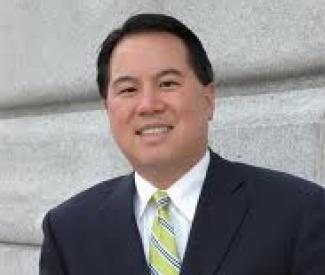
Assessor-Recorder Phil Ting’s campaign for mayor is trying to rile up San Francisco’s car drivers with a new petition called “San Francisco Parking Ticket Overload,” but it seems to be misrepresenting the situation to score election season points.

In the recent email launching the petition, Ting provoked drivers to help “tear up the unfair ticket plan” in order to prevent “turning the whole city into a ‘parking trap.’” Ting said he opposes the MTA’s plan to jack up the enforcement of parking restriction by dolling out more tickets, which was reported in C.W. Nevius’s column. But Ting’s email also made it sound as if parking fines were going up and the MTA was launching a new initiative targeting drivers.

MTA spokesperson Kristin Holland told us that it isn’t true the agency has any intention to increase the cost of parking fines. In response, Ting spokesperson Eric Jaye (who ran Gavin Newsom’s two mayoral campaign) told us, “We are taking [the MTA] at their word and we are very happy to hear that,” insisting the campaign honestly thought that rates were going up.

Tom Radulovich, a transportation policy expert who founded Livable City, called Ting’s messaging and the stance behind it “knee-jerk car populism” and a “saber-rattling election stunt.” He said Ting’s campaign is playing to the fears of drivers who are the more privileged commuters of the city, with most studies showing motorists don’t pay the full costs of their impact to society.

“Even if [Ting’s claim] was true, the premise that motorists have an undue burden is untrue,” Radulovich said. Even with increased enforcement, drivers can still avoid fines by obeying the laws whereas all Muni passengers have had to bear the brunt of higher fares, which doubled under Newsom’s tenure. “I’d like to see someone saying how transit passengers have an unfair deal,” Radulovich said.

Jaye takes a different tone than some of the campaign missives. According to Jaye, what Ting opposes is that the increase in tickets is not the result of policy or enforcement considerations but specifically meant to increase revenue for the city. “We are just trying to pursue a revenue generating policy that is a little more progressive,” Jaye said. Guardian Executive Editor Tim Redmond also recently made the point that parking tickets were meant primarily to keep cars flowing in urban areas and not as a revenue source, but he also noted that motorists don’t pay for their impacts and should pay far higher car taxes.

But Radulovich’s question is left unanswered: “Are any of the candidates going to talk about the plight of transit passengers?”

SF’s new political era

31

news@sfbg.com

You can argue about what the word “progressive” means, and you can argue about the process and the politics that put Ed Lee in the Mayor’s Office. And you can talk forever about which group or faction has how much of a majority on the San Francisco Board of Supervisors, but you have to admit: this city has just undergone a significant political realignment.

Some of that was inevitable. The last members of the class of 2000, the supervisors who were elected in a rebellion against the sleaze, corruption, and runaway development policies of the Willie Brown administration, have left office. Gavin Newsom, the mayor who was often at war with the board and who encouraged a spirit of rancor and partisanship, is finally off to Sacramento. For the first time since 1978, the supervisors will be working with a mayor they chose themselves.

For much of the past 15 years, progressive politics was as much about stopping bad things — preventing Brown and then Newsom from wrecking the city — as it was about promoting good things. But the “politics of anti,” as San Francisco State political scientist Rich DeLeon describes is, wasn’t a central theme in the November elections, and this generation of supervisors comes into office with a different agenda.

Besides, one of the clear divisions on the board the past seven years was the Newsom allies against the progressives — something that dissipated instantly when Lee took over.

But the realignment goes deeper.

Until recently, the progressives on the board had a working majority — a caucus, so to speak — and they tended to vote together much of the time. The lines on the board were drawn almost entirely by what Newsom disparagingly calls ideology but could more accurately be described as a shared set of political values, a shared urban agenda.

There are still six supervisors who call themselves progressives, but the idea that they’ll stick together was shattered in the battle over a new mayor — and the notion that there’s anything like a progressive caucus died with Board President David Chiu’s election (his majority came in part from the conservative side, with three progressives opposing him) and with Chiu’s new committee assignments, which for the first time in a decade put control of key assignments in the hands of the fiscal conservatives.


A PROGRESSIVE MAJORITY?

The progressive bloc on the board was never monolithic. There were always disagreements and fractures. And, thanks to the Brown Act, the progressives don’t actually meet outside of the formal board sessions. But it was fair and accurate to say that, most of the time, the six members of the board majority functioned almost as a political party, working together on issues and counting on each other for key votes. There was, for example, a dispute two years ago over the board presidency — but in the end, Chiu was elected with exactly six votes, all from the progressive majority that came together in the end.

That all started to fall apart the minute the board was faced with the prospect of choosing a new mayor. For one thing, the progressives couldn’t agree on a strategy — should they look for someone who would seek reelection in November, or try to find an acceptable interim mayor? The rules that barred supervisors from voting for themselves made it more tricky; six votes were not enough to elect any of the existing members. And, not surprisingly, some of the progressives had mayoral ambitions themselves.

When state Assemblymember Tom Ammiano — who would have had six votes easily — took himself out of the running, there was no other obvious progressive candidate. And with no other obvious candidate, and little opportunity for open discussion, the progressives couldn’t come to an agreement.

But by the Jan. 4 board meeting, five of the six had coalesced around Sheriff Mike Hennessey. Chiu, however, was supporting Ed Lee, someone he had known and worked with in the Asian community and whom he considered a progressive candidate. And once it became clear that Lee was headed toward victory, Sup. Eric Mar announced that he, too, would be in Lee’s camp.

A few days later, when the new board convened to choose a president, the progressive solidarity was gone. Sups. David Campos, John Avalos, and Ross Mirkarimi, now the solid left wing of the board, voted for Avalos. Chiu won with the support of Mar, Sup. Jane Kim, and the moderate-to-conservative flank.

Now the Budget Committee — long controlled by a progressive chair and a progressive majority — will be led by Carmen Chu, who is among the most fiscally conservative board members. The Land Use and Development Committee will be chaired by Mar, but two of the three members are from the moderate side. Same goes for Rules, where Sup. Sean Elsbernd, for years the most conservative board member, will work with ideological ally Sup. Mark Farrell on confirming mayoral appointments, redrawing supervisorial districts, and promoting or blocking charter amendments as Kim, the chair, does her best to contain the damage.

You can argue that having independent-minded supervisors who don’t vote as a caucus is a good thing. You can also argue that a fractured left will never win against a united downtown. And both arguments have merit.

But you can’t argue any more that the board has the same sort of progressive majority it’s had for the past 10 years. That’s over. It’s a new — and different — political era.

What happens now? Will the progressives hold enough votes to have an influence on the city budget (and ensure that the deficit solutions include new revenue and not just cuts)? What legislative priorities will the supervisors be pushing in the next year? How will the votes shake out on difficult new proposals (and ongoing issues like community choice aggregation)?

Mayor Lee has pledged to work with the board and will show up for monthly questions. How will he respond to the sorts of progressive legislation — like tenant protections, transit-first policies, immigrant rights measures, and stronger affordable housing standards — that Newsom routinely vetoed?

How will this all play out in a year when the city will also be electing a new mayor?


IDENTITY POLITICS?

When Sups. Chiu, Mar, and Kim broke with their three progressive colleagues to support Chiu for board president — just as Chiu and Mar helped clear the path for Ed Lee to become mayor days earlier — it seemed to many political observers that identity had trumped ideology on the board. There’s some truth to that observation, but it’s too simple an explanation. There’s also the fact that Chiu strongly supported Kim, who is a personal friend and former roommate, in her election, so it’s no surprise she went with him for board president.

And the phrase itself is so laden with baggage and problems that it’s hard to talk about. It has come to signify a wide range of political activity and theorizing founded in the shared experiences of injustice of members of certain social groups. “Rather than organizing solely around belief systems, programmatic manifestoes, or party affiliation, identity political formations typically aim to secure the political freedom of a specific constituency marginalized within its larger context,” says the Stanford Encyclopedia of Philosophy, an ongoing research project by the students and faculty at Stanford University.

Although the notion of identity politics took hold during the social movements of the 1960s and ’70s — when liberation and organizing movements among women and various ethic and other identity groups fed a larger liberal democratic surge that targeted war, economic inequity, social injustice, and other issues — it’s also a political approach that has divided the populace.

“One of the central charges against identity politics by liberals, among others, has been its alleged reliance on notions of sameness to justify political mobilization,” says the Stanford Encyclopedia. “Looking for people who are like you rather than who share your political values as allies runs the risk of sidelining critical political analysis of complex social locations and ghettoizing members of social groups as the only persons capable of making or understanding claims to justice.”

Mar explains that the reality of identity politics and whether it’s a factor in the current politics at City Hall is far more complex.

“With me, David Chiu, and Jane Kim as a block of three progressive Asians — and I still define David Chiu as a progressive though I think some are questioning that — we all come out of what I would call a pro-housing justice, transit-first, and environmental sustainability [mindset],” Mar told us. “But I think because of our ethnic background and experiences, we may have different perspectives at times than other progressives.”

For example, Mar said, many working class families of color need to drive a car so they’ll differ from progressives who want to limit parking spaces to discourage driving. He also has reservations about the proposed congestion pricing fee and how it might affect low-income drivers.\

“I think often when progressive people of color come into office — Jane Kim might be one of the best examples — that sometimes there’s an assumption that her issues are going to be the same as a white progressive or a Latino progressive,” he said. “But I think kind of the different identities that we all have mean that we’re more complex.”

Campos, a Latino immigrant who is openly gay, noted that “as a progressive person of color, I have at times felt that the progressive movement didn’t recognize the importance of identity politics and what it means for me to have another person of color in power.”

But, he added, “I don’t think identity politics alone should guide what happens. A progressive agenda isn’t just about race but class, sexual orientation, and other things. It’s not enough to say that identity politics justifies everything.”

University of San Francisco political science professor Corey Cook told the Guardian that identity has always been a strong factor in San Francisco politics, even if it was overshadowed by the political realignment around progressive ideology that occurred in 2000, mostly as a reaction to an economic agenda based on rapid development and political cronyism.

“I’m not sure that identity wasn’t relevant, but it was swamped by ideology,” Cook told the Guardian. Now, he said, another political realignment seems to be occurring, one that downplays ideology compared to the position it has held for the last 10 years. “I’m not sure that ideology is dead. But the dynamics have definitely changed.”

Cook sees what may be a more important change reflected in Chiu’s decision to put the political moderates in control of key board committees. But he said that shift was probably inevitable given the difficulties of unifying the diverse progressive constituencies.

“It’s hard to hold a progressive coalition together, and it’s amazing that it has lasted this long,” he said.

There’s another kind of identity politics at play as well — that of native San Franciscans, who often express resentment at progressive newcomers talking about what kind of city this is, versus those who see San Francisco as a city of immigrants and ideas, a place being shaped by a wider constituency than the old-timers like to acknowledge.

“I’m honored to join Sups. Elsbernd and Cohen in representing the neighborhoods they grew up in,” Sup. Mark Farrell said during his opening remarks after being sworn in Jan. 8., sobbing when he thanked his parents for their support.

As he continued, he fed the criticism of the notion of ideology-based politics that has been a popular trope with Gavin Newsom and other fiscal conservatives in recent years, telling the crowd he wanted “to turn City Hall into a place based on issues and ideas, not ideology.”

Cohen also placed more importance on her birthright than on her political philosophy, telling stories about entering board chambers through the back door at age 16 when she was part of a youth program created by then-Mayor Frank Jordan, and with former Mayor Dianne Feinstein coming to speak at Cohen’s third-grade class. “I am a San Francisco native, and that is a responsibility I take seriously,” said Cohen, who graduated from the Emerge Program, which grooms women for political office,

“We will have another woman as president of the Board of Supervisors, and we will have a woman as mayor of San Francisco,” she added. And as the sole African American on the board, she also pledged, “I will be working to add more members of the African American community to the elected family of San Francisco.”

But what issues she plans to focus on and what values she’ll represent were unclear in her comments — as they were throughout her campaign, despite the efforts of journalists and activists to discern her political philosophy. In her public comments, her only stated goal was to build bridges between the community and City Hall and let decisions be guided by the people “not political ideologies.”

Oftentimes in recent San Francisco history, identity and ideology have worked in concert, as they did with former Sup. Harvey Milk, who broke barriers as the first openly gay elected official, but who also championed a broad progressive agenda that included tenants rights, protecting civil liberties, and creating more parks and public spaces.

Sup. Scott Wiener, shortly after being sworn into office, acknowledged the legacy of his district, which was once represented by Milk and fellow gay progressive leader Harry Britt, telling the crowd: “I’m keenly aware of the leadership that has come through this district and I have huge shoes to fill.”

Yet Wiener, a moderate, comes from a different ideological camp than Milk and Britt and he echoed the board’s new mantra of collaboration and compromise. “I will always try to find common ground. There is always common ground,” he said.


GETTING THINGS DONE?

Chiu is making a clear effort to break with the past, and has been critical of some progressive leaders. “I think it’s important that we do not have a small group of progressive leaders who are dictating to the rest of the progressive community what is progressive,” he said.

While he didn’t single out former Sup. Chris Daly by name, he does seem to be trying to repudiate Daly’s leadership style. “I think that while the progressive left and the progressive community leaders have had very significant accomplishments over the past 10 years, I do think that there are many times when our oppositional tactics have set us back.”

When Chiu was reelected board president, he told the crowd that “none of us were voted into office to take positions. We were voted into office to get things done.”

Some progressives were not at all happy with that comment. “I thought that was a terrible thing to say,” Avalos told the Guardian, arguing the positions that elected officials take shape the legislation that follows. As an example, he cited the positions that progressive members of Congress took in favor of the public option during the health care reform debate.

Talking about getting things done is “a sanctimonious talking point that fits well with what the Chronicle and big papers want to hear,” Avalos said. He said the Chronicle and other downtown interests are more interested in preserving the status quo and blocking progressive reforms. “It’s what they want to see not get done.”

Campos even challenged the comment publicly during the Jan. 11 board meeting when he said, “It’s important to get things done, but I don’t think getting things done is enough. We have to ask ourselves: what is it that we’re getting done? How is it that we’re getting things done? And for whom is it that we’re doing what we’re doing? Is it for the people, or the downtown corporate interests? I hope it’s not getting things done behind closed doors.”

Chiu said that, for him, getting things done is about expanding the progressive movement and consolidating its recent gains. “I think we all share a political goal. As progressives, we all share a political goal of getting things done and growing mainstream support for our shared progressive principles so that they really become the values of our entire city.”

To do that, he said, progressives are going to need to be more conciliatory and cooperative than they’ve been in the past. “I think it’s easy to slip into a more oppositional way of discussing progressive values, but I’m really pushing to move beyond that.”

The biggest single issue this spring will be the budget — and it’s hard to know exactly where the board president will draw his lines. “I have spoken to Mayor Lee about the need for open, transparent, and community-based budget processes and he’s open to that,” Chiu told us — and that alone would be a huge change. But the key progressive priority for the spring will be finding ways to avoid brutal budget cuts — and that means looking for new revenue.

When asked whether new general revenue will be a part of the budget solution, instead of Newsom’s Republican-style cuts-only approaches, Chiu was cautious. “I am open to considering revenues as part of the overall set of solutions to close the budget deficit,” he said. “I am willing to be one elected here that will try to make that argument.” But with his political clout and connections right now, he can do a lot more than be one person making an argument.

Chiu has always been open to new revenue solutions and even led the way in challenging the cuts-only approach to both the city budget and MTA budget two years in a row, only to back down in the end and cut a deal with Newsom. When asked whether things will be better this year given his closer relationship to Lee, Chiu replied, “I think things are going to be different in the coming months.”

During the board’s Jan. 7 deliberation on Lee, Sup. Eric Mar also said that based on his communications with Lee, Mar believed that the Mayor’s Office is open to supporting new revenue measures. He echoed the point later to us.

In addition to supporting the open, inclusive budget process, Mar called for “a humane budget that protects the safety net and services to the most vulnerable people in San Francisco is kind of the critical, top priority.

“I think it’s going to be difficult working with the different forces in the budget process,” he added. “That’s why I wish it could have been a progressive who was chairing the budget process.”

Mar said progressive activism on the budget process is needed now more than ever. “The Budget Justice Coalition from last year I think has to be reenergized so that so many groups are not competing for their own piece of the pie, but that it’s more of a for-all, share-the-pain budget with as many people communicating from outside as possible, putting the pressure on the mayor and the board to make sure that the critical safety net’s protected.”


CUTS WILL BE CENTER STAGE

But major cuts — and the issue of city employees pay and benefits — will also be center stage.

At the board’s Jan. 11 meeting, before the supervisors voted unanimously to nominate Lee as interim mayor, Sup. Elsbernd signaled that city workers’ retirement and health benefits will once again be at the center of the fight to balance the budget.

Elsbernd noted that in past years he was accused of exaggerating the negative impacts that city employees’ benefits have on the city’s budget. “But rather than being inflated, they were deflated,” Elsbernd said, noting that benefits will soon consume 18.14 percent of payroll and will account for 26 percent in three years.

“Does the budget deficit include this amount?” he asked.

And at the after-party that followed Lee’s swearing-in, Public Defender Jeff Adachi, who caused a furor last fall when he launched the ill-considered Measure B, which sought to reform workers’ benefits packages, told us he is not one to give up lightly.

“We learned a lot from that,” Adachi said. “This is still the huge elephant in City Hall. The city’s pension liability just went up another 1 percent, which is another $30 million”

Chu agreed that worker benefits would be a central part of the budget-balancing debate. “Any conversation about the long-term future of San Francisco’s budget has to look at the reality of where the bulk of our spending is,” she said.

Avalos noted that he plans to talk to labor and community based organizations about ways to increase city revenue. “I’m going to work behind the scene on the budget to make sure the communities are well-spoken for,” Avalos said, later adding, “But it’s hard, given that we need a two-thirds majority to pass stuff on the ballot.”

Last year, Avalos helped put two measures on the ballot to increase revenue: Prop. J, which sought to close loopholes in the city’s current hotel tax and asked visitors to pay a slightly higher hotel tax (about $3 a night) for three years, and Prop. N, the real property transfer tax that slightly increased the tax charged by the city on the sale of property worth more than $5 million.

Prop. N should raise $45 million, Avalos said. “I’ve always had my sights set on raising revenue, but making cuts is inevitable.”


THE IDEOLOGY ARGUMENT

Newsom and his allies loved to use “ideology” as a term of disparagement, a way to paint progressives as crazies driven by some sort of Commie-plot secret agenda. But there’s nothing wrong with ideology; Newsom’s fiscal conservative stance and his vow not to raise taxes were ideologies, too. The moderate positions some of the more centrist board members take stem from a basic ideology. Wiener, for example, told us that he thinks that in tough economic times, local government should do less but do it better. That’s a clear, consistent ideology.

For much of the past decade, the defining characteristic of the progressives on the board has been a loosely shared urban ideology supported by tenants, immigrant-rights groups, queer and labor activists, environmentalists, preservationists, supporters of public power and sunshine and foes of big corporate consolidation and economic power. Diversity and inclusiveness was part of that ideology, but it went beyond any one political interest or identity group.

It was often about fighting — against corruption and big-business hegemony and for economic and social equality. The progressive agenda started from the position that city government under Brown and Newsom had been going in the wrong direction and that substantive change was necessary. And sometimes, up against powerful mayors and their well-heeled backers, being polite and accommodating and seeking common ground didn’t work.

As outgoing Sup. Daly put it at his final meeting: “I’ve seen go-along to get along. If you want to do more than that, if you think there’s a fundamental problem with the way things are in this world, then go-along to get along doesn’t do it.” When Chiu announced that the new progressive politics is one of pragmatism, he was making a break from that ideology. He was signaling a different kind of politics. He has urged us to be optimistic about the new year — but we still don’t know what the new agenda will look like, how it will be defined, or at what point Chiu and his allies will say they’ve compromised and reached out enough and are ready to take a strong, even oppositional, stand. We do know the outcome will affect the lives of a lot of San Franciscans. And when the budget decisions start rolling down the pike, the political lines will be drawn fairly clearly. Because reaching across the aisle and working together sounds great in theory — but in practice, there is nothing even resembling a consensus on the board about how the city’s most serious problems should be resolved. And there are some ugly battles ahead.

They have issues: Members of the new Board speak

20

Board President David Chiu touched off a broad political discussion in recent weeks with his statement that officials were elected “not to take positions, but to get things done.” Delivered just before his reelection as Board President with the solid backing of the board’s moderate faction, Chiu’s comment has been viewed in light of City Hall’s shifting political dynamic, a subject the Guardian explores in a Jan. 19 cover story. Politics aside, Chiu’s statement also begs the question: Just what do members of the board hope to get done, and how do they propose to accomplish the items on their agenda?
Last week, Guardian reporters tracked down every member of the board to find out. We asked, what are your top priorities? And how do you plan to achieve them? Some spoke with us for 25 minutes, and others spoke for just 5 minutes, but the result offers some insight into what’s on their radar. Not surprisingly, getting the budget right was mentioned by virtually everyone as a top priority, but there are sharp differences in opinion in terms of how to do that. Several supervisors, particularly those in the moderate wing, mentioned ballooning pension and healthcare costs. Aiding small business also emerged as a priority shared by multiple board members.

Sup. Eric Mar
District 1

Issues:
*Budget
*Assisting small businesses
*Programs and services for seniors
*Food Security
*Issues surrounding Golden Gate Park

Elected in 2008 to represent D1, Sup. Eric Mar has been named chair of the powerful Land Use & Economic Development Committee and vice chair of the City Operations and Neighborhood Services Committee.

Asked to name his top priorities, Mar said, “A humane budget that protects the safety net and services to the must vulnerable people in San Francisco is kind of the critical, top priority.”

It’s bound to be difficult, he added. “That’s why I wish it could have been a progressive that was chairing the budget process. Now, we have to work with Carmen Chu to ensure that it’s a fair, transparent process.”

A second issue hovering near the top of Mar’s agenda is lending a helping hand to the small businesses of the Richmond District. “There’s a lot of anxiety about the economic climate for small business. We’re trying to work closely with some of the merchant associations and come up with ideas on how the city government can be more supportive,” he said. Mar also spoke about the need to respond to the threat of big box stores, such as PetCo, that could move in and harm neighborhood merchants. “I’m worried about too many of the big box stores trying to come in with an urban strategy and saying that they’re different — but they sure have an unfair advantage,” he noted.

Programs and services for the senior population ranked high on his list. Mar noted that he’d been working with senior groups on how to respond to a budget analyst’s report showing a ballooning need for housing – especially affordable housing – for seniors. “It’s moving from the Baby Boom generation to the Senior Boomers, and I think the population, if I’m not mistaken, by 2020 it’s going up 50 percent,” he said. “It’s a huge booming population that I don’t think we’re ready to address.”

Addressing food security issues through the Food Security Task Force also ranked high on Mar’s list, and he noted that he’s been working with a coalition that includes UCSF and the Department of Public Health to study the problem. “We’ve had a number of strategy meetings already, but we’re trying to launch different efforts to create healthier food access in many of our lowest income neighborhoods,” Mar said.

Finally, Mar talked about issues relating to the park. “I do represent the district that has Golden Gate Park, so I’m often busy with efforts to preserve the park, prevent privatization, and ensure enjoyment for the many residents not just in the Richmond but throughout the city that enjoy the park.” Although it’s not technically in his district, Mar noted that he is very supportive of HANC Recycling Center – and plans to advocate on their behalf to Mayor Lee.

Sup. Mark Farrell
District 2
Issues:
*Pension reform
*Long-term economic plan for city
*Job creation
*Quality-of-life issues

Elected to replace termed-out D2 Sup. Michela Alioto-Pier, Farrell has been named vice-chair of the Government Audits & Oversight Committee and a member of the Rules Committee. A native of D2, Farrell told the Guardian he believes his roots in the city and background as a venture capitalist would be an asset to the city’s legislative body. “I know at the last board, Carmen [Chu] was the only one who had any finance background,” he said. “To have someone come from the private sector with a business / finance background, I really do believe … adds to the dialogue and the discussion here at City Hall.”

Along those lines, Farrell said one of his top priorities is the budget. “I’m not on the budget and finance committee this time around, but given my background, I am going to play a role in that,” he said.

So what’s his plan for closing the budget deficit? In response, he alluded to slashing services. “In the past, there have been views that we as a city don’t provide enough services and we need to raise revenues to provide more, or the perspective that we first need to live within our means and then provide more services. Everyone’s going to disagree, but I’m in the latter camp,” he said. “I do believe we need to make some tough choices right now – whether it be head count, or whether it be looking at …pension reform. I do believe pension reform needs to be part of the dialogue. Unfortunately, it’s unsustainable.”

He also said he wanted to be part of “trying to create and focus on a framework for a long-term financial plan here in San Francisco.”

Secondly, Farrell discussed wanting to put together a “jobs bill.”

“Jobs is a big deal,” he said. “It’s something I want to focus on. There are only so many levers we can pull as a city. I think the biotech tax credits have spurred a lot of business down in Mission Bay.”

Next on Farrell’s agenda was quality-of-life issues, but rather than talk about enforcing San Francisco’s sit/lie ordinance – supported by political forces who organized under the banner of maintaining ‘quality-of-life’ – Farrell revealed that he is incensed about parking meter fines. “It is so strikingly unjust when you are 1 minute late to your parking meter and you have a $65 parking fine,” he said.

Farrell also mentioned development projects that would surely require time and attention. “CPMC is going to be a major dominant issue,” he said. He also mentioned Doyle Drive, and transitional age youth housing projects proposed in D2 – but as far as the housing project planned for the King Edward II Inn, which has generated some controversy among neighborhood groups, he didn’t take a strong position either way, saying he wanted to listen to all the stakeholders first.

Board President David Chiu
District 3
Issues:
*Budget
*Preserving neighborhood character
*Immigrant rights
*Preserving economic diversity
*Transit

Elected for a second two-year term as President of the Board, D3 Sup. David Chiu is rumored to be running in the mayor’s race, after he turned down former Mayor Gavin Newsom’s offer to appoint him as District Attorney. That offer was made after Kamala Harris won the state Attorney General’s race this fall. And when Chiu turned it down, former Mayor Gavin Newsom shocked just about everybody by appointing San Francisco Police Chief George Gascon, who is not opposed to the death penalty and was a longtime Republican before he recently registered as a Democrat, instead.

A temporary member of the Board’s Budget acommittee, Chiu is also a permanent member of the Board’s Government Audits & Oversight Committee.

Asked about his top priorities, Chiu spoke first and foremost about  “ensuring that we have a budget that works for all San Franciscans, particularly the most vulnerable.” He also said he wanted to see a different kind of budget process: “It is my hope that we do not engage in the typical, Kabuki-style budget process of years past under the last couple of mayors, where the mayor keeps under wraps for many months exactly what the thinking is on the budget, gives us something on June 1 for which we have only a couple of weeks to analyze, and then engage in the tired back-and-forth of debates in the past.” Chiu also spoke about tackling “looming pension and health care costs.”

Another priority, he said, was “Ensuring that our neighborhoods continue to remain the distinctive urban villages that they are, and protecting neighborhood character,” a goal that relates to “development, … historic preservation, [and] what we do around vacant commercial corridors.”

*Immigrant rights also made his top-five list. “I was very sad that last November we didn’t prevail in allowing all parents to have a right and a voice in school board elections,” he said, referencing ballot measure Proposition D which appeared on the November 2010 ballot. “I think we are going to reengage in discussion around Sanctuary City, another topic I have discussed twice already with Mayor Lee.”

Another issue for Chiu was  “ensuring again that hopefully San Francisco continues to remain an economically diverse city, and not just a city for the very wealthy.” He spoke about reforming city contracts: “In particular, dealing with the fact that in many areas, 70 to 80 percent of city contracts are awarded to non-San Francisco businesses. … I think there is more significant reform that needs to happen in our city contracting process.” Another economic-diversity measure, he said, was tax policy, “particularly around ensuring that our business tax is incenting the type of economic growth that we want.”

Finally, Chiu spoke about “Creating a transit-first city. This is not just about making sure MUNI is more reliable and has stable funding, but ensuring that we’re taking steps to reach a 2020 goal of 20 percent cycling in the city. Earlier this week I called for our transit agencies to look at pedestrian safety, because we are spending close to $300 million a year to deal with pedestrian deaths and injuries.”

Sup. Carmen Chu
District 4
*Budget
*Core Services
*Jobs
*Economy

Chiu has just named Sup. Carmen Chu as chair of the powerful Board and Finance Committee. And Chu, who worked as a budget analyst for Newsom’s administration, says the budget, core services, employment and the economy are her top priorities.

“My hope is that this year the budget is going to be a very collaborative and open process,” Chu said.

Chu believes workers benefits will be a central part of the budget-balancing debate.
“Any conversation about the long-term future of San Francisco’s budget has to look at the reality of where the bulk of our spending is,” she said.

Chu noted that the budget debate will have to take the state budget into account.
“At the end of the day, we need to take into account the context of the state budget, in terms of new cuts and taxes, because anything we do will be on top of the state level.

“We need to ask who do these measures really impact,” she added, noting that there were attempts to put revenue measures on the ballot last year.

Sup. Ross Mirkarimi
District 5
* Local Hire / First Source / Reentry programs
* Budget / generating revenue
* Infrastructure improvements
*Reversing MTA service cuts

With only two years left to serve on the Board, D5 Sup. Ross Mirkarimi has been named chair of the Board’s Public Safety Committee and vice-chair of the Budget and Finance Committee.

“One of my top priorities is building on and strengthening the work that I’ve already done and that Avalos is doing on mandatory local hire and First Source programs,” Mirkarimi said. He also spoke about “strengthening reentry programs for those coming out of the criminal justice system, because we still have an enormously high recidivism rate.”

The budget also ranked high on Mirkarimi’s list, and he stressed the need for “doing surgical operations on our budget to make sure that services for the vulnerable are retained, and looking for other ways to generate revenue beyond the debate of what’s going on the ballot.

“For instance, I helped lead the charge for the America’s Cup, and while the pay-off from that won’t be realized for years, the deal still needs to be massaged. What we have now is an embryonic deal that still needs to be watched.”

Mirkarimi mentioned safeguarding the city against privatization, saying one of his priorities was “retooling our budget priorities to stop the escalating practice of privatizing city services.”

 He spoke about “ongoing work citywide to make mixed-use commercial and residential infrastructure improvements, which coincide with bicycle and pedestrian improvements.”

Finally, Mirkarimi said he wanted to focus on transportation issues. “As Chair of the Transportation Authority, if I even continue to be chair, to take the lead on signature transit projects and work with the M.T.A. to reverse service cuts.”

Sup. Jane Kim
District 6
Issues:
*Jobs
*Economic Development
*Small Business
*Pedestrian Safety
*Legislation to control bedbug infestations

Elected to replace termed-out D6 Sup. Chris Daly, Kim has been named chair of the Rules Committee and a member of the Budget & Finance committee.

Kim believes that she will prove her progressive values through her work and she’s trying to take the current debate about her allegiances on the Board in her stride.

“The one thing I learned from serving on the School Board was to be really patient,” Kim told me, when our conversation turned to the issue of “progressive values.”

“I didn’t want to be President of the School Board for the first few years, because I loved pushing the envelope,” Kim added, noting that as Board President David Chiu is in the often-unenviable position of chief negotiator between the Board and the Mayor.

But with Ed Lee’s appointment as interim mayor, Kim is excited about the coming year.
“There are a lot of new opportunities, a different set of players, and it’s going to be very interesting to learn how to traverse this particular scene.”

Kim is kicking off her first term on the Board with two pieces of legislation. The first seeks to address bedbug infestations. “Particularly around enforcement, including private landlords,” Kim said, noting that there have also been bedbug problems in Housing Authority properties.

Her second immediate goal is to look at pedestrian safety, a big deal in D6, which is traversed by freeways with off-ramps leading into residential zones.
“Pedestrian safety is a unifying issue for my district, particularly for all the seniors,” Kim said, citing traffic calming, speed limit enforcement and increased pedestrian traffic, as possible approaches.

Beyond those immediate goals, Kim plans to focus on jobs, economic development and small businesses in the coming year. “What can we do to create jobs and help small businesses? That is my focus, not from a tax reduction point of view, but how can we consolidate the permitting and fees process, because small businesses are a source of local jobs.”

Kim plans to help the Mayor’s Office implement Sup. John Avalos’ local hire legislation, which interim Mayor Ed Lee supports, unlike his predecessor Mayor Gavin Newsom.

“Everyone has always liked the idea of local hire, but without any teeth, it can’t be enforced,” Kim observed. “It’s heartbreaking that young people graduate out of San Francisco Unified School District and there’s been not much more than retail jobs available.”

She noted that jobs, land use and the budget are the three overarching items on this year’s agenda. “I’m a big believer in revenue generation, but government has to come half-way by being able to articulate how it will benefit people and being able to show that it’s more than just altruistic. I think we have to figure out that balance in promoting new measures. That’s why it’s important to be strong on neighborhood and community issues, so that folks feel like government is listening and helping them. I don’t think it’s a huge ask to be responsive to that.”

Kim said she hoped the new mayor would put out a new revenue measure, enforce local hire, and implement Sup. David Campos’ legislation to ensure due process for immigrant youth.

“I think Ed can take a lot of the goodwill and unanimous support,” Kim said. “We’ve never had a mayor without an election, campaigns, and a track record. Usually mayors come in with a group of dissenters. But he is in a very unique position to do three things that are very challenging to do. I hope raising revenues is one of those three. As a big supporter of local hire, I think it helps having a mayor that is committed to implement it. And I’m hoping that Ed will implement due process for youth. For me, it’s a no brainer and Ed’s background as a former attorney  for Asian Law Caucus is a good match. Many members of my family came to the U.S. as undocumented youth, so this is very personal. Kids get picked up for no reason and misidentified. People confuse Campos and Avalos, so imagine what happens to immigrant youth.”

Sup. Sean Elsbernd
District 7
Issues:
*Parkmerced
*Enforcing Prop G
*Pension & healthcare costs
*CalTrain

With two years left to serve on the Board, D7 Sup. Sean Elsbernd has been named vice-chair of the Rules Committee and a member of the City Operations & Neighborhood Services Committee. He was congratulated by Chinatown powerbroker Rose Pak immediately after the Board voted 11-0 to nominated former City Administrator Ed Lee as interim mayor, and during Lee’s swearing-in, former Mayor Willie Brown praised Elsbernd for nominating Lee for the job.

And at the Board’s Jan. 11 meeting before the supervisors voted for Lee, Elsbernd signaled that city workers’ retirement and health benefits will be at the center of the fight to balance the budget in the coming year.

Elsbernd noted that in past years, he was accused of exaggerating the negative impacts that city employees’ benefits have on the city’s budget. “But rather than being inflated, they were deflated,” Elsbernd said, noting that benefits will soon consume 18.14 percent of payroll and will account for 26 percent in three years. “Does the budget deficit include this amount?” he asked.

And at the afterparty that followed Lee’s swearing in, Public Defender Jeff Adachi, who caused a furor last fall when he launched Measure B, which sought to reform workers’ benefits packages, told the Guardian he is not one to give up lightly. “We learned a lot from that,” Adachi said. “This is still the huge elephant in City Hall. The city’s pension liability just went up another 1 percent, which is another $30 million.”

As for priorities, Elsbernd broke it down into district, city, and regional issues. In D7, “Hands-down, without question the biggest issue … is Parkmerced,” he said, starting with understanding and managing the environmental approval process. If it gets approved, he said his top concerns was that “the tenant issue. And the overriding concern of if they sell, which I think we all think is going to happen in the near-term – do those guarantees go along with the land?”

Also related to Parkmerced was planning for the traffic conditions that the development could potentially create, which Elsbernd dubbed a “huge 19th Avenue issue.”

Citywide, Elsbernd’s top priorities included enforcing Proposition G – the voter-approved measure that requires MUNI drivers to engage in collective bargaining – and tackling pension and healthcare costs. He spoke about “making sure that MTA budget that comes to us this summer is responsive” to Prop G.

As for pension and healthcare, Elsbernd said, “I’ve already spent a good deal of time with labor talking about it, and will continue to do that.” But he declined to give further details. Asked if a revenue-generating measure could be part of the solution to that problem, Elsbernd said, “I’m not saying no to anything right now.”

On a regional level, Elsbernd’s priority was to help CalTrain deal with its crippling financial problem. He’s served on that board for the last four years. “The financial situation at CalTrain – it is without question the forgotten stepchild of Bay Area transit, and the budget is going to be hugely challenging,” he said. “I think they’ll survive, but I think they’re going to see massive reductions in services.”

Sup. Scott Wiener
District 8
Issues:
*Transportation
*Reasonable regulation of nightlife & entertainment industry
*Pension reform

Elected in November 2010 to replace termed-out D8 Sup. Bevan, Wiener has been named a temporary member of the Board’s Budget and Finance Committee and a permanent member of the Land Use and Economic Development Committee.

“Transportation is a top priority,” Wiener said. ‘That includes working with the M.T.A. to get more cabs on the street, and making sure that the M.T.A. collectively bargains effectively with its new powers, under Prop. G.”

“I’m also going to be focusing on public safety, including work around graffiti enforcement, though I’m not prepared to go public yet about what I’ll be thinking,” he said.

“Regulating nightlife and entertainment is another top priority,” Wiener continued. “I want to make sure that what we do is very thoughtful in terms of understanding the economic impacts, in terms of jobs and tax  revenues, that this segment has. With some of the unfortunate incidents that have happened, it’s really important before we jump to conclusions that we figure out what happened and why. Was it something the club did inappropriately, or was it just a fluke? That way, we can avoid making drastic changes across the board. I think we have been very reactive to some nightclub issues. I want us to be more thoughtful in taking all the factors into consideration.”

“Even if we put a revenue measure on the June or November ballot, we’d need a two-thirds majority, so realistically, it’s hard to envision successfully securing significant revenue measure before November 2012,” Wiener added. “And once you adopt a revenue measure, it takes time to implement it and revenue to come in, so it’s hard to see where we’ll get revenue that will impact the 2012 fiscal year. In the short term, for fiscal year 2011/2012, the horse is out of the barn”

“As for pension stuff, I’m going to be very engaged in that process and hopefully we will move to further rein in pension and retirement healthcare costs.”

Sup. David Campos
District 9
Issues:
*Good government
*Community policing
*Protecting immigrant youth
*Workers’ rights and healthcare

Elected in 2008, D9 Sup. David Campos has been named chair of the Board’s Government Audit & Oversight Committee and a member of the Public Safety Committee. And, ever since he declared that the progressive majority on the Board no longer exists, in the wake of the Board’s 11-0 vote for Mayor Ed Lee, Campos has found his words being used by the mainstream media as alleged evidence that the entire progressive movement is dead in San Francisco.

“They are trying to twist my words and make me into the bogey man,” Campos said, noting that his words were not a statement of defeat but a wake-up call.

“The progressive movement is very much alive,” Campos said. “The key here is that if you speak your truth, they’ll go after you, even if you do it in a respectful way. I didn’t lose my temper or go after anybody, but they are trying to make me into the next Chris Daly.”

Campos said his overarching goal this year is to keep advancing a good government agenda.

“This means not just making sure that good public policy is being pursued, but also that we do so with as much openness and transparency as possible,” he said.

As a member of the Board’s Public Safety Committee, Campos says he will focus on making sure that we have “as much community policing as possible.

He plans to focus on improving public transportation, noting that a lot of folks in his district use public transit.

And he’d like to see interim mayor Ed Lee implement the due process legislation that Campos sponsored and the former Board passed with a veto-proof majority in 2009, but Mayor Gavin Newsom refused to implement. Campos’ legislation sought to ensure that immigrant youth get their day in court before being referred to the federal immigration authorities for possible deportation, and Newsom’s refusal to implement it, left hundreds of youth at risk of being deported, without first having the opportunity to establish their innocence in a juvenile court.
‘We met with Mayor Lee today,” Campos told the Guardian Jan. 18. “And we asked him to move this forward as quickly as possible. He committed to do that and said he wants to get more informed, but I’m confident he will move this forward.”

Campos also said he’ll be focusing on issues around workers’ rights and health care.
“I want to make sure we keep making progress on those fronts,” Campos said.

“It’s been a rough couple of days,” Campos continued, circling back to the beating the press gave him for his “progressive” remarks.“But I got to keep moving, doing my work, calling it as a I see it, doing what’s right, and doing it in a respectful way. The truth is that if you talk about the progressive movement and what we have achieved, which includes universal healthcare and local hire in the last few years, you are likely to become a target.”

Sup. Malia Cohen
District 10
Issues:
*Public safety
*Jobs
*Preserving open space
*Creating Community Benefit Districts
*Ending illegal dumping
Elected to replace termed-out D10 Sup. Sophie Maxwell, Cohen has been named chair of the City & School District committee, vice chair of the Land Use and Economic Development Committee and vice chair of the Public Safety Committee.

Cohen says her top priorities are public safety, jobs, open space, which she campaigned on, as well as creating community benefits districts and putting an end to illegal dumping.

“I feel good about the votes I cast for Ed Lee as interim mayor and David Chiu as Board President. We need to partner on the implementation of local hire, and those alliances can help folks in my district, including Visitation Valley.”

“I was touched by Sup. David Campos words about the progressive majority on the Board,” she added. “I thought they were thoughtful.”

Much like Kim, Cohen believes her legislative actions will show where her values lie.
“I’d like to see a community benefits district on San Bruno and Third Street because those are two separate corridors that could use help,” Cohen said. 

She pointed to legislation that former D10 Sup. Sophie Maxwell introduced in November 2010, authorizing the Department of Public Works to expend a $350,000 grant from the Solid Waste Disposal Clean-Up Site trust fund to clean up 25 chronic illegal dumping sites.
“All the sites are on public property and are located in the southeast part of the city, in my district,” Cohen said, noting that the city receives over 16,000 reports of illegal dumping a year and spends over $2 million in cleaning them up.

Sup. John Avalos
District 11
*Implementing Local Hire
*Improving MUNI / Balboa Park BART
*Affordable housing
*Improving city and neighborhood services

Sup. John Avalos, who chaired the Budget committee last year and has just been named Chair of the Board’s City Operations and Neighborhood Services Committee, said his top priorities were implementing local hire, improving Muni and Balboa Park BART station, building affordable housing at Balboa, and improving city and neighborhood services.

“And despite not being budget chair, I’ll make sure we have the best budget we can,” Avalos added, noting that he plans to talk to labor and community based organizations about ways to increase city revenues. “But it’s hard, given that we need a two-thirds majority to pass stuff on the ballot,” he said.

Last year, Avalos helped put two measures on the ballot to increase revenues. Prop. J sought to close loopholes in the city’s current hotel tax, and asked visitors to pay a slightly higher hotel tax (about $3 a night) for three years. Prop. N, the real property transfer tax, h slightly increased the tax charged by the city on the sale of property worth more than $5 million.

Prop. J secured only 45.5 percent of the vote, thereby failing to win the necessary two-thirds majority. But it fared better than Prop. K, the competing hotel tax that Newsom put on the ballot at the behest of large hotel corporations and that only won 38.5 percent of the vote. Prop. K also sought to close loopholes in the hotel tax, but didn’t include a tax increase, meaning it would have contributed millions less than Prop. J.

But Prop. N did pass. “And that should raise $45 million,” Avalos said. “So, I’ve always had my sights set on raising revenue, but making cuts is inevitable.”


Will the “real” progressives please stand up?

Before Ed Lee was unanimously appointed interim mayor at the Jan. 11 Board of Supervisors meeting, Sup. David Campos delivered a speech about the progressive movement in San Francisco.

“Progressives are no longer in control of this Board of Supervisors,” Campos noted. “We have a president of the Board of Supervisors who was elected without a clear progressive majority, and who was elected with a clear backing of the moderate block of supervisors.”

Speaking to the notion that supervisors were not elected to take positions, but to get things done, an idea aired by Board President David Chiu, Campos demurred. “I don’t think it’s entirely accurate to say that none of us are elected to take certain positions,” he said.

“It’s important to get things done,” Campos continued. “But I don’t think getting things done is enough. We have to ask ourselves, what is it that we’re getting done? How is it that we’re getting things done? And for whom is it that we’re doing what we’re doing?”

Would things be done in the interests of the people, Campos wanted to know, “or the downtown corporate interests?”

Would things be done in a transparent way? “I hope we’re not getting things done behind closed doors,” Campos said.

Campos also took issue with the implication that “progressives cannot get things done.” He pointed to district elections, universal healthcare, domestic partner benefits, and police reform as accomplishments of the progressive community.

Despite Campos’ pronouncement that progressives were on the losing end, nearly every elected official who stood to speak throughout the course of the historic day uttered the P-word — including Lee himself.

“I was a progressive,” Lee said during his inaugural speech, “before progressive was a political faction in this town.” Lee pointed to his history of fighting for the rights of African Americans and Latinos, his move to establish a whistle-blower program, and his role in creating a recycling program for the city as evidence of his progressive credentials.

Supervisors Eric Mar, Ross Mirkarimi, and Chiu also touched on the issue of progressive politics in comments delivered before Lee was unanimously appointed. “Progressive politics needs to qualify its new definition,” Mirkarimi said, “which is more than just who we are by name or

by ethnicity or culture but by what we stand for.” Mirkarimi also spoke about the transition representing an opportunity to “inject a level of smart politics, not necessarily branded as a progressive or moderate or conservative, but smart politics that take us forward.”

Mar spoke about “our changing progressive movement,” and Board President David Chiu countered Campos’ charge that progressives had lost their control of the board, saying, “I do believe that the majority of this board shares progressive values.”

Chiu also said he believed that there is “a danger in an overly narrow definition of what is progressive.”

At this point, given so many different opinions and affiliations with the label, the very word “progressive” is starting to take on a confusing quality. Does this stem from a lack of a better term? Is it simply that many people with different sets of alliances and perspectives, sometimes at odds with one another, nonetheless identify as “progressives?”

Or is does this new, more complex version of “progressive” relate to the void left behind by two polarizing figures, who drew definitive battle lines between “progressives” and “moderates” by staking out furious opposition to each other? The transition of power in City Hall was marked not only by the introduction of new elected officials in the board chambers and Room 200, but by the departure of former Sup. Chris Daly and former Mayor Gavin Newsom, both towering white men known for relishing the limelight, delivering long-winded addresses, and waging fierce battles against their enemies.

If those elected officials once viewed as the solidly progressive block – former Sup. Chris Daly and Sups. John Avalos, David Campos, Eric Mar, and Ross Mirkarimi – were swept out of power with this shift, as Campos suggested, their political label seems to have survived intact. Despite the approving nod of the board’s moderates and two business-friendly powerhouses who hold tremendous sway even if they don’t hold office, the city’s top two officials — Chiu and Lee — nonetheless seemed eager to be associated with “progressive” values.

Ed Lee is San Francisco’s interim mayor

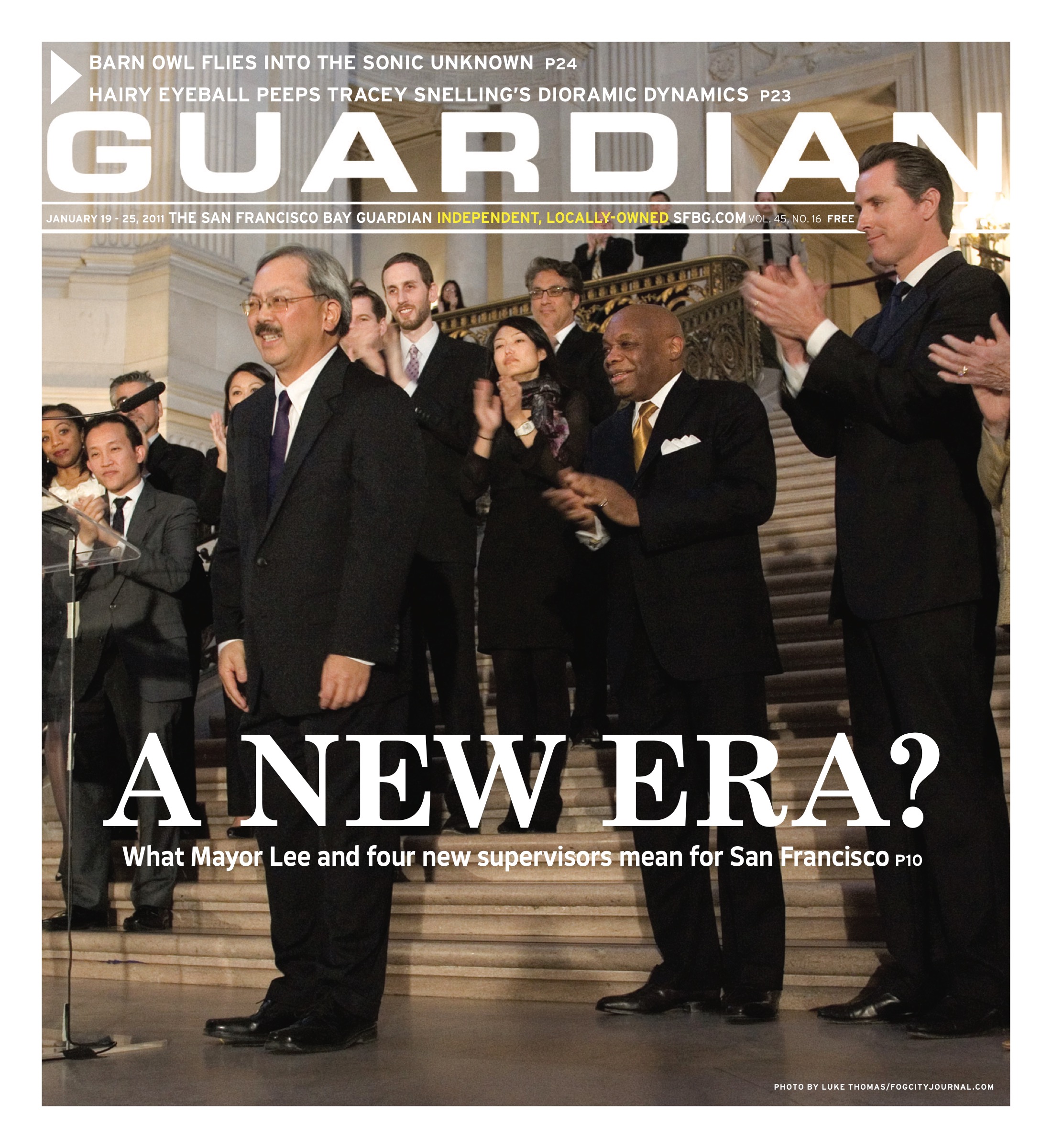
After a unanimous vote by San Francisco’s newly installed Board of Supervisors on Jan. 11, City Administrator Edwin M. Lee was sworn in as interim mayor of San Francisco. The swearing-in was regal affair staged in the rotunda of City Hall. A host of prominent political figures, including Oakland Mayor Jean Quan, congregated to witness the changing of the guard.

Former Mayor Willie Brown served as master of ceremonies, standing behind a podium on the grand staircase with members the newly elected board to his right and former Mayor Gavin Newsom and Mayor-elect Ed Lee to his left.

Newsom offered advice to Lee on how to govern the city, saying, “Figure out what it is you want to accomplish, and work backward from there.”

Rose Pak, the powerful head of the Chinatown Chamber of Commerce, was seated near the front row for a close-up view of the ceremony. Speaking to the historic nature of the first Asian American holding the office of mayor in San Francisco, Lee singled out Pak, whom he called his good friend, saying, “Today, Rose, our struggle is here, and it’s succeeding.”

Newly anointed as mayor, Lee expressed gratitude to Brown, Newsom, Pak, and the members of the Board of Supervisors who supported him.

He also noted that several weeks ago, he hadn’t even anticipated such a momentous change. “It’s been a whirlwind for me,” he said.

Lee promised to be “a mayor who tackles things head on, and moves the bar forward.” He also vowed to be inclusive – and if he is true to his word, it will mark a dramatic difference from Newsom’s administration, which tended to exclude anyone who disagreed with the mayor.

“I want to say to all of you: I will do my very best to represent all the communities,” Lee said. “I’m going to open up that Room 200 to everybody.”

Following the swearing-in was a reception featuring tables piled high with sushi, gourmet finger foods, and fancy cheese, plus a bar serving wine and beer. Several observers remarked to the Guardian that they had never seen such a feast offered up to the public at City Hall.

Gascon shocker

0

Gavin Newsom’s appointment of his police chief, George Gascón, as district attorney wasn’t just a slap in the face to the D.A.’s office, it reversed a long tradition in which the city’s top prosecutors have pledged their opposition to the death penalty. It broke an unwritten rule that the district attorney should have some independence from the Police Department. And it suggests that Newsom’s decision was about his own future and not about San Francisco’s.

Gascón, who has a law degree from Western State University in Fullerton, has been a member of the state bar since 1996 and has handled labor and bankruptcy cases for a year and a half. But he’s never prosecuted a criminal case.

He still believes he has the necessary organizational skills. “Running a D.A.’s office is not the same as prosecuting cases on the floor,” he said at his Jan.9 swearing-in.

He sees the D.A. post as a way to build closer relationships between various law enforcement agencies, including the police department and the public defender’s office. “We have to find a way to bring law enforcement together,” Gascón said.

But so far the response to his appointment in those circles has been less than favorable, even though City Attorney Dennis Herrera issued a press release praising Gascón’s help in moving ahead with gang injunctions in Visitacion Valley.

Attorney Elliot Beckelman, who worked in the D.A.’s office until a few months ago, said people in the office were stunned because no one thought Gascón was a good candidate. “It’s like taking a lawyer who has been working for 20 years, and has done a stint as the D.A., and graduated from the police academy, and appointing them as police chief when they never worked as a police officer, arrested anyone, or saw a dead body,” he said.

Beckelman said he wonders if Gascón’s Jan. 9 comment that he is not “philosophically opposed to the death penalty” indicates that Newsom picked him to boost his own popularity with law enforcement groups and improve his chances at getting elected to higher office.

“It’s very cynical to make your final political move one that disassociates you from San Francisco, but it’s a big move nationally in terms of where Newsom hopes to land five moves from now,” Beckelman said. “It’s a politician appointing another politician.”

Former District Attorney Terence Hallinan said Gascón’s appointment was stupid. “Maybe it’s Gavin’s comeback after gay marriage to appoint someone who will say, ‘Okay, let’s kill people.’ But this is not a well-thought-out move,” he said. “OK, Gascón’s a lawyer, but he has never practiced law. The D.A. and the police work together, yes, but you have to try a lot of cases before you work out which are worth prosecuting and which deputies to assign.

‘It’s the responsibility of the D.A.’s office to supervise the police,” he added.

Public Defender Jeff Adachi notes that the choice of Gascon’ has energized this fall’s D.A.’s race , when Gascón will have to stand for election to keep his new job. “What was a sleepy race looks like it will take center stage” Adachi said. “Other candidates are now outsiders and will have to distinguish themselves.”

One such opportunity could arise if Gascón seeks the death penalty in the coming year. Matt Gonzalez, who was the first candidate to oppose the death penalty when he ran against then-D.A. Terence Hallinan, said he thinks Gascón’s views on the death penalty should have eliminated him. “That alone should have made him ineligible. This is a step backward.”

Gonzalez thinks Gascón’s appointment trivializes what the D.A.’s office does. “This was a real opportunity to pick a professional prosecutor who was familiar with the office and knew San Francisco,” he said. “Instead, this is like me thinking I should be police chief because I’ve seen a lot of fingerprints.”

Adachi worries that little is known about Gascón’s legal abilities. “He does not have a track record in terms of felony and homicide experience,” he said. “That’s not to say he wouldn’t run the office well, but it leaves us without an important knowledge base. He does bring many years of experience as a police officer, but the responsibilities are very different.”

Adachi observes that while police bring cases to the D.A. based on probable cause, the D.A. reviews those cases and only brings cases that are deemed justified. “But will Gascón file more cases for the sake of wanting to justify arrests by the police?” Adachi mused.

The agenda for Mayor Lee

0

EDITORIAL San Francisco has its first Chinese American mayor, and that’s a major, historic milestone. Let’s remember: Chinese immigrants were among the most abused and marginalized communities in the early days of San Francisco. In 1870, the city passed a series of laws limiting the rights of Chinese people to work and live in large parts of the city. Chinese workers built much of the Transcontinental Railroad — at slave wages and in desperately unsafe conditions that led to a large number of deaths. The United States didn’t even repeal the Chinese Exclusion Act (an anti-immigration law) until 1943, and for years, Chinatown was one of the poorest and most neglected city neighborhoods.

So there’s good reason for Asians to celebrate that the last door in San Francisco political power is now open. And Mayor Ed Lee comes from a civil rights background; he got his start in politics working as a poverty lawyer and tenant organizer.

Unfortunately, his path to Room 200 was badly marred by some ugly backroom dealing involving Willie Brown, the most corrupt mayor in modern San Francisco history. Even Lee’s supporters agree the process was a mess and that it undermines Lee’s credibility. So it’s important for Mayor Lee to immediately establish that he’s independent of Brown and his cronies, that his administration will not just be a Gavin Newsom rerun, and that progressives can and should support him.

He has a tough job ahead. We urge him to make a clean break with the past and set the city in a new direction. Here are a few ways to get started.

Clear out the Newsom operatives and bring some new people with progressive credentials into the senior ranks. Newsom’s chief of staff, Steve Kawa, has been a shadow mayor for the past year while Newsom was on the campaign trail, and is the architect of much of what the outgoing administration has done to sow political division and cripple city government. Lee needs his own chief advisor.

Show up for question time and work with the district-elected supervisors. Newsom was openly dismissive of the board and refused to take the supervisors seriously as partners in city government. Lee should appear once a month to answer questions from the board in public, should meet regularly with all the supervisors and appoint a liaison that the board can work with and trust. He needs to make his administration as transparent and open as possible and ensure that everyone at City Hall follows the letter and spirit of the Sunshine Ordinance.

Make it clear that the next city budget includes substantial new revenue. Newsom offered nothing but Republican politics when it came to city finance; his only solutions to the massive structural deficit involved service cuts.

The deficit will be even worse than projected this year, since Gov. Jerry Brown wants to transfer much of the state’s responsibility for public safety and public health back to local government — and there won’t be enough state money attached to handle the new burden. Lee needs to publicly call on Brown and the Legislature to give cities more ability to raise taxes on the local levee. Then he should start planning for a June ballot package that will raise as much as $250 million in new revenue for the city.

A substantially higher vehicle license fee on expensive cars, a congestion management fee, a significant annual transit impact fee on downtown offices, a restructured business tax, and a progressive tax on income of more than $50,000 a year would more than eliminate the structural deficit.

There are plenty of other revenue ideas out there; not all can or would pass on a single ballot. But Lee needs to make it clear that revenue will be part of the solution — and that he will use all the political capital he can muster to convince the voters to go along.

<\!s> Get serious about community choice aggregation. Newsom loved to talk about his environmental agenda, but when it came to challenging the hegemony of Pacific Gas and Electric Co. and its dirty power portfolio, he ran for cover. His hand-picked Public Utilities Commission director, Ed Harrington, has been an obstacle to implementing the city’s CCA plan. Lee needs to get rid of Harrington or direct him to cooperate with the supervisors and get San Francisco on the path to clean public power.

<\!s> Establish a real affordable housing program. The city plans to build housing for as many as 60,000 new residents in the southeast neighborhoods — but only a fraction of them will be affordable. This city is already well on its way to becoming a high-end bedroom community for Silicon Valley; only a clear policy that limits new market-rate condos until there’s a plan for adequate affordable housing will turn things around.

<\!s> Support Sanctuary City and quit helping federal immigration authorities break up families. Newsom was just awful on this issue; Lee needs to work with Sup. David Campos to implement more humane laws.

<\!s> End the demonization of homeless people and public employees. Newsom came to power attacking the homeless (with Care Not Cash) and went out attacking the homeless (with the sit-lie law). Lee ought to tell the Police Department not to aggressively enforce the ordinance.

<\!s> Take on the sacred cows of the Police and Fire departments. The biggest salary and pension problems in the city are in the two public safety departments. The Fire Department budget has been bloated for years. If everyone else is taking cuts, so should the highest-paid cops and the overstaffed fire stations.

Some of Lee’s supporters insist he’s a solid progressive and that we shouldn’t hold the details of his selection — or the fact that he was chosen by people who are openly hostile to the progressive agenda — against him. We’re open to that — but the progressive community will judge him on his record. And he has to start right away.

Editor’s Notes

2

tredmond@sfbg.com

Former Mayor Willie Brown says that choosing a person of color for a leadership position should be a progressive value. Board of Supervisors President David Chiu says the new mayor, Ed Lee, is a progressive. Several supervisors and other political observers say the six-vote progressive majority on the board is gone.

And nobody really talks about what that word means.

Progressive is a term with a long political vintage, but it’s changed (as has the political context) since the 1920s. (Progressives these days aren’t into Prohibition.) So I’m going to take a few minutes to try to sort this out.

I used to tell John Burton, the former state senator, that a progressive was a liberal who didn’t like real estate developers. But that was in the 1980s, when the Democratic Party in town was funded by Walter Shorenstein and other developers who were happy to be part of the party of Dianne Feinstein, happy to be liberals on some social issues (Shorenstein insisted that the Chamber of Commerce hire and promote more women), and happy to promote liberal candidates like John and Phil Burton for state and national office — as long as they didn’t mess with the gargantuan money machine that was high-rise office development in San Francisco.

But these days it’s not all about real estate; it’s that the level of economic inequality in the United States has risen to levels unseen since the late 1920s. So I sat down on a Saturday night when the kids went to bed(yeah, this is my social life) and made a list of what I think represent the core values of a modern American progressive. It’s a short list, and I’m sure there’s stuff I’ve left off, but it seems like a place to start.

This isn’t a litmus test list (we’ve endorsed plenty of people who don’t agree with everything on it). It’s not a purity test, it’s not a dogma, it’s not the rules of entry into any political party … it’s just a definition. My personal definition.

Because words don’t mean anything if they don’t mean anything, and progressive has become so much of a part of the San Francisco political dialogue that it’s starting to mean nothing.

For the record: when I use the word "progressive," I’m talking about people who believe:
1. That civil rights and civil liberties need to be protected for everyone, even the most unpopular people in the world. We’re for same-sex marriage, of course, and for sanctuary city and protections for immigrants who may not have documentation. We’re also in favor of basic rights for prisoners, we’re against the death penalty, and we think that even suspected terrorists should have the right to due process of law.
2. That essential public services — water, electricity, health care, broadband — should be controlled by the public, not by private corporations. That means public power and single-payer government run health insurance.
3. That the most central problem facing the city, the state, and the nation today is the dramatic upward shift of wealth and income and the resulting economic inequality. We believe that government at every level — including local government right here in San Francisco — should do everything possible to reduce that inequality. That means taxing high incomes, redistributing wealth, and using that money for public services (education, for example) that tend to help people achieve a stable middle-class lifestyle. We believe that San Francisco is a rich city, with a lot of rich people, and that if the state and federal government won’t try to tax them to pay for local services, the city should.
4. That private money has no place in elections or public policy. We support a total ban on private campaign contributions, for politicians and ballot measures, and support public financing for all elections. Corruption — even the appearance of corruption — taints the entire public sector and helps the fans of privatization, and progressives especially need to understand that.
5. That the right to private property needs to be tempered by the needs of society. That means you can’t just put up a highrise building anywhere you want in San Francisco, of course, but it also means that the rights of tenants to have stable places for themselves and their families to live is more important than the rights of landlords to maximize return on their property. That’s why we support strict environmental protections, even when they hurt private interests, and why be believe in rent control, including rent control on vacant property, and eviction protections and restrictions on condo conversions. We think community matters more than wealth, and that poor people have a place in San Francisco too — and if the wealthier classes have to have less so the city can have socioeconomic diversity, that’s a small price to pay. We believe that public space belongs to the public and shouldn’t be handed over to private interests. We believe that everyone, including homeless people, has the right to use public space.
6. That there are almost no circumstances where the government should do anything in secret.
7. That progressive elected officials should use their resources and political capital to help elect other progressives — and should recognize that sometimes the movement is more important that personal ambitions.

I don’t know if Ed Lee fits my definition of a progressive. He hasn’t taken a public position on any major issues in 20 years. We won’t know until we see his budget plans and learn whether he thinks the city should follow Gavin Newsom’s approach of avoiding tax increases and simply cutting services again. We won’t know until he decides what to tell the new police chief about enforcing the sit-lie law. We won’t know until we see whether he keeps Newsom’s staff in place or brings in some senior people with progressive values.
I agree that having an Asian mayor in San Francisco is a very big deal, a historic moment — and as Lee takes over, I will be waiting, and hoping, to be surprised.

Power and pragmatism

5

steve@sfbg.com

After an epic week at City Hall, the political dynamics in San Francisco have undergone a seismic shift, with pragmatism replacing progressivism, longtime adversarial relationships morphing into close collaborations, and Chinese Americans as mayor and board president.

It was a week of surprises, starting Jan. 4 when City Administrator Ed Lee came out of nowhere to become the consensus choice for interim mayor, and ending Jan. 9 when Mayor Gavin Newsom appointed Police Chief George Gascón to be the new district attorney, Newsom’s last official act as mayor before belatedly taking his oath of office as lieutenant governor on Jan. 10.

In between, the outgoing Board of Supervisors held a special final meeting Jan. 7, at which progressive supervisors fell into line behind Lee, some of them reluctantly, and accepted the new political reality. The next day, the new Board of Supervisors took office and overwhelmingly reelected David Chiu as board president, with only the three most progressive supervisors in dissent.

After Chiu played kingmaker as the swing vote for making Lee the new mayor, the board and Mayor’s Office are likely to enjoy far closer and more cooperative relations than they’ve had in many years. And the sometimes prickly, blame-game relations between the Police Department and D.A.’s Office should also get better now that the top cop has switched sides. But what it all means for the average San Franciscan, particularly the progressive voters who created what they thought was a majority on the Board of Supervisors, is still an open question.

One thing that is clear is the ideological battles that have defined City Hall politics — what Chiu called the “oppositional politics of personality” during his closing remarks on Jan. 8 — have been moved to the back burner while the new leaders try a fresh approach.

Newsom — with his rigid fiscal conservatism and open disdain for the Board of Supervisors, particularly its progressive wing — is gone. Also leaving City Hall is Sup. Chris Daly, a passionate and calculating progressive leader whose over-the-top antics caused a popular backlash against the movement.

In a way, Newsom and Daly were perfect foils for one another, caustic adversaries who often reduced one another to two-dimensional caricatures of themselves. But they were each strongly driven by rival ideologies and political priorities, despite Newsom’s rhetorical efforts to turn “ideology” into a dirty word applied only to his opponents.

“This year represents a changing of the guard, a transition,” Chiu said, pledging to continue pushing for progressive reforms, only with a more conciliatory approach, a theme also sounded by Sups. Eric Mar and Jane Kim, who each broke with their progressive colleagues to support Chiu over rival presidential nominee Sup. John Avalos.

“I will always support policies that will make our city more equitable and just,” Kim said after being sworn in to replace Daly, although she also made a claim about the new board with which her predecessor probably wouldn’t agree: “I think we have a lot more in common than we don’t.”

With a focus on diversity and compromise, “respect and camaraderie,” Mar said, “I think this new board represents the evolution of the progressive movement in San Francisco.”

If indeed City Hall is enjoying a “Kumbaya” moment, the path to this point was marred by backroom deal-making and old-school power politics, much of it engineered by a pair of figures from the previous era who are by no means progressives: former Mayor Willie Brown and Rose Pak, head of the Chinatown Chamber of Commerce.

Pak was seated front and center — literally and figuratively — during the board’s Jan. 7 vote for Lee and its Jan. 8 vote for Chiu, following media reports that it was she and Brown who persuaded Lee to take the job and city leaders (particularly Newsom, Chiu, and outgoing Sups. Bevan Dufty and Sophie Maxwell) to give it to him.

It all seemed sneaky and unsettling to board progressives, who questioned what kind of secret deal had been cut, even as they voiced their respect for Lee’s progressive roots and long history of service to the city. The sense that something unseemly was happening was exacerbated on Jan. 4 when Dufty abandoned a pledge of support for Sheriff Michael Hennessey — who five progressive supervisors supported for interim mayor — and left the meeting to confer with the Mayor’s Office before returning to announce his support for Lee.

Sups. David Campos, Ross Mirkarimi, and Avalos pleaded with their colleagues for time to at least talk with Lee, who was traveling in China since he reportedly changed his mind about wanting the interim mayor job. Maxwell was the only Lee supporter in the 6-5 vote for delaying the interim mayor item by a few days so the supervisors could speak with Lee by phone.

Pak and other Chinatown leaders put together a strong show of force by the Chinese American community at that Jan. 7 meeting, where the board voted 10-1 for Lee, with only Daly in dissent. Afterward, some of Lee’s strongest supporters — including the Rev. Norman Fong and Gordon Chin with the Chinatown Community Development Center — admitted that the process of picking Lee was flawed.

“Part of the problem was Ed’s because he couldn’t make up his mind. The process was bad,” Fong told the Guardian after the vote. Although Fong said he knows Lee to be a strong and trustworthy progressive, he admitted that the way it went down raised questions: “Some people were concerned about who he’ll listen to.”

Specifically, the concern is that Lee will be unduly influenced Brown and Pak, who each represent corporate clients whose interests are often at odds with those of the general public. And both operate behind the scenes and play a kind of political hardball that runs contrary to progressive values on openness, inclusion, and accountability.

“If there is a phone call from Willie Brown to Rose Pak, Ed Lee is going to go along with it,” predicted a knowledgeable source who has worked closely with all three, recalling the way they did business during Brown’s mayoral administration. “There was no real discussion of issues. The fix was always in.”

But Pak insisted that there was nothing wrong with the process of selecting Lee, and that all concerns about the nomination were driven by anti-Asian racism. “You have a plantation mentality,” Pak told the Guardian as she held court in front of a crowded press box before the Jan. 8 meeting. “The Bay Guardian has never given people of color a fair shot.”

While Newsom, Chiu, and Pak-allied political consultant David Ho all insisted “there was no deal” to win support for Lee, Pak seemed to revel in the high-profile role she played, with Bay Citizen reporter Gerry Shih labeling her “boastful” in his Jan. 6 article “Behind-The-Scenes Power Politics: The Making of Ed Lee,” which ran the next day in The New York Times.

“This was finally our moment to make the first Chinese mayor of a major city,” Pak reportedly told Shih. “How could you let that slip by?”

Chiu downplayed Pak’s influence, telling the Guardian that Lee was his top choice since November, and telling his colleagues before the Jan. 7 vote, “Ed is someone who does represent our shared progressive values.” But he also made it clear that helping the city’s progressive movement wasn’t what drove his decision.

“This is a decision beyond who were are as progressives and who we are as moderates. It’s about who we are as San Franciscans,” Chiu said. “This is a historic moment for the Chinese-American community,” calling it “a community that has struggled, a community that has seen discrimination.”

The next day, shortly after being elected to a second term as board president, Chiu acknowledged the “very real differences” in ideology among the supervisors, “but leadership is about working through those differences.” Ultimately, he said, “none of us were voted into office to take positions. We were voted into office to get things done.”

EDITORIAL: The Agenda for Mayor Lee

6

San Francisco has its first Chinese American mayor, and that’s a major, historic milestone. Let’s remember: Chinese immigrants were among the most abused and marginalized communities in the early days of San Francisco. In 1870, the city passed a series of laws limiting the rights of Chinese people to work and live in large parts of the city. Chinese workers built much of the Transcontinental Railroad at slave wages and in desperately unsafe conditions that led to a large number of deaths. The United States didn’t even repeal the Chinese Exclusion Act (an anti-immigration law) until 1943, and for years, Chinatown was one of the poorest and most neglected city neighborhoods.

So there’s good reason for Asians to celebrate that the last door in San Francisco political power is now open. And Mayor Ed Lee comes from a civil rights background; he got his start in politics working as a poverty lawyer and tenant organizer.

Unfortunately, his path to Room 200 was badly marred by some ugly backroom dealing involving Willie Brown, the most corrupt mayor in modern San Francisco history. Even Lee’s supporters agree the process was a mess and that it undermines Lee’s credibility. So it’s important for Mayor Lee to immediately establish that he’s independent of Brown and his cronies, that his administration will not just be a Gavin Newsom rerun, and that progressives can and should support him.

He has a tough job ahead. We urge him to make a clean break with the past and set the city in a new direction. Here are a few ways to get started.

Clear out the Newsom operatives and bring some new people with progressive credentials into the senior ranks. Newsom’s chief of staff, Steve Kawa, has been a shadow mayor for the past year while Newsom was on the campaign trail, and is the architect of much of what the outgoing administration has done to sow political division and cripple city government. Lee needs his own chief advisor.

Show up for question time and work with the district-elected supervisors. Newsom was openly dismissive of the board and refused to take the supervisors seriously as partners in city government. Lee should appear once a month to answer questions from the board in public, should meet regularly with all the supervisors and appoint a liaison that the board can work with and trust. He needs to make his administration as transparent and open as possible and ensure that everyone at City Hall follows the letter and spirit of the Sunshine Ordinance.

Make it clear that the next city budget includes substantial new revenue. Newsom offered nothing but Republican politics when it came to city finance; his only solutions to the massive structural deficit involved service cuts.

The deficit will be even worse than projected this year, since Gov. Jerry Brown wants to transfer much of the state’s responsibility for public safety and public health back to local government and there won’t be enough state money attached to handle the new burden. Lee needs to publicly call on Brown and the Legislature to give cities more ability to raise taxes on the local levee. Then he should start planning for a June ballot package that will raise as much as $250 million in new revenue for the city.

A substantially higher vehicle license fee on expensive cars, a congestion management fee, a significant annual transit impact fee on downtown offices, a restructured business tax, and a progressive tax on income of more than $50,000 a year would more than eliminate the structural deficit.

There are plenty of other revenue ideas out there; not all can or would pass on a single ballot. But Lee needs to make it clear that revenue will be part of the solution and that he will use all the political capital he can muster to convince the voters to go along.

Get serious about community choice aggregation. Newsom loved to talk about his environmental agenda, but when it came to challenging the hegemony of Pacific Gas and Electric Co. and its dirty power portfolio, he ran for cover. His hand-picked Public Utilities Commission director, Ed Harrington, has been an obstacle to implementing the city’s CCA plan. Lee needs to get rid of Harrington or direct him to cooperate with the supervisors and get San Francisco on the path to clean public power.

Establish a real affordable housing program. The city plans to build housing for as many as 60,000 new residents in the southeast neighborhoods but only a fraction of them will be affordable. This city is already well on its way to becoming a high-end bedroom community for Silicon Valley; only a clear policy that limits new market-rate condos until there’s a plan for adequate affordable housing will turn things around.

Support Sanctuary City and quit helping federal immigration authorities break up families. Newsom was just awful on this issue; Lee needs to work with Sup. David Campos to implement more humane laws.

End the demonization of homeless people and public employees. Newsom came to power attacking the homeless (with Care Not Cash) and went out attacking the homeless (with the sit-lie law). Lee ought to tell the Police Department not to aggressively enforce the ordinance.

Take on the sacred cows of the Police and Fire departments. The biggest salary and pension problems in the city are in the two public safety departments. The Fire Department budget has been bloated for years. If everyone else is taking cuts, so should the highest-paid cops and the overstaffed fire stations.

Some of Lee’s supporters insist he’s a solid progressive and that we shouldn’t hold the details of his selection or the fact that he was chosen by people who are openly hostile to the progressive agenda against him. We’re open to that but the progressive community will judge him on his record. And he has to start right away.

What progressive means

85

Willie Brown says that choosing a person of color for a leadership position should be a “progressive” value. David Chiu says Ed Lee is a progressive. Several supervisors, and other political observers, say the six-vote progressive majority on the board is gone.

And nobody really talks about what that word means.

Progressive is a term with an excellent political vintage, but it’s changed (as has the political context) since the 1920s. (Progressives these days aren’t into prohibition.) So I’m going to take a few minutes to try to sort this out.

I used to tell John Burton that a progressive was a liberal who didn’t like real estate developers, but that was in the 1980s, when the Democratic Party in town was funded by Walter Shorenstein and other developers, who were happy to be part of the party of Dianne Feinstein, happy to be liberals on some social issues (Shorenstein insisted that the Chamber of Commerce hire and promote more women) and happy to promote liberal candidates like John and his brother Phil for national office – as long as they didn’t mess with the gargantuan money machine that was highrise office development in San Francisco.
Arguing that Shorenstein’s economic agenda was driving up housing prices, destroying low-income neighborhoods and displacing tenants was a waste of time; the liberals like Burton (who also represented real estate developers as a private attorney) weren’t interested.

But these days it’s not all about real estate; it’s about the fact that the level of economic inequality in the United States has risen to levels unseen since the late 1920s, and the impacts are all around us. And it’s about (Democratic) politicians in San Francisco blaming Sacramento, and (Democratic) politicians in Sacramento blaming Washington, and the Democratic Party in the United States abandoning economic equality as a guiding principle.

So I sat down on a Saturday night when the kids went to be (yeah, this is my social life) and made a list of what I think represent the core values of a modern American progressive. It’s a short list, and I’m sure there’s stuff I’ve left off, but it seems like a place to start.

For all the people who are going to blast me in the comments, let me say very clearly: This isn’t a litmus-test list (we’ve endorsed plenty of people who don’t agree with everything on it). It’s not a purity test, it’s not a dogma, it’s not the rules of entry into any political party … it’s just a definition. My personal definition.

Because words don’t mean anything if they don’t mean anything, and progressive has become so much of a part of the San Francisco political dialogue that it’s starting to mean nothing.
For the record: When I use the word “progressive,” I’m talking about people who believe:

1. That civil rights and civil liberties need to be protected for everyone, even the most unpopular people in the world. We’re for same-sex marriage, of course, and for Sanctuary City and protections for immigrants who may not have documentation. We’re also in favor of basic rights for prisoners, we’re against the death penalty, and we think that even suspected terrorists should have the right to due process of law.

2. That essential public services – water, electricity, health care, broadband – should be controlled by the public and not by private corporations. That means public power and single-payer government run health insurance.

3. That the most central problem facing the city, the state and the nation today is the dramatic upward shift of wealth and income and the resulting economic inequality. We believe that government at every level – including local government, right here in San Francisco – should do everything possible to reduce that inequality; that means taxing high incomes, redistributing wealth and using that money for public services (education, for example) that tend to help people achieve a stable middle-class lifestyle. We believe that San Francisco is a rich city, with a lot of rich people, and that if the state and federal government won’t try to tax them to pay for local services, the city should.

4. That private money has no place in elections or public policy. We support a total ban on private campaign contributions, for both politicians and ballot measures, and support public financing for all elections.

5. That the right to private property needs to be tempered by the needs of society. That means you can’t just put up a highrise building anywhere you want in San Francisco, of course, but it also means that the rights of tenants to have stable places for themselves and their families to live is more important than the rights of landlords to maximize return on their property. That’s why we support strict environmental protections, even when they hurt private interests, and why be believe in rent control, including rent control on vacant property, and eviction protections and restrictions on condo conversions. We think community matters more than wealth and that poor people have a place in San Francisco too — and if the wealthier classes have to have less so that the city can have socio-economic diversity, that’s a small price to pay. We believe that public space belongs to the public, and shouldn’t be handed over to private interests; we believe that everyone, including homeless people, has the right to use public space.

6. That there are almost no circumstances where the government should do anything in secret.

7. That progressive elected officials should use their resources and political capital to help elect other progressives – and should recognize that sometimes the movement is more important that their own personal ambitions.

I could add a lot more, but I think those six factors are at the heart of what I mean when I talk about progressives. We support a lot of other things; I put the right of workers to unionize under Number 3, since unions (along with public schools and subsidized higher education) are one of the major forces behind a stable middle class and a more equal society. We think racism and homophobia are never acceptable, and we support affirmative action, but that goes under Number 1.

This is not a socialist manifesto; I never mentioned worker control of the means of production. Progressives don’t oppose private enterprise; they just think that some things essential for the good of society don’t belong in the private sector, and that the private sector should be regulated for the good of all of us. We trust and support small businesses much more than big corporations – and we think their interests are not the same.

I don’t know if Ed Lee fits my definition of a progressive. We won’t know until we see his budget plans, and learn whether he thinks the city should follow Gavin Newsom’s approach of avoiding tax increases and simply cutting services again. We won’t know until he decides what the tell the new police chief about enforcing the sit-lie law. We won’t know until we see whether he keeps Newsom’s staff in place or brings in some senior people with progressive values. We know that the people who pushed him to take the job aren’t progressives by any definition, but you never know. I agree that having an Asian mayor in San Francisco is a very big deal, an historic moment — and when Lee takes office, I will be waiting, and hoping, to be surprised.

Chiu and pragmatism win over the new board

13

Despite the re-election of David Chiu as president of the Board of Supervisors today, there was a palpable shift in the political dynamics at City Hall. “Ideology” has been deemed a dirty word by a majority of the Board of Supervisors, while the politics of identity and “getting things done” is the new imperative.
That shift was most evident in the 8-3 vote for Chiu, with progressive Sups. John Avalos, David Campos, and Ross Mirkarimi supporting Avalos for the post through two rounds of voting. Chiu won it on the second round after fiscal conservative Sup. Sean Elsbernd withdrew his nomination, with he and his other three backers – Sups. Carmen Chu, Scott Wiener, and Mark Farrell – all supporting Chiu in the second round.
“This year represents a changing of the guard, a transition,” Chiu told us, noting the departure of both Mayor Gavin Newsom and supervisors that include Chris Daly. “We’re going to have to get past the oppositional politics of personality.”
In place of a progressive politics based on principled positions and aggressively challenging the influence that powerful downtown interests still exert on City Hall, Chiu is advocating for more pragmatic solutions to the considerable challenges facing the city, starting with a projected budget deficit of almost $400 million.
“None of us were voted into office to take positions, we were voted into office to get things done,” Chiu said.
His approach has occasionally earned him the scorn of progressives over the last two years, particularly in Chiu’s high-profile compromises with Newsom over cuts to Muni and city programs, business tax breaks, and other issues, as Avalos noted. But as Avalos told Chiu, “Clearly today, you have been validated in your hard work.”
Chiu was backed in both rounds of voting by progressive Asian-American Sups. Jane Kim and Eric Mar, both of whom also struck pragmatic notes in their comments. But they also noted that the board’s new civility and diversity are progressive values. “I think this new board represents the evolution of the progressive movement in San Francisco,” Mar said.
Newsom has been pointedly criticizing the notion of ideology for years – apparently unaware that his anti-tax, pro-business philosophy is an ideology – and it was echoed by several supervisors, including Farrell, who said he wants “to turn City Hall into a place based on issues and ideas and not ideology.”
Now, we’re all left to wait and see what kinds of issues and ideas take root. We’ll have much more on an extraordinary week at City Hall – with a new board and new incoming Mayor-select Ed Lee – in next week’s Guardian.

Highlights of Ed Lee’s nomination

25

An awful lot went down at City Hall today: four Board members were termed out, new Board members were moving into their offices, the old Board nominated Ed Lee as interim mayor, and Gavin Newsom revealed he’ll be gone as mayor by Monday afternoon. Here in no particular order are some of the highlights:


When termed-out D6 Sup. Chris Daly suggested that Rose Pak be nominated mayor, since she apparently managed to broker the Lee deal in three short days, Pak shot back, “I would do it, only if Chris Daly would be my Chief of Staff.”


Pak told me that she persuaded Lee to take the job, over the cell phone, while he was at the airport in Hong Kong.


Pak outlined her reasons for supporting Ed Lee as mayor. “Ed Lee has devoted 35 years to San Francisco. He’s earned his stripes. He’s the most qualified, the most unifying agent, and the most talented.”


 The crowd of seniors from the Self Help for the Elderly non-profit who crammed City Hall today are a likely preview of things to come during the mayor’s race.


 Board President David Chiu’s insistence that there were no back room deals. “Shortly after Gavin Newsom was elected Lt. Governor, I said Ed Lee should be considered as a candidate,” Chiu told me. “There was never a deal.”


The strong sense that Chiu is running for mayor in November, though he hasn’t filed. Asked if he was running, Chiu said. “I’m here at the Board focused on the work.” Asked if he wasn’t running, Chiu said, “I’m here at the Board focused on the work.” (That’s not a very convincing denial, David!)


On being reminded that the Year of the Rabbit kicks off in February, Chiu added,  “Hopefully, this will be a very fortunate year for San Francisco.”


Oakland and San Francisco will both have Asian American mayors—160 years after Chinese immigrants first settled in San Francisco and 129 years after the Chinese Exclusion Act sought to prevent these immigrants from rising to the top.


The rejoicing that reportedly is going in the Asian community, right now.“Chinatown is excited,” a reporter for Sing Tao Daily told me. “Ed Lee is a low-key kinda guy. No one really knows him, but as former DPW director, he was always filling up pot holes.”


The stated hope that Lee will support Sup. Avalos local hire ordinance, which kicks in Feb. 23, implement Sup. David Campos’ due process for immigrant youth ordinance, and enforce the recommendations of the Mayor’s African American Out Migration Task Force.


The growing sense that Sup. John Avalos is a strong contender as new Board President.


Sharen Hewitt’s observation that burgeoning racial tensions between African Americans, Asian Americans and Latinos need to be addressed. Now.


Julian Davis’ observation that while the way Lee was appointed is not something San Francisco should be proud of, the fact that we now have an Asian American mayor with the almost unanimous support of the old Board is (Daly was the lone dissenter).


Newsom’s reminder that the old Board’s vote was symbolic.“Today was an extraordinary historic vote,” Newsom said. “But remember, it’s symbolic. The new Board will make the appointment.”


 Newsom’s description of Lee as a ‘recruitment” as he, too, insisted there were no backroom deals. “There were no deals, no backroom deals,” Newsom insisted. “He’s the right person at the right time.”


Newsom’s claim that this isn’t about Lee (or anyone else who’d been nominated.) “It’s not about you,” Newsom said, recreating a conversation he allegedly recently had to convince Lee, who’d just been guaranteed five more years employment as City Administrator, to become interim mayor for the rest of 2011. “You are that something more, that something better. You’re the one guy who can pull it altogether, including if disaster strikes, which is my biggest fear.”


Newsom’s relief that he only needs to prepare a 3-page budget brief. “Someone who understands so much of the process doesn’t need 20 pages,” he said.


Newsom’s claim that ideologues make terrible mayors.”If this city gets off track, plays some ideological game, it impacts the entire region,” he said. “I love that Lee is not even in the country. If he had been here, he’d probably have been convinced not to do it. Ideologues make terrible mayors, and mayors make terrible ideologues.”


Newsom’s explanation of how Lee will be able to get back his job, though the charter prohibits people who served in elected office from working for the city for at least a year.
”Hopefully, the Board will make it easy for him. Four members of the Board can put a charter amendment on the ballot. Or Lee can do it himself.”


Newsom’s revelation that he will be sworn in as Lt. Governor at 1:30 p.m, Jan. 10, and San Francisco will find out who the next District Attorney is by then.


Newsom’s claim that 2010 was an “incredible” year. “The Shipyard, Treasure Island, the America’s Cup, Doyle Drive, the Transbay Terminal. All these things are groundbreaking,” he said.


Historic mayoral vote followed a flawed process

6

Ed Lee would be San Francisco’s first Chinese-American mayor right now – if Mayor Gavin Newsom wasn’t delaying his swearing in as lieutenant governor. And Lee might also have had 10 votes on the Board of Supervisors on Tuesday, as he had today, if the process hadn’t involved backroom deals and moderate, lame-duck supervisors kowtowing to the outgoing mayor. In other words, this historic occasion just didn’t need to be sullied the way it was this week.
There was real jubilation at City Hall when I left there a few minutes ago, and for good reason, even though today’s vote will have to be repeated by the new board after Newsom officially resigns. “This is a historic moment for the Chinese-American community,” Board President David Chiu told a packed board chambers, calling it, “a community that has struggled, a community that has seen discrimination.”
Chiu braved the taunts of Sup. Chris Daly and some progressive activists for supporting Lee on Tuesday, steadfastly maintaining that Lee is progressive and the best candidate for this job, despite his five progressive colleagues voting for Sheriff Michael Hennessey. And Lee does have progressive roots and support, as the progressive supervisors have attested publicly.
Once the progressive supervisors were given the chance to talk to Lee – whose openness to accepting the nomination came out of nowhere, reportedly at the urging of Chinatown power broker Rose Pak and former Mayor Willie Brown – all but Daly voted to support Lee.
Yet all of them also publicly noted how the process was deeply flawed and contrary to progressive principles of openness and accountability. “I have questions about the process and how we got to this point,” Sup. John Avalos said before announcing his support for Lee based on a half-hour telephone conversation yesterday (Lee has been in China through his public consideration as interim mayor).  
Sup. David Campos said he nominated Hennessey as a compromise caretaker mayor based on the representation from Newsom that he was acceptable and after being told by Sup. Bevan Dufty that he would support Hennessey. Instead, Dufty refused to vote until calling for a recess and marching down to the Mayor’s Office on Tuesday, returning to be the swing vote for Lee.
“I’m very disappointed in the way this process has gone down,” Campos said, adding that Hennessey “did not deserve the kind of treatment he received.” Sups. Ross Mirkarimi and Eric Mar echoed the point, with Mirkarimi saying he still doesn’t understand why Dufty flipped or what happened when he went to visit the Mayor’s Office.
Through the whole hearing, Dufty – a candidate for mayor himself – didn’t say a word. At one point, he even started clearing out his desk in Board Chambers, throwing away recycled papers and filling a big envelope full of paper clips. He didn’t stick around the hallway for the celebration that he helped enable, instead going straight into his office, where I found him and asked for a reaction to his colleagues’ questioning of his motives and integrity.
“My actions speak for themselves,” was all Dufty would say.
Perhaps they do, but even Lee’s strongest supporters acknowledged that the process of picking him was flawed. “Part of the problem was Ed’s because he couldn’t make up his mind,” Rev. Norman Fong told the Guardian. “The process was bad.”
Without a public discussion or the ability of reporters or supervisors to talk to Lee, Fong acknowledged why some progressives worried that a deal had been cut to continue with Newsom’s policies and personnel. “Some people were concerned about who he’ll listen to,” Fong said, but he said, “I’ve fought with Ed Lee and I know his heart…He’ll do the right thing.”
Gordon Chin of Chinatown Community Development Center said he has worked closely with both Lee and Hennessey and both would have been good interim mayors, and he said this should not have been a partisan fight. “Who nominated Mike Hennessey as the nominee of all of progressive San Francisco?” Chin asked, noting that few progressive constituencies were consulted on the choice or offered their buy-in.
Yet he also acknowledged the unseemly way in which Lee came out of nowhere to get the nomination, with little public vetting, “If Ed was out there a week earlier, it would have been a lot better. It was a flawed process,” Chin said.
So flawed that Daly and many progressive activists are still smarting about what happened and wary of what kind of mayor Lee will be. “No more backroom deals,” queer activist and blogger Michael Petrelis repeatedly shouted at Rose Pak as she was being interviewed outside board chambers.
But Fong just shrugged and told me, “There’s backroom deals on the left too.”

Congratulations to Ed Lee

5

Congratulations to Ed Lee, who, unless Gavin Newsom still refuses to leave or the next board does something terribly surprising, will be the city’s first Asian mayor. This, as Sup David Chiu pointed out, is an historic moment, a watershed event in San Francisco history. And we shouldn’t forget that.


Now Lee will face a massive challenge, starting with a terrifying city budget — and a need to reassure progressives that he can be trusted. It’s not Lee’s fault that Rose Pak and Willie Brown settled on him as their candidate — but starting from Day One, he is going to have to demonstrate independence.


I have no doubt that, true to his roots, he will be solid on sanctuary city and local hire — two major issues that the supervisors mentioned today. And on those issues, and on civil rights in general, he will be vastly better than Newsom. He won’t deport high school kids and break up families.


But I have to wonder if he’ll be true to progressive values on the city budget — because the willingness to accept that, as Chris Daly just said, something is very wrong in this country and this world, and it includes (perhaps starts with) the vast income and wealth disparities that are making our society unsustainable, and that it’s the responsibility of every official at the federal, state AND local level to try to address that problem … that’s what separates out the real progressives.


Good luck, Mayor Lee, we sincerely wish you the best, look forward to working with you and can’t wait to hear your ideas on new city revenues.

It looks like Ed Lee — but will that hold tomorrow?

1

Well, Campos says he’s with Ed Lee — and that means it’s over. For now, anyway. There’s a new board in place tomorrow; it’s hard to imagine that the new supes will change this vote, but they’ll have to reaffirm it.


So Mayor Ed Lee will have a tough job ahead of him — starting with the fact that there’s no question he came to office at least to some degree because of Willie Brown and Rose Pak. And that’s going to hurt his credibility. He doesn’t need to convince us that he’s no Gavin Newsom; ne needs to convince us that he’s not going to take directions from Willie Brown.  

Chiu rejects DA job and defends his support for Lee

22

Amid speculation that he was angling to be appointed district attorney – and questions about whether that goal influenced his support for Ed Lee to be named interim mayor – Board of Supervisors President David Chiu has issued a press release announcing that he’s withdrawing from consideration for the DA’s job.

“Right now my strong belief is that I can best serve San Francisco from City Hall. The challenges ahead of us will require a new level of collaboration between our elected leaders—many of them new to office—and all San Franciscans who care about the future of our incredibly diverse and inclusive City,” Chiu said in the prepared statement, thanking Mayor Gavin Newsom and Attorney General Kamala Harris for their consideration and for recent meetings with Chiu on the appointment.

When I spoke with Chiu yesterday afternoon, he said that he was leaning against taking the job, partly out of concern that Newsom would replace him with a fiscal conservative like Joe Alioto Jr. “I would not want to leave my seat to someone whose perspective on issues is drastically different than mine,” Chiu told me.

He also strongly emphasized that there was no connection at all between his discussion with Newsom over the DA appointment and with Chiu’s pivotal support for Lee, and Chiu said Newsom did not raise the issue during their conversations. On Tuesday, Chiu broke with his progressive colleagues to be the sixth vote in favor of Lee.

Chiu said that he has long been supportive of Lee and Chiu disagrees with the assertion that Lee is a less progressive pick than Sheriff Michael Hennessey, who had the support of five progressive supervisors. “He’s someone who has tremendous progressive roots,” Chiu said of Lee, noting that Chinese-American progressives have long considered him one of their own. “We have been working with Ed Lee for years and we know where his heart is.”

Chiu argued that Lee is experienced in a broad range of city functions and issues while Hennessey’s knowledge of city government issues is limited mainly to law enforcement. While the strong and sudden support for Lee among fiscal conservatives has been worrisome to many progressives, Chiu noted that “unfortunately, the moderates are far more disciplined than we are on the progressive side.”

“We have many competing and diverse constituencies that led us to be unable to get to consensus around one candidate,” Chiu said.

The current Board of Supervisors will convene for a final time at 3 p.m. tomorrow to vote on Lee after progressive supervisors successfully pushed for a delay in the vote on Tuesday. In addition to Chiu and the five supervisors to his ideological right, Sup. Eric Mar has announced that he will also support Lee, and Sups. John Avalos and David Campos said they are open to backing Lee after they get the chance to speak with him.

Hennessey, Lee and change

8

I’m not surprised that Randy Shaw is defending Ed Lee and arguing that either Lee or Mike Hennessey would be fine as interim mayor:


Ed Lee is not Gavin Newsom. Lee has dedicated his life to public service, spent years as a poverty lawyer, and has proved an outstanding administrator over the past two decades.


Shaw worked with Lee way back in the 1980s, when they were both young, underpaid lawyers doing housing work for some of the poorest San Franciscans. Both of them were doing crucial work that nobody else would handle; both of them were making San Francisco a better place. While I sometimes disagree with Shaw (and he seems to be all about attacking the Guardian these days) we have been close allies over the years on almost all the issues that matter. And I’m not going to attack Ed Lee or suggest that he’s forgotten his roots in immigrant rights and poverty law.


Here’s what I will say: If Ed Lee is interim mayor, you can expect very little change in Room 200. There’s a reason that Newsom wants Lee in office, and it’s not that he was a great progressive lawyer once. Newsom (and Sean Elsbernd, who nominated Lee) don’t want to see the mayor’s staff infrastructure — the people really running the city — dismantled. They don’t want any real changes in how business is done — and how the budget is addressed — from the way things worked the past seven years.


Lee hasn’t survived (and thrived) under so many different mayors by rocking the boat. He would be a cautious administrator who, I suspect, would avoid anything controversial (like tax increases on the wealthy or big cuts in the bloated Fire Department). Ed Lee is not Gavin Newsom — but his staff will be Gavin Newsom’s staff and, through the inertia that is San Francisco bureaucracy, not much will change in the next 11 months.


That’s what the conservatives on the board want, and I understand that. I don’t think Hennessey would make dramatic changes, either — the whole idea of a caretaker mayor is that the person who fills out Newsom’s term won’t try to put his own stamp on city government. (And let’s remember, Hennessey sided with Newsom on privatizing jail health services) But I think Hennessey would bring some new blood into the office and would be more likely to consider an approach to the budget that differs significantly from what Newsom has offered.


Everyone agrees that Lee is a smart, competent manager; that’s why he won unanimous approval as the City Administrator, an office that doesn’t involve major policy initiatives. So if you think things are basically okay in San Francisco, and you don’t want any major policy shifts out of the Mayor’s Office until after the next election, Ed Lee will do a fine job for you. That’s not demonizing him; that’s just explaining the reality here.


Me, I don’t think things are okay in this city at all. I’m looking for dramatic, profound, radical change in the next mayor. I’m not going to get it from either of these interim candidates, but after talking to Hennessey, I think if the supervisors pushed for a better, more progressive budget, he’d go along. I’m not so sure about Lee. And the fact that Newsom and every member of the conservative wing of the board wants Lee over Hennessey says something to me. These people aren’t fools; they don’t want any surprises. That’s why they’re making this move.


I’ve been wrong before. Hope I’m wrong this time. Maybe Mayor Ed Lee will support $250 million worth of new revenue measures, like a city income tax and a business tax overhaul that makes the biggest companies pay more. But if that was part of his agenda, I suspect Elsbernd and Newsom would have a clue — and then he wouldn’t be their choice.


Backroom Ed Lee mayoral deal raises suspicions

11

Last night’s dramatic eight-hour Board of Supervisors meeting, at which six supervisors suddenly came together around naming City Administrator Ed Lee to succeed Gavin Newsom as mayor, was a classic case of backroom dealing making, the full results of which the public still doesn’t know. And it is those unknowns that have progressives rightfully pissed off and distrustful of the choice.
On the surface, both Lee and the progressives’ preferred pick, Sheriff Michael Hennessey, are similar figures who fit Newsom’s demand for a nonpolitical caretaker mayor. He has publicly said both would be acceptable, and both have some impressive progressive credentials as well.
Lee was a civil rights attorney who help run the Asian Law Caucus before being hired by then-Mayor Art Agnos as an investigator for whistleblower complaints, and he’s worked for the city ever since, serving as executive director of the Human Rights Commission and director of the Department of Public Works. Newsom moved him in the powerful post of city administrator in 2005 and he was recently approved for a second five-term for that job, unanimously approved by the Board of Supervisors.
Sup. Bevan Dufty and other supervisors had even talked to Lee about being interim mayor, and he has consistently said that he didn’t want it – until a couple days ago. That’s when Newsom and the fiscal conservatives on the board suddenly coalesced around Lee, who apparently changed his mind while on a trip to China, from which he is scheduled to return on Sunday, although that might be moved up now that the board has delayed the vote choosing him until Friday afternoon.
That delay was won on a 6-5 vote, with moderate Sup. Sophie Maxwell heeding progressive requests for an opportunity to at least be able to speak with Lee before naming him the city’s 43rd mayor. “I don’t think we should make such a decision blindly,” Sup. John Avalos said.
It was a reasonable request that neither the fiscal conservatives nor Board President David Chiu, the swing vote for Lee in what his progressive supporters angrily call a betrayal, would heed. And the question is why. What exactly is going on here? Because it’s not just progressive paranoia to think that a deal has been cut to maintain the status quo in the Mayor’s Office, as Newsom’s downtown allies have desperately been seeking.
Just consider how all of this went down. Sources have confirmed for the Guardian that Chiu met with Newsom at least twice in recent days, and that Newsom offered Chiu the district attorney’s job, hoping to be able to put a fiscal conservative into the D3 seat and topple a bare progressive majority on the board. Chiu reportedly resisted the offer and tried to influence who Newsom would name to succeed him, and we’ll find out as soon as today who the new district attorney will be.
Closed door meetings also apparently yielded Lee as Newsom’s choice for successor mayor, with both Chiu and Sup. Eric Mar initially inclined to back Lee, who would be the city’s first Chinese-American mayor. After pushing his colleagues for weeks to name a new mayor, Daly tried to thwart the Lee pick by initially seeking a delay, then finally persuading Mar to go with Hennessey as his first choice.
“Politically, he will work for the other side, my progressive colleagues,” Daly said at the hearing, calling it “the biggest fumble in the history of progressive politics in San Francisco.”
As the deliberations began, Mar called Lee his mentor at the Asian Law Caucus and someone whom he respects, but that he preferred to keep Lee in his current post and to support Hennessey, who got five votes on the first round, while Lee got four, including Chiu.
Dufty – who said that he would be supportive of Hennessey for mayor – and Sup. Sophie Maxwell abstained from voting for anyone during the first round. On the second round, Maxwell went with Lee, leaving Dufty as the kingmaker. But rather than decide, he asked for a recess at 8:45 pm, and he and Maxwell went straight to Room 200 to confer with Newsom.
When the board reconvened, Dufty announced his support for Lee. Dufty denies that Newsom offered him anything, but he did confirm that Newsom indicated a preference for Lee and a willingly to help Lee return to his current post next year, which requires some tricky maneuvering around city ethics laws. Similarly, Chiu denies that his support for Lee was anything less than his unconditional preference.
But it’s hard to know. After weeks of Newsom playing games with leaving the Mayor’s Office to assume his duties at lieutenant governor (a stand egged on by his downtown allies and Chronicle editorial writers), it seems likely that Lee has given them some kind of assurance that he won’t rock the boat or side with board progressives on key issues.
Some progressives aren’t ready to accept that Lee will be our next mayor, believing that Chiu, Dufty, or Maxwell can still be shamed into changing their minds, but that seems unlikely. Instead, progressive Sups. John Avalos, David Campos, and Ross Mirkarimi just want to talk to Lee and they hope to be convinced that he’ll work cooperatively with the board and not simply be a Newsom puppet.
“I have been open and I remain open to supporting Ed Lee,” Campos said in support of the motion to continue the meeting to Friday at 3 pm, the day before the new Board of Supervisors is sworn in.
But he and the other progressives are openly questioning the Lee power play. After all, Campos said, his nomination of Hennessey was already an olive branch to Newsom’s side, saying he wasn’t the progressives’ first choice but simply the most acceptable from Newsom’s list. “It was in the spirit of one side of the political spectrum saying to the other side, ‘We want to come together,’” Campos said.
Instead, it was a backroom political deal with carried the day, a deal that Chiu went along with.
“I feel amazingly betrayed right now,” Jon Golinger, Chiu’s campaign manager, told us after the meeting. “It’s a shock…Process-wise, Ed Lee came out of nowhere.”
And that’s antithetical to the progressive values on transparency and public process. So now, it’s up to Lee, Chiu, and the other involved in this deal to fill in a few of the many blanks, and to assure the public that this choice is in the best interests of the whole city.

Alerts

0

Alerts are compiled by Nicole Dial and Jackie Andrews

alert@sfbg.com

FRIDAY, JAN. 7


Noam Chomsky interview

Pick the brain of linguist and author Noam Chomsky as Wild Wild West Radio hosts an interactive cyber-convo with the influential professor and political dissident. Listeners may phone in questions or chat with Chomsky online for a unique, collective experience.

3 p.m., free

Wild Wild Left Radio

www.wildwildleft.com


San Francisco Bike Party

The new year brings a new kind of mass bicycle ride, one a bit more civilized than Critical Mass. Join the inaugural San Francisco Bike Party, a new monthly ride that begins at AT&T Park and follows a planned route through the city, obeying most traffic laws along the way. But it will still be a rolling party, complete with a mobile sound system and three party stops for dancing and socializing along the way.

7:30 p.m., free

Giants Stadium, Willie Mays Gate

www.sfbikeparty.org

SATURDAY, JAN 8


Board of Supervisors swearing-in

Members of the newly elected Board of Supervisors take their oath of office, followed immediately by the election of a new board president, who could also become acting mayor once Gavin Newsom is sworn in as California’s new lieutenant governor. Or if Newsom resigns by then, the board could also directly select a new interim mayor. It promises to be high political drama under the dome.

Noon, free

Room 250, City Hall

1 Dr. Carlton B. Goodlett Dr., SF

www.sfbos.org


Writers with Drinks

Writers with Drinks mixes genres and authors and throws in a dash of alcohol. It’s more than just a reading series, it’s also a celebration of performers, intellectuals, and writers from all over. This month it features writers Jane Wiedlin, Ethan Watters, Jesús Ángel García, and Blake Charlton. More good news: proceeds benefit the Center for Sex and Culture. 7:30 p.m.; doors open at 6:30 p.m.

$5 to $10, sliding scale The Make Out Room 3225 22nd St., SF www.writerswithdrinks.com

SUNDAY, JAN. 9


Found the Free University of SF

Matt Gonzalez, Alan Kaufman, and others are forming the new Free University of San Francisco, and they want public input. Organizers ranging from political activists to poet laureates will put on a public meeting to discuss plans for the university. The Free U aims to promote free higher level education for anyone who wants it. Future plans include a weekend-long teach-in Feb. 5–-6. Come down and help promote and organize free education. 10 a.m., free Viracocha 998 Valencia, SF 415-573-5766


Guantánamo Means Torture

Attend a public planning meeting for the national demonstration scheduled for Jan. 11 against the continuation of Guantánamo Bay’s detention facility. World Can’t Wait hosts the meeting here in San Francisco, and then travels to Washington, D.C., with Witness Against Torture, the Center for Constitutional Rights, and other activists to demand an end to the horrors of Guantánamo. 2:30 p.m., free Mechanics Library 57 Post, 415 864 5153

sf@worldcantwait.org

Jerry Brown wants to eliminate Redevelopment

10

Calitics reveals today that newly sworn-in Gov. Jerry Brown told the Sacramento Bee that he’s proposing to eliminate local redevelopment agencies as part of a set of austerity measures that he is proposing in a purported effort to shock folks into approving new revenues

Brown’s shocking proposal got me calling tenants rights activist Calvin Welch and Arc Ecology executive director Saul Bloom, who both have strong and well- informed views on what’s up with local redevelopment agencies and how they could be improved. And interestingly neither Bloom nor Welch was in favor of eliminating redevelopment.

Welch, who hadn’t yet had time to read the article when I called him, actually laughed when I outlined Brown’s basic idea, which admittedly is big on shock value and thin on explanations, at least at this point.
‘That would be very interesting, but the devil’s in the details.” Welch observed, noting that voters just approved Prop. 22 in Nov. 2010 to prevent the state from taking city redevelopment money to balance the budget in Sacramento. (Unfortunately, Prop. 22’s passage still doesn’t protect San Francisco from having its budget raided by the state, since it’s defined as both a city and a county.)

“That’s an astounding idea,” Welch added, trying to wrap his mind around Brown’s out-of-the-blue proposal. “Because in San Francisco, there are redevelopment areas, including Bayview Hunters Point, Mission Bay and the Transbay Terminal, that have already been authorized for another 25-30 years.”

“Perhaps the language would be ‘no new redevelopment’ but I don’t know how you would do that,” Welch added, noting that Brown has not only been governor before, but was also mayor of Oakland. (During his term as mayor, Brown was credited with starting the revitalization of Oakland but was also accused of being more interested in downtown redevelopment and economic growth than political ideology.)

Welch noted that San Francisco was fortunate in being able to reshape its Redevelopment financing arrangements in 1990 under then mayor Art Agnos.

“It was probably the most progressive and long standing reform of Art Agnos’ administration—and no one understands it,” Welch said. As Welch tells it, when Agnos came into office, he inherited a city that had been bankrupted by a decade of mayor Dianne Feinstein’s business-friendly policies, much like how San Francisco has been milked in the past decade by Newsom’s business-friendly policies.

“Redevelopment doesn’t pay its way in the post Prop. 13 world,” Welch stated. “Under Mayor Gavin Newsom, we’ve had the most market rate housing produced and the biggest deficits in what was a real estate collapse, as part of the collapse of the economic markets. And under Mayor Feinstein’s 10-year rule, we saw massive amounts of commercial office space built that never paid its way, leaving Agnos with a $103 million deficit.”

Welch notes that Agnos also inherited a huge homeless crisis (something Welch says Feinstein was in denial over) and that Agnos sought to reform Redevelopment in large part as a way to address the city’s growing lack of affordable housing. “Art basically said, let’s take a look at tax increment financing,” Welch said, referring to a tax financing arrangement, under which a municipality can a) do an assessed value of an area before redevelopment takes place, b) estimate what that same area’s local taxes would be after redevelopment, and c) borrow money against the incremental difference between a) and b).

“Art said, ‘I want to do that and I want to use the hundreds of millions of dollars available through redevelopment for affordable housing,’” Welch recalled. He noted that Agnos succeeded in his mission by shifting the San Francisco Redevelopment Agency’s mission from ‘urban renewal’ (which had negative connotations following the displacement of African American and other low-income communities from the Fillmore in the 1960s) to ‘community development,’ making Redevelopment subject to the same budgetary process as other departments, and insisting that 20 percent of tax increment financing dollars be devoted to affordable housing.
“But we said, ‘no, 50 percent has to be devoted to affordable housing and Art agreed, and that’s been the case since 1990,” Welch recalled. “And since then our Redevelopment Agency has been the principal source of affordable housing revenue in San Francisco.”

So, in another words, the San Francisco Redevelopment Agency is pretty much alone in the state, in terms of devoting half its tax increment financing revenues to affordable housing. But by the same token, San Francisco’s Redevelopment Agency is pretty much alone in the state in terms of not being governed directly by a city council or a county Board of Supervisors. Instead, it’s governed by a Commission, whose members are appointed solely by the mayor . And therein lies the problem, Welch says.
‘It would only take six votes on the Board of Supervisors, or eight votes to override a mayoral veto, to change that,” Welch observed.

But to date there haven’t been eight votes to do that, even with a progressive Board.
Welch believes the problem is that supervisors, who currently each only have two legislative aides, fear swampage from Redevelopment responsibilities.
“To contemplate taking over a multibillion dollar agencies and taking on the likes of Catellus with only two staffers, well it’s a recipe for disaster,” Welch said, acknowledging that additional reforms, including splitting appointments on the Redevelopment Commission between the mayor and the Board, or allowing the Board to hire additional legislative staff to work on redevelopment issues, could solve the problem.

Bloom, who recently sued after the Redevelopment Commission threw his non-profit under the bus, said his non-profit’s recent experience perfectly illustrates why and how Redevelopment should be reformed, rather than completely eliminated.
“Redevelopment is a process that has been much abused, so it’s easy to say, let’s get rid of it, but I’m not there, ”Bloom said, noting that his beef has been with the way his non-profit was treated by Redevelopment Commissioners, rather than Redevelopment staff.
“But I do believe there needs to be a modification of the process, in which redevelopment is put in the hands of an entity that is answerable to the public.”

Bloom believes this modification could be achieved by making the Board of Supervisors the governing body of the Redevelopment Agency, which is already the case in almost all municipalities in California.
“Give that role to the Board of Supervisors because you can fire your supervisor,” Bloom said, noting that currently there are no limits on how long individuals, who are appointed by the mayor, can serve on the Redevelopment Commission. ‘If you give that role to the supervisors, they will be able to utilize more staff to become better Board members. So, this is an opportunity to increase people’s participation in the process.”

Meanwhile, it’s possible that Brown’s threat to eliminate Redevelopment will be like the time Warren Buffett, who’d just been announced as then newly elected Gov. Arnold Schwarzenegger’s financial adviser, caused a brou-haha when he threatened to reform that even holier of cows, Prop. 13.