Gavin Newsom

Editorial: The mayor’s race: beyond compromise

0


The litmus test issue: Either you’re for public power and against Pacific Gas and Electric Co., or you’re opposed, weak, or ducking — all of which put you in PG&E’s camp.

The race for mayor is now fully underway, with eight candidates declared — and at least four are fighting for the progressive vote. It’s a remarkably open field — and the fact that there’s no clear frontrunner, no candidate whose money is dominating the election, no Willie Brown or Gavin Newsom, is the result of two critical progressive reforms: public financing and ranked-choice voting.

In fact, those two measures — promoted by the progressive, district-elected supervisors — have transformed the electoral process in San Francisco and undermined, if only somewhat, downtown’s control.

As Steven T. Jones points out on page 11, the leading candidates are all sounding similar, vague themes. They all say the city can work better when we all work together. That’s a nice platitude, but it reminds us too much of President Obama’s promise to seek bipartisan consensus, and it’s likely to lead to the same result.

On the big issues, the Republicans don’t want to work with the president, and big downtown businesses, developers, and landlords don’t want to work with the progressives. In the end, on some key issues, there’s going to be a battle, and candidates for mayor need to let us know, soon, which side they’re going to be on.

Sup. David Chiu, who entered the race Feb. 28, may have the hardest job: he actually has to help balance the city budget. As board president, he’ll be involved in the negotiations with the Mayor’s Office and the final product will almost certainly carry his imprimatur. It’s unlikely the progressives on the board will agree with the mayor on cuts; it’s much more likely that some will seek revenue enhancements as an alternative. Whatever Chiu does, he’ll be on the record with a visible statement of his budget priorities.

We’d like to hear those priorities now, instead of waiting until June. But either way, the remaining candidates, particularly those who want progressive and neighborhood support, need to start taking positions, now. What in the city budget should be cut? What new revenue should be part of the solution? What, specifically, do you support in terms of pension reform? How would you, as mayor, deal with the budget crisis?

Every major candidate in the race has enough familiarity with city finance to answer those questions. None should be allowed to duck or resort to empty rhetoric about everyone working together.

The same goes for community choice aggregation and public power. There is no consensus here, and will never be. Either you’re for public power and against Pacific Gas and Electric Co., or you’re opposed, weak, or ducking — all of which put you in PG&E’s camp.

There are many more issues (condo conversions, tax breaks for big corporations, housing development, help for small business, etc.) on which there has never been, and likely never will be, agreement. The people who make money building new condos will never accept a law mandating that 50 percent of all new housing be affordable (although the city’s own Master Plan sets that as a goal). The landlords will never accept more limits on evictions and condo conversions.

We’re all for working together and seeking shared solutions, but the next mayor needs to be able to go beyond that. When the powerful interests refuse to bend, are you ready to fight them?


Messages to the next police chief

While researching Tasers in the wake of last week’s police commission hearing, I came upon an online series published while the city of San Jose was considering candidates for police chief. Created by Silicon Valley De-Bug as part of an effort with San Jose’s Coalition for Justice and Accountability, the project featured the messages of people who wished to share their personal stories with the next top cop. Each week leading up to the selection of the new chief, the group posted another “Message to the Next Police Chief.”

One video featured Art Calderon, whose 68-year old father was beaten by San Jose police, addressing how officers could improve their relationship with the Latino community. A young homeless person weighed in on their interactions with the police. Another contributor wrote that he was bipolar and wanted the next chief to train officers to be sensitive to people with mental-health issues, since he was slammed against a squad car once while delusional.

Raj Jayadev, director of Silicon Valley De-Bug, told the Guardian that the project also included surveying 3,000 community members in three different languages, and organizing seven community forums to generate input from communities of color on what qualities and characteristics they hoped to see in the next chief. When the former chief retired, “We knew for sure that we were standing at this really historic moment,” Jayadev said. “We wanted to get as much community input as possible.” The coalition was motivated to improve relations between police and communities of color in San Jose amid a history of fatal officer-involved shootings, accidental deaths following deployment of Tasers, and disturbing accounts of excessive use of force, particularly against young people of color.

The group focused their questions on three “hot-button issues,” Jayadev said, including use of force, racial profiling, and concern surrounding police cooperation with federal immigration authorities. Based on a review of the survey responses, the coalition generated a list of six tenets they hoped would guide the selection process for the new police chief.

San Jose Police Chief Chris Moore, who was sworn in last week, wasn’t DeBug’s first choice, Jayadev said. However, Moore has met with the Coalition for Justice and Accountability and plans to sit down with them a second time. Although the community lacked decision-making power, Jayadev noted, thanks to De-Bug’s project “there’s going to be clarity on what the community wants.”

Meanwhile, San Francisco is undergoing its own process of selecting a new police chief, and the San Francisco Police Commission is expected to submit the names of up to three applicants to Mayor Ed Lee by March 15. The process is overshadowed by the mayor’s race, since a newly elected mayor could opt to initiate a new candidate search if he or she isn’t satisfied with Lee’s pick.

That uncertainty hasn’t discouraged the 75 hopefuls who reportedly submitted applications. Police Commission Secretary Lt. Tim Falvey told the Guardian that the number of candidates under consideration was recently whittled down to 25, but he declined to say how many candidates were to be interviewed by commissioners. Nor would he say when the interviews were taking place, or where they were being held.

Meanwhile, the San Francisco Police Commission held three community meetings in February to garner community input on the selection of the next chief, with three commissioners present at each forum. Asked if there were any notes, recordings, or other documentation of those meetings available, Falvey said nothing like that was required since they weren’t official commission meetings. “I don’t know if [commissioners] just took mental notes, or maybe they took notes for themselves, but that’s not something I have here,” he said.

Falvey said the turnout ranged from 25 to 45 people at the three meetings, which were held at the United Irish Cultural Center on 45th Avenue, the Southeast Community Facility in the Bayview, and the San Francisco LGBT Center in the Castro. “A lot of people wanted a track record in community policing,” Falvey noted when asked what points came up repeatedly during the community forums. Another common issue was improved relations with the nightlife and entertainment industry, he said.

At the end of the day, the choice lies with the police commissioners — four of whom were appointees of former Mayor Gavin Newsom — and of course, Mayor Lee.

Falvey said that candidates had expressed concern that they did not want their names publicized, and that every effort was being made to keep the applicants’ identities secret until Mayor Lee makes his final announcement.

What do San Francisco community members want in a new police chief? And in the end, how much will their opinions matter?

John Ross memorial takes the streets

1

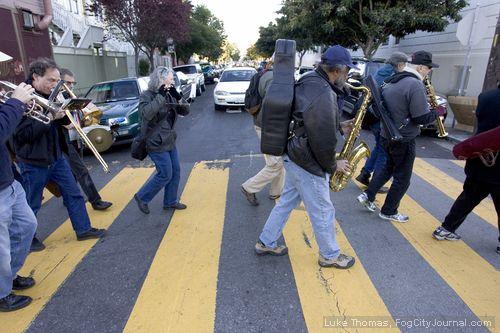
A standing-room-only crowd gathered at United Mission Presbyterian Church on 23rd and Capp Feb. 25th to remember Guardian correspondent and hell-raising investigative poet John Ross. John’s old friends Q.R. Hand, Hermann Bellinghausen, Frank Bardacke, Kevin Quigley and me spoke; his kids, Carla Ross-Allen and Dante Ross, gave moving remeberances. Then we marched through the Mission, led by the Musicians Action Group playing the Internationale. It was a perfect Ross moment: A few of the celebrants put pieces of yellow tape across their chests and stood in the streets halting traffic to the let the procession pass. A couple of confused bicycle cops went by, but took no action, which was good for all involved.


When we reached Cafe LaBoheme, the crowd took over much of 24th Street — but the air of fun and solidarity was so visible and loud that most of the cars simple stopped and waited patiently for room to crawl past. A wild, crazy anarchist funeral mob on the streets of San Francisco; we sent him off right.


PS: The generally nice obituary in the Chronicle described Ross as


“an author, poet, liberal activist and journalist who toiled against perceived injustice from the jungles of Chiapas, Mexico, to the baked streets of Baghdad.”


Which is wrong on two accounts. First of all, there was nothing “perceived” about the injustice Ross saw and wrote about; it was very real. But that’s just a daily paper trying to be objective in a way that turns out to be embarassing. More to the point, as his longtime friend Elizabeth Bell noted, calling Ross a “liberal”  is wildly inaccurate.


Here’s the letter she sent to the Chron:


Although some time has gone by since the Chronicle’s obituary of Bay Area activist and poet John Ross, I must correct a glaring inaccuracy–indeed, slander–that appears in the very first sentence of your otherwise adequate write-up.  John Ross was not at the time of his death, nor had he ever been, a “liberal.”  He was not a liberal-diaper baby, his pioneering refusal to serve in the Vietnam war was not the act of a liberal, nor was placing his body between Palestinian olive farmers and club-wielding Israelis.  His response to a Mexican journalist who asked his profession, “Soy comunista,” does not translate to “I’m a liberal.”  A raucous rebel and man of the people, Ross believed to his dying day that revolution in the United States was necessary and possible. A brief vocabulary lesson, Mr. Coté: Gavin Newsom is a liberal. John Ross was a liberal like a Molotov cocktail is a gin rickey.


Paul Henderson denies D.A. deal with Willie Brown

6

Paul Henderson doesn’t mince words when it comes to debunking the notion that Willie Brown helped him get his new job as Mayor Ed Lee’s public policy czar. Or that his decision to drop out of the D.A.’s race was in exchange for his new job.

“There was no deal with Willie Brown. I called and said, so do I get a check in the mail, a basket of fruit?” Henderson said, recalling his furious reaction to Brown’s claim, made in the Chronicle in January, that Brown and then mayor Gavin Newsom conspired to make sure Henderson was “taken care of,” in the wake of Newsom’s shocking announcement that he had appointed San Francisco Police Chief George Gascón as D.A.

“If there was a set up for me somewhere, I still have not got it. I didn’t get shit,” Henderson, who joined the D.A.’s office in 1995 and was said to be former D.A. Kamala Harris’ preferred pick to fill the D.A. post, after she won the state Attorney General’s race, last fall.

Instead, Henderson, who filed papers to run in the D.A.’s race in November, saw his plans blown out of the water when Newsom, in his last act as mayor, appointed Gascón as Henderson’s new boss. And when Gascón filed papers in the D.A.’s race the very next day, Henderson found himself in the unenviable situation of holding an at-will position in the D.A.’s office, while running against his boss in the 2011 D.A. election.

“ If there was any deal, it was for me not to lose my job,” Henderson added.  “And it’s the best decision for me. I really do care about public service.”

During his 16 years in the D.A.’s office, Henderson established juvenile drug and community justice courts, set up domestic violence and hate crime programs, and focused on rehabilitative, reformative, treatment-oriented alternatives to imprisonment.

He said his decision to join the Mayor’s Office is based on a long relationship with Lee. “I want to have a voice in the criminal justice system, and I’ve known Ed Lee independent of all this political business,” Henderson said, recalling that he worked with Lee to develop language programs in the D.A.’s office, so employees could take lessons and better interact with community members, victims and witnesses in court.

“I’m a third generation San Francisco resident, and the first generation not to grow up in the projects, though we lived opposite them,” Henderson continued, recalling how his mother is a Public Defender, his grandmother was a community advocate, and he went to preschool in Sunnydale. Those experiences gave him a strong sense of being connected to and serving his community from an early age, Henderson said.

And he soon found himself holding the highest position, as a gay and black, in the D.A.’s office in the 1990s.‘I was the first African American the D.A.’s office had hired in five years,” Henderson said, recalling how the department looked in 1995. “And look at it now,” he added, noting that since he took over hiring at the D.A.’s office, more gays, lesbians, Asians, Latinos and other minorities have been employed.

“I’m very aware of who I am and what I represent in this office,” Henderson said. “For me, it’s about creating an open door and having a voice at the table. Ed Lee has asked if I would be the liaison between national, state and local agencies collectively in his office. And this expands my voice and creates opportunities for all in San Francisco in ways that are exciting to me.”

Henderson said his new post will have a very different focus from the role former US Attorney Kevin Ryan played, during his brief tenure in the Mayor’s Office, under Gavin Newsom.“This will be about policy development, advice and implementation, and it will be more reflective of marginalized communities,” Henderson said. “So, I don’t want these communities being misled into thinking, ‘oh, he got a hand out.’ This was not a hook-up. I earned my place here.”

“The truth is that you have access to me because I am in this position,” Henderson continued. “And I hope it’s transformative for the city and the community. Because I did not get shit. There is no Paul Henderson pay-off. I’d be happy to tell you if I’d sold out. But no. I knew Ed independently. He knows my heart, trusts my judgment and reputation. This has nothing to do with Willie, Gavin and Kamala. Unless it did, and they are all tricking me. In which case, they should at least tell me, so I can credit them. But the truth is, I’ve worked so hard, and if I’ve become ‘the Man,’ then I’m at the table for the community. I’m not the person who took a pay out, got a hook up, a cushy deal, so I will go away, to silence my voice.”

Henderson notes that he has not given up his political aspirations, despite all that went down recently. “If it’s not my time right now, I still have political credibility and a profile in the city that isn’t going away “ he said, noting that he raised $65,000 in 28 days, just before Christmas, with no staff, immediately after a statewide election. “That speaks to how much support I have. Obviously I was disappointed that I wasn’t appointed D.A. But I’m not dead, and I’m trying to move in a direction that expands my voice.”

Henderson says his new role won’t change him and he’ll remain accessible to gay, black, Chinese, Samoan, immigrant, low-income, Latino and other marginalized communities.“I have a lens that most city leaders don’t have,” he said, noting that he was homeless and slept in his car when he was going to law school. “Ad now I can affect policy. Many folks feel the criminal justice system happens to you, and over 80 percent of victims are people of color and poor people. But who speaks for and represents them?”

Henderson drops out of D.A’s office and race, SFPD Chief turned D.A. Gascón appoints DeBerry as new chief of staff

4

I wondered what Willie Brown was talking about when he wrote that making sure that D.A. office insider Paul Henderson was “taken care of” was one of only two details to be worked out, following former Mayor Gavin Newsom’s shocking last-minute appointment of former police chief George Gascón as the next District Attorney  And now I think I found out: Henderson, who was former D.A. Kamala Harris’ chief of administration and her preferred pick, announced yesterday that he is dropping out of the D.A.’s race and will serve as Lee’s public safety czar.

Henderson starts his new job March 8, meaning 15 months has passed since former U.S. Attorney Kevin Ryan resigned from the Mayor’s Office of criminal justice—leaving everyone unsure what Henderson’s new post entails, and whether it comes with a staff and/or a budget.

Henderson says his new job includes involvement in the Taser debate, the next police chief selection, and assessing how budget cuts impact public safety. And he certainly didn’t publicly let on that he was anything but delighted about this latest twist in the ever evolving race to be the next elected district attorney.

“I’m excited about helping our Mayor shape this new position and about what we can accomplish under his leadership to enhance public safety in the City,” Henderson, who is  reportedly backing Gascón in the D.A.’s race, told the Guardian.

But Henderson’s move brings us back to the other detail Brown referred to in January, namely, “assessing the odds of Gascón winning the D.A.’s race in November.”

Currently, David Onek, a senior fellow at the UC Berkeley Center for Criminal Justice and served in the Mayor’s Office of Criminal Justice under Newsom and Alameda County Deputy District Attorney Sharmin Bock, are the only remaining contenders. And while little has been heard from Bock since she filed in January, Onek has been doing all he can to stay relevant, including holding house parties, raising money, calling for transparency in the D.A.’s Office around officer-involved shootings, and interviewing criminal justice experts as part of his Criminal Justice conversations podcast project in Berkeley.

Onek’s latest interview is with Michael Romano, co-founder of the Stanford Three Strikes Project, which represents folks serving life sentences under the Three Strikes law for minor, non-violent offenses – such as stealing a pair of socks. “Addressing the flaws in the Three Strikes law will protect Californians while also having a positive impact on our state budget.” Onek observed in a campaign email. “According to the California state auditor, non-violent third strikers will cost our state at least $4.8 billion over the next 25 years – almost $200 million per year.”
 
Onek also noted that the next few months are crucial for his D.A. campaign, “to build strong partnerships between law enforcement and the community.”
And the challenge for anyone who is not part of the Brown- Newsom machine to remain viable in the D.A.’s race were illustrated afresh yesterday when Gascón convened a 30-minute press conference at the Hall of Justice to announce he is reorganizing his staff to focus on cutting the backlog of homicides and other felony cases–and was replacing Henderson with Cristine DeBerry, who was deputy chief of staff under Mayor Gavin Newsom and Mayor Ed Lee.

Gascón said the reshuffle was a product of six weeks talking to prosecutors, court officials, defense lawyers and others in the criminal justice system. And so far it has led to David Pfeiffer being named as heads of special operations, Sharon Woo as head of operations, Eugene Clendinen as chief of administration, Braden Woods as chief of the criminal division, Lenore Anderson as chief of collaborative courts, Maria Bee as chief of victim services, June Cravett as head of the white collar division, Jim Crisolo as chief of investigations and Jerry Coleman as chief of the Brady, appellate and training division.

Gascón said he doesn’t foresee immediate layoffs in the department, which has a $39 million annual budget. But he warned that if he is required to cut his budget by 10 percent, as Mayor Lee has requested of all departments, he’ll have to lay off the equivalent of 18 prosecutors.
“Hopefully, we’ll be spared that,” he said. “As it is, we have so much unattended business.”

Gascón blamed the crushing deficit in the D.A.’s Office on budget constrictions over many years, as he used a Power Point slide show to illustrate how the department had less funding in 2008 than in 1986 (if numbers are adjusted for inflation).
“It’s why we had problems in the past and why we are doing this reorganization,” he said, claiming that a significant lack of training in the department has caused “a poor performance in court,” and that there is only one paralegal for every 9 attorneys, on average.

Gascón said it took 3-4 months to process most felony cases, and up to 3 1/2 years to bring a murder case to trial, under the office’s previous configuration.  “By that time, memories have faded, and people are not showing up,” he said.
(D.A. press spokesperson Seth Steward clarified today that Gascón’s claim that “only one out of every 26 misdemeanor cases” was in fact a misstatement, and that the D.A. is working to provide a more accurate analysis.)

Gascón also announced that he is rolling out a makeshift community court system in the next few months, in which alleged perpetrators, victims and three mediating members of the public would work to find a solution, which could be community service.
‘So you can roll the dice and be prosecuted or go to the community court,” he said. “We believe we can take 20 percent of our work load, which is about 1,000 cases, and run it through this system.”

He also claimed that instead of spending $1,200 to $1,300 in the court system, these cases would only cost $300, and that the Tenderloin Community Justice Center will stay in place, under the reshuffle.
 “My goal as Chief was the make San Francisco the safest and largest city in the United States, and that continues to be the goal,” Gascón concluded.


Behind the Twitter tax break deal

36

There’s much political intrigue and anticipation swirling around the Central Market Payroll Tax Exclusion, aka the Twitter Tax Break, which the Board of Supervisors will consider next month. This has all the elements of a great story: backroom deals between political and corporate power brokers, the strange argument that Republican-style tax cuts will cure Mid-Market blight, the fact that Twitter executives have uttered nary a tweet about shaking down SF taxpayers, and the role that a pair of supposedly progressive supervisors have played in brokering the deal.

Following up on my Feb. 10 post about how the deal would help Twitter meet the high asking price of politically connected landlord Alvin Dworman for a new mid-Market headquarters, the Bay Citizen yesterday had a great story showing how Dworman gave then-Mayor Gavin Newsom discounted office space for his lieutenant governor bid just as Newsom proposed the tax break that would benefit Dworman and Twitter. The story also includes a nice tick-tock about how this unseemly deal unfolded.

We at the Guardian are currently awaiting a big package of documents from City Hall that we requested on the deal, and sources tell us they’re likely to include some interesting insights and tidbits. For example, are Twitter and Dworman the main beneficiaries of this legislation or are there other corporations (and the politicians they support) who were pushing this plan? Everyone is also waiting to see how the city’s Office of Economic Analysis rates the proposal, and Economic Ted Egan tells us that report should be out by the end of next week or beginning of the following week.

At this point, we have more questions than answers, but that should start changing by next week. Maybe we’ll gain a better understanding of why Sup. Jane Kim is pushing this deal (much to the consternation of some of her former top supporters) or why Randy Shaw, the taxpayer-subsidized blogger and Tenderloin don, strongly backed Kim’s candidacy and attacked her critics with such perplexing ferocity. Will Willie Brown’s name continue popping up? Perhaps we’ll be able to determine whether the Newsom-Dworman pact actually broke campaign finance laws. And we’ll certainly gain some insights into how the Mayor’s Office of Economic and Workforce Development trades away taxpayer money to successful corporations that wield whines and threats of relocation.

If nothing else, we’ll get a peek into modern crony capitalism, San Francisco-style, dressed up in the guise of “saving” the Tenderloin. So, from a strictly journalistic perspective, this should be fun.

Who’s next?

39

steve@sfbg.com and tredmond@sfbg.com

The seven serious candidates who have announced plans to run for mayor extends from moderate to conservative at this point, but it’s an unusual field for San Francisco: there is no clear progressive standard-bearer, and no clear downtown candidate.

But it probably won’t stay that way. Sources say others are likely to join the lackluster race in the coming months, and there’s a strong likelihood that some progressive candidate will decide to the take plunge.

Also unlike the last few mayor’s races, there appears to be no clear frontrunner — either in fundraising or in having a clear constituency base — a new dynamic that creates an unpredictability that will be exacerbated because this is the first contested mayor’s race using the ranked-choice voting system and public financing of candidates.

There was a weak field of challengers to Gavin Newsom in 2007 and no one qualified for public financing or presented a strong threat. But this time City Attorney Dennis Herrera and former Sup. Bevan Dufty already have indicated they will take public financing, and others are expected to follow suit.

In addition to Herrera and Dufty, the field includes Sen. Leland Yee, Assessor-Recorder Phil Ting, venture capitalist Joanna Rees, and former Sups. Tony Hall and Michela Alioto-Pier. Those close to Board President David Chiu also say he is “seriously considering” jumping into the race and talking to friends and supporters about that possibility now.

But so far none come from the progressive political community that has controlled the Board of Supervisors for the past decade. Although Chiu is the only candidate in the field to self-identify as a progressive, he has adopted a more moderate governing style that has frustrated many progressive activists and supervisors. So that leaves voters on the left without a candidate right now.

“If a credible progressive candidate doesn’t get into the race, then we’ll see the top-tier candidates — which so far Leland Yee and Dennis Herrera — try to make friends with progressive San Francisco. And it would appear they have a lot of work to do,” Aaron Peskin, the former board president who chairs the San Francisco Democratic Party, told us.

Both Yee and Herrera have taken some progressive positions, and Yee has consistently endorsed more progressive candidates than anyone else in the mayoral field, but they have also taken many positions that have alienated them from progressives. And both have been taking in lots of campaign cash from interests hostile to the progressive base of renters, environmentalists, and advocates for social and economic justice.

“Nobody who has put their hats in the ring is really exciting anyone, so there is plenty of room for new entrants,” Peskin said, noting the progressives are actively discussing who should run. Peskin wouldn’t identify whom they’re courting, but some of the names being dropped are Sups. John Avalos, Ross Mirkarimi, and David Campos, as well as former Sup. Chris Daly and Peskin.

But Mirkarimi shifted some of that talk this week when he announced that he intends to run to replace the retiring Mike Hennessey as sheriff.

Political consultant Jim Stearns, who is representing Yee, also expects others to get into the race. “I don’t think the field is complete yet. Historically, the strong self-identified progressive candidate has come in late or surged late, like [Tom] Ammiano and [Matt] Gonzalez,” Stearns said.

Ammiano launched his write-in mayoral bid in September 1999 and Gonzalez jumped into the race just before the filing deadline in August 2003, so there’s plenty of time for progressive candidates to get in. “It’s never too late in San Francisco,” Stearns said. And unlike those two races when the upstarts were seriously outspent by the well-heeled frontrunners, Stearns said this year’s field will likely be on a fairly even financial footing.

“It’s likely every candidate will have $1.5 million to $2 million to spend,” he said. That means the keys to the race are likely to be name ID with voters and “which campaign can do the most with the least dollars,” Stearns said.

Already, some of the candidates who will be running to the center are looking for progressive support. Yee, for example, has given substantial amounts of money to progressive groups and candidates and has endorsed progressives for office.

Yee told us he’s positioning himself as “the candidate of the regular folks of San Francisco — the people who are trying to raise their families and live in this city.” He added: “To the extent that the progressive agenda fits that, we’ll be part of it.”

But he already has the endorsement of the Building Trades Council, which has often been at war with progressives, particularly over development issues.

Yee said he hasn’t yet weighed in on the local budget, but he agreed that new revenue “shouldn’t be off the table.” He said he thinks the current pension reform discussions at City Hall, involving Mayor Ed Lee, Sup. Sean Elsbernd, financier Warren Hellman, and union representatives are “the right way to go.”

Herrera said he’s going to run on his record — which includes a long list of progressive legal actions (along with his gang injunctions, which a lot of progressives question). He also told us that he’s involved in the pension reform discussions but thinks that new revenue absolutely ought to be a part of the budget debate.

Meet the new boss

3

news@sfbg.com

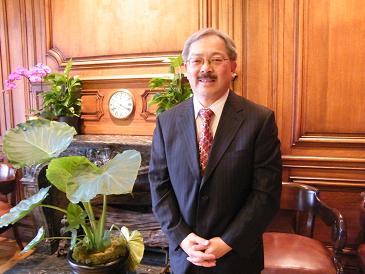
The Guardian hasn’t been invited into City Hall’s Room 200 for a long time. Former Mayor Gavin Newsom, who frequently criticized this newspaper in his public statements, had a tendency to freeze out his critics, adopting a supercilious and vinegary attitude toward any members of the press who questioned his policy decisions. So it was almost surreal when a smiling Mayor Ed Lee cordially welcomed two Guardian reporters into his stately office Feb. 15.

Lee says he plans to open his office to a broader cross-section of the community, a move he described as a way of including those who previously felt left out. Other changes have come, too. He’s replaced Newsom’s press secretary, Tony Winnicker, with Christine Falvey, former communications director at the Department of Public Works (DPW). He’s filled the Mayor’s Office with greenery, including giant tropical plants that exude a calming green aura, in stark contrast to Newsom — whose own Room 200 was sterile and self-aggrandizing, including a portrait of Robert Kennedy, in whose footsteps Newsom repeatedly claimed to walk.

When it comes to policy issues, however, some expect to see little more than business-as-usual in the Mayor’s Office. Democratic Party chair Aaron Peskin, a progressive stalwart, said he sees no substantive changes between the new mayor and his predecessor. “It seems to me that the new administration is carrying forward the policies of the former administration,” Peskin said. “I see no demonstrable change. And that makes sense. Lee was Willie Brown and former Mayor Gavin Newsom’s handpicked successor. So he’s dancing with the guys that brought him in.”

Sup. David Campos, viewed as part of the city’s progressive camp along with Peskin, took a more diplomatic tack. “So far I’ve been very pleased with what I’ve seen,” Campos noted. “I really appreciate that he’s reached out to the community-based organizations and come out to my district and done merchant walks. I think we have to wait to see what he does on specific policy issues.”

But while Lee has already garnered a reputation for being stylistically worlds apart from Newsom, he still hews close to his predecessor’s policies in some key areas. In our interview, Lee expressed an unwillingness to consider tax-revenue measures for now, but said he was willing to take condo conversions into consideration as a way to bring in cash. He was unenthusiastic about community choice aggregation and dismissive of replacing Pacific Gas & Electric Co. with a public-power system. He hasn’t committed to overturning the pending eviction of the Haight Ashbury Neighborhood Council’s recycling center, and he continued to argue for expanding Recology’s monopoly on the city’s $206 million annual trash stream, despite a recent Budget and Legislative Analyst’ report that recommended putting the issue to the voters.

Public Defender Jeff Adachi, who met Lee in 1980 through the Asian Law Caucus, said Lee would be facing steep challenges. “It’s a fascinating political karmic outcome that he is now our appointed mayor. He didn’t seek it out, as he says, but the opportunity he has now is to focus his efforts on fixing some of the problems that have gone unaddressed for decades, pension reform being one of them. I think he realizes he has a limited time to achieve things of value. The question I and others have is, can he do it?”


THE RELUCTANT MAYOR

Lee identified as a non-politician, patently rejecting the notion that he would enter the race for mayor. In meetings with members of the Board of Supervisors at the end of 2010, he said he didn’t want the job.

Yet while vacationing in Hong Kong, Lee became the subject of a full-court press. “When the lobbying and phone calls started … clearly they meant a lot to me,” Lee told us, adding that the choice “was very heavy on my mind.” He finally relented, accepting the city’s top post.

Although rumors had been circulating that Lee might seek a full term, he told the Guardian he’s serious about serving as a caretaker mayor. “If I’m going to thrust all my energy into this, I don’t need to have to deal with … a campaign to run for mayor.”

Adachi offered an interesting take on Lee as caretaker: “Somewhere along the way, [Lee] became known as the go-to guy in government who could take care of problems,” Adachi said, “like the Wolf in Pulp Fiction.”

Sounding rather unlike Harvey Keitel’s tough-talking character, Lee noted, “One of my goals is to rebuild the trust between the Mayor’s Office and the Board of Supervisors. I think I can do that by being consistent with the promises I make.”

Lee’s vows to keep his promises, mend rifts with the board, and stay focused on the job could be interpreted as statements intended to set him apart from Newsom, who was frequently criticized for being disengaged during his runs for higher office, provoking skirmishes with the board, and going back on his word.

The new mayor also said he’d be willing to share his working calendar with the public, something Newsom resisted for years. Kimo Crossman, a sunshine advocate who was part of a group that began submitting requests for Newsom’s calendar in 2006, greeted this news with a wait-and-see attitude. “I’ve already put in a request,” Crossman said. “Politicians are always in support of sunshine — until they have to comply with it.”


THE ELEPHANT IN THE ROOM

Pointing to the tropical elephant-ear plants adorning his office, Lee noted that elephants are considered lucky in Chinese culture. With the monstrous issues of pension reform and a gaping budget deficit hitting his mayoral term like twin tornadoes, it might not hurt to have some extra luck.

Pension reform is emerging as the issue du jour in City Hall. A round of talks on how to turn the tide on rising pension costs has brought labor representatives, Sup. Sean Elsbernd, billionaire Warren Hellman, City Attorney Dennis Herrera, labor leaders, and others to the table as part of a working group.

Gabriel Haaland, who works for SEIU Local 1021, sounded a positive note on Lee. “He’s an extraordinarily knowledgeable guy about government. He seems to have a very collaborative working style and approach to problem-solving, and he is respectful of differing opinions,” Haaland said. “Where is it going to take us? I don’t know yet.”

Lee emphasized his desire to bring many stakeholders together to facilitate agreement. “We’re talking about everything from limiting pensionable salaries, to fixing loopholes, to dealing with what kinds of plans we can afford in the health care arena,” he noted. Lee said the group had hashed out 15 proposals so far, which will be vetted by the Controller’s Office.

A central focus, Lee said, has been “whether we’ve come to a time to recognize that we have to cap pensions.” That could mean capping a pension itself, he said, or limiting how much of an employee’s salary can be counted toward his or her pension.

Since Lee plans to resume his post as city administrator once his mayoral term has ended, he added a personal note: “I want to go back to my old job, do that for five years, and have a pension that is respectable,” he said. “At the same time, I feel others who’ve worked with me deserve a pension. I don’t want it threatened by the instability we’re headed toward and the insolvency we’re headed toward.”


BRACING FOR THE BUDGET

If pension reform is shaping up to be the No. 1 challenge of Lee’s administration, tackling the city budget is a close second. When Newsom left office, he passed Lee a budget memo containing instructions for a 2.5 percent reduction in most city departments, part of an overarching plan to shave 10 percent from all departments plus another 10 percent in contingency cuts, making for a bruising 20 percent.

Lee said his budget strategy is to try to avert what Sup. David Chiu once characterized as “the typical Kabuki-style budget process” that has pitted progressives against the mayor in years past. That means sitting down with stakeholders early.

“I have opened the door of this office to a number of community groups that had expressed a lot of historical frustration in not being able to express to the mayor what they feel the priorities of their communities are,” Lee said. “I’ve done that in conjunction with members of the Board of Supervisors, who also felt that they weren’t involved from the beginning.”

Affordable-housing advocate Calvin Welch said Lee’s style is a dramatic change. “I think he’s probably equaled the total number of people he’s met in six weeks with the number that Newsom met in his seven years as mayor,” Welch said.

Sup. Carmen Chu, recently installed as chair of the Budget & Finance Committee, predicted that the budget will still be hard to balance. “We are still grappling with a $380 million deficit,” Chu told us, noting that there are some positive economic signs ahead, but no reason to expect a dramatic improvement. “We’re been told that there is $14 million in better news. But we still have the state budget to contend with, and who knows what that will look like.”

Sup. John Avalos, the former chair of the Board’s powerful Budget Committee, said he thinks the rubber hasn’t hit the road yet on painful budget decisions that seem inevitable this year — and the outcome, he said, could spell a crashing halt to Ed Lee’s current honeymoon as mayor.

“We are facing incredible challenges,” Avalos said, noting that he heard that labor does not intend to open up its contracts, which were approved in 2010 for a two-year period. And federal stimulus money has run out.


DID SOMEONE SAY “CONDO CONVERSIONS”?

Asked whether he supported new revenue measures as a way to fill the budget gap, Lee initially gave an answer that seemed to echo Newsom’s inflexible no-new-taxes stance. “I’m not ready to look at taxes yet,” he said.

He also invoked an idea that Newsom proposed during the last budget cycle, which progressives bitterly opposed. In a conversation with community-based organizations about “unpopular revenue-generating ideas,” Lee cautioned attendees that “within the category of unpopular revenue-generating ideas are also some that would be very unpopular to you as well.”

Asked to explain, Lee answered: “Could be condo conversion. Could be taxes. I’m not isolating any one of them, but they are in the category of very unpopular revenue-generating ideas, and they have to be carefully thought out before we determine that they would be that seriously weighed.”

Ted Gullicksen, who runs the San Francisco Tenants Union, said tenant advocates have scheduled a meeting with Lee to talk about condo conversions. Thanks to Prop. 26’s passage in November 2010, he said, any such proposal would have to be approved by two-thirds of the board or the voters. “It’s pretty clear that any such measure would not move forward without support from all sides,” Gullicksen said. “If anyone opposes it, it’s going to go nowhere.”

Gullicksen said he’d heard that Lee is willing to look at the possibility of significant concessions to renter groups in an effort to broker a condo conversion deal, such as a moratorium on future condo conversions. “If, for example, 1,000 TICs [tenants-in-common] became condos under the proposal, then we’d need a moratorium for five years to minimize and mitigate the damages,” Gullicksen explained.

More important, some structural reform of TIC conversions may be on the table, Gullicksen said. “And that would be more important than keeping existing TICs from becoming condos.”

Gullicksen acknowledged that Lee has the decency to talk to all the stakeholders. “Newsom never attempted to talk to tenants advocates,” he said.


GREEN, WITHIN LIMITS

Lee’s two children are in their early 20s, and the mayor said he takes seriously the goal of being proactive on environmental issues in order to leave them with a more sustainable San Francisco. He trumpeted the city’s green achievements, saying, “We’re now on the cutting edge of environmental goals for the city.”

Leading bicycle activist Leah Shahum of the San Francisco Bicycle Coalition had praise for Lee on bike issues. “I’m really encouraged by his very public support of the new green separate bikeways on Market Street and his interest and commitment to creating more,” she said. “I believe Mayor Lee sees the value of connecting the city with cross town bicycle lanes, which serve a wide range of folks, including business people and families.”

Yet some proponents of green causes are feeling uncertain about whether their projects will advance under Lee’s watch.

On the issue of community choice aggregation (CCA), the ambitious green-energy program that would transfer Pacific Gas & Electric Co. customers to a city-run program with a cleaner energy mix, Lee — who helped determine rates as city administrator — seemed lukewarm. “I know Mr. [Ed] Harrington and his staff just want to make sure it’s done right,” he said, referring to the general manager of the city’s Public Utilities Commission, whose tepid attitude toward the program has frequently driven him to lock horns with the city’s chief CCA proponent, Sup. Ross Mirkarimi.

Lee noted that CCA program goals were recently scaled back. He also said pretty directly that he opposes public power: “We’re not in any day getting rid of PG&E at all. I don’t think that is the right approach.”

The controversial issue of the Haight Ashbury Neighborhood Council Recycling Center’s pending eviction from Golden Gate Park still hangs in the balance. The Recreation and Park Commission, at Newsom’s behest, approved the eviction despite overwhelming community opposition.

Lee said he hadn’t looked at the issue closely. “I do know that there’s a lot of strong debate around the viability, what that operation attracts and doesn’t attract,” he said. “I had the owner of HANC here along with a good friend, Calvin Welch, who made a plea that I think about it a bit. I agreed that I would sit down and talk with what I believe to be the two experts involved in that decision: Melanie Nutter at the Department of the Environment and then Phil Ginsburg at the Rec and Park.” Nutter and Ginsburg supported HANC’s eviction.

Welch, who is on the board of HANC, noted that Lee could be swayed by his staff. “The bunch around Newsom had old and bad habits, and old and bad policies. In dealing with mayors over the years, I know how dependent they are on their staff. They’re in a bubble, and the only way out is through a good staff. Otherwise, Lee will come to the same conclusions as Newsom.”

HANC’s Jim Rhoads told the Guardian he isn’t feeling reassured. “He said he would keep asking people about it. Unfortunately, if he asked his own staff, it would be a problem because they’re leftovers from Newsom.”

Speaking of leftovers, Lee also weighed in on the debate about the city’s waste-management contract — and threw his support behind the existing private garbage monopoly. Campos is challenging a perpetual waste-hauling contract that Recology has had with the city since 1932, calling instead for a competitive-bidding process. When the Department of the Environment recommended awarding the city’s landfill disposal contract to Recology last year, it effectively endorsed a monopoly for the company over managing the city’s entire waste stream, at an estimated value of $206 million per year.

The final decision to award the contract was delayed for two months at a February Budget & Finance Committee hearing. Campos is contemplating putting the issue to the voters this fall, provided he can find six votes on the Board.

“I know that Sup. Campos had given his policy argument for why he wants that revisited,” Lee said. “I have let him know that the Recology company in its various forms has been our very dependable garbage-hauling company for many, many decades. … I feel that the company has justified its privilege to be the permit holder in San Francisco because of the things that it has been willing to do with us. Whether or not we want to use our time today to revisit the 1932 ordinance, for me that wouldn’t be a high priority.”


UNFINISHED BUSINESS

In the last week of 2010, Avalos pushed through groundbreaking local-hire legislation, without the support of then Mayor Gavin Newsom or his chief of staff, Steve Kawa, who wanted Avalos to back off and let Newsom takeover the task.

With Lee now in Room 200, things appear to be moving forward on local hire, in face of misleading attacks from Assemblymember Jerry Hill (D-San Mateo), who wants to make sure no state money is used on local-hire projects, presumably because the building trades are upset by it. And Kawa, whom Lee has retained as chief of staff, doesn’t really support the legislation. Indeed, Kawa’s presence in the Mayor’s Office has his detractors believing that the new boss in Room 200 is really the same as the old boss.

“I feel like things are moving forward in the right direction around local hire, though a little more quietly than I’d like,” Avalos told the Guardian. Avalos noted that he is going to hold a hearing in March on implementing the legislation that should kick in March 25.

Welch said he believes that if Lee starts replacing staff wholesale, it could indicate two things: he’s a savvy guy who understands the difficulties of relying on Newsom’s chief of staff Steve Kawa for a budget, and he’s not ruling out a run for mayor.

“If I was in his position, the first thing out of my mouth would be, ‘I’m not running.’ I think he’s very focused in the budget. And it’s going to make or break him. But if he starts overriding Kawa and picks staff who represent him … well, then I’d revisit the question of whether he’s contemplating a run for mayor, say, around June.”

Is Adachi’s pension reform a Tea Party initiative?

54

With all eyes on Wisconsin, local labor leaders are suggesting that Public Defender Jeff Adachi’s proposed retirement/health plan reforms are really Tea Party initiatives, even as Adachi threatens to place another Measure B-like initiative on the fall ballot if city leaders can’t agree on a fix for the city’s fiscal problems

Last fall, Adachi started a war with the local labor movement when he placed Measure B on the November ballot. Measure B proposed increasing employee contributions for retirement benefits, decreasing employer contributions for heath benefits for employees, retirees and their dependents, and changing rules for arbitration proceedings about city collective bargaining agreements,

Measure B ultimately failed, but not after both sides spent a ton of cash. And now labor is refusing to have Adachi sit in on their pension reform talks with Mayor Ed Lee, former SEIU President Andy Stern is describing the fight in Wisconsin as a ’15 state GOP Power grab,” and SEIU Local 1021 leader Gabriel Haaland is pointing to Wisconsin as a reason for excluding Adachi from pension reform talks

“Adachi’s obviously scapegoating a group that’s part of a national agenda,” Haaland said, noting that in the states where Republicans gained statehouse control in 2010, there’s talk about eliminating collective bargaining, and ending defined benefit plans and paycheck protection.

“The problem is that pension reform has been blowing on the anti-public sector worker winds that are blowing in Wisconsin and other states, whether progressives want to acknowledge it or not,” Haaland continued. “There is a reason that Adachi got so much money last year, and the corporate interests behind him are part of this effort to bash public sector workers.”

Prop. B’s campaign finance records show the campaign raised $1.125 million in 2010, and that the lion’s share came from wealthy individuals.

Billionaire venture capitalist, former Google board member and Obama supporter Michael Moritz gave $245,000. Author Harrier Heyman, Moritz’ wife, donated $172,500. financial analyst Richard Beleson donated $110,000. George Hume of Basic American Foods donated $50,000. Gov. Schwarzenegger’s former economic policy advisor David Crane gave $37,500. Philanthropist Warren Hellman donated $50,000. Republican investor Howard Leach, who co-hosted a Prop. B fundraiser with former Mayor Willie L. Brown, gave $25,000. Investor Joseph Tobin gave $15,750. Maverick Capital partner David Singer gave $15,000. JGE Capital Partners donated  $15,000; Bechtel owner  Stephen Bechtel Jr gave $10,000: Matthew Cohler, a general partner of Benchmark Capital, donated $10,000; the California Chamber of Commerce donated $5,000 and philanthropist Dede Wilsey gave $1,000.

But records also show that Measure B opponents, which included San Francisco Firefighters, SF Police Officers Association, SF First Responders, the California Nurses Association, United Educators, San Francisco Gardeners, San Francisco Teachers, Library Workers, laguna Honda Workers, donated over $1 million in their successful bid to squash Adachi’s reform. And that just about every elected Democrat, including Assemblymember Tom Ammiano, then mayor Gavin Newsom, Sheriff Mike Hennessey, and Board President David Chiu, came out against Adachi’s original plan.
 
Haaland acknowledged that the argument could be made that the progressives’ version of the hotel tax didn’t pass and less attention was paid to the district elections last fall, because labor focused primarily on defeating Adachi’s Measure B.

“But at the end of the day, we did get the real estate transfer tax and we defeated Measure B,” Haaland observed. “So, we need to keep fighting anti-worker pressure. It’s challenging times, but I feel like the connections need to be made.”

Adachi was swift to refute Haaland’s claim that his Measure B pension reform is and was a Tea Party initiative.
“What’s not been reported is the fact that there are all these people supporting pension reform who are progressive Democrats,” Adachi said, pointing to Moritz, Crane and former Board President and Green Party member Matt Gonzalez, who all supported Measure B last fall.

“You are talking about saving basic services and that’s a progressive cause,” Adachi continued. “You might argue that pension reform isn’t a progressive solution. But then you are saying that the needs of one group of workers are subservient to the needs of other workers. And even if you raised every tax in the city, you’d not be able to keep up with pension and healthcare costs.”

“Even if we could raise parking tickets to $200 a pop, and tax folks who make more than $100,000 a year, that still wouldn’t solve the problem, because the problem is so huge,” Adachi added. “When you look at this crisis, you can’t simply redbait and say, you are a Republican, or Sarah Palin. Matt Gonzales has always spoken for progressive values, but because he supports pension reform, he’s suddenly a member of the Tea Party? At a certain point, it begins to become absurd.”

Haaland countered that he’s  “challenged by the notion that thousands show up in Wisconsin to fight some of the same people behind Measure B, but our discourse has lowered to whether or not Jeff Adachi is a good guy.”

And Adachi expressed doubt that Mayor Ed Lee can come up with a suitable pension reform plan.

“I’ve heard Lee say there has to be a solution involving pension reform and underfunded healthcare benefits that would save $300 million to $400 million in annual savings, and that corresponds with the solution he needs to come up with to close the budget deficit,” Adachi said.

Adachi said that he has met with Lee on his own to discuss pension reform, but the new mayor did not list specifics.
“He didn’t tell me what his plan was,” Adachi said, “The Prop. B supporters have a plan, but Lee did not ask what that was. But he said he sincerely wants to solve that problem, and that his preference would be one ballot initiative that everyone would agree on. And I fully support a solution that is going to truly solve the problem. I’ve always believed it’s important for the public to understand the gravity of the situation. For too long, it’s been the elephant in the room and there hasn’t been enough public information.”

Adachi said he had a beef with the idea of “groups of labor unions holding meetings at City Hall and deciding who can participate.”

“It’s also troubling that there is no information publicly available about what the ideas on the table are, no explanation of how they got there, and no documenting of the extent of the problem,” Adachi continued. “And that’s what got us here in the first place: a lack of transparency, and voters being asked to weigh in without the full information.”

Adachi said he has an upcoming meeting with Lee, the Department of Human Resources and Sup. Sean Elsbernd about pension reform that is separate from the working group that includes labor and philanthropist Warren Hellmann.

And Elsbernd told the Guardian he believes the pension reform process would go smoother if Adachi were at the table.
“I have no problem with Jeff at the table, it makes sense to have him there to avoid two ballot measures,” Elsbernd said.

Elsbernd added that it was too early to cite numbers when it comes to talk of capping pensions.
“It’s a mistake to pick a number right now because you don’t know what it’s worth,” he said, noting that the pension reform working group has sent a bunch of different scenarios to retirement actuaries to crunch the numbers to see how much they would save the city.

“I can see a case being made for asking the highest paid city workers to contribute higher amounts for healthcare benefits,” Elsbernd said. “But I’m not sure that’s equitable on retirement benefits, though I could see a situation where safety pays more, regardless, because they have better pensions.”

Onek to SFPD Chief turned D.A. Gascon: release records of officers cleared in shootings

3

Calitics has a revealing letter from David Onek, a senior fellow at the Berkeley Center for Criminal Justice, a former member of the San Francisco Police Commission and a candidate in the 2011 District Attorney’s race, demanding greater transparency from the D.A.’s office when it comes to explaining why officers have been cleared in officer-related shootings.

“After spending my career working to identify and implement the most effective public safety strategies, I have seen one constant – the community is safest when the police and prosecutors earn and keep the public’s trust,” Onek writes in a letter that is guaranteed to turn up the ante in an already intriguing race. “That’s why I read with real concern that the San Francisco District Attorney’s office would not produce reports related to officer-involved shootings pursuant to a recent public records request from NPR-affiliate KALW.”

(The KALW report shows that the person in the D.A.’s office who penned the letter denying its request for records was Paul Henderson, D.A. Kamala Harris’ chief of staff and her preferred pick as replacement D.A. before Gavin Newsom appointed former SFPD Chief George Gascón as his last act as mayor, shocking just about everyone except Willie Brown, especially when it came out that Gascón used to be a Republican and is not philosophically opposed to the death penalty. And while Gascón, who was registered in recent years as decline-to-state, promptly turned around and registered as a Democrat, he also filed papers in the D.A.’s race that cite the phone number of notorious campaign attorney Jim Sutton.)

In his post on Calitics, Onek notes that as a former Police Commissioner, he was briefed in closed session on the details of officer-involved shootings, and he often heard complaints from community members about how little public information was released about officer-involved shootings.
“This lack of transparency breeds distrust,” Onek observes.

Onek acknowledges that in all officer-involved shootings, the DA’s office conducts an independent review to determine if there is criminal liability, and that if such liability is found, the DA presses charges, which are public. “But when the DA determines that there is no liability, it is equally important that the DA publicly explain the reasons for its decision,” Onek states.

In short, he believes the D.A.’ office should issue a very detailed report on every officer-involved shooting in which it does not file charges and should make the report publicly available on its website. “The report should detail the facts, the law and the reasons for the decision not to file charges,” Onek says, arguing that complete transparency would make the job of police and prosecutors much easier by building trust between law enforcement and the community, making it more likely that community members will work in partnership with police and prosecutors, and that victims and witnesses will come forward to testify.

“Publishing detailed reports that clear officers when they acted within the law can dispel public misconceptions about what actually happened,” Onek concludes. “Of course, officers’ privacy rights need to be respected and investigations cannot be compromised. But once an investigation is complete, and an officer has been cleared, it is imperative that the District Attorney’s office share its findings with the public. “

And as Onek points out, this standard is already in place in communities in California. “The District Attorney’s office in San Diego, hardly a bastion of liberalism, actually lists these cases on its website,” Onek states. “Many other counties – including Los Angeles, Orange and Fresno – also make them matters of public record and available on request. Building trust with the community is the key to enhancing public safety. Let’s not violate that trust by refusing to release documents that the public has the right to see.”

I’ve got a call into D.A. Gascón’s office to learn more about the rationale for denying KALW’s request, and I’ll be sure to post his reply here, so stay tuned.

Adachi and Ballard’s pension reform gloves come off

64

Yesterday, I talked to Public Defender Jeff Adachi about the latest efforts to address pension reform in San Francisco. Readers may remember that Adachi roused the ire of the labor unions last year, with the ultimately unsuccessful Proposition B. At the time, most folks felt Adachi’s measure didn’t have a snowball’s chance because it asked public employees to bear the brunt of the city’s ballooning retirement and health plan costs. Yet, they all praised Adachi as a great city leader who has been on the right side of many other battles in this city’s rich political history.
But the pension reform issue hasn’t gone away, and now that Adachi is threatening to introduce another measure this fall, the gloves have apparently come off, as witnessed by a Bay Citizen article that reported that union leaders don’t want Adachi to be part of a pension-reform working group at City Hall
In that Bay Citizen article, Nathan Ballard, who served as communications director for former Mayor Gavin Newsom from 2007 to 2009, said, “Inviting Jeff Adachi to our talks would be like inviting Sarah Palin to speak at the Democratic convention.”
The Bay Citizen characterized Ballard as “a Democratic strategist who has been involved in the working group since its inception.” And it noted that Mayor Lee had reached out to Adachi—an effort that it framed as a “complicating move.”
But it didn’t get Adachi’s thoughts on Ballard’s comments. So, I asked Adachi how he felt about being compared to Sarah “Moose in the headlights” Palin.
“It’s ironic that a spokesperson from Burson-Marsteller, which is headed by Republican operatives such as President Bush’s former press secretary (Dana Perino) and represents some of the most reactionary corporate interests, such as USA Blackwater, is accusing me of being a Republican for trying to solving our city’s pension crisis,” Adachi replied, referring to the fact that Burson-Marsteller, a global public relations firm, appointed Ballard as a managing director in March 2010.
“This is a company that is known for representing the worst corporate criminals in modern history,” Adachi continued. “They organized a campaign against civil rights in Argentina, supported a government massacre in Indonesia and tried to justify the killing of over 2,000 people in India’s Bhopal disaster. You have a hired mouthpiece, Nathan Ballard, who’s been paid $50,000 out of union member dues deciding who can attend meetings at City Hall. “
Asked for his thoughts on Adachi’s response, Ballard replied, “Burson-Marsteller employs talented operatives from both sides of the aisle. Although I won’t speak to the specifics of Jeff Adachi’s allegations, Burson is well known as the world’s go-to firm for crisis communications, and that tends to involve handling high-stakes disputes for controversial clients. As a criminal defense lawyer, Jeff Adachi should resist the temptation to assign blame to an advocate for accusations made against a client.”

So, buckle your seats, ladies and gentlemen. The pension reform battle is ON. And if the exchange posted above is any indication, it’s only going to get uglier

Dense in the west

9

rebeccab@sfbg.com

A marathon special meeting of the San Francisco Planning Commission on Feb. 10 demonstrated a clear split over Parkmerced, a $1.2 billion private development project that will rebuild an entire existing neighborhood on the west side of San Francisco.

While some expressed strong enthusiasm for moving forward with the ambitious plan, many residents turned out to voice vehement opposition, citing concerns about traffic congestion, noise, dust, and the demolition of affordable apartments that some Parkmerced tenants have occupied for decades.

The votes to certify the project’s environmental analysis and send the plan onto the Board of Supervisors with a commission endorsement were split 4-3, with Commissioners Christina Olague, Hisashi Sugaya, and Kathrin Moore dissenting.

Those who voted no were appointees of the Board of Supervisors, while the four commissioners who voted in favor were appointees of former Mayor Gavin Newsom, suggesting a break along clear political lines. State Assemblymember Tom Ammiano also submitted a letter urging commissioners not to approve the project.

While Parkmerced Investors LLC, the project sponsor, eagerly awaits groundbreaking, spokesperson P.J. Johnston noted that they weren’t there yet. “First,” he said, “we have to break ground at the Board of Supervisors.”


IS IT GREEN?

The Parkmerced redesign has been touted as an ecological and sustainable beacon for urban development and, indeed, some features of the grand plan read as if they were plucked from a checklist from the U.S. Green Building Council’s Leadership in Energy and Environmental Design (LEED) green-neighborhood standards.

Walkable, bikeable streets with proximity to transit? Check. Water-efficient landscaping? Check. Energy-efficient dwellings? Check. Project sponsors claim that through dramatic reductions in per capita resource consumption, three times as many residents would consume the same amount of water and electricity as Parkmerced’s current population does today.

Johnston emphasized how adding new units to the west side of the city also helped contribute to “density equality,” since most new projects tend to be concentrated in the eastern neighborhoods.

Johnston was particularly jazzed about an innovative storm-water discharge system envisioned for the plan, which he described as a design that could “regenerate and repair the environment.” It would recirculate rainwater through a naturally filtrating system of ponds and bioswales to recharge Lake Merced, a water body that has been slowly shrinking due to being choked off from its natural watershed by a concrete urban barrier.

Green points might be awarded for plans for an on-site organic garden, but Commissioner Michael Antonini, who said he lives less than a mile from Parkmerced, cautioned that developers shouldn’t get too attached to that idea. After all, he said, many kinds of vegetables won’t thrive in that part of the city.

Meanwhile, the wholesale destruction of existing units is decidedly not eco-chic. The Green Building Council’s LEED neighborhood standards insist that “historic resource preservation and adaptive reuse” is always preferable in a green development — and that’s the point that Aaron Goodman, an architect who previously lived at Parkmerced, has been driving at for more than a year. Proponents maintain that Parkmerced’s wartime construction meant it was built with inferior materials, and that property owners have battled dry rot and other infrastructure problems.

Another not-so-green Parkmerced project feature has also raised eyebrows: parking. While proponents portray the redesign as a switch from a suburban, love-affair-with-the-automobile style to an enlightened departure from car-centrism, plans nonetheless include a parking space for every single unit.

That creates the potential for more than 6,000 new cars on the road in that area, and the 19th Avenue corridor is already notorious for traffic snarls. According to calculations by the Environmental Protection Agency, the typical American motorist generates more than five metric tons of carbon dioxide by driving in a given year.


REPLACING WHAT’S THERE

Before the Planning Commission meeting, residents from the Parkmerced Action Coalition — a relatively new residents’ group formed to oppose the redevelopment and a wholly different entity from the Parkmerced Residents’ Organization — made a public show of their dissatisfaction outside City Hall. Holding signs with slogans such as “Don’t Bulldoze Our Homes,” residents sang protest songs and chanted, “We are Parkmerced!”

With the dramatic makeover, Parkmerced would expand to around 8,900 units, tripling the number of residents who could be accommodated. Existing 1940’s-era garden apartments would be razed to make way for higher, denser housing. The plan comes at a time when neighboring San Francisco State University is undergoing its own phase of expansion.

“This project in its current state is a vision that is not in harmony with the people, place, or the environment,” charged Cathy Lentz, an organizer with the Parkmerced Action Coalition, in a vociferous plea to the commissioners. “It is a narrow vision, a corporate vision … a true vision would be inclusive of present dwellings, inclusive of animals, trees, and present environment.”

One resident lamented the pending loss of his garden courtyard, noting how much his children had enjoyed the green space growing up and listing the different kinds of birds that would surely be driven away by heavy-duty construction and tree removal. For many, the point was not so much what developers intended to build, but what would be lost to make way for it. One speaker dismissed the plan as “architectural clear-cutting.”

Commissioner Moore, an architect, sounded a similar note when she rejected the notion that the Parkmerced redevelopment should be hailed as infill, a desirable development concept that curbs sprawl by utilizing space efficiently. “Urban infill housing is defined as infill on vacant sites,” Moore said, “not sites that have become vacant by demolition.” She added that she believed the environmental impact review “fails to sufficiently examine why housing demolition is even necessary.”

In Moore’s view, “the only reasonable alternative is a significantly redesigned … project.”


WORKING-CLASS NEIGHBORHOOD

Unlike a luxury condominium development, the Parkmerced plan emphasizes built-in economic diversity — yet critics point out that as it stands, the housing complex is already inclusive of many lower-income, working-class residents.

The plan will incorporate several hundred below-market rate units, in accordance with the city’s inclusionary zoning ordinance. Commissioner Antonini also emphasized the boost to city coffers from tax revenue associated with the project.

Meanwhile, questions are still arising on the issue of rent control. “We do not believe it is appropriate for the City and County of San Francisco to be displacing rent-controlled residents,” noted Michael Yarne, a mayoral development advisor. A binding agreement between Parkmerced Investors LLC and the city of San Francisco, which will be linked to the land, promises that new units will be made available to rent-controlled tenants at the same monthly rate they now pay, with rent control intact (See “Weighing a Landlord’s Promise,” Dec. 21, 2010).

Yet Polly Marshall, a commissioner on the San Francisco Rent Board, noted that she still didn’t believe tenant protections were adequate. She also spoke to the pitfalls of tearing down and redoing an entire neighborhood.

“The proposed Parkmerced development is the kind of development that I normally would support. It’s the kind of thing I work on in my profession,” noted Marshall, an attorney who has worked on redevelopment projects. “What’s different about this project is that it involves an existing community. It requires devastation of that community. It reminds me of the old-style redevelopment projects that went on in the Fillmore that destroyed existing neighborhoods. Look around that area now … there’s high density housing there, but that’s about all. The community — the networks of the people — was destroyed decades ago.”

Marshall took it a step further, offering her analysis on why Parkmerced was targeted. “It’s because it’s a working-class neighborhood of renters,” she said. “That’s why we’re going to destroy Parkmerced.”

Mayor Ed Lee willing to disclose work calendar

1

Among the many issues that rankled progressives under Mayor Gavin Newsom’s administration was Newsom’s unwillingness to turn over his work calendar to members of the public who formally requested it. Beginning in 2006, a group of sunshine activists routinely submitted public-information requests for the mayor’s daily schedule in hopes of finding out who Newsom was meeting with, what events he attended, and just how he spent his time on the job as mayor of San Francisco. After years of battle, Newsom finally agreed to release a watered-down calendar containing very little information.

On this matter, it does not seem as if Interim Mayor Ed Lee will follow in the footsteps of his predecessor.

In an interview with Guardian reporters today, Mayor Lee indicated that he would be willing to make his calendar available to the public. “Sure,” he said when we asked him about it. “I have no problem with that.”

Lee noted that he has complied with similar requests in the past. “I’ve had those already reviewed as the City Administrator, so I’m used to it,” Lee said.

He added that while he was willing to share his work-related calendar, “I may not want to share where I privately go every night.”

That’s OK. Thanks to former Mayor Willie Brown, we already know Lee went out to dinner in North Beach the other night with Brown, Rose Pak, and several others.

Twitter tax break could help a well-connected landlord

34

Opposition to the proposal to give millions of dollars in city payroll tax breaks to Twitter and other companies that open for business in the mid-Market area has focused on the bad precedent of caving into demands for corporate welfare and the lead role that two people who call themselves progressives – Sup. Jane Kim and Board President David Chiu – are taking in pushing the deal.

But behind-the-scenes, there’s another aspect of the deal that is troubling to advocates for transparent government that acts in the broad public interest, rather than that of powerful individuals. And once again, the specter at the center of this insider deal-making is none other that former mayor Willie Brown, whose close allies seem to once again have the run of City Hall.

The mid-Market property that Twitter wants to move into is San Francisco Mart, a million-square-foot building at Market and 9th streets, which sources say has been having a hard time finding tenants to fulfill its ambitious plan to “transition and reinvent” the old furniture outlet as a modern home for high-tech businesses. Most recently, they were unable to seal the deal with Twitter – until the tax break proposal popped up.

The building is owned by millionaire developer Alwin Dworman, founder of the ADCO Group and someone who has had a 30-plus-year friendship with Brown, who sang Dworman’s praises in this 2007 article from the San Francisco Business Times discussing this property and others. The property is also operated by Linda Corso, longtime partner of Warren Hinckle, a local media figure with close ties to Brown (as well as Gavin Newsom, who last year named Hinckle as his alternative representative to the DCCC). Reached by phone yesterday, Corso said she wasn’t directly involved in the negotiations with Twitter and would have someone call us, but nobody did.

Brown’s name has been popping up quite a bit in recent months as he and his allies re-exert their deal-making influence on the city, starting four months ago with his stealth support for Kim’s campaign and continuing with his role in elevating his protege Ed Lee to the interim mayor post (the way the pair ran City Hall when Brown was mayor is also the subject of an investigative report in this week’s Guardian) and placing ally Richard Johns onto the Historic Preservation Commission over progressive objections that he was unqualified.

Reached on his cell phone, Brown refused to comment, telling us, “I don’t want to talk to the the Bay Guardian ever in my life. Goodbye.” There is no indication that Brown or other representatives for Dworman lobbied the supervisors over the deal, and both Kim and Chiu say they weren’t contacted. “I’ve never spoken to the man and I don’t know much about his business,” Chiu said of Dworman, although he said that he was told by people in the Mayor Office, which brokered the deal, that Twitter was looking at moving into Dworman’s building.

Kim has maintained that she has very little contact with Brown and doesn’t know why he supported her candidacy. And she said the benefits for Dworman and other big mid-Market landlords who will profit from her legislation wasn’t a factor in her decision to sponsor it. In a prepared statement to the Guardian, she wrote, “I am not aware of any lobbyists for the Mid-Market legislation and therefore certainly have not met with any.  I have communicated directly with Twitter, who are [sic] excited to be a part of revitalizing the Mid-Market corridor and about partnering with community-based organizations and schools who serve the neighboring communities of SOMA and the Tenderloin.  Our office has convened neighborhood stakeholders who will be directly impacted by this legislation and they are currently committed to being a part of this dialogue over the next month.”

Kim told us last week that she philosophically opposes business tax breaks, but that she wanted to help stimulate the mid-Market area and keep Twitter from following through on its threat to leave town. Despite calling himself a progressive, Chiu has supported using targeted tax breaks as a economic development tool, including the biotech tax credit. And yesterday, he told us, “I would love to bring more companies in the mid-Market area…If we don’t do this policy, we will see future years of zero economic activity in that area.”

But progressives say these tax breaks are nothing but corporate welfare that will exacerbate the city’s budget deficit. During a benefit event for Lyon Martin Health Services last night at the Buck Tavern, which is owned by Kim predecessor Chris Daly, signs plastered throughout the bar urged the public to oppose the Twitter tax break in order to preserve public health and other vital city services.

SF’s redevelopment miracle

2

OPINION While many of us (and most of the rest of the state) can tire from time to time when we hear San Francisco “exceptionalism” being touted, especially when Gavin Newsom is doing the touting, there are some cases in which it’s justified. One of the most salient is the way San Franciscans transformed the city’s Redevelopment Agency and used tax-increment financing to build housing and infrastructure that served its residents, not elite developers.

This is an exceptional story that Gov. Brown does not want to hear. He should both listen and learn from San Francisco’s experience.

The San Francisco Redevelopment Agency started out like all others: destroying low income neighborhoods to create what the San Francisco Planning and Renewal Association, a strong agency supporter at the time, called ” ‘clean’ industries [and a] population … closer to ‘standard white Anglo-Saxon Protestant’ characteristics … ” But the big difference was that San Franciscans fought back.

In the 1960s in the Western Addition and SoMa, community organizations were formed that sought legal assistance and stopped the agency in its tracks. In the 1970s, new community coalitions were formed to deny the agency new federal funding. By the 1980s, the agency was broke and its mission of urban renewal so blocked and discredited that SPUR changed the last two words in its name from “Urban Renewal” to “Urban Research.”

In 1988, Mayor Art Agnos brought in the opponents of redevelopment and asked them how to redesign the agency. The product of that collaboration was a new mission statement and an ordinance fully integrating the agency into city government — transforming it into a financing agency, with no operational role.

Since 1990, the agency has become the major funder of affordable housing in San Francisco, pouring more than $500 million into low-cost housing both inside and outside redevelopment areas. More than 10,000 units have been built for working and low-income residents, more than half of those units for families with children. The urban infrastructure needed to transform Mission Bay from a toxic rail yard to a residential and biotech center came from the agency. Since 1990, not one neighborhood has been bulldozed by the agency and two new ones are being created (Mission Bay and Transbay).

Yes, some of the tax increment has been used to do some infrastructure work at ATT Park, and former Mayor Gavin Newsom wanted to entice the 49ers with agency funds for a new stadium at the shipyard. And yes, former Mayor Willie Brown gave Bloomingdale’s some agency money for its Market Street store. But the reality is that 50 percent of all tax increment since 1990 has gone to affordable housing development, and the bulk of the remaining 50 percent has gone for critical needed infrastructural work that has produced new property taxes more than paying for the investments. As the state and federal government turned their backs on central cities it was the only form of financing available.

And now Gov. Brown wants to end tax-increment financing. He points to the excess of other redevelopment agencies in other places. He does not, however, look to us and our experience. He should. San Francisco should be the model for what is required of all redevelopment agencies.

After serving as mayor of Oakland, Brown is probably tired of hearing about how different San Francisco is, how exceptional we are. That’s too bad, because in this case it isn’t hype. It’s real. *

Calvin Welch lives and works in San Francisco.

Dirty business

24

rebeccab@sfbg.com

The owner of a certified minority-owned business in San Francisco is suing the city, charging that his telecommunications company went belly up after city officials falsely accused him of participating in a fraudulent kickback scheme within the city’s Department of Building Inspection (DBI).

The case and depositions of high-ranking officials offer a rare window into the inner workings of city government at a time when corruption was rife within DBI and regulations governing city contracting were considerably less strict. They also provide a glimpse at how city business was sometimes conducted under the administration of Mayor Willie Brown, a powerful figure who has resurfaced recently in San Francisco politics.

In addition, the case alleges inappropriate behavior by current Mayor Ed Lee when he was the city’s purchasing director. One of the depositions includes allegations that Lee, at Brown’s direction, approved a city contractor who was utterly unqualified and was later accused of being part of a criminal scam.

The plaintiff in the lawsuit — James Brady, CEO of Cobra Solutions — closed up shop years ago and moved to Sacramento with his wife and business partner, Debra. But he’s been locked in an ongoing legal battle against powerful forces in City Hall since 2003, when he claims the city stopped issuing payments to his company, terminated its contract, and declined to award it a new contract on suspicions of bribery.

“They want to make us look like we’re Bonnie and Clyde,” Brady told the Guardian. “We’ve never done a thing.”

Nancy Fineman, an attorney with the firm Cotchett, Pitre & McCarthy, which is representing the city in the case, said the corruption allegations against Cobra still stand and she emphasized, “The city attorney was not involved in doing anything wrong.”

In a complaint filed Jan. 7, attorney G. Whitney Leigh — law partner of former Board of Supervisors President Matt Gonzalez — alleges that a host of city officials are responsible for precipitating Brady’s financial ruin.

According to Leigh’s version of events, Cobra was dragged into an overzealous campaign to hold someone accountable after a contractor the city alleged was corrupt vanished, leaving a number of subcontractors unpaid and the city “with egg on its face.”

Leigh subpoenaed Ed Harrington, former city controller and current head of the San Francisco Public Utilities Commission; Deputy City Controller Monique Zmuda; former officials from the Office of Contract Administration, and others to testify out of court during discovery. Leigh describes the case as “a Shakespearean tragedy combined with a cartoon combined with a soap opera.”

For City Attorney Dennis Herrera, it might be more like a zombie flick. The city attorney is gaining momentum in his campaign for mayor and has taken an early lead in fundraising against his opponents. The Cobra Solutions saga might be one that he — and other top city officials — would rather forget.


CONFLICTS AND CRACKDOWNS

Appeals in the case have reached all the way to the California Supreme Court, which ruled that Herrera had a conflict of interest that should have disqualified his office from suing Cobra. Beginning in September 2000, before he was elected city attorney, Herrera provided legal representation to Cobra while working with a private firm called Kelly, Gill, Sherburne & Herrera.

Due to the disqualification, Herrera could not discuss specifics in the case. But he did offer us a general comment. “I’ve made it very clear that me and my office are going to have zero tolerance for corruption and individuals who would violate the public trust,” he said. “This case, I think, represents that philosophy.”

When Herrera was campaigning for city attorney in the November 2001 race, he ran on a platform of cracking down on fraud and corruption. The DBI case began as a triumphant delivery of that campaign promise.

In 2003, following a yearlong investigation by a Public Integrity Task Force that Herrera had convened, a corrupt DBI official named Marcus Armstrong got busted by the feds. He’d allegedly falsified the qualifications on his resume and set up shell companies to funnel money out of city coffers for his own personal gain. He pleaded guilty to corruption charges brought by the U.S. Attorney, and spent time in prison for cheating the city out of about $500,000.

Herrera brought a civil suit against Armstrong and a DBI contractor, Government Computer Sales, Inc. (GCSI), which allegedly partnered with Armstrong in a kickback scheme. Questions surrounded GCSI from the start. It only gained certification as a city contractor after being rejected multiple times by city staff as unqualified. Deborah Vincent-James, who directed the city’s Committee on Information Technology (COIT) at the time and has since died, testified in a 2008 deposition that GCSI was “fraudulent” and got the contract only because of ties to Mayor Brown.

Herrera hit a stumbling block when he amended the complaint to name Cobra Solutions and its management company, TeleCon Ltd., as another city contractor in on Armstrong’s kickback scheme. (Debra Brady was president of TeleCon, which predated Cobra. Although the Bradys insist the two entities were separate, Herrera named TeleCon in the suit as an alter ego of Cobra.)

Cobra struck back, claiming the City Attorney’s Office wasn’t entitled to file suit against the company because Herrera’s old firm had represented Brady. Herrera told us the whole thing came about “because of the 18 minutes that I billed to work for Cobra.”

Herrera’s office initially denied any conflict of interest. “Immediately upon discovery of Cobra’s role, the office screened Herrera off from further involvement in the investigation and all matters related to it in accordance with a stringent ethical screening policy Herrera established when he took office,” according to a statement issued by the City Attorney’s Office.

But the Supreme Court disagreed in a 2006 ruling. “The possibility that the City Attorney’s former client might be prosecuted for civil fraud by the City Attorney’s office may test public faith in the integrity of the judicial system,” the ruling stated, “raising the specter of perceptions that the former client will be treated more leniently because of its connections, or more harshly because of leaked confidences.”


COBRA’S CASH

The city’s lawsuit alleged that Cobra paid Armstrong about $240,000 in bribes in exchange for $2.4 million worth of business with DBI from April 1999 through 2000. The allegation was based on checks Cobra sent to Monarch Enterprises, which the city said was an Armstrong front. The investigation found that GCSI paid Armstrong about 10 percent of the contract amount in a similar fashion.

“Armstrong used these and all other funds received from Cobra for his personal benefit and gain,” the suit claimed. The complaint also charges, “Cobra … knew that Monarch enterprises was wholly owned and controlled by Armstrong, and that any payment made by Cobra was in fact a payment to Armstrong.”

But Cobra’s suit claims an FBI investigation into Cobra’s involvement found no wrongdoing. Additionally, “We turned all of our records over to the U.S. Attorney,” Leigh noted, and that didn’t lead to a criminal prosecution.

Brady calls the corruption allegation “a big lie,” and says his company’s name has been wrongfully sullied. He says Armstrong led him to believe Monarch Enterprises was an Internet company performing training, support, and computer security upgrades as a subcontractor. The bills came in, and Cobra believed it was responsible for paying for the service, Brady said. “We mailed the checks, and never thought about it.”

Before the trouble started, Cobra Solutions was in a growth phase, having gone from four employees to 35 in just a few years. James and Debra Brady moved from Colorado to San Francisco in the late 1980s with nothing. James Brady worked as a manager in several SROs, became a member of the Tenderloin Merchant’s Association and helped establish a credit union serving low-income residents.

The couple established TeleCon Ltd. and started out as city subcontractors providing voicemail services. At first, they had very limited resources. “Prior to being able to afford an office, Debra frequently used the telephones in the women’s lounge at Nordstrom to conduct business,” according to her bio.

Cobra was established after Vincent-James urged the Bradys to submit a bid for an upcoming contract. The city had opened up a Request for Proposals (RFP) for vendors who wanted to be admitted to the Computer Store, an entity created to speed up municipal orders for technical services.

Before then, it could take six months for the city to purchase so much as a desktop computer. A Human Rights Commission vetting process, designed to ensure that city contractors adhered to environmental and social justice criteria, caused long delays. Then-City Purchaser Ed Lee created the Computer Store to solve this logistical challenge. Vendors who applied for membership were vetted in the RFP (minority-owned businesses were given preference), admitted as certified contractors, and granted preference by city departments in need of IT services.

Cobra’s first departmental contract through the Computer Store was a $1.3 million agreement to provide technical services for DBI, working with Armstrong. Things got off to a rough start.

“We could never find the guy, he would never be at work, and when we did see him, he was complaining,” Brady recounted. According to Cobra’s complaint, “it ran into a series of disputes with DBI and Armstrong over the scope of work and particular payment issues,” and Cobra was eventually awarded a settlement reflecting services it provided after Armstrong changed the scope of the work.

Brady says he sought city help in dealing with Armstrong. According to Cobra’s complaint, he appealed for assistance to COIT, which oversaw the Computer Store. Cobra’s relationship with Armstrong soon soured, and the DBI deal dissolved.

According to the description of Vincent-James, “The relationship between James Brady … and Marcus got worse … Marcus got another company involved because James Brady would not do what Marcus wanted to do.”

The other company was GCSI.


NEW PHASE

Things got better for the Bradys before they got worse. Cobra became one of the city’s largest technology services providers, netting $14.5 million in contracts with various city agencies by 2003. They relocated to a nicer, more spacious office in the Financial District.

A partnership with IBM granted them access to higher credit limits than ever. The couple had a home custom-built in El Sobrante. When GCSI vanished without a trace, Vincent-James called on Cobra to hire some of the GCSI subcontractors who had gotten burned in the process, according to a deposition from former city purchaser Judith Blackwell.

By 2003, the Public Integrity Task Force’s DBI investigation was in full swing, but Brady didn’t know it. He says he started experiencing problems getting paid, yet couldn’t get an explanation from city agencies.

According to Cobra’s complaint, “The city intentionally frustrated payments to Cobra and TeleCon because investigators hastily and incorrectly concluded that the companies had conspired with Armstrong in a GCSI-type scheme to defraud the city.”

Fineman, the city’s attorney, said she strongly disagrees with “the idea that we just stopped and left them in the lurch,” emphasizing that there had been a whole separate legal proceeding arising out of the fact that “Cobra was not paying its subcontractors,” in violation of its contract.

The city defended its decision to delay Cobra’s payments by pointing to the GCSI scandal, which had left city agencies high and dry. “By the time the City discovered GCSI’s fraud and stopped making payments to GCSI, GCSI had already received millions of dollars in city payments that were not then passed on to the subcontractors,” a letter from the City Attorney’s Office to Brady’s attorneys explained. “Once the city started investigating the payments to GCSI that Marcus Armstrong authorized, GCSI’s assets, officers and staff disappeared. … The city has an obligation to its taxpayers to prevent the GCSI scenario from unfolding with regard to Cobra / TeleCon.”

Brady insists that because Cobra couldn’t get paid, it couldn’t pay its subcontractors, or its creditors, either — and the financial holdup triggered a cascade of losses. “I’ve got IBM, Booz Allen Hamilton, and American Express breathing down on me like a dragon,” he said. “Everybody wants to get paid. We owed folks after we couldn’t collect our receivables.”

The bills were piling up. “We were sinking fast,” said Debra Brady, “so we sold our house in El Sobrante.”

Brady said he was stunned to learn that Cobra had been named in Herrera’s suit.

“I have 37 employees, and I had to go in and tell them. I was all choked up and the phone was ringing, and it was my attorney on the line telling me that the FBI was coming. I could not believe that after everything we had achieved in the last three years, my former attorney was filing a lawsuit against me.”


CLEARING THEIR NAMES

After filing the complaint against Cobra, the City Attorney’s Office called on the company to submit to an audit — but Cobra refused on the basis that Herrera’s firm had represented it in the past. “The City Attorney’s assumption of the role of auditor seems calculated to exacerbate and expand the existing conflict of interest,” Cobra attorney Ethan Balogh wrote in an April 2003 letter. “This problem could easily be solved by allowing an agency other than the City Attorney to conduct the audit.”

In a lengthy back-and-forth, Herrera’s office responded: “You have never explained why your client, having been caught sending over $240,000 in cash to a San Francisco IT manager who authorized over $2.4 million in payments to Cobra/TeleCon during the period of time which he received those payments, has elected not to immediately … open its books and records to the city. Instead … you have raised a host of constantly-shifting objections and arguments as to why the city’s demand was inappropriate.”

Cobra’s lawsuit charges that the City Attorney’s Office never informed the Controller’s Office that Cobra would have allowed an audit by another party. At the same time, it charges, city attorneys weren’t allowing Cobra to communicate with the controller directly, due to the legal dispute.

“The question of who would do the audit and whether or not the City Attorney was doing the audit was not something that I was aware of or certainly had not agreed to,” Deputy City Controller Monique Zmuda said during her deposition.

Meanwhile, Cobra had received the highest Human Rights Commission score of any bidder for a renewal on the Computer Store contract, an HRC document shows. Brady received a letter stating that his company would be awarded a new Computer Store contract — but shortly after, he got a second letter reversing that award.

Judith Blackwell, who oversaw city purchasing under Brown’s administration, explained why during her deposition with Leigh. After Cobra’s bid evaluation, Blackwell testified, her office moved to award the contract — but the controller intervened, saying Cobra shouldn’t be awarded a new contract because of the Armstrong scandal. Blackwell wasn’t willing to throw Cobra out, however.

“I learned from watching politics that I cannot afford to bend the rules,” Blackwell testified. “If I step outside the precise boundaries in any way, or if any African American administrator does, they are probably not going to be interpreted in the same way as if anyone else did it. Based on the … procurement code, there is no way that I could, as the purchasing director, just throw them out.”

Blackwell testified that Zmuda requested that she sign paperwork denying Cobra the contract, and Blackwell received a warning when she refused. “She told me that I needed to remember that when [Mayor Brown] was gone that they, the Controller’s Office, and [Chief of Staff Steve Kawa] — I knew that is what she was implying — were in charge,” Blackwell said. Once Mayor Gavin Newsom replaced Brown, Blackwell was let go. She now lives in New York City.

Blackwell testified that losing her job came as a surprise, since she’d worked on Newsom’s campaign and expected to keep her position. “I had asked him something about why it happened and he said … he knew nothing about it and people were acting without, you know, basically not at his direction,” Blackwell testified. “I said, well, Mayor Newsom, you are in charge. And his response was, oh, I wish that were so.” 


ED LEE APPROVED UNQUALIFIED CONTRACTOR ACCUSED OF CORRUPTION

GCSI — a company accused of defrauding the city after improperly being given a city contract by Ed Lee, allegedly at the urging of then-Mayor Willie Brown — is long gone.

“I don’t think they’re around,” Nancy Fineman, an attorney representing the city, told the Guardian. “We’ve just been focused on Cobra and TeleCon.”

The story of how GCSI came to be a city contractor may be the most fascinating part of this case, one that could have repercussions today, even though it happened in the late-1990s.

Like Cobra Solutions, GCSI was a contractor with the city’s Computer Store — gaining admission after being repeatedly rejected by city staff, according to a 2008 deposition with former COIT director Deborah Vincent-James, who has died.

Vincent-James testified that GCSI didn’t meet the minimum qualifications and recounted how, during an interview with city officials about the bid, a member of the City Attorney’s Office noticed a wire peeking out from the suit of a GCSI representative who had been surreptitiously taping the meeting.

“San Francisco was not aware of GCSI’s wrongful conduct, financial problems, or legal difficulties at the time it hired GCSI to work on the DBI projects,” a city lawsuit claimed. Nor had the city realized that, “GCSI’s president and owner had been arrested and imprisoned by a federal judge for contempt of court and for disbursing funds in an effort to avoid …efforts to collect its loan.”

GCSI principal Robert Fowler resided in both Washington, D.C., and California, was believed to be a citizen of Sweden, and was also the director and owner of a bank located on the Caribbean island of St. Vincent, according to Herrera’s complaint.

“From day one, I knew that they were not qualified,” Vincent-James’ deposition transcript reads. She went on to say that the official city process for evaluating contractors was “totally bypassed.” Nonetheless, “We had to admit them to the Computer Store.”

“Who told you, you had to admit them to the Computer Store?” attorney Whitney Leigh asked.

“The director of purchasing,” states Vincent-James’ deposition transcript. “Ed Lee.”

She went on to testify that Lee had been acting under the direction of Mayor Brown. According to her deposition, “[Lee] was directed by the Mayor’s Office and told to do an evaluation process. They evaluated them. They were put in the store.” She also testified, “Principals of GCSI hired an attorney who had been in the State Legislature with Mayor Brown and … GCSI had felt that because we were asking intrusive questions during the oral interview, such as ‘Why do you have that wire hanging out of your coat?’ … They felt that biased the committee toward … not hiring them.”

Neither Brown nor Mayor Lee’s office responded to requests for comment.

GCSI is still a codefendant in the complaint, but the principals of the defunct company seem to be off the hook. A 2008 story from the Anchorage Daily News noted that Fowler had emerged as the head of a natural gas company in Alaska. The Bradys, meanwhile, are getting ready for another court date in March. “We keep going to court,” Debra Brady said. “I’m kind of like, when is the end coming?”


Division of labor

0

sarah@sfbg.com


In the wake of a three-day protest by unemployed workers outside UCSF’s Mission Bay hospital construction site — and under pressure from city leaders — UC officials have announced voluntary local hiring targets at the $1.5 billion complex.


Targets start at hiring 20 percent of the project’s workers in San Francisco during 2011 and increase that by 5 percent each year until the hospital complex is completed, UCSF news director Amy Pyle told us. But she denies that UC was pressured into its decision. UC is a state agency that is exempt from local rules when it builds facilities for UCSF and other campuses.


“Our voluntary goals are not a result of their protest,” Pyle insisted. “We have been aware of the local hire concerns since before they were protesting.”


The protests have focused on the need to hire workers for southeast San Francisco, where unemployment rates are the highest in the city, particularly among the city’s African American population.


“Of course we are looking to be good neighbors and hire people from an area we know has been hard hit,” Pyle said, clarifying that under the University of California’s hiring program, “local residents mean people who live in San Francisco generally.”


Mission Bay Hospitals Projects executive director Cindy Lima said uproar at the site stemmed in part from perceptions that lots of work is available now, but she said that isn’t true.


“Job opportunities should ramp up in May, but right now, they are installing structural piles,” Lima said. “So if there is an opportunity for a carpenter or a laborer to get decks built, we call the union.” UC’s voluntary local hire announcement came after Mayor Ed Lee urged UC officials to formalize a community hiring plan for Mission Bay, and Aboriginal Blackmen United (ABU) president James Richards agreed to call off his group’s protest outside UC’s Mission Bay hospital complex, at least for now.


ABU member Fred Green, an unemployed construction worker who has lived in the Bayview for 50 years and has five children, said the protesters tried to remain peaceful. “But an empty belly makes you do strange things,” Green said. “If there’s enough work for everybody, why should we be stuck at home while someone comes into my community and takes food out of my kids’ mouths?”


Troy Moor, who has lived in the Bayview for 47 years and has two kids, speculated that if ABU blocked both gates to the project, it would cost UC thousands of dollars a day in lost productivity. “Here at the front gates, we are visible. But we figure that if by next week, nothing is happening, we’ll start making them lose money,” he said.


Michelle Carrington is a 58-year-old flagger and operating engineer from the Bayview who has been unemployed for 10 years. She said Dwayne Jones, who worked in the Mayor’s Office and helped her graduate from Young Community Developers, was “working to try and get us jobs.”


Jones, who is now with Platinum Advisors as a consultant to DPR Construction, UC’s prime contractor at its Mission Bay site, put in an appearance on day three of ABU’s protest. But he said his work with DPR had nothing to do with the ABU protest.


“UC is very committed to maximizing local hire where we can,” Lima told the Guardian. “It’s unfortunate there is a protest because it gives the sense we haven’t been working with the community when in fact we have been working with the Mayor’s Office, CityBuild, and every stakeholder interested in this project, including ABU.”


Richards said ABU mounted its protest to challenge UC’s claims that it has hired more local residents at the site. They were also angry over a flyer that encouraged residents interested in working at the site to sign up with the San Francisco Workforce Collaborative, in partnership with Rev. Arelious Walker’s BayView Hope Community Development Corporation, feeling as if the UC was trying to divide their community. Walker did not return our calls for comment.


“We were with Walker when he was fighting the Nation of Islam’s attempt to stop development at the shipyard, so it hurts so bad to see this,” Richards said. “Never again will we stand by and let people come into the southeast community and take our jobs. We’re going to fight until the end. If the community doesn’t work, no one works.”


But even as UC announced its voluntary Mission Bay goals, community advocates pressed UCSF to set higher targets, citing the city’s failure to attain 50 percent local hire goals under San Francisco’s decade-long policy of seeking to hit that goal.


Joshua Arce of the Brightline Defense Project said he is glad Lee expressed support for Sup. John Avalos’ local hire legislation, “but we are waiting to see if he implements the law as written or a watered-down version.”


Then-Mayor Gavin Newsom allowed Avalos’ legislation to become law without signing it, bowing to the veto-proof 8-3 majority that approved it. But in a 12/23/10 letter explaining his position, Newsom recommended modifications to accommodate the concerns of the building trades, whose members come from across the Bay Area.


“I know the passage of this policy has created high expectations among some residents of San Francisco,” Newsom wrote. “The city owes it to them to implement this policy in a way that will result in a successful program that is fiscally responsible and reflects the best thinking of the many stakeholders invested in San Francisco.”


But with Newsom moving to Sacramento, California Assembly member Tom Ammiano and Sens. Mark Leno and Leland Yee are urging legislators to support San Francisco’s newly approved local hire law as approved.


In a Jan. 25 letter that Leno and Yee signed, Ammiano encouraged Bay Area officials to work with the city to explore mutually beneficial “reciprocity agreements” in which local cities would support one another’s programs “aimed at providing disadvantaged job seekers opportunities in the construction sector.”


“In neighborhoods like the Bayview, the Mission, and the Western Addition, the promise of jobs — particularly living wage construction jobs — has been an unfulfilled promise for generations,” Ammiano wrote.


But in a Jan. 28 press release, UC officials clarified that “as one of 10 campuses of a statewide constitutional corporation and public trust,” UCSF is not subject to Avalos’ mandatory requirement and is prohibited from adopting mandatory requirements based upon residency.


Instead, UC promised to do more community outreach and try to carve out financial incentives to encourage contractors to hit UC’s targets at Mission Bay.


Lima said the hospital complex is a historic opportunity to put as many San Franciscans to work as possible. “We have set an ambitious hiring target but we recognize that the economic activity generated by the project can significantly benefit our neighbors and local residents,” she said


After his Jan. 27 meeting with UC, Richards told ABU members that “when DPR needs someone for a job, they’re gonna call Dwayne Jones, and then Dwayne will let us know. There are hundreds of jobs, but I don’t know if they are in every trade. So, I feel good. But not so good that I can say that 10 carpenters will be hired tomorrow. There’s not enough need for that right now. But the work that’s there, when they call, you’re going to know it.”


Lima said UC’s meeting with Richards was “positive”.


“We clarified some misunderstandings and made some progress,” Lima said, noting that work at the site will become increasingly available starting in May. “Our goal is still to create jobs for San Francisco residents and make this project happen. We are continuing to try and match people who need to go to work with available job opportunities. The bottom line is that there are a lot of people in this city who are out of work and a lot of groups with different intentions in mind and we get tangled in that process.”


Lima vowed to work closely with DPR Construction and major subcontractors to ensure qualified local residents — including those from neighborhoods closest to the site — can access the construction jobs. And she promised that results will be reported regularly and the size of the workforce will increase steadily, peaking with 1,000 workers in 2012.


“We are mindful that while these goals challenge us, they are also within reach,” Lima said, noting that UCSF has been engaged in creating job opportunities in the construction trades for San Franciscans since 1993. “Our success will depend on the participation and commitment of the broader community and the trade unions.”


UC’s move comes less than two weeks after Lee announced at the annual San Francisco Labor Council Martin Luther King Jr. Day breakfast that one of his top priorities is implementing Avalos’ mandatory local hire policy.


Lee’s comments suggest a different approach from Newsom’s, but it’s still not clear whether Lee intends to follow the “critical steps” that Newsom felt the city should take “to ensure the responsible and successful implementation of Avalos’ legislation.”


Arce said he was happy to see Lee address the issue at the MLK Day event. “Lee said that if we are using local dollars to create local jobs, those jobs should go to local workers,” Arce recalled, noting that the following week Lee started to coordinate with the Office of Economic and Workforce Development and CityBuild to engage community stakeholders and lay out a road map to implement Avalos’ legislation.


“They set a deadline of March 25 as the target date by which the language of Avalos’ mandatory legislation must be included in all public bids and contracts,” Arce said. “And it’s our understanding that Mayor Lee called UC Chancellor Susan Desmond-Hellmann directly on the morning of Jan. 27 [before ABU’s Richards met with UC officials] to ask that UCSF formalize a community hiring plan for Mission Bay as soon as possible.”


Avalos said he was “very encouraged” by Lee’s remarks. “To say that at the Martin Luther King Labor Breakfast was a big deal,” Avalos said, noting that the building trades were also in the room. “I feel Ed Lee wants to implement the legislation how it is written. He needs help doing that. He needs to create a process to make it happen, and I believe the folks who helped draft the legislation will be ready to do that. That’s not to say that this couldn’t go wrong, but I feel pretty confident that he will implement as strong a local hire model as possible.”

Danny Glover, DCCC stand up for HANC

The Haight Ashbury Neighborhood Council (HANC) Recycling Center has gained some powerful allies in its ongoing fight against eviction.

A YouTube video posted over the weekend shows actor Danny Glover, a resident of the Haight, sitting in his car at the recycling center. If it were shut down, “I would be dismayed,” Glover tells a staff member. He also says, “It would be a tragedy. It would be a great loss to this city.” (Scroll down to watch.)

On Jan. 26, the Democratic County Central Committee (DCCC) voted in favor of a resolution calling for the HANC recycling center to stay at its location behind the Kezar Stadium in Golden Gate Park. The statement noted that “San Francisco is notoriously underserved by recycling centers,” adding that “people want to receive their California Redemption Value deposit, especially in this depressed economy, which can only be done at recycling centers.”
 
In recent weeks, Sup. Eric Mar told the Guardian he was strongly supportive of the recycling center’s continued operation in the park. He added that he planned to encourage Mayor Ed Lee to overturn the eviction.

The San Francisco Recreation & Park Commission voted in December 2010 to evict the recycling center from a paved lot in Golden Gate Park, where it has been operating for more than three decades. Since the center was originally on a quarterly lease, it was given 90 days notice — but HANC’s lawyer contends that it could legally occupy the property till June.

The eviction, supported by former Mayor Gavin Newsom and a commission composed of his appointees, was widely viewed by recycling center supporters as a form of political payback. HANC, a progressive organization that was at odds with the Newsom administration on a variety of issues, was particularly outspoken against the sit/lie ordinance, which Newsom placed on the ballot.

A neighborhood group, the Inner Sunset Park Neighbors, also supported the ouster of HANC, citing quality-of-life issues such as aggressive panhandling and public safety concerns that the group believes to be linked to recycling center patrons. Rec & Park plans to use the lot for a community garden, at a cost of $250,000.

http://www.youtube.com/watch?v=l09tUCChOiA

Don’t nobody give a damn: day 3

1

Unemployed construction workers protested outside UC Mission Bay’s Hospital building for the third day straight—but by early afternoon seemed to have got some clarification from UC officials over upcoming job opportunties at the site.


At issue is the tension between UCSF’s stated desire to be a good neighbor and put local residents to work, and the reality that while unemployment remains high throughout the construction industry, the communities immediately neighboring UC’s Mission Bay campus have been hard hit.


.“I want them to set up a system where we have a referral mechanism that includes CityBuild, and for UC to discontinue using DPR’s subcontractor Cambridge and other consultants,” James Richards, President of Aboriginal Blackmen United (ABU), said shortly before he met with UC officials. “Because if you don’t have a community-based organization helping UC make good on its commitment to be a good neighbor, then you are going to see stuff like UC’s voluntary local hire system. The idea that you can have a voluntary system without someone like ABU, which organizes folks from the community, is why this system is going to fail. And it’s why we only see token folks on the site. Because if you don’t work with the community, you won’t get the community to work. Really it’s an easy proposition: you have unemployed union workers at the gate. So put them to work.”

Just then Dwayne Jones, who worked in the Mayor’s Office when Gavin Newsom occupied Room 200, stopped by to chat with Richards and the ABU crew. 
Jones, who is now with Platinum Advisors, told the Guardian that he works as consultant for DPR Construction, UC’s prime contractor at Mission Bay. Fortune recently ranked DPR number 22 in its list of Top 100 companies to work for in the U. S.


Jones noted that his work with DPR had nothing to do with ABU’s local hire protest. “I’m only involved because I have worked with all these folks in the past and know all the players,” Jones said. “So, I’m helping these folks. At the end of the day, DPR’s concerns and mine are the same: I want to facilitate a process that maximizes opportunities for local folks.”

“These are all great people,” Jones continued. “I’ve worked for them for 15 years.”

Asked what the city can do to get the state-owned UC to hire more folks from economically disadvantaged communities on a project that isn’t financed by city funds, Jones said, “I agree that there is little leverage that the city has, given the constraints of the contract, so people need to be creative.”

Jones said he was not aware that Dr.Arelious Walker and the San Francisco Workforce Collaborative has issued a flier stating that they were gathering lists of names to be submitted to UC for jobs, amove that angered ABU members since they have been protesting for jobs at the site for over a year


“I was not aware of this group but there are a multitude of organizations trying to do good work,” Jones said. “And frankly this [multitude] was one of the things that led to the end of the lead agency methodology, because it caused so much division in the community. I hope we build a really strong coalition in the community that leverages its strengths.”

Jones gave UCSF credit for trying to move the local hire process forward
“I’m glad that they accepted the initial recommendation to do whatever they can to mirror the city’s local hire legislation,” he said. “Because although it’s voluntary, if it’s part of your culture and you embrace it, it’ll get done. And these are the people who have been out here for a year.”

Last December, the Board approved local hire legislation for city-funded projects. Mayor Gavin Newsom did not sign the legislation, which met stiff opposition from the building trades, and it’s fallen to Mayor Ed Lee to mplement this new law, which does not apply to state agencies,but had led to a parallel dialogue with UC.


“Much like any policy, implementation is the biggest challenge,” Jones observed. And until we do some inventory of which organizations, contractors, individuals and groups can do each piece of the work, it’s going to be a struggle. What I’m praying for is that local hire legislation allows us to get a bigger table. What I’m interested in doing is creating a pipeline of qualified workers, so that whenever something like this happens, I don’t have to hear the excuse that folks aren’t ready to work.”

Then Richards took off for a meeting with UC Vice Chancellor Barbara French that lasted two hours during which time rumors started circulated that Mayor Ed Lee had called French to try and help move the conversation along, as ABU members continued their protest and shared stories with reporters of how they came to be standing on a picket line in Mission Bay.

One worker, who preferred to remain anonymous, said he was frustrated by UCSF’s plea for workers to remain patient because jobs are coming soon. “We’ve been out here for one and a half years, so since before they did their demolition, and they have been playing games with us,” he said. “ Folks with ABU were promised jobs. But then they didn’t get anything. That’s what UC does. They try to pacify you and tell you stories, then the money gets taken out of the community, and another year goes by. So, if anybody says, why aren’t you more patient, the answer is that the whole area has been built with only a handful of people from our community. Especially now, when no one has jobs, and everybody wants to work here. We are not going into other communities and trying to steal their jobs. We just want to work here. But we could be protesting every day, until this whole stuff has been built. It’s a city within a city. Just look around you. We was patient. And all this stuff has been built and we got no jobs.”

Michelle Carrington, 58, a flagger and an operating engineer from the Bayview, said Dwayne Jones helped her graduate from Young Community Developers. “He got me in tears, he dropped me in the mud at 5 in the morning and made me do push ups, but I fought and kept on and graduated at the top of my class out of three women and 15 men,” she said. “But now we got people going behind the gate, folks who used to work for Dwayne Jones, like Dr. Arelious Walker, who are trying to say that they are the ones who have got the sign-up list for jobs here. But you ain’t been here marching, or down at City Hall fighting for local hire. And I saw Rodney Hampton Jr. on the number 54 bus, and I let him have it. I said, what’s this I heard about you and Walker? And he said he went to UCSF and tried to get a bid but was told ABU had it. So the only way to get in was for him and Marcellus Prentice to go to God’s house.  But Walker’s not out here. Meanwhile, we see folks coming from Hayward, Sacramento and Vallejo and working on this yard. Why is it such a hard decision to try and put us to work? It’s easy. Just take 5 or 10 of us, put us to work, and we will go away. Work smarter, not harder.

Laborer Sharon Brewer, who was born and raised in the Bayview and has been out of work for two years. She helped her granddaughter, Akira Armstrong, hold a protest sign and talked about losing her apartment because she lost her job.
“I had to move back in with my daughter because nobody lets you live for free,” she said. “I used to work for UCSF as a patient coordinator for physical therapy but I got laid off. Now I have to dummy down my resume to try and get a job making $8 an hour selling coffee and donuts .”

Jesse Holford said he had reached the fourth level of his apprenticeship as a Carpenter.
‘There are eight levels between an apprentice and a journeyman,” he said.

Jason Young and Alonzo McClanahan said they were unemployed laborers from  Bayview Hunters Point resident. Robert English, a carpenter journeyman from the Bayview, had been out of work 6 months. Tina Howards, a carpenter’s apprentice from the Bayview with four kids,  had been out of work for a year. And Keith Williams, a carpenter from the Bayview, had been out of work for nine months.


Fred Green, who has lived in the Bayview for 50 years and has five kids, said protesters were trying to remain as peaceful as possible.


“But an empty belly makes you do strange things,” Green said. “If there’s enough work for everybody, why should we be stuck at home while someone comes into my community and takes food out of my kids’ mouths. I got five kids and they all go hungry.”

Bayview resident Carlos Rodriguez has three kids and has been out of work for two years.
“They called me to work before Christmas but never hired me, “ he said.


Bayview resident Truenetta Webb has two kids and has been out of work for four months.
‘Some guys called me and took my information, but there’s been no work,” she said.

Troy Moor, who has lived in the Bayview for 47 years and has two kids, worked in January on Lennar’s shipyard development for 17 days.


“Two weeks ago, UC said they were going to hire four folks on ABU’s list, but they didn’t,” he said. “We don’t want it to get ugly out here. All we want to do is feed our families.”

Moor said he believes Mayor Ed Lee will ensure local hire is implemented on city-funded projects. “Ed don’t want no problem, we know him personally, we used to work for him when he was at DPW (the city’s Department of Public Works),” he said. “He’s a decent guy, as long as you keep the pressure on him.”

Moor speculated that if ABU blocked both gates to the UC Mission Bay hospital project, it would cost UC thousands of dollars.“Here at the front gates, we are visible, but we figure that if by next week, nothing is happening, we’ll start making them lose money,” he said.

Ed Albert, a retired painter and a Bayview resident for 57 years, said he was protesting for folks in his community.
“I grew up in the Bayview, I’m a servant of the Bayview,” he said. “I went from paperboy to contractor. I was a painter for Redevelopment and the San Francisco Housing Authority. But I don’t want a job. Who’d hire a 67-year-old guy with one eye? But I want to see my people get a job.”

James Amerson, a laborer with Local 261, said he worked on the Transbay Terminal in July, then got transferred to Pier 17.
“But when that was over, they didn’t bring me back to the Transbay, so I’ve been out of work since the end of December,” Amerson said. “They sent me to the Transbay as a flagger, and I rode by the other day, and saw they had an apprentice operator doing flagging.”


“When we are not working, we always come back to James [Richards]’s church at Double Rock,” he continued. “We meet at 9 a.m., Monday through Thursday. James is sick with diabetes. But he ain’t asking for anything. He’s here for the people, coming out here, buying food every day. We feed everybody. Yesterday he was feeding the police officers.”

Finally, Richards emerged from his meeting with UC officials. After he crossed 16th Street slowly, Richards was encouraged take a swig of orange juice from the back of ABU’s flatbed truck before giving folks an update.


“When DPR needs someone for a job, they’re gonna call Dwayne Jones, and then Dwayne will let us know,” Richards finally said. “There’s enough work for everybody. There’s hundreds of jobs, but I don’t know if they are in every trade. So, I feel good. But not so good that I can say that ten carpenters will be hired tomorrow. There’s not enough need for that, right now. But the work that’s there, when they call, you’re going to know it. Laborers, there are going to be no others going first. You guys are going first. So, I suppose next week, more laborers should be going, then more carpenters.”

Asked if ABU was going to continue its protest, Richards ‘said he thought folks needed to regroup.


“I think we got enough to not have to come out here tomorrow again. So, we’ll come back to church on Monday and let everyone know what happened. Then we’ll make a decision about what we are going to do. If the majority says, fuck this man, make ‘em hire 10 or 20 more folks, then that’s what we’ll do. But for now, we gotta regroup.”

Reached by phone, as ABU members prepared to pack up for the day, Cindy Lima, executive director of UC Mission Bay Hospitals Project, said she felt UC’s meeting with Richards was positive


“We clarified some misunderstandings and made some progress,” Lima said. “Our goal is still to create jobs for San Francisco residents and make this project happen. So, we are continuing to try and match people who need to go to work with available job opportunities. The bottom line is that there are a lot of people in this city who are out of work and a lot of groups with different intentions in mind and we get tangled in that process. So, maybe we need to have more dialogue about when jobs will become available. And we have made a commitment to talk more.”


Don’t nobody still give a damn?

33

For the second day in a row, Aboriginal Blackmen United (ABU), a community organization that represents unemployed construction workers from Bayview Hunters Point, embarassed University of California officials by blocking the front gate of UC’s $1.7 billion Mission Bay hospital project.


ABU members claim UCSF is refusing to hire workers from local neighborhoods and they say they are prepared to go to jail if their demands aren’t met.

“At 6: 30 this morning, we were full of energy,” ABU President James Richards said on the first day of the protest. And ABU members recalled that they saw ” nothing but skunks”  when they arrived outside the construction site at 6 a.m.


“They’d locked up everything and guarded back fence, so we stopped everyone from coming in this front entrance, including management and cars,” Richards said, as he stood outside UC’s 16th Street and Fourth Street construction site, while ABU members chanted, “If we don’t work, nobody works.”


Richards said the police told employees to go around to the site’s back entrance, as they made calls, trying to figure out what was going on.

“We’ve been out here every day for almost a year and nothing has changed except the paperwork,” Richards continued. “We have qualified union workers standing outside the job site that are ready, willing, and able to work and if the community doesn’t work, no one works.”

But UC officials say they want the Mission Bay Hospitals project to be a model for the nation of how to put people to work, even though, as a state agency, they cannot mandate local hire requirements or give preference to any particular domicile.

“UC is very committed to maximizing local hire where we can,” Cindy Lima, executive director of the Mission Bay Hospitals project, said. “It’s unfortunate that there is a protest because it gives the sense that we haven’t been working with the community, when in fact we have been working with the Mayor’s Office, CityBuild and every stakeholder interested in this project, including ABU.”

Richards said ABU decided to mount their protest this week for two main reasons: to challenge UC’s claims that it has been hiring more local residents at the site, and to register anger over the distribution of a  flier that encouraged local residents interested in working at the UC site and other construction projects in town to sign up with a group called the San Francisco Workforce Collaborative.


The flier, which fueled suspicions that UC is trying to divide the city’s disadvantaged communities, named Dr. Arelious Walker as President of BayView Hope Community Development Corporation.


“We at the San Francisco Workforce Collaborative partnered with BayView Hope CDC are currently doing sign-ups in ALL trades to afford you the opportunity to work on these projects,” the flier stated.


Richards was particularly outraged that Walker was calling his group “the San Francisco Workforce Collaborative,” since this was the name UC used to describe its community outreach efforts last year.


“We guys were with Walker when he was fighting the Nation of Islam’s attempt to stop development at the shipyard, so it hurts so bad to see this,” he said, pointing to a copy of Walker’s flier, which listed Jan. 25 and Jan. 27 as sign-up dates at Walker’s Gilman Avenue building.

“All I know is that ABU is here for the long run and we’re prepared to go to jail,” Richards said. “Never again will we stand by and let people come into the southeast community and take our jobs. We’re going to fight until the end.”


“When Dwayne Jones was with the City, DPR [which is UC’s construction contractor] was trying to notify him about requirements for job hire, and Jones was supposed to notify ABU for job placements, but now we find out that they have brought in another consultant,” Richards said, noting that Jones has left the city and now works for Platinum Advisors. “And now all of a sudden, UC hires this company and is giving this list to DPR?” Richards continued, noting that UC has hired a consultant called Marinus Lamprecht to handle job submissions at its hospital site, but no one from ABU had been hired, despite the fact that Richards submitted five names to UC, months ago.


“We’ve been demonstrating at this site and marching down the street, and UC was telling us at that time, we’re gonna put some of your folks to work,” Richards said. ” All I know is that ABU is working diligently to try and get our people hired. We want to be the first organization, not the only organization to have people work here. After demonstrating and protesting for over a year, we feel that the people who brought UC to the table and supported the city’s new local hire legislation have the right to work first. But it always seems that the powers-that-be go outside our community to cause division amongst the community.”

“We’ve been here since 6 a.m. today and this is the community,” Richards continued. “No so-called community leaders have joined forces with us, including pastors and political leaders. And that’s why we say, don’t nobody give a damn about us, but us.”

Reached by phone, UCSF’s news director Amy Pyle clarified that in recent weeks UC has committed to voluntary hiring goals at the site. The goals start at 20 percent, and increase 5 percent each year until the completion of the project in 2014, Pyle said.

This means UCSF’s voluntary local hiring plan was put together shortly after the Board of Supervisors approved Sup. John Avalos’ mandatory local hire legislation for city-funded projects. Former Mayor Gavin Newsom refused to sign Avalos’ legislation, leaving Mayor Ed Lee to figure out how to implement Avalos’ legislation, which mandates 20 percent local hire this year, increasing 5 percent each year until mandatory 50 percent goals are reached. And UCSF officials stress that, as a state agency, UC can’t have quotas and isn’t subject to the city’s local hire mandates, since its hospital project is not city-funded. But they note that the university has set voluntary local hiring goals, held monthly meetings with stakeholders, and is currently working on carving out financial incentives to encourage contractors to achieve these voluntary goals.

“Our voluntary goals are not a result of their protest,” UCSF news director Pyle said. “We have been aware of the local hire concerns since before they were protesting. So, I don’t think people should expect there to be a quid pro quo.”

And Lima observed that UC has tried to maximize local hire on construction sites, since 1993. “It’s ranged from 7 to 24 percent, so the average has been about 12 percent,” she said, stressing that a lot has changed in recent years, regarding UCSF, local hire, and the overall economy.

“For a start, this project is six times larger than anything we’ve done,” Lima said. “There’s been a shift in capacity of community groups. The city has centralized its actions, concerning local hire efforts. And now it’s advancing its local hire goals, and then there’s the economy.”

Lima said that it’s because of this changed landscape that UCSF is ramping up its efforts to hire local residents.

“While we cannot mandate that our contractors hire locally, we are holding monthly meetings that are open to all community stakeholders,” she said. “We are doing extensive outreach to offer any stakeholders to submit names. We are keeping a list so as jobs become available. We are able to provide those names to unions for job call opportunities. And we have tried to carve out part of our payment to contractors to put it into an incentive program if they hit those goals.”

Lima said the final details of the incentive plan haven’t been worked out.
“But they are substantial,” she said.

She insisted that ABU did not succeed in completely shutting down UC Mission Bay Hospitals’ construction site in the last two days, and she claimed that if the goals of UCSF’s voluntary local hire program are reached, UC will double its historical local hire average, eventually.

Lima pointed to UC Mission Bay’s website where minutes of a Jan. 13 meeting between UCSF and representatives for the local workforce are posted.

Those minutes show that UCSF has agreed to work with its Mission Bay construction contractor DPR “to ensure that qualified San Francisco residents have access to jobs, Lima said, and that names can be submitted to consultant Marinus Lamprecht, using submission forms available here.

UCSF also intends to prepare trade-by-trade name call opportunities and has promised to report on actual local hiring progress at monthly community workforce meetings to be held the second Thursday of each month, she said.


UCSF’s news director Amy Pyle clarified that under UC’s voluntary local hire program,  “local residents mean people who live in San Francisco generally.”


“Of course we are looking to be good neighbors and hire people from an area we know has been hard hit,” Pyle said.

Meanwhile, Lima said UC has not entered into any contract with BayView Hope CDC and requested a copy of Walker’s flier to see if his group “overstepped.”
“For many years, UC did have a memorandum of understanding with the community and was working with a group called the San Francisco Workforce Collaborative,” Lima clarified. “The name has lasted, but the organization has changed. It was very successful historically, and there’s been an effort in the community to resurrect that group and make it stronger, but the landscape has changed, so we decided to open the doors to everybody.”

According to Lima, any interested party can now submit names to UC’s sign-up list.

“I carry that list around with me,” Lima said, promising folks will be hired in the order their names are received, if they match available opportunities.

“The contractors talk to the subcontractors who give them their best monthly estimates,” Lima said, noting that the subcontractors arrive with a core crew and then call the unions to fill their remaining needs.


Lima said part of the current uproar over local hire at UC Mission Bay’s hospital site stems from the misperception that there are lots of jobs available now.


“Job opportunities should ramp up in May, but right now, they are installing 1,052 structural piles,” she said. “So if there is an opportunity for a carpenter or a laborer to get decks built, we call the union.”

Lima added that folks are welcome to review data that UC’s compliance officer gathers.
‘It’s in our and the community’s best interest to put people to work,” she said.

But so far UCSF’s stance has continued to angered ABU members. They note that the university’s local hiring rates hovered at less than 10 percent until a series of ABU-led community protests in late 2010 forced UCSF and its contractor DPR  to request voluntary reporting of worker residency. 

And while UCSF claims that local employment is on the rise at the site, ABU questions the reliability of the university’s self-reported performance at the site. As a result, ABU imembers continued to protest at the site Jan. 26, even as efforts appeared to be underway to address their concerns.

“Dr. Walker called us, he was apologetic,” ABU’s Ashley Rhodes told the Guardian Jan. 26, referring to BayView Hope CDC’s flier. “And the Mayor’s Office just called, saying they wanted to talk with James [Richards, ABU’s leader]. So, that’s where he is right now. But tomorrow we may go to jail.”

Rhodes noted that on Jan. 26, DPR hired one carpenter from ABU’s list.  “And a female receptionist is being interviewed, but we still have three out of five names we submitted last year to bring in,” he said.

Outside UC’s Mission Bay construction site , Michelle Carrington, a 58-year-old Hunters Point resident, continued her protest for a second day straight.

“I’ve been out of work for ten years,” Carrington said, noting that she has over a decade of construction experience as a flagger and an operating engineer.
“I graduated from YCD in 1999,” she said, referring to Young Community Developers. “Dwayne Jones trained me. He just left the Mayor’s Office and now he is working to help us get jobs.”

Mayor Lee and Big Pharma

0

EDITORIAL A piece of simple, logical legislation that would protect San Francisco consumers, public safety, and the environment appears headed for the desk of Mayor Ed Lee — and his signature would be the first clear sign that he’s not going to let powerful lobbyists (or the legacy of Gavin Newsom) guide his decisions.

The bill, by Sup. Ross Mirkarimi, would establish several secure places where people can drop off unused, unwanted, or expired pharmaceuticals for safe disposal. It seems so simple: every year, huge amounts of prescription meds are flushed down toilets or left around in medicine cabinets or drawers in the city. As much as one-third of all medicine purchased in the country is never used. The stuff that goes down the drain already has had a proven impact on aquatic life; the pills that never get thrown away are a hazard, particularly in households with small children.

But under current law, the only safe way to get rid of old meds is to return them to a pharmacy — and pay a fee. The cost of returning old drugs is enough of a deterrent that most consumers don’t bother.

If you have used motor oil in California, you can drop off and recycle it free. Many hardware stores recycle old batteries, light bulbs, and paint. Computer makers have to pay for recycling their products. Why can’t the city mandate the same rules for medication?

The easy answer: because it would cost about $200,000 a year to set up drop-off sites in drug stores and police stations — and the pharmaceutical industry doesn’t want to pay.

It’s a trivial amount of money, a fraction of what the industry spends on lobbying. In fact, with Big Pharma lobbyists from Washington and Sacramento crawling all over City Hall to block the Mirkarimi bill, it’s possible that the drug companies have already spent more fighting the legislation than it would cost to implement it.

The bill would charge companies that sell pharmaceuticals in the city a very modest fee to pay for the drop-off program. Similar programs in other places (San Mateo County, Washington State) have been highly successful — but nobody yet has asked the companies that make billions of dollars selling these products to underwrite the cost. San Francisco would be the first.

The San Francisco Chamber of Commerce has been fighting hard against the measure, claiming it would discourage biotech firms from investing in the city. That’s a huge stretch, but the chamber’s lobbying had an impact. When the measure came up at the end of 2010, four supervisors — Sean Elsbernd, Carmen Chu, Michela Alioto-Pier, and Bevan Dufty — voted with the Chamber and Big Pharma. So the bill would not have survived a Newsom veto.

But thanks to the oddities of scheduling, the legislation comes up for second reading Jan. 25, giving the new board a chance to weigh in. That will be a test for the new supervisors, but Mirkarimi is confident he’s got the six votes to give the measure final approval.

Then it goes to Lee. And if he can stand up to the chamber and the misinformation campaign from Big Pharma and sign the measure, he’ll not only help San Francisco take a national stand on an important consumer and environmental issue, he’ll also demonstrate that he’s not going to fall in line the way Newsom did every time downtown calls.

Lyon Martin clinic facing closure

7

Lyon Martin Health Services — a legendary health clinic that specializes in women’s and LGBT health, celebrating its 30th anniversary last year — is having serious financial problems and could close down as soon as Thursday.

Rumors of the closure have been circulating all day, with Sup. Scott Wiener telling the SF Appeal that a source told him the clinic was closing. And the Guardian has now learned that at least one patient, health educator Catie Magee, had an appointment for Monday canceled by the clinic and was told, “We have to cancel your appointment because Lyon Martin is closing.”

The clinic is the only free-standing community clinic in California that serves to women and transgender people in a place sensitive to sexual and gender identity. The non-profit closure of the clinic would be a great loss to the community since it also provides healthcare regardless of one’s ability to pay.

“If you’re uninsured and your trans or a lesbian, you’ve probably been to Lyon Martin,” transgender labor organizer Gabriel Haaland, who used the clinic for his transition in 1997, told us. Unlike most medical providers, he said Lyon Martin offered hormone shots and other services to anyone who sought them “without making you jump through a whole bunch of hoops.”

Haaland and other supporters of the center plan to gathered tonight at 7 pm in Room 301 of the LGBT Center (1800 Market) to discuss the center and what can be done to save it.

The clinic’s namesakes, pioneering lesbian and feminist activists Del Martin and Phyllis Lyon, were the first same-sex couple to be issued a marriage license by the city back in 2004, and they were married by then-Mayor Gavin Newsom on Feb. 16, 2004,

In the past year, the clinic served 2,500 patients. Elizabeth Sekera, the clinic director told us that the clinic even sees patients outside the county of San Francisco and unfortunately if the clinic closes, those patients won’t even be covered under the city’s health access program, Healthy San Francisco, since they do not live here.

Sekera said she was unable to comment on why and when the clinic will be closed. She also did not give any information on where patients would be referred to but did say that the staff at Lyon Martin has opposed the closure of the clinic because there isn’t a transition of care plan and the abandonment of patients is unethical.

It is uncertain whether the clinic, which is funded solely by donations, is closing due to funds. The clinic is run by about 23 staff members, interns, and lots of volunteers. The support section in its website pleads, “We need your help! We need it now.”

Magee said the loss of Lyon Martin would be huge blow to the city, particularly after New Leaf, which also served an LGBT clientele, closed last year. “It’s a shame,” Magee said, noting Lyon Martin’s excellent “reputation as a place for women’s and LGBT healthcare.”

Charlene Hawek, who has been a patient at the clinic for two years, expressed concern for where she will go if the clinic does close. When asked if there is any other option she responded, “There’s the Tom Waddell center but it’s not the same.”

Sekera hopes to see the clinic “remain open, possibly under a different name, or a full institution to exist in the same state, live for another 30 years.”

Editorial: A timely test for new Mayor Ed Lee and four new supervisors

0

B3 Impertinent Question:  And so we have a timely test for the new mayor and the four new supervisors.  Will they support good consumer and environmental legislation, setting a major national precedent, or will they do a Newsom and go with the Chamber of Commerce  and Big Pharma lobbyists from Washington, D.C., dispatched to City Hall to kill this bill?


Mayor Lee and Big Pharma

EDITORIAL A piece of simple, logical legislation that would protect San Francisco consumers, public safety, and the environment appears headed for the desk of Mayor Ed Lee — and his signature would be the first clear sign that he’s not going to let powerful lobbyists (or the legacy of Gavin Newsom) guide his decisions.

The bill, by Sup. Ross Mirkarimi, would establish several secure places where people can drop off unused, unwanted, or expired pharmaceuticals for safe disposal. It seems so simple: every year, huge amounts of prescription meds are flushed down toilets or left around in medicine cabinets or drawers in the city. As much as one-third of all medicine purchased in the country is never used. The stuff that goes down the drain already has had a proven impact on aquatic life; the pills that never get thrown away are a hazard, particularly in households with small children.

But under current law, the only safe way to get rid of old meds is to return them to a pharmacy — and pay a fee. The cost of returning old drugs is enough of a deterrent that most consumers don’t bother.

If you have used motor oil in California, you can drop off and recycle it free. Many hardware stores recycle old batteries, light bulbs, and paint. Computer makers have to pay for recycling their products. Why can’t the city mandate the same rules for medication?

The easy answer: because it would cost about $200,000 a year to set up drop-off sites in drug stores and police stations — and the pharmaceutical industry doesn’t want to pay.

It’s a trivial amount of money, a fraction of what the industry spends on lobbying. In fact, with Big Pharma lobbyists from Washington and Sacramento crawling all over City Hall to block the Mirkarimi bill, it’s possible that the drug companies have already spent more fighting the legislation than it would cost to implement it.

The bill would charge companies that sell pharmaceuticals in the city a very modest fee to pay for the drop-off program. Similar programs in other places (San Mateo County, Washington State) have been highly successful — but nobody yet has asked the companies that make billions of dollars selling these products to underwrite the cost. San Francisco would be the first.

The San Francisco Chamber of Commerce has been fighting hard against the measure, claiming it would discourage biotech firms from investing in the city. That’s a huge stretch, but the chamber’s lobbying had an impact. When the measure came up at the end of 2010, four supervisors — Sean Elsbernd, Carmen Chu, Michela Alioto-Pier, and Bevan Dufty — voted with the Chamber and Big Pharma. So the bill would not have survived a Newsom veto.

But thanks to the oddities of scheduling, the legislation comes up for second reading Jan. 25, giving the new board a chance to weigh in. That will be a test for the new supervisors, but Mirkarimi is confident he’s got the six votes to give the measure final approval.

Then it goes to Lee. And if he can stand up to the chamber and the misinformation campaign from Big Pharma and sign the measure, he’ll not only help San Francisco take a national stand on an important consumer and environmental issue, he’ll also demonstrate that he’s not going to fall in line the way Newsom did every time downtown calls.