Films

Film listings

0

Film listings are edited by Cheryl Eddy. Reviewers are Kimberly Chun, Michelle Devereaux, Max Goldberg, Dennis Harvey, Johnny Ray Huston, Louis Peitzman, Lynn Rapoport, Ben Richardson, and Matt Sussman. For rep house showtimes, see Rep Clock. For first-run showtimes, see Movie Guide.

OPENING

Eat Pray Love Julia Roberts has a midlife crisis. (2:30) Cerrito, Elmwood, Marina.

The Expendables Sylvester Stallone directs and stars (along with just about every other action hero, ever) in this mercenaries-in-the-jungle-with-big-guns adventure. (1:43)

The Extra Man The polar opposite of buddy cop action flicks and spoofs a la The Other Guys, with only a faint resemblance to the bromances of Judd Apatow, Adam McKay, Will Ferrell, Seth Rogen, and so on, The Extra Man is a gently weird throwback to another era, much like its title character, Henry Harrison (Kevin Kline). Sweet, cross-dressing-curious teacher and would-be writer Louis Ives (Paul Dano) is drifting though life passively when he stumbles on eccentric playwright Harrison’s room-for-let and his oddball realm of hangers-on. A blustery, prickly, proudly misogynistic collector of Christmas balls, given to spasms of improvisational dancing, Harrison relishes his role as an escort to aged socialites, crankily shucking and jiving to score invites to fancy dinner parties and vacation homes in Florida. When Ives isn’t courting environmental magazine editor Mary (Katie Holmes) or hiding from the fearsome-looking wooly recluse Gershon (John C. Reilly), the mentor-able young man turns out to be more adept at the role than Harrison ever imagined. And like fossilized grande dames in Chanel, literate audiences also might be charmed by director-writer Shari Springer Berman’s unassuming, crushed-out bon mot, based on the novel by Jonathan Ames, to a few mannered, less-than-examined, happily twisted New York City subcultures. (1:45) Elmwood, Embarcadero. (Chun)

Harimaya Bridge The Harimaya Bridge might be the first film I’ve seen that portrays the American-Japanese culture clash so beloved by stateside filmmakers (see: 2003’s Lost in Translation) from the viewpoint of an African American man in Japan. The debut feature for short-film director Aaron Woolfolk, Bridge follows a retired man who travels to Japan after the death of his estranged son, with intentions to retrieve his son’s paintings for an art show. Likely based on Woolfolk’s personal experiences living in Japan, The Harimaya Bridge has both the look and feel of a short, an attribute that makes the otherwise agreeable film seem much too long and drawn-out. Or maybe, all along Woolfolk intended to replicate the dour melodrama and often glacial pacing of popular Japanese film. Meta-filmmaking? (2:00) Presidio. (Peter Galvin)

Lourdes Jessica Hausner’s Lourdes is a film about the people who things happen to rather than the things that happen to people. This is one of its merits yet also its greatest handicap because, really, not much does happen. Wheelchair-bound Christine (Sylvie Testud) makes the pilgrimage to the titular site of Catholic healing in the Pyrenees. When a miracle occurs and Christine walks, the other, less-enlightened denizens of Lourdes lampoon her, and God, for her inexplicable recovery. Hausner limns every scene with exaggerated blues, reds, and whites while relying on long takes and a certain clinical distance from the characters. The film’s atmosphere recalls Julian Schnabel’s The Diving Bell and the Butterfly (2007) but since Christine, unlike Jean-Dominique in that film, can speak and move, she doesn’t need to rely on her imagination to make sense of the world, and that would’ve been nice. Testud is subtle and sweet, but personality falls short here. Maybe it went out with her character’s legs. (1:39) Roxie. (Ryan Lattanzio)

Patrik Age 1.5 Freshly settled in suburbia, gay couple Goran (Gustaf Skarsgard) and Sven (Torkel Petersson) are eager to adopt a child — or at least Goran is, with Sven reluctantly caving in. But when against the odds they’re informed a native-born boy is available, a misplaced bit of bureaucratic punctuation means they get not the 18-month-old toddler expected but 15-year-old Patrik (Tom Ljungman). He’s a foul-tempered foster home veteran who makes it clear he’s no happier cohabiting with two “homos” than they are with him. Nevertheless, they’re stuck with each other at least through the weekend, allowing a predictable mutual warming trend to course through Ella Lemhagen’s agreeable seriocomedy. While formulaic in concept, the film’s low-key charm and conviction earn emotions that might easily have felt sitcomishly pre-programmed. (1:38) Lumiere, Shattuck. (Harvey)

Peepli Live Bollywood superstar Aamir Khan uses his powers for good in producing Peepli Live, Anusha Rizvi’s occasionally funny but also sobering satire. Poor and possibly a bit simple-minded, farmer Natha (Omkar Das Manikpuri) declares he’ll commit suicide after learning his family will receive enough benefits to save their land if he offs himself. He’s encouraged by his unmarried brother, received with skepticism by his exasperated wife, and harangued (as he clearly has been his entire life) by his sharp-tongued, bedridden mother. Once the media gets wind of Natha’s decision, he becomes a cause célèbre; ambitious reporters descend on Peepli, his tiny village, hoping to launch or further their careers with exclusive scoops (including one camera crew who proudly shares an exclusive close-up of Natha’s bowel movements). The bewildered man also becomes a political pawn among government muckety-mucks, who eagerly use him as leverage in a fast-approaching election. Though obviously an exaggeration, Peepli Live is grounded by the fact that India has had a real-life epidemic of farmer suicides. Stirring original music (though the film is not a musical) and an unpretentious filming style help Peelpli Live convey pressing themes of class and economics without slipping into preachiness. (1:46) Balboa. (Eddy)

The Oxford Murders One doesn’t need the deductive skills of Sherlock Holmes to see that things don’t quite add up in The Oxford Murders, cult Spanish director Álex de la Iglesia’s surprisingly stuffy adaptation of Guillermo Martinez’s 2003 murder mystery of the same name. Martin (Elijah Wood), an American graduate student, arrives at Oxford with the hopes of studying with the famous and prickly Wittgenstein scholar Arthur Seldom (John Hurt). After Seldom drubs Martin in a post-lecture Q&A, both men simultaneously come upon the corpse of Martin’s elderly landlady, a discovery appended by a cryptic note that reads, “the first of the series.” What follows is both a philosophical and criminal investigation as professor and student seek to prevent the next murders by determining whether the killer is a master domino layer or just a bookish nut-job. Iglesia has built his following on flash, and aside from one impressive tracking shot cribbed from 1958’s Touch of Evil and a few grisly air kisses to 1995’s Se7en, he yields far too much screen time to Seldom and Martin’s tendentious Philosophy 101 sparring matches. Although certainly more clever than your average Dan Brown whodunit, The Oxford Murders is no less ludicrous (or entertaining for that matter) for kitting out the bones of a CSI episode in the upper-crust finery of a university don. (1:50) Opera Plaza. (Sussman)

*Scott Pilgrim vs. The World See “Geek Love.” (1:52) California, Four Star, Presidio.

Tales from Earthsea Goro Miyazaki (son of Hayao) directs this animated, environmentally-themed fantasy. (1:55)

Vengeance See “Triad Quartet.” (1:48) Sundance Kabuki.

ONGOING

Agora There’s a good movie somewhere in Agora, but finding it would require severe editing. It’s not that the film is too long, though it does drag in stretches. The problem is that there are too many stories being told: Hypatia of Alexandria, the central figure, only emerges as the focus well into the film. Meanwhile, there’s Davus (Max Minghella), the slave boy in love with her; Orestes (Oscar Isaac), the student who tries to win her affection; Synesius (Rupert Evans), the devout Christian. We jump from character to character and plot to plot — the conflict between the pagans and the Christians, the conflict between the Christians and the Jews, and Hypatia’s studies in astronomy. Agora is so scattered that by the time it reaches its tragic conclusion — only a spoiler if you haven’t already Googled Hypatia — there’s little room to breathe, let alone grieve. While Hypatia herself is a fascinating subject, Agora is weighed down by all the stories it’s intent on cramming in. (2:06) Opera Plaza, Shattuck. (Peitzman)

*Alamar Pedro González-Rubio’s gorgeous Alamar (“to the sea”) is set between landscapes (land and sea) and ways of telling (fiction and documentary). The bare frame of a plot places a young boy with his father and grandfather, Mayan fishermen working the Mexican Caribbean. The sweetness of this idyll is tempered by its provisional bounds: the boy will return to his mother in Rome at the end of his compressed experience of a father’s love. Every shot is earned: there are several in which the camera bucks with the boat, physically linked to the actors’ experience. The child is at an age of discovery, and González-Rubio channels this openness by fixing on the details of the fisher’s elegant way of life and the environmental contingencies of their home at sea. (1:13) Sundance Kabuki. (Goldberg)

*Anton Chekhov’s The Duel Conformity vs. freedom, small-town whispers vs. the heavy hand of the law — Georgian director Dover Kosashvili successfully teases out some of the tensions in the Anton Chekhov novella, encapsulating the provincial pressures brought to bear on deviants and nonconformists during a steamy summer in a seaside resort town in the Caucasus. Dissolute civil servant and would-be intellectual Laevsky (Andrew Scott) is in the bind, as he gripes to the town doctor Samoylenko (Niall Buggy). Laevsky has everything he wants: he’s coaxed the creamy, married Nadya (Fiona Glascott) into living with him openly, yet now that her husband has died, he desires nothing more than to be free of her. In the meantime upstanding zoologist Von Koren (Tobias Menzies) simmers in the background, gaging Laevsky’s social mores and practically oozing contempt. Matters come to a head as Laevsky begs a loan from Samoylenko to escape his ripening paramour, who is also beginning to feel the gracious perimeters of the town closing in around her. From the buttons-and-bows millinery details to the oppressive dark wood furnishings, Kosashvili even-handedly builds a compelling Victorian-era mise en scene that seems to perfectly evoke the Chekhov’s milieu — it’s only when the title entanglement comes to pass that we finally see which side he’s on. (1:35) Smith Rafael. (Chun)

Cats and Dogs: The Revenge of Kitty Galore (1:40) 1000 Van Ness, SF Center.

Charlie St. Cloud The best thing one can say about Charlie St. Cloud is that it isn’t quite as terrible as the trailers would have you believe. Yes, the story is Nicholas Sparks-level silly: the eponymous Charlie (Zac Efron) loses his brother Sam (Charlie Tahan) in a tragic drunk driving accident, then spends the rest of the film playing baseball with his ghost. Add to that a romantic subplot involving fellow sailor Tess (Amanda Crew). There’s nothing you don’t already know about Charlie St. Cloud: each scene is laid out far in advance. So while the film itself is reasonably competent, it never surprises or unnerves an audience well-versed in its tropes. Efron, star of Disney’s delightful High School Musical series, is predictably charming, but even a few wet t-shirt scenes — yes, really — don’t distract from the story. Not to mention the fact that Tahan’s Sam is seriously grating. You’re dead, it sucks: no need to whine about it. (1:40) 1000 Van Ness. (Peitzman)

The Concert (1:47) Embarcadero.

Cyrus It’s tempting to label Mark and Jay Duplass’ Cyrus as “mumblecore goes mainstream.” Yes, the mumblecore elements are all there: plentiful moments of awkward humiliation, characters fumbling verbally and sometimes physically in desperate attempts to establish emotional connections, and a meandering, character-driven plot, in the sense that the characters themselves possess precious little drive. The addition of bona fide indie movie stars John C. Reilly, Catherine Keener, and Marisa Tomei — not to mention Hollywood’s chubby-funny guy du jour, Jonah Hill — could lead some to believe that the DIY-loving Duplass brothers (2005’s The Puffy Chair, 2008’s Baghead) have gone from slacker disciples of John Cassavetes (informally known as “Slackavetes”) to worshippers at the slickly profane (with a heart) altar of Judd Apatow. But despite the presence of Apatow protégé Hill (2007’s Superbad) in the title role, Cyrus steers clear of crowd-pleasing bombast, instead favoring small, relatively naturalistic moments. That is to say, not much actually happens. Mumblecore? More or less. Mainstream? Not exactly. Despite playing a character with some serious psychological issues, Hill comes off as likeable. Unfortunately the movie is neither as broadly comic nor as emotionally poignant as it needs to be — the two opposing forces seem to cancel each other out like acids and bases. (1:32) Shattuck, Sundance Kabuki. (Devereaux)

Despicable Me Judging from the adorable, booty-shaking, highly merchandisable charm of its sunny-yellow Percocet-like minions, Despicable Me‘s makers have more than a few fond memories of the California Raisins. That gives you an idea of the 30-second attention-span level at work here. Thanks to Pixar and company, our expectations for animated features are high, but despite the single lob at Lehman Brothers aimed toward the grown-ups, the humor here is pitched straight at the eight and younger crowd: from the mugging, child-like minions to the all-in-good-fun, slightly quease-inducing 3-D roller-coaster ride. Gru (Steve Carell) is Despicable‘s also-ran supervillain — a bit too old and too unoriginal for a game that’s been rigged in the favor of the youthful, annoyingly perky Vector (Jason Segel), who’s managed to swipe the Giza Pyramids and become the world’s number one bad dude. When Vector steals away the crucial shrink ray needed for Gru’s plot to thieve the moon, the latter pulls out the big guns: three adorable orphans who have managed to penetrate Vector’s defenses with their fund-raising cookie sales. It turns out kids have their own insidiously heart-warming way of wrecking havoc on one’s well-laid plans. Filmmakers Pierre Coffin and Chris Renaud do their best to exploit the 3-D medium, but Avatar (2009) this is not. Nor will many adults be able to withstand the onslaught of cute undertaken by all those raisins, I mean, minions. (1:35) 1000 Van Ness, SF Center. (Chun)

Dinner for Schmucks When he attracts favorable notice and a possible promotion from his corporate boss, Tim (Paul Rudd) is invited to an annual affair in which executives compete to see who can dig up the freakiest loser dweeb for everyone to snicker at. He literally runs into the perfect candidate: Barry (Steve Carrell), an IRS employee whose hobby is making elaborate tableaux with stuffed dead nice in tiny human clothes. He’s also the sort of person who, in trying to be helpful, inevitably wreaks havoc on the unlucky person being helped. Which means the 24 hours or so before the “Biggest Idiot” contest provide plenty of time for well-intentioned Barry to nearly destroy Tim’s relationship with a girlfriend (Stephanie Szostak), reunite him with Crazy Stalker Chick (Lucy Punch), and imperil his wooing of a multimillion-dollar account. Director Jay Roach (of the Austin Powers and Meet the Fockers series) has a full load of comedy talent on board here. So why are the results so tepid? This remake softens the bite of Francis Veber’s 1998 original French The Dinner Game by making Tim not a yuppie scumbag but a nice guy who just happens to have a jerk’s job (his company seizes ailing firms and liquidates them), and who doesn’t really want to expose hapless Barry to humiliation. But even with that satirical angle removed and a wider streak of sentimentality, it should cough up more laughs than it does. (1:50) Four Star, 1000 Van Ness, Presidio, SF Center. (Harvey)

*The Disappearance of Alice Creed The reliably alarming Eddie Marsen (concurrently Life During Wartime‘s pederast) plays bullying Vic, one-half of a criminal duo — with puppyish Danny (Martin Compston) his younger subordinate — who abduct grown child of wealth Alice (Gemma Arterton) for ransom in a carefully-thought-out kidnapping. This simple setup, for the most part very simply set in the two abandoned-apartment-complex rooms where Alice is held captive, allows talented British writer-director J. Blakeson to spring a number of escalating narrative surprises. The whole endeavor is almost too chamber-scaled to justify being seen on the big screen (let alone being shot in widescreen format). But it does have some mighty satisfying tricks up its sleeve. (1:40) Sundance Kabuki. (Harvey)

Farewell (1:53) Lumiere, Shattuck.

Get Low Born from the true story of Felix Bush, an eccentric Tennessee hermit who invited the world to celebrate his funeral in advance of his own death, Get Low is a loose take on what might inspire a man to do a thing like that. It’s a small story, and unlikely to attract the attention of popcorn-addled viewers in the midst of the summer blockbuster season, but Get Low has a whopper of a character in Felix Bush. Robert Duvall becomes Bush, constructing a quiet man who sees it all and speaks only when he has something to say, and supporting roles from Sissy Spacek and Bill Murray are expectedly solid, but the real surprise is what a strong eye director Aaron Schnieder has. In allowing scenes to unfold on their own terms and in their own time, Schneider gives a real humanity to what could have been a Hallmark movie. (1:42) Albany, Embarcadero, Piedmont. (Galvin)

*The Girl Who Played With Fire Lisbeth Salander is cooler than you are. The heroine of Stieg Larsson’s bestselling book series is fierce, mysterious, and utterly captivating: in the movie adaptations, she’s perfectly realized by Noomi Rapace, who has the power to transform Lisbeth from literary hero to film icon. Rapace first impressed audiences in The Girl With the Dragon Tattoo (2009), a faithful adaptation of Larsson’s premiere novel, and she returns as Lisbeth in The Girl Who Played With Fire. The sequel, as is often the case, isn’t quite on par with the original, but it’s still a page-to-screen success. And while the first film spent equal time on journalist Mikael Blomkvist (Michael Nyqvist), The Girl Who Played With Fire is almost entirely Lisbeth’s story. Sure, there’s more to the movie than the hacker-turned-sleuth — and the actor who plays her — but she carries the film. Rapace is Lisbeth; Lisbeth is Rapace. I’d watch both in anything. (2:09) Albany, Embarcadero, Piedmont, Smith Rafael. (Peitzman)

*The Girl With the Dragon Tattoo By the time the first of Stieg Larsson’s so-called “Millennium” books had been published anywhere, the series already had an unhappy ending: he died (in 2004). The following year, The Girl With the Dragon Tattoo became a Swedish, then eventually international sensation, its sequels following suit. The books are addicting, to say the least; despite their essential crime-mystery-thriller nature, they don’t require putting your ear for writing of some literary value on sleep mode. Now the first of three adaptive features shot back-to-back has reached U.S. screens. (Sorry to say, yes, a Hollywood remake is already in the works — but let’s hope that’s years away.) Even at two-and-a-half hours, this Girl With the Dragon Tattoo by necessity must do some major truncating to pack in the essentials of a very long, very plotty novel. Still, all but the nitpickingest fans will be fairly satisfied, while virgins will have the benefit of not knowing what’s going to happen and getting scared accordingly. Soon facing jail after losing a libel suit brought against him by a shady corporate tycoon, leftie journalist Mikael Blomkvist (Michael Nyqvist) gets a curious private offer to probe the disappearance 40 years earlier of a teenage girl. This entangles him with an eccentric wealthy family and their many closet skeletons (including Nazi sympathies) — as well as dragon-tattooed Lisbeth Salander (Noomi Rapace), androgynous loner, 24-year-old court ward, investigative researcher, and skillful hacker. Director Niels Arden Oplev and his scenarists do a workmanlike job — one more organizational than interpretive, a faithful transcription without much style or personality all its own. Nonetheless, Larsson’s narrative engine kicks in early and hauls you right along to the depot. (2:32) Shattuck, Smith Rafael. (Harvey)

*I Am Love I Am Love opens in a chilly, Christmastime Milan and deliberately warms in tandem with its characters. Members of the blue-blood Recchi family are content hosting lavish parties and gossiping about one another, none more than the matriarch Emma (Tilda Swinton). But when prodigal son Edoardo befriends a local chef, Emma finds herself taken by both the chef’s food and his everyman personality, and is reminded of her poor Soviet upbringing. The courtship that follows is familiar on paper, but director Luca Guadagnino lenses with a strong style and small scenes acquire a distinct energy through careful editing and John Adams’ unpredictable score. Swinton portrays Emma’s unraveling with the same gritty gusto she brought to Julia (2008), and her commitment to the role recognizes few boundaries. You’ve probably seen this story before, but it has rarely been this powerful. (2:00) Opera Plaza, Shattuck. (Galvin)

Inception As my movie going companion pointed out, “Christopher Nolan must’ve shit a brick when he saw Shutter Island.” In Nolan’s Inception, as in Shutter Island, Leonardo DiCaprio is a troubled soul trapped in a world of mind-fuckery, with a tragic-vengeful wife (here, Marion Cotillard) and even some long-lost kids looming in his thoughts at all times. But Inception, about a team of corporate spies who infiltrate dreams to steal information and implant ideas, owes just as much to The Matrix (1999), Eternal Sunshine of the Spotless Mind (2004), and probably a James Bond flick or two. Familiar though it may feel, at least Inception is based on a creative idea — how many movies, much less summer blockbusters, actually require viewer brain power? If its complex house-of-cards plot (dreams within dreams within dreams) can’t quite withstand nit-picking, its action sequences are confidently staged and expertly directed, including a standout sequence involving a zero-gravity fist fight and elevator ride. Though it’s hardly genius — and Leo-recycle aside — Inception is worth it, if you don’t mind your puzzle missing a few pieces. (2:30) Empire, Marina, 1000 Van Ness, Sundance Kabuki. (Eddy)

*Joan Rivers: A Piece of Work Whether you’re a fan of its subject or not, Ricki Stern and Annie Sundberg’s documentary is an absorbing look at the business of entertainment, a demanding treadmill that fame doesn’t really make any easier. At 75, comedian Rivers has four decades in the spotlight behind her. Yet despite a high Q rating she finds it difficult to get the top-ranked gigs, no matter that as a workaholic who’ll take anything she could scarcely be more available. Funny onstage (and a lot ruder than on TV), she’s very, very focused off-, dismissive of being called a “trailblazer” when she’s still actively competing with those whose women comics trail she blazed for today’s hot TV guest spot or whatever. Anyone seeking a thorough career overview will have to look elsewhere; this vérité year-in-the-life portrait is, like the lady herself, entertainingly and quite fiercely focused on the here-and-now. (1:24) Empire, Opera Plaza, Smith Rafael. (Harvey)

*The Kids Are All Right In many ways, The Kids Are All Right is a straightforward family dramedy: it’s about parents trying to do what’s best for their children and struggling to keep their relationship together. But it’s also a film in which Jules (Julianne Moore) goes down on Nic (Annette Bening) while they’re watching gay porn. Director Lisa Cholodenko (1998’s High Art) co-wrote the script (with Stuart Blumberg), and the film’s blend between mainstream and queer is part of what makes Kids such an important — not to mention enjoyable — film. Despite presenting issues that might be contentious to large portions of the country, the movie maintains an approachability that’s often lacking in queer cinema. Of course, being in the gay mecca of the Bay Area skews things significantly — most locals wouldn’t bat an eye at Kids, which has Nic and Jules’ children inviting their biological father (“the sperm donor,” played by Mark Ruffalo) into their lives. But for those outside the liberal bubble, the idea of a nontraditional family might be more eye-opening. It’s not a message movie, but Kids may still change minds. And even if it doesn’t, the film is a success that works chiefly because it isn’t heavy-handed. It refuses to take itself too seriously. At its best, Kids is laugh-out-loud funny, handling the heaviest of issues with grace and humor. (1:47) Bridge, California, Cerrito, 1000 Van Ness, Piedmont, SF Center. (Peitzman)

*Let It Rain Well-known feminist author Agathe Villanova (writer-director Agnès Jaoui) is taking a rare break from her busy Paris life, visiting her hometown to see family, vacation with boyfriend Antoine (Frédéric Pierrot), and do a little stumping for her nascent political career. But despite the ever-picturesque French countryside as background, all is not harmonious. Antoine complains Agathe’s workaholism (among other things) is killing their relationship, particularly once she agrees to be time-consumingly interviewed for film about “successful women” by shambling documentarian Michel (coscenarist Jean-Pierre Bacri) and local Karim (Jamel Debbouze). Her married-with-children sister Florence (Pascale Arbillot) is having a secret affair with Michel, but seems more focused on old resentments springing from Agathe being their late mother’s favorite. Karim — son of the family’s longtime housekeeper (Mimouna Hadji) — bears his own grudge against the clan and brusque, officious Agathe in particular. Being happily wed, he’s further bothered at his hotel day job by his attraction to co-worker Aurélie (Florence Loiret-Caille). These various conflicts simmer, then boil over as the documentary shooting goes from bumbling to disastrous. In 2004, Jaoui delivered a pretty near perfect Gallic ensemble seriocomedy in Look at Me. This isn’t quite that good. Still, her seemingly effortless skill at managing complex character dynamics, eliciting expert performances (including her own), and weaving it all together with insouciant panache makes this a real pleasure. The problem with Agnès Jaoui: she’s so good it chafes that (acting-only gigs aside) she’s made just three films in ten years. Pick it up, girl! (1:39) Elmwood, Smith Rafael. (Harvey)

*Life During Wartime The Kids Are Alright isn’t the only film this summer that subtly skewers the suburban upper-middle class by following a seemingly well-adjusted family as they’re thrown into crisis when a shadowy father figure attempts to enter their orbit. Only in the case of Todd Solondz’s Life During Wartime, instead of a sperm donor, Dad is a convicted child molester. A quasi-sequel to 1998’s Happiness, Life picks up 10 years later to survey the still-damaged Jordan sisters. After discovering that her husband Allen (Michael Kenneth Williams) is still making sexually harassing phone calls, mousy Joy (squeaky-voiced British actress Shirley Henderson) flees to Florida, where her older sister Trish (Allison Janney) has attempted to start a new life for herself and her children. Oldest Billy (Chris Marquette) is now a bitter college student, and youngest son Timmy (Dylan Riley Snyder) still doesn’t know the horrible truth about his father Bill (Ciarán Hinds), who has just been released from prison. Third sister Helen (Ally Sheedy), has had success in Hollywood, but still feels victimized by her family. Despite the entirely new cast, happiness remains just as elusive as before. Pleasure, when it can be found, is fleeting. Characters’ awkward conversations with each other inevitably sputter and stall, and even the best intentions are no measure against disaster. Solondz may be a scathing observer, but he is not above being sympathetic when its called for. Neither does he gloss over the serious questions — what are the limits of forgiveness? When is forgetting necessary? (1:37) Clay, Shattuck. (Sussman)

Making Plans for Lena Christophe Honoré’s latest presents an ensemble of difficult characters related to or entangled with a recently divorced mother of two. The titular Lena (Chiara Mastroianni) feels somewhat like a Noah Baumbach protagonist, a failing human being who is nonetheless pitiable and even relatable. At the core of this tense family drama are Lena’s relationships with her young son Anton (Donatien Suner), who is in many ways more mature than she is, and with her ex-husband Nigel (Jean-Marc Barr), whose name inspired the pun of the title, which refers to the XTC track “Making Plans for Nigel.” In the film’s most intriguing sequence, bookworm Anton reads his mother a story, which is in turn reproduced onscreen, of a woman who kills many suitors by dancing them to death. Besides that fantastical interlude, which hardly lightens the movie’s fundamental sadness, the film’s naturalistic depiction of family life rings true if also worryingly dissonant. (1:47) Sundance Kabuki. (Sam Stander)

Middle Men George Gallo’s Middle Men, though far beyond the salvage of so-bad-it’s-good, makes for the ultimate airplane movie (re: mind-numbing). Nothing audible is ever interesting, there are visual gimmicks galore, and you can more or less doze off and avoid missing much. Purportedly the events that unfold, from the 80s onward, are based on actual ones — but that’s like the Coen Brothers claiming Fargo (1996) was a true story. Pish posh. Jack (Luke Wilson) is a Texan who cleans up people’s messes. He gets entangled with the biggest idiots of all time, played by Giovanni Ribisi and Gabriel Macht, and soon they launch what will become the bastion of Americana: Internet porn. Everything is tits-and-giggles until the Russian mob wants a cut. It’s downright apoplexing how shallow, flashy, and lazy this movie is. If you must go, bring a friend and play I Spy A Desperate Has-Been (James Caan, Kelsey Grammer, Kevin Pollak). And Luke Wilson, formerly known as Fire of My Loins? Definitely not cute anymore. (1:45) 1000 Van Ness, Shattuck, Sundance Kabuki. (Lattanzio)

The Other Guys Will Ferrell and Adam McKay can do no wrong in some bro-medy aficionados’ eyes, but The Other Guys is no Talladega Nights: The Ballad of Ricky Bobby (2006) or Anchorman: The Legend of Ron Burgundy (2004). The other two Ferrell-McKay team-ups made short work of men’s jobs, in addition to genre filmmaking tropes, with crisper, cut-to-the-gag punchiness. And despite its laugh-out-loud first quarter — and some surprising TLC references by Michael Keaton, of all people, The Other Guys is about half a genuinely hilarious film that pokes fun at masculinity, as well as, interestingly, whiteness and beyond-the-pale, big-bucks white-collar crime. This lampoon of action buddy-cop flicks is dealt a semi-fatal blow when excess-loving, damage-dealing supercops Samuel Jackson and Dwayne Johnson exit, manically chewing scenery as they go. Two forgotten desktop jocks, forensic accounting investigator-with-a-past Allen (Ferrell) and ragaholic screwup Terry (Mark Wahlberg), must step it up when the dynamic duo dissipates, and go after crooked financier David Ershon (Steve Coogan). The second half of The Other Guys could have used some of the dramatic tension budding between buddy team Jackson-Johnson and reluctant cohorts Ferrell-Wahlberg, especially when Wahlberg begins to get bogged down in single-gear disbelief. But perhaps we should just be grateful for what few yuks we can glean from the atrocities of Great Recession-era robber barons. (1:47) California, 1000 Van Ness, Presidio. (Chun)

Salt Angelina Jolie channels the existential crisis of Jason Bourne and the DIY spirit of MacGyver in a film positing that America’s most pressing concern is extant Russian cold warriors, who are plotting to reestablish their country’s pre-glasnost glory via nuclear holocaust and a Dark Angel–style army of spy kids. Jolie plays CIA agent Evelyn Salt, a woman who can stymie the top-shelf surveillance system at work using her undergarments and fashion a shoulder-mounted rocket out of interrogation-room furniture and cleaning supplies. These talents surface after Salt is accused of being a Russian operative in league with the aforementioned disturbers of the new world order and takes flight, with her agency coworkers (Liev Schreiber and Chiwetel Ejiofor) in hot pursuit. What ensues is a vicious and confounding assault on the highest levels of the U.S. government, most known rules of logic, and the viewer’s patience and powers of suspending disbelief. Salt’s off-the-ranch maneuverings are moderately engaging, particularly in the first leg of the chase, but clunky expository flashbacks, B-movie-grade dialogue, and an absurd plotline slow the momentum considerably. (1:31) Empire, Sundance Kabuki. (Rapoport)

The Sorcerer’s Apprentice Socially awkward science nerd Dave (Jay Baruchel) toils away on his suspiciously elaborate NYU physics project, unaware that he’s about to have a Harry Potter-style moment of awakening. Enter Balthazar (Nicolas Cage), a centuries-old, steampunky sorcerer who believes Dave to be “the Prime Merlinian” — i.e., the greatest conjurer since Merlin himself. (Literally) rising from ashes to provide conflict are fellow sorcerers Horvath (Alfred Molina) and Morgana (Alice Krige); signing on for romantic-interest purposes are Monica Bellucci and newcomer Teresa Palmer. The Sorcerer’s Apprentice spins off Disney classic Fantasia (1940) in only the loosest sense, though there is a scene of dancing brooms. The bland Baruchel’s rise to fame continues to mystify, but at least Cage and Molina seem to be having a blast exchanging insults and zapping each other around. (1:43) SF Center. (Eddy)

Step Up 3D The third installment of the Step Up enterprise graduates performing arts high school and moves to the sidewalks, rooftops, and warehouses of New York City, as well as the occasional venue — part underground club, part ad-plastered sports arena — where packs of street dancers battle and mop up the floor with their rivals, employing only the weaponry of a fierce routine. That, and the fast-forward button in the editing suite — beyond drop kicks and droplets of water coming out of the screen at your face, Step Up 3D unabashedly adopts the choreographed F/X of contemporary action films, manipulating footage to make the dancers look like nimble, ferocious, supernatural creatures with a youthful disdain for gravity and the space-time continuum. There is a plot of sorts, involving a crew called the Pirates; their fearless leader Luke (Rick Malambri); his mysterious lady friend Natalie (Sharni Vinson); an NYU freshman named Moose (Adam Sevani of 2008’s Step Up 2: The Streets), who was, in Luke’s oft-repeated words, “born from a boombox” (or BFAB); and the warehouse wonderland where the Pirates live and train, amid a decor of tape-deck-womb walls and galleries of limited-edition sneakers. It’s best, though, not to follow along too closely on the rare occasions when director Jon Chu (Step Up 2) mistakenly lets more than four lines of earnest dialogue stack up without a dance-scene intervention. The near-continuous wave of choreographed outbursts is like eye candy injected with multiple shots of 5-Hour Energy drink, but those who flinch at the idea of Auto-Tuning dance performance may want to stay home and rent 2000’s Center Stage. (1:46) 1000 Van Ness, SF Center. (Rapoport)

*Toy Story 3 You’ve got a friend in Pixar. We all do. The animation studio just can’t seem to make a bad movie — even at its relative worst, a Pixar film is still worlds better than most of what Hollywood churns out. Luckily, Toy Story 3 is far from the worst: it’s actually one of Pixar’s most enjoyable and poignant films yet. Waiting 11 years after the release of Toy Story 2 was, in fact, a stroke of genius, in that it amplifies the nostalgia that runs through so many of the studio’s releases. The kids who were raised on Toy Story and its first sequel have now grown up, gone to college, and, presumably, abandoned their toys. For these twentysomethings, myself included, Toy Story 3 is a uniquely satisfying and heartbreaking experience. While the film itself may not be the instant classic that WALL-E (2008) was, it’s near flawless regardless of a viewer’s age. Warm, funny, and emotionally devastating—it’s Pixar as it should be. (1:49) 1000 Van Ness, Shattuck, Sundance Kabuki. (Peitzman)

The Wildest Dream: Conquest of Everest The Everest documentary has, by now, become a genre unto itself. It’s got its own tropes (sweeping shots of the mountain’s face, somber voice-over philosophizing about the human struggle with nature) and its own canon (topped, perhaps, by the harrowing 1998 IMAX hit Everest). The latest entry into this field is National Geographic Entertainment’s The Wildest Dream, which chronicles early-20th century explorer George Mallory’s lifelong — and ultimately life-ending — quest to reach Everest’s summit, and modern mountaineer Conrad Anker’s attempt to recreate his predecessor’s final climb. Director Anthony Geffen unfolds his tale in standard adventure-doc fashion. We get a lot of scratchy footage from Mallory’s climbs, a few risibly awkward dramatic re-creations, and quite a lot of portentous voiceover work. These are worn techniques, to be sure, but that doesn’t make the story told any less compelling. Mallory himself emerges as a particularly fascinating figure — a talented and charming scholar, a devoted husband, and an irresponsible, borderline suicidal obsessive. It’s a shame that we’re only able to observe him at a century’s distance. (1:33) Embarcadero. (Zach Ritter)

*Winter’s Bone Winter’s Bone has already won awards at the Berlin International Film Festival and the Sundance Film Festival, but it’s the kind of downbeat, low-key, quiet film that may elude larger audiences (and, as these things go, Oscar voters). Like Andrea Arnold’s recent Fish Tank, it tells the story of a teenage girl who draws on unlikely reserves of toughness to navigate an unstable family life amid less-than-ideal economic circumstances. And it’s also directed by a woman: Debra Granik, whose previous feature, 2004’s Down to the Bone, starred Vera Farmiga (2009’s Up in the Air) as a checkout clerk trying to balance two kids and a secret coke habit. Drugs also figure into the plot of the harrowing Winter’s Bone, though its protagonist, Ree Dolly (Jennifer Lawrence), is faced with a different set of circumstances: her meth head father has jumped bail, leaving the family’s humble mountain home as collateral; the two kids at stake are her younger siblings. With no resources other than her own tenacity, Ree strikes out into her rural Missouri community, seeking information from relatives who clearly know where her father is — but ain’t sayin’ a word. It’s a journey fraught with menace, shot with an eye for near-documentary realism and an appreciation for slow-burn suspense; Lawrence anchors a solid cast with her own powerful performance. Who says American independent film is dead? (1:40) Empire, Lumiere, Shattuck. (Eddy)
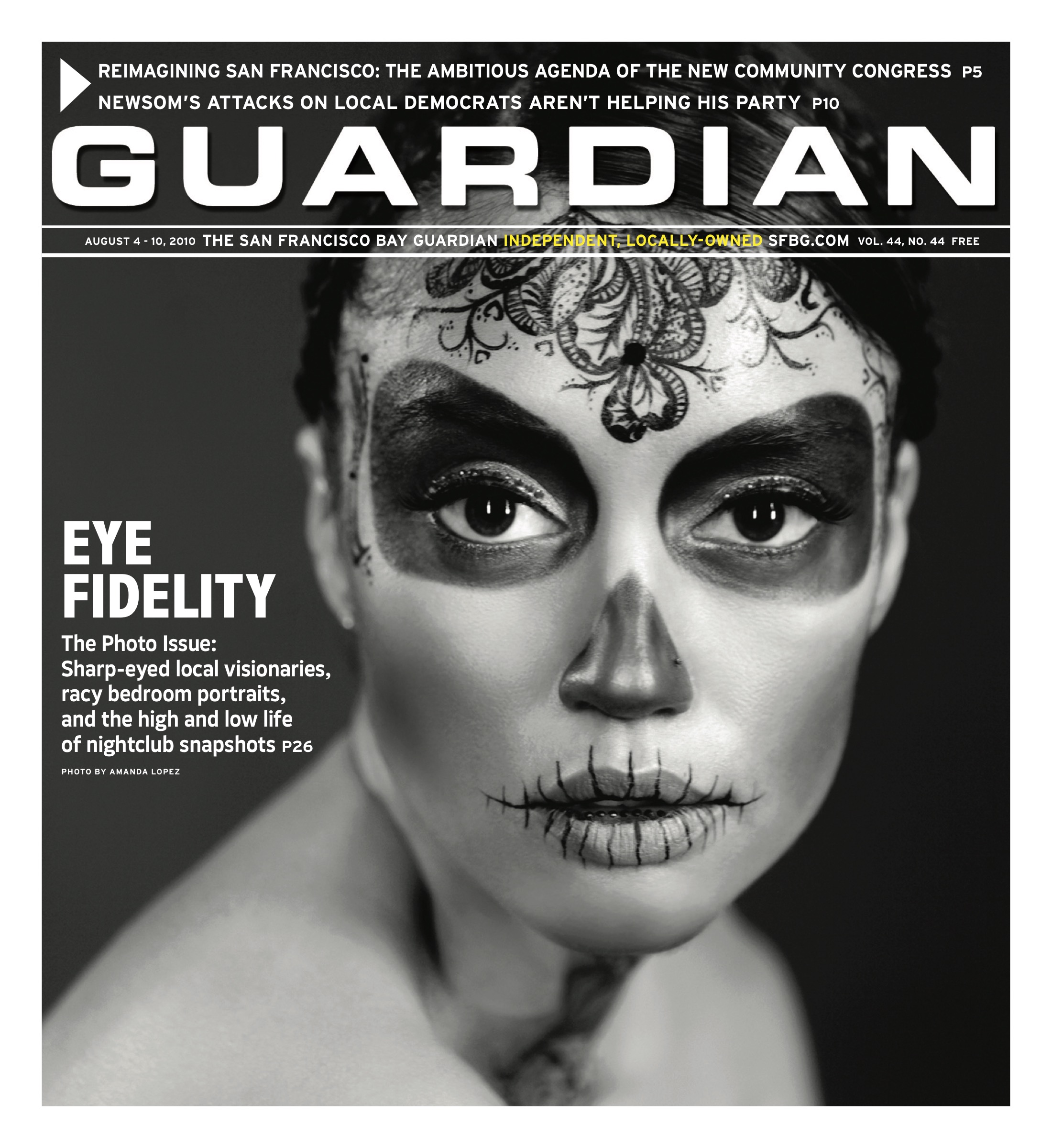

The Photo Issue: Dean Dempsey

0

SFBG What’s it’s like stepping in front of your camera?
Dean Dempsey I don’t have any strong feelings about it, perhaps because I know there is so much post-production involved. I certainly behave as though I am being watched, or surveyed. A bit like what John Berger said, “Women watch themselves being looked at,” and although I’m not a biological woman that rings true for me, and perhaps for many artists who turn the camera onto themselves.There is a spectacle element involved.

SFBG How about the process of being a different person or character or being? What does it feel like — is it experimental, psychological, revelatory, any or all of the above?
DD Sometimes I surprise myself in how unexperimental it feels. I’ve never really been a fan of experiment, perhaps because I feel that it suggests a sort of aimlessness. I do, however, feel it is playful, and there certainly is a revelatory aspect to it. Psychologically, I’m constantly having to imagine the presence of characters that aren’t in fact there — especially for the multiple self-composites. I have to imagine eye-contact, gestures, and conversation. In the process, it doesn’t make any sense. I just look a bit nutty as I pose in various positions to invent relationships with characters who are not immediately present. In this respect, there again is the resurfacing of “phantom.”

SFBG Has it taken you in directions or resulted in visions you didn’t anticipate? I ask this because your series’ seem to inform each other, and in a manner that doesn’t seem predictable, even if the realized images are obviously very carefully composed.

DD The playful,psychological or phantom? Or all three?

SFBG All three. Let’s be expansive, for now.
DD The series “You, Me and the Other” has really informed the bulk of these new series’, “Fragmentations” and “Artifice.” At first I was interested in a more literal interpretation of otherness and spectacle. I wanted, and continue to want, to explore notions of belonging while questioning the ways in which ideas of normality are constructed.
But as I continued with those images, which were about the multiple and theatrical side of my work, I began to explore a little deeper why I was doing them — why I was so invested in the gaze. I’m not at all interested in making “identity art,” but I can’t deny the pivotal ways childhood has informed my practice. So from having a whole lot of myself within a single frame, there has been a complete implosion in “Fragmentations.” That erasure takes place not just to anatomically dismember my characters, but to emphasise what is left over. There is a sort of implosion in “Artifice” as well, as the characters embody something more subhuman and alienated, making it more difficult to encapsulate into specific meanings, in a way.

SFBG What kinds of reactions have you encountered to “Artifice,” and in turn to “Fragmentations”? To me, these series’ manage to be interrelated, though in a surface sense “Artifice” is quite brash and overtly performative and imaginative, while ‘Fragmentations’ is more elliptical.
DD They are very much interrelated. I’ve been working on both series’ at the same time for quite some time now. There are images in each body of work that I haven’t shown anybody because there are other images that have to come first. But yes, on the surface, there is a difference. Conceptually, they are both informed by personal biographical history and each series investigates methods of spectacle and exclusion. Although with a difference in general aesthetic, each series is about the pieces that complete us; the pieces of our body, our process, our gender – pieces of social fabric.

SFBG Biographical history is present in your work in a variety of forms or absences. How has your family responded to your photography, and in what ways might you feel a familial influence in making an image or a series?
DD It’s funny, because the only familial influence with my work is more through a variety of absences — the absence of a father, the absence of a visible Mexican identity, the absence of siblings, and so on. I met my father in 2005, just a few months before I was about to move to San Francisco to attend college. And just two years after that he was hit by a Union Pacific train, losing two limbs. So again, there is a return of absence (this time anatomical) that emerges in my photoworks. He’s been very cooperative in letting me take portraits of him, even at the site of the accident. I even showed him my reenactments of him and he asked, “I don’t remember you taking those of me, when was that?” A lifetime of transiency and drug use hasn’t made him the sharpest of knives, but it certainly has made him an interesting subject.
It was only yesterday I told my mother about it. It took over 3 years for me to process and even begin to find the language to articulate how I felt. It wasn’t so much a secret, I just didn’t know how to say it. The details of his accident continue to reveal themselves in my work, even if they are depersonalized, so I knew it was something I couldn’t avoid much longer. She hasn’t seen him in 20 years. I recorded the conversation, maybe I’ll use it for This American Life. It really is a good story.

SFBG In a different sense, just as there is absence “present” in your photography, there’s also a multiplicity of self. Does that come naturally in relation to your personality? I don’t mean this in an MPD sense, but rather do you feel a creative urge to perform and discover things through performance?
DD It must come naturally because that is in some ways a more difficult part of my process to locate. I have an idea and I know what I need, or don’t need, to materialize it. But as my various bodies of work develop and expand, I’ve become more aware of their shared concept as well as what sets them apart. It is a constant discovery. Performance is fundamental in my work, whether in the act or in the idea behind the image. My content addresses performance in relationship to the constructs of gender and race, and notions of (dis)belonging. Everybody is always performing, even when there isn’t an audience to see it. So in this way, the performer becomes its spectator. By digitally inserting myself multiple times, or even by dismembering the figures I emobody, I’m envisioning a completed project. I’m thinking of how I will see myself, or the people I perform. Not to reference Berger again, but I’m watching myself being looked at.

SFBG What drew you to photography, and what photographic works have had the strongest impact on you in life?
DD I think I was, at first, most allured by the deceptive nature of photography. The medium is often falsely attributed as being very honest and undiscerning, yet a photo (and the photographer) always omits something from the frame. They deem what is worthy enough to be documented, and they choose what is seen. And I won’t begin to mention how Photoshop and image editing software furthers this point.
A good image, or least one I personally find most engaging, is one that suggests a larger narrative but refuses to explain itself. I call them little “cinematic babies,” because these sorts of pictures act as a still, forcing us to image what is happening before and after that with which we can see. What good is a piece of art, or anything, without the implication of its audience? Without outside interest it folds. But these are all my personal opinions, I could care less about constituting what is universally “good,” I’ll leave that to the bigger-headed.
Regarding influences, it’s always a tough question for me. I tend to jump around a lot, but I’ve always enjoyed folks like Carrie Mae Weems, Andreas Gursky, and even sculptural and installation artists like Santiago Serra and Sarah Lucas.

SFBG Ah, and now we segue to the inevitable question — do you have any interest in making films?
DD Yes! It’s funny because I feel sometime these photoworks began as studies for films. Beyond the technical aspect of putting a film or video together, there is still a conceptual formula of sorts that is in the works. But working more with the moving image is definitely in my horizon, I’d say before the end of this year.

Our Weekly Picks: August 4-10, 2010

0

WEDNESDAY 4

MUSIC

Blondie

Emerging from the early punk and new wave scenes of New York City in the mid-1970s, Blondie incorporated a variety of musical styles into its overall sound, helping to set itself apart from its contemporaries and creating a following that perseveres today. It’s hard to believe that firebrand singer Deborah Harry is now 65, but she, along with founding members Chris Stein and Clem Burke, continues to powerfully rollick through the band’s impressive back catalog of favorites such as “Call Me,” “Heart of Glass,” “Atomic,” and its cover of The Paragons’ “The Tide Is High.” With Gorvette (featuring Nikki Corvette alongside Amy Gore of the Gore Gore Girls). (Sean McCourt)

With Gorvette

8 p.m., $55

Fillmore

1805 Geary, SF

www.thefillmore.com


COMEDY

Tim Lee

There are many career paths available to someone with an advanced degree in biology, but standup comedy usually isn’t one of them. That explains the immediate appeal of Tim Lee, a PhD from UC Davis who’s made his name mining the rich comedic veins of fossil records and molecular geometry. This is actually way better than it sounds — think of the guy as your witty high school science teacher writ large. His use of PowerPoint slides makes him a kind of Demetri Martin for the un-stoned. But what ultimately sets Lee apart is his undeniably charming wonkiness. Sure, you’ve heard a million Larry King jokes, but have you heard one that manages to work in the Cambrian explosion? (Zach Ritter)

8 p.m., $20

Punch Line Comedy Club

444 Battery, SF

(415) 397-7573

www.punchlinecomedyclub.com


THURSDAY 5


DANCE/THEATER

CounterPULSE artists-in-residence

What is feminine? Answering such a broad and loaded question undoubtedly generates some anxiety. Not so for CounterPULSE’s summer artists-in-residence, Laura Arrington and Jesse Hewit. Merging dance and theater, these two emerging choreographers aren’t afraid to dive head-first into notions of sex, gender, and authenticity. Their shared showcase at CounterPULSE (a nonprofit community performance space) features Arrington’s latest piece, Hot Wings — which centers around four women in a cardboard castle — and Hewit’s newest creation, Tell Them That You Saw Me, a work with everything from lipstick and large tanks of water to sacred hymns and sex stories. (Katie Gaydos)

Thurs/5-Sat/7, 8 p.m.; Sun/8, 3 p.m., $15–$20

CounterPULSE

1310 Mission, SF

(415) 626-2060

http://counterpulse.org


THEATER

Sex Tapes for Seniors

If you have a comfortable relationship founded on bridging the generational gap, Sex Tapes For Seniors is a show you can see with your grandparents. They can relate to, or at least chuckle at, the plight of old folks clinging to their libidos before slipping into senility, and you can appreciate it because this is your future. Yet as Mario Cossa –– playwright, director, and choreographer –– fills your imagination, you might realize you don’t want to be sitting with grandma and grandpa after all. Upon retiring, a group of seniors starts making their own instructional sex tapes and thus, the locals get all verklempt. In the words of the late TV series Party Down, this musical is “seniorlicious!” (Lattanzio)

Through Aug. 22

Previews tonight, 8 p.m.

Runs Fri.–Sat., 8 p.m.; Sun, 2 p.m., $20–$40

Victoria Theater

2961 16th St, SF

(415) 863-7576

www.stfsproductions.com


EVENT

“Exploratorium After Dark: Nomadic Communities”

As thousands of Bay Area residents prepare for their annual pilgrimage to the Black Rock Desert for Burning Man, the monthly Exploratorium After Dark series takes on the topic of nomadic communities. “While true nomads are rare in industrialized countries, hybrids of whimsical and economically inventive itinerancies are evolving here in the Bay Area,” notes the program. Burning Man board member and chief city builder Harley Dubois will discuss the evolution of Black Rock City while attendees have the chance to nosh on one of the blue plate specials at the mobile Dust City Diner, a project developed by Burning Man artists that brings the ’40s-style diner experience to the most random spots. Exploratorium biologist Karen Kalumuck will also talk about nomads from the animal world and how they’ve come to live and thrive in the Bay Area, with interactive exhibits. (Steven T. Jones)

6–10 p.m., $15

Exploratorium

3601 Lyon, SF

(415) 561-0360

www.exploratorium.edu


FRIDAY 6


THEATER

The Norman Conquests

The Shotgun Players invade the Ashby Stage with British playwright Alan Ayckbourn’s The Norman Conquests, a triptych of farce, lunacy, and suburban malaise. The Conquests feature three freestanding yet complementary plays set in separate rooms of a house revolving around the same characters: Table Manners happens in the dining room, Living Together in the living room, and finally Round and Round the Garden in the … well, you get it. In 2009, a revival garnered one Tony and five nominations. A three-play package affords you many chances to catch each, but on Aug. 29 and Sept. 5, you can see them all in one marathon. (Lattanzio)

Through Sept. 5

Performance times vary, $20–$25 (three-play package, $50)

Ashby Stage

1901 Ashby, Berk.

(510) 841-6500

www.shotgunplayers.org


VISUAL ART

“Gangsters, Guns, and Floozies”

The cinematic microverse populated by shamuses and femmes fatales is fodder for plenty of critical writing as well as contemporary neo-noir film, but a gallery of visual art inspired by the form stands to capture the shadows from a different angle. Nicole Ferrara’s works depict harsh gray moments in time, with the titular floozies, guns, and gangsters as primary subjects. The immediacy of the faces on Ferrara’s characters is enough to convey the continued relevance of this decades-old aesthetic. Whether painted or caught on film, the desperate acts of desperate people are riveting and revealing. Ferrara also paints B-movie inspired art, apparently drawing inspiration from the alternate visual reality presented in such films. (Sam Stander)

Through Aug. 31

Reception 6 p.m., free

Hive Gallery

301 Jefferson, Oakl.

www.hivestudios.org/hive_gallery.html


VISUAL ART

“Por Skunkey”

Big Umbrella Studios is a cooperative gallery and a community of artists, and with them comes DIY-chic culture to the Divisadero Corridor. “Por Skunkey” brings together the artists-in-residence –– including the abstract, gestural paintings of Umbrella co-owner Chad Kipfer –– along with a few guests to pay tribute to Skunkey, also known as canine-in-residence, also known as Mama Skunk. And if you’d like some oil spill on the side of your oil painting, then under the Umbrella you’ll find artist responses to this summer’s BP disaster. Here’s hoping Skunkey herself shows up, so be nice and pet the pooch. When you’re good to Mama, Mama’s good to you. (Lattanzio)

Through Aug. 31

7 p.m., free

Big Umbrella Gallery

906 1/2 Divisadero, SF

(415) 359-9211

www.bigumbrellastudios.com


SATURDAY 7


MUSIC/PERFORMANCE

Slammin’ All-Body Band

Clap, snap, stomp, slap, step, tap. Try it and you’ll see it’s easy to make sound with your body. Making music though, proves far more difficult. Keith Terry — a trained percussionist and drummer for the original Jazz Tap Ensemble — has mastered what he terms body music. He’s been clapping and stomping his way through awe-inspiring kinetic soundtracks for more than 30 years. In 2008 he founded the International Body Music Festival out of his nonprofit Oakland arts organization, Crosspulse. This benefit show with Slammin’ All-Body Band — plus guest dancers and renowned hambone artist Derique McGee — highlights the artists before they head off to the Lincoln Center Out-of-Doors Festival. Proceeds help fund the group’s NYC debut. (Gaydos)

8 p.m., $25–$100

La Peña Cultural Center

3105 Shattuck, Berk.

(510) 849-2568

www.crosspulse.com


FILM/PERFORMANCE

“Night of 1,000 Showgirls

Can you believe it’s been 15 years since Showgirls was first released? The crowning achievement in a directing career that also included 1997’s Starship Troopers, 1992’s Basic Instinct, 1990’s Total Recall, and 1987’s RoboCop, Paul Verhoeven’s trashiest, most glorious film is, by extension, probably the trashiest, most glorious film of all time. Peaches Christ (now a filmmaker in her own right, thanks to alter ego Joshua Grannell’s All About Evil) hosts “Night of 1,000 Showgirls,” maybe the biggest tribute the tit-tastic classic has ever enjoyed. In addition to a Goddessthemed preshow, there’ll be a contest for Nomi Malone look-alikes — don’t forget the nails! And don’t eat all the chips … or the doggie chow. (Cheryl Eddy)

8 p.m., $18

Castro Theatre

429 Castro, SF

(415) 621-6120

www.peacheschrist.com


SUNDAY 8

DANCE

San Francisco Ballet

An afternoon at the ballet doesn’t come cheap. Rarely ever, free. But thanks to the annual performing series Stern Grove Festival, park-goers can see one of the nation’s top ballet companies, San Francisco Ballet, for a grand total of zero dollars. In its one and only Bay Area summer appearance, SFB performs Christopher Wheeldon’s romantic pas de deux, After the Rain; Mark Morris’ playful ensemble piece, Sandpaper Ballet; the classic pas de deux from act three of Petipa’s Don Quixote; and the neoclassical work Prism by SFB artistic director Helgi Tomasson. So skip out on Dolores Park for one Sunday this summer, trade in your tall can for a bottle of wine, and head to Stern Grove for a tutu-filled midsummer afternoon. (Gaydos)

2 p.m., free

Sigmund Stern Grove

19th Ave. and Sloat, SF

www.sterngrove.org


MONDAY 9


EVENT

“The Evolving Landscape of Local Journalism”

In the face of the ever more hectic state of print journalism, as exemplified by the recent strife at the San Francisco Chronicle and the disappearance of other local publications, new modes of reporting are cropping up to fill the need for engaged investigative coverage. Tonight at the Booksmith, Lisa Frazier from the recently opened Bay Citizen, SF Public Press’s Michael Stoll, and Mission Local’s Lydia Chavez discuss the future of local journalism as a significant alternative to our standard methods of news delivery and consumption. If these three aren’t enough San Francisco journalistic players for you, the panel discussion will be moderated by Christin Evans, co-owner of the Booksmith and a contributor to the Huffington Post. (Stander)

7:30 p.m., free

Booksmith

1644 Haight, SF

(415) 863-8688

www.booksmith.com


TUESDAY 10

MUSIC

Weird Al Yankovic

Must we seek to encapsulate Weird Al Yankovic in 130 words or less? Some would call this treason against the United States of Awesome. Yankovic has been marshaling the ludricrousness of pop culture music into parodies no less farcical since 1979 — and his campaign (surprise!) continues to this day. Certainly, “Eat It,” “I Love Rocky Road,” and “Amish Paradise” — the track that incurred the wrath of Coolio at the height of his celebrity powers — were classics seared into our souls like the brand on a cow’s behind. But rest assured of the future’s brightness by his recent offerings, like an ode to that modern day zeitgeist, “Craigslist.” (Caitlin Donohue)

8 p.m., $36-50

Warfield

982 Market, SF

1-800-745-3000

www.thewarfieldtheatre.com 

The Guardian listings deadline is two weeks prior to our Wednesday publication date. To submit an item for consideration, please include the title of the event, a brief description of the event, date and time, venue name, street address (listing cross streets only isn’t sufficient), city, telephone number readers can call for more information, telephone number for media, and admission costs. Send information to Listings, the Guardian Building, 135 Mississippi St., SF, CA 94107; fax to (415) 487-2506; or e-mail (paste press release into e-mail body — no text attachments, please) to listings@sfbg.com. We cannot guarantee the return of photos, but enclosing an SASE helps. Digital photos may be submitted in jpeg format; the image must be at least 240 dpi and four inches by six inches in size. We regret we cannot accept listings over the phone.

The kids aren’t alright

1

arts@sfbg.com

FILM The Kids Are Alright isn’t the only film this summer that subtly skewers the suburban upper-middle class by following a seemingly well-adjusted family as they’re thrown into crisis when a shadowy father figure attempts to enter their orbit. Only in the case of Todd Solondz’s Life During Wartime, instead of a sperm donor, Dad is a convicted child molester.

A quasi-sequel to 1998’s Happiness, Life picks up 10 years later to survey the still-damaged Jordan sisters. After discovering that her husband Allen (Michael Kenneth Williams) is still making sexually harassing phone calls, mousy Joy (squeaky-voiced British actress Shirley Henderson) flees to Florida, where her older sister Trish (Allison Janney) has attempted to start a new life for herself and her children. Oldest Billy (Chris Marquette) is now a bitter college student, and youngest son Timmy (Dylan Riley Snyder) still doesn’t know the horrible truth about his father Bill (Ciarán Hinds), who has just been released from prison. Third sister Helen (Ally Sheedy), has had success in Hollywood, but still feels victimized by her family.

Despite the entirely new cast, happiness remains just as elusive as before. Pleasure, when it can be found, is fleeting. Characters’ awkward conversations with each other inevitably sputter and stall, and even the best intentions are no measure against disaster. Solondz may be a scathing observer, but he is not above being sympathetic when its called for. Neither does he gloss over the serious questions — what are the limits of forgiveness? When is forgetting necessary? — Life grabbles with, something that was quite clear when I talked with the affable Solondz in his San Francisco hotel room.

SFBG Why did you decide to return to these characters?

Todd Solondz When I finished Happiness, I never imagined I would. But it just shows that my imagination wasn’t so fertile, because about 10 years later I wrote the first scene of Life During Wartime and I liked what I had written. Also, knowing that I could recast the movie freed me up to have fun and get at things I hadn’t gotten before in quite the same way.

SFBG Diverse casting is another hallmark of yours, and you always get such strong performances from your actors. Do you have specific people in mind once you’ve written the script?

TS I like to shake it up and try out different people. For this film, I knew I wanted Ally Sheedy but I wasn’t sure I was going to be able to get her. Almost everybody has read everything for my movies because I don’t have much in the way of rehearsal. Usually the audition is the rehearsal since we usually can’t afford anything more.

SFBG Your films elicit this queasy response. The audience’s laughter always seems nervous. How do you find a balance between humor and sadness?

TS It’s a moral challenge. As an audience member, you’re highly attuned to the laughter you like and the laughter you don’t like, and it becomes a moral decision — laughing or not laughing. My movies are comedies, but terribly sad comedies.

SFBG Life During Wartime interrogates the possibility of “forgiving and forgetting.” Yet you’re always careful not to condemn your characters too harshly, no matter how antisocial or appalling their behavior.

TS Yes, but you have to be careful. I have no sympathy for [Hinds’ character] Bill Maplewood or someone who could commit those crimes, but he is tragic since he also loved his son. People want to embrace humanity or love mankind, but those are abstractions so they don’t really mean anything. Rather, to what extent can you allow someone like Bill Maplewood into that embrace of humanity? To me pedophilia has no inherent interest. It’s how it serves as a metaphor for that which is most demonized, ostracized, and feared that interests me. I think in this country more people would rather have dinner with Osama bin Laden than with Bill Maplewood.

SFBG Can you divulge anything about the film you’re working on now?

TS The title is Dark Horse, and all I can say is that there is no child molestation, rape, or masturbation in it, so I know what’s left. But we’ll see how marketable it is.

LIFE DURING WARTIME opens Fri/6 in Bay Area theaters.

The man, the myth, the legend

0

arts@sfbg.com

FILM When Dennis Hopper died May 29 from prostate cancer, many obituaries — usually a place for polite, laundry-listed achievements — included unusually unflattering observations calling Hopper “difficult,” “unpredictable,” even “a pain in the ass.” It takes a lot to merit such treatment precisely when people are customarily at their most hypocritically respectful. But Hopper had about 55 years to drive directors, fellow actors, wives, friends, and sundry crazy.

The wild-man tendencies that made him a longtime hipster fan favorite also got him sued, blacklisted, and nearly killed. (An incensed John Wayne reportedly chased him with a gun on the set of 1969’s True Grit, likely not an isolated incident.) He burned though five marriages — one to The Mamas & The Papas’ Michelle Phillips lasting eight days — and was divorcing his longest-lasting latest wife on his deathbed, solely (she says) to disinherit her.

After years of world-class alcohol and drug abuse, he cleaned up in the early 1980s. At which point the hippie rebellion icon from Easy Rider (1969) became a Reagan Republican, dumping on the counterculture lifestyle he’d lived and promoted. Yet he remained a major avant-garde art collector, as well as a modernist painter and photographer of some repute. What’s not to like? Probably everything, given close proximity. Yet from a safe distance, Hopper somehow remained dead cool.

The Castro Theatre pays posthumous tribute with “Dennis Hopper: Misfits and Outsiders.” The five-day mini-retrospective strictly hits popular highlights: Rebel Without a Cause (1955) and Giant (1956), in which he appeared with James Dean (whose tic-ridden Method acting and unprofessional work habits were a major bad influence); the very dated Easy Rider, his hugely influential directorial debut; plus 1988’s Colors, the Sean Penn cops-vs.-gangs drama that commercially peaked a more mainstream return to the director’s chair.

There are also three disparate 1986 features that reignited his acting career: as harrowingly crazy Frank Booth in Blue Velvet (a role he told David Lynch he had to play because “it’s me”); the barely-less-freakish drug dealer in River’s Edge (facing off against spiritual heir Crispin Glover); and as a town drunk redeemed in inspirational sports drama Hoosiers. That last, natch, snagged his Oscar nomination.

Hopper undertook more villains in films like Speed (1994), Waterworld (1995), and Land of the Dead (2005). Plus recurring TV roles (24, Crash), voice work (videogames, cartoons) and just about any other job that fell into his lap, good or ill.

The Dennis Hopper retrospective I’d really like to see might, admittedly, roll tumbleweeds down the Castro’s aisles. But it would do the man’s crazier side, and craziest decade, justice. For during the 1970s, Hopper was basically a Hollywood outcast, roaming the globe in shambolic distress, choosing odd projects to bedevil. Every last one is interesting, eccentric, or simply unknowable.

His directorial career imploded in 1971 with endlessly delayed Easy Rider “follow-up” The Last Movie, possibly still the most experimental feature ever released by a major studio (an appalled MGM). Hopper then fell into French obscurities like 1972’s Crush Proof (costarring Pierre Clémenti … and Bo Diddley) and 1978’s Flesh Color (Veruschka and Bianca Jagger!) Good luck finding those.

He appeared in Orson Welles’ aborted final feature The Other Side of the Wind. In 1977 he played an unraveling Vietnam vet in pal Henry Jaglom’s still-most-serious first feature Tracks, then drove everyone nuts on-set as 19th-century Australian folk hero Mad Dog Morgan in Philippe Mora’s underrated 1976 film of that name. (Unfortunately it’s hard to see save in severely cut versions.)

He had a rare international success as a berserker edition of Patricia Highsmith’s sociopath Ripley in Wim Wenders’ breakout existential noir The American Friend (1977). Hopper sprang back into U.S. mainstream consciousness as another druggy nutjob — last stop before Brando’s black hole — in 1979’s Apocalypse Now. In all these he is a combustive element in a mad universe.

Equally if not more revealing are two little-known features also made on the cusp of the ’80s. Silvio Narizzano — a Canadian incongruously best known for Swinging London classic Georgy Girl (1966) — directed the incredible surreal tragicomedy Bloodbath, with Hopper as pathetic hippie-trail junkie “Chicken” and erstwhile Hollywood glamazon Carroll Baker as retired sex goddess “Treasure.” Both tempt doom, and get it, in a Spanish village that only tolerates Western decadence and wealth so far. Eventually Buñuel-type heavy symbolism requires a climactic slaughter both martyring and morally corrective. It’s amazing that a parable so thoroughly anti-bourgeoisie yet ruling-class paranoid — in short, so 1970 — was made as late as 1979.

Hopper often seems utterly mad, or at least mega-wasted, in that delirious film. Ditto 1980’s comparatively (barely) sober Out of the Blue, on which he was hired as actor but took over as director when the original one was fired. He plays a total fuckup just released from prison (having committed multiple manslaughter in a horrific school bus accident while drunk) who reunites with his drug-addicted wife (Sharon Farrell) and supremely alienated punk teen daughter CB (the extraordinary Linda Manz, from 1978’s Days of Heaven).

Out of the Blue offers genuinely shocking family dysfunction, as well as a little-heralded but great first-generation U.S. punk depiction. (Which nonetheless threads bits from the acoustic half of Hopper friend Neil Young’s Rust Never Sleeps through an eclectic soundtrack.) It’s terrific, exhilarating, arbitrary, and merciless. Apparently public domain, you can find it in DVD discount bins. Likewise Bloodbath, never released to DVD, can be had on used VHS for a couple of bucks online.

Those few dollars will get you closer to Hopper’s boastfully self-loathing perversity than anything on the Castro schedule. He might have been hell to work with — an easy rider who rode everyone else’s nerves raw — but the public expressions of his interior mess were always fun to watch.

DENNIS HOPPER: MISFITS AND OUTSIDERS

Wed/4-Fri/6 and Sun/8, $7.50–$10

Castro Theatre

429 Castro, SF

(415) 621-6120

www.castrotheatre.com


Rep Clock

0

Schedules are for Wed/4–Tues/10 except where noted. Director and year are given when available. Double and triple features are marked with a •. All times are p.m. unless otherwise specified.

ARTISTS’ TELEVISION ACCESS 992 Valencia, SF; www.atasite.org. $6. “ANSWER Coalition Film Festival:” Maquilapolis (2006), Sat, 7; 9 Star Hotel (2007), Sat, 8:30; Cuba: An African Odyssey: Part One, Congo and Guinea Bissou (2007), Sun, 5; Part Two, Angola (2007), Sun, 7:30.

BRIDGE 3010 Geary, SF; (415) 668-6384. $10. “Rocksploitation with Citizen Midnight:” American Pop (Bakshi, 1981), Sat, midnight.

CASTRO 429 Castro, SF; (415) 621-6120, www.castrotheatre.com. $7.50-10. “Dennis Hopper: Misfits and Outsiders:” •Easy Rider (Hopper, 1969), Wed, 2:40, 7, and Colors (Hopper, 1988), Wed, 4:35, 8:55; •Blue Velvet (Lynch, 1986), Thurs, 2:30, 7, and River’s Edge (Hunter, 1986), Thurs, 4:55, 9:20; •Rebel Without a Cause (Ray, 1955), Fri, 2:30, 7, and Hoosiers (Anspaugh, 1986), Fri, 4:40, 9:10; Giant (Stevens, 1956), Sun, 2, 7. “Peaches Christ Presents: A Night of 1,000 Showgirls:” Showgirls (Verhoeven, 1995), Sat, 8.

CHRISTOPHER B. SMITH RAFAEL FILM CENTER 1118 Fourth St, San Rafael; (415) 454-1222, www.cafilm.org. $6.50-10.25. Anton Chekhov’s The Duel (Koshashvili, 2010), call for dates and times. The Girl Who Played With Fire (Alfredson, 2009), call for dates and times. The Girl With the Dragon Tattoo (Oplev, 2009), call for dates and times. Joan Rivers: A Piece of Work (Stern and Sundberg, 2010), Wed-Thurs, call for times. Let It Rain (Jaoui, 2010), call for dates and times. “San Francisco Opera Grand Opera Cinema Series:” “Don Giovanni by Amadeus Mozart,” Thurs, 7. San Francisco Jewish Film Festival, Sat-Mon. See film listings.

“FILM NIGHT IN THE PARK” This week: Dolores Park, Dolores and 19th St, SF; (415) 272-2756, www.filmnight.org. Donations accepted. Ferris Bueller’s Day Off (Hughes, 1986), Sat, 8.

HUMANIST HALL 390 27th St, Oakl; www.humanisthall.org. $5. Woman in the Moon (Lang, 1929), Wed, 7:30.

MANDELA VILLAGE ARTS CENTER 1357 Fifth St, Oakl; www.brainwashm.com. $10. “16th Annual Brainwash Drive-In Bike-In Walk-In Movie Festival,” independent films from around the world, Sat and Aug 13-14, 9pm.

MECHANICS’ INSTITUTE 57 Post, SF; (415) 393-0100 (reservations required). $10. “CinemaLit: Musicals With a Message:” Hair (Forman, 1979), Fri, 6.

PACIFIC FILM ARCHIVE 2575 Bancroft, Berk; (510) 642-5249, www.bampfa.berkeley.edu. $5.50-9.50. “Akira Kurosawa Centennial:” The Idiot (1951), Wed, 7; High and Low (1963), Sat, 5:30. “A Theater Near You:” Hadewijch (Dumont, 2009), Thurs, 7; The River (Renoir, 1951), Sun, 7. “Criminal Minds: True Crime Cinema:” Compulsion (Fleischer, 1959), Fri, 7; Boxcar Bertha (Scorsese, 1972), Fri, 9:10. “Modernist Master: The Cinema of Francesco Rosi:” Lucky Luciano (1973), Sat, 8:10; Just Another War (1970), Sun, 5.

RED VIC 1727 Haight, SF; (415) 668-3994. $6-9. Dead Man (Jarmusch, 1996), Wed, 2, 7, 9:25. Calvin Marshall (Lundgren, 2010), Thurs, 7:15, 9:15. Exit Through the Gift Shop (Banksy, 2010), Fri-Mon, 7:15, 9:15 (also Sat-Sun, 2; Sun, 4). The Matter of Everything (Lappano, 2009), Tues, 7, 9:15.

ROXIE 3117 and 3125 16th St, SF; (415) 863-1087, www.roxie.com. $5-11.50. The Cremaster Cycle (Barney, 1995-2002) plus “De Lama Lamina” (Barney, 2004), Wed-Thurs. Check web site for schedule. “ATX Down and Dirty Film Tour:” Total Badass (Ray, 2010), with “CrashToons,” Wed, 7; Hell on Wheels (Ray, 2007), with “CrashToons,” Wed, 9:15.

On the Cheap listings

0

On the Cheap listings are compiled by Paula Connelly. Submit items for the listings at listings@sfbg.com.

WEDNESDAY 4

Psychedelic Bicycle Ride Club Six, 60 6th St., SF; (415) 863-1221. 5pm, $10-$20. Tune in to your cosmic consciousness at this art show starting at 5pm, featuring Stanley Mouse, Tripp Shealy, Chor Boogie, Erin Cadigan, and more followed by transcendent musical performances starting at 9pm by DJ Logic, Abstract Rude, Citizen Ten, DJ Coopdville, and more.

THURSDAY 5

Craft Lab Museum of Craft and Folk Art, 51 Yerba Buena Lane, SF; (415) 227-4888. 6pm, $5. Explore your inner book worm at this craft bar where artists Julie Schneider, Kelly Ball, Jen Hewett, and Maren Salomon will provide you with easy-to-learn bookmaking projects using found and recycled materials. The Loin SF will also be on hand to walk you through a silk-screening project or you can join in the Stitch ‘n Bitch area for some knitting and crocheting.

Sister Corita Silkscreen Workshop Levi’s Workshop, 580 Valencia, SF; www.workshops.levi.com. 3pm, free. Attend this workshop with artist Aaron Rose, where attendees are invited to create a silkscreen composition using the imagery of Sister Corita, an iconic California artist from the 1960’s and 70’s.

SATURDAY 7

Aloha Festival Presidio Parade Grounds, Lincoln at Anza, SF; www.pica-org.org. Sat.-Sun. 10am-5pm, free. Get a taste of Pacific Island culture and life at this two day festival featuring traditional and contemporary hula, slack key guitar, Tahitian dance, ukulele music, Hawaiian music, chanting, and more performances. There will also be arts and crafts vendors, island cuisine, educational exhibits and workshops, and more. This is an alcohol free event.

American Indian Market and Powwow Julian between 14th St. and 15th St., SF; www.friendshiphousesf.org. 10am-6pm, free. Celebrate the diversity and cultures represented in the American Indian community at his market and powwow featuring American Indian arts and crafts, powwow dancers, drum groups, educational booths, Indian tacos and refreshments, teepee storytelling sessions, carnival games for kids, and more.

Birding for Everyone Meet at the main gate, Strybing Arboretum, San Francisco Botanical Garden, 9th Ave. at Lincoln, SF; www.sfnature.org. 10am, $10. Take a leisurely naturalist-led walk through the micro-habitats of the San Francisco Botanical Garden in search of the California Quail and other birds that nest there.

Gem and Mineral Show San Francisco County Fair Building, Golden Gate Park, 9th Ave. at Lincoln, SF; (415) 564-4230. Sat. 10am-6pm, Sun. 10am-5pm; $7. Watch jade carving demonstrations, wire wrapping, chain maille weaving, bead stringing, and more demonstrations, exhibits of hand-crafted jewelry, gemstones, carvings, and more, and vendors selling gems, minerals, fossils, crystals, beads, jewelry, and more.

Robert Philipson Magnet, 4122 18th St., SF; (415) 581-1600. 7pm, free. Attend this poetry reading with author Robert Philipson, author of Very Good-Looking Seeks Same: Gay Profiles in Search of Love, featuring live jazz, wine, and snacks.

Progressive Film Festival ATA, 992 Valencia, SF; (415) 821-6545. Sat. 7pm, Sun. 5pm; $6 each screening. For two days, ATA will be showing films addressing the struggles of people from around the world. Showing Sat. at 7pm, Maquilapolis (City of Factories) documents the struggle of women workers in Tijuana, and at 8:30pm, 9 Star Hotel takes a look at Palestinian workers struggling for survival. Sun. to feature a two part movie, Cuba: An African Odyssey, documenting Cuba’s role in the African Liberation struggles of the 1960’s and 70’s.

Summer Gardening Fair San Francisco Botanical Garden, Golden Gate Park, 9th Ave. at Lincoln, SF; (415) 661-1316. Postpone your Saturday chores and go learn more about plants and gardening from representatives of local horticultural and conservation organizations. Join a local plant club, buy plants and plant products, or enjoy activities and demonstrations.

BAY AREA

Brainwash Movie Festival Mandela Village Arts Center, 1357 5th St., Oakl.; www.brainwashm.com. 9pm, $10. Attend the kickoff to this drive-on, bike-in, walk-in independent movie festival featuring the short With Anchovies…Without Mamma followed by Dynamite Swine. The festival to continue Fri/13 and Sat/14 with a full line up of indie films.

“Once Upon A Time, Happily Ever After…” All around Lake Merritt, pick up audio equipment at Rotary Nature Center, 553 Bellevue, Oakl.; www.onceuponatime-happilyeverafter.com. All day, through Nov. 14th; free. Take a self-guided audio tour designed by local artist Scott Oliver, local photographer Rachel Heath, and others that tells the intimate history of Lake Merritt and some of it’s most familiar and peculiar features.

SUNDAY 8

San Francisco Theater Festival Various locations, visit www.sftheaterfestival.org for more info. 11am-5pm, free. Get a taste of the Bay Area’s culturally and artistically-varied theater groups at this one-day festival showcasing 120 shows on 14 stages, including shows created specifically for kids. Participating theater groups to include Beach Blanket Babylon, Lamplighters Musical Theatre, The Big Lebowski…Over the Line!, Piano Fight, We Players, PlayGround, Ray of Light Theatre, and more.

Film listings

0

Film listings are edited by Cheryl Eddy. Reviewers are Kimberly Chun, Michelle Devereaux, Max Goldberg, Dennis Harvey, Johnny Ray Huston, Louis Peitzman, Lynn Rapoport, Ben Richardson, and Matt Sussman. For rep house showtimes, see Rep Clock. For first-run showtimes, see Movie Guide.

SAN FRANCISCO JEWISH FILM FESTIVAL

The 30th San Francisco Jewish Film Festival runs through Mon/9 at the Roda Theatre, 2025 Addison, Berk; Christopher B. Smith Rafael Film Center, 118 Fourth St, San Rafael; and the Jewish Community Center of San Francisco, 3200 California, SF. Tickets (most shows $11) are available by calling (415) 256-TIXX or visiting www.sfjff.org. For schedule, see www.sfjff.org.

OPENING

The Concert A former Bolshoi Orchestra conductor scrambles to reassemble his musician friends to play a last-minute concert. Mélanie Laurent (2009’s Inglourious Basterds) co-stars. (1:47) Embarcadero.

*The Disappearance of Alice Creed The reliably alarming Eddie Marsen (concurrently Life During Wartime‘s pederast) plays bullying Vic, one-half of a criminal duo — with puppyish Danny (Martin Compston) his younger subordinate — who abduct grown child of wealth Alice (Gemma Arterton) for ransom in a carefully-thought-out kidnapping. This simple setup, for the most part very simply set in the two abandoned-apartment-complex rooms where Alice is held captive, allows talented British writer-director J. Blakeson to spring a number of escalating narrative surprises. The whole endeavor is almost too chamber-scaled to justify being seen on the big screen (let alone being shot in widescreen format). But it does have some mighty satisfying tricks up its sleeve. (1:40) Sundance Kabuki. (Harvey)

Get Low Born from the true story of Felix Bush, an eccentric Tennessee hermit who invited the world to celebrate his funeral in advance of his own death, Get Low is a loose take on what might inspire a man to do a thing like that. It’s a small story, and unlikely to attract the attention of popcorn-addled viewers in the midst of the summer blockbuster season, but Get Low has a whopper of a character in Felix Bush. Robert Duvall becomes Bush, constructing a quiet man who sees it all and speaks only when he has something to say, and supporting roles from Sissy Spacek and Bill Murray are expectedly solid, but the real surprise is what a strong eye director Aaron Schnieder has. In allowing scenes to unfold on their own terms and in their own time, Schneider gives a real humanity to what could have been a Hallmark movie. (1:42) Albany, Embarcadero. (Peter Galvin)

*Life During Wartime See "The Kids Aren’t All Right." (1:37) Clay, Shattuck.

Making Plans for Lena Christophe Honoré’s latest presents an ensemble of difficult characters related to or entangled with a recently divorced mother of two. The titular Lena (Chiara Mastroianni) feels somewhat like a Noah Baumbach protagonist, a failing human being who is nonetheless pitiable and even relatable. At the core of this tense family drama are Lena’s relationships with her young son Anton (Donatien Suner), who is in many ways more mature than she is, and with her ex-husband Nigel (Jean-Marc Barr), whose name inspired the pun of the title, which refers to the XTC track "Making Plans for Nigel." In the film’s most intriguing sequence, bookworm Anton reads his mother a story, which is in turn reproduced onscreen, of a woman who kills many suitors by dancing them to death. Besides that fantastical interlude, which hardly lightens the movie’s fundamental sadness, the film’s naturalistic depiction of family life rings true if also worryingly dissonant. (1:47) Sundance Kabuki. (Sam Stander)

Middle Men George Gallo’s Middle Men, though far beyond the salvage of so-bad-it’s-good, makes for the ultimate airplane movie (re: mind-numbing). Nothing audible is ever interesting, there are visual gimmicks galore, and you can more or less doze off and avoid missing much. Purportedly the events that unfold, from the 80s onward, are based on actual ones — but that’s like the Coen Brothers claiming Fargo (1996) was a true story. Pish posh. Jack (Luke Wilson) is a Texan who cleans up people’s messes. He gets entangled with the biggest idiots of all time, played by Giovanni Ribisi and Gabriel Macht, and soon they launch what will become the bastion of Americana: Internet porn. Everything is tits-and-giggles until the Russian mob wants a cut. It’s downright apoplexing how shallow, flashy, and lazy this movie is. If you must go, bring a friend and play I Spy A Desperate Has-Been (James Caan, Kelsey Grammer, Kevin Pollak). And Luke Wilson, formerly known as Fire of My Loins? Definitely not cute anymore. (1:45) Presidio, Shattuck, Sundance Kabuki. (Ryan Lattanzio)

The Other Guys Another buddy-cop movie — though in this case, the buddies are the has-potential combo of Will Ferrell and Mark Wahlberg. (1:47) California, Presidio.

Step Up 3D It’s official: 3D has jumped the shark. And done the worm. (1:46)

The Wildest Dream: Conquest of Everest The Everest documentary has, by now, become a genre unto itself. It’s got its own tropes (sweeping shots of the mountain’s face, somber voice-over philosophizing about the human struggle with nature) and its own canon (topped, perhaps, by the harrowing 1998 IMAX hit Everest). The latest entry into this field is National Geographic Entertainment’s The Wildest Dream, which chronicles early-20th century explorer George Mallory’s lifelong — and ultimately life-ending — quest to reach Everest’s summit, and modern mountaineer Conrad Anker’s attempt to recreate his predecessor’s final climb. Director Anthony Geffen unfolds his tale in standard adventure-doc fashion. We get a lot of scratchy footage from Mallory’s climbs, a few risibly awkward dramatic re-creations, and quite a lot of portentous voiceover work. These are worn techniques, to be sure, but that doesn’t make the story told any less compelling. Mallory himself emerges as a particularly fascinating figure — a talented and charming scholar, a devoted husband, and an irresponsible, borderline suicidal obsessive. It’s a shame that we’re only able to observe him at a century’s distance. (1:33) Embarcadero. (Zach Ritter)

ONGOING

Agora There’s a good movie somewhere in Agora, but finding it would require severe editing. It’s not that the film is too long, though it does drag in stretches. The problem is that there are too many stories being told: Hypatia of Alexandria, the central figure, only emerges as the focus well into the film. Meanwhile, there’s Davus (Max Minghella), the slave boy in love with her; Orestes (Oscar Isaac), the student who tries to win her affection; Synesius (Rupert Evans), the devout Christian. We jump from character to character and plot to plot — the conflict between the pagans and the Christians, the conflict between the Christians and the Jews, and Hypatia’s studies in astronomy. Agora is so scattered that by the time it reaches its tragic conclusion — only a spoiler if you haven’t already Googled Hypatia — there’s little room to breathe, let alone grieve. While Hypatia herself is a fascinating subject, Agora is weighed down by all the stories it’s intent on cramming in. (2:06) Lumiere, Shattuck. (Peitzman)

*Alamar Pedro González-Rubio’s gorgeous Alamar ("to the sea") is set between landscapes (land and sea) and ways of telling (fiction and documentary). The bare frame of a plot places a young boy with his father and grandfather, Mayan fishermen working the Mexican Caribbean. The sweetness of this idyll is tempered by its provisional bounds: the boy will return to his mother in Rome at the end of his compressed experience of a father’s love. Every shot is earned: there are several in which the camera bucks with the boat, physically linked to the actors’ experience. The child is at an age of discovery, and González-Rubio channels this openness by fixing on the details of the fisher’s elegant way of life and the environmental contingencies of their home at sea. (1:13) Sundance Kabuki. (Goldberg)

*Anton Chekhov’s The Duel Conformity vs. freedom, small-town whispers vs. the heavy hand of the law — Georgian director Dover Kosashvili successfully teases out some of the tensions in the Anton Chekhov novella, encapsulating the provincial pressures brought to bear on deviants and nonconformists during a steamy summer in a seaside resort town in the Caucasus. Dissolute civil servant and would-be intellectual Laevsky (Andrew Scott) is in the bind, as he gripes to the town doctor Samoylenko (Niall Buggy). Laevsky has everything he wants: he’s coaxed the creamy, married Nadya (Fiona Glascott) into living with him openly, yet now that her husband has died, he desires nothing more than to be free of her. In the meantime upstanding zoologist Von Koren (Tobias Menzies) simmers in the background, gaging Laevsky’s social mores and practically oozing contempt. Matters come to a head as Laevsky begs a loan from Samoylenko to escape his ripening paramour, who is also beginning to feel the gracious perimeters of the town closing in around her. From the buttons-and-bows millinery details to the oppressive dark wood furnishings, Kosashvili even-handedly builds a compelling Victorian-era mise en scene that seems to perfectly evoke the Chekhov’s milieu — it’s only when the title entanglement comes to pass that we finally see which side he’s on. (1:35) Smith Rafael. (Chun)

Cats and Dogs: The Revenge of Kitty Galore (1:40) 1000 Van Ness, SF Center.

Charlie St. Cloud The best thing one can say about Charlie St. Cloud is that it isn’t quite as terrible as the trailers would have you believe. Yes, the story is Nicholas Sparks-level silly: the eponymous Charlie (Zac Efron) loses his brother Sam (Charlie Tahan) in a tragic drunk driving accident, then spends the rest of the film playing baseball with his ghost. Add to that a romantic subplot involving fellow sailor Tess (Amanda Crew). There’s nothing you don’t already know about Charlie St. Cloud: each scene is laid out far in advance. So while the film itself is reasonably competent, it never surprises or unnerves an audience well-versed in its tropes. Efron, star of Disney’s delightful High School Musical series, is predictably charming, but even a few wet t-shirt scenes — yes, really — don’t distract from the story. Not to mention the fact that Tahan’s Sam is seriously grating. You’re dead, it sucks: no need to whine about it. (1:40) 1000 Van Ness. (Peitzman)

Countdown to Zero "Every man woman and child lives under a nuclear Sword of Damocles, hanging by the slenderest of threads." So said John F. Kennedy when he addressed the UN in 1961. It’s a quote that’s oft repeated in Countdown to Zero, a fear-mongering horror film disguised as a documentary. Yes, nuclear war is a serious threat. Yes, the world would be a better place without any nuclear weapons. But exactly what is the point of a movie like Countdown to Zero, which serves only to remind us how fucked we truly are? There are no solutions offered, no real insight into how we got here. Instead, we get lots of facts and figures that underline how quickly and easily a country, a group of terrorists, or even a lone nut could end it all. At one point a series of disembodied voices describe — in endless detail — the result of a nuclear attack. And to what end? It’s unclear what Countdown to Zero realistically hopes to accomplish: worldwide disarmament is a lofty feat. Unsettling viewers, on the other hand — that’s cheap and easy. (1:30) Opera Plaza, Shattuck. (Peitzman)

Cyrus It’s tempting to label Mark and Jay Duplass’ Cyrus as "mumblecore goes mainstream." Yes, the mumblecore elements are all there: plentiful moments of awkward humiliation, characters fumbling verbally and sometimes physically in desperate attempts to establish emotional connections, and a meandering, character-driven plot, in the sense that the characters themselves possess precious little drive. The addition of bona fide indie movie stars John C. Reilly, Catherine Keener, and Marisa Tomei — not to mention Hollywood’s chubby-funny guy du jour, Jonah Hill — could lead some to believe that the DIY-loving Duplass brothers (2005’s The Puffy Chair, 2008’s Baghead) have gone from slacker disciples of John Cassavetes (informally known as "Slackavetes") to worshippers at the slickly profane (with a heart) altar of Judd Apatow. But despite the presence of Apatow protégé Hill (2007’s Superbad) in the title role, Cyrus steers clear of crowd-pleasing bombast, instead favoring small, relatively naturalistic moments. That is to say, not much actually happens. Mumblecore? More or less. Mainstream? Not exactly. Despite playing a character with some serious psychological issues, Hill comes off as likeable. Unfortunately the movie is neither as broadly comic nor as emotionally poignant as it needs to be — the two opposing forces seem to cancel each other out like acids and bases. (1:32) Shattuck, Sundance Kabuki. (Devereaux)

Despicable Me Judging from the adorable, booty-shaking, highly merchandisable charm of its sunny-yellow Percocet-like minions, Despicable Me‘s makers have more than a few fond memories of the California Raisins. That gives you an idea of the 30-second attention-span level at work here. Thanks to Pixar and company, our expectations for animated features are high, but despite the single lob at Lehman Brothers aimed toward the grown-ups, the humor here is pitched straight at the eight and younger crowd: from the mugging, child-like minions to the all-in-good-fun, slightly quease-inducing 3-D roller-coaster ride. Gru (Steve Carell) is Despicable‘s also-ran supervillain — a bit too old and too unoriginal for a game that’s been rigged in the favor of the youthful, annoyingly perky Vector (Jason Segel), who’s managed to swipe the Giza Pyramids and become the world’s number one bad dude. When Vector steals away the crucial shrink ray needed for Gru’s plot to thieve the moon, the latter pulls out the big guns: three adorable orphans who have managed to penetrate Vector’s defenses with their fund-raising cookie sales. It turns out kids have their own insidiously heart-warming way of wrecking havoc on one’s well-laid plans. Filmmakers Pierre Coffin and Chris Renaud do their best to exploit the 3-D medium, but Avatar (2009) this is not. Nor will many adults be able to withstand the onslaught of cute undertaken by all those raisins, I mean, minions. (1:35) 1000 Van Ness, SF Center. (Chun)

Dinner for Schmucks When he attracts favorable notice and a possible promotion from his corporate boss, Tim (Paul Rudd) is invited to an annual affair in which executives compete to see who can dig up the freakiest loser dweeb for everyone to snicker at. He literally runs into the perfect candidate: Barry (Steve Carrell), an IRS employee whose hobby is making elaborate tableaux with stuffed dead nice in tiny human clothes. He’s also the sort of person who, in trying to be helpful, inevitably wreaks havoc on the unlucky person being helped. Which means the 24 hours or so before the "Biggest Idiot" contest provide plenty of time for well-intentioned Barry to nearly destroy Tim’s relationship with a girlfriend (Stephanie Szostak), reunite him with Crazy Stalker Chick (Lucy Punch), and imperil his wooing of a multimillion-dollar account. Director Jay Roach (of the Austin Powers and Meet the Fockers series) has a full load of comedy talent on board here. So why are the results so tepid? This remake softens the bite of Francis Veber’s 1998 original French The Dinner Game by making Tim not a yuppie scumbag but a nice guy who just happens to have a jerk’s job (his company seizes ailing firms and liquidates them), and who doesn’t really want to expose hapless Barry to humiliation. But even with that satirical angle removed and a wider streak of sentimentality, it should cough up more laughs than it does. (1:50) Four Star, 1000 Van Ness, Presidio, SF Center. (Harvey)

Farewell (1:53) Embarcadero, Shattuck.

*The Girl Who Played With Fire Lisbeth Salander is cooler than you are. The heroine of Stieg Larsson’s bestselling book series is fierce, mysterious, and utterly captivating: in the movie adaptations, she’s perfectly realized by Noomi Rapace, who has the power to transform Lisbeth from literary hero to film icon. Rapace first impressed audiences in The Girl With the Dragon Tattoo (2009), a faithful adaptation of Larsson’s premiere novel, and she returns as Lisbeth in The Girl Who Played With Fire. The sequel, as is often the case, isn’t quite on par with the original, but it’s still a page-to-screen success. And while the first film spent equal time on journalist Mikael Blomkvist (Michael Nyqvist), The Girl Who Played With Fire is almost entirely Lisbeth’s story. Sure, there’s more to the movie than the hacker-turned-sleuth — and the actor who plays her — but she carries the film. Rapace is Lisbeth; Lisbeth is Rapace. I’d watch both in anything. (2:09) Albany, Embarcadero, Piedmont, Smith Rafael. (Peitzman)

*The Girl With the Dragon Tattoo By the time the first of Stieg Larsson’s so-called "Millennium" books had been published anywhere, the series already had an unhappy ending: he died (in 2004). The following year, The Girl With the Dragon Tattoo became a Swedish, then eventually international sensation, its sequels following suit. The books are addicting, to say the least; despite their essential crime-mystery-thriller nature, they don’t require putting your ear for writing of some literary value on sleep mode. Now the first of three adaptive features shot back-to-back has reached U.S. screens. (Sorry to say, yes, a Hollywood remake is already in the works — but let’s hope that’s years away.) Even at two-and-a-half hours, this Girl With the Dragon Tattoo by necessity must do some major truncating to pack in the essentials of a very long, very plotty novel. Still, all but the nitpickingest fans will be fairly satisfied, while virgins will have the benefit of not knowing what’s going to happen and getting scared accordingly. Soon facing jail after losing a libel suit brought against him by a shady corporate tycoon, leftie journalist Mikael Blomkvist (Michael Nyqvist) gets a curious private offer to probe the disappearance 40 years earlier of a teenage girl. This entangles him with an eccentric wealthy family and their many closet skeletons (including Nazi sympathies) — as well as dragon-tattooed Lisbeth Salander (Noomi Rapace), androgynous loner, 24-year-old court ward, investigative researcher, and skillful hacker. Director Niels Arden Oplev and his scenarists do a workmanlike job — one more organizational than interpretive, a faithful transcription without much style or personality all its own. Nonetheless, Larsson’s narrative engine kicks in early and hauls you right along to the depot. (2:32) Opera Plaza, Shattuck, Smith Rafael. (Harvey)

*I Am Love I Am Love opens in a chilly, Christmastime Milan and deliberately warms in tandem with its characters. Members of the blue-blood Recchi family are content hosting lavish parties and gossiping about one another, none more than the matriarch Emma (Tilda Swinton). But when prodigal son Edoardo befriends a local chef, Emma finds herself taken by both the chef’s food and his everyman personality, and is reminded of her poor Soviet upbringing. The courtship that follows is familiar on paper, but director Luca Guadagnino lenses with a strong style and small scenes acquire a distinct energy through careful editing and John Adams’ unpredictable score. Swinton portrays Emma’s unraveling with the same gritty gusto she brought to Julia (2008), and her commitment to the role recognizes few boundaries. You’ve probably seen this story before, but it has rarely been this powerful. (2:00) Opera Plaza, Shattuck. (Galvin)

Inception As my movie going companion pointed out, "Christopher Nolan must’ve shit a brick when he saw Shutter Island." In Nolan’s Inception, as in Shutter Island, Leonardo DiCaprio is a troubled soul trapped in a world of mind-fuckery, with a tragic-vengeful wife (here, Marion Cotillard) and even some long-lost kids looming in his thoughts at all times. But Inception, about a team of corporate spies who infiltrate dreams to steal information and implant ideas, owes just as much to The Matrix (1999), Eternal Sunshine of the Spotless Mind (2004), and probably a James Bond flick or two. Familiar though it may feel, at least Inception is based on a creative idea — how many movies, much less summer blockbusters, actually require viewer brain power? If its complex house-of-cards plot (dreams within dreams within dreams) can’t quite withstand nit-picking, its action sequences are confidently staged and expertly directed, including a standout sequence involving a zero-gravity fist fight and elevator ride. Though it’s hardly genius — and Leo-recycle aside — Inception is worth it, if you don’t mind your puzzle missing a few pieces. (2:30) Empire, Four Star, Marina, 1000 Van Ness, Sundance Kabuki. (Eddy)

*Joan Rivers: A Piece of Work Whether you’re a fan of its subject or not, Ricki Stern and Annie Sundberg’s documentary is an absorbing look at the business of entertainment, a demanding treadmill that fame doesn’t really make any easier. At 75, comedian Rivers has four decades in the spotlight behind her. Yet despite a high Q rating she finds it difficult to get the top-ranked gigs, no matter that as a workaholic who’ll take anything she could scarcely be more available. Funny onstage (and a lot ruder than on TV), she’s very, very focused off-, dismissive of being called a "trailblazer" when she’s still actively competing with those whose women comics trail she blazed for today’s hot TV guest spot or whatever. Anyone seeking a thorough career overview will have to look elsewhere; this vérité year-in-the-life portrait is, like the lady herself, entertainingly and quite fiercely focused on the here-and-now. (1:24) Opera Plaza, Smith Rafael. (Harvey)

*The Kids Are All Right In many ways, The Kids Are All Right is a straightforward family dramedy: it’s about parents trying to do what’s best for their children and struggling to keep their relationship together. But it’s also a film in which Jules (Julianne Moore) goes down on Nic (Annette Bening) while they’re watching gay porn. Director Lisa Cholodenko (1998’s High Art) co-wrote the script (with Stuart Blumberg), and the film’s blend between mainstream and queer is part of what makes Kids such an important — not to mention enjoyable — film. Despite presenting issues that might be contentious to large portions of the country, the movie maintains an approachability that’s often lacking in queer cinema. Of course, being in the gay mecca of the Bay Area skews things significantly — most locals wouldn’t bat an eye at Kids, which has Nic and Jules’ children inviting their biological father ("the sperm donor," played by Mark Ruffalo) into their lives. But for those outside the liberal bubble, the idea of a nontraditional family might be more eye-opening. It’s not a message movie, but Kids may still change minds. And even if it doesn’t, the film is a success that works chiefly because it isn’t heavy-handed. It refuses to take itself too seriously. At its best, Kids is laugh-out-loud funny, handling the heaviest of issues with grace and humor. (1:47) Bridge, California, 1000 Van Ness, Piedmont, SF Center. (Peitzman)

*Let It Rain Well-known feminist author Agathe Villanova (writer-director Agnès Jaoui) is taking a rare break from her busy Paris life, visiting her hometown to see family, vacation with boyfriend Antoine (Frédéric Pierrot), and do a little stumping for her nascent political career. But despite the ever-picturesque French countryside as background, all is not harmonious. Antoine complains Agathe’s workaholism (among other things) is killing their relationship, particularly once she agrees to be time-consumingly interviewed for film about "successful women" by shambling documentarian Michel (coscenarist Jean-Pierre Bacri) and local Karim (Jamel Debbouze). Her married-with-children sister Florence (Pascale Arbillot) is having a secret affair with Michel, but seems more focused on old resentments springing from Agathe being their late mother’s favorite. Karim — son of the family’s longtime housekeeper (Mimouna Hadji) — bears his own grudge against the clan and brusque, officious Agathe in particular. Being happily wed, he’s further bothered at his hotel day job by his attraction to co-worker Aurélie (Florence Loiret-Caille). These various conflicts simmer, then boil over as the documentary shooting goes from bumbling to disastrous. In 2004, Jaoui delivered a pretty near perfect Gallic ensemble seriocomedy in Look at Me. This isn’t quite that good. Still, her seemingly effortless skill at managing complex character dynamics, eliciting expert performances (including her own), and weaving it all together with insouciant panache makes this a real pleasure. The problem with Agnès Jaoui: she’s so good it chafes that (acting-only gigs aside) she’s made just three films in ten years. Pick it up, girl! (1:39) Smith Rafael. (Harvey)

Predators Anyone who claims to be disappointed by Predators has clearly never seen parts one and two in the series; all three are straight B-movie affairs (though 1990’s Predator 2 takes everything oh-so-slightly over the top. Gary Busey’ll do that). And if you’ve seen either of the recent Predator-versus-Alien flicks, Predators should feel like a masterpiece. Nimród Antal directs under the banner of Robert Rodriguez’s production company, which explains the presence of Danny "Machete" Trejo in the cast. Adrien Brody stashes his Oscar in a safe place to star as Royce, a well-armed mercenary who awakes to find himself in free fall, plummeting into a strange jungle along with other elite-forces types (including Brazilian Alice Braga, playing an Israeli soldier). It doesn’t take long before Royce realizes that "this is a game preserve, and we’re the game." I wish Predators had allowed itself to have a little more fun with its uniquely skilled characters (the yakuza guy does have a nice, if culturally-stereotyped, swordplay scene); there’s also an underdeveloped "plot twist" involving the presence of the decidedly un-badass Topher Grace among the human prey. But all is forgiven when Laurence Fishburne turns up as Crazy Old Dude Who’s Been Hiding Out With Predators a Little Too Long. Fishburne’s presence also adds to the heart-of-darkness vibe the movie seems vaguely interested in conveying. (1:51) 1000 Van Ness. (Eddy)

Ramona and Beezus (1:44) 1000 Van Ness.

*Restrepo Starting mid-’07, journalists-filmmakers Tim Hetherington and Sebastian Junger spent some 15 months off and on embedded with a U.S. Army platoon in Afghanistan’s Korengal Valley, a Taliban stronghold with steep, mountainous terrain that could hardly be more advantageous for snipers. Particularly once a second, even more isolated outpost is built, the soldiers’ days are fraught with tension, whether they’re ordered out into the open on a mission or staying put under frequent fire. Strictly vérité, with no political commentary overt or otherwise, the documentary could be (and has been) faulted for not having enough of a "narrative arc" — as if life often does, particularly under such extreme circumstances. But it’s harrowingly immediate (the filmmakers themselves often have to dive for cover) and revelatory as a glimpse not just of active warfare, but of the near-impossible challenges particular to foreign armed forces trying to make any kind of "progress" in Afghanistan. (1:33) Empire. (Harvey)

Salt Angelina Jolie channels the existential crisis of Jason Bourne and the DIY spirit of MacGyver in a film positing that America’s most pressing concern is extant Russian cold warriors, who are plotting to reestablish their country’s pre-glasnost glory via nuclear holocaust and a Dark Angel–style army of spy kids. Jolie plays CIA agent Evelyn Salt, a woman who can stymie the top-shelf surveillance system at work using her undergarments and fashion a shoulder-mounted rocket out of interrogation-room furniture and cleaning supplies. These talents surface after Salt is accused of being a Russian operative in league with the aforementioned disturbers of the new world order and takes flight, with her agency coworkers (Liev Schreiber and Chiwetel Ejiofor) in hot pursuit. What ensues is a vicious and confounding assault on the highest levels of the U.S. government, most known rules of logic, and the viewer’s patience and powers of suspending disbelief. Salt’s off-the-ranch maneuverings are moderately engaging, particularly in the first leg of the chase, but clunky expository flashbacks, B-movie-grade dialogue, and an absurd plotline slow the momentum considerably. (1:31) Empire, Four Star, Marina, 1000 Van Ness, Sundance Kabuki. (Rapoport)

The Sorcerer’s Apprentice Socially awkward science nerd Dave (Jay Baruchel) toils away on his suspiciously elaborate NYU physics project, unaware that he’s about to have a Harry Potter-style moment of awakening. Enter Balthazar (Nicolas Cage), a centuries-old, steampunky sorcerer who believes Dave to be "the Prime Merlinian" — i.e., the greatest conjurer since Merlin himself. (Literally) rising from ashes to provide conflict are fellow sorcerers Horvath (Alfred Molina) and Morgana (Alice Krige); signing on for romantic-interest purposes are Monica Bellucci and newcomer Teresa Palmer. The Sorcerer’s Apprentice spins off Disney classic Fantasia (1940) in only the loosest sense, though there is a scene of dancing brooms. The bland Baruchel’s rise to fame continues to mystify, but at least Cage and Molina seem to be having a blast exchanging insults and zapping each other around. (1:43) 1000 Van Ness, SF Center. (Eddy)

*Toy Story 3 You’ve got a friend in Pixar. We all do. The animation studio just can’t seem to make a bad movie — even at its relative worst, a Pixar film is still worlds better than most of what Hollywood churns out. Luckily, Toy Story 3 is far from the worst: it’s actually one of Pixar’s most enjoyable and poignant films yet. Waiting 11 years after the release of Toy Story 2 was, in fact, a stroke of genius, in that it amplifies the nostalgia that runs through so many of the studio’s releases. The kids who were raised on Toy Story and its first sequel have now grown up, gone to college, and, presumably, abandoned their toys. For these twentysomethings, myself included, Toy Story 3 is a uniquely satisfying and heartbreaking experience. While the film itself may not be the instant classic that WALL-E (2008) was, it’s near flawless regardless of a viewer’s age. Warm, funny, and emotionally devastating—it’s Pixar as it should be. (1:49) 1000 Van Ness, Piedmont, Shattuck, Sundance Kabuki. (Peitzman)

The Twilight Saga: Eclipse The only person more bored by the Twilight franchise than I am is Kristen Stewart. In Eclipse, the third installment of the film series, she mopes her way through further adventures with creepily obsessive vampire Edward (Robert Pattinson). Look, you’re either sold on this star-crossed love story or you’re not, and it’s clear which camp I fall into. Besides, Eclipse is at least better than New Moon, the dreadful Twilight film that preceded it last year. But the story is still ponderous and predictable — Eclipse sets up a conflict and then quickly resolves it, just so it can spend more time on the Bella-Edward-Jacob love triangle. (As if we don’t know how that ends.) Then there’s the unfortunate anti-sex subtext: carnal relations are cast as dirty, wrong, and soul-destroying. I’m not saying we should be encouraging all teenagers to have sex, but that doesn’t mean we should make them feel ashamed of their desires. And what parent would approve of Eclipse‘s conclusion? Marrying your first boyfriend at 18 — not always the best move. (2:04) 1000 Van Ness, Shattuck. (Peitzman)

Winnebago Man (1:15) Lumiere.

*Winter’s Bone Winter’s Bone has already won awards at the Berlin International Film Festival and the Sundance Film Festival, but it’s the kind of downbeat, low-key, quiet film that may elude larger audiences (and, as these things go, Oscar voters). Like Andrea Arnold’s recent Fish Tank, it tells the story of a teenage girl who draws on unlikely reserves of toughness to navigate an unstable family life amid less-than-ideal economic circumstances. And it’s also directed by a woman: Debra Granik, whose previous feature, 2004’s Down to the Bone, starred Vera Farmiga (2009’s Up in the Air) as a checkout clerk trying to balance two kids and a secret coke habit. Drugs also figure into the plot of the harrowing Winter’s Bone, though its protagonist, Ree Dolly (Jennifer Lawrence), is faced with a different set of circumstances: her meth head father has jumped bail, leaving the family’s humble mountain home as collateral; the two kids at stake are her younger siblings. With no resources other than her own tenacity, Ree strikes out into her rural Missouri community, seeking information from relatives who clearly know where her father is — but ain’t sayin’ a word. It’s a journey fraught with menace, shot with an eye for near-documentary realism and an appreciation for slow-burn suspense; Lawrence anchors a solid cast with her own powerful performance. Who says American independent film is dead? (1:40) Lumiere, Shattuck. (Eddy)

Our Weekly Picks: July 28-August 3, 2010

0

WEDNESDAY 28

VISUAL ART

“(Por)trait Revealed: A Juried Exhibition of Portrait Photography”

The latest RayKo offering runs the gamut of portraiture in American photography: Elvis impersonators, Arbus-esque twins (potentially Kubrick-esque too), among others. Combining You Are What You Eat by Mark Menjivar and Fritz Liedtke’s Skeleton in the Closet, this exhibit looks up and down the non-proverbial food chain and an obsession with keeping up appearances: the ectomorphic, the body-dysmorphic, and finally, the contents of the American fridge. This raw size-up of eating disorders and trends might leave you hungry, so I found several nearby restaurants (Supperclub, La Briciola, Chaat Café) with decent reviews on Yelp to make you feel better –– or possibly worse –– about yourself. (Ryan Lattanzio)

Through Sept. 10

Reception 6 p.m., free

RayKo Photo Center

428 Third St., SF

(415) 495-3773

www.raykophoto.com


THURSDAY 29

COMEDY

Tracy Morgan

Getting his first major mainstream exposure on the TV show Martin in the mid-1990s, Tracy Morgan quickly went on to join the cast of Saturday Night Live based on the strengths of his hilarious comedic talents. On SNL he created classic characters such as the moonshine-swilling “Uncle Jemima” and performed a host of side-splitting celebrity impersonations. Now turning the tables, in a manner of speaking, he pokes fun at his own celebrity on the hit NBC show 30 Rock in the guise of “Tracy Jordan” — Morgan has proven on the air that anything is possible, so expect nothing less when he hits the stage in front of a live audience. (Sean McCourt)

Thurs/29–Sat/31, 8 p.m. (also Fri/30–Sat/31, 10:15 p.m.);

Sun/1, 7:30 p.m., $40.50

Cobb’s Comedy Club

915 Columbus, SF

(415) 928-4320

www.livenation.com


DANCE

Napoles Ballet Theater

Napoles Ballet Theater might be considered a newbie in terms of other dance companies in the Bay Area, but this ballet-based modern dance company has a Cuban flair that says: NBT is here to stay. Under the artistic direction of Cuban choreographer Luis Napoles, NBT’s “First Home Season” features six different ballets by Napoles and includes the world premiere of his newest work, Lecuona. Reinventing classical ballet with elements of Afro-Cuban dance, contemporary movement, theater, and jazz, it wouldn’t be surprising if NBT’s first full-length performance in SF marks the first of many seasons to come. (Katie Gaydos)

Thurs/29-Sat/31, 8 p.m.; Sun/1, 4 p.m., $20

Dance Mission Theater

3316 24th St., SF

(415) 273-4633

www.napolesballet.org


FRIDAY 30

DANCE

“ODC’s Summer Sampler”

If you’re in the mood for modern dance but not sure if you can commit to sitting through a full-length performance, contemporary dance company ODC has what you want. With wine sampling, hors d’oeuvres, and a one-hour showing of some of ODC’s best works, its fourth annual “Summer Sampler” will satisfy your appetite without overloading your senses. The dance portion of the evening includes choreography by ODC artistic directors Brenda Way and KT Nelson, with audience favorites such as Nelson’s Stomp a Waltz (2006), Way’s John Somebody (1993), and ODC’s most recent premiere: Way’s sassy satire on feminine manners, Waving Not Drowning (A Guide to Elegance). (Gaydos)

Through Sat/31

6:30 p.m. (also Sat/31, 4:30 p.m.), $20

ODC Dance Commons

351 Shotwell, SF

www.odcdance.org


MUSIC

Zola Jesus

Opera is hardly the musical language of the young, but 21-year-old Nika Roza Danilova is as suited to the form as any goth kid from Madison, Wis/, can be. Danilova’s opera is no Carmen after all; she uses the techniques but favors atmospheric noise and murky echo, letting those sounds take the foreground over her powerful voice. As a sometime member of the band Former Ghosts and one-half of the synth-pop duo Nika + Rory (where she makes a significant case for the benefits of Auto-Tune), Danilova seems primed to find herself the catalyst for a new generation of opera singers — and fans. (Peter Galvin)

With Wolf Parade and Moools

8 p.m., $27.50

Fox Theatre

1807 Telegraph, Oakl.

1-800-745-3000

www.thefoxoakland.com


DANCE

Man Dance

His experiences running Central Dancer Theater in Nebraska had taught Man Dance Company founder Bryon Heinrich that audiences like theme-based programs. So for the company’s (sold-out) opening season last year, he let himself be inspired by ballet. This time he looked to romance in ballroom dancing. Joining his own company of seven men — women appear as guest artists — are ballroom professionals Roby Tristan, Chelsea Wielstein, and Eric Koptke. The first half of the evening offers mixed choreography, including young Alec Guthrie’s award-winning trio which he will perform in pointe shoes. The second half, “It Takes Two to Tango,” is a love story for ballroom and ballet dancers. (Rita Felciano)

Through Sat/31

8 p.m., $25–$45

San Francisco Conservatory of Music

50 Oak, SF

1-800-838-3000

www.mandance.org


VISUAL ART

“Between Currencies”

Texas-raised artist Erik Parra’s collage works prominently feature photographic images with an abiding retro aesthetic (probably because they appear to be actual old photographs), dappled with blobs or confetti-like clouds of color. The appealing result is vibrant and surprising, humorous but also a bit eerie, as colors creep into a black-and-white plane like so many stills from a forgotten, more austere version of Pleasantville (1998). Though perhaps it’s irrelevant to the ideas behind Parra’s art, this critically skewed lens on images of the not-so-distant past seems curiously complementary to the recent premier of Mad Men‘s fourth season. The gallery show opens today, but the official reception happens a week later. (Sam Stander)

Through Sept. 11

Reception Aug. 6, 5–8 p.m., free

Johansson Projects

2300 Telegraph, Oakl.

(510) 444-9140

www.johanssonprojects.com


SATURDAY 31

EVENT

Mama Calizo’s Voice Factory wake for 1519 Mission

Mama Calizo’s Voice Factory, having a few years ago taken over the space formerly occupied by the Jon Sims Center for the Arts, has carried forward nearly three decades of work by queer artists at 1519 Mission St. MCVF (and its new but unaffiliated off-shoot, THEOFFCENTER) promises to continue the mission of incubating queer performance, but the traditional Mission Street incubator must close its doors at the end of the month. A search for a new permanent home is underway, but in the meantime, MCVF will hold a “final performance and wake” on Saturday night to mourn, remember, and celebrate. (Robert Avila)

8 p.m., free

Mama Calizo’s Voice Factory

1519 Mission, SF

www.mcvf.org

www.theoffcenter.org


MUSIC

Swingin’ Utters

San Francisco’s street-punk stalwarts the Swingin’ Utters have steadily built a loyal following since they formed back in the late ’80s in Santa Cruz, and the band is back in action with a new seven-inch titled “Brand New Lungs.” Teeming with all the working-class attitude and piss and vinegar that fueled their early releases, the three-track single features Johnny Bonnel’s wonderfully ragged vocals once again mixing with Darius Koski’s searing guitars and the jackhammer rhythms of the rest of the group. A new full-length album, Here, Under Protest, is due in October, so catch them now before they hit the road for extended U.S. and European tours. (McCourt)

With Cute Lepers and Stagger and Fall

9 p.m., $16

Slim’s

333 11th St., SF

(415) 255-0333

www.slimstickets.com


EVENT

25th Annual Berkeley Kite Festival

Only in Berkeley do the world’s largest octopi fly through the sky in a giant octopile. No, the East Bay is not home to a freak show aquarium (as far as I know) — but it does host the annual Berkeley Kite Festival. So bust out your most impressive kites — bigger is not always better (especially when you’re trying to avoid kite-on-kite collisions) — and head over to Berkeley Marina. This might be your only chance to watch 30,000 square feet of creature kites take flight, eat corn on the cob at the kite ballet, and cheer on the Berkeley Kite Wranglers in the West Coast Kite Championships. (Gaydos)

Through Sun/1

10 a.m.–5 p.m., free

(free shuttle service to and from North Berkeley BART, 11 a.m.–5:30 p.m.)

Berkeley Marina, Cesar Chavez State Park

www.highlinekits.com


FILM

“Midnites for Maniacs: Macho Man-iacs Quadruple Feature”

In typical Castro Theatre tradition, Midnites For Maniacs unites Bay Area movie geeks with esoteric tastes and a palate for the weird and cult-y. Saturday is “Macho Man-iacs,” the quinto-mother of all manly movies with Stallone-starring Nighthawks (1981), Jean Claude Van Damme’s breakout film Bloodsport (1986), and two gems from the mine of John Carpenter B-movie bliss: They Live (1988) and Big Trouble in Little China (1986). Finally, this testosterone-charged program, with no X chromosomes in sight, concludes with a “Secrete Midnite Film.” All we know is it’s from 1989, not on DVD, and as the website insists, “You won’t believe there’s a 35mm print of this!” I’d bet money it’s a low-budget action flick starring a retrosexual with bad hair. (Lattanzio)

Films start at 2 p.m., $10

Castro Theatre

429 Castro, SF

(415) 621-6120

www.castrotheatre.com


MONDAY 2

MUSIC

Bomb the Music Industry!

If punk rock’s traditional values are DIY and egalitarianism, then Jeff Rosenstock of Bomb the Music Industry! is a stone cold reactionary. He’s known for blurring the line between fans and bandmates until it’s more or less invisible — bring a guitar or horn to a BTMI show, and there’s a good chance you’ll be invited onstage. Unswerving as the band’s commitment to aesthetic integrity might be, however, nobody could ever accuse BTMI of taking itself too seriously. Like their labelmates Andrew Jackson Jihad, Rosenstock and company leaven their scathing social commentary with lighthearted wit and eminently pogo-worthy arrangements. (Zach Ritter)

With Shinobu and Dan Potthast

9 p.m., $8

Bottom of the Hill

1233 17th St., SF

(415) 621-4455

www.bottomofthehill.com


TUESDAY 3

THEATER

MacHomer: The Simpsons Do Macbeth

Two of the most influential cultural icons ever, Shakespeare and The Simpsons, and two of art’s saddest sacks, Homer and Macbeth, finally arrive together on one stage, and in the form of one actor, in MacHomer: The Simpsons Do Macbeth. This solo show puts the Bard in Bart as Canadian import Rick Miller performs a daunting feat of incantation –– aside from that bewitching incantation “Double, double, toil and trouble” –– with voice impressions of more than 50 characters from the animated series. Miller is damn’d spot on, in both his display of an uncanny vocal talent and a commitment to making Shakespeare more accessible for younger audiences. (Lattanzio)

Through Aug.. 7

8 p.m. (also Aug. 6–7, 10:30 p.m.), $30–$40

Bruns Amphitheater

100 California Shakespeare Way, Orinda

(510) 548-9666

www.calshakes.org 

The Guardian listings deadline is two weeks prior to our Wednesday publication date. To submit an item for consideration, please include the title of the event, a brief description of the event, date and time, venue name, street address (listing cross streets only isn’t sufficient), city, telephone number readers can call for more information, telephone number for media, and admission costs. Send information to Listings, the Guardian Building, 135 Mississippi St., SF, CA 94107; fax to (415) 487-2506; or e-mail (paste press release into e-mail body — no text attachments, please) to listings@sfbg.com. We cannot guarantee the return of photos, but enclosing an SASE helps. Digital photos may be submitted in jpeg format; the image must be at least 240 dpi and four inches by six inches in size. We regret we cannot accept listings over the phone.

On the cheap listings

0

On the Cheap listings are compiled by Paula Connelly. Submit items for the listings at listings@sfbg.com.

WEDNESDAY 28

System Administrator Appreciation Party DNA Lounge, 375 11th St., SF; (415) 626-1409. 6pm, free. It’s System Administrator Month and Open DNS is celebrating by inviting overworked system administrators to a networking, RnR party featuring music, stiff drinks, and the company of other hard working people who spend 24 hours a day keeping the world’s networks up and running.

THURSDAY 29

David Choe SFMOMA, Atrium, 151 3rd St., SF; www.sfmoma.org. 6:30pm, free. Meet gallery and street artist David Choe while he signs copies of his new book, a selection of images narrated by Choe throughout the book including graffiti, murals, paintings, sketchbook pages, photographs, toys, t-shirts, collages, and artwork.

SATURDAY 31

“Am I Illegal? /Am I Endangered?” Time Zone Gallery, 717 Leavenworth, SF; www.timezonesf.com. 7pm, free. Attend the opening reception for a new exhibit from Arizona artist Mike Frick titled, “Am I Illegal?,” and local artists Amelia Lewis titled, “Am I Endangered?.” Frick explores issues related to the recent immigration legislation and Lewis questions whether humans are endangered.

Indonesia Day Union Square, Powell at Geary, SF; www.indodaysf.com. 11am-4pm, free. Featuring traditional and contemporary Indonesian dance and music performances from various Indonesian islands, most notably Bali, Java, Sulawesi, Sumatra and Kalimantan, with well known singers, dancers and musicians from Indonesia joined by local performers. Indonesian cuisine from local restaurants will be available.

Laborfest Closing Party Nap’s 3, 3152 Mission, SF; www.laborfest.net. Celebrate the last day of the month long festival that promoted the legacy of labor issues past and present throughout our San Francisco community. Featuring live performances by the Angry Tired Band, AT&T, and more.

Renegade Craft Fair Fort Mason Center Festival Pavilion, Buchanan at Beach, SF; www.renegadecraft.com. Sat.-Sun. 11am-7pm, free. Attend this craft, art and design, DIY spectacular featuring over 250 indie-crafters selling and exhibiting their wares all weekend, workshops, DJs from Amoeba Music, cash bar, and more.

SUNDAY 1

BAY AREA

Oakland Museum First Sunday Oakland Museum of California, 1000 Oak, Oakl.; www.museumca.org. 11am-5pm, free. Check out the newest exhibit, “Pixar: 25 Years of Animation,” with over 500 works from Pixar artists, including drawings, paintings, and sculptures illustrating the creative process behind computer animated films. Or browse the museums permanent collection with art, design, historical collections, and natural sciences area.

For Lit, Talks, and Benefits listings, visit the Pixel Vision blog at www.sfbg.com/pixel_vision.

Film listings

0

Film listings are edited by Cheryl Eddy. Reviewers are Kimberly Chun, Michelle Devereaux, Max Goldberg, Dennis Harvey, Johnny Ray Huston, Erik Morse, Louis Peitzman, Lynn Rapoport, Ben Richardson, and Matt Sussman. For rep house showtimes, see Rep Clock. For first-run showtimes, see Movie Guide at www.sfbg.com. Due to early deadlines for this issue, theater information was incomplete at press time.

SAN FRANCISCO JEWISH FILM FESTIVAL

The 30th San Francisco Jewish Film Festival runs through Aug 9 at the Castro, 429 Castro, SF; Roda Theatre, 2025 Addison, Berk; CineArts@Palo Alto Square, 3000 El Camino Real Bldg Six, Palo Alto; and Christopher B. Smith Rafael Film Center, 118 Fourth St, San Rafael. Tickets (most shows $11) are available by calling (415) 256-TIXX or visiting www.sfjff.org. All times pm unless otherwise indicated.

WED/28

Castro Mrs. Moskowitz and the Cats 11:30am. Ingelore with "Surviving Hitler: A Love Story" 1:15. Budrus 4. Arab Labor: Season Two 6:30. Army of Crime 9.

THURS/29

Castro "Panel: Is Dialogue Possible? How Films Help Us Talk About Israel (…Or Not) 11:30am. Bugsy 1. Sayed Kashua: Forever Scared with Arab Labor: Season One, Episode 10 3:45. A Film Unfinished 8:45. The Klezmatics: On Holy Ground with "Seltzer Works" 8:45.

SAT/31

CineArts A Small Act noon. Jews and Baseball: An American Love Story 2. A Film Unfinished 4:15. Saviors in the Night 6:45. Father’s Footsteps 9.

Roda Bena noon. "Arab Labor: Season Two" 2. "Utopia in Four Movements" (live event) 4:30. The Klezmatics: On Holy Ground with "Seltzer Works" 7. Protektor 9:45.

SUN/1

CineArts My So Called Enemy noon. My Perestroika 2. The Worst Company in the World with "Baabaa the Sheep" 4. Anita 6:30. "Arab Labor: Season Two" 8:45.

Roda "Grace Paley: Collected Shorts" (shorts program) noon. Jews and Baseball: An American Love Story 2:15. A Film Unfinished 4:15. Budrus 6:45. Gruber’s Journey 9:15.

MON/2

CineArts Ahead of Time 2. Surrogate with "Guided Tour" 4. Te Extraño (I Miss You) with "Escape from Suburbia" 6:15. Bena 8:30.

Roda Long Distance with "You Can Dance" 2:15. Sayed Kashua: Forever Scared with "Arab Labor: Season One, Episode 10" 4. A Room and a Half 6. "Jews in Shorts: Focus on Israeli Narratives" (shorts program) 8:45.

TUES/3

CineArts Mrs. Moscowitz and the Cats 2. Long Distance with "You Can Dance" 4. The Wolberg Family with "Perfect Mother" 6. Jaffa with "The Orange" 8.

Roda 9 Years Later with "Perin’s Dual Identity" 2:30. Amos Oz: The Nature of Dreams 4:30. Anita 6:30. Illusiones Ópticas with "What About Me?" 8:45.

OPENING

*Alamar Pedro González-Rubio’s gorgeous Alamar ("to the sea") is set between landscapes (land and sea) and ways of telling (fiction and documentary). The bare frame of a plot places a young boy with his father and grandfather, Mayan fishermen working the Mexican Caribbean. The sweetness of this idyll is tempered by its provisional bounds: the boy will return to his mother in Rome at the end of his compressed experience of a father’s love. Every shot is earned: there are several in which the camera bucks with the boat, physically linked to the actors’ experience. The child is at an age of discovery, and González-Rubio channels this openness by fixing on the details of the fisher’s elegant way of life and the environmental contingencies of their home at sea. (1:13) Sundance Kabuki. (Goldberg)

Cats and Dogs: The Revenge of Kitty Galore Secret agent pets return, in 3-D. (1:40)

Charlie St. Cloud Zac Efron goes boating. (1:40)

Countdown to Zero This documentary takes on the nuclear arms race. (1:30) Embarcadero, Shattuck.

Dark House On a dare, a little girl enters the house "where the weird kids live," and finds a slew of children slaughtered, their murdering foster mother in suicidal death throes. Fourteen years later, Claire (Meghan Ory) is plagued by nightmares. Her therapist has the bright idea that she should "face the past" and unlock her repressed memories by visiting the house in question. Yeah, that’ll work. The arrival of high-tech spookhouse impresario Walston (Jeffrey Combs) provides a convenient plan of action, as he wants to hire her entire college acting class as live performers in a press preview of his latest creepy creation, a house of holographic horrors tastelessly located in the still-vacant site of that child massacre. Natch, before you can say "avenging evil spirit," the illusory frights turn into cast-winnowing real perils. This allows director-scenarist Darin Scott (who previously wrote 1995 horror omnibus Tales from the Hood) to toss in a bevy of genre familiars, from zombies to an axe-wielding scary clown. But Dark House isn’t meta-horror so much as a fairly ordinary slasher that’s more silly than it is self-aware (let alone scary). Meh. (1:26) Opera Plaza. (Harvey)

Dinner for Schmucks When he attracts favorable notice and a possible promotion from his corporate boss, Tim (Paul Rudd) is invited to an annual affair in which executives compete to see who can dig up the freakiest loser dweeb for everyone to snicker at. He literally runs into the perfect candidate: Barry (Steve Carrell), an IRS employee whose hobby is making elaborate tableaux with stuffed dead nice in tiny human clothes. He’s also the sort of person who, in trying to be helpful, inevitably wreaks havoc on the unlucky person being helped. Which means the 24 hours or so before the "Biggest Idiot" contest provide plenty of time for well-intentioned Barry to nearly destroy Tim’s relationship with a girlfriend (Stephanie Szostak), reunite him with Crazy Stalker Chick (Lucy Punch), and imperil his wooing of a multimillion-dollar account. Director Jay Roach (of the Austin Powers and Meet the Fockers series) has a full load of comedy talent on board here. So why are the results so tepid? This remake softens the bite of Francis Veber’s 1998 original French The Dinner Game by making Tim not a yuppie scumbag but a nice guy who just happens to have a jerk’s job (his company seizes ailing firms and liquidates them), and who doesn’t really want to expose hapless Barry to humiliation. But even with that satirical angle removed and a wider streak of sentimentality, it should cough up more laughs than it does. (1:50) (Harvey)

Farewell In Joyeux Noel (2005) director Christian Carion’s new drama, a KGB agent slips top-secret documents to a French businessman, hoping to bring about the end of the Cold War. Fun fact: Fred Ward plays Reagan. (1:53) Embarcadero, Shattuck, Smith Rafael.

*Kisses Sweet as a lingering caress or a smooch swiftly snatched, Kisses is besotted with the feel, lights, and ambiance of Dublin and the sensation of being young, free, and all too ready to plunge into the mysteries of adulthood. Next-door neighbors living on the outskirts of the big city, Kylie (Kelly O’Neill) and Dylan (Shane Curry) have a few things in common: they’re both children forced to grow up far faster than they like. When Dylan strikes back at his abusive father, the two flee, vowing never to return. Their goal is to find Dylan’s older brother, who ran from their father’s beatings long ago. And through their street-wise but still innocent eyes — and Kisses‘ gradual, graceful transition from black and white to color — Dublin takes on a subtle magic, one that darkens as the night and its dangers progress. To his credit, director and writer Lance Daly avoids striving for epic statements with Kisses. Rather, he keeps his unashamedly romantic focus tight on the moment and his two riveting leads, coaxing a wonderful performance in particular from O’Neill, whose angelic contenance, giving-as-good-as-it-gets lip, and bulldog feistiness stays with you long after Kisses‘ tender touch has faded. (1:15) (Chun)

*Orlando The director Sally Potter recently revealed during a panel discussion in New York that she was once told, "There’s only one golden rule: nobody should ever try to adapt Virginia Woolf!" Eighteen years later Potter’s fantastic Orlando (1992) stands as proof to the contrary. As whip smart and thick with history and allusion as Woolf’s 1928 "biography" of its titular time-traveling, gender-bending hero, Orlando feels less like an adaptation of its source material than a collaboration with it. While the sumptuous costumes and lush production design certainly do their part, Woolf’s sharp humor and nuanced observations about art, nature, gender, and, well, nearly everything else, truly come alive thanks to Tilda Swinton’s performance in the title role. With her androgynous features, dry delivery, and winking, direct addresses to the camera, Swinton carries Orlando‘s journey from male consort to Queen Elizabeth (Quentin Crisp, in a brilliant bit of casting that would be his last onscreen appearance), to the most desired woman in 18th century London, to modern day published author and mother, with the practiced ease of a prima ballerina. Orlando elevated the flame-haired actor from Derek Jarman-muse to full-blown art house star. Come and see why. (1:33) Lumiere, Shattuck. (Sussman)

Winnebago Man This documentary tells the strange story of Jack Rebney, a YouTube sensation (thanks to a cussin’-tastic RV commercial outtake) who has no idea of his viral fame. (1:15) Shattuck.

ONGOING

Agora There’s a good movie somewhere in Agora, but finding it would require severe editing. It’s not that the film is too long, though it does drag in stretches. The problem is that there are too many stories being told: Hypatia of Alexandria, the central figure, only emerges as the focus well into the film. Meanwhile, there’s Davus (Max Minghella), the slave boy in love with her; Orestes (Oscar Isaac), the student who tries to win her affection; Synesius (Rupert Evans), the devout Christian. We jump from character to character and plot to plot — the conflict between the pagans and the Christians, the conflict between the Christians and the Jews, and Hypatia’s studies in astronomy. Agora is so scattered that by the time it reaches its tragic conclusion — only a spoiler if you haven’t already Googled Hypatia — there’s little room to breathe, let alone grieve. While Hypatia herself is a fascinating subject, Agora is weighed down by all the stories it’s intent on cramming in. (2:06) (Peitzman)

*Anton Chekhov’s The Duel Conformity vs. freedom, small-town whispers vs. the heavy hand of the law — Georgian director Dover Kosashvili successfully teases out some of the tensions in the Anton Chekhov novella, encapsulating the provincial pressures brought to bear on deviants and nonconformists during a steamy summer in a seaside resort town in the Caucasus. Dissolute civil servant and would-be intellectual Laevsky (Andrew Scott) is in the bind, as he gripes to the town doctor Samoylenko (Niall Buggy). Laevsky has everything he wants: he’s coaxed the creamy, married Nadya (Fiona Glascott) into living with him openly, yet now that her husband has died, he desires nothing more than to be free of her. In the meantime upstanding zoologist Von Koren (Tobias Menzies) simmers in the background, gaging Laevsky’s social mores and practically oozing contempt. Matters come to a head as Laevsky begs a loan from Samoylenko to escape his ripening paramour, who is also beginning to feel the gracious perimeters of the town closing in around her. From the buttons-and-bows millinery details to the oppressive dark wood furnishings, Kosashvili even-handedly builds a compelling Victorian-era mise en scene that seems to perfectly evoke the Chekhov’s milieu — it’s only when the title entanglement comes to pass that we finally see which side he’s on. (1:35) Smith Rafael. (Chun)

Beetle Queen Conquers Tokyo Opening with the humid buzz of crickets and the probings of bug aficionados in the thick of a forest, first-time documentarian Jessica Oreck puts Japan’s fascination with insects under the microscope. Preferring to let the images and interview subjects speak for themselves, she turns a lens to young children who clamor to buy sleek, shiny, obsidian beetles, as well as the giant big city gatherings of insect collectors — events that likely are less than familiar to western audiences. Oreck’s intent is to get at the ineffable attraction behind such astonishing sales as that of a single beetle for $90,000 not so long ago, and to that end, she weaves in looks at insect literature and art, visits to Buddhist temples, and historical factoids about, for instance, the first cricket-selling business in the early 1800s. (1:30) (Chun)

Breathless (1:30)

*City Island The Rizzo family of City Island, N.Y. — a tiny atoll associated historically with fishing and jurisdictionally with the Bronx — have reached a state where their primary interactions consist of sniping, yelling, and storming out of rooms. These storm clouds operate as cover for the secrets they’re all busy keeping from one another. Correctional officer Vince (Andy Garcia) pretends he’s got frequent poker nights so he can skulk off to his true shameful indulgence: a Manhattan acting class. Perpetually fuming spouse Joyce (Julianna Margulies) assumes he’s having an affair. Daughter Vivian (Dominik García-Lorido) has dropped out of school to work at a strip joint, while the world class-sarcasms of teenager Vinnie (Ezra Miller) deflect attention from his own hidden life as an aspiring chubby chaser. All this (plus everyone’s sneaky cigarette habit) is nothing, however, compared to Vince’s really big secret: he conceived and abandoned a "love child" before marrying, and said guilty issue has just turned up as a 24-year-old car thief on his cell block. Writer-director Raymond De Felitta made a couple other features in the last 15 years, none widely seen; if this latest is typical, we need more of him, more often. Perfectly cast, City Island is farcical without being cartoonish, howl-inducing without lowering your brain-cell count. It’s arguably a better, less self-conscious slice of dysfunctional family absurdism than Little Miss Sunshine (2006) — complete with an Alan Arkin more inspired in his one big scene here than in all of that film’s Oscar-winning performance. (1:40) (Harvey)

Cyrus It’s tempting to label Mark and Jay Duplass’ Cyrus as "mumblecore goes mainstream." Yes, the mumblecore elements are all there: plentiful moments of awkward humiliation, characters fumbling verbally and sometimes physically in desperate attempts to establish emotional connections, and a meandering, character-driven plot, in the sense that the characters themselves possess precious little drive. The addition of bona fide indie movie stars John C. Reilly, Catherine Keener, and Marisa Tomei — not to mention Hollywood’s chubby-funny guy du jour, Jonah Hill — could lead some to believe that the DIY-loving Duplass brothers (2005’s The Puffy Chair, 2008’s Baghead) have gone from slacker disciples of John Cassavetes (informally known as "Slackavetes") to worshippers at the slickly profane (with a heart) altar of Judd Apatow. But despite the presence of Apatow protégé Hill (2007’s Superbad) in the title role, Cyrus steers clear of crowd-pleasing bombast, instead favoring small, relatively naturalistic moments. That is to say, not much actually happens. Mumblecore? More or less. Mainstream? Not exactly. Despite playing a character with some serious psychological issues, Hill comes off as likeable. Unfortunately the movie is neither as broadly comic nor as emotionally poignant as it needs to be — the two opposing forces seem to cancel each other out like acids and bases. (1:32) (Devereaux)

Despicable Me Judging from the adorable, booty-shaking, highly merchandisable charm of its sunny-yellow Percocet-like minions, Despicable Me‘s makers have more than a few fond memories of the California Raisins. That gives you an idea of the 30-second attention-span level at work here. Thanks to Pixar and company, our expectations for animated features are high, but despite the single lob at Lehman Brothers aimed toward the grown-ups, the humor here is pitched straight at the eight and younger crowd: from the mugging, child-like minions to the all-in-good-fun, slightly quease-inducing 3-D roller-coaster ride. Gru (Steve Carell) is Despicable‘s also-ran supervillain — a bit too old and too unoriginal for a game that’s been rigged in the favor of the youthful, annoyingly perky Vector (Jason Segel), who’s managed to swipe the Giza Pyramids and become the world’s number one bad dude. When Vector steals away the crucial shrink ray needed for Gru’s plot to thieve the moon, the latter pulls out the big guns: three adorable orphans who have managed to penetrate Vector’s defenses with their fund-raising cookie sales. It turns out kids have their own insidiously heart-warming way of wrecking havoc on one’s well-laid plans. Filmmakers Pierre Coffin and Chris Renaud do their best to exploit the 3-D medium, but Avatar (2009) this is not. Nor will many adults be able to withstand the onslaught of cute undertaken by all those raisins, I mean, minions. (1:35) (Chun)

*Exit Through the Gift Shop Exit Through the Gift Shop is not a film about the elusive graffiti-cum-conceptual artist and merry prankster known as Banksy, even though he takes up a good chunk of this sly and by-no-means impartial documentary and is listed as its director. Rather, as he informs us — voice electronically altered, face hidden in shadow — in the film’s opening minutes, the film’s real subject is one Thierry Guetta, a French expat living in LA whose hangdog eyes, squat stature, and propensity for mutton chops and polyester could pass him off as Ron Jeremy’s long lost twin. Unlike Jeremy, Guetta is not blessed with any prodigious natural talent to propel him to stardom, save for a compulsion to videotape every waking minute of his life (roughly 80 percent of the footage in Exit is Guetta’s) and a knack for being in the right place at the right time. When Guetta is introduced by his tagger cousin to a pre-Obamatized Shepard Fairey in 2007, he realizes his true calling: to make a documentary about the street art scene that was then only starting to get mainstream attention. Enter Banksy, who, at first, is Guetta’s ultimate quarry. Eventually, the two become chummy, with Guetta acting as lookout and documenter for the artist just as the art market starts clambering for its piece of, "the Scarlet Pimpernel of street art," as one headline dubs him. When, at about three quarters of the way in, Guetta, following Banksy’s casual suggestion, drops his camcorder and tries his hand at making street art, Exit becomes a very different beast. Guetta’s flashy debut as Mr. Brainwash is as obscenely successful as his "art" is terribly unimaginative — much to the chagrin of his former documentary subjects. But Guetta is no Eve Harrington and Banksy, who has the last laugh here, gives him plenty of rope with which to truss himself. Is Mr. Brainwash really the ridiculous and inevitable terminus of street art’s runaway mainstream success (which, it must be said, Banksy has handsomely profited from)? That question begs another: with friends like Banksy, who needs enemies? (1:27) Roxie. (Sussman)

Get Him to the Greek At this point movie execs can throw producer Judd Apatow’s name on the marquee of a film and it’s a guaranteed blockbuster. It’s hard to say whether this Forgetting Sarah Marshall (2008) spin-off benefits from the Apatow sign of approval or if it would be better off standing on its own, but it definitely doesn’t benefit from comparisons to its predecessor. Russell Brand returns as the British rock star Aldous Snow, and Jonah Hill, playing a different character this time, is given the task of chaperoning the uncooperative Snow from London to LA in 48 hours. Despite a great cast, including a surprisingly animated P. Diddy, the story is pretty bland and can’t match the blend of drama and comedy that Marshall achieved. Of course, none of that matters because the movie execs are right: if you like Apatow’s brand of humor, you’re going to have a good time anyway. (1:49) (Peter Galvin)

*The Girl Who Played With Fire Lisbeth Salander is cooler than you are. The heroine of Stieg Larsson’s bestselling book series is fierce, mysterious, and utterly captivating: in the movie adaptations, she’s perfectly realized by Noomi Rapace, who has the power to transform Lisbeth from literary hero to film icon. Rapace first impressed audiences in The Girl With the Dragon Tattoo (2009), a faithful adaptation of Larsson’s premiere novel, and she returns as Lisbeth in The Girl Who Played With Fire. The sequel, as is often the case, isn’t quite on par with the original, but it’s still a page-to-screen success. And while the first film spent equal time on journalist Mikael Blomkvist (Michael Nyqvist), The Girl Who Played With Fire is almost entirely Lisbeth’s story. Sure, there’s more to the movie than the hacker-turned-sleuth — and the actor who plays her — but she carries the film. Rapace is Lisbeth; Lisbeth is Rapace. I’d watch both in anything. (2:09) Smith Rafael. (Peitzman)

*The Girl With the Dragon Tattoo By the time the first of Stieg Larsson’s so-called "Millennium" books had been published anywhere, the series already had an unhappy ending: he died (in 2004). The following year, The Girl With the Dragon Tattoo became a Swedish, then eventually international sensation, its sequels following suit. The books are addicting, to say the least; despite their essential crime-mystery-thriller nature, they don’t require putting your ear for writing of some literary value on sleep mode. Now the first of three adaptive features shot back-to-back has reached U.S. screens. (Sorry to say, yes, a Hollywood remake is already in the works — but let’s hope that’s years away.) Even at two-and-a-half hours, this Girl With the Dragon Tattoo by necessity must do some major truncating to pack in the essentials of a very long, very plotty novel. Still, all but the nitpickingest fans will be fairly satisfied, while virgins will have the benefit of not knowing what’s going to happen and getting scared accordingly. Soon facing jail after losing a libel suit brought against him by a shady corporate tycoon, leftie journalist Mikael Blomkvist (Michael Nyqvist) gets a curious private offer to probe the disappearance 40 years earlier of a teenage girl. This entangles him with an eccentric wealthy family and their many closet skeletons (including Nazi sympathies) — as well as dragon-tattooed Lisbeth Salander (Noomi Rapace), androgynous loner, 24-year-old court ward, investigative researcher, and skillful hacker. Director Niels Arden Oplev and his scenarists do a workmanlike job — one more organizational than interpretive, a faithful transcription without much style or personality all its own. Nonetheless, Larsson’s narrative engine kicks in early and hauls you right along to the depot. (2:32) Smith Rafael. (Harvey)

*Great Directors Sussing taste in movies isn’t always as easy as perusing a shelf — not everyone necessarily cares to watch repeatedly even the films they esteem most. (Of course 1941’s Citizen Kane is brilliant, but do I own that? Nix. But 2000’s Dude, Where’s My Car? Yup.) Thus Angela Ismailos’ new documentary Great Directors is as interesting for what it reveals about the curator as for insights from "great" filmmakers themselves. Ismailos has tony taste: good if idiosyncratic, the kind you can respect yet argue with. She’s a real cineaste. And a narcissist, falling into that realm of filmmakers who make movies about other people yet incessantly insert themselves into the frame. Still, there have been far worse offenders in the realm of Gratuitous Me: The Documentary, and Ismailos chooses her subjects — plus filmic excerpts — with beguiling intelligence. The interviewees are very articulate. Are all "great"? Well, it’s hard to argue against Bernardo Bertolucci and David Lynch. Richard Linklater and Todd Haynes are inspired next-generation American choices. With John Sayles we enter the land of good intentions. Likewise Ken Loach and Stephen Frears. The jury’s still out on Catherine Breillat, while one truly odd choice is Liliana Cavani (1974’s S–M Nazi romance The Night Porter); offering contrast is Agnès Varda, whose puckish cinema is hobbit-like in its denial of sex. Several participants share tales of production travails, like Lynch claiming "It’s beautiful to have a great failure" (i.e., 1984’s Dune) since it freed him to make smaller, more personal projects like next-stop Blue Velvet (1986). Preening and adoring her idols in camera view, Ismailos flashes her good taste around. This would be more annoying if her taste wasn’t, in fact, pretty choice. (1:26) Opera Plaza, Shattuck. (Harvey)

Grown Ups In order of star power, Grown Ups casts Adam Sandler, Kevin James, Chris Rock, Rob Schneider, and David Spade as five fortysomething friends who reunite to attend the funeral of their high school basketball coach, and play catch-up over a long weekend together at a cabin by the lake. If you’re expecting five of America’s biggest comedy stars to form like Voltron and make the most hilarious movie of the year, you’ve got a sad day coming. Grown Ups is never the sum of its parts, it’s about on par with Sandler’s other producing/starring affairs, and probably features a lot of the same jokes. People fall in poop and little kids say cute things designed to make audiences awww, but history has shown that’s exactly what a popcorn viewer is looking for. By these standards, Grown Ups is a perfectly summer-y movie. (1:42) (Galvin)

*I Am Love I Am Love opens in a chilly, Christmastime Milan and deliberately warms in tandem with its characters. Members of the blue-blood Recchi family are content hosting lavish parties and gossiping about one another, none more than the matriarch Emma (Tilda Swinton). But when prodigal son Edoardo befriends a local chef, Emma finds herself taken by both the chef’s food and his everyman personality, and is reminded of her poor Soviet upbringing. The courtship that follows is familiar on paper, but director Luca Guadagnino lenses with a strong style and small scenes acquire a distinct energy through careful editing and John Adams’ unpredictable score. Swinton portrays Emma’s unraveling with the same gritty gusto she brought to Julia (2008), and her commitment to the role recognizes few boundaries. You’ve probably seen this story before, but it has rarely been this powerful. (2:00) (Galvin)

Inception As my movie going companion pointed out, "Christopher Nolan must’ve shit a brick when he saw Shutter Island." In Nolan’s Inception, as in Shutter Island, Leonardo DiCaprio is a troubled soul trapped in a world of mind-fuckery, with a tragic-vengeful wife (here, Marion Cotillard) and even some long-lost kids looming in his thoughts at all times. But Inception, about a team of corporate spies who infiltrate dreams to steal information and implant ideas, owes just as much to The Matrix (1999), Eternal Sunshine of the Spotless Mind (2004), and probably a James Bond flick or two. Familiar though it may feel, at least Inception is based on a creative idea — how many movies, much less summer blockbusters, actually require viewer brain power? If its complex house-of-cards plot (dreams within dreams within dreams) can’t quite withstand nit-picking, its action sequences are confidently staged and expertly directed, including a standout sequence involving a zero-gravity fist fight and elevator ride. Though it’s hardly genius — and Leo-recycle aside — Inception is worth it, if you don’t mind your puzzle missing a few pieces. (2:30) (Eddy)

*Joan Rivers: A Piece of Work Whether you’re a fan of its subject or not, Ricki Stern and Annie Sundberg’s documentary is an absorbing look at the business of entertainment, a demanding treadmill that fame doesn’t really make any easier. At 75, comedian Rivers has four decades in the spotlight behind her. Yet despite a high Q rating she finds it difficult to get the top-ranked gigs, no matter that as a workaholic who’ll take anything she could scarcely be more available. Funny onstage (and a lot ruder than on TV), she’s very, very focused off-, dismissive of being called a "trailblazer" when she’s still actively competing with those whose women comics trail she blazed for today’s hot TV guest spot or whatever. Anyone seeking a thorough career overview will have to look elsewhere; this vérité year-in-the-life portrait is, like the lady herself, entertainingly and quite fiercely focused on the here-and-now. (1:24) Smith Rafael. (Harvey)

John Rabe John Rabe (Ulrich Tukur) was the Oskar Schindler of Nanking: A man who, under discreetly opportunist pretenses, attempted to keep the Chinese in a safety zone from the Japanese in the late 30s. Steve Buscemi plays Robert Wilson, a surly American doctor. He’s to Tukur as Ben Kingsley was to Liam Neeson in 1993’s Schindler’s List, but without the nuance or iconic chemistry. Tukur is understated, bordering on uninteresting, and Buscemi is just over-the-top. Unlike Spielberg’s film, John Rabe grants us little access to the stories of civilians. The film is so preoccupied with people of power and those like Rabe, couched in a world of privilege, that the film lacks an emotional, human center. It’s impossible to feel much of anything because we’re never asked to feel, nor are we ever asked to endure any especially difficult scenes. Even the occasional rain of hellfire isn’t as wallop-packing as it ought to be. (2:14) (Ryan Lattanzio)

*The Kids Are All Right In many ways, The Kids Are All Right is a straightforward family dramedy: it’s about parents trying to do what’s best for their children and struggling to keep their relationship together. But it’s also a film in which Jules (Julianne Moore) goes down on Nic (Annette Bening) while they’re watching gay porn. Director Lisa Cholodenko (1998’s High Art) co-wrote the script (with Stuart Blumberg), and the film’s blend between mainstream and queer is part of what makes Kids such an important — not to mention enjoyable — film. Despite presenting issues that might be contentious to large portions of the country, the movie maintains an approachability that’s often lacking in queer cinema. Of course, being in the gay mecca of the Bay Area skews things significantly — most locals wouldn’t bat an eye at Kids, which has Nic and Jules’ children inviting their biological father ("the sperm donor," played by Mark Ruffalo) into their lives. But for those outside the liberal bubble, the idea of a nontraditional family might be more eye-opening. It’s not a message movie, but Kids may still change minds. And even if it doesn’t, the film is a success that works chiefly because it isn’t heavy-handed. It refuses to take itself too seriously. At its best, Kids is laugh-out-loud funny, handling the heaviest of issues with grace and humor. (1:47) (Peitzman)

*Knight and Day A Bourne-again Vanilla Sky (2001)? Considerably better than that embarrassingly silly stateside remake, though not quite as fulfilling as director James Mangold’s 3:10 to Yuma (2007) rework, this action caper played for yuks still isn’t the most original article in the cineplex. But coasting on the dazzling Cheshire grins of its stars, Tom Cruise and Cameron Diaz, reunited for the first time since Sky, you can just make out the birth of a beautiful new franchise. Everygirl June Havens (Diaz) is on her way to her sister’s wedding when she collides-cute at the airport with Roy Miller (Cruise). After killing the passengers and pilots on their plane, he literally sweeps her off her feet — thanks to some potent drugs. Picture a would-be Bond girl dragged against a spy-vs.-spy thriller semi-against-her-will — grappling with the subtextual anxiety rushing beneath all brief romantic encounters as well as some very justifiable survival fears. Can June overcome her trust issues? Is Roy the man of her dreams — or nightmares? Mangold and company miss a few opportunities to have more fun with those barely teased out ideas, and the polished, adult-yet-far-from-knowing charisma of the leads doesn’t quite live up to sophisticated interplay of Cary Grant and Grace Kelly, or even the down-home fun of Burt Reynolds and Sally Field, but it’s substantial enough for Knight and Day to coast on, for about 90 minutes tops. (2:10) (Chun)

The Last Airbender There must be some M. Night Shyamalan fans out there. How else does one explain the fact that he keeps making movies? And yet, most of his post-Sixth Sense (1999) work has ranged from forgettable to downright reviled. His latest disaster is sure to fall into the latter category: in The Last Airbender, he takes a much-loved Nickelodeon cartoon and transforms it into an awkwardly paced, poorly acted mess. Woefully miscast Noah Ringer stars as Aang, the avatar with the power to end the Fire Nation’s dominion. Along with his friends, siblings Sokka (Jackson Rathbone) and Katara (Nicola Peltz), Aang must — oh, just watch the damn show. For newcomers, the film is as confusing as Shyamalan’s equally self-indulgent Lady in the Water (2006). For fans of the TV show, The Last Airbender is nearly unbearable, condensing the entire first season into one film by removing the humor, the heart, and the complexity of the characters. There’s no twist here — we expect Shyamalan to disappoint, and he does. (1:34) (Peitzman)

*Let It Rain Well-known feminist author Agathe Villanova (writer-director Agnès Jaoui) is taking a rare break from her busy Paris life, visiting her hometown to see family, vacation with boyfriend Antoine (Frédéric Pierrot), and do a little stumping for her nascent political career. But despite the ever-picturesque French countryside as background, all is not harmonious. Antoine complains Agathe’s workaholism (among other things) is killing their relationship, particularly once she agrees to be time-consumingly interviewed for film about "successful women" by shambling documentarian Michel (coscenarist Jean-Pierre Bacri) and local Karim (Jamel Debbouze). Her married-with-children sister Florence (Pascale Arbillot) is having a secret affair with Michel, but seems more focused on old resentments springing from Agathe being their late mother’s favorite. Karim — son of the family’s longtime housekeeper (Mimouna Hadji) — bears his own grudge against the clan and brusque, officious Agathe in particular. Being happily wed, he’s further bothered at his hotel day job by his attraction to co-worker Aurélie (Florence Loiret-Caille). These various conflicts simmer, then boil over as the documentary shooting goes from bumbling to disastrous. In 2004, Jaoui delivered a pretty near perfect Gallic ensemble seriocomedy in Look at Me. This isn’t quite that good. Still, her seemingly effortless skill at managing complex character dynamics, eliciting expert performances (including her own), and weaving it all together with insouciant panache makes this a real pleasure. The problem with Agnès Jaoui: she’s so good it chafes that (acting-only gigs aside) she’s made just three films in ten years. Pick it up, girl! (1:39) Smith Rafael. (Harvey)

The Lottery (1:21) Roxie.

Micmacs An urge to baby-talk at the screen underlines what is wrong with Jean-Pierre Jeunet’s new film: it is like a precocious child all too aware how to work a room, reprising adorable past behaviors with pushy determination and no remaining spontaneity whatsoever. There will be cooing. There will be clucking. But there will also a few viewers rolling their eyes, thinking "This kid rides my last nerve." It’s easy to understand why Jeunet’s movies (including 2001’s Amélie) are so beloved, doubtless by many previously allergic to subtitles. (Of course, few filmmakers need dialogue less.) They are eye-candy, and brain-candy too: fantastical, hyper, exotic, appealing to the child within but with dark streaks, byzantine of plot yet requiring no close narrative attention at all. The artistry and craftsmanship are unmissable, no ingenious design or whimsical detail left unemphasized. In Micmacs, hero Bazil (Dany Boon) is a lovable misfit who lost his father to an Algerian landmine, then loses his own job and home when he’s brain-injured by a stray bullet. He falls in with a crazy coterie of lovable misfits who live underground, make wacky contraptions from junk, and each have their own special, not-quite-super "power." They help him wreak elaborate, fanciful revenge on the greedy arms manufacturers (André Dussollier, Nicolas Marié) behind his misfortunes, as well as various human rights-y global ones. So there’s a message here, couched in fun. But the effect is rather like a birthday clown begging funds for Darfur — or Robert Benigni’s dreaded Life is Beautiful (1997), good intentions coming off a bit hubristic, even distasteful. (1:44) (Harvey)

Predators Anyone who claims to be disappointed by Predators has clearly never seen parts one and two in the series; all three are straight B-movie affairs (though 1990’s Predator 2 takes everything oh-so-slightly over the top. Gary Busey’ll do that). And if you’ve seen either of the recent Predator-versus-Alien flicks, Predators should feel like a masterpiece. Nimród Antal directs under the banner of Robert Rodriguez’s production company, which explains the presence of Danny "Machete" Trejo in the cast. Adrien Brody stashes his Oscar in a safe place to star as Royce, a well-armed mercenary who awakes to find himself in free fall, plummeting into a strange jungle along with other elite-forces types (including Brazilian Alice Braga, playing an Israeli soldier). It doesn’t take long before Royce realizes that "this is a game preserve, and we’re the game." I wish Predators had allowed itself to have a little more fun with its uniquely skilled characters (the yakuza guy does have a nice, if culturally-stereotyped, swordplay scene); there’s also an underdeveloped "plot twist" involving the presence of the decidedly un-badass Topher Grace among the human prey. But all is forgiven when Laurence Fishburne turns up as Crazy Old Dude Who’s Been Hiding Out With Predators a Little Too Long. Fishburne’s presence also adds to the heart-of-darkness vibe the movie seems vaguely interested in conveying. (1:51) (Eddy)

Ramona and Beezus (1:44)

*Restrepo Starting mid-’07, journalists-filmmakers Tim Hetherington and Sebastian Junger spent some 15 months off and on embedded with a U.S. Army platoon in Afghanistan’s Korengal Valley, a Taliban stronghold with steep, mountainous terrain that could hardly be more advantageous for snipers. Particularly once a second, even more isolated outpost is built, the soldiers’ days are fraught with tension, whether they’re ordered out into the open on a mission or staying put under frequent fire. Strictly vérité, with no political commentary overt or otherwise, the documentary could be (and has been) faulted for not having enough of a "narrative arc" — as if life often does, particularly under such extreme circumstances. But it’s harrowingly immediate (the filmmakers themselves often have to dive for cover) and revelatory as a glimpse not just of active warfare, but of the near-impossible challenges particular to foreign armed forces trying to make any kind of "progress" in Afghanistan. (1:33) (Harvey)

Salt Angelina Jolie channels the existential crisis of Jason Bourne and the DIY spirit of MacGyver in a film positing that America’s most pressing concern is extant Russian cold warriors, who are plotting to reestablish their country’s pre-glasnost glory via nuclear holocaust and a Dark Angel–style army of spy kids. Jolie plays CIA agent Evelyn Salt, a woman who can stymie the top-shelf surveillance system at work using her undergarments and fashion a shoulder-mounted rocket out of interrogation-room furniture and cleaning supplies. These talents surface after Salt is accused of being a Russian operative in league with the aforementioned disturbers of the new world order and takes flight, with her agency coworkers (Liev Schreiber and Chiwetel Ejiofor) in hot pursuit. What ensues is a vicious and confounding assault on the highest levels of the U.S. government, most known rules of logic, and the viewer’s patience and powers of suspending disbelief. Salt’s off-the-ranch maneuverings are moderately engaging, particularly in the first leg of the chase, but clunky expository flashbacks, B-movie-grade dialogue, and an absurd plotline slow the momentum considerably. (1:31) (Rapoport)

The Secret in Their Eyes (2:07)

The Sorcerer’s Apprentice Socially awkward science nerd Dave (Jay Baruchel) toils away on his suspiciously elaborate NYU physics project, unaware that he’s about to have a Harry Potter-style moment of awakening. Enter Balthazar (Nicolas Cage), a centuries-old, steampunky sorcerer who believes Dave to be "the Prime Merlinian" — i.e., the greatest conjurer since Merlin himself. (Literally) rising from ashes to provide conflict are fellow sorcerers Horvath (Alfred Molina) and Morgana (Alice Krige); signing on for romantic-interest purposes are Monica Bellucci and newcomer Teresa Palmer. The Sorcerer’s Apprentice spins off Disney classic Fantasia (1940) in only the loosest sense, though there is a scene of dancing brooms. The bland Baruchel’s rise to fame continues to mystify, but at least Cage and Molina seem to be having a blast exchanging insults and zapping each other around. (1:43) (Eddy)

South of the Border After a prolific career of dramatic films steeped in political commentary, Oliver Stone drops the pretext. South of the Border is his Michael Moore moment, a chance for the filmmaker to make a direct and focused documentary in which his bias is readily apparent. Stone travels to South American nations and meets with their political leaders, men and women — including Hugo Chávez, Evo Morales, and Rafael Correa — who have long been considered enemies of the United States. His goal is to show that they are not ruthless dictators but rather democratically elected representatives of their country, cast in a negative light by a mainstream media with ulterior motives. Stone’s rapport with these politicians is intimate: at one point, he plays soccer with Morales. Even if you’re skeptical of his assertions, you can at least appreciate the unique perspective South of the Border offers. As a film, it’s somewhat slipshod, not nearly as glossy as a Moore production. But provided you’re willing to fill in the blanks, it’s a captivating and well-intentioned endeavor. (1:18) (Peitzman)

*Stonewall Uprising On the night of June 28, 1969, police embarked on what they thought would be a routine raid on a gay bar in New York’s Greenwich Village, the sleazy, Mafia-run Stonewall Inn. The ensuing three days of rioting — during which mostly young men and drag queens accustomed to being marginalized and hauled off to jail stood their ground and fought back — became what historian Lillian Faderman has called "the shot heard round the world" for LGBT activism: a spontaneous expression of street-level outrage that fueled the birth of a movement. Kate Davis and David Heilbroner’s solid documentary Stonewall Uprising takes a "just the facts, ma’am" approach to this historic flashpoint that makes for an information-packed, if at times dry, 80 minutes. Working around the paucity of photographic documentation of the actual riots (itself a testament to the marginalization of homosexuality in the late 1960s), Davis and Heilbroner make extensive use of period news footage and photography, reenactments, and most important, the first-person testimonies of who those who witnessed and participated in what one interviewee terms "our Rosa Parks moment." The filmmakers’ contextual groundwork is as impressive for its archival research as it is repetitive in its message: pre-Stonewall life was hell. The documentary becomes more nuanced as it zeros in on reconstructing the first night of rioting via eyewitness accounts. (1:22) (Sussman)

*Toy Story 3 You’ve got a friend in Pixar. We all do. The animation studio just can’t seem to make a bad movie — even at its relative worst, a Pixar film is still worlds better than most of what Hollywood churns out. Luckily, Toy Story 3 is far from the worst: it’s actually one of Pixar’s most enjoyable and poignant films yet. Waiting 11 years after the release of Toy Story 2 was, in fact, a stroke of genius, in that it amplifies the nostalgia that runs through so many of the studio’s releases. The kids who were raised on Toy Story and its first sequel have now grown up, gone to college, and, presumably, abandoned their toys. For these twentysomethings, myself included, Toy Story 3 is a uniquely satisfying and heartbreaking experience. While the film itself may not be the instant classic that WALL-E (2008) was, it’s near flawless regardless of a viewer’s age. Warm, funny, and emotionally devastating—it’s Pixar as it should be. (1:49) (Peitzman)

The Twilight Saga: Eclipse The only person more bored by the Twilight franchise than I am is Kristen Stewart. In Eclipse, the third installment of the film series, she mopes her way through further adventures with creepily obsessive vampire Edward (Robert Pattinson). Look, you’re either sold on this star-crossed love story or you’re not, and it’s clear which camp I fall into. Besides, Eclipse is at least better than New Moon, the dreadful Twilight film that preceded it last year. But the story is still ponderous and predictable — Eclipse sets up a conflict and then quickly resolves it, just so it can spend more time on the Bella-Edward-Jacob love triangle. (As if we don’t know how that ends.) Then there’s the unfortunate anti-sex subtext: carnal relations are cast as dirty, wrong, and soul-destroying. I’m not saying we should be encouraging all teenagers to have sex, but that doesn’t mean we should make them feel ashamed of their desires. And what parent would approve of Eclipse‘s conclusion? Marrying your first boyfriend at 18 — not always the best move. (2:04) (Peitzman)

*Winter’s Bone Winter’s Bone has already won awards at the Berlin International Film Festival and the Sundance Film Festival, but it’s the kind of downbeat, low-key, quiet film that may elude larger audiences (and, as these things go, Oscar voters). Like Andrea Arnold’s recent Fish Tank, it tells the story of a teenage girl who draws on unlikely reserves of toughness to navigate an unstable family life amid less-than-ideal economic circumstances. And it’s also directed by a woman: Debra Granik, whose previous feature, 2004’s Down to the Bone, starred Vera Farmiga (2009’s Up in the Air) as a checkout clerk trying to balance two kids and a secret coke habit.

Drugs also figure into the plot of the harrowing Winter’s Bone, though its protagonist, Ree Dolly (Jennifer Lawrence), is faced with a different set of circumstances: her meth head father has jumped bail, leaving the family’s humble mountain home as collateral; the two kids at stake are her younger siblings. With no resources other than her own tenacity, Ree strikes out into her rural Missouri community, seeking information from relatives who clearly know where her father is — but ain’t sayin’ a word. It’s a journey fraught with menace, shot with an eye for near-documentary realism and an appreciation for slow-burn suspense; Lawrence anchors a solid cast with her own powerful performance. Who says American independent film is dead? (1:40) (Eddy)

Rep Clock

0

Schedules are for Wed/28–Tues/3 except where noted. Director and year are given when available. Double and triple features are marked with a •. All times are p.m. unless otherwise specified.

ARTISTS’ TELEVISION ACCESS 992 Valencia, SF; www.atasite.org. $6. “Cut and Run: Evolution of the Mind, Body, and Medium,” short films, Sat, 8.

BAY MODEL 2100 Bridgeway, Sausalito; www.tiburonfilmfestival.com. Free. Still Bill (Baker and Vlack, 2009), Tues, 6.

BERKELEY FELLOWSHIP OF UNITARIAN UNIVERSALISTS 1924 Cedar, Berk; (510) 841-4824, www.bfuu.org. Free. Saving the Bay: Marvel of Nature, Thurs, 7:30.

BRIDGE 3010 Geary, SF; (415) 668-6384. $10. “Rocksploitation with Citizen Midnight:” Wild At Heart (Lynch, 1990), Sat, midnight.

CASTRO 429 Castro, SF; (415) 621-6120, www.castrotheatre.com. $7.50-10. San Francisco Jewish Film Festival, Wed-Thurs. See film listings. •Rosemary’s Baby (Polanski, 1968), Fri, 7, and See No Evil (Fleischer, 1971), Fri, 9:35. “Midnites for Maniacs: Macho Man-iacs Quadruple Feature:” Nighthawks (Malmuth, 1981), Sat, 2; Bloodsport (Arnold, 1987), Sat, 4:15; Big Trouble in Little China (Carpenter, 1986), Sat, 6:30; They Live (Carpenter, 1988), Sat, 9:30; “Secret Midnite Film,” Sat, 11:45. “Cinematic Titanic:” War of the Insects (Nihonmatsu, 1968), Tues, 8. Tickets ($30) at www.sfsketchfest.com.

CHRISTOPHER B. SMITH RAFAEL FILM CENTER 1118 Fourth St, San Rafael; (415) 454-1222, www.cafilm.org. $6.50-10.25. Anton Chekhov’s The Duel (Koshashvili, 2010), call for dates and times. The Girl Who Played With Fire (Alfredson, 2009), call for dates and times. The Girl With the Dragon Tattoo (Oplev, 2009), call for dates and times. Joan Rivers: A Piece of Work (Stern and Sundberg, 2010), Wed-Thurs, call for times. Let It Rain (Jaoui, 2010), call for dates and times. Farewell (Carion, 2009), July 30-Aug 5, call for times. “San Francisco Opera Grand Opera Cinema Series:” “La Rondine by Giacomo Puccini,” Thurs, 7 and Sat, 10am. Emma’s Time Machine: Adventures in Time and Space Burtt, 2010), Sun, 6:30. Tickets ($20-40) benefit the Marin History Museum.

“FILM NIGHT IN THE PARK” This week: Creek Park, 451 Sir Francis Drake, San Anselmo; (415) 272-2756, www.filmnight.org. Donations accepted. Fantastic Mr. Fox (Anderson, 2009), Fri, 8; Jaws (Spielberg, 1975), Sat, 8.

PACIFIC FILM ARCHIVE 2575 Bancroft, Berk; (510) 642-5249, www.bampfa.berkeley.edu. $5.50-9.50. “Akira Kurosawa Centennial:” One Wonderful Sunday (1947), Wed, 7; Sanjuro (1962), Sat, 6:30; Scandal (1950), Sat, 8:30. “A Theater Near You:” Lourdes (Hausner, 2009), Thurs and Sun, 7. “Criminal Minds: True Crime Cinema:” The Lodger (Brahm, 1944), Fri, 7; The Boston Strangler (Fleischer, 1968), Fri, 8:45. “Modernist Master: The Cinema of Francesco Rosi:” More Than a Miracle (1967), Sun, 5.

PARAMOUNT THEATRE 2025 Broadway, Oakl; 1-800-745-3000, www.ticketmaster.com. $5. King Kong (Cooper and Schoedsack, 1933), Fri, 8.

RED VIC 1727 Haight, SF; (415) 668-3994. $6-9. Harold and Maude (Ashby, 1971), Wed, 2, 7:15, 9:15. Stop Making Sense (Demme, 1984), Thurs-Sat, 7:15, 9:15 (also Sat, 2, 4). The Room (Wiseau, 2003), Sat, midnight. El Topo (Jodorowsky, 1970), Sun-Mon, 7, 9:35 (also Sun, 2, 4:30). Dead Man (Jarmusch, 1996), Aug 3-4, 7, 9:25 (also Aug 4, 2).

ROXIE 3117 and 3125 16th St, SF; (415) 863-1087, www.roxie.com. $5-11.50. Exit Through the Gift Shop (Banksy, 2010), Wed, 7:15, 9:15. The Lottery (Sackler, 2010), Wed-Thurs, 7, 9. “Arab Film Festival Presents:” Gaza-strophe: The Day After (Abdellah), plus “Gaza’s Winter,” short films about Gaza and Operation Cast Lead, Thurs, 7. The Cremaster Cycle (Barney, 1995-2002) plus “De Lama Lamina” (Barney, 2004), July 30-Aug 5. Check web site for schedule.

VIZ CINEMA New People, 1746 Post, SF; www.sfindie.com $11.50. “Another Hole in the Head Film Festival”: Death Kappa (Haraguchi, 2010), Thurs, 5; Mutant Girls Squad (Iguchi, 2010), Thurs, 7.

YERBA BUENA CENTER FOR THE ARTS 701 Mission, SF; (415) 978-2787, www.ybca.org. $6-8. “Something From Nothing: Films on Design and Architecture:” The Greening of Southie (Cheney, 2008), Sun, 2.

The top 10 films of 2010’s first half — one take

0

By now we’re past the halfway point of 2010, the inaugural year of another decade in movies. So far, the selection of great films has been scant –– though, as usual, the coming of winter and the iron hand of film’s favorite fascist Harvey Weinstein signal Oscar-worthy films in our future. These are the best films of 2010, so far, in alphabetical order. And yes, I have seen Inception, but I did miss The Ghost Writer. Cold Weather (Aaron Katz)
http://www.youtube.com/watch?v=zEggB8DvXP4
Aaron Katz acts as the much-needed liaison between mumblecore and non-mumblecore (what would that be? Everything Else? Screamcore?), forgoing an already tired genre (though Andrew Bujalski’s Funny Ha Ha remains great) for a totally weird existential detective story. Cold Weather stirs up the naturalism of mumblecore with the more exciting draw of, say, an independent thriller.

Exit Through the Gift Shop (Banksy)
http://www.youtube.com/watch?v=GTlm6dU2xHk
The exit of this Gift Shop could’ve led us down an enigmatic path forged by Banksy for his own self-gratification. Yet, for the most part, he turns the camera completely away from himself –– despite a few shadowy moments –– and onto Thierry Guetta, also known as Mr. Brainwash, also known as the biggest art hack of the 21st century.

Greenberg (Noah Baumbach)
http://www.youtube.com/watch?v=DjV2GXxrEMI
Speaking of mumblecore, Noah Baumbach’s (The Squid and the Whale) latest bittersweet-slice-of-life stars mumblecore muse Greta Gerwig as the bemused and socially uncomfortable Florence as Ben Stiller’s love interest (or, more accurately, emotional plaything/fuck buddy). Baumbach’s screenplay is spare, mostly plotless, yet full of the scars of real life that are mostly healed but always leave a mark.

Joan Rivers: A Piece of Work (Ricki Stern, Anne Sundberg)
http://www.youtube.com/watch?v=2fnojZw54ls
One of the best documentaries about show business ever, A Piece of Work is just that and more. It is the root canal of a starlet going sour, a woman trying to elevate herself above flotsam-status. Joan Rivers has never been so heartbreaking before, nor has she been this saucy.

The Kids Are All Right (Lisa Cholodenko)
http://www.youtube.com/watch?v=DgwjTy_cohg
This is the best tragicomedy about family in America that I’ve seen in awhile. Annette Bening and Julianne Moore note-perfectly elicit all the nuances of a very long marriage. Cholodenko works in a language that can be universally understood and in some way, I can’t help but think she’s made a great case for gay marriage.

Please Give (Nicole Holofcener)
http://www.youtube.com/watch?v=zi9WlsYCr-k
In Nicole Holofcener’s (Lovely and Amazing) sometimes icky dramadey, Catherine Keener is brilliant as a polarizing character who tries to have a heart of gold –– but all her liberal trappings are weighing her down. Rebecca Hall plays a woman who is sort of the opposite: a genuinely good person for whom things just don’t work out. These are some of the year’s best performances.

Shutter Island (Martin Scorsese)
http://www.youtube.com/watch?v=HYVrHkYoY80
A totally misunderstood, underrated genre romp, Shutter Island is Scorsese’s Shining: occasionally terrifying, oozing with hallucinatory visuals and an ending that could be potentially be seen as a cop-out. Leonardo DiCaprio, in all his tortured, splashing-water-on-his-face-in-front-of-the-mirror madness, has utterly convinced me he’s one of today’s great actors.

Splice (Vincenzo Natali)
http://www.youtube.com/watch?v=t6o_Vl2f07Q
Splice is probably the most fun I’ve had at the movies this year. It’s fucking scary, it reeks of Freud, and Adrien Brody looks brutally hot –– again. But seriously, guys, if you consider yourself a horror or sci-fi buff at all, you’ll most likely take great pleasure and comfort in this film, and the fact that Vincenzo Natali restored my faith in horror. The most remarkable splicing is the one with thrills and laughs. This movie is mostly horrifying for its 104-minute running time, and hilarious for at least 80 of those minutes.

White Material (Claire Denis)
http://www.youtube.com/watch?v=z2noQowyoKQ
I don’t really know what the hell happened in this movie –– most of the senior citizens seeing it at the PFA didn’t know, either –– but all I need are lots of grainy handheld close-ups of Isabelle Huppert’s face to know White Material is good.

Winter’s Bone (Debra Granik)
http://www.youtube.com/watch?v=HQ8kqytI_oA
Granik wow’d me with 2004’s Down to the Bone, and she’s thrown us yet another bone with Winter’s Bone, a bloody and downright biblical tale of the Ozarks. Granik is so skilled because she deals in rich, beautiful symbolism that’s never too obvious, nor is it cockeyed. She might very well be the Dardenne Brothers of the West.

HONORABLE MENTION: I almost forgot Sex and the City 2 (Michael Patrick King). It transcends this list. It is the list-defier of all list-defiers. It’s just that good. So good, in fact, that I just can’t parse it with words.

Work and play with the Shout Out Louds

1

By John Lambert Pearson

Does life on the road effect the music of the constantly-touring Shout Out Louds? “I guess it does,” says singer Adam Olenius. “You know, I think you’re sorta living a different life on the road and you think about home and being away and returning and of course that effects you. You meet a lot of people. People that you meet and things that happen while you’re traveling and things we do as a band become [what] I sing about. I’m not sure it’s being at a certain place, it’s just…being away, and trying to figure out your life.” On the eve of the group’s recent show at Great American Music Hall in support of their new album Work, I sat down and talked with Olenius about the pleasure and the work of being in a band.
 
SFBG Your existence as a band is constantly battled by traveling, you’re always together, but you’re also trying to remain individuals at the same time. I’m wondering if there’s anything you do that helps you. Do you stay together, or do you do things by yourself?
AO It depends if you have friends or crew or other people coming along. On this tour we have Henrik [Jonzon] with us, an old childhood friend. I haven’t had time to see him for awhile and now on the road we’re catching up a lot. He’s filling in for Ted [Malmros, on bass] who got a baby a few days ago.
 
SFBG I heard.

AO That’s kinda why we took a break after the second [album; Our Ill Wills]. We felt that we should try and find ourselves a bit. It’s not that we were tired of hanging out together. As you said, you’re a band all the time, and people just need to sort of think about what they want..  We agree that we still want to be in a band, so it was great that everyone was on the same boat.

SFBG Do you think a fourth album is coming?
AO Absolutely. And I think it’s gonna be coming sooner than the others. We have a lot of ideas, a lot of things we want to try — to start doing things by ourselves, I think. I want the next one to be more… schizophrenic. I love [Work], but there’s always a reaction to what you do.
 
SFBG People have said [Work] was quite a change from your previous work, but going back to some of your older work I can hear it in the older stuff. It’s interesting that it took you quite a long time and two other albums to get to this sound that I heard a long time ago. I’m wondering if there’s something that made you want to do that.
AO I think having two albums to look at while you’re working on the third one you can see what you liked on every record. We went back to ideas and back to the way I felt about certain songs. People kept saying we found our sound – I don’t think we found our sound, but we found ourselves.

SFBG I was thinking about your music in terms of an environment and a landscape. Our Ill Wills had a kind of maritime or nautical theme, and I was wondering if you thought Work had a specific place to which it belonged.
AO We wanted every song to be like a train – we talked about very straight roads, an escalating train. When we did the arrangements for the songs, they start slow and accelerate, and end in a bombastic way. That was something we didn’t really plan, it just happened. I think [Work] belongs more in a factory, with those belts…

SFBG You talk about books and libraries a lot – are any of you big readers?
AO Bebban [Stenborg] and Carl [von Arbin] are  I read a lot, but Bebban reads like 10 books a month. She is a good writer as well, she’s writing short stories. Everything — art and music and a lot of films – inspires us. Our songs, we can talk about them more [in those terms] as well.
 
SFBG Photography seems very important to you guys.
AO Yeah, it is because we also are very involved in all the artwork. and Carl was talking about how we took a lot of inspiration from Irving Penn and his photography on this record. The title came from many different ideas, but it has to do with Warhol’s Factory, and how Lou Reed and John Cale did a song called “Work.”

SFBG So that’s an example of where your ideas for the covers of your albums come from?
AO We’ve always been negative about showing ourselves too much, even though we have a lot of photography on the homepage. There isn’t a typical band photo.
[Work] looks very nice when you have it, especially on vinyl.  Very ’70s, and because Irving Penn passed away last year, it was a tribute to him. 
 
SFBG You have a lot of people that I love remixing your songs, like Kleerup and Russian Futurists and Studio. Is there anyone you’re still looking to get?
AO Of course. I would love Daft Punk. There’s some British guys doing one right now, Punks Jump Up.

SFBG They recently did a really good one for Lykke Li. What bands are you listening to right now?

AO I saw Caribou, I like that album. I haven’t really been listening to new stuff, but I bought the new National record, and last year I liked Girls a lot.
I saw them in a small club in Stockholm about six months ago, I think they’re really good. I’ve been listening to a lot of old stuff like Todd Rundgren and old early-’70s songwriter stuff.

SFBG Do you listen to a lot of Swedish music?
AO On tour we listen to a lot of Swedish bands. But we’ve listened to a lot of Fleetwood Mac on this tour – Rumours.

SFBG How would you describe your live show in comparison to your album?
AO It’s more explosive. This record sounds better live, because we didn’t have to change the songs to make live versions.
It took a couple months to find a live sound for the songs [on Our Ill Will].  

SFBG What is the song “Time Left For Love” about?
AO It’s a story. I remember writing the first sort of lines. It was a long time ago, when we recorded the first record. In Stockholm they have this truck that cleans the streets and it comes in the middle of the night, once a week — especially in Stockholm, cause we use a lot of sand in winter to get the streets dry. A lot of things had changed in my life, and that truck, that sound, every night put me to sleep.

SFBG Do you have a favorite song from Work?
AO My favorite song to write was “Throwing Stones.” It’s a song I started writing right before flying home from Melbourne, and I finished just 3 hours after I landed in Stockholm, so it’s an important song for me. It has a freedom to it. I like “Walls,” too. That was the first song I wrote for the album. Bebban actually played that piano melody on glockenspiel — I think the first time she played that was in Columbus, Ohio
I listened to the demo of “1999” recently, it’s got a more electronic and sharp sound. I think I liked the demo version more. But I like how we do it, like “Hard Rain” from the second album, that [also] has that beat with rushed melodies on top

http://www.youtube.com/watch?v=01oqzy-C7zw

SFBG I think “Hard Rain” and “1999” are the two closest songs from your two albums.
AO Yeah, and that’s why we made [“1999”] song number one, because it puts those two together, if you listen to our albums in a row. But who does that? Haha, I did that when I was fourteen with Guns ‘n’ Roses.  

SFBG Are you close with any other bands in particular?
AO The Stockholm scene is tight, you know.  We’re good friends with the Concretes, and Peter, Björn and John. We spend a lot of time with Swedish ones. Lykke Li, she’s a neighbor — I mean when she’s home. I can hear her when she’s writing songs and she can probably hear mine, cause we don’t have day jobs and you can hear through the walls

Hot sexy events July 21-27

1


“What was that video about Eric? Wow! Girl’s butt in your face and everything!” I hope not too many of you are keeping tabs on FOX News, because in terms of sheer entertainment value we here at the SFBG simply cannot compete with Glenn Beck and his cronies’ 2009 commentary on the SF’s pervert art scene. Just watching him pump his blonde little eyebrows up and down while saying the words “the world’s only underground kinky art porno horror flick, complete with four men, three women and one gorilla,” – hey Beck, stay the hell away from my beat!

Yeah yeah yeah, what the hell am I talking about. So the National Endowment for the Arts kicks down some precious ducats from their $80 million stimulus pot to SF org’s like Cinematheque, Frameline Films, and CounterPULSE, whose series Perverts Put Out was honored with a name check on the fair and balanced news channel. What are they so tantalizingly riled over? Well my friends, check it out for yourselves when PPO hits the Center for Sex and Culture stage this weekend as part of its traditional, pre Dore Alley Fair show (Sat/24). 


Alex Ironrod

The semi-retired leather champ-author talks about his Leather Masters and slaves series, which follows the adventures of Tarquin and Paul and their buddies in the L.A. leather scene.

Thurs/22 7:30 p.m., free

A Different Light bookstore

489 Castro, SF

(415) 431-0891

www.adl-book.blogspot.com


Bay of Pigs

For all the fun of the street fair without the gawkers and sunshine, head to the Bay of Pigs. This is the UYA’s official Saturday pre-party, and you can bet your well oiled, mid-shin-high boots that there’ll be enough visuals to keep you stimulated; dancers, demos, and spaces to cavort and carouse like you wouldn’t believe.

Sat/24 10 p.m.-4 a.m., $50

525 Harrison, SF

(415) 777-3247

www.folsomstreetfair.org


Perverts Put Out For Dore

As seen on FOX news! Philip Huang, Steven Schwartz, and Gina de Vries will leave their hangups at the door, and Dr. Carol Queen and Simon Sheppard host.

Sat/24 7:30 p.m., 

Center for Sex and Culture

1519 Mission, Suite 1

(415) 552-7399

www.sexandculture.org


Up Your Alley Street Fair

Swing your partner round and round! Take your kinks down to SoMa for an leather SF tradition: UYA has been rocking Dore to its very soul since 1987. Just be sure to walk that fine line of legality. Nudity’s no crime, but lewd behavior, the festival website says, will get you the boot. Well, after a couple verbal warnings… 

Sun/25 11 a.m.-6 p.m., $5 suggested donation

Dore between Folsom and Howard, SF

(415) 777-3247

www.folsomstreetfair.org


Sex Positive Sex Workshop

Dr. Carol Queen doesn’t sleep. In a good way. Today she’s hosting a class for all those considering, or currently delving into, sex work. She’ll be breaking down the inter-sniping that can too often occur between divisions of work (dancer vs. escort vs. street worker), and sharing the reasons for solidarity if you’re gonna be up on that pole or on your back for cash. Hint: they’re important.

Sun/25 6 p.m., $10

Femina Potens gallery

2199 Market, SF

(415) 864-1558

www.feminapotens.org


The Art of Female Ejaculation

“The Fountain of the Goddess” is the subtitle for Sheri Winston’s primer on how to get your favorite va-jay-jay (ugh, no props to your proto-linguistic ingenuity, Oprah) gushing that sweet, sweet Amrita. Oh yes, she goes there. Winston will take you back into ancient India’s reverence for the “Nectar of Life,” which sadly today has been reduced to fodder for Amsterdam sideshow-porn star shooting competition. Learn how to evoke your inner squirting goddess with her.

Tues/27 6- 8 p.m., $25-30

Good Vibrations

1620 Polk, SF

(415) 345-0400

www.goodvibes.com 


Tough stuff

0

SAN FRANCISCO JEWISH FILM FESTIVAL Jews are not thugz, an assumption only affirmed when they commit crimes of financial-sector greed (Bernie Madoff). Jews involved in violent Godfather-style mayhem? That flies so against cultural-cliché winds as to seem inherently ridiculous.

Yet Jewish gangs battled Irish and Italian ones for turn-of-the-19th-century Manhattan turf. During Prohibition, they became more businesslike, expanded reach, and powered hitman outfit Murder Incorporated, even brokering syndicate cooperation between hitherto rivalrous “yids and dagos.”

Needless to say, such activities embarrassed mainstream Jews, providing ammo to anti-Semites. But movies seldom portrayed that reality. Hollywood has traditionally been reluctant to embrace the J-word or identity, despite Jewish artists and entrepreneurs’ huge industry contributions from earliest days. The same studio heads who imitated upper-crust goyim lifestyles and Anglicized Jewish stars’ backgrounds were disinclined to let their rare screen representations encompass machine guns and shakedowns.

Curated by former programming director Nancy Fishman, “Tough Guys: Images of Jewish Gangsters in Film” reprises a few times that policy of polite cinematic omission was lifted. Two features showcased are familiar: Howard Hawks’ original 1932 Scarface is included because it “would have had a Jewish subtext” for audiences familiar with star Paul Muni’s Yiddish theater work. Barry Levinson’s 1991 Bugsy has dithery Warren Beatty as pioneering Vegas mobster Siegel, in a soft-focus biopic with swank but little danger.

Two more, however, are seldom-revived B flicks providing pulpy fun. Pre-Fugitive TV star David Janssen plays a real-life gambler-bootlegger in 1961’s King of the Roaring 20s: The Story of Arnold Rothstein. His Rothstein grows up poor and rebellious (dad blames “a dybbuk in him”) alongside BFF Johnny (Mickey Rooney), whom he eventually betrays because winners don’t drag losers up the success ladder. There’s a steep fall for both.

Lepke (1975) has Tony Curtis in one of his edgier roles as Louis Bechalter, sole U.S. mob boss to be executed. A union racketeer turned mob assassin, he gets married in a formal “Heeb wedding,” as Italian-American gangster pals put it. There’s also a scene placing bizarre emphasis on bagels. Uninspired but entertaining Lepke was a relatively prestigious endeavor from Israeli director Menahem Golan, later the ledger-shuffling Cannon Group tycoon responsible for such marvels as 1984’s Breakin’ 2: Electric Boogaloo. This series asks if Jewish gangster films are “good for the Jews.” Was Golan? Dunno, but he’s been great for cinematic camp.

Bringing out the dead

4

arts@sfbg.com

SAN FRANCISCO JEWISH FILM FESTIVAL The question of how to represent the Holocaust is one that rightly haunts film history — rightly, because it was the Nazis themselves who most rigorously documented their destruction of Europe’s Jews, and thus it is to the Nazis that any filmmaker incorporating archival evidence owes a dubious debt. Certainly, documentary contemplations of the Holocaust have been instrumental not only to our philosophical understanding of the history, but also to the development of documentary form itself (I’m thinking of 1955’s Night and Fog, 1985’s Shoah, 1969’s The Sorrow and the Pity, and, less readily available, the works of Abraham Ravett and Péter Forgács). But given the relative invisibility of more recent genocides and the political inflection of what Norman Finkelstein uncharitably calls the "Holocaust Industry," it seems clear that a contemporary work needs a more dimensional rationale than "never forget."

The 30th San Francisco Jewish Film Festival includes several documentaries that at least peripherally touch on the Holocaust, but two are particularly ambitious: Einsatzgruppen: The Death Brigades and A Film Unfinished. The former is an exhaustive cataloging of the Nazi execution squads’ brutal charge to render the Eastern front: Judenfrei, incorporating textbook history, eyewitness accounts (adhering to Shoah‘s trifurcated structure of Jewish survivors, local collaborators and onlookers, and former Nazis on hidden camera), and an unrelenting case of archive fever. The same color footage of starving Jewish children we see in Einsatzgruppen washes up in Yael Hersonski’s A Film Unfinished, but here it’s the provenance of these images, filmed by Nazis in the Warsaw Ghetto, that’s being scrutinized.

Director Michael Prazan is primarily interested in how the Einsatzgruppen’s killing was done. This leaves plenty to sort out during the film’s three hours, especially given the still contentious issue of local collaboration — a Ukrainian woman he interviews movingly conveys the shattering realization that the murderers who spoke her language so well were indeed her people. But in Einsatzgruppen, eyewitness accounts like these are tangential to the grand historical perspective glued together by voice-over and traumatic archival images (Claude Lanzmann assiduously avoided both in Shoah). The voice-over speaks from nowhere, while the images of bloody pogroms and fresh corpses viewed from the vantage point of their killers are merely speechless.

Reappropriating Nazi propaganda is an old story — Frank Capra grabbed some of Triumph of the Will (1935) for Why We Fight (1943-1945), as does director John Keith Wasson at the beginning of his fine SFJFF film, Surviving Hitler: A Love Story. Contrary though the meanings may be, it’s difficult to sidestep the totalizing operation of propaganda. Keenly aware of this epistemological trouble, A Film Unfinished‘s Hersonski does everything she can to address Nazi footage in its specificity. Her coordination of primary documents is breathtaking, aligning the Nazi reels with the descriptive (and at times deconstructive) diaries of ghetto inhabitants and the court testimony of one of the cameramen. The invocatory effect acknowledges the gaps of the visible history as it articulates its layers. Hersonski is similarly clever in staging her interviews: she films survivors watching the reels in darkened theaters, alone, offering comments and startling yelps of recognition ("Oy, I knew that woman!")

Before a contemporary filmmaker leans on horrific archival images as self-evident documents, he or she really ought to see the clip in A Film Unfinished of Jewish prisoners being rounded up for a film shoot, terrified that they were being led to slaughter — which they were, of course. The filming was a rehearsal for the murders, and, as Einsatzgruppen shows us ad nauseam, the camera was occasionally present for the final moments as well. The death brigade’s supervisorial role in the Eastern European killings afforded them their "objective" camera positions — a fact that should give any well-meaning documentarian pause.

SAN FRANCISCO JEWISH FILM FESTIVAL

July 14–Aug. 9, most shows $11

Castro, 429 Castro, SF; Roda Theatre, 2025 Addison, Berk; CineArts@Palo Alto Square, 3000 El Camino Real Bldg Six, Palo Alto; Christopher B. Smith Rafael Film Center, 118 Fourth St., San Rafael

(415) 256-TIXX

www.sfjff.org

Close-up

0

arts@sfbg.com

FILM Everybody’s a curator, providing one or more terrain maps of their personality. What’s more telling, or potentially damning, than looking over someone’s iPod playlist or CD collection? My Detroit best-friend freshman roommates were first encountered pawing through my LP crate, diagnosing just what sort of hick they’d been stuck with. (Between the Sex Pistols and Dan Fogelberg, they were highly confused.)

Sussing taste in movies isn’t always as easy as perusing a shelf — not everyone necessarily cares to watch repeatedly even the films they esteem most. (Of course 1941’s Citizen Kane is brilliant, but do I own that? Nix. But 2000’s Dude, Where’s My Car? Yup.) Thus Angela Ismailos’ new documentary Great Directors is as interesting for what it reveals about the curator as for insights from "great" filmmakers themselves.

Of course "greatness" is ever-subjective, ever-more idly applied. Christopher Nolan is "the best director in the world" (according to imdb.com threads), if being good among blockbuster-franchise mediocrities measures the depth of your purview (though after the overcomplicated nonsense of Inception, even that status is questionable. Bring it on, haters!)

Ismailos has tonier taste. Good if idiosyncratic, the kind you can respect yet argue with. She’s a real cineaste. And a narcissist, falling into that realm of filmmakers who make movies about other people yet incessantly insert themselves into the frame. (Over 86 minutes, we get to see how many hairdos she can subject her dyed blonde locks to.) Still, there have been far worse offenders in the realm of Gratuitous Me: The Documentary, and Ismailos chooses her subjects — plus filmic excerpts — with beguiling intelligence.

The interviewees are very articulate. Are all "great"? Well, it’s hard to argue against Bernardo Bertolucci and David Lynch. Richard Linklater and Todd Haynes are inspired next-generation American choices. With John Sayles we enter the land of good intentions. Likewise Ken Loach and Stephen Frears, liberal 1960s-1970s BBC Two beneficiaries later orphaned by Margaret Thatcher funding cuts, subsequently taking disparate big-screen paths; Ismailos is attracted primarily by their frequent social-undercaste advocacy.

The jury’s still out on Catherine Breillat, while one truly odd choice is Liliana Cavani. Including that mostly undistinguished veteran Italian director most famous for 1974’s S–M Nazi romance The Night Porter suggests Ismailos has a thing for women directing women being sexually punished. (She also draws attention to the famous scene in 1972’s Last Tango in Paris where buttered-up Marlon Brando anally rapes Maria Schneider, while barely referencing Bertolucci’s later achievements.) Offering contrast is Agnès Varda, whose puckish cinema is hobbit-like in its denial of sex.

Ismailos deserves props for achieving 40 percent female representation in a field where careers like that of The Kids Are All Right‘s Lisa Cholodenko — three features in 12 years — are considered gender-triumphant. Oscar-winning The Hurt Locker (2009) director Kathryn Bigelow made even fewer over a longer span, and you know it’s not for lack of trying. (Neither of those women are in Great Directors, however.)

Several participants cite meaningful mentors, whether actually met or loved from a celluloid distance: Pasolini (Bertolucci), Fassbinder (Haynes), etc. More interesting still are their tales of production travails, whether it’s Breillat on the censorious loathing exercised toward her many portraits of abused female sexuality, or Lynch claiming "It’s beautiful to have a great
failure" (i.e., 1984’s Dune) since it freed him to make smaller, more personal projects like next-stop Blue Velvet (1986).

Great Directors has myriad such behind-scenes revelations. Preening and adoring these idols in camera view, Ismailos flashes her
good taste around. This would be more annoying if her taste wasn’t, in fact, pretty choice.

GREAT DIRECTORS opens Fri/23 in Bay Area theaters.

Here’s lookin’ at you, Vic

1

cheryl@sfbg.com

FILM Ah, Friday night at the movies: chatty mobs, unable to detach from their smart phones or fathom seeing a movie that isn’t both brand-new and unnecessarily 3-D’d. With such a bummer scene in the outside world, might as well stay home and watch edited-for-TV Seagal flicks on TBS, right?

Insert screeching needle-on-a-record sound here. Third option: head to one of the city’s most offbeat repertory theaters, collectively-run Haight Street landmark the Red Vic, which celebrates its 30th birthday this week.

“So often we hear people say, ‘Oh, we love the Red Vic! But we haven’t been there in years,'” collective member Claudia Lehan says. “That’s our biggest joke. We’re still here, we’re hanging in, but we need people to come to the movies. We’re doing our best to provide what people want.”

For the past three decades, that has meant a unique space (bench-style seating; organic popcorn and home-baked treats) with programming that reflects the theater’s eclectic spirit. Along with films skating the gap between first-run cineplex and DVD (Kick-Ass, The Runaways), a recent Red Vic calendar also lists the Burning Man Film Festival, local-interest doc It Came From Kuchar, a surf-movie night, a San Francisco Museum and Historical Society-presented program on the Haight, and the cult classic Freaks (1932).

“I think we’re a unique night out,” Lehan says. “The whole experience — the movie itself, it’s such an intimate theater, and it’s community-based.”

On a recent afternoon, I met with current collective members Lehan, Jack Rix, and Susie Bell; the fourth and newest member, Sam Sharkey (who late-night movie fans will know from Landmark Theatres), was out of town. Also joining us was Jack’s wife, Betsy Rix; she, along with Jack, Brad Reed, and Terry Seefeld, cofounded the Red Vic in 1980, with the help of other key players, including Martha Beck (who appears in the Red Vic’s adorable pre-show trailer) and Gary Aaronson.


RED HEADS

“We were all door-to-door canvassers in the ’70s,” Betsy remembers. “We’d go out after, and say, ‘There’s gotta be something better out there for us to do.’ We started thinking about starting a business together: a bookstore, or a movie theater. Movie theater seemed like a really good idea. At that time, there was a thriving repertory scene. We talked right away about having couches, nondisposable popcorn bowls — just to make it a totally different kind of movie theater. We plugged away on the idea for over a year.”

After some scouting, the group found its first venue, just down the street from its current location at 1727 Haight. “The Red Victorian Bed and Breakfast had an international marketplace that was closing up. It was a great big space,” Betsy says. “We got a lease for 10 years and renovated it.”

Visit the Red Vic’s cozy lobby, and you’ll see their first calendar hanging on the wall. You might be fooled into thinking the theater opened in 1980 on July 14, with a screening of the 1942 classic Casablanca. That was the original plan — until all of the projection equipment was stolen. Fortunately, the group was insured, but they had to delay their debut until new equipment could be ordered. When it arrived, they opened with the film scheduled for that day, July 25: 1977’s Outrageous!

Within the first month, Betsy says, they had their first bomb (1969 Oscar winner Midnight Cowboy) and their first hit, Jacques Rivette’s Celine and Julie Go Boating (1974). From the beginning, Red Vic audiences were determined to support the theater’s more unexpected film choices. A recent favorite has been Tommy Wiseau’s The Room (2003), a terrible-amazing vanity project that’s drawn hoards of devotees to its frequent Red Vic midnight showings. At $25 a pop, Wiseau bobbleheads are an in-demand item at the concession stand.


BIG(GER) RED

Though the Red Victorian hotel would give the Red Vic its name, the theater’s address would eventually change. “We’d had a fairly antagonistic relationship with the landlady,” recalls Betsy. “We knew for many years that in 1990, when the lease was up, we had to go.”

Fortunately, “it worked out better for everyone,” Jack Rix says. He and Betsy ended up buying the building that houses the Red Vic today, flanked by Escape from New York Pizza and the Alembic Bar. “Awesome neighbors,” agree the collective members, who tend to cheerfully talk over each other like family members. Though Jack suggests that the success of a collective is “like making sausage — you don’t really want to delve into it too much,” it’s clear the unique structure of the theater’s “management” has enabled it to thrive. The non-collective members at the Red Vic are volunteers who work in exchange for free movies.

The Red Vic’s permanent home holds 143; in keeping with the theater’s cinephile roots, “we remain committed to 35mm. We really try to show things in 35mm,” Jack says.

This dedication can sometimes lead to extremes (thanks to a distributor snafu, they once had to contact director Jim Jarmusch directly to borrow one of his films). But you’ll never see video at the Red Vic, unless the work was specifically made for it.

“If it’s made on video, and meant to be screened on video, we do have a pretty kick-ass projector,” Lehan says. “But if it’s made for 35mm … “

That projector comes in handy when local filmmakers, whose projects are often created using the more accessible video format, are on the calendar. “We really enjoy showing local films that people aren’t going to get to see anywhere else,” Jack says. “Lately something that’s worked pretty well is to rent the theater to filmmakers. It seems to work well both ways, because we get a minimum amount of business that’s guaranteed, and filmmakers get their movie shown.”


RED-HOT TICKETS

Though making gobs of money isn’t exactly the Red Vic’s goal, it has had some certified hits over the years. Used to be you couldn’t pick up one of the Red Vic’s signature red-and-black calendars without seeing trippy, time-lapse-heavy Baraka (1992) on the schedule. “We’re taking a break [from Baraka] for a little bit,” Lehan says with a chuckle.

Other success stories (besides The Room, as noted above) include two films coming up in August, El Topo (1970) and Dead Man (1995), plus anything by Werner Herzog, 1998 big-wave surf film Maverick’s (“Lines around the block,” Susie Bell recalls), and The Big Lebowski (1998), which returns every year on April 20, the high holiday for stoners. The Red Vic’s political leanings also draw crowds (“A new Noam Chomsky documentary will always do well,” per Bell), along with “stuff that’s really beautiful that looks good up on the big screen,” according to Jack.

For the past several years, the Red Vic has screened Hal Ashby’s 1971 dark comedy Harold and Maude on its birthday, July 25. It was a favorite of the late Steve Kasper, a friend and regular customer from the Red Vic’s earliest days. “He loved Harold and Maude,” Betsy says. “I don’t think we had really thought about showing it, but he brought it in. He was the one who started handing out daisies [after the film, a tradition that continues]. And it just really caught on.”

For 30 years, its cozy sense of community has remained unchanged. But the Red Vic, like other repertory theaters, has felt the 21st century pinch: DVDs, video-on-demand, and the Internet mean that less people bother seeking out off-the-beaten-path exhibitors. For the most part, though, collective members remain cautiously optimistic about the decades ahead.

“The first time we showed Aguirre: The Wrath of God (1972), which is a movie I really love, it did really well. I remember being amazed that we could show something like that and people would show up to see pure art on the wall of your funky little movie theater,” Jack says, before turning philosophical. “These are tough times for repertory theaters. To a certain extent, it’s use it or lose it. If people don’t support little theaters, they’re definitely not going to be around much too much longer.” 

HAROLD AND MAUDE

July 25–28, 7:15 and 9:15 p.m.

(also Sun/25, 2 and 4 p.m.; July 28, 2 p.m.), $6–$9

Red Vic Movie House

1727 Haight, SF

(415) 668-3994

www.redvicmoviehouse.com

Quick Lit: July 21-July 27

0

Literary readings, book tours, and talks this week

Classic SF Noir, Cooking from the Farmer’s Market, sustaible design in the California Academy of Sciences, holistic tips for the  mind and home, Richard Walter, Yogiraj, and more.

Wednesday, July 21 

Cooking From the Farmer’s Market
Jodi Liano presents her book that helps home chefs identify, select, and prepare over 100 types of fruits and vegetables fresh from the market.
7 p.m., free
Books Inc. Berkeley
1760 4th St., Berk.
(510) 525-7777

Deep Medicine
Surgeon and holistic healer Dr. William Stewart explains how to tap into the mind’s power to heal the body.
7 p.m., free
Books Inc. Laurel Village
3515 California, SF
(415) 221-3666


Share This!

Deanna Zandt discusses the importance of social media as tools for change.
7:30 p.m., free
Books Inc. Marina
2251 Chestnut, SF
(415) 931-3633

Trust
Australian journalist and author Kate Veitch discusses her new novel about one woman’s journey to define what it means to her to be a “good woman,” balancing being a daughter, sister, wife, and mother.
7:30 p.m., free
The Booksmith
1644 Haight, SF
(415) 863-8688

Thursday, July 22

“A Roof Full of Wild Flowers”
As part of the Bone Room Presents natural history lecture series, California Academy of Sciences Senior Curator and Botanist Frank Alameda will talk about the living, growing, 2.5 acre roof on the new California Academy of Sciences building. Alameda will discuss the construction of the roof and the part that it plays in the sustainability of the museum as a whole.
7 p.m., free
Bone Room
1573 Solano, Berk.
(510)526-5252

“Down with Stereotypes”
Alison Owings will read from her two books, Hey, Waitress! The USA from the Other Side of the Tray and the forthcoming Indian Voices / Listening to Native Americans, and discuss how the tales of Beulah Compton, a waitress union leader in Seattle in the 1940’s and 1950’s, and Tom Phillips (Kiowa), a powwow emcee and drug counselor at the Friendship House American Indian Healing Center, have in common.
7 p.m., free
Modern Times Bookstore
888 Valencia, SF
www.mtbs.com

Essentials of Screenwriting
Veteran screenwriter and legendary professor at UCLA’s film school, Richard Walter will read from his new book filled with his tricks of the trade that have led to many award-winning films.
7 p.m., free
Borders
400 Post, SF
(415) 399-1633

Feng Shui Your Mind
Holistic healers Jill Lebeau and Maureen Raytis share their strategies for decluttering and destressing your life.
7 p.m., free
Books Inc. Berkeley
1760 4th St., Berk.
(510) 525-7777

San Francisco Noir 2 vs. Los Angeles Noir 2
Hear from the editors of the lastest installments in the Noir series, San Francisco Nior 2 and Los Angeles Noir 2: the Classics. Featuring San Francisco Noir 2 editor Peter Maravelis, contributor Eddie Muller, and special guest Cara Black and Los Angeles Noir 2 editor Denise Hamilton.
7 p.m., free
Cantina
580 Sutter, SF
www.akashicbooks.com

The Thousand Autumns of Jocob de Zoet
David Mitchell brings us a new novel, set in coastal Japan in 1799, that follows a Dutch accountant that loses himself in a world of Japanese intrigue and danger.
7:30 p.m., free
The Booksmith
1644 Haight, SF
(415) 863-8688

Saturday, July 24

“The Bard in Bollywood”
Shakespearean scholar, Gitanjali Shahani, will explore the many adaptations, manifestations, and appropriations of Shakespeare in popular Hindi cinema using clips from Shakespeare Wallah, Maqbool, and Omkara to illustrate how Bollywood has re-imagined Shakespeare through the ages.
7 p.m., $8-$10 sliding scale
Artists’ Television Access
992 Valencia, SF
www.thirdi.org

 
“Fly Trap Theater”
This kid-friendly presentation by staffers from the Conservatory of Flowers offers an up close look at carnivorous plants and how they attack and eat bugs. There will even be a fly trap dissection, so onlookers can see the plants’ trapping mechanisms, followed by bug and plant puppet crafts.
2 p.m., free
Paxton Gate’s Curiosities For Kids
766 Valencia, SF
(415)252-9990

Himalayan Kriya Master Yogiraj SatGurunath Siddhanath
Attend this gathering where Yogiraj will discuss life from an enlightened viewpoint and share his mission of Earth peace through self peace.
7 p.m., $20 suggested donation
St. Gregory of Nyssa Episcopal Church
500 DeHaro, SF
1-866-YOGI-RAJ


Redstone Labor and Culture Walk

Learn about the history behind the murals in the lobby of the Redstone Building, a building that was the headquarters of the 1934 General Strike, followed by a guided walk through the vibrant surrounding neighborhood highlighting the Mission’s art, ethnic history, and class struggle.
1 p.m., free
Meet at Redstone Building
16th St. and Capp, SF
RSVP at (415) 841-1254

Sunday, July 25

Barak Obama and the Jim Crow Media
Author Ishmael Reed will read and discuss his new book, Barak Obama and the Jim Crow Media: The Return of the Nigger Breakers, about how Obama’s opponents use modern reincarnations of the ugly demons of slavery-era tactics to “break” black people.
2 p.m., free
Koret Auditorium
San Francisco Main Library
100 Larkin, SF
(415) 557-4400

Laborfest Book Fair and Poetry Reading
All day long, the Mission Cultural Center will feature multiple rooms where authors, activists, educators, and organizers will present labor themed panel discussions, book discussions, poetry readings, historical lectures, tabling, socializing, and more.
9:30am-5pm, free
Mission Cultural Center for Latino Arts
2868 Mission, SF
www.laborfest.net

Tuesday, July 27

Death is Not an Option
Suzanne Riveca’s new collection about girls and women in a world where sexuality and self-delusion collide.
7 p.m., free
Books Inc. Berkeley
1760 4th St., Berk.
(510) 525-7777

Found in Translation Book Group
Once a month, Scott Esposito of the Center for the Art of Translation and the Quarterly Conversation hand-selects fiction from around the world for a spirited discussion. Learn about the classic novel by Honoré de Balzac, Eugénie Grandet, and his epic 100- book series Comedie humaine which provides an immense panorama of post-Napoleon France.
7 p.m., free
The Booksmith
1644 Haight, SF
(415) 863-8688

“Jesse Schell: Visions of Gamepocalypse”
Hear game designer and CEO of Schell Games Jesse Schell discuss the social, cognitive, and technological trends in computer game design and use.
7:30 p.m., $10
Novellus Theater
YBCA
701 Mission, SF
(415) 978-2787

Rep Clock

0

Schedules are for Wed/21–Tues/27 except where noted. Director and year are given when available. Double and triple features are marked with a •. All times are p.m. unless otherwise specified.

ARTISTS’ TELEVISION ACCESS 992 Valencia, SF; www.atasite.org. $8-10. "3rd I Presents: The Bard in Bollywood: Shakespeare Re-Invented," presentation with film clips by Gitanjali Shahani, Sat, 7.

BRIDGE 3010 Geary, SF; (415) 668-6384. $10. "Rocksploitation with Citizen Midnight:" Phantom of the Paradise (De Palma, 1974), Sat, midnight.

CASTRO 429 Castro, SF; (415) 621-6120, www.castrotheatre.com. $7.50-10. •Night of the Iguana (Huston, 1964), Wed, 2:30, 7, and Boom! (Losey, 1968), Wed, 4:50, 9:20. •A Streetcar Named Desire (Kazan, 1951), Thurs, 2:10, 7, The Fugitive Kind (Lumet, 1959), Thurs, 4:25, 9:25. •Ghostbusters (Reitman, 1984), and 1941 (Spielberg, 1979), Fri, 9:05. San Francisco Jewish Film Festival, Sat-Tues. See film listings.

CHRISTOPHER B. SMITH RAFAEL FILM CENTER 1118 Fourth St, San Rafael; (415) 454-1222, www.cafilm.org. $6.50-10.25. The Girl Who Played With Fire (Alfredson, 2009), call for dates and times. The Girl With the Dragon Tattoo (Oplev, 2009), call for dates and times. Joan Rivers: A Piece of Work (Stern and Sundberg, 2010), Wed-Thurs, call for times. The Sun Behind the Clouds (Sonam and Sarin, 2010), call for dates and times. Let It Rain (Jaoui, 2010), Wed-Thurs, call for times. Anton Chekhov’s The Duel (Koshashvili, 2010), July 23-29, call for times.

"FILM NIGHT IN THE PARK" This week: Creek Park, 451 Sir Francis Drake, San Anselmo; (415) 272-2756, www.filmnight.org. Donations accepted. The Blob (Yeaworth, 1958), Fri, 8; Harry Potter and the Half-Blood Prince (Yates, 2009), Sat, 8.

JACK LONDON SQUARE East lawn, Oakl; www.jacklondonsquare.com. Free. "Waterfront Flicks:" Star Trek (Abrams, 2009), Thurs, 7:30.

MECHANICS’ INSTITUTE 57 Post, SF; (415) 393-0100 (reservations required). $10. "CinemaLit: Musicals With a Message:" The Harmonists (Vilsmaier, 1997), Fri, 6.

PACIFIC FILM ARCHIVE 2575 Bancroft, Berk; (510) 642-5249, www.bampfa.berkeley.edu. $5.50-9.50. "Akira Kurosawa Centennial:" No Regrets for Our Youth (1946), Wed, 7; Yojimbo (1961), Sat, 6:30. "A Theater Near You:" Five Easy Pieces (Rafelson, 1970), Thurs, 7. "Criminal Minds: True Crime Cinema:" Cell 2455, Death Row (Sears, 1955), Fri, 7; I Want to Live! (Wise, 1958), Fri, 8:45. "Modernist Master: The Cinema of Francesco Rosi:" Illustrious Corpses (1976), Sat, 8:40; Christ Stopped at Eboli (1979), Sun, 7.

RED VIC 1727 Haight, SF; (415) 668-3994. $6-9. Freaks (Browning, 1932), Wed, 2, 7:15, 9:15. "TV Carnage," Thurs, 7:15, 9:30. The Good, The Bad, The Weird (Kim, 2008), Fri-Sat, 7, 9:40 (also Sat, 2, 4:30). Harold and Maude (Ashby, 1971), July 25-28, 7:15, 9:15 (also Sun, 2, 4; July 28, 2).

ROXIE 3117 and 3125 16th St, SF; (415) 863-1087, www.roxie.com. $5-11.50. "SF Indie Presents: Another Hole in the Head Film Festival," Wed-Thurs. See www.sfindie.com for schedule. Daddy Longlegs (Safdie and Safdie, 2009), Wed-Thurs, call for times. The Killer Inside Me (Winterbottom, 2010), Wed-Thurs, call for times.

SAN FRANCISCO PUBLIC LIBRARY Koret Auditorium, 100 Larkin, SF; www.sfpl.org. Free. "Wallace Stagner Environmental Films:" Fresh (Joanes, 2009), Thurs, 6.

"TEMESCAL STREET CINEMA" 49th St at Telegraph, Oakl; www.temescalstreetcinema.com. Free. Ready Set Bag! (da Silva and Jacobs, 2008), Thurs, 8. With free popcorn and live music.

VIZ CINEMA New People, 1746 Post, SF; www.sfindie.com $11.50. "Another Hole in the Head Film Festival," horror and grindhouse films, July 23-29.
YERBA BUENA CENTER FOR THE ARTS 701 Mission, SF; (415) 978-2787, www.ybca.org. $6-8. Behind the Burly Q (Zemeckis, 2010), Thurs-Sat, 7:30; Sun, 4 and 6. "Something From Nothing: Films on Design and Architecture:" "wow + flutter" (2009), Sun, 2.

Seasick cinema

0

An inspired idea for a film series if ever there was one — the SF Maritime National Historical Park is showing nautically themed films onboard the ferryboat Eureka at Hyde Street Pier. They began last month with 2003’s Pirates of the Carribean: The Curse of the Black Pearl, and they’re picking up Thurs/15 with Lifeboat (1944), Alfred Hitchcock’s production of a John Steinbeck story, starring Tallulah Bankhead. Next month, step aboard the Eureka for Jaws (1975) — that is, if they don’t end up needing a bigger boat. Teasers and show info after the jump:

http://www.youtube.com/watch?v=BMtiqQEc85Q
http://www.youtube.com/watch?v=0zkYRD51I34

FLOATING FILMS
8 p.m., $5 donation
Eureka
Hyde Street Pier
Hyde & Jefferson, SF
(415) 561-6662
www.maritime.org


666-ZOMB

0

arts@sfbg.com

FILM Yes, vampires and werewolves are getting pretty dang tired lately.

Yet even they haven’t risked getting so overexposed as our shuffling undead friends.

George Romero’s last couple Dead films felt tapped out — if you were Romero, wouldn’t you be bored with zombies by now too? We’ve had remakes of Romero sequels, fer chrissakes. Plus we’ve had so many zombie comedies (2004’s Shaun of the Dead being the gold standard) that parodying the genre has itself become a cliché. There’ve been Zombie Strippers (2004), Nazi zombies (last year’s Dead Snow pretty much completed that concept), gay zombies (Bruce La Bruce’s oddly poignant 2008 Otto), a zombie feature made by an 11-year-old girl (Emily Hagins’ 2006 Pathogen), a documentary about that (2009’s Zombie Girl) … yada, yada. Of course there’s still fun to be had on occasion. But mainstream hit Zombieland (2009) worked not ‘cuz of zombies per se, but because Woody Harrelson and Jesse Eisenberg were funnier than their routine spoofy material.

Let’s face it: zombies are a limited concept. You can make them go slow or fast (pausing naturally to debate whether “fast zombies” betray all things sacred). They can be silent, grunty, or banshee-screamy. That’s about it. Vary the formula much farther and you’re outta zombie territory.

[Rec] 2 does fudge matters somewhat. This sequel to the successful 2007 Spanish original (decently Hollywood-remade in 2008 as Quarantine) elaborates its hints that what’s going on here is not just some bite-driven viral thingie but a supernatural evil. It’s home-lab “contagious enzyme” germ warfare — meets Satan. The zombies are, indeed, recently-munched living beings who can be perma-killed with the traditional headshot. Yet they are also Exorcist-y “possessed” who speak in many voices, including the classic Mercedes McCambridge-through-Linda-Blair obscene croak. Whatever.

Explication wasn’t the first film’s strong suit. It isn’t for this superior follow-up, either, which starts with [Rec]‘s memorable final shot (which Quarantine shamelessly surrendered in trailers): last survivor Ángela Vidal (Manuela Velasco) dragged from first-person camera range by something that surely ended her career as both glam TV reporter and living human.

Picking up moments later, [Rec] 2 then switches to the camcording POV of special-forces cops speeding to a Barcelona apartment building whose residents, responding firefighters, and fluff-story-pursuing TV news guests are now presumed undead. No one is allowed in or out save the SWAT-equivalent team whose imposed outside leader (Jonathan Mellor) turns out to be no Ministry of Health official, but a priest.

After various really bad things happen, their camera dies. [Rec] 2 cleverly then restarts the narrative from other live-video viewpoints, first wielded by three neighboring bourgeois teens who elude site barriers in search of “something really cool.” Once they realize what they’ve gotten themselves into, they do what comes naturally: panic and demand adults save them. But mummy and daddy can’t help you now.

Returning writing-directing duo Juame Balagueró and Paco Plaza know the slow build won’t work a second time, so [Rec] 2 quickly turns headlong. That it works pays testament to their screenplay — which cleverly develops original tropes rather than simply reprising them — and ability to invest the exhausted mockumentary form with visceral potency. (A couple deaths here are truly memorable despite the usually obfuscating shaky-cam format.)

There are silly ideas — otherwise invisible ephemera can be seen by night-vision cameras? Satan hasn’t covered his Radio Shack ass yet? — but [Rec] 2 proves there’s still imaginative life in zombie cinema, even if it requires bending the rules. [Rec] 3 and 4 are reportedly moving forward. This might become the rare film series — living or undead — that steadily improves.

[REC] 2 opens Fri/16 in Bay Area theaters.