Films

Mellow noir

0

arts@sfbg.com

FILM Every nation’s cinema has its share of memorable contributions to the narrative category of amour fou. But since the French came up with that term in the first place, we might as well grant them a certain supremacy. They definitely tend to arrive at the madness of a self-destructive love with less high melodrama (let alone misogyny) than is the U.S. norm.

Consider such prior Gallic exercises as Duvivier’s 1937 Pépé le Moko, Malle’s 1958 The Lovers, Truffaut’s 1981 The Woman Next Door, or Resnais’ recent Wild Grass (2009) — all strong in incident yet restrained in execution and complex in psychology. Many of these movies might be classified as "noir," the label French critics applied to postwar American thrillers first.

But their country’s films seldom replicated the sharply-defined good vs. evil conflicts between character, circumstance, fate, and gorgeous black and white stylization in those Hollywood B movies that created an eventual transcontinental cult. Instead, they were essentially intimate dramas whose roiling domestic emotions hurtled toward fatalistic, often fatal yet low-key implosions.

Stéphane Brizé’s new Mademoiselle Chambon is like that, a movie whose protagonists lunge toward each other — even though they shouldn’t, for their own sakes and everyone else’s.

Grave-voiced, craggy-faced Jean (Vincent Lindon) is a construction-site laborer; Anne Marie (Aure Atika) his assembly-line worker wife; Jeremy (Arthur Le Hourerou) the eight-year-old offspring who’s already better educated than either of them. One day Anne Marie suffers a temporarily disabling factory accident, leaving Jean to pick up Jeremy from school.

There, Jean first encounters Jeremy’s teacher, Véronique Chambon (Sandrine Kiberlain). She has the willowy body of a veteran ballet dancer and a naturally refined air — at least by his limited experiential standards.

There’s an immediate if unadmitted spark between them, amplified when she asks him to address her fourth-grade class (there’s been a cancellation) on career day. He unexpectedly enthralls them describing how a house or school gets built — then she hires him to repair a drafty apartment window. As payment he asks her to play the violin, something she hasn’t done for anyone else in so long she plays with her back to him. You can imagine where this sequence’s heady repressed emotions are heading.

Yet Mademoiselle Chambon doesn’t get cheap about it. None of these people are more than ordinary, kinda-attractive. Forty-something Jean has working-class-hero brawn but also a beer gut. His wife is a French Talia Shire circa Rocky (1976), and slightly younger Véronique resembles a more starved Agnès Jaoui.

As temptations and related tensions unravel their stability, Brize allows his characters to slip grip gracefully. No one behaves well, but they do behave credibly. This isn’t the outsized universe of Hollywood noirs 60 years ago, where men were men and women were frequently duplicitous, bullet-bra’d Shivas of destruction. Nor does it echo the medium’s occasional role-reversals, in which intoxicated family man turns hapless stalker. Or even the stop-me-please-I’m-having-too-much-good-sex-to-maintain-sanity likes of Last Tango in Paris (1972) or Betty Blue (1986).

Instead, Mademoiselle Chambon sees rational folk with well-organized lives stubbornly resisting a mutual pull whose logical outcome will surely suck for all concerned. It’s a fine, measured drama presented with typical Gallic insouciance — tenderly discreet even when conventional art and commerce shout for something more crudely dramatic.

Indeed, Brizé ultimately aligns over-much with the Brief Encounter (1945) school of thwarted-passion pathos. His refusal to artificially underline such emotions, however, is what elevates this from so many good movies nobody in their right mind would confuse with reality.

MADEMOISELLE CHAMBON opens Fri/10 in Bay Area theaters.

Rep Clock

0

Schedules are for Wed/8–Tues/14 except where noted. Director and year are given when available. Double and triple features are marked with a •. All times are p.m. unless otherwise specified.

ARTISTS’ TELEVISION ACCESS 992 Valencia, SF; www.atasite.org. $6. "ANSWER Coalition:" Faubourg Tremé: The Untold Story of Black New Orleans (Logsdon, 2008), Thurs, 7:30. The Invisible Forest (Alli, 2008), Fri, 8.

CASTRO 429 Castro, SF; (415) 621-6120, www.castrotheatre.com. $7.50-10. The Bridge on the River Kwai (Lean, 1957), Sept 10-16, 7:30 (also Sat-Sun, Wed, 1, 4:15).

CHRISTOPHER B. SMITH RAFAEL FILM CENTER 1118 Fourth St, San Rafael; (415) 454-1222, www.cafilm.org. $6.50-10.25. Cairo Time (Nadda, 2009), call for dates and times. The Girl Who Played With Fire (Alfredson, 2009), call for dates and times. Lebanon (Maoz, 2009), call for dates and times. Soul Kitchen (Akin, 2009), call for dates and times. The Agony and the Ecstasy of Phil Spector (Jayanti, 2009), Sept 10-16, call for times. It Came From Kuchar (Kroot, 2009), Sun, 6:30.

"FILM NIGHT IN THE PARK" This week: Old Mill Park, 300 block of Throckmorton, Mill Valley; (415) 272- 2756, www.filmnight.org. Donations accepted. Alice in Wonderland (Burton, 2010), Fri, 8. Washington Square Park, Union and Columbus, SF; same contact and price info. Amélie (Jeunet, 2001), Sat, 8.

HERBST THEATER 401 Van Ness, SF; www.groundspark.org. $10-25. Choosing Children (Chasnoff and Klausner, 1985), Tues, 6:30. Twenty-fifth anniversary screening.

HUMANIST HALL 390 27th St, Oakl; www.humanisthall.org. $5. World in the Balance: The Population Paradox, Wed, 7:30.

JACK LONDON SQUARE East lawn, Oakl; www.jacklondonsquare.com. Free. "Waterfront Flicks:" Dreamgirls (Condon, 2006), Thurs, 7:30.

MECHANICS’ INSTITUTE 57 Post, SF; (415) 393-0100 (reservations required). $10. "CinemaLit: Loves Labours: Leo McCarey Revisited:" The Awful Truth (McCarey, 1937), Fri, 6.

"9/11 TRUTH FILM FESTIVAL" Various venues; www.sf911truth.org. Sponsored by the Northern California 9/11 Truth Alliance; go to website for complete schedule. Thurs-Sun.

PACIFIC FILM ARCHIVE 2575 Bancroft, Berk; (510) 642-5249, www.bampfa.berkeley.edu. $5.50-9.50. "Unseen Cinema:" "Revolutions in Technique and Form," Wed, 7:30. "Shakespeare on Film:" Henry V (Olivier, 1945), Thurs, 7; A Midsummer Night’s Dream (Dieterle and Reinhardt, 1935), Sun, 4. "Swoon: Great Leading Men in Gorgeous 35mm Prints:" House of Bamboo (Fuller, 1952), Fri, 7; The Hustler (Rosen, 1961), Sun, 6:30. "Drawn From Life: Comic Books and Graphic Novels Adapted:" Flash Gordon (Hodges, 1980), Fri, 9; Hellboy (del Toro, 2004), Sat, 8:45. "Berkeley Old Time Music Convention:" •I Hear What You See: The Old-Time World of Kenny Hall (Simon, 2010), and Sprout Wings and Fly (Blank, Gerrard, and Conway, 1983), Sat, 4. "Dance and the State in East Asia Conference:" Yang Bang Xi: The Eight Model Works (Yan, 2006), Sat, 6:30.

RED VIC 1727 Haight, SF; (415) 668-3994. $6-9. "SF Shorts: The San Francisco International Festival of Short Films," Wed-Sat, 7:30, 9:30 (also Fri, 5:30; Sat, 3:30, 5:30). The Karate Kid (Zwart, 2010), Sun, 2, 5, 8; Mon, 7:30. Cyrus (Duplass and Duplass, 2010), Sept 14-16, 7:15, 9:15 (also Sept 15, 2).

ROXIE 3117 and 3125 16th St, SF; (415) 863-1087, www.roxie.com. $5-11.50. The Cockettes (Weissman and Weber, 2002), Wed-Thurs, 7, 9:15. With live performances from the Thrillpeddlers’ production of the Cockettes musical Pearls Over Shanghai. The Life and Times of Allen Ginsberg (Aronson, 1984), Wed-Thurs, 7:15, 9. Agony and the Ecstasy of Phil Spector (Jayanti, 2008), Sept 10-16, 7, 9:15 (also Sat-Sun, 2:30, 4:45). Pickup’s Tricks (Pickup, 1973), Sat, 6. Part of SFMOMA’s "Cinema City" film crawl.
SAN FRANCISCO MUSEUM OF MODERN ART 151 Third St, SF; www.sfmoma.org. Prices vary. "Infinite City: Cinema City:" "Housing Shadows and Projecting Fog," work-in-progress screening, Thurs, 7. "Cinema City" continues with screenings at various SF venues. Check website for info.
SAN FRANCISCO PUBLIC LIBRARY Koret Auditorium, 100 Larkin, SF; www.sfpl.org. Free. "Amandla! South Africa During and After Apartheid:" Tsotsi (Hood, 2005), Thurs, noon.

Film listings

0

Film listings are edited by Cheryl Eddy. Reviewers are Kimberly Chun, Michelle Devereaux, Peter Galvin, Max Goldberg, Dennis Harvey, Johnny Ray Huston, Louis Peitzman, Lynn Rapoport, Ben Richardson, and Matt Sussman. For rep house showtimes, see Rep Clock. For first-run showtimes, see Movie Guide. Due to the Labor Day holiday, theater information was incomplete at presstime.

OPENING

*The Agony and the Ecstasy of Phil Spector See “Agony Uncle.” (1:42) Roxie, Smith Rafael.

Bran Nue Dae An energetic screen translation of a 1990 Australian stage musical, Rachel Perkins’ film is tourist cliché spun into crowd-pleasing slop, like a Down Under Riverdance. Young Aboriginal Willie (Rockie McKenzie) escapes the “corrective” environ of a 1969 Perth Catholic boarding school and flees homeward, only to be pursued by mercilessly hammy Geoffrey Wright’s racist priest baddie. The crude humor, generic tunes, and hectically shot and dance-poor numbers have about as much to do with Aussie abo culture as The Lion King does with “Africa” — it’s prefab feel-good pap posing as multicultural representation. (1:28) Sundance Kabuki. (Harvey)

Change of Plans Emmanuelle Seigner stars in this ensemble comedy revolving around a dysfunctional Parisian dinner party. (1:40) Sundance Kabuki.

I’m Still Here Casey Affleck’s long-awaited Joaquin Phoenix documentary follows the maybe-crazy actor during his mountain man-bearded hip-hop phase. (1:48)

*Mademoiselle Chambon See “Mellow Noir.” (1:41)

Resident Evil: Afterlife Milla Jovovich picks up her guns again, this time to fight zombies in 3D. (1:30)

*White Wedding Every culture’s gotta have its own version of the wacky road-trip movie, in which a series of snafus (mechanical failure, miscommunication, booze, rednecks, farm animals, etc.) sidetrack hapless travelers en route to their (inevitably very important) destination. If the basic structure of Jann Turner’s White Wedding feels rather familiar, at least this South African import has its share of original charm. Groom-to-be Elvis (Kenneth Nkosi) misses a bus at the beginning of the film (we know he’s a nice guy, because he misses it helping a lost child), setting in motion a series of mostly comical disasters en route to his Johannesburg wedding. While his beloved, Ayanda (Zandile Msutwana), clashes with her mother over her choice of wedding (she wants a modern, sophisticated affair; mom wants a more traditional party) — and fends off the advances of a suave ex — Elvis and best friend Tumi (Rapulana Seiphemo, who co-wrote with Turner and Nkosi) attempt to cross miles of countryside despite fate throwing every kind of theoretical and metaphorical roadblock in their paths. One happy distraction is Rose (Jodie Whittaker), an English doctor grappling with travel woes of her own. There’s never any real doubt that Elvis and Ayanda will get hitched at film’s end, but White Wedding‘s journey, which is mostly featherlight despite some eye-opening insights into South Africa’s post-apartheid culture, is worth taking. (1:33) (Eddy)

A Woman, a Gun and a Noodle Shop Zhang Yimou remakes (kind of) the Coen Brothers’ 1984 Blood Simple. (1:35)

ONGOING

*The American George Clooney caught in a moodily paranoid, yet exquisitely photographed, ’70s-style suspense-arthouse death-trap? Belmondo and Beatty could empathize. Nonetheless, veteran rock photographer and Control (2007) director Anton Corbijn suffuses the chilly proceedings with a fresh, wintry beauty, the carefully balanced sense of highly charged tension and silky smoothness that a gunsmith would appreciate, and a resonance that feels personal. How else would an ex-rock shooter like Corbijn, who’s made iconic images of the Clash, U2, and others, connect with this tale of an assassin masquerading as a photographer, one who’s constantly glancing behind and around himself — justifiably wary of being caught in another killer’s sights — and seemingly just as wary of the director’s, and audience’s, gaze? A character who wouldn’t be out of place in a Camus novella or a Melville brooder, Jack/Edward, or more accurately “the American,” (Clooney) is in exile after a bad collision with a girlfriend and hitmen in Sweden and hiding out in a picturesque Italian village, conspicuously the more-cold-than-cool outsider and doing one immaculate job for a gorgeous mysterious woman (Thekla Reuten). Is he a good or bad guy? The local priest (Paolo Bonacelli), who knows and sees all like a great eye in the sky, is trying to find out, as is the most beautiful prostitute in town (Violante Placido). The answers are nowhere near as clear or as plainly painted as a Sergio Leone Western, although Corbijn nods to the maestro when stone-cold killer Henry Fonda, then playing shockingly against type, appears on a cafe TV screen in Once Upon a Time in the West (1968). But the director’s care and attention to beauty — as well as the lines carved in the face of Clooney’s lean, mean-looking American, a whore like any other — say more than words. (1:43) (Chun)

*Animal Kingdom More renowned for its gold rush history and Victorian terrace homes than its criminal communities, Melbourne, Australia gets put on the same gritty map as Martin Scorsese’s ’70s-era New York City and Quentin Tarantino’s ’90s Los Angeles with the advent of director-writer David Michôd’s masterful debut feature. The metropolis’ sun-blasted suburban homes, wood-paneled bedrooms, and bleached-bone streets acquire a chilling, slowly building power, as Michôd follows the life and death of the Cody clan through the eyes of its newest member, an unformed, ungainly teenager nicknamed J (James Frecheville). When J’s mother ODs, he’s tossed into the twisted arms of her family: the Kewpie doll-faced, too-close-for-comfort matriarch Smurf (Jacki Weaver), dead-eyed armed robber Pope (Ben Mendelsohn), Pope’s best friend Baz (Joel Edgerton), volatile younger brother and dealer Craig (Sullivan Stapleton), and baby bro Darren (Luke Ford). Learning to hide his responses to the escalating insanity surrounding the Codys’ war against the police — and the rest of the world — and finding respite with his girlfriend, Nicky (Laura Wheelwright), J becomes the focus of a cop (Guy Pearce) determined to take the Codys down — and discovers he’s going to have use all his cunning to survive in the jungle called home. Stunning performances abound — from Frecheville, who beautifully hides a growing awareness behind his character’s monolithic passivity, to the adorably scarifying Weaver — in this carefully, brilliantly detailed crime-family drama bound to land at the top of aficionados’ favored lineups, right alongside 1972’s The Godfather and 1986’s At Close Range and cult raves 1970’s Bloody Mama and 1974’s Big Bad Mama. (2:02) (Chun)

Avatar: Special Edition (2:51)

Cairo Time (1:29)

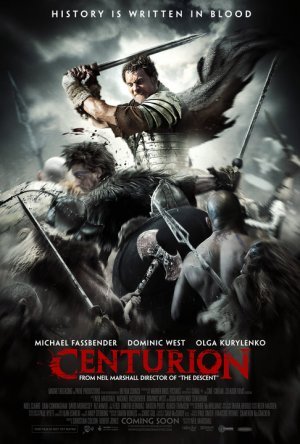
*Centurion Neil Marshall is the kind of filmmaker who inspires glee among horror and action junkies, but indifference among mainstream moviegoers. Centurion isn’t likely to change this. It’s the second century, and Romans are invading what’s now the Scottish Highlands, much to the displeasure of the Picts, the tribal people who’re already living there. Enter Quintus Dias (Michael Fassbender), a Roman soldier who becomes the de facto leader of an ever-shrinking group of men trapped behind enemy lines after their general (The Wire‘s Dominic West) is captured. Devotees of Marshall (2002’s Dog Soldiers, 2005’s The Descent, 2008’s Doomsday) will recognize certain elements: an ensemble cast, a military setting, the presence of a fierce female (Bond heroine Olga Kurylenko, who makes Pict warrior drag both spooky and sexy). Unlike his earlier films, though, there’s no supernatural twist; it’s just good old battlefield guts and gore. Sure, the romantic subplot feels a little forced, but this is genre filmmaking in its purest form, to be celebrated with gusto by those who appreciate grisly decapitations and the like. (Read my interview with Marshall at www.sfbg.com/pixel_vision.) (1:39) (Eddy)

The Concert (1:47)

Despicable Me Judging from the adorable, booty-shaking, highly merchandisable charm of its sunny-yellow Percocet-like minions, Despicable Me‘s makers have more than a few fond memories of the California Raisins. That gives you an idea of the 30-second attention-span level at work here. Thanks to Pixar and company, our expectations for animated features are high, but despite the single lob at Lehman Brothers aimed toward the grown-ups, the humor here is pitched straight at the eight and younger crowd: from the mugging, child-like minions to the all-in-good-fun, slightly quease-inducing 3-D roller-coaster ride. Gru (Steve Carell) is Despicable‘s also-ran supervillain — a bit too old and too unoriginal for a game that’s been rigged in the favor of the youthful, annoyingly perky Vector (Jason Segel), who’s managed to swipe the Giza Pyramids and become the world’s number one bad dude. When Vector steals away the crucial shrink ray needed for Gru’s plot to thieve the moon, the latter pulls out the big guns: three adorable orphans who have managed to penetrate Vector’s defenses with their fund-raising cookie sales. It turns out kids have their own insidiously heart-warming way of wrecking havoc on one’s well-laid plans. Filmmakers Pierre Coffin and Chris Renaud do their best to exploit the 3-D medium, but Avatar (2009) this is not. Nor will many adults be able to withstand the onslaught of cute undertaken by all those raisins, I mean, minions. (1:35) (Chun)

Dinner for Schmucks When he attracts favorable notice and a possible promotion from his corporate boss, Tim (Paul Rudd) is invited to an annual affair in which executives compete to see who can dig up the freakiest loser dweeb for everyone to snicker at. He literally runs into the perfect candidate: Barry (Steve Carrell), an IRS employee whose hobby is making elaborate tableaux with stuffed dead nice in tiny human clothes. He’s also the sort of person who, in trying to be helpful, inevitably wreaks havoc on the unlucky person being helped. Which means the 24 hours or so before the “Biggest Idiot” contest provide plenty of time for well-intentioned Barry to nearly destroy Tim’s relationship with a girlfriend (Stephanie Szostak), reunite him with Crazy Stalker Chick (Lucy Punch), and imperil his wooing of a multimillion-dollar account. Director Jay Roach (of the Austin Powers and Meet the Fockers series) has a full load of comedy talent on board here. So why are the results so tepid? This remake softens the bite of Francis Veber’s 1998 original French The Dinner Game by making Tim not a yuppie scumbag but a nice guy who just happens to have a jerk’s job (his company seizes ailing firms and liquidates them), and who doesn’t really want to expose hapless Barry to humiliation. But even with that satirical angle removed and a wider streak of sentimentality, it should cough up more laughs than it does. (1:50) (Harvey)

Dogtooth A man, his wife, and their three children live in a country house with a swimming pool and a huge yard enclosed by a high fence. So far, so good. But the kids, who don’t have names, appear to be in their 20s. They’ve never left the property, and they won’t, Dad (Christos Stergioglou) says, until they lose a “dogtooth,” at which time they’ll be mature enough to deal with the terrors of the outside world. In the meantime, they’re trapped in the only world they’ve ever known, carefully constructed by their domineering father. Greek writer-director Yorgos Lanthimos, who picked up the Prize Un Certain Regard at Cannes for this slice of disturbing domesticity, offers little explanation for Dad’s motives, or why Mom (Michelle Valley) goes along with his plan. The only hint comes from one of few scenes set outside the family’s compound, in which Dad goes to check on the progress of the family’s soon-to-be new dog. “Dogs are like clay, and our job here is to mold them,” the trainer explains. “Every dog is waiting for us to show it how to behave.” Indeed. It’s pretty clear Dad — master of his own private North Korea — is aware of that concept. Though Dogtooth‘s main themes enfold cruelty and child abuse, it also deploys the kind of black humor and button-pushing that fans of shock-trader Harmony Korine would appreciate. There is casual violence, extreme animal cruelty, full-frontal nudity, several disturbing sex scenes, and maybe the most alarming dance routine ever captured on film. (1:36) (Eddy)

Eat Pray Love The new film based on Elizabeth Gilbert’s chart-busting memoir, Eat Pray Love, benefits greatly from the lead performance by Julia Roberts, an actor who can draw from her own reserves of pathos when a project has none of its own. The adaptation, about a whiny American author farting around the globe in search of what amounts to spiritual room service, is nothing without her. The journey begins with the Type-A, book contract-inspired premise that Gilbert will travel to three appointed countries over the course of a year in order that, having thrice denied herself absolutely nothing, she might come out the other end a better-balanced human being. The first stop is Italy, where her entire plan is to finally unbutton her jeans and indulge in a celebrated cuisine, as if her home base of Manhattan were a culinary backwater. But this film is all about tired equivalencies, so Italy equals food, and expressive hand gestures, and “the art of doing nothing.” India, her next stop, equals enlightenment (her discovery that the guru she’s come to see is currently at an ashram in New York is an irony lost on the movie). And Bali, her final getaway, apparently equals contradictory but flattering aphorisms and thematically hypocritical romances. The sole appeal to a moviegoer here is aspirational. What’s so embarrassing about Eat Pray Love is its insistence that this appeal sprouts from the spiritual quest itself, and not just from the privilege that enables Gilbert to have such an extravagant quest in the first place. But then, self-awareness is supposed to be a obstacle to enlightenment. She’s got nothing to worry about there. (2:30) (Jason Shamai)

The Expendables Exactly what you’re expecting: a completely ludicrous explosion-o-thon about mercenaries hired by Bruce Willis to take down a South American general who’s actually a puppet for evil CIA agent-turned-coke kingpin Eric Roberts. Clearly, Sylvester Stallone (who directed, co-wrote, stars, and even coaxed a cameo out of Schwarzenegger) knows his audience, but The Expendables — bulging with a muscle-bound cast, including Dolph Lundgren, Terry Crews, Jason Statham, and Steve Austin, plus Jet Li, who suffers many a short-guy joke — is content to simply tap every expected rung on the 80s-actioner homage ladder. There’s no self-awareness, no truly witty one-liners, no plot twists, and certainly no making a badass out of any female characters (really, couldn’t the South American general’s daughter have packed some heat, or kicked someone in the balls — anything besides simply heaving her cleavage around?) The only truly memorable thing here is the inclusion of Mickey Rourke as Stallone’s tattoo-artist pal; I would possibly wager that Rourke was allowed to write his own weepy monologue, delivered in a close-up so extreme it’s more mind-searing than any of the film’s many machine-gun brawls. (1:43) (Eddy)

The Extra Man The polar opposite of buddy cop action flicks and spoofs a la The Other Guys, with only a faint resemblance to the bromances of Judd Apatow, Adam McKay, Will Ferrell, Seth Rogen, and so on, The Extra Man is a gently weird throwback to another era, much like its title character, Henry Harrison (Kevin Kline). Sweet, cross-dressing-curious teacher and would-be writer Louis Ives (Paul Dano) is drifting though life passively when he stumbles on eccentric playwright Harrison’s room-for-let and his oddball realm of hangers-on. A blustery, prickly, proudly misogynistic collector of Christmas balls, given to spasms of improvisational dancing, Harrison relishes his role as an escort to aged socialites, crankily shucking and jiving to score invites to fancy dinner parties and vacation homes in Florida. When Ives isn’t courting environmental magazine editor Mary (Katie Holmes) or hiding from the fearsome-looking wooly recluse Gershon (John C. Reilly), the mentor-able young man turns out to be more adept at the role than Harrison ever imagined. And like fossilized grande dames in Chanel, literate audiences also might be charmed by director-writer Shari Springer Berman’s unassuming, crushed-out bon mot, based on the novel by Jonathan Ames, to a few mannered, less-than-examined, happily twisted New York City subcultures. (1:45) (Chun)

Flipped I’m sure a “he said/she said” film exists that makes good on the premise, but Rob Reiner’s Flipped doesn’t quite cut it. Nestled safely in 1960s small-town America, the film is first narrated by Bryce, an eighth grader who’s spent the past four years rebuking the advances of Juli, the girl who lives across the street. Bryce is a pretty typical boy, bumbling and unsure of just what he wants, but soon the story “flips” and we see the same events narrated from Juli’s POV. Juli is drawn to Bryce’s “sparkling eyes,” yes, but with a poor family and an annoyingly sincere love for life, she has problems outside of lusting for Bryce. Based on a tween-hit novel by author Wendelin Van Draanen, the story’s familiarity perhaps stems from the source material — in my experience those sorts of novels rarely invite readers older than high school — and similarly in the case of Flipped, I think this might be something we should leave to the kids. (1:30) (Galvin)

Get Low Born from the true story of Felix Bush, an eccentric Tennessee hermit who invited the world to celebrate his funeral in advance of his own death, Get Low is a loose take on what might inspire a man to do a thing like that. It’s a small story, and unlikely to attract the attention of popcorn-addled viewers in the midst of the summer blockbuster season, but Get Low has a whopper of a character in Felix Bush. Robert Duvall becomes Bush, constructing a quiet man who sees it all and speaks only when he has something to say, and supporting roles from Sissy Spacek and Bill Murray are expectedly solid, but the real surprise is what a strong eye director Aaron Schnieder has. In allowing scenes to unfold on their own terms and in their own time, Schneider gives a real humanity to what could have been a Hallmark movie. (1:42) (Galvin)

*The Girl Who Played With Fire Lisbeth Salander is cooler than you are. The heroine of Stieg Larsson’s bestselling book series is fierce, mysterious, and utterly captivating: in the movie adaptations, she’s perfectly realized by Noomi Rapace, who has the power to transform Lisbeth from literary hero to film icon. Rapace first impressed audiences in The Girl With the Dragon Tattoo (2009), a faithful adaptation of Larsson’s premiere novel, and she returns as Lisbeth in The Girl Who Played With Fire. The sequel, as is often the case, isn’t quite on par with the original, but it’s still a page-to-screen success. And while the first film spent equal time on journalist Mikael Blomkvist (Michael Nyqvist), The Girl Who Played With Fire is almost entirely Lisbeth’s story. Sure, there’s more to the movie than the hacker-turned-sleuth — and the actor who plays her — but she carries the film. Rapace is Lisbeth; Lisbeth is Rapace. I’d watch both in anything. (2:09) Smith Rafael. (Peitzman)

Going the Distance If you live in San Francisco, don’t try to date someone in New York. It’s just not worth the hassle. But hey, maybe you’re as adorable as Drew Barrymore, and your boyfriend’s as charming as Justin Long — you can’t be expected to let a little geographical complication get in the way. That’s the driving force behind Going the Distance, a romcom that stars real-life couple Barrymore and Long as Erin and Garrett, two crazy kids trying to make it work cross-country. In many ways, the film is your standard boy-meets-girl story, but it’s cute enough that the predictability factor doesn’t really matter. The cast is universally strong, with bonus points to the standouts: It’s Always Sunny in Philadelphia‘s Charlie Day as Garrett’s embarrassing roommate, and Christina Applegate as Erin’s germaphobe sister. The humor is surprisingly sharp — and raunchy, which earned Going the Distance an R-rating. I’m not going to say Long’s bare ass is worth the price of admission, but it’s certainly a selling point. (1:43) (Peitzman)

Highwater The latest from the first family of surf movies comes courtesy of Dana Brown (2003’s Step Into Liquid), son of Bruce (1964’s The Endless Summer) and father of Wes (an up-and-comer who co-edited Highwater). The film focuses on Oahu’s legendary North Shore — “the one path all surfers must take,” per Dana’s occasionally woo-woo narration — and the annual big-wave contests held there each year. Though the majority of screen time is (of course) taken up by sweeping, slo-mo shots of pros tangling with looming walls of water, Highwater reaches out to civilian audiences with sidebars on the North Shore’s eccentric local culture, the science behind the 10-mile beach’s massive waves, and profiles of the sport’s more colorful characters. Brown is also careful to highlight the growing amount of women in the sport, who surf the exact same breaks as the men but earn far less prize money for it. Diehards might notice events in the film feel a bit dated, and indeed, Highwater was shot in 2005. But since surfers operate under the assumption that “one wave can make a person’s career” (especially if it’s captured on film), there’s presumably no sell-by date violation here. (1:30) (Eddy)

Inception As my movie going companion pointed out, “Christopher Nolan must’ve shit a brick when he saw Shutter Island.” In Nolan’s Inception, as in Shutter Island, Leonardo DiCaprio is a troubled soul trapped in a world of mind-fuckery, with a tragic-vengeful wife (here, Marion Cotillard) and even some long-lost kids looming in his thoughts at all times. But Inception, about a team of corporate spies who infiltrate dreams to steal information and implant ideas, owes just as much to The Matrix (1999), Eternal Sunshine of the Spotless Mind (2004), and probably a James Bond flick or two. Familiar though it may feel, at least Inception is based on a creative idea — how many movies, much less summer blockbusters, actually require viewer brain power? If its complex house-of-cards plot (dreams within dreams within dreams) can’t quite withstand nit-picking, its action sequences are confidently staged and expertly directed, including a standout sequence involving a zero-gravity fist fight and elevator ride. Though it’s hardly genius — and Leo-recycle aside — Inception is worth it, if you don’t mind your puzzle missing a few pieces. (2:30) (Eddy)

Jean-Michel Basquiat: The Radiant Child In 1986, filmmaker Tamra Davis was six years away from her breakthrough (1992’s Guncrazy; she also made 1998’s Half Baked and 2002 Britney Spears misfire Crossroads, and is married to one of the Beastie Boys). But she was already friends with artist Jean-Michel Basquiat, then at the height of his career. He died two years later of a heroin overdose, equally shaken by close friend Andy Warhol’s death and the pressures of his own skyrocketing fame. This tender doc weaves Davis’ 1986 interview with a low-key Basquiat (shot in a Beverly Hills hotel room) with recollections from his New York City circle (girlfriends, gallery owners, fellow artists, art critics). Though his art-world rise was breathtaking — he went from graffiti-scrawling kid to a hip painter whose works sold for hundreds of thousands (and now, multi-millions) — Davis’ doc suggests it was too much, too soon, creating distractions that first interfered with his creativity, then his well-being. Even if you don’t care for his art, Radiant Child is a compelling, insidery look at the dark side of celebrity. (1:34) (Eddy)

*Joan Rivers: A Piece of Work Whether you’re a fan of its subject or not, Ricki Stern and Annie Sundberg’s documentary is an absorbing look at the business of entertainment, a demanding treadmill that fame doesn’t really make any easier. At 75, comedian Rivers has four decades in the spotlight behind her. Yet despite a high Q rating she finds it difficult to get the top-ranked gigs, no matter that as a workaholic who’ll take anything she could scarcely be more available. Funny onstage (and a lot ruder than on TV), she’s very, very focused off-, dismissive of being called a “trailblazer” when she’s still actively competing with those whose women comics trail she blazed for today’s hot TV guest spot or whatever. Anyone seeking a thorough career overview will have to look elsewhere; this vérité year-in-the-life portrait is, like the lady herself, entertainingly and quite fiercely focused on the here-and-now. (1:24) (Harvey)

*The Kids Are All Right In many ways, The Kids Are All Right is a straightforward family dramedy: it’s about parents trying to do what’s best for their children and struggling to keep their relationship together. But it’s also a film in which Jules (Julianne Moore) goes down on Nic (Annette Bening) while they’re watching gay porn. Director Lisa Cholodenko (1998’s High Art) co-wrote the script (with Stuart Blumberg), and the film’s blend between mainstream and queer is part of what makes Kids such an important — not to mention enjoyable — film. Despite presenting issues that might be contentious to large portions of the country, the movie maintains an approachability that’s often lacking in queer cinema. Of course, being in the gay mecca of the Bay Area skews things significantly — most locals wouldn’t bat an eye at Kids, which has Nic and Jules’ children inviting their biological father (“the sperm donor,” played by Mark Ruffalo) into their lives. But for those outside the liberal bubble, the idea of a nontraditional family might be more eye-opening. It’s not a message movie, but Kids may still change minds. And even if it doesn’t, the film is a success that works chiefly because it isn’t heavy-handed. It refuses to take itself too seriously. At its best, Kids is laugh-out-loud funny, handling the heaviest of issues with grace and humor. (1:47) (Peitzman)

The Last Exorcism Latest in a long line of Louisiana preachers, genial extrovert Cotton Marcus (Patrick Fabian) isn’t even sure he believes in God anymore — but it’s the family business, and it’s a living. He definitely doesn’t believe in demonic possession, yet has presided over many an “exorcism” if only to fool the psychologically damaged into thinking they’re “cured” of delusional ails. But now he’s decided such hijinks might be more harmful than helpful. So to debunk the whole idea, he takes a documentary filmmaking crew on one last “soul-saving” trek, answering a desperate letter from a widowed farmer (Louis Herthum) whose 16-year-old daughter (Ashley Bell) is believed possessed. Cotton deploys theatrical tricks to rig an alleged purging of Satan’s minion. And it works … but this wouldn’t be a horror movie if that rationalist triumph didn’t turn out to be a false finish, followed by all kinds of inexplicable WTF. German director Daniel Stamm’s first English-language feature (written by Huck Botko and Andrew Gurland) is being positioned by Lionsgate as the next viral word-of-mouth horror sensation a la prior faux-docs The Blair Witch Project (1999) and Paranormal Activity (2007). But the “reality” illusion is more transparent here. Despite some clever buildup tactics, okay twists, and a handful of scares, this ultimately disappoints — a preview audience’s catcalls at its underwhelming fadeout suggested there will be no Last Exorcism 2. (1:27) (Harvey)

Lebanon Das Boot in a tank” has been the thumbnail summary of writer-director Samuel Maoz’s film in its festival travels to date, during which it’s picked up various prizes including a Venice Golden Lion. On the first day of Israel’s 1982 invasion (which Maoz fought in), an Israeli army tank with a crew of three fairly green 20-somethings — soon joined by a fourth with even less battle experience — crosses the border, enters a city already halfway reduced to rubble, and promptly gets its inhabitants in the worst possible fix, stranded without backup. Highly visceral and, needless to say, claustrophobic (there are almost no exterior shots), Lebanon may for some echo The Hurt Locker (2009) in its intense focus on physical peril. It also echoes that film’s lack of equally gripping character development. But taken on its own willfully narrow terms, this is a potent exercise in squirmy combat you-are-thereness. (1:33) Smith Rafael. (Harvey)

The Life and Times of Allen Ginsberg Here’s your chance to get to know the late poet before he’s portrayed by non-doppelgänger James Franco in the upcoming Howl. Whereas Howl, title drawn from his most famous and controversial creation, focuses on Ginsberg’s 1957 obscenity trial, Jerry Aronson’s 1994 doc offers a more sweeping take on his life. Friends and relatives (in both new and archival interviews), home-movie footage and photographs, talk show excerpts (William F. Buckley: so not down with the counterculture), and the man himself (reading his work, powerfully) help piece together what was undeniably a passionate and remarkable existence. (1:22) Roxie. (Eddy)

Lottery Ticket (1:39)

*Machete Probably the first movie that was initially conceived solely as a fake-movie trailer (as part of Quentin Tarantino and Robert Rodriguez’s 2007 Grindhouse), Rodriguez’s Machete emerges in full-length form to take on everyone’s sky-high expectations. I mean, the trailer promised motorcycles soaring through flames, a gun-toting priest, and the line “You just fucked with the wrong Mexican.” Fortunately, Machete the film does Machete the trailer proud; its deliberately silly revenge plot is both spot-on vintage homage and semi-serious commentary on America’s ongoing immigration debate. In addition, it features more severed limbs, gunshots to the head, irresponsible sex, and smirking Steven Seagal close-ups than any other movie in recent memory. Frequent Rodriguez supporting player Danny Trejo pretty much kills it as the title badass — but then, you already knew he would. (1:45) (Eddy)

*Mao’s Last Dancer Based on the subject’s autobiography of the same name, this Australian-produced drama chronicles the real-life saga of Li Cunxin (played as child, teen, and adult by Huang Wen Bin, Chengwu Guo, and Chi Cao), who was plucked from his rural childhood village in 1972 to study far from home at the Beijing Dance Academy. He attracted notice from Houston Ballet artistic director Ben Stevenson (Bruce Greenwood) during a cultural-exchange visit, and was allowed to go abroad for a Texas summer residency. At first the film looks headed toward well-handled but slightly pat inspirational territory pitting bad China against good America, as it cuts between Li’s grueling training by (mostly) humorless Party ideologues, and his astonishment at the prosperity and freedom in a country he’d been programmed to believe was a capitalist hellhole of injustice and deprivation. (Though as a Chinese diplomat cautions, not untruthfully, he’s only been exposed to “the nice parts.”) Swayed by love and other factors, Li created an international incident — tensely staged here — when he chose to defect rather than return home. But Jan Sardi’s script and reliable Aussie veteran Bruce Beresford’s direction refuse to settle for easy sentiment, despite a corny situation or two. Our hero’s new life isn’t all dream-come-true, nor is his past renounced without serious consequence (a poignant Joan Chen essays his peasant mother). The generous ballet excerpts (only slightly marred by occasional slow-mo gimmickry) offer reward enough, but the film’s greatest achievement is its honestly earning the right to jerk a few tears. (1:57) (Harvey)

*Mesrine: Killer Instinct This first half of a two-part film about notorious French bank robber Jacques Mesrine examines the early life of its subject, before he was a flamboyant, headline-grabbing folk hero. The very first scene uses 70s-style split-screens to revel Mesrine’s violent 1979 death; writer-director Jean-François Richet (2005’s Assault on Precinct 13) then jumps back 15 or so years for a glimpse of our (anti-) hero’s soldiering days in Algeria. Before long, “Jacky” (an outstanding Vincent Cassel, in a César-winning performance) is back in Paris, horrifying his upper-class parents and young wife by choosing the underworld over conventional pencil-pushing. (A near-unrecognizable Gérard Depardieu appears as a mob boss.) Killer Instinct, which is adapted from Mesrine’s own prison-penned autobiography, suffers from some standard biopic problems — it tries to cram in too much, and feels mighty rushed at times. But there’s still plenty of bad, bad behavior to enjoy, including the film’s spectacular last act, a breakneck recreation of one of the daring prison escapes that helped make Mesrine a legend. Continuation Mesrine: Public Enemy No. 1, which beings where this film ends, is now playing. (1:53) (Eddy)

*Mesrine: Public Enemy No. 1 If you see writer-director Jean-François Richet’s Mesrine: Killer Instinct (review below), you’re pretty much obligated to see this sequel, especially since the earlier film beings with the main character’s death, then flashes back and never catches up to it. This installment was actually filmed first, allowing star Vincent Cassell to pack on nearly 50 pounds to play the oldier, portlier version of the legendary French bank robber. Mesrine’s prowess as an escape artist allows him to spend much of this film on the lam with partner François (Mathieu Amalric) and girlfriend Sylvia (Ludivine Sagnier). Along the way, the headline-hungry crook declares himself a revolutionary, poses for Paris Match, kidnaps a billionaire, spends his ill-gotten money on diamonds and BMWs, tortures a journalist, and does as much as he can to further the Myth of Mesrine. The foreknowledge of Mesrine’s ultimate end lends a sense of ticking-clock doom; the first time we see it, in Killer Instinct, it’s from the point of view of Mesrine and Sylvia. Richet films the death scene here from the perspective of the police who tracked him, with increasing frustration, for years. Clever twists like this make it preferable to watch both films back-to-back, though Cassell’s commanding performance makes each a worthwhile stand-alone. (2:14) (Eddy)

Nanny McPhee Returns Emma Thompson is back as the titular Mary Poppins type who’s far from practically perfect, her extreme case of the uglies lessening whenever children in her charge learn a “lesson.” The family in need this time belongs to harried Isabel Green (Maggie Gyllenhaal, trying a little too hard like everyone here), who’s got way more than she can handle raising three unruly children and running an English farm while her husband’s away fighting World War II. Making matters worse is the arrival of a horribly bratty nephew and niece fleeing the London Blitz, not to mention the constant pestering of a brother-in-law (Rhys Ifans) who wants the farm sold to cover his secret gambling debts. Enter guess who, restoring order and civility with the thump of her magic walking stick. The first Nanny McPhee (2005) movie, adapted from Christianna Brand’s children’s books by Thompson and directed by Kirk Jones, was an old-fashioned delight adults could thoroughly enjoy. This sequel, again written by Thomson though directed by Susanna White, is roughly what Babe: Pig in the City (1998) was to the original Babe (1995): something endearingly simple and charming turned shrill, overproduced, and charmless, with way too many CGI animals doing stupid things (like porcine synchronized swimming). It’s bad enough that Ralph Fiennes and Ewan McGregor — no doubt beguiled by the earlier film — chose to do thankless cameos in such dross. But it’s pretty unforgivable that Dame Maggie Smith should suffer a career nadir as a senile old dear who at one point happily plops down on a big pat of cow shit. (1:48) (Harvey)

The Other Guys Will Ferrell and Adam McKay can do no wrong in some bro-medy aficionados’ eyes, but The Other Guys is no Talladega Nights: The Ballad of Ricky Bobby (2006) or Anchorman: The Legend of Ron Burgundy (2004). The other two Ferrell-McKay team-ups made short work of men’s jobs, in addition to genre filmmaking tropes, with crisper, cut-to-the-gag punchiness. And despite its laugh-out-loud first quarter — and some surprising TLC references by Michael Keaton, of all people, The Other Guys is about half a genuinely hilarious film that pokes fun at masculinity, as well as, interestingly, whiteness and beyond-the-pale, big-bucks white-collar crime. This lampoon of action buddy-cop flicks is dealt a semi-fatal blow when excess-loving, damage-dealing supercops Samuel Jackson and Dwayne Johnson exit, manically chewing scenery as they go. Two forgotten desktop jocks, forensic accounting investigator-with-a-past Allen (Ferrell) and ragaholic screwup Terry (Mark Wahlberg), must step it up when the dynamic duo dissipates, and go after crooked financier David Ershon (Steve Coogan). The second half of The Other Guys could have used some of the dramatic tension budding between buddy team Jackson-Johnson and reluctant cohorts Ferrell-Wahlberg, especially when Wahlberg begins to get bogged down in single-gear disbelief. But perhaps we should just be grateful for what few yuks we can glean from the atrocities of Great Recession-era robber barons. (1:47) (Chun)

The People I’ve Slept With Legions of walk-ons lay claim to the title role in the latest from Quentin Lee (1997’s Shopping for Fangs). The People I’ve Slept With‘s heroine, late-twentysomething L.A. dweller Angela (Karin Anna Cheung), leads a life of qualm-free sexual rapaciousness. That is, until the day when she finds herself — whether owing to a drunken bout of bad judgment or a breakdown in latex technology — pregnant, perplexed in regard to the issue of paternity, and forced to consult the thick stack of homemade baseball-style trading cards with which she documents her sexploits, using descriptive monikers and salient stats. Is Daddy dildo-lovin’ Mr. Hottie from down the hall? The smarmy gent with whom she briefly exchanged intimacies in the bathroom of a bar, a.k.a. Five-Second-Guy? Or the most appealing and least absurd contender, a local politico dubbed Mystery Man? Nothing in Angela’s track record suggests that the answer should matter as much as the location of the nearest Planned Parenthood clinic, but as in Knocked Up (2007), if it was less inexplicable, it would be a much shorter film. Instead, Angela, with the help of her snarky, romantically challenged gay BFF Gabriel (Wilson Cruz), sets off in pursuit of DNA samples from the likeliest candidates and, with slightly unhinged optimism, starts planning her nuptials. These events offer some very mild comedy and the occasional gross-out gag; the film’s maneuverings as Angela fumbles toward a position on motherhood, slutdom, and constructing the perfect life are sweet, earnest, and a little clumsy. (1:29) Viz Cinema. (Rapoport)

Piranha 3D (1:29)

Salt Angelina Jolie channels the existential crisis of Jason Bourne and the DIY spirit of MacGyver in a film positing that America’s most pressing concern is extant Russian cold warriors, who are plotting to reestablish their country’s pre-glasnost glory via nuclear holocaust and a Dark Angel–style army of spy kids. Jolie plays CIA agent Evelyn Salt, a woman who can stymie the top-shelf surveillance system at work using her undergarments and fashion a shoulder-mounted rocket out of interrogation-room furniture and cleaning supplies. These talents surface after Salt is accused of being a Russian operative in league with the aforementioned disturbers of the new world order and takes flight, with her agency coworkers (Liev Schreiber and Chiwetel Ejiofor) in hot pursuit. What ensues is a vicious and confounding assault on the highest levels of the U.S. government, most known rules of logic, and the viewer’s patience and powers of suspending disbelief. Salt’s off-the-ranch maneuverings are moderately engaging, particularly in the first leg of the chase, but clunky expository flashbacks, B-movie-grade dialogue, and an absurd plotline slow the momentum considerably. (1:31) (Rapoport)

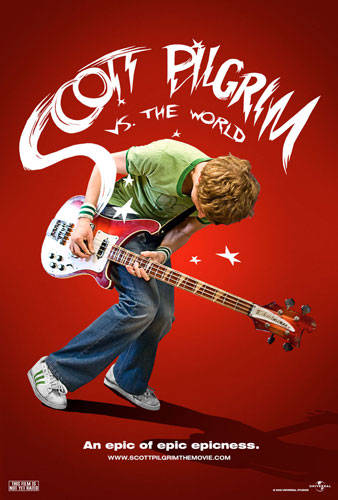
*Scott Pilgrim vs. The World For fans of Bryan Lee O’Malley’s just-completed comics saga Scott Pilgrim, the announcement that Edgar Wright (2004’s Shaun of the Dead, 2007’s Hot Fuzz) would direct a film version was utterly surreal. Geeks get promises like this all the time, all too often empty (Guillermo del Toro’s Hobbit, anyone?). But miraculously, Wright indeed spent the past five years crafting the winning Scott Pilgrim vs. the World. The film follows hapless Toronto 20-something Scott Pilgrim (Michael Cera), bassist for crappy band Sex Bob-omb, as he falls for delivery girl Ramona Flowers (Mary Elizabeth Winstead), only to find he must defeat her seven evil exes — like so many videogame bosses — before he can comfortably date her. As it happens, he’s already dating a high-schooler, Knives (Ellen Wong), who’s not coping well with Scott moving on. Cera plays a good feckless twerp; his performance isn’t groundbreaking, but it dodges the Cera-playing-his-precious-self phenomenon so many have lamented. The film’s ensemble cast maintains a sardonic tone, with excellent turns by Alison Pill, Aubrey Plaza, and newcomer Wong. Jason Schwartzman is perfectly cast as the ultimate evil ex-boyfriend — there’s really no one slimier, at least under 35.The film brilliantly cops the comics’ visual language, including snarky captions and onomatopoetic sound effects, reminiscent onscreen of 1960s TV Batman. Sometimes this tends toward sensory overload, but it’s all so stylistically distinctive and appropriate that excess is easily forgiven. (1:52) (Sam Stander)

Soul Kitchen Director Fatih Akin (2004’s Head-On) offers a tribute to the German Heimat (“homeland”) film, as well as to his own hometown, Hamburg, with this gritty comedy set in a restaurant dubbed Soul Kitchen. Star Adam Bousdoukos, who co-wrote the script with Akin, really did own a similar greasy spoon, and his knowledge of what makes an eatery soar or fail is exaggerated here to humorous and occasionally surreal effect. Bousdoukos’ character, the scruffy Zinos, loves funk music; he’s also in an existential funk, having just seen his girlfriend move to Shanghai. What’s worse, he’s just injured his back, necessitating the hiring of snooty chef Shayn (Head-On‘s Birol Ünel); his ne’er-do-well brother (Moritz Bleibtreu) is freshly out of jail; and he owes big bucks to the local tax board. Also, an old childhood pal turned sleazy businessman (Wotan Wilke Möhring) is circling his property with sharky hunger. Will everything that can possibly go wrong, go wrong, with a side of ketchup and mayonnaise? Of course it will. Stylish direction and a game cast, including winning newcomer Anna Bederke as Zinos’ shot-gulping waitress, make Soul Kitchen a fun if non-essential diversion. (1:33) Smith Rafael. (Eddy)

Step Up 3D The third installment of the Step Up enterprise graduates performing arts high school and moves to the sidewalks, rooftops, and warehouses of New York City, as well as the occasional venue — part underground club, part ad-plastered sports arena — where packs of street dancers battle and mop up the floor with their rivals, employing only the weaponry of a fierce routine. That, and the fast-forward button in the editing suite — beyond drop kicks and droplets of water coming out of the screen at your face, Step Up 3D unabashedly adopts the choreographed F/X of contemporary action films, manipulating footage to make the dancers look like nimble, ferocious, supernatural creatures with a youthful disdain for gravity and the space-time continuum. There is a plot of sorts, involving a crew called the Pirates; their fearless leader Luke (Rick Malambri); his mysterious lady friend Natalie (Sharni Vinson); an NYU freshman named Moose (Adam Sevani of 2008’s Step Up 2: The Streets), who was, in Luke’s oft-repeated words, “born from a boombox” (or BFAB); and the warehouse wonderland where the Pirates live and train, amid a decor of tape-deck-womb walls and galleries of limited-edition sneakers. It’s best, though, not to follow along too closely on the rare occasions when director Jon Chu (Step Up 2) mistakenly lets more than four lines of earnest dialogue stack up without a dance-scene intervention. The near-continuous wave of choreographed outbursts is like eye candy injected with multiple shots of 5-Hour Energy drink, but those who flinch at the idea of Auto-Tuning dance performance may want to stay home and rent 2000’s Center Stage. (1:46) (Rapoport)

*The Switch Has any hard-working actor ever made as many mediocre, albeit vigorously marketed, movies as Jennifer Aniston? It seems like an age since her last good one, Nicole Holofcener’s Friends with Money (2006), though some might go as far back as 2002’s The Good Girl, her dramatic and cinematic breakthrough. Perhaps that dry spell seems extra long due to Aniston’s tabloid overexposure, or maybe it’s just the feeble conceits (a la 2009’s Love Happens) that Aniston allows herself to get roped into. In any case, armed with a sharp script based on a Jeffrey Eugenides short story and a less-than-perfect but comically well-equipped everyman foil in Jason Bateman, The Switch turns out to be a refreshing break from Aniston’s run of predictability: it’s actually good, girl (if a bit far-fetched that even a neurotic, successful financial whiz could be so emotionally constipated). Heeding her biological alarm clock over the objections of best friend Wally (Bateman), Kassie (Aniston) decides to get artificially inseminated by handsome, smart, and charming donor Roland (Patrick Wilson), but nothing goes according to plan when Wally gets wasted at her insemination party and — no use crying over spilled semen — woozily decides to substitute his own emissions for Roland’s. Funny, tender, heart-strings-tugging shenanigans ensue when Kassie returns to NYC after seven years with her adorable, neurotic mini-Wally Sebastian (Thomas Robinson). Bateman is as reliably excellent as ever. Blades of Glory (2007) directors Will Speak and Josh Gordon put care into the details — from the lighting, to the scene-swiping cameos by Juliette Lewis and Jeff Goldblum, to the on-point yet relatively realistic dialogue, and it shows, making this, along with The Kids Are All Right, a, ahem, seminal year for donor-coms. (1:56) (Chun)

*Takers Likely the best movie to be advertised on billboards all over Oakland in a while, Takers is one of those likeable, smart, and faintly ludicrous genre flicks — a gangsta B with a hip-hop heart, centered on a cadre of high-style, Rat Pack-like bank robbers — that redeems its playas all around. It gives T.I., in both starring and executive producer roles and tellingly emerging from the clink in his first scene, a career beyond the rap game and the pen: he’s a snottily charmismatic Little Caesar here, a slight, serpentine mini-Snoop. It gives the formidable Idris Elba (The Wire) as the group’s leader something to wrap his sonorous Cockney around as he plays off crack ‘ho sister (Marianne Jean-Baptiste) as if they were English-accented castaways on island L.A. It gives Paul Walker, the second-banana princeling of the urban action flick, something to do: namely function as Elba’s lieutenant. And it gives the benighted Chris Brown, who gets his share of fast-stepping glory via a nice, meaty chase scene, a way to recast and strive toward redeeming himself on the silver screen — while giving the little-girls-who-love-bad-boys something to scream about. See, something for everyone (except maybe Zoe Saldana, who gets saddled with the arm candy role). (1:57) (Chun)

*The Tillman Story To what extent is our government prepared to lie to us? Not just on a policy level, but a personal level, perverting actual instances of heroic self-sacrifice into propagandistic pablum? The answer during our prior White House administration was clearly: as far as possible, until caught. Perhaps the most egregious such instance was the case of Pat Tillman, who gave up a lucrative NFL contract, becoming a U.S. Army Ranger enlistee in a burst of genuine patriotic fervor post-9/11. He was subsequently killed in Afghanistan — but the “friendly fire” circumstances of that death, and its apparent cover-up, scandalized not only his military superiors but a command chain of deliberate disinformation stretching all the way to the White House. Amir Bar-Lev’s The Tillman Story is a documentary expose of unusual immediacy, narrative thrust, and outrage, which may partly stem from its being such a Bay Area story. The deceased subject’s South Bay family were diehard liberals dedicated to values that might be considered eccentric anywhere else. The mistake authorities made in casting Tillman’s death as a battlefield martyrdom — a scenario amply undermined by footage and testimony here — lay in underestimating the well-educated skepticism and doggedness of his blood relations, most notably mom, Mary. While other families might have simply accepted an official scenario, the Tillmans found logistical gaps, then pushed, and pushed. The Tillman Story is a journey toward justice (if not nearly enough). It’s engrossing, appalling, heartrending, and enraging, the nonfiction equivalent to last year’s underseen body bag drama The Messenger. (1:34) (Harvey)

Vampires Suck (1:40)

The Wildest Dream: Conquest of Everest The Everest documentary has, by now, become a genre unto itself. It’s got its own tropes (sweeping shots of the mountain’s face, somber voice-over philosophizing about the human struggle with nature) and its own canon (topped, perhaps, by the harrowing 1998 IMAX hit Everest). The latest entry into this field is National Geographic Entertainment’s The Wildest Dream, which chronicles early-20th century explorer George Mallory’s lifelong — and ultimately life-ending — quest to reach Everest’s summit, and modern mountaineer Conrad Anker’s attempt to recreate his predecessor’s final climb. Director Anthony Geffen unfolds his tale in standard adventure-doc fashion. We get a lot of scratchy footage from Mallory’s climbs, a few risibly awkward dramatic re-creations, and quite a lot of portentous voiceover work. These are worn techniques, to be sure, but that doesn’t make the story told any less compelling. Mallory himself emerges as a particularly fascinating figure — a talented and charming scholar, a devoted husband, and an irresponsible, borderline suicidal obsessive. It’s a shame that we’re only able to observe him at a century’s distance. (1:33) (Zach Ritter)

*Winter’s Bone Winter’s Bone has already won awards at the Berlin International Film Festival and the Sundance Film Festival, but it’s the kind of downbeat, low-key, quiet film that may elude larger audiences (and, as these things go, Oscar voters). Like Andrea Arnold’s recent Fish Tank, it tells the story of a teenage girl who draws on unlikely reserves of toughness to navigate an unstable family life amid less-than-ideal economic circumstances. And it’s also directed by a woman: Debra Granik, whose previous feature, 2004’s Down to the Bone, starred Vera Farmiga (2009’s Up in the Air) as a checkout clerk trying to balance two kids and a secret coke habit. Drugs also figure into the plot of the harrowing Winter’s Bone, though its protagonist, Ree Dolly (Jennifer Lawrence), is faced with a different set of circumstances: her meth head father has jumped bail, leaving the family’s humble mountain home as collateral; the two kids at stake are her younger siblings. With no resources other than her own tenacity, Ree strikes out into her rural Missouri community, seeking information from relatives who clearly know where her father is — but ain’t sayin’ a word. It’s a journey fraught with menace, shot with an eye for near-documentary realism and an appreciation for slow-burn suspense; Lawrence anchors a solid cast with her own powerful performance. Who says American independent film is dead? (1:40) (Eddy)


Turf politics

1

arts@sfbg.com

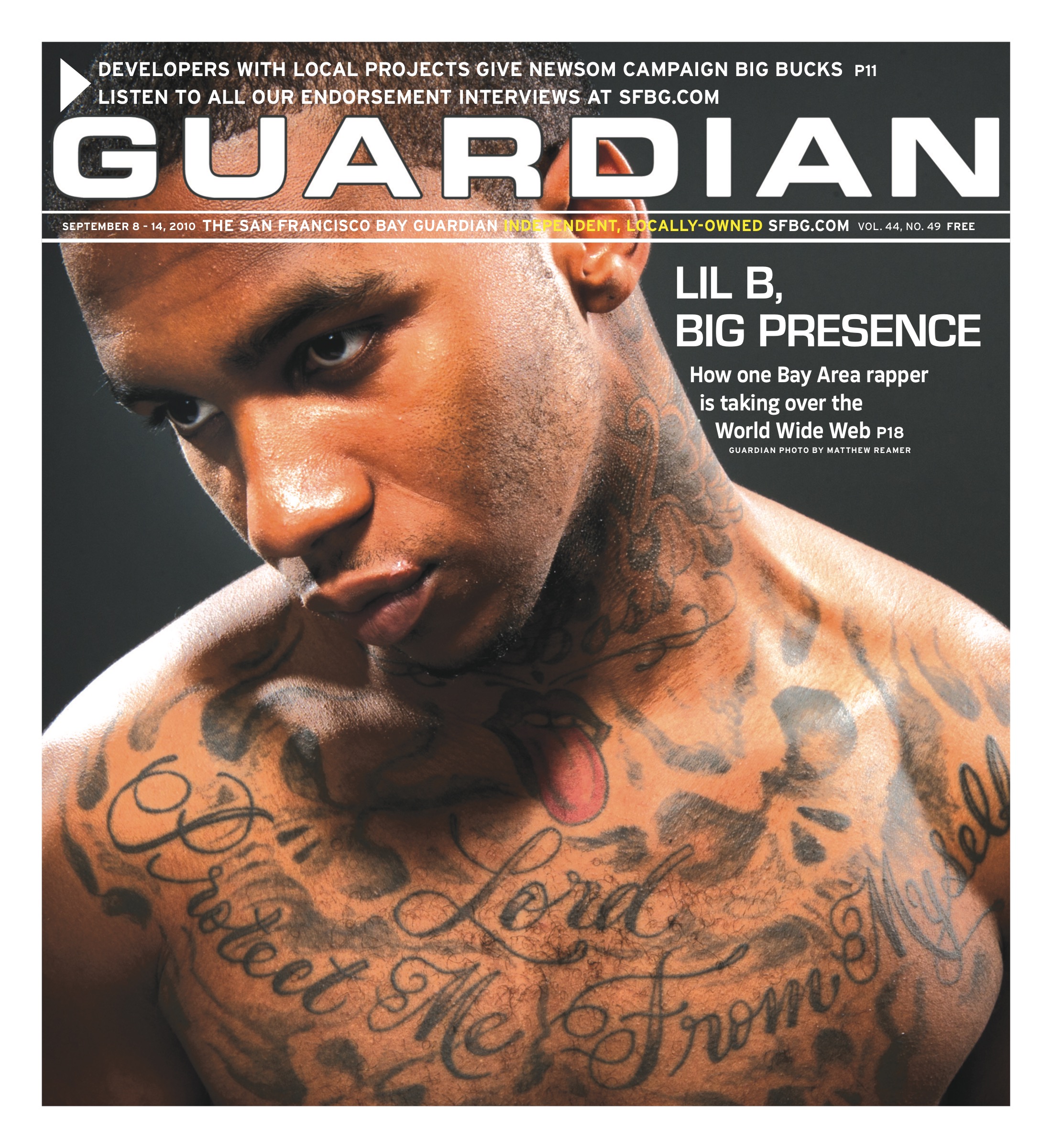
MUSIC Messy Marv, a.k.a. The Boy Boy Young Mess, is probably San Francisco’s most popular rapper. Within the city, fellow Fillmore District native San Quinn remains SF’s icon, but, as Will Bronson, head of SMC Recordings, says: “Once you cross that [Bay} Bridge, it’s Mess.” According to Saeed Crumpler, the rap buyer for Rasputin, the prolific Mess outsells everyone in the Bay save E-40 and The Jacka, often having three or four CDs among the store’s top 20 rap chart. SMC has thus tapped the raspy-voiced gangsta rapper to preside over the just-released compilation Thizz City, first of a Frisco-focused series paralleling the label’s Oakland-oriented imprint Town Thizzness.

“We’re trying to brand the city and showcase the talent and the up and coming talent,” Mess says of Thizz City, a partnership between SMC and Thizz Entertainment, hence the name. “People can get on my promotion as far as where I’m at in my career.”

True to this conception, Thizz City attempts to represent all of the city’s scattered hoods, with a lineup that ranges from enduring O.G.s like Lakeview’s Cellski to new acts like Roach Gigz, a white kid from the Fillmore. Yet behind this apparent display of unity lurks an inconvenient truth: SF rappers don’t get along. By comparison, Oakland is a rap utopia — not that there’s never beef so much as the prominent acts tend to find common cause in the endless quest to make it big.

“In Oakland, they come together,” says Killa Keise, also of Lakeview. Keise, who began recording with Cellski at 12 and later hooked up with Hunters Point’s Guce, is simultaneously a vet and a young act, one of several slated for a Thizz City album later this year. “We just did a video shoot in Oakland for Guce and all the Oakland rappers came out to support it,” Killa says. “But there really wasn’t that Frisco support.”

The lack of camaraderie in SF is evident, and neutrality is frequently not an option. I’ve confirmed stories, off the record, of people being threatened just for recording with another rapper’s rival, and never have I been forced to have so many off-the-record conversations to get a picture of what’s happening. In Oakland, threats are generally reserved for someone who owes someone money, not for guilt by association. But in SF, where the African American population has shrunk from 13 percent to 6.5 percent since 1970 (according to an Aug. 8, 2008 article in the San Francisco Chronicle), street politics tend to exert more pressure on its necessarily smaller rap scene.


MESSY SITUATIONS

Mess’s situation is instructive. Currently he’s prepping his first full-blown solo album in several years, Waken Dey Cook Game Up, due this month from his own company, Scalen LLC/Click Clack Records. Produced largely by Mess’s longtime collaborator Sean T, who also made Mac Dre’s classic “Fellin’ Myself,” Waken will be the Fillmore rapper’s first big release as The Boy Boy Young Mess. It’s also a serious bid for chart action, with singles featuring Keyshia Cole (whom Mess discovered in the late 1990s) and Houston rapper Chalie Boy, whose 2009 independent hit “I Look Good” snagged him a deal with Jive. Clearly Mess has similar major label ambitions, and Chalie Boy proves that despite rap’s youth bias, a 30-year-old underground legend like Mess himself can still fulfill them. (In the age of Jay-Z, 30 is the new 25.)

“If one of us makes it from Frisco, we all make it,” says Guce, articulating the regional rap logic that has turned once-fledgling scenes like Houston into national powerhouses. But the SF rap scene hasn’t rallied around Mess the way the entire Bay seemed to support Jacka for last year’s Billboard-charting Tear Gas (SMC). This is partly due to feuds that have divided the Fillmore itself. A vicious beef with San Quinn two years ago has left lingering tension. Their battle was shocking because Quinn and Mess literally grew up under the same roof — Mess lived with Quinn’s family for a time — and the two have recorded together since they were teens.

“It was an ugly fight because they knew too much about each other,” says Fillmore’s Big Rich, who is in the studio working on his new album, Built to Last, with his protégés, Evenodds. “When Rick Ross and 50-Cent beef, they don’t know each other like that. It’s very nonpersonal. But these two brothers, every line they said was real.”

Just as this beef was “officially” squashed, another exploded between Mess and his former associates the Taliban (Young Boo and Homewrecka), which the group airs on Thizz City. The reasons for the dispute are less clear than the duo’s mode of attack, which is to question Mess’ street cred due to his recent absence from the Bay. On probation after his second weapons conviction — one strike away from serious prison time — Mess relocated to Miami in 2008 to focus on his music and his new endeavors Scalen Clothing and Scalen Films.

“When you break away and do other things, you get negative shit: ‘He ain’t fuck with the hood no more. He ain’t got money no more,'<0x2009>” Mess says during our phone interview. “Ain’t nobody run me out of Fillmore. I go wherever the fuck I please. I got out of jail and moved myself because I don’t want to go through that situation no more.”

This is an eternal dilemma, not limited to SF. A gangsta rapper faces an unrealistic if not impossible demand: to maintain credibility, you’re supposed to simultaneously get rich and stay in the hood.

“A lot of my people are brainwashed to believe you’re supposed to be in the hood and stay there,” Mess says. “That’s not what it’s supposed to be. I want to break the cycle. I have a kid. I don’t want him to go through the shit I went through. So I’m doing what I need to do for what’s better for my kid.”


WESTERN SUBTRACTION

No rap scene is immune to street politics, but the degree to which they affect SF is more extreme than anywhere else in the Bay. To every rapper I spoke with, I put the same question: why? Big Rich links the widespread volatility to both the depressed economy and drug abuse.

“The turf war in SF hip-hop is because niggas ain’t eatin’ enough,” Rich says. “Only a few of us can live off rap. And a few aren’t livin’ the way they used to because of the economy. That’s problem No 2. Problem No. 1 is drugs. A lot of Frisco rappers do cocaine and ecstasy, and drugs alter your thought process and your actions. So you get the drugs mixed in with the street politics and the lack of money being circulated.”

Another answer comes from the Fillmore’s DaVinci, a rising star originally from Quinn’s Done Deal camp. In March, DaVinci released his debut, The Day the Turf Stood Still (SWTBRDS), one of the most powerful, thought-provoking recent Bay Area albums, using gangsta rap to explore the problems of urban life. (The album is available for purchase or for free at www.swtbrds.com/DaVinci) As on his album, DaVinci suggests that gentrification is the root of many problems that bleed into the SF’s rap scene.

“Not only did gentrification break up families, but families that stayed let personal problems get in the way of coming together,” DaVinci said. “Fillmore used to be a whole, and now it’s broken up into different sections. Families who were keeping it together moved or got bought out of they houses, and we’re left with sprinkles of people who don’t know each other well. Or the second generation from them isn’t able to connect the dots like, ‘Oh, my pops used to go to school with him; he’s cool.’ It wasn’t instantly beef, but it was more like, ‘I ain’t fuckin with them.'<0x2009>”

As the aforementioned Chronicle article notes, SF has the most rapidly dwindling black population in the country, and the Fillmore, prime real estate in the middle of one of the most expensive cities on earth, has particularly felt the squeeze.

“The neighborhood’s shrinking every year,” DaVinci says. “It’s like, first you had two blocks for your territory, now you only got half a block. You do whatever you can to protect your half-block, even if it means you just fuck with these two niggas on your block. People don’t trust each other. And that’s reflected in the music because the music always reflects what’s going on in the neighborhood.”

Everyone I spoke with agrees that the lack of unity in SF rap is a problem. It’s bad for business, even locally. Town Thizzness, for example, has been thriving since 2008 while Thizz City is just getting off the ground, though they were conceived at the same time. “It’s like there’s a dark cloud over the city,” DEO of Evenodds sighs.

Occasionally a ray of light breaks through. Berner, a Mexican Italian SF native whose duo projects with the likes of Jacka also made Billboard noise, recently brokered what seemed impossible: getting Mess and Quinn on the same track — twice! — for his new collaboration with Mess, Blow (Blocks and Boatdocks) from Bern One Entertainment.

“I’m a fan first,” Berner says. “To be able to bring them together after all the problems is the greatest feeling in the world.”

They may have recorded their parts on opposite coasts without personal interaction, but that Mess and Quinn agreed to appear together sends a powerful message. Yet the tension in SF rap runs far deeper than any one dispute and Rich, for one, is tired of it.

“People be like, ‘We need a meeting, all the rappers come out,'<0x2009>” he says. “Every meeting, niggas say ‘This is what we need to do, this is what we gonna do,’ then everyone puts their hand in the circle and we break out the huddle. And niggas go out that room like, ‘Fuck that nigga.’ So I gotta carve my own lane and stay in it.”

Rep Clock

0

Schedules are for Wed/1–Tues/7 except where noted. Director and year are given when available. Double and triple features are marked with a •. All times are p.m. unless otherwise specified.

ARTISTS’ TELEVISION ACCESS 992 Valencia, SF; www.atasite.org. $3-10. The Treatment (Lovewarz), Thurs, 7:30. Music shorts by Vincent Moon, Fri, 8. "Other Cinema Digital and Alternative Digital Domain: Kwik Gigs 66," short films, videos, and live performance, Sat, 9.

"BERNAL HEIGHTS OUTDOOR CINEMA" Various venues, www.bhoutdoorcine.org. Free. More than 65 short films and videos from local filmmakers, screened at impromptu neighborhood venues. Thurs-Sun.

CASTRO 429 Castro, SF; (415) 621-6120, www.castrotheatre.com. $7.50-10. "Blonde Bombshells:" •Written on the Wind (Sirk, 1956), Wed, 2:55, 7, and Madame X (Rich, 1966), Wed, 4:55, 9; •Three For the Show (Potter, 1955), Thurs, 2, 5:35, 9:20, and Will Success Spoil Rock Hunter? (Tashlin, 1957), Thurs, 3:45, 7:30; My Man Godfrey (La Cava, 1936), Fri, 1, 5, 9:20, and Some Like It Hot (Wilder, 1959), Fri, 2:45, 7; •Libeled Lady (Conway, 1936), Sat, 1, 5, 9:10, and Dinner at Eight (Cukor, 1933), Sat, 2:55, 7; • The Misfits (Huston, 1961), and Platinum Blonde (Capra, 1931), Sun, call for times.

CHRISTOPHER B. SMITH RAFAEL FILM CENTER 1118 Fourth St, San Rafael; (415) 454-1222, www.cafilm.org. $6.50-10.25. Cairo Time (Nadda, 2009), call for dates and times. The Girl Who Played With Fire (Alfredson, 2009), call for dates and times. Lebanon (Maoz, 2009), call for dates and times. Soul Kitchen (Akin, 2009), Sept 3-9, call for times. "Everybody’s Classics": North by Northwest (Hitchcock, 1959), Sun, noon (free screening).

"FILM NIGHT IN THE PARK" This week: Creek Park, 451 Sir Francis Drake, San Anselmo; (415) 272- 2756, www.filmnight.org. Donations accepted. Sixteen Candles (Hughes, 1984), Fri, 8; Up (Docter and Peterson, 2009), Sat, 8; Avatar (Cameron, 2009), Sun, 5.

HUMANIST HALL 390 27th St, Oakl; www.humanisthall.org. $5. Avatar (Cameron, 2009), Wed, 7:30.

JEWISH COMMUNITY CENTER OF SAN FRANCISCO 3200 California, SF; www.sf-interfaith.org. Free. A Village Called Versailles (Chiang), Wed, 7.

MECHANICS’ INSTITUTE 57 Post, SF; (415) 393-0100 (reservations required). $10. "CinemaLit: Loves Labours: Leo McCarey Revisited:" Ruggles of Red Gap (McCarey, 1935), Fri, 6.

PACIFIC FILM ARCHIVE 2575 Bancroft, Berk; (510) 642-5249, www.bampfa.berkeley.edu. $5.50-9.50. "Alternative Visions: Oskar Fischinger Classics," Wed, 7:30. "Swoon: Great Leading Men in Gorgeous 35mm Prints:" In a Lonely Place (Ray, 1950), Thurs, 7; Out of the Past (Tourneur, 1947), Sat, 6:30; From Here to Eternity (Zinnemann, 1953), Sat, 8:30; Picnic (Logan, 1956), Sun, 6:45. "Shakespeare on Screen:" Hamlet (Gade and Schall, 1920), Fri, 6:30; Hamlet Goes Business (Kaurismäki, 1987), Fri, 8:40; Romeo and Juliet (Zeffirelli, 1968), Sun, 4.

RED VIC 1727 Haight, SF; (415) 668-3994. $6-9. Vertigo (Hitchcock, 1958), Wed-Thurs, 7, 9:35 (also Wed, 2). House (Obayahsi, 1977), Fri-Sat, 7:15, 9:15 (also Sat, 2, 4). The Secret of Kells (More and Twomey, 2009), Sun-Tues, 7:15, 9:15 (also Sun-Mon, 2, 4).

ROXIE 3117 and 3125 16th St, SF; (415) 863-1087, www.roxie.com. $5-11.50. "Not Necessarily Noir:" •Mickey One (Penn, 1965), Wed, 6:10, 9:15, and The Woman Chaser (Devor, 1999), Wed, 8; •Rolling Thunder (Flynn, 1977), Thurs, 6, 10, and Hardcore (Schrader, 1979), Thurs, 8. The Life and Times of Allen Ginsberg (Aronson, 1994), Sept 3-9, 7:15, 9 (also Sat-Sun, 2, 3:45, 5:30). Mogwai: Burning (Moon and La Souanec, 2010), Sat, 11. The Cockettes (Weissman and Weber, 2002), Sept 7-9, 7, 9:15. With live performances from the Thrillpeddlers’ production of the Cockettes musical Pearls Over Shanghai.

SAN FRANCISCO MUSEUM OF MODERN ART 151 Third St, SF; www.sfmoma.org. $5. "Daft Punk on Screen:" Electroma (Bangalter and De Homem-Christo, 2006), Thurs, 7.

VIZ CINEMA New People, 1746 Post, SF; www.vizcinema.com. $10. "Kurosawa On Sword Battles: Samurai Saga Vol. 2:" Throne of Blood (1957), Wed, 4:30 and Thurs, 7; The Hidden Fortress (1958), Wed, 7 and Thurs, 4.

YERBA BUENA CENTER FOR THE ARTS 701 Mission, SF; (415) 978-2787, www.ybca.org. $6-8. "Dark "Something From Nothing: Films on Design and Architecture:" Handmade Nation (Levine, 2009), Sun, 2.

Film listings

0

Film listings are edited by Cheryl Eddy. Reviewers are Kimberly Chun, Michelle Devereaux, Peter Galvin, Max Goldberg, Dennis Harvey, Johnny Ray Huston, Louis Peitzman, Lynn Rapoport, Ben Richardson, and Matt Sussman. For rep house showtimes, see Rep Clock. For first-run showtimes, see Movie Guide.

OPENING

*The American George Clooney caught in a moodily paranoid, yet exquisitely photographed, ’70s-style suspense-arthouse death-trap? Belmondo and Beatty could empathize. Nonetheless, veteran rock photographer and Control (2007) director Anton Corbijn suffuses the chilly proceedings with a fresh, wintry beauty, the carefully balanced sense of highly charged tension and silky smoothness that a gunsmith would appreciate, and a resonance that feels personal. How else would an ex-rock shooter like Corbijn, who’s made iconic images of the Clash, U2, and others, connect with this tale of an assassin masquerading as a photographer, one who’s constantly glancing behind and around himself — justifiably wary of being caught in another killer’s sights — and seemingly just as wary of the director’s, and audience’s, gaze? A character who wouldn’t be out of place in a Camus novella or a Melville brooder, Jack/Edward, or more accurately "the American," (Clooney) is in exile after a bad collision with a girlfriend and hitmen in Sweden and hiding out in a picturesque Italian village, conspicuously the more-cold-than-cool outsider and doing one immaculate job for a gorgeous mysterious woman (Thekla Reuten). Is he a good or bad guy? The local priest (Paolo Bonacelli), who knows and sees all like a great eye in the sky, is trying to find out, as is the most beautiful prostitute in town (Violante Placido). The answers are nowhere near as clear or as plainly painted as a Sergio Leone Western, although Corbijn nods to the maestro when stone-cold killer Henry Fonda, then playing shockingly against type, appears on a cafe TV screen in Once Upon a Time in the West (1968). But the director’s care and attention to beauty — as well as the lines carved in the face of Clooney’s lean, mean-looking American, a whore like any other — say more than words. (1:43) Cerrito, Presidio. (Chun)

Dogtooth See "Father Knows Best." (1:36) Sundance Kabuki.

Going the Distance If you live in San Francisco, don’t try to date someone in New York. It’s just not worth the hassle. But hey, maybe you’re as adorable as Drew Barrymore, and your boyfriend’s as charming as Justin Long — you can’t be expected to let a little geographical complication get in the way. That’s the driving force behind Going the Distance, a romcom that stars real-life couple Barrymore and Long as Erin and Garrett, two crazy kids trying to make it work cross-country. In many ways, the film is your standard boy-meets-girl story, but it’s cute enough that the predictability factor doesn’t really matter. The cast is universally strong, with bonus points to the standouts: It’s Always Sunny in Philadelphia‘s Charlie Day as Garrett’s embarrassing roommate, and Christina Applegate as Erin’s germaphobe sister. The humor is surprisingly sharp — and raunchy, which earned Going the Distance an R-rating. I’m not going to say Long’s bare ass is worth the price of admission, but it’s certainly a selling point. (1:43) California, Marina. (Peitzman)

Highwater The latest from the first family of surf movies comes courtesy of Dana Brown (2003’s Step Into Liquid), son of Bruce (1964’s The Endless Summer) and father of Wes (an up-and-comer who co-edited Highwater). The film focuses on Oahu’s legendary North Shore — "the one path all surfers must take," per Dana’s occasionally woo-woo narration — and the annual big-wave contests held there each year. Though the majority of screen time is (of course) taken up by sweeping, slo-mo shots of pros tangling with looming walls of water, Highwater reaches out to civilian audiences with sidebars on the North Shore’s eccentric local culture, the science behind the 10-mile beach’s massive waves, and profiles of the sport’s more colorful characters. Brown is also careful to highlight the growing amount of women in the sport, who surf the exact same breaks as the men but earn far less prize money for it. Diehards might notice events in the film feel a bit dated, and indeed, Highwater was shot in 2005. But since surfers operate under the assumption that "one wave can make a person’s career" (especially if it’s captured on film), there’s presumably no sell-by date violation here. (1:30) Metreon. (Eddy)

Jean-Michel Basquiat: The Radiant Child Director Tamra Davis, a personal friend of Basquiat’s, draws on her insider knowledge for this doc about the late artist. (1:34) Lumiere, Shattuck.

The Life and Times of Allen Ginsberg Here’s your chance to get to know the late poet before he’s portrayed by non-doppelgänger James Franco in the upcoming Howl. Whereas Howl, title drawn from his most famous and controversial creation, focuses on Ginsberg’s 1957 obscenity trial, Jerry Aronson’s 1994 doc offers a more sweeping take on his life. Friends and relatives (in both new and archival interviews), home-movie footage and photographs, talk show excerpts (William F. Buckley: so not down with the counterculture), and the man himself (reading his work, powerfully) help piece together what was undeniably a passionate and remarkable existence. (1:22) Roxie. (Eddy)

*Machete Probably the first movie that was initially conceived solely as a fake-movie trailer (as part of Quentin Tarantino and Robert Rodriguez’s 2007 Grindhouse), Rodriguez’s Machete emerges in full-length form to take on everyone’s sky-high expectations. I mean, the trailer promised motorcycles soaring through flames, a gun-toting priest, and the line "You just fucked with the wrong Mexican." Fortunately, Machete the film does Machete the trailer proud; its deliberately silly revenge plot is both spot-on vintage homage and semi-serious commentary on America’s ongoing immigration debate. In addition, it features more severed limbs, gunshots to the head, irresponsible sex, and smirking Steven Seagal close-ups than any other movie in recent memory. Frequent Rodriguez supporting player Danny Trejo pretty much kills it as the title badass — but then, you already knew he would. (1:45) Presidio. (Eddy)

*Mesrine: Public Enemy No. 1 If you see writer-director Jean-François Richet’s Mesrine: Killer Instinct (review below), you’re pretty much obligated to see this sequel, especially since the earlier film beings with the main character’s death, then flashes back and never catches up to it. This installment was actually filmed first, allowing star Vincent Cassell to pack on nearly 50 pounds to play the oldier, portlier version of the legendary French bank robber. Mesrine’s prowess as an escape artist allows him to spend much of this film on the lam with partner François (Mathieu Amalric) and girlfriend Sylvia (Ludivine Sagnier). Along the way, the headline-hungry crook declares himself a revolutionary, poses for Paris Match, kidnaps a billionaire, spends his ill-gotten money on diamonds and BMWs, tortures a journalist, and does as much as he can to further the Myth of Mesrine. The foreknowledge of Mesrine’s ultimate end lends a sense of ticking-clock doom; the first time we see it, in Killer Instinct, it’s from the point of view of Mesrine and Sylvia. Richet films the death scene here from the perspective of the police who tracked him, with increasing frustration, for years. Clever twists like this make it preferable to watch both films back-to-back, though Cassell’s commanding performance makes each a worthwhile stand-alone. (2:14) Embarcadero, Shattuck. (Eddy)

The People I’ve Slept With Legions of walk-ons lay claim to the title role in the latest from Quentin Lee (1997’s Shopping for Fangs). The People I’ve Slept With‘s heroine, late-twentysomething L.A. dweller Angela (Karin Anna Cheung), leads a life of qualm-free sexual rapaciousness. That is, until the day when she finds herself — whether owing to a drunken bout of bad judgment or a breakdown in latex technology — pregnant, perplexed in regard to the issue of paternity, and forced to consult the thick stack of homemade baseball-style trading cards with which she documents her sexploits, using descriptive monikers and salient stats. Is Daddy dildo-lovin’ Mr. Hottie from down the hall? The smarmy gent with whom she briefly exchanged intimacies in the bathroom of a bar, a.k.a. Five-Second-Guy? Or the most appealing and least absurd contender, a local politico dubbed Mystery Man? Nothing in Angela’s track record suggests that the answer should matter as much as the location of the nearest Planned Parenthood clinic, but as in Knocked Up (2007), if it was less inexplicable, it would be a much shorter film. Instead, Angela, with the help of her snarky, romantically challenged gay BFF Gabriel (Wilson Cruz), sets off in pursuit of DNA samples from the likeliest candidates and, with slightly unhinged optimism, starts planning her nuptials. These events offer some very mild comedy and the occasional gross-out gag; the film’s maneuverings as Angela fumbles toward a position on motherhood, slutdom, and constructing the perfect life are sweet, earnest, and a little clumsy. (1:29) Viz Cinema. (Rapoport)

Soul Kitchen Director Fatih Akin (2004’s Head-On) offers a tribute to the German Heimat ("homeland") film, as well as to his own hometown, Hamburg, with this gritty comedy set in a restaurant dubbed Soul Kitchen. Star Adam Bousdoukos, who co-wrote the script with Akin, really did own a similar greasy spoon, and his knowledge of what makes an eatery soar or fail is exaggerated here to humorous and occasionally surreal effect. Bousdoukos’ character, the scruffy Zinos, loves funk music; he’s also in an existential funk, having just seen his girlfriend move to Shanghai. What’s worse, he’s just injured his back, necessitating the hiring of snooty chef Shayn (Head-On‘s Birol Ünel); his ne’er-do-well brother (Moritz Bleibtreu) is freshly out of jail; and he owes big bucks to the local tax board. Also, an old childhood pal turned sleazy businessman (Wotan Wilke Möhring) is circling his property with sharky hunger. Will everything that can possibly go wrong, go wrong, with a side of ketchup and mayonnaise? Of course it will. Stylish direction and a game cast, including winning newcomer Anna Bederke as Zinos’ shot-gulping waitress, make Soul Kitchen a fun if non-essential diversion. (1:33) Embarcadero, Smith Rafael. (Eddy)

*The Tillman Story "See Notes on a Scandal." (1:34) Shattuck.

ONGOING

*Animal Kingdom More renowned for its gold rush history and Victorian terrace homes than its criminal communities, Melbourne, Australia gets put on the same gritty map as Martin Scorsese’s ’70s-era New York City and Quentin Tarantino’s ’90s Los Angeles with the advent of director-writer David Michôd’s masterful debut feature. The metropolis’ sun-blasted suburban homes, wood-paneled bedrooms, and bleached-bone streets acquire a chilling, slowly building power, as Michôd follows the life and death of the Cody clan through the eyes of its newest member, an unformed, ungainly teenager nicknamed J (James Frecheville). When J’s mother ODs, he’s tossed into the twisted arms of her family: the Kewpie doll-faced, too-close-for-comfort matriarch Smurf (Jacki Weaver), dead-eyed armed robber Pope (Ben Mendelsohn), Pope’s best friend Baz (Joel Edgerton), volatile younger brother and dealer Craig (Sullivan Stapleton), and baby bro Darren (Luke Ford). Learning to hide his responses to the escalating insanity surrounding the Codys’ war against the police — and the rest of the world — and finding respite with his girlfriend, Nicky (Laura Wheelwright), J becomes the focus of a cop (Guy Pearce) determined to take the Codys down — and discovers he’s going to have use all his cunning to survive in the jungle called home. Stunning performances abound — from Frecheville, who beautifully hides a growing awareness behind his character’s monolithic passivity, to the adorably scarifying Weaver — in this carefully, brilliantly detailed crime-family drama bound to land at the top of aficionados’ favored lineups, right alongside 1972’s The Godfather and 1986’s At Close Range and cult raves 1970’s Bloody Mama and 1974’s Big Bad Mama. (2:02) Shattuck, Sundance Kabuki. (Chun)

Avatar: Special Edition (2:51) 1000 Van Ness, SF Center, Sundance Kabuki.

Cairo Time (1:29) Embarcadero, Piedmont, Shattuck, Smith Rafael.

*Centurion Neil Marshall is the kind of filmmaker who inspires glee among horror and action junkies, but indifference among mainstream moviegoers. Centurion isn’t likely to change this. It’s the second century, and Romans are invading what’s now the Scottish Highlands, much to the displeasure of the Picts, the tribal people who’re already living there. Enter Quintus Dias (Michael Fassbender), a Roman soldier who becomes the de facto leader of an ever-shrinking group of men trapped behind enemy lines after their general (The Wire‘s Dominic West) is captured. Devotees of Marshall (2002’s Dog Soldiers, 2005’s The Descent, 2008’s Doomsday) will recognize certain elements: an ensemble cast, a military setting, the presence of a fierce female (Bond heroine Olga Kurylenko, who makes Pict warrior drag both spooky and sexy). Unlike his earlier films, though, there’s no supernatural twist; it’s just good old battlefield guts and gore. Sure, the romantic subplot feels a little forced, but this is genre filmmaking in its purest form, to be celebrated with gusto by those who appreciate grisly decapitations and the like. (Read my interview with Marshall at www.sfbg.com/pixel_vision.) (1:39) Lumiere, Shattuck. (Eddy)

The Concert (1:47) Clay.

Despicable Me Judging from the adorable, booty-shaking, highly merchandisable charm of its sunny-yellow Percocet-like minions, Despicable Me‘s makers have more than a few fond memories of the California Raisins. That gives you an idea of the 30-second attention-span level at work here. Thanks to Pixar and company, our expectations for animated features are high, but despite the single lob at Lehman Brothers aimed toward the grown-ups, the humor here is pitched straight at the eight and younger crowd: from the mugging, child-like minions to the all-in-good-fun, slightly quease-inducing 3-D roller-coaster ride. Gru (Steve Carell) is Despicable‘s also-ran supervillain — a bit too old and too unoriginal for a game that’s been rigged in the favor of the youthful, annoyingly perky Vector (Jason Segel), who’s managed to swipe the Giza Pyramids and become the world’s number one bad dude. When Vector steals away the crucial shrink ray needed for Gru’s plot to thieve the moon, the latter pulls out the big guns: three adorable orphans who have managed to penetrate Vector’s defenses with their fund-raising cookie sales. It turns out kids have their own insidiously heart-warming way of wrecking havoc on one’s well-laid plans. Filmmakers Pierre Coffin and Chris Renaud do their best to exploit the 3-D medium, but Avatar (2009) this is not. Nor will many adults be able to withstand the onslaught of cute undertaken by all those raisins, I mean, minions. (1:35) SF Center. (Chun)

Dinner for Schmucks When he attracts favorable notice and a possible promotion from his corporate boss, Tim (Paul Rudd) is invited to an annual affair in which executives compete to see who can dig up the freakiest loser dweeb for everyone to snicker at. He literally runs into the perfect candidate: Barry (Steve Carrell), an IRS employee whose hobby is making elaborate tableaux with stuffed dead nice in tiny human clothes. He’s also the sort of person who, in trying to be helpful, inevitably wreaks havoc on the unlucky person being helped. Which means the 24 hours or so before the "Biggest Idiot" contest provide plenty of time for well-intentioned Barry to nearly destroy Tim’s relationship with a girlfriend (Stephanie Szostak), reunite him with Crazy Stalker Chick (Lucy Punch), and imperil his wooing of a multimillion-dollar account. Director Jay Roach (of the Austin Powers and Meet the Fockers series) has a full load of comedy talent on board here. So why are the results so tepid? This remake softens the bite of Francis Veber’s 1998 original French The Dinner Game by making Tim not a yuppie scumbag but a nice guy who just happens to have a jerk’s job (his company seizes ailing firms and liquidates them), and who doesn’t really want to expose hapless Barry to humiliation. But even with that satirical angle removed and a wider streak of sentimentality, it should cough up more laughs than it does. (1:50) 1000 Van Ness, SF Center. (Harvey)

Eat Pray Love The new film based on Elizabeth Gilbert’s chart-busting memoir, Eat Pray Love, benefits greatly from the lead performance by Julia Roberts, an actor who can draw from her own reserves of pathos when a project has none of its own. The adaptation, about a whiny American author farting around the globe in search of what amounts to spiritual room service, is nothing without her. The journey begins with the Type-A, book contract-inspired premise that Gilbert will travel to three appointed countries over the course of a year in order that, having thrice denied herself absolutely nothing, she might come out the other end a better-balanced human being. The first stop is Italy, where her entire plan is to finally unbutton her jeans and indulge in a celebrated cuisine, as if her home base of Manhattan were a culinary backwater. But this film is all about tired equivalencies, so Italy equals food, and expressive hand gestures, and "the art of doing nothing." India, her next stop, equals enlightenment (her discovery that the guru she’s come to see is currently at an ashram in New York is an irony lost on the movie). And Bali, her final getaway, apparently equals contradictory but flattering aphorisms and thematically hypocritical romances. The sole appeal to a moviegoer here is aspirational. What’s so embarrassing about Eat Pray Love is its insistence that this appeal sprouts from the spiritual quest itself, and not just from the privilege that enables Gilbert to have such an extravagant quest in the first place. But then, self-awareness is supposed to be a obstacle to enlightenment. She’s got nothing to worry about there. (2:30) Cerrito, Empire, Marina, 1000 Van Ness, SF Center, Sundance Kabuki. (Jason Shamai)

The Expendables Exactly what you’re expecting: a completely ludicrous explosion-o-thon about mercenaries hired by Bruce Willis to take down a South American general who’s actually a puppet for evil CIA agent-turned-coke kingpin Eric Roberts. Clearly, Sylvester Stallone (who directed, co-wrote, stars, and even coaxed a cameo out of Schwarzenegger) knows his audience, but The Expendables — bulging with a muscle-bound cast, including Dolph Lundgren, Terry Crews, Jason Statham, and Steve Austin, plus Jet Li, who suffers many a short-guy joke — is content to simply tap every expected rung on the 80s-actioner homage ladder. There’s no self-awareness, no truly witty one-liners, no plot twists, and certainly no making a badass out of any female characters (really, couldn’t the South American general’s daughter have packed some heat, or kicked someone in the balls — anything besides simply heaving her cleavage around?) The only truly memorable thing here is the inclusion of Mickey Rourke as Stallone’s tattoo-artist pal; I would possibly wager that Rourke was allowed to write his own weepy monologue, delivered in a close-up so extreme it’s more mind-searing than any of the film’s many machine-gun brawls. (1:43) 1000 Van Ness. (Eddy)

The Extra Man The polar opposite of buddy cop action flicks and spoofs a la The Other Guys, with only a faint resemblance to the bromances of Judd Apatow, Adam McKay, Will Ferrell, Seth Rogen, and so on, The Extra Man is a gently weird throwback to another era, much like its title character, Henry Harrison (Kevin Kline). Sweet, cross-dressing-curious teacher and would-be writer Louis Ives (Paul Dano) is drifting though life passively when he stumbles on eccentric playwright Harrison’s room-for-let and his oddball realm of hangers-on. A blustery, prickly, proudly misogynistic collector of Christmas balls, given to spasms of improvisational dancing, Harrison relishes his role as an escort to aged socialites, crankily shucking and jiving to score invites to fancy dinner parties and vacation homes in Florida. When Ives isn’t courting environmental magazine editor Mary (Katie Holmes) or hiding from the fearsome-looking wooly recluse Gershon (John C. Reilly), the mentor-able young man turns out to be more adept at the role than Harrison ever imagined. And like fossilized grande dames in Chanel, literate audiences also might be charmed by director-writer Shari Springer Berman’s unassuming, crushed-out bon mot, based on the novel by Jonathan Ames, to a few mannered, less-than-examined, happily twisted New York City subcultures. (1:45) Opera Plaza. (Chun)

Flipped I’m sure a "he said/she said" film exists that makes good on the premise, but Rob Reiner’s Flipped doesn’t quite cut it. Nestled safely in 1960s small-town America, the film is first narrated by Bryce, an eighth grader who’s spent the past four years rebuking the advances of Juli, the girl who lives across the street. Bryce is a pretty typical boy, bumbling and unsure of just what he wants, but soon the story "flips" and we see the same events narrated from Juli’s POV. Juli is drawn to Bryce’s "sparkling eyes," yes, but with a poor family and an annoyingly sincere love for life, she has problems outside of lusting for Bryce. Based on a tween-hit novel by author Wendelin Van Draanen, the story’s familiarity perhaps stems from the source material — in my experience those sorts of novels rarely invite readers older than high school — and similarly in the case of Flipped, I think this might be something we should leave to the kids. (1:30) Opera Plaza. (Galvin)

Get Low Born from the true story of Felix Bush, an eccentric Tennessee hermit who invited the world to celebrate his funeral in advance of his own death, Get Low is a loose take on what might inspire a man to do a thing like that. It’s a small story, and unlikely to attract the attention of popcorn-addled viewers in the midst of the summer blockbuster season, but Get Low has a whopper of a character in Felix Bush. Robert Duvall becomes Bush, constructing a quiet man who sees it all and speaks only when he has something to say, and supporting roles from Sissy Spacek and Bill Murray are expectedly solid, but the real surprise is what a strong eye director Aaron Schnieder has. In allowing scenes to unfold on their own terms and in their own time, Schneider gives a real humanity to what could have been a Hallmark movie. (1:42) Albany, Empire, Opera Plaza. (Galvin)

*The Girl Who Played With Fire Lisbeth Salander is cooler than you are. The heroine of Stieg Larsson’s bestselling book series is fierce, mysterious, and utterly captivating: in the movie adaptations, she’s perfectly realized by Noomi Rapace, who has the power to transform Lisbeth from literary hero to film icon. Rapace first impressed audiences in The Girl With the Dragon Tattoo (2009), a faithful adaptation of Larsson’s premiere novel, and she returns as Lisbeth in The Girl Who Played With Fire. The sequel, as is often the case, isn’t quite on par with the original, but it’s still a page-to-screen success. And while the first film spent equal time on journalist Mikael Blomkvist (Michael Nyqvist), The Girl Who Played With Fire is almost entirely Lisbeth’s story. Sure, there’s more to the movie than the hacker-turned-sleuth — and the actor who plays her — but she carries the film. Rapace is Lisbeth; Lisbeth is Rapace. I’d watch both in anything. (2:09) Lumiere, Shattuck, Smith Rafael. (Peitzman)

Inception As my movie going companion pointed out, "Christopher Nolan must’ve shit a brick when he saw Shutter Island." In Nolan’s Inception, as in Shutter Island, Leonardo DiCaprio is a troubled soul trapped in a world of mind-fuckery, with a tragic-vengeful wife (here, Marion Cotillard) and even some long-lost kids looming in his thoughts at all times. But Inception, about a team of corporate spies who infiltrate dreams to steal information and implant ideas, owes just as much to The Matrix (1999), Eternal Sunshine of the Spotless Mind (2004), and probably a James Bond flick or two. Familiar though it may feel, at least Inception is based on a creative idea — how many movies, much less summer blockbusters, actually require viewer brain power? If its complex house-of-cards plot (dreams within dreams within dreams) can’t quite withstand nit-picking, its action sequences are confidently staged and expertly directed, including a standout sequence involving a zero-gravity fist fight and elevator ride. Though it’s hardly genius — and Leo-recycle aside — Inception is worth it, if you don’t mind your puzzle missing a few pieces. (2:30) Empire, 1000 Van Ness, Sundance Kabuki. (Eddy)

*Joan Rivers: A Piece of Work Whether you’re a fan of its subject or not, Ricki Stern and Annie Sundberg’s documentary is an absorbing look at the business of entertainment, a demanding treadmill that fame doesn’t really make any easier. At 75, comedian Rivers has four decades in the spotlight behind her. Yet despite a high Q rating she finds it difficult to get the top-ranked gigs, no matter that as a workaholic who’ll take anything she could scarcely be more available. Funny onstage (and a lot ruder than on TV), she’s very, very focused off-, dismissive of being called a "trailblazer" when she’s still actively competing with those whose women comics trail she blazed for today’s hot TV guest spot or whatever. Anyone seeking a thorough career overview will have to look elsewhere; this vérité year-in-the-life portrait is, like the lady herself, entertainingly and quite fiercely focused on the here-and-now. (1:24) Four Star. (Harvey)

*The Kids Are All Right In many ways, The Kids Are All Right is a straightforward family dramedy: it’s about parents trying to do what’s best for their children and struggling to keep their relationship together. But it’s also a film in which Jules (Julianne Moore) goes down on Nic (Annette Bening) while they’re watching gay porn. Director Lisa Cholodenko (1998’s High Art) co-wrote the script (with Stuart Blumberg), and the film’s blend between mainstream and queer is part of what makes Kids such an important — not to mention enjoyable — film. Despite presenting issues that might be contentious to large portions of the country, the movie maintains an approachability that’s often lacking in queer cinema. Of course, being in the gay mecca of the Bay Area skews things significantly — most locals wouldn’t bat an eye at Kids, which has Nic and Jules’ children inviting their biological father ("the sperm donor," played by Mark Ruffalo) into their lives. But for those outside the liberal bubble, the idea of a nontraditional family might be more eye-opening. It’s not a message movie, but Kids may still change minds. And even if it doesn’t, the film is a success that works chiefly because it isn’t heavy-handed. It refuses to take itself too seriously. At its best, Kids is laugh-out-loud funny, handling the heaviest of issues with grace and humor. (1:47) Bridge, Piedmont, Presidio, SF Center, Shattuck. (Peitzman)

The Last Exorcism Latest in a long line of Louisiana preachers, genial extrovert Cotton Marcus (Patrick Fabian) isn’t even sure he believes in God anymore — but it’s the family business, and it’s a living. He definitely doesn’t believe in demonic possession, yet has presided over many an "exorcism" if only to fool the psychologically damaged into thinking they’re "cured" of delusional ails. But now he’s decided such hijinks might be more harmful than helpful. So to debunk the whole idea, he takes a documentary filmmaking crew on one last "soul-saving" trek, answering a desperate letter from a widowed farmer (Louis Herthum) whose 16-year-old daughter (Ashley Bell) is believed possessed. Cotton deploys theatrical tricks to rig an alleged purging of Satan’s minion. And it works … but this wouldn’t be a horror movie if that rationalist triumph didn’t turn out to be a false finish, followed by all kinds of inexplicable WTF. German director Daniel Stamm’s first English-language feature (written by Huck Botko and Andrew Gurland) is being positioned by Lionsgate as the next viral word-of-mouth horror sensation a la prior faux-docs The Blair Witch Project (1999) and Paranormal Activity (2007). But the "reality" illusion is more transparent here. Despite some clever buildup tactics, okay twists, and a handful of scares, this ultimately disappoints — a preview audience’s catcalls at its underwhelming fadeout suggested there will be no Last Exorcism 2. (1:27) 1000 Van Ness, Shattuck. (Harvey)

Lebanon "Das Boot in a tank" has been the thumbnail summary of writer-director Samuel Maoz’s film in its festival travels to date, during which it’s picked up various prizes including a Venice Golden Lion. On the first day of Israel’s 1982 invasion (which Maoz fought in), an Israeli army tank with a crew of three fairly green 20-somethings — soon joined by a fourth with even less battle experience — crosses the border, enters a city already halfway reduced to rubble, and promptly gets its inhabitants in the worst possible fix, stranded without backup. Highly visceral and, needless to say, claustrophobic (there are almost no exterior shots), Lebanon may for some echo The Hurt Locker (2009) in its intense focus on physical peril. It also echoes that film’s lack of equally gripping character development. But taken on its own willfully narrow terms, this is a potent exercise in squirmy combat you-are-thereness. (1:33) Smith Rafael. (Harvey)

Lottery Ticket (1:39) 1000 Van Ness.

*Mao’s Last Dancer Based on the subject’s autobiography of the same name, this Australian-produced drama chronicles the real-life saga of Li Cunxin (played as child, teen, and adult by Huang Wen Bin, Chengwu Guo, and Chi Cao), who was plucked from his rural childhood village in 1972 to study far from home at the Beijing Dance Academy. He attracted notice from Houston Ballet artistic director Ben Stevenson (Bruce Greenwood) during a cultural-exchange visit, and was allowed to go abroad for a Texas summer residency. At first the film looks headed toward well-handled but slightly pat inspirational territory pitting bad China against good America, as it cuts between Li’s grueling training by (mostly) humorless Party ideologues, and his astonishment at the prosperity and freedom in a country he’d been programmed to believe was a capitalist hellhole of injustice and deprivation. (Though as a Chinese diplomat cautions, not untruthfully, he’s only been exposed to "the nice parts.") Swayed by love and other factors, Li created an international incident — tensely staged here — when he chose to defect rather than return home. But Jan Sardi’s script and reliable Aussie veteran Bruce Beresford’s direction refuse to settle for easy sentiment, despite a corny situation or two. Our hero’s new life
isn’t all dream-come-true, nor is his past renounced without serious consequence (a poignant Joan Chen essays his peasant mother). The generous ballet excerpts (only slightly marred by occasional slow-mo gimmickry) offer reward enough, but the film’s greatest achievement is its honestly earning the right to jerk a few tears. (1:57) Albany, Embarcadero, Sundance Kabuki. (Harvey)

*Mesrine: Killer Instinct This first half of a two-part film about notorious French bank robber Jacques Mesrine examines the early life of its subject, before he was a flamboyant, headline-grabbing folk hero. The very first scene uses 70s-style split-screens to revel Mesrine’s violent 1979 death; writer-director Jean-François Richet (2005’s Assault on Precinct 13) then jumps back 15 or so years for a glimpse of our (anti-) hero’s soldiering days in Algeria. Before long, "Jacky" (an outstanding Vincent Cassel, in a César-winning performance) is back in Paris, horrifying his upper-class parents and young wife by choosing the underworld over conventional pencil-pushing. (A near-unrecognizable Gérard Depardieu appears as a mob boss.) Killer Instinct, which is adapted from Mesrine’s own prison-penned autobiography, suffers from some standard biopic problems — it tries to cram in too much, and feels mighty rushed at times. But there’s still plenty of bad, bad behavior to enjoy, including the film’s spectacular last act, a breakneck recreation of one of the daring prison escapes that helped make Mesrine a legend. Continuation Mesrine: Public Enemy No. 1, which beings where this film ends, comes out Fri/3. (1:53) Embarcadero, Shattuck, Sundance Kabuki. (Eddy)

Nanny McPhee Returns Emma Thompson is back as the titular Mary Poppins type who’s far from practically perfect, her extreme case of the uglies lessening whenever children in her charge learn a "lesson." The family in need this time belongs to harried Isabel Green (Maggie Gyllenhaal, trying a little too hard like everyone here), who’s got way more than she can handle raising three unruly children and running an English farm while her husband’s away fighting World War II. Making matters worse is the arrival of a horribly bratty nephew and niece fleeing the London Blitz, not to mention the constant pestering of a brother-in-law (Rhys Ifans) who wants the farm sold to cover his secret gambling debts. Enter guess who, restoring order and civility with the thump of her magic walking stick. The first Nanny McPhee (2005) movie, adapted from Christianna Brand’s children’s books by Thompson and directed by Kirk Jones, was an old-fashioned delight adults could thoroughly enjoy. This sequel, again written by Thomson though directed by Susanna White, is roughly what Babe: Pig in the City (1998) was to the original Babe (1995): something endearingly simple and charming turned shrill, overproduced, and charmless, with way too many CGI animals doing stupid things (like porcine synchronized swimming). It’s bad enough that Ralph Fiennes and Ewan McGregor — no doubt beguiled by the earlier film — chose to do thankless cameos in such dross. But it’s pretty unforgivable that Dame Maggie Smith should suffer a career nadir as a senile old dear who at one point happily plops down on a big pat of cow shit. (1:48) 1000 Van Ness, SF Center. (Harvey)

The Other Guys Will Ferrell and Adam McKay can do no wrong in some bro-medy aficionados’ eyes, but The Other Guys is no Talladega Nights: The Ballad of Ricky Bobby (2006) or Anchorman: The Legend of Ron Burgundy (2004). The other two Ferrell-McKay team-ups made short work of men’s jobs, in addition to genre filmmaking tropes, with crisper, cut-to-the-gag punchiness. And despite its laugh-out-loud first quarter — and some surprising TLC references by Michael Keaton, of all people, The Other Guys is about half a genuinely hilarious film that pokes fun at masculinity, as well as, interestingly, whiteness and beyond-the-pale, big-bucks white-collar crime. This lampoon of action buddy-cop flicks is dealt a semi-fatal blow when excess-loving, damage-dealing supercops Samuel Jackson and Dwayne Johnson exit, manically chewing scenery as they go. Two forgotten desktop jocks, forensic accounting investigator-with-a-past Allen (Ferrell) and ragaholic screwup Terry (Mark Wahlberg), must step it up when the dynamic duo dissipates, and go after crooked financier David Ershon (Steve Coogan). The second half of The Other Guys could have used some of the dramatic tension budding between buddy team Jackson-Johnson and reluctant cohorts Ferrell-Wahlberg, especially when Wahlberg begins to get bogged down in single-gear disbelief. But perhaps we should just be grateful for what few yuks we can glean from the atrocities of Great Recession-era robber barons. (1:47) California, 1000 Van Ness, Presidio. (Chun)

Pirahna 3D (1:29) 1000 Van Ness.

Salt Angelina Jolie channels the existential crisis of Jason Bourne and the DIY spirit of MacGyver in a film positing that America’s most pressing concern is extant Russian cold warriors, who are plotting to reestablish their country’s pre-glasnost glory via nuclear holocaust and a Dark Angel–style army of spy kids. Jolie plays CIA agent Evelyn Salt, a woman who can stymie the top-shelf surveillance system at work using her undergarments and fashion a shoulder-mounted rocket out of interrogation-room furniture and cleaning supplies. These talents surface after Salt is accused of being a Russian operative in league with the aforementioned disturbers of the new world order and takes flight, with her agency coworkers (Liev Schreiber and Chiwetel Ejiofor) in hot pursuit. What ensues is a vicious and confounding assault on the highest levels of the U.S. government, most known rules of logic, and the viewer’s patience and powers of suspending disbelief. Salt’s off-the-ranch maneuverings are moderately engaging, particularly in the first leg of the chase, but clunky expository flashbacks, B-movie-grade dialogue, and an absurd plotline slow the momentum considerably. (1:31) 1000 Van Ness, Sundance Kabuki. (Rapoport)

*Scott Pilgrim vs. The World For fans of Bryan Lee O’Malley’s just-completed comics saga Scott Pilgrim, the announcement that Edgar Wright (2004’s Shaun of the Dead, 2007’s Hot Fuzz) would direct a film version was utterly surreal. Geeks get promises like this all the time, all too often empty (Guillermo del Toro’s Hobbit, anyone?). But miraculously, Wright indeed spent the past five years crafting the winning Scott Pilgrim vs. the World. The film follows hapless Toronto 20-something Scott Pilgrim (Michael Cera), bassist for crappy band Sex Bob-omb, as he falls for delivery girl Ramona Flowers (Mary Elizabeth Winstead), only to find he must defeat her seven evil exes — like so many videogame bosses — before he can comfortably date her. As it happens, he’s already dating a high-schooler, Knives (Ellen Wong), who’s not coping well with Scott moving on. Cera plays a good feckless twerp; his performance isn’t groundbreaking, but it dodges the Cera-playing-his-precious-self phenomenon so many have lamented. The film’s ensemble cast maintains a sardonic tone, with excellent turns by Alison Pill, Aubrey Plaza, and newcomer Wong. Jason Schwartzman is perfectly cast as the ultimate evil ex-boyfriend — there’s really no one slimier, at least under 35.The film brilliantly cops the comics’ visual language, including snarky captions and onomatopoetic sound effects, reminiscent onscreen of 1960s TV Batman. Sometimes this tends toward sensory overload, but it’s all so stylistically distinctive and appropriate that excess is easily forgiven. (1:52) California, Four Star, 1000 Van Ness. (Sam Stander)

Step Up 3D The third installment of the Step Up enterprise graduates performing arts high school and moves to the sidewalks, rooftops, and warehouses of New York City, as well as the occasional venue — part underground club, part ad-plastered sports arena — where packs of street dancers battle and mop up the floor with their rivals, employing only the weaponry of a fierce routine. That, and the fast-forward button in the editing suite — beyond drop kicks and droplets of water coming out of the screen at your face, Step Up 3D unabashedly adopts the choreographed F/X of contemporary action films, manipulating footage to make the dancers look like nimble, ferocious, supernatural creatures with a youthful disdain for gravity and the space-time continuum. There is a plot of sorts, involving a crew called the Pirates; their fearless leader Luke (Rick Malambri); his mysterious lady friend Natalie (Sharni Vinson); an NYU freshman named Moose (Adam Sevani of 2008’s Step Up 2: The Streets), who was, in Luke’s oft-repeated words, "born from a boombox" (or BFAB); and the warehouse wonderland where the Pirates live and train, amid a decor of tape-deck-womb walls and galleries of limited-edition sneakers. It’s best, though, not to follow along too closely on the rare occasions when director Jon Chu (Step Up 2) mistakenly lets more than four lines of earnest dialogue stack up without a dance-scene intervention. The near-continuous wave of choreographed outbursts is like eye candy injected with multiple shots of 5-Hour Energy drink, but those who flinch at the idea of Auto-Tuning dance performance may want to stay home and rent 2000’s Center Stage. (1:46) 1000 Van Ness, SF Center. (Rapoport)

*The Switch Has any hard-working actor ever made as many mediocre, albeit vigorously marketed, movies as Jennifer Aniston? It seems like an age since her last good one, Nicole Holofcener’s Friends with Money (2006), though some might go as far back as 2002’s The Good Girl, her dramatic and cinematic breakthrough. Perhaps that dry spell seems extra long due to Aniston’s tabloid overexposure, or maybe it’s just the feeble conceits (a la 2009’s Love Happens) that Aniston allows herself to get roped into. In any case, armed with a sharp script based on a Jeffrey Eugenides short story and a less-than-perfect but comically well-equipped everyman foil in Jason Bateman, The Switch turns out to be a refreshing break from Aniston’s run of predictability: it’s actually good, girl (if a bit far-fetched that even a neurotic, successful financial whiz could be so emotionally constipated). Heeding her biological alarm clock over the objections of best friend Wally (Bateman), Kassie (Aniston) decides to get artificially inseminated by handsome, smart, and charming donor Roland (Patrick Wilson), but nothing goes according to plan when Wally gets wasted at her insemination party and — no use crying over spilled semen — woozily decides to substitute his own emissions for Roland’s. Funny, tender, heart-strings-tugging shenanigans ensue when Kassie returns to NYC after seven years with her adorable, neurotic mini-Wally Sebastian (Thomas Robinson). Bateman is as reliably excellent as ever. Blades of Glory (2007) directors Will Speak and Josh Gordon put care into the details — from the lighting, to the scene-swiping cameos by Juliette Lewis and Jeff Goldblum, to the on-point yet relatively realistic dialogue, and it shows, making this, along with The Kids Are All Right, a, ahem, seminal year for donor-coms. (1:56) 1000 Van Ness. (Chun)

*Takers Likely the best movie to be advertised on billboards all over Oakland in a while, Takers is one of those likeable, smart, and faintly ludicrous genre flicks — a gangsta B with a hip-hop heart, centered on a cadre of high-style, Rat Pack-like bank robbers — that redeems its playas all around. It gives T.I., in both starring and executive producer roles and tellingly emerging from the clink in his first scene, a career beyond the rap game and the pen: he’s a snottily charmismatic Little Caesar here, a slight, serpentine mini-Snoop. It gives the formidable Idris Elba (The Wire) as the group’s leader something to wrap his sonorous Cockney around as he plays off crack ‘ho sister (Marianne Jean-Baptiste) as if they were English-accented castaways on island L.A. It gives Paul Walker, the second-banana princeling of the urban action flick, something to do: namely function as Elba’s lieutenant. And it gives the benighted Chris Brown, who gets his share of fast-stepping glory via a nice, meaty chase scene, a way to recast and strive toward redeeming himself on the silver screen — while giving the little-girls-who-love-bad-boys something to scream about. See, something for everyone (except maybe Zoe Saldana, who gets saddled with the arm candy role). (1:57) 1000 Van Ness, Shattuck. (Chun)

*The Two Escobars In America, the World Cup ends, and most sports fans turn their attentions elsewhere. In other countries, soccer is a year-round happening that inspires religious devotion. Putting this fact into perspectives both glorious and cruel is The Two Escobars, Jeff and Michael Zimbalist’s involving new doc about the rise of "narco-soccer" in Colombia, circa the coke-crazed 1980s and early 90s. One Escobar, we’ve all heard of: Pablo, a noted drug kingpin who was also a hero to the slum-dwellers who benefited from his donations of housing and, perhaps more importantly, soccer fields. A rabid footy fan himself, Pablo invested in Colombian teams, an influx of cash that helped the national team become one of the strongest in the world. Escobar number two is Andrés, the affable, wholesome defender who served as team captain in the 1994 World Cup. The events that caused both Escobars to meet untimely and brutal deaths are detailed here, by people who knew them well, in a moving, well-edited film that’s as cautionary as it is celebratory. Highly recommended. (1:40) Sundance Kabuki. (Eddy)

Vampires Suck (1:40) 1000 Van Ness.

The Wildest Dream: Conquest of Everest The Everest documentary has, by now, become a genre unto itself. It’s got its own tropes (sweeping shots of the mountain’s face, somber voice-over philosophizing about the human struggle with nature) and its own canon (topped, perhaps, by the harrowing 1998 IMAX hit Everest). The latest entry into this field is National Geographic Entertainment’s The Wildest Dream, which chronicles early-20th century explorer George Mallory’s lifelong — and ultimately life-ending — quest to reach Everest’s summit, and modern mountaineer Conrad Anker’s attempt to recreate his predecessor’s final climb. Director Anthony Geffen unfolds his tale in standard adventure-doc fashion. We get a lot of scratchy footage from Mallory’s climbs, a few risibly awkward dramatic re-creations, and quite a lot of portentous voiceover work. These are worn techniques, to be sure, but that doesn’t make the story told any less compelling. Mallory himself emerges as a particularly fascinating figure — a talented and charming scholar, a devoted husband, and an irresponsible, borderline suicidal obsessive. It’s a shame that we’re only able to observe him at a century’s distance. (1:33) Opera Plaza. (Zach Ritter)

*Winter’s Bone Winter’s Bone has already won awards at the Berlin International Film Festival and the Sundance Film Festival, but it’s the kind of downbeat, low-key, quiet film that may elude larger audiences (and, as these things go, Oscar voters). Like Andrea Arnold’s recent Fish Tank, it tells the story of a teenage girl who draws on unlikely reserves of toughness to navigate an unstable family life amid less-than-ideal economic circumstances. And it’s also directed by a woman: Debra Granik, whose previous feature, 2004’s Down to the Bone, starred Vera Farmiga (2009’s Up in the Air) as a checkout clerk trying to balance two kids and a secret coke habit. Drugs also figure into the plot of the harrowing Winter’s Bone, though its protagonist, Ree Dolly (Jennifer Lawrence), is faced with a different set of circumstances: her meth head father has jumped bail, leaving the family’s humble mountain home as collateral; the two kids at stake are her younger siblings. With no resources other than her own tenacity, Ree strikes out into her rural Missouri community, seeking information from relatives who clearly know where her father is — but ain’t sayin’ a word. It’s a journey fraught with menace, shot with an eye for near-documentary realism and an appreciation for slow-burn suspense; Lawrence anchors a solid cast with her own powerful performance. Who says American independent film is dead? (1:40) Empire, Four Star, Opera Plaza. (Eddy)

Our Weekly Picks: August 25-31, 2010

0

WEDNESDAY 25

THEATER

The Penny Dreadful Project

If you know what a penny dreadful is, and you know who Andrea Yates is, and you’re still reading this, The Penny Dreadful Project will probably be up your alley (you sick freak!) Directed by Mario El Caponi Mendoza, this experimental play concerns an anonymous woman and a triad of men who are three different versions of her son. Mommy goes mad, and potentially murderous, as she finds herself in the hell she’s created. The production is also inspired by Susan Eubanks who, like Yates, murdered her sons. It’s one thing to read about this stuff, and another to see it unfold in front of you. Prepare to be shaken. Oh, and don’t bring the kids. (Ryan Lattanzio)

8:30 p.m., free

Studio Theatre

Creative Arts Bldg., Room 102

SF State University

1600 Holloway, SF

(415) 338-2467

www.creativearts.sfsu.edu


THURSDAY 26

MUSIC

“Mexico: Los Soneros de la Bahía”

Under the artistic direction of Nydia Algazzali Gonzalez, the music ensemble Los Soneros de la Bahía brings traditional Mexican son to the Yerba Buena Gardens lunchtime concert series. Known for its danceable, dynamic rhythmic patterns and elements of improvisation, son fuses colonial and indigenous music traditions and embodies Mexican mestizo culture. Dedicated to preserving and reviving this unique art form, the musicians, dancers, and poets (also known as soneros) of Los Soneros de la Bahía deliver Mexican music and dance that evoke both old traditions and contemporary aesthetics. Let’s just hope their lively son brings out some sol. (Katie Gaydos)

12:30 p.m., free

Yerba Buena Gardens Esplanade

740 Mission, SF

(415) 543-1718

www.ybgf.org


MUSIC

Boris

It’s easy to reflexively dislike Boris, if only because it’s the one heavy band that a guy wearing a purple keffiyeh to a cocktail party will profess his undying affection for. But despite all the too-cool-for-school trappings, the Japanese trio is a potent rock ‘n’ roll force, combining drone, doom, and scuzz into a noisy, inimitably raw package. It’s a particular favorite of the band’s fellow musicians, having collaborated with SunnO))), Torche, and the Cult’s Ian Astbury, with whom they’ll release a four-track EP in September. Great American Music Hall — one of the city’s best-sounding venues — should be a perfect location for its sonic excursions and incursions. (Ben Richardson)

With Red Sparowes and Helms Alee

9 p.m., $18

Great American Music Hall

859 O’Farrell, SF

(415) 885-0750

www.gamh.com


FILM

“Dark in August: Rare Vampire Films”

For folks of the ever-more-prevalent view that vampire cinema these days totally bites, the Yerba Buena Center for the Arts is here to staunch the wound. Over four days, it is screening bloodsucking fare from decades past, kicking off with Kathryn Bigelow’s cult Western-tinged fang flick Near Dark (1987). The following days bring Vampire Hookers (1978), ostensibly a trashy vamp romp shot in the Philippines and starring David Carradine; and two showings of Vampyr (1932), Carl Theodor Dreyer’s first sound film. Hookers is reportedly standing in for an unsatisfactory print of Daughters of Darkness (1971), but it seems the range of camp to class will still be maintained. (Sam Stander)

Near Dark tonight, 7:30 p.m.; Vampire Hookers Fri/27, 7:30 p.m.;

Vampyr Sat/28, 7:30 p.m. and Sun/29, 4:30 p.m., $6–$8

Yerba Buena Center for the Arts

701 Mission, SF

(415) 978-2787

www.ybca.org


FRIDAY 27

MUSIC

Nekromantix

Expect some spooky and sinfully delightful musical mayhem when Danish imports Nekromantix hits the stage tonight after the sun goes down. You may just want to bring some wooden stakes and holy water with you, unless you’ve already been bitten — er, smitten — by its infectious songs. Founding member Kim Nekroman’s wild antics on his signature coffin bass have given unholy life to the band’s funeral-march-on-speed psychobilly blasts since 1989, when he played the part of the classic movie mad scientist and melded the sounds of punk and rockabilly and fused them together. Listen to them, children of the night. What music they make. (Sean McCourt)

With Howlers and Mutilators

9 p.m., $15

Slim’s

333 11th St., SF

(415) 255-0333

www.slims-sf.com


DANCE

“Café Flamenco”

So you can’t go to Andalucia for your flamenco fix this summer. Not to worry. This time of the year its cities are really hot and the parking is lousy. Much better to indulge that all-encompassing passion at home, offered in a fresh guise to boot: Caminos Flamencos, SF’s foremost flamenco company, is inviting pianist-composer Alex Conde from Valencia and bassist Haggai Cohen of Israel for a jazz-flavored evening. They join Caminos’ own formidable dancers and musicians, including the always-welcome singer Jesus Montoya from Seville. (Rita Felciano)

8 p.m., $22

Verdi Club

2424 Mariposa, SF

1-800-838-3006

www.caminosflamencos.com


SATURDAY 28

VISUAL ART

16777216

A Web browser-based digital art piece, Richard S. Mitchell’s new work comprises millions of single-colored frames, across the spectrum that makes up the RGB color model. It runs for seven days, 18 hours, 24 minutes, and 48.64 seconds, and is simultaneously viewable from any computer that accesses the Jancar Jones Gallery website. That may seem like a mouthful of data, and there’s more to be had on the site, but little in the way of stated intent or contextual mumbo-jumbo. This is a minimalist exercise focusing on color rather than shape and allowing anyone, anywhere to synchronously experience a nonstatic piece of art. But if you want to rub elbows with other appreciators, it will be showing in the gallery for three hours. (Stander)

Through Sept. 5

Reception tonight, 6–9 p.m., free

Jancar Jones Gallery

965 Mission, Suite 120, SF

(415) 281-3770

www.jancarjones.com


MUSIC

Valerie Orth

Valerie Orth is a sexy, soulful singer-songwriter whom I’ve been lucky enough to catch for truly memorable sets ranging from a powerful performance at Cafe du Nord to an intimate acoustic session rolling across the playa in an art car with a konked out generator at Burning Man last year. Now the SF artist has just come out with a new album, Faraway City, that beautifully captures a voice and style that is reminiscent of Ani DiFranco or Björk, two of her key influences. The album, filled with catchy original songs developed over the last two years, was produced by Jon Evans, another local who plays bass for Tori Amos and helped record music for the likes of Tom Waits, Third Eye Blind, and Boz Scaggs. Stop by this CD release party and see what I mean. (Steven T. Jones)

With Emily Wells and Kindness and Lies

8 p.m., $15

Slim’s

333 11th St., SF

(415) 255-0333

www.slims-sf.com


SUNDAY 29

MUSIC

Slash

For more than 20 years, Saul Hudson — better known to his millions of fans around the world simply as Slash — has exuded the very essence of what it means to be a rock star. His iconic stage image: trademark top hat, sunglasses, and low-slung Les Paul is instantly recognizable, as are his innumerable guitar licks and solos that are now part of the rock ‘n’ roll canon. Although on this tour he’s supporting his new self-titled solo album, which hit stores in April, fans should probably expect a decent dose of some classic Guns N’ Roses tunes in the mix as well. (McCourt)

With Myles Kennedy and Taking Dawn

8 p.m., $32–$40

Warfield

982 Market, SF

www.thewarfieldtheatre.com


MONDAY 30

MUSIC

Mazel Tov, Mis Amigos

Es la hora de salsa — or make that, la hora de hora. Either dance would be an appropriate response to the music at this live album recreation. The year was 1961 when Mazel Tov, Mis Amigos was released, Yiddish folk tunes remixed by top Latin jazz musicians into dance floor fusions fit to blow off your yarmulke. The Idelsohn Society is sponsoring its on-stage rebirth featuring Larry “El Judio Maravilloso” Harlow, Wil-Dog of Ozomatli, and Jeremiah Lockwood of the Sway Machinery; the whole shebang is led by Arturo O’Farrill of the Afro Cuban Sextet. They’re playing in conjunction with an exhibit at the Contemporary Jewish Museum that highlights congruent notions of Zion, “Black Sabbath: The Secret Musical History of Black-Jewish Relations.” (Caitlin Donohue) 8 p.m., $18

Yoshi’s San Francisco

1330 Fillmore, SF

(415) 655-5600

www.yoshis.com


TUESDAY 31

MUSIC

Lower Dens

If you combine Jana Hunter’s saturnine vocals, or found (like Nico’s) between masculine and feminine, with Will Adams’ shoegazing guitar, you get what sounds like something caught in the wind. Or sometimes you get music that sounds like was recorded in the most depressing bedroom ever. For the most part, the Baltimore, Md., quartet Lower Dens keeps things in a minor key, and its 2010 debut Twin-Hand Movement glistens with brooding songcraft, riding a dark and stormy (new) wave. This band was already on the rise before it was stabbed with a certain Pitchfork, as Hunter had been kicking it solo since early in the aughts. (Lattanzio)

9 p.m., $10

Hotel Utah

500 Fourth St., SF

(415) 546-6300

www.thehotelutahsaloon.com EVENT


MUSIC/LIT

Mustaine: A Heavy Metal Memoir

Dave Mustaine has seen more than his fair share of difficult obstacles to overcome throughout his musical career due to his past drug and alcohol addictions, which famously got him kicked out of an early Metallica lineup. Even during his ensuing triumphs with long-time metal favorites Megadeth, he struggled often with his demons. Now clean and sober, the singer and guitarist is riding high on his current successes, which include a new autobiography, Mustaine: A Heavy Metal Memoir (Harper Collins), that hit the New York Times Best Sellers List earlier this month. Fans won’t want to miss this rare opportunity to meet a true metal icon when he signs copies this afternoon before taking the stage at the Cow Palace tonight with Slayer and Testament. (McCourt)

10:30 a.m. (updated event time!), free

Borders Stonestown

233 Winston, SF

(415) 731-0665

www.borders.com 


The Guardian listings deadline is two weeks prior to our Wednesday publication date. To submit an item for consideration, please include the title of the event, a brief description of the event, date and time, venue name, street address (listing cross streets only isn’t sufficient), city, telephone number readers can call for more information, telephone number for media, and admission costs. Send information to Listings, the Guardian Building, 135 Mississippi St., SF, CA 94107; fax to (415) 487-2506; or e-mail (paste press release into e-mail body — no text attachments, please) to listings@sfbg.com. We cannot guarantee the return of photos, but enclosing an SASE helps. Digital photos may be submitted in jpeg format; the image must be at least 240 dpi and four inches by six inches in size. We regret we cannot accept listings over the phone.


Representing the reps

0

FALL ARTS Here’s a list to get your started; visit the venue or organization website for even more events than could possibly fit here.

Artists’ Television Access (www.atasite.org): “Other Cinema,” the Saturday-night showcase of creatively programmed films and videos, returns Sept. 11 (www.othercinema.com); the “Electronic Cinema” series brings sound artists together with experimental filmmakers Sept. 14.

Castro (www.castrotheatre.com): “Blonde Bombshells” series (lot o’ Marilyn) Aug. 27–Sept. 5; a digital restoration of 1957 classic Bridge on the River Kwai Sept 10–16; and a Chaplin series Sept. 18–21. Jesse Hawthorne Ficks’ always-fun “Midnites for Maniacs” (www.midnitesformaniacs.com) rolls out a “Reinventing Prom” triple feature Sept. 17 (at midnight: 1982’s Zapped!).

Christopher B. Smith Rafael Film Festival (www.cafilm.org): The biggest event up north is the 33rd Mill Valley Film Festival (www.mvff.org), Oct 7-17. Other special events: the “Films of My Life” series, with Talking Head Jerry Harrison discussing Jim Jarmusch’s 1984 Stranger Than Paradise.

Clay (www.landmarktheatres.com): The Clay closes Aug. 29. Head out for Aug. 28’s midnight showing of The Rocky Horror Picture Show (1975), with the Bawdy Caste on hand for a live performance and Clay “funeral.”

Film Night in the Park (www.filmnight.org): Dude! Season-capper The Big Lebowski (1998) invades Dolores Park Sept. 25.

Forbidden Island (www.forbiddenislandalameda.com): Shout out to Will “The Thrill” Viharo, whose “Forbidden Thrills” double-feature-and-signature-drink series packs in some true oddities. Nov. 15’s entry is an Ed Wood tribute, with “The Angora Sweater” cocktail.

Pacific Film Archive (www.bampfa.berkeley.edu): Highlights of the fall program include “Drawn from Life: The Graphic Novel on Film” (Sept. 10–Oct. 31); and the San Francisco Cinematheque co-sponsored “Radical Light: Alternative Film and Video in the San Francisco Bay Area” (Sept. 17–March 31).

Red Vic (www.redvicmoviehouse.com): Oh, hi. Good luck trying to get a ticket for The Room (2003) with THE Tommy Wiseau in person Sept. 17–18. Other fall delights: the local theatrical premiere of Cropsey, a doc that investigates the intersection of true crime and urban legend, Oct 15–19.

Roxie (www.roxie.com): It’s a festival-a-thon, with the SF Latino Film Festival (www.sflatinofilmfestival.com) Sept 16-19 and the SF Irish Film Festival (www.sfirishfilm.com) Sept. 23–25. Don’t miss the Robert Altman miniseries, with 1977 personality-swapping epic 3 Women Sept 21.

San Francisco Cinematheque (www.sfcinematheque.org): Complete program information was unavailable at press time, but SF Cinematheque heads to the San Francisco Museum of Modern Art (www.sfmoma.org) for a screening of films by avant-gardist Alexander Hammid, plus live music by the Beth Custer Ensemble, Oct 21.

San Francisco Film Society (www.sffs.org): A few highlights: the NY/SF International Children’s Film Festival (Sept. 24–26); programs of films from Taiwan (Oct. 22–24), France (Oct. 23–Nov. 3), and Italy (Nov. 14–21); the San Francisco International Animation Film Festival (Nov. 11–14); and a screening of 1919 silent Sir Arne’s Treasure with accompaniment by the Mountain Goats (Dec. 14).

San Francisco Museum of Modern Art (www.sfmoma.org): Picks include “The Elements” sound and film performance Sept. 30, with experimental filmmaker Paul Clipson; and the “Witches” double feature Oct. 28 with George Romero’s Season of the Witch (1973) and Dario Argento’s Suspiria (1977).

Victoria (www.victoriatheatre.org): Joshua Grannell’s horror comedy All About Evil screens at the very theater where it was filmed, Oct 21–24 — with Grannell’s alter ego, Midnight Mass hostess Peaches Christ in person (www.peacheschrist.com).

Yerba Buena Center for the Arts (www.ybca.org): The maker of 1965’s Dead Birds gets his due at “Others/Ourselves: The Cinema of Robert Gardner” (Sept. 23–30); plus, check out “Totally Ridiculous: The Lost Films of Charles Ludlum” (Sept. 24–26) and “Sesame Street: A Celebration” (Oct. 1–30).

And more: Bernal Heights Outdoor Cinema (Sept. 2–5) blankets the ‘hood with free screenings (www.bhoutdoorcine.org). Good Vibrations Fifth Annual Indie Erotic Film Festival (Sept. 18–23) aims to tickles your fancy (www.goodvibes.com). The 14th Arab Film Festival (Oct. 14–24) screens films from and about the Arab world (www.arabfilmfestival.org).

The “Roman Wild West”: chatting with “Centurion” director Neil Marshall

0

Genre junkies, rejoice! Neil Marshall — 2002 werewolf thriller Dog Soldiers, 2005 cave-monster chiller The Descent, and 2008 post-apocalyptic actioner Doomsday — has a brand-new film: Centurion. The latest from the man some call “the new John Carpenter” is getting a release with actual fanfare (however humble in comparision to, say, The Expendables or whatever), though you’d best hustle to the theater if you care to see Centurion, about a Roman soldier doing battle with tribal Picts in what’s now Scotland, on the big screen. (It’s also now available On Demand, but c’mon: the big screen is always better.) Evident in Marshall’s films is the fact that he himself is a movie fan, which makes him all the more pleasurable to talk to. [Spoiler warning: there are some. Just so you know.]

San Francisco Bay Guardian: Centurion takes a documented event, the building of Hadrian’s Wall, and creatively fills in some of the history surrounding it. Why did you write the story this way?

Neil Marshall: It was kind of a case of compacting a couple of dates, which weren’t that far apart anyway. The myth of the Ninth Legion is based around 117 AD, which is when the film is set. That was when the entire Ninth Legion marched into Scotland and supposedly vanished without a trace. Historians have since been spoilsports and disproved that, and proved that they were attacked but they didn’t get massacred, they were dispersed, and such like. But then, in 122 AD, Hadrian’s Wall started being built. And I just thought, “Well, couldn’t I tie the two in together somehow, that logically, what happened to the Ninth Legion could have been part of the reason for Hadrian to build the wall in the first place?” So, yeah, it was a question of kind of condensing that slightly.

In terms of the Ninth Legion legend, I kind of went with that old adage: when the legend becomes fact, print the legend. Because it’s far more interesting! But the story was kind of book ended: yes, my Ninth Legion goes into Scotland, and at the end of it, it becomes a cover-up by the Romans. Which is kind of what happened in truth, that they disbanded the legion to avoid the embarrassment of having lost so many people to the Picts. So I was playing around to a degree, and I know that to a large extent the story is a fiction, a hypothesis of what might have happened to them based on the legend, but I tried to make that within the most authentic world I could create.

SFBG: The historical setting is new for you. Had you been wanting to do a period film?

NM: I’d been itching to do a historical movie. I love those kind of movies. I love watching those kind of movies. What guy wouldn’t want to make a movie about Romans and Picts, and ancient history, and battles, and stuff like that? It’s great fun! I’d grown up with all that history as well. In Newcastle, it’s one end of Hadrian’s Wall. So I was surrounded by Roman history — ruins of forts, Roman roads, and all sorts of stuff. You can’t avoid it if you grow up in that part of the world. We used to go on school trips to these places, and my dad’s a big history buff, and all that kind of stuff. I think it was kind of in my blood that I would want to make a movie about this stuff, one day or another.

SFBG: Unlike your previous films, Centurion doesn’t have a supernatural element. Did you decide that ahead of time, on purpose?

NM: It was very tempting. When I first came up with the story, I’d just made Dog Soldiers. And when I heard about the entire legion vanishing without a trace, initially I went down a supernatural path. I was thinking, was it gonna be some monsters? An alien abduction? Were they eaten by the Loch Ness Monster or something? And then I quickly thought, “I don’t want to immediately repeat myself. What might have actually happened to them? Who are these Picts?” I mean, these Picts sound pretty scary, because the Romans built this 60-mile wall to keep them out. So I figured maybe I didn’t need to go down a supernatural path to find a terrifying opponent or enemy. And that’s when I kind of based it more in reality, I guess.

SFBG: Something else that’s new is Centurion‘s romantic subplot. It softens the tone of the film somewhat. Why did you decide to include that?

NM: Yes, it’s new for me. Um, I don’t know. It just felt right. I thought, maybe it’s time I do have a bit of a romance in one of my films. It’s a long way from suddenly going down the route of turning to romantic comedies, but a little bit of a love story going on seemed like, I don’t know, a step for me. Getting older, maybe maturing as a writer. I didn’t really think about it that much. It just naturally fell into place.

The other thing is that, in the original draft of the script, there was more to [Imogen Poots’] character [Arianne] than just being a love interest. In the original ending of the film, it’s revealed that she’s half-sister to [Olga Kurylenko’s character] Etain, and it was Etain who in fact gave her the cut on the face, and there’s this really kind of issue between the two of them. Originally, Etain survived until the end of the film, when it was Arianne who killed her and not Quintus. When I was writing the film, it seemed like less of just a love story and more of an integral part of the plot.

SFBG: Why did you change it?

NM: It was under producer pressure. I don’t know why they wanted to change it, but they kind of pressured me into changing it. Those are the perils. Even in a low-budget film like this, the idea that I have absolute control is a myth. [Laughs.]

SFBG: Even with a low budget, it seems like you got a good cast together.

NM: We were incredibly lucky with timing. When we cast Michael [Fassbender, who plays Quintus], I hadn’t seen Hunger (2008), and Inglourious Basterds (2009) hadn’t been released yet. But we knew that he’d done this stuff. I’d actually auditioned both him and Dominic [West, who plays Virilus] for Doomsday. Due to scheduling difficulties I wasn’t able to get either of them in that movie but I still wanted to work with them. So when the opportunities came to have them in this movie, I just jumped at the chance. So that just fell into place perfectly. The rest of was just getting the best caliber of actors that we could in those roles. We were very lucky. Somebody like David Morrissey — I never figured he would take what is essentially a supporting role, but he was just really itching to do an action movie, and, you know, play a Roman soldier and hack people to bits with swords. So, he jumped at the chance. Same with everybody else, really.

SFBG: Were you a fan of [Dominic West’s TV show] The Wire?

NM: Oh yeah. I’m a huge fan of Dominic. Amazing work in The Wire. Really phenomenal stuff. So phenomenal, I think, that many people forget that he’s an English guy. [Laughs] He’s such a larger-than-life presence as well, and it was perfect for the role of Virilus.

SFBG: When I talked to you about The Descent, we discussed how the movie was incredibly physical though it was shot mostly on sets. With Centurion, it seems like you actually went out and shot it in the elements. Did that present any particular challenges?

NM: The first day of filming, we were 3,000 feet up a mountain in a blizzard, and it was minus 18 degrees. That set the standard for the rest of the shoot. I deliberately went out to get the most miserable, hard conditions that we could find. My ethos in this film was to kind of do the anti-300. It was never gonna be on a soundstage. It was never gonna be green-screen, and all kind of in slo-mo. This was gonna be in the rain, in the mud, in the snow, and it was gonna be tough, very very tough for everyone involved. And everybody embraced that. The crew, the cast. I warned everybody beforehand: “You know, this isn’t going to be easy. This is gonna be tough.” And everybody signed up for it, and nobody ever complained because they were just 100 percent for it.

SFBG: You said that there were four films that influenced you when making The Descent: Deliverance (1972), The Shining (1980), Alien (1979), and The Texas Chain Saw Massacre (1974). Did you have any touchstones like that when making Centurion? Braveheart (1995) or Gladiator (2000) …

NM: Actually, I tried to put Braveheart and Gladiator to the back of my mind as much as possible. With this one, it was like The Warriors (1979), She Wore a Yellow Ribbon (1949), Fort Apache (1948), Last of the Mohicans (1992). Stuff like that. I actually saw a lot of Westerns, and not many Roman movies at all. Chase movies, things like Figures in a Landscape (1970) which is a kind of obscure movie about people running across mountaintops.

SFBG: What elements of the Western do you think you brought to Centurion?

NM: I see this as a Western in two ways. Historically, it’s a Western, because this frontier, ancient Britain, was the equivalent of the Roman’s Wild West. It was their furthest Western frontier. It was lawless, it was violent. They were battling the natives. So it was their Wild West. As a film, I consider it to be akin to John Ford’s cavalry movies. The Romans are the cavalry, the Picts are the Comanches, and the landscape is absolutely integral to everything. I kind of had that in the back of my mind all the time. And also from the point of view that, if Ford was trying to make those movies today, they’d be seen as incredibly un-PC, because you’re telling them from the point of view of the invading army. Which is exactly what I’m doing here, telling it from the Roman point of view. I was never saying the Roman point of view was right. I was just saying, that’s what it was.

SFBG: The main Roman character has a change of heart from beginning to end.

NM: Absolutely. It’s primarily about the individuals. I’m not asking the audience to sympathize with the Romans. I am asking the audience to sympathize with Quintus and his band of brothers as it were, because they kind of get left in the lurch and are disillusioned by the whole system. They basically just want to get home.

SFBG: There’s also a more contemporary subtext within the film, since the invading-army story mirrors the current Iraq war in some ways. Did you set out to make that parallel?

NM: I didn’t write it with that in mind, but it became really obvious when I was writing it that there is a subtext there. Things are happening today that were happening 2,000 years ago. This is about a superpower marching into a country and being held back by a guerrilla fighting style. The comparisons are screamingly obvious. But, once I recognized that fact, I made a conscious decision not to turn it into a political allegory, to ram it down the audience’s throat, or make that kind of movie. It had to be seen first and foremost as a historical action-adventure movie. And if people read that into it, if people see that, that’s fantastic. It’s certainly there. But it shouldn’t distract from the story.

SFBG: What’s next for you?

NM: I’m producing a film called The Ghost of Slaughterford, that’s being directed by my wife, Axelle Carolyn [who plays a supporting role in Centurion]. For myself, I’m attached to a project that Sam Raimi’s producing, called Burst. It’s gonna be a horror movie, it’s in 3D, and it’s all about people exploding.

SFBG: Ah, I was going to ask you what you thought of the 3D trend. Obviously you’re in favor!

NM: I’m gonna give it a go. I’m dubious about the 3D trend. I’m worried that it’s going to be applied to anything and everything, when it should be very specialized. But it’s a great tool, and I want to have a go at seeing what I can do with it.

http://www.youtube.com/watch?v=yiQCofKrYAI

Centurion opens Fri/27 in Bay Area theaters.

On the Cheap listings

0

On the Cheap listings are compiled by Paula Connelly. Submit items for the listings at listings@sfbg.com.

THURSDAY 26

The Bearded Gentleman Books Inc., 2275 Market, SF; (415) 864-6777. 7:30pm, free. Men have been growing and styling their facial hair for centuries. Hear facial hair expert Nick Burns read from his authoritative, detailed guide, The Bearded Gentleman: The Style Guide to Shaving Face, on 50 specific facial hair styles and how to grow and maintain them.

“On Artists and Institutions” Yerba Buena Center for the Arts, 701 Mission, SF; (415) 978-2787. 6pm, free. Curators Stuart Horodner and Betti-Sue Hertz and artist Sergio de la Torre discuss the relationship between local artists and their city’s arts institutions, and the meaning of “local” in an increasingly globalized art world. RSVP required, email tlam@ybca.org.

“Seedy Side of SF” Bender’s Bar and Grill, 806 South Van Ness, SF; (415) 824-1800. 8pm, free. Check out six short silent films from Grumblefish Films that depict the darker sides of San Francisco, with slapstick humor revolving around heavy drug use, hard boozing, jerk landlords, and more from the underbelly we all know and love.

BAY AREA

007 Jack London Square, 2 Webster, Oakl.; www.jacklondonsquare.com. 7:30pm, free. Practice your double agent skills at this free showing of the newest James Bond movie, Quantum of Solace, coupled with some James Bond trivia and DVD prizes. Prepare for the night by getting a martini, shaken of course, beforehand at one of the many surrounding bars.

FRIDAY 27

BAY AREA

Eat Real Festival Jack London Square, 2 Webster, Oakl.; www.eatrealfest.com. Fri. 2pm-9pm, Sat. 10:30am-9pm, Sun. 10:30am-5pm; free. Celebrate tasty, fresh, handmade food, with a focus on food craft, street food, artisan beers, and local wines at this three day food and culture festival, where no food item will be priced over $5. There will also be DIY lifestyle demonstrations, tons of live music, films, a lit fest, a Porchlight Storytelling performance on Sunday, and more.

SATURDAY 28

Climate Change, Adaptation, and the Gowen Cypress Meet in the Presidio at the parking area at the intersection of Pacific and Walnut, SF; www.wildequity.org. 10am, free. Join Brent Plater of the Wild Equity Institute and Dr. Daniel Gluesenkamp of the Bay Area Early Detection Network for a guided tour of the Presidio’s misplaced Gowen Cypress, an endangered species that is not native to the area.

Cow Palace Farmer’s Market Cow Palace, Lower Parking Lot, 2600 Geneva, SF; 9am-1pm, free. Get some fresh and affordable produce, baked and specialty goods, live music, and more at this community farmers market, happening every Saturday through October 16.

“Regeneration Art Walk” Meet at Intersection for the Arts, 446 Valencia, SF; (415) 626-2787. Noon, free. Attend this guided art walk on Valencia street of artwork curated and created by current and previous participants in Intersection’s Leadership Training Program, exploring regeneration as an integral aspect of growth in our personal lives and communities. Meet the artists and hear about their creative process and response to the theme of regeneration.

“Wondrous Strange” SFMOMA Artists Gallery, Fort Mason Building A, Fort Mason, Marina at Buchanan, SF; (415) 441-4777. 2pm, free. Attend the closing event for the exhibit, “Wondrous Strange: A Twenty-first Century Cabinet of Curiosities,” featuring works by more than a dozen Bay Area artists and including photography, sculpture, and painting, the exhibition explores themes such as evolutionary biology and history, progress and decadence, and the carnal and the intellectual.

SUNDAY 29

“Paint Out” Presidio Officer’s Club, 50 Moraga, SF; (415) 561-5500. 11am-5pm; free, $15 to enter. All artists working in any medium are invited to participate in this California Watercolor Association outdoor painting competition, where each artist has four hours to Select a subject and paint any scene visible from the grounds of the Presidio. Each artist can exhibit one completed work to be voted on for a chance to win cash prizes.

MONDAY 30

“Pint Sized Plays” Café Royale, 800 Post, (415) 441-4099. 8pm, free. Grab a beer and enjoy a series of original short plays by local writers presented in a range of tones and styles that involve people drinking beer and end once the beer is gone. Cheers!

“Up All Night” Hemlock Tavern, 1131 Polk, SF; (415) 923-0923. 7pm, free. Join in this Porchlight Storytelling Series Open Door event, where attendees are invited to tell their own five minute story about whatever it is that they were doing all night when they should have been in bed. Sign up sheet for participants will be available shortly before 7pm.

Film listings

0

Film listings are edited by Cheryl Eddy. Reviewers are Kimberly Chun, Michelle Devereaux, Peter Galvin, Max Goldberg, Dennis Harvey, Johnny Ray Huston, Louis Peitzman, Lynn Rapoport, Ben Richardson, and Matt Sussman. For rep house showtimes, see Rep Clock. For first-run showtimes, see Movie Guide.

OPENING

Avatar: Special Edition Now with nine extra minutes? Wasn’t this movie long enough the first time? (2:51)

Cairo Time Patricia Clarkson plays a married magazine editor who unexpectedly falls in love while on vacation in Cairo. (1:29) Embarcadero, Piedmont, Shattuck, Smith Rafael.

*Centurion Neil Marshall is the kind of filmmaker who inspires glee among horror and action junkies, but indifference among mainstream moviegoers. Centurion isn’t likely to change this. It’s the second century, and Romans are invading what’s now the Scottish Highlands, much to the displeasure of the Picts, the tribal people who’re already living there. Enter Quintus Dias (Michael Fassbender), a Roman soldier who becomes the de facto leader of an ever-shrinking group of men trapped behind enemy lines after their general (The Wire‘s Dominic West) is captured. Devotees of Marshall (2002’s Dog Soldiers, 2005’s The Descent, 2008’s Doomsday) will recognize certain elements: an ensemble cast, a military setting, the presence of a fierce female (Bond heroine Olga Kurylenko, who makes Pict warrior drag both spooky and sexy). Unlike his earlier films, though, there’s no supernatural twist; it’s just good old battlefield guts and gore. Sure, the romantic subplot feels a little forced, but this is genre filmmaking in its purest form, to be celebrated with gusto by those who appreciate grisly decapitations and the like. (Read my interview with Marshall at www.sfbg.com/pixel_vision.) (1:39) Lumiere, Shattuck. (Eddy)

Flipped I’m sure a "he said/she said" film exists that makes good on the premise, but Rob Reiner’s Flipped doesn’t quite cut it. Nestled safely in 1960s small-town America, the film is first narrated by Bryce, an eighth grader who’s spent the past four years rebuking the advances of Juli, the girl who lives across the street. Bryce is a pretty typical boy, bumbling and unsure of just what he wants, but soon the story "flips" and we see the same events narrated from Juli’s POV. Juli is drawn to Bryce’s "sparkling eyes," yes, but with a poor family and an annoyingly sincere love for life, she has problems outside of lusting for Bryce. Based on a tween-hit novel by author Wendelin Van Draanen, the story’s familiarity perhaps stems from the source material — in my experience those sorts of novels rarely invite readers older than high school — and similarly in the case of Flipped, I think this might be something we should leave to the kids. (1:30) Embarcadero. (Galvin)

The Last Exorcism Latest in a long line of Louisiana preachers, genial extrovert Cotton Marcus (Patrick Fabian) isn’t even sure he believes in God anymore — but it’s the family business, and it’s a living. He definitely doesn’t believe in demonic possession, yet has presided over many an "exorcism" if only to fool the psychologically damaged into thinking they’re "cured" of delusional ails. But now he’s decided such hijinks might be more harmful than helpful. So to debunk the whole idea, he takes a documentary filmmaking crew on one last "soul-saving" trek, answering a desperate letter from a widowed farmer (Louis Herthum) whose 16-year-old daughter (Ashley Bell) is believed possessed. Cotton deploys theatrical tricks to rig an alleged purging of Satan’s minion. And it works … but this wouldn’t be a horror movie if that rationalist triumph didn’t turn out to be a false finish, followed by all kinds of inexplicable WTF. German director Daniel Stamm’s first English-language feature (written by Huck Botko and Andrew Gurland) is being positioned by Lionsgate as the next viral word-of-mouth horror sensation a la prior faux-docs The Blair Witch Project (1999) and Paranormal Activity (2007). But the "reality" illusion is more transparent here. Despite some clever buildup tactics, okay twists, and a handful of scares, this ultimately disappoints — a preview audience’s catcalls at its underwhelming fadeout suggested there will be no Last Exorcism 2. (1:27) Shattuck. (Harvey)

*Mesrine: Killer Instinct This first half of a two-part film about notorious French bank robber Jacques Mesrine examines the early life of its subject, before he was a flamboyant, headline-grabbing folk hero. The very first scene uses 70s-style split-screens to revel Mesrine’s violent 1979 death; writer-director Jean-François Richet (2005’s Assault on Precinct 13) then jumps back 15 or so years for a glimpse of our (anti-) hero’s soldiering days in Algeria. Before long, "Jacky" (an outstanding Vincent Cassel, in a César-winning performance) is back in Paris, horrifying his upper-class parents and young wife by choosing the underworld over conventional pencil-pushing. (A near-unrecognizable Gérard Depardieu appears as a mob boss.) Killer Instinct, which is adapted from Mesrine’s own prison-penned autobiography, suffers from some standard biopic problems — it tries to cram in too much, and feels mighty rushed at times. But there’s still plenty of bad, bad behavior to enjoy, including the film’s spectacular last act, a breakneck recreation of one of the daring prison escapes that helped make Mesrine a legend. Continuation Mesrine: Public Enemy No. 1, which beings where this film ends, comes out Sept 3. (1:53) Embarcadero, Shattuck. (Eddy)

Takers This just in: Hayden Christensen still getting work. (1:57) Shattuck.

*The Two Escobars In America, the World Cup ends, and most sports fans turn their attentions elsewhere. In other countries, soccer is a year-round happening that inspires religious devotion. Putting this fact into perspectives both glorious and cruel is The Two Escobars, Jeff and Michael Zimbalist’s involving new doc about the rise of "narco-soccer" in Colombia, circa the coke-crazed 1980s and early 90s. One Escobar, we’ve all heard of: Pablo, a noted drug kingpin who was also a hero to the slum-dwellers who benefited from his donations of housing and, perhaps more importantly, soccer fields. A rabid footy fan himself, Pablo invested in Colombian teams, an influx of cash that helped the national team become one of the strongest in the world. Escobar number two is Andrés, the affable, wholesome defender who served as team captain in the 1994 World Cup. The events that caused both Escobars to meet untimely and brutal deaths are detailed here, by people who knew them well, in a moving, well-edited film that’s as cautionary as it is celebratory. Highly recommended. (1:40) Sundance Kabuki. (Eddy)

ONGOING

*Animal Kingdom More renowned for its gold rush history and Victorian terrace homes than its criminal communities, Melbourne, Australia gets put on the same gritty map as Martin Scorsese’s ’70s-era New York City and Quentin Tarantino’s ’90s Los Angeles with the advent of director-writer David Michôd’s masterful debut feature. The metropolis’ sun-blasted suburban homes, wood-paneled bedrooms, and bleached-bone streets acquire a chilling, slowly building power, as Michôd follows the life and death of the Cody clan through the eyes of its newest member, an unformed, ungainly teenager nicknamed J (James Frecheville). When J’s mother ODs, he’s tossed into the twisted arms of her family: the Kewpie doll-faced, too-close-for-comfort matriarch Smurf (Jacki Weaver), dead-eyed armed robber Pope (Ben Mendelsohn), Pope’s best friend Baz (Joel Edgerton), volatile younger brother and dealer Craig (Sullivan Stapleton), and baby bro Darren (Luke Ford). Learning to hide his responses to the escalating insanity surrounding the Codys’ war against the police — and the rest of the world — and finding respite with his girlfriend, Nicky (Laura Wheelwright), J becomes the focus of a cop (Guy Pearce) determined to take the Codys down — and discovers he’s going to have use all his cunning to survive in the jungle called home. Stunning performances abound — from Frecheville, who beautifully hides a growing awareness behind his character’s monolithic passivity, to the adorably scarifying Weaver — in this carefully, brilliantly detailed crime-family drama bound to land at the top of aficionados’ favored lineups, right alongside 1972’s The Godfather and 1986’s At Close Range and cult raves 1970’s Bloody Mama and 1974’s Big Bad Mama. (2:02) Shattuck, Sundance Kabuki. (Chun)

Army of Crime In 1941 Paris, a group of resistance fighters — mostly foreign-born, many Jewish — form an underground network to sabotage the ever-growing Nazi presence in France. Their schemes range from the clever (playing loud piano to disguise the sound of a printing press) to the violent (grenades tossed under buses). Tension builds as the film progresses, though we learn in the first three minutes which characters will have "Died for France" at the end. In addition to its important historical lesson (with a modern-day nod toward the shifting definition of what makes a terrorist), Army of Crime also boasts a strong, easy-on-the-eyes ensemble cast and a depiction of wartime Paris that favors glamorous nostalgia. (2:13) Sundance Kabuki. (Eddy)

Cats and Dogs: The Revenge of Kitty Galore (1:40) 1000 Van Ness, SF Center.

The Concert (1:47) Clay.

Cyrus It’s tempting to label Mark and Jay Duplass’ Cyrus as "mumblecore goes mainstream." Yes, the mumblecore elements are all there: plentiful moments of awkward humiliation, characters fumbling verbally and sometimes physically in desperate attempts to establish emotional connections, and a meandering, character-driven plot, in the sense that the characters themselves possess precious little drive. The addition of bona fide indie movie stars John C. Reilly, Catherine Keener, and Marisa Tomei — not to mention Hollywood’s chubby-funny guy du jour, Jonah Hill — could lead some to believe that the DIY-loving Duplass brothers (2005’s The Puffy Chair, 2008’s Baghead) have gone from slacker disciples of John Cassavetes (informally known as "Slackavetes") to worshippers at the slickly profane (with a heart) altar of Judd Apatow. But despite the presence of Apatow protégé Hill (2007’s Superbad) in the title role, Cyrus steers clear of crowd-pleasing bombast, instead favoring small, relatively naturalistic moments. That is to say, not much actually happens. Mumblecore? More or less. Mainstream? Not exactly. Despite playing a character with some serious psychological issues, Hill comes off as likeable. Unfortunately the movie is neither as broadly comic nor as emotionally poignant as it needs to be — the two opposing forces seem to cancel each other out like acids and bases. (1:32) Four Star. (Devereaux)

Despicable Me Judging from the adorable, booty-shaking, highly merchandisable charm of its sunny-yellow Percocet-like minions, Despicable Me‘s makers have more than a few fond memories of the California Raisins. That gives you an idea of the 30-second attention-span level at work here. Thanks to Pixar and company, our expectations for animated features are high, but despite the single lob at Lehman Brothers aimed toward the grown-ups, the humor here is pitched straight at the eight and younger crowd: from the mugging, child-like minions to the all-in-good-fun, slightly quease-inducing 3-D roller-coaster ride. Gru (Steve Carell) is Despicable‘s also-ran supervillain — a bit too old and too unoriginal for a game that’s been rigged in the favor of the youthful, annoyingly perky Vector (Jason Segel), who’s managed to swipe the Giza Pyramids and become the world’s number one bad dude. When Vector steals away the crucial shrink ray needed for Gru’s plot to thieve the moon, the latter pulls out the big guns: three adorable orphans who have managed to penetrate Vector’s defenses with their fund-raising cookie sales. It turns out kids have their own insidiously heart-warming way of wrecking havoc on one’s well-laid plans. Filmmakers Pierre Coffin and Chris Renaud do their best to exploit the 3-D medium, but Avatar (2009) this is not. Nor will many adults be able to withstand the onslaught of cute undertaken by all those raisins, I mean, minions. (1:35) SF Center. (Chun)

Dinner for Schmucks When he attracts favorable notice and a possible promotion from his corporate boss, Tim (Paul Rudd) is invited to an annual affair in which executives compete to see who can dig up the freakiest loser dweeb for everyone to snicker at. He literally runs into the perfect candidate: Barry (Steve Carrell), an IRS employee whose hobby is making elaborate tableaux with stuffed dead nice in tiny human clothes. He’s also the sort of person who, in trying to be helpful, inevitably wreaks havoc on the unlucky person being helped. Which means the 24 hours or so before the "Biggest Idiot" contest provide plenty of time for well-intentioned Barry to nearly destroy Tim’s relationship with a girlfriend (Stephanie Szostak), reunite him with Crazy Stalker Chick (Lucy Punch), and imperil his wooing of a multimillion-dollar account. Director Jay Roach (of the Austin Powers and Meet the Fockers series) has a full load of comedy talent on board here. So why are the results so tepid? This remake softens the bite of Francis Veber’s 1998 original French The Dinner Game by making Tim not a yuppie scumbag but a nice guy who just happens to have a jerk’s job (his company seizes ailing firms and liquidates them), and who doesn’t really want to expose hapless Barry to humiliation. But even with that satirical angle removed and a wider streak of sentimentality, it should cough up more laughs than it does. (1:50) 1000 Van Ness, SF Center. (Harvey)

*The Disappearance of Alice Creed The reliably alarming Eddie Marsen (concurrently Life During Wartime‘s pederast) plays bullying Vic, one-half of a criminal duo — with puppyish Danny (Martin Compston) his younger subordinate — who abduct grown child of wealth Alice (Gemma Arterton) for ransom in a carefully-thought-out kidnapping. This simple setup, for the most part very simply set in the two abandoned-apartment-complex rooms where Alice is held captive, allows talented British writer-director J. Blakeson to spring a number of escalating narrative surprises. The whole endeavor is almost too chamber-scaled to justify being seen on the big screen (let alone being shot in widescreen format). But it does have some mighty satisfying tricks up its sleeve. (1:40) Sundance Kabuki. (Harvey)

Eat Pray Love The new film based on Elizabeth Gilbert’s chart-busting memoir, Eat Pray Love, benefits greatly from the lead performance by Julia Roberts, an actor who can draw from her own reserves of pathos when a project has none of its own. The adaptation, about a whiny American author farting around the globe in search of what amounts to spiritual room service, is nothing without her. The journey begins with the Type-A, book contract-inspired premise that Gilbert will travel to three appointed countries over the course of a year in order that, having thrice denied herself absolutely nothing, she might come out the other end a better-balanced human being. The first stop is Italy, where her entire plan is to finally unbutton her jeans and indulge in a celebrated cuisine, as if her home base of Manhattan were a culinary backwater. But this film is all about tired equivalencies, so Italy equals food, and expressive hand gestures, and "the art of doing nothing." India, her next stop, equals enlightenment (her discovery that the guru she’s come to see is currently at an ashram in New York is an irony lost on the movie). And Bali, her final getaway, apparently equals contradictory but flattering aphorisms and thematically hypocritical romances. The sole appeal to a moviegoer here is aspirational. What’s so embarrassing about Eat Pray Love is its insistence that this appeal sprouts from the spiritual quest itself, and not just from the privilege that enables Gilbert to have such an extravagant quest in the first place. But then, self-awareness is supposed to be a obstacle to enlightenment. She’s got nothing to worry about there. (2:30) Empire, Marina, 1000 Van Ness, SF Center, Sundance Kabuki. (Jason Shamai)

The Expendables Exactly what you’re expecting: a completely ludicrous explosion-o-thon about mercenaries hired by Bruce Willis to take down a South American general who’s actually a puppet for evil CIA agent-turned-coke kingpin Eric Roberts. Clearly, Sylvester Stallone (who directed, co-wrote, stars, and even coaxed a cameo out of Schwarzenegger) knows his audience, but The Expendables — bulging with a muscle-bound cast, including Dolph Lundgren, Terry Crews, Jason Statham, and Steve Austin, plus Jet Li, who suffers many a short-guy joke — is content to simply tap every expected rung on the 80s-actioner homage ladder. There’s no self-awareness, no truly witty one-liners, no plot twists, and certainly no making a badass out of any female characters (really, couldn’t the South American general’s daughter have packed some heat, or kicked someone in the balls — anything besides simply heaving her cleavage around?) The only truly memorable thing here is the inclusion of Mickey Rourke as Stallone’s tattoo-artist pal; I would possibly wager that Rourke was allowed to write his own weepy monologue, delivered in a close-up so extreme it’s more mind-searing than any of the film’s many machine-gun brawls. (1:43) 1000 Van Ness, Sundance Kabuki. (Eddy)

The Extra Man The polar opposite of buddy cop action flicks and spoofs a la The Other Guys, with only a faint resemblance to the bromances of Judd Apatow, Adam McKay, Will Ferrell, Seth Rogen, and so on, The Extra Man is a gently weird throwback to another era, much like its title character, Henry Harrison (Kevin Kline). Sweet, cross-dressing-curious teacher and would-be writer Louis Ives (Paul Dano) is drifting though life passively when he stumbles on eccentric playwright Harrison’s room-for-let and his oddball realm of hangers-on. A blustery, prickly, proudly misogynistic collector of Christmas balls, given to spasms of improvisational dancing, Harrison relishes his role as an escort to aged socialites, crankily shucking and jiving to score invites to fancy dinner parties and vacation homes in Florida. When Ives isn’t courting environmental magazine editor Mary (Katie Holmes) or hiding from the fearsome-looking wooly recluse Gershon (John C. Reilly), the mentor-able young man turns out to be more adept at the role than Harrison ever imagined. And like fossilized grande dames in Chanel, literate audiences also might be charmed by director-writer Shari Springer Berman’s unassuming, crushed-out bon mot, based on the novel by Jonathan Ames, to a few mannered, less-than-examined, happily twisted New York City subcultures. (1:45) Opera Plaza. (Chun)

Get Low Born from the true story of Felix Bush, an eccentric Tennessee hermit who invited the world to celebrate his funeral in advance of his own death, Get Low is a loose take on what might inspire a man to do a thing like that. It’s a small story, and unlikely to attract the attention of popcorn-addled viewers in the midst of the summer blockbuster season, but Get Low has a whopper of a character in Felix Bush. Robert Duvall becomes Bush, constructing a quiet man who sees it all and speaks only when he has something to say, and supporting roles from Sissy Spacek and Bill Murray are expectedly solid, but the real surprise is what a strong eye director Aaron Schnieder has. In allowing scenes to unfold on their own terms and in their own time, Schneider gives a real humanity to what could have been a Hallmark movie. (1:42) Albany, Embarcadero, Piedmont. (Galvin)

*The Girl Who Played With Fire Lisbeth Salander is cooler than you are. The heroine of Stieg Larsson’s bestselling book series is fierce, mysterious, and utterly captivating: in the movie adaptations, she’s perfectly realized by Noomi Rapace, who has the power to transform Lisbeth from literary hero to film icon. Rapace first impressed audiences in The Girl With the Dragon Tattoo (2009), a faithful adaptation of Larsson’s premiere novel, and she returns as Lisbeth in The Girl Who Played With Fire. The sequel, as is often the case, isn’t quite on par with the original, but it’s still a page-to-screen success. And while the first film spent equal time on journalist Mikael Blomkvist (Michael Nyqvist), The Girl Who Played With Fire is almost entirely Lisbeth’s story. Sure, there’s more to the movie than the hacker-turned-sleuth — and the actor who plays her — but she carries the film. Rapace is Lisbeth; Lisbeth is Rapace. I’d watch both in anything. (2:09) Lumiere, Shattuck, Smith Rafael. (Peitzman)

*I Am Love I Am Love opens in a chilly, Christmastime Milan and deliberately warms in tandem with its characters. Members of the blue-blood Recchi family are content hosting lavish parties and gossiping about one another, none more than the matriarch Emma (Tilda Swinton). But when prodigal son Edoardo befriends a local chef, Emma finds herself taken by both the chef’s food and his everyman personality, and is reminded of her poor Soviet upbringing. The courtship that follows is familiar on paper, but director Luca Guadagnino lenses with a strong style and small scenes acquire a distinct energy through careful editing and John Adams’ unpredictable score. Swinton portrays Emma’s unraveling with the same gritty gusto she brought to Julia (2008), and her commitment to the role recognizes few boundaries. You’ve probably seen this story before, but it has rarely been this powerful. (2:00) Opera Plaza. (Galvin)

Inception As my movie going companion pointed out, "Christopher Nolan must’ve shit a brick when he saw Shutter Island." In Nolan’s Inception, as in Shutter Island, Leonardo DiCaprio is a troubled soul trapped in a world of mind-fuckery, with a tragic-vengeful wife (here, Marion Cotillard) and even some long-lost kids looming in his thoughts at all times. But Inception, about a team of corporate spies who infiltrate dreams to steal information and implant ideas, owes just as much to The Matrix (1999), Eternal Sunshine of the Spotless Mind (2004), and probably a James Bond flick or two. Familiar though it may feel, at least Inception is based on a creative idea — how many movies, much less summer blockbusters, actually require viewer brain power? If its complex house-of-cards plot (dreams within dreams within dreams) can’t quite withstand nit-picking, its action sequences are confidently staged and expertly directed, including a standout sequence involving a zero-gravity fist fight and elevator ride. Though it’s hardly genius — and Leo-recycle aside — Inception is worth it, if you don’t mind your puzzle missing a few pieces. (2:30) Empire, Marina, 1000 Van Ness, Sundance Kabuki. (Eddy)

*Joan Rivers: A Piece of Work Whether you’re a fan of its subject or not, Ricki Stern and Annie Sundberg’s documentary is an absorbing look at the business of entertainment, a demanding treadmill that fame doesn’t really make any easier. At 75, comedian Rivers has four decades in the spotlight behind her. Yet despite a high Q rating she finds it difficult to get the top-ranked gigs, no matter that as a workaholic who’ll take anything she could scarcely be more available. Funny onstage (and a lot ruder than on TV), she’s very, very focused off-, dismissive of being called a "trailblazer" when she’s still actively competing with those whose women comics trail she blazed for today’s hot TV guest spot or whatever. Anyone seeking a thorough career overview will have to look elsewhere; this vérité year-in-the-life portrait is, like the lady herself, entertainingly and quite fiercely focused on the here-and-now. (1:24) Four Star, Opera Plaza. (Harvey)

*The Kids Are All Right In many ways, The Kids Are All Right is a straightforward family dramedy: it’s about parents trying to do what’s best for their children and struggling to keep their relationship together. But it’s also a film in which Jules (Julianne Moore) goes down on Nic (Annette Bening) while they’re watching gay porn. Director Lisa Cholodenko (1998’s High Art) co-wrote the script (with Stuart Blumberg), and the film’s blend between mainstream and queer is part of what makes Kids such an important — not to mention enjoyable — film. Despite presenting issues that might be contentious to large portions of the country, the movie maintains an approachability that’s often lacking in queer cinema. Of course, being in the gay mecca of the Bay Area skews things significantly — most locals wouldn’t bat an eye at Kids, which has Nic and Jules’ children inviting their biological father ("the sperm donor," played by Mark Ruffalo) into their lives. But for those outside the liberal bubble, the idea of a nontraditional family might be more eye-opening. It’s not a message movie, but Kids may still change minds. And even if it doesn’t, the film is a success that works chiefly because it isn’t heavy-handed. It refuses to take itself too seriously. At its best, Kids is laugh-out-loud funny, handling the heaviest of issues with grace and humor. (1:47) Bridge, California, Piedmont, Presidio, SF Center. (Peitzman)

Lebanon "Das Boot in a tank" has been the thumbnail summary of writer-director Samuel Maoz’s film in its festival travels to date, during which it’s picked up various prizes including a Venice Golden Lion. On the first day of Israel’s 1982 invasion (which Maoz fought in), an Israeli army tank with a crew of three fairly green 20-somethings — soon joined by a fourth with even less battle experience — crosses the border, enters a city already halfway reduced to rubble, and promptly gets its inhabitants in the worst possible fix, stranded without backup. Highly visceral and, needless to say, claustrophobic (there are almost no exterior shots), Lebanon may for some echo The Hurt Locker (2009) in its intense focus on physical peril. It also echoes that film’s lack of equally gripping character development. But taken on its own willfully narrow terms, this is a potent exercise in squirmy combat you-are-thereness. (1:33) Lumiere, Smith Rafael. (Harvey)

Lottery Ticket (1:39) 1000 Van Ness.

*Mao’s Last Dancer Based on the subject’s autobiography of the same name, this Australian-produced drama chronicles the real-life saga of Li Cunxin (played as child, teen, and adult by Huang Wen Bin, Chengwu Guo, and Chi Cao), who was plucked from his rural childhood village in 1972 to study far from home at the Beijing Dance Academy. He attracted notice from Houston Ballet artistic director Ben Stevenson (Bruce Greenwood) during a cultural-exchange visit, and was allowed to go abroad for a Texas summer residency. At first the film looks headed toward well-handled but slightly pat inspirational territory pitting bad China against good America, as it cuts between Li’s grueling training by (mostly) humorless Party ideologues, and his astonishment at the prosperity and freedom in a country he’d been programmed to believe was a capitalist hellhole of injustice and deprivation. (Though as a Chinese diplomat cautions, not untruthfully, he’s only been exposed to "the nice parts.") Swayed by love and other factors, Li created an international incident — tensely staged here — when he chose to defect rather than return home. But Jan Sardi’s script and reliable Aussie veteran Bruce Beresford’s direction refuse to settle for easy sentiment, despite a corny situation or two. Our hero’s new life
isn’t all dream-come-true, nor is his past renounced without serious consequence (a poignant Joan Chen essays his peasant mother). The generous ballet excerpts (only slightly marred by occasional slow-mo gimmickry) offer reward enough, but the film’s greatest achievement is its honestly earning the right to jerk a few tears. (1:57) Albany, Embarcadero, Sundance Kabuki. (Harvey)

Nanny McPhee Returns Emma Thompson is back as the titular Mary Poppins type who’s far from practically perfect, her extreme case of the uglies lessening whenever children in her charge learn a "lesson." The family in need this time belongs to harried Isabel Green (Maggie Gyllenhaal, trying a little too hard like everyone here), who’s got way more than she can handle raising three unruly children and running an English farm while her husband’s away fighting World War II. Making matters worse is the arrival of a horribly bratty nephew and niece fleeing the London Blitz, not to mention the constant pestering of a brother-in-law (Rhys Ifans) who wants the farm sold to cover his secret gambling debts. Enter guess who, restoring order and civility with the thump of her magic walking stick. The first Nanny McPhee (2005) movie, adapted from Christianna Brand’s children’s books by Thompson and directed by Kirk Jones, was an old-fashioned delight adults could thoroughly enjoy. This sequel, again written by Thomson though directed by Susanna White, is roughly what Babe: Pig in the City (1998) was to the original Babe (1995): something endearingly simple and charming turned shrill, overproduced, and charmless, with way too many CGI animals doing stupid things (like porcine synchronized swimming). It’s bad enough that Ralph Fiennes and Ewan McGregor — no doubt beguiled by the earlier film — chose to do thankless cameos in such dross. But it’s pretty unforgivable that Dame Maggie Smith should suffer a career nadir as a senile old dear who at one point happily plops down on a big pat of cow shit. (1:48) 1000 Van Ness, Presidio, Shattuck. (Harvey)

The Other Guys Will Ferrell and Adam McKay can do no wrong in some bro-medy aficionados’ eyes, but The Other Guys is no Talladega Nights: The Ballad of Ricky Bobby (2006) or Anchorman: The Legend of Ron Burgundy (2004). The other two Ferrell-McKay team-ups made short work of men’s jobs, in addition to genre filmmaking tropes, with crisper, cut-to-the-gag punchiness. And despite its laugh-out-loud first quarter — and some surprising TLC references by Michael Keaton, of all people, The Other Guys is about half a genuinely hilarious film that pokes fun at masculinity, as well as, interestingly, whiteness and beyond-the-pale, big-bucks white-collar crime. This lampoon of action buddy-cop flicks is dealt a semi-fatal blow when excess-loving, damage-dealing supercops Samuel Jackson and Dwayne Johnson exit, manically chewing scenery as they go. Two forgotten desktop jocks, forensic accounting investigator-with-a-past Allen (Ferrell) and ragaholic screwup Terry (Mark Wahlberg), must step it up when the dynamic duo dissipates, and go after crooked financier David Ershon (Steve Coogan). The second half of The Other Guys could have used some of the dramatic tension budding between buddy team Jackson-Johnson and reluctant cohorts Ferrell-Wahlberg, especially when Wahlberg begins to get bogged down in single-gear disbelief. But perhaps we should just be grateful for what few yuks we can glean from the atrocities of Great Recession-era robber barons. (1:47) California, 1000 Van Ness, Presidio. (Chun)

Pirahna 3D (1:29) 1000 Van Ness.

Salt Angelina Jolie channels the existential crisis of Jason Bourne and the DIY spirit of MacGyver in a film positing that America’s most pressing concern is extant Russian cold warriors, who are plotting to reestablish their country’s pre-glasnost glory via nuclear holocaust and a Dark Angel–style army of spy kids. Jolie plays CIA agent Evelyn Salt, a woman who can stymie the top-shelf surveillance system at work using her undergarments and fashion a shoulder-mounted rocket out of interrogation-room furniture and cleaning supplies. These talents surface after Salt is accused of being a Russian operative in league with the aforementioned disturbers of the new world order and takes flight, with her agency coworkers (Liev Schreiber and Chiwetel Ejiofor) in hot pursuit. What ensues is a vicious and confounding assault on the highest levels of the U.S. government, most known rules of logic, and the viewer’s patience and powers of suspending disbelief. Salt’s off-the-ranch maneuverings are moderately engaging, particularly in the first leg of the chase, but clunky expository flashbacks, B-movie-grade dialogue, and an absurd plotline slow the momentum considerably. (1:31) 1000 Van Ness, Sundance Kabuki. (Rapoport)

*Scott Pilgrim vs. The World For fans of Bryan Lee O’Malley’s just-completed comics saga Scott Pilgrim, the announcement that Edgar Wright (2004’s Shaun of the Dead, 2007’s Hot Fuzz) would direct a film version was utterly surreal. Geeks get promises like this all the time, all too often empty (Guillermo del Toro’s Hobbit, anyone?). But miraculously, Wright indeed spent the past five years crafting the winning Scott Pilgrim vs. the World. The film follows hapless Toronto 20-something Scott Pilgrim (Michael Cera), bassist for crappy band Sex Bob-omb, as he falls for delivery girl Ramona Flowers (Mary Elizabeth Winstead), only to find he must defeat her seven evil exes — like so many videogame bosses — before he can comfortably date her. As it happens, he’s already dating a high-schooler, Knives (Ellen Wong), who’s not coping well with Scott moving on. Cera plays a good feckless twerp; his performance isn’t groundbreaking, but it dodges the Cera-playing-his-precious-self phenomenon so many have lamented. The film’s ensemble cast maintains a sardonic tone, with excellent turns by Alison Pill, Aubrey Plaza, and newcomer Wong. Jason Schwartzman is perfectly cast as the ultimate evil ex-boyfriend — there’s really no one slimier, at least under 35.The film brilliantly cops the comics’ visual language, including snarky captions and onomatopoetic sound effects, reminiscent onscreen of 1960s TV Batman. Sometimes this tends toward sensory overload, but it’s all so stylistically distinctive and appropriate that excess is easily forgiven. (1:52) California, Four Star, Presidio. (Sam Stander)

Step Up 3D The third installment of the Step Up enterprise graduates performing arts high school and moves to the sidewalks, rooftops, and warehouses of New York City, as well as the occasional venue — part underground club, part ad-plastered sports arena — where packs of street dancers battle and mop up the floor with their rivals, employing only the weaponry of a fierce routine. That, and the fast-forward button in the editing suite — beyond drop kicks and droplets of water coming out of the screen at your face, Step Up 3D unabashedly adopts the choreographed F/X of contemporary action films, manipulating footage to make the dancers look like nimble, ferocious, supernatural creatures with a youthful disdain for gravity and the space-time continuum. There is a plot of sorts, involving a crew called the Pirates; their fearless leader Luke (Rick Malambri); his mysterious lady friend Natalie (Sharni Vinson); an NYU freshman named Moose (Adam Sevani of 2008’s Step Up 2: The Streets), who was, in Luke’s oft-repeated words, "born from a boombox" (or BFAB); and the warehouse wonderland where the Pirates live and train, amid a decor of tape-deck-womb walls and galleries of limited-edition sneakers. It’s best, though, not to follow along too closely on the rare occasions when director Jon Chu (Step Up 2) mistakenly lets more than four lines of earnest dialogue stack up without a dance-scene intervention. The near-continuous wave of choreographed outbursts is like eye candy injected with multiple shots of 5-Hour Energy drink, but those who flinch at the idea of Auto-Tuning dance performance may want to stay home and rent 2000’s Center Stage. (1:46) 1000 Van Ness, SF Center. (Rapoport)

*The Switch Has any hard-working actor ever made as many mediocre, albeit vigorously marketed, movies as Jennifer Aniston? It seems like an age since her last good one, Nicole Holofcener’s Friends with Money (2006), though some might go as far back as 2002’s The Good Girl, her dramatic and cinematic breakthrough. Perhaps that dry spell seems extra long due to Aniston’s tabloid overexposure, or maybe it’s just the feeble conceits (a la 2009’s Love Happens) that Aniston allows herself to get roped into. In any case, armed with a sharp script based on a Jeffrey Eugenides short story and a less-than-perfect but comically well-equipped everyman foil in Jason Bateman, The Switch turns out to be a refreshing break from Aniston’s run of predictability: it’s actually good, girl (if a bit far-fetched that even a neurotic, successful financial whiz could be so emotionally constipated). Heeding her biological alarm clock over the objections of best friend Wally (Bateman), Kassie (Aniston) decides to get artificially inseminated by handsome, smart, and charming donor Roland (Patrick Wilson), but nothing goes according to plan when Wally gets wasted at her insemination party and — no use crying over spilled semen — woozily decides to substitute his own emissions for Roland’s. Funny, tender, heart-strings-tugging shenanigans ensue when Kassie returns to NYC after seven years with her adorable, neurotic mini-Wally Sebastian (Thomas Robinson). Bateman is as reliably excellent as ever. Blades of Glory (2007) directors Will Speak and Josh Gordon put care into the details — from the lighting, to the scene-swiping cameos by Juliette Lewis and Jeff Goldblum, to the on-point yet relatively realistic dialogue, and it shows, making this, along with The Kids Are All Right, a, ahem, seminal year for donor-coms. (1:56) 1000 Van Ness, Shattuck. (Chun)

Tales from Earthsea Drawn from Ursula K. Le Guin’s Earthsea series of fantasy novels, the feature debut of Goro Miyazaki, the legendary Hayao Miyazaki’s son, is the latest to come out of Japan’s Studio Ghibli. It tells the story of angsty patricidal prince-refugee Arren, who finds himself in the company of the wise Archmage Sparrowhawk and must help him and his friends defeat a Maleficent-esque evil sorcerer. But this film’s fantastical world tends too often toward the unengagingly mundane, with a cast of half-baked archetypes battling over overwrought metaphysical concepts. To boot, too many of the weird creatures and unreal elements seem reminiscent of the elder Miyazaki’s creations in films like Princess Mononoke (1997) and Spirited Away (2001). Ghibli is famed for its relentlessly creative productions, but Earthsea misses the mark, even if it is entirely watchable. It’s worth noting that Le Guin herself has written a lengthy piece on the film’s many problems. (1:55) Sundance Kabuki. (Stander)

*Toy Story 3 You’ve got a friend in Pixar. We all do. The animation studio just can’t seem to make a bad movie — even at its relative worst, a Pixar film is still worlds better than most of what Hollywood churns out. Luckily, Toy Story 3 is far from the worst: it’s actually one of Pixar’s most enjoyable and poignant films yet. Waiting 11 years after the release of Toy Story 2 was, in fact, a stroke of genius, in that it amplifies the nostalgia that runs through so many of the studio’s releases. The kids who were raised on Toy Story and its first sequel have now grown up, gone to college, and, presumably, abandoned their toys. For these twentysomethings, myself included, Toy Story 3 is a uniquely satisfying and heartbreaking experience. While the film itself may not be the instant classic that WALL-E (2008) was, it’s near flawless regardless of a viewer’s age. Warm, funny, and emotionally devastating—it’s Pixar as it should be. (1:49) Shattuck. (Peitzman)

Vampires Suck (1:40) 1000 Van Ness.

The Wildest Dream: Conquest of Everest The Everest documentary has, by now, become a genre unto itself. It’s got its own tropes (sweeping shots of the mountain’s face, somber voice-over philosophizing about the human struggle with nature) and its own canon (topped, perhaps, by the harrowing 1998 IMAX hit Everest). The latest entry into this field is National Geographic Entertainment’s The Wildest Dream, which chronicles early-20th century explorer George Mallory’s lifelong — and ultimately life-ending — quest to reach Everest’s summit, and modern mountaineer Conrad Anker’s attempt to recreate his predecessor’s final climb. Director Anthony Geffen unfolds his tale in standard adventure-doc fashion. We get a lot of scratchy footage from Mallory’s climbs, a few risibly awkward dramatic re-creations, and quite a lot of portentous voiceover work. These are worn techniques, to be sure, but that doesn’t make the story told any less compelling. Mallory himself emerges as a particularly fascinating figure — a talented and charming scholar, a devoted husband, and an irresponsible, borderline suicidal obsessive. It’s a shame that we’re only able to observe him at a century’s distance. (1:33) Opera Plaza. (Zach Ritter)

*Winter’s Bone Winter’s Bone has already won awards at the Berlin International Film Festival and the Sundance Film Festival, but it’s the kind of downbeat, low-key, quiet film that may elude larger audiences (and, as these things go, Oscar voters). Like Andrea Arnold’s recent Fish Tank, it tells the story of a teenage girl who draws on unlikely reserves of toughness to navigate an unstable family life amid less-than-ideal economic circumstances. And it’s also directed by a woman: Debra Granik, whose previous feature, 2004’s Down to the Bone, starred Vera Farmiga (2009’s Up in the Air) as a checkout clerk trying to balance two kids and a secret coke habit. Drugs also figure into the plot of the harrowing Winter’s Bone, though its protagonist, Ree Dolly (Jennifer Lawrence), is faced with a different set of circumstances: her meth head father has jumped bail, leaving the family’s humble mountain home as collateral; the two kids at stake are her younger siblings. With no resources other than her own tenacity, Ree strikes out into her rural Missouri community, seeking information from relatives who clearly know where her father is — but ain’t sayin’ a word. It’s a journey fraught with menace, shot with an eye for near-documentary realism and an appreciation for slow-burn suspense; Lawrence anchors a solid cast with her own powerful performance. Who says American independent film is dead? (1:40) Empire, Four Star, Opera Plaza, Shattuck. (Eddy)

Rep Clock

0

Schedules are for Wed/25–Tues/31 except where noted. Director and year are given when available. Double and triple features are marked with a •. All times are p.m. unless otherwise specified.

ARTISTS’ TELEVISION ACCESS 992 Valencia, SF; www.atasite.org. $3-6. "Animated Art," short films, Fri, 8. "Other Cinema Digital and Alternative Digital Domain: Kwik Gigs 66," short films, videos, and live performance, Sat, 9.

BERKELEY FELLOWSHIP OF UNITARIAN UNIVERSALISTS 1924 Cedar, Berk; (510) 841-4824, www.bfuu.org. Free. King Corn (Woolf, 2007), Thurs, 7:30.

CANNERY 2801 Leavenworth, SF; (415) 771-3112, www.thecannery.com. Free. Nine Months (Columbus, 1995), Sun, 8.

CASTRO 429 Castro, SF; (415) 621-6120, www.castrotheatre.com. $7.50-10. •Kick Ass (Vaughn, 2010), Wed, 2:35, 7, and Splice (Natali, 2009), Wed, 4:35, 9:15. •The Thing (Carpenter, 1982), Thurs, 7, and Videodrome (Cronenberg, 1982), Thurs, 9:10. "Blonde Bombshells:" •Gentlemen Prefer Blondes (Hawks, 1953), Fri, 3, 7, and The Seven Year Itch (Wilder, 1955), Fri, 4:50, 8:50; •Gentlemen Prefer Blondes (Hawks, 1953), Sat, 3:20, 7:10, and How To Marry a Millionaire (Negulesco, 1953), Sat, 1:30, 5:10, 9; •The Girl Can’t Help It (Tashlin, 1956), Sun, 1, 4:50, 8:30, and Gentlemen Prefer Blondes (Hawks, 1953), Sun, 3, 6:45; •The Big Heat (Lang, 1953), Mon, 1:30, 5:10, 8:55, and Bus Stop (Logan, 1956), Mon, 3:20, 7; •The Burglar (Wendkos, 1957), Tues, 1:35, 5:05, 8:45, and The Public Enemy (Wellman, 1931), Tues, 3:25, 7.

CHRISTOPHER B. SMITH RAFAEL FILM CENTER 1118 Fourth St, San Rafael; (415) 454-1222, www.cafilm.org. $6.50-10.25. The Girl Who Played With Fire (Alfredson, 2009), call for dates and times. Lebanon (Maoz, 2009), call for dates and times. Cairo Time (Nadda, 2009), Aug 27-Sept 2, call for times.

"FILM NIGHT IN THE PARK" This week: Union Square, Geary at Powell, San Francisco; (415) 272- 2756, www.filmnight.org. Donations accepted. Rear Window (Hitchcock, 1954), Sat, 8.

HUMANIST HALL 390 27th St, Oakl; www.humanisthall.org. $5. 2001: A Space Odyssey (Kubrick, 1968), Wed, 7:30.

JACK LONDON SQUARE East lawn, Oakl; www.jacklondonsquare.com. Free. "Waterfront Flicks:" Quantum of Solace (Forster, 2008), Thurs, 7:30.

PACIFIC FILM ARCHIVE 2575 Bancroft, Berk; (510) 642-5249, www.bampfa.berkeley.edu. $5.50-9.50. "Akira Kurosawa Centennial:" Rhapsody in August (1991), Wed, 7; Dreams (1990), Sat, 5:30; Madadayo (1993), Sun, 7. "Modernist Master: The Cinema of Francesco Rosi:" Neapolitan Diary (1992), Thurs, 7; The Moment of Truth (1965), Sat, 8:30. "Viva La Revolución: Celebrating the Hundredth Anniversary of Mexico’s Revolution:" Reed: Insurgent Mexico (Leduc, 1971), Fri, 7. "Free Outdoor Screening:" "Shelf Life: Weird and Wonderful Shorts from the PFA Collection," Fri, 8:30.

RED VIC 1727 Haight, SF; (415) 668-3994. $6-9. Micmacs (Jeunet, 2009), Wed-Thurs, 7, 9:15 (also Wed, 2). Best Worst Movie (Stephenson, 2010), Fri-Sat, 7:15, 9:15 (also Sat, 2, 4). 2Everything2Terrible2: Tokyo Drift Sun-Mon, 7:15, 9:15. Reefer Madness (Gasnier, 1936), Tues, 7:15, 9:15.

ROXIE 3117 and 3125 16th St, SF; (415) 863-1087, www.roxie.com. $5-11.50. "Not Necessarily Noir:" •A Town Has Turned to Dust (Frankenheimer, 1958), Wed, 6:15, 9:45, and The Sadist (Landis, 1963), Wed, 8; •House of Horrors (Yarbrough, 1946), Thurs, 5:30, 8:30, and The Face Behind the Mask (Florey, 1941), Thurs, 7, 9:50; •Obsession (De Palma, 1976), Fri, 6, 10, and Last Embrace (Demme, 1979), Fri, 8; •Romeo is Bleeding (Medak, 1993), Sat, 2, 6, 10, and Breathless (McBride, 1983), Sat, 4, 8; •Blue Collar (Schrader, 1978), Sun-Mon, 5:45, 9:50 (also Sun, 1:30), and Bad Lieutenant (Ferrara, 1992), Sun-Mon, 8 (also Sun, 3:45); •Cutter’s Way (Passer, 1981), Tues, 5:30, 9:45, and Thief (Mann, 1981), Tues, 7:30.

VICTORIA THEATRE 2961 16th St, SF; www.threeminutepictureshow.com. $5-10. "Three-Minute Picture Show Presents:" "The Twinking To-Do," films for kids, Sat, 4; "Black Tie Gala and Film Screening," short films, Sat, 8.

VIZ CINEMA New People, 1746 Post, SF; www.vizcinema.com. $10. "Kurosawa On Sword Battles: Samurai Saga Vol. 2:" Rashomon (1950), Wed, 5; Sanjuro (1962), Wed, Fri, and Sun, 7; Thurs and Mon, 4:45; Yojimbo (1961), Thurs, 7; Fri and Tues, 4:30; Sat, 1:30; Throne of Blood (1957), Sat-Sun, 4; Tues and Sept 2, 7; Sept 1, 4:30; The Hidden Fortress (1958), Sat, Mon, and Sept 1, 7; Sun, 1; Sept 2, 4.

YERBA BUENA CENTER FOR THE ARTS 701 Mission, SF; (415) 978-2787, www.ybca.org. $6-8. "Dark in August: Rare Vampire Films:" Near Dark (Bigelow, 1987), Thurs, 7:30; Vampire Hookers (Santiago, 1978), Fri, 7:30; Vampyr (Dreyer, 1932), Sat, 7:30 and Sun, 4:30. "Something From Nothing: Films on Design and Architecture:" The Visual Language of Herbert Matter (Caduff, 2010), Sun, 2.

VIRGINS & REJECTS FILM FESTIVAL

0

The Digital Filmmaking & Video Production department at The Art Institute of California- San Francisco proudly presents the 2nd annual Virgins and Rejects Film Festival. The Virgins and Rejects Film Festival is open to all filmmakers and gives them the opportunity to showcase their work for the first time. The festival debuted last year in San Francisco, California with a successful program of short media by filmmakers who had either never entered into a festival or had been rejected by previous festivals.
 
We are now seeking submissions for the 2nd annual Virgins & Rejects Film Festival. Submissions can be of any genre, and should range in length from 1-15 minutes. A full list of submission guidelines can be found at the Virgins & Rejects website.
 
Once chosen, the films will be screened at the Virgins & Rejects Film Festival held at the Roxie Theatre on Thursday, October 7th, 2010.

Lights out!

0

NOIR (AND NOT) FILM SERIES Like many of its hardboiled antiheros, film noir is a career criminal on the lam. Constantly eluding the clutches of the historically particular and categorically retentive, it’s especially skilled at flying under the radar only to stealthily reappear years down the line. Just look at the number of times it has been sighted (as well as cited) since its initial appearance in postwar France, when critics first identified something particulier about the 1930s and ’40s American films that filled Parisian cinemas.

Noir’s notorious elasticity is on full display in “Not Necessarily Noir,” an extraordinary police lineup of double bills organized by the Roxie’s resident noir programmer Elliot Lavine. Following on the heels of Lavine’s May series “I Still Wake Up Dreaming,” which celebrated the down and dirty world of B pictures, the two-week long “Not Necessarily Noir,” as its title indicates, includes films that scan as noir more in terms of their sensibility than which video store shelf they’d sit on. From Cold War sci-fi (the original 1956 Invasion of the Body Snatchers kicks off the series) to more contemporary dramas such as Abel Ferrara’s Bad Lieutenant (1992) — and let’s not forget the 1983 WTF remake of Breathless starring Richard Gere — “Noir” plays fast and loose with genre and decade but ensures that at the core of each of its titles gleams a heart of darkness.

I’m hoping that the recent return of Mad Men will boost interest in the early 1960s rarities Lavine has programmed, all of which make the bad behavior and private tribulations of the Sterling Cooper Draper Pryce suits look like kid stuff. Let’s start with The Sadist (1961), James Landis’ lean and nasty B&W attempt to jump on Psycho‘s bandwagon. The picture’s reputation as an honorary precursor to 1974’s The Texas Chainsaw Massacre is much deserved thanks to Arch Hall Jr.’s gonzo performance as the titular thrill-killer.

With his incessant giggle, bleached pompadour, 10-yard stare, and an overhanging brow worthy of Ansel Adams, Hall Jr. is hillbilly nut-job personified, and it’s a pleasure to which him terrorize a trio of uptight schoolteachers stranded at a remote gas station. Credit is also due to the striking compositions of cinematographer Vilmos Zsigmond, who would in later decades become the Oscar-winning go-to man for Hollywood blockbusters such as The Deer Hunter (1978) and Close Encounters of the Third Kind (1977).

The psychological thriller Mirage (1965) is another title that tips its hat to Hitchcock (as does Brian De Palma’s 1976 Vertigo redo Obsession, which screens in the series’ second week). Gregory Peck stars as a bewildered accountant whose world starts to fall apart when he realizes that his daily routine has actually been a byproduct of long-term amnesia. As he attempts to recover his life pre-memory loss, first with the aid of a hired detective (Walter Matthau in a great supporting bit) and then with an old flame (Diane Baker), he discovers that someone is invested in keeping him in the dark — for good.

The real gem, though, is Jack Garfein’s criminally unavailable Something Wild (1961), which plays with his only other feature, the homoerotic military school drama The Strange One (1957). You know the gloves are off when within its first five minutes the ravishing Carroll Baker, the film’s star and director’s then-wife, is graphically raped. After running away to Manhattan, Baker’s traumatized victim is rescued from a suicide attempt by Mike (Ralph Meeker, star of 1955’s Kiss Me Deadly), a drunken mechanic who locks her in his rundown flat. Though, at times, Meeker and Baker lay on the Method acting pretty thick, Aaron Copland’s dissonant original score and cinematographer Eugen Schüfftan’s remarkable black and white photography of New York’s slums and skyscrapers push Something Wild into wonderfully strange, surreal places.

Week two, which focuses more on recent incarnations of noir, might rankle purists, but offers plenty of bullets, bloodlust, and good men turned bad. Quentin Tarantino favorite Rolling Thunder (1978) offers much gruesome fun as its claw-wielding, Vietnam vet protagonist hunts down his family’s murderers. Also worthy of rediscovery are Ivan Passer’s harrowing Cutter’s Way (1981), which also centers around a group of dissolute ‘Nam vets, and neo-noir proponent Paul Schrader’s Blue Collar (1988), a similarly working-man-minded drama about the fallout of a union office heist bungled by a group of broke Detroit auto workers.

NOT NECESSARILY NOIR

Aug. 20–Sept. 2, $5–$ 9.75

Roxie Theater

3117 16th St., SF

(415) 863-1087

www.roxie.com

Rep Clock

0

Schedules are for Wed/18–Tues/24 except where noted. Director and year are given when available. Double and triple features are marked with a •. All times are p.m. unless otherwise specified.

ARTISTS’ TELEVISION ACCESS 992 Valencia, SF; www.atasite.org. $3-6. “OpenScreening,” Thurs, 8. For participation information, contact ataopenscreening@atasite.org. “Other Cinema Digital and Alternative Digital Domain present Kwik Gigs 66: Time,” works by Cal Volner-Dison, Hannah Ruskin, and more, Sat, 9. “ATA Sunday Salon,” live music with ASSS, Jesse Kudler and Chandan Narayan, and Particle Board, Sun, 4.

CANNERY 2801 Leavenworth, SF; (415) 771-3112, www.thecannery.com. Free. Sister Act (Ardolino, 1992), Sun, 8.

CASTRO 429 Castro, SF; (415) 621-6120, www.castrotheatre.com. $7.50-10. “Double Stanwyck:” •The Bitter Tea of General Yen (Capra, 1933), Wed, 2:30, 5:40, 8:55, and Baby Face (Green, 1933), Wed, 4:15, 7:30. •Greenberg (Baumbach, 2010), Thurs, 3, 7, and Please Give (Holofcener, 2010), Thurs, 5:05, 9:10. “Midnites for Maniacs: Bullies Getting Bullied:” •Revenge of the Nerds (Kanew, 1984), Fri, 7:30; The Outsiders: The Original Cut (Coppola, 1983), Fri, 1983; and Class of 1984 (Lester, 1982), Fri, 11:45. “Harryhausen 90: Day One:” •The 7th Voyage of Sinbad (Juran, 1958), Sat, 1:30, 7:30; Jason and the Argonauts, (Chaffey, 1963), Sat, 3:20, 9:15; and The Golden Voyage of Sinbad (Rózsa, 1973), Sat, 5:25. “Harryhausen 90: Day Two:” •Earth vs. the Flying Saucers (Sears, 1956), Sun, 1:30, 7; 20 Million Miles to Earth (Juran, 1957), Sun, 3:10, 8:45; and It Came From Beneath the Sea (Juran, 1957), Sun, 5:15.

CHRISTOPHER B. SMITH RAFAEL FILM CENTER 1118 Fourth St, San Rafael; (415) 454-1222, www.cafilm.org. $6.50-10.25. The Girl Who Played With Fire (Alfredson, 2009), call for dates and times. Lebanon (Maoz, 2009), Aug 20-26, call for times. Everything Strange and New (Bradshaw, 2009), Sun, 6:30. With filmmaker Frazer Bradshaw and star Jerry McDaniel in person.

“FILM NIGHT IN THE PARK” This week: Creek Park, 451 Sir Francis Drake Blvd, San Anselmo; (415) 272-2756, www.filmnight.org. Donations accepted. Notorious (Hitchcock, 1946), Fri, 8; Coraline (Selick, 2009), Sat, 8.

HUMANIST HALL 390 27th St, Oakl; www.humanisthall.org. $5. Forbidden Planet (Wilcox, 1956), Wed, 7:30.

MECHANICS’ INSTITUTE 57 Post, SF; (415) 393-0100 (reservations required). $10. “CinemaLit: Musicals With a Message:” Chicago (Marshall, 2002), Fri, 6.

PACIFIC FILM ARCHIVE 2575 Bancroft, Berk; (510) 642-5249, www.bampfa.berkeley.edu. $5.50-9.50. “Akira Kurosawa Centennial:” Dersu Uzala (1972), Wed, 7; The Quiet Duel (1949), Thurs, 7; Ran (1985), Sat, 5:30 and Sun, 7:30. “Viva La Revolución: Celebrating the Hundredth Anniversary of Mexico’s Revolution:” Let’s Go With Pancho Villa! (de Fuentes, 1935), Fri, 7; La soldadera (Bolaños, 1966), Fri, 9. “Modernist Master: The Cinema of Francesco Rosi:” To Forget Palermo (1990), Sat, 8:30. “Film on Film Foundation Presents:” Endless Lvoe (Zeffirelli, 1981), Sun, 4.

RED VIC 1727 Haight, SF; (415) 668-3994. $6-9. The Killer Inside Me (Winterbottom, 2010), Wed-Thurs, 7, 9:20 (also Wed, 2). Joan Rivers: A Piece of Work (Stern and Sundberg, 2010), Fri-Sat, 7:15, 9:15 (also Sat, 2). Blank Slate Sun, 4 (free admission). Get Him To the Greek (Stoller, 2010), Sun-Tues, 7, 9:20 (also Sun, 2).

ROXIE 3117 and 3125 16th St, SF; (415) 863-1087, www.roxie.com. $5-11.50. Alamar (González-Rubio, 2009), Wed-Thurs, 7:15, 8:45. Lourdes (Hausner, 2009), Wed-Thurs, 7, 9. “Not Necessarily Noir:” The Creeping Unknown (Guest, 1956), Fri, 5:45, 9:15; Invasion of the Body Snatchers (Siegel, 1956), Fri, 7:30, 11; 13 West Street (Leacock, 1962), Sat, 2:15, 6:15, 10; Mirage (Dmytryk, 1965), Sat, 4, 8; The Strange One (Garfein, 1957), Sun-Mon, 8 (also Sun, 4); Something Wild (Garfein, 1961), Sun-Mon, 6, 10 (also Sun, 2); Terror in a Texas Town (Lewis, 1958), Tues, 6:15, 9:50; Day of the Outlaw (De Toth, 1959), Tues, 8. VIZ CINEMA New People, 1746 Post, SF; www.vizcinema.com. $10. “Bay Area Filmmakers Series Vol. 2: Junichi Suzuki War Documentaries:” Toyo’s Camera (2008), Wed-Thurs, 12:50 and 5; 442: Live With Honor, Die With Dignity (2010), Wed-Thurs, 2:50 and 7. “Kurosawa On Sword Battles: Samurai Saga Vol. 2:” Seven Samurai (1954), Fri, 7; Sat, 1; Sun, 3:30; Rashomon (1950), Sat and Mon, 7; Sun, 1; Aug 24-25, 5; Yojimbo (1961), Mon, Aug 27, and Aug 31, 4:30; Tues and Aug 26, 7; Aug 28, 1:30. YERBA BUENA CENTER FOR THE ARTS 701 Mission, SF; (415) 978-2787, www.ybca.org. $6-8. “Something From Nothing: Films on Design and Architecture:” Rem Koolhaas: A King of Architecht (Heidingsfelder and Tesch, 2008), Sun, 2.

Our Weekly Picks: August 18-24, 2010

0

WEDNESDAY 18

THEATER

Macbeth

Cal Shakes follows its recent production of MacHomer with the original Macbeth — and proof that pop culture is but a palimpsest. This company always manages to inject new life into any well-known or overdone Shakespeare play and here, the troupe remains loyal to the dark side of everyone’s favorite regicidal maniac. The website boasts that this version doesn’t “shy away from the brutal, violent nature of the work,” so it would be imprudent of you to bring your children. Macbeth, with all its insoluble blood stains, C-sections, and beheadings will remind you of how fucked up the theater really could be back in the 1600s. (Ryan Lattanzio)

Through Sept. 12

Tues-Sun, performance times vary, $20–$65

California Shakespeare Theater

100 California Shakespeare Theater Way, Orinda

(510) 548-9666

www.calshakes.org


EVENT

“Tick-Tock: Linear and Visceral Expressions of Time”

In conjunction with its Now and When exhibition (on view through Sept. 4), the San Francisco Arts Commission is hosting a discussion on time between Jeannene Przyblysk, executive director of the San Francisco Bureau of Urban Secrets, and Alexander Rose, executive director of the Long Now Foundation. Time, they will argue, doesn’t just operate on a linear schedule: the past and future can be bent, juxtaposed, and collaged into other events and moments that allow the malleability of memory and untethering of tomorrow. The effects of this loosening carry a visceral register. Baby, this is moving too fast, can we slow it down a bit to figure things out? (Spencer Young)

6:30-8 p.m., free (reservations required)

SFAC Main Gallery

401 Van Ness, SF

(415) 554-6080

www.sfartscommission.org


MUSIC

WAVVES

Twentysomething Nathan Williams has had a pretty unbelievable couple of years, teeter-tottering between indie blog success and proud poster child for a recent glut of lazy-sounding DIY bands. Williams does little to sway critics from seeing him only as the latter — most of his lyrics glorify either weed or “being bored” — but there has always been a charming immediacy to his lackadaisical approach. Having stumbled on a winning blueprint like that, it comes as a surprise to listen to Williams’ latest album, King of the Beach, and find that the musician appears to have grown weary of making that same record over and over again. In dropping a lot of the scuzz and picking up the late Jay Reatard’s solid backing band, Beach primes Williams as the poster child for something completely different: the party record of the summer. (Peter Galvin)

With Young Prisms

7:30 p.m., $14

Rickshaw Stop

155 Fell, SF

(415) 861-2011

www.rickshawstop.com


THURSDAY 19

THEATER

“Solo Performance Workshop Festival”

From under the radar comes this showcase of new and recently acclaimed solo performance, as the Solo Performance Workshop celebrates five years developing original work in StageWerx’s sub–Sutter Street lair. The venue may be underground, but shows spawned under direction of founders Bruce Pachtman (Don’t Make Me Look Too Psychotic) and performer-director W. Kamau Bell (The W. Kamau Bell Curve) have gone on to far-flung success. Some of these — including Jennifer Jajeh’s I Heart Hamas and Enzo Lombard’s Love, Humiliation, and Karaoke — return for the two-week fest, which also launches Bell’s latest venture: AAAAAAAAAARGH!: A Solo Comedy About How Frustrating Frustration Can Be. All of which stands to be pretty satisfying, actually. (Robert Avila)

Through Aug. 29

Thurs.–Sat., 8 p.m.; Sun., 7 p.m., $20–$30

StageWerx Theatre

533 Sutter, SF

www.stagewerx.org


VISUAL ART

“Photographer: unknown

Photography has served a casual or practical purpose in countless lives ever since cameras were widely available to the public. Still, most amateur photographers in years past probably never expected their work to be up on a gallery wall. Taking the opposite approach, Robert Tat Gallery seeks out vernacular photographs (photos not intended as art) worthy of appreciation in a new context. Their “accidental art” photos are “generally acquired at flea markets, antique stores, estate sales, or literally just ‘found.'” The gallery’s press release traces the appreciation of such found photos back to the Dada movement. But since we still haven’t fully realized the wealth of art around us, it’s exciting to see a gallery celebrating the supposedly mundane. (Sam Stander)

Through Nov. 27

Tues.–Sat., 11 a.m.–5:30 p.m. and by appointment, free

Robert Tat Gallery

49 Geary, Suite 211, SF

(415) 781-1122

www.roberttat.com


FRIDAY 20

DANCE

Stepology’s 2010 Bay Area Rhythm Exchange

It’s time to tap into the spirit of Gregory Hines and Fred Astaire. Stepology (the nonprofit tap organization founded by renowned tap dancer John Kloss) makes it easy to channel the tap masters with the annual Bay Area Tap Festival. Inspiring dancers and nondancers alike, Stepology’s week-long tap extravaganza brings some of the nation’s most talented tappers together to lead classes, workshops, and demonstrations. The festival culminates with the Bay Area Rhythm Exchange, an annual concert performance. Acclaimed musicians and tap artists Channing Cook Holmes, John Kloss, Mark Mendonca, Jason Rogers, Dormeshia Sumbry-Edwards, Sam Weber, and Lukas Weiss (to name a few) grace the stage at this year’s Rhythm Exchange. (Katie Gaydos)

Through Aug. 21

8 p.m., $25

Herbst Theatre

401 Van Ness, SF

(415) 392-4400

www.stepology.com


SATURDAY 21

FILM

Bassem Yousri

Catch two experimental documentaries by Bassem Yousri, a recipient of a 2009-10 Kala Fellowship, as part of the ongoing series “Residency Projects,” featuring works by all the fellowship artists. Yousri’s films, Keep Recording (2009) and Still Recording, are set in Cairo and Philadelphia, respectively. His premise is the same for each: use a low-budget video camera and record footage of the city and its people. In Godfrey Reggio fashion, Yousri navigates unfamiliar urban contexts, and the films’ meanings arise through this kind of episodic assembling where artist is at the mercy of environment. (Lattanzio)

2 p.m., free

Kala Gallery

2990 San Pablo, Berk

(510) 841-7000

www.kala.org


MUSIC

“Joe Strummer Tribute”

A tribute show can be a dicey prospect, especially if the artist being honored isn’t alive to comment. Sometimes it’s better to leave a dead legend’s legacy well enough alone instead of trying to embroider it posthumously. Still, when it comes to someone like Joe Strummer, different rules apply. Annual tributes to the punk pioneer have been held in SF for the past seven years, and something tells me that their focus on local bands would have gibed well with Strummer’s music-to-the-people ethos. This year’s show features the Armagideons, the Hooks, Monkey, Sistas in the Pit, Stigma 13, and Interecords, and its proceeds benefit Strummerville, a charity that provides funds and support to struggling musical talents the world over. (Zach Ritter)

9 p.m., $10

Bottom of the Hill

1233 17th St., SF

(415) 621-4455

www.bottomofthehill.com


DANCE

“House Special 2010”

ODC Theater’s “House Special” gives selected choreographers two weeks to create new dance works before premiering them in the intimate ODC Dance Commons. Now the two weeks are up and the show is ready. Although vastly different in terms of choreographic styles and interests, the three artists in residence all share a common passion for social activism. Brazilian native Tania Santiago and her dance company Aguas Da Bahia explore the deep roots of Afro-Brazilian traditions; Jesselito Bie’s Steamroller Dance Company’s newest work Big Homo Love Explosion explores sexuality, gender, and race; while Pearl Ubungen’s SF Bardo Project investigates the cultural landscape of the city while contemplating death and dying from a Tibetan Buddhist perspective. (Gaydos)

8 p.m., $15

ODC Dance Commons

351 Shotwell, SF

(415) 863-9834

www.odctheater.org


EVENT

Art and Soul Festival

No “adjectives on the typewriter” can quite sum up why Cake was a perfect soundtrack for the 1990s, and an even better one for the shift into the aughts and beyond. This year, for the 10th anniversary of Oakland’s Art and Soul Festival, John McCrea and his fellow fellas bring rockable irony to the Main Stage. Don’t remember “Shadow Stabbing” or “Never There”? Fear not. Cake hasn’t released a studio album since 2004, so this show will definitely jog your memory with the hits — and very few of the songs in their canon aren’t hits. Hailing from Sacramento, this band seems to understand West Coast sensibilities of spliffs, catchy riffs, and kicking it with friends to some music under a Saturday sunset. (Lattanzio)

Sat/21, 12:30 p.m. (Cake plays at 4:30 p.m.);

Sun/22, 12:45 p.m., $8–$15

12th and Broadway, Oakl

www.artandsouloakland.com


SUNDAY 22

FILM

Endless Love

Critically mauled at the time, this 1981 adaptation of Scott Spencer’s acclaimed novel is being offered up for “rediscovery and reevaluation” by the ever-idiosyncratic local Film on Film Foundation. Martin Hewitt plays David, a high school senior who finds the warm family vibe he lacks at home at the Butterfields, where 15-year-old daughter Jade (Brooke Shields, still wet from 1980’s The Blue Lagoon) is his girlfriend. But his passion for her runs a little too hot, even for this very free-thinking clan, and when he’s banned from future contact, he concocts a scheme to restore his status that turns disastrous. An amour fou melodrama further inflamed by director Franco Zeffirelli’s customary gauzy romanticism — and providing him with opportunity for more exposed boy butt than 1968’s Romeo and JulietEndless Love likewise swoons over roiling teenage libidos with a near-gaga intensity. There is a certain amount of adult actor hysteria and overripe sweetness, as well as only semi-convincing eroticism. But Shields is perfectly adequate in her last adolescent part, and Hewitt, whose career didn’t last, is excellent as the obsessed BF whose love is maybe a little too endless. Other attractions include a very young James Spader as Jade’s snarky older brother and Tom Cruise (his first role) as one of their friends. Yes, the book was better (if also a little overripe). But belying its camp reputation, this movie is actually pretty good. (Dennis Harvey)

4 p.m., $8

Pacific Film Archive

2757 Bancroft, Berk.

www.filmonfilm.org


TUESDAY 24

MUSIC

Bad Brains

Ever since their seminal 7-inch debut, 1980’s Pay to Cum, the Bad Brains have hewed a truly bizarre path through the musical landscape, perfecting punk rock and reggae on the strength of jazz fusion-honed technical ability and a commitment to speed. Their career (and that of unpredictable singer H.R.) has been peripatetic for many years now, but despite the profusion of Jah-loving jam-outs at recent shows, there’s only one Bad Brains, and they’re not getting any younger. Go to see — without hyperbole — one of the most unique bands to ever play rock ‘n’ roll. (Ben Richardson)

With Broun Fellinis

9 p.m., $26

Slim’s

333 11th St, SF

(415) 255-0333

www.slims-sf.com 


The Guardian listings deadline is two weeks prior to our Wednesday publication date. To submit an item for consideration, please include the title of the event, a brief description of the event, date and time, venue name, street address (listing cross streets only isn’t sufficient), city, telephone number readers can call for more information, telephone number for media, and admission costs. Send information to Listings, the Guardian Building, 135 Mississippi St., SF, CA 94107; fax to (415) 487-2506; or e-mail (paste press release into e-mail body — no text attachments, please) to listings@sfbg.com. We cannot guarantee the return of photos, but enclosing an SASE helps. Digital photos may be submitted in jpeg format; the image must be at least 240 dpi and four inches by six inches in size. We regret we cannot accept listings over the phone.


Film Listings

0

Film listings are edited by Cheryl Eddy. Reviewers are Kimberly Chun, Michelle Devereaux, Max Goldberg, Dennis Harvey, Johnny Ray Huston, Louis Peitzman, Lynn Rapoport, Ben Richardson, and Matt Sussman. 

OPENING

*Animal Kingdom More renowned for its gold rush history and Victorian terrace homes than its criminal communities, Melbourne, Australia gets put on the same gritty map as Martin Scorsese’s ’70s-era New York City and Quentin Tarantino’s ’90s Los Angeles with the advent of director-writer David Michôd’s masterful debut feature. The metropolis’ sun-blasted suburban homes, wood-paneled bedrooms, and bleached-bone streets acquire a chilling, slowly building power, as Michôd follows the life and death of the Cody clan through the eyes of its newest member, an unformed, ungainly teenager nicknamed J (James Frecheville). When J’s mother ODs, he’s tossed into the twisted arms of her family: the Kewpie doll-faced, too-close-for-comfort matriarch Smurf (Jacki Weaver), dead-eyed armed robber Pope (Ben Mendelsohn), Pope’s best friend Baz (Joel Edgerton), volatile younger brother and dealer Craig (Sullivan Stapleton), and baby bro Darren (Luke Ford). Learning to hide his responses to the escalating insanity surrounding the Codys’ war against the police — and the rest of the world — and finding respite with his girlfriend, Nicky (Laura Wheelwright), J becomes the focus of a cop (Guy Pearce) determined to take the Codys down — and discovers he’s going to have use all his cunning to survive in the jungle called home. Stunning performances abound — from Frecheville, who beautifully hides a growing awareness behind his character’s monolithic passivity, to the adorably scarifying Weaver — in this carefully, brilliantly detailed crime-family drama bound to land at the top of aficionados’ favored lineups, right alongside 1972’s The Godfather and 1986’s At Close Range and cult raves 1970’s Bloody Mama and 1974’s Big Bad Mama. (2:02) Metreon, Shattuck. (Chun)

Army of Crime In 1941 Paris, a group of resistance fighters — mostly foreign-born, many Jewish — form an underground network to sabotage the ever-growing Nazi presence in France. Their schemes range from the clever (playing loud piano to disguise the sound of a printing press) to the violent (grenades tossed under buses). Tension builds as the film progresses, though we learn in the first three minutes which characters will have “Died for France” at the end. In addition to its important historical lesson (with a modern-day nod toward the shifting definition of what makes a terrorist), Army of Crime also boasts a strong, easy-on-the-eyes ensemble cast and a depiction of wartime Paris that favors glamorous nostalgia. (2:13) Sundance Kabuki. (Eddy)

Hugh Hefner: Playboy, Activist, and Rebel See “Bunny Business.” (2:04) Lumiere, Shattuck.

Lebanon Das Boot in a tank” has been the thumbnail summary of writer-director Samuel Maoz’s film in its festival travels to date, during which it’s picked up various prizes including a Venice Golden Lion. On the first day of Israel’s 1982 invasion (which Maoz fought in), an Israeli army tank with a crew of three fairly green 20-somethings — soon joined by a fourth with even less battle experience — crosses the border, enters a city already halfway reduced to rubble, and promptly gets its inhabitants in the worst possible fix, stranded without backup. Highly visceral and, needless to say, claustrophobic (there are almost no exterior shots), Lebanon may for some echo The Hurt Locker (2009) in its intense focus on physical peril. It also echoes that film’s lack of equally gripping character development. But taken on its own willfully narrow terms, this is a potent exercise in squirmy combat you-are-thereness. (1:33) Embarcadero, Shattuck, Smith Rafael. (Harvey)

Lottery Ticket When Bow Wow wins $370 million in the lottery, his neighbors are, understandably, a bit jealous. The all-star ensemble also features Ice Cube, Loretta Devine, Mike Epps, and Charlie Murphy. (1:39)

*Mao’s Last Dancer Based on the subject’s autobiography of the same name, this Australian-produced drama chronicles the real-life saga of Li Cunxin (played as child, teen, and adult by Huang Wen Bin, Chengwu Guo, and Chi Cao), who was plucked from his rural childhood village in 1972 to study far from home at the Beijing Dance Academy. He attracted notice from Houston Ballet artistic director Ben Stevenson (Bruce Greenwood) during a cultural-exchange visit, and was allowed to go abroad for a Texas summer residency. At first the film looks headed toward well-handled but slightly pat inspirational territory pitting bad China against good America, as it cuts between Li’s grueling training by (mostly) humorless Party ideologues, and his astonishment at the prosperity and freedom in a country he’d been programmed to believe was a capitalist hellhole of injustice and deprivation. (Though as a Chinese diplomat cautions, not untruthfully, he’s only been exposed to “the nice parts.”) Swayed by love and other factors, Li created an international incident — tensely staged here — when he chose to defect rather than return home. But Jan Sardi’s script and reliable Aussie veteran Bruce Beresford’s direction refuse to settle for easy sentiment, despite a corny situation or two. Our hero’s new life isn’t all dream-come-true, nor is his past renounced without serious consequence (a poignant Joan Chen essays his peasant mother). The generous ballet excerpts (only slightly marred by occasional slow-mo gimmickry) offer reward enough, but the film’s greatest achievement is its honestly earning the right to jerk a few tears. (1:57) Albany, Embarcadero. (Harvey)

Nanny McPhee Returns Emma Thompson reprises her role as the magical nanny, this time helping out harried mother Maggie Gyllenhaal. (1:48) Presidio, Shattuck.

The Switch Sperm-donor humor: now officially a tired trend. (1:56) Shattuck.

Vampires Suck And they’re ripe for parody, too. (1:40)

ONGOING

Agora (2:06) Shattuck.

*Alamar (1:13) Roxie.

Cats and Dogs: The Revenge of Kitty Galore (1:40) 1000 Van Ness, SF Center.

The Concert (1:47) Clay.

Despicable Me (1:35) 1000 Van Ness, SF Center.

Dinner for Schmucks (1:50) 1000 Van Ness, SF Center.

*The Disappearance of Alice Creed (1:40) Sundance Kabuki.

Eat Pray Love The new film based on Elizabeth Gilbert’s chart-busting memoir, Eat Pray Love, benefits greatly from the lead performance by Julia Roberts, an actor who can draw from her own reserves of pathos when a project has none of its own. The adaptation, about a whiny American author farting around the globe in search of what amounts to spiritual room service, is nothing without her. The journey begins with the Type-A, book contract-inspired premise that Gilbert will travel to three appointed countries over the course of a year in order that, having thrice denied herself absolutely nothing, she might come out the other end a better-balanced human being. The first stop is Italy, where her entire plan is to finally unbutton her jeans and indulge in a celebrated cuisine, as if her home base of Manhattan were a culinary backwater. But this film is all about tired equivalencies, so Italy equals food, and expressive hand gestures, and “the art of doing nothing.” India, her next stop, equals enlightenment (her discovery that the guru she’s come to see is currently at an ashram in New York is an irony lost on the movie). And Bali, her final getaway, apparently equals contradictory but flattering aphorisms and thematically hypocritical romances. The sole appeal to a moviegoer here is aspirational. What’s so embarrassing about Eat Pray Love is its insistence that this appeal sprouts from the spiritual quest itself, and not just from the privilege that enables Gilbert to have such an extravagant quest in the first place. But then, self-awareness is supposed to be a obstacle to enlightenment. She’s got nothing to worry about there. (2:30) Cerrito, Elmwood, Empire, Marina, 1000 Van Ness, SF Center, Sundance Kabuki. (Jason Shamai)

The Expendables Exactly what you’re expecting: a completely ludicrous explosion-o-thon about mercenaries hired by Bruce Willis to take down a South American general who’s actually a puppet for evil CIA agent-turned-coke kingpin Eric Roberts. Clearly, Sylvester Stallone (who directed, co-wrote, stars, and even coaxed a cameo out of Schwarzenegger) knows his audience, but The Expendables — bulging with a muscle-bound cast, including Dolph Lundgren, Terry Crews, Jason Statham, and Steve Austin, plus Jet Li, who suffers many a short-guy joke — is content to simply tap every expected rung on the 80s-actioner homage ladder. There’s no self-awareness, no truly witty one-liners, no plot twists, and certainly no making a badass out of any female characters (really, couldn’t the South American general’s daughter have packed some heat, or kicked someone in the balls — anything besides simply heaving her cleavage around?) The only truly memorable thing here is the inclusion of Mickey Rourke as Stallone’s tattoo-artist pal; I would possibly wager that Rourke was allowed to write his own weepy monologue, delivered in a close-up so extreme it’s more mind-searing than any of the film’s many machine-gun brawls. (1:43) 1000 Van Ness, Sundance Kabuki. (Eddy)

The Extra Man (1:45) Elmwood, Embarcadero.

Farewell (1:53) Opera Plaza, Shattuck.

Get Low Born from the true story of Felix Bush, an eccentric Tennessee hermit who invited the world to celebrate his funeral in advance of his own death, Get Low is a loose take on what might inspire a man to do a thing like that. It’s a small story, and unlikely to attract the attention of popcorn-addled viewers in the midst of the summer blockbuster season, but Get Low has a whopper of a character in Felix Bush. Robert Duvall becomes Bush, constructing a quiet man who sees it all and speaks only when he has something to say, and supporting roles from Sissy Spacek and Bill Murray are expectedly solid, but the real surprise is what a strong eye director Aaron Schnieder has. In allowing scenes to unfold on their own terms and in their own time, Schneider gives a real humanity to what could have been a Hallmark movie. (1:42) Albany, Embarcadero, Piedmont. (Peter Galvin)

*The Girl Who Played With Fire (2:09) Embarcadero, Piedmont, Shattuck, Smith Rafael.

*The Girl With the Dragon Tattoo (2:32) Shattuck.

Harimaya Bridge (2:00) Four Star.

*I Am Love (2:00) Elmwood, Opera Plaza.

Inception (2:30) Empire, Marina, 1000 Van Ness, Sundance Kabuki.

*Joan Rivers: A Piece of Work (1:24) Opera Plaza, Red Vic.

*The Kids Are All Right In many ways, The Kids Are All Right is a straightforward family dramedy: it’s about parents trying to do what’s best for their children and struggling to keep their relationship together. But it’s also a film in which Jules (Julianne Moore) goes down on Nic (Annette Bening) while they’re watching gay porn. Director Lisa Cholodenko (1998’s High Art) co-wrote the script (with Stuart Blumberg), and the film’s blend between mainstream and queer is part of what makes Kids such an important — not to mention enjoyable — film. Despite presenting issues that might be contentious to large portions of the country, the movie maintains an approachability that’s often lacking in queer cinema. Of course, being in the gay mecca of the Bay Area skews things significantly — most locals wouldn’t bat an eye at Kids, which has Nic and Jules’ children inviting their biological father (“the sperm donor,” played by Mark Ruffalo) into their lives. But for those outside the liberal bubble, the idea of a nontraditional family might be more eye-opening. It’s not a message movie, but Kids may still change minds. And even if it doesn’t, the film is a success that works chiefly because it isn’t heavy-handed. It refuses to take itself too seriously. At its best, Kids is laugh-out-loud funny, handling the heaviest of issues with grace and humor. (1:47) Bridge, California, Cerrito, 1000 Van Ness, Piedmont, Presidio, SF Center. (Peitzman)

*Life During Wartime The Kids Are Alright isn’t the only film this summer that subtly skewers the suburban upper-middle class by following a seemingly well-adjusted family as they’re thrown into crisis when a shadowy father figure attempts to enter their orbit. Only in the case of Todd Solondz’s Life During Wartime, instead of a sperm donor, Dad is a convicted child molester. A quasi-sequel to 1998’s Happiness, Life picks up 10 years later to survey the still-damaged Jordan sisters. After discovering that her husband Allen (Michael Kenneth Williams) is still making sexually harassing phone calls, mousy Joy (squeaky-voiced British actress Shirley Henderson) flees to Florida, where her older sister Trish (Allison Janney) has attempted to start a new life for herself and her children. Oldest Billy (Chris Marquette) is now a bitter college student, and youngest son Timmy (Dylan Riley Snyder) still doesn’t know the horrible truth about his father Bill (Ciarán Hinds), who has just been released from prison. Third sister Helen (Ally Sheedy), has had success in Hollywood, but still feels victimized by her family. Despite the entirely new cast, happiness remains just as elusive as before. Pleasure, when it can be found, is fleeting. Characters’ awkward conversations with each other inevitably sputter and stall, and even the best intentions are no measure against disaster. Solondz may be a scathing observer, but he is not above being sympathetic when its called for. Neither does he gloss over the serious questions — what are the limits of forgiveness? When is forgetting necessary? (1:37) Lumiere. (Sussman)

Lourdes (1:39) Roxie.

Middle Men (1:45) 1000 Van Ness, Sundance Kabuki.

The Other Guys (1:47) California, 1000 Van Ness, Presidio.

Patrik Age 1.5 (1:38) Lumiere.

Peepli Live (1:46) Balboa.

Salt (1:31) 1000 Van Ness, Sundance Kabuki.

*Scott Pilgrim vs. The World For fans of Bryan Lee O’Malley’s just-completed comics saga Scott Pilgrim, the announcement that Edgar Wright (2004’s Shaun of the Dead, 2007’s Hot Fuzz) would direct a film version was utterly surreal. Geeks get promises like this all the time, all too often empty (Guillermo del Toro’s Hobbit, anyone?). But miraculously, Wright indeed spent the past five years crafting the winning Scott Pilgrim vs. the World. The film follows hapless Toronto 20-something Scott Pilgrim (Michael Cera), bassist for crappy band Sex Bob-omb, as he falls for delivery girl Ramona Flowers (Mary Elizabeth Winstead), only to find he must defeat her seven evil exes — like so many videogame bosses — before he can comfortably date her. As it happens, he’s already dating a high-schooler, Knives (Ellen Wong), who’s not coping well with Scott moving on. Cera plays a good feckless twerp; his performance isn’t groundbreaking, but it dodges the Cera-playing-his-precious-self phenomenon so many have lamented. The film’s ensemble cast maintains a sardonic tone, with excellent turns by Alison Pill, Aubrey Plaza, and newcomer Wong. Jason Schwartzman is perfectly cast as the ultimate evil ex-boyfriend — there’s really no one slimier, at least under 35.The film brilliantly cops the comics’ visual language, including snarky captions and onomatopoetic sound effects, reminiscent onscreen of 1960s TV Batman. Sometimes this tends toward sensory overload, but it’s all so stylistically distinctive and appropriate that excess is easily forgiven. (1:52) California, Four Star, Presidio, Shattuck. (Stander)

Step Up 3D (1:46) 1000 Van Ness, SF Center.

Tales from Earthsea Drawn from Ursula K. Le Guin’s Earthsea series of fantasy novels, the feature debut of Goro Miyazaki, the legendary Hayao Miyazaki’s son, is the latest to come out of Japan’s Studio Ghibli. It tells the story of angsty patricidal prince-refugee Arren, who finds himself in the company of the wise Archmage Sparrowhawk and must help him and his friends defeat a Maleficent-esque evil sorcerer. But this film’s fantastical world tends too often toward the unengagingly mundane, with a cast of half-baked archetypes battling over overwrought metaphysical concepts. To boot, too many of the weird creatures and unreal elements seem reminiscent of the elder Miyazaki’s creations in films like Princess Mononoke (1997) and Spirited Away (2001). Ghibli is famed for its relentlessly creative productions, but Earthsea misses the mark, even if it is entirely watchable. It’s worth noting that Le Guin herself has written a lengthy piece on the film’s many problems. (1:55) Sundance Kabuki. (Sam Stander)

*Toy Story 3 (1:49) 1000 Van Ness, Shattuck, Sundance Kabuki.

Vengeance Prolific Hong Kong director Johnnie To’s two best films to date are 1999’s The Mission and its sorta-sequel, 2006’s Exiled. Both are about hired killers going about their business — a favored To plot that allows him to explore his fascination with male bonding, particularly amid crooks who fiercely adhere to the underworld’s sticky loyalty codes. His latest stateside release is 2009’s Vengeance; I had to double-check to make sure this was a new movie, because how could To have not made one called Vengeance already? The turf is classic To; The Mission and Exiled star Anthony Wong is, of course, the chief assassin; as always, he’s a cool, stone-faced cat of the sunglasses-at-night variety. There are elegantly staged gun battles, a post-skirmish tending-our-wounds scene, a daring getaway via a series of fire escapes, and lots of slo-mo. But there’s one new element here: 60-something Johnny Hallyday, dubbed “the French Elvis” in the 1960s. His Costello is a killer-turned-chef seeking revenge for the death of his Macau-based daughter’s family. He hasn’t been in the game for decades, so he hires Wong and co. to help him annihilate the bad guys. Hallyday has a certain glamorous presence, but at times it feels like he’s been grafted onto Vengeance just so it won’t feel like To is repeating himself (again). Costello is losing his memory at a rapid rate, so much time is spent waiting for him to shuffle through his Memento-style sheaf of Polaroids, struggling to recall who he’s with, why he’s there, and finally, “What is revenge?” Indeed, as another character points out, “What does revenge mean when you can’t remember anything?” Wong’s gunslingers may have just met Costello, but he’s paid for their loyalty — and earned their respect. Plus, his Paris restaurant is called “Frères,” so of course his newfound “brothers” will finish the job. (1:48) Four Star, Sundance Kabuki. (Eddy)

The Wildest Dream: Conquest of Everest (1:33) Opera Plaza.

*Winter’s Bone (1:40) Empire, Lumiere, Shattuck.

Jamie Stewart on orange juice, armpits, bird calls, and ambient music

0

On Friday 8/13, Berkeley Art Museum is hosting a project that is threefold: the visual art of David Wilson, short films curated by Max Goldberg, and the music of Jamie Stewart (Xiu Xiu). To find out more about this unusual collaboration, I spoke to Mr. Stewart on the phone about his contribution and how he anticipates the night will go down.

SFBG The BAM website says that you’re debuting a “new composition in field recording inspired by the night, animal calls, and quietness.” This is a little vague, so could you tell me more about what your performance is going to be?
Jamie Stewart I’ve always been really impressed with people who went to art school but I’ve never had any opportunity. Probably in the past six or seven years I’ve become a really avid birdwatcher and one of the things that I initially, having been so involved in music, enjoyed about birdwatching is that it was something completely visual for me. Most bird calls are completely bizarre so I had since become almost focused on listening to bird calls but almost in a way that’s detached from the birds itself. In the middle of this increased interest I find myself inexplicably in North Carolina and a big part of the recreational culture here is hunting. There’s a lot of hunting stores and being a vegan obviously, I’m not totally interested in hunting. In these stores there were rows and rows of different animal calls and a lot of these are really horrifying-sounding. If you blow into them, you hear some of the most harsh noise music ever imaginable. A lot of the hunting bird calls sound like the environment completely exploding. So I’ve racked up a pretty hardy collection of these.

SFBG How might you categorize this work into a genre?
JS It’s an ambient piece. I have a really extensive collection of gongs and animal calls and I will be using these together but with long periods of silence. It’s an attempt to incorporate ideas of 1950s minimalist composition insofar as focusing on the pauses in sound, animal sounds, and a certain amount of physicality.

SFBG How are you going to do it?
JS I think I’ll be running mostly. It will end up utilizing a fair amount of space. So far, there will be gongs placed on two different sides of the room and I have these two gongs I got in Korea recently, and various bird calls will be placed throughout the room. Part of the idea is to have [the piece] be in relative darkness and move as quickly as possible at predetermined intervals with each of the items that can make sound, to have a combination of intense rustling and physicality, and intense sounds, in addition to certain electronica. Short periods of super intense activity and miserable, intense sound, and then no source of sound.

SFBG How is this similar or different to Xiu Xiu?
JS It has absolutely nothing to do with Xiu Xiu at all. That has a specific aesthetic and philosophy, whereas this is more about being less defined, about subconscious experiences, and to be more experiential, whereas Xiu Xiu is an attempt to be about something that is very linear. I can feel what it is about but it is difficult to say what it is about. I think it will be emotionally clear but I think to put it into words will be more difficult, which is something I appreciate because usually I have to be as clear as possible.

SFBG Is this your first venture into museums and visual art?
JS When I was growing up, I used to do a lot of disruptive performance art –– we would shave our armpits into orange juice, the dumbest things possible. It wasnt a performance, I think we were just trying to irritate people. I’ve played the Gameboy occasionally. I’ve composed a fair amount of ambient music. I recorded a 13-disc series [available with a subscription]. I didn’t put it online, so I guess it was available to 50 people on Earth. This piece is probably more minimalist than some of that.

SFBG Who are some ambient artists that have inspired you in the making of this work?
JS A couple (like Rhys Chatham) but it was really inspired by natural sounds and more of a coming to terms with different ways in how people regionally deal with ideas of nature. [Being from California] I have a hippie-ized idea of what nature is for. Rhys Chatham is so preposterously minimalist. Chestnut and I saw how long we could endure listening to it. It’s called “Two Gongs” but my piece plays differently. Two gongs for an hour, very limited changes in the tonal shading. A lot of ambient music that I find difficult to endure or that is unpleasant I find particularly fascinating. It ends up being less of a musical experience and more of a psychological and physical experience. Its a combination of being inspired by the sonic tools that people use to destroy nature. Hopefully it’s just interesting. I don’t think Rhys Chatham was trying to do anything unpleasant either.

Edgar Wright vs. the World

0

Go here to read Sam Stander’s review of Scott Pilgrim vs. the World in this week’s Guardian. What follows is Stander’s complete interview with director Edgar Wright.

San Francisco Bay Guardian: What is your favorite visual effect or sight gag in all of Scott Pilgrim?

Edgar Wright: Oh my god. There’s so much … I probably have to pick, off the top of my head, I like watching the twins scene because it was only very recently finished, so I’d have to pick that.
 
SFBG: How did you originally get involved in adapting Scott Pilgrim?

EW: I was given the book six years ago, when the first volume came out, by … the producers who had kind of leapt on the rights to it before it was even in bookstores. And I really loved the book, and I thought it would be a really interesting thing to try and adapt. At that point there was only the one book. [We] began a five-year process of working on it as [author Bryan Lee O’Malley] continued to develop the books, so the development of the film and the books kind of went in tandem in places. So it’s kind of been, six years ago I was given the book, and now the final book just was released, and the film is coming out, too.
SFBG: How many books were there when the film was in production? Were there four?

EW: By the time we started filming, there were five and the sixth book had been kind of half-written. But over the course of the production, I’m thinking of various stages where we stalled for time as much as we could, so that we could get as much material as possible. But there was a decision made early on that the two things would have to be different beasts, and Bryan was certainly aware of that, and understood that that would be the case. In a way, I think he actually preferred there being two different versions, that the film could be an alternate-reality version of the comic.
 
SFBG: But you still definitely kept a lot of the details of the comic. I was curious what inspired the choice to visually represent sound effects.

EW: I kind of figured that, you know, it’s a huge part of comics that most people completely jettison, because usually comic book adaptations are striving for reality. I thought, as well, it made sense within Scott Pilgrim that the character would choose to live his life like that, that Scott Pilgrim, as a character who’s grown up on a diet of Saturday morning cartoons and gaming, would actually choose to live his life that way if he could, and have points pop up and sound effects pop out when the doorbell rings. Because the books are funny and imaginative, it was just a way of embracing that kind of imagination within the artwork. It wasn’t a film where we had to strive for absolute realism like The Dark Knight. We had a chance to embrace the bubblegum, pop art nature of the artwork.

SFBG: It reminded me in places of the opening titles to ’60s Batman, which I enjoyed.

EW: Oh, I was always a fan of that show as a kid. I like some of those ’60s comic book adaptations that would embrace the form of the comics a little more. I guess, you know, in the ’80s, with the Tim Burton Batman, comic book movies started to strive for legitimacy, but we didn’t really have to do that with this. It was something where we could actually have fun with the form.
 
SFBG: I was wondering if the characters of Shaun from Shaun of the Dead or Tim from Spaced — how you see them in relation to Scott as a protagonist, or even Ramona?

EW: I think Scott Pilgrim has some things in common with Shaun and Tim Bisley. Tim Bisley and Shaun are both older than Scott Pilgrim, and I think maybe, you know, Tim is in his mid-20s, so he’s a bit more frustrated than Scott Pilgrim is. I think Scott Pilgrim is still in that sort of stage in his life where he’s powered by blind optimism, and I don’t think he’s necessarily a character who’s been worn down by the harsh realities of life yet, and that kind of effects everything he does, in terms of — the way that he pursues Ramona is like the way you pursue a shiny object in a videogame. I don’t think he’s really had his hard knocks yet, and this film is slightly about him getting his karmic comeuppance. I think Shaun is Scott Pilgrim plus about ten years, where he’s kind of settled into a slightly more lazy, depressed state. He’s kind of given up, slightly.
 
SFBG: I was curious, who came first: Gideon or Jason Schwartzman?

EW: Gideon came first. There was a drawing of Gideon back in 2004. I remember when I first read the first book, there was the first book and the script for the second book, but then there were also sketches of all the other exes and their stats that Bryan had drawn. So he’d drawn all of them way back in 2004. But the Gideon sketch back in 2004 looks uncannily like Jason and what he eventually drew for the sixth book.
 
SFBG: In light of having just made a movie entirely referencing videogames, what do you have to say to Roger Ebert’s constant claim that videogames aren’t a form of art?

EW: I think that the film shows both the good and the bad, in a way, in terms of, there’s elements of Scott Pilgrim’s character as maybe a slightly thoughtless person in the way that he powers through life and doesn’t necessarily think about the feelings of the people around him, and even treating them sometimes like bit players on his quest, that that shows maybe a downside to being lost in the world of gaming, and he’s forced to face the consequences later in the film. But then, I think sometimes the criticism about videogames stems from games that are pretty generic, because there is art and brilliant design and amazing ideas at work in gaming and game design, and I think that that would be difficult to deny, in a sense, that there are artists as good as the people working at Pixar working in games today.

But I think that some of the negative articles that are written about games are usually referring to games that are more generic and just concentrate on violence and destruction, that are kind of Xeroxes of films. So I think sometimes there are probably some games that undo the good work done by others, maybe. I’m sure that’s part of it. And then you get videogame adaptations … that are Xeroxes of a Xerox. I can see where that criticism comes from, I don’t necessarily agree with it, because I feel like … on a design level, Nintendo has become sort of the Walt Disney for our era, in a way. I mean, the characters are so identifiable and so beloved. And you get some games that are just works of beauty and interaction, so I can see it go both ways, you know. I would hope Roger Ebert would enjoy this film on the basis that we namechecked Beyond the Valley of the Dolls, so I would hope we could score brownie points even if he didn’t like the videogame stuff in it.
 
SFBG: With the development of the characters, certainly a lot of the comedy of the characters in the comics comes from playing with various stereotypes — of the way people behave in relationships, also jokes about Knives’ Chinese heritage and Wallace being gay, and different characters coming from different contexts like that. I was curious what level of depth do you perceive these characters having, as opposed to being sort of absurd caricatures?

EW: Well, I think a lot of those people came from friends and colleagues of Bryan Lee O’Malley, because Toronto is a very multicultural society, and Bryan himself is half Irish and half Japanese. The two characters you just mentioned, I know Knives and Wallace are based on real people. In the books at least, and certainly in the film, it’s an attempt to show actually a very ethnic community. We tried, in terms of the gay characters in the film to kind of, in hopefully a progressive way, not make a big deal about it. I’m actually quite proud that we have a PG-13 rating when sometimes that has been, you know — depicting homosexual relationships is sometimes frowned upon by the MPAA, or given a more restrictive rating. So it’s actually nice in a studio comedy to have characters who are gay and out, and there’s no stigma about it whatsoever.
 
SFBG: Definitely, in the United States, Shaun of the Dead and Hot Fuzz are really seen as archetypally very English comedies. Were you trying to work as a Canadian comedy director with Scott Pilgrim, or how do you see it relating to that?

EW: I don’t know, I’ve always found that question difficult to answer because I don’t really know how my sense of humor or what I find funny particularly relates to Britain, because I grew up on comedy from all around the world. Obviously, I really like a lot of British comedy, but a lot of my favorite comedy films are American. I wouldn’t like to thing that my sense of humor is completely defined by where I’m from. So I didn’t try and put a Canadian hat on to direct Scott Pilgrim. I tried to just be myself.
 
SFBG: I was curious about the music in the movie. I thought it was really interesting that you got some of the bands that it seemed like Bryan Lee O’Malley was sort of lampooning in the comic to do the actual music, and I was wondering what the process was for picking those bands and getting them involved.

EW: Basically, we had an embarrassment of riches in terms of the people that came on to collaborate. I know that Bryan had drawn Envy Adams based on a live shot of Metric in performance … but I think that most of the bands are a mélange of bands that he played with when he was in a band himself. I think some of the bands in Scott Pilgrim are kind of lampooning his own efforts, and other bands that were doing that circuit at the time. But, you know, in terms of the artists coming on board, everybody was really excited to be a part of it. And I think in the case of the bands, they got to also play a part, they’re sort of almost cast as characters in the film. I mean, Broken Social Scene’s songs in the film don’t sound anything like Broken Social Scene, and Beck was channeling his earlier, fuzzier roots. So I think people had fun playing a part rather than playing themselves. Even the Metric track that’s in the film is them almost doing a pastiche of themselves. In that case, with the track “Black Sheep,” [Metric frontwoman] Emily Haines had said it was a track they left off the last album because they thought it maybe sounded like somebody doing an impression of Metric. And so when I heard that, I said, ‘Well, that’s the song that we want!’”
 
SFBG: You also worked on the screenplay for the upcoming Tintin film, right?
EW: I did. Not for very long, sadly, because I got busy on Scott Pilgrim, but I worked on a couple of drafts, and it was very exciting to work on.
 
SFBG: Was that adaptation-of-a-comic experience similar to Scott Pilgrim or notably different?

EW: Well, different in the sense that [Tintin creator] Hergé is dead, so you don’t get a chance to — in that case, radically different, because you’re only going on his work and his life, rather than actually being able to talk to the creator himself. Unlike with Scott Pilgrim, I couldn’t call Hergé every day, so I could only go on reading those books and trying to recapture how I felt about them when I was eight when I read them.
 
SFBG: All right, anything else you want to say about the film?

EW: Go and see it in theaters.

Scott Pilgrim vs. the World opens Fri/13 in Bay Area theaters.

Our Weekly Picks: August 11-17, 2010

0

WEDNESDAY 11

MUSIC

Carla Bozulich’s Evangelista

Anyone who’s witnessed Carla Bozulich live knows the former Geraldine Fibbers frontperson is a true force of nature, bravely following her muse into the flatlands of Texas, onto arena-sized stages, or to the ear-scorching reaches of experimental music. For the past month, the Bay Area has been home to the artistically restless Bozulich, who says she never stays anywhere for very long. Still, this is her refuge as she writes her fourth album with Evangelista for the respected Constellation imprint — recording once again with players in Godspeed You! Black Emperor — before she heads out again. This fall, she’ll be directing and performing at a massive multiday installation-performance in Krems, Austria. Godspeed you, Ms. Bozulich, who hopes to “shake things up a bit” at her favorite old haunt, Cafe Du Nord, with guests Ava Mendoza on guitar and John Eichenseer on viola. (Kimberly Chun)

With Common Eider, King Eider

9:30 p.m., $14

Café Du Nord

2170 Market, SF

(415) 861-5016

www.cafedunord.com


EVENT

Henry Lee

Once a prolific Chronicler of one of the biggest media snafus in recent Bay Area memory, Henry Lee adapted and expanded his coverage of the Hans Reiser murder case for his true crime book Presumed Dead. What elevates it beyond a sensationalist paperback is Lee’s cogent reportage and willingness to think more about the unthinkable (spousicide, for one) than most would ever dare. He starts with the life of murder victim Nina Sharanova and weaves his way into the nitty-gritty of the case. Even before this summer’s publication, Lee proved himself a stalwart for local journalism — and for all the other strong stomachs out there delivering cold, hard truths. (Ryan Lattanzio)

7 p.m., free

Books, Inc.

1760 Fourth St., Berk.

(510) 525-7777

www.booksinc.net


THURSDAY 12

EVENT


Infinite City: Right Wing of the Dove”

The release of Rebecca Solnit’s Infinite City: A San Francisco Atlas — a book that digs through the dense and dirty histories, cultures, and sites of the Bay Area with help from cartographers, artists, and writers — is preceded by a series of cartographic “live art” events at the San Francisco Museum of Modern Art and in the Bay Area at large. Part two of this series is a screening of In Smog and Thunder: The Great War of the Californias (2003), written and art-directed by Sandow Birk. Drawing from his own experience amid the antagonisms of these two cities, Birk satirically envisions a civil war between Los Angeles and SF, and his 100-plus artworks comically probe the ongoing geo-ideo-cultural tension. Afterward, Solnit leads a post-screening discussion on the contradictory relationship between our liberal values and local economy. That SF and LA are cultural foils is well-known. But Solnit points out, friction is being made closer to home. (Spencer Young)

7 p.m., free with museum admission ($9–$18)

SFMOMA

Phyllis Wattis Theater

151 Third St, SF

(415) 357-4000

www.sfmoma.org


THEATER/DANCE

Rapid Descent Physical Performance Company

Love ain’t easy. Relationships are intense, emotionally draining, and take up too much time. What then (besides cuddling) keeps us coupling up? New Zealand playwright Gary Henderson might have the answer. And thanks to choreographer Megan Finlay and her physical performance company Rapid Descent, you won’t have to go all the way to New Zealand to find out. Finlay brings Henderson’s Skin Tight to San Francisco and reworks the original script to incorporate dance as well as live music by trumpeter Aaron Priskorn. Centering around the enduring love of one couple (played by Beth Deitchman and Nathaniel Justiniano), Skin Tight exposes the visceral complexity of hostility and attachment. (Katie Gaydos)

Through Aug. 28

Thurs.–Sat., 8 p.m., $20–$35

CounterPULSE

1310 Mission, SF

www.counterpulse.org


ROCK

Dawes

The California Academy of Sciences, a place that puts nature on its proper pedestal, is a great venue for Dawes. The band has appreciation not just for its own musical genealogy, but also for the mysteries of the American landscape. This folk rock quartet, helmed by the Goldsmith brothers, saw Americana anew on the debut album North Hills, undoubtedly a nod to that small-town Louisiana region. The songcraft recalls the harmonic pastures of Crosby, Stills, and Nash. Like a pair of Levis, Dawes’ faded wear-and-tear is contrived — yet it feels genuine, and that’s what counts. A song like “Take Me Out Of The City” gives a microcosmic view of the band’s guitar-plucking, straw-gnawing aesthetic. (Lattanzio)

6 p.m., $12

California Academy of Sciences

55 Music Concourse Dr., SF

(415) 379-8000

www.calacademy.org


MUSIC

Reverend Horton Heat

It may be hard to believe, but the rockabilly juggernaut that is the Reverend Horton Heat will be hitting the 25 year mark soon — and as fans of the Texas trio know, the band’s strong suit is its live show. So in fitting fashion, it has decided to celebrate its upcoming milestone by filming a live set in our fair city’s legendary music venue, the Fillmore, for a special release next year. Although the band will be sure to touch on material from its latest album, Laughin’ and Cryin’ With The Reverend Horton Heat, expect Jim Heath, Jimbo Wallace, and Paul Simmons to dig into their back catalog for some oldies and goodies as well. (Sean McCourt)

With Split Lip Rayfield, Hillstomp

9 p.m., $25

Fillmore

1805 Geary, SF

www.thefillmore.com


FRIDAY 13

EVENT

Terry Zwigoff

On Aug. 10, there were two things of utmost importance you should’ve celebrated: National S’mores Day and the arrival of Terry Zwigoff’s 1995 documentary Crumb on Criterion Collection DVD. Zwigoff, personal hero of many (including myself), will be at Amoeba to sign copies of that new release plus his 1985 film Louie Blue, also slated for Criterion treatment. Blues musicians Frank Fairfield and Blind Boy Paxton will accompany, which fits the bill since Zwigoff has made the blues and its many subgenres a focus of his films. He probably saw some of himself in Seymour, the LP-loving and lovable schlub in Ghost World (2001), just as he understood artist R. Crumb’s grotesque genius. (Lattanzio)

6 p.m., free

Amoeba Music

1855 Haight, SF

(415) 831-1200

www.amoeba.com


COMEDY

Bobcat Goldthwait

Although he is perhaps most initially recognizable for his high-pitched, scratchy voice and wacky mannerisms from his appearances in 1980s movies and comedy specials, Bobcat Goldthwait is a man of many talents. From his breakout acting roles in flicks, including the Police Academy series, to his live album Meat Bob, to directing his first film Shakes The Clown in 1991, the versatile performer has had an ever-expanding resume. He even opened for Nirvana on its 1993 U.S. tour. Last year saw the release of his critically acclaimed film World’s Greatest Dad, and his newest project is directing a U.K. musical production based on the Kinks’ Schoolboys in Disgrace album. Be sure to catch the hilarious — and busy — man live on stage while you can. (McCourt)

Through Sat/14

8 p.m. and 10:15 p.m., $20.50

Cobb’s Comedy Club

915 Columbus, SF

(415) 928-4320

www.cobbscomedyclub.com


SATURDAY 14

MUSIC

Stone River Boys

Although their recent debut album Love On The Dial was born in the midst of enduring personal tragedies, the Stone River Boys created a collection of inspiring tunes that meld country with a host of other roots rock influences. Featuring guitarist Dave Gonzalez (the Paladins and the Hacienda Brothers) and singer Mike Barfield (the Hollisters), the group came together a couple of years ago while the two were trying to help raise money for friend and fellow musician Chris Gaffney’s cancer treatments. “Gaff” passed away before the benefit tour could begin, but the resulting music is a fitting tribute, carrying the torch and keeping the infectious spirit of their friendship alive. (McCourt)

With Carolyn Wonderland, Mother Truckers

9 p.m., $15

Slim’s

333 11th St., SF

(415) 255-0333

www.slims-sf.com


SUNDAY 15

MUSIC

Dan Sartain

How did a lip-stachioed rocker from Birmingham, Ala., become the poster child for the garage roots revival? Well, he didn’t really; Jack White already had that crown. But years of paying tribute to the gods of garage and blues eventually landed Sartain on a tour with the White Stripes in 2007 — the subsequent 7-inch release for White’s Third Man label now seems like your textbook well, of course! facepalm moment. The pair’s aesthetics of “garage-a-billy” with a Morricone spaghetti western tinge are invariably complementary. And although it may seem a disservice to all the time Sartain put into his sound before this epic meeting of minds, you have to admit there are worse career maneuvers than being linked to Jack White. (Peter Galvin)

With Leopold and His Fiction, Twinks

9 p.m., $8

Hemlock Tavern

1131 Polk, SF

(415) 923-0923

www.hemlocktavern.com


MUSIC

Rasputina

Fourteen years on from the advent of Rasputina’s cello-goth-lite musical stylings on Thanks for the Ether, the trio is touring behind its latest record Sister Kinderhook. Vocalist-songwriter-cellist Melora Creager is the only remaining original member (in fact, the band’s lineup has even changed since recording the album, with percussionist Catie D’Amica stepping down). Rasputina seems to be maintaining its historical fascination here — the album’s embroidered cover anachronistically purports that it was “wrought by Rasputina circa 1809.” They’re well-matched with supporting act Larkin Grimm, a skilled practitioner of weird folk and one-time member of Dirty Projectors whose riveting life story incorporates being born into a cult, studying at Yale, and spending time in Thailand and Guatemala. (Sam Stander)

With Larkin Grimm

8 p.m., $16

Great American Music Hall

859 O’Farrell, SF

(415) 885-0750

www.gamh.com


MONDAY 16

EVENT

Alison Gopnik

UC Berkeley psychology and philosophy professor Alison Gopnik is responsible for groundbreaking work exploring the ways young children think and learn. She’ll be reading from her latest book, The Philosophical Baby, just a few blocks from Berkeley campus. A Chronicle bestseller, the book continues to delve into developmental psychology for new insight into some momentous topics (it is, after all, subtitled What Children’s Minds Tell Us About Truth, Love, and the Meaning of Life). Heavy subject matter, to be sure. But since it’s also about babies, you can temper those overwhelmingly deep thoughts with cuteness and chortling. Oh, and an inborn template for the scientific method, apparently. (Stander)

7:30 p.m., free

Pegasus Books Downtown

2349 Shattuck, Berk.

(510) 649-1320

www.pegasusbookstore.com


TUESDAY 17

EVENT

“Idiolexicon”

It’s changed over the years, for better and for worse, but the Bay Area is still a hospitable place for poets. Just look at the newly opened café-performance space Rancho Parnassus. According to its website, RP’s goal is “to get the abundant untapped talent around Sixth Street working together.” Toward this end, the venue is hosting an installment of the “Idiolexicon” series, with readings from local poets Carrie Hunter, Della Watson, and Jessica Wickens. All three are billed as experimental, but their work also bears more than a hint of high-modernist influence. Watson’s unconventional syntax is reminiscent of Gertrude Stein, while Hunter’s “Kine(sta)sis” evokes Poundian Imagism. On the page, it’s all pretty effective stuff. Come to the reading, and you can decide how it plays live. (Zach Ritter)

7 p.m., free

Rancho Parnassus

132 Sixth St, SF

(415) 503-0700

www.idiolexicon.com 


The Guardian listings deadline is two weeks prior to our Wednesday publication date. To submit an item for consideration, please include the title of the event, a brief description of the event, date and time, venue name, street address (listing cross streets only isn’t sufficient), city, telephone number readers can call for more information, telephone number for media, and admission costs. Send information to Listings, the Guardian Building, 135 Mississippi St., SF, CA 94107; fax to (415) 487-2506; or e-mail (paste press release into e-mail body — no text attachments, please) to listings@sfbg.com. We cannot guarantee the return of photos, but enclosing an SASE helps. Digital photos may be submitted in jpeg format; the image must be at least 240 dpi and four inches by six inches in size. We regret we cannot accept listings over the phone.

Bay Area assemblage

3

arts@sfbg.com

FILM/MUSIC/VISUAL ART Since July 9, local artist David Wilson has programmed the Friday night L@TE shows at the Berkeley Art Museum, in conjunction with “Gatherings,” his installment in the site’s MATRIX series. On Friday the 13th, Wilson concludes his summer contributions to L@TE with presentations by Jamie Stewart, the veritable prince of darkness for Oakland-based indie band Xiu Xiu, and Bay Area film critic Max Goldberg. The program is not only about gatherings in nature but also the assemblage of disparate art forms. Wilson has traversed between media to suss out the kind of aesthetics you can see, and invisible aesthetics that can only be heard. Or as he puts it in an e-mail: “I have been organizing a seasonal series of performances that foster collaborations with different artists and performers and bring people together in unique circumstances.”

Adjacent to Thom Faulder’s BAMscape — a massive orange installation that doubles as sculpture and furniture, beckoning spectators to “sit on it” but also turning them off with its uncomfortable wood seating — Wilson has placed what he calls “a large cove structure of found wood.” It works like an indoor amphitheater. This summer it has become the playing space of musicians such as Grouper and Gamelan Sekar Jaya. Wilson also has framed some works in conjunction with the interactive architecture installed in the gallery. “I’ve been making art about place and experience in place,” he writes. “Often this takes shape as a series of drawings made during explorations through the hills, or as a single drawing of a place.”

When he’s not brooding onstage or exploring childhood trauma in Xiu Xiu, Oakland native Stewart has cultivated a rather self-effacing hobby: bird-watching. “I find myself inexplicably in North Carolina,” he tells me in a phone interview. He’s been living there for about two years. “There are a lot of hunting stores … [with] rows and rows of different animal calls. A lot of these are really horrifying. The hunting bird calls sound like the environment completely exploding.”

I ask Stewart not to be totally forthcoming about his performance, as the element of mystery and the unexpected will be crucial to this event. “It’s an ambient piece,” he says. “I have a really extensive collection of gongs and animal calls and I will be using these together, but with long periods of silence. It’s an attempt to incorporate ideas of 1950s minimalist composition insofar as focusing on the pauses in sound, animal sounds, and a certain amount of physicality.”

In trying to realize the chasm between din and utter silence, Stewart cites composer Rhys Chatham’s Two Gongs (1971) as an inspiration. Of ambient music, Stewart explains, “It ends up being less of a musical experience and more of a psychological and physical experience.”

The aural and physical aspects of Stewart’s contribution — since he will be running from gong to gong — collide with the almost exclusive visual focus of Goldberg’s carefully curated selection of short films, all culled from Canyon Cinema. In the same way that the aural, physical, and visual get cozy and find a crossroads at BAM, the trio of Wilson, Stewart, and Goldberg will gather and treat BAM like a bazaar for the exchange of artistic interests.

Goldberg, a friend of Wilson’s and an admirer of Xiu Xiu (and Guardian contributer), says in an interview that the films he curated are “tuned into different ideas about recording nature. It’s not just observing. You’re in the midst and you encounter it.” For the exhibit, he sought “aesthetically amazing works” because he is “eager to capture the eyes of people who might not know about experimental cinema.”

The six shorts include films by Jeanne Liotta, Len Lye, and avant-garde household name (because there are so many of those!) Stan Brakhage. One of the most stunning works is Ben Russell’s 2007 Black and White Trypps Number Three, which turns a mosh pit into a fugue state with epileptic, chiaroscuro-heavy visuals. “They’re all films with no spoken language, and that was unintended,” Goldberg tells me. He’s curious about BAM-as-theater since it is “not a controlled environment for viewing films.” The projector will be placed right in the audience, in BAMscape’s center.

While Stewart’s performance and Goldberg’s handpicked film selection will not occur at the same time, they will operate in tandem, addressing the aesthetic concerns of place — and its, well, place in nature — while creating a multisensory experience: a disquieting yet provocative full-course feast for the open eyes, ears, and mind.

L@TE: JAMIE STEWART AND FILM PROGRAM BY MAX GOLDBERG

7:30 p.m., $5

Berkeley Art Museum

2625 Durant, Berk.

(510) 642-0808

www.bampfa.berkeley.edu


Triad quartet

0

cheryl@sfbg.com

FILM In 2008, the Pacific Film Archive did a retrospective on prolific Hong Kong director Johnnie To, highlighted by his two best films to date: 1999’s The Mission and its sorta-sequel, 2006’s Exiled. Both are about hired killers going about their business — a favored To plot that allows him to explore his fascination with male bonding, particularly amid crooks who fiercely adhere to the underworld’s sticky loyalty codes.

His latest stateside release is 2009’s Vengeance; I had to double-check to make sure this was a new movie, because how could To have not made one called Vengeance already? And a casual fan could be forgiven if he or she found this film familiar. The turf is classic To: hired killers, etc. The Mission and Exiled star Anthony Wong is, of course, the chief assassin; as always, he’s a cool, stone-faced cat of the sunglasses-at-night variety. Taking orders from Simon Yam (as always, buffoonish-homicidal), Wong and his men (fellow To faves Lam Ka Tung and Lam Suet) blow away disloyal minions. There are elegantly staged gun battles, a post-skirmish tending-our-wounds scene, a daring getaway via a series of fire escapes, and lots of slo-mo.

So why not just stay home and rent Exiled instead? Well, there’s one new element here: 60-something Johnny Hallyday, dubbed “the French Elvis” in the 1960s. His Costello is a killer-turned-chef seeking revenge for the death of his Macau-based daughter’s family. He hasn’t been in the game for decades, so he hires Wong and company to help him annihilate the bad guys. Hallyday has a certain glamorous presence, but at times it feels like he’s been grafted onto Vengeance just so it won’t feel like To is repeating himself (again). Costello is losing his memory at a rapid rate, so much time is spent waiting for him to shuffle through his Memento-style sheaf of Polaroids, struggling to recall who he’s with, why he’s there, and finally, “What is revenge?”

Indeed, as another character points out, “What does revenge mean when you can’t remember anything?” Wong’s gunslingers may have just met Costello, but he’s paid for their loyalty — and earned their respect. Plus, his Paris restaurant is called “Frères,” so of course his newfound “brothers” will finish the job. Forgetfulness (for Costello) and déjà vu (for everyone else) aside, when the focus onscreen turns to servin’ up some payback, To fans will be in bullet-ballet heaven.

VENGEANCE opens Fri/13 at the Sundance Kabuki.


Rep Clock

0

Schedules are for Wed/11–Tues/17 except where noted. Director and year are given when available. Double and triple features are marked with a •. All times are p.m. unless otherwise specified.

ARTISTS’ TELEVISION ACCESS 992 Valencia, SF; www.atasite.org. $6. “Other Cinema and Alternative Digital Domain present: A Mid-Summer Night’s Delirium,” Other Cinema fundraiser with works by Omori, Craig Baldwin, and more, Sat, 9.

BERKELEY FELLOWSHIP OF UNITARIAN UNIVERSALISTS 1924 Cedar, Berk; (510) 841-4824, www.bfuu.org. Free. Inner Tour (Alexandrowicz, 2001), Thurs, 7:30.

CASTRO 429 Castro, SF; (415) 621-6120, www.castrotheatre.com. $7.50-10. Fruit Fly (Mendoza, 2009), Wed-Thurs, 2:30, 4:45, 7, 9:30. Metropolis (1927), Fri-Sun, 2, 5, 8. Restored version.

CAVALLO POINT Fort Baker, 601 Murray Circle, Sausalito; www.sausalitofilmfestival.com. Most shows $12. “Sausalito Film Festival,” indie films, Fri-Sun.

CERRITO 10070 San Pablo, El Cerrito; www.rialtocinemas.com. $7. “Cerrito Classics:” To Catch a Thief (Hitchcock, 1955), Thurs, 7:15.

CHRISTOPHER B. SMITH RAFAEL FILM CENTER 1118 Fourth St, San Rafael; (415) 454-1222, www.cafilm.org. $6.50-10.25. Anton Chekhov’s The Duel (Koshashvili, 2010), call for dates and times. The Girl Who Played With Fire (Alfredson, 2009), call for dates and times. The Girl With the Dragon Tattoo (Oplev, 2009), call for dates and times. Joan Rivers: A Piece of Work (Stern and Sundberg, 2010), Wed-Thurs, call for times. Lourdes (Hausner, 2009), Aug 13-19, call for times.

“FILM NIGHT IN THE PARK” This week: Creek Park, 451 Sir Francis Drake Blvd, San Anselmo; (415) 272-2756, www.filmnight.org. Donations accepted. The World’s Fastest Indian (Donaldson, 2005), Fri, 8; Mamma Mia! (Lloyd, 2008), Sat, 8.

FORBIDDEN ISLAND TIKI LOUNGE 1304 Lincoln, Alameda; www.forbiddenislandalameda.com. Free. “Forbidden Thrills: Elvis D-Day Tiki Party!”, clips of the King and drink specials, Mon, 9:15.

HUMANIST HALL 390 27th St, Oakl; www.humanisthall.org. $5. Destination Moon (Pichel, 1950), Wed, 7:30.

JACK LONDON SQUARE East lawn, Oakl; www.jacklondonsquare.com. Free. “Waterfront Flicks:” Monsters vs. Aliens (Letterman and Vernon, 2009), Thurs, 7:30.

PACIFIC FILM ARCHIVE 2575 Bancroft, Berk; (510) 642-5249, www.bampfa.berkeley.edu. $5.50-9.50. “Akira Kurosawa Centennial:” Dodes’ ka-den (1970), Wed, 7; Kagemusha (1980), Sun, 7; Seven Samurai (1954), Tues, 7. “Modernist Master: The Cinema of Francesco Rosi:” Chronicle of a Death Foretold (1987), Thurs, 7. “Criminal Minds: True Crime Cinema:” The Rise and Fall of Legs Diamond (Boetticher, 1960), Fri, 7; Al Capone (Wilson, 1959), Fri, 9. “Viva La Revolución: Celebrating the Hundredth Anniversary of Mexico’s Revolution:” Prisoner Number 13 (de Fuentes, 1933), Sat, 6:30; El Compadre Mendoza (de Fuentes, 1933), Sat, 8:15.

RED VIC 1727 Haight, SF; (415) 668-3994. $6-9. The Human Centipede (Six, 2009), Wed-Fri, 7:15, 9:20 (also Wed, 2). “Atheist Film Festival,” Sat, 10am-midnight. Visit www.atheistfilmfestival.org for details. All screenings free. Babies (Balmès, 2010), Sun-Mon, 7:15, 9:15 (also Sun, 2, 4). The Killer Inside Me (Winterbottom, 2010), Aug 17-19, 7, 9:20 (also Aug 18, 2).

REDWOOD GARDENS 2951 Derby, Berk; (510) 684-1787. $7-20. Cuba feliz (Dridi, 2000), Sun, 6. Benefit for Berkeley Palma Soriano Sister Cities Association.

ROXIE 3117 and 3125 16th St, SF; (415) 863-1087, www.roxie.com. $5-11.50. “Summer in Italy:” Swept Away (Wertmuller, 1974), Wed, 6:30, 8:45; Death in Venice (Visconti, 1971), Thurs, 6:15, 8:45. Lourdes (Hausner, 2009), Aug 13-19, 7, 9 (also Aug 14-15, 3, 5).

VIZ CINEMA New People, 1746 Post, SF; www.vizcinema.com. $10. “Winding Road to Peace: Three War Films by Kon Ichikawa and Nagisa Oshima:” Fires on the Plain (Ichikawa, 1959), Wed, 7; Merry Christmas, Mr. Lawrence (Oshima, 1983), Wed, 4:30 and Thurs, 7; The Burmese Harp (Ichikawa, 1956), Thurs, 4:30. “Bay Area Filmmakers Series Vol. 2: Junichi Suzuki War Documentaries:” Toyo’s Camera (2008), Aug 13-19, 12:50 and 5; 442: Live With Honor, Die With Dignity (2010), Aug 13-19, 2:50 and 7.

YERBA BUENA CENTER FOR THE ARTS 701 Mission, SF; (415) 978-2787, www.ybca.org. $6-8. “Something From Nothing: Films on Design and Architecture:” Infinite Space: The Architecture of John Lautner (Grigor, 2009), Sun, 2.