Events

Our Weekly Picks: August 10-16

0

WEDNESDAY 10

MUSIC

Outdoorsmen

Seeking some pissed-as-shit garage rock from San Francisco? Eschewing the contemporary lyrical idiom of pizzas, fun, and friends, the band Outdoorsmen has more in common with early GG Allin (minus the racism, sexism, and other things about the baddest of rock ‘n’ roll’s bad boys that were generally inexcusable, no matter how good he was otherwise) than the Seeds or 13th Floor Elevators. If you want the raging fury of punk run through too many pedals and spat out in songs like “Summer of Hate” and “Decapitated,” these cats are here to save you from the paisley wave of vintage rock wannabes. Get angry! (Cooper Berkmoyer)

With San Francisco Water Cooler

9 p.m., $6

Hemlock Tavern

1131 Polk, SF

(415) 923-0923

www.hemlocktavern.com


MUSIC

Breakestra

I’ve never quite been able to wrap my head around L.A. band Breakestra. With a tendency to change members and labels as frequently as it switches from one break beat to another, the expectation is inconsistency. But instead, its collective effort manages to reach a level of esteem that puts them somewhere between other encyclopedic genre bands like the Roots and the Dap-Kings (or to go back further, the J.B.’s), reliably grooving across funk, hip-hop, and soul. Its last album, 2009’s Dusk Till Dawn, saw the band resurrecting the feel of a Norman Whitfield-era Temptations track one moment, only to later lay down a proper beat for Chali 2na. (Ryan Prendiville)

With California Honeydrops

9 p.m., $15

Brick and Mortar Music Hall

1710 Mission, SF

(415) 800-8782

www.brickandmortarmusic.com


FRIDAY 12

COMEDY

Dave Attell

Often regarded as the epitome of a “comedian’s comedian” while paying his dues in the New York City stand-up circuit, Dave Attell finally caught his well-earned break in 2001 with the debut of Insomniac, his late night reality show on Comedy Central. His blunt and unabashed style, blue-collar looks, and approachability made him the perfect comic to maneuver the run-ins with all the drunks and freaks on that show, and those same qualities translate to his live performances. As a former writer for Saturday Night Live and contributor to The Daily Show, Attell’s credentials run deep, and his balance of the lewd and the incredibly clever has helped make him one of the best and most-respected comics around. (Landon Moblad)

Fri/12-Sat/13, 8 and 10:15 p.m., $35

Cobb’s Comedy Club

915 Columbus, SF

(415) 928-4320

www.cobbscomedyclub.com


MUSIC

Sadies

Comprised of guitarists Dallas and Travis Good (who are also brothers), drummer Mike Belitsky, and bassist Sean Dean, the Sadies have recorded and toured with everyone from John Doe and Neko Case to Andre Williams and Heavy Trash — all for very good reason. The Canadian rockers seamlessly incorporate country, surf, rockabilly, garage rock, and more into their musical foundation, creating a wide sonic pallet to work with. The band shines just as brightly on its own as in its collaborations, as was the case with its latest excellent release, 2010’s Darker Circles — so expect nothing short of an amazing live set tonight. (Sean McCourt)

With Jesse Sykes and the Sweet Hereafter

9 p.m., $17

Great American Music Hall

859 O’Farrell, SF

(415) 885-0750

www.gamh.com


MUSIC

Javelin

Though you may hear descriptors like electro and hip-hop bandied about to describe Javelin’s music, neither really captures the wide-eyed charm of the group’s eccentric cut-and-paste style. Originally from Providence, RI but now rooted in New York City, the duo is comprised of two cousins who are just as intrigued by MPCs and old, dusty vinyl samples as they are by homemade instruments and beat-up toy keyboards. No Mas, Javelin’s 2010 debut, showed off its ability to filter lo-fi psychedelia, playful electronica, and fractured R&B into a perfectly balanced, collage-style mix of live and electronic sounds. Its follow-up, Candy Canyon, is a 24-minute exercise in cowboy folk and spaghetti Western scores. (Moblad)

With Siriusmo, Pictureplane, Krystal Klear, Vin Sol, and Charles McCloud

10 p.m., $15

103 Harriet, SF

(415) 264-1015

www.1015.com/onezerothree


MUSIC

Trainwreck Riders

What do you get when you cross the epic guitar work of stadium rock and the audacity of punk with the drunken swagger of country? A trainwreck? Trainwreck Riders actually. This San Francisco four-piece will have you stumbling along in commiseration and drifting into rock heaven with its boozy lullabies, but that’s only half the equation. As genuinely beautiful and sad as Trainwreck Riders can be (just check out their single “Christmas Time Blues” — goddamn) it’s just as apt to slam you back to earth with leaden shredding and headbanging goodness. Sing along and dance or just let the melodies carry you away. Trainwreck Riders will make a fan of you yet. (Berkmoyer)

With Pine Hill Haints, Mahgeetah, and Pops

8:30 p.m., $12

Café Du Nord

2170 Market, SF

(415) 861-5016

www.cafedunord.com


MUSIC

DJ Lo Down Loretta Brown a.k.a. Erykah Badu

Following a live performance at Outside Lands, Erykah Badu — the reigning queen of whatever genre she’s in — will be donning her DJ Lo Down Loretta Brown persona at Mezzanine. Whether you catch the soulful singer, who’s reportedly working on material with Flying Lotus, following Big Boi at the festival, or just the DJ set, she’ll be keeping the party going for the Ankh Marketing (the people behind Rock the Bells and plenty of Bay Area hip-hop) seventh anniversary celebration. Ankh has delivered on their events — the last time they brought the Roots’ Questlove for a set (which they’ll repeat Saturday at Public Works) Ghostface Killah popped on stage in the two o’clock hour. (Prendiville)

With D-Sharp

9 p.m. Doors, $25 Advance

Mezzanine

444 Jessie, SF

(415) 625-8880

www.mezzaninesf.com


SATURDAY 13

MUSIC

Inciters

Although it hails from Santa Cruz, the band known as Inciters sounds as though it could have come straight out of England circa the late 1960s, steeped in the rich sound and traditions of Northern Soul, albeit with an energy and attitude all its own. Currently recording its next album, the 11-piece outfit has been rocking stages both locally and internationally since 1995, and tonight finds it both performing an opening slot and also acting as the backing band for genre favorite Dean Parrish, known for 1960s hits like “I’m On My Way.” (McCourt)

With Champions, Soul Fox, Shawn and Miss T, and Mattie Valentine

9 p.m., $8

Rockit Room

406 Clement, SF

www.rock-it-room.com


VISUAL ART

“Scab-Free”

Is there anything more fun than a scab? Pick, pick, pick. The tension between patience and raw fulfillment makes them better than blackheads, dandruff, and ingrown hairs combined. And while blood streams through the gutters to the Bay from the tatted-up flesh of everyone from your barista to rock stars to your aunt, before the scabs and permanent skin art came the sketches and paintings. As the co-owners of Black Heart Tattoo, Scott Sylvia, Tim Lehi, and Jeff Rassier are globally renowned knights with tattoo-machine swords, swivel-stool steeds, and holy grails of pigments. Their canvases, and those of five other Black Heart dudes, may not bleed, but they’ll surely inspire your next inky scab. (Kat Renz)

Through Sept. 3

Opening reception tonight, 7 p.m.-midnight, free

Space Gallery

1141 Polk, SF

(415) 377-3325

www.spacegallerysf.com


FILM

Jaws

Discovery Channel’s annual Shark Week wrapped up August 5. As a floundering nation collapses into Great White Withdrawl Syndrome, Bay Area residents can feed (-ing frenzy) their obsession with bloody, toothy good times at Film Night in the Park’s screening of 1975’s Jaws. One of the first-ever summer blockbusters, Steven Spielberg’s seaside classic actually doesn’t feature much fishy footage, thanks to a cranky mechanical shark that taught all involved a valuable lesson about stories actually being scarier when you don’t reveal too much of the monster. But since Discovery just served up plenty of savage shark porn (Top Five Eaten Alive!), bundle up and enjoy Jaws‘ human standouts: Roy Scheider as the sheriff trying to cope with the deadly waters off his beaches; Richard Dreyfuss as the nerdy ichthyologist; Robert Shaw as the crusty shaaak hunter; and composer John Williams, who spun epic menace from a few simple notes and created one of cinema’s most recognizable themes in the process. (Cheryl Eddy)

8 p.m., donations accepted

Dolores Park

19th St. at Dolores, SF

(415) 272-2756

www.filmnight.org


MUSIC

“Incest Fest”

Incest is really bad if you’re a cheetah — one of the fastest species on Earth is nearly extinct because of its shrinking gene pool. Luckily, the Bay Area metal scene is not the African savannah. Here, such cozy relations are less about genetic mutations and all about a healthy synergy. Our local slaying skills are legendary throughout the headbanging realm, and Incest Fest is searing testimony: a dozen musicians composing five bands: Orb of Confusion (last show! CD release!), Hazzard’s Cure, Floating Goat, Owl, and Hellship. The night’s not only celebrating diverse permutations of heaviness; it’s also the birthday of one of the triple-duty guitarists. Buy the man a drink! And cheers to cheetahs, too. (Renz)

10 p.m., $5

Bender’s Bar and Grill

806 South Van Ness, SF

(415) 824-1800

www.bendersbar.com


TUESDAY 16

MUSIC

Heavy Hawaii

Heavy Hawaii aren’t really that heavy. Actually, they aren’t heavy at all. They are very “Hawaii.” What the hell does that mean, you ask? These minimalist weirdoes from San Diego tap into the same dream state that the islands and their beaches inspired in the Beach Boys and Jan and Dean and a whole generation of vacation-going Americans. It’s surf-pop for a new generation, one reared on shoegaze and surrealism. The classic pop vocals are there, and catchy melodies abound, but the instrumentation is an exercise in simplicity and unsettling strangeness that will leave you swaying like kelp in a creepy underwater forest. (Berkmoyer)

With Bleached and Plateaus 9 p.m., $7

Hemlock Tavern 1131 Polk, SF

(415) 923-0923

www.hemlocktavern.com


The Guardian listings deadline is two weeks prior to our Wednesday publication date. To submit an item for consideration, please include the title of the event, a brief description of the event, date and time, venue name, street address (listing cross streets only isn’t sufficient), city, telephone number readers can call for more information, telephone number for media, and admission costs. Send information to Listings, the Guardian Building, 135 Mississippi St., SF, CA 94107; fax to (415) 487-2506; or e-mail (paste press release into e-mail body — no text attachments, please) to listings@sfbg.com. Digital photos may be submitted in jpeg format; the image must be at least 240 dpi and four inches by six inches in size. We regret we cannot accept listings over the phone.

Stage Listings

0

THEATER

OPENING

Bedtime in Detroit Boxcar Theatre Studios, 125A Hyde, SF; www.boxcartheatre.org. $15. Opens Thurs/11, 8pm. Runs Thurs-Sat, 8pm; Sun, 4pm. Through Aug 21. Boxcar Theatre’s first-ever Directing Lab Performance is of Ellen K. Anderson’s drama, set in Detroit on Devil’s Night.

True West NOHspace, 2840 Mariposa, SF; 1-800-838-3006, www.truewestsf.com. $10-28. Previews Fri/12, 8pm. Opens Sat/13, 8pm. Runs Wed-Sat, 8pm. Through Sept 17. Expression Productions presents Sam Shepard’s tale of two brothers.

BAY AREA

Candida Bruns Memorial Amphitheater, 100 California Shakespeare Theatre Way, Orinda; www.calshakes.org. $35-66. Previews Wed/10-Fri/12, 8pm. Opens Sat/13, 8pm. Runs Tues-Thurs, 7:30pm; Fri-Sat, 8pm (also Sept 3, 2pm); Sun, 4pm. Through Sept 4. Cal Shakes artistic director helms this taken on George Bernard Shaw’s classic about a housewife torn between her husband and a new suitor.

Seven Guitars Marin Theatre Company, 397 Miller, Mill Valley; (415) 388-5208, www.marintheatre.org. $34-55. Previews Thurs/11-Sat/13, 8pm; Sun/14, 7pm. Opens Tues/16, 8pm. Runs Tues and Thurs-Sat, 8pm (also Aug 25, 1pm; Aug 20 and Sept 3, 2pm); Wed, 7:30pm; Sun, 2 and 7pm. Through Sept 4. Marin Theatre Company performs August Wilson’s 1940s-set entry into his series of plays about the African-American experience.

ONGOING

Act One, Scene Two SF Playhouse, Stage Two, 533 Sutter, SF; (415) 869-5384, www.un-scripted.com. $10-20. Thurs-Sat, 8pm. Through Aug 20. Un-Scripted Theater Company hosts a different playwright each night, performing the first scene of an unfinished play and then improvising its finish.

“AfroSolo Arts Festival” Various venues, SF; www.afrosolo.org. Free-$100. Through Oct 20. The AfroSolo Theatre Company presents its 18th annual festival celebrating African American artists, musicians, and performers.

American Buffalo Actors Theatre of San Francisco, 855 Bush, SF; (415) 345-1287, www.actorstheatresf.org. $26-38. Wed-Sat, 8pm. Through Sept 3. Actors Theatre of San Francisco performs the David Mamet crime classic.

Billy Elliot Orpheum Theater, 1192 Market, SF; www.shnsf.com/shows/billyelliot. $35-200. Tues-Sat, 8pm (also Wed, 2pm); Sun, 2pm. Through Aug 21. As a Broadway musical, Billy Elliot proves more enjoyable than the film. The movie’s T. Rex score may have been a major selling point, but it was a bit maudlin for a story that needed no help in that department. The musical naturally has a sentimental moment or three, but it’s much more often funny, muscular in its staging (with repeatedly inspired choreography from Peter Darling), and expansive in its eclectic score (Elton John) and well-wrought book and lyrics (Lee Hall). Moreover, Stephen Daldry (who also directed the 2000 film) plays up bracingly the too-timely class politics of the modest 1980s English mining town besieged by Margaret Thatcher’s neoliberal regime in the latter’s ultimately successful bid to crush the once-powerful miners union. The cast is likewise very strong. The second act is not as strong as the first, but as crowd-pleasing entertainment the musical burrows deep and more often than not comes up with gold. (Avila)

The Book of Liz Custom Made Theatre, 1620 Gough, SF; www.custommade.org. $25-32. Thurs-Sat, 8pm; Sun, 7pm. Extended through Aug 28. Custom Made Theatre performs David and Amy Sedaris’ comedy about an unconventional nun.

Country Club Catastrophe Exit Theatre, 156 Eddy, SF; www.brownpapertickets.com. $20. Thurs/11-Sat/13, 8pm. Back Alley Theater Company performs its first original production, a farcical comedy set at a country club.

Gilligan’s Island: Live On Stage! 2011 Garage, 975 Howard, SF; www.brownpapertickets.com. $10-20. Sat-Sun, 8pm. Through Aug 28. Moore Theatre and SAFEhouse for the Performing Arts presents this updated, ribald take on TV’s classic castaways.

Left-Handed Darling Exit Theatre, 156 Eddy, SF; www.brownpapertickets.com. $15-30. Fri/12-Sat/13, 8pm. This American gothic from Foul Play productions and playwright Nikita Schoen, directed by Michelle Talgarow, moves too listlessly and could use some trimming besides — besides the trimming invoked in the story, that is. Still, it offers spirited moments and morbid chuckles in its macabre tale about a little girl named Calliope (a nicely remote if somewhat wooden Amanda Ortmayer) who runs off to join the circus sideshow. Her shut-in parents once comprised a magic act there, but a gruesome tragedy inadvertently provoked by the infant Calliope has her father (Don Wood) pretending to be a lone convalescent to a charitable neighboring farmer (Sean Owens), as her mother (Kimberly Maclean) tries to keep hidden directly behind him (for reasons stemming from the aforementioned tragedy). In the face of parental opposition to her sideshow fever, Calliope’s willfulness gets the better of her — all the worse for mom and dad, and a girls’ academy recruiter (Mikka Bonel). Embraced by a set of sideshow freaks as one of their own, Calliope discovers stardom and “belonging” not what they were cracked up to be. Don Seaver’s moody sound design and a large freaky caricature-puppet (crafted by Peter Q. Parish) lend atmosphere, while solid turns from Owens (including as the sideshow’s half-man half-woman) and the bright, agile Bonel (including as an armless sideshow Venus) bring needed punch. Less consistent but fiery Mikl-Em has good moments too as sideshow barker Sugarchurch. But the production’s shuffling gait and slightly muddled storyline make small beer of its embroidered dialogue and wistful denouement. (Avila)

A Midsummer Night’s Dream Steve Silver Theater, 1101 Eucalyptus (on the Lowell High School campus), SF; www.bathwater.org. $20. Thurs-Sat, 7:30pm. Through Aug 20. Bathwater Productions performs an acrobatic version of the Shakespeare classic.

The Nature Line Phoenix Theater, 414 Mason, SF; www.sleepwalkerstheatre.com. $17-20. Thurs-Sat, 8pm. Through Aug 27. With The Nature Line, Sleepwalkers Theatre concludes playwright J.C. Lee’s ambitious apocalypse trilogy, “This World and After.” Now well into the post-apocalyptic age, Aya (Charisse Loriaux) buries her miscarriages in the hardscrabble earth, tended by a blind one-breasted s/he named T (Amy Prosser) who plants a would-be garden and collects tattered love letters from a past when people could still physically — and emotionally — touch one another. All that’s been banished now, Aya’s friend Arty (Ariane Owens) tells us, along with the onetime plague of “sadness.” The few humans remaining huddle in the antiseptic arms of a corporate entity represented by a bossy nurse (Janna Kefalas) and her spacey assistant (Lissa Keigwin), who manage an artificial insemination clinic fueled by a stable of four comic-book–reared studs, or “dudes” in the argot of the future (a sensitive crooner smitten with Aya, played by Joshua Schell, and a boisterously adolescent fantastic three played by the roundly hilarious Roy Landaverde, Jeff Moran, and Jomar Tagatac). This all takes place at the edge of a vast, reportedly menacing frontier. Lured by an enchanting dream, and urged by T, Aya crosses over into this forbidding land, followed willy-nilly by everyone else, only to find another Eden of sorts, inhabited by the, at first, unrecognized figures of Aya’s lost and future familia (Soraya Gillis and Carla Pantoja) — a poignant moment comes in a bilingual reunion that magically erases barriers of language and time. Indeed, if Lee’s title suggests “line” as both lineage and division, the play recovers a timeless order by challenging the artificial lines between persons; people and “nature”; past, present, and future; or dream and reality. Director Mina Morita’s staging is fleet and at times poetic, while she gets generally solid performances from her cast (the more comical parts working best). Imaginative, just a little risqué, and reminiscent in its heightened vernacular, low humor, and romantic optimism of word-struck apocalypto-dramas like Liz Duffy Adams’ Dog Act, Nature is a well-constructed narrative with a theme and dialogue that can feel alternately eloquent and heavy-handed. That said, its final image remains an apt conclusion for the trilogy as a whole, amid another Eden where the first kiss, and first heartbreak, starts the beating all over again. (Avila)

Peaches en Regalia Stage Werx, 533 Sutter, SF; www.wilywestproductions.com. $12-24. Thurs-Sat, 8pm. Through Aug 27. The new comedy by Bay Area playwright Steve Lyons borrows its title from a Frank Zappa instrumental and stamps it on the menu of a local diner (tangibly evoked in Wes Cayabyab and Quinn J. Whitaker’s spiffy set design), where new employee and recent college graduate Peaches (an endearingly offbeat Sarah Moser) revels in her impulse decision to leave a job at an investment bank to work at a place with such an auspicious side dish. We meet Peaches, as well as best friend Joanne (Nicole Hammersla), nebbish customer Norman (Philip Goleman), and confident guy’s guy Syd (Cooper Carlson), through a set of discrete monologues, each illustrated with mute help from the other characters. Philosophies of life and hidden desires are all on display but the plot is a prix fixe menu of romance, marriage, and parenthood as deliberate encounters lead to unexpected matches. Sharp performances crisply directed by Sara Staley add zest to otherwise average comic fare, but the writing has several inspired flights of zaniness too. Questionable whether the second act’s course is warranted, however, since it’s plot to pull into parenthood a reluctant Norman — for whom the pace of events collapses nine months and more into a dizzying time warp — is a bit too I Love Lucy to concentrate on without itching to change the channel. (Avila)

Tigers Be Still SF Playhouse, 522 Sutter, SF; www.sfplayhouse.org. $30-50. Tues-Wed, 7pm; Thurs-Sat, 8pm (also Sat, 3pm). Through Sept 10. SF Playhouse performs Kim Rosenstock’s quirky comedy.

What Mamma Said About Down There SF Downtown Comedy Theater, 287 Ellis, SF; www.sfdowntowncomedytheater.com. $15. Thurs-Sat, 8pm. Through Aug 20. Sia Amma returns with her solo comedy.

BAY AREA

Communicating Doors Live Oak Theatre, 1301 Shattuck, Berk; www.aeofberkeley.org. $12-15. Fri-Sat, 8pm; Sun/14, 2pm. Through Aug 20. Actors Ensemble of Berkeley performs Alan Ayckbourn’s “time-travel-battle-of-the-sexes comedy.”

The Complete History of America (abridged) Dominican University of California, Forest Meadows Amphitheater, 1475 Grand, San Rafael; (415) 499-4488, www.marinshakespeare.org. $20-35. Performance times vary; check website for schedule. Through Sept. 25. Marin Shakespeare Company performs Adam Lon, Reed Martin, and Austin Tichenor’s three-person romp through American history.

Fly By Night Lucie Stern Theatre, 1305 Middlefield, Palo Alto; (650) 463-1960, www.theatreworks.org. $19-69. Wed/10, 7:30pm; Thurs/11-Sat/13, 8pm (also Sat/13, 2pm). TheatreWorks performs the world premiere of Kim Rosentock, Michael Mitnick, and Will Connolly’s musical, set in 1965 New York.

Macbeth Dominican University of California, Forest Meadows Amphitheater, 1475 Grand, San Rafael; (415) 499-4488, www.marinshakespeare.org. $20-35. Performance times vary; check website for schedule. Through Sun/14. Marin Shakespeare Company takes on the Scottish play.

Madhouse Rhythm Cabaret at Marsh Berkeley, 2120 Allston, Berk; (415) 282-3055, www.themarsh.org. $15-35. Thurs, 7:30pm. Through Aug 25. Joshua Walters performs his hip-hop-infused autobiographical show about his experiences with bipolar disorder.

A Midsummer’s Night Dream This week: Downtown Library, 400 Front, Danville; www.womanswill.org. Free (donations requested). Sat/13, 2pm. Amador Valley Community Park, 4455 Black, Pleasanton. Sun/14, 4:30pm. Performances continue at Bay Area parks through Aug 21. Woman’s Will performs the Shakespeare favorite.

Not a Genuine Black Man Marsh Berkeley, TheaterStage, 2120 Allston, Berk; 1-800-838-3006, www.themarsh.org. $20-50. Sat, 5pm (also Sept 8 and 22, 7:30pm). Through Sept 24. This is it: the final extension of Brian Copeland’s solo show about growing up in (nearly) all-white San Leandro.

Reduction in Force Berkeley City Club, 2315 Durant, Berk; (510) 558-1381, www.centralworks.org. $14-25. Thurs-Sat, 8pm (also Aug 20 and 27, 5pm); Sun, 5pm. Through Aug 28. Central Works performs “an economic comedy about back-stabbing, ass-kissing, and survival of the sneakiest.”

The Road to Hades John Hinkel Park, Southampton Ave, Berk; (510) 841-6500, www.shotgunplayers.org. $10 (suggested donation; no one turned away for lack of funds). Sat-Sun, 3pm. Through Sept 11. Shotgun Players presents a new comedy written by and starring veteran comedian and clown Jeff Raz.

Strange Travel Suggestions Cabaret at Marsh Berkeley, 2120 Allston, Berk; (415) 282-3055, www.themarsh.org. $20-50. Fri, 8pm; Sat, 5pm. Through Aug 27. Jeff Greenwald returns with a new version of his hit show of improvised monologues about travel.

“2011 New Works Festival” TheatreWorks at Lucie Stern Theatre, 1355 Middlefield, Palo Alto; (650) 463-1960, www.theatreworks.org. $19-29. Schedule varies. Through Aug 21. TheatreWorks presents its annual festival of new musicals and plays, performed in workshop or staged-reading form, plus a panel discussion.

2012: The Musical! This week: Live Oak Park, Shattuck and Berryman, Berk; www.sfmt.org. Free. Sat/13-Sun/14, 2pm. Continues through Sept 25 at various Bay Area venues. San Francisco Mime Troupe mounts their annual summer musical; this year’s show is about a political theater company torn between selling out and staying true to its anti-corporate roots.

PERFORMANCE/DANCE

Lily Cai Dance Company Novellus Theater, Yerba Buena Center for the Arts, 700 Howard, SF; (415) 978-ARTS, www.ybca.org. Sat, 8pm. $25-40. The company’s 2011 Home Season Concert includes the world premieres Shifting and What Is Missing, plus Candelas.

“Mortified” DNA Lounge, 375 11th St, SF; www.getmortified.com. Fri, 8pm, $17. The popular storytelling series (famous for its embarassing tales) moves into its biggest venue yet, with way more room for sympathetic cringing.

“Permutae/Reception” CounterPULSE, 1310 Mission, SF; www.counterpulse.org. Fri-Sat, 8pm. $10-20. Mary Franck/Finley Coyl and Tessa Wills contribute to these evenings of shared performance.

BAY AREA

“Hella Gay Comedy Show” La Estrellita Café, 446 E. 12th St, Oakl; (510) 465-7188. 9pm, $10. Charlie Ballard hosts this showcase of LGBT comedians.

“My Fair Lady” Woodminster Amphitheater, Joaquin Miller Park, 3300 Joaquin Miller, Oakl; (510) 531-9597, www.woodminster.com. $26-42. Woodminster Summer Musicals presents the classic makeover tale, selected by Woodminster audiences as their choice for this season’s musical.


Performance times may change; call venues to confirm. Reviewers are Robert Avila, Rita Felciano, and Nicole Gluckstern. Submit items for the listings at listings@sfbg.com. For further information on how to submit items for the listings, see Picks. For complete listings, see www.sfbg.com.

SF Giants asked to take a stand against racism UPDATED

13

Updated with response from SF Giants at bottom of post

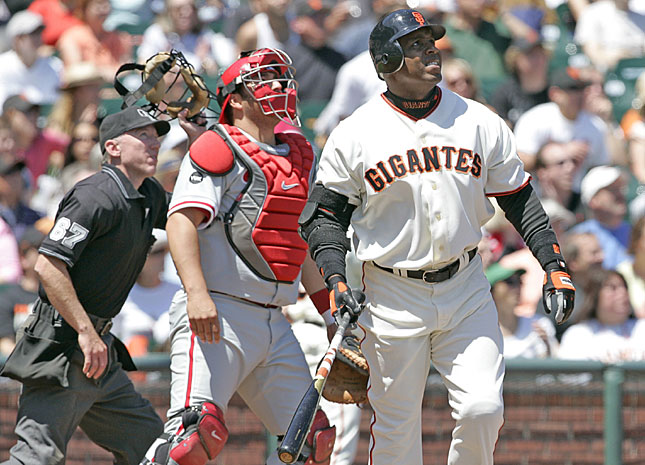
The San Francisco Giants will host the Arizona Diamondbacks tonight (July 31), beginning a three-game series that will determine the first place slot in the National League West. A lot of eyes will be on our 2010 league champions – all the more reason, says a classic Mission District arts and culture organization, for them to take a stand against racist anti-immigration laws.

In early June, community members who had been leaders of the 1960s to ’80s group Casa Hispana de Bellas Artes sent Giants CEO Bill Newcombe a letter with a simple request. They want the baseball team to wear its popular ‘Gigantes’ jerseys while playing the Arizona Diamondbacks and the Atlanta Braves, two squads that hail from states that have recently passed laws codifing racial profiling in the fight against illegal immigration. The letter tells the team “this kind of law has created a paralyzing climate of fear among Latino families, citizen and non-citizen alike.”

San Francisco, the Casa Hispana elders insist, does not swing at discriminatory government. Reminding the Giants organization of its long-standing support of the Latino community, they’re politely encouraging the team to represent its fans by speaking out against discrimination. We caught up with Casa Hispana elder Don Santina for an email interview to explain why his group asked its team for a wardrobe change. The Guardian was unable to reach the SF Giants for comment – but any organizational response we get will be added to this post.


San Francisco Bay Guardian: Tell us about the mission of Casa Hispana de Bellas Artes.

Don Santina: Casa Hispana de Bellas Artes was founded in 1966 in the Mission District by a group of artists and poets to promote cultural advocacy for Latino-Chicano-Raza culture. [Our] group produced and sponsored programs year-round but focused particularly on an annual two-month long Raza/Hispanidad Festival which opened on October 12, Dia de la Raza. Among the multitude of programs, exhibits, performances, and events produced included major undertakings like the Chichen Itza exhibit at SF State, the pre-Colombian artifacts at the De Young and 24th Street BART station opening, the Cisco Kid Festival with Duncan Renaldo, and the Latin American Theatre Festival with Enrique Buenaventura, and low rider car exhibit at the US Presidio. Casa faded into history in 1983 when its major funding sources withdrew. The National Endowment for the Arts was seized by Reaganites.

In 1975 Casa Hispana executive director Amilcar Lobos Yong read a bilingual version of “Casey at the Bat” at Candlestick Park as part of a program in honor of the Giant’s support of the Latino community. Photo by Joe Ramos

SFBG: Why did you send this letter to the Giants?

DS: The elders of Casa wrote to Bill Newcomb’s Giants organization because it had produced a pre-game program in Candlestick Park with Horace Stoneham’s Giants team in 1975 honoring the Giants for their “pioneer recognition of Latin players” in the racist world of major league baseball.  At the event, Casa Poets Theatre read “Casey at the Bat” in English and Spanish before the game and gave awards to the Giants, Juan Marichal, and Tito Fuentes for his works with youth in the Mission District (editor’s note: the awards were presented by long-time Bay Area Latino news legend Luis Echegoyen). Casa people felt that the Giants should continue that anti-racist policy by making a genuine statement against SB 1070 by at least wearing Gigantes uniforms when playing Arizona and Atlanta.


SFBG: What’s been the response from the team? Did they get back to you?

DS: The Giants received Casa’s letter on June 9, and the business has not responded. Casa is disappointed in this lack of response and respect from a San Francisco-based team which has many Latino players.


SFBG: What is a professional sports team role’s in their community? Should they be speaking out on political and social issues? 

DS: A professional sports team has the same responsibilities to the community as any other business; in a word: Spike Lee’s “do the right thing.” Unfortunately, these teams are all mega-corporate businesses with morality based on profit. Dave Zirin has covered this topic very thoroughly.


SFBG: How much of the artists and community members involved with Casa Hispana are baseball fans?

DS: Most of the Casa people love the Giants; however, they also love fútbol, a.k.a. the international game of soccer.   


SFBG: Do you think they’ll be wearing the Gigantes jerseys at AT&T Park tonight?  

DS: We don’t think they’ll wear the Gigantes uniforms without public pressure or embarrassment. [But] if they do, it will be beneficial as a public stand against racial profiling laws. 


UPDATED WEDNESDAY, AUGUST 3: The Guardian contacted Giants spokesperson Shana Daum, who said she couldn’t recall recieving Casa Hispana’s letter but that the Giants would not be wearing their Gigantes jerseys at all during this week’s Arizona series. “We try to support the community, but we don’t want to take a political stance,” she told us.

“There’s other ways for major league baseball to get involved.” Daum cited the team’s annual Fiesta Gigantes celebration during September’s Hispanic Heritage Month, HIV/AIDS awareness days, the team’s pioneering involvement in the It Gets Better campaign. She added “but we appreciate the spirit in which [Casa Hispana’s request to wear the Gigantes jersey] was asked.”

Stop the right-wing revolutionaries

59

The revolution has begun, but we aren’t the revolutionaries. That was the disturbing thought that occurred to me this morning as I listened to Fresh Air on KALW and its interview with Robert Draper, the New York Times Magazine journalist who is writing a book about the House of Representatives, where Tea Party backed members almost just succeeded in bringing down government as we know it.

That wasn’t how Draper cast the situation, although he did paint a vivid picture of the right-wing true believers who manufactured this debt ceiling “crisis” and their monomaniacal goals of slashing government to the bone, no matter what the consequences to the U.S. economy and way of life. Instead, the discussion triggered a memory of the powerful and prescient premise from economist Paul Krugman’s 2003 book The Great Unraveling.

In its opening pages, under the heading of “A Revolutionary Power,” Krugman cites an unlikely source for how to identify and oppose those bent on destroying a country’s institutions: Henry Kissinger. In 1957, as he was completing his doctorate at Harvard University, Kissinger wrote his dissertation, “A World Restored,” on Napoleon and the French reconstruction period after Waterloo, with some obvious parallels to the rise of fascism in Europe in the 1930s.

Kissinger argued for the importance of understanding the nature of a revolutionary force, and Krugman saw the inflexible right-wing movement in the U.S. as another example of that. “That is, it is a movement whose leaders do not accept the legitimacy of our current political system,” Krugman wrote, citing the oft-stated belief of modern Republicans that “long-established American political and social institutions should not, in principle, exist – and [they] do not accept the rules that the rest of us have taken for granted.”

At the time, Krugman cited the efforts of right-wing politicians and institutions to undo such New Deal era programs as Social Security, unemployment insurance, and Medicare, as well as their rejection of international treaties and cooperation in favor of empire and unilateralism. But since then, the right-wing has gone even further, willing to force the government into default in order to accomplish its ideological goal of destroying the federal government’s ability to ask anything of capital.

Kissinger made clear that such forces can’t be reasoned or compromised with, all you can do it try to defeat them before they destroy the country. The longer everyone delays arriving at that conclusion, the more difficult that task becomes, and that’s an important lesson for President Obama and the Democrats to learn right now.

“Lulled by a period of stability, which had seemed permanent, they find it nearly impossible to take at face value the assertion of the revolutionary power that it means to smash the existing framework. The defenders of the status quo therefore tend to begin by treating the revolutionary power as if protestation were merely tactical; as if it really accepted the existing legitimacy but overstated the case for bargaining purposes; as if it were motivated by specific grievances to be assuaged by limited concession. Those who warn against the danger in time are considered alarmists; those who counsel adaptation to circumstances are considered balanced and sane…But it is the essence of a revolutionary power that it possesses the courage of its convictions, that it is willing, indeed eager, to push its principles to their ultimate conclusion,” Kissinger wrote.

The Tea Party may have a fundamental misunderstanding of the principles and events surrounding the American Revolution, but make no mistakes that they do see themselves as revolutionaries, people who want to turn back the clock on the gains made in workers’ rights, environmental protection, tax equity, the creation of social safety net, and all the other hallmarks of civil society.

They’ve already taken over one of our two political parties, and succeeding in forcing the other one to do their bidding. Call me an “alarmist,” but if we don’t challenge the notion that Obama is “balanced and sane” and convince them that the American way of life is at stake, then we just might end up with another revolutionary war on our soil.

Scribe’s Guide to Playa Prep

32

steve@sfbg.com

PLAYA PREP This is a crazy time of year for burners, when they begin to realize just how overly ambitious their art projects actually are, when the August calendar seems to shrink as to-do lists grow, and when procrastination morphs into panic — all of it laced with a giddy, distracting excitement about the dusty adventures to come.

Don’t worry, fellow burners, Scribe is here to help. I’m way too busy right now to actually come help weld your art car or hot glue your costume (unless you’ve got stuff or skills that I may need, in which case we can maybe work something out) but after years of deep immersion in this culture, I do have a few tips and resources for you.


ATTITUDE

The most important thing to bring to the playa with you is the right attitude. It’s right up there with your ticket at the very top of the list. As I worked on this guide, I posed the question “What’s the most important thing you bring to the playa?” to online burner hives, and most of the answers I got back had something to do with attitude.

Whether you’re a nervous newbie or salty veteran, it’s important to leave your expectations at home and just be open to whatever experiences await you. Intention is everything out there, and if you try to always maintain an open mind, a loving heart, and a sense of humor, everything you need will just flow your way.

It isn’t always easy. When your project breaks, or the dust won’t stop blowing, or your lover squashes your heart, or some yahoo behaves in a way that strikes you as somehow un-Burning Man, it’s natural to let your anxieties creep up. But you’ve got to let it go, because it’s all going to be OK, it really is. When all else fails, just breathe.

It is the breaking through those difficult moments and coming out the other side — enduring through things that feel like they may break you — that makes Burning Man feel so transformative. It is a cauldron, and you may not come out in the same form you went it, but that’s part of why you go.


GETTING AROUND

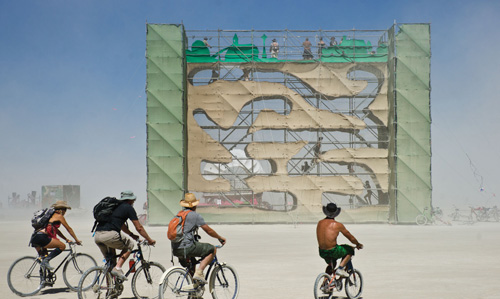
You’ll need a motorized vehicle to get to Burning Man — and art cars can be a fun way to get around when you’re there, a sort of surreal public transit system — but if you don’t have a good bicycle then you’re at a decided disadvantage in fully experiencing Black Rock City, the most bike-friendly city on the planet while it exists. And that’s never been more true than this year, when early reports indicate that the wet winter has left the playa packed solid and perfect for pedaling.

Form and function are equally important when it comes to your bike. It needs to be in good mechanical condition (and with enough tools and patch kits to keep it that way) and correctly sized to your body, ideally with a comfortable, upright position and basket for your stuff. And you also need to decorate it and make it unique, both because making art is the essence of Burning Man and so you can easily find it amid a sea of bikes. Form and function, they’re like two wheels rolling together.

Although the Borg, a.k.a. Black Rock City LLC, recommends that you bring a bike lock, I’ve personally never used one and never had a problem. Sure, bike thefts happen, but I believe they’re almost always crimes of opportunity or drunken mistakes involving nondescript bikes, not unique rides like mine that I could spot 100 yards away.

I’m convinced that half the people who think their bikes got stolen actually just lost them. The playa can be a very disorienting place, with art cars and other visible markers moving around — and even one’s own brain conspiring against locating one’s bike. So illuminate your bike well, ideally with something that sticks up high the air, and leave your lights on as you explore on foot.

Speaking of which: wear good, comfy shoes. Most costumes should stop at the ankle at Burning Man, particularly if you’re prowling the playa


SNEAKING IN

In honor of the mad scramble for tickets after Burning Man sold out more than a month before the event for the first time in its 25-year history, I’m offering some thoughts on sneaking into the event. Given how many people could find themselves stuck with counterfeit tickets or otherwise unable to get in this year, it seems like something that any thorough guide should cover.

Now, before everyone jumps all over me, telling me that I’m endangering lives and undermining the spirit and the stability of the event, let me make clear the spirit in which I’m offering this advice. Just think of it like a hacker publicizing the security vulnerabilities of a beloved institution — hopefully the Borg will read this too and do what it can to either plug the holes or somehow take pity on the desperate souls stuck outside the city’s gates.

First of all, you gotta know what you’re getting yourself into. Gate crew takes this shit very seriously, thoroughly searching every car and trailer, and looking into hiding spots that you probably haven’t even thought of. Many of them take real pride in this, some thoroughly stomping on rolls of carpet that might contain a stowaway, potentially adding injury to your insult.

Here’s the worst part: It is official Burning Man policy that when stowaways are found, everyone in that vehicle gets his or her tickets torn up. And burner brass says it will beef up security this year, including more people at the gate and more people scanning the open playa with night-vision goggles and fast interceptor cars.

Every year, they catch about 30 people trying to sneak it. “We’re very confident that we catch all the stowaways,” Borg member Marian Goodell tells us. But we all know that can’t possibly be true, right? There are playa legends of a contortionist who puts herself in a packing bin and gets in every year, and I’ve met people who claim to have snuck in both at the gate and over the open playa.

So, if you gotta do it, my best advice is to find a confederate on the inside, such as someone on Gate crew who owes you or will take pity on you or a bribe from you. That’s how many coyotes do it at the US-Mexico border, and it could work here too. There aren’t any wristbands at Burning Man, so once you can weasel your way in amid the confusion at the gate, you’re in.

Skydivers also have a pretty good shot at getting in, even though they’re likely to be greeted on the ground by someone asking for their tickets. But, it’s a big city, and if you’ve got some skydiving expertise and you’re able to rapidly change directions during the final phase of your descent, you might just make it.

There are also ways to take advantage of human oversights, particularly during the early arrival period before the event begins. There are often openings in the gate briefly left unguarded in the early days, as we discovered last year after a trip to the reservoir. Or sometimes, after thoroughly searching the car, the person at the gate will forget to tear your ticket. And believe it or not, sometimes people on the inside end up with spare tickets for friends who couldn’t make it. Any untorn tickets can be spirited out by people making runs into nearby Gerlach for supplies.

But in closing, let me just reiterate that buying a ticket is part of the “radical self-reliance” principle that is central to the burner ethos, so do yourself and your community a favor and find a ticket, or accept that you may just have to sit this year out. Don’t worry, we’ll make more.


FOOD AND SHELTER

In preparing for Burning Man, it’s always helpful to remember Maslow’s Hierarchy of Needs, which instructs us that we need to see to our basic needs at the bottom of the pyramid before we can even think about approaching the enlightenment at its pinnacle. And that begins with food and shelter.

Contrary to common misconceptions, you don’t need an RV or trailer on the playa — and it’s too late to get one at this point anyway. Frankly, you’ll be fine in a cheap pup tent as long as you place it under a sturdy shade structure, such as the 10-by-20-foot steel carports that are ubiquitous on the playa, or a cheaper shade structure with poles reinforced by PVC or something to help it from being flattened.

You may need to make adjustments during the course of the week, but jerry-rigging your shit is just part of the fun. Or if that’s not your cup of tea, more and more burners in recent years have been building their own yurts or turning to custom-made designs like the Playa Dome Shelters from Shelter Systems (www.shelter-systems.com/playadomes.html).

For food, just try to keep it simple, nutritious, and free of unnecessary waste. That means lots of simple snacks and easy meals, such as those you make ahead of time and reheat. There are also some good entrepreneurs out there that have perfected this approach, such as Gastronaut SF (www.gastronautsf.com/playa-provisions), which makes meals that you boil in the bag, which even allows you to reuse that water.

And don’t forget to take your vitamins because playa life can really take it out of you. Dr. Cory’s Playa Packs (www.drcory.com) are one of many good companies that understand what nutrients you’ll need and try to provide them.


SHOPPING

Let’s face it, for all the talk about decommodification and intentional communities and all that hippie crap, you’re going to need stuff at Burning Man. Lots and lots of stuff. Luckily, San Francisco is a great place to get it, and here are some of my personal favorite spots to shop for my playa gear.

Mendels This art supply store has everything you need for your costumes and other Burning Man projects, and many things you didn’t know you needed. For example, when I was looking for a cool covering for my bike years ago, I found tubes of thick acrylic paint that dries hard (now known as 3-D Paint), which has lasted for years and drawn compliments the whole time.

1556 Haight, SF. (415) 621-1287, www.mendels.com

Fabric Outlet Fake fun fur has become a staple item for Burning Man costumes and art projects, particularly as the styles and varieties of it have gotten better. And this place has the coolest fake furs in town, as well as a huge selection of other fabrics, patterns, and sewing kits.

2109 Mission, SF. (415) 552-4525, www.fabricoutletsf.com

Multikulti This is the best place in town to find a great selection of groovy sunglasses for just $6 each — and you’ll want a good selection of shades out there to go with your costumes — as well as a variety of other accessories and costumey geegaws to accent your Burning Man ensemble.

539 Valencia, SF. (415) 437-1718

Five and Diamond If there is a store that grew directly out of the feather-and-leather fashion aesthetic that has come to take center stage on the playa, this is it. From groovy utility belts (important when your costumes lack pockets) to elaborate leather outer wear to some of the coolest custom goggles that I’ve found (mine has a built-in light and both clear and shaded lenses), this place has great — if slightly pricey — stuff.

510 Valencia, SF. (415) 255-9747, www.fiveanddiamond.com

Held Over My favorite second-hand clothing store creates special racks of Burning Man clothes this time of year, but I always prefer to assemble my own outfits from their great selection of unique vintage and specialty clothes, including an entire room of tuxedos and other retro formal wear.

1543 Haight, SF. (415) 864-0818

Distractions The oldest walk-up Burning Man ticket outlet, Distractions knows just what burners need, offering a wide variety of playa-oriented clothing and accessories that you’ll need, from goggles to EL wire strips to pipes and other smoking paraphernalia.

1552 Haight, SF. (415) 252-8751

Cool Neon This Oakland-based company specializes in electro luminescent wire, the staple item for illumination on the playa (and whether you’re walking or on a bike, you will need to be lit-up out there). Cool Neon makes the rounds at many of the fairs and trunk shows, but you can also place orders for shipment or arrange pickups at its office at 1433 Mandela Parkway in Oakland.

www.coolneon.com

Discount Builders Supply Rather than spending your hard-earned money at Home Depot or some other chain store in the burbs, this locally owned business has everything you need to construct and decorate your project, or see to your sundry personal needs. They’re also used to burners with strange requests, so they give good advice.

1695 Mission, SF. (415) 621-8511, www.discoutbuilderssupplysf.com


WORKSPACES

The project. It is the essence of Burning Man, whether it’s the fun fur and EL wire you’re putting on your bike, the bar or showers your camp is building, or some ridiculously ambitious artwork that you’re creating with a crew of hundreds. Black Rock City is a series of thousands of these individual projects, all of which are coming together right now. And if you’re looking for some help finishing (or starting) yours, here are some resources you can tap.

The Crucible The Crucible is a venerable nonprofit institution that offers a wide variety of arts and crafts classes and resources in a state-of-the-art facility in West Oakland, with many burners among its staff and clients. As the longtime host of the Fire Arts Festival, this place knows its stuff.

1270 17th St., Oakl. www.thecrucible.org

CELLspace The Flaming Lotus Girls and many other key burner art collectives were born here, and his facility continues to provide the expertise and tools to bring Burning Man to life, year after year.

2050 Bryant, SF. www.cellspace.org

Techshop The new kid on the block, but one of the most technologically advanced, Techshop is a DIY workshop with amazing tools and experts on staff. Join its Aug. 15 EL wire workshop or other upcoming classes catering to burners.

926 Howard, SF. www.techshop.ws

American Steel Also known as Big Art Studios, this massive warehouse houses many of these biggest projects now bound for Burning Man. It may not have the structural support of places like the Crucible, but if you’re looking for knowledgeable burners to work through some problem, American Steel is brimming over with them.

1960 Mandela Parkway, Oakl. www.americansteelstudios.com

Burning Man costume creations If it’s sewing or other costuming help that you need, there are lots of local designers who might lend a hand (see “What not to M.O.O.P.” in this guide). Or you can stop by these Aug. 11 or Aug. 25 sewing circle meetups listed at www.meetup.com/Burning-Man-Costume-Creations


ART

Here are a few of the major installation artworks with Bay Area connections that I’m excited to see on the playa this year:

Charon by Peter Hudson Peter Hudson and his large volunteer crews have created some of the most dynamic art pieces in Burning Man history, zoetropes that use motion and strobe lights to animate the characters they create: the swimmers of Sisyphish, the divers of Deeper, the snake and monkeys of Homouroboros, and the man reaching for the golden apple of Tantalus. This year, Charon the boatman crosses the river Styx into Hades and, well, you just really gotta see what could be his best piece yet. As the artist says, “Charon asks them to reflect on their own mortality and ponder how to give and get the most from their brief time here on earth.”

Tympani Lambada by the Flaming Lotus Girls Combining fire, steel, light, and sound on the massive scale that we’ve come to expect from the Flaming Lotus Girls, Tympani Lambada simulates the structure of our inner ears, which control not just hearing but balance and perception. As always with this crew, this project promises to be space as occupy and interact with (usually with an unbelievable sense of awe) rather just a structure to see. And as they’ve been doing for many years (see “Angels of the Apocalypse,” 8/20/05), the dynamic crew built this creation right out at the Box Shop on Hunters Point (with an assist for American Steel, where some of its longest sections are being built).

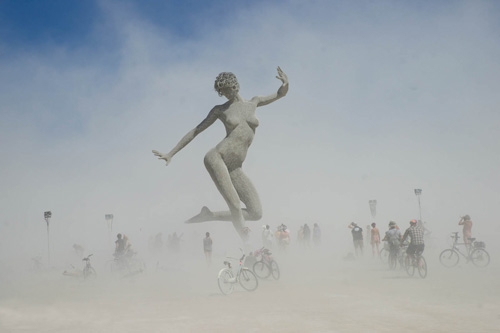
Truth and Beauty by Marco Cochrane Following up last year’s amazing Blissdance, which is now on display on Treasure Island, this crew hoped to make an even larger female nude sculpture of the same model (55 feet this time), but their fundraising fell a little short so they couldn’t complete it. But even in the abbreviated form they’re bringing to the playa this year — just the torso from knee to shoulder, but well-anchored that it’s climbable — it should still be something to see.

Temple of Transition, by International Art Megacrew The Temple is always a special place at Burning Man (see “Burners in flux,” 8/31/10), and this year promises to be as spectacular as it is spiritual. The project is headed by a pair of builders known by their nationalities, Kiwi and Irish, and built mostly in Reno by a crew of committed volunteers from more than 20 countries. It’s centerpiece tower, Gratitude, is a towering 120-feet tall, surrounded by and connected to five smaller towers: Birth, Growth, Union, Death, and Decay.

Otic Oasis Lightning (Burning Man’s attorney) and friends (including named artists Gregg Fleishman and Melissa Barron) wanted the quietest spot on the playa for this 35-foot wooden pyramid of comfy lounging compartments, a remote spot where even the music from art cars couldn’t reach. Their answer: at the very back of the walk-in camping area, a spot only reachable on foot by people intending to go there. Finally, a quiet spot to chill out.


PLAYA EVENTS

OK, I know that many of these events are music-related, and there are an untold number of quirky, weird things to do on the playa besides just rocking out to a DJ. But exploring what the hundreds of theme camps offer each year is part of the fun, and it’s too Herculean a task to sort through the voluminous information and offer you sound predictions.

But every year the music lovers among us compile their recommendations of the stops to hit that will be going off and filled with dancing fools, so I know those lists are valuable. And mine does include some other stuff as well, so just deal with it.

The future of Burning Man The 17 board members of The Burning Man Project, the new nonprofit entity being created to take over operations of Burning Man in coming years (see “State of the burn” in this guide), will be available to discuss the future of this culture. This is your chance to weigh in on what’s important to you and how the event should be governed into the future.

Everyday, 1 p.m.-2:30 p.m. at Everywhere Lane (near Center Camp)

Lee Coombs This British-born DJ has long been a great supporter of Burning Man art projects — and he always plays fun sets — so come check him as the playa’s best daytime dance party camp starts to work it out.

Tuesday, 5 p.m.-6 p.m., Distrikt (9&F)

Unicorn Stampede

The perverts from Kinky Salon love getting horny on the playa, and this time they’re getting literal as they dress as unicorns and stampede across the playa, spreading their joy and juices onto unsuspecting burners and ending up at the Walkout Woods art piece. What does all that mean? Bring a horn, leave your inhibitions, and come find out.

Wednesday, 7-9:30 p.m., gather at The Man

Shpongle OT’s regular Wednesday night White Party — which has included many epic performances over the years, and this year include big draws EOTO, Infected Mushroom (both doing live sets on two stages OT is setting up for live music this year) and Christopher Lawrence, at midnight, 1:30 am and 3 am respectively — welcomes the dawn with pysbient music innovators Shpongle, which is already generating lots of excitement.

Thursday, 5:45 am (sunrise set), Opulent Temple (10&B)

Deep End reunion It’s like family day at Distrikt as the core San Francisco-based DJs that helped launch the original Deep End day parties play successive one-hour sets, with Syd Gris followed by Tamo, Kramer, and then Clarkie. Buckle up, everyone, because this could get ugly.

Thursday, 2-6 p.m., Distrikt (9&F)

Cuddle Ocean Upping the ante on the stereotype of ravers heaped into cuddle puddles at Burning Man, some instigators from last year’s Temple of Flux crew are seeking to create a Cuddle Ocean of thousands of burners heaped all over each other in the deep playa. Come feel the love.

Thursday, 6-8 p.m., between the Man and the Temple

Bootie BRC Adrian, Mysterious D, and the rest of the popular Bootie SF music mashup crew will be throwing a dance party specially mixed for your on-playa pleasure — with actual words!

Thusday, 8 pm-???, Fandango (Esplanade&4)

Circle of Regional Effigies burn Regional events have become an important part of the Burning Man culture, and this year 23 of them will build wooden effigies in circle around The Man. And then, as tends to happen to our effigies, they will all burn — simultaneously!

Thursday, 9 p.m., around The Man

Critical Tits This women-only topless bike ride has been a playa tradition for many years, so cruise by to cheer them on and offer your encouragement for what is a very freeing experience for many of the participants. Besides, who doesn’t like tits?

Friday, 4-5 p.m., The Man

Space Cowboys Hoedown Legendary SF-based sound collective the Space Cowboys has a tradition of driving its mobile music vehicle the Unimog out to the “biggest, baddest art piece” on the playa for a big dance party every year, which art cars with speakers and radio receivers can also relay, create a fun circle of sound. And this year, the winner is…The Flaming Lotus Girls’ Tympani Lambada.

Friday night at Tympani Lambada

Distrikt Come ride the daytime dance party train to the end of the line with DJ Kramer spinning until someone drags him off the stage to get ready for the burn.

Saturday, 4-??? at Distrikt Camp (9&F)

Scumfrog Dutch-born DJ Scumfrog has been rocking the playa every year since he first camped with us at Opulent Temple in 2004, and as readers of my book know, he’s a Burning Man true believer who just loves this culture, so he always brings his A-game. This is the place to be as the sun rises on final full day of Black Rock City.

Sunday, 4 am-sunrise, Disorient (2&Esplanade)

Tribes of Burning Man signing Yours truly, Scribe, will be on stage leading a discussion of issues raised in my book, The Tribes of Burning Man: How an Experimental City in the Desert is Shaping the New American Counterculture. Study up by ordering a signed copy now from www.steventjones.com and join in the debate, or just come heckle me for this shameless plug.

Sunday 4 p.m., Center Camp Stage

Steven T. Jones, a.k.a. Scribe, is the Guardian’s city editor and the author of The Tribes of Burning Man: How an Experimental City in the Desert is Shaping the New American Counterculture, which grew out of a series of stories in the Guardian that ran from 2004 through 2010.


Replacing the Concourse

4

news@sfbg.com

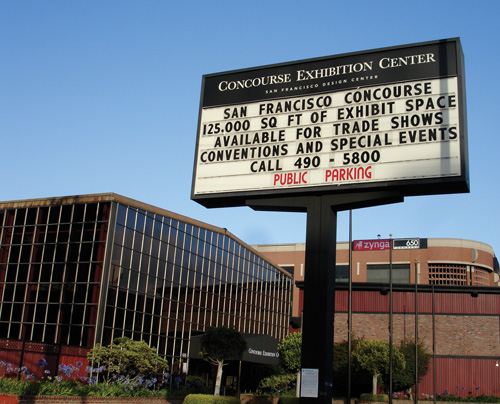
In one of the few remaining San Francisco neighborhoods untouched by gentrification, there is a proposal to demolish the Concourse Exhibition Center and replace the quintessential Showplace Square building with a market-rate residential project, which the developer says will be rental apartments.

This is the first major project in the new Eastern Neighborhoods Plan that will change the light industrial neighborhood where brick and mortar meet interior design, raising questions about whether the development would be sustainable, transit-oriented, and family-friendly.

Home to annual events like the Green Festival and the KPFA Craft Fair, the Concourse is where mom and pop vendors share their wares in an affordable venue — one of the few remaining in the city.

“Since ’96,” recounted Alan Van De Kamp, director of sales for the Green Festival, “they’ve been trying to sell it, to tear it down. You never know from year to year … You imagine at some point, somebody’s gonna say it’s time.”

Though nothing has been approved, the current proposal by developer and Concourse owner Bay West Development, first introduced in 2000, has come the farthest yet. The project will be considered for approval by the Planning Commission once the environmental review process is complete, which could take up to six months. Public comments on the project will be accepted until August 8.

The proposed project contains two sites, one at 801 Brannan Street and one at 1 Henry Adams Street, which would result in a total development of up to 674 residential units, 43,037 square feet of retail space, and 673 parking spaces. Under the city’s inclusionary housing laws, 221 of those units would be affordable (71 to be built on site and 150 dedicated to the city for development). Of the total parking spaces, 166 spaces would replace existing parking spots at the site.

Bay West, developer of the San Francisco Design Center, has owned the Concourse building for 30 years and wants to demolish and rebuild as part of the Eastern Neighborhoods Rezoning and Area Plans, the blueprint for development in a part of the city dominated by working class residents.

That controversial plan was in development for years, during which there was a moratorium on approval of large projects, and it was finally adopted in 2008. It was created to redevelop The Mission, Showplace Square/Potrero Hill, East SoMa, and the Central Waterfront — 7 percent of the city’s 47 square miles — over 20 years.

“It’s our feeling that the building itself is beyond its use as an exhibit hall and we’re replacing it with housing units,” said Sean Murphy, a partner at Bay West.

The Planning Commission heard the draft Environmental Impact Report for the proposal on July 28. At the hearing, the commissioners expressed interest in seeing the progression of the development, but not all were convinced.

“There is a certain amount of vagueness,” said Commissioner Kathrin Moore. “This EIR is ultimately tempered by the strong policy issues that underlie building in the Eastern Neighborhoods and at this moment I don’t quite see that.”

The proposal has left some questions unanswered, such as, where will the small vendors go to sell their wares? Bay West has suggested exhibition halls like the Cow Palace or Moscone Center, but Green Festival organizers say that isn’t realistic for everyone. “We would lose some of our vendors if we went to Moscone,” said Van De Kamp. “There’s some people that can’t come. A lot of the green economy is about mom and pops. They can’t afford it.”

Sue Hestor, a land-use attorney who opposes the development, asked vendors who use the Concourse how important leaving the center would be. “For a lot of people,” she said, “it meant the difference for them being viable or not.”

It would be a major challenge to move, said Robbie Kowal, the co-director of Sea of Dreams, a huge party and concert that will hold its seventh annual celebration this New Years Eve at the Concourse. “There’s the Cow Palace, and the Design Center, but it’s not that big, not a place where you can put a proper concert on one side and a multitude of different kinds of spaces [on the other]. The Sea of Dreams’ success is attributable to the proper use of the Concourse.”

With 125,000 square feet of space that can be split into its west and east halls and a mezzanine, the Concourse building has catered to annual festivals and events for more than 20 years, holding as many as 6,800 people at once.

“There’s room for so many different communities in there. We love our home,” said Kowal. “It’s a really unique and wonderful space.”

The redwood frame of the Concourse, accented by glass fronts that allow for natural lighting, used to be a furniture mart and then a fashion and jewelry mart before it was an event center. The project proposal’s architect, David Baker and Partners, has already designed many of the new buildings in Showplace Square.

Bay West isn’t worried about where the Concourse shows will go. “Most of our shows use less than 20,000 square feet,” said Murphy. “The larger shows would go to the 100,000 square foot San Mateo County Event Center.”

Tony Kelly of the Potrero Boosters Neighborhood Association says the intention of the plan is to reduce the light industrial area by zoning more of it for residential uses, protecting only about half of it and converting the remainder.

“This is an area where we don’t have enough parks, or transit. The project would double the population, and we don’t have enough new infrastructure to handle it,” he said. “It’s essentially a ticking time bomb that the city’s going to have to get a handle on at some point, or these residents are going to be miserable.”

Though the project would create at least an acre of publicly accessible open space, some residents wonder if it’s enough, and the concern about insufficient transit remains.

“It seems to me that once again there is too much parking near a freeway entrance, inadequate transit that is not likely to improve significantly once the Transit Effectiveness Project [a city plan for improving Muni service] is implemented,” said activist Sue Vaughan, who rides her bike at least part way during her commute from the Richmond District to REI at 840 Brannan Street for work.

“This is exactly the kind of place that attracts (commuters),” said Hestor. “There’s too much parking. There’s crappy transit. It totally undermines any idea of sustainable development.”

But at the commission hearing, Commissioner Hisashi Sugaya didn’t think Hestor’s argument had merit. “Parking is not an environmental impact as far as the city is concerned,” he said.

Vaughan says that Muni managers have been absent from several development meetings in the Eastern Neighborhoods area. “No one from Muni was represented on this panel discussion about the Sustainable Communities Strategy,” she said, referring to a July 6 meeting convened by the Planning Department to discuss the importance of building housing next to accessible transit.

The Concourse is scarcely accessible by bus lines 10 and 19, but with a growing population in Showplace Square, it wouldn’t be enough, says Vaughan. “We’re moving forward with all these projects with lots of parking near freeway entrances, which makes it seems like SF is becoming a bedroom community for Silicon Valley. You have an impact on Muni when that happens. With more cars, there’s more congestion for buses.”

Bay West argues that the apartments it plans to build at the Concourse site would be “workforce housing” with less than 1:1 parking (actual parking would work out to .79:1 at the 801 Brannan site and .64:1 at the One Henry Adams site). More than 40 percent of the units would be larger two-bedroom units intended for families.

Yet Kelly says that that by offering the apartments at market rates, none are appropriate for new families. “For all the talk about keeping families here, then how come we’re not building family housing?”

It’s a max-out project, says San Francisco architect Dick Millet, of the Potrero Boosters Neighborhood Association. “In the end, under their breath, they’re all going to say, I wouldn’t live there myself.”

The foodie crackdown

3

news@sfbg.com

Yet another blow was dealt to the San Francisco’s free-thinking food scene on June 11 when the final Underground Market was staged by ForageSF, at least for the time being. The market was shut down by the San Francisco Department of Public Health (SFDPH) in a clash between small-time food businesses and city officials over permitting and regulatory issues.

“I was ready for this for a while,” ForageSF founder Iso Rabins told us. “I thought someone would show up eventually to say something about this, and now they have.”

Rabins began the Underground Market in 2009 as a monthly venue for food entrepreneurs to share their goods without financial and bureaucratic red tape. It’s basically a farmers market without the permits, fees, and commercial kitchen requirements that add thousands of dollars to the cost of staging an event. Throw in live music, drinks, a little subversive thrill, and you’ve got a gathering that has proven enormously popular.

Until now, the market has operated as a private event. It is held in a private space and attendees are required to sign a membership form and pay a $5 entrance fee. It’s become a huge draw for foodies, with 1,500 to 3,200 patrons per event, according to Rabins, so the state government got wind of its largely unregulated operations.

Alicia Saam, the temporary events coordinator with SFDPH, says her department was asked by state officials to observe the market. It’s now too big to be considered private, she says, so it must adhere to health code and public safety regulations just like any other public event.

“One of the things that differentiate private versus public events is how much advertisement goes out there,” Saam said. “Something that is advertised and has grown big enough to have a following, that becomes a concern for us as a public event.”

Without official oversight, rules are bound to be broken. As with any novice venture, mistakes are made. When officials came to the Underground Market, they saw some vendors acting more like friends at a house party than professional food vendors, which is the complicated line that the market tries to toe.

“We observed operators and vendors eating and then handling the food, and that’s a huge contamination hazard for us,” Saam said. “They weren’t washing their hands before continuing food service, nor did they have a hand-washing set-up right there at their booth. There looked to be temperature issues as far as some of the food that was being stored, such as protein foods, sausages, and dairy. Some foods were not protected but were displayed on the table uncovered. People come up and they’re excited and curious, there’s a lot of creativity there, so they’re hovering over the food and possibly contaminating it with all sorts of things. The source of food, such as the kitchen where the food is coming from, needs to be an approved space where there are no animals, or cats like in some homes. It needs to be a commercial space that is properly cleaned and sanitized.”

According to the U.S. Center for Disease Control, one in six Americans get sick each year from eating contaminated food. Salmonella infection is of particular concern because food can be contaminated anywhere from the fields to kitchen surfaces.

The SFDPH has already allowed the Underground Market to operate unregulated for more than a year without any reported food illnesses, but Rabins is quick to agree that these health concerns are real.

“I do believe that these issues of health are important, and although I feel that all the vendors at the market are very careful about what they make, we do want to institute some Serve-Safe classes, basic food safety,” Rabins says.

He says that on the whole, people cooking small batches pay much more attention to their ingredients and processes than industrial food companies do. Rabin said that while the country’s food safety system works pretty well, it doesn’t allow for much locally based innovation in new models for making and sharing food.

“The Health Department’s position makes sense because this is the system that has existed, this is the system that they know and that their jobs support, and it’s a system that works in a lot of ways. But it’s also a system that was really created for industrial processes,” Rabins says. “Unfortunately the way regulations work, top-down is one-size-fits-all, but that’s just not the way it is.”

That gets to the meat of the issue: whether and how much the city should get involved in people’s food habits. Where is the line between public restaurants and private homes — and are there ways of creating hybrids of the two? It’s an ongoing battle in San Francisco between regulating restaurants (and netting taxes) while still promoting an innovative food industry that attracts locals and tourists alike.

In the past few years, the mobile food truck craze has hit San Francisco with little bits of foodie culture from all over the world. Entrepreneurs say it’s too difficult and expensive to start a successful restaurant in SF, so they’re trying small-time pop-ups instead.

At first they went unregulated, but now laws define what they can sell, the permits they need, and limit their mobility. Permits are expensive too, starting at $1660 for initial basic coverage, which is why Rabins says the Underground Market provides an additional support for motivated locals. As city officials have closed big budget deficits year after year without any substantial increases in general tax revenue, fees and permit costs have risen substantially in recent years.

According to Rabins, getting the Underground Market up to code means, “getting all the vendors commercial kitchen space, making them get catering licenses, which is around $600, making them pay for vendor event permits, which is $140 per event, and then I would have to buy a sponsor permit which is another $1200 per event plus event insurance plus, plus, plus all these things that would essentially destroy the spirit of the event. It would make the bar way too high.”

Tightening the membership rules is another option, such as making people sign up weeks in advance or requiring member cards. Richard Lee, the director of environmental health regulatory programs at SFPHD, says that regardless of the vendor’s complaints, the regulations must be met.

“We think that these are reasonable options,” Lee said. “Anyone who is going to sell to the public needs to meet certain requirements, and unfortunately some of those requirements are going to be costly. They have to pay for permits and whatever those permits cost they’re going to have to pay.”

Until some agreement can be reached, the Underground Market won’t be operating, and San Franciscans will have to find their fix at the numerous above ground markets and restaurants. Lee says that he hopes that the market meets city demands, and soon, as this kind of entrepreneurial innovation is essential to a thriving food economy.

“We do encourage the micro-enterprises, and there are possible ways to have that started in San Francisco,” Lee said. “It is possible that there may be legislation in the future that might be supported by the Board [of Supervisors] to make it easier for them to get permitted, so there are things that can be done. For us, though, it is food safety and public health that are the most important things.”

But Rabins is already looking far beyond just the small market model.

“They just want to make it another farmers market,” Rabins said. “I’m not interested in running another farmers market. There are plenty of farmers markets around and people who have been doing them for years and know how to do them.”

He also isn’t interested in conforming to the pre-set expectations and sees the motivation behind the market taking it to new heights. In addition to reopening, he says that ForageSF has secured a kitchen space for helping entrepreneurs launch their small businesses and host public classes.

“We are going to hopefully have a rooftop garden with a movie screen, a retail space in front that sells products being made in the kitchen by vendors, and possibly a small-scale brewery in back,” Rabins said.

He is also reaching out to other similar market organizers, such as some in Los Angeles, to brainstorm ways to make this business model more acceptable across the country. He says they are in the initial phases of creating a model that is reproducible for others who want to start their own markets.

Once again, in the place where the organic food movement first bloomed, people are coming together to create new interactions between producers, consumers, and their food.

The Guardian Guide to Burning Man

15

It’s a Burning Man world

Burning Man dominates August in the Bay Area. It’s everywhere, almost impossible to escape, even if you try. That’s a never-ending source of irritation to those who don’t go, particularly for those who are the rare holdouts in social circles filled with burners, where playa preparation, anticipation, and exaltation can unexpectedly snake their ways into any conversation.

So, on behalf of my Burning mates, please allow me to sympathize, even if I’m unwilling to apologize. We just can’t help ourselves. There’s just so much to do right now, so little time to do it, and so many little reminders that the playa is out there, waiting for us to come build it into the city of our own creation.

It’s important to plan your attack, and there is no shortage of resources to consult, from the official Burning Man Survival Guide that gets mailed to ticket holders to the sample packing lists that many people post online, and they’re all worth consulting. So our contribution is meant to supplement what’s out there and offer some useful tips and resources from the perspective of the Bay Area, the launching pad for more burners than any other single place on earth.

From fashion tips to food advice, from getting in to getting off, from this year’s coolest projects and events to a profile of the people who will lead this culture for years to come, we hope you find this guide a valuable addition to your playa preparations. Now get busy, because time is tick, tick, ticking away. (Steven T. Jones, a.k.a Scribe)

>>SCRIBE’S GUIDE TO PLAYA PREP

From art and parties to shopping and eating: a festival of tips and resources to get the most out of Burning Man

>>THE FUTURE OF BURNING MAN

In setting up its new nonprofit, the Black Rock City LLC board is looking beyond the event

>>WHAT NOT TO M.O.O.P.

Burner designers move beyond disposable fashion

>>THE LATEST BURNING MAN NEWS ON SFBG

A link to our continuing blog coverage of the festival


A song and dance at City Hall

It was a lively scene on the steps of City Hall Aug. 2, as back-to-back press events featured live performances, lots of cheering, and support for new legislation that supporters hope will benefit low-wage workers, small businesses, and musicians.

Spirits were high at the Progressive Workers’ Alliance (PWA) rally, as organizers anticipated strong support for an ordinance they helped craft which aims to prevent wage theft by strengthening the powers of the city’s Office of Labor Standards & Enforcement (OLSE).

The Wage Theft Prevention Ordinance would double fees for employers who retaliate against employees seeking to have labor laws enforced, impose a timeline in which employee complaints must be addressed, and create new penalties for employers who fail to adhere to local labor standards. During the rally, workers speaking in various languages described their experiences of working long hours without receiving minimum wage or overtime pay.

Organized under PWA as part of a number of organizations including the Chinese Progressive Association, Young Workers United, the Filipino Community Center, the San Francisco Day Laborer’s Program, and others, the crowd of PWA members crammed into the Board Chambers and exploded into applause when the board voted unanimously to pass the ordinance on first reading.

Following a noon rally, youth with the Chinese Progressive Association’s high school program treated supporters and members of the press to a dance performance.

http://www.youtube.com/watch?v=X7CVb4K3tcw

Directly afterward, District 5 Supervisor Ross Mirkarimi appeared at the podium to drum up support for legislation he’d proposed to create a more affordable permit for cafes and restaurants wishing to host live performances in their establishments. He described it as a business-friendly idea that could “put musicians to work,” adding that more music in smaller venues could help dispel the notion that San Francsico isn’t as supportive of the arts as Chicago, Boston, New York, or even Paris. A preliminary survey found that some 700 restaurants could benefit from having access to less expensive live performance permits, he said.

Supervisors showed unanimous support for Mirkarimi’s idea, but Sups. David Chiu and Mark Farrell each added amendments to ensure that live performances couldn’t go past 10 p.m. in certain neighborhoods in their districts.

Mirkarimi invited Jazz Mafia to play a tune before the board meeting started. Here’s what they sounded like.

http://www.youtube.com/watch?v=WjRbGBTEdMk

Videos by Rebecca Bowe

Appetite: Plans of attack for SF Chefs

0

SF Chefs year three starts this Monday, an event that has become San Francisco’s biggest food and drink showcase – our “food and wine classic”, if you will — utilizing much of the Bay Area’s best talent. (You can check out my coverage of the event from last year here).  

The event takes over Union Square for a week with events, classes, grand tastings, and nightly parties. There’s something magical about a tented Union Square, especially with the cable cars gliding by and tourists casually wondering what kind of fun is going on. After hours of tastings and music, one can walk to afterparties atop the Westin or other nearby locales, taking in the city lights until the wee hours with dancing and yes, more impeccable food and drink.

But with a week full of events, how does one begin to choose what to attend? I have covered a lot of ground every year I’ve attended and have some specific advice on what to make sure you don’t miss, depending on your preferences. Oh, and don’t forget to allow your stomach some recovery time.

If you’re a cocktail hound or celebrity chef follower

Don’t miss Friday night’s opening celebration and grand tasting (6:30-10 p.m.). Sure, the chef line-up is impressive. Everyone from Michael Mina to Tyler Florence will be there serving creative tastes of their food. There will be more food than you’ll ever be able to fit in one stomach, especially if you attempt to sample from the over 35 chefs who’ll be there.

On the cocktail front, you’ll work double-time to keep up with the amazing bartenders and bars represented as they shake up special event cocktails. There’s fine bartenders at many SF Chefs events, but Friday night particularly showcases a larger number of our city’s best bars in one place.

There’s also plenty of wine, beer, and spirits. You won’t suffer from choices. Chef Joey Altman and the Soul Peppers provide the live blues backdrop. Oh, did I mention that all tastes are unlimited with price of admission? That way you can keep going back for your favorites, if you do happen to pack stomach No. 2. 


If you want all this — and dancing too

Saturday night is another big shindig in “Union Square: Decadence After Dark” (7-10:30pm), again with over 35 chefs plus spirits, wine, beer, cocktails. Again, all unlimited. There will be dancing (if you’re still mobile) along with eats from chefs like David Bazirgan of Fifth Floor and Thomas McNaughton of flour + water.

Save room for the after parties. Friday night’s mayhem happens 10 p.m.-1 a.m. in private rooms at the City Club. With sponsors like Cigar Aficionado and Wente Vineyards, there’s cigars given out and Wente wines flowing along with cocktails, beer, chocolates, coffee, caviar, oysters, and desserts from Pastry Chef Leena Hung (The Restaurant at Wente Vineyards). Best of all, Hubert Keller will be stationed at the turntable. That man does everything.  

Saturday night offers a second afterparty option, this one hosted by Top Chef All-Stars winner Richard Blais and SF-based Skyy Spirits, the latter of whose portfolio includes beloved classics Campari and Wild Turkey, as well as the delightful Espolon Tequila. Chef Blais heads up a team of former Top Chef contestants (Fabio Viviani, Jen Biesty, Marisa Churchill, Mattin Noblia, Ryan Scott) for bites to go with cocktail creations by the Bon Vivants. There’s even more food from Dennis Lee (Namu) and Ryan Farr (4505 Meats) and music from Hot Pocket – a quintet comprised of members of the Best of the Bay winning group Bayonics – and DJ Dojah so you can dance it all off.


If you want demos, classes, and unlimited tastings 

There’s individual classes during the week, but for a full feast included, hit up the grand tasting tent all afternoon Saturday or Sunday. Both days feature food from over 30 big-name chefs like Hubert Keller and Elizabeth Faulkner. But there’s also ongoing demos from chefs like Martin Yan, NY’s Cesare Casella, Fabio Viviani, and Gary Danko, while cocktail experts such as H. Joseph Ehrmann and Charlotte Voisey school you on spirits and cocktails. Watch for a Negroni cart where top bartenders will mix you a classic negroni, a sbagliato (basically a sparkling negroni… with prosecco), or a negroni variation of your choice (even better, Campari is donating $200 per hour the cart is in operation to support USBG’s Bartenders Relief Fund).


If you want to get up close and personal

Choose from an array of classes, demos and meals taking place in the Westin for a more intimate focus than you’ll get in bustling Union Square during the Grand Tasting Tent and evening parties. You could watch Chris Cosentino (Incanto) and Elizabeth Falkner (Citizen Cake & Orson) take on Dominique Crenn (Atelier Crenn) and Russell Jackson (Lafitte) in a chef’s challenge. Maybe you want to attend a demo with Tyler Florence, a bartender’s cocktail breakfast, a Wine Spectator pinot noir panel, “Secrets of the Sommeliers” with Rajat Parr and Jordan Mackay, or a family cooking demo led by chefs Michael Mina, Craig Stoll (Delfina), Gerald Hirigoyen (Piperade), and their kids.

Another winning night last year was Thursday’s ‘Sugar and Spice” party. Smaller than Union Square events, tastes cover palate extremes, while cocktails from key bartenders and local wineries are featured. The line-up is strong (including Hoss Zaré of Zaré at Flytrap and Mourad Lahlou of Aziza), but it’s manageable and memorable in the stunning mezzanine ballroom of the Westin.


SF Chefs

Mon/1-Sun/7, $25-150

Various SF venues

www.sfchefs2011.com


— Subscribe to Virgina’s twice monthly newsletter, The Perfect Spot


Many Burning Man DJs get stuck without tickets

153

UPDATE/CORRECTION: The manager for Infected Mushroom says the group does indeed have tickets.

The mad scramble for sold-out tickets to Burning Man and the subsequent price gouging by scalpers have been frustrating for burners who didn’t plan ahead, but now it appears that it could impact the musical offerings on the playa this year as many big-name DJs and musicians have been stuck without tickets.

“About 25 to 30 percent of our DJs are ticketless right now,” says Chris Kite of the Utah-based Bass Camp, which will be creating Temple of Boom on the high-profile corner of Esplanade and 10:00 this year. “These guys are contributing their art for free, and they aren’t even looking for a free ticket, just access to buy one.”

Among the big acts that are still ticketless are Shpongle, Infected Mushroom, EOTO, Mimosa, and Adam Ohana, many of which are managed by Coast 2 Coast Entertainment, which helped book many of its artists on the playa but waited too long to buy tickets for them, many of whom have been on tour and unable to put the time into preparing for Burning Man.

“We’re having a small crisis in that regard,” said Syd Gris of Opulent Temple, whose epic lineup for its traditional Wednesday-night White Party includes many of the performers who are stuck without tickets. He and Kite have both appealed to Black Rock City LLC, which stages Burning Man, but so far haven’t found a solution to the problem.

Big sound camps have always been the redheaded stepchildren of Burning Man. Despite their role in creating its nightlife and soundtrack – fueling the event’s growing popularity and helping burners with fundraising events throughout the year – they don’t qualify for art grants, free tickets, or other support that art collectives often receive from the LLC. While some burners dislike the DJ culture, Burning Man has in recent years become one of the world’s biggest electronic music events, a status that contributed to brisk ticket sales this year.

“The irony of this is some of these artists usually get paid $50,000 to play and they want to come [to Burning Man and] play for free and they can’t even do that,” said Syd, who has worked with other big sound camps to push for more support from the LLC in recent years, with little success (as I chronicle in my book). “Our lineup on Wednesday night, if we booked it at another festival, would be easily a $100,000 night.”

Kite notes that BassCamp’s budget this year is tens of thousands of dollars, all paid for by member dues and fundraising events – which is fairly typical for big sound camps (which, as part of the burner ethos, don’t pay the DJs) – and he said its been very demoralizing to spend so much time and money at this late stage to ensure they can still deliver their planned music lineup.

“I’m spending a lot of time online just trying to get tickets,” Kite said. Anyone who wants to help out can reach his camp at basscampevents@gmail.com, or they can contact Syd at sydgris@opulenttemple.org. And for a guide to the best DJ sets planned for Burning Man this year, check the Guardian’s Aug. 3 playa prep issue.

Hot sexy events: July 27-August 3

0

Ugh. There is nothing sexy about breast cancer (unless you’re Annie Sprinkle). But honestly, when life gives you tumors, you give that thing tumescence – or at least, that’s adult film performer Hollie Stevens’ view.

Stevens was diagnosed with breast cancer this year, but it’s hardly held her down. The clown porn enthusiast filmed an intense scene on societysm.com in which her head was shaved – it had to happen anyway for chemo, so why not make it someone’s fantasy? This week, you can help young Stevens out in her quest for health. On Fri/29, she’s hosting a low-lit lingerie roller disco, complete with an auction featuring Chuck Stevens pornography prints, and Girls and Corpses magazines – the site of Stevens’ recent “Playdead bunnies” feature.

“Is Leather Dead? Does it Need to Die?”

Leather leader-author Guy Baldwin, kink educator Race Bannon, lesbian activist Gayle Rubin, and Instigator magazine editor Michael Thorn take a hard look at leather’s relevance today. In the age of Internet cruising, can a community still be said to exist? Heady questions being asked mere days before the Up Your Alley street fair. 

Weds/27 7-10 p.m., free

LGBT Center

1800 Market, SF

www.folsomstreetfair.org


A Night for Hollie Stevens

The press release says bring your fat wallet, lingerie, or both. So you’ve got options. Can’t make it? Donate to Stevens here.

Fri/29 8:30 p.m.-12:30 a.m., $30

Private SoMa location, SF (buy ticket for details)

www.holliestevensxxx.com


Comfort and Joy Active Touch

Burning Man fundraising season is upon us (for those who were lucky enough to score a ticket) and one of the most venerable playa sexy camps is throwing a big, swinging bash set to jams by DJ Bus Station John

Fri/29 10 p.m.-4 a.m., $20 suggested donation

Mission Control 

www.missioncontrolsf.org


Perverts Put Out! Dore Alley edition

Our sex columnist Gina De Vries is over the moon for this recurring performance series that focuses on the gamut of sex and artistic expression – cop fantasies, “bearlesque,” even cruising the Excelsior has gotten its due on stage over the years. What will go off this year? You’ll have to attend to find out – it’s also the perfect pre-party for all those that are gonna have to work Up Your Alley tomorrow. 

Sat/30 7:30 p.m., $10-15

1349 Mission, SF

(415) 552-7399

www.sexandculture.org


Up Your Alley street fair 

In the thick of hippie summer fests comes Up Your Alley Fair, an al fresco get-together that unmasks the sexual undertones of other festivals. Why pretend it’s all about the music when you know all you’re trying to do is get that hottie back to your tent to get laid? Up Your Alley (and Folsom Street Fair, its big brother) makes no pretense – it’s all sexy sex all the time, in the DJ areas, in the women-only Venus Playground, and by your favorite pillory. 

Sun/31 11a.m.-6 p.m., $7 suggested donation

Folsom between Seventh and 12th St., SF

www.folsomstreetfair.org/alley


Enviro justice groups spar with SFPUC on power program

A Pew Research Center analysis based on the latest U.S. Census data has found that Latino and African American households weathered deeper blows in the economic recession, driving the wealth gap between whites and minorities to an historic high. As things stand under current economic conditions, the Washington Post reports, the median net worth of a white family is now 20 times that of a black family, and 18 times that of a Latino family — roughly twice the gap that existed before the recession, and the biggest gap ever since 1984.

Meanwhile, a report issued yesterday by the Natural Resources Defense Council hit on another alarming trend, outlining the water-related challenges coastal cities will face as climate change takes its toll. The report highlights sea level rise, land erosion, saltwater intrusion, flooding, impacts to fisheries, and more frequent and intense storm events. (That’s to say nothing of wildfires.)

In San Francisco, a small group of environmental justice advocates has been working for the better part of a decade to help craft a municipal energy program with the aim of turning the tide, at least on a small local scale, to promote greater economic equality and fend off the worst impacts of climate change. Advocates from groups such as Global Exchange, the Local Clean Energy Alliance, the Sierra Club, the Brightline Defense Project, the San Francisco Green Party, and others have long envisioned CleanPower SF as a way to bolster local job creation, particularly for people who reside in the city’s low-income neighborhoods. The twin goal of CleanPower SF, also known as community choice aggregation (CCA), is to launch a local response to climate change by offering San Franciscans the option of purchasing clean electricity generated from local, renewable energy sources such as wind and solar.

At a July 26 meeting of the San Francisco Public Utilities Commission (SFPUC) in City Hall, however, it became clear that this overarching vision for the program wasn’t gaining traction with the agency that is tasked with implementing it. As the program inches closer to a review by the Board of Supervisors, advocates have reached an impasse with SFPUC staff as to how the whole endeavor should proceed.

Grassroots advocates raised concerns that the latest proposal for CleanPower SF amounted to a setup for failure, unless there was a concerted effort to plan for robust development of local green-energy sources. While SFPUC staff indicated that the current proposal would result in new jobs at call centers, advocates said more needed to be done to plan for installing local energy-generating sources which could truly bolster local job creation.

Yet SFPUC General Manager Ed Harrington said that what the advocates were asking for wasn’t realistic. He dismissed the original vision for CCA, articulated in a 2007 board-approved ordinance, as “not a realistic goal.” And he spoke in a condescending tone about the grassroots stakeholders, saying, “People saw that they would like green power to be cheaper, and therefore they believed that it was.”

Under the proposal that the SFPUC described to commissioners July 26, monthly electricity rates under CleanPower SF would be at least $7 more than estimated PG&E rates. That’s a key difference from the original draft implementation plan, hammered out in 2007, to “meet or beat” rates offered by the investor-owned utility.

The new proposal has also been scaled down considerably since 2007. As planned, CleanPower SF would contract with Shell Energy North America to begin offering 30 megawatts of 100 percent green power to just 75,000 municipal customers by the spring of 2012. That’s assuming most of the 229,000 residential account holders who will initially be enrolled will opt out; and SFPUC media relations representative Charles Sheehan noted that the full customer base would eventually roll up to the original goal of 340,000 customers. Still, the target at the outset represents just a fraction of the 360 megawatts of power for 340,000 customers originally called for, with a 51 percent renewable energy mix. Under this new scheme, electricity would be purchased through Shell on the open market, with long-term plans to develop local sources but no solid short-term goals for achieving that end.

SFPUC Commissoner Francesca Vietor asserted that SFPUC staff should continue working closely with the grassroots stakeholders and find a way to seriously plan for building local renewable sources, which could ultimately serve to drive municipal rates down and make the program more viable and competitive. “I think local build-out is a really exciting and important opportunity, and a critical piece of the CCA program,” she said.

Commissioners continued the decision on whether to approve parameters for a term sheet and submit it to the full board, pushing the discussion back until September unless a special meeting is called. Several commissioners raised concerns about the financial risk to the city, since the program would have higher rates than PG&E and is designed in such a way that a bulk of power would have to be purchased up front before the agency can determine how many customers will opt out.

“I was actually glad to hear a lot of commissioners raise a lot of concerns, especially about the financials,” Eric Brooks, a long-time CCA advocate speaking on behalf of the Green Party and an organization called Our City, told commissioners. “The more of a local build-out … the lower your price, and the lower you can get in terms of the risks.”

June Brashares, green energy director at Global Exchange, echoed Brooks’ comments in a telephone interview with the Guardian. “The proposal they’re doing now is really vulnerable,” because the higher rates will make the alternative power program less competitive, she said. “The whole reason for CCA — yes, we want cleaner energy — but the real key is the building of local energy sources to create an economic boost, and local green careers. And that’s not at the core of what the SFPUC is doing.”

This article has been corrected from an earlier version.

What’s next for San Francisco’s small theaters? The Roxie has an idea…

1

The Red Vic closed this week, and a recent SFgate.com article reported that Balboa Theater owner Gary Meyer will be leaving the Richmond District landmark at the end of the summer. What’s a small, independent movie theater to do in these troubled times?

The Roxie, San Francisco’s oldest continually operating theater (it’s had a few different monikers, but the Mission District space opened in 1909; it became a non-profit in 2008), has a plan, according to a press release that landed in my inbox this morning. It boils down to a four-letter word: BEER.

According to the release, “At a spry 102-years-young, the Roxie Theater has applied for a permanent beer license. Over the past year, the Roxie has used its non-profit status to obtain day use permits for on-site alcohol, and the response was so overwhelmingly positive that we’re trying to make it permanent. Our application is in! The Roxie hopes to add beer sales as part of its mission statement to make the theater a place of gathering and celebration, as well as a business model for the survival of neighborhood theaters.”

The release goes on to explain that the programming won’t change (have you seen World on a Wire yet?), and there will still be kid-friendly events planned to balance out the 21-and-over-only screenings. Also: “It has not yet been decided if beer will be offered every day, just weekends or just special events.”

Cross your popcorn butter-stained fingers that the Roxie finds success with this new endeavor, and in the name of all that is (cinematically) holy — get out there and see a movie! Check out the Roxie’s upcoming programming here.

Anger erupts over police shootings

11

rebeccab@sfbg.com

As the murky details of two recent police shootings emerge, a palpable anger surging through targeted communities points to a deeper issue than the particular circumstances surrounding each of these deaths. Simply put, many Bay Area communities are fed up with police violence.

For many activists who descended on transit stations to protest the fatal BART police shooting of Oscar Grant III, the 20-year-old unarmed Hayward man who was killed on New Year’s Day 2009, an upwelling of rage was rekindled after BART cops shot and killed a homeless man named Charles Blair Hill on July 3 in Civic Center Station.

Then, on July 16, San Francisco police officers in the Bayview shot 19-year-old Kenneth Wade Harding Jr. multiple times after he ran from the T-Third train platform because he’d been stopped for fare evasion, leaving him dead on the sidewalk.

The recent officer-involved shootings occurred under two different law enforcement bodies, and both incidents remain under police investigation with many questions still unanswered. BART police say Hill was brandishing a knife; the San Francisco Police Department (SFPD) said its response was justified because Harding fired at officers first. The investigation in Harding’s case took a bizarre twist July 21 when SFPD issued a press release based on a medical examiner’s report stating that Harding had died not from rounds fired by police, but a self-inflicted gunshot wound.

But among communities distrustful of the police, the particulars of each case seemed to matter less than the perception that officers are too quick to escalate conflicts into deadly standoffs. Both incidents provoked intense anger because they resulted in marginalized transit passengers suffering sudden, violent deaths following interactions that were initiated by police. The shootings sparked angry protests, prompting standoffs at Civic Center BART Station, along the T-Third line in the Bayview, on Valencia Street, in Dolores Park, inside the Castro Muni Station, and at the cable car turnaround on Powell Street.

A group of activists staged protests in the Mission following the Bayview police shooting, snaking through the streets as they disrupted traffic and public transit service. “The march began at Dolores Park where nearly 200 of us departed,” an anonymous post on the anticapitalist Bay of Rage website recounted, describing the events of a July 19 protest that resulted in 43 arrests. “Upon reaching the Castro Muni Station, all hell broke loose…. What had now become a mob moved effortlessly past the bewildered cops … Trash was set alight and thrown down onto the tracks below … ticket machines, the fare checkpoints, and the agent booth were all smashed with hammers and flags — totally ruined. Smoke bombs and fireworks were thrown throughout the station.”

This display occurred just eight days after protesters shut down BART stations in downtown San Francisco during rush hour to condemn the fatal shooting of Hill, the homeless BART passenger.

The message from outraged Bayview residents at a chaotic and emotionally charged community forum staged July 20 at the Bayview Opera House was not that people were upset that this had happened to Harding, a Washington state resident, in particular. Instead, people expressed outrage that police had gunned down yet another African American youth, and that unless some complicated and long-standing issues were addressed, it could happen again, to anyone. The forum was organized in partnership with the SFPD and clergy members from the Bayview. Police had prepared a PowerPoint presentation, but never managed to get that far.

At the meeting, Police Chief Greg Suhr tried to provide an explanation for the July 16 shooting. “During this foot pursuit, at some point in time, the suspect … fired at the officers, and the officers returned fire. This is the account that we have so far,” he said. “I cannot tell you how badly that I feel … as captain of this station for two years,” Suhr continued, as an angry crowd shouted him down.

Police escorted Suhr out of the meeting before everyone who had signed up to speak had a chance to be heard. Once outside, the police chief told reporters that he planned to return.

After Suhr and other city officials departed from the meeting, District 10 Supervisor Malia Cohen stayed at the Bayview Opera House and addressed the crowd that remained, she later told the Guardian, and engaged in discussion with Bayview homeowners, merchants, and other community stakeholders.

“We had a very thoughtful conversation,” she said. “People had questions about [Municipal Transportation Agency] policy over the SFPD riding the bus. We talked about the importance of attending Board of Supervisors meetings, Police Commission meetings, and giving public comment. And there will be future conversations, without obstruction.”

Many who attended the meeting voiced concerns that went well beyond the July 16 incident. Several said they believed youth were unduly harassed by law enforcement over Muni fares on a regular basis. Elvira Pollard spoke about how her son was shot 36 times by police and killed seven years ago. Another woman complained that police had used abusive language when she was arrested in the Bayview four years ago.

Mayor Ed Lee told the Guardian that a bigger police presence at the Oakdale/Palou stop on the T-Third line was part of the city’s strategy to prevent violence in that area. “I actually asked the chief to pay more attention to areas that had a history of gun violence and shootings and other kinds of violence … and it just so happens that this particular area, Third and Palou, is a place where there’s a lot of violence,” Lee said. “So we had more uniformed officers on that specifically at not only my request, but with the understanding of the police chief, too.”

Responding to acts of violence by sending in more police sounds simple enough, yet it seems a toxic environment has arisen out of a heightened police presence in a community where tensions between police and residents already run high, fueled by anxiety and bad past experiences. Add to this dynamic a trend of youth who lack other transportation alternatives riding public transit even if they don’t have enough money to pay the fare, and the situation feeds ongoing strife, particularly when fare evaders are asked for identification and searched by police.

Lee, in partnership with Cohen, called a meeting in City Hall July 19 with leaders of the Bayview community. The press was not allowed to attend, but participants said later that officials gave a presentation about the shooting and played an audio of gunfire from the SFPD’s SpotShotter program to offer evidence that Harding had fired first. Later that day, the SFPD reported that gunshot residue had been detected on Harding’s hand, supporting the police account of what happened. Yet the July 21 press release, suggesting that Harding had shot himself because a .380-caliber bullet that police said could not have come from SFPD firearms had entered the right side of Harding’s neck, made it even less clear what really happened.

By July 22, confusion was still swirling over why a gun hadn’t immediately been recovered from the scene of the shooting, and there still wasn’t any clarity on whether an online video of a passerby removing a silvery object from the sidewalk showed a person who retrieved Harding’s firearm after the shooting, as police have claimed. Police recovered a gun that was initially believed to be Harding’s, but later reported that the gun could not have been the same weapon that discharged a .380 caliber round into the victim’s head.

Chris Jackson, a Bayview resident who sits on the board of City College of San Francisco and ran for District 10 supervisor in 2010, said after the City Hall meeting that he felt it had amounted to little more than a lecture from the city’s top officials. Jackson said he perceived a need for a policy shift in terms of how to deal with fare evasion and violence prevention. “We need a better approach,” he said. “We cannot address this with more cops on the T line.”

After Harding’s death, it came to light that the 19-year-old Washington state man had served time for attempting to promote prostitution, and had been named as a person of interest in connection with the fatal shooting of a 19-year-old Seattle woman. Yet a widely circulated online video showing him writhing on the sidewalk in a pool of blood after being shot, while a handful of officers continued to stand around with weapons drawn, sparked outrage. Once the forum at the Bayview Opera House had broken up, LaDonna Callaway condemned the police response, saying, “They didn’t have to shoot him as many times as they did.”

Angelique Mayhem, a Bayview resident who stood nearby, told the Guardian that she didn’t think the meeting had solved anything. “A boy gets gunned down. We don’t know if there was a gun there, but we do know that for 40 damn years, people have been getting gunned down in this community,” Mayhem said. “People are angrier now than when they were when they walked in the door. We’re a community that’s truly in pain, that’s truly frustrated, and really needs some respect.”

Alerts

0

alert@sfbg.com

WEDNESDAY, JUNE 27


Discussion of contemporary Afghan women

To mark the publication of the book Land of the Unconquerable: The Lives of Contemporary Afghan Women, coeditor and sociologist Ashraf Zahedi and contributor Amina Kator discuss this portrait of a misunderstood people. The book features essays from scholars, humanitarian workers, politicians, and journalists who abandon stereotypes or clichés, focusing on the women’s struggle for peace and justice instead.

5:30–7:30 p.m., $5 members/$10 nonmembers

Russ Building

235 Montgomery, SF

www.imow.org

THURSDAY, JUNE 28


Unsung heroes of U.S. history

This event spotlights the lesser-known Philippine heroes of U.S. history and features stories told by descendants of the Buffalo Soldiers who helped the U.S. win World War II; a discussion of the Filipino farm workers in Delano who fought fair wages and ethical working conditions; and a tribute to Al Robles —SF’s Manilatown community leader who was instrumental in the fight against the eviction and demolition of the famed I-Hotel — a refuge for Filipino laborers.

5–9 p.m., free

Manilatown Center

868 Kearny

www.laborfest.net

Operation Recovery: Right to Heal tour

Support the Iraqi Veterans Against the War, a nonprofit that fights for adequate medical and mental health care as well as G.I. rights for returning soldiers. The organization is on tour to share their stories while on the road fighting to win veterans “the right to heal.” The events also features musical performances by Ryan Harvey and Nomi.

7–10 p.m., sliding scale donation

766 Fell, SF

www.ivaw.org

SATURDAY, JUNE 30


Walk through labor history

Revisit the sites involved in the 1946 strike that was started spontaneously by the mostly women retail clerks at Kahn’s and Hastings department stores in Oakland. More than 100,000 workers strong, the so-called “Work Holiday” strike shut down all city commerce for 54 hours. Also, along the way you can learn about the five other general strikes across the U.S. that same yea — the year that set the record for the most strikes in our country’s history.

10:30 a.m.–12:30 p.m., free

Latham Square fountain

Broadway and Telegraph, Oakl.

www.laborfest.net 2

Mail items for Alerts to the Guardian Building, 135 Mississippi St., SF, CA 94107; fax to (415) 437-3658; or e-mail alert@sfbg.com. Please include a contact telephone number. Items must be received at least one week prior to the publication date.

Best of the Bay 2011: BEST WORD OF LAW

0

Gone are the days when poetry readings were confined to the dimly lit coffee shops, public libraries and beat bars of urbania. San Francisco being one of the world’s meccas for all things literary, we word-worshipping denizens hardly bat an eyelash when we hear of something like the regular poetry readings at Tony Serra’s law offices on Pier Five. Serra, who has made a career defending and championing society’s outcasts by expressing “the poetry of the law,” has been holding such events for three years, usually with a theme attached and a lively crowd attending. This year included poetry events celebrating Native American culture and the great, lost deserts of America.

506 Broadway, SF. (415) 986-5591, www.pier5law.com/j-tony-serra

Best of the Bay 2011: BEST DOOR GUY IN A LOIN CLOTH

0

Bouncer-for-hire Isaac is a towering figure in San Francisco, standing sentry at all of the top cultural happenings and cool club events. Simultaneously a welcoming presence and one who is not to be trifled with, he can be as cuddly as a teddy bear and as imposing as a grizzly. (Although he artfully and subtly conveys his grizzliness without feeling a need to menace or provoke.) Simply by being who he is — a big bearded guy in a loincloth who seems to know everyone — his presence validates the cultural cred of any event, and ensures you’ll find the entertainment you’re looking for therein. As a veteran performer with Fireside Storytelling, he may even provide some of it.