Event

Film Listings

0

Film listings are edited by Cheryl Eddy. Reviewers are Kimberly Chun, Max Goldberg, Dennis Harvey, and Lynn Rapoport. For rep house showtimes, see Rep Clock. For complete film listings, see www.sfbg.com.

OPENING

Ballplayer: Pelotero With upbeat music, slick editing, and narration by John Leguizamo, Ballplayer: Pelotero is an entertaining, enlightening investigation into exactly why the Dominican Republic produces so many baseball stars. Comparisons to acclaimed sports doc Hoop Dreams (1994) are apt, as filmmakers Ross Finkel, Trevor Martin, and Jonathan Paley travel to the DR to follow a pair of teenage baseball players dreaming of big-league stardom (and big-league paychecks). But the Hoop Dreams kids weren’t being confronted by the shady, sinister, bottom-line-obsessed recruiters working for Major League Baseball, which maintains a pee-wee farm system of sorts in the country to train young prospects — the best of whom are snapped up at the magic age of 16 for bargain-basement (relatively speaking) prices. And in this environment, questions about numbers reign supreme: how much with each kid be signed for? And, more intriguingly, is either kid lying about his true age? (1:12) SF Film Society Cinema. (Eddy)

Bonsái Awkward young love blooms in this Chilean import, a hit at the 2012 San Francisco International Film Festival. (1:35) SF Film Society Cinema.

Crazy Eyes Los Angeles thirtysomething Zach (Lukas Haas, playing a character apparently based on writer-director Adam Sherman — which, if true, yikes) doesn’t do anything but party from the minute he wakes up ’till the moment he passes out. Since he’s conveniently, inexplicably rich, he also has plenty of time to chase tail; occasionally, very occasionally, he’ll make time for his concerned parents and young son, the product of a failed marriage to a woman openly portrayed as a gold digger. Adding to this noxious brew is Rebecca (Madeline Zima), Zach’s vapid drinking buddy; she refuses to have sex with him, so he becomes obsessed with her — see, she’s the one thing the man who has everything can’t have. Deep, man. This is the cinematic equivalent of all that slurring, flailing, late-night drama that goes down outside your local dive bar, amplified to magnificently self-indulgent levels. (1:36) Lumiere, Shattuck. (Eddy)

Crazy Wisdom Not exactly your average Buddhist leader, Chogyam Trungpa was one part monk to two parts rock star. Recognized as a reincarnated master while still an infant, he left Tibet behind to flee Chinese government forces in 1960, eventually landing in the UK, where he founded its first Buddhist center. A decade later he’d move to the US, founding its first Buddhist university. Amidst all that achievement and enlightenment-spreading, however, he also found time to marry a 16-year-old upper-class Brit, have myriad affairs with students, partially paralyze himself driving a car into a shop front, frequently get drunk in public, and so forth — even though, incongruously, he frowned upon marijuana (and rock music). All this made sense in a tradition of Tibetan Buddhist “crazy wisdom” — or so his supporters would (and still) claim in his defense. Having left this life at age 48, his body exhausted by decades of hedonistic excess, he still has a powerful hold over diverse, multi-faith followers and acquaintances who recall his extraordinary spiritual-personal magnetism. Johanna Demetrakas’ entertaining documentary gathers up testimony from a gamut of them, including Ram Dass, Allen Ginsberg, Robert Thurman, and Anne Waldman. (1:26) Roxie. (Harvey)

The Do-Deca-Pentathlon An annual family gathering sets the stage for revival of the poisonously competitive rivalry between two thirty-something siblings. Mark (Steve Zissis) has a devoted wife (Jennifer Lafleur), a teenage son (Red Williams), a home, and steady job, but he can still be easily goaded into a frustrated rage by brother Jeremy (Mark Kelly), who has none of the above but still gloats over his alleged victory in an adolescent fraternal mini-Olympics two decades earlier. Their uncomfortable reunion provides an opportunity to settle that score once and for all — even if they must (not very successfully) try to hide this epic athletic rematch between nearly middle-aged schlubs from their disapproving relatives. Penned by the Duplass Brothers (2011’s Jeff, Who Lives at Home), and shot several years ago, this feels like a Will Ferrell-John C. Reilly (or whoever) comedy writ small, with the variously normal and silly competitive heats only mildly amusing, and the character drama only slightly more depthed than it would be in a more commercial, slapsticky vehicle. Plus, it’s hard to care much about whether the bros achieve reconciliation, since Jeremy is a little too effectively drawn as an annoying, bullying prick in the early going. There’s a clever idea at Pentathlon‘s center, but this just passably diverting feature doesn’t make all that much of it. (1:30) Sundance Kabuki. (Harvey)

“Family Screening: The Storytellers Show” A one-time-only engagement, this cosmopolitan, family-friendly compilation of short films is a mixed bag, both content and quality-wise. Certain selections — the beautifully, imaginatively animated, Storyteller (Kahanikar) of England; the live-action, Aussie Play Lunch — are inhibited by the heavy-handed drive to tell a linear story or push a message, while others (the Tim Burton-ish, Alan Rickman-narrated Boy in the Bubble) put forth compelling narratives, hindered by wishy-washy CGI. Strongest are the visually-driven films (the silent, mixed-media Paper Piano from Venezuela, in which a young girl crosses the “dangerous urban jungle” to get to her music lesson), and those whose stories flow naturally (the live-action, left-field documentary The Vacuum Kid, about a tweenage boy who enthusiastically collects vacuum cleaners). As a whole, “The Storytellers Show” is perfectly viable entertainment — but with competition like A Cat in Paris, it’s not compulsory viewing, either. (1:06) SF Film Society Cinema. (Taylor Kaplan)

Farewell, My Queen (Benoît Jacquot, France, 2012) Opening early on the morning of July 14, 1789, Farewell, My Queen depicts four days at the Palace of Versailles on the eve of the French Revolution, as witnessed by a young woman named Sidonie Laborde (Léa Seydoux) who serves as reader to Marie Antoinette (Diane Kruger). Sidonie displays a singular and romantic devotion to the queen, while the latter’s loyalties are split between a heedless amour propre and her grand passion for the Duchess de Polignac (Virginie Ledoyen). These domestic matters and other regal whims loom large in the tiny galaxy of the queen’s retinue, so that while elsewhere in the palace, in shadowy, candle-lit corridors, courtiers and their servants mingle to exchange news, rumor, panicky theories, and evacuation plans, in the queen’s quarters the task of embroidering a dahlia for a projected gown at times overshadows the storming of the Bastille and the much larger catastrophe on the horizon. (1:39) Embarcadero. (Rapoport)

Ice Age: Continental Drift This time with pirates. (1:27) Presidio.

Magic of Belle Isle Morgan Freeman and Virginia Madsen star in this Rob Reiner-directed drama about an alcoholic writer who gets a new lease on life after befriending the neighbors at his lakeside cabin. (1:49) Opera Plaza.

Patang (The Kite) Loving memories tethered to a place (Ahmedabad, India), moment (the city’s kite festival, the largest of its kind in the country), and season (according to the Hindu calendar, the event coincides with the day that wind direction shifts) beautifully suffuse this first feature film by director and co-writer Prashant Bhargava. Certainly Patang (The Kite) is the story of a family: Delhi businessman Jayesh (Mukund Shukla) has returned with his freewheeling, movie-camera-toting daughter Priya (Sugandha Garg) to his majestically ramshackle family home, where he supports his mother, sister-in-law (Seema Biswas of 1994’s Bandit Queen), and nephew Chakku (Nawazuddin Siddiqui). He’s come to indulge his childhood love of kite flying and to introduce Priya to Ahmedabad’s old-world sights and ways. Entangled among the strands of story are past resentments —harbored by Chakku against his paternalistic uncle — and new hopes, particularly in the form of a budding romance between Priya and Bobby (Aakash Maherya), the son of the kite shop owner. Above all — and as much a presence as any other — is the city, with its fleeting pleasures and memorable faces, captured with vérité verve and sensuous lyricism on small HD cameras by Bhargava and director of photography Shanker Raman. Their imagery imprints on a viewer like an early memory, darting to mind like those many bright kites dancing buoyantly in the city sky. (1:32) Metreon. (Chun)

Red Dog Already a monster hit in Australia, provenance of the Babe movies, this animal-centric charmer comes to the Bay Area as part of the Windrider Bay Area Film Forum in Atherton. It’s based on Louis de Bernières’ collection of tales (and tall tales) about a legendary canine that roamed the country’s Northwestern wilderness in the 1970s. Director Kriv Stenders centers his film in the mining burg that erected a statue to the animal after its death — an event that serves as the movie’s starting point, as the townspeople gather to toast Red Dog’s many contributions to the community (in addition to providing a much-needed source of amusement in a bleak, barren place, he also became a mascot for the local union, match-made multiple couples, prevented a suicide-by-shark attempt, and engaged in epic brawls with his arch-nemesis, Red Cat). It’s a shaggy, sentimental story elevated by some appealing human performances — Josh Lucas is the token American star, though Aussie film fans will recognize Noah Taylor and Keisha Castle-Hughes — and, of course, one very charismatic pooch. If you can’t make the trek down the peninsula for the screening, Red Dog will be available On Demand starting August 14; the DVD will be out September 4. (1:32) Menlo-Atherton Performing Arts Center. (Eddy)

ONGOING

Beasts of the Southern Wild Six months after winning the Grand Jury Prize at Sundance (and a Cannes Camera d’Or), Beasts of the Southern Wild proves capable of enduring a second or third viewing with its originality and strangeness fully intact. Magical realism is a primarily literary device that isn’t attempted very often in U.S. cinema, and succeeds very rarely. But this intersection between Faulkner and fairy tale, a fable about — improbably — Hurricane Katrina, is mysterious and unruly and enchanting. Benh Zeitlin’s film is wildly cinematic from the outset, as voiceover narration from six-year-old Hushpuppy (Quvenzhané Wallis) offers simple commentary on her rather fantastical life. She abides in the Bathtub, an imaginary chunk of bayou country south of New Orleans whose residents live closer to nature, amid the detritus of civilization. Seemingly everything is some alchemical combination of scrap heap, flesh, and soil. But not all is well: when “the storm” floods the land, the holdouts are forced at federal gunpoint to evacuate. With its elements of magic, mythological exodus, and evolutionary biology, Beasts goes way out on a conceptual limb; you could argue it achieves many (if not more) of the same goals Terrence Malick’s 2011 The Tree of Life did at a fraction of that film’s cost and length. (1:31) Bridge, California, Embarcadero, Smith Rafael. (Harvey)

Neil Young Journeys Interested in going back further with Neil Young, back beyond 1969’s Everybody Knows This Is Nowhere? With Neil Young: Heart of Gold (2006) and Neil Young Trunk Show (2009) under his belt, Jonathan Demme has clearly earned the trust of the singer-songwriter, who occasionally likes to flex his multi-hyphenate creative muscles as a director himself, working under the name Bernard Shakey. The music-loving filmmaker tails Young as he drives through his hometown of Omemee, Ontario, shares glimpses of his school, named after his newspaper-man father, his small-town streets, and his home, and then takes it back to the stage and performs at Toronto’s Massey Hall. The stories and sights will interest mostly Young fans — you definitely get a feel for Young’s roots, but the place and its tales won’t jump out dramatically; they merely visualize factoids one can cull from sources like James McDonough’s bio Shakey — but performance dominates this concert film. Playing solo on guitar, harmonica, and in at least one memorable instance, pipe organ (for a hammered-home “After the Gold Rush”), the songs range from the still-moving, sprawling “Ohio” to “Love and War” off 2010’s Le Noise. It’s all love here for the Young diehard, though for an insightful, passionate tour doc, one might look to Shakey’s own CSNY/ Deja Vu (2008) or, for the performer’s finest cinematic performances, to Rust Never Sleeps (1979) and The Last Waltz (1978). (1:27) SF Center, Shattuck. (Chun) *


 

Caught in the FBI’s net

3

yael@sfbg.com

The mission: Rescuing sexually exploited children. Who can argue with that?

From June 20 through June 23, the FBI and local police departments and district attorney’s offices throughout the United States were engaged in Operation Cross Country, three days of stings targeting pimps for arrest.

According to the FBI, the mission was successful. “Nationwide, 79 children were rescued and 104 pimps were arrested for various state and local charges,” a press statement released the following week reads.

In the Bay Area, the operation resulted in “the recovery of six children, who were being victimized through prostitution, and the arrest of seven individuals, commonly referred to as pimps.”

Also caught up in the Bay Area sweep: 61 adult prostitutes — ten consensual sex workers for every underage victim.

Operation Cross Country was part of an ongoing effort called the Innocence Lost National Initiative, which the FBI describes as beginning in the Bay Area in 2005 with the Bay Area Innocence Lost Working Group. According to FBI spokesperson Julianne Sohn, this June’s crackdown was the sixth Operation Cross Country in the past several years.

“The FBI and our partners are looking for those who are exploiting minors for purposes of prostitution,” Sohn told the Guardian. “But in the process of doing this we also pick up pimps exploiting adults, and adult prostitutes along the way.”

“What we’re looking at are people who traffic children for prostitution and solicitation,” she said. But the pimping arrests under Operation Cross Country don’t necessarily have anything to do with children. “Those are just pimps, generally speaking,” said Sohn.

As Caitlin Manning, a sex workers rights advocate, put it, “This emotionally laden appeal to save children who are forced into sexual slavery is being used to further the criminalization of all sex work, these lines are being blurred. There are always a large number of consensual sex workers involved in these stings.”

The Guardian caught up with one such consensual sex worker swept up in Operation Cross Country. “Maya,” 22, an escort in Richmond, was targeted because officers believed she looked under 18 in her ads. After her entrapment, arrest and interrogation, she convinced them she was older. She says that sex trafficking is a terrible problem, but criminalizing working people like her is no solution.

Bay Guardian: Tell me about the arrest.

Maya: I got a phone call. All he said to me was that he was nervous and had never done this before, and that he was looking for somebody to party with. So I never said anything sexual, and he didn’t either. There was absolutely no premise.

So I went to the hotel room. I walked in the door and I said, I’m glad that I found the right room. I put my bag down. I turned to the side and there was another man standing there, and my immediate thought was that I was going to get taken advantage of by another person. But then- I can’t even, I don’t know how many officers it was. Some came out of the bathroom, and they said Richmond PD, you’re under arrest, put your hands behind your back.

They had me in handcuffs, they questioned me for a while. I was in custody for about six hours. So I guess the way that it works with that is, the phone call is initiation and showing up to the hotel room is an act in furtherance. Entrapment is legal for that in California.

BG: What was the questioning like?

M: You know, I’ve been through a lot of things in my life. Family tragedies. Just like a lot of people. But that was definitely hands down, probably top five most traumatic events in my life. I’ve never felt so degraded. They were sitting there asking me, why do you have condoms in your bag? I had a vibrator, I had lube, and I had condoms with me.

There were four men and one woman in the room, and they were all sitting there making jokes. One of the officers was very adamant about telling me that he would never pay me that much for my services.

BG: You’ve said they lied to you, what did they lie to you about?

M: They told me that that day they had caught an underage girl, but then I read the newspaper article about the sting about it, and they said the youngest girl that they got that day was 20. So they were trying to make it seem like they were helping all these women, helping all these girls get away from this lifestyle, when in reality they’re just busting girls like me.

They looked through my phone and looked through my pictures, and questioned me about every picture in my phone. They were like, is this your pimp? They read my text messages, they listened to voice mails from my family. They don’t care.

BG: The sting was for underage people being trafficked. Do you think that’s a big problem? What do you think about that issue?

M: I do think that it’s a problem, absolutely. But this is the very unfortunate thing about what I do for work. Whether you want to call it prostitution or you want to call it escorting. So I do think absolutely it’s a problem, but it’s very important for people to know that it’s not the same thing, it’s really, really not.

I’m probably going to get two years’ probation, up to 60 days in jail and hundreds of dollars in fines. Now I’m out of work, can’t get a job, and I have prostitution on my record. You know, it’s just … it doesn’t help anybody.

BG: It strikes me what you were saying about the police officer saying I wouldn’t pay that much. Were there other degrading things said?

M: I don’t care if they’re officers, I don’t care what they do for a living. They’re still men. And when you come in and you’re a prostitute, they look you up and down. And they’re thinking about that. And I had the officer asking me questions like oh, how do you clean your vibrator. Just unnecessary questions, where obviously they’re getting some sort of gratification out of it.

BG: Have you ever met people who were forced into what they’re doing?

M: No…I mean, we’ve all done things for money. You know, desperate times. Whether it’s working some shit job. I mean, I look at it as a job. So in the past when I was younger yeah, you know, trying to make rent, maybe I’ll do something that I wouldn’t want to do as much, or not get paid as much for it. But it beats working at Taco Bell.

People sometimes think it’s easy money. It’s not easy money. It takes a certain person, it takes an emotionally stable and sexually stable person to do this work sustainably. It’s definitely tolling. It’s tolling because its therapy. It’s tolling because I listen to people’s problems, it’s not tolling because of the sexual aspect at all.

BG: Have you gotten any help from sex workers rights organizations?

M: I did have a therapist that’s sex-worker friendly offer me free sessions. I might take him up on that, but — you know, the event was traumatizing. I’m not traumatized by my work. I can tell the story and that’s pretty much enough for me. I don’t really need therapy for being a sex worker. I love my job. It makes me happy, its great.

BG: What do you love about it?

M: I love meeting different people, I love the psychological aspects. I just have so many fantastic stories, and amazing people that I’ve met. I saw a guy recently who, after our session he was telling me that his wife had died about six months previous that he had been married to for 42 years, and he started crying. And my mother passed away when I was younger, and so we were able to relate on that. And I gave him my lessons on how I dealt with it, and he had never really had somebody tell him that, and he was very touched. And I know that he will take those lessons that I taught him and use them for his grieving process.

So it’s things like that. People don’t realize how much therapy it really is, how many of these people just want some intimacy…we’re human beings, we need sexual outlets. That’s just the way that we are. “Maya” invites anyone who has been in a similar situation or wants to talk to contact her at mayaarticle8719@yahoo.com. An extended version of this interview can be found at sfbg.com

Alerts

0

WEDNESDAY 11

Students organizing for CCSF Student Union upper level lounge, CCSF Ocean Campus, 50 Phelan, SF; www.ccsfwill.blogspot.com. 5-8pm, free. At an emergency community meeting concerning the threatened closure of City College of San Francisco July 9, many meetings were called, including the organizing to form a student union, to campaign for the parcel tax initiative to get money to CCSF, and to organize in solidarity with labor. This meeting is discussing support for the parcel tax, which could send $15 million City Colleges way if it passes in November. Come organize with labor on this issue. This meeting is a working group on student response to the accreditation report.

THURSDAY 12

It calls you back 826 Valencia, SF; www.826valencia.org. A book reading and film screening with Luis Rodriguez, a poet, journalist, and fiction writer and author of the best-selling memoir Always Running, La Vida Loca, Gang Days in L.A. He will read from his new sequel and screen Rushing Waters, Rising Dreams: How the Arts are Transforming a Community, documenting how Tia Chucha’s Centro Cultural and Bookstore is bringing art and community to the once devastated post-industrial San Fernando Valley.

Happiness Happiness Institute, 1720 Market, SF; www.meetup.com/SF-Free-School. An afternoon of yoga and a workshop on community building. This event is presented by a collaboration between the Bay Area Community Exchange Time Bank, the San Francisco Free School, and the Happiness Institute- three of the organizations that work on spending time and energy in the gift economy.

FRIDAY 13

4 days for Kenneth Harding Jr. around Bayview-Hunters Point, July 13-16; www.tinyurl.com/4days4kenny. On July 16, 2011, 19-year-old Kenneth Harding Jr. was killed. He was stopped by police and asked for his transfer when off-boarding the Muni T train—he ran, and police began shooting. As far as the SFPD is concerned, the case is settled; they say Harding drew a gun and shot back at them, and the fatal bullet was his own. His family, friends, and the movement resisting police murder of black youth disagree. On this anniversary of his death, commemorate Kenny with four days of events. On July 13, a community speak out at NOI Mosque at 26a 3rd & Revere at 7pm. On July 14th, a free community hip hop show. On July 15th a free community meal at 3rd and Palou St from 10am-2pm. And on July 16th, join Kenneth Harding’s mother and a broad coalition of community and labor to shut down Muni in honor of Kenneth Harding.

SATURDAY 14

Occupy Bohemian Grove Monte Rio Amphitheater, 9925 Main, Monte Rio; www.occupybohemiangrove.com. Noon, free. What, you’ve never heard of Bohemian Grove? It’s just the private club of CEOs, politicians, and their favorite performers that meet every year for debauchery and rituals such as the “Cremation of Care” at the Owl Shrine. The rich and powerful go camping among the redwoods every year, and although business talk is frowned upon, they often make deals, including, notoriously, a 1942 Manhattan Project planning meeting that led to the atomic bomb. Many anti-war activists and others who are pissed off that the 1 percent meets in this strange private camping party to plot acts of war and environmental destruction will be setting up their own protest encampment outside Bohemian Grove this year. The kick-off on Saturday will include musical performances and speakers, including the Fukushima Mothers and Cindy Sheehan.

Tardeada/ women’s social for women’s rights, 2969 Mission, SF; www.defendwomensrights.org. 2pm, $3-10. Women Organized to Defend and Resist are planning a nationwide protest August 26 to defend women’s rights. This Saturday, come share food, entertainment and political conversation to meet and bond with others who won’t stand for attacks on women’s rights.

Win a pair of tickets to the US Air Guitar Championships

0

The official 2012 US Air Guitar Championship is coming back to The Bay!  On this very special evening, the best local Air Guitarists will compete for the opportunity to represent San Francisco in the National Finals.  Contestants are judged on a combination of Technical Merit, Stage Presence, and “Airness.” Bjorn Turoque, star of the movie Air Guitar Nation, will return in 2012 to host the US Air Guitar Championships.   And 2008 SF, US & World Air Guitar Champion, Hot Lixx Hulahan, will return as a judge. This is an evening you will never forget! For more information about the event, click here.

Check out a past video to see what you’ll be getting yourself into:

Enter for your chance to win a pair of tickets by emailing sfbgpromos@sfbg.com with the title as ‘US Air Guitar Championships’ and include your name in the message. Three lucky winners will receive a pair of tickets to the event.  Winners will be announced this Friday the 13th.

Saturday, July 14, doors open at 8:30, event starts at 9 @ The Independent, 628 Divisadero, SF | $20


Check out the Hidden World of Girls

0

The Cabrillo Festival of Contemporary Music is a hip and splashy event, North America’s most important festival of new orchestral music”  (San Jose Mercury News) The Festival turns 50 this summer, and its commitment to orchestral innovation is as fearless as ever, with six world and three west coast premieres and 14 composers-in-residence. Marin Alsop leads the Cabrillo Festival Orchestra, joined by guest artists David Krakauer, klezmer clarinet; Cristina Pato, Galician bagpipes; Kayhan Kalhor, kemancheh; and Michael Ward-Bergeman, hyper-accordion. July 28 through August 12 will be filled with concerts, forums, and open rehearsals in Santa Cruz. August 4 and 5 includes the Church Street Fair, a two-day celebration of Santa Cruz’ vibrant arts scene. The season will open on July 28 with Hidden World of Girls: Stories for Orchestra, a groundbreaking multimedia collaboration with NPR’s Kitchen Sisters, five female composers, and media design by renowned Obscura Digital.

For more information, tickets, and a full list of events going on this summer click here

Saturday, July 28 – Sunday, July 29 @ Santa Cruz Civic Auditorium, 307 Church Street, Santa Cruz | $32

Win a pair of tickets to Solar Battle of the Bands: Round two

0

Win a pair of tickets to the sold out, second annual afterhours, invitation-only solar industry party and live music performance – the biggest solar networking and entertainment event of the year. Five bands compete for the top prize, to be named the winner of Solar Battle of the Bands: Round 2. Solar Battle of the Bands is an exciting networking event that brings the solar industry together through a friendly competition of talented musicians working in the industry. Enter to win a pair of tickets to this event and see first hand the incredible energy, talent and enthusiasm that fuels the ongoing explosive growth of the solar industry. Produced by Session Solar and Quick Mount PV, Solar Battle of the Bands features a musical showdown of rock & roll bands comprised of solar industry employees from Sungevity, SMA, SolarCity, Zep Solar, and Tioga Energy; and, after the competition, Quick Mount PV. This is the can’t-miss solar party of the year for those fortunate enough to get tickets!
Doors open at 8:00 p.m.
Band competition from 9:00 p.m. until midnight
Wave Array plays from midnight till 12:30 a.m.
Winner announced at 12:30 a.m.
Raffle by NorCal Solar from 8:00 p.m. to 11:30 p.m.
For more information on the event click here

Enter to win a pair of tickets by emailing sfbgpromos@sfbg.com with the title as “Battle of the Bands” and include your name and phone number in the message.  One lucky winner will receive a phone call Wednesday at noon!

Wednesday, July 11th from 8:00 p.m. to 12:30 a.m. @ the Mezzanine, 444 Jessie St., SF | SOLD OUT

Hollie Stevens lived a big life that was tragically cut short

3

When a slowly unfolding tragedy strikes the young and energetic, fate seems especially cruel, a notion I haven’t been able to shake since learning that my friend Hollie Stevens, a 30-year-old porn star, died this week after a year-long bout with cancer that had spread from her breasts to her brain.

Hollie moved here from the Midwest in her early 20s for a career in porn that included more than 170 films, and she had an infectious zest for life and a strong and expansive sense of her community. She was proudly living her dream, parlaying her film career into an entertaining column on porn life in Girls and Corpses magazine, art projects, and speaking gigs.

I met Hollie in 2008 when working on “Cue the clowns,” a Guardian cover story on the burgeoning local indie circus scene, a memorable meeting that I even included in the article. Dressed as a clown at a Bohemian Carnival event, I asked this statuesque blond if she liked clowns, and she responded that she was a clown and had starred in a film called Clown Porn, a cult classic in this admittedly narrow porn genre.

Hollie combined a fun-loving free spirit with a down-to-earth confidence that made her easy to befriend, as other friends of mine at the time also found. While doing often-extreme BDSM porn shoots at the Armory for Kink.com and live shows at Lusty Lady, she also became a regular in the tight crew that gathers on the north side of Baker Beach and a volunteer with How Weird Street Faire and other community events.

We’d lost touch when I heard last year that she was diagnosed with stage three metastatic breast cancer, which first claimed those beautiful breasts and then her luscious life. But our mutual friends said she was a fighter who maintained her spirit and sense of humor throughout, an inspiration to friends and admirers who held a series of fundraisers around San Francisco to help pay her medical expenses. Just last month, she married her love, artist and comedian Eric Cash, while in the hospital.

Hollie was one of those classic San Francisco transplants, who made a real home and family of her adopted city and lived an unconventional life to its fullest potential. She will be greatly missed by many admirers and kindred spirits.


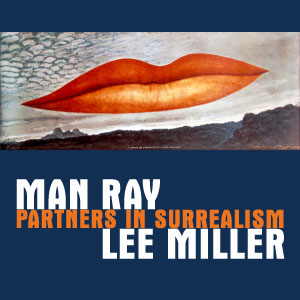
Win a pair of tickets to Man Ray & Lee Miller’s art exhibition

0

Man Ray and Lee Miller’s brief, mercurial love affair resulted in some of the most powerful works of each artist’s career, helping shape the course of modern art. See the first exhibition to focus on the pair’s artistic relationship, with approximately 115 photographs, paintings, drawings, and writings exploring the creative interaction between these two giants of European Surrealism. The exhibition also includes selected works by artists in Ray and Miller’s circle in Paris, including paintings by Pablo Picasso, Max Ernst, Roland Penrose, Dora Maar, and a small sculpture by Alexander Calder.

From 1929 to 1932, Man Ray and Lee Miller lived together in Paris, first as teacher and student, and later as lovers. The two artists inspired each other equally, collaborating on several projects, and though they lived together for only three years, the exhibition examines the lingering effect each had on the other’s art. Connecting photography with other media, the exhibition also reveals how the Surrealists combined imagery in unexpected ways, creating extraordinary feats of imagination.

For more information about the event click here.

Enter for your chance to win a pair of tickets by emailing sfbgpromos@sfbg.com with the title as “Man Ray” along with your name and mailing address for your chance to win a pair of tickets.  Ten lucky winners will win a pair of tickets that are valid anytime through October. Winners will be announced on July 25th.

July 14 through October 14 @ Fine Arts Museum of San Francisco, 100 34th Ave, SF | $15

Faces of feminism

7

Is San Francisco still on the cutting edge of women’s issues? I recently spent a sunny Saturday morning buried in the radical archives of Bolerium Books (www.bolerium.com) — which is by the way, an amazing resource for anyone researching labor, African American, First Peoples, and queer history, among other things. Me, I was looking into our city’s rich history of feminist activism, inspiration for our upcoming Guardian “Bay Area Feminism Today” panel discussion. The event will unite amazing females from across the city who have but one thing in common: they’re pushing the envelope when it comes to the definition of what a “women’s issue” is, in a time when very few people claim feminism as their primary crusade. We’ll be talking more about their exciting projects –- but also touching on more universal issues. What is San Francisco’s role in fighting the nationwide attack on reproductive rights? How is our progressive community doing in terms of supporting women and maintaining a feminist perspective on issues?

Women’s work: it’s alive and kicking, and it deserves its moment in the spotlight. Meet our panelists here, in preparation for the real deal. 

THE GUARDIAN PRESENTS: “BAY AREA FEMINISM TODAY”

Wed/11 6-8pm, free

City College of San Francisco Mission campus

1125 Valencia, SF

www.sfbg.com/bayareafeminismtoday


STEPHANY ASHLEY

St. James Infirmary programs director, ex-president of Harvey Milk LGBT Democratic Club


For me, sex worker rights are a feminist issue because they are about body autonomy. As much as reproductive choice is a feminist issue, so too is the right to determine the ways in which we use our bodies, change our bodies, and take care of our bodies. When people are criminalized for their HIV status, denied access to hormones and safe gender transitions, or are afraid to carry condoms because it might lead to police harassment or arrest — these are all feminist issues. At St. James Infirmary (www.stjamesinfirmary.org), we provide healthcare and social services from a peer-based model, so community is really the central aspect of the project. I was excited to chair the Harvey Milk LGBT Democratic Club (www.milkclub.org) last year, because I wanted to keep raising sex workers rights issues as part of the LGBT agenda. At St. James, nearly 70 percent of our community members are LGBTQ, so it’s really critical that sex workers rights are treated as a queer issue, a feminist issue, and a labor issue.

CELESTE CHAN

Artist and founder of Queer Rebels

My partner KB Boyce and I started our production company Queer Rebels (www.queerrebels.com) to honor the feminist and queer of color artists and elders who paved the way. Our main project is “Queer Rebels of the Harlem Renaissance,” a performance extravaganza which took place June 28-30. Such an exciting time! The Harlem Renaissance legacy remains with us to this day. It was an explosion of art, intellect, and sexual liberation led by queer Black artists. I’m also a board member at Community United Against Violence (www.cuav.org). CUAV was formed in the wake of Harvey Milk’s assassination and the White Night riots, and does incredible work to address violence within and against the LGBTQ community. Another way I’m involved with women’s issues is through Femme Conference (www.femme2012.com). In a culture where femininity is both de-valued and the expected norm, Femme Con creates a vital feminist space — this year it takes place in Baltimore, Maryland.

EDAJ

DJ and promoter of queer nightlife

I work in nightlife to provide space for communities that often don’t have spaces to come together. For 15 years, I have been providing music for women as the resident DJ at Mango (every fourth Sunday at El Rio, www.elriosf.com). I also work to support my fellow LGBT veterans by promoting their visibility through my nightlife projects. Ex-Filipino Marine and two-spirit drag king Morningstar Vancil’s story has inspired me to work on creating a space that raises awareness about LGBT veterans, especially women living with disabilities. I also think it’s important to do outreach in the Black LGBT community to help strengthen support for organizations such as the Bayard Rustin LGBT Coalition (www.bayardrustincoalition.com), a group that is not only fighting for Black LGBT equality, but is focused on social change for all oppressed people. After 10 years of executive producing the Women’s Stage at SF Pride, I was honored as a grand marshal this year at an event hosted by the BRC and Soul of Pride. It was beautiful to see so many Black LGBT people dedicated to moving global equality forward. Although there is a need to reach out to everyone in the Black LGBT community, naturally my goal is to first focus on connecting more women, a group that has always been less visible.

JUANA FLORES

Co-director of Mujeres Unidas y Activas

My organization Mujeres Unidas y Activas (www.mujeresunidas.net) is based on a double mission: personal transformation and community power for social justice. MUA is a place where women arrive through different challenges in their lives. We try to provide emotional support and references so that they don’t feel like they’re alone, so that they have strength to begin the process of healing and making changes. Those can include issues of domestic violence, problems with teenage children, labor or housing issues — when they arrive at MUA they begin the process of developing their self esteem and becoming stronger. They also begin to participate in trainings and making changes in their community and to the system through civic and political participation. At MUA, women find a home. They feel comfortable because they’re always welcome. We’re developing strong leadership, leadership that is at the table when it comes to making decisions about our campaigns, like our letter of labor rights and the help we give to victims of domestic violence through our crisis line. Every day our members are developing their ability to be involved in the organization and community, and making changes in their personal and familial lives.

ALIX ROSENTHAL

Attorney and elected member of the SF Democratic County Central Committee

As an elected member of the SF DCCC (www.sfdemocrats.org), the governing body of the SF Democratic Party, I am working to involve the party in recruiting more women to run for political office locally. In the June 2012 election, I assembled a slate of the female candidates for DCCC — we called ourselves “Elect Women 2012.” It was a controversial effort, because it included both progressives and moderates. In the wake of a highly contentious and factional term on the DCCC, we hoped to prove that moderates and progressives can work together to re-energize Democrats in this important presidential election cycle. Running for office in San Francisco is a high stakes game; it is costly and requires an extensive political network. And so the DCCC is where many future candidates get their start — it is where they build the connections necessary to run for higher office, and where they hone their fundraising abilities. By recruiting and supporting women candidates for the DCCC, I am hoping to build a “farm team” of female candidates within the party. This year, I am proud that the seven women incumbents on the DCCC retained our seats in the June election, and that we achieved parity by electing four new women to the party’s governing board. I look forward to seeing what these women can accomplish together.

LAURA THOMAS

Deputy state director of Drug Policy Alliance

Ending the failed war on drugs is a women’s issue because women are far too often bearing the brunt of that failure, losing their freedom, children, economic independence, safety, health, and sometimes their lives as victims of the war on drugs. Women in prison in California can be shackled during childbirth, lose custody of their children because they use legal medical marijuana. They’re vulnerable to HIV and hepatitis C because they or their partners don’t have access to sterile syringes for injecting drugs. My major project for the Drug Policy Alliance (www.drugpolicy.org) is mobilizing San Francisco to show the rest of the world how effective progressive drug policy can be. I want to see San Francisco open the first supervised injection facility in the United States, to end new HIV and hepatitis C infections among people who use drugs. I want us to truly have effective, culturally appropriate substance use treatment for everyone who requests it. I want San Francisco to end the cycle of undercover drug buys-incarceration-recidivism. I want us to address the appalling racial disparities in who gets arrested, convicted, and incarcerated for drug offenses here. I want us to aggressively defend our ground-breaking, well-regulated medical cannabis dispensary system against all federal intervention. San Francisco is leading the way in the United States in addressing the harms of drug use and drug prohibition but we have a lot more we can do.

MIA TU MUTCH

Transgender activist and SF Youth Commission officer

I’ve worked for a plethora of LGBTQ organizations and have been on several national speaking tours. I currently serve as media and public relations officer of the San Francisco Youth Commission, and use my position to promote LGBTQ safety and overall health. I’ve partnered with several city departments in order to create a cultural competency video that will train all service providers on best practices for working with LGBTQ youth. As a vocal advocate against hate crimes and sexual assaults, I’m working with local groups to create a community patrol in the Mission to prevent violence against women and transgender people. I’m also the founder of Fundraising Everywhere for All Transitions: a Health Empowerment Revolution! (FEATHER), a collective aimed at making gender-affirming transitions more affordable for low income transgender people. I work to create avenues of equality for those who benefit the least from patriarchy by creating a culture of safety and support for people of all genders.

Rep Clock

0

Schedules are for Wed/4-Tue/10 except where noted. Director and year are given when available. Double and triple features marked with a •. All times pm unless otherwise specified.

CASTRO 429 Castro, SF; (415) 621-6120, www.castrotheatre.com. $8.50-11. Grease (Kleiser, 1978), Thu, 5, 7. Presented sing-along style; this event, $10-15. “Midnites for Maniacs: BFFs Triple Bill:” •Clueless (Heckerling, 1995), Fri, 7:30; Mean Girls (Waters, 2004), Fri, 9:45; Heavenly Creatures (Jackson, 1994), Fri, 11:45. This event, one or all three films for $13. “Scary Cow Short Film Festival,” Sat, 3. More info at www.scarycow.com. •The Muppet Movie (Frawley, 1979), Sun, noon, 3:15, 7, and Phantom of the Paradise (De Palma, 1974), Sun, 5:05, 8:50.

CHRISTOPHER B. SMITH RAFAEL FILM CENTER 1118 Fourth St, San Rafael; (415) 454-1222, www.cafilm.org. $6.75-$10.25. Bel Ami (Donnellan and Ormerod, 2012), call for dates and times. Bernie (Linklater, 2012), call for dates and times. Oslo, August 31st (Trier, 2011), call for dates and times. Peace, Love and Misunderstanding (Beresford, 2011), call for dates and times. Pink Ribbons, Inc. (Pool, 2011), call for dates and times. Take This Waltz (Polley, 2011), July 6-12, call for times.

PACIFIC FILM ARCHIVE 2575 Bancroft, Berk; (510) 642-5249, bampfa.berkeley.edu. $5.50-9.50. “Bellissima: Leading Ladies of the Italian Screen:” Le Amiche (Antonioni, 1955), Fri, 7; La strada (Fellini, 1954), Sat, 8:30. “A Theater Near You:” Weekend (Godard, 1967), Fri, 9:05; Gerhard Richter Painting (Belz, 2011), Sat, 6:30; This Is Not a Film (Mirtahmasb and Panahi, 2011), Sun, 5:15. “Always for Pleasure: The Films of Les Blank:” Always for Pleasure (Blank, 1978) with “Dry Wood” (Blank and Gosling, 1973) and “Running Around Like a Chicken With Its Head Cut Off” (Blank, Blank, and Van Deusen, 1960), Sun, 7.

ROXIE 3117 and 3125 16th St, SF; (415) 863-1087, www.roxie.com. $6.50-10. Beyond the Black Rainbow (Cosmatos, 2011), Wed-Thu, 7:15. 9:30. The Connection (Clarke, 1962), Wed-Thu, 7, 9:15. “Kung Fu Double Feature:” •Five Element Ninjas (a.k.a. Chinese Super Ninjas) (Chang, 1982), Fri, 7:30, and The Mystery of Chess Boxing (Kuo, 1979), Fri, 9:30. “Au Revoir Béla Tarr:” The Man From London (Tarr and Hranitzky, 2007), July 7-11, 6:30 (also Sat-Sun, 1); The Turin Horse (Tarr and Hranitzky, 2011), July 7-11, 9:15 (also Sat-Sun, 3:45).

SF FILM SOCIETY CINEMA 1746 Post, SF. $10-11. The Story of Film: An Odyssey, Part Six: The Arrival of Multiplexes and Asian Mainstream (1970s); Fight the Power: Protest in Films (1980s), (Cousins, 2011), Sat, noon. British TV series; new episodes weekly through July 21. Corpo Celeste (Rohrwacher, 2011), Wed-Thu, 2:30, 4:30, 6:30. Marina Abramovic: The Artist is Present (Akers, 2011), July 6-12, 2:45, 5, 7:15, 9:30.

SF STATE UNIVERSITY Coppola Theatre, 1600 Holloway, SF; www.legacyfilmfestivalonaging.org. $12. “Legacy Film Festival on Aging,” co-presented by the Osher Lifelong Learning Institute, Fri-Sun.

YERBA BUENA CENTER FOR THE ARTS 701 Mission, SF; (415) 978-2787, www.ybca.org. $6-8. “Documentaries By Ai Weiwei:” Fairytale (2008), Sun, 2.

Film Listings

0

Film listings are edited by Cheryl Eddy. Reviewers are Kimberly Chun, Max Goldberg, Dennis Harvey, and Lynn Rapoport. For rep house showtimes, see Rep Clock. For complete film listings, see www.sfbg.com.

OPENING

Beasts of the Southern Wild See "Delta Delight." (1:31) Embarcadero.

Katy Perry: Part of Me The candy-colored pop star makes the logical leap to big-screen 3D. (1:57) Metreon.

Marina Abramovic: The Artist is Present Matthew Akers’ sleek and telling doc explores the career and motivations of the legendary Serbian-born, New York-based performance artist on the occasion of 2010’s major retrospective and new work at the New York Museum of Modern Art. Abramovic, self-styled the "grandmother of performance art" at an eye-catching 63, steels herself with rare energy — and a determination to gain equal status for performance in the world of fine art — for an incredibly demanding new piece, The Artist Is Present, a quasi-mystical encounter between herself and individual museum patrons that takes the form of a three-month marathon of silent one-on-one gazing. Meanwhile, 30 young artists re-perform pieces from her influential career. Akers gains intimate access throughout, including Abramovic’s touching reunion with longtime love and artistic collaborator Ulay, while providing a steady pulse of suspense as the half-grueling, half-ecstatic performance gets underway. A natural charmer, Abramovic’s charismatic presence at MoMA is no act but rather a focused state in which audiences are drawn into — and in turn shape — powerful rhythms of consciousness and desire. (1:45) SF Film Society Cinema. (Robert Avila)

Nobody Else But You The Marilyn Monroe pop-culture resurgence continues with director and co-writer Gérald Hustache-Mathieu’s appealingly low-key mystery, which pays homage to the iconic blonde while borrowing liberally from a pair of noir Lauras: Vera Caspary’s back-from-the-dead heroine, and Twin Peaks‘ unfortunate Ms. Palmer. Fortunately, Nobody Else But You is original enough to remain both suspenseful and highly entertaining. David (Jean-Paul Rouve), a detective novelist with writer’s block, travels from Paris to a small village where a Monroe-esque local beauty named Candice (Sophie Quinton) has just been found dead in a snowdrift. The official word is suicide, but David suspects something more sinister. With the help of a local cop (Guillaume Gouix), the newly inspired author investigates, urged onward by Candice’s evocative diary entries. Though it tries a little hard at times (drinking game: keep track of how many times the number five appears onscreen), Nobody Else But You is well worth seeking out; it layers European flair (translation: lots of casual nudity) over a plot that wouldn’t be out of place in an American indie — but relocated, memorably, to "the coldest town in France." (1:42) Lumiere, Shattuck. (Eddy)

Savages Weed dudes (Aaron Johnson and Taylor Kitsch) break bad, bro, by taking on a Mexican cartel in Oliver Stone’s latest. (1:57) Four Star, Marina.

Take this Waltz See "Sad Romance." (1:56) Embarcadero, Shattuck, Smith Rafael.

ONGOING

The Amazing Spider-Man A mere five years after Sam Raimi and Tobey Maguire’s Spider-Man 3 — forgettable on its own, sure, but 2002’s Spider-Man and especially 2004’s Spider-Man 2 still hold up — Marvel’s angsty web-slinger returns to the big screen, hoping to make its box-office mark before The Dark Knight Rises opens in a few weeks. Director Marc Webb (2009’s 500 Days of Summer) and likable stars Andrew Garfield (as the skateboard-toting hero) and Emma Stone (as his high-school squeeze) offer a competent reboot, but there’s no shaking the feeling that we’ve seen this movie before, with its familiar origin story and with-great-power themes. A little creativity, and I don’t mean in the special effects department, might’ve gone a long way to make moviegoers forget this Spidey do-over is, essentially, little more than a soulless cash grab. Not helping matters: the villain (Rhys Ifans as the Lizard) is a snooze. (2:18) Metreon, 1000 Van Ness, Presidio. (Eddy)

The Connection The first re-release in a project to restore all of quintessential 1960s American independent director Shirley Clarke’s features, this 1961 vérité-style drama was adapted from a controversial off-Broadway play by Jack Gelber. Set exclusively in a dingy Greenwich Village crash pad, it captures a little time in the lives of several junkies there — many off-duty jazz musicians — listlessly waiting for the return of their dealer, Cowboy. To mimic the stage version’s breaking of the fourth wall between actors and spectators, Clarke added the device of two fictive filmmakers who are trying to record this "shocking" junkie scene, yet grow frustrated at their subjects’ levels of cooperation and resistance. With actors often speaking directly to the camera, and all polished stage language and acting preserved, The Connection offers a curious, artificial realm that is nonetheless finally quite effective and striking. A prize-winner at Cannes, it nonetheless had a very hard time getting around the censors and into theaters back home. Hard-won achievement followed by frustration would be a frequent occurrence for the late Clarke, who would only complete one more feature (a documentary about Ornette Coleman) after 1964’s Cool World and 1967’s Portrait of Jason, before her 1997 demise. She was a pioneering female indie director — and her difficulty finding projects unfortunately
also set a mold for many talented women to come. (1:50) Roxie. (Harvey)

Magic Mike Director Steven Soderbergh pays homage to the 1970s with the opening shot of his male stripper opus: the boxy old Warner Bros. logo, which evokes the gritty, sexualized days of Burt Reynolds and Joe Namath posing in pantyhose. Was that really the last time women, en masse, were welcome to ogle to their heart’s content? That might be the case considering the outburst of applause when a nude Channing Tatum rises after a hard night in a threesome in Magic Mike‘s first five minutes. Ever the savvy film historian, Soderbergh toys with the conventions of the era, from the grimy quasi-redneck realism of vintage Reynolds movies to the hidebound framework of the period’s gay porn, almost for his own amusement, though the viewer might be initially confused about exactly what year they’re in. Veteran star stripper Mike (Tatum) is working construction, stripping to the approval of many raucous ladies and their stuffable dollar bills. He decides to take college-dropout blank-slate hottie Adam (Alex Pettyfer) under his wing and ropes him into the strip club, owned by Dallas (Matthew McConaughey, whose formidable abs look waxily preserved) and show him the ropes of stripping and having a good time, much to the disapproval of Adam’s more straight-laced sister Brooke (Cody Horn). Really, though, all Mike wants to do is become a furniture designer. Boasting Foreigner’s "Feels like the First Time" as its theme of sorts and spot-on, hot choreography by Alison Faulk (who’s worked with Madonna and Britney Spears), Magic Mike takes off and can’t help but please the crowd when it turns to the stage. Unfortunately the chemistry-free budding romance between Mike and Brooke sucks the air out of the proceedings every time it comes into view, which is way too often. (1:50) 1000 Van Ness, Presidio, SF Center. (Chun)

Ted Ah, boys and their toys — and the imaginary friends that mirror back a forever-after land of perpetual Peter Pans. That’s the crux of the surprisingly smart, hilarious Ted, aimed at an audience comprising a wide range of classes, races, and cultures with its mix of South Park go-there yuks and rom-commie coming-of-age sentiment. Look at Ted as a pop-culture-obsessed nerd tweak on dream critter-spirit animal buddy efforts from Harvey (1950) to Donnie Darko (2001) to TV’s Wilfred. Of course, we all know that the really untamable creature here wobbles around on two legs, laden with big-time baggage about growing up and moving on from childhood loves. Young John doesn’t have many friends but he is fortunate enough to have his Christmas wish come true: his beloved new teddy bear, Ted (voice by director-writer Seth MacFarlane), begins to talk back and comes to life. With that miracle, too, comes Ted’s marginal existence as a D-list celebrity curiosity — still, he’s the loyal "Thunder Buddy" that’s always there for the now-grown John (Mark Wahlberg), ready with a bong and a broheim-y breed of empathy that involves too much TV, an obsession with bad B-movies, and mock fisticuffs, just the thing when storms move in and mundane reality rolls through. With his tendency to spew whatever profanity-laced thought comes into his head and his talents are a ladies’ bear, Ted is the id of a best friend that enables all of John’s most memorable, un-PC, Hangover-style shenanigans. Alas, John’s cool girlfriend Lori (Mila Kunis) threatens that tidy fantasy setup with her perfectly reasonable relationship demands. Juggling scary emotions and material that seems so specific that it can’t help but charm — you’ve got to love a shot-by-shot re-creation of a key Flash Gordon scene — MacFarlane sails over any resistance you, Lori, or your superego might harbor about this scenario with the ease of a man fully in touch with his inner Ted. (1:46) California, Four Star, Marina, Metreon, 1000 Van Ness, Sundance Kabuki. (Chun)

To Rome with Love Woody Allen’s film legacy is not like anybody else’s. At present, however, he suffers from a sense that he’s been too prolific for too long. It’s been nearly two decades since a new Woody Allen was any kind of "event," and the 19 features since Bullets Over Broadway (1994) have been hit and-miss. Still, there’s the hope that Allen is still capable of really surprising us — or that his audience might, as they did by somewhat inexplicably going nuts for 2011’s Midnight in Paris. It was Allen’s most popular film in eons, if not ever, probably helped by the fact that he wasn’t in it. Unfortunately, he’s up there again in the new To Rome With Love, familiar mannerisms not hiding the fact that Woody Allen the Nebbish has become just another Grumpy Old Man. There’s a doddering quality that isn’t intended, and is no longer within his control. But then To Rome With Love is a doddering picture — a postcard-pretty set of pictures with little more than "Have a nice day" scribbled on the back in script terms. Viewers expecting more of the travelogue pleasantness of Midnight in Paris may be forgiving, especially since it looks like a vacation, with Darius Khondji’s photography laying on the golden Italian light and making all the other colors confectionary as well. But if Paris at least had the kernel of a good idea, Rome has only several inexplicably bad ones; it’s a quartet of interwoven stories that have no substance, point, credibility, or even endearing wackiness. The shiny package can only distract so much from the fact that there’s absolutely nothing inside. (1:52) Albany, Balboa, Embarcadero, Sundance Kabuki. (Harvey)

Cash your bowl

0

caitlin@sfbg.com

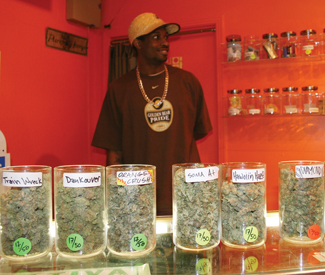
HERBWISE It’s time to get a Discover card. As of July 1, you can no longer use your Visa or Mastercard credit or debit card to buy medical marijuana. And of course, American Express cards have been out of the question since spring 2011. Electronic Merchant Systems, which handles card processing for most of the nation, sent out an announcement last month to its vendors, raising the stakes for dispensaries across the country that seem to be coming under a coordinated federal attack. Cash-only cannabis? That’s pretty bad, maybe just as bad as the next thing I have to tell you about…

MORE BAD NEWS

The Vapor Room is closing. Yes, the perennial Best of the Bay-winning, nine-year old Lower Haight dispensary-lounge (607 Haight, SF. www.vaporroom.com) will be closing its doors as of July 31, according to the nonprofit’s executive director Martin Olive. Olive told the Guardian in a phone interview that the dispensary learned an undisclosed amount of time ago that its landlord had received one of the doom-bearing letters now so familiar to San Francisco dispensaries from US Attorney Melinda Haag declaring that the dispensary was within 1,000 feet of Duboce Park. The city’s permitting laws, Olive told us, are concerned with how far cannabis clubs are from playgrounds, not park grounds. Vapor Room has a long-standing relationship with the Harvey Milk Rec Center that anchors the park — the nonprofit actually sponsors free yoga classes and health counseling that take place in the center itself. Olive wouldn’t confirm rumors that Vapor Room’s stock will continue to be available for delivery, but that’s the word on the street.

PLEASE NO MUNCHIES JOKES

The “bath salts” face-eater didn’t have any bath salts in his system. In fact, the only drug authorities uncovered through post-humous tests was cannabis.

UNDISCLOSED THING

As an events editor, organizations that don’t send us the vital information we need to cover their event are the bane of my existence. It is another thing entirely, however, when an organization requests that vital information be kept out of the newspaper. A sign of the times when it comes to cannabis journalism, I’m afraid. And as such: check out a happy hour benefit at El Rio for “an organization supporting low-income, AIDS-HIV, and cancer patients with free medicine.” Sigh. It’ll be running semi-concurrently with pop-up Mugsy Wine Bar’s hat-tip to Bastille Day (5:30pm-8:30pm). Drown your frustrations with some nice sparkling Blanc de Noir Cremant de Bourgnone, why don’t you.

Fri/13 4pm-6pm, free. El Rio, 3158 Mission, SF. www.elriosf.com

AND FINALLY

Search YouTube for “Conan O’Brien and Martha Stewart Get Crafty with Pot.” Discussion question: for all the weirdness that you just read, is marijuana becoming more or less accepted in mainstream culture?

How they do it in New York: ‘Brooklyn Boheme’ premieres, SFNY goes out with a bang

0

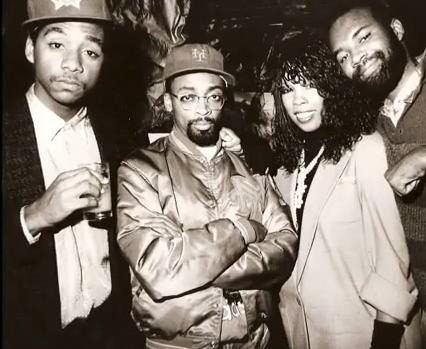
Do people within a “scene” ever recognize it at the time? Does that self-awareness kill the vibe, or is it essential in forming a group identity? Perhaps the answers can be gleaned at the Thu/12 Bay Area premiere of hip-hop writer Nelson George’s latest flick Brooklyn Boheme — a documentary filled with glimpses of baby Rosie Perez, Erykah Badu, and Talib Kweli in the thick of their Fort Greene, Brooklyn heyday. The show’s being thrown down by SFNY,  the three-year event series concluding this week that has connected SF and NYC with promises of slick DJs in fancy hotels and bicoastal culture swap. 

Hip-hop historian Jeff Chang interviewed George about the period he explores in Boheme. In that exchange, George’s top five moments from Fort Greene circa mid-’80s to ’90s make it sound like a dream: 

“1. I had a book party for The Death of Rhythm & Blues at my place at 19 Willoughby Avenue in 1988 that attracted a very eclectic group of folks, from Russell Simmons to Melba Moore to supermodels. It was a very fun, memorable party.

2. Chris Rock coming over to that same apartment to pitch me the film that eventually became CB4.

3. Sneaking around one night to the apartments of two women who lived around the corner from each other for booty calls. A very risky, but exciting night.”

Judging from the trailer, Brooklyn Boheme is an insider’s look at the kids everyone wanted to be like in the ’90s. Yeah, that’s Michael Jordan hanging with Spike Lee, what? Mos Def — sorry, Yasiin Bey — pre-Hitchhiker’s Guide to the Galaxy, visual artist Lorna Simpson reminiscing on the productivity that came from hanging out around densely-packed, extravagantly brilliant people (Lorna, I’m down for tips on how to do this if you’re offering.) The snapshot of the temporary community is made even more poignant with the knowledge of what came about in the neighborhood later on. The trailer acknowledges that Fort Greene has become synonymous with gentrification. Blame it on the artists… 

After the flick, head to the Clift Hotel for sets by KM/FM (King Most, FA, and Marky), Wonway Posibul (Latin Soul Brothers-Thinkbeat Radio), Haylow (Roy Ayers Project-70/30), and Jerry Nice (Groove Merchant Records). 

Brooklyn Boheme premiere

Thu/12 8pm; $5 movie only, $15-$45 movie and afterparty

Clay Theater 

2261 Fillmore, SF


SFNY wrap party-Brooklyn Boheme afterparty

Thu/12 10pm-2am

Clift Hotel 

495 Geary, SF

sfny6.eventbrite.com

The good old days in Rock Rapids, Iowa, the Fourth of July, 1940-1953

1

(Note: In July of 1972, when the Guardian was short a Fourth of July story, I sat down and cranked out this one for the front page on my trusty Royal Typewriter. I now reprint it each year on the Bruce blog, with some San Francisco updates and postscripts.)

Back where I come from, a small town beneath a tall standpipe in northwestern Iowa, the Fourth of July was the best day of a long, hot summer.

The Fourth came after YMCA camp and Scout camp and church camp, but before the older boys had to worry about getting into shape for football. It was welcome relief from the scalding, 100-degree heat in a town without a swimming pool and whose swimming holes at Scout Island were usually dried up by early July. But best of all, it had the kind of excitement that began building weeks in advance.

The calm of the summer dawn and the cooing of the mourning doves on the telephone wires would be broken early on July Fourth: The Creglow boys would be up by 7 a.m. and out on the lawn shooting off their arsenal of firecrackers. They were older and had somehow sent their agents by car across the state line and into South Dakota where, not far above the highway curves of Larchwood, you could legally buy fireworks at roadside stands.

Ted Fisch, Jim Ramsey, Wiener Winters, the Cook boys, Hermie Casjens, Jerry Prahl, Elmer Menage, and the rest of the neighborhood gang would race out of  their houses to catch the action. Some had cajoled firecrackers from their parents or bartered from the older boys in the neighborhood: some torpedoes (the kind you smashed against the sidewalk); lots of 2 and 3-inchers, occasionally the granddaddy of them all, the cherry bomb (the really explosive firecracker, stubby, cherry red, with a wick sticking up menacingly from its middle; the kind of firecracker you’d gladly trade away your best set of Submariner comics for).

Ah, the cherry bomb. It was a microcosm of excitement and mischief and good fun. Bob Creglow, the most resourceful of the Creglow boys, would take a cherry bomb, set it beneath a tin can on a porch, light the fuse, then head for the lilac bushes behind the barn.

“The trick,” he would say, imparting wisdom of the highest order, “is to place the can on a wood porch with a wood roof. Then it will hit the top of the porch, bang, then the bottom of the porch, bang. That’s how you get the biggest clatter.”

So I trudged off to the Linkenheil house, the nearest front porch suitable for cherry bombing, to try my hand at small-town demolition. Bang went the firecracker. Bang went the can on the roof. Bang went the can on the floor. Bang went the screen door as Karl Linkenheil roared out in a sweat, and I lit out for the lilacs behind the barn with my dog, Oscar.

It was glorious stuff – not to be outdone for years, I found out later, until the Halloween eve in high school when Dave Dietz, Ted Fisch, Ken Roach, Bob Babl, and rest of the Hermie Casjens gang and I made the big time and twice pushed a boxcar loaded with lumber across Main Street and blocked it for hours. But that’s another story for my coming Halloween blog.

Shooting off fireworks was, of course, illegal in Rock Rapids, but Chief of Police Del Woodburn and later Elmer “Shinny” Sheneberger used to lay low on the Fourth. I don’t recall ever seeing them about in our neighborhood and I don’t think they ever arrested anybody, although each year the Rock Rapids Reporter would carry vague warnings about everybody cooperating to have “a safe and sane Fourth of July.”

Perhaps it was just too dangerous for them to start making firecracker arrests on the Fourth – on the same principle, I guess, that it was dangerous to do too much about the swashbuckling on Halloween or start running down dogs without leashes (Mayor Earl Fisher used to run on the platform that, as long as he was in office, no dog in town would have to be leashed. The neighborhood consensus was that Fisher’s dog, a big, boisterous boxer, was one of the few that ought to be leashed).

We handled the cherry bombs and other fireworks in our possession with extreme care and cultivation; I can’t remember a single mishap. Yet, even then, the handwriting was on the wall. There was talk of cutting off the fireworks supply in South Dakota because it was dangerous for young boys. Pretty soon, they did cut off the cherry bomb traffic and about all that was left, when I came back from college and the Roger boys had replaced the Creglow boys next door, was little stuff appropriately called ladyfingers.

Fireworks are dangerous, our parents would say, and each year they would dust off the old chestnut about the drugstore in Spencer that had a big stock of fireworks and they caught fire one night and much of the downtown went up in a spectacular shower of roman candles and sparkling fountains.

The story was hard to pin down, and seemed to get more gruesome every year – but, we were told, this was why Iowa banned fireworks years before, why they were so dangerous and why little boys shouldn’t be setting them off. The story, of course, never made quite the intended impression; we just wished we’d been on the scene My grandfather was the town druggist (Brugmann’s Drugstore, “Where drugs and gold are fairly sold, since 1902″) and he said he knew the Spencer druggist personally. Fireworks put him out of business and into the poorhouse, he’d say, and walk away shaking his head.

In any event, firecrackers weren’t much of an issue past noon – the Fourth celebration at the fairgrounds was getting underway and there was too much else to do. Appropriately, the celebration was sponsored by the Rex Strait post of the American Legion (Strait, so the story went, was the first boy from Rock Rapids to die on foreign soil during World War I); the legionnaires were a bunch of good guys from the cleaners and the feed store and the bank who sponsored the American Legion baseball team each summer.

There was always a big carnival, with a ferris wheel somewhere in the center for the kids, a bingo stand for the elders, a booth where the ladies from the Methodist Church sold homemade baked goods, sometimes a hootchy dancer or two, and a couple of dank watering holes beneath the grandstand where the VFW and the Legion sold Grainbelt and Hamms at 30¢ a bottle to anybody who looked of age.

Later on, when the farmboys came in from George and Alvord, there was lots of pushing and shoving, and a fist fight or two.

In front of the grandstand, out in the dust and the sun, would come a succession of shows that made the summer rounds of the little towns. One year it would be Joey Chitwood and his daredevil drivers. (The announcer always fascinated me: “Here he comes, folks, rounding the far turn…he is doing a great job out there tonight…let’s give him a big, big hand as he pulls up in front on the grandstand…”)

Another year it would be harness racing and Mr. Hardy, our local trainer from Doon, would be in his moment of glory. Another year it was tag team wrestling and a couple of barrel-chested goons from Omaha, playing the mean heavies and rabbit-punching their opponents from the back, would provoke roars of disgust from the grandstand. ( The biggest barrel-chest would lean back on the ropes, looking menacingly at the crowd and yell, “ Aw, you dumb farmers. What the hell do you know anyway? I can beat the hell out of any of you.”   And the crowd  would roar back in glee.)

One year, Cedric Adams, the Herb Caen of Minneapolis and the Star-Tribune, would tour the provinces as the emcee of a variety show. “It’s great to be in Rock Rapids,” he would say expansively, “because it’s always been known as the ‘Gateway to Magnolia.” (Magnolia, he didn’t need to say, was a little town just over the state line in Minnesota which was known throughout the territory for its liquor-by-the-drink roadhouses. It was also Cedric Adams’ hometown: his “Sackamenna.”) Adams kissed each girl (soundly) who came on the platform to perform and, at the end, hushed the crowd for his radio broadcast to the big city “direct from the stage of the Lyon County Fairgrounds in Rock Rapids, Iowa.”

For a couple of years, when Rock Rapids had a “town team,” and a couple of imported left-handed pitchers named Peewee Wenger and Karl Kletschke, we would have some rousing baseball games with the best semi-pro team around, Larchwood and its gang of Snyder brothers: Barney the eldest at shortstop, Jimmy the youngest at third base, John in center field, Paul in left field, another Snyder behind the plate and a couple on the bench. They were as tough as they came in Iowa baseball.

I can remember it as if it were yesterday at Candlestick, the 1948 game with the Snyders of Larchwood. Peewee Wenger, a gawky, 17-year-old kid right off a high school team, was pitching for Rock Rapids and holding down the Snyder artillery in splendid fashion. Inning after inning he went on, nursing a small lead, mastering one tough Larchwood batter after another, with a blistering fastball and a curve that sliced wickedly into the bat handles of the right-handed Larchwood line-up.

Then the cagey Barney Snyder laid a slow bunt down the third base line. Wenger stumbled, lurched, almost fell getting to the ball, then toppled off balance again, stood helplessly holding the ball. He couldn’t make the throw to first. Barney was safe, cocky and firing insults like machine gun bullets at Peewee from first base.

Peewee, visibly shaken, went back to the mound. He pitched, the next Larchwood batter bunted, this time down the first base line. Peewee lurched for the ball, but couldn’t come up with it. A couple more bunts, a shot through the pitcher’s mound, more bunts and Peewee was out. He could pitch, but, alas, he was too clumsy to field. In came Bill Jammer, now in his late 30’s, but in his day the man who beat the University of Iowa while pitching at a small college called Simpson.

Now he was pitching on guts and beer, a combination good enough for many teams and on good days even to take on the Snyders. Jammer did well for a couple of innings, then he let two men on base, then came a close call at the plate. Jammer got mad. Both teams were off the bench and onto the field and, as Fred Roach wrote in the Rock Rapids Reporter, “fisticuffs erupted at home plate.” When the dust cleared, Jammer has a broken jaw, and for the next two weeks had to drink his soup through a straw at the Joy Lunch. John Snyder, it was said later, came all the way in from center field to throw the punch, but nobody knew for sure and he stayed in the game. I can’t remember the score or who won the game, but I remember it as the best Fourth ever.

At dusk, the people moved out on their porches or put up folding chairs on the lawn. Those who didn’t have a good view drove out to the New Addition or parked out near Mark Curtis’ place or along the river roads that snaked out to the five-mile bridge and Virgil Hasche’s place.

A hush came over the town. Fireflies started flickering in the river bottom and, along about 8:30, the first puff of smoke rose above the fairgrounds and an aerial bomb whistled into the heavens. BOOM! And the town shook as if hit by a clap of thunder.

Then the three-tiered sky bombs – pink, yellow, white, puff, puff, puff. The Niagara Falls and a gush of white sparks.

Then, in sudden fury, a dazzling display of sizzling comets and aerial bombs and star clusters that arched high, hung for a full breath and descended in a cascade of sparks that floated harmlessly over the meadows and cornfields. At the end, the flag – red, white and blue – would burst forth on the ground as the All-American finale in the darkest of the dark summer nights. On cue, the cheers rolled out from the grandstand and the cars honked from the high ground and the people trundled up their lawn chairs and everybody headed for home.

Well, I live in San Francisco now, and I drive to Daly City with my son, Danny, to buy some anemic stuff in gaudy yellow and blue wrapping and I try unsuccessfully each year to get through the fog or the traffic to see the fireworks at Candlestick. But I feel better knowing that, back where I come from, everybody in town will be on their porches and on the backroads on the evening of the Fourth to watch the fireworks and that, somewhere in town, a little boy will put a big firecracker under a tin can on a wood porch, then light out for the lilacs behind the barn.

P.S. Our family moved in l965 from Daly City to a house in the West Portal area of San Francisco. There are, I assure you, few visible fireworks in that neighborhood. However, down at the bottom of Potrero Hill, the professional and amateur action is spectacular.

 From any Potrero Hill height, you can see the fireworks in several directions: the waterfront fireworks in the city, fireworks on the Marin side of the Golden Gate bridge, fireworks at several points in the East Bay, fireworks along the Peninsula coast line.

And for the amateur action, parents with kids, kids of all ages, spectators in cars and on foot, congregate after dusk along Terry Francois Boulevard in San Francisco along the shoreline between the Giants ballpark and Kellys Mission Rock restaurant.

The action is informal but fiery, fast,  and furious: cherry bombs, clusters, spinning wheels, high flying arcs, whizzers of all shapes and sizes. The cops are quite civilized and patrol the perimeter but don’t bother anybody. I go every year. I think it’s the best show in town. B3.

Leaked documents add to CPMC’s credibility problems

10

Three key members of the Board of Supervisors today presented what they say are documents leaked by a whistleblower within California Pacific Medical Center showing it will likely shut down St. Luke’s Hospital by invoking an escape clause in the development agreement that the Mayor’s Office negotiated and the board is now considering.

The CPMC internal financial documents sent to the supervisors Sunday from an anonymous whistleblower predict a financial scenario in which the operating revenue will fall below a 1 percent margin by 2018.  The predicted loss would allow CPMC to exit its 20-year commitment to St. Luke’s and close the hospital in 2020, just five years after its scheduled reopening.  Sups. David Chiu, Malia Cohen, and Christina Olague say they worry the financial shortfall would also limit CPMC’s charitable donations while its Sutter Health parent company cuts hundreds of hospital jobs to save a projected $70 million per year.

 CPMC has promised to seismically retrofit St. Luke’s and run it for 20 years. In return, the medical group gets to build a massive hospital on Cathedral Hill. Inserted into the deal is what Chiu calls the fine print, which states if CPMC operating margin falls below 1 percent for two years it may close the hospital. Chiu said CPMC presented the escape clause as a very unlikely event, occurring only in a catastrophic scenario.

Instead, the leaked documents present a negative operating margin as an incredibly probably situation that CPMC has known about for months and misrepresented to city officials. “CPMC knew it was possible and likely they would default on their commitment,” Cohen said, adding that her greatest grievance is CPMC’s refusal to do anything about the situation.

Cohen said the financial revelations aren’t surprising considering Sutter Health has a reputation for shady practices. She said we should all wonder how a supposedly not-for-profit corporation is able to make so much profit.

CPMC spokesman Sam Singer said the documents are fraudulent, flawed financial reports that CPMC threw away a long time ago. He suggested someone must have dug them out of the garbage in a conspiracy like fashion. Singer said the mayor had learned about the document a few weeks ago.

Chui said that may help explain why  the Mayor’s Office recently acknowledged it reentered negotiations with the CPMC after becoming concerned about the viability of St. Luke’s, telling supervisors it was based on CPMC’s revised revenue estimates, sparking a controversy during last week’s hearing.

Whatever the reason, the three supervisors want more time to investigate the matter.

“Let’s be clear,” said Cohen said, “these contract negotiations should be informed by actual financial information and not just by the word of CPMC leadership, which we’ve unfortunately found to be untrustworthy.”


A queerness in Harlem, finely revived

0

Visual alchemy, fabulous feminist story-telling, and something deemed “hyper-literate busking” abound at 2012’s Queer Rebels of the Harlem Renaissance fesitval, three nights of art and performance (Thu/28-Sat/30) by 21 LGBTQ African Americans.

Part of the 15th National Queer Arts Festival, Queer Rebels of the Harlem Renaissance continues the legacy of the droves of artists, performers, and activists who questioned stale societal standards in a myriad ways during the heyday of the New York City neighborhood’s 1920s and 30s creative blossoming: from sensual lyrics of Bessie Smith to the pointed poetics of Langston Hughes, the artists of the Harlem Renaissance continue to testify to the assertion that social causes are rarely separate and constantly progressing.

“The explosion of artistic, intellectual, and sexual freedom during the Harlem Renaissance created new possibilities,” explains Celeste Chan over the phone. She co-directs the performance series with Kali Boyce — together they’re known as the Queer Rebels. “We think that dialogue on race, gender, and sexuality grew naturally during the Harlem Renaissance because these were people’s real experiences, and what they wanted to create art about. We’re thankful for the elders and the artists who paved the way for us, whose shoulders we stand on.”

Queer Rebels of the Harlem Renaissance reinforces the idea that it is necessary to understand a past in order to create a future. Thus, paying proper homage to the Harlem Renaissance artists who opened the possibility for social change and activist dialogue, the performance schedule for Queer Rebels consists largely of dance, story-telling and readings, and music. Earl Thomas, Sista Monica, and “Drag King of the Blues” TuffNStuff operate within the jazz and blues traditions — however, the show also expands to mediums of artistic expression not so common in 1920’s America, such as political film,  contemporary music, and visual alchemy with appearances from the likes of short-filmmaker Crystal Mason, punk rock dancer Brontez Purnell, and visual artist Adee Roberson. 
(Check out the incredible-sounding lineup here.)

“Artists and queers are up against a lot, and have always been society’s outsiders, the ones who have and will lead the way,” says Chan, “Today, we are able to live unapologetically queer lives and create our own spaces because of the work that the Harlem Renaissance artists did.”

QUEER REBELS OF THE HARLEM RENAISSANCE

Thu/28.-Sat/30, 8pm, $15-$25

African American Art and Culture Complex

762 Fulton, SF.

www.queerrebels.com

Tickets:  www.brownpapertickets.com/event/246312


Besting a star

1

le.chicken.farmer@gmail.com

CHEAP EATS Hedgehog goes and goes and goes to New York. For work — so they fly her and put her up in a nice hotel. This is what’s called (I believe) a business trip. But there’s more than that, of course, to it.

Examples include eating at WD-50 on my birthday (without me), and being at that Mets game (without me) when Johan Santana pitched the first no-hitter in team history, lucky duck. By which I mean Hedgehog. Santana’s a pretty good pitcher.

Me, I’m not a Mets fan or a foofy restaurant fan but, in a word, still… I like baseball. I like food. These are documented facts. Well, I must have whined and complained enough, because this time she said, “Wanna come with me?”

“No thanks,” I said. “I’d rather whine and complain.”

“Suit yourself,” she said, adding that there was a fitness center in the hotel, that she would take me to WD50 after work, and a Mets game the next night. Romanticness was insinuated. That, and hot dogs.

I thought and thought. And thought and thought. There was no guarantee that my new friend Shaya (from last week’s review) would be on this flight too. But Hedgehog would hold my hand real hard during takeoff and landing, she said, and sing my favorite songs into my ear.

I thought about how hot it was in New Orleans in June, how lonely it was in the air-conditioning without her, and I decided to go to New York.

She bought all the necessary tickets, made the necessary reservations, drove us to the necessary airport, and when I emerged from my necessary Valium haze I found myself in a nice, cozy room on Times Square, staring out the window at those scoreboardy ticker tape thingies with all the stupid stock statistics flying by. One of the most dizzyingly annoying events I have ever found outside of any window, anywhere…

Until early next morning, this morning, when I awoke abruptly to “Blister in the Sun” by Violent Femmes over a PA system in the street below. That’s a great song, but at 6:30am in the morning I think I might rather sleep, thank you.

At 7:30am in the morning it was yoga — loud, microphone yoga. This was the annual Mind over Madness yoga event, Solstice on Times Square, idea being “to find tranquility and transcendence in the midst of the world’s most commercial and frenetic place.” At an hour when sane, peaceful people are trying to sleep.

At least all the colorful mats and yogawear made a pretty picture when I finally got out of bed and opened the curtains to see what the flying fuck all the noise was about.

I need a nap.

Tonight, if all goes as planned, the normally entirely hittable Dillon Gee is going to pitch a no-hitter for the Mets! And I’ll be there, with Hedgehog and hot dogs.

Last night was more of a lobster roe duck egg chicken confit veal brisket crab toast lamb sweetbreads kind of a night, but even I know not to compare a Michelin-starred restaurant to stadium hot dogs. No. I’m going to compare it to a tiny takeout sushi place on Solano Avenue in Berkeley, where once I went with a Chunk de la Cooter and her dad to bring home the hamachi, as the saying goes, for the whole wide family.

Except there wasn’t much hamachi, as I recall. A lot of cucumber and avocado rolls, that sort of thing…

Mostly people get prepackaged sushi from the display case, which might explain the de la Cooter family’s preference for sushi-less sushi, but you can also order made-to-order items, and I got a lot of those.

All of them were awesome! I especially liked the unagi bowl and the nigiri saba.

Saba is my favorite sushi. Thus was I delighted to see something very much like it leading off the 13-thing tasting menu at WD-50 last night: nigiri’d mackerel on salsify, instead of rice, with seaweed and sesame. Many of the later dishes, especially the yuzu milk ice dessert, did indeed blow my mind. But this, the nigiri, wasn’t one of them. Ha! It’s better at:

KYOTO SUSHI

Mon-Fri 11am-7:30pm; Sat-Sun 11am-6:30pm

1599 Solano Ave., Berk.

(510) 527-3288

Cash only

No alcohol


Rep Clock

0

Schedules are for Wed/27-Tue/3 except where noted. Director and year are given when available. Double features and marked with a •. All times pm unless otherwise specified.

CASTRO 429 Castro, SF; (415) 621-6120, www.castrotheatre.com. $8.50-11. •Pina (Wenders, 2011), Wed, 3:05, 7, and Cave of Forgotten Dreams (Herzog, 2010), Wed, 5:05, 9. •Barbarella (Vadim, 1968), Thu, 3:05, 7, and Cherry 2000 (De Jarnatt, 1987), Thu, 5, 8:55. Grease (Kleiser, 1978), June 29-July 5, 7 (also Sat-Sun, 2:30; no show July 4). Presented sing-along style; this event, $10-15.

CHRISTOPHER B. SMITH RAFAEL FILM CENTER 1118 Fourth St, San Rafael; (415) 454-1222, www.cafilm.org. $6.75-$10.25. Bel Ami (Donnellan and Ormerod, 2012), call for dates and times. Bernie (Linklater, 2012), call for dates and times. Oslo, August 31st (Trier, 2011), call for dates and times. Peace, Love and Misunderstanding (Beresford, 2011), call for dates and times. Pink Ribbons, Inc. (Pool, 2011), June 29-July 5, call for times.

LIFECROWD MOVIE THEATRE 356 Sixth St, SF; www.lifecrowd.com. Free (advance sign-up required). Dazed and Confused (Linklater, 1993), Thu, 7.

PACIFIC FILM ARCHIVE 2575 Bancroft, Berk; (510) 642-5249, bampfa.berkeley.edu. $5.50-9.50. "Gregory Peck: An Agreeable Gentleman:" Duel in the Sun (Vidor, 1969), Wed, 7; Arabesque (Donen, 1966), Fri, 7. "One-Two Punch: Pulp Writers Dorothy B. Hughes, Mickey Spillane, Elmore Leonard:" My Gun is Quick (White, 1957), Thu, 7; The Girl Hunters (Rowland, 1963), Thu, 8:50; Stick (Reynolds, 1985), Sat, 6:30; Valdez is Coming (Sherin, 1971), Sat, 8:40. "Three Czech New Wave Classics:" Valerie and Her Week of Wonders (Jires, 1969), Fri, 9.

ROXIE 3117 and 3125 16th St, SF; (415) 863-1087, www.roxie.com. $6.50-10. Gerhard Richter Painting (Belz, 2011), Thu, 6:30. Marley (Macdonald, 2012), Thu, 8:30. Ultrasonic (Rao, 2011), Wed-Thu, 7, 8:45. Arab Film Festival presents: The War Around Us (Omeish, 2012), Wed, 7:30. With director Abdallah Omeish in person. Beyond the Black Rainbow (Cosmatos, 2011), June 29-July 5, 7:15. 9:30 (also Sat-Sun, 2:30, 4:45). The Connection (Clarke, 1962), June 29-July 5, 7, 9:15 (also Sat-Sun, 2:30, 4:45).

SF FILM SOCIETY CINEMA 1746 Post, SF. $10-11. The Story of Film: An Odyssey, Part Five: American Cinema of the 70s and Movies to Change the World (Cousins, 2011), Sat, noon. British TV series; new episodes weekly through July 21. Found Memories (Murat, 2011), Wed-Thu, 2:30, 4:30, 6:30, 8:30. Corpo Celeste ( Rohrwacher, 2011), June 29-July 5, 2:30, 4:30, 6:30.

Midnight in Woodyland

0

arts@sfbg.com

FILM Woody Allen’s film legacy is not like anybody else’s — his imitators don’t count — and is likely to grow ever more interesting in retrospect, as it becomes clear how even his (by now many) bad or indifferent movies still provided some idiosyncratic diversity in American comedy. (For the most part his few straight dramas are, face it, only really interesting as digressions from his strengths.)

At present, however, he suffers from a sense that he’s been too prolific for too long. It’s been nearly two decades since a new Woody Allen was any kind of “event,” and the 19 features since Bullets Over Broadway (1994) have been hit and-miss — the “hits” just nice rather than truly memorable, the misses landing with a soft, listless thud. Every few films there’s a heralded “return to form,” whether it’s Melinda and Melinda (2004), Match Point (2005), Vicky Christina Barcelona (2008), or last year’s Midnight in Paris. But they’re just pretty good, and no one should be surprised anymore when something as dismal as Cassandra’s Dream (2007) or Anything Else (2003) pops up between them.

Still, there’s the hope that Allen is still capable of really surprising us — or that his audience might, as they did by somewhat inexplicably going nuts for Midnight in Paris. That mild, harmless amusement had a half-developed clever concept and a snugly-fitting lead in Owen Wilson, one of few actors who’ve held on to their own personality while playing Allen’s surrogate. It was Allen’s most popular film in eons, if not ever, probably helped by the fact that he wasn’t in it — for reasons beyond the real-life distaste some have felt toward him ever since the Mia/Soon-Yi fracas. With increasing age, he’s become an onscreen liability to his own movies.

http://www.youtube.com/watch?v=dZcip9HY1Pw

Unfortunately, he’s up there again in the new To Rome With Love, familiar mannerisms not hiding the fact that Woody Allen the Nebbish has become just another Grumpy Old Man. He has trouble making eye contact with other actors, and his fussbudgeting is now a long way from cute, well into annoying. He’s meant to annoy the other characters in his scenes, but still, there’s a doddering quality that isn’t intended, and is no longer within his control.

But then To Rome With Love is a doddering picture — a postcard-pretty set of pictures with little more than “Have a nice day” scribbled on the back in script terms. Viewers expecting more of the travelogue pleasantness of Midnight in Paris may be forgiving, especially since it looks like a vacation, with Darius Khondji’s photography laying on the golden Italian light and making all the other colors confectionary as well. But if Paris at least had the kernel of a good idea, Rome has only several inexplicably bad ones; it’s a quartet of interwoven stories that have no substance, point, credibility, or even endearing wackiness. The shiny package can only distract so much from the fact that there’s absolutely nothing inside, not even Styrofill.

Allen’s segment has him as Jerry, a retired opera director married to Judy Davis (wasted, which could be said of everyone here), reaching the Eternal City to meet the fiancé (Flavio Parenti) of his daughter (Alison Pill). He’s distracted by discovering the latter’s father (tenor Fabio Armiliato) is a superb singer — albeit only in the shower. The joke is that Jerry gets him to sing publicly … in showers. Yep, that’s the whole joke.

The other threads are, if anything, even feebler. Through inane mix-ups a honeymooning couple (Alessandro Tiberi, Alessandra Mastronardi) end up separated, paired respectively with a prostitute (Penélope Cruz) and veteran movie star (Antonio Albanese).

The relationship between study-abroad students Jack (Jesse Eisenberg) and Sally (Greta Gerwig) is complicated when her seductive actress friend (Ellen Page) shows up; Alec Baldwin plays a visiting architect who, for no apparent reason, acts as their omnipresent adviser à la the Bogart ghost in 1972’s Play It Again, Sam.

Worst of all is an utterly stupid non-story in which Roberto Benigni — who doesn’t need to imitate Woody because he’s already annoyingly mannered enough — plays an ordinary family man suddenly treated, and paparazzi-hounded, as a celebrity. There’s no explanation for this, and the presumably intended spoof of meaningless media fascinations famous-for-being-famous folk is so cluelessly handled you wonder if Allen was having a senior moment while writing it.

At the beginning a stereotypical traffic-directing polizia tells the camera directly that he sees all of Rome pass by and knows all their stories. At the end, he tells us there are plenty more where the ones we’ve just seen came from. Pretty as it’s been to look at, after 112 barely chuckle-prodding minutes of To Rome With Love that sounds very much like a threat.


TO ROME WITH LOVE opens Fri/29 in San Francisco.