Ethics

Editor’s notes

0

tredmond@sfbg.com

I say it over and over again, because some people clearly aren’t paying attention:

Corruption matters.

When the mayor of San Francisco surrounds himself with people who don’t show any respect for campaign finance or ethics regulations, who think it’s fine to skirt (and possibly break) election laws, it undermines faith in local government.

And at a time when conservatives at the national and state level are mounting a concerted campaign to shrink, weaken and ultimately burn down government, the last thing San Francisco needs is to give them fuel.

Listen: When Willie Brown was mayor, a tax lawyer named Ron Chun was running for assessor. Generally a good guy, generally progressive, full of creative ideas. But when I asked him about how to get more revenue into the city, he said:

“Why should we bring in more revenue? Willie Brown’s just going to waste it on his cronies anyway.”

He wasn’t alone. A lot of generally progressive people felt as if paying taxes was throwing money down the sewer. Because everyone knew that Brown was hiring unqualified people, pouring cash into contracts for his pals, handing out raises and benefits to city workers who supported him — and treating critics as if they were traitors to the nation.

Mayor Lee says he doesn’t approve of what looks an awful lot like voter fraud and doesn’t support what the independent expenditure committees are doing in his name. But anyone with any sense knows that the IE groups and the Lee campaign and the Lee administration are all parts of a permanent floating crap game where the players move around but everybody knows everybody else and there’s no way to keep communications completely shut off. If Lee wanted these “independent” groups to quit using stencils to make sure voters choose him for mayor, these operators would stop.

But he talks to people like Brown, people who have disdain for honest, open government, and they tell him not to worry. These things blow over. Once he wins the election, it won’t matter.

But when you have a mayor who invites corrupt actors into the house, it does matter. It matters a lot.

The selling of Ed Lee

0

steve@sfbg.com

Ed Lee has gone through a remarkable makeover in the last year, transformed from the mild-mannered city bureaucrat who reluctantly became interim mayor to a political powerhouse backed by wealthy special interests waging one of the best-funded and least transparent mayoral campaigns in modern San Francisco history.

The affable anti-politician who opened Room 200 up to a variety of groups and individuals that his predecessor had shut out — a trait that won Lee some progressive accolades, particularly during the budget season — has become an elusive mayoral candidate who skipped most of the debates, ducked his Guardian endorsement interview, and speaks mostly through prepared public statements peppered with contradictions that he won’t address.

The old Ed Lee is still in there somewhere, with his folksy charm and unshakable belief that there’s compromise and consensus possible on even the most divisive issues. But the Ed Lee that is running for mayor is largely a creation of the political operatives who pushed him to break his word and run, from brazen power brokers Willie Brown and Rose Pak to political consultants David Ho and Enrique Pearce to the wealthy backers who seek to maintain their control over the city.

So we thought it might be educational to retrace the steps that brought us to this moment, as they were covered at the time by the Guardian and other local media outlets.

Caretaker mayor

The story begins quite suddenly on Jan. 4, when the Board of Supervisors convened to consider a replacement for Gavin Newsom, who had been elected lieutenant governor but delayed his swearing-in to prevent the board from choosing a progressive interim mayor who might then have an advantage in the fall elections. Newsom and other political centrists insisted on a “caretaker mayor” who pledged to vacate the office after serving the final year of the current term.

It was the final regular meeting of the old board, four days before the four newly elected supervisors would take office. What had been a bare majority of progressive supervisors openly talked about naming former mayor Art Agnos, or Sheriff Michael Hennessey, or maybe Democratic Party Chair Aaron Peskin as a caretaker mayor.

When then-Sup. Bevan Dufty said he would support Hennessey, someone Newsom had already said was acceptable, the progressive supervisors decided to coalesce around Hennessey. That was mostly because the moderates on the board had suddenly united behind a rival candidate who had consistently said didn’t want the job: City Administrator Ed Lee.

Board President David Chiu was the first in the progressive bloc to breaks ranks and back Lee, saying that had long been his first choice. Dufty became the swing vote, and he abstained from voting as the marathon meeting passed the 10 p.m. mark, at which point he asked for a recess and walked down to Room 200 to consult with Newsom.

At the time, Dufty said no deals had been cut and that he was just looking for assurances that Lee wouldn’t run for a full term (Dufty was already running for mayor) and that he would defend the sanctuary city law. But during his endorsement interview with the Guardian last month, he confessed to another reason: Newsom told him that Hennessey had pledged to get rid of Chief-of-Staff Steve Kawa, a pro-downtown political fixer from the Brown era who was despised by progressive groups but liked by Dufty.

Chiu and others stressed Lee’s roots as a progressive tenants rights attorney, the importance of having a non-political technocrat close the ideological gap at City Hall and get things done, particularly on the budget. So everyone just hoped for the best.

“Run, Ed, Run”

The drumbeat began within just a couple months, with downtown-oriented politicos and Lee supporters urging him to run for mayor in the wake of a successful if controversial legislative push by Lee, Chiu, and Sup. Jane Kim to give million of dollars in tax breaks to Twitter and other businesses in the mid-Market and Tenderloin areas.

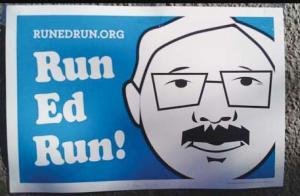
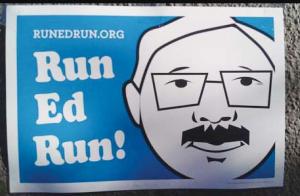
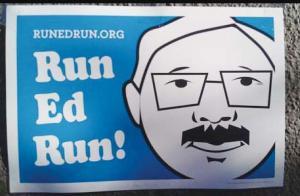
In mid-May, Pak and her allies created Progress for All, registering it as a “general civic education and public affairs” committee even though its sole purpose was to use large donations from corporations with city contracts or who had worked with Pak before to fund a high-profile “Run, Ed, Run” campaign, which plastered the city with posters featuring a likeness of Lee.

Initially, that campaign and its promotional materials were created by Pak (who refuses to speak to the Guardian) and political consultant Enrique Pearce (who did not return calls for this article) of Left Coast Communications, which had just run Kim’s successful D6 victory over progressive opponent Debra Walker, along with Pak protégé David Ho.

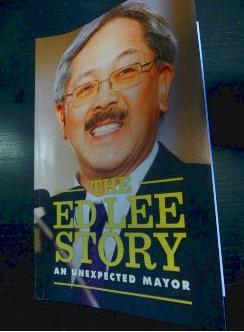
During that campaign, the Guardian and Bay Citizen discovered Pearce running an independent expenditure campaign called New Day for SF, funded mostly by Willie Brown, out of his office, despite bans of IEs coordinating with official campaigns. That tactic would repeat itself over the coming months, drawing criticism but never any sanctions from the toothless Ethics Commission. Pearce was hired by two more pro-Lee IEs: Committee for Effective City Management and SF Neighbor Alliance, for which he wrote the book The Ed Lee Story, a supposedly “unauthorized biography” filled with photos and personal details about Lee.

Publicly, the campaign was fronted by noted Brown allies such as his former planning commissioner Shelly Bradford-Bell, Pak allies including Chinatown Community Development Center director Gordon Chin, and a more surprising political figure, Christina Olague, a progressive board appointee to the Planning Commission. She had already surprised and disappointed some of her progressive allies on Feb. 28 when she endorsed Chiu for mayor during his campaign kickoff, and even more when she got behind Lee.

Olague recently told us the moves did indeed elicit scorn from some longtime allies, but she defends the latter decision as being based on Lee’s experience and willingness to dialogue with progressives who had been shut out by Newsom, noting that she had been asked to join the campaign by Chin. Olague also said the decision was partially strategic: “If we get progressives to support him early on, maybe we’ll have a seat at the table.”

Right up until the end, Lee told reporters that he planned to honor his word and not run. During a Guardian interview in July when we pressed him on the point, Lee said he would only run if every member of the Board of Supervisors asked him to, although about half the board publicly said that he shouldn’t, including Sup. Sean Elsbernd, who nominated him for interim mayor.

And then, just before the filing deadline in early August, Lee announced that he had changed his mind and was running for mayor, the powers of incumbency instant catapulting him into the frontrunner position where he remains today, according to the most recent poll by the Bay Citizen and University of San Francisco.

Lee the politician

With his late entry into the race and decision to forgo public financing and its attendant spending limits, one might think that Lee would have to campaign aggressively to keep his job. But most of the heavy lifting has so far been done by his taxpayer-financed Office of Communications (which issues press releases at least daily) and by corporate-funded surrogates in a series of coordinated “independent” groups (see Rebecca Bowe’s story, “The billionaires’ mayor”).

That has left Lee to simply act as mayor, where he’s made a series of decisions that favor the business community and complement the “jobs” mantra cited relentlessly by centrist politicians playing on people’s economic insecurities.

Yet Lee has been elusive on the campaign trail and to reporters who seek more detailed explanations about his stands on issue or contradictions in his positions, and his spokespersons sometimes offer only misleading doublespeak.

For example, Lee’s office announced plans to veto legislation by Sup. David Campos that would prevent businesses from meeting their city obligation to provide a minimum level of employee health benefits through health savings accounts that these businesses would then pocket at the end of the year, taking $50 million last year even though some of that money had been put in by restaurant customer’s paying 5 percent surcharges on their bills.

Although Campos, the five other supervisors who voted for the measure, four other mayoral candidates, and its many supporters in the labor and consumer rights movements maintained the money belonged to workers who desperately needed it to afford expensive health care, the San Francisco Chamber of Commerce said it was about “jobs” that would be protected only if businesses could keep that money.

Lee parroted the position but tried to push the political damage until after the election, issuing a statement entitled “Mayor Lee Convenes Group to Improve Health Care Access & Protect Jobs,” saying that he would seek to “develop a consensus strategy” on the divisive issue — one in which Campos said “we have a fundamental disagreement” — that would take weeks to play out.

After a frustrating back-and-forth with Lee Press Secretary Christine Falvey by email, it’s still unclear how to resolve the contradiction between whether businesses could seize these funds or whether they belonged to employees, with her latest statement being, “The Mayor absolutely wants these funds spent on providing access to quality primary and preventative health care because this is the business’s obligation under HCSO. Making sure that these funds go to pay for health care is the most important objective.”

Similarly, when police raided the OccupySF encampment on Oct. 5, Lee’s office issued a statement that was a classic case of politicians trying to have it both ways, expressing support for the movement and its goal to “occupy” public space, but also supporting the need to police to clear the encampment of those same occupiers.

But now, in the wake of a repeat raid on Oct. 16 that has inflamed passions on the issue, the question is whether Lee can run out the clock and retain the office he gained on the promise of being someone more than a typical politician.

Line blurred between Ed Lee campaign and “independent” expenditures

28

From the public’s perspective, it’s hard to tell where the official Ed Lee for Mayor campaign – with its $500 limit on campaign donations – ends and where the various independent expenditure campaigns that we cover in this week’s issue begin. And that’s a problem given their ability to raise cash in unlimited amounts, coordinate with one another, and essentially act in concert with the official campaign.

For example, when San Francisco voters recently got telephone calls that began, “Hi, how are you? May I speak with ______. My name is ______ and I am a volunteer for Mayor Ed Lee. Will you support Mayor Ed Lee this upcoming election?”

The average voter would probably assume that the caller was a volunteer for the Lee campaign, but the phone banking was actually done by a group called Committee for Effective City Management, although that was never identified in the script that it was required to file with the Ethics Commission.

Campaign consultant David Looman, who runs the group, disputed that interpretation, telling us, “It doesn’t present as part of the campaign.” When we noted that was the obvious impression it left, he still wouldn’t budge, “It doesn’t say I’m a part of the campaign or anything of the sort.” When we asked whether they are required to identify themselves as an independent expenditure, he responded, “I’m not clear about that.”

Ethics Commission Executive Director John St. Croix said it is a clear violation of the law for an IE to identify itself as part of the official campaign. When he read him the script, he responded, “I don’t like it, but I can’t say off the top of my head it’s absolutely a violation because that isn’t the exact name of the campaign, which is Ed Lee for Mayor 2011.”

But clearly, voters are left with the impression that it’s a Lee campaign volunteer calling, right? “I think that’s a legitimate layman’s perspective on this, yes,” St. Croix responded.

Will the Ethics Commission do anything about this, or the numerous other campaign finance law violations that CitiReport, Bay Citizen, and other media outlets have been unearthing? Don’t bet on it, particularly because of the commission’s history of ignoring problems and overcomplicating its role in watchdogging even the most obvious violations.

For example, at tonight’s Ethics Commission hearing, the body is considering relaxing rules that require the reporting of big campaign finance expenditures within 24 hours, pushing that requirement back to the last week before the election — right after the Guardian’s final pre-election issue hits the streets. 

Two words Ed Lee doesn’t want to hear

13

There are two words no candidate wants to hear a month before Election Day:

“Criminal investigation.”

I give District Attorney George Gascon credit — I didn’t think he’d ever really go after municipal corruption, but he’s showing at least a bit of political spine here, launching an investigation into the dubious campaign contributions of Ed Lee. Lee’s campaign immediately said there would be full cooperation:

Last week, Mayor Lee’s campaign returned 23 contributions associated with Go Lorrie’s Shuttle company as a result of the campaign’s own concerns and compliance review. On Friday, the campaign reached out to the District Attorney’s Office, the U.S. Attorney’s Office, the Ethics Commission and the Fair Political Practices Commission to offer its full assistance in any investigation or review. It is important to note that there is nothing about the District Attorney’s statement or initiation of an investigation that suggests that Mayor Lee’s campaign is a target.

And at this point, there’s no way to know how far the investigation will go or what it will turn up. But the very fact that the D.A. is looking into all of this looks bad for Lee.

And if Gascon’s office scours not only the Go Lorrie’s money but the rest of Lee’s campaign contributions — and the independent expenditure committees that aren’t supposed to be coordinating with each other or the main campaign — he might find more.

Bill Barnes, who works with the Lee campaign, told me that he was doing everything possible to make sure the contributions were all on the up-and-up. “I can’t control the i.e.’s,” he said, “but we are very careful to follow the law.”

He also said that it’s possible there were mistakes, like the Go Lorrie’s money. “We’re raising a lot of money in a short period of time,” he said.

But you see, that’s part of the problem. You enter the race late, refuse to accept public financing (and abide by spending limits) and start trying to raise more than a million bucks in a few weeks, and it’s too easy to get sloppy. Add in the fact that people like Willie Brown, who never cared much for campaign contribution or ethics laws, are involved in the fundraising, and you have a recipe for real trouble.


Lee under pressure for contract disclosure law violations

By Lisa Carmack

Mayor Ed Lee has allegedly failed to file 67 reports detailing contracts worth $50,000 or more with the San Francisco Ethics Commission.

Lee has come under attack by fellow candidate City Attorney Dennis Herrera, who claimed that he has “repeatedly delayed filing his required disclosure forms.”

“I’m not aware of specific delays yet, but any time we get a notice and our campaign is reviewed, everything we’re supposed to file as far as I know, we’re in compliance,” Lee said when asked about the claims.

According to city law, any elected official who approves contracts worth $50,000 or more is required to file a report within five days of approval. The requirement serves as a safeguard against illegal campaign contributions, since the city’s Campaign Finance Reform Ordinance bars officials from receiving contributions from vendors within six months of contract approval.

“It just came to my attention today,” said the executive director of Ethics Commission John St. Croix. “We’re gonna have to talk to him and his folks about why these reports have been excessively late.”

On Oct. 5, Herrera publicized records listing each time Lee failed to comply with the ordinance since becoming interim mayor in January of this year.

Whether or not punitive actions will be taken is up to the Ethics Commission. “In this case we have to investigate first,” said St. Croix, adding that while the agency would look into the matter, he could neither confirm nor deny the existence of an official investigation. “I’m not aware of any other entity that files late on a routine basis.”

City contractors plunk down for Lee

Representatives from Stellar Services, an IT infrastructure services provider that also does business as 4 U Services, contributed a total of $7,500 in support of Mayor Ed Lee’s bid for a full term, filings with the San Francisco Ethics Commission show. The New York-based company holds a contract with the San Francisco Public Utilities commission (SFPUC) and has been paid $91,737.80 to date for programming and coding services.

Lee also received a maximum $500 contribution from a senior vice president at AECOM, another city contractor. While the contributions may have squared with campaign finance law, significant support from companies doing business with the city nevertheless give the impression of businesses attempting to advance their own interests through political influence.

The majority of the contributions from Stellar came in the form of a $5,000 donation from 4 U Services to the Committee for Effective City Management, an independent expenditure committee created in support of Lee that recently hosted a Lee fundraiser in Millbrae honoring special guests Sup. Jane Kim and former Mayor Willie Brown.

4 U, according to its website, also does business as Stellar Services, a company based in New York that has an office in San Francisco. “Stellar is currently a sub-consultant that is working to develop our new online invoicing system called SOLIS,” SFPUC spokesperson Tyrone Jue told the Guardian. “The invoicing system centralizes and streamlines the invoicing process, makes invoicing transaction transparent to all users, increases reporting and transparency, and makes invoicing completely paperless.” Jue noted that the contract was signed in July 2009, and the SOLIS pilot program is underway.

The remainder of contributions from Stellar were made to Lee’s official mayoral campaign. Five individuals who listed Stellar Services or 4 U Services as their employer, including company founder and president Liang Chen, made maximum contributions of $500, according to a report filed with the San Francisco Ethics Commission.

Shaista Shaikh of the Ethics Commission noted that it is legal for city contractors to make contributions to independent expenditure committees formed in support of a candidate for public office. City contractors run afoul of ethics law if they make campaign contributions to an elected official who must approve the contract at any time during contract negotiations or until six months have passed from the date of contract approval, she explained. Since the contract with Stellar was approved in 2009, the contribution would have been made well past the six-month mark  — so it apparently squares with the campaign finance reform ordinance.

Reached by phone, Lee spokesperson Tony Winnicker told the Guardian that if the contract was approved in 2009, it would not be included in a database of city contractors maintained by the campaign, since “there’s no prohibition” against accepting campaign money after the six-month ban has passed. “So that should not be a concern to the Guardian,” he said.

On Sept. 17, Lee received a maximum $500 contribution from Joseph G. Moss, Jr., who listed his occupation as a senior vice president of AECOM in Atlanta, according to an Ethics filing. Lee received another $875 in contributions from AECOM employees, Ethics records show. According a press release on the AECOM website which seems to have been taken down since the Guardian highlighted it, an AECOM joint venture was awarded a $150 million contract for program management services for the SFPUC’s wastewater improvement program on Aug. 16. AECOM is also a partner in a joint venture working on construction of the controversial Central Subway project.   

Since the contractor contribution ban (Section 1.126 of the city’s campaign finance reform ordinance) sets a number of parameters for determining the legality of contributions, it wasn’t immediately clear whether the contributions from AECOM were in line with the ordinance.

Regardless of whether the campaign cash falls on the right side of the law, however, substantial support for Lee from city contractors is likely to raise eyebrows, especially in light of concerns progressives have raised that San Francisco is about to witness a resurgence of the pay-to-play politics that characterized City Hall under Brown.

Censorship — or something else?

8

Project Censored highlight stories that didn’t make the national mainstream news media. And in this issue, we’ve got a story that shows something about how news judgments are made in two of San Francisco’s largest newsrooms.

Journalist Peter Byrne (who once worked at SF Weekly and wrote some critical stories about us) shares the tale of what happened to a story that the San Francisco Chronicle assigned him — but never published. The people at the Chron and the Bay Citizen (a nonprofit whose work runs in the New York Times) have different perspectives on what happened in this case — and whether powerful people like Richard Blum influence whether critical stories end up in print. Readers can decide for themselves how to see this situation.

But what was striking to us at the Guardian — and why we chose to print both Byrne’s account and the final story that the Chronicle chose not to print below — was that the suppressed story was actually quite tame and well-balanced after Chronicle writers, editors, and lawyers spent months working on it (Bay Citizen also invested weeks of work and never published anything relating to the story).

It simply raised the issue of whether the University of California should be doing private equity investment deals that are overseen by wealthy, politically connected people like Blum, whose own funds were also involved. It ultimately wasn’t a screaming indictment or accusation of illegal activity, but just a modest peek behind the curtain of an important institution whose focus has strayed from its core mission of serving college students.

We reviewed email exchanges that confirm the basic outline of Byrne’s story, conducted some interviews that guided our editing of this story, and included responses from the Chronicle and Bay Citizen at the end of the story. Ultimately, whether this is a case of censorship or something else, we thought it deserved to find its way into print. (Steven T. Jones)


BlumGate

Why two Bay Area newsrooms dismissed my story about conflicts of interest in UC investment deals


By Peter Byrne

news@sfbg.com

In September 2010, the journalism website Spot.us published my investigative series, “The Investors Club: How University of California Regents Spin Public Money into Private Profit.” It detailed how members of the UC Board of Regent’s investment committee oversaw the investment of nearly $1.5 billion of UC’s money into business deals in which they themselves held significant stakes.

One of the conflicted regents was Richard Blum, the financier husband of U.S. Sen., Dianne Feinstein (D-CA); another was Paul Wachter, a business partner of then-Gov. Arnold Schwarzenegger (who is also a regent).

The story caused a stir, particularly at a time when student groups were protesting draconian cuts and tuition hikes. Several newsweeklies published the series. The Los Angeles Times ran a story about my findings. And the investigation was honored with journalism awards by several local, state, and national organizations. So I was not surprised when Nanette Asimov, the higher education beat reporter for the San Francisco Chronicle, called me last October.

“I know it’s a Herculean task, but is it possible to charbroil your opus down to 800 words?” she asked. The paper offered to pay me $350 for the story.

Intrigued, I squeezed the investigation that Spot.us had paid $7,000 to produce into a few paragraphs. Little did I know that Asimov and I would be expanding and cutting and tweaking this story for the next eight months, as publication was delayed again and again by foot-dragging editors.

But I was patient. Even after Metro Editor Audrey Cooper told me that Blum had “threatened” Chronicle editors if they ran the tale, I waited several more months before going public. It is my belief that journalists must as accountable for what we do not print as for what we do print.

When Elizabeth Lesly Stevens, a staff writer at the Bay Citizen, inquired about the delay in publishing the story, I told her what I knew and gave her dozens of emails between myself and Chronicle staff. Ironically, the Bay Citizen never ran the story about the story.


THE GORY DETAILS

It quickly became obvious that the complex financial story would not easily squeeze into a few paragraphs. But since the Hearst Corporation had cut the Chronicle’s reportorial throat several years ago by laying off its investigative enterprise staff, there appeared to be no one left capable of editing it. Asimov had to constantly badger editors to work on the story.

Shortly before Thanksgiving 2010, Chronicle business reporter Tom Abate got involved. He sent me an outline indicating places where I should insert a “FIRE BREATHING QUOTE” and then a “QUOTE OF OUTRAGE.” The idea of daily news writing, he told me, was “make the readers spit up their coffee.” Okay! I dreamed that the streets of San Francisco would soon flow with rivers of regurgitated java.

By early January 2011, Asimov and I had worked up a coherent version, focusing on Blum and Wachter’s conflicts of interest. On January 31, Assistant City Editor Terry Robertson emailed, “I’m aiming to get it in the paper by the end of the week.” A few days later, he backtracked, “Well, I just found out that the story needs to be lawyered. That throws a bit of a wrench into the works. Sorry.”

By mid-February, Robertson had evidently lost interest. Determined to see it in print, Asimov recruited a veteran Chronicle reporter, John Wildermuth, to edit it. He whipped it into shape at 1,600 words. Now it was time for Asimov to call Blum for comment, since he refuses to talk to me.

According to Asimov, Blum was “spitting nails.” He called the allegations of conflicts of interest made by an array of ethics experts “obscene.” He said, “Nobody has ever told me that we had to ask UC for an OK before we invested in something. I wouldn’t be on the Board of Regents if I have to ask for permission to go to the bathroom.” And I was told he threatened the Chronicle with legal action if the story was published.

In late March, the copy was again sent to Cooper. On April 11, she decided it needed yet more attention from the lawyers.


COOPER GETS MAD

On April 14, the Daily Nexus, which is the student newspaper at UC Santa Barbara, reported on a group of students who had gathered hundreds of signatures on a petition to the state Attorney General asking for an investigation based upon the conflicts of interest identified in the Spot.us investigation. In the article, UC scholar Gray Brechin opined that the Chronicle was failing to print my story due “to the political influence of Blum and Feinstein.”

Shortly after the story was posted online, Cooper called Daily Nexus Editor Elliot Rosenfeld. She complained that Brechin’s comment about the Chronicle was “libelous.” The student editor removed the quote from the newspaper’s website.

When I asked Cooper about this, she emailed, “As for the Nexus, I think it’s a learning experience for them. As I told the paper’s editor and Dr. Brechin, I have never been intimidated into publishing anything—nor to refrain from publishing an article. And it won’t happen in the future, regardless of whether the pressure comes from a scientist, another journalist, or a senator.”

Then Cooper stopped responding to my emails.


THE PLOT THICKENS

On May 6, I received an email from the Bay Citizen’s Stevens. She had been at a dinner party with Brechin. She asked me why the Chronicle story was languishing. She said the Bay Citizen might publish it. I told her I was not ready to go public.

On May 18, I emailed Asimov about the status of the story. She said the lawyer had it.

I called Cooper. She told me, “I would like to get [the story] in for Memorial Day because we need the copy. … I am not responding to emails because I don’t want any of this shit in print. … Dick Blum can go fuck himself! Excuse my language. I don’t know the guy. I am not afraid of him. If he is doing something shady I want to publish that … [but] I am not going to be bullied into not printing it by Dick Blum and I’m not going to be bullied into printing it. … The fact that he’s called the editor and has an attorney in waiting makes us want to do it more. … I absolutely want to run it. I would like to run it next weekend.”

I asked if Blum was threatening the newspaper.

Cooper replied, “Yeah. The only people who know that are me and the executive editor and the managing editor. I don’t think Nanette knows that. So you are now like the fourth person that knows that besides Dick Blum. … People threaten to sue us all the time. But if we are going to mess with, you know, a billionaire, we are going to be a little cautious.”

A few weeks later, on June 2, I asked Asimov if she knew about Blum’s threat. She replied, “Of course, I knew. Heck, Blum told me as well. The presence of Blum’s lawyers won’t influence whether we run the piece, however. But this is getting increasingly ridiculous, and I’ve asked someone to find out the status for us.”

On June 27, Asimov told me that the “final version” of the story would “run over the weekend” and that it had been cut to 1,200 words. It did not run.

On July 6, I asked Asimov what was going on. She replied, “What happened is that the lawyer looked at it, and made some tweaks. Most were minor, but a small number of them struck me as simply wrong—like he didn’t understand the point. So I told Audrey, and its been the big chill ever since. So I don’t currently know what’s happening.”

That same day, July 6, the Chronicle ran a profile of Feinstein praising her as “the most effective politician in California.” Her well-documented conflicts of interest with her husband’s various businesses were not mentioned.

A week later, July 12, the Chronicle printed an op-ed by Blum in which he said online education is the future. He did not mention that Blum Capital has a multi-billion-dollar stake in two of the nation’s largest for-profit education corporations, each with a growing online component. Nor did the oped note that UC had invested $53 million in these companies after Blum joined the investment committee in 2004.

On July 19, Asimov told me, “The story was re-sent to the attorneys last night with the latest edits.” She said that nothing was likely to happened for at least two weeks since people were going on vacation. She said she would “leave [Cooper] a note saying that if the lawyer approves it, you must approve the final version.” And that was the last time I heard from anyone at the Hearst Corporation.

A few days later, Stevens contacted me again. She wanted to write about my story for the Bay Citizen’s section in The Sunday New York Times. Not being gifted with second sight, I did not know if the Chronicle would ever run the story, but they damn sure had let it get rigor mortis. So, I gave Stevens the email trail. I warned her that she might run into a similar problem at the Bay Citizen, which was founded by Wall Street financier Warren Hellman. It turns out that Hellman sits on the Board of Directors of the Berkeley Endowment Management Company, which controls half a billion dollars in UC Berkeley Foundation investments. Public records show that Hellman’s investment bank is partnered with the same two private equity funds that count both UC and Blum Capital as limited partners. And one of the Founding Patrons of Bay Citizen is the Blum Family Foundation. And one of the board members of the nonprofit Bay Citizen is Jeffery Ubben, a former managing partner of Blum Capital. But I digress.

[Editor’s Note: The Bay Citizen’s newsroom is run independently of its board members, and journalists there say none of the funders have influenced the selection or editing of news stories.]

A week later, Stevens informed me that the story was being pushed to the following week. And then she went on a month-long vacation and the story died. Go figure.

But Stevens did alert the Chronicle staff to my complaints, and the fact that I had provided her with emails and documentation to back up my claim that the Chronicle had bowed to Blum’s threat.

On August 8, Asimov emailed a UC instructor, Kathryn Klar, who had inquired about the status of my story. Asimov recounted, “I worked for nearly a year to get Peter Byrne’s—frankly awful—story in good enough shape to run in the Chronicle. It was poorly written and confusing. He will tell you how hard I worked to get that thing ready for publication. … By the end of July, the story was in great shape and the lawyers were taking a final look.

“And then Peter did the unthinkable. He forwarded a year’s worth of my private correspondence to another journalistic organization—not a newspaper—who then contacted me and others at the paper threatening to write a story about how the Chronicle had suppressed Peter’s story. … They behaved like blackmailers. Of course they had no story to write, and they didn’t. Needless to say, Peter’s story will not run in the Chronicle now. But it was his actions, not ours, that led to its death. We, my editors included, liked the story and were pleased that it was finally in great shape. Even the lawyers agreed.

“Its such a shame.”

Editors note: We asked Chronicle Managing Editor Steve Proctor for his response. He told us:

“The decision not to publish the story was made by the paper’s two top editors, me and Ward Bushee. After reviewing Mr. Byrne’s previously published articles and his interactions with the Chronicle, we decided that we were not comfortable publishing his work.

“The story was brought to the Chronicle after having been previously published on a journalism web site. The editors here who worked with Mr. Byrne decided that his reporting would need to be double-checked if the piece were to appear in some form in the Chronicle. This was done intermittently, over a period of time, as there was no urgency to publish given that a version of the story had already appeared.

“We want to be clear on one point. The Chronicle is never intimidated by threats made prior to the publication of a newspaper story — and they are hardly infrequent. We make all of our decisions about publishing stories based on the high standards for journalism that we seek to uphold in the newspaper every day.” Bay Citizen reporter Elizabeth Lesly Stevens told us: “After much reporting we ultimately decided that Peter’s story was a lot less interesting than he thought it was, and wouldn’t make for a very worthwhile column in the NY Times.”

Editors note: This is the final version of the story that was supposed to run in the Chron:

By Peter Byrne

news@sfbg.com

The University of California has invested hundreds of millions of dollars in business deals in which two regents who have helped oversee UC’s investment portfolio also had financial interests, records show.

Since 2003, UC has invested in five private equity deals in which Regent Richard Blum also had investment interests, according to federal, state and university documents. Regent Paul Wachter had a substantial financial interest in one of those deals.

In such cases, Blum and Wachter were in a position to benefit — or lose — from university investments they oversaw. Blum served on the investment committee from 2004 to February 2010. Wachter joined in 2004 and is its current chairman.

Both regents deny any wrongdoing. The university’s chief attorney has examined the investment overlap and concluded they were likely coincidental.

Yet some ethics experts say the overlapping investments create an appearance of conflicted interests. Critics say the deals may violate state and UC ethics guidelines.

Blum, an investment banker and financier who was appointed to the regents in 2002 by then-Gov. Gray Davis, is the husband of Sen. Dianne Feinstein. Wachter is CEO of Main Street Advisors,?a financial management company. He was named to the board by Gov. Arnold Schwarzenegger in 2004.

The regents’ 10-member investment committee sets policy for and oversees the management of UC’s $70.8 billion as of March 2011 portfolio of investments, which includes the retirement, endowment and campus foundation funds. UC’s chief investment officer, Marie Berggren, regularly reports to the committee, explaining where the money is being invested and how well the investments are doing.

The investment committee’s conflict-of-interest policy prohibits committee members from telling the investment officer what specific funds to invest in. But they can, and do, direct her to invest greater or lesser amounts in certain categories of funds.

Committee members must also adhere to conflict-of-interest guidelines established by the state and UC, both of which prohibit officials from influencing or voting on matters in which there is even an appearance of a personal conflict of interest. In particular, UC’s policy says a conflict exists “if it is reasonably foreseeable that the decision will have a material financial effect on one or more of your economic interests.” A material interest is defined as being worth more than $2,000.

DEALS EXAMINED

Blum had investments of more than $1 million in a number of the business partnerships that UC put money into, while Wachter had up to $1 million invested in one of the deals.

UC’s general counsel, Charles Robinson, examined these investments in 2010. Robinson concluded that the investment overlap was probably coincidental, and that neither Blum nor Wachter improperly steered public funds.

“Any overlap is substantially more likely to be the result of independent decisions by like-minded investors than the result of coordination,” Robinson reported.

Blum called the idea that he would coordinate investments and profit from UC’s financial dealings “ridiculous” and even “obscene.”

“Nobody has ever told me that we had to ask the UC for an OK before we invested in something,” Blum told The Chronicle. “I wouldn’t be on the Board of Regents if I have to ask for permission to go to the bathroom.”

Wachter also dismissed the idea that the overlapping investments represent a conflict. “It just doesn’t make sense at all,” Wachter said, adding that he’s surprised that he and Blum had so few overlapping investments over the years, given the extent of their holdings. “The key thing is that you’re not telling each other what to do.”

But ethics experts say conflict of interest laws and regulations do not allow for such overlaps. “The regents’ overlapping investments pose clear conflicts of interest,” said Kirk Hanson, executive director of the Markkula Center for Applied Ethics at Santa Clara University. “It is really striking that members of the investment committee stood to gain so significantly from co-investing with UC.”

Robert Weissman, president of the government watchdog group Public Citizen, was more direct: “A third-grader can see that what the regents on the investment committee were doing is unethical.”

FINANCIAL DETAILS

Minutes from committee meetings show Blum and Wachter consistently voted to instruct the investment officer to increase the amount of money invested in private equity funds, a sector in which the two regents have substantial financial interests.

More importantly, some of those investments were tied to private equity deals in which Blum and Wachter held financial stakes.

In one example, Blum, Wachter, and UC all invested in private equity funds that partnered to buy the Las Vegas casino corporation Harrah’s Entertainment in 2008.

It worked this way: The regents’ investment committee oversaw an investment of $199 million in four private equity funds that helped finance the $30 billion Harrah’s deal, according to documents filed with the U.S. Securities and Exchange Commission and UC financial records.

Blum held “more than $1 million” in one these funds, called TPG Capital V, according to Feinstein’s economic disclosure statement. Wachter owned “up to $1 million” in two of the funds that financed the Harrah’s buyout, according to his financial disclosure statements.

Blum denied any conflict. He said the money resulted from a 2006 merger between Blum’s Newbridge Capital and TPG Capital. Newbridge became TPG Asia, with Blum as its co-chairman.

As a result of the merger, “I wound up having some extremely minor — less than 1 percent — interest in some of (TPG Capital’s) funds,” Blum said, referring to his $1 million-plus asset.

Blum said he did not engineer the arrangement, and is never consulted on matters concerning TPG Capital, which did the deal with Harrah’s.

“You couldn’t pay me to invest in a casino,” he said. Wachter agreed that the Harrah’s case presents no conflict. “With investors, there will always be overlap. The point is, if one of the regents told the UC to invest in a particular fund, manager or company, that would be a different conversation. But that’s what our policy prohibits.”

OTHER DEALS

During his six years on the investment committee, Blum had a financial interest in four other deals in which UC was involved, according to SEC filings and UC records.

They involved Univision and Freescale Semiconductor in 2007, Sungard Data Systems in 2005, and Kinetic Concepts in 2004.

Blum said he had no control over any of the deals involving TPG Capital, but said his firm, Blum Capital Investments, was very involved with Kinetic Concepts.

He scoffed at the idea that he engineered any UC investment to enrich himself. “This is how ridiculous it is,” Blum said. “So someone’s going to whine because of $1 million? And somehow I’m taking advantage of the UC? I probably give away a bigger percentage of my net worth” than many people.

Private equity, in any case, has not been a cash cow for the university. In February, investment officer Berggren reported that the 10-year rate of return on the private equity portion of the UC retirement fund was averaging less than 1 percent annually, far less than the 6.5 percent return of UC’s fixed-income portfolio during the same period. Nanette Asimov contributed to this report.

Consequences of inaction

8

news@sfbg.com

The San Francisco Sunshine Ordinance, although it sounds bright and cheery, remains shrouded in a cloud of inaction. Meant to increase transparency in city government, it hasn’t emerged from the bureaucratic fog since its establishment in 1994. Cases wait years to be heard and even blatant violations go unpunished, due to infighting and power disputes between the commissions that are supposed to enforce government compliance.

The Sunshine Ordinance outlines citizen’s rights to request document and information. Citizens can take their complaints about request denials to the Sunshine Ordinance Task Force, an 11-member committee appointed by the Board of Supervisors to ensure government compliance. If the task force decides a violation has occurred the case is handed over to the Ethics Commission, a five-member appointed board that will supposedly enforce the rulings with fines or ordering documents to be made public.

George Wooding, reporter for the Westside Observer and president of the West of Twin Peaks Central Council, is the complainant in one of the task force’s most recent cases. This spring Wooding requested emails from the Recreation and Park Department multiple times but was told the documents did not exist. What RPD didn’t know was that Wooding had the emails all along.

The task force unanimously found RPD guilty of withholding emails. This is the third major sunshine violation by RPD in three years. Even more surprising, not one RPD employee has been fined, suspended, or faced any kind of punishment or corrective action.

The episode is a case study in the total eclipse of sunshine enforcement in the city, and how one embattled department — the RPD, which has come under heavy scrutiny for efforts to monetize park resources (see “Parks Inc.”, July 12) — used that dysfunction to stifle dissent.


DILUTING DISSENT

George Wooding v. RPD began when Wooding was asked to be a panelist at a Commonwealth Club event on May 11. The event, titled “Golden Gate Park Under Siege,” was to be a discussion about possible development projects in the park. Other panelists were representatives of environmental and anti-development groups who claimed they were not given time to voice their concerns in Board of Supervisors meetings, and wanted a forum to do so.

Wooding says that the Commonwealth Club was bombarded with phone calls and emails weeks before the discussion.

“They were saying our panel was one-sided, which is really unusual, and the Commonwealth Club told us they were getting a lot of heat for such a little panel discussion,” Wooding said. “It was not going to be a big deal, in all honesty.”

The emails that Wooding had and the department denied include correspondence from Sarah Ballard, RPD’s director of policy and public affairs, to Kerry Curtis, co-chair of the Commonwealth Club Environment & Natural Resources Forum, indicating she had phoned the club as well and asked that the discussion be canceled due to its “deeply biased panel that has no interest in discussing facts.”

There are also emails between Susan Hirsch, director of the City Fields Foundation, a private group that has been installing artificial turf in public parks, from her business email address to the panel moderator Jim Chappell’s private email, urging him to reconsider the event.

“You and I discussed this project years ago; the private sector is contributing far more than $20 million to provide safe, accessibly, and yes, environmentally sound fields for kids all across San Francisco to use. We have a unique private/public partnership with Rec and Park; it’s too bad the focus is on something negative, rather than the positive impact,” Hirsch wrote.

Mark Buell, president of the Recreation and Park Commission, also emailed Greg Dalton, Commonwealth Club’s COO, from his private email address: “I find the title inflammatory, the participants biased, and the fact that no one from the Rec and Park Department invited hard to understand. As president of the Commission I would like to urge the club to both alter the title of the event to ‘issues facing the park’ and have the club ask a representative of the department to be on the panel.”

Shortly thereafter, Buell was added to the panel and the event was renamed “Golden Gate Park Under Siege?”

Buell says the situation has been blown out of proportion. “I got on the panel because I’ve been active with the Commonwealth Club for years and all of a sudden I read a very slanted title about something tantamount to the ruination of Golden Gate Park, and a panel of people who are all critics,” Buell told us.

Wooding says the panel went smoothly, but he was unsettled by the last minute changes. He asked around for any information about what happened and got the emails through a knowledgeable source close to the RPD.

“[RPD] has pissed off a lot of people because they came in with a hammer when they didn’t need a sledge hammer. One of the people they pissed off was really upset and ended up giving me the correspondence,” Wooding told us.

As a journalist, Wooding said, “I was thinking, ‘this is a great story but wait, I can’t use any of this information,’ so I thought about how I could get the information legitimately?”

Wooding immediately emailed Olivia Gong, a RPD secretary, making clear that he was requesting the emails in accordance with the Sunshine Ordinance. Gong replied that the department did not have any documents matching the request.

“Imagine how amazed I was when they claimed they didn’t exist,” Wooding said.

After a second request turned up nothing, Wooding knew they were hiding the emails. He then asked Gong how she had determined the emails did not exist. Gong forwarded emails she had sent to department members who replied they did not have responsive documents.

Wooding then filed a complaint with the task force, which voted unanimously that RPD was in the wrong. Not only did it claim the emails did not exist, but when it became clear that they did, the department said that members deleted the emails because some were sent on private accounts and did not directly pertain to RPD affairs.

“I just delete everything,” Buell says. “It’s not that I did anything, it’s just that I didn’t know the rules that you’re supposed to keep everything.”

Task Force Chair Hope Johnson says she was shocked by this argument. The California Public Records Act, which is more lenient than the Sunshine Ordinance, clearly lists emails as a form of government document that must be handed over on request. The Sunshine Ordinance covers emails as well, and all officials who serve on city boards were required to undergo sunshine training last year, outlining what public documents are and noting that it’s illegal under state law to destroy them.

“Just switching over to another email address lends itself to the idea that this is something they knew was underhanded and would not be received positively by the public,” Johnson said.

She says this is becoming a problem throughout city government.

“There’s not a lot of specificity about keeping emails. They need a retention policy,” Johnson says. “Obviously I think that they prefer it to be as vague as possible.”


POSSIBLE PUNISHMENT?

Although the task force found RDP in violation, punishment is up to the Ethics Commission, a separate entity at City Hall.

Enter bureaucratic gloom and doom.

Since 1993 the task force has given the Ethics Commission 19 sunshine violation cases. Only one has even been heard. The other 18 were dismissed or are still “pending investigation.” Government officials are therefore under no serious threat if they disobey the law.

Richard Knee, former chair of the task force, says there is obvious animosity between the task force and commission staff. Rather than enforcing punishment, the Ethic Commission staff claim that cases can be dismissed on the grounds of insufficient evidence, or require additional investigation, which stalls the process indefinitely.

“I don’t think there’s any confusion, I think it’s merely resistance,” Knee said. “We are not asking the Ethics Commission to re-adjudicate something we have already adjudicated. When we refer a matter to the Ethics Commission we are asking them to tack some kind of enforcement action on a violation we have already found exists.”

In the one case Ethics did hear, it turned the punishment decision over to the mayor as the “appointing officer,” who did nothing. It has, therefore, never enforced a penalty on any government official that the task force found guilty.

A report released in August by the Civil Grand Jury, entitled “San Francisco’s Ethics Commission: The Sleeping Watchdog,” criticizes the body’s record of inaction on both sunshine and campaign finance complaints.

“Because of the Ethics Commission’s lack of enforcement, no city employee has been disciplined for failing to adhere to the Sunshine Ordinance. The Commission has allowed some city officials to ignore the rulings of the Sunshine Ordinance Task Force,” the report says.

Johnson says that since the report came out, her correspondence with the Ethics Commission has shifted slightly.

“They used to send us letters back saying they dismissed it, but recently we’ve sent over two cases and they agreed that there had been a violation,” Johnson said. “But they said they wouldn’t be able to do enforcements of any kind.”

She says that the Sunshine Ordinance won’t be taken seriously until the very people it is meant to monitor begin to enforce its stipulations.

“It’s difficult with the Ethics Commission because they keep all of their investigations secret,” Johnson says. “There is no external oversight, it is all the politicians, all of the people who appointed them, they are the only people who monitor what they’re doing.”

In response to the report, Johnson hopes the Ethics Commission will be urged to actually hear sunshine cases, and Wooding’s could be one of the first.

“The George Wooding case is a good example of how the Sunshine Ordinance can reveal oppression of a group of people who wanted to come together and have a constructive analysis,” Johnson said. “That should be something that’s allowed, and here’s the very entity that they want to have an analysis and discussion about shutting them down. And here are some documents that prove it.”

Wooding’s case will be heard once more by the task force on Sept. 27. It will almost certainly be sent to the Ethics Commission, but Wooding may be waiting awhile for any resolution.

“It’s probably going to take forever,” Wooding says. “Either I’ll just end up being another file in a cabinet somewhere, or this may even become an example, if it moves through, of how things should be done. There might be a lot more life in this than anyone ever imagined.”

Endorsement interviews: Dennis Herrera

13

Dennis Herrera has an interesting challenge: as city attorney, he’s been barred by law, legal ethics and custom from taking stands on a lot of the legislative and political issues facing the city. He couldn’t, for example, say he opposes a law that he might later have to defend in court. But now that he’s running for mayor, he’s liberated himself, and he’s started to talk about specific challenges facing the city.

Herrera told us he thinks this is the most important mayor’s race in the past 20 years and said that local government is going to have to play more of a role taking care of things that the federal and state governments will no longer do. He talked about the “culture of an organization” and his experience running a large office. He said that the city can’t cut its way out of its budget problems and he supports “additional revenues,” including a higher real-estate transfer tax, a more progressive payroll tax and (possibly) a commercial rent tax.

He supports an affordable housing bond — but wouldn’t call for a moratorium on market-rate housing and condo conversions.

Video and complete audio are after the jump.

Herrera by endorsements2011

Deep-pocketed Lee supporter aims to take back S.F. from progressives

1

Power brokers Willie Brown and Rose Pak aren’t nearly the only influential backers working behind the scenes to help elect Mayor Ed Lee to a full term. Three different committees have been set up to support his candidacy and are fundraising independently from his official campaign, according to Ethics Commission filings.

The principal officer and treasurer of one of these independent expenditure committees are, respectively, a Republican Silicon Valley tech investor who’s spoken publicly about taking San Francisco back from progressives, and a political attorney who worked on Pacific Gas & Electric Co.’s failed yet stunningly expensive Proposition 16 campaign.

“San Franciscans for Jobs and Good Government, Supporting Ed Lee for Mayor 2011,” was created in late August with a San Rafael address, according to an Ethics filing. Its principal officer is Ron Conway, a Silicon Valley angel investor who made his fortune in the tech industry. Conway was quoted in a San Francisco Business Times article last year as saying “we must take our city back” from progressives, a rallying cry he delivered at a dinner hosted by the the Bay Area Council, a business association. A book written about Conway by Gary Rivlin dubs him “The Godfather of Silicon Valley.”

According to campaign finance records, Conway, a registered Republican, has donated more than $320,000 to Republican state and federal candidates since 1999. He also contributed $1,000 to a Draft Ed Lee for Mayor committee, a separate effort from Progress for All which was formed before Lee announced his candidacy to encourage him to run. Conway has made substantial contributions to Democratic hopefuls, too, but the majority of his campaign donations over the last decade have benefited GOP candidates.

The treasurer of “San Franciscans for Jobs and Good Government” is Elli Abdoli, a political attorney who works in the San Rafael office of Nielsen Merksamer Parrinello Mueller & Naylor, a heavyweight political firm based in Sacramento whose services were tapped last year by PG&E to advance the Proposition 16 ballot initiative that the company bankrolled. Prop 16 was designed to crush municipal power programs that threatened to compete with PG&E by requiring a supermajority approval of the voters before they could move forward. Despite sinking more than $45 million into that campaign, voters rejected Prop. 16.

Abdoli served as the assistant treasurer for the Yes on 16 committee, according to a form filed with the Fair Political Practices Commission. She was listed as a contact for the “San Franciscans for Jobs and Good Government” committee and had not returned calls by press time.


Team Avalos

63

When Supervisor John Avalos chaired the Budget & Finance Committee in 2009 and 2010, his office became a bustling place in the thick of the budget process. To gain insight on the real-life effects of the mayor’s proposed spending cuts, Avalos and his City Hall staff played host to neighborhood service providers, youth workers, homeless advocates, labor leaders, and other San Franciscans who stood to be directly impacted by the axe that would fall when the final budget was approved. They camped out in City Hall together for hours, puzzling over which items they could live without, and which required a steadfast demand for funding restoration.

“One year, we even brought them into the mayor’s office,” for an eleventh-hour negotiating session held in the wee morning hours, recounted Avalos’ legislative aide, Raquel Redondiez. That move came much to the dismay of Steve Kawa, mayoral chief of staff.

Avalos, the 47-year-old District 11 supervisor, exudes a down-to-earth vibe that’s rare in politicians, and tends to display a balanced temperament even in the heat of high-stakes political clashes. He travels to and from mayoral debates by bicycle. He quotes classic song lyrics during full board meetings, keeps a record player and vinyl collection in his office, and recently showed up at the Mission dive bar El Rio to judge a dance competition for the wildly popular Hard French dance party.

Yet casual observers may not be as familiar with the style Avalos brings to conducting day-to-day business at City Hall, an approach exemplified that summer night in 2010 when he showed up to the mayor’s office flanked by grassroots advocates bent on preserving key programs.

“My role is, I’m an insider, … but it’s really been about bringing in the outside to have a voice on the inside,” Avalos said in a recent interview. “People have always been camped out in my office. These are people who represent constituencies — seniors, recipients of mental health care, unions, people concerned about violence. It’s how we change things in City Hall. It’s making government more effective at promoting opportunities, justice, and greater livelihood.” Part of the thrust behind his candidacy, he added, is this: “We want to be able to have a campaign that’s about a movement.”

That makes Avalos different from the other candidates — but it also raises a crucial question. Some of the most important advances in progressive politics in San Francisco have come not just from electoral victories, but from losing campaigns that galvanized the left. Tom Ammiano in 1999 and Matt Gonzalez in 2003 played that role. Can Avalos mount both a winning campaign — and one that, win or lose, will have a lasting impact on the city?

Workers and families

No budget with such deep spending cuts could have left all stakeholders happy once the dust settled, but Avalos and other progressive supervisors did manage to siphon some funding away from the city’s robust police and fire departments in order to restore key programs in a highly controversial move.

“There’s a Johnny Cash song I really like, written by Tom Petty, called ‘I Won’t Back Down.’ I sang it during that time, because I didn’t back down,” Avalos said at an Aug. 30 mayoral forum hosted by the Potrero Hill Democratic Club. “We made … a symbolic cut, showing that there was a real inequity about how we were doing our budgets. Without impacting public safety services, we were able to get $6 million from the Fire Department. A lot of that went into Rec & Park, and health care programs, and to education programs, and we were able to … find more fat in the Police Department budget than anybody had ever found before, about $3 million.”

Last November, Avalos placed a successful measure on the ballot to increase the city’s real-estate transfer tax, which so far has amassed around $45 million in new revenue for city coffers, softening the blow to critical programs in the latest round of budget negotiations. “Without these measures that community groups, residents, and labor organizations worked for, Mayor Ed Lee would not have been able to balance the budget,” Avalos said.

More recently, he emerged as a champion of the city’s Local Hire Ordinance, designed as a tool for job creation that requires employers at new construction projects to select San Francisco residents for half their work crews, to be phased in over the next several years. That landmark legislation was a year in the making, Redondiez said, describing how union representatives, workers, contractors, unemployed residents of Chinatown and the Bayview, and others cycled through Avalos’ City Hall office to provide input.

His collaborative style stems in part from his background. Avalos formerly worked for Service Employees International Union Local 1877, where he organized janitors, and served as political director for Coleman Advocates for Children & Youth. He was also a legislative aide to former District 6 Sup. Chris Daly, who remains a lightning rod in the San Francisco political landscape.

Before wading into the fray of San Francisco politics, Avalos earned a masters degree in social work from San Francisco State University. But when he first arrived in the city in 1989, with few connections and barely any money to his name, he took a gig at a coffee cart. He was a Latino kid originally from Wilmington, Calif. whose dad was a longshoreman and whose mom was an office worker, and he’d endured a climate of discrimination throughout his teenage years at Andover High in Andover, Mass.

Roughly a decade ago, Avalos and a group of youth advocates were arrested in Oakland following a protest against Proposition 21, which increased criminal penalties for crimes committed by youth. Booked into custody along with him was his wife, Karen Zapata, whom he married around the same time. She is now a public school teacher in San Francisco and the mother of their two children, ages 6 and 9, both enrolled in public schools.

“John has consistently been a voice for disenfranchised populations in this city,” said Sharen Hewitt, who’s known Avalos for more than a decade and serves as executive director of The Community Leadership Academy & Emergency Response Project (CLAER), an organization formed to respond to a rash of homicides and alleviate violence. “He understands that San Francisco is at a major turning point in terms of its ability to keep families and low-income communities housed. With the local hiring ordinance, most of us who have been working around violence prevention agree — at the core of this horrible set of symptoms are root causes, stemming from economic disparity.”

Asked about his top priorities, Avalos will invariably express his desire to keep working families rooted in San Francisco. District 11, which spans the Excelsior, Ingleside, and other southeastern neighborhoods, encompasses multiracial neighborhoods made up of single-family homes — and many have been blunted with foreclosure since the onset of the economic crisis.

“Our motto for building housing in San Francisco is we build all this luxury housing — it’s a form of voodoo economics,” Avalos told a small group of supporters at a recent campaign stop in Bernal Heights. “I want to have a new model for how we build housing in San Francisco. How can we help [working-class homeowners] modify their loans to make if more flexible, so they can stay here?” He’s floated the idea of creating an affordable housing bond to aid in the construction of new affordable housing units as well as loan modifications to prevent foreclosures.

“That’s what is the biggest threat to San Francisco, is losing the working-class,” said community activist Giuliana Milanese, who previously worked with Avalos at Coleman Advocates for Youth and has volunteered for his campaign. “And he’s the best fighter. Basically, economic justice is his bottom line.”

Tenants Union director Ted Gullicksen gave Avalos his seal of approval when contacted by the Guardian, saying he has “a 100 percent voting record for tenants,” despite having fewer tenants in his district than some of his colleagues. “David Chiu, had he not voted for Parkmerced, could have been competitive with John,” Gullicksen said. “But the Parkmerced thing was huge, so now it’s very difficult to even have David in same ballpark. Dennis [Herrera] has always taken the right positions — but he’s never had to vote on anything,” he said. “After that, nobody comes close.”

Cash poor, community rich

There’s no question: The Avalos for Mayor campaign faces an uphill climb. Recent poll figures offering an early snapshot of the crowded field peg him at roughly 4 percent, trailing behind candidates with stronger citywide name recognition like City Attorney Dennis Herrera or the incumbent, Mayor Ed Lee, who hasn’t accepted public financing and stands to benefit from deep-pocketed backers with ties to big business.

Yet as Assembly Member Tom Ammiano phrased it, “he’s actually given progressives a place to roost. He doesn’t pussy-foot around on the issues that are important,” making him a natural choice for San Francisco voters who care more about stemming the tides of privatization and gentrification than, say, rolling out the red carpet for hi-tech companies.

One of Avalos’ greatest challenges is that he lacks a pile of campaign cash, having received less than $90,000 in contributions as of June 30, according to an Ethics Commission filing. “He can’t call in the big checks,” said Julian Davis, board president of Booker T. Washington Community Service Center, “because he hasn’t been doing the bidding of big business interests.” A roster of financial contributions filed with the Ethics Commission shows that his donor base is comprised mainly of teachers, nonprofit employees, health-care workers, tenant advocates, and other similar groups, with almost no representatives of real-estate development interests or major corporations.

Despite being strapped for cash, he’s collected endorsements ranging from the Democratic County Central Committee, to the Harvey Milk Democratic Club, to the city’s largest labor union, SEIU 1021; he’s also won the backing of quintessential San Francisco characters such as renowned author Rebecca Solnit; San Francisco’s radical bohemian poet laureate, Diane di Prima; and countercultural icon Diamond Dave.

While some of Avalos’ core supporters describe his campaign as “historic,” other longtime political observers have voiced a sort of disenchantment with his candidacy, saying it doesn’t measure up to the sweeping mobilizations that galvanized around Gonzalez or Ammiano. Ammiano has strongly endorsed Avalos, but Gonzalez — who now works for Public Defender (and mayoral candidate) Jeff Adachi — has remained tepid about his candidacy, stating publicly in an interview on Fog City Journal, “I like [Green Party candidate Terrie Baum] and John fine. I just don’t believe in them.”

Ironically, Sup. Sean Elsbernd, often Avalos’ political opposite on board votes, had kinder words for him. “John is intelligent, John is honest, and John has integrity,” Elsbernd told the Guardian. “I don’t think he knows the city well enough to serve as chief executive … but I’ve seen the good work he’s done in his district.”

Meanwhile, Avalos is still grappling with the fallout from the spending cut he initiated against the police and fire departments in 2009. Whereas those unions sent sound trucks rolling through his neighborhood clamoring for his recall from office during that budget fight, the San Francisco Police Officers Association (SFPOA), the San Francisco Fire Fighters union, and the plumbers’ union, Local 38, have teamed up now that Avalos is running for mayor to form an independent expenditure committee targeting him and Public Defender Jeff Adachi, a latecomer to the race.

“We’ll make sure we do everything we can to make sure he never sees Room 200,” SFPOA President Gary Delagnes told the Guardian. “I would spend as much money as I could possibly summon to make sure neither ever takes office.” Delagnes added that he believes the political makeup of San Francisco is shifting in a more moderate direction, to Avalos’ disadvantage. “People spend a lot of money to live here,” he said, “and they don’t want to be walking over 15 homeless people, or having people ask them for money.”

If it’s true that the flanks of the left in San Francisco have already been supplanted with wealthy residents whose primary concern is that they are annoyed by the sight of destitute people, then more has already been lost for the progressive movement than it stands to lose under the scenario of an Avalos defeat.

The great progressive hope?

Despite these looming challenges, the Avalos campaign has amassed a volunteer base that’s more than 1,000 strong, in many cases drawing from grassroots networks already engaged in efforts to defend tenant rights, advance workplace protections for non-union employees, create youth programs that aim to prevent violence in low-income communities, and advance opportunities for immigrants. According to some volunteers, linking these myriad grassroots efforts is part of the point. Aside from the obvious goal of electing Avalos for mayor, his supporters say they hope his campaign will be a force to re-energize and redefine progressive politics in San Francisco.

“All the candidates that are running are trying to appeal to the progressive base,” Avalos said. But what does it really mean? To him, being progressive “is a commitment to a cause that’s greater,” he offered. “It’s about how to alter the relationship of power in San Francisco. My vision of progressivism is more inclusive, and more accountable to real concerns.”

N’Tanya Lee, former executive director of Coleman Advocates, was among the people Avalos consulted when he was considering a run for mayor. “The real progressives in San Francisco are the folks on the ground every day, like the moms working for public schools … everyday families, individual people, often people of color, who are doing the work without fanfare. They are the unsung heroes … and the rising progressive leaders of our city,” she said. “John represents the best of what’s to come. It’s not just about race or class. It’s about people standing for solutions.”

When deciding whether to run, Avalos also turned to his wife, Zapata, who has held leadership positions in the San Francisco teacher’s union in the past. She suggested rounding up community leaders and talking it through. “The campaign needed to be a movement campaign,” Zapata told the Guardian. “John Avalos was not running because he thought John Avalos was the most important person in the world to do this job. Our question was, if John were to do this, how would it help people most affected by economic injustice?”

Hewitt, the executive director of CLAER, also weighed in. “My concern is that he has been painted as a leftist, rooted in some outdated ideology,” she said. “I think [that characterization] is one-dimensional, and I think he’s broader than that. My perception of John is that he’s a pragmatist — rooted in listening, and attempting to respond.”

Others echoed this characterization. “He doesn’t need to be the great progressive hope,” said Rafael Mandelman, an attorney who ran as a progressive in District 8 last year. “If people are looking for the next Matt Gonzalez, I’m not sure that’s what John is about. He’s about the communities he’s representing.”

As to whether or not he has a shot at victory, Mandelman said, “It’s a very wide field, and I think John is going to have a very strong base. I think he will get enough first-choice votes to be one of the top contenders. And with ranked choice voting, anything can happen.”


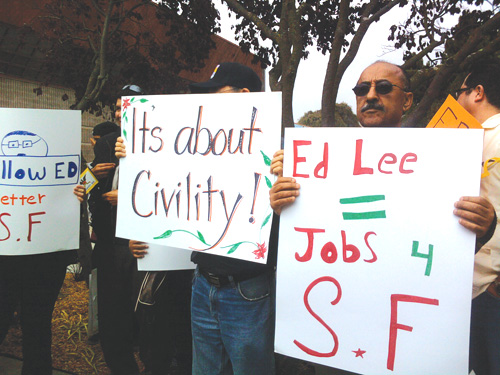
So much for civility

0

rebeccab@sfbg.com

The San Francisco mayor’s race went from a lackluster affair to a dynamic match as the Aug. 12 filing deadline drew near and two prominent city officials who had previously said they wouldn’t run tossed their hats into the ring.

Mayor Ed Lee’s Aug. 8 announcement that he’d seek a full term prompted several of his opponents to use their time onstage at candidate forums to decry his reversal and question his ties to the moneyed, influential backers who openly urged him to run. Several days later, Public Defender Jeff Adachi’s last-minute decision to run for mayor signaled more tension yet to come in the debates.

At this point, eight current city officials are running campaigns for higher office, and the dialogue is beginning to take on a tone that is distinctly more biting than civil. Adachi, who had not yet debated onstage with his opponents by press time, told reporters he was running because he wanted “to make sure there’s a voice in there that’s talking about the fiscal realities of the city.”

Adachi authored a pension reform ballot measure that rivals the package crafted by Lee, labor unions, and business interests (see “Awaiting consensus,” May 31, 2011). At an Aug. 11 candidate forum hosted by the Alice B. Toklas Democratic Club, the San Francisco Young Democrats, and the City Democratic Club, all of the top-tier candidates who were present indicated that they would support Lee’s pension reform measure and not Adachi’s.

“The reforms that I have championed are reforms that are absolutely needed, along with action,” Adachi told reporters moments after making his candidacy official. He added that after watching the mayoral debates, “I became convinced that either the candidates don’t get it, or they don’t want to get it.”

Those fighting words will likely spur heated exchanges in the months to come, but until Adachi’s entrance into the race, it was Lee who took the most lumps from opponents. Even Board President David Chiu, a mayoral candidate whose campaign platform is centered on the idea that he’s helped restore civility to local government, had some harsh words for Lee during an Aug. 11 mayoral debate.

“I do regret my decision to take Ed Lee at his word when he said he would not run,” Chiu said in response to a question about whether he regretted any of his votes. He also said his first interaction with Lee after the mayor had announced his candidacy was “a little like meeting an ex-girlfriend after a breakup.”

Lee, whose pitch on the campaign trail features a remarkably similar narrative about transcending political squabbling in City Hall, became the target of boos, hisses, and noisemaker blasts when a boisterous crowd packed the Castro Theater for an Aug. 8 candidate forum. He received one of the most forceful rebukes from Sen. Leland Yee, an opponent whom Lee supporters are especially focused on defeating.

“Had the mayor said that he would in fact run, he may not have gotten the votes for interim mayor,” Yee said. “Will you resign from your post,” he asked, challenging Lee, “in order to then run for mayor?” Days later, Yee had developed a new mantra about throwing power brokers out of City Hall instead of “wining and dining with them.”

Yet Lee said his decision to enter the race wasn’t because of the push from his backers, but because of how well things have gone during his brief tenure in Room 200. “Things have changed at City Hall, particularly in the last seven months,” he told reporters Aug. 8. “And because of that change, I changed my mind.”

In yet another twist, former Mayor Art Agnos — whom progressives had looked to as a potential appointee to the vacant mayor’s seat back in December, before Lee was voted in to replace former mayor and Lieutenant Governor Gavin Newsom — delivered a surprise endorsement of City Attorney Dennis Herrera shortly after Lee declared. The decision was particularly significant since Agnos first hired Lee to serve in city government, and has a long history of working with him.

“[Herrera] is an independent person who will empower neighborhoods … and won’t be beholden to power brokers,” Agnos said. He also told the Guardian he wasn’t surprised that Lee had opted to run, given the role former Mayor Willie Brown and influential business consultant Rose Pak had played in orchestrating Lee’s appointment.

“Anybody who is an astute political observer saw the signs from the very beginning,” Agnos said. In response to a comment about his unique vantage point as a would-be caretaker mayor, he said, “I would’ve kept my word and not run for reelection.”

Intense focus on Lee’s flip-flop, and on the Progress for All-backed “Run, Ed, Run” effort that was the subject of an Ethics Commission discussion that same week, stemmed at least in part from the threat the incumbent mayor represents to other candidates. A CBS 5-SurveyUSA poll suggested he became an instant front-runner.

Yet questions about “Run, Ed, Run” — some raised by observers unaffiliated with any campaigns — also served to spotlight the candidate’s longstanding ties with backers closely connected to powerful business interests that stand to lose big if their links to city government aren’t preserved.

Retired Judge Quentin Kopp issued an open letter to District Attorney George Gascón Aug. 1 urging him to convene a criminal grand jury to investigate whether illegal and corrupt influencing had occurred when Pak — a close friend of Lee’s and a key driver behind the “Run, Ed, Run” effort — reportedly recruited executives of Recology to gather signatures urging Lee to run.

Recology, which handles the city’s waste, was recently awarded a $112 million city contract, and Lee’s scoring of the company and recommendation to raise rates in his previous capacity as city administrator benefited the company. Brown received substantial campaign donations from Recology in previous bids for mayor. Kopp is the coauthor of a ballot initiative asking San Francisco voters if the company’s monopoly on city garbage contracts should be put out to bid.

“A criminal grand jury is vital in order to put people under oath and interrogate them,” Kopp said. “They would put Willie Brown under oath, put Pak under oath, put [Recology President Mike Sangiacomo] under oath, put [Recology spokesperson Sam Singer] under oath … That’s the course of action that should be pursued by this.”

Although Kopp told the Guardian that he hadn’t yet received a response from Gascón, DA candidates Sharmin Bock, Bill Fazio, and David Onek nevertheless seized the opportunity to publicly and jointly call for Gascón to recuse himself from any investigation into Progress for All. Gascón has a conflict of interest, they argued, since he reportedly sought Pak’s advice when deciding whether to accept Newsom’s offer to switch from his previous post as police chief to his current job as top prosecutor.

The Ethics Commission determined unanimously Aug. 8 that the activities of Progress for All, the committee that was formed to encourage Lee to run, had not run afoul of election laws despite director John St. Croix’s opinion that it had filed improperly as a general purpose committee when it ought to have been a candidate committee, which would have placed caps on contribution limits.

“The Ethics Commission has spoken, and they’ve supported our position,” Progress for All consultant Enrique Pearce of Left Coast Communications told the Guardian.

St. Croix did not return Guardian calls seeking comment, but an Ethics Commission press release included a caveat: “Should facts surface that coordination occurred between Mayor Lee and [Progress for All], such allegations will be investigated under the Commission’s enforcement regulations.”

At a Lee support rally organized by his official campaign team on Aug. 11, volunteers who arrived with “Run, Ed, Run” materials produced by Progress for All were told they could not display those signs and T-shirts; the same people were on a first-name basis with one of Lee’s campaign team members.

Pressed on the question of whether there was any coordination between agents of Progress for All and Lee, Pearce said the Ethics Commission discussion had focused on whether Lee had been a candidate. “Whether or not he’s a candidate has nothing to do with whether or not he has dinner with Rose [Pak],” Pearce noted. He insisted that there had not been coordination, and that the efforts to encourage Lee to run and to support Lee as a candidate were totally separate.

Sup. John Avalos, who is running for mayor on a progressive platform, recalled at an Aug. 8 candidate forum how things unfolded when Lee’s name first came up as an appointee for interim mayor.

Avalos reminded people that he had called for postponing the vote back in December because he hadn’t even had a chance to sit down and meet with Lee, who was in Hong Kong at the time. With behind-the-scenes deals orchestrating his appointment, Avalos said, “We saw City Hall turning into one big back room.”

You can’t trust Ethics

2

By Larry Bush

OPINION Proposition F, a measure on the November ballot, is supposed to clean up some provisions of the law that requires political consultants to register and make disclosures about their clients and their work. It was approved by all 11 supervisors.

But Prop. F has some serious problems. For starters, it grants authority to the Ethics Commission to make any other changes it wants in the law.

As the Voter Handbook says:

“A yes vote means: You also want to allow the City to change any of the campaign consultant ordinance’s requirements without further voter approval.”

Why should you oppose that? Because the Ethics Commission can’t be trusted.

The reason San Francisco has a law forcing political consultants to register and make disclosures is because the voters demanded one. City Hall fought against it every step of the way.

Former Supervisor Tom Ammiano introduced the measure in 1996, and it won board approval. Then-Mayor Willie Brown vetoed it. Ammiano rewrote the measure 1997 to meet Mayor Brown’s objections. Brown vetoed it again. And the supervisors who had voted for the law refused to vote for it again and overturn the veto.

So Ammiano and several other supervisors put the measure on the ballot. The political consultants raised a war chest to defeat it and spent more than $100,000 in direct mail, billboards and other voter contacts.

It passed with 61 percent of the vote.

What kind of clean up does Ethics plan now on the political consultant law? You can bet it won’t come down on the side of greater disclosure.

In 2009, two years ago, the Ethics Commission decided to write a clean up of the city lobbyist law. Just like they want to do with the political consultant law now.

And what happened with that law?

It changed one little aspect that didn’t get any real attention. It changed what is defined as a lobbyist — a person or entity who seeks to influence administrative or legislative decisions.

And what is the result?

Now the San Francisco Chamber of Commerce no longer has to file and disclose its lobbying. Neither does Lennar. Neither does the America’s Cup or Larry Ellison.

All those groups had to file under the old rules.

The bottom line is that a sleeping watchdog that can’t be trusted wants the right to change the laws governing political consultants — without any further oversight or public vote.

The former Ethics Commissioners who also are opposing this measure are Paul Melbostad, who served on the commission when the political consultants act was passed; Bob Dockendorff; Joe Julian; Bob Planthold; and Eileen Hansen, who just completed her term and was the only commissioner who voted against the pay-to-play rewrite.

I urge you to join them in opposing this measure.

Larry Bush is the publisher of Citireport.com, a City Hall watchdog.

Ed Lee does some ‘splainin

Ed Lee, appointed San Francisco’s interim mayor early this year after giving the San Francisco Board of Supervisors his word that he would not seek a full term, filed papers to enter the race as a mayoral candidate on Aug. 8.

“I haven’t changed at all,” Lee said when reporters questioned his 180-degree turnaround. “I’ve just made a change of mind in terms of running for this office.”

Standing beside his wife, Anita, the mayor delivered a five-minute speech about what has transpired in his seven months as interim mayor, saying he was motivated to run by his accomplishments in office so far.

http://www.youtube.com/watch?v=7u4DudZPY80

Lee said he had met with members of the Board of Supervisors and understood that some would be looking for an explanation on his change of heart.

Former District 6 Sup. Chris Daly has said he believes Lee’s run for mayor was scripted from the start. Whatever the case, an outburst that occurred as Lee was filling out paperwork certainly was not part of any script. Surrounded by news cameras, Charles Khalish heckled Lee, asking, “Sir, are you going to step down? You’re in the office under false pretenses, Mr. Lee.” When security surrounded him, he loudly protested, and a group of sheriff deputies and mayoral security officers with the San Francisco Police Department closed in and grabbed him.

http://www.youtube.com/watch?v=Gs0tFvWCNzo

While it was impossible for this reporter to see exactly what took place seconds before Khalish was forcibly removed, Tony Winnicker, a former press secretary to Mayor Gavin Newsom who is now issuing media advisories for Lee’s mayoral campaign, later claimed he wouldn’t have been removed if he hadn’t gotten pushy. The officers hauled Khalish down the corridor as he shrieked, “Heeeeeeelp!!” They restrained his arms behind his back and placed his head in a lock while they told him to stop resisting.

“He was cited for obstructing public business,” sheriff spokesperson Eileen Hirst later told the Guardian. “It is likely that he will be released as soon as the paperwork is finished.” She added that she had not yet seen an incident report.

The interim mayor said he made the decision to run over the weekend with the help of his family members. Chinatown power broker Rose Pak is not part of his family, but Lee’s daughter Brianna wrote in a January editorial called “Fear the ‘ Stache” that she had always known Pak as “Auntie Rose.”

Pak was a key driver behind “Run, Ed, Run,” the campaign backed by Progress for All that plastered cartoon drawings of Lee all over San Francisco. Progress for All will be the subject of discussion at the Aug. 8 Ethics Commission meeting, since Ethics director John St. Croix has stated he believes the political organization filed improperly as a general purpose committee. In late July, five mayoral candidates — including Board President David Chiu — joined Democratic County Central Committee chair Aaron Peskin in asking for an investigation into whether Progress for All had violated local campaign laws. Campaign finance reports, meanwhile, show that the effort was backed by a small group of inflential business insiders. Asked about the role of “Run, Ed, Run,” on his campaign for mayor, here’s how Lee responded:

http://www.youtube.com/watch?v=CBI5SSmVr4E

This evening, Lee the will participate in a mayoral candidate forum hosted by the Duboce Triangle/Castro/Eureka Valley Neighborhood Association at the Castro Theater at 7 p.m.

Shady financial dealings mar the “Run, Ed, Run” campaign

68

Not only do the groups behind the campaign urging Mayor Ed Lee to run for mayor get lucrative city contracts, sometimes with Lee’s help, but at least one of the companies has also made direct payouts to Chinatown power broker Rose Pak, who arranged to place Lee in the Mayor’s Office and has been coordinating the campaign to keep him there.

This latest revelation, from documents uncovered by the Guardian, comes as other local media outlets have been exposing the financial self-interest that Pak, former Mayor Willie Brown, and their allies have in urging Lee to break his word and run for a full mayoral term, including a devastating front page article in today’s Chronicle.

Reporter John Cote writes that Progress for All, the group behind the “Run, Ed, Run” campaign, “has been bankrolled almost entirely by a small group of politically connected individuals, some of whom have received millions of dollars in city contracts in recent years.” Among them is Robert Chiang, owner of Chiang CM Construction, which has received millions of dollars in city contracts despite lawsuits and rulings by regulators alleging that the company violated a variety of wage laws.

Chiang CM has also paid Pak personally at least $10,000, according to her tax return form that she filed with the city back in 2002 when she bought a Rincon Hill condominium for half-price through a city affordable housing program. The tax form listed that payment under “miscellaneous income,” along with $12,000 from Emerald Fund, the politically connected developer of the project, “an apparent violation of regulations governing the distribution of the discount housing,” according to an Examiner article at the time (“Affordable-housing flap,” 2/24/03). But the Brown Administration, which approved Pak’s purchase of the condo, refused to take any action against Pak, a close ally of both Brown and Lee.

We reached Pak on her cell phone to discuss her financial ties to Chiang CM and what they paid her for, and after we explained our findings three times, she said, “I don’t remember,” and hung up the phone. When we called the company for comment, we were told “nobody is available to speak on that right now.”

More recently, the Examiner has reported on the millions of dollars in city contracts that Lee has helped steer to other key Progress for All leaders, including the Chinatown Community Development Center, whose executive director, Gordon Chin, also leads Progress for All. In addition to its city contracts, documents obtained by the Guardian also show that on Dec. 10, 2010, CCDC entered into a contract with Central Subway Partners – which is building the Central Subway project long pushed by Pak and Lee, but criticized as an overly expensive boondoggle by many transit activists – to be paid up to $810,000 for unspecified services that “will be issued on an Annual Task Order basis.” Chin hasn’t yet returned a Guardian call for comment.

The Chronicle also broke the story about Pak urging Recology – which just last month was awarded a lucrative city contract (with Lee’s support) giving it a monopoly over all aspects of waste management in the city – to improperly have its employees work for the “Run, Ed, Run” campaign. And the Bay Citizen has also exposed the financial self-interest of Progress for All backers, which Judge Quentin Kopp and local Democratic Party chair Aaron Peskin have separately called for prosecutors and regulators to investigate.

“Unlike all other candidates who must abide by the strict $500 contribution limit and source restriction (no corporate, union or City contractor money), Progress for All has been able to raise unlimited amounts from any source, making it easy to amass large sums of money for its efforts,” Peskin wrote in a July 28 letter to Ethics Commission director John St. Croix, requesting an investigation. The Ethics Commission is scheduled to discuss Progress for All at its Aug. 8 meeting.

Despite her considerable power and influence – including arranging regular trips to China for public officials, including Lee and Board President David Chiu – Pak’s 1999 tax return indicated she had an adjusted gross income of just $31,084. On her application, Pak reported a $60,000 income in 2002 as a “self employed consultant,” yet a whopping $73,414 in her checking account.

Although Maggie LaRue, the inclusionary program manager, wrote Pak a letter on June 17, 2002 challenging the “inadequate documentation” of her income in the application, the Mayor’s Office ultimately approved her purchase of a swanky two-bedroom apartment at 400 Beale Street for just $300,000, although it was valued at $580,000.

Although Pak seems to have fairly steady income from the vague consulting work that she does, a request for information from the Office of the Treasurer and Tax Collector indicates that she doesn’t have a business license and hasn’t paid any local taxes, even though city laws require a license from any “entity engaging or about to engage in business for seven or more days a year in San Francisco.”

Lee’s office has consistently denied knowledge of or connections to the Progress for All campaign, although the Chronicle has reported that Lee does plan to get into the mayor’s race, probably next week. The deadline to file for a run is Aug. 12.

Ethics Commission to discuss Progress for All

San Francisco Chronicle reporter John Cote’s scoop highlighting how Recology executives were working behind the scenes under pressure from Chinatown power broker Rose Pak to encourage Mayor Ed Lee to seek a full term is just the latest development for a committee that’s raised eyebrows already, and it may be just the beginning.

Five mayoral candidates — board President David Chiu, City Attorney Dennis Herrera, state Sen. Leland Yee, former Supervisor Michela Alioto-Pier, and businesswoman Joanna Rees — have teamed up to encourage the San Francisco Ethics Commission to investigate whether Progress for All has run afoul of local election laws, rallying behind an effort spearheaded by Democratic County Central Committee Chair Aaron Peskin in a July 28 letter to commissioners.

At the heart of the issue is whether Lee or any of his representatives have been coordinating with agents of Progress for All. If they are, Progress for All would have to be considered Lee’s own, candidate-controlled committee, Peskin asserts in the letter.

“Given the close relationship between Ms. Pak, the Mayor, and Progress for All, it is very possible that the committee has ‘consulted’ or ‘coordinated’ with the Mayor, and therefore its expenditures should be deemed to be made ‘at his behest,'” Peskin’s letter to the Ethics Commission argues. A City Hall insider told the Guardian that Pak — a primary driver behind the Run, Ed, Run campaign — is regularly observed going to and from the mayor’s office.

“If Progress for All or any of these other committees has been acting on Mayor Lee’s behalf, those committees may have violated the $500 contribution limit and prohibitions against accepting corporate, union or city contractor money, restrictions that apply to all candidate committees,” the letter states.

Financial disclosure filings for committees fundraising for the Nov. 8 election are due Monday.

Aside from the question of whether there is coordination between Lee, who has not yet announced that he will run for mayor, and Progress for All, concerns have been raised about city contractors aiding in the efforts of the campaign. Under the city’s Campaign Finance Reform Ordinance, contractors doing business with the city are not allowed to make political contributions.

(Given the revelations that Recology executives’ signature gathering efforts were done in violation of company policy, it’s no wonder Recology executives become bashful when approached by reporters who ask tough questions.)

Meanwhile, Recology might not be the only city contractor that Pak has encouraged to support Run, Ed, Run. A column that former Mayor Willie Brown published recently in the San Francisco Chronicle suggests that this isn’t the first conversation of this kind.

“One thing you can say about Chinatown powerhouse Rose Pak, she is not shy,” Brown’s column begins. “Holding court at the party for the opening of the new airport terminal, Rose was seated at the table with interim Mayor Ed Lee and his wife, Anita, and a host of other local officials. ‘I want every one of you to call his office and tell him he should run for mayor,’ Rose told the table. ‘And do it right away so that there’s no misunderstanding.’ Then she turned to the architect David Gensler. ‘Didn’t you do this terminal?’ she asked. ‘Yes,’ he said. ‘Didn’t you remodel this terminal before?’ ‘Yes,’ he said. ‘Then your firm should raise a million dollars for his election campaign.'”

While Brown may not be a visible player in the Run, Ed, Run campaign, he’s certainly been at the table with a key driver behind it and Lee himself — and he’s using his platform in the Chronicle to get the word out about Lee’s potential mayoral campaign.

“The specific revelations of unethical and possibly illegal activity are very troubling and need to be fully investigated by the Ethics Commission as soon as possible,” Chiu told the Guardian.

Political consultant Jim Stearns, whose firm is managing Sen. Yee’s mayoral campaign, joined the chorus in calling for an investigation. “If you think about the fact that these guys still, according to press reports, are eating together once a week, and there’s not supposed to be any coordination … You have this committee that is essentially operating in complete disregard of the campaign law,” he said. “It’s sort of like there’s a crime being committed, and where’s the police?”

The San Francisco Ethics Commission will hold a policy discussion about how to treat Progress for All at its Aug. 8 meeting, Ethics director John St. Croix told the Guardian.

“We’ve told the committee that we believe they’re a primarily form committee, which is an independent expenditure committee on behalf of a candidate for office or a ballot measure,” St. Croix explained. “They’re claiming that there’s no candidate, so they can’t be that committee, even though they’re acting pretty much exactly like one would.”

As things stand, Progress for All has filed as a general purpose committee, he added. “A general purpose committee is what you would think of as a [political action committee]. They usually represent an organization or elected group of individuals, they tend to exist for a long period of time, and they contribute to multiple campaigns, whereas a primarily formed committee is created to support or oppose a single candidate or a single ballot measure in a single election,” he explained. Another key distinction: “Independent expenditure committees don’t have contribution limits the way that candidate committees do. Candidate committees have a $500-per-contributor contribution limit.”

Peskin, meanwhile, hinted that there may be more to come. “There’s a lot of it,” he said, “and I think there are many people who have stories to tell.”

Editorial: Don’t gut SF campaign law

1

The U.S. Supreme Court, which has already ruled that corporations can spend all the money they want on political campaigns, dealt another huge blow to democracy in June when it struck down a campaign finance law in Arizona that was designed to level the playing field for candidates running against better-financed opponents.

The ruling has implications for San Francisco’s public finance law, and already the Ethics Commission has moved to amend — some would say gut — the ordinance. The supervisors also have to approve the changes, and they should move cautiously; there is much about the local law that can still be saved, and there are experts working on alternative models that could still work under the Arizona ruling.

The Arizona law gave public funds to candidates who agreed to limit personal spending to $500. The more privately financed opponents and independent expenditure (IE) committees spent on a candidate, the more public matching money the other candidates received.

The idea: if one rich candidate — or one candidate supported by deep-pocketed special interests — tried to dominate the election, the others would be given enough money to make things fair.

That’s the same motivation behind San Francisco’s law, which sets a spending limit for the mayoral and supervisorial races, provides matching funds for small contributions — and gives public money to candidates who are attacked by outside independent expenditure committees.

It’s possible that the current IE match won’t hold up to legal scrutiny under the Arizona decision. And already some of the city’s biggest downtown interests are threatening to sue to overturn the local ordinance. But there is much about the San Francisco law that will likely survive a court challenge.

Bob Stern, a campaign finance expert and president of the Center for Governmental Studies in Los Angeles, told us that he’s working on a new model law for cities like San Francisco. The Ethics Commission knew that when it voted July 11 to eliminate matching for IEs and to reduce the available pot of money.

Now the law comes to the Board of Supervisors, where eight votes are required to accept the Ethics Commission amendments. Good government advocates say the supervisors should do only what is clearly legally necessary: “The Ethics Commission should have used a scalpel, not a sledgehammer,” Oliver Luby, a former commission staffer, told us.

The November mayor’s race is a huge test for the city’s law; this will be the first time effective public financing will be in place for a citywide race, and the success of the ordinance will draw national attention. The supervisors should stop short of so badly amending it that it will lose all its teeth.

The board should hold public hearings and solicit input from local and national experts. The supervisors shouldn’t be intimidated by downtown lawsuits and consider only the most limited changes — after reviewing every possible alternative. 


Don’t gut SF campaign law

0

The U.S. Supreme Court, which has already ruled that corporations can spend all the money they want on political campaigns, dealt another huge blow to democracy in June when it struck down a campaign finance law in Arizona that was designed to level the playing field for candidates running against better-financed opponents.

The ruling has implications for San Francisco’s public finance law, and already the Ethics Commission has moved to amend — some would say gut — the ordinance. The supervisors also have to approve the changes, and they should move cautiously; there is much about the local law that can still be saved, and there are experts working on alternative models that could still work under the Arizona ruling.

The Arizona law gave public funds to candidates who agreed to limit personal spending to $500. The more privately financed opponents and independent expenditure (IE) committees spent on a candidate, the more public matching money the other candidates received.

The idea: if one rich candidate — or one candidate supported by deep-pocketed special interests — tried to dominate the election, the others would be given enough money to make things fair.

That’s the same motivation behind San Francisco’s law, which sets a spending limit for the mayoral and supervisorial races, provides matching funds for small contributions — and gives public money to candidates who are attacked by outside independent expenditure committees.

It’s possible that the current IE match won’t hold up to legal scrutiny under the Arizona decision. And already some of the city’s biggest downtown interests are threatening to sue to overturn the local ordinance. But there is much about the San Francisco law that will likely survive a court challenge.

Bob Stern, a campaign finance expert and president of the Center for Governmental Studies in Los Angeles, told us that he’s working on a new model law for cities like San Francisco. The Ethics Commission knew that when it voted July 11 to eliminate matching for IEs and to reduce the available pot of money.

Now the law comes to the Board of Supervisors, where eight votes are required to accept the Ethics Commission amendments. Good government advocates say the supervisors should do only what is clearly legally necessary: “The Ethics Commission should have used a scalpel, not a sledgehammer,” Oliver Luby, a former commission staffer, told us.

The November mayor’s race is a huge test for the city’s law; this will be the first time effective public financing will be in place for a citywide race, and the success of the ordinance will draw national attention. The supervisors should stop short of so badly amending it that it will lose all its teeth.

The board should hold public hearings and solicit input from local and national experts. The supervisors shouldn’t be intimidated by downtown lawsuits and consider only the most limited changes — after reviewing every possible alternative. 


Editor’s notes

5

tredmond@sfbg.com

I’m not going to tell Ed Lee he can’t run for mayor. I know he promised he wasn’t going to. I know that if he hadn’t made that promise, he wouldn’t have had the six votes to win the office. I think Lee believed at the time that he didn’t want to run in November, and he may believe it now.

But this is still a democracy, and if Lee thinks the situation has changed and he’s the only person who can properly lead the city over the next four years, he ought to put his name forward.

Right now, though, he’s allowing the “draft Ed Lee” movement to get out of control.

Chinatown powerbroker Rose Pak and political consultant Enrique Pierce (who runs the clearly misnamed Left Coast Campaigns and loves to tout his progressive credentials) have set up an office, are raising money, and have hatched this plan to get Lee to agree to put his name on the ballot and not actively campaign.

The operation — which, let’s remember, carries Ed Lee’s name on it — has already run afoul of the law. The Ethics Commission — hardly an aggressive political watchdog — says the campaign had improperly filed as a political action committee. That’s not Lee’s fault — he has nothing to do with this. But it already taints his reputation.

Lee, by all accounts, has done a far better job with the budget than his immediate predecessor. He’s actually been talking to people. He listens; he accepts logic; he tries to make thing work. I admit, the bar is pretty low — Gavin Newsom was a complete asshole. Still: Lee’s a decent guy.

But he has some heavy political baggage — and most of it has to do with his connections to sleazy operators like Pak and Willie Brown. As long as he’s linked to people who treat campaign finance laws, lobbying rules, and political ethics with disdain bordering on hostility, he’s going to have trouble keeping the public trust.

And right now, those same people are raising money — money that is already being spent on a political campaign — and the noncandidate is letting it happen.

Run if you want, Ed. But if you’re going to keep your promise, then it’s time to call Pak, Pierce and company and tell them to quit.