Ethics

Ethics chief says “Run, Ed, Run” must register honestly

24

As the pseudo-campaign to convince Mayor Ed Lee to change his mind and run for mayor prepares to open a campaign office tomorrow morning – an event with all the trappings of a real campaign but without the candidate or the regulatory controls – the Ethics Commission is asking it to re-register in a less deceptive way.

As the Examiner reported this morning, Progress for All, the group behind the Run, Ed, Run campaign – which has set up a website, bought advertising, and printed and circulated campaign materials around the sole purpose of promoting a mayoral campaign – registered as a political action committee (one not subject to campaign contribution limits or other controls) even though Ethics Director John St. Croix said it is clearly formed around a primary purpose.

Today, St. Croix tells the Guardian that he has asked Progress for All to re-register as a committee formed around the specific purpose of promoting Lee for mayor, but that “I don’t know that they responded completely in the affirmative.” Guardian calls to the group’s main contract Gordon Chin, who also runs the Chinatown Community Development Center, were not returned.

Despite statements to the Examiner by Progress for All campaign consultant Enrique Pearce that this campaign isn’t unprecedented (he cited the 1999 mayoral write-in campaign of Tom Ammiano, who was a willing participant in the effort and formed a campaign committee), St. Croix said it is unprecedented and his office is figuring out how to regulate it.

“There aren’t regulations specifically designed for a scenario like his,” he told us. “They can’t operate in the absence of regulations.”

Right now, while Progress for All lists five co-chairs of the committee, the public has no way of knowing who’s funding the group, how much individual donors have given, or how much is being spent to make the campaign appear to have popular support. That will become more clear at the end of July when the semi-annual campaign finance reports are due, and St. Croix said his office plans to “carefully examine” those filings in order to decide how to proceed.

The group’s current filings list its purpose as “general civic education and public affairs,” but St. Croix said the public has a right to know that it has actually formed around a single candidate. While the courts have struck down fundraising limits for committees like this, the group’s website seems to limit contributions to the maximum individual contribution of $500, apparently acknowledging that there are potential legal problems with its current approach.

Lee has repeatedly said that he doesn’t want to run for mayor and has not encouraged this effort, but he has done little to discourage the efforts by a group led by his closest political allies, so he could be sullied by group’s tactics if he eventually decides to run. St. Croix says that if Lee runs and his campaign has any overlap with the current efforts, it will raised troubling issues of whether there has been any collusion between the two campaigns, which is illegal.

Despite the concerns expressed by Ethics, the agency doesn’t have a great track record of being tough with powerful campaign finance violators, as a Grand Jury report released this week argues. For example, although the Guardian and Bay Citizen each reported back in October about an independent expenditure (partially funded by Willie Brown) on behalf of Jane Kim’s supervisorial campaign that was done through Pearce’s Left Coast Communications, which was Kim’s campaign consultant, that apparently illegal action was never followed up by the Ethics Commission. St. Croix has said he can’t comment on that incident, and he responded to the grand jury report by noting that its recommendations were mild even though “the report itself uses some fighting words,” and he said he was preparing a formal response.

Although some activists have argued that those expressing concerns about this stealth campaign are somehow being undemocratic, the reality is that Progress for All is the only mayoral campaign not playing by the rules. And there are rules that govern elections, rules set up precisely so the public knows who’s really behind the campaign propaganda.

Chronicle pushes fake campaign to “draft” Ed Lee

83

Downtown is clearly nervous about not having a reliable horse in the mayor’s race, so much so that a few power brokers are using the Chronicle to drum up a fake “campaign” to convince Mayor Ed Lee to break his word and run to keep the job. And the fact that these liars – those who just six months ago earnestly argued we need a caretaker mayor who won’t run for the office – are pushing this with a front-page, above-the-fold “news” story shows just how shameless they are.

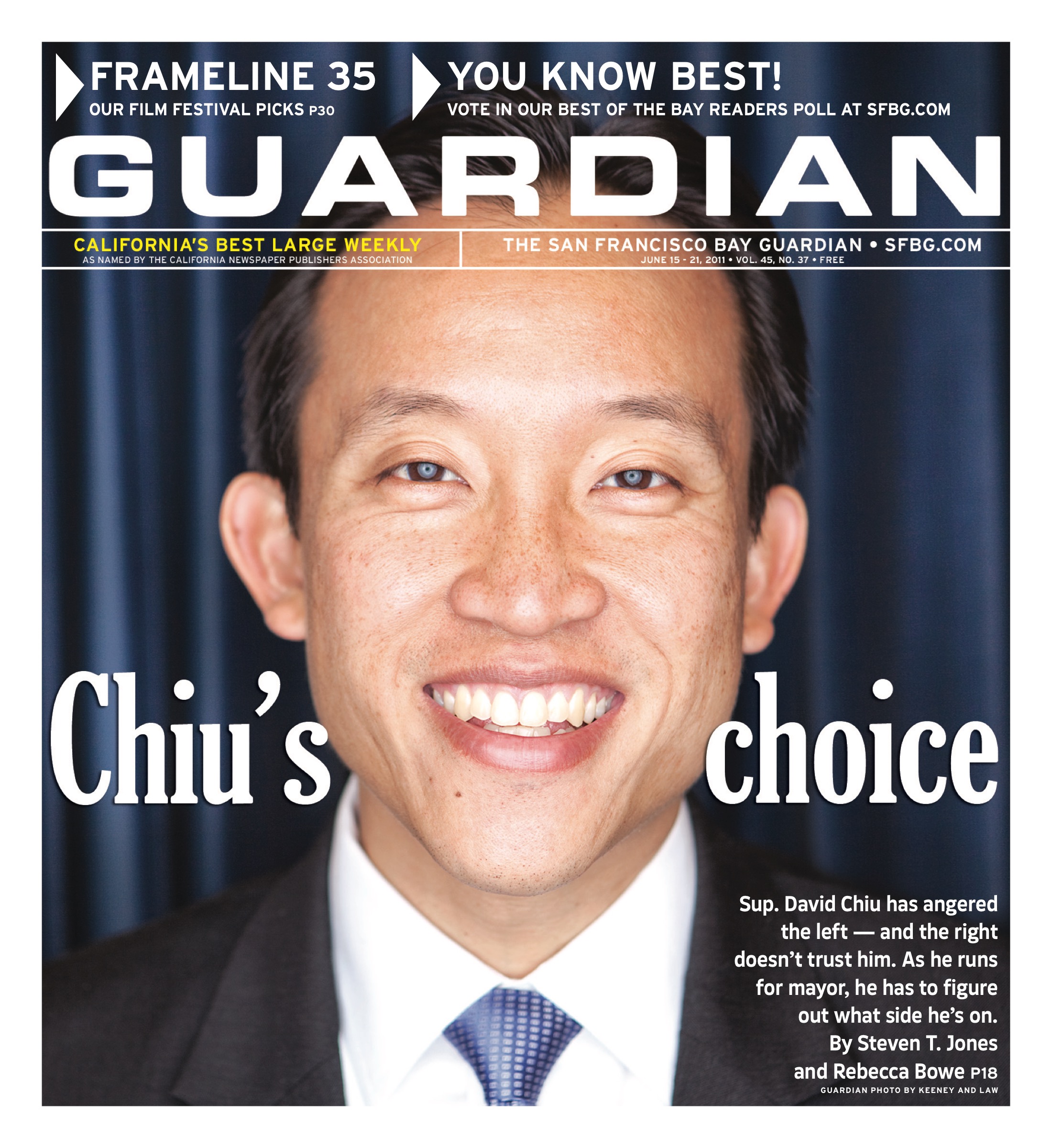
Say what you will about this year’s field of mayoral candidates, but they do represent a broad range of constituencies and they include several seasoned politicians who are well-qualified to be mayor. Sen. Leland Yee has served in a variety of public offices for decades, Sup. John Avalos is a reliable progressive intimately familiar with the workings of City Hall, Dennis Herrera and Phil Ting each hold citywide offices to which the Mayor’s Office is the logical next step, Michela Alioto-Pier is a consistent supporter of ruling class interests, and David Chiu has proven his political skills by engineering his reelection as board president and installing Lee as mayor.

So why exactly do people want to convince Lee to go back on his word, as well as giving up the city administrator position that the board just cleared the way for him to return to with an ethics exemption? Well, the Chronicle article doesn’t really make that clear, all it makes clear is that’s what Willie Brown and Rose Pak – as well as their errand boys, former Sup. Michael Yaki and downtown consultant Jim Ross – want.

And why do they want Lee to remain in the Mayor’s Office? Because they’re the ones who put him there and he has done nothing to challenge the corrupt status quo at City Hall, where corporate desires trump people’s needs every time. Chief-of-staff Steve Kawa is still calling the shots, Brown’s clients and developer buddies are still getting what they want, and Pak still gets to be the de facto leader of Chinese-American interests in City Hall.

They desperately fear that Yee will win the mayor’s race and clean house, kicking out Kawa and all of the Brown and Pak cronies, greatly reducing their power in San Francisco. And the rest of the candidates are too independent and broad-based to guarantee the continued power of Brown and Pak and the downtown interests they represent. Their only hope is that they can cut some kind of deal with Chiu to maintain their influence in the next administration by applying pressure through this article and the others likely to follow in this fake draft-Lee campaign.

To his credit, Sup. Sean Elsbernd isn’t taking part in this shameless charade, instead sticking by the statements he made when he nominated Lee to be mayor, telling the Chronicle that in a year with tough political decisions on the budget, pension reform, and other pressing issues, “this city desperately needed someone who wasn’t going to play election-year politics,” and that, “if he files papers to run for mayor, all that goes away.”

That’s true, along with any illusions that Lee and those who back him have any integrity.

Perception of lost integrity costs police

1

Reporting by Sarah Phelan. Photograhy by Luke Thomas.

At the San Francisco Public Defender’s Office’s May 18 Justice Summit, the ethics of law enforcement were a central topic. And not surprisingly, the latest incidents of alleged police conduct in which SFPD officers are caught on surveillance video, which the Public Defender’s Office released, as they apparently steal personal property from suspects whose homes in the Julian Hotel they searched for drugs under possibly illegal circumstances, were on everyone’s minds, along with the crime lab and Henry Hotel scandals.

Asked if District Attorney George Gascón, who was Chief of Police until January, is considering a special prosecutor to look into these latest incidents, Sharon Woo, the D.A.’s Chief Assistant of Operations, said the D.A. looks into each case as it comes in. “We are trying to enhance the videos that came in from the Public Defender’s Office,” Woo said in a pre-summit interview. “Some are not as clear as we’d like.”

Earlier this year, when Gascón first became aware of the allegations against officers at the Henry Hotel, he directed the D.A.’s office to open an investigation into the officers and their alleged conduct. The move got David Onek, who is running against Gascón in the D.A.’s race, urging Gascón to turn the investigation over to an independent prosecutor.

But for a week, Gascón maintained that there was no conflict, and when he did finally announce that he was turning the investigation over to the to the U.S. Attorney’s Office – he claimed it was about “resources”. “New information has come to light that indicates it is better to turn over this investigation to the FBI,” Gascón said. “I have spoken to the U.S. Attorney, Melinda Haag, and she has agreed to take over the full investigation. We will of course cooperate fully with the FBI, and provide whatever assistance they need from us.”

At the time, Onek noted that Gascón’s decision was correct step. But he criticized Gascón for not making it his policy to recuse himself from any investigations that relate to his own tenure as chief. And Alameda Assistant D.A. Sharmin Bock, who recently sprung into the D.A.’ race, described Gascón’s situation on this matter as being “between a rock and a hard place.”

But yesterday, Woo noted that while it’s true that Gascón was SFPD Chief when many of the recent misconduct scandals occurred, Mayor Gavin Newsom had already appointed him D.A. when the Julian Hotel incidents occurred in February.

And Peter Herley, former chief of the Tiburon Police Department, told the Guardian that there “is always the Attorney General” to refer cases if D.A.’s feel conflicted. “George Gascón is a very upstanding individual who has also worked for the Los Angeles Police Department and was Chief of Meza, Arizona, and has done a good job in every place he’s been,” Herley said during a pre-summit interview. “So, if he sees a conflict arise, he’d probably recuse himself. It’s the public perception that’s key, that’s paramount.”

During the summit’s panel on ethics, retired San Francisco Superior Court judge Lee Baxter grilled panelists with incisive questions—as befits any self-respecting judge, retired or otherwise–on whether police misconduct is the product of a departmental culture. Noting that there had been a seemingly non-stop string of alleged police misconduct scandals in the Bay Area from drug thefts, dirty D.U.I cases, stolen drugs and setting up a brothel, Baxter observed, “If I saw a movie that included all those things, I’d think that this is not realistic.”

And there was a perhaps surprising amount of stated consensus about what needs to happen next from panelists Woo, Herley, defense attorney Stuart Hanlon, newly sworn-in SFPD Chief Greg Suhr, Anne Irwin, an attorney at the Public Defender’s Office, and John Burris, an Oakland-based civil rights attorney who is renowned for representing plaintiffs in police brutality cases.

Baxter asked the panelists why abuse of power happens, and whether, when we see media accounts of alleged police misconduct, we see the most extreme cases.

Hanlon kicked off by referring to the case of Elmer “Geronimo” Pratt, a former high ranking member of the Black Panther Party, who was tried and convicted of the kidnap and murder of Caroline Olsen in 1972, and spent 27 years in prison, eight in solitary confinement, until 1997 when his conviction was vacated on the grounds that the prosecution concealed evidence that might have exonerated him. In particular, the government had not disclosed that a key witness against Pratt, Julius Butler, was an informant for both the FBI and the LAPD. Pratt eventually received $4.5 million as settlement for false imprisonment—the city of L.A. paid $2.75 million, the U.S. Department of Justice paid $1.75 million.

“We learned that law enforcement officers had hidden evidence, let people commit perjury, and destroyed evidence to convict someone who was innocent, “ Hanlon recalled, noting how when he first worked on the case, folks wondered if Pratt’s claim of innocence was simply part of a big conspiracy theory. “But it was not, it was men and women who thought the ends justified the means” Hanlon said, noting that the “bad apples” theory is typically trotted out during investigations into alleged police misconduct. “But officers see people who they think are bad people, and they feel they must whatever it takes,” Hanlon continued. “Primarily, most law enforcement people are good, but sometimes you get good cops lying to protect bad cops. It’s a dilemma, this concept of ‘what we do we need to do, this ‘us versus them’ concept.”

Hanlon claimed that officers don’t think citizens who live in SROs (single room occupancy hotels) have the same rights as folks in Pacific Heights.
“They think it’s OK to break down doors because these are drug dealers,” he said. And he noted that the recent string of back-to-back scandals are unusual in their proximity but are not unusual, generally speaking. “I’m not an apologist for (Chief) Suhr or the D.A., but I’ve seen these problems forever, and without trust law enforcement doesn’t work,” Hanlon concluded.

Next, Baxter put Suhr in the hot seat by asking him what to do about the “ends justify the means concept”. At which point Suhr, who has been Chief for less than two weeks, observed that the summit, which was packed to the gills with defense and civil rights attorneys, was “a bit of an away game for me, but it’s O.K., I can handle it.” He noted that only 1 in 11 applicants make it through the SFPD Police Academy, where folks undergo 1,100 hours of training, including sessions on abuse of power and responsibilities. “But if something is proven, it’s my intention not to have those officers in the SFPD any more,” Suhr said.

Retired Tiburon Chief Pete Herley revealed that during his decades-long police career, he blew the whistle when three officers nearly beat a gay man to death. “I suffered the consequences for many years,” he said. “It’s very lonely getting death threats, it’s very lonely when you don’t get the backing of fellow officers.”

Herley claimed times have changed a lot. “Change starts in the Academy and the selection of officers, and you have no other law enforcement officers that get more scrutiny, background checks m psychological checks and an 18-month probation period,” he said.

He noted that police chiefs inherit a departmental culture, whether they come into the post from the inside or the outside of the department. And that while the number of officers involved in misconduct is small, “it makes good press.” 

“I really feel one needs to be more loyal to integrity than to people,” Herley continued, noting that his parents were Holocaust survivors, and that his father was aghast when he decided to become a police officer. “But I had certain values and I don’t expect anything less from other people. I expect that every department has something in their rules and regulations that directs their officers that if they see misconduct, it’ll be stopped and the action will be reported immediately to the Chief.

Baxter asked Woo what the D.A. should do, if there is a problem.“All we are is our integrity, our ability to communicate and put forth evidence to juries “ Woo observed, noting that she has been on the frontlines as allegations about the crime lab, the Henri Hotel, and now potential theft, surfaced. “We find ourselves very reactive,” Woo observed, noting that if officers are not being truthful, the D.A.’s office has to look at all the cases they were involved in. “So it really impacts public safety and how all of us view the criminal justice system,” Woo said, noting that officers involved in the Henri Hotel allegations taken off the street.“But we have no interest in prosecuting individuals if it’s not based on solid evidence,” Woo said.

She recommended proactive steps like getting involved in Police Academy training on the law, and what officers can and cannot do, and giving officers tools to make good decisions and arrests, so there is integrity in the system. “If there isn’t, we all lose, not just the criminal justice system, but the entire community,” Woo observed, noting that as SFPD Chief, “Gascón instituted lots of policies to make sure people are doing an appropriate level of review.”

Baxter asked Anne Irwin, an attorney in the Public Defender’s Office, about their office’s role in bringing abuse of power to the attention of the public. “The Public Defender has a unique and natural role as a messenger,” Irwin replied. “We have more meaningful interaction with the victims of police misconduct than anyone else in the criminal justice system. We get into the intimate details of their lives, we develop a relationship of trust, so they confide their stories about police misconduct. And those stories are commonplace.”

Irwin noted that these stories include a disrespect for the Fourth Amendment, perjury and theft. “When you hear those stories over and over, there’s a ring of truth, a consistency,” Irwin said, noting that this is not the first time officers have been captured on camera. “We didn’t say, let’s amass a bunch of evidence. We just basically did our job. Residents told us what someone said in a report is not what happened, so we got videos from Dec. 23 and Jan. 5, and lo and behold, every word was true, two for two.”

Irwin noted that there are many good officers in the SFPD, but questioned whether a culture develops in certain departments, including the plain-clothes units, that allows misconduct to happen. “Without the videos officers would not have had to answer for their conduct,” she observed.

Baxter asked Suhr what it is about the culture that makes some cops go rogue. “Did they work there too long, were the temptations too much?” she asked.

Suhr replied that he worked in narcotics for a long time, and recovered $1.4 million in cash from an apartment in the Western Addition. “I never took a dime, and I am confident that the officers I worked with were of the highest caliber,” he said. “To paint a 2,000-person organization with a broad brush is unfair,” he added. “In the legal profession, every once in a while, you see ugly stories there too.”

Burris, who filed a $25 million wrongful death claim against BART on behalf of Oscar Grant’s family, noted that he has been involved in about 1,000 police misconduct cases in the Bay Area. “A culture exists about how you treat minority communities, “ he said, noting that he had represented black and brown clients for over 20 years. “A culture where you beat people and nothing is done, and you get away with it.”

Burris believes the problem lies in how policies are imposed, as he claimed that when officers join departments they are told to forget what they were taught in the Academy.“This is what you do on the streets,” he said.

Baxter observed that she has seen movies about the code of silence and wondered if it actually exists in police departments. “I don’t think so generally,” Suhr said. “There’s peer pressure to be sure. A regular citizen has a right not to self incriminate, and in the Police Department you can say that, but you are immediately sent to Internal Affairs, where you are told, tell me what happened or you are fired. So, today, the light is shining on us 100 percent of the time.”

Herley noted that his concern lay with situations in which officers see something, but don’t say anything. “I never thought I’d sit here and agree with every word John Burris says, but it starts at the top, and has to be enforced throughout the organization.”

Herley said the two best tools to prevent indiscretions and ensure responsibility are tape recorders and video cameras. “There’s certification of exactly what happened.” As for questions of how much it would cost to outfit officers with this recording equipment, Herley said, “ What is the cost of a lawsuit, the cost the perception of a loss of integrity to a department?”

Tourk’s clients sully Herrera’s mayoral campaign

22

Does anyone really believe that lobbyist and campaign consultant Alex Tourk isn’t talking to City Attorney Dennis Herrera, whose mayoral campaign Tourk is running, about the biggest clients and issues that Tourk is representing? Honestly, do they believe the public is that stupid?


Apparently so, because that’s the story they were feeding to the Chronicle and its readers today, denying that the two men had ever talked about the Stow Lake Boathouse vendor contract or California Pacific Medical Center and its controversial plan to build a new hospital and housing project on Cathedral Hill.


I mean, c’mon, Tourk even filed documents with the Ethics Commission stating that they had talked about those issues and clients, only to now deny it after realizing that it’s actually illegal to lobby one of your campaign clients. Luckily, Herrera had the good judgment to refer the matter to the Oakland City Attorney’s Office to investigate, considering that this city’s hopelessly corrupt and ineffectual Ethics Commission has abdicated its watchdog responsibilities in favor of repeatedly rubber-stamping every ethics waiver that comes before it, making a mockery of itself and contributing mightily to culture of political corruption that has been on the rise in San Francisco.


This is a problem that runs far deeper that just the Recreation and Parks Department steering the Oretega family vendor to Tourk, who then used his insider connection to get them the contract, which is unseemly enough. No, that’s just the tip of the iceberg with a consultant who has deep connections to monied interests and who has been hired by a mayoral candidate who actually hopes to gain some progressive support.


Consider Tourk’s client list. CPMC is perhaps the most controversial project facing city approval this year, one in which a powerful corporation is making big demands that are being strenuously opposed by a wide swath of working class San Franciscans. Whether Herrera would support this project as mayor and what modifications he would make are important litmus tests to determine what kind of mayor he would be. Yet his campaign consultant is simultaneously advocating for CPMC.


How would Herrera be on police issues, ranging from officer accountability to pension reform to whether to retain new Police Chief Greg Suhr? And can we really have faith that whatever stands Herrera takes weren’t influenced by the fact that the San Francisco Police Officers Association is another Tourk client?


Other Tourk clients include Civil Sidewalks, which advocated for the sit-lie ordinance that police are now struggling with how to legally implement; CH2MHill, the Lennar subcontractor who exposed Hunters Point residents to carcinogenic construction dust; Medjool Restaurant, whose politically connected owner has pushed projects that clash with local planning codes; Prado Group, which has a number of development proposals in SF; Target Corp., which is doing a controversial remodel of the Metreon; and many others.


Is Tourk touting his inside access to man who may be the next mayor? Will Herrera’s campaign benefit from that cross-pollination? I’ve left messages with Tourk and Herrera to ask these questions and others, and I’ll update this post when the call back, but what do you think they’re going to say? And, based on their credibility-stretching comments to the Chron today, will anyone believe them?


UPDATE: Herrera called back, but he wouldn’t discuss these issues on-the-record, instead just giving me a quote similar to the one he gave the Chron: “I was surprised to read that Alex Tourk listed me on his lobbying disclosure forms because he never lobbied me on any of those clients and issues.”

Stage Listings

0

Stage listings are compiled by Guardian staff. Performance times may change; call venues to confirm. Reviewers are Robert Avila, Rita Felciano, and Nicole Gluckstern. Submit items for the listings at listings@sfbg.com. For further information on how to submit items for the listings, see Picks. For complete listings, see www.sfbg.com.

THEATER

OPENING

Silk Stockings Eureka Theatre, 215 Jackson; 255-8207, www.42ndstmoon.org. $24-44. Previews Wed/4, 7pm; Thurs/5-Fri/6, 8pm. Opens Sat/7, 6pm. Runs Wed, 7pm; Thurs-Fri, 8pm; Sat, 6pm; Sun, 3pm. Through May 22. 42nd Street Moon presents a Cole Porter production.

ONGOING

Absolutely San Francisco Alcove Theater, 414 Mason; 992-8168, www.absolutelysanfrancisco.com. $32-50. Check for dates and times. Open-ended. Not Quite Opera Productions presents a musical.

*Caliente Pier 29, The Embarcadero; 438-2668, www.love.zinzanni.org. $117-145. Wed-Sat, 6pm; Sun, 5pm. Open-ended. Ricardo Salinas, cofounder of famed Mission-born radical Latino comedy trio Culture Clash, penetrates the velvet enclave of Teatro ZinZanni, taking the helm for its latest Euro-style dinner-cirque cabaret show. Under Salinas’ inspired direction, the evening plays as a revolt by brown-hued kitchen and wait staff against a ruthless takeover by, what else, a Chinese conglomerate. Multiculti clashes ensue, with the underdogs led by a brother-sister team played charmingly by ZinZanni regulars Christine Deaver and Robert Lopez, and with much expert repartee and physical humor neatly enveloping characteristically stunning feats of acrobatics and circus arts that leave forkfuls of grub hovering before slack-jawed mouths. I don’t know how many actual kitchen staffers out there can afford the ticket price (though it does come with a tasty five-course meal in addition to a first-class show), but the blend of Salinas and company’s shrewd if subdued social commentary and big-heated Latin-fueled humor—not to mention the exquisite musical numbers featuring guest star Rebekah Del Rio—lead to something altogether harmonious. (Avila)

Cancer Cells The Garage, 975 Howard; 518-1517, www.975howard.com. $15. Fri-Sat, 8pm; Sun, 2pm. Through May 22. Performers Under Stress and directors Geoff Bangs and Scott Baker offer this well-conceived program of late Pinter works, a total of nine plays and poems intelligently arranged and unevenly but in some cases vibrantly performed (especially in the case of One for the Road) in a fleet 90-minute evening. With the titular poem, written as the esteemed playwright was undergoing chemo (and recited here with somewhat unnecessary emotion by Valerie Fachman), a telling definition of cancer cells arises: “They have forgotten how to die/ And so extend their killing life.” Given the unbridled political nature of the work that follows—including the devastatingly stark (yet ever articulate to the point of being unexpected) dramatic vocabulary of Mountain Language, a compact depiction and rumination on state-sponsored genocide—those cancer cells grow out of their literal referent into a literary metaphor for the warping, perverting, and devastating consequences of supreme, unchecked power and its Olympian delusions. Pinter’s late works, written with a pronounced urgency in the face of ever-widening war and genocide, advance his shrewd and potent ability for exposing the obscenity beneath the shell games of language as deployed by power in pursuit of its imperial and totalitarian aims. (Avila)

Collected Stories Stage Werx, 533 Sutter; Z(800) 838-3006, www.brownpapertickets.com. $20-25. Fri-Sat, 8pm. Through Sat/ 7. Stage Werx presents David Margulies’ drama about art, ethics, and betrayal.

Cordelia NOHspace, 2840 Mariposa; (800) 838-3006, www.brownpapertickets.com. $18-20. Wed-Thurs, 7pm; Fri-Sat, 8pm. Through Sat/7. Theatre of Yugen presents world premiere of an abstraction of Shakespeare’s King Lear.

Devil/Fish 2781 24th St; www.cirquenoveau.com. $26. Fri-Sat, 7pm; Sun, 6pm. Through May 22. Cirque Noveau presents a story involving aerial performance, acrobatics, and more.

*Geezer Marsh, 1062 Valencia; (800) 838-3006, www.themarsh.org. $20-50. Thurs, 8pm; Sat, 5pm; Sun, 3pm. Through July 10. The Marsh presents a new solo show about aging and mortality by Geoff Hoyle.

*Killer Queen: The Story of Paco the Pink Pounder Michael the Boxer Gym and Barbershop, 96 Lafayette; (800) 838-3006, www.brownpapertickets.com. $20. Thurs-Sat, 8pm; Sun, 7pm. Through Sun/8. The boxing ring is no metaphor in Killer Queen, a vital and walloping new solo play by Peter Griggs set in a small, real-life boxing gym in SoMa (before moving to another in Los Angeles later in the run). And yet the ring—around which a privileged audience is excitingly pressed—encompasses so much of the queer American experience since the 1970s and ’80s that every punch, literary or otherwise, reverberates with wider significance and poetical precision. Griggs, as a gay youth of color who grows up to be the first openly gay title holder in his class, occupies that ring and that life with a rare and utterly persuasive intensity as he alternately cajoles, flirts with, dismisses, and even menaces his audience between a captivating narrative and highly credible boxing choreography (including a tense training scene with the gym’s Michael Onello). An effeminate boy growing up in a violently homophobic society, “Paco” (as he’s nicknamed despite not being Latino) discovers boxing—and Queen—in time to save his life, thanks to two crucial surrogate fathers. Set to the music of the seminal rock band (sometimes using original recordings, sometimes interpretations by nearby piano accompanist Stephen Mello), the music is, like the ring, anything but arbitrary, and beautifully deployed overall. There are some rough or abrupt transitions and some muddiness in the underscoring of dialogue, but these are minor and passing and hardly take away from a unique, enthralling work directed with incisive attention to emotional as well as social truths by Wolfgang Wachalovsky (cofounder of queer performance incubator THEOFFCENTER, which co-produced with Burning Monk Collective). Indeed, it’s the very rawness around the edges of this studiously developed piece—including a passionate digression concerning the current “It Gets Better” campaign pitched at queer youth—that gives it an immediate and politically-charged quality above and beyond the electricity of the setting and the pulsating athletic movement it foregrounds. Beyond the stage-ring, moreover, the play remains as serious as its site-specific setting: its development has led to the founding in LA of an Empowerment Center for disadvantaged queer youth as well as the first Gay Boxing League. (Avila)

Loveland The Marsh, 1062 Valencia; (800) 838-3006, www.themarsh.org. $20-35. Fri, 8pm; Sat, 8:30pm (also Sun/8, 7pm). Through Sun/8. Ann Rudolph’s one-woman show continues its successful run.

Party of 2 — The New Mating Musical Shelton Theater, 533 Sutter; 1-800-838-3006, www.partyof2themusical.com. $27-29. Fri, 9pm. Open-ended. A musical about relationships by Shopping! The Musical author Morris Bobrow.

Secret Identity Crisis SF Playhouse, Stage 2, 533 Sutter; 869-5384, www.un-scripted.com. $10-20. Thurs-Sat, 8pm (no show Sat/7). Through May 14. Un-Scripted Theater Company presents a story about unmasked heroes.

Shopping! The Musical Shelton Theater, 533 Sutter; (800) 838-3006, www.shoppingthemusical.com. $27-29. Sat, 8pm. Open-ended. A musical comedy revue about shopping by Morris Bobrow.

A Streetcar Named Desire Actors Theatre, 855 Bush; 345-1287, www.actorstheatresf.org. $26-38. Wed-Sat, 8pm. Through June 4. Actors Theatre of San Francisco presents the Tennessee Williams tale.

Talking With Angels Royce Gallery, 2901 Mariposa; (800) 838-3006, www.brownpapertickets.com. $21-35. Thurs-Sat, 8pm. Through May 21. A play by Shelley Mitchell set in Nazi-occupied Hungary.

Vice Palace: The Last Cockettes Musical Thrillpeddlers’ Hypnodrome, 575 10th St; (800) 838-3006, www.brownpapertickets.com. $30-35. Fri-Sat, 8pm; Sun, 7pm. Through July 31. Thrillpeddlers presents composer Scrumbly Koldewyn’s revival of the 1972 musical revue.

BAY AREA

East 14th – True Tale of a Reluctant Player The Marsh Berkeley, 2120 Allston Way, Berk; (800) 838-3006, www.themarsh.org. $20-50. Sat, 8pm; Sun, 7pm. Through Sun/8. Don Reed’s one-man show continues.

*Eccentricities of a Nightingale Aurora Theatre, 2081 Addison; (510) 843-4822, www.auroratheatre.org. $10-55. Tues, 7pm; Wed-Sat, 8pm; Sun, 2 and 7pm. Through Sun/8. Bracketed literally from beginning to end by fireworks, Aurora Theatre’s production of Tennessee Williams’ The Eccentricities of a Nightingale offers some serious bang. On the surface, a tragic-comic tale of unrequited love in small-town Mississippi, Eccentricities plunges into deeper waters, exploring the ever-waged war between societal norms and its misfits — and the struggle to remain true to oneself — with a subtly layered approach. Protagonist Alma (Beth Wilmurt), the titular Nightingale, isolated by her complicated family circumstances and her own mild eccentricities, carries a long-burning torch for the boy-next-door, a rather callow young doctor (Thomas Gorrebeeck) with a terrifyingly overprotective mother (Marcia Pizzo). But Alma’s yearning, as much habit as attraction, has less to do with a dream of settling down with a nice doctor husband, but rather of freeing herself from the conventions that threaten to crush her spirit. Alma’s nervous artistic temperament hides a solidly pragmatic core, and when she has her young doctor alone in a hotel room at last, her plea for him to “give me an hour and I’ll make a lifetime of it,” rings not of desperation but of the adventure she craves. Director Tom Ross deftly brings out the gentle humor and bittersweet victory in the text via a strong cast and stellar design team. (Gluckstern)

Lady With All the Answers Center REPertory Company, Lesher Center for the Arts, Knight Stage 3 Theatre, 1601 Civic Center, Walnut Creek; (925) 943-SHOW, www.centerrep.org. $45. Thurs-Sat, 8:15pm; Sun, 2:15pm. Through May 15. Center REPpresents Kerri Shawn’s one-woman play about Ann Landers.

Not a Genuine Black Man The Marsh Berkeley, TheaterStage, 2120 Allston Way, Berk; (800) 838-3006, www.themarsh.org. $20-50. Thurs, 7:30pm. Through Thurs/5. Brian Copeland’s one-man show continues.

Out of Sight The Marsh Berkeley, Theaterstage, 2120 Allston Way, Berk; (800) 838-3006, www.themarsh.org. $20-50. Sat, 5pm (no show Sat/9); Sun, 3pm. Through May 8. Sara Felder’s one-woman show returns.

Passion Play Live Oak Theatre, 1301 Shattuck, Berk; (510) 649-5999, www.aeofberkeley.org. $10-15. Fri-Sat, 7pm (also Sun/8, and may 15, 2pm). Through May 21. Actors Ensemble of Berkeley presents the West Coast premiere of a time-travel play by Sarah Ruhl.

Three Sisters Berkeley Repertory Theatre, Thrust Stage, 2025 Addison, Berk; (510) 647-2949, www.berkeleyrep.org. $29-73. Dates and times vary. Through May 22. Berkeley Rep presents a new version of Chekhov’s 1901 play by Sarah Ruhl (In the Next Room, Eurydice), directed by Les Waters. The language sounds generally and pleasingly modern in the mouths of the titular Prozorov sisters—Olga (Wendy Rich Stetson), Masha (Natalia Payne), and Irina (Heather Wood)—although the production is rather traditional in staging (period set by Annie Smart, and corresponding costumes by Ilona Somogyi). We follow the restless siblings and their flock of soldier-admirers through a handful of years in their provincial town, where their late father was an elite military officer. In this period, the dashing officer Vershinin (Bruce McKenzie) brings a spark of new life—especially to the unhappily married Masha—and stokes the sisters’ ultimately unanswered desire to return to their beloved Moscow. The production breathes a good deal of life into the play, whose half-foolish and heartbreakingly funny characters so palpably exude a complex set of longings and misplaced desires, but it labors under an initial stiffness and a somewhat jagged set of performances. (Payne’s twitchy Masha, for instance, whose features maintain throughout a look of unwelcome surprise, feels incongruent at times). Some of the more moving turns concentrate here in the supporting characters, including James Carpenter as Chebutykin, the fawning old doctor who has forgotten all he used to know; Thomas Jay Ryan as Tuzenbach, the self-conscious Russian of German descent desperately smitten with Irina; and Alex Moggridge as the sisters’ much put-upon, feckless, alternately gentle and petulant brother, Andrei. (Avila)

The World’s Funniest Bubble Show The Marsh Berkeley, Cabaret, 2120 Allston Way, Berk; (800) 838-3006, www.themarsh.org. $8-50. Through July 10. The Amazing Bubble Man performs.

PERFORMANCE

DIVAfest EXIT Theatre, 156 Eddy; 673-3847, www.theexit.org. Check for times and prices. Through May 28. Plays and performances by women artists, including Maggie Cronin, Christina Augello, Margery Fairchild, Cheryl Smith, and Diane di Prima. 

Stage Listings

0

Stage listings are compiled by Guardian staff. Performance times may change; call venues to confirm. Reviewers are Robert Avila, Rita Felciano, and Nicole Gluckstern. Submit items for the listings at listings@sfbg.com. For further information on how to submit items for the listings, see Picks. For complete listings, see www.sfbg.com.

THEATER

OPENING

Vice Palace: The Last Cockettes Musical Thrillpeddlers’ Hypnodrome, 575 10th St; (800) 838-3006, www.brownpapertickets.com. $30-35. Opens Fri/29, 8pm. Runs Fri-Sat, 8pm; Sun, 7pm. Through July 31. Thrillpeddlers presents composer Scrumbly Koldewyn’s revival of the 1972 musical revue.


ONGOING

The Busy World is Hushed New Conservatory Theatre Center, 25 Van Ness; 861-8972, www.nctcsf,org. $24-40. Wed-Sat, 8pm; Sun, 2pm. Through May 1. New Conservatory Theatre Center presents the world premiere of a play by Keith Bunin.

*Caliente Pier 29, The Embarcadero; 438-2668, www.love.zinzanni.org. $117-145. Wed-Sat, 6pm; Sun, 5pm. Open-ended. Ricardo Salinas, cofounder of famed Mission-born radical Latino comedy trio Culture Clash, penetrates the velvet enclave of Teatro ZinZanni, taking the helm for its latest Euro-style dinner-cirque cabaret show. Under Salinas’ inspired direction, the evening plays as a revolt by brown-hued kitchen and wait staff against a ruthless takeover by, what else, a Chinese conglomerate. Multiculti clashes ensue, with the underdogs led by a brother-sister team played charmingly by ZinZanni regulars Christine Deaver and Robert Lopez, and with much expert repartee and physical humor neatly enveloping characteristically stunning feats of acrobatics and circus arts that leave forkfuls of grub hovering before slack-jawed mouths. I don’t know how many actual kitchen staffers out there can afford the ticket price (though it does come with a tasty five-course meal in addition to a first-class show), but the blend of Salinas and company’s shrewd if subdued social commentary and big-heated Latin-fueled humor—not to mention the exquisite musical numbers featuring guest star Rebekah Del Rio—lead to something altogether harmonious. (Avila)

Collected Stories Stage Werx, 533 Sutter; Z(800) 838-3006, www.brownpapertickets.com. $20-25. Fri-Sat, 8pm (alos April 24 2pm). Through May 7. Stage Werx presents David Margulies’ drama about art, ethics, and betrayal.

Cordelia NOHspace, 2840 Mariposa; (800) 838-3006, www.brownpapertickets.com. $18-20. Wed-Thurs, 7pm; Fri-Sat, 8pm. Through May 7. Theatre of Yugen presents world premiere of an abstraction of Shakespeare’s King Lear.

*40 Pounds in 12 Weeks The Marsh, Studio Theater, 1074 Valencia; (800) 838-3006, www.themarsh.org. $15-35. Call for dates and times. Through Sat/30. Pidge Meade’s one-woman show extends its successful run.

*Geezer Marsh, 1062 Valencia; (800) 838-3006, www.themarsh.org. $20-50. Thurs, 8pm; Sat, 5pm; Sun, 3pm. Through July 10. The Marsh presents a new solo show about aging and mortality by Geoff Hoyle.

*Into the Clear Blue Sky Phoenix Theater, 414 Mason; 913-7272, www.sleepwalkerstheatre.com. $15-17. Thurs-Sat, 8pm. Through Sat/30. In our post-apocalyptic future as imagined by J.C. Lee, New Jersey is a pitched battleground of mythic proportions, and the moon is open for business. Against a spare backdrop of torn, crumpled fragments of letters and skillfully understated lighting (designed respectively by Ben Randle, Christian Mejia, and Alexander C. Senchak), a nuclear family of four experiences a severe meltdown. We meet a deadbeat dad who disappears into space (Christopher Nelson), a runaway daughter whose hands are disfigured by chemical burns (Dina Percia), a slightly unhinged, Neruda-quoting mother (Pamela Smith), and a banished son, Kale (Eric Kerr), who sets out on a hero’s quest to bring his sister home. The second part of the “This World and After” trilogy, being staged this season in its entirety by Sleepwalkers Theatre, Into the Clear Blue Sky may be set in a futuristic world beset by cannibals and sea monsters, but its primary concerns are those close to the heart. In fact, the most sympathetic character by far is the lovelorn neighbor boy, Cody (Adrian Anchondo), who would wear his heart on his sleeve if he had sleeves to wear it on; a bare-chested, face-painted, poetry-spouting Sancho Panza to Kale’s Quixote. Under Ben Randle’s direction, the actors morph easily from their characters into parts of the set and even the lighting team, making the most of a small budget with their large collaborative effort. (Gluckstern)

Loveland The Marsh, 1062 Valencia; (800) 838-3006, www.themarsh.org. $20-35. Fri, 8pm; Sat, 8:30pm (also Sun/1 and 8, 7pm). Through May 8. Ann Rudolph’s one-woman show continues its successful run.

M. Butterfly Gough Street Playhouse, 1620 Gough; (510) 207-5774, www.custommade.org. $20-28. Thurs-Sat, 8pm. Through Sat/30. Custom Made Theatre presents David Henry Hwang’s award-winning play.

No Exit A.C.T., 415 Geary; (415) 749-2228, www.act-sf.org. $10-85. Wed-Sat, 8pm; Sun, 2pm. Through Sun/1. Canada’s Virtual Stage and Electric Company Theatre’s production of Jean-Paul Sartre’s 1944 hell-in-a-three–hander conceives it, rather, as a four-hander in something less than three dimensions. After director Kim Collier’s concept, the production (originally staged in a warehouse but presented here on ACT’s massive Geary stage) expands the duties and significance of the Valet (Jonathan Young) into a wandering, whistling comic lackey whose winking acquaintance with the audience reveals a desperation to escape his own portion of hell’s (and humanity’s) eternal psychological dungeon. Meanwhile, and further distractingly, Collier casts the traditional principals—three unwitting mutual torturers made up of a craven journalist (Andy Thompson), a butch home-wrecker (Laara Sadiq), and a spoiled trophy bride (Lucia Frangione)—off the stage entirely, projecting their images to us in three flat video panels. This two-dimensional realm is perhaps as claustrophobic a set-up as imaginable in so large a space as the Geary, which is part of the point, although the effect as staged rarely rises above gimmickry, especially with the monkey business concerning the Valet. Moreover, the acting as projected, with mugs in the camera lens and voices relayed over speakers, feels overly broad. All it brings anew out of the play (or Paul Bowles’ crystalline adaptation) is a suspicion that Sartre’s brainy but artificial and familiar composition is too dated for us without some cat toys to grab our attention. If that’s the case, then the nip should have been stronger. (Avila)

Party of 2 — The New Mating Musical Shelton Theater, 533 Sutter; 1-800-838-3006, www.partyof2themusical.com. $27-29. Fri, 9pm. Open-ended. A musical about relationships by Shopping! The Musical author Morris Bobrow.

The Real Americans The Marsh MainStage, 1062 Valencia; 282-3055, www.themarsh.org. $25-35. Fri, 8pm; Sat, 8:30pm. Through Sat/30. Dan Hoyle’s hit show returns for another engagement.

Sea Turtles Exit Theater, 156 Eddy; www.generationtheatre.com. $15-25. Fri-Sat, 8pm; Sun, 3pm (also April 28, 8pm). Through Sat/30. GenerationTheatre presents an original play by David Valayre.

Secret Identity Crisis SF Playhouse, Stage 2, 533 Sutter; 869-5384, www.un-scripted.com. $10-20. Thurs-Sat, 8pm (no show May 7). Through May 14. Un-Scripted Theater Company presents a story about unmasked heroes.

Shopping! The Musical Shelton Theater, 533 Sutter; (800) 838-3006, www.shoppingthemusical.com. $27-29. Sat, 8pm. Open-ended. A musical comedy revue about shopping by Morris Bobrow.

A Streetcar Named Desire Actors Theatre, 855 Bush; 345-1287, www.actorstheatresf.org. $26-38. Wed-Sat, 8pm. Through June 4. Actors Theatre of San Francisco presents the Tennessee Williams tale.

Talking With Angels Royce Gallery, 2901 Mariposa; (800) 838-3006, www.brownpapertickets.com. $21-35. Thurs-Sat, 8pm. Through May 21. A play by Shelley Mitchell set in Nazi-occupied Hungary.

Twelfth Night African American Art & Culture Complex, 762 Fulton; (800) 838-3006, www.African-AmericanShakes.org. $15-35. Sat, 8pm; Sun, 3pm. Through Sun/1. African-American Shakespeare Company presents a jazzy interpretation of the Bard.

BAY AREA

East 14th – True Tale of a Reluctant Player The Marsh Berkeley, 2120 Allston Way, Berk; (800) 838-3006, www.themarsh.org. $20-50. Sat, 8pm; Sun, 7pm. Through May 8. Don Reed’s one-man show continues.

*Eccentricities of a Nightingale Aurora Theatre, 2081 Addison; (510) 843-4822, www.auroratheatre.org. $10-55. Tues, 7pm; Wed-Sat, 8pm; Sun, 2 and 7pm. Through May 8. Bracketed literally from beginning to end by fireworks, Aurora Theatre’s production of Tennesee Williams’ The Eccentricities of a Nightingale offers some serious bang. On the surface, a tragic-comic tale of unrequited love in small-town Mississippi, Eccentricities plunges into deeper waters, exploring the ever-waged war between societal norms and its misfits — and the struggle to remain true to oneself — with a subtly layered approach. Protagonist Alma (Beth Wilmurt), the titular Nightingale, isolated by her complicated family circumstances and her own mild eccentricities, carries a long-burning torch for the boy-next-door, a rather callow young doctor (Thomas Gorrebeeck) with a terrifyingly overprotective mother (Marcia Pizzo). But Alma’s yearning, as much habit as attraction, has less to do with a dream of settling down with a nice doctor husband, but rather of freeing herself from the conventions that threaten to crush her spirit. Alma’s nervous artistic temperament hides a solidly pragmatic core, and when she has her young doctor alone in a hotel room at last, her plea for him to “give me an hour and I’ll make a lifetime of it,” rings not of desperation but of the adventure she craves. Director Tom Ross deftly brings out the gentle humor and bittersweet victory in the text via a strong cast and stellar design team. (Gluckstern)

Lolita Roadtrip San Jose Stage, 490 S. 1st St, San Jose; (408) 283-7142, www.thestage.org. $20-40. Wed-Thurs, 7:30pm; Fri-Sat, 8pm; Sun, 2pm. Through Sun/1. An emotionally scarred graduate student (Chloë Bronzan) writing her thesis on Vladimir Nabokov’s Lolita heads from New York back to Stanford to confront her own personal Humbert Humbert of a thesis adviser (Julian López-Morillas). Accompanying her is a handsome underage hustler (Patrick Alparone) who finagles a ride as far as Santa Monica with hopes of making her his first female conquest. Meanwhile, the Stanford literature prof attends to his dying wife (Stacy Ross) between final touches on the last chapter of a secretly predacious book and dull lectures on “sex and death” to his undergraduate class. As co-presented by San Jose Stage and PlayGround, Bay Area playwright Trevor Allen’s latest has a high-powered director, cast, and crew behind it but nevertheless limps along as a flatfooted cross-country trek into a traumatic past, its narrative meagerly fueled by reference to a real-life road trip undertaken by Nabokov and family in 1941 (during which the writer and butterfly enthusiast discovered a new subspecies of Lepidoptera) and thin fumes drawn from a still great if long since controversial novel. It feels like an empty exercise and unfortunately abounds in corny humor as “corny humor,” joyless crosscutting of multiple monologues, a thematically leaden butterfly lecture by Nabokov (López-Morillas), forced repartee (delivered at a tediously breathless pace), and far-fetched situations. There was the pupa of an idea here at one point, but it was neither new (even as a subspecies) nor sensibly developed before being asked to fly. (Avila)

Not a Genuine Black Man The Marsh Berkeley, TheaterStage, 2120 Allston Way, Berk; (800) 838-3006, www.themarsh.org. $20-50. Thurs, 7:30pm. Through May 5. Brian Copeland’s one-man show continues.

Out of Sight The Marsh Berkeley, Theaterstage, 2120 Allston Way, Berk; (800) 838-3006, www.themarsh.org. $20-50. Sat, 5pm (no show Sat/9); Sun, 3pm. Through May 8. Sara Felder’s one-woman show returns.

Passion Play Live Oak Theatre, 1301 Shattuck, Berk; (510) 649-5999, www.aeofberkeley.org. $10-15. Fri-Sat, 7pm (also May 1, 18, and 15, 2pm). Through May 21. Actors Ensemble of Berkeley presents the West Coast premiere of a time-travel play by Sarah Ruhl.

Three Sisters Berkeley Repertory Theatre, Thrust Stage, 2025 Addison, Berk; (510) 647-2949, www.berkeleyrep.org. $29-73. Dates and times vary. Through May 22. The creators of In the Next Room present a new take on Chekhov. The World’s Funniest Bubble Show The Marsh Berkeley, Cabaret, 2120 Allston Way, Berk; (800) 838-3006, www.themarsh.org. $8-50. Through July 10. The Amazing Bubble Man returns. *

Get off on green

0

Your outdoor environment is looking a little cleaner after Friday’s Earth Day efforts, so now it’s time for some dirty bedroom rewards. Don’t worry– it’s possible to carry your eco-ethics into the other room. Let your passion for saving the environment slide between the sheets for love making in all shades of green.

Being a good little environmentalist all year deserves a (nice) spank, but sometimes the products we use and things we do to feel good make the Earth feel bad. Phthalate-infected vibrators, cuffs from overseas, lube made in nasty factories, and mounds of landfill-bound packaging are definite turn-offs.Tree-humpers should take note from the hoards of San Francisco foodies eating out every night: treat your bed like you would a table and go for conscious, local, and sustainable. From foreplay to fornication, here are a couple of stimulating Bay Area resources for keeping things hot between you and Mother Nature. 


wbuffalo

Setting the mood:

Skip the machine-made colognes and perfumes and keep it simple — you can pick some herbal aphrodisiacs made from your own backyard garden. If you forgot to plant said garden, check out White Buffalo Naturals collection of stimulating smells. All products are made locally in small batches by Nicole Spencer, a traditional herbalist who is all about the Big O (a.k.a. organic) and growing or wild-harvesting the plants she uses for the White Buffalo line herself. 


pact

Sexy underthings:

Stripping down to your factory-made granny panties or tighty-whities could be a huge boner-dissapointer if you’re about to get down with an earth lover. Pull on a pair of PACT undies, a Berkeley company that sources super-soft, organic Turkish cotton and in the process, allows you to participate what they call, a social movement — your purchase supports farmers, responsible labor practices, and a chain of non-profits dedicated to change. Wow– instant orgasm.


condom

Protection:

Condoms aren’t very sweet on the environment but nothing says green like curbing the population of our crowded city. Unfortunately rubbers can’t be composted or recycled, so you’ll just have to make up for it in other areas. Rubber offsets? Buy in bulk and save on wasteful packaging. 


transaction

Supportive supplies:

Leather can really help tie ’em down and strap ‘er on, but it’s important to know your hide source isn’t hiding any secrets. Project TransAction is an Oakland-based independent leatherworking company who promises to keep things ethical and earth-friendly. Their super-attractive harnesses, cuffs, and collars will keep anyone in line with a smirk, especially when they hear these babies were made with water-based inks, biodegradable cleaners and non-toxic dyes.


moon


Setting:

Screw PG&E and conserve utilities. Turn down the heat and let your bodies control the temperature. Turn off the lights and replace with flickering soy candles. Go outside and let the moon cast some flattering shadows. Do it in the garden (backyard not community) and then save water by showering off the dirt together.


jimmyjane

Stimulating Extras:

As guilty or proud as it made you feel, that rabbit vibe you picked up at the adult superstore didn’t suffer a short life due to overuse. Cheaply made sex toys are a dime a dozen, but their small sticker price makes for a big pile at the landfill. Quality is important, ladies and gents, and a good toy should hum for more than a year. Jimmyjane‘s vibrators are totally down for extended use, inviting you to play and please with a three-year warranty. The San Francisco company’s design-centric products buzz pretty and smart: responsibly manufactured, energy efficient, replaceable parts, and rechargeable batteries. 


Stage Listings

0

Stage listings are compiled by Guardian staff. Performance times may change; call venues to confirm. Reviewers are Robert Avila, Rita Felciano, and Nicole Gluckstern. Submit items for the listings at listings@sfbg.com. For further information on how to submit items for the listings, see Picks. For complete listings, see www.sfbg.com.

THEATER

OPENING

Vice Palace: The Last Cockettes Musical Thrillpeddlers’ Hypnodrome, 575 10th St; (800) 838-3006, www.brownpapertickets.com. $30-35. Previews Fri/22-Sat/23, 8pm; Sun/24, 7pm. Opens April 29, 8pm. Runs Fri-Sat, 8pm; Sun, 7pm. Through July 31. Thrillpeddlers presents composer Scrumbly Koldewyn’s revival of the 1972 musical revue.

BAY AREA

Passion Play Live Oak Theatre, 1301 Shattuck, Berk; (510) 649-5999, www.aeofberkeley.org. $10-15. Opens Fri/22, 7pm. Runs Fri-Sat, 7pm (also May 1, 18, and 15, 2pm). Through May 21. Actors Ensemble of Berkeley presents the West Coast premiere of a time-travel play by Sarah Ruhl.

ONGOING

The Busy World is Hushed New Conservatory Theatre Center, 25 Van Ness; 861-8972, www.nctcsf,org. $24-40. Wed-Sat, 8pm; Sun, 2pm. Through May 1. New Conservatory Theatre Center presents the world premiere of a play by Keith Bunin.

*Caliente Pier 29, The Embarcadero; 438-2668, www.love.zinzanni.org. $117-145. Wed-Sat, 6pm; Sun, 5pm. Open-ended. Teatro Zinzanni presents a new production conceived in San Francisco.

Collected Stories Stage Werx, 533 Sutter; Z(800) 838-3006, www.brownpapertickets.com. $20-25. Fri-Sat, 8pm (alos April 24 2pm). Through May 7. Stage Werx presents David Margulies’ drama about art, ethics, and betrayal.

Cordelia NOHspace, 2840 Mariposa; (800) 838-3006, www.brownpapertickets.com. $18-20. Wed-Thurs, 7pm; Fri-Sat, 8pm. Through May 7. Theatre of Yugen presents world premiere of an abstraction of Shakespeare’s King Lear.

*40 Pounds in 12 Weeks The Marsh, Studio Theater, 1074 Valencia; (800) 838-3006, www.themarsh.org. $15-35. Call for dates and times. Through April 30. Pidge Meade’s one-woman show extends its successful run.

*Geezer Marsh, 1062 Valencia; (800) 838-3006, www.themarsh.org. $20-50. Thurs, 8pm; Sat, 5pm; Sun, 3pm. Through July 10. The Marsh presents a new solo show about aging and mortality by Geoff Hoyle.

*Into the Clear Blue Sky Phoenix Theater, 414 Mason; 913-7272, www.sleepwalkerstheatre.com. $15-17. Thurs-Sat, 8pm. Through April 30. In our post-apocalyptic future as imagined by J.C. Lee, New Jersey is a pitched battleground of mythic proportions, and the moon is open for business. Against a spare backdrop of torn, crumpled fragments of letters and skillfully understated lighting (designed respectively by Ben Randle, Christian Mejia, and Alexander C. Senchak), a nuclear family of four experiences a severe meltdown. We meet a deadbeat dad who disappears into space (Christopher Nelson), a runaway daughter whose hands are disfigured by chemical burns (Dina Percia), a slightly unhinged, Neruda-quoting mother (Pamela Smith), and a banished son, Kale (Eric Kerr), who sets out on a hero’s quest to bring his sister home. The second part of the “This World and After” trilogy, being staged this season in its entirety by Sleepwalkers Theatre, Into the Clear Blue Sky may be set in a futuristic world beset by cannibals and sea monsters, but its primary concerns are those close to the heart. In fact, the most sympathetic character by far is the lovelorn neighbor boy, Cody (Adrian Anchondo), who would wear his heart on his sleeve if he had sleeves to wear it on; a bare-chested, face-painted, poetry-spouting Sancho Panza to Kale’s Quixote. Under Ben Randle’s direction, the actors morph easily from their characters into parts of the set and even the lighting team, making the most of a small budget with their large collaborative effort. (Gluckstern)

KML Reboots Traveling Jewish Theater, 470 Floriad; www.killingmylobster.com. $10-20. Thurs-Fri, 8pm; Sat, 7 and 10pm; Sun, 7pm. Through Sun/24. The sketch comedians present a new show about the pleasures and pains of technology.

Loveland The Marsh, 1062 Valencia; (800) 838-3006, www.themarsh.org. $20-35. Fri, 8pm; Sat, 8:30pm (also May 1 and 8, 7pm). Through May 8. Ann Rudolph’s one-woman show continues its successful run.

M. Butterfly Gough Street Playhouse, 1620 Gough; (510) 207-5774, www.custommade.org. $20-28. Thurs-Sat, 8pm. Through April 30. Custom Made Theatre presents David Henry Hwang’s award-winning play.

Party of 2 — The New Mating Musical Shelton Theater, 533 Sutter; 1-800-838-3006, www.partyof2themusical.com. $27-29. Fri, 9pm. Open-ended. A musical about relationships by Shopping! The Musical author Morris Bobrow.

The Real Americans The Marsh MainStage, 1062 Valencia; 282-3055, www.themarsh.org. $25-35. Fri, 8pm; Sat, 8:30pm. Through April 30. Dan Hoyle’s hit show returns for another engagement.

Sea Turtles Exit Theater, 156 Eddy; www.generationtheatre.com. $15-25. Fri-Sat, 8pm; Sun, 3pm (also April 28, 8pm). Through April 30. GenerationTheatre presents an original play by David Valayre.

Secret Identity Crisis SF Playhouse, Stage 2, 533 Sutter; 869-5384, www.un-scripted.com. $10-20. Thurs-Sat, 8pm (no show May 7). Through May 14. Un-Scripted Theater Company presents a story about unmasked heroes.

Shopping! The Musical Shelton Theater, 533 Sutter; (800) 838-3006, www.shoppingthemusical.com. $27-29. Sat, 8pm. Open-ended. A musical comedy revue about shopping by Morris Bobrow.

A Streetcar Named Desire Actors Theatre, 855 Bush; 345-1287, www.actorstheatresf.org. $26-38. Wed-Sat, 8pm. Through June 4. Actors Theatre of San Francisco presents the Tennessee Williams tale.

Talking With Angels Royce Gallery, 2901 Mariposa; (800) 838-3006, www.brownpapertickets.com. $21-35. Thurs-Sat, 8pm. Through May 21. A play by Shelley Mitchell set in Nazi-occupied Hungary.

Tape The Dark Room, 2263 Mission; www.darkroomsf.com. $10-20. Fri-Sat, 8pm. Through Sat/23. The 4th Mirror presents a production of the play by Stephen Belber.

Twelfth Night African American Art & Culture Complex, 762 Fulton; (800) 838-3006, www.African-AmericanShakes.org. $15-35. Sat, 8pm; Sun, 3pm (no performance April 24). Through May 1. African-American Shakespeare Company presents a jazzy interpretation of the Bard.

*Wirehead SF Playhouse, 533 Sutter; 677-9596, www.sfplayhouse.org. $30-50. Tues-Wed, 7pm; Thurs-Fri, 8pm; Sat, 3and 8pm. Through Sat/23. Perfectionism’s ruthless class dimensions come to the fore in SF Playhouse’s smart, fun, and sharply staged Bay Area premiere about the super-smart posthumans of the near future, and the rest of us. A shady China-based conglomerate with a name that sounds like Sin-Tell sells a scintillating if dangerous procedure for those already well connected: a hardwire boost to the neural circuitry that gives the recipient more than an edge on the competition and something just shy of godlike powers. Two friends and colleagues in a banking firm (Craig Marker and Gabriel Marin) and their variously class-marked but equally ambitious girlfriends (Lauren Grace and Madeleine H.D. Brown) are all drawn into this cyborgian gold rush, and it gets sticky in more ways than one, as meanwhile a brash local DJ named RIP (Scott Coopwood) raps sardonically over the airwaves about this latest twist in an old game. SF Playhouse’s Susi Damilano directs a charismatic cast (including a terrific Cole Alexander Smith in a related series of frenetic roles) in Matt Benjamin and Logan Brown’s culture-jamming riposte to tech-mad humanist hogwash about Progress. It gets you thinking. (Avila)

BAY AREA

*Beardo Ashby Stage, 1901 Ashby, Berk; (510) 841-6500, www.shotgunplayers.org. $17-26. Thurs-Sat, 8pm; Sun, 5pm. Through Sun/24. Shotgun Players present a an original songplay about Rasputin.

East 14th – True Tale of a Reluctant Player The Marsh Berkeley, 2120 Allston Way, Berk; (800) 838-3006, www.themarsh.org. $20-50. Sat, 8pm; Sun, 7pm. Through May 8. Don Reed’s one-man show continues.

*Eccentricities of a Nightingale Aurora Theatre, 2081 Addison; (510) 843-4822, www.auroratheatre.org. $10-55. Tues, 7pm; Wed-Sat, 8pm; Sun, 2 and 7pm. Through May 8. Bracketed literally from beginning to end by fireworks, Aurora Theatre’s production of Tennesee Williams’ The Eccentricities of a Nightingale offers some serious bang. On the surface, a tragic-comic tale of unrequited love in small-town Mississippi, Eccentricities plunges into deeper waters, exploring the ever-waged war between societal norms and its misfits — and the struggle to remain true to oneself — with a subtly layered approach. Protagonist Alma (Beth Wilmurt), the titular Nightingale, isolated by her complicated family circumstances and her own mild eccentricities, carries a long-burning torch for the boy-next-door, a rather callow young doctor (Thomas Gorrebeeck) with a terrifyingly overprotective mother (Marcia Pizzo). But Alma’s yearning, as much habit as attraction, has less to do with a dream of settling down with a nice doctor husband, but rather of freeing herself from the conventions that threaten to crush her spirit. Alma’s nervous artistic temperament hides a solidly pragmatic core, and when she has her young doctor alone in a hotel room at last, her plea for him to “give me an hour and I’ll make a lifetime of it,” rings not of desperation but of the adventure she craves. Director Tom Ross deftly brings out the gentle humor and bittersweet victory in the text via a strong cast and stellar design team. (Gluckstern)

Not a Genuine Black Man The Marsh Berkeley, TheaterStage, 2120 Allston Way, Berk; (800) 838-3006, www.themarsh.org. $20-50. Thurs, 7:30pm. Through May 5. Brian Copeland’s one-man show continues.

Out of Sight The Marsh Berkeley, Theaterstage, 2120 Allston Way, Berk; (800) 838-3006, www.themarsh.org. $20-50. Sat, 5pm (no show Sat/9); Sun, 3pm. Through May 8. Sara Felder’s one-woman show returns.

Singing at the Edge of the World The Cabaret at The Marsh Berkeley, 2120 Allston Way, Berk; (800) 838-3006, www.brownpapertickets.com. $15-35. Thurs-Fri, 8pm; Sat, 5pm. Through Sat/16. The Marsh presents a one-man show by Randy Rutherford.

Slices 2011 pear Avenue Theatre, 1220 Pear, Mtn View; (650) 254-1148, www.thepear.org. $15-30. Thurs-Sat, 8pm; Sun, 2pm. Through April 24. Pear Avenue Theatre presents its annual festival of short plays.

Snow Falling on Cedars TheatreWorks at Mountain View Center for the Performing Arts, 500 Castro, Mtn View; (650) 463-1960, www.theatreworks.org. $24-67. Tues-Wed, 7:30pm; Thurs-Fri, 8pm; Sat, 2 and 8pm; Sun, 2 and 7pm. Through April 24. TheatreWorks presents a stage adaptation of the David Guterson novel.

Three Sisters Berkeley Reperory Theatre, Thrust Stage, 2025 Addison, Berk; (510) 647-2949, www.berkeleyrep.org. $29-73. Dates and times vary. Through May 22. The creators of Eurydice and In the Next Room present a new take on Chekhov.

The World’s Funniest Bubble Show The Marsh Berkeley, Cabaret, 2120 Allston Way, Berk; (800) 838-3006, www.themarsh.org. $8-50. Through July 10. The Amazing Bubble Man returns.

PERFORMANCE/DANCE

Alonzo King LINES Ballet Yerba Buena Center for the Arts; 701 Mission; (415) 978-2787, www.ybca.org. Wed/20-Thurs/21, 7:30pm; Fri/22-Sat/23, 8pm; Sun/24, 5pm. Check for prices. Alonzo King LINES Ballet’s new Triangle of the Squinches—the title refers to a structural device—is a dance about affinities. Dance is often described as “architectural,” and architectural creations are sometimes described as having “dancing” qualities. Architect Christopher Haas created what looked like a solid wall that made up of rubberized strings, and another wall – monumental, but also malleable – out of corrugated cardboard. The dancers’ movements infused these seemingly solid structures with motion. But the choreography stayed on the level of “Let’s see what we can do with this.” Still, LINES is LINES. The dancing, particularly by newcomers Courtney Henry and Michael Montgomery, was gorgeous. Mickey Hart’s score had a beautiful shimmer to it, combining earthly sounds with celestial ones. (Felciano) 

Seeking a watchdog’s watchdog

1

rebeccab@sfbg.com

When cash pumps through the guts of city politics, the Ethics Commission is charged with keeping track of it all to help members of the public follow the money. But what happens when the public loses faith in the ethics of the Ethics Commission?

In the run-up to a hotly contested mayoral race, in a city marked by rough-and-tumble politics influenced by moneyed power brokers, the function of this local-government watchdog agency is especially critical — and to hear some critics tell it, the Ethics Commission needs reform if it is to perform as an effective safeguard against corruption.

So it was hardly surprising that an April 5 discussion at the San Francisco Board of Supervisors meeting about whom to appoint to the Ethics Commission featured a low-level tug-of-war with some potentially high-level implications.

Sup. Eric Mar proposed that the board consider Allen Grossman for the seat. An octogenarian government watchdog unaffiliated with any political party, Grossman has gone so far as to file a successful lawsuit against the Ethics Commission for not following its own public-disclosure rules. As a potential appointee, he was widely viewed as reform-minded, following in the footsteps of others who have been purged from the body in recent years.

“Open government and good government work together, hand in hand,” Grossman told members of the board’s Rules Committee several weeks prior, interlacing his fingers for emphasis.

Grossman won the backing of Sups. John Avalos and Ross Mirkarimi. But Board President David Chiu spoke against the idea, throwing his support instead behind Dorothy Liu, an attorney and professional colleague of his through the Asian American Bar Association. The Rules Committee, chaired by Sup. Jane Kim and filled out by Sups. Sean Elsbernd and Mark Farrell, also turned down Grossman in favor of Liu.

“She’s extremely hard-working and does her homework,” Chiu later told the Guardian. He also saw it as a plus that Liu was not a political insider: “I think we need an individual on the Ethics Commission who will be impartial,” he said, adding that he’d prefer “someone who has not been involved in the rough-and-tumble of San Francisco politics.” Sup. Carmen Chu echoed Chiu’s comments during the meeting, saying she thought Liu would be an ideal candidate because she did not seem to have an agenda.

Mirkarimi and Avalos, on the other hand, said they were looking for a candidate who did possess a vision for strengthening the role of the agency as a watchdog. “I think our Ethics Commission and the department, as it stands, needs all the help it can get,” Mirkarimi said during the meeting. “I think having people who are well-seasoned with an understanding in the law of ethics and sunshine is something we should be looking for. Mr. Grossman has exhibited that well over the years in trying to do everything he possibly can to advance the cause in a nonpartisan way of making sure that we have a very strong Ethics Commission.”

Mar’s motion to consider Grossman was shot down on an 8-3 vote with Mirkarimi, Mar, and Avalos dissenting; Liu then won the commission appointment on a 10-1 vote, with Avalos dissenting.

Until recently, the Board of Supervisors seat on the Ethics Commission was held by Eileen Hansen, a progressive who had called for political reform under Mayor Willie Brown’s administration prior to being named to the post. When she was being considered for the commission, Hansen recalled, then-Sup. Michela Alioto-Pier raised an objection. “[She] thought the perfect person would be somebody who … would come essentially as a clean slate,” Hansen remembered. “Because I had been involved in organizing campaigns and had run for office, that was deemed too political.”

Yet Hansen viewed her familiarity with the system as an asset that helped her serve as an effective watchdog against corruption. During her six-year tenure, Hansen often cast lone dissenting votes against decisions she believed were weakening ethical standards. She told the Guardian she’d tried floating remedies for situations she viewed as inappropriate, only to have them summarily ignored, a role similar to that of former Ethics Commission member and staffer Joe Lynn.

In one case, Hansen recalled, she became concerned about a planning commissioner who also directed a nonprofit. To raise money, her organization held fundraisers that were ostensibly attended and funded by the very same developers and lobbyists who appeared before her at the Planning Commission. Yet Hansen said she was unable to persuade the other commissioners or staff to call for an investigation.

A more recent Ethics Commission vote underscores the same tension. On March 14, the commission voted unanimously to waive a pair of ethics regulations to allow a mayoral staff member to become executive director of the America’s Cup Organizing Committee (ACOC). Composed of highly influential business figures including at least two billionaire investors, ACOC is tasked with securing corporate donations for the America’s Cup to offset city costs of hosting the race.

Kyri McClellan, project manager with the Mayor’s Office of Economic and Workforce Development, helped craft a memorandum of understanding with ACOC regarding its fundraising obligations to the city. In her new job, without skipping a beat, she’ll interface with the city on behalf of ACOC. The rules that were waived for her benefit are meant to prevent city officials from holding undue influence over their former coworkers after leaving public service, and to prevent city staffers from accepting money from city contractors right after departing from city employment.

“If I had been there, there would have been at least one vote against that waiver,” said Hansen, whose term on the commission ended before this vote. “We have this law in place for a reason. By continuing to provide waivers … we create a situation where the public will not trust the Ethics Commission as a watchdog.”

Hansen said she was scouting for a new commissioner who would carry on with her work. “I was looking for and trying to recruit a visionary — someone who could really be a reformer,” she said. “We’re almost in a position now where we need a watchdog over the watchdog.” She said she saw Grossman as the right fit.

Other observers, such as CitiReport blogger Larry Bush — an investigative reporter who called for the creation of the Ethics Commission in San Francisco in the early 1990s — questioned whether Liu was the best choice after hearing her statements at the March 17 Rules Committee hearing. Liu did not come out strongly in favor of televising Ethics Commission meetings, which has long been a sticking point for open-government advocates.

“I absolutely support televising the Ethics Commission, I think it’s really important,” Kim noted when we asked her about this. She added that she would have supported Oliver Luby — a former Ethics Commission staff member and whistleblower who was ultimately ousted from the job — if he’d applied.

Kim noted that an initial concern she’d had in seeking an ethics commissioner was whether the person would vote to allow Mayor Lee to resume his job as city administrator after serving out his term as interim mayor, a key decision that the commission was scheduled to consider April 11.

Once she was advised that it would be inappropriate to ask which way they would vote when conducting candidate interviews, Kim said she withheld her question — and still didn’t know Liu’s or Grossman’s position at the time she spoke with the Guardian. “I think it’s very appropriate for him to get his job back,” Kim noted. “That vote is very important to me.”

That vote drew closer scrutiny, however, after Ethics Commission staff recommended that the exemption that would be built into the law for Lee’s benefit should be expanded to include appointed members of the Board of Supervisors. “This new proposal would convert a targeted, narrow exemption to deal with a special case into the ‘Politician Job Protection Act’ and could open the door to all kinds of unintended consequences,” charged Jon Golinger of San Franciscans for Clean Government.

Meanwhile, Luby seemed disheartened by the board’s selection of Liu for the Ethics Commission. He was looking to Grossman to fill Hansen’s shoes as the commission’s reformer — a role previously held by Lynn, Luby’s good friend and mentor who died last year.

He lamented, “This will mark the first time in over 10 years to have an Ethics Commission without someone who has past experience advocating for good government.” 


Stage Listings

0

Stage listings are compiled by Guardian staff. Performance times may change; call venues to confirm. Reviewers are Robert Avila, Rita Felciano, and Nicole Gluckstern. Submit items for the listings at listings@sfbg.com. For further information on how to submit items for the listings, see Picks. For complete listings, see www.sfbg.com.

THEATER

OPENING

Cordelia NOHspace, 2840 Mariposa; (800) 838-3006, www.brownpapertickets.com. $18-20. Previews Tues/19, 7pm. Opens April 20, 7pm. Wed-Thurs, 7pm; Fri-Sat, 8pm. Through May 7. Theatre of Yugen presents world premiere of an abstraction of Shakespeare’s King Lear.

ONGOING

The Busy World is Hushed New Conservatory Theatre Center, 25 Van Ness; 861-8972, www.nctcsf,org. $24-40. Wed-Sat, 8pm; Sun, 2pm. Through May 1. New Conservatory Theatre Center presents the world premiere of a play by Keith Bunin.

*Caliente Pier 29, The Embarcadero; 438-2668, www.love.zinzanni.org. $117-145. Wed-Sat, 6pm; Sun, 5pm. Open-ended. Teatro Zinzanni presents a new production conceived in San Francisco.

Collected Stories Stage Werx, 533 Sutter; Z(800) 838-3006, www.brownpapertickets.com. $20-25. Fri-Sat, 8pm (alos April 24 2pm). Through May 7. Stage Werx presents David Margulies’ drama about art, ethics, and betrayal.

*40 Pounds in 12 Weeks The Marsh, Studio Theater, 1074 Valencia; (800) 838-3006, www.themarsh.org. $15-35. Call for dates and times. Through April 30. Pidge Meade’s one-woman show extends its successful run.

Free Theater Community Room, Notre Dame Senior Plaza, 347 Dolores; 864-4467. Free. Fri, 7:30pm; Sat-Sun, 3pm. Through April 17. The 16th Street Players present four comic plays.

*Geezer Marsh, 1062 Valencia; (800) 838-3006, www.themarsh.org. $20-50. Thurs, 8pm; Sat, 5pm; Sun, 3pm. Through May 1. The Marsh presents a new solo show about aging and mortality by Geoff Hoyle.

Into the Clear Blue Sky Phoenix Theater, 414 Mason; 913-7272, www.sleepwalkerstheatre.com. $15-17. Thurs-Sat, 8pm. Through April 30. Sleepwalkers Theatre presents the second production in a three-part apocalypse series.

KML Reboots Traveling Jewish Theater, 470 Floriad; www.killingmylobster.com. $10-20. Thurs-fri, 8pm; Sat, 7 and 10pm; Sun, 7pm. Through April 24. The sketch comedians present a new show about the pleasures and pains of technology.

Loveland The Marsh, 1062 Valencia; (800) 838-3006, www.themarsh.org. $20-35. Fri, 8pm; Sat, 8:30pm (also May 1 and 8, 7pm). Through May 8. Ann Rudolph’s one-woman show continues its successful run.

M. Butterfly Gough Street Playhouse, 1620 Gough; (510) 207-5774, www.custommade.org. $20-28. Thurs-Sat, 8pm. Through April 30. Custom Made Theatre presents David Henry Hwang’s award-winning play.

*Obscura: A Magic Play Exit Studio, 156 Eddy; 673-3847, www.sffringe.org. $20-25. Fri-Sat, 8pm. Through Sat/16. Christian Cagigal is back with the magical. Over the last several years, the popular Bay Area writer/performer has developed a series of dramatically structured magic shows (the most recent being the autobiographical Now and at the Hour), each a different attempt at blending expert prestidigitation with elements of narrative theater. Tightly focused and deliberately small-scale, Obscura is in some ways his most successful foray yet. In the Exit Theater’s new studio space, Cagigal (with occasional help from his audience) unfolds a series of sly Gothic stories combined with extremely clever, sometimes dementedly playful card and coin tricks—the majority a collection of favorite pieces from other magicians—all played out on a delicately managed little table augmented by overhead projection (a set-up that offers various visual opportunities, including use of title cards). Rapid-fire narration (occasionally indistinct but generally articulate) and a laid back, slightly mischievous demeanor combine here with consummate skill in an intimate and very enjoyable evening of crafty little tales. If there’s an overarching theme, it probably has something to do with human folly, the persistence of mystery, and the devil, but then any good fable involving a deck of cards probably should. (Avila)

Party of 2 — The New Mating Musical Shelton Theater, 533 Sutter; 1-800-838-3006, www.partyof2themusical.com. $27-29. Fri, 9pm. Open-ended. A musical about relationships by Shopping! The Musical author Morris Bobrow.

The Real Americans The Marsh MainStage, 1062 Valencia; 282-3055, www.themarsh.org. $25-35. Fri, 8pm; Sat, 8:30pm. Through April 30. Dan Hoyle’s hit show returns for another engagement.

Sea Turtles Exit Theater, 156 Eddy; www.generationtheatre.com. $15-25. Fri-Sat, 8pm; Sun, 3pm (also April 28, 8pm). Through April 30. GenerationTheatre presents an original play by David Valayre.

Secret Identity Crisis SF Playhouse, Stage 2, 533 Sutter; 869-5384, www.un-scripted.com. $10-20. Thurs-Sat, 8pm (no show may 7). Through May 14. Un-Scripted Theater Company presents a story about unmasked heroes.

Shopping! The Musical Shelton Theater, 533 Sutter; (800) 838-3006, www.shoppingthemusical.com. $27-29. Sat, 8pm. Open-ended. A musical comedy revue about shopping by Morris Bobrow.

*Songs of the Dragons Flying to Heaven The Thick House, 1695 18th St; 255-8746, www.asianamericantheatre.org, www.crowdedfire.org. $15-25. Call for dates and times. Through Sat/16. “They have no idea what the fuck we’re doing,” observes one of the nameless “Korean” characters in Young Jean Lee’s Songs of the Dragons Flying to Heaven. In rapid succession the audience has witnessed a video clip of the playwright being slapped repeatedly in the face, a westernized Korean woman (Cindy Im) ranting about her “retarded monkey” parents and minority rage yet promising her Grandmother that she’ll give Jesus a whirl, bafflingly banal interactions between two “white” people (Alexis Papedo and Josh Schell) struggling with their floundering romance, and cartoonish interludes of exaggerated sex, consumerism, and violence enacted by three gaudily-dressed Korean women (Mimu Tsujimura, Lily Tung Crystal, Katie Chan)—none of whom are actually played by Koreans. It’s a play you have to surrender yourself to, a roller-coaster ride of sharp curves and nausea-inducing plunges (especially twisted is the gross-out contest of suicide methods in which each character takes a turn at dying in an unimaginably gruesome yet hilarious manner). Oddly, the piece ends on a rather lackluster note, with the two “white” people exploring the mutual contempt they pretend is love, which might be the playwright’s method of showing that white people can ruin anything without half trying, but the ride before their dead end is a thrilling one. (Gluckstern)

A Streetcar Named Desire Actors Theatre, 855 Bush; 345-1287, www.actorstheatresf.org. $26-38. Wed-Sat, 8pm. Through June 4. Actors Theatre of San Francisco presents the Tennessee Williams tale.

Talking With Angels Royce Gallery, 2901 Mariposa; (800) 838-3006, www.brownpapertickets.com. $21-35. Thurs-Sat, 8pm. Through May 21. A play by Shelley Mitchell set in Nazi-occupied Hungary.

Tape The Dark room, 2263 Mission; www.darkroomsf.com. $10-20. Fri-Sat, 8pm (also Sat/16, 10pm). Through April 23. The 4th Mirror presents a production of the play by Stephen Belber.

Twelfth Night African American Art & Culture Complex, 762 Fulton; (800) 838-3006, www.African-AmericanShakes.org. $15-35. Sat, 8pm; Sun, 3pm (no performance April 24). Through May 1. African-American Shakespeare Company presents a jazzy interpretation of the Bard.

*Wirehead SF Playhouse, 533 Sutter; 677-9596, www.sfplayhouse.org. $30-50. Tues-Wed, 7pm; Thurs-Fri, 8pm; Sat, 3and 8pm. Through April 23. Perfectionism’s ruthless class dimensions come to the fore in SF Playhouse’s smart, fun, and sharply staged Bay Area premiere about the super-smart posthumans of the near future, and the rest of us. A shady China-based conglomerate with a name that sounds like Sin-Tell sells a scintillating if dangerous procedure for those already well connected: a hardwire boost to the neural circuitry that gives the recipient more than an edge on the competition and something just shy of godlike powers. Two friends and colleagues in a banking firm (Craig Marker and Gabriel Marin) and their variously class-marked but equally ambitious girlfriends (Lauren Grace and Madeleine H.D. Brown) are all drawn into this cyborgian gold rush, and it gets sticky in more ways than one, as meanwhile a brash local DJ named RIP (Scott Coopwood) raps sardonically over the airwaves about this latest twist in an old game. SF Playhouse’s Susi Damilano directs a charismatic cast (including a terrific Cole Alexander Smith in a related series of frenetic roles) in Matt Benjamin and Logan Brown’s culture-jamming riposte to tech-mad humanist hogwash about Progress. It gets you thinking. (Avila)

BAY AREA

*Beardo Ashby Stage, 1901 Ashby, Berk; (510) 841-6500, www.shotgunplayers.org. $17-26. Thurs-Sat, 8pm; Sun, 5pm. Through April 24. Shotgun Players present a an original songplay about Rasputin.

East 14th – True Tale of a Reluctant Player The Marsh Berkeley, 2120 Allston Way, Berk; (800) 838-3006, www.themarsh.org. $20-50. Sat, 8pm; Sun, 7pm. Through May 8. Don Reed’s one-man show continues.

Eccentricities of a Nightingale Aurora Theatre, 2081 Addison; (510) 843-4822, www.auroratheatre.org. $34-45. Tues, 7pm; Wed-Sat, 8pm; Sun, 2 and 7pm. Through May 8. Aurora Theatre Company presents a Tennessee Williams drama.

Not a Genuine Black Man The Marsh Berkeley, TheaterStage, 2120 Allston Way, Berk; (800) 838-3006, www.themarsh.org. $20-50. Thurs, 7:30pm. Through May 5. Brian Copeland’s one-man show continues.

Out of Sight The Marsh Berkeley, Theaterstage, 2120 Allston Way, Berk; (800) 838-3006, www.themarsh.org. $20-50. Sat, 5pm (no show Sat/9); Sun, 3pm. Through May 8. Sara Felder’s one-woman show returns.

Quidam The Cow Palace 2600 Geneva, Daly City; (415) 404-4100; www.cowpalace.com, www.cirquedusoleil.com. $32-115. Call for dates and times. Through Sun/17. In Albert Lamorisse’s 1956 short film The Red Balloon, a child’s love affair with a mischievous toy takes place on the streets of Paris, a rough gray place that weirdly foreshadows the subterranean world inhabited by the mysterious creatures of Quidam. Here the silent child toting a giant red balloon is Zoe (Alessandra Gonzalez), who’s been spirited away to their underworld from her neglectful, oblivious parents. Her participation in their antics basically amounts to her looking on as acrobats, contortionists, and clowns strut their stuff, in the uninviting, under-populated confines of the Cow Palace, a far from ideal venue for a show that relies so much on audience participation and intimacy. In general the acts involving more performers work better in the cavernous space—an inventive diabolo juggling act, a complicated twenty-person jump rope exhibition, a five-person aerial Spanish Webs ensemble, and a highly-acrobatic fifteen-person Banquine act: synchronized, rapid-fire flinging of bodies to, fro, high, and low without missing a beat or (thankfully) a catch. There is much to admire in Cirque du Soleil’s dedication to legitimizing the Circus as a higher art form, but this presentation of Quidam aims unfortunately low. (Gluckstern)

Singing at the Edge of the World The Cabaret at The Marsh Berkeley, 2120 Allston Way, Berk; (800) 838-3006, www.brownpapertickets.com. $15-35. Thurs-Fri, 8pm; Sat, 5pm. Through Sat/16. The Marsh presents a one-man show by Randy Rutherford.

Slices 2011 pear Avenue Theatre, 1220 Pear, Mtn View; (650) 254-1148, www.thepear.org. $15-30. Thurs-Sat, 8pm; Sun, 2pm. Through April 24. Pear Avenue Theatre presents its annual festival of short plays.

Snow Falling on Cedars TheatreWorks at Mountain View Center for the Performing Arts, 500 Castro, Mtn View; (650) 463-1960, www.theatreworks.org. $24-67. Tues-Wed, 7:30pm; Thurs-Fri, 8pm; Sat, 2 and 8pm; Sun, 2 and 7pm. Through April 24. TheatreWorks presents a stage adaptation of the David Guterson novel.

Three Sisters Berkeley Reperory Theatre, Thrust Stage, 2025 Addison, Berk; (510) 647-2949, www.berkeleyrep.org. $29-73. Dates and times vary. Through May 22. The creators of Eurydice and In the Next Room present a new take on Chekhov.

The World’s Funniest Bubble Show The Marsh Berkeley, Cabaret, 2120 Allston Way, Berk; (800) 838-3006, www.themarsh.org. $8-50. Through July 10. The bubbles keep flowing.


Ethics Commissioner: No surprises, please

The San Francisco Ethics Commission voted unanimously on April 11 to amend a post-employment ban under the city’s Campaign and Governmental Conduct Code, creating a provision that’s designed to allow Mayor Ed Lee to resume his post as City Administrator following the completion of his term as interim mayor.

The change allows an appointed mayor to obtain city employment immediately after serving out a term, provided that he or she doesn’t pull papers to run for office, was previously employed by the city, and doesn’t receive a salary that’s higher than the last year of city employment prior to taking office. The amendment builds in an exception to a rule banning the mayor and members of the Board of Supervisors from obtaining city employment for one year after leaving office.

Ethics Commission staff had recommended that this provision be expanded to apply to appointed members of the Board of Supervisors. While Mayor Lee’s circumstance is a rare occurrence, supervisors are appointed far more often. “The underlying ordinance applies only to the mayor and the board, so we thought, why just do one, why not do both?” Ethics Commission director John St. Croix explained.

But a couple commissioners took issue with that idea, saying it was too far outside the scope of the law that voters enacted, and it ultimately did not win approval. “I don’t see the compelling reason to include the supervisors,” noted commissioner Charles Ward, “and I expect that members of the public are going to be awfully surprised. As a member of the public, I’d be surprised myself.”

Rule change for Mayor Ed Lee could expand beyond special case

Last week, the Guardian reported on the Ethics Commission’s decision to waive two post-employment bans for city officials in order to allow mayoral staffer Kyri McClellan to take a job as executive director of the America’s Cup Organizing Committee, a role that will put her into direct contact with the same office she’s departing from as a representative of private-sector interests.

The April 11 Ethics Commission meeting will feature another discussion on whether to bend the rules on post-employment for city officials.

Shortly after former City Administrator Ed Lee was appointed as interim Mayor, Board President David Chiu introduced legislation that would modify post-employment restrictions to allow Lee to go back to his former job directly after serving out his mayoral term. Under the Campaign and Governmental Conduct Code, the mayor and members of the Board of Supervisors must wait a full year after serving office to obtain employment with the city. Unlike in McClellan’s case, this rule cannot be waived for an interim mayor, so the law must to be changed to include an exception to accommodate Lee in this special case.

As it stands, “This rule is designed to restrict these elected officials from using their influence to create golden parachutes as they leave office,” according to a memo issued by Ethics Commission Deputy Executive Director Mabel Ng.

Yet Ng’s memo proposes expanding the reach of the rule change, advocating for it to apply not only to an interim mayor but any appointed member of the Board of Supervisors who does not plan to seek office after filling out a term.

“If the commission approves this legislation, staff recommends that the Commission also extend the exception to a member of the Board of Supervisors in the same circumstances,” Ng’s memo notes. “Staff makes this recommendation because the same arguments supporting an exception for appointed mayors like Mayor Lee apply equally to appointed members of the board.”

Not so fast, says Jon Golinger of San Franciscans for Clean Government, who issued a press release warning of the possible rule change on April 11. While Lee’s case is rare indeed, supervisors are appointed to fill vacant seats far more frequently, Golinger pointed out. “It introduces a whole new level of uncertainty and political abuse,” he charged. “We don’t want our top officials playing games with public funds so that they can have a job with the city” after leaving office.

Golinger said his group thought the provision that would allow for Lee to resume his old post should include a sunset clause to make it a temporary change, since in his view, “there’s no reason that should be a permanent change.”

As for going a step further to include appointed members of the board, “It’s a major change,” Golinger said, “and it does raise the broader issue of whether Ethics Commission reform is needed.”

In order to be approved, the rule change would have to win at least four votes at the Ethics Commission and at least eight votes at the Board of Supervisors.

Ng’s memo noted that a representative of Chiu’s office would attend the April 11 meeting and respond to questions from staff about the proposed legislation to create an exemption from the post-employment ban for Lee. Reached by phone, Chiu’s legislative aide Judson True said his office had not yet formed an opinion on whether the rule change ought to be extended to the Board of Supervisors.

Mayoral staff member to direct America’s Cup Organizing Committee

The San Francisco Ethics Commission voted unanimously on March 14 to waive a pair of ethics rules in order to allow Kyri McClellan, a project manager in the Mayor’s Office of Economic and Workforce Development (OEWD), to become executive director of the nonprofit America’s Cup Organizing Committee (ACOC). The fundraising arm of the America’s Cup effort, ACOC’s role in bringing the world-famous sailing regatta to San Francisco is to secure corporate donations to offset city costs.

For months, McClellan has been on the city’s side of the negotiating table in discussions with ACOC to hash out a memorandum of understanding (MOU) concerning its fundraising obligations to the city. Without skipping a beat, she’ll now be interfacing with the city on the ACOC side. At press time, it was unclear whether McClellan had already started her new job, but her voicemail with OEWD was still in service. We left a message, but haven’t heard back.

McClellan sat down with the Guardian last November for an interview about the America’s Cup. She seemed knowledgeable and organized — and race organizers were clearly impressed with her performance. Regardless of how qualified she may be, however, the Ethics Commission’s decision to grant these waivers raises the question of whether McClellan received special treatment from the very entity that’s tasked with ensuring ethical government conduct.

The move also raises concerns about a revolving door between the Mayor’s Office of Economic and Workforce Development and the powerful private-sector interests behind the prestigious sailing event. Rather than preserving the ethical barrier that the rules intended, ACOC will now gain a team member who has detailed knowledge of OEWD’s inner workings.

In order to accommodate McClellan, commissioners agreed to waive two post-employment restrictions for city officials. The first is a yearlong post-employment communications ban, and the second prohibits former city employees from receiving compensation from city contractors for two years.

To better understand the intent behind these bans, the Guardian phoned the Ethics Commission and was connected to Deputy Executive Director Mabel Ng. She explained that the communications ban prohibits former city employees from taking private-sector positions that interface with the same department they worked for, “because you might have some undue influence.”

The two-year ban on receiving compensation from city contractors is meant to ensure that city officials engaged in negotiating contracts are not doing so to secure an outcome that would benefit them personally. “This again, just to make sure that when you are negotiating a contract … you’re doing this on behalf of the city,” Ng said.

Asked to explain the commission’s reasoning behind the granting McClellan the waivers, Ng said it was because “it determined that there would not be a potential for undue influence … because it seemed like [ACOC’s] interests were aligned with the city’s interests.”

As one ethics commissioner pointed out during the meeting, however, the same could be said of virtually any nonprofit entering into an agreement with the city.

Asked what would happen if ACOC somehow failed to raise the agreed-upon funds, placing McClellan in the position of having to explain the shortfall or re-negotiate with her former coworkers, Ng allowed, “If something like that happened, there might be a conflict.”

And what justification was given for waiving the ban on former employees receiving compensation from city contractors? “For that one, in the law itself, it says the commission may waive it … if it would cause extreme hardship,” Ng explained. “There would be a hardship, because … this is a great opportunity for her, and there was a short timeline for her to do it.”

Pressed on that point, Ng confirmed that the “hardship” in this case was the possibility of being barred from a great job opportunity, not the threat of financial impact or job loss.

The other issue, Ng said, was that without McClellan serving in that post, the committee’s fundraising effort might not be successful. “It just seemed like, you need to have somebody take charge,” she said. “The committee may suffer without her at the helm. If she were not able to do that, the committee — which plays a very crucial role in this — may not be able to meet its obligations.”

When we mentioned to Ng that the committee was composed of some very well-connected individuals, she noted that she was not familiar with its membership.

As we reported in previous coverage of the America’s Cup, ACOC is a veritable who’s who. Hollywood mogul Steve Bing, who’s donated millions to the Democratic Party and funded former President Bill Clinton’s 2009 trip to North Korea to rescue two imprisoned American journalists, is on the committee. Tom Perkins, a Silicon Valley venture capitalist, billionaire, and former mega-yacht owner, has a seat. George Schultz and his wife, Charlotte, are members. Billionaire Warren Hellman, San Francisco socialite Dede Wilsey, and former Newsom press secretary Peter Ragone are also on the committee. And that’s to say nothing of the less well-known investors, or the honorary members — elected officials serving at all levels of government. Would a powerful crew such as this have a difficult time raising money without McClellan’s leadership? Seems like a stretch, but that reasoning was offered as a factor in the decision to grant the waiver.

In an odd twist, McClellan might also be working alongside her former boss on the America’s Cup effort. In January, ACOC named its “first ever” Ambassador at Large: Lt. Governor Gavin Newsom.

While several ethics commissioners raised questions before granting the waiver, the vote ultimately came to 4-0 in favor of McClellan’s request. Board President David Chiu sent his legislative aide, Judson True, to speak in support of issuing the waiver.

Ethics Commission complacency continues

5

As the Rules Committee considers two diametrically opposed nominees to the Ethics Commission – one a reformer and the other an ally of those who want this political watchdog to be as toothless as possible – Larry Bush with the new CitiReport blog has penned an excellent rundown of the sad recent history of an agency that is ineffective at best and corrupt at worst.

We at the Guardian have reported extensively on the problems with the Ethics Commission, from its coverup of Gavin Newsom’s money-laundering to its failure to regulate Willie Brown’s blatant flouting of city lobbying laws, as well as how the agency has expelled the only public-spirited employees it’s had, such a Oliver Luby and Joe Lynn.

At a time when big corporations and local power brokers are cutting backroom deals to give away millions of dollars in taxpayer revenue, and when even public officials are refusing to answer basic questions about ethics violations and influence peddling, this would seem to be a good time to try to restore faith in the agency that is supposed to be regulating that kind of thing.

Instead, powerful interests seem to be doubling down and going for broke, hoping that the public is too trusting or complacent to do anything about it. Sadly, they may just be right.

Unregistered lobbyist

0

tredmond@sfbg.com

In 2007 and 2008, Pacific Gas and Electric Co. paid former Mayor Willie Brown a total of $480,000 for consulting work. Since Brown has never been utility lawyer, it’s almost certain that money has bought political advice and access.

Brown is also working for the owners of the Fairmont Hotel, which wants to tear down one of its towers and build as many as 180 luxury condos.

His public affairs institute shares office space with one of the most powerful lobbying firms in town. He meets with or talks regularly with the mayor and members of the Board of Supervisors.

Yet unlike dozens of others who seek to influence public policy for hire, Brown is not registered as a lobbyist at City Hall.

On the surface, it’s a fairly modest issue — all Brown would have to do to comply with the letter and spirit of the city’s law is to fill out a form, list his clients, and reveal which officials he’s been talking to. It would take him 10 minutes.

But the fact that someone who is widely acknowledged to be among the most influential power brokers in San Francisco refuses to disclose whom he’s working for leaves city officials and the public in the dark — and raises a long list of questions about the effectiveness of the city’s ethics laws.

There’s a reason city law requires people who seek to influence city officials for money to disclose what they’re up to. When elected officials, commissioners, or department heads meet with advocates, they need to know who’s paying the bills. If, for example, Sup. Jane Kim has breakfast with Brown (which Brown himself reported on in a recent column in the San Francisco Chronicle), she needs to know: Does he have a client with an agenda? If he asks her to meet with someone, is he just looking out for the interests of the city — or is he pushing a paid special interest?

When Brown has dinner with Mayor Ed Lee (as he did several weeks ago) the voters need to know: Is this dinner companion pushing the mayor to make policy decisions that might help a private interest?


THE RULES

The definition of “lobbyist” in city law is designed to avoid putting special requirements on advocates who push issues on their own or for purely political reasons. A neighborhood activist pushing for a stop sign or better police patrols doesn’t have to register. Neither does a restaurant owner looking for a permit to put tables on the street. The only people who have to register are those who represent a client who pays them more than $3,000 in any given three-month period.

Lawyers are exempt if they’re contacting city officials purely about specific pending litigation or claims. Labor leaders are exempt if they’re talking about wages or benefits for their union members.

The requirements aren’t onerous. Lobbyists simply disclose their clients, the issues they’re working on, the city officials they have contacted, and any campaign contributions they’ve made.

There’s no doubt Brown meets the financial threshold in at least one instance. Documents on file with the state Public Utilities Commission show that PG&E paid him $280,000 in 2007 and almost $200,000 in 2008. And although Brown is a lawyer, there’s no indication that he is representing PG&E in any litigation against the city.

On the other hand, PG&E is fighting hard to derail the city’s community choice aggregation program. Is Brown part of that effort? There’s no way to know.

It’s clear he talks to local officials regularly. Most members of the Board of Supervisors we contacted said they had talked to Brown at some point in the past year. “He called me to ask how he could help with the local hire legislation,” Sup. John Avalos told us. “I told him he could call (then-Sup.) Bevan Dufty. He said he would, but I don’t know if it ever happened.” Sup. Sean Elsbernd told us he speaks to Brown about “the state of local political dynamics,” but said he can’t remember being lobbied on any particular issue.

Insiders say that’s typical — Brown rarely lets anyone know exactly what his interests are. “The talent of Willie is his ability to create plausible deniability,” one city official, who asked not to be named, told us.

But when Brown is involved, things have a funny way of happening. Take the Fairmont Hotel.


FRONT OF THE LINE

The Fairmont’s owners, who include the Saudi royal family and a group of American investors, want to tear down one of the hotel’s towers, eliminate several hundred hotel rooms, and replace them with high-end condominiums. That requires a city permit — legislation by former Sup. Aaron Peskin limits the number of hotel rooms that can be converted to condos and requires applicants to submit to a lottery for the right to convert.

The Fairmont applied for a permit in 2009, and won tentative approval. But in October 2010, the Planning Commission refused to certify the project’s environmental impact report. With no valid EIR, the permits expired, meaning the hotel would have to go back and reenter the lottery, with no guarantee of success.

So the Fairmont owners are seeking special legislation that would allow them to submit a new EIR without going to the back of the line — in essence, an exemption from the lottery. So far there’s no champion on the Board of Supervisors, and the hotel workers union has been dubious about the project, fearing it will cost union jobs in the long run.

But early in March, Mayor Lee quietly submitted his own legislation to the board, offering the Fairmont everything the owners want.

Who’s working for the owners? Willie Brown.

Bill Oberndorf, part of the local ownership group, told us Brown was an “advisor” to the project. “Nobody in the city has more knowledge about how to get things done than Mayor Brown,” he said.

So did Brown talk to Lee before the mayor introduced his Fairmont bill? And isn’t that a valid question? At press time, Lee’s office hadn’t responded to my questions. But if Brown was a registered lobbyist, he’d have to report that information.

Who else are Brown’s clients? Since he doesn’t register, there’s no list. But there are some clues.

For example, the headquarters of the Willie Brown Institute is situated at One Market Plaza, Suite 2250. That’s the same address as Platinum Advisors, the high-powered lobbying firm founded by Darius Anderson. Among the firm’s clients: AECOM, the engineering and construction giant, which has a $147 million contract on the Chinatown subway project; PG&E; and Sutter Health, which wants to build a $1 billion hospital on Van Ness Avenue.

Others who lobby regularly at City Hall don’t always register. Rob Black, who works for the Chamber of Commerce, is a constant presence.

Black told us the chamber used to be considered a “registered lobby entity” that was required to report all contacts with public officials and the issue involved. But the Board of Supervisors changed that law last year, requiring lobbyist registration only from individuals who are paid at least $3,000 per quarter for lobbying. Furthermore, the definition of lobbying doesn’t include attending or speaking at public hearings or writing letters. So while the SF Chamber’s Black, Steve Falk, and Jim Lazarus all lobby city officials, Black said, none have exceeded that threshold. “If we hit the monetary threshold, we’ll start filing individually,” he said.

The fact that Brown is a lawyer doesn’t excuse him from registering, said Ethics Commission director John St. Croix “If someone is paid specifically to lobby government, they should register,” St. Croix said.

Sup. Ross Mirkarimi told us that the city needs to take a look at the lobbyist registration law to make sure that everyone who has private interests is properly registered.

Elsbernd said that others — particularly labor leaders and union staffers — also regularly lobby but don’t register. And while the law may allow them to skate underneath (like Black), there’s a huge difference between, say, Labor Council Executive Director Tim Paulson appearing at City Hall and Brown meeting with city officials.

When Paulson appears, there’s no doubt in anyone’s mind whom he represents. The same could be said of Black. Although the chamber has many members, it’s clear that he’s pushing the interests of the big-business community.

On the other hand, Ken Cleaveland, public affairs director of the Building Owners and Managers Association, is duly registered with the Ethics Commission.

Brown — as is his typical practice — didn’t return my calls seeking comment. But by flouting the rules, he’s able to operate completely behind the scenes, influencing policy decisions in secrecy, with no accountability whatsoever. That’s a violation of the exact reason the lobbyist registration laws exist.

The lobbyist loophole

1

EDITORIAL As the stories in this issue show, open government laws are critical to democracy. Without the city’s sunshine law, we wouldn’t know how the proposal to give Twitter a tax break ballooned into a major giveaway. Without the sunshine laws, Tim Crews, the embattled publisher of the Sacramento Valley Mirror, wouldn’t have been able to use his small paper to hold public officials accountable.

That’s why the laws on the books need to be enforced — and sometimes strengthened. One example in San Francisco is the lobbyist registration requirement.

Here’s the problem: Former Mayor Willie Brown, who now works for at least two major outfits with business before City Hall. As Tim Redmond reports on page 10, Pacific Gas and Electric Co. paid Brown some $480,000 in 2007 and 2008. And although Brown is a lawyer, nobody can honestly believe that was for legal work. He was clearly paid to give the embattled utility political advice and to pull political strings. And PG&E has major interests at City Hall — San Francisco is trying to set up a community choice aggregation system that PG&E opposes, and (of course) the utility has spent almost 90 years trying to block public power in this town. There are dozens of other city issues, from facility safety to the franchise fee, that affect PG&E’s bottom line.

Has Brown tried to influence city officials on behalf of the utility? The public has no way to know. By law, any individual who lobbies for a private client (and earns more than $3,000 a quarter doing so) has to register with the Ethics Commission, reveal his or her clients, and report on all contacts with city officials. Brown has never done that.

Brown also works for the owners of the Fairmont Hotel, who want the right to convert hotel rooms to condos. Mayor Ed Lee just submitted legislation giving the hoteliers what they want, and Brown is Lee’s political mentor. Connection?

The public has a right to know who’s trying to do what deals behind closed doors; that’s why the city has a lobbyist registration law. The voters have a right to know whether lobbyists are giving money to elected officials; that’s why the law requires registered lobbyists to itemize those contributions. But it’s not always honored — and as Brown shows, it can be openly defied. And nothing happens.

Part of the problem is that the Ethics Commission has been far too lax in pursuing enforcement of the laws. The agency lacks the resources to do serious investigations. As a result, its director John St. Croix told us, all the staff can do is respond to complaints. But even with the limited money it has, the commission can do a lot more. Public hearings on the failures of lobbyist registration and campaign contribution reporting would be a good first step. And how hard would it be to cross-check campaign filings with lobbyist filings to see which lobbyists don’t properly report their contributions? A simple computer program could do that in a few minutes.

The commission also needs to do a better job making its funding case to the supervisors. The utter lack of serious enforcement of laws involving powerful interests doesn’t instill confidence in the agency.

But the law is also vague in parts, and the supervisors need to fix it. A clearer definition of “lobbyist” is a clear mandate. And enforcement needs to be increased. Willful violation of the state’s Political Reform Act is a misdemeanor crime. Violating the city’s lobbyist law should be too.

Editorial: The Willie Brown loophole

0

As the stories in this issue show, open government laws are critical to democracy. Without the city’s sunshine law, we wouldn’t know how the proposal to give Twitter a tax break ballooned into a major giveaway. Without the sunshine laws, Tim Crews, the embattled publisher of the Sacramento Valley Mirror, wouldn’t have been able to use his small paper to hold public officials accountable.

That’s why the laws on the books need to be enforced — and sometimes strengthened. One example in San Francisco is the lobbyist registration requirement.

Here’s the problem: Former Mayor Willie Brown, who now works for at least two major outfits with business before City Hall. As Tim Redmond reports on page 10, Pacific Gas and Electric Co. paid Brown some $480,000 in 2007 and 2008. And although Brown is a lawyer, nobody can honestly believe that was for legal work. He was clearly paid to give the embattled utility political advice and to pull political strings. And PG&E has major interests at City Hall — San Francisco is trying to set up a community choice aggregation system that PG&E opposes, and (of course) the utility has spent almost 90 years trying to block public power in this town. There are dozens of other city issues, from facility safety to the franchise fee, that affect PG&E’s bottom line.

Has Brown tried to influence city officials on behalf of the utility? The public has no way to know. By law, any individual who lobbies for a private client (and earns more than $3,000 a quarter doing so) has to register with the Ethics Commission, reveal his or her clients, and report on all contacts with city officials. Brown has never done that.

Brown also works for the owners of the Fairmont Hotel, who want the right to convert hotel rooms to condos. Mayor Ed Lee just submitted legislation giving the hoteliers what they want, and Brown is Lee’s political mentor. Connection?

The public has a right to know who’s trying to do what deals behind closed doors; that’s why the city has a lobbyist registration law. The voters have a right to know whether lobbyists are giving money to elected officials; that’s why the law requires registered lobbyists to itemize those contributions. But it’s not always honored — and as Brown shows, it can be openly defied. And nothing happens.

Part of the problem is that the Ethics Commission has been far too lax in pursuing enforcement of the laws. The agency lacks the resources to do serious investigations. As a result, its director John St. Croix told us, all the staff can do is respond to complaints. But even with the limited money it has, the commission can do a lot more. Public hearings on the failures of lobbyist registration and campaign contribution reporting would be a good first step. And how hard would it be to cross-check campaign filings with lobbyist filings to see which lobbyists don’t properly report their contributions? A simple computer program could do that in a few minutes.

The commission also needs to do a better job making its funding case to the supervisors. The utter lack of serious enforcement of laws involving powerful interests doesn’t instill confidence in the agency.

But the law is also vague in parts, and the supervisors need to fix it. A clearer definition of “lobbyist” is a clear mandate. And enforcement needs to be increased. Willful violation of the state’s Political Reform Act is a misdemeanor crime. Violating the city’s lobbyist law should be too.


5 Things: March 3, 2011

0

Each day, our staff picks five (or so) things we think might interest you

>>1. SUSHI FROM SPACE “U. F. T Ume Fried Tai: fried red snapper in u.f.o shaped sushi served with balsamic raspberry sauce

>>2. HOP TO IT Bahama Kangaroo. That’s the ace sometime-moniker of Yukako Ezoe, along with her husband, Naoki Onodera. It’s also the title of Ezoe’s new art show, opening tonight at Kokoro Studio at 682 Geary St, SF. The fact that two of Ezoe’s main influences are John Audobon and animation and color master Yokoo Tadanori is enough to convey her uniqueness, but it only hints at her playful deployment of fabric, paint, and even metal (she also makes jewelry). Ezoe is one of those rare people who can party hearty in the most fun ways at night, help the likes of Larkin Street Youth Services and Precita Eyes during the day, and still find time to do her own work. She’s a wonder, and her opening — for a series of self-portraits that are a definite change in terms of in subject matter — should be a blast.

Yukako Ezoe at work on a children’s mural in 2006

>>3. ZION I LOVE YOU Oh Zion I, dreamiest hip hop group in the Bay Area: you’ve already organized your fans into mass meditation sessions, released seven albums of beats so good you almost forget the lyrics laid over them are uplifting as well, and you’re really hot. Now you’re donating ticketing fees to a community circus arts program? The group’s upcoming Fillmore show with the Grouch (Sat/19) benefits the Inner Sunset’s Acrosports  program, teaching 18-monthers through adults how to tumble with grace. Word on the street is the school’s capoeira squad will take the stage at the Fillmore between songs from the crew’s dope new album, Heroes in the Healing of the Nation. We’re listening to our press copy right now, and “I Used to be a Vegan,” plus the tracks featuring Los Rakas, Brother Ali, and Silk E … ah, sogood. (Check the new sound with the Grouch here.)

>>4. HOMESTEAD SWEET HOMESTEAD Did you know that that the phrase Urban Homesteading™ has been copyrighted? (It’s kind of a big scandal). Ploughing those trademarks aside, why not indulge in the spit-and-polish DIY ethics of How-to Homestead’s “11 in 11 Tour”? Each month, the resourceful website is visiting one of SF’s neighborhoods — there are apparently 11! — and thrwing a gaggle of workshops in handicrafts, mending, urban agriculture, and more — plus potlucks and occasional squaredancing! On Sat/5 they’ll be near the Castro at the Harvey Milk recreation Center in Duboce Park, where surely we hope there’s a live demo of this important Castro-related information:

>>5. LES VAGUES BLANCHES Bay Area producer extraordinaire Jason Quever trades slackness for varied arrangements and sings expressively on this lovely moment from the new Papercuts LP:

Not forgotten

0

arts@sfbg.com

HAIRY EYEBALL Around 500 people a day pass through the long corridor that bisects San Francisco City Hall’s lower level: supervisors dashing to the café for a quick lunch; tour groups of elementary school children; aides making a post office run; the occasional member of a wedding party looking for the bathroom.

It is also one of the last places where you’d expect to find a politically vital art installation, which is what makes San Francisco Art Commission gallery director Meg Shiffler’s decision to hang its current exhibit, “Afghanistan in 4 Frames,” in such a public and heavily-trafficked area so gutsy. Though the SFAC regularly puts on three to four art shows a year in the City Hall space, none in recent memory have resonated so powerfully with the dynamics of the venue itself.

The “4 Frames” exhibit presents a ground-level (no pun intended) portrait of the country through the lenses of four photojournalists who, over the past five years, have embedded themselves with various military forces and units stationed there. Though each photographer varies in style and background, their work — presented as photo-essays — shares a focus on the day-to-day, intersecting lives of civilians and soldiers off the battlefield.

James Lee, a U.S. Marine Corps veteran and current San Francisco State University graduate student whose move to photography from writing was a recent one, captures in crisp color the downtime faced by young Afghan National Security Force soldiers stationed near the Pakistan border.

In contrast to the all-male environment Lee documents, Lynsey Addario’s series “Women at War” focuses on the experience of female U.S. troops and their engagement with female civilians. The Pulitzer Prize-winning photographer has a knack for taking a picture at the moment her subjects are at their most unguarded, whether sharing a laugh with each other or shaving their legs in the barracks.

Addario’s photos are pointedly hung on a wall across from Bay Area photographer Eros Hoagland’s slightly more testosterone-driven series, “Siege Perilous.” The high contrast black and white photos depicting British military forces in the Korengal Valley and Helmand Province practically crackle with tension.

Another veteran photographer, Teru Kuwayama, is the only one who works with actual film, and his grainy, black and white Holga and Leica portraits of rural clans and armed mercenaries feel as if they are from another era. Kuwayama’s most timely work on Afghanistan actually resides offsite and online: his Web reporting initiative, Basetrack, links deployed Marines with life at home through images and video created by embedded journalists (although just last week military brass asked the embeds to leave).

Afghanistan made front pages again last summer after WikiLeaks uncovered 90,000 pages of classified materials chronicling a five-year window in the U.S. military’s long slog there. But “4 Frames” reminds those who encounter it — as well as those who seek it out — that regardless of the headlines, there will always be an ongoing, human side to what has been so often dubbed “the forgotten war.” And forgetting is not a luxury we can afford.


THE ATROCITY EXHIBITION

Although a vastly different beast from “Afghanistan in Four Frames,” SFMOMA’s current juggernaut of a thematic survey “Exposed: Voyeurism, Surveillance and the Camera Since 1870” offers a pointed study in contrast, demonstrating how not to curate a photography show with clarity of vision or regard to what could be called an ethics of representation.

As proclaimed by its title, “Exposed,” which was organized by SFMOMA and the Tate Modern in London, where it originally premiered, attempts to track — across various eras, technologies, and milieu — what the introductory wall text calls the “voyeuristic impulse” in modern and contemporary photography: “an eagerness to see a subject commonly considered taboo.”

With such an open-ended criteria, the curators have essentially given themselves carte blanche to include everything from early 20th-century “detective cameras,” Walker Evans’ portraits of unknowing New York City subway passengers, Ron Galella’s paparazzi snaps of Jackie O., Nick Ut’s iconic image of a crying Kim Phuc in Vietnam (as well as his 2007 picture of a crying Paris Hilton), Robert Mapplethorpe’s BDSM pictures, surreptitious documentation of the liberation of Nazi concentration camps, and Trevor Paglen’s near-abstract renderings of distant military sites.

The 200 or so pieces are arranged in thematically-grouped galleries (“Celebrity and the Public Gaze,” “Witnessing Violence”) that wind through half of the museum’s fifth floor. By the time you’ve made it through the lengthy, final “Surveillance” section of the show, “Exposed” feels more like a photography catalog that become the genesis for an exhibit, and not the other way around.

Such tidy categorization has the negative effect of creating closed systems rather than allowing different pieces to speak to each other. For example, two harrowing, anonymously-attributed lynching photos belong next to one of the most moving selections in “Exposed,” Oliver Lutz’s Lynching of Leo Frank, which hangs in another gallery. At the same time, the very proximity of death images and paparazzi shots cheapens both.

When presenting highly-charged, difficult images, many of which document humankind at its most brutal and unsavory, the context they are displayed in becomes as crucial as the images themselves. “Exposed,” which feels like the result of several unseemly Google image searches rather than a decade of curatorial sweat, disappoints in this regard.

Atrocity. Murder. Fame. Kinky sex. It’s all here! The question no one seemed to ask is: does it need to be? “Exposed” is simply too much. *

AFGHANISTAN IN 4 FRAMES

Through May 13, free

City Hall

1 Dr Carlton B. Goodlett Place (ground floor), SF

(415) 554-6080

www.sfartscommission.org/gallery

EXPOSED: VOYEURISM, SURVEILLANCE, AND THE CAMERA SINCE 1870

Through April 17; free–<\d>$18

San Francisco Museum of Modern Art

151 Third St., SF

(415) 357-4000

www.sfmoma.org


Why aren’t Brown and Pak registered lobbyists?

13

Powerful business interests constantly put pressure on City Hall to do their bidding rather than act in the public interest. Theoretically, they’re supposed to report who they’re lobbying, on whose behalf, and how much they’re being paid, but that doesn’t always happen. Instead, some of this city’s most powerful players operate with little public scrutiny.

Consider former Mayor Willie Brown – a corporate attorney and Chronicle columnist – and his close ally, Chinatown Chamber of Commerce head Rose Pak. Much was made, from the New York Times to local blogs, of how they engineered the selection of Ed Lee as interim mayor. More recently, there were questions about whether they influenced the narrow and controversial appointment of Richard Johns to the Historic Preservation Commission.

But neither Brown nor Pak is on the long list of lobbyists registered with the city. Neither is Rob Black, who lobbies City Hall on behalf of the San Francisco Chamber of Commerce and is a regular fixture at Board of Supervisors meetings. Why? I don’t know because none of the three would return my calls asking that question [see UPDATE below for Black’s comments].

So I asked John St. Croix, who runs the Ethics Commission, the regulatory agency that oversees lobbying and other activities by which wealth influences government. But he didn’t know the answer either. “If someone is paid specifically to lobby government, they should register,” St. Croix told us.

But his underfunded agency is mostly complaint-driven in its enforcement actions, and even though I complained, he didn’t seem inclined to act against these powerful local players. Hell, his agency hasn’t even done anything about the blatantly illegal collusion between a Brown-funded independent expenditure and the campaign of Jane Kim, despite reports in both the Guardian and the Bay Citizen (the local arm of the New York Times) back in October.

And so it goes in this supposedly progressive city.

UPDATE ON 2/4: Black just got back to me after being out sick with the flu. He said the Chamber used to be considered a “registered lobby entity” that was required to report all contacts with public officials and the issue involved. But the Board of Supervisors changed that law last year, requiring lobbyist registration only from individuals who are paid at least $3,000 per quarter for lobbying. And the definition of lobbying doesn’t include attending or speaking at public hearings or writing letters. So while the SF Chamber’s Black, Steve Falk, and Jim Lazarus all lobby city officials, Black said, none of them have exceeded that threshold. “If we hit the monetary threshold, we’ll start filing individually,” he said.

Sawako’s choice

0

arts@sfbg.com

FILM Sawako Decides, the most recent feature by the talented 27 year-old Japanese director Yuya Ishii, might not be the best film of 2010 that you never saw, but it certainly ranks as one of last year’s funniest — and perhaps more debatably, most feminist.

Yerba Buena Center for the Arts’ Ishii double feature “Lost in Japan,” which pairs Sawako with Ishii’s previous film To Walk With You (2009), is an all- too-brief introduction to a director whose modestly budgeted films about losers, misfits, and the socially marginalized in a Japan as depressed as they are have been garnering critical praise and catching the attention of festival programmers since his 2006 debut Rebel, Giro’s Love. Sawako Decides leaves no doubt that Ishii is one to watch (and to watch repeatedly).

Five years after winding up in Tokyo after a failed post-high school elopement, 20-something Sawako (a wonderful Hikari Mitsushima) has landed herself a thankless pink collar job serving tea at the offices of a toy manufacturer and an equally lame coworker boyfriend, whose young daughter from a previous marriage seems just as indifferent to Sawako as her father is. A human doormat in the extreme, Sawako is the first to agree the chorus of detractors that surround her that she’s, “not really much … a lower-middling type, really.” This routine existence is upended when her boyfriend arranges for Sawako to take over her estranged and terminally ill father’s freshwater clam packing business, and Sawako must face down the rural community — most notably, the pack of sniping older female employees she now oversees — who view her as a selfish deserter.

Although Sawako is a far cry from Emma Stone’s sass-spouting Olive in Easy A (2010), Ishii still wants his underdog to come out on top, and eventually the fates smile kindly, albeit crookedly, on her. By the time the film reaches the climactic scene in which a newly-emboldened Sawako leads her shocked employees in a rousing anti-government anthem, there is no denying that she has — to borrow the title phrase of another recent coming-of-age film anchored by a strong female character — true grit, and that Ishii is not only a wildly inventive filmmaker, but one who possesses a true heart.

Ishii — who also frequently edits and writes his films — combines humor and pathos in a way that mimics his bumbling antiheroes’ oft-failed attempts to integrate themselves within the world around them: jokes are frequently followed up a beat too late so as to go practically unnoticed or are delivered in a deadpan that verges on D.O.A. He also has a penchant for peppering his narratives with absurdist detours, out-of-the-blue dance numbers, and enough idiosyncratic supporting characters to make Miranda July proud.

Unlike July’s work, however, Ishii’s films leave no aftertaste of preciousness. Ishii’s characters are often as laughably insufferable as their peers make them out to be, but Ishii takes their funny-sad struggles to exist quite seriously, putting his work more in line with that of, say, Woody Allen or even Todd Solondz, than of anything Michael Cera has mumbled his way through. Ishii’s films are “existential” — a descriptor they’re frequently tagged with — to the extent that his characters, through much hilarious trial and error, transform their failure to achieve what society expects of them into a new ethics for living.

Thus, Sawako Decides‘ most radical proposition is that “nothing special” is not simply a demoted way of being, but grounds for collectivization. Japanese culture’s drive toward upper-middle class exceptionalism is exposed as a myth that should have died with the Bubble Economy (in To Walk With You, the protagonist discovers everybody’s mother wants them to be a lawyer largely for lack of imagination). Like Melville’s scrivener Bartleby, Sawako turns staying within one’s station into an act of defiance. To be the best at being a “lower-middling person” is not defeatist. Rather, it is to embrace one’s stunted potential as a generative constraint. If everyone’s a loser, than no one is. *


LOST IN JAPAN: THE EXISTENTIAL COMEDIES OF YUYA ISHII

Jan. 13–15, $6-$8

Yerba Buena Center for the Arts

701 Mission, SF (415) 978-2787 www.ybca.org

Backroom Ed Lee mayoral deal raises suspicions

11

Last night’s dramatic eight-hour Board of Supervisors meeting, at which six supervisors suddenly came together around naming City Administrator Ed Lee to succeed Gavin Newsom as mayor, was a classic case of backroom dealing making, the full results of which the public still doesn’t know. And it is those unknowns that have progressives rightfully pissed off and distrustful of the choice.
On the surface, both Lee and the progressives’ preferred pick, Sheriff Michael Hennessey, are similar figures who fit Newsom’s demand for a nonpolitical caretaker mayor. He has publicly said both would be acceptable, and both have some impressive progressive credentials as well.
Lee was a civil rights attorney who help run the Asian Law Caucus before being hired by then-Mayor Art Agnos as an investigator for whistleblower complaints, and he’s worked for the city ever since, serving as executive director of the Human Rights Commission and director of the Department of Public Works. Newsom moved him in the powerful post of city administrator in 2005 and he was recently approved for a second five-term for that job, unanimously approved by the Board of Supervisors.
Sup. Bevan Dufty and other supervisors had even talked to Lee about being interim mayor, and he has consistently said that he didn’t want it – until a couple days ago. That’s when Newsom and the fiscal conservatives on the board suddenly coalesced around Lee, who apparently changed his mind while on a trip to China, from which he is scheduled to return on Sunday, although that might be moved up now that the board has delayed the vote choosing him until Friday afternoon.
That delay was won on a 6-5 vote, with moderate Sup. Sophie Maxwell heeding progressive requests for an opportunity to at least be able to speak with Lee before naming him the city’s 43rd mayor. “I don’t think we should make such a decision blindly,” Sup. John Avalos said.
It was a reasonable request that neither the fiscal conservatives nor Board President David Chiu, the swing vote for Lee in what his progressive supporters angrily call a betrayal, would heed. And the question is why. What exactly is going on here? Because it’s not just progressive paranoia to think that a deal has been cut to maintain the status quo in the Mayor’s Office, as Newsom’s downtown allies have desperately been seeking.
Just consider how all of this went down. Sources have confirmed for the Guardian that Chiu met with Newsom at least twice in recent days, and that Newsom offered Chiu the district attorney’s job, hoping to be able to put a fiscal conservative into the D3 seat and topple a bare progressive majority on the board. Chiu reportedly resisted the offer and tried to influence who Newsom would name to succeed him, and we’ll find out as soon as today who the new district attorney will be.
Closed door meetings also apparently yielded Lee as Newsom’s choice for successor mayor, with both Chiu and Sup. Eric Mar initially inclined to back Lee, who would be the city’s first Chinese-American mayor. After pushing his colleagues for weeks to name a new mayor, Daly tried to thwart the Lee pick by initially seeking a delay, then finally persuading Mar to go with Hennessey as his first choice.
“Politically, he will work for the other side, my progressive colleagues,” Daly said at the hearing, calling it “the biggest fumble in the history of progressive politics in San Francisco.”
As the deliberations began, Mar called Lee his mentor at the Asian Law Caucus and someone whom he respects, but that he preferred to keep Lee in his current post and to support Hennessey, who got five votes on the first round, while Lee got four, including Chiu.
Dufty – who said that he would be supportive of Hennessey for mayor – and Sup. Sophie Maxwell abstained from voting for anyone during the first round. On the second round, Maxwell went with Lee, leaving Dufty as the kingmaker. But rather than decide, he asked for a recess at 8:45 pm, and he and Maxwell went straight to Room 200 to confer with Newsom.
When the board reconvened, Dufty announced his support for Lee. Dufty denies that Newsom offered him anything, but he did confirm that Newsom indicated a preference for Lee and a willingly to help Lee return to his current post next year, which requires some tricky maneuvering around city ethics laws. Similarly, Chiu denies that his support for Lee was anything less than his unconditional preference.
But it’s hard to know. After weeks of Newsom playing games with leaving the Mayor’s Office to assume his duties at lieutenant governor (a stand egged on by his downtown allies and Chronicle editorial writers), it seems likely that Lee has given them some kind of assurance that he won’t rock the boat or side with board progressives on key issues.
Some progressives aren’t ready to accept that Lee will be our next mayor, believing that Chiu, Dufty, or Maxwell can still be shamed into changing their minds, but that seems unlikely. Instead, progressive Sups. John Avalos, David Campos, and Ross Mirkarimi just want to talk to Lee and they hope to be convinced that he’ll work cooperatively with the board and not simply be a Newsom puppet.
“I have been open and I remain open to supporting Ed Lee,” Campos said in support of the motion to continue the meeting to Friday at 3 pm, the day before the new Board of Supervisors is sworn in.
But he and the other progressives are openly questioning the Lee power play. After all, Campos said, his nomination of Hennessey was already an olive branch to Newsom’s side, saying he wasn’t the progressives’ first choice but simply the most acceptable from Newsom’s list. “It was in the spirit of one side of the political spectrum saying to the other side, ‘We want to come together,’” Campos said.
Instead, it was a backroom political deal with carried the day, a deal that Chiu went along with.
“I feel amazingly betrayed right now,” Jon Golinger, Chiu’s campaign manager, told us after the meeting. “It’s a shock…Process-wise, Ed Lee came out of nowhere.”
And that’s antithetical to the progressive values on transparency and public process. So now, it’s up to Lee, Chiu, and the other involved in this deal to fill in a few of the many blanks, and to assure the public that this choice is in the best interests of the whole city.

Slough Feg’s Mike Scalzi talks metal, philosophy

6

(For a review of Slough Feg’s latest, The Animal Spirits, go here. Read on for an interview with the band’s guitarist-singer, Mike Scalzi.)

San Francisco Bay Guardian: I noticed a clear theological theme running through the album. Was that – the Reformation – an area of historical interest to you? I’m interested in that choice, of a less exciting historical topic than maybe a more violent event…

Mike Scalzi: It’s not as metal, certainly. But in another way, Martin Luther was very metal, in that he was dedicated. Though he was Christian, in his dedication and his rebellion, he was metal. I was reading about all that stuff in an anthology of Western cultures. It was very general – I had to teach it. I’m a teacher. I started teaching Philosophy of Religion a year ago for the first time, and I’m not really that into teaching it, because its not my area of expertise, but I kinda had to.

[Writing music] helps me, actually. If I can write a song about it, it becomes more ingrained in my everyday thought. It becomes more second nature to say “oh, the 95 Theses!” It’s not just as a teaching aid, though. When it comes to Renaissance Christian theologians, he’s the most metal one. He’s out in the world. He’s out doing stuff, being a revolutionary. And a lot of his views are funny, a lot of the things he said were really funny and really extreme.

SFBG: Less metal for being ultimately successful, though. A lot of those so-called heretics were metal in the sense that they died for their principles, or were burnt at the stake or what have you.

MS: But he was the most badass one! Obviously, I don’t agree with him – he was a fundamentalist and all that, and he brought on fundamentalism in a way, I guess. But at least he said that trying to believe that the Bible is literal fact by reason alone is preposterous. That’s why he thought you had to exercise faith – because it’s preposterous. Everything in the Old Testament is preposterous, but you have to believe in it, purely to test your faith.

After seven records, you have to think of new things. I don’t want to repeat myself.

SFBG: What was the rubric for the lyrics that were included in the liner notes?

MS: Oh, those are the lyrics to “Trick the Vicar”

SFBG: Oh, so it’s just the one song?

MS: That was my decision. I’m sick of like…I’ve done that on every record and…

SFBG: People parse your lyrics?

MS: Oh, I don’t care about that. They come up with all sorts of weird interpretations, as if I really care that much. “Oh this means this and that means that. This is the deep meaning in this.” There’s no deep meaning in this shit! At least not that I know about! But at this point, trying to find things to say is a challenge.

With “Trick the Vicar,” I thought the lyrics to that would be important because it’s all one big pun. There’s obviously no deeper meaning, other than just being entertaining. It’s like something from a Benny Hill skit or something. So on the inside of the CD, I had all the puns – I came up with all those puns in the same month. They’re really silly, obviously.

SFBG: Well I did mean to confirm whether or not “boister” was a word.

MS: Good, good! No, its not. But when I say “There’s a boister that goes on in the cloister”…

SFBG: …from context it’s pretty clear.

MS: Yeah. It’s just a bunch of silliness, but it works for the song. I like silliness, and that’s one of the things that’s missing from a lot of metal: a good sense of humor. Metal used to have a sense of humor, in the 70s and 80s.

SFBG: That’s something that I was meaning to ask you about, if there’s a way to account for that sudden lack of humor. You have this form of music that has this potential to be taken seriously, but also the potential to be looked at with a sense of humor, or with an understanding of its many tongue-in-cheek aspects. It seems like a lot of its biggest fans, a lot of the people with the kind of familiarity with it that would enable them to see the humor, are the people least able to see it.

MS: Well, there are a lot of stupid people. You go to a metal show and you run into a lot of morons. Around here, you don’t have as many.

SFBG: I think it’s sort of like a dumbbell shaped-graph. On the one end, it attracts a lot of stupid people, but on the other end, it attracts a lot of people who are discerning and smart.

MS: I think, basically, they’re going to laugh at you one way or another. Being a metal guy, especially when you’re old, or older, or from the last generation of metal, they’re going to laugh at you. You make the choice of whether they’re going to laugh at you or with you. And I choose to laugh with them!

Also, metal, or indeed all rock and roll, is inherently funny. It is! People used to know that!

SFBG: Or inherently fun. That’s what a lot of people seem to lose sight of.

MS: Metal is inherently funny. No matter what! It’s funny. That’s one of the best things about it! It’s ridiculous, and it’s great because it’s ridiculous. People realized that way back. Black Sabbath, maybe not Led Zeppelin — they never had much of a sense of humor – Deep Purple, Judas Priest. The New Wave of British Heavy Metal. Early glam metal – Twisted Sister, Quiet Riot – they all had a sense of humor. Van Halen! Give me a break…that band was all humor until Sammy Hagar came, and it lost its sense of humor, and it started to suck.

The way that these things incorporated humor resembled vaudeville. That was David Lee Roth’s whole thing. Humor is part of entertainment. The most serious, heavy band, Black Sabbath, was also the most funny, because they realized – they were a British band with a British sense of humor.

SFBG: It’s interesting that you mention that. Do you think the trans-Atlantic shift had anything to do with that loss of humor?

MS: No, because Van Halen is the funniest. Maybe they’re not metal. Manowar! I don’t know if you want to open that can of worms. There’s a lot of evidence that they started out as a joke. They started out tongue-in-cheek and got serious as they went along. They know they’re funny; they may not want to acknowledge it, but they are.

SFBG: And the humor is bound up in the fact that everyone knows there is a joke, but no one will actually admit it. You can listen to it and pretend that you’re taking it seriously.

MS: It’s true of hardcore too. It used to be funny, now its all [imitates hardcore singing]. It’s lost its humor – some of it hasn’t, but most of it has. That’s one of my problems with a lot of the metal in this country, or in Germany too – people take it too seriously.

It’s the same thing with entertainment. I’m accused of being too traditionalist and narrow, but I’m bored by anything else. The way that entertainment used to be, in my opinion, was better. Period. It just used to be better. And now, it lacks.

I guess the question you’re asking is “why?” I don’t know why. I think it’s something about the world and the way people see entertainment. It has a much wider scope than it used to. People are much more involved in it as fans, and take it seriously as a statement, which is great, but maybe some of the actual enjoyment of it – from the performance standpoint and the artists’ standpoint – has been diminished by the fact that people hold it too close to their heart. The fragility of their egos and their identity are wrapped up in it in a way that causes problems.

SFBG: Like many discussions about the evolution and history of metal, I blame Nirvana. They taught people, or people took away from them this idea that if a band was trying to entertain you, that was somehow false.

MS: Well, that happened way before Nirvana, but that’s when it hit mainstream.

SFBG: There’s that line in Smells Like Teen Spirit: “Here we are now/Entertain us.”

MS: I don’t know if I have much to say about that. At the time, I didn’t like it. I heard their first album, before they were really popular, and I didn’t like it then. I was playing shows in San Francisco at the time, and I knew that I was not down with what was happening as a result of them. “Don’t try.” “Don’t give a shit.” “Nevermind.” “Be a loser.” I mean, sure, I thought that when I was a teenager. That’s the 14-year-old mentality: “everything sucks, so fuck it, man.” By the time you’re in your twenties you’ve grown out of that, you try to do something, unless you end up like Kurt Cobain, and you just fade off into negative, negative, everything sucks, and then die. [Sarcastically.] That’s great! That’s my hero! [Chuckles ruefully.] What the fuck is that?

SFBG: So, part and parcel of the conversation we’ve been having is the fact that you’re a very opinionated guy…

MS: So you’ve read my blog posts. There’s a new one today! I was just reading the comments.

SFBG: I did read them. I can only imagine what kind of comments you’re going to get on the most recent one. I was wondering if there’s something you can identify about metal that helps it attract opinionated people. Or, to reverse the chicken and the egg, if there’s something about being into metal that makes people opinionated?

MS: Well, I don’t think people get into metal for some other reason, and then get opinionated once they’re into metal. Unless you want to get into the fact that most metal is so bad now that you can get into it and say “oh god I’m so opinionated because there’s so much garbage out there. That’s true of a lot of kinds of music though.

It attracts opinionated people because it is extreme music. It attracts people who are into a certain kind of mentality. It happens from such an early age! I can’t analyze it. I got into metal, like a lot of people, when I was pretty young, and that was a long time ago! I don’t remember exactly. I don’t have immediate access to that feeling first being attracted to it. To me, its something that happened so far back that its like…

SFBG: …it’s like asking “why do you like mac ‘n’ cheese?”

MS: Exactly. And I have more access to what’s happened since then. But I don’t feel like I’m actively opinionated. People take things in, and they call them like they hear them. To me, things assault my sense, not the other way around. Nobody remembers being born into the world of music or food or anything and going “Hmm, I’m going to investigate this thing!” It’s more you hear something and you’re passed into this impression that you have. And some things, you get an impression and you go “Argh, that sucks! That really bothers me!” So my opinions, like those of most people who are opinionated, come from being stimulated by something in a positive or negative way. I would say I call it like I hear it.

I never thought of myself as opinionated until I moved here. People said that if I moved to San Francisco there would be all this great music. They said, “People out there are very enlightened.” And then I got here – 20 years ago – and I thought, “Everybody here’s not really that enlightened. There’s a lot of stupid bullshit going on out here.”

SFBG: Switching tacks completely, I’m curious about your master’s degree in philosophy. I read a little bit in another interview about what you teach, but I’m curious about what you focused on in your studies.

MS: I ended up studying Descartes for my thesis. I was interested in Descartes as a graduate student because his method was very simple and intuitive, and the whole point of it was a do-it-yourself type thing, rather than getting involved in this long academic tradition. Obviously, like anyone else, he comes from an academic tradition, but his point in Meditations [on First Philosophy] was to say “let’s erase everything that happened beforehand in philosophy and science and start on your own, with what you can know by yourself.”

I just found Descartes pretty easy to understand. I was able to maneuver in that ontology. I started taking seminars on Descartes, and I subsequently got interested in German idealism, like Kant and Schopenhauer, and like every metalhead, I was interested in Nietzsche.

In a master’s degree, you end up focusing on major guys because they have these comprehensive exams that test your knowledge of Plato, Descartes, Hume, etc. I stuck to a lot of that, because I knew I would have to take an exam on it.

SFBG: That Kantian or Cartesian originalist thinking – wiping the slate clean, starting with the Categorical Imperative, or something like that…

MS: …well, Kant is much more in the tradition, he’s not trying to wipe the slate clean. He’s just trying to be revolutionary.

SFBG: I’ll admit I’m only tenuously familiar with Kant, but I remember his ethics being founded on a sort “first principle” that ignores cultural baggage and so forth.

MS: Well, that’s what people say, but his point is to come up with something that is not dependent on circumstance in any way at all. Something that’s not empirical, that’s totally dependent on reason. Just like Descartes’ “I think, therefore I am,” in a way.

It’s something that you try to universalize by saying “what if everybody did this?” [Motions toward cookie on the table.] What if I were to steal this cookie? What if everybody did that? If it produces a contradiction – if its unreasonable for everybody to do something – you have to decide if it would be possible. Not if it would be right or wrong.

In order to establish a standard of right and wrong, you have to decide if it’s reasonable – could everyone do it. Suppose I don’t keep a promise – I say I’m going to show up here at 11, and I don’t. If I don’t do that, and I don’t keep my promise, what happens? It undermines the principle of the promise in the first place. If I don’t keep a promise, whatever, no big deal. What if nobody keeps promises. Could everybody do what I did? If no one keeps promises, there wouldn’t be promises in the first place.

SFBG: There’d be no point.

MS: You couldn’t make promises, because there’d be no such thing.

SFBG: Like if everyone stole, there would be no point in having property.

MS: If there were no property, you couldn’t steal. If there were no taking anybody’s word for anything, you couldn’t make a promise. It undermines its own possibility. It’s a contradiction that makes the act itself impossible. If its irrational to that extent, to the point where it makes the act itself a contradiction, then, according to Kant, its not morally permissible. That’s a little bit of a long answer.

SFBG: I’m going to attempt a sort of interviewer Triple Lutz here. Is Descartes’ idea of discarding what has come before, or Kant’s idea of ignoring circumstance to come up with principle…

MS: …Rational principle…

SFBG: …purely rational principle. Can that be applied to your creative process? In the sense that…

MS: No. [Laughs.] I wish I could say that it could. That’d be a brilliant piece of journalism. But as much as I’d love to be able to say that there’s some heavy metal calculus that I use in order to write by sheer principles of reason…no. At least, not for me. It’d be cool if there was some guy, some alchemist songwriter guy who was trying to find the principle of guitar or whatever.

SFBG: You could sort of take a stab at the categorical imperative of metal though, being like Maiden, Priest, and Sabbath, and not being affected by sort of the whims of circumstance.

MS: That’s the problem I’m encountering though. I don’t want to say that everything’s all based on the past. I don’t want to be a heavy metal anachronism. That’s what I’m getting in a lot of these responses to my Invisible Oranges articles. Again, to be philosophical about it, I get this confusion of cause and consequence. A lot of people say to me: “you don’t like death metal because you haven’t explored it.”

I try to keep the analysis somewhat objective, about why I don’t like the cookie monster vocals, the guitar sounds that are very brittle, and the drums that are triggered – clickety, clackety, clickety doesn’t sound “brutal.” It sounds like some bullshit to me.

People say, “You haven’t explored it enough. You haven’t heard the good stuff. You haven’t gone to the lengths that it takes to appreciate it.”

SFBG: If it’s good, it shouldn’t take any “lengths.”

MS: It’s confusing the cause with the consequence. It’s not that I don’t like extreme metal because I haven’t listened to enough of it. I haven’t listened to enough of it because I don’t like it. People think that I’ve come up with some sort of rigid heavy metal calculus and say “I like Priest, I like Maiden, I like Sabbath, Saint Vitus, whatever, some underground stuff too. These are the criteria of what I will listen to.”

It’s not like that! I grew up with the evolution of the whole thing, listening to it happen, and I heard things, and I said “I don’t like that! That’s crap! That sounds like someone who doesn’t care about what they’re doing.” It just sounds like shit to me, for whatever reason. And I heard more and more of it, and I chose not to investigate it.

SFBG: Getting back to philosophy just briefly, I saw in another interview that you described your music as having a Machiavellian aspect. I understand a Nietzschian aspect, but how does Machiavelli come into it?

MS: I was probably joking! I’m not sure. I was just being macho, talking about taking over the world. It’s a very vague characterization of Machiavelli, who I don’t really know shit about anyway.

SFBG: I was struck by the William Blake references in one of your old songs, “Tiger! Tiger!” Blake has always struck me as very metal.

MS: The reason that I put that stuff in there is not because of William Blake. It’s because of Alfred Bester, who quoted him.

SFBG: I noticed that you mentioned that author a lot in other interviews.

MS: A lot of sci-fi fans haven’t read him! This is insane to me. When people read The Stars My Destination – the original title of which was Tiger! Tiger! – they say “that’s the greatest fiction book I’ve ever read.” I was not a sci-fi or fantasy reader until I was 26, and someone got me that book. It was completely a fluke. I got it and I was like, “Ehh, I don’t really like science fiction books,” and then I finished it and said, “This is the best book I’ve ever read in my life.” Only on the basis of that did I get into science fiction.

SFBG: It’s tempting to ask you questions about Slough Feg’s distinctive sound, but seeing where my fellow interviewers have gone before, I was wary. It seems like we journalists want to get you to say “Oh, I choose to write songs with major chords because of this reason which is easy to print,” and your response is to say, “Look, this just my creative process; it’s how it sounds good to me.”

MS: Well, something that sounds good to me vocally sounds good because it’s catchy. If I remember it. I don’t always tape everything that I do. So, why do I remember it? That’s a whole question. Maybe I remember it because it sounds a little bit unique, maybe for some other reason.

SFBG: I think the music stands out to people, whether on record or live, because it makes melodic choices that almost seem like a deliberate subversion of the conventions of metal, like all those major chords. But I’m assuming that wasn’t a choice to subvert. That there wasn’t a point at which you were like, “Heavy metal is in minor keys – I’m going to do it a different way.”

MS: Well maybe there was! Again, it wasn’t a conscious choice. I don’t write Slough Feg songs according to music theory. I don’t say, “Now we’re going to do a song like this; now we’re going to do a song with these chords, or with this type of vocals.” If you do that, it ends up sounding overly stiff and deliberate.

But having said that, that’s not to say that there isn’t some kind of overall approach. When I do write stuff, what do I edit out? What do I keep? Stuff that reaches a certain criteria after the fact. Not when I come up with riffs, or vocals – that just happens. But what do I choose to keep? I don’t think about it consciously – it’s second nature to me now, so its hard to say – but basically, at one point, I wanted to write things that imitated Maiden, Sabbath, Thin Lizzy, Alice Cooper, Saint Vitus, Black Flag, and all that.

It became second nature to say “I want to pick up where Maiden left off,” but not to use major chords. The first “Irish-sounding” song I ever did was called “The Red Branch,” and I was sitting around in my living room, in a place I lived in years and years ago, I was sitting in my living room with an acoustic guitar, just joking around, singing to somebody as a joke, and I thought, “That’s a cool chord change!”

I keep a lot of things that other people would throw away, that they’d be scared to put on a record because it’s too silly-sounding. I say to myself “this is actually something that someone else wouldn’t do, and have the nerve to take seriously.” I think a lot of people are embarrassed to play Slough Feg-type songs. They were 20 years ago, at least. And now we’ve developed the sound to the point that it’s sort of obnoxious. People are like “what the hell man! This guy is willing to do this?!”

That’s what happened in San Francisco in the mid-nineties, playing this music. People would be like “God, you’re willing to get up onstage and play that? That sounds like nursery-rhyme music with metal instruments. It’s major. You’re singing like you’re in a 50s musical!”

Those are the kind of influences that I incorporate, maybe because it was something people weren’t willing to do, and so it sounded fresh to people.

SFBG: That sort of discomfort you describe is interesting, because you have this whole other offshoot of metal that’s built on discomfort. Black metal is based around saying “which chords can I play that will make people uncomfortable, that are the most dissonant.” You’ve come up with an incredibly unique way to do the same thing. You challenge people’s expectations, you make them uncomfortable, you take them out of their comfort zone, but instead of being really really heavy, or really fast, or really dissonant, or really down-tuned, you just have your own personal approach: to write chord changes that are, you know, silly.

MS: Or just really, really, traditional. Not that I intended that. But this is good, I think we hit the nail on the head in sense. When I started developing the sound, in the early nineties, a lot of it was a reaction. I didn’t write these looney tunes in 1989. I wrote them when I got here, and I started playing some shows, and I noticed that all the bands were drab, and all the bands played sort of one-dimensional speed metal. And I was totally nonplussed by it.

What I was writing was a reaction. I was saying “what can be done at this point?” Punk rock and speed metal and grindcore are just an extension of the same dirge – being obnoxious by being a dirge.

SFBG: And it’s an arms race, right? You can only go so fast. And then the next band that comes along has to go faster than that.

MS: And also it’s the attitude that’s so passe after a while. Spitting blood and whatever. I wanted touch on what people inevitably heard – kid’s music, or what your parents were playing – and pose the question: “are you willing to admit that this is enjoyable to you?” Slough Feg songs that do sound like they’re from a 50’s musical. Are you able to admit that this is catchy to you? That’s the punk rock maneuver, that I was able to think of it in those terms. And that’s what set us apart. But in a totally different way, in a way that goes back to like, “This is inherently enjoyable. Are you willing to partake in it, or are you too cool for it?”

SFBG: And it’s diametrically opposed to black metal. Black metal is “I will alienate you by doing something that is not enjoyable.” Your approach is “I will alienate you by doing something that is too enjoyable.”

MS: After the fact, that’s how we can analyze it. I think that’s a proper way to look at it. My songs do assault the listener, and people say “I can’t get it out of my head!” Because it’s written in very simple way – they’re really not that hard to write, but it’s a kind of songwriting that people aren’t willing to do.

Someone said to me in the 80’s, when I liked Venom a lot – they’re a very silly, vaudevillian form of Satanic metal – “Why do you like this? Anybody can do that. Anybody can play Venom songs.” And I said “yeah, that’s true. But nobody is willing to. That’s what makes it special.”

www.sloughfeg.com