Eric Mar

Chiu blocks health-care bill (for now)

22

Sup. David Chiu has blocked a health-care reform bill from advancing to the full Board of Supervisors. And it’s particularly ironic since he’s a cosponsor of the measure.


The bill, by Sup. David Campos, is a key labor priority this year. It modifies the Healthy San Francisco program, which requires businesses with more than 20 employees to either offer health insurance, pay about $1.09 an hour into a fund for the city’s own health-care system, or set aside money to reimburse workers for health-care expenses. The last option is the least effective; asthe Chron points out


Part of the problem, said Matt Goldberg of the city’s labor office, is that some individual employers tailor their plans so restrictively that it’s difficult for workers to tap into their accounts. At some businesses, he said, employees can’t get reimbursed for such expenses as dental work and health insurance premiums.


The other part of the problem: Employers set aside the money, and at the end of the year, if the workers haven’t used it, they simply take it back. The payments (which, frankly, are an alternative to benefits that an employee would consider part of his or her compensation) don’t roll over to the next year. Campos wants to change that (and in the process, perhaps, discourage businesses from using the benefits-account option, which doesn’t work very well for employees). The bill would require businesses to make the money they put aside in one year available for the next year.


The Chamber of Commerce hates it, of course, but Campos had six co-sponsors. Until July 14.


At the Government Audit and Oversight Committee, Campos — the committtee chair — sought to get the bill approved and sent on to the full board. Committee member Mark Farrell, of course, opposes it, so the swing vote was the third committee member, Chiu — who, to the surprise of Campos, insisted on holding it in committee.


Chiu told me that he still supports the idea of the legislation, but thinks it needs a little more work, and that it’s better to amend bills in committee than send them on to the full board with changes pending. His main concern, he said, was potential job loss.


The city’s economist, Ted Egan, concluded that there could be job loss — but not really. What he said was that the city could expect 20,000 new jobs next year, and 15,000 the year after — but this legislation might mean a loss of as many as 400. So instead of 20,000 new jobs, SF might wind up with 19,600. Since the 20,000 is clearly an estimate, the actual impact seems pretty minor. Chiu told me that 400 jobs lost out of 700 businesses wasn’t minor — but the reality is that this isn’t a huge economic deal for the businesses. Just for the employees.


Campos said he thinks Chiu “wants to water it down.”


Henoted: “from a public policy standpoint, the Health Care Security law was designed to relieve the burden on the taxpayers of coveirng the costs of uninsured employees, who wind up at the public hospital emergency room.” He noted that the health care accounts, which can amount to about $4,000 a year, are of only limited use for a lot of people — “that doesn’t even cover one night in the hospital.” (Tell me about it — when I broke my hand, I wasn’t even in the hospital overnight, but I had two surgeries, one to put pins in the bone and one to take them out, and the cost, before my insurance payments, was close to $20,000. I’d still be typing with one hand if I didn’t have real insurance.)


“I don’t know what the hesitation is,” Campos said. “That money is for the workers, it belongs to the workers, and in some restaurants, customers are being asked to pay extra fees to cover the cost of healthcare that isn’t being provided. The businesses that play by the rules are at a competitive disadvantage.”


It takes four votes to pull a measure out of committee and bring it to the board. Campos so far has three — himself, John Avalos and Eric Mar. I’ll keep you posted. 


Parks Inc.

6

steve@sfbg.com

Should the city be trying to make money off of its parks, recreation centers, and other facilities operated by the Recreation and Park Department? That’s the question at the center of several big controversies in recent years, as well as a fall ballot measure and an effort to elevate revenue generation into an official long-term strategy for the department.

So far, the revenue-generating initiatives by RPD General Manager Phil Ginsburg and former Mayor Gavin Newsom have been done on an ad hoc basis — such as permitting vendors in Dolores Park, charging visitors to Strybing Arboretum, and leasing out recreation centers — but an update of the Recreation and Open Space Element (ROSE) of the General Plan seeks to make it official city policy.

The last of six objectives in the plan, which will be heard by the Planning Commission Aug. 4, is “secure long-term resources and management for open space acquisition, operations, and maintenance,” a goal that includes three policies: develop long-term funding mechanisms (mostly through new fees and taxes); partner with other public agencies and nonprofits to manage resources; and, most controversially, “pursue public-private partnerships to generate new operating revenues for open spaces.”

The plan likens that last policy to the city’s deal with Clear Channel to maintain Muni bus stops with funding from advertising revenue, saying that “similar strategies could apply to parks.” It cites the Portland Parks Foundation as a model for letting Nike and Columbia Sportswear maintain facilities and mark them with their corporate logos, and said businesses such as bike rental shops, cafes, and coffee kiosks can “serve to activate an open space,” a phrase it uses repeatedly.

“The city should seek out new opportunities, including corporate sponsorships where appropriate, and where such sponsorship is in keeping with the mission of the open space itself,” the document says.

Yet that approach is anathema to how many San Franciscans see their parks and open spaces — as vital public assets that should be maintained with general tax revenue rather than being dependent on volunteers and wealthy donors, subject to entry fees, or leased to private organizations.

That basic philosophical divide over how the city’s parks and recreational facilities are managed has animated a series of conflicts in recent years that have soured many people on the RPD. They include the mass firing of rec directors and leasing out of rec centers, the scandal-tinged process of selecting a new Stow Lake Boathouse vendor, new vending contracts for Dolores Park, the eviction of the Haight Ashbury Neighborhood Center recycling facility, plans to develop western Golden Gate Park and other spots, the conversion by the private City Fields Foundation of many soccer fields to artificial turf, and the imposition of entry fees at the arboretum.

Activists involved in those seemingly unrelated battles united into a group called Take Back Our Parks, recognizing that “it’s all the same problem: the monetization of the park system,” says member John Rizzo, a Sierra Club activist and elected City College trustee. “It’s this Republican idea that the parks should pay for themselves.”

And now, with the help of the four most progressive members of the Board of Supervisors, the group is putting the issue before voters and trying to stop what it calls the auctioning off of the city’s most valuable public assets to the highest bidders.

The Parks for the Public initiative — which was written by the group and placed on the ballot by Sups. John Avalos, David Campos, Eric Mar, and Ross Mirkarimi — is intended to “ensure equal public access to parks and recreation facilities and prevent privatization of our public parks and facilities,” as the measure states. It would prevent the department from entering into any new leases or creating new entry fees for parks and other facilities.

Even its promoters call it a small first step that doesn’t get into controversies such as permitting more vending in the parks, including placing a taco truck in Dolores Park and the aborted attempt to allow a Blue Bottle Coffee concession there. But it does address the central strategy Newsom and his former chief of staff, Ginsburg, have been using to address the dwindling RPD budget, which was slashed by 7 percent last year.

“What a lot of us think the Recreation and Parks Department is actually doing is relinquishing the maintenance of park facilities to private entities,” says Denis Mosgofian, who founded the group following his battles with RPD over the closures and leases rec centers. “They’re actually dismantling much of what the public has created.”

He notes that San Francisco voters have approved $371 million in bonds over the last 20 years to improve parks and recreation centers, only to have their operations defunded and control of many of them simply turned over to private organizations that often limit the public’s ability to use them.

By Mosgofian’s calculation, at least 14 of the city’s 47 clubhouses and recreation centers have been leased out and another 11 have been made available for leases, often for $90 per hour, which is more than most community groups can afford. And he says 166 recreation directors and support staffers have been laid off in the last two years, offset by the hiring of at least nine property management positions to handle the leases.

Often, he said, the leases don’t even make fiscal sense, with some facilities being leased for less money than the city is spending to service the debt used to refurbish them. Other lease arrangements raised economic justice concerns, such as when RPD evicted a 38-year-old City College preschool program from the Laurel Hill Clubhouse to lease it to Language in Action, a company that does language immersion programs for preschoolers.

“Without telling anyone, they arranged to have a private, high-end preschool go in,” Rizzo said, noting that its annual tuition of around $12,000 is too expensive for most city residents and that the program even fenced off part of the playground for its private use, all for a monthly lease of less than $1,500. “They don’t talk to the neighbors who are affected or the users of the park … We’re paying for it and then we don’t have access to it.”

They also refused to answer our questions. Neither Ginsburg nor Recreation and Park Commission President Mark Buell responded to Guardian messages. Department spokesperson Connie Chan responded by e-mail and asked us to submit a list of questions, which department officials still hadn’t answered at Guardian press time. But it does appear that the approach has at least the tacit backing of Mayor Ed Lee.

“In order to increase its financial sustainability in the face of ongoing General Fund reductions, the Recreation and Parks Department continues to focus on maximizing its earned revenue. Its efforts include capitalizing on the value of the department’s property and concessions by entering into new leases and developing new park amenities, pursuing philanthropy, and searching for sponsorships and development opportunities,” reads Mayor Lee’s proposed budget for RPD, which includes a chart entitled “Department Generated Revenue” that shows it steadily increasing from about $35 million in 2005-06 to about $45 million in 2011-12.

And that policy approach would get a big boost if it gets written into the city’s General Plan, which could happen later this year.

Land use attorney Sue Hestor has been fighting projects that have disproportionately favored the wealthy for decades, often using the city’s General Plan, a state-mandated document that lays out official city goals and policies. She also is concerned that the ROSE is quietly being developed to “run interference for Rec-Park to do anything they want to.”

“By getting policies into the General Plan that are a rationalization of privatization, it backs up what Rec-Park is doing,” Hestor said, noting how much influence Ginsburg and his allies have clearly exerted over the Planning Department document. “It’s effectively a Rec-Park plan.”

Sue Exeline, the lead planner on ROSE, said the process was launched in November 2007 by an Open Space Task Force created by Newsom, and that the Planning Department, Neighborhood Parks Council, and speakers at community meetings have all influenced its development. Yet she conceded that RPD was “a big part of the process.”

When we asked about the revenue-generating policies, where they came from, and why they were presented in such laudatory fashion without noting the controversy that underlies them, Exeline said simply: “It will continue to be vetted.” And when we continued to push for answers, she tried to say the conversation was off-the-record, referred us to RPD or Planning Director John Rahaim, and hung up the phone.

The rationale for bringing in private sources of revenue: it’s the only way to maintain RPD resources during these tight budget times. A July 5 San Francisco Examiner editorial that praised these “revenue-generating business partnerships” and lambasted the ballot measure and its proponents was titled “Purists want Rec and Park to pull cash off trees.”

But critics say the department could be putting more energy into a tax measure, impact fees, or other general revenue sources rather than simply turning toward privatization options.

“We need to see revenue, but we also need to stop the knee-jerk acceptance of every corporate hand that offers anything,” Mosgofian said. “Our political leadership believes you need to genuflect before wealth.”

And they say that their supporters cover the entire ideological spectrum.

“We’re getting wide support, everywhere from conservative neighborhoods to progressive neighborhoods. It’s not a left-right issue, it’s about fairness and equity,” Rizzo said.

In sponsoring the Parks for the People initiative and unsuccessfully trying to end the arboretum fees (it failed on a 5-6 vote at the Board of Supervisors, with President David Chiu the swing vote), John Avalos is the one major mayoral candidate that is raising concerns about the RPD schemes.

“Our parks are our public commons. They are public assets that should be paid for with tax dollars,” Avalos told us. He called the idea of allowing advertising and corporate sponsorships into the parks, “a real breach from what the public expects from parks and open space.”

When asked whether, if he’s elected mayor, he would continue the policies and let Ginsburg continue to run RPD, Avalos said, “Probably not. I think we need to make a lot of changes in the department. They should be given better support in the General Fund so we don’t have to make these kinds of choices.”

ROSE will be the subject of informational hearings before the Planning Commission on Aug. 4 and Sept. 15, with an adoption hearing scheduled for Oct. 13. Each hearing begins at noon in Room 400, City Hall, 1 Dr. Carlton B. Goodlett Dr., San Francisco.


Big launch for Avalos, emphasizing unity and integrity

69

John Avalos launched his mayoral campaign yesterday with a spirited event in a sunny SoMa park that drew several hundred enthusiastic supporters, ranging from elected officials such as Assemblymember Tom Ammiano and Sups. Ross Mirkarimi and Eric Mar to representatives of a wide variety of progressive and community organizations.

There was also an unlikely supporter: Sen. Leland Yee, who is also running for mayor but spoke to reporters wearing an Avalos sticker and said he was pleased that Avalos is in the race. The two men were each endorsed by the SF Bay chapter of the Sierra Club over weekend, and Yee’s campaign appears to be trying to court the second place votes from supporters of Avalos, the only solid progressive in the race.

But political sideshows aside, this was a day for Avalos and his supporters to shine, and they demonstrated a larger and more energetic event than other mayoral candidates have managed to pull together so far. And the crowd took the opportunity to emphasize Avalos’ progressive values of integrity and collaboration, in the process taking subtle swipes at the ambitions and egocentrism of other mayoral candidates.

“We are for John Avalos because John Avalos is for all of us,” was the repeated refrain in a strong speech by “progressive Christian pastor” and blogger Bruce Reyes-Chow.

Ammiano noted that it was the birthday of Harvey Milk and said that Avalos is the heir to Milk’s legacy of promoting progressive change through community organizing. “Harvey Milk knew the secret and the secret was grassroots…Without that tethering together, we never move forward,” said Ammiano, whose endorsement of Avalos could be a significant factor in the race, particularly as Bay Area Reporter writers and other LGBT entities support other candidates.

Ammiano offered a few reasons for his endorsement, joking that, “He has the best hair of all the candidates.” But even more important was the issue of integrity and trustworthiness, where Ammiano said Avalos really shines. “Trust is a significant attribute and you don’t see a lot of that [in public life]. And John is honorable,” Ammiano said.

Other speakers from labor and progressive organizations emphasized how Avalos has been fighting for progressive causes his entire adult life. “John cares about the issues we care about and he listens,” said Andrea Buffa of Global Exchange, who also worked with Avalos on campaigns against corporate dominance when she worked for Media Alliance.

“I’m here to fight for John because John fights for all of us,” was the conclusion of the fifth-grade student from San Francisco Community School, who introduced Avalos.

During his speech, Avalos said he was touched by the huge turnout and display of enthusiasm. “It’s such a joy to see you here. My heart is swollen,” he said, before introducing his family and telling a story of his father’s lifetime of union activism on behalf of Los Angeles dock workers. “I learned from him the value of hard work and devotion to something much greater than yourself,” Avalos said.

And the main cause that Avalos has devoted himself to in San Francisco has been the progressive movement, with its commitment to workers rights and social and economic justice. “We see that wealth is accumulating into fewer and fewer hands,” Avalos said, one of several core problems that he said his candidacy is committed to addressing, later adding, “I’m running for mayor to even the playing field.”

While he advocated for creating safe streets for pedestrians and cyclists, stimulating job growth, and adopting a housing policy designed to promote diversity by creating more homes for low- and middle-income San Franciscans, he devoted much of his address to addressing the core problem of wealthy special interests getting their way at City Hall.

“We cannot have the same business as usual that greases the wheels with lobbyists,” Avalos said. “I’ll put the interests of the collective above the interests of the few, day in and day out.”

Avalos cast this year’s mayoral election as pivotal to San Francisco’s future. “As a city, we are at the crossroads and only we can turn the tide,” Avalos told a crowd from which almost 400 people signed up to volunteer on his campaign, closing with a line that echoed Milk’s refrain from almost 40 years ago: “I want to recruit you to this movement.”

Held underwater

1

sarah@sfbg.com

Since the recession began four years ago, 2,000 homes have been lost to foreclosure in San Francisco. These numbers sound insignificant compared to other counties in the Bay Area, but they primarily have hit communities of color already struggling to remain in this expensive city.

As panelists at a recent seminar on foreclosures noted, the first wave hit the Bayview and the Excelsior, while the second hit the Richmond and the Sunset. And as the recession drags on and more borrowers go underwater, another 2,000 foreclosures are on the local horizon.

Although foreclosures continue to destabilize communities and drain resources from local governments, the banking lobby continues to oppose legislative reforms that would allow more people to remain in their homes. And this deep-pocketed resistance has labor, religious, and educational organizations forming the New Bottom Line coalition in an effort to find grassroots solutions to the crisis.

“Foreclosures are the new f-word,” said Regina Davis, CEO of Bayview’s San Francisco Housing Development Corporation, at SFHDC’s April 29 foreclosure seminar.

Sups. John Avalos and Malia Cohen illustrated that there is no shortage of horror stories about predatory lending and dual tracking, in which borrowers apply for loan modifications while the bank continues to pursue foreclosure. Representatives for Sup. Ross Mirkarimi and Assessor-Recorder Phil Ting noted that the banking lobby has blocked even the most modest reforms, even as uncertainty continues to devastate the housing market.

Avalos said his family underwent a housing crisis in 2009, when his wife left her job to home school their special-needs daughter. “We tried to get a loan modification and were told we could only get it by going into default,” he said, recalling how Mission Economic Development Agency (MEDA) helped them navigate the process. “If this could happen to an elected official, it could happen to anyone.”

Cohen, who lost her condo in the Bayview to foreclosure earlier this year, described foreclosure as “an incredible beast that has ravaged and wrecked the finances of many Latino, African American, and Asian communities who were sold the American dream of homeownership but then had the rug pulled away.”

Mirkarimi aide Robert Selna, a former San Francisco Chronicle reporter, said the banking industry spent $70 million last year to kill legislation by state Sen. Mark Leno (D-SF) and Senate President Darrell Steinberg (D-Sacramento) to end dual tracking. This year, the industry has been opposing SB729, Leno and Steinberg’s latest attempt to require banks to give people a definitive answer on loan modification, identify who owns the loan, and give borrowers legal recourse if banks don’t take these steps.

“SB729 gets to the heart of helping to keep people in their homes, but it’s difficult to combat the spending power of the banking industry,” Selna said.

Ben Weber, an analyst in the Assessor-Recorder’s Office, said approximately 277,000 homes in California are going through the foreclosure process; an estimated 1.8 million California residents are underwater on their mortgage; and California is sixth in “negative equity” nationwide. “Negative equity is one of the best indicators of foreclosures — so can we expect another 1.5 million to 1.6 million foreclosures statewide?” he asked.

Weber noted that Ting is supporting AB 1321 by Assemblymember Bob Wieckowski (D-Fremont), which would require that all mortgage assignments be recorded within 30 days of their execution; prevent notices of default from being recorded until 45 days after any deed of trust has been recorded; and provide consumers with better transparency about who owns their debt. Yet Ting’s office reports that the banking industry has lobbied against this and other foreclosure-related legislation

Weber said the legislation is a response to problems with the industry’s Mortgage Electronic Registration System (MERS), which was introduced 15 years ago. “The mortgage industry wanted to expedite the transfer of mortgages between entities so that they could be sold and resold on Wall Street,” Weber said, noting that the system also allowed the industry to avoid paying recording fees to counties.

MERS records an average of 6,700 deeds of trust annually in San Francisco, and MERS deeds of trust are usually transferred two to four times, Weber observed. “So MERS members avoided — conservatively — $134,000 per year in fees.”

Grace Martinez of Alliance of Californians for Community Empowerment noted that the banking lobby already killed AB935 by Assemblymember Bob Blumenfield (D-Northridge), which sought to charge a $20,000 fee to compensate for the estimated cost of a foreclosure to local government. “That money would have gone back to the city,” she said.

In an April 14 letter, the banking lobby claimed Blumenfield’s bill was a tax that increases the costs of homeownership for new borrowers. “It also serves to discourage the importation of capital into California at a time when the federal government is winding down their involvement in mortgage finance and protracts and complicates California’s economic recovery,” stated the letter, which the California Bankers Association, the California Chamber of Commerce, and other business groups signed.

But Dan Byrd, research director at Berkeley’s Greenlining Institute, reminded the mostly black and brown crowd at SFHDC’s foreclosure seminar that declining property values due to foreclosures have drained $193 billion from African American and $180 billion from Latino communities nationwide. “Folks from these communities who had credit good enough to qualify for a prime loan were given subprime loans with adjustable mortgage rates,” he said

Byrd stressed that homeowners facing foreclosures need to be more financially literate. “A lot of loan documents are written in language that people can’t understand, and they don’t have the money to hire a lawyer,” Byrd said, as he urged politicians to fund organizations that provide financial counseling and education. “Our elected federal officials just cut the budget that supports SFHDC and similar groups.”

SFHDC housing counselor Ed Donaldson said appraisal values make it hard to sell the below-market-rate units that are coming online. “So if we don’t do something about the foreclosure problem, the housing market will continue to unwind,” he said, urging people to protests banks and show up at City Hall and in Sacramento to support reform.

The Rev. Arnold Townsend, vice president of the local branch of the National Association for the Advancement of Colored People, said San Francisco likes to pretend that the foreclosure crisis didn’t really affect the city. “But it did,” he said. “It badly hit people of color that the city, by its policies, doesn’t seem to care if they leave.”

Attorney Henri Norris noted that bankruptcy can be an alternative to foreclosure. “A bankruptcy can stop a foreclosure, at least temporarily,” Norris said. He recommends that people make their loans current and try to get a loan modification approved. “But it’s going to take running a marathon.”

Avalos, who is running for mayor, noted that the city does not fund enough affordable housing and he proposed an affordable housing bond that would include assistance for mortgage assistance, ownership downpayment, seismic retrofitting, and energy efficiency. “I understand that voters see no personal benefit, but it would raise wealth in property values,” he said.

Cohen observed that the federal Homeowners Affordable Modification Program (HAMP), which President Obama unveiled in March 2009, “hasn’t worked” and that most of the important reform proposals are “happening at the state level.” She encouraged people to show support for SB729, but wasn’t ready to declare support for Avalos’ housing bond.

“I want to make sure the climate is ripe, that Sups. Carmen Chu and Eric Mar are included, because their districts will be impacted by foreclosures, and that the support is broad-based,” she said. “But folks can divest from banks that have not treated us right.”

Noting that divestment was the most effective way to end apartheid in South Africa, SFHDC’s Davis invited seminar participants to a free screening of Charles Ferguson’s documentary Inside Job, which shows how subprime loans, dual tracking, and mortgage bundling triggered the 2008 financial meltdown — and how many of the main players are still calling the shots.

But despite SFHDC’s informative seminar and the New Bottom Line campaign’s May 3 protest at Wells Fargo’s annual shareholder meetings in San Francisco, SB729 failed to make it out of committee May 4, when Sen. Alex Padilla (D-Van Nuys) announced he would introduce an alternative dual tracking bill. In addition, Wieckowski turned his MERS reform into a two-year bill, suggesting the votes weren’t there to approve it.

Paul Leonard, California director of the Center for Responsible Lending, observed that SB729 supporters include a broad array of consumer, civil rights, labor, faith-based groups, and homeowners, but the only groups in opposition were the California Bankers Association, the Mortgage Bankers Association, and the Chamber of Commerce.

“I find it remarkable that after the exposure of deep-seeded scandals about robo-signing and the systematic shortcomings of mortgage loan service operators, none of the bills intended to address these issues got out of their first committee hearing,” Leonard said.

In an April 20 letter, the banking lobby claimed that SB729 was “unnecessarily complex,” could overlap and contradict actions by federal regulators and state attorneys general, and promote strategic defaults that would negatively affect communities and cloud title for a year following a foreclosure, leaving properties vacant.

Dustin Hobbs of the California Mortgage Bankers Association claims the average time for a foreclosure is more than 300 days. “This would have dragged it out further, and the last thing we need is more vacant homes and more homes in foreclosure,” he said.

Ting noted that Wieckowski made the call to turn AB1321 into a two-year bill. “But you would have thought we were offering the end of home ownership,” Ting said, noting that the banking industry was shocked when advocates produced a MERS memo that encourages banks to record documents and pay fees. “It basically recommended our legislation,” Ting observed.

“Assignments out of MERS name should be recorded in the county land records, even if the state law does not require such a recording,” a Feb. 16 MERS memo said.

Ting describes MERS as “a Wall Street set-up, the ultimate in smoke and mirrors.”

“We did a little poking around in MERS and found that it would help if the name of the loan owner was recorded,” Ting said, noting that the confusion MERS created is bad for consumers, the real estate industry, and homeowners.

“Part of the problem is computer systems doing what banks used to do,” Ting said. “It ended up with robo-signing and foreclosures being sent to the wrong people. I thought AB1321 was a no-brainer, but we had to take it to five or six legislators before anyone would pick it up. This is a prime example of how a particular industry has made a huge amount of money and is unwilling to bend any rules to give consumers any recourse.”

But CMBA’s Hobbs described AB1321 as “part of a broader attack on MERS.” And an April 21 opposition letter from the banking industry describes it as “creating impediments for attracting capital to California’s mortgage marketplace and imposing significant new workloads on county recorders and clerks.”

Ting says he has heard lobbyists make that argument. “But my assessor recorders organization supported it — and they are mostly not elected officials,” he said, noting the group usually doesn’t get involved in promoting legislation.

Ting admits that it’s hard to get the national reforms that are needed. “San Francisco still has a big part to play. And our legislators are still very powerful, so we have no excuse not to be fighting in Sacramento where the Democrats have a supermajority. I mean, how could these bills not get out of committee? It’s not like we didn’t take amendments, but no level of amendments would have made anything happen.”

“Foreclosures typify this financial and political era,” he continued. “They are about all the things we should have seen coming — and some of us did. But even then, and now, there is political amnesia. For all the families that lost their homes, shouldn’t we do something to make sure this doesn’t happen again? Wall Street was bailed out two years ago, but Main Street is still waiting.”

Supervisors and activists decry businesses that deny wages to low-income workers

13

For one of this country’s first government hearings regarding wage theft yesterday (Thurs/12), San Francisco activists, public employees, and politicians alike were determined to find ways to address issues surrounding low-income workers who are paid below minimum wage or otherwise deprived of money they’re entitled to.

Wage theft may involve a number of different violations including payment below the minimum wage, obligation to work off the clock, and denial of overtime and sick pay. Low-income jobs such as construction work, hospitality and domestic care are the most cited types of employment for wage theft and wage theft disproportionately affects communities of color and those with language barriers.

“We are not going to allow any worker in San Francisco to be exploited,” said Sup. David Campos said on the steps of City Hall, later presiding over the Government Audit and Oversight Committee hearing on the issue. “Wage theft affects the lowest wage workers and their ability to make a living and survive in these tough economic times.”

The pre-hearing protest and the meeting was comprised of workers with emotional stories of poverty and injustice. Other speakers included Donna Levitt, the director of the Office of Labor Standards Enforcement, the agency in charge of overseeing claims of employers withholding wages, and Rajiv Bhatia, the director of Occupational and Environmental Health at the San Francisco Department of Public Health.

Levitt said that 500 claims of wage theft have been addressed by the OLSE since the minimum wage law’s inception in 2003. Dan Goncher of Harvey M. Rose Associates, which does budget analysis for the city, cited data showing that the OLSE takes significantly longer to go through the hearing process for back wages than other agencies. However, Levitt mentioned that 97 percent of cases are settled and never go to the City Attorney’s Office for a hearing.

“Very little thought from our policymakers was made on how this was going to be enforced,” Levitt said of the current minimum wage law.

The coalition of community organizations including Young Workers United, Filipino Community Center, Chinese Progressive Association, San Francisco Tenants Association, Unite Here Local 2, Mujeres Unidas y Activas, and others joined together for the protest in order to raise awareness of some proposed amendments to the current minimum wage enforcement law.

Co-sponsored by Campos and Sup. Eric Mar, the amendments would add additional penalties such as raising the fine for employers from $500 to $1,000 for retaliating against workers exercising rights under the current law, the ability to interview employees and inspect payroll records at places of business, the requirement of notifying employees when an employer is being investigated, and to posting of a public notice when an employer fails to comply with a settlement agreement.

“We want to see the city taking a stronger commitment to addressing the issue of wage theft,” said lead organizer of the Chinese Progressive Association Shaw San Liu. “We don’t want this to be a one-day publicity stunt.”

One of the workers, who spoke about his experience of wage theft, recalled working long hours without the assurance of payment. “We would wait for hours for them to come back pay us but they never came,” Jose Cruz, a day laborer and client of La Raza Centro Legal, said about one of his jobs.

Bhatia explained to the supervisors and crowded audience in the committee hearing room that in the last week, 26 percent of the nation’s low wage workers were paid less than minimum wage. He also outlined different steps such as tracking chronic violators and training health inspectors to make referrals to local enforcement agencies in cases of non-compliance, so the SFDPH could support the community efforts in decreasing wage theft.

In addition, both Campos and Board President David Chiu made a point of speaking about how wage theft also detrimentally affects businesses.

“Most businesses play by the rules and those businesses are at a disadvantage when we allow businesses to not follow the rules,” said Campos.

“This is not about workers versus businesses,” Chiu said. “The issue of wage theft effects workers and workers’ families across the city.”

City officials pedal and praise on Bike to Work Day

6

photos by Luke Thomas/Fog City Journal

Almost every top city official pedaled up to City Hall this morning for the 17th annual Bike to Work Day, all pledging their support for expanding safe cycling opportunities in San Francisco and declaring the bike to be a vital part of the city’s transportation infrastructure that will only grow in importance in the coming years.

“We should all feel proud that we have more to celebrate than ever in the history of Bike to Work Day,” said Leah Shahum, executive director of the San Francisco Bicycle Coalition, which sponsored the event and facilitated the rides by city officials, including riding Sups. Jane Kim and Carmen Chu to work on tandem bikes. Shahum praised the city for rapidly expanding the network of bike lanes and facilities over the last year.

Shahum accompanied Mayor Ed Lee on a ride along JFK Drive in Golden Gate Park (which Lee announced will soon get the city’s next separated green bikeway), along car-clogged Fell and Oak streets, through the Wiggle, and along Market Street toward City Hall.

Lee told us, “I feel good, exhilarated,” as he neared City Hall, where he and officials gave speeches praising bikes and calling for improvements to the system. “I want to experiment with ways to have detached bike lanes on Fell and Oak,” Lee said to the applause of cyclists familiar with competing with cars on those fast-moving streets.

Lee also declared his support for the goals of SFBC’s Connecting the City initiative, which calls for a system of safe, crosstown bikeways, connecting the bay to the ocean and the northern waterfront to the south side of the city. He also called for continuing the green bike lanes on Market Street all the way to the Ferry Building and said, “I’m dedicated to it.”

Board President David Chiu, who sponsored the legislation that set the goal of achieving 20 percent of all vehicle trips by bicycle by the year 2020, said he was proud to see so many bikes on the streets today. “Thank you for showing the world how we roll,” he told the crowd, also voicing his support for the crosstown bike route plan. “We have to imagine safe enough conditions for 8- and 80-year-olds to bike.”

“It makes us a healthier, happier, and more vibrant city when we bike together,” Sup. Eric Mar told the gathering.

Sup. Sean Elsbernd was the only member of the board not to bike today, but his fellow fiscal conservative Sup. Mark Farrell biked in from District 2 and told the gathering that improving the city’s bicycling infrastructure “is critical to our future.”

Chu doesn’t ride a bike, but she hoped on a tandem bike with SFBC board member Amandeep Jawa and told him, “Thanks for helping me see San Francisco in a new way,” noting her new appreciation for the sights, smells, and small details that opened up along a route to work that she usually drives.

Sup. Ross Mirkarimi called his District 5 the “epicenter” for cycling in the city and declared, “It’s time that we take back Masonic Boulevard…to make sure it’s safe for bicyclists and pedestrians.”

Sup. Jane Kim told the crowd, “I grew up a city girl and I never learned how to ride a bike,” but said that former SFBC director Dave Snyder and others have been trying to teach her recently. In her ride in on the back of a tandem bike, “I got to feel how unsafe it is to have cars and buses jostle around you.”

Sup. Scott Wiener told the gathering, “This was my first Bike to Work Day and it’s not going to be my last.”

Sup. David Campos told us he really enjoyed his ride up Valencia Street, where the stoplights are timed to the pace of bicyclists. “It’s the best ride in the city. If we can make more streets like Valencia we’d be in better shape,” Campos told us.

In his speech, Campos said, “We have so much happening around bicycling, bu we also have a long way to go.”

Sup. Malia Cohen said she biked the longest way in to City Hall, all the way from 3rd Street and Thomas, and that she was happy about both the bike infrastructure improvements and carfree events like Sunday Streets. “I want to encourage you all to come out to the Bayview for Sunday Streets [on June 12],” she said.

For all the celebration and improvements to the system, Sup. John Avalos said it’s important to continue establishing respect on the roads for bicyclists. “We have to change many minds about biking in San Francisco,” he said.

To illustrate the increasingly important role that bicycling is playing in San Francisco, SFMTA Commissioner Cheryl Brinkman cited city studies showing a 58 percent increasing in the number of cyclists on the streets of San Francisco over the last four years, noting a comparable increase in Muni ridership or in motorists on the roads would have resulted in gridlock in those systems.

“It’s a good lesson for us,” Brinkman said, voicing support for the goal to creating 100 miles of dedicated bikeways throughout the city in order to promote safe cycling.

Campos urges Lee to implement entire due process law

12

Text by Sarah Phelan. Photographs by Luke Thomas


After the Guardian broke the news that Mayor Ed Lee was planning to only partially implement Sup. David Campos’ due process legislation, we headed to City Hall to witness Lee announce his partial shift during question time. And afterwards, Lee told reporters that he spent the months since he was appointed reviewing the policy and talking with leaders in the city’s juvenile justice departments.


“I looked at the difference between youth with family here and youth who did not,” Lee said, noting that his decision to let youth that have family here to have their day in court is in keeping with his policy of focusing on family reunification and getting families more involved.


Lee stressed that youth with family here will still need to be enrolled in school and not be repeat offenders in order to have their day in court.


“It will be decided upon on a case by case basis,” he said.


Lee said he has had conversations with the federal government and US Immigration and Customs Enforcement (ICE) about the policy shift. “We have discussed this,” Lee said. “And we did get a very strong feeling that the federal government is a bit confused.”


Asked how far he is willing to go to defend this latest policy shift, Lee said, “I’ll take that up as it comes. President Obama is struggling with immigration right now.”


Reminded that his predecessor Mayor Gavin Newsom refused to implement any aspect of Campos’ due process legislation, even though a super-majority of the Board passed the ordinance in 2009, Lee said, “I don’t compare myself with the former mayor.”


Asked what percentage of immigrant youth that end up getting booked are “unaccompanied,” Lee said he did not have those statistics. “Check with Siffermann,” he said, referring to the head of the city’s Juvenile Probation Department.”


Lee’s announcement was met with mixed reviews among immigrant advocates.


Civil rights groups applauded Lee’s decision to immediately begin implementation of Campos’ legislation, which was passed in November 2009, restores due process for immigrant youth in the city’s juvenile justice system and ensures that innocent youth are not torn from their families for deportation.  But they also expressed disappointment that Lee will only be implementing the policy for youth who have immediate family here, and not for unaccompanied youth.  And they all urge him to fully implement what they described as Campos’ “duly-enacting, common-sense law so that all innocent youth receive protections.”


They noted that implementation of Campos’ broadly-supported law, which has been endorsed by over 70 organizations, had been stalled until today due to former Mayor Newsom’s refusal to enact the law. 


Under Newsom’s direction, Juvenile Probation reported over 160 youth to ICE at the point of arrest, prior to the youth receiving due process, based only on a juvenile probation officer’s “reasonable suspicion” that a youth is undocumented. 


Civil rights advocates note that Newsom’s problematic policy was responsible for tearing innocent youth from their families and spreading fear among immigrant residents around coming forward to cooperate with police, either as witnesses or victims of crime.  


And they observe that the policy that Juvenile Probation Department has been enforcing since the summer of 2008, and which involved reporting youth for life-altering deportation at arrest, went well above and beyond any obligations under federal law. 


They noted that, as a cadre of legal scholars, including University of San Francisco Law Professor Bill Ong Hing, have repeatedly made clear, there is no requirement imposed on city officials under federal law to ask about immigration status or to report individuals suspected of being undocumented.”


Ana Perez, executive director of Central American Resource Center, agreed.“While we appreciate Mayor Lee taking action to finally begin implementation, we are concerned that he is only implementing the policy for accompanied youth and not for youth who may be unaccompanied because they are trafficked to this country, are orphans, or are escaping persecution.”


“I’m certain it’s not for all youth,” Pérez continued. “So, it’s a small win. But what about the kids who are victims of human trafficking? The fact is we spent so much time developing a policy that was approved by a majority of the Board. So, this is bitter sweet.”


Asked what became of the criminal grand jury investigation that then US Attorney Joe Russoniello initiated in 2008, when Mayor Gavin Newsom was running for governor, and news first broke that the city was accompanying youth who weren’t here with family back to their home country, Pérez suppressed a snort. “It seems that was a bunch of empty threats to try and get the city to move to a more conservative position,” she said. “It’s been a whole new day with Obama.”


Angela Chan, staff attorney at the Asian Law Caucus said that Juvenile Probation’s prior policy of reporting innocent youth exacerbated the impact of a broken federal immigration system on local immigrant families. “We appreciate that Mayor Lee has taken this long awaited step forward because he values family unity and due process for youth,” Chan said. “However, we ask that the Mayor not exclude unaccompanied youth from receiving due process protections.”


Patricia Lee, managing attorney in the Juvenile Unit at the Public Defender’s Office also supported the demand for complete implementation of Campos’ legislation. “If you want the immigrant community to feel safe enough to cooperate with police and probation, then those agencies should not be viewed as representatives of immigration,” she said. “My clients and their families are scared of probation, they are scared of police. Selective implementation of the due process policy for only accompanied youth and not to unaccompanied youth does not solve this problem.” 


And Charles Washington, the Muni bus driver and longtime San Francisco resident, whose wife and 14 year old son were almost separated from him as a result of the prior Juvenile Probation policy, expressed concern that the policy would only be implemented for some youth. “I’m glad to see Mayor Lee is doing the right thing by implementing the due process policy,” he said. “However, he should not leave any youth, especially those who are most vulnerable, behind.”


Sup. Campos applauded the Mayor for implementing the policy while expressing disappointment that it is only partial implementation. As Campos’ stated during the Board meeting, but after Lee had already left, “This body enacted that law and that law needs to be respected.  It is not up to the executive branch to second guess the legislative branch.” 


Sup. Eric Mar added that he supports full implementation for all youth.


 And Sup. Jane Kim, who asked the Mayor during the Board’s Question Time about his plans for implementation, stated, “My hope is that he will commit to full implementation of this policy.”


But in the end, the burden fell on Campos to explain why partial due process is unjust. “This is a good first step, but it doesn’t go far enough,” Campos explained. “As I understand it, the decision Mayor Lee has taken is, that if you are a minor, and are accused of a felony, you will be given due process if you have family here. But if you are charged with a felony, but don’t have family here, then you will not be given due process. Let me begin by thanking Mayor Lee for at least taking one step in the right direction. That said, we still will not have full compliance with a law that was duly enacted by this body. Full compliance means giving every child that interacts with the juvenile justice system due process. So, {Mayor Lee’s first step] is simply not sufficient.”


Campos noted that when mayors are sworn in, they agree to uphold laws that the Board enacts. “So, the law needs to be respected,” Campos said. “It’s not up to the executive branch to second guess the legislative body. That second guessing can only be done by the courts. Therefore, we, once again, ask the mayor of San Francisco to comply with full implementation.”


Noting that a bedrock of the U.S.’ justice system is the principle that we are innocent until proven guilty, Campos said that if the mayor does not fully implement the law, as approved by the Board, “There’s a very real possibility that children that we are reporting [to ICE for possible deportation] are not guilty of what they have been accused of. So, once again, I ask the mayor to reconsider his opinion.”


Campos also noted that there are already procedures in place, within the existing juvenile justice system, to ensure that “we do not have individuals released who should not be.”


After the meeting, Campos noted that the format for the Board’s question time with the mayor currently leaves something to be desired: an opportunity for the Board to reply.


“It would be better if it would allow for some exchange, though obviously, we don’t want it to be a ‘gotcha’ game. But at this moment, it’s too rigid.”


 Asked who drafted the current Question Time format, Campos replied, “Board President David Chiu.”

Ross for boss (of the sheriff’s department)

3

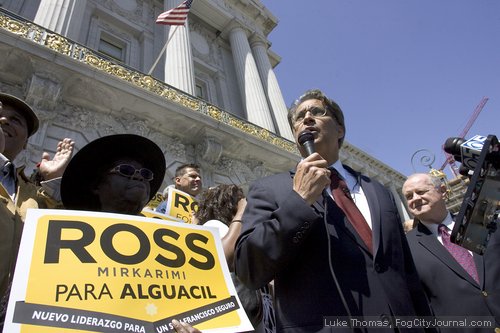
City Hall’s steps were awash in multi-lingual black and yellow “Ross Mirkarimi for Sherrif” signs at noon today, as Mirkarimi supporters watched Sheriff Mike Hennessey, who is stepping down after 31 years of service and eight elections, endorse Sup. Mirkarimi as the next sheriff.  “New Leadership for a Safe San Francisco” was printed on the English version of the signs that Mirkarimi’s supporters carried. They included former Mayor Art Agnos, Sups. David Campos and Eric Mar, Tim Paulson of the Labor Council, Debra Walker, Linda Richardson, Sharen Hewitt, Terry Anders, and Mirkarimi’s partner Eliana Lopez and their almost two-year old son Theo. And everyone had plenty of great things to say about outgoing sheriff Hennessey and sheriff candidate Mirkarimi. And Hennessey even pinned a shiny toy sheriff’s badge onto the T-shirt of Mirkarimi’s son Theo, making him the happiest kid in town. At least for the day.

Campos kicked off the event by honoring Hennessey as the “most progressive and most effective sheriff in the country.”
“Mike Hennessey is also my neighbor in District 9. I see him taking out the trash so I know he’s a good neighbor,” Campos joked, as he listed the many achievements in Hennessey’s long career as an elected official in San Francisco. These achievements included Hennessey’s pioneering innovations in criminal justice and culminated in his decision to blow the whistle in 2010 on the federal government’s plan to activate its controversial Secure Communities program in San Francisco—without telling the public.
“He’s not afraid to stand up for what’s right,” Campos said.

‘This is the time for me to move on,” Hennessey announced, as he laid out his reasons for endorsing Mirkarimi as Sheriff, over other candidates in the field.
Hennessey described the Sheriff’s Department as a “large enterprise” that has over 1,000 employees, a $150 million budget and whose jail houses an average population of 2,000 folks in custody, on a daily basis.
“It’s not something that can be handled lightly,” Hennessey said. “That’s why I’m here to endorse Ross Mirkarimi as the next sheriff.”

Hennessey listed the many endeavors that he and Mirkarimi have worked closely on, including a number of criminal justice issues, and he cited Mirkarimi’s extensive law enforcement background, his significant legislative accomplishments in the areas of criminal justice and public safety, and his ability to find innovative solutions and overcome obstacles to progress, as reasons to support Mirkarimi.

Hennessey observed that criminal justice is “one of the thornier issues” that members of the Board of Supervisors are often asked to get involved in, but often duck.”But Ross has not shied away from working on them,” Hennessey said, citing Mirkarimi’s involvement in shaping the “No Violence Alliance Project” and his leadership in creating the Safe Communities Re-entry Council.

Hennessey also noted that in face of AB 109, the Governor’s plan to transfer state inmates to county jails, “it’s vitally important to have person in charge of sheriff’s office that understands these alliances and can make them work more effectively.”

Hennessey concluded by observing that the Sherrif’s Department has to deal with a lot of bureaucracy, so it’s important to understand how the Board, the budget process and other city departments, including the District Attorney’s office and the police, work.
‘And that’s why I’m endorsing Ross as Sheriff,” Hennessey said

Then it was the turn of Mirkarimi, who graduated from the San Francisco Police Academy, did Naval Reserve training and worked for more than 8 years as an investigator for the District Attorney’s office, to speak.

“I have never been at a loss for words,” Mirkarimi acknowledged, as he launched into a speech that began by thanking everyone for showing up at short notice “for one of the most important occasions of my political career.”

Mirkarimi did a great job of giving Hennessey the praise he deserves.
“He is a living legend,” Mirkarimi said. “It’s completely impossible to fill his shoes.”
Citing Hennessey’s integrity and his ability to innovate, Mirkarimi warned that, “Maybe it’s come to the point where we have taken him for granted. He’s the longest serving elected official in the history of San Francisco, and he’s probably the most understated.”

“And the most important endorsement in this race is that of Mike Hennessey,” Mirkarimi added, as he gave Hennessey his commitment “to build upon your legacy as effectively as possible.”

Mirkarimi cited some of the most immediate and serious challenges that face the next sheriff. These include AB 109, which Gov. Jerry Brown just signed, which. Mirkarimi said, threatens to increase the reentry prisoner level by 30 percent in California. “It will take creative ingenuity and resources to make sure we are effective in taking care of this population,” he said.

Mirkarimi also touched on the rising number of veterans that are ending up in the prison system, talked more about the No Violence Alliance Project, and suggested that certified deputy sheriffs could help serve warrants, transfer prisoners, and patrol Muni, “when the police department finds itself understaffed” so as to ensure that San Francisco is safe.

“For every four people arrested and jailed in San Francisco, three out of four are repeat offenders in a three-year period,” Mirkarimi warned, by way of explaining why he wants to advance a more collaborative spirit between SPPD and the Sheriff’s department.

Mirkarimi also noted that one out of every 15 African American males are in jail, at any time in the year, compared to I out of 300 males who are not black or brown. “So, we must step up our game in dealing with poverty,” he said, as he recommended increased access to job training and good jobs, “so work doesn’t become a seasonal hope but a permanent job.” He also made the connections between a lack of good housing, childcare, and schools and a rise in poverty, crime and recidivism.

Mirkarimi concluded by crediting Hennessey for “walking that fine pirouette” between upholding the principles of public safety and understanding the power of redemption at the same time.

I asked Sheriff Mike Hennessey what he considers to be the biggest challenges of running for sheriff/
“Letting people know what you are going to do, and what your issues are,” Hennessey said, noting that San Francisco has an intelligent, issues-driven electorate.

And Mirkarimi’s supporters weren’t shy about letting folks know the issues that the current D5 Supervisor has helped them with, over the years.

“Ross, as a supervisor and me, as someone who comes from a community of color, we know the habits that ex-offenders can bring with them, if there are no safety nets,” said Terry Anders who sits with Mirkarimi on the Safe Communities Reentry Council. “And I believe in what Ross stands for and the integrity of his person. He’s one of the first people to show up when there are crimes and victims, and he attends basketball games and boxing matches.”

Paulette Brown, whose son Aubrey Abraska Jr, was murdered in August 2006, but whose killers have still not been brought to justice.
“We shouldn’t have to run and leave our families, we should be protected,” Brown said. “Ross is my district supervisor and if he can get in, and do something about crime and solve unsolved homicides, then I’m for him. Maybe if he gets in, he’ll have more pull to do something about these unresolved cases.”

And then it was back to work, which for Mirkarimi now includes the somewhat daunting task of trying to raise money in an election year that also includes a mayor’s race, but does not include the help of public financing, at least not for the sherrif’s race….

Approve affordable housing — for youth

1

OPINION Booker T. Washington, born as a slave, risked his life to learn to read and write and went on to found Tuskegee University. At his core, he believed that economic independence and access to education were the keys to equality. He put it best when he said: “There are two ways of exerting one’s strength: one is pushing down, the other is pulling up.”

Since 1919, the Booker T. Washington Community Service Center has worked to lift up San Franciscans of every background, with a particular focus on the African American community. To continue that vision, the center is embarking on a capital project that will provide 50 units of affordable housing to youth and families, along with new athletic and educational space.

The most critical part of the project is providing housing for transitional-age youth. Many of these young people age out of foster care with no family support, few job skills, and no chance to rent a market-rate apartment in this expensive city. The project represents a real commitment to these youth, who are overwhelmingly people of color. With affordable housing funding under threat at the federal and state levels, it’s essential that shovel-ready projects get the green light from City Hall.

That is why we were thrilled when Sups. Ross Mirkarimi, Eric Mar, and Mark Farrell introduced the necessary legislation to allow this project to move forward. Joining hundreds of community leaders, countless families, and prominent African Americans, these supervisors lent their support for a project that continues the ongoing fight for economic justice.

It’s also why we are concerned that a few neighbors are using their influence to push down on the hopes of San Francisco’s youth. Some neighbors have asked that we add additional parking, even though the site is just a few blocks from Geary Boulevard and most low-income youth don’t have cars. Others have suggested that we cut nine units to make the building shorter, even though San Francisco’s housing needs are so acute. As is often the case in San Francisco, those who support progressive values need to speak up to ensure that we can overcome this campaign of misinformation and fear.

On April 28, the Planning Commission will consider whether to certify the environmental impact report for this project, and whether to approve it. We are hopeful that progressive voices speak out so we can provide hope and a future to youth in our community. As Booker T. often said: “Success is to be measured not so much by the position one has reached in life as by the obstacles one has overcome.” 

Julian Davis is president of the board and Patricia Scott is executive director of the Booker T. Washington Community Service Center, located at 800 Presidio Ave. The Planning Commission hearing is Thursday, April 28 at City Hall, Room 400.


Spies in blue

19

sarah@sfbg.com

San Francisco cops assigned to the FBI’s terrorism task force can ignore local police orders and California privacy laws to spy on people without any evidence of a crime.

That’s what a recently released memo appears to say — and it has sent shockwaves through the civil liberties community.

It also has members of the S.F. Police Commission asking why a carefully crafted set of rules on intelligence gathering, approved in the wake of police spy scandals in the 1990s, were bypassed without the knowledge or consent of the commission.

“It’s a bombshell,” said John Crew, a long-time police practices expert with the American Civil Liberties Union of Northern California.

The ACLU obtained the document April 4 under the California Public Records Act after a long battle. It’s a 2007 memorandum of understanding outlining the terms of an agreement between the city and the FBI for San Francisco’s participation in the Joint Terrorism Task Force.

And, according to Crew, it effectively puts local officers under the control of the FBI. “That means Police Commission policies do not apply,” Crew said. “It allows San Francisco police to circumvent local intelligence-gathering policies and follow more permissive federal rules.”

Veena Dubal, a staff attorney at the Asian Law Caucus, agreed: “This MOU confirms our worst fears,” she said.

Dubal noted that in the waning months of the Bush administration, the FBI changed its policies to allow federal authorities to collect intelligence on a person even if the subject is not suspected of a crime. The FBI is now allowed to spy on Americans who have done nothing wrong — and who may be engaged in activities protected by the First Amendment.

FBI activity under this new “assessment” category has since come under fire, and a recent report in The New York Times showed that the FBI has conducted thousands of assessments each month, and that these guidelines continue under Obama.

And if the feds do control San Francisco police policy, then the San Francisco cops could be spying on innocent people — a dramatic change from longstanding city policy. “The MOU is disturbing,” Police Commission member Petra DeJesus told the Guardian. “The department is assuring us that local policies are not being violated — but it looks as if it’s subject to interpretation.”

It’s the latest sign of a dangerous trend: San Francisco cops are working closely with the feds, often in ways that run counter to city policy.

And it raises a far-reaching question: With a district attorney who used to be police chief, a civilian commission that isn’t getting a straight story from the cops, and a climate of secrecy over San Francisco’s intimate relations with outside agencies, who is watching the cops?


SPIES LIKE US

San Francisco has a long — and ugly — history of police surveillance on political groups. SFPD officers spied on law-abiding organizations during the 1984 Democratic National Convention; kept files in the 1980s on 100 Bay Area civil, labor, and special interest groups; and carried out undercover surveillance of political groups focused on El Salvador and Central America.

Those abuses led the Police Commission to develop a departmental general order in 1990 known as DGO 8.10. The local intelligence guidelines require “articulable and reasonable suspicion” before SFPD officers are allowed to collect information on anyone.

Even those rules weren’t enough to halt the spies in blue. In 1993, police inspector Tom Gerard was caught spying on political groups — particularly Arab American and anti-apartheid organizations and groups Gerard described as “pinko” — and selling that information to agents for the Anti-Defamation League.

As the ACLU and Asian Law Caucus noted in a December 2010 letter to Cdr. Daniel Mahoney: “That scandal was not just about the fact that peaceful organizations and individuals were being unlawfully spied upon and their private information sold to foreign governments, but that the guidelines adopted in 1990 had never been fully implemented by SFPD. No officers had been trained on the new guidelines and no meaningful audit had ever been implemented.”

Over the years, the commission has tried to keep tabs on police intelligence and prevent more spy scandals. The general order mandates that local police officials have to request general authority from a commanding officer and the chief to investigate any activity that comes under First Amendment protections — and must specify in the request what the facts are that give rise to this suspicion of criminal activity. The order also states that the chief can’t approve any request that doesn’t include evidence of possible criminal activity.

Those requests are reviewed monthly by the Police Commission and there are annual audits of the SFPD files to monitor compliance — so the notion that the local cops are joining the FBI spy squad without commission oversight is more than a little disturbing.

Officials with the FBI and SFPD are doing their best to reassure the local community that there’s nothing to worry about. But so far their replies seem to duck questions about whether FBI guidelines trump local policies. For example, the MOU states that “when there is a conflict, [task force members] are held to the standard that provides the greatest organizational benefit.”

We asked Mahoney to clarify: does that mean the local cops could be held to the FBI’s standards?

“The San Francisco Police Officer(s) who are assigned to the Joint Terrorism Task Force always have and continue to be required to follow all SFPD’s policies and procedures,” Mahoney replied in a statement.

That’s confusing; do they follow SFPD policies, or obey the MOU?

We asked FBI special agent-in-charge Stephanie Douglas whether SFPD officers are involved in surveillance and “assessments” (that FBI code word for creating spy files on individuals and groups) and whether they are identifying as SFPD or FBI officers.

“The FBI only initiates investigations on allegations of criminal wrongdoing or threats to our national security,” Douglas replied April 21. “Our investigations are conducted in compliance with the Constitution, the laws of the United States, the Attorney General Guidelines, the Domestic Investigation and Operations Guide, and all other FBI policies.”

Okay, that’s typical FBI-speak. Here’s more: “The JTTF is a task force comprised of FBI special agents, agents from other federal agencies, and local police officers who have been officially deputized as federal task force officers (TFOs) who have the power and authority of a federal agent. Because all JTTF TFOs are actually de facto federal agents, they are required to operate under federal laws and policies when involved in a JTTF case.”

So the cops are actually feds. But wait: “Our standard JTTF MOU recognizes, however, that the JTTF TFOs do wear two hats, as it were, and directs JTTF TFOs to follow his or her own agency’s policy when it is stricter than the FBI policy under certain circumstances,” Douglas concluded.

Again: not exactly clear, and not exactly reassuring.

“At some point they need to say whether SFPD officers are engaged in assessments,” Crew said.

These questions have spurred the Police Commission and Human Rights Commission to schedule a joint hearing in May to discuss what the document means, why SFPD never alerted the civilian oversight authorities, and whether a clarifying addendum can be tacked onto the agreement.


SPY FOR US OR LEAVE

The concerns are likely to be intensified by recent developments in Portland, Ore.

Portland dropped out of the Joint Terrorism Task Force in 2005 over concerns that local cops would be violating privacy laws. But in November 2010, the FBI thwarted a bomb plot allegedly linked to terrorists, and city officials came under pressure to rejoin the JTTF.

But Mayor Sam Adams has insisted on language that would bar local cops from doing surveillance and assessments, which, apparently, won’t fly with the feds.

On April 20, Willamette Week, the Portland alternative paper, wrote that Adams “effectively scuttled” Portland’s reentry into its local JTTF because of his anti-spying language.

In an April 19 letter to Adams, U.S. Attorney for Oregon Dwight Holton stated that Adams’ proposal of only allowing officers with the Portland Police Bureau to be involved in investigations and not in FBI assessments was a deal-breaker.

“Unfortunately, as currently drafted, the proposed resolution does not provide a way in which the PPB can rejoin the team,” Holton wrote. “There is a single provision that stands as a roadblock to participation — specifically the provision that seeks to have the City Council delineate only certain investigative steps a task force officer can take part in. Specifically, the resolution seeks to dictate for the JTTF which stages of an investigation task force officers from the [Portland police] can work on.”

“Investigation and prevention of complex crimes and terrorism are typically fluid and fast-moving,” he added. “It makes no sense to ask [Portland police] officers to be in for one part of a conversation, but out for another part of the same conversation as investigators discuss findings from assessments, investigations, etc. in evaluating and addressing terrorist threats in Portland and beyond.”

The message isn’t lost on San Francisco civil liberties activists. If you don’t let your cops join the spy squad, they can’t be a part of the task force.

“It was one thing to join the JTTF 10 years ago when they were operating under guidelines that, while not to the ALCU’s taste, were at least tied to some level of suspicion,” Adams said. “But they have taken their procedures and guidelines and moved them to the far right. It’s one thing to say that it’s necessary for the FBI to do that, and quite another to say that local agencies have to forfeit their own policies — and with no public debate or decision-making.”


ASK THE FEDS FIRST

Further complicating the question of police oversight is the fact that George Gascón, who was police chief when civil liberties groups started asking for a copy of the MOU last fall, refused to turn over the document without asking the feds first.

In a Jan. 4 letter to the ACLU and ALC, Gascón and Mahoney stated that the SFPD could not speak to information about the duties, functions, and numbers of officers assigned to the Joint Terrorism Task Force “without conferring with our partners in the Federal Bureau of Investigation.”

“I am sure you can appreciate the delicate balance we hold in crafting policy that not only supports our mission in the ultimate protection of life, but also in advancing democratic values through collaboration with the communities we serve,” Gascón and Mahoney wrote.

And Gascón is now district attorney.

“It raises the question of accountability,” said Public Defender Jeff Adachi “We want to make sure that police officers working in the city, regardless of whether it be for the feds or the SFPD, are complying with general orders and policies established by the department. But when officers go on an assignment with the feds, we don’t know if they are operating under parameters set by local law.”

Unearthing the FBI’s hitherto clandestine MOU with the SFPD appears to be yet another sign that local police are increasingly being subjected to federal policies not in keeping with local procedures.

As the Guardian previously reported, the 2008 decimation of San Francisco’s sanctuary city legislation and the 2010 activation of the federal government’s controversial Secure Communities program, which both happened during former Mayor Gavin Newsom’s tenure, means that the city of St. Francis now ranks among the top 38 counties nationwide that are deporting “noncriminal aliens.”

Dubal also noted that the FBI came to the SFPD in 1996 asking for help with the task force, but also sought a waiver from the Police Commission so officers could participate without having to follow local rules. “And within two weeks, then Mayor Willie Brown said, not in our town,” Dubal said. “So in 1997, the SFPD said we are not going to join unless we can follow our own rules. And in 2001, when the SFPD joined, it was under an MOU that required them to comply with SFPD rules and was signed in 2002 by then-SFPD Chief [Earl] Saunders.”

Dubal said that after local law enforcement agencies sign an MOU with the FBI, they designate and assign officers to work from FBI headquarters. “In the past, two SFPD officers, paid with San Francisco tax dollars, physically worked in the FBI’s office in a secure room where you can only go if you have security clearance. But they still can’t spy without reasonable suspicion, and they also need audits.”

Crew and Dubal said that in a recent meeting, SFPD officials assured them that local police were following General Order 8.10, but that they are open to creating an MOU addendum to clarify this.

Crew and Dubal remain unsure if the FBI would be agreeable to signing off on that. They note that the FBI has previously stated that its JTTF has sensitive investigations going on so it can’t give the public all the information. “Fine, but the issue is, Are these investigations based on suspicion, or are they based on religious background, associations, ethnicity, and travel patterns?” Dubal said.

They also doubt that the MOU would even have surfaced if not for comments that then SFPD Chief Gascón made, first in October 2009, then in March 2010, that triggered an uproar in the local Muslim, Arab, and Pakistani and Afghani communities.

At the time, Gascón, who has a law degree and graduated from the FBI Academy, had just landed in San Francisco fresh from a stint as police chief for Meza, Ariz., where he drew praise for speaking out against Maricopa County Sheriff Joe Arpaio’s inhumane treatment of undocumented immigrants Given this seemingly progressive stance, Gascón shocked civil libertarians in San Francisco when he said he wanted to unearth SFPD’s intelligence unit, which was disbanded amid scandal in the early 1990s.

“We have to realize that in the post-9/11 world, San Francisco is an iconic city, like New York, Washington. and Los Angeles,” Gascón said. “If somebody wanted to make a big statement about something they disliked about America, doing it here would definitely get attention. We need to know what is going on under the surface of the city.”

But Gascón did not say how a revived police spy unit, which had been shut down in large part due to Crew’s work, would operate. And six months later, he upset Bay Area Muslims during a March 2010 breakfast by reportedly saying that the Hall of Justice building was not just susceptible to earthquakes, but also to an attack by members of the city’s Middle Eastern community who could park a van in front of it and blow it up.

Gascón subsequently claimed that he “never referred to Middle Easterners or Arab Americans,” but that he had instead singled out the Afghanistan and Yemen communities because they pose “potential terrorism risks”

“In light of Gascón’s comments and his desire to resurrect the intelligence unit, people were asking, ‘Is it possible that the SFPD is also doing the same thing?'” Dubal asked, noting that she started getting complaints in 2009 and throughout 2010 about the FBI.

“Folks were saying that the FBI was asking about their religious identity, their family situation, and their political activities,” she recalled. “I certainly saw an upswing in innocent people being contacted. People were saying, ‘What the hell? — the FBI knocked on my door at 5 a.m.'”


COMMUNITIES UNDER SIEGE

A 2011 Human Rights Commission report documents frequent complaints from Arab, Muslim, and South Asian communities facing racial and religious profiling while traveling and unwaraanted interrogation, surveillance, and infiltration by local and federal law enforcement personnel at their homes, places of worship, and workplaces.

The report recommended asking the supervisors and the Police Commission to “ensure that all SFPD officers, including those deputized to the Joint Terrorism Task Force, follow and comply with local and state privacy laws, including DGO 8.10.”

On April 5, the Board of Supervisors voted 10-0 to approve a resolution, sponsored by Sup. Ross Mirkarimi and cosponsored by Sups David Chiu, Eric Mar, David Campos, and John Avalos, to endorse the HRC report.

All this is happening against the backdrop of FBI guidelines that have been loosened twice since September 2011, first by U.S. Attorney General John Ashcroft in the wake of the 9/11 terrorist attacks, then by Attorney General Michael Mukasey in the dying days of the Bush administration, and now by the Obama administration.

And as The New York Times reported in March, records obtained through a Freedom of Information Act request show that between Dec. 2008 and March 2009, the FBI began 11,667 assessments of people and groups for criminal/terror links, completed 8,605 assessments, and launched more than 400 intensive investigations based on the assessments. The FBI also told the Times that agents continue to open assessments at about the same pace

Crew noted that Mukasey’s guidelines marked the first time since 1976 that the FBI has been allowed to do assessments and collect files without a suspicion that a crime has occurred.

Dubal observed that the most relevant documents to emerge from a recent FOIA request to determine if the FBI has engaged in disturbing intelligence gathering activities are those related to “geomapping.”

“The materials are not particular to Northern California, but they show how FBI maps communities based in ethnic concentrations,” Dubal said.

Dubal also pointed to the case of Yasir Afifi, an Egyptian American student from Santa Clara, who found an FBI tracking device on his car when he took it in for an oil change. In March 2011, CAIR filed suit in Washington, D.C., alleging that the FBI violated Afifi’s First, Fourth, and Fifth Amendment rights by failing to obtain a warrant.

DeJesus recently told the Guardian that the Police Commission was never made aware of the MOU’s existence. “The chief should have checked in with the commission president, at the very least,” she said. “The idea that they were not reporting this to anyone is disconcerting.”

“The SFPD does not have the authority to enter into a secret agreement with the FBI whereby some of its officers are allowed to conduct intelligence operations in violation of the Police Commission’s General Order 8.10,” Crew added.

In a Jan. 25 letter to Mahoney, representatives from the ACLU and the ALC noted that “in the past, the SFPD had not previously deferred to the FBI on whether or how to openly address how San Francisco police officers will be supervised and held to well-established and painstakingly and collaboratively crafted San Francisco general orders.”

“These are low-level investigations that require no criminal predicate, meaning that when initiating an assessment, FBI agents can conduct intrusive forms of investigation without any criminal suspicion,” Dubal said. “These include interviewing innocent Americans, infiltrating organizations, using open source data to spy and surveil, going into religious centers such as mosques to spy and surveil, and recruiting and using informants.”


Supes vote on Botanical Garden fees

The Board of Supervisors voted on April 12 to keep in place nonresident fees at the San Francisco Botanical Garden for at least another two years, rejecting a proposal by Sup. John Avalos to do away with the fees and make up for the shortfall with a portion of revenues brought in by a real-estate transfer tax that was approved by voters last year.

Advocating for his position, Avalos stood to tell a story about his last visit to the Botanical Garden. “A couple months ago, I was able to go there with my kids,” he began. “I went in, I was asked for my ID, I showed my ID. I noticed the next person who came in after me looked very agitated when she got to the gate. She said the F-word very loud, and she started to walk away. I approached her, and I said, ‘hey what’s going on?’ And she said, ‘I come here everyday, and I’m being asked for my ID, and I have to go back to my house to get it because I don’t have it with me today.'”

She wasn’t the only person who seemed disgruntled by the gatekeeper that day. “On my way out, I noticed a few tourists coming up,” Avalos continued. “It looked like they were from Germany. They walked up to the gate and then they walked back away from the gate. They clearly did not go in because they did not want to pay the fee.” A couple in their 60s tried to enter, but they did not go in because they didn’t have their IDs proving that they lived in San Francisco, he added.

Bottom line: “The gate and the fee has really diminished what people’s enjoyment of the park has been like for decades,” he said. “Can’t there just be one fee that we don’t raise? Can this be that one fee? I don’t think that’s asking too much.” He also noted that budget analyst’s report showed that the fees did not bring in the revenue that had been anticipated, a point echoed by Sups. Ross Mirkarimi and David Campos.

Yet Avalos’ pitch wasn’t enough to persuade his colleagues. On the question of whether money from the real-estate transfer tax revenues should be used to make up for the nonresident fees so that the Botanical Garden could be free for everyone, supervisors said no on a 7-4 vote, with Sups. Eric Mar, Mirkarimi, Campos, and Avalos voting yes.

The board also voted on whether the nonresident admission fees should be extended beyond June 30, 2011 (a date set when the fee was initially imposed), as proposed by Mayor Ed Lee. Board President David Chiu offered an amendment that the fees would only remain in place for two years, after which point the debate could be rehashed. The amendment was adopted, and the mayor’s proposal passed on a 6-5 vote, with Sups. Jane Kim, Mar, Mirkarimi, Avalos, and Campos voting no.

So, that’s how it went down at the board. If you’re a nonresident, the Botanical Garden still isn’t free.

Since Kim and Avalos both shared their accounts of visiting the Botanical Garden, I thought I’d share my own photos and impressions from a visit on a recent afternoon, when I had several hours to myself to explore Golden Gate Park’s haven of greenery. Admission was free, since I’d planned ahead to bring my ID.

The day was sunny and warm, and I spent a long time photographing the light streaming through a cluster of bamboo and sitting by a pond watching some water bugs skip around on the surface. It was a welcome escape from city life with an element of educational value, since all the plants are labeled with plaques identifying their Latin names, common names, and places of origin.

I noticed two people sitting wordlessly together in the sun. The woman, who seemed to be a caregiver, was seated on a bench, and beside her was an elderly man in a wheelchair with a blanket over his lap. The man seemed to be very frail. Yet he wore a serene expression, and was clearly enjoying the calm and quiet afternoon.

I don’t know if they paid to get in or not. As Board President David Chiu noted at the meeting before voting in favor of keeping the fee in place, “We don’t live in a perfect world.” You can argue about the privatization of parks, or about the need to find all possible sources of revenue in order to fend off cuts to city-funded services. Nevertheless, it’s sad to think of the folks who would be barred from the simple pleasure of sitting in the sun surrounded by natural beauty, because they can’t afford to pay.

It’s not so easy building green

34

OPINION The Parkmerced project developers like to talk about how environmentally sound their plans are, but a harder look suggests otherwise.

At a March 29 hearing on the project, Green Pary member Eric Brooks presented graphic evidence of the environmental impacts of the destruction of the garden units and the landscape, and the proposed increase in parking on- site. As a transit-first city, it seems ludicrous to spend so much on below-grade parking. And regrading and replanting the entire site will allow toxins in the soil to become airborne.

Then there’s the question of whether the site is really “blighted,” as the developer claims — and whether so much housing needs to be torn down in the first place. Sup. Eric Mar questioned the issue of the deterioration of the existing units; he said he’d visited the site and noted that many units appear to be in fine shape.

I agree that the western side of town needs more density — but dumping that density disproportionately on one community seems to be a biased approach. Parkmerced is a renter community. Other areas dominated by homeowners seem to be off the table.

San Francisco should take a broader look at west-side zoning. That would include looking seriously at corridors with light-rail lines — Ocean Avenue, West Portal Avenue, Taraval Street, Geary Boulevard, Judah Street, and others — where some one-story buildings are far more deteriorated than the buildings at Parkmerced.

City officials should look at alternatives that allow other sites to be upzoned or allow owners to build on side sites. This would lessen the effects on one community by sharing the growing pains of a city limited on three sides by water.

We all want the projects, work, housing, jobs, and an expanded tax base for the city. But many of us question whether the current plan for Parkmerced does justice environmentally and sustainably when it ignores infill and preservation-based alternatives that could create more jobs and a better long-term green solution.

I have submitted a proposal to the Planning Commission that shows how to improve transit linkages, how infill housing can be done, and how the 11 towers at Parkmerced can be redesigned (the initial concept was to design new, pencil-thin replacement towers and structurally-reinforced new buildings). I suggest that more infill housing can be built by removing parking garages throughout the site — which would lessen displacement and allow a significant density increase.

Assurances by the developer should not placate the city or the supervisors. If the supervisors lean toward approval, they need to be reminded of the transit, sustainability, and open-space concerns of the project to ensure that the design is changed either through revisions of portions or the whole to make more clear the concerns that the project has been greenwashed to promote the developer’s interests.

Aaron Goodman is an architect and Bay Area native.

Seeking a watchdog’s watchdog

1

rebeccab@sfbg.com

When cash pumps through the guts of city politics, the Ethics Commission is charged with keeping track of it all to help members of the public follow the money. But what happens when the public loses faith in the ethics of the Ethics Commission?

In the run-up to a hotly contested mayoral race, in a city marked by rough-and-tumble politics influenced by moneyed power brokers, the function of this local-government watchdog agency is especially critical — and to hear some critics tell it, the Ethics Commission needs reform if it is to perform as an effective safeguard against corruption.

So it was hardly surprising that an April 5 discussion at the San Francisco Board of Supervisors meeting about whom to appoint to the Ethics Commission featured a low-level tug-of-war with some potentially high-level implications.

Sup. Eric Mar proposed that the board consider Allen Grossman for the seat. An octogenarian government watchdog unaffiliated with any political party, Grossman has gone so far as to file a successful lawsuit against the Ethics Commission for not following its own public-disclosure rules. As a potential appointee, he was widely viewed as reform-minded, following in the footsteps of others who have been purged from the body in recent years.

“Open government and good government work together, hand in hand,” Grossman told members of the board’s Rules Committee several weeks prior, interlacing his fingers for emphasis.

Grossman won the backing of Sups. John Avalos and Ross Mirkarimi. But Board President David Chiu spoke against the idea, throwing his support instead behind Dorothy Liu, an attorney and professional colleague of his through the Asian American Bar Association. The Rules Committee, chaired by Sup. Jane Kim and filled out by Sups. Sean Elsbernd and Mark Farrell, also turned down Grossman in favor of Liu.

“She’s extremely hard-working and does her homework,” Chiu later told the Guardian. He also saw it as a plus that Liu was not a political insider: “I think we need an individual on the Ethics Commission who will be impartial,” he said, adding that he’d prefer “someone who has not been involved in the rough-and-tumble of San Francisco politics.” Sup. Carmen Chu echoed Chiu’s comments during the meeting, saying she thought Liu would be an ideal candidate because she did not seem to have an agenda.

Mirkarimi and Avalos, on the other hand, said they were looking for a candidate who did possess a vision for strengthening the role of the agency as a watchdog. “I think our Ethics Commission and the department, as it stands, needs all the help it can get,” Mirkarimi said during the meeting. “I think having people who are well-seasoned with an understanding in the law of ethics and sunshine is something we should be looking for. Mr. Grossman has exhibited that well over the years in trying to do everything he possibly can to advance the cause in a nonpartisan way of making sure that we have a very strong Ethics Commission.”

Mar’s motion to consider Grossman was shot down on an 8-3 vote with Mirkarimi, Mar, and Avalos dissenting; Liu then won the commission appointment on a 10-1 vote, with Avalos dissenting.

Until recently, the Board of Supervisors seat on the Ethics Commission was held by Eileen Hansen, a progressive who had called for political reform under Mayor Willie Brown’s administration prior to being named to the post. When she was being considered for the commission, Hansen recalled, then-Sup. Michela Alioto-Pier raised an objection. “[She] thought the perfect person would be somebody who … would come essentially as a clean slate,” Hansen remembered. “Because I had been involved in organizing campaigns and had run for office, that was deemed too political.”

Yet Hansen viewed her familiarity with the system as an asset that helped her serve as an effective watchdog against corruption. During her six-year tenure, Hansen often cast lone dissenting votes against decisions she believed were weakening ethical standards. She told the Guardian she’d tried floating remedies for situations she viewed as inappropriate, only to have them summarily ignored, a role similar to that of former Ethics Commission member and staffer Joe Lynn.

In one case, Hansen recalled, she became concerned about a planning commissioner who also directed a nonprofit. To raise money, her organization held fundraisers that were ostensibly attended and funded by the very same developers and lobbyists who appeared before her at the Planning Commission. Yet Hansen said she was unable to persuade the other commissioners or staff to call for an investigation.

A more recent Ethics Commission vote underscores the same tension. On March 14, the commission voted unanimously to waive a pair of ethics regulations to allow a mayoral staff member to become executive director of the America’s Cup Organizing Committee (ACOC). Composed of highly influential business figures including at least two billionaire investors, ACOC is tasked with securing corporate donations for the America’s Cup to offset city costs of hosting the race.

Kyri McClellan, project manager with the Mayor’s Office of Economic and Workforce Development, helped craft a memorandum of understanding with ACOC regarding its fundraising obligations to the city. In her new job, without skipping a beat, she’ll interface with the city on behalf of ACOC. The rules that were waived for her benefit are meant to prevent city officials from holding undue influence over their former coworkers after leaving public service, and to prevent city staffers from accepting money from city contractors right after departing from city employment.

“If I had been there, there would have been at least one vote against that waiver,” said Hansen, whose term on the commission ended before this vote. “We have this law in place for a reason. By continuing to provide waivers … we create a situation where the public will not trust the Ethics Commission as a watchdog.”

Hansen said she was scouting for a new commissioner who would carry on with her work. “I was looking for and trying to recruit a visionary — someone who could really be a reformer,” she said. “We’re almost in a position now where we need a watchdog over the watchdog.” She said she saw Grossman as the right fit.

Other observers, such as CitiReport blogger Larry Bush — an investigative reporter who called for the creation of the Ethics Commission in San Francisco in the early 1990s — questioned whether Liu was the best choice after hearing her statements at the March 17 Rules Committee hearing. Liu did not come out strongly in favor of televising Ethics Commission meetings, which has long been a sticking point for open-government advocates.

“I absolutely support televising the Ethics Commission, I think it’s really important,” Kim noted when we asked her about this. She added that she would have supported Oliver Luby — a former Ethics Commission staff member and whistleblower who was ultimately ousted from the job — if he’d applied.

Kim noted that an initial concern she’d had in seeking an ethics commissioner was whether the person would vote to allow Mayor Lee to resume his job as city administrator after serving out his term as interim mayor, a key decision that the commission was scheduled to consider April 11.

Once she was advised that it would be inappropriate to ask which way they would vote when conducting candidate interviews, Kim said she withheld her question — and still didn’t know Liu’s or Grossman’s position at the time she spoke with the Guardian. “I think it’s very appropriate for him to get his job back,” Kim noted. “That vote is very important to me.”

That vote drew closer scrutiny, however, after Ethics Commission staff recommended that the exemption that would be built into the law for Lee’s benefit should be expanded to include appointed members of the Board of Supervisors. “This new proposal would convert a targeted, narrow exemption to deal with a special case into the ‘Politician Job Protection Act’ and could open the door to all kinds of unintended consequences,” charged Jon Golinger of San Franciscans for Clean Government.

Meanwhile, Luby seemed disheartened by the board’s selection of Liu for the Ethics Commission. He was looking to Grossman to fill Hansen’s shoes as the commission’s reformer — a role previously held by Lynn, Luby’s good friend and mentor who died last year.

He lamented, “This will mark the first time in over 10 years to have an Ethics Commission without someone who has past experience advocating for good government.” 


Man on the move

1

steve@sfbg.com

As the homegrown Burning Man festival and culture marks its 25th anniversary, Black Rock City LLC, the company that stages the annual event, is about to take a couple of big steps. Next month, organizers say it will move into a high-profile new headquarters on mid-Market Street and form a new nonprofit group to take over Burning Man.

Tickets to the weeklong festival, which takes place Aug. 28-Sept. 5 in Nevada’s Black Rock Desert, have been selling at their fastest pace ever and the city is likely to exceed a population of 50,000. Symbolizing perhaps the biggest transitional year since 1996, when the LLC was formed and a more formal civic infrastructure was created, the eponymous Man will be in a new pose for the first time: striding across a chasm rather than standing still.

While the transitions have been in the works for years, event founder Larry Harvey publicly laid out the details for the first time on April 1, when he addressed a gathering of Burning Man regional representatives from around the world.

“I’m here tonight to talk to you about the next step for Burning Man,” Harvey told the crowd of about 150 regional representatives and another couple hundred burners, including Sup. Eric Mar, who attended the event last year for the first time. Sup. Jane Kim, who is sponsoring a controversial mid-Market tax exclusion zone that would benefit BRC and many other companies (see “Selling the Tenderloin,” March 30), appeared at the event briefly but didn’t stay for the whole speech.

Harvey then proceeded to talk for more than an hour, revealing often personal details about the bitter infighting among BRC’s six board members that followed lawsuits filed in 2006 by board member Michael Mikel and in early 2007 by John Law, an estranged founder of the modern event, over control of Burning Man’s trademarks and future (see “Burning Brand,” 1/6/07).

“It triggered a series of cascading events, and those began a rite of passage,” Harvey said, echoing this year’s Burning Man art theme, Rites of Passage.

With Mikel and Law forcing the question of what would become of the event, BRC realized it needed a new operating agreement, but the board members couldn’t agree on the fundamentals and ended up in mediation. “It began to look like everybody would lawyer up,” Harvey said. “It felt like the band was breaking up.”

They brought in corporate appraisers to “think about what the pie will fetch, then divide by six,” an idea that was as abhorrent to Harvey as it would certainly have been to the vast community of burners who have helped give the event its value over decades now.

“It was against everything we stood for, everything we had practiced,” he said. “How could we sell our life’s work like a commodity?”

Eventually, working with a committee of BRC senior employees that formed after relations on the board devolved, they decided to turn control of the event and its assets over to a new nonprofit group called The Burning Man Project.

“Why not act to change the world, a world that you won’t be in? And that’s what we want to do,” Harvey said, eliciting applause from the room. “We want to get out of running Burning Man. We want to move on.”

But it’s going to be a slow process. In May, he said the LLC will file papers to create the nonprofit, which will initially be run by the current board members and at least seven more directors selected by that board. In about three years, depending on how the new nonprofit forms up, the LLC will turn over management of Burning Man, while holding onto control of the logos and trademarks for another three years after that, Harvey said. And that’s when the six board members will officially cash out.

“We will liquidate our ownership interests and it will be for more than $20,000,” Harvey said, alluding to the sum promised to departing board member under the LLC’s original operating agreement, an amount he dismissed as “laughable.”

The slow, conditional transition and big potential payout were criticized by longtime burner and former mayoral candidate Chicken John Rinaldi, who led a 2004 rebellion against the board’s control over an event that is created mostly by its participants.

“We’ve gotta pay for their retirement for something they stole from us in the first place?” Rinaldi said. “They’re turning Burning Man into a commodity. They’re selling the event.”

Harvey, Mikel, and board member Marian Goodell say they are simply trying to safeguard Burning Man and ensure its longevity. “Nonprofits can go bad so the real challenge is creating a rugged framework,” Mikel said. “This thing needs to run beyond us.”

But even Rinaldi agreed with the move to Mid-Market, which Goodell said is good timing as BRC begins to create and shape the Burning Man Project. “We need to be in an urban environment to get a handle on what we need,” she said, noting how isolated their last two offices along Third Street have been. “We want to have a public face to the world.”

Guardian City Editor Steven T. Jones is the author of The Tribes of Burning Man: How an Experimental City in the Desert is Shaping the New American Counterculture.


Board to approve highly staged mayoral question time

8

When San Franciscans voted on two occasions to require the mayor to meet publicly with the Board of Supervisors to answer questions – most recently in November when voters approved a binding measure after Gavin Newsom ignored the preview measure – I don’t think they had in mind the sterile, staged process that the board is poised to approve today.

Sponsored by Sups. David Chiu and Eric Mar (an early endorser of Chiu for mayor) and rubber-stamped by the Chiu-stacked Rules Committee, the procedures are a far cry from England’s raucous question time, which supporters and critics have always compared the proposal to. And it seems to let board-appointed Mayor Ed Lee and his successor off very easy.

The rules call for the mayor to appear on the second regular board meeting of each month (meaning Lee’s first session will be five months after voters approved it) and for only supervisors from odd-numbered districts to be allowed to ask questions one month, followed by even-numbered supes the next.

Supervisors are then required to submit their questions in writing almost a week in advance – and even then a supermajority of eight supervisors can vote the question down, meaning the mayor won’t have to answer. Conversely, a supermajority can also approve questions after the deadline when they arise about pressing business.

That’s quite a neat and tidy little democratic exercise that the new powers-that-be at City Hall are trying to create.

UPDATE: Chris Daly, who authored the question time measure as a supervisor, told us that neither of its sponsors nor any Rules Committee members who asked him about the legislative intent of the measure or the language he wrote in it, which Daly said the board and the mayor are violating.

“The intent of the charter amendment was to increase the dialogue and discourse, but the rules seem to dampen the ability of that discourse to take the city somewhere,” Daly told us. He also said that the measure calls for the mayor to appear monthly before the board and it contained no provision suspending that requirement while the board and mayor spend months coming up with ground rules, so “the mayor has been in violation of the charter since then.”

Board to vote on resolution opposing HANC eviction

Last week, Mayor Ed Lee met for around 45 minutes with Ed Dunn and Jim Rhoads of the Haight Ashbury Neighborhood Council (HANC) Recycling Center, Melanie Nutter of the Department of the Environment, and some others who have been in discussions over HANC’s pending eviction from Golden Gate Park.

“The mayor wanted us to consider alternatives to the site we’re in,” Rhoads told the Guardian after the meeting. He noted that ideas had been floated about relocating HANC to a parcel owned by the Port of San Francisco in District 10, or creating a mobile recycling unit.

“He clearly had been lobbied hard by his own staff,” Rhoads said of Lee, referring to Rec & Park General Manager Phil Ginsburg and others in that department who recommended HANC’s removal from Golden Gate Park.

But HANC doesn’t want to relocate, and the organization has the support of several members of the Board of Supervisors. At today’s March 8 Board of Supervisors meeting, the board will vote on a resolution “requesting the Recreation and Parks Department to rescind the eviction of the HANC Recycling Center from Golden Gate Park,” sponsored by Sups. Ross Mirkarimi, John Avalos, Eric Mar, and David Campos. While the Board cannot compel the Recreation & Park department to reverse its decision, Lee does have that authority.

Meanwhile, HANC’s attorney, Robert DeVries, believes that the notice of termination issued by Rec & Park was improper under state tenant laws, and he issued a letter to the city last week stating as much. March 4, the date Rec & Park named as the termination of HANC’s lease, came and went without incident, and HANC is likely to file a lawsuit if the city moves to carry out an eviction.

Until that happens, “We’re just going to continue to operate,” Rhoads said, “for what period of time, I don’t know.”

Danny Glover, DCCC stand up for HANC

The Haight Ashbury Neighborhood Council (HANC) Recycling Center has gained some powerful allies in its ongoing fight against eviction.

A YouTube video posted over the weekend shows actor Danny Glover, a resident of the Haight, sitting in his car at the recycling center. If it were shut down, “I would be dismayed,” Glover tells a staff member. He also says, “It would be a tragedy. It would be a great loss to this city.” (Scroll down to watch.)

On Jan. 26, the Democratic County Central Committee (DCCC) voted in favor of a resolution calling for the HANC recycling center to stay at its location behind the Kezar Stadium in Golden Gate Park. The statement noted that “San Francisco is notoriously underserved by recycling centers,” adding that “people want to receive their California Redemption Value deposit, especially in this depressed economy, which can only be done at recycling centers.”
 
In recent weeks, Sup. Eric Mar told the Guardian he was strongly supportive of the recycling center’s continued operation in the park. He added that he planned to encourage Mayor Ed Lee to overturn the eviction.

The San Francisco Recreation & Park Commission voted in December 2010 to evict the recycling center from a paved lot in Golden Gate Park, where it has been operating for more than three decades. Since the center was originally on a quarterly lease, it was given 90 days notice — but HANC’s lawyer contends that it could legally occupy the property till June.

The eviction, supported by former Mayor Gavin Newsom and a commission composed of his appointees, was widely viewed by recycling center supporters as a form of political payback. HANC, a progressive organization that was at odds with the Newsom administration on a variety of issues, was particularly outspoken against the sit/lie ordinance, which Newsom placed on the ballot.

A neighborhood group, the Inner Sunset Park Neighbors, also supported the ouster of HANC, citing quality-of-life issues such as aggressive panhandling and public safety concerns that the group believes to be linked to recycling center patrons. Rec & Park plans to use the lot for a community garden, at a cost of $250,000.

http://www.youtube.com/watch?v=l09tUCChOiA

Daly’s Dive has become a progressive gathering place

36

In the three weeks since Chris Daly left the Board of Supervisors, the bar he bought – Buck Tavern, to be renamed Daly’s Dive next month – has become a popular place for progressives to commiserate and conspire with one another. And many of them plan to gather there this evening for the State of the Union speech by President Obama, who has been a disappointment to many leftists.

“The good news is for this year’s State of the Union, we have a pub, we’ll be serving the hard stuff, and the faithful might need that,” said Daly, who will be behind the bar.

Daly and allies like Aaron Peskin were an early supporters of Obama’s presidential aspirations, back in the primaries when Gavin Newsom and most of San Francisco’s political moderates were backing Hillary Clinton. So how does Daly feel about Obama now that the president has capitulated to conservatives on tax cuts for the rich, requiring all Americans to sign up with health insurance companies, and maintaining his predecessor’s approach to “fighting terrorism”?

“I can’t say that I’m disappointed because I didn’t have the same expectations other people had,” Daly said. And he maintains that supporting Obama in 2008 was the right thing to do for the country, and a smart political move for San Francisco progressives.

“Barack Obama gave us two more years in San Francisco City Hall,” Daly said, arguing that his campaign maintained the ascendancy of progressives in San Francisco and helped Sups. John Avalos and Eric Mar (and probably Board President David Chiu, although Daly didn’t mention the man he has likened to Judas for betraying the progressive movement) win close races for the Board of Supervisors and for progressives to take over the DCCC. “Obama and the campaign around him helped us very much in San Francisco in 2008.”

But like most progressives, Daly does admit that Obama hasn’t realized his potential as president. While Daly thinks health reform was important, even without a public option, “he was too quick to compromise and the rest of his agenda is in the shitter.”

And that’s likely to be a fairly mild reaction for what could be a cantankerous crowd bellying up to the bar (1655 Market St.) for tonight’s speech, which starts at 6 p.m.