Eric Mar

Mayor Lee, Sharp Park, and Gavin Newsom

43

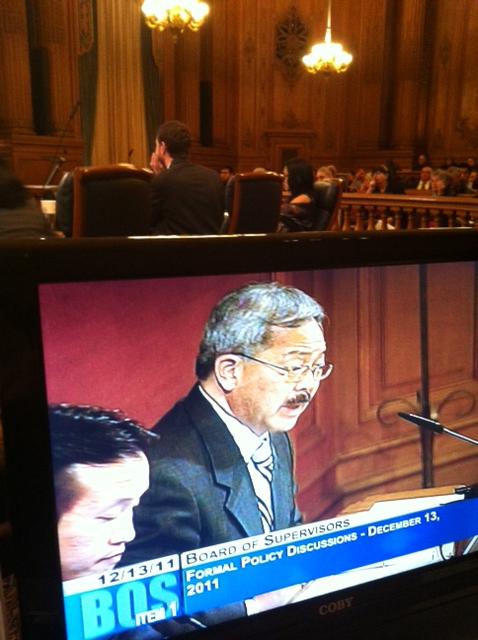
So Ed Lee’s going to veto the Board of Supervisors resolution on Sharp Park. Of course he is. And there’s more than snakes and frogs at issue here.

The veto, I think, sets the tone for what we’re going to see over the next four years, which is: Gavin Newsom.

For four years, the progressive bloc on the board — that is, the shaky sometimes-majority that can pull together six votes on an issue — is going to run slam into a mayoral veto a good deal of the time.

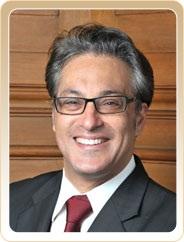
In this case, John Avalos, David Campos, David Chiu, Jane Kim, Eric Mar and Ross Mirkarimi — that’s the list of the six — all supported a plan to negotiate with the National Park Service to take over the property, which would probably mean the end of the golf course. It’s an environmental issue, mostly, and also a public-resource issue — but the main thing is that it’s an issue that split the board along the left-center/right lines that we’ll see again and again over Lee’s term. And Lee is siding with the right.

That’s what we came to expect from Newsom — every progressive initiative was a struggle; often, bill sponsors had to line up eight votes, not six, because there was always the threat that Newsom would shoot it down. And I’m getting the feeling that we’ll be facing the same thing with Mayor Lee.


A step forward and step back for SF’s homeless families

26

As San Francisco grapples with a record-high number of homeless families seeking shelter space during the holiday season, a pair of homeless policy discussions at yesterday’s Board of Supervisors meeting highlighted shortcomings and missed opportunities in the city’s approach to the issue.

Mayor Ed Lee announced that he is opening up more shelter space and public housing units for homeless families, finally relenting to weeks of pressure to address the pressing problem. Yet the board also narrowly approved turning surplus city property over to neighborhood residents rather than using proceeds from selling it to benefit homeless families, as city policies call for.

The property in question, 341 Corbett Avenue, is a vegetated hillside near Upper Market that the city declared a surplus property in 2004, transferring it to the Mayor’s Office of Housing to either develop as housing for poor families or to put the proceeds from its sale toward that purpose. Providing housing for the homeless is what city policy calls for surplus property to be used for, according to 2002’s Surplus City Property Ordinance. The property was assessed at $2.2 million, but it wasn’t developed because of costs associated with the steep hillside, nor was it listed for sale.

Neighbors of the property have sought to use the property for open space and a community garden, so the district’s Sup. Scott Wiener authored legislation to facilitate a community garden by transferring it to the Department of Public Works. The transfer would involve no money, leaving homeless advocates concerned about depriving homeless families of any revenues from the property.

“There are a lot of public assets we could sell if we wanted to fund this need or that,” Wiener told his colleagues, noting that neighbors would rather see a community garden on the site and that Upper Market lacks adequate open space.

But Sups. Jane Kim and Eric Mar led the opposition to the move, saying they didn’t object to that kind of community use of this property, but that city policies need to be followed, particularly considering the dire need for more resources to address the needs of homeless families. “I do have concerns about the precedent we set and also being consistent,” she said, arguing for a delay in the action until city officials find a way to compensate MOH for at least some of the property’s value.

“Overriding the surplus property ordinance is not something I want to do right now,” Sup. John Avalos said.

But the board voted 6-5 to approve the transfer, with progressive Sups. Kim, Avalos, Mar, David Campos, and Ross Mirkarimi in dissent. Housing advocates upset by the action directly their ire at the swing vote, one-time progressive Sup. David Chiu, with activist Tommi Avicolli Mecca sending out an e-mail blast saying, “david chiu betrayed us again — he wouldn’t support continuing the 341 Corbett item so that affordable housing advocates could try and work out a better deal with the Mayor’s Office on Housing and others.”

Meanwhile, the skyrocketing number of homeless families has become a big issue in town since the Guardian broke the story on Oct. 13, with repeated stories in the Chronicle, Examiner, and other media outlets, and homeless advocates staging rallies outside City Hall and unsuccessfully pushing for a meeting with Mayor Lee on the issue.

During yesterday’s monthly mayoral question time, Kim asked Lee what he was doing to address the “alarming rate” of homeless families in the city – with 267 families now on a wait list for emergency shelter space, a 356 percent increase since 2007 – specifically challenging him to expand the city’s Rental Subsidy Program by 50 families and open new emergency winter shelters. She also noted three recent suicides in the city by individuals facing homelessness.

“I share your concern about family homelessness in San Francisco. My staff has been hard at work for a long time now trying to proactively respond to this very serious challenge and I’m proud to offer some very constructive, tangible solutions,” Lee said. He announced that his administration had just this week starting expediting the placement of homeless families into vacant public housing units, with 18 families now being processed and a goal of placing about 30 of the 79 families now in shelters into public housing units.

Lee also said that SalesForce.com CEO Marc Benioff is donating $1.5 million to the Home for the Holidays program the city is creating to provide rent subsidies and case management to 160 families, a donation that the city will match. “Their generosity is inspiring,” Lee said.

He also pledged to open up an unspecified number of new family shelter spots and, somewhat bizarrely, tried to wrap this issue into his relentless focus on promoting private sector job creation, mostly through tax breaks that actually cut into the city’s ability to provide direct assistance to homeless families. As Lee said, “The long-term goal is to increase these families’ incomes and to place them into permanent unsubsidized housing.”

SF supervisors urge city to defy federal immigration holds

57

The San Francisco Board of Supervisors yesterday (Tues/13) approved a resolution calling for the city to adopt stronger policies for resisting federal efforts to deport undocumented immigrants who live here. It is the latest move to support the city’s Sanctuary City status and counter the federal Secure Communities (S-Com) program, a new database that allows the feds to circumvent local policies protecting local immigrants who have been arrested but not convicted of any crimes.

The resolution urges the Sheriff’s and Juvenile Probation departments not to honor civil immigration detainer requests from U.S. Immigration and Customs Enforcement until there is a written agreement to have ICE pay for all local costs associated with the incarcerations. The Santa Clara County Board of Supervisors adopted a similar policy in October, a move also being pursued in Chicago, New York City, Washington DC, and other jurisdictions.

“It doesn’t make communities safer. In fact, it makes immigrant communities less safe,” Sup. Eric Mar, who authored the resolution, said of S-Com, noting that it makes immigrants less likely to report crimes or cooperate with police. “I urge you to support this message and to follow the lead of jurisdictions like Santa Clara and Chicago, Cook County.”

Sups. David Campos and Jane Kim asked to join Mar and Board President David Chiu as co-sponsors of the measure, which was then approved on an 8-3 vote, with Sups. Sean Elsbernd, Mark Farrell, and Carmen Chu in dissent. Members of the San Francisco Immigrant Right Defense Committee, who had lobbied hard for the resolution and who packed board chambers, erupted in a sustained standing ovation after the vote.

Angela Chan, an attorney with Asian Law Caucus who helped lead the effort, afterward told supporters, “It’s because of this group’s hard work that we got a lot more votes than we thought we’d get,” noting they only had six solid votes going in. “Thank you, happy holiday, and we have lots more work to do.”

Chan hopes the resolution will give political cover to Ross Mirkarimi – who supported the measure as a supervisor and who takes over as sheriff at the end of the month – to expand policies created this year by Sheriff Michael Hennessey to resist some immigration detainer requests. Mirkarimi hasn’t yet returned calls for comment on the issue.

San Francisco has a fraught recent history on how to handle undocumented immigrants accused of crimes. Two years ago, the board adopted a policy of refusing to report them to the feds until they had been convicted of serious crimes, approving the Campos-authored legislation on a veto-proof 8-3 vote, only to have then-Mayor Gavin Newsom refuse to enforce the policy. After that highly charged fight, the creation of the S-Com program allowed the feds to circumvent those restrictions by directly finding out whether local inmates are undocumented, making moot Mayor Ed Lee’s agreement to partially implement the Campos legislation.

As we report in this week’s paper, this is one of a number of issues related to local control and an overreaching police state where Bay Area communities such as Berkeley, San Francisco, Richmond, and San Jose are trying to push back on the federal government. Sup. Jane Kim is currently working on an ordinance to restrict the participation of San Francisco http://www.sfbg.com/2011/04/26/spies-blue. Advocates say she plans to introduce the measure next month, but Kim told us she’s have some difficulty getting sign-off from the City Attorney’s Office.

Progressives split on bag ban, ex-cons

12

A couple of interesting votes at the Board of Supes Dec. 6. Sup. Ross Mirkarimi lost two pieces of legislation — a mandate that stores charge for bags at checkout counters and a tax credit for companies that hire ex-offenders.

The bag ban went down 7-4. Well, actually, it was continued to February, by which time Mirkarimi will be gone. Sup. Jane Kim said she wanted to see more outreach to minority businesses, and was quoted in the press saying she would support it at a future date, but I suspect the delay marks the end of the bill. Without Mirkarimi around to push it, the measure will probably just die. It’s odd because San Francisco used to be on the cutting edge of environmental issues; the bag ban is getting picked up by other cities and will probably be law all over the country in a decade.

Voting for the continuation were three supes who said they supported the “concept” — Scott Wiener, David Chiu and Kim.

The ex-offender tax credit went down 6-5 — and on this one, Sup. Malia Cohen, who is not always with the progressives but whose district has the largest number of parolees in the city, supported Mirkarimi. So did Kim, Eric Mar, and David Campos. The swing vote: Sup. John Avalos, the progressive leader in the mayor’s race and one of the most solid left votes on the board.

Avalos told me that he doesn’t support tax breaks; he’s been consistent on that, and I understand. I don’t support tax breaks, either. I don’t think they’re very effective and they cost the city money. But there are two elements that make this unusual — for one, if anyone actually used the tax credit and hired an ex-offender, the money the city would likely save by keeping that person from going back to jail would greatly exceed the amount of the tax reduction.

Besides, I was waiting to see Lee come up with an excuse to veto the bill — particularly at a time when more and more ex-offenders are going to be released in San Francisco. I know this is just petty politics and all that, but this was a tough decision involving a very unpopular group (nobody wants to be nice to former criminals) — and Lee got off easy.

The food divide

4

news@sfbg.com

Antonia Williams is part of a slow, quiet food revolution. After battling obesity for much of her adult life, the 26-year-old lifelong Bayview resident did some research. “I realized it had a lot to do with the food I consumed,” she told us. “As a result of growing up in the neighborhood, I suffer from obesity. I’m overweight because of the lack of options for good healthy food.”

“It’s what I grew up on, McDonald’s and a lot of fried food for dinner,” she recalls. “The grocery stores in the area were very limited in what they offered. I believe my parents weren’t as educated or aware” about health and nutrition.

Williams managed to escape this bad foods trap, change her personal diet, and now works as a “food guardian” for the nonprofit Southeast Food Access (SEFA), helping to bring more nutritious fare to the Bayview.

The complex of challenges Williams faced simply to eat well—the fast food all around her, the dearth of grocery stores, and lack of awareness—reflects the array of systemic barriers to good food that keep tens of thousands of San Franciscans in chronically poor health.

Under the weight of recession and double-digit unemployment, San Francisco’s chronic food divide has grown deeper and wider. From regions of the city like Bayview, Excelsior, and other Southeast neighborhoods, to seniors surviving on marginal fixed incomes, to the city’s swelling unemployed and underemployed who rely on food pantries, access to fresh food is a daily geographic and economic battle.

Roughly one in five San Franciscans each day has no reliable source of adequate sustenance and must scramble for food from soup kitchens, food pantries, or other “emergency” supplies that have become a structural part of the city’s food system, according to the San Francisco Food Bank.

Each month, more than 100,000 families rely on the Food Bank to help feed themselves — nearly double the amount from 2006. Economic recession has dramatically increased the number of city residents using food stamps (known as “CalFresh”) each month, rising from 29,008 in 2008 to 44,185 in 2010.

Yet even that rise belies a far deeper need: only 47 percent of those qualifying for CalFresh are actually accessing benefits, according to a data analysis by California Food Policy Advocates; at minimum, more than 40,000 additional city residents are entitled to get this help, and thus eat better.

Across the city, parallel economic and food divides compound one another, spelling serious trouble for people’s basic nutrition and health — in turn depleting their energy, cognition, and ability to do everything from succeeding in school to getting a job.


BEYOND GROCERY STORES

In Bayview, where poverty and unemployment run about double citywide averages, these geographic and economic food divides come to a head. District 10, encompassing Bayview/Hunters Point (BVHP), features some of the city’s most grocery-impoverished neighborhoods, and has the highest rates of CalFresh usage.

This confluence of lack and need—compounded by a prevalence of fast food and liquor stores over fresh food offerings—has inspired Antonia Williams and other residents to fight for better food in their neighborhoods.

As one of four paid Food Guardians for SEFA, Williams spends about 20 hours a week examining grocery store shelves in Bayview, talking with consumers and food retailers, and educating both about the need for more fresh non-processed foods.

One recent victory: armed with customer survey data, she convinced the Bayview Foods Co. to stock low-sodium tomato paste. Next on Williams’ food improvement list is getting more low-sodium products, less cholesterol, and more fiber on the shelves.

These may sound like small steps, but they’re part of a larger effort to get healthier food in Bayview, where chronic diseases such as obesity, diabetes and heart disease are rampant. “I think a lot of people just don’t know the link between the food we are eating and these chronic diseases,” says Williams.

The Bayview is among the city’s most food-deprived districts, with just 63 percent of residents living within a half-mile of a supermarket (in Excelsior, it’s 57 percent), compared with 84 percent citywide. That ratio improved somewhat with the arrival this August of Fresh & Easy supermarket on Third Street, but access to fresh produce remains limited — a situation that numerous studies show contributes greatly to chronic undernourishment and disease.

Indeed, statistics show Bayview area residents suffer by far the city’s “highest rates of everything negative,” as former district supervisor Sophie Maxwell puts it: obesity, diabetes, heart disease, and cancer.

Ironically, the Bayview’s Third Street is home to the city’s bustling produce warehouses, which rattle early every morning with trucks and crates full of fruits and vegetable, “but you have to go out of the district to get it,” says Maxwell, who helped spearhead a Food Security Task Force while in office. “I was very much aware of [the food access problem] because of what I had to do to get food myself.”

Much of Third Street remains a boulevard of liquor stores and fried and fast food. According to Tia Shimada of California Food Policy Advocates, “A lot of what we see instead of food deserts is food swamps, where the amount of healthy nutritious food available is overwhelmed by all the fast food and junk food.”

Despite a seemingly diverse landscape of food businesses, “There’s a saturation in neighborhoods with unhealthy choices,” SEFA’s Tracey Patterson argues. “When the cheapest choice in front of you is fatty comfort food and fast food, that’s what you get accustomed to eating. The easier options quickly become habit.”

Kenny Hill, a 23-year-old food guardian and Bayview resident, puts it like this: “What we have in our community, that’s what we eat.” But he says history and culture play a role, too. “We need to change the culture of what’s considered good…Growing up eating salad, people would say, ‘Why are you eating that? That’s white people’s food.'”

In other words, it takes more than getting a grocery store—which itself involved a nearly 20-year struggle for Bayview residents and leaders. “Food access is just one part of the issue. Even if you get a grocery store, that doesn’t solve the problem,” says Patterson, whose group, SEFA, espouses “three pillars” to fix the area’s food problems: more grocery stores; education and health literacy; and expanded urban agriculture. “None on their own is enough.”


HUNGER CROSSES LINES

Getting a job isn’t enough either, statistics show. A recent study by the USDA cited by the Food Security Task Force shows that 70 percent of families nationwide with “food insecure” children have at least one member working full-time. And in San Francisco, the task force found, “39 percent of the households that receive weekly groceries through the SF Food Bank include at least one working adult. Only 18 percent of clients are homeless.”

At least by federal definitions of poverty, food insecurity isn’t just for poor people anymore — particularly in San Francisco, where exorbitant housing and other costs compound people’s struggles to meet their food needs. “If you just look at the poverty level, you’re missing a lot of people who are struggling to make ends meet,” says Colleen Rivecca, advocacy coordinator with St. Anthony’s Foundation. “Hunger and health and housing are so interconnected.”

Indeed, while the Federal Poverty Level for a family of three is $18,310, cost-of-living research by the INSIGHT Center for Community Economic Development found that in San Francisco, this family would need almost $40,000 more than that to make ends meet.

Rivecca says the ongoing recession is simultaneously deepening the food divides and undermining efforts to address it. For instance, SSI recipients must make do with $77 a month less than they got in 2009, while California is the only state where SSI cannot be supplemented by food stamps.

According to the Food Security Task Force, San Francisco “has an inordinately high number of residents who are elderly, low-income and/or blind and disabled — over 47,000 residents receive SSI.” Many are homebound, socially isolated, and living in SRO units without kitchens, and no means of preparing their own food. So it’s no surprise that these same people, who need help the most, often get it the least.

Due to “misconceptions about what qualifies,” says CFPA’s Kerry Birnbach, only 5 percent of Californians eligible for Social Security participate in CalFresh. “Senior citizens are more isolated, and the more isolated you are, the less likely you are to know about it.” Birnbach says that leads to lower nutrition, less energy, and greater hospitalization rates. “It’s not having food on the table — choosing between food and medicine.”

A 2006 study by the San Francisco Department of Aging and Adult Services found that while the city’s elders “received approximately 12.2 million free meals through all of the programs in the City including food pantries, free dining rooms, and home delivered meals, the gap between the number of meals served and the number of meals needed was somewhere between 6 [million] and 9 million meals annually.”


BAND-AID FOOD SYSTEM

As television cameras made clear on Thanksgiving, there’s no shortage of food and meal giveaway programs, soup kitchens run by churches and nonprofits — a whole constellation of ad hoc benevolence spread across the city. But this kind of “emergency food assistance” has become a structural part of the city’s dietary landscape.

Another main ingredient in the city’s food infrastructure is seemingly cheap fast food, which for many poor people becomes the diet of first and last resort. Sup. Eric Mar recalls meeting with teenage mothers and hearing one parent speak about dumpster diving at McDonald’s for what she called “fancy dinner.”

“The cheapest possible food like McDonald’s is seen as a luxury,” says Mar, who last year passed legislation preventing fast food chains from selling kids meals with toys unless they improved their nutrition content. “Poor people rely on whatever’s out there, and when McDonald’s or Burger King sells cheap, it undercuts families’ efforts to get healthy.”

District 10 Sup. Malia Cohen sees the impacts of fast food and junk food every day in Bayview. “There is no infrastructure out there to de-program people” from long-standing fast food habits. “I don’t fault people for eating fast food, but I do want them to think twice and know they have a choice.”

So what is the choice, and how will the city address its deep food divides, which cut across geographic and demographic lines?

So far, it’s a patchwork project. As one step, the supervisors in April passed a new zoning ordinance designed to encourage more urban food production. In Bayview, Cohen says, “We’re looking at urban agriculture as something that’s viable” to feed low-income residents.

Despite the arrival of Fresh & Easy, BVHP remains a critical flashpoint for the food security fight. Markets for fresh produce are few and far between. In 2006 the Department of the Environment teamed with Girls 2000 and Literacy for Environmental Justice to create the Bayview Hunters’ Point Farmers Market, but for a variety of reasons, the customer base wasn’t sufficient for farmers to keep selling there, and the project stalled. Now there is talk of reviving a farmers market in the area.

But for larger, more structural change to take hold, Mar argues, the food gap “has to be a citywide goal and priority.” And, he notes, bigger forces — notably agribusiness lobbies and congressional agriculture committees — make local progress more difficult. “It’s hard because the Farm Bill allows these food companies and commodity groups to keep their prices lower, and small businesses and producers have a hard time keeping their prices low,” encouraging more fast food and obesity and other diet-related diseases.


GREEN GLIMMERS

On a chilly gray late afternoon the day before Thanksgiving, we met with Patterson, Williams, and two other food guardians at Bridgeview Community Garden on the corner of Newhall and Revere in Bayview. Perched on a small chunk of slope overlooking houses and freeway traffic, the plot offers a thriving little harvest of tomatoes, kale, leeks, basil, and other vegetables and herbs. It’s not a lot of food, but along with other nearby agriculture, such as Quesada Gardens and the larger Alemany Farm, it helps bolster residents’ weekly dose of fresh produce.

Equally important, it gives budding food activists like Antonia Williams and Kenny Hill reason to believe things can change. After yanking a healthy crop of leeks from the soil, fellow food guardian Jazz Vassar, 25, notes, “There are a lot of community organizations doing good work here. We have high hopes to change things.”

Even as they work to nourish a different food future, the food guardians are acutely aware of the jagged rocks and stubborn old roots that need to be cleared. Asked what the city should do about Bayview’s many-layered food struggles, Hill responds: “Realize there is a problem in Bayview, and allocate resources here. There are statistics that this is a food desert, there are high rates of crime—people have to wake up and see that people here have been disenfranchised.”

It’s not about having the city do it for them, says Hill. “Give us something to latch on to so we can help ourselves.”

Former Bay Guardian city editor Christopher D. Cook is the author of Diet for a Dead Planet: Big Business and the Coming Food Crisis.

Lessons from 2011 for 2012

4

With the release of precinct results for the 2011 election, we are able to actually see, for the first time, what San Francisco voters did, as opposed to hearing what various nabobs said they did.  There are a couple of key conclusions about the vote that should guide any left-liberal thinking of the key 2012 Supervisor races.

The first thing San Francisco voters did- about 40,000 of them-  was stay home.  Turnout – about 40% – was the lowest for a mayor’s race in 40 years. Moreover, counter to several “expert” narratives, turnout in neighborhoods with large numbers of Chinese voters — Chinatown, the Richmond, the Sunset, and Vis Valley — was lower (average 33%) than in neighborhoods with few Chinese voters — Diamond Heights, Noe Valley, the Castro and West of Twin Peaks — where turnout averaged 40%.

There seems to be four reasons for this curious outcome. A couple of them have lessons for us for the 2012 election that we ignore at our peril.
First, in a City that is clearly center-left, voters were presented with nine center-right candidates, seven of whom were declared by the Chronicle at one time or another to be “serious.” Only John Avalos was a clear center-left choice. This was shown in the huge number undecideds that appeared in poll after poll. Undecided voters are often unhappy at the lack of choice being offered by the field and simply don’t vote.

Second, professional campaign management of the supposedly serious candidates was terrible and actually counter-productive to their candidates’ best interests. The pros actually seemed to have suppressed turnout in key neighborhoods. Ace Smith and Bill Barnes, working for for Ed Lee, spent most of their time trying to distance their candidate from his base and key supporters, made rookie fund-raising mistakes time and again and gave their counterparts in the Yee and Herrera campaigns ample ammunition for a  series of negative ads and mailers.  John Whitehurst and Mark Mosher, working for Herrera, and Jim Sterns, working for Yee, took the opportunity and went negative on the least threatening figure in San Francisco politics in recent memory. 

As we all know negative campaigns generally suppress turnout — and that seems to be the case in this election. Avalos, who after September had no professional management, stayed positive and gained votes by doing so.

Third, organized labor, for the first time in living memory, did not endorse the winning candidate for mayor. Indeed, its official candidate, Yee, came in FIFTH. It’s as if labor decided to concentrate only on its issue — pension reform — and devote no energy, people or money to the myors race. Without labor’ support,effective GOTV in left-liberal neighborhoods is all the more difficult and was clearly beyond the ability of the Avalos campaign to carry by itself.

Labor knew who it wanted to vote on pension reform and narrowly focused only on those voters. That it still has the ability to do electoral politics can be seen in the fact that more total votes were cast on  Proposition C (186,336) — labor’s pension- reform measure –than were cast for all candidates in the mayors race (179,888).

Finally, there were 160 fewer polling places this election than last year, and to make matters worse the Department of  Elections mailed 115,000 voter handbooks with the wrong polling place address causing them to send postcards with the corrections. While this in no way was responsible for the 40,000 fewer votes cast, it was probably worth several hundreds of missed votes.

The lessons for next year? We need good candidates who actually align with political sensibility of the voters. This will be especially true in District Five after Mayor Lee appoints some center-right clone in the most left-liberal district in the city, and equally true in District Three with David Chiu, who has certainly turned to the right since his election. 

Supervisor David Campos in District 9 will be fine in this regard as will Supervisor Eric Mar in District 1 — where he will face a real fight.
Avalos’ showing in the mayors race should do him well in District 11 and offers a real chance for him to be board president in 2013.
Community-based left-liberals and labor must come together closer than in this election and perhaps closer than at any time since the Great depression. Labor’s support for the Occupy movement is a good indication that fruitful common ground can be found. We need each other more than ever in 2012.

We need to work to get good lines for the new districts and have a grand meeting of the minds on how we address the absentee voter issue.  Both labor and the Mirkarimi campaign did absentees well enough to win.  We need to apply their lessons to the Supervisors races.

Dare to struggle, dare to win.

Calvin Welch is a housing activist who has been watching San Francisco elections for more than 40 years.


Lee benefits from vetoing health care reform

25

Downtown groups that pressured Mayor Ed Lee to veto legislation that would have prevented businesses from raiding their employees’ health savings accounts have been funneling big bucks into independent expenditure campaigns formed to keep Lee in the Mayor’s Office.

Meanwhile, the Board of Supervisors today strengthened a weak alternative to the vetoed legislation by Board President David Chiu, which it then continued for two weeks. The amendments by Sup. Malia Cohen were unanimously approved by the board, but her five allies in supporting the vetoed legislation – David Campos, John Avalos, Ross Mirkarimi, Jane Kim, and Eric Mar – preferred that the measure be returned to committee for more analysis, losing on a 6-5 vote.

“We need more time to understand the implications of the amendments. We’re not sure if it actually closes the loophole,” Campos, the vetoed measure’s sponsor, said of provisions in the Health Care Security Ordinance – the city’s landmark measure that required employers to provide some health coverage to employees – that allowed businesses last year to pocket more than $50 million from health savings accounts they created for their employees.

One Cohen amendment specifically addressed one of the more egregious violations – restaurants that charge customers at 3-5 percent surcharge for employee health care and than pocket that money at the end of the year – which Chiu had addressed only by calling for more scrutiny of the tactic by the Office of Labor Standards. She also would require businesses to keep two years worth of contributions in the account, rather than the one year sought by Chiu to address the so-called “January problem” of businesses draining the account at the end of every year and leaving nothing for employees who get sick or injured at the start of the year.

It was perhaps a sign of the heat that Lee took from labor and consumer groups for his veto that he quickly issued a press release today praising the supervisors for addressing the issue. “I applaud President Chiu, Supervisor Cohen, organized labor, small business owners, and the Department of Public Health for finding the solutions to this important public policy that can strengthen our City’s landmark Health Care Security Ordinance. By closing the loophole through these proposed amendments, we can increase access to health care, protect jobs in our small businesses and protect consumers while growing our economy at the same time,” it read.

But Lee appears to have already benefited from heeding the demands of downtown – particularly the San Francisco Chamber of Commerce and Golden Gate Restaurant Association (GGRA) – who made defeating the Campos legislation a top priority, casting it as a new “fee” that would drain $50 million from the local economy.

The San Francisco Alliance for Jobs and Sustainable Growth PAC, created by notorious downtown bagman Jim Sutton, is the best-funded on the four independent expenditure groups that are supporting Lee, taking in $390,000 this fall, including $27,000 from the GGRA and $25,000 from the Chamber’s SF Forward group. Both groups also support the Committee on Jobs, which kicked in $110,000 to the Alliance campaign. GGRA also gave another $10,000 to the pension reform campaign that Lee is pushing, support the Chamber had threatened to withhold if the Campos measure was approved.

GGRA Executive Director Rob Black denied this was pay-to-play politics, noting that the Alliance is also supporting DA George Gascon, Sheriff candidate Chris Cunnie and two ballot measures. “But absolutely, the mayor’s name is on there and the organization voted to endorse him,” Black said.

GGRA voted in August to endorse Lee, Chiu, and Michela Alioto-Pier for mayor. Black said the organization is “generally supportive of Sup. Chiu’s approach to reforming the Health Care Security Ordinance,” and Black specifically said it supports improving requirements that businesses notify employees about the health savings accounts and how to use them.

The GGRA led the original fight against the HCSO in 2006, which was sponsored by then-Sup. Tom Ammiano, who lined up a veto-proof majority on the progressive-dominated board and eventually persuaded then-Mayor Gavin Newsom to support it. The measure created the Healthy San Francisco program and required employers to spend a minimum amount per employee on health care, although federal ERISA law bars cities from prescribing how that money is spent.

GGRA challenged the employer mandate all the way to the U.S. Supreme Court on the grounds that it violated ERISA, losing the case. Many of its members restaurants then opted to use health savings accounts rather than paying into Healthy San Francisco or private health insurance, even though health experts say such accounts are the worst option.

Campos and his allies have maintained that money in these health savings accounts belongs to employees and that businesses that use and raid them gain an unfair competitive advantage at the expense of their employees, customers, and city taxpayers, who are often forced to foot the bill for the uninsured.

Campos and the coalition that supports him has said they may take this issue to voters if the Chiu/Lee legislative fix doesn’t address their concerns.

SF supervisors support OccupySF’s 24/7 encampment

56

The San Francisco Board of Supervisors today approved a resolution supporting Occupy Wall Street and the right of OccupySF to maintain a 24/7 encampment in Justin Herman Plaza, although sponsors of the measure narrowly lost a fight over amending the measure to allow police to use force if “there is an objective threat to safety or health.”

The sponsors of the measure – Sups. John Avalos, David Campos, Eric Mar, and Jane Kim – noted that heath and safety concerns were used as a pretext for both police raids on OccupySF and for last week’s violent police crackdown on the Occupy Oakland encampment, something San Francisco officials uniformly say they want to avoid here. Those four sponsors were joined by Sup. Ross Mirkarimi in opposing the amendment by Sup. Scott Wiener, which passed on a 6-5 vote.

But the overall measure – which urges Mayor Ed Lee to drop his opposition to tents and other camping infrastructure and not order another police raid on the camp – was then approved on an 8-3 vote, with Sups. Mark Farrell, Carmen Chu, and Sean Elsbernd in dissent. Farrell and Chu both expressed support for the movement’s call for addressing severe economic inequities in the country, but they oppose the tactic of occupation.

Board President David Chiu, the swing vote on allowing the resolution to be watered down, said his vote was an effort to get as much support for the measure as possible. “For me, it was important to build consensus here at the board,” he said, praising the work that city officials and OccupySF participants have done to resolve their differences. “I have been very impressed with the behavior of individuals involved in this movement.”

Wiener had made a number of amendments to the resolution that Avalos accepted without objection, drawing the line only at the change that would specifically allow for police to use force to dislodge the protesters. While the nonbinding resolution doesn’t compel any action by Lee or the SFPD, Avalos praised the mayor for meeting privately with OccupySF members after he seemed to take a firm public stand again allowing camping.

“I do want to thank the mayor for coming to the table on how our public spaces can be used,” Avalos said. Kim echoed the point, noting that, “A ton of progress has been made.” The Mayor’s Office has not yet responded to Guardian requests for comment on the resolution or his current position on OccupySF, but we’ll update this post when we hear back.

Wiener and others also thanked Avalos for taking the lead role in addressing this issue. “I want to thank Sup. Avalos for being so open and collaborative,” Wiener said, noting that he’s been very impressed with how OccupySF has handled itself throughout the standoff. “I’m very supportive of OccupySF…It’s been incredibly peaceful and people have been friendly and passionate.”

Superviors and labor leaders challenge Lee’s OccupySF stance

41

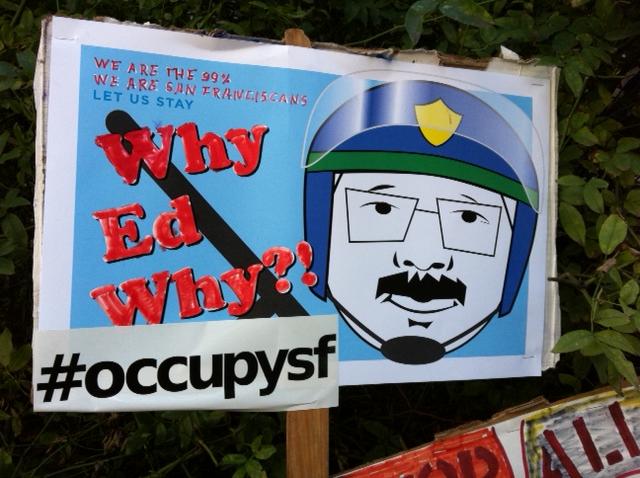
Mayor Ed Lee has put the city and its police force on a collision course with not only OccupySF, but also several members of the Board of Supervisors and top labor leaders who support the movement and want the city to allow its encampment to continue.

They spoke at a special hearing of the City Operations and Neighborhood Services Committee that was convened by Chair John Avalos this morning, supporting a resolution that Avalos created to allow OccupySF to have tents and other infrastructure that Lee opposes. The resolution – which is co-sponsored by Sups. Eric Mar, David Campos, and Jane Kim – was approved by the committee and is set to be considered by the full Board of Supervisors tomorrow (Tues/1).

“It is something I am wholeheartedly supporting because it is an expression of great frustration and concern about the economic system,” Avalos said. “We need to speak with a greater voice about changing our economic system so it works for the many and not just the few,” Avalos said, explaining why he is “wholeheartedly supporting” the OccupySF movement.

But Avalos said he’s been frustrated that Lee and the police have raided the camp twice and are threatening more, something that Avalos has been trying to mediate since the first raid on Oct. 5. He also said the city should learn from Oakland that using the police force to stop the movement only makes it stronger.

“If we were to try to stop it from happening, it would just encourage more people to take part in it,” he said, noting that more midnight raids are dangerous for both police and protesters. “We have to figure out as a city how we’re going to facilitate, encourage, and accommodate this movement.”

But instead, Avalos said Lee’s stand against allowing tents or an kind of encampment, while claiming to support the message OccupySF, has created a tense standoff. “I’ve seen very mixed messages come out of this administration,” Avalos said, adding that nobody believes police statements that the massing of SFPD cops in riot gear on Oct. 26 was only a training exercise.

Mar said OccupySF deserves tremendous credit for holding the space and being responsive to the health and safety concerns raised by city officials. “I’ve seen a transformation in the movement in the last three weeks that is truly impressive,” Mar said. “I’ve also seen, during the General Assemblies, an incredible exercise in democracy.”

He also disputed accusations that the camps are dirty and that the movement is unfocused. “Don’t believe the hype from the mainstream media but look at the messages coming out of this movement,” said Mar, who was wearing a “We are the 99 percent” sticker.

“We should allow OccupySF to do what they’re doing,” Campos said. “It’s good for San Francisco.”

Campos also called out Lee and Oakland Mayor Jean Quan for ordering violent raids on the peaceful encampment, disputing the idea that “somehow it’s okay for us to spend the limited resources we have on these kinds of police actions…I hope we don’t have Mayors Quan and Lee wasting resources that could be better spent elsewhere.”

During the public comment portion of the hearing, each of the more than two dozen speakers supported the resolution.

“What this resolution does is it calls on the other supervisors and the mayor to decide how they want to deal with OccupySF,” said Gus Feldman of SEIU Local 1021.

Representatives of several labor unions and the San Francisco Labor Council that have voted to endorse OccupySF spoke at the hearing, include Ken Tray with United Educators of San Francisco, who gave a rousing speech in support of the movement.

“The times have changed and the political landscape has shifted,” Tray said, ticking off a long list of reasons for supporting the movement, from San Francisco’s long tradition of advocating for progressive change to the fact that “the schoolchildren of San Francisco are being denied resources because the 1 percent refuse to pay their fair share.”

Frank Martin del Campo of the SF Labor Council displayed the bruises on his arm inflicted by police during the raid on the Occupy Oakland, saying “this was an attempt to criminalize dissent…It represents the politicization of the police.”

Labor Council Executive Director Tim Paulson said, “I just want to be clear that we are the 99 percent….We want Occupy San Francisco to be there 24/7.” He and others say the Occupy movement is highlighting deep economic inequities that the labor movement has long been raising as well. “OccupySF has called the question on really important issues we’ve been struggling with for years,” said Gabriel Haaland of SEIU Local 1021

“Here is a peaceful protest being answered with violence,” said Pilar Schiavo of California Nurses Association, which has been supporting the occupations. This is an important political struggle, she said, and “It’s time for the mayor to decide what side he’s on.”

Many speakers focused their criticism on Lee, such as Brad Newsham, who said, “Any official who would send in the riot police to deal with this camp does not deserve to be mayor of San Francisco.” He said the city should set an example for the country by formally allowing the encampment to continue, and he turned to the young protesters in the room and said, “Hold your ground and we’ll try to get your back.”

Sean Semans, an active member of OccupySF since the beginning, thanked Avalos and the other progressive supervisors for “saving us when nobody would,” and he expressed frustration with the Mayor’s Office.

“The mayor still doesn’t recognize us, he won’t come down and see the work we’re doing,” Semans said. “We can do all kinds of work when we’re not fighting to protect our First Amendment rights.”

He was part of an OccupySF delegation that met with Lee last week, and Semans said the mayor offered to help get the protesters rooms in SRO hotels or meals from local soup kitchens, showing that he has a fundamental misunderstanding about what this occupation is about.

As Semans said, “It shows what we’re dealing with here.”

How OccupySF thwarted a police raid

9

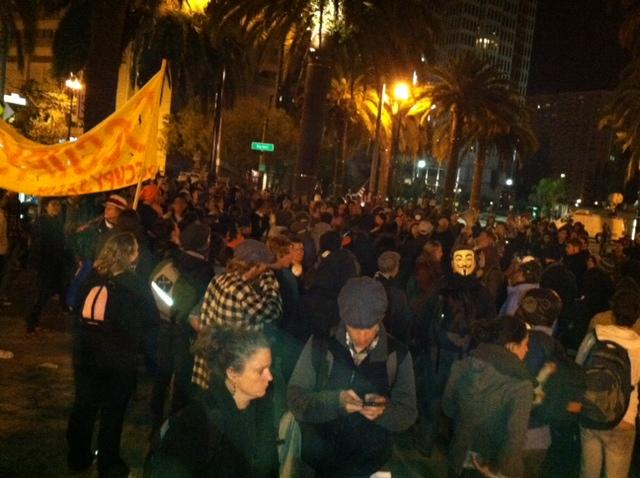
More than 1,000 people amassed at the OccupySF camp last night based on word that police would be raiding the camp. At 4:30 am, there were still 500 gathered in Justin Herman Plaza when OccupySF organizer Ryan Andreola finally announced: “We just got a report from an official police statement that the raid has been called off because there were not enough police for the number of people here,” as the crowd erupted in applause.

It was the end of what was for many protesters a long — and remarkably successful — day. Word began circulating of possible police altercation at 6 a.m. October 26, when police passed through the encampment handing out notices titled “You are subject to arrest,” which claimed that the protest was in violation of several city and state laws and had become a public health hazard.

On Oct 19, city officials had communicated to OccupySF that they would provide portable toilets, but a week later had not followed through; to deal immediately with public health concerns, protesters acquired them on their own.

Around 8:00, having received various tips and seen a document warning nearby businesses of police activity that night, OccupySF put out a call for supporters, saying police raid was confirmed. Justin Herman Plaza officially closes at 10 p.m., so protesters mobilized to be ready for an attack then.
At 9:00, hundreds of people were at the encampment and were meeting about tactics in case the raid occurred. For the next several hours, as hundreds more continued to pour into camp, supporters practiced formations to defend the camp and separate those who were willing to risk arrest from those who weren’t.

At 9:30, photos began circulating social media of scores of police in riot gear waiting with six muni buses near the police operations building in Potrero Hill. Many feared that they were gearing up to descend on Justin Herman Plaza.

Different groups, including a group of clergy, SF Labor Council representatives, a meditation circle and groups practicing blockade formations met throughout the camp. Drum circles continuously pounded, and the Brass Liberation Orchestra jammed throughout the night.

Nurses and medic volunteers distributed materials to protect from and relieve the effects of tear gas, and National Lawyers Guild volunteers scoured the camp making sure protesters had their legal hotline phone number. Talk of the violence and mass arrests at Occupy Oakland that had happened the past few days permeated the group.

The BART stations closest to the OccupySF and Oakland camps were closed last night due to “civil disturbance,” but many supporters still crossed the Bay to swell the OccupySF ranks.

At 10:00, between 500 and 600 people had gathered at the camp. Protesters danced to the constant music and chanted political cries to the beat: “This system has got to die, hella hella occupy!”

Others waited in defense formation around the camp. After spotting Supervisor John Avalos, many began imploring him to sit down in the ranks, which he did.

As the night went on, sightings of police with buses continued. Some protesters joked, “the police are on the way, but they’re taking Muni so it will be a few hours.”

At 12:40, though much of the camp’s kitchen supplies and food had been moved offsite, protesters continued to serve free food. A young man serving up salad and bread gestured to several cases of food, saying “this has all been donated within the last hour.”

At 1 a.m., the group had reached its peak numbers. All sides of Justin Herman Plaza were blocked by masses of people, who also spilled out into the street on Steuart and Market, attracting virtually all passers-by into the crowd. Organizers urged supporters to stay prepared, but as one woman emphasized on a bullhorn “Remember, 99 percent means we are all individuals. It’s your choice how you respond.”

At 1:30, an impromptu speak-out began as protesters, amplified by the Peoples Mic, explained who they were and why they were there that night. Ten minutes later the group decided to allow a makeshift press conference, giving a formal space for five city officials present to speak.

Supervisors John Avalos, Jane Kim, David Campos, David Chiu and Eric Mar, along with state Senator Leland Yee, professed their support for OccupySF and commitment to protecting it from raids. The group was met with mixed responses. Many cheered their support, and one woman said, “I’m from Oakland and I wish Oakland supervisors had done what San Francisco supervisors have done tonight.” Others were less receptive, crying “I don’t trust you!” and “remember, these are the same supervisors that helped pass sit-lie!”

After the politicians finished speaking at 2:00, many supporters left the camp. One man declared, “I’m glad they came, but they do not represent us.”
About 30 minutes later, new reports were coming in that police were massing at Treasure Island. Protesters surveyed their drastically reduced numbers, and voted on what new formations to practice. As the group discussed, drummers punctuated each point, keeping energy high.

Protesters organized new strategies, but by 3:38 there was still no sign of cops. Representatives of labor organizations began a spontaneous rally, speaking to why they supported OccupySF. Mentions of Occupy Oakland’s vote to call for a general strike on Wednesday November 2 circulated, and one labor rep recalled the 1934 general strike.

At 4 a.m., hundreds were still awake and prepared in the camp. Said protester Robert Duddy, “I’m tired. I stayed up last night until 5:30 after getting the notice that we might be evicted. I think they’re trying to wait us out and have our numbers dwindle.” Duddy added that he did not expect the police to show up that night.

Won-Yin Tang wasn’t convinced. “I won’t feel [that we’ve won] until 7 a.m. when they’re not waiting in riot gear anymore. We have to stay focused. When everyone leaves, that’s when they’ll come.”

At 4:30, the long-awaited announcement of victory came. The crowd cheered, and many headed to nearby Muni stations, now open for the morning. Said protester Sam Miller, waiting exhausted in Embarcadero Station, “Tonight was a great triumph of the human sprit. It was the middle class showing we can’t be beaten down anymore. We’re not the zombies that they think we are.”

Protester Sean Semans also celebrated. Said Semans, “We won tonight. Now we just have to sure, if we need to, we can do the same thing tomorrow.”
Staying up until 5 a.m. on weeknights is no easy call to action. But it seems thousands throughout the Bay Area are willing to step up to the plate.

Big victory for OccupySF, Occupy Oakland reconvenes after crackdown (VIDEO)

36

(UPDATED/CORRECTED AT 11:30 AM)The Occupy movements in San Francisco and Oakland reportedly scored big victories last night, with huge numbers of people overcoming police crackdowns and the shutdown of public transit stations, turning back city efforts to clear the OccupySF encampment and voting in the General Assembly in Oakland to call a general strike for Nov. 2.

We’ll have a full reports later today. Occupy Oakland protesters showed up outside a cordoned-off Frank Ogawa Plaza to figure out how to respond to the previous day’s aggressive police raid, which made national news and left Iraq War veteran Scott Olsen in the hospital with a fractured skull after apparently being hit by a tear gas canister or some other projectile fired by police.

In San Francisco, Mayor Ed Lee and the SFPD threatened to shut down the OccupySF encampment over alleged public health problems – which the movement tried to address by bringing in their own porta-potties because the city refused to provide them at night – but the camp swelled with supporters. Among them were mayoral candidates John Avalos, Leland Yee, Jeff Adachi, and David Chiu, as well as Sups. Jane Kim, Eric Mar, and David Campos.

Video by Rebecca Bowe

They spoke to the crowd around 2 a.m., expressing their support and saying that neither police nor Lee had responded to requests for information about the city’s intentions. Other notables on the scene included writer Rebecca Solnit, SF Democratic Party Chair Aaron Peskin, Shawn San Liu of the Chinese Progressive Association, and local labor leaders Tim Paulson, Gabriel Haaland, and Mike Casey. Spirits were high, and protesters were ready to link arms and form a human blockade in the event that police showed up.

SF police reportedly massed nearby in the early morning hours, preparing to clear Justin Herman Plaza, and there were rumors that hundreds more were on the way. BART stations in the area were shut down to prevent more arrivals, while police in Oakland also reportedly stopped protesters there who tried to cross the bay to support OccupySF. But the raid was then reportedly called off because police were outnumbered and possibly to avoid a repeat of the violence and mass arrests that have plagued Oakland since the decision to clear the encampment there, and protesters sent out jubilant messages of victory.

Check back later for video and eyewitness details of what went down, from the the Guardian’s Rebecca Bowe (who contributed to this report) and Yael Chanoff, as well as information on what comes next. Or follow the Oakland live stream here or San Francisco live stream here.

Avalos offers resolution supporting OccupySF and its camp

57

In the wake of last night’s violent police raid on the Occupy Oakland encampment (a still-tense situation that we’re now on the scene covering) and two similar late-night police crackdowns on OccupySF in recent weeks, Sup. John Avalos and co-sponsors Eric Mar and David Campos are introducing a resolution at today’s San Francisco Board of Supervisors meeting that calls for the city to explicitly allow the OccupySF encampment and its related infrastructure to remain.

That resolution (the full text follows below), which Avalos legislative aide Raquel Redondiez says will be the subject of a special hearing on Monday before being considered by the full board on Tuesday, Nov. 1, grew out of testimony from OccupySF participants that Avalos solicited at last week’s board meeting following a late night police raid on Oct. 16 that resulted in five arrests and many injuries.

As we report in this week’s paper (see “Mixed messages,” to be posted this evening, Tues/25), at that Oct. 18 board meeting, Mayor Ed Lee took the position that no tents, kitchens, or other infrastructure would be permitted, a stance that Police Chief Greg Suhr seemed to soften slightly at a raucous Police Commission hearing the next day. In the face of those mixed messages, OccupySF grew into a full-blown tent city in Justin Herman Plaza and there have been no real conflicts with police since.

Both the San Francisco Police Department and the Mayor’s Office were slow to respond to messages we left all week seeking to clarify the city’s policy toward OccupySF, but both finally got back to us last night after the article had gone to press.

SFPD spokesperson Daryl Fong told us, “We’re still currently doing daily safety inspections at Justin Herman Plaza and continuing to provide leafletting…We’re educating the campers about violations and concerns for public safety,” such as unsanitary conditions or unsafe camping structures.

But he said OccupySF hasn’t been given any deadlines for removing structures and there are no current plans for another raid. “Our goal is to get compliance from the campers voluntarily,” he said. “This situation is being continually monitored as it progresses.”

When we asked the Mayor’s Office about the contradiction being Lee’s stance and the city’s reaction to the growing tent city, Press Secretary Christine Falvey wrote, “The mayor’s position on Occupy SF has not changed. He has directed his departments to facilitate peaceful protest, but not allow structures, tents, or a permanent campsite. He wants to ensure the area is safe for demonstrators and the general public. If you have been to the site, you may have seen the Fire and Public Health Departments conducting inspections for public health and safety concerns and you may have seen Recreation and Park and Police staff informing people of the parks and public safety codes that prohibit camping equipment. Individuals are being informed daily of this and the city’s Homeless Outreach Team is offering services to anyone in the area who may need it. The policy stands and departments are educating the group about what is and is not allowed and the mayor expects those who want to use the space to protest, to follow the rules.”

But OccupySF protesters say they have no intention of leaving the space, believing it’s their right to be there as part of a national movement spotlighting the greed and corruption of the wealthiest 1 percent of Americans. And when I told Falvey that the encampment seems to defy the mayor’s stated position, she wrote, “The mayor has asked several departments to enforce the existing codes, and I understand a number of informational contacts have gone out daily to educate those using the plaza about what is allowable in addition to Fire and Public Health inspections to make sure open flames or dangerous materials are not being used or stored at the site.”

I told her that didn’t address my question, and I asked for a reaction to the Avalos legislation that would explicitly allow “tents, tarps, First Aid supplies, environmentally clean and fire-safe energy sources, and the ability to store, prepare, and serve hot food,” which is the reality now on the ground. I’ll update this post when I get a response.

In the meantime, here’s the full text of the resolution:

[Expressing Support for Occupy Wall Street Protest Movement and the People’s Right to Peaceful Assembly in San Francisco]

Resolution Supporting the Occupy Wall Street Protest Movement and Urging Mayor Lee to Uphold People’s Right to Peaceful Assembly and Collaborate with Occupy SF to Ensure Safety of the Protestors, their Supporters, and the Greater Public.

WHEREAS, “Occupy Wall Street” was formed by a broad spectrum of people coming together to protest the corporate-serving economic and political system controlled by the 1 percent, profiting at the expense of 99 percent of the people; and

WHEREAS, Three years after the current financial crisis caused by Wall Street speculators and profiteers, the unemployment rate in the United States is still at the highest level since the Great Depression with the unemployment rate in San Francisco currently at 8.3 percent; and,

WHEREAS, The United States’ major banking institutions, which have been bailed-out by the government and United States taxpayers, have done little to prevent massive foreclosure of residential properties or support the revitalization of local economies by sustaining small businesses; and,

WHEREAS, Since 2008, there have been 1.2 million foreclosures in California, with 12,410 homes in San Francisco alone; and,

WHEREAS, The “Occupy Wall Street” protest movement has struck a chord with the people of the United States and around the world, inspiring over 900 similar protests and solidarity actions across the country, where tens of thousands of people have come out to express their deep indignation against Wall Street greed and systemic socio-economic injustices; and,

WHEREAS, The “Occupy” demonstrations are a rapidly growing movement of people from all walks of life with the goal of occupying public space in order to create a shared dialogue and assert demands for economic justice; and,

WHEREAS, The “Occupy” demonstrations have been supported by the California Nurses Association/ National Nurses Association, American Federation of Labor -Congress of Industrial Organizations, Change to Win, International Longshore and Warehouse Union-International, Teamsters Joint Council 7, Services Employees International Union, Laborers International Union of North America, and many others; and,

WHEREAS, The OccupySF demonstrations began in September with small gatherings of people and have since grown and gained supported from thousands of individuals, community and faith-based organizations, and unions; and,

WHEREAS, On October 12, a 500-person march and civil disobedience organized by local community groups received national media attention, exposing the struggles of San Francisco residents against foreclosure, corporate control, and spiraling unemployment; and,

WHEREAS, The October march and protest action culminated in civil disobedience and, despite the arrest of 11 people, lacked any antagonistic conflict between the police and protestors; and,

WHEREAS, Similar to demonstrations in hundreds of cities across the United States, OccupySF demonstrators are asserting their rights to free speech and peaceful assembly 24 hours a day, seven days a week, in order to create public dialogue around corporate control of the political process and public space; and,

WHEREAS, Numerous and various groups continue to join the protesters at OccupySF, including an interfaith clergy contingent and the California Nurses Association, which has set up a First Aid tent to support the protestors and help ensure public safety; and,

WHEREAS, The City of San Francisco has a right and duty to ensure the safety and security of the general public including the protestors and their supporters; and,

WHEREAS, Since the beginning of the protest, City actions have resulted in the confiscation of food, tents, sleeping bags, and other belongings from the OccupySF demonstrators as well as causing preventable injuries and arrests; and,

WHEREAS, The City has a lengthy and proud history of political protest and has upheld the rights of people to free speech, freedom of assembly, and peaceful protest; and,

WHEREAS, With clear leadership from the Mayor, City departments can set a tone of cooperation and collaboration with OccupySF protestors and supporters, help mitigate harm, and address any public safety, health and sanitation concerns, all while avoiding unnecessary conflict; now, therefore, be it

RESOLVED, That the Board of Supervisors supports the Occupy Wall Street protest movement and the rights of all who protest to assemble peacefully and enjoy free speech in the City and County of San Francisco; and, be it

FURTHER RESOLVED, That the Board of Supervisors recognizes that Free Speech and Freedom of Assembly should not be limited to daytime nor short-term activities and we deem the need of protesters to have tents, tarps, First Aid supplies, environmentally clean and fire-safe energy sources, and the ability to store, prepare, and serve hot food reasonable; and, be it

FURTHER RESOLVED, That the Board of Supervisors urges the Mayor, the Police Department, and other City agencies to uphold the rights of protestors to political speech and public assembly, and to recognize that the full exercise of such rights requires that participants are able to attend to the needs of everyday life, and have a space free from harassment; and, be it

FURTHER RESOLVED, That the Board of Supervisors urges Mayor Ed Lee to direct the Recreation and Park Department, the Department of Public Works, the Police Department, and other City agencies, as relevant, to be flexible and to collaborate with protestors for the safe sharing of public spaces, in which demonstrators can exercise their political rights and the City can address legitimate safety concerns while avoiding unnecessary antagonism; and, be it

FURTHER RESOLVED, That the Board of Supervisors urges Mayor Ed Lee, in order to prevent further harm and conflict to any members of the public, including protestors of OccupySF, to direct the Police Department to ensure that there will be no use of force to dislodge the OccupySF demonstrators and confiscate their belongings.

OccupySF appeals to City Hall, but the standoff continues

40

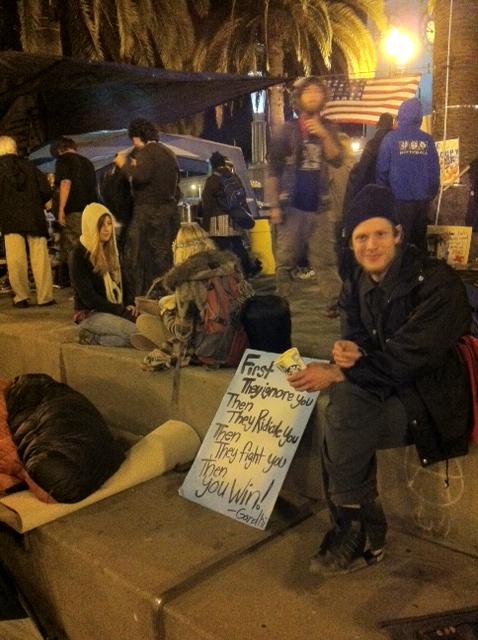
Frustrated by repeated late-night police raids on their encampments and empty statements of support by top city officials, hundreds of protesters with OccupySF entered City Hall today – under the watchful eyes of a large police presence with riot gear at the ready – to testify at today’s Board of Supervisors meeting.

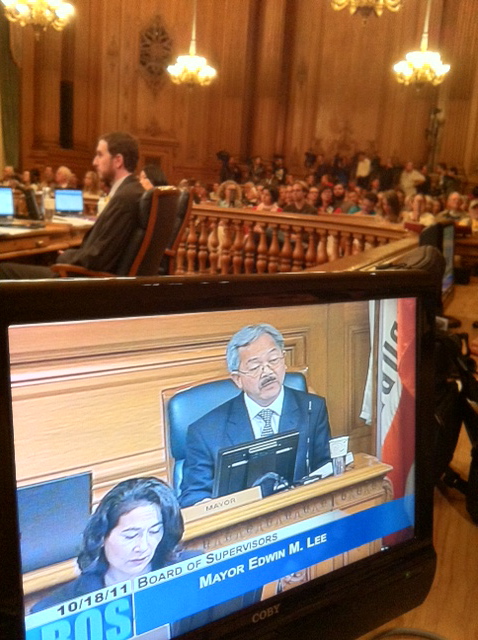
The meeting began with the scripted monthly question time session with Mayor Ed Lee, who was asked by Sup. Jane Kim – whose District 6 includes the OccupySF encampment, which she visited for a couple hours last night – to “describe the plan that our offices have been developing” to facilitate the OccupySF movement.

But in Lee’s response and in exchanges with journalists after the meeting, as well as Guardian interviews with people in both offices, it doesn’t seem city officials have a coherent plan for carrying out Lee’s contradictory goals of supporting the Occupy movement and keeping sidewalks and parks clear of encampments.

Kim seemed to acknowledge as much later in the meeting when she said voiced support for OccupySF and for city officials who object to tents, kitchens, and other basic infrastructure that the month-old movement needs to continue. “We’re all struggling to figure out the best way to accommodate it,” she said.

Lee’s message was even more muddled, saying he supported the movement and agreed with its economic justice message. “From the very beginning, I have fully supported the spirit of the OccupySF movement,” Lee told the crowd, transitioning into reciting a litany of economic development efforts with little relevance to the demands of the movement.

“Then don’t send the police in to destroy it,” a protester shouted from the audience, which was filled to capacity and had a line out front and an overflow room. “We are working with you,” Lee responded, but then went on to complain about the lack of consistent contacts in the leaderless movement and emphasizing his bottom line that any kind of encampment with infrastructure is an impermissible violation of city codes.

“I need to make sure our public spaces are open to be used by anyone,” he said. Later, his Press Secretary Christine Falvey clarified the mayor’s stance by saying he supports the message but not the movement: “The tactic of camping overnight, he does not support.”  

Afterward, talking to reporters, Lee couldn’t really explain why the police needed to do their raids in the middle of the night, why San Francisco is cracking down on conditions that are being allowed in many other Occupy cities, or how the movement might be able to avoid future crackdowns if it continues, ignoring questions about where OccupySF might be able to go to avoid police raids.

Sup. John Avalos, who has been working to try to mediate the dispute between OccupySF and the city, responded to Lee’s speech by calling it “very frustrating. I’m alarmed that he is moving toward nightly standoffs with the Occupy movement.” Avalos says he supports protesters’ right to peacefully occupy public spaces and acknowledges their need for basic supplies to do so, calling the current standoff, “unsafe for both sides.”

“I’m proud to say that we are the 99 percent,” Sup. Eric Mar said, echoing the movement’s mantra and saying he would defer to Avalos’ leadership to create a “resolution strongly holding the police accountable for the crackdowns.”

Avalos had invited OccupySF participants to raise their concerns during the public comment portion of the meeting, and he said that he plans to use their input to form a resolution or plan for how the city should accommodate a movement that six of the 11 supervisors professed to support at the meeting.

When the long line of OccupySF protesters finally took to the microphone for public comment, they made it clear that the issue wasn’t as complicated as some city officials were trying to make it.
“It is outrageous and inhumane to see our camp raided in the middle of the night by San Francisco Police,” Magic, a middle-aged woman and lifelong activist, told the supervisors, closing with, “This can be a celebration or a battle, but we will not back down.”

Several speakers were dismissive of city claims to be protecting public health and safety, noting how dangerous the midnight confrontations have been, saying food and shelter are basic human needs, and noting how peaceful and cooperative OccupySF has been with the escalating series of city demands as the protest’s numbers have grown.

Michael Goldman said police have asked them to return to the sidewalk in front of the Federal Reserve, where they are densely packed in what he called unsafe conditions. “We have too many people to fit in front of 101 Market,” he said.

That was what prompted the move to nearby Justin Herman Plaza, where police cracked down Sunday night, citing a violation of the park’s 10 pm curfew. Another protester who works at the Ferry Building angrily noted that even before OccupySF began, he regularly watched city crews chase the homeless away from the site at 3 am with water trucks.

“We are a peaceful and nonviolent people and we do not deserve to be treated this way by our city and our country,” he said.  

“They were waiting to be talked to and not just run over by the police,” said iconic San Francisco activist Father Louie Vitale, who gestured to the waiting protesters and said, “We’re very proud of these people, very proud.”

It was a point echoed by others like local resident Andy Blue, who said, “They are doing a great service to this city and the world.”

Will Mayor Lee veto legislation that helps workers and protects consumers?

10

After the Board of Supervisors today voted 6-5 to bar San Francisco businesses from pocketing money they and their patrons set aside for employee health care, Mayor Ed Lee faces a tough but telling choice: Whether to heed business community demands that he veto legislation that has wide labor and consumer support.
A veto is widely expected, but complicating that decision is the position that was staked out today by one of his main rivals as a mayoral candidate, Leland Yee, who issued a statement echoing supporters claims that this is an issue of workers’ rights and consumer protection versus corporate greed: “This is a defining issue of who we are as a city. If Ed Lee vetoes this legislation, one of my first acts as Mayor will be to reverse his veto and sign this legislation into law.”
Neither Lee’s mayoral nor campaign spokespersons answered a Guardian email about whether he will veto the measure, which would kill it unless two supervisors who opposed the measure (David Chiu, Sean Elsbernd, Mark Farrell, Carmen Chu, and Scott Wiener) break ranks, which is unlikely given the polarization on this measure. San Francisco Chamber of Commerce officials have made a top priority of killing the measure, even threatening to withdraw support from Prop. C, the pension reform measure that they helped create with Lee.
At issue is the roughly $50 million per year that San Francisco businesses have been taking from health savings accounts they create for employee health care – funds that are often subsidized by 3-5 percent surcharges that many restaurants have chosen to tack onto their customers bills – under legislation that then-Sup. Tom Ammiano created to require employers to provide health care coverage for their employees.
The position of the Chamber – which fought Ammiano’s legislation and supported years of unsuccessful lawsuits challenging it – is that this $50 million “loss” to city businesses would be a “job killer.” Chiu has also accepted that paradigm and introduced legislation that would let businesses use that money, but require them to let employees know they can tap into it and other reforms. But supporters of the legislation say these businesses are deceiving their customers, defying city law, and stealing from their employees.
“People have tried to complicate this issue, but it is a simple issue. It’s about the right of workers to have health care,” Sup. David Campos, the author of the legislation, said at today’s hearing.
Campos said he would limit his comments, given how widely the issue has already been discussed, and he announced a limitation on how long employees could tap the fund after their termination “in the spirit of compromise.” But then opposing supervisors attacked the measure, its timing, and supporters’ refusal to “compromise,” with Elsbernd chiding Campos that his legislation is “not the best way to encourage jobs.”
So Campos went into more detail about why his measure was needed, noting that Chiu’s alternative would cap an employee’s access to health care at just $4,300, far less than the cost of a night’s hospital stay and a small fraction of the cost of a serious ailment. “You’re looking at a situation where very little could be provided for them,” Campos said.
He also said how important it is to ban the fraudulent practice of restaurants charging customers for employee health care costs and then simply keeping the money, a practice that a recent Wall Street Journal investigation discovered was widespread. Campos said 80 percent of the money collected on diners’ bills is pocketed by the restaurants.
“When consumers are paying for this, the expectation is that workers will have basic coverage,” Campos said, noting that his legislation would guarantee that “every cent that that consumer pays is actually spent on health care…This is not just about workers, it’s about consumer protection.”
Even worse, Campos noted that these consumers are actually paying twice for restaurant employees’ health coverage, first on their dinner bills, and then again as taxpayers when those uninsured employees end up in General Hospital with their expenses paid for by the city.
Under the federal ERISA law – which was the basis for the failed lawsuit challenging the city program, brought primarily by the Golden Gate Restaurant Association – the city cannot tell employers how to provide health coverage, and so they have the option of providing health insurance, paying into the city’s Healthy San Francisco plan, or providing the medical savings accounts that this legislation addresses.
Sup. Jane Kim said she supported the legislation largely because of the horror stories she’s heard from employees who not only weren’t told of the existence of these accounts, but who were denied payment for medical procedures even after they learned about them. She also said the city could be vulnerable to another ERISA lawsuit if it took Chiu’s approach of directing how businesses used their funds, citing an earlier discussion of the board’s role in protecting the city from litigation.
On that issue, Kim today introduced an alternative to legislation by Farrell and Elsbernd that would end the city’s program of providing matching funds to publicly financed mayoral and supervisorial candidates once their privately financed competitors break the spending cap. The US Supreme Court recently ruled a similar program in Arizona to be unconstitutional.
The Chamber and other downtown groups – mostly supporters of Mayor Lee, who are close to breaking the spending limits – had signaled their intent to sue the city over the issue. The Farrell/Elsbernd legislation, which needed eight votes to change the voter-approved program, today failed on a 6-5 vote, with Sups. Campos, Kim, John Avalos, Eric Mar, and Ross Mirkarimi opposed.

Progressives battle downtown over economic and political reforms

63

Battles between progressive members of the Board of Supervisors and downtown power brokers such as the San Francisco Chamber of Commerce defined City Hall politics for much of the last decade, until the new politics of “civility” and compromise took hold this year, a dynamic that has favored downtown interests. But now, a pair of important, high-profile issues headed to the full board on Tuesday has revived the old dynamic. And in both cases, wealthy interests are putting enormous pressure on the board.

The first involves a proposal – put forward by Sups. Sean Elsbernd and Mark Farrell, the two most conservative supervisors – to gut the city’s system for publicly financing campaigns because downtown is threatening a lawsuit. They propose to end San Francisco’s program of giving publicly financed candidates more money when a privately funded candidate exceeds the spending cap because the Supreme Court recently struck down similar provisions in Arizona.

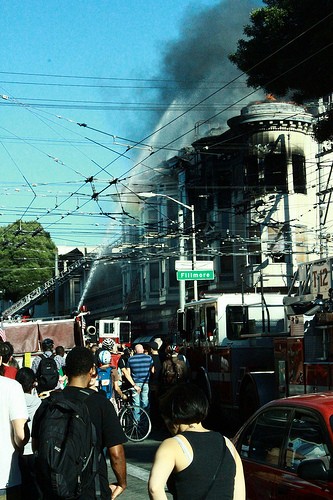
This week, after convening in closed session to discuss the threat of litigation by downtown groups, the board voted 7-3 – with Sups. David Campos, Jane Kim, and Eric Mar opposed, and Sup. Ross Mirkarimi absent because he rushed out to large structure fire in his district – for the Elsbernd/Farrell measure, one vote short of the supermajority needed to amend the current city law.

Campaign finance reform advocates such as Steven Hill argue that it’s unfair to modify the city program right in the middle of an election season in which Mayor Ed Lee and the wealthy independent expenditure groups supporting him are poised to spend millions of dollars to defeat a large field of mostly publicly funded mayoral candidates.

Hill and his allies are appealing to Mirkarimi – who told the Chronicle that he is leaning toward supporting the amendment when the measure returns to the board on Tuesday – not to support what they consider an overly broad capitulation to downtown’s threats. They’re also lobbying Sup. John Avalos to switch his vote, while downtown players are putting the screws to supervisors as well.

In an interview with the Guardian, Mirkarimi clarified his stance, noting that he was the sponsor of the original public financing law and his goal is to protect it, even if it needs to be modified to withstand a legal challenge. “I’m looking for alternatives to fortify San Francisco’s program,” he told us, noting that he missed some of this week’s discussion and he’s hoping something can be done to retain provisions that level the financial playing field with wealthy candidates.

Meanwhile, downtown forces are pulling out the stops to kill Sup. David Campos’ legislation that would prevent San Francisco businesses from pocketing money they set aside for their employees’ health care under a city mandate that they provide health coverage – totaling about $50 million last year – legislation that gets its first hearing tomorrow (Friday/30) at 10 am.

Board President David Chiu has put forward competing legislation that is more to the Chamber’s liking, letting businesses (mostly restaurants that are even placing surcharges of customers’ bills, ostensibly to subsidize their legal obligations) keep the money. But Campos and his labor allies believe they have the six votes they need to pass the legislation, thanks largely to moderate Sup. Malia Cohen’s pledge to support the measure.

While even some supporters have quibbled with the timing of this measure, Campos notes the urgency of keeping money intended for workers in their hands. “It’s an outrage and the longer we wait, the worse it gets,” Campos tells us, noting that the practice, “is what many of us consider fraud.”

Unfortunately, even if the board approves the measure this Tuesday, it will still need the signature of Mayor Lee to become law. While he hasn’t formally taken a position, given that his political base is the downtown crowd, he’s expected to veto the measure. But we’ll ask him about it tomorrow when he’s scheduled to meet with the Guardian for an endorsement interview at 2 pm.

Mayor Lee likes Question Time just the way it is: scripted and boring

26

Mayor Ed Lee appeared before the Board of Supervisors today for his fifth monthly Question Time session, where he was asked by Sup. John Avalos – and subsequently by reporters – whether he would be willing to “change the format to make it a truly interactive, substantive, and dynamic exchange?”
But Lee disagreed with the widespread perception that the scripted nature of these exchanges – a condition that Lee’s office insisted on during negotiations with the board earlier this year, with questions submitted in writing a week before the meeting – is a contrived and dull departure from what San Francisco voters intended when they twice voted to establish Question Time.
“Supervisor Avalos, this is substance, and I think it’s exactly what the voters had in mind with Proposition C,” Lee said, reading from a prepared text. Later, he added, again reading from his script, “I think these are very substantial and dynamic exchanges.”
But apparently, that view isn’t widely shared, as the format has been criticized by a wide variety of media outlets in town, and it was the main topic that the pack of reporters who intercepted Lee in the hallway afterwards wanted to discuss. He was asked whether the session would still be as civil as they are if they were less scripted, and Lee responded that he thought they would still be civil.
“But I like a little more structure to it,” Lee said, adding that he likes to have prepared notes to address the questions that supervisors might ask. “If we don’t set boundaries, it could be a free-for-all.”
But a bit more of a free-for-all is certainly what former Sup. Chris Daly intended when he drafted the legislation, which voters approved as a binding measure last year after first approving it as an advisory measure two years early, only to have then-Mayor Gavin Newsom refuse to come.
For example, when Sup. Sean Elsbernd asked Lee for a status report on the Central Subway project, it’s possible that Lee’s recitation of the project’s benefits might have been followed up with questions asking him to address recent criticisms or the tripling of the project’s costs, which he didn’t mention.
Or perhaps Sup. Eric Mar might have asked a follow-up question when Lee answered the question “Are you willing to require that CPMC enter into a Community Benefits Agreement before their proposal is approved by the city?” by saying, “These community benefits will be incorporated into a Developer Agreement,” reminding the mayor of the premise of his question that many of the benefits that the community is seeking cannot legally be included in the Developer Agreement.
Similarly, Lee also avoided directly answering Sup. David Campos’ question about whether the mayor intends to support legislation by Campos and Sup. Mark Farrell that would require city departments to return to the board for approval of budget supplements when overtime costs are significantly exceeding those that the department budgeted for.
But there is some wiggle room in the exchanges for supervisors who want to freestyle, as long as they are within the narrow confines of civility being practiced at City Hall these days. Elsbernd embellished his approved Central Subway question, calling it an “opportunity to move beyond the clichés and one-liners of political campaigns.”
And when Lee closed his answer to Avalos by inviting him to take part in an upcoming benefit ping-pong match in Chinatown, Avalos asked the mayor, with a slight taunt in his voice, “How is your game?”
To which Lee – perhaps reaching new heights in conflict aversion – said his style of play is “diplomatic and friendship first.” To which Avalos responded, again with an air of challenge, “I used to work at the Boys and Girls Club and played everyday.”
And that, I suppose, is what passes for political conflict and debate at City Hall these days.

Chiu and Kim are making a quick trip to Burning Man

18

Board of Supervisors President David Chiu will take a day off from his busy mayoral campaign next week to attend Burning Man, which he’ll fly into on a small private airplane along with Sup. Jane Kim and spend less than 24 hours on the ground.

“For several years, I’ve wanted to visit the Black Rock Desert to learn about how Burning Man is building 21st Century community, creating art, and fostering sustainability,” Chiu told the Guardian after we learned about the trip from several sources.

Black Rock City LLC, the company that stages Burning Man – an arts and cultural extravaganza that began in 1986 on San Francisco’s Baker Beach and now takes place in Nevada’s Black Rock Desert – has long sought to woo influential city officials to the event, offering free tickets to elected officials and some board aides. With this year’s move into a new Mid-Market headquarters space and creation of the new Burning Man Project nonprofit, both the LLC and City Hall have more reason than ever to seek stronger ties.

Sup. Eric Mar, who attended his first Burning Man last year, will be returning this year on his own to spent most of the week on the playa. By contrast, Chiu and Kim will fly into an airport set up at the event on the morning of Sept. 1 – accompanied by activists Sunny Angulo and Dan Nguyen-Tan, who will essentially staff them during their visit – stay in accommodations set up by supporters and the LLC, and fly out the next morning.

“It’ll be a super quick trip,” Chiu said, but he says that he’s excited to experience the event because, “Burning Man is an extension of our San Francisco community.”

Neither Kim nor Angulo returned calls for comment. Sources who helped set up the trip say they are trying to keep the value of the contributions to each supervisor under California’s $420 limit on gifts to public officials, and that if the value of the tickets, flight, and accommodations exceed that, Kim and Chiu will pay for the difference.

Organizers of the trip were also trying to woo another mayoral candidate, Sup. John Avalos, who considered it but ultimately decided against it. “Can’t pull away, what with being from a working family and with the kids and campaign and all,” he told us.

Tickets to Burning Man, which runs from Aug. 29-Sept. 5, sold out for the first time in its history this year, setting off a mad scramble for tickets that belied the event’s focus on a decommodified gift economy. To deal with that escalating demand, the event is expected to grow from a population of around 52,000 this year up to 70,000 within five years.

To learn more about the event and the culture is has spawned, check out our recent guide; read my book, The Tribes of Burning Man: How an Experimental City in the Desert is Shaping the New American Counterculture; or listen to the podcast of KQED’s Forum that I was on last week with event founder Larry Harvey and celebrated artist Karen Cusolito.

Who doesn’t support Ed Lee?

37

One of the more interesting things about the Democratic County Central Committee’s mayoral endorsements was the lack of support for Mayor Ed Lee among the eight state and federal office holders who sit on the panel.


Under the party charter, any Democrat who lives in the city and represents San Francisco in Sacramento or Washington gets to vote at the DCCC. So U.S. Senator Dianne Feinstein, U.S. Reps. Nancy Pelosi and Jackie Speier, state Senators Mark Leno and Leland Yee, State Assembly Members Tom Ammiano and Fiona Ma and Attorney General Kamala Harris all had a say in who the party would support for mayor. None of those people ever show up at the meetings, but they’re allowed to appoint an alternate to represent their views.


And only Feinstein voted to endorse Lee.


Pelosi’s alternate didn’t show up for the endorsement meeting. Speier abstained. Yee voted for himself. Leno voted No Endorsement. Ammiano suported Avalos. Harris abstained. Fiona Ma voted for Bevan Dufty.


Not a rousing show of support for the incumbent.


(It would have been interesting if Lt. Governor Gavin Newsom were still on the DCCC, but Gav has moved to Marin, and he will now have the distinct honor of serving on that county’s committee.)


Meanwhile: I almost want to ignore Randy Shaw’s attempt to portray the DCCC (and some white progressives in general) as racist for not supporting any of the Asian candidates, since I think it’s too easy to throw that word around in this city, and journalists ought to be pretty careful when they do it. White people (like me and Randy Shaw) need to be particularly sensitive to race issues in the media — and I do think there are real tensions between some old-line progressives and emerging Asian political leaders who don’t always agree with progressives on issues. But that sensitivity should include not sensationalizing race or using race to score political points.


That said, it’s worth noting that of the four Asians on the Board of Supervisors, the DCCC endorsed three (Eric Mar, David Chiu, and Carmen Chu). The only one who didn’t get the DCCC nod for supervisor was Shaw’s candidate in District 6, Jane Kim.


Oh, and the Number 1 candidate endorsed by the Democratic Party is Latino. And the two fastest-growing non-white political populations in the city are Asians and Latinos.


You can fight forever about the politics of the DCCC endorsement and why the panel only chose two candidates. The Guardian will almost certainly support three, since that’s how RCV works. Why Yee, who has the support of both SEIU Local 1021 and the Sierra Club, got only two votes at the DCCC is a fair question. Why Chiu, who is a member of the DCCC, didn’t win the third slot is also an interesting political question. But I honestly don’t think race was a factor. Maybe I’m wrong.    


And as for the whole flap about Aaron Peskin, Rose Pak and the People’s Republic of China (based, by the way, on Peskin’s comments in a Falun Gong newspaper): I met with Rose Pak a few weeks ago, and in the course of talking about Leland Yee (who I will be profiling in the Aug. 31 Guardian) she told me that some progressives were accusing her of being a Communist — a reference to comments by Peskin and Chris Daly linking her to the PRC. She called it “red baiting.”


Just for the record: I’d by happy if Pak WAS a communist — maybe she’d be more interested in income redistribution, progressive taxation and land reform in San Francisco. I like communists. I even got me a picture of ol’ Leon Trostky hangin’ in my office (along with a picture of John Ross, another noted pinko). And years ago, when I had a garage, I really did have a commie flag tacked up on the wall. A friend bought it for me in the Soviet Union back in the day, and one of the reasons I loved it was that it was so poorly made that it started to unravel the minute I stuck the tacks in it, and the colors weren’t quite right, and the silkscreened hammer and sickle was way off center. Go team.


Seriously, I think the era when the label “Communist” was a serious smear is long over. Nobody cares any more. Besides, China isn’t really a Communist country these days, is it? I’m not an expert on the Chinese economy, but it seems much more hyper-capitalist to me. And it’s safe to say that there’s no Cuba-style forced economic equality in China, a country that has a handful of billionaires and a lot of very poor people and may have even worse income distribution than the United States.


Maybe we could talk about the issues?

Shelter from the storm

0

rebeccab@sfbg.com

Ms. Li has a petite build, but she’s physically strong. Hauling around dish bins and boxes of produce weighing 50 pounds was part of her daily routine when she worked shifts lasting 12 hours a day, six days a week, at a San Francisco Chinatown eatery that later made headlines for its poor labor standards.

Li, who did not share her full name for fear of retaliation, says things have improved slightly since the days she worked at King Tin Restaurant, which closed its doors abruptly in 2004 after workers who hadn’t seen paychecks in months filed an onslaught of complaints. At the time, her husband was unemployed and she was struggling to support her two teenagers on a single paycheck totaling $950 a month.

It took about five years before the San Francisco Office of Labor Standards Enforcement (OLSE), the City Attorney’s Office, and grassroots advocates with the Chinese Progressive Association (CPA) finally succeeded in forcing the restaurant’s previous owner to grant Li and other workers the back wages they were owed.

Now, she’s working 12 hour shifts, five days a week at a different restaurant, but says she still isn’t receiving minimum wage or overtime pay. Li aided in the efforts of the Progressive Workers Alliance (PWA) to urge members of the Board of Supervisors to pass the Wage Theft Prevention Ordinance, which aims to strengthen enforcement of local labor standards by empowering OLSE to take a more proactive role against employers who don’t pay workers what they’re owed.

As a kitchen worker at a high-end restaurant in downtown San Francisco, Li receives a monthly paycheck totaling a little more than $1,400 before taxes. Take-home pay is less, because the employer deducts for meals, a requirement that cannot be dodged even if employees bring their own food.

Li told the Guardian her coworkers are angry about the working conditions, but fear of job loss keeps them silent. “Some of my coworkers work so hard that they cry,” she said, speaking through a translator. “One worker was burned badly in the kitchen, and didn’t receive worker’s compensation or paid sick leave.” That person uses their own ointment to treat the burns, she added.

As she described her predicament at the CPA office in Chinatown, student volunteers were creating a banner to be displayed during a press event at City Hall. They arranged folded red and yellow petitions signed by workers in similar situations to spell out PWA, for Progressive Worker’s Alliance, to urge city officials to crack down on employers who violate local labor laws.

PWA has been meeting regularly since last year, but the organizations that are part of the advocacy group have been engaged in organizing low-wage workers for much longer. Over the course of more than three years, CPA interviewed hundreds of restaurant workers in Chinatown, and their surveys revealed that about half were not receiving San Francisco’s minimum wage, while about 75 percent weren’t being paid overtime when they worked more than 40 hours a week. Yet the problem of wage theft in San Francisco extends well beyond Chinatown.

PWA includes representatives from CPA, the Filipino Community Center, Young Workers United, People Organized to Win Employment Rights (POWER), the San Francisco Day Labor Program, and Pride at Work, among others. On August 2, workers and organizers with PWA burst into thunderous applause after the Board of Supervisors voted unanimously to pass the Wage Theft Prevention Ordinance on first reading. This represented a major victory.

“With the economic crisis, and the backlash against workers, we felt that as a small grassroots organization, we needed to have a more powerful voice and a specific space for worker issues to be brought to light,” CPA lead organizer Shaw San Liu said of the impetus behind PWA.

“You’re talking about workers who are pretty vulnerable — not knowing the laws, not speaking the language. People who need a job and cannot afford to lose it are vulnerable to exploitation,” Liu said.

While labor laws in San Francisco are uniquely strong, with mandatory paid sick leave and local minimum wage established at $9.92 per hour, “When it comes to implementation and enforcement, there’s still a lot left to be desired,” Liu said. As things stand, investigation of employer violations are predicated on worker complaints, and it can take years for a worker to get a hearing if they’re owed back wages.

The Wage Theft Prevention Ordinance doubles the fines for employers who retaliate against workers who file complaints. It allows OLSE investigators to issue immediate citations if they detect a problem in a workplace. When an employer comes under investigation, it requires them to post a notice informing workers that they have a right to cooperate with investigators — and imposes a fine for failing to post the notice. It also establishes a one-year timeline in which cases brought to OSLE’s attention must be resolved.

Under the new law, employers would also be required to provide contact information to their workers, an important change for day laborers who are sometimes taken to job sites where they perform manual labor, only to be dropped off later without payment and no way to get in touch with their temporary bosses.

“You have raised awareness about the crisis of wage theft,” OLSE director Donna Levitt told workers at an Aug. 2 rally outside City Hall. “And we have made it clear that wage theft will not be tolerated in our city.”

The ordinance was spearheaded by Sups. David Campos and Eric Mar, with Sups. Jane Kim, John Avalos, Ross Mirkarimi, and Board President David Chiu signing on as co-sponsors. Members of PWA met with supervisors to win their support, and even succeeded in bringing on board the influential Golden Gate Restaurant Association.

“The fact is that even though we have minimum wage laws in place, those laws are still being violated not only throughout the country, but here in San Francisco,” Campos told the Guardian. “Wage theft is a crime, and we need to make sure that there is adequate enforcement — and that requires a change in the law so that we provide [OLSE] more tools and more power to make sure that the rights of workers are protected.”

Victoria Aquino, 66, spent several years working 16-hour hours without minimum wage or overtime pay as the sole live-in caregiver for six disabled patients at a San Francisco care center. Her duties included feeding patients, bathing them, changing diapers, and cleaning.

“The patients would knock to wake me up and ask me for cigarettes or food in the middle of the night,” she recounted, “and I wasn’t paid for that.” She first complained to OLSE after one of the patients physically attacked her, leaving her black and blue with a permanently injured finger, and later sought the help of the Filipino Community Center to file a claim demanding back wages. It took months, but her employer eventually settled, agreeing to pay $60,000 in back wages and reduce her shifts to eight hours a day.

Aquino said she became involved with the Filipino Community Center because “there are a lot of caregivers still suffering, and more than I suffered — especially those who don’t know the laws. I sympathize for them. It hurts me when I hear some caregivers who are no longer supposed to work. They’re past their 70s, and they’re still working.”

Fall ballot gets stripped of progressive measures

25

The San Francisco Tenants Union suffered a pair of disappointing setbacks in the last week – first when a referendum on the Parkmerced project narrowly failed to qualify for the fall ballot, then when progressive supervisors withdrew a proposed ballot measure to prevent demolition of existing rental housing – leaving the fall ballot without any progressive measures (unless one counts the sales tax measure that was unanimously approved this week by the Board of Supervisors).

Also dropped from the ballot this week was another progressive measure that would have prevented the Recreation and Park Department from entering into new commercial leases of parks and recreation centers, a measure written by the citizens group Take Back Our Parks to reverse RPD’s recent push to monetize more of its assets.

Yet unlike last week’s removal of a third measure placed on the ballot by at least four progressive supervisors – the Fair Shelter Initiative, written by the Coalition on Homelessness, which was unhappy that Sup. Jane Kim dropped her support under pressure from the Mayor’s Office – it was the sponsoring groups that asked the supervisors to remove the two measures this week.

Sponsors of the parks measure say it had some legal problems that would have complicated the campaign, particularly after an analysis by the City Attorney’s Office concluded that it could affect things like private party reservations and leases associated with the America’s Cup.

Ted Gullicksen of the San Francisco Tenants Union said his group concluded there were legal problems with the anti-demolition measure as well and that it wouldn’t affect the demolition of 1,500 housing units associated with the Board of Supervisors’ 6-5 vote to approve the massive Parkmerced project, which was the catalyst for the measure.

SFTU sponsored the signature-gathering campaign to do a referendum on that vote, but the Elections Department concluded on July 29 that of the 18,487 signatures that were turned in, just 12,917 were valid, falling short of the 14,336 they needed. Gullicksen said delays in qualifying the 56-page petition gave them just three weeks to gather signatures, and a freak mid-June rainstorm hurt that effort as well.

“We knew from the get-go that it was going to be a challenge,” he said. “It was very disappointing that we fell just short.”

But he said there was a silver lining: “It sent a message to the supervisors. David Chiu [the swing vote on the Parkmerced approval] called me the next day to say he’d make sure demolitions don’t become an epidemic.”

Sup. David Campos – who helped sponsor all three measures and even kept his name on the shelter measure after Sups. Eric Mar and Kim had removed theirs – told us, “I think it’s disappointing that there isn’t a measure on the ballot to excite the progressive base, but at the end of the day, we do have an exciting mayor’s race and races for sheriff and district attorney.”

Campos has endorsed John Avalos of mayor and Ross Mirkarimi for sheriff, but has not yet made an endorsement for DA.

Kim removes homeless shelter reform measure from ballot

8

Under pressure from the Mayor’s Office, Sup. Jane Kim today removed her sponsorship of the Fair Shelters Initiatives, effectively killing the measure that was set to appear on the November ballot, according to activists working on the issue. Sup. Eric Mar reportedly followed Kim’s lead and also removed his sponsorship, telling activists he was deferring to Kim’s decision.

“We hardly expected the supervisors would put a measure forward and then cave in before the campaign had even started,” said Bob Offer-Westort of the Coalition on Homelessness, which had asked Kim to be the lead sponsor of a measure that he said is the homeless community’s highest priority.

The measure would have removed shelter beds from the definition of housing under the city’s voter-approved Care Not Cash program, thus freeing up beds for the larger homeless population that is often denied space in shelters even as beds reserved for CNC recipients – who give up most of their welfare support in return for housing and services – often remain vacant.

The measure — which was sponsored by Sups. Ross Mirkarimi, David Campos, and John Avalos, in addition to Kim and Mar, giving it one more than the four votes it needed to make the ballot – had been harshly criticized by the San Francisco Chamber of Commerce and other downtown groups, as well as Mayor Ed Lee and other moderate politicians, who said it would somehow destroy CNC and attract more homeless people to the city.

In a recent email blast, Chamber head Steve Falk called the measure “alarming” and was “effectively dismantling the nationally-recognized program.” He tried to use the 100 nightly vacant shelter beds as a rationale against the measure (despite the fact that was the very problem the measure tried to correct), and wrote, “This measure is nothing more than pure politics to turn out progressive voters in a crowded mayoral race.”

Kim and her staffers haven’t returned Guardian calls for comments, and neither Mar nor Mirkarimi could be reached. But Offer-Westort said the arm-twisting by the Mayor’s Office shows just how little things have really changed at City Hall.

“It sets a really bad precedent when once again a mayor bullies members of the Board of Supervisors to get his way,” he said, noting that Kim still claimed to support the reform in her conversations with COH members. “It certainly wasn’t because she changed her mind about whether this was right or wrong. It had more to do with her concerns over the board’s relationship with Room 200.”

Wage theft prevention ordinance moves forward

Supervisors expressed strong support July 20 for an ordinance that a San Francisco coalition of labor advocates is pushing for to prevent wage theft and shore up protections for low-income workers. Spearheaded by Sups. Eric Mar and David Campos with Sups. Ross Mirkarimi, Jane Kim, John Avalos, and David Chiu as co-sponsors, the legislation would enhance the power of the city’s Office of Labor Standards and Enforcement (OLSE) and double fines for employers who retaliate against workers.

Dozens of low-wage restaurant workers, caregivers, and day laborers turned out for a July 20 Budget & Finance Committee meeting to speak in support of the Wage Theft Prevention Ordinance, which was drafted in partnership with the Progressive Workers Alliance. The umbrella organization includes grassroots advocacy groups such as the Chinese Progressive Association, the Filipino Community Center, Pride at Work, Young Workers United, and others.

A restaurant worker who gave his name as Edwin said during the hearing that he’d been granted no work breaks, no time off, and had his tips stolen by his employer during a two-and-a-half year stint in a San Francisco establishment, only to be fired for trying to take a paid sick day. “When I was let go, I did not receive payment for my last days there,” he said.

His experience is not uncommon. An in-depth study of labor conditions in Chinatown restaurants conducted by the Chinese Progressive Association found that some 76 percent of employees did not receive overtime pay when they worked more than 40 hours in a week, and roughly half were not being paid San Francisco’s minumum wage of $9.92 an hour.

“People who need a job and can’t afford to lose it are vulnerable to exploitation,” Shaw San Liu, an organizer with the Chinese Progressive Association who has been instrumental in advancing the campaign to end wage theft, told the Guardian.

The ordinance would increase fines against employers from $500 to $1,000 for retaliating against workers who stand up for their rights under local labor laws. It would establish $500 penalties for employers who don’t bother to post notice of the minimum wage, don’t provide contact information, neglect to notify employees when OLSE is conducting a workplace investigation, or fail to comply with settlement agreements in the wake of a dispute. It would also establish a timeline in which worker complaints must be addressed.

“The fact is that even though we have minimum wage laws in place, those laws are still being violated not only throughout the country but here in San Francisco,” Campos told the Guardian. “Wage theft is a crime, and we need to make sure that there is adequate enforcement — and that requires a change in the law so that we provide the Office of Labor Standards and Enforcement more tools and more power to make sure that the rights of workers are protected. Not only does it protect workers, but it also protects businesses, because the vast majority of businesses in San Francisco are actually … complying with the law, and it’s not fair for them to let a small minority that are not doing that get away with it.”

So far, the ordinance is moving through the board approval process with little resistance. Mayor Ed Lee has voiced support, and Budget Committee Chair Carmen Chu, who is often at odds with board progressives, said she supported the goal of preventing wage theft and thanked advocates for their efforts during the hearing. The item was continued to the following week due to several last-minute changes, and will go before the full board on Aug. 2.