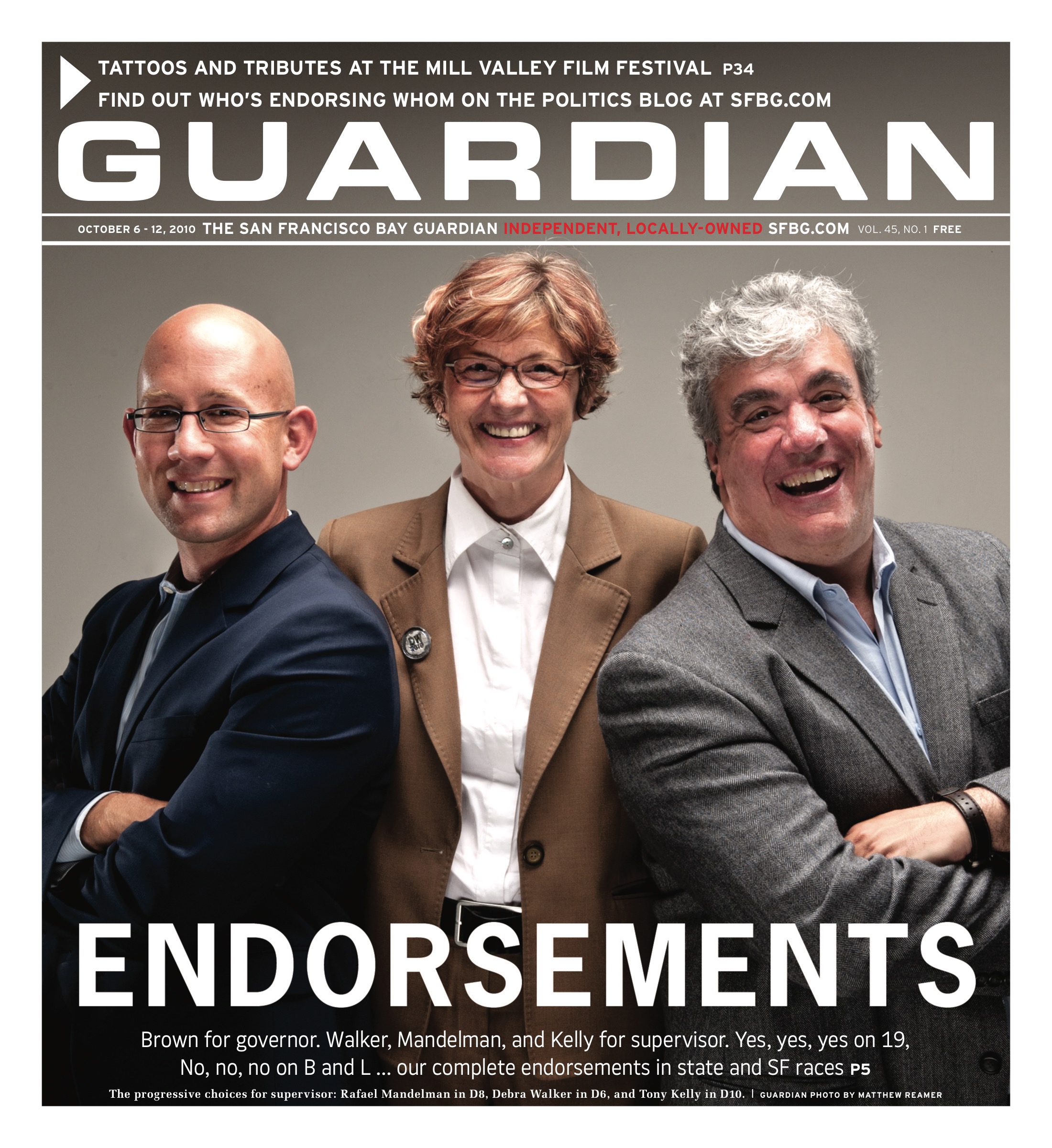
Endorsements

Who’s Endorsing Whom

6

Political endorsements matter in SF. (You can find ours here.) We regularly run this Who’s Endorsing Whom table (PDF) summarizing endorsements by various groups and officials, including some we don’t agree with — but we encourage honest, open debate and informed political participation. Feel free to add other endorsements in the comments sections and we’ll periodically update the chart. 


D8 debate: “Filling Harvey’s Shoes”

0

Editors note: I ran out of space for opinion pieces this week (endorsements just ran too long) so I’m posting this timely oped here.

By Jeff Sheehy

Harvey Milk Civil Rights Academy, a public elementary school in the heart of the Castro, is hosting a debate between the four candidates for District 8 Supervisor on Friday, October 8 at 7 pm.   The school, formerly Douglass Elementary, was named for Milk in 1996. 

The community that comprises the school has adopted an unique mission to honor Milk’s life: to empower student learning by teaching tolerance and non-violence, celebrating our diversity, achieving academic excellence, and fostering strong family-school-community connections.
 
The theme of the debate—“Filling Harvey’s Shoes”— centers on the values inspired by Harvey Milk’s life that have now been enshrined in the mission of the school named after him. Cynthia Laird, the editor of the Bay Area Reporter, and Christina Velasco, principal of Harvey Milk Civil Rights Academy, will moderate, asking questions themselves, taking questions from the audience and reading questions submitted by Harvey Milk students.

One of the candidates was quoted in this paper a couple of weeks ago saying about the race: “It’s a definitional fight about what the queer community is about in 2010.”  This debate offers the candidates the opportunity to directly address this “definitional” question.

In many ways, the LGBT community is at a crossroads. For those with good jobs and good incomes and the means to rent or own a house in District 8, much of the struggle for LGBT civil rights in San Francisco must feel more like history than a critically important issue for someone who seeks election in his former district.

However, I wonder if Harvey’s oft-referenced kid from Altoona hopping a bus to San Francisco in search of freedom would feel the same way. The kids arriving here are much more likely to be kids of color, transgender or undocumented. To what degree does District 8 or even San Francisco offer a place to live or real economic opportunity? Is Harvey’s legacy a gentrified Oz, great for those who can afford it, but little solace to those desperately seeking haven?

Plus, what is Harvey’s larger legacy?  Harvey Milk Civil Rights Academy defines one vision. Kids from under-resourced areas and under-represented communities are actively recruited to the school as part of its commitment to teaching tolerance and diversity. The LGBT experience is presented as one among the many struggles that communities of color, women, the undocumented and working people have fought in America to create a more just and tolerant society. Consciousness of shared struggle and the necessity of creating community amongst the disenfranchised and marginalized are crucial values inculcated at the school. The school’s pledge sums up this vision of Harvey’s legacy:  “I pledge allegiance to the world, to cherish every living thing, to care for earth and sea and air with peace and freedom everywhere.”

My husband and I thought deeply about community and values when we were deciding where to send our daughter to school. We felt that our daughter should begin to understand the world and how to act in it in the context of struggles for civil rights and social justice.  

I hope others in the LGBT community will take a moment and think about their values, hopefully attend the debate on Friday, and recognize that the election for this seat is about the future direction of the community.

Indeed, next May would have been Harvey’s 80th birthday and one wonders which candidate he would have endorsed and in what direction he would have advised the LGBT community to take had he lived.

Sheehy is the parent of a kindergartener at Harvey Milk Civil Rights Academy 

The debate will be held in the auditorium at Harvey Milk Civil Rights Academy at the corner of 19th and Collingwood, in the Castro.

ENDORSEMENTS 2010

55

On every level — federal, state and local — the Nov. 2 election is critical. Californians will decide whether a billionaire with no political experience and a failed business executive with right-wing views should be the next governor and senator. They’ll address a long list of major ballot measures. In San Francisco, voters will decide the balance of power on the Board of Supervisors, weigh in on ballot measures that could deeply affect the local budget, and decide whether this city wants to allow a harsh crackdown on the homeless.

Absentee ballots are already in the mail. Vote early, vote often, and vote like your city and state depended on it. We’ll publish our Clean Slate clipout guide to take to the polls on October 27. Click below for our endorsements. (East Bay endorsements will be added next week.)

>>NATIONAL RACES

>>STATE RACES

>>STATE BALLOT MEASURES

>>SAN FRANCISCO CANDIDATES

>>SAN FRANCISCO BALLOT MEASURES

>>EAST BAY ENDORSEMENTS

Listen to our Endorsement Interviews with local candidates here

get the single page printable PDF in color or black and white

Endorsements 2010: San Francisco ballot measures

26

PROP. AA

VEHICLE REGISTRATION FEE

YES

Proposition AA would add $10 to the existing annual fee for vehicles registered in San Francisco, which would bring in about $5 million a year in desperately needed funds for public transit and other environmentally friendly modes of transportation. Proceeds would help to fund new bike infrastructure, pedestrian crosswalks, and transit reliability projects. Some would also be spent on street repairs — with top priority given to streets with bikeways and public transit routes. Unless Muni and bike infrastructure improves, it’s hard to persuade drivers to leave their cars at home and choose greener ways of getting around. Prop. AA is in line with the city’s transit-first goals, and it will be a step toward reducing traffic congestion and helping public transit. Vote yes.


PROP. A

EARTHQUAKE RETROFIT BOND

YES

This $46.15 million general obligation bond to support seismic upgrades for wood-framed buildings is an important means of protecting San Franciscans in an earthquake and preserving affordable housing. A 2009 report by the Department of Building Inspection found that 151 buildings that received government affordable housing support — 8,247 units in all — could be destroyed in the next big earthquake.

Unfortunately, most of these buildings are break-even ventures for their owners, who have no incentive to put the money into needed seismic upgrades. This measure would fund those improvements with grants and deferred loans, which would accrue interest but would only need to be paid back if the owner makes a profit or tries to convert the building to another use, providing further guarantees that the housing will remain affordable even after an owner’s obligation to the state or federal governments ends. Vote yes on Prop. A.


PROP. B

CITY RETIREMENT AND HEALTH PLANS

NO, NO, NO

Back when the great national health care reform debate was raging, the Guardian advocated for a single-payer system, which would have cut out health insurance companies altogether. What we got instead was a bill that requires everyone to buy health insurance. Now endlessly rising health insurance costs pose a problem for the city — in years of financial stress, it must make ever-larger payments to cover public employees’ health benefits. The blame for this dysfunctional system should be pinned on health insurance companies, not public employees. After all, the industry spent millions lobbying federal lawmakers to preserve a system in which they are solidly guaranteed to make millions off the backs of taxpayers.

But Prop. B, introduced by Public Defender Jeff Adachi, asks public employees to bear the brunt of these ballooning costs. It would also require them to contribute up to 10 percent of their pay to fund retirement benefits. One of the most compelling arguments against Prop. B was articulated by Assemblymember Tom Ammiano in a recent Guardian editorial: “A single mother will be forced to pay up to $5,600 per year for her child’s health care — in addition to the $8,154 she already pays.” That cost would be the same whether the employee earns $40,000 or $100,000 annually — and that’s just unfair. Prop. B would deal the greatest blow to the people who have the least. But there’s a broader consequence, too — take this kind of money out of the pockets of working people and you’ve done just the opposite of stimulating the economy.

Adachi wrote and circulated his measure without negotiating with city employee unions or seeking a solution that would be less harsh and regressive. We’re all for reviewing the city’s pension and health care costs. But making the lowest-paid city workers take the same hit as the overpaid managers is no answer. Vote no on B.


PROP. C

MAYOR APPEARANCES AT BOARD

YES

If you feel like you’ve seen this measure before, that’s because you have — an advisory measure asking the mayor to show up once a month and answer questions at the Board of Supervisors passed overwhelmingly in 2006. But Mayor Gavin Newsom ignored it, and a tougher measure failed the next year after Newsom raised $250,000 to defeat it.

Now the problem is worse than ever. In a year in which back room negotiations and underhanded political tactics marred the city budget approval process and other legislative initiatives, progressive supervisors are again trying to get Newsom and future mayors to engage in a political dialogue, in public, to determine what’s best for the city. This is precisely how the people’s business should be done, in an open and transparent way that respects the role that these two branches of government are supposed to play in running the city. Besides, won’t it be fun to watch? Vote yes.


PROP. D

NONCITIZEN VOTING IN SCHOOL BOARD ELECTIONS

YES

Sponsored by Board President David Chiu and Sups. David Campos, Eric Mar, John Avalos, Ross Mirkarimi, Sophie Maxwell, Chris Daly, and Bevan Dufty, this charter amendment would extend the right to vote in local school board elections to San Francisco residents who are parents, guardians, and caregivers of children who attend school in San Francisco, regardless of whether these residents are U.S. citizens.

One-third of San Francisco residents are foreign-born. Parental involvement has been determined as a critical factor in children’s education — and this measure only applies to elections for the Board of Education. Vote yes.


PROP. E

ELECTION DAY VOTER REGISTRATION

YES

In an era of growing political apathy and cynicism, anything that draws more people into the electoral process is a good thing. So this common sense measure by Sup. Ross Mirkarimi to remove one more barrier to participation in elections is a positive step.

Current state law requires eligible voters to register at least 15 days before an election. Prop. E would allow any city resident to simply show up at a polling place on Election Day, register to vote, and participate in a municipal election. Eight other states currently offer same-day voter registration. Vote yes.


PROP. F

HEALTH SERVICE BOARD ELECTIONS

NO

Sup. Sean Elsbernd, who sponsored this measure, says it will save the city money be consolidating elections for the board that oversees the city employee health care fund. But it won’t save much — $30,000 a year, at most — and the unions that represent the people who are served by this board say risks turning board elections into more expensive and complex political contests. Vote no.


PROP. G

TRANSIT OPERATOR WAGES

NO

We understand the motivations behind this measure — Muni drivers are the only city employees who don’t have to engage in collective bargaining for wages and work rules. Instead, the City Charter guarantees them the second-highest salary level of all comparable transit systems in the nation. Although that’s not an unreasonable salary level given that Muni is perhaps the country’s most challenging transit system and San Francisco has one of the highest cost of living price tags in the country, no city workers should have their salaries set this way.

We also agree that many of Muni’s work rules need to be changed and that removal of the salary guarantees would give the city more leverage to make those changes. We even agree that Transport Workers Union Local 250 hasn’t done itself any favors and should have been a better partner in this year’s difficult city budget process.

But we oppose Prop. G, which inappropriately seeks to blame Muni’s problems on its drivers and would set a new standard for collective bargaining that could hurt workers and perhaps make Muni more dangerous to pedestrians and others.

Like all city employees, Muni drivers are banned from going on strike. In exchange, the city agrees to binding arbitration if contract talks reach an impasse. But this measure adds a factor that exists in no other city union contract: the arbitrator would have to consider whether a proposed contract could negatively affect service.

While that might seem benign or even appropriate, the reality is that everything from driver rest breaks to assisting those with disabilities to the expectations of how fast drivers can complete a route all potentially affect service, forcing the arbitrator into positions of agreeing with city officials who have been choosing the politically expedient path of trying to squeeze more out of Muni without trying to give it the resources it needs to operate safely, efficiently, and reliably.

Earlier this year, progressive supervisors tried to craft an omnibus Muni reform measure that removed driver pay guarantees from the charter while also trying to get it more money and make critical changes in how the system is governed, an effort the TWU supported but that the supervisors ultimately abandoned. That’s the kind of balanced approach the system needs and it ought to be revived. In the meantime, vote no on G.


PROP. H

LOCAL ELECTED OFFICIALS ON POLITICAL PARTY COMMITTEES

NO

This one’s a pure political vengeance act by Mayor Newsom, who is unhappy that the local Democratic Party is controlled by progressives who oppose his initiatives. The measure would bar elected officials in San Francisco from serving on the Democratic or Republican County Central Committee. It’s almost certainly unconstitutional — the parties get to decide their own membership rules — and has no rationale at all except the mayor’s personal sour grapes. Vote no.


PROP. I

SATURDAY VOTING

YES

Okay, we’re suspicious of Prop I. The sponsor is Alex Tourke, a political consultant whose client list isn’t exactly a roster of progressive San Francisco. And it’s a little funky — it calls for an experiment in opening the polls the Saturday before the next mayoral election, with the costs covered by private donations. And the idea of private interests paying for an election strikes us as bad policy.

But at its base, the idea is sound. Tuesday voting is a very old idea that makes no sense in the modern age. We’d much rather see Election Day held at a time when most people aren’t working. In fact, we’d rather see the polls open for a week, not just one day. And this is a one-time test to see if weekend voting might increase turnout. Vote yes.

PROP. J

HOTEL TAX CLARIFICATION AND TEMPORARY INCREASE

YES

There are two competing hotel taxes on the November ballot: Prop. J and Prop K. Prop. K contains a poison pill: if both measures pass, whichever gets the most votes take effect. Both J and K try to address legal insufficiencies in San Francisco’s existing hotel tax, but Prop. J also asks visitors to pay a slightly higher tax — about $3 a night (the cost of a latte) — for the next three years.

Currently the way hotel taxes are assessed allows some online customers to avoid part of the tax. When a customer books a hotel room through an online booking service like Expedia or Orbitz, the hotel tax is only assessed on the amount that a hotel receives, not the amount that the website charges the customer. In other words, if a website sells a room to an online customer for $150 a night, but only $120 of that goes to the hotel, the customer is charged hotel tax on the lower amount. If Prop. J passes, the customer will have to pay a hotel tax on the full amount paid to the online booking service. The measure would also eliminate a loophole that allows airlines to book rooms for flight crews without paying any tax. Those changes are expected to generate at least $12 million a year. The $3 increase in the hotel tax will generate another $26 million.

The Chamber of Commerce and Convention and Visitors Bureau say the measure could hurt tourism — but it’s hard to imagine how somebody will decide not to visit San Francisco because of a $3 a night fee. Vote yes.


PROP. K

HOTEL TAX CLARIFICATION

NO

Put on the ballot by Mayor Newson at the behest of large hotel corporations, Prop. K also seeks to close loopholes in the hotel tax. But Prop. K doesn’t include a tax increase, meaning that it will contribute millions less to the city’s General Fund at a time when San Francisco is having trouble balancing its budget, leading to ongoing cuts in city staff and services.

Prop. K’s a direct attempt to undermine Prop. J. Vote no.


PROP. L

SITTING OR LYING ON SIDEWALKS

NO, NO, NO

What kind of a city is San Francisco? If proponents of Prop. L, the Civil Sidewalks Ordinance, were to be believed, it’s a city where nothing is done when uncivil people harass pedestrians, drink on the sidewalk, or pee in public. Even though Prop. L purports to address this kind of behavior, all it really does is outlaw sitting or lying on public sidewalks.

We think San Francisco is the kind of city that is smart enough to reject this dumb idea. The Prop. L proponents like to say it’s about public safety, but there is nothing inherently unsafe about sitting or lying down on the sidewalk. Street poets sit at their typewriters to sell sonnets to tourists. The tamale lady sometimes sits while selling her tasty Mexican treats. Day laborers sit when they get tired of standing around waiting for work. Many people who live on the streets lie down to sleep beside their shopping carts. If Prop. L passes, there is nothing to guarantee that buskers, day laborers, homeless people, partygoers, people with bad knees, or anyone else would not be harassed by police for the simple act of sitting.

But even if there are people squatting on the sidewalk harassing passersby, how is this law going to change that? All they have to do is stand up — which would still be legal. If they persist, and the police arrest them, the city will be on the hook for millions of dollars in costs for prosecution, defense, and incarceration.

The notion that the ordinance would only be used against troublemakers is problematic too, since a law that is selectively enforced could open the door to legal headaches. Prop. L is misguided, draconian, unnecessary, and the wrong direction for San Francisco. Vote no.


PROP. M

COMMUNITY POLICING AND FOOT PATROLS

YES

Prop. M offers an enlightened alternative to Prop. L. Introduced by Sup. Ross Mirkarimi, it would require the chief of police to establish a comprehensive beat patrol program, with cops on the beat, to deal with the safety and civility issues Prop. L seeks to address. It would also direct the Police Commission to adopt a written community policing policy, involving police interactions with the community, focusing police resources on high crime areas, and encouraging citizen involvement in combating crime. Prop. M also has a poison pill: if the voters adopt both M and L and M gets more votes, then the law against sitting or lying down on the sidewalk would not take effect. So a yes vote for Prop. M is kind of like another no vote against Prop. L. Vote yes.


PROP. N

REAL PROPERTY TRANSFER TAX

YES

With the city facing a massive structural budget deficit, it’s hard to argue against a measure that would bring in an average of $36 million without hurting anyone except the buyers and sellers of very high-end property — that is, big corporations and exceptionally wealthy individuals. Prop. N would slightly increase the tax charged by the city on the sale of property worth more than $5 million. Vote yes.


>>BACK TO ENDORSEMENTS 2010

Endorsements 2010: San Francisco candidates

53

SUPERVISOR, DISTRICT 2


JANET REILLY


Frankly, we were a little surprised by the Janet Reilly who came in to give us her pitch as a District 2 supervisorial candidate. The last time we met with her, she was a strong progressive running for state Assembly as an advocate of single-payer health care. She was challenging Fiona Ma from the left, and easily won our endorsement.


Now she’s become a fiscal conservative — somewhat more in synch with her district, perhaps, but not an encouraging sign. Reilly seems to realize that there’s a $500 million budget deficit looming, but she won’t support any of the tax measures on the ballot. She’s against the hotel tax. She’s against the real estate transfer tax on high-end properties. She’s against the local car tax. She opposed Sup. David Chiu’s business tax plan that would have shifted the burden from small to larger businesses (even though it was clear from our interview that she didn’t understand it).


She talked about merging some of the nonprofits that get city money, about consolidating departments, and better management — solutions that might stem a tiny fraction of the red ink. But she wouldn’t even admit that the limited tax burden on the very rich was part of San Francisco’s budget problem.


Her main proposal for creating jobs is more tax credits for biotech, life sciences, and digital media and more public-private partnerships.


It’s too bad, because Reilly’s smart, and she’s far, far better than Mark Farrell, the candidate that the current incumbent, Michela Alioto-Pier, is backing. We wish she’d be realistic about the fiscal nightmare she would inherit as a supervisor.


On the positive side, she’s a strong supporter of public power and she has good connections to the progressive community. Unlike Alioto-Pier, she’d be accessible, open-minded, and willing to work with the progressive majority on the board. That would be a dramatic change, so we’ll give her the nod.


We were also impressed with Abraham Simmons, a federal prosecutor who has spent time researching city finance on the Civil Grand Jury. But he supports sit-lie, Prop. B and Prop. S, and opposes most new tax proposals and needs more political seasoning.


DISTRICT 4


NO ENDORSEMENT


We’ve always wanted to like Carmen Chu. She’s friendly, personable, intelligent, and well-spoken. But on the issues, she’s just awful. Indeed, we can’t think of a single significant vote on which she’s been anything but a call-up loyalist for Mayor Newsom. She even opposed the public power measure, Prop. H, that had the support of just about everyone in town except hardcore PG&E allies.


She’s running unopposed, and will be reelected. But we can’t endorse her.


DISTRICT 6


1. DEBRA WALKER


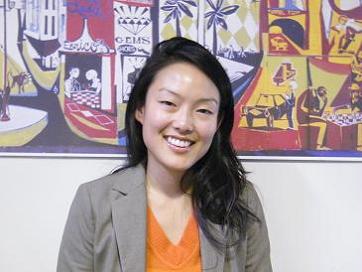
2. JANE KIM


3. GLENDON “ANNA CONDA” HYDE


CORRECTION: In our original version of this endorsement, we said that Jim Meko supports the sit-lie ordinance. That was an error, and it’s corrected below.


A year ago, this race was artist and activist Debra Walker’s to lose. Most of the progressive community was united behind her candidacy; she’d been working on district issues for a couple of decades, fighting the loft developers during the dot-com boom years and serving on the Building Inspection Commission. Then School Board member Jane Kim decided to enter the race, leaving the left divided, splitting resources that might have gone to other critical district races — and potentially helping to put the most pro-business downtown candidate, Theresa Sparks, in a better position to win.


Now we’ve got something of a mess — a fragmented and sometimes needlessly divisive progressive base in a district that’s key to holding progressive control of the board. And while neither of the two top progressive candidates is actively pursuing a credible ranked-choice voting strategy (Kim has, unbelievably, endorsed James Keys instead of Walker, and Walker has declined to endorse anyone else), we’re setting aside our concern over Kim’s ill-advised move and suggesting a strategy that is most likely to keep the seat Chris Daly has held for the past 10 years from falling to downtown control.


Walker is far and away our first choice. She understands land use and housing — the clear central issues in the district — and has well thought-out positions and proposals. She says that the current system of inclusionary housing — pressing market-rate developers to include a few units of below-market-rate housing with their high-end condos — simply doesn’t work. She supports an immediate affordable housing bond act and a long-term real estate transfer tax high enough to fund a steady supply of housing for the city’s workforce. She told us the city ought to be looking at planning issues from the perspective of what San Francisco needs, not what developers want to build. She’s in favor of progressive taxes and a push for local hiring. We’re happy to give her our first-place ranking.


Jane Kim has been a great SF School Board member and has always been part of the progressive community. But she only moved into District 6 a year and a half ago — about when she started talking about running for supervisor (and she told us in her endorsement interview that “D6 is a district you can run in without having lived there a long time.”) She still hasn’t been able to explain why she parachuted in to challenge an experienced progressive leader she has no substantive policy disagreements with.


That said, on the issues, Kim is consistently good. She is in favor of indexing affordable housing to market-rate housing and halting new condo development if the mix gets out of line. She’s for an affordable housing bond. She supports all the tax measures on this ballot. She’s a little softer on congestion pricing and extending parking-meter hours, but she’s open to the ideas. She supports police foot patrols not just as a law-enforcement strategy, but to encourage small businesses. She’d be a fine vote on the board. And while we’re sympathetic to the Walker supporters who would prefer that we not give Kim the credibility and exposure of an endorsement, the reality is that she’s one of two leading progressives and would be better on the board than the remaining candidates.


Hyde, a dynamic young drag queen performer, isn’t going to win. But he’s offered some great ideas and injected some fun and energy into the race. Hyde talks about creating safe injection sites for IV drug users to reduce the risk of overdoses and the spread of disease. He points out that a lot of young people age out of the foster-care system and wind up on the streets, and he’s for continuum housing that would let these young people transition to jobs or higher education. He talks about starting a co-op grocery in the Tenderloin. He proposes bus-only lanes throughout the district and wants to charge large vehicles a fee to come into the city. He’s a big advocate of nightlife and the arts. He lacks experience and needs more political seasoning, but we’re giving him the third-place nod to encourage his future involvement.


Progressives are concerned about Theresa Sparks, a transgender activist and former business executive who now runs the city’s Human Rights Commission. She did a (mostly) good job on the Police Commission. She’s experienced in city government and has good financial sense. But she’s just too conservative for what remains a very progressive district. Sparks isn’t a big fan of seeking new revenue for the city telling us that “I disagree that we’ve made all the cuts that we can” — even after four years of brutal, bloody, all-cuts budgets. She doesn’t support the hotel tax and said she couldn’t support Sup. David Chiu’s progressive business tax because it would lead to “replacing private sector jobs with public sector jobs” — even though the city’s own economic analysis shows that’s just not true. She supports Newsom’s sit-lie law.


Sparks is the candidate of the mayor and downtown, and would substantially shift the balance of power on the board. She’s also going to have huge amounts of money behind her. It’s important she be defeated.


Jim Meko, a longtime neighborhood and community activist, has good credentials and some solid ideas. He was a key player in the western SoMa planning project and helped come up with a truly progressive land-use program for the neighborhood. But he supports Prop. B and is awfully cranky about local bars and nightlife.


James Keys, who has the support of Sup. Chris Daly and was an intern in Daly’s office, has some intriguing (if not terribly practical) ideas, like combining the Sheriff’s Department and the Police Department and making Muni free). But in his interview, he demonstrated a lack of understanding of the issues facing the district and the city.


So we’re going with a ranked-choice strategy: Walker first, Kim second, Hyde third. And we hope Kim’s supporters ignore their candidate’s endorsement of Keys, put Walker as their second choice, and ensure that they don’t help elect Sparks.


DISTRICT 8


RAFAEL MANDELMAN


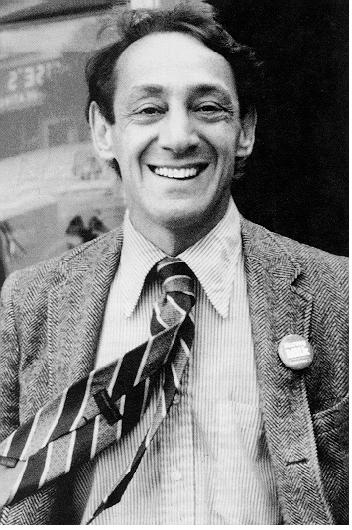
This is by far the clearest and most obvious choice on the local ballot. And it’s a critical one, a chance for progressives to reclaim the seat that once belonged to Harvey Milk and Harry Britt.


Mandelman, a former president of the Milk Club, is running as more than a queer candidate. He’s a supporter of tenants rights, immigrants’ rights, and economic and social justice. He also told us he believes “local government matters” — and that there are a lot of problems San Francisco can (and has to) solve on its own, without simply ducking and blaming Sacramento and Washington.


Mandelman argues that the public sector has been starved for years and needs more money. He agrees that there’s still a fair amount of bloat in the city budget — particularly management positions — but that even after cleaning out the waste, the city will still be far short of the money it needs to continue providing pubic services. He’s calling for a top-to-bottom review of how the city gets revenue, with the idea of creating a more progressive tax structure.


He’s an opponent of sit-lie and a supporter of the sanctuary city ordinance. He supports tenants rights and eviction protection. He’s had considerable experience (as a member of the Building Inspection Commission and Board of Appeals and as a lawyer who advises local government agencies) and would make an excellent supervisor.


Neither of the other two contenders make our endorsement cut. Rebecca Prozan is a deputy city attorney who told us she would be able to bring the warring factions on the board together. She has some interesting ideas — she’d like to see the city take over foreclosed properties and turn them into housing for teachers, cops, and firefighters — and she’s opposed to sit-lie. But she’s weak on tenant issues (she told us there’s nothing anyone can do to stop the conversion of rental housing into tenancies-in-common), doesn’t seem to grasp the need for substantial new revenues to prevent service cuts, and doesn’t support splitting the appointments to key commissions between the mayor and the supervisors.


Scott Wiener, a deputy city attorney, is a personable guy who always takes our phone calls and is honest and responsive. He’s done a lot of good work in the district. But he’s on the wrong side of many issues, and on some things would be to the right of the incumbent, Sup. Bevan Dufty.


He doesn’t support public power (which Dufty does). He says that a lot of the city’s budget problems can’t be solved until the state gets its own house in order (“we can’t tax our way out of this”) and favors a budget balanced largely by further cuts. In direct contrast to Mandelman, Wiener said San Franciscans “need to lower our expectations for government.” He wants broad-based reductions in almost all city agencies except Muni, “core” public health services, and public safety. He doesn’t support any further restrictions on condo conversions or TICs. And he has the support of the Small Property Owners Association — perhaps the most virulently anti-tenant and anti-rent control group in town.


This district once gave rise to queer political leaders who saw themselves and their struggles as part of a larger progressive movement. That’s drifted away of late — and with Mandelman, there’s a chance to bring it back.


DISTRICT 10


1. TONY KELLY


2. DEWITT LACY


3. CHRIS JACKSON


District 10 is the epicenter of new development in San Francisco, the place where city planners want to site as many as 40,000 new housing units, most of them high-end condos, at a cost of thousands of blue-collar jobs. The developers are salivating at the land-rush opportunities here — and the next supervisor not only needs to be an expert in land-use and development politics, but someone with the background and experience to thwart the bad ideas and direct and encourage the good ones.


There’s no shortage of candidates — 22 people are on the ballot, and at least half a dozen are serious contenders. Two — Steve Moss and Lynette Sweet — are very bad news. And one of the key priorities for progressives is defeating the big-money effort that downtown, the police, and the forces behind the Van Ness Avenue megahospital proposal are dumping into the district to elect Moss.


Our first choice is Tony Kelly, who operates Thick Description Theater and who for more than a decade has been directly involved in all the major neighborhood issues. He has a deep understanding of what the district is facing: 4,100 of the 5,300 acres in D10 have been rezoned or put under the Redevelopment Agency in the past 10 years. Planners envision as many as 100,000 new residents in the next 10 years. And the fees paid by developers will not even begin to cover the cost of the infrastructure and services needed to handle that growth.


And Kelly has solutions: The public sector will have to play a huge role in affordable housing and infrastructure, and that money should come from higher development fees — and from places like the University of California, which has a huge operation in the district and pays no property taxes. Kelly wants to set up a trigger so that if goals for affordable housing aren’t met by a set date, the market-rate development stops. He supports the revenue measures on the ballot but thinks we should go further. He opposes the pension-reform measure, Prop. B, but notes that 75 percent of the city’s pension problems come from police, fire, and management employees. He wants the supervisors to take over the Redevelopment Agency. He’s calling for a major expansion of open space and parkland in the district. And he thinks the city should direct some of the $3 billion in short-term accounts (now all with the Bank of America) to local credit unions or new municipal bank that could invest in affordable housing and small business. He’s a perfect fit for the job.


DeWitt Lacy is a civil-rights lawyer and a relative newcomer to neighborhood politics. He speaks passionately about the need for D10 to get its fair share of the city’s services and about a commitment to working-class people.


Lacy is calling for an immediate pilot program with police foot patrols in the high-crime areas of the district. He’s for increasing the requirements for developers to build affordable housing and wants to cut the payroll tax for local businesses that hire district residents.


Lacy’s vision for the future includes development that has mixed-use commuter hubs with shopping and grocery stores as well as housing. He supports the tax measures on the ballot and would be willing to extend parking meter hours — but not parking fines, which he calls an undue burden on low-income people.


He’s an outspoken foe of sit-lie and of gang injunctions, and with his background handling police abuse lawsuits, he would have a clear understanding of how to approach better law-enforcement without intimidating the community. He lacks Kelly’s history, experience, and knowledge in neighborhood issues, but he’s eminently qualified and would make a fine supervisor.


Chris Jackson, who worked at the San Francisco Labor Council and serves on the Community College Board, is our third choice. While it’s a bit unfortunate that Jackson is running for higher office only two years after getting elected to the college board, he’s got a track record and good positions on the issues. He talks of making sure that blue-collar jobs don’t get pushed out by housing, and suggested that the shipyard be used for ship repair. He wants to see the city mandate that landlords rent to people with Section 8 housing vouchers. He supports the tax measures on the ballot, but also argues that the city has 60 percent more managers than it had in 2000 and wants to bring that number down. He thinks the supervisors should take over Redevelopment, which should become “just a financing agency for affordable housing.” He wants to relocate the stinky sewage treatment plant near Third Street and Evans Avenue onto one of the piers and use the area for a transit hub. He’s still relatively unseasoned, but he has a bright political future.


Eric Smith, a biodiesel activist, is an impressive candidate too. But while his environmental credentials are good, he lacks the breadth of knowledge that our top three choices offer. But we’re glad he’s in the race and hope he stays active in community politics.


Malia Cohen has raised a lot of money and (to our astonishment) was endorsed No. 2 by the Democratic Party, but she’s by no means a progressive, particularly on tenant issues — she told us that limiting condo conversions is an infringement of property rights. And she’s way too vague on other issues.


Moss is the candidate of the big developers and the landlords, and the Chamber of Commerce is dumping tens of thousands of dollars into getting him elected. He’s got some good environmental and energy ideas — he argues that all major new developments should have their own energy distribution systems — but on the major issues, he’s either on the wrong side or (more often) can’t seem to take a stand. He said he is “still mulling over” his stand on sit-lie. He supports Sanctuary City in theory, but not the actual measure Sup. David Campos was pushing to make the policy work. He’s not sure if he likes gang injunctions or not. He only moved back to the district when he decided to run for supervisor. He’s way too conservative for the district and would be terrible on the board.


Lynette Sweet, a BART Board member, has tax problems (and problems explaining them) and wouldn’t even come to our office for an endorsement interview. The last thing D10 needs is a supervisor who’s not accountable and unwilling to talk to constituents and the press.


So we’re going with Kelly, Lacy, and Jackson as the best hope to keep D10 from becoming a district represented by a downtown landlord candidate.


SAN FRANCISCO BOARD OF EDUCATION


MARGARET BRODKIN


KIM-SHREE MAUFAS


HYDRA MENDOZA


Three seats are up on the School Board, and three people will get elected. And it’s a contested race, and in situations like that, we always try to endorse a full slate.


This fall, it was, to put it mildly, a challenge.


It’s disturbing that we don’t have three strong progressive candidates with experience and qualifications to oversee the San Francisco Unified School District. But it seems to be increasingly difficult to find people who want to — and can afford to — devote the time to what’s really a 40-hour-a-week position that pays $500 a month. The part-time school board is an anachronism, a creature of a very different economic and social era. With the future of the next generation of San Franciscans at stake, it’s time to make the School Board a full-time job and pay the members a decent salary so that more parents and progressive education advocates can get involved in one of the most important political jobs in the city.


That said, we’ve chosen the best of the available candidates. It’s a mixed group, made up of people who don’t support each other and aren’t part of anyone’s slate. But on balance, they offer the best choices for the job.


This is not a time when the board needs radical change. Under Superintendent Carlos Garcia, the local public schools are making huge strides. Test scores are up, enrollment is increasing, and San Francisco is, by any rational measure, the best big-city public school district in California. We give considerable credit for that to the progressives on the board who got rid of the irascible, secretive, and hostile former Superintendent Arlene Ackerman and replaced her with Garcia. He’s brought stability and improvement to the district, and is implementing a long-term plan to bring all the schools up to the highest levels and go after the stubborn achievement gap.


Yet any superintendent and any public agency needs effective oversight. One of the problems with the district under Ackerman was the blind support she got from school board members who hired her; it was almost as if her allies on the board were unable to see the damage she was doing and unable to hold her accountable.


Our choices reflect the need for stability — and independence. We are under no illusions — none of our candidates are perfect. But as a group, we believe they can work to preserve what the district is doing right and improve on policies that aren’t working.


Kim-Shree Maufas has been a staunch progressive on the board. She got into a little trouble last year when the San Francisco Chronicle reported that she’d been using a school district credit card for personal expenses. That’s not a great move, but she never actually took public money since she paid back the district. Maufas said she thought she could use the card as long as she reimbursed the district for her own expenses; the rules are now clear and she’s had no problems since. We don’t consider this a significant enough failure in judgment to prevent her from continuing to do what she’s been doing: serving as an advocate on the board for low-income kids and teachers.


Maufas is a big supporter of restorative justice and is working for ways to reduce suspensions and expulsions. She wants to make sure advanced placement and honors classes are open to anyone who can handle the coursework. She supports the new school assignment process (as do all the major candidates), although she acknowledges that there are some potential problems. She told us she thinks the district should go back to the voters for a parcel tax to supplement existing funding for the schools.


Margaret Brodkin is a lightening rod. In fact, much of the discussion around this election seems to focus on Brodkin. Since she entered the race, she’s eclipsed all the other issues, and there’s been a nasty whisper campaign designed to keep her off the board.


We’ve had our issues with Brodkin. When she worked for Mayor Newsom, she was part of a project that brought private nonprofits into city recreation centers to provide services — at a time when unionized public employees of the Recreation and Parks Department were losing their jobs. It struck us as a clear privatization effort by the Newsom administration, and it raised a flag that’s going to become increasingly important in the school district: there’s a coming clash between people who think private nonprofits can provide more services to the schools and union leaders who fear that low-paid nonprofit workers will wind up doing jobs now performed by unionized district staff. And Brodkin’s role in the Newsom administration — and her background in the nonprofit world — is certainly ground for some concern.


But Brodkin is also by far the most qualified person to run for San Francisco school board in years, maybe decades. She’s a political legend in the city, the person who is most responsible for making issues of children and youth a centerpiece of the progressive agenda. In her years as director of Coleman Advocates for Children and Youth, she tirelessly worked to make sure children weren’t overlooked in the budget process and was one of the authors of the initiative that created the Children’s Fund. She’s run a nonprofit, run a city department, and is now working on education issues.


She’s a feisty person who can be brusque and isn’t always conciliatory — but those characteristics aren’t always bad. Sup. Chris Daly used his anger and passion to push for social justice on the Board of Supervisors and, despite some drawbacks, he’s been an effective public official.


And Brodkin is full of good ideas. She talks about framing what a 21st century education looks like, about creating community schools, about aligning after-school and summer programs with the academic curriculum. She wants the next school bond act to include a central kitchen, so local kids can get locally produced meals (the current lunch fare is shipped in frozen from out of state).


Brodkin needs to remember that there’s a difference between being a bare-knuckles advocate and a member of a functioning school board. But given her skills, experience, and lifetime in progressive causes, we’re willing to give her a chance.


We also struggled over endorsing Hydra Mendoza. She works for Mayor Newsom as an education advisor — and that’s an out-front conflict of interest. She’s a fan of Obama’s Education Secretary, Arne Duncan, whose policies are regressive and dangerous.


On the other hand, she cares deeply about kids and public education. She’s not a big supporter of charter schools (“I’ve yet to see a charter school that offers anything we can’t do ourselves,” she told us) and while she was on the wrong side of a lot of issues (like JROTC) early in her tenure, over the past two years she’s been a good School Board member.


There are several other candidates worth mentioning. Bill Barnes, an aide to Michela Alioto-Pier, is a good guy, a decent progressive — but has no experience in or direct connection to the public schools. Natasha Hoehn is in the education nonprofit world and speaks with all the jargon of the educrat, but her proposals and her stands on issues are vague. Emily Murase is a strong parent advocate with some good ideas, but she struck us as a bit too conservative (particularly on JROTC and charter schools.) Jamie Wolfe teaches at a private school but lacks any real constituency or experience in local politics and the education community.


So given a weak field with limited alternatives, we’re going with Maufas, Brodkin and Mendoza.


SAN FRANCISCO COMMUNITY COLLEGE BOARD


JOHN RIZZO


The San Francisco Community College District has been a mess for years, and it’s only now starting to get back on track. That’s the result of the election of a few progressive reformers — Milton Marks, Chris Jackson, and John Rizzo, who now have enough clout on the seven-member board to drag along a fourth vote when they need it.


But the litany of disasters they’ve had to clean up is almost endless. A chancellor (who other incumbent board members supported until the end) is now under indictment. Public money that was supposed to go to the district wound up in a political campaign. An out-of-control semiprivate college foundation has been hiding its finances from the public. The college shifted bond money earmarked for an arts center into a gigantic, expensive gym with a pool that the college can’t even pay to operate, so it’s leased out to a private high school across the street.


And the tragedy is that all three incumbents — two of whom should have stepped down years ago — are running unopposed.


With all the attention on the School Board and district elections, not one progressive — in fact, not one candidate of any sort — has stepped forward to challenge Anita Grier and Lawrence Wong. So they’ll get another term, and the reformers will have to continue to struggle.


We’re endorsing only Rizzo, a Sierra Club staffer who has been in the lead in the reform bloc. He needs to end up as the top vote-getter, which would put him in position to be the board president. Rizzo has worked to get the district’s finances and foundation under control and he richly deserves reelection.


BART BOARD OF DIRECTORS, DISTRICT 8


BERT HILL


It’s about time somebody mounted a serious challenge to James Fang, the only elected Republican in San Francisco and a member of one of the most dysfunctional public agencies in California. The BART Board is a mess, spending a fortune on lines that are hardly ever used and unable to work effectively with other transit agencies or control a police force that has a history of brutality and senseless killing.


Fang supports the suburban extensions and Oakland Airport connector, which make no fiscal or transportation sense. He’s ignored problems with the BART Police for 20 years. It’s time for him to leave office.


Bert Hill is a strong challenger. A professional cost-management executive, he understands that BART is operating on an old paradigm of carrying people from the suburbs into the city. “Before we go on building any more extensions,” he told us, “we should take care of San Francisco.” He wants the agency to work closely with Muni and agrees there’s a need for a BART sunshine policy to make the notoriously secretive agency more open to public scrutiny. We strongly endorse him.


ASSESSOR-RECORDER


PHIL TING


San Francisco needs an aggressive assessor who looks for every last penny that big corporations are trying to duck paying — but this is also a job that presents an opportunity for challenging the current property tax laws. Phil Ting’s doing pretty well with the first part — and unlike past assessors, is actually stepping up to the plate on the second. He’s been pushing a statewide coalition to reform Prop. 13 — and while it’s an uphill battle, it’s good to see a tax assessor taking it on. Ting has little opposition and will be reelected easily.


PUBLIC DEFENDER


JEFF ADACHI


Adachi’s done a great job of running the office that represents indigent criminal defendants. He’s been outspoken on criminal justice issues. Until this year, he was often mentioned as a potential progressive candidate for mayor.


That’s over now. Because Adachi decided (for reasons we still can’t comprehend) to join the national attack on public employees and put Prop. B on the ballot, he’s lost any hope of getting support for higher office from the left. And since the moderate and conservative forces will never be comfortable with a public defender moving up in the political world, Adachi’s not going anywhere anytime soon.


Which is fine. He’s doing well at his day job. We wish he’d stuck to it and not taken on a divisive, expensive, and ill-conceived crusade to cut health care benefits for city employees.


SAN FRANCISCO SUPERIOR COURT


SEAT 15


MICHAEL NAVA


To hear some of the brahmins of the local bench and bar tell it, the stakes in this election are immense — the independence of the judiciary hangs in the balance. If a sitting judge who is considered eminently qualified for the job and has committed no ethical or legal breaches can be challenged by an outsider who is seeking more diversity on the bench, it will open the floodgates to partisan hacks taking on good judges — and force judicial candidates to raise money from lawyers and special interests, thus undermining the credibility of the judiciary.


We are well aware of the problems of judicial elections around the country. In some states, big corporations that want to influence judges raise and spend vast sums on trial and appellate court races — and typically get their way. In Iowa, three judges who were willing to stand on principle and Constitutional law and declare same-sex marriage legal are facing what amounts to a well-funded recall effort. California is not immune — in more conservative counties, liberal judges face getting knocked off the bench by law-and-order types.


It’s a serious issue. It’s worth a series of hearings in the state Legislature, and it might be worth Constitutional change. Maybe trial-court elections should be eliminated. Maybe all judicial elections should have public campaign financing. But right now, it’s an elected office — at least in theory.


In practice, the vast majority of the judicial slots in California are filled by appointment. Judges serve for four-year terms but tend to retire or step down in midterm, allowing the governor to fill the vacancy. Unless someone files specifically to challenge an incumbent, typically appointed judge, that race never even appears on the ballot.


The electoral process is messy and political, and raising money is unseemly for a judicial officer. But the appointment process is hardly pure, either — and governors in California have, over the past 30 years, appointed the vast majority of the judges from the ranks of big corporate law firms and district attorney’s offices.


There are, of course, exceptions, and Gov. Arnold Schwarzenegger has been better than his predecessor, Democrat Gray Davis. But overall, public interest lawyers, public defenders, and people with small community practices (and, of course, people who have no political strings to pull in Sacramento) have been frustrated. And it’s no surprise that some have sought to run against incumbents.


That’s what’s happening here. Michael Nava, a gay Latino who has been working as a research attorney for California Supreme Court Justice Carlos Moreno, was going to run for a rare open seat this year, but the field quickly got crowded. So Nava challenged Richard Ulmer, a corporate lawyer appointed by Schwarzenegger who has been on the bench a little more than a year.


We will stipulate, as the lawyers say: Ulmer has done nothing wrong. From all accounts, he’s a fine judge (and before taking the bench, he did some stellar pro bono work fighting for reforms in the juvenile detention system). So there are two questions here: Should Nava have even filed to run against Ulmer? And since he did, who is the better candidate?


It’s important to understand this isn’t a case of special interests and that big money wanting to oust a judge because of his politics or rulings. Nava isn’t backed by any wealthy interest. There’s no clear parallel to the situations in other areas and other states where the judiciary is being compromised by electoral politics. Nava had every right to run — and has mounted an honest campaign that discusses the need for diversity on the bench.


Ulmer’s supporters note — correctly — that the San Francisco courts have more ethnic and gender diversity than any county in the state. And we’re not going to try to come to a conclusion here about how much diversity is enough.


But we will say that life experience matters, and judges bring to the bench what they’ve lived. Nava, who is the grandson of Mexican immigrants and the first person in his family to go to college, may have a different perspective on how low-income people of color are treated in the courts than a former Republican who spent his professional career in big law firms.


We were impressed by Nava’s background and knowledge — and by his interest in opening up the courts. He supports cameras in the courtrooms and allowing reporters to record court proceedings. He told us the meetings judges hold on court administration should be open to the public.


We’re willing to discuss whether judicial elections make sense. Meanwhile, judges who don’t like the idea of challenges should encourage their colleagues not to retire in midterm. If all the judges left at the end of a four-year term, there would be plenty of open seats and fewer challenges. But for now, there’s nothing in this particular election that makes us fear for the independence of the courts. Vote for Nava.


>>BACK TO ENDORSEMENTS 2010

Endorsements 2010: State ballot measures

25

PROP. 19

LEGALIZE MARIJUANA

YES, YES, YES

The most surprising thing about Prop. 19 is how it has divided those who say they support the legalization of marijuana. Critics within the cannabis community say decriminalization should occur at the federal level or with uniform statewide standards rather that letting cities and counties set their own regulations, as the measure does. Sure, fully legalizing marijuana on a large scale and regulating its use like tobacco and alcohol would be better — but that’s just not going to happen anytime soon. As we learned with the legalization of marijuana for medical uses through Prop. 215 in 1996, there are still regional differences in the acceptance of marijuana, so cities and counties should be allowed to treat its use differently based on local values. Maybe San Francisco wants full-blown Amsterdam-style hash bars while Fresno would prefer far more limited distribution options — and that’s fine.

Other opponents from within marijuana movement are simply worried about losing market share or triggering federal scrutiny of a system that seems to be working well for many. But those are selfish reasons to oppose the long-overdue next step in legalizing adult use of cannabis, a step we need to take even if there is some uncertainty about what comes next. By continuing with prohibition Californians and their demand for pot are empowering the Mexican drug cartels and their violence and political corruption; perpetuating a drug war mentality that is ruining lives, wasting resources, and corrupting police agencies that share in the take from drug-related property seizures; and depriving state and local governments of tax revenue from the California’s number one cash crop.

Bottom line: if there are small problems with this measure, they can be corrected with state legislation that Assemblymember Tom Ammiano has already pledged to carry and that Prop. 19 explicitly allows. But this is the moment and the measure we need to seize to continue making progress in our approach to marijuana in California. Vote yes on Prop. 19.


PROP. 20

CONGRESSIONAL DISTRICT REAPPORTIONMENT

NO

Prop. 20 seeks to transfer the power to draw congressional districts from elected officials to the 14-member California Citizens Redistricting Commission, the state agency created in 2008 to draw boundary lines for California state legislative districts and Board of Equalization districts.

Supporters argue that Prop. 20, (which is backed by Charles Munger Jr., the heir to an investment fortune) would create more competitive elections and holds politicians accountable. And indeed, there’s been some funky gerrymandering going on the the state for decades.

But the commission is hardly a fair body — it has the same number of Republicans as Democrats in a state where there are far more Democrats than Republicans. And most states still draw lines the old-fashioned way, so Prop. 20 could give the GOP an advantage in a Democratic state. States like Texas and Florida, notorious for pro-Republican gerrymandering, aren’t planning to change how they do their districts.

That’s why former state Assemblymember John Laird (D-Santa Cruz), who lost his recent bid for the State Senate thanks to gerrymandering and an August special election, calls Prop. 20 “the unilateral disarmament of California.”

It could also create a political mess in San Francisco, Laird said. “An independent commission could end up dividing the city north/south, not east/west. Or it could throw Sen. Mark Leno and Leland Yee into the same district.” Vote no.


PROP. 21

VEHICLE LICENSE FEE FOR PARKS

YES

Part of the reason California is in the fiscal crisis it is now facing — underfunding schools, slashing services, and considering selling off state parks — is because Gov. Arnold Schwarzenegger ran for office on a pandering pledge to deeply cut the vehicle license fee, costing the state tens of billions of dollars since then. It was the opposite of what this state should have been doing if it was serious about addressing global warming and other environmental imperatives, not to mention encouraging car drivers to come closer to paying for their full societal impacts, which study after study shows they don’t now do. This measure doesn’t fully correct that mistake, but it’s a start.

Prop. 21 would charge an $18 annual fee on vehicle license registrations and reserve at least half of the $500 million it would generate for state park maintenance and wildlife conservation programs. As an added incentive, the measure would also give cars free entrance to the state parks, a $50 million perk. Of the remaining $450 million, $200 million could be used to back-fill state general fund revenue now going to these functions, which means most of this money would go to parks and wildlife.

We’d rather see funds derived from private car use go to mass transit and other alternatives to the automobile, but we’re not going to quibble with the details on this one. California desperately needs the money, and it’s time for drivers to start giving back some of the money they shouldn’t have been given in the first place.


PROP. 22

LOCAL REDEVELOPMENT FUNDS

NO

This one sounds good, on the surface: Prop. 22 would prevent the state from taking money from city redevelopment agencies to balance the budget in Sacramento. But it’s not so simple: Sometimes it actually makes sense to use redevelopment money to fund, say, education — and only the state can do that. Besides, this particular bill only protects cities, not counties — so San Francisco will take even more of a hit in tough times. Vote no.


PROP. 23

SUSPENDING AIR POLLUTION CONTROL LAWS

NO, NO, NO

Think of Prop. 23 as a band of right-wing extremists orchestrating a sneak attack on the one hope this country has for removing its head from the tarball-sticky sand and actually doing something, for real this time, about global warming. Assembly Bill 32, California’s Global Warming Solutions Act, imposes enforceable limits on greenhouse gas emissions by 2012 — and now, Big Oil is drilling deep into its pockets in an effort to blow up those limits.

Funded by Texas oil companies Tesoro Corporation and Valero Energy Corporation in conjunction with the Koch brothers, billionaires who have been called the financial backbone of the Tea Party, Prop. 23 would reverse a hard-fought victory by suspending AB32 until unemployment drops to 5.5 percent for four consecutive quarters — not likely to happen anytime soon. In truly sleazy fashion, proponents have dubbed Prop. 23 the “California jobs initiative.”

The environmental arguments for rejecting Prop. 23 are obvious, but this time there’s a twist — even the business community doesn’t like it. Take it from Rob Black of the San Francisco Chamber of Commerce, which is actively opposing Prop. 23. “There is a fear that clean energy policy is a communist plot,” Black explained. “We actually think it’s a good capitalist strategy.” To most business leaders, AB32 is like the goose that laid the golden egg — it encourages investment in green technology, which is probably California’s best future economic hope. Vote no on 23.


PROP. 24

BUSINESS TAXES

YES

Prop. 24 repeals some special-interest tax breaks that the Legislature had to accept as part of the latest budget deal. In essence, it restores about $1.7 billion worth of taxes on corporations, particularly larger ones that hide income among various affiliates. Vote yes.


PROP. 25

SIMPLE MAJORITY BUDGET PASSAGE

YES, YES, YES

Prop. 25 would be a step toward ending the budget madness that defines California politics every year. It would allow the state Legislature to pass a budget and budget-related legislation can be passed with a simple majority vote.

It’s not a full solution — a two-thirds vote would still be required to pass taxes. But at least it would allow the majority party to approve a blueprint for state spending and help end the gridlock caused by a small number of Republicans. Vote yes.


PROP. 26

TWO-THIRDS VOTE FOR FEES

NO, NO, NO.

Prop. 26 would require a two-thirds supermajority vote in the Legislature and at the ballot box in local communities to pass fees, levies, charges and tax revenue allocations that under existing rules can be enacted by a simple majority vote

It’s supported by the Chamber of Commerce, Chevron, Occidental Petroleum, the Wine Institute, and Aera Energy.

Opponents argue that Prop. 26 should be called the “Polluter Protection Act” because it would make it harder to impose fees on corporations that cause environmental or public health problems. For example, it would be harder to impose so-called “pollution fees” on corporations that discharge toxics into the air or water. It would also make it nearly impossible for San Francisco to impose revenue measures like the Alcohol Fee sponsored by Sup. John Avalos. It’s another in a long line of attempts at the state level to block local government from raising money. Vote no.


PROP. 27

ELIMINATING REDISTRICTING COMMISSION

YES

We opposed the 2008 ballot measure creating the redistricting commission, arguing that, while allowing the state Legislature to draw its own seats is a problem, the solution would make things worse. The panel isn’t at all representative of the state (it has an equal number of Republicans and Democrats) and could be insensitive to the political demographics of California cities (it makes sense, for example, to have Senate and Assembly lines in San Francisco divide the city into east and west sides because that’s how the politics of the city tend to break).

This measure abolishes that panel and would allow the Legislature to draw new lines for both state and federal offices after the 2010 census. We don’t love having the Legislature handle that task — but we like the existing, unaccountable, unrepresentative agency even less. Vote yes.


>>BACK TO ENDORSEMENTS 2010

Endorsements 2010: State races

24

GOVERNOR

EDMUND G. BROWN

We have issues with Jerry Brown. The one-time environmental leader who left an admirable progressive legacy his first time in the governor’s office (including the Agricultural Labor Relations Board, the California Conservation Corps, and the liberal Rose Bird Supreme Court) and who is willing to stand up and oppose the Diablo Canyon nuclear power plant has become a centrist, tough-on-crime, no-new-taxes candidate. And his only solution to the state budget problems is to bring all the players together early and start talking.

But at least since he’s started to debate Republican Meg Whitman face to face, he’s showing some signs of life — and flashes of the old Jerry. He’s strongly denouncing Whitman’s proposal to wipe out capital gains taxes, reminding voters of the huge hole that would blow in the state budget — and the $5 billion windfall it would give to the rich. He’s talking about suing Wall Street financial firms that cheated Californians. He’s promoting green jobs and standing firm in support of the state’s greenhouse-gas emissions limits.

For all his drawbacks (his insistence, for example, that the Legislature shouldn’t raise any taxes without a statewide vote of the people), Brown is at least part of the reality-based community. He understands that further tax cuts for the rich won’t solve California’s problems. He knows that climate change is real. He’s not great on immigration issues, but at least he’s cognizant that 2 million undocumented immigrants live in California — and the state can’t just arrest and deport them all.

Whitman is more than a conservative Republican. She’s scary. The centerpiece of her economic platform calls for laying off 40,000 state employees — thereby greatly increasing the state’s unemployment rate. Her tax plan would increase the state’s deficit by another $5 billion just so that a tiny number of the richest taxpayers (including her) can keep more of their money. She’s part of the nativist movement that wants to close the borders.

She’s also one of the growing number of candidates who think personal wealth and private-sector business success translate to an ability to run a complex state government. That’s a dangerous trend — Whitman has no political experience or background (until recently she didn’t even vote) and will be overcome by the lobbyists in Sacramento.

This is a critically important election for California. Vote for Jerry Brown.


LIEUTENANT GOVERNOR


GAVIN NEWSOM

Why is the mayor of San Francisco running for a job he once dismissed as worthless? Simple: he couldn’t get elected governor, and he wants a place to perch for a while until he figures out what higher office he can seek. It’s almost embarrassing in its cold political calculus, but that’s something we’ve come to expect from Newsom.

We endorsed Newsom’s opponent, Janice Hahn, in the Democratic primary. It was hard to make a case for advancing the political career of someone who has taken what amounts to a Republican approach to running the city’s finances — he’s addressed every budget problem entirely with cuts, pushed a “no-new-taxes” line, and given the wealthy everything they wanted. His immigration policies have broken up families and promoted deporting kids. He’s done Pacific Gas and Electric Co. a nice favor by doing nothing to help the community choice aggregation program move forward.

Nevertheless, we’re endorsing Newsom over his Republican opponent, Abel Maldonado, because there really isn’t any choice. Maldonado is a big supporter of the death penalty (which Newsom opposes). He’s pledged never to raise taxes (and Newsom is at least open to discussion on the issue). He used budget blackmail to force the awful open-primaries law onto the ballot. He’s a supporter of big water projects like the peripheral canal. In the Legislature, he earned a 100 percent rating from the California Chamber of Commerce.

Newsom’s a supporter of more funding for higher education (and the lieutenant governor sits on the University of California Board of Regents). He’d be at least a moderate environmentalist on the state Lands Commission. And he, like Brown, is devoting a lot of attention to improving the state’s economy with green jobs.

We could do much worse than Newsom in the lieutenant governor’s office. We could have Maldonado. Vote for Newsom.


SECRETARY OF STATE


DEBRA BOWEN

California has had some problems with the office that runs elections and keeps corporate filings. Kevin Shelley had to resign from the job in 2005 in the face of allegations that a state grant of $125,000 was illegally diverted into his campaign account. But Bowen, by all accounts, has run a clean office. Her Republican opponent, Damon Dunn, a former professional football player and real estate agent, doesn’t even have much support within his own party and is calling for mandatory ID checks at the ballot. This one’s easy; vote for Bowen.


CONTROLLER


JOHN CHIANG

Chiang’s been a perfectly decent controller, and at times has shown some political courage: When Gov. Arnold Schwarzenegger tried to cut the pay of state employees to minimum-wage level, Chiang refused to go along — and forced the governor to back down. His opponent, state Sen. Tony Strickland (R-Los Angeles), wants to use to office to promote cuts in government spending. Vote for Chiang.


TREASURER


BILL LOCKYER

Lockyer’s almost certain to win reelection as treasurer against a weak Republican, Mimi Walters. He’s done an adequate job and pushed a few progressive things like using state bonds to promote alternative energy. Mostly, though, he seems to be waiting for his chance to run for governor — and if Jerry Brown loses, or wins and decides not to seek a second term, look for Lockyer to step up.


ATTORNEY GENERAL


KAMALA HARRIS

This is going to be close, and it’s another clear choice. We’ve had our differences with Harris — she’s trying too hard to be a tough-on-crime type, pushing some really dumb bills in Sacramento (like a measure that would bar sex offenders from ever using social networking sites on the Internet). And while she shouldn’t take all the blame for the problems in the San Francisco crime lab, she should have known about the situation earlier and made more of a fuss. She’s also been slow to respond to serious problem of prosecutors and the cops hiding information about police misconduct from defense lawyers that could be relevant to a case.

But her opponent, Los Angeles D.A. Steve Cooley, is bad news. He’s a big proponent of the death penalty, and the ACLU last year described L.A. as the leading “killer county in the country.” Cooley has proudly sent 50 people to death row since he became district attorney in 2001, and he vows to make it easier and more efficient for the state to kill people.

He’s also a friend of big business who has vowed, even as attorney general, to make the state more friendly to employers — presumably by slowing prosecutions of corporate wrongdoing.

Harris, to her credit, has refused to seek the death penalty in San Francisco, and would bring the perspective of a woman of color to the AG’s office. For all her flaws, she would be far better in the AG’s office than Cooley. Vote for Harris.


INSURANCE COMMISSIONER


DAVE JONES

Jones, currently a state Assemblymember from Sacramento, won a contested primary against his Los Angeles colleague Hector de la Torre and is now fighting Republican Mike Villines of Fresno, also a member of the Assembly. Jones is widely known as a consumer advocate and was a foe of Prop. 17, the insurance industry scam on the June ballot. A former Legal Aid lawyer, he has extensive experience in health-care reform, supports single-payer health coverage, and would make an excellent insurance commissioner.

Villines pretty much follows right-wing orthodoxy down the line. He wants to replace employer-based insurance with health savings accounts. He argues that the solution to the cost of health insurance is to limit malpractice lawsuits. He wants to limit workers compensation claims. And he supports “alternatives to litigation,” which means eliminating the rights of consumers to sue insurance companies.

Not much question here. Vote for Jones.


BOARD OF EQUALIZATION, DISTRICT 1


BETTY YEE

The Board of Equalization isn’t well known, but it plays a sizable role in setting and enforcing California tax policy. Yee’s a strong progressive who has done well in the office, supporting progressive financial measures. She’s spoken out — as a top tax official — in favor of legalizing and taxing marijuana. We’re happy to endorse her for another term.


SUPERINTENDENT OF PUBLIC INSTRUCTION


TOM TORLAKSON

We fully expected a November runoff between Torlakson and state Sen. Gloria Romero. Both Democrats had strong fundraising and political bases — and very different philosophies. Romero’s a big charter school and privatization fan; Torlakson has the support of the teachers unions. But to the surprise of nearly everyone, a wild-card candidate, retired Los Angeles educator Larry Aceves, came in first, with Torlakson second and Romero third. Now Aceves and Torlakson are in the runoff for this nonpartisan post.

Aceves is an interesting candidate, a former principal and school superintendent who has the endorsement of the San Francisco Chronicle and the San Francisco Green Party. But he’s too quick to take the easy line that the teachers’ unions are the biggest problem in public education, and he wants the unilateral right to suspend labor contracts.

Torlakson wants more charter-school accountability and more funding for primary education. He’s the far better candidate.


STATE SENATE


DISTRICT 8

Leland Yee

Yee’s got no opposition to speak of, and will easily be re-elected. So why is he spending money on a series of slick television ads that have been airing all over San Francisco, talking about education and sending people to his website? It’s pretty obvious: The Yee for state Senate campaign is the opening act of the Yee for San Francisco mayor campaign, which should kick into high gear sometime next spring. In other words, if Yee has his way, he’ll serve only a year of his next four-year term.

Yee infuriates his colleagues at times, particularly when he refuses to vote for a budget that nobody likes but everyone knows is necessary to keep the state afloat. He’s done some ridiculous things, like pushing to sell the Cow Palace as surplus state property and turn the land over to private real estate developers. But he’s always good on open-government issues, is pushing for greater accountability for companies that take tax breaks and then send jobs out of state, has pushed for accountability at the University of California, and made great progress in opening the records at semiprivate university foundations when he busted Stanislaus State University for its secret speaking-fees deal with Sarah Palin.

With a few strong reservations, we’ll endorse Yee for another term.


STATE ASSEMBLY, DISTRICT 12


FIONA MA

A clear hold-your-nose endorsement. Ma has done some truly bad things in Sacramento, like pushing a bill that would force the San Francisco Unified School District to allow military recruiters in the high schools and fronting for landlords on a bill to limit rent control in trailer parks. But she’s good on public power and highly critical of PG&E, and she has no opposition to speak of.


STATE ASSEMBLY, DISTRICT 13


TOM AMMIANO

Ammiano’s a part of San Francisco history, and without his leadership as a supervisor, we might not have a progressive majority on the Board of Supervisors. Ammiano was one of the architects of the return to district elections, and his 1999 mayoral campaign (against Willie Brown) marked a turning point in the organization, sophistication, and ultimate success of the city’s left. He was the author of the rainy day fund (which has kept the public schools from massive layoffs over the past couple of years) and the Healthy San Francisco plan.

In Sacramento, he’s been a leader in the effort to legalize (and tax) marijuana and to demand accountability for the BART Police. He’s taken on the unpleasant but critical task of chairing the Public Safety Committee and killing the worst of the right-wing crime bills before they get to the floor. He has four more years in Sacramento, and we expect to see a lot more solid progressive legislation coming out of his office. We enthusiastically endorse him for reelection.


STATE ASSEMBLY, DISTRICT 14


NANCY SKINNER

Skinner’s a good progressive, a good ally for Ammiano on the Public Safety Committee, and a friend of small business and fair taxation. Her efforts to make out-of-state companies that sell products in California pay state sales tax would not only bring millions into the state coffers but protect local merchants from the likes of Amazon. We don’t get why she’s joined with Berkeley Mayor Tom Bates to try to get rid of Kriss Worthington, the most progressive member of the Berkeley City Council, but we’ll endorse her for re-election.


STATE ASSEMBLY, DISTRICT 16


SANDRE SWANSON

Swanson’s a good vote most of the time in Sacramento, but he’s not yet the leader he could be — particularly on police accountability. The BART Police murdered Oscar Grant in Swanson’s district, yet it fell to a San Franciscan, Tom Ammiano, to introduce strong state legislation to force BART to have civilian oversight of the transit cops. Still, he’s done some positive things (like protecting state workers who blow the whistle on fraud) and deserves another term.


>>BACK TO ENDORSEMENTS 2010
Endorsements 2010: National races

10

 U.S. SENATE

BARBARA BOXER

The San Francisco Chronicle made a stunning — and utterly irresponsible — statement when it refused to endorse either candidate in this race, saying that neither Boxer, the three-term incumbent, nor challenger Carly Fiornia, was qualified for the job. That’s insane — this one’s as clear and obvious a choice as you could ask for in American politics.

Boxer’s one of the leading voices for the progressives in the U.S. Senate. She was an early and stalwart foe of the war in Iraq; she’s been good on immigration (even when other Democrats have been ducking); and she’s a leading voice for accountability in financial companies. She’s finally come around on same-sex marriage and has a perfect record on reproductive rights and labor issues.

Fiornia’s chief claim to fame is that she ran one of the nation’s top companies, screwed up its history of excellent labor relations, outsourced 30,000 jobs, orchestrated a train wreck of a merger, and was fired. She left with enough of a golden parachute to help finance her campaign for Senate.

Fiorina’s anti-choice. She strongly supported Prop. 8 and opposes marriage equality. She’s so rabidly seeking the support of the gun nuts that she actually said that people on the federal “no-fly” list should be able to buy handguns. She supports the Arizona anti-immigration law. She’s for tax cuts for the rich and can’t even figure out if she’s supporting or opposing Prop. 23.

This one is a no-brainer. Vote for Boxer.


CONGRESS, 6TH DISTRICT

LYNN WOOLSEY

Woolsey was against the war when her colleague to the south, Nancy Pelosi, was still waffling. She’s a consistent voice against cuts in the safety net (and has the distinction of being the only member of Congress who was once on welfare). We’re happy to endorse her for another term.


CONGRESS, 7TH DISTRICT

GEORGE MILLER

Miller’s an East Bay institution, now seeking his 18th term. He’s been good and bad on issues — weak at first on the war, bad on education (he supported No Child Left Behind), but generally sound on environmental issues. And this spring, he was willing to publicly challenge Sen. Dianne Feinstein (D-Calif.) on a terrible water bill.


CONGRESS, 8TH DISTRICT

NANCY PELOSI

It’s odd that Pelosi’s become such a symbol of liberal Democrats and fodder for the right-wing attack machine. When you look at her record, she’s hardly a San Francisco liberal and certainly no progressive. She’s not even a strong supporter of same-sex marriage. She was bad on the war for too long and seems far more interested in raising money than representing her constituents. But she did salvage the health care bill, and she’s held up as Obama’s chief Capitol Hill ally under enormous pressure, and if the Democrats survive with control of the House, she’ll stay speaker. If not, she should think about retiring.


CONGRESS, 9TH DISTRICT

BARBARA LEE

Lee became a hero to the peace movement worldwide when she refused after 9/11 to vote to authorize then-President Bush to go to war. She was the only member of either house willing to stand up against what would become the costly and bloody invasions of Iraq and Afghanistan. But she’s also been a strong supporter of HIV funding, is one of the few members of Congress to show much leadership on poverty issues, and has been elected to chair the Progressive Caucus. We’re happy to endorse her for another term.


CONGRESS, 13TH DISTRICT

PETE STARK

Stark is the Sup. Chris Daly of Congress, a fearless progressive who’s not afraid to ruffle feathers — or even insult the president — when he thinks it’s necessary. At 78, he’s an outspoken atheist (the only one in Congress), a staunch foe of the wars in Iraq and Afghanistan, and a progressive on all the major issues. He’s not terribly popular among his colleagues, who allowed him to serve for only one day as chair of the Ways and Means Committee before dethroning him for his inflammatory statements. But on balance, we’re glad he’s around.


>>BACK TO ENDORSEMENTS 2010
The D6 Ranked Choice debacle

10

I must admit, I was pretty astonished when I read that Jane Kim had endorsed two other candidates in District 6, and Debra Walker wasn’t among them.


I understand that there’s bad blood here — Walker’s supporters are pissed that Kim moved into the district and entered a race that Walker had been working on for years. She effectively challenged another progressive with whom she has no substantive policy disagreements, and it looked a lot like personal ambition trumping progressive strategy. And the Walker team managed to keep Kim off the Democratic County Central Committee slate.


But please, folks: The real issue here is Theresa Sparks — and the possibility that we’ll lose D6 to a downtown candidate. And there are only two people in the race capable of beating Sparks, and they’re Walker and Kim. I’ve been wrong before, but I don’t think I’m wrong here — this is a three-person race at this point. And two of those people are qualified progressives.


It took me a while to reach Jane Kim, but I finally talked to her today, and I had one basic question: Does she really think her candidates would be better supervisors than Debra Walker? Well, she said her endorsement strategy was only to support people who were also doing ranked-choice endorsements, and Walker had declined to do that. (Correct: I called Walker, who told me she’s not endorsing anyone for the second and third slots).


But come on: If you want to be a progressive leader, you have to be responsible not just to yourself but to the movement — and the only way we’re going to save D6 is if Walker or Kim wins the election. And the best way to help Theresa Sparks is for Kim to snub Walker and urge her supporters to vote for someone who isn’t likely to win.


I’m one of the people who has publicly questioned whether Kim should have entered this race, and I’ve argued — to Kim, and to anyone else willing to listen — that while she had every right to run for supervisor, and is by any account a qualified progessive candidate, she risked splitting progressive resources and energy and, purely from the perspective of a larger progressive movement, running against Walker might not have been the smartest strategy. Kim’s response: Well, that’s why we have ranked-choice voting, so nobody becomes the spoiler.


Again: True. And that’s why when you use ranked-choice voting, you don’t play the spoiler.


Kim told me that if Walker would also do ranked-choice, she’d reconsider her endorsements. (That’s tough, too — what, is she going to un-endorse someone?) And honestly, it’s better for Walker to do no endorsements than to endorse two candidates and leave Kim off. But at this point, with big money pouring into the district for Sparks, everyone’s got to take the high road and work on the real issue. 

How lame is the San Francisco Chronicle?

5

Pretty goddam lame.

Bruce Brugmann always says that the way to tell where a big-city daily newspaper stands is to look at its endorsements for mayor and United States Senate. And on Sept, 26, the Chronicle endorsed for United States Senate and said:

Man, we suck. In a race with a crystal-clear choice, we can’t make up our minds. So we won’t endorse either of them.

The Guardian’s done a few “no endorements” too — but only in races where an incumbent who’s really bad is unopposed, or where the outcome is pretty much pre-determined and we want to make a statement. In a race like this, ducking the question is completely irresponsible. One of these two women is going to get elected to the United States Senate — and the outcome of the vote will have major national significance. Make a choice, folks. The voters have to.

Stay tuned for our local and statewide endorsements issue, coming out October 6. Listen to our interviews with the candidates here.

The District 8 dilemma

13

tredmond@sfbg.com

Gabriel Haaland, a longtime queer labor activist, was talking to a friend from District 8 the other day, chatting about the race for a supervisor to fill the shoes of Harvey Milk, Harry Britt, Mark Leno, and Bevan Dufty. “She told me that she didn’t know who to vote for,” Haaland said, “because she didn’t know who the progressive was in the race.”

For supporters of Rafael Mandelman, that’s a serious challenge. “The polls are very consistent,” Haaland said. “Most of the voters in D-8 would prefer a progressive over a moderate, and when they know who the progressive is, they support that candidate.”

But oddly enough, although District 8 — the Castro, Noe Valley, and parts of the Mission — is one of the most politically active parts of the city, where voter turnout is consistently high, the supervisorial race is getting only limited media attention. The neighborhood and queer papers are doing a good job of covering the race, but for the rest of the media, it’s as if nothing’s happening. And that’s left voters confused about what ought to be a very clear choice.

The San Francisco Chronicle featured the District 6 race on the front page Sept. 19, with a long story about how demographic changes in the South of Market area would affect the successor to Sup. Chris Daly. District 10, with the mad political scrum of 22 candidates, no clear front runner and endorsements all over the map, has received considerable media attention.

Yet D–8 — which offers by far the most striking distinctions between candidates and the sharpest divisions over issues — has been flying under the radar.

Three major candidates are in the race, two gay men and a lesbian. All of them, for what it’s worth, are lawyers. Rafael Mandelman, who works for a firm that advises cities and counties, has the support of the vast majority of progressive leaders and organizations. Rebecca Prozan, a deputy district attorney, and Scott Wiener, a deputy city attorney, are very much on the moderate-centrist (some would say, by San Francisco standards, conservative) side of the political spectrum.

“As Barbara Boxer has said in her ads, the choice is clear,” Aaron Peskin, chair of the local Democratic Party and a Mandelman backer, told us. “Not to exaggerate, but this is like Boxer v. Carly Fiornia, and Rafael is our Boxer.”

Yet by almost all accounts, Wiener is ahead in the race.


ON THE ISSUES

The San Francisco Board of Supervisors has been roughly divided in the past decade between the progressive camp and moderate camp. And while those labels are hard to define (the Chronicle won’t even use the term “progressive,” preferring “ultraliberal”), most observers have a basic grip on the differences.

The moderates, who tend to support Mayor Gavin Newsom, are social liberals but fiscal conservatives. They talk about the city surviving budget red ink without major tax increases. They talk about controlling government spending and increasing public safety. The progressives generally see local government as underfunded after four years of brutal cuts and support the idea of raising new revenue to fill the gap. They support tenants over landlords, seek stronger protections for affordable housing, support Sanctuary City, and oppose sit-lie.

Certainly with Wiener and Mandelman, it’s abundantly clear where the candidates fall. The two agree on some things (they both oppose Prop. B, the pension-reform measure that would reduce health care payments for the children of city employees) and they both support nightlife. But overall, they take very different political stands.

Wiener told us, for example, that the city’s structural budget problems won’t be solved without cuts. “We’re not going to able to tax our way out of this,” he said in an endorsement interview. “We have to lower our expectations for government.”

Other than Muni, public safety, and core public health services, cuts “will have to be across the board,” he said. “What are the things we really can’t do without?”

Wiener supports the sit-lie proposal, saying that he doesn’t think the local police have the tools they need to get poorly behaving people off the streets. He doesn’t support Sup. Ross Mirkarimi’s measure mandating foot patrols because, he told us, he doesn’t think the supervisors should micromanage the Police Department.

Sup. Bevan Dufty, who currently holds the D–8 seat, has voted with the progressives occasionally — but almost never on tenant issues. And Wiener, who has the support of the rabidly anti-tenant Small Property Owners of San Francisco, is likely to follow that approach. Although he told us he supports rent control (which just about everyone in local politics agrees on at this point), he’s not a fan of additional protections against evictions and condo conversions. “I’m not prepared to go beyond what we have now” on eviction protections, he said. He supported Newsom’s plan to allow people to buy their way out of the waiting list and lottery for condo conversions.

And when it comes to public power, he’s to the right of the incumbent: Dufty has said repeatedly that he supports the city taking over Pacific Gas and Electric Co.’s infrastructure and putting the city in control of a full-scale public power system. Wiener says he supports community choice aggregation (CCA), but not full-scale public power.

Mandelman is a big supporter of local government and says, without hesitation, that the city needs more revenue. “The public sector is dramatically underfunded,” he told us in a recent interview. “There’s great wealth in the city and it needs to be tapped to preserve public services.” Mandelman said he’s not “tax happy,” but told us that the structure of how the city raises revenue is a mess. He supports a top-to-bottom review of the city’s revenue base with the goal of making taxation more progressive — and bringing in enough money to fund crucial services.

Mandelman is a foe of sit-lie, which he sees as punitive and ineffective. He opposes gang injunctions and supports Sanctuary City. And he’s a strong advocate for tenants, supporting stronger eviction protections and limits on condo conversions that take away affordable rental stock.

“You have to look at the candidates and ask what their priorities are,” he said. “Are the displacement of long-time residents critically important or something that’s not on the top of the list? Do you believe we need to rebuild the safety net? Or is queer politics all about property values?”

Prozan told us that she’s the one who can “bring the two sides together” and said that, like Dufty, she is “right up the middle.” She supports the hotel tax and the vehicle license fee and opposes sit-lie, but also thinks gang injunctions are a useful tool for law enforcement. She doesn’t see any reason to split appointments between the mayor and the supervisors for the board that oversees Muni or the Redevelopment Agency. She doesn’t think the city can or should do anything more about the conversion of rental property to tenancies in common, but supports the idea of taking over foreclosed properties to create housing for teachers, cops, and firefighters. So it’s safe to say the Prozan would probably be similar to the incumbent — with the progressives on a few things, against them on others.


UNDER THE RADAR?

Wiener and Mandelman agree on two basic points: there are stark differences between the candidates — and the city’s major media outlets aren’t paying enough attention. That’s probably because the relatively tame politics doesn’t compare to the sort of wild excitement you see in Districts 6 and 10.

“There’s less chaos than some of the other districts,” Wiener said. “The three major candidates are all hard-working, respected people who have all lived in the district a while.”

He also agreed that he and Mandelman have “very different visions” for the district and the city, and that there are sharp contrasts and divisions between the two candidates.

Prozan also argued that the political differences on issues aren’t going to be the only — or even the deciding — factor for many voters. “I think they’re looking for who’s got the courage and independence to do what’s right,” she told us.

But Mandelman told us there’s a crucial story here that needs to be told: “It’s a definitional fight about what the queer community is about in 2010. As goes D–8, so goes San Francisco.”

Endorsement interviews: Emily Murase

0

Emily Murase has a lot on her plate. The mother of two daughters in the San Francisco public school system, she is also the executive director of the San Francisco Department on the Status of Women, a member of the Rosa Parks School Site Council, the Japanese Bilingual Bicultural Program Parent Teacher Community Council, and the Lowell Alumni Association Board of Directors; she also sits on the boards of the Lakeshore Acres Improvement Club, the San Francisco Girl Scouts, and Democratic Women in Action.

As if that weren’t enough, she’s running for school board, and has earned the endorsements of California Senators Mark Leno and Leland Yee, Mayor Gavin Newsom, five members of the Board of Supervisors, and United Educators.

When she met with the Guardian, Murase spoke about tackling the budget deficit, addressing the opportunity gap for African American, Latino, and Pacific Islander students, and fighting truancy. She said she’s in favor of reforming Prop. 13 to promote adequate funding for education, but in the short-term she envisions setting up a system to solicit ideas from people working within the school system to identify opportunities for savings.

Murase said she supports a parcel tax to generate more funding for schools. She’s also in favor of developing a formal system for evaluating teacher performance. Murase said she supported JROTC in the past, but would be interested in forging more robust partnerships between public schools and skilled trades in order to create a broader array of career pathways for students. School lunches should be prepared locally, she added, and this could also translate into a learning opportunity for kids.

Listen to the entire interview below.


murase by endorsements2010

DCCC endorsements — how the hell did this happen?

35

Everyone knew that the DCCC, the endorsing arm of the San Francisco Democratic Party, would have trouble choosing candidates in the heavily contested D. 10 race. After all, the member decided at the August endorsement meeting to punt the D. 10 decision for four weeks.

But the DCCC’s September 8 endorsement of civil rights attorney Dewitt Lacy, former Newsom staffer Malia Cohen, and biodiesel activist Eric Smith, in that order, was somewhat mind-boggling. It left the San Francisco Democratic Party in the position of endorsing a candidate who is utterly unreliable on tenant issues and passing over perhaps the most progressive contender in the race.


D. 10 candidate Tony Kelly, who has a long history of progressive involvement in the district and who thought he had strong support on the DCCC, felt as if he’d been thrown under the endorsement bus. And it left fellow progressive Chris Jackson feeling that the DCCC endorsement process didn’t take the community’s wishes into consideration.

It’s common knowledge that DCCC members felt they had to endorse an African American in this district, since it contains the city’s largest remaining black community, and since it’s unlikely that a black candidate will get elected from any other district this fall, potentially leaving the board with no African American representation.

But that does not explain why the DCCC, after giving Lacy its first place endorsement, gave its second slot to Cohen, a moderate who told the Guardian in a recent endorsement interview that she doesn’t support further controls on evictions and condo conversions because that would infringe on property owners’ rights.


And in the end, you have to wonder: Does this end up helping Steve Moss, the candidate most progressives on the DCCC most fear?

Insiders point to two hidden plays that worked against Kelly, and for Cohen, in terms of getting the DCCC’s nod.

The first was a push by downtown interests to have their representatives on the DCCC make no endorsements in the race. The idea was to keep Kelly off the slate, so that downtown’s preferred D. 10 candidate Steve Moss would have a better chance of sewing up the vote on Potrero Hill, where Kelly is expected to do well.

The other play was a push among some DCCC members to put a black woman on the slate. This made Cohen, despite her moderate stance on some progressive issues, their choice, since she was born and raised in the district and has raised enough money to run a competitive campaign.

DCCC chair Aaron Peskin told the Guardian that he wanted Kelly to get one of the slots.


“My failure to do so proves that the DCCC isn’t a machine,” Peskin said. “I wanted Tony on there somewhere, and for a while it was looking like he might get second or third place.”

Kelly told the Guardian that he was surprised not to get the DCCC endorsement—and that he has received 8 phone calls from DCCC members apologizing for what happened.


“Nobody wanted those three candidates, except perhaps Scott Wiener,” Kelly said.


“At the same time, there have been so many gyrations around this in the last week. I’ve had more than half of the DCCC members tell me directly, ‘You’ll make the best supervisor—and I’m supporting someone else.’ But now they don’t even have three progressives in the slate.”

Kelly added: “This is a weak moment for the Democratic Party. This is not a machine, it’s not something that has strength or relevance to the district. This is the most clueless endorsement possible.”


Jackson believes that what happened last night was purely politics.


“This was a very political process and they made a political decision,” Jackson said. “But ultimately, it’ll be up to the neighborhoods and community to make their own choice.”

 “Unbelievable,” is how Smith described the DCCC’s D. 10 slate. “Right before this vote started, Eric Quezada told me, no matter what happens, there are better things in life than this. But now I feel great. It’s given my campaign a big boost.”

“I’m close to Tony Kelly, I consider him as a friend,” Smith added. “But in some ridiculous karmic way, the stars aligned, and I’m one lucky bro.”

Lacy for his part was clearly elated at getting the DCCC’s top slot.


“I’m really excited,” Lacy said.  “I believe this means D. 10 has a strong opportunity to get its fair share of good things and the Democratic Party will take part in making that happen.”


It also means Lacy — whose campaign has been a little slow and underfunded — is really going to have to ramp up his efforts in the next few weeks to take advantage of the DCCC nod. And it means Moss will get a boost, since Kelly could take Potrero Hill votes away from him. Kelly’s the only candidate who got the Potrero Hill Democratic Club endorsement.


The Guardian 2010 election Endorsement Interviews

13

The Guardian is interviewing candidates for the fall elections, and to give everyone the broadest possible understanding of the issues and our endorsement process, we’re posting the sound files of all the interviews on the Politics blog. Our endorsements will be coming out Oct. 6th. Click here to listen — page will be updated as we publish more interviews.

Steve Moss’ misleading ad

16

If you live in Potrero Hill, chances are you read the Potrero View, a neighborhood paper that’s been in existence for 40 years. Five years ago, Steve Moss took over as the View’s publisher and editor. And last year, when Moss filed papers in the D. 10 supervisor race, he stated in an editorial that “running for office and running a paper aren’t necessarily incompatible, but the two activities, undertaken simultaneously, prompts the need to adhere to ethical and legal standards.”

In that same editorial, Moss noted that, according to the Fair Political Practices Commission, a newspaper columnist seeking political office can continue to write columns.
“What they can’t do is advocate for their election, denigrate other candidates, or engage in direct politicking,” Moss wrote.

He also promised that, “The paper will not endorse any of the contenders. And we’ll offer all who’ve filed for the race a 50 percent discount on print and online advertisements—a fee my campaign committee will similarly have to pay.”

So, imagine this reporter’s surprise when I opened up the August 2010 special 40th anniversary issue of the View—and found an almost full-page advertisement, paid for the Steve Moss for D. 10 campaign, that claimed Moss got the View’s endorsement.

Titled ‘Five Things You Should Know About Steve Moss,” the advertisement features a photo of Moss and family. And the first thing that View readers should know, according to his ad, is that Moss “edits and publishes this very paper (but got its endorsement on his own merits).”

Reached by phone, Moss claimed that his ad was intended as a joke.
“It was meant tongue-in-cheek,” Moss said. “It was meant to be a joke.”

But nowhere in Moss’ ad is there any disclaimer that says that the View endorsement is a joke.

” Well, maybe it wasn’t funny,” Moss replied. “But you’re British. You should understand.”

Moss said so far the only call/complaint about his ad has come from me. But he added that perhaps in a future issue, he’d clarify that the View will not make any endorsements.

Moss followed up on my call with an email:

“I talked to my wife, Debbie, about the View advertisement, and she reminded me that she had warned me that some folks wouldn’t understand that the endorsement was a joke,” Moss wrote. “So, at minimum, you have made my wife correct.  Again. I think she’s still going to vote for me, though.”

While I appreciate Moss’ willingness to answer difficult questions from reporters, including those hailing from the British Isles, it seems that Moss is trying to argue that black is white. So, in the spirit of British humor, may I humbly suggest that Moss watch Monty Python’s “The Argument” skit. And then call me for a five-minute argument about his misleading ad.

http://www.youtube.com/watch?v=kQFKtI6gn9Y

School board race shouldn’t be personal

36

The backroom anti-Brodkin campaign has to stop

EDITORIAL There are plenty of issues to talk about in the San Francisco School Board race. The new student assignment process marks a dramatic shift in the way parents and kids get to choose schools. The district’s decision to pursue federal Race to the Top money was a mistake. There are too many charter schools, and not enough money for basic programs. The district has made great strides in closing the achievement gap, but there’s more to do. Many school facilities still need upgrades, meaning — potentially — more bond acts. The austerity budget has meant teacher layoffs. Overall, the district is in better shape than it was five years ago, but the goal of quality education for all kids is still a long way off.

This is what candidates and interest groups ought to be talking about. Instead, it seems as if the entire race is about one candidate: Margaret Brodkin.

Brodkin, the former director of Coleman Advocates for Children and Youth and former head of the Mayor’s Office of Children, Youth, and Families is by all accounts among the most experienced people ever to run for the office. She’s also strong-willed, forceful, and sometimes difficult. That’s what’s made her such a successful advocate. Over the past 30 years, she’s been involved in almost every progressive cause involving children and youth in the city, from the creation of the Children’s Fund to the battle against privatization in the public schools.

You think she’d at least be considered a serious candidate and that elected officials and political groups would give her the respect she deserves as someone who has devoted her life to activism on behalf of children.

But some incumbent board members have been engaged in a full-scale, anti-Brodkin campaign the likes of which we’ve rarely seen, even in the rough and sometimes brutal politics of this city. It’s mostly quiet, backroom stuff — and as far as we can tell, it’s not about issues. But they’ve approached just about everyone in local politics to badmouth Brodkin.

Let us stipulate: there are issues, real issues, progressives can disagree on with Brodkin. We’ve fought with her ourselves over some of the programs she implemented when she worked in the Newsom administration. Brodkin was far too supportive of former school superintendent Arlene Ackerman, who was secretive and imperious, for far too long. She’s also a close ally of board member Jill Wynns, who was wrong on a lot of issues over the past few years.

Brodkin has extensive proposals about education reform that she has discussed over and over; if you don’t like them, then don’t vote for her. If you think her proposals would be bad for the kids in the public schools — and in the end, that’s what this is all about — then work to elect somebody else. That’s how politics works.

But the misleading whisper campaign annoys us, and is often based on inaccurate information. Brodkin, we’ve been told, opposed voting rights for noncitizens back in 2004. Not true — she personally wrote a ballot argument in favor of the law. She told us, for the record, on tape, that she disagrees with Wynns and opposes JROTC in the public schools.

There’s also the line (and it’s somewhat reminiscent of some of things that were said about Hillary Clinton during the presidential campaign) that she’s hard to get along with, that she won’t be collegial on the board. At her campaign kickoff, incumbent Hydra Mendoza praised the lack of conflict on the current board and said she wanted to preserve that — the implication being that Brodkin would bring disunity.

But unanimity and lack of conflict isn’t always good for a public board. Too much consensus leads to complacency — and that’s always a big problem, particularly when it comes to oversight.

We’ll issue our endorsements Oct. 6, when we’ve had a chance to talk to all the candidates — and right now we’re not ready to give the nod to Brodkin or anyone else. And we’d be the first to say that she has made mistakes and they ought to be taken into account in any endorsement process.

But we don’t like personal attacks, and we don’t like the politics of personal destruction. It’s not good for the schools, not good for democracy, not good for San Francisco. Argue issues, debate public problems — but this nasty whisper campaign has to stop.

School board race shouldn’t be personal

4

EDITORIAL There are plenty of issues to talk about in the San Francisco School Board race. The new student assignment process marks a dramatic shift in the way parents and kids get to choose schools. The district’s decision to pursue federal Race to the Top money was a mistake. There are too many charter schools, and not enough money for basic programs. The district has made great strides in closing the achievement gap, but there’s more to do. Many school facilities still need upgrades, meaning — potentially — more bond acts. The austerity budget has meant teacher layoffs. Overall, the district is in better shape than it was five years ago, but the goal of quality education for all kids is still a long way off.

This is what candidates and interest groups ought to be talking about. Instead, it seems as if the entire race is about one candidate: Margaret Brodkin.

Brodkin, the former director of Coleman Advocates for Children and Youth and former head of the Mayor’s Office of Children, Youth, and Families is by all accounts among the most experienced people ever to run for the office. She’s also strong-willed, forceful, and sometimes difficult. That’s what’s made her such a successful advocate. Over the past 30 years, she’s been involved in almost every progressive cause involving children and youth in the city, from the creation of the Children’s Fund to the battle against privatization in the public schools.

You think she’d at least be considered a serious candidate and that elected officials and political groups would give her the respect she deserves as someone who has devoted her life to activism on behalf of children.

But some incumbent board members have been engaged in a full-scale, anti-Brodkin campaign the likes of which we’ve rarely seen, even in the rough and sometimes brutal politics of this city. It’s mostly quiet, backroom stuff — and as far as we can tell, it’s not about issues. But they’ve approached just about everyone in local politics to badmouth Brodkin.

Let us stipulate: there are issues, real issues, progressives can disagree on with Brodkin. We’ve fought with her ourselves over some of the programs she implemented when she worked in the Newsom administration. Brodkin was far too supportive of former school superintendent Arlene Ackerman, who was secretive and imperious, for far too long. She’s also a close ally of board member Jill Wynns, who was wrong on a lot of issues over the past few years.

Brodkin has extensive proposals about education reform that she has discussed over and over; if you don’t like them, then don’t vote for her. If you think her proposals would be bad for the kids in the public schools — and in the end, that’s what this is all about — then work to elect somebody else. That’s how politics works.

But the misleading whisper campaign annoys us, and is often based on inaccurate information. Brodkin, we’ve been told, opposed voting rights for noncitizens back in 2004. Not true — she personally wrote a ballot argument in favor of the law. She told us, for the record, on tape, that she disagrees with Wynns and opposes JROTC in the public schools.

There’s also the line (and it’s somewhat reminiscent of some of things that were said about Hillary Clinton during the presidential campaign) that she’s hard to get along with, that she won’t be collegial on the board. At her campaign kickoff, incumbent Hydra Mendoza praised the lack of conflict on the current board and said she wanted to preserve that — the implication being that Brodkin would bring disunity.

But unanimity and lack of conflict isn’t always good for a public board. Too much consensus leads to complacency — and that’s always a big problem, particularly when it comes to oversight.

We’ll issue our endorsements Oct. 6, when we’ve had a chance to talk to all the candidates — and right now we’re not ready to give the nod to Brodkin or anyone else. And we’d be the first to say that she has made mistakes and they ought to be taken into account in any endorsement process.

But we don’t like personal attacks, and we don’t like the politics of personal destruction. It’s not good for the schools, not good for democracy, not good for San Francisco. Argue issues, debate public problems — but this nasty whisper campaign has to stop.

Endorsement Interviews: Debra Walker

Editors note: The Guardian is interviewing candidates for the fall elections, and to give everyone the broadest possible understanding of the issues and our endorsement process, we’re posting the sound files of all the interviews on the politics blog. Our endorsements will be coming out Oct. 6th.

Debra Walker, a candidate for District 6, has obviously thought a lot about sustainable development — and she isn’t just focused on what building materials are being selected. In addition to planning in ways that would limit traffic congestion and still make sense years from now when the city is grappling with sea-level rise, affordability ranks near the top of her list of priorities.

“Can we agree that we are not building enough below-market housing?” she asked.

A tenant representative on the city’s Building Inspection Commission, Walker is interested in integrating an analysis of the socioeconomic effects of development into the city planning process. “We need to look at our development proposals through a different lens,” she said. “We need to come at planning from the perspective of what we need.”

She’d like to see the city look at the larger picture of what kind of a future is being crafted through its planning decisions. “Land use is the primary issue in District 6 and District 10,” she said. “If we do it wrong, it will exacerbate every problem we have. It’s the future of San Francisco.”

As someone whose primary mode of transportation is a bicycle, Walker looks at MUNI from the perspective of some one who might take transit more often if her busy schedule permitted it. “None of our policies encourage people to ride transit,” she pointed out, adding that she would be interested in exploring ways to boost ridership in order to improve MUNI service, and looking at measures such as a vehicle license fee to create additional funding for transit.

Walker also talked with us about revenue generating measures, why she would support a Bank of San Francisco as a way to prime the pump for our local economy, and how to address issues surrounding local hiring. Listen to the full interview below.

dwalker by tim94107

Endorsement Interviews: Kim-Shree Maufas

8

Editors note: The Guardian is interviewing candidates for the fall elections, and to give everyone the broadest possible understanding of the issues and our endorsement process, we’re posting the sound files of all the interviews on the politics blog. Our endorsements will be coming out Oct. 6th.

Equitable access, restorative justice, parental participation and the achievement gap. Those are the main issues that Kim-Shree Maufas brought up when she sat down with the Guardian to talk about why she is running for re-election to the School Board.

“It’s about education,” Maufas said, as she talked about the need for equitable access and opportunities throughout the San Francisco Unified School District.

In October 2009, the Board voted unanimously to develop a plan to replace some student suspensions with a restorative justice approach. Since then $1 million has come into the district to fund this initiative and those monies are being used to focus on the relationships between teachers and students, Maufas says.
‘The teacher is no longer the person at the chalkboard, handing out assignments,” Maufas said.

Now, Maufas wants to lessen the amount of time that some students—particularly African American, Latino and Samoan students— spend outside class because they have been sent to the principal’s office.
“The most important daytime relationship for these kids is the ones they have at school,” Maufas said.

Listen to Maufas talk about why she supports the new assignment process and open AP and honors classes for all, why she is in favor of a bond to raise more money for local schools, and the untold story of how she came to use a SFUSD credit card to pay for some personal expenses.
“The thing is that the Chronicle did not have all the information,” Maufas said.  “They just had the part where I had used the credit card.”


maufas by endorsements2010

Endorsement interviews: Margaret Brodkin

7

Editors note: The Guardian is interviewing candidates for the fall elections, and to give everyone the broadest possible understanding of the issues and our endorsement process, we’re posting the sound files of all the interviews on the politics blog. Our endorsements will be coming out Oct. 6th.

Margaret Brodkin’s spent her entire adult life as an advocate for children, youth and families. She been a nonprofit director (she ran Coleman Advocates for 24 years), a department manager (running the Department of Children, Youth and Families until Gavin Newsom fired her for refusing to go along with his budget plans) and was the author of the legislation that created the Children’s Fund. She has a wealth of knowledge about the school district and is full of ideas about what a 21st century education would look like.

Brodkin talks about big-picture issues — experiential learning, the problems with the Obama Administration’s education policies — and basic local issues (the need for a central kitchen to make healthy school lunches).

You can hear our interview with her here:

mbrodkin by endorsements2010

Endorsement interview: Jim Meko

5

Editors note: The Guardian is interviewing candidates for the fall elections, and to give everyone the broadest possible understanding of the issues and our endorsement process, we’re posting the sound files of all the interviews on the politics blog. Our endorsements will be coming out Oct. 6th.

Jim Meko’s been part of western SOMA for decades. He founded the SOMA Leadership Council, played a key role in Western SOMA planning, helped create the Entertainment Commission and now sits on that panel. He probably knows the details of land-use policy better than half the professional planners in the city and has all sorts of ideas about using zoning and traffic engineering to improve the neighborhood (two-way traffic on Folsom, for example). He’s pushing to be sure that market-rate housing development not skew the existing ration of affordable to expensive housing. He’s a small business owner and a supporter of the entertainment industry.

He’s got a bit of a fiscal conservative side, too: He told us he supports Jeff Adachi’s pension-reform measure and wants to get rid of many of the set-asides in the city budget. You can listen to his views here:


jimmeko by janwend

Endorsement interviews: Glendon “Anna Conda” Hyde

2

Editors note: The Guardian is interviewing candidates for the fall elections, and to give everyone the broadest possible understanding of the issues and our endorsement process, we’re posting the sound files of all the interviews on the politics blog. Our endorsements will be coming out Oct. 6th.

District 6 candidate Glendon “Anna Conda” Hyde is full of intriguing ideas for how San Francisco can bring greater dignity into people’s lives.

These include a five-year moratorium on condominiums, the establishment of safe injection sites, building a grocery store in the Tenderloin, continuum housing for youth that age out of foster care, the charging of weight-based fees on vehicles that enter the city, and the creation of a theater and cultural district on the mid-Market Street corridor.

“We have been inspiring a whole lot of people that didn’t have a voice,” Hyde, who performs as the drag queen Anna Conda, told us in a conversation that touched on hot-button topics like decriminalizing homelessness, expanding rent control, creating safe and affordable housing, and providing better and basic services for folks in low-income areas,

“I was more into the idea of rent control but people are far more willing to talk about harm reduction and safe injection sites,” Hyde said of life on the campaign trail.

“San Francisco is a magical place that draws people to it, but it’s become the place that forces people out.”

Folks often talk about the divisive rise of NIMBYism in the South of Market, but Hyde thinks there is a way to create a more unified front in the district. “People don’t understand the ramifications of not taking care of the homelessness,” Hyde said. “Your tax is putting people in jail or on the streets, where it will cost twice as much. Three nights in jail equals the cost of an entire month of housing.”

To learn more about how Hyde intends to offer permanent solutions to these challengers, instead of simply sweeping folks from a doorstep to a jail cell, listen to the interview here:


glendon by janwend

Democrats divided

25

Update:This online article contains a correction concerning the DCCC’s vote on Sup. Sean Elsbernd’s Muni pay guarantees (Prop. G). In the print version of this article, the Guardian reported that the DCCC had voted “to recommend a no vote” on Prop. G. This is incorrect. The DCCC voted “not to endorse” Prop. G. As Elsbernd points out, “This is a key distinction.”

Sarah@sfbg.com

With fewer than 10 weeks to go until a pivotal November election, the San Francisco Democratic County Central Committee (DCCC) approved a package of endorsements at its Aug. 11 meeting, giving the nod to mostly progressive candidates and rejecting Mayor Gavin Newsom’s most divisive ballot measures.

This crucial election could alter the balance of power on a Board of Supervisors that is currently dominated by progressives, and that new board would be seated just as it potentially gets the chance to appoint an interim mayor.

That’s what will happen if Newsom wins his race for lieutenant governor. The latest campaign finance reports show that Newsom has raised twice as much money as the Republican incumbent, former state Sen. Abel Maldonado. But the two candidates are still neck-and-neck in the polls.

Although the DCCC supports Newsom in the race, it is resisting his agenda for San Francisco, voting to oppose his polarizing sit-lie legislation (Prop. L), a hotel tax loophole closure (Prop. K) that would invalidate the hotel tax increase that labor unions placed on the ballot, and his hypocritical ban on local elected officials serving on the DCCC (Prop. H).

Shortly after the vote, the San Francisco Chronicle reported that Newsom called an emergency closed-door meeting with some of his downtown allies to discuss the upcoming election. “We just wanted to get on the same page on what’s going on locally, what’s going with the ballot initiatives, where people are on the candidates for supervisor,” Newsom told the newspaper.

DCCC Chair Aaron Peskin, who regularly battled with Newsom during his tenure as president of the Board of Supervisors, voted with the progressive bloc against Newsom’s three controversial measures. But he told us that he was glad to see the mayor finally engage in the local political process.

Sup. David Campos kicked off the DCCC meeting by rebuffing newly elected DCCC member Carole Migden’s unsuccessful attempt to rescind the body’s endorsement of Michael Nava for Superior Court Judge, part of a push by the legal community to rally behind Richard Ulmer and other sitting judges.

Things got even messier when the DCCC endorsed the candidates for supervisor. In District 2, the DCCC gave the nod to Janet Reilly, snubbing incumbent Sup. Michela Alioto-Pier, who is running now that Superior Court Judge Peter Busch has ruled that she is not termed out (a ruling on City Attorney Dennis Herrera’s appeal of Busch’s ruling is expected soon).

In District 6, where candidates include DCCC member Debra Walker, School Board President Jane Kim, Human Rights Commission Executive Director Theresa Sparks, neighborhood activist Jim Meko, and drag queen Glendon Hyde (a.k.a. Anna Conda), the club endorsed only Walker, denying Kim the second-place endorsement she was lobbying for.

But in District 8, where candidates include progressive DCCC member Rafael Mandelman, moderate DCCC member Scott Wiener, and moderate Rebecca Prozan, the politics got really squirrelly. As expected, Mandelman got the first-place nod with 18 votes: the progressive’s bare 17-vote majority on the 33-member body plus Assembly Member Leland Yee.

Yet because Yee supports Prozan and David Chiu, the Board of Supervisors president who was also part of the DCCC progressive slate, had offered less than his full support for Mandelman, a deal was cut to give Prozan a second-place endorsement.

That move caused some public and private grumbling from Jane Kim’s supporters, who noted that Kim is way more progressive than Prozan and said she should have been given the second-place slot in D6.

A proxy for John Avalos even tried to get the DCCC to give Walker and Kim a dual first-place endorsement, but Peskin ruled that such a move was not permitted by the group’s bylaws. Then DCCC members Eric Mar and Eric Quezada argued that Kim should get the club’s second-choice endorsement.

But Walker’s supporters argued that Kim only recently moved into the district and changed her party affiliation from the Green Party to the Democratic Party, and Kim’s supporters failed to find the 17 votes they needed.

“District 6 has an amazing wealth of candidates and I look forward to supporting many of them in future races,” Gabriel Haaland told his DCCC colleagues. “I will just not be supporting them tonight.”

Wiener told the group he would not seek its endorsement for anything below the top slot. “I’m running for first place and I intend to win,” Wiener said, shortly before Prozan secured the club’s second-choice endorsement.

In District 4, the DCCC endorsed incumbent Carmen Chu, who is running virtually unopposed. The DCCC also endorsed Bert Hill’s run for the BART Board of Directors, where he hopes to unseat James Fang, San Francisco’s only elected Republican.

The body had already decided to delay its school board endorsements until September and ended up pushing its District 10 supervisorial endorsement back until then as well because nobody had secured majority support.

“I think it’s because they want to give members of the DCCC a chance to learn more about some of the candidates,” District 10 candidate Dewitt Lacy told the Guardian. “I don’t think folks have spent enough time to make an informed decision.”

D10 candidate Chris Jackson agreed, adding, “The progressives in this race have brought our issues to the forefront.”

“I think it’s appropriate,” concurred D10 candidate Isaac Bowers. “D10 is a complicated district. It’s wise to wait and see how it settles out.”

The main thing that needs to be resolved is which candidate in the crowded field will emerge as the progressive alternative to Lynette Sweet, who has the support of downtown groups and mega-developer Lennar Corp.

After the meeting, Walker said different races require different political strategies. “I think it’s hard in the progressive community, where so many of us know each other and even our supporters know the other candidates and are their supporters in other scenarios,” Walker said.

“But the Democratic Party makes decisions not just based on politics,” she continued. “So the endorsement is about being viable and successfully involved in Democratic issues. And even though I want to encourage everyone to run, and we have that ability with ranked choice voting and public financing, when it comes to straight-on politics, the goal is winning.”

Walker said the vote on D8 reflected the reality that Mandelman was having trouble getting the necessary number of votes. “I know Rebecca and I know Rafael, and Rafael was my clear first choice,” Walker said.” Rafael asked me to consider voting for Rebecca—and I voted for her as my second choice.”

Walker predicts she’ll have union support behind her campaign, while Kim, who leads in fundraising, will have independent expenditure committees that will support her campaign.

“My consultant says it’s a $250,000 race, and unfortunately the viability is based on that reality, the funds, the money,” Walker observed.

On the fall ballot measures, the DCCC voted to recommend a no vote on Public Defender Jeff Adachi’s measure to make city employees pay more for the pension and healthcare costs (Prop. B), Sup. Sean Elsbernd’s Health Service Board Elections (Prop. F,) and Newsom’s three controversial measures. And they voted “no endorsement” on Elsbernd’s measure to remove from the charter Muni pay guarantees (Prop. G). 

But the DCCC did vote to endorse a local vehicle registration fee surcharge (Prop. AA), Newsom’s earthquake retrofit bond (Prop. A), Sup. Chris Daly’s proposed legislation to require mayoral appearances at board meetings (Prop. C), Chiu’s measure to allow noncitizen voting in school board elections (Prop. D), Sup. Ross Mirkarimi’s Election Day voter registration (Prop. E), former Newsom campaign manager Alex Tourk’s Saturday voting proposal (Prop. I) Labor’s hotel tax (Prop. J ), Mirkarimi’s foot patrols measure (Prop. M) and Avalos’ real estate transfer tax (Prop. N).

With just about everybody opposed to Adachi’s measure going after public employee unions, Walker observed that Adachi probably wishes he had done it differently now. But looking into the future, Walker sees opportunities for the party to come back together.

“There’s an opportunity to start a dialogue because everyone is hurting,” Walker said. “The more we don’t have a proactive solution, the more we get caught at the bottom.”

And in a feel-good vote for the frequently divided body, the DCCC also voted overwhelmingly to endorse the statewide initiative to legalize and tax marijuana (Prop. 19). Normally local party committees don’t take a position on state initiatives, but because the California Democratic Party took no position on Prop. 19, the DCCC had permission to weigh in.

As Peskin put it before the enthusiastic marijuana vote, “Raise your hands — high.”