Endorsements

Daly endorses James Keys in D.6.

7

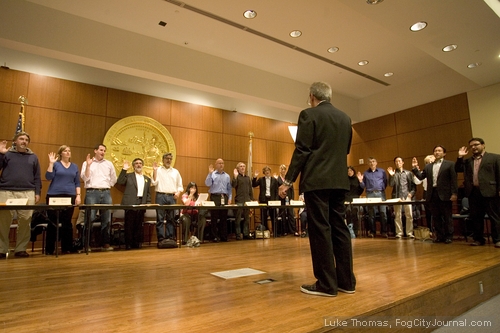
Termed out D. 6 Sup. Chris Daly announced last night via Fog City Journal that he has endorsed community organizer James Keys. Keys was Daly’s re-election campaign manager in 2006.

“James was by my side through my toughest battles,” Daly told FCJ. “While there are many good candidates in this race, James Keys best represents what I’m about – social and economic justice for our City’s most vulnerable. His campaign may not have the most money or endorsements, but he does have a special connection with the constituents that I love and the will to overcome great odds.”

Daly’s endorsement vaults Keys into the front line of candidates vying to replace Daly. 

“I am humbled to be receiving the endorsement of Supervisor Chris Daly, who has done so much for our District,” Keys told FCJ. ” It’s going to be helpful to have him with me as I work to continue his legacy.”

Daly said he will formally endorse Keys during a campaign barbecue this  Saturday at 11am in Boeddeker Park. And as FCJ founder, editor and photographer extraordinaire Luke Thomas put it, in an email about his scoop, “An interesting development, n’est ce pas?”.


What DCCC questionnaires reveal about Adachi reform, sit-lie and marijuana

20

The DCCC makes its endorsements for the November election on August 11. And in preparation for that crucial endorsement, candidates filled out questionnaires that are posted online, providing fodder for those interested in Jeff Adachi’s pension reform, Mayor Gavin Newsom’s sit-lie ordinance, and the legalization of marijuana, amongst other measures.

But before we get to those issues, I have to admit I was a bit surprised to see that D. 10 candidate Malia Cohen, who has already secured the endorsements of Sally Lieber, Fiona Ma and Aaron Peskin, says on her DCCC questionnaire that she supports the death penalty.

Now, to be fair, advocating for or against the death penalty isn’t the duty of the Board of Supervisors. And I haven’t yet caught up with Cohen yet to clarify why she holds this stance, (or whether it was one big typo, though I somehow doubt it). So, I’ll be sure to update this post, once I have a chance to talk to Cohen, who was busy at yet another candidate forum, when I was writing this entry. UPDATE: Cohen says she does not support the death penalty, and that she inadvertently misanswered the question. (Thanks for clearing up the mystery, Malia, and being gracious about it in the process.)

I should mention that Peskin also endorsed D. 10 candidate Tony Kelly.

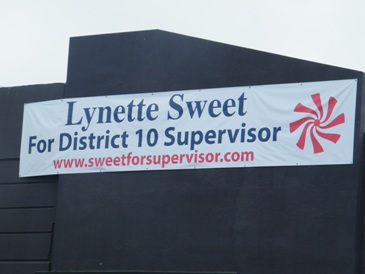
And I should also note that while D. 10 candidate Lynette Sweet’s questionnaire says she supports Jeff Adachi’s pension and healthcare reform, Sweet’s campaign says that’s not the case, pointing to how Sweet said at the Potrero Hill Democratic Club’s August 2 D. 10 forum that what Adachi did wasn’t a bad thing, but the way he went about it was.

I quoted Sweet saying those very words in a previous post, and Sweet’s campaign manager Shane Mayer told me that he forwarded what I wrote about that meeting to the DCCC to clarify Sweet’s position. But Mayer got testy when I asked him about the rent, or rather the lack of rent, that Sweet, who Mayor Gavin Newsom has already endorsed, appears to be paying for her campaign headquarters at 25 Division Street (at Rhode Island).

As Beyond Chron tells it, the deal looks more than a bit fishy, and appears to be bankrolled by the Visovichs, a family with Republican leanings that supported Mayors Willie Brown and Newsom in past election campaigns.

 Mayer tried to dismiss the Beyond Chron article as a “hit piece”.

“The article focuses on only one candidate,” Mayer said. “We’re paying fair market rate, and using only a small portion of a warehouse. When we moved in, we didn’t have lights.”

But Sweet isn’t the only D. 10 candidate to come under Beyond Chron’s fire in recent days: fellow D. 10 candidate Steve Moss also took flak for receiving $500 from Andrew Zacks, the landlord attorney famous for doing Ellis Act evictions.

While on the phone with Moss recently, I asked what he thought about Newsom’s sit-lie ordinance, Moss said he hadn’t made up his mind yet.

And in his DCCC questionnaire, Moss also waxes ambiguous on sit-lie. “There’s clearly a lack of civility in certain areas of the city,” Moss wrote. “And in Bayview-Hunters Point, youth loitering can create conditions that create violence. However, it’s not clear to me that sit-lie is an appropriate response to this issue, and that it won’t result in unintended consequences. For example, sidewalks in Bayview-Hunters Point are also often used for peaceful gathering of neighbors, which is community-building and non-threatening.”

Makes me wonder what Moss and the rest of the candidates think about City Attorney Dennis Herrera’s recent gang injunction in Viz Valley…

UPDATE: I should add here that termed-out D.6 Sup. Chris Daly has just endorsed legislative aide and D.6 candidate James Keys, whose DCCC answers I’ve included in my round up of some of the candidate responses to this year’s DCCC questionnaire. UPDATE: And for all the Glen “Anna Conda” Hyde supporters, my humble apologies for omitting your candidate’s positions in my first post on this issue:

Chiu’s non-citizen voting in School Board elections
Supportive of non-citizen voting:  Adachi, Sup. Michela Alioto-Pier and D. 2 challenger Janet Reilly, D. 6 candidates Glen “Anna Conda” Hyde, James Keys, Jane Kim, Jim Meko, Debra Walker and Theresa Sparks. D. 8 candidates Rafael Mandelman, Rebecca Prozan and Scott Wiener. D. 10 candidates Isaac Bowers, Cohen, Chris Jackson, Tony Kelly, Dewitt Lacy and Eric Smith.
Opposed: D.2 candidates Farrell and Berwick, D. 4 incumbent Carmen Chu, and D. 10 candidates Kristine Enea and Lynette Sweet.

Newsom’s ban on dual office holding

Supportive: Berwick, Farrell, Glen “Anna Conda” Hyde, Meko, Enea.

“Yes. Better distribution of power,” Anna Conda said.

Opposed: Adachi, Alioto-Pier, Reilly, Keys, Kim, Walker, Sparks, Mandelman, Sweet, Lacy, Kelly, Cohen, Wiener, Jackson, Smith and Prozan.
“This measure is the result of petty politics between the mayor and the Board,” Prozan, who contributed S100 to Newsom’s Lt. Governor campaign, famously wrote on her DCCC questionnaire.

Newsom’s Sit-Lie Ordinance
Supportive: Farrell, Alioto-Pier, Reilly, Chu, Sparks, Wiener and Sweet.
Opposed: Adachi, Berwick, Glen “Anna Conda” Hyde, Keys, Kim, and Walker. Mandelman and Prozan. Cohen, Jackson, Kelly, Lacy and Smith.

Adachi’s Pension Reform
Supportive: Adachi, Berwick, Meko, and Sweet
Opposed: Chu, Farrell and Reilly. Glen “Anna Conda” Hyde, Keys, Kim, Walker and Sparks. Mandelman, Prozan and Wiener. Cohen, Jackson, Kelly, Lacy and Smith.
No position, yet: Alioto-Pier.

Legalization of pot (Prop. 19)
Supportive: Adachi, Berwick. Glen “Anna Conda” Hyde, Keys, Kim, Meko, Sparks, and Walker. Mandelman, Prozan and Wiener. Cohen, Jackson, Kelly, Lacy, Smith and Sweet.
Opposed: Chu and Farrell

No position, yet: Alioto-Pier, Janet Reilly.

Hard to tell: Moss.

“I philosophically support this measure but am concerned that its economic and social implications haven’t been carefully considered, nor its interaction with federal law,” Moss wrote on his DCCC questionnaire.

Sparks for her part just clarified that she mistakenly answered “No” on two DCCC questionnaire items: “Do you opposeprivatization of essential government services,” and “Will you oppose anti-worker initiatives that seek to undermine the ability of union leaders to carry out will of members and engage in political activities.”

“I meant to answer yes, as I explained at my DCCC interview,” Sparks said. “I was confused by the double negatives.”

While she was on the phone, Sparks also admitted that the pace on the campaign trail is getting intense with forums and meetings every night.

“David Campos, who has been a good friend since we were both on the Police Commission, recently told me, ‘win or lose, you need to schedule a few weeks off in November when the election is over,’” Sparks said.

Campos is right. To all the candidates on the campaign trial, here’s wishing you lots of energy and calm in the weeks to come. And see you at the DCCC forum.

<!–[endif]–>

DCCC endorsements will test progressive unity

2

When the San Francisco Democratic County Central Committee convenes tomorrow (Aug. 11) evening to vote on its endorsements for the November races and ballot measures, the clout and unity of its slim progressive majority will be tested in a few high profile contests where the outcome isn’t entirely clear.

As I reported last week, progressives occupy only about 17 of the 33 seats, so any defectors from the slate that won in June could create some squirrely politics or backroom deals. Progressive supervisorial candidates Rafael Mandelman from District 8 and Debra Walker from District 6 are widely expected to get the top endorsements in their races, but Rebecca Prozan in D8 and Jane Kim (and possibly Jim Meko) in D6 each have some progressive supporters on the committee and could make a play for the second slot in the ranked-choice voting election. D8 candidate Scott Wiener, the former DCCC chair, will probably also try to get some kind of spot on the slate but is likely to be met with fairly unified progressive opposition.

The District 10 endorsement will be a free-for-all with no clear progressive consensus alternative to downtown-backed candidate Lynette Sweet yet emerging from the crowded field. Party chair Aaron Peskin has endorsed Malia Cohen and Tony Kelly in that race, but Chris Jackson, Dewitt Lacy, Kristine Enea, and other candidates also have progressive backing, so it could be tough for any of them to get to 17 votes at this point. But in District 2, Janet Reilly appears to have the endorsement locked down, despite a judge allowing incumbent Sup. Michela Alioto-Pier to run for a third term.

On the local ballot measures, the progressive majority is likely to endorse the revenue measures (a hotel tax increase pushed by labor, a transfer tax on properties worth over $5 million, and a small local vehicle license fee surcharge) and reject Public Defender Jeff Adachi’s measure to increase how much city employees pay for health care and into their pensions and Sup. Sean Elsbernd’s measure to end pay guarantees for Muni drivers (although not even progressives are feeling much love for the recalcitrant Transportation Workers Union these days).

The aggressive effort by the legal community to overturn the DCCC endorsement of Michael Nava for judge – waged on behalf of Judge Richard Ulmer, a recent appointee of Gov. Arnold Schwarzenegger, ostensibly over judicial independence but also as a way of sucking up to judges that lawyers want to curry favor with – is expected to fail, mostly because it requires a two-thirds vote. An ordinance to ban sitting or lying on sidewalks that is being pushed by Mayor Gavin Newsom, Police Chief George Gascon, and San Francisco Chronicle columnist CW Nevius is also likely to be soundly rejected by the party.

DCCC endorsements usually carry quite a bit of weight in heavily Democratic San Francisco, getting the candidates on party slate cards and entitling them to other party resources. Any races that don’t yield a majority endorsement this week would get pushed back to the September meeting, when the DCCC will consider school board endorsements.

The fun starts at 6 p.m. at the Unite-Here Local 2 office at 209 Golden Gate Avenue.

D. 10 candidates split on Lennar’s plan

3

One of the key questions at the Potrero Hill Democratic Club’s forum for D. 10 candidates revolved around Lennar’s Candlestick Point-Hunter’s Point Shipyard redevelopment plan.

The current Board of Supervisors recently approved Lennar’s plan by a 10-1 vote (D.6 Sup. Chris Daly dissented). Following that vote, Mayor Gavin Newsom rushed to sign twelve pieces of legislation that approve and enable what could shape up to be the largest redevelopment project in San Francisco´s history.

“Today is a historic day for San Francisco and a testament to so many who have worked for more than a decade to secure this critical engine for our City´s economic future,” Newsom said in a press statement, after he signed off on the Lennar deal. “I want to thank Sup. Sophie Maxwell for spearheading this effort throughout her entire tenure on the Board of Supervisors and our State and Federal representatives including Speaker Pelosi and Senator Feinstein as we take a giant leap forward towards our shared vision of jobs, housing, and hope for the Bayview-Hunters Point community.”

But with Maxwell termed out in January, the successful candidate in the D. 10 race stands to inherit a plan that has been approved, but apparently isn’t funded yet. And by my accounting, the majority of the candidates who spoke at the D. 10 forum expressed reservations with Lennar’s proposal, with only a few firmly against it, and only a few firmly in favor of it. But read their comments, decide for yourself–and keep tracking this fascinating race!

 
Asked how she would have voted on Lennar’s plan, Lynette Sweet, who voted to make Lennar the shipyard’s master developer when she was a member of the Redevelopment Commission in 1999, said she would have approved it.
“I voted for it then, and I would have voted for it now,” Sweet said. “And I want to be the person who shepherds it through in the next eight years.” But Sweet also sought to reduce the many ongoing questions about the plan–including housing affordability levels, local job creation, air quality impacts, and the  Navy’s related shipyard clean-up–to one simplistic issue: the bridge over Yosemite Slough.

“There’s been a lot of controversy over a bridge,” Sweet said. “But we don’t give up on people for a bridge. We just can’t.”

Eric Smith said he was supportive of the plan and the community benefits agreement, but he voiced criticism of the project’s environmental Impact report (EIR).
“The project’s EIR wasn’t perfect,” Smith noted. “And I wasn’t a huge fan of the bridge, but I’ve walked around Alice Griffith [a dilapidated public housing project in the Bayview] and when you see folks with moldy pipes, broken ceilings, and rats, it moves you. So, I’m supportive of it, and I’m supportive of the community benefits agreement [that the SF Labor Council negotiated with Lennar] and the jobs it can bring.”

Nyese Joshua said she would have voted against the plan, starting years ago.
“I would have voted to stop that project in 2006, when the dust issue was going on,” Joshua said. “And it’s a misnomer to claim the Board voted 10-1 for Lennar,” Joshua contined, as she pointed out that five progressive supervisors on the Board voted against the bridge and for air quality analysis, greater affordability and greater workforce protections. But ultimately, this progressive core was unable to pass those amendments, because Sups. Maxwell, Bevan Dufty, Sean Elsbernd, Carmen Chu, Michela Alioto-Pier and Board President David Chiu did not support them.
“That 10-1 vote is being called a pyrrhic victory,” Joshua added.


Kristine Enea indicated that she would have voted yes, but with reservations.
“I would have consistently voted yes to amendments, but there was no comprehensive transportation analysis,” Enea said.
Enea, who has served on the now disbanded Navy’s Hunter’s Point Shipyard Restoration Advisory Board, noted that she is “intimately familiar with the technical data,” surrounding the Navy’s shipyard clean-up plans.
“And I live a stone’s throw from the shipyard, and I believe we are safe,” Enea added.
“There is hope soon to be a restored public process on the Navy’s clean up,” Enea continued, referring to the Navy’s 2009 decision to dissolve the RAB.“But we need to be very vigilant that cleanup of Parcel E2.”

Malia Cohen said she would have supported Lennar’s plan,
“Lennar has dominated the lion’s share of our conversations,” Cohen said, noting that there are a bunch of redevelopment projects in the southeast. “So, we can’t be singular in our vision of what we want our community to look like. We can’t let Lennar dominate. But I’d have supported the project because I believe what Lennar represents is an extraordinary opportunity for us to pick ourselves up, organize and collectively voice what we’d like our community to look like. It’s imperative that Lennar’s plan moves forward, but it has to be environmentally sound.”

Steve Moss said he probably would have voted for the project’s EIR, but voiced concern about the lack of affordability within the project’s 10,500 units of housing.
“But nothing is more toxic than the shipyard than the conversation about the shipyard,” Moss added, noting that the Navy and US EPA have collectively committed to spend millions and millions on shipyard cleanup, but the community doesn’t trust the process.
“So, what went wrong with the conversation in a community that is clearly wounded?” Moss said. “We need to start having honest conversations. And we’re programming a lot of housing [within the Lennar development,] but not enough jobs.”

Stephen Weber said he would have voted for it.
“ I believe that we need it, that we can’t wait any longer,” Weber said. “But it goes back to oversight. It’s the responsibility of the city to make sure the developer and everyone connected to the development is held accountable and is made to follow through on procedures, and make sure affordable housing is mixed into the plan. It has to be a neighborhood built on diversity.”

Isaac Bowers said he’d have been in favor of sending the plan back to Redevelopment to be amended.
“This is a very difficult decision,” Bowers observed. “We all know that the area has suffered from many decades of neglect. But when I looked closely at the plan’s environmental impact report and the process, I didn’t think the range of alternatives for the bridge were sufficient. The demands for [greater oversight] of the shipyard clean-up were legitimate. The analysis of how many jobs in research and development was insufficient. There was no analysis of displacement. There were inadequate levels of truly affordable housing. We need to look at real jobs when we look at development. And the Redevelopment Agency has to be put back under the control of the Board. It can’t be allowed to put out fake projects that don’t benefit the community.”

Diane Wesley Smith suggested she’d have voted no when she pointed to Lennar’s “trail of broken promises.”
“And talk about collusion,” Wesley Smith said. “ I understand this was a done deal, five years ago.”

Geoffrea Morris said she would have voted no.
“There was a lot of money, a lot of power pushing the shipyard project,” Morris said.
“If this happened in any other community [in the city], it wouldn’t have happened,” Morris continued. And they wouldn’t have got rid of the [Navy’s community-based] restoration advisory board,” Morris added.”But ours is a poor community of minority people and a majority are African Americans.”

Chris Jackson said he would have voted yes, but with amendments.
“I would have supported the plan, but with amendments to ensure the full clean-up of the shipyard to residential standards, and to work towards on agreement on the bridge,” Jackson said.
 “We are a better city than just saying no,” Jackson continued, as he outlined ways to ensure that local workers get decent paying jobs, the community gets an expanded health clinic, the city includes a cooperative housing and land trust element to provide affordable housing, and the city is required to provide a supplemental environmental impact report.

Tony Kelly said he would have voted no–and noted that he was the only candidate to publicly testify against the certification of project’s EIR.
“I was the only candidate to testify against the environmental impact report and in support of the appeal [that three separate groups brought after the Redevelopment and Planning Commissions voted to certify the city’s EIR for Lennar’s plan],” Kelly said.
‘Michael Cohen, the Mayor of San Francisco,” Kelly half-jokingly continued, “has said the project is not going to be started to be built for at least 4 to 5 years. So, how can the city say, you must support the plan now, when it’s not going to happen for a long time?”

Marlene Tran said she can’t support the plan until the shipyard’s cleaned up.
Tran explained that initially, when Arc Ecology’s Saul Bloom gave the community a presentation about the plan, she was intrigued.
“It seemed to bring a lot of promises, but then Bloom presented ten of the deficiencies with the plan,” Tran said, referring to heavy metals and other toxins on the shipyard.
“I will make sure they will do the clean-up first,” Tran said. “If we go for it, and then construction workers and residents, get sick…well, there’s no way I can condone the project, until it’s absolutely clean. And what if the developer goes bankrupt?”

Espanola Jackson gave folks a history lesson
“When I learned that the shipyard was a Superfund site was not until 1990, because we was illiterate about environmental justice in a black community,” Jackson recalled. “I thought environmental justice was white kids chasing whales. But then I went to Monterey and learned about restoration advisory boards [RABs].”

Noting that the local community got its own RAB in 1994, Jackson recalled how former Mayor Willie Brown appointed Lynette Sweet to the Redevelopment Commission, before the Commission voted 4-3 in 1999 to select Lennar as master developer for the shipyard.
“Willie Brown brought in Lynette Sweet to be the swing vote to bring Lennar into the community,” Jackson said.

DeWitt Lacy said he wouldn’t have supported the plan, as it was, and given the Board’s limited ability to amend it under the city charter.
“I’d have supported the plan, if I’d had the power to amend the project’s environmental impact report and get it done right,” Lacy explained.
Lacy faulted the plan for carving up a state park, building a bridge over an environmentally sensitive slough, and not doing enough to ensure local jobs or guarantee benefits.
“Folks didn’t believe it was important for black folks to have state park land, but it’s important for our kids to have this,” Lacy said. “The state has spent $5 million to rehabilitate Yosemite Slough… And a ‘good faith’ agreement [around local hiring quotas] doesn’t get it for me. We have to have absolute certainties to make sure our people get the benefits.”


You can watch video of both the D. 10 forums, which were moderated by Keith Goldstein, here. And stay tuned for coverage of the endorsements and financing behind each candidates’ campaign. D. 10 is already shaping up to be one of the most fascinating and pivotal races in the fall.


The politics of unity and division

7

steve@sfbg.com

These are strange days for the San Francisco Democratic Party, which is seeking to overcome bitter divisions on the local level and come together around candidates for statewide office that include Mayor Gavin Newsom, whose fiscal conservatism and petulant political style are the main sources of that local division.

The tension has played out recently around the Board of Supervisors deliberations on the new city budget and November ballot measures and in dramas surrounding the newly elected Democratic County Central Committee, where the battles during its July 28 inaugural meeting previewed a more significant fight over local endorsements coming up Aug. 11.

Almost every elected official in San Francisco is a Democrat. Newsom, the Democratic nominee for lieutenant governor, has been the main obstacle to new taxes that progressives and labor leaders say are desperately needed to preserve public services, deal with massive projected deficits in the next two years, and quit balancing budgets on the backs of workers.

“We balanced the budget without raising taxes. I don’t believe in raising taxes. We don’t need to raise taxes,” Newsom said proudly at his July 29 budget signing ceremony, during which he also effusively praised the labor unions whose support he needs this fall: “Labor has been under attack in this state and country. They’ve become a convenient excuse for our lack of leadership in Sacramento and around the country.”

That hypocritical brand of politics has been frustrating to his fellow Democrats, particularly progressive supervisors and DCCC members. At the July 27 board meeting, Sup. Ross Mirkarimi and Board President David Chiu reluctantly dropped their pair of revenue measures that would have raised $50 million, bowing to opposition by Newsom and the business community.

The San Francisco Chamber of Commerce has become such a vehicle for antitax and antigovernment vitriol that the DCCC on July 29 approved a resolution calling for the organization — which hosted a speech by Republican National Chair Michael Steele in June — to renounce the platform of the Republican National Committee.

“The Chamber is not a knee-jerk right-wing organization,” Chamber President Steve Falk felt compelled to clarify in a July 28 letter to DCCC Chair Aaron Peskin, closing with, “Anything you can do to avoid painting the Chamber as a pawn of the GOP would be greatly appreciated — because it just isn’t true.”

Yet Rafael Mandelman, who sponsored the resolution and is a progressive supervisorial candidate in District 8, told us the Chamber’s fiscal policies are indistinguishable from those pushed by Republicans. “They’re the leading force pushing the Republican agenda in San Francisco,” Mandelman said, calling the stance short-sighted. “It’s not in the long-term interests of the business community for our public sector to fall apart.”

Chiu’s business tax reform measure is a good example of how conservative ideology seems to be trumping progressive policy, even among Democrats. Only 10 percent of businesses in the city pay any local business tax, and the measure would increase taxes on large corporations, lower them on small businesses, create private sector jobs, bring $25 million per year into the city, and expand the tax burden to 25 percent of businesses, including the large banks, insurance companies, and financial institutions that are now exempt. But even the Small Business Commission refused to support the plan, prompting Chiu to drop the proposal and tell his colleagues, “There is still not consensus about whether this should move forward.”

Sup. Chris Daly, the lone vote against the budget compromise with Newsom and the removal of revenue measures from the November ballot, noted at the July 27 board meeting how the business community has sabotaged city finances, citing its 2002 lawsuit challenging the gross receipt taxes, which the board settled on a controversial 8-3 vote. “This is a large part of our structural budget deficit,” Daly said.

But antitax sentiment has only gotten worse with the current recession and political dysfunction, causing Democrats like Newsom to parrot Republicans’ no-new-taxes mantra, much to the chagrin of progressives.

“A lot of this is being driven by statewide politics. [Newsom] needs to not have taxes go up but he also needs the support of the labor unions, so we get weird stuff happening in San Francisco,” Mandelman said.

The situation has also fed Newsom’s animus toward progressives, who have enjoyed more local electoral success than the mayor. Newsom responded in June to the progressive slate winning a majority on the DCCC by placing a measure on the November ballot that would ban local elected officeholders from serving on that body, which includes four progressive supervisors and three supervisorial candidates.

Nonetheless, Newsom then unexpectedly sought a seat on the DCCC, arguing that his lieutenant governor nomination entitled him to an ex officio seat (those held by state and federal elected Democrats) even though the DCCC’s legal counsel disagreed. While noting the hypocrisy of the request, Party Chair Aaron Peskin took the high road and proposed to change the bylaws to seat Newsom.

Some progressives privately groused about giving a seat to someone who, as DCCC member Carole Migden said at the meeting, was “picking a fight” with progressives by pushing a measure she called “disrespectful and unconstitutional.” But in practice, the episode seems to have hurt Newsom’s relations with progressives without really strengthening his political hand.

Newsom ally Scott Wiener — a DCCC member and District 8 supervisorial candidate (who told us he opposes the mayor’s DCCC ballot measure) — proposed to amend Peskin’s motion to change the bylaws in order to seat Newsom with language that would allow Newsom to continue serving even if he loses his race in November.

That amendment was defeated on a 17-13 vote that illustrated a clear dividing line between the progressive majority and the minority faction of moderates and ex officio members. Even with Newsom and District Attorney Kamala Harris (who was seated as the Democratic nominee for attorney general) being seated — and counting the one absent vote, Sen. Leland Yee, who is expected to sometimes vote with progressives and sometimes with moderates — progressives still hold the majority going into the process of endorsing local candidates and allocating party resources for the fall campaign.

“Presuming that 17 people of that 33-member body all agree on something, then the presence of Mayor Newsom doesn’t change anything,” Peskin said. He also noted that even if Newsom’s measure passed and the progressive supervisors were removed, “the irony is that the chair of the party [Peskin] would appoint their successors.”

Also ironic is the political reality that it is Newsom who most needs his party’s support right now, while it is progressives who are adopting the most conciliatory tone.

“We should all be working to turn out the vote and help Democrats win,” Peskin told us. “I implore our mayor and lieutenant gubernatorial candidate to work with us and get that done.”

Yet after Newsom gave a budget-signing speech that included the line, “At the end of the day, it comes down to leadership, stewardship, collaboration, partnership,” he told the Guardian that he has no intention of removing or explaining his DCCC ballot measure, saying only, “If the voters support it, then it would be the right thing to do.”

Chiu responded to the news by telling us, “I hope the mayor can move beyond the politics of personality and build a party vehicle that is about unity.”

Janet Reilly should stay in the race

9

Now that a judge has ruled that Michela Alioto-Pier can run again for her District Two seat, a wide-open race has become a little strange. Janet Reilly had already rounded up the endorsements of Democratic Party heavies like Dianne Feinstein and Nancy Pelosi, along with Gavin Newsom. Of course, Newsom has always supported Alioto-Pier in the past; he no doubt backed Reilly because he figured (as did a lot of us) that City Attorney Dennis Herrera was right and Alioto-Pier was termed out. Same goes for Feinstein and Pelosi, who won’t want to be in the position of opposing an incumbent supervisor who has always sided with the downtown establishment.

So now what do all those people do?

Add in the fact that Herrera, who still thinks his position was correct, might decide to appeal, and the state Appeals Court might still intervene and kick Alioto-Pier off the ballot, and anyone who switches endorsements after this ruling might have to do it again after that one, and you’ve got quite a political mess.

The only thing that gets the entire power structure of the local Democratic Party off the hook is if Reilly drops out and says she doesn’t want to fight Alioto-Pier. There’s going to be immense pressure on her to do just that; I bet someone from Pelosi’s office has already called.

But Reilly needs to hang tough. She’s a good candidate who could mount a serious challenge to Alioto-Pier, who needs a challenge. District Two isn’t going to elect a left-progressive, but Reilly would be a much more independent supervisor. I couldn’t reach her today, but she told the Chron she was going to make up her mind this fall. My advice: Don’t spend a lot of time debating (which leaves all your supporters up in the air). Announce right away that you’re in the race for good, that you’re in it to win and that you look forward to a lively debate on the issues facing the city. And if Pelosi and Feinstein back off from their endorsements, they look bad and you look fine.


Buyer beware of Candlestick-Shipyard project

0

Board President David Chiu has introduced five amendments to the city’s Candlestick Point-Hunters Point Shipyard redevelopment proposal. All five are a good start, but longtime observers question if they are too little, too late, in the face of intense lobbying by a city and a developer intent on getting project approvals before a new Board and possibly a new mayor occupy City Hall in January 2011.

Chiu’s amendments address key concerns with the city’s proposed redevelopment plan, and they come as the Board prepares for its July 13 hearing into three separate appeals of the project’s final EIR certification, as well as amendments to the Bayview Hunters Point and Shipyard redevelopment plans.

Two of Chiu’s amendments seek to address concerns about the clean-up of radiologically impacted waste at Parcel E-2 on the shipyard, and environmental impacts of a proposed bridge over Yosemite Slough.

Chiu’s other three amendments seek to finance the expansion of the Southeast Health Center, create a workforce development fund and analyze the feasibility of providing public power, including natural gas at the site.

But while all five amendments are welcome, some observers worry they do not fully address concerns about the project’s sustainability, financing and infrastructure.  But before we get to those concerns, let’s review Chiu’s five amendments in greater detail:

1. The Parcel E-2 amendment.
This amendment declares that the Board’s adoption of CEQA findings for the project “shall not in any way imply support of a cap for Parcel E-2.” 

As such, this amendment is a critical step towards insisting that the parcel get completely cleaned up, not just capped, as the Navy is currently proposing. On the other hand, it’s not a watertight demand to excavate and haul away all contamination from this parcel, which is the cleanup alternative that many in the community would prefer..

Instead, Chiu’s Parcel E-2 amendment declares that the U.S. EPA, California EPA and the Navy, “should pursue the highest practicable level of cleanup for Parcel E-2.”
And that the San Francisco Redevelopment Agency “should not accept the property unless and until that cleanup is satisfied.”

It also establishes that the Board shall conduct a hearing regarding final cleanup strategies for Parcel E-2 before a final remedy is selected, urges the U.S. EPA, California EPA and the Navy to participate in such a hearing, and further establishes that the Board shall conduct a separate hearing prior to any transfer of Parcel E-2 to Redevelopment.”

(There was some question as to why the Board was saying “should” in some parts of this amendment, and “shall” in others. The reason I heard was, you can’t force the Navy to do anything, but you can urge them, and you certainly can refuse to accept the property, if it is not cleaned up a city’s requirements.But this needs to be clarified.)

2. The Yosemite Slough Bridge amendment
Chiu notes that the city’s EIR for the project analyzed a non-49ers-stadium alternative that “includes an approximately 41 ft. wide bridge spanning the Yosemite Slough which is limited to bike, pedestrian and transit use.”
“However, in the event the San Francisco 49ers elect to build a new stadium on the shipyard site, the project will include a bridge spanning Yosemite Slough that is wider than 41 ft. across to accommodate game-day traffic,” Chiu’s amendment states.
(So, Chiu’s amendment doesn’t throw the bridge entirely out with the 49ers’ stadium, and that leaves environmental groups uneasy, afraid that the anticipated 25,000 new residents in the proposed development will subsequently push for legislation to allow for a wider, car-accessible bridge.)

3. The Southeast Health Center amendment
Chiu’s Southeast Health Center amendment demands that the developer contribute $250,000 to the Redevelopment Agency for a needs assessment study regarding the need to expand the center and the ongoing health needs of local residents, and, to the extent such expansion is needed, to help pay for predevelopment expenses associated with this expansion.
The capital costs for expanding the center would be funded through a combination of  tax increment dollars, a $2 million Wellness Contribution paid by the developer, and the City’s ability to finance savings that would accrue to the Department of Public Health by moving from leased space into owned space at the expanded center.

4. The Workforce Development Fund amendment
Chiu’s amendment would modify language in the current community benefits agreement to require the developer to contribute $8,925,000 to a workforce development fund to be used for programs “designed to create a gateway to career development, fiirst for residents of District 10 and secondly for “at-risk job applicants.”
(A member of the public suggested that veterans be specified as “at-risk job applicants,” an idea D. 10 Sup. Sophie Maxwell seemed to support during yesterday’s July 12 Land Use Committee hearing, which was where Chiu introduced his five proposed amendments.)

 5. The Public Power amendment 
Chiu’s public power amendment notes that the SFPUC confirmed the feasibility of providing electric service to the shipyard sire, but requires the agency to update this study and include the Candlestick site and include “an analysis of the feasibility of providing natural gas to the project site.”

But will these steps be enough to ensure that the development actually delivers on its promises of thousands of jobs, and hundreds of affordable housing units,? And is a bridge really necessary across Yosemite Slough, if the 49ers go to Santa Clara as planned?

Long-term observers of the project point to the first phase of the project, which began on the shipyard’s Parcel A, as a warning of where things might end up.

“We approved the fast-tracking of Parcel A based on a bevy of assurances and enthusiastic endorsements from the best and brightest this administration has to offer,” said a source who wishes to remain anonymous. “But what has happened since then, and what are we to learn from this experimental test case?”

This source noted that recent maps of the shipyard show that Parcel A, which the Navy conveyed to the city in 2004, has since been carved up into several new pieces.

“How did Parcel A get divided into two areas that don’t even border one another?” my source asked.

The answer appears to be that sections of the shipyard, including Parcel A,  have since been renamed as new and separate parcels, after it was discovered that shipyard sewers on those parcels contained radiologically contaminated material.

One of these sewer lines, as indicated on recent project maps, leads from a site now known as Parcel UC-3, into the Bayview. In other words, it appears to lead off the shipyard site and into the surrounding community. If so, this raises concerns that shipyard contamination is no longer limited to the shipyard in the Bayview, and could be impacting residents and businesses that are not covered by the Navy’s clean-up commitments.

Either way, it seems that the Board could use an update on what happened on Parcel A, since it was conveyed, what’s the deal with UC-3, and other recently renamed parcels, before they consider an early transfer of the rest of the shipyard.

“How can we start Phase 2 of the project, when we haven’t completed Phase 1?” my source asked.

And since the Navy is still tasked with cleaning up the rest of the shipyard parcels, it would be helpful if the Navy updated the Board on what the Navy is proposing in its Records of Decisions for each of these parcels, including UC-3, before the Board votes on Phase 2 of the project.

My source also noted that since the project plans to use 100 percent recycled water at the site, it would be helpful to have an update as to how issues with sewer contamination and groundwater concerns might impact the project’s sustainability plans.

“These issues touch on half of the documents that make up the EIR, but are now obsolete, because of the issue of radioactive contamination on UC-3,” my source claimed.

And then there’s the question of fproject financing and who the developer for the project actually is, these days.

“The city’s exclusive negotiating agreement (ENA) was with Lennar, so who is CP Development and why do we have an ENA with them?” my source asked.”What happened to Lennar? And why would we be obligated to negotiate solely with this CP Development group?”

Now, hopefully the Board has greatly reassuring answers to all these questions, so that the community can rest assured that the supervisors really do understand the ramifications of a project that they are being asked to approve in what appears to be an awful hurry.

Yes, there are plenty of project supporters who keep on urging “no delays.” I understand their concerns. They want jobs, housing, parks and other promised community benefits. And I don’t blame them.

But it’s up to the Board to ensure that it doesn’t get rushed into approving a project that perhaps doesn’t guarantee any or all of these things. So, let’s keep asking questions so the Board of Supervisors doesn’t end up with buyer’s remorse, but instead can truly claim to having secured a deal that really helps all the folks who currently live and work in the city’s southeast sector. Stay tuned.


T


Everyone hates PG&E

5

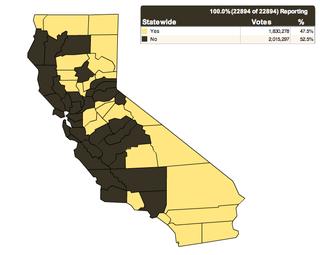
Well, maybe not everyone, but the results from last night’s election are fascinating. A $50 million campaign, with the opposition struggling to come up with $100,000 — and PG&E still lost. Calitics has a fun comparison that makes one of the key points: The company lost most heavily in its own service areas. People who have to deal with PG&E — and its high rates, poor service, blackouts, botched smart-meter program and financial greed — voted strongly against allowing the company to further entrench its monopoly power. In essence, PG&E lost at home.


A couple of other interesting factors: The results show, I think, that whatever you say about the decline of newspapers, their endorsements still matter. Every major newspaper in the state opposed Prop. 16, and that clearly had an impact. The No on 16 campaign didn’t have the money for any media buys; the press coverage and strong anti-PG&E endorsements had to carry the message.


TURN, Ross Mirkarmi, Mark Leno, Tom Ammiano and consultant Gail Kaufman deserve credit for raising what little money they could and leveraging it into a stunning statewide victory. Considering that the turnout skewed heavily Republican, the defeat of Prop. 16 will go down as one of the great progressive victories in California history.


The local numbers were astounding: In San Francisco, Prop. 16 went down 2-1, with 67 percent of the voters rejecting PG&E’s ploy. That’s the strongest mandate for public power I’ve ever seen. Same for the rest of the Bay Area: Alameda County, 64 percent No. San Mateo County, 60 percent No. Marin County, 61 percent No. Mayor Gavin Newsom ought to take a look at the map on the Secretary of State’s website; it shows that the voters he needs to get elected lieutenant governor have rejected PG&E and want a public-power option.


The collapse of PG&E’s attempt to buy democracy in California gives San Francisco some breathing room on its community choice aggregation contract, which is excellent news. The supervisors can now take some time to go over the details — and prepare for the next major battle, the marketing campaign to education local residents about the value of community-controlled green energy.


PG&E is clearly on the run — CEO Peter Darbee has driven the company to a point where it has no friends left. Could be a great era for public power efforts.

Three words: Vote June 8

1

The problem with the June 8th ballot is that the Democrats aren’t fighting with each other.


I mean, it’s great that Jerry Brown and Barbara Boxer will emerge from the primary season unscathed, flush with money and ready to go after opponents who have been battered and beaten mercilessly in their own primaries. It’s great that Steve Poizner drove down Meg Whitman’s positives and made her look so bad that she’s now behind Jerry Brown (who isn’t even campaigning yet) in the polls. It’s great that Carly Fiorina was forced so far to the right that she had to endorse allowing people on the no-fly list to buy handguns. The expensive and ugly GOP primary battles may have saved Boxer’s job and put Brown in the governor’s office.


But around the state, Democrats don’t have as much reason to vote. Fiorina, Poizner, Whitman — they’re all spending millions to bring Republicans to the polls. There’s no similar statewide GOTV operation on the Democratic side. So the electorate could wind up skewing considerably to the right — and that’s going to hurt us on the ballot propositions.


Johnny Angel and I were talking on our radio show today about the fact that Republicans — those who aren’t complete idiots — ought to oppose Prop. 16 and Prop. 17. Those aren’t partisan measures; they’re just corporate scams. And nobody from any political party likes Pacific Gas and Electric Co. these days.


But the reality is, PG&E has aimed its Prop. 16 campaign directly at the heart of the more conservative electorate, with its anti-government message. And Mercury insurance has aimed its campaign at the better-off consumers who aren’t likely to drop their car insurance any time soon. I don’t see Prop. 16 winning big in any constituency — but it will do better among Republicans.


So Democrats have to get to the polls — and get their friends to the polls, and their families to the polls, and their neighbors to the polls, and a few dead people, too, if they can find them (just kidding, Arthur Evans, lighten up).


And in San Francisco, where there are no races for mayor or supervisor, it’s easy to want to sit this one out — but that would be a major mistake. The election for Democratic County Central Commitee alone is worth a trip to the polling place, since the makeup of that body will have a significant impact on the fall supervisorial races.


So you have to vote, folks. Here’s our endorsements.


Affordable housing group’s shady, “shameless” endorsements

0

Editors note: This article orginally ran in October, 2000.T


he Brown machine’s soft money operation is churning out some very
duplicitous propaganda. While we haven’t seen many mailers attacking
independent candidates yet (they’re usually deployed in the final days
of the campaign, when the targets don’t have a chance to respond), we’ve
come across flyers that aim to portray business-friendly machine
candidates as champions of progressive causes.


Perhaps the most egregious comes from an organization called the
Affordable Housing Alliance.


Once a legitimate tenant advocacy group, the AHA does little these days
except endorse candidates and send out mailers during election season.
Numerous well-known tenant activists say the AHA reflexively promotes
the candidates of the Willie Brown machine — no matter where they
stand on tenant issues.


And from what we’ve learned about the group’s endorsement process, AHA
director Mitchell Omerberg isn’t even trying to give the group the
appearance of legitimacy.


Omerberg, who works as a deputy city attorney for San Francisco, was
active in the 1979 fight for rent control. We called him several times
and left messages at the AHA, at his home, and at his city office. He
never called us back or faxed us a copy of the group’s endorsements.
The shenanigans began when Omerberg invited candidates to speak at the
AHA’s endorsement meeting. Chris Daly, the District Six hopeful who has
inspired more enthusiasm from tenant activists than any other candidate
in the city, wasn’t even invited. Daly told us his campaign called
Omerberg to ask when the meeting was scheduled, and Omerberg never
called back.


At the Sept. 28 meeting, the candidates whom Omerberg did invite made
their speeches. Then the group’s supposed members voted on the club’s
endorsements. But it’s not clear who most of those members are or where
they came from.


Progressive activist Richard Ow, who probably attends more political
meetings than anyone in San Francisco, told us he didn’t recognize a
single other tenant activist among the voting members. Ow sits on the
boards of the San Francisco Tenants Union, the Housing Rights Committee,
and the Senior Action Network and is active in dozens of other tenant
groups.


The most egregious maneuver came at the end of the meeting. According
to District One supervisorial candidate Jake McGoldrick (one of the few
people who stayed until the end) Omerberg refused to open the ballot box
and tally up the votes there and then.


Instead, he insisted on taking the ballot box home with him.
Apparently Omerberg prefers to count the ballots alone: one former AHA
member, who asked to remain anonymous, told us he did the same thing
after at least two endorsement meetings in years past.


Alex Wong, chair of the Democratic County Central Committee, helped
Omerberg run the meeting, introducing the candidates and watching the
clock as they spoke. Wong, a Brown ally, told us he didn’t know if Omerberg had taken the ballots home with him; he says he, too, had left the meeting by that point. Then he got off the phone, saying he’d call
us back. He never did.


With Omerberg and Wong keeping mum, we couldn’t track down a copy of
the group’s endorsement list. (McGoldrick campaign manager Jerry Threet
says he asked Omerberg for a copy and Omerberg flat out refused.) But an
AHA mailer sent to tenant voters in the Richmond provides a clue.
“Renters have two choices in the November election,” the flyer
proclaims. “Michael Yaki will preserve rent control. Rose Tsai wants to
repeal it.”


Of course, Richmond renters have more than two choices. There are five
candidates on the District One ballot, including McGoldrick. McGoldrick
has been active on tenant issues for decades, including a term as a San
Francisco Rent Board commissioner from 1988 to 1992 and another as
cochair of the now defunct Housing and Tenants Council, an umbrella
coalition for the movement.


“Jake has a long history of being pro-tenant, from his days on the Rent
Board to doing grassroots work on every tenant campaign and every piece
of tenant legislation,” said Ted Gullicksen of the Tenants Union. The
city’s preeminent renters’ advocacy group, the Tenants Union gave
McGoldrick its enthusiastic endorsement. If you believe the AHA’s
mailer, he’s not even in the race.


On the other hand, Gullicksen said, “Yaki initiated legislation to stop
owner move-in evictions — but then, under pressure from landlords,
killed it himself. Since then he has consistently been against tenants
and with the real estate industry.”


That’s the candidate of the Affordable Housing Alliance. Yaki has a
strong claim on AHA support: he is backed by Willie Brown, of whom he
has been a stalwart ally, and Omerberg worked on Yaki’s 1998 campaign
for the board.


“As a tenant who went through an owner-move-in eviction, I strongly
believe in protecting our rent-control laws and stringently enforcing
protections for seniors and the disabled,” Yaki told us through his
consultant Ellie Schafer. “I am proud to have supported all the measures
which passed the Board of Supervisors expanding OMI and Ellis Act
protections.” (Note Yaki’s careful phrasing: he supported the measures
that passed, and opposed the measures that failed. The same can be said
for most of Willie Brown’s other appointees; that’s why those measures
passed and the others failed.)


The AHA also endorsed Meagan Levitan in District Three, according to a
Levitan mailer. Her opponent Aaron Peskin, who spoke at the endorsement
meeting, has the support of the Tenants Union and just about every other
legitimate tenant activist. Yaki and Levitan are both endorsed by the
Small Property Owners Association and the San Francisco Apartment
Association, which lobby for landlords.


The AHA’s endorsements of Yaki and Levitan were no surprise to longtime
members of the tenant movement. “Historically, the Affordable Housing
Alliance hasn’t endorsed credible pro-tenant supervisors,” Robert
Haaland of the Housing Rights Committee told us. “It’s a group that’s
used to perpetuate machine candidates. It’s another shameless example of
how the machine stays in power.”

Chris Daly’s progressive primary

3

Sup. Chris Daly’s proposal for a progressive primary — and his pledge for candidates who want to participate — is starting to get attention in the mainstream media. The Chron had an item on it that, not surprisingly, makes it look like some sort of commie-style litmus test. (“I pledge allegiance to the Progressives,” the headline read. And even by Chron standards, the comments were pretty harsh.)
I’ve never been personally too fond of the idea of the progressive primary, particularly in its rather elaborate manifestation. (You can see what some of the D6 candidates think of it here.) I think the whole thing could have been done as a caucus, and cost a lot less money. And I told Daly when he first suggested this that he ought to make his “pledge” into a scorecard: Let the candidates answer the questions, then decide how much you like them based on their answers. That’s what the Guardian does in its endorsements. The pledge term just doesn’t sound very good, and it leaves progressives open to the charge that we expect purity and will somehow blackball candidates who don’t follow the every whim of one supervisor.

Truth is, Daly just compiled his list of 30 questions from the endorsement questionnaries that a bunch of progressive groups put out for Democratic County Central Committee Candidates; he used a copy of ours, too. And the positions on the list are pretty much representative of the general consensus of progressive San Francisco. So it’s less a “purity test” than a determination whether someone generally adheres to the positions that the Tenants Union, the Sierra Club, Local 1021 and the Milk Club promote. There’s no big secret here, and nothing terribly alarming — all of these same District Six candidates are going to appear before all of those organizations and answer, in one way or another, all of the same questions. Daly just put it all in one place.

And if we had an umbrella progressive organization in San Francisco, which Daly, among others, has tried but failed to create, what this would be is the basic platform of the city’s left. There may be some in the progressive camp who disagree with some of it, and others who think it should be longer, stronger, etc., but it’s pretty basic stuff.

The problem, really, is that it’s not coming from an organization — it’s coming from Chris Daly. And the winner of the progressive primary gets Daly’s endorsement. I like Chris, and he’s been solid on almost every issue (PDF), and taken on causes nobody else will touch — but any one individual politician who tries to establish this kind of standard is going to set himself up for bad press.

East Bay endorsements

0

EDITORIAL There’s not a lot to bring voters out to the polls in Berkeley and Oakland, but two important races deserve attention. Proposition C, a bond act to replace the city’s aging public pools, has widespread support, but needs two-thirds of the vote to pass. And in a race for an open judicial seat, Victoria Kolakowski has the opportunity to become the first transgender person to serve on a trial court in the United States.

OUR ENDORSEMENTS


YES ON PROPOSITION C


Berkeley has four public pools, three outdoors and the indoor Berkeley High School Warm Pool. All four are badly in need of repair, but the Warm Pool faces imminent closure. That would primarily affect the disabled and senior communities, who use the pool for exercise, recreation, and therapy. It’s not a wealthy group overall, and having a place to go year-round to swim (or in some cases, just do physical therapy in the water) is a big deal.

The remaining pools are used by kids, adults, local swim clubs, and Berkeley residents who can’t or don’t want to spend the money on private gyms. Prop. C would provide the money to build a new Warm Pool and fix the cracks and do seismic upgrades and needed repairs on the other facilities. It’s the kind of measure that’s hard to oppose (it would cost the typical homeowner less than $100 a year in increased taxes) and every member of the City Council has endorsed it.

But with no major local issues on the ballot, progressives may not turn out in large numbers, which means the more conservative voters (who tend to dominate low-turnout elections) could account for enough votes to deny Prop. C a two-thirds majority. So Berkeley residents need to get out and vote — yes on C.

KOLAKOWSKI FOR JUDGE


Three people are contending for Seat No. 9 on the Alameda County Superior Court. It’s a rare open seat, and all three candidates have strong legal records and appear to be qualified for the job. But Kolakowski is our pick, in part because she’d make history — but more so because of her long history of public service and her progressive values.

John Creighton, a career prosecutor, has 25 years experience in the Alameda County District Attorney’s Office. He has the support of a lot of local law enforcement groups and a long list of judges. Louis Goodman, a defense lawyer, also served as a deputy D.A. before going into private practice. All the judges who haven’t endorsed Creighton are backing Goodman. We have nothing against either candidate — except that the bench is already full of former prosecutors.

Kolakowski is a different type of candidate. She’s spent much of her career as an administrative law judge, and for two years she helped the state try to recover some of the money that private utilities and energy traders stole during the 2000-01 energy crisis. She also has been deeply involved in community activities, serving as chair of Berkeley’s Human Welfare Commission, working with the city’s Police Review Commission on LGBT sensitivity training for police officers, and sitting on Oakland’s Budget Advisory Committee. She’s been on the Board of San Francisco’s Tenderloin AIDS Resource Center and is currently co-chair of the Transgender Law Center Board.

She’s an advocate for openness in the courts and wants to push for more transparency in how the Administrative Office of the Courts spends its budget. She also wants to make the courts more accessible to people who can’t afford lawyers.

Her election would be more than an historic statement — it might help change the way courts deal with transgender people (who often wind up in court, either for what ought to be simple things like identification changes or for the more serious problems facing a marginalized community with high unemployment). She has the support of Oakland City Attorney John Russo, Alameda County Supervisor Keith Carson, Oakland City Council Member Rebecca Kaplan, and many other progressive leaders. Vote for Kolakowski.

ENDORSEMENTS

Our endorsements  for the upcoming election were originally published on April 27. We’re republishing them here for the benefit of absentee voters. Our clip-out guide to take to the polls will appear in our June 2 issue and online.

On the eve of the June 8 election, we’ll be publishing our handy clip-out guide for you to take to the polls. Before then, however, take a minute to read about our decisions — and why they’re important for the future of the country, the state, and San Francisco.

ENDORSEMENTS:

>>NATIONAL AND STATE RACES

>>STATE BALLOT MEASURES

>>SAN FRANCISCO BALLOT MEASURES

>>JUDICIAL RACES


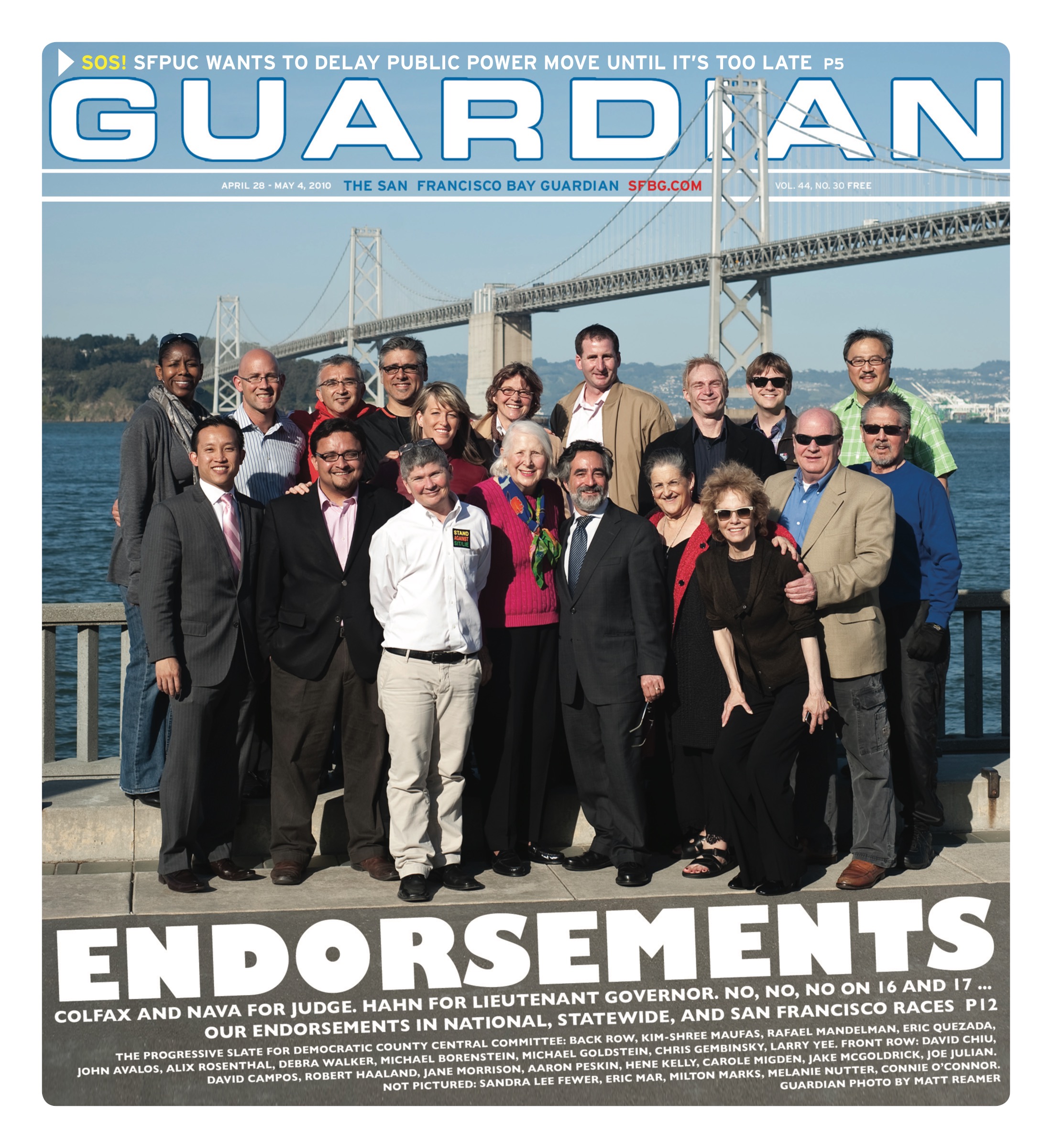
Pictured above: 

OUR CHOICES FOR DCCC

We’ve already endorsed candidates for the Democratic County Central Committee (see “Our endorsements for DCCC,” 3/30). We’re listing them again here for easy reference — in the order they will appear on the ballot. (Since it’s unfair to present candidates in a crowded field in alphabetical order, the state every year does a random alphabetical drawing to set the order in these races.)

The election is crucial — DCCC controls the local Democratic Party endorsements, which can make a huge difference in district supervisorial contests.


ASSEMBLY DISTRICT 13

Debra Walker

Aaron Peskin

Eric Quezada

Joe Julian

Alix Rosenthal

Michael Goldstein

David Campos

David Chiu

Rafael Mandelman

Kim-Shree Maufas

Carole Migden

Robert Haaland


ASSEMBLY DISTRICT 12

Chris Gembinski

Connie O’Connor

Michael Bornstein

John Avalos

Hene Kelly

Melanie Nutter

Sandra Lee Fewer

Eric Mar

Milton Marks

Jane Morrison

Jake McGoldrick

Larry Yee


ENDORSEMENTS: Judicial races

2

SUPERIOR COURT JUDGE, SEAT 6


LINDA COLFAX


It’s rare to see an open seat on the Superior Court; judges typically retire midterm and allow the governor to appoint their replacement. And with a Republican governor, the more progressive Democrats have had a hard time getting even close to judicial appointments. Four highly qualified candidates are seeking this seat, and all of them make good cases for election.


Since judicial candidates can’t take stands on most political issues or indicate how they might rule on cases, it’s hard to get a sense of where the candidates stand. But they can talk about their backgrounds and experience — and about how the local courts are run. For example, the Superior Court is managed on a day-to-day basis by a presiding judge, elected by the sitting judges on the San Francisco bench. But those elections are secret; nobody except the judges know who the candidates were; who voted for which one; or what the final tally was. Court administration is done in closed meetings. Most of what happens in the courts is public — but there’s no presumption of cameras in the courtrooms to give the public access to the justice system.


Our choices for judge reflect our interest in a diverse judiciary, judges who have both professional and personal experience that will shape fair decisions — and jurists who believe in open government, including open courts.


Our choice for Seat 6 is Linda Colfax, a deputy public defender with a background in community service (she’s been an ACLU board member) and progressive politics. Like all four candidates, she has impressive legal credentials and trial experience. She also strongly supports sunshine in the courts and told us she would allow the press and public into judges’ meetings when appropriate, supports cameras in the courtrooms (except for cases where a witness or crime victim has to be protected), and efforts to make the courts work more efficiently.


Robert Retana, who grew up in East Los Angeles, has worked in both civil and criminal law, as a prosecutor and a civil litigator. He also has extensive community service with La Raza Centro Legal and the Lawyer’s Committee for Civil Rights. He was awfully vague on cameras in the courtroom and didn’t seem well-informed on open-government issues, but he’s certainly qualified for the job.


Rod Mcleod, a former San Francisco School Board member, told us he won’t raise any money for this race since he thinks judges shouldn’t be captive to special interests. That’s noble, but it also makes it unlikely he’ll be a factor in the end.


Harry Dorfman, a career prosecutor with the District Attorney’s Office, has extensive trial experience but was the least willing of all the candidates we interviewed to expand public access to the courts.


Colfax has the endorsements of Assembly Member Tom Ammiano, Sen. Mark Leno, and Sups. David Campos, John Avalos, and Eric Mar, among others. She would also diversify the bench in a significant way, not just because she’s a lesbian but because she spent her career in the Public Defender’s Office. And since Democratic and Republican governors alike tend not to appoint public defenders to the bench, that background and perspective is rare. Vote for Colfax.


SUPERIOR COURT JUDGE, SEAT 15


MICHAEL NAVA


Another rarity here: a contested race where challengers are taking on a sitting judge. Richard Ulmer, the incumbent, was a Republican living in Hillsborough when Gov. Schwarzenegger appointed him to the bench last year; he quickly changed his registration to independent and took up residence in Park Merced. But two gay men, Michael Nava and Daniel Dean, saw him as potentially vulnerable and, noting the lack of LGBT appointments coming out of the current administration, filed to challenge Ulmer.


Ulmer’s a smart and appealing person with an impressive legal resume, and we see no scandal that would mandate his removal from office. But we also recognize that this is an elected office, and that it’s perfectly acceptable for candidates who think they would better serve the public and the bench to run against an incumbent. In this case, we’re endorsing Michael Nava.


Nava, the grandson of Mexican immigrants, makes the case that judicial appointments can be just as political as elections: out of some 500 judicial appointments, Schwarzenegger has named perhaps five openly LGBT candidates. Nava also would bring a different perspective to the courts. His career has been in the public sector and he currently works as a staff attorney drafting decisions for Superior Court Justice Carlos Moreno. More than anyone else running for judge this year, Nava is an advocate of openness in the judiciary. He told us the courts are the third branch of government and should be held to most of the same sunshine standards at the executive and legislature.


Daniel Dean also makes a compelling case and has extensive courtroom experience as a litigator and judge pro tem. His accessibility and sense of humor would serve him well on the bench, and we hope he continues to seek a judicial slot. But in this race, we’re endorsing Nava.

ENDORSEMENTS: San Francisco ballot measures

0

 PROPOSITION A

SCHOOL FACILITIES SPECIAL TAX

YES

This measure would extend a 1990 parcel tax that expires in 2010 by another 20 years, keeping it at its current rate ($32 a year for single family homes and commercial enterprises, $16 a year per dwelling unit for mixed use buildings). The tax brings in $7 million a year for San Francisco school facilities and would finance seismic upgrades, structural strengthening and related improvements of its facilities, and child care centers. Vote yes.


PROPOSITION B

EARTHQUAKE SAFETY AND EMERGENCY RESPONSE BONDS

YES

It’s hard to argue against a $430 million bond act to upgrade police, fire, and water facilities to prevent a catastrophic collapse of the city’s most basic public safety infrastructure in the event of an inevitable earthquake. Hard — but not impossible: Sup. Chris Daly, the lone vote against Prop. B, points out that the bond money would be used to upgrade police stations but that the old County Jail at 850 Bryant St. wouldn’t get any help. Prisoners, it seems (even those who are awaiting trial and have been convicted of nothing) aren’t worth protecting. And the Fire Department has been very hazy about where it’s going to spend the cash. So we’ve got some concerns here — but on balance, we’re endorsing Yes on B.


PROPOSITION C

FILM COMMISSION

YES

By some accounts, this measure was put together in retaliation for Mayor Gavin Newsom’s November 2009 demand that Film Commission executive director Stefanie Coyote resign — shortly after her husband, actor Peter Coyote, supported Attorney General Jerry Brown over Newsom for governor. But Bill Barnes, who works as a legislative aide for Newsom ally Sup. Michela Alioto-Pier, the author of Prop. C, says Alioto-Pier was working on this measure even before Coyote got ousted.

Either way, it’s a positive step. Prop. C would streamline a convoluted permitting process for shooting films in San Francisco — a process that can involve multiple departments — and would create a one-stop shop. It would also split the power to appoint the film commissioners between the mayor and the board (6-5, respectively), and require that all 11 commissioners have specific qualifications or experience. Vote yes.


PROPOSITION D

RETIREMENT BENEFITS

YES

Prop. D is a compromise. Sup. Sean Elsbernd wanted to reform the city’s pension system by mandating higher employee contributions and an end to what’s known as “spiking” — giving some employees a big raise just before they retire. Under current law, that worker would get a pension based on the inflated salary.

Elsbernd wanted to change the calculation and base pensions on an average of the final three years of salary an employee earned. Labor countered that some lower-paid workers only reach their top pay at the end of their careers. The final deal would base pensions on a two-year average. Prop. D would also require future employees to contribute and extra 2 percent to their pensions and require the city to set aside some money every year for the pension and retiree health care systems. In the end, progressive Sups. David Campos and Eric Mar signed on, and the city employee unions aren’t opposed. Vote yes.


PROPOSITION E

BUDGET LINE ITEM FOR POLICE SECURITY

YES

Prop. E would make one simple tweak to the reporting requirements for San Francisco’s annual city budget: a line-item on how much is spent on security for city officials and visiting dignitaries. As things stand, the amount the police department spends to protect people like, oh, say Mayor Gavin Newsom while he is crisscrossing the state campaigning for (lieutenant) governor is kept secret. That’s information the public has a right to know. Vote yes.


PROPOSITION F

RENTERS’ FINANCIAL HARDSHIP APPLICATIONS

YES

Prop. F would allow a tenant facing a rent increase to file a petition with the Rent Board claiming financial hardship. If the tenant was unemployed, or had his or her wages cut by 20 percent or more, or didn’t get a cost of living increase in government benefits and was paying at least 33 percent of his or her income as rent, the rent hike would be delayed for 60 days pending a hearing. If the renter can establish hardship, the landlord would have to hold off on the increase until the tenant’s employment or benefit situation improved. Few San Francisco landlords would be hurt by the delay in what are typically modest rent hikes — but a lot of tenants could avoid eviction. Vote yes.


PROPOSITION G

TRANSBAY TRANSIT CENTER

YES

Prop. G, a policy statement, became a moot point earlier this year, but it’s still good for San Franciscans to affirm the city’s support for bringing high-speed rail service downtown. The California High-Speed Rail Project is moving to create bullet train service from SF to downtown Los Angeles using bond money approved by voters in 2008. Even though that bond measure named the Transbay Terminal as the northern terminus of the first phase, some officials raised doubts about whether the downtown location was the best choice. That rail service was integral to plans for the transit center, which is currently being rebuilt, so the Board of Supervisors placed this measure on the ballot to support that choice. Earlier this month, the California High-Speed Rail Authority considered other alternatives and voted to stay with the Transbay Terminal. That’s the right way to go; vote yes.

ENDORSEMENTS: State ballot measures

8

PROPOSITION 13

LIMITS ON PROPERTY TAX ASSESSMENT FOR SEISMIC RETROFITS

YES

The primary sponsor of Prop. 13 is Republican Sen. Roy Ashburn, who dominated the news for several days after he was arrested for drunk driving on his way home from a Sacramento gay bar. Needless to say, Ashburn’s dramatic coming out has whipped up far more attention than his noncontroversial ballot initiative.

We’re generally opposed to anything that gives tax cuts or tax deferrals to property owners; thanks to a 1978 measure also called Prop. 13, much of the commercial and residential property in California is badly under assessed. And Prop. 13, 2010 style, is indeed a tax break. But it’s probably justified.

Buildings in this state are typically reassessed for property taxes after they’ve been modified with new construction, except in cases where the modifications are made to comply with earthquake-safety standards. While most buildings that undergo seismic retrofitting are exempt from reassessment until the property is transferred to a new owner, the exemption for unreinforced masonry buildings is limited to 15 years. Prop 13 would remove that 15-year cap.

The fiscal impact on cities is likely to be pretty minor, and the measure might encourage both commercial and residential landlords to bring their buildings up to standard. Vote yes.


PROPOSITION 14

OPEN PRIMARIES

NO

At the height of a royal mess last year when the state budget was long overdue and the two-thirds majority needed to pass it was still out of reach by one vote, Republican Sen. Abel Maldonado struck a deal with Democrats. He said he’d support the budget — if the majority party would meet a few of his demands. One thing he insisted on was Prop. 14 — a ballot measure that would effectively remove political parties from the primary elections process, allowing all voters to cast ballots for any candidate regardless of party affiliation.

Under Maldonado’s plan, all candidates would run on a single primary ballot, and the top two vote-getters would face off in the general election. Heavily funded by the California Chamber of Commerce and marketed by the same spin doctors and corporate lawyers who are rolling in Yes on 16 campaign money, Prop. 14’s backers say it will result in more centrist elected officials.

There are plenty of pitfalls here, the most worrisome being that it would drive up the cost of elections and give more moneyed (and corporate-allied) candidates a sharper competitive edge while elbowing out progressives. It would allow Republicans to play a role in what would normally be Democratic primaries (and vice versa.) The measure would also make it nearly impossible for smaller parties — the Green Party, for example — to offer candidates in the November elections.

Bad idea, bad process, Vote no.


PROPOSITION 15

FAIR ELECTIONS ACT

YES

California desperately needs electoral reform. Corporate campaign spending and lobbyists have poisoned the decision-making process and muzzled the voice of the people. Something radical needs to be done — and while this measure is only a small, measured step in the right direction, it’s an important and promising experiment.

Prop. 15 would create a pilot public financing program for the 2014 and 2018 races for California Secretary of State — and the program would be funded by a tax on lobbyists. Right now lobbyists pay only $12.50 per year to register with the state. This measure would increase that fee to $350 annually and use the money to create a fund of about $6 million that candidates for the crucial office overseeing elections in the state could tap after demonstrating their popular support by gathering a number of small contributions. All candidates who qualify would be given the same amount of money and left to compete on the issues. Ideally this public financing program would prove successful and eventually be expanded to other offices. Public financing of election campaigns, which is currently working well in Arizona and Maine, is certainly worth a try in California. Vote yes.


PROPOSITION 16

MONOPOLY PROTECTION FOR PG&E

NO! NO! NO!

The deceptively titled “Taxpayer’s Right to Vote Act” was dreamed up and funded entirely by Pacific Gas and Electric Co., the monopolistic utility that is worried it could face actual competition here in San Francisco (and elsewhere) from municipal electricity programs that would offer customers a greener energy mix and more accountability than PG&E executives will ever demonstrate.

Rather than accept some healthy competition, this sleazy corporation has opted to spend some $35 million to exterminate all possibilities of municipal electricity programs cropping up anywhere in the state in a bid to preserve its octopus-like grip on the energy market in Northern California. Prop. 16 would require a two-thirds majority vote at the ballot before any community choice aggregation (CCA) program — or any attempt at creating or expanding a public-power system — could move forward. That’s an extreme hurdle — -and PG&E knows it.

In effect, PG&E is trying to buy public policy here, trying to pass a law that will protect its own monopoly interests.

In San Francisco, the CCA being proposed would offer customers 51 percent renewable power by 2017, which means it would blow PG&E out of the water in the green arena and mark S.F. as taking greater strides toward combating climate change than any other major U.S. city. This example could set a precedent for others, which, in turn, could create favorable market conditions for green energy startups that want to harness wind, solar, biomass, geothermal, tidal, and energy efficiency alternatives.

The very existence of Prop. 16 is already threatening the San Francisco CCA; the city’s Public Utilities Commission is trying to delay a final contract until after the June 8 vote on the measure (see editorial, page 5)

Vote no on Prop 16. Not just because it’s an example of a big business single-handedly trying to alter the state constitution for its own economic benefit by pouring millions of dollars into a deceptive advertising campaign. Not just because a two-thirds majority vote requirement is anti-democratic. Not just because there were reports that the signature gatherers who got people to sign on in support of placing Prop. 16 on the ballot were telling people that its purpose was to limit PG&E expansion or encourage solar power. Not just because Senate Pro Tem Darrell Steinberg and a half dozen members of the Legislature sent a letter rebuking PG&E CEO Peter Darbee for disrespecting the democratic process by going straight to the ballot to undermine legislation it initially supported that enabled the creation of CCA programs. Not just because PG&E is using $35 million of ratepayer dollars (that’s the check you wrote them for your electricity bill!) to put out slick TV ads for this campaign when it should have been repairing the pipelines under those manholes that keep exploding and messing up your morning commute. Not even just because with CCA, you already have the right to vote whether or not you want to be part of it, a choice PG&E will never give you. And not just because PG&E keeps trying to raise rates, which is much more difficult for municipal energy agencies to do.

If for no other reason, vote no because Prop. 16 flies in the face of everything environmentalists stand for. It’s a measure that will thwart progress on fighting climate change, brought to you by the company that practically invented green-washing. PG&E is a huge nuclear power player; it purchases coal from mountaintop-removal coal mines in West Virginia that are completely devastating biodiverse landscapes in Southern Appalachia and screwing over poor people by tainting their drinking water; and it’s in the process of building fossil fuel-fired power plants in poor communities of color in California. The CCA programs at least represent a glimmer of hope for an alternative model; Prop. 16 kills off that possibility with one fell swoop motivated by pure greed. For the love of justice, democracy, and the planet, vote no on Prop 16.


PROPOSITION 17

CAR INSURANCE SCHEME

NO, NO, NO!

Mercury Insurance sponsored this measure and is campaigning for it with tens of millions of dollars, betting it can fool voters and make hundreds of millions of dollars in profits by doing so. And if the company is right, insurance rates will skyrocket for new drivers and those who haven’t had continuous insurance coverage, which experts say will increase the number of uninsured drivers on the roadways and end up increasing insurance rates for everyone.

Mercury and its founder George Joseph have been truly malevolent players in California, exploiting their customers to make billions of dollars in profits, attacking California’s landmark insurance reform measure Prop. 103 with lawsuits and corrupting campaign contributions over more than 20 years, and flouting insurance regulators in such brazen fashion that even Insurance Commissioner Steve Poizner, a conservative Republican, recently chastised the company for its “lengthy history of serious misconduct” (see “Buying power,” March 17).

Now, however, the company is hoping its promise to cut the insurance premiums of drivers who have maintained continuous coverage by “as much as $250 per year” will buy their votes and that they’ll overlook the myriad negative impacts of increasing everyone else’s premiums by $1,000 per year or more, based on Mercury’s own estimates.

Think about that. If you’re a driver who missed an insurance payment by even one day, or a soldier returning from boot camp, or someone with a low-income getting insurance for the first time or after ditching your car for a while, what are you going to do when you discover already-expensive car insurance comes with a $1,000 annual surcharge?

Many Californians, those who share our roads, will choose to drive without insurance. Then they’ll be more likely to leave the scene of accidents or declare bankruptcy rather than paying out-of-pocket for their accidents, both of which increase the cost of insurance for everyone else.

That’s how insurance works. If someone pays less, someone else pays more; and the only entity guaranteed to really make money over the long term is the insurance company. Don’t fall for this scam. Vote no on 17.

ENDORSEMENTS: National and state races

15

Editor’s note: the file below contains a correction, updated May 5 2010. 


National races


U.S. SENATE, DEMOCRAT


BARBARA BOXER


The Republican Party is targeting this race as one of its top national priorities, and if the GOP can dislodge a three-term senator from California, it will be a major blow for the party (and agenda) of President Obama. The pundits are happily talking about how much danger Barbara Boxer faces, how the country’s mood is swinging against big-government liberals.


But it’s always a mistake to count out Boxer. In 1982, as a Marin County supervisor with little name recognition in San Francisco, she trounced then-SF Sup. Louise Renne for an open Congressional seat. Ten years later, she beat the odds and won a hotly contested primary and tough general election to move into the Senate. She’s a fierce campaigner, and with no primary opposition, will have a united party behind her.


Boxer is one of the most progressive members of the not-terribly progressive U.S. Senate. She’s been one of the strongest, most consistent supporters of reproductive rights in Washington and a friend of labor (with 100 percent ratings from the AFL-CIO and National Education Association). We’ve had our disagreements: Boxer supported No Child Left Behind, wrote the law allowing airline pilots to carry guns in the cockpit, and was weak on same-sex marriage when San Francisco sought to legalize it (although she’s come around). But she was an early and stalwart foe of the war in Iraq, split with her own party to oppose a crackdown on illegal immigration, and is leading the way on accountability for Wall Street. She richly deserves reelection, and we’re happy to endorse her.


CONGRESS, 6TH DISTRICT, DEMOCRAT


LYNN WOOLSEY


It’s odd that the representative from Marin and Sonoma counties is more progressive by far than her colleague to the south, San Francisco’s Nancy Pelosi. But over the years, Lynn Woolsey has been one of the strongest opponents of the war, a voice against bailouts for the big Wall Street banks, and a foe of cuts in the social safety net. We’re proud to endorse her for another term.


CONGRESS, 7TH DISTRICT, DEMOCRAT


GEORGE MILLER


George Miller has been representing this East Bay district since 1974, and is now the chair of the Education and Labor Committee and a powerhouse in Congress. He’s too prone to compromise (with George W. Bush on education policy) but is taking the right line on California water (while Sen. Dianne Feinstein is on the wrong side). We’ll endorse him for another term.


CONGRESS, 8TH DISTRICT, DEMOCRAT


NANCY PELOSI


We’ve never been terribly pleased with San Francisco’s most prominent Congressional representative. Nancy Pelosi was the author of the bill that created the first privatized national park at the Presidio, setting a horrible standard that parks ought to be about making money. She was weak on opposing the war, ducked same-sex marriage, and has used her clout locally for all the wrong candidates and issues. But we have to give her credit for resurrecting and pushing through the health care bill (bad as it was — and it’s pretty bad — it’s better than doing nothing). And, at a time when the Republicans are trying to derail the Obama presidency, she’s become a pretty effective partner for the president.


Her fate as speaker (and her future in this seat) probably depends on how the Democrats fare in the midterm Congressional elections this fall. But if she and the party survive in decent shape, she needs to take the opportunity to undo the damage she did at the Presidio.


CONGRESS, 9TH DISTRICT, DEMOCRAT


BARBARA LEE


Barbara Lee, who represents Berkeley and Oakland, is co-chair of the Progressive Caucus in the House, one of the most consistent liberal votes in Congress, and a hero to the antiwar movement. In 2001, she was the only member of either house to oppose the Bush administration’s Use of Force resolution following the 9/11 attacks, and she’s never let up on her opposition to foolish military entanglements. We’re glad she’s doing what Nancy Pelosi won’t — represent the progressive politics of her district in Washington.


CONGRESS, 13TH DISTRICT, DEMOCRAT


PETE STARK


Most politicians mellow and get more moderate as they age; Stark is the opposite. He announced a couple of years ago that he’s an atheist (the only one in Congress), opposed the Iraq war early, called one of his colleagues a whore for the insurance industry, and insulted President Bush and refused to apologize, saying: “I may have dishonored the commander-in-chief, but I think he’s done pretty well to dishonor himself without any help from me.” He served as chair of the House Ways and Means Committee for exactly one day — March 3 — before the Democratic membership overruled Speaker Pelosi and chucked him out on the grounds that he was too inflammatory. The 78-year-old may not be in office much longer, but he’s good on all the major issues. He’s also fearless. If he wants another term, he deserves one.


State races


GOVERNOR, DEMOCRAT


EDMUND G. BROWN


Jerry Brown? Which Jerry Brown? The small-is-beautiful environmentalist from the 1970s who opposed Pacific Gas and Electric Co.’s Diablo Canyon nuke and created the California Conservation Corps, the Office of Appropriate Technology, and the Farm Labor Relations Board (all while running a huge budget surplus in Sacramento)? The angry populist who lashed out at corporate power on a KPFA radio talk show and ran against Bill Clinton for president? The pro-development mayor of Oakland who sided with the cops on crime issues and opened a military academy? Or the tough-on-crime attorney general who refuses to even talk about tax increases to solve the state’s gargantuan budget problems?


We don’t know. That’s the problem with Brown — you never know what he’ll do or say next. For now, he’s been a terribly disappointing candidate, running to the right, rambling on about preserving Proposition 13, making awful statements about immigration and sanctuary laws, and even sounding soft on environmental issues. He’s started to hit his stride lately, though, attacking likely GOP contender Meg Whitman over her ties to Wall Street and we’re seeing a few flashes of the populist Brown. But he’s got to step it up if he wants to win — and he’s got to get serious about taxes and show some budget leadership, if he wants to make a difference as governor.


LIEUTENANT GOVERNOR, DEMOCRAT


JANICE HAHN


Not an easy choice, by any means.


Mayor Gavin Newsom jumped into this race only after it became clear that he wouldn’t get elected governor. He sees it as a temporary perch, someplace to park his political ambitions until a better office opens up. He’s got the money, the statewide name recognition, and the endorsement of some of the state’s major power players, including both U.S. Senators and House Speaker Nancy Pelosi. He’s also been a terrible mayor of San Francisco — and some progressives (like Sup. Chris Daly) argue, persuasively, that the best way to get a better person in Room 200 is to ship Newsom off to an office in Sacramento where he can’t do much harm and let the supervisors pick the next mayor.


But it’s hard to endorse Newsom for any higher office. He’s ducked on public power, allowing PG&E to come very close to blocking the city’s community choice aggregation program (See editorial, page 5). His policies have promoted deporting kids and breaking up families. He’s taken an approach to the city budget — no new revenue, just cuts — that’s similar to what the Republican governor has done. He didn’t even bother to come down and talk to us about this race. There’s really no good argument for supporting the advancement of his political career.


Then there’s Janice Hahn. She’s a Los Angeles City Council member, the daughter of a former county supervisor, and the sister of a former mayor. She got in this race way before Newsom, and her nightmare campaign consultant, Garry South, acts as if she has some divine right to be the only Democrat running.


Hahn in not overly impressive as a candidate. When we met her, she seemed confused about some issues and scrambled to duck others. She told us she’s not sure she’s in favor of legalizing pot, but she isn’t sure why she’s not sure since she has no arguments against it. She won’t take a position on a new peripheral canal, although she can’t defend building one and says that protecting San Francisco Bay has to be a priority. She won’t rule out offshore oil drilling, although she said she has yet to see a proposal she can support. Her main economic development proposal was to bring more film industry work to California, even if that means cutting taxes for the studios or locating the shoots on Indian land where there are fewer regulations.


On the other hand, she told us she wants to get rid of the two-thirds threshold in the state Legislature for passing a budget or raising taxes. She supports reinstating the car tax at pre-Gov. Arnold Schwarzenegger levels. She supports a split-roll measure to reform Prop. 13. She wants to see an oil-severance tax to fund education. She’s one of the few statewide candidates who openly advocates higher taxes on the wealthy as part of the solution to the budget crisis.


We are under no illusions that Hahn will be able to use the weak office of lieutenant governor to move on any of these issues, and we’re not at all sure she’s ready to take over the top spot. But on the issues, she’s clearly better than Newsom, so she gets our endorsements.


SECRETARY OF STATE, DEMOCRAT


DEBRA BOWEN


Debra Bowen is the only Democrat running, a sign that pretty much everyone in the party thinks she’s doing a fine job as Secretary of State. She’s run a clean office and we see no reason to replace her.


CONTROLLER, DEMOCRAT


JOHN CHIANG


Like Bowen, John Chiang has no opposition in the primary, and he’s been a perfectly adequate controller. In fact, when Gov. Schwarzenegger tried two years ago to cut the pay of thousands of state employees to the minimum wage level, Chiang defied him and refused to change the paychecks — a move that forced the governor to back down. We just wish he’d play a more visible role in talking about the need for more tax revenue to balance the state’s books.


TREASURER, DEMOCRAT


BILL LOCKYER


Bill Lockyer keeps bouncing around Sacramento, waiting, perhaps, for his chance to be governor. He was attorney general. Now he’s treasurer seeking a second term, which he will almost certainly win. He’s done some good things, including trying to use state bonds to promote alternative energy, and has spoken out forcefully about the governor’s efforts to defer deficit problems through dubious borrowing. He hasn’t, however, come out in favor of higher taxes for the rich or a change in Prop. 13.


ATTORNEY GENERAL, DEMOCRAT


KAMALA HARRIS


There are really only two serious candidates in this race, Kamala Harris, the San Francisco district attorney, and Rocky Delgadillo, the former Los Angeles city attorney. Harris has a comfortable lead, with Delgadillo in second and the others far behind.


Delgadillo is on his second try for this office. He ran against Jerry Brown four years ago and got nowhere. And in the meantime, he’s come under fire for, among other things, using city employees to run personal errands for him (picking up his dry-cleaning, babysitting his kids) and driving his car without insurance. On a more significant level, he made his reputation with gang injunctions that smacked of ethnic profiling and infuriated Latino and civil liberties groups. It’s amazing he’s still a factor in this race; he can’t possibly win the general election with all his baggage.


Harris has a lot going for her. She was among the first California elected officials to endorse Barack Obama for president, and remains close to the administration. She’s a smart, articulate prosecutor and could be one of the few women atop the Democratic ticket this year. We were never comfortable with her ties to Willie Brown, but he’s no longer a factor in state or local politics. These days, she’s more closely allied with the likes of State Sen. Mark Leno.


That said, we have some serious problems with Harris. She’s been up in Sacramento pushing Republican-style tough-on-crime bills (like a measure that would bar registered sex offenders from ever using social networking sites on the Internet) and forcing sane Democrats like Assembly Member and Public Safety Committee Chair Tom Ammiano to try to tone down or kill them (and then take the political heat). If she didn’t know about the problems in the SFPD crime lab, she should have, and should have made a bigger fuss, earlier.


But Harris has kept her principled position against the death penalty, even when it meant taking immense flak from the cops for refusing to seek capital punishment for the killer of a San Francisco police officer. She’s clearly the best choice for the Democrats.


INSURANCE COMMISSIONER, DEMOCRAT


DAVE JONES


Two credible progressives are vying to run for this powerful and important position regulating the massive — and massively corrupt — California insurance industry. Dave Jones and Hector De La Torre are both in the state Assembly, with Jones representing Sacramento and De La Torre hailing from Los Angeles. Both have a record opposing insurance industry initiatives; both are outspoken foes of Prop. 17; and either would do a fine job as insurance commissioner. But Jones has more experience on consumer issues and health care reform, and we prefer his background as a Legal Aid lawyer to De La Torre’s history as a Southern California Edison executive. So we’ll give Jones the nod.


BOARD OF EQUALIZATION, DISTRICT 1, DEMOCRAT


BETTY T. YEE


Betty Yee has taken over a job that’s been a stronghold of progressive tax policy since the days of the late Bill Bennett. She’s done well in the position, supporting progressive financial measures and even coming down, as a top tax official, in favor of legalizing (and taxing) marijuana. We’re happy to endorse her for another term.


SUPERINTENDENT OF PUBLIC INSTRUCTION


TOM TORLAKSON


Two prominent Democratic legislators are running for this nonpartisan post, state Sen. Gloria Romero of Los Angeles and Assembly Member Tom Torlakson of Martinez. It’s a pretty clear choice: Romero is a big supporter of charter schools who thinks parents should be able to move their kids out of one school district and into another (allowing wealthier white parents, for example, to abandon Los Angeles or San Francisco for the suburban districts). She’s been supported in the past by Don and Doris Fisher, who put a chunk of their GAP Inc. fortune into school privatization efforts. Torlakson wants more accountability for charters, opposes the Romero district-option bill, and has the support of every major teachers union in the state. Vote for Torlakson.


STATE SENATE, DISTRICT 8, DEMOCRAT


LELAND YEE


Sen. Leland Yee can be infuriating. Two years ago, he was hell-bent on selling the Cow Palace as surplus state property and allowing private developers to take it over. In the recent budget crisis, he pissed off his Democratic colleagues by refusing to vote for cuts that everyone else knew were inevitable (while never making a strong stand in favor of, say, repealing Prop. 13 or raising other taxes). But he’s always been good on open-government issues and has made headlines lately for busting California State University, Stanislaus over a secret contract to bring Sarah Palin in for a fundraiser — and has raised the larger point that public universities shouldn’t hide their finances behind private foundations.


Yee will have no serious opposition for reelection, and his campaign for a second term in Sacramento is really the start of the Leland Yee for Mayor effort. With reservations over the Cow Palace deal and a few other issues, we’ll endorse him for reelection.


 Correction update: Yee’s office informs us that the senator suports an oil-severance tax and a tax on high-income earners and “believes that Prop. 13 should be reformed,” although he hasn’t taken a position on Assemblymember Tom Ammiano’s reform bill. 


STATE ASSEMBLY, DISTRICT 12, DEMOCRAT


FIONA MA


Fiona Ma’s a mixed bag (at best). She doesn’t like Pacific Gas and Electric Co. and supports public power, but comes up with strange bills that make no sense, like a 2009 measure to limit rent control in trailer parks. Why does Ma, who has no trailer parks in her district, care? Maybe because the landlords who control the mobile home facilities gave her some campaign cash. She faces no opposition, and we’re not thrilled with her record, but we’ll reluctantly back her for another term.


STATE ASSEMBLY, DISTRICT 13, DEMOCRAT


TOM AMMIANO


When the history of progressive politics in modern San Francisco is written, Tom Ammiano will be a central figure. His long-shot 1999 mayoral campaign against Willie Brown brought the left to life in town, and his leadership helped bring back district elections and put a progressive Board of Supervisors in place in 2000. As a supervisor, he authored the city’s landmark health care bill (which Newsom constantly tries to take credit for) and the rainy day fund (which saved the public schools from debilitating cuts). He uses his local influence to promote the right causes, issues, and candidates.


And he’s turned out to be an excellent member of the state Assembly. He forced BART to take seriously civilian oversight of the transit police force. He put the battle to reform Prop. 13 with a split-role measure back on the state agenda. And his efforts to legalize and tax marijuana are close to making California the first state to toss the insane pot laws. As chair of the Public Safety Committee, he routinely defies the police lobbies and the right-wing Republicans and defuses truly awful legislation. We’re glad Ammiano’s still fighting in the good fight, and we’re pleased to endorse him for another term.


STATE ASSEMBLY, DISTRICT 14, DEMOCRAT


NANCY SKINNER


Nancy Skinner has taken on one of the toughest, and for small businesses, most important, battles in Sacramento. She wants to make out-of-state companies that sell products to Californians collect and remit sales tax. If you buy a book at your local bookstore, you have to pay sales tax; if you buy it from Amazon, it’s tax-free. That not only hurts the state, which loses hundreds of millions of dollars in tax revenue, it’s a competitive disadvantage to local shops. Skinner’s a good progressive vote and an ally for Ammiano on the Public Safety Committee. We’re happy to endorse her for another term.


STATE ASSEMBLY, DISTRICT 16, DEMOCRAT


SANDRE SWANSON


Sandre Swanson represents the district where BART police killed Oscar Grant, but he wasn’t the one out front pushing for more civilian accountability; that was left to SF’s Ammiano. And while Swanson was generally supportive of Ammiano’s bill, he was hardly a leader in the campaign to pass it. This is too bad, because Swanson’s almost always a progressive vote and has been good on issues like whistleblower protection (a Swanson bill that passed this year protects local government workers who want to report problems confidentially). We’ll endorse him for another term, but he needs to get tougher on the BART police.


Editor’s Notes

0

Tredmond@sfbg.com

A couple of weeks ago, political consultant David Latterman, who often works with downtown interests, sent off an e-mail warning that the pro big-business, moderate bloc needed to get its act together. "It appears as if different groups are unwilling to set aside their egos or agendas, and pool together resources in a comprehensive plan to take back the [Democratic County Central Committee]," he wrote. "And guess what, we’re going to lose, in June and November."

His point: the DCCC matters, a lot. "The DCCC controls the supe endorsements that matter most," he noted, adding, "The mayor’s race starts now."

And that’s absolutely true — and unless the folks downtown are foolish or have given up (and neither is terribly likely) they’re going to get the message, and there’s going to be a big-money push in the next two months to oust the progressive majority on the county committee.

The DCCC controls the Democratic Party endorsements — and the party slate card is among the most influential political slates in a city where the vast majority of the population votes for Democrats. The DCCC could well make the difference in some of the key supervisorial races this fall — and could play a key role in choosing the next mayor of San Francisco.

But it’s not a high-profile election. More than half the votes will probably be absentees. That means it’s critical that the progressive candidates can raise money, do mailers, and fight back.

At this point, there’s a pretty good consensus on a progressive slate. We published our endorsements last week, and the Milk Club, Sierra Club, Tenants Union, and Assembly Member Tom Ammiano have endorsed most of the same candidates. In the fall, labor, environmental groups, tenants, and other progressive interests will be putting a lot of money into the races for district supervisor. But I could argue that the DCCC is just as important — and if we don’t fight this one to win, it’s going to be a lot harder in November.

Judicial candidates: Rod McLeod

0

Six candidates are running for two judicial seats in San Francisco, and over the next few weeks, we’ll be interviewing all of them (and at the end of April, we’ll be publishing our endorsements). The interviews make for interesting listening, so we’re posting the sound files on the web. Here’s Rod McLeod, who is one of four candidates seeking to replace retiring judge Wallace Douglass.


Rod McLeod by endorsements2010

Our Endorsements: For DCCC

10

The Democratic County Central Committee isn’t the most high-profile elected agency in San Francisco, but it’s really important. The committee sets policy for the local Democratic Party — and that includes endorsements. The people who control the committee control a slate card that goes out to every registered Democrat in the city, and that’s a vast majority of the voters. DCCC endorsements, carrying the imprimatur of the party, have a significant impact on local elections, particularly in district supervisor races.

For years, the DCCC was controlled largely by the old Brown-Burton machine, but two years ago, the progressives took back control, and that made a huge difference in electing good supervisors. The DCCC endorsement will also matter in the next mayor’s race.

The folks downtown realize this. David Latterman, a political consultant who often works with more moderate candidates and interest groups, sent a memo out March 17 titled “Headed toward the cliff in 2010 elections.” The memo, which we’ve obtained, argues that downtown and the moderates need to get organized, now: “If we can have one person run a coordinated effort with $150K … we can really pick up DCCC seats. Only a few will make a difference in the fall endorsements. The mayor’s race starts now.”

So it’s crucial that the progressives turn out to vote June 8, and vote for strong candidates for the DCCC who will support district elections, public power, tenant rights — and progressive candidates for supervisor.

We’ll be publishing endorsements for all of the June primary races and ballot measures in a few weeks, but we’ve decided to do early endorsements for the DCCC. Twelve people are elected from each assembly district. Here are our choices:


ASSEMBLY DISTRICT 12

John Avalos

Michael Borenstein

Sandra Lee Fewer

Chris Gembinski

Hene Kelly

Eric Mar

Milton Marks

Jake McGoldrick

Jane Morrison

Melanie Nutter

Connie O’Connor

Larry Yee


ASSEMBLY DISTRICT 13

David Campos

David Chiu

Michael Goldstein

Robert Haaland

Joseph Julian

Rafael Mandelman

Kim-Shree Maufas

Carole Migden

Aaron Peskin

Eric Quezada

Alix Rosenthal

Debra Walker


Downtown’s DCCC slate fizzles

9

I’m actually a bit surprised that Gavin Newsom’s allies haven’t made a bigger push to take back control of the San Francisco Democratic Party, which will play a key role in the fall supervisorial races. It looked for a while as if the downtown folks were organizing to put a slate of strong candidates with solid name recognition on the ballot. But when the Department of Elections closed Friday afternoon, and the deadline for filing passed, there weren’t that many new names on the ballot. Here’s the list. (PDF).


Twelve candidates will get elected in each of the two San Francisco Assembly districts. On the east side of town, in AD 13, eight progressive incumbents, including Sups. David Campos and David Chiu, former Sup. (and current DCCC chair) Aaron Peskin are running. So is School Board member Kim-Shree Maufas and former state Sen. Carole Migden. Supervisorial candidates (and incuments ) Rafael Mandelman and Debra Walker are running, as are former supervisorial candidates Eric Quezada and Alix Rosenthal.


Not a lot of star power in the more moderate camp. Other than former Sup. (and incumbent) Leslie Katz and sup. candidate (and incumbent) Scott Wiener, it’s not a powerful crew. So the progressives look to do well — as they usually do — in D 13.


D-12 is a little more conservative in general — and there are lots and lots of candidates, meaning name recognition is even more important. I’d thought maybe somebody would talk Sup. Sean Elsbernd or Sup Carmen Chu into running. But no: the only elected officials on the list are progressives, including Sups. John Avalos and Eric Mar, School Board member Sandy Fewer, and Community College Board member Milton Marks. Then there’s incumbent (and former Sup.) Jake Mcgoldrick.


The moderate, pro-Newsom camp — the folks who would try to shift the Democratic Party endorsements away from progressives in swing supervisorial districts — may be large, but not terribly deep. Incumbents Tom Hsieh and Megan Levitan are, of course, running again, and there’s Bill Fazio, who once ran for district attorney.


Myra Kopp, wife of former state Sen. (and retired judge) Quentin Kopp, is a candidate, and while she may be a little more politically conservative than Avalos and Mar, she’s not going to be in the Newsom camp, either; she’s more of an independent wild card.


Paul Hogart agrees with me that the progressives seem well situated to keep control of the DCCC, although it’s never a sure thing: there are no contribution limits for these races, and since it’s a low-profile office, big money can make a big difference. Let’s see what downtown tries to do to buff up and promote its candidates in the next two months.


A progressive primary for District 6

8

By Supervisor Chris Daly

OPINION Ten years ago, the newly drawn District 6 (which includes the Tenderloin, South of Market, and North Mission) was thought to be politically up for grabs. With an aggressive grassroots campaign and a progressive sweep across the city, we won the seat. Despite small demographic shifts to the right over the years, we’ve built a clear progressive identity for our district. Community stakeholders and all of progressive San Francisco should be proud of this accomplishment.

In 2006, despite downtown’s major effort to unseat me, I held on with a nine point, or 1,600-vote, margin. I would guess that this is generally reflective of the current political dynamics in the district. In other words, District 6 is roughly a progressive +10 district.

But heading into the first open-seat race in the district in 10 years, we have to take care to not become victims of our own success. Already, four serious progressive candidates have declared for the seat and are now raising money, seeking endorsements, formulating campaign strategy, and assembling their teams.

Our system for electing supervisors allows voters to rank their top three choices. In other words, even if all progressive voters ranked three progressive candidates on every ballot, a certain number of those votes would not transfer to the strongest progressive candidate. In District 6, where the political contests have been pretty black and white for a decade, it’s a safe bet we’ll have more than our share of voters who only vote for one candidate. (In 2006, a number of voters even marked me as their first, second, and third choice.)Sensing an unexpected political opportunity, downtown is working to coalesce around a single candidate to steal away the seat and the progressive majority on the Board of Supervisors. We can’t afford to let that happen. Our 10-point margin of error is too small to risk moving forward on our current path.

That’s why I have asked all the major progressive candidates in the race to participate in a progressive primary early this summer. A central polling place will be open to all District 6 voters. We will have a ranked-choice ballot that will include the progressive candidates who have qualified for public financing (raised more than $5,000 in qualifying contributions.) Permanent absentee voters will be able to mail in their ballots. In most respects, the progressive primary will look like an officially sanctioned election.

The primary will give district voters an opportunity to signal their early preference in candidates and will give the progressive campaigns much-needed experience identifying and turning out their supporters. More important, it will give the rest of us a window into what otherwise could become a very confusing progressive cluster.

The winner of the primary will become the beneficiary of my endorsement and campaign support. It also will be a momentum-builder for the campaign that is already strongest within the district and will signal to all progressive voters that, even if they’ve committed to another candidate, they need to make sure they rank the progressive primary winner on their ballot.

As progressives continue to build our politics, we need to keep creating democratic forums and structures. I hope the Progressive Primary becomes a useful component of our political movement.

Supervisor Chris Daly represents District 6.

No more silence on Prop. 16

0

EDITORIAL Pacific Gas and Electric Co. has found few allies in its effort to halt the spread of public power in California. The Sacramento Bee has come out strongly against PG&E’s initiative, Proposition 16 on the June ballot. Los Angeles Times columnists have denounced it. Six Democratic leaders in the California Senate have called for the company to withdraw the measure. Even the California Association of Realtors, hardly a radical environmental group, has come out strongly against the measure, in part because it’s so badly worded that it could halt residential and commercial development in large parts of the state.

But PG&E has already set aside $30 million to try to pass this thing — and since the cities and counties that would be hit hardest can’t use public money to defeat it, elected officials across the state need to be using every opportunity they have to speak out against it.

Prop. 16 is about the most anti-democratic measure you can imagine. It mandates that any local agency that wants to sell retail electricity to customers first get the approval of two-thirds of the local electorate. The two-thirds majority has been the cause of the debilitating budget gridlock in Sacramento, and it will almost certainly end efforts to expand public power or create community choice aggregation (CCA) co-ops in the state.

It actually states that no existing public power agency can add new customers or expand its delivery service without a two-thirds vote — which means, according to former California Energy Commissioner John Geesman, that no new residential or commercial development in the 48 California communities that have public power could be given electricity hook-ups.

It also, of course, eliminates the possibility of competition in the electricity business, making PG&E the only entity legally allowed to sell power in much of Northern California. That’s a radically anti-consumer position that most residents of the state would reject — if they understood it.

And there’s the problem. With PG&E spending $30 million (of our ratepayer money) promoting this, using misleading language and a campaign based on lies, and with very little money available for a counter-campaign, it’s going to be hard to get the message out.

That’s why every single elected official, candidate for office, and political group in the state that isn’t entirely bought off by PG&E needs to loudly oppose it, now.

And there’s still a lot of silence out there.

State Sen. Mark Leno and Assembly Member Tom Ammiano, to their credit, are not only opposing Prop. 16, they are helping lead the campaign against it. Sup. Ross Mirkarimi has helped build the coalition that’s running the No on 16 effort. The San Francisco Board of Supervisors has passed a resolution opposing the initiative. Sup. Bevan Dufty, who is running for mayor, is a public opponent. State Sen. Leland Yee’s office told us he opposes it (although he hasn’t made much of a big public issue of the measure). Same for City Attorney Dennis Herrera.

But where is Mayor Gavin Newsom? Where is District Attorney Kamala Harris, who is running for attorney general? Where’s Rep. Nancy Pelosi and Sens. Dianne Feinstein and Barbara Boxer? Where’s the City Hall press conference with the mayor and every other elected official in town denouncing Prop. 16 and urging San Franciscans to vote against it?

The silence is a disgrace, and amounts to a tacit endorsements of PG&E’s efforts.

And it’s happening at the same time that the supervisors are pushing against a tight deadline to get the city’s Community Choice Aggregation program up and running.

San Francisco is the only city in the United States with a federal mandate to sell public power, and the city is moving rapidly to set up a CCA system. This is a monumental threat to the city — and everyone either in office or seeking office needs to recognize that and speak out. Prop. 16 and CCA ought to be a factor in every local organization’s endorsements for Democratic County Central Committee and supervisor this year, and any candidate who can’t stand up to PG&E has no business seeking office in San Francisco.

Editorial: No more silence on PG&E’s statewide power grab

1

Every single elected official, candidate for office, and political group in the state that isn’t entirely bought off by PG&E needs to loudly oppose Prop. 16 – now

EDITORIAL Pacific Gas and Electric Co. has found few allies in its effort to halt the spread of public power in California. The Sacramento Bee has come out strongly against PG&E’s initiative, Proposition 16 on the June ballot. Los Angeles Times columnists have denounced it. Six Democratic leaders in the California Senate have called for the company to withdraw the measure. Even the California Association of Realtors, hardly a radical environmental group, has come out strongly against the measure, in part because it’s so badly worded that it could halt residential and commercial development in large parts of the state.

But PG&E has already set aside $30 million to try to pass this thing – and since the cities and counties that would be hit hardest can’t use public money to defeat it, elected officials across the state need to be using every opportunity they have to speak out against it.

Prop. 16 is about the most anti-democratic measure you can imagine. It mandates that any local agency that wants to sell retail electricity to customers first get the approval of two-thirds of the local electorate. The two-thirds majority has been the cause of the debilitating budget gridlock in Sacramento, and it will almost certainly end efforts to expand public power or create community choice aggregation (CCA) co-ops in the state.

It actually states that no existing public power agency can add new customers or expand its delivery service without a two-thirds vote &#151; which means, according to former California Energy Commissioner John Geesman, that no new residential or commercial development in the 48 California communities that have public power could be given electricity hook-ups.

It also, of course, eliminates the possibility of competition in the electricity business, making PG&E the only entity legally allowed to sell power in much of Northern California. That’s a radically anti-consumer position that most residents of the state would reject – if they understood it.

And there’s the problem. With PG&E spending $30 million (of our ratepayer money) promoting this, using misleading language and a campaign based on lies, and with very little money available for a counter-campaign, it’s going to be hard to get the message out.

That’s why every single elected official, candidate for office, and political group in the state that isn’t entirely bought off by PG&E needs to loudly oppose it, now.

And there’s still a lot of silence out there.

State Sen. Mark Leno and Assembly Member Tom Ammiano, to their credit, are not only opposing Prop. 16, they are helping lead the campaign against it. Sup. Ross Mirkarimi has helped build the coalition that’s running the No on 16 effort. The San Francisco Board of Supervisors has passed a resolution opposing the initiative. Sup. Bevan Dufty, who is running for mayor, is a public opponent. State Sen. Leland Yee’s office told us he opposes it (although he hasn’t made much of a big public issue of the measure). Same for City Attorney Dennis Herrera.

But where is Mayor Gavin Newsom? Where is District Attorney Kamala Harris, who is running for attorney general? Where’s Rep. Nancy Pelosi and Sens. Dianne Feinstein and Barbara Boxer? Where’s the City Hall press conference with the mayor and every other elected official in town denouncing Prop. 16 and urging San Franciscans to vote against it?

The silence is a disgrace, and amounts to a tacit endorsements of PG&E’s efforts.

And it’s happening at the same time that the supervisors are pushing against a tight deadline to get the city’s Community Choice Aggregation program up and running.

San Francisco is the only city in the United States with a federal mandate to sell public power, and the city is moving rapidly to set up a CCA system. This is a monumental threat to the city – and everyone either in office or seeking office needs to recognize that and speak out. Prop. 16 and CCA ought to be a factor in every local organization’s endorsements for Democratic County Central Committee and supervisor this year, and any candidate who can’t stand up to PG&E has no business seeking office in San Francisco.