Employment

Mirkarimi to PG&E: We want our $46 million back

Speaking at the June 15 Board of Supervisors meeting, Sup. Ross Mirkarimi introduced a non-binding resolution calling on Pacific Gas & Electric Co. to refund ratepayers for the $46 million it spent on a failed bid to pass Proposition 16, a ballot initiative dubbed the “Taxpayer’s Right to Vote Act” that would have impeded the creation of municipal electricity programs.

While PG&E has publicly stated that its campaign costs were covered by “shareholder funds,” the sole source of income for the parent corporation is money that the utility makes selling electricity, so the $46 million originated in ratepayers’ pockets.

At the meeting, Mirkarimi displayed a map of PG&E’s service territory beside a map of the California counties that rejected Prop 16, highlighting the striking similarity. In San Francisco, Prop 16 was rejected by more than two-thirds of the vote.

Mirkarimi’s resolution included several other improbable requests. He extended an invitation to PG&E CEO Peter Darbee to attend a Board of Supervisors meeting, to “discuss what it really and truly means to peacefully coexist,” he explained. “We look forward to Mr. Darbee coming to meet with us.”

The third aspect of the resolution deals with SFERS, San Francisco’s employment retirement system, which owns 106,348 shares of PG&E common stock valued at $4.38 million on the day the information was accessed. Institutional investors such as CalPERS and SFERS account for more than a 60 percent share of ownership of PG&E, according to the resolution.

Mirkarimi is calling on PG&E to refund SFERS, and “urges CALPERS and SFERS to consider divesting its holdings in PG&E stock” if the company refuses.

The resolution also asks the California Public Utilities Commission to carefully scrutinize PG&E’s requested rate hike.

PG&E didn’t return our requests for comment the last 10 times we called, but we tried again — even though the result is predictable.

Cutting from the bottom

7

By Alex Emslie

news@sfbg.com

When Mayor Gavin Newsom unveiled his proposed city budget on June 1, he downplayed the severity of cuts to the city’s Department of Public Health, noting that they amounted to less than 2 percent. But if Newsom’s uneven program chopping becomes a reality, critical social services for some of San Francisco’s poorest and most vulnerable residents will be cut by almost one-third.

The DPH was able to shrink its budget by nearly $31 million, according to a budget proposal currently before the Board of Supervisors, in part by slashing community nonprofit clinics providing outpatient mental health services to some of San Francisco’s most difficult to treat mental health cases.

“It’s very possible you could see more people who are homeless, people who are homeless not getting as much care — they’ll be sicker,” said Dr. Eric Woodard, medical director of psychiatric emergency services at San Francisco General Hospital. “And you could reasonably expect more deaths on the street to occur.”

State and federal matching funding to the DPH dwarfs the amount of money the department receives from the city. What isn’t spelled out in Newsom’s budget is that every dollar cut by the city results in more than another dollar lost in federal funding for social services.

The DPH proposed a nearly 9 percent cut to outpatient community-based health services, and an 11 percent cut to residential inpatient services to meet the mayor’s request that all city departments submit a 30 percent budget reduction to his office. Newsom reversed the proposed cuts to residential services but kept the outpatient cuts.

“I believe in the efficacy of residential [treatment],” Newsom said during his budget unveiling. “I believe there are a lot of question marks around outpatient drug treatment.”

But the cuts affect more than just outpatient drug treatment. While many of the clinics that were cut focus on treating mental illnesses, they are funded through the DPH category that includes substance abuse treatment. Newsom’s office declined to answer our inquiries about the reasons for and implications of his cuts, referring us to DPH.

Walden House CEO Vitka Eisen, whose organization serves people suffering from mental illness and substance abuse in inpatient and outpatient clinics, said she was relieved that residential funding was added back. However, she is concerned about the proposed $4.1 million cut spread across several nonprofit outpatient services.

“There’s a very large cut to outpatient services citywide, and that’s obviously problematic because outpatient services are an important part of our system of care in the city,” she told the Guardian. “You can’t really cut one or the other.”

DPH Community Behavioral Health Services Director Dr. Robert Cabaj is hoping the Board of Supervisors will restore some of the cuts to outpatient clinics. “Unfortunately, they [the Mayor’s Office] left these in,” he told the Guardian. “I’m not sure why — I’m not sure what the mayor was thinking at the time.”

Citywide Case Management and Community Focus, an outpatient clinic serving some of San Francisco’s most severely mentally ill, is one of the hardest hit nonprofit clinics in the mayor’s proposed budget. The agency will lose $1.22 in federal funding for every $1 cut from the city, division director Dr. David Fariello said.

That’s how its 15 percent, $1.3 million cut proposed by the DPH and accepted by the mayor, ballooned into a 33 percent, $2.8 million loss for one of the city’s most comprehensive and best-performing community behavioral health services.

Citywide, at 982 Mission St., boasts the facilities, network, and location to serve one of San Francisco’s most vulnerable populations. The typical Citywide client suffers from schizophrenia, bipolar disorder, borderline personality disorder, or severe depression. They are likely homeless, grappling with substance abuse, and many have posttraumatic stress disorder.

Citywide employees, doctors, and administrators, as well as physicians from outside the clinic, speculate that cutting outpatient mental health services in a city with one of the highest per capita populations of mentally ill homeless people will ultimately cost the city more money than it saves now. Use of expensive city services like psychiatric emergency rooms, jails, police, and ambulance could all rise.

“Frankly, a lot of these budget cuts do not seem to be very well thought out in terms of what the real cost is going to be,” Woodard said. “If you look into the not very distant future, you’re going to incur costs that are probably much greater than your savings were initially by making the cuts.”

Cabaj said that past funding cuts haven’t resulted in higher use of psychiatric emergency services because the DPH prioritizes funding for the most severe cases and screens for those who could possibly be moved into cheaper services. Citywide clients are consistently high users of San Francisco General Hospital acute inpatient psychiatric care, at an average cost to the city of $1,200 per patient, per day, if they don’t have insurance or Medical benefits.

Many end up in costly in-patient psychiatric care facilities or are arrested and land in the city’s Behavioral Health Court, which hears cases in which defendants have been diagnosed with a mental illness that is suspected of being a factor in their crime. More than 70 percent of the Behavioral Health Court’s mandated treatment slots are at Citywide.

“We can manage behaviors that get people thrown out of every other clinic in the city,” Fariello said. “Where is that capacity going to be picked up? These are not clients who, if they don’t get treatment, maybe their doctor will give them some medicine and it’ll be OK. These are clients who are going to continue to be high users unless we intervene.”

Citywide figures show a 40 percent decrease in violent reoffenses for clients referred to their clinic from the Behavioral Health Court. Nearly three-quarters who were homeless are able to maintain housing, and more than 25 percent of clients who were frequent users of inpatient psychiatric services have stayed out of the hospital.

“Citywide really is one of the best,” said Woodard, who works with Citywide’s Linkage Team to stabilize patients from SFGH’s psychiatric emergency room. “They provide excellent care for these really fragile, very ill patients. I would say of the community programs, they’re really at the top of the list.”

Fariello estimates having to reduce the 1,035 clients receiving treatment at his clinic by 400 if the cuts are finalized. He may have to scale back some of his clinic’s innovative and successful categories of service — such as employment support and dialectical behavioral therapy, a highly specialized form of therapy with proven success in treating borderline personality disorder. Citywide has the largest DBT team in San Francisco.

Citywide administrators are baffled by DPH’s decision-making process, given that it serves the city’s sickest, poorest, and homeless — characteristics that should have reduced its cuts, according to the department’s priorities outlined in its budget reduction proposal.

Since founding the agency nearly 30 years ago, Fariello has worked with the city to implement innovative techniques in treating San Francisco’s highest users of expensive psychiatric emergency services. And it has been consistently successful. In a review last year of 15 similar programs conducted by the DPH, Citywide received an average 92.1 out of 100, the highest score. It scored a 4.0 out of 4.0 on another recent program review.

Several divisions within Citywide contribute to its inclusive approach to mental health services. Citywide’s forensics program works exclusively with clients involved in the criminal justice system. Community Focus provides culturally sensitive therapy in several languages. The Linkage Team stabilizes emergency psychiatric patients from SFGH.

Employment support for Citywide clients helps them get and retain jobs, emblematic of the entire agency’s goal of treating clients as complete people, not just mental health patients. “What we’ve found out is that people who have an investment in purposeful activity have an investment in getting better,” Fariello said. “A lot of clients have a notion that their career is being a mental health client. What we’re trying to do is change that.”

Citywide supported employment services supervisor Greg Jarasitis told a story of one client who said she liked her job as a bookkeeper because while she was at work she felt like a “normy,” then added: “These are people who have been marginalized for so long.” *

Get involved: The Board of Supervisors holds a public comment hearing on the deep proposed health cuts, as state law requires, June 15 at 3 p.m. in Board Chambers at City Hall. The board’s Budget and Finance Committee departmental hearings for the DPH are scheduled for June 21 and June 28.

Should Antonini recuse himself from Lennar vote?

1

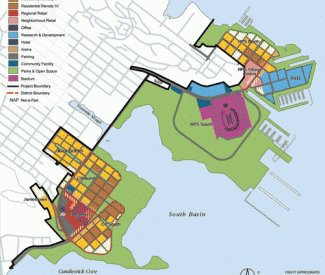
As a Newsom appointee, Planning Commissioner Michael Antonini is expected to be a key vote today in favor of Lennar’s massive redevelopment plan at Candlestick Point-Hunters Point Shipyard.

And then there’s the fact that he wrote an op-ed for the San Francisco Business Times in December 18, 2009, suggesting that business, civic, labor and government leaders can keep the 49ers in town by “joining forces to assist in needed repairs and improvements to Candlestick Park and to expedite development of the Candlestick Point Hunters Point Shipyard, a project that features a “state-of-the art,” 69,000-seat football stadium.”
(The full text of Antonini’s op-ed is included at the end of this post to put his words into full context.)

But Antonini’s cheerleading has got some folks questioning his impartiality when it comes to the decisions that members of the Planning and Redevelopment Commissions will make today around certifying the project’s Final Environmental Impact Report (FEIR) and adopting related environmental findings.

In a June 2 letter to Planning Commission president Ron Miguel, Arthur Feinstein of the Sierra Club, Mike Lynes of the Golden Gate Audubon Society, Jennifer Clary of San Francisco Tomorrow and Jaron Browne of POWER (People Organized to Win Employment Rights) claim that “Commissioner Antonini has clearly prejudged the proposed project and become a strong advocate for locating a football stadium for the 49ers at the Hunters Point site as part of this project.”

“He has publicly urged others to support that stadium and cannot impartially review the record before him to determine whether the EIR is adequate, accurate and objective and whether adequate measures are required to protect the environment,” the foursome continue.

 Noting that he could have chosen to sign the December 2009 op-ed as a Member of the Republican County Central Committee, Feinstein, Lynes, Clary and Browne observe that Antonini “ instead identified himself in the capacity where the law requires him to act impartially – as a Planning Commissioner.”

With others arguing that Antonini’s right to express his opinion is protected by the First Amendment, and Antonini planning to read a rebuttal into the record at 1 p.m. today, it sounds like there’ll be plenty of drama at today’s hearing.

Antonini’s Op Ed in San Francisco Business Times

Friday, December 18, 2009
Business leaders can save the Niners
San Francisco Business Times – by Michael J. Antonini

“The 49ers are deeply and historically identified with San Francisco. San Franciscans Vic and Tony Morabito founded the team in 1946, many years before the Giants moved from New York and the Warriors from Philadelphia.

Hence business, civic, labor and government leaders are joining forces to assist in needed repairs and improvements to Candlestick Park and to expedite development of the Candlestick Point Hunters Point Shipyard, a project that features a “state-of-the art,” 69,000-seat football stadium. Leaders from the Committee on Jobs, the San Francisco Chamber of Commerce, Recreation and Park and others are asking businesses and individuals to help with funding of improvements at Candlestick in return for advertising. These improvements could translate into increased revenue for the contributor, the city and the team. Replacement of aging seats and a highly visible new luxury section are two concepts being studied.

Naming rights to Candlestick Park is an attractive opportunity for a company or an entity to gain nationwide exposure and local acclaim — and, perhaps, position itself to be a key contributor when a new stadium is built at Hunters Point. No new stadium can be built anywhere without significant private investment, in addition to $100 million assured from Lennar Corp. as a precondition of development rights and the amount which the 49ers ownership would invest.

On Thursday, Dec. 17, the San Francisco Planning Commission was to hear comment on the Draft Environmental Impact Report for the Candlestick Point Hunters Point Shipyard Plan. Because this plan features many diverse uses, particularly huge amounts of housing, funding is being rapidly obtained for greatly improved transit and traffic access.

San Francisco must avoid the errors of the past, when we failed to build an arena for indoor sporting, major conventions and entertainment events. Such a facility could have brought huge amounts of revenue to San Francisco businesses.

Leaders have twice stepped up to save the San Francisco Giants. One would expect no less from our leaders when dealing with our home grown, five- time Super Bowl champion San Francisco 49ers!

Michael J. Antonini is a planning commissioner for the City and County of San Francisco.”


Political juggernaut

3

sarah@sfbg.com

City officials are scrambling to secure final approvals to allow Lennar Corp. to move forward with its 770-acre Candlestick/Hunters Point Shipyard redevelopment of San Francisco’s impoverished and polluted southeast sector. But the community remains divided on the project, raising concerns that wary residents will end up being steamrolled by this politically powerful juggernaut.

Some groups say the project needs major amendments, but fear it will be rushed to the finish for political reasons. Others say they are hungry to work and desperate to move into better housing units, so they don’t want all the myriad project details to slow that progress. And Mayor Gavin Newsom’s administration is arguing that approving the project’s final environmental impact report by June 3 is crucial if San Francisco wants to keep the San Francisco 49ers in town.

But many observers fear Lennar wants its entitlements now before its project can be subjected to greater scrutiny that could come with the November elections. Newsom, who made Lennar’s project the centerpiece of his housing policy, will be replaced as mayor if he wins the lieutenant governor’s race. And a crowded field of candidates, many of them progressives concerned about the project’s impacts on the poor and the environment, are vying to replace termed-out Sup. Sophie Maxwell, whose district includes Lennar’s massive territory.

“It’s 180 percent about the 49ers,” land use attorney Sue Hestor told the Guardian, referring to the city’s proposed rush job, as evidenced by a rapid entitlement schedule that the Newsom’s administration wants city commissions and the board to follow.

Under that schedule, which Hestor procured from the Mayor’s Office, Planning and Redevelopment commissioners are expected to certify the project’s final 6,000-page EIR, adopt California Environmental Quality Act findings, approve amendments to the project’s original disposition and development agreement, and authorize land trust and open space reconfigurations — all during a June 3 meeting where public comment will likely last for many hours.

Saul Bloom, executive director of Arc Ecology, a community-based nonprofit that tracks the development, says this schedule stretches the credulity that this is a deliberative process. “There’s no way anyone could make a functional reasoned assessment,” Bloom told us. “How do you have any meaningful public conversation under those circumstances?”

Michael Cohen, Newsom’s chief economic advisor, asserted in an April 29 article in The New York Times that Lennar’s plan is a “really, really good project,” echoing the glowing praise he’s heaped on the project since its conception.

“But there’s nothing new in their proposal,” Bloom told us. “That’s because they haven’t been listening to the public’s concerns. [Cohen] says, ‘Haven’t we talked enough? The community’s been waiting all these years!’ But waiting to get what done?”

Lennar’s project — which had early backing from Newsom, U.S. Sen. Dianne Feinstein, and other political power brokers — was sold as creating “jobs, housing, and parks” and “revitalizing the abandoned shipyard” when voters approved the Lennar-financed Proposition G in 2008.

“Proposition G is from the community and for the community,” Lennar’s campaign promised. “You can turn the abandoned Hunters Point Shipyard into a clean, healthy, sustainable, livable neighborhood — a place where people can raise their children.”

The shipyard once employed thousands of workers, including African Americans who were recruited from the South in the 1940s and ’50s. But the district’s economic engine fell into disrepair when the military left in 1974. Today the neighboring Hunters Point and Bayview neighborhoods have the highest unemployment and crime rates and the largest concentration of African American families in the city.

But the city’s final EIR for the project, which the Planning Department released mid-May, shows that 68 percent of the developer’s proposed 10,500 new housing units will be sold at market rates unaffordable to area residents, and that many of these units will be built on state park land at Candlestick Point.

Lennar is also proposing to build a bridge across the environmentally sensitive Yosemite Slough, significantly changing the southeast waterfront. Lennar says it plans to develop the project’s remaining 3,000 units at below market prices, including one-for-one replacement of rundown Alice Griffith public housing units. Its proposal includes a dozen high-rise towers, 2.7 million square feet of commercial space, 1 million square feet of retail space, a performing arts theater, and an artists colony.

Lennar claims its proposal will create 1,500 construction jobs annually during the project’s 20-year build-out, along with 10,000 permanent jobs, thanks to a United Nations Global Compact Sustainability Center and a vaguely defined green technology office park.

The project and its impacts are already an issue in this year’s District 10 supervisor’s race (see “The battle for the forgotten district,” Feb. 23). Candidate Chris Jackson says Lennar’s proposal is weak when it comes to creating well-paying, low-skilled green collar jobs. He supports Arc’s proposal to including green maritime industrial use at the shipyard.

Arc recommends that the city’s final EIR allow recycling and repairing of ships, including the Suisun Bay Ghost fleet — decommissioned U.S. Navy, cruise, and ferry ships — arguing that “ship recycling and repair are resurgent strategic industrial activities yielding employment opportunities for our existing pool of skilled and unskilled workers.”

Jackson, who was elected to the Community College Board in 2008 and recently jumped into the District 10 race, wants the city to assert that the project is not a regional housing plan.

“It’s a local housing plan for local residents,” Jackson asserts. “It’s not here to provide housing for Silicon Valley. It’s for Bayview-Hunters Point and District 10 residents.”

Jackson understands why some local residents want no delays on final EIR approval: “I can never blame folks in Alice Griffith public housing for coming out and saying ‘no delays.’ They really want something real, housing that is not rat and cockroach infested.”

As a policy analyst (a position he’s quitting to focus on the District 10 race) for the San Francisco Labor Council — which gave key backing to the project in the 2008 election — Jackson knows labor is frustrated by all the project meetings. “I try to tell them it’s better to get this project right than rush it through and find out later that it goes against the interests of labor,” Jackson said.

In May 2008, the Labor Council signed a community benefits agreement (CBA) with Lennar. Since then labor leaders have urged no delays on the project’s draft EIR review. But Jackson believes the city must demand that financial consequences, such as liquidated damages, be a project approval condition if the developer reneges on the CBA.

“Right now the only push-back the city has is to threaten to kill the whole project if Lennar doesn’t meet its timeline,” Jackson said. “But people are really invested in this project, and I don’t believe anyone would pull the trigger and end the entire development. We don’t need to throw everything out; we just need to change them.”

Jackson wants to see the inclusion of a special-use district that would create a cooperative land trust to ensure affordability and home ownership opportunities for local residents. “I love open space and sustainability, but I also want affordable housing and real light-industrial opportunities that can employ people living in the district now.”

Special-use districts, Jackson argues, give city commissioners a way to amend this project to make it more acceptable.

Jackson wants to see strong tenant protections for public housing residents. “The vast majority of those residents are African American. At the end of the day, I want to see economic and environmental justice, so we can say we brought the right change to our community.”

Jackson also would like to see a more independent Mayor’s Office. “Don’t you feel like its 2002/2003, and that if you speak out against the project, it’s like you are speaking out against the Iraq war, and all of a sudden you are not patriotic?”

Fellow District 10 candidate Eric Smith concurred. “The powers that be are definitely moving this thing forward,” he said. “And this is a monster train, a juggernaut that is gathering steam. But how it shakes out down the road remains to be seen. My whole mantra is that there needs to be greater transparency down the line. If I become the sheriff, I’ll be shining a light on all this stuff.”

Smith warned that the community needs to work together or it won’t win a better deal. “It’s clear that folks in the city are hoping against all odds that Lennar can pull this stuff off so they can prove all the naysayers wrong and these community benefits can be realized, and that scrutiny of the projects can go on while all this happens,” he said.

But Arthur Feinstein, the Sierra Club’s political chair, worries that the city’s rush job is resulting in seriously flawed documents and decision-making. “It’s difficult for folks to digest 6,000 pages of comments and responses on the draft EIR in the three weeks since planning posted them online,” Feinstein said. “And nothing has changed despite all the comments, which is why it continues to be a nonsense process.”

Feinstein says the Sierra Club’s top concerns are the Parcel E-2 cleanup on the shipyard, a deal to transfer 23 acres at Candlestick Park for development, and the bridge over Yosemite Slough.

“You can cover most of the site,” he said. “But when it comes to Parcel E-2, where the dump burned for six months in 2002, that’s only 20 acres, it could and should be removed. This is the environmental justice issue that has the community up in arms.”

Feinstein worries about the precedent that selling a state park for condos sets. “This is our park, and they are shrinking it.” He is also concerned that the developer wants to bridge Yosemite Slough for cars.

How many of these concerns will be addressed at the June 3 hearing, which is just days before Santa Clara County voters decide whether to try to lure away the 49ers with a new publicly financed stadium? We’ll see.

Benefits: June 2-June 8

0

Ways to have fun while giving back this week


Wednesday, June 2

Headlands Center for the Arts Auction
Attend this benefit featuring work by more than 85 contemporary artists with cocktails, hors d’oeuvres, and entertainment.
6:30 p.m., $100
Herbst International Exhibition Hall
The Presidio
385 Moraga, SF
www.headlands.org/auction

“Escape from the Opera House”
Catch “escapees” from Bay Area opera and musical theater companies performing an evening of fun and fine music to benefit the Life After Exoneration Program and the Unrepresented Death Row Prisoner Project. Reception to follow.
8 p.m., $15
First Congregational Church of Berkeley
2345 Channing, Berk.
(510) 486-8006

Thursday, June 3

WGirls Bachelor/Bachelorette Auction
Bid on some of the most eligible bachelors and bachelorettes in the Bay Area at this fundraiser for local charity Oasis for Girls featuring dancing, raffles, an hour open bar, and more.
6:30 p.m., $40
330 Rich, SF
http://wgirls.org


“Where is Tibet?”
Attend this Qinghai Earthquake Benefit featuring a two part presentation of Genny Lim’s “Where is Tibet?” performed by Tsering Bawa, Francis Wong, Lenora Lee, and Genny Lim followed by a slideshow by the Tibetan Association of Northern California on the earthquake devastation in Qinghai.
7 p.m., $10 suggested donation
Berkeley Fellowship of Unitarian Universalists
1924 Cedar, Berk.
(510) 841-4824

Friday, June 4

SummerTini
Kick off the summer at this fundraiser for Episcopal Community Services employment programs featuring live jazz, martinis, and specialty hors d’ oeuvres from Bay Area restaurants.
6 p.m., $75-$100
Galleria at the San Francisco Design Center
101 Henry Adams, SF
www.summertini.org

21 Grand Art Sale
Come early for the best view of everything because as the art is sold, it will come down immediately ready to go home with whomever buys it. Art is donated by nearly 90 different artists and sales will benefit 21 Grand.
7 p.m., free
21 Grand
416 25th St., Oakl.
www.21grand.org

Saturday, June 5

“Even More Glitter”
Enjoy a gallery talk with photographer Daniel Nicoletta, who’s show “More Glitter-Less Bitter” documents San Francisco’s gay, lesbian, bisexual, and transgender communities. Proceeds to benefit the Gay, Lesbian, Bisexual, Transgender Historical Society.
6 p.m., $100
Electric Works
130 8th St., SF
www.sfelectricworks.com

GLAAD Media Awards
The Gay & Lesbian Alliance Against Defamation (GLAAD) will recognize and honor media for their fair, accurate and inclusive representations of the lesbian, gay, bisexual and transgender community and the issues that affect their lives. GLAAD will also honor actress Cybill Shepard and filmmaker Lee Daniels.
4:30 p.m., $350
San Francisco Marriott Marquis
55 4th St., SF
www.glaad.org/mediaawards

VisionWalk
This fundraising walk for the Foundation Fighting Blindness brings hundreds of people together to take part in finding preventions, treatments, and cures for people with retinal degenerative diseases.
10 a.m., raise $100 or more for a t-shirt
Golden Gate Park
Music Concourse Bandshell, SF
www.visionwalk.org

Walk for Hope
This year City of Hope has expanded their annual 5k walk to benefit all women’s cancers, so sign up to walk or voluteer today.
9 a.m., $30 registration
Justin Herman Plaza
Market Street and Embarcadero, SF
www.walk4hope.org

“What the World Needs Now…”
Attend this gala fundraiser and opening night for a juried exhibit of children’s art featuring hors d’ oeuvres, wine tastings, an artists’ marketplace, and entertainment by youth performance troupes. The exhibit features artwork by Bay Area children in grades K-12 on the themes of social justice, community awareness, and world peace.
5 p.m., $50
Museum of Children’s Art
538 9th St., Oakl.
www.mocha.org

Sunday, June 6

Scavenger Crawl
Go on a scavenger hunt and pub crawl to build awareness and advocacy for Bay Area non-profits, where clues and puzzles lead you through different restaurants, bars, and retail shops throughout San Francisco. Gift certificate prizes for the winning teams.
2 p.m., $20
Start at Sports Basement
610 Old Mason, SF
www.scavengercrawl.org

Let the ICE picket begin

7

Members of the San Francisco Immigrant Rights Defense Committee launched a picket outside US Immigration and Customs Enforcement (ICE)’s Detention and Removal Operations office at 630 Sansome Street today to decry the activation of Secure Communities, which they describe as a “dangerous police-ICE collaboration program that threatens public safety.”


“In the wake of massive protests this weekend against Arizona’s anti-immigrant law, a broad coalition of immigrant rights advocates will stage a protest Tuesday in San Francisco against the implementation of a new police-ICE collaboration initiative which will harm public safety, the so-called ‘Secure’ Communities or S-Comm program,” SFIRDC’s press release states.

Concerned community members plan to form a picket line holding placards of enlarged fingerprints and multi-lingual messages “to expose the danger the program poses to the community.”

 “If we oppose Arizona’s SB1070, then we cannot stand aside while a dangerous policy with disturbing similarities to SB1070 is forced on our own city,” Carolina Morales of Community United Against Violence stated. “S-Comm gives dangerous discretion to police officers to falsely arrest or overcharge immigrant residents, who would then be automatically reported for deportation.”

The picket comes as a veto-proof majority of eight SF Supervisors stands poised to vote next week (there is no Board meeting today) on a resolution calling on local law enforcement to opt-out of S-Comm, noting that the policy “puts at risk even those subject to arrest for a minor infraction and those who did not commit any crime at all but were falsely arrested. “

To date, the Mayor’s Office has not indicated that Newsom has any concerns with the program.
But San Francisco Sheriff Michael Hennessey, who requested to opt out of the program, has stated that S-Comm “will widen the net (of people reported to ICE) excessively” and that ICE has a “record of secrecy.”

Last year, the California Dept. of Justice signed a memorandum with ICE on the S-Comm program; the cover letter indicated that counties needed to agree to the program by signing a “statement of intent.” But last week, Attorney General Brown denied the Sheriff’s request to opt out, so community and legal advocates continue to explore their options.
 
 “The Attorney General is mistaken in believing that this program will only affect people who have already been apprehended and deported by ICE or charged with serious offenses,” said Francisco Ugarte, an immigrant rights attorney with Dolores Street Community Services.

.
 According to ICE’s own data, 5  percent of the people identified under the S-Comm program were U.S. citizens, and some 9 out of 10 of the total identified were charged with low level offenses, including property and traffic violations, not serious crimes.
And then there’s the fact that ICE’s data does not indicate whether those deported were actually found guilty of crimes, or were simply charged with crimes—a key distinction for anyone who professes to believe in human rights.

 “Our city’s families are living in fear that if they report a threat to their own safety, they or their family member may risk deportation, “ Nour Chammas with the Arab Resource and Organizing Center stated in SFIRDC’s press release. “This policy will tear at the very fabric of San Francisco’s rich and diverse culture.”

And Bobbi Lopez of La Voz Latina observed that folks are working on a federal level for immigration reform because they know real solutions to a broken immigration system.  “However, we cannot just sit idly by and wait while ICE’s police collaboration schemes threaten our families daily,” Lopez warned. “ We are proud that city officials are standing with community members to halt this attack on our San Francisco community.” 

Today’s picket was called for by the following members of SFIRDC:
African Advocacy Network, Arab Resource and Organizing Center, Asian Law Caucus,
CARECEN, Causa Justa: Just Cause, Chinese for Affirmative Action, Chinese Progressive Association, Communities United Against Violence, Dolores Street Community Services, East Bay Alliance for Sustainable Economy, Immigrant Legal Resource Center, Instituto Familiar de la Raza, La Raza Centro Legal / SF Day Labor Program, La Voz Parents Council, Mujeres Unidas y Activas, National Lawyers Guild SF Bay Area Chapter, People Organizing to Demand Environmental & Economic Rights, People Organized to Win Employment Rights, SF Pride at Work, and South of Market Community Action Network.

Public employees step up; when will Newsom and downtown?

7

With news that Muni union leaders are backing salary givebacks to help close San Francisco’s $483 million budget deficit, all city employees are now making sacrifices to preserve city services that we all rely on. But as we eagerly await the release of the mayor’s budget on June 1 – in which some city departments have been asked to make cuts of up to 30 percent – the question is whether Mayor Gavin Newsom will find the courage to ask other San Francisco entities to help.

For example, will he support the 2 percent increase in the hotel tax that labor is pushing (and which polls show would probably pass muster with voters if Newsom backed it), a real estate transfer tax that would hit the comfortably rich, or a downtown transit assessment district that would make corporations finally help pay for the transit services their employees rely on?

So far, it’s doesn’t look like it (and his Communications Office won’t respond to the question). Instead, Newsom has cynically engaged in deceptive blame games that scapegoat public employees for a problem he created (for example, by approving bloated police and fire contracts to win political support and then blocking efforts to seek new revenue sources), while still pushing gimmicky new spending programs designed to burnish his political image as he runs for state office.

This could be Newsom’s last chance to finally show some leadership, and now is the time when it’s needed most. After offering cuts-only city budgets his entire tenure in office, most city departments are unable to go any further without sacrificing needed services.

The situation has become dire, as workers said Wednesday during a budget rally outside City Hall. Guardian news intern Kaitlyn Paris was there covering the action and offers this report:

Community groups from around San Francisco rallied in front of City Hall on Wednesday to protest the drastic reductions that health and human services face in the Governor’s proposed state budget and Mayor Newsom’s impending city budget.

A graveyard of tombstones representing each of the organizations stuck out of the sand next to the grassy square where participants gathered. Identifiable by their maroon sweatshirts, the largest faction present was the Community Housing Partnership. The proposed budget would cut over $100,000 from the agency and its programs that provide help with employment, substance abuse, and habitation development.

“Supervisors need to be constantly reminded of the merits of these services,” CHP employee Gabriel Haywood told us.

The partnership runs a jobs retention program that Haywood says has exceeded its city-mandated job retention rate by 25 percent, keeping 75 percent of the people it serves employed for longer than three months. Still, Cameron McHenry told the Guardian the city thinks the groups services are duplicative. [Editor’s Note: information in this paragraph has been corrected since his article was posted].

The city’s OneStop employment service is suited to workers displaced by the recession, not the multiple-burdened clients helped by CHP, said McHenry: “We can’t take a 30 percent cut and still do the work we do.”

After speakers from various groups addressed the crowd from a flatbed truck, District 5 Sup. Ross Mirkarimi took to the stage to demand alternative ways of generating revenue. The progressive revenue tactics championed mainly involved increased hotel tax to reduce the budget burden felt by community service groups. Mirkarimi and members of the crowd also criticized the city for its continued funding of Sharp golf course in Pacifica.

“We’re trying to force the Mayor to have a fair budget,” Coalition on Homelessness Director Jennifer Fredenbach told us. “We believe he can do it through alternative revenue like the hotel tax, a more progressive tax base, and a property transfer tax on high end real estate. It has real consequences for poor San Franciscans, not only in quality of life, but in the ability to live.”

East Oakland’s peaceful Youth Uprising

4

Six months ago, Javae Reed could hardly have pictured himself as part of the solution to the problems that plague the East Oakland community where he grew up. Fresh off an incarceration in Reno (Reed had relocated temporarily to be with his mom) on charges of robbery, the 19 year old didn’t have a history of positive association with the system. But thanks to Youth Uprising, a youth advocacy non-profit — which celebrates its fifth anniversary with a gala fundraiser Tues/25 — Javae has landed a job, and got his driver’s license. Not to mention the fact that he’s performing policy work that will make a real difference for other young people like himself.

“I always had this potential in me,” Reed told me over the phone as he sat alongside YU director of strategy and investment director Maya Dillard-Smith. “I just needed that guidance to find it.” After hearing of  Youth Uprising through a friend upon his return to Oakland, Reed went to check out the program. The next day, he found himself heading out for a Youth Uprising LeaderShift retreat with 29 other young men, a trip which focuses on teaching individuals who are already leaders among their peers how to use their charisma and intelligence in a constructive direction.

Reed, a naturally outgoing guy, immediately found his niche. “By the second day, everybody was social, I got comfortable, the staff showed me support, we had fun. I became a part of the YU family,” he recalls. 

It’s indicative of the community-driven nature of YU that Reed was able to connect so readily. The organization celebrates a multi-pronged approach to youth empowerment, focusing both on physical (they operate the most used health clinic in Alameda County) and interior needs (a full purpose media lab gives participants a chance to use their voices artistically, and YU sponsors dance, theater and fine arts programs).

Reed was chosen to become a workshop facilitator, and the organization got to work helping him overcome the obstacles to employment for a young black man in Oakland. Through the Mayor’s Summer Jobs Program, they placed him as a janitor, enrolled him in a computing class to further develop his potential.

And then he was tapped to play a larger role. East Oakland is one of the 14 neighborhoods Building Health and Communities, California’s largest health care foundation, has chosen as a major aide recipient through 2020. Research was needed, however, to identify just how that money was to be allocated.

Who better than the area’s youth themselves to figure that out? Youth Uprising, the lead agency on the project, put Reed and a team of his peers in charge. They were tapped to draw up a survey for their neighborhood that touched on health and safety issues, then gathered responses, and presented their findings to BHC stakeholders (perhaps not surprisingly, national health care reform topped the list of concerns they uncovered). Their conclusions would drive $10 million in social investments.

It was an empowering experience. “You know these things are right, but you’ve never walked in my shoes,” Reed tells me. Although he’d never located himself in politics before, he can now say confidently “I speak for myself — and my generation.”

Reed’s lightening quick transition from disenfranchised youth to community leader is just the kind of change that Youth Uprising wants to keep on the country’s to-do list. “Some people believe the investment should be on the back end with incarceration,” says Dillard-Smith. “But we’re building up social enterprises.”

Which hasn’t been easy in an era of social service mass murder — but YU is pulling through. “We’ve got to have a diversified funding strategy, because the needs of this community are not going away when the funding does,” Dillard-Smith says.

YU’s developing ways to get businesses involved in a way that touches more than just the youth they served. They’ve teamed up with Silicon Valley corporations to keep their data entry programs from being outsourced overseas. “The young people we work with are incredibly computer literate, even when they can‘t read and write,” says Dillard-Smith. They’ve set up their own youth run Corners Café, which gives chosen program participants a chance to develop job skills in a real life environment, and is set to cater your next event.

With all this self made empowerment, it should be no surprise that YU was lauded by US attorney general Eric Holder as a “perfect example” of how change can happen in our beleaguered country. Check out their anniversary on Tues/25, featuring civil rights activist Lateefah Simon  — you’ll join the Uprising, too.

Youth Uprising 5th Anniversary Event
Tues/25 6:30-8:30 p.m., $50 donation
8711 MacArthur, Oakland
(510) 777-9099
www.youthuprising.org

Sheriff: ICE referrals will leap from 2,000 to 40,000

4

There was a strong showing of supervisors, activists and community members at today’s rally to urge San Francisco to opt out of the Secure Communities Initiative, an automated fingerprint screening system that U.S. Immigration and Customs Enforcement (ICE) plans to switch on, in San Francisco on June 1—just two weeks ago.

The program links local law enforcement agencies to the Department of Homeland Security’s biometric system through interoperability agreements with each state. Scott Lorigan in the California Department of Justice’s Bureau of Criminal Identification and Information reportedly signed such an agreement with John P. Torres, acting assistant Secretary of ICE, over a year ago, on April 10, 2009. And according to ICE, As April 2010, biometric identification has been activated in 169 jurisdictions in 20 states:

In California, the system has already been activated in Alameda, Contra Costa, Fresno, Imperial, Los Angeles, Monterey, Orange, Sacramento, San Bernadino, San Diego, San Joaquin, San Luis Obispo, Santa Barbara, Solano, Sonoma, Stanislaus, and Ventura.But as speakers pointed out at today’s rally, the supervisors and the communities they represent would not have even known that this system was about to go live in San Francisco, had it not been for San Francisco Sheriff Mike Hennessey, who spoke out after ICE informed local law enforcement agencies about the program three weeks ago.

Eric Quezada of Mission-based Dolores Street Community Services kicked off the rally with a rousing speech in which he warned that this “draconian Policy” was happening in the “shadow of Arizona.

Sup. Eric Mar warned that ICE’s proposed program will not make communities more safe.
”It was developed in the dead of night,” Mar said. “The police-ICE entanglement will hurt our communities and tear families apart.”

The Bush administration introduced the Secure Communities Initiative in March 2008. But as Mar observed, it is now being expanded under President Obama.“Many people accused of minor crimes will see families torn apart,” Mar said, citing statistics to show that  “90 percent of those IDed have been arrested for minor, less severe crimes.

“The shadow of Arizona is starting to cover other cities,” Mar continued. “We can’t let Arizona come to SF.”

Sheriff Hennessey told the crowd that he had written to California Attorney General Jerry Brown asking for his assistance in opting San Francisco out of the ICE program.“The Sheriff already has the authority to report foreign born folks charged with serious  felonies,” Hennessey explained.

In a May 18 letter to AG Jerry Brown, Hennessey wrote that he believed that Brown’s agency “has the technological capability to isolate by agency the information linked to ICE.”

““I ask that you isolate transactions from the San Francisco Sheriff’s Department because Secure Communities conflicts with local laws,” the Sheriff continued. “My department already has a system in place that reports individuals to ICE and I do not wish it to be replaced by Secure Communities.”

Hennessey also expressed concern about the unintended consequences of ICE technology interfacing with that of the Department of Justice’s fingerprint database, which also holds fingerprints collected for non-criminal justice purposes such as employment applications. And he warned that the number of ICE referrals could explode under the new system.
Under this system, we’ll be fingerprinting 35,000-40,000 persons annually, “ Hennessey said. “I think that’s excessive.”

Currently the Sheriff’s Dept. reports foreign-born individuals arrested on a felony crime or found during the booking process to have a felony of a previous ICE contact in their criminal histories.

‘Since 2007, the department has delivered more than 3,100 individuals to ICE, and has reported at least twice that number,” Hennessey wrote. “I would like to keep system that way.”

At the rally, Hennessey warned that the new system will widen excessively to include folks who were charged with misdemeanors, infractions and traffic violations, but failed to show up in court.

“ICE has a record of secrecy. They won’t tell me what happened to folks they picked up, they won’t say if they are still in custody, been released or deported,” Hennessey said.

Sup. John Avalos said the Secure Communities Initiative is yet another example of why the nation needs comprehensive immigration reform.
“I don’t know if we have the ability to opt out, there are a lot of obstacles in our oath, right now.”

But he warned that the nation is passing laws that “stand at odds” with the U.S. Constitution and the Bill of Rights “And we have rogue departments in the Obama administration, “ Avalos added. “ I consider ICE a rogue department. “
 
Rev. Phillip Lawson, a retired Methodist minister said he wanted to stand in solidarity with “resident aliens”.
“As black people, we know what it’s like to be aliens in our own land. And this enlarges the net of ICE. We will soon not be able to tell any difference between the police and ICE. And no one will trust the police.”

“I give thanks to the courage of folks here for instituting this attempt to say, no we will not cooperate…And we can also resist the law.”

Sup. David Campos, who provided much leadership in the last two years around the city’s sanctuary legislation, thanked Hennessey for blowing the whistle.

“None of us would have known this was happening,” Campos said. “This is the time for all San Francisco’s elected officials to stand up in support of the principles that led us to establish a sanctuary city. It’s not just the Board, but also the mayor who needs to step up and say that what just happened is not acceptable. This program eviscerates sanctuary city.”

Campos warned that the community has already lost trust in the local police, over the last two years, thanks to the city’s policy of referring juveniles to ICE when they are booked.

“If we cooperate [with SCI] that lack of trust will intensify,” he warned. “I applaud the sheriff, but we also need the police department to come forward.”

Campos laid the blame at Obama’s door.
“This is a Democratic president, who was elected with the support of the Latino and the immigrant community, but is engaging in practices worse than any other president.”

Tim Paulson, executive director of the Labor Council spoke on behalf of 150 unions in town. “Our work is dependent on the immigrant community,” He said. “Secure Communities is absolutely divisive and unconstructive. It pits worker against worker, families against families.”

Heidi Li of Asian Pacific Islander Legal Outreach warned that victims of domestic violence, trafficking and elder abuse would be at risk from ICE’s program.

“It will result in a situation where folks who need trust and assurance the most, will not feel safe and will no longer report to the police when they are the victims of abuse,” Li said.

At rally’s end, Hennessey told the Guardian, “The basis of Sanctuary city is to protect immigrants who are not doing anything wrong or serious. When ICE grabs someone who failed to pay a traffic ticket, and that person is supporting a family, I don’t think those crimes should rise to the level of deportation.”

Warning folks that folks did not know that SCI had been activated in Alameda and Contra Costa counties, Hennessey said all he can do is “raise the issue” of opting out. 

Sup. Mar told the Guardian that the request to opt out is a “unique and creative tactic.”

“We have the strong legal backing from organizations around the country, but SFPD Chief George Gascon doesn’t seem convinced,” Mar observed

Christine Gasparac, Attorney General Jerry Brown’s press secretary told the Guardian that they received Hennessey’s May 18 letter requesting to opt out and are reviewing it.

“To clarify, the California Department of Justice manages the statewide database of fingerprints that are essential to solving crimes, but we have no direct role in enforcing federal immigration laws,” Gasparac said. “We were informed by ICE yesterday that they will work with counties to opt out of their program. Because that is a process directly between the county and ICE, we are advising local authorities who want to opt out to contact ICE directly.

Virginia Kice, ICE’s Western Regional Communications Director said, “under Secure Communities jurisdictions can choose not to receive the immigration-related information on individuals who are fingerprinted, but that information will still be provided to ICE.

As April 2010, biometric identification has been activated in 169 jurisdictions in 20 states. Since it’s unclear, which communities know about the program, the Guardian is posting the list here:

In Arizona:  Cochise, Maricopa, Pima, Pinal, Santa Cruz, Yavapai and Yuma

In California Alameda, Contra Costa, Fresno, Imperial, Los Angeles, Monterey, Orange, Sacramento, San Bernadino, San Diego, San Joaquin, San Luis Obispo, Santa Barbara, Solano, Sonoma, Stanislaus, and Ventura

In Delaware: Kent, New Castle and Sussex

In Florida: Brevard, Browar, Charlotte, Clay, Collier, Duval, Escambia, Highlands, Hillsborough, Lake, Leon, Manatee, Marion,Miami Dade, Monroe, Orange, Osceola, Palm Beach, Pinellas, Polk
Sarasota, St. Johns, St. Lucie, Volusia

In Georgia: Clayton, DeKalb and Gwinnett

In Hawaii: Oahu

In Illinois: DuPage, Kane, Lake, Madison, McHenry, St. Clair, Will and Winnebago

In Lousiana: Jefferson Parrish

In Maryland: Frederick, Prince George’s, Queen Anne’s and St. Mary’s.

In Massachusetts: Suffolk

In Michigan: Wayne

In North Carolina: Brunswic, Buncombe, Cabarrus, Catawba, Columbus , Cumberland, Dare , Duplin, Durham, Gaston, Halifax, Harnett, Henderson, Jackson, Lee, Mecklenburg, New Hanover,
Orange, Transylvania, Union and Wake.

In New Mexico: Bernalillo, Dona Ana, Grant, Hidalgo, LunaOhio, Cuyahoga and Franklin

In Oklahoma: Oklahoma, TulsaOregon and Clackamas

In Pennsylvania: Bucks, Montgomery and Philadelphia

In Utah: Box Elder, Davis, Salt Lake, Utah and Weber

In Virginia: Alexandria City, Arlington, Fairfax, Fauquier, Henrico, Loudoun, Norfolk City, Prince William, Rappahannock. Richmond City and Virginia Beach City

In Texas: Bexar, Brazoria, Brewster, Brooks, Collin, Culberson, Dallas Dallas County Jail, Dallas Farmers Branch PD, Dallas Irving PD, Dallas and Collin Richardson PD, Dallas and Kaufman Mesquite PD, Dallas, Collin, Denton Carrollton PD, Denton, Dimmit, El Paso, Fort Bend, Galveston
Grayson, Harris, Hidalgo, Hudspeth, Hunt, Jeff Davis, Jefferson, Jim Wells, Johnson, Kaufman, Kenedy, Kinney, Kleberg, Maverick, McLennan, Montgomery, Nueces, Pecos, Presidio, Real, Starr, Tarrant, TDCJ, Terrell, Travis, Uvalde, Val Verde, Webb, Willacy, Williamson, Zapata and Zavala.


Editor’s Notes

3

Tredmond@sfbg.com

The governor of California released his last official state budget proposal May 14, just a few weeks before Mayor Gavin Newsom releases what might be his last official city budget proposal. The guv’s is truly ugly, so bad it’s almost hard to imagine what would happen if it passes. The mayor’s may not be a whole lot different.

Here’s why Gov. Schwarzenegger’s budget is so hypocritical. In his message, Schwarzenegger said that "employment remains the biggest source of concern" as the state emerges from the Great Recession. Then he moved to guarantee more unemployment.

I remember when a Democratic Assembly Member from San Francisco first proposed the idea that would later become the philosophical basis for the CALWORKS program. Art Agnos, who went on to serve as mayor of this city, suggested that it wasn’t such a bad idea to make welfare recipients work — as long as the state offered education, training, and, most important, affordable child care. A lot of us complained about it, warning that it would never get fully funded; it costs a lot up front to provide the services that allow long-term unemployed to transition into the workforce. Ultimately, however, most states have now created some sort of welfare-to-work program.

Now Schwarzenegger wants that completely eliminated. Along with all state-subsidized child care. So how are low-income people with kids supposed to get a job?

They’re not. They’re supposed to become a permanent underclass in a rich state. That’s exactly what the governor is talking about — destroying opportunities for hundreds of thousands of people, keeping them from joining in the productivity boom we’re going to need to get the economy going again, forcing them to live a third-world existence, at a massive cost to the state’s future. All to avoid modest taxes on the rich. If that’s not class warfare, I don’t know what is.

So how are we going to respond in San Francisco? Will Newsom’s budget — the one he will have to answer for as he runs for lieutenant governor — be cuts only? Or does he have the courage to tell the truth — that the only way the state and the city are ever going to emerge from this recession is if the folks on top of the economic pyramid chip in a little more? Well, I asked his press person, Tony Winnicker, and here’s what he said: "The mayor’s budget will not rely on taxes to achieve balance."

Nice.

UC, CSU chiefs need to quit the Chamber of Commerce board

1

The California Chamber of Commerce is one of the most consistently right-wing organizations in the state, particularly on economic issues. The Chamber’s against pretty much all taxes and supports pretty much all cuts in government spending.

So why are the heads of the three largest public educational institutions in California, the University of California, California State University, and the California Community Colleges, members of the Chamber board?

It’s a tradition at the Chamber to put the UC president and the CSU and CCC chancellors on the board, which has about 100 members. But the three educators came under fire recently when the Chamber put out a blatantly partisan ad attacking Jerry Brown

And in fact, UC President Mark Yudof told the Chamber’s fundraising chair last year that he couldn’t donate to the CalChamberPAC because that group was trying to make sure that Democrats don’t win enough seats in the Legislature to hold a two-thirds majority. “As president of a public institution that is both in practice and in policy nonpartisan, I must decline your request for a contribution,” Yudof wrote in an Oct. 9, 2009 letter, a copy of which I obtained under the state’s Public Records Act.

But Yudof also stated: “As a member of the Board of Directors, I appreciate the Chamber’s engagement in the political process and its advocacy for a strong and vibrant California economy.”

The truth is, the Chamber’s “engagement in the political process” is almost always adversarial to the interests of the state’s public education system. The fundraising letter Yudof was responding to specifically sought money to block Democrats from holding enough seats to raise taxes — and the refusal of the governor and his GOP colleagues to seek any new revenue sources has been the major reason the state’s budget is so horribly messed up. And that’s the main reason the University of California and CSU have faced such alarming budget cuts.

Why are the people in charge of promoting public higher education willingly putting their names, and their credibility, behind what’s really a Neanderthal institution? Because that’s what’s going on here — Yudof, CSU Chancellor Charles Reed and CCC Chancellor Jack Scott aren’t on the Chamber board to offer advice. They’re on the board to give the Chamber more credibility. They help make the organization seem more friendly, more concerned with the public interest.

They help make an organization devoted to reducing the role of the public sector in this state seem supportive of public education. They help propagate a political lie.

I asked Yudof, Reed and Scott why they’re still on the board, and got pretty weak responses. Here’s Yudof’s spokesperson, Peter King:

[President Yudof] considers the California business community to be one of several key constituency groups that are important to the University, which is why traditionally higher education leaders in California have held seats on the Chamber board. In general, President Yudof has found the Chamber to be highly supportive of higher education in California. He cannot recall in his tenure as President a single Chamber proposal to reduce funding for higher education.

Um, actually that’s not true at all. The Chamber just released its 2010 “job killer” list — a roster of bills that the organization will oppose on the grounds that they’re bad for business. Among them: Assemblymember Tom Ammiano’s bill to fix a loophole in Prop. 13 (and provide more money for public education), and a bill by Sen. Leland Yee that would allow the state to recapture tax-credit money if the company that got the credits (for increasing employment in the state, for example) winds up leaving California or shipping jobs elsewhere. That money would be available for higher education.

 Passage of those bills would allow the state to stop cutting UC and CSU. The Chamber wants to kill them.

King did say, however, that after the Brown ad aired, he “has informed the Chamber that he will continue to serve on the board only if his status is changed to that of an ex officio member.” But that doesn’t mean anything; it’s his name on the letterhead that matters.

Reed’s press person, Erik Fallis, was even more vague. He would only refer me to a statement Reed and Yudof issued after the Brown ad controversy, which said, in part:

We value our inclusion on the Chamber board, which provides an opportunity to interact with business leaders on issues that are of vital importance to the future of California. This is a dialogue that has been of great benefit to higher education, the business community and the state as a whole.

Actually, the inclusion of top state education officials  is detrimental to the public interest, detrimental to public education and really bad form. Particularly now, when the Chamber is going out of its way to make sure that the state budget crisis is solved with nothing but cuts.

Scott has been openly complaining about budget cuts (PDF) but his office hasn’t responded to my questions.

Yee, a frequent critic of UC management, responded, though, and he didn’t mince words:

It would be one thing if President Yudof and Chancellor Reed used their positions on the California Chamber of Commerce board to support more revenue for our beleaguered public universities.  Unfortunately, the CalChamber is categorical in its opposition to new revenues and has become nothing short of a mouthpiece for the Republican Party.  The Chamber benefits from the prestige that Yudof and Reed bring to the table, and uses it to advance a right-wing agenda that includes questioning the validity of global warming (AB 32, 2006) and the need to protect workers from discrimination (AB 793, Jones, 2009), blocking universal health care (SB 810, Leno, 2010), and holding corporations accountable to their promises to create jobs (SB 1391, Yee, 2010).  It is outrageous that Yudof and Reed would serve as accomplices to killing bills that would increase revenue for higher education.

The top education executives need to resign from the Chamber board, now.

ENDORSEMENTS: San Francisco ballot measures

0

 PROPOSITION A

SCHOOL FACILITIES SPECIAL TAX

YES

This measure would extend a 1990 parcel tax that expires in 2010 by another 20 years, keeping it at its current rate ($32 a year for single family homes and commercial enterprises, $16 a year per dwelling unit for mixed use buildings). The tax brings in $7 million a year for San Francisco school facilities and would finance seismic upgrades, structural strengthening and related improvements of its facilities, and child care centers. Vote yes.


PROPOSITION B

EARTHQUAKE SAFETY AND EMERGENCY RESPONSE BONDS

YES

It’s hard to argue against a $430 million bond act to upgrade police, fire, and water facilities to prevent a catastrophic collapse of the city’s most basic public safety infrastructure in the event of an inevitable earthquake. Hard — but not impossible: Sup. Chris Daly, the lone vote against Prop. B, points out that the bond money would be used to upgrade police stations but that the old County Jail at 850 Bryant St. wouldn’t get any help. Prisoners, it seems (even those who are awaiting trial and have been convicted of nothing) aren’t worth protecting. And the Fire Department has been very hazy about where it’s going to spend the cash. So we’ve got some concerns here — but on balance, we’re endorsing Yes on B.


PROPOSITION C

FILM COMMISSION

YES

By some accounts, this measure was put together in retaliation for Mayor Gavin Newsom’s November 2009 demand that Film Commission executive director Stefanie Coyote resign — shortly after her husband, actor Peter Coyote, supported Attorney General Jerry Brown over Newsom for governor. But Bill Barnes, who works as a legislative aide for Newsom ally Sup. Michela Alioto-Pier, the author of Prop. C, says Alioto-Pier was working on this measure even before Coyote got ousted.

Either way, it’s a positive step. Prop. C would streamline a convoluted permitting process for shooting films in San Francisco — a process that can involve multiple departments — and would create a one-stop shop. It would also split the power to appoint the film commissioners between the mayor and the board (6-5, respectively), and require that all 11 commissioners have specific qualifications or experience. Vote yes.


PROPOSITION D

RETIREMENT BENEFITS

YES

Prop. D is a compromise. Sup. Sean Elsbernd wanted to reform the city’s pension system by mandating higher employee contributions and an end to what’s known as “spiking” — giving some employees a big raise just before they retire. Under current law, that worker would get a pension based on the inflated salary.

Elsbernd wanted to change the calculation and base pensions on an average of the final three years of salary an employee earned. Labor countered that some lower-paid workers only reach their top pay at the end of their careers. The final deal would base pensions on a two-year average. Prop. D would also require future employees to contribute and extra 2 percent to their pensions and require the city to set aside some money every year for the pension and retiree health care systems. In the end, progressive Sups. David Campos and Eric Mar signed on, and the city employee unions aren’t opposed. Vote yes.


PROPOSITION E

BUDGET LINE ITEM FOR POLICE SECURITY

YES

Prop. E would make one simple tweak to the reporting requirements for San Francisco’s annual city budget: a line-item on how much is spent on security for city officials and visiting dignitaries. As things stand, the amount the police department spends to protect people like, oh, say Mayor Gavin Newsom while he is crisscrossing the state campaigning for (lieutenant) governor is kept secret. That’s information the public has a right to know. Vote yes.


PROPOSITION F

RENTERS’ FINANCIAL HARDSHIP APPLICATIONS

YES

Prop. F would allow a tenant facing a rent increase to file a petition with the Rent Board claiming financial hardship. If the tenant was unemployed, or had his or her wages cut by 20 percent or more, or didn’t get a cost of living increase in government benefits and was paying at least 33 percent of his or her income as rent, the rent hike would be delayed for 60 days pending a hearing. If the renter can establish hardship, the landlord would have to hold off on the increase until the tenant’s employment or benefit situation improved. Few San Francisco landlords would be hurt by the delay in what are typically modest rent hikes — but a lot of tenants could avoid eviction. Vote yes.


PROPOSITION G

TRANSBAY TRANSIT CENTER

YES

Prop. G, a policy statement, became a moot point earlier this year, but it’s still good for San Franciscans to affirm the city’s support for bringing high-speed rail service downtown. The California High-Speed Rail Project is moving to create bullet train service from SF to downtown Los Angeles using bond money approved by voters in 2008. Even though that bond measure named the Transbay Terminal as the northern terminus of the first phase, some officials raised doubts about whether the downtown location was the best choice. That rail service was integral to plans for the transit center, which is currently being rebuilt, so the Board of Supervisors placed this measure on the ballot to support that choice. Earlier this month, the California High-Speed Rail Authority considered other alternatives and voted to stay with the Transbay Terminal. That’s the right way to go; vote yes.

Herrera to San Francisco: boycott Arizona

25

I almost visited Arizona once.
I was in Nevada, visiting the Hoover Dam which crosses the border between Nevada and Arizona and took a photo next to the Arizona state sign.

But I didn’t cross the line. I already suspected that Arizona was groundzero for wingnuts, thanks to the decision of Arizona U.S. senator, Republican John McCain, to choose then Alaska governor Sarah Palin as his running mate in the 2008 presidential election.


At least, Democrat Janet Napolitano was still governor of Arizona at the time, and so was able to veto similar attempts to pass racist immigration laws in the state of


But now Republican Jan Brewer, a former Maricopa County supervisor, is governor of Arizona and has signed Arizona’s SB  1070, I think I’ll follow San Francisco city Attorney Dennis Herrera’s advice and implement a sweeping boycott of all things Arizona.


Citing San Francisco’s “moral leadership against such past injustices as South African apartheid, the exploitation of migrant farm workers, the economic oppression of Catholics in Northern Ireland, and discrimination against the LGBT community,” Herrera offered the services of his office’s contracts, government litigation and investigations teams to work closely with city departments and commissions to identify applicable contracts and to aggressively pursue termination wherever legally tenable.


“Arizona’s controversial new law makes it a state-level crime for someone to be in the country illegally, and even criminalizes the failure to carry immigration documents at all times by lawful foreign residents,” Herrera’s April 26 press release observed. “It additionally imposes a requirement for police officers to question those they suspect may be in the United States illegally. Civil libertarians have sharply criticized the law for being an open invitation for harassment and discrimination against all Latinos, regardless of their citizenship. It has also been rebuked by the nation’s law enforcement community, with the president of the Major Cities Chiefs Association, San Jose Police Chief Robert Davis, reiterating his organization’s 2006 policy statement that requiring local police to enforce immigration laws “would likely negatively effect and undermine the level of trust and cooperation between local police and immigrant communities.”


“Arizona has charted an ominous legal course that puts extremist politics before public safety, and betrays our most deeply-held American values,” said Herrera, who is the son of an immigrant from Latin America. “Just as it did two decades ago when it refused to observe Martin Luther King Jr. Day, Arizona has again chosen to isolate itself from the rest of the nation. Our most appropriate response is to assure that their isolation is tangible rather than merely symbolic. San Francisco should lead the way in adopting and aggressively pursuing a sweeping boycott of Arizona and Arizona-based businesses until this unjust law is repealed or invalidated. My office is fully committed to work with San Francisco city departments and commissions to identify all applicable contracts, and to pursue termination wherever possible.  And my office stands ready to assist in any legal challenges in whatever way it can.”


Meanwhile, Napolitano, who is serving as Obama’s Department of Homeland Security Secretary, joined Obama in calling Arizona’s new immigration law “misguided.”


Appearing on ABC News, Napolitano said of the bill: “That one is a misguided law. It’s not a good law enforcement law. It’s not a good law in any number of reasons.”
She also warned that Arizona’s law could get other states trying to pass similar legislation, which could create a patchwork of immigration rules, instead of an an overall federal immigration system.


“This affects everybody, and I actually view it now as a security issue,” Napolitano said. “We need to know who’s in the country. And we need to know, for those who are in the country illegally, there needs to be a period under which they are given the opportunity to register so we get their biometrics, we get their criminal history and we know who they are. They pay a fine. They learn English. They get right with the law.”


Here on the streets of San Francisco, immigrant advocates are asking folks to march on May Day in solidarity with the immigrant communities of Arizona.


“In 2006, the immigrant community took to the streets in huge numbers,” a press release from the May 1st coalition stated. “Millions of undocumented working people and their families sought a pathway to legalization and to a life without fear of work-place raids or middle-of-the night deportations that tear families apart. In 2010, conditions have only worsened as hate crimes have increased exponentially; intolerance has been legitimized by the rhetoric of the Tea Party; and governments (like Arizona) have instituted harsh policing and employment practices that terrorize our communities. The federal government has failed to solve the crisis of undocumented workers in this country. In San Francisco, thousands of workers face losing their jobs because of a flawed employment verification process. Our children are deported without due process and now we must fear the codification of racial bigotry in Arizona.  State and federal governments have ineffectively solved the budget crisis on the backs of the lowest paid workers.  We march in solidarity with Arizona’s immigrants; immigrants everywhere; and the hard-working people of San Francisco who’ve unfairly endured the burden of this economic crisis.


The May 1st Coalition invites the community to join them for an April 28 poster-making party at 10 a.m, City College Mission Campus at 1125 Valencia Street in preparation for a May Day march at which Olga Miranda, President of SEIU Local 87, Jane Kim, SFUSD school board president, and Pablo Rodriguez, city college faculty, will speak.


My favorite comment on this unfunny situation comes from Daily Kos contributing editor and Las Vegas resident Jed Lewison.


“What do you call a bunch of people who not only don’t see anything wrong with Arizona’s new hate law, but blame federal inaction on immigration reform for “forcing” Arizona to enact the law while simultaneously trying to block federal immigration reform legislation?” Lewison asks. “You call them conservatives.”


Conan O’Brien is employed so the rest of us don’t have to be

6

Yuppies love jokes about homeless people.

Consider that a telling, if ancillary, lesson I learned at last night’s Conan O’Brien “Legally Prohibited From Being Funny on Television” tour, which continues tonight, Fri/23.

In the wake of O’Brien’s sacking from his late night gig at NBC earlier this year, the show marked a return to relevancy for the comedian. His comeback seemed to resonate with the younger, upper middle crowd at the Nob Hill Masonic Center, many of whom are no doubt fighting to maintain their own $79.50 comedy show lifestyle in the face of economic shittiness and uncertain employment.

Before we could see the man himself, we the audience were treated to a video showing an obese, bearded Conan from “a month ago” lolling about in sweatpants and pizza boxes as he waited for the phone to ring that would grant him a chance to spread his snark to the masses once more. No job = letting the dog lick peanut butter off your toes and sweatsuits. I looked around, and the buttoned down, well coiffed crowd around me was chuckling uncomfortably to themselves. Unemployed — and that beard! What a loser Conan was!

But the call comes, and we watch the birth of the 72 city “Legally Prohibited” tour. Barred from TV, radio, and the Internet until the fall (when his new TBS series begins, surely a come down for a man used to the bright lights of network television) by the terms of his contract with NBC, live performances are one of the only options open right now to O’Brien, whose career’s been light on the stand up without the sound stage up to this point.

+ beard + certain degree of world weary grizzle = Conan from last night’s show

His lack of live experience didn’t matter to the folks last night, though. They whooped it up as the man made his entrance onstage, re-energized in a sharp suit, his band behind him once more. The gut was gone, but the beard stayed, a rugged look that seemed to scream ‘this man has been through some shit!’

“We played San Francisco in 2007 in the Tenderloin, at the Orpheum,” O’Brien explains to us. “I had to get to the theater by canoeing through hobo urine!”

Haaaa! “That’s the show it’s going to be,” he tells us, as the crowd cheers his cheekiness. He tells us he can see “some guy in a top hat in the balcony” telling his wife, Mildred “it’s time to go.” Frumpy old people aside “your asses are mine tonight! You can’t change the channel,” he tells us. But no one’s leaving. The bland jokes, humorous musical numbers, and even an appearance from Chris Isaak (omg! He’s like, so cute!) keep the endorphins up and the bright, shiny crowd enthralled.

In crazy times, your late night show will always be there for you. Even if that interview didn’t go so hot, or you’re forced to give up the private parking space, you know your favorite TV host awaits to round out the day with some reassuringly belittling comments on pretty much every single person in popular culture. All the better if he’s cracking wise about the unemployment office and the steps of grieving that happen when you lose your job.

These days, that’s what we call relevant humor. Go get ‘em, Coco.

Conan O’Brien’s “Legally Prohibited From Being Funny on Television” tour

Fri/23  8 p.m., $39.50-79.50

Nob Hill Masonic Center

1111 California, SF

(415) 630-8496

www.teamcoco.com

MTA board approves controversial budget

2

By Adam Lesser

City Hall needed an overflow room to accommodate all the disenchanted Muni riders who showed up to protest the two-year San Francisco Municipal Transportation Agency budget plan yesterday (4/20). The budget locks in a 10 percent service cut through July 1st, 2011, at which point the MTA board is hopeful that the service cut will be lowered to 5 percent. The controversial budget was adopted on a 4-3 vote, and now goes to the Board of Supervisors, where progressive supervisors have already signaled opposition to the service cuts.

“It still seems and feels as I look at it [the budget], that it’s very tenuously put together. In light of the fact that it’s going to impact the least, the lonely, and the lost of us, I had to say, let’s keep looking at it,” said Director James McCray, who was one of three dissenting votes.

McCray, along with Director Malcolm Heincke who voted for the budget, were the two directors to openly express concern about the pay of transit operators and overtime charges. In a $750 million budget, service cuts wound up providing $29 million in savings, a relatively small number compared to the $456 million that will be spent on salaries and benefits, as well as the $59 million in work orders to other agencies like the police department and the city attorney.

Small revenue measures like adding 1,000 metered spaces, eliminating free reserved parking around areas like City Hall, and window advertising wrap on buses are part of the budget.

Heincke questioned MTA Executive Director Nathaniel Ford about the budget which includes $10 million in labor concessions from MTA employees while locking in a $9 million raise in 2011 and a $9.5 million raise in 2012 for transit operators from Transit Workers Union (TWU) Local 250-A. Transit operators’ wages and raises are written into the city charter. 

“The bubble over my head says wow,” said Heincke. Ford’s attempts to negotiate with the union over work rules have been unsuccessful. Sup. Sean Elsbernd is pushing a charter amendment for the November ballot that would remove the TWU’s pay rates from the city charter.

Anger over Muni’s payment of work orders to other city agencies was a constant theme among community groups as diverse as the Chinese Progressive Association and the San Francisco Transit Riders Union. Those work orders have increased from $36 million in 2006 to $66 million in 2010.

“What really happened is the rest of the city had a budget crisis and the mayor went after Muni looking for funds,” said Dave Snyder, coordinator for the San Francisco Transit Riders Union. Newsom appoints the directors who sit on the MTA Board. “Muni is paying for service the public doesn’t want them to pay for at the expense of transit service.”

Members of the Latino and Chinese-American community were out in large numbers, not just to protest service cuts that they felt disproportionately impact the Mission and Chinatown, but to complain about harassment by the police. Enforcement of the Proof of Payment program has increased with Muni agents and police checking the amount of time left on riders’ transfer tickets, and issuing fines.

“You have police asking for ID and issuing $75 fines. There have been a few cases of deportation,” Beatriz Herrera, an organizer for People Organized to Win Employment Rights (POWER). Referring to riders whose transfers expire while riding a bus, Emily Lee of the Chinese Progressive Association said, “They expect folks to get off the bus. That’s an unreasonable expectation. It’s stressful for the community. The police are intimidating.”

The service changes are slated to take effect May 8th.

Calvin Trillin: A guide to discussing the news for responsible citizens

0


Calvin Trillin: Deadline Poet

A guide to discussing the news for responsible and serious-minded citizens

Our healthcare’s finally getting well

But houses still are hard to sell.

Employment programs still won’t gel.

And ice caps melt away pell-mell.

One shouldn’t dwell upon Rielle.

But, still…

The Nation 4/12/2010

Workers rally against Newsom’s layoff scheme

8

By Jobert Poblete

Dozens of workers at San Francisco General Hospital rallied March 25 to protest layoffs there and throughout the city as ordered by Mayor Gavin Newsom. More than 17,000 city workers received layoff notices in the last few weeks, including hundreds at the hospital. The protest was organized by SEIU Local 1021, which represents around 12,000 city employees, 9,000 of whom have received pink slips. 

Many of these workers are expected to be re-hired as part-time employees, working 37.5 hours a week or less. The move is expected to shave $50 million from a more than $500 million budget deficit. The Mayor’s Office is calling this a “reorganization” that will minimize the impact on services and maintain employment. But the plan, which was proposed by Newsom last month without first consulting with the city’s unions, has met fierce resistance from employees and their labor representatives and is now the subject of negotiations between the mayor and 41 city employee unions.

SEIU acknowledged the city’s fiscal troubles but is upset about what it calls a unilateral change in its members’ wages and benefits. “Essentially what they’re doing is unilaterally cutting wages and benefits without negotiating it,” SEIU organizer Gabriel Haaland told us. “It’s not a question of whether we’re willing to sacrifice, but that choice has been taken away.”

Hospital workers, carrying signs that read “Patient Care is Not Part Time,” also raised concerns about the layoff-rehire scheme’s potential effects on the quality of services at the hospital. “It can’t work in the emergency room and it can’t work in the rest of the hospital,” said Ed Kinchley, a social worker who works in the hospital’s emergency room.

Shari Zinn, an X-ray technician in the hospital, said her department already runs below minimum staffing levels, forcing patients to wait two to four hours for X-rays. Since X-ray technicians are hard to retain, she is not being laid off, but clerks and aids in her department are. “If there isn’t a clerk or aid,” Zinn said, “then an X-ray tech has to stop what they’re doing. Fewer patients can be served.”

Hospital officials would not comment on the layoffs.

At the rally, speakers called on the city to come up with revenue measures and other ways to balance the budget. “The city has really pushed us too far,” Sin Yee Poon, SEIU’s chief elected officer, told the assembled workers. “They’re balancing they’re budget on us, just us.”

Occupation! exhibit highlights racism at SF businesses

1

By Cécile Lepage

San Francisco has always had a liberal streak, but not so its business community, as a current exhibit highlights. In 1963 and ‘64, San Francisco was hit with massive demonstrations that denounced businesses’ discriminatory hiring practices and demanded equal work opportunity for African-Americans. Crowds picketed on Auto Row, in front of Mel’s Drive-In, Lucky Store, the Sheraton Palace Hotel, and Bank of America.

The Main Library exhibit “Occupation! Economic Justice as a Civil Right in San Francisco, 1963-64” retraces a struggle for economic justice that was specific to the city by the Bay, where thousands of African-Americans had moved to during World War II to work on the shipyards. When the war effort wound down, they were the first to be fired. Only direct actions—sit-ins, sleep-ins, and shop-ins—were able to shake the status quo: they led to more than 260 employment agreements for minority workers. There’s only a few days left to discover this important yet underrepresented piece of SF history: the display ends on March 27.

We spoke with curator Nancy J. Arms Simon about the exhibit and its relevance:

SFBG: How did this exhibition come to be?

NAS: It was actually the brainchild of Susan Goldstein, from the San Francisco History Center, and Catherine Powell, the director of the Labor Archives and Research Center. They had talked about collaborating on an exhibit related to labor, drawing from both collections.

In the meantime, I had fallen in love with the photographs of the photojournalist Phiz Mezey that I had discovered at the Labor Archives. She documented the April ‘64 demonstrations on Auto Row. So, it was a perfect blending. Those pictures are amazing because esthetically they’re incredible. On every single one of them, the layout just keeps your eyes circling. And the other part is that Phiz Mezey had been removed from her position at San Francisco State University, where she had been a professor. She had refused to sign the Communist Levering Act that all public employees were required to sign. In the 1950s, anyone who worked for a state agency had to sign an anti-communist oath.

While she was petitioning San Francisco State for years to get her job back, which she did in 1978, she was also trying to support herself and her kids. And so she became a documentary photographer. So I had become intrigued with her and with that story. When I started the project, I thought it would be an exhibit on the Auto Row protests. I didn’t even realize that this was part of a greater series of events that had spanned for two years.

SFBG: What were people asking for?

NAS: What they wanted was jobs, what I refer to as front-end jobs. I don’t like the idea of using the terms skilled and unskilled labor, because too many things that are very skilled get lumped under unskilled labor.

Blacks in San Francisco were assigned to jobs where they didn’t interact with the public. Basically, they weren’t allowed to. So they were allowed to be mechanics, janitors, but they weren’t allowed to be service people: bank tellers, waitresses, salesmen. There were two big pushes conjointly going on. There was the push for equality in housing, to end the segregation in housing, and also this push for jobs. If you don’t have access to jobs, there’s so much that you lose along with that. There’s that compounded effect of not saving to send your kids to college or provide for your own retirement… 

SFBG: But during the Second World War, [President] Roosevelt had enacted the Fair Employment Practices Act that made discrimination unlawful with companies that held government contracts.

NAS: But it was slated to end once the war was over. It was voted through to continue slowly across the country state by state, but it wasn’t nationwide until ‘64, when LBJ signed the Civil Rights Act. So for 20 years, from 1945 to 1964, people who had known a certain quality of life were fighting just to maintain it. Laws to promote equality might have been enacted, or agreements might have been signed, but having the law didn’t mean anything. There was this understanding that you can never let out the pressure; you have to keep pushing to make sure that that equality is actually enacted.

SFBG: How did the protesters organize their actions?

NAS: There’s a lot of lessons on how you effectively make change. There was a lot of unity amongst the groups, CORE, the WEB Du Bois Club, and the Ad-hoc Committee to End Discrimination. They had lawyers in place. Before a protest, they would decide who could afford to get arrested, and who couldn’t. So the people who could afford to get arrested would go to a certain level, they would maybe go inside the building. And all the leaders always made a point to get arrested, because they knew that that would get more press. And they also intentionally clogged the courts. They made sure that hundreds of people would get arrested just to slow things down and make it more difficult on the system.

It was really effective. And I think there’s a lot of these lessons that we miss today. They started with Mel’s Diner and they did get the owner to sign the agreements. Over at Lucky Store grocery, they did a shop-in. This is non-violent protest at its most beautiful! They went in and filled their shopping carts, they got to the counter and got them all run through. Remember, this is all scanned by hand. And then, once everything was scanned, they would say, “I will pay for these groceries once you give better jobs to Blacks,” and then they would leave. And all these bagged groceries filled the entire floor! All this stuff had to be put away. Plus people were picketing outside the store. So not only are you creating this major headache and throwing this wrench in the wheel, you’re also blocking people from shopping. So they were significantly cutting into their income.

SFBG: The Sheraton Palace Hotel rally was the biggest protest to take place.

NAS: It was really hard to narrow it down to a few statements to get into a showcase! About 1,500 protesters surrounded the hotel on March 6, 1964. There were other events leading up to that, though, they had tried negotiations, they had started smaller pickets outside. There would have been a court order to end the picket. So this is all building up.

During the major protest, I think 450 people entered the building and wouldn’t leave the lobby. The police carried them out, but they came back. They slept in overnight. And then the mayor, Jack Shelley, stepped in. He worked on the negotiation process and made it happen. After that, literally, the day they signed the agreement, they started picketing on Auto Row. This is how well organized they were. At the same time, other businesses were signing agreements for hiring Blacks, because they didn’t want this kind of press to happen. Remember, this is all happening in “liberal” San Francisco, so the fact that this is not good press for them counted.

SFBG: In the outcomes, you were careful to underline how these events had an impact on individuals’ lives.

NAS: It’s so easy for us in hindsight to know that civil rights were the right thing to fight for. But just think about what it would take out of somebody to get arrested. Tracy Sims, who later became Tamam Tracy Moncur, basically took the fall for her group. Because there were so many people arrested, they sent them to court in groups of 10 to12 people. She ended up getting 60 days in jail, plus a $200 fine. It was horrible for her. She was an idealistic 18-year-old. She knew she was doing the right thing. They were successfully changing laws just to confirm she was doing the right thing. And then she’s punished. After she served her time, her mother was already back on the East Coast, and she went to live with her mom.

SFBG: You were able to gather artifacts to tell this story, pins in particular.

NAS: These are all part of the Labor Archive collection. Graphically, they’re so simple, easy to read. You see them in photographs and they absolutely pop out. My favorite one is this “= Quality” one. It’s timeless. You’ve got the word play of equality equals quality. It’s got the silhouettes of a white child and a black child. What does equality really mean? It means equal quality for everybody. It’s not just a word. I really love that one, because it’s still so contemporary. Objects have got a power of their own. If you can stop and think of what’s involved, why they were created, and all the places they’ve been to… Some of the old pins will have the printer’s union stamp and the sheet metal workers’ stamp Look at that! That’s pride in your work right there.

U.S. Census begins, officials work to quell fears

14

By Adrián Castañeda

Federal Census forms are being mailed out today, March 15. It’s a massive government effort to count everyone who lives in the United States that comes every 10 years, and it’s being matched by an equally strong effort by nonprofit groups to ensure that even marginalized residents get counted.

In a country that once counted slaves as 3/5 a person and did not count Native Americans at all, it appears that the 2010 census will come the closest to counting all people living in the U.S. Millions of dollars are being spent to inform people of the importance, and the function, of responding to the decennial census – and saving the feds from spending further millions on door-to-door enumerating. 

Among other things, the population count is used to determine the apportionment of public funds to various communities and of seats in the U.S. House of Representatives. Despite all the immigrant-bashing by right-wingers who claim to revere the U.S. Constitution, that guiding document requires that all persons, not just citizens, be counted. It is for this reason that special care is being taken to include the historically undercounted communities such as low-income families, non-English speakers, and immigrants both undocumented and documented.

For Alex Darr, office manager of the San Francisco census office that covers all of the Mission and Bayview districts, the task is difficult but familiar. A veteran of the 2000 census, when some estimates say as many as 100,000 San Francsicans were not counted, Darr says the census has evolved in both form and execution. 

What used to be a multi-page document with as many as 52 questions per person has now been whittled down to just 10. “Ten questions in ten minutes, we like to say around here,” says Darr. The questions are of the most basic sort, requesting the age, sex and race of every member of a household. It does not ask about citizenship. Even more reassuring to immigrants, 2010 is the first census that will be available en Español. Spanish language forms will be arriving in the Mission, but that and the laws that require participation may not be enough to encourage people to respond.

 The U.S. Census Bureau is actively recruiting bilingual speakers to work in the Mission and educate residents of the importance of the census for things like social services and infrastructure. Employing residents of the area, Darr says, will reassure people that responding to the census is not a risk when census-takers begin knocking on doors in late May because, “it’s easier to hear this from your neighbor.”

A document released by the census bureau estimates that for each percentage point of the population that does not return its census form by the April 14th deadline, the government will spend $80-90 million sending out census-takers to visit homes. Darr says that his office’s efforts will, “save [residents] some trouble, save the government some money as well.” San Francisco’s census-takers, with a starting salary of $22 per hour, will be among the highest paid in the country.

In addition to the boost in recruitment, Darr’s office has teamed up with a variety of community organizations to form the Mission Complete Count Committee and build on the existing relationships with residents. Rosario Anaya of the Mission Language and Vocational School (MLDS) says students at the center are being urged to pass on information about the census to their families and the building is being used as a training center for census workers. Anaya says the response has been good but there is hesitation. Some residents have told her, “We get counted but there’s no services coming back to us.”

Joel Aguiar of the SF Day Laborer program says his group trained day laborers and domestic workers to go out and engage their friends in discussion about the census. “When they think of the census, they’re not going to think of somebody knocking on their door,” Aguiar says of their program. Many of the workers are worried that by responding to the census, they would put their housing at risk by inadvertently revealing to the landlord or housing authorities how many live in their crowded homes.

But Aguiar says the laborers found that, “really a lot of their fears are unfounded.” Many of the community groups in the Mission will also be hosting Questionnaire Assistance Centers starting March 19th, with multilingual staffs to help anyone who needs help filling out forms. Information on individual QAC sites and much more on the census will be printed in El Tecolote’s late March issue.

MLDS is one of several groups who participated in conjunction with the city and the SF Recreation and Parks Department in a community soccer tournament over the weekend at Garfield Park. The tournament featured both adult and children’s teams representing the various social justice groups as well as a team fielded by the census bureau. Aguiar says the soccer games strengthened the census education effort by “associating it with something which is already a community event.”

The Mission is also home to a number of single room occupancy hotels, or SROs, that are another community that was vastly undercounted by the last census. “Many SROs don’t have buzzers, have absent managers, or have managers who will not let us in,” says Kendra Froshman of the Mission SRO Collaborative. In response, the Mission SRO has joined a citywide coalition formed by the Community Housing Partnership to push for legislation that would change SRO visitor policies to allow census workers to enter.

The Mission is not the only area on Darr’s agenda. While citizenship is not a major issue in Bayview-Hunter’s Point, investigation into the low mail-back rate after the 2000 census found that many residents did not return their forms simply because they did not have a mailbox on their street. It remains unclear if mailbox distribution is one of the many things the government uses census data to calculate, but for the 2010 census, the Postal Service and the Housing Authority have set up various locations in the neighborhood where people can drop off their completed forms to be mailed.

“We are starting at a new beginning point for people to understand the importance of being counted,” Bayview Census representative Omar Khalif says of the outreach effort he has been working on since last July. Khalif attributes the low return rate to misinformation, saying many of the people in the area are hesitant to divulge personal information to the government despite being on government assistance and living in government housing.

As part of the effort, many different groups, such as the SF Housing Development Corporation, have come together to form the Bayview Complete Count Committee and host a series of community events such as a Gospel feast on March 28, giving residents a chance to win prizes for turning in their forms early. Flyers posted in community centers urge residents that being counted could mean thousands of government dollars in funding for their neighborhood. Working with all the established groups has given the census office better access to an often-disenfranchised community, Khalif says: “This is something that benefits us as a whole.”

The first census since the 9/11 attacks and the federal government crackdown that followed has many has many people understandably worried about giving too much personal information to the government. Census data is used by a variety of government agencies as well as private entities for everything from allocating federal funds to academic research and even advertising.

Many undocumented people fear that participating in the Census will tip off ICE agents. However, personal census information, including names, is strictly confidential even to other agencies within the government. “If the president asked me for your census form, I can say ‘No, you can’t get it,'” U.S. Census Bureau Director, Robert Groves recently told a crowd of immigrants in a Texas bordertown.

The long form of the 2000 census asked a variety of questions including employment, living expenses, and citizenship. These questions are now found on the American Community Survey (ACS), which is sent out every year to a small percentage of homes and gives the Department of Commerce more up to date and in depth data on how Americans live. Yet fears on both sides of the issue persist.

Some Latino advocacy groups such as the National Coalition of Latino Clergy and Christian Leaders (CONLAMIC) have launched a campaign urging Latinos to boycott the census until Congress passes comprehensive immigration reform. “Before you count us you must legalize us,” proclaims the president and founder of CONLAMIC, Rev. Miguel Angel Rivera, on his website. Similarly, several conservative politicians have spoken out about counting non-citizens, as it will shift Congressional power and federal money to areas with high populations of immigrants.

Conservative U.S. Rep. Michelle Bachman (R-Minnesota) briefly called for a boycott of the census, saying on air that the survey is intrusive but does not ask the right questions. “This would be your perfect opportunity to find out how many illegal aliens are in [the] United States,” she suggested. She also cited the internment of Japanese-Americans in World War II as a misuse of Census data. Census Bureau officials have stated that the USA Patriot Act does not override the explicit, legally mandated confidentiality of the census. Government assurances do little to quell public fears, but it is possible that the boots on the ground work done by census takers and their partners in the various community groups around the city will make the 23rd census a success.

SF leaders condemn SEIU tactics

104

San Franciscans seem to be turning against Service Employee International Union and its national President Andy Stern this week, first with the vote by SEIU Local 1021 members to oust Stern’s leadership team, and now with a letter signed by a broad array of top political officials condemning SEIU tactics against the National Union of Healthcare Workers.

As the Guardian reported last year, NUHW President Sal Rosselli and his management team broke away from SEIU’s United Healthcare Workers after a protracted conflict that culminated in a hostile SEIU takeover of the local, placing it under a Stern-controlled trusteeship. NUHW had criticized Stern’s autocratic leadership style and undemocratic methods while SEIU accused Rosselli of using union funds to undermine Stern’s decisions.

Since then, a majority of SEIU-UHW workers statewide has filed petitions asking to decertify with SEIU-UHW and affiliate with NUHW, which has won seven of the nine elections that have been held so far. So SEIU filed various complaints with the National Labor Relations Board to try to block those elections, while NUHW has complained of worker harassment and ballot meddling by SEIU.

Earlier today, SEIU-UHW sent out a press release touting an NLRB ruling that clears the way for elections at 51 facilities around the state covering 6,845 voters, blaming NUHW for “violating members’ democratic rights” in opposing those elections.

But NUHW leaders say SEIU-UHW has been “cherry-picking” selected sites where they think their chances of winning are good and keeping their NLRB complaints in place to block other sites, often dividing up bargaining units in the process to raise fears in workers that they might lose bargaining clout if they switch unions. NUHW is a relatively small organization compared to the massive SEIU.

NUHW leaders say they want a fair, up-or-down vote among all of the SEIU-UHW members statewide who have asked for elections, and they’ve asked SEIU to sign a Fair Election Agreement to prevent harassment and intimidation, something that SEIU often asks employers to sign.

Supporting that request is an open letter signed by 116 San Francisco political leaders from across the spectrum, including every member of the Board of Supervisors except Sup. Carmen Chu, Assembly members Tom Ammiano and Fiona Ma, Sen. Mark Leno, Democrat Party chair Aaron Peskin and nine other members of the DCCC, all four major candidates for the Dist. 8 Board of Supervisors seat, United Educators of San Francisco President Dennis Kelly, and representatives from a board array of unions and grassroots organizations, including UNITE-HERE, POWER, Young Workers United, Chinese Progressive Association, Coleman Advocates, and many others.

Interestingly, in addition to his critics on the left within the labor movement, Stern is also being criticized by conservatives right now after President Barack Obama appointed him to his National Commission on Fiscal Responsibility and Reform.

The Guardian has forwarded the letter and allegations to SEIU-UHW officials and is awaiting a response, which I’ll post in the comments section when I hear back.


The letter reads:

WE, THE UNDERSIGNED community leaders of San Francisco, are deeply troubled by allegations that the Service Employees International Union (SEIU) committed multiple, serious violations of state labor law during the union representation election between SEIU United Healthcare Workers – West (SEIU-UHW) and the National Union of Healthcare Workers (NUHW) for 10,000 Fresno County homecare workers this June.

These allegations, made in sworn testimony before the California Public Employment Relations Board, include that SEIU officials directed staff to open, mark, and alter workers’ ballots; threaten the deportation of immigrants; and tell workers they would suffer the loss of wages, benefits and hours to scare them into voting for SEIU. The complaint alleges further that SEIU organizers physically removed ballots from workers’ mailboxes and homes.

Caregivers in San Francisco have complained of similar intimidation and harassment at the hands of SEIU officials trying to block union representation elections requested by them and tens of thousands of other California healthcare workers who have petitioned to join NUHW.

Over the next year, as thousands of San Francisco homecare workers, private sector nursing home workers, and private sector hospital workers make their choice for union representation between SEIUUHW and NUHW, we are committed to see that these workers can make their decision democratically, without intimidation, harassment, threats or coercion of any kind, from any party.

NUHW officials have communicated to us their willingness to enter into Fair Election Agreements, which are common in California’s healthcare industry, and which SEIU officials have long championed throughout the nation, to govern their campaign conduct and protect caregivers’ freedom of choice in their upcoming union representation elections.

Therefore, we are asking that you and San Francisco’s healthcare employers join NUHW in negotiating Fair Election Agreements to establish ground rules for these elections and guarantee that workers can choose their representatives for themselves. Please know that regardless of your decision, we will stand united to ensure that San Francisco’s healthcare workers have the fair elections they deserve.

Why taxes need to be on SF’s budget table

18

San Francisco missed an opportunity last fall. While communities around the Bay Area were approving new revenue plans, addressing devastating budget cuts in part by raising their own taxes, San Francisco’s mayor and supervisors were sitting on their hands, bewailing the fact that passing tax measures is tough.

But this year’s budget is even worse than last year’s, and the cuts are going to be even more brutal (particularly when you realize that the cuts will come on top of several years of previous cuts). And still, nobody at City Hall seems to be putting forward any plans to mount a campaign for new revenues in the fall.

It’s not that hard a sell, really. Brian Leubitz has an excellent report on Calitics about a new poll showing how people in California feel about pressing issues. Budget cuts are a serious concern; so is employment and the economy. Taxes don’t even rate.

In other words, even across California, where the population is far more conservative than it is in San Francisco, people worry more about budget cuts than about taxes.

If the supervisors and the mayor made even a half-serious effort to get the message out — you can raise these taxes or you can accept these cuts — I think more than half the voters (all you would need this November) would go for the new revenue, easy.

At this point in the budget cycle, this ought to be not only on the table but front and center. We should have half a dozen different revenue plans in the works; legislation should be floating around, the Budget and Finance Committee should be holding hearing, the Controller’s Office should be studying the impacts and issuing reports, and the supervisors should be preparing to include the potential revenue from a November ballot measure in their 2010-2011 budget calculations.

Why isn’t this happening? It’s almost March, and the mayor will be delivering a budget in less than three months, and at that point the supervisors will have a short few weeks to deal with devastating cuts. And it will be too late at that point to start the debate over new revenue sources.

This is the year, folks. Let’s get on the stick.  

Newsom’s war on the public sector

2


By Calvin Welch

OPINION With the Feb. 10 release of the Controller’s Office economic analysis of Mayor Gavin Newsom’s proposed tax cuts to businesses, combined with its December 2009 analysis of the Newsom administration’s proposed fee cuts to market-rate condo developers, we now have a clear and objective measurement of this administration’s response to the biggest economic collapse in San Francisco since the Great Depression: the mayor hopes to create 4,400 jobs (of the 39,000 jobs lost in San Francisco since the start of the downturn) and 40 to 50 new market-rate condos over the next two years at the cost of $72 million in lost tax revenues.

The plan includes no affordable housing — zero, zip, nada — below-market rate housing for moderate-income San Franciscans. Instead, the developer fees that fund parks, transit, and other critical neighborhood infrastructure projects promised for the Market Street, Octavia Street, and eastern neighborhoods plan areas will be postponed indefinitely.

Those impacts don’t include the loss of public sector jobs and services. The report rather coyly notes that “the potential impacts of the city revenue decline on public services, and indirectly on the economy, is not considered because the city could adjust to that impact in many ways.” The analysis warns: “However, if the stimulus does not directly incentivize job creation, it may not overcome the loss of public sector employment that the subsidy’s revenue would pay for.”

That last point that needs some attention.

Newsom’s “stimulus” is targeted solely at the private sector, with no requirement that the companies slated to get tax breaks and fee reductions actually perform — either through job growth or housing development. It cuts public sector employment and public sector-led infrastructure development — affordable housing, transit lines, parks and playgrounds — when it’s clear that both public employment and infrastructure development would be a direct stimulus to the local economy.

Quick, name the biggest employer in San Francisco. How about the second biggest — or fourth, sixth, or seventh? Well, they’re all in the public sector: the City and County of San Francisco, the University of California, San Francisco, the State of California, the San Francisco Unified School District, and the U.S. Postal Service top the list. As of 2008, some 85,000 jobs in San Francisco — 15 percent of all jobs in the city — were in the public sector. More than half were in education, and the bulk of the rest were in health and human services.

The Newsom administration’s war, and it is a war, on the public sector is economic suicide. We should look at stimulus as saving as many public sector jobs — especially in education and health and human services — as we can and finance as much local infrastructure development as we can afford. That’s real economic stimulus. What Newsom is proposing is the same old, inside-the-box, tried and failed trickle-down that got us in this ditch in the first place.

Calvin Welch has spent the last four decades working for sane economic development policies in San Francisco.

A union that made black history

0

The Brotherhood of Sleeping Car Porters was a pioneering union that led the battle from the l930s to l950s against racial discrimination that laid the groundwork for the civil rights movement of the l960s. 

Few of the groups that we should honor during Black History Month are more deserving than the Brotherhood of Sleeping Car Porters, a pioneering union that played a key role in the winning of equal rights by African Americans. The union, the first to be founded by African Americans, was involved as much in political as in economic activity, joining with the NAACP to serve as the major political vehicle of African Americans from the late 1930s through the 1950s. It led the drives in those years against racial discrimination in employment, housing, education and other areas that laid the groundwork for the civil rights movement of the 1960s.

The need for a porters’ union was distressingly obvious. Porters commonly worked 12 or more hours a day, six or even seven days a week, on the Pullman Company’s luxurious sleeping car coaches for a mere $72.50 a month. And out of that, they had to pay for their meals, uniforms, even the polish they used to shine passengers’ shoes. They got no fringe benefits, although they could ride the trains for half-fare on their days off – providing they were among the very few with the time and money to do so. And providing they didn’t ride a Pullman coach. Pay was so low porters often had to draw on the equally meager earnings of their wives, almost invariably employed as domestics, to pay the rent at month’s end. It was a marginal and humiliating experience.

Porters were rightly proud of their work, a pride that showed in their smiling, dignified bearing. But they knew that no matter how well they performed, they would never be promoted. They could never be conductors. Those jobs were reserved for white men. Porters knew most of all that their white passengers and white employers controlled everything. It was they alone who decided what the porters must do and what they’d get for doing it. No point in arguing. No point in even correcting the many passengers who called all porters “George” — as in George Pullman, their boss — whatever their actual names, just as slaves had been called by their masters’ given names. When a passenger pulled the bell cord, porters were to answer swiftly and cheerfully. Just do what the passengers asked – or demanded. Shine their shoes, fetch them drinks, make their beds, empty their cuspidors. No questions, no complaints, no protests. No rights. Nothing better epitomized the huge distance between black and white in American society. Hundreds of porters who challenged the status quo by daring to engage in union activity or other concerted action were fired.

But finally, the administration of President Franklin D. Roosevelt granted workers, black and white, the legal right to unionize, and finally, in 1937, the Brotherhood of Sleeping Car Porters won a union contract from Pullman. The contract was signed precisely 12 years after union founder and president A. Philip Randolph had called the union’s first organizing meeting in New York City. But the long struggle was well worth it. The contract pulled the porters out of poverty. It brought them pay at least equal to that of unionized workers in many other fields, a standard work week, full range of fringe benefits and, most important, the right to continue to bargain collectively with Pullman on those and other vital matters. Union President Randolph and Vice President C.L. Dellums, who succeeded him in 1968, led the drive that pressured President Roosevelt into creating a Fair Employment Practices Commission aimed at combating discrimination in housing as well as employment. FDR agreed to set up the commission — a model for several state commissions – only after Randolph and Dellums threatened to lead a march on Washington by more than 100,000 black workers and others who were demanding federal action against discrimination.

Dellums and Randolph struggled as hard against discrimination inside the labor movement, particularly against the practice of unions setting up segregated locals, one for white members, one for black members. Randolph, elected in 1957 as the AFL-CIO’s first black vice president, long was known as the civil rights conscience of the labor movement, often prodding federation President George Meany and other conservative AFL-CIO leaders to take stands against racial discrimination.

The sleeping car coaches that once were the height of travel luxury have long since disappeared, and there are very few sleeping car porters in this era of less-than-luxurious train travel. The Brotherhood of Sleeping Car Porters is gone, too. But before the union disappeared, it had reached goals as important as any ever sought by an American union – or any other organization. Dick Meister, formerly labor editor of the SF Chronicle and KQED-TV Newsroom, has covered labor and politics for a half-century. Contact him through his website, www.dickmeister.com, which includes more than 250 of his recent columns.

(Dick Meister, formerly labor editor of the SF Chronicle and KQED-TV Newsroom, has covered labor and politics for a half-century.)

Newsom’s $72 million corporate giveaway

1

City economist Ted Egan yesterday released his analysis of the payroll tax exemption for new hires that Mayor Gavin Newsom has proposed, one of several business tax cut proposals that we discuss in this week’s Guardian. Egan estimates that the net revenue loss (which takes into account taxes paid by the new hires) to the city would be $72 million over the next two years.

“The proposed policy will have a strong positive effect on local hiring, albeit at a steep costs the City’s General Fund,” Egan wrote, later adding, “The policy would also make the City’s serious current budget deficit worse, and likely lead to significant employment reductions in the City’s workforce.”

While the tax breaks amount to only about 1 percent of businesses’ payroll costs, Egan’s models predict they would spur the creation of 4,330 jobs, or about 5 percent of the jobs lost since 2007. Yet he also notes that the unemployment rate in San Francisco has been dropping in recent months and the economy is predicted to add about 20,000 jobs in the next two years even without this subsidy by taxpayers.

Both Newsom and Egan have tried to cast these tax breaks as similar to the approach being taken by President Obama. Egan writes, “The policy is a targeted tax cut that mirrors the President’s New Jobs Tax Credit, which is supported by a wide range of economists.”

But the big difference is that the federal government can deficit-spend and doesn’t have to reduce its own spending, which would have a negative impact on economy, as Egan’s report acknowledged a few pages later: “Because the City cannot run a fiscal deficit from one year to the next, the lost revenue would necessitate reductions in City staffing and services, like any revenue shortfall.”

The report specifically doesn’t analyze the impact of that reduced government spending on the local economy, with Egan writing that, “is not considered, because the City could adjust to that impact in many ways.” New taxes, for example, which Newsom has avoided proposing as a partial solution to the city’s gargantuan $520 million projected budget deficit.

In an interview with the Guardian this morning, Egan also affirmed what he has told us before, that the consensus among economists is that direct government spending stimulates the economy more than tax cuts, even though these tax cuts tied to new hiring are better than general tax cuts.

For example, Egan said that another current Newsom tax cut proposal – a $2,000 tax break for businesses that provide health care to employees – “would have a negative effect on the economy” because it doesn’t encourage hiring.

While the report is generally favorable to the notion of these targeted tax cuts, it doesn’t make a recommendation. And it does take away a key argument that Newsom and other believers in trickle down economics generally make, that the tax cuts will ultimately be paid for by increased economic activity. Instead, the report shows the cuts will cost $85 million of two years and the new hires will generate $12 million in increased sales, hotel, and other taxes. Even stretching that analysis out over 10 years, assuming the new hires remain employed after the tax exemption ends, the reports says the policy will still cost the city $42 million.

Sup. John Avalos, the chair of the Board of Supervisors Budget and Finance Committee who has been skeptical of Newsom’s tax cut proposals, has set a Feb. 24 hearing on the proposal.

Basically, this is a policy decision rooted in ideological beliefs: Should the city subsidize private companies at great cost to the public treasury, payroll, and services? Does the public sector exist solely to serve private corporations? Economic conservatives who are hostile to government generally think so, but progressives think it’s crazy to make deep cuts to government spending and services just to subsidize private sector economic growth, most of which is going to occur naturally anyway.