Elections

Hands off social security!

2

Dick Meister, former labor editor of the SF Chronicle and KQED-TV Newsroom, has covered labor and politics for a half-century. Contact him through his website, www.dickmeister.com, which includes more than 250 of his recent columns.

Republican leaders in Congress would have us believe that most Americans support cutting Social Security and Medicare payments as a way to cut the federal budget deficit. But don’t you believe it.

As the AFL-CIO and other labor sources have discovered, that’s at best a figment of the Republican imagination. Or, as is most likely, it’s a bald-faced political lie.

The proof came in a poll marking the 75th anniversary of Social Security this year. It was conducted by a prominent research organization, Greenberg Quilan Rosner, and commissioned by the nation’s leading public employee unions, the Service Employees International and American Federation of State, County and Municipal Employees, joined by MoveOn.org and the Campaign for America’s Future.

The poll was in response to Republican House leader John Boehner’s call for reducing the federal budget deficit by raising the Social Security retirement age to 70, while continuing President Bush’s massive tax breaks for multi-billion-dollar corporations and wealthy individuals.

Boehner, that is, wants to lower the Republicans’ rich friends’ taxes at the expense of Americans who must rely on Social Security payments, averaging less than $14,000 a year, to meet their basic living expenses.

It would make much more sense, of course, to reduce the deficit by increasing taxes on the wealthy at least to the level they were before Bush’s tax cuts, rather than do it by raising the retirement age and making other financial cutbacks that hurt low and middle income Americans.

So, what did the poll show?

Most Democrats and independents responding wanted to end the Bush tax cuts that, if not repealed, will increase the deficit by an estimated $3.1 trillion over the next decade and reduce government revenue by more than $650 billion. That obviously would greatly curtail Social Security and other government programs for poor and middle class Americans.

It shouldn’t surprise anyone that most of the Republicans polled did not want to repeal the tax cuts and thus help government provide more services to those who need them, often badly need them.

Nevertheless, nearly 70 percent of the probable voters polled, whatever their political party, opposed cutting Social Security and Medicare to reduce the deficit.
What’s more, two-thirds of the Republicans also opposed raising the retirement age, despite their general dislike of the Social Security system. Raising the retirement age from 67 to 70 obviously would greatly curtail Social Security and other government programs designed to help poor and middle class Americans. But that apparently didn’t disturb many of the Republicans polled. Most of them did not want to repeal the tax cuts under any circumstance.

The AFL-CIO concluded – and quite accurately, I think – that “those conservative politicians who want to use concern about deficits as an opening to go after Social Security or Medicare risk a backlash” from voters.

The poll made clear that relatively few people are buying the Republican claims that Social Security and Medicare outlays are a major cause of the continuing federal budget deficit. Too many people have too much sense to believe that.

But what did sensible voters see as the main causes of the deficit?

Nearly half of those polled blamed the costs of the wars in Iraq and Afghanistan.
About a third blamed the bailouts of big banks and the auto industry.

Nearly a third blamed lobbyists and special interests for getting unnecessary spending put into the budget.

Almost as many placed the major blame on President Obama’s economic recovery or stimulus plan.

About one-fourth blamed the Bush tax cuts.  A relative few blamed the economic recession that reduced tax revenue and required costly government support for the unemployed. A relatively few others blamed the deficit on the cost of Medicare prescription drug benefits.

What it boils down to is this, as the AFL-CIO’s James Parks said in a bit of public advice to GOP Congressman Boehner:  “The public doesn’t like your plan to cut their Social Security so your rich friends can get another tax break.”

Anyone doubting the popularity and importance of Social Security need only consider a recent AARP survey that showed  “exceedingly high” support for the program.

” Clearly,” said AARP researcher Colette Thayer, ” most Americans rely on Social Security and expect it to be a source of income in their retirement. In fact, it is the most commonly cited source of retirement income.”

    Whatever their ages, whether over 30 or under, the poll – just as others like taken on the program’s anniversary dates five, 15 and 25 years ago – shows that Social Security is one of the government’s most important programs in that it provides essential retirement income to millions of Americans who would otherwise have little or no income.

The Campaign for America’s Future and MoveOn.org, will be jointly campaigning for candidates in the coming midterm elections who’ll pledge to block cuts in Social Security and Medicare and otherwise back the organizations’ liberal agendas. The unions that helped them sponsor the poll will also be waging major campaigns, as will other AFL-CIO affiliates.

They’re backing the kind of political candidates we should all back – and as strongly as we can. Our social security depends on it.

Dick Meister, former labor editor of the SF Chronicle and KQED-TV Newsroom, has covered labor and politics for a half-century. Contact him through his website, www.dickmeister.com, which includes more than 250 of his recent columns.

Endorsement interviews: Margaret Brodkin

7

Editors note: The Guardian is interviewing candidates for the fall elections, and to give everyone the broadest possible understanding of the issues and our endorsement process, we’re posting the sound files of all the interviews on the politics blog. Our endorsements will be coming out Oct. 6th.

Margaret Brodkin’s spent her entire adult life as an advocate for children, youth and families. She been a nonprofit director (she ran Coleman Advocates for 24 years), a department manager (running the Department of Children, Youth and Families until Gavin Newsom fired her for refusing to go along with his budget plans) and was the author of the legislation that created the Children’s Fund. She has a wealth of knowledge about the school district and is full of ideas about what a 21st century education would look like.

Brodkin talks about big-picture issues — experiential learning, the problems with the Obama Administration’s education policies — and basic local issues (the need for a central kitchen to make healthy school lunches).

You can hear our interview with her here:

mbrodkin by endorsements2010

Endorsement interview: Jim Meko

5

Editors note: The Guardian is interviewing candidates for the fall elections, and to give everyone the broadest possible understanding of the issues and our endorsement process, we’re posting the sound files of all the interviews on the politics blog. Our endorsements will be coming out Oct. 6th.

Jim Meko’s been part of western SOMA for decades. He founded the SOMA Leadership Council, played a key role in Western SOMA planning, helped create the Entertainment Commission and now sits on that panel. He probably knows the details of land-use policy better than half the professional planners in the city and has all sorts of ideas about using zoning and traffic engineering to improve the neighborhood (two-way traffic on Folsom, for example). He’s pushing to be sure that market-rate housing development not skew the existing ration of affordable to expensive housing. He’s a small business owner and a supporter of the entertainment industry.

He’s got a bit of a fiscal conservative side, too: He told us he supports Jeff Adachi’s pension-reform measure and wants to get rid of many of the set-asides in the city budget. You can listen to his views here:


jimmeko by janwend

Endorsement interviews: Glendon “Anna Conda” Hyde

2

Editors note: The Guardian is interviewing candidates for the fall elections, and to give everyone the broadest possible understanding of the issues and our endorsement process, we’re posting the sound files of all the interviews on the politics blog. Our endorsements will be coming out Oct. 6th.

District 6 candidate Glendon “Anna Conda” Hyde is full of intriguing ideas for how San Francisco can bring greater dignity into people’s lives.

These include a five-year moratorium on condominiums, the establishment of safe injection sites, building a grocery store in the Tenderloin, continuum housing for youth that age out of foster care, the charging of weight-based fees on vehicles that enter the city, and the creation of a theater and cultural district on the mid-Market Street corridor.

“We have been inspiring a whole lot of people that didn’t have a voice,” Hyde, who performs as the drag queen Anna Conda, told us in a conversation that touched on hot-button topics like decriminalizing homelessness, expanding rent control, creating safe and affordable housing, and providing better and basic services for folks in low-income areas,

“I was more into the idea of rent control but people are far more willing to talk about harm reduction and safe injection sites,” Hyde said of life on the campaign trail.

“San Francisco is a magical place that draws people to it, but it’s become the place that forces people out.”

Folks often talk about the divisive rise of NIMBYism in the South of Market, but Hyde thinks there is a way to create a more unified front in the district. “People don’t understand the ramifications of not taking care of the homelessness,” Hyde said. “Your tax is putting people in jail or on the streets, where it will cost twice as much. Three nights in jail equals the cost of an entire month of housing.”

To learn more about how Hyde intends to offer permanent solutions to these challengers, instead of simply sweeping folks from a doorstep to a jail cell, listen to the interview here:


glendon by janwend

Alioto-Pier vows to take D. 2 re-election bid to California Supreme Court

4

Sup. Michela Alioto-Pier announced today that she will file an appeal with the California Supreme Court by the end of tomorrow (August 25), following today’s California Court of Appeal ruling that found she was ineligible to seek another term.

Alioto-Pier’s announcement came shortly after City Attorney Dennis Herrera issued a press release, announcing that today’s California Court of Appeals’ decision “strongly vindicates” his office.

Herrera’s office advised Alioto-Pier in a February 2008 legal opinion that she was ineligible to seek another term on the Board due to the city charter’s term limits provisions.

“More than two years later, Alioto-Pier sued to force Elections Department officials to place her name on the ballot,” Herrera’s office stated, noting that a San Francisco Superior Court judge granted Alioto-Pier’s petition on July 22, holding that voters had implicitly rendered the 20-year-old term limits rule “ineffective” with subsequent charter amendments. 

“Today’s appellate court ruling restores the legal effect of the voter-approved ‘rounding-up rule,’ which provides that if an appointed incumbent serves more than two years of a term, it counts as a full four-year term for purposes of term limits,” Herrera’s office said.  “In so doing, the decision affirms Herrera’s original conclusion that Alioto-Pier is ineligible to seek another term on the Board.”

Herrera included a personal statement in his office’s press release, indicating that he does not want this decision to be seen as a personal attack on Alioto-Pier.

“I am grateful to the Court of Appeal for recognizing the obvious intent of San Francisco voters, and for affirming the clear meaning of the law,” Herrera stated. “This case has always been about the principle of upholding voters’ will, and I regret that some political pundits focused instead on personalities.  I’ve consistently defended Sup. Alioto-Pier’s right to pursue this dispute in the courts, and I wish her and her family every success in their future endeavors.  I know I join the vast majority of San Franciscans in expressing gratitude for her record of public service to the City we share.”

But Alioto-Pier isn’t about to give up on her bid just because of an appeal court ruling.

“Clearly, we disagree with that ruling,” Tom Pier, Alioto-Pier’s husband, told me. “We feel that the panel failed to look at the clear language of the charter in which voters expressed their clear intent that no supervisor should serve no more than two consecutive four-year terms.”

Pier noted that the City Attorney’s Office applied this same argument when it allowed now Assembly member Tom Ammiano to serve on the Board for 14 years, a decision Pier believes was rendered in 1998.

One difference between these two cases is that Ammiano was elected to serve all those years, while Alioto-Pier was initially appointed by Gavin Newsom to fill his D. 2 seat in January 2004, when he became  mayor. Alioto-Pier was then elected to the Board in November 2004. As a result, Alioto-Pier will have served on the Board for seven years, when her term expires in January 2011.

Rumor has it that Elections has had to print two versions of the ballot, one with Alioto-Pier’s name on it, and one without, in face of uncertainty about her appeal.
And now the question becomes if and when the California Supreme Court will agree to hear her appeal in time, given that the election is less than 10 weeks away.

 “The exact date by which they need to render an opinion is yet to be determined,” Pier said.

Editor’s Notes

1

tredmond@sfbg.com

Every once in a while, The New York Times Magazine drops a profound and staggeringly important bit of information into a slot that typically reserved for softer articles. So I read at least the first few paragraphs of everything — and on Aug. 22 the opening essay by Judith Warner made a point that ought to be the center of the national debate on the Bush tax cuts, the value of philanthropy, and the direction of economic policy in a lingering recession.

Warner was struck, as I was (see Editor’s Notes, Aug. 18) by the massive praise heaped on Bill Gates and Warren Buffet for their vows to donate half their wealth to charity. "After all," she noted, "what better illustration could there be of the great social good that wealthy people can do when the government lets them keep their hard-earned dollars to spend as they please?"

Yet it turns out that Gates and Buffet are very much the exception. It’s odd and counterintuitive, but the truth is that most rich people give less of their money to charity than most poor people. Upper-class people, studies show, are much less compassionate toward others and more likely to be selfish with their money.

"This compassion deficit," she wrote, "is perhaps not so surprising in a society that for decades has seen the experiential gap between the well-off and the poor (or even the middle class) significantly widen."

In other words: we already know that cutting taxes on the rich hurts the economy, makes the deficit worse, and does little or nothing to improve the lot of others. Trickle-down economics has been widely proven a fraud.

But the new evidence shows that letting the very wealthy decide how the wealth of society should be divided doesn’t work well either. For one thing, very little of the charity coming from the rich goes to the poor; those tax write-off donations tend to wind up helping big cultural institutions or successful universities — and those gifts, Warner notes, "come with the not-inconsequential payoff of enhancing the donor’s status among his or her peers."

More important, it’s a public policy failure. You can’t trust the rich to make the right decisions about where the nation’s resources should go; that’s why we have elections, open government hearings, political debates. And that’s why that big, bad word "taxation" — taking the money from the rich and giving it out the way the representatives of the rest of us decide is best — is actually a far more efficient and fair way to go.

Historic election for labor

0

Labor and Democratic Party leaders are concerned – and rightly so – that labor’s rank-and-file may not turn out in November to support labor-friendly Democrats in the massive numbers that played a major role in the election of President Obama and Democratic congressional majorities in 2008.

AFL-CIO officials are hoping to turn the anger and frustration that so many working people feel into votes, financial support and campaigning in behalf of pro-labor Democrats.  But the officials worry about an “enthusiasm gap” among unionists and their supporters stemming from the relatively slow pace of the progressive economic and political changes that they had very much expected from Obama and the congressional Democrats.

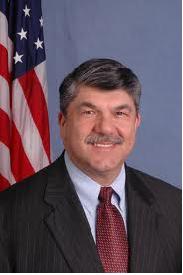
Many unionists are frustrated as usual by the lack of a viable progressive alternative to the Democratic Party. But they’d best beware, as AFL-CIO President Richard Trumka says, of the serious consequences of   being less than enthusiastic supporters of Democratic candidates in November’s elections.

“The Republican Party of NO doesn’t want our vote,” says Trumka. “All they want is for us to stay home. They want us to feel hopeless and disgusted so they can come back by default.”

 Trumka acknowledges that many union members, and many of their supporters and other progressives, are frustrated with the slow pace of economic change, the continuing high unemployment rate, continuing wars and other serious, unsettled problems.

But Trumka points out that in just a year and a half, Obama has had to dig out of a huge economic hole and “face extremist opposition on every point.” Yet, Trumka notes, “We’ve halted taxpayer bailouts … no longer are losing 700,000 jobs a month but are gaining a few… And by the end of this year we will have created or saved 3 1/2 million jobs and have fulfilled the dream of every president since Harry Truman and started to move down the road to health care for all. “

Organized labor has particularly good reason to be pleased with the performance of Obama and the congressional Democrats – particularly good reason to once again deploy millions of campaign dollars and millions of campaign workers in their behalf as labor did in the 2008 elections.

The Labor Department and National Labor Relations Board, virtually tools of the anti-labor right wing under President Bush, are under Obama returning to their job of enforcing the laws that guarantee workers the right to unionize without employer interference.

 And federal agencies are once again strictly enforcing the minimum wage and hour laws and other vital pro-worker laws that had been seriously neglected under Bush’s distinctly anti-labor administration. What’s more, the Occupational Safety and Health Administration is actually attempting to clamp down on the widespread violation of the job safety laws that has led to the needless deaths and serious injury of millions of American workers.

“We know you are angry,” Trumka told a recent gathering of labor leaders, “but we have made progress. No one said this was going to be easy. Ask African Americans how long they have fought and continue to fight. If they had given up after a year and a half they would still be in chains.”

 November’s election, says Richard Trumka, is  “the most crucial election in 75 years.” It will in any case be of unusually high importance to America’s working people and their unions and of exceptional importance to the rest of us as well.

Dick Meister, former labor editor of the SF Chronicle and KQED-TV Newsroom, has covered labor and politics for a half-century. Contact him through his website, www. dickmeister.com, which includes more than 250 of his recent columns.

Following Newsom’s money trail to City Hall and beyond

8

The Chronicle reports that Jennifer Matz of the Mayor’s Office of Economic and Workforce Development is the leading contender to replace Mayor Michael Cohen, who announced his resignation yesterday as Gavin Newsom’s top economic advisor.

Newsom’s most recent campaign finance filings in the Lt. Governor’s race show that Matz contributed $1,000 to the Newsom for California campaign.

Matz’s contribution pales in comparison to the $2,000 that PG&E’s Dana Williamson put into Newsom’s hat, or the $2,500 that Barbara Streisand dropped, the $5,000 that the Building Owners and Managers Association (BOMA) plunked down, and  the $12,5000 that the Southwest Regional Council of Carpenters injected into the race.

But it’s the same amount the Teamsters coughed up, venture capitalist Joanna Rees popped for, Charles Schwab’s Ann Insley threw down, AT&T’s Ken McNeely gave, and realtor Victor Makras contributed to Newsom last month, helping his campaign raise $345,654 between May 23 and June 30.

And hopefully, if Matz becomes the next director of MOEWD, the Chron will run the correct photo when they write articles about her, something that can’t be said for the print edition of the article about Cohen’s resignation on Chronicle news stands today…

Eating humble pie with Glendon “Anna Conda” Hyde

22

It was with a sinking feeling that I read the comments that Glendon “Anna Conda” Hyde’s supporters left on the Guardian’s website last week, after I wrote about the DCCC questionnaires last week—and managed to screw up by omitting Conda/Hyde from my hasty round up.

“How is it that you’ve omitted Anna/Glendon from your election roundup?” was one of many similar comments made by Conda/Hyde’s outraged supporters. “This looks awfully like PREJUDICE, darlings. You should be ashamed of yourselves. Anna/Glendon’s candidacy is not a joke. S/he is one of the most promising progressive voices in SF. Wake up.”

So, I picked up the phone, and called Conda/Hyde to offer my humble apologies.

And today we sat down and talked about the role of the media and political endorsement clubs in propping up the marginalization of marginalized candidates and communities—and the role of radical queers in pushing back against the status quo and the political machines.

Conda/Hyde kicked off by recalling how the DCCC offered congratulations on the campaign’s artwork.

“But then they said you are not a viable candidate, and have you thought about taking the spotlight off yourself,” Conda/Hyde claimed.

(After our interview, I put in a call to DCCC chair Aaron Peskin. He had no recollection of the conversation going down quite like that. But Peskin also noted that the DCCC had done a ton of interviews recently.

“I like Glendon and I remember him appearing,” Peskin said. “But I don’t remember anyone telling him he was not viable.”

But with 26 candidates in the D. 6 race, and 27 candidates in the D. 10 race, it’s likely that some similar-minded candidates in those contests may decide, or be advised, to rally together between now and the election to increase the chances that  “the bad guys” don’t win, right?

“You’d think,” Peskin said. “That’s why I dropped out of the Board of President’s race when Willie Brown’s guy looked like he was going to win, and as a result, Matt Gonzalez won the race.”)

Anyways, back to my interview with Conda/Hyde, who also claimed that D. 6 candidate h.brown recently got barred from a small business debate in SoMa.

I wasn’t at that particular forum, or the D. 10 debate that the SF Young Dems recently hosted in the Bayview.

But I have watched videos of the outrage that was triggered at the Young Dems forum, when D. 10 candidates Dianne Wesley Smith, Nyese Joshua, Ed Donaldson, Marie Harrison and Espanola Jackson were excluded from the debate, even though the Bayview is where they are based.

And it’s similar to the outrage that Conda/Hyde supporters understandably felt when their candidate’s positions on issues like Mayor Gavin Newsom’s sit-lie legislation weren’t included in my original summary of the DCCC questionnaire. Especially since Conda/Hyde led the pushback against Newsom’s sit-lie measure.

“Marginalized districts, marginalized candidate voices,” Conda/Hyde observed.

The point Conda/Hyde is making here is that all candidates bring unique voices and perspectives to a race, and they provide marginalized communities with a rare opportunity to push back against powerful interests and ill-advised measures before this or that political machine can shoe horn its preferred slate into office.

“I was the first candidate to come out against sit-lie aggressively,” Conda/Hyde noted, by way of example.

At this point in our conversation, Labor leader and DCCC member Gabriel Haaland, who sat in on today’s meeting and voiced sharp criticism of my Conda/Hyde omission last week, chimed in.

“So many candidates were ducking sit-lie, so when I introduced a resolution opposing sit-lie at the DCCC, so many people were pissed off,” Haaland said. “And it was refreshing to see Anna Conda vocally opposing sit-lie in drag on Polk Street.”

Haaland added that he’d be working for Conda/Hyde’s campaign, “if not for a 15 year friendship with Debra Walker.”

And then he pointed to the central role that radical queers have played in pushing for political change.

“The first queer to run for elected office was a drag queen,” Haaland observed. “Radical queers have always been leading the movement, busting a move and changing the world. And Anna Conda is more the Harvey Milk of the race, in my opinion.”

“You reflect my radical queer positions more,” Haaland continued, addressing Conda/Hyde direct.  “And you have a real base in the district in a way that Theresa Sparks does not. But people are moving into the district and having bases created for them.”

Conda/Hyde then observed that plans are afoot for an inclusionary District 6 forum.

“Jane Kim and I are getting together to do a forum that includes all the D. 6 candidates,” Conda/Hyde said, “We’ll be including James Keys, Dean Clark and Fortunate ‘Nate’ Payne, who are all out there working hard on their campaigns, as well.”

The ability to raise funds is often an indicator of whether a candidate is viable. Campaign finance records show that Conda/Hyde has applied for public funds, the application is under review, and that Jane Kim, Jim Meko, Theresa Sparks, Debra Walker and Elaine Zamora have qualified for public financing in the D. 6 race.

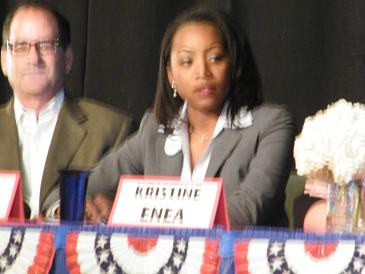
That level of public fund raising is only bested by D. 10 where Malia Cohen, Kristine Enea, Chris Jackson, Tony Kelly, DeWitt Lacy, Steven Moss, Eric Smith and Lynette Sweet have already qualified for public financing, and Diane Wesley Smith, has her application under review.

(In D. 2, Kat Anderson and Abraham Simmons have already qualified for public funding. In D. 8, Rafael Mandelman, Rebecca Prozan and Scott Wiener have already qualified, and Bill Hemenger’s application is under review.)

At the end of our meeting, Conda/Hyde talked about name recognition problems.
“I have a lot of name recognition as Anna Conda, and not as much as Glendon Hyde,” Conda/Hyde noted, choosing to pose as Glendon Hyde next to his D. 6 campaign sign.
“I think I’ve already proven that I’m a drag queen,” Hyde explained.

“And not just a pretty face,” Haaland concluded.


Democrats divided

25

Update:This online article contains a correction concerning the DCCC’s vote on Sup. Sean Elsbernd’s Muni pay guarantees (Prop. G). In the print version of this article, the Guardian reported that the DCCC had voted “to recommend a no vote” on Prop. G. This is incorrect. The DCCC voted “not to endorse” Prop. G. As Elsbernd points out, “This is a key distinction.”

Sarah@sfbg.com

With fewer than 10 weeks to go until a pivotal November election, the San Francisco Democratic County Central Committee (DCCC) approved a package of endorsements at its Aug. 11 meeting, giving the nod to mostly progressive candidates and rejecting Mayor Gavin Newsom’s most divisive ballot measures.

This crucial election could alter the balance of power on a Board of Supervisors that is currently dominated by progressives, and that new board would be seated just as it potentially gets the chance to appoint an interim mayor.

That’s what will happen if Newsom wins his race for lieutenant governor. The latest campaign finance reports show that Newsom has raised twice as much money as the Republican incumbent, former state Sen. Abel Maldonado. But the two candidates are still neck-and-neck in the polls.

Although the DCCC supports Newsom in the race, it is resisting his agenda for San Francisco, voting to oppose his polarizing sit-lie legislation (Prop. L), a hotel tax loophole closure (Prop. K) that would invalidate the hotel tax increase that labor unions placed on the ballot, and his hypocritical ban on local elected officials serving on the DCCC (Prop. H).

Shortly after the vote, the San Francisco Chronicle reported that Newsom called an emergency closed-door meeting with some of his downtown allies to discuss the upcoming election. “We just wanted to get on the same page on what’s going on locally, what’s going with the ballot initiatives, where people are on the candidates for supervisor,” Newsom told the newspaper.

DCCC Chair Aaron Peskin, who regularly battled with Newsom during his tenure as president of the Board of Supervisors, voted with the progressive bloc against Newsom’s three controversial measures. But he told us that he was glad to see the mayor finally engage in the local political process.

Sup. David Campos kicked off the DCCC meeting by rebuffing newly elected DCCC member Carole Migden’s unsuccessful attempt to rescind the body’s endorsement of Michael Nava for Superior Court Judge, part of a push by the legal community to rally behind Richard Ulmer and other sitting judges.

Things got even messier when the DCCC endorsed the candidates for supervisor. In District 2, the DCCC gave the nod to Janet Reilly, snubbing incumbent Sup. Michela Alioto-Pier, who is running now that Superior Court Judge Peter Busch has ruled that she is not termed out (a ruling on City Attorney Dennis Herrera’s appeal of Busch’s ruling is expected soon).

In District 6, where candidates include DCCC member Debra Walker, School Board President Jane Kim, Human Rights Commission Executive Director Theresa Sparks, neighborhood activist Jim Meko, and drag queen Glendon Hyde (a.k.a. Anna Conda), the club endorsed only Walker, denying Kim the second-place endorsement she was lobbying for.

But in District 8, where candidates include progressive DCCC member Rafael Mandelman, moderate DCCC member Scott Wiener, and moderate Rebecca Prozan, the politics got really squirrelly. As expected, Mandelman got the first-place nod with 18 votes: the progressive’s bare 17-vote majority on the 33-member body plus Assembly Member Leland Yee.

Yet because Yee supports Prozan and David Chiu, the Board of Supervisors president who was also part of the DCCC progressive slate, had offered less than his full support for Mandelman, a deal was cut to give Prozan a second-place endorsement.

That move caused some public and private grumbling from Jane Kim’s supporters, who noted that Kim is way more progressive than Prozan and said she should have been given the second-place slot in D6.

A proxy for John Avalos even tried to get the DCCC to give Walker and Kim a dual first-place endorsement, but Peskin ruled that such a move was not permitted by the group’s bylaws. Then DCCC members Eric Mar and Eric Quezada argued that Kim should get the club’s second-choice endorsement.

But Walker’s supporters argued that Kim only recently moved into the district and changed her party affiliation from the Green Party to the Democratic Party, and Kim’s supporters failed to find the 17 votes they needed.

“District 6 has an amazing wealth of candidates and I look forward to supporting many of them in future races,” Gabriel Haaland told his DCCC colleagues. “I will just not be supporting them tonight.”

Wiener told the group he would not seek its endorsement for anything below the top slot. “I’m running for first place and I intend to win,” Wiener said, shortly before Prozan secured the club’s second-choice endorsement.

In District 4, the DCCC endorsed incumbent Carmen Chu, who is running virtually unopposed. The DCCC also endorsed Bert Hill’s run for the BART Board of Directors, where he hopes to unseat James Fang, San Francisco’s only elected Republican.

The body had already decided to delay its school board endorsements until September and ended up pushing its District 10 supervisorial endorsement back until then as well because nobody had secured majority support.

“I think it’s because they want to give members of the DCCC a chance to learn more about some of the candidates,” District 10 candidate Dewitt Lacy told the Guardian. “I don’t think folks have spent enough time to make an informed decision.”

D10 candidate Chris Jackson agreed, adding, “The progressives in this race have brought our issues to the forefront.”

“I think it’s appropriate,” concurred D10 candidate Isaac Bowers. “D10 is a complicated district. It’s wise to wait and see how it settles out.”

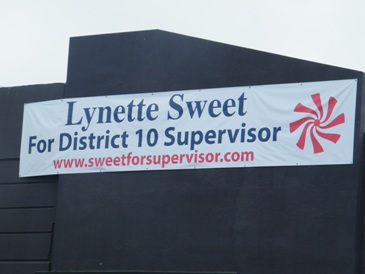
The main thing that needs to be resolved is which candidate in the crowded field will emerge as the progressive alternative to Lynette Sweet, who has the support of downtown groups and mega-developer Lennar Corp.

After the meeting, Walker said different races require different political strategies. “I think it’s hard in the progressive community, where so many of us know each other and even our supporters know the other candidates and are their supporters in other scenarios,” Walker said.

“But the Democratic Party makes decisions not just based on politics,” she continued. “So the endorsement is about being viable and successfully involved in Democratic issues. And even though I want to encourage everyone to run, and we have that ability with ranked choice voting and public financing, when it comes to straight-on politics, the goal is winning.”

Walker said the vote on D8 reflected the reality that Mandelman was having trouble getting the necessary number of votes. “I know Rebecca and I know Rafael, and Rafael was my clear first choice,” Walker said.” Rafael asked me to consider voting for Rebecca—and I voted for her as my second choice.”

Walker predicts she’ll have union support behind her campaign, while Kim, who leads in fundraising, will have independent expenditure committees that will support her campaign.

“My consultant says it’s a $250,000 race, and unfortunately the viability is based on that reality, the funds, the money,” Walker observed.

On the fall ballot measures, the DCCC voted to recommend a no vote on Public Defender Jeff Adachi’s measure to make city employees pay more for the pension and healthcare costs (Prop. B), Sup. Sean Elsbernd’s Health Service Board Elections (Prop. F,) and Newsom’s three controversial measures. And they voted “no endorsement” on Elsbernd’s measure to remove from the charter Muni pay guarantees (Prop. G). 

But the DCCC did vote to endorse a local vehicle registration fee surcharge (Prop. AA), Newsom’s earthquake retrofit bond (Prop. A), Sup. Chris Daly’s proposed legislation to require mayoral appearances at board meetings (Prop. C), Chiu’s measure to allow noncitizen voting in school board elections (Prop. D), Sup. Ross Mirkarimi’s Election Day voter registration (Prop. E), former Newsom campaign manager Alex Tourk’s Saturday voting proposal (Prop. I) Labor’s hotel tax (Prop. J ), Mirkarimi’s foot patrols measure (Prop. M) and Avalos’ real estate transfer tax (Prop. N).

With just about everybody opposed to Adachi’s measure going after public employee unions, Walker observed that Adachi probably wishes he had done it differently now. But looking into the future, Walker sees opportunities for the party to come back together.

“There’s an opportunity to start a dialogue because everyone is hurting,” Walker said. “The more we don’t have a proactive solution, the more we get caught at the bottom.”

And in a feel-good vote for the frequently divided body, the DCCC also voted overwhelmingly to endorse the statewide initiative to legalize and tax marijuana (Prop. 19). Normally local party committees don’t take a position on state initiatives, but because the California Democratic Party took no position on Prop. 19, the DCCC had permission to weigh in.

As Peskin put it before the enthusiastic marijuana vote, “Raise your hands — high.”

Unions sue to block Adachi measure

53

Five city-employee labor unions have filed suit to stop  Public Defender Jeff Adachi‘s “Sustainable City Employees Benefits Reform Act” (or Prop. B) from making it onto  the November ballot.

The San Francisco Fire Fighters Local 798, International Federation of Professional & Technical Engineers Local 21, Service Employees International Union Local 1021, the San Francisco Municipal Executives’ Association, and the San Francisco Police Officers Association filed suit August 10.

In a press release, Adachi said the suit attempts to discredit the Civil Grand Jury, the Department of Elections, the City Attorney and the rights of over 77,000 San Franciscan’s who signed the petition and, of course, Adachi himself..  

“The law has very specific requirements that must be followed in order to receive the approval from the Department of Elections for a measure to qualify for the ballot,” Adachi observed. 
“The democratic process by which the Sustainable City Employees Benefits Reform Act was approved both by the City Attorney through granting title and summary to the petition and by the Department of Elections when the signatures of 49,178 San Francisco voters were verified and accepted,” Adachi continued. “We as Americans have the freedom afforded to us by the Constitution to have our choices heard at the ballot box and the taxpayers have the right to address how their tax dollars are spent in San Francisco without interference from special interest groups.”

Representatives from the unions filing suit have yet to return my calls, but I’ll update this post, when they get back to me on the Adachi amendment, which is shaping up to be the hottest political potato on the November ballot.

D. 10 candidate Malia Cohen opposes death penalty

0

It’s relief to discover that D. 10 candidate Malia Cohen does not support the death penalty.  Confusion over her stance arose yesterday, thanks to an answer on her DCCC questionnaire that was posted at the SF Democratic Party’s website. (I noted in an earlier post that I was surprised by Cohen’s position and would include an update once I had a chance to ask Cohen about her position on this issue.)

“Sometimes it’s tricky,” Cohen told me today, making her yet another candidate to confide that they were confused by the DCCC questionnaire’s formatting.


Cohen assures me that the DCCC questionnaire now posted at the Dem Party’s site accurately reflects her opposition to the death penalty. And she’s focussing on moving forward with communicating her vision for D. 10 , following a debate that the SF Young Dems hosted at the Southeast Community Facility last night. 

“It was an excellent turnout, but you can never get your ideas out in 30 seconds,” Cohen said, noting that things got contentious when some D. 10 candidates showed up to complain that they had not been invited to participate in the debate.

“We have out migration and a shrinking African American community, so I do believe a minute could have been extended to allow folks to introduce themselves,” Cohen said, observing that D. 10 candidates Marlene Tran, Nyese Joshua, Diane Wesley Smith,  Espanola Jackson and Ed Donaldson (to name a few) were omitted from the debate table last night.

Sorry to hear that not everyone got to sit at the table. Especially, since being left out of the conversation is a recurring and historical theme in the Bayview. The truth is that there are a ton of interesting candidates in this race. And with D. 10 shaping up to be one of the most pivotal battles this fall, getting to hear the myriad of candidate viewpoints is critical for those wanting to make informed decisions when it comes to voting in November.

What DCCC questionnaires reveal about Adachi reform, sit-lie and marijuana

20

The DCCC makes its endorsements for the November election on August 11. And in preparation for that crucial endorsement, candidates filled out questionnaires that are posted online, providing fodder for those interested in Jeff Adachi’s pension reform, Mayor Gavin Newsom’s sit-lie ordinance, and the legalization of marijuana, amongst other measures.

But before we get to those issues, I have to admit I was a bit surprised to see that D. 10 candidate Malia Cohen, who has already secured the endorsements of Sally Lieber, Fiona Ma and Aaron Peskin, says on her DCCC questionnaire that she supports the death penalty.

Now, to be fair, advocating for or against the death penalty isn’t the duty of the Board of Supervisors. And I haven’t yet caught up with Cohen yet to clarify why she holds this stance, (or whether it was one big typo, though I somehow doubt it). So, I’ll be sure to update this post, once I have a chance to talk to Cohen, who was busy at yet another candidate forum, when I was writing this entry. UPDATE: Cohen says she does not support the death penalty, and that she inadvertently misanswered the question. (Thanks for clearing up the mystery, Malia, and being gracious about it in the process.)

I should mention that Peskin also endorsed D. 10 candidate Tony Kelly.

And I should also note that while D. 10 candidate Lynette Sweet’s questionnaire says she supports Jeff Adachi’s pension and healthcare reform, Sweet’s campaign says that’s not the case, pointing to how Sweet said at the Potrero Hill Democratic Club’s August 2 D. 10 forum that what Adachi did wasn’t a bad thing, but the way he went about it was.

I quoted Sweet saying those very words in a previous post, and Sweet’s campaign manager Shane Mayer told me that he forwarded what I wrote about that meeting to the DCCC to clarify Sweet’s position. But Mayer got testy when I asked him about the rent, or rather the lack of rent, that Sweet, who Mayor Gavin Newsom has already endorsed, appears to be paying for her campaign headquarters at 25 Division Street (at Rhode Island).

As Beyond Chron tells it, the deal looks more than a bit fishy, and appears to be bankrolled by the Visovichs, a family with Republican leanings that supported Mayors Willie Brown and Newsom in past election campaigns.

 Mayer tried to dismiss the Beyond Chron article as a “hit piece”.

“The article focuses on only one candidate,” Mayer said. “We’re paying fair market rate, and using only a small portion of a warehouse. When we moved in, we didn’t have lights.”

But Sweet isn’t the only D. 10 candidate to come under Beyond Chron’s fire in recent days: fellow D. 10 candidate Steve Moss also took flak for receiving $500 from Andrew Zacks, the landlord attorney famous for doing Ellis Act evictions.

While on the phone with Moss recently, I asked what he thought about Newsom’s sit-lie ordinance, Moss said he hadn’t made up his mind yet.

And in his DCCC questionnaire, Moss also waxes ambiguous on sit-lie. “There’s clearly a lack of civility in certain areas of the city,” Moss wrote. “And in Bayview-Hunters Point, youth loitering can create conditions that create violence. However, it’s not clear to me that sit-lie is an appropriate response to this issue, and that it won’t result in unintended consequences. For example, sidewalks in Bayview-Hunters Point are also often used for peaceful gathering of neighbors, which is community-building and non-threatening.”

Makes me wonder what Moss and the rest of the candidates think about City Attorney Dennis Herrera’s recent gang injunction in Viz Valley…

UPDATE: I should add here that termed-out D.6 Sup. Chris Daly has just endorsed legislative aide and D.6 candidate James Keys, whose DCCC answers I’ve included in my round up of some of the candidate responses to this year’s DCCC questionnaire. UPDATE: And for all the Glen “Anna Conda” Hyde supporters, my humble apologies for omitting your candidate’s positions in my first post on this issue:

Chiu’s non-citizen voting in School Board elections
Supportive of non-citizen voting:  Adachi, Sup. Michela Alioto-Pier and D. 2 challenger Janet Reilly, D. 6 candidates Glen “Anna Conda” Hyde, James Keys, Jane Kim, Jim Meko, Debra Walker and Theresa Sparks. D. 8 candidates Rafael Mandelman, Rebecca Prozan and Scott Wiener. D. 10 candidates Isaac Bowers, Cohen, Chris Jackson, Tony Kelly, Dewitt Lacy and Eric Smith.
Opposed: D.2 candidates Farrell and Berwick, D. 4 incumbent Carmen Chu, and D. 10 candidates Kristine Enea and Lynette Sweet.

Newsom’s ban on dual office holding

Supportive: Berwick, Farrell, Glen “Anna Conda” Hyde, Meko, Enea.

“Yes. Better distribution of power,” Anna Conda said.

Opposed: Adachi, Alioto-Pier, Reilly, Keys, Kim, Walker, Sparks, Mandelman, Sweet, Lacy, Kelly, Cohen, Wiener, Jackson, Smith and Prozan.
“This measure is the result of petty politics between the mayor and the Board,” Prozan, who contributed S100 to Newsom’s Lt. Governor campaign, famously wrote on her DCCC questionnaire.

Newsom’s Sit-Lie Ordinance
Supportive: Farrell, Alioto-Pier, Reilly, Chu, Sparks, Wiener and Sweet.
Opposed: Adachi, Berwick, Glen “Anna Conda” Hyde, Keys, Kim, and Walker. Mandelman and Prozan. Cohen, Jackson, Kelly, Lacy and Smith.

Adachi’s Pension Reform
Supportive: Adachi, Berwick, Meko, and Sweet
Opposed: Chu, Farrell and Reilly. Glen “Anna Conda” Hyde, Keys, Kim, Walker and Sparks. Mandelman, Prozan and Wiener. Cohen, Jackson, Kelly, Lacy and Smith.
No position, yet: Alioto-Pier.

Legalization of pot (Prop. 19)
Supportive: Adachi, Berwick. Glen “Anna Conda” Hyde, Keys, Kim, Meko, Sparks, and Walker. Mandelman, Prozan and Wiener. Cohen, Jackson, Kelly, Lacy, Smith and Sweet.
Opposed: Chu and Farrell

No position, yet: Alioto-Pier, Janet Reilly.

Hard to tell: Moss.

“I philosophically support this measure but am concerned that its economic and social implications haven’t been carefully considered, nor its interaction with federal law,” Moss wrote on his DCCC questionnaire.

Sparks for her part just clarified that she mistakenly answered “No” on two DCCC questionnaire items: “Do you opposeprivatization of essential government services,” and “Will you oppose anti-worker initiatives that seek to undermine the ability of union leaders to carry out will of members and engage in political activities.”

“I meant to answer yes, as I explained at my DCCC interview,” Sparks said. “I was confused by the double negatives.”

While she was on the phone, Sparks also admitted that the pace on the campaign trail is getting intense with forums and meetings every night.

“David Campos, who has been a good friend since we were both on the Police Commission, recently told me, ‘win or lose, you need to schedule a few weeks off in November when the election is over,’” Sparks said.

Campos is right. To all the candidates on the campaign trial, here’s wishing you lots of energy and calm in the weeks to come. And see you at the DCCC forum.

<!–[endif]–>

Hidden health care costs of Adachi’s pension reform measure

New information about the health care costs associated with a pension reform measure backed by Public Defender Jeff Adachi suggests that the highest cost burden would fall to parents at the lowest end of the pay scale.

An analysis of the Adachi measure estimates that city employees with two or more dependents could face monthly healthcare cost increases of $220 a month, which would bring their total monthly contributions to $448, $765, or $1,630, depending on the health care plan. Dental care would bring those costs up an additional $82 per month.


Rael & Letson, an actuary firm hired to calculate premium contributions, completed the analysis on behalf of the Public Employees Committee of the San Francisco Labor Council. The city has not done a formal analysis of employee contribution increases to date.

Rael & Letson’s report estimates that for employees with a single dependent, the monthly employee contribution would go up an additional $240 under Kaiser, $352 under Blue Shield, and $419 under the city plan — bringing the total monthly contributions to $249, $473, and $1,098, respectively. Dental benefits would bring each of those costs up another $50 per month. That’s compared with current contribution levels of $8.84, $120, and $679 for employees in that category.

The analysis found that if approved, the policy change would result in “a relatively modest monthly out-of-pocket increase for Kaiser participants without dependents, but a significant shift in … costs paid by employees enrolled in other plans … especially those with employee + 1 dependent coverage. These increases could make covering dependents unaffordable for lower income employees.”
According to StateHealthFacts.org, a website run by the Kaiser Family Foundation, the average employee contribution to a family health insurance premium in the state of California amounted to about $290 per month in 2009.

Whether or not these proposed increases are manageable depends of course on an employee’s salary, whether or not they have assistance from a spouse or family members, and other personal circumstances. In the case of a single mother with two or more children at the lower end of the pay scale, the spike in health care costs could force some very difficult choices.

Meanwhile, an analysis of the pension reform measure written by the director of San Francisco’s Health Service System (HSS) at the request of the city’s Department of Elections suggests that the measure could jeopardize an estimated $23 million in federal funding that is expected to be awarded annually for the next four years under the new federal healthcare reform bill. HSS administers healthcare benefits to city employees.

A new program created under federal healthcare reform — the Early Retiree Reinsurance Program (ERRP) — is designed to ease employers’ financial burden of healthcare costs for retirees not eligible for Medicare. ERRP funds can be used reimburse 80 percent of claims between $15,000 and $90,000 for each retiree over 55 who isn’t eligible for Medicare. In San Francisco, this new federal subsidy amounts to an estimated $23 million annually over the next four years, which would be deposited into the city’s HSS trust fund and used to lower premium requirements.

The HSS memo warns that since Adachi’s measure proposes increasing employee healthcare contributions, “This proposed Charter amendment will therefore eliminate this anticipated subsidy of premium contributions not only for the City and County but also for City College and the Unified School District who are also employers within the San Francisco Health Service System.”

The memo also points out that just $53 million out of the $83 million in savings that the Adachi measure is expected to generate will go into the city’s General Fund, because more than a third of employees work for non-General Fund supported departments.

“If this Charter amendment becomes law, the balance of the contributions required to fully fund the HSS benefits will ultimately have to shift to the employees,” according to the HSS memo. “This Charter amendment does not address the underlying factors that will continue to drive increases in the cost of providing healthcare benefits.”

The recession has brought a recent spate of finger pointing at public-sector workers, and some might consider sharp healthcare cost increases to be a worthwhile tradeoff when it comes to the anticipated savings. Yet the decision to take more money out of the pockets of working people comes with its own set of consequences, which might be felt most acutely at the individual level but will also have a ripple effect on a broader economic scale.

Gabriel Haaland, an organizer with SEIU Local 1021, told the Guardian he believes that Adachi’s measure has been misrepresented as a pension-reform measure and ought to be discussed in the context of health care. “It’s a wolf in sheep’s clothing,” he said. Haaland added that he thought the sharp contribution increases would lead to more people opting out of healthcare benefits altogether, which could in turn place more of a strain on the city’s public healthcare system.

We contacted Adachi for comments, and we’ll be sure to post his response if and when we receive it.

Reinventing San Francisco

8

By Christopher D. Cook, Karl Beitel, and Calvin Welch. 

OPINION It’s hard to trust hope these days — to imagine that our world, or even our city — could be different. But for the next 10 or 15 minutes, as you read this, we invite you to suspend the cynicism and disbelief that hang over contemporary life, and allow your mind to imagine that, yes, a different San Francisco is possible. Just for 15 minutes, although we hope this helps kick-start a much longer-term revival of hope and urban reimagining.

It’s time to create something new in San Francisco — a visionary movement for constructive change that’s bold and unapologetic. Imagine, for instance, if San Francisco became a national model for how cities can reinvest local profits (public and private) and assets to expand economic opportunity and social equity. Imagine if, instead of promoting a dispiriting and volatile blend of corporate development and Darwinian “free-market” anarchy, San Francisco transformed how American cities define success by creating concrete alternatives to the chaos of capitalism.

Now imagine that San Francisco had its own public bank — a fiscally solvent, interest-generating financial force (potentially a half-billion dollars strong) dedicated to public financing and economic stimulus, that functioned as a vigorous incubator for homegrown industries and sustainable, true-green job creation.

We are proposing no less than a reinvention of San Francisco — a dramatic shift in priorities, resources, politics, and culture that marries the very best in both creative innovation and urgently needed reforms to make our city socially equitable and sustainable, both ecologically and economically.

Toward this end, the Community Congress, Aug. 14-15 on the University of San Francisco campus, will stimulate ideas, discussion, and planning to reinvigorate civic engagement and inspiration and create a concrete, locally actionable agenda for reshaping the city. You’re invited. (Visit www.sfcommunitycongress.wordpress.com for more information.) The congress is a conversation starter and idea incubator — an opportunity to begin reimagining San Francisco as a socially equitable, racially inclusive, ecologically sustainable city that grows its own food, supplies its own energy, and is an affordable haven for working-class people, immigrants, artists, and creative folk of all stripes.

We humbly propose a city that embraces cosmopolitanism and international exchange while empowering its residents to achieve a decent and livable quality of urban life. We are not trying to turn back the clock; we are trying to create new forms of social and economic value that give people meaning and sustenance, and hope.


WHY A COMMUNITY CONGRESS—WHY NOW?

Couldn’t we save such sweeping aspirations for a rainy day? The sky isn’t falling yet, is it? Not quite, but the present constellation of crises San Francisco is ensnarled in — massive and rising structural deficits, a boom/bust economy that’s profoundly unstable and inequitable, deepening economic and social divides that destabilize communities, to name a few — is simply unsustainable.

San Francisco’s economic and fiscal crisis is not a passing moment. Rather, it signals long-term structural flaws in the city’s economic policies and planning. San Francisco has lost roughly 45,000 jobs since 2000, and each “recovery” is marked by steadily higher unemployment rates (currently resting at 9.2 percent). More critically, as jobs and wages have grown more precarious and housing prices have steadily risen (over the long term), thousands of San Franciscans have been displaced.

Any serious vision for change must incorporate race and class dynamics. Consider the economic evisceration of much of the city’s African American population, which has plummeted from 13.4 percent of the population in 1970 to just 6.5 percent today (more than 22,000 African Americans left the city between 1990 and 2008). The gutting of communities of color is intrinsically intertwined with issues of job and wage loss and soaring housing costs. This is particularly acute in the geographic and political dislocation of African Americans in San Francisco. Add to this picture intense overcrowding and poverty in Chinatown and in Latino and immigrant communities, and you get a set of inequities that are morally unacceptable and socially untenable.

Like other major American cities, San Francisco faces a crucial historical moment. Global warming and fast-dwindling oil supplies require a transformative shift in how we conceive (and implement) economic development far beyond the city’s current piecemeal approach to “green procurement.” The Peak Oil Preparedness Task Force, appointed by the Board of Supervisors in 2007, concluded that a full 86 percent of San Francisco’s energy use comes from fossil fuels, primarily petroleum and natural gas, and a small amount of coal. Given the world’s fading oil supplies and mounting climate chaos, this is simply unsustainable.

The specter of a looming energy and environmental crisis, combined with economic instability marked by persistently high unemployment, rising income inequality, systemically entrenched homelessness, consumer debt, and the deepening crisis of cutbacks to critically needed human services and affordable housing call for a radical shift in how society — and San Francisco’s economy — are run.

Transforming San Francisco into a truly sustainable city will mean dramatic shifts in what (and how) we produce and consume, and aggressive city policies that promote local renewable energy. Our economy — how our food, housing, transportation and other essential goods are made — will have to be rebuilt for a world without oil.

These and other limits mean we must redefine growth and profit—fast. Work and sustainability must become fully intertwined, and we must think creatively about how jobs can produce social and community value, instead of profits concentrated at the top.

Creating truly sustainable and equitable cities for the 21st century will also mean dramatic shifts in how we produce and consume. There is no better place to begin than here in San Francisco, long an incubator in progressive thinking and genuine grassroots action and innovation. In an earlier Community Congress in 1975, residents and groups from across San Francisco united in a movement of ideas and organizing that led to district supervisorial elections and successful campaigns to stem the tide of downtown corporate development, helping to democratize politics and economics in San Francisco.

The 2010 Community Congress is aimed at reinvigorating local movements for lasting change, both on the policy level and in the relationship between people and their government. We hope to inspire a spirited and creative shift in the city’s culture and politics — with concrete, politically actionable policies to democratize planning and development and a more sweeping transformation of our expectations — toward a far richer and deeper engagement of people and communities in their own governance.


A NEW FRAMEWORK FOR URBAN DEVELOPMENT

What would this City of Hope look like, and how would it work? Consider what we could accomplish with a municipal bank. The City and County of San Francisco currently has almost $2.6 billion in highly liquid reserves, about $500 million of which could be used to fund a Municipal Bank of San Francisco. Once established (and federally insured), the Municipal Bank could take additional deposits and use this to issue more loans. The bank could promote economically viable worker-run cooperatives that produce goods and services addressing community needs — be it day care, urban gardening, or ecologically sustainable light industry that creates meaningful employment for local residents. The bank could provide competitive small-interest loans to help stimulate small-business development — the key economic engine of the city. Currently, access to credit is one of the primary impediments to small business growth in San Francisco.

The city could also start a Municipal Development Corporation to produce goods and services that meet essential needs, boost local employment, and generate surpluses that would be available for local reinvestment. San Francisco could launch itself on the path to local energy self-reliance with funds from the Municipal Bank, together with revenue bonds—raising large pools of capital to finance large-scale alternative energy investments such as solar panels to generate energy for sale to local businesses and households.

The proceeds could help subsidize community-based development such as urban farming projects that could grow food for our public schools. The Municipal Development Corporation could explore other initiatives like large-scale medical marijuana cultivation and development of a commercial fiberoptic network. Other ideas can be developed; we need to engage our collective imagination to envision what can exist if there’s enough people power and political will.

By expanding access to credit, municipalizing a chunk of the city’s assets, establishing an economically viable municipal development enterprise, and democratizing city planning and development, San Francisco can enable long-disenfranchised communities to create sustainable and diversified development — instead of fighting over “jobs versus the environment” and other false choices and getting nowhere for decades.

It’s time for proactive, community-led economic development that addresses urgent needs, from local hiring and training, to creating a diverse base of neighborhood-serving businesses, to ecologically sustainable and healthful development and planning that is driven by communities and residents.

San Francisco’s job creation policies can be transformed to prioritize community needs over corporate profits by linking major development contracts to strict local hiring and training, community benefits agreements that invest in social goods like childcare and in-home health services, and ensuring dramatic increases in the city’s stock of affordable housing.

We need to build new forms of public participation in local government in ways that address people’s everyday needs. For instance, the congress will propose a new partnership between residents and Muni to make Muni work better, involving current riders and drivers in a new, more powerful role in how Muni lines function.

We need to find better ways to sustain a diverse population of working-class, people of color, artists, writers, musicians, and others. We need to make sure development isn’t just code for finding new ways to gentrify neighborhoods and displace existing residents.

Specific proposals will address how the city and community-based nonprofits deliver critical health and human services to our neediest residents. We propose making this an integrated part of the budget process, not a last-minute afterthought. Toward this end, the Community Congress will present actionable proposals to create innovative “resident/government” partnerships to improve local government responsiveness and efficiency.


RAISING—AND SPENDING—THE BENJAMINS

One of the keys to unlocking the city’s stagnating economy is progressive revenue generation and more democratic participation in budgeting. We must enlarge the public pie while reapportioning it in a way that stimulates job creation and shifts the tax burden onto the large businesses that reap vast private benefits from public goods and services. The city’s budget process must be dramatically reshaped and democratized. Communities need a seat at the fiscal table when the budget is being crafted — instead of lobbying tooth and nail at the end of the process just to retain funding that barely keeps programs afloat.

How can we build a participatory budgeting movement that brings residents and communities into the process? For instance, community budget councils composed of elected and appointed residents from every supervisorial district could assess neighborhood needs and incorporate them into drafting the budget. Whatever form this takes, the goal is to put the needs of residents at the forefront of how the city spends its resources.

The Community Congress can also help redefine fiscal responsibility. Taxing and spending must be accountable and transparent and respect the fact that this is the public’s money. Let’s be honest: much of what passes for government excess is due to management and executive bloat at the top, not salaries of frontline workers like bus drivers, social service providers, and hospital workers. True fiscal responsibility also means investing in prevention: education, healthcare, and services that help people build their lives.


RECLAIMING HOPE

It’s time to reclaim the public sector as the sphere of our shared interest. Rather than thinking in terms of the old paradigm that counterpoises “government” and “the market,” let us envision a new citizen movement to create a more participatory, democratic, and accountable system of self-government.

The San Francisco Community Congress is about bringing people together — community activists, those working in the trenches of our increasingly strained social services, our environmental visionaries, our artists, the urban gardeners and permaculturists, poets, bicycle enthusiasts, inventors … in short, assembling our pool of collective knowledge and wisdom, and yes, our differences — in a forum to discuss, debate, share concerns and viewpoints, and ultimately produce a working template that is both visionary and can be implemented.

The Community Congress will create a space for all of us to participate in defining our own vision of San Francisco. It is a first step toward reasserting popular control over economic development. It is an invitation to be visionary, rethinking in fundamental ways what it means to live in the 21st century city, and a forum for creating real, practical platforms and proposals that can be implemented using the powers of local government.

We want to propose a new vision of urban governance. Not more bureaucracy, more commissions, more departments, but the creation of new institutions that are democratically accountable and place new kinds of economic and political resources in the hands of ordinary citizens.

We don’t have any illusions. There are limits to what local government can do. Ultimately, deep change will require actions by higher levels of government. More profoundly, it will require a deeper change in citizen awareness, a rejection of life dominated by the pursuit of narrow self-interest, in favor of a more ecologically sustainable, socially just, and more democratic way of life.

But we can begin at the local level, here and now, to envision and implement the kind of changes that will need to take place if we want to insure that our city, our country, and our planet will be the kind of place we want our children to live. Please come. Bring your hopes, passions, and ideas. This is our collective project, our shared wisdom, our joint vision of the kind of city and society in which we want to live.

Christopher D. Cook is an author, journalist, and former Bay Guardian city editor (www.christopherdcook.com). Karl Beitel is a writer, scholar, and activist. Calvin Welch is the director of the San Francisco Information Clearinghouse and a long-time affordable housing advocate. This story was funded in part by www.spot.us


 

A new community congress

0

EDITORIAL The first time a group of activists from across San Francisco met in a Community Congress, it was 1975 and the city was in trouble. Runaway downtown development was creating massive displacement and threatening the quality of life. Rents were rising and tenants were facing eviction. An energy crisis had left residents and businesses with soaring power bills. The manifesto of the Congress laid out the problem:

"Every poor and working class community in San Francisco has learned the hard way that its interests are at the bottom of the list as far as City Hall is concerned. At the top of the list are the banks, real estate interests, and large corporations, who view San Francisco not as a place for people to live and work and raise families, but as a corporate headquarters city and playground for corporate executives. By using their vast financial resources, they have been able to persuade local government officials that office buildings, hotels, and luxury apartments are more important than blue-collar industry, low-cost housing and decent public services and facilities."

The Community Congress hammered out a platform — a 40-page document that pretty much defined what progressive San Francisco believed in and wanted for the city. It included district elections of supervisors, rent control, public power, a requirement that developers build affordable housing, and a sunshine ordinance — in fact, much of what the left has accomplished in this town in the past 35 years was first outlined in that document.

Beyond the details, what the platform said was profound: it suggested that the people of San Francisco could reimagine their city, that local government could become a force for social and economic change on the local level, even when politics in Washington and Sacramento were lagging behind. It called for a new relationship between San Franciscans and their city government and looked not just at what was wrong, but what was possible.

That’s something that too often gets lost in political debate today. With urban finances in total collapse, the progressives are on defense much of the time, trying to save the basic safety net and preserve essential programs and services. It seems as if there’s little opportunity to talk about a comprehensive alternative vision for San Francisco.

But bad times are great times to try new ideas — and when the second Community Congress convenes Aug. 14 and 15 at the University of San Francisco, that’s exactly what they’ll be trying to do. It’s not going to be easy — the left in San Francisco has always been fractious, and there’s no consensus on a lot of central issues. But if the Community Congress attracts a broad enough constituency and develops a coherent platform that can guide future political organizing efforts, it will have made a huge contribution to the city.

The event also offers the potential for the creation of a permanent progressive organization that can serve as a forum for discussion, debate, and action on a wide range of issues. That’s something the San Francisco left has never had. Sup. Chris Daly tried to create that sort of organization but it never really worked out. The city’s full of activist groups — the Tenants Union, the Harvey Milk LGBT Club, the Sierra Club, and many others — that work on important issues and generally agree on things, but there’s no umbrella group that can knit all those causes together. It may be an impossible dream, but it’s worth discussing.

The organizers of the Community Congress discuss some of their agenda in the accompanying piece on this page. It should be based on a vision of what a city like San Francisco can be. Think about it:

This can be a city where economic development is about encouraging small businesses and start-ups, where public money goes to finance neighborhood enterprises instead of subsidizing massive projects.

This can be a city where planning is driven by what the people who live here want for their community, not by what big developers can make a profit doing.

This can be a city where housing is a right, not a privilege, where new residential construction is designed to be affordable for the people who work here.

This can be a city where renewable energy powers nearly all the needs of residents and businesses and where the public controls the electricity grid.

This can be a city where the wealthy pay the same level of taxes that rich people paid in this country before the Reagan era, where the individuals and corporations that have gotten filthy rich off Republican tax cuts give back a little bit to a city that is proud of its liberal Democratic values.

This can be a city where it’s safe to walk and bike on the streets and where clean, reliable buses and trains have priority over cars.

This can be a city where all kids get a good education in public schools.

Despite all the economic woes, this is one of the richest cities in one of the richest countries in the history of human civilization. There are no economic or physical or scientific or structural constraints to reimagining the city. The only obstacles are political.

In the next two years, control of City Hall will change dramatically. Five seats on the Board of Supervisors are up in November, and the mayor’s office is open the year after that. The progressives have made great progress in the past few years — but downtown is gearing up to try to reverse those advances. The community congress needs to address not just the battle ahead, but describe the outcome and explain why San Francisco’s future is worth fighting for.

A new community congress

2

Bad times are great times to try new ideas – the second Community Congress convenes Aug. 14 and 15 at the University of San Francisco

EDITORIAL The first time a group of activists from across San Francisco met in a Community Congress, it was 1975 and the city was in trouble. Runaway downtown development was creating massive displacement and threatening the quality of life. Rents were rising and tenants were facing eviction. An energy crisis had left residents and businesses with soaring power bills. The manifesto of the Congress laid out the problem:

“Every poor and working class community in San Francisco has learned the hard way that its interests are at the bottom of the list as far as City Hall is concerned. At the top of the list are the banks, real estate interests, and large corporations, who view San Francisco not as a place for people to live and work and raise families, but as a corporate headquarters city and playground for corporate executives. By using their vast financial resources, they have been able to persuade local government officials that office buildings, hotels, and luxury apartments are more important than blue-collar industry, low-cost housing and decent public services and facilities.”

The Community Congress hammered out a platform — a 40-page document that pretty much defined what progressive San Francisco believed in and wanted for the city. It included district elections of supervisors, rent control, public power, a requirement that developers build affordable housing, and a sunshine ordinance — in fact, much of what the left has accomplished in this town in the past 35 years was first outlined in that document.

Beyond the details, what the platform said was profound: it suggested that the people of San Francisco could reimagine their city, that local government could become a force for social and economic change on the local level, even when politics in Washington and Sacramento were lagging behind. It called for a new relationship between San Franciscans and their city government and looked not just at what was wrong, but what was possible.

That’s something that too often gets lost in political debate today. With urban finances in total collapse, the progressives are on defense much of the time, trying to save the basic safety net and preserve essential programs and services. It seems as if there’s little opportunity to talk about a comprehensive alternative vision for San Francisco.

But bad times are great times to try new ideas — and when the second Community Congress convenes Aug. 14 and 15 at the University of San Francisco, that’s exactly what they’ll be trying to do. It’s not going to be easy — the left in San Francisco has always been fractious, and there’s no consensus on a lot of central issues. But if the Community Congress attracts a broad enough constituency and develops a coherent platform that can guide future political organizing efforts, it will have made a huge contribution to the city.

The event also offers the potential for the creation of a permanent progressive organization that can serve as a forum for discussion, debate, and action on a wide range of issues. That’s something the San Francisco left has never had. Sup. Chris Daly tried to create that sort of organization but it never really worked out. The city’s full of activist groups — the Tenants Union, the Harvey Milk LGBT Club, the Sierra Club, and many others — that work on important issues and generally agree on things, but there’s no umbrella group that can knit all those causes together. It may be an impossible dream, but it’s worth discussing.

The organizers of the Community Congress discuss some of their agenda in the accompanying piece on this page. It should be based on a vision of what a city like San Francisco can be. Think about it:

This can be a city where economic development is about encouraging small businesses and start-ups, where public money goes to finance neighborhood enterprises instead of subsidizing massive projects.

This can be a city where planning is driven by what the people who live here want for their community, not by what big developers can make a profit doing.

This can be a city where housing is a right, not a privilege, where new residential construction is designed to be affordable for the people who work here.

This can be a city where renewable energy powers nearly all the needs of residents and businesses and where the public controls the electricity grid.

This can be a city where the wealthy pay the same level of taxes that rich people paid in this country before the Reagan era, where the individuals and corporations that have gotten filthy rich off Republican tax cuts give back a little bit to a city that is proud of its liberal Democratic values.

This can be a city where it’s safe to walk and bike on the streets and where clean, reliable buses and trains have priority over cars.

This can be a city where all kids get a good education in public schools.

Despite all the economic woes, this is one of the richest cities in one of the richest countries in the history of human civilization. There are no economic or physical or scientific or structural constraints to reimagining the city. The only obstacles are political.

In the next two years, control of City Hall will change dramatically. Five seats on the Board of Supervisors are up in November, and the mayor’s office is open the year after that. The progressives have made great progress in the past few years — but downtown is gearing up to try to reverse those advances. The community congress needs to address not just the battle ahead, but describe the outcome and explain why San Francisco’s future is worth fighting for.

Filing fees and public financing as clues to 2010 supervisor races

5

For months now–and in a few cases, over a year- a bunch of dedicated residents have been campaigning in the hopes of becoming the next supervisor in districts 2,4,6,8 and 10. But now comes the moment of truth:

Between July 12 and August 6, all these potential candidates must file all necessary paperwork and pay all necessary fees to qualify for the November ballot.

And, provided they get enough signatures, they can submit a petition in which each signature represents 50 cents towards offsetting their $500 candidate-filing fee.

These signatures are called signatures-in-lieu (or SIL) and they provide an interesting data point if you are trying to figure out who has community support and/or money.

A spokesperson for the San Francisco Elections Department recently told me that the point of the signature-in-lieu petition is to allow anyone to get on the ballot, regardless of their financial circumstances—provided they have valid support.

“If they were to collect, let’s say, 1,000 valid signatures, then that totally offsets their candidate filing fee,” the Elections spokesperson said. “But if they go over 1,000 signatures, they don’t get extra money back.”

And, as of July 26, Elections started to look at candidates’ SIL petitions to get an idea of who will owe what come Friday, when the filing fees are due. This is done by figuring out of the signatures are valid or not. To be valid, a signature must come from a person who resides in the geographical area that is covered by the race.

So, D. 2 candidates must gather signatures from D2 residents, and so on.

“Let’s say the candidates didn’t want to do all that, they just file and write a check,” the Elections spokesperson said. “But they must collect at least 20 valid nominating signatures.”

These signatures can be the same as those on the SIL petition, but they must be re-submitted on a nominating petition. And these signatures must come from folks residing in the district covered by each race. So, D 10 nominators must also be D. 10 residents.

“We expect a long line on Friday, which is when we’ll see a lot of people,” the Elections Department representative added. “And we will be working through the weekend to create an ‘unofficial’ official list of candidates by Monday [August 9]. A list we call “unofficial’ because we may need to check out some of the signatures.”

So, what do the candidates’ signature-in-lieu submissions reveal, so far?

Leading the pack in terms of candidates who submitted the least amount of valid signatures-in-lieu is D. 6 supervisor candidate Theresa Sparks.
As of July 27, Sparks had submitted 20 signatures, but only 19 were valid.

Sparks is closely followed, in terms of low SIL numbers, by D.6 candidate Jim Meko: Meko submitted 33 signatures, and only 28 were valid.

Now, this paucity of signatures-in-lieu could suggest that Sparks and Meko do not have massive grassroots support in D. 6. It could also mean that Meko and Sparks are focusing their campaign energies elsewhere. And, to be fair, both could submit more signatures by Friday.

Meko admitted that his campaign did not spend time gathering signatures-in-lieu.

‘We did not devote a whole lot of energy on that,” Meko told me today.”You can only spread yourself so far.”

To date, Sparks’ signatures only count towards $19.50 of her $500 filing fee. This suggests Sparks will pay for the filing fee herself. (Or from the $10,000 public financing that she had qualified for, as of July 14, with a possible increase coming soon, as Elections examines her filings.).

Likewise for Meko: His 28 signatures-in-lieu means $14 off his $500 filing fee. Meko has already qualified for $10,000 in public funds and has an application for another $22,000 in publid funds in the works. This combined with the $7,000 Meko raised in 2009, and the $6,000 he has raised in the first half of 2010, means Meko will have $45,000 in hand to run his campaign.

“That’s no small potatoes to run a campaign in little old District 6,” Meko observed.

Unlike signatures-in-lieu, which must be from within the geographical boundaries of the race, candidates can qualify for public financing based on their ability to raise $5,000 in contributions of less than $100 each, with no requirement that those contributions come from within their electoral district. If the candidates raise $5,000 in this way, the city will double it, meaning that the candidates will receive  $10,000 in public funds. And if candidates raise another $10,000, the city will match those funds by a 1:4 ratio.

But unlike Meko, Sparks still appears to need another valid nominating signature from a D. 6 resident to qualify, since 20 sigs is the nominating minimum. So, someone do her a favor and sign the petition, why don’t you.

Sparks’ and Meko’s numbers stand in stark contrast to D6 candidates Jane Kim and Debra Walker.
Kim has already submitted 1,732 signatures-in-lieu, and 1,281 are valid. This means Kim qualifies to have her filing fee waived and to complete her nominating petition.

The same holds for Walker. She submitted 1,107 signatures, and 1,041 are valid.

Kim also leads the pack with $71,148 in public funds, followed by Walker ($57,344) and Elaine Zamora (S50, 999) with Sparks a distant fourth ($10,00). So, again, it looks like Kim and Walker are running strategic grassroots campaigns, compared to Sparks and Meko. (I left a message with Sparks campaign manager Chris Lee today, and if there are any updates that shed more light on these numbers, I’ll be sure to post them here. Same for Meko.)
Combined, D.6 candidates have seen $199,491 in public funds disbursed.

Over in  D. 4, incumbent Carmen Chu has submitted 401 signatures, and only 282 are valid. But judging from the megabucks that Chu raised from wealthy contributors in 2008, including $11,500 from PG&E, a $500 filing fee is probably the least of her worries.

In D. 8, Rebecca Prozan submitted 1,147 sigs, and 1,056 were valid, so she cleared the waiver and nominating petition requirements, as did Scott Weiner (1,479 sigs submitted, 1,264 valid) and Rafael Mandelman (1,036  sigs submitted, 1,011 are valid.)

In D. 10, none of the candidates has so far succeeded in qualifying for a complete waiver, which is an interesting statistic in a race that remains wide open at this point.
But Steve Moss came close (1097 sigs submitted, 955 are valid). Chris Jackson came fairly close (904 submitted, 802 valid), Marlene Tran got half way (718 submitted, 574 valid) as did Lynette Sweet (509 submitted, 479 valid), and Malia Cohen secured a third of needed sigs to waive the fee (504 submitted, 338 valid).

Fellow D. 10 candidate Tony Kelly told me that he decided not to concentrate his energies on signature-in-lieu gathering, based on on-the-ground intel that Jackson and Moss had already done a thorough job of knocking on doors and asking for folks’ sigs.

Kelly said he’s focusing his efforts on qualifying for increasing levels of public financing. And so far, Kelly is one of eight candidates in D. 10, who have either qualified or are under review for public financing, making D. 10 the top public financing district, citywide, with $233,065 distributed, as of July 30.

Leading the D. 10 public financing pack is Malia Cohen with $53,671 in public funds disbursed. She is followed by Moss ($53,284) and Jackson ($50,220). Kelly is in fourth place ($39,548), Kristine Enea is in fifth ($26,342), DeWitt Lacy is sixth—and Lynette Sweet and Eric Smith’s public funds applications are still under review.

In D. 8, Rafael Mandelman is one of only two candidates to qualify for public financing. Mandelman has received $62,153, placing him ahead of Scott Weiner ($10,000.)

And in D. 2, Kat Anderson has received $40,480, followed by Abraham Simmons ($36,160) but neither made inroads on the signatures-in-lieu front: Anderson submitted 99 and 82 were valid, while Simmons appears not to have submitted any. Of course, everything in D. 2 is up in the air, now that a judge has ruled that incumbent Michela Alioto-Pier can run again this fall, and D. 2 candidate Janet Reilly has not yet decided whether to run. With the latest campaign finance disclosure reports due this week, stay tuned…

Legal Brahmins organize against Nava

19

Some of the most prominent lawyers in San Francisco, including two high-ranking judges, have launched a full-scale political campaign to protect Judge Richard Ulmer, a straight white former Republican and Schwarzenegger appointee, against a challenge by a gay Latino Democrat.


Among the Ulmer supporters, who have vowed to raise a substantial amount of money for the fall judicial election, are J. Anthony Kline, presiding justice of the state Court of Appeal in San Francisco and James McBride, presiding judge of the San Francisco Superior Court. They’re joined by a surprising number of leading liberal lawyers, including James Brosnahan, senior partner at Morrison and Foerster, Joe Cotchett, the widely known trial lawyer, and Sid Wolinsky, a founder of Disability Rights Advocates and a lifelong public interest attorney.


And John Burton, the chair of the California Democratic Party, is contacting members of the San Francisco County Central Committee to try to get that panel to rescind its endorsement of Ulmer’s opponent, Michael Nava.


It is, by any standard, an astonishing amount of political firepower for a local judicial race – and it’s all being done in the name of avoiding politicizing the judiciary.


Nava, a former prosecutor who now works as a staff attorney for state Supreme Court Justice Carlos Moreno, finished first among three candidates in the June primary election, and will face Ulmer in a November runoff. Nava finished with 45 percent of the vote, Ulmer with 42. Dan Deal, also a gay man, won 11 percent of the vote, and most observers agree that if he hadn’t been in the race, Nava would have exceeded 50 percent of the vote and won the seat outright.


So Ulmer heads into the fall with a significant disadvantage — Nava needs only another five percent to put him over the top, and has the endorsement of the local Democratic Party, a major factor in a race that typically doesn’t attract much public attention.


That, by all accounts, has given the local judiciary a bit of a scare. Judges by law serve six-year terms, and can face a challenge when they come up for election, but it doesn’t happen often. And there aren’t many elections for open seats. That’s because the vast majority of Superior Court judges retire or step down in mid-term, giving the governor the opportunity to appoint somenone to the post.


And judges typically don’t like running for re-election; it forces them to raise money from people who might appear in their courtroom and makes them get out and about and glad hand in the community — something that isn’t a normal part of a judge’s life.


Ulmer’s only been on the bench a little more than a year, and hasn’t done anything unprofessional or inappropriate; most attorneys who’ve appeared before him consider him an honest, competent judge. But he was appointed by a Republican governor to a bench that critics say is not reflective of the diversity of San Francisco, and if a local Democrat can unseat him, a lot of other judges could be vulnerable.


That’s what drove McBride, who told me he normally avoids politics, into the fray. Early in July, McBride sent an email to every past president of the Bar Association of San Francisco, inviting (some would say summoning) them to a July 7th meeting at the law office of Pillsbury, Madison and Sutro. The tagline talked about the “independence of the judiciary,” but the event turned out to be something of a pep talk and rally for Ulmer.


According to several accounts, Kline made the main pitch: He called this a “game-changing judicial election,” and made the arguments he would publish two days later in an opinion piece in the Recorder, a legal newspaper.


“The unseating of Judge Ulmer, widely considered an outstanding judge, would have a far greater politicizing effect than many realize,” his piece stated.


He added:


“If challenges to sitting judges without regard to their competence and character become acceptable in California, the consequences for our judiciary will be transformative. Exceptionally able but politically inexperienced lawyers will be less likely to seek judicial appointment. Lawyers who do seek appointment might feel it necessary to seek and obtain the political support of well-financed or influential groups, which may want to know where they stand on issues courts decide. Governors will favor judicial candidates possessing the political skills and financial resources necessary to defend themselves. Some judges may think twice about ruling against politically influential parties, lawyers, or interest groups. Judges may establish campaign funds to discourage potential challengers, and lawyers who appear before such judges may feel compelled to contribute.”


And in a move that disturbed some of those present, Kline argued, in essence, that the local court already has considerable diversity, and that the fact that Ulmer is a straight white male shouldn’t be an overriding factor in the race.


“With the election of Linda Colfax,” his Recorder article states, “25 of the court’s 51 members will be women, 10 gay men or lesbians, 9 Asian-Americans; 3 Latinos; and 3 African-Americans. The court must already be the most diverse in the United States.”


McBride told the group that Ulmer would need money — substantial sums of money — to compete against Nava, and made it clear that he needed help raising it. According to some accounts, there was discussion of seeking a war chest of $350,000. The presiding judge also asked the former bar presidents to sign a letter asserting that the election of Nava would be an attack on the judiciary.


Peter Keane, dean emeritus of the Golden Gate University Law School, was among those invited, and the meeting left him deeply disturbed. “It was something disgraceful, the tone of opposition from people like Kline,” he told me. “It felt like a Dick Cheney weapons of mass destruction speech, this fear about the independence of the judiciary. I raised my hand and said I disagree.”


Keane said that “to frame this as an independence of the judicary question cheapens that argument.” Nava, he said, has every legal right to run and make the case that he’d be a better judge than Ulmer. “Ulmer’s been endorsed by the Republicans,” Keane said. “So what’s wrong if Nava is endorsed by the Democrats?”


Keane said he’d voted for Ulmer in June, but was switching to supporting Nava this fall, in part because he sees a powerful attack coming down against the challenger. “A lot of Brahmins in the legal society have gotten stampeded into the lynch mob against Michael,” he said.


In the end, the bar presidents agreed to what Keane called a mild statement saying that party affiliation shouldn’t be the sole basis for making judicial election decisions.


Kline, a former judicial appointments secretary for Gov. Jerry Brown who is widely considered one of the most liberal judges in the state, told me that he barely knows Ulmer, but knows of his pro bono work cleaning up the California Youth Authority. But he said he will continue to speak out for the incumbent because he fears the election of Nava would open the floodgates to challenges against judges on purely political grounds.


McBride confirmed that he called the July 7th meeting and was happy to discuss what happened and his perspective. He told me that it’s difficult and often inappropriate for judges to raise money for campaigns, since the people most likely to be interested in those races — lawyers — often have business before the courts. And he argued that the fear of a challenge could make judges hesitant to rule against powerful interest groups.


“One of the things that came up at the meeting,” he said, “is that judges are the only public officials who are required by the Constitution and their oath of office to act against their constituents.”


But Nava points out that state law provides for judges to face the voters — and potential opponents — once every six years. “This is simply the judges trying to establish standards for the voters to decide when and under what circumstances a judge can be challenged,” he told me. “They want to decide what qualifies someone to be a judge and what doesn’t.”


He said that the argument that the court is already diverse is “offensive.” The court’s own statistics, he noted, show that 70 percent of the judges are white and “most have been appointed by governors of a particular partisan and ideological bent.”


That, of course, is one reason Nava is running against an incumbent: He thinks (probably correctly) that Gov. Schwarzenegger would never appoint him to the bench, and unless Jerry Brown wins this fall, he’ll be essentially unable to become a local judge for years. Of course, if more judges retired at the end of their terms, and create more openings, there’d be less of a problem; lawyers who want to ascend to the bench would have a fair shot at running without taking on any incumbents.


Nava agreed that it was unpleasant and unseemly for judges, or judicial candidates, to go around raising money — but he thinks there’s another solution. “Why don’t they work to make all judicial campaigns fully publicly financed?” he asked. “If Justice Kline wants to do that, I’ll be happy to join him.”


Although McBride said he hopes the Ulmer campaign will be able to raise enough money to reach the voters directly this fall, the focus right now is on the DCCC. “Since the Democratic Party is so dominant in this town, having the endorsement of the party shifts the balance way towards Nava,” McBride told me. Everybody knows the party won’t endorse Ulmer, who was a Republican until he was appointed to the bench, at which point he switched his registration to decline to state. But McBride hopes enough DCCC members will agree to reverse the Nava endorsement to leave the local party neutral in the race.


That’s going to be difficult – it takes a two-thirds vote to change an endorsement. But Ulmer supporters are pulling out all the stops – Burton has written a letter, prominent local lawyers who support Ulmer are calling DCCC members,  and in some cases, cornering them in person.


“I was at an event the other day, and Joe Cotchett comes up and tells me he needs to talk to me,” DCCC member Alix Rosenthal told me. “He corners me and starts talking about how I need to reverse the endorsement of Nava.”


And the power of the Brahmins seems to be having at least some impact – a few of the members who supported Nava in the spring appear to be wavering, and some newly elected progressives are still undecided.


Reversing an endorsement would be highly unusual. “I’ve never seen anything like this done in my eight years on the committee,” member Gabriel Haaland told me.


But no matter what happens at the DCCC in August, when the issue will come up, the relatively low-profile race for Superior Court judge is going to get heated this fall – and Nava will be in the crosshairs.

Herrera’s right to appeal the Alioto-Pier decision

5

I’m not exactly sure what Ken Garcia was trying to say here — his argument is rambling and makes no sense — but Dennis Herrera really had no choice: He had to appeal the Alioto-Pier decision.


The Superior Court ruling in the case screws up the city’s term-limits law. It’s not clear now, for example, when Sup. Carmen Chu will be termed out. It’s not clear whether the mayor can appoint someone midway into a vacant term and essentially give that person an extra two years on the board. And one ruling from one Superior Court judge doesn’t clarify the law (which the judge acknowledged was at the very least ambiguous) or set a binding precedent.


When the voters approved district elections, they also approved term limits; everyone gets two four-year terms. But under Judge Peter Busch’s decision, that’s no longer true.


Suppose, for example (and this is a wild scenario, but such things happen in local politics) that Gavin Newsom gets elected lieutenant governor (entirely possible) and in January, the newly elected supervisors choose the next mayor. Here’s what happens: The board president becomes interim mayor until somebody lines up six votes.


So let’s say (and this just happened with David Chiu) that one of the newly-elected, first-time supervisors — Debra Walker, or Rafael Mandelman, or Scott Weiner, or Jane Kim, or someone else — lines up six votes and becomes board president, and thus mayor. Then he or she immediately appoints a successor as supervisor. That person gets a free four-year term that doesn’t count against term limits at all.


So the city needs clarity, and the only way to get it is to ask the Appeals Court to weigh in. And if it turns out that the current law does, indeed, set a double standard, and that appointed supervisors get special treatment, then the board needs to be a Charter amendment on the ballot fixing the problem.


If Sup. Alioto-Pier wants to claim this is just politics, let’s remember: She’s already run for Congress, for secretary of state, and was planning to run for insurance commissioner until she fell ill this spring. Now that nothing else has worked out, she wants another term on the board. She has every right to challenge Herrera’s opinion, but asking him to apologize is wrong; he’s just doing his job.

City Hall standoff

0

steve@sfbg.com

Backroom politics, vote-trading, threats, and tricky legislative maneuvering marked — some would say marred — the approval of the city’s 2010-11 budget and a package of fall ballot measures.

For weeks, Mayor Gavin Newsom had been threatening to simply not spend the roughly $42 million in budgetary add-backs the supervisors had approved July 1, mostly for public health and social services, unless they agreed to withdraw unrelated November ballot measures that Newsom opposes (see "Bad faith," July 14).

The board’s July 20 meeting included a flurry of last-minute maneuvers interrupted by an hours-long recess during which Newsom, Board President David Chiu, and their representatives negotiated a deal that was bristled at by progressive supervisors and fiscal conservative Sup. Sean Elsbernd.

Ideological opposites Elsbernd and Sup. Chris Daly voted against motions to delay consideration of several measures — including splitting appointments to the Rent, Recreation and Park, and Municipal Transportation Authority boards; revenue measures; and requiring police foot patrols — until after approval of the city budget.

"What is the connection between [seismic retrofit] bonds and the budget?" Elsbernd asked as Budget Committee chair John Avalos made the motion to delay consideration of the $46 million general obligation bond Newsom proposed for the November ballot.

Avalos made an oblique reference to "other meetings" that were happening down the hall. Daly then criticized the maneuver, noting that "vote trading is illegal," later citing a 2006 City Attorney’s Office memo stating that supervisors may not condition their votes on unrelated items.

But that didn’t stop supervisors from engaging in a complex, private dance with the Mayor’s Office and other constituencies that day. In the end, the board approved the budget on a 10-1 vote, with Daly in dissent. Then Chiu provided the swing vote to kill the progressive proposal to split with the mayor appointments to the Recreation and Park Commission, with Sups. Daly, Avalos, Ross Mirkarimi, David Campos, and Eric Mar on the losing end of a 5-6 vote to place the measure on the fall ballot.

A measure to split appointments to the Rent Board was defeated on a 10-1 vote, with Daly dissenting, although that seems to be tactical concession by progressives. Campos, who sponsored the measure, said landlord groups were threatening an aggressive campaign against the measure that would also seek to tarnish progressive supervisorial candidates.

Removal of an MTA reform measure from the ballot, another mayoral demand, was also likely at the July 27 meeting (held after Guardian press time). Chiu told his colleagues July 20 that he was still negotiating with the mayor on implementing some of its provisions without going to the ballot this year.

Chiu rejected the notion that he cut an inappropriate budget deal, saying he was concerned the split appointment measures would be portrayed as a board power grab, noting that community groups need the funding that Newsom was threatening to withhold, and saying the board’s threats not to fund Newsom’s Project Homeless Connect facility and Kids2College Savings program were also factors in the deal.

"We were engaged with a number of conversations, they all took time, and we didn’t finish until very late," Chiu told us.

Even Daly acknowledged supervisors had few options to counter Newsom’s threats, but told us, "It’s just not the way we should be doing things."

The decision on three revenue measures (a parking tax increase, property transfer tax, and business tax reform) was set for July 27, with sources telling the Guardian that only one or perhaps two would make it onto the ballot. Newsom opposes all of them. Also hanging in the balance was Mirkarimi’s ballot measure requiring police to do more foot patrols, as well as another version in which Chiu added a provision that would invalidate the Newsom-backed ordinance banning sitting or lying on sidewalks, a retaliation for Newsom inserting a similar poison pill in his hotel tax loophole measure that would invalidate the hotel tax increase that labor put on the ballot if it gets more votes.

But most of the action was on July 20. The Transportation Authority (comprised of all 11 supervisors) voted 8-3 (with Chiu, Avalos, and Mar opposed) to place a $10 local vehicle license fee surcharge on the ballot, which would raise about $5 million a year for Muni. A Daly-proposed ballot measure to create an affordable housing fund and plan failed on 4-7 vote, with only Campos, Mar, and Chiu joining Daly.

There were some progressive victories as well. A charter amendment by Mirkarimi to allow voters to register on election day was approved 9-2, with Elsbernd and Alioto-Pier in dissent. A Chiu-proposed measure to allow non-citizens to vote in school board elections was approved 9-2, with Elsbernd and Carmen Chu voting no. And a Daly-proposed charter amendment to require the mayor to engage in public policy discussions with the board once a month was approved 6-5, opposed by Dufty, Alioto-Pier, Elsbernd, Maxwell, and Chu.

But the busy day left some progressives feeling unsettled. "How do you do this and not be trading votes?" Campos told us. "In the end, we’re saving programs, but what does it say about the institution of the board?"

Newsom spokesperson Tony Winnicker denied that the mayor made inappropriate threats, but confirmed that a deal was cut and told us, "Yes, the Mayor made his concerns about the budget clear. Yes, the mayor made his concerns about the charter amendments clear."

Quezada says don’t let “perfect” stand in way of immigration reform

9

The SF Bay Area Coalition for Immigration Reform is organizing a rally, Wednesday July 28 at 4 p.m., at the new federal building in San Francisco, at 90 7th Street at Mission to ask Speaker of the House Nancy Pelosi to help fix the nation’s broken immigration system.

The rally occurs hours before Arizona’s harsh new law, SB 1070, is set to go into effect. Members of the local clergy will be on hand to bless local immigrant families that are facing deportation. The protest kicks off an action-packed 24 hours, with activities planned in San Francisco, Oakland, and beyond.

“Arizona’s unworkable law threatens both our safety and our ideals. And it’s a symptom of a tragically broken immigration system at the national level,” said Eric Quezada of Dolores Street Community Services in a press release that notes that thanks to federal inaction on reform, “1,100 deportations happen every day.”

“Wednesday’s rally is not a protest of Speaker Pelosi, but we want to make sure she hears from her constituents who are suffering as a result of this broken system,” Quezada said. “And we’re calling on her to exercise leadership so we can work towards real solutions that reflect our values of fairness and community.”
 
With confirmed speakers including Board President David Chiu, I asked Quezada, who heads Dolores Street Community Services, how ICE’s new Secure Communities, or SecureComm, program is impacting deportation rates locally and what he hopes will happen on the immigration front this year.

“There has definitely been an increase,” Quezada said, referring to a recent SecureComm audit that was presented to the San Francisco Police Commission a month after the federal-state-local database hook-up got switched on, linking previously separate records.
“Part of our ask with this action is that Pelosi take a more active role,” Quezada continued, noting that Congressmember Zoe Lofgren has done much of the research.

Arizona’s SB 1070 is set to go into effect on Thursday, July 29. But it faces seven lawsuits, including a challenge from the US Department of Justice (DOJ). Several of the suits call for an injunction against the law. A federal judge in Phoenix heard arguments last week, but has not released any decision to date.

“We welcome the lawsuit that DOJ put in,” Quezada said. “At the same time, the Obama administration is rolling out SecureComm across the nation and we still have 287(g) programs in place. So, if the Arizona law gets implemented, it will be a really tragic day in U.S. history.”

To fix the current immigration system, rally organizers are advocating measures that would halt dangerous police-ICE collaboration programs, and would serve as a first step toward comprehensive reform. These include the DREAM Act, which offers a pathway to legal status for immigrant students, and a just and humane immigration reform that brings immigrant community members out of the shadows.

Quezada feels that Obama currently appears to be resisting bringing administrative relief forward, but he’s not exactly sure why the President is holding his cards back, or when he plans to lay them out on the table.
“But we know that pressure is building on a couple of fronts, prior to the November elections,” Quezada added. “Folks are going to see a lot of immigrant rights groups calling on members to register to vote. And we are going to support those who support us, oppose those who oppose us, and those sitting on the fence will get nothing. That’s a message that a lot of swing Democrats need to hear.”

With the 2012 presidential election approaching (in terms of campaigning and fund raising), Quezada observes that the Latino vote played a significant role in electing Obama in 2008.
“So, every day that there is no movement on this front in D.C., Obama loses strong support from the immigrant community. But we also know that pressure from the right sometimes holds more sway than ours.”

Quezada says the immigrant community is frustrated because it’s almost two years since Obama got elected, in part because of his promise to bring millions of undocumented immigrants out of the shadows. But to date, the Obama administration has not created a mechanism to even allow people to start getting in line to legalize their status.

‘There is no line to wait in,” Quezada said. “All these folks would be willing to wait in line, but there isn’t one for these 11 million people. We need legislative fixes.”

Quezada acknowledges that many Republicans will try to stop or amend any such fixes in unacceptable ways.

“We are worried that if the Dream Act goes ahead as a stand-alone bill, the right will try and put harsh enforcement measures into the bill,” Quezada said. “So, we have to ask, are we willing to live with that, if it helps 11 million people? How about, if it only helps 2 million? These are the questions the Hispanic Caucus is conflicted about. But what if we end up with amendments that would really hurt and the bill only helps 2 million people?”

With immigrant advocates arguing that comprehensive immigration reform would translate into $1.5 trillion in cumulative U.S. gross domestic product, the fireworks over the Arizona law and similar efforts in other states, aren’t about to stop soon.

But Quezada warns folks against insisting on an ideologically pure approach if they want to win this particular war.

‘If our position is open borders and legalization for everyone, then it won’t be obtainable, and we’d be leaving a lot of people in the lurch,” Quezada said We need 270 votes in the Senate and Congress, and we want relief for our people. We can no longer count on our sanctuary city to protect us. And the second we stop paying attention to this issue, they’ll eliminate some other piece of [existing protections and services for immigrants]. A lot of groups don’t want to engage in legislation that isn’t perfect. But only from a unified front will anything get done.”

With that aim in mind, Quezada says that immigrant advocates must work with evangelical churches and Republicans who are willing to support a reform package.
“Evangelical churches may sound like an unlikely ally, but we have to work with them, it’s the responsible thing to do. And we need to win and gain some Republican support, at least enough votes to get to the 60-vote threshold.”


                                                                              .
 

Lennar’s plan illustrates San Francisco’s redevelopment problem

9

Today, the Board of Supervisors confirmed that though they are elected officials, they have been told that they can’t do anything except second a massive redevelopment plan for the Bayview that was developed, first by Mayor Willie Brown and then by Mayor Gavin Newsom’s administrations. in cohoots with Lennar, an out-of-state private developer, and approved by a bunch of Brown and Newsom’s political appointees.


“At this point, a deal has been done and the Board has been neutralized,” Arc Ecology’s Saul Bloom said today. “It says a great deal about the process.”


Bloom spent today visiting the supervisors to explain the problems with the current Lennar plan, including a bridge that is proposed to be built across the environmentally sensitive Yosemite Slough.


“Sup. Ross Mirkarimi said the bridge plan reminds him of the exact same through way that was argued for during the Fillmore plan,” Bloom said.”That would never happen now, at least not overtly,


Bloom added that shopping the no-bridge alternative around to the Board today wasn’t exactly uplifting.
“The sense we got was that we were dragging a dead body around.”


So far, Board President David Chiu has taken major heat by deciding to suggest a narrower bridge rather than no bridge.


But at least he took a stand. That is more than can be said for those colleagues of his on the Board that sat silently through the July 13/14 proceedings, presumably making sure they can be reelected with the help of deep-pocketed developers.


Here’s hoping that this latest redevelopment charade convinces the progressives on the Board to reform the Redevelopment Agency, so that private developers and political appointees can no longer trump the legitimate concerns of the residents of San Francisco and their duly elected supervisors


And no matter what people in the Bayview have been led to believe, the sad truth if that the promised jobs and housing aren’t likely to happen any time soon.


“The developer is not going to be running hog wild out there,” Bloom observed. “Part of the sad trick is that the only rush was for them to have control over the property.”


Bloom predicts that the plan will ultimately be headed to court.
“They will have lawsuits and elections to contend with,” he said. “The message that the environmental community takes away from all this is that it doesn’t pay to play well. No matter how much you spend to try and ensure that litigation is not the only way to obtain the desired outcome, ultimately the message that comes back from the city and the developer is, ‘Sue us!’ That brings out the worst political conduct not the most appropriate.”


The good news? Lennar’s Treasure Island’s EIR is on the street, and environmental justice advocates should be fully versed in reading such hefty tomes and figuring out where the body is buried. The bad news? Redevelopment and the Mayor’s Office still control the process.

Congress is acting stupidly

1

Dick Meister, former labor editor of the SF Chronicle and KQED-TV Newsroom, has covered labor and politics for a half-century. Contact him through his website, www.dickmeister.com, which includes more than 250 of his recent columns.

AFL-CIO President Rich Trumka has it right. It’s not the heat in Washington, D.C., that’s bothering him and many other advocates of working people. It’s the stupidity – the economic stupidity of Congress refusing to give financial aid to states that badly need help in order t o save the jobs of some 300,000 teachers, nurses, firefighters, police and other public service workers who are facing layoffs because of budget deficits.

The possible remedy is at hand – a pending $100 billion jobs bill.  Most of the money would go to states for quickly creating or saving up to one million jobs in public and private employment, restoring government services that have been cut, and averting other planned cuts, mostly in education, public safety and job training.

Republican opposition has kept the jobs bill from passage. The GOP also opposes a companion bill that deals with another bit of economic stupidity in Washington – the stupidity of Congress’ refusal to extend the unemployment insurance benefits of the 1.4 million Americans who will run out of benefits by the end of July, and the 325,000 who already have run out of benefits.

By year’s end, more than eight million workers will have exhausted their benefits. Their regular benefits, averaging $300 a week, ran out after 26 weeks and have not been extended as they usually have been during periods of heavy unemployment. The House voted for extension, and President Obama urged extension. But the Senate has refused to act.

The AFL-CIO’s Trumka calls the situation tragic, as well he should. He notes that almost 15 million Americans are currently unemployed, a number that’s been growing by about 250,000 workers per week.

So, 15 million people who need jobs – many who desperately need jobs – are unable to find them. About one million have been jobless for more than a year.

Overall, the jobless make up about 10 percent of the workforce. They’ve been out of work an average of 35 weeks. Another 11 million Americans are underemployed, including temporary and part-time workers and others who are underutilized and underpaid.

Nearly half of all the jobless have been out of work for more than six months.  As Trumka says, “Families are stretched to the limit and state budgets are under incredible strain, putting hundreds of thousands more jobs in danger. Yet the Republicans in Congress repeatedly have blocked efforts to take action, create jobs and rebuild our battered economy.” Although it’s mainly Republicans who’ve opposed extension of benefits, some conservative Democrats have also opposed extension.

Trumka, noting that many politicians, including every member of the House, will be on the ballot in the coming mid-term elections, urges union members to demand that the office seekers take concrete action to “rebuild our economy and create jobs now.” If they don’t take action, Trumka warns, “they may not be elected officials anymore.”

New York Times’ columnist Paul Krugman blames Congress’ failure to provide relief to the jobless on “a coalition of the heartless, the clueless and the confused.”

Krugman defines the heartless as “Republicans who have made the cynical calculation that blocking anything President Obama tries to do – especially anything that  might ease the country’s economic problems – improves their chances in the midterm elections.

And the clueless? Try Sharron Angle, the Republican candidate for senator from Nevada. She’s repeatedly claimed that the unemployed are deliberately choosing to stay jobless so they can keep collecting the benefits of a few hundred dollars a week.

The confused include politicians and others who apparently are too confused to understand the obvious – that the unemployed need money, and will quickly spend whatever they get in the way of extended benefits, thus boosting consumer spending, helping create jobs quickly and otherwise expanding the economy.

Except to the heartless, clueless and confused, saving money at the expense of the unemployed by denying them benefits is, as Paul Krugman says, “cruel as well as misguided.”

Dick Meister, former labor editor of the SF Chronicle and KQED-TV Newsroom, has covered labor and politics for a half-century. Contact him through his website, www.dickmeister.com, which includes more than 250 of his recent columns.