Elections

The strangest election ever

2

It’s getting really wierd out there. There’s a campaign video featuring the white face of a dark-haired politician emerging from an all-black background and proclaiming:


“I am not a witch.”


And she’s a serious (more or less) candidate for the United States Senate. Check out the strangest campaign ad of the year after the jump.Huffington Post interviewed a Wiccan, who complained about the demonizing of witches; Wicca is an ancient religion that, typically, doesn’t involve blood sacrifices on altars.


But I have to say, Christine O’Donnell’s plea reminds me of the last time I remember someone saying “I’m not a witch.”


Downtown money hits district races

42

Downtown cash is pouring into the district supervisorial races.

Ethics Department filings show that an alliance backed by the Chamber of Commerce, the SF Police Officers Association and United Health Care Workers West is dropping major money on Steve Moss in D10, Scott Wiener in D8 and Theresa Sparks in D6. 

Called the “Alliance for Jobs and Sustainable Growth,” the coalition supports the building of a mega-hospital on Cathedral Hill.

The independent expenditure alliance puts UHW, part of the Service Employees International Union, in the odd position of using membership money to attack progressive politics in San Francisco – potentially undermining years of work by another SEIU affiliate, Local 1021.

Campaign disclosure forms show that the Chamber-Police-UHW alliance has spent $20,000 on bilingual (English/Chinese) door hangers for Moss that feature photos of Chamber of Commerce President Steve Falk and United Healthcare Workers political director Leon Chow.

These same interests also spent $20,000 on robo-calls for Moss, with a heavy focus on Visitacion Valley in an effort to secure the Asian vote in the crowded D10, where there is a strong likelihood that the race will be decided by second and third place votes

Word on the street in the Bayview is that former Mayor Willie Brown is pissed off that the Chamber is backing Moss, instead of African American candidate Lynette Sweet, and that termed out D10 Sup. Sophie Maxwell is angry that big corporations are trying to buy an election in the poorest and most ethnically diverse district in town.

But unlike the rumor mill, the money trail doesn’t lie. And from that perspective this is looking like a replay of the June 2008 election, when big businesses bought support for Lennar’s Candlestick Point/shipyard development by claiming it would create thousands of jobs building condos that most workers can’t afford—jobs that have yet to materialize.

This time the battle cry is for jobs building a massive hospital, even though few workers will likely get service from this hospital, which is designed to serve as a regional center for high-end health care.

So far, the same alliance of police and corporate money has plunked down $17,000 for bilingual (English and Chinese) door hangers in support of Theresa Sparks in D6 and another $17,000 for bilingual robo-calls in support of Sparks.

And so far, Scott Wiener has gotten the relatively short end of the corporate money stick: the Alliance has only spent $15,000 on a door hanger in support of Wiener.

This means that the alliance spent $90,000 in a two-week period in September. The numbers lend credence to DCCC Chair Aaron Peskin’s belief that the alliance has a war chest of $800,000, which it intends to use to put pro-downtown candidates into power.

Asked about the support of this alliance, Sparks, Wiener and Moss gave markedly different replies that reveal as much about each candidate as the money behind them.

D6 candidate Theresa Sparks suggested that the Alliance was spending more on her and Moss’ D10 campaign, because it felt Wiener was further ahead in the D8 race than she is in D6 or Moss is in D10.

And Sparks was openly supportive of the Cathedral Hill hospital project. “I’ve been very supportive of that project,” Sparks told us.

Sparks also observed that it was logical that the Chamber would support her.

“D6 has one of the largest numbers of small businesses and one of my biggest platforms has been economic growth, and I think the Chamber has been very supportive of job creation,” Sparks said.

By comparison, Scott Wiener told the Guardian that he has not taken a position on CPMC’s proposed mega hospital on Cathedral Hill.

“Those kind of issues could come before the Board, in terms of CEQA issues, and so I could be conflicted out,” Wiener said.

When the Guardian noted that the Alliance has so far not spent any money on phone banking for Wiener in D8, Wiener said, “I have volunteers doing phone banking.”

As for Moss, he told the Guardian that said he doesn’t have a position on the mega-hospital.

“I haven’t seen the plan,” Moss said. “But I understand that there seems to be an agreement that would maintain St. Luke’s with about 300 beds, but that there is a deep suspicion among the nurses that it’s not economically viable. And there seems to be a much greater need for a hospital in the southeast.”

Moss, however, is with downtown on other key issues: He supports the sit-lie legislation on the November ballot. He also reiterated that he likes the rabidly anti-tenant Small Property Owners Association, whose endorsement he called a “mistake” during a previous interview with the Guardian.

“Landlords feel that they are responsible for maintaining costly older buildings and that they are not provided with ways to upgrade their units in ways that share costs with tenants,” Moss, who sold a condo on Potrero Hill in 2007 for the same price that he paid for the entire building in 2001, and owns a 4-floor rent-controlled apartment building in D8, near Dolores Park, that he bought for $1.6 million in 2007, and where he lived from December 2007 to February 2010.

Moss refused to provide a copy of the lease on his current rental at Vermont and 18th St—something that the Guardian requested in light of an email from his wife that indicated that the family intended to move back to Dolores Park of Moss loses the race.
‘That’s private information,” Moss said, claiming that he does not plan to move back into his apartment building in D8, if he loses in November.

Moss claimed that UHW endorsed him because his position on politicians and unions.
“I agreed that politicians should get not involved in union politics,” Moss said. “The United Healthcare Workers seem to be a worthy group,” he added. “All they said was that they wanted to make sure that they had access.”

All this campaign money drama is playing out against the backdrop of a punishing battle between United Healthcare Workers West and the rest of SEIU. And as these recent filings show, UHW is spending a huge amount of its membership dues to undermine the city’s progressive infrastructure by trying to elect candidates who are not progressive, even though its progressive sister union has endorsed Rafael Mandelman in D8.

SEIU 1021 member Ed Kinchley, who works in the Emergency Room at SF General Hospital, is furious that UHW is pouring all its money into downtown candidates like Moss, Sparks and Wiener and trying to undermine everything that its progressive sister union is trying to do.

“UHW basically isn’t participating in the Labor Council, it’s just doing its own thing,” Kinchley said.

Kinchley noted that UHW is currently in trusteeship, and is being controlled by its International, and not its local membership, thus explaining why it’s doing this dance with forces like the Chamber and the Building Owners and Managers Association, which have long been the enemy of labor.

“Sutter wants a monopoly on private healthcare, and people like Rafael Mandelman in and Debra Walker have been strong supporters of public healthcare,” Kinchley said, Kinchley also noted that he wants supervisors who are willing to state their support for public health care, rather than dodging the issue and hedging their bets, right now.

“I want someone who can straight-up say, here’s what’s important for families in San Francisco, especially something as important as healthcare,” Kinchley said. “but it sounds like UHW is teaming up with the Chamber and supporting people who are not progressive.”

“And it’s not OK for somebody in D10 to say they haven’t seen CPMC’s plans, when people from D10 use St. Luke’s all the time for healthcare, because it sounds like Sutter wants to change St. Luke’s into an out-patient clinic for paying customers,” he continued.

SEIU 1021 activist Gabriel Haaland accused the Chamber, the Building Owners and Managers Association, UHW and the Police Officers Association of putting together a massive political action committee, “to try and steal the election through corporate spending.”

All this leaves the Guardian wondering how Leon Chow, the political director of UHW, who has done good work in the past on health care issues, is feeling about seeing his photograph spreads all over town alongside that of Chamber of Commerce President Steve Falk on door hangers in support of Sparks, Wiener and Moss.
 
As of press time, Chow had not returned our calls, but if he does, we’ll update this post.

Who’s trying to fast-track Parkmerced?

At a Sept. 30 Planning Commission meeting, several commissioners and community members raised concerns that project approval for Parkmerced, a development that will add thousands of new housing units to an existing residential complex, had been scheduled before anyone was really prepared to discuss it. It’s since been pushed back, but the attempt to rush it through drew fire nonetheless.

Land use attorney Sue Hestor said she’d discovered the day before the Planning Commission meeting that a final project EIR would be made available Oct. 7, with an approval hearing scheduled just two weeks later, on Oct. 21. That came as a surprise even to Hestor, who closely monitors development projects. “You cannot just drop a complex legal document on people two weeks before the hearing and say that is sufficient,” Hestor said. “Two weeks for a staff report for this project is insulting.” Prior to this notice, the hearing on Parkmerced was widely expected later in the year.

Christina Olague, vice-president of the Planning Commission, said during the meeting that the accelerated timeline was highly unusual. “I was hearing that we were going to be attempting to initiate this project on the 7th of October with an approval calendared for the following week,” she said. “And I was concerned that it felt, at that point, that it was a little bit out of the hands of the planning commission. When it comes to projects of this size, I just felt like that was too much of a rush to get it through, especially given that we are in the middle of CPMC with comments due the 19th of October.”

Olague said the process made her uncomfortable. “I felt a lot of our say was being removed from our realm and there were outside forces … other departments in the city that were kind of influencing it in a way that didn’t feel comfortable to me,” she said. “Also, historically … we have never done it that way. Usually we calendar an item for one week and then there’s a 20-day noticing period that allows members of the public to digest the information and review the information.” She added, “I just didn’t want the public to get the impression that we were favoring one project over other projects.”

Calvin Welch, an affordable housing activist, noted that Parkmerced developers have a laudable goal of preserving onsite rent-controlled units at the housing complex — but he had yet to see a draft of a development agreement outlining the details of that plan. The planning commissioners hadn’t seen that document, either. Welch suggested more time was needed to review the terms of the agreement.

If the Planning Commission had approved Parkmerced on this accelerated schedule, it might have gone to the Board of Supervisors for approval before the end of the year, so the votes would’ve easier to count than if the project went before a new class of Supes in 2011.

The Guardian reported earlier this month that Mayor Gavin Newsom received a $1,000 campaign contribution for his bid for lieutenant governor from Craig Hartman, a design partner for Parkmerced, plus $2,000 from two executives associated with the project. AECOM, which is completing technical studies for the project, gave him campaign donations totaling $13,000.

Speaking to a crowd of real-estate professionals and representives from the business community a couple weeks ago, Newsom urged them to get involved in district elections in order to avoid “a dramatic shift” that would occur if the wrong people get elected to local office in November.

Did the mayor’s office lean on the planning department to rush the approval of Parkmerced in order to ensure a more predictable outcome? We emailed Newsom’s press secretary, Tony Winnicker, with questions, and we’ll be sure to post a response if we receive one.


The pummeling of SF Labor

18

Click to read sidebar, Brown or Whitman? No contest

With five supervisorial seats open and only one incumbent running, the Labor Council has had a tough time picking the right pro-labor candidates. The easy choices were incumbent Carmen Chu in District 4, with no opposition, and Raphael Mandelman, an exceptionally promising newcomer in District 8. But Janet Reilly in District 2 opposes the Labor Council’s revenue measures. In District 6, where long-time activist Deborah Walker has been endorsed, and in District 8, where Malia Cohen and Chris Jackson are #1 and #2, there are a multitude of candidates, many of them labor friendly.

It’s not an easy year.

Prop. B on San Francisco’s November election ballot confronts the city’s working people and their unions with an unprecedented challenge. The measure, sponsored by Public Defender Jeff Adachi, would severely weaken public employee unions and undoubtedly lead to other serious attacks on workers and unions in private as well as public employment nationwide.

The proposition is by no means the only dangerously anti-labor measure on the ballot, but it ‘s the worst from labor’s point of view, as it very well should be. It’s a prime example of the public-employee bashing that’s become a favorite theme in election campaigns everywhere and, if passed, would set a clear national precedent.

Actually, Prop. B might better be described as a pummeling rather than bashing – and one coming, furthermore, just a few months after city employees took a voluntary $250 million pay cut. Prop. B would steeply raise the employees’ contributions to their pensions unilaterally and prohibit bargaining on the issue in the future as well.

It would arbitrarily lower city contributions to the employees’ health plans, especially dependent care. What employees pay for health care coverage for children and other dependents would be as much as doubled.

The steep rise in the employees’ share of their health care coverage could quite possibly force families to drop city coverage and try to get cheaper coverage on their own. That, of course, is a primary goal of the corporate anti-labor forces and others who seek to balance the budgets of public entities on the backs of their employees.

So what if workers can’t afford to take the kids to the doctor.  Cutting taxes and balancing budgets is a lot more important. Besides, there’s always the emergency room and charity.

But wait! There are yet more major Prop. B flaws. For example: If city health care coverage is changed by increasing the premiums paid by employees, as the proposition requires, the city Health Service system (HSS) would have to forfeit new $23 million-a-year federal grants intended to reduce premiums for employees and retirees covered by the HSS. The system includes, not just city employees, but also school and community college district and SF court system employees and retirees.

There’s even more, much more than enough to energize labor’s troops. They are angry. Very angry. Unions citywide have at least temporarily set aside their sometimes considerable differences and feuding over tactics, jurisdictions and other matters. They’ve come together tightly along with a substantial number of labor’s Democratic Party allies to oppose Prop. B.

And watch out for Prop. G. It’s another favorite of the anti-union, anti-public employee crowd, led in this case by Sean Elsbernd, a very politically ambitious member of the SF Board of Supervisors.

Elsbernd and friends claim their intent is to “fix the Muni,” one of the nation’s most complex transit systems. The Municipal Railway, overseen by the Metropolitan Transit Authority (MTA), is indeed badly in need of fixing. But the principal blame for that does not rest with Muni’s bus and streetcar operators – most of them people of color – as proponents of Prop. G claim. Most of the blame rests with Muni’s overpaid managers, headed by $336,000-a-year executive director and CEO Nathaniel Ford.

As President Irwin Lum of the Muni operator’s union said in a Guardian interview,  “Muni needs to be changed from the top to the bottom.” He sees Muni’s problem as mainly a lack of resources and the political will to pursue them.  Muni officials might also avoid lots of problems if they’d deign to consult regularly with community groups and their leaders on their transit needs.

The public rightly complains of buses not arriving on time, of being passed up while waiting at bus stops, of grumpy drivers and of other certainly legitimate matters.  Naturally, they blame the drivers. But drivers do not make schedules. Under pressure to keep to the schedules made by others, they sometimes speed by waiting passengers. Sometimes they’re slowed by heavy traffic, sometimes by problems with faulty, broken-down down buses or slowed by having to deal with violent passengers. Sometimes, managers making out the schedules don’t properly anticipate such probable delays.

Oh, yes, those grumpy drivers.

Wouldn’t you be grumpy if you had to work a full shift without going to the bathroom? If you had to listen to loud complaints from unruly passengers who sometimes got rough with you and each other?  If you had to weave through heavy traffic for hours at a time? If you had to time your work to unrealistic schedules you had nothing to do with making?

It’s not the drivers who are in charge of replacing badly worn buses and streetcar tracks and equipment, not the drivers who are in charge of negotiating with Muni suppliers for a reduction in ever-escalating fuel prices and other costs. In short, it’s not the drivers who run Muni – though Muni, of course, could not run without them.

So, what do Elsbernd and his anti-labor cohorts want to do to the Muni’s invaluable workers? Here’s the deal:

The City Charter now requires that Muni operators be paid at least as much as the average salary of operators at the two highest paying similar transit systems in the country.  And if benefits granted Muni operators are worth less than those of operators at similar transit systems, the difference is paid to the operators from a trust fund established for that purpose.

Under Prop. G, operators’ pay and benefits would be set by bargaining between union and MTA representatives. If they couldn’t agree, the dispute would be submitted to an arbitrator, whose decision would be binding.

The arbitrator would be required to consider the possible impact of disputed proposals on Muni fares and services. But though all other city unions are also subject to arbitration, there’s no requirement that the arbitrator consider how their proposals would affect the services provided by the union’s members – an unusual requirement that’s virtually unheard of elsewhere.

Prop. G backers presumably see the proposition as a step toward their goal of being able to set, change or eliminate Muni work rules without bothering to consult workers or their unions. They are, you might say, “unilateralists.”

 Taking on Muni operators is only part of Supervisor Elsbernd’s anti-labor romp. He’s also sponsoring Prop.  F, a deceptively simple charter amendment that would seriously impact the 105,000 members of the Health Service System. It’s a stealth proposition, difficult to understand and explain, and thus often brushed aside as a minor ballot measure of no particular consequence.

But Prop. F is capable of doing major long-term damage to HSS members by weakening their position in negotiating with powerful health insurers such as Blue Shield on the size of the premiums HSS members have to pay for coverage and the benefits they receive.

All politicians stretch the truth. It’s part of their game. You needn’t look further than Elsbernd for evidence of that.  He actually claims he put Prop. F on the ballot strictly to save the Health Service System money by eliminating two of the four elections in which HSS members vote for representatives on the HSS Board. This seemingly small change would eliminate the overlapping terms that provide the continuity essential to successful negotiations with health insurers.

The savings would average a mere $30,000 a year, and would not even be available until 2016. Nor is there a guarantee that any of the money would go to the HSS. $30,000? What’s the real motive here?

As for the rest of San Francisco’s ballot measures and candidates, union supporters could hardly do better than to follow the recommendations of the AFL-CIO’s local Labor Council, which almost invariably backs the propositions most likely to be labor-friendly and opposes those that are not. This time, the Labor Council is saying “no” to those decidedly unfriendly Propositions B, G and F.

And don’t forget Props. J, K and N. Hotel workers and others are supporting Prop. J, which is meant to stop the travel industry practice of using online hotel booking to avoid paying SF’s hotel tax. Prop. J also would increase the city’s hotel tax for the first time in 14 years in order to raise some most welcome revenue for the city’s general fund.

However, Prop. K – introduced by Mayor Newsom – could stand in the way. Since Prop. K makes no change in the hotel tax rate, apparently it’s intended to confuse and distract the voters so they won’t approve Prop. J.

The other major revenue measure strongly supported by labor – Proposition N – would increase the city’s transfer tax rate on the sale of property worth more than $5 million from 1.5 percent now to a range of 2 to 2 ½ percent for a property worth $10 million or more. This would also generate millions for the city’s general fund.

Rarely has so much been at stake for San Francisco’s working people and their unions.

Dick Meister, former Labor Editor of the SF Chronicle and KQED-TV, has covered labor and politics for a half-century, Contact him through his website, www.dickmeister.com, which includes more than 250 of his columns.

Newsom campaign also plugging Sparks

9

UPDATED WITH RESPONSE FROM SPARKS.

Gavin Newsom’s campaign for lieutenant governor might have a tough time beating moderate Latino Republican Abel Maldonado – indeed, even many of his local allies privately tell us they fear he’s going to lose – but it is still using some of its significant resources and energy to promote the candidacy of Theresa Sparks, whom Newsom endorsed to replace Chris Daly on the Board of Supervisors.

“I’m hoping we can count on your vote for Gavin Newsom for lieutenant governor and Theresa Sparks for District 6 supervisor,” a volunteer with the Newsom campaign said during a call that I received today, the first I’ve gotten from the Newsom campaign.

As of Sept. 23, the Sparks campaign reported having $29,361 in the bank, about half of what her main District 6 rival Debra Walker had on hand on that date ($57,895), even though Sparks has out-fundraised Walker $124,000 to $110,000, according to the most recent campaign finance reports.

Yet even these strong local fundraising totals pale in comparison to what a statewide candidate like Newsom can pull down. As of the last full campaign report that extended through June 30, Newsom’s campaign had $494,000 in the bank after raising $1.4 million, and his recent late contribution reports show hundreds of thousands of dollars more rolling in since then.

Among the recent Newsom contributors are downtown political players such as the San Francisco Apartment Association ($3,500 on 9/16), Shorenstein Realty Services ($6,500 on 9/16), Recology (the company bidding on SF’s big garbage contract, $2,500 on 9/16), San Francisco Building Owners and Managers Association ($5,000 on 9/1), and Sen. Dianne Feinstein ($5,000 on 9/4) – all of which far exceeds the $500 local limit on campaign contributions

It’s unusual for a local and statewide candidate to share a phone-banking operation, and clearly a sign that Newsom would really like to deal with a more ideologically friendly (that is, less progressive) Board of Supervisors if he doesn’t move to Sacramento in January. And from a campaign finance perspective, both campaigns will probably need to document where the resources came from for this shared campaigning when the next pre-election statements are due on Oct. 5.

“Generally speaking, if they share resources they should be apportioning those costs,” Mabel Ng, deputy director of the San Francisco Ethics Commission, told the Guardian. Yet she also noted that California Gov. Code Section 84310 makes a distinction between automatic robo-calls and the kind of live “volunteer” that the caller identified himself as. “If it’s a live person, some of these rules don’t apply,” Ng said. If that’s the case, Sparks might be in for lots of no-cost campaigning during the final pre-election push.

The Newsom campaign has not responded to a Guardian inquiry about the issue, but Sparks returned our call after this article was initially posted. Although she took issue with the implication that there was anything wrong with her benefitting from calls by the Newsom campaign, comparing it to the support Walker has received from the Democratic County Central Committee, she admits to the coordination on the matter between her campaign and Newsom’s.

“Newsom had a volunteer phone bank and he asked if he shoudl add my name to it and I said yes,” Sparks told the Guardian, adding that she’s been pleased with the response to this effort and her own campaign’s phonebanking efforts.

Meanwhile, while Sparks just got a boost from above today, so did Newsom, who was the subject of an e-mail blast from former President Bill Clinton, who wrote, “We have a tremendous opportunity in Jerry Brown and Gavin Newsom, two leaders who realize the promise of their state and will get it back on track. Please join me in helping these candidates win in November.”

Lynette Sweet’s finances: Curiouser and curiouser

4

By this time it’s old news that Lynette Sweet, current BART Board Budget Committee chair and District 10 supervisorial candidate, has some issues with the Internal Revenue Service. She owed the IRS taxes going back to the year 2000, and the consequent lien on her property exceeded $20,000 in 2007.

Sweet says she never knew about the lien and thought she’d paid the taxes.

We’re still trying to figure out exactly how this happened — and the trail gets more and more convoluted.

We first called Sweet early in September, after we read about her tax troubles in the Chronicle. When we asked Sweet how she could have been unaware that the IRS was after her, Sweet told us that she’d been working with the tax firm JK Harris. She and Harris reached a deal to pay the IRS $14,500. She told us she bought a cashier’s check at Wells Fargo and mailed it in. But for some reason, she made the check out to herself, not the U.S. Treasury — so the IRS couldn’t cash it.

Normally, when you owe the IRS money, they let you know. But in this case, Sweet says she heard nothing from the feds.

When the Guardian pressed her, Sweet blamed JK Harris for not having forwarded her any of the mail in question. “I gave them power of attorney,” she said. “They had all the communications from the IRS.”

But we reached the the tax firm recently, and the folks there beg to differ. Gina Anton, Director of Corporate Communications at JK Harris, told the Guardian that any mail the IRS sent, it sent to Sweet. JK Harris’s role in Sweet’s tax kerfuffle appears modest — she hired the firm to merely act as intermediary between herself and the IRS.

Said Anton: “Our role was to obtain documents from both her and the IRS to determine what amount she could afford and what the IRS would consider an acceptable amount.”

JK Harris did not cut any checks, or inspect any checks after Sweet had cut them, Anton told us. Just the opposite: whatever documents the firm had prepared for Sweet, they sent to her for approval before forwarding them to the IRS.

Furthermore, said Anton, JK Harris was trying to reach Sweet for two years, after Sweet sent the IRS the dubious cashier’s check that she had hoped would diffuse her tax problem. Sweet finally returned JK Harris’s calls when she found out the IRS could not cash the check.

It’s all pretty odd for someone who’s worked in the banking industy for 22 years.

Questions surrounding Sweet’s finances reach beyond troubles with the taxman. She told us recently that she has worked at two companies that she never listed on her economic interest statements.

In her discloure forms, viewable at the BART Board website, she lists no sources of income after 2004, when she reported that she was employed by BayCAT (Bayview Hunters Point Center for Arts and Technology). However, in a very short and heated interview Sept. 10, Sweet told the Guardian that after she had worked at BayCAT, she had also worked at the African American Interest Free Loan Association and Trans Bay Cable.

In fact, she said she had worked at Trans Bay Cable, which is building an electricity line from Pittsburg to San Francisco,  until May of this year, when she left the company to run for office.

Which raises the question: If she was working all those years, why do her economic interest statements show no sources of income at all from 2004-2009?

The Guardian has attempted many times over the past week to contact Sweet to follow up on that question, but she’s stopped returning our calls or responding to our emails. (She’s also refused to come talk to us for an endorsement interview.)

Here are the questions her campaign has decided not to answer:

1.) What were Sweet’s periods of employment with the African American Interest Free Loan Association and Trans Bay Cable? Did she receive any income for this work? Whether yes or no, would she like to comment on the nature of that work?

2) What was the source of the tax that Sweet owed the IRS? Was this a tax on income? If so, then for income from work with which companies?

3) Why did Sweet elect to pay what she owed the IRS by means of a cashier’s check? (Why not a personal check?)

We’re also wondering why she didn’t list any income on her disclosure forms or why she made the check out to herself.

If she gets back to us, we’ll let you know.


District 2 race divides Alioto clan

6

The Janet Reilly for District 2 Supervisor campaign today announced its endorsement by Angela Alioto, the former supervisor, mayoral candidate, and aunt of the current incumbent, Michela Alioto-Pier, who endorsed Reilly rival Mark Farrell in the race. Hmm, I wonder how this will go over at the next family gathering.

“As a former supervisor and a District 2 resident, I am backing Janet Reilly 100 percent,” Alioto said, according to the Reilly campaign press release. “At such a crucial moment in this city we need leaders like Janet who combine strong business credentials with a proven track record of public service.”

Contrast that with her niece’s recent praise of Farrell as “someone with common sense values who will stand up to the special interests and lead with honor and integrity.”

What’s the back story on this? Well, neither Alioto returned my calls yet, but it’s well-known that Michela is bitter about how the courts and City Attorney’s Office wouldn’t let her run for a third term and with the fact that Reilly didn’t defer to her desires to do so, instead securing an early endorsement from Mayor Gavin Newsom, who appointed Michela to succeed him in the D2 seat.

But this thicket of family conflicts is even more tangled than that. Michela’s husband, Tom Pier, used to work for Janet’s husband, Clint Reilly. And when Clint sued the San Francisco Chronicle, twice, over the company’s improper and anticompetitive collusion first with the Examiner and then with MediaNews, his attorney was Joe Alioto Jr., son of former Mayor Joe Alioto, sister of Angela, and father of Michela. Perhaps politics is thicker than blood.

Yet for the Guardian, it’s really simpler than all that: We thought Angela was a far better supervisor than Michela, who has been little more than a Newsom proxy and call-up vote for the Chamber of Commerce, so this is one more vote in Janet Reilly’s favor as we consider who to endorse for the seat.

The real Steve Moss

83

Some folks are so mad about D. 10 candidate Steve Moss that they have put together a website titled The Real Steve Moss that pulls together public records and poses a series of questions in an effort to make Moss provide concrete answers about his residency and his handling of tax-payer dollars before the November election rolls around.

“If Mr. Moss believes that he is such a great candidate, we suggest he answer critics instead of hiding out and just dodging the questions,” The Real Steve Moss website states. “Anyone who won’t answer direct questions while running, certainly won’t in office.”

The website challenges Moss to provide more details about his residency, including the exact date he moved back to D10, the identity and move-in date of the person(s) currently living in his Dolores Park home in D8, along with copies of his utility, internet, cable and telephone bills and records from his D8 Dolores Park home and the place he is currently renting in 18th Street to prove Moss’ residency claims.

“If your Dolores home wasn’t occupied till August 2010, did you maintain services such as Internet, cable and telephone, and if so why?” the website asks.

The Real Steve Moss also drills into questions about the $1.5 million that the Department of the Environment paid to Moss’ private company, M-Cubed.
Last week, the Department of Environment confirmed to the Guardian that a grant was awarded to M-Cubed sometime between 2000 and 2001. 
“The total amount of the agreement was $1.5 million and the purpose of the agreement was to set up an energy cooperative in Bayview Hunter’s Point,” the Department told us.

Yet, 990 forms filed by Moss’s SF Community Power Cooperative and his parallel SF Community Power non-profit in 2002 and 2003 do not reflect large infusions of tax payer dollars that the City reportedly paid to Moss’ private company M.Cubed to set up an energy cooperative.

As “The Real Steve Moss” notes, “information easily obtained from Mr.Moss’ for profit, non-profit, and campaign websites do not appear to match records obtained from the City, State or the IRS.”

And while the Guardian waits for the Department of the Environment to respond to our request for more information about this grant, The Real Steve Moss drills into other questions about Moss’ money flow.

“What exactly did you do with the $4m plus in mostly public and private funding that you stated was to create a newswire and help Bayview Hunters Point residents?” The Real Steve Moss  asks, presumably referring to, amongst other donations, a series of $50,000 grants that the Goldman Fund, where Moss’ wife works, paid to Moss’ SF Community Power.

“Exactly how many paid jobs did you create and for how long? Why is your non-profit paying such a lot of rent and for what? Why is your non-profit’s communications bills so high? How much money did you pay yourself from your non-profit and for profit companies funded in majority by taxpayer funds?”
Hopefully, Moss will respond to these and other questions posed at The Real Steve Moss with concrete evidence. And soon. So, stay tuned.

http://www.sfbg.com/politics/2010/09/21/plan-c-endorses-sweet-and-moss-d10

Walk SF goes pro as pedestrians get priority

2

Walk San Francisco, a longtime pedestrian advocacy organization in San Francisco, wants us all on our feet and in the streets. This week, the organization welcomed Elizabeth Stampe to their nonprofit team as executive director — its first executive director in four years – just as the city of San Francisco has made it official policy to promote walking over other transportation options.

With the help of Stampe, who spent eight years as communications director for the Greenbelt Alliance, Walk SF plans to improve overall street safety and increase pedestrian activity throughout the City. However, with Stampe’s plans to make San Francisco “the most walkable city in America,” there also comes a fair share of speed bumps to take into consideration. For one thing, the desire to keep all pedestrians in a large metropolis safe is about as simple as keeping Tiger Woods celibate — the issue may never be completely resolved.

Walk SF, although welcomes Stampe with whole heartedness, will need to step up their game funding-wise now that they have officially gone pro. “We’re looking for all of the funding we can find right now,” Stampe said. “Especially right now funding is not a sure thing”

Getting San Franciscans walking instead of driving may be an arduous task, but it is a task Stampe is ready to take on. She said organizing and promoting street events is “a way of showing that we can use streets in a different way,” other than solely attempting to exterminate the notion of an unsafe road. “That’s something we really want to build here.”

Walk SF’s number one goal is to safeguard pedestrians and make walking fun again. However even though walking provides fabulous oxygen circulation as well as exercise, being a pedestrian can sometimes become a high risk activity. In a report released in 2009 by Transportation for America, studies showed that 27 percent of all traffic deaths in the San Francisco region —which includes Oakland and Fremont — were pedestrians.

The study also reported that there were 72 pedestrian fatalities in the SF region in 2008, which rose from 64 in 2007. Transportation for America also refers to potentially hazardous roads as “dangerous by design roadways,” which Stampe describes as any type of road that encourages fast driving.

“Pedestrians also have the right to speak up for safety,” Stampe said. “There are [dangerous by design roadways] in San Francisco, where there’s very little to influence cars to slow down.”

While San Francisco’s hilly streets make for a thrilling car ride, the amount of pedestrian-vehicle collisions that take place in this city alone are enough to shoot down any race car driver dreams of careening down Nob Hill.

Stampe mentioned well-known streets such as 19th Avenue, Masonic Avenue, and Monterey Boulevard as some of the most prominent dangerous by design roadways, listing several priorities in promoting pedestrianism.

“The first thing is for there to be more equity in how funding is distributed,” Stampe said. “Right now much more money goes towards funding for cars than sidewalks.” 

A way in which this may soon change can be found in Proposition AA, which is on the ballot for this November’s elections. Walk SF Board President Manish Champsee explained how Prop AA will help strengthen sidewalk safety and promote more walking.

“It is a vehicle registration fee, projected to bring about $5 million a year,” Champsee said. “It costs $10 every time you register your car.”

If passed, 50 percent of Prop AA funding will go to road resurfacing, 25 percent will go towards transit reliability improvements, and another 25 percent for pedestrian safety. Champsee tells us about what his organization calls “walkability,” which makes places inviting to walk through and deflects local street crime.

“There should be active ground floor uses,” Champsee said. “At street level,you should have retail, eyes on the street.”

After traveling the world, Stampe feels inspired by street culture abroad and hopes to bring that same environment to San Francisco. She explained that in places like India and other Asian countries, “what you realize is that people are paying much more attention there,” regardless of the J-walking cows and street vendors blocking the road.

Champsee’s street-life inspiration lies in bicycle communities like Amsterdam and sidewalk café culture in Paris. Community events such as Sunday Streets, in which San Francisco city streets are temporarily closed and completely open to pedestrians, are what members of Walk SF hope to see more of.

Walk SF’s own event, Peak to Peak, will take place Oct. 16, and hundreds of walkers will make the trek from one side of the city to the other. “There are 10 different peaks,” Chamsee said. “You see parts of the city that not many have seen before.”

From advocating the reduction of car use to asserting local speed limits, Walk SF clearly has a lot in store for our city. And when asked if we can expect anything like Bay to Breakers from Peak to Peak, Stampe replied, “Probably, but with fewer naked people.”


Plan C endorses Sweet and Moss in D10

2

Plan C, a group that promotes condo conversions and rails against tenant protections, claims to be working hard to elect “moderate candidates” to the Board this fall.


And now the group has invited its members to meet Plan C’s “endorsed candidates” on October 4 at St. Mary’s Cathedral on Gough Street.

The winners, according to Plan C’s website, are Mark Farrell in D2, Theresa Sparks in D6, Scott Wiener in D8 –and Lynette Sweet & Steve Moss in D10.

No big surprises here.

But candidates in the district elections might want to note that Plan C’s slate met with limited success in 2008: the group endorsed Sue Lee in D1, Joe Alioto Jr in D3, Eva Royale in D 9 and Ahsha Safai in D11, and none of these “moderate” political hopefuls made it into office.

In fact, the only folks on Plan C’s 2008 slate who actually won were incumbent supervisors: D4’s Carmen Chu and D7’s Sean Elsbernd.
Hey, maybe that explains why Sweet is trying to act like the incumbent in D10 and refusing to give interviews before she’s even been elected…


Lynette Sweet, the “no comment” candidate

24

Lynette Sweet, who is running for D. 10 Supervisor, has already declined to give the Guardian an endorsement interview. And earlier this year, when Sweet sat down for a brief interview as part of our kick-off coverage of the D. 10 race, her campaign manager Shane Meyer kept trying to answer our questions before Sweet could even open her mouth.
But yesterday Meyer took the campaign’s habit of non-communicating to a new level, making us wonder just how much access or information anyone will be able to get out of Sweet, in the event that she actually gets elected, given how she is behaving as a candidate.

“We make no comments to the Guardian,” Meyer told us, when we called to ask if Sweet knew that workers with her campaign had stuck her campaign signs on the doors of the tenants association building in the Sunnydale public housing projects

Now, aside from the fact that Sweet is running a truly off-putting campaign by refusing to communicate on even the most straighforward issues, she might want to make sure her campaign staff are properly trained.

That’s because, as John St. Croix, executive director of the city’s Ethics Commission, told us, “It’s generally illegal to post any sign on public property.”

“All political signs can only be posted on utility poles and lamp posts,” St. Croix added, noting that the Department of Public Works regulates such activity and these regulations are clearly laid out in the Elections Department’s candidate guide.

That guide also states that local law prohibits the posting of signs in excess of 8-1/2 x 11” on all street poles—and that there is a total prohibition on historic lampposts, traffic signals (duh!) and poles with directional signage.

The guide lists common violations of the law regulating outdoor political advertising, which include posting more than one sign on the same pole, and failure to remove signs after Election Day.

“Candidates are strongly advised to become familiar with all applicable laws to avoid such violations,” the guide states.

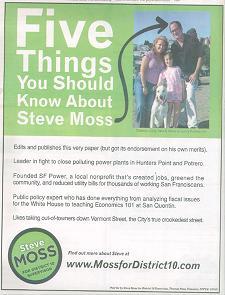
Five things you should know about Steve Moss

29

Sarah@sfbg.com

In August 2010, Steve Moss, who is running for District 10 supervisor, took out an ad in the Potrero View, which he owns, titled “Five things you need to know about Steve Moss.”

The ad, paid for by Moss’ political campaign, stated that Moss “edits and publishes this very paper (but got its endorsement on his own merits).” A year earlier, when Moss filed for the D–10 race, he promised in the View that “the paper will not endorse any of the contenders.” Reached by phone, Moss said that part of the ad was intended as a joke.

The other four bullet points seemed to be factual statements about Moss’ accomplishments. But Moss’ misleading ad got the Guardian taking a closer look, and, along the way, we found a lot of other things you probably didn’t know about Moss.

As far as we know, none of these things are illegal, and Moss can certainly argue that none of them are wrong. But since this is a progressive district, we thought voters would want to know a little more before the November election.

1. He’s a carpetbagger

Moss portrays himself as a District 10 resident who spent the last decade raising his family on Potrero Hill. In fact, during 2008 and 2009, Moss wasn’t living on Potrero Hill at all. When he filed his intent to run in the D–10 race in 2009, he was living near Dolores Park in a four-floor, four-unit, $1.6 million apartment building he owns. And shortly before he filed his intent to seek office, Moss’ wife told friends that the family was only moving to District 10 so Moss could run for supervisor, and that if he lost, they would be moving back to the Dolores Park area.

In his declaration of intent to run, a legal document he signed under penalty of perjury Aug. 4, 2009, Moss listed his address as 2325 Third St. That address is where the View; Moss’ nonprofit San Francisco Community Power; and M.Cubed, Moss’ private consulting company, share space. It’s also where where the Moss campaign asked supporters to send checks. It’s not where Moss was living with his family.

Indeed, evidence that came to light in a lawsuit between Moss and his wife, Debbie Findling, and a couple who co-own the property where Moss used to reside on Kansas Street, indicate that he moved out of D-10 in November 2007 and was living at 296 Liberty Street, in District 8, until February 2010.

In a July 8, 2009 e-mail to friends, filed in court in this lawsuit, Moss’ wife noted: “Steven has decided to run for city supervisor in District 10!!! (Sophie Maxwell’s term ends in November 2010) so we’ll be moving back to the hill in early spring! If you hear of any lovely rentals let us know. Or — I know it’s a crazy idea — but if you’re interested in swapping houses with us for a year as an even trade, you can move into our place on Dolores Park! (We’re hedging our bets in case he doesn’t win, we’d be moving back to Dolores Park after the elections. If he does win, we’ll find a long-term place to live … ).”

Reached by phone, Moss told us that it was only his candidate intention statement — a form that allows a candidate to start to raise money — that he filed while living at Liberty Street in 2009, not his official declaration of candidacy form. The language on the two forms is slightly different; the intent form only asks for a “street address” while the actual declaration of candidacy asks for a “residence” address.

Moss said he filed his declaration of candidacy a few days before the deadline, this summer. That form requires candidates to have resided in the district for not less than 30 days immediately preceding the date they file.

Moss insisted that he currently lives in a rental house at 2145 18th Street. “I’m planning to win,” Moss told us. “And we’re very much enjoying the house on Potrero Hill and hoping to stay there.”

2. He managed to avoid the condo lottery.

Moss and his wife bought a two-unit house on Kansas Street in May 2000 for $648,000 and filed for a condo conversion permit in 2002. San Francisco only allows only 200 condo conversions a year. It’s tough to get a permit, it’s very lucrative if you do, and most applicants — including two-unit buildings with a single owner — have to enter a lottery. But thanks to a strange short-term loophole in the law, Moss managed to get away without doing that.

The application, which got tentative approval in March 2004, notes that Moss and his wife — single owners of a two-unit building — did not win the lottery or qualify for a bypass. Asked how he managed this, Moss pointed to a loophole in legislation that former Sup. Jake McGoldrick passed in 2001. “The McGoldrick clause allowed us to directly convert it,” Moss said.

McGoldrick’s law tightened the conversion rules, but allowed two-unit buildings that, like Moss’, had only one owner-occupant, to slip through. The odd thing is that Andrew Zacks, a lawyer who represents landlords, and the Small Property Owners of San Francisco sued to overturn the McGoldrick legislation (not because of the loophole but because of the new restrictions) and the Superior Court ruled in January 2003 that the law was “unconstitutional on its face” and ordered that the city “shall not enforce this ordinance.” That should have ended the loophole, too.

Records show that Moss’ condo application was signed Feb. 10, 2003 by Planning’s Larry Badiner and received tentative mapping approval March 2004.

Department of Public Works Surveyor Bruce Storrs told us he thinks Moss’ case fell through the cracks. “It doesn’t say it was a McTIC,” Storrs said, using the nickname for McGoldrick’s condo conversion loophole, as he reviewed Moss’ file. “But it’s the only thing that makes any sense.”

There’s no indication that Moss did anything wrong, but he sure got a sweet deal. Records show that after he got his conversion permit, he sold the upper unit of Kansas Street in 2007 for more than he paid for the entire building in 2000.

3. He has the support of some very anti-tenant folks.

Attorney Zacks, who specializes in evictions and TICs, gave Moss $500, and the candidate claimed it was because his wife knows Zacks from the playground of the school where their kids both go. Pressed, Moss confirmed that Zacks is his attorney in a court case against the co-owners of the Kansas Street property and in another action he filed against a tenant in his Liberty Steet building in May 2009.

Moss also has the support of the Small Property Owners group, which opposes almost all tenants rights and is among the most conservative, pro-property rights groups in the city. He told us he made a mistake in seeking that endorsement.

And on Aug. 24, conservative campaign finance consultant Jim Sutton, who typically represents big business interests, filed papers representingThe Alliance For Jobs And Sustainable Growth,” which is financing three independent expenditure committees, one supporting Moss; another supporting Scott Weiner in D-8; and the third supporting Theresa Sparks in D–6.

4. He’s involved in a nasty lawsuit with his former neighbor.

Records show that after Moss and Findling subdivided their property on Kansas Street, they sold the upper unit to Edward Penrose and Heather Gibbons in 2007 and moved near Dolores Park.

Court filings suggest the couples remained friendly until March 2010, when Moss and Findling tried to sell the Kansas Street lower unit for $600,000 and ran into problems.

After the deal fell through, Moss and Findling turned around and sued Penrose and Gibbons, claiming that their behavior “constitutes a nuisance.”

In their complaint, Moss and Findling claim they suffered emotional distress, loss of sale, and diminution of the value of their lower unit on Kansas Street “due to the need, going forward, to disclose to buyers that [Penrose and Gibbons] have a propensity to engage in malicious and antisocial behavior.”

On July 30, Gibbons and Penrose countersued. They claim that when they offered to purchase 673 Kansas Street, Moss and Findling never disclosed that there was a boundary line dispute or prior instances of flooding, drainage, and grading problems that had damaged an abutting property.

Now Penrose and Gibbons are asking the court to rescind the purchase agreement whereby they obtained ownership of their Kansas Street condo.

Findling and Moss responded Aug. 31, claiming that “cross-complainants have unclean hands in that, beginning in the spring of 2010, they undertook efforts to interfere with the sale of the lower unit 673 1/2 Kansas] by making unfounded noise complaints and did discourage the buyer from consummating the transaction.”

Asked about this messy legal dispute, Moss said, “We were unhappy with the outcome of a sale in escrow that they disturbed.”

5. His nonprofit pays a bunch of money to his private consulting firm.

In 2001, Moss and two partners founded a private consulting company called M.Cubed. A few months later, Moss and his partners also founded SF Community Power, a nonprofit that started using M.Cubed as a consultant. “M.Cubed was subsequently awarded a contract from SF Community Power. I’m paid directly from SF Community Power, and I’m paid a consulting fee at M.Cubed, depending how much I work,” Moss told us.

Records show that as SFCP’s director, Moss made $48,000 in 2009 and $50,000 in 2008. But more than $1 million has moved from Moss’ nonprofit into Moss’ private consulting firm since 2001.

Moss confirms that SF Power has received $350,000, some of it from Pacific Gas and Electric Co. through the California Public Utilities Commission in 2010; $440,000 in 2009; and $500,000 in 2008 — and that some of those dollars went to M.Cubed.

“I intervene in regulatory cases on behalf of SF Community Power,” Moss said, “And then, if you win a case, you get compensation after the case.”

The Potrero View shares office space with the nonprofit and the consulting firm. Last year, SFCP paid $22,000 in rent, and the View paid SFCP $5,000 toward that rent.

Alhough Moss’ campaign asked supporters to mail contributions to the office that all three of Moss’ business entities share, his campaign finance records show that as of June 30, he had paid no rent for campaign headquarters. “I haven’t had a campaign headquarters,” Moss said. “It’s pretty much been at my house.”


Editor’s Notes

4

Tredmond@sfbg.com

We’ve been doing a lot of reporting on Steve Moss, a candidate for supervisor in District 10 who lived in District 8 when he filed his initial election papers and launched his campaign. Moss, who owns a residential building on Liberty Street near Dolores Park, insists he is now a full-time resident of Potrero Hill, renting a nice place at 18th and Vermont — and that he moved in long before the legal deadline for declaring an official candidacy.

It’s actually not a high standard — city law says you only have to live in a district for 30 days prior to the filing deadline. And since Moss is hardly the only candidate to make a relatively recent relocation, it’s worth asking the question: how important is long-time residence to a candidate for district supervisor — and how long is long enough?

I’ve always supported district elections, in part — and this is critically important — because you can win in a district without raising a huge amount of money. When the universe of voters you’re trying to reach numbers around 30,000, you don’t need $500,000. You can knock on doors, go to neighborhood forums, mobilize volunteers for a get-out-the-vote operation, and get elected with the kind of money you can raise in a real grassroots campaign. That means downtown, the landlords, the developers, and big business interests don’t carry the day, the way they did when the board was elected at-large.

But the other goal of district elections was to ensure that every part of town got represented on the board — and to bring legitimate activists with roots in a community to the table. That means people who have more than a passing interest in where they live.

The first few times around, it wasn’t much of an issue — with the obvious exception of Ed Jew, and the possible exception of Michela Alioto-Pier, everyone who has been elected so far under the district system ran from a neighborhood where he or she had be living, and doing community work, for years.

But this time, people have been venue-shopping. I heard a lot of potential candidates over the past year talk about moving into one district or another to run, and I think we’ll see more of it in the future. It can get tricky; Moss, for example, owns the Potrero View newspaper and lived in D-10 for years, then moved out and bought a place near Dolores Park. When he decided to run for supervisor, he moved back. At least he has some history and ties to the community — but I don’t think there’s a lot of dispute over the fact that he moved back to run for office, and that if he hadn’t decided to run, he’d still be living on Liberty Street.

Jane Kim, president of the School Board, moved into District 6 about a year and a half ago — about the same time she started talking about running for supervisor from that district. Again: perfectly legal — although her ties to the neighborhood and to neighborhood activism aren’t anywhere near as strong as some of the other candidates in the race.

We’re going to have to watch this, carefully — and the 30-day requirement is clearly too weak. You should have to live in a district for at least a year before you can file even exploratory papers — and every neighborhood questionnaire should ask candidates to list every address they’ve lived in for the past five years. That might slow down the shopping a bit.

CityPlace, USA — and why Newsom wants developers involved in district elections

18

Speaking at the San Francisco Mariott Hotel today, Sept. 14, to a room packed full of developers, land-use attorneys, building owners and managers, members of the San Francisco Convention & Visitor’s Bureau, and others who had gathered for a San Francisco Business Times event, Mayor Gavin Newsom championed a retail development project proposed for San Francisco’s mid-Market area that is being opposed by Livable Cities and the San Francisco Bicycle Coalition. The project will come under consideration at today’s Board of Supervisors meeting.

“CityPlace will be an anchor of revitalization” in mid-Market between Fifth and Sixth streets, Newsom said. Members of the Board of Supervisors may try to block it, he added, but “we can’t afford to let that happen. It’s a quarter of a million square feet, and it connects right up from Nordstrom’s.”
“CityPlace is critical,” he added. Marcia Smolens of public relations firm HMS Associates is representing Urban Realty, the developer of CityPlace, according to a file included in the Board of Supervisors meeting packet. Smolens contributed $2,500 to Newsom’s run for Lieutenant Governor. An architect with a partnering firm on the project, Gensler, plunked down $1,000 for Newsom’s campaign.

The mid-Market area has long faced issues of blight and crime. Newsom put forth a vision for its revitalized future that would include “more cops” (the development would connect with a police officers’ substation planned near Sixth and Market streets, Newsom noted), a creative bent thanks to partnerships with artists, and an area “a little less crowded with folks panhandling.”

The proposed development is essentially a large glass box with a shopping mall inside. According to the project website, Urban Realty has not yet engaged potential tenants, but appears geared toward attracting low-end retail chains. “We intend to bring affordable, value-based retail tenants to the area and expand the shopping choices available to make this section of Market Street a shopping destination that truly caters to San Francisco’s diverse demographic,” the website notes. Our guess is that they aren’t talking about unique, independently owned thrift stores that offer affordable used items and encourage shoppers to support small business, but something more along the lines of TJ Maxx.

The project would also include 188 parking spaces in an underground garage. In contrast, the Westfield mall near Fourth and Market streets was built with no new parking.

Livable Cities has filed an appeal of the Environmental Impact Report (EIR) for CityPlace on the grounds that transportation issues weren’t adequately dealt with, and the board will vote on the appeal today after opening the item up for public comment. Livable Cities executive director Tom Radulovich noted that the project would demolish the St. Francis Theater, a 1910 building that some had envisioned as a structure that could be rehabbed as part of a revived theater district in that area. He also felt the development was out of character for the neighborhood. “They’ve been given a lot of bonuses, like surplus parking and an excess floor,” Radulovich noted. “We feel like the Planning Department gave them a lot more value — millions of dollars worth. The public should get something out of it.” Partly out of a desire to improve the area, he said, mid-Market amounted to a sort of “Wild West in terms of planning. That’s been the story is that the only way to move forward is to throw away our rules.”

The developer estimates that the project would create up to 250 union jobs during construction, and 760 new permanent retail positions (that is, non-union, low-wage jobs with high rates of turnover — but at least it’s something). This could present a quandary for supervisors who might otherwise hold their nose at the idea of approving a big-box mall in the heart of San Francisco. Construction workers are in dire straits right now, and unemployment in the city is nearing 10 percent — and even higher in communities of color such as the Bayview.

Meanwhile, Newsom urged the crowd of downtown real-estate big shots to get involved in disctrict elections for the Board of Supervisors, lest “you wake up and things get worse quickly.”

The mayor issued a strong warning that “ideology is too strong in this town,” and then referenced the Guardian, speaking to some dangerous influence wielded by “these people who write these blogs.”

“You are the only thing standing between a dramatic shift off course in this town,” he told the crowd. “But our opportunities are limitless as long as we have stable leadership. Please take the time to learn about these candidates. Get involved – even in the districts you don’t reside in.”

At the end of Newsom’s speech, everyone applauded and then turned their attention to a short, flashy video about America’s Cup.

Steve Moss responds

55

Editor’s note: On Sept. 10, we posted a story called “Steve Moss, carpetbagger,” explaining how a leading candidate for District 10 had had filed his intent to run for office while he still lived in another district. Moss sent us a response, which we’re posting below (and our response to him follows that).


 There are many things you could say about me.  You could say that you hope
someone else wins the race for Supervisor in District 10.  You could say that
you don’t like my politics.  You could say you think that if I were Supervisor,
the city would fall into the ocean (although that seems a bit extreme).
But to suggest that I’m not really in the district, as your reporter did in a
story on 9/10 – what’s up with that?


 If you really wonder whether I live in District 10, you could send a reporter
over to my house on Potrero Hill.  You’ll see a home lived in by a family (and a
very large mutt), my family…not a Potemkin village.  Or come by my office at the
Potrero View.  Or talk to the folks at Farley’s or Goat Hill Pizza or The Good
Life Grocery.  I’m not saying that I’m known to everyone, but I’m hardly a
stranger.


 Three years ago, after living in the district for years, I moved to Mission
Dolores so we could walk our daughter to her new school (Alvarado).  When she
switched schools, and I decided to run for Supervisor, we moved back.  That was
last winter.


 That’s not a secret.  There’s no secret life, no secret pied a’ terre, no
secret, period.   I completed all the paper work the city and state asks of a
candidate, using my office address for mailing purposes and my home address on
the appropriate forms.  I’m a resident of District 10.  My daughter was born in
District 10.  I work in District 10.  I have history in District 10.
If you want to say that you don’t like what I think about development in the
district, schools, or post-modern theater – by all means, let’s have that
debate.  But surely, even in San Francisco, we can find a way to disagree with
one another politically without resorting to something like this.


 P.S.  Regarding Form 501 referenced in your article, see the official FPPC
instructions on page 38 in this link, which states that using a
business address is fine.


 Tim Redmond responds:


 For the record, we never stated that Moss is “not really in the district.” He says he lives in D-10 now, and we have no reason to doubt him. What we said was that he didn’t live in the district when he launched his campaign by filing his statement of intent to run for supervisor. We reported that he had moved out of the district, and apparently — according to an email from his wife — moved back specifically to enter this race. I quote the July 8, 2009 email Debbie Findling, Moss’s wife, sent to friends:


 “Steven has decided to run for City Supervisor in District 10!!! (Sophie Maxwell’s term ends in November 2010) so we’ll be moving back to the Hill in early spring! If you hear of any lovely rentals let us know. Or—I know it’s a crazy idea—but if you’re interested in swapping houses with us for a year as an even trade—you can move into our place on Dolores Park! (We’re hedging our bets in case he doesn’t win we’d be moving back to Dolores Park after the elections- If he does win, we’ll find a long-term place to live…).”


 Here’s the key: “We’re hedging our bets in case he doesn’t win we’d be moving back to Dolores Park after the elections.” And, from his comment above: “When … I decided to run for supervisor, we moved back.”


 That sounds like someone moving into a district just to run for office.


 Now, Moss is singing a slightly different tune today. When I asked him if he intended to stay past the election, he said:


 “We love our home on 18th and vermont street, and very much hope to stay here (its a rental). If I don’t win I’m thinking of launching a southside newspaper, to serve the neighborhoods of district 10.”


 Good for him; we need more neighborhood newspapers.


 Still, our point remains: Moss wasn’t living in the district when he started his campaign for D-10 supervisor.


 It’s not illegal to move into a district to run for supervisor. You just have to live there 30 days prior to filing. But I still think it’s wrong. The law ought to mandate at least a year’s residency prior to filing an intent to run. And since Moss’s residency in D-10 seems based at least in part on his desire for a job at City Hall, that’s something the voters ought to know.  

Steve Moss, carpetbagger

73

UPDATE: Read Steve Moss’s response to this story here.

Steve Moss portrays himself as a District 10 candidate who has spent the last decade raising his family on Potrero Hill, working as a non-profit energy guy and publisher and editor of the Potrero View.

But in fact, during 2008 and 2009, Moss wasn’t living on Potrero Hill at all. When he filed his intent to run in the D. 10 race in 2009, he was living near Dolores Park, in a 4-floor 4-unit $1.6 million building he owns, and sending his daughter to Brandeis Hillel Day School, a private establishment near Daly City.

And shortly before he filed his intent to seek office, his wife told friends that the family was only moving to District 10 so Moss could run for supervisor, and that if he lost, they would be moving back to the Dolores Park area.

In his declaration of intent to run, a legal document he signed under penalty of perjury Aug. 4, 2009, Moss listed his address as 2325 Third Street, with a 94107 zip code. That address is where the View and Moss’s nonprofit San Francisco Community Power have their offices, along with M.Cubed, a private company that Moss and two other people founded.
In other words, the building is not where Moss was living with his family.

In fact, evidence that came to light in a lawsuit between Moss and his wife, Debbie Findling, and a couple who co-own the property where Moss used to reside on Kansas Street, indicate that he was living at 296 Liberty St, in District 8, until February 2010.

In a July 8, 2009 email to friends, filed in court as evidence in the lawsuit Moss’s wife noted:

“Steven has decided to run for City Supervisor in District 10!!! (Sophie Maxwell’s term ends in November 2010) so we’ll be moving back to the Hill in early spring! If you hear of any lovely rentals let us know. Or—I know it’s a crazy idea—but if you’re interested in swapping houses with us for a year as an even trade—you can move into our place on Dolores Park! (We’re hedging our bets in case he doesn’t win we’d be moving back to Dolores Park after the elections- If he does win, we’ll find a long-term place to live…).”

A three-day notice to cure or quit that Moss and Findling filed against one of their tenants at the Liberty Street address, which is also listed on public records as 841-849 Church Street, shows that between January 2008 and April 2009, Moss and his wife lived at the Dolores Park address.

For instance, Moss and Findling’s nuisance notice against this tenant notes that on “April 8, 2009, 7:10 a.m.—you pounded on the ceiling of your bedroom for several minutes and cursed repeatedly, “Shut the fuck up!”, severely annoying your landlords and scaring their daughter.”

Moss’s wife subsequently sent out a email in February 2010, alerting folks that the couple had moved from Liberty Street to their current address at 2145 18th Street, SF, CA 94107.

Reached by phone, Moss told us that it was only his candidate intention statement — a form that allows a candidate to start to raise money — that he filed while living at Liberty St. in 2009, not his official declaration of candidacy form. The language on the two forms is slightly different; the intent form only asks for a “street address,” where as the actual declaration of candidacy asks for a “residence” address.

Moss said he filed his declaration of candidacy a few days before the deadline, this summer. That form requires that candidates must have resided in the district for which they are running, for not less than 30 days immediately preceding the date they file. Under city law, candidates must continue to reside, if elected, in the district during their incumbency.
“I’m planning to win,” Moss told us. “And we’re very much enjoying the house on Potrero Hill and hoping to stay there.”
He added: “I have lived, worked and raised my family on Potrero Hill consistently for the last ten years.”

Pressed, Moss acknowledged that he owns an apartment building near Dolores Park. But he said he did not actually evict the nuisance tenant and has since rented out his own family’s apartment in the building.

‘We have not occupied it recently, we have a tenant there,” Moss said. Asked where he is living now, Moss said he’s renting at 18th and Vermont.

Moss confirmed that Andrew Zacks, an Ellis Act eviction specialist, is his attorney in the court case against the co-owners of the Kansas Street property and in the notice to cure that he filed on May 13, 2009.

When we called the city’s Ethics Department, a spokesperson said that they can’t comment on a specific race.
“But if someone signs a candidate form under penalty of perjury and they give an incorrect address, where they do not reside, that would add up to perjury,” the spokesperson, Mabel Ng, said.

DCCC endorsements — how the hell did this happen?

35

Everyone knew that the DCCC, the endorsing arm of the San Francisco Democratic Party, would have trouble choosing candidates in the heavily contested D. 10 race. After all, the member decided at the August endorsement meeting to punt the D. 10 decision for four weeks.

But the DCCC’s September 8 endorsement of civil rights attorney Dewitt Lacy, former Newsom staffer Malia Cohen, and biodiesel activist Eric Smith, in that order, was somewhat mind-boggling. It left the San Francisco Democratic Party in the position of endorsing a candidate who is utterly unreliable on tenant issues and passing over perhaps the most progressive contender in the race.


D. 10 candidate Tony Kelly, who has a long history of progressive involvement in the district and who thought he had strong support on the DCCC, felt as if he’d been thrown under the endorsement bus. And it left fellow progressive Chris Jackson feeling that the DCCC endorsement process didn’t take the community’s wishes into consideration.

It’s common knowledge that DCCC members felt they had to endorse an African American in this district, since it contains the city’s largest remaining black community, and since it’s unlikely that a black candidate will get elected from any other district this fall, potentially leaving the board with no African American representation.

But that does not explain why the DCCC, after giving Lacy its first place endorsement, gave its second slot to Cohen, a moderate who told the Guardian in a recent endorsement interview that she doesn’t support further controls on evictions and condo conversions because that would infringe on property owners’ rights.


And in the end, you have to wonder: Does this end up helping Steve Moss, the candidate most progressives on the DCCC most fear?

Insiders point to two hidden plays that worked against Kelly, and for Cohen, in terms of getting the DCCC’s nod.

The first was a push by downtown interests to have their representatives on the DCCC make no endorsements in the race. The idea was to keep Kelly off the slate, so that downtown’s preferred D. 10 candidate Steve Moss would have a better chance of sewing up the vote on Potrero Hill, where Kelly is expected to do well.

The other play was a push among some DCCC members to put a black woman on the slate. This made Cohen, despite her moderate stance on some progressive issues, their choice, since she was born and raised in the district and has raised enough money to run a competitive campaign.

DCCC chair Aaron Peskin told the Guardian that he wanted Kelly to get one of the slots.


“My failure to do so proves that the DCCC isn’t a machine,” Peskin said. “I wanted Tony on there somewhere, and for a while it was looking like he might get second or third place.”

Kelly told the Guardian that he was surprised not to get the DCCC endorsement—and that he has received 8 phone calls from DCCC members apologizing for what happened.


“Nobody wanted those three candidates, except perhaps Scott Wiener,” Kelly said.


“At the same time, there have been so many gyrations around this in the last week. I’ve had more than half of the DCCC members tell me directly, ‘You’ll make the best supervisor—and I’m supporting someone else.’ But now they don’t even have three progressives in the slate.”

Kelly added: “This is a weak moment for the Democratic Party. This is not a machine, it’s not something that has strength or relevance to the district. This is the most clueless endorsement possible.”


Jackson believes that what happened last night was purely politics.


“This was a very political process and they made a political decision,” Jackson said. “But ultimately, it’ll be up to the neighborhoods and community to make their own choice.”

 “Unbelievable,” is how Smith described the DCCC’s D. 10 slate. “Right before this vote started, Eric Quezada told me, no matter what happens, there are better things in life than this. But now I feel great. It’s given my campaign a big boost.”

“I’m close to Tony Kelly, I consider him as a friend,” Smith added. “But in some ridiculous karmic way, the stars aligned, and I’m one lucky bro.”

Lacy for his part was clearly elated at getting the DCCC’s top slot.


“I’m really excited,” Lacy said.  “I believe this means D. 10 has a strong opportunity to get its fair share of good things and the Democratic Party will take part in making that happen.”


It also means Lacy — whose campaign has been a little slow and underfunded — is really going to have to ramp up his efforts in the next few weeks to take advantage of the DCCC nod. And it means Moss will get a boost, since Kelly could take Potrero Hill votes away from him. Kelly’s the only candidate who got the Potrero Hill Democratic Club endorsement.


The Guardian 2010 election Endorsement Interviews

13

The Guardian is interviewing candidates for the fall elections, and to give everyone the broadest possible understanding of the issues and our endorsement process, we’re posting the sound files of all the interviews on the Politics blog. Our endorsements will be coming out Oct. 6th. Click here to listen — page will be updated as we publish more interviews.

Matt Gonzalez, Tony Hall, and Ron Paul

26

If Luke Thomas didn’t have the pictures to prove it, I might never have believed this story, but there they are — the former supervisor and progressive candidate for SF mayor, Matt Gonzalez, hanging out with his old (odd) BFF Tony Hall — and libertarian Republican Ron Paul and John Dennis, a Republican running against Nancy Pelosi, at an “anti war and anti-incumbent” rally Sept. 4.

I guess they’re all against the wars in Iraq and Afghanistan. So am I. Dennis is also one of those “federal reserve is the devil” types who wants all of our currency once again backed by gold. I’m not defending the federal reserve here. I’m just saying — this is an odd crew.


Alioto-Pier’s campaign ends

0

District 2 candidates Janet Reilly, Mark Farrell, Kat Anderson, Vilma Guinto Peoro, Barbara Berwick and Abraham Simmons may be breaking out the champagne, right about now. That’s because incumbent D. 2 Sup. Michela Alioto-Pier just saw her bid to run for re-election squashed.

But bubbly likely won’t be flowing chez Michela.

As Fog City Journal reports, Alioto-Pier put out a statement expressing her disappointment in the outcome, but her respect for the judicial process.

“I believed and continued to believe that the intent of the voters as reflected in the plain language of our city charter allows me to run for second four year term,” Alioto-Pier said, as she pledged to keep working for her district until her terms ends in January.

Joanna Rees pole vaults into Mayor’s race

2

Matier & Ross have an interesting item about venture capitalist Joanna Rees running for mayor and declaring herself  “a progressive independent”.

What they don’t mention –- or don’t know — is that Rees has given $6,500 to Mayor Gavin Newsom’s Lt. Governor campaign.


That puts Rees on par with former Dreamworks co-founder David Geffen, Dreamworks’ Jeffrey Katzenberg, actress Kate Capshaw, film director Stephen Spielberg, and the three members of the Traina clan (Alexis, Todd and Trevor) who so far have each plunked down 6.5 K for Newsom’s latest political run.

Newsom’s campaign filings also record that Rees is with VSP Capital. So if you want to know more about Rees and her partner, you can read their official bios here.

But if you want the gossip on the VSP adultery scandal, read valleygawker’s piece here. And then there’s the piece on VSP’s website about the settlement that you can read here.


Steve Moss’ misleading ad

16

If you live in Potrero Hill, chances are you read the Potrero View, a neighborhood paper that’s been in existence for 40 years. Five years ago, Steve Moss took over as the View’s publisher and editor. And last year, when Moss filed papers in the D. 10 supervisor race, he stated in an editorial that “running for office and running a paper aren’t necessarily incompatible, but the two activities, undertaken simultaneously, prompts the need to adhere to ethical and legal standards.”

In that same editorial, Moss noted that, according to the Fair Political Practices Commission, a newspaper columnist seeking political office can continue to write columns.
“What they can’t do is advocate for their election, denigrate other candidates, or engage in direct politicking,” Moss wrote.

He also promised that, “The paper will not endorse any of the contenders. And we’ll offer all who’ve filed for the race a 50 percent discount on print and online advertisements—a fee my campaign committee will similarly have to pay.”

So, imagine this reporter’s surprise when I opened up the August 2010 special 40th anniversary issue of the View—and found an almost full-page advertisement, paid for the Steve Moss for D. 10 campaign, that claimed Moss got the View’s endorsement.

Titled ‘Five Things You Should Know About Steve Moss,” the advertisement features a photo of Moss and family. And the first thing that View readers should know, according to his ad, is that Moss “edits and publishes this very paper (but got its endorsement on his own merits).”

Reached by phone, Moss claimed that his ad was intended as a joke.
“It was meant tongue-in-cheek,” Moss said. “It was meant to be a joke.”

But nowhere in Moss’ ad is there any disclaimer that says that the View endorsement is a joke.

” Well, maybe it wasn’t funny,” Moss replied. “But you’re British. You should understand.”

Moss said so far the only call/complaint about his ad has come from me. But he added that perhaps in a future issue, he’d clarify that the View will not make any endorsements.

Moss followed up on my call with an email:

“I talked to my wife, Debbie, about the View advertisement, and she reminded me that she had warned me that some folks wouldn’t understand that the endorsement was a joke,” Moss wrote. “So, at minimum, you have made my wife correct.  Again. I think she’s still going to vote for me, though.”

While I appreciate Moss’ willingness to answer difficult questions from reporters, including those hailing from the British Isles, it seems that Moss is trying to argue that black is white. So, in the spirit of British humor, may I humbly suggest that Moss watch Monty Python’s “The Argument” skit. And then call me for a five-minute argument about his misleading ad.

http://www.youtube.com/watch?v=kQFKtI6gn9Y

Endorsement Interviews: Debra Walker

Editors note: The Guardian is interviewing candidates for the fall elections, and to give everyone the broadest possible understanding of the issues and our endorsement process, we’re posting the sound files of all the interviews on the politics blog. Our endorsements will be coming out Oct. 6th.

Debra Walker, a candidate for District 6, has obviously thought a lot about sustainable development — and she isn’t just focused on what building materials are being selected. In addition to planning in ways that would limit traffic congestion and still make sense years from now when the city is grappling with sea-level rise, affordability ranks near the top of her list of priorities.

“Can we agree that we are not building enough below-market housing?” she asked.

A tenant representative on the city’s Building Inspection Commission, Walker is interested in integrating an analysis of the socioeconomic effects of development into the city planning process. “We need to look at our development proposals through a different lens,” she said. “We need to come at planning from the perspective of what we need.”

She’d like to see the city look at the larger picture of what kind of a future is being crafted through its planning decisions. “Land use is the primary issue in District 6 and District 10,” she said. “If we do it wrong, it will exacerbate every problem we have. It’s the future of San Francisco.”

As someone whose primary mode of transportation is a bicycle, Walker looks at MUNI from the perspective of some one who might take transit more often if her busy schedule permitted it. “None of our policies encourage people to ride transit,” she pointed out, adding that she would be interested in exploring ways to boost ridership in order to improve MUNI service, and looking at measures such as a vehicle license fee to create additional funding for transit.

Walker also talked with us about revenue generating measures, why she would support a Bank of San Francisco as a way to prime the pump for our local economy, and how to address issues surrounding local hiring. Listen to the full interview below.

dwalker by tim94107

Endorsement Interviews: Kim-Shree Maufas

8

Editors note: The Guardian is interviewing candidates for the fall elections, and to give everyone the broadest possible understanding of the issues and our endorsement process, we’re posting the sound files of all the interviews on the politics blog. Our endorsements will be coming out Oct. 6th.

Equitable access, restorative justice, parental participation and the achievement gap. Those are the main issues that Kim-Shree Maufas brought up when she sat down with the Guardian to talk about why she is running for re-election to the School Board.

“It’s about education,” Maufas said, as she talked about the need for equitable access and opportunities throughout the San Francisco Unified School District.

In October 2009, the Board voted unanimously to develop a plan to replace some student suspensions with a restorative justice approach. Since then $1 million has come into the district to fund this initiative and those monies are being used to focus on the relationships between teachers and students, Maufas says.
‘The teacher is no longer the person at the chalkboard, handing out assignments,” Maufas said.

Now, Maufas wants to lessen the amount of time that some students—particularly African American, Latino and Samoan students— spend outside class because they have been sent to the principal’s office.
“The most important daytime relationship for these kids is the ones they have at school,” Maufas said.

Listen to Maufas talk about why she supports the new assignment process and open AP and honors classes for all, why she is in favor of a bond to raise more money for local schools, and the untold story of how she came to use a SFUSD credit card to pay for some personal expenses.
“The thing is that the Chronicle did not have all the information,” Maufas said.  “They just had the part where I had used the credit card.”


maufas by endorsements2010