Election

U.S. in Afghanistan: Good help is hard to find

0


Now the Obama administration and congressional leaders — with Sen. John Kerry playing a starring role in recent days — are making a determined effort to legitimize the Afghan government as a prelude to further U.S. escalation of the war.

By Norman Solomon

(Norman Solomon, executive director of the Institute for Public Accuracy, is the author of “War Made Easy: How Presidents and Pundits Keep Spinning Us to Death.”)

Almost eight years after choosing Hamid Karzai to head the Afghan government, Uncle Sam would like to give him a pink slip. But it’s not easy. And the grim fiasco of Afghanistan’s last election is shadowing the next.

Another display of electioneering and voting has been ordered up from Washington. But after a chemical mix has blown a hole through the roof — with all the elements for massive fraud still in place — what’s the point of throwing together the same ingredients?

This time, the spinners in Washington hope to be better prepared.

Killing the dream

0

tredmond@sfbg.com

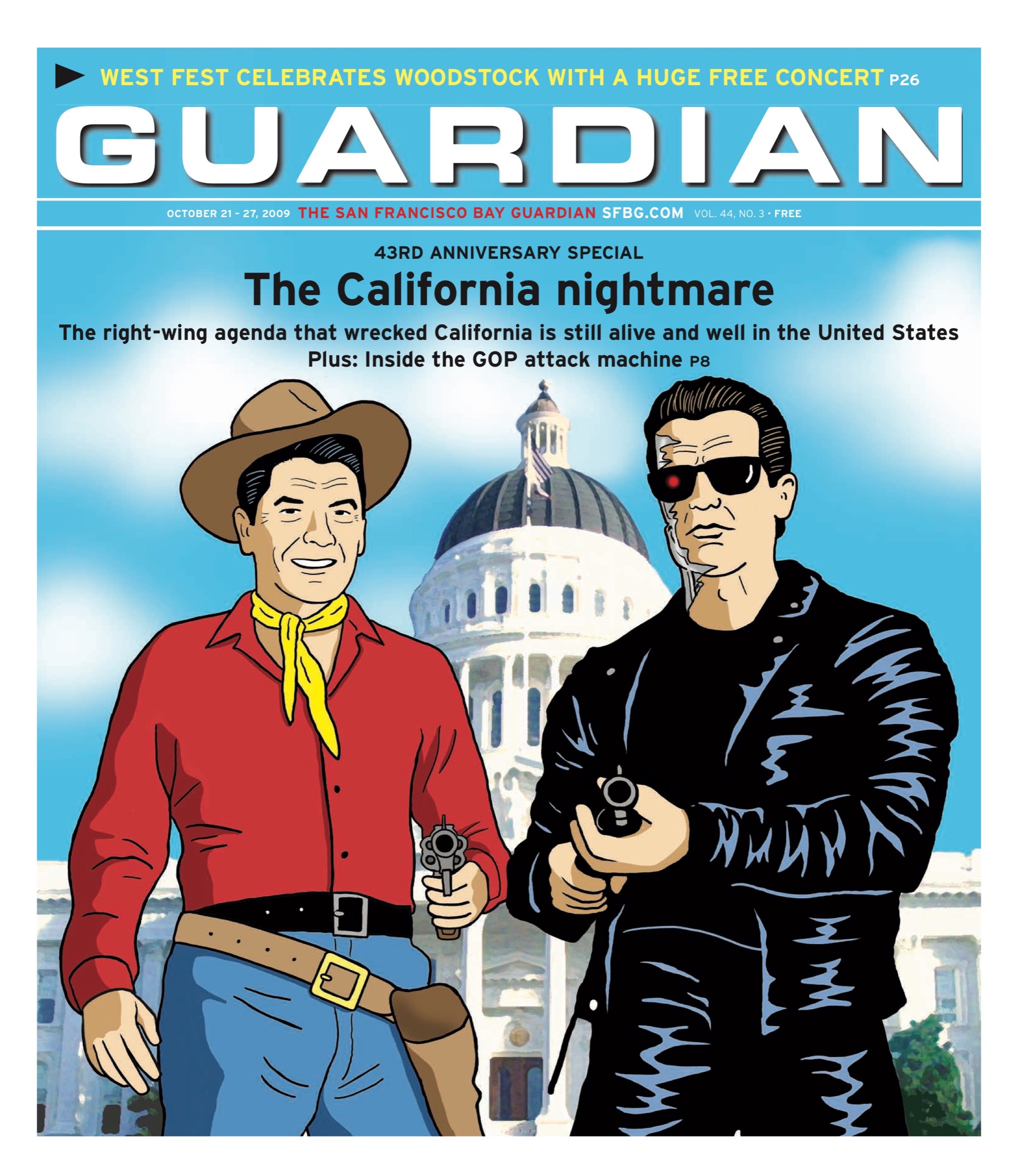
When the first issue of the Bay Guardian hit the stands in 1966, it was still really possible to talk about the California dream. The state had seemingly limitless potential and was in many way a model for the nation — a free public university system that was the envy of the world, an economy that provided jobs to hundreds of thousands of new arrivals, the beginnings of what would be the nation’s premier environmental movement pushing to save San Francisco Bay, save the coast, save Lake Tahoe … and the Free Speech Movement, the Summer of Love, the United Farm Workers Union, and so much more that was transforming politics and culture in the United States from the West Coast.

Twelve years later, it was all falling apart. Eight years of Gov. Ronald Reagan and then the passage of Proposition 13 launched a very different kind of movement out of the West, a movement that sought to dismantle the public sector and the social safety net, to treat government as the enemy, and to use culture wars to convince working-class Americans to vote against their own economic interests.

And now California is being described as the nation’s first failed state. Gov. Arnold Schwarzenegger — the second Republican actor to hold that role — has driven the state to the brink of bankruptcy. The University of California is drowning in red ink, raising fees and turning away students. The state’s water system is a mess; cities and counties are in fiscal collapse; the economy’s in the tank; and nobody seriously talks about a California dream anymore.

The story of how that happened — and how the diseases of tax-revolts, privatization, government corruption, and public disempowerment spread east from California — is the focus of this 43rd anniversary issue. It’s both enlightening and a bit scary to read through old issues, because in hundreds of stories over the past four decades, the Guardian has warned of exactly what was to come.

The very first issue of the Bay Guardian talked about the "historic election" pitting the incumbent, Democrat Pat Brown, against Reagan. A lot of people in the emerging "new left" were arguing that there wasn’t a bit of difference between the two, and that you might as well sit out the election. But the Guardian had a different take. The election was really about the direction California wanted to go, the paper said, a choice between a state that cares about the public sector and social welfare and a state where those things don’t matter.

"Reagan’s stands typify the temper of the cause," the Nov. 7, 1966 editorial stated. "He is on record, at various times, in opposition to the progressive income tax, Social Security, Medicare, the anti-poverty program, farm subsidies, the TVA, the Civil Rights Act, the Voting Rights Act, public housing, federal aid to education, and veterans hospitalization for anything other than service-connected disabilities. How can a man or a movement govern the state of California with such a political philosophy?"

Reagan’s election may have seemed like a fluke, but it was nothing of the sort. By the mid 1960s, with the counterculture — and equally important, the economic left — looking to make major inroads in American policy, the broad outlines of a right-wing attack plan were in place.

That’s something the Guardian always recognized — that powerful people who moved the levers of government typically did so with a long-term plan.

In San Francisco, part of that plan was the transformation of a human-scale city to a West Coast version of Manhattan. The idea: tear up South of Market (then mostly low-income housing) for a shiny new convention center and hotels. Dump dozens of big high-rise office buildings downtown. Construct a fixed-rail system to carry suburban commuters into the dense downtown. Drive up property values — massively — and if that means blue collar jobs and working class people had to go to make way for wealthier office workers, so be it. In the end, of course, the architects of the plan — landowners, developers, bankers, and big business leaders — became immensely wealthy.

On the state and national level, their plans were broader. Even so, they had one major aim: throttle the pubic sector. Cut off the funding for government programs, reduce regulations, undermine any concept of a welfare estate — and cut taxes on the rich.

As we report on page 8, the architects of this plan are happy today to talk about how it worked — how Reagan launched his war on government back in the 1970s, how a group of well-funded think tanks developed plans, and political consultants took advantage of people’s fears (and the Democratic Party’s failures) to put those plans into action.

The movement really got off the ground in 1978 with the passage of Proposition 13.

Prop. 13 emerged from a state in the middle of a massive growth spurt and a heated political cauldron of money, race, and Legislative failure. Howard Jarvis, a Republican landlord lobbyist who hated taxes, hated government, hated public schools, and disdained most Californians — "63 percent of [public school] graduates are illiterate" and would have no need for public libraries, he once quipped — took advantage of a gaping hole in political leadership and set off a movement that would cripple the United States of America.

The measure marked the final, fatal end in California of the era known as the ’60s — a period when the left was ascendant, when taxes on the wealthy funded education, infrastructure and programs for inner cities, and when economic and cultural liberalization seemed to be spreading across the nation.

Rising property values, driven by rapid population growth, were driving up property taxes — and the problem was real. Long-time residents, particularly people on fixed incomes, saw their taxes rise so high they couldn’t afford to stay in their homes. The Legislature could have addressed that (with, say, a split-roll measure that taxed residential and commercial property at different rates) but utterly failed to move on the crisis.

A series of assessor’s office scandals didn’t help, either. And, at the same time, the California Supreme Court ruled that rich school districts had to share revenue with poor districts, infuriating wealthy white property owners.

Jarvis and his partner Paul Gann circulated petitions to roll back property taxes and make it almost impossible to raise taxes in the future. It passed with 65 percent of the vote.

Of course, big businesses (particularly utilities) were the big winners. As the Guardian pointed out on June 1, 1978, the top five utilities in California alone (including Pacific Gas and Electric Co.) would gain billions from the tax cuts.

But beneath it all was a simmering discontent with government — something Jarvis had set afire and would later be used by Ronald Reagan and the right-wing operatives who backed him to undermine the New Deal, the social safety net, and the basic social contract in America. The antitax folks played to white people who didn’t want to see their money going to minorities, to the middle-class folks who thought (thanks to the assessor scandals) their tax money was being wasted by corruption — and to a lot of younger people coming out of the 1960s who had learned from Vietnam, COINTELPRO, and Watergate not to trust government.

The Bay Guardian opposed the measure strongly: "Most analyses indicate that without replacement taxes, hundreds of thousands of California public servants would be thrown out of work (which is exactly what Howard Jarvis intends) … " a May 18, 1978 editorial noted. "Vote for Prop. 13 only if you favor decreased government services (including cutbacks in everything from libraries to schools to street-cleaning crews and possibly police and fire departments) and are fond of half-baked measures that favor the rich."

Prop. 13 set off a national movement to cut taxes — and riding that wave, Reagan was elected president in 1980. He immediately set about attempting to slash taxes on big business and the wealthiest Americans, and eliminate environmental, workplace safety, and employment regulations.

You can see the results in California — and across the nation. The very strategies that emerged in this state and that the right has supported over the years have come very close to destroying the United States economy, leaving millions out of work — while the gap between the rich and the poor has risen to unsustainable levels.

Part of the reason this national attack on government and the public sector worked was the failure of Democrats to recognize that corruption matters. It was no small wonder that Californians were losing faith in government — in the 1970s and 1980s, the state Legislature, under the Democratic control of Speaker Willie Brown, was awash in sleaze, paralyzed by lobbyist influence and campaign money. Yet leading Democrats, fearful of Brown’s power, did little to reign in the appalling corruption.

In fact, when Brown became mayor of San Francisco, the entire Democratic Party, from the president of the United States on down, seemed to treat him as royalty — despite the fact that he was selling the city to every developer and corporate lobbyist who waved money under his nose. When taxpayers knew that a large part of their money was going to fund juicy jobs for Brown’s cronies and pet projects, it was hard to argue for higher taxes.

And it was the Democratic Party leadership in San Francisco who presided over two of the greatest examples of privatization of public resources in modern history: the Presidio and the Raker Act. Rep. Nancy Pelosi was the author of the bill that, for the first time, turned a national park over to the private sector — and hardly a Democratic leader in the city dared to lift a finger in opposition. And for decades — since the Guardian first broke the story in 1969 — the city’s Democratic power brokers have bowed and genuflected to PG&E and allowed the private utility to control the local electric grid and block implantation of the federal law that mandates public power for San Francisco.

And now PG&E wants to pull off one of the greatest feats of privatization in American history. The company has launched a ballot initiative that would wipe out any further attempts at public power in California, essentially guaranteeing that private companies, not the public sector, control the vast, critical resource of electric power in this state.

It’s the latest big battle between two divergent visions of America — and this time, the folks who have done so much damage to this state and this nation can’t be allowed to win. In fact, maybe the campaign against PG&E can be the turning point, the time when California realizes that privatization, attacks on the public sector, tax cuts for the rich, and political sleaze are a formula for disaster.

Attack of the right-wing nuts

0

news@sfbg.com

In April 2006, with the approval ratings of President George W. Bush plummeting, his senior political advisor, Karl Rove, began discussing a plan to turn things around.

His strategy: attack progressive organizations that were registering low-income people to vote and helping them fight corporate power — and claim it was about voter fraud.

The main White House target, newly released records show, was the Association of Community Organizations for Reform Now (ACORN). By the end of 2006, Rove would oversee the removal of eight U.S. attorneys, including two who refused to press bogus charges against ACORN in New Mexico and Missouri, and a third under similar suspicions in Washington state.

ACORN made a convenient target for Rove and his gang — and the well-orchestrated attacks on that group, which have exploded into the headlines this year, provide a compelling case study in how the right wing operates in this country.

Although it was the GOP that removed tens of thousands of likely Democratic voters from the rolls in the 2000 and 2004, the Republicans and their allies were able to make the issue of voter fraud all about ACORN, using a handful of isolated problems to undercut an organization focused on giving a voice to poor people.

Founded in Little Rock, Ark. at the end of the 1960s, ACORN has grown into the nation’s top community-organizer group, thanks to success in improving poor people’s housing, wages, and educational access. By the eve of the 2008 presidential election, ACORN had helped register more than 1.3 million voters — mostly young, low-income minorities — in 21 states, including the battleground states of Florida, Pennsylvania, Michigan, and Ohio.

As The Nation put it, these successes made ACORN “something of a right-wing bogeyman.”

And while the recent furor over a conservative videographer secretly taping ACORN employees saying dumb things has somehow become one of the big political stories of the year, the major media have mostly ignored how this attack is part of a larger conservative strategy.

In August, hundreds of pages of e-mails and transcripts related to the 2006 U.S. attorney-firing scandal were released to the press and public — but few news outlets mentioned that Rove was focused on attacking ACORN’s voter registration efforts, even though ACORN and voter fraud are repeatedly mentioned in these documents.

“This is about a campaign that goes back a decade to big business and that people who don’t like what ACORN does and is effective at — namely, helping groups to organize and put pressure on banks around sub[prime] mortgage loans to stop racial discrimination,” Peter Dreier, a professor of politics at Occidental College, told us.

It wasn’t really about voter fraud. As former U.S. Attorney David Iglesias, a Republican from New Mexico, recently stated on The Rachel Maddow Show: “They were looking at numbers [and] didn’t like the demographic tidal wave that was coming their way so they wanted to engage the machinery of the Justice Department to stop that wave.”

After two years of investigating ACORN and other supposed perpetrators of left-wing voter fraud, Igelias said, “I couldn’t find one case I could prosecute.”

But for the right-wing attack machine, it didn’t matter — the damage was done.


THEIR MASTERS’ VOICE

White House communications strategist Anita Dunn created a stir in mid-October when she told CNN host Howie Kurtz that Fox News “is really more of a wing of the Republican Party. … Let’s not pretend they’re a news network like everybody else is.”

It didn’t take long for Fox commentator Glenn Beck to retaliate. In a series of broadcasts, he attacked Dunn, compared the Obama administration to a communist dictatorship, and likened the criticism to the Holocaust. “Ask yourself this question,” Beck said during a radio segment, vaguely addressing people he called “good journalists” at other mainstream news networks. “When they’re done with Fox, and you decide to speak out on something — it’s the old ‘first they came for the Jews, and I wasn’t Jewish.'” Beck concluded the segment by warning his audience, “this is how a dictatorship always starts.”

Beck’s comment may strike San Francisco progressives as outrageous, but given the rhetoric routinely issuing from the right-wing megaphone, it’s also 100 percent predictable.

But when Dunn called Fox News Channel an arm of the GOP, she was dead on. Consider the history of its chairman and CEO, Roger Ailes, who ran Richard Nixon’s 1968 presidential campaign and later those of presidents Ronald Reagan and George H.W. Bush, guiding them all to victory through his brilliant and successful media campaign strategies.

“Roger Ailes is a newsman with a profound disdain for newsmen,” according to a New York magazine profile. “Fox News is being promoted as an anti-network, a news channel designed to appeal to the people … who don’t trust [the others].” Portrayed in the story as a “self-described paranoid,” Ailes reportedly resigned from an earlier position as head of CNBC after questions were raised about his desire to use his position as a weapon against his enemies.

Fox News is an outgrowth of its parent company, Rupert Murdoch’s News Corporation. A look at the board of directors of this multinational giant yields some startling insight into who controls the “fair and balanced” news network. Ailes himself has a seat at the table — but not every board member has a background in media.

News Corp. board member Viet Dinh, for example, is an attorney who came to the United States as a boy from Vietnam. In a 2002 interview with the Los Angeles Times, Dinh, who then served as an assistant attorney general at the Department of Justice, recalled an exchange he had with then-Attorney General John Ashcroft in the wake of the Sept. 11 attacks. “He told me: ‘The art of leadership is the redefinition of the possible. I want you to be the think tank to help me redefine the possible for the Department of Justice.'”

Dinh successfully redefined “the possible” by acting as a primary author of the USA PATRIOT Act, quickly propelling himself to prominence as a darling of conservatives and an enemy of civil liberties watchdog groups. A law professor at Georgetown University, Dinh is also founder and chief of Bancroft Associates PLLC, a consulting firm that specializes in helping Fortune 500 companies “navigate the federal and state criminal or civil investigations, congressional investigations, and complex litigation,” according to the firm’s Web site. It also specializes in public relations.

Another board member is José Maria Aznar, former prime minister of Spain. Aznar was born into a politically active, conservative family in Spain in 1953, and both his father and grandfather held government jobs under Gen. Francisco Franco, the fascist dictator. Aznar was handpicked by Manuel Fraga, a minister under Franco, to succeed him in leading Spain’s center-right People’s Party (Partido Popular), according to an article in the U.K.’s The Independent.

Aznar now serves as president of the Foundation for Social Studies and Analysis, a right-wing think tank based in Spain that, according to its Web site, works closely with the CATO Institute, the Heritage Foundation, and other conservative U.S. think tanks.

Occupying other seats at News Corp.’s board table is an assortment of professors, attorneys, public-relations experts, and businessmen with their fingers in a variety of banks and multinational corporations. Among the more familiar names are Phillip Morris, Ford Motor Co., Hewlett Packard, Goldman Sachs, HSBC North America, and JP Morgan Chase. Lesser known are the investment banking firms that have stakes in the petroleum industry, utilities, mining companies, and real estate.

While the connections between corporate interests and the country’s leading conservative propagandist are extensive and obvious, there’s a stark contrast between the message delivered by Fox News and the interests of its parent company.

Fox News plays up the theme of patriotism and reinforces the idea that there is a distinction between “real Americans” and outsiders. But Fox’s board is made up of members whose lives and economic interests are scattered across the globe, but have one common thread: they all control extraordinary sums of concentrated wealth.


PROPAGANDA AND EMOTIONS

While Dunn called Fox News Channel an arm of the Republican Party, others have gone so far as to label its content pure propaganda — and incredibly effective propaganda at that.

“This is very, very sophisticated propaganda,” says Bryant Welch, a clinical psychologist, author, and expert on political manipulation. “I don’t think progressives really get it that it’s a technique being used all the time.”

Welch said when he began working as a Washington, D.C., lobbyist on behalf of the American Psychological Association years ago, he started observing the tricky political maneuverings at play in the nation’s capital through the eyes of a psychotherapist who had spent some 30,000 hours helping patients confront their deep-seated hang-ups.

To his surprise, Welch found that some of the most successful right-wing political operatives also seemed to have an understanding of psychology — although they use the knowledge very differently. “A lot of it is psychological manipulation,” Welch asserts.

George Lakoff, a professor of linguistics at UC Berkeley and author of Don’t Think of an Elephant: Know Your Values and Frame the Debate, offered a similar analysis. He said Republicans approach issues as a marketing challenge. “They’ve learned from the cognitive scientists. Even if they don’t understand the science, they know how to do marketing.”

Welch, who is also an attorney and Huffington Post blogger, provides an analysis of how the right wing gets its message across in his book, State of Confusion: Political Manipulation and the Assault on the American Mind. He argues that public relations professionals, right-wing commentators, and others in the business of shaping public opinion are skilled at tapping into widespread feelings of anxiety and uncertainty.

“In this world, things are confusing,” he explains. “You’ve got to be constantly adapting and assimiutf8g new information. When times get confusing, people have a hard time forming a sense of what’s real.”

Right-wing television and radio personalities like Sean Hannity, Glenn Beck, or Rush Limbaugh prey on this widespread uncertainty, Welch argues, by providing viewers and listeners with an absolute version of reality that is easily grasped, neatly divided into right and wrong, and spelled out in very certain terms.

“The thing that Bill O’Reilly and Sean Hannity do is, they sound very powerful, certain, and aggressive,” Welch told us. “[Viewers] identify with that strength. They draw a sense of security from someone who has certainty about what is real.”

Viewers who find that their anxiety subsides when they tune in are hard-pressed to go back and reexamine their views later on, Welch said, because they’re satisfied with the answers they’ve been given. And in right-wing messaging, those answers consistently cast government as the enemy.

On Fox and AM radio, the use of repetition helps drive home an idea until it becomes a conviction in the mind of a listener. Television reinforces those key phrases with patriotic color schemes. The whole package is designed to transform an audience’s sense of bewilderment over a complex world into trust in spokespeople helping them make sense of it.

The right-wing commentators’ success lies partly in their ability to harness core human emotions such as paranoia or envy, Welch said. He pointed to the health care debate as an example, noting how Fox News has repeatedly played up the false concept of “death panels” to create fear.

To counter this tactic, Lakoff suggests that the left would do well to learn how to frame things in moral terms instead of playing defense against right-wing spin masters.

President Obama’s problem, Lakoff said, is that he is still trying to unify the country. “More power to him, but I don’t believe it’s possible,” Lakoff said. “Republican presidential candidate Sen. John McCain got 47 percent of the vote, bad as he was, and given how terrible a campaign he ran, and given that Obama ran a perfect campaign. So Obama’s election was not a landslide, even though he had one of the best campaign organizations and one of the best framed campaigns ever.” Obama doesn’t play the same manipulative games, Lakoff noted. “Obama believes that if you just tell the truth, it’ll be OK, and every day have a truth squad to find the conservative lies,” Lakoff said. “What he didn’t understand was that by focusing on the conservative lies, he was in fact helping the conservative cause. It’s like Richard Nixon saying, ‘I’m not a crook.'” That why Lakoff says it’s so important for Obama, and for the progressive movement in general, to define the moral imperative behind empowering the people and their government to create a better world, then aggressively push a campaign to do so. “It’s the ‘this is the right thing to do’ approach,” Lakoff explained. “And once it’s been framed that way, then you can say what’s false or true. But you should never go on the defensive first. As soon as you go point by point, you are on the defensive.”

Our endorsements

1

For the Nov. 3 election are here. We’ve also endorsed John Garamendi for Congress in District 10. Fell free to comment if you disagree with us ….

Endorsements

0

San Francisco is facing the worst budget crisis in modern history. More than 1,000 employees, mostly front-line workers in the Department of Public Health, have been laid off, and the red ink continues. Yet the only measure on the November ballot that would raise any money for the city is Sup. Bevan Dufty’s plan to sell off naming rights for Candlestick Park.

That’s pathetic. During the summer budget discussions, Mayor Newsom vowed to work with business, labor, and the supervisors to come up with a reasonable plan to bring in some new cash for the city. But that collapsed — largely because state law would have made it hard to raise taxes this fall without a unanimous vote of the supervisors. And while eight members were willing to put a revenue measure on the ballot, the three supervisors closest to the mayor — Sean Elsbernd, Carmen Chu, and Michela Alioto-Pier, all Newsom appointees — refused to go along. And the mayor made only a weak effort to change their minds.

So while Democrats everywhere decry Gov. Arnold Schwarzenegger’s insistence on a cuts-only budget, the Democratic mayor of San Francisco has forced essentially the same approach on this city. The only revenue increases we’re seeing are fees, like Muni fare hikes, that amount to taxes on the poor.

That’s the state of San Francisco as we head into what will almost certainly be a low-turnout election. Only two elected officials are on the ballot, and both are unopposed. Five ballot measures — several fairly significant — round out the local ballot. And with no big-name races at the top, they will win or lose on the votes of a small majority.

That’s too bad, because the issues matter. Vote Nov. 3 — and let’s hope next year’s ballot actually includes some new, progressive taxes.

OUR RECOMMENDATIONS


City Attorney

Dennis Herrera

San Francisco hasn’t always had a good track record with city attorneys. George Agnost, who ran the office in the 1970s and 1980s, was a dour, secretive, conservative lawyer who let downtown call all the shots. Louise Renne, who took over from Agnost, ran the office in the 1990s as if it was a wholly-owned subsidiary of Pacific Gas and Electric Co. Herrera, who took over in 2001, has been a major improvement. He’s turned the office into a modern operation, professionalized the administration, and taken on an activist role on consumer, environmental, and public-interest issues. He’s been a big supporter of marriage equality and of the city’s landmark health-care legislation. On his own initiative, he sued to end gender rating in health insurance and crack down on predatory payday lenders. He also moved to enforce health codes in housing and has been out front going after corrupt landlords like Skyline Realty.

We have some concerns about Herrera. Although he’s been far more sunshine-friendly than his predecessors, open-government activists are still sometimes forced to sue the city to get access to records. He won’t use his power as city attorney to enforce the Raker Act and bring public power to San Francisco. And during the current budget crisis, he cut the number of city attorney hours the supervisors can use to draft legislation.

And if, as rumored, he wants to run for mayor, Herrera needs to start taking public stands on major issues — like the unfairness of the local tax code and the need for new revenue.

But we’re happy to endorse him for another term.

Treasurer

Jose Cisneros

The incumbent treasurer is running unopposed, and we see no reason not to endorse him. He’s done some very positive things: Cisneros worked to get the big downtown law firms and other partnerships to pay their fair share of city taxes. He closed a tax loophole exploited by the big airlines that put up flight crews in local hotels.

He also convinced local banks and credit unions to accept consular identification cards to allow immigrants to open accounts and has pushed those institutions to offer "second-chance banking" to people with past credit problems. During his tenure, more than half of the 50,000 households in the city that lacked bank accounts have been able to get away from predatory check-cashing outfits and open legitimate accounts.

As an elected official, however, he could be doing a lot more. The city still keeps all its short-term accounts in one bank — Bank of America, which isn’t even local. Cisneros has promised to open that deal up to competitive bidding, but doesn’t have a timeline. And although nobody knows better than the treasurer how unfair and regressive the city’s tax codes are, he has never spoken out or offered any solutions. Cisneros says he wants his office to be apolitical, but city money is, by its nature, a political issue, and we’d like to see a little more leadership from the person who handles it. But overall, he’s a professional money manager who’s done a decent job and deserves another term.

Proposition A

Budget process

YES

We’re a little nervous about Prop. A, which would institute a two-year budget cycle for the city. Sup. Chris Daly, who opposes it, points out that the city controller’s budget projections are often wrong — badly wrong — and trying to plan 24 months ahead when economic conditions (and thus the city’s revenue stream) can change so quickly and unpredictably is a dangerous game.

But on balance, the approach in Prop. A makes sense. The budget debates would still take place every year, and the supervisors would still have to approve an annual budget — although the budget would be a rolling two-year projection. So next year, the board would approve a budget for 2010 and 2011, the following year for 2011 and 2012, and so on — leaving plenty of room for adjusting to meet economic changes. And two-year cycles might make it easier for nonprofits that rely on city funding to do some serious long-term planning.

Equally important, Prop. A requires the police and firefighters to negotiate their union contracts the same time the other unions do — before the budget deadline. The current system allows those unions to make demands that are unrelated to — and often outside — the current year’s budget realities.

Every progressive on the board except Daly supports this, and Sups. Alioto-Pier, Elsbernd and Chu oppose it.

Proposition B

Board of Supervisors aides

YES

This one’s a no-brainer. The City Charter mandates that each supervisor be allowed to hire two aides. The requirement dates back to a long-ago era when city budgets were far smaller, problems were less pressing and complex, and the supervisors worked part-time. It makes perfect sense to take such an archaic law out of the City Charter and allow the supervisors to set their own budgets — and staffing levels — the same way the mayor does. Vote yes.

Proposition C

Candlestick Park Naming Rights

NO

You have to give Sup. Bevan Dufty, the author of Prop. C, credit for trying. He’s looking for any angle he can use to help keep the 49ers in town, and allowing a corporate sponsor to pay for naming rights might possibly help cover the immense cost of substantially renovating aging Candlestick Park. And, like Prop. D (see below), this measure has a nice beneficiary: part of the money from naming rights would go to save the jobs of recreation directors, many of whom have faced budget-driven layoffs.

We agree that rec directors play a crucial role, particularly in neighborhoods with large numbers of at-risk youth. And we wish the Chamber of Commerce, Sup. Elsbernd, and other supporters of Prop. C were willing to accept some progressive tax hikes to fund those jobs.

But this isn’t a good deal. The city owns the stadium; the taxpayers financed its construction and spent 30 years paying off the bonds. But the 49ers, a private outfit owned by a very wealthy family, would get half the money from any naming deal. And the money that would come in would be radically short of what the team would need to rebuild the ‘Stick. Vote no.

Proposition D

Mid-Market special sign district

NO

Again: credit for the effort. David Addington, who owns the Warfield Theater and several other properties on mid-Market Street, accurately notes that the city’s main thoroughfare, between Fifth and Seventh streets, is rundown, ignored, and badly in need of an economic boost. He argues that allowing new digital billboards would create something of a Times Square in San Francisco, attracting tourists and turning mid-Market into a thriving theater district. Nothing else the city has done has worked — why not give this a try?

We aren’t necessarily opposed to digital billboards and we’d love to see mid-Market reinvigorated. But Prop. D would give too much authority to an unelected, unrepresentative group. It would amount to privatizing city planning and set a terrible precedent.

Under the measure, the Central Market Community Benefits District, a private group of property owners, organizations, and residents, would be authorized to approve new general advertising billboards as large as 500 square feet. The ads would have to meet city codes, but the Planning Department and supervisors would have no ability to block new installations. And the money — potentially millions of dollars a year — would go entirely to the property owners and the CBD, which would decide how to distribute it.

Yes, like Prop. C, this measure would help a worthy group: some of the new money would go to youth programs in the Tenderloin. But the process this measure describes isn’t at all democratic. The CBD board selects its own members, and the only oversight the city has is the ability of the Board of Supervisors to abolish the agency and start over.

We’re open to new ideas for central Market Street. We’re open to lights and ads and maybe even billboards. But we’re not willing to turn over zoning and public finance decisions to a private group. Vote no.

Proposition E

Advertisements on city property

YES

Proposition E, written by former Sup. Jake McGoldrick, would freeze new commercial billboards and ads on street furniture at 2008 levels and outlaw advertising on public buildings. It’s an extension of existing city policy, which seeks to limit the increasing blight of commercial ads in public space. Vote yes.

Gavin Newsom’s “reform” pitch

6

By Tim Redmond

Mayor Gavin Newsom doesn’t have enough money to do a major statewide TV buy, but he’s making his early pitch, and trying to define the race, with a new internet ad. Calitics points out that the ad

mentions not once, but twice, both the Constitutional Convention and eliminating the 2/3rds rule. Newsom is positioning himself as the candidate of not just “change” but of structural reform:

Of course, those of us who live in San Francisco know that Newsom has done nothing — nothing — in terms of real structural reform in the city, and has pused a Schwarzenegger-style no-new-taxes budget. He was at first very wary about Constitutional change, but now is embracing it, sensing, no doubt, that the mood of the public is so down on Sacramento and Sacto politiciians that the concept of fundamental change is attractive — even when peddled by someone who has no credentials as a “change” candidate.

But for Jerry Brown, this is serious stuff — the candidate who defines the race first is often in a much better position to make the case for his or her election. And Newsom is trying to define the race as insider-outsider, change v. politics as usual. Brown may have the poll numbers and the money, but if he sits around and lets Newsom define the race, he’s playing a dangerous game.

Mexico report: The anarchists return

9

By John Ross

90909bomb.jpg

MEXICO CITY — An unprecedented wave of anarchist bombings here and in provincial capitals has Mexican security forces on red alert.

Beginning September 1st, bombs have gone off once or twice a week regularly as clockwork, taking out windows and ATMs at five banks, and torching two auto showrooms and several U.S. fast-food franchises and an upscale boutique in the chic Polanco district of this conflictive capital. In each case, the Anarchist “A” has been spray-painted on nearby walls along with slogans supporting animal liberation demands to stop prison construction, and calls for the demise of capitalism.

The serial bombings are the first to strike Mexico City since November 2006, when radicals took out a chunk of the nation’s highest electoral tribunal, blew up a foreign-owned bank, and scorched an auditorium in the scrupulously-guarded compound of the once and future ruling PRI party. The 2006 attacks came in the wake of a fraud-marred presidential election and federal police suppression of a popular uprising in the southern state of Oaxaca and were claimed by five armed groups, most prominently the Democratic Revolutionary Tendency, a split-off from the Marxist-Leninist Popular Revolutionary Army (EPR) which itself bombed a Sears outlet in Oaxaca City in 2006 and PEMEX pipelines in central Mexico in 2007.

Anarchist cells that claim to have perpetrated the recent explosions take pains to distance themselves from the Marxist bombers.

In vindicating a September 25th blast at a Banamex branch in the rural Milpa Alta delegation (borough) of Mexico City during which the rebels claim a half million pesos were immolated, “The Subversive Alliance For The Liberation Of The Earth, The Animals, & The Humans” (in that order) charged that the U.S.-owned bank promoted “torture, destruction, and slavery. “Our motives are to stop these bastards and let them know that we are not playing games.”

SF vs. the Catholic Church, round 3

5

By Ryan Thomas Riddle

A decision is expected next month in the high-stakes battle
between the Archdiocese of San Francisco and Assessor-Record Phil Ting, which will determine whether the church will pay out millions in transfer taxes.

On Thursday, Oct. 8, Ting once again went before the Transfer Tax Review Board to counter the Archdiocese’s
assertions that its extensive 2008 property transfers aren’t taxable. The board then called for final legal documentation in the case, including closing briefs, to be delivered by both sides on Nov. 9. The board will render its final ruling two weeks later, according to Ting.

“It is in the capable hands of the tax review board,” he told the Guardian.

Ting said he expects that the verdict will be in his office’s favor, which could force the Catholic Church to pay somewhere between $3 million and $15 million in transfer taxes to the city. Church officials, who have yet to respond to our calls, contend that the properties the archdiocese moved from one interdenominational entity to another are considered a “gift” under canon law, and thus do not qualify for transfer taxation since the properties still belong to the greater Catholic Church.

The Assessor’s Office reviewed a January 2009 California Supreme Court ruling that reaffirmed the national Episcopal Church’s ownership of local church buildings and properties, a case the archdiocese has cited. “Basically, it’s an interdenominational conflict that has no barring on this case,” Ting said.

As for accusations from the more militant church supporters that this is the city’s retaliation for the passing of Proposition 8
, Ting said that his office made overtures on the transfer taxes long before the same-sex marriage issue went to the election ballot. Craig Dziedzic, manager of the recording division within the Assessor’s Office who testified in Thursday’s hearing, sent emails out to the legal counsel for the diocese regarding the transfer taxes back in April 2008, months before Prop 8 was passed.

The local list of censored stories

2

539-cover.web.jpg
By Guardian News Staff
Every year, when the Guardian covers the release of Project Censored’s list of underreported news story, we also try to list a few local stories that didn’t get the coverage they deserve. For 2009, they include:

Gavin Newsom’s no-new-taxes budget
When Gov. Arnold Schwarzenegger and the Republicans in Sacramento insisted that they wouldn’t raise taxes to address the budget deficit, it was big news — and plenty of San Francisco officials were critical. When Mayor Gavin Newsom took the exact same stance — no new taxes — the news media largely ignored the story and let him off the hook.

What happened to the tax measures?
Last winter, there were big fights over putting revenue measures on the fall ballot. Progressives dug in and fought through a mayoral veto. Commissions were convened. Polls were taken. Promises were made. And then the election deadline simply passed and it was as if the whole thing never happened.

The demise of newspapers
The San Francisco Chronicle has done a few, weak stories about its own extensive layoffs, and other news outlets have discussed the paper’s shaky finances. And the news industry fretted about MediaNews gobbling up most Bay Area newspapers. But there’s been little deep analysis or attention to the end game: What would San Francisco be like with no daily newspaper? Is that where this city is headed? Who will speak truth to power?

Censored!

0

news@sfbg.com

Peter Phillips, director of Project Censored for 13 years, says he’s finished with reform. It’s impossible, he said in a recent interview, to try to get major news media outlets to deliver relevant news stories that serve to strengthen democracy.

"I really think we’re beyond reforming corporate media," said Phillips, a professor of sociology at Sonoma State University and director of Project Censored. "We’re not going to break up these huge conglomerates. We’re just going to make them irrelevant."

Every year since 1976, Project Censored has spotlighted the 25 most significant news stories that were largely ignored or misrepresented by the mainstream press. Now the group is expanding its mission — to promote alternative news sources. But it continues to report the biggest national and international stories that the major media ignored.

The term "censored" doesn’t mean some government agent stood over newsrooms with a rubber stamp and forbid the publication of the news, or even that the information was completely out of the public eye. The stories Project Censored highlights may have run in one or two news outlets, but didn’t get the type of attention they deserved.

The project staff begins by sifting through hundreds of stories nominated by individuals at Sonoma State, where the project is based, as well as 30 affiliated universities all over the country.

Articles are verified, fact-checked, and selected by a team of students, faculty, and evaluators from the wider community, then sent to a panel of national judges to be ranked. The end product is a book, co-edited this year by Phillips and associate director Mickey Huff, that summarizes the top stories, provides in-depth media analysis, and includes resources for readers who are hungry for more substantive reporting.

Project Censored doesn’t just expose gaping holes in the news brought to you by the likes of Fox, CNN, or USA Today — it also shines a light on less prominent but more incisive alternative-media sources serving up in-depth investigations and watchdog reports.

Phillips is stepping down this year as director of Project Censored and turning his attention to a new endeavor called Media Freedom International. The organization will tap academic affiliates from around the world to verify the content put out by independent news outlets as a way to facilitate trust in these lesser-known sources. "The biggest question I got asked for 13 years was, who do you trust?" he explained. "So we’ve really made an effort in the last three years to try to address that question, in a very open way, in a very honest way, and say, these are [the sources] who we can trust."

Benjamin Frymer, a sociology professor at Sonoma State who is stepping into the role of Project Censored director, says he believes the time is ripe for this kind of push. "The actual amount of time people spend reading online is increasing," Frymer pointed out. "It’s not as if people are just cynically rejecting media — they’re reaching out for alternative sources. Project Censored wants to get involved in making those sources visible."

The Project Censored book this year uses the term "truth emergency."

"We call it an emergency because it’s a democratic emergency," Huff asserted. In this media climate, "we’re awash in a sea of information," he said. "But we have a paucity of understanding about what the truth is."

The top 25 Project Censored stories of 2008-09 highlight the same theme that Phillips and Huff say has triggered the downslide of mainstream media: the overwhelming influence of powerful, profit-driven interests. The No. 1 story details the financial sector’s hefty campaign contributions to key members of Congress leading up to the financial crisis, which coincided with a weakening of federal banking regulations. Another story points out that in even in the financial tumult following the economic downturn, special interests spent more money on Washington lobbyists than ever before.

Here’s this year’s list.

1. CONGRESS SELLS OUT TO WALL STREET


The total tab for the Wall Street bailout, including money spent and promised by the U.S. government, works out to an estimated $42,000 for every man, woman, and child, according to American Casino, a documentary about sub prime lending and the financial meltdown. The predatory lending free-for-all, the emergency pumping of taxpayer dollars to prop up mega banks, and the lavish bonuses handed out to Wall Street executives in the aftermath are all issues that have dominated news headlines.

But another twist in the story received scant attention from the mainstream news media: the unsettling combination of lax oversight from national politicians with high-dollar campaign contributions from financial players.

"The worldwide economic meltdown and the bailout that followed were together a kind of revolution, a coup d’état," Matt Taibbi wrote in "The Big Takeover," a March 2009 Rolling Stone article. "They cemented and formalized a political trend that has been snowballing for decades: the gradual takeover of the government by a small class of connected insiders who used money to control elections, buy influence, and systematically weaken financial regulations."

In the 10-year period beginning in 1998, the financial sector spent $1.7 billion on federal campaign contributions, and another $3.4 billion on lobbyists. Since 2001, eight of the most troubled firms have donated $64.2 million to congressional candidates, presidential candidates, and the Republican and Democratic parties.

Wall Street’s spending spree on political contributions coincided with a weakening of federal banking regulations, which in turn created a recipe for the astronomical financial disaster that sent the global economy reeling.

Sources: "Lax Oversight? Maybe $64 Million to DC Pols Explains It," Greg Gordon, Truthout.org and McClatchey Newspapers, October 2, 2008; "Congressmen Hear from TARP Recipients Who Funded Their Campaigns," Lindsay Renick Mayer, Capitol Eye, February 10, 2009; "The Big Takeover," Matt Taibbi, Rolling Stone, March 2009.

2. DE FACTO SEGREGATION DEEPENING IN PUBLIC EDUCATION


Latinos and African Americans attend more segregated public schools today than they have for four decades, Professor Gary Orfield notes in "Reviving the Goal of an Integrated Society: A 21st Century Challenge," a study conducted by UCLA’s Civil Rights Project. Orfield’s report used federal data to highlight deepening segregation in public education by race and poverty.

About 44 percent of students in the nation’s public school system are people of color, and this group will soon make up the majority of the population in the U.S. Yet this racial diversity often isn’t reflected from school to school. Instead, two out of every five African American and Latino youths attend schools Orfield characterizes as "intensely segregated," composed of 90 percent to 100 percent people of color.

For Latinos, the trend reflects growing residential segregation. For African Americans, the study attributes a significant part of the reversal to ending desegregation plans in public schools nationwide. Schools segregated by race and poverty tend to have much higher dropout rates, more teacher turnover, and greater exposure to crime and gangs, placing students at a major disadvantage in society. The most severe segregation is in Western states, including California.

Fifty-five years after the Supreme Court’s Brown vs. Board of Education ruling, Orfield wrote, "Segregation is fast spreading into large sectors of suburbia, and there is little or no assistance for communities wishing to resist the pressures of resegregation and ghetto creation in order to build successfully integrated schools and neighborhoods."

Source: "Reviving the Goal of an Integrated Society: A 21st Century Challenge," Gary Orfield, The Civil Rights Project, UCLA, January 2009

3. SOMALI PIRATES: THE UNTOLD STORY


Somali pirates off the Horn of Africa were like gold for mainstream news outlets this past year. Stories describing surprise attacks on shipping vessels, daring rescues, and cadres of ragtag bandits extracting multimillion dollar ransoms were all over the airwaves and front pages.

But even as the pirates’ exploits around the Gulf of Aden captured the world’s attention, little ink was devoted to factors that made the Somalis desperate enough to resort to piracy in the first place: the dumping of nuclear waste and rampant over-fishing their coastal waters.

In the early 1990s, when Somalia’s government collapsed, foreign interests began swooping into unguarded coastal waters to trawl for food — and venturing into unprotected Somali territories to cheaply dispose of nuclear waste. Those activities continued with impunity for years. The ramifications of toxic dumping hit full force with the 2005 tsunami, when leaking barrels were washed ashore, sickening hundreds and causing birth defects in newborn infants. Meanwhile, the uncontrolled fishing harvests damaged the economic livelihoods of Somali fishermen and eroded the country’s supply of a primary food source. That’s when the piracy began.

"Did we expect starving Somalians to stand passively on their beaches, paddling in our nuclear waste, and watch us snatch their fish to eat in restaurants in London and Paris and Rome?" asked journalist Johann Hari in a Huffington Post article. "We didn’t act on those crimes — but when some of the fishermen responded by disrupting the transit-corridor for 20 percent of the world’s oil supply, we begin to shriek about ‘evil.’"

Sources: "Toxic waste behind Somali piracy," Najad Abdullahi, Al Jazeera English, Oct. 11, 2008; "You are being lied to about pirates," Johann Hari, The Huffington Post, Jan. 4, 2009; "The Two Piracies in Somalia: Why the World Ignores the Other," Mohamed Abshir Waldo, WardheerNews, Jan. 8, 2009

4. NORTH CAROLINA’S NUCLEAR NIGHTMARE


The Shearon Harris nuclear plant in North Carolina’s Wake County isn’t just a power-generating station. The Progress Energy plant, located in a backwoods area, bears the distinction of housing the largest radioactive-waste storage pools in the country. Spent fuel rods from two other nuclear plants are transported there by rail, then stored beneath circuutf8g cold water to prevent the radioactive waste from heating.

The hidden danger, according to investigative reporter Jeffery St. Clair, is the looming threat of a pool fire. Citing a study by Brookhaven National Laboratory, St. Clair highlighted in Counterpunch the catastrophe that could ensue if a pool were to ignite. A possible 140,000 people could wind up with cancer. Contamination could stretch for thousands of square miles. And damages could reach an estimated $500 billion.

"Spent fuel recently discharged from a reactor could heat up relatively rapidly and catch fire," Robert Alvarez, a former Department of Energy advisor and Senior Scholar at the Institute for Policy Studies noted in a study about safety issues surrounding nuclear waste pools. "The fire could well spread to older fuel. The long-term contamination consequences of such an event could be significantly worse than Chernobyl."

Shearon Harris’ track record is pocked with problems requiring temporary shutdowns of the plant and malfunctions of the facility’s emergency-warning system.

When a study was sent to the Nuclear Regulatory Commission highlighting the safety risks and recommending technological fixes to address the problem, St. Clair noted, a pro-nuclear commissioner successfully persuaded the agency to dismiss the concerns.

Source: "Pools of Fire," Jeffrey St. Clair, CounterPunch, Aug. 9, 2008

5. U.S. FAILS TO PROTECT CONSUMERS AGAINST TOXICS


Two years ago, the European Union enacted a bold new environmental policy requiring close scrutiny and restriction of toxic chemicals used in everyday products. Invisible perils such as lead in lipstick, endocrine disruptors in baby toys, and mercury in electronics can threaten human health. The European legislation aimed to gradually phase out these toxic materials and replace them with safer alternatives.

The story that has gone unreported by mainstream American news media is how this game-changing legislation might affect the U.S., where chemical corporations use lobbying muscle to ensure comparatively lax oversight of toxic substances. As global markets shift to favor safer consumer products, the U.S. Environmental Protection Agency is lagging in its own scrutiny of insidious chemicals.

As investigative journalist Mark Schapiro pointed out in Exposed: The Toxic Chemistry of Everyday Products and What’s at Stake for American Power, the EPA’s tendency to behave as if it were beholden to big business could backfire in this case, placing U.S. companies at a competitive disadvantage because products manufactured here will be regarded with increasing distrust.

Economics aside, the implications of loose restrictions on toxic products are chilling: just one-third of the 267 chemicals on the EU’s watch list have ever been tested by the EPA, and only two are regulated under federal law. Meanwhile, researchers at UC Berkeley estimate that 42 billion pounds of chemicals enter American commerce daily, and only a fraction have undergone risk assessments. When it comes to meeting the safer, more stringent EU standard, the stakes are high — with consequences including economic impacts as well as public health.

Sources: "European Chemical Clampdown Reaches Across Atlantic," David Biello, Scientific American, Sept. 30, 2008; "How Europe’s New Chemical Rules Affect U.S.," Environmental Defense Fund, Sept. 30, 2008; "U.S. Lags Behind Europe in Reguutf8g Toxicity of Everyday Products," Mark Schapiro, Democracy Now! Feb. 24, 2009

6. AS ECONOMY SHRINKS, D.C. LOBBYING GROWS


In 2008, as the economy tumbled and unemployment soared, Washington lobbyists working for special interests were paid $3.2 billion — more than any other year on record. According to the Center for Responsive Politics, special interests spent a collective $32,523 per legislator, per day, for every day Congress was in session.

One event that triggered the lobbying boom, according to CRP director Sheila Krumholz, was the federal bailout — with the federal government ensuring that the lobbyists got a piece of the pie. Ironically, some of the first in line were the same players who helped precipitate the nation’s sharp economic downturn by engaging in high-risk, speculative lending practices.

"Even though some financial, insurance and real estate interests pulled back last year, they still managed to spend more than $450 million as a sector to lobby policymakers," Krumholz noted. "That can buy a lot of influence, and it’s a fraction of what the financial sector is reaping in return through the government’s bailout program."

The list of highest-ranking spenders on Washington lobbying reads like a roster of some of the most powerful interests nationwide. Topping the list was the health sector, which spent $478.5 million lobbying Congress last year. A close runner-up was the finance, insurance, and real-estate sector, spending $453.5 million. Pharmaceutical companies plunked down $230 million; electric utilities spent $156.7 million; and oil and gas companies paid lobbyists $133.2 million.

Source: "Washington Lobbying Grew to $3.2 Billion Last Year, Despite Economy," Center for Responsive Politics, Open Secrets.org

7. OBAMA’S CONTROVERSIAL DEFENSE APPOINTEES


President Barack Obama’s appointments to the Department of Defense have raised serious questions among critics who’ve studied their track records. Although the news media haven’t paid much attention, the defense appointees bring to the administration controversial histories and conflicts of interest due to close ties to defense contractors.

Obama’s decision to retain Robert Gates, Secretary of Defense under President George W. Bush, marks the first time in history that a president has opted to keep a defense secretary of an outgoing opposing party in power.

Gates, a former CIA director, has faced criticism for allegedly spinning intelligence reports for political means. In Failure of Intelligence: The Decline and Fall of the CIA, author and former CIA analyst Melvin Goodman described him as "the chief action officer for the Reagan administration’s drive to tailor intelligence reporting to White House political desires." Gates also came under scrutiny for questions surrounding whether he misled Congress during the Iran-contra scandal in the mid-1980s, and was accused of withholding information from intelligence committees when the U.S. provided military aid to Saddam Hussein during the Iran-Iraq war.

Critics are also uneasy about the appointment of Deputy Defense Secretary William Lynn, who formerly served as a senior vice president at defense giant Raytheon Company and was a registered lobbyist for Raytheon until July 2008. Lynn, who previously served as Pentagon comptroller under the Clinton administration, came under fire during his confirmation hearing for "questionable accounting practices." The Defense Department failed multiple audits under Lynn’s leadership because it was unable to properly account for $3.4 trillion in financial transactions made over the course of several years.

Sources: "The Danger of Keeping Robert Gates," Robert Parry, ConsortiumNews.com, Nov. 13, 2008; "Obama’s Defense Department Appointees- The $3.4 Trillion Question," Andrew Hughes, Global Research, Feb. 13, 2009; "Obama Nominee Admiral Dennis Blair Aided perpetrators of 1999 church Killings in East Timor," Allan Nairn, Democracy Now! Jan. 7, 2009; "Ties to Chevron, Boeing Raise Concern on Possible NSA Pick," Roxana Tiron, The Hill, Nov. 24, 2008


8. BIG BUSINESS CHEATS THE IRS


The Cayman Islands and Bermuda are magnets for Bank of America, Citigroup, American International Group, and 11 other financial giants that were the beneficiaries of the federal government’s 2008 Wall Street bailout. It’s not the balmy weather that inspires some of America’s wealthiest companies to open operations in the Caribbean archipelago: the offshore oases provide safe harbors to stash cash out of the reach of Uncle Sam.

According to a 2008 report by the Government Accountability Office, which was largely ignored by the news media, 83 of the top publicly-held U.S. companies, including some receiving substantial portions of federal bailout dollars, have operations in tax havens that allow them to avoid paying their fair share to the Internal Revenue Service. The report also spotlighted the activities of Union Bank of Switzerland (UBS), which has helped wealthy Americans to use tax schemes to cheat the IRS out of billions.

In December 2008, banking giant Goldman Sachs reported its first quarterly loss, and promptly followed up with a statement that its tax rate would drop from 34.1 percent to 1 percent, citing "changes in geographic earnings mix" as the reason. The difference: instead of paying $6 billion in total worldwide taxes as it did in 2007, Goldman Sachs would pay a total of $14 million in 2008. In the same year, it received $10 billion and debt guarantees from the U.S. government.

"The problem is larger than Goldman Sachs," U.S. Representative Lloyd Doggett, a Texas Democrat who serves on the tax-writing House Ways and Means Committee, told Bloomberg News. "With the right hand out begging for bailout money, the left is hiding it offshore."

Sources: "Goldman Sachs’s Tax Rate Drops to 1 percent or $14 Million," Christine Harper, Bloomberg News, Dec. 16, 2008; "Gimme Shelter: Tax Evasion and the Obama Administration," Thomas B. Edsall, The Huffington Post, Feb. 23, 2009

9. U.S. CONNECTED TO WHITE PHOSPHOROUS STRIKES IN GAZA


In mid-January, as part of a military campaign, the Israeli Defense Forces fired several shells that hit the headquarters of a United Nations relief agency in Gaza City, destroying provisions for basic aid like food and medicine.

The shells contained white phosphorous (referred to as "Willy Pete" in military slang), a smoke-producing, spontaneously flammable agent designed to obscure battle territory that also can ignite buildings or cause grotesque burns if it touches the skin.

The attack on the relief-agency headquarters is just one example of a civilian structure that researchers discovered had been hit during the January air strikes. In the aftermath of the attacks, Human Rights Watch volunteers found spent white phosphorous shells on city streets, apartment roofs, residential courtyards, and at a U.N. school in Gaza.

Human Rights Watch says the IDF’s use of white phosphorous violated international law, which prohibits deliberate, indiscriminate, or disproportionate attacks that result in civilian casualties. After gathering evidence such as spent shells, the organization issued a report condemning the repeated firing of white phosphorus shells over densely populated areas of Gaza as a war crime. Amnesty International, another human rights organization, followed suit by calling upon the United States to suspend military aid to Israel — but to no avail.

The U.S. was a primary source of funding and weaponry for Israel’s military campaign. Washington provided F-16 fighter planes, Apache helicopters, tactical missiles, and a wide array of munitions, including white phosphorus.

Sources: "White Phosphorus Use Evidence of War Crimes Report: Rain of Fire: Israel’s Unlawful Use of White Phosphorus in Gaza," Fred Abrahams, Human Rights Watch, March 25, 2009; "Suspend Military Aid to Israel, Amnesty Urges Obama after Detailing U.S. Weapons Used in Gaza," Rory McCarthy, Guardian/U.K., Feb. 23, 2009; "U.S. Weaponry Facilitates Killings in Gaza," Thalif Deen, Inter Press Service, Jan. 8, 2009; "U.S. military resupplying Israel with ammunition through Greece," Saed Bannoura, International Middle East Media Center News, Jan. 8, 2009.

10. ECUADOR SAYS IT WON’T PAY ILLEGITIMATE DEBT


When President Rafael Correa announced that Ecuador would default on its foreign debt last December, he didn’t say it was because the Latin American country was unable to pay. Rather, he framed it as a moral stand: "As president, I couldn’t allow us to keep paying a debt that was obviously immoral and illegitimate," Correa told an international news agency. The news was mainly reported in financial publications, and the stories tended to quote harsh critics who characterized Correa as an extreme leftist with ties to Venezuelan President Hugo Chavez.

But there’s much more to the story. The announcement came in the wake of an exhaustive audit of Ecuador’s debt, conducted under Correa’s direction by a newly created debt audit commission. The unprecedented audit documented hundreds of allegations of irregularity and illegality in the decades of debt collection from international lenders. Although Ecuador had made payments exceeding the value of the principal since the time it initially took out loans in the 1970s, its foreign debt had nonetheless swelled to levels three times as high due to extraordinarily high interest rates. With a huge percentage of the country’s financial resources devoted to paying the debt, little was left over to combat poverty in Ecuador.

Correa’s move to stand up against foreign lenders did not go unnoticed by other impoverished, debt-ridden nations, and the decision could set a precedent for developing countries struggling to get out from under massive debt obligation to first-world lenders.

Ecuador eventually agreed to a restructuring of its debt at about 35 cents on the dollar. Nonetheless, the move served to expose deficiencies in the World Bank system, which provides little recourse for countries to resolve disputes over potentially illegitimate debt.

Sources: "As Crisis Mounts, Ecuador Declares Foreign Debt Illegitimate and Illegal," Daniel Denvir, Alternet, November 26, 2008; "Invalid Loans to Ecuador: Who Owes Who," Committee for the Integral Audit of Public Credit, Utube, Fall 2008; "Ecuador’s Debt Default," Neil Watkins and Sarah Anders, Foreign Policy in Focus, Dec. 15, 2008

——–

OTHER STORIES IN THE TOP 25

11. Private Corporations Profit from the Occupation of Palestine

12. Mysterious Death of Mike Connell—Karl Rove’s Election Thief

13. Katrina’s Hidden Race War

14. Congress Invested in Defense Contracts

15. World Bank’s Carbon Trade Fiasco

16. US Repression of Haiti Continues

17. The ICC Facilitates US Covert War in Sudan

18. Ecuador’s Constitutional Rights of Nature

19. Bank Bailout Recipients Spent to Defeat Labor

20. Secret Control of the Presidential Debates

21. Recession Causes States to Cut Welfare

22. Obama’s Trilateral Commission Team

23. Activists Slam World Water Forum as a Corporate-Driven Fraud

24. Dollar Glut Finances US Military Expansion

25. Fast Track Oil Exploitation in Western Amazon

Read them all at www.projectcensored.org

The mayor’s race begins

9

By Tim Redmond

So now it’s official: Just when San Francisco political junkies needed something other than the generally dull November election to talk about, Bevan Dufty has done us all a favor and fired the opening gun in the 2011 mayor’s race.

It’s no surprise, really — everyone knew that Dufty was running. Just as everyone knows that City Attorney Dennis Herrera and state Senator Leland Yee will be in the race, and that Assessor Phil Ting is looking at it, and that Sup. Ross Mirkarimi and Public Defender Jeff Adachi are mulling their prospects.

With public financing in place, and ranked-choice voting, the race will be fascinating. Dufty has never run citywide, but he’s a nice guy who can be funny and charming and he’s built a reputation as a nuts-and-bolts supervisor who takes government seriously. “Ross Magowan [of KTVU] asked me what my biggest single issue was, and I said Muni,” Dufty told me today. “He said that Muni was getting better, but hey — crime is down 30 percent citywide and still up on Muni.”

Fixing Muni is a Dufty kind of thing — not a grand civic vision, but a basic public service that people use that has problems. (A classic Dufty story: When the city got rid of the crossing guard at the school my kids go to a couple of years ago, which is in Dufty’s district, the principal called Dufty, and the guard was back the next day. He loves that sort of thing.)

“What I try to be is a collaborator,” he said. “I’ve never had the luxury of knowing I had six votes on the board, so I’ve had to reach out to people.”

He also promised that Mayor Dufty would always show up for question time at the board. He joked that “it’s easy for me to promise that because Chris Daly will be off the board by them” but in the next breath told me how much he likes and respects Daly, who he called “incredibly talented.” (Again, classic Dufty.)

It’s going to be a challenge for him to stand out in this race. He’s not going to get a lot of progressive support; he simply hasn’t been there on a lot of progressive votes and issues. It’s rare to see him defy Mayor Newsom and he’s been on the wrong side of many of the key battles of the past ten years.

He has a lot of support in his district, and among the more centrist parts of the gay community. But he’s not a big downtown guy, not a prodigious fundraiser and won’t be the next Newsom, who ran the first time with the unwavering support of the big-business community and all the money he could ever need.

And Herrera and Yee — both with a proven track record of raising money, both with citywide name recognition — will also be sitting in that political center. Neither of them can claim the support of the majority of the progressive supervisors (although Herrera will no doubt have former Board President Aaron Peskin on his team).

If Mirkarimi or Adachi runs, they’ll take the left flank. Yee will be the more conservative candidate, especially when he’s working the west side of town. I don’t see how Dufty finds his niche.

He doesn’t either, right now — except to say that “I’m not running for anything else. I have no desire to go to Sacramento or Washington. I’m humble and I’m going to run a grassroots campaign.”

What he has, clearly, done is given a kind of shit-or-get-off-the-pot push to the other candidates. The race is a long way away, but with Dufty out there, raising money and seeking endorsements, Mirkarimi is going to have to decide if he’s serious, and if not, the progressives are going to have to decide if Adachi is their man, and the race is going to start firming up. There won’t be a Matt Gonzalez late entry this time around. What you see is what you get, and the late-comers will be at a disadvantage.

Where would we be without rent control?

0

news@sfbg.com

OPINION This year marks the 30th anniversary of rent control in San Francisco. On June 13, 1979, the Board of Supervisors passed a law that was seen by tenant activists as a fairly weak version of rent control. The supervisors were acting under pressure from landlords, who were lobbying them to hurry up and pass a law before the November election, when landlords feared San Francisco voters would enact a stricter version.

So the supervisors went with a middle-of-the-road measure, but its passage was still a milestone. Today, San Franciscans in rent-controlled apartments shudder to think where they would be without this basic protection. Many would be priced out of the rental market — and out of the city altogether.

The original legislation has been amended many times to limit annual rent increases, to expand who is covered by rent control, and to give increased protections from eviction to seniors, disabled people, the catastrophically ill, and long-term tenants. To curb the use of Ellis Act evictions by real estate speculators, buildings where seniors or disabled tenants have been evicted are now barred from condo conversion. In the past few years, we have worked to raise mandatory relocation payments for tenants, and added increased protections against landlord harassment.

Tenants are still being pressured to leave their apartments with supposed voluntary buyouts, a type of roulette in which speculators wave cash and tenants need nerves of steel to resist the threat of little money and no apartment — or more money and no apartment. But tenants keep organizing and holding on.

The San Francisco Tenants Union, Housing Rights Committee, St. Peter’s Housing Committee, Tenderloin Housing Clinic, and the Eviction Defense Collaborative all work with limited staff and many dedicated, inspiring volunteers to inform tenants of their rights and represent them when they need legal assistance. Tenants Together, founded last year, is now organizing tenants statewide and making progress all over California.

Sup. Eric Mar is sponsoring legislation that would give eviction protection to families with children — currently an endangered species in San Francisco. Study after study has shown the negative effect of evictions on families with children. More than half of all families with children in San Francisco live in rent-controlled apartments. A recent nationwide report named San Francisco as the major metropolitan area with the lowest number of children. In addition to tenants groups, a broad coalition of education and health groups have given their support to the Mar legislation. If you haven’t already done so, write or fax your supervisor in support of the legislation.

Meanwhile, come celebrate the 30th anniversary of rent control by stopping by one of our tenants rights counseling booths Saturday, Sept. 19 between 11 a.m. and 2 p.m. (see www.sftu.org for locations). Get info on our reduced price anniversary memberships and commemorative t-shirts. Then join us back at 558 Capp St., the Tenants Union office, for a barbecue, raffle, and Tenants Hall of Fame festivities where we can all celebrate 30 years of fighting for safe, fairly priced housing.

Susan Prentice is a San Francisco Tenants Union counselor/activist.

Taxi cab confessions

0

a&eletters@sfbg.com

SONIC REDUCER We all have fantasies, and considering the fact that he happily goes to the sick, hilarious places only you and your silliest, closest pals go, comedian Brent Weinbach’s is remarkably simple. He’d love to drive you … no, not insane, but around in a cab. Of course, when the dream sort of came true — he got to tool around with a cabbie-curator for "Where to," a 2007 art show of taxi-related art at the Lab — one bubble was brutally burst, spurring a joke, of sorts.

"Not a lot of people got it," confesses the longtime SF comedian, now based in his native Los Angeles and back in town for his Outside Lands fest performances. In the cab, he says, "I met a wide variety of people: I met two yuppie girls, a yuppie guy, and more yuppies — and a stripper. A yuppie stripper.

"The point was," Weinbach continues, "I thought it was going to be more like New York City, where all kinds of people take cabs. But that’s really what it was — a bunch of yuppies and a stripper. It turns out the only people who ride around in taxis in San Francisco are yuppies."

A disappointingly homogenous experience for a comic who has found plenty of very specific and strange black, queer, Chinese, Russian, Mexican, and just plain twisted voices to filter through his hilariously stiff, straight-guy comic persona — and despite the perk that, as a Travis Bickle manque, one would have a captive audience in the backseat. Still, cabbing it provided a theme of sorts for the wildly diverse array of live performance recordings, studio-recorded skits, and Weinbach-penned tunes and video game-inspired backing sounds making up the comedian’s second album, The Night Shift (Talent Moat), the focus of a release show at the Verdi Club on Sept. 11. Weinbach sib and comedy co-conspirator Laura of Foxtail Brigade opens, along with Moshe Kasher and Alex Koll.

The tunes on Night Shift are a new touch, setting me off on a daydream about Weinbach doing the duelin’ piano (and laughs) routine with Zach Galifianakis. (Weinbach once teased the ivories professionally in the lobby of Union Square hotels like the Mark Hopkins.) "Sometimes I close my set with one of those songs," Weinbach says. "After hearing the word ‘penis’ a bunch of times and talking about poo-poo, it’s kind of funny to end the set with a sweet old-fashioned song." He worries, though, about the track-by-track re-creation of the album at the Verdi Club: "I hope they don’t kill the momentum of the set."

Yet Weinbach is game — the ex-Oakland substitute teacher has had to be (memories of the letter from a student apologizing for calling him a "bitch" ghost-ride by). He dives into a rapid-fire, impassioned discussion of his comedy, which rarely discusses race directly, yet clearly emerges from the mashed-up, pop sensibility of a half-Filipino, half-Jewish Left Coast kid.

"The only time I’ve ever talked about race is right after the presidential election, when I wrote this: ‘On Nov. 4, 2008, history was made’ — I usually get a little applause here — ‘It was a remarkable thing to see so much of the black community come together and deny gay people their civil rights. So now that the black man is keeping the gay man down, that means gay is the new black. And that means suburban teenagers will have to get used to a whole new way of acting cool.’"

Weinbach pauses, then explains heatedly, "I was really upset that 70 percent of black voters in California voted against gay marriage, when this whole election was about getting a black president into office. It just blew my mind." As for the joke itself, well, "It gets a good response, though sometimes people think I’m making fun of gay people or black people. I don’t even know what’s going through their head, actually. I do remember doing the joke once and hearing people hissing. It was like, ‘What are you hissing at? Are you glad gay people were denied their rights or are you a snake?’ And if you’re a snake, that’s OK … ‘" *

BRENT WEINBACH

Sept. 11, 8 p.m., $10–<\d>$12

Verdi Club

2424 Mariposa, SF

www.brownpapertickets.com/event/72659

———–

JONESIN’


The cute couple loves their bubblegum and Casio-pop on Hi, We’re Jonesin’ (Telemarketer’s Worst Nightmare). Thurs/3, 9 p.m., $6. Hemlock Tavern, 1131 Polk, SF. www.hemlocktavern.com

AL GREEN


The rev has his finger on the holy trigger. Wed/2, 8 p.m., $56–<\d>$85. Warfield, 982 Market, SF. www.goldenvoice.com

SF CENTER FOR THE BOOK BENEFIT


Literati party down at a book arts-zine exhibit, with dance sets by Vin Sol, Honey Soundsystem, and Pickpockit. Fri/4, 9 p.m., free before 9 p.m., $7–<\d>$10. 111 Minna Gallery, 111 Minna, SF. www.111minnagallery.com

Desperate measures?

0

sarah@sfbg.com

A proposal to open the first desalination plant on the San Francisco Bay inched forward Aug. 18 when the Marin Municipal Water District (MMWD) board voted 4-0 to build a facility that would convert 5 million gallons of seawater a day into fresh drinking water.

It’s the latest chapter in a saga that has pit environmentalists, who see the plant as too energy intensive, against business and development interests, which fear the district is going to run out of water.

The plant, which is planned for a seven-acre shoreline plot in San Rafael and could be up and running by 2014, would cost an estimated $105 million to build and another $3 million to $4 million a year to operate. MMWD says it will fund the project using bonds and a $3 to $5 increase in monthly water bills.

MMWD Board President David Behar and directors Larry Russell, Cynthia Koehler, and Jack Gibson also approved $400,000 to cover permits and design construction of the new facility

The Aug. 18 vote took place with the five-member MMWD board short a director (former Board President Alex Forman died July 9). And it came after hours of public comment, with opponents arguing that desalination is too expensive, detrimental to marine life, and will release climate-changing gases.

"When you look at the bigger picture, it makes no sense," said Mark Schlosberg, California Director for the Washington, D.C.-based Food & Water Watch, an environmental advocacy group.

In June, Food & Water Watch’s James Frye released a report titled "Sustaining Our Water Future," which argues that MMWD could meet its future water needs by intensifying conservation measures and improving reservoir operations. Frye’s report also indicated that the water district overestimated its expected water shortfall because it based its calculations on high-use years.

But MMWD’s general manager Paul Helliker contends the report was not realistic. "They are talking about everyone, business and homeowners, cutting landscape water use by 40 percent. That’s a phenomenal cut," Helliker told the Marin Independent Journal at the time.

Others see desalination as a drought-proof way to satisfy projected population and economic growth.

"We’re concerned about bringing supply and demand into balance," Hal Brown, president of the Marin County Board of Supervisors, said during public comment.

"Under a severe drought, the economy will be impacted tremendously," said Bill Scott, business manager of the Marin Building Trades Council.

When the board ultimately voted to green-light the next steps in the desalination plant building process, they noted that they will explore the use of alternative renewable energy sources, including solar, wind, wave/tidal, or landfill gas, to power the plant. They also pointed out that when the next drought hits, Marin won’t be able to build emergency pipelines and negotiate for more water from the Russian River, which is what the county did during previous droughts.

Today, Marin County relies on seven small local reservoirs. The district contends that the new facility will be insurance against longer dry spells, which are anticipated due to global warming.

"This has been hard," Board member Cynthia Koehler acknowledged, addressing the riled-up crowd and noting that the district still has "a number of off-ramps."

The MMWD is already on the vanguard of conservation statewide, Koehler noted, observing that no water district achieves its conservation goals. "So I don’t think six years is rushing," he said.

"We will not build a desalination plant without the need," MMWD director Larry Russell told the crowd. "We are not fast-tracking this. But if a drought comes, we will."

"I’d be lying if I said I have no concerns about de-sal, starting with the energy," MMWD director Jack Gibson told the agitated crowd. "So, why am I not there with you? I view it as being prepared."

Recalling how attitudes changed overnight when the drought hit in 1976 and 1977, Gibson added, "If we have a serious water crisis, people are going to be clamoring for water. My concern is that the Russian River, as a fish habitat, will be gone."

With four of five seats up for election in November 2010 election, the composition of the board could change dramatically before the desalination plant’s fate is sealed.

Garamendi for Congress

0

EDITORIAL The Sept. 1 special election to replace Ellen Tauscher (who has taken a post with the Obama administration) in the East Bay’s Congressional District 10 includes a large field with several great candidates. In fact, any of the top half-dozen or so Democratic Party candidates would be an improvement on Tauscher, a member of the Blue Dog Coalition who supported the Iraq War.

All these top candidates are good on the issues, including requiring a strong public option in health care reform (most go even further and support single-payer), ending the military’s "don’t ask, don’t tell" policy, withdrawing troops from Iraq and developing an exit strategy for Afghanistan, achieving marriage equality, limiting federal drug and immigration raids, reforming Wall Street, and developing a sustainable energy policy that addresses climate change.

But it’s a tougher decision to choose between the experienced politicians in the race and a couple of attractive newcomers, who argue that fresh faces and new ideas are what’s most needed now in Congress, where the Democratic Party’s huge new majorities have so far produced disappointing results.

The most impressive of these new candidates is Anthony Woods, a smart, charismatic young person of color who has a remarkable personal story. From growing up poor in Fairfield with a single mom and without health insurance, Woods got into the U.S. Military Academy at West Point and then went to Harvard, where he earned a master’s degree in public policy from the prestigious Kennedy School of Government.

Then, after doing two tours of duty in the Iraq War and earning the Bronze Star, Woods informed his commanding officer that he is gay. He was honorably discharged from the military and forced to repay the federal government for his college tuition, in the process becoming a cause célèbre in the LGBT community, which has strongly backed his candidacy.

Adriel Hampton, a former San Francisco Examiner political reporter who now works for the San Francisco City Attorney’s Office, also brings to the race a fresh perspective and intriguing ideas about using technology to engage more citizens with their government. We’re glad they’re running, but they could each use some more political experience before assuming such an important office at this critical point in history.

Fortunately, there are three Democratic Party office-holders in the race. Joan Buchanan is a member of the California Assembly who is running a strong race, while State Sen. Mark DeSaulnier has a more extensive political background, a long list of endorsers (including Tauscher and Sen. Mark Leno), and a strong voice calling for fundamental reforms of the political system, including being an early proponent for calling a constitutional convention in California.

DeSaulnier was the clear frontrunner and would have made an excellent member of Congress — but then Lt. Gov. John Garamendi dropped his plans to run for governor again and got into the race. It was a game changer. Garamendi has been in public service since he was elected to the Legislature in 1974; he later served as deputy secretary of the Department of the Interior under President Bill Clinton and as California’s first and best insurance commissioner, where he learned to play hardball with health insurance companies.

Garamendi has a forceful presence, progressive values, long relationships with key power brokers and knowledgeable advocates, and an unmatched history of intensive work on the most pernicious problems that Congress is now wrestling with, including health care reform and resource issues. From day one, he would be a leader who would help President Barack Obama move his agenda.

"I have the experience and knowledge we need right now in Congress," Garamendi told the Guardian‘s editorial board. He’s right, and he has earned our endorsement. *

Editorial: Garamendi for Congress

0

Garamendi has an unmatched history of intensive work on the most pernicious problems that Congress is now wrestling with. And he is a strong advocate for single payer health care.

Garamendi for Congress

EDITORIAL The Sept. 1 special election to replace Ellen Tauscher (who has taken a post with the Obama administration) in the East Bay’s Congressional District 10 includes a large field with several great candidates. In fact, any of the top half-dozen or so Democratic Party candidates would be an improvement on Tauscher, a member of the Blue Dog Coalition who supported the Iraq War.

All these top candidates are good on the issues, including requiring a strong public option in health care reform (most go even further and support single-payer), ending the military’s “don’t ask, don’t tell” policy, withdrawing troops from Iraq and developing an exit strategy for Afghanistan, achieving marriage equality, limiting federal drug and immigration raids, reforming Wall Street, and developing a sustainable energy policy that addresses climate change.

Newcomers vs. old hands in D10 congressional race

4

By Steven T. Jones
woods.jpgGaramendi.JPGhampton.jpg
Anthony Woods, John Garamendi, and Adriel Hampton are running for Congress.

Three of the top candidates in the Sept. 1 special election to replace Ellen Tauscher in the East Bay’s District 10 congressional race met with the Guardian’s editorial board last week. In tomorrow’s Guardian, we reveal who we’re endorsing in that race, but for now you can review their interviews.

Below, you’ve find links to sound files from the recorded interviews with John Garamendi, Anthony Woods, and Adriel Hampton. Each are about an hour long and cover the complete endorsement interview.

Team Newsom readies the mudballs

5

By Steven T. Jones
mudslinging.gif

Gavin Newsom has been openly and repeatedly signaling his intention to run a negative primary campaign for governor against Jerry Brown ever since he hired political hitman Garry South, who encouraged his client Steve Westly to beat the crap out of Phil Angelides last time, thus ensuring Arnold Schwarzenegger would keep the governor’s office. Newsom’s determination to take the low road was also reinforced by the recent departure of Eric Jaye, who opposed South’s penchant for scorched earth campaigning.

The Los Angeles County Democratic Central Committee was justifiably concerned and recently unanimously passed a resolution calling for the gubernatorial candidates to sign a clean campaign pledge. The San Francisco Democratic County Central Committee followed suit this week, overwhelmingly passing an identical resolution, with only a few staunch Newsom allies in dissent.

“Democrats cannot afford a negative, bruising primary that leaves our nominee weakened and damaged going into the general election and according to recent published press reports, negative attacks are likely to be forthcoming in the coming weeks,” reads of the resolution’s whereases.

‘Can I buy your park?’

0

sarah@sfbg.com

Saul Bloom, executive director of Arc Ecology, recently donned his best suit and a sandwich-board saying "Can I buy your park?" then headed to some of the city’s most popular open spaces: Dolores Park, Golden Gate Park, Crissy Field, and Ocean Beach.

Bloom’s quest? Pose as a developer and videotape reactions to a fictitious proposal to sell 25 percent of the parks for housing, a ruse designed to illuminate how the city and its master developer, Lennar Corp., have never been nearly that honest about their plan to get the state to sell 25 percent of Candlestick Point State Recreation Area so Lennar can build luxury condos on prime waterfront parklands.

Predictably, responses to Bloom’s poll were mainly negative, occasionally violent. "A couple of people tried to clock me over the head," Bloom recalled. "They got aggressive. They said ‘You’re an asshole, man.’ But the predominant reaction was ‘I love my park.’ People asked, ‘Why do you want to sell them?’ They feel there’s not enough open space."

Perhaps the most chilling response came when Bloom told folks about the city’s actual plan to build condos at Candlestick Point SRA in the Bayview District. "Their response was, ‘Oh, it’s in the Bayview? Who cares?’" said Bloom, who fears that apparent indifference to the plight of the Bayview may explain why the city and Lennar see Candlestick Point SRA as a development opportunity.

Arc isn’t the only group accusing Lennar and the city of not properly informing the public that a vote for Proposition G, which was billed as the "clean-up the shipyard initiative" during the June 2008 election, was also a vote to push Senate Bill 792, state tidelands legislation that authorizes the Candlestick Point sell-off.

Introduced by State Sen. Mark Leno in February, SB 792 has since been amended and approved by the full Senate and is currently scheduled for a hearing by the Assembly Appropriations Committee Aug. 19. Passage by the committee is virtually certain, given that it only delays legislation based on fiscal impacts.

But even some Prop. G supporters, including Bloom, are now raising questions about the deal.

San Francisco’s Park, Recreation, and Open Space Advisory Committee (PROSAC) unanimously approved a resolution recommending that the city’s Recreation and Park Commission and the sponsor of SB 792 require both the city and Lennar to "provide detailed accounting of the park and open space acreage in the Candlestick Project." The committee asks that no net open space in the region be lost in the transfer.

PROSAC claims it was in the dark about the deal and asked those who pushed Prop. G to "provide documentation of when PROSAC and any other relevant advisory committees were informed of the intention to purchase state parkland for the Candlestick Project." So far Lennar and the city have pointed to conceptual maps and a couple of notices of public meetings as evidence that the public was adequately informed before voting.

But according to Bloom, who studies the maps and attends the meetings, "There really is not anything other than two graphics, neither of which call out the alteration to the park boundary. You’d really have to know what you were looking for. And why would the city’s own advisory committee be asking Lennar and the city for information if they were in fact told of this plan?"

Adding fuel to the fire is a July 21 resolution by Sups. Chris Daly and John Avalos, which argues that it should be official policy of San Francisco to oppose SB 792 in its current form and remind city lobbyist Lynn Suter "to accurately represent the City and County of San Francisco policy in Sacramento."

The resolution has been assigned to the board’s Land Use Committee and likely won’t be heard until September. It contends that SB 792 is "premature and preempts the process for public input and environmental assessment since the environmental impact reports for the proposed development on Candlestick Point and the Hunters Point Shipyard will not be released until the fall of 2009."

Noting that the state "purchased this beautiful waterfront parkland for $10 million in 1977," Daly and Avalos assert that "this land represents a valuable and irreplaceable asset to the state of California that should not be disposed of for private development."

The resolution notes that many people oppose the transfer "because of the impact of environmental racism caused by selling a clean park to a private developer for condominium construction denying Bayview Hunters Point residents equal access to healthy open space as is enjoyed by other neighborhoods in San Francisco."

As Daly told the Guardian, "Everyone wants the shipyard site cleaned up, development that works for the community, and real open space opportunities on the shoreline. And Prop. G was billed as doing this, which led to a division of people who believed Lennar and those who didn’t."

As a result, Daly said, people like Saul Bloom, who supported Prop. G, are coming out against SB 792. "So now, it seems, the skeptics are right," Daly said. "A lot of promises have been made. But unless you get them in writing, and have an insurance policy, Lennar is not delivering."

But Lennar Communities of California, the developer’s major political action committee, seems to be delivering when it comes to advocating for the park sell-off. In the second quarter of this year, Lennar more than doubled its spending on lobbying, including on SB 792. And Aug. 3, it alerted its Prop. G supporters that help is needed "passing SB 792 through the California State Legislature."

The e-mail blast claims that SB 792 is "straightforward and necessary legislation that reconfigures the state park boundaries at Candlestick Point and exchanges under-utilized land (most of it dirt, rubble, and a parking lot) for tens of millions of dollars of needed new improvements to the state park and a steady stream of dedicated funding to operate and maintain the improved park and open space."

But recently, there has been talk of an SB 792 compromise. According to insiders, the city and Lennar are willing to concede 20 acres of the contested 42-acres of park, although the developer insists it needs to build hundreds of condos (of which only 15 percent will be below market rate) on the 22 remaining acres of state park land if its entire 700-acre development is to pencil out.

Privately, environmental advocates say they may be unable to stop the land grab. And they worry that seven of the 20 acres Lennar is prepared to concede could be inundated by rising seas caused by global warming, as shown in a 2007 study by engineering firm Moffat & Nichol. It would be an ironic fate given Mayor Gavin Newsom’s July 30 announcement of a proposed United Nations center focused on climate change and green technology as part of Lennar’s project.

The Sierra Club opposes selling state parklands, building a bridge over Yosemite Slough, and capping a radiologically-affected dump on the shipyard’s Parcel E2. But the club does not oppose Lennar’s entire redevelopment plan. Arthur Feinstein, the group’s local representative, said, "We’re interested in saving as much land as possible. We are pushing to save the park’s grasslands. It’s existing habitat."

Noting that some amendments to SB 792 have been made, including removing proposed exchanges of parklands for shipyard land, Feinstein said that "there’s now a map that defines the project and no longer carries shipyard land."

Michael Cohen, Newsom’s chief economic adviser, said, "At Leno’s request, we’ve made amendments to address concerns, including taking steps to ensure there is no adverse impact on wildlife habitat."

Cohen called Newsom’s United Nations Climate Center "the perfect institution" for the entire redevelopment project, since it provides the shipyard with a green technology anchor. Cohen said he was unaware of the study showing the area could be flooded by global warming.

"But no one disagrees," Cohen continued, "that the state park will benefit from infrastructure and much needed capital for operations and maintenance."

Leno told the Guardian that his goal is to arrive at the best possible bill. "At the request of the opposition, we did amend the bill so that land at Hunters Point Shipyard won’t be part of any exchange," Leno said. "But it is conceivable that once the cleanup is completed, there could be a gift from the city to the State Parks Commission."

Leno said he hadn’t seen the flood map and joked, "If someone thinks they know exactly where the water is going to stop, they can place some bets now."

Assuming a more serious tone, Leno added that "the entire park system is under threat." He recalled how Gov. Arnold Schwarzenegger proposed to eliminate all General Fund money for parks and said, "We fought back and were able to restore most of the money."

But with the state’s ongoing fiscal woes and political stalemate, "Anyone who believes CPRSA is going to be open and funded indefinitely is not thinking clearly … so this deal has the potential for being an opportunity for our taking responsibility for the future of our state park system."

As currently drafted, SB 792 provides millions for improvements and $700,000 annually for operations and maintenance, Leno explained. "So I’m trying to make a bad situation better in a way that brings along this bill’s opponents so that they see that they are being taken seriously."

California: Fragmented, or what?

8

By Tim Redmond

Calitics is awash with talk about the new Field Poll on California demographics And although the SF Chron has ignored it, ol’ Dan Walters at the Sacto Bee is all over it, lamenting that the poll shows “the division of a once-cohesive society into its many component parts.”

Robert Cruikshank takes issue with Walters:

California’s society has never, ever been cohesive. Not in the 20th century, not in the 19th century, not even during the dozens of millennia of Native American settlement. Certainly our electorate hasn’t been cohesive. Until the 1950s state politics were defined by an urban-rural split with a crosscutting cleavage (apologies for the poli sci jargon) of intensive racial division. Even after the legal barriers of racial exclusion came down at mid-century segregation and discrimination persisted.

All of which is certainly true. He continues:

Some fragmentation is likely to continue. Californians are continuing to self-segregate according to political preference, leaving only the newer and affordable exurbs as the few places in the state up-for-grabs.

And blames the political structure:

What I see as the main problem facing California is obsolescence. Our government and our politics are still stuck in 1978. We’ve had fragmentation and a well-governed state, and fragmentation and a badly-governed state. That suggests to me we need to look at a system of governance that has remained almost unchanged since 1978 despite all the demographic changes reported in the Field Poll.

Again, true — and getting rid of the two-thirds majority for budget approval would make a big difference. It wouldn’t, however, undo all of the other awful things about state politics, including Prop. 218, which makes it almost impossible for local government to raise taxes, and Prop. 13, which is in many ways the root cause of the state’s total economic meltdown.

Paul Hogarth at Beyond Chron imagines

a California where the state legislature passes a budget by majority rule, and you can register to vote on Election Day. Three Strikes has been reformed to require the third “strike” to be a violent felony, and we have single-payer health care. The wealthy pay a higher income tax rate, and – just like in Alaska and Texas – oil companies must pay a modest tax for the privilege of extracting oil.

And Hogart argues that the progressives need to take back the initiative process to make that happen.

For once, I’m going to be the downer here: I don’t see progressives winning a whole lot of major statewide initiatives that make structural reforms in California government. We can win one or two — we can certainly overturn Prop. 8, and maybe repeal the two-thirds tax rule.

SF overdue to put anti-gay discrimination on trial

0

Text and photos by Sarah Phelan

youth2b.JPG
City Attorney Dennis Herrera wants to join the fight to challenge Prop. 8, which eliminates the rights of same-sex couples to wed. Between May and November 2008, couples like Spencer Jones and Tyler Barrick (above) wed legally in California.

City Attorney Dennis Herrera has petitioned a U.S. District Court Judge today to allow San Francisco to intervene as a party plaintiff in a federal constitutional challenge to Proposition 8, the state constitutional amendment which eliminated the fundamental right of marriage for gay and lesbian citizens in California.
http://www.sfgov.org/cityattorney/

The American Foundation for Equal Rights filed the original federal lawsuit this May on behalf of two California same-sex couples: Kristin Perry and Sandra Stier of Berkeley, and Paul Katami and Jeffrey Zarrillo of Burbank.

Filed in U.S. District Court for the Northern District of California on May 22, 2009, the original suit is led by attorneys Theodore Olson and David Boies, who were one-time political foes in the Bush v. Gore US Supreme Court case that decided the outcome of the 2000 presidential election. They argue that Proposition 8 “denies the basic liberties and equal protection under the law that are guaranteed by the Fourteenth Amendment of the United States Constitution.”

The City’s motion comes in the wake of a federal judge’s order to develop significant factual evidence in the case – something, Herrera says, his office has already done as a lead plaintiff in the landmark Marriage Cases, which the state supreme court decided last year, in May 2008.

“San Francisco is a singularly well-prepared co-plaintiff in this case, both in terms of the wealth of evidence it has already developed, and its unique public sector perspective in having to enforce a discriminatory law,” Herrera said. “We are long overdue to put anti-gay discrimination on trial based on the facts. The San Francisco City Attorney’s Office has the experience and expertise to aggressively assist in doing precisely that.”

On May 15, 2008, the landmark California Supreme Court ruling In re Marriage Cases, in which San Francisco was a lead plaintiff, struck down previous state statutes that defined marriage solely as a union between a man and a woman.

As a result, thousands of same-sex couples wed in California/

But that discriminatory marriage exclusion was later enshrined into the California Constitution with the passage of Prop. 8 on Nov. 5, 2008, and the state high court upheld it on May 26, 2009.

end2.jpg
After the state high court upheld Prop. 8, couples like Sharon Papo and Amber Weiss, pictured above when they wed in June 2008, said they were relieved their marriage was not invalidated.

” But this is a hollow victory because there are so many that are not allowed to marry those they love,” Weiss said, while her partner Papo added. “I feel very uncomfortable being in a special class of citizens.”

WiFi at City Hall — but no electricity

9

By Tim Redmond

Okay, so we finally have WiFi at City Hall. This is something some of us have been talking about for years; at one point, Alex Clemens and I even offered to buy and install the routers ourselves. The first step is a pilot project, currently limited to the Board of Supervisors Chamber, but it’s a start. The wireless has unlimited bandwidth at 54G and sppeds of up to 10 megabits.

Only one problem: Unless you’re a reporter in the press box (which has limited space), there’s no way to plug in your laptop. And if you want to live-blog or post video from a board meeting, you’re going to run out of battery time –meetings often go for many more hours than even the best batteries can handle.

Kimo Crossman has asked about the possibility of using one of the electrical outlets in the room; here’s what he got back, from Nilka Julio, administrative deputy director for the board:

We strive to keep everyone safe, including minimizing tripping hazards for the public and employees.
We want to avoid any disruption for the Board, public and staff who attend the meetings and that includes, no one other than the Supervisors having access to the outlets in the well in the Board Chamber or Committee room or the press having access to the outlets in the press box.

Kimo’s response:

A simple policy change to the more contemporary- “all cords should be taped” usually solves the problem.

The SF Library has found this to be a reasonable compromise.

I encourage you to walk around the main branch and see how many people need to plug in their laptops for usage – also when they run on batteries the screens are dimmed to save power so readability goes down.

Look at all the people who plug in their laptops at SFO Airport

Why not try it? that is what Pilots are for – right? How many people are binging their laptops to BOS meetings anyhow?

I get Julio’s point — you can’t have cords running all over the floor. But there has to be a way to solve this, and an easy one comes to mind. The city can purchase a nice extension cord and a power strip (about $40 for the package at Cole Hardware, and I bet Kimo would split the cost with me if it’s too much for the cash-strapped city budget). Plug the cord into the wall, tape it down (I’ve got a full roll of gaffer’s tape I’ll donate to the cause) and set up an area at the back of the chambers where laptop users can plug in. The back row of seats would probably work fine.

Every political convention I’ve been to in the past five years has set aside an area on the floor for bloggers using this exact technique.

I was unable to reach Julio by phone this afternoon, but I’ll keep trying. A lot of things that government seeks to do are incredibly hard; this one’s incredibly easy.

And once we have that settled, we can work to get the WiFi extended to the Light Courts, where reporters work on Election Night.

Bitter medicine

0

news@sfbg.com

The Democratic Party has been promising a major overhaul of the health care system for a generation or more. Now, with President Barack Obama and his party’s congressional leaders in a strong position to finally reach that elusive goal by next month, this should be a momentous time for the reform movement.

So why are so many health reform advocacy groups unhappy?

The answer involves policy and process. Rather than pushing for the single-payer system that many progressive groups demand and say is needed, Democratic leaders immediately opted for a compromise plan they hoped would be acceptable to economic conservatives and the insurance industry.

But Republicans are still calling them socialists for doing it, while the insurance industry — which loves the portion of the legislation that requires everyone to buy coverage — is still spending $1.4 million a day to either kill the complicated bills or turn them to its advantage.

When congressional Democrats unveiled America’s Affordable Health Choices Act (HR 3200) on July 14, many reformists thought a long-awaited, dramatic overhaul to a broken system was close at hand. The insurance companies would finally be made to adhere to ethical practices, and the Democrats would defend their plan to establish a government-run health insurance option that could compete with private insurers and keep them in check.

“American families cannot afford for Washington to say no once again to comprehensive health care reform,” said Rep. George Miller (D-Martinez), who chairs the crucial House Education and Labor Committee.

The Democrats’ bill does address some critical flaws in the health care system. It would greatly expand Medicare to ensure coverage for low-income individuals, and would subsidize coverage for those earning up to 400 percent of the federal poverty level, defined as $43,320 for an individual and $88,200 for a family of four. The bill would forbid insurance companies from denying coverage to patients based on a preexisting condition, age, race, or gender. It would eliminate co-pays for preventative care and establish a cap on annual out-of-pocket expenses. To pay for it, the proposal would create a graduated tax on households earning more than $350,000 a year, with the top bracket being a 5.4 percent levy on incomes of more than $1 million.

Progressive members of Congress threw their support behind the bill because — and only because — it included the public option. “The public option is central to our support of health care reform,” read a statement from the Congressional Progressive Caucus.

Rep. Lynn Woolsey (D-Petaluma), who chairs the CPC, was quoted in the Huffington Post as saying, “We have already compromised. More than 90 percent of the progressive caucus would vote today for a single-payer system. And so for us to compromise and get behind a really good strong public plan, I mean that’s as far as we’re going.”

While that statement indicates the precarious nature of the current legislation — which will likely be weakened further as it works its way through the process and merges with legislation from the more conservative U.S. Senate — many progressive groups aren’t even willing to go that far.


COVERAGE ISN’T CARE

Many single-payer supporters say some reform is better than none, and that the passage of HR 3200 would represent a major win. “We can advance many of the principles that we support with the House bill,” said Anthony Wright, executive director of Health Access California and an organizer for the national reform advocacy group Health Care for America Now. The nation, he believes, needs to endorse principles such as universally covering Americans and making sure patients aren’t left alone “at the mercy of the private insurance industry.”

Yet other groups fear this cure would be worse than the disease, sending millions of new customers into a private insurance system that simply doesn’t work, and compounding existing problems.

“We’re still pushing for a national single-payer bill,” Dr. James Floyd, a health reform researcher with the nonprofit group Public Citizen, told the Guardian. “While we’re open to other options, we haven’t seen anything [in proposals by Democratic congressional leaders] yet that is acceptable.”

That position has plenty of support among the general public and reform-minded organizations, for whom single-payer continues to be the holy grail.

The current proposal “doesn’t change the system one bit,” said Leonard Rodberg, a member of Physicians for a National Health Program, who works in health policy. “These bills are requiring that people buy insurance, but there are no numbers about how much the insurance would cost. And if the cost of the insurance is still too high, you can remain uninsured.”

And as negotiations center on the government-run insurance option, the concept of scratching the status quo and offering free Medicare-like health care to every American instead has fallen to the wayside.

Rep. John Conyers (D-Mich.) got 84 co-sponsors for his single-payer bill, HR 676, and hearings were held in June to explore the option. But congressional leaders then took it off the table. The reasons why seem to be as much about political will as they are about campaign contributions from the insurance industry. As one high-level congressional staffer told us, many lawmakers won’t back a single-payer system in part because they “don’t want to have to respond to being accused of being a socialist by the right wing.”

Then there’s the insurance lobby. “They spend hundreds of millions,” the staffer said. “They lobby Congress, and they provide millions to campaigns. They have Fox News. But the single-payer movement is growing leaps and bounds.”

Rodberg said the insurance industry would love to see a mandate to buy insurance approved at a time when insurers are losing customers because the economy is shedding thousands of jobs each month. “This is a bailout for the insurance companies,” Rodberg told us. “But there’s absolutely nothing in this legislation that will control costs, because it just leaves it to the insurance companies and the market.”

Dr. Jim G. Kahn, president of the California Physicians’ Alliance and a professor at UCSF with expertise in health policy, told us he believes the proposed bill falls short of the goal of comprehensive, universal coverage. “‘Universal’ was recently redefined by [Montana Sen. Max] Baucus as 95 percent — i.e., 15 million uninsured,” Kahn told us via e-mail. “Reaching even that level will be hard, due to the complexity of enforcing an ‘individual mandate’ on families with only modest income (and hence no subsidies). And in eagerness to reach that level, more and more people will become underinsured, with inadequate coverage and a further boost in already high medical bankruptcy.”

Medical debt contributed to nearly two-thirds of all bankruptcies in 2007, according to a study in the American Journal of Medicine. The majority of those afflicted were solidly middle-class homeowners at the start of their illness, and most had private health insurance.

Health Care Now, a hub for single-payer grassroots groups, is planning a large rally in Washington, D.C., for July 30, the anniversary of the founding of Medicare, on which many single-payer plans would be based. “Single-payer is the only plan that would truly be universal and contain costs,” said Katie Robbins of Health Care Now, arguing that the current plan pushed by congressional leaders “doesn’t protect us from the ills of the insurance-based system as we know it.”

Other progressive groups are withholding judgment for now, hoping the good aspects will ultimately outweigh the bad. “We’re digging through them now. We support a bill that has a true public option, and the House bill has that,” said Consumer Watchdog’s Jerry Flanagan. “But we really dislike the individual mandate [to purchase health insurance]. The insurance companies really don’t want the public option, but they really want the mandate.”


LEAVING OPTIONS OPEN

Even if single-payer isn’t going to be the national model yet, advocates say it’s crucial that states such as California be allowed to experiment with the option anyway. Single-payer advocates in Congress have insisted the health care legislation be amended to explicitly allow states to do single-payer (otherwise, federal preemption laws and the Employee Retirement Income Security Act might prevent states from doing so).

On July 17, Rep. Dennis Kucinich (D-Ohio) successfully inserted such an amendment into the bill that cleared the House Committee on Education and Labor with a 25-19 vote, which included significant Republican support. The amendment was opposed by Miller, indicating Democratic Party leaders oppose the change and may ultimately succeed in stripping it from the bill.

“George Miller is a longtime supporter of a national single-payer plan and health care reform. The truth is, however, there are not enough votes in the House or the Senate to pass a final bill that contains single-payer language. That is unfortunate but it is also the truth,” Miller spokesperson Rachel Racusen told the Guardian.

California is a hotbed of single-payer activism. Even a leading candidate for state insurance commissioner, Assemblymember Dave Jones (D-Sacramento) — who appeared on the steps of San Francisco City Hall on July 15 to receive the endorsements of a long list of local elected officials — has made single-payer advocacy a central plank in his campaign.

The movement is so strong in California that it actually had legislators vying for who would get to carry its banner. San Francisco’s own state senator Mark Leno, a longtime single-payer supporter, was selected this year to take over the landmark single-payer legislation previously sponsored by termed-out legislator Sheila Kuehl, which has passed twice, only to be vetoed by Gov. Arnold Schwarzenegger.

“The more I dive into this issue, the more convinced I am that the answer has to be single-payer,” Leno told us. “The only reform that truly contains costs is single-payer.”

Leno doesn’t fault Obama for taking a more cautious stance — but he does believe the federal government shouldn’t block states like California from creating single-payer systems. “States should be incubators of trying different proposals. We have a great history with that,” Leno said.

But even with a Democratic governor, there’s no guarantee that single-payer would be approved. Mayor Gavin Newsom is running for governor, featuring health care reform in his platform. He chairs the U.S. Conference of Mayors National Health Care Reform Task Force, which is pushing for approval of the Obama plan. But even Newsom won’t promise to back the Leno plan.

“He doesn’t think single-payer is the best option now,” Newsom’s campaign manager Eric Jaye told us when asked whether Newsom would sign the legislation as governor. “He hopes and believes that as governor he will be supporting a national public option.”

But in the end, the governor may not matter. Leno said the political reality in California is that voters, rather than legislators, will need to approve the single-payer system. The funding mechanism for any ambitious health care plan would require a two-thirds vote in the legislature, a political impossibility.

“The difference in California is the voters will have the final say. And I’m excited about that. The voters of California will be able to say to the insurance companies, ‘We’ve had enough, now go away,'” Leno told us. He said he expects a ballot campaign in 2012.

Of course, it won’t be that simple. Leno knows that the insurance industry will spend untold millions of dollars to defend itself and a “status quo that is only working for them, not for anyone else. This is an enormously powerful industry and they control the debates.”

“Our effort here in California is an educational one. We have from now until the election in 2012 to make the arguments,” Leno said.


THE COST OF INSURANCE

Testifying at a hearing of the House Education and Labor Committee in June, Geri Jenkins, a registered nurse and the co-president of the California Nurses Association, related the story of Nataline Sarkisyan. The 17-year-old girl needed a life-saving liver transplant, Jenkins explained to Congress members. “But CIGNA would not approve it,” she told them, “until I, and hundreds of others, protested. During one of the protests, I was with Hilda, Nataline’s mother, when she got the call of approval.”

Hilda’s relief didn’t last long. By the time the hurdle had been cleared, Jenkins testified, “it was too late. Nataline died an hour later.”

Nataline’s story sparked national outrage, and it has since become a flagship tale highlighting all that is wrong with this country’s health care system. But as the debate about health care reform continues inside House and Senate committee chambers, discussion about “universal health care” — a phrase with a simple ring to it — has grown murkier.

“We have a universal health care system now,” Flanagan said, referring to how all Americans with serious medical conditions have a right to treatment — even if that treatment comes with great expense in an overcrowded public hospital emergency room. “It’s just the most inefficient system imaginable.”

With the August congressional recess coming up fast and Obama leaning on Capitol Hill to shift into high gear on an issue that was a hallmark of his campaign, the pressure is on to vote on the historic health care reform legislation within weeks.

The Senate Health, Education, Labor, and Pensions Committee passed a health care reform bill July 16 that is similar to the House bill, with the vote split along party lines. Now, national attention has turned to the Senate Finance Committee, chaired by Baucus, which continued its efforts last week to achieve a bipartisan bill.

Many of progressive reform advocates simply don’t trust the players in Washington, D.C., to get this right, particularly Baucus. “He’s the voice of the insurance companies in the Senate,” Flanagan said.

A recent article in the Washington Post estimated that the insurance industry is spending an estimated $1.4 million per day to influence the outcome of the health care legislation, and pointed out that many of the lobbyists were Washington insiders who had previously worked for key legislators, such as Baucus.

The Center for Responsive Politics, a nonpartisan nonprofit research group that tracks money in U.S. politics and operates the Web site opensecrets.org, launched an intensive study of health care sector lobbyist spending, including cataloguing industry contributions to individual candidates from 1989 to the present. Baucus received more industry campaign contributions in that time than any other Democrat, the CRP study reveals, with a total of $3.8 million. Henry Waxman (D-<\d>Los Angeles), who chairs the House Energy and Commerce Committee, received a total of $1.4 million in that same time, while Speaker Nancy Pelosi (D-San Francisco) received $1.2 million.

Starting in the 2008 election cycle, the health sector gave more to Democrats than to Republicans, according to the CRP’s analysis.

To overcome that kind of money and influence, advocates say it was crucial to wield a credible single-payer option — a sort of death penalty for the insurance industry — for as long as possible.

“Having single-payer discussions on the table really informs the debate over the public option,” Flanagan said. “But by removing single-payer, it made the public option the left flank.”

Flanagan, like many, is worried about how a 900-page bill will turn out. “There are a thousands ways to get it wrong,” he said. “An easy way to get it right would be to just do a single-payer system.” ————

HEALTH CARE BY THE NUMBERS

Uninsured Americans: 47 million

Uninsured Californians: More than 6.7 million (about one in six)

African Americans without health insurance in California: 19 percent

Latinos without health insurance in California: 31 percent

Whites without health insurance in California: 12 percent

San Franciscans without health insurance: 15.3 percent

Rise in health-insurance premiums from 2000 to 2007 in California: 96 percent

Projected rise in health care costs per family without reform: $1,800 per year

Percentage of bankruptcies attributed to an individual’s inability to pay medical bills: 62 percent

Percentage of Americans who skip doctor visits because of the cost: 25 percent

U.S. rank of 19 industrialized nations on preventable deaths due to treatable conditions: 19

Jobs that would be created by extending Medicare to all Americans: 2.6 million

Annual U.S. spending on billing and insurance-related administrative costs for health care: $400 billion

Sources: Health Care for America Now, American Journal of Medicine, Physicians for a National Health Program

How to help Iran without meddling

0

OPINION Two of us, Penn and Erlich, traveled to Iran in 2005 and interviewed numerous ordinary Iranians. People were very friendly toward us as Americans but very hostile to U.S. policy against their country. We visited Friday prayers where 10,000 people chanted, "Death to America." Afterward those same people invited us home for lunch.

That contradiction continues today as Iran goes through its most significant upheaval since the 1979 revolution. Iranians are rising up against an authoritarian system, but they don’t want U.S. intervention.

Many Iranians believe that they have experienced a coup d’état, in which the military and intelligence services have hijacked the presidential election. Through vote-buying and manipulation of the count, President Mahmoud Ahmadinejad guaranteed himself another four years in office.

In June more than a million Iranians marched in the streets of major cities across the country. The spontaneous demonstrations included well-to-do supporters of opposition candidates, but also large numbers of workers, farmers, small-business people, and the devoutly religious. They were fed up with 30 years of a system that used Islam as an excuse for breaking union labor strikes, stripping women of their rights, and repressing a nation.

The Iranian government responded to these peaceful protests with savagery, killing dozens of people. Some human rights groups put the number at more than 100. The government admits arresting 2,500 people nationwide and continues to hold at least 500. Most are being held without charges or have simply disappeared.

The repression hasn’t killed the movement. On July 17, more than 10,000 people came to Friday prayers in support of the opposition. Instead of chanting "Death to America," they chanted "Death to the Dictator," a reference to supreme leader Ali Khamenei. Police attacked them with clubs and tear gas.

Meanwhile in Washington, some politicians tried to use the crisis for their own ends. Sen. John McCain criticized President Obama for not taking a stronger position against the Iranian government. It’s ironic to hear McCain and other conservatives proclaim their support for the people of Iran when a few months ago they wanted to bomb them.

That doesn’t exactly build credibility among Iranians.

President Obama faces tough choices on Iran. If he speaks out loudly against Ahmadinejad, he is accused of meddling in Iran’s internal affairs. If he says too little, then right-wingers in the U.S. accuse him of being soft on Ahmadinejad.

In reality, the U.S. has very little ability to impact what has become a massive, spontaneous movement for change. And it shouldn’t. The CIA overthrew the democratically elected government of Prime Minister Mohammed Mossadegh in 1953, bringing the dictatorial shah back to power. George W. Bush’s administration attempted to overthrow the Iranian government by funding and arming ethnic minority groups opposed to Tehran.

The U.S. government has no moral or political authority to tell Iranians what they should do. Iranians are perfectly capable of deciding for themselves.

That’s why citizen diplomacy is so important. Iranian demonstrators welcome the support of ordinary Americans. Joan Baez recorded a Farsi-language version of "We Shall Overcome" that has shot around the world on YouTube. She sang it July 12 at San Francisco’s Stern Grove.

Iranian activists are holding a hunger strike in front of the United Nations in New York from July 22 to 24, demanding that Secretary-General Ban Ki-moon send a special commission to Iran.

With hundreds of thousands of Iranian-Americans in California, it would be unconscionable to ignore the nonnegotiable right of peaceful dissent by millions of people in Iran. Join us in the San Francisco Civic Center plaza on July 25, from noon to 4 p.m. Stand in solidarity with Iranians and against U.S. intervention in Iran (www.norcal4iran.org). *

Sean Penn is an actor, director, and writer who visited Iran in 2005. Ross Mirkarimi is a San Francisco supervisor, the first elected Iranian-American to hold that office. Reese Erlich is a freelance journalist and author of The Iran Agenda: The Real Story of U.S. Policy and the Middle East Crisis.