Election

Following Recology’s $$$ to Environment Commission and DCCC

7

If you’ve been looking for a financial connection between the city’s tentative decision to award the next landfill disposal contract to Recology, which plans to dispose of our trash in Yuba County, then you’ll be interested in this campaign finance item: Because records show that Recology contributed $5,000 last year to SF Forward, a San Francisco Chamber of Commerce political action committee, which also got Money  from Bechtel, Medjool, PG&E, Charles Schwab, and Shorenstein Realty.

Recology Vice President and Group Manager John Legnitto is Chamber’s Chair Elect.

In the last two years, the Chamber contributed $10,000 to Plan C, a political action committee that advocates for more condo conversions and less tenants’ rights.And Plan C gave Commission of the Environment President Matt Tuchow $3,300 for his failed 2010 Democratic CCC bid.

So, while the transactions were legal, with the money laundered twice in between, these dollar connections will probably have folks opposed to the city’s plan to dispose of its waste in Recology’s landfill in Yuba County asking if this explains why Tuchow decided to limit public comment to only one minute when folks wanted to voice concerns at a March 23 hearing at the Environment Commission about an alleged lack of fairness and transparency in the decision to award the contract to Recology.

Especially those folks who drove three hours from Yuba County, which is where Recology proposes to send our trash. And folks who helped negotiate the city’s current trash disposal contract and were shocked that the city would set a one-minute time limit on what they claim is a $1 billion contract, once you factor in the cost of transportation, new trash processing facilities and an as yet unbuilt rail spur that Recology needs inYuba County to transfer trash from the Union Pacific line to its landfill in Wheatland,

Tuchow, who works in the Global Compliance and Ethics Division of McKesson Corporation in San Francisco, had not returned calls as of blog post  time, but if and when he does, I’ll be sure to post an update here.

Meanwhile, it doesn’t look as if Recology’s bucks and/or Mayor Gavin Newsom’s powergrabbing antics, are going to be able to help shoehorn Tuchow onto the DCCC, even in light of Newsom’s newly hatched plan for dominion for the following reasons:

1. Results from the June 8 election show that Tuchow was fourth failed runner up in the DCCC 12th district. (Milton Marks, Sup. Eric Mar, Melanie Nutter, Arlo Smith, Connie O’Connor, Tom A. Hsieh, Jane Morrison, Mary Jung, Sandra Lee Fewer, Michael Bornstein, Sup. John Avalos and Bill Fazio were the top vote getters to win seats, beating out Larry Yee, Jake McGoldrick, Hene Kelly and then Tuchow, in that order.)

2.. It’s not clear if Newsom’s plan for the DCCC is even legal.

3. Even if Newsom’s plan survives a legal challenge, it’s not clear that the law would have the retroactive effect necessary to oust Mar and Avalos.

4. And even if it did, under state law,  DCCC Chair Aaron Peskin would get to appoint folks to fill those vacancies,
“This is about clean money and good government,” Newsom spokesman Tony Winnicker told reporters of Newsom’s DCCC plan.

So, let’s hope the Mayor’s Office applies the same standards when it comes to opening the landfill disposal contract bids this summer and shining light on the money that’s influencing the city’s garbage disposal contract. 

Meanwhile, Peskin, who was reached by cell phone somewhere near Moab, in Utah, where he’s taking his annual camping and hiking trip with his wife, told the Guardian that Newsom “is not thinking very far ahead” with his latest dominion scheme.


And now, the race to replace Kamala Harris

2

David Onek, who has strong political connections and little courtroom experience, sent out a email today announcing that he wants to be San Francisco’s next district attorney:


As many of you know, District Attorney Kamala Harris is very likely to become California’s next Attorney General. DA Harris is a friend and I would never run against her, but her victory in November will open up the office as early as the end of this year. This means the time to get organized is right now.


He adds his name to the list of people, including former chief homicide prosecutor Jim Hammer, who want the job. But it’s going to be an unconventional campaign, to say the least. Because if Harris wins, her successor won’t be chosen by the voters of San Francisco.


There are three relevant scenarios here.


1. Harris loses the AG race. Entirely possible; she’s got a tough campaign ahead of her. Then all of this talk is moot; Onek clearly isn’t going to run against her, although Hammer might.


2. Harris wins the AG race, and Newsom loses his race for lieutenant governor. In that case, Newsom will be mayor of San Francisco when Harris resigns to move up to Sacramento — and under the City Charter, he will appoint someone to serve out the rest of Harris’s term.


3. Harris and Newsom both win — in which case there’s a fascinating legal issue. Do Harris and Newsom leave at the same moment — in which case the Board of Supervisors appoint the next mayor, who appoints the next DA? Or does Newsom try to fill Harris’s job before he resigns himself? In the end, Matt Dorsey, spokesperson for City Attorney Dennis Herrera told me, “that’s a question that will be answered by the attorney general. Theoretically, it could get very complicated.”


Under the state Constitution, the governor, lt. governor and attorney general all take office the same day, the first monday after Jan. 1st, which in this case is Jan. 3. The constitution doesn’t say what time of day that happens. In theory, then, Harris could take the oath of office at 9 am, Newsom could wait until 10 am, and appoint a new DA in between. Then somebody who didn’t get appointed (or, frankly, any angry citizen of San Francisco) could sue — because if Newsom’s term technically starts at 12:01 am Jan. 3d, then at that moment, by city law, the president of the Board of Supervisors instantly becomes mayor, meaning David Chiu should be the one making the DA appointment.


Or Harris and Newsom (and whatever other parties wanted to play ball) could cut a deal. Harris could resign a day early, and Newsom could appoint her replacement with no legal consequences at all. That would look sleazy as hell and be a rotten way for the mayor to start his term as lieutentant governor, but he could do it.


Of course, that will all depend on an interpretation from the attorney general on when the AG and lt. gov. terms actually begin — and the AG at that point will be Jerry Brown, who may have just been elected governor on a ticket with Newsom and Harris.


What a clusterfuck.


At any rate, David Onek now has to build a campaign aimed not really at winning an election, but at convincing either Newsom or Chiu (or, potentially, the next mayor, who would be named by the supervisors) that he ought to be district attorney. Part of that calculation will hinge on whether he can hold onto the job when it comes up for a real election in November.


If it’s a simple deal with Newsom, Onek will be relying on his political allies. He notes:


A broad range of leaders in government, in law enforcement and in the broader criminal justice community have already pledged their support – including former San Francisco City Attorney and Police Commission President Louise Renne, former state Treasurer Phil Angelides, Supervisor Carmen Chu, School Board Commissioner Hydra Mendoza, former Mayor Art Agnos, former Police Chief Heather Fong, Berkeley Law School Dean Christopher Edley, Jr., Police Commission President Joe Marshall and former Chief Probation Officer Jeanne Woodford. 


Although I’m not sure that Newsom cares much these days what Louise Renne, Art Agnos or Phil Angelides think.


So what Onek — and anyone else who wants to be the next DA — needs to do is convince the next mayor that he’s not only going to be a good chief prosecutor (already a hurdle for someone with no background as a prosecutor) but that he has the political ability to convince the actual voters that he’s qualified. Otherwise he’s just another Kim Burton waiting to happen.


I haven’t been able to reach Onek yet to discuss all of this, but the minute he calls me I’ll post an update.

Voters are pissed

0

By Guardian News Staff

news@sfbg.com

After spending more than $70 million, two big corporations failed to convince Californians to vote their way. After spending nearly $70 million, the former head of a big corporation easily convinced Californians to vote her way. And that outcome is not as schizophrenic as it sounds.

On one level, the outcome of the June 8 election was a sign of the anti-corporate anger seething through the California electorate. “BP, Goldman Sachs, PG&E — anything that seems connected to a big corporation is in serious trouble right now,” one political insider, who asked not to be named, told us.

Yet two candidates who were very much corporate icons — Meg Whitman and Carly Fiorina — won handily in the Republican primaries and now have a real chance to become the state’s next governor and junior senator. What’s happening? It’s fascinating. The voters in the nation’s most populous state are pissed off — at big business, at government, at the oil spill, at 10 percent unemployment, at Washington, at Sacramento, at Wall Street. It’s an unsettled electorate, uncertain about its future and looking for something new, and definitely despising power.

There’s a populist fervor out there, and it’s going to define this fall’s expensive, dirty, and high-stakes battle for California’s future.


THE MAYOR GOES STATEWIDE

Addressing a crowd of supporters gathered at Yoshi’s San Francisco on election night, San Francisco Mayor Gavin Newsom — who easily beat opponent Janice Hahn to claim the Democratic nomination for lieutenant governor — said he was excited to be part of a crucial political year for the Golden State.

“We’re very proud to be in a position to be the Democratic nominee and to work with the other Democratic nominees,” Newsom told supporters. He lavished praise on the Democratic nominee for governor, Jerry Brown — the man who just last year he was trying to beat in a primary — telling stories about his father’s long relationship with the former governor and expressing his admiration. “I couldn’t be more proud to quasi- be on a ticket with Jerry Brown,” he said.

The race for lieutenant governor may prove one of the most interesting this election season — and not just because a victory for Newsom would transform San Francisco politics. Newsom’s opponent is Abel Maldonado, a moderate Republican who enjoys popularity among the growing, influential Latino community, and who Newsom’s team said will be a formidable challenge.

The campaign could revolve around an intriguing question. At a time when the Republican Party has been taken over by virulent anti-immigrant politicians — Whitman and Fiorina have both made harsh statements about illegal immigrants and vowed never to support “amnesty” (that is, immigration reform) — will Latino voters go for a white Democrat over a Latino Republican?

“You talk to them about all the same issues you talk to all voters about: jobs, education, and health care,” Newsom political strategist Dan Newman said when asked whether Newsom could win over Latino voters. “Latinos, like all voters, will appreciate someone with a proven record of success.”

Pollster Ben Tulchin also downplayed the trouble Newsom could encounter in winning the Latino vote. “With what’s going on in Arizona, they are very wary of Republicans,” Tulchin said, but then added: “We don’t want to underestimate the challenge we have. There’s never been a moderate Latino on the statewide ballot.”

Newsom sounded another alarm. If Whitman decides to help Maldonado, the race will get even tougher. “We’re running against Meg Whitman’s checkbook,” the mayor said.

“Expect to see Meg and Abel together a whole lot in the next few months,” one consultant predicted.

If Newsom wins, San Francisco will get a new mayor a year early — and the district-elected Board of Supervisors will choose the person to fill out the last year of Newsom’s term. Technically, the current board will still be in office then, but the task may well fall to the next board — which makes the local November elections even more important.

“Everyone is gaming this out and trying to figure out what happens,” political consultant Alex Clemens said during a post-election wrap-up at the San Francisco Planning and Urban Research Association office. “There will be a lot of dominoes to fall and deals to be cut.”

Meanwhile, Newsom’s nomination for lieutenant governor places many San Franciscans in an uncomfortable position, one that was illustrated well by Newsom’s victory speech, in which he proudly rejected taxes. Although most San Francisco progressives are disenchanted with their fiscally conservative mayor, few would rather vote for Maldonado.

Tim Paulson, the SF Labor Council president, was at the Newsom event gritting his teeth as he talked about the opportunity progressives now have to work with “a mayor of San Francisco we have issues with.” Now, he noted, “There is going to be a real campaign around this man. It could establish a narrative for what California is about.”


POWERFUL WOMEN

At Delancey Street on election night, San Francisco District Attorney Kamala Harris talked about getting “tough and smart on crime,” addressing gang-related criminal activity but also focusing on corporate criminals. She talked about cracking down on predatory lenders, supporting health care reform, and protecting California’s environment. And she made a point of dragging in BP.

“It must be the work of the next attorney general to ensure that the disaster and tragedy that happened in the Gulf of Mexico never happens in California,” she said, warning of attacks on AB 32, which set California’s 2020 greenhouse gas emissions reduction goal into law in 2006.

Of course, Harris now has to take on her southern counterpart, Los Angeles DA Steve Cooley, who is a moderate but comes in with much stronger law enforcement support. If Harris wins, it will go a long way to prove that opposition to the death penalty isn’t fatal in California politics, and that voters are finally ready for a women of color as the top law enforcement official — a first in state history.

But she and Newsom will both have to overcome likely attacks for the San Francisco’s crime lab scandal, one of many hits to be magnified by the size of Whitman’s war chest.

Whitman, who trounced opponent Steve Poizner in the primary, is riding the crest of a new wave of Republican-style “feminism,” starring her, Fiorina, and Fox news pundit Sarah Palin as female champions of the right-wing agenda. A few short months ago, it looked as if Brown was in serious trouble. But that was before Whitman and Insurance Commissioner Steve Poizner got into an $85 million bloodbath that left the winner of the GOP primary badly wounded. Whitman wants to play off the populist uprising by portraying herself as an outsider running against a career politician; Poizner gave her a huge scare by hammering her ties to Goldman Sachs.

That Wall Street narrative is one Democrats will push against Whitman and Fiorina. “I think it is stunningly politically tone deaf to nominate two Wall Street CEOs to the top of the ticket,” Newman said. Voters will decide whether they are fresh voices with new ideas or corporate hacks who laid off Californians and made fortunes with dubious stock market deals.

Brown leads in the polls — narrowly — but he’s vulnerable. He’s taken so many stands over so many years and Whitman’s fortune will hammer any openings they see. Brown is only slowly getting into campaign mode, but it’s no secret what he has to do. If the campaign is about Jerry Brown, unconventional politician, against Meg Whitman, Wall Street darling, then he wins.

But to take advantage of that, Brown has to offer some concrete solutions to the state’s problems — and he has to start acting like the progressive he once was. “If I were him, I’d run hard to the left,” a consultant who isn’t involved in any of the gubernatorial campaigns said.

The conventional wisdom had Barbara Boxer in trouble, too — but she’s a savvy campaigner who has beaten the odds before. And while the senator appears ripe for attack — almost 30 years in Washington, a voting record perhaps a bit more liberal than the state as a whole — her opponent, Fiorina, has baggage too.

For starters, Fiorina’s entire pitch is that she — like Whitman — would bring business-world savvy to politics. But as CEO of HP, “she was about perks and pink slips,” Newman said. “She laid off Californians and shipped those jobs overseas while enriching herself.”

Her own primary pushed her far to the right (at one point, in an embarrassing sop to the National Rifle Association, she actually argued that suspected terrorists on the federal no-fly list should be able to buy handguns). And speaking of feminist values, her anti-abortion positions won’t help her in a decidedly pro-choice state.


PROP. 16 GOES DOWN

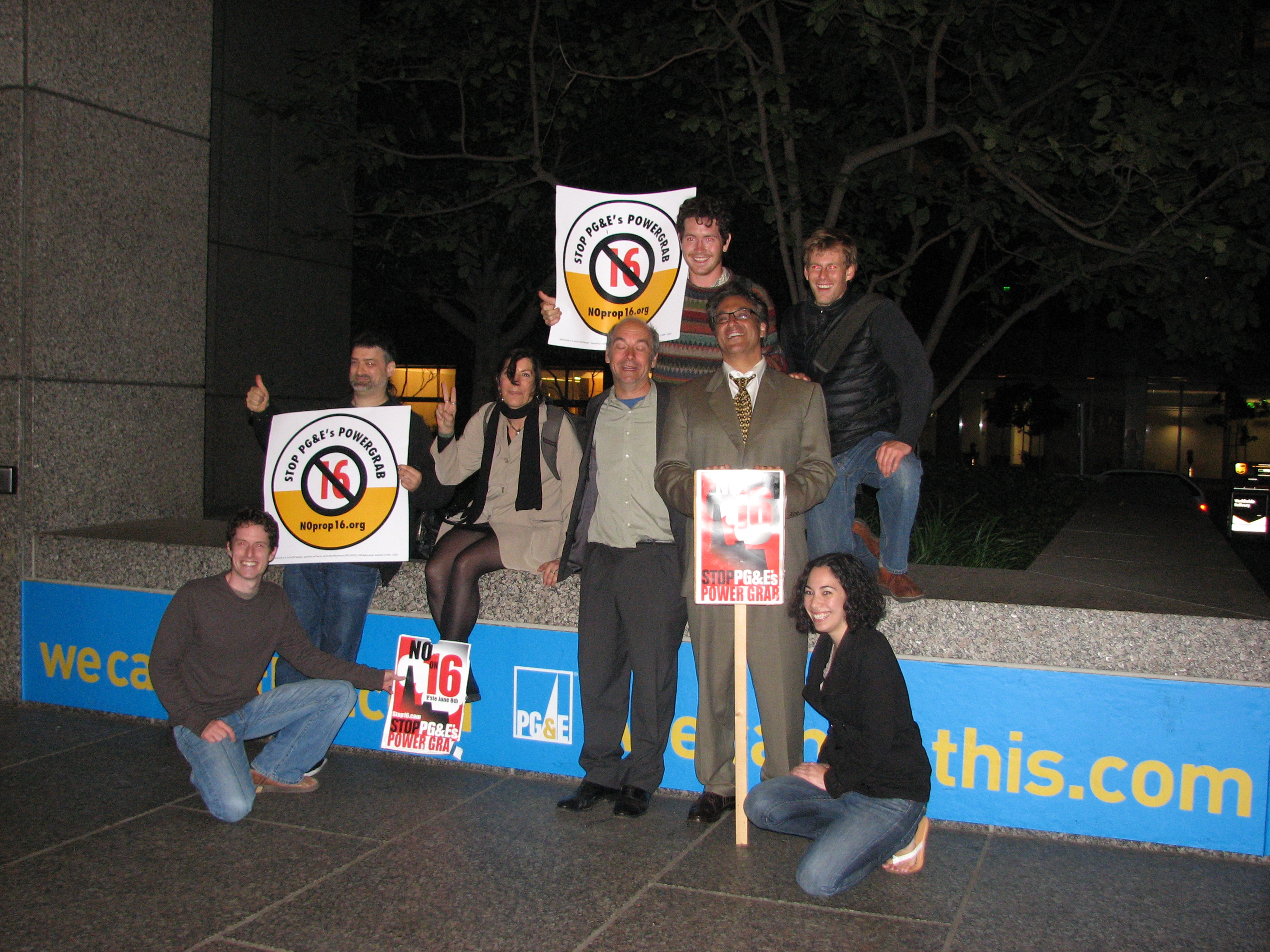
The defeat of Proposition 16 will go down in history as one of the most remarkable campaigns ever. It was, Sup. Ross Mirkarimi noted, “a righteous win:” The No on 16 campaign spent less than $100,000 and still captured 52 percent of the vote. Another narrow corporate-interest measure, Mercury Insurance’s Prop. 17, faced a similar fate.

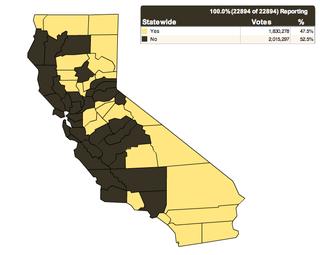
One reason: PG&E’s $50 million campaign backfired, making voters suspicious of the company’s propaganda. Another: it lost overwhelmingly in its own service area, the company rejected by those who know it best.

Now PG&E CEO Peter Darbee, who pushed to mount the expensive campaign, must return to his shareholders empty-handed — and that’s going to cause problems. “I assume the leadership of PG&E will be called to task,” Clemens said. “They truly rolled the dice.”

The day after the election, PG&E shares dropped 2.2 percent, a possible sign of shaken investor confidence. Mindy Spatt of the Utility Reform Network (TURN), a nonprofit that worked on the No on 16 effort, described the situation succinctly. “Peter Darbee’s got egg on his face,” she said. “Big-time.”

Mirkarimi has witnessed other battles with PG&E, and said this probably wouldn’t be the last. “PG&E, every time we want to have a seat at the table, tries to take us out, like assassins,” he said. “If they were smart, they would take us up on what we asked many years ago, and that is to abide by peaceful coexistence.”

On the statewide level, the bold and expensive deceptions pushed by PG&E and Mercury Insurance were countered by only a handful of super-committed activists and a broad cross-section of newspaper editorials, a reminder that newspapers — battered by the economy and technological changes — are neither dead nor irrelevant.

One of the wild cards of the election was Prop. 14, which will eliminate party primaries for state offices — and potentially shake up the state’s entire political structure. “This is a big deal even if we don’t know how it’s going to play out,” consultant David Latterman said at the SPUR event.

Interestingly, the only two counties that voted No on 14 were the most progressive — San Francisco — and the most conservative, Orange.

Progressives did well in San Francisco, expanding their majority on the Democratic County Central Committee. “In an environment where it was about hundreds of millions of dollars from PG&E and Meg Whitman and Chris Kelly outspending us, we showed that San Francisco is San Francisco and we support San Francisco values,” DCCC chair Aaron Peskin told us.

Money used to define the debates in San Francisco, but the dominant narratives are now being written by the coalition of tenants, environmentalists, workers, social justice advocates, and others who backed a progressive slate of DCCC candidates, which took 18 of the 24 seats on a body that makes policy and funding decisions for the local Democratic Party.

“This time it was the coalition that really made the difference,” DCCC winner Michael Bornstein said on election night. “Frankly, our people worked harder.”

Board of Supervisors President David Chiu agreed, telling us, “For the Central Committee, the message is people power wins.”

The lesson from this election is that people are starting to get wise to corporate deceptions. And they’re realizing that with hard work and smart coalition-building, the people can still prevail.

Steven T. Jones, Rebecca Bowe, Sarah Phelan, and Tim Redmond contributed to this report.


Stage listings

0

Stage listings are compiled by Guardian staff. Performance times may change; call venues to confirm. Reviewers are Robert Avila, Rita Felciano, and Nicole Gluckstern. Submit items for the listings at listings@sfbg.com.

THEATER

OPENING

BAY AREA

Les Liasons Dangereuses Redwood Ampitheatre, 30 Sir Francis Drake, Ross; (415) 251-1027, www.porchlight.net. $15-30. Previews Thurs/17-Fri/18, 7pm. Opens Sat/19, 7:30pm. Runs Thurs-Sun, 7:30pm; also June 28, July 7, 7:30pm. Through July 10. Porchlight Theatre Company presents a production of Christopher Hampton’s adaptation of the 1782 novel.

ONGOING

Abigail: The Salem Witch Trials Temple SF, 540 Howard; www.templesf.com. $10. July 8, 29, Aug 5, 12, 19, 26, 9pm. Through Aug 26. Buzz Productions, with Skycastle Music and Lunar Eclipse Records, presents an original rock opera based on the Salem witch trials.

All My Sons Actors Theatre of San Francisco, 855 Bush; 345-1287, www.ticketweb.com. $26-38. Wed-Sat, 8pm. Through June 26. Actors Theatre performs Arthur Miller’s masterwork.

Andy Warhol: Good For the Jews? Jewish Theatre, 470 Florida; 292-1233, www.tjt-sf.org. $15-45. Thurs-Sat, 8pm; Sun, 2 and 7pm. Through Sun/20. Renowned monologist Josh Kornbluth is ready to admit his niche is a narrow one: he talks about himself, and more than that, he talks about his relationship to his beloved late father, the larger-than-life old-guard communist of Kornbluth’s breakthrough Red Diaper Baby. So it will not be surprising that in his current (and still evolving) work, created with director David Dower, the performer-playwright’s attempt to “enter” Warhol’s controversial ten portraits of famous 20th-century Jews (neatly illuminated at the back of the stage) stirs up memories of his father, along with a close family friend — an erudite bachelor and closeted homosexual who impressed the boyhood Josh with bedtime stories culled from his dissertation. The scenes in which Kornbluth recreates these childhood memories are among the show’s most effective, although throughout the narrative Kornbluth, never more confident in his capacities, remains a knowing charmer. (Avila)

Bone to Pick and Diadem Cutting Ball Theater, Exit on Taylor, 277 Taylor; 1-800-838-3006, www.cuttingball.com. $15-30. Thurs-Sat, 8pm; Sun, 5pm. Through Sun/20. Cutting Ball Theater closes its tenth season with a pair of plays by Eugenie Chan.

Boys Will Be Boys New Conservatory Theatre Center, 25 Van Ness; 861-8972, www.nctcsf.org. $22-40. Wed-Sat, 8pm; Sun, 2pm. Through June 26. What happens when you realize you have Gay Attention Deficit Disorder? This comedic musical aims to find out.

Die Walküre War Memorial Opera House, 301 Van Ness, SF; www.sfopera.com. $15-360. Sat/19, Tues/22, June 25, 30, 7pm. Through June 30. San Francisco Opera presents the second installment of Wagner’s Ring cycle, directed by Francesca Zambello.

“Durang Me!” Next Stage, 1620 Gough; 1-800-838-3006, www.custommade.org. $10-28. Thurs-Sat, 8pm; Sun, 7pm (no show July 4). Through July 10. Custom Made performs two comedies by Christopher Durang: Sister Mary Ignatius Explains It All For You, and The Actor’s Nightmare.

La Fanciulla Del West War Memorial Opera House, 301 Van Ness, SF; www.sfopera.com. $15-360. Opens Wed/9, 7:30pm. Fri/18, July 2, 8pm; June 24, June 29, 7:30pm; June 27, 2pm. Through June 17. San Francisco Opera presents Puccini’s opera, with Deborah Voigt as Minnie.

Forever Never Comes Boxcar Playhouse, 505 Natoma; www.crowdedfire.org. $10-25. Wed-Sat, 8pm. Through June 26. Crowded Fire performs Enrique Urueta’s world premiere “psycho-Southern queer country dance tragedy.”

Giant Bones Exit Theatre, 156 Eddy; (650) 728-8098, www.brownpapertickets.com. $15-50. Thurs-Sat, 8pm. Through Sat/19. Cobbled from the stories of Peter S. Beagle, author of The Last Unicorn, this frolic into the fantasy genre is a multi-corn misstep from writer-director Stuart Bousel. The only good thing about the convoluted plot—which, in addition to the requisite assortment of wizards, dragons, and whatnot has a play-within-a-play dimension featuring a band of caviling actors—is that it is so convoluted you can safely stop paying attention to it almost immediately. For the rest, you will have to endure two hefty acts’ worth of amateurish theatrics, whose look and tone suggest an Interstate mishap between giddy vanloads of Renaissance Fairegoers and Star Trek conventioneers. (Avila)

Gutenberg! The Musical! Exit Stage Left, 156 Eddy, SF; www.beardsbeardsbeards.com. $20. Thurs-Sat, 8pm. Through June 26. A Theatre Company presents a musical about two writers who scheme to create a Broadway musical about Johann Gutenberg.

*Hot Greeks Hypnodrome Theatre, 575 Tenth St; 1-800-838-3006, www.thrillpeddlers.com. $30-69. Thurs, 8pm; Sun, 7pm. Through June 27. On the principle that when you’ve got it you should really flaunt it, San Francisco’s Thrillpeddlers essay their second revival of a musical by the storied Cockettes. Hot Greeks, which premiered in midnight performances at the old Palace Theater in 1972, was the gleefully crazed cross-dressing troupe’s only other fully scripted musical besides, of course, Pearls Over Shanghai.

While not the Oresteia or anything, Hot Greeks is more than an excuse for a lot of louche, libidinous hilarity. Okay, not much more. But it is a knowing little romp — supported by some infectious songs courtesy of Martin Worman and Richard “Scrumbly” Koldewyn — wedding trashy high school romance with the trashy ancient Greece of Aristophanes and the Peloponnesian War. (Avila)

*How I Learned to Stop Worrying and Lost My Virginity SF Playhouse, 533 Sutter; www.sfplayhouse.org. $20. Sun, 7pm. Through June 27. A natural born charmer and a comedic actor with hard-won training behind her, Aileen Clark wins over an audience within about ten seconds. But her stories (co-scripted by John Caldon and ably directed by Claire Rice) turn out to be just as solid: all of them loving, irreverent, and unfailingly hilarious autobiographical accounts of coming of age across three cultures. Born to a Nicaraguan mother and a Scottish father and raised principally in Brazil, Managua and San Francisco, Clark’s perfectly pitched monologue comes liberally spiced with Spanish and Portuguese, sweetened by an affecting but never maudlin honesty, and stirred with a feisty humor clearly a lifetime in the making. As well paced and energetic as this Guerilla Rep and Ann Marie co-production is, it could probably be tightened further by shaving some 10 minutes off the 90-minute run time. Nonetheless, you are not likely to regret a minute of this frank and funny, wise and sassy visit to Aileen’s world. (Avila)

KML Goes Undercover Zeum Theater, 221 4th St, SF; www.killingmylobster.com. $10-20. Thurs-Fri, 8pm; Sat, 7pm, 10pm; Sun, 7pm. Through June 27. Killing My Lobster returns with a series of comedic vignettes based on the theme of espionage.

Krapp’s Last Tape Exit on Taylor, 277 Taylor; 1-800-838-3006, www.cuttingball.com. $15-30. Thurs-Sat, 8pm; Sun, 5pm. Through July 3. Cutting Ball Theater remounts its strong recent production of Samuel Beckett’s hour-long solo play, featuring a full-fledged and satisfying turn by a hearty, slyly comic Paul Gerrior as the titular Krapp, reflecting on the fleeting sense of self recorded on reel-to-reel tapes over the course of a long life. Artistic director Rob Melrose approaches the material with supreme assurance and passionate but never stifling fidelity. David Sinaiko provides the recorded voice of the younger Krapp, expertly balancing a passion and unselfconscious pomposity that has Gerrior’s Krapp alternately bemused, euphoric, and wincing through one of Beckett’s most autobiographical and surprisingly affirming pieces. Melrose’s choice use of scenic elements, meanwhile, including the palpably solid 1950s-era tape machine, places Gerrior (suitably odd and natty in costumer Maggie Whitaker’s dapper vest, high-water trousers and white shoes) in a kind of communion with the reel and the real—an affecting and quietly unsettling relationship, pitched against an infinite blackness all around, that has Krapp at one point resting his head gently on the machine as he and the insubstantial voice of his younger self relive a moment of intimacy with a long-gone lover. (Avila)

Marga Gomez is Proud and Bothered New Conservatory Theater Center, 25 Van Ness; 861-8972, www.nctcsf.org. $18-40. Thurs-Sat, 8pm (no show June 25); Sun, 2pm. Through June 26. Gomez performs her GLAAD Media award-winning comedy.

The New Century New Conservatory Theatre Center, 25 Van Ness, SF; 861-8972, www.nctcsf.org. $22-40. Wed-Sat, 8pm; Sun/20, July 11, 2pm. Through July 11. New Conservatory Theatre Center performs Paul Rudnick’s bill of short comedies.

*Pearls Over Shanghai Hypnodrome, 575 Tenth St.; 1-800-838-3006, www.thrillpeddlers.com. $30-69. Fri-Sat, 8pm. Through June 26. Starting July 10, runs Sat, 8pm and Sun, 7pm. Through August 1. Thrillpeddlers presents this revival of the legendary Cockettes’ 1970 musical extravaganza.

Peter Pan Threesixty Theater, Ferry Park (on Embarcadero across from the Ferry Bldg); www.peterpantheshow.com. $30-125. Tues and Thurs, 7pm; Fri-Sat, 7:30pm (also Sat, 2pm); Wed, 2pm; Sun, 1 and 5pm. Through August 29. JM Barrie’s tale is performed in a specially-built 360-degree CGI theater.

Sandy Hackett’s Rat Pack Show Marines’ Memorial Theater, 609 Sutter; 771-6900. $30-89. Fri-Sat, 8pm (also Sat, 2pm); Sun, 2pm. Through June 27. From somewhere before the Beatles and after Broadway “Beatlemania” comes this big band cigarettes-and-high-ball nightclub act, recreating the storied Vegas stage shenanigans of iconic actor-crooners Frank Sinatra (David DeCosta), Dean Martin (Tony Basile), and Sammy Davis Jr. (Doug Starks), and sidekick comedian Joey Bishop (Sandy Hackett). The band is all-pro and the songs sound great — DeCosta’s singing as Sinatra is uncanny, but all do very presentable renditions of signature songs and standards. Meanwhile, a lot of mincing about the stage and the drink cart meets with more mixed success, and I don’t just mean scotch and soda. The Rat Pack is pre-PC, of course, but the off-color humor, while no doubt historically sound, can be dully moronic. (Avila)

“Something C.O.O.L.: The Summer Cabaret Festival” Eureka Theatre, 215 Jackson; www.brownpapertickets.com. Free-$10. Mon-Tues, 7:30pm; Wed, 8pm. Through June 27. Cabaret singer Carly Ozard presents six diverse showcases (Mon-Tues nights) and hosts open mics (Wed nights) with professional performers.

Speed the Plow Royce Gallery, 2910 Mariposa; 1-866-811-4111, www.speedtheplowsf.com. $28. Thurs-Sat, 8pm. Through Sat/19. Expression Productions performs David Mamet’s black comedy.

*The Tosca Project American Conservatory Theater, 415 Geary; 749-2ACT, www.act-sf.org. $15-87. Wed-Sat, 8pm; Wed, Sun, 2pm. Through June 27. Four years in the making, this ACT–SF Ballet collaboration unfurls a lushly romantic, whimsical pageant of San Francisco history through movement, character, mise en scène, and an irresistible cultural lens: the famed North Beach bar lending the project its setting and name. Co-created by ACT’s Carey Perloff and SFB choreographer Val Caniparoli, the storyline traipses over every iconic period since Prohibition—sometimes too cursorily but generally with vigor and a quietly gathering intoxication—meanwhile centering on three characters: the tragically lovelorn Italian bartender-owner (Jack Willis); a Russian émigrée and regular (Rachel Ticotin) who eventually inherits the establishment; and an African American musician (Gregory Wallace) arriving on the lamb, who becomes another permanent fixture of the place. Never far away either is the incarnation of the Bartender’s lost love, played by SFB’s enchanting Sabina Allemann. Although the story is conveyed without dialogue, there are moments when words take the stage too—how could they not in Beat-era SF, especially with a neighbor in poet-publisher Lawrence Ferlinghetti (played here by the consistently winning Peter Anderson). The truly rare treat, of course, is watching the dancers of SF Ballet—not least the radiant and commanding Allemann (who retired from SFB in 1999), with added power and charisma in key scenes from Pascal Molat—relatively up-close and personal, mingling persuasively with their formidable actor colleagues, enveloped in an exquisite stage design (courtesy of Douglas W. Schmidt, gorgeously lit by Robert Wierzel) and a moody soundscape (by Darron L West) featuring choice period songs. (Avila)

What Mama Said About Down There Our Little Theater, 287 Ellis; 820-3250, www.theatrebayarea.org. $15-25. Thurs-Sun, 8pm. Through July 30. Writer-performer-activist Sia Amma presents this largely political, a bit clinical, inherently sexual, and utterly unforgettable performance piece.

BAY AREA

The Drawer Boy Marion E. Greene Black Box Theatre, 531 19th St, Oakl. www.brownpapertickets.com. $10. Thurs-Sat, 8pm; Sun, 2pm. Through July 4. TheatreFIRST presents Michael Healey’s comedy about two aging farmers with a family secret.

*East 14th: True Tales of a Reluctant Player Marsh Berkeley, 2120 Allston, Berk; www.themarsh.org. $20-50. Fri/18, 9pm; Sun/20, 7pm. Through June 20. Don Reed’s solo play, making its Oakland debut after an acclaimed New York run, is truly a welcome homecoming twice over. (Avila)

“Fireworks Festival” Berkeley Repertory Theatre, Thrust Stage, 2025 Addison, Berk; (510) 647-2949, www.berkeleyrep.org. $25-35. Through July 3, showtimes vary. This performance festival includes work by John Leguizamo, David Sedaris (whose show is already sold out), Dan Hoyle, and Wes “Scoop” Nisker.

God’s Ear Ashby Stage, 1901 Ashby, Berk; www.shotgunplayers.org. $15-28. Wed, 7pm; Thurs-Sat, 8pm; and Sun, 5pm. Through Sat/20. Against a frozen, deceptively empty-looking landscape of perpetual winter, an anguished married couple stagnates in grief over the accidental death of their young son. Estranged by the sorrow and guilt they feel, they spend most of the time apart but not alone: Mel (Beth Wilmurt) stays at home, where she loses herself in obsessive domestic projects while fielding questions from their surviving daughter — the equally traumatized but far more resilient Lanie (Nika Ezell Pappas) — with assists from the Tooth Fairy (Melinda Meeng) and G.I. Joe (Keith Pinto); meanwhile, Ted (Ryan O’Donnell) wanders in his business suit through a string of airports and airport bars commiserating with other lost souls (Joe Estlack and Zehra Berkman). New York-based playwright Jenny Schwartz’s whimsical meditation on the process of grieving is something like The Rabbit Hole as written by Ionesco, fueled by dialogue that makes an overly showy and eventually tedious hysterical poetry of the banalities, clichés, and platitudes spoken by her stricken characters as a kind of prefab linguistic armor — everything and anything to avoid saying something. Director-choreographer Erika Chong Shuch stages the action in this Shotgun Players production with warm energy and imagination, however — and a handful of tuneful, clever songs from composer Daveen Digiacomo — compensating somewhat for the motionless plot. Moreover, Shuch undercuts the play’s maudlin tendencies by moving her able actors and even the stage properties around in swift, comical, aptly dreamlike fashion, as the stunned couple continue their largely separate meanderings, meaningfully spouting “meaningless” lines about bucking up, or settling in, or riding off, etc. The problem is there is not much beneath this frozen surface of clichés beyond more cliché. (Avila)

*In the Wake Berkeley Repertory Theatre, Roda Theatre, 2015 Addison, Berk; (510) 647-2949, www.berkeleyrep.org. $13.50-71. Tues and Thurs-Sat, 8pm (also Thurs and Sat, 2pm; no matinee Thurs/17; no show June 25); Wed and Sun, 7pm (also Sun, 2pm). Through June 27. Brilliantly weaving the political and the personal, New York playwright Lisa Kron takes on the myth and mayhem of American exceptionalism through the prism of a compelling lefty smarty-pants named Ellen (Heidi Schreck) and her “alternative” family circle, as it slowly unravels during the first decade of the 21st century. From her modest Manhattan perch — shared with adoring, wise-cracking longtime boyfriend Danny (Carson Elrod) — Ellen rails against the ineptitude of the Democrats in the face of the rising Right and its season of havoc. But she’s already told the audience she has a problem with “blind spots,” much like the country. Projections of headlines and sound bites, intermittently splayed across the fortified proscenium arch, locate the action at precise moments in the dreary political timeline of the last decade, beginning with the 2000 election coup that has put a damper on Thanksgiving festivities (despite inclusion of Pilgrim smocks). Her sister (Andrea Frankle) and sister’s wife (Danielle Skraastad) are there too, along with Ellen’s older friend Judy (Deidre O’Connell), a cranky, deceptively oblivious relief worker just back from a refugee camp in Africa. As time goes by, and Ellen turns to an open relationship with a woman filmmaker (Emily Donahoe), our protagonist’s bedrock assumptions about the natural order of things get sorely tested. Leigh Silverman directs a top-notch cast in a remarkably engaging mix of political dialogue and personal entanglements, written for the most part with stirring intelligence and incisive humor. If the play loses focus and momentum by the second act — despite a wonderfully charged scene between Ellen and Judy that is the play’s most memorable — its wit, real anger and constructive irreverence still make it too good to miss. (Avila)

John Steinbeck’s The Pastures of Heaven Bruns Amphitheater, 100 California Shakespeare Theater Wy, Orinda; (510) 548-9666, www.calshakes.org. $34-70. Tues-Thurs, 7:30pm; Fri-Sat, 8pm (also June 26, 2pm); Sun, 4pm. Through June 27. Cal Shakes leads off its season with an original staging of John Steinbeck’s early story cycle, a collaboration with Word for Word theater company gracefully adapted by acclaimed San Francisco playwright Octavio Solis (Lydia, Ghosts of the River). Artistic director Jonathan Moscone directs a fine 11-actor cast in lively performances across a smoothly intertwining set of ten tales, all revolving around two specific households—one, the Munroe family, settled upon a notoriously “cursed” patch of land—in the central California valley that a Spanish explorer once dubbed “the pastures of heaven.” Irony anyone? Steinbeck went for broke in the themes and taboos he touches upon here, from incest, madness, infanticide—he misses one or two, but not many. It’s sometimes somber yet rarely heavy going, however, with many lighter stories and situations in the mix, and director Moscone’s staging missing few opportunities for added humor along the way. At the same time, the stories are not equally compelling—the overly crowd-pleasing “song” story of two Mexican American sisters (Catherine Castellanos and Joanne Winter) who segue almost unconsciously from a failed restaurant venture into prostitution, for instance, is cute but surprisingly ho-hum. But if you lie back and let the play’s frontier landscape unfurl (as you do literally anyway in the hill-saddled Bruns Amphitheater), the evening has a dependable charm and several dramatic highlights—not the least of which features the powerful Rod Gnapp in the role of a man desperate to appear prosperous before his family and neighbors. (Avila)

Loveland The Marsh Berkeley, 2120 Allston, Berk; (800) 838-3006, www.themarsh.org. $25-50. Fri/18, June 25, July 2, 9, 7pm; July 3, 5pm; Sun/20, July 11, 2pm. Ann Randolph’s comic solo show about an irreverent woman’s trip back to her childhood home in Ohio.

1001 Berkeley City Club, 2315 Durant, Berk; (510) 488-4116, www.justtheater.org. $15-30. Thurs-Sat, 8pm; Sun, 5pm. Through Sun/20. Just Theater performs Jason Groete’s Arabian Nights-inspired tale of post-9/11 life.

Opus Mountain View Center for the Performing Arts, 500 Castro, Mtn View; (650) 463-1960, www.theatreworks.org. $27-62. Tues-Wed, 7:30pm; Thurs-Sat, 8pm (also Sat, 2pm); Sun, 2 and 7pm. Through June 27. TheatreWorks performs Michael Hollinger’s drama, set in the world of chamber music.

Speech & Debate Aurora Theatre, 2081 Addison, Berk; www.auroratheatre.org. $34-55. Wed-Sat, 8pm; Sun, 2pm, 7pm; Tues, 7pm. Through July 18. Aurora Theatre closes its 18th season with Stephen Karam’s comedy about three teen misfits connected to a small town sex scandal.

*Woody Guthrie’s American Song Marin Theatre Company, 397 Miller, Mill Valley; (415) 388-5208, www.marintheatre.org. $34-54. Tues, Thurs-Sat, 8pm; Wed, 7:30pm; Sun, 2 and 7pm. Through June 27. Marin Theater Company presents director-adapter Peter Glazer’s graceful, dynamic staging of the life and times of Woody Guthrie using the famed folk singer’s own enduring words and music (impressively, rousingly orchestrated and arranged by Jeff Waxman). Traveling alternately hard, light, and stirringly through the 1930s and 1940s before leaping ahead to alight briefly on the present (which is never far, in fact, from any of the concerns of the much abused but resilient working people channeled so brilliantly in Guthrie’s social poetry), five charismatic cast members (Lisa Asher, Berwick Haynes, Sam Misner, Matt Mueller, Megan Pearl Smith) sing, act, and play their own instruments beautifully, backed by a smooth and irresistible band under multi-instrumentalist and musical director Tony Marcus. You don’t have to know a lick of Guthrie’s material to immediately understand its relevance and beauty in these cleverly staged set pieces, which are as humorous and crowd-pleasing as they are unapologetically damming and defiant of the rule of capital. For Guthrie fans, of course, this is a must. (Avila)

The World’s Funniest Bubble Show Marsh Berkeley, 2120 Allston, Berk; (415) 826-5750, www.themarsh.org. $10-50. Sun, 11am. Through June 27. The Amazing Bubble Man, a.k.a. Louis Pearl, performs his family-friendly show.

PERFORMANCE/DANCE

Ball-ist-ic CounterPULSE, 1310 Mission; 626-2060, www.counterpulse.org. Fri/18-Sat/19, 8pm and 9:30pm. $18-22. Scott Wells & Dancers present a performance with seven dancers and a lot of balls.

Fauxgirls! Kimo’s Penthouse Lounge, 1351 Polk; 885-4535, www.fauxgirls.com. Sat/19, 10pm. Free. The female impersonation revue’s ninth anniversary show.

Liss Fain Dance Novellus Theater, Yerba Buena Center for the Arts, 701 Mission; 978-2787, www.ybca.org. Thurs/17-Sat/19, 8pm. $15-30. The company presents its home season, with two premieres, How It Ends and Speak of Familiar Things.

Marsh’s 20th Anniversary Performance Marathon The Marsh, 1062 Valencia; (800) 838-3006, www.themarsh.org. Sat/19, noon-midnight. A full-day of performances, including appearances by Charlie Varon and David Ford, and a late-night party.

Mortified SF Make-Out Room, 3225 22nd St; 647-2888, www.makeoutroom.com. Fri/18-Sat/19, 8pm. $12-15. Share the shame with firsthand stories of embarrassment.

“San Francisco Ethnic Dance Festival” Palace of Fine Arts, 3301 Lyon; 474-3914, www.worldartswest.org. Sat-Sun, 2pm (also Sat, 8pm). Through June 27. $22-44. Nearly 600 Bay Area performers representing 20 cultures participate in this 32nd annual festival.

Sherri aka Cherchez La Femme Club Six, 60 6th St; 863-1221, www.cherchezlafemme.eventbrite.com. Fri/18, 9pm. $10-15. Performing along with Ariellah and Deshret Dance Company, Freyja, Auberon, Calamity Sam, Mirtara, blackhoodygrrrl and Superkate.


 

Reading the June election tea leaves

0

Everyone’s reading the tea leaves after the local election. The November supes races will be a huge deal, and it’s really tempting to try to figure out what the DCCC results mean for the fall. Paul Hogarth at BeyondChron takes it on here. Chris Daly (no surprise) disagrees.


Let me see if I can sort some of this out.


Hogarth’s basic argument is that the progressives didn’t really do so well in the election:


“In District 8, moderate Scott Wiener finished 1,400 votes ahead of progressive Rafael Mandelman – as the two face the same electorate in November. The renters’ financial hardship measure, Proposition F, lost badly citywide – and finished far worse in neighborhoods that are usually pro-tenant. Debra Walker fared well in her run for DCCC, but most of her votes were not in District 6 – and results there suggest that another candidate for Supervisor could make such a race highly competitive.”


Hogarth is completely upfront and honest about disclosing that he’s a supporter of one of Walker’s opponents, Jane Kim — a former Green who is now a Democrat (and is very much a progressive), but wasn’t in the DCCC race. Theresa Sparks wasn’t in the DCCC race either. Nor was Jim Meko. There are several strong candidates in that race, and they don’t break down along easy political lines. So looking at how many votes Walker got in D6 seems a little off point; there’s nobody to compare her to.


Back to D8. Hogarth:


“Now we know [the D8 breakdown], and the numbers are even worse for Mandelman. Scott Wiener finished approximately 1,400 votes ahead in District 8 (my vote count shows him at 5,954 to Mandelman’s 4,561.) As a comparison, in December 2002 – the last time District 8 saw a hotly contested race on “moderate v. progressive” lines – Bevan Dufty got 11,000 votes, Eileen Hansen 10,000.”


That would seem to make Wiener the much stronger candidate going into the fall.


But there’s another key factor here: turnout. Low-turnout races are mostly (not always, but mostly) better for the more conservative candidate, and in this case, the turnout was really low. Just 32 percent of the voters went to the polls.


Let’s take a look at the 2002 election, the last time we had an open seat in D 8 with a progressive and a moderate running. In the general election in November, progressive Eileen Hansen came in first, with 9,820 votes to Bevan Dufty’s 8,795. But another progressive, Tom Radulovich was also in the race, and this was before ranked-choice voting. Radulovich got 5,221 votes, the majority of which probably would have gone to Hansen.


Turnout was a little over 50 percent.


In the runoff, in December, turnout dropped to 38.8 percent. Dufty got 11,096 votes, and Hansen 9,995. You could argue that most of the Radulovich votes went to Dufty — possible — but more likely, in the runoff, the more liberal voters who had come out in November to vote for Gray Davis for governor and also voted for Hansen just stayed home in December.


And this fall, Wiener will be more in the position that Hansen was in: There’s a third candidate in the race, Rebecca Prozan, and she’s more likely to take votes from Wiener than from Mandelman. And, of course, there’s RCV this time around — and with two gay men and a lesbian in the race, nobody really knows how the second-choice votes will play out.


Daly plays with the turnout numbers:


For the sake of argument, let’s concede that Mandelman starts out 1000-1400 votes behind Wiener among the 11,000 or so District 8 Democrats who voted for DCCC last week. Given that over 31,000 District 8 residents voted in the 2006 Supervisor race (in a contest that was not the most competitive,) we can assume that at least 20,000 additional people will vote this November. In a 2-person contest, Mandelman would need to win 53.5% of these votes in order to win. Given that less frequent voters trend significantly more progressive, and with the addition of Democratic Party branding and the weight of its mail program, 53.5% is almost assured.


Well, I dunno — in 2002, with a contested governor’s race and a contested D8 race, only 26,600 people voted, but it’s safe to say the numbers will be well above 11,000. And it’s not a two-person contest. But I think it’s also safe to say that those higher-turnout voters are the votes most likely to swing toward Mandelman.  


Jim Stearns, a political consultant with long experience in San Francisco (and no candidate in the D8 race), has another interesting analysis he sent over to me:


“Mandelman’s strategy was to spend his limited resources as part of a team effort to maintain progressive leadership on the DCCC. In so doing, he focused more heavily on slate cards that went district-wide than on mailers in District 8 promoting his own candidacy.


 Wiener, on the other hand, abandoned his fellow moderates and spent his money mostly on his own candidacy. This shortsighted strategic blunder will be extremely costly for Wiener in November.


 The result? Wiener got more votes in District 8, but lost his bid to regain his position as chair of the DCCC. Mandelman got fewer votes, but has significantly increased his chances of winning the Democratic Party endorsement this November. That endorsement is worth far more than the mere 1,000 vote difference between Wiener and Mandelman today.”


None of this means Walker will beat Kim and Sparks in November, or that Mandelman will beat Wiener and Prozan. It just means that I suspect the DCCC results don’t really say much about the relative strengths of any of the candidates when it comes to a focused, district-centered race in a high-turnout fall election.


I emailed Hogarth and ran the turnout argument by him. His response:


I tried to caution in my piece that there’s only so much you can see in the numbers — and that you’re right; voter turnout in November will be a lot higher.  Maybe I should have made this a bigger point.  But progressives are deluding themselves if they think turnout will be as high as it was in November 2008.  And if I were Rafael, I would have reason to worry that Scott did so much better than me in D8.  Also keep in mind that, despite the drop-off of DCCC voters, 48% of people in D8 who participated in this election cast a ballot for Scott Wiener.


Correct — turnout won’t be as high as it was in the presidential race. But it might very well be as high as it was in 2002, when there was a contested race for governor, as there will be this fall. Lots of Democratic candidates — particularly Gavin Newsom and Kamala Harris — will be doing GOTV operations in the city, and while Newsom and Harris won’t be supporting Mandelman, I don’t think either of them will limit their turnout efforts to precincts that run toward Wiener. The more liberal dems who vote in November, the better Harris and Newsom do against Republicans; that’s what they care about.


There’s no question that Scott Wiener will be a formidable contender in November. He’s got money, he’s got Mark Leno, and he’s running in a district that has elected moderate gay men since the return of district elections. But it’s remarkable how well the progressives have done in swing districts of late (see: Eric Mar, John Avalos), and Mandelman will, as Daly says, be the consensus candidate of every progressive group in town. He’ll almost certainly have the Democratic Party — which matters even more when Democrats at the top of the ticket are driving turnout. And he’ll have the same sort of boots on the ground that gave Mar a victory in a very tight race.


At this point, I think Mandelman and Wiener both have a shot at finishing first; it will probably be very close. And Rebecca Prozan runs third.


Oh, and the tenant measure? It lost because there wasn’t an effective campaign behind it. Tenant measures don’t automatically win in tenant-heavy San Francisco; time and again over the years we’ve seen that when there’s a measure that pushes the edge (and face it, I strongly supported Prop. F, but it was pushing the edge) and there’s landlord money against it, you need a full-scale concerted campaign for it. Progressives were paying a lot of attention to the DCCC, and to defeating Props. 16 and 17. Prop. F got lost. I’m not happy about that, but I’m not terribly surprised, either — and I don’t think it means much in the long run.


Chris Daly went a bit too far attacking Hogarth for his connections to Mark Leno, who is a Wiener supporter, and suggesting that the folks at BeyondChron — who are, after all, first and foremost tenant lawyers — are going to be backing Scott Wiener in the fall. I don’t see that happening; I can’t imagine it happening. I just think they read a little too much into the DCCC results.

Why Newsom loves sit-lie

43

To the surprise of exactly nobody, Mayor Gavin Newsom is putting his sit-lie law on the November ballot. And I think he’s thrilled about it.


The last thing the mayor wanted was to have the supervisors approve its own version. He’d much rather have his name on it. This way, he not only gets a wedge issue to attack the progressives in the fall; he gets to run his statewide campaign as someone who’s cracking down on the homeless. It’s tough for a San Francisco politician to win in more conservative parts of the state — but if he can say he stood up to those crazy “ultra-liberals” on the board and is willing to beat up on the poor and homeless, he can shed some of that liberal image.


But it’s not clear that the strategy will work at home. Even David Latterman, a political consultant for Scott Wiener and other downtown-backed candidates, downplayed the role that sit-lie will play in the fall election. “It’s just a wedge issue and it’s not going to change people’s minds on who they support,” Latterman told a crowd that including Chron columnist CW Nevius — who is perhaps the most enthusiastic backer of the measure — during a post-election wrapup at SPUR on June 10.


And among the DCCC candidates in this election, the only one to really champion sit-lie and make it a part of his campaign was David Villa-Lobos, who is also running to replace Chris Daly on the Board of Supervisors, but who finished 26th out of 30 candidates in District 12.


The law also seems a little hinky. It would ban sitting on the sidewalk — or “any object placed on the sidewalk, like a crate or folding chair,” according to the Chron. Everywhere I go in the city these days, people are sitting on folding chairs on the sidewalk — typically eating at a restaurant or cafe that has outdoor seating. I suspect many of those eateries have no specific permits to put chairs on the sidewalk; they just do it, which is fine, and nobody minds.


But technically, I guess, outdoor diners could be cited under the mayor’s law. Or the cops could just ignore them, and decide how and where to enforce the law. Which is never a good thing.


I asked the mayor’s press office for clarification on this point, and I’m still waiting for a response.

Editorial: PG&E’s greed backfires

1

The defeat of Prop. 16 showed that unlimited corporate spending on a ballot initiative doesn’t guarantee victory.

EDITORIAL The single most important number to come out of San Francisco on election night was this: 67.49 percent. That’s how many people in this city voted against Pacific Gas and Electric Co.’s monopoly measure, Proposition 16. It’s a statistic that ought to be posted somewhere on a wall at City Hall to remind everyone in local government that the voters sided overwhelmingly against PG&E and in favor of a public option for local electricity.

It’s a landmark victory. On the state level, the defeat of Prop. 16 showed that unlimited corporate spending on a ballot initiative doesn’t guarantee victory, that an underfunded coalition can defeat a giant utility — and that a majority of those in PG&E’s own service area are unhappy with their electricity provider. Public power activists all over the state should take this as a signal that PG&E, and its once-formidable political clout, are on the wane.

In San Francisco — the only city in the nation with a legal mandate for public power — the vote was the most lopsided of any California county. It was the strongest local mandate for public power since the passage of the Raker Act in 1913.

That should be a huge boost for the city’s community choice aggregation (CCA) program. Sup. Ross Mirkarimi, who has been leading the fight for CCA, was pushing hard to get a contract signed before the June 8 vote; like a lot of observers, he feared that PG&E’s vast war chest would overwhelm the opposition. But now that Prop. 16 is dead — and nothing like it will be back in the near future, if at all — the city has a bit of a breather.

That doesn’t mean all work on the contract should slow down. The San Francisco PUC has been mucking around with this deal for more than a year, and needs to bring it to a close. And the city needs to start preparing to answer PG&E’s propaganda campaign with a concerted effort — from the mayor’s office on down — to remind San Franciscans that CCA power will be greener, safer, and in the long run, cheaper than the energy we’re now forced to buy from PG&E.

Any San Francisco politician who stands with PG&E and opposes CCA will do so at his or her peril.

And while San Francisco is moving to implement a modest public power program, state Sen. Mark Leno is moving in Sacramento to limit PG&E’s ability to try another Prop. 16 move — or to spend tens of millions of dollars trying to block local power initiatives. Leno has introduced a bill that would limit the utility’s ability to use ratepayer money on political or public relations campaigns.

The measure doesn’t have a number yet, but the language is brilliant. It directs the California Public Utilities Commission to disallow any political spending that PG&E tries to add into its regulated rates. And since the company has no source of income other that the money it gets from ratepayers, the impact would be to deny PG&E the ability to spend money working against the interests of ratepayers and the public.

"Over the past 10 years, PG&E has probably spent $150 million on political campaigns — and that’s money that came from the ratepayers," Leno said. "This bill is to protect ratepayers."

PG&E will howl about its First Amendment rights — and, indeed, the Supreme Court has of late given corporations who want to influence political campaigns and legislative issues a good bit of leeway. But the fact remains that PG&E is a regulated utility in California, and the state has every right to determine how much the company can charge its customers and to limit how that money is used.

Leno’s bill, of course, could radically change local politics. If PG&E couldn’t spend millions to defeat public power measures, the city would have far more options — and activists should be thinking about how a future campaign to take over the company’s infrastructure might work.

The Board of Supervisors should pass a resolution endorsing Leno’s bill, and the coalition that worked to defeat Prop. 16 should be working to get other cities and counties around the state to sign on.

PG&E’s greed in putting Prop. 16 on the ballot is starting to backfire — and it can’t happen too soon.

PG&E’s greed backfires

0

EDITORIAL The single most important number to come out of San Francisco on election night was this: 67.49 percent. That’s how many people in this city voted against Pacific Gas and Electric Co.’s monopoly measure, Proposition 16. It’s a statistic that ought to be posted somewhere on a wall at City Hall to remind everyone in local government that the voters sided overwhelmingly against PG&E and in favor of a public option for local electricity.

It’s a landmark victory. On the state level, the defeat of Prop. 16 showed that unlimited corporate spending on a ballot initiative doesn’t guarantee victory, that an underfunded coalition can defeat a giant utility — and that a majority of those in PG&E’s own service area are unhappy with their electricity provider. Public power activists all over the state should take this as a signal that PG&E, and its once-formidable political clout, are on the wane.

In San Francisco — the only city in the nation with a legal mandate for public power — the vote was the most lopsided of any California county. It was the strongest local mandate for public power since the passage of the Raker Act in 1913.

That should be a huge boost for the city’s community choice aggregation (CCA) program. Sup. Ross Mirkarimi, who has been leading the fight for CCA, was pushing hard to get a contract signed before the June 8 vote; like a lot of observers, he feared that PG&E’s vast war chest would overwhelm the opposition. But now that Prop. 16 is dead — and nothing like it will be back in the near future, if at all — the city has a bit of a breather.

That doesn’t mean all work on the contract should slow down. The San Francisco PUC has been mucking around with this deal for more than a year, and needs to bring it to a close. And the city needs to start preparing to answer PG&E’s propaganda campaign with a concerted effort — from the mayor’s office on down — to remind San Franciscans that CCA power will be greener, safer, and in the long run, cheaper than the energy we’re now forced to buy from PG&E.

Any San Francisco politician who stands with PG&E and opposes CCA will do so at his or her peril.

And while San Francisco is moving to implement a modest public power program, state Sen. Mark Leno is moving in Sacramento to limit PG&E’s ability to try another Prop. 16 move — or to spend tens of millions of dollars trying to block local power initiatives. Leno has introduced a bill that would limit the utility’s ability to use ratepayer money on political or public relations campaigns.

The measure doesn’t have a number yet, but the language is brilliant. It directs the California Public Utilities Commission to disallow any political spending that PG&E tries to add into its regulated rates. And since the company has no source of income other that the money it gets from ratepayers, the impact would be to deny PG&E the ability to spend money working against the interests of ratepayers and the public.

"Over the past 10 years, PG&E has probably spent $150 million on political campaigns — and that’s money that came from the ratepayers," Leno said. "This bill is to protect ratepayers."

PG&E will howl about its First Amendment rights — and, indeed, the Supreme Court has of late given corporations who want to influence political campaigns and legislative issues a good bit of leeway. But the fact remains that PG&E is a regulated utility in California, and the state has every right to determine how much the company can charge its customers and to limit how that money is used.

Leno’s bill, of course, could radically change local politics. If PG&E couldn’t spend millions to defeat public power measures, the city would have far more options — and activists should be thinking about how a future campaign to take over the company’s infrastructure might work.

The Board of Supervisors should pass a resolution endorsing Leno’s bill, and the coalition that worked to defeat Prop. 16 should be working to get other cities and counties around the state to sign on.

PG&E’s greed in putting Prop. 16 on the ballot is starting to backfire — and it can’t happen too soon.

Leno bill would limit PG&E political spending

5

State Senator Mark Leno is introducing a bill that could stop Pacific Gas and Electric Company from spending ratepayer money on political campaigns.


The bill, which doesn’t yet have a number, would put a serious crimp in the private utility’s ability to launch another effort like Prop. 16 — the $50 million campaign to block public power in California.


The bill wouldn’t stop PG&E from spending money on politics — that might fly in the face of the Supreme Court’s rulings on corporations and campaign finance. It just says that no ratepayer money can be spent — and since PG&E gets the vast majority of its money from ratepayers, the measure would at the very least significantly limit the company’s political efforts.


And since PG&E is a regulated utility, the state of California has every right to control how much money PG&E collects from its customers — and where that money goes.


Not only would the bill ban PG&E from running its own Prop. 16-style statewide campaign, it could block the company from spending tens of millions of dollars to oppose public-power efforts. The bill states that any gas and electric utility with more than three million customers in California (and there’s only one such company)


“shall not spend funds received from ratepayers as authorized revenues on political and public affairs related to state or local governments. For purposes of this section, political and public affairs spending includes any activities involving, directly or indirectly, advocacy of the election or defeat of political candidates and of the adoption or defeat of ballot measures, through the actions of the corporation or through a third party.”


A few years ago, a bill like this would have had little chance in the state Legislature, where PG&E spent lavishly and was relatively popular. But under CEO Peter Darbee, the company has done nothing but piss off legislators. Not one state lawmaker endorsed Prop. 16. It’s safe to say that today, PG&E doesn’t have many friends.


More details to come as I get them.


UPDATE: Here’s Leno’s comment, from a press release I just got:


“PG&E launched a dangerous and misleading political campaign – with ratepayer funds – that had only one goal, to preserve the corporation’s monopoly. The state’s largest electrical and gas company should not be able to use ratepayer-generated profits to write special rules into the state constitution protecting it from competition. This measure ensures that local communities across the state have the ability to launch their own municipal power agencies, which will in turn encourage competition and help keep our rates low.”


UPDATE TWO: I just spoke with Leno, and he noted that the bill has a decent chance, since PG&E at this point “would be hard pressed” to find any friends in Sacramento. “The bill is to protect ratepayers,” Leno said. “It requires the California Public Utilities Commission, when it hears PG&E’s rate cases, to disallow any spending on political campaigns.”


Welcome to Peter Darbee’s world

“The only thing worse than a thug is an ineffective thug,” a source, who has closely tracked Pacific Gas & Electric Co.’s activities for years, told us yesterday. “And that’s what [PG&E CEO] Peter Darbee is revealing himself to be.”

That’s pretty harsh, and isn’t just some hot air blown off by a disgruntled employee or a customer angry about a power shutoff. PG&E’s problem now is that since Darbee set out on the political adventure known as Proposition 16, this kind of characterization isn’t so far off from the sentiments publicly expressed by a number of powerful figures that the company must continue to work with.

California Public Utilities Commission President Michael Peevey wrote in an op-ed in the San Jose Mercury News that, “Pure and simple, Proposition 16 is a clever, brazen, buzzword-driven effort by one company to manipulate the California Constitution to protect its current monopoly.” Peevey isn’t exactly known as a PG&E hater –- green-power advocates have complained to the Guardian in the past that they think he’s too willing to honor the company’s requests. But Prop 16 clearly irked Peevey, who presides over the commission that decides whether PG&E will be allowed to raise rates.

Half a dozen state senators, including Senate pro tem Darrell Steinberg, rebuked PG&E over Prop 16, writing in a formal letter in December that it “calls into question your company’s integrity.”

On June 9, the day after voters shot down Prop 16, PG&E shares dropped 2.2 percent — the greatest decline of electricity utilities in the S&P 500 — possibly signaling a fluctuation in shareholder confidence. The Los Angeles Times ran a story pointing out (as the Guardian did) that the majority of counties that voted “no” on Prop 16 overlap with PG&E’s service territory, suggesting that the initiative dubbed by opponents as “PG&E’s power grab” was roundly rejected by its own customers.

Yet amid all the signs that PG&E had gone too far, despite all the indications that the utility had alienated regulators and political allies and royally pissed off its customers to boot, CEO Peter Darbee was patting himself on the back. While others were beginning to see Darbee as an unaccountable power-monger, Darbee evidently regarded himself as a fearless, courageous leader.

In a memo obtained by the Guardian that the CEO sent out to PG&E employees the day after Prop 16 was defeated, Darbee compares PG&E’s $46 million, failed quest to alter the state constitution through Prop 16 to the company’s decision to withdraw from the U.S. Chamber of Commerce. The utility won the respect of environmentalists when it dumped the national business organization last fall, denouncing its do-nothing approach to climate change.

Darbee suggests that PG&E’s willingness to take a stand in both instances is evidence of strong corporate leadership, but it’s an odd comparison to make. As Steinberg and other senators pointed out in their December letter, Prop 16 would’ve served to limit renewable energy development, not facilitate it. “It is unacceptable for a company that is falling behind in meeting state adopted goals for clean energy to impede the efforts of others who would attain those goals through innovative means,” Steinberg wrote.

Without further ado, here’s what Darbee had to say after Prop 16 went down. The essay, which was submitted as an opinion piece to the San Francisco Chronicle, is prefaced with a note to employees.

——————————————————————————————–
From: A Message From Peter Darbee
Sent: Wednesday, June 09, 2010 2:18 PM
To: All PG&E Mail Recipients; All PGE Corp Employees
Subject: After Election Day, A Reflection On Leadership

To All Employees:

As we look forward after the culmination of a hard campaign on Proposition 16, I wanted to share with you a short opinion essay that we submitted today to the San Francisco Chronicle. It addresses head on some of the questions we have all seen about PG&E’s stance on tough issues-from Proposition 16 to climate change, or any number of other examples many of us can no doubt recall. It makes clear that, in each case, our focus is on leadership, even-or maybe especially-when it requires tremendous courage.

I believe passionately that this is one of the aspects of our character that sets PG&E apart from many other companies. That’s been true throughout our history, and it’s even more true today.

As is always the case, the paper may or may not choose to print this piece. We hope they will. It’s an important and timely message for our customers. But it’s just as important and timely for all of us as employees. And, whether it appears in print or not, it’s a message we can all take heart in and carry forward proudly to others.

________________________________

The Price of Leadership

By Peter Darbee, Chairman, CEO and President, PG&E Corporation

Prime Minister Tony Blair said a few years ago, “I do not seek unpopularity as a badge of honour, but sometimes it is the price of leadership. And the cost of conviction.”

I was reminded of that observation this spring, as Pacific Gas and Electric Company came under widespread criticism for its support of Proposition 16, a statewide initiative to give people the right to vote on proposals to create risky new public agencies to provide electric power.

Many of those who criticized our support of Proposition 16 have long applauded our leadership at the state and national level on environmental issues and as a clean-energy provider. At the state level, PG&E helped champion passage of AB32, the Global Warming Solutions Act of 2006.

PG&E also supported California’s aggressive vehicle emissions standards, opposing efforts by a national business organization to overturn them.

At the national level, we were instrumental in forging an historic alliance of major utilities, other large businesses, national environmental groups and labor unions to support comprehensive and effective clean-energy and climate change legislation in Congress. The work of the U.S. Climate Action Partnership, of which PG&E has been a major contributor, is widely credited with inspiring major congressional initiatives on this vital issue.

While PG&E has been frequently honored for its environmental performance and commitment, including Newsweek magazine’s ranking as the country’s greenest utility in 2009, our environmental leadership has aroused controversy as well.

Last year, in a widely discussed move, PG&E withdrew its membership in a national business organization over fundamental differences on the need for climate change legislation. While a number of other major businesses followed our lead, others questioned why we broke ranks to support actions that could increase energy costs. We have explained, without apology, the science behind our stand and our careful choice of policies to utilize market forces to minimize costs.

Some of our longtime supporters, who decried Proposition 16, believe the PG&E they once admired lost its way somewhere along the line. I would tell them that their disagreement with us-which we respect-is the price of our leadership on important issues of the day. By staking out bold positions, we of course invite controversy. But the alternative is to be cowed by fear of criticism into ducking our leadership opportunities and responsibilities. Surely our society needs more leadership, not less.

After a lively debate, the voters have now spoken on Proposition 16 and we respect the outcome. We hope our critics will equally respect our willingness to participate in the system and engage on the important issues of the day. Through mutual engagement and mutual dialog, we can improve our company, our communities and our country.

Goodbye, 49ers — and do we really care?

4

Tony Winnicker, the mayor’s press secretary, was chatting with a group of folks at the Newsom victory party on election night, and Steven T. Jones, the Guardian city editor, asked how the stadium vote was going down in Santa Clara. “Oh, it’s winning, but it’s never going to get built,” Winnicker said. “Cities building stadiums is an economic loser.”


He’s right, of course — although it’s an odd comment coming from a press staffer for a mayor who is still dead set on building a stadium for the 49ers at Candlestick Point. I agree with Randy Shaw: The loss of the 49ers would be a good thing for San Francisco — particularly if the alternative is to pour public money into another expensive boondoggle like Candlestick Park.


Here’s the thing: You can argue that urban baseball stadiums bring economic benefits to the community. You can argue that the (mostly) privately financed Giants stadium has spruced up that neighborhood, spurred the creation of new bars and restaurants, brought in new tax dollars and created jobs. (It also displaced some blue-collar jobs and some poor people, but that’s a different argument.)


In fact, with limited parking and good transit access, the Giants ballpark encourages foot traffic, which encourages people to patronize local businesses before and after the game.


Football stadiums are traditionally very different. Football fans are tailgaters — they drive cars, bring their food and drinks to the parking lot, set up grills and picnic tables, go to the game — and then go right home. Almost nobody who attends a 49ers game at Candlestick stays around in the neighborhood afterward; the people who live nearby get virtually zero economic benefits.


Even as part of a shiny new development package, that won’t change much. The plans for a 49ers stadium in the new redevelopment area include a new roadway and bridge to make it easier to drive in and out, and a parking garage with room for tailgating; the fan base is largely from the Peninsula anyway. And in nearly every city that’s put up public money for a football stadium, the taxpayers have gotten screwed.


I love football, I love the 49ers, but I never go to the games, anyway — way too expensive. The TV feed from Santa Clara will be just fine.


Passionate progressive people prevail

3

At risk of being overly alliterative, this primary election was about the power of progressive principles pushed by passionate people, as several politicos told me last night. That was evident in the success of the progressive slate for the Democratic County Central Committee and in the defeat of Propositions 16 and 17 despite about $70 million in corporate spending.

Money used to define the debates in San Francisco and throughout California, but the dominant narratives are now being written by the coalition of tenants, environmentalists, workers, social justice advocates, and others who backed the Bay Guardian’s slate of DCCC candidates, which took 18 of the 24 seats on a body that makes policy and funding decisions for the local Democratic Party.

“This time, it was the coalition that really made the difference,” DCCC winner Michael Bornstein told me last night. “Frankly, our people worked harder.”

Board of Supervisor President David Chiu agreed, telling me, “For the Central Committee, the message is people power wins.”

Despite the post-election punditry by the Chron’s CW Nevius that “moderates” just didn’t rise up like he had hoped, the most obvious reality is this election demonstrated the power of progressives who embrace San Francisco values – from valuing diversity and the environment to believing in economic justice – and the potential for success when we really stand up for them. One reason why even our would-be exports, Gavin Newsom and Kamala Harris, prevailed last night could be that liberal San Francisco just isn’t widely viewed with the same scorn felt by Nevius and the so-called “moderates,” who want to “take back” the city from progressives.

“In an environment where it was about hundreds of millions of dollars from PG&E and Meg Whitman and Chris Kelly outspending us, we showed that San Francisco is San Francisco and we support San Francisco values,” DCCC chair Aaron Peskin told me last night.

On the statewide level, the bold and expensive deceptions pushed by PG&E and Mercury Insurance were countered only by a handful of super committed activists and a broad cross-section of newspaper editorials, yet because the basically progressive message was so consistent – don’t let powerful corporations fool you into giving up your rights and protections – the Proposition 16 and 17 campaigns turned into epic failures that will feed distrust of corporations.

“California voters proved once again that they can’t be fooled by tens of millions of dollars in deceptive advertising by insurance companies,” Harvey Rosenfield of Consumer Watchdog said today of Prop. 17.

And that failure could feed and empower an ascendant progressive movement. The local Sierra Club’s John Rizzo told me at the DCCC slate party last night that PG&E will be hurt by its overreaching: “The $50 million they spent on this is totally backfiring. Whatever environmental reputation they had has now been totally trashed.”

As it should be. The lesson from last night is that people are starting to get wise to corporate deceptions, and they’re realizing that with hard work and smart coalition-building, the people can still prevail.

SFBG Radio: Johnny and Tim on the election results

1

Today, Johnny and Tim talk about the stunning defeat of Props. 16 and 17, the future of Gavin Newsom and why the governor’s race is Jerry Brown’s to lose. You can listen after the jump.

sfbgradio6/9/2010 by sfbgradio

Everyone hates PG&E

5

Well, maybe not everyone, but the results from last night’s election are fascinating. A $50 million campaign, with the opposition struggling to come up with $100,000 — and PG&E still lost. Calitics has a fun comparison that makes one of the key points: The company lost most heavily in its own service areas. People who have to deal with PG&E — and its high rates, poor service, blackouts, botched smart-meter program and financial greed — voted strongly against allowing the company to further entrench its monopoly power. In essence, PG&E lost at home.


A couple of other interesting factors: The results show, I think, that whatever you say about the decline of newspapers, their endorsements still matter. Every major newspaper in the state opposed Prop. 16, and that clearly had an impact. The No on 16 campaign didn’t have the money for any media buys; the press coverage and strong anti-PG&E endorsements had to carry the message.


TURN, Ross Mirkarmi, Mark Leno, Tom Ammiano and consultant Gail Kaufman deserve credit for raising what little money they could and leveraging it into a stunning statewide victory. Considering that the turnout skewed heavily Republican, the defeat of Prop. 16 will go down as one of the great progressive victories in California history.


The local numbers were astounding: In San Francisco, Prop. 16 went down 2-1, with 67 percent of the voters rejecting PG&E’s ploy. That’s the strongest mandate for public power I’ve ever seen. Same for the rest of the Bay Area: Alameda County, 64 percent No. San Mateo County, 60 percent No. Marin County, 61 percent No. Mayor Gavin Newsom ought to take a look at the map on the Secretary of State’s website; it shows that the voters he needs to get elected lieutenant governor have rejected PG&E and want a public-power option.


The collapse of PG&E’s attempt to buy democracy in California gives San Francisco some breathing room on its community choice aggregation contract, which is excellent news. The supervisors can now take some time to go over the details — and prepare for the next major battle, the marketing campaign to education local residents about the value of community-controlled green energy.


PG&E is clearly on the run — CEO Peter Darbee has driven the company to a point where it has no friends left. Could be a great era for public power efforts.

Stage listings

0

Stage listings are compiled by Guardian staff. Performance times may change; call venues to confirm. Reviewers are Robert Avila, Rita Felciano, and Nicole Gluckstern. Submit items for the listings at listings@sfbg.com.

THEATER

OPENING

Die Walküre War Memorial Opera House, 301 Van Ness, SF; www.sfopera.com. $15-360. Opens Thurs/10, 7pm. Runs Sun/13, 1pm; June 19, 22, 25, 30, 7pm. Through June 30. San Francisco Opera presents the second installment of Wagner’s Ring cycle, directed by Francesca Zambello.

La Fanciulla Del West War Memorial Opera House, 301 Van Ness, SF; www.sfopera.com. $15-360. Opens Wed/9, 7:30pm. Runs Sat/12, Tues/15, June 18, July 2, 8pm; June 24, June 29, 7:30pm; June 27, 2pm. Through June 17. San Francisco Opera presents Puccini’s opera, with Deborah Voigt as Minnie.

Gutenberg! The Musical! Exit Stage Left, 156 Eddy, SF; www.beardsbeardsbeards.com. $20. Opens Thurs/10, 8pm. Runs Thurs-Sat, 8pm. Through June 26. A Theatre Company presents a musical about two writers who scheme to create a Broadway musical about Johann Gutenberg.

KML Goes Undercover Zeum Theater, 221 4th St, SF; www.killingmylobster.com. $10-20. Opens Thurs/10, 8pm. Runs Thurs-Fri, 8pm; Sat, 7pm, 10pm; Sun, 7pm. Killing My Lobster returns with a series of comedic vignette based on the theme of espionage.

BAY AREA

The Drawer Boy Marion E. Greene Black Box Theatre, 531 19th St, Oakl. www.brownpapertickets.com. $10. Opens Sat/12, 8pm. Thurs-Sat, 8pm; Sun, 2pm. TheatreFIRST presents Michael Healey’s comedy about two aging farmers with a family secret.

Speech & Debate Aurora Theatre, 2081 Addison, Berk; www.auroratheatre.org. $34-55. Previews Fri/11, Sat/12, June 16, 8 p.m.; Sun/13, 2pm. Opens June 17, 8 pm. Runs Wed-Sat, 8pm; Sun, 2pm, 7pm; Tues, 7pm. Aurora Theatre closes its 18th season with Stephen Karam’s comedy about three teen misfits connected to a small town sex scandal.


ONGOING

Abigail: The Salem Witch Trials Temple SF, 540 Howard; www.templesf.com. $10. Thurs/10, July 8, 29, Aug 5, 12, 19, 26, 9pm. Through Aug 26. Buzz Productions, with Skycastle Music and Lunar Eclipse Records, presents an original rock opera based on the Salem witch trials.

All My Sons Actors Theatre of San Francisco, 855 Bush; 345-1287, www.ticketweb.com. $26-38. Wed-Sat, 8pm. Through June 26. Actors Theatre performs Arthur Miller’s masterwork.

Andy Warhol: Good For the Jews? Jewish Theatre, 470 Florida; 292-1233, www.tjt-sf.org. $15-45. Thurs-Sat, 8pm; Sun, 2 and 7pm. Through June 20. Renowned monologist Josh Kornbluth is ready to admit his niche is a narrow one: he talks about himself, and more than that, he talks about his relationship to his beloved late father, the larger-than-life old-guard communist of Kornbluth’s breakthrough Red Diaper Baby. So it will not be surprising that in his current (and still evolving) work, created with director David Dower, the performer-playwright’s attempt to "enter" Warhol’s controversial ten portraits of famous 20th-century Jews (neatly illuminated at the back of the stage) stirs up memories of his father, along with a close family friend — an erudite bachelor and closeted homosexual who impressed the boyhood Josh with bedtime stories culled from his dissertation. The scenes in which Kornbluth recreates these childhood memories are among the show’s most effective, although throughout the narrative Kornbluth, never more confident in his capacities, remains a knowing charmer. (Avila)

The Apotheosis of Pig Husbandry SF Playhouse, 533 Sutter; www.sfplayhouse.org. $20-30. Wed-Sat, 8pm. Through Sat/12. SF Playhouse presents the world premiere of William Bivins’ new play, set at the sleazy Lazy Eight Motel, as part of its stripped-down Sandbox Series.

Bone to Pick and Diadem Cutting Ball Theater, Exit on Taylor, 277 Taylor; 1-800-838-3006, www.cuttingball.com. $15-30. Thurs-Sat, 8pm; Sun, 5pm. Through June 20. Cutting Ball Theater closes its tenth season with a pair of plays by Eugenie Chan.

Boys Will Be Boys New Conservatory Theatre Center, 25 Van Ness; 861-8972, www.nctcsf.org. $22-40. Wed-Sat, 8pm; Sun, 2pm. Through June 26. What happens when you realize you have Gay Attention Deficit Disorder? This comedic musical aims to find out.

"Durang Me!" Next Stage, 1620 Gough; 1-800-838-3006, www.custommade.org. $10-28. Thurs-Sat, 8pm; Sun, 7pm (no show July 4). Through July 10. Custom Made performs two comedies by Christopher Durang: Sister Mary Ignatius Explains It All For You, and The Actor’s Nightmare.

Forever Never Comes Boxcar Playhouse, 505 Natoma; www.crowdedfire.org. $10-25. Wed-Sat, 8pm. Through June 26. Crowded Fire performs Enrique Urueta’s world premiere "psycho-Southern queer country dance tragedy."

Giant Bones Exit Theatre, 156 Eddy; (650) 728-8098, www.brownpapertickets.com. $15-50. Thurs-Sat, 8pm. Through June 19. Cobbled from the stories of Peter S. Beagle, author of The Last Unicorn, this frolic into the fantasy genre is a multi-corn misstep from writer-director Stuart Bousel. The only good thing about the convoluted plot—which, in addition to the requisite assortment of wizards, dragons, and whatnot has a play-within-a-play dimension featuring a band of caviling actors—is that it is so convoluted you can safely stop paying attention to it almost immediately. For the rest, you will have to endure two hefty acts’ worth of amateurish theatrics, whose look and tone suggest an Interstate mishap between giddy vanloads of Renaissance Fairegoers and Star Trek conventioneers. (Avila)

*Hot Greeks Hypnodrome Theatre, 575 Tenth St; 1-800-838-3006, www.thrillpeddlers.com. $30-69. Thurs, 8pm; Sun, 7pm. Through June 27. On the principle that when you’ve got it you should really flaunt it, San Francisco’s Thrillpeddlers essay their second revival of a musical by the storied Cockettes. Hot Greeks, which premiered in midnight performances at the old Palace Theater in 1972, was the gleefully crazed cross-dressing troupe’s only other fully scripted musical besides, of course, Pearls Over Shanghai.

While not the Oresteia or anything, Hot Greeks is more than an excuse for a lot of louche, libidinous hilarity. Okay, not much more. But it is a knowing little romp — supported by some infectious songs courtesy of Martin Worman and Richard "Scrumbly" Koldewyn — wedding trashy high school romance with the trashy ancient Greece of Aristophanes and the Peloponnesian War. (Avila)

*How I Learned to Stop Worrying and Lost My Virginity SF Playhouse, 533 Sutter; www.sfplayhouse.org. $20. Sun, 7pm. Through June 27. A natural born charmer and a comedic actor with hard-won training behind her, Aileen Clark wins over an audience within about ten seconds. But her stories (co-scripted by John Caldon and ably directed by Claire Rice) turn out to be just as solid: all of them loving, irreverent, and unfailingly hilarious autobiographical accounts of coming of age across three cultures. Born to a Nicaraguan mother and a Scottish father and raised principally in Brazil, Managua and San Francisco, Clark’s perfectly pitched monologue comes liberally spiced with Spanish and Portuguese, sweetened by an affecting but never maudlin honesty, and stirred with a feisty humor clearly a lifetime in the making. As well paced and energetic as this Guerilla Rep and Ann Marie co-production is, it could probably be tightened further by shaving some 10 minutes off the 90-minute run time. Nonetheless, you are not likely to regret a minute of this frank and funny, wise and sassy visit to Aileen’s world. (Avila)

Krapp’s Last Tape Exit on Taylor, 277 Taylor; 1-800-838-3006, www.cuttingball.com. $15-30. Thurs-Sat, 8pm; Sun, 5pm. Through July 3. Cutting Ball Theater remounts its strong, recent production of Samuel Beckett’s hour-long solo play, featuring a full-fledged and satisfying turn by a hearty, slyly comic Paul Gerrior as the titular Krapp, reflecting on the fleeting sense of self recorded on reel-to-reel tapes over the course of a long life. Artistic director Rob Melrose approaches the material with supreme assurance and passionate but never stifling fidelity. David Sinaiko provides the recorded voice of the younger Krapp, expertly balancing a passion and unselfconscious pomposity that has Gerrior’s Krapp alternately bemused, euphoric, and wincing through one of Beckett’s most autobiographical and surprisingly affirming pieces. Melrose’s choice use of scenic elements, meanwhile, including the palpably solid 1950s-era tape machine, places Gerrior (suitably odd and natty in costumer Maggie Whitaker’s dapper vest, high-water trousers and white shoes) in a kind of communion with the reel and the real—an affecting and quietly unsettling relationship, pitched against an infinite blackness all around, that has Krapp at one point resting his head gently on the machine as he and the insubstantial voice of his younger self relive a moment of intimacy with a long-gone lover. (Avila)

Marga Gomez is Proud and Bothered New Conservatory Theater Center, 25 Van Ness; 861-8972, www.nctcsf.org. $18-40. Thurs-Sat, 8pm (no show June 25); Sun, 2pm. Through June 26. Gomez performs her GLAAD Media award-winning comedy.

*Pearls Over Shanghai Hypnodrome, 575 Tenth St.; 1-800-838-3006, www.thrillpeddlers.com. $30-69. Fri-Sat, 8pm. Through June 26. Starting July 10, runs Sat, 8pm and Sun, 7pm. Through August 1. Thrillpeddlers presents this revival of the legendary Cockettes’ 1970 musical extravaganza.

Peter Pan Threesixty Theater, Ferry Park (on Embarcadero across from the Ferry Bldg); www.peterpantheshow.com. $30-125. Tues and Thurs, 7pm; Fri-Sat, 7:30pm (also Sat, 2pm); Wed, 2pm; Sun, 1 and 5pm. Through August 29. JM Barrie’s tale is performed in a specially-built 360-degree CGI theater.

Sandy Hackett’s Rat Pack Show Marines’ Memorial Theater, 609 Sutter; 771-6900. $30-89. Fri-Sat, 8pm (also Sat, 2pm); Sun, 2pm. Through June 27. From somewhere before the Beatles and after Broadway "Beatlemania" comes this big band cigarettes-and-high-ball nightclub act, recreating the storied Vegas stage shenanigans of iconic actor-crooners Frank Sinatra (David DeCosta), Dean Martin (Tony Basile), and Sammy Davis Jr. (Doug Starks), and sidekick comedian Joey Bishop (Sandy Hackett). The band is all-pro and the songs sound great — DeCosta’s singing as Sinatra is uncanny, but all do very presentable renditions of signature songs and standards. Meanwhile, a lot of mincing about the stage and the drink cart meets with more mixed success, and I don’t just mean scotch and soda. The Rat Pack is pre-PC, of course, but the off-color humor, while no doubt historically sound, can be dully moronic. (Avila)

"Something C.O.O.L.: The Summer Cabaret Festival" Eureka Theatre, 215 Jackson; www.brownpapertickets.com. Free-$10. Mon-Tues, 7:30pm; Wed, 8pm. Through June 27. Cabaret singer Carly Ozard presents six diverse showcases (Mon-Tues nights) and hosts open mics (Wed nights) with professional performers.

Speed the Plow Royce Gallery, 2910 Mariposa; 1-866-811-4111, www.speedtheplowsf.com. $28. Thurs-Sat, 8pm. Through June 19. Expression Productions performs David Mamet’s black comedy.

The New Century New Conservatory Theatre Center, 25 Van Ness, SF; 861-8972, www.nctcsf.org. $22-40. Wed-Sat, 8pm; Sun/13, June 20, and July 11, 2pm. Through July 11. New Conservatory Theatre Center performs Paul Rudnick’s bill of short comedies.

What Mama Said About Down There Our Little Theater, 287 Ellis; 820-3250, www.theatrebayarea.org. $15-25. Thurs-Sun, 8pm. Through July 30. Writer-performer-activist Sia Amma presents this largely political, a bit clinical, inherently sexual, and utterly unforgettable performance piece.

BAY AREA

*East 14th: True Tales of a Reluctant Player Marsh Berkeley, 2120 Allston, Berk; www.themarsh.org. $20-50. Fri/11, June 18, 9pm; June 20, 7pm; June 12, 8pm. Through June 20. Don Reed’s solo play, making its Oakland debut after an acclaimed New York run, is truly a welcome homecoming twice over. (Avila)

"Fireworks Festival" Berkeley Repertory Theatre, Thrust Stage, 2025 Addison, Berk; (510) 647-2949, www.berkeleyrep.org. $25-35. Through July 3, showtimes vary. This performance festival includes work by John Leguizamo, David Sedaris (whose show is already sold out), Dan Hoyle, and Wes "Scoop" Nisker.

God’s Ear Ashby Stage, 1901 Ashby, Berk; www.shotgunplayers.org. $15-28. Wed, 7pm; Thurs-Sat, 8pm; and Sun, 5pm. Through June 20. Against a frozen, deceptively empty-looking landscape of perpetual winter, an anguished married couple stagnates in grief over the accidental death of their young son. Estranged by the sorrow and guilt they feel, they spend most of the time apart but not alone: Mel (Beth Wilmurt) stays at home, where she loses herself in obsessive domestic projects while fielding questions from their surviving daughter — the equally traumatized but far more resilient Lanie (Nika Ezell Pappas) — with assists from the Tooth Fairy (Melinda Meeng) and G.I. Joe (Keith Pinto); meanwhile, Ted (Ryan O’Donnell) wanders in his business suit through a string of airports and airport bars commiserating with other lost souls (Joe Estlack and Zehra Berkman). New York-based playwright Jenny Schwartz’s whimsical meditation on the process of grieving is something like The Rabbit Hole as written by Ionesco, fueled by dialogue that makes an overly showy and eventually tedious hysterical poetry of the banalities, clichés, and platitudes spoken by her stricken characters as a kind of prefab linguistic armor — everything and anything to avoid saying something. Director-choreographer Erika Chong Shuch stages the action in this Shotgun Players production with warm energy and imagination, however — and a handful of tuneful, clever songs from composer Daveen Digiacomo — compensating somewhat for the motionless plot. Moreover, Shuch undercuts the play’s maudlin tendencies by moving her able actors and even the stage properties around in swift, comical, aptly dreamlike fashion, as the stunned couple continue their largely separate meanderings, meaningfully spouting "meaningless" lines about bucking up, or settling in, or riding off, etc. The problem is there is not much beneath this frozen surface of clichés beyond more cliché. (Avila)

*In the Wake Berkeley Repertory Theatre, Roda Theatre, 2015 Addison, Berk; (510) 647-2949, www.berkeleyrep.org. $13.50-71. Tues and Thurs-Sat, 8pm (also Thurs and Sat, 2pm; no matinees Sat/12, or June 17; no show June 25); Wed and Sun, 7pm (also Sun, 2pm). Through June 27.

Brilliantly weaving the political and the personal, New York playwright Lisa Kron takes on the myth and mayhem of American exceptionalism through the prism of a compelling lefty smarty-pants named Ellen (Heidi Schreck) and her "alternative" family circle, as it slowly unravels during the first decade of the 21st century. From her modest Manhattan perch — shared with adoring, wise-cracking longtime boyfriend Danny (Carson Elrod) — Ellen rails against the ineptitude of the Democrats in the face of the rising Right and its season of havoc. But she’s already told the audience she has a problem with "blind spots," much like the country. Projections of headlines and sound bites, intermittently splayed across the fortified proscenium arch, locate the action at precise moments in the dreary political timeline of the last decade, beginning with the 2000 election coup that has put a damper on Thanksgiving festivities (despite inclusion of Pilgrim smocks). Her sister (Andrea Frankle) and sister’s wife (Danielle Skraastad) are there too, along with Ellen’s older friend Judy (Deidre O’Connell), a cranky, deceptively oblivious relief worker just back from a refugee camp in Africa. As time goes by, and Ellen turns to an open relationship with a woman filmmaker (Emily Donahoe), our protagonist’s bedrock assumptions about the natural order of things get sorely tested. Leigh Silverman directs a top-notch cast in a remarkably engaging mix of political dialogue and personal entanglements, written for the most part with stirring intelligence and incisive humor. If the play loses focus and momentum by the second act — despite a wonderfully charged scene between Ellen and Judy that is the play’s most memorable — its wit, real anger and constructive irreverence still make it too good to miss. (Avila)

John Steinbeck’s The Pastures of Heaven Bruns Amphitheater, 100 California Shakespeare Theater Wy, Orinda; (510) 548-9666, www.calshakes.org. $34-70. Tues-Thurs, 7:30pm; Fri-Sat, 8pm (also June 26, 2pm); Sun, 4pm. Through June 27. Cal Shakes kicks off its season with Octavio Solis’ world-premiere adaptation of John Steinbeck’s 1932 novella.

Loveland The Marsh Berkeley, 2120 Allston, Berk; (800) 838-3006, www.themarsh.org. $25-50. Sat/12, June 18, 25, July 2, 9, 7pm; June 25, July 3, 5pm; Sun/13, June 20, July 11, 2pm. Ann Randolph’s comic solo show about an irreverent woman’s trip back to her childhood home in Ohio.

1001 Berkeley City Club, 2315 Durant, Berk; (510) 488-4116, www.justtheater.org. $15-30. Thurs-Sat, 8pm; Sun, 5pm. Through June 20. Just Theater performs Jason Groete’s Arabian Nights-inspired tale of post-9/11 life.

Opus Mountain View Center for the Performing Arts, 500 Castro, Mtn View; (650) 463-1960, www.theatreworks.org. $27-62. Tues-Wed, 7:30pm; Thurs-Sat, 8pm (also Sat, 2pm); Sun, 2 and 7pm. Through June 27. TheatreWorks performs Michael Hollinger’s drama, set in the world of chamber music.

Twelfth Night La Val’s Subterranean, 1834 Euclid, Berk; www.impacttheatre.com. $10-20. Thurs-Sat, 8pm. Through June 12. You’ve got to hand it to Impact Theatre: they make reimagining Shakespeare look so darnned easy. To set a crass comedy about class, obsession, and mistaken identity at "Illyria Studios" in the heart of tawdry Tinseltown seems like such an obvious take, you wonder why it took someone so long to get around to doing it. True, the execution is not as vivacious as last year’s A Midsummer Night’s Dream, but overall, the enthusiastic cast and timeless humor win the night. (Gluckstern)

Woody Guthrie’s American Song Marin Theatre Company, 397 Miller, Mill Valley; (415) 388-5208, www.marintheatre.org. $34-54. Tues, Thurs-Sat, 8pm (also Thurs/10, 1pm; June 20, 2pm); Wed, 7:30pm; Sun, 2 and 7pm. Marin Theatre Company presents Peter Glazer’s musical based on the life and times of the legendary songwriter.

The World’s Funniest Bubble Show Marsh Berkeley, 2120 Allston, Berk; (415) 826-5750, www.themarsh.org. $10-50. Sun, 11am. Through June 27. The Amazing Bubble Man, a.k.a. Louis Pearl, performs his family-friendly show.

PERFORMANCE/DANCE

"Bakla Show II" Thick House, 1695 18th St; www.brownpapertickets.com. Thurs-Sat, 8pm. Through Sat/12. $15-20. Bindlestiff Studio presents this theatrical exploration of queer Filipino identities, inspired by myths and folktales.

"Bay Area Festival of Flamenco Arts and Traditions" Various venues; www.bayareaflamencofestival.com. See website for dates and prices. Performers include Manuela Carrasco, Suspira Flamenco, and Manuel Agutejas.

"Festival of New Voices II: The Next Wave of Solo Performance" Marsh San Francisco, 1062 Valencia; 1-800-838-3006, www.themarsh.org. Wed-Thurs, 7:30pm; Fri, 8pm; Sat, 5, 5:30, 8:30, and 9pm; Sun, 3pm. Sun/13. $7.50-50. Six new full-length works and 11 shorter works make up this solo-performance fest.

"Garage All-Stars 2" The Garage, 975 Howard; www.brownpapertickets.com. Sun/13-Mon/14, 8pm. $10-20. AIRspace presents an evening of queer women choreographers.

"Katya…A One Night Stand" Eureka Theatre, 215 Jackson; www.brownpapertickets.com. Sun/13, 7pm. $17. San Francisco’s red-headed Countess presents her latest cabaret show.

"Live, Love and Rituals" Dance Mission Theater, 3316 24th St; www.dancecontinuumsf.org. Fri/11-Sun/13, 8pm. $20. Dance Continuum SF presents its annual season concert.

"San Francisco Ethnic Dance Festival" Palace of Fine Arts, 3301 Lyon; 474-3914, www.worldartswest.org. Sat-Sun, 2pm (also Sat, 8pm). Through June 27. $22-44. Nearly 600 Bay Area performers representing 20 cultures participate in this 32nd annual festival.

"Ungrateful Daughter: One Black Girl’s Story of Being Adopted into a White Family That Aren’t Celebrities" StageWerx, 533 Sutter; www.stagewerx.org. Thurs-Sat, 8pm. Through Sat/12. $20-25. Lisa Marie Rollins performs her autobiographical show.

Now: full-speed ahead with CCA

2

EDITORIAL Proposition 16 — Pacific Gas and Electric Co.’s monopoly power grab — has to rank as the most venal, corrupt abuse of the initiative system in California history. The utility spent nearly $50 million to pay for a misleading signature drive, mount a campaign of lies and distortions, create bogus front groups, and flood the airwaves with ads — all in an effort to convince Californians to vote against their own interests. It’s a case study in why the state needs initiative reform (a ban on paid signature gatherers and limits on corporate campaign contributions would be good places to start).

At press time, we didn’t know how the election would turn out — but this much is clear: San Francisco needs to move ahead with community choice aggregation and continue to push for public power anyway.

Prop. 16 was never about "taxpayer rights." The whole point of the initiative was to block communities from replacing PG&E with public power. But it’s too late to stop San Francisco. Thanks to heroic efforts by Sup. Ross Mirkarimi, the city has already reached a deal with Power Choice LLC to create and operate a CCA system in town. Under state law, every resident and business in the city is automatically a customer of the CCA unless they opt out — so Prop. 16, which bars public-power agencies from signing up new customers, doesn’t apply.

It was a battle royal to get to this point. The PG&E-friendly San Francisco Public Utilities Commission, operating under a PG&E-friendly mayor, had more than a year to find a vendor and negotiate a contract. But PUC General Manager Ed Harrington dragged his feet at every turn. In fact, just a few weeks ago, Harrington tried to delay the contract until after the June election — thus giving PG&E a better shot at invalidating any contract. But with enough pressure from the supervisors, the basic terms of the deal were sealed in plenty of time.

Besides, San Francisco is in a unique position. Federal law (the Raker Act) requires the city to operate a public power system — and that act of Congress would trump any state law.

So the supervisors should move forward on finalizing the CCA, Mayor Gavin Newsom should sign off on it, and City Attorney Dennis Herrera should prepare to defend it vigorously if PG&E tries to sue.

Herrera has told us repeatedly that he thinks the city’s legal position is sound. In the past, he’s refused to use the Raker Act as a legal strategy — to go to court and force his own city to follow the law — but he needs to be ready to use that powerful weapon if PG&E tries to interfere with the implementation of CCA.

City officials at every level also have to make a concerted effort to counter PG&E’s lies — particularly the sort of misinformation that made it into the Matier and Ross column in the Chron June 7, the day before the election. Quoting unnamed sources, the reporters insisted that San Francisco CCA’s electricity rates would be higher than PG&E’s. That’s only true if you ignore the fact that PG&E’s rates are unstable and going up every year and that the cost of alternative energy is coming down every year — and if you don’t consider the costs of climate change, oil spills, coal mining disasters, nuclear waste storage, and all the other impacts of PG&E’s nonrenewable energy mix. And remember: San Francisco is asking the CCA to provide 51 percent renewables by 2019; PG&E’s portfolio doesn’t even meet the state’s weak 15 percent requirement. (There is also, of course, the multibillion dollar risk that San Francisco could lose the Hetch Hetchy dam if the city continues to violate the Raker Act.)

But the private utility that spent gobs of money on the Prop. 16 campaign will spend millions more in San Francisco to convince customers to opt out of the CCA. So the city needs its own campaign to explain why public power is not only much greener, but in the long run, much, much cheaper.

San Francisco has had a mandate for public power since 1913, nearly 100 years. The implementation of CCA would be a big step toward fulfilling that mandate. The supervisors should not let anything stand in the way.

Prop 16 opponents celebrate

It’s now official: Prop 16 is toast.

With 87 percent of the election results in, Prop 16 was losing, 52.6 percent “no” to 47.4 percent “yes.”

Yes, that’s the measure that the state’s most powerful utility company, Pacific Gas & Electric Co., just sunk a record-breaking $46 million into. 

On election night, victory belonged to a small, brainy group of under-funded green-power activists, filmmakers, bloggers, and attorneys who put their hearts and souls into beating PG&E’s measure. The measure was designed to destroy municipal energy programs that offer an opportunity to depart from PG&E with greener power. Sup. Ross Mirkarimi was a vocal opponent of Prop 16, and the chief supporter of San Francisco’s community choice aggregation program.

Not long after Mirkarimi made an entrance at the Otis Lounge in San Francisco, where opponents of Proposition 16 were glued to computer screens watching election results roll in, the green “Yes” box displayed on the voting results website turned to a “No.”

“We’re winning!” Someone shouted. A cheer arose, and hands shot into the air. Mirkarimi’s face broke into a beaming grin. Public power advocates Eric Brooks, Bruce Wolfe, and Paul Fenn stood nearby, along with Dave Room of the Local Clean Energy Alliance and Ben Zolno, a blogger who created YouTube videos against Prop 16.

Matt Freedman, of The Utility Reform Network (TURN), was perched with a computer on his lap for the duration of the night, and his co-workers, including TURN executive director Mark Toney, clustered around and watched, eyes wide and faces lit up, as things started trending in their favor.

“PG&E has one thing, and one thing only on their side, which is money,” Toney said early in the night, when the numbers were close, but still too early to tell. “The fact that we’re so close is amazing, given that they’ve outspent us 500 to 1.”

State Sen. Mark Leno, an outspoken opponent of Prop 16, made an appearance early in the night, then returned later as things swung in the favor of the opponents.

“I think [Prop 16] represents the epidemic of corporate greed that is so challenging in this country right now, whether it’s banking or the oil industry,” Leno said. “I think a victory tonight would really speak to Calfornia voters rebuking the lies and the deceit” spread by PG&E.

As the results grew stronger in their favor, opponents went into celebration mode. 

A little after 1 a.m., the exuberant crew took an impromptu stroll to San Francisco’s PG&E headquarters on Beale Street.

Banners adorned PG&E’s fortress-like building. Printed on them was the slogan, “We can do this.”

Note: This post has been updated from an original version.

Harris declares victory in AG Democratic primary

0

San Francisco District Attorney Kamala Harris declared victory in the Attorney General Democratic primary in an energized  speech around 11 p.m. at Mimi Silbert’s Delancey Street Foundation at 600 Embarcadero.

Harris’ speech came soon after the room buzzed with the news that Santa Clara voters had approved a $937 million stadium deal for the 49ers at a site near Great America, and immediately on the heels a rousing introduction by State Sen. Mark Leno.

“With her kind of leadership, we’ll be able to reinvest dollars in the best crime prevention programs,” Leno said.

Harris’s campaign raised $3 million in the Democratic primary, and Leno indicated that supporters would need to “triple or quadruple that in the general election.”

Leno promoted medical parole and praised Harris’ Back on Track program for reducing recidivism rates for young, first time offenders.

“With your help we will elect the first woman to be Attorney General for the state of California,” Leno promised.

 Then Harris took the podium, dazzling in a chic black outfit and pearls.

Acknowledging the work and efforts of her supporters, Harris broke into a big smile.

“I do humbly accept the Democratic nomination for Attorney General of California,” she  said.

She praised good ideas that her fellow Democrats raised during the primary around fighting gang crime, corporate greed and fraud, protecting kids and the environment.

‘It’s been an honor to work with you,” Harris said, promising to call her opponents, “to ask you to help us put those great ideas to work.”

Then she talked about getting “tough and smart on crime” by addressing gang crime, but also focusing on early intervention and truancy.

She talked about cracking down on predatory lenders, supporting health care reform, and protecting California’s environment.

“When the President passed healthcare reform, it was the right thing to do,” Harris said. “People deserve to have medical care when they need it. The Attorney General has got to stand up and support that. It must be the work of the next Attorney General to ensure that the disaster and tragedy that happened in the Gulf of Mexico never happens in California,” she said, warning of attacks on AB 32, which set California’s 2020 greenhouse gas emissions reduction goal into law in 2006. “

And she described her campaign touching down in Modesto, Bakersfield, Oakland and Palo Alto and stretching from “grassroots to net roots,” ,

“We may seemingly be different because of our zip codes, perhaps, but we are all the same in terms of what we want for children.. elders,” Harris said, promising, “to protect poor people, the vulnerable and people who are the targets of bias.”

“We have a lot of work to do before November…but we are clear of purpose, clear of mind,” Harris said. “We believe in hard work, but we also believe that if can be fun work. Let’s celebrate tonight!”

And then she was off the stage, shaking hands with fans .Asked about the possibility of becoming the first female California Attorney General, Harris flashed that dazzling smile.“I’m sure a man could do the job just as well,” she said. “Let’s leave it at that for now.”


DCCC: The progressives are holding their majority

0

It came down to the wire, but the progressives appear to have held their majority on the DCCC. I can now count 18 progressives in the money, and while it’s still close, unless the election-day absentees are very different from the election-day votes, I think that lead will hold. And that was the result of a remarkable coalition effort. “It’s a beautiful thing when we all pull together, Gabriel Haaland just told me. “It was amazing what went into the last few days. We walked 120 precincts.”


More SF results: Colfax is in, Nava leading, DCCC very, very close

1

Linda Colfax is going to win the open judicial seat without a runoff. She’s got 52 percent of the vote, and her lead is growing. Michael Nava and Richard ulmer appear headed for a fall runoff. Right now, the progressives have 17 votes on the DCCC, one short of what they need for a majority. Veronese is out, Haaland is in …. and with 70 percent of the votes counted, this may come down to election-day absentees.

From the progressive DCCC party

2

Alex Emslie gives this report from the progressive DCCC victory party:


As of 9 p.m., close to 100 people have gathered at the Project 1 art gallery and DJ lounge to celebrate the progressive slate for Democratic County Central Committee.


At this point, candidates are beginning to trickle into the dimly lit gallery, chatting with the crowd over the quiet din from a DJ booth in the back.


“It’s a beautiful array of San Francisco progressives,” Assembly District 13 candidate Alix Rosenthal said of the partygoers. She said the most important part of her platform is getting more women elected locally. She also wants to preserve the nightlife culture in San Francisco.


“I’m getting distracted because I can’t believe I’m winning,” Rosenthal added after checking election results behind the DJ booth.


David Cutler, a San Francisco resident since 1987, stood by the bar waiting for more candidates to arrive. “It’s nice to have this much accessibility to our local politicians,” he said.


The real question on everyone’s mind, though, is how the election will turn out; the progressives currently control the commitee, but only narrowly. “Right now, we have about 16 or 17 votes, and we need 18,” Sup. John Avalos said. “I think we’re going to catch a couple more.”

Some scary stuff

0

The results on Prop. 14 — the open primaries law — are a bit alarming. This thing’s passing with 60 percent of the vote — and winning every single county that’s reported so far. And Prop. 15, the election-reform law, is losing big. I know that open primaries sound appealing (as long as you don’t stop to think about it), but why would people vote against a law that creates public financing for just one statewide office, at no cost to the taxpayers? I’m also a little disturbed that Prop. 16 is doing so well in Los Angeles. That’s where all of the Yes votes seem to be coming from. Cause for serious concern.

Editorial: No matter who wins on Prop 16, full speed ahead with CCA

0

EDITORIAL Proposition 16 — Pacific Gas and Electric Co.’s monopoly power grab — has to rank as the most venal, corrupt abuse of the initiative system in California history. The utility spent nearly $50 million to pay for a misleading signature drive, mount a campaign of lies and distortions, create bogus front groups, and flood the airwaves with ads — all in an effort to convince Californians to vote against their own interests. It’s a case study in why the state needs initiative reform (a ban on paid signature gatherers and limits on corporate campaign contributions would be good places to start).

At press time, we didn’t know how the election would turn out — but this much is clear: San Francisco needs to move ahead with community choice aggregation and continue to push for public power anyway.


Prop. 16 was never about “taxpayer rights.” The whole point of the initiative was to block communities from replacing PG&E with public power. But it’s too late to stop San Francisco. Thanks to heroic efforts by Sup. Ross Mirkarimi, the city has already reached a deal with Power Choice LLC to create and operate a CCA system in town. Under state law, every resident and business in the city is automatically a customer of the CCA unless they opt out — so Prop. 16, which bars public-power agencies from signing up new customers, doesn’t apply.

It was a battle royal to get to this point. The PG&E-friendly San Francisco Public Utilities Commission, operating under a PG&E-friendly mayor, had more than a year to find a vendor and negotiate a contract. But PUC General Manager Ed Harrington dragged his feet at every turn. In fact, just a few weeks ago, Harrington tried to delay the contract until after the June election — thus giving PG&E a better shot at invalidating any contract. But with enough pressure from the supervisors, the basic terms of the deal were sealed in plenty of time.

Besides, San Francisco is in a unique position. Federal law (the Raker Act) requires the city to operate a public power system — and that act of Congress would trump any state law.

So the supervisors should move forward on finalizing the CCA, Mayor Gavin Newsom should sign off on it, and City Attorney Dennis Herrera should prepare to defend it vigorously if PG&E tries to sue.

Herrera has told us repeatedly that he thinks the city’s legal position is sound. In the past, he’s refused to use the Raker Act as a legal strategy — to go to court and force his own city to follow the law — but he needs to be ready to use that powerful weapon if PG&E tries to interfere with the implementation of CCA.
City officials at every level also have to make a concerted effort to counter PG&E’s lies — particularly the sort of misinformation that made it into the Matier and Ross column in the Chron June 7, the day before the election. Quoting unnamed sources, the reporters insisted that San Francisco CCA’s electricity rates would be higher than PG&E’s. That’s only true if you ignore the fact that PG&E’s rates are unstable and going up every year and that the cost of alternative energy is coming down every year — and if you don’t consider the costs of climate change, oil spills, coal mining disasters, nuclear waste storage, and all the other impacts of PG&E’s nonrenewable energy mix. And remember: San Francisco is asking the CCA to provide 51 percent renewables by 2019; PG&E’s portfolio doesn’t even meet the state’s weak 15 percent requirement. (There is also, of course, the multibillion dollar risk that San Francisco could lose the Hetch Hetchy dam if the city continues to violate the Raker Act.)

But the private utility that spent gobs of money on the Prop. 16 campaign will spend millions more in San Francisco to convince customers to opt out of the CCA. So the city needs its own campaign to explain why public power is not only much greener, but in the long run, much, much cheaper.

San Francisco has had a mandate for public power since 1913, nearly 100 years. The implementation of CCA would be a big step toward fulfilling that mandate. The supervisors should let  nothing stand in the way.