Election

Election 2010: How the late absentees are breaking

11

Lots of votes still to count in San Francisco — as of this morning, the Department of Elections said there were about 80,000 absentee and provisional ballots in the hopper. But some have been counted yesterday and today, and we can draw some conclusions.

Typically election-day absentees break fairly close to the way election-day votes break, and Kamala Harris is citing that — and her campaign’s own analysis — to claim victory;

“Uncounted ballots will only bolster Kamala Harris’s lead, as they will reflect Harris’s strong Election Day advantage.”

In San Francisco, though, I’ve seen progressive measures that won on election day go down to defeat when the late votes, which were not as conservative as the early absentees but more conservative than election-day votes — were counted.

We now have the newest results from the DOE, and a little quick math gives us some interesting trends. In D2, Janet Reilly has (marginally) increased her lead over Mark Farrell. She’s gone from 6253 yesterday to 6512 today, a pickup of 259 votes. Farrell picked up only 223. So Reilly will probably still lead this race when all the votes are counted, but the RCV calculation will depend entirely on whether supporters of the third and fourth candidates, Abraham Simmons and Kat  Anderson, were voting for Anyone But Reilly or were willing to put Reilly as a second choice.

In D6, Jane Kim picked up about 100 votes over Debra Walker, enough to make her the clear front-runner. Again, though: Do the more conservative Theresa Sparks votes go to Kim,  whose supporters tried to portray Walker as part of a liberal machine and who touted her support for Prop. G, or do a sizable number go to Walker, another LGBT candidate?

D10? Not much has changed.  Tony Kelly picked up 65 votes. Lynette Sweet picked up 80. Malia Cohen picked up 72. Steve Moss picked up 64. The rankings aren’t going to change much. But this will be the mother of all RCV elections — and we’ll know more tomorrow, when DOE does its first RCV pass.


D10 crapshoot

7

Right now, D10 watchers are driving themselves crazy trying to predict the ranked choice math in a 22-candidate race. And so far it looks like it’s a toss-up between Tony Kelly, Lynette Sweet and Malia Cohen, with Steve Moss and Marlene Tran trailing in fourth and fifth place in a contest in which race, neighborhood and inter-campaign alliances will likely prove to be the decisive factors.

So far, about 10,000 votes have been cast and counted in D10. Based on a preliminary vote count yesterday, Kelly was leading (13.19 percent, 1,310 votes) Sweet is in second place (12.29 percent, 1,220 votes) and Cohen is in third place (11.90 percent, 1,182 votes) yesterday. And as of 4 p.m. Thursday, Nov. 4, , Kelly remains first( 12.77 percent, 1, 375 votes), Sweet is second (12.08 percent, 1,300 votes), and Cohen is third (11.65 percent, or 1254 votes).

Together this trio account so far for 36.50 percent of the vote. But according to the Elections Department, there are 71,000 vote-by-mail ballots that have yet to be counted and 14,000 provisional ballots, so the outcome continues to be far from certain.

But of these 85,000 citywide votes, only 8 percent are estimated to be from D10. Still, it’s too early to count out Steve Moss and Marlene Tran. Moss was in fourth place (11.33 percent, or 1,125 votes) and Tran was in fifth place ( 9.91 percent, or 984 votes) yesterday. And as of 4 p.m. this afternoon, Moss remained fourth (11.13 percent, or 1198 votes) and Tran remained fifth ((10.83 percent, or 1,166 votes), and the odds remain against them. And here’s why:

The majority of the remaining 16 bottom-ranked candidates are based or have roots in the Bayview.  And it seems fair to predict that their supporters will cast their second and third-place votes primarily along race and neighborhood lines, which will likely benefit Cohen and Sweet.

But the November 2010 election also illustrates the growing importance of the Asian-American vote in D10, as evidenced by Tran and Teresa Duque’s relatively strong showing. Kelly is most likely to benefit from Tran’s candidacy, since she endorsed Kelly as her 2nd choice, but that’s presuming that her supporters actually follow her advice.

Less clear is where Moss and Tran will get second or third place votes. Some observers believe Moss could benefit from Kristine Enea supporters and Tran could benefit from Kelly’s. But at this point, the money is on Sweet being pushed over the finish line by Cohen’s supporters, unless Cohen and/or Kelly manage to win a significant number of second and third-choice votes, district wide.

Elections will post a preliminary ranked-choice voting report at 4 p.m. Friday, November 5, so stay tuned. But Elections spokesperson Rachel Gosiengfiao warns that this report will “only provide a snapshot and not a final report”.

“We still have the vote-by-mails and the provisionals,” Gosiengfiao said.

In the meantime, here’s the complete list of the updated D10 results, so that you can look at the numbers and play the ongoing D10 crapshoot game :

ASHLEY H RHODES 173 1.61%
MARLENE TRAN 1166 10.83%
MALIA COHEN 1254 11.65%
JAMES M. CALLOWAY 272 2.53%
STEPHEN WEBER 221 2.05%
DIANE WESLEY SMITH 239 2.22%
TONY KELLY 1375 12.77%
KRISTINE ENEA 324 3.01%
NYESE JOSHUA 77 0.72%
ELLSWORTH ”ELL” JENNISON 40 0.37%
CHRIS JACKSON 645 5.99%
DEWITT M. LACY 793 7.37%
M.J. MARIE FRANKLIN 46 0.43%
LYNETTE SWEET 1300 12.08%
ERIC SMITH 295 2.74%
 JACKIE NORMAN 103 0.96%
GEOFFREA MORRIS 202 1.88%
STEVE MOSS 1198 11.13%
ED DONALDSON 129 1.2%
TERESA DUQUE 778 7.23%
RODNEY HAMPTON, JR. 134 1.24%


Ranked choice vote tallying starts tomorrow

4

With four of the five Board of Supervisors races awaiting ranked-choice voting tallies, the San Francisco Department of Elections says it will run a preliminary ranked choice voting tally tomorrow (Friday) afternoon.

The department says there are still at least 52,000 ballots left to count (14,000 provisional ballots and 38,000 absentee ballots dropped off at the polls), plus an unknown number of absentee ballots still arriving by mail, so tomorrow won’t be the final word on who wins. But it will give a good idea where people’s second choices are going.

In District 10, just 90 votes separate leader Tony Kelly from runner-up Lynette Sweet, while Jane Kim has 470 votes more than Debra Walker in D6, and Janet Reilly is leading Mark Farrell by just 361 votes in D10. Looking slightly more settled is D8, where Scott Wiener leads Rafael Mandelman by 1,168 votes, particularly given the third place finisher is Rebecca Prozan. Like Wiener, she is a moderate former president of the Alice B. Toklas Democratic Club.

Election officials say they don’t have a breakdown of the outstanding votes by district.

Live Shots: Dia de los Muertos 2010

0

OK somewhere between Giants madness and the election frenzy, this happened: one of our favorite, uniquely SF civic holidays went down in the Mission. Photographer Charlie Russo was there to capture all the morbid beauty, serene remembrance, and ghoulish fun.

SFBG Radio: The election bloodbath

6

Today Johnny and Tim talk about Congress — what happened, and why, and how (and whether) Obama can turn things around. Check it out after the jump.

sfbgradio1132010 by endorsements2010

Election 2010: SF’s season of political madness

7

You can draw — or not draw — all sorts of conclusions about the meaning of last night’s national election, but I can tell you what the state and local results mean: A season of political madness. As of the first week in January, San Francisco will have a new mayor and (probably) a new district attorney, and neither will be elected by the voters. And if some pundits are correct and Nancy Pelosi decides to retire rather than taking a seat on the back bench, then a once-in-a-lifetime change to take a safe seat in Congress will open up. And man, will the mad scramble be on.


Gavin Newsom will be sworn in as lt. governor the same day that Kamala Harris (if her lead in the polls holds) will be sworn in as attorney general. In theory, that means Board President David Chiu will become acting mayor — with the authority to appoint a new district attorney. That’s if Harris doesn’t step down a day early, allowing Newsom to appoint her replacement. Deals are being offered and tossed around already (and one of the interesting elements is that Chiu has always been interested in the D.A.’s job — which would open up not only the board presidency but his D3 seat.)


Then the current board members will have five days before their terms end to choose a new mayor by majority vote (except that no supervisor can vote form him or herself), and in the meantime, Chiu will be both acting mayor and board president. If the supes can’t make a decision, the new board — and we still don’t know who will be on that board — will get a chance to elect both a new board president (and acting mayor) and a new mayor.


And to make it more complicated, a number of the people being looked at for the mayor’s job — and some of the people who plan to run for mayor next November — would also be very interested in Pelosi’s seat.


This election isn’t over yet — but already, I promise you, the talks are on and everyone’s thinking about the deal.


It’s going to be crazy — and it also offers progressives a rare change to reshape city politics. No matter what happens with the D6 and D10 races, progressives will hold the board majority. If they can work together — thinking about the larger agenda, not just their personal egos — this could turn out very well indeed.

Election 2010: Labor and progressives dodge a bullet

22

Bucking a national conservative, anti-government political trend, San Franciscans stayed with some fairly progressive politics on election night, rejecting a measure to demonize public employees (Prop. B), giving progressive John Rizzo far more votes than his City College of San Francisco board rivals, and taking far more liberal positions in state ballot measures and candidates than California voters, who were already far to the left of national voters.
“We are really happy that Prop. B is going down because it was such a misguided measure. It was not well thought through,” San Francisco Labor Council President Tim Paulson told the Guardian at the party labor threw with the San Francisco Democratic Party at Great American Music Hall. “San Francisco voters are the smartest in America.”
Paulson was also happy to see those voters approve Prop. N, taxing the transfer of properties worth more than $5 million, “because San Franciscans know that everyone has to pay their fair share.”
Another labor priority, Prop. J, the temporary hotel tax increase, lost by a narrow margin after Mayor Gavin Newsom and his downtown allies opposed it, and the online travel company spent millions of dollars to bury Prop. K – a Newsom-created rival measure that would have closed a loophole that lets the company avoid paying the hotel tax.
Rizzo said he was happy to far outpoll Lawrence Wong and Anita Grier as the three incumbents ran uncontested for their City College board seats, which should put him in a leadership position in the troubled district. “There is a tradition at City College that the highest vote getter gets the presidency, so I’m pretty happy,” Rizzo told us on election night.
There were some conservative victories in San Francisco, including approval of Prop. L, which criminalizes sitting or lying on sidewalks, and Prop. G, which will reduce Muni operator wages and change work rules after getting the approval of about 63 percent of voters.
“Ultimately, downtown did well,” progressive political consultant Jim Stearns said, noting how aggressive spending by downtown business and real estate interests ended a string of progressive victories in the last several election cycles, including the likely election of Scott Wiener in D8 and the strong challenge in D2 by Mark Farrell to perceived frontrunner Janet Reilly, who had progressive endorsements.
Stearns said national polls have shown that people are more afraid of big government than big corporations, whereas progressives tend to hold the opposite view. “That national atmosphere definitely had an impact on even races locally,” Stearns said.
But in San Francisco, the progressives retain a strong position in the political debates to come.

Election 2010: Jim Meko’s “not going anywhere”

4

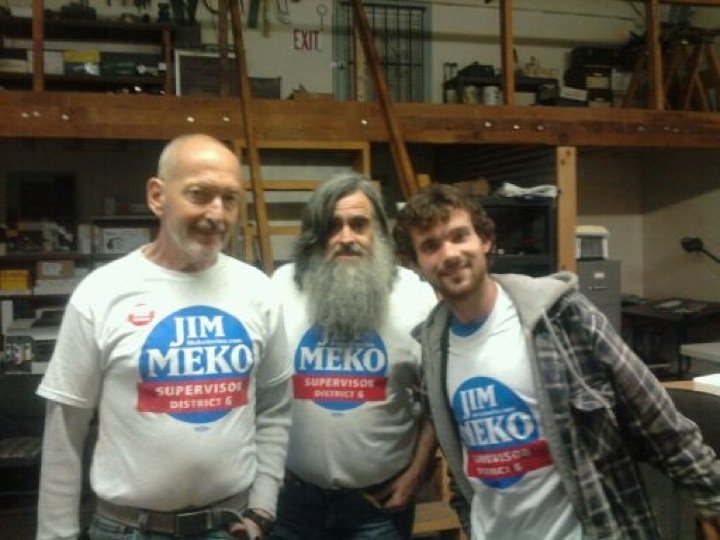
D6 candidate Jim Meko was with campaign volunteers Jake Dues and Anthony Faber at his print shop on 10th Street near the end of the night on Nov. 2.

Meko and the others had ordered pizza, and a couple cans of Bud Light were out on the table. It was a quiet scene, since it was clear that he wasn’t one of the front-runners. Meko seemed disappointed by his loss, but kept a positive attitude.

“Unlike other losing candidates,” he said, “I’m not going anywhere. So I won’t be dwelling on what I could have done to win, but what I can do next for the district.”

He mentioned his involvement with the SoMa leadership council and Western SoMa community plan, which he has been involved with for years.

Election 2010: A last sit on Haight Street

77

I guess sit-lie supporters don’t party that late. I arrived at Hobson’s Choice, the Haight Street election party central for Civil Sidewalks at 11:30 p.m. only to find the triumphant contingent long gone. “Oh yeah, the last couple guys just left,” the bartender tells me. “There was a ton of people here.”

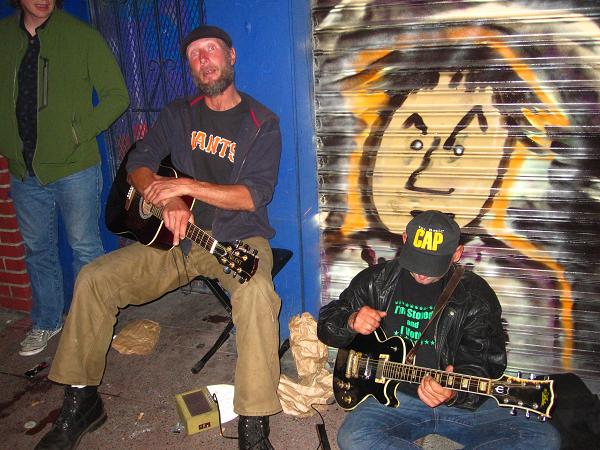
Not heading home any time soon, however, was Scott Free, who was sitting on a chair strumming a guitar down the block from Hobson’s contemplating the downfall of Prop. 19. Free’s been living “outdoors” for the past two years and has lived in the Haight for eight. He’s pretty sure the passage of Prop L is just a sign of a change that’s been long coming in the neighborhood. “Yeah, sit-lie will change things — but then, I didn’t think they’d be giving smoking tickets in Golden Gate Park. I came to San Francisco from Santa Clara County for the music and the tolerance.”

Hard to believe that voters in SF just passed a measure that will effectively ban Free and friends’ joyful noise. 

Their buddy is prone on the sidewalk besides him — drinking away the night that made homelessness illegal and made sure pot remained the same? “He’s real upset about it all,” Free tells me “he’s a big time sitter and liar.” 

Election 2010: Debra Walker holds out

1

San Francisco Democrats milled about the Great American Music Hall, where a screen displaying election results was the centerpiece of the room. D6 candidate Debra Walker was thanking campaign volunteers and hugging supporters when we caught up with her.

But with Jane Kim ahead in the race, the celebration was somewhat subdued in her corner of the room.

Still, Walker was hopeful. “Now I think it’s going to be about the distribution of second choice votes,” she told us. “It’s going to be a nailbiter. In fact, I’m pretty confident about it. I’m really hopeful that we’ll gain the votes we need.”


Election 2010: Progressives keep D6 seat

14

While the outcome of the D6 supervisorial race won’t be known until all the ranked choice ballots get counted, it is clear that the seat will stay with the progressives as Jane Kim and Debra Walker vie to see how many voters liked them second best. And that was good enough news for Board President David Chiu.
“Given where Debra and Jane are, I’m glad that we’re going to keep this a progressive seat,” Chiu, a Kim supporter, told us at their election night party in the new club Public Works, which is right next to Kim’s Mission Street campaign headquarters.
The latest results show Kim with 3,780 votes (31.3 %), Walker with 3,337 votes (27.7%), and downtown-backed Theresa Sparks with 1,985 votes (16.5%), and the rest divided among 11 other candidates.
“I feel good,” Kim told the Guardian, although she seemed a little weary from running a strong campaign, noting that they had 400 volunteers on the street today, most of them wearing the bright red T-shirts that read “See Jane Run” on the back. “What I’m really happy about is we ran a really good campaign.”
Kim supporters on hand included Sup. John Avalos, transit activist Dave Snyder, progressive activists Julian Davis and Sunny Angulo, Chiu board aides Judson True and Cat Rauschuber, and a large group of young Asian-American activists.
“I really want to encourage people to get to get to know each other,” Kim told the crowd. “We live in a big city and a really diverse district.”

Election 2010: Loose crowd, few conclusions at the Labor-Dems party

1

SF Democratic Party chairperson Aaron Peskin made it to the Labor Council-Democratic Party soiree at the Great American Music Hall a little late. Of course, he didn’t miss much yet. Ask him how things are going tonight and he says “I’ll tell you on Friday.”

It’s a somewhat anti-climatic election night for followers of the tightly contested supervisoral races. Peskin told us he doubts that the close calls will be settled until later this week.

But the tardy tidings hardly seem to be stopping the party at GAMH. An abrasive little man who has unfortunately gotten his hands on a video camera shouts over the crowd at Peskin as he makes his way through the throngs. “You gonna pretend like you didn’t see me? You bitch!” Debra Walker, a candidate in the race for District 6, enters to a smattering of applause around 10:30 p.m. Drinks all around.

Election 2010: The Cohen party

0

By Shawn Gaynor


Malia Cohen, her campaign staff and enthusiastic supporters gathered at Poquito’s on Third street anxiously awaiting election results. “It feels good to be the underdog,” said a grinning Cohen.


In a crowded district 10 field Cohen says, “she is the most prepared to work with all of the district’s people, district 10 is not monolithic it is not simply an African American community.”


“I am going to go where the people are and speak with people in their places of comfort they have ideas, creditable policy ideas. The people know how to solve our problems.”


 When asked what the district’s most pressing problem is, Cohen said: “it is an issue she saw highlighted on the campaign trail. We had a campaign BBQ up on third street and it really showed how profound the need is. We have to be addressing  food issues better in our community.” Cohen placed an importance on attracting new business including tourism to the district. “I see some real gems in district 10 and we need to  help polish those gems.”

Election 2010: The Prozan party

0

Amid a packed bar of Giants fans and political supporters, Rebecca Prozan was greeted with fervent clapping and shouts. Whether or not she wins tonight, her supporters and fans still believe strongly in her and her campaign. Her supporters even sported paper hats with Prozan’s face.


“My base and my supporters is the people I’ve met on Muni or worked with at the mayor’s office, or at the dog park.” She said, excitedly shaking hands, posing for pictures and greeting the crowd.


Her supporters were upbeat about the election results based on her politics and ideals.” It’s easy to read the paper and have thoughts but harder to take action,” Asit Panwala, one of the election canvassers said. “I see her willingness to help people and how she engages with the public.”


Election 2010: D6 comes down to Sparks

1

Here’s what’s going to make the D6 race so interesting as RCV plays out: The second-place votes of all the minor candidates won’t be enough to put either Walker or Kim over the top. The final decision about which progressive will be supervisor is going to come down to the second-place votes of a candidate who was seen by progressives as the one to beat: Theresa Sparks. Who were the Sparks voters — and how will they allote their second-place votes? I don’t think anyone knows for sure — but that’s what will determine the next D6 supervisor.

Election 2010: Just about final in SF

5

We won’t know who the new supervisors are for several more days — and the near-final reslts show a much closer race in D 8 than  I thought a few minutes ago. Scott Wiener is still in the lead, but Rafael Mandelman is within 1,000 votes, and Rebecca Prozan in third has 3,500 votes. The Prozan votes would have to split overwhlemingly for Mandelman, but it’s possible.


But we do know this: Theresa Sparks, the candidate with the downtown and real-estate money, is not going to win in District 6. Steve Moss, who had all the big-money support, isn’t going to win either. (And he’s acting like a sorehead: His staff just kicked our reporter out of his party.) 


The School Board reace appears to have gone the way the Guardian recommended: Hydra Mendoza, Margaret Brodkin, and Kim-Shree Maufas look to be the top three.

Film Listings

0

Film listings are edited by Cheryl Eddy. Reviewers are Kimberly Chun, Michelle Devereaux, Peter Galvin, Max Goldberg, Dennis Harvey, Johnny Ray Huston, Louis Peitzman, Lynn Rapoport, Ben Richardson, and Matt Sussman. The film intern is Ryan Prendiville. For rep house showtimes, see Rep Clock. For first-run showtimes, see Movie Guide at www.sfbg.com. For complete film listings, see www.sfbg.com.

OPENING

The Blue Tower Smita Bhide’s debut film, The Blue Tower, part of the 3rd I South Asian International Film Fest, begins with Mohan (Abhin Galeya) in the sort of loveless marriage that has become a standard cliché. It’s unnecessary to give any reason why the relationship is failing; as a viewer I accept it just as easily as I realize that with the introduction of Judy (Alice O’Connell), a young white nurse working for Mohan’s overbearing Auntie, Mohan will have an affair. However, this predictable fare, like a straight version of My Beautiful Laundrette (1985), takes a dark turn about halfway through, as every character and plot point emerges as more nefarious and twisted than originally imagined, and Mohan finds himself in a situation full of Lynchian perversion and Kafkaesque disorientation. The boldness and speed at which developments occur shifts the deadpan, suburban drama into a black-humored, grotesque ride — the sort you half want to stop, and you half want to see where it’s going. (1:25) Castro. (Prendiville)

*Brutal Beauty: Tales of the Rose City Rollers Focusing on Portland-based league Rose City Rollers, Chip Mabry’s Brutal Beauty offers some insights into the recent roller derby revival. The documentary follows the league travel team’s attempt to make it to Nationals over the course of the 2009 season. Ultimately though, the narrative really isn’t all that exciting (spoiler alert: they don’t make it very far). The real heart of the movie lies in the backgrounds and interviews of the tatted-up, foul-mouthed, dyed-haired derby girls from teams like the Break Neck Betties and Guns ‘N’ Rollers. Their personalities and stories of how derby helped shatter their ideas of self-expression and traditional gender norms helps keep the majority of the film’s 80-minute running time interesting, even when the action is not. (1:20) Red Vic. (Landon Moblad)

Butte, America: The Saga of a Hard Rock Mining Town This documentary follows the life and death of a great American mining town, following Butte, Montana’s rise as a mining town through to its inevitable environmental collapse. Once home to one of the world’s largest (and most dangerous) copper mines, Butte saw an influx of immigrants drawn to “the richest hill on earth.” Its story is definitely rich in terms of subject matter, particularly with the town’s role in the labor struggle; it could easily be the background for great early 20th century stories (as is the case with Atlantic City in HBO’s current Boardwalk Empire). But Butte, America is decidedly not cinematic, despite the voice-over narration by Gabriel Byrne, and is better suited to PBS than the big screen. (1:06) Victoria. (Prendiville)

Carlos Carlos, Olivier Assayas’s biopic of Ilich Ramírez Sánchez, a.k.a. Carlos the Jackal, begins with a warning, that while the film is the subject of historical and journalistic research, “relations with other characters have been fictionalized.” In other words: there be contradictions ahead. But I suppose that’s the least you can expect when you’re watching a 330 minute theatrical miniseries that gives the rock ‘n’ roll biopic treatment to a terrorist who, under an alias, professes “the pleasure of doing one’s duty in silence.” Much of this is intentional, questioning the convictions of extremists. One particularly well-shot scene involves Carlos (Édgar Ramírez) sexually dominating a cell member, only moments after she admits to being a German feminist. After about four hours, though, the intellectual irony begins to feel more like a filmmaker attempting to cover his bases. Carlos is an idealist, but also a sellout. An egalitarian revolutionary, but also a sexist bigot. (And so vain.) Still, the film, full of actors speaking a bevy of languages and propelled by a international punk rock soundtrack, manages to be engaging. Keep in mind, though, that the miniseries was originally aired in three parts, and viewing Carlos in one sitting should be left to the cinemasochists. (5:30) Sundance Kabuki. (Prendiville)

Due Date Robert Downey Jr. and Zach Galifianakis star in this Todd Phillips-directed road trip movie. (1:35) Four Star, Presidio, Shattuck, Sundance Kabuki.

*Fair Game Doug Liman’s film effectively dramatizes yet another disgraceful chapter from the last Presidential administration: how CIA agent Valerie Plame (Naomi Watts), who’d headed the Joint Task Force on Iraq investigating whether Saddam Hussein had WMDs, was identified by name in the Washington Post as a covert agent — thus ending her intelligence career and placing many of her subordinates and sources around the world in danger. This info was leaked to the press, it turned out, by highest-level White House officials as “punishment” for the New York Times editorial former ambassador Joe Wilson (Sean Penn) — Plame’s husband — wrote condemning their insistence on those WMDs to justify the Iraq invasion by then already well in progress. (The CIA task force had also found zero evidence of mass-destruction weapons, but Bush and co. chose to come up with their own bogus “facts” to sway US public opinion.) Purportedly, Karl Rove clucked to CNN’s Chris Matthews that Wilson’s awkwardly-timed dose of sobering truth rendered his spouse “fair game” for exposure. Unfortunately opening here several days after it might theoretically have done some election-day good — not that many Republican voters would likely be queuing up — Fair Game may be a familiar story to many. But its gist and details remain quite enough to make the blood boil. While the political aspects are expertly handled in thriller terms, the personal ones are a tad less successful. That’s partly because we never quite glimpse what brought these two very busy, business-first people together; but largely, alas, because so many of Wilson’s diatribes come off all too much as things that might be said by Sean Penn, Rabble-Rouser and Humanitarian. This is perhaps a case of casting so perfect it becomes a distracting fault. (1:46) Embarcadero, Sundance Kabuki. (Harvey)

For Colored Girls Sprinkling many tears and Janet Jackson’s blue steel throughout his high-camp, muy melodramatic adaptation of Ntzoke Shange’s For Colored Girls Who Have Considered Suicide When the Rainbow Is Enuf, Tyler Perry deserves at least an E for effort in attempting to bring Shange’s choreopoem masterpiece to the screen. The result is a free-floating, somewhat tortured contemporary collection of vignettes centered on a clutch of African American women residing in an Harlem apartment building — a structure that remotely evokes an early Wong Kar-Wai omnibus like Days of Being Wild (1991), sans the narrative ambiguity and sublime cinematography — with its “colored girls,” each representing a hue in Shange’s rainbow, occasionally pouring out the poet’s original verse. Crystal (Kimberly Elise) appears to have it the hardest, burdened with an abusive baby daddy (Michael Ealy), a veteran dealing with Post Traumatic Stress Disorder. Dance teacher Yasmine (Anika Noni Rose) is the beacon of positivity who finds her trust horribly betrayed. Tangie (Thandie Newton) is the saucy slut, baby sister Nyla (Tessa Thompson) is the good girl with a secret, and their mother Alice (Whoopi Goldberg) is the building’s extremely annoying holy roller. Overseeing all is the apartments’ de facto matriarch Gilda (Phylicia Rashad), safe sex activist Juanita (Loretta Devine), and social worker Kelly (Kerry Washington). Oh, yes, and there’s Miss Jackson, who plays the leather-tough, magazine-editing devil wearing Prada, and spends most of her time looking wrecked about possibly ruining her makeup with an actual facial expression. Yes, they will survive, hey, hey, and though Perry may not have been the best moviemaker to adapt Shange’s groundbreaking work, a few of his players, particularly Newton and Elise, rise above the rainbow with wrenching, scene-stealing performances. (2:00) (Chun)

Honest Man: The Life of R. Budd Dwyer Everyone of a certain age or with morbid curiosities has heard of R. Budd Dwyer, thanks to the very public way he died — by committing suicide at a televised-live press conference. The 1987 footage, of a portly middle-aged man with anguish in his eyes and a finger on the trigger, has been recycled in a number of contexts; thanks to the internet, it’s now freely viewable for shock value more than anything else (the incident created a controversy as to how much should be shown during news replays — when Dwyer takes out the gun? When he sticks it in his mouth?) Along the way, who Dwyer was, and why he shot himself, have kind of been lost by the general public. However, as director James Dirschberger discovers, the Pennsylvania politician’s widow, children, colleagues, and even the man whose testimony lead to a conviction in Dwyer’s corruption trial have never forgotten him. Honest Man suggests that Dwyer was actually innocent, but decided in despair to end his life before he’d been removed from office, thus allowing his family to collect full benefits. The full story will probably never be known, but Honest Man‘s attempts to show the man behind the gruesome film clip are sincere, if couched in the understanding that he’ll always be first associated with his infamous, well-documented death. (1:16) Red Vic. (Eddy)

*Megamind Be careful what you wish for, especially if you’re a blue meanie with a Conehead noggin and a knack for mispronunciation and mayhem. Holding up hilariously against such animated efforts as The Incredibles (2004) and Monsters, Inc. (2001), Megamind uses that nugget of wisdom as its narrative springboard and takes off where most superhero-vs.-supervillain yarns end: the feud between baddie Megamind (voiced by Will Farrell) and goody-two-shoes Metro Man (Brad Pitt) goes waaay back, to the ankle-biter years. They’ve battled so often over intrepid girl reporter Roxanne Ritchi (Tina Fay) that she’s beyond bored by every nefarious torture device and disco crocodile the Blue Man throws at her. When Mega finally, unexpectedly vanquishes his foe, he finds himself with a bad case of the blues. With the help of his loyal Minion (David Cross), he decides to change the game and create his own worthy opponent, who just happens to be Roxanne’s schlubby cameraman (Jonah Hill). Chortles ensue, thanks to the sarcastic sass emanating from the Will and Tina show, although the 3-D effects seem beside the point. The resemblance to this year’s Despicable Me is more than a little passing, from the bad guy on the moral turnaround to the adorable underlings, but Megamind‘s smart satire of comic hero conventions, its voice actor’s right-on riffs, and the rock and pop licks on the soundtrack make it the nice and nasty winner. (1:36) Presidio, Sundance Kabuki. (Chun)

*Monsters After a NASA space pod bearing samples of extraterrestrial life crashes in northern Mexico, a large swath of the now massively walled-off U.S. border area becomes an “Infected Zone,” with frequent unpleasant contact between humans and giant octopus-like creatures. Photographer Andrew (Scoot McNairy) is reluctantly charged with delivering his publisher’s daughter Sam (Whitney Able) to safety. Unfortunately, things do not go as planned. The duo find themselves making a dangerous journey northward straight through the Zone, right at the start of an annual “migration season” that always makes the critters especially ornery. Just as 2009’s District 9 commented obliquely on Apartheid, Gareth Edwards’ feature similarly riffs on our own illegal-alien debate. But there’s no need to look for deep meanings here. Taken as a slow build (sometimes a little too slow) toward the inevitable perils, Monsters is a successfully low-key, lower-budget spin on aspects of The War of the Worlds, Cloverfield (2008), The Mist (2007), etc. Those looking for lots of graphic horror-fantasy content may be frustrated, but on its own terms the film is creepy and credible enough. (1:33) California, Lumiere. (Harvey)

*36 Quai des Orfèvres It’s taken six years for this major French policier to get a proper U.S. release, which is a little strange considering its genre appeal and lack of conflict with an English-language remake (Martin Campbell, director of 2006’s Casino Royal, might make one within the next couple years). Leaving for another post, Paris’ Chief of Police (Andre Dussolier) wants to wrap things up tidily before he goes, and that means nailing the violent gang that’s been robbing armored trucks and killing their guards. Though he’d prefer his post be inherited by the honorable Leo Vrinks (Daniel Auteil) rather than the latter’s ex-friend, shamelessly ambitious and underhanded Denis Klein (Gerard Depardieu), internal politics necessitate he give it to whichever man and his team end this crime spree. When a con (Roschdy Zem) gives Vrinks a tip — albeit under seriously compromising, blackmail-ready circumstances — it seems the murderous gang will be caught under his supervision. Drunk and raging with envy, Klein pulls a stunt that has catastrophic consequences. Yet a chance windfall allows him to turn things to his advantage, and greatly against Vrinks. To a point the story is very loosely inspired by events that actually occurred in the mid-1980s, when director-writer Olivier Marchal was a Parisian cop. His script (penned in collaboration with three others) is intricate and dramatic, with some startling twists of fate; the casting, which includes a number of other leading French actors, is impeccable. 36 has been called a Gallic Heat — though it lacks the visually and thematically epic, larger-than-life qualities Michael Mann provided that film. Which leaves it a very good story competently executed, but not the great movie it could have been. (1:51) Roxie. (Harvey)

Tibet in Song It’s often a bad sign when directors are subjects in their own documentaries. With Tibet in Song, Ngawang Choephel has good cause to disprove this theory. In 1995, he returned to Tibet for the first time since fleeing with his mother as a child. An ethnomusicologist and Fulbright scholar, he wanted to record traditional Tibetan music. Instead he was arrested, lost half his footage, and charged with spying, eventually serving six years in jail. Tibet in Song is the completion of his original project, and although the director does give due attention to the circumstances of his own story, it’s always within the larger context of the music, as a culture is being held captive by Chinese pop and propaganda. As Choephel argues that the traditional Tibetan music has been manipulated to change the country’s identity generation by generation, we don’t just hear the music, but understand what it means. (1:26) Lumiere, Shattuck. (Prendiville)

ONGOING

Cairo Time (1:29) Opera Plaza.

Conviction (1:47) Empire, Piedmont, SF Center.

*Easy A (1:30) Shattuck.

Enter the Void (2:17) Lumiere.

*The Girl Who Kicked the Hornet’s Nest If you enjoyed the first two films in the Millennium trilogy — 2009’sThe Girl With the Dragon Tattoo and The Girl Who Played With Fire — there’s a good chance you’ll also like The Girl Who Kicked the Hornet’s Nest. Based on the final book in Stieg Larsson’s series, the film begins shortly after the violent events at the conclusion of the second movie. There are brief flashes of what happened — the cinematic equivalent of TV’s “previously on&ldots;” — but it’s likely an indecipherable jumble to Girl first-timers. Hornet’s Nest presents the trial of Lisbeth Salander (Noomi Rapace), the much-abused, much-misunderstood, entirely kick-ass protagonist of the series. With the help of journalist Mikael Blomkvist (Michael Nyqvist) and his sister Annika (Annika Hallin) as her lawyer, Lisbeth finally gets her day in court. The conspiracy that drives the story is somewhat convoluted, and while it all comes together in the end, Hornet’s Nest isn’t an easy film to digest. Still, it’s a well-made and satisfying conclusion to the trilogy — as long as you caught the beginning and middle, too. (2:28) Bridge, Embarcadero, Piedmont, Shattuck, Smith Rafael. (Peitzman)

Hereafter (2:09) Empire, Marina, 1000 Van Ness, SF Center, Shattuck, Sundance Kabuki.

Inside Job (2:00) Embarcadero, Shattuck, Sundance Kabuki.

It’s Kind of a Funny Story (1:51) 1000 Van Ness, Shattuck.

*Jackass 3D (1:30) 1000 Van Ness.

*The Kids Are All Right (1:47) Red Vic.

*Leaving Few beauties — French, English, French-English, or otherwise — have managed the transformation Kristin Scott Thomas has, in using her considerable beauty to convey unfathomable hunger. In this romantic thriller with a touch of Madame Bovary and more than a dab of noir, Scott Thomas is Suzanne, the efficient if somewhat taken-for-granted wife of a doctor (Yvan Attal, director of 2001’s My Wife Is an Actress and Charlotte Gainsbourg’s partner), whose marriage resembles a business arrangement more than a love match. The couple enlist Catalan ex-con Ivan (Sergi Lopez) to build an office for her budding physical therapy practice, and after a minor car accident, Ivan falls into Suzanne’s care, and as she grows to care more deeply about him, an affair begins. Director Catherine Corsini’s tough-eyed look at what follows — concerning the economics of marriage and the price of one woman’s individuation and passionate choices — calls to mind women’s melodramas of the ’40s and ’50s, though Corsini renders her oft-told tale of awakening with considerably less heavy-handedness and minimal condescension. That approach and Scott Thomas’ performance — the movie almost turns on the motionless, slowly evolving look in Suzanne’s eyes when she realizes what she must do — makes Leaving a departure from your average coming-of-liberation romance. (1:30) Albany, Clay. (Chun)

Let Me In (1:55) Four Star.

Life as We Know It (1:52) 1000 Van Ness.

*Mademoiselle Chambon (1:41) Opera Plaza.

My Dog Tulip (1:22) Smith Rafael.

Never Let Me Go (1:43) Four Star, Lumiere.

*Nowhere Boy (1:37) Opera Plaza, Shattuck.

Paranormal Activity 2 (1:45) California, 1000 Van Ness.

Red (1:51) 1000 Van Ness, SF Center, Sundance Kabuki.

Saw 3D (1:31) 1000 Van Ness.

*Secretariat (1:56) 1000 Van Ness, SF Center.

*The Social Network (2:00) Empire, Marina, 1000 Van Ness, Sundance Kabuki.

Stone (1:45) Opera Plaza.

The Town (2:10) 1000 Van Ness, Presidio, SF Center, Shattuck.

*Waiting for “Superman” (1:51) Piedmont, SF Center, Shattuck.

Wall Street: Money Never Sleeps (2:13) Presidio.

You Will Meet a Tall Dark Stranger (1:38) Albany, Opera Plaza, Presidio.

Election 2010: More SF results, closer and closer races

9

We now have 70 percent of the precincts reporting, and some of the supervisor races are still awy, way too close to call. Janet Reilly and political neophyte Mark Farrell are going to finish within a few percentage points — and Distrct 2 will come down to where the votes for Abraham Simmons, also a neophyte but in third place, wind up. In D 6, Jane Kim is about 600 votes ahead of Debra Walker, with Theresa Sparks well behind them; one of the two progressives will get this seat. Kim is in a strong position, but again: It all depends on the second- and third-place votes. James Keys, who had the endorsement of Chris Daly (and who Daly insisted to us was a serious candidate) has only 430 votes, or about 5 percent.


In D10, Tony Kelly, who had far less money than some other candidates, remains in the lead. Malia Cohen and Lynette Sweet are close behind, and Steve Moss, despite big money, is a distant 4th.


Scott Wiener is well ahead in D8, with 44 percent of the vote, and I’d say that one’s about over.

Election 2010: Wiener confident in D8, but Mandelman not giving up

5

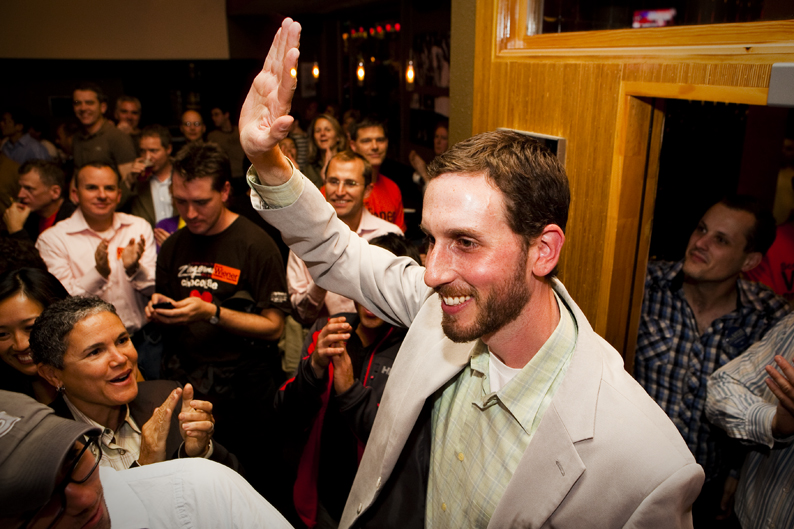
The mood was buoyant in Harvey’s bar in the Castro, where D8 supervisorial candidate Scott Wiener had 54 percent of the vote in early returns when he arrived around 9:30 pm. His lead over progressive candidate Rafael Mandelman has narrowed since then (45-33 percent at last count), and that campaign was still hopeful at its party at Pilsner Inn on Church Street.
“The question is does it get tight enough that the number two votes make a difference,” Mandelman told the Guardian, referring to the ranked choice election and showing hope that many of Rebecca Prozan’s second choice votes would go to him. Mandelman noted that his campaign had a solid volunteer effort and good turnout in the district. “We think it’s going to be closer than in looks right now.”
But Wiener expressed confidence that he will prevail. “I feel really good about it,” he told the Guardian. The race was fairly cordial among the candidates, but Wiener got hit pretty hard by mailers from labor and tenant groups attacking him as hostile to progressive priorities.
“It got negative toward the end, and I think that’s unfortunate, but that’s modern politics and the truth prevailed,” said Wiener, who has argued that his record of votes on tenant issue while serving on the DCCC was better that it was represented in this election. In fact, even some progressives think Wiener might be a better vote on tenant issues than incumbent Bevan Dufty, who was consistently a swing vote against tenant protection legislation.
In fact, Wiener campaign manager Adam Taylor, who is a renter, told us that he wouldn’t have worked on the campaign if he didn’t believe Wiener would stand up for renters’ rights. “We expected certain falsehoods to count out and they did,” said Taylor, who was running his first campaign in San Francisco. “I’m proud of how we kept our head held high.”

Election 2010: Theresa Sparks supporters await results

District 6 candidate Theresa Sparks showed up fashionably late for her own election night gathering at Don Ramon’s Mexican restaurant in the South of Market neighborhood. Election results are still coming in, and she told the crowd, “We’ll just watch it together and see what happens.” Early results show Jane Kim as the favored candidate in the district so far, but as everyone here seems to be telling one another, “it’s going to be a long night.”

Rob Black of the San Francisco Chamber of Commerce was in attendance, as well as Francis Tsang, who works in Mayor Gavin Newsom’s press office. 

Katra Briel said she had known Sparks for years, and was one of the first to volunteer for her campaign. Being out on the streets and talking to voters about the election was “really enlightening,” she said, but “sometimes the things reminded me of the 7th grade — it seemed like more of a popularity contest than being about the issues.” Briel said she sees Sparks as “the kind of person we need in government.”

John Zowine, another campaign volunteer, said he was inspired to do phone banking for Sparks after a five-year stretch without being involved in any campaigns. “I was really impressed with her,” he said. Asked how he was feeling about the outcome of the race, Zowine said, “I would think that with all those endorsements, and Gavin’s support, she should do really well.”


Election 2010: The Jackson party

0

By Shawn Gaynor

Surrounded by a youthful, diverse, and dedicated volunteer campaign staff, Chris Jackson enthusiastically awaits election results in San Francisco’s district 10.

Nobody here has slept in 24 hours as the campaign pushed for a final get out the vote drive. “Whatever happens, we’ve changed the discussion of this district’s selection, from the focus on middle class issues to a focus on working class issues,” Jackson said. “Our industry is being replaced in District 10 with parking lots and condos. The city needs land trusts to keep foreclosures from destroying neighborhoods.”

He added: “You can’t have high employment in your community if your community reads at a 7th grade level. Win or lose, we are here to stay in the neighborhood and build community. I hope after this election we figure out how to have a united progressive family again, that’s what we need to move forward.”

Election 2010: The Lacy party

0

Outside of Bloom’s Saloon, there’s a silver taco truck with a black and orange Dewitt Lacy sign stuck on the back. “Eat It” by Weird Al is blasting from inside the Saloon and as I timidly follow the noise Lacy himself turns around and gives me a wave.

I instantly feel right at home sipping my ice water while Lacy tells me about his campaign team and their accomplishments. “A lot of us put a lot of hard work into the campaign,” Lacy says.

We talked about the day he met President Obama and how his abilty to keep his cool completely vanished upon shaking the president’s hand. But personal anecdotes aside, Lacy is definitely serious about representing his district.

 “Some people have pegged this race as the Heart and Soul of San Francisco,” Lacy explained. “For far too long this district has been left out or overlooked and it’s time for that to stop.”

And while this particular race may not produce all results immediately — it will be decided by ranked-choice votes later in the week —  Lacy seems relaxed and relieved to be enjoying tacos, tequila, and cherry delight with friends, family and supporters.

When asked if most election parties are this chill, Lacy simply replies, “We are the people man.”

Election 2010: More results, some dramatic changes

0

Wow, are things changing fast. The newest numbers — almost 30 percent of the vote — show D2 very, very tight. I thought janet Reilly would win this one, but it’s a squeaker. The D6 race is getting closer too — Debra Walker is closing in on Jane Kim, but it looks at this point as if a progressive will hold that seat. And in D10, Tony Kelly has taken the lead — and Steve Moss, the beneficiary of big money, is in third place.