Education

Black Power, then and now

17

“We’re not ever to be caught up in the intellectual masturbation of the question of Black Power. That’s a function of people who are advertisers that call themselves reporters.”

That’s how the radical student and civil rights leader Stokely Carmichael opened a speech about Black Power — a term he helped popularize — at UC Berkeley in 1966. But the ideas and concepts behind Black Power proved to be an enduring ones that are enjoying a resurgence today.

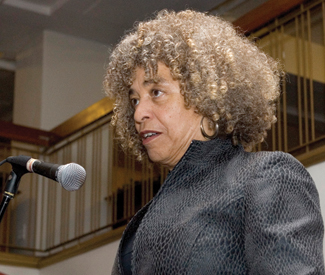
Angela Davis epitomized the Black Power movement to many observers. The author, scholar, and professor was a Black Panther Party member who then joined the Communist Party USA and brought a class analysis to issues of race, building on the movement that began in the ’60s for decades to come.

In recent months, as the Occupy Wall Street movement began to focus the country’s attention on economic and social inequities, Davis has spoken out regularly in support of the movement and drawn connections back to her early activism. She has embraced the “99 percent” paradigm, and the connections between various issues that Occupy activists have sought to highlight.

“Our demands for justice lead us toward demands for prison abolition. And our demands for prison abolition lead us to demands for free, quality education. And our demands for free quality healthcare, and housing, and an end to racism, an end to sexism, an end to homophobia,” Davis said March 1 in Oakland at a benefit for Occupy 4 Prisoners, a coalition of Occupy protesters and prison justice advocates.

Consciousness surrounding those connections can be largely attributed to efforts from Black Power organizers.

“When I listen to the way young people so easily talk about the connectedness of race, gender, and sexual issues, and I remember how we groped our way towards an understanding of those connections, it makes me really proud,” Davis said in a January interview with Independent Lens.

And as Davis said at the March 1 event: “One of the most exciting accomplishments of the Occupy movement has been to force us to engage in conversation, explicit conversation about capitalism, for the first time since the 1930s.”

The movement’s economic message also seemed useful to Kiilu Nyasha, a San Francisco-based journalist and former member of the New Haven Black Panther Party.

“Globalization has already happened. It’s not happening, it’s happened. One percent, internationally, owns and controls 80 percent of the world’s resources. People are dying all over the world of every complexion which you can think of” Nyahsa said March 14 at a panel discussion called Reboot the Rainbow.

The original Rainbow Coalition- the topic of the March 14 panel- included the Black Panther Party, the Puerto Rican Young Lords, and the poor white Young Patriots organization, and was committed to a Black Power concept: organize your own, fight together. Building coalition is more important now than ever.

“It’s not Black Power right now,” says Terry Collins, president of KPOO radio, a black-owned station long focused on community empowerment. “It’s people power. It’s power unto the people who are in need: all the people out there who are out of their homes, students who owe so much that they’re like indentured servants.”

Occupy the Hood is a national effort to encourage participation of people of color in Occupy Wall Street. In its mission statement the group writes, “It is imperative that the voice of people of color is heard at this moment!”

The focus of San Francisco’s Occupy the Hood chapter is “three-fold,” according to organizer Mesha Irizarry: “The cop-watching in neighborhoods that are criminalized, especially poor neighborhood of color. It’s freedom fighters against foreclosures. It’s also bank transfers.”

Occupy the Hood showed up March 16, when a group known as the Foreclosure Fighters- organized and supported Alliance of Californians for Community Empowerment, Homes Not Jails, and related groups—occupied their latest foreclosed home. “We’re liberating this house. We’re taking it out of the hands of the oppressor,” said Archbishop Franzo King of the African Orthodox Church.

“Jesus Christ was an uncompromising revolutionary. He spoke truth to power. Then they killed him for it,” added King in a nod to the radical religious leaders who have influenced liberation movements throughout the years.

Black Power was concerned with self-determination, with organizing within community. That legacy is still strong as San Francisco’s African American communities experience an out-migration and continuing police harassment and violence.

“Black sailors and black army personnel built the shipyard,” said Jameel Patterson, a founder of the Bayview-Hunters Point-based community organization Black Star Liner Incorporated. “Hunters Point, West Point, Harbor Road—they’re all military names. The soldiers stayed there with their families. The area has a rich African American legacy going back to the ’40s. Now it’s fading…we want to make sure that community’s still here 20 years from now.”

Patterson remembers being a child in the ’70s when, on the tail of an era brimming with black liberation efforts. “There were more community events,” he said, but now, “People don’t have connections with each other. That’s what we’re building.”

The group does regular events where they serve free home-cooked meals to residents, reminiscent of the Black Panther Party’s free breakfast program. “With every plate, you get information,” often Know Your Rights reminders for encounters with police, said Tracey Bell-Borden of Black Star Liner.

They have also spent countless hours in City Hall meetings advocating for their community and reporting back on city policies that affect it. “We occupy the Police Commission meeting,” said Bell-Borden.

Police are a central and tricky question for the Black Power movement of the ’60s, as well as organizing efforts today. Black Panther Party members spent years serving free breakfast to children, writing and selling newspapers, and even running election campaigns, but they are often remembered for carrying guns and efforts to “police the police.” So many leaders were arrested that energy that could have gone into feeding or education was often channeled into freeing prisoners.

“I was in the second chapter of the Black Panther Party,” Nyasha said at the March 14 event, “which basically existed to get the first chapter out of jail.”

Recent police crackdowns have fed indignation not just about policing protesters, but about the role police play in poor communities of color. “One thing Occupy has done is address the issue of policing in communities of color, to the extent that some aftermath of what we’re seeing at Occupy is shedding light on how police can sometimes treat people,” said Kimberley Thomas Rapp, executive director of the Lawyers’ Committee for Civil Rights of the Bay Area.

“In black neighborhoods, police should be community partners, not come in and exert more force than necessary. And at protests, they should be there to ensure safety, not just to arrest people unnecessarily or use excessive force,” Rapp said.

Police crackdowns on Occupy are the first exposure many white protesters of the younger generation have had to excessive police force, an issue that was central to the story of the Black Power. Sadly, for many black and other protesters of color, excessive police force is nothing new.

“It’s absolutely the case that police brutality shown towards many Occupy protesters has brought to the forefront the issue of police violence and led to an awakening among many white folks of the day to day reality of police violence that many people of color have lived with now for many years,” Michelle Alexander, author of The New Jim Crow, told the Guardian.

Enraged at police beatings (see “OPD spies on and beats protesters,” Feb. 14) both Occupy Oakland and Occupy San Francisco have held “fuck the police” marches. March 18, after a six-month commemoration celebration brought 3,000 to Zuccotti Park in New York City, followed by 200 arrests and rampant police violence, Occupy Wall Street protesters followed suit, holding their first anti-police brutality march.

Occupy Wall Street has reanimated concepts that burned through the ’60s, such as violence vs. nonviolence, the systemic causes of personal economic woes, and the peoples’ relationship to police. With the consciousness created by Black Power activists, today’s organizers have a foundation on which to build their own answers to these questions, across issues and generations.

National Occupy the Hood has called for action concerning Trayvon Martin, the unarmed black 17-year-old who was shot Feb. 26 and whose confessed killer has yet to be arrested. Taking up high-profile cases of injustice and working more closely with organizers to respond to the needs of local African American communities could bring more power and truth to the rage for justice currently galvanizing a new generation.

“It’s about black re-empowerment,” Archbishop King said. “It’s like the torch, the light of freedom and justice, has actually gone out. And we’re trying to relight that. That’s why I’m so excited about the Occupy movement; it ties into the Black Power struggle. And I think it’s waking up some of us old revolutionaries to stand up.”


Alerts

0

THURSDAY 22

The longest war: Afghanistan beyond the Taliban

Two veteran journalists who have covered Afghanistan talk about the war that has surpassed Vietnam as the longest in US history. Masood Farivar, a former fighter in the Afghan anti-Soviet resistance before becoming a newswire in New York, then returning to Afghanistan in his capacity as journalist, and Tim McGirk a former Time magazine bureau chief in the region who has reported from Afghanistan since 1990, will have a conversation hosted by Jason Motlagh, a freelance journalist/filmmaker and former Time magazine correspondent in Kabul. A short documentary, Million Dollar Militia , will also be screened. What does a continued US presence—or, potentially, troops preparing to leave—mean for the country’s future? What political environment exists there?  Oakland-based production company Blackbeard Films launches a series that will highlight reporting on underreported stories with this event. 

7 p.m., free

Arbor Café

4210 Telegraph, Oakl.

www.blackbeardfilms.com 


SATURDAY 24

Wilderness first aid for the streets

In the saga of Occupy Oakland clashes with police, perhaps none are more unsung than the medics. These volunteers do everything from flushing eyes of tear gas to being first responders to protesters with broken limbs and gushing wounds. The medics team up for a training to others who want to do what they do. “Developed for wilderness situations, this course is adapted for urban uprisings, and will include care for chemical weapons exposure, herbal first aid, and public health considerations for long-term occupations,” according to the Occupy Oakland medics committee. This course is serious, covering two full days- March 24 and 25, 10am to 8pm. Red Cross certification and Continuing Education Units credits are available for $20, and scholarships are available.

10 a.m., donation suggested

The Holdout

2313 San Pablo, Oakl.

www.occupyoakland.org

WFAforthestreets@gmail.com 


St. Patricks Day Ceili

Did you make it through that special day without participating in a ceili, a traditional Irish social dance that is a hallmark of St. Patricks Day? If so, you’re in luck — you will be given a second chance. This dance is easily accessible for newbies and much more fun than cheap plastic green stuff and day-drinking. 

7 p.m., $10 (free for children)

United Irish Cultural Center 

2700 45th Ave., SF

www.irishcentersf.org  


MONDAY 26

Speaking youth to power

When it comes to climate change, young people know what’s up. Specifically such acclaimed young people as project coordinator for the urban farming non-profit Urban Tilth and Green For All Fellow Tania Pulido, Adarsha Shivakumar, founder of Project Jathropa, and Abigail Boroh, the student best known for interrupting the Durban, South Africa Climate Conference in December to bring urgency to the less than promising conference proceedings. Join them for a discussion on civic engagement within the climate justice movement. 

Doors 5:30, program 6pm, $20 (free for members and students)

Commonwealth Club

595 Market, SF

www.commonwealthclub.org


Blue Bear School of Music 40th Anniversary Celebebration

0

Blue Bear School of Music, the original school of rock and roll since 1971, is celebrating their 40th Anniversary with an incredible party featuring Jackie Greene plus special guests. Talented Blue Bear youth bands will jump-start this special evening with rocking performances. Proceeds support the school’s nonprofit mission and youth music programs, which serve more than 1,300 Bay Area kids – nearly half of them from low income families and under-served communities.

Please join Blue Bear for this exciting event, and help them to continue their 40-year legacy of bringing innovative and affordable music education programs to anyone, regardless of financial means, who is motivated to sing, play or craft a song. 

For tickets and more info, visit this link. To win a pair of tickets to this event, email sfbgpromos@sfbg.com and write “Blue Bear” in the subject. Leave your name and phone number — two winners will be chosen on Friday at 4pm.

Thursday, March 22 at 7pm @ Bimbo’s 365 Club, 1025 Columbus, SF


Millionaires Tax merger is a risk and opportunity

40

My first reaction to today’s news that the popular Millionaires Tax measure was merging with Gov. Jerry Brown’s broad-based tax measure was “What the fuck!?!?” Taxing millionaires had over two-thirds support in recent polls and seemed to clearly tap the tax-the-rich zeitgeist that animated and was amplified by the Occupy movement.

Now, it’s being married to a measure that increases the regressive sales tax and brings the income taxes increases down to those making $250,000 per year, possibly turning more self-interested voters against it. This just seemed to blow a golden opportunity to do the one simple thing that most Californians agree we need to do to address the state’s perpetual and deepening fiscal crisis: tax the rich.

But then I talked to Assembly member Tom Ammiano, someone with longstanding and unwavering progressive values, and he said, “It’s the art of the deal. It’s acceptable to me, not because it’s perfect.” While he’s not a fan of sales tax increases, he explained how it improves upon the Millionaires Tax in a couple key ways, and that is finally represents some new political cooperation after years of frustrating dysfunction in Sacramento.

“This is something we can build on,” Ammiano told me. “It’s a pretty good coming together.”

Clearly, there is value in creating a functional center-left coalition to counteract the inflexible conservatism that a shrinking minority of Republicans has used to mindlessly block all revenue measures, defund education, and plunge the state into a serious fiscal crisis. And it is good strategy  to reduce the number of competing tax measures on the ballot, and to broaden the coalition of supporters.  

But beyond those tactical benefits, the new measure is worth supporting on its merits. Ammiano notes that it actually raises more money than the Millionaires Tax (about $2 billion per year more) and frees up how that money can be spent (rather than limiting it solely to education).

“We raise more money over more years and we cut back his sales tax increase,” said Steve Hopcraft, a spokesperson for the campaign, noting that Brown’s proposed half-cent sales tax increase is now a quarter-cent increase and the measure now raises $3.3 billion per year from the top 2 percent of wage earners. “It’s a progressive measure that has almost a consensus now…It’s basically what we were proposing but with a quarter percent increase in the sales tax.”

And a expiration date that the Millionaires Tax didn’t have. But while the sales tax increase sunsets in four years, the income tax increases — which range from a 1 percent bump for $250,000 earners to 3 percent for those making more than $1 million — last for seven years.

So Brown’s measure, which had broad institutional support, gets better. And the Millionaires Tax — developed by the California Federation of Teachers and others and receiving strong popular support — gets watered down just a bit. I suppose that alright, if they can still make the ballot and win over voters in November.

That’s a big “if,” perhaps bigger today than it was yesterday. And if supporters of this measure blow this important opportunity — after all, the threshold for approving tax increases drops to a simple majority only during presidential elections, so the stakes now are high — then we’ll all pay a heavy price for this decision. 

Pink slime and the SFUSD

7

Let’s start off with a basic assumption: This stuff is gross. If you eat hamburgers, you don’t want to know what goes in them anyway, since it’s never been pretty, but the idea of taking stuff so likely to be infected with e. coli that you have to run it through a centrifuge and the expose it to ammonia gas — and then call it “food” — is pretty icky even to me, and I eat sausage.

And like a lot of things in our world-class corporate agribusiness food system, nobody knew much about it until ABC News revealed that it’s in most of the ground beef sold in America.

Which leads to the obvious question that Dana Woldow asked in BeyondChron today: Are San Francisco school kids eating pink slime?

It’s actually not too hard to find out. The San Francisco Unified School District has a press office, and the folks there answer the phone, and it took me exactly four minutes to get ahold of Heidi Anderson, who told me that the district had contacted the Illinois-based food service it uses, and has been assured that pink slime is not on the mix or in the menu.

She sent me a March 9, 2012 memo from James Gunner, director of quality assurance at Preferred Meal Systems, which said:

Please be assured that Preferred Meal Systems does NOT use any lean fine textured beef in any of the burger or meat crumble products we produce. All of the beef we use comes from ‘block beef’, which are whole muscle meat trimmings. These trimmings are not pre-ground in any way similar to the lean fine textured beef. Preferred Meal Systems actually grinds its own beef from this block to produce its hamburger patties, Salisbury steak and crumbles which are then used in our customer’s meals.

How appetizing.

I have no reason to believe that’s untrue, although I bet if we really wanted to check, the chemistry students at one of the high schools could run a test for ammonia traces in the school hamburgers.

I get Woldow’s complaint — the district could have put this up on its website, could have issued a press release, could have made more of an effort to get out ahead of this story. On the other hand, what passes for the education coverage in the mainstream media could have been better (and I’m to blame too — I could have called SFUSD the minute the first word about this nastiness hit the news). In the old days, when the Chron and Ex had hundreds of staffers and TV news had big investigative teams and there were people scouring the city for stories, I suspect someone one would have asked this question a week ago, when the ABC news story broke.

That’s part of the tragedy of the decline of newspapers (I know, I know, the dailies weren’t much good even the glory days, and it’s their own damn fault that they didn’t keep up with technology, I get it, heard it, been there, done that, threw away the T-Shirt) — we still count on reporters to do the work of monitoring local government, and until we all figure out a new way to make enough money to pay the staff, it’s getting harder and harder to do. As Anderson told me: “We just haven’t gotten an official query from the press on this.”

Amazing. A week after a blockbuster story (and again, if ABC news didn’t pay investigative reporters, none of us would have known anything about this) and nobody in the local news media thought to pick up the phone and call the SFUSD press office.

My usual parental concern didn’t kick in on this one, in part because my elementary-school daughter alwasy brings her own lunch and my middle-school son, who loves animals, wants to be a vet and never ate much meat, has recently announced that he’s a vegan. That’s quite a challenge at the local school district — there’s not a whole lot of vegan fare in the cafeteria. Most of the protein in the veggie lunches comes from milk and cheese, which is understandable, I guess, since there’s probably not enough demand for vegan food to justifiy a special set of entrees. But, you know, beans and rice. And vanilla soy milk.

The bigger problem here is that SFUSD gets so little money for its lunches that there aren’t many options — and the district doesn’t have a central kitchen to cook better food locally. When Margaret Brodkin ran for school board, that was one of her issues, and I agree with it: In this food-obsessed (and rich) city, we ought to be able to figure out a way to get decent locally-produced food to the kids.

That, and the fact that the PR staff at public agencies need to start thinking like reporters, and getting news like this out to the public, because too often the reporters aren’t doing it for them anymore.


Brown compromise may water down Millionaires Tax

4

The Restore California campaign and Governor Jerry Brown’s—the authors of two competing ballot initiatives that would both raise taxes to fund education—are in talks today. The two groups hope to strike a deal and agree on one measure.

“I think we’ll have a compromise measure that will be more progressive than governor’s current one,” said Fred Glass, communications director for the California Federation of Teachers (CFT).

The CFT, along with the measure’s co-sponsor Restore California, have seen widespread support for their proposed Millionaires Tax. In its current form, the measure would raise taxes on the state’s highest income earners. California residents earning $1 million per year would pay an additional three percent in income taxes; those making $2 million or make per year would add five percent. 60 percent of funds raised would go towards education.

The proposed initiative would not raise taxes on anyone earning less than $1 million per year, and tax increases would be permanent.

Brown’s plan included a half-cent sales tax increase and would expire after five years.

But Brown has expressed concern that competing measures would mean defeat for any plan to fund education, and now a deal may be reached between the two parties.

The Sacramento Bee reports that the compromise measure may lower Brown’s proposed sales tax increase to a quarter-cent and extend the tax increase to seven years.

But the deal could pose an organizing challenge. Polls have consistently shown majority support for the Millionaires Tax, and signature gathering is already well underway; if a new deal is reached, proponents would need to start fresh and may face only four to five weeks to gather more than one million signatures.

According to Glass, many lawmakers might have supported the Millionaires Tax in its original version if it hadn’t been for Brown’s competing version.

“Everybody wanted to support the governor. There was enormous pressure on the legislature, even those who were sympathetic [to the Millionaires Tax],” said Glass.

Details of a finalized compromise measure could be announced as soon as this afternoon.

Olague explains her support for RCV repeal measure

52

  Sup. Christina Olague has drawn ire from progressive circles over her pivotal co-sponsorship of a proposed charter amendment that aims to eliminate Ranked Choice Voting in all citywide races. It takes six members of the Board of Supervisors to place the repeal measure on the November ballot and she is the sixth co-sponsor.

Olague has long ties to the progressive community and was appointed by Mayor Ed Lee to the District 5 seat, one of the city’s most progressive, in January after Ross Mirkarimi was elected Sheriff. This week, she joined Sean Elsbernd, Carmen Chu, Scott Wiener, and Malia Cohen – all considered moderate/conservative supervisors – in supporting Sup. Mark Farrell’s proposal to replace RCV with runoff elections for the mayor’s race and other citywide offices.

“To me, this isn’t a progressive or moderate issue. This is a democratic one here in San Francisco,” Farrell said during Tuesday’s Board of Supervisors meeting, where he introduced the measure, which will have a hearing next month. “Ranked Choice Voting has continued to confuse and disenfranchise voters here for over a decade and, in my opinion, it’s time to restore our voting system to the one person, one vote rule.”

Farrell’s sentiments mirror a similar line trumpeted by the San Francisco Chamber of Commerce, a supporter of runoff elections and longtime opponent of RCV. A recent poll commissioned by the Chamber, which claims 58 percent of respondents prefer runoff elections, has been discounted as biased and based on misleading statements. Farrell, who was elected to the District 2 seat in November using RCV, said he would have prefers to eliminate RCV altogether in San Francisco but said, “This is a significant step in the right direction.” A proposed ballot measure by Farrell and Elsbernd to eliminate RCV was rejected by the Board of Supervisors last month.

Steven Hill, who helped crafted the city’s voter-approved RCV system, criticized the move to repeal it: “Critics of RCV have long maintained that voters are confused and even disenfranchised and yet they have offered no credible evidence to support these claims. In fact, the evidence shows just the opposite, that voters understand what they have to do with RCV, which is to rank their ballots, 1, 2, 3, and they are using their ranked ballots effectively.”

In an interview conducted as she was departing the Westbay Community Center on Thursday, Olague initially rebuffed our request to discuss her support for Farrell’s amendment (just as she had an earlier request by the Guardian), but she ultimately relented.

Here’s what she had to say:

Olague: “What it is is that it begins a conversation.  There was talk of eliminating RCV altogether, which I certainly don’t support.  There was talk from a lot of different corners, not just moderate circles, but progressive circles as well, that maybe we need to examine it and see how has it or has it not really been – has it really helped us reach our goals in the way that we had originally intended that it would.”

SFBG: What were those goals?

Olague: “I think it was to try to make sure that more progressives were elected… and make it easier for people who had lesser means to prevail… So I think maybe it is time to reflect on that a little bit.”

SFBG: What parts of RCV don’t you like or don’t support?

Olague: “Well, I think it’s just time to have a conversation about it.  I’m not even sure that I’m against it, per se. When I signed on to it, I believed it was looking at keeping some of the citywide races, where there are fewer numbers of candidates engaged, to reverting back to a runoff, and keeping the races where we have a diversity of candidates and numerous candidates, which are the district races, as they are – which is ranked choice voting.”

“Now there’s some people who say what we need to do is, well, maybe revisit that and maybe just, rather than have it apply to all citywide races, maybe it should just apply to the mayor’s race.”

“So I think there needs to be a conversation and there needs to be a reflection on its effectiveness.  I think that’s what [Sup. John] Avalos and even [Sup. David] Campos were thinking that there needs to be more education – and I do think there needs to be more education as it relates to RCV.”

SFBG: Voters don’t seem to be confused about filling out an RCV ballot, but maybe there’s confusion about how votes are tallied and candidates are eliminated.  It would appear that there’s a myth being spread that voters are confused about filling in a RCV ballot, but that doesn’t appear to be the case…

Olague: “Do you know that?  I think when you talk to people out there on either side of spectrum, politically, I think there’s still a lot of – I don’t think that people have necessarily concluded that this is the most effective way of achieving certain goals.  But, you know, I think it starts a conversation and it may end up that the voters decide, you know, let’s just leave it the way it is, we’re happy with it.”

SFBG: And how would you feel if RCV is completely eliminated?

Olague: “Well it’s not going to be eliminated because there’s nothing in the charter amendment asking that RCV be eliminated.  What I was concerned about was that there was a push to eliminate it altogether, which I don’t support.  What this does, I figured I’ll meet them halfway because I can’t support a complete repeal of RCV and currently the way this charter amendment is drafted, what is does is it keeps RCV in the District elections.  That stays the same, and the citywide elections would be reverting back to a runoff, so it goes to a more citywide for a runoff, ranked choice voting for District [elections]. There is an argument to be made for why that should be the case.”

SFBG: Wouldn’t this eliminate a diversity of candidates if there were a repeal of RCV in citywide races?

Olague: “So let’s have the debate and people may decide, you know, if it’s not a good idea. People may decide they want to push to amend the charter amendment as it is before us.  Some people are thinking it should just apply to the mayor’s race and not other citywide races like public defender and others. So maybe there’ll be amendments to the charter amendment before it even hits the ballot.”

SFBG: Why do you think some people are up in arms over your support on this?

Olague: “I guess, you know, I mean – I just think that everyone is going to sit around and wait for something, right?  They’re, sort of, laying in wait, right? So it’s just what it is, you know – it’s like people are going to agree with me sometimes, they’re not going to agree with me other times.  There are some things that I am doing that is progressive, there are some things people will perceive as not being progressive.”

SFBG: Did you come to this decision by yourself, or was there any influence or pressure from others to vote the way you did on this?

Olague: “No.  I just think it’s funny because it’s like I don’t really succumb to pressure.  I’m willing to start the conversation at some kind of a compromise.  To me, this is as close to a compromise as we’re going to get and then it can start the conversation. So I think the conversation will start and people can assume all kinds of things, and they will.”

SFBG: So you voted in good conscience?  You didn’t have any doubts about your vote?

Olague: “I vote in good conscience, but sometimes you have to go with a compromise.  It’s not completely what you want and it might not be completely what you don’t want, but the alternative might be something that is completely unacceptable, which could be the complete elimination of RCV.”


A version of this story also appears on Fog City Journal, which is run by Luke Thomas.

Occupying the Capitol

5

It’s an unseasonably hot day at UC Davis, and student activists are milling around a tent city, set up especially for 100 people arriving from a four-day March on Education. The school, one of the hubs of the Occupy movement, gained notoriety when public safety Officer John Pike casually pepper sprayed a line students during a sit-in back in November. Now, officers bike through the idyllic scene, smiling and chatting up occupiers.

Everyone is preparing for the next day, March 5, the statewide day to defend education that will bring thousands of students and teachers to Sacramento to demand an end to budget cuts and fee hikes at California’s schools, community colleges, and universities.

Those on the march hope to highlight the importance of this issue, marching 79 miles from the Bay Area. The first night, the march stayed in Richmond, and the next day Richmond’s Mayor Gayle McLaughlin came out to welcome them.

Students march annually on Sacramento, and say they won’t stop until education is affordable (or, as some would demand, free). A climate of worldwide protest over disparities in wealth and opportunity, including Occupy protests in the United States, helped fuel a larger than usual turnout this year.

More than 5,000 people converged in Sacramento March 5 and marched to the Capitol building, occupying the Rotunda all day. Many chanted “no cuts, no fees, education must be free.”

Community college student throughout the state are reeling from the cuts, and resulting fee hikes—course units, once free, were raised from $26 to $36 per unit last year, and will be increased another $10 this summer. These costs go towards closing the state budget deficit, and not toward a bigger course catalogue; classes continue to be slashed.

Frances Gotoh of San Bernardino Valley College is back at school after being laid off from her longtime job at Bank of America. She said she desperately needs the retraining; without it her job prospects look dim. She needs to support her family—her 20-year-old son is also a college student—but says she can’t afford the increasing fees. “Why is education being taken away?” asked Gotoh. “It belongs to the people.”

Josselyn Torres, a psychology major at Sonoma State University, felt similarly. “Every year, the fees are getting higher but the class size is getting bigger,” said Torres, who noted that many of her friends won’t be graduating with her because so many of the classes they needed were cut. “The politicians have all gone to college. If they keep cutting our education, how can we make it as far as them?”

When the march reached the Capitol, student and state government leaders spoke on the importance of education. Students demanded an end to fee hikes and budget cuts. Assembly Speaker John Perez (D-Los Angeles) and Senate President Pro Tem Darrell Steinberg (D-Sacramento) praised student activists and expounded on the necessity of accessibility to education. Almost all speakers decried the two-thirds majority needed to raise taxes, allowing just a few Republicans to block them.

Lt. Gov. Gavin Newsom also spoke, describing the need to support education in staunchly free-market terms: “You can’t have an economic development strategy without a workforce development strategy.”

Periodically, the crowd interrupted Newsom and other politicians in the midst of making promises with chants of “show us.” They also chanted this election year threat: “You’ll hear us out or we’ll vote you out!”

Around 12:30 p.m., the permitted rally ended and thousands dispersed. About 400 stayed to “Occupy the Capitol.” The group streamed into the building and into the rotunda. California Highway Patrol officers, responsible for policing the Capitol, blocked more than 150 from entering the central area. So, communicating via the Peoples Mic with several rounds of crowd repetition for every sentence spoken, the group participated in a statewide general assembly.

Some building employees showed support, but the only politician to sit down with the protesters was Newsom, who sits on the UC Board of Regents and CSU Board of Trustees. He chatted with students, some of whom requested that he ask police to stop blocking students from meeting in the same area; he didn’t do so, but was able to convince them to give protesters in the rotunda access to bathrooms.

The group managed to collectively decide on demands of the state: support the Millionaire’s Tax ballot initiative, repeal Prop. 13, cancel all student debt, fund all education through college, and democratize the Board of Regents. When building closed at 6 p.m., officers declared the assembly unlawful and arrested 70 who refused to disperse.

Meanwhile, another 400 or so attended a permitted rally on the Capitol lawn called by several Sacramento labor unions to support Occupy the Capitol.

Over the past five years, education funding in California has been cut drastically. Spending per K-12 student per year has gone down by almost $2,000 and higher education has seen program cuts and tuition hikes. Gov. Jerry Brown’s latest budget proposal includes still more cuts to California colleges and universities.

Several proposed ballot initiatives are designed to address this. An initiative sponsored by Brown would bring spending per student per year up by $1,000, stabilizing at $7,658 (it was $7,096 in 2011-12) and reversing a five-year slide. But it would still be less than 2007-08, according to a report from the California Budget Project (CBP).

That report shows K-12 education spending is the biggest piece of the state budget, although California ranks dismally low compared to other states for spending on K-12 education: 47th in the country.

The governor’s proposal would raise funds with a combination of a tax increase for those earning $250,000 and over per year and a sales tax increase. But critics say the increase in the sales tax, which is notoriously regressive, would hurt lower and middle income families.

The measure is up against other potential ballot initiatives that would raise revenue strictly from the wealthiest Californians. The so-called Millionaire’s Tax, for example, would raise funds for education by increasing taxes on those making $1 million or more per year. The Millionaire’s Tax also has the advantage of resulting in a permanent change in the law, while Brown’s measure would apply only for the next five years.

“California’s problems have also been exacerbated by tax cuts, one-time ‘solutions,’ overly optimistic assumptions, and the fact that the two-thirds vote requirement for the legislature to approve any tax measure has blocked adoption of a balanced approach towards bridging the budget gap,” according to the CBP report.

Teachers’ unions are divided over the best ballot measure. The California Teachers’ Association has endorsed Brown’s measure, emphasizing that it includes a plan to close the budget deficit.

“The governor’s initiative is the only initiative that provides additional revenues for our classrooms and closes the state budget deficit, and guarantees local communities will receive funds to pay for the realignment of local health and public safety services that the Legislature approved last year,” said Dean Vogel, CTA president, in a press release.

But the Millionaire’s Tax was sponsored by the California Federation of Teachers, and it has now been endorsed by this student general assembly. John Rizzo, president of the City College of San Francisco Board of Trustees, also endorsed the measure.

“We’ve got to tell the state of California that we cannot continue this. We cannot continue the cuts to our community colleges, to UCs, to the California State Universities,” said Rizzo, speaking at a March 1 rally in San Francisco.

According to a recent report, of five polls conducted throughout California, each initiative has majority support, but voter prefer the Millionaire’s Tax, with a recent Field Poll showing 63 percent support.

Legislators are also at work trying to increase education funding. Assembly Speaker Perez has introduced a bill that would slash tuition fees by two-thirds at CSU and UC schools for students of families making less than $150,000 per year. The bill would also allocate funding to city colleges throughout the state, for them to determine how to best use the money.

The cost of the plan, about $1 billion, would be paid by eliminating a corporate tax loophole that the Legislature approved in 2009, which would allow companies to choose the cheaper of two formulas for calculating their taxes. Critics have called the legislation bad for business, saying that removing tax incentives would hurt California companies.

“The California Middle Class Scholarship Act is very simple,” Perez told students at UC Davis when he unveiled the bill on Feb. 3. “Too many families are getting squeezed out of higher education. For students whose families make $150,000 a year or less, too much to qualify for our current financial aid system, but not enough to be able to write a check for the cost of education, without feeling that pinch, the Middle Class Scholarship Act reduces fees at the UC system and at the CSU system by two-thirds, giving tremendous assistance to those families to make college affordable again.”

Education advocates say California needs to do something to reverse the spiraling cost of higher education in California, which could do long-term damage to the state, affecting young people and businesses that need skilled workers and spiraling out from there. And these advocates say this short-sighted strategy is easily preventable if there is the political will to address it.

“There are a lot of sources of revenue that are not being taken advantage of,” Lisa Schiff, a member of Parents for Public Schools of San Francisco, told us.

Even if tuitions were lowered or—as the most ambitious of protesters demand—higher education was made free, most former students would still be saddled with massive debt. As costs have risen, debts of hundreds of thousands of dollars are commonplace. With the job market recovery slow and painful, graduates often feel helpless to pay back their debt.

Robert Meister, a professor of Political and Social Thought at UC Santa Cruz and president of the Council of UC Faculty Associations, has long argued that the state’s higher education systems ought to focus on keeping tuitions low and student debt in check (see “In the red,” 1/11/11).

Yet he told us that growing income inequality makes people even more desperate for a college education and willing to accept levels of student debt that limit their ability to become anything more than corporate cogs after graduation. “Their ability to raise tuition is a function of the growth of income inequality,” he told us.

In his speech at UC Davis, Perez cast the issue as one of a disinvestment in the state’s future: “California’s public colleges and universities has been one of our most prestigious institutions, and, unfortunately, because of the collapse of the economy, we’ve moved away from fully investing in those universities and colleges.”

A month later, the school again served as a backdrop for illustrating the problem and calling for reform. Dani Galietti, a MFA student at UC Davis who was setting up a performance art piece when I arrived, greets everyone cheerfully and is thrilled about the Occupy movement.

“I wanted to share myself and my work with the movement,” Galietti tells me while taping a “paper trail” to the sidewalk; she plans to walk on it with home-made stamps attached to the bottoms of her shoes.

But her mood darkens when I ask about her student debt. “I came out of five years of education $100,000 in debt,” says Galietti, “and I’m not the only one.”

She is a first generation college student, she explains, who helped pay for school with McNair scholarships.

“I grew up one of five, with a single mother,” Galietti explains. “We struggled my whole life, as a lot of people have, financially.”

“So many people are graduating with so much debt. There’s this looming fear, fear and hopelessness. The economy’s bad, the job market sucks. I’m so thankful that they’re out here. People are active, they’re making a difference.”

“We need education,” Galietti says. “I mean, knowledge is power.”


Mayor Lee makes demands on SFUSD

9

“You thought you felt an earthquake Sunday night. Actually, that was me.”

Assemblymember Tom Ammiano was on the phone, talking to me about Mayor Ed Lee’s plan to demand some changes in the way the San Francisco Unified School District manages its property — and to hold up the $6 million the city owes the district until that happens. The mayor says there will be “strings attached” to the rainy-day fund money that would normally go to help SFUSD avoid teacher layoffs — and while it’s not exactly clear what those strings are, except that the mayor wants surplus property to be developed or sold, it’s not what Ammiano had in mind when he created the fund as a supervisor.

“The mayor is trying to hold the school district hostage,” Ammiano said. “And it’s not well advised.”

It’s also really odd: For one thing, as School Superintendent Carlos Garcia told me in a phone interview, any money the district got from selling off surplus property would be earmarked for use in facilities development and couldn’t go to pay teachers or prevent program cuts. “He wants to see how we’re using the property, and that’s fine, I’m happy to share that with him,” Garcia said. “But selling property doesn’t help. Even if we sold everything, we’d still need the money from the Rainy Day Fund.”

The district is constantly looking at ways to use its surplus property, and does a study on the topic every two years. But it’s not simple — for one thing, enrollment is growing, and it’s entirely possible that some sites that are now surplus will be needed in the next few years. And Garcia is properly cautious about getting rid of public property without a very good reason.

He’s a little curious, too, about what the mayor has in mind. “This did come a little bit out of the blue,” he told me.

The whole situation creates another disturbing conflict, one I’ve been worried about for years. The mayor’s education advisor, Hydra Mendoza, also sits on the School Board. What happens when the guy who pays her salary at her day job — Mayor Lee — takes a position that’s directly at odds with the interests of the job the voters gave her, as a board member? I see that happening right now, and I don’t know how it’s going to play out.

With any luck, the mayor will come to his senses, cut the check and stop trying to tell the school district how to manage its property. If not, his education advisor is going to be in a bit of a pickle.

Mendoza told me she doesn’t see it that way — in fact, she said she doesn’t think the mayor will really hold up the $6 million. “It’s part of an ongoing conversation,” she told me. “People keep telling the mayor that the school district has all this surplus property and needs to sell it before they get any city money. The mayor is just responding to that, saying ‘is there another source of revenue?’ Because the rainy day fund is going to dry up.

“How that got portrayed as ‘strings’ I don’t know.”

She did say, however, that the mayor “has been very clear that he wants to look at other revenue streams” and wants to see a plan in place to use the surplus property. Even though, of course, it’s not that simple and Mendoza was quick to agree that you can’t just put a tech company in a building that’s part of a school site.

She also insisted that there’s no conflict here. “It works well for me and the district,” she said. “If I wasn’t here, the perception of the district at City Hall would be different.”

But still: We’re very close to a situation where the mayor is on one side of an issue and the school district is on the other, and there’s critical money involved, and Mendoza is in the middle. “We haven’t come to those crossroads,” she said. “I haven’t been put in that situation. We’ve had a lot of civil conversations.”

But it’s out there, and it’s a potential problem.


Teachers, students demand funding for education

9

People across the Bay Area joined in the National Day of Action to Defend Public Education March 1, with rallies at Berkeley City Hall, UC Berkeley, Oakland City Hall, SF State, and at the State Building on Golden Gate Ave.  Demonstrators at UC Santa Cruz shut down the campus for the day demanding well-funded and quality public education.

At the State building, about 100 engaged in civil disobedience, entering the building’s large lobby for a teach-in on the importance of public education. Speakers included teachers and students from several local schools, including City College of San Francisco, San Francisco State University, and Mission High School.

Around 4 p.m, most left the building to go two blocks down the street to Civic Center Plaza, where about 400 converged to share stories of hardship in affording education and voice demands.

Students from local elementary schools express their concerns at the Civic Center rally to defend public education. Video by Carol Harvey

The day of action was supported and shaped in part by Occupy groups throughout the country, including, here in the city, Occupy SF, Occupy SF State and Occupy CCSF. But unlike most occupy-affiliated demonstrations, speakers March. 1 urged the crowd to support specific policies; initiatives that may go to the ballot in November.

Specifically, the group expressed support for the Millionaire’s Tax measure. If the measure passes, California residents earning $1 million per year would pay an additional three percent in income taxes; those making $2 million or make per year would add five percent. 60 percent of funds raised would go towards education.

There are several competing ballot initiatives to fund education, including one proposed by Governor Jerry Brown. According to a recent Field Poll, the Millionaire’s Tax polls the highest, with 63 percent support.

Some protesters also expressed support for the Tax Oil to Fund Education Initiative.

Support for both measures was one of the demands on a demand letter distributed throughout the events. Activists began the protest with lobbying at the offices of state legislators, and convinced four aides to fax the demand letter to their representatives, including Leland Yee, Mark Leno, Fiona Ma, and Tom Ammiano.

However, some protesters at the State Building teach-in emphasized that legislation would not solve the whole problem.

“This issue is bigger than just taxes. The same power structure that is causing the destruction of our educational system is also destroying the face of the planet that we live on. It’s destroying our personal relationships with one another and all of our brothers and sisters around the world,” said Ivy Anderson, a 2011 SF State graduate and organizer with the environmental group Deep Green Resistance.

The event was peaceful and lasted only a few hours. When the state building closed at 6 p.m., 14 remained inside, continuing to “occupy.” Police issued a dispersal order shortly after six o’ clock, and by 6:40, 13 had been cited on-site and released, according to SF occupier Joshua.

At that point, several raced to board buses down the block, joining about 100 others who began a march to Sacramento. Known as the “99 Mile March for Education,” protesters plan to walk about 20 miles a day until arriving in Sacramento March 5 to take their demands for accessible education to the governor.

According to Joshua, the conflict-free day was a success.

“We had a great rally, and I thought it was an excellent lead-up to Sacramento,” said Joshua.

“But the capitol is obviously going to be a bigger fish.”

The Performant: The Secret to Life, the Universe, and Nothing in Particular

0

“Celestial Observatories for Cyanobacteria” illuminate the knowledge gap at the San Francisco Arts Commission

“The purpose of our lives is to celebrate the grandeur of the cosmos” — William Kotzwinkle, Dr. Rat

At the age of eight, possibly inspired by my first encounter with Madeleine L’Engle’s A Wind in the Door, the notion occurred to me that just as individual cells were undetectable (to the naked eye) in the human body, so were individual human beings virtually undetectable on the great organism that is the world, and just as the planet earth was virtually undetectable in the vastness of a single galaxy, that single galaxy was virtually undetectable within the infinite scope of the universe.

As I imagined that individual cells were equally incapable of fully comprehending the individual body or organism that they inhabited, so I became aware that mere specks such as human beings could never hope to comprehend the universe entire. Not really a ground-breaking theory, you understand, but heady conjecture for an eight year-old.

It’s precisely that gap of comprehension between the very large and very small that conceptual artist Jonathon Keats addresses with his “Celestial Observatories for Cyanobacteria,” aka the Microbial Academy of Sciences.

At first glance you might mistake it for the leftovers from a classroom science experiment, a tabletop of uniform petri dishes each filled with clear liquid (“brackish water” the description clarifies). But when you bend over the otherwise unremarkable display, a projection of Hubble telescope imagery shimmers into view, a colorful array of swirling galaxies and sparkling stars, spread out across the patient petri plates, an exotic tapestry.

What you can’t really tell about the contents of the petri dishes just by looking is that each one contains cyanobacteria, oft-referred to as blue-green algae, a photosynthetic bacterium with an ability to withstand almost any environmental extreme. But whisked from the relative comfort of their “homes”, these particular bacteria are being exposed to the grandeur of the cosmos for a reason—so that they might tackle the knotty conundrum that has plagued human scientists for generations—that of a unified theory of everything. “Might it be,” wonders Keats in his artist statement, ”that organisms simpler than us are better able to grasp the simplicity underlying the universe?” If so, the cyanobacteria aren’t telling—not in a language we can comprehend anyhow. But after their higher education is over (presumably when the show closes), the plan is to introduce them back to where they originated, so that they might further educate their bacterial peers in whatever grand hypotheses they might have hit upon. 

Just one exhibit of several at the San Francisco Art Commission’s “Vast and Undetectable” show, a collection of artworks exploring the stated theme in a variety of mediums, Keats’ piece comes closest to identifying the unknowable on both sides of the undetectability spectrum—from the unfathomable expanses of the cosmos, to the infinitesimal recesses of the micro-universe. And though we may never know how their exposure to astronomy will affect the microscopic “students” of Keats’ academy, we can follow their example, however briefly, by pondering the implications of a space race between beings so fundamentally disparate they might never even know that they are in competition.


Journalists express doubts about nonprofit media merger

2

Will the Bay Area’s two biggest nonprofit newsrooms — Bay Citizen and the Center for Investigative Reportingmerge and what would that mean for local journalism? While we await votes as soon as next week on the first part of that question, I explored the second part in last week’s Guardian. But for the old-fashioned reason of limited space in the paper, I couldn’t use another set of interviews that I’d gathered for the story at the recent launch party for San Francisco Public Press’ sixth print edition.

In many ways, the Bay Citizen and Public Press are mirror images of one another. Both pursued the nonprofit, noncommercial, reader-supported model for doing local journalism with an emphasis of media partnerships. But while the Bay Citizen tapped wealthy benefactors to fund well-paid leadership and full-time reporters, the Public Press has been a labor of love put out on a shoestring budget largely with volunteer labor, although its journalists are now getting small stipends.

I played a role in the launch of both newsrooms. In 2008, I was one of the founding board members of the Public Press, working with director Michael Stoll (the Examiner’s former city editor and a current journalism professor) to help launch the project and hire its first paid editor, consulting with them periodically thereafter. I had also developed a good working relationship with billionaire financier Warren Hellman and helped spark his interest in reversing the decline in local journalism, which led to Hellman’s founding the Bay Citizen with $5 million in seed money in 2009. Before that, I helped set up a mutually beneficial meeting between Hellman and Stoll (Hellman got some good advice for his project while the Public Press soon secured its first $35,000 grant from San Francisco Foundation, run by Hellman’s family).

Yes, the journalism community in the Bay Area seems just that small at times and – despite our fiercely competitive impulses at times – we all have an interest in promoting good reporting on local institutions. It’s just something we believe in, and something that we don’t like entrusting to the big, out-of-town corporations that own the San Francisco Chronicle and Examiner.

So, as Stoll and his Public Press colleagues celebrated their latest print edition – a solid effort featuring investigations of human trafficking that go beyond the hype of activists and pandering politicians, as well as follow-ups on their last issue’s coverage of Healthy San Francisco – at Booksmith on Haight Street, I asked what they thought of the proposed merger.

“Hopefully the marriage of the two will be better than either of them are independently,” Stoll said.

He praises the statewide work CIR has done under director Robert Rosenthal, a respected journalist, but it hasn’t helped fill the gaping hole in Bay Area journalism created by years of media mergers and layoffs. And while Stoll thinks Bay Citizen has done some good work, it hasn’t had the local impact one might expect with a $17 million budget over the last three years.

“If I had the millions of dollars they had, I would have done some things differently,” he said.

Praveen Madan, who owns Booksmith and has worked as an editor for Public Press, is even more critical of Bay Citizen, calling it a “misguided philanthropic activity” that lacks the independence journalistic outlets need to be credible and effective.

“It’s about public education,” Madan said, calling the proposed CIR-Bay Citizen merger “a terrible idea.” Madan has been in the business world for 20 years and has consulted on mergers and acquisitions, and he said that 60 percent of mergers fail, usually because of differences in the culture and values of the entities. And he said media mergers are an especially bad idea.

“Independent media means you need lots of independent organizations reporting on the community,” Madan said.

He also criticized the proposal that the merged newsrooms would be led by Phil Bronstein, who ran the Examiner before taking over as editor of the Chronicle when Hearst Corp. bought it. “He is the person who presided over the failure of the Examiner,” Madan said.

Stoll agrees that Bronstein could be problematic as a leader, if for no other reason than the symbolism: “He has had such an influence on the quality of journalism in San Francisco that it’s tough to distinguish between him and the problems we’re trying to address.”

Public Press Publisher Lila LaHood also expressed reservations about Bronstein and the merger: “One runs the risk of having one voice homogenizing both the corporate and nonprofit journalism in San Francisco.”

When I asked Bronstein about that issue for my last article, he said, “I don’t know that I’m the best person to take it over. That’s something other people should determine, not me.”

But Stoll thinks the merger itself might help each entity make up for the others’ shortcomings. “If CIR can provide the leadership that the Bay Citizen has been lacking, and if Bay Citizen can provide some of the magic and capital that the Bay Citizen had, it may work,” Stoll said.

“They’re going through a lot of changes and permutations, and who knows what their future is,” Stoll said of the Bay Citizen.

Its funding model has been working well, but it doesn’t seem to have a guiding vision of the role that it wants to play in San Francisco or the kind of journalism that the city needs. And for Stoll’s crew, the problem is how to find the resources to fund the community-based journalism they believe in.

“We had a vision and we still have that vision, but the goal is not as close at hand as it seemed four years ago when we started this,” Stoll said. “If it’s not sustainable, it’s not going to help anyone.”

But, like Bronstein and Rosenthal both told me, Stoll said it’s important that these conversations and efforts are taking place because of the important role journalism plays in this country and in the Bay Area: “We’re all trying to do something to keep journalism alive and keep public service journalism alive.”

Alerts

0

yael@sfbg.com

WEDNESDAY 29

Funeral for capitalism

Occupy Oakland declares capitalism dead with a funeral procession with New Orleans style brass band, eulogy, and “dancing on the grave to follow.” Organizers want you to “use your extra day to bid farewell to a system that brings us meaningless jobs, billionaires, shopping malls, structural poverty, and ecological collapse.” After all, this is a leap year, so celebrate it right!

6 p.m., free

Oscar Grant/ Frank H. Ogawa Plaza

Broadway and 14th, Oakl

www.leapdayaction.org/event/funeral-capitalism


THURSDAY 1

Occupy Education Part 1

As part of a national day of action, join Occupy City College of SF, Occupy SF State, and the Occupy SF Action Council for a teach-in and occupation at the California State Office Building. The event will be followed by a rally at Civic Center Plaza, with speeches and discussions about the causes and effects of deep cuts to the higher education system.

3 p.m., free

California State Office Building

455 Golden Gate, SF

www.occupyed.org


Occupy 4 Prisoners benefit

Legendary activist and professor Angela Davis, along with fellow prison-reform activists Elaine Brown and Barbara Becnel, will speak about the prison-industrial complex, followed by a film screening of Broken on all sides: Race, Mass Incarceration, and New Visions for Criminal Justice in the US.

7 p.m., $10 suggested donation

Grand Lake Theater

3200 Grand, Oakl

www.occupyoakland.org


SATURDAY 3

The Future of Palestine

Dr. Mustafa Barghouti, general secretary of the Palestinian National Initiative and president of the Union of Palestinian Medical Relief Committees, comes to Berkeley. His talk will center on the impact of the Arab Spring on Palestinian politics, and how non-violent struggle there has succeeded in recent years. Proceeds from the event will benefit medical relief for children in Palestine.

7:30 p.m., $10

Martin Luther King Middle School

1781 Rose, Berk.

www.mecaforpeace.org


MONDAY 5

Occupy Education Part 2

Every year, students, teachers and supporters march on Sacramento to demand better access to education. This year, fueled by Occupy momentum, promises to be a big one. Hundreds of protesters plan to march from San Francisco to Sacramento—a four-day journey—for this day of rallies, a general assembly, and non-violent action trainings at California’s Capitol building. Join them, sign up for a seat on the bus, or head to Sacramento yourself.

10 a.m., free

Southside Park

2115 Sixth St, Sacra

www.occupyeducationca.org/wordpress

5 reasons to attend this weekend’s online porn convention

0

Looking for a reason to spend this unseasonably warm weekend hovering over your computer? The sluttiest ticket of them all: the Adult Virtual Convention, an online version of the time-tested, fan-approved pornography fan expo that will go live from Fri/24-Sun/26 on your computer. Yes sir, just as the DVD porn industry has mourned the loss of revenue to low-budget Internet blue film, soon porn conventioneers might be feeling the pinch as well. Here’s a list of reasons why cyber conventioneering just might be better than the real thing: 

1. No need to agonize over which that baseball cap makes you look like a slobby creep, or whether you should wear the tee with your favorite starlet’s face on it: AVC is being conducted through Utherverse, an “online adult social center” that to the untrained observer seems a lot like Second Life. Like that site, you’re welcome to concoct your own avatar that may have very little to do with your meat physique. Goodbye wardrobe issues, hello black chaps and a bikini (one of the default ‘fits for women — you can also opt for flame pants or “Hit Me Baby One More Time.”)

2. Could-be interesting lectures. On Sun/26 at 3 p.m. “A Look Inside the Profession of a Virtual Sex Worker” seems like it could be pretty illustrative. How do you get people to pay you for cyber sex? Utherverse minx Ronnie Turner has done it, and has signed onto share the secrets of how she got there. The convention’s Sat/25 noon keynote conversation is entitled “Surviving Porn’s Evolution: A Darwinian Perspective,” and will feature Evil Angel Video’s Christian Mann being interviewed by Colin Rowntree, the founder of one of the Internet’s first BDSM-alternative sexuality sites. 

3. Real-life porn movers-and-shakers. Xbiz’s Man of the Year and founder of Girlfriends Films (who I interviewed in a recent cover story on the AVN Awards in Vegas) Dan O’Connell — or at least, O’Connell’s avatar — will be around at 2 p.m. on Sat/25 to talk about how to produce porn. He should know, he’s written and shot over 1500 scenes, by his own count. Sabrina Deep will explore the issues of condom usage in the porn industry on Sat/25 at 3 p.m. Perhaps you’re familiar with Deep’s work from her record-breaking 2007 gang bang with no less than 77 fans from her website over the course of eight hours. She was subsequently named Queen of Bukkake and Gangbangs by Howard Stern, who you may not be surprised to learn is considered a type of royalty himself among porn types. 

4. You can be as scandalous as you like. Feel free to explore any fantasy you like while being respectful — no one knows that’s you in the bulging muscles and acid-washed jeans. I mean, you can already do that on the Internet, but whatever. Ultraverse is expecting 20,000 attendees, so get buck. 

5. It’s free. Let me tell you, porn conventions are never free. At all. And this one is — well. You do have to pay for outfits beyond the standard defaults. Because no one’s avatar should be poorly dressed for the porn convention. 

For more information on the first-ever AVC go here

Alerts

0

WEDNESDAY, FEB. 22


Police graft

This event, part of the Shaping SF Public Talk series, will focus on the 1937 Atherton Report that blew the lid off San Francisco police corruption in that era. Speakers Hank Chapot and Chris Agee will address their research, on the report and on SF policing and crime in the 1950s, respectively.

7:30pm, free

CounterPULSE

1310 Mission, SF

www.counterpulse.org/?tribe_events=shaping-sf-public-talk-police-graft-in-san-francisco/

THURSDAY, FEB. 23

Eviction community forum

A panel discussion and chance to access resources for those affected by and interested in the epidemic of foreclosures and evictions in our neighborhoods. Hear from community organizers, foreclosure lawyers, and affected homeowners and tenants. This is organized by Occupy Bernal and will feature Spanish translation and childcare.

7pm, free

Bernal Heights Community Center

515 Cortland, SF

415-821-7617


Garden for the environment

Enjoy live music, food from Haight Street Market, a raffle, and a celebration of urban permaculture at the fundraiser. The Haight Ashbury Neighborhood Center celebrates the achievements of Garden for the Environment, a group that maintains a one-acre garden in the Sunset demonstrating the educational, environmental and food-security possibilities of permaculture.

6pm, $5

111 Minna, SF

www.hanc-sf.org/urban-farming-fundraiser-and-party.html

FRIDAY, FEB. 24


History of porn

Join author Sam Benjamin and golden age porn star Richard Pacheco for a lively presentation chronicling how porn emerged in its present form by looking back over past decades. The presentation will use non-explicit clips but promises to be funny and informative. Benjamin is the author of American Gangbang: A Love Story.

8pm, $10-30 suggested donation

Center for Sex and Culture

1349 Mission, SF

www.sexandculture.org/

SATURDAY, FEB. 25

Foreclose on Wells Fargo CEO

A demonstration, complete with street theater and education, as activists attempt to foreclose on and evict Wells Fargo CEO John Stumpf. According to Occupy Bernal, this fun community event will feature “street theater to foreclose, auction home, and evict the CEO, music, Pride at Work dance mob, and special surprise bidders.”

1pm, free

1090 Chestnut, SF

www.occupybernal.org/wordpress


Deep Green Resistance

Have you ever felt that to continue to live on the planet, people must actively dismantle industrial systems which are destroying the earth, perhaps by any means necessary? If so, you should hear author Aric McBay speak about his book Deep Green Resistance: Strategy to Save the Planet. In the book, also by Derrick Jensen and Lierre Keith, the authors discuss the philosophies, tactics and implications of this brand of radical environmental activism.

7:30pm, free

Unite HERE Local 2

209 Golden Gate, SF

www.occupysf.org/calendar-2/

Down Dog break down

29

culture@sfbg.com

YOGA For a sizeable sector of our population, yoga is as much a part of the culture as burritos and biking to work. With more than 50 studios in San Francisco’s 49 square miles alone — and even a brand-new yoga room in SFO, which claims to be an airport first — the Bay Area isn’t short on options for a Saturday morning sweat sesh or Sunday night candlelight.

But which teacher is best for you? For three exhaustive weeks I pretzeled it up from Berkeley to Bernal, sampling classes with some of our most famous and intriguing yogis. Below are my experiences with each, along with a one-to-five “sweat factor” intensity rating . Hopefully, this will help you choose the right teacher to help you lighten up, ground down, or just plain bliss out. (Perhaps you might be inspired to follow one of our dozens of other local yogis’ paths.)

Me? I’ll be soaking in a hot bath. Can you hand me that ice pack?


PETE GUINOSSO: GOOFY AND LOOSE

If you’re the kind of person who thinks the Black Eyed Peas and Beyoncé — let alone House of Pain — don’t belong in the yoga studio, then Pete’s Friday night Happy Hour Yoga at Yoga Tree on Valencia (www.yogatreesf.com) isn’t for you.

Guinosso breaks it down, both musically and with frequent stops to explain a new inversion or variation on an arm balance. With plenty of “play time” to work at your own pace, plus friendly gossip and occasionally flirty energy in the female-heavy room, the class can sometimes feel more like a very sweaty cocktail party. But it’s a great way to stay loose, learn new tricks, and cultivate what Pete calls the “inner teacher.” The smiley, Forrest-trained yogi also guides more traditional vinyasa and candlelight flow classes — no Top 40 here — but his liberating sense of humor remains.

Sweat Factor: 3 

The Takeaway: Fun and funky, but probably not best if verses from “Afternoon Delight” aren’t among your favored mantras.

www.petegyoga.com


LES LEVENTHAL: FRESH AND AFFIRMING

Imagine taking a rubber band ball and chucking it down some hard wooden stairs: that’s what Les was like, bouncing around during Saturday morning vinyasa while his students were still waking up.

But that’s all right. As my neighbor one mat over put it, Les is “really good at letting you know that where you are is fine, while at the same time pushing you to move forward.”

Leventhal’s quirky style, coupled with live beats by Sac-town sacred sound messenger Nate Spross (Les has also brought the likes of Buddha Bar’s Daniel Masson from Paris to spin), kept class sparkling; even when he got down among the mats to demonstrate a Foot-Behind-Head pose which morphed into a series of arm balances that had students’ eyes bulging, his sense of humor soothed the spirits of those of us who were in pain just watching — let alone trying to replicate the seamless flow.

“Why do we let our heads tell us what’s good enough?” he asked, putting a hand at neck level to show a separation between head and body. “Even if you’re in the simplest expression of this pose, it feels good from here down!”

Sweat Factor: 4 

The Takeaway: Down-to-earth, despite chanting in a reverberating baritone that brings me shuddering back to the rabbis of my Sunday school days.

www.yogawithles.com


JANET STONE: FAST AND UNFETTERED

With barely two inches between mats on a Saturday morning, it’s easy to see that Janet is a Bay Area favorite. She’s no slave to typical maneuvers like the Sun Salutation, though, and while her fast flows kept class interesting, all the unfamiliar iterations seemed a bit frantic — and made the class more about momentum (and not getting lost) than about muscle and alignment.

But of course, that’s the yoga. And though her students may love her because they come to learn her style, she might say the real work is in getting better at not knowing what’s next. Or, in Janet’s wording: “In this practice we pause and disarm our myriad of defenses, and experience the pure luminous light that is there.”

Sweat Factor: 3

The Takeaway: Good if you like spontaneous Hare Krishna-themed dance fevers and Lulu-clad students eager to show off their handstands — even when that means toppling onto others’ mats.

www.janetstoneyoga.com


RUSTY WELLS: DEVOTED AND UNDONE

Only a few years after beginning his journey as a yogi in early 1990s Atlanta, Rusty started to sense something missing.

“A teacher of mine told me after class one day, ‘it looks like you’re praying when you practice,'” Rusty says, “and my reply was, ‘What, am I not supposed to be?'”

Now he knows that something is bhakti, Sanskrit for “devotion to the wonder of life,” and it’s for sale (well, actually, for donation) at Rusty’s vinyasa-inspired studio near the Mission, Urban Flow (www.urbanflowyoga.com).

Taking class with Rusty is a bit like having your own personal cheerleader, albeit an extremely calm one, urging you to “undo a lifetime of doing.” His classes reflect the intention to be a beginner each time you return to the mat. But despite a slightly slower pace and emphasis on fundamentals, Bhakti Flow is by no means a soft option. In fact, everyone I saw there (including a smattering of other Bay Area teachers) was pretty much a hardbody.

Not that I should have noticed, my teacher told me.

“When I first started practicing,” Rusty said, “I used to look around and admire the people who were really strong, really stretchy.”

“After a while, I learned to look around and admire the people who were finding great joy in their practice. And a while after that,” the yogi concluded “I learned to just stop looking.”

Sweat Factor: 3

The Takeaway: Like Chicken Soup for the Ass(ana). Part workout, part therapy.

www.rustywells.com


STEPH SNYDER: COMFY AND UNASSUMING

I was a little intimidated, walking into the crowd assembled for Steph’s class on Super Bowl Sunday — my first with her, and her first upon returning to teaching after having a healthy baby boy. Excitement was as thick as the steam wafting through the air, streaking the windows with condensation. Friends squealed and greeted each other, mats moved over and over again to make more space, and shouts that had nothing to do with pigskin could be heard all around.

But once we started, it was like slipping into a favorite pair of old jeans. Her flows have great rhythm and plenty of variety. Plus something intuitive, as though my body knew what to do even before her cue. She’s humble, and you can tell that she honestly loves what she’s doing.

Part of her appeal is her belief in the practice, one she says has gotten her through dark times, and her commitment to making the same hold true for others.

“Whatever you need, the practice is there for you. If you need to be saved, it will literally save you,” she promises. Add to that a great workout, beautiful chanting, and some awesome harmonium playing (Steph says she accompanies herself every day) and you can’t go wrong.

Sweat Factor: 4

The Takeaway: Delicious in every way.

www.stephaniesnyder.com


PRADEEP TEOTI: SONGFUL AND BOLD

Born in a small village outside of New Delhi, Pradeep brings with him an international yoga certification in the Sivananda tradition, a deep personal practice that stretches way beyond asana, and an amazing unique voice that pitches and rolls all throughout class with nary an audible breath, making him sound something like a spiritual auctioneer trying to sell peace of mind and six-pack abs; the only pause in singsong accompaniment raising warrior ones to warrior twos is his distinctive intonation of exhaaayle, inhaaayle.

Pradeep’s classes, including this one at Oakland’s Flying Yoga Shala (www.flyingyogashala.com) are fast and packed with plenty of push-ups and core work, definitely best when you’re feeling bold. But his compassion is also undeniable.

“Yoga is not saying you put your leg behind your head,” he told me when I was feeling sick in class. “Yoga is just putting yourself in the moment, paying attention to right now. Maybe someone wants to come to my class and just do child pose for one whole hour. Then my job is to create that space for them.”

Sweat Factor: 5

The Takeaway:Though he said I taught him yoga that day, it’s better to leave the instruction up to Pradeep: he’s one of the best.

www.pradeepyoga.com


DARREN MAIN: SPIRITUAL AND SINCERE

Though he’s definitely made a student or two sweat, Darren truly shines when teaching restorative sessions — especially his donation-based Tuesday night practices in the cavernous Grace Cathedral, coupled with live music like Sam Jackson’s exquisite chorus of a dozen Tibetan singing bowls.

The temptation may be not to take Darren seriously: sometimes he slips into that same ethereal quality of voice he uses to introduce his “Inquire Within” podcasts, and the flowing blond hair and bright blue eyes staring out from the back of his most popular book, Yoga and the Path of the Urban Mystic, are a bit Cherub-cum-movie-star, come to that.

But his teachings — in the studio and as an author, essayist, and international speaker on spirituality — come from a sincere place: a struggle with issues of sexuality, religion, and identity. Who couldn’t use a teacher with that kind of experience on their quest for personal growth? Plus, his hair’s short now.

Sweat Factor: 1 

The Takeaway: Unique restorative classes with a dose of mysticism — and sometimes hot stones.

www.darrenmain.com


MARK MORFORD: CALM AND FOCUSED

Straight up: I have to respect a guy who starts class, no apologies, with core work. Mark is that guy. His classes are serious and to-the-point, but without the rush and ego I sometimes associate with other hardcore workout-focused yogis. Of course, he does teach, rather noticeably, with his shirt off. But we’ll give him the benefit of the doubt and chalk that up to inspiration. Perhaps because his classes don’t tend toward the super-crowded, they feel both peaceful and purposeful.

And — unlike his columns for the Chronicle, which are all over the place and over-the-top funny — his yoga, both the asana and the anecdotes, have a simple, quiet intensity and calm focus that make them rewarding and accessible for all levels.

Sweat Factor: 4 stars

The Takeaway: Strong, steady yoga with the occasional conversational foray.

www.markmorford.com


JANE AUSTIN: CANDID AND EARTHY

In classes filled with as much laughter and candid advice as yoga, Jane prepares new moms and moms-to-be for the best and worst of mothering. And she does it as much through understanding and open conversation as through asana (poses to strengthen the arms for holding a newborn, to rotate wee ones while they’re still inside, and to stretch, err, whatever might need stretching in preparation for delivery).

A midwife, doula, and mother of two, Jane is funny and warm, and able to come up with plenty for pregnant or healing women to do other than “go sit against the wall and squat.”

Plus, for ladies looking to speed things up, her classes have a history of hastening delivery — as in, right then and there. Pssst, the “water breaking spot” is just one mat to the right of the door at Yoga Tree on Valencia.

Sweat Factor: 2 

The Takeaway: Be prepared to discuss everything from the nipples on down. And imagine your cervix melting like butter.

www.janeaustinyoga.com

Editor’s Notes

1

“San Francisco’s economy is moving in the right direction,” Mayor Ed Lee told the Examiner last week. “My economic development and job creation policies are setting San Francisco on a path toward economic recovery.”

The normally modest mayor is making a rather sweeping statement there — the US economy is improving in general, and I don’t think the mayor can take credit for all of it. But he’s absolutely correct that he’s promoted policies that are aimed at bringing more tech companies in to San Francisco, and over the next few years, they will no doubt create a lot of high-paid jobs for people with specific skills that require a high degree of training and education.

Is that “the right direction” for the city? I lived here the last time that San Francisco was part of a tech boom, and I’m not so sure.

See, bringing all sorts of new wealth into town sounds good on the surface, and for some people — particularly real-estate speculators, landlords and purveyors of high-end services — it is. But in a city that has limited space and nearly unlimited demand for housing, lots of new rich people and lots of high-paid people looking for places to live puts pressure on the existing residents, particularly the poor and the working class. It screws the middle class, too — if you’re a teacher or a nurse and you want to buy a house in San Francisco during a boom, you’re S.O.L. You can barely afford to rent — and if you’re already renting, you’re constantly at risk of losing your home, and your ability to live in this city, because your landlord can make more money kicking you out and selling the place as a tenancy in common to someone with more money.

There’s no way to build enough new affordable rental housing, or housing that middle-class families can buy, to keep up with the demand. It’s impossible. Developers won’t do that — there’s too much money to be made in high-end housing for anyone in the private marketplace to waste time on anything else.

The only way to preserve the middle class in the upcoming boom that Lee is promoting is to aggressively protect existing rental housing stock — which means preventing condo conversions and TICs and the stuff that gets promoted as “middle-class housing.” The only way to prevent massive displacement of people and existing businesses is to regulate space in the city more tightly than anyone has ever done — which will, by its nature, make it harder for the newcomers and new millionaires to find places to live.

That’s the tradeoff. That’s the fact that Lee and his allies don’t seem to want to grasp

6 places to take a nude figure drawing class

3

Clothes are nothing but hindrances when it comes to drawing the human body. Strip down to the barest essentials in these nude figure drawing classes offered around the Bay Area. Most of these classes are uninstructed, so you will be on your own to explore the aesthetic beauty of the human form.

“Figure Drawing Without Instruction”

9:30-12:30 p.m. and 6:30-9:30 p.m.; Wednesdays 6:30-9:30 p.m., $16/class. 23rd Street Studio, 3747 23rd St., SF. (415) 824-3408, www.23rdstreetstudio.com 

“Uninstructed gesture poses with nude art model”

Tuesdays 6:30-9:30 p.m., $15/class. Frank Bette Center for the Arts, 1601 Paru, Alameda. (510) 523-6957, www.frankbettecenter.org

“Drawing from the Nude Model”

Tuesdays 7-10 p.m., $12/class. Lightning Coyote Studio, 2914 Linden, Oakl. (510) 836-0363, www.lightningcoyote.com

“Berkeley Nude Life Drawing Group”

Wednesdays 7 p.m., $13/class. Firehouse North Gallery, 1790 Shattuck, Berk. www.firehouseartcollective.blogspot.com

“Gay Men’s Sketch”

Tuesday 6:30 p.m., call for reservations. Mark I. Chester Studio, 1229 Folsom, SF. (415) 621-6294, www.markichester.com

“Figure Drawing: Gestural Poses”

Wednesdays 9:30-12:30 p.m, $55/four sessions. The Emerald Tablet, 80 Fresno, SF. (415) 500-2323, www.emtab.org


NATHANIEL BLUMBERG, 1922-2012

3

Nathan Blumberg, a great journalist who insisted on meeting deadlines, wrote his own obituary so that he would not miss his final deadline,  on Valentine’s Day, in 2012, when he died of complications from a stroke in Kalispell, Montana. Below is his obit,and his final byline, updated and corrected by Wilbur Wood, his former student and former city editor of the Guardian in the late 1960s.  Wood said that  Nathaniel wrote his own obit to insure that it would be complete and accurate. Nathaniel’s critique of mainstream journalism, and his  vision of independent journalism, were a major influence in the founding of the Guardian and the alternative press.

Nathaniel Blumberg was a World War II combat veteran, Rhodes Scholar, investigative reporter, national press critic, novelist, visiting professor and lecturer at major universities, dean and professor during his 35-year tenure at the University of Montana, and a man devoted to Montana for the last 55 years of his life.

He died February 14, 2012, at the age of 89 in Kalispell, Montana, where he had been hospitalized since a stroke February 8 in his home near Big Fork.     

Born April 8, 1922, in Denver, Colorado, Nathaniel Bernard Blumberg was the eighth and last child of Dr. Abraham Moses and Jeanette Blumberg. His father was a country doctor in Siebert, Colorado, for many years and had moved to Denver with his family to serve as superintendent of a tuberculosis sanitarium.

Nathaniel grew up in the west side of Denver with his four brothers and three sisters in a vibrant home filled with newspapers, magazines, books, music and long discussions of current events at the dinner table. He was graduated from East Denver High School after covering the city’s high school sports for the Rocky Mountain News while a senior.

His education at the University of Colorado was interrupted by the attack on Pearl Harbor and in August, 1942, he enlisted in the Army. After basic training, he was sent to the Army Specialized Training Program in Logan, Utah, and then to Camp Bowie in Texas. He was assigned to the forward observation team of Battery C of the newly formed 666th Field Artillery Battalion, a 155mm howitzer non-divisional unit trained to change mission on short notice. The Triple Sixes entered the war during one of the coldest winters of the century in Belgium against elite German SS troops in the Battle of the Bulge, the largest land battle in the history of the United States Army. The battalion then drove across the Roer river and the Rhine, through the heart of Germany and into occupation in Austria. He earned three battle stars and a Bronze Star in combat. 

Shortly after VE Day in 1945, he published the first history of a unit in World War II, “Charlie of 666,” which he had begun writing when the battalion was formed in 1944. With his poker winnings and combat pay, he published the 32-page booklet in a German print shop and distributed it to members of his battery to send home.

After the war he returned to the University of Colorado, was named editor of the student newspaper and received a bachelor of arts in journalism and a master of arts in history. He was awarded a Rhodes Scholarship for two years of study at Oxford University, where he earned a doctorate in modern history under the tutelage of the internationally known and controversial historian, A.J.P. Taylor. He was a starting guard for Oxford in the first Oxford-Cambridge basketball game ever played in 1949.

Nathaniel was an assistant professor of journalism at the University of Nebraska from 1950 to 1955, when in 1954 the University of Nebraska Press published his “One-Party Press?,” the first significant study of press performance in a presidential election. He went to Michigan State University for a year as an associate professor and in 1956 at the age of 34 he was brought to the Universty of Montana by President Carl McFarland to become dean and professor of the School of Journalism. He served under four presidents and two interim presidents during his 12 years as dean.

He established the annual Dean Stone Night in 1957 to honor the founder and first dean of the School of Journalism, to present awards to outstanding students and to bring a prominent journalist to lecture on the campus, a tradition still followed.

He formed the Department of Radio-Television in 1957 and brought in Phil Hess to put KUFM on air Jan. 31, 1965, six years before National Public Radio was begun in 1971. He has been called on air “the grandfather of Montana Public Radio, a public service of the University of Montana.”

With Mel Ruder of the Hungry Horse News, president of the Montana Newspaper Association, Nathaniel installed the Montana Newspaper Hall of Fame in the School of Journalism in 1958.

Also in 1958, he founded the Montana Journalism Review, the first journalism review in the United States, three years before the Columbia Journalism Review. It is still going.

Shortly after the inauguration of President Kennedy in 1961, the U.S. State Department asked him to serve as an “American Specialist” in Thailand for the summer. Three years later, under President Johnson, he again served in the same capacity for the summer in Trinidad, Guyana, Surinam and Jamaica.

He was elected vice president of the American Association of Schools and Departments of Journalism in 1962, declining to run for president because it meant he would be sponsoring a national journalism competition he and his faculty regarded as unethical. He was elected national chairman of the accreditation committee of the American Council on Education for Journalism in 1967 and national president of Kappa Tau Alpha, the society honoring scholarship in journalism, in 1969.

He was a member of the Rhodes Scholarship state selection committee from 1956 to 1987, including seven years as state secretary. He served six times on the western seven-state Rhodes regional selection committee.

Nathaniel was a staff writer for the Denver Post, associate editor of the Lincoln (Neb.) Star and assistant city editor of the Washington Post. He accepted invitations to serve as a visiting professor at Pennsylvania State University for fall quarter of 1964, Northwestern University’s Medill School of Journalism for the 1966-67 year and the Graduate School of Journalism at the University of California at Berkeley in 1970.

He married Lynne Stout in 1946 and they had three daughters, Janet Leslie, Jenifer Lyn and Josephine Laura. They divorced in 1970 but remained a close family. Their children and grandchildren gathered in Missoula on many occasions and spent long summers on the east shore of Flathead Lake.

Starting a new life in 1970, Nathan took the full name of Nathaniel on his birth certificate. In 1973, he married Barbara Farquhar, a college English professor and a widely published poet, who came to Missoula with her daughter, Nina. Barbara introduced him to Newfoundland dogs and they shared their 34 years together with seven Newfies (and a wolf with a touch of dog in her from the Helena hills). They enjoyed traveling together to beaches and fishing villages in the Canary Islands, Morocco, Spain, Portugal, Nova Scotia, and frequently to Florida, Mexico, Costa Rica, Orcas Island and the central Oregon coast. They balanced these adventures with quiet periods of writing in the cabin they designed and helped build near Big Fork.

In 1980 he established WoodFIREAshes Press to publish books which he hoped to write, edit and design without commercial publishers, editors or agents. He crafted “The Afternoon of March 30, A Contemporary Historical Novel” in l984, which centered on facts never reported by mainstream newspapers or on television about the attempted assassination of President Reagan by John W. Hinckley Jr. It received many warm reviews except for the Missoulian reviewer who didn’t care for the book although he termed the chapter on Hinckley’s trial “riveting.” Bud Guthrie wrote that he had “written a pretty bad novel but a forceful and persuasive book.” Doris Lessing, years before she was awarded the Nobel Prize for Literature, wrote Nathaniel, “I have read ‘The Afternoon of March 30’ with fascination. I really could not put it down, once I had started. If you ever come to London – and why should you, if you live in Montana, which I understand from friends of mine is one of the special places – then do let me know.”    
 
Nathaniel rarely spoke of his part in World War II until 19 survivors of his artillery battery gathered for a reunion in 1992 and urged him to write the uncensored story of their time at war. He returned to Belgium and Germany three times, including a three-day meeting with 32 German veterans of the Ardennes battle. In 2000 he published “Charlie of 666, a Memoir of World War II,” which included his 1945 history and his recollections on the war 55 years later. It was nominated for the 2002 Distinguished Book Award of the Society of Military History.

From 1991 to 1999 he published 20 issues of the “Treasure State Review, A Montana Periodical of Journalism and Justice.” Many of his graduates contributed to the 12-page newsletter. It served as his commentary on that decade of Montana history.

He wrote many articles for magazines, but he was most proud of his coverage of the “March on the Pentagon” in 1967 and his long essay, “Chicago and the Press,” based on his time on the streets and in the parks covering the protesters during the chaotic week of the 1968 Democratic National Convention. He was co-editor with Warren Brier of “A Century of Montana Journalism” and editor of the two-volume “Mansfield Lectures in International Relations.”

He was a demanding teacher with high standards who encouraged his students to live up to the highest principles of the journalism profession, to treat their native language with accuracy and affection, to always be skeptical but never cynical, and to remember that “sacred cows make the best hamburgers.” He was teacher, friend and counselor to hundreds of his students and took great pride in their professional success, their contributions to journalism in Montana and the nation, and their strong sense of public service in their chosen careers. They have written an extraordinary number of books. Scores of his graduates became lifelong friends.

Nathaniel was outspoken and had strong opinions. When he was honored by the Montana Newspaper Association along with Mel Ruder of the Hungry Horse News and Hal Stearns of the Harlowtown Times as the first three Master Editor/Publishers in 1991, he told a cheering audience of weekly journalists that “I am just as proud of the kind of people who don’t like me as I am of the kind of people who love me.” At the 25th anniversary of the Montana Constitutional Convention in Helena in 1997, his critique of the Montana daily press drew the longest standing ovation of the meeting.

His beloved Barbara Ann died of a stroke on the Autumnal Equinox, Sept. 21, 2007, a few days before her 73rd birthday. He also lost his youngest daughter, Josephine Loewen, in a tragic accident on Jan. 7, 2001, at the age of 46.

Survivors include his daughters, Janet Leslie Blumberg of Bothell, Wash., Jenifer Blumberg of Charlo, and stepdaughter Nina Gutierrez and husband Miguel of Ciudad Colon, Costa Rica; grandchildren Caleb Knedlik and wife Janine of Philadelphia, Pa., Asher Loeb of San Francisco, Ariel Diaz and husband Victor of Phoenix, Aram Loeb of Dayton, Ohio, Laramie and Kiam Loewen of Missoula, Adam Loewen of Portland, and Helen, Valerie and Sofia Gutierrez of Ciudad Colon, Costa Rica; numerous nieces and nephews and his first wife, Lynne Blumberg in Missoula.

He spent his last years in his cabin working on a book, including a chapter on “My 30 Years With John W. Hinckley, Jr.” in which he named Neil and Sharon Bush as co-conspirators in the attempt to assassinate President Reagan.

He requested no formal services and that his ashes be scattered with those of Barbara among the trees around their home near Big Fork.

Everlasting Noise

0

emilysavage@sfbg.com

NOISE POP Thao recalls hosting impromptu beer trivia with Mirah during their joint show a few years back, a festive moment she says is telling of Noise Pop. Cursive vocalist Tim Kasher retained playing one of the “most hungover shows imaginable” many years ago at Bottom of the Hill and it still being one of his favorite shows. Archers of Loaf bassist Matt Gentling has a fuzzy memory of playing the fest in 1997 with Spoon and Knapsack. Roddy Bottum and Jone Stebbins of Imperial Teen once declared themselves “King and Queen of Noise Pop” due to a tireless week creeping nearly every show.

Chances are, if you’ve been in a touring band at any point in the past two decades, or you’re a Bay Area music fan, you’ve got a Noise Pop memory or 20. My own? That incredible moment a couple years back when Yoko Ono and Sean Lennon were rejoined on the ornate Fox stage by Deerhoof, Petra Haden, Harper Simon, and a half dozen more for a stage-audience sing-along of “Give Peace a Chance.”

Longtime Noise Pop co-producer Jordan Kurland clearly has endless stories from the fest. Sitting casually in the bright, spacious Mission office of his own Zeitgeist Artist Management, he smiles as he quietly recounts his life within Noise Pop; Guided By Voices at Bimbo’s in 2002 playing an encore of the first eight songs off 1994’s Bee Thousand, taking duel legends Frank Black and John Doe out to breakfast the morning after their co-headlining show, watching Joanna Newsom — a soon to be star — play her third ever show opening for Cat Power.

He then begins methodically ticking off great shows of NP past: Flaming Lips, Grandaddy, Creeper Lagoon, Death Cab, Rodriguez (M. Ward’s early act) at Great American Music Hall, Two Gallants, Superchunk at Bimbo’s, Wolf Mother at Bottom of the Hill — Lars Ulrich happened to be in the crowd for that one. “When you look back at some of the bills, it’s pretty amazing — and the fact that people still come and appreciate it, it’s gratifying,” he understates. Later he mentions, “we’ve had some misses over the years too, stuff that just doesn’t connect.” But he’s too polite to indulge those.

The Noise Pop festival began in 1993, founded by Kevin Arnold who continues to this day, along with Kurland, to produce it. That first year, there were five bands playing one venue, one day. This year, there are 128 bands, playing 19 venues spread out over six days. Plus there’s the Noise Pop-Up pre-events, and the Thurs/16 pre-party with Class Actress, a Painted Palms DJ set, and Epicsauce DJs at the California Academy of Sciences.

“It’s changed so much,” Kurland says. “When Kevin started [Noise Pop], it was about celebrating a scene that really wasn’t well recognized, and most of the bands were like Hüsker Dü or Replacements, you know, noisey pop.” Now, he says, “it’s really just about independently-minded artists. It doesn’t mean that every band that plays the festival is on an independent label, it’s just a certain approach to the craft.”

He adds that they’ve expanded over the years to include electronic music, dance music, and underground hip-hop. “I feel like we’re all getting older — I know, weird. But our staff is immersed in the culture of this so we have a good sense of what people are listening to — I mean, we’re not going to start booking yacht rock.”

Kurland joined Arnold in 1998, the sixth year of Noise Pop. “At that point, Kevin had been saying for the past five years, ‘this is the last year,’ ‘this is the last Noise Pop, I can’t do it anymore.’ He had a day job in the technology industry, but I was working for another management company so it was easier to weave [booking bands] into the fabric of my day.”

The year Kurland joined, the Flaming Lips did the momentous boombox experiment (pre-Zireka) at Bimbo’s, and Modest Mouse played its first show at Great American Music Hall. In the years that followed, the organizers introduced the Noise Pop Film Festival, which screens music-enwrapped flicks, and have toyed with different music education forums. There was once Noise Pop Night School, this year, there’s Culture Club at Public Works, where you can learn how to bounce with Big Freedia, or all about art, animation, and film with Aaron Rose and Syd Garon. The fest, which began a small indie music creature, is now a many-headed culture beast.

This year is a significant year for Noise Pop, as Kurland is well aware. “You only get one 20th anniversary…so for this year it was a big effort to bring back bands that have played.” He and Arnold called up acts such as Flaming Lips, Archers of Loaf, Bob Mould, and Imperial Teen, all of which played early on.

There’s also Thao and John Vanderslice, locals who have both separately played Noise Pops past in different incarnations, and who this year will co-headline Bottom of the Hill. At that show Thao will be testing out five to six new songs, and says “depending on the reaction, they may or may not go on the new album.”

There is, however, one act that will be brand new to Noise Pop this year and yet, is still part of the tradition in a sense. Kurland has been trying to nab Built to Spill for the fest for the past 14 years, to no avail, though it did once play Treasure Island (also part of Noise Pop Industries). His annual reach-out for the act has become a tradition in its own right. “Every year it’s like a joke, I call them up, and it actually worked this year!”

That Built to Spill show at the Fillmore, however, is long sold out, as are many of the big names — Flaming Lips, Atlas Sound, Imperial Teen, even comparatively newer acts like Grimes. Though those who purchased badges will still have the opportunity to check them out, and there are dozens of other impressive lineups. “It’s definitely moving quicker this year,” Kurland says when the rate of sell-outs is pointed out. “I think there’s more attention on the festival.”

“It seems obvious, but I feel every year we get a little more established,” he adds. “I feel like not that long ago people who should know what Noise Pop is, didn’t.”

Noise Pop also inevitability brings a whole batch of artists wandering the city. Stebbins from Imperial Teen is hoping to catch Archers of Loaf at Great American Music Hall, Christie Front Drive at Cafe Du Nord, and Craig Finn at Bottom of the Hill, among other fellow artists. Interestingly, Kasher from Cursive also mentions those exact shows. Kurland, the eternal music fan, is also ready to haunt SF’s venues yet again. “I’m kind of stressed about some of the nights, I’m like, okay, Saturday night I’ve got Surfer Blood, but also Archers of Loaf…”

Time again to start marking those schedules, fanatics.

NOISE POP

Feb. 21-26

Various venues, SF

2012.noisepop.com


On the Cheap Listings

0

On the Cheap listings are compiled by Soojin Chang. Submit items for the listings at listings@sfbg.com. For further information on how to submit items for the listings, see Picks.

WEDNESDAY 15

Radical Directing Lecture Series: Shari Frilot San Francisco Art Institute, 800 Chestnut, SF. (415) 771-7020, www.sfai.edu. 7:30 p.m., free. Shari Frilot is the curator of the Sundance Film Festival’s New Frontier Program. In this lecture, she will discuss the cinematic works that are being created at the crossroads where art, film, and new media technology meet.

THURSDAY 16

“Coloring Outside the Lines: Black Cartoonists As Social Commentators” panel discussion City College of San Francisco John Adams Campus, 1835 Hayes, SF. (415) 239-3580, www.ccsf.edu. 1:30 p.m.-3:30 p.m., free. Cartoonists are like modern jesters — they poke fun and offer criticism, but we can’t help but love them. Nowhere is this more apparent than in funnies that deal with race in our society. Join curator Kheven LaGrone and guests in a discussion of how black cartoonists have brought in a wide range of perspectives to racial issues and social prejudices.

“Project Censored with Mickey Huff” book release event Modern Times Bookstore Collective, 2919 24th St, SF. (415) 282-9246, www.mtbs.com. 7 p.m., free. Mainstream media seems to air more stories about cats running onto soccer pitches and M.I.A.’s middle finger than relevant news. Author Mickey Huff presents the top 25 underreported news stories you may have missed, and delves in to censorship issues in the relentless fight against Big Media.

“Beyond Cage-Free” panel discussion Port Commission Hearing Room, Ferry Building, 1 Embarcadero, SF. (415) 291-3276, www.cuesa.org. 6:30 p.m.-8:30 p.m., $5 suggested donation. The cage-free label promises eggs from unpenned hens, but can belie farm environments that are much more tragic than the happy picture on cartons would lead us to believe. Join the Center for Urban Education and Sustainable Agriculture in a panel discussion with Lexicon of Sustainability founder Douglas Gayeton, Ferry Plaza farmers, and local ranch owners.

San Francisco Childhood: Memories of a Great City Seen Through the Eyes of Its Children author discussion Green Arcade, 1680 Market, SF. (415) 431-6800, www.thegreenarcade.com. 7 p.m., free. This city has always been a hoot. Editor and author John van der Zee has put together writings dedicated to the magic of San Francisco by figures like Joe DiMaggio, Jerry Garcia, Margaret Cho, and Carol Channing. Come hear about how the city felt to them, and reflect on whether it’s the same for you today.

FRIDAY 17

SF Beer Olympics Impala, 501 Broadway, SF. (415) 982-5299, www.impalasf.com. 8:30 p.m., $10. To start the night, compete in a game of flip cup, beer pong, and relays with strangers, friends, and soon-to-be friends. Afterwards, Olympic champions and losers are welcome to meander upstairs for free admission to the Impala night club.

A night with photographer Robert Altman Wix Lounge, 3169 22nd St, SF. (415) 329-4609, www.wixloungesf.com. 7-10 p.m., free. Robert Altman not only survived the 1960’s but photographed some of the best parts of it. He will be talking about his work for Rolling Stone and his experiences photographing icons like Mick Jagger and Bill Graham. Come hang out with this all-around cool dude.

SATURDAY 18

“A Love Supreme” Harlem Renaissance art celebration First Unitarian Church of Oakland, 685 14th St, Oakl. (510) 893-6129, www.uuoakland.org. 6 p.m.-9 p.m., donations accepted. The Harlem Renaissance brought on an explosion of culture and redefined music, art, and literature in American history. Join local queer poets of color in a delicious potluck dinner and music-poetry session to celebrate how cultural richness and literary splendor have not stopped growing.

The Dark Wave book release party Fecal Face Dot Gallery, 2277 Mission, SF. (415) 500-2166, www.ffdg.net. 6-9 p.m., free. You may know Jay Howell from his zine Punks Git Cut! where he sketched out an assortment of naked people, dogs, and boners. Howell is now bringing his majestic artwork as the backdrop of his new book — a literary tale of a black metal band’s disenchanted lead singer.

SUNDAY 19

Art Beat Bazaar music, poetry, and pop-up indie-mart Starry Plough, 3101 Shattuck, Berk. (519) 841-2082, www.starryploughpub.com. 3-7 p.m., free. This is the first of the monthly community event Art Beat Foundation will be hosting as a way to showcase local musicians, spoken word artists, comedians, and visual artists. Let folk-rock band Upstairs Downstairs be the musical soundtrack to your trip to the quirky pop-up store, where you will find handmade treasures by artists like Cori Crooks and Brownie 510

Yiddish sing-along with Sharon Bernstein Jewish Community Center of San Francisco, 3200 California, SF. (415) 292-1200, www.jccsf.org. 5-6:30 p.m., free. This musical event is one part of KlezCalifornia’s Yiddish Culture Festival, a three-day event for anyone who is interested in Yiddish literature, interactions between musical cultures, klezmer music, and/or Eastern European Jewish history. Lyric books will be provided.

MONDAY 20

Open mic night with Les Gottesman and Bill Crossman Bird and Beckett Books and Records, 653 Chenery, SF. (415) 586-3733, www.birdbeckett.com. 7 p.m., free. Les Gottesman and Bill Crossman are poets, activists, and professors who are coming to share their latest and favorite works in this literary night. Gottesman’s words are said to be goosebump-invoking and Crossman’s smooth piano skills are not to be missed.

TUESDAY 21

“Laissez les bons temps rouler” Mardis Gras party Jazz Heritage Center, 1320 Fillmore, SF. (415) 346-5299, www.thefillmoredistrict.com. 5 p.m., $5 for wristbands. Make it a merry Fat Tuesday this year by going out to the Fillmore District for a neighborhood party of stilt walkers, jugglers, and face painters. 10 Fillmore Street venues will have live music and Mardi Gras-themed drinks and treats for under 10 dollars.

“Youthquake: High Style in the Swinging Sixties” American Decorative Arts forum and exhibit Koret Auditorium at de Young Museum, 50 Hagiwara Tea Garden, SF. (415) 750-3600, www.deyoung.famsf.org. 7 p.m., $15. Long hair and bellbottoms marked the fashion and music scene during the 1960’s, and a similarly defiant idiosyncrasy took over home décor. Join Mitchell Owens of Architectural Digest in a lecture on the bold and innovative interior style moves that were made during the exuberance of the youthquake.

“Feast of Words: A Literary Potluck” SOMArts Cultural Center, 934 Brannan, SF. (415) 552-1770, www.feastofwords.somarts.org. 7-9 p.m., $10 in advance; $5 with a potluck dish; $12 at door. Writers are often thought of as caffeine junkies who survive off of coffee and cigarettes. But hey, we eat just like any other Joe Schmo. At this literary event, foodies and writers unite to share (both food and literature) and learn about local cultures and flavors.

The Obama budget, beyond the politics

3

Man, the way the president’s talking it sounds as if he’s appointed the General Assembly of OccupySF to write his budget plans. He’s going to make everyone pay a fair share of taxes. He’s going to invest in affordable higher education. He’s going to spend $350 billion on jobs programs. Just about everyone in the news media is calling it a “populist budget.

I love the politics. It’s the year Occupy will dominate the national political debate, and for Obama to decide that he wants to hitch his wagon to the tax-the-rich star can only be a positive development. Washington is listening, and is starting to talk. We’re making progress.

But we haven’t made that much. Because the actual Obama budget isn’t such a radical departure from what he and his predecessors have been doing for years: Spending far too much on the military, cutting tax rates for high incomes and leaving largely intact the class divide.

There’s a good NYT analysis here but you have to go through it carefully. Here’s what our populist leader wants to do:

1. He’s going to spend $613.9 billion on the military, more than most other departments combined. When you add in the $64 billion we’re spending to clean up the human costs of former wars (which isn’t enough) and the $40 billion we’re spending on Homeland Security, that’s a big, big number. Yeah, it’s about 2 percent less than last year. It’s still far too large, dwarfing all other federal spending. And we’re supposed to be winding down wars.

2. He’s not going to raise the marginal tax rate on the rich. In fact, he’s talking about lowering it. That’s crazy, that’s criminal, that’s a recipe for continued deficits and increased wealth disparity. All he’s proposing is to raise the tax rate on stock dividends — yeah, that’s something that mostly benefits the wealthy (although also some middle-class retired people), but it’s a tiny fraction of the money that would be available if the top bracket was raised just a little bit. His goal for new taxes? About $20 billion a year. Peanuts.

3. He’s not investing heavily in critical transportation priorities like high-speed rail. The funding for the transpo system of the nation’s future: $47 billion over six years. That’s less than $8 billion a year, which won’t build much track. His annual commitment to a project that would create tens of thousands of jobs and go a long way to end fossil-fuel reliance? About what the Pentagon will spend every four days. Whoopee.

So while I get the rhetoric, and it demonstrates that he’s going to make a few nods to the left during the campaign, I wouldn’t get too excited about this budget. It’s really business as usual.