Education

WTF, Debra Saunders?

12

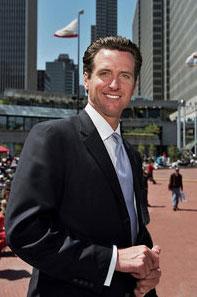
I really, really can’t figure out what the Chron’s only local editorial page columnist, the conservative Debra Saunders, is trying to say. If I read her Feb. 8 column right, she’s opposing the Appeals Court ruling on same-sex marriage — and she seems to be saying that Mayor Gavin Newsom was wrong to allow gay marriages and that the whole matter ought to be decided by a statewide vote:

When the California Supreme Court ruled in favor of same-sex marriage, Newsom stood on the steps of City Hall crowing, “It’s going to happen – whether you like it or not.” Newsom didn’t bother trying to win Californians over to his cause. He figured the courts would impose same-sex marriage on them. And then voters don’t have to like it.

Again — I don’t get it. By the tone of her column, you could almost get the impression that she’s against same-sex marriage. At the very least, she doesn’t seem to fathom that some basic civil and human rights aren’t and never have been subject to the will of the voters. If you asked the voters in Topeka, Kansas in 1954 whether the local schools should be forcibly desegregated, I think it’s a good bet that segregation and racism would have won at the ballot box. Is she trying to argue against Brown v. Board of Education?

I wrote her an email and asked her to explain — really, Debra, I want to understand, but I’m baffled — and I gave her all day to get back to me, but I haven’t heard.


The sex worker struggle

3

yael@sfbg.com

Google has come under fire in the past year for everything from privacy policies to censorship. But in December, some Bay Area residents were protesting the tech giant for a very different reason. The group that marched in front of the company’s San Francisco office was angry over the company’s donation to organizations fighting human trafficking.

The flyers declared, “Google: Please fund non-judgmental services for sex workers, NOT the morality crusaders that dehumanize us!”

Google had donated a whopping $11.5 million to organizations that “fight slavery” last December, including the anti-sex trafficking groups International Justice Mission, Polaris Project, and Not For Sale.

But the activists said that these are religious organizations that ignored the rights of consensual sex workers.

According to a press release from Sex Worker Activists, Allies, and You (SWAAY), “As frontline sex-worker support services struggle for funding to serve their communities, it is offensive to watch Google shower money upon a wealthy faith-based group like the International Justice Mission, which took in nearly $22 million in 2009 alone.”

“I appreciate what they’re trying to do, but I wish that they had done more research,” Kitty Stryker, a local performer, sex worker and activist, of Google’s choice to fund the organizations.

In a society where the term “sex worker” — coined to describe those who consensually engage in commercial sex and consider it legitimate labor — is still new to most people, this sex workers rights struggle can be an uphill battle. But it rages on, and San Francisco remains one of its most important front lines.


FREE SEX FOR HIRE

The heart of the struggle is, and or years has been, fighting the prohibition of prostitution, and the ultimate goal of the sex workers movement is the repeal of the laws that criminalize sex for hire. Decriminalization would be a vital safety measure for escorts, people working on the street, phone-sex operators, exotic dancers, porn actors, and other occupations that fall under the umbrella category of sex work.

Sex workers held worldwide conferences in the 1980s, meeting in Amsterdam and Brussels. Sex work was legalized and decriminalized in several countries around the world, including New Zealand, the Netherlands and Germany. The Sex Workers Outreach Project (SWOP) became one of the most important organizations fighting for the cause, with chapters around the world.

Here in San Francisco, the city remains a hub for sex-workers rights advocates, who raise awareness about issues ranging from STD prevention to consent in BDSM contexts. The Saint James Infirmary supports and treats sex workers when they need medical assistance, and the Center for Sex and Culture is a resource and community center that embraces all San Franciscan’s with their minds in the gutter, sex industry workers included.

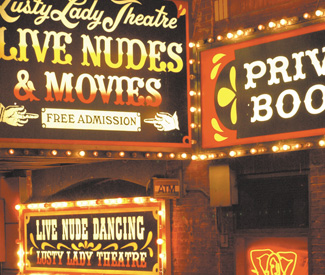
San Francisco’s sex workers rights history includes two unions. Workers at the North Beach strip club the Lusty Lady formed the Exotic Dancers Union in 1997. The union became part of the Service Employees International Union, and the Lusty Lady remains the only collectively run, sex-worker-owned strip club in the United States.

Maxine Doogan founded the Erotic Service Providers Union (ESPU) in 2004 as an umbrella organization for sex workers in various industries. The ESPU has been active in opposing regulations of the massage industry and sponsoring Proposition K, a 2008 ballot measure that would have decriminalized sex work in San Francisco.

I spoke to a handful of Bay Area sex-workers rights activists to get a sense of the major issues and priorities for the next year.

NO VISAS

Activists are currently planning for the July, 2012 International AIDS Conference in Washington, D.C.

Many international sex workers rights advocates have been denied visas to get to the conference. The U.S. typically bars convicted felons — but there’s a special exception for people guilty of misdemeanor prostitution charges.

“SWOP has an idea of getting in touch with some of the people denied entrance and asking them what they were going to present on and to try and present their papers in their place, to make sure these organizers voices are heard,” said SWOP-Bay Area spokesperson Shannon Williams.

But that’s not where the government’s weird exclusion of sex workers from its efforts to fight AIDS ends.

The Presidents Emergency Plan for AIDS Relief (PEPFAR) fund allocates $48 billion to organizations around the world engaged in AIDS treatment and prevention. But thanks to the religious right, the law, approved in 2003, includes a stipulation that all recipient groups must make a pledge decrying prostitution. It’s known as the “anti-prostitution loyalty oath.”

A court ruling July 6, 2011 declared the oath a violation of the free-speech rights of organizations in the United States, but the U.S. still blocks PEPFAR funding for international organizations based on the “loyalty oath.”

“Sex worker activists are going to converge in D.C. for the AIDS conference and talk about the loyalty oath. The US is exporting its ideology through this funding requirement” said Carol Leigh, a longtime activist who curates the annual San Francisco Sex Worker Film and Art Festival.


EMPHASIZING CONSENT

Sex workers rights activists continue to be engaged in their complex, decades-long struggle with anti-sex trafficking organizations.

People who want safer working conditions say that decriminalization would make it easier for police to distinguish between coerced and consensual prostitution and encourage those with knowledge of crimes perpetuated against sex workers to come forward without risking prosecution for their own illegal work.

But many anti-trafficking advocates dismiss the distinction between forced and consensual prostitution in their efforts. According to a document called “Ten reasons for not legalizing prostitution,” on the website of the Coalition Against Trafficking in Women, “There is no doubt that a small number of women say they choose to be in prostitution, especially in public contexts orchestrated by the sex industry… In this situation, it is harm to the person, not the consent of the person that is the governing standard (emphasis theirs).”

It’s this refusal to acknowledge the importance of consent that really pisses off advocates —and has a powerful effect on the policy that governs them.

The federal definition of sex trafficking includes consensual prostitution, and defines coerced prostitution as “severe sex trafficking.” “Law enforcement agencies can use anti-trafficking funds to arrest sex workers in prostitution, on the grounds that the feds define all prostitution as trafficking, even though the government distinguishes between trafficking and severe trafficking,” said one sex workers rights activist.

According to Leigh, anti-trafficking organizations are not all bad; she named the Global Alliance Against Traffic in Women as an organization that “has been allied with sex workers rights movement and takes rights-based approach.”

But organizations that conflate consensual and coerced commercial sex are often big-time recipients of public and private funding.

Doogan is wary of any attempt to further regulate or criminalize sex work. She says that often, laws meant to deter prostitution trap people who may want to change occupations.  “Women have to continue working in the industry because no one else will take them for work when they have those convictions on their record,” said Doogan.

That may be the case with Lola, an occasional Erotic Service Providers Union volunteer who was arrested on prostitution-related charges outside California earlier this year. She moved to the Bay Area and is looking for a job, but after a promising interview last week, she’s nervous that a background check will reveal her arrest.

“I’m waiting to hear whether that’s going to be an issue or not. They could tell my landlord, and then I could lose my house too…all I’m trying to do is get a job,” Lola told the Guardian.


THE WORK GOES ON

For most sex-workers rights activists, the long-term goal remains decriminalization. For now education, creative projects, and protest in service of that goal continue.

Members of SWOP-Bay Area have a program called Whorespeak that does outreach at colleges, and “we’ve also been speaking in classes for therapists about how to work with current and former sex workers and not pathologize them,” said Williams.

According to Stryker, one of the most exciting projects happening now is Karma Pervs. The website, run by local queer porn star Jiz Lee, sells unique sex-positive porn and donates the proceeds to organizations like the Saint James Infirmary.

Then, of course, there’s the International Day to End Violence Against Sex Workers, when sex workers and allies gather to commemorate sex workers who have been assaulted and killed.

Sex workers often can’t go to police to report crimes for fear of being locked up themselves, society retains a huge stigma surrounding sex work, and there is an insidious cultural myth that “you can’t rape a prostitute.” These all add up to put sex workers at high risk for assault and murder; serial killers, such as the Green River Killer in Seattle and a murdered in Long Island-area this past summer, are disproportionately likely to target prostitutes.

That’s why, for Williams, “Our long-term goal is to decriminalize prostitution. But the real goal is to end violence against sex workers.”

On the Cheap Listings

0

WEDNESDAY 8

Aphrodesia Afterhours Valentine’s Day Conservatory of Flowers, Golden Gate Park, 100 John F. Kennedy, SF. (415) 831-2090, www.conservatoryofflowers.org. 6 p.m.-10 p.m., $10.

Chocolate is hands down the best part of Valentine’s Day. Join local chocolatier TCHO’s chief chocolate guru, Brad Kintzer, for his demonstration on how to transform beans into bliss. Afterwards, grab a love potion from the Cocktail Lab, frolic amongst the orchids, and enjoy a live performance by Le Quartet de Jazz. Remember to take a picture in the photobooth — a night dedicated to chocolate is a night to remember.

Love on Wheels dating game Public Works, 161 Erie, SF. (415) 932-0955, www.sfbike.org. 6 p.m., $5 for SF Bicycle Coalition members; $10 for non-members. The cutest people always seem to be railing past each other on their bikes. The SF Bicycle Coalition is going to sit all you guys down so you can date already. Lovebirds will quiz three potential dates (hidden from view) and go on a date provided by one of the sponsors. This annual tradition is a cute hoot.

THURSDAY 9

“Animal Attraction” NightLife aquarium gallery and sex talk California Academy of Sciences, 55 Music Concourse, SF. (415) 379-8000, www.calacademy.org. 6 p.m.-10 p.m., $12. Cal Academy’s weekly Thursday evening party, NightLife, is launching a new gallery for fish-lovers (and friends!) with a series of reproduction-themed talks. Various experts will be talking about mating strategies in the animal kingdom, penis bones of different species, and the sex life of Zodiac signs. Dr. Carol Queen from Good Vibrations will be sharing her knowledge about the science of orgasms. So let’s do like they do on the Discovery Channel.

“Cupid’s Back” sixth annual Valentine’s Day party Supperclub, 657 Harrison, SF. (415) 348-0900, cupidsback.kintera.org. 8 p.m.-midnight, $30-35. Gay charity impressario Mark Rhoades is back — like Cupid, you might say — with this popular shindig that brings together oodles of hot men. DJ Juanita More will fluff the crowd, and it all goes to help out our invaluable GLBT Historical Society. Shoot your arrow and it goes real high …

“Go Deep” lube wrestling for the boys El Rio, 3158 Mission, SF. (415) 379-8000, www.calacademy.org/events/nightlife. 8 p.m.-11:30 p.m., $10–<\d>$15. What says romance more than watching half-naked queer boys with fantastical monikers like Yogzar and Red Dragon wrestling in a vat of lube? Slide your way into V-Day at this monthly grip ‘n slip put on by neo-Vaudevillian troupe SF Boylesque, with DJ Drama Bin Laden, a performance by the Bohemian Brethren, and Cajon food from Family Meal available on the back patio.

FRIDAY 10

Bardot A Go Go Pre-Valentine’s Dance Rickshaw Stop, 155 Fell, SF. (415) 861-2011, www.bardotagogo.com. 9 p.m., $10. “Music by French people for everybody” is the motto of the neato longtime roving Bardot A Go Go — and that includes a bubbly beretful of cute folks who revel in 1960s pop glamour filtered through contemporary va-va-voom. Live band Nous Non Plus is très adorable, and DJs Pink Frankenstein, Brother Grimm, and Cali Kid bring French kisses galore. Plus: free hairstyling by Peter Thomas Hair Design, d’accord.

I Heart Some Thing The Stud, 399 9th St., SF. (415) 863-6623, www.studsf.com. 10 p.m.-late, $8. “We love love! We just love it!” scream the awesome queens of Some Thing, the mind-altering weekly friday drag show and party at the Stud. You may detect a hint of the sardonic in there, but the smart Some Thingers always cover their bases with a healthy dose of sincerity to go with the staged pop culture send-ups. heart-shaped performers include Glamamore, Manicure Versace, Cricket Bardot, and Nikki Sixx Mile. Afterhours dancing, too.

Mortified’s Annual Doomed Valentine’s Show DNA Lounge, 375 11th St., SF. (415) 626-1409, www.getmortified.com. 7:30 p.m., $14 adv; $21 at door. Do you remember your first kiss when you went in for the gold, missed completely, and your lips puckered mid-air? Well, the folks at Mortified sure do. They have sorted through the oldest and nerdiest notebooks, letters, photos, and shoeboxes so that they can share with you their most humiliating romantic encounters. Reinvigorate your disdain for this holiday by taking comedic comfort in the mishaps of these thick-skinned Valentine’s veterans.

Ninth Annual Food from the Heart Festival Ferry Building Marketplace, 1 Ferry Building, SF. (415) 983-8000, www.ferrybuildingmarketplace.com. Through Saturday. 5:30-8 p.m., free entrance. Nothing says “I love you” like food. Give the gift of a happy stomach to your lover this Valentine’s in the candlelit Grand Nave of the Ferry Building, with a night of dancing and eating. Revel in the magic of the waterfront, sip on wine poured by local Napa Vinters, and taste a scrumptious hors-d’oeuvre or five.

“On The Edge 2” erotic photography exhibition Gallery 4N5, 863 Mission, SF. (415) 522-2400, www.gallery4n5.com. Through Sunday. Gallery hours Fri., 4 p.m.-9 p.m.; Sat., 11 p.m.-9 p.m.; Sun., noon-5 p.m., free. Valentine’s Day may be about romance for some people, but for us it’s about getting naked. (And eating, but mostly getting naked.) This group exhibition features 400 pictures of artful sexiness taken by 25 erotic photographers who bring on the nudes.

SATURDAY 11

“Drunk with Love” with Carol Peters The Emerald Tablet, 80 Fresno, SF. (415) 500-2323, www.carolpeters.net. 8 p.m., $10. Carol Peters, a.k.a. “Velvet Voice,” is known for her passionate and amorous renderings. For one steamy night in light of Valentine’s Day, Peters will grace the stage to croon sensual tunes that capture the many dimensions of love.

Valentine’s Surprise SF Lindy Ball Womens Building, 3543 18th St., SF. sfswingjam.eventbee.com. 7:30 p.m.-12:30 a.m., $22 This Lindy Hop and Swing ball is actually the centerpiece of a three-day swing summit in celebration of romance (check the website for full line-up) — because what says, “I love you” more than artfully mopping the floor with your partner? We sure don’t know. Hoppin’ workshops and technique tune-up sessions complement the ball, which consists of a Lindy contest, live swing music, and a surprise 91st birthday celebration for classic movie star Ray Hirsch.

Watson’s “Naked at the Art Museum Scavenger Hunt” Legion of Honor, 34th Ave, SF. (415) 750-3600, legionofhonor.famsf.org. Through Sunday. 2 p.m.-4:30 p.m., $20. Who said museums had to be tame? Bring a lover or friend this weekend to the Legion of Honor for a sexy scavenger hunt. You will scope the halls for studly sculptures, titillating paintings, bathing beauties, and many sexy inanimate objects more. Museums will never be the same again.

SUNDAY 12

SF Mixtape Society’s “Under The Covers” music exchange and contest The Make-Out Room, 3225 22nd St, SF. (415) 440-4177, www.sfmixtapesociety.com. 6 p.m., free with mix. Don’t have someone to make a mixtape for this year? It’s OK. Your ex’s music taste was awful anyways! Put that playlist you love on a CD, cassette, or USB drive and have it land right in the ears of a random yet lucky someone. You’ll end the night with someone else’s coveted mix, and everyone will get to vote for the playlist with the best track listings and artwork.

MONDAY 13

Litquake Literary Festival presents: Love Hurts readings of grief-stricken passages of love and lust The Make-Out Room, 3225 22nd St, SF. (415) 440-4177, www.litquake.org. 7 p.m., $10. Ten Bay Area writers will give their own cynical (and mostly hilarious) twists on the forlorn words of some of the most melancholic and/or melodramatic novels ever written. Come sort out the parallels between drug dependency and romance in Valley of the Dolls, the masochistic plotline of The Story of O, and many more classics that well forewarned of broken hearts.

TUESDAY 14

Club Neon’s Eighth Annual Vaslentine’s Day Underwear Party The Knockout, 3223 Mission, SF. (415) 550-6884, www.theknockoutsf.com. This is THE event for fresh and nubile indie heartbreakers, stripping down to make you all “damn!” and stuff. One of our favorite annual pantsless throwdowns, with steamy rock DJs Jamie Jams and EmDee making you want to take it all off.

The Fifth Annual Poetry and Music Battle of ALL of the Sexes Uncle Al and Mama Dee’s Cafe at POOR Magazine, 2940 16th St, SF. (415) 865-1932, www.poormagazine.org. 7 p.m., $5-$20 suggested donation for dinner and show. Instead of scribbling your words in to a Hallmark card, show off your love this Valentine’s in rhyme and verse. All proceeds will support POOR magazine, a local arts organization that advocates education and media access for struggling communities. The theme is 1950s, but the beats will be timeless.

Love Story film showing and gala with Justin MX Bond Castro Theatre, 429 Casto, SF. (415) 621-6120, www.castrotheatre.com. 8 p.m., $10 film only; $25 for gala tickets. Relive the drama, the tragic heartaches, and the swooning love story of the 1970 film classic. Ali MacGraw will be at the Castro mezzanine in person, “Theme from Love Story” will be sung by Katya Smirnoff-Skyy, and special guest Mx Justin Vivian bond will be doing a “sorry” medley.

Passion Punch Valentine’s day kickboxing class UFC Gym, 1975 Diamond, Concord. (925) 265-8130, www.ufcgyms.com. 6:30 p.m., free. Valentine’s got you foaming at the mouth? Let it out. This 60-minute class will incorporate dynamic boxing moves so that you can punch away all the annoyances you will be feeling by the end of this day.

The Crackpot Crones present “I Hate Valentine’s Day” sketch comedy and improv show The Dark Room, 2263 Mission, SF. (415) 648-5244, www.crackpotcrones.com. 8 p.m., $20. Outrageous duo Terry Baum and Carolyn Myers are providing a public service for the romantically challenged. They will be making fun of everything Valentine’s related — especially silly little concepts like true love and soul mates. Belt along to the song, “The Twelve Days of Being Dumped,” and give your best evil cackle at this sketch comedy show.

Valentine’s Day Party with T.I.T.S and Uzi Rash Hemlock, 1131 Polk, SF. (415) 923-0923, www.hemlocktavern.com. 9 p.m., free. There is no need for all the fuss, the fancy gifts, the cutesy ribbons, or the overpriced dinner. If you’re sick of the pink, come dance your anti-heart out at this doom punk show. Flowers wilt anyways.

Rep Clock

0

Schedules are for Wed/8-Tues/14 except where noted. Director and year are given when available. Double and triple features are marked with a •. All times p.m. unless otherwise specified.

ARTISTS’ TELEVISION ACCESS 992 Valencia, SF; www.atasite.org. $6-10. Dirty Looks presents: City of Lost Souls, Fri, 8. “Mindscapes,” short films, Sat, 8.

CALIFORNIA COLLEGE OF THE ARTS 1118 Eighth St, SF; www.dirtylooksnyc.org. Free. Dirty Looks presents: “Queer Conversations on Culture in the Arts,” with selections from the “Female Trouble” experimental shorts program and a conversation with Margaret Tedesco, Thurs, 7.

CASTRO 429 Castro, SF; (415) 621-6120, www.castrotheatre.com. $7.50-10. •Pickpocket (Bresson, 1959), Wed, 3:30, 7:15, and American Gigolo (Schrader, 1979), Wed, 4:55, 8:45. •Beauty and the Beast (Cocteau, 1946), Thurs, 3:05, 7, and No Such Thing (Hartley, 2001), Thurs, 4:55, 8:50. “Midnites for Maniacs: I’m Black and I’m Proud:” •I’m Gonna Git You Sucka (Wayans, 1988), Fri, 7:30; Pootie Tang (Louis CK, 2001), Fri, 9:30; CB4 (Davis, 1993), Fri, 11:30. French American International School presents: “I-Speak: Celebrating 50 Years of International Education,” Sat, 6:30. This event, $5-10; tickets at www.internationalsf.org. •Do The Right Thing (Lee, 1989), Sun, 2, 8, and Malcolm X (Lee, 1992), Sun, 4:15. “Love: Ali MacGraw:” Love Story (Hiller, 1970), Tues, 8. With pre-show gala performance and MacGraw in person; for tickets ($25-45), visit www.ticketfly.com.

ELMWOOD 10070 San Pablo, El Cerrito; www.rialtocinemas.com. Free. “Community Cinema:” More Than a Month: One Man’s Journey to End Black History Month (Tilghman, 2012), Wed, 7.

CHRISTOPHER B. SMITH RAFAEL FILM CENTER 1118 Fourth St, San Rafael; (415) 454-1222, www.cafilm.org. $6.75-10.25. “Rafael Film Club:” “Jan Wahl,” Thurs, 1. Pina (Wenders, 2011), call for dates and times. “Mostly British Film Festival:” Route Irish (Loach, 2010), Wed, 7; Albatross (MacCormick, 2011), Thurs, 7. “2012 Oscar Nominated Short Films,” narrative and documentary (separate admission), Feb 3-9, call for times.

LAMORINDA THEATRES Four Orinda Theatre Square, Orinda; www.caiff.org. $12-15. “California Independent Film Festival,” 11 features, plus docs, shorts, and educational seminars, Feb 10-16.

MECHANICS’ INSTITUTE 57 Post, SF; (415) 393-0100, rsvp@milibrary.org. $10. “CinemaLit Film Series: Hollywood Dames: Beauty and Brains:” Intermezzo (Ratoff, 1939), Fri, 6.

PACIFIC FILM ARCHIVE 2575 Bancroft, Berk; (510) 642-5249, bampfa.berkeley.edu. $5.50-9.50. “Documentary Voices:” The Green Wave (Ahadi, 2010), Wed, 7. “Seconds of Eternity: The Films of Gregory J. Markopoulos:” “Markopoulos: The Early Films (1940-49)” Thurs, 7; “Eros and Myth (1950-63),” Sat, 6:30. “Austere Perfectionism: The Films of Robert Bresson:” The Trial of Joan of Arc (1962), Fri, 7; Les dames du Bois du Boulogne (1945), Fri, 8:25; Lancelot of the Lake (1974), Sat, 8:30. “Screenagers: 14th Annual Bay Area High School Film and Video Festival,” Sat, 3. “Howard Hawks: The Measure of Man:” The Criminal Code (1931), Sun, 4:30; Bringing Up Baby (1938), Tues, 7. “African Film Festival 2012:” Viva Riva! (Munga, 2010), Sun, 6:30.

ROXIE 3117 and 3125 16th St, SF; (415) 863-1087, www.roxie.com. $6.50-10. Come Back, Africa (Rogosin, 1959/2012), Wed-Thurs, 6:45, 8:30. Drive (Winding Refn, 2011), Wed, 8:45. Into the Abyss (Herzog, 2011), Wed, 6:45. SF IndieFest, Feb 9-23. Visit www.sfindie.com for complete schedule.

SFFS | NEW PEOPLE CINEMA 1746 Post, SF; www.sffs.org. $10-11. Domain (Chiha, 2010), Wed-Thurs, 2, 4:30, 7, 9:30. Once Upon a Time in Anatolia (Ceylan, 2011), Feb 10-16, 2, 5:30, 8:30.

TWINSPACE CONTINUUM 2111 Mission, Third Flr, Ste 3, SF; www.blockreportradio.com. $15. “Human Rights and Hip-Hop Film Festival,” documentaries and shorts, Fri, 5; Sat, 6:30.

VOGUE 3290 Sacramento, SF; www.mostlybritish.org. $12.50. “Mostly British Film Festival:” Black Butterflies (van der Oest, 2011), Wed, 5; London Boulevard (Monahan, 2010), Wed, 7:15; The Great White Silence (Ponting, 1924), Wed, 9:30; A Passionate Woman (2010), Thurs, 5; Route Irish (Loach, 2010), Thurs, 7:30.

VORTEX ROOM 1082 Howard, SF; www.myspace.com/thevortexroom. $7 donation. “The Second Coming of the Vortex Room:” The Second Coming of Suzanne (Barry, 1974), and Marjoe (Kernochan and Smith, 1972), Thurs, 8.

YERBA BUENA CENTER FOR THE ARTS 701 Mission, SF; (415) 978-2787, www.ybca.org. $6-8. “Bros Before Hos:” The Killing of a Chinese Bookie (Cassavetes, 1976), Thurs, 7:30; “Female Trouble,” experimental shorts program presented by Dirty Looks curator Bradford Nordeen, Sun, 2.

Stage Listings

0

Stage listings are compiled by Guardian staff. Performance times may change; call venues to confirm. Reviewers are Robert Avila, Rita Felciano, and Nicole Gluckstern. Submit items for the listings at listings@sfbg.com. For further information on how to submit items for the listings, see Picks.

THEATER

OPENING

Blue/Orange Lorraine Hansberry Theatre, 450 Post, SF; (415) 474-8800, www.lhtsf.org. $43-53. Previews Wed/8-Fri/10, 8pm. Opens Sat/11, 8pm. Runs Thurs-Sat, 8pm (also Sat, 2pm). Through March 18. Lorraine Hansberry Theatre performs Joe Penhall’s comedic drama about a hospital patient who claims to be the son of an African dictator.

52 Man Pick Up Brava Theater, 2781 24th St, SF; (415) 647-2822, www.brava.org. $10-25. Opens Tues/14, 8pm. Runs Thurs-Sat, Feb 15, and Feb 27, 8pm. Through March 3. Desiree Butch performs her solo show about a deck of cards’ worth of sexual encounters.

Geezer Marsh San Francisco, MainStage, 1062 Valencia, SF; (415) 282-3055, www.themarsh.org. $25-100. Opens Thurs/9, 8pm. Runs Thurs and Sat, 8pm; Sun, 5pm. Through March 18. Geoff Hoyle’s hit solo show returns.

BAY AREA

A Doctor in Spire of Himself Berkeley Repertory Theatre, Roda Theatre, 2015 Addison, Berk; (510) 647-2949, www.berkeleyrep.org. $14.50-73. Previews Fri/10-Sat/11 and Tues/14, 8pm; Sun/12, 7pm. Opens Feb 15, 8pm. Runs Tues and Thurs-Sat, 8pm (also Thurs and Sat, 2pm; no matinees Feb 16, Feb 25, March 1, 8, and 15; no show March 23); Wed and Sun, 7pm (also Sun, 2pm). Through March 25. Berkeley Rep performs a contemporary update of the Molière comedy.

ONGOING

Cabaret Young Performers Theatre, Fort Mason Center, Bldc C, Room 300, Marina at Laguna, SF; (415) 381-1638, cabaretsf.wordpress.com. $25-45. Thurs-Sat, 8pm; Sun, 7pm. Through Feb 19. Shakespeare at Stinson and Independent Cabaret Productions perform the Kander and Ebb classic in an intimate setting.

Glengarry Glen Ross Actors Theatre of San Francisco, 855 Bush, SF; (415) 345-1287, www.brownpapertickets.com. $26-40. Fri-Sat, 8pm. Through March 24. David Mamet’s cutthroat comedy, courtesy of the Actors Theatre of San Francisco.

Higher Theater at Children’s Creativity Museum, 221 Howard, SF; (415) 749-2228, www.act-sf.org. $10-65. Tues-Sat, 8pm (also Wed, Sat-Sun, 2pm; no matinee Wed/8). Through Feb 19. American Conservatory Theatre presents Carey Perloff’s smart and sexy world premiere.

Jesus in India Magic Theatre, Fort Mason Center, Marina at Laguna, SF; www.magictheatre.org. $20-55. Tues, 7pm; Wed-Sat, 8pm (also Feb 18, 2:30pm); Sun, 2:30pm. Through Feb 19. Lloyd Suh’s American Hwangap is still one of Magic’s strongest premieres in recent years, an intriguingly funny and affecting cross-cultural tale of an absent Korean father’s return to the family he abandoned in West Texas 15 years earlier. Suh’s latest makes a disappointing contrast. There’s again an absent father (or two) and a sense of dislocation, but Suh’s “Jesus in India” does little or nothing with them. Director Daniella Topol assembles a bright cast headed by musically adept charmer Damon Daunno — on Michael Locher’s colorful, all-encompassing street mosaic set (comprised of floor-to-wall stickers, spray-paint, and mandalas around a central thicket of abandoned bicycle wheels) — but it all serves an insipid chronicle of the deity’s wayward teen years, which are spent getting high and playing in a punk band in India. Pure irreverence might have been worthwhile, but the “dude, fuckin’ &ldots; dude” humor here — one-note and rarely that funny — comes yoked to a fourth-quarter theme (basically a Henry IV thing, the sowing of wild oats ahead of the taking on of a “king’s” responsibilities) that proves even sketchier, not to mention out-of-step with these deliberately leaderless times. (Avila)

*Little Brother Gough Street Playhouse, 1620 Gough, SF; www.custommade.org. $25-32. Thurs-Sat, 8pm; Sun, 7pm. Through Feb 25. Custom Made Theatre Co. performs Josh Costello’s adaptation of Cory Doctorow’s San Francisco-set thriller.

Not Getting Any Younger Marsh San Francisco, Studio Theater, 1062 Valencia, SF; (415) 826-5750, www.themarsh.org. $15-50. Fri, 8pm; Sat, 5 and 8:30pm. Extended through Feb 25. Marga Gomez is back at the Marsh, a couple of too-brief decades after inaugurating the theater’s new stage with her first solo show — an apt setting, in other words, for the writer-performer’s latest monologue, a reflection on the inevitable process of aging for a Latina lesbian comedian and artist who still hangs at Starbucks and can’t be trusted with the details of her own Wikipedia entry. If the thought of someone as perennially irreverent, insouciant, and appealingly immature as Gomez makes you depressed, the show is, strangely enough, the best antidote. (Avila)

Olivia’s Kitchen Exit Theatre, 156 Eddy, SF; www.generationtheatre.com. $20-40. Fri-Sat, 8pm; Sun, 3pm. Through Feb 19. GenerationTheatre offers this “remix” of Shakespeare’s Twelfth Night.

Private Parts SF Playhouse, Stage 2, 533 Sutter, SF; www.sfplayhouse.org. $20. Thurs, 7pm; Fri-Sat, 8pm. Through Feb 25. Graham Gremore performs his autobiographical solo comedy.

*True West Boxcar Studios, 125A Hyde, SF; (415) 967-2227, www.boxcartheatre.org. $25. Thurs-Sat, 8pm. Through April 7. The first installment of Boxcar Theatre’s four-play Sam Shepard repertory project, True West ushers in the ambitious run with a bang. This tale of two brothers who gradually assume the role of the other is one of Shepard’s most enduring plays, rich with humorous interludes, veering sharply into dangerous terrain at the drop of a toaster. In time-honored, True West tradition, the lead roles of Austin, the unassuming younger brother, and Lee, his violent older sibling, are being alternated between Nick A. Olivero and Brian Trybom, and in a new twist, the role of the mother is being played by two different actresses as well (Adrienne Krug and Katya Rivera). The evening I saw it, Olivero was playing Austin, a writer banging away at his first screenplay, and Trybom was Lee, a troubled, alcoholic drifter who usurps his brother’s Hollywood shot, and trashes their mother’s home while trying to honor his as yet unwritten “contract”. The chemistry between the two actors was a perfect blend of menace and fraternity, and the extreme wreckage they make of both the set (designed by both actors), and their ever-tenuous relationship, was truly inspired. (Gluckstern)

*Vice Palace: The Last Cockettes Musical Thrillpeddlers’ Hypnodrome, 575 10th St, SF; (415) 377-4202, www.thrillpeddlers.com. $30-35. Fri-Sat, 8pm. Through March 3. Hot on the high heels of a 22-month run of Pearls Over Shanghai, the Thrillpeddlers are continuing their Theatre of the Ridiculous revival with a tits-up, balls-out production of the Cockettes’ last musical, Vice Palace. Loosely based on the terrifyingly grim “Masque of the Red Death” by Edgar Allan Poe, part of the thrill of Palace is the way that it weds the campy drag-glamour of Pearls Over Shanghai with the Thrillpeddlers’ signature Grand Guignol aesthetic. From an opening number set on a plague-stricken street (“There’s Blood on Your Face”) to a charming little cabaret about Caligula, staged with live assassinations, an undercurrent of darkness runs like blood beneath the shameless slapstick of the thinly-plotted revue. As plague-obsessed hostess Divina (Leigh Crow) and her right-hand “gal” Bella (Eric Tyson Wertz) try to distract a group of stir-crazy socialites from the dangers outside the villa walls, the entertainments range from silly to salacious: a suggestively-sung song about camel’s humps, the wistful ballad “Just a Lonely Little Turd,” a truly unexpected Rite of Spring-style dance number entitled “Flesh Ballet.” Sumptuously costumed by Kara Emry, cleverly lit by Nicholas Torre, accompanied by songwriter/lyricist (and original Cockette) Scrumbly Koldewyn, and anchored by a core of Thrillpeddler regulars, Palace is one nice vice. (Gluckstern)

*Vigilance Phoenix Theatre, 414 Mason, SF; (415) 335-6087, secondwind.8m.com. $20-25. Thurs-Sat, 8pm; Sun, 2pm. Through Feb 25. Ian Walker (The Tender King) directs a sharp revival of his own lucid, involving 2000 domestic drama about three households brought to the brink by the arrival of a menacing working-class loner. Seamlessly staged in a single pair of rooms (designed by Fred Sharkey) representing all three suburban middle-class homes — as well as downstage on the street where dream-home lottery winner Duncan (an imposing Steven Westdahl) throws his beer cans and leers at the wives and children — Vigilance begins with three friends meeting under the pretext of a poker game. Host Virgil (played with gruff charm by a commanding Mike Newman) is a 30-something husband, father, and guy’s guy whose Montana-grown libertarian machismo compensates for the agro of a stormy marriage and rocky finances. He talks the suggestible, nebbishy Bert (a slyly humorous Ben Ortega) and the equally nerdy but independent-minded Dick (a nicely layered Stephen Muterspaugh) into forming a “committee” to deal with the troublesome Duncan. Walker’s well-honed dialogue brings out the false notes in the supposed pre-Duncan harmony right away, especially in the volatile arguments between Virgil and wife Marla (a sure Natalie Palan Walker) and the passive but more troubled confrontations between Dick and his distant, frustrated wife Cathy (a subtly fraught Kim Stephenson). While the insular, repressed lives of the moderately well off come across well, Duncan’s final monologue is a compressed, if dramatically necessary, attempt at voicing the other side. Vigilance strikes best at the buried politics of marriage and friendship, the latter further invoked in the concerned intervention of cop and childhood friend Frank (a sympathetic Leon Goertzen). (Avila)

Waiting for Godot Royce Gallery, 2901 Mariposa, SF; (415) 336-3522, www.tidestheatre.org. $20-38. Thurs-Sat, 8pm. Through Feb 18. The fuchsia papier-mâché tree and swirling grey-on-white floor pattern (courtesy of scenic designer Richard Colman) lend a psychedelic accent to the famously barren landscape inhabited by Vladimir (Keith Burkland) and Estragon (Jack Halton) in this production of the Samuel Beckett play by newcomers Tides Theatre. Director (and Tides’ producing artistic director) Jennifer Welch layers the avant-garde classic with some audio accents as well (although Jon Bernson’s minimalist industrial soundscape is a bit low in the mix to be very effective). More compelling is the gentle, sad humor and couched intelligence captured expertly by Halton in the circular but deliberate rhythms of his hapless tramp. Burkland as pal Vladimir exudes a palpable presence as well, though lacks the same focus. Timing is all in vaudeville — the parallel universe from whence these tangible modernist archetypes hail — as well as in a play whose plot goes intentionally nowhere, or rather loops back on itself in an implied dance with eternity. The halting aspect to Tides’ staging gets compounded with the arrival of brash whip-cracker Pozzo (a suitably stentorian but inconsistent Duane Lawrence) and his pitiful slave Lucky (a haunted, generally sharp Renzo Ampuero, made up to look like a goth doll à la some Tim Burton movie). That said, the best moments here broadcast the brooding beauty of the play, with its purposely vague but readily familiar world of viciousness, servility, trauma, want, fear, grudging compassion, and the daring, fragile humor that can look it all squarely in the eye. (Avila)

The Waiting Period MainStage, Marsh San Francisco, 1062 Valencia, SF; (415) 282-3055, www.themarsh.org. $15-50. Fri, 8pm; Sat, 5pm. Through March 24. Brian Copeland returns with a new solo show about his struggles with depression.

BAY AREA

Arms and the Man Lesher Center for the Arts, Margaret Lesher Theater, 1601 Civic, Walnut Creek; (925) 943-7469, www.centerrep.org. $38-43. Wed, 7:30pm; Thurs-Sat, 8pm; Sun, 2:30pm. Through Feb 25. Center REPertory Company presents George Bernard Shaw’s classic romantic comedy.

Body Awareness Aurora Theatre, 2081 Addison, Berk; (510) 843-4822, www.auroratheatre.org. $34-55. Tues, 7pm; Wed-Sat, 8pm; Sun, 2 and 7pm. Through March 4. Aurora Theatre performs Annie Baker’s comedy.

Counter Attack! Ashby Stage, 1901 Ashby, Berk; (510) 444-4755, ext. 114, www.stagebridge.org. $18-25. Wed-Thurs, 7:30pm; Fri-Sat, 8pm (also Sat, 2pm); Sun, 2pm. Through March 4. Stagebridge presents the world premiere of Joan Holden’s waitress-centric play.

Ghost Light Berkeley Repertory Theatre, Thrust Stage, 2025 Addison, Berk; (510) 647-2949, www.berkeleyrep.org. $14.50-73. Tues, Thurs-Sat, 8pm (also Sat and Feb 16, 2pm); Wed and Sun, 7pm (also Sun, 2pm). Through Feb 19. Berkeley Rep performs Tony Taccone’s world-premiere play about George Moscone’s assassination, directed by the late San Francisco mayor’s son, Jonathan Moscone.

*The Kipling Hotel: True Misadventures of the Electric Pink ’80s New venue: Marsh Berkeley, 2120 Allston, Berk; (415) 282-3055, www.themarsh.org. $20-50. Sat, 8:30pm; Sun, 7pm. Extended through March 25. This new autobiographical solo show by Don Reed, writer-performer of the fine and long-running East 14th, is another slice of the artist’s journey from 1970s Oakland ghetto to comedy-circuit respectability — here via a partial debate-scholarship to UCLA. The titular Los Angeles residency hotel was where Reed lived and worked for a time in the 1980s while attending university. It’s also a rich mine of memory and material for this physically protean and charismatic comic actor, who sails through two acts of often hilarious, sometimes touching vignettes loosely structured around his time on the hotel’s young wait staff, which catered to the needs of elderly patrons who might need conversation as much as breakfast. On opening night, the episodic narrative seemed to pass through several endings before settling on one whose tidy moral was delivered with too heavy a hand, but if the piece runs a little long, it’s only the last 20 minutes that noticeably meanders. And even with some awkward bumps along the way, it’s never a dull thing watching Reed work. (Avila)

The Pitman Painters TheatreWorks at Mountain View Center for the Arts, 500 Castro, SF; (650) 463-1960, www.theatreworks.org. $19-69. Wed/8, 7:30pm; Thurs/9-Sat/11, 8pm (also Sat/11, 2pm); Sun/12, 2 and 7pm. TheatreWorks performs a new comedy from the author of Billy Elliot about a group of British miners who become art world sensations.

A Steady Rain Marin Theatre Company, 397 Miller, SF; (415) 388-5208, www.marintheatre.org. $34-55. Tues and Thurs-Sat, 8pm (also Sat/11 and Feb 25, 2pm; Feb 16, 1pm); Wed, 7:30pm; Sun, 2 and 7pm. Through Feb 26. Marin Theatre Company performs Keith Huff’s neo-noir drama.

The World’s Funniest Bubble Show Marsh Berkeley, TheaterStage, 2120 Allston, Berk; (415) 826-5750, www.themarsh.org. $8-50. Extended run: Sun/12, Feb 19, 26, March 11, and 18, 11am. Louis “The Amazing Bubble Man” Pearl returns with this kid-friendly, bubble-tastic comedy.

PERFORMANCE/DANCE

“Elect to Laugh” Studio Theater, Marsh San Francisco, 1062 Valencia, SF; (415) 282-3055, www.themarsh.org. Tues, 8pm. Ongoing through Nov 6. $15-50. Will Durst and friends perform in this weekly political humor show that focuses on the upcoming presidential election.

“Epic Romance” Bayfront Theater, B350 Fort Mason Center, Marina at Laguna, SF; (415) 474-6776, www.improv.org. Tues/14, 8pm. $25. BATS Improv taps its collective quick-wit talents to conjure a romantic play on the spot.

“The Eric Show” Milk Bar, 1840 Haight, SF; www.milksf.com. Tues, 8pm (ongoing). $5. Local comedians perform with host Eric Barry.

“How We First Met” Marines’ Memorial Theatre, 609 Sutter, SF; www.howwefirstmet.com. Tues/14, 8pm. $40-75. Jill Bourque’s long-running holiday tradition is inspired by audience members’ real-life tales of romance.

“The I Hate Valentine’s Day Show” Dark Room, 2263 Mission, SF; www.crackpotcrones.com. Tues/14, 8pm; Feb 19, 5pm. $20. “Sketch comedy and improv as a public service for the romantically challenged” with Crackpot Crones Terry Baum and Carolyn Myers.

“It’s Got to Be Love” Eureka Theatre, 215 Jackson, SF; (415) 392-4400, www.cityboxoffice.com. Mon/13-Tues/14, 8pm. $20. Craig Jessup sings Rodgers, Hart, Gershwin, and Sondheim to benefit the San Francisco Arts Education Project.

“Love Bites — and So Did the ’80s” Mission Cultural Center, 2868 Mission, SF; www.lgcsf.org. Fri/10-Sat/11, 8pm. $15-30. The Lesbian/Gay Chorus of San Francisco celebrates the neon decade with this cabaret and musical extravaganza.

“Mortified! Doomed Valentine’s Show” DNA Lounge, 375 11th St, SF; www.getmortified.com. Fri/10, 7:30pm. $21. Also Sat/11, 8pm, $20, Shattuck Down Low, 2184 Shattuck, Berk. The awkward storytelling series returns with a romance-gone-awry theme.

“Our Feet Speak the Rhythms of Our Hearts” Cowell Theater, Fort Mason Center, Marina at Laguna, SF; (415) 345-7575, www.fortmason.org. Sat/11, 8pm; Sun/12, 3pm. $15-25. Tango and More Argentine Dance and World Arts West present this event featuring six ethnic dance companies, including La Tania, Ensembles Ballet Folklórico de San Francisco, Valverde Dance, Barbary Coast Cloggers, and Ballet Pampa Argentina.

“Through the Night” Brava Theatre, 2781 24th St, SF; www.communityworkswest.org. Sat/11, 7pm. $40-100. Daniel Beaty performs at this evening honoring author Nell Bernstein and activist Sujatha Baliga; proceeds benefit Community Works’ programs for Bay Area children, families, and communities impacted by incarceration.

“The Weight Game” NOHspace Theater, 2840 Mariposa, SF; www.brownpapertickets.com. Fri/10-Sat/11 and Feb 17-18, 8pm. $15. Sarah Abbey performs her semi-autobiographical solo show about diets and self-esteem.

BAY AREA

“Black Choreographers Festival: Here and Now 2012” Laney College Theater, 900 Fallon, Oakl; www.bcfhereandnow.com. Fri/10-Sat/11, 8pm; Sun/12, 4pm. Also Feb 17-18 and Feb 24-25, 8pm; Feb 19, 4pm; Feb 26, 7pm, Dance Mission Theater, 3316 24th St, SF. $10-25. Celebrate African and African American dance and culture at this multi-part festival, with works by Marc Bamuthi Joseph, Kendra Kimbrough Barnes, and more.


Making black herstory, every day

8

news@sfbg.com

Deconstructing the roots of

The black n gray suits

with hands in the Loot

That has buried the truth

About our black, brown and disabled youth

— excerpt from KKKourt by Tiny

OPINION On the first day of Black Herstory Minute (I mean, Month), I practiced black herstory, and walked through activism and breathed organizing and lived resistance by putting my body in the benches belonging to the criminal injustice system (a.k.a. the plantation) at 850 Bryant. I was there to support a struggle against injustice in the case of a young African warrior for truth, Fly Benzo, a.k.a. Debray Carpenter — student, son, media producer, organizer, and hip-hop artist who is facing a felony charge, jail sentence and $95,000 fine for nothing more than exercising his First Amendment right to free speech.

How many among you, overwhelmed with multiple Face-crack postings and a cacophony of tweets, might have missed the story of Fly, who spoke the truth about racism, police brutality and the unjust death of Kenneth Harding Jr. to a cop in a poor-people-of-color neighborhood, Bayview, which is under seize from the occupying army known as the police (or po’lice as we call them at POOR Magazine)?

As a woman criminalized and incarcerated for the sole act of being poor and houseless, the melanin-challenged daughter of a poor black single mother who spent all of her life in poverty and in struggle, I have witnessed first hand unequal justice against people of color and poor people. It’s a fact that remains, in 2012, still a very dire reality.

“They arrested me for exercising my Constitutional right to free speech,” said Benzo, 22.

Benzo’s revolution began when he was born to conscious African-descendant parents who, like many African descendant people in San Francisco, have been under the constant threat of removal, displacement, redlining, and ongoing police harassment for decades. He has been speaking out about injustices since he was a teen, starting with the fact that hardly any Bayview residents were hired to construct the multi-million-dollar T-Train that runs from downtown to Third Street — and the dramatic rise in the violent policing of the T-Train and the Muni bus lines that run through the poor communities of color in S.F.

But the beginning of Benzo’s current battle with the criminal injustice system began when he began to speak up about Harding, murdered by San Francisco police officers for not having a $2 dollar bus transfer. The judge might not admit the video that was taken at the scene of Benzo’s arrest, making his case all the more difficult to fight, and the truth all the more difficult to hear and see, which is where community support comes in.

A lot of people and organizers and politricksters talk about stopping the violence and how to “deal” with the inequities of racism and classism and violence on our youth of color. And yet when this brother spoke out, used his voice for nothing but truth and resistance about injustices he personally experiences everyday, who comes out to support him?

Practicing revolutionaries at POOR Magazine, the Idriss Stelly Foundation, The BayView Newspaper, Education not Incarceration, and United Playaz have been there, as well as his hard-working attorney, Severa Keith, and a few more. But we all need to be there, fighting for a very alive, very revolutionary, young truth-teller who is making black history, every day.

Tiny, a.k.a. Lisa Gray-Garcia, is an editor at POOR Magazine. Opening statements in the trial of Debray Carpenter are expected to begin Feb. 8 in Dept. 27.

Cheap dates!

0

VALENTINE’S Whether you’re hopelessly in love, completely philophobic, or somewhere in between, here’s a sweet slew of events on the horizon that won’t tap you dry. We’ve chosen our favorites that are all less than $20 (except for a couple worthwhile charity fundraisers). Now go out and get starry-eyed, you kid.  


——-

WEDNESDAY 8

Aphrodesia Afterhours Valentine’s Day Conservatory of Flowers, Golden Gate Park, 100 John F. Kennedy, SF. (415) 831-2090, www.conservatoryofflowers.org. 6 p.m.-10 p.m., $10. Chocolate is hands down the best part of Valentine’s Day. Join local chocolatier TCHO’s chief chocolate guru, Brad Kintzer, for his demonstration on how to transform beans into bliss. Afterwards, grab a love potion from the Cocktail Lab, frolic amongst the orchids, and enjoy a live performance by Le Quartet de Jazz. Remember to take a picture in the photobooth — a night dedicated to chocolate is a night to remember.

Love on Wheels dating game Public Works, 161 Erie, SF. (415) 932-0955, www.sfbike.org. 6 p.m., $5 for SF Bicycle Coalition members; $10 for non-members. The cutest people always seem to be railing past each other on their bikes. The SF Bicycle Coalition is going to sit all you guys down so you can date already. Lovebirds will quiz three potential dates (hidden from view) and go on a date provided by one of the sponsors. This annual tradition is a cute hoot.


——-

THURSDAY 9

“Animal Attraction” NightLife aquarium gallery and sex talk California Academy of Sciences, 55 Music Concourse, SF. (415) 379-8000, www.calacademy.org. 6 p.m.-10 p.m., $12. Cal Academy’s weekly Thursday evening party, NightLife, is launching a new gallery for fish-lovers (and friends!) with a series of reproduction-themed talks. Various experts will be talking about mating strategies in the animal kingdom, penis bones of different species, and the sex life of Zodiac signs. Dr. Carol Queen from Good Vibrations will be sharing her knowledge about the science of orgasms. So let’s do like they do on the Discovery Channel.

“Cupid’s Back” sixth annual Valentine’s Day party Supperclub, 657 Harrison, SF. (415) 348-0900, cupidsback.kintera.org. 8 p.m.-midnight, $30-35. Gay charity impressario Mark Rhoades is back — like Cupid, you might say — with this popular shindig that brings together oodles of hot men. DJ Juanita More will fluff the crowd, and it all goes to help out our invaluable GLBT Historical Society. Shoot your arrow and it goes real high …

“Go Deep” lube wrestling for the boys El Rio, 3158 Mission, SF. (415) 379-8000, www.calacademy.org/events/nightlife. 8 p.m.-11:30 p.m., $10–$15. What says romance more than watching half-naked queer boys with fantastical monikers like Yogzar and Red Dragon wrestling in a vat of lube? Slide your way into V-Day at this monthly (second Thursdays) grip ‘n slip put on by neo-Vaudevillian troupe SF Boylesque, with DJ Drama Bin Laden, a performance by the Bohemian Brethren, and Cajon food from Family Meal available on the back patio.


——–

FRIDAY 10

 ——–

FRIDAY 10

Bardot A Go Go Pre-Valentine’s Dance Rickshaw Stop, 155 Fell, SF. (415) 861-2011, www.bardotagogo.com. 9 p.m., $10. “Music by French people for everybody” is the motto of the neato longtime roving Bardot A Go Go — and that includes a bubbly beretful of cute folks who revel in 1960s pop glamour filtered through contemporary va-va-voom. Live band Nous Non Plus is très adorable, and DJs Pink Frankenstein, Brother Grimm, and Cali Kid bring French kisses galore. Plus: free hairstyling by Peter Thomas Hair Design, d’accord.

I Heart Some Thing The Stud, 399 9th St., SF. (415) 863-6623, www.studsf.com. 10 p.m.-late, $8. “We love love! We just love it!” scream the awesome queens of Some Thing, the mind-altering weekly friday drag show and party at the Stud. You may detect a hint of the sardonic in there, but the smart Some Thingers always cover their bases with a healthy dose of sincerity to go with the staged pop culture send-ups. heart-shaped performers include Glamamore, Manicure Versace, Cricket Bardot, and Nikki Sixx Mile. Afterhours dancing, too.

Mortified’s Annual Doomed Valentine’s Show DNA Lounge, 375 11th St., SF. (415) 626-1409, www.getmortified.com. 7:30 p.m., $14 adv; $21 at door. Do you remember your first kiss when you went in for the gold, missed completely, and your lips puckered mid-air? Well, the folks at Mortified sure do. They have sorted through the oldest and nerdiest notebooks, letters, photos, and shoeboxes so that they can share with you their most humiliating romantic encounters. Reinvigorate your disdain for this holiday by taking comedic comfort in the mishaps of these thick-skinned Valentine’s veterans.

Ninth Annual Food from the Heart Festival Ferry Building Marketplace, 1 Ferry Building, SF. (415) 983-8000, www.ferrybuildingmarketplace.com. Through Saturday. 5:30-8 p.m., free entrance. Nothing says “I love you” like food. Give the gift of a happy stomach to your lover this Valentine’s in the candlelit Grand Nave of the Ferry Building, with a night of dancing and eating. Revel in the magic of the waterfront, sip on wine poured by local Napa Vinters, and taste a scrumptious hors-d’oeuvre or five.

“On The Edge 2” erotic photography exhibition Gallery 4N5, 863 Mission, SF. (415) 522-2400, www.gallery4n5.com. Through Sunday. Gallery hours Fri., 4 p.m.-9 p.m.; Sat., 11 p.m.-9 p.m.; Sun., noon-5 p.m., free. Valentine’s Day may be about romance for some people, but for us it’s about getting naked. (And eating, but mostly getting naked.) This group exhibition features 400 pictures of artful sexiness taken by 25 erotic photographers who bring on the nudes.


——–

SATURDAY 11

“Drunk with Love” with Carol Peters The Emerald Tablet, 80 Fresno, SF. (415) 500-2323, www.carolpeters.net. 8 p.m., $10. Carol Peters, a.k.a. “Velvet Voice,” is known for her passionate and amorous renderings. For one steamy night in light of Valentine’s Day, Peters will grace the stage to croon sensual tunes that capture the many dimensions of love.

Valentine’s Surprise SF Lindy Ball Womens Building, 3543 18th St., SF. sfswingjam.eventbee.com. 7:30 p.m.-12:30 a.m., $22 This Lindy Hop and Swing ball is actually the centerpiece of a three-day swing summit in celebration of romance (check the website for full line-up) — because what says, “I love you” more than artfully mopping the floor with your partner? We sure don’t know. Hoppin’ workshops and technique tune-up sessions complement the ball, which consists of a Lindy contest, live swing music, and a surprise 91st birthday celebration for classic movie star Ray Hirsch. Lessons offered!

Watson’s “Naked at the Art Museum Scavenger Hunt” Legion of Honor, 34th Ave, SF. (415) 750-3600, legionofhonor.famsf.org. Through Sunday. 2 p.m.-4:30 p.m., $20. Who said museums had to be tame? Bring a lover or friend this weekend to the Legion of Honor for a sexy scavenger hunt. You will scope the halls for studly sculptures, titillating paintings, bathing beauties, and many sexy inanimate objects more. Museums will never be the same again.


———-

SUNDAY 12

SF Mixtape Society’s “Under The Covers” music exchange and contest The Make-Out Room, 3225 22nd St, SF. (415) 440-4177, www.sfmixtapesociety.com. 6 p.m., free with mix. Don’t have someone to make a mixtape for this year? It’s OK. Your ex’s music taste was awful anyways! Put that playlist you love on a CD, cassette, or USB drive and have it land right in the ears of a random yet lucky someone. You’ll end the night with someone else’s coveted mix, and everyone will get to vote for the playlist with the best track listings and artwork.


———

MONDAY 13

Litquake Literary Festival presents: Love Hurts readings of grief-stricken passages of love and lust The Make-Out Room, 3225 22nd St, SF. (415) 440-4177, www.litquake.org. 7 p.m., $10. Ten Bay Area writers will give their own cynical (and mostly hilarious) twists on the forlorn words of some of the most melancholic and/or melodramatic novels ever written. Come sort out the parallels between drug dependency and romance in Valley of the Dolls, the masochistic plotline of The Story of O, and many more classics that well forewarned of broken hearts.


———

TUESDAY 14

Club Neon’s Eighth Annual Valentine’s Day Underwear Party The Knockout, 3223 Mission, SF. (415) 550-6884, www.theknockoutsf.com. 10 p.m.-2 a.m., $5, free with no pants before 11 p.m.! This is THE event for fresh and nubile indie heartbreakers, stripping down to make you all “damn!” and stuff. One of our favorite annual pantsless throwdowns, with steamy rock DJs Jamie Jams and EmDee making you want to take it all off.

The Fifth Annual Poetry and Music Battle of ALL of the Sexes Uncle Al and Mama Dee’s Cafe at POOR Magazine, 2940 16th St, SF. (415) 865-1932, www.poormagazine.org. 7 p.m., $5-$20 suggested donation for dinner and show. Instead of scribbling your words in to a Hallmark card, show off your love this Valentine’s in rhyme and verse. All proceeds will support POOR magazine, a local arts organization that advocates education and media access for struggling communities. The theme is 1950s, but the beats will be timeless.

Love Story film showing and gala with Justin MX Bond Castro Theatre, 429 Casto, SF. (415) 621-6120, www.castrotheatre.com. 8 p.m., $10 film only; $25 for gala tickets. Relive the drama, the tragic heartaches, and the swooning love story of the 1970 film classic. Ali MacGraw will be at the Castro mezzanine in person, “Theme from Love Story” will be sung by Katya Smirnoff-Skyy, and special guest Mx Justin Vivian bond will be doing a “sorry” medley.

http://www.youtube.com/watch?v=oMjsuYytrkg

Passion Punch Valentine’s day kickboxing class UFC Gym, 1975 Diamond, Concord. (925) 265-8130, www.ufcgyms.com. 6:30 p.m., free. Valentine’s got you foaming at the mouth? Let it out. This 60-minute class will incorporate dynamic boxing moves so that you can punch away all the annoyances you will be feeling by the end of this day.

The Crackpot Crones present “I Hate Valentine’s Day” sketch comedy and improv show The Dark Room, 2263 Mission, SF. (415) 648-5244, www.crackpotcrones.com. 8 p.m., $20. Outrageous duo Terry Baum and Carolyn Myers are providing a public service for the romantically challenged. They will be making fun of everything Valentine’s related — especially silly little concepts like true love and soul mates. Belt along to the song, “The Twelve Days of Being Dumped,” and give your best evil cackle at this sketch comedy show.

Valentine’s Day Party with T.I.T.S and Uzi Rash Hemlock, 1131 Polk, SF. (415) 923-0923, www.hemlocktavern.com. 9 p.m., free. There is no need for all the fuss, the fancy gifts, the cutesy ribbons, or the overpriced dinner. If you’re sick of the pink, come dance your anti-heart out at this doom punk show. Flowers wilt anyways.

The marriage decision, for better and for worse

7

The Ninth Circuit Court of Appeals judges cited both Groucho Marx (“marriage is a great institution, but who wants to live in an institution?”) and Marilyn Monroe (what if the movie was called “Who Wants to Enter Into a Domestic Partnership With a Millionaire?”) in discussing the importance of the word “marriage.” Justice Stephen Reinhardt’s ruling made clear that the only purpose of Proposition 8 was to “lessen the status and dignity of gays and lesbians in California.” The decision makes clear that the law against same-sex marriage is by its nature discriminatory.

But in the end, the ruling was very narrow. If you read the entire decision, it’s not a sweeping affirmation of the legal rights of Americans to marry the person of their choice. The court basically concluded that California voters had no legal right to take away marriage rights that had previously existed. Since the state Supreme Court had granted marriage equality, and 18,000 people got married before Prop. 8 passed, the ballot measure was in fact a reduction in rights, which, the court said, requires a different level of scrutiny and analysis.

The Chronicle calls it a “wise decision,” but in political terms, it’s a bit wimpy: It stops far short of where Judge Vaughn Walker went in his original ruling on this case, which essentially said that marriage is a fundamental right for all.

The good news: If the ruling stands up, same-sex marraige will be legal in the state of California. The bad news: If the ruling stands up, it’s likely that it will apply only to California.

But that could be good news in a sense, too. Here’s why.

The proponents of Prop. 8 are going to appeal to the U.S. Supreme Court. Everyone knows that. And if the 9th Circuit had come out with a sweeping ruling stating that the right of gays and lesbians to marry is fundamental and can’t be abridged under any circumstances, it’s almost certain the the Supreme Court would hear the case. That might be wonderful; the Supremes could come down with a decision like Brown v. Board of Education  that forever changes the civil rights landscape and ensures full equality for the LGBT community in every aspect of society.

On the other hand, I worry that if this current Supreme Court heard Brown, five members might have sided with the Board of Education.

In other words, there are four very conservative justices who could easily proclaim the sanctity of heterosexual marriage in a ruling that would set us back years — and depending on how Justice Anthony Kennedy was feeling that day, he could go either way. So giving the current Supreme Court a chance to rule on the larger issue was, and is, risky. Now, Justice Reinhardt’s decision repeatedly cited a case that Kennedy had personally written, the 1996 Romer v. Evans, which would have made it harder for the swing judge to reverse the 9th Circuit — but you never know.

As it is, there’s a good chance now that the High Court will just take a duck. That would mean that same-sex marriage was restored to legal status in California (and there’s no way that another Prop. 8 will ever pass in this state, ain’t happening, don’t waste your money, bigots — this train is only going in one direction, and the population has already changed enough that same-sex marriage would easily win at the polls). And it will be legal in eight other states and D.C., and the movement will continue and in a few years, it will be legal everywhere, without the U.S. Supreme Court making the final call. (Or Kennedy will retire and Obama will be re-elected and it won’t matter because the Supreme Court will no longer have a troglodyte majority.)

And even if the court takes the case, it’s possible that Kennedy would go along with the narrow ruling (Reinhardt has been around a long time and he’s no fool — he knows who his audience is on a final appeal, and it’s one Supreme Court justice). It’s possible Kennedy might agree that you can’t take away existing rights, which would be good news for California and not terrible news for the rest of the country.

That’s the cautious approach. I’m the sort who usually wants to push issues as far as we can (wouldn’t a showdown over the defining LGBT issue of the day at the Supreme Court be exciting? Wouldn’t it be amazing to see Justice Scalia try to argue, in 2012, that it’s okay to deny marriage rights to lesbians and gay people?) And I believe that both the legal and political ground is shifting fast on this issue and we might get a grounbreaking Supreme Court decision the way we did in Lawrence v. Texas. But the downside is potentially huge.

So while I was disappointed in the rather limited scope of the decision, I suspect a lot of the lawyers who support marriage equality are quietly pleased. This is a big victory, and it might actually last.


Some reality about the jobs report

6

The Obama Administration is thrilled with the new employment figures, and it’s clear the president will use this as a key part of his campaign (as long as the recovery keeps going and doesn’t sputter again). The Republicans, of course, are complaining that it’s not enough, that “we could do better,” but that sounds awfully hollow and fits into the narrative that the GOP doesn’t want anything to improve this year because the entire goal of the party is to defeat Obama in the fall.

But really, while it’s encouraging, the new unemployment figures are still bogged down by two things: The labor force is growing faster than the nation is creating jobs — and layoffs in the public sector are still a drag on the recovery.

There’s a pretty good analysis on DailyKos, talking about the labor force issue. But there’s more: Among people without a college education, the jobs picture is still really bleak. Same for people who have been unemployed for a while now and for youth. I could go on and on about the failure of trickle-down spending, but the reality is that the economy is still far too top heavy to all for a real recovery. Income inequality isn’t just a political and moral issue; it’s an economic downer. The U.S. economy depends overwhelmingly on consumer spending, and since all of the new new wealth of the past 20 years has gone to the very rich, most consumers don’t have enough money to spend enough to keep the economy buzzing. And a few new IPOs that make a few more people rich isn’t going to solve the problem.

Note that the one sector of the economy that is still losing jobs is government. That’s a result of low taxes that can’t fund public services (and can’t provide the generally decent unionized jobs, including jobs for people without college degrees, that exist in the public sector).

I was intrigued by the Congressional Budget Office report comparing federal and private-sector workers, which the Republicans (and, I’m sure, some of my beloved trolls on this blog) will use as evidence that government is bloated and public-sector workers are overpaid. But that’s not exactly what the report says:

CBO found that those without a college degree fared better as federal employees, since their pay was 36% higher than that of private-sector employees–particularly when it came to benefits. Those with advanced degrees such as doctorates, however, were generally better off in private industry, strictly from a monetary viewpoint–government pay was 18% lower than that of comparable individuals in the private sector.

In other words, federal pay is a lot more like the private sector used to be, back before the United States became one of the most socially stratifed societies in the developed world. The folks at the bottom do better, and the folks at the top don’t get as rich, and the gap between the highest paid and the lowest paid is a lot smaller.

Which is one reason that Republicans hate public-sector unions and government employment — it’s better for the 99 percent.

Gavin Newsom (suddenly) cares about economic justice

37

I was eating my (late) breakfast as I was listening to Gavin Newsom on KQED’s Forum this morning, and at first it was just the usual lofty rhetoric about education … and then Michael Krasny asked the lieutenant governor about the Occupy movement, and I almost threw up my whole wheat bagel and peanut butter.

Cuz Gav — the mayor who would never even consider asking the city’s wealthiest to pay more taxes, who ran for governor and then lite gov on a platform that he’d balanced the city budget without raising taxes, the guy who was a great friend of the city’s 1 percent, had the nerve to sing the praises of Occupy and complain about economic injustice.

Seriously: Gav ranted on for about five minutes about how low the taxes are on rich people. He announced that his company just set up a new winery and hired a bunch of people — and taxes were never an issue. He acted like someone who reads my shit.

One of the messages of Occupy — and one of the reasons that the movement exists not just in Washington and Manhattan but in cities all over the country — is that economic injustice needs to be addressed everywhere. It’s not just about the Bush tax cuts or even Jerry Brown’s tax-hike initiative; it’s also about local government trying to address the wealth and income gap and the impacts of 1 percent domination — at home.

Gavin had seven years to do that. He didn’t even try. Worse, when the progressives on the board tried, he’d veto anything that remotely smacked of a tax hike on the rich or a way to force the 1 percent to share the wealth with the 99 percent. (Does anyone think he would have allowed Occupy to stay at Justin Herman Plaza as long as Ed Lee did? Not a chance.) Now he wants to take advantage of the popularity of the movement for his own advancement.

Fucking sick.

Hot sexy events: February 1-7

0

(Insert “saddle friction” joke here.) At the risk of sounding like an episode of Portlandia, we are stoked for the Bike Smut Film Festival, which rides in for its second SF showing in two weeks – the first took place at Bayview’s Cyclecide Swearhouse last weekend – on Fri/3. 

Bike smut: people having sex on bikes, sex with bikes, sex with bikes watching – surely there will be bike couplings in there somewhere (a handlebar penetrating a spoke, well greased). This incarnation of the fresh-from-touring-Europe show has an Oregon Trail theme. Yes, we know you loved that game in elementary school. You know who else did? Everyone.

Anyways, the whole shebang rolls into the art collective OffCenter on Divisadero Street this Friday, led by one-time Lusty Lady dancer and full-time bike slut Poppy Cox and that saint (as ordained by the Church of Bicycle Genius) Reverend Phil. It sounds like it’s gonna be a good time. 

Bike Smut Film Festival

Fri/3 7-10 p.m., $7

TheOffCenter

848 Divisadero, SF

www.bikesmut.com


“From the Collection of Larry Townsend” ongoing art exhibit

I was recently at the premiere of Priscilla Bertucci’s [SSEX BBOX] global sexuality documentary at the Center for Sex and Culture, but I kept looking at the walls. Not because the film wasn’t rad (it was!), but because of all the amazing comic-style drawings of Roman orgies, space orgies, and orgy-orgies currently occupying the sex-positive community center’s walls. I have Larry Townsend to thank for this, and you can too if you head down to the comfy library space of the Center for Sex and Culture, which is adding Townsend’s treasures for a spell to its perma-exhibits of antique vibrators and shelves of queer and sex-positive literature.

Through March 30

Center for Sex and Culture

1349 Mission, SF

www.sexandculture.org


Hard French Winter Ball

Few nights of our lives can match the high-pitched hormonal rush that was high school prom. Outfit agony, whose-your-date torture, the shoes, the corsage – foreplay from hell, really. How could you have known that years later you’d be trying to recreate that same special freak-out with a slutty queer soul party on the Santa Cruz Beach Boardwalk? El Rio’s favorite afternoon dance party takes to the road for the second year in a row this weekend, with Juanita More and the House of Salad drag beauties in tow (check the candidates for the ball’s king and queen, adorable). Will the town of Santa Cruz be the same after tulle-and-tux-encased queers occupy the beachfront? Reserve your hotel room now and pack protection because: no.

Sat/4 7 p.m., $20-$25

Cocoanut Grove

400 Beach, Santa Cruz

hardfrenchwinterball.eventbrite.com


“Bros Before Hos: Masculinity and Its Discontents” film festival

C’mon men, look at yourselves. No really – though masculinity studies is often the subject of yucks and early 1990s primal scream mock-ups, men really don’t get the magnifying glass treatment when it comes to their sexuality. Not so at this film series orchestrated by YBCA – from the story of truck-lifting strong man Stanley “Stanless Steel” Pleskun to a collection of ’20s-’70s stag films, the meat of menfolk (c’mon, not just that part) will be offered up as prime conversation-starters. Today, a look at boundary-pushing filmmaker Bob Mizer of the Athletic Model Guild.

Festival runs through Feb. 26, $8/screening

Sat/4, 7:30 p.m.: The Golden Age of the American Male: Films From Bob Mizer’s Legendary Athletic Model Guild 

Yerba Buena Center for the Arts

701 Mission, SF

(415) 978-2787

www.ybca.org


Good Vibes’ “Ask Our Docs: Intro to Anal Play”

It’s okay not to know about anal sex, Good Vibrations says. So okay, in fact, that the sex toy company is offering this completely free primer on how to get primed, taught by Charles Glickman, that man-about-sex-education-classes-in-town.

Tue/7 7-8 p.m., free

Good Vibrations

3219 Lakeshore, Oakl.

(510) 788-2389

www.goodvibes.com


After the tear gas clears

3

yael@sfbg.com

After a chaotic day of marches and confrontations between police and protesters Jan 28, I was arrested along with about 400 others who were trapped by police in front of the downtown Oakland YMCA. Seven of us were journalists.

The goal of the march was to take over an abandoned building — an the vacant Kaiser Convention Center, a city-owned building that’s been closed since 2005, was a prime target.

I have not yet been able to retrieve my property, including my recorder and notebook, which is being held by the Oakland Police Department. What follows is a pieced-together account and a perspective on what the events of Jan. 28.

I spend 20 hours behind bars, and missed the later parts of the action. But I was able to observe what happened in jail and make some sense of what happened.

Occupy people are constantly debating tactics and goals, and for many, the idea of occupying a vacant building made sense. When Occupy Oakland had a camp in Frank Ogawa Plaza, also known as Oscar Grant Plaza, and commonly shortened to OGP, it created a strong community. That community bridged divides between the homeless and the housed, between students and labor organizers, and between Oakland residents of different races, genders and levels of ability in an unprecedented fashion.

The camp had a kitchen that fed hundreds of people everyday and a network of shared tents and blankets which welcomed in hundreds who otherwise would have slept on the streets, often feeling isolated from other residents of their city and made to feel inferior.

The camp was repeatedly raided, Occupiers were tear gassed and shot with rubber bullets, and when OGP was cleared out, the community no longer had a home. And the police started that violence.

That was the practical reason for wanting to occupy a vacant building: to have a social center for Occupy Oakland.

Of course, there are other reasons. There’s the question that many squatters and homeless advocacy groups have been making for decades: why let buildings lie vacant while people freeze on the street?

Remember: The building that Occupy wanted to occupy is public property, and right now nobody is using if for anything.

In one exchange in jail, a guard asked a protester why the activists thought they had the right to take over a vacant building. “I mean, it’s not yours,” he insisted. The protester replied that many vacant buildings are government-owned and therefore public.

“So it’s the government’s,” the cop said.

“But I pay taxes,” the protester responded.

“Me too!” replied the cop. “It’s mine!”

“It’s both of ours,” smiled the protester. “It’s all of ours.”

That’s what made the convention center action such a clear and easy political decision.

A lot of people in Occupy would go further, saying that at a time of a severe housing crisis, it’s perfectly legitimate to take over privately owned buildings that are sitting there vacant. It’s part of the central argument of Occupy — that corporations and the rich unfairly own and continue to acquire much more wealth than the majority of people. For many people, owning a vacant building and doing nothing with it, while hundreds freeze on the streets, is a crime itself.


UP AGAINST THE COPS

Then there’s the question of the police — and violence.

The word “nonviolent” has a specific meaning in the history of political movements. Martin Luther King Jr. defined it in his essay “The Meaning of Non-Violence”: “If you are hit you must not hit back; you must rise to the heights of being able to accept blows without retaliating … But it also means that you are constantly moving to the point where you refuse to hate your enemy. You are constantly moving to the point where you love your enemy.”

It’s a philosophy but also, in political terms, a tactic.

Many of the people who make up Occupy Oakland get their start as activists organizing against police brutality in a city that has longstanding problems with violent and undisciplined officers.

Police Chief Howard Jordan said in a press release that “It became clear that the objective of this crowd was not to peacefully assemble and march, but to seek opportunity to further criminal acts, confront police, and repeatedly attempt to illegally occupy buildings.”

It was certainly clear that the intent of the crowd was to illegally occupy a building. And any honest assessment of Occupy Oakland would have to acknowledge that some members are not wedded to King-style nonviolent civil disobedience. (Neither, by the way, were a lot of the protest movements of the 1960s.) Many protesters wore masks and bandanas to disguise their identities and protect them from tear gas and pepper spray, and the march was led by protesters with makeshift shields, which suggests that they expected to be attacked. You could certainly argue that what those people were doing wasn’t confrontation; it was self-defense.

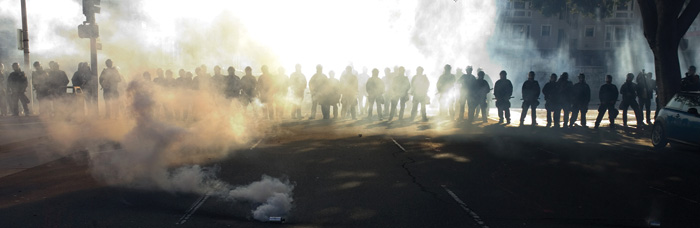
Frankly, it made sense to be prepared: In other Occupy Oakland actions, police have attacked with batons, tear gas, pepper spray, flash-bang grenades, and smoke bombs. And for quite a few Oakland residents, the police have always been seen as an outside force that can’t be trusted.

In fact, violence did break out. Many, including myself, have eyes still stinging from tear gas. I saw several wounds caused by rubber bullets shot at protesters. I spoke individually to at least a dozen people — one of them a pregnant woman — who were struck with police batons.

And protesters did not remain peaceful while this violence was being used against them.

Some picked up tear gas canisters and threw them back towards police; that much I saw. I also saw protesters throw empty plastic bottles at police.

According to the police, they also threw metal pipes, rocks and bricks. According to the protesters, they threw mainly empty plastic bottles and fruit at police. But as protesters often say of the police, “They’re the ones who showed up with the guns.” If the cops didn’t want violence, why unleash such an arsenal of weapons?

People got hurt, protesters and police alike. Several bystanders who had nothing to do with the situation were swept up in the mass arrest.

The city of Oakland, already in dire financial straits, likely spent hundreds of thousands of dollars reacting to the protests. Police claim that they were unable to sufficiently respond to violent crimes over the weekend, including five murders, because they were overwhelmed with Occupy troublemakers.

Of course, city officials were the ones who decided to arrest 400 people — with all the expense that involves.

There are, at this point, no reports of serious injuries to any police officers. However, at least a dozen protesters had welts on their faces or bodies from being beaten by clubs or shot with rubber bullets. One woman was shot in both arms with rubber bullet; one man was shot in the face with rubber bullets while holding a video camera to document the events. Several protesters were shoved to the ground and received wounds on their faces while being arrested. Police raised their rubber-bullet rifles to the faces of protesters throughout the day, threatening attacks. A rubber bullet to the face can cause brain damage and blindness.


DID IT HAVE TO HAPPEN?

How could this have been prevented?

Police say that “while peaceful forms of expression and free speech rights will be facilitated, acts of violence, trespassing, property destruction and overnight lodging will not be tolerated.” But 40 people were arrested during an ongoing Occupy Oakland vigil in the first weeks of January for having “illegal property” at OGP in what many saw as clearly a peaceful expression of First Amendment rights.

On KGO radio Jan. 29, Chief Jordan said that he has allowed Occupy Oakland to protest without a permit and would continue to do so, but those early January raids were ostensibly due to permit violations — violations of the terms of a permit that Occupy Oakland did in fact have.

There’s no question: The police response to Occupy Oakland over the past few months has caused some people in the movement to get more radical.

Many Occupy Oakland-affiliated medics condemned those who threw objects at police, saying that they provoked a backlash that caused more injuries. Many Oakland residents who might be in line with the socio-economic critique presented by the Occupy movement feel endangered and confused by marches that result in the massive use of police weapons in broad daylight. A lot of people would rather protest in a lot of ways that less resemble urban warfare.

On the other hand, there are also ways that Oakland officials could have prevented the consequences of weapons deployed and 400 arrested Jan. 28. They could, for example, have allowed protesters to occupy the vacant building.

When protesters seized a building Jan. 20 in San Francisco, police first attempted to prevent them. They lined up in front of the targeted building. They deployed pepper spray and struck several protesters with batons. When they were unsuccessful, and protesters entered the building from the back, they opted to block the surrounding streets and wait until the time seemed right to enter the situation and make arrests. Police spokesperson Carlos Manfredi told me that the cops were not going to rush into the situation and were trying to prevent injury and violence.

The Kaiser Convention Center has been vacant for years. The city of Oakland recently made plans to sell it to its Redevelopment Agency, but that plan fell into legal limbo when Gov. Jerry Brown signed AB26, a bill that dissolved all California redevelopment agencies.

At this point, nobody at Oakland City Hall has any plans whatsoever for the big, empty structure.

Why not allow Occupy to use the convention center? It’s not downtown, where Mayor Quan says businesses have been adversely affected by Occupy Oakland’s presence. It would give the movement a chance to stop focusing on trying to occupy spaces and start focusing on benefiting the community with food, shelter, and community programs that they provided when they had a camp. It would give the building tenants who could be held responsible for maintaining it. It might even help get Occupy Oakland and the Oakland Police Department out of the cycle of violence that they have been spiraling into for months.

Each time arrests occur, each time violence occurs, both sides blame the other. Both sides are correct that they were provoked. Both sides are correct that something that they think is worth defending was violated — for the cops, it’s the law. For the protesters, it’s the right of the people to assemble.

In fact, many Oakland residents have experienced violence at the hands of the Oakland Police Department for years before Occupy began. There was already a mass movement formed around the murder of Oscar Grant, and thousands of people fed up with police murders of unarmed, often black, suspects.

In recent decades, other radical groups, notably the Black Panthers, insisted that their community lacked basic needs because the city of Oakland refused to prioritize them. The Black Panther free breakfast program served food in a strikingly similar way to Occupy Oakland. Black Panthers were also notorious for carrying guns to defend themselves against police violence.

Occupy Oakland protesters (unlike Tea Party members) certainly don’t carry guns. But, more and more, they cry “fuck the pigs” as much as any Panther.

For much of the Occupy movement’s 99 percent, unjust actions by banks, corporations, and the government officials that they have often bought and paid for are the worst problems facing the United States today. For others, particularly the poor and people of color, these problems are magnified and exacerbated by the fact that they feel the threat of police harassment every day. For years, they’ve understood that police disproportionately do not investigate or solve crimes that happen to them and their families.


THE RADICALS AND THE BROADER MOVEMENT

The Oakland General Assembly Jan. 29 was the biggest it’s been in weeks. While there were still over 300 people in jail, 300 more came out to get involved with the meeting. That happened at the same time that many who felt that inexcusable violence and property destruction occurred Jan. 28 and concluded they could no longer have anything to do with Occupy Oakland.

It’s a challenge for the movement nationally, too: How do you accept and encourage the people whose legitimate anger at economic injustice and police abuse turns them toward more radical responses — and at the same time make room for a people who want nothing to do with the black bloc Fs, vandalism, and confrontation with the police?

There are tactical issues with the way the building occupation was planned. Many who were completely in line with the concept felt unsafe and uncomfortable with the secretive nature of the organizers who planned it. The location of the building targeted for occupation was kept secret for practical reasons; police could easily prevent a successful takeover. Supporters must often be led to the locations of planned takeovers without knowing where the action is and how they’ll get there. But how do you reconcile this with the transparency required when organizers are leading more than 1,000 people who want to use tactics they feel comfortable with and make their own choices?

Occupy Oakland is asking the people to imagine a world where property rights wouldn’t prevent them from doing all the good that they could do with a building like the Kaiser Convention Center. They must also ask themselves to imagine a world in which goals like a building occupation can be achieved in a way that everyone involved is able to consent to their involvement.

These debates continue to occur at Occupy Oakland. Some will leave the movement, some will join. Some will take the ideas and try to manifest them in new and different ways. Participants in Occupy Oakland desperately want basic needs of food and shelter met for their community members, and for the system that governs the city to do so in a way that allows people to thrive when it comes to health, education, and opportunities for creativity and growth. They think that they have the beginnings of a community and a process that can achieve those visions, better than the city government ever has, and they care more about achieving it than respecting the property rights of the owners of abandoned buildings.

Rep Clock

0

Schedules are for Wed/8-Tues/14 except where noted. Director and year are given when available. Double and triple features are marked with a •. All times p.m. unless otherwise specified.

ARTISTS’ TELEVISION ACCESS 992 Valencia, SF; www.atasite.org. $6-10. Dirty Looks presents: City of Lost Souls, Fri, 8. “Mindscapes,” short films, Sat, 8.

CALIFORNIA COLLEGE OF THE ARTS 1118 Eighth St, SF; www.dirtylooksnyc.org. Free. Dirty Looks presents: “Queer Conversations on Culture in the Arts,” with selections from the “Female Trouble” experimental shorts program and a conversation with Margaret Tedesco, Thurs, 7.

CASTRO 429 Castro, SF; (415) 621-6120, www.castrotheatre.com. $7.50-10. •Pickpocket (Bresson, 1959), Wed, 3:30, 7:15, and American Gigolo (Schrader, 1979), Wed, 4:55, 8:45. •Beauty and the Beast (Cocteau, 1946), Thurs, 3:05, 7, and No Such Thing (Hartley, 2001), Thurs, 4:55, 8:50. “Midnites for Maniacs: I’m Black and I’m Proud:” •I’m Gonna Git You Sucka (Wayans, 1988), Fri, 7:30; Pootie Tang (Louis CK, 2001), Fri, 9:30; CB4 (Davis, 1993), Fri, 11:30. French American International School presents: “I-Speak: Celebrating 50 Years of International Education,” Sat, 6:30. This event, $5-10; tickets at www.internationalsf.org. •Do The Right Thing (Lee, 1989), Sun, 2, 8, and Malcolm X (Lee, 1992), Sun, 4:15. “Love: Ali MacGraw:” Love Story (Hiller, 1970), Tues, 8. With pre-show gala performance and MacGraw in person; for tickets ($25-45), visit www.ticketfly.com.

ELMWOOD 10070 San Pablo, El Cerrito; www.rialtocinemas.com. Free. “Community Cinema:” More Than a Month: One Man’s Journey to End Black History Month (Tilghman, 2012), Wed, 7.

CHRISTOPHER B. SMITH RAFAEL FILM CENTER 1118 Fourth St, San Rafael; (415) 454-1222, www.cafilm.org. $6.75-10.25. “Rafael Film Club:” “Jan Wahl,” Thurs, 1. Pina (Wenders, 2011), call for dates and times. “Mostly British Film Festival:” Route Irish (Loach, 2010), Wed, 7; Albatross (MacCormick, 2011), Thurs, 7. “2012 Oscar Nominated Short Films,” narrative and documentary (separate admission), Feb 3-9, call for times.

LAMORINDA THEATRES Four Orinda Theatre Square, Orinda; www.caiff.org. $12-15. “California Independent Film Festival,” 11 features, plus docs, shorts, and educational seminars, Feb 10-16.

MECHANICS’ INSTITUTE 57 Post, SF; (415) 393-0100, rsvp@milibrary.org. $10. “CinemaLit Film Series: Hollywood Dames: Beauty and Brains:” Intermezzo (Ratoff, 1939), Fri, 6.

PACIFIC FILM ARCHIVE 2575 Bancroft, Berk; (510) 642-5249, bampfa.berkeley.edu. $5.50-9.50. “Documentary Voices:” The Green Wave (Ahadi, 2010), Wed, 7. “Seconds of Eternity: The Films of Gregory J. Markopoulos:” “Markopoulos: The Early Films (1940-49)” Thurs, 7; “Eros and Myth (1950-63),” Sat, 6:30. “Austere Perfectionism: The Films of Robert Bresson:” The Trial of Joan of Arc (1962), Fri, 7; Les dames du Bois du Boulogne (1945), Fri, 8:25; Lancelot of the Lake (1974), Sat, 8:30. “Screenagers: 14th Annual Bay Area High School Film and Video Festival,” Sat, 3. “Howard Hawks: The Measure of Man:” The Criminal Code (1931), Sun, 4:30; Bringing Up Baby (1938), Tues, 7. “African Film Festival 2012:” Viva Riva! (Munga, 2010), Sun, 6:30.

ROXIE 3117 and 3125 16th St, SF; (415) 863-1087, www.roxie.com. $6.50-10. Come Back, Africa (Rogosin, 1959/2012), Wed-Thurs, 6:45, 8:30. Drive (Winding Refn, 2011), Wed, 8:45. Into the Abyss (Herzog, 2011), Wed, 6:45. SF IndieFest, Feb 9-23. Visit www.sfindie.com for complete schedule.

SFFS | NEW PEOPLE CINEMA 1746 Post, SF; www.sffs.org. $10-11. Domain (Chiha, 2010), Wed-Thurs, 2, 4:30, 7, 9:30. Once Upon a Time in Anatolia (Ceylan, 2011), Feb 10-16, 2, 5:30, 8:30.

VOGUE 3290 Sacramento, SF; www.mostlybritish.org. $12.50. “Mostly British Film Festival:” Black Butterflies (van der Oest, 2011), Wed, 5; London Boulevard (Monahan, 2010), Wed, 7:15; The Great White Silence (Ponting, 1924), Wed, 9:30; A Passionate Woman (2010), Thurs, 5; Route Irish (Loach, 2010), Thurs, 7:30.

VORTEX ROOM 1082 Howard, SF; www.myspace.com/thevortexroom. $7 donation. “The Second Coming of the Vortex Room:” The Second Coming of Suzanne (Barry, 1974), and Marjoe (Kernochan and Smith, 1972), Thurs, 8.

YERBA BUENA CENTER FOR THE ARTS 701 Mission, SF; (415) 978-2787, www.ybca.org. $6-8. “Bros Before Hos:” The Killing of a Chinese Bookie (Cassavetes, 1976), Thurs, 7:30; “Female Trouble,” experimental shorts program presented by Dirty Looks curator Bradford Nordeen, Sun, 2.

Editor’s notes

13

tredmond@sfbg.com

I used to go to Grateful Dead shows at the Oakland Auditorium, which is now called the Kaiser Convention Center. One night I saw Bill Graham, the late concert promoter, ride a zip line from up near the ceiling to the stage in a giant paper mache joint called the “S.S. Columbian,” which looked like it was going to fall apart at any minute as he swung back and forth 50 feet over the crowd, trying to smile and wave in a bizarre promotional stunt that confused even the deadheads. I bet he shit his pants.

The place was a pretty good venue for a big concert, but it never worked out as a convention center, and the city shut it down in 2005. It needs seismic work and about $5 million in maintenance. It sits near Lake Merritt, on the edge of downtown Oakland, a giant empty building just waiting for something to happen to it.

It’s a perfect spot for an Occupy Oakland headquarters. I’m surprised it took the Occupy folks this long to figure it out.

Look: Oakland’s a working-class city, and it’s having severe financial problems, and sending hundreds of cops to arrest Occupy protesters is sucking up money that’s desperately needed for other things. Mayor Jean Quan complains that police were unable to respond to emergency calls in other parts of the city because they were all downtown dealing with the demonstration.

Understood — and it’s clear that the Oakland Police, whether the Occupy folks like it or not, are going to arrive in mass numbers to make sure that there’s no damage to local businesses or City Hall (where, oddly, there were no arrests, because the cops were elsewhere).

But the empty Kaiser Center, which isn’t even in the downtown center? Why bother?

Seriously: Why not just give it to Occupy Oakland? Tell the group that the city will strictly enforce fire and health codes, that the Occupy people will have to clean the place up and keep it clean, that they can’t damage the place … and hand over the keys?

It’s public property. Nobody using it now. Occupy might actually bring some excitement to the scene. If it became a center for political meetings and organizing, for education and performances, it could be a be a very positive thing.

Declare at truce in the Occupy wars. Let the cops go after murderers; give Occupy the vacant convention center. Nothing else is working. It’s worth a try.

Jeffrey Sachs: The necessity for sustainable development

2

By Jeffrey D. Sachs
Jeffrey D. Sachs is Professor of Economics and Director of the Earth Institute at Columbia University. He is also Special Adviser to United Nations Secretary-General on the Millennium Development Goals.

ADDIS ABABA – Sustainable development means achieving economic growth that is widely shared and that protects the earth’s vital resources. Our current global economy, however, is not sustainable, with more than one billion people left behind by economic progress and the earth’s environment suffering terrible damage from human activity. Sustainable development requires mobilizing new technologies that are guided by shared social values.

United Nations Secretary-General Ban Ki-moon has rightly declared sustainable development to be at the top of the global agenda. We have entered a dangerous period in which a huge and growing population, combined with rapid economic growth, now threatens to have a catastrophic impact on the earth’s climate, biodiversity, and fresh-water supplies. Scientists call this new period the Anthropocene – in which human beings have become the main causes of the earth’s physical and biological changes. 

The Secretary-General’s Global Sustainability Panel has issued a new report that outlines a framework for sustainable development. The GSP rightly notes that sustainable development has three pillars: ending extreme poverty; ensuring that prosperity is shared by all, including women, youth, and minorities; and protecting the natural environment. These can be termed the economic, social, and environmental pillars of sustainable development, or, more simply, the “triple bottom line” of sustainable development.

The GSP has called for world leaders to adopt a new set of Sustainable Development Goals, or SDGs, that will help to shape global policies and actions after the 2015 target date for achieving the Millennium Development Goals (MDGs). Whereas the MDGs focus on reducing extreme poverty, the SDGs will focus on all three pillars of sustainable development: ending extreme poverty, sharing the benefits of economic development for all of society, and protecting the Earth.

It is, of course, one thing to set SDGs and quite another to achieve them. The problem can be seen by looking at one key challenge: climate change. Today, there are seven billion people on the planet, and each one, on average, is responsible for the release each year of a bit more than four tons of carbon dioxide into the atmosphere. This CO2 is emitted when we burn coal, oil, and gas to produce electricity, drive our cars, or heat our homes. All told, humans emit roughly 30 billion tons of CO2 per year into the atmosphere, enough to change the climate sharply within a few decades.

By 2050, there will most likely be more than nine billion people. If these people are richer than people today (and therefore using more energy per person), total emissions worldwide could double or even triple. This is the great dilemma: we need to emit less CO2, but we are on a global path to emit much more.

We should care about that scenario, because remaining on a path of rising global emissions is almost certain to cause havoc and suffering for billions of people as they are hit by a torrent of droughts, heat waves, hurricanes, and more. We have already experienced the onset of this misery in recent years, with a spate of devastating famines, floods, and other climate-related disasters.

So, how can the world’s people – especially its poor people – benefit from more electricity and more access to modern transportation, but in a way that saves the planet rather than destroys it? The truth is that we can’t – unless we improve dramatically the technologies that we use.

We need to use energy far more wisely while shifting from fossil fuels to low-carbon energy sources. Such decisive improvements are certainly possible and economically realistic.

Consider the energy inefficiency of an automobile, for example. We currently move around 1,000 to 2,000 kilograms of machinery to transport only one or just a few people, each weighing perhaps 75 kilograms (165 lbs.). And we do so using an internal combustion engine that utilizes only a small part of the energy released by burning the gasoline. Most of the energy is lost as waste heat.

We could therefore achieve huge reductions in CO2 emissions by converting to small, lightweight, battery-powered vehicles running on highly efficient electric motors and charged by a low-carbon energy source such as solar power. Even better, by shifting to electric vehicles, we would be able to use cutting-edge information technology to make them smart – even smart enough to drive themselves using advanced data-processing and positioning systems.

The benefits of information and communications technologies can be found in every area of human activity: better farming using GPS and micro-dosing of fertilizers; precision manufacturing; buildings that know how to economize on energy use; and, of course, the transformative, distance-erasing power of the Internet. Mobile broadband is already connecting even the most distant villages in rural Africa and India, thereby cutting down significantly on the need for travel.

Banking is now done by phone, and so, too, is a growing range of medical diagnostics. Electronic books are beamed directly to handheld devices, without the need for bookshops, travel, and the pulp and paper of physical books. Education is increasingly online as well, and will soon enable students everywhere to receive first-rate instruction at almost a zero “marginal” cost for enrolling another student.

Yet getting from here to sustainable development will not just be a matter of technology. It will also be a matter of market incentives, government regulations, and public support for research and development. But, even more fundamental than policies and governance will be the challenge of values. We must understand our shared fate, and embrace sustainable development as a common commitment to decency for all human beings, today and in the future.

Jeffrey D. Sachs is Professor of Economics and Director of the Earth Institute at Columbia University. He is also Special Adviser to United Nations Secretary-General on the Millennium Development Goals.

Copyright: Project Syndicate, 2012.
www.project-syndicate.org

The sex heard ‘round the world: [SSEX BBOX] documentary premieres

1

Scenes from [SSEX BBOX], the global sexuality documentary project whose long-awaited first episode will premiere at the Center of Sex and Culture on Mon/30:

One. A protest in Berlin, where a presentation is being made on the 16th century physical punishments that religious institutions imposed on sexually “immoral” people. 

Two. A conversation between two transgendered men living in Brazil.

Filmed in the form of interviews and group discussions, [SSEX BBOX] is a social justice film project that takes viewers on tour through the different understandings of gender and sexuality from around the globe. The documentary engages the ongoing conversation regarding the cultural, social, and even linguistic implications that are intertwined within sexuality. It will air 15 10-minute episodes bi-weekly from January to August 2012 — but the Mon/30 screening will offer the chance to talk face-to-face with the team behind the project. 

[SSEX BBOX] sexuality out of the box! from SSEX BBOX on Vimeo.

Priscilla Bertucci, the executive producer and director of [SSEX BBOX], holds that in an environment where something so primary as a noun is categorized as male or female, sexism and strict gendering become strongly embedded in cultural perceptions of sexuality. Looking back at the project, she commented to the Guardian in a recent phone interview:

SF and Berlin are pioneering cities in that there is a lot of sexual education and many years of work have been [put into those places towards] bringing about awareness. [Exploring sexuality] is definitely more difficult in Barcelona and Brazil where there are still a lot judgments.  People perceive gender as male or female, straight or gay, and don’t really think of what may be outside of this divided box. 

On location with [SSEX BBOX]. Photo by Danila Bustamante

When shooting in Sao Paulo, Bertucci encountered numerous individuals who had never been exposed to the idea of alternative sexual orientations. That lack of experience wasn’t a surprise to her — she was raised there:

I grew up in Brazil and I experienced a gap in information first hand. In places like Sao Paulo, there is a huge lack of sex education in schools and sex educators in general. When I was very young, I was aware of the gay and lesbian community. But at some point, I started not fitting in the box because I would sometimes be attracted to men and I didn’t really identity as bisexual. But later, I became aware that I could identify as queer or gender queer. But it took me a long time and I had to go out and learn a lot of things on my own. A project like [SSEX BBOX] helps people understand that they don’t have to choose [from] a binary.

Bertucci’s film features interviews with sex activists, educators, psychotherapists, and average citizens from all over the spectrum of sexuality. The documentary was mostly edited here in San Francisco, but its crew was comprised of a globetrotting crew of directors and cinematographers traveling through Sao Paulo, Berlin, and Barcelona. 

The international affair was made possible through efficient Skype meetings and Dropbox, and [SSEX BBOX] will continue to embrace the web as a way to distribute their films. The team also launched a pocket-size zine in fall of 2011 that included photography, personal narratives, cartoons, paintings, and writings on gender expression which you can order online in digital or paper form.


[SSEX BBOX] documentary premiere 

Mon/30 7:30-11 p.m., free. 

Center for Sex and Culture

1349 Mission, SF

(415) 902-2071

www.sexandculture.org

This is our country, too: Fred Korematsu’s daughter on her father’s civil rights legacy

1

“One never knows after someone dies what happens to their legacy. Sometimes it becomes a part of history and sometimes it grows,” Karen Korematsu -remarked in a phone interview with the Guardian this week. Her father, civil rights activist Fred Korematsu, will be honored statewide with his own official day on Mon/30. You can celebrate his legacy locally at the Oakland Museum of California’s Lunar New Year event on Sun/29, where Karen will be speaking about her dad’s contribution to our cultural heritage.

“In the case of my father, his legacy seems to be growing,” Karen continued. “His story resonates and remains important to people.” Last year was the first time California celebrated the Fred Korematsu Day of Civil Liberties and the Constitution. This year, events from a photo exhibition in the Smithsonian National Portrait Gallery, panel discussions, and teacher workshops in Humboldt, San Diego, Davis, San Francisco, and San Jose will commemorate his work.

The Oakland Museum of California’s celebration will be especially meaningful — Korematsu was born and raised in Oakland.  The event will include remarks from Oakland Mayor Jean Quan, a talk by Karen, performances by students from the Korematsu Discovery Academy in Oakland, vocalist Shirley Kazuyo Muramoto, and koto player Brian Mitsuhiro, and a screening of the Emmy Award-winning Of Civil Wrongs and Rights: the Fred Korematsu Story.

The elder Korematsu was a civil rights hero who refused to be incarcerated in the Japanese internment camps during World War II. When President Roosevelt signed Executive Order 9066 on February 19, 1942 requiring Japanese Americans to be placed in internment camps, the 23-year-old Korematsu refused to report. He attempted to continue his life as a normal American citizen, but was spotted and arrested in San Leandro three months later. Convicted for violating military orders, he lived for several months at the Tanforan assembly center in San Bruno and subsequently was transferred to Topaz, Utah — one of the 10 incarceration camps that were set up for Japanese Americans during WWII — where his family was also being held. 

Korematsu refused to let go of the belief that his civil liberties as guaranteed by the constitution were being directly violated. He appealed his case to the U.S. Supreme Court to no avail. 

That is, until 1983, when researcher Aiko Herzig-Yoshinaga and professor Peter Irons brought to light previously-suppressed documents detailing the FBI and military intelligence agencies’ conclusion that Japanese Americans were not threats to national security. 

Korematsu’s case was re-opened by a legal team of pro bono attorneys and at long last, his conviction was overturned in a federal court in San Francisco. In 2011, the U.S. Department of Justice released an admission of error in the case of the Japanese American internment camp. 

Karen is disappointed that her father didn’t live to see the apology. But she sees the confession as an important step towards bringing “accountability to people in government who need to take responsibility in making sure that decisions are always in the best interests of all Americans.”

She holds that actions like those of her father are especially relevant today, in these times of anti-immigrant sentiment. “He took a stance against racial profiling in issues such as national security and immigration,” she said. 

Following 9/11, Fred, along with the Japanese American Citizen League, spoke out against the national security measures the U.S. government was taking towards Muslim inmates being held at Guantanamo Bay. He became an active member of the National Coalition for Redress and Reparations. He assisted in the passage of a bill that prompted an official apology from the U.S. government, granting $20,000 for each surviving Japanese American who was incarcerated.

Today, Fred’s legacy lives on through the work of the Korematsu Institute. Founded in 2009 through the Asian Law Caucus, the institute’s mission is to advance pan-ethnic civil and human rights through education. 

Karen said that one of the many ventures of the institute is creating supplemental curriculum for K-12 schools to provide historical information that is missing in textbooks. She believes that her father’s story is an important lesson for children. “It tells the truth about American history, the Constitution, and their own backgrounds,” she said. 

Sensitive to the current financial troubles of California’s school system, the Korematsu Institute raises funds independently to create educational kits that it distributes to schools free-of-cost. 

Upon her father’s death, Karen believed that she had been passed on the torch in terms of challenging prejudice through education — so that nothing similar to the Japanese internment camps will ever happen again. “It’s heartwarming to tell my father’s story and see his legacy grow,” she concluded.


Lunar New Year celebration

Sun/29 noon-4:30 p.m., free with museum admission

Oakland Museum of California

1000 Oak, Oakl.

(510) 318-8400

www.museumca.org


Occupy and the State of the Union

2

Have all of the Occupy actions made any difference? Gee — I wonder.


I wonder if a president who acted a year ago as if economic justice wasn’t even an issue in this country would have devoted a substantial part of his State of the Union speech to fairness in tax policy. I wonder if he would have said this:


Right now, we’re poised to spend nearly $1 trillion more on what was supposed to be a temporary tax break for the wealthiest 2 percent of Americans. Right now, because of loopholes and shelters in the tax code, a quarter of all millionaires pay lower tax rates than millions of middle-class households. Right now, Warren Buffett pays a lower tax rate than his secretary.


Do we want to keep these tax cuts for the wealthiest Americans? Or do we want to keep our investments in everything else –- like education and medical research; a strong military and care for our veterans?


Or this:


Tax reform should follow the Buffett Rule. If you make more than $1 million a year, you should not pay less than 30 percent in taxes. And my Republican friend Tom Coburn is right: Washington should stop subsidizing millionaires. In fact, if you’re earning a million dollars a year, you shouldn’t get special tax subsidies or deductions. On the other hand, if you make under $250,000 a year, like 98 percent of American families, your taxes shouldn’t go up. You’re the ones struggling with rising costs and stagnant wages. You’re the ones who need relief.


Now, you can call this class warfare all you want. But asking a billionaire to pay at least as much as his secretary in taxes? Most Americans would call that common sense.


or this:


No American company should be able to avoid paying its fair share of taxes by moving jobs and profits overseas. From now on, every multinational company should have to pay a basic minimum tax.


Now: Not saying any of that is going to happen right away, or even that Obama will put tax reform at the top of the agenda. And changing the tax code to charge people like Mitt Romney 30 percent is nowhere near enough; in the 1960s, those people paid 80 percent of their marginal dollars in federal taxes. The Repubs in Congress won’t let any of this happen anyway.


But all of the major newspapers (which a year ago didn’t even know how to spell economic injustice) made his pitch for greater fairness in the economy the lead of their reports and all of the headlines talked about it. And when pollster Stan Greenberg tracked the responses of Democrats, Republicans and independents to the speech, the vast majority were pleased by and agreed with the commments that I cited above. That’s not just 80 percent of the Dems but 70 percent of the GOP voters.


The other thing Obama said — in indirectly — is that government is important. Beyond the flag-waving salute to the troops and the talk about the Navy Seals (Yay! We killed a guy! No arrest, no trial, just summary execution!), Obama was setting the tone for a debate over the role of the public sector in America. He talked about building the Hoover Dam, the Golden Gate Bridge and the interstate highway system. He talked about the importance of public support for research. That’s a direct contradiction to what the Republicans are saying about making government much smaller and less significant in people’s lives. I wonder what happens if the Republican candidate and Obama get out of the platitudes are actually have that discussion this fall.


Of course, he also said the solution to most business problems was tax cuts and incentives, which is not only GOP dogma but silly, since tax cuts for business almost never have the intendent effect. Tax penalties won’t keep companies from moving offshore (although I still support the idea), and tax cuts won’t bring them back.


It’s notable that Obama didn’t mention corporate personhood, which is going to be a huge part of the Occupy agenda this year. And that’s something that could actually change business behavior. Corporate charters are granted by the government — and with a few changes in law, could be revoked by the government, too. Screw your workers, cheat on taxes and move jobs to low-wage non-union areas where children work 14 hours a day making your products? Guess we’ll have to revoke your corporate charter. No more protection for personal liability for the owners and shareholders. Too bad.


And while his populist stuff struck a chord, the energy and environmental policy suggestions were just horrible. Yeah, I’m for ending tax breaks for oil companies — but opening up 75 percent of the potential offshore areas to drilling? Encouraging more natural gas drilling? Not much in the way of serious talk about investing a fraction of that money in renewables?


Oh, and I love this: Obama’s going to force natural gas drillers to “disclose the chemicals they use.” That’s going to keep us safe, yesiree. Thank you, mister driller, for telling me how your poisoning my water. Not that I can do anything about it, of course; you can keep right on going. But now, thanks to our bold president, I know about it.


Occupy the natural gas wells. I’m ready to go.


Hot sexy events: January 18-24

0

Thankful. I am thankful for San Francisco sex. Just got back from the AVN awards in Vegas this weekend and couldn’t get over the fake boobs (literally — mountainous cleavage), rubber ducky-esque lips, and rote couplings that took over the Hard Rock Hotel for the better part of the week. Don’t get me wrong, the weekend was all kinds of wonderful and there were buffets and penthouse hot tubs filled with Tina Horn, Princess Donna, and Akira Raine — salacious tweeting and rumors of Robin Leach and deep red carpet conversations about being forced to wear condoms. But for me, SF.

Also, the trailer for James Franco’s new movie based on the life of Kink.com actress-writer Lorelei is out: 

Why am I so stoked on this city? Read on about what San Francisco does best: weird, original, affirming sex events in the City By the Bay. Here’s four reasons that’ll make you glad you’re here (pervert).


Good Vibrations’ Lakeshore store opening

Once an employee-owned store in the Mission, Good Vibes has expanded into a nationwide business, powered by an Ohio sex toy corporation, and teaching everyone from Florida to Washington about the power of gadgets in the bedroom through an award-winning sales and education website. (Read our interview with the company’s C.O.O. and staff sexologist Carol Queen here.)The empire gets one bigger today, with the opening of Good Vibes’ first Oakland brick and mortar location. Kandi Burress of Real Housewives of Atlanta will be on hand to promote her superlative line of vibrators, Bedroom Kandi

Sat/28 6-9 p.m., free

Good Vibrations

3219 Lakeshore, Oakl.

(510) 788-2389

www.goodvibes.com


Perverts Put Out: Midwinter Edition

Accepting his honor at this year’s Guardian Goldies art awards, performance provacateur Philip Huang utilized a neti pot in ways surely frowned up by the Health Department. The man is inappropriateness, embodied — just ask those “God Hates Fags” people, he’s crashed their protests with a colander head, carrying a sign that says “No Fags on the Moon.” So what does a Huang do at a reading made for and by pervy weirdos? You’ll just have to attend the latest edition of Perverts Put Out, to find out. Tonight’s event also features sexy solliquies by horehound stillpoint, Sherilyn Connelly, and Jen Cross. 

Sat/28 7:30 p.m., $10-15

Center for Sex and Culture

1349 Mission, SF

www.sexandculture.org


John Leslie one-year memorial

Harken back to your best memories of golden age porn star John Leslie, who passed away in 2010. Center for Sex and Culture will be hosting this memory circle for friends of his work — which includes Talk Dirty To Me (1980), Nothing To Hide (1981), and Talk Dirty To Me, Part II (1982). One of the first actor-cum-director hyphenates in adult film, the man was big back in the days of well-budgeted productions. Perhaps this will also be a look back on the long, strange road the porn industry has traveled over the past few decades (after all, Leslie did finish out his career directing gonzo releases). 

Sun/29 5:30 p.m., free

Center for Sex and Culture

1349 Mission, SF

(415) 902-2071

www.sexandculture.org


[SSEX BBOX] premiere 

Name the sexiest cities in the world. Did Sao Paolo, Berlin, and San Francisco make it on there? They’re the obvious choices, of course — and fertile territory for this global documentary project. The team behind [SSEX BBOX] chased tail around the globe, chatting with all orientations and genders about what makes them tingle below (above) the equator.

Mon/30 8:30 p.m., free

Center for Sex and Culture

1349 Mission, SF

(415) 902-2071

www.ssexbbox.com


“Occupy Wall Street West” hopes to see massive protest

14

A coalition from across San Francisco is hoping to make tomorrow – Friday, Jan. 20 – a monumental day in the history of Bay Area activism, the Occupy movement, and the fight against home foreclosures and other manifestations of corporate greed.Organizers call the day of protests, marches, street theater, pickets, and more “Occupy Wall Street West.”

Those that urged Occupy protesters to focus in on a list of demands should be pleased, as the day includes a list of demands on banks, including a moratorium on foreclosures and an end to predatory and speculative loans.


Organizers note that Occupy SF Housing, the coalition that planned the day, is separate from OccupySF. In fact, a subset of the group known best for its months-long tent city at Justin Herman Plaza was only one part of a substantial coalition that planned this day of action. Among others, the coalition includes the SF Housing Rights Committee, Homes Not Jails, Alliance of Californians for Community Empowerment (ACCE), and Occupy Bernal, a neighborhood-focused Occupy group specifically aimed at preventing evictions and foreclosures.

Justin Herman Plaza – or Bradley Manning Plaza, as many in OccupySF like to refer to the park just across from the Ferry Building – will be a crucial meeting point. A press spokesperson said that “down at Bradley Manning Plaza at 6 a.m.,12 p.m., and 5 p.m., we’re going to be launching various segments of the protests, and there will be information desks and education all for those who are interested.”

Organizers hope to culminate the day with a mass march at 5 p.m. A map of the planned actions can also be found here.

Many of the groups in the coalition have focused on specific cases of homeowners and tenants facing eviction and foreclosure; tomorrow, they bring their power to the Financial District.

Vivian Richardson, a member of the coalition who has also worked with ACCE and the newer Foreclosure Fighters group in Bayview, says that she remains in her home after being threatened with foreclosure due to community support.

“On my own, I tried everything to get out of this bad loan… I fought for two years on my own, only to have my home foreclosed on and taken away,” Richardson said at a press conference held yesterday.

“With the help of my community, unions, and ACCE members throughout the state, we generated over 1,400 emails and a few hundred calls to the CEO of [lender] Aurora Bank, and within one hour they called me to reopen my case,” she said. “As of today, the bank has voided the sale of my home and rescinded the foreclosure.”

Groups hoping to prevent foreclosures have had many success stories like Richardson’s. But tomorrow, they will put pressure on large corporate banks.

As SF Housing Rights Committee Executive Director Sarah Shortt said at the rally, “What we’re trying to do here is draw connections between some of those issues and the banking industry… I think that’s one of the most important pieces of the Occupy movement: starting to educate ourselves and each other about how ubiquitous the toll that’s been taken on cities, neighborhoods, communities by banking industry and the one percent.”

The focus is on housing, but in typical Occupy fashion, protesters will draw connections between all kinds of concerns that they see as abuses by banks and corporations.

According to OccupySF member Lisa Guide, the day is about “war profiteering, unjust foreclosures and evictions for profits by the big banks, exploitation of labor and union workers, and liberation of the commons for public good, among many other [issues].”

Guide also mentioned that Jan. 20 is “the eve of the Citizens United Supreme Court case, the court case that gave corporations the power to buy our government.” Simultaneous actions are planned to protest Citizens United, including an Occupy the Courts action at the Ninth District Court of Appeals at noon, to coincide with a national call to “Occupy the Courts

More than 55 organizations are involved in the day of action, and their focuses go beyond housing rights. These include students from Occupy SF State, Occupy Modesto Junior College, and other campus Occupy groups; anti-war organizations such as Iraq Veterans Against the War; environmental organizations such as the Rainforest Action Network; several unions, including UNITE HERE Local 2 and the California Nurses Association; the Chinese Progressive Alliance; and the Interfaith Allies of Occupy, which will be hosting an all-day “respite area” at Saint Patrick’s Roman Catholic Church at 756 Mission.

The array of events planned for Friday is overwhelming. There are demonstrations, pickets, and occupations planned at dozens of banks and corporations throughout the Financial District. Street theater is planned in several places, including an adaptation of A Christmas Carol by the San Francisco Mime Troupe at Justin Herman Plaza at noon and a show from Iraq Veterans Against the War that, according to IVAW member Jason Matherne, a Navy veteran who served in Qatar, “is called Operation First Casualty, because the first casualty of war is the truth.”

Matherne said, “corporations are profiting off the war at the expense of the 99 percent. Specifically, the Bechtel Corporation is using–misusing–billions of dollars to rebuild the infrastructure in Iraq.”

Tomorrow should be big. In a press release, organizers claim that “this is predicted to be the largest street protest of the Financial District since anti-war protests in 2003.”

Whatever the turnout, the Saint Patrick’s “respite” should be a boon, as weather reports indicate rain for tomorrow. Luckily, as Vicki Gray, a Deacon in the Episcopal Diocese of California, Occupy supporter and Interfaith Organizer, said of the sanctuary: “All are welcome. It will be warm, it will be quiet, and you will be loved.”

Firing bad teachers

8

Diane Ravich, who used to be on the wrong side of school reform but has pretty much come around, was on Forum Jan. 18 talking about education policy. For the most part, she was right on target, explaining that too much of a focus on testing (as a measure of school and teacher accomplishment, not as a diagnostic tool) and too narrow an emphasis on math and reading has damaged public schools.


Neither she nor host Michael Krasny spent much time talking about the bigger problem — money — or the fact that other nations that are eclipsing the United State in education actually tax people and spend that money on schools. California has already cut the number of classroom days, and may cut as much as a week out of the school year. That’s a huge deal, one that’s directly related to the intransigence of a few state legislators who can hold the entire budget hostage — and to the unwillingness of California residents to amend Prop. 13 and allow reasonable property taxes.


But one of the things that struck me was a caller who complained that tenure was making it impossible to fire bad teachers.


Tenure, Ravich noted, is badly misunderstood. At the college level, it’s essentially a lifetime commitment; a college professor gets tenure and he or she understands that, for the most part, it means a career at an institution — with minimal job requirements. Tenured professors teach a few classes, but are free to spend a lot of time on academic research (without any set requirement for success or publication.)


For K-12 teachers, tenure is just a word meaning that they get due process in employment. It’s basically the same as the civil-service rules that San Francisco city employees have — the right to a hearing on discipline and freedom for arbitrary actions on the part of management.


You think it’s hard to fire a teacher? Try firing a cop. The police, who have nothing called “tenure,” have more and broader rights than any other public-sector employees, including the right to have all disciplinary matters kept completely secret. And police officers are armed and given the ability to arrest and even shoot people.


So yeah, let’s blame the inability to fire teachers. That’ll fix the problems.