Education

Doc ‘Girl Model’ investigates the dark side of the catwalk

2

The recent outcry over a “Team Supermodel” strut showing off British fashion during the Olympics’ closing ceremony underlined a dichotomy: as much as people want the conventional glamour of the moment, they don’t want to feel guilty about it, i.e. have it exposed by direct comparison to the purportedly natural physical beauty of athletes.

Yet there are parallels between these two groups, particularly in the realm of concerns about weight and drugs. Plus, being a sports star and a model are both roles that allow the performer to actually merit being “entitled.” Everyone wants to be special — though of course that only works if other people aren’t.

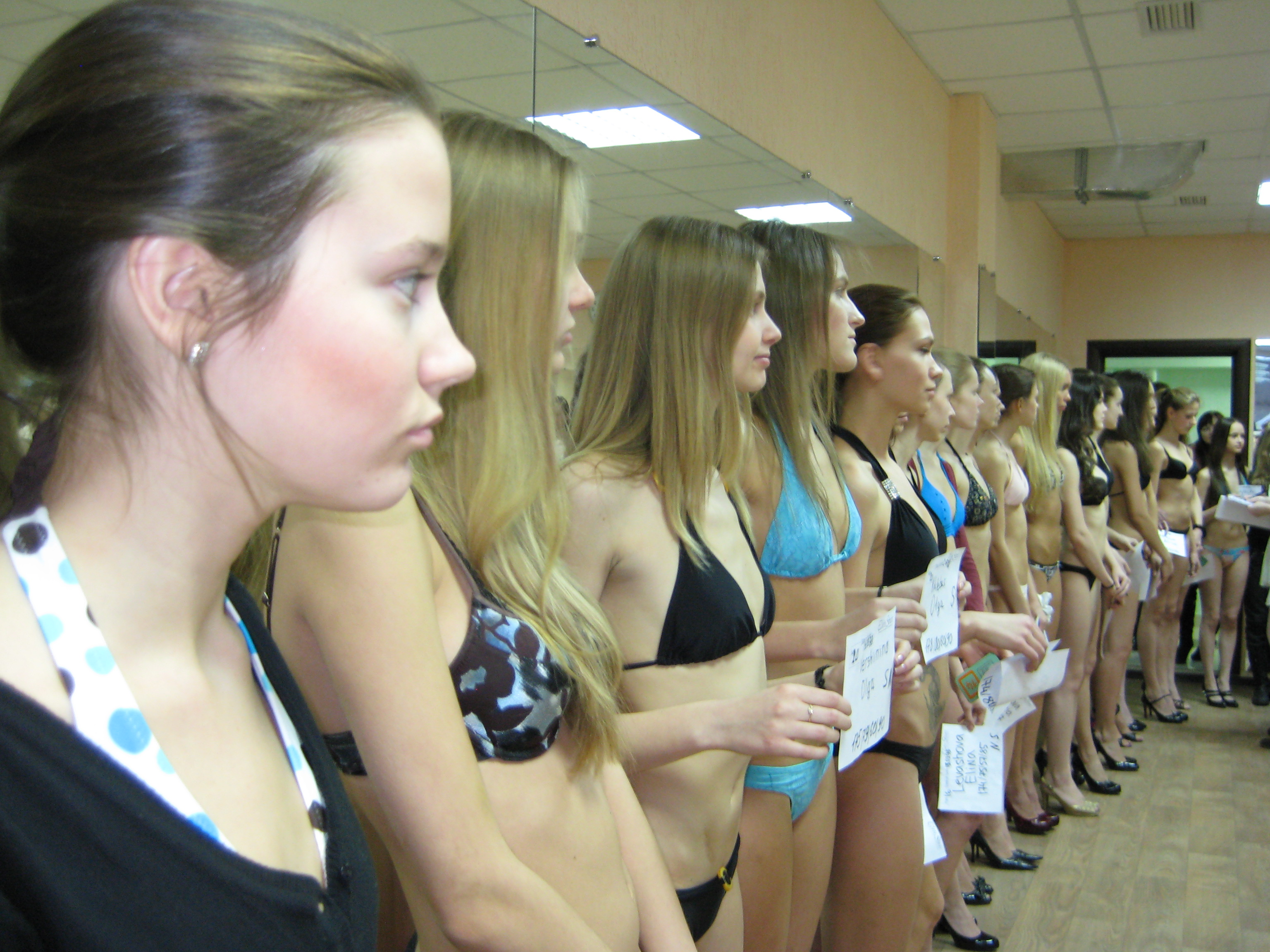
The disturbingly instructive new documentary Girl Model (opening Fri/14) makes a good case for not encouraging such desires in your child, because the likelihood is that someone will come along to exploit that desire, convincingly promise them fame, then leave them worse off than before, with debts accrued from the dream that didn’t come true. “The first secret to a successful modeling career is to start modeling at five or ten years old,” says an emcee at a cattle-call showcase early on in David Redmond and Ashley Sabin’s film. It’s Russia, where the relatively new capitalism trickles down even less than here, so the families are even more eager to turn little Svetlana into a moneymaker. But that way lies madness, or at least deceit and disappointment.

http://www.youtube.com/watch?v=mHWDLkkOk4Y

Plucked from a couple hundred pretty, rail-thin girls — the lucky ones are reassuringly told, “We’ll put you on a diet” — 13-year-old wide-eyed blonde Nadya Vall is yanked from her rural Siberian village and mother and sent to Japan, where she fits a general type sought there. One that is willowy, “innocent,” but mostly just plain young. The younger the better, as talent scout Ashley Arbaugh tells us, qualifying that it’s not her taste, but she’s learned to see through the clients’ eyes. An ex-model herself (who “hated it,” and is seen in footage she videotaped of that career years earlier when she was 18), Ashley gives off disillusioned, compromised vibes. She constantly seems on the verge of confessing some horrible truth about the business, but is held back by good taste or the Russian mafia or her own maternal instincts toward her charges. It takes a while for us to realize that she’s a user and a hypocrite — not a buffer between the girls and harsh reality but a key part of the problem herself.

Nadya has never traveled abroad and speaks no languages but her own. She arrives in Tokyo (an overwhelming place for even the best-prepared visitor) alone; no one shows up to meet her. Of course she’s homesick — she’s a child. But worse than her fast, unkind education and personal sacrifice is that there appears to be no reward. A Japanese agency admits that there’s little use for such “new faces” sans portfolio here, even though he and the Russian agency (whose flamboyant chief simpers “Just like Noah saved all the animals, I’m trying to save these girls … in a way for me it’s a religious matter,” sounding about as convincing as a Fox pundit) promise their young recruits exactly the opposite.

Needless to say, Nadya ends up owing rather than making money. Meanwhile Ashley lounges around the immaculate, expansive, coldly all-white house her job as middleman has earned (and which she’s about to sell at a profit). She has two plastic baby dolls she keeps around, and shows off snapshots she’s surreptitiously taken of models’ extremities. She is creepy, never more so than when she visits Nadya and a roommate at their flat and is as uneasy playing the best-friend-slash-minder as they are having her there. At one point we learn she has two stomach growths that must be operated on, and rather than feeling sympathy, we wonder if this is some cancerous manifestation of her having exchanged the role of exploited for exploiter.

At the end she’s straight-facedly telling a new group of parents “Every model has success in Japan, unlike other markets where they might go into debt. They never do in Japan.” She’s even picked another 13-year-old protegee from the crowd — one that, like Nadya, will probably be fired once she’s been snagged in debt for gaining as little as a centimeter in waist, hips, or bust. This is the point in a Harry Potter movie or other fantasy where the wicked witch would be surrounded by tell-tale black smoke, or reveal her true ugly face. But this is the real world, and Ashley stays pretty on the outside.

GIRL MODEL opens Fri/14 in Bay Area theaters.

Insurance executive increases his payout to Greenlining

2

A consumer group that supports Mercury Insurance in its efforts to charge some drivers higher rates just got a donation of $195,000 from Mercury’s founder. The money is going to create a political operation supporting two ballot measures – Mercury’s Prop. 33 and Prop. 38, a tax measure sponsored by Molly Munger, who also gave the group $225,000.

Greenlining Institute, which has the mission of protecting low-income people from predatory financial institutions, defends its stands. But since the group opposed a very similar Mercury measure two years ago, critics are wondering how much Greenlining is influenced by its corporate donors.

Just as the Guardian was going to press last week with a story about the strange alliance between Greenlining and Mercury to back Prop. 33, which would increase car insurance rates for those who haven’t maintained continuous coverage, that connection got far cozier and more lucrative for Greenlining.

Greenlining’s General Counsel Sam Kang – the main proponent for backing Prop. 33, a stand that was controversial within the organization – has taken a sabbatical until Election Day to support the Yes on 33 campaign using a $195,000 donation that Mercury founder George Joseph made a new 501c4 offshoot organization: Greenlining Action.

Before the Guardian independently learned of those new developments, Greenlining Executive Director Orson Aguilar contacted us about writing a response to our article, which we welcome, although he hasn’t followed through yet. “Regarding the article, I think it was fair given your early conclusion that $25k led to our decision. Clearly we have issues with that, but enough said,” he wrote to us.

I disputed the characterization that my article implied the $25,000 donation from Joseph to Greenlining was the deciding factor in the organization’s decision to support Prop. 33 after opposing a similar measure in 2010, but Aguilar sounded a similar criticism in a piece he posted to Greenlining’s website on Sept. 6 entitled “Check the Facts and Support Prop. 33.”

“Simply put, Proposition 33 is good policy that will lead to lower rates by encouraging more competition among insurance carriers in California,” Aguilar wrote, a disputable claim that Kang offered. “You may have also heard that Harvey Rosenfield, the founder of Consumer Watchdog, is attacking Greenlining for supporting Prop 33. Harvey claims that a $25,000 table sponsorship by Mercury Insurance at Greenlining’s 2012 Annual Economic Summit led to our support of Prop 33.”

Actually, Rosenfield hadn’t made that claim in the Guardian article that Aguilar referenced in his write-up, nor did he acknowledge the $195,000 donation that Greenlining Action received from Joseph on Sept. 4, two days before posting his open letter minimizing the impact of a $25,000 contribution.

I asked Aguilar why he didn’t mention that hefty donation, or the fact that Kang had taken a long sabbatical to do campaign work (which I learned of by an auto-response to his email about the sabbatical that also said “If your note is regarding Proposition 33, please call my cell phone”), or asking about Kang’s current financial arrangements and possible conflicts of interest.

Aguilar responded with a high-minded announcement of Greenlining Action: “This November, voters will have a chance to pass tax measures that ensure that schools and colleges have enough money to serve our students. Other propositions would make common sense reforms to California’s system of incarceration – saving the state millions in dollars while keeping us safe. Another proposition would give large corporations unlimited influence over California politics and must be defeated. Another would bring lower auto insurance rates for families working from paycheck to paycheck.

“As an organization, we decided not to sit on the sidelines any longer. In our work listening to hundreds of working-class voters, they demanded more concise and accurate information on initiatives from a trusted reliable source.

Greenlining Launches Greenlining Action

“We have decided to take action by re-launching a c4 organization, Greenlining Action. Greenlining Action was originally launched several years ago when we unsuccessfully tried to freeze tuition at the University of California by imposing a tax on millionaires. Unfortunately, we came up a few hundred thousand signatures short to qualify our petition for the ballot. This year we have developed an initiative slate with recommendations on all ballot measures. Our hope is to put this slate in the hands of thousands of voters this election.”

So far, Greenling Action is only listed in campaign filing documents as officially advocating for two measures: Prop. 33 and Prop. 38, which would raise taxes to help fund public education, whose chief sponsor, attorney Molly Munger, also gave $225,000 to Greenlining Action.

Consumer Watchdog founder Harvey Rosenfield said he finds the dual roles played by Kang (who could not be reached for comment) unseemly, particularly if he’s being paid to work on the campaign: “To use the name of the nonprofit to further your personal interests, that’s personal inurement.”

Obama’s appeal to SF’s divided Left draws mixed reactions

26

President Barack Obama has a divided political base, as local Democrats who showed up at the Laborers Local 261 hall last night to hear his nomination acceptance speech were immediately reminded by leftist protesters. And despite the belief by some true believers that his speech won over its target audience, I have my doubts.

Courage to Resist and its allies from Code Pink, the Occupy movement, and other groups targeted this Democratic County Central Committee watch party (and 24 others around the country) with an appeal that Obama free Bradley Manning, the US soldier accused of turning over classified documents to Wikileaks who has been kept in solitary confinement for almost two years without trial.

“President Obama needs to live up to his promise to protect whistleblowers,” said Jeff Paterson, founder of Courage to Resist and himself a Gulf War resister (and coincidentally the ex-boyfriend of newly elected DCCC member Kat Anderson). For more on that protest, read this.

DCCC member Hene Kelly (and a phalanx of SFPD cops) helped keep the entrance clear – something the good-natured protesters didn’t seem to threaten – and said she understood their perspective: “They’re here because they have a right to ask President Obama to free Bradley Manning, and I agree with them.”

But inside, DCCC Chair Mary Jung wasn’t so happy about this rain on their parade, telling the Guardian that she supported the ideas behind Occupy but said, “I think the message is misdirected at us,” ticking off Democratic Party positions on same sex marriage, immigration reform, and other issues.

When I told her that the protest was actually about Manning, whose fate is pretty clearly in the hands of Obama and his appointees, she offered this hopeful assessment: “I would hope it’s going to work it’s way through the courts as it’s supposed to. There is a process.”

When I tried to get District Attorney George Gascon’s take on whether that process comports with normal legal and civil rights standards, he told us, “I have no opinion. I need to digest the information a little more.” (That was more than Willie Brown offered, with the former mayor, unregistered political lobbyist, and San Francisco Chronicle columnist responding to my questions with, “I’m a columnist. I don’t make comments to other newspapers,” after he gave a speech to the gathered Democrats.)

But it didn’t take Gascon long to digest Obama’s speech, telling us afterward, “I think he hit it out of park. If this doesn’t get the enthusiasm up, nothing will.”

Yet my reaction, and most that I’ve heard since then from people who listened to the speech, wasn’t quite so enthusiastic. Yes, Obama had some good lines, and yes, he fairly effectively countered many of the Republican misrepresentations of his record and ability to quickly turn around the failing economy he inherited. And yes, I think the substance and messaging were more progressive than his centrist acceptance speech of four years ago.

“Times have changed and so have I,” Obama declared at one point.

But this is a party that still shares the same basic paradigm as the Republican Party, this story of American exceptionalism, protected by noble military “heroes” and guided by altruistic virtues, working within an economic system that can just keep growing and expanding the prosperity of US citizens indefinitely – the kind of rhetoric that still drove the crowd to a jingoistic chant of “USA, USA, USA!” at one point.

Yet it was a crowd where not a single person in the local hall applauded or cheered for this line by Obama: “Our country only works when we accept our obligation to each other and future generations.” He’s right, but he’s also been running the country in a way that robs from future generations in many realms (debt, infrastructure, global warming, energy, education, etc.) and doesn’t address our obligation to the protesters out front and the valid perspective that they represent.

“There are many shades of blue in the Democratic Party. We’re all blue,” Jung told me.

Perhaps that true, because I felt a little blue coming away from this event, but maybe not in the sense that Jung intended.

Central Market Guide*

0

CounterPULSE

CounterPULSE is an experimental and innovative non-profit theater, performance space, community center, and gallery with roots deep in the Bay Area’s provocative performance and dance scenes. Supports emerging, local, and talented artists and performers who have not yet tapped into the larger Arts funding streams by producing their own shows, hosting residency programs, and boot camps, not to mention the constant combing of the artist community for emerging talent. Their small and intimate stage can seem to blur the link between audience and performer for a truly unique theater-going experience. Perfect for those seeking an out-of-the-box adventure and fringe art aficionados alike, CounterPULSE is conveniently and centrally located – just a short walk up Ninth St. from the Civic Center BART and Muni Metro stations.

1310 Mission St | (415) 626-2060 | counterpulse.org


A.C.T. Presents: Electra

Direct from its acclaimed sold-out premiere in Los Angeles, A.C.T. director Carey Perloff brings her sweeping production of Sophocles’ Electra to the Bay Area beginning October 25, with a specially-commissioned new translation by London playwright Timberlake Wertenbaker and a haunting original score by Pulitzer Prize-winning composer David Lang. A feast of poetic language, Elektra features two of A.C.T.’s most beloved performers: core acting company member René Augesen in the title role and associate artist (and Academy Award winner) Olympia Dukakis as the fiercely partisan Chorus Leader.

After her mother murders her father, Elektra is driven by grief, perpetually reliving the horrific event to refuel her burning need for revenge. See why the LA Times calls A.C.T.’s production of Electra “shattering in its poignancy.” For show times, visit act-sf.org.


24 Days of Central Market Arts Festival

Central Market Arts, is thrilled to announce its third year offering the 24 Days of Central Market Arts Festival, a free and open-to-the-public art festival in the Central Market district of San Francisco. The festival kicked-off last month and continues through October 21 with action-packed performances and activities at a variety of Central Market locales like Mint Plaza, United Nations Plaza, The Old Mint Building, and Market at 6th Street. A calendar and map of all events can be found by logging on to centralmarketarts.org.

Next up is KUNST-STOFF arts presents: Dance Based Artistic processes at Mint Plaza from 1-4:30pm on Saturday, October 20. Sharing the outdoor stage is Tango & More Argentine Dance, Hallie Dalsimer, Santa Barbara Dance Theater Kate Jordan, Tahoe Youth Ballet, Bruno Augusto, Dance ELIXIR, Anne-Rene Petrarca/Sculpted Motion Samantha Giron, Laura Arrington, KUNST-STOFF Dance Company Dancers, and Guests.


Marinello Schools of Beauty

Started in 1905 by a physician’s wife cooking up batches of face cream in her Wisconsin kitchen, Marinello Schools of Beauty are now the nation’s leading chain of beauty schools, where industry professionals teach aspiring cosmetologists, estheticians, and manicurists their tricks of the trade. Marinello schools are at the forefront of beauty education so rest assured that their advanced students will give you quality services at unbelievably reasonable prices, that will make you feel like a million bucks. For a complete menu or guest services – everything from five-dollar haircuts to forty-dollar Glycolic peels – visit their website.

1035 Market #100, SF | marinello.com | (415) 800-5842


Pearl’s Deluxe Burgers


One cannot call him or herself a burger fan unless they’ve eaten at Pearl’s. With four locations, two of which are in San Francisco, there’s no excuse not to! They’ve got a variety of beef burgers (including Kobe!) and chicken sandwiches, salads, homemade chili, and plenty of sides to make everyone in your party happy. Try the healthier and leaner grass-fed buffalo burger, or the somewhat less so King Burger topped with a hot dog, or the much less so – and appropriately named – Phat Bob with BBQ sauce, bacon, onion rings, and cheese. Pearl’s looks out for the vegetarians with veggie burger options, as well as the more indecisive crowd with their clever sides menu that includes “springs” (half sweet potato fries and onion rings), “spries” (half sweet potato fries and french fries), and “frings” (you guessed it – half french fries and onion rings). Down any combo of their outstanding comfort food with one of their milk shakes and you’re good to go.

1001 Market Street and 708 Post Street, SF | pearlsdeluxe.com


Huckleberry Bikes

Not even open for one year yet, Huckleberry Bikes has already become the FiDi bicycle commuter’s dream come true and go-to (their five-star Yelp score speaks for itself.) Leaving work and need a repair? Riding to work in the morning and catch a flat? Not only are they conveniently located on San Francisco’s heaviest bike commuting corridor with a nice and late close time of 7pm, they were smart – correction: genius – enough to convert a newspaper kiosk on the corner of Market and Seventh Streets for early morning drive-by servicing – open from 7:30am to 9:30am every weekday morning. Their prices are more than reasonable, their staff is less than pretentious, and their shop is stocked to the gills with everything you need for the smoothest ride.

1073 Market Street | huckleberrybicycles.com


Summer of Art continues through fall with What’s On Stage?


What’s on Stage? (produced by Denia Dance and People in Plazas) takes the stage from the theatre to the streets with free Tuesday lunch-time performances at UN Plaza. A part of the Summer of Art series, this cultural respite from the hectic workweek continues throughout the month of September.

Up next is the September 11 event featuring Yannis Andoniou’s KUNST-STOFF Dance Co., who will preview The Moment You Stood Still…#7 moNOs – catch the world premier at the Old Mint Building Courtyard on October 13 and 14. KUNST-STOFF Dance Company partners with The San Francisco Museum and Historical Society to present this funny, dramatic, and at times “real” play on appropriation and acceptance.

Also catch the Leyya Tawail’s DANCE ELIXER preview of Destroy// with live music by Mike Guarino of Tiberius before a full ensemble of dancers and musicians perform it October 4-6 at KUNST-STOFF arts, as well as Kate Jordan Dance Project’s preview of BUILd – performed by Bruno Augusto – before it premiers October 24 at the 24 Days of Central Market Arts Festival.

Yes on Prop. A rally urges support for City College parcel tax measure

18

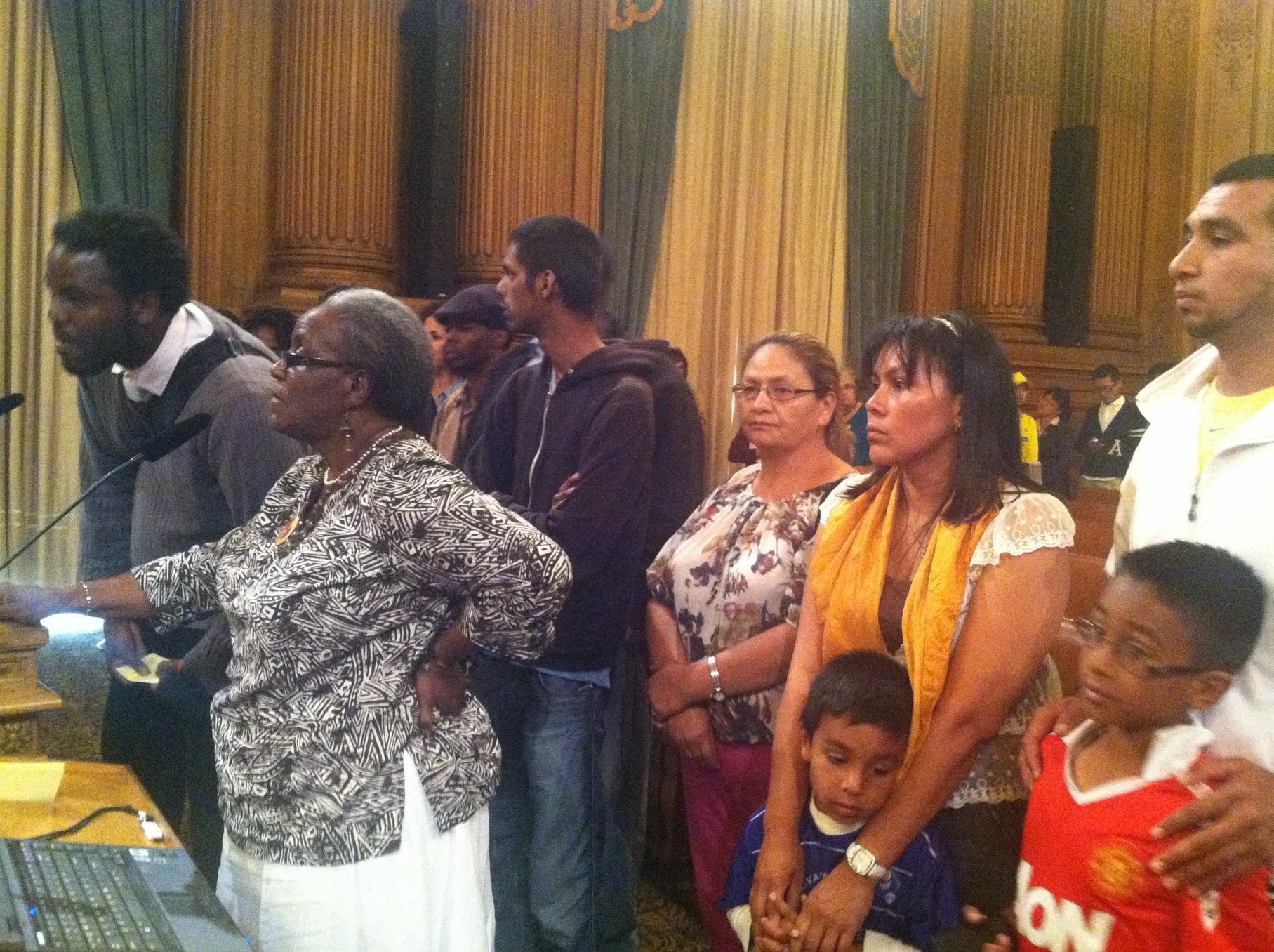
Those who work at, attend and support City College of San Francisco have a lot of work ahead of them. The school’s budget has been regularly slashed, losing $20 million last year alone. The school cut 700 classes this semester. After receiving notice that they faced losing accreditation, students, faculty, staff and administrators have been working tirelessly to save the school.

A rally yesterday highlighted one issue of importance to City College: Proposition A.

Prop. A would create a parcel tax of $79 per year for eight years for San Francisco tax payers. The revenue, estimated at $15 million per year, would go to City College.

Prop. A will be one of three ballot measures that increase taxes in November, including Prop 30 and Prop 38. The second two are statewide measures that also raise taxes to fund schools. 

If both Prop. A and Prop. 30 pass it would restore much of the funds cut from City College. If either measure doesn’t pass, the college would face a large deficit.

Several members of the board of supervisors, the school board, and candidates for those seats spoke in support of City College. 

As Community College Board President John Rizzo mentioned at the rally, the school has cut 700 classes this semester alone. For many of those classes, the school still offers the subject but in far fewer class sections, lengthening wait lists and making it more difficult for students to get into the classes they need to graduate.

“This does not restore all the funding, but it goes a good way forward,” said Norman Yee, president of the board of education. Yee attended City College before going on to UC Berkeley, and taught ESL classes at City College for 10 years.

“If it wasn’t for City College I would have gone down a different path,” said Yee.

Alex Tom, Executive Director of the Chinese Progressive Association, emphasized that support for Prop A should be a citywide issue. He also pointed out that supporting City College “Is a big issue for Asian Americans.”

“Most people don’t know that half of the population of City College is Asian students,” said Tom.

Students, labor, and Democratic Party members also lended their voices to support Prop A. “It’s so important and critical for students to have this resource,” said Shanell Williams, president of the Associated Students organization at City College. 

Sup. John Avalos told Guardsman reporter Joe Fitzgerald that the accreditation process is related but separate from the need to pass Prop A. 

“We need to actually fund it, and make sure it’s around,” said Avalos. “If the parcel tax fails, we’ll see a real diminishment of the effectiveness of City College, and that’s something that I think would further deteriorate its ability to get accredited.”

Video by Joe Fitzgerald

On the Cheap Listings

0

Submit items for the listings at listings@sfbg.com. For further information on how to submit items for the listings, see Picks.

WEDNESDAY 5

Humpday happy hour Good Vibrations, 2504 San Pablo, Berk.; 1620 Polk, SF. www.goodvibes.com. 6:30-7:30pm, free. The strap-on: a necessity to many, mind-boggling to others, both to some. In Berkeley, tool over to your local Good Vibes for this guided shopping event where experts will talk to you about what you need to look for in a falsie friend. At the chain’s Polk Street location, GV employees will demystify the 50 Shades of Grey phenomenon. What will it take for you to recreate a scene with your own Christian Grey? Chances are, you’ll find the tools you need here.

THURSDAY 6

"Captured: Specimens in Contemporary Art" Bedford Gallery, Lesher Center for the Arts, 1601 Civic Dr., Walnut Creek. (925) 295-1417, www.bedfordgallery.org. Through Nov. 18. Opening reception 6-8pm, $5. Trend watch! Throughout our history, humans have appropriated the natural world as raw material for our bizarre artistic impulses. Nowhere is this more true than in Walnut Creek, where a new exhibit opens showcasing reassembled taxidermy, curiosity cabinets, and specimen boxes.

Geoff Manaugh talks applied topology Banatao Auditorium, Sutardja Dai Hall, UC Berkeley. (510) 495-3505, bcnm.berkeley.edu. 5-7pm, free. Things we know: Manaugh used to be a senior editor at Dwell Magazine, and a contributing editor at Wired UK. Currently, he runs a think tank for the Columbia University architecture department. Today’s UC Berkeley talked will be, according to the press release, about "burglary, tunneling, and urban perforation." In other news, UC Berkeley can sometimes create really confusing press releases.

Fillmore Fashion Night

MADison Avenue party Cartoon Art Museum, 655 Mission, SF. www.cartoonart.org. 7-9pm, $5-500. Celebrate the closing of "What, Me Worry?: 60 Years of Mad Magazine" at this little downtown shrine to the drawn and funny. Early 1960s attire is encouraged – in fact, you’ll get your date in for free if you’re both wearing Mad Men-style flair.

FRIDAY 7

Paralympics viewing party LightHouse for the Blind, 214 Van Ness, SF. (415) 694-7350, www.lighthouse-sf.org. 6-8pm, free. RSVP recommended. This center for the visually-impaired is celebrating its brand-new entertainment center with this party for the London 2012 Paralympic Games. Yes, there will be pizza.

"Party Like It’s 1906" One City One Book launch party The Green Arcade, 1687 Market, SF. www.sfpl.org. 7pm, free. It’s always a good idea to celebrate author-sociologist Rebecca Solnit, and no day better than today, when the SF Public Library launches a citywide reading of her community-forged-in-disaster book A Paradise Built in Hell. It’s the eighth time the library’s encouraged the city to read together, and today Solnit will be on hand, and snacks they were noshing around the time of the 1906 SF earthquake will be available like oysters, sourdough bread, and beer.

Night Market Public Works, 161 Erie, SF. www.publicsf.com. 5-9:30pm, $5. "Bacon Crack" chocolates, vegan soul food, and champagne funnel cakes go fabulously with a ukulele chanteuse — as any attendee of Forage SF’s upcoming Night Market will be able to attest. The organization dedicated to promoting ultra-local nourishment has been striking gold with this recurring nightlife-snack event, at which local small vendors rub elbows with the Bay’s musicos, DJs, and of course, party-hard foodies. Check out Uni and Her Ukulele, the 29th Street Swingtet, and Izzy*Wise.

KALX 50th anniversary art exhibit opening Rock Paper Scissors Collective, 2278 Telegraph, Berk. kalx.berkeley.edu. 6-9pm, free. For a half-century, UC Berkeley’s been home to 90.7 FM, a.k.a. KALX, where John Lennon talked People’s Park riots and Green Day crashed when they came to town. Come tonight to check out a collection of KALX paraphernalia, flyers, and historic photos.

SATURDAY 8

All You Can Dance Alonzo King Lines Dance Center, 26 Seventh St., SF. dancecenter.linesballet.org. 1-5pm, $5. Don’t know jack about dancing? Take a four-hour crash course today, with a sampling of mini-courses on ballet, flamenco, Chinese movement, hip-hop, modern, and more. Teachers will be on hand to possibly turn you on to a whole new beat of your heart.

Babylon Salon Cantina, 580 Sutter, SF. www.babylonsalon.com. 7pm, free. Explore the Bay at this evening of readings – you’ll hear tales from a special education classroom, from assassinated journalist Chauncey Bailey’s finals days and ensuing trial, plus words from the "refreshingly off-kilter" (according to the NY Times Book Review) Lysley Tenorio. Cash bar on-site.

SUNDAY 9

The Last Picture Show free screening Berkeley Underground Film Society, The Tannery, 708 Gillman, Berk. berkeleyundergroundfilms.blogspot.com. 7:30, donations suggested. Small town life examined, in this film about Anarene, Texas, and a bunch of kids just trying to get along. High school honey Jacey is the babe every one wants, but will the perfect sweetheart be enough to counteract the slow death of the town she calls home?

TUESDAY 11

Jefferson Graham’s "Video Nation: A DIY Guide to Planning, Shooting, and Sharing Great Video" The Booksmith, 1644 Haight, SF. (415) 863-8688, www.booksmith.com. 7:30pm, free. These days, it’s all about video. Author Graham knows it – that’s why he compiled this book on how to create the best footage for bloggers, web show hosts, and small business owners. The USA Today columnist and tech video host shares how to get your clip to go viral.

Women’s comedy night The Layover, 1517 Franklin, Oakl. www.feelmore510.com. 7pm, free. Sponsored by downtown Oakland’s sex-positive community shop Feelmore510 (a Best of the Bay 2012 winner!), this evening is for female-focused yucksters. Grab a drink, peruse the art that covers the Layover’s walls, and ready yourself for quips.

Dick Meister: Let’s count our blessings on Labor Day!

2

By Dick Meister

Dick Meister, former labor editor of the SF Chronicle and KQED-TV Newsroom, has covered labor and politics for more than a half-century. Contact him through his website, www.dickmeister.com, which includes more than 350 of his columns.

OK, it’s time to celebrate Labor Day, time to celebrate the labor movement that won a wide range of benefits for working people. That includes, of course, a paid day off on Labor Day and other holidays or extra pay for working on the holidays. But there’s much more than that. Much more.

We can also thank unions for:

* The eight-hour workday with meal and rest breaks.

* Forty-hour work weeks and three-day holiday weekends.

* Overtime pay and paid vacations, sick leave and maternity leave.

 * Major help in the enactment of anti-child labor law laws and increased public education funding.

* Medicare and retirement and disability benefits.

* Job security and other workers’ rights.

* A strong political voice for unions that helped enact Social Security, unemployment insurance, workers compensation, health and safety and minimum wage laws and has helped elect pro-worker office holders.

* Important help in the passage of key civil rights and civil liberties laws that have particularly helped political dissidents, women and minorities and military veterans.

Certainly not every worker enjoys all the union-backed benefits. But even the non-union workers who make up the vast majority of working people these days have many of the benefits. And, thanks to the efforts of unions, they have the opportunity to win all of the benefits.

You can be sure that on this Labor Day, as on all others, political candidates will have lots to say about unions.  You can expect, however, that not much will be heard from Republicans. Their usual ranting in behalf of their moneyed backers about the evils of “Big Labor” and “union bosses” will be muted, lest they offend potential blue-collar supporters. Democrats undoubtedly will voice their usual support for union members and workers generally, many sincerely, some simply in hopes of gaining blue-collar support.

Union opponents seem to forget that unions are democratic organizations, whose members generally have a strong voice in their unions’ activities.  Union officers are elected, after all, and so are answerable to their members.

Union positions on political candidates and issues, as well as financial contributions to candidates, are not dictated by union officers, despite what anti-union politicians assert. Union positions and union political spending are determined by the votes of union members, usually on the recommendations of their Committees on Political Education (COPE). Officers who don’t reflect their members’ position face replacement by membership vote.

Once, Labor Day meant big parades in cities nationwide. But no more. Although union numbers continue shrinking, unions are surely here to stay. They’ve fought their way into the Establishment. They still parade here and there, but no longer feel that parading is necessary to show their strength and importance.

Unions are much more likely to mark Labor Day with the political activity that has become as important to them as economic activity since their arrival into the ranks of the economically accepted.

Thus the Labor Day messages of union leaders will stress politics. That will largely include support for President Obama, despite union complaints that he has not worked hard enough to overcome congressional opposition to pro-labor reforms that he’s proposed or supported. From labor’s point-of-view, Obama is nevertheless very much preferable to Mitt Romney, just as most other Democrats are preferable to their Republican opponents.

Despite much opinion to the contrary, the union stress on politics, rather on winning broader public support for unionization, does not mean that all unions have reached a permanent, unshakeable position in society.

Nor does it mean that unions are not still fighting battles that are as almost as significant as those of the 1930s and 1940s that drew broad support from a public which sometimes frowns on unions, now that they have secured the strong position in society which the public helped them win.

Labor influence is not measured strictly by the number of union members, because of labor’s strong influence in politics and because the wages and conditions of unionized workers set the standard for all workers. Yet numbers are important, and unions generally have been struggling just to keep overall membership steady.

Currently, only about 12 percent of privately employed workers are unionized. But while their numbers have remained low, the figure for unionized public employees has grown to nearly 40 percent. That has put public employee unions in the vanguard of the labor movement, and given the movement new, badly needed strength, although also raising strong political opposition to public employee unions.

There are some fairly solid reasons for the decline in union membership overall, ironically including the unions’ loss of their position as underdogs, the widespread granting of union conditions to non-union workers and illegal employer interference in voting by workers on whether to unionize.

Perhaps the most important reason for the decline in union membership has been a fundamental change in the workforce. Once dominated by blue-collar production workers, it has come to be dominated by white-collar service workers. But organized labor sometimes has been slow to move into white-collar fields outside of public employment.

Labor Day should cause us to reflect on the great importance of the labor movement’s vital mission – its organizing of workers to win economic and political strength and helping elect pro-worker officeholders, its help in creating jobs and otherwise aiding the millions of Americans who remain unemployed or otherwise in economic distress.

So while you may not be able to see a parade on Labor Day, labor is still doing many other things well worth watching, and well worth supporting.

A footnote: Despite what the standard history books say, the first real Labor Day celebration was not held in New York City in 1882, but 14 years earlier right here in San Francisco. That was on February 21, 1868. Three thousand paraded the city’s streets by torchlight to mark enactment of the 8-hour-day law in California.

Happy Labor Day!

Dick Meister, former labor editor of the SF Chronicle and KQED-TV Newsroom, has covered labor and politics for more than a half-century. Contact him through his website, www.dickmeister.com, which includes more than 350 of his columns.

City College board takes first step toward scaling back its mission

21

[CORRECTED BELOW] The first step was taken in changing City College of San Francisco’s educational mission at last night’s Board of Trustees meeting, a decision that would drastically alter what programs the college funds and who it serves.

The college’s mission statement is an overarching funding guideline, according to Gohar Momjian, the college’s accreditation liaison officer. She presented the mission statement workgroup’s findings to the college’s board and a packed room of faculty and students last night.

Momjian oversees the 15 workgroups responsible for addressing the major areas the Accrediting Commission of Community and Junior Colleges told the school it has to rectify. A failure to do so by March 2013 could result in the revocation of the school’s accreditation, which is necessary for the college’s degrees to be recognized and for the school to receive federal funding.

Simply put, City College was tasked by the ACCJC to gets its mission in line with current fiscal realities. The workgroups, tasked with brainstorming ways to reshape the college and meet the criteria of the accreditation team’s findings, will use the new mission statement as a guide for what programs are viable, said Momjian.

So what was cut out of the new mission statement? Completion of adult high school diplomas, GED’s (which help students test out of high school), active engagement in the social fabric of the community, lifelong learning, life skills, and enrichment courses were all dropped from the revised mission statement. [[8/27 CORRECTION: Transitional Studies, which includes GEDs and basic adult education, ended up being in included in the primary mission]].

In their place was a statement making these things “conditional” on available resources. “In addition, the college offers other programs and services consistent with our primary mission, only as resources allow and whenever possible in collaboration with partnering agencies and community-based organizations,” reads the new draft statement of the college’s mission.

Essentially, the college promises to enrich the community only if the resources are available to do so. Students and faculty from classes geared towards older adults and also disabled students came out to oppose changes to the mission statement, and a loss of their funding.

“We have students that will wait 40 minutes in the rain in a wheelchair for a bus to get to class,” Disabled Students Programs and Services faculty Katherine Brown said to the board.

Shelly Glazer, faculty in the older adults program, left the board with a warning. “Here are the almost 2,000 letters written to the Student Success Task Force when they tried to cut our dollars,” Glazer said, dropping the huge stack of paper on the top of the podium. “They need your support, and you need theirs.”

Importantly, English as Second Language classes and basic skills classes were preserved in the primary mission guideline. “There are compromises made in the mission statement. There are things we can do under [better] conditions,” said Momjian in her report to the board. “That was our compromise.”

The board made a motion to approve the new draft mission statement, and voted unanimously in favor. The board will look at a second revised mission statement on Sept. 11, and take a final vote to amend the mission statement on Sept. 27. The draft mission statement can be read at the City College website here.

Forty-five problem areas were found in City College’s financial structures by a financial consulting group at the same college board meeting last night. The findings left the college board nearly speechless once the report was complete.

The Financial Crisis Management Team, known as FCMAT, was paid for by the state community college chancellor’s office and assigned to City College to help it review its finances. This was good timing with the recent accreditation troubles, but officially has no connection to the recent accreditation team visit or with any direction from the state chancellor’s office, FCMAT Chief Analyst Michelle Plumbtree told the college board.

Plumbtree and her associate Mike Hill made the presentation to the board on behalf of the four members of the “financial SWAT team,” as they’ve been dubbed by the board in the past. The report it gave to the board that night was only the tip of the iceberg.

“The report itself is going to be in the realm of 65 pages. There are about 45 specific recommendations,” said analyst Mike Hill. “But we do want to give you a sense of some of our observations first, and some of our recommendations grouped together.”

The hit list was read in a bullet point fashion, and as he rattled off each of the findings, the silence in the room deepened:

  • The district has made a cost structure over time that can’t be sustained in this economy.
  • The district opted for short term solutions.
  • Employee contracts have been made without long-term analysis.
  • Decision making has been made by power and political whim rather than logic and fairness.
  • The conduct of key leaders and the culture within the district have greatly diminished the role and the effectiveness of the management team.
  • The district lacks data to assess sites.
  • The district supports much more faculty than its closest peers.
  • There’s a history of maintaining a small fund balance, with 90-92 percent of the budget being committed to salary and benefits, the college needs to make adjustments.
  • The department chair structure is not cost effective nor administratively sound.
  • We’re recommending a reduction in full time faculty through attrition.
  • We’re recommending the district not subsidize categorical programs, and that current subsidies be reassessed (the state cut funding for some categorical programs, like the second chance program, and City College has been eating that cost to the tune of around $20 million a year, according to AFT 2121 president Alisa Messer).
  • Consider either elimination of department chairs or diminish them while empowering deans and giving them the ability to act.”

“There’s a lot there, it covers a lot of territory, and you need to see the context and data and analysis in order to have informed questions, or else you’ll be spinning our wheels,” Hill said to the stunned board.

Chief Analyst Michelle Plumbtree concluded by cautioning the board against inaction. “The circumstances the district found itself did not happen overnight, decisions made over many years brought you here,” she said. “You’re going to have to move quicker than you want to, but that’s what’s needed.”

“Some of these things are new to me, but some of these things have come up in work groups. Some of these things are things we’ve known for years,” board President John Rizzo said after the report concluded. Financial administrators at City College declined to comment before the release of the full report. The 65-page final report will be made public on Sept. 18, and given to the college board a few days before that, Plumbtree said.

The City College Board of Trustees motioned to delay one of their most controversial votes at last night’s board meeting.

The board hopes to bring in a “special trustee,” who would be provided by the state, to help guide them through their recent accreditation woes. A special trustee is not simply a guide. A special trustee has veto power over the college board, giving the trustee unilateral decision making powers, according to college officials that night.

Most of the board welcomed the notion of outside help. The board has asked for $1.5 million dollars in cuts that never got made, Rizzo said, arguing for the need for the special trustee.

“It’s an enormous wealth of expertise that we do not have…We need someone from the outside to tell us where that mistake was made,” Rizzo said.

Trustee Chris Jackson wasn’t sure that the board had full knowledge of what it was asking. “I support a special trustee, but I have questions…How long would a trustee be here? What’s the process of asking them to leave?” Jackson asked, to the applause of the audience.

It was student Trustee William Walker who clarified the students’ position. He had a meeting with students the previous day, and they strongly disagreed with bringing in a special trustee to help run the school.

Given the history of special trustees in college districts, it’s not surprising why. A report by the LA Sentinel shows the discord brought by one special trustee to the Compton community college district, also facing accreditation woes. To read a report of Compton College’s and how it mirrors City College, check out the Guardian report “Saving City College.”

Special trustee Dr. Genethis Hudley-Hayes, was removed from her position as special trustee by State Community College Chancellor Jack Scott last September, according to the Sentinel article. The article cites multitudes of complaints against her by the community, who wrote a six page letter to Gov. Jerry Brown and Scott asking for Hayes’ removal.

“Who do you serve and why are you here?” Associated Students President Shanell Williams said to the board during its public comment session. “It’s shameful… If you can’t make decisions without a special trustee, then we need a new board.”

Student Kitty Lui said that the board’s decision to bring in a special trustee would undercut the democratic will of the community.
“If you don’t know how to move forward, I don’t know why you’re still here,” she said.

Despite students’ objections, if the board does not choose a special trustee, the likelihood is that one will be imposed on them, Jackson said. The board ultimately decided to shelve the decision until a special meeting on Sept. 11.

Interestingly, the “financial SWAT team,” FCMAT, thinks that a special trustee is a good idea. “To have an outside expert is always good,” FCMAT Chief Analyst Michelle Plumbtree told The Guardian. “Sometimes, you’re just too close.”

How to be a sex-positive parent, from a woman who knows

1

“It’s almost a cliché to say that families come in all shapes and sizes, but they really do”

I’ve always found the expression “the birds and the bees” queer. As a child I somehow knew the expression had sexual connotations, but I could never understand why the birds and bees were having sex together. They seem like such an odd pairing.

Airial Clark, or as she’s known on her blog, the Sex-Positive Parent, could have explained to a prepubescent me that the expression was merely a metaphor about having a talk about sex with kids. More importantly, I’m hoping Clark will teach me how to explain to my future child how it is that one of their daddies used to be a little girl.

Clark has a master’s degree in human sexuality from San Francisco State University, and is the proud parent of two beautiful children. She hosts a Youtube channel on which she provides sex-positive schooling. If you’re in town this weekend, you should check out her series of four workshops on sex-positive parenting at the Center for Sex and Culture. I caught up with her via email for a sneak peek at what she’ll be sharing. 

SFBG: What  have you told your children about sex and your own sexuality?

Arial Clark: When talking about sexuality with kids, the focus has to be on them. Where are they at in their development? What do they need to know? What are they comfortable hearing? What have they been observing? It shouldn’t be about me as the adult. 

SFBG: In interviews you often discuss the wide range of familial matrixes, or ways that families are configured. How do we go about cultivating acceptance among kids about the diversity of the family matrix? 

AC: This is a great question- especially in the Bay Area where respecting cultural diversity is a goal we are all striving for. It’s almost a cliché to say that families come in all shapes and sizes, but they really do. Families also change shape over time. The first step in cultivating acceptance and respect is to let kids know that not all families look like their own and that is just how the world works. This message works for kids in more traditional family structures as well as for kids in under-represented family structures too. 

SFBG: You also talk a lot about diversity among parents — gay parents, kinky parents, poly parents. What kind of parent would you describe yourself to be?  

AC: Like all parents, I have to maintain healthy boundaries with my kids and focus on what they need for their healthy development. I also have to respect their privacy. The important thing for parents to remember is that labels are secondary to your role in their life. Your child sees you a parent first and everything else second. When I refer to a certain type of parent, that is more about self-identification for seeking support. All parents need role models. Finding other parents who share your same concerns is vital so we have this system of identification around sexuality in order to combat stigma and prejudice of all kinds. 

SFBG: How can parents begin to identify some of the sex-negative and hetero-normative scripts they may be passing along to their children? 

AC: This is the first suggestion I make to parents who want to create a more sex-positive dialogue in their family: what are your beliefs about sexuality and gender? It takes some self-reflection and bravery to differentiate yourself from how you may have been raised. How do you talk about relationships in front of your kids? What language do you use about feeling desirable, or feeling protected, or feeling uncomfortable? Most parents choose silence as opposed to directly voicing their dissent with more traditional cultural norms, so kids depend on subtext. My suggestion is to start bringing it out into the open. 

SFBG: You discuss at length what a sex-positive parent should be. How would you describe a sex-positive child?

AC: A sex-positive child is safe, protected, and knows about consent and boundaries. They have access to accurate and age-appropriate information about reproductive biology as well as the emotional and social realities of sexuality. A sex-positive child is not a sexualized child. 

SFBG: What are some practical tools parents can start using to cultivate healthy conversations around sexual diversity with their children? 

AC: I always recommend asking questions first. Ask your kids what they think about characters on a TV show, or their friend’s parents. Begin by asking and then listen. Let them know that what they think matters. Ask them why they think people dress in a certain or way, or what they think the lyrics to a song means. Using media to distance the conversation can make both parent and child more comfortable. 

Also, sharing stories from when you were their age is a great way to know what to say and to relate to where they are now. Share anxieties you had, or weird situations you were in. You don’t have to tell them everything, you’re the adult so you’re in control of the narrative, but start with something true and go from there. As they get older the depth of the topic will increase. Remember these are life long conversations; it’s a gradual process in parallel to their maturation. 

SFBG: Is there an ideal time for parents to start having conversations about sex with their kids? 

AC: Before they become sexually active! Parents need to set the foundation way in advance. That is why age-appropriateness is so important. At every stage of development, there are conversations relating to sexuality to be had. 

SFBG: How does one create a sex-positive environment in such a sex saturated culture (with television, social-media, books, and conversations you may have with other adults)? 

AC: I remember being so overwhelmed by how much sexualized imagery and content was being directed at my kids when they were pre-school-aged. Everything around them had to do with gender and reenacting sexualized behavior. I felt inundated. All you have to do is take a step back to see how much sexuality is used in marketing to kids and in children’s programming. Placing that constant stream of sexualized information into a container, detaching it from the child, is something parents can do to cultivate sex-positivity. We can talk to our kids about what is being directed at them by problematizing the messages about sexuality. 

SFBG: You are hosting a sex-positive workshop this weekend. What can attendees expect?

AC: Saturday’s classes are tailored to parents with alternative sexualities- parents who often don’t see themselves in parenting books or online forums. In the morning we’re going to talk about stigma and finding support as both parents and members of sexual minority groups. In the afternoon we’ll work on coming-out strategies specific to non-traditional families. I’m going to teach parents how to both educate and advocate from a sex-positive perspective. 

Sunday’s workshops are designed for a broad audience. The morning workshop is about what to say and when to say it. The afternoon class is about how to communicate your sex education values with other adults in your child’s life. Maybe you and Grandma need to talk about how you plan to teach your kids about sexuality because it is going to look a lot different then how she taught you. Having those conversations are tough as well. 

SFBG: What is your favorite thing about being a parent?

AC: Watching my children grow into the people they are is pretty amazing. I am so proud of them, and I am consistently impressed with the things they come up with. Being a parent is the ultimate form of geekery for me. 

Sex Positive Parenting

Four sessions: Sat/25 and Sun/26, 10:30am and 1pm, $25/each, $75/four sessions

Center of Sex and Culture

1349 Mission, SF

www.sexandculture.org


Localized Appreesh: The Seshen

0

Localized Appreesh is our weekly thank-you column to the musicians that make the Bay. To be considered, contact emilysavage@sfbg.com.

As is often the case these days, the Seshen grabbed attention with a video. The Bay Area band’s first official music video – for its song “Oblivion” off the self-titled LP released earlier this year –  has gained more than 10,000 views since it went up in June.

The black and white clip is like a mini art film, with a fuzzy countdown clock ticking off cerebral scenes of shadowy figures, singer Lalin St. Juste in an abandoned alleyway, and close ups of blinking eyes.

And then there’s the song itself, a beat-driven pop song, with these echoing, soulful vocals, bouncy keys, and hypnotic layers of electro effects. Given all those harrowing echoes, you could picture the song (which has a sort of Little Dragon meets Erykah Badu feel) featured in horror flick, as the heroic female lead tears away from the chaos, running to safety. 

This week, the Seshen plays for a good cause in Oakland: a fundraiser for the Women’s International Fund for Education (W.I.F.E).

http://www.youtube.com/watch?v=gOkubxzD4gY

Year and location of origin: March of 2010 in El Cerrito, Calif. We all met or re-connected at Aki (bass player and producer)’s and his girlfriend Lalin (lead singer)’s house parties in El Cerrito. Lots of like minded musicians jamming in their basement led to the first incarnation and lineup of the Seshen.
 
Band name origin: Egyptian for blue lotus, a symbol of the sun and creation or rebirth. That, and it also sounds like “session”.
 
Band motto: In the absence of an official motto, we’d say “Roast Beef”.
 
Description of sound in 10 words or less: Beat driven electronic music that balances pop and abstraction.

Instrumentation: Vocals, keyboards, bass, drums, percussion and samples. Almost everybody has some kind of MIDI device or effects pedal in order to reproduce the layered electronic sounds of the studio album in a live situation.
 
Most recent release: Our self-titled debut dropped on February 28, 2012. It streams for free here.
 
Best part about life as a Bay Area band:
Eclectic audiences, amazing musicians, great venues, different scenes (East Bay vs. San Francisco).
 
Worst part about life as a Bay Area band: Trying to be heard and remembered amongst all the other awesome musicians the Bay produces.
 
First album ever purchased: (Aki) I think the first album I purchased was Green Day’s Dookie, which I got in the 5th grade.
 
Most recent album purchased/downloaded: (Aki) The last album I downloaded was TNGHT by Hudson Mohawke and Lunice.
 
Favorite local eatery and dish: In the year and a half it took to record the first album, we ordered the large veggie from Americana Pizza and Taqueria in San Pablo probably a million times. Honorable mention to the multiple bottles of Sriracha we topped them with.

Seshen
With Fast Piece of Furniture, DJ Black
Fundraiser for Women’s International Fund for Education
Fri/24, 9pm, $10-$20 sliding scale
Geoffrey’s Inner Circle
410 14th St., Oakl.
www.wifeducation.org


Farmville, for real

11

yael@sfbg.com

In the next few months, San Francisco will lose some of its most beloved urban farms.

The City Hall victory garden is now reduced to dirt. The grants that kept afloat Quesada Gardens Initiative, which creates community gardens in Bayview, were temporary and are now drying up. Kezar Gardens, funded by the Haight Asbury Neighborhood Council recycling center, is facing eviction by the city.

Time is up for Hayes Valley Farm, on the old freeway ramp, where developers are now ready to build condos.

St. Paulus Lutheran Church has also announced that it wants to sell the land that the Free Farm uses at Eddy and Gough.

“There’s the old joke about developers,” said Antonio Roman-Alcalá, co-founder of Alemany Farm and the San Francisco Urban Agriculture Alliance. “God must be a developer, because they always seem to get their way.”

At the same time, new urban agriculture projects have sprung up across San Francisco. Legislation authored by Sup. David Chiu will create a city Urban Agriculture Program, with the goal of coordinating efforts throughout the city.

So is the movement to grow food in the city progressing? It’s a tricky question that gets down to one of the oldest conflicts in San Francisco: The best use of scarce, expensive land.

THE VALUE OF FARMING

The San Francisco Planning and Urban Research Association lauds the value of community gardens. An April 2012 SPUR report notes that urban agriculture connects people “to the broader food system, offers open space and recreation, provides hands-on education, presents new and untested business opportunities, and builds community.”

According to the report, the city had “nearly 100 gardens and farms on both public and private land (not including school gardens),” two dozen of which started in the past four years.

But that’s nowhere near enough for the demand. “The last time waiting lists were surveyed, there were over 550 people waiting,” Eli Zigas, Food Systems and Urban Agriculture Program Manager at SPUR, told us. “That likely underrepresents demand because some people who are interested haven’t put their name down.”

Changes in zoning last year, and the recent ordinance to create the Urban Agriculture Program, show a measure of city support for urban farming and gardening.

“We have one of the most permissive zoning codes for urban agriculture that I know of in the country,” said Zigas.

One zoning change from 2011 makes it explicit that community gardens and farms less than one acre in size are welcome anywhere in the city, and that projects on larger plots of land are allowed in certain non-residential districts.

More recent legislation is meant to streamline the process of starting to grow food in the city. Applying to use empty public land for a garden can be an arduous process, and every public agency has a different approach. The hoops to jump through for land owned by the Police Department, for example, are entirely different than what the Public Utilities Commission requires. A new Urban Agriculture Program would coordinate efforts.

“The idea is to create a new program that will serve as the main point of entry. Whether it will be managed by existing agency or nonprofit is to be determined,” said Zigas.

If the timeline laid out in the ordinance is followed, the plan will be implemented by Jan.1, 2014.

By then, if all goes according to plan, no San Franciscan looking to garden will wait more than a year for access to a community garden plot.

NO NEW LAND

Roman-Alcalá said that efforts to clear the way for urban agriculture are much less controversial than for affordable housing and other tenets of anti-gentrification. But for all the good the latest legislation does, it doesn’t secure a single square foot of land for urban agriculture.

“If you look at the language, there’s nowhere in it that mandates or prioritizes urban agriculture on any site,” said Roman-Alcalá. “The closest thing is a call for an audit of city owned rooftops. That’s the closest it comes to changing land use.”

And it won’t be easy. “No matter how much support there is for urban agriculture, in the end, developers and their ability to make money is going to be prioritized,'” he said. “The only way to really challenge that right now is cultural. Social change is not an event but a process.”

Janelle Fitzpatrick, a member of the Hayes Valley Farm Resource Council and a neighborhood resident who has been volunteering at the farm since it started, is committed to that process.

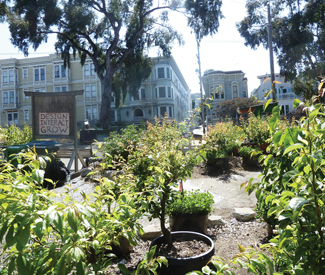
“Hayes Valley Farm proves that when the city, developers, and communities come together, urban agriculture projects can be successful,” Fitzpatrick said. She and dozens of other volunteers created the farm, which is now lush with food crops, flowers, and trees. The farm has a bee colony, a seed library, and a green house. It offers yoga and urban permaculture classes.

Hayes Valley Farm started on land that used to be ramps to the Central Freeway before that section was damaged in the Loma Prieta earthquake. The land under the freeway was toxic, but volunteers spent six months layering mulch and cardboard and planting fava beans to create soil. It took less than a year to create a productive farm on a lot that had been vacant and overgrown for nearly two decades.

“We’re producing food, we’re producing community, we’re producing education,” said Zoey Kroll, another volunteer and resource council member.

When they vacate their land in the winter, many Hayes Valley Farm team members will already be knee deep in new urban agriculture projects. These include Bloom Justice, a flower farm in the Lower Haight that Kroll says will teach job skills like forestry and landscaping. The farm has also built a relationship with Hunters Point Family, working together to offer organic gardening and produce at Double Rock Community Garden at the Alice Griffith Housing Development and Adam Rogers Community Garden.

As for the loss of the current site, Kroll says, “It’s an exercise in detachment.” Change in landscapes and ownership is part of urban life, she said — “We’re a city of renters.”

We’re also a city of very limited land. “Securing permanent public land for urban agriculture would be challenging,” said Kevin Bayuk, an instructor at the Urban Permaculture Institute. “And securing long-term tenure on anything significant, an acre or more of land in San Francisco, if it were on private land, would be cost prohibitive.”

Of the city’s three largest farms, only Alemany Farm seems secure in its future. The farm is on Recreation and Parks Department land, and has been working with the department since 2005 to create a somewhat autonomous governance structure.

Community gardens on Rec-Park land are subject to a 60-page rulebook, and according to Roman-Alcalá, Alemany Farm’s operations were restricted by the rules.

Last week, the group’s plan to be reclassified as a farm instead of a garden was approved, eliminating some of the rules and creating an advisory council of community stakeholders that will exert decision making power over the farm, although Rec-Park still has ultimate authority.

“Now it’s more secure,” said Roman-Alcalá. “We’ve finally reached this point where the city acknowledges it as a food production site.”

“I think the urban agriculture movement is still growing and burgeoning in the grassroots sense,” said Bayuk. “And I think some of the grassroots growth is reflected in the policy and code changes. “I’m optimistic for the idea of people putting land into productive use to meet human needs and be a benefit of all life.”

This article has been corrected to reflect information about the location and ownership of the Free Farm.

Lee appoints Santos, a staunch development advocate, to CCSF board

22

Rodrigo Santos, a structural engineer who heads the pro-development advocacy group San Francisco Coalition for Responsible Growth, had already raised an unheard of amount of money in his race for the City College of San Francisco Board of Trustees, $113,153 in just six months, mostly from real estate and development interests.

Today, he got another big boost when Mayor Ed Lee appointed Santos to fill the vacancy on that board created by the recent death of Milton Marks, giving the ambitious Santos a big advantage in the fall contest and perhaps signaling Lee’s support for making deep program cuts to satisfy the accrediting commission’s demand that CCSF cut expenditures and beef up its reserves.

“Tough decisions and reform are what City College needs at this time,” Lee said at a press conference this afternoon, calling Santos “someone who shares my vision of reform and will support the tough decisions ahead.”

Although Lee said Santos “is committed and passionate about education,” Santos hasn’t been active on education issues before running for this office. His passions seem to lie mostly with advocating for developers and opposing government regulations in front of the Planning Commission and other bodies, where he regularly testifies, and in helping fellow conservatives gain power on city boards and commissions.

The appointment continues Lee’s pattern of appointing and relying on controversial conservatives in key areas, from his chief fundraiser and economic adviser, venture capitalist Ron Conway, to his recent reappointment to the Planning Commission of Republican Michael Antonini, who gave Santos the maximum $500 contribution in his CCSF race.

“I join an institution that must be saved. I am absolutely committed to that goal,” Santos told a press conference in the Mayor’s Office. He said that he will work to “achieve consensus” around solutions to the troubled institution’s problems, while also declaring, “We must support the interim chancellor, Pamila Fisher.”

But rather than someone who seeks political compromise, Santos’ reputation is as more of polarizing and ideologically conservative firebrand who regularly criticizes government and progressives as part of the downtown alliance that includes Plan C, Committee on Jobs, Building Owners and Managers Association, the SF Chamber of Commerce, and the Board of Realtors PAC

“I actually find him to be pretty divisive in trying to work on issues at [the Department of Building Inspection],” Debra Walker, who served with Santos on the Building Inspection Commission. “He always seems to come into a situation attacking and I hope he doesn’t bring that to this board.”

Walker, a longtime progressive activist and former supervisorial candidate, said that she and her political allies have long endured nasty attacks from Santos and his CRG bretheren.

“They spend all of their time attacking progressives and he gets pretty intense about attacking rather than working with people,” she said. “CRG is about getting people elected who are conservative, that’s their whole reason for existence, perpetuating the real estate industry’s impact of city policies, which has had a negative impact on the middle class.”

Asked about that reputation by the Guardian, both Lee and Santos denied it and refused to answer follow-up questions. Santos said CRG has a “diverse membership” and told us, “I don’t know why you would cast that as polarizing.”

Yet its board is made up almost exclusively of real estate and development interests who have shown themselves to be politically ambitious, winning key mayoral appointments to the Building Inspection and Small Business commissions and working with mayoral staffers to hold onto key leadership positions, edging out supervisorial appointees in the process.

Sup. John Avalos, who was targeted by a CRG independent expenditure campaign in 2008, said that he researched Santos’ background on education issues and was a little surprised not to find anything. “More than anything, the appointment says more about Lee’s pro business leanings,” Avalos told us.

It was also telling that Lee included two of the most conservative CCSF trustees in his press conference, Natalie Berg and Anita Grier, but that more liberal trustees Chris Jackson and John Rizzo were neither consulted nor notified directly about the appointment. “I’m sorry the mayor didn’t involve us more or let us know,” Rizzo told us.

While Rizzo didn’t endorse Santos – instead backing Jackson, Steve Ngo, and Rafael Mandelman (who Rizzo said “really does have the best interests of the district at heart”) – he didn’t want to offer an opinion on Santos, saying that he wants to work constructively with him to solve the district’s problems: “I welcome him to the board and hope he will welcome the work we’ve been doing.”

Santos told reporters that he starts every work day with an “open house” at his office from 5:20-8am, discussing various issues with anyone who wants to stop by, before getting into his engineering and administrative work for his firm, Santos & Urrutia. “I will bring that same commitment to City College,” he pledged.

What will Jerry do?

14

A few good bills have emerged from the madness of the end of the Legislative session in Sacramento — including measures by Assemblymember Tom Ammiano and Sen. Leland Yee — and now we have to wait for the governor, who isn’t thinking much beyond Prop. 30.

Jerry’s always odd and unpredictable, but this year, I’m told, he’s focused almost entirely on getting his tax measure approved. He’s told everyone in the state how much everything will suck if we don’t vote Yes, and he’s made it something of a referendum on his leadership. If it goes down, he’s facing almost unthinkable cuts to education and public services — cuts that will make him hugely unpopular. When class sizes go up and UC rejects qualified students and cops get laid off, the voters won’t blame themselves for rejecting Prop. 30; they’ll blame the guv. And Jerry knows it.

So he’s gone all in on this one — and he’s viewing everything he does, including every bill he might sign, through that lens.

Which leaves some very worth legislation up in the air — or rather, since it’s Jerry Brown, up in the ozone.

Ammiano managed to win approval for a measure that would allow the news media to interview inmates in state prisons — something that the California Department of Corrections and Rehabilitation has blocked since 1996. Right now, the only way reporters get access to the inside of prisons is on special tours that CDCR sets up — and the jailers get to decide which “random” inmates can talk to the press. It’s pretty basic — In San Francisco, the Sheriff’s Department allows reporters to talk to any prisoner who consents to an interview, and nothing bad has happened. We spend so many billions of dollars on prisons, and we know so little about where it goes. Even the prison guard’s union (Jerry’s BFFs) supports this. Jerry? Who knows.

Another Ammiano bill, AB 889, would require that domestic workers (people who do child care, housecleaning etc.) get basic labor rights, including lunch breaks and overtime. Seems like a no-brainer (and no, it doesn’t apply to your casual high-school babysitter). Lots of support, and it’s hard to see what this has to do with tax policy, but nobody’s sure about the guv.

And everyone’s really unsure what will happen with Sen. Leland Yee’s latest attempt to give juveniles who are sentenced to life without parole at least some opportunity to get out of prison before they die. SB 9 is pretty moderate — it states that a person convicted of a crime as a youth who has already served 15 (FIFTEEN) years can petition a court to reduce the sentence to 25 (TWENTY FIVE) years. Nobody’s getting out without serving some long, hard time, but since someone who is an accessory to murder at 15 almost certainly doesn’t have the brain development of an adult, and no other industrialized nation in the world allows LWOP for anyone under 18, and since there are only 300 people in the who state prison system who would be eligible for sentence changes under this law, I can’t imagine anyone opposing it. Seriously, Jerry. Can you veto something like this? The Jesuits would go batty.


Appetite: Highlights and bites from SF Chefs

0

Here are a few highlights in photos of another SF Chefs, San Francisco’s food, wine, spirits “classic” (aka week-long festival in tented Union Square), a whirlwind of excellent bites, drinks, wine, demos, and parties.

There are high points every year, but no party has yet been as memorable as this year’s Late Night Cocktail Adventure/Campari after party on Saturday, August 4. The Redwood Room at the Clift Hotel was as magical as it was meant to be outfitted for the South Seas by way of Milan with Afrolicious providing the addictive, live reggae-funk soundtrack of the evening we couldn’t stop dancing to. Drinks were high-caliber, including a brilliant rum and passion fruit punch by Steven Liles (Smuggler’s Cove), and rum, coconut milk, and kaffir lime beauty by Brooke Arthur (formerly of Wo Hing, now House Spirits’ Director of On Premise Outreach and Education).

All photos by Virginia Miller. Subscribe to her newsletter at www.theperfectspotsf.com.

Tastes of Cindy: Drag artists re-enact Cindy Sherman portraits from SFMOMA show

11

To celebrate the incredibly engaging Cindy Sherman retrospective at the SF MOMA (through October 8), we asked four of San Francisco’s premier drag performance artists to re-enact four of Sherman’s iconic portraits. It’s all about looking twice — or in Sherman’s case, four or five times — and we wanted to see how many layers of gaze her work could hold.

Read Matt Fisher’s review of the retrospective here and Rob Avila’s review of accompanying show, “Stage Presence” here. All re-enactment photos by Keeney + Law.


>> FAUXNIQUE: UNTITLED #351


The truly artistic Fauxnique, aka Monique Jenkinson, currently holds a fellowship through the de Young Museum: she’ll be Artist in Residence for the month of September in the de Young’s Kimball Education Gallery, working in an open studio setting, co-hosting “Dance Discourse Project #13: Working in Museums” with Dancers’ Group and CounterPULSE on Saturday, September 15 at 2pm), and making new work, including “Instrument,” a solo created in an experimental collaboration with choreographers Chris Black, Amy Seiwert, and Miguel Gutierrez premiering at CounterPULSE in November.


>> BOY CHILD: UNTITLED #355


A relative newcomer to the scene, Boy Child stretches drag performance into phantasmagorical new directions, mashing neon hip-hop swagger into goth-electro darkness. Lately, she’s been representing SF in New York and the Pacific Northwest and gaining attention for her photography.


>> LIL MISS HOT MESS: UNTITLED #360


One of the only queens who could have most of SF’s colorful nightlifers dancing the hora to “Hava Nagila” at her Bar Mitzvah x2 party — or falling on their bums at her annual rollerskating birthday jam — Lil Miss Hot Mess will be stepping down as Miss Tiara Sensation during next month’s pageant (Saturday, September 29, 9pm, $10-$20. Rickshaw Stop, SF. www.rickshawstop.com) and enrolling in grad school, to begin her new life as a career girl.


>> LADY BEAR: UNTITLED #354


Always elegantly but firmly large and in charge, Lady Bear hosts monthly parties Hot Rod at the Powerhouse and Dark Room at the Hot Spot here in SF and Cub Scout at the Eagle in LA. As Dragoon the actress, she’s currently starring in the uproarious “Designing Women Live!” (Tuesdays through August 28, 8pm, $20. Rebel, 1760 Market, SF.) and the upcoming “Roseanne: The Play” in September. She also recently starred in a short film, Love and Anger, with Cousin Wonderlette.


Photography: Keeney + Law

Art direction: Brooke Robertson

Assistant: Caitlin Donohue

Concept: Marke B.

Healthy transitions

1

yael@sfbg.com

When the Human Rights Campaign, the national LGBT rights group, released its latest scorecard, rating companies by their support for LGBT issues, the healthcare giant Kaiser scored 100 percent. In June, the company’s float in the San Francisco Pride Parade was packed with happy employees.

But as the float passed through the streets, it was met by a group of protesters. Pride at Work complained, loudly, that Kaiser — for all its efforts to work with the community — excludes transgender care from its standard policies.

“We said, let’s push Kaiser,” said Sasha Wright, an organizer with Pride at Work. “They say they’re good for the community. Let’s show them that the queer community demands this.”

It was a perfect sign of the city’s struggle with trans health care. In many ways, San Francisco is exemplary — this is a long ways from Chattanooga, Texas, where state legislator Richard Floyd tried to pass a law instituting steep fines for people who can’t prove their genders match the designated genders of public bathrooms.

And with Healthy San Francisco officials’ recent decision to cover transgender and care, it’s likely this city is leading the nation in trans health.

But that’s a limited distinction — because trans people everywhere, even here, still face sometimes daunting obstacles in getting access even to basic care. And the struggle to change that is becoming a high-profile (and increasingly successful) political fight.

TRANSITIONS AND COSMETIC SURGERY

Kaiser’s insurance plans are typical of the industry. In its 2012-2013 “Traditional Plan,” Kaiser lists “transgender surgeries” among the services excluded from coverage, along with massage therapy and cosmetic surgery.

And Kaiser’s not alone.

Medicare, the federal health plan for low-income people, specifically excludes transgender health care. MediCal, the state version, is required to cover trans care — but will often deny individual applications. And many of the doctors and surgeons who accept MediCal (and many don’t) are unfamiliar with transition-related care.

Then there’s plain old discrimination. A troubling number of people report being denied healthcare — not just healthcare related to their gender identity — because the doctor they saw didn’t want to treat a transgender person.

The State of Transgender California, a 2008 survey by the Transgender Law Center, found that 30 percent of transgender people in California reported that they have “postponed care for illness or preventative care due to disrespect and discrimination from doctors or other healthcare providers. Over 40 percent did so because of economic barriers.”

The study also found that 35 percent of respondents “recount having to teach their doctor or care provider about transgender people in order to get appropriate care.”

To make things worse, American health insurance is overwhelmingly employer-based — and unemployment among trans people is epidemic. A 2011 study from the National Center for Transgender Equality found that trans unemployment was double the national rate and that 47 percent of trans people surveyed had been fired or overlooked for a job.

The World Professional Association for Transgender Health (WPATH) sets the international standard for transgender health care. WPATH states that, for many transgender people, “sex reassignment surgery is effective and medically necessary.” Hormone therapy, voice and communication therapy, as well as non-discriminatory primary and preventative care are also necessary.

But with high rates of poverty and discrimination among transgender people, affording these medically necessary procedures can be nearly impossible. Even in San Francisco, where some politicians and powerful organizations advocate tirelessly for transgender rights, many people are forced to go outside the system altogether to take care of themselves.

“We see transgender folks either not being able to make a transition, or having to spend a lot of money,” said Wright. “I don’t know if you’ve ever been to a top surgery party, but they’re common in San Francisco.”

Mia Tu Mutch, a member of San Francisco’s Youth City Services Committee who advocates for LGBTQ rights inside and outside City Hall, recently started a group that supports and raises funds for people who are transitioning.

“Me and my partner have been shocked at trans incompetency in San Francisco,” said Tu Mutch. “We’ve had several really bad instances of doctors refusing to treat us when they found out that we were trans. There’s still education needed.”

Tu Mutch said that, even though she is covered by a high-quality, trans-inclusive insurance plan, she has spent at least $10,000 out of pocket on transition related expenses.

“People are usually told, ‘get a good job, save all your money,'” she said. “But I’ve been spending 80 percent of my money on transgender related care for the past couple of years. I don’t think the whole ‘pull yourself up by your bootstraps’ thing works.”

HOPE ON THE HORIZON

But the situation is starting to change. In fact, trans organizers say that the medical, insurance and political establishments — particularly in California — are beginning to realize how backward the system is and are open to dramatic changes.

“It is an exciting time,” said Dr. Dawn Harbatkin, executive director or San Francisco’s Lyon Martin Health Center, which offers free and low-cost service to trans people “I didn’t think I would see this during my career.”

Nikki “Tita Aida” Calma, program supervisor at Trans: Thrive, echoed that sentiment. Said Calma, “I’m glad to see this in my lifetime.”

Thanks to groups like Pride at Work and the Transgender Law Center (TLC), city workers in San Francisco and Berkeley are now covered by the trans-inclusive version of Kaiser’s plan. The TLC, along with Lyon Martin and Equality California, came together to form Project Health in 2010, which convinced Healthy San Francisco to drop its transgender exclusions.

Tu Mutch has also worked this year to start FEATHER, or Fundraising Everywhere for All Transitions: a Health Empowerment Revolution.

Meanwhile, lawmakers in Sacramento, and even nationally, are also chipping away at the transgender discrimination that plagues the healthcare system.

Harbatkin told us that there isn’t a specific set of services that make up transgender health care.

“Really good transgender medicine means that you are providing good primary care, that you’re treating a patient as a whole person and taking care of all of their health care needs,” she said.

Lyon Martin provides preventative care like pap smears, breast exams, and prostate exams, treatment for chronic issues like hypertension and diabetes, as well as transition-related care—services that assist transgender people in transitioning to a body that reflects their gender identity.

“The bigger part of providing good medicine is about being culturally competent, culturally sensitive,” Harbatkin said. “Knowing how to address people respectfully and with their appropriate name and pronoun. Knowing about their legal name versus preferred name, or gender markers in terms of billing issues.”

One obstacle transgender patients face is doctors who are unfamiliar with transition-related healthcare, such as hormone therapy and surgeries. But often, trans people are denied care that doctors know well and would perform on cisgender patients, simply because of their gender identity.

Then there’s the challenge low-income people face in finding doctors who accept MediCal.

Harbatkin cited the example of an orchiectomy — surgical removal of the testicles, a procedure done by urologists. Finding a urologist who takes MediCal is fairly routine.

“But finding a surgeon who would do a vaginoplasty who accepts MediCal, that is more challenging,” she said.

And some urologists might perform an orchiectomy for someone with testicular cancer — but refuse to do so for someone who is transitioning from male to female.

That type of discrimination has caught the attention of Assemblymember Tom Ammiano, and his office has been working for several years to change it.

Ammiano aide Wendy Hill has been focusing on eliminating transgender health barriers in California for years. Thanks in part to her efforts, the California Department of Insurance now interprets existing gender equity legislation to include transgender people.

“They’ve clarified a set of recommendations and essentially code sections that spell out that for the purpose of transgender, this law requires gender equity,” Hill said. “If you cover pap smears, you have to cover them for everybody. If you cover breast reconstruction or hysterectomy, you have to cover it for everybody, regardless of gender.”

Now Ammiano’s office is taking on the Department of Managed Health Care and has been documenting cases of discrimination.

“When a citizen calls the Department of Managed Health Care, their helpline, they tag the call so that they know what’s going on,” Hill explains.

“They just tagged the calls based on discrimination. But we got them to tag the calls based on gender discrimination, and then even more specifically, discrimination against transgender people.”

The sort of problem she sees: “A person goes in to be treated for what could potentially be pneumonia, but the physician is having trouble seeing this person because their papers say they’re male but they are trying to see a gynecologist.”

Hill said some of her most interesting moments have been outreach meetings with community members and local businesses.

“I’ve gone in to talk with folks and said, how many of you know someone who’s transgender?” Hill recalls. “And in Sacramento, not that many people raise their hands. And then I say, how many of you identity as transgender? And the transgender people raise their hands. A lot of people don’t know that they already knew transgender people.”

Ammiano, who created Healthy San Francisco, said he was thrilled about the program dropping its transgender exclusions. “This has been in the works for a while,” he said. “We always fully intended to make sure that everyone who needed it was covered.”

Nationally, he said, “I think it’s an uphill battle around eradicating the transphobia and getting services provided without any hassle, but there’s light at the end of the tunnel.”

SUPPORTIVE NETWORK

San Francisco offers plenty of support. Lyon Martin is part of a network of organizations providing health-related services to transgender people.

Trans: Thrive, a project of API, serves as a drop-in center for transgender people, including many who show up there as one of their first stops after coming to San Francisco to escape discrimination and danger in their hometowns. Trans: Thrive provides counseling, computer labs, food, activities, and an all-important clothing closet to cut the extensive costs of a whole new wardrobe that better reflects a person’s gender identity.

Lyon Martin is “a federally qualified health center, so we take MediCal, MediCare, and many commercial insurances and Healthy San Francisco,” said Harbatkin. “And for patients who are uninsured, they are put on a sliding scale based on income and family size. And we continue to see people whether they can afford it or not.”

That means even people with little or no income can access transition-related surgery at Lyon Martin. This can be essential for people who otherwise would rely on MediCal.

The situation will actually be improved with the changes to Healthy San Francisco, as people who access healthcare through the program will have more options for surgeons and specialists.

In the 2008 State of Transgender California report, the TLC made a series of recommendations — and to the surprise of even the TLC staff, many have been adopted.

For example, the Affordable Care Act bars discrimination against people with pre-existing conditions — a term used to deny coverage to trans people. Most medical schools still don’t teach transgender healthcare, but on a local scale, Lyon Martin is working to train healthcare professionals and students to provide quality, culturally appropriate care to transgender patients with a residency program.

But one of the key recommendations — “Enact federal and state legislation prohibiting transgender- and gender-specific exclusions that limit access to comprehensive, quality care in public and private insurance plans” — is still a ways off.

As far as state legislation goes, said Hill, “Assemblymember Ammiano is definitely there. But the Legislature is not there yet. We don’t have enough support for that, to get a bill down to the governor.”

Kristina Wertz, director of Policy and Programs at the TLC, says that significant progress has been made on the recommendations that the 2008 report included.

“We’re really getting there,” said Wertz. “Things have changed. The world of transgender healthcare is very different than it was five. years ago.

“Right now there’s a lot of advocacy to build on the good laws that we already have and make sure they’re effectively implemented.”

The cost of the death penalty

4

OPINION As a retired police officer, I believe deeply in safety and justice. As a father and a person who has devoted more than 30 years to working with young people, I know what our kids need to become positive members of our communities. I’ve seen the positive changes that come from resources, attention and education. I’ve seen it as a precinct service officer in East Harlem, New York, as a police officer and lieutenant in the Oakland Unified School District.

I can no longer stand by while we tell young people that we care about them while simultaneously undermining their future and safety with poor use of our resources. I can’t stay silent as we talk about tough times and budget cuts, but spend billions on death row inmates who will actually die in prison of illness or old age instead of execution. It’s not right, and it’s not effective.

California’s death penalty is suffocating our resources. A June 2011 study by former death-penalty prosecutor and federal judge Arthur L. Alarcón and law professor Paula Mitchell found that California has spent $4 billion dollars on the death penalty since 1978 and that death-penalty trials are 20 times more expensive than trials seeking a sentence of life in prison without the possibility of parole.

That money is wasted, because the system is so dysfunctional that those death row inmates actually end up serving the equivalent of life without the possibility of parole anyway. California is on track to spend $1 billion dollars in the next five years on the death penalty — all of this while risking the execution of an innocent person.

These irresponsible budget choices are undermining the safety of California families. Despite a horrific unsolved murder rate of 46 percent, we fire homicide investigators and take police off the streets. Even though a shocking 56 percent of reported rapes go unsolved, rape kits all over the state remain untested on shelves because of lack of funding. Budget cuts for crime labs and police mean evidence that can help find and convict criminals is sitting on a shelf while we waste millions on a death row that is broken beyond repair.

We also undermine crime prevention by firing teachers and taking away violence intervention programs — two things I know for sure keep kids out of a life of crime.

Proposition 34 will help us put our priorities into action by replacing the death penalty with life in prison without the possibility of parole. That will save California $130 million dollars a year. Prop. 34 would redirect a portion of those savings for three years to solve open murder and rape cases. By solving more cases and bringing more criminals to justice, we can keep our families and communities safer and hold these people accountable for what they have done.

Murderers deserve tough punishment. But I can tell you from my career as a police officer — lifetime incarceration in prison with no chance of parole is real punishment.

There is no fixing the death penalty, but Prop. 34 will help us fix the funding for our priorities. That is justice that works for young people, and for all of us.

Steve Fajardo is a former police officer.


Big week ahead as City College classes start

2

Classes at City College of San Francisco start for the fall on August 15. That makes this a big week for the coalition of students, staff, and community working on its future. 

As the college welcomes students back, this coalition will set up on the Ocean campus in Ram Plaza and at the Valencia entrance of the Mission Campus. With litterature from community groups, music and speakers, they hope to let incoming students get the chance to learn about the efforts to save the college- making sure it continues to exist, as well as maintaining its academic standards, accessibility, and other core values. The celebration will include music and speakers.

There’s also plenty happening before Wednesday. Today, a student organizing meeting will take place at the student union at the CCSF Ocean Campus. Then, at 6pm, CCSF will be the focus of the weekly Occupy Forum, an open space to discuss issues of importance to the occupy movement. William Walker, CCSF student trustee, will speak at this week’s forum, called “Education Under Attack: Austerity, Privatization and Profit.”

On Tuesday, the CCSF Board of Trustees will hold a special meeting at CCSF’s Ocean Campus. They are scheduled to discuss the progress of the working groups that have been set up to work towards meeting accreditation requirements. The meeting is public, and stakeholders and community members will definitely be making an appearance. The meeting is at 4pm in multi-use building room 140.

“There are a lot of people that have opinions on how we need to move forward,” said Walker. “It’s the job of students to come together to figure out what austerity is actually going to mean for city college, and what our must-have demands.”

Creating activist scholars: extended interview with Andrej Grubacic

16

For this week’s paper, we talked with with Andrej Grubacic, the new head of the anthropology department at the California Institute for Integral Studies. Here’s the extended interview with Grubacic, where he talks more about the new Anthropology and Social Change program, as well as the history of anarchist schools, how his grandmother influenced his politics growing up in Yugoslavia, and the state of the occupy movement.

San Francisco Bay Guardian: What’s the structure of the new program going to look like?

Andrej Grubacic: It’s going to be called Anthropology and Social Change, and we have two levels. One is MA, the other is PhD. Philosophically speaking and politically speaking, in the age of occupy and all of these movements, the great question for me was how to organize a department that’s actually going to be useful for all of these social struggles and that activism that’s happening outside of education. I’ve been in academia as a scholar-activist for a long time. And what I’ve discovered is the most painful thing in my experience is the separation. The fact of actual separation between the grassroots knowledges, produced outside of the academia, and academic knowledge produced within the universities. So the best things, the way that I was thinking about this was that what we should do on both levels, MA and PhD, is to construct a space of translation of different knowledge. So to put these two knowledges, one produced outside of academia and the other produced in the university, in dialogue.

So we have Boots Riley for example, he’s going to be teaching community organizing, or organizing for social justice. Then we’re going to have Sasha Lilley teaching an eminently practical course on how to create and produce radical radio. So you’re going to get activist media skills. Then we’re going to have a few other people teaching also different skills, and knowledge that’s inspired by art, bringing artists in, and knowledge that’s inspired by people who are thinking about social theory and social emancipation. We’re going to create something really exciting. 

SFBG: Do you think the students who attend are going to be the same kind of mix of academics, artists, activists, and people who want to organize within their own communities here in San Francisco?

AG: I think so. That’s the idea. The idea is to make this department work for the students, but also for the people in San Francisco Bay Area. And we can do that by bringing students who are interested in local work, and I think that’s going to be a pretty amazing. If we are of course able to do things right, but I think that we will be. So Chris Carlsson for example, he’s going to be teaching labor and ecological history of San Francisco, so a very local topic. We’re going to be teaching courses on activist ethnography, and activist ethnography is the center for the whole program, which is how can we relate to community– and this is where we’re also using the term integral– in an integral way? Meaning how do we integrate community into every step of the research process? And the traditional anthropology, as you probably know, is all about participant observation. We would like to have instead observant participants. People who are involved with the communities. People who are trying to dissolve the distinction between the researcher, between who’s on the outside, and who’s on the inside. And they’re creating something together. 

SFBG: I saw when you spoke at the University of the Commons launch. You were talking about how there’s a wave of radical activity going on at schools throughout the world.

AG: Oh yeah.

SFBG: This is obviously very different, because this is an institution putting out something radical, but do you think it fits into that trend right now?

AG: I think it does. Because if you know my biography, I’ve been travelling through all of these experiences in schools for many many years now. I had to leave Yugoslavia where I’m from because of my oppositional political activity and, you know, I finally arrived here to work at New College of California which was also a private institution, and I was very inspired by the department of Activism and Social Change, and I completely fell in love with the history of radical schools in San Francisco. Now I don’t know how much you know about them, but they’re, like, great stuff. There was a liberation school, there were Black Panther schools, of course. There is a great history of alternative schools and experiments. So New College was a private institution, but still, many of my activist friends, who became friends later, have actually been through New College and they got their MA s in activism and social change or media studies. So CIIS actually took many of these people, many of the professors from these programs, and invited them here. So in a certain sense, I think what was done in terms of Activism and Social Change, and orientation to social justice and emancipation, was that at New College we are still keeping that spirit alive. But, in communication- and I think this is the crucial thing for our department- we are doing this in communication with radical educational experiments, movement-based experiments from all over the world. Manolo Callahan, who is going to be teaching here next semester, he is one of the people involved in University of the Earth- Universidad de la Tierra in Oaxaca and in Chiapas, so we are creating relationships with them. Which you know are completely radical experiences outside of institutions, they call themselves deprofessionalized intellectuals. We have already relationships with the Activism and Social Change department in Leeds, in England, they have a great school there. With people in Brazil, the landless workers movements. We’re in touch with people from Ecuador and people form Bolivia. So it’s a whole network of educational, tendency of educational experiences that this department is now creating.

SFBG: Do you have economics courses here?

AG: Yeah.

SFBG: So are there classes that are non-capitalist economics?

AG: Yes, it’s called radical political economy. We are trying to understand political economy from a feminist perspective, from an anarchist perspective, from a post-colonialist- so in that sense we are engaging multiple emancipatory frameworks of understanding social reality. So I myself, I come from the anarchist experience in social science, in politics. We have people who are feminists- Roxanne Dunbar-Ortiz for example. She’s sort of a legend in San Francisco Bay Area and she’s teaching three courses. Roxane Dunbar-Ortiz is going to be teaching about Native American struggles. As it pains me to say, that kind of a focus is mostly missing not only in private but also in public universities now. 

SFBG: So could you tell me a little more about the anarchist background you come from?

AG: I became an anarchist fairly early on, I was 13 or something. Because I was living in Yugoslavia. At that time, Yugoslavia was a socialist state. And because it was a socialist state for me it was a very interesting place to grow up, because you see socialism, real existing socialism, and you see many things that are beautiful about socialism. But you also see many things that are not so beautiful. And I was thinking about the alternatives to it. And for me it was really, sounds cheesy, but a conversation with my grandmother that decided it. She was a communist; she was a Yugoslav revolutionary communist. And Yugoslavia was falling apart, Yugoslavia was in a series of really brutal ethnic wars back in the 90s, and my grandmother, this lifelong communist, told me– my question was, are you still a communist? Do you still believe in communism in the context of this country falling apart? And she said yes, I do, I think that we have chosen a path to communism that was wrong. But I think the responsibility of your generation is to find a different path. The ideal is OK, the ideal is good. It’s a different path that you’re generation needs to find, and you have a great responsibility to do so. And the alternative that I discovered that seemed to me, back when I was 13 years old, and it still does, rational– as an alternative to the Marxist-Leninst way of getting from here to there, right– is anarchism. So for me anarchism, or libertarian socialism is another name that people are using, is a way of organizing for social justice and creating an egalitarian system that takes democracy very seriously. It’s like democracy without a state. 

SFBG: What happened that made you leave Yugoslavia?

AG: I was raised a Yugoslav. So I was raised to be a citizen of a country that doesn’t exist anymore. And on one hand, you had people who were Serbian nationalists, and I couldn’t really get along with those. On the other hand you had people who were neoliberal capitalists, who thought that everything coming from Europe and the United States was great and I couldn’t really agree with those either. And being a young academic, I was a historian at the time and working within the university, there was a great deal of pressure to get me out of the university. So it became very unpleasant. So I already had a relationship with Noam Chomsky, and Chomsky was following everything that was happening to me in Yugoslavia. And he told me at some point OK, it’s time for you to go. So he got me out of Yugoslavia, moved me to the United States or helped me move to the United States, introduced me to a man whose name is Immanuel Wallerstein, a great, amazing sociologist, who helped me get to his program at the Center for the Study of Economics, Historical Systems, and Civilization at SUNY-Binghamton to finish my graduate studies. So that was a– it was a long journey. 

Let’s just say that it was an active disagreement with the political class active at that time in Yugoslav-Serbia. It was actually funnily enough still called Yugoslavia. We only had two countries of the former Yugoslavia, Serbia and Montenegro. But the political cultures and political groups in power were either Serbian nationalists or these hyper-capitalists, right. And going after them, because I was publishing and I was doing a lot of things, was– let’s say, not smart career choice. But it made it possible for me to meet people like Chomsky and some other people. And they liked what I was doing and they were concerned that, for health reasons, United States might be a better environment.

SFBG: Even within these more welcoming academic environments, do you feel your activism or anarchism is stifled in some way?

AG: I had a bad experience here at one university, a local university here in San Francisco, and it wasn’t a good experience. That felt unpleasant and it felt very stifling. CIIS is very different. Actually this is the first place where I think that I was hired because I was an anarchist, or I am an anarchist. It’s kind of funny. But in other places, in Yugoslavia and there was another institution here, I had problems because of my politics. Here, that was exactly the reason I was hired. So it gives you an idea that the school is very different than most other universities. 

SFBG: Could there be such a thing as an anarchist school?

AG: I hope University of the Commons can become something like an anarchist school. Anarchist schools actually used to exist. And they still exist. But the really big one was Francisco Ferrer in Spain. It was called Modern School. It was created in 1904. It became so huge– especially after Francisco Ferrer was killed by the Spanish state in 1909- that there were 60 schools only in Spain and there were I don’t know how many schools in the United States but the last one closed only in 1958 in New Jersey. Modern Schools were amazing places. One could also argue that Yasnaya Polyana of Leo Tolstoy was also an anarchist school. It was in many ways. 

But anarchist schools were schools where you had a few elements. Integral education was number one. Education of the whole person. You don’t only educate somebody as an intellectual but you aim at education of the whole person. The other thing was something that anarchists called reality of the encounter. Which means that all the questions in pedagogical practice needs to come from real questions posed by life itself. So you need to do something that’s practical. Another thing was the complementary role of the teacher, which means the teacher needs to be a facilitator who listens and who offers something in return. But the first thing, the first kind of show of interest, comes from the student. So the role of the teacher is complementary. Another huge thing was something Proudhon called démoédie, or self-government of the school. So school becomes a place where you teach students arts of self-government and self-management. Schools are organized in the spirit of direct democracy. Another thing which was Paul Goodman, famous anarchist educator, his idea was to organize decentralized “teeny schools,” as he called them. So to have a small teaching environment. To have students go to the bank to be taught about mathematics, to go to a museum and then to teach them about geography, to do these things. And then the most important thing for anarchist schools on all levels is the idea of natural motivation and natural learning which was first formulated by Tolstoy. The idea is the students have this natural motivation to learn. And what you do is basically you create an environment where that kind of learning becomes possible. And another thing for anarchist schools was the idea of spontaneous order. So there is no imposed order by the teacher, but there is a spontaneous order that the students themselves discover. In other words, discipline is– I think this is Tolstoy’s, the word that he used– discipline is being discovered, not imposed. What would that mean for a university is a different question. I think the one obvious thing would be that everybody, students and professors, there needs to be a horizontal relationship between them. There needs to be an atmosphere of collective production of knowledge in the classroom. There cannot be a curriculum that’s linear. It needs to be dialogical, it needs to be participatory, you need to talk about this and co-create a syllabus. You need to be as horizontal and participatory as possible. You need to be as imaginative as possible in diminishing your own role as a teacher, which is a very tricky thing, without becoming a populist in the classroom, you know. Empowering students, and finding appropriate structure together with students. Again we are coming back to the idea of listening. We need to listen to the students and together with them, create an atmosphere in the classroom that’s going to be genuinely transformative. 

SFBG: I’d love to ask you more about how this will relate to anarchism and occupy.

AG: In terms of anarchism, we are gonna have- this is going to be one of the few places where anarchism is going to be studied. So anarchist social theory, anarchist education, anarchist ideas in general. We are going to study them, seriously, because they need to be recognized seriously. They’re part of- it’s a beautiful history, it’s a beautiful tradition. How important it is, I think, is revealed, by the recent rediscovery or reinvention of anarchism at occupy. So I think that it’s more relevant than ever to create a space where anarchism will be studied. 

In terms of occupy, occupy is going through the process of fragmentation right now, and they are looking for a new political space of conversation I think. So the way that we can relate to occupy, I think, is to have our students participate in whatever different movements occupy helped. Because you know that occupy now how occupy patriarchy, there is decolonize, there are many different groups. So I expect our students to be involved in occupy, and I expect us to be able to offer a space where many of the debates related to occupy can happen. So, and you know there is an actual affinity. When Silvio Federici comes, or John Holloway, or Michael Hardt, or any of these people, these are the people that occupy people read, and these are some of the bibles of the occupy movement. So what are we going to do is, we are going to make them available and accessible to these people who come here, and we are going to bring here,  and we are going to take them to the occupy movements and we are going to invite people from the occupy movements to come here. But we are also going to do more I think. What we can do, and this is now only a plan an idea, is to invite the movement itself, not only occupy but different movements, and say, OK, please come here and tell us what would you like us to do. And one person from our department had this idea and I think it is brilliant. So to have the movement, different movements– is it food, is it the environment, is it one of the occupy-related movements- come here. We provide the space. And they tell us- social theorist, social scientists, people in the academia, they tell us what do they need us to do. It comes back to this idea of listening. So give a movement or movements a real possibility and opportunity to speak. Because usually academics, we are people who speak. Well we would like to see academics become people who actually listen. 

SFBG: I agree that occupy is basically an anarchist movement and a lot of the tenants of anarchism are being used in it. And I think this is a time when, in the mainstream, people are talking about anarchism more. But for a lot of people it has the image of people who wear black and smash stuff. So I’m curious, how does black bloc, or property damage, relate to the anarchism that’s going to be studied in the department?

AG: It doesn’t relate at all. The anarchism that we are going to study is– in Katrina, the Common Ground collective. That for me is a great example. Common Ground collective is a relief group of activists who went there from all over the place, they went to New Orleans, they were all anarchists and they said OK, we don’t believe in charity, we believe in solidarity. And they built a common ground center and they did relief work with the community for a couple of years. And there is a new book about it by a person who actually came here and spoke, one of the New Orleans activists, Scott Crow. And this is the kind of anarchism I am myself inspired by, the constructive side, not the destructive side. So how to build alternatives in the present for people, what sometimes referred to as prefigurative politics. How to think about positive stuff, constructive stuff. Building alternatives that are going to be persuasive enough– not about breaking windows. I don’t see any particular point in breaking windows. And I think it’s an unfortunate thing that people would reduce anarchism to that. If you think about it, the most important public intellectuals in the United States, one of them recently died, Howard Zinn, and Noam Chomsky thankfully is still alive, they’re both anarchists. So this is the kind of anarchism that I subscribe to, and both of them were my mentors. And I studied with Howard. I studied with Noam, he was the chair of my PhD committee. So these are the people whose anarchism I take very seriously, and this is the kind of anarchism that I like. 

SFBG: But it’s hard to ignore organizing tactics.

AG: But even orgnanizing tactics– black bloc as a tactic comes from the autonomen movement in Germany, which was not an anarchist movement. It comes from the 80s. People dressed in black in Germany, you know, doing property destruction thinking that property destruction is going to contribute to the tactical efficiency of a particular action. Then it went through the environmental movement in particular places, in the environmental movement here in the United States. And it’s being used not only by anarchists, it’s being used by people who would call themselves communists, left, anti-state communists, by different varieties, autonomous Marxists. So it’s not only a tactic that anarchists use. And, you know, it’s a tactic. Anarchism is far broader. 

SFBG: Than just tactics.

AG: Yes. If you would ask me what is the most distinguishing, for me, character of anarchism I would say prefigurative politics– creating the new within the shell of the old—the idea of direct democracy, and the idea of direct action. Direct action being producing alternatives within the present, and direct democracy, behaving in the way that general assemblies are being set up. So that is I think the greatest lesson that anarchism can teach, direct democracy and direct action. 

SFBG: Occupy Oakland, they only had their camp for less than two months, but so much happned.

AG: They did great things. I really feel bad when I read mainstream media completely dismissing that experience. I was there, and the amount of work that went into keeping the medical facilities there, to helping homeless, feeding homeless, helping people with medicine, with immediate healthcare, taking care of children, creating children-friendly spaces, I mean it was amazing. Sure there were problems, of course there are going to be problems. But the stuff that people did there was just incredible. And the general strike, and shutting the port, and all of that, these were great things.

SFBG: And part of the reason the city started cracking down on it was when police tried to enter the space, people wouldn’t let them in.

AG: And they shouldn’t let them in, because the way police behave in Oakland was just outrageous.

This interview has been edited for length.