Economy

Black History Month in SF kicks off with dancing, future visions

0

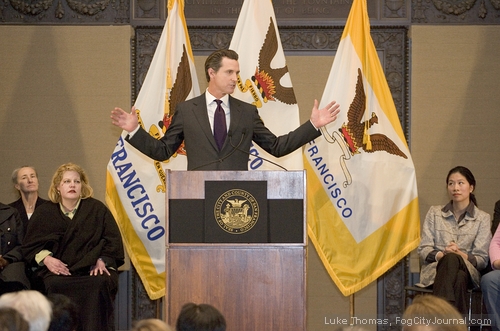
By the time I made it to the 2010 Black History Month kickoff ceremony at San Francisco City Hall, on Friday, Feb. 5, California Public Utilities Commissioner Tim Simon was talking about how the African American community can make sure it doesn’t get left on the sidelines in future.

Simon advised folks to know their resources, community and strategy to ensure that people of color are included in the burgeoning Green economy—a topic in keeping with the history-of-black-economic-empowerment theme.

“And I want to encourage all of us to celebrate the month of Black History and teach it to our children, because we could lose this generation,” Smith said, noting that just three blocks away from City Hall in the Western Addition/Filmore, “young men talk about and celebrate it when they reach 25 years old.”

California Public Utilities Commissioner Tim Simon advised folks how not to get left behind in the Green economy.

The community was encouraged to attend the Human Rights Commission’s Feb. 18 meeting in the Bayview and to get involved in the 2010 Census, which will provide temporary, part-time jobs with flexible hours.

Destined to Dance enlivens the corridors of power at San Francisco’s City Hall.

And then dancers with Destined to Dance wowed the audience by infusing the typically staid marble corridors of power with a “Swing low, sweet chariot” inspired blend of energy, grace and light-footed gaiety.

After the main program concluded, a who’s who of San Francisco’s black community lingered for a moment to chat.

Sup. Sophie Maxwell told me that she saw the failed attempt to recall her as “democracy at work.” She also repeated earlier statements that she is not yet ready to endorse any of the candidates vying to replace her when she is termed out in January 2011.

“It’s not just about Bayview Hunters Point,” Maxwell observed. “The common thread is the entire District 10 community.”


D. 10 candidates Eric Smith and Tony Kelly smile for the camera.

Kelly told me that to his mind the common thread is that residents of the district, which is home to the worst toxic hot spots in the city, can’t rely on corporations to solve their problems.

“District 10 can think for itself,” Kelly said. “They don’t have to look outside. But to my mind, up until now, the approach in city hall has been that there is no mess in D. 10 that can’t be fixed by a friendly corporation.”

Kelly observed that folks in the eastern neighborhoods came up with a better revitalization plan than what the city proposed, and that community activists managed to close the power plant, after the city said it was impossible.

“We have the worst schools, transportation and pollution,” Kelly said. “Candidates in the D. 10 race tend to fall into one of two groups: those that are responsive to Lennar and PG&E’s plans, and those who oppose them.”

D. 10 candidate Kristine Enea, who attended the Navy’s Feb. 2 “community involvement plan” meeting at the Bayview YMCA told me that at least the Navy showed some willingness to let the community speak at that meeting,

Chris Jackson San Francisco Community College Board Trustee chats with D. 10 candidates Tony Kelly and Kristine Enea.

“But they need to stop being so defensive,” Enea said, as she questioned why the Navy refuses to speak in public about why it dissolved the Shipyard Restoration Advisory Board.

D 10 candidate Lynette Sweet told me that she thought California PUC commissioner Tim Simon “hit it on the head with his comments,” at the Black History Month kickoff event.

D. 10 candidate Lynette Sweet poses for the camera.

“We’re not the sum of our parts, we’re not murderers and poverty pimps, there is some real leadership and quality people within our community,” Sweet observed.

Public employees feel blindsided by Newsom’s layoff scheme

39

Mayor Gavin Newsom’s proposal to lay off 10,000 city employees and rehire them at lower pay is being met with outrage by some public-sector workers. The plan, crafted as a way of saving money to balance the city budget, would amount to sweeping pay cuts across the board for a significant number of city workers.

Formal discussions about it are in the earliest stages, and Tony Winnicker, the mayor’s press secretary, described it as “just one alternative that we’re investigating.” Nonetheless, some members of Service Employees International Union Local 1021 are furious that the mayor unveiled this plan in the San Francisco Chronicle instead of at a meeting with the city’s labor leaders.

“As far as we can tell, an idea he has ended up on the front page of the Chronicle that’s had a devastating ripple affect among the people who work for the city and county,” SEIU Local 1021 President Damita Davis-Howard told the Guardian. “We feel like we got a sucker-punch. … We really wish he had talked to us before he governed by press conference.”


Davis-Howard said she’s been inundated with phone calls from angry union members who read the article. “This is the same proposal he floated last year,” Davis-Howard said. “Most of our members believed that they gave up their holiday pay in order to avoid this very thing.”

The proposal, which was briefly considered last year but never moved forward, serves to illustrate just how hard financial woes are hitting San Francisco. The city is staring down a $522 million deficit, and Newsom’s proposal would make up for a mere $50 million in savings.

Winnicker declined to comment on Davis-Howard’s concerns about being blindsided by news of the layoff plan, brushing it off by saying the mayor did discuss it with “some folks in labor.” Instead, he suggested that Newsom is getting serious about solving the budget crisis while the Guardian is just focusing on irrelevant gripes.

“It is an unprecedented budget shortfall, and it is real,” Winnicker said, stressing that the gaping budget gap will have to be bridged without the infusion of federal stimulus dollars that cushioned the blow last year. “The easy choices are behind us.” This layoff plan could prevent “hundreds, if not thousands, of layoffs,” but the mayor is open to other ideas that labor brings to the table, he said.

“That logic is just flawed,” Davis-Howard said when asked about the assertion that the plan could prevent layoffs. “That’s not the way you re-stimulate the economy, by taking more dollars out of the economy. We can’t continue to balance the budget on cuts, because pretty soon the actual fiber of the city and county of San Francisco will be reeling because of the number of cuts that we sustained.”

When asked how SEIU Local 1021 would respond, she said, “I do believe we need to be open-minded, imaginative, and creative in coming up with some revenue-generating measures here.”

No doubt the mayor will receive plenty of suggestions as negotiations continue in the coming weeks.

Tragically hip

0

arts@sfbg.com

THEATER The Oedipus of Sophocles gets transposed to the California prison system and East L.A. in Luis Alfaro’s lively Oedipus el Rey, playing at the Magic Theatre in a world premiere slickly staged by artistic director Loretta Greco. Neither the classic nor contemporary terrain is new turf for Alfaro, whose Electricidad similarly reset the Electra myth. But San Francisco is another story, this being the acclaimed L.A.-based Latino playwright’s first professional Bay Area production.

Slipping into Alfaro’s lyrical mix of the sacred and vernacular, his intuitive sense of comic timing, and his larger dramatic purposes proves relatively easy. Despite many appeals to artistic license — including a sometimes cumbersome substitution of a Christian universe for fate-bound Greek pantheism and the more intriguing revisioning of Oedipus as a barrio gangster on the make — the story remains familiar in outline, not least the beloved plot points “kills father, marries mother.” And decades into the work of playwrights like Luis Valdez, José Rivera, and Octavio Solis, there’s something already familiar as well about the setting’s wry, poetical, classically bound barrio.

But Alfaro is a knowing and competent progenitor of the style. The use of a four-cholo chorus, or Coro, is particularly deft, with the actors in orange prison smocks occupying the extreme corners of a mystically bare stage and calling on us to consider “this man” — played with a jagged, bounding innocence by Joshua Torrez — in a tough, sardonic but elegant litany that pounds open the themes of the play from the outset like a piñata idol.

But the less abstract scenes are among the most effective, especially the riveting relationship between Oedipus and his lover and unrecognized mother Jocasta (a winningly strong yet vulnerable Romi Dias), which unfolds as an incestuous but tender and strangely compelling meeting of damaged souls. If the play doesn’t cohere with quite the authority or intensity it aims for, what remains is a set of images and moments that set the prophetic and profane in vital relation to one another.


KEEPING IT REAL, OR PRÊT-À-PORTER

Drag performance artist and dancer Monique Jenkinson, a.k.a. Fauxnique, recently saw the weekend run of her new solo show Luxury Items at ODC Theater sell out in the bat of an eyelash. (See SFBG photographer Ariel Soto’s shots of that perfomance here.) So the current remounting at CounterPULSE comes highly anticipated. It doesn’t disappoint, and given the charisma and talent of its writer-choreographer-performer, not to mention the love lavished on her by adoring audiences, it’s hard to imagine how an intimate evening like this could. And considering its general execution and not least its ambition and scope — at once surprising and altogether apt — it’s well worth seeing at any stage in its ongoing development. At the same time, in the uneven arc of its dramatic line and somewhat choppy melding of themes, it remains a work-in-progress.

But what a work! Beginning in glorious repose across a deluxe chaise longue, Luxury Items revels in haute couture fantasy. But it soon acknowledges essential truths about our obsession with opulence in general and haute couture in particular. One: it’s built around an ersatz encounter with luxury that comes courtesy of media and advertising (“obsession,” in other words, is first of all a perfume ad). And two: it’s tacitly premised on a political economy whose principal characteristic is the ruthless class-based exploitation of laboring bodies.

If this makes drag sound like a drag, all the more reason to laud what Jenkinson is crafting here. It retains all requisite insouciance and wit even while deconstructing, in compellingly personal and historical terms, the “real” material bargain being made in every rarified, Chanel-clouded embrace of precious materialism.

OEDIPUS EL REY

Through Feb. 28

Wed.–Sat., 8 p.m. (also Sat., 2:30 p.m.);

Sun., 2:30 p.m.; Tues., 7 p.m., $20-$55

Magic Theatre

Bldg B, Fort Mason Center, SF

(415) 441-8822

www.magictheatre.org

LUXURY ITEMS

Through Feb. 21

Thurs.–Sat., 8 p.m. (except Feb. 20, 10 p.m.), $20

CounterPULSE

1310 Mission, SF

(415) 626-2060

www.counterpulse.org

Dolce utopia

0

arts@sfbg.com

VISUAL ART Amid day-to-day art world caprice, an event titled "Dynamic Adaptability: A Conference on New Thinking and New Strategies for the Arts" took place Jan. 28 at Herbst Theater. Rather than vie for stability, the organizers envisioned the gathering as an opportunity "to explore our changing environment and offer fresh ways of thinking about the future" of Bay Area arts. "This is a time," they asserted, "of tremendous potential for new ideas to take root."

Surprisingly, the speaker who best formulated this alternative model — this strategy of adaptive dynamism — was an outsider, and the youngest person at Herbst Theater that day. But 22-year-old neuroscientist Jonah Lehrer would argue this makes perfect, logical sense. Author of Proust Was a Neuroscientist (Houghton Mifflin, 256 pages, $24), Lehrer claims remote perspectives and practices offer unforeseeable insights. He argues that keen novelists like Proust can lead us to new understandings of the brain and society at large that neuroscientists (and other professionals) might otherwise overlook. The same goes for innovative artists; great art provokes new questions, which in turn abets new thinking.

The reason, Lehrer argues, is reason. Linear projections fashioned by rationality allow cognition only so many avenues. According to Lehrer, "emotions" — those messy feelings that propel many artists — "underlie cognition differently. And like morality and aesthetics, they have inexplicable qualities." Essentially, the more variegated and multidisciplinary the approach, the better the chance of screwing in that light bulb. The battlefield of "truth," it turns out, isn’t won solely by techies in labs, but also by writers and artists in studios.

Yet what if artists today can’t afford studios? Lehrer convincingly makes a case for dynamism, the importance of arts and humanities disciplines joining hands with sciences and other fields. But with arts budgets always the first to go in a paraplegic, sloughing economy, how are artists to survive, let alone produce? Better yet, how are they to adapt?

Artist-provocateur Philip Huang provided the conference’s other answer. Adorned in a cape, glitter vest, and Snoopy t-shirt, Huang greeted the audience by yelling, "Hey, motherfuckers!" Then he did it again, and again, until the shock wore off, at which point he was able to convince the crowd to taunt back, effectively turning the theater into an absurd acoustic swirl of contrived and zealous "Motherfucker!" chants.

Huang espoused an artistic model borrowed from TV and radio journalist Robert Krulwich, a strategy of "throwing yourself." It’s a prostitution tactic of pitching and hustling, but without the grip of the pimp or institution. And it works. In 10 short minutes, he convinced a dumbfounded-turned-elated crowd to fund his "24-hour Witness Fitness Performance," a straight-from-the-ass proposal to do a performance circuit on sidewalks that face treadmill runners as they vacuously stare into urban inanity. Hoang raised nearly $300 of wadded-up bills, all thrown at him like roses at a princess, despite his goading, "Fork it over, motherfuckers!"

Huang clearly doesn’t give a shit about the economy; he’s the type of artist who, despite uncertainties, will always find a way to produce via hustling. His "studio" is a case in point: the bedroom doubles as a "queer performance space" where he screens work and disseminates it through a YouTube channel (spider75berkely). But it’s his street performances that are most interesting. An artist’s work is likely to suffer if entirely withdrawn from the world (Proust’s last writings, where he ensconced himself in a cork-lined bedroom for three years, attest to this).

The mutability of an "in-between" or "third way" of making art was proposed by speakers at the "What is the Good of Work?" seminars organized by the Goethe-Institut in New York. Aimed at "think(ing) of unemployment as an artistic and philosophical category" given the amount of unemployed artists, the seminar "takes its starting point in the claim that today the artist — defined by creativity, unconventionality, and flexibility — might be seen as a role model for contemporary workers."

Liam Gillick, who spoke at the most recent seminar Jan. 30, believes today’s artist has an opportunity to "to reflect on permanent leisure." "The good artist is always productive and works all the time," he says. This "work" isn’t necessarily work or leisure in the traditional sense, but work characterized by "flexible knowledge-workers exercising self-organization and self-determination where the studio functions as a laboratory." Gillick views entropy as art’s current model: resistance and production via indeterminacy and flux.

In a similar spirit, albeit unwittingly, this article was written in several spaces (Herbst Theater; BART; seat 14B on a Boeing 757; Everyman Espresso and Fresh Salt Bar in NYC; a friend’s Brooklyn bedroom that isn’t really a bedroom but a living room with a partition; and all the criss-crossing streets in between), in several formats (notebook; laptop; cell phone; napkin; and folds in my brain). There were distractions — turbulence announcements; actors rehearsing scripts of banal, big city dating-related dialogue while jogging in place; a man’s heinous, relentless laughter that sounded exactly like a 1980 VW Rabbit desperately trying to turn over in the dead of winter; and near the rampant heat of a misused radiator. This may account for its moments of disjunction, but its words are imbued with many shifts in space and time, so that ideally they reflect more than a static mirror might.

Metacognition, or "thinking about thinking," as Lehrer explains it, is crucial to problem-solving and development. As is distance and movement. This is why Lehrer suggests doing work when traveling, walking — even daydreaming. Distancing oneself from an immediate obstacle allows for relaxation, which allows alpha waves to generate, which leads to moments of insight and epiphany.

"We shouldn’t be complaining about uncertainty or the prospect of no future," Gillick claims. Nor should we follow the opposite instinct of scrambling for "transparent utopias." Those, he warns, are never "transparent but actually opaque and dangerous."

I believe art critic Nicolas Bourriaud proffered the best way out of the current impasse faced by artists in a time of economic struggle and failure: "I am not persuaded that we should respond to this sort of ‘all or nothing’ by another globalizing system," he says. "I’m under the impression that we are approaching an era of ‘dolce utopia,’ to quote Maurizio Cattelan. It’s the idea of constructing temporal spaces which permit for a while experimentation."

The “jobs” shell game

0

Written with Nima Maghame

news@sfbg.com

While many San Francisco city officials have been trying to figure out how to close a projected budget deficit of more than $520 million, Mayor Gavin Newsom has spent the last month trying to make that spending gap even larger by aggressively pushing a variety of business tax cuts that economists say will do little to improve the local economy and could actually make it worse.

Newsom first proposed his so-called “local economic stimulus package” a year ago during his ill-fated run for governor, just as President Barack Obama was pushing his own economic stimulus plan. But unlike the federal government’s $787 billion plan, about a third of which involved tax cuts demanded by conservatives, Newsom proposed to cut local business taxes while also deeply slashing local government spending and laying off hundreds of city workers.

Most economists say that’s a terrible idea. In fact, a report issued at the time by Moody’s Investor Services made it clear that every dollar of direct government spending adds about $1.60 into the economy (or $1.73 if it’s on food stamps, the most stimulative spending government can make), whereas business tax cuts add only about $1 to the economy for every dollar spent.

We clashed with the Mayor’s Office at the time on our Politics blog (see “Mayor Newsom doesn’t understand economics,” 2/13/09), with Newsom’s spokesperson telling us the mayor was relying on the input of City Economist Ted Egan. But when we interviewed Egan about the issue, he agreed that it’s a bad idea to slash government spending to pay for tax cuts.

“We were in no way saying you should cut taxes to stimulate the economy, particularly if it means reducing government spending,” Egan told us then. And when we asked directly whether it’s better for San Francisco’s economy for the city to directly spend a dollar on payroll or to give that dollar away in a private sector tax break, he told us, “The consensus among economists is that most of the time government spending stimulates the economy more.”

The Board of Supervisors basically ignored Newsom’s proposal. But he revived it last month, expanding the proposals with even more private sector subsidies and making them the centerpiece of his Jan. 13 State of the City speech, publicly pushing it since then with a series of public events at businesses located in the city.

And this time — with the local economy still slow, projected city budget deficits bigger than ever, and little serious talk about how the city can bring in more money — it appears the proposals will be the subject of a series of hearings before Board of Supervisors’ committees in the coming weeks.

Newsom’s tax cut proposals include a proposal to waive the 1.5 percent payroll tax (the city’s main business tax) for all new hires; extend and expand the payroll tax exemption for biotech companies (see “Biotech’s bonanza,” p. 12); give small businesses tax credits for their spending on health plans; and allow developers to pass one-third of their affordable housing in-lieu fees onto future homeowners.

Newsom and his Press Secretary Tony Winnicker have spoken euphorically about the proposals, saying they’re desperately needed to spur the local economy. “We believe that enacting these tax incentives, particularly the payroll tax credit for new hires, is one of the single biggest things we can do for economic growth,” Winnicker said.

Despite repeated questions about the economists’ concerns over financing tax cuts with government spending cuts, we couldn’t get them to address the tradeoff directly. “The mayor will support critical public services,” was all Winnicker would say about the deep cuts that Newsom is expected to announce in his June 1 budget.

Sup. John Avalos, who chairs the Board of Supervisors Budget and Finance Committee, expressed more skepticism about the mayor’s proposals. “Do tax breaks have the intended effect of stimulating the economy? As we underfund government services, are we getting a net gain or are we getting something taken away? For the very small businesses in my district, it’s going to be trickle-down economics. It’s very unrelated and unmeasurable in benefit,” he told us.

David Noyola, board aide to President David Chiu, said his boss is supporting the biotech tax credit but reserving judgment on the rest. “It’s going to be a cost-benefit analysis,” Noyola said. “When we’re talking about jobs, we’re talking about public and private sector jobs, always.”

While Egan’s economic analysis predicts tax cuts will encourage some economic growth, even he is circumspect about the good it will do, particularly without finding a way to avoid deep cuts in city spending. “The truth of the matter is that our stimulus efforts are small because the city has relatively small power to affect the local economy,” Egan told us.

That’s the consensus economic opinion. Huge federal spending can help a national economy a little bit, but local economies are just different animals that local governments are largely powerless to really alter, particularly through tax cuts.

“I agree with Egan: city government has little power over the local economy,” Mike Potepan, an urban development economist at San Francisco State University, told the Guardian.

Both economists agree that tying tax cuts to job creation or development stimulus is better than general tax cuts, but that neither is good if it means laying off more city workers.

“Research shows that by cutting taxes you have more business activity where studies show it is likely to effect employment,” Potepan said. “On the other side, you have to think about revenue. Cities are going to have to balance their budgets, which could mean a cut in services.”

Author Greg LeRoy expresses a more critical perspective in his book The Great American Jobs Scam: Corporate Tax Dodging and the Myth of Job Creation (1995, Berrett-Koehler), amassing evidence from economic studies and CEO surveys that corporate tax breaks, even those tied to new job creation, have almost no effect on private companies’ decisions about where to locate and whether to hire.

“How can companies get away with this? Because the system is rigged. Corporations have it down to a science. They have learned how to chant ‘jobs, jobs, jobs’ to win huge corporate tax breaks — and still do whatever they wanted all along,” LeRoy writes. “That’s the Great American Jobs Scam: an intentionally constructed system that enables corporations to exact huge taxpayer subsidies by promising quality jobs — and lets them fail to deliver. The other benefit often promised — higher tax revenues — often proves false as well.”

While proposing to forgo collecting millions of dollars in payroll taxes (the Controller’s Office is still working on a projected total for the tax cut package), the Mayor’s Office also wants to spur development of new housing with a proposal that would delay collection of needed affordable housing money by more than a decade.

After hearing mostly from a large crowd of desperate developers and construction workers during a Jan. 21 hearing on the proposal, the Planning Commission approved the package on a 4-3 vote, with the mayor’s appointees in agreement and the board’s appointees in dissent. It will be considered by the Board of Supervisors Land Use Committee sometime after Feb. 12.

The most controversial part of the fee reform package involves reducing the fee developers pay to support affordable housing by 33 percent, then charging a 1 percent transfer tax to subsequent buyers of those homes. Egan estimates developers would save almost $20,000 per housing unit, and that it would take an average of 16 years for the city to recover that money. But for high-rise luxury condos, the city would eventually recover about $27,000 per unit.

“It’s a classic make-an-investment-now-to-get-more-later strategy,” Michael Yarne, who crafted the policy for the Mayor’s Office of Economic and Workforce Development at Newsom’s direction, told the Guardian.

“If it makes it feasible for projects to be started, then it is worth passing,” Tim Colen, a representative of San Francisco Housing Action, said at the Planning Commission hearing, expressing hope that it will help create desperately needed construction jobs and new market rate housing.

But affordable housing advocates and some progressives criticize the policy as completely backward, saying that affordable housing development is desperately needed now, during these tough economic times, rather than a policy that encourages more market rate housing and bails out bad investments made at the height of the real estate bubble.

“What the city needs to do is directly build affordable housing, for which there is a demand,” affordable housing activist Calvin Welch told us. “The problem is that the banks don’t want to lend these guys money because they know nobody can afford to buy houses at the prices that these guys are demanding.”

Debra Walker, who is running for supervisor from District 6 and voted against the proposal when it came before the Building Inspection Commission (the sole vote on a commission dominated by mayoral appointees), agrees.

“The whole argument is that it stimulates development, but it doesn’t,” Walker said, arguing that the incremental gains (about 25 housing units per year, Egan estimates) will be offset by delayed affordable housing construction. “There would be more economic stimulus by using the fee to build more affordable housing.”

Instead, it simply shifts resources to favored entities: from home owners to developers, in the case of the affordable housing fees, or in the case of the tax credits, from the public to the private sector. But Newsom’s office just doesn’t see it that way.

“The Guardian believes in protecting public sector employees over private sector employees,” was how Winnicker formulated our understanding of what the economists are saying. “Most people don’t work for the city, and if we can support private sector jobs, that adds to sales tax revenues and benefits the economy. Despite a short-term impact of the tax credit, that’s a benefit.”

Adam Lesser contributed to this report


Biotech’s bonanza

0

By Adam Lesser

news@sfbg.com

It’s difficult to measure the value a biotechnology company receives from locating in San Francisco. Most measures are qualitative: scientists talk about synergy with other biotech companies in the area, the intellectual community that thrives at the University of California-San Francisco, and support offered at the California Institute for Quantitative Biosciences (QB3).

But the quantitative costs are easier to calculate, beginning with rents that often are two to three times higher than in the East Bay or South Bay. Add San Francisco’s 1.5 percent payroll tax, and companies can begin to attach a dollar figure to the premium of being in San Francisco.

To incentivize biotech companies to locate in San Francisco, Mayor Gavin Newsom is asking the Board of Supervisors to extend the six-year-old Biotech Payroll Tax Exemption. The exemption allows any new biotech company to get a full 7.5 years without paying local business taxes as long as it files for the exemption by Dec. 31, 2014.

At a time when San Francisco city officials are struggling to close a budget deficit of more than $500 million — for which Newsom hasn’t offered any significant revenue proposals to help bridge the gap — some are questioning why the city should continue giving millions of dollars in tax breaks to the thriving biotech industry.

The core question of whether the payroll tax credit has worked in bringing more biotech companies to San Francisco is complex. While Newsom boasted of attracting 54 new biotech companies in the last five years during his Jan. 13 State of the City address, analysis of the credit by Ted Egan, the city’s chief economist, indicated that only eight companies had applied for the credit by the end of 2008.

The thriving research environment at UCSF-Mission Bay and the establishment of the state taxpayer-funded California Institute for Regenerative Medicine have played significant roles in creating a favorable environment for young biotech companies. The last five years also have seen broad growth in biotech as scientific discoveries have accelerated. Would biotech companies have come to San Francisco regardless of the payroll tax exemption?

The city’s Office of Economic Analysis looked at the question of how effective the payroll tax exclusion actually has been in spurring biotech growth. Because the size of the incentive — an exemption from paying a 1.5 percent tax on its total payroll — is relatively small, Egan felt that there could not be a conclusive link between the exemption and biotech growth. But he did feel there was some benefit, writing in his analysis that “in fact, the primary worth of the incentive may lie in its marketing value and how it signals to the industry that San Francisco is a credible location for biotechnology.”

Between 2004 and 2008, the biotech tax credit cost the city $1.2 million. If costs stay on pace with 2008, the existing Biotechnology Tax Exclusion will cost at least an additional $2 million. There are no cost estimates yet on extending the credit to give all biotech companies the full 7.5 years of payroll tax exclusion.

The extension faces opposition. Sup. John Avalos, chair of the Board of Supervisors Budget and Finance Committee, has expressed concern about the effectiveness of tax credits.

“I’m not sure the city is going to be able to show a direct connection between taxes and the growth of the biotech industry. The verdict is still out for me,” Avalos told the Guardian. “We’ve created the whole infrastructure for the industry around Mission Bay. That could have a lot to do with companies coming to San Francisco.” The city donated a portion of the land the UCSF-Mission Bay campus was built on.

Allopartis Biotechnologies is a small biotech startup in QB3 at UCSF-Mission Bay that has received venture capital funding. It saved $3,670 in 2009 by qualifying for the payroll exclusion. Allopartis has six employees and focuses on developing technologies to convert biomass into sustainable fuels.

“You pay a premium to be in the city, and it’s worth it,” said Robert Blazej, cofounder of Allopartis. “We’d like to stay close to this nexus of innovation and collaborators. But it’s going to be challenging with the cost of square footage.”

Interviews with other growing San Francisco businesses showed that their biggest concern was the cost and availability of commercial real estate. Zynga, a social gaming company in Potrero Hill, plans to add 800 jobs over the next two years. Newsom has asked for an additional waiver on payroll taxes for all new hires over the next two years, regardless of industry.

“We considered moving out of San Francisco for a couple reasons. One is the availability of commercial real estate. The other is the payroll tax,” said Chief Financial Officer Mark Vranesh. “The large blocks of space we would be looking for are hard to find.”

But as the city tries to plug gaps in dwindling city services, concerns are mounting about how much the city can give away to companies under the premise that tax credits create new jobs. In the debate about the biotech tax credit, objections have been raised about the fundamental fairness of giving a tax break to one industry while others still pay their share. Similar next generation industries with large up-front research and development costs such as solar energy or fiberoptic Internet do not receive payroll tax waivers.

Economists such as the Tax Foundation’s Patrick Fleenor are quick to point out that there are no political advantages to taxing everyone equally. “The problem is a political one. If you tax everyone the same, there aren’t politicians creating little fiefdoms. There aren’t ribbon-cutting ceremonies,” he said.

Avalos has equated judging the effectiveness of tax credits at creating jobs to looking into a crystal ball. But the price tag of each tax credit is borne in the present as the city contemplates laying off hundreds of city workers.

Adding to the political infighting have been public complaints by Sup. Michela Alioto-Pier that Newsom is trying to take credit for the biotech payroll exclusion, which she originally proposed and helped legislate in 2004. She requested an extension for the biotech tax credit in November. Her office has defended the bill. “We’re creating a hub so that other biotech companies can come to San Francisco,” said Bill Barnes, Alioto-Pier’s legislative aide. “When she was courting biotech, she was hearing that the payroll tax was an impediment.”

But other cities charge local business taxes comparable to San Francisco’s payroll tax. And if there was ever an industry that has been heaped with support from the public sector, it is biotech.

Proposition 71 passed with 59 percent voter support in 2004 and established the CIRM, which provides grants and loans for stem cell research. Stem cell research is an area within biotech that has seen significant political support, particularly since the time of the Bush administration, when federal funding for embryonic stem cell research was heavily restricted.

But appearing to be doing something about the economy remains politically important, even if the actual benefits are somewhat dubious.

“It’s a big political game that the mayor is playing. He wants to paint progressives as anti-jobs, which is ridiculous, and paint himself as the mayor for jobs,” Avalos told us. “We would be cannibalizing government services for the private sector.”

Newsom has been vague about whether he accepts that tradeoff or even understands its implications to city coffers and the local economy. Newsom Press Secretary Tony Winnicker recently told us, “He thinks it’s good policy to spur private sector job growth.”

Later, he added: “While not every company has taken advantage of it, we feel extending it sends the right message,”

Our weekly picks

0

WEDNESDAY (10th)

EVENT

Electronic Frontier Foundation: 20 Years

With technology becoming ever more an integral part of our daily lives, important issues surrounding digital rights continue to arise in new forms, be they regarding net neutrality, government wiretapping, or downloading music. The Electronic Frontier Foundation, a nonprofit civil liberties organization, was founded in 1990 to defend people’s rights in the areas of free speech, innovation, privacy and more. EFF celebrates its 20th anniversary tonight with a party and fundraiser hosted by Mythbusters’ Adam Savage, featuring music, entertainment, and tech luminaries such as Apple cofounder Steve Wozniak and Lotus 1-2-3 program designer Mitch Kapor. (Sean McCourt)

8 p.m., $30

DNA Lounge

375 11th St., SF.

(415) 626-1409

www.dnalounge.com, www.eff.org

THURSDAY (11th)

VISUAL ART

ARTEMIO: “Gersamkunstwerk”; Frankie Martin: “Through the Vortex”

Nothing sounds more disparate than “guns, grenades, bombs, and machetes” assembled into a mandala; and video of a “1,000 mile, California coastal bicycle” voyage. But who knows, juxtapositions create funny things like frisson. What distinguishes Mexico City conceptual artist ARTEMIO from New York “nomadic inter-media artist” Frankie Martin could potentially create a third work where the paradoxical polarities and politics of drug wars infiltrate the narratives of mobile subjectivity this side of the leisure-born border. I’m thinking something like Road Rash, the 1991 Sega Genesis video game where motorcyclists beat each other with chains and baseball bats in a race to the champagne and bikini line. You might see something a bit more sophisticated. (Spencer Young)

7–11 p.m. (through March 13), free

Queen’s Nails Projects

3191 Mission, SF

(415) 314-6785

www.queensnailsprojects.com

FRIDAY (12th)

FILM

“A Valentine’s Tribute Weekend to John Hughes”

When the Oscars’ people-who-died montage rolls around in March, more than one child of the ’80s will raise a fist for John Hughes, the writer-director-producer of many of the era’s most beloved teen films. Midnites for Maniacs programmer and host Jesse Hawthorne Ficks feels your pain — he’s assembled seven of Hughes’ enduring classics for a two-day feast of class- and clique-disrupting romances, multiple Ringwalds, touchy-feely grandmas, homemade prom dresses, Ferraris, the best fucking movie about travel ever (you can bet your John Candy it ain’t Up in the Air), and Bueller … Bueller … Bueller. The marathon begins tonight with Some Kind of Wonderful . Angst ahead! (Cheryl Eddy)

7:30 p.m. (Some Kind of Wonderful), 9:30 p.m. (Ferris Bueller’s Day Off) and 11:45 p.m. (National Lampoon’s Vacation); through Sat/13, $10 per day

Castro Theater

429 Castro, SF

(415) 621-6120

www.ticketweb.com

MUSIC

San Francisco Bluegrass and Old-Time Festival

Old-timey — it’s not just for lemonade, hoop skirts, handlebar mustaches, and dial-ups. It’s also for the retro-coolly acronymed SFBOT, raising its analog arms and taking over dozens of the Bay’s venues with that sweet, sweet sound of everyone’s favorite time period: yore. Loudon Wainwright III, Stairwell Sisters, Water Tower Bucket Boys, Asylum Street Spankers, and a strummin’ army of fiddlers, yelpers, crooners, stompers, hoofers, and juggers blow wildly through the roots of this 11th annual harmonic convergence. Oh yes, there shall be banjos. (Marke B.)

Various times, venues, and prices (through Feb. 24)

Tonight: Red Molly, Stairwell Sisters

8 p.m., $19.50

Freight and Salvage

2020 Addison, Berk.

www.sfbluegrass.org

MUSIC

Mahogany Soul Series: Chico DeBarge, Martin Luther

It’s Friday night — time to mellow out to some old school soul sounds. Chico DeBarge is a charismatic and skilled songwriter and producer long known for making the ladies swoon with his sensual singing style. He’s joined by fellow R&B man Martin Luther. Also in the mix is DJ Sake-1. Part of Ineffable Music Group’s Mahogany Soul Series, this event is a trifecta for R&B lovers. (Lilan Kane)

9 p.m. $16–$20

Shattuck Down Low

2284 Shattuck, Berk.

(650) 291-1732

ineffablerecords.inticketing.com

MUSIC

Badfish: A Tribute to Sublime

Badfish, named after a song on Sublime’s 40 Oz. to Freedom (Gasoline Alley/MCA, 1992), has helped keep the Sublime spirit alive. The group formed in 2001 when they met at the University of Rhode Island, where they were computer science majors. They’ve quickly garnered a fanbase in the college music scene and have played to sold out crowds since 2006. The members are also in their own non-tribute band, Scotty Don’t, which usually serves as the opening act for Badfish shows. (Kane)

9 p.m., $65–$84

Regency Ballroom

1290 Sutter, SF

(415) 673-5716

www.theregencyballroom.com

SATURDAY (13th)

EVENT

Alameda Zombie Crawl

Movies (and music videos) have taught us that zombies can run, swim, operate amusement park machinery, and perform synchronized dances. It turns out the undead even enjoy exotic cocktails — ergo, the first annual Alameda Zombie Crawl, which kicks off with drink specials (including, duh, Zombies) at the Forbidden Island Tiki Lounge. The brain-chomping masses will then head to Scobies Sports Bar and Grill and Lost Weekend Lounge, before breaking off into smaller groups to terrorize shopping malls and farmhouses in rural Pennsylvania. Come dressed to kill — er, like you’ve already been killed; there’ll be makeup assistance ashore the Island for anyone who doesn’t have Tom Savini-style gore-and-latex skills. (Eddy)

7 p.m. (makeup starting at 5 p.m., $5–$50), free

Forbidden Island Tiki Lounge

1304 Lincoln, Alameda

alamedazombie@live.com

EVENT/DANCE

Black Choreographers Festival

The Black Choreographers Festival kicks off its three-weekend run in Oakland with workshops, public discussions, $10 master classes, and seminars. New this is year is a free film series presented in partnership with see.think.dance. Starting this Saturday in Oakland, it includes documentaries, feature films, and shorts from Africa and the diaspora. Also this weekend is a Sunday morning youth meet, after which the young dancers invite the public to an afternoon concert. Despite videos and all manner of documentation, dance still gets passed on directly from one body to the next. This is an opportunity to see the next generation. Participating groups include Dimensions Extensions Dance Ensemble, Destiny Arts, Oakland School of the Arts, San Francisco School of the Arts, and On Demand. (Rita Felciano)

1–6 p.m. (also Sun/14, 4 p.m.; festival through Feb 28), free–$10

Malonga Casquelourd Center for the Arts

1428 Alice, Oakl.

(888) 819-9106

www.bcfhereandnow.com

EVENT

Workshop: “DIY Valentine — Sexy Bedroom”

Extravagant gifts and pricey candlelit dinners for the big V day have, more or less, become a thing of the past. In this economy, many are having to craft new ways of celebrating the day dedicated to all things love. Fortunately Kelly Malone is giving a sultry tutorial on how the ladies, and even gents, can spice up their bedrooms for the big night. At Workshop, you’ll learn how perfect a seductive cocktail, tease your hair like Brigitte Bardot, create alluring smoky eyes, and transform your unadorned room into a lair fit for a sex kitten. (Elise-Marie Brown)

5:30 p.m., $40 (sign-up required)

Workshop

1798 McAllister, SF

(415) 874-9186

www.workshopsf.org

DANCE

Company C Contemporary Ballet

At nine, Company C Contemporary Ballet has found its groove. Two things stood out at last month’s Walnut Creek performances that will be repeated on this side of the Bay this weekend. These are beautifully alert dancers who can shine in a wide range of repertoire. Being in a small company, they switch gears rapidly and admirably. Also, founding Artistic Director Charles Anderson has a gift for programming. He commissioned Amy Seiwert in a hot nightclub number, brought Lar Lubovitch’s flowing Cavalcade to a tough Steve Reich score, introduced Charles Moulton’s ingenious Nine Person Ball Passing to a new generation, and choreographed his own Akimbo. He knows what’s he’s doing. (Felciano)

8 p.m. (also Sun/14, 2 p.m.), $18–$40

Yerba Buena Center for the Arts

Novellus Theater

701 Mission, SF

415 978-ARTS

www.ybca.org

SUNDAY (14th)

EVENT/FILM/MUSIC

Marc Huestis Presents “Justin Bond: Close to You” and Whatever Happened to Susan Jane?

“Did he beat you, girl? You got burned if he didn’t beat you, girl.” I can’t think of any better romantic advice than that, gleaned from a scene in Marc Huestis’ San Francisco new wave comedy from 1982, Whatever Happened to Susan Jane? Besides drag queen wisdom, the flick dispenses some great back-in-vogue music, including tunes from Tuxedo Moon and Indoor Life. A DVD release screening of it is just the prelude to a night with SF girl-gone-good Justin Bond, who’ll be singing Carpenters hits with a 10-piece orchestra, and hosting special guests the Thrillpeddlers. Trash the Ipecac and be my bloody, melancholy valentine. (Johnny Ray Huston)

Susan Jane: noon, $8

Justin Bond: 8:15 p.m., $25–$75

Castro Theatre

419 Castro, SF

(415) 621-6120

www.ticketweb.com

MUSIC

Girls, Smith Westerns

Girls were last year’s critical darlings, but their tour mates the Smith Westerns have perhaps a more interesting rise to fame. Hailing from Chicago, the four members range from 17 to 19 years old. They play the sort of Nuggets rock that went out of style 20 years before they were born. With songs like “Girl in Love” and “Be My Girl,” these guys wear their hearts on their sleeves — and really, isn’t that what Valentine’s Day is all about? (Peter Galvin)

With Magic Kinds, Hunx and the Punkettes

7 30 p.m., $16, sold out

Great American Music Hall

859 O’Farrell, SF

(415) 885-0750

www.gamh.com

MUSIC

The Damned

Planting its stake in music history as the first U.K. punk band to release a single and tour the U.S., the Damned turned heads with “New Rose” and “Neat Neat Neat.” But since today is Valentine’s Day, perhaps its tune “Love Song” is most appropriate to sing along to: “I’ll be the ticket if you’re my collector/ I’ve got the fare if you’re my inspector/ I’ll be the luggage, if you’ll be the porter/ I’ll be the parcel, if you’ll be my sorter.” Join founding members Dave Vanian and Captain Sensible for a chaotic romp through the old days and slam dance with your sweetheart. (McCourt)

With Hewhocannotbenamed and the Generators

8 p.m. (7 p.m. doors), $30 ($54.95 with dinner)

Slim’s

333 11th St., SF

(415) 255-0333

www.slims-sf.com

MUSIC

Leela James

Leela James’s debut album A Change Is Gonna Come (Warner Bros., 2005) received rave reviews from critics and comparisons to Aretha Franklin and Chaka Khan. After four years and a break from a major label, she’s returned with her self-produced sophomore record, Let’s Do It Again (Shanachie Records). The album was recorded using live takes, much like the original soul recordings created at Stax and Muscle Shoals. James pays homage to her musical influences with covers by Betty Wright, Bobby Womack, and the Staples Singers, to name a few. Attention soul lovers: let loose some raw emotion on V-Day. (Kane)

7 p.m. $30

Yoshi’s SF

1330 Fillmore, SF.

(415) 655-5600

www.yoshis.com

TUESDAY (16th)

MUSIC

Fat Tuesday Mardi Gras Party!: Dirty Dozen Brass Band, Zigaboo Modeliste & the New Aahkesstra, DJ Harry D

Oh Mardi Gras, the time of year where beads almost help people avert indecent exposure and jazz bands blare throughout the streets. It’s one of those rare moments that I find myself wanting to be in a city other than San Francisco. But since some of us can’t fly down to New Orleans for the week, the next best thing to the Southern goodness that is Louisiana is the Fat Tuesday party going down at the Independent. Listen to the sounds of the Dirty Dozen Brass Band while downing a glass of bourbon, and be transported to the place of deep, dark bayous and ambrosial gumbo. (Brown)

7:30 p.m., $22

Independent

628 Divisadero, SF

(415) 771-1421

theindependentsf.com

EVENT

“Ask a Scientist: Quantum Mechanics”

Although most of us are glad to be done with school and liberated from 10-page papers and final exams, every now and then it’s nice to learn something new. With the “Ask A Scientist” series anyone can unfold the scientific mysteries that make up the world we inhabit, at least on a level that can be taught in two hours. Discover how energy and matter make up quantum mechanics, how an object can be in two places at once, and other science stuff. (Brown)

7:00 p.m., free (excluding food or drinks)

Horatius

350 Kansas, SF

www.askascientistsf.com

The Guardian listings deadline is two weeks prior to our Wednesday publication date. To submit an item for consideration, please include the title of the event, a brief description of the event, date and time, venue name, street address (listing cross streets only isn’t sufficient), city, telephone number readers can call for more information, telephone number for media, and admission costs. Send information to Listings, the Guardian Building, 135 Mississippi St., SF, CA 94107; fax to (415) 487-2506; or e-mail (paste press release into e-mail body — no text attachments, please) to listings@sfbg.com. We cannot guarantee the return of photos, but enclosing an SASE helps. Digital photos may be submitted in jpeg format; the image must be at least 240 dpi and four inches by six inches in size. We regret we cannot accept listings over the phone.


Newsom’s perplexing attack on San Francisco’s economy

4

There’s a crazy disconnect in City Hall these days over how to help the local economy. Mayor Gavin Newsom has spent much of the last month focusing on “jobs” and “local economic stimulus,” proposing to give a few million dollars in tax breaks to local companies while refusing to discuss new tax measures to help close the city’s $522 million budget deficit.

As we explain in detail in tomorrow’s Guardian, economists just don’t think the tax cuts will help the economy much at all – particularly if the city is reducing its spending and payroll to do so — but even some progressive supervisors are playing along to appease the anxious business community. For example, Board of Supervisors President David Chiu supports an extension of the biotech tax, denying city coffers the benefit of efforts by the city and UCSF to become an important hub for the industry.

Then, in today’s Chronicle, Newsom floats the idea of unilaterally shortening the workweek for city employees in order to save $50 million in payroll costs, firing 10,000 workers and then rehiring most of them to do so. But let’s be clear about this: that means removing $50 million from San Francisco’s economy, or even more once you figure in the multiplier effect that would more than double that loss.

As much as Newsom and his Chamber of Commerce allies love to bash government, the city is one of San Francisco’s largest employers, a clean industry with good-paying jobs. And it just makes no sense why they prefer to inflict mass layoffs on that employer – not to mention the reduced city services that will hurt even private sector productivity — rather than increase taxes on large corporations that ship their profits out of the city and therefore offer minimal benefits to this city’s economy.   


Joseph Stiglitz: Muddling Out of Freefall

0

Here is our monthly installment of Joseph E. Stiglitz’s Unconventional Economic Wisdom column from the Project Syndicate news series. Stiglitz is University Professor at Columbia University and the winner of the 2001 Nobel Prize in economics. His new book is Freefall.

NEW YORK – Defeat in the Massachusetts senatorial election has deprived America’s Democrats of the 60 votes needed to pass health-care reform and other legislation, and it has changed American politics – at least for the moment. But what does that vote say about American voters and the economy?

It does not herald a shift to the right, as some pundits suggest. Rather, the message it sends is the same as that sent by voters to President Bill Clinton 17 years ago: “It’s the economy, stupid!” and “Jobs, jobs, jobs.” Indeed, on the other side of the United States from Massachusetts, voters in Oregon passed a referendum supporting a tax increase.

The US economy is in a mess – even if growth has resumed, and bankers are once again receiving huge bonuses. More than one out of six Americans who would like a full-time job cannot get one; and 40% of the unemployed have been out of a job for more than six months.

As Europe learned long ago, hardship increases with the length of unemployment, as job skills and prospects deteriorate and savings gets wiped out. The 2.5-3.5 million foreclosures expected this year will exceed those of 2009, and the year began with what is expected to be the first of many large commercial real-estate bankruptcies. Even the Congressional Budget Office is predicting that it will be the middle of the decade before unemployment returns to more normal levels, as America experiences its own version of “Japanese malaise.” 

As I wrote in my new book Freefall, President Barack Obama took a big gamble at the start of his administration. Instead of the marked change that his campaign had promised, he kept many of the same officials and maintained the same “trickle down” strategy to confront the financial crisis. Providing enough money to the banks was, his team seemed to say, the best way to help ordinary homeowners and workers.

When America reformed its welfare programs for the poor under Clinton, it put conditions on recipients: they had to look for a job or enroll in training programs. But when the banks received welfare benefits, no conditions were imposed on them. Had Obama’s attempt at muddling through worked, it would have avoided some big philosophical battles. But it didn’t work, and it has been a long time since popular antipathy to banks has been so great.

Obama wanted to bridge the divides among Americans that George W. Bush had opened. But now those divides are wider. His attempts to please everyone, so evident in the last few weeks, are likely to mollify no one.

Deficit hawks – especially among the bankers who laid low during the government bailout of their institutions, but who have now come back with a vengeance – use worries about the growing deficit to justify cutbacks in spending. But these views on how to run the economy are no better than the bankers’ approach to running their own institutions.

Cutting spending now will weaken the economy. So long as spending goes to investments yielding a modest return of 6%, the long-term debt will be reduced, even as the short-term deficit increases, owing to the higher tax revenues generated by the larger output in the short run and the more rapid growth in the long run.

Trying to “square the circle” between the need to stimulate the economy and please the deficit hawks, Obama has proposed deficit reductions that, while alienating liberal democrats, were too small to please the hawks. Other gestures to help struggling middle-class Americans may show where his heart is, but are too small to make a meaningful difference.

Three things can make a difference: a second stimulus, stemming the tide of housing foreclosures by addressing the roughly 25% of mortgages that are worth more than the value the house, and reshaping our financial system to rein in the banks.

There was a moment a year ago when Obama, with his enormous political capital, might have been able to achieve this ambitious agenda, and, building on these successes, go on to deal with America’s other problems. But anger about the bailout, confusion between the bailout (which didn’t restart lending, as it was supposed to do) and the stimulus (which did what it was supposed to do, but was too small), and disappointment about mounting job losses, has vastly circumscribed his room for maneuver.

Indeed, there is even skepticism about whether Obama will be able to push through his welcome and long overdue efforts to curtail the too-big-to-fail banks and their reckless risk-taking. And, without that, more likely than not, the economy will face another crisis in the not-too-distant future.

Most Americans, however, are focused on today’s downturn, not tomorrow’s. Growth over the next two years is expected to be so anemic that it will barely be able to create enough jobs for new entrants to the labor force, let alone to return unemployment to an acceptable level.

Unfettered markets may have caused this calamity, and markets by themselves won’t get us out, at least any time soon. Government action is needed, and that will require effective and forceful political leadership.

Joseph E. Stiglitz, winner of the 2001 Nobel Prize in economics, served as Chairman of the Council of Economic Advisers from 1995 to 1997. He is the author of the recently published bestseller, Freefall: America, Free Markets, and the Sinking of the World Economy.

Copyright: Project Syndicate, 2010.
www.project-syndicate.org
For a podcast of this commentary in English, please use this link: http://media.blubrry.com/ps/media.libsyn.com/media/ps/stiglitz122.mp3


Drinking the tea, ignoring the facts

3

Listening to members of the Tea Party movement on KQED’s Forum this morning, I and many callers to the show were struck by the basic inaccuracy of their core beliefs, these revanchist delusions about what’s in the U.S. Constitution and how this country really operates.

There’s a lot of justifiable anxiety out there over the state of the country, and the Tea Party movement has tapped into that with bumper sticker slogans that are just broad enough to capture alienated Americans from across the political spectrum. One recent poll shows that 41 percent of respondents are sympathize with the movement, stronger support than either major political party now enjoys.

But facts should matter, and they just don’t to many teabaggers or their high priestess, Sarah Palin, who is headlining the current national Tea Party convention in Nashville. For example, the two self-described “patriots” on this morning’s show railed against all the unconstitutional actions of the runaway federal government in ways that reveal an astonishing ignorance about the document they claim to prize so highly.

An East Bay woman from Bay Area Patriots, Heather Gaas, complained that the “government takeover” of the health care system is specifically prohibited by the constitution, seemingly unaware that there is no takeover, and even if there was, the federal government is specifically empowered to “regulate commerce” and see to the country’s “general welfare.”

North Bay teabagger Gary Hahn claimed that a free market system with minimal government is enshrined in the Constitution, another false claim. The words “capitalism” or “free market” aren’t in the Constitution, which doesn’t prescribe an economic system for the country and would even allow socialism to exist if we had to votes to approve it.

Luckily, while host Dave Iverson did little to correct the teabaggers’ inaccuracies on the first half of the show, a series of callers did that work on the second half. One caller, who was a self-described Tea Party member and Ron Paul supporter, criticized the hypocrisy of the guests’ for criticizing “big government” while supporting its wars and imperial overreach, sounding the anti-war position that is also an element of this broad and unfocused movement.

And that’s really why we shouldn’t read too much into this movement’s power and its implications (check out this interview for an insightful take on why conservatism no longer contributes anything useful to American politics). The Tea Party is best understood as a primal scream rather than a political movement. I’m a big government progressive, yet I share the teabaggers’ outrage over the Wall Street bailouts and the corruption and unresponsiveness of the two major political parties.

We may even share a few revanchist impulses, concerns that powerful forces have steered this country away from what it once was. But my concern is with Big Corporations that have eroded basic egalitarian principles expressed from the Declaration of Independence (the right to “life, liberty and the pursuit of happiness,” talk about radical!) to the New Deal, not with Big Government (except for its biggest and most wasteful element, the bloated military budget).

But the revanchist fantasies of most tea baggers long for a time that is no longer possible, when there was still a frontier on which rugged individualists could stake their claim, for that “shining city on the hill” that their god, Ronald Reagan, once conjured up in the national mind’s eye. They want to smite their liberal enemies and restore this country to a position of deserved greatness, an attitude that frankly scares the crap out of me, with its echoes of 20th Century fascism.

The realities of today are much more complex than the teabaggers’ simplistic beliefs. They want to deeply cut government spending, despite the damage that would do to the fragile economy. They want us to get tough with the terrorists, unaware that every bomb we drop has the potential to create new enemies. They want more power for the “real Americans,” however racist and divisive that judgment is made.

Yet their primal scream shouldn’t be ignored because it is the manifestation of frustration that cuts across a wide swath of the country that is fed up with politics as usual. But in the teabaggers’ ignorance of the Constitution and the basic social contract on which any country or government is based, we can see just how much work there is to do before we have an educated and engaged citizenry that is even capable of participating in a democracy. So this is still a party worthy of our attention.


Progressives should care about pension reform

2

OPINION In today’s failing economy, with double-digit unemployment and huge government deficits, progressives have a strong interest in ensuring that San Francisco’s pension system remains viable.

After years of working and contributing a percentage of their income to a pension fund, city employees receive a guaranteed annual pension based on an employee’s years of service and his or her pay level at retirement. In the private sector, most employees participate in a 401(k)-type of retirement plan, in which the pension is based on the amount contributed to the fund.

Under the city charter, the city is only required to pay into the pension fund when its liabilities exceed its income. When the fund loses money, as it has in recent years, the city is required to make up the difference.

In 2005, investments losses brought the fund below the break-even mark, requiring the city to pay $175 million in retiree pension and health premiums. Today, that number has grown to $525 million — an increase of 200 percent. Two years from now, in 2013, the amount will grow to $675 million, eclipsing what it costs to run San Francisco General Hospital for one year.

While headlines reporting pensioners who receive $100,000 or more raise the public’s ire, most retired city workers receive modest pensions. Still, there are abuses to the pension system that must be eliminated. A recent civil grand jury report found that some police and firefighters engage in pension “spiking” by promoting employees in their last year of service to increase the amount of their pensions. That practice has cost the city $132 million.

The question of how to address the city’s growing pension liability is now before the Board of Supervisors. A proposed charter amendment would change the contribution levels for police and fire employees hired after July 2010 from 7.5 percent to 9 percent and base pensions on the last three years of the employee’s salary to reduce pension spiking.

Some argue that the measure unfairly targets labor and city workers by eliminating pension formulas that have been used for decades. But with the city’s $522 million budget deficit, if San Francisco’s pension problem isn’t fixed, escalating pension costs will ultimately force city officials to confront this choice: make huge service cuts and layoffs or be unable to meet the city’s retirement obligations to its retired workers. That’s why we have to act now.

Other pension funds have faced this reality. One San Francisco union leader whose fund is paid by its workers told me that his union voted to reduce future pension benefits while increasing the amount of employees’ contributions. “It was a bitter pill, but we knew we had to do it,” he said.

The proposed charter amendment doesn’t go this far and only has a minimal impact on the city’s present pension liabilities since it only changes contribution levels for future employees. However, if the amendment reaches the June ballot, these modest reforms should not become a wedge issue.

Having a sustainable pension fund that protects the futures of workers without bankrupting the city is a progressive value. Progressives should also support ending pension abuses that only benefit a small number of workers at the expense of taxpayers and other workers who contribute to the fund. Pension reform is one step, among others, that must be taken to restore San Francisco’s fiscal stability.

Jeff Adachi is San Francisco’s public defender.

Meister: Obama’s promise to women

0

It’s time to enact the Paycheck Fairness Act that would allow women to negotiate with employers for equal pay with men

By Dick Meister

(Dick Meister, former labor editor of the SF Chronicle and KQED-TV Newsroom, has covered labor and politics for a half-century.)

One of the most important promises made by President Obama in his State of the Union address has been largely overlooked – his promise to “crack down on violations of equal pay laws, so that women get equal pay for an equal day’s work.”

The need for that is great. Despite the 47-year-old law that promises women equal pay, their earnings remain well below men’s pay. They average only 77 cents for every dollar earned by men, even though their work is obviously every bit as valuable to employers and society at large as the work of men.

The pay discrepancy is even greater for women of color. African American women earn 63 cents and Latinas 52 cents for every dollar earned by men.

It’s estimated that if women were granted equal pay, they could earn as much as $2 million more over the whole of their working lives. It’s also estimated that if women were paid equally, the number of families living in poverty could be reduced by as much as half. Women’s earnings are needed by most families, and in many cases, women are their family’s only breadwinner.

Even women doing the same work as men, or work that’s as valuable to employers as that of their male counterparts, almost always are paid less. It’s as bad for women in the professions as for others. Female nurses, for instance, physicians and surgeons, professors, school teachers and lawyers earn as much as 30 percent less than men in their fields.

President Obama already has signed a bill that should help narrow the male-female pay gap. It was, in fact, the very first bill he signed after taking office – the Lilly Ledbetter Fair Pay Restoration Act. It’s named for a retired tire plant supervisor in Alabama who discovered after nearly 20 years on the job that she was being paid less than male supervisors.

Ms. Ledbetter sued for discrimination under the 1964 Civil Rights Act. But the Supreme Court ruled in 2007 that the law requires workers to sue no later than 180 days after their discriminatory pay rate was set – even if, like Ms. Ledbetter, they don’t discover the pay discrimination until years later. As the result of the decision, hundreds of pay discrimination cases were thrown out of court.

Shortly after the Supreme Court acted, the House passed a bill that would have overturned the court’s outrageous decision. But Senate Republicans, claiming the bill would lead to a flood of unfounded suits against employers, blocked a vote, and President Bush vowed to veto the bill if it ever crossed his desk.

The bill that finally reached Obama’s desk for signing provides that the 180-day time limit for filing lawsuits under the Civil Rights Act doesn’t begin to run until the last discriminatory act by an employer.

What’s most needed now is enactment of the Paycheck Fairness Act that’s been pending for a dozen years. The bill made it through the House last year, but was blocked by Senate Republicans. Obama, who voted for the bill as a senator, is certain to sign the new bill – if it’s not kept from him by a Republican filibuster in the Senate.

The Fairness Act would close loopholes in the 1963 Equal Pay Act that have made it relatively easy for employers to pay women less than their male co-workers holding the same jobs. The law would empower women to negotiate with employers for equal pay; prohibit retaliation against workers who share salary information with co-workers; strengthen government outreach, education and enforcement, and generally make the law much stronger.

There ‘s no doubting President Obama’s firm support for the act. As he’s said, “We won ‘t truly have an economy that puts the needs of the middle class first until we ensure that when it comes to pay and benefits at work, women are treated like the equal partners they are.”

Dick Meister, former labor editor of the SF Chronicle and KQED-TV Newsroom, has covered labor and politics for a half-century. Contact him through his website, www.dickmeister.com

Marijuana goes mainstream

6

I’ve smoked marijuana on and off for most of my adult life, usually in the evening to help let go of the anxieties associated with being a progressive wage slave in an increasingly conservative capitalist country.

Buying my pot, which is California’s biggest cash crop, has always been a criminal transaction: in hushed tones or coded language, I arrange to meet a dealer I’ve been set up with through friends. And when I meet him (they’ve always been men), I give him cash in exchange for an eighth- or quarter-ounce of whatever kind of pot he’s selling.

I don’t know what variety I’m buying, who grew it, or how it was grown; whether violence or environmental degradation have occurred along the supply chain; or even whether it is an indica or sativa, the two most basic cannabis families that have differing effects on users.

I’ve been completely in the dark, both in terms of what I was buying and who was benefiting from the transaction, but that changed recently. I obtained a doctor’s recommendation to legally smoke weed — honestly citing anxiety as my affliction — and set out to explore the area’s best cannabis clubs.

It was a little strange and disorienting at first, this new world of expert purveyors of the finest Northern California marijuana and the various concentrates, edibles, drinkables, and other products it goes into. But what eventually struck me is just now normal and mainstream this industry has become, particularly in San Francisco, which has long led the movement to legalize marijuana.

Unlike in cities such as Los Angeles, where the rapid proliferation of unregulated pot clubs has made headlines and raised community concerns, San Francisco years ago made its clubs jump through various bureaucratic hoops to become fully licensed, permitted, and regulated, free to join the mainstream business community, pay their taxes, and compete with one another on the basis of quality, price, customer service, ambiance, and support for the community.

As Californians prepare to decide whether to decriminalize marijuana for even recreational use — on Jan. 28, advocates plan to turn in enough valid signatures to place that initiative on the fall ballot — it’s a good time to explore just what the world of legal weed looks like.

Pretty much everyone involved agrees that San Francisco’s system for distributing marijuana to those with a doctor’s recommendation for it is working well: the patients, growers, dispensary operators, doctors, politicians, police, and regulators with the planning and public health departments.

“It works and it should continue to be replicated,” Sup. Ross Mirkarimi, who created the legislation four years ago that led to the current system, told us. “It’s now mainstream.”

Public health officials agree. “In general, we’re very happy about our relationship with the industry and their commitment to the regulations,” said Dr. Rajiv Bhatia, San Francisco’s environmental health director. “We did this well and we did it cooperatively with the clubs.”

Bhatia said there are now 22 fully-permitted clubs (and two more under review) in San Francisco, less than half the number operating when the regulations were created. He also said the city no longer receives many complaints from neighbors of clubs.

Misha Breyburg, managing partner of the nonprofit Medithrive, which opened just a few months ago on Mission Street, supports the process too. “The regulations generally are not easy, but I think that’s okay,” he said. “The process was long and cumbersome and stressful, but very fair.”

Martin Olive, director of the Vapor Room, one of the city’s largest and best dispensaries, agrees that the permitting process professionalized the industry: “I’m proud to be here because the city government has been amazing.”

Richard Lee — founder of Oaksterdam University in Oakland, which teaches marijuana cultivation and is the main financial backer behind the initiative to legalize and tax pot — said San Francisco and Oakland have demonstrated that cannabis clubs can function like any other legitimate industry and become a real asset to their neighborhoods and the local economy.

“Once they started legalizing the clubs, they had no more problems,” Lee told us. “It really is boring and really not a big deal. It’s only the prohibition that makes it exciting and a little scary.”

In fact, Lee said that normalizing and legalizing the marijuana industry is the best way to deal with the problems associated with the illegal drug trade, such as violence, creation of a criminal class, respect for law enforcement, wasted public resources, lost tax opportunities, unsafe growing operations, and environmental damage.

“We need to end cannabis prohibition to end the violence,” Lee said.

Bringing marijuana above ground also has created an artisanship that’s similar to the wine industry, elevating cultivation practices to an art form, improving the science behind it, and making users more sophisticated about subtle differences in taste and effect among the dozens of varieties now on the market.

But the growers themselves still exist in a murky gray area. Although they can get some legal cover as registered caregivers to a cooperative’s members, they’re still exposed to thefts, shakedowns, logistical difficulties, and raids by federal agents or even local police, such as the series of raids in the Sunset District last fall that targeted even legitimate growers for the clubs.

“Right now, cultivators have no air cover at all and they’re getting mixed messages,” Mirkarimi said, calling for the city to better protect growers and even consider getting into the business of growing pot for the clubs and patients. “General Hospital should dispense medical cannabis.”

That issue and others related to the city’s relationship with the industry are currently the subject of a working group convened by Sup. David Campos, a byproduct of which is the proposal to create a Medical Cannabis Task Force to advise the Board of Supervisors, an item the board was scheduled to vote on Jan. 26.

Mirkarimi said he’s also concerned about current rules that ban smoking in clubs that are within 1,000 feet of schools or drug treatment facilities, which has served to prohibit smoking in all but a few San Francisco clubs. Oakland bans smoking in all its clubs. “That’s where the laws could be modified, because you don’t want to take away that social vibe,” Mirkarimi said. “San Francisco needs to be a leader in activating the next step.”

Olive, whose club allows smoking and has a great social scene, agrees that something is lost when the clubs are forced to be simply transactional.

“This is a social healing medicine, and we’re here to promote an inviting atmosphere where people can share their stories,” Olive said. “The whole point is not to just come in and get your medicine, but to be a part of a community.”

That community can range from young stoners to dying old patients, who can both benefit from their communion. “It’s the hippies and the yuppies. Everyone comes here,” Breyburg said. Or as Olive told me, “There is something intrinsically rewarding to sharing a joint with someone, as silly as that sounds.”

The voter-approved Proposition 215 and state law are deliberately vague on what ailments qualify for a doctor’s recommendation, spawning a sub-industry of physicians who specialize in pot, like the ones at the clinic I visited, Dr. Hanya Barth’s Compassionate Health Options in SoMa.

The busy clinic charges around $130 for an initial visit and patients walk away with a legal recommendation, which is all state law requires to legally use marijuana (the clinic recommended also buying a $100 state ID card or a $40 card from the Patient ID Center in Oakland, but I didn’t need them to enter any of the clubs I visited).

The long forms patients fill out even suggest anxiety as an affliction that pot can help, but the clinic also asks patients to sign a waiver to obtain detailed medical records supporting the recommendation. When Barth learned that I have a shoulder separation for which I underwent an MRI a few years ago, she requested those records and added “shoulder pain” to my “anxiety” affliction.

“My goal is not just to give people a recommendation. I look at how I can help or support the person beyond just giving them a recommendation,” Barth told me, illustrating her point by showing me two packs of cigarettes from patients whom she said she convinced to quit smoking.

Her vibe combines the healer and the old hippie, someone who sees a plethora of uses for marijuana and generally thinks society would be better off if everyone would just have a puff and chill out. The clubs also don’t draw distinctions based on their customers’ reasons for smoking.

“There is a distinct difference between medical use and recreational use,” Olive said, telling stories about amazing turnarounds he’s seen in patients with AIDS, cancer, and other debilitating diseases, contrasting that with people who just like to get high before watching a funny movie, which he said is also fine.

But Olive said there’s an important and often under-appreciated third category of marijuana use: therapeutic. “They use cannabis to cope, to unwind, to relax, to sleep better, or to think through problems in a different way,” Olive said.

This third category of user, which I officially fall into, seems to be the majority people I encountered in the local clubs. And while it may be easy for cannabis’ critics to dismiss such patients as taking advantage of laws and a system meant to help sick people, Olive says they play an important role.

“They make it easier for the cannabis clubs to give it away to the people who really need it,” Olive said, referring the practice by most clubs of giving away free weed to low-income or very sick patients, which is supported by the profits made on sales.

The Vapor Room is widely regarded as having one of the best compassionate giving programs, and Olive estimated that the operation gives away about a pound per week through local hospice programs and by giving away edibles and bags of cannabis vapor at the club.

Some of the profits are also used to offer free massage, yoga, chiropractic, and other classes to their members, a system being taken to new heights by Harborside Health Center in Oakland, which has fairly high prices but uses that revenue to offer an extensive list of free services and laboratory analysis of the pot it sells, identifying both contaminants (such as molds or pesticides) and the level of THC, the compound that gets you high.

Olive said there’s also a positive psychological impact of legitimizing the use of marijuana: “It no longer feels like you’re doing a bad thing that you have to be sneaky about.”

As I created my list of the clubs I planned to review, I found abundant online resources such as www.sanfranciscocannabisclubs.com and www.weedtracker.com. But an even better indicator of how mainstream this industry has become were the extensive listings and reviews on Yelp.com.

I combined that information with recommendations from a variety of sources I interviewed to develop my list, which is incomplete and entirely subjective, but nonetheless a good overview of the local industry and the differences among the clubs.

Also, like our restaurant reviewers, I didn’t identify myself as a journalist on my visits, preferring to see how the average customer is treated — and frankly, I was amazed at the high level of friendly, knowledgeable customer service at just about every club. To comply with city law, all the clubs are fully accessible by those with disabilities.

So, with that business out of the way, please join me on my tour of local cannabis clubs, in the (random) order that I visited them:

————

DIVINITY TREE

While the reviews on Yelp rave about Divinity Tree (958 Geary St.), giving it five stars, I found it a little intimidating and transactional (although it was the first club I visited, so that might be a factor). But if you’re looking to just do your business in a no-frills environment and get out, this could be your place.

The staff and most of the clientele were young men, some a bit thuggish. One worker wore a “Stop Snitching” T-shirt and another had “Free the SF8.” But they behaved professionally and were knowledgeable and easy to talk to. When I asked for a strain that would ease my anxiety but still allow me enough focus to write, my guy (patients wait along a bench until called to the counter) seemed to thoughtfully ponder the question for a moment, then said I wanted a “sativa-dominant hybrid” and recommended Neville’s Haze.

I bought 1/16 for $25 and when I asked for a receipt, it seemed as though they don’t get that question very often. But without missing a beat he said, “Sure, I’ll give you a receipt,” and gave me a hand-written one for “Meds.”

Buds weighed on purchase

Open for: three years

Price: Fairly low

Selection: Moderate

Ambiance: A transactional hole in the wall

Smoke On Site: No

Thug factor: Moderate

Access/Security: Easy. Membership available but not required

————-

GRASS ROOTS

Located at 1077 Post St. right next to Fire Station #3, Grass Roots has the feel of a busy saloon. Indeed, as a worker named Justin told me, many of the employees are former bartenders who know and value customer service. With music, great lighting, and nice décor, this place feels comfortable and totally legit. Whereas most clubs are cash-only, Grass Roots allows credit card transactions and has an ATM on site.

The steady stream of customers are asked to wait along the back wall, perusing the menus (one for buds and another with pictures for a huge selection of edibles) until called to the bar. When asked, my guy gave me a knowledgeable breakdown of the difference between sativa and indica, but then Justin came over to relieve him for a lunch break with the BBQ they had ordered in and ate in the back.

Justin answered my writing-while-high inquiry by recommending Blue Dream ($17 for a 1.2-gram), and when I asked about edibles, he said he really likes the indica instant hot chocolate ($6), advising me to use milk rather than water because it bonds better with the cannabinoids to improve the high. Then he gave me a free pot brownie because I was a new customer. I was tempted to tip him, but we just said a warm goodbye instead.

Buds weighed on purchase

Open for: five years

Price: Moderate

Selection: High

Ambiance: A warm and welcoming weed bar

Smoke On Site: No

Thug factor: Low

Access/Security: Easy

————–

HOPENET

Hopenet (223 Ninth St.) is one of the few places in the city where you can smoke on site, in a comfortable, homey style, as if you’re visiting a friend’s apartment. In addition to the loveseat, two chairs, and large bong, there is a small patio area for smoking cigarettes or playing a guitar, as someone was doing during my visit.

Although the small staff is definitely knowledgeable, they all seemed stoned. And when I asked about the right weed for my writing problem, a gruff older woman impatiently dismissed any indica vs. sativa distinctions and walked away. But I learned a lot about how they made the wide variety of concentrates from the young, slow-talking guy who remained.

He weighed out a heavy gram of White Grapes for $15, the same price for Blue Dream, and $2 cheaper than I had just paid at Grass Roots. That was in the back room, the big middle area was for hanging out, and the front area was check-in and retail, with a case for pipes and wide variety of stoner T-shirts on the walls.

Buds weighed on purchase

Open for: seven years

Price: Low

Selection: Moderate

Ambiance: Like a converted home with retail up front

Smoke On Site: Yes!

Thug factor: Low

Access/Security: Easy

————

VAPOR ROOM

Vapor Room (607A Haight, www.vaporroom.com) is San Francisco’s best pot club, at least in terms of feeling like an actual club and having strong connections to its community of patients. It’s a large room where customers can smoke on site, giving this collective a warm, communal vibe that facilitates social interaction and fosters a real sense of inclusiveness.

Each of the four large tables has a high-end Volcano vaporizer on it, there’s a big-screen TV, elegant décor, and large aquarium. There’s a nice mix of young heads and older patients, the latter seeming to know each other well. But, lest members feel a little too at home, a sign on the wall indicates a two-hour time limit for hanging out.

Its early days in the spot next door were a bit grungier, but the new place is bright and elegant. It has a low-key façade and professional feel, and it strongly caters to patients’ needs. Low-income patients are regularly offered free medicine, such as bags full of vapor prepared by staff. Mirkarimi said the Vapor Room is very involved in the Lower Haight community and called it a “model club.”

But they’re still all about the weed, and they have a huge selection that you can easily examine (with a handy magnifying glass) and smell, knowledgeable staff, lots of edibles and concentrates, a tea bar (medicated and regular), and fairly low standardized pot prices: $15 per gram, $25 per 1/16th, $50 per eighth. And once you got your stuff, grab a bong off the shelf and settle into a table — but don’t forget to give them your card at the front desk to check out a bowl for your bong. As the guy told me, “It’s like a library.”

Buds weighed on purchase

Open for: six years

Price: Moderate

Selection: High

Ambiance: Warm, communal hangout

Smoke On Site: Yes!

Thug factor: Low

Access/Security: Easy, but membership required

————-

MEDITHRIVE

The newest cannabis club in town, MediThrive (1933 Mission, www.medithrive.com) has a bright, fresh, artsy feel to it, with elegantly frosted windows and a welcoming reception area as you enter. This nonprofit coop takes your photo and requires free membership, and already had almost 3,000 members when I signed up a couple weeks ago. Tiana, the good-looking young receptionist, said the club recently won a reader’s choice Cannabis Cup award and noted that all the art on the walls was a rotating collection by local patients: “We’re all about supporting local art.”

The decorators seemed to have fun with the cannabis concept, with a frosted window with a pot leaf photo separating the reception area from the main room, while the walls alternated wood planks with bright green fake moss that looked like the whole place was bursting with marijuana. There’s a flat-screen TV on the wall, at low volume.

The large staff is very friendly and seemed fairly knowledgeable, and the huge selection of pot strains were arranged on a spectrum with the heaviest indica varieties on the left to the pure sativas on the right. Lots of edibles and drinkables, too. The cheapest bud was a cool steel tin with a gram of Mission Kush for $14 (new members get a free sample), while the high rollers could buy some super-concentrated OG Kush Gold Dust ($50) or Ear Wax ($45) to sprinkle over their bowls.

Prepackaged buds

Open for: three months

Price: Moderate

Selection: High

Ambiance: Professional, like an artsy doctor’s office

Smoke On Site: No

Thug factor: Very low

Access/Security: Easy, but membership required

————

KETAMA COLLECTIVE

At 14 Valencia St., Ketama is a testament to how silly it is that clubs within 1,000 feet of schools aren’t permitted to allow smoking on site. This former café has a large, comfortable seating area and full kitchen, both of which have had little use since a school opened way down the street last year, causing city officials to ban smoking at Ketama.

Pity, because it seems like a great place to just hang out. Yet now it just seemed underutilized and slow. The staff is small (one door guy and a woman hired last summer doing sales), and we were the only customers during the 20 minutes I was there (except for the weird old guy drinking beer from a can in a bag who kept popping in and out).

But it still had jars of good green bud, several flavors of weed-laced drinks and edibles, and a pretty good selection of hash and kief at different prices, and the woman spoke knowledgeably about the different processes by which they were created. To counteract the slow business, Ketama has a neon sign out front that explicitly announces its business — another indication the industry has gone legit.

Buds weighed on purchase

Open for: five years

Price: Low

Selection: Limited

Ambiance: Dirty hippie hangout, but with nobody there

Smoke On Site: No

Thug factor: Low

Access/Security: Easy, but free membership required

————

MR. NICE GUY

Belying its name, Mr. Nice Guy (174 Valencia St.) thrilled and scared me, but not necessarily in a bad way. Located across the street from Zeitgeist, the thug factor here was high and so was the security, allowing no human interaction that wasn’t mediated by thick Plexiglass, presumably bulletproof.

After initially being told by a disembodied voice to come back in five minutes, I submitted my doctor’s recommendation and ID into the slot of a teller’s window, darkened to hide whoever I was dealing with. Quickly approved, I was buzzed into a small, strange room with three doors.

I paused, confused, until the disembodied voice again told me, “Keep going,” and I was buzzed through another door into a hallway that led to a large room, its walls completely covered in brilliant murals, expertly painted in hip-hop style. Along the front walls, a lighted menu broke down the prices of about 20 cannabis varieties.

Then finally, I saw people: two impossibly hot, young female employees, lounging nonchalantly in their weed box, like strippers waiting to start their routines. The only other customer, a young B-boy, chatted them up though the glass, seemingly more interested in these striking women than their products.

I finally decided to go with the special, an ounce of Fever, normally $17, for just $10. I opened a small door in the glass, set down my cash, and watched the tall, milk chocolate-skinned beauty trade my money for Fever, leaving me feeling flushed. It was the best dime-bag I ever bought.

Prepackaged buds

Open for: ???

Price: Moderate, with cheap specials

Selection: High

Ambiance: Hip hop strip club

Smoke On Site: No

Thug factor: High

Access/Security: High security but low scrutiny

————-

BERNAL HEIGHTS COLLECTIVE

Bernal Collective (33 29th St. at Mission) seemed both more casual and more strict than any of the other clubs in town — and it also turned out to be one of my favorites.

After refusing to buy pot for a guy out front who had just been turned away, I entered the club and faced more scrutiny than I had at any other club. It was the only club to ask for my doctor’s license number and my referral number, and when I tried to check an incoming text message, I was told cell phone use wasn’t allowed for “security reasons.” On the wall, they had a blown-up copy of their 2007 legal notice announcing their opening.

But beyond this by-the-book façade, this club proved warm and welcoming, like a comfortable clubhouse. People can smoke on site, and there’s even a daily happy hour from 4:20–5:20 p.m., with $1 off joints and edibles, both in abundant supply. Normal-sized prerolled joints are $5, but they also offer a massive bomber joint with a full eighth of weed for $50.

The staff of a half-dozen young men were knowledgeable about the 20 varieties they had on hand and offered excellent customer service, even washing down the bong with an alcohol-wipe before letting a customer take a rip from the XXX, a strong, sticky bud that was just $15 for a gram.

Buds weighed at purchase

Open for: five years

Price: Fairly low

Selection: High

Ambiance: A clubhouse for young stoners

Smoke On Site: Yes

Thug factor: Low

Access/Security: Fairly tight

————-

LOVE SHACK

This longtime club (502 14th St.) has had its ups and downs, the downs coming mostly because of its location on a fairly residential block. After taking complaints from neighbors, the city required Love Shack to cap its membership, although that seems to be changing because the club let me in, albeit with a warning that next time I would need to have a state ID card. It was the only club I visited to have such a requirement.

Once inside this tiny club, I could see why people might have been backed up onto the street at times. But the staff was friendly and seemed to have a great rapport with the regulars, who seemed be everyone except me. The knowledgeable manager walked me through their 20-plus varieties, most costing the standard street price of $50 per eighth, or more for stronger stuff like Romulan.

On the more affordable end of the spectrum was the $10 special for Jack Herrer Hash, named for the longtime legalization advocate who wrote The Emperor Wears No Clothes, a classic book on the history of the movement.

Buds weighed at purchase

Open for: eight years

Price: Moderate

Selection: High

Ambiance: Small, like a converted apartment

Smoke On Site: No

Thug factor: Moderate

Access/Security: Tight

————-

COFFEE SHOP BLUE SKY

Blue Sky (377 17th St., Oakland)is based on the Amsterdam model of combining marijuana dispensaries with coffee shops, although it suffers a bit from Oakland’s ban on smoking. Still, it’s a cool concept and one that Richard Lee sees as the future of marijuana-related businesses because of the synergy between smoking and grabbing a bite or some coffee.

Most of Blue Sky is a small coffee shop and smoothie bar, but there’s a little room in back for buying weed. “We’ve got the best prices around,” said the guy who checked my ID, and indeed, $44 eighths and $10 “puppy bags” were pretty cheap. Customers can also sign up to do volunteer political advocacy work for free weed.

The only downside is the limited selection, only four varieties when I was there, although the woman at the counter said the varieties rotate over the course of the day based on the club’s purchases from growers.

Prepackaged buds

Open for: 14 years

Price: Low

Selection: Very limited

Ambiance: A fragrant little room behind a coffee shop

Smoke On Site: No

Thug factor: Low

Access/Security: Easy

————–

HARBORSIDE HEALTH CENTER

I have seen the future of legitimized medical marijuana businesses, and it’s Harborside (1840 Embarcadero, Oakland). With its motto of “Out of the shadows, into the light,” this place is like the Costco of pot — a huge, airy facility with a dizzying number of selections and even a “rewards card” program.

All new members are given a tour, starting with sign-up sheets for daily free services that include yoga, chiropractic, acupuncture, reiki, consultations with herbalists, and classes on growing. Then we moved to a section with the clones of dozens of pot plant varieties available for purchase (limit of 72 plants per visit), along with a potted marijuana plant the size of a tree.

Harborside is also blazing the trail on laboratory services, testing all of its pot for contaminants and THC content, labeling it on the packaging just like the alcohol industry does. Some of the smaller clubs don’t like how over-the-top Harborside is, and they complain that its prices are high. But those profits seem to be poured back into the services at this unique facility.

Prepackaged buds

Open for: three years

Price: High

Selection: Huge

Ambiance: A big, open shopping emporium

Smoke On Site: No

Thug factor: Low

Access/Security: Tight

————-

SANCTUARY

The people who run Sanctuary (669 O’Farrell St.), the first club to fully comply with the new city regulations and get its permanent license, have been active in the political push for normalizing medical marijuana, as a wall full of awards and letters from politicians attests. Owner Michael Welch was commended for his work by the Harvey Milk LGBT Democratic Club, where Sanctuary employee Tim Durning has been an active longtime member and former elected officer.

Sanctuary has a generous compassionate giving program and caters to lots of poor residents of the Tenderloin neighborhood. While the club is prohibited from allowing smoking, they fudge the restriction with a Volcano vaporizer. “A lot of patients are on fixed income and live in the SROs, where they can’t smoke, so we let them vaporize here whether they buy from us or not,” Durning told us.

Those who do buy from them find a huge selection — including 20 different kinds of hash and 17 varieties of buds — at a wide price range. Staffers know their products well and take their business seriously, giving a regular spiel to new members about responsible use, which includes maintaining neighborhood relations by not smoking near the business.

Buds weighed on purchase

Open for: five years

Price: Low to moderate

Selection: High

Ambiance: Campaign headquarters for the marijuana movement

Smoke On Site: No, but vaporizing OK

Thug factor: Low

Access/Security: Easy

————–

GREEN DOOR

If low prices or a huge selection of edibles are what you seek, Green Door (843 Howard St., www.greendoorsf.com) could be the club for you.

Eighths of good green buds start at a ridiculously low $25 and go up to just $50 (the cheapest price for eighths at many clubs and also the standard black market price). If that’s not low enough, super-broke users can buy a quarter-ounce bag of high-grade shake for $40.

If you didn’t already have the munchies going in, you’ll get them perusing the huge menu of edibles: from weed-laced knockoffs of Snickers bars and Reese’s Peanut Butter Cups for just $5 to cupcakes, ice cream, or Chex party mix. They have lots of hash and other concentrates as well.

Somehow, the club also manages to have a strong compassionate giving program and contibutes to local civic organizations that include the Black Rock Arts Foundation, Maitri AIDS Hospice, and Friends of the Urban Forest.

The club itself is a little sterile and transactional, with an institutional feel and employees stuck behind teller windows. But even though that and the steady flow of tough-looking young male customers raise its thug factor a bit, the employees all seemed friendly and helpful, giving free edibles to first-time customers.

Prepackage buds

Open for: 8 years (4 here, 4 in Oakland)

Price: Cheap

Selection: High for edibles, moderate for weed

Ambiance: Like a community bank of cheap weed

Smoke On Site: No

Thug factor: Moderate

Access/Security: Easy access, high security

————–

RE-LEAF HERBAL CENTER

While I had heard good things about Re-Leaf (1284 Mission St.), my first impression was that it’s a little sketchy. As the door guy was checking my recommendation card and ID, I asked whether they allow smoking on site. He looked as if this was a difficult question, paused, and finally told me to ask the people behind the counter.

The small club was blaring gangsta rap when I entered, after a while lowering the volume to compete less with the blaring television set to an ultimate fighting match. It had two small fridges filled with tasty-looking edibles and lots of vaporizers and other merchandise for sale, but only eight varieties of marijuana.

But the service was good, and after knocking $5 off my gram of Jim Jones (a variety I only found here) because I was a first-time customer, he told me it was OK to smoke on site. I sat down on the couch, but there were no bongs, vaporizers, pipes, or even ashtrays to use.

Buds weighed on purchase

Open for: two years (three years at previous SF location)

Price: Fairly low

Selection: Limited

Ambiance: A loud head shop that also has some weed

Smoke On Site: Yes and no

Thug factor: Moderate to high

Access/Security: Easy

Editor’s Notes

0

When Ronald Reagan took office as president in 1981, Democrats controlled the House of Representatives and the Republicans only had a narrow majority in the Senate. Yet Reagan was able to undertake a series of profound, far-reaching and radical policy changes that transformed the United States. He cut taxes on the rich, deregulated industries, drove up the military budget (and the deficit) and reshaped the Supreme Court — all without seeking bipartisan unity or offering major concessions to the Democrats.

That, I think, is why so many people are so mad at the Obama administration — and why we shouldn’t panic about the loss of a Senate seat in Massachusetts. Yeah, it’s terrible (and historic) to lose Ted Kennedy’s seat to a weak and lame Republican. And it’s alarming to think the Democrats could lose several more Senate seats this fall.

But that shouldn’t either stop Obama from pushing a legislative agenda or terrify the Democrats into paralysis.

Look, the Democrats still control Washington. The Republicans still have no ideas of their own, and are doing nothing but obstructing progress so the Obama administration will fail. And nobody seems to be calling them on it. The Democrats were a lot more vocal (and acted a lot more like Democrats) when Bush was in office.

I can’t get too agitated about the loss of a 60-vote majority in the Senate; the Democrats never really had that anyway. One of the 60 was Joe Lieberman, who isn’t even a Democrat in name anymore and who held Obama hostage, demanded concessions and cave-ins for his vote on health care, and still couldn’t be trusted. Now there are 58 Democrats instead of 59; most Democratic presidents in the past century would have loved those numbers. So would most Republicans.

And let’s remember — the economy was almost as bad during Reagan’s first year as it is now, and it wasn’t showing any signs of getting better.

Reagan was a Hollywood-trained actor who’d been a pitchman for cigarette companies; he knew how to look into a camera and make an emotional case for his positions. Obama is by far the best speaker the Democrats have had in decades, and he has the natural ability to go beyond what Reagan did. He can go after the Republicans, make the case for legislative action, push the voters to push their senators and Congress members to approve his agenda, and turn this political funk around. But he’s got to give up the bipartisan rhetoric (been there, tried that), convince the millions of people who put their hopes in him that there’s still reason to believe, and stop looking at the Massachusetts vote as a rejection of progressive policies.

The mood in the country is anxious, restive, impatient, and displeased — not with the ideas Obama presented during his campaign, but with his failure to make them happen. He can still turn this around by talking about the economy, creating (public sector) jobs — now — and using the still-solid majorities in Congress.

Or he can get all defensive and change course. We know how well that’s going to work.

Enter night

0

FILM Hollywood always exploits the space between plausibility and fantasy, but rarely with such fluidity as in the films of the 1940s and ’50s. Some of the era’s darkest refractions of the disquieted American belong to Jerry Lewis, but generally we look to film noir for the cynical postwar imagination.

The canon is not nearly so settled as some might imagine, and San Francisco’s Eddie Muller has done as much anybody to reinvigorate this American trust. His enterprising archival work and affable showmanship have turned the San Francisco Film Noir Festival into that rarest bird in repertory programming: a sure thing. Over the course of a week jammed with 12 double-features, Noir City furnishes a utopic movie universe where the Castro Theatre is always packed and the credits of unsung Hollywood talents like screenwriter Bill Bowers and cinematographer James Wong Howe win spontaneous applause. This year’s theme, “Lust and Larceny,” is sufficiently baggy to accommodate a wide range of rarities, but my early pick is for the one-eyed André de Toth’s Pitfall (1948), a despairing adultery tale that makes serious sport of the fault-lines running through the suburban family unit.

Fortuitously, the Noir City festival opens the same night as a Pacific Film Archive retrospective of producer Val Lewton’s seminal B movies. The 10 films unspooling during January and February date from the same war-frayed years that the noir mood came into its own, and in many ways the Lewton films are the flipside of Noir City’s disillusionment. Instead of the pathology of everyday life, here we have intensely relatable nightmares. In Kent Jones’ 2007 documentary portrait, Val Lewton: The Man in Shadows, a visibly moved Kiyoshi Kurosawa speaks of Lewton’s films bearing the hermetic mark of works made in rapid succession, when inspiration burns brightest.

It is surely one of the great ironies of American film history that RKO’s front office brought on Lewton’s unit to jettison Orson Welles’ long shadow. Boasting dunderheaded populism (“Showmanship in Place of Genius”), they ended up with another great artist. Everything that makes Lewton’s legacy comparatively minor has, paradoxically, made him the more fiercely prized auteur in cinephile circles. James Agee pitched him as one of the three preeminent creative minds in Hollywood, but Lewton still belongs to Manny Farber. One can sense the recently canonized critic honing his taste for lateral movement, character actors, weird symbols, and the effectively out-of-joint in his early writings on Lewton’s unlikely perfection.

As many have remarked, the Russian-born producer’s strategic acceptance of budget constraints purchased a unique degree of creative freedom and formal consistency. And yet, however exact the films’ realization, the melancholy that sets women on slow promenades and objects to mysterious life verges on unbounded irrationalism. The conventional take on Lewton — that he worked tight budgets to his advantage by pressing shadows and sounds to suggestive heights, in stark contrast to Universal’s corny monsters — is right as far as it goes, but the films’ dark tidings cannot be put down to economy. Invisibility always operates on several levels in a Lewton film. Most basically, the inspired chills slaking horror’s thirst do not resolve in the proper genre manner, but rather twist towards deeper, irrevocable anguish.

But what exquisite torment! In spite of the morose overtones — and it’s difficult to think of another Hollywood oeuvre from this period so contently in the grip of death — there is something ecstatic in the films’ animistic apprehension. The violent sway of a ship’s hook, a rustling branch, a voodoo doll, a pool, and a whole world of echo: these things have a talismanic significance that can help explain why Lewton’s cinema simultaneously seems so cluttered and withholding, compressed, and lingering — in a word, loving.

SAN FRANCISCO FILM NOIR FESTIVAL

Jan 22–31, $10

Castro Theatre

429 Castro, SF

www.noircity.com

“COMPLICATED SHADOWS: THE FILMS OF VAL LEWTON”

Jan. 22–Feb 13, $5.50–$9.50

Pacific Film Archive, 2575 Bancroft, Berk

(510) 642-5249

www.bampfa.berkeley.edu

Clouds and mirrors

1

Carl Fisher turned a mosquito-plagued, malarial sandbar into Miami Beach, “The Sun and Fun Capital of The World,” in less than a decade — dredging up sea bottom to build the island paradise, an all-American Las Vegas-by-the- Sea, where Frank Sinatra and Jackie Gleason partied and Richard Nixon received two Republican nominations for president. Art Deco hotels lined the beach, bold as Cadillacs, defiant in the path of hurricanes, their confident Modern lines projecting postwar American power. Morris Lapidus, the architect of the Fontainebleau Hotel, understood that the skin-deep city Fisher conjured out of neon and sunshine was a stage for the leisure fantasies of the ruling class. When his iconic Collins Avenue hotel opened in 1954, Lapidus said he wanted to design a place “where when (people) walk in, they do feel ‘This is what I’ve dreamed of, this is what we saw in the movies.'”

For many years in Miami, that movie was Scarface, as Colombian drug lords shot it out in mall parking lots. A shiny new downtown skyline of banks and condos emerged during a recession economy from the laundered proceeds of drug smuggling. Today the cocaine cowboys have all died, or done their time and moved on. Their descendents are selling art.

Art Basel came to Miami Beach in 2002, and the rise of Miami as an international art world capital neatly coincided with the glory days of the housing bubble. According to Peter Zalewski of Condovulture.com, around 23,000 new condo units were built in and around downtown Miami during the Art Basel era — twice the amount built in the 40 previous years. The success of the international art exhibition has inspired a fever dream among city leaders, in which Miami’s skyline and neighborhoods are radically transformed by art world-related real estate development.

Cesar Pelli’s $461 million, 570,000-square-foot Carnival Center for the Performing Arts opened in 2006 in a moribund section of downtown known for its proximity to the faded 1970s-era mall, the Omni. That same year, the Miami Art Museum (MAM) hired as its new director Terence Riley, the former curator for architecture and design at the New York Museum of Modern Art. Heralded in his new city as “the Robert Moses of the new Miami millennium,” Riley initiated the development of Museum Park. This 29-acre complex would be home to new buildings for the Miami Art Museum and the Miami Museum of Science and Planetarium. It was to be built on the site of Miami’s last public waterfront park, Bicentennial Park, long a sort-of autonomous zone for Miami’s homeless residents. While the new MAM is not scheduled for completion until 2013, by 2007, a 50-floor, 200-unit luxury condo development, 10 Museum Park, had already been finished across the street.

Art Basel Miami Beach brings an estimated 40,000 people to Miami each year to look at art, party, and more important, look at celebrities as they look at art and party. The art fair, once dubbed “the planet’s highest concentration of wealth and talent,” generates an estimated $500 million in art sales each year. Yet while Miami leaders seek to present to the world Basel’s image of wealth and glamour, the iconic image of South Florida today has abruptly become the newly built and entirely empty condo development. Zalewski estimates that 40% of the condo units built since 2003 remain unsold. Florida’s foreclosure rate is the second-highest in the nation, and for the first time since World War II, people are leaving Florida faster than they are arriving. Just months before this year’s Art Basel Miami Beach, a New York Times cover story told of the lone occupant in a towering Broward County condo that had gone entirely into foreclosure. As the fair approached, I wondered: can art really save a city like Miami? Or is its reliance on art world money part of the city’s collapse?

ATLANTIS CITY

At this year’s Art Basel, the glitz was, of course, played down, what with the global economic collapse and Art Basel’s main corporate sponsor, top Swiss bank UBS, now the subject of an FBI probe on charges of helping billionaire clients evade taxes. In the weeks before the opening of the fair, it was announced that the legendary UBS free caviar tent would not be open this year. One could not help but notice that the ice sculptures on the beach itself, hallmarks of the recent boom, were gone, already as fabled as the lost city of Atlantis.

Still, the epic “Arts and Power” issue of Miami magazine hit the stands on time, luxurious full-color spreads on oversize glossy pages. Press from all over the world wrote a month’s worth of previews leading up to the event, and on the day of the VIP vernissage, TV news reporters from all continents were there to dutifully record the arrivals of billionaires, celebrities, and fashion models at the Miami Beach Convention Center. As Art Basel Miami Beach 2009 opened, the floor of the convention center was eerily quiet, with hardly a sound except a hushed, determined whisper a bit like paper money being rubbed together. It seemed to me like everyone was doing her or his part, as if the whole art fair was a sort of performance art piece demonstrating the vigor of the free market in dark times.

This murmur ceased completely, and the air filled with the muted clicking of camera shutters, as Sylvester Stallone passed me on the convention floor. Stallone, too, was stoic, his expression hidden by dark sunglasses at mid-day. He stopped next to me and began to talk to TV news cameras about his own paintings on display, presented by the gallery Gmurzynska. Close-up and in person, clumps of the actor’s face, now just inches from mine, seemed to lay inert and dead like the unfortunate globs of oil paint he had arranged on his own canvasses. Pieces of puffy cheek hung limp and jowly under taut eyebrow skin, Botox and facelifts fighting age for control. For a paparazzi flashbulb moment, I thought I saw in Rambo’s sagging face a metaphor for the doomed efforts to prop up a whole failing way of life.

The Miami Beach Convention Center’s 500,000 square feet had been blocked out into booths and concourses that comprised a pseudo-city of art. As a city, it most resembled some parts of the new Manhattan — crowded yet curiously hollowed out and lifeless, under relentless surveillance, full of nostalgia for its former, more vital self. Groundbreaking art that once had the power to shock, move, or startle — Rauschenberg’s collages, Richard Prince’s Marlboro men, Barbara Krueger’s text block barrages — were presented here as high-priced real estate. In the city of art, time stood still; Matisse, de Kooning, and Duchamp had all retired to the same street. A sailor portrayed in a 2009 life-size portrait by David Hockney seemed to gaze wistfully across the hall toward a 1981 silk-screened print of a dollar sign by Andy Warhol. The life-size portraits by Kehinde Wiley felt just like the city in summer, how the radio of every passing car seems to be blasting the same song. A print of a photo of Warhol and Basquiat together in SoHo stood catty-corner to a 1985 Warhol paining of the text, “Someone Wants To Buy Your Apartment Building.”

I wondered if this city of art offered clues as to the kind of city that developers imagined Miami might become.

ART MAUL

Across Biscayne Bay, away from Miami Beach in the city of Miami, the fever dream of art was turning a down-and-out neighborhood in the poorest city in America into an outdoor art mall. Fifteen satellite art fairs and 60 galleries staged simultaneous exhibitions in Miami during the week of Art Basel Miami Beach. Virtually all this art was crammed into about 80 square blocks north of downtown Miami, bisected by North Miami Avenue. The area included Miami’s African American ghetto, Overtown, the warehouse district of the low rent Puerto Rican neighborhood, Wynwood, and the resurgent Miami Design District up to its shifting borders with Little Haiti.

Walking up North Miami Avenue and Northwest Second Avenue the night before the exhibitions began, I could see the usually moribund main drags transforming before my eyes. Warehouses vacant the other 50 weeks of the year were hastily being turned into galleries or party spaces. Solely for Art Basel week, the Lower East Side hipster bar Max Fish had built an exact replica of its Ludlow Street digs in an Overtown storefront. In Wynwood, the paint still appeared wet on a fresh layer of murals and graffiti running up and down the streets.

The modern-day Carl Fisher most perhaps most responsible for dredging this new art world Miami up from the bottom of the sea is Craig Robins. “I transformed the image of my city from Scarface into Art Deco,” is how Robins put it when I talked to him in the Design District offices of his development firm, Dacra. Widely considered to be the person who brought Art Basel to Miami Beach, Robins is, at a youthful 46, the man who perhaps more than anyone embodies the values and tastes of a new Miami where art and real estate have become as inseparable as fun and sun. Robins takes art seriously — he is a major collector of artists like John Baldessari, Elizabeth Peyton, Rirkrit Tiravanija, and Richard Tuttle — and he made his name and fortune by restoring the derelict Art Deco motels on his native Miami Beach during the early 1990s into the international high-end tourist destination now known as South Beach. Today Robins is one of the principal owners of the warehouses in the Miami Design District and Wynwood.

With his casual dress, shaved head, and stylish Euro glasses, Robins could easily fit in as one of the German tourists who flock to the discos on the South Beach that he developed. His offices offer a rotating display of the works of art in his collection. Around the time of Art Basel, his staff had installed many works by the SoCal conceptual artist John Baldessari, in honor of Baldessari’s upcoming career retrospective at the Tate Gallery in London. Robins was friendly and projected a relaxed cool; when I’d met him on the convention center floor and asked for an interview, he gave me an affectionate shoulder squeeze and said, “Call my assistant and we’ll hang, OK?” A few days later, he grinned somewhat impishly when I sat down said, “I notice you sat in the Martin Bas chair,” as if it was a Rorschach test. Honestly, it was the only piece of furniture in the design collector’s office that looked dependably functional.

Not surprisingly, Robins was adept at explaining the art theory behind his development projects, and the ways Dacra is bringing art, design, and real estate together “to make Miami a brand name.” He said he learned from the successful preservation of historic buildings in his South Beach projects that consumers were starting to reject the cookie-cutter commodities of the mall and “starting to value unique experiences” made from “a combination of permanent and temporary things.” On the streets of the Design District and Wynwood, Robins sought to bring together restaurants, fashion showrooms, and high-end retail stores, surrounded by parties, international art shows, and public art. “This gives a richness to the experience of Miami,” Robins said. “That is the content that Miami is evolving toward right now.” I thought of Lapidus, the Godfather of Art Deco, and his quote about the Fontainebleau: In Wynwood, Robins wanted to turn not just a hotel lobby but an entire neighborhood into a place where visitors feel they have entered a movie.

Robins grew more excited as he discussed his vision. “With my work at Dacra, I build communities,” he told me. “When we brought Art Basel here, Miami immediately became recognized as a world-class city.”

Others are skeptical. “Miami will always be an attractive place for people to visit in December, but you can’t graft culture onto a city,” says Alan Farago of the widely read blog Eye On Miami. “It’s a mistaken belief that art can be a totem or a symbol of a great city without there being any substance. Miami will continue to be a pretender because there is no investment in local culture beyond building massive edifices like the Performing Arts Center.”

Indeed, the center — now renamed the Adrienne Arsht Performing Arts Center, in honor of a wealthy benefactor — has become perhaps another in a long line of tragicomic failed improvements for the area. Bunker-like, it has been likened by some architecture critics to an upside-down Jacuzzi. Though 20 years in the making and long heralded by boosters as a building that would instantly make Miami a “world-class city,” the center has operated at a deficit and suffered from poor attendance since its opening. The future of Museum Park suddenly turned cloudy a month before the opening of this year’s Art Basel, when Miami Art Museum director Terrence Riley unexpectedly resigned days after unveiling the architects Herzog and de Meuron’s final model for the new buildings. Riley sited a desire to return to private practice as an architect, but online speculation had it that he already knew cash-strapped Miami would ultimately be unable to raise the money to build the museum.

Farago wonders what would change if the city did have the money. “In Miami on one hand, we have public school teachers using their own salaries to buy art supplies for their students,” he says. “Then we have these one-off art events and a performing arts center that brings us road shows of Rent, Annie, and 101 Dalmatians.”

When I asked Robins what lasting benefits Art Basel provided to the community, he cited a roster of new restaurants opened by star chefs and fashion showrooms. “It encourages people to come down here year-round,” he said. It was clear that Robins was discussing amenities designed for tourists, or for a speculative community of future residents who might be enticed to come to Miami.

I suggested that there were actually two different communities in Wynwood with potentially opposing interests. I told Robins I’d attended a community meeting held by the activist groups Power University and the Miami Workers Center. There, Wynwood residents discussed how their rents had doubled, how the city continued to neglect the facilities at Roberto Clemente Park, and how the increased presence of police escorting the art patrons to the new galleries had made them feel like they didn’t belong in their own neighborhood.

Robins, who had been very loose and calm during the first 45 minutes of our talk, became visibly upset. He launched into a sustained rant. “Well, look, active communities are a good thing,” he said, shaking his head. “But just because a community is active doesn’t mean it is rational. You go and sit in these meetings and half the people are nuts. Half are just there because they are miserable people and they have some soapbox to go and rant about all these things that they think they have some entitlement to attack government about when they never do anything themselves for anyone. I find that 20 percent of these people are totally irrational, mean-spirited people who would never agree with anyone about anything good.”

“What kind of people do you mean?” I asked.

“People who feel disenfranchised! They’re very angry. They have psychological problems and they want a forum to vent. I’m not implying we should stifle democracy — I’m a big believer in it! I’m saying these people should not be taken seriously by enlightened people!”

Robins rose to look at a clock on his desk. Not surprisingly, our time was up. I politely excused myself to the restroom. When I returned it was like no tantrum had ever happened. Robins’ impish grin even returned as I asked him to pose for a photo in front of one of his Baldessari prints. I had him stand in front of Cigar Smoke to Match Clouds That are Different (By Sight/ First Version), a 1972-3 triptych of photos. As the artist looks into a mirror at clouds over his shoulder in the sky, he blows out a mouthful of twisting cigar smoke, trying to match their elusive shape in the air.

GIMME DANGER

Out on the streets of Wynwood, it was still mostly quiet, expectant, but the scene at David Lynch’s art opening gave one a sense of what the coming weekend would be like. Lynch was presenting photos from a book of staged stills he is releasing with a CD of music by Danger Mouse. Hundreds of hipsters, mostly locals, guzzled free booze and gawked when new Miami resident Iggy Pop showed up, shirtless as usual, in a Miami Vice-style blue blazer. As I watched the Godfather of Punk pose for pictures with his arm around Danger Mouse, I thought of the city of art, the Jackson Pollacks and Donald Judds together at last, on the convention center floor. I had the eerie feeling that the Internet had come to life.

I left the opening and walked at random through the streets of Wynwood at 2:00 a.m. While looking at murals and thinking about the changes Art Basel had wrought, I unexpectedly came upon a small street party of people I knew. The side street intersection was lit up like a stage with an enormous floodlight. Street artist SWOON stood high on a scissor lift, painting a mural on a warehouse wall, while below a couple of kids dressed like old tramps wrestled with a big, brown stuffed bear.

The bear split open, and thousands of tiny white particles of stuffing poured out into a warm Miami breeze, swirling high into the air and reflecting the glow from the floodlight. I ran to join the kids, who were now playing and laughing in the sudden snowstorm. A guy I recognized from Brooklyn rode by on a tall bike. Bay Area artist Monica Canilao went careening by on a scooter with no helmet. A cop drove by and smiled and waved. Guys from Overtown with cornrows and gold teeth were laying out a spread of huge chicken legs on a flaming grill. Some punk kids from Brooklyn sat on the curb, drinking beer. A girl in the group laid her head on a boy’s shoulder as they all watched SWOON work.

For a second, I flashed back to the Stallone scene earlier in the day, back on the convention floor. Here, in this intersection, I had found something living and breathing. This could be the real city of art. But I also knew the SWOON mural was commissioned by Jeffrey Deitch. I stood and watched the painting and the dancing and laughing and eating in the fake December snowstorm and contemplated what the city would be like if we all had the free time, resources, and permission to take to the streets and transform the city any way we pleased. Was this a window to a different world where anything might be possible?

Or was it just art?

The second half of this essay will run in the Jan. 27 Guardian. *


10 sexy books published in 2009

0

As the aughts, a decade fondly described by many to be the worst decade ever, mercifully makes way to the grave, an uncharacteristically optimistic blogosphere is abuzz with requisite “best of the decade” lists, signaling that even the grimmest times come with small condolences. These “best of the decade” lists are — for all their neat hierarchies, pithy generalizations, and annoying assumption of authority — quite fun to read. And, as a rare opportunity to recycle old news as relevant content, they are also fun to write.

Among the many “best ofs” floating about at the moment, I find myself gravitating toward the literary. For all their Anglo-centric, sexist, dead white male undertones, and despite the occasional mentions of Malcolm Gladwell or Dan Brown, these “best books” lists seem far less depressing than their pop-cultural (like hipster of the decade) or political counterparts (like top political scandals of the decade). And as I peruse the many books deemed by many opinions to be the best of the year or, grander yet, best of the decade, I find myself compiling a modest, literary list of my own: 10 Sexy Books Published in 2009. Having been all of 14-years-old in the year 2000, I don’t really have the authority to create a “best of the decade list” regarding anything sexual.

However, I have certainly read some very sexy books this past year.

If sexy is to be taken by its dictionary definition as “sexually interesting or exciting,” then the following ten decidedly qualify. Some are sexy for their potent ability to raise readerly temperatures, others, for their intellectually seductive, mentally stimulating faculties. Despite a somewhat disparate array of themes and subjects, each book is capable of producing the feeling that compels readers to, as my aunt puts it, “close their legs and open a book”: the ecstasy of reading.

10. Confessions of an Ivy League Pornographer, by Sam Benjamin. Ahh, Ivy Leaguers, drawn, as moths are to a flame, to porn careers which are subsequently turned into quarter-life memoirs. Or not. Mind you, this career trajectory is not something I fault a college graduate, or anyone at all, from pursuing. In an economy in which a college graduate is lucky to find a job doing anything, partying with porn stars sounds like the glittering reward at the end of a Horatio Alger (himself an Ivy League grad) tale. With the dreaded spring semester looming ahead, soon-to-be-graduates are advised to find inspiration where they can. Hint: Benjamin’s book.

9. Over Here, a volume of poems by Frank Sherlock. Having won a coveted Sexiest Poem of 2009 award, from CAConrad’s “Sexiest Poem Award” blog, Sherlock is a shoo-in for a spot on this list. “Over Here” is, without a doubt, a sexy poem — though it’s not a poem about sex. What makes Sherlock’s poem sexy is, in CAConrad’s words, its “tenacious defiance for culture’s endless forms of violence to our fellow humans, other animals and the environment.” Hmm… tenacious defiance…

8. Live Nude Girl: My Life as an Object, by Kathleen Rooney. In the beginning, there was irony: Rooney began working as a nude model after being fired from her cafe job because she refused to sleep with her boss. Her experiences as an art model are the inspiration and subject of her book. Rooney is a talented writer whose honesty, conviction, and obvious poetic gifts underline her ambitious theoretical observations. In this contemplative book, Rooney ruminates on working in the buff and, in the process, finds something to say about Roland Barthes, Judeo-Christianity, and the Terra Cotta warriors of China. Somehow, she succeeds in making such declarations convincing; Rooney did earn money being naked, but her memoir cloaks that nudity in layers of meaning.

7. Obsession: An Erotic Tale, by Gloria Vanderbilt. I wrote about Vanderbilt’s erotica earlier this year. Vanderbilt, who will be entering her 86th year in 2010, has a habit of becoming hugely successful in endeavors that should reasonably predict the exact opposite. Like that time in the ’80s when she lent her name a line of high-waisted mom jeans… for women and men. The famous socialite’s new career as a writer of BDSM erotica has impressed even Salman Rushdie, who acknowledged, “Writing about work and writing about sex are probably the two hardest things. If I’m still doing it when I’m 85, I’ll be very grateful.”

6. Roberto Bolle: An Athlete in Tights, photographed by Bruce Weber. Men are lucky. Men are not confronted nearly to the degree that women are by images of bodily perfection. Can you imagine what would happen if half the advertisements featuring undressed women, from Victoria’s Secret to American Apparel to PETA, were to be replaced with one of Weber’s strapping Adonises? For my benefit, can we conduct an informal experiment using Weber’s images of Roberto Bolle?

5. Best Women’s Erotica 2010, edited by SF’s own Violent Blue. As a genre, erotica is tarnished with a sorry reputation, so it is a truth universally acknowledged that a writer in possession of good erotica-writing abilities must be in want of a literary champion. Anais Nin had Henry Miller; these women writers have Violet Blue. Like the other “Best Women’s Erotica” collections Ms. Blue edits, her latest will not disappoint her readers and fans.

4. Important Artifacts and Personal Property from the Collection of Lenore Doolan and Harold Morris, Including Books, Street Fashion, and Jewelry, by Leanne Shapton. To any degree that a break-up can be sexy, this one is, perhaps because, in reading Shapton’s book (an experiment of form that is part story, part photo essay, part auction catalogue) we can’t help but recall the intensity and sadness of our own past relationships. Through ingeniously chosen ephemera, vibrant “artifacts” Shapton employs to bring her characters to life, the otherwise cloying artifice of a fictional auction becomes believably real. As this is a story of a break-up, it makes perfect sense that we should see nothing of Lenore and Harold themselves. Like our own ex-lovers, their identies are marked by absence outlined in memory, as invisible fingerprints tracing the objects they leave behind.

adderall-diaries0110.jpg

3. The Adderall Diaries: A Memoir of Moods, Masochism, and Murder, by local writer Stephen Elliott. Granted, neither murder nor Adderall is sexy. Then again, this isn’t a book about murder or Adderall. Like most of Elliott’s work, The Adderall Diaries is about Stephen Elliott and, true to form, his latest effort contains (in addition to good writing and a dark backstory that readers familiar with Elliott’s work will recognize as one that could only have happened in this author’s universe) a healthy dose of stolid sexual confessionism. Judging from the behavior of some of Elliott’s fans, as gathered from his own reports and my own firsthand observations of several local readings, Stephen Elliott is a subject that some women do find sexy indeed.

2. We Did Porn: Memoir and Drawings by local writer/artist/pornographer Zak Smith, a tome that helped SFBG‘s D. Scot Miller overcome his “fear and predjudice of hipsters.” Given that Smith looks like a combination between Devon Sawa’s character in SLC Punk and a guy I had a crush on in high school who drew pentagrams on his fingernails with a White Out pen, we shouldn’t understate the accomplishment. In any case, it was the art that swayed D. Scot, who contends that despite being a “artsty-fartsy, probably spoiled, uber-talented white boy artist,” Smith’s “artwork is impeccable. There is tenderness, daring, heat in his pieces. With a Nan Goldin compassion, he captures an intimacy and inclustion that is often lacking in the movies he and his comrades made.” Seconded.

1. Don’t Cry, by Mary Gaitskill. Mary Gaitskill is, in my opinion, the sexiest writer currently working in the English language. I’ve been an overzealous fan since I discovered, at an impressionable age, her short story “Secretary,” a BDSM-themed story of a young secretary’s affair with her boss (that later inspired the Gyllenhaal/Spader movie of the same name). Gaitskill is unafraid to tackle grand themes in small spaces, and it’s her short stories — oozing as they are in love, sex, and grief — that her formidable abilities are most obvious. She lends an intelligence, devastating accuracy, and unmatched bravery of sentiment to topics otherwise reducable as merely “perverse”. In “Folk Song,” Gaitskill creates a female character who decides to have sex with a thousand men in a row. A 43-year-old woman, in “Old Virgin,” lends her anatomy to Gaitskill’s precisely honed scalpel. My favorite of the collection, “Mirror Ball,” reveals the theft of a soul, literally, as something that a beautiful young Mephistopheles collects from his trail of lovers. Like the sex that Gaitskill is so adept at describing, the stories in this collection are first brutal, then revealing — and necessarily in that order.

Shopping

0

BEST INDEPENDENT BOOKSTORE; BEST USED BOOKSTORE

Green Apple

With thousands of dirt-cheap books, CDs, and DVDs, Green Apple is worth visiting for the witty staff picks alone.

506 Clement, SF. (415) 387-2272, www.greenapplebooks.com

Best Independent Bookstore runners up: Books, Inc., City Lights

Best Used Bookstore runners up: Dog-Eared Books, Aardvark

BEST COMIC BOOK STORE

Isotope

Mainstream comics are represented at Isotope, but its raison d’être is small-press, independent, and self-published varieties.

326 Fell, SF. (415) 621-6543, www.isotopecomics.com

Runners up: Whatever, Al’s Comics

BEST MAGAZINE SELECTION

Fog City News

Nibble designer chocolates while you sift through a staggering selection of magazines, including more than 700 foreign titles.

455 Market, SF. (415) 543-7400, www.fogcitynews.com

Runners up: Issues, Farley’s

BEST SPECIALTY BOOKSELLER

Borderlands

This Mission District shop, specializing in fantasy, horror, and science fiction, hosts an author nearly every week.

866 Valencia, SF. (415) 824-8203, www.borderlands-books.com

Runners up: Babylon Falling, Get Lost

BEST PLACE TO BUY VINYL; BEST PLACE TO BUY CDS

Amoeba Music

A Bay Area institution, Amoeba features a formidable vinyl collection and bargain bins overflowing with cheap used CDs.

1855 Haight, SF. (415) 831-1200; 2455 Telegraph, Berk. (510) 549-1125; www.amoeba.com

Best Place to Buy Vinyl runners up: Grooves, Open Mind

Best Place to Buy CDs runners up: Rasputin, Streetlight Records

BEST PLACE TO RENT MOVIES

Le Video

Conceived when the Parisian owner couldn’t find the cult and foreign films she craved, Le Video is known for its large, eclectic inventory.

1231 Ninth Ave., SF. (415) 566-3606, www.levideo.com

Runners up: Lost Weekend, Faye’s

BEST CLOTHING STORE (WOMEN)

Ambiance

Ambiance junkies love the store’s dedicated staff and massive selection, stretching across several budget octaves and featuring brands like Free People, BCBG, and Betsey Johnson.

1458 Haight, SF. (415) 552-5095; 3985 24th St., SF. (415) 647-7144; 1864 Union, SF. (415) 923-9797;

Runners up: Crossroads Trading Co., Brownies Vintage

www.ambiancesf.com

BEST CLOTHING STORE (MEN)

Indie Industries

The pared-down Berkeley storefront features prints, graphic tees, hoodies, and dresses by in-house artisans, plus anime-inspired kitsch.

2003 Milvia, Berk. (510) 549-3285, www.indieindustries.com

Runners up: Cable Car Clothiers, Five and Diamond

BEST CLOTHING STORE (KIDS)

Chloe’s Closet

Visit Chloe’s for the big selection, sweet Bernal Heights location, and homey atmosphere that’s earned it accolades four years running.

451 Cortland, SF. (415) 642-3300, www.chloescloset.com

Runners up: Little Fish, Pumpkin

BEST LOCAL DESIGNER


Nicacelly: Best Local Designer
GUARDIAN PHOTO BY MATTHEW REAMER

Nicacelly

Nicacelly’s designs are as colorful and eclectic as San Francisco itself — imagine a schizophrenic geisha sightseeing in Thailand while moonlighting as a hip-hop DJ. You can find her styles at True, Upper Playground, and Density, among other locations.

www.nicacelly.com

Runners up: Linda Pham, Sunhee Moon

BEST VINTAGE CLOTHING STORE

Brownies Vintage

Brownies has an unusual specialty: deadstock vintage that’s never been washed or worn. The unassuming shop also carries new styles by local and independent designers.

2001 Milvia, Berk. (510) 548-5955, www.brownies-vintage.com

Runners up: La Rosa, Painted Bird

BEST THRIFT STORE

Thrift Town

Thrift Town’s not your tame little vintage boutique — it’s a massive beast of a thrift store, with a huge selection and dizzyingly low prices.

2101 Mission, SF. (415) 861-1132, www.thrifttown.com

Runners up: Community Thrift, Out of the Closet

BEST SHOE STORE

Shoe Biz

If Kelly of YouTube fame were to shop at any of these footwear outlets, he/she could have only one response: these shoes rule.

1446 Haight, SF. (415) 864-0990; 877 Valencia, SF. (415) 550-8655; 3810 24th St., SF. (415) 821-2528,

www.shoebizsf.com

Runners up: Gimme Shoes, Rabat

BEST FURNITURE STORE

Propeller

Propeller mixes whimsy, beauty, and function in its showroom, featuring items like ceramic deer-head wall hangings, a chair made to look duct-taped, and dishes that look like they’re in motion.

555 Hayes, SF. (415) 701-7767, www.propellermodern.com

Runners up: Zonal, Monument

BEST VINTAGE FURNITURE STORE

Monument

Perfect for buying your home’s centerpiece item or simply getting inspiration, Monument has an impressive selection of modern and deco furniture.

572 Valencia, SF. (415) 861-9800, www.monument.1stdibs.com

Runners up: The Apartment, X-21

BEST FLEA MARKET

Alemany Flea Market

Smaller than Alameda’s but more charming, the Sunday Alemany market is a haven for hipsters seeking ironic art, vintage housewares, old tools, and antique art-projects-to-be.

100 Alemany, SF. (415) 647-2043

Runners up: Alameda, Ashby

BEST HARDWARE STORE

Cole Hardware

Friendly staff, an impressive selection, and convenient locations have made this independently owned shop a Bay Area favorite since 1920.

956 Cole, SF. (415) 753-2653; 3312 Mission, SF. (415) 647-8700; 70 Fourth St., SF. (415) 777-4400

2254 Polk, SF. (415) 674-8913; www.colehardware.com

Runners up: Brownie’s, Cliff’s

BEST INDEPENDENT TOY STORE

Ambassador Toys

A wonderland of toys, puzzles, coloring books, vintage race cars, collectible dolls, and other unique gifts for kids, Ambassador further charms shoppers with free gift wrapping.

186 West Portal, SF. (415) 759-8697; 2 Embarcadero Center, lobby level, SF.

(415) 345-8697, www.ambassadortoys.com

Runners up: The Ark, Mr. Mopps

BEST SHOP FOR PARENTS-TO-BE

Natural Resources

Encouraging mindfulness in pregnancy and child rearing, Natural Resources is an eco-boutique as well as an educational resource.

1367 Valencia, SF. (415) 550-2611, www.naturalresourcesonline.com

Runners up: Day One, Chloe’s Closet

BEST PET SHOP

Bernal Beast

Locals love Bernal Beast’s courteous staff, merchandise selection, unique treats (antlers as a chew toy!), and fantastic raw food section.

509 Cortland, SF. (415) 643-7800, www.bernalbeast.com

Runners up: Best in Show, Noe Valley Pet Co.

BEST QUIRKY SPECIALTY STORE

Paxton Gate

A more eclectic selection of bones, stones, taxidermy, rare plants, and oddball collectibles than Paxton’s could only exist in a gothic novel.

824 Valencia, SF. (415) 824-1872, www.paxtongate.com

Runners up: Heartfelt, Wishbone

BEST SPORTING GOODS STORE

Sports Basement

Whether it’s yoga mats, running shorts, tennis rackets, or basketballs you need, this is the place to get them — and often at warehouse prices.

1590 Bryant, SF. (415) 575-3000; 610 Mason, SF. (415) 437-0100; www.sportsbasement.com

Runners up: See Jane Run, Lombardi’s

BEST PLACE TO BUY CAMPING GEAR

REI

It’s difficult to find a retailer with a better selection of outdoor gear, from trek shoes to white-water rafting oars — and the return policy for members is unmatched.

840 Brannan, SF. (415) 934-1938, www.rei.com

Runners up: Sports Basement, Wilderness Exchange

BEST PLACE TO BUY BIKES AND GEAR

Mike’s Bikes

Mike’s does sell bikes and gear, but it’s best known and loved for its knowledgeable, reliable, and friendly service staff.

1233 Howard, SF. (415) 241-2453, www.mikesbikes.com Valencia Cyclery, American Cyclery

BEST ECO-FRIENDLY RETAILER

Rainbow Grocery

Featuring organic produce at good prices, natural bath and body products, and a selection of vegan, vegetarian, gluten-free, and other specialty items, Rainbow pleases a full spectrum of shoppers.

1745 Folsom, SF. (415) 863-0620, www.rainbowgrocery.org

Runners up: Elephant Pharmacy, Spring

Shopping — Editors Picks

BEST SUI, SHARP AND SWEET


Sui Generis: Best Sui, Sharp and Sweet
GUARDIAN PHOTO BY SAMANTHA BERG

Despite the vast numbers of stylish males who haunt our fair burg, shopping for menswear in San Francisco can be a real downer. You’re either pummeled with dopey high-end “designer” street labels à la G-Star or forced to piece together a credible look from scattershot resale sources — not a bad option in itself, except that every other subculturally fashion-conscious Y-chromosomer is usually elbowing you out of the way to get to the good stuff. Enter Sui Generis, a boutique of impeccably vetted men’s vintage wear on Church Street (another location, featuring dressier consignment duds, recently opened on Market Street). The Generis gentlemen hand-select a dossier of ultrasharp hand-me-down duds that poke the up-on-it eye with longing — rare and perfect tees, plaids of fondest dreams, jeans that scream “do me,” fedoras, scarves, footwear, more — and force us to re-evaluate our look every time we glance up at its display windows. A good thing, then, that Sui’s also manageably affordable. And one-of-a-kind cache is part of the value: no chance of running into your twin from Rolo or Nomads, here.

218 Church, SF. (415) 436-9661; 2265 Market, SF. (415) 437-2265, www.myspace.com/suigeneris_sfo

BEST PLACE TO FIND RARE NUTS

Sure, Valencia Cyclery has a whole store full of bikes, locks, tools, lubricants, and clothes at their 1077 Valencia showroom, but what makes them so magical is the 1065 Valencia repair shop. They opened in 1985, which means if you need a roller cam on an early Suntour mountain bike brake, a rebuild kit for a Sturmey Archer 3 speed hub, or just a hard-to-find nut with an odd thread pitch, you’re stoked. The back rooms have shelves and drawers full of every imaginable wingding and doohickey for your two-wheeled best friend — and if what you need isn’t there, the manager will order it. The mechanics are actually people you’d trust to work on your bike, not ham-handed hacks with their thumbs on backwards. And best of all, they explain things in plain English, not cooler-than-thou biker-ese.

1065 and 1077 Valencia, SF. (415) 550-6600, www.valenciacyclery.com


Sara Brownell and Nici Williams of
Brew Holster Cult: Best Beer Helmet
GUARDIAN PHOTO BY SAMANTHA BERG

BEST BEER HELMET UPGRADE

You’d think hipsters would’ve come up with an answer to beer helmets ages ago. But it wasn’t until saucy AC/DShe rock ‘n’ roll vixens Nici and Sarah began to face technical tippling difficulties at their shows — including drenched T-shirts and wet amps — that the Brew Holster was born. The studded leather gun sling, created by the girls in their backyard chop shop, kept the rockers’ drinks close and off their clothes while still looking badass. So how to join the Brew Holster Cult? Simply buy one off the Web site and wear it to backyard BBQs, outdoor concerts, all-night barhops, or wherever you need to rock out with your cock out or jam out with your clam out — without losing your booze. Brew it to it!

www.brewholstercult.com

BEST FARM-FRESH FASHION

Quaint, antique- and decor-store-lined Jackson Square got a little chicer — and a little more fashionista-friendly — when Carrots moved into the gracious hood. Sisters Melissa and Catie Grimm named their sublime boutique, tongue firmly placed in cheek, after the petite veggies that built their family’s business, Grimmway. Yet we couldn’t be further from the farm amid Carrots’ lofty yet elegant, European-inspired mix of antiques and industrial decor touches. Visitors are welcome to sip an espresso beneath the zinc 19th-century chandelier while browsing the wares of such covetable young designers as Thakoon, Stella McCartney, Narcisco Rodriguez, Vanessa Bruno, and Peter Som. Men can also find fashion respite courtesy of such desirables as Band of Outsiders, Obedient Sons, and Rag & Bone. The free mini carrot-cake cupcake isn’t your only reward for stopping by and discovering the ideal piece.

843 Montgomery, SF. (415) 834-9040, www.sfcarrots.com

BEST ONE-STOP MAELSTROM OF METAL

Chances are, if you’re at all familiar with the Bay Area metal scene, you’ve crossed paths with Shaxul, proprietor of Shaxul Records. In addition to distributing and releasing local and rare metal albums, Shaxul hosts a monthly radio show on KUSF (all-metal, natch) and runs a snug storefront on Haight Street, boldly perched opposite the megasize Amoeba Records. The walls are black and decorated with all manner of posters and T-shirts (including a particularly rad High on Fire tee that is sold out on every Internet vendor you might think of). The shelves are packed with vinyl (them things you put on a record player, kids!), CDs, DVDs, and more. And you ain’t gonna find no wimpy selections here: Shaxul almost exclusively stocks bands with names that’d scare your grandma, with brutal sounds to match. Both current (Saros, Hammers of Misfortune, Asunder) and classic (Death, Exodus, Testament) acts are well represented. Emo kids stay home! Everyone else, horns up.

1816 Haight, SF. (415) 831-5334, www.shaxulrecords.com

BEST VOODOO NOSE CANDY

Helen Keller once said, “Smell is a potent wizard that transports you across thousands of miles and all the years you have lived.” Which may be true, but she forgot to add that it can also be used to accumulate money, secure a long life, and get back at your ex for blowing your housemate. The aromatic candles, incense, and powders at Yoruba Botanica, a Santeria store in the Mission District, have been imbued with a potent form of South American sorcery, so choose your scents wisely. You don’t want to mistakenly buy a death candle for your arthritic grandmother, or some romance dust for your creepy bi-curious roommate. A consultation with one of the women who run Yoruba Botanica will ensure you get the correct smell for your purposes. And for a small fee, they’ll take you in back, read your fortune, and maybe even tell you how to score more ass.

998 Valencia, SF. (415) 826-4967

BEST NOMADIC HIPSTER BOUTIQUE

The Mission Indie Mart, a roaming thrift store, local design showcase, and barbecue that takes place monthly in backyards and at dive bars throughout the Mission District was dreamt up by Kelly Malone, a tattooed hipster chick with three lifelong obsessions: DIY fashion, hard drinking, and good times. Sadly, while her hobbies did wonders for her social life, they caused quite a stir at the Gap, where Malone had been working for more than 10 years. So she set up her own business. Her brainchild has become a staple of Mission dwelling: a monthly opportunity to mingle with artists, musicians, fashion designers, misfits, and fall-down drunks like the founder herself, whose hourly announcements at MIM evolve throughout the day from straightforward information to inebriated performance art. Her best line to date: “The bathrooms are in the back, the T-shirts are in the corner, and the vodka is in my belly. Now come on stage and let’s get naked, bitches. Wooo!”

www.indie-mart.com

BEST BONBON BAR

Charlie’s chocolate factory may be pure fiction, but Miette Confisserie is pure magic. This Hayes Valley confectioner, sister to the Ferry Building’s Miette Patisserie, brings European decadence and childlike devotion to the candy-shop concept. Walls are lined floor-to-ceiling with apothecary jars filled with imported boiled sweets, Dutch licorice, saltwater taffy, fine chocolates, and buttery caramels — all of which can be packaged in custom boxes tied with satin ribbons. But you don’t have to take your treats home. Miette hosts children’s birthday parties, complete with ballerinas, storytelling, and pony rides. Not a breeder? Adults can play too, with private evening fetes featuring champagne and cotton candy. Either option is ideal, considering Miette’s decor is as winsome as its sweets: if the perfectly salted walnut shortbread doesn’t charm you, the black-and-white checkerboard floor surely will.

449 Octavia, SF. (415) 626-6221

BEST WAY TO LEAVE A PARTY WITHOUT YOUR CLOTHES

Alternative economies sound nice in political lectures at the University of California, Santa Cruz, but they rarely thrive in real life. Sure, there are little free markets that crop up in cities across the world, but they’re usually full of questionable scavengers, dirty hippies, and slumming rich kids temporarily rebelling against “the Man.” And then there’s the stuff they trade — the idea that one man’s trash is another man’s treasure just doesn’t hold water when you see the usual pile of broken plates, outdated VCRs, and defunct Web site promo T-shirts. But thanks to the hipsters behind SwapSF, one experimental trade economy seems to be working. Their secret? Alcohol and music, of course. SwapSF is a seasonal warehouse party that charges $5 and a bag of clothes for entry. It’s a small price to pay for access to dope beats, an open bar, and all the cool togs your friends bought and never wore.

www.swapsf.com.

BEST FRENCH WINE WAREHOUSE

Many people are frightened of French wine, particularly the indecipherable and austere-looking labels — but not you. When your friend goes to a Halloween costume party as an uncorked bottle of Château d’Yqem, you are savvy enough to be amused. You are also savvy enough to know where to find deals on French (and other European) wines — which can still be found despite the dollar’s collapse against the euro: The Wine House. The warehousey setting on the northern foot of Potrero Hill assures you that it’s not ambience or fancy shelving you’re paying for. The staff is knowledgeable, helpful, and friendly. And there are plenty of offerings from Burgundy, Bordeaux, and lesser-known winegrowing regions, especially those in the south of France. Many wines are priced near $5 a bottle, making them competitive with Trader Joe’s plonk. Best of all are regular case discounts, from 10 percent on up, along with occasional case specials (often on fine Côtes du Rhône) even more drastically discounted.

129 Carolina, SF. (415) 355-9463, www.winesf.com

BEST ECO-SPOT FOR NOE TOTS

Ensure the longevity of both your children and the world they’ll grow up in at Mabuhay Kids, an eco-friendly baby boutique in Noe Valley named for the Filipino phrase for “long life.” Sporting eco-friendly, safe, and stylish attire from global and local designers, Mabuhay (pronounced “ma-boo-hi”) is a must for JAKC’s organic baby blankets, Stubby Pencil Studio’s soy crayons, and much more. Why trick out your toddlers with gun-toting G.I. Joes or sweatshop OshKosh B’Gosh overalls when you can provide them with sustainably harvested rubber tree tricycles or duds from Ses Petites Mains, who make organic French fashions for little ladies? In light of massive baby product recalls, this is a shop whose wares you can trust — whether your moppet’s got ’em on her bod or in his mouth. Plus, for Noe dwellers, it’s just one biodiesel stroller ride away.

195 Church, SF. (415) 970-0369, www.mabuhaykids.com

BEST MASTERS OF MYSTERY

A bookstore that sells mysteries shouldn’t be clean and well-lighted. It should look and smell and feel like it came out of the dark streets of Victorian London. And although the San Francisco Mystery Bookstore isn’t by any means dingy or dank, it’s got that wonderful cluttered feel of a place owned by someone who loves books and tolerates a bit of chaos. There are paperback mysteries everywhere — in the shelves, on the windowsill, stacked up by the cash register, tucked away in the back. They’re brand-new, used, or very old and valuable. There are selections by famous authors and some by writers you’ve never heard of. And best of all, the people who work there are as obsessed with whodunits as we are — they seem to have read everything by everybody and are happy to talk, recommend, critique, or chat. Or are they?

4175 24th St., SF. (415) 282-7444, www.sfmysterybooks.com

BEST BARGAIN BEATER MOTORCYCLES


Bike Yard: Best Bargain Beater Motorcycles
GUARDIAN PHOTO BY SAMANTHA BERG

The Bike Yard is every would-be sick boy’s dream come true: a used bike dealership, run by Francisca Feribert, a petite German mechanic who repairs totaled motorcycles and sells ’em cheap. Surrounded by ivy-covered brick warehouses and highway overpasses, the Yard feels like a piece of the country plopped down on the east side of Potrero Hill. Motorcycles and scooters in various states of repair look like they’ve been poured into the cyclone-fenced lot, where they’ve washed up against the sides of a gypsy caravan-style wagon, a small, corrugated metal workshop, racks of tires, and a tattered, sun-bleached Winnebago — all protected by Feribert’s guard goose, Helga. This licensed dealership even handles registration and sells helmets, so you can get riding as soon as you’ve got the scrill. Plus, beaters are especially good for first-timers, who need not wreck a $1,000 ride the first time they drop it.

851 Tennessee, SF. (415) 821-3941, www.bikeyardsf.com

BEST BANANA REPUBLIC REPLACEMENT

If you like Banana Republic’s simple, well-fitting, flattering clothes but not its reputation for using child labor and cutting down old-growth forests, you’ll love Sunhee Moon. This independent local designer with a “less is more” attitude uses such high quality fabrics and tailored, classic designs that you’ll hardly bat an eyelash at the price tags (tops run between $48 and $118). Women of all body types can find basics in simple, solid colors that somehow manage to maintain a hip, San Francisco-style sensibility. These are cute, modern clothes for home-based creative types who want to feel a bit dressed up, or for professionals working in the Financial District — who are probably the people who can afford to shop here regularly. But if you’re sick of ill-fitting T-shirts and corporate-shopping guilt, an occasional splurge at Moon is well worth the sacrifice.

2059 Union; 3167 16th St.; 1833 Fillmore, SF. (415) 922-1800, www.sunheemoon.com

BEST ORGANIC GUYLINER

Whether you’re headed to Club Meat at DNA Lounge, a Fall Out Boy concert, or simply a party full of squares where you’ll be the token “edgy” guy, there’s nothing to make a man feel sexy like a smudge of black kohl around the eyes. But who wants to defile his delicate emo lids with chemical-laden mainstream makeup? Not you. That’s where Pharmaca Integrative Pharmacy comes in. This Cole Valley cosmetic emporium features shelf after shelf and wall after wall of beauty products that won’t take a toll on either the planet or your face. There’s even a male makeup artist to give you tips, as well as a dizzying array of browsing-friendly herbal remedies, magazines, and health-related tchotchkes to occupy your friends who refuse to wear guyliner. Oh, and ladies can shop here too.

925 Cole, SF. (415) 661-1216, www.pharmaca.com

BEST MID-SHOPPING RESPITE

Any savvy shopper knows you have to refuel midday if you want to hit all the sales before closing. But there’s no need to resort to food courts and burger stands. Tucked away down Claude Lane, just blocks from Union Square, is Café Claude. Dining at the clandestine café is like spending an afternoon in Paris — arguably the best shopping city in the world — and has similarly replenishing effects (without the price or carbon footprint of a flight to France). Sit inside to enjoy a daily special amid the zinc bar, period travel posters, and vintage tables all rescued from an actual Parisian café. Or refuel with soupe l’oignon, salade Niçoise, and charcuterie et fromage on the petite heated patio. Weary shoppers can also enjoy a full bar and daily happy hours from 4 to 6 p.m. After all, you might need a glass of Sancerre — or a shot of St. Germain — before you take a second glance at your receipt from Neiman Marcus.

7 Claude Lane, SF. (415) 392-3505

BEST BAGPIPE EMPORIUM

It’s likely you’ve never stepped inside Lark in the Morning, unless you’re a musician with highly specialized needs. (Bagpipe reeds? Musical saws? Chinese opera gongs? It’s got ’em.) Time to change that! Though it does most of its business via mail order and its Web site, Lark recently moved from tourist-choked Fisherman’s Wharf to cozier digs in the Mission District, where the diverse inventory of ethnic instruments covers the walls, fills floor space, and hangs from every available ceiling hook. Adventurous beginners (including kids) and pros alike can find what they need here. And unlike certain big-chain instrument stores, Lark is staffed by musicians who are excited to share their knowledge with fellow artists, budding and otherwise. Just don’t test-drive anything by playing “Smoke on the Water” or “Dueling Banjos” — the staff might have to pull a Wayne’s World on you and request a song they aren’t subjected to on a daily basis.

1453 Valencia, SF. (415) 922-4277, www.larkinthemorning.com

BEST HOUSEWARMERS FOR POETS

Like Coleridge’s “Kubla Khan” vision of a sunny pleasure dome filled with caves of ice, Rare Device, that bright little Hayes Valley shop on Market Street, exhibits gorgeous and amazing things. Things, (as the poem says, of course), of rare device. This San Francisco find is actually the sister of a Brooklyn establishment running under the same moniker, and both focus on designer objets d’art from around the world. Stop by once and your list of must-gets could go something like this: Japanese tea cups carved from single blocks of wood, a mouth-blown wine glass with an inverted stem, and a linen silk-screened pillow for your dreamy head. Things you must give as gifts range from the perplexing knitted bowl with a porcelain center to the mind-blowingly obvious bottle opener that says “open.” Well, how else are you going to pop the lid of that milk of paradise at the next housewarming party?

1845 Market, SF. (415) 863-3969, www.raredevice.net

BEST “SECRET” GARDEN

In Frances Hodgson Burnett’s The Secret Garden, it is the magic of nature, experienced privately, that transforms Mary and Colin into blossoming children. Though Vines Café is not officially a secret, the quaint coffee house and gallery’s proximity to the typically quiet Thomson’s Nursery next door seems to have a similar effect on patrons. Sitting on the patio of the converted Victorian, one might find time standing still: hummingbirds hover midair to drink nectar from red-flowered pineapple sage while bees and butterflies flit from the lavender to the lemon geraniums to the foxglove plants below. ‘Tis a place that seems built for writing in a diary, reading a fanciful novel, or sketching a whimsical landscape. And if contemplation isn’t your thing, you can occupy yourself by browsing Vine’s antique jewelry gallery upstairs or choosing which petunias you’ll take home with you. Just don’t tell Mr. Craven where you got ’em.

1113 Lincoln, Alameda. (510) 522-8489

BEST BOOKSTORE FOR ASPIRING ACTIVISTS


Babylon Falling: Best Bookstore for Aspiring Activists
GUARDIAN PHOTO BY SAMANTHA BERG

Mark Twain said, “The man who does not read good books has no advantage over the man who cannot read,” which means that if you ever want to actually learn anything from books, you’re gonna have to get some decent lit. But you don’t need to waste your time surfing on Amazon or searching through library stacks (gasp!) — the rebel academics at Babylon Falling have already done all the work for you. If you really want to learn how to be as subversive as Che Guevara or Chuck D, pop into Babylon and check out its selection of revolutionary literature, graphic novels, art, and music. Babylon also carries a huge assortment of toys, artwork, clothing, and DVDs to complement its collection of more than 3,000 book titles. Plus, it hosts readings, art shows, and signings by literate revolutionaries from the Bay Area and beyond. Babylon will never fall if its citizens learn to read good. You can quote us on that.

1017 Bush, SF. (415) 345-1017, www.babylonfalling.com

BEST DIRT CHEAP DESIGNER DUDS

Jeremy’s is what all fashion discounters should aspire to be — fluorescent lights, foul dressing rooms, and lack of mirrors be damned. Brick-lined, filled with well-weathered wood and retro fixtures, built like an aging beauty of a department store, and chock-full of full-tilt high fashion and fun bargains, Jeremy’s is catnip to the clothes fiend who has all the desires of an haute couture client but few of the funds. It’s all here, kids: Prada, Dolce & Gabbana, Missoni, McQueen, Chanel, Marc Jacobs, Marc Jacobs, Marc Jacobs — all well-edited and last season or older. You wouldn’t guess it, of course. The men’s collections are similarly high style, though often much more pecked over. Pity the poor manly fashionisto in search of a deal elsewhere — you’ll find them here. Also worth perusing are the always delightful collections of unique shoes and boots, junior lines (often culled from Anthropologie and its ultracute, vintage-inspired brand), and accessories, jewelry, bags, and housewares. Items come and go, but, man, do they speed out of the store when Jeremy’s all-store sales are in full effect.

2 South Park, SF. (415) 882-4929; 2967 College, Berk. (510) 849-0701, ww.jeremys.com

BEST DANDY NANCIES

Toss the tacky Axe body spray, lose that horrid Aveda sheen, forget dropping oodles of dough on some designer-brand swill that looks better in its fancy bottle then on your handsome man-skin — Nancy Boy products are the real deal when it comes to male image enhancement. Manufactured locally and distributed from a lovely shop in Hayes Valley that also functions as a gallery of rare and covetable glassware, the all-natural line for men features several enormously popular products for local luxury lovers, including an inimitable signature replenishing shave cream infused with natural steam-distilled extract of fresh cucumbers (“not some ‘idea of cucumber’ concocted in some chemistry lab,” the makers assure us), a wildly fab lavender laundry detergent, and myriad other beauty products — not just for metrosexuals and A-gays! They work on scruffy hipsters and women too! — that we never thought we’d come to depend on so much. An extra treat: co-founder Eric Roos’ occasional hilarious, politically satirical newsletter that keeps us in stitches. Who knew beauty could be so spot-on?

347 Hayes, SF. (415) 552-3802, www.nancyboy.com

BEST BOUTIQUE FOR HEP CATS (AND DOGS)

Jeannine Giordan believes that pet stores are places humans should want to shop in, and that pet food should be made of ingredients animals actually want to eat. So radical! So revolutionary! And, in the case of Giordan’s brand new pet boutique Hazel and Gertie’s, so cute! Housed on the bottom floor of a Victorian on 22nd Street, the shop is clean, airy, and punctuated by tastefully, carefully collected displays of products for four-legged friends, from beds for your beagle to collars for your chartreux. Most impressive, though, is the selection of pet foods, including healthy, organic items by California Natural, Innova, Newman’s Own, and Wysong and raw food by San Francisco–based smallbatch. But Hazel and Gertie’s — named for Giordan’s dogs — is more than just a store. It’s also the outpost for Giordan’s dog-walking business, Gooddog, as well as a self-serve washing station (tub, water, towel, apron, and all-natural soap provided for $15). Giordan even gives referrals for other pet-related services.

3385 22nd St., SF. (415) 401-9663, www.hazelandgerties.com

BEST CUSTOM BOOKBINDERY

You refuse to get your wedding dress off the rack, so why buy your guestbook at Target? Especially when Kozo Arts can make you a custom book as special as your ceremony? This small bindery in Cow Hollow specializes in Japanese-style journals, invitations, scrapbooks, photo albums, and guest books, all handmade by one of Kozo’s five artisans. You choose from a wall of gorgeous screen-printed Chiyogami papers, pick a matching imported silk binding fabric, and order the size and page count you want — and you soon have a one-of-a-kind volume for documenting your once-in-a-lifetime event. The small, charming shop on Union Street also has a selection of premade books in its most popular styles, including journals decorated with pink and white flowers and bunnies, a basic red cherry blossom print, and various colored backgrounds embossed with Japanese parasols that are great as gifts. And don’t miss the scrap bin, full of beautiful leftover papers and fabrics perfect for DIY projects.

1969A Union, SF. (415) 351-2114, www.kozoarts.com

BEST GARDEN OF FASHION


Porto: Best Garden of Fashion
GUARDIAN PHOTO BY SAMANTHA BERG

We can’t decide which we like better: the imported Italian fashions Porto sells or the building it houses them in. It’s undeniable that the clothes for women are chic, distinctive, and well made. We love the asymmetrical details on Sathia tees and dresses, the fun and flirty sportswear by Deha, the innovative skirts and tops from MC Planet, and the unique detailing on everything by Vasalli. But we especially love how the shop is tucked away from the bustle of Union Street down a long corridor, and how natural light floods the airy, two-story building. Add the adjacent rooftop garden, where Porto’s friendly, helpful owner might let you sip bubbly between purchases, and you might forget about the clothes altogether. That is, until you check out the fabulous sale racks. One visit here and you’ll never need Urban Outfitters again.

1770 Union, SF. (415) 440-5040, www.portoboutique.com

BEST MODERN MOROCCAN STYLE

If you like the bold colors, interesting shapes, and exotic romance of Moroccan design, but don’t want your home to look like a college dorm or a swingers’ lounge, you’ll love Tazi. This Hayes Valley showroom is stocked full of Moroccan furniture, textiles, clothing, and accessories — all with a sleek, modern edge. Think mosaic patio tables, bright sofas, metalsmithed lanterns, leather poufs (ottomans), and antiqued doors — most handmade, and all of unmatched quality. Though the Linden Street studio specializes in working with retailers, bars, and restaurants, the staff will also happily help individuals supplement their wardrobe with a gorgeous leather purse, or solve complicated spatial issues with mix-and-match furniture pieces. Plus, Blue Bottle’s just down the street. You can’t get that in Morocco.

333 Linden, SF. (415) 503-0013, www.tazidesigns.com

BEST BIKE CLOTHES FOR BABES

When Sheila Moon started racing bicycles in 1993, very few companies made cycling clothes designed to fit women. “I started asking friends in bike shops if women’s clothing would be a good idea, and they all looked at me like I was crazy,” she said. Moon went for it anyway. Now, after six years in business, she’s distributed in 32 states, plus Canada, and her extensive line includes caps, jerseys, shorts, and knickers for women and men, with separate styles for professional cyclists and regular ol’ riders. She’s moved her SoMa design studio to a live/work loft in Oakland, but everything is still stitched and shipped from San Francisco. Locals can find styles like her women’s riding britches on her Web site and at shops like Sports Basement, City Cycle, and Mojo Bike Café. And daily commuters should keep an eye out: Moon’s got even more bike-to-boardroom threads in her fall line. (Hint: skirts!)

www.sheilamoon.com

Know Your Class

0

(Dick Meister, former labor editor of the SF Chronicle and KQED-TV Newsroom, has covered labor, politics and other matters for a half-century.)

When Jack Hall died, flags were flown at half-staff throughout Hawaii, longshoremen closed the ports of San Francisco, Los Angeles and San Diego for 24 hours, and thousands of other workers in Hawaii and all along the west coasts of the United States and Canada also stopped work to show their respect.

That was 40 years ago. Yet Jack Hall, one of America’s greatest labor leaders, is still remembered fondly by many working people. In Hawaii, where he was regional director of the International Longshoremen’s and Warehousemen’s Union, many ILWU members had a paid holiday on Jan. 2, the date of his death. Others will have a holiday on the Feb. 28th anniversary of Hall’s birth.

It would be hard to exaggerate Jack Hall’s importance. He was director of organization for the ILWU and one of its two vice presidents when a stroke killed him in 1971 at age 55 in San Francisco. But it was not what he had done during the previous 18 months in the drafty, run-down headquarters presided over by the legendary Harry Bridges that made Hall extraordinary.

Rather, it was what Hall had done before then in Hawaii, where he served for more than a quarter-century as the ILWU’s regional director. He was the key leader in bringing industrial democracy to Hawaii, transforming Hawaii from virtually a feudalistic territory controlled by a few huge financial interests into a modern pluralistic state in which workers and their unions have a major voice.

As former Gov. John Burns of Hawaii said, Hall Brought about “the full flowering of democracy in our islands.”

Hall’s first job was as a sailor in 1932. He sailed to the Far East, where he saw grinding poverty that sickened and angered him and, he later recalled, “determined which side of the fence I was on.” Hall landed in Hawaii four years later, a tall, skinny 26-year-old sent by the Sailors Union to help striking longshoremen win union recognition. Hall soon emerged as a leader of the longshoremen and later as a principal leader in organizing sugar and pineapple plantations.

Virtually all phases of life in the islands were controlled by five extremely powerful holding companies, popularly known as “the Big Five,” that owned the plantations. The workers, Japanese, Filipino, Chinese, Portuguese, Spanish, Puerto Rican and others, were purposely segregated by race and ethnicity to keep them from acting jointly. They lived in company housing on the plantations where they worked, bought their food and clothing in company stores there, and had little choice but to do exactly what the bosses told them to do, at pay of less than 50 cents an hour.
The battles waged by Hall and his fellow organizers to overcome the employers’ absolute domination of their workers’ lives often got brutal. There were beatings, an attempt on Hall’s life, and a great furor over Hall’s admitted political radicalism.

The strike was the only weapon available to the workers. But when workers of a particular nationality struck to demand union rights, they’d be replaced immediately with workers of another nationality.

Hall, a tough, plainspoken, hard-drinking man, talked with the workers endlessly about the obvious need to bring them together in a single union. He spoke to them individually and often in meetings that were held in secret, outside the closely guarded plantations. He told the workers over and over that they could not achieve the unified strength necessary to overcome exploitation if they continued to remain apart because of racial and ethnic differences.

“Know your class,” Hall told them, “and be loyal to it.”

Finally, by the mid-1940s, the ILWU managed to organize workers on the plantations, as well as on Hawaii’s waterfronts. That gave the ILWU a powerful role in Hawaii’s economy that led the union quickly to a major role in Hawaii’s political life as well.

Hall helped put together a political league that became one of the most important political forces in Hawaii and the most racially and ethnically mixed such group anywhere. The union league helped break 50 consecutive years of Republican control of the State Legislature, which in turn led to passage of the most progressive laws of any state and helped make the ILWU as dominant in Hawaiian life as were the Big Five plantation owners before the coming of the union.

Plantation and longshore workers still are the backbone of the ILWU in Hawaii, but Hall long ago led the union into just about every other industry in the islands. Bakers, factory workers, automobile salesmen, supermarket clerks and a wide variety of other workers, especially including hotel workers and others in Hawaii’s ever-expanding tourist industry – all carry union cards.

Union membership is their guarantee of economic and political rights and rewards, of dignity and self-respect and the chance to determine their own destinies, of an effective voice on the job and in their communities, of fair and equal treatment their forebears could only dream of.

Jack Hall left a truly remarkable legacy.

Dick Meister, former labor editor of the SF Chronicle and KQED-TV Newsroom, has covered labor, politics and other matters for a half-century. Contact him through his website, www.dickmeister.com, which includes more than 250 of his recent columns.

Best of the Bay 2009: Shopping

0

Shopping

BEST NEW NECESSITIES

Sure, you can buy anything you want on the Internet, but there’s still a certain charm in entering a store whose items have been carefully chosen to delight the eye in three dimensions. That’s the idea behind Perch, Zoel Fages’s homage to all things charming and cheeky, from gifts to home décor. Do you need a set of bird feet salt-and-pepper shakers? A rhinoceros-head shot glass? A ceramic skull-shaped candleholder that grows “hair” as the wax drips? Of course not. But do you want them? The minute you enter the sunny, sweet Glen Park shop, the obvious answer will be yes. And for those gifty items you do need — scented candles and soaps, letterpress greeting cards, handprinted wrapping paper — Perch is perfect too. We’d recommend you stop by just to window-shop, but who are we kidding? You can’t visit here without taking something home.

654 Chenery, SF. (415) 586-9000, www.perchsf.com

BEST PENNYSAVERS FOR EARTHSAVERS

How many environmentalists does it take to change a light bulb? None: LED light bulbs last longer than environmentalists. If you think that joke’s funny — or at least get why it’s supposed to be — you might just be the target market for Green Zebra. Based on the idea that environmentally aware consumers like to save money as much as their Costco-loving neighbors, this book melds the concept of a coupon book with the creed of environmental responsibility. It’s a virtual directory of deals at local businesses trying to work outside the world of pesticidal veggies and gas-guzzling SUVs. Anne Vollen and Sheryl Cohen’s vision now comes in two volumes — one for San Francisco, and one for the Peninsula and Silicon Valley — featuring more than 275 exclusive offers from indie bookstores, art museums, coffee houses, organic restaurants, pet food stores, and just about anywhere else you probably already spend your money (and wouldn’t mind spending less).

(415) 346-2361, www.thegreenzebra.org

BEST ONE-STOP SHOP

So you need a salad spinner, some kitty litter, a birthday card for your sister, and a skein of yarn, but you don’t feel like going to four different stores to check everything off the list? Face it, you’re lazy. But, you’re also in luck. This year marks the 70th anniversary of the Standard 5 and 10, a one-stop wonderland in Laurel Village that caters to just about every imaginable whim, need, and desire of serious shoppers and procrastinators alike. Don’t be fooled by the large red Ace sign on the storefront — this is not merely a hardware store (although it can fulfill your hardware needs, of course). It’s an everything store. Walking the aisles here is a journey through consumerism at its most diverse. Greeting cards and tabletop tchotchkes fade into rice cookers then shower curtains, iron-on patches, Webkinz, motor oil…. It’s a dizzying array of stuff you need and stuff you simply want.

3545 California, SF. (415) 751-5767, www.standard5n10.com

BEST PLACE TO SINK A BATTLESHIP

Maybe we don’t have flying cars yet, but with video chatting, iPhones, and automated vacuum cleaners, we’re pretty close to living in the imaginary future The Jetsons made magical. Is it any wonder that, while loving our new technologies (hello, Kindle), we’ve also developed a culturewide nostalgia for simpler times? A perfect example is the emergence of steampunk — perhaps familiar to the mainstream as jewelry made of watch parts and cars crafted to look like locomotives. There also seems to be a less expensive, less industrial trend for the pastimes of yore: Croquet. Talk radio. And board games. The last of which is the basis of Just Awesome, the Diamond Heights shop opened by Portland escapee Erik Macsh as a temple to old-fashioned charms. Here you can pick up a myriad of boxes full of dice, cards, and plastic pieces. Head home with Clue, one of the Monopoly iterations (was Chocolate-opoly really necessary?), or a new game that came out while you were distracted by Nintendo Wii. You can even open the box and try a round or two in the shop. How’s that for old-world service?

816 Diamond, SF. (415) 970-1484, www.justawesomegames.com

BEST BORROWED CLOTHES

The nice thing about having a sister, a roommate, or a tolerable neighbor who’s exactly your size is that there’s always someone else’s closet to raid when your own is looking dismal. But what to do when you live alone, your neighbor’s not answering your calls, and you desperately need an attention-getting outfit right now? Make a new best friend: Shaye McKenney of La Library. The friendly fashionista will let you borrow a pair of leather hot pants for a Beauty Bar boogie or a German knit couture gown for that gold-digging date to the opera, all for a small pay-by-the-day price. You can even bring your makeup and get ready for the evening in front of the antique mirrors in her socialist street shop. It’s all the fun of sharing, without having to lend out any of your stuff.

380 Guerrero, SF. (415) 558-9481, www.la-library.com

BEST ROCKSTAR STYLES

Need clothes a rockstar would wear but a starving musician can afford? Look no further than Shotwell, whose blend of designer duds and vintage finds are worthy of the limelight and (relatively) easy on your budget. Think jeans with pockets the size of guitar picks, sculptural black dresses, handpicked grandpa sweaters, and reconstructed ’80s rompers that can be paired with lizard skin belts or dollar sign boots, all for less than the cutting-edge designer labels would suggest they should cost. And it’s not just for the ladies. Michael and Holly Weaver stock their adorable boutique with clothing and accessories for all chromosomal combinations. The concept’s become such a success that Shotwell’s moving from its old locale to a bigger, better space. All we can say is, rock on.

320 Grant, SF. (415) 399-9898, www.shotwellsf.com

BEST LOOKIN’

The best stores are like mini-museums, displaying interesting wares in such a way that they’re almost as fun to peruse as they are to take home. Park Life takes this concept one step further by being a store (wares in the front are for sale) and a gallery (featuring a rotating selection of local contemporary artists’ work). No need to feel guilty for window-shopping: you’re simply checking out the Rubik’s Cube alarm clock, USB flash drive shaped like a fist, and set of “heroin” and “cocaine” salt-and-pepper shakers on your way to appreciating the paintings in the back, right? And if you happen to leave with an arty coffee-table book, an ironic silk-screen T-shirt, or a Gangsta Rap Coloring Book, that’s just a bonus.

220 Clement, SF. (415) 386-7275, www.parklifestore.com

BEST LITTLE COOKING STORE THAT COULD

In a world replete with crates, barrels, Williams, and Sonomas, it’s easy to forget there’s such a thing as an independent cooking store. But Cooks Boulevard is just that: an adorable, one-stop shop for reasonably priced cooking paraphernalia, from a pastry scale or Le Creuset to a candy mold or stash of wooden spoons. And if the shop doesn’t have what you need, the friendly staff will order it for you. In fact, this Noe Valley gem has everything the big stores have, including online ordering, nationwide shipping, and a well-kept blog of missives about the foodie universe. It even offers cooking classes, on-site knife sharpening, community events such as food drives and book clubs, and CSA boxes of local organic produce delivered to neighborhood clientele. With knowledgeable service and well-stocked shelves, the Boulevard makes it easy for home cooks and professional chefs to shop local.

1309 Castro, SF. (415) 647-2665, www.cooksboulevard.com

BEST BROOKLYN ALTERNATIVE

No sleep ’til Brooklyn? Fine. But no style ’til you reach the Big Apple? We just can’t give you license for that kind of ill, especially since the Brooklyn Circus came to town last July. With its East Coast–style awning, living room vibe, and indie hip-hop style, this boutique might just be the thing to keep those homesick for NYC from buying that JetBlue ticket for one … more … week. Want to save your cash just in case? You’re welcome to chill out on the leather sofas and listen to Mos Def mixtapes. At the store you can soak in the charm of the Fillmore’s colorful energy and history, while checking out the trends that blend Frank Sinatra and Kanye West almost seamlessly. Sure, you could visit the Chicago outpost before going to the original in the store’s namesake city, but why bother? Next year’s selection will include an expanded line of locally produced goodies — all available without having to brave a sweltering Big City summer.

1525 Fillmore, SF. (415) 359-1999, www.thebkcircus.com

BEST YEAR-ROUND HOLIDAY GIFT BASKET

I know. It’s July. The last thing you want to do is think about that stupid holiday shopping season that’ll dominate the entire universe in about three months. But the gift baskets at La Cocina are worth talking about year-round, not only because purchasing one supports a fantastic organization (dedicated to helping low-income entrepreneurs develop, grow, and establish their businesses) but because the delightful packages really are great gifts for any occasion. Whether it’s your boss’s birthday, your friend’s dinner party, or simply time to remind your grandmother in the nursing home that you’re thinking of her, these baskets full of San Francisco goodness are a thoughtful alternative to flower bouquets and fruit collections ordered through corporations. Orders might include dark chocolate-<\d>covered graham crackers from Kika’s Treats, spicy yucca sticks, toffee cookies from Sinful Sweets, roasted pumpkin seeds, or shortbread from Clairesquare, starting at $23. Everything will come with a handwritten note and a whole lot of love.

www.lacocinasf.org

BEST UNDERWATERSCAPING

Aqua Forest Aquarium has reinvented the concept of fish in a bowl. The only store in the nation dedicated to a style of decorating aquariums like natural environments, Aqua Forest boasts an amazing display of live aquatic landscapes that seem directly transplanted from more idyllic waters. With good prices, knowledgeable staff, a focus on freshwater life, and a unique selection of tropical fish, the shop is not only proof that aquarium stores need not be weird and dingy, but that your home fish tank can be a thriving ecosystem rather than a plastic environment with a bubbling castle (OK, a thriving ecosystem with a bubbling castle). Part pet store, part live art gallery, Aqua Forest is worth a visit even if you’re not in the market for a sailfin leopard pleco.

1718 Fillmore, SF. (415) 929-8883, www.adana-usa.com

BEST FRIDGE FILLERS ON A BUDGET

Remember when we all joked that Whole Foods should be called Whole Paycheck? Little did we realize the joke would be on us when the only paper in our purses would be a Whole Pink Slip. In the new economy, some of us can’t afford the luxury of deciding between organic bananas or regular ones — we’re trying to figure out which flavor of ramen keeps us full the longest. Luckily, Duc Loi Supermarket opened in the Mission just in time. This neighborhood shop is big, bright, clean, well stocked, cheap, and diverse, with a focus on Asian and Latino foods. Here you can get your pork chops and pig snouts, salmon and daikon, tofu and tortilla chips — and still have bus fare for the ride home. In fact, young coconut milk is only 99 cents a can, a whole dollar less than at Whole Foods.

2200 Mission, SF. (415) 551-1772

BEST PLACE TO DISS THE TUBE

Some people go their entire lives buying replacement 20-packs of tube socks from Costco, socks whose suspicious blend of elastic, petroleum products, and God-knows-what signals to wearers and viewers alike: Warm, shwarm! Fit, shmit! Style, shmyle! Other people, even if they keep their socks encased in boots or shoes, want to know that their foot coverings are just one more indicator of their fashion — and common — sense. Those people go to Rabat in Noe Valley, where the sock racks look like a conjuring of the chorus of “Hair”: “curly, fuzzy, snaggy, shaggy, ratty, matty, oily, greasy, fleecy, shining, gleaming, streaming, flaxen, waxen, knotted, polka-dotted, twisted, beaded, braided, powdered, flowered, and confettied; bangled, tangled, spangled, and spaghettied.” Furthermore, the socks are mostly made from recognizable materials like wool, cotton, or fleece. As for you sensible-shoe and wingtip types, not to worry. Rabat also stocks black and white anklets and nude-colored peds.

4001 24th St., SF (415) 282-7861. www.rabatshoes.com

BEST BOOKS FOR KIDS YOU DON’T KNOW

Don’t let the small storefront at Alexander Book Company deter you — this three-story, independent bookstore is packed with stuff that you won’t find at Wal-Mart or the book malls. We’re particularly impressed with the children’s collection — and with the friendly, knowledgeable staff. If you’re looking for a birthday present for your kid’s classmate, or one for an out-of-town niece or nephew — or you just generally want to know what 10-year-old boys who like science fiction are reading these days — ask for Bonnie. She’s the children’s books buyer, and not only does she have an uncanny knack for figuring out what makes an appropriate gift, chances are whatever the book is, she’s already read it.

50 Second St., SF. (415) 495-2992, www.alexanderbook.com

BEST PLACE TO SELL THE CLOTHES OFF YOUR BACK

If you think Buffalo Exchange and Crossroads are the only places to trade your Diors for dollars, you’re missing out. Urbanity, Angela Cadogan’s North Berkeley boutique, is hands down the best place to consign in the Bay. The spot is classy but not uppity, your commission is 30 percent of what your item pulls in, and, best of all, you’d actually want to shop there. Cadogan has a careful eye for fashion, choosing pieces that deserve a spot in your closet for prices that won’t burn a hole in your wallet. Want an even better deal on those Miu Miu pumps or that YSL dress? Return every 30 days, when items that haven’t sold yet are reduced by 40 percent. But good luck playing the waiting game against Urbanity’s savvy regulars — they’ve been eyeing those Pradas longer than you have.

1887 Solano, Berk. (510) 524-7467, www.shopurbanity.com

BEST TIME MACHINE

Ever wish you could be a character in a period piece, writing love letters on a typewriter to your distant paramour while perched upon a baroque upholstered chair? We can’t get you a role in a movie, but we can send you to the Perish Trust, where you’ll find everything you need to create a funky antique film set of your very own. Proprietor-curator team Rod Hipskind and Kelly Ishikawa have dedicated themselves to making their wares as fun to browse through as to buy, carefully selecting original artwork, vintage folding rulers, taxidermied fowl, out-of-print books, and myriad other antique odds-and-ends from across the nation. As if that weren’t enough, this Divisadero shop also carries Hooker’s Sweet Treats old world-<\d>style gourmet chocolate caramels — and that’s definitely something to write home about.

728 Divisadero, SF. www.theperishtrust.com

BEST MISSION MAKEOVER

If Hayes Valley’s indie-retailer RAG (Residents Apparel Gallery) bedded the Lower Haight’s design co-op Trunk, their love child might look (and act) a lot like Mission Statement. With a focus on local designers and a philosophy of getting artists involved with the store, the 18th Street shop has all the eclectic style of RAG and all the collaborative spirit of Trunk — all with a distinctly Mission District vibe. Much like its namesake neighborhood, this shop has a little of everything: mineral makeup, fedoras adorned with spray-painted designs, multiwrap dresses, graphic tees, and more. Between the wares of the eight designers who work and play at the co-op, you might find everything you need for a head-to-toe makeover — including accessorizing advice, custom designing, and tailoring by co-owner Estrella Tadeo. You may never need to leave the Valencia corridor again.

3458-A 18th St., SF. (415) 255-7457, www.missionstatementsf.com

BEST WALL OF BEER

Beer-shopping at Healthy Spirits might ruin you. Never again will you be able to stroll into a regular suds shop, eye the refrigerated walk-in, and feign glee: “Oh, wow, they have Wolaver’s and Fat Tire.” The selection at Healthy Spirits makes the inventory at almost all other beer shops in San Francisco — nay, the fermented universe — look pedestrian. First-time customers sometimes experience sticker shock, but most quickly understand that while hops and yeast and grain are cheap, hops and yeast and grain and genius are not. Should you require assistance in navigating the intriguing and eclectic wall of beer, owner Rami Barqawi and his staff will guide you and your palate to the perfect brew. Once you’ve got the right tipple, you can choose from the standard corner-store sundries, including coffee, wine, ice cream, and snacks. Chief among them is the housemade hummus (strong on the lemon juice, just the way we like it). Being ruined never tasted so good.

2299 15th St., SF. (415) 255-0610, healthy-spirits.blogspot.com

BEST PLACE TO CHANNEL YOUR INNER BOB VILLA

When is a junkyard not just a junkyard? When you wander through its labyrinth of plywood, bicycle tires, and window panes only to stumble upon an intricately carved and perfectly preserved fireplace mantle which, according to a handwritten note taped to it, is “circa 1900.” This is the kind of thing that happens at Building Resources, an open air, DIY-er’s dream on the outskirts of Dogpatch, which just happens to be the city’s only source for recycled building and landscape materials. Maybe you’ll come here looking for something simple: a light fixture, a doorknob, a few pieces of tile. You’ll find all that. You’ll also find things you never knew you coveted, like a beautiful (and dirt cheap) claw-foot bathtub that makes you long to redo your own bathroom, even though you don’t own tools and know nothing about plumbing. No worries. That’s what HGTV is for.

701 Amador, SF. (415) 285-7814, www.buildingresources.org

BEST WAY TO SHOP LOCAL

It’s impossible not to be impressed with the selection at Collage, the tiny jewel-box of a shop perched atop Potrero Hill. The home décor store and gallery specializes in typography and signage, refurbished clocks and cameras, clothing, unique furniture, and all kinds of objects reinvented and repurposed to fit in a hip, happy home. But what we like best is owner Delisa Sage’s commitment to supporting the local community and economy. Not only does she host workshops on the art of fine-art collage, she carries a gorgeous selection of jewelry made exclusively by local woman artists. Whether you’re looking for knit necklaces, Scrabble pieces, typewriter keys, or an antiqued kitchen island, you’ll find ’em here. And every dollar you spend supports San Francisco, going toward a sandwich at Hazel’s, or a cup of joe at Farley’s, or an artist’s SoMa warehouse rent. Maybe capitalism can work.

1345 18th St., SF. (415) 282-4401, www.collage-gallery.com

BEST BRAND-NEW VINTAGE STYLE

There’s something grandmothers seem to understand that the Forever 21, H&M, Gap generation (not to mention the hippies in between) often miss: the value of elegant, tailored, designer classics that last a lifetime. Plus, thanks to living through the Great Depression, they know a good bargain. Luckily, White Rose got grandma’s memo. This tiny, jam-packed West Portal shop is dedicated to classy, timeless, well-made style, from boiled wool-<\d>embroidered black coats to Dolce handbags. Though the shelves (stacked with sweaters) and racks (overhung with black pants) may resemble those in a consignment or thrift store, White Rose is stocked full of new fashions collected from international travels, catalog sales, or American fabricators. In fact, it’s all part of the plan of the owner — who is reputed to have been a fashion model in the ’50s — to bring elegant chemises, tailored blouses, and dresses for all sizes and ages to the masses. The real price? You must have the patience to sort through the remarkable inventory.

242 W. Portal, SF. (415) 681-5411

BEST BOUTIQUE FOR BUNHEADS

It seems you can get yoga pants or Lycra leotards just about anywhere these days (hello, American Apparel). But elastic waists and spaghetti straps alone do not make for good sportswear. SF Dancewear knows that having clothes and footwear designed specifically for your craft — whether ballroom dance, gymnastics, theater, contact improv, or one of the good old standards like tap, jazz, or ballet — makes all the difference. This is why they’ve been selling everything from Capezio tap shoes to performance bras since 1975. The shop is lovely. There are clear boxes of pointe shoes nestled together like clean, shiny baby pigs; glittering displays of ballroom dance pumps; racks of colorful tulle, ruched nylon, patterned Lycra; and a rope draped with the cutest, tiniest tutus you ever did see. The store is staffed by professional dancers who’re not only trained to find the perfect fit but have tested most products on a major stage. And though your salesclerk may dance with Alonzo King’s Lines Ballet or have a regular gig at the S.F. Opera, they won’t scoff at middle-aged novice salsa dancers or plus-size burlesqueteers looking for fishnets and character shoes. Unlike the competitive world of dance studios, this retail shop is friendly and open to anyone who likes to move.

659 Mission, SF. (415) 882-7087; 5900 College, Oakl. (510) 655-3608,

www.sfdancewear.com

BEST GIFTS FOR YESTERYEAR’S KIDS

We weren’t sure it could get any better — or weirder — than Paxton Gate, that Mission District palace of science, nature, and dead things. But then the owner, whose first trade was landscape architecture, opened up Paxton Gate Curiosities for Kids down the street, and lo and behold, ever more awesomeness was achieved. Keeping the original store’s naturalist vibe but leaving behind some of its adults-only potential creepiness, this shop focuses on educational toys, vintage games, art supplies, and an eclectic selection of books sure to delight the twisted child in all of us. From handblown marbles to wooden puzzles, agate keychains to stop-motion booklets, and Lucite insects to Charlie Chaplin paper doll kits, everything here seems to be made for shorties from another time — an arguably better one, when kids rooted around in the dirt and made up rules for imaginary games and didn’t wear G-string underwear.

766 Valencia, SF. (415) 252-9990, www.paxtongate.com

BEST DAILY TRUNK SHOW

San Francisco sure does love its trunk shows: all those funky people hawking their one-of-a-kind wares at one-of-a-kind prices. The only problem? Shows happen intermittently (though with increasing frequency in the pre-<\d>Burning Man frenzy). Lucky for us, Miranda Caroligne — the goddess who makes magic with fabric scraps and a surger — co-founded Trunk, an eclectic indie designer showcase with a permanent address. The Lower Haight shop not only features creative dresses, hoodies, jewelry, and menswear by a number of artists, but also functions as an official California Cooperative Corporation, managed and run by all its 23 members. That means when you purchase your Kayo Anime one-piece, Ghetto Goldilocks vest, or Lucid Dawn corset, you’re supporting an independent business and the independent local artists who call it home.

544 Haight, SF. (415) 861-5310, www.trunksf.com

BEST PLACE TO GET IRIE WITH YOUR OLLIE

Skate culture has come a long way since its early surfer punk days. Now what used to be its own subculture encompasses a whole spectrum of subs, including dreadheaded, jah-lovin’, reggae pumpin’ riders. And Culture Skate is just the store for those who lean more toward Bob Marley than Jello Biafra. The Rasta-colored Mission shop features bamboo skate boards, hemp clothing, glass pipes, a whole slew of products by companies such as Creation and Satori, and vinyl records spanning genres like ska, reggaeton, dub, and, of course, good old reggae. Stop by to catch a glimpse of local pros — such as Ron Allen, Matt Pailes, and Karl Watson. But don’t think you have to be a skater to shop here: plenty of people stop by simply for the environmentally-friendly duds made with irie style.

214 Valencia, SF. (415) 437-4758, www.cultureskate.com

Best of the Bay 2009: Arts and Nightlife

0

Editors Picks: Arts and Nightlife

BEST BLOODY QUEEN

A gut-spewing zombie drag queen roller derby in honor of Evil Dead 2. An interview with The Exorcist‘s Linda Blair preceded by a rap number that includes the line, “I don’t care if they suck their mother’s cock, as long as they line up around the block!” A virtual wig-pulling catfight with Elvira, Mistress of the Dark. All this and more have graced the proscenium of the Bridge Theater as part of the jaw-dropping (literally) Midnight Mass summertime B-movie fun series, brought to us by the always perfectly horrific Peaches Christ. Her wigs alone are usually enough to scare the jellybean-bejeezus out of us, but Peaches combines live craziness with wince-worthy flicks to take everything over the top. After this, her 12th season of disembowelled joy, Peaches is moving on from Midnight Mass to become a director in her own right — she just wrapped up filming All About Evil with Natasha Lyonne and a cast of local fleshbots. Look for it in your googleplex soon, and know that Peaches still stumbles among us.

www.peacheschrist.com

BEST FLAMIN’ FUN

Kids, really, don’t try this at home. Don’t hook up your two-player Dance Dance Revolution game to a row of flamethrowers. Don’t rig said game to blast your dance competitior with a faceful of fire in front of an adoring crowd if they miss a step. Don’t invest in enough propane to fuel a small jet, a flaming movie screen for projecting all those awkward dance moves onto, and a booming sound system to play all the Japanese bubblegum techno you could ever hope to hear. Leave the setup to Interpretive Arson, whose Dance Dance Immolation game has wowed participants and spectators alike from Black Rock City to Oaktown — and will scorch Denmark’s footsies this fall. Do, however, seek out these intrepid firestarters, and don a giant silver fireproof suit with a Robby the Robot hood. Do the hippie shake to the mellifluous tones of Fatboy Slim and Smile.dk, and prepare yourself to get flamed, both figuratively and literally.

www.interpretivearson.com

BEST PENGUIN PARTY, PLANETARIUM INCLUDED

Penguins are damn funny when you’re drunk. They’re pretty entertaining animals to begin with, but after a couple martinis those little bastards bring better slapstick than Will Ferrell or Jack Black. But tipsily peeping innocent flightless birds — plus bats, butterflies, sea turtles, and manta rays — is just one of many reasons to attend Nightlife, the stunningly rebuilt California Academy of Sciences’ weekly Thursday evening affair. This outrageously popular (get there early) and ingenious party pairs gonzo lineups of internationally renowned DJs and live bands with intellectual talks by some of the world’s best-known natural scientists. Cocktails are served, the floor is packed, intellects are high — and where else can you order cosmos before visiting the planetarium? Another perk: the cost of admission, which includes most of the academy’s exhibits, is less than half the regular price, although you must be 21 or older to attend. Come for the inebriated entertainment, stay for the personal enrichment.

Thursdays, 6 p.m., $8-<\d>$10. California Academy of Sciences, 55 Music Concourse Dr., Golden Gate Park, SF. (415) 379-8000, www.calacademy.org/events/nightlife

BEST LINDY HOP TO LIL’ WAYNE

Retain a fond nostalgia for the 1990s swing revival scene? Swing Goth is the event you’ve been waiting for. Not quite swing and not even remotely goth, Swing Goth gives swing enthusiasts the go-ahead to boogie-woogie to modern tunes at El Rio. This isn’t your grandmother’s fox trot: rock, rap, ’80s, alternative, Madchester, Gypsy punk, and almost anything else gets swung. Held on the first and third Tuesday of each month and tailored for beginners, this event draws an eclectic crowd that includes dudes who call themselves “hep cats,” Mission hipsters, and folks who rock unironic mom jeans and Reebok trainers. If you’re new to swing, arrive at 7:30 and take a one-hour group lesson with ringleader Brian Gardner, who orchestrates the event, to get a quick introduction to swing basics before the free dance. Lessons are $5, but no extra charge for ogling the cute dykes who call El Rio their local watering hole. Swing? Schwing!

First and third Tuesdays, 7 p.m., free. El Rio, 3158 Mission, SF. (415) 282-3325, www.swinggoth.com

BEST CELESTIAL TRAJECTORISTS

Who can take a sunburst of boomer rock inspirations — like The Notorious Byrd Brothers-<\d>era Byrds and Meddle-some Pink Floyd — sprinkle it with dew, and cover it with chocolaty nouveau-hippie-hipster blues-rock and a miracle or two? The fresh-eyed, positive-minded folks of Assemble Head in Sunburst Sound can, ’cause they mix it with love and make a world many believed had grown hack and stale taste good. Riding a wave of local ensembles with a hankering for classic rock, hard-edged Cali psych, Japanese noise, and wild-eyed film scores, the San Francisco band is the latest to make the city safe once more for musical adventurers with open minds and big ears. What’s more, the Assemble Head in Sunburst Sound’s inspired new third album, When Sweet Sleep Returned (Tee Pee) — recorded with help from Tim Green at Louder Studios — has fielded much press praise for space-traveling fuzzbox boogie blowouts like “Drunken Leaves” and blissed-out, sitar-touched jangle rambles such as “Kolob Canyon.” Consider your mind burst.

www.myspace.com/theassembleheadinsunburstsound

BEST DANCE DYNAMO

You can’t miss him. He has legs like tree trunks and arm muscles that ripple like lava. When he leaps you think he’ll never come down, and his turns suggest the power of a hurricane. He is dancer Ramón Ramos Alayo, Six years ago he founded the CubaCaribe Festival that now packs in dance aficionados of all stripes, and he’s one of the shaping forces behind the wild San Francisco Carnaval celebration. He runs Alayo Dance Company, for which he choreographs contemporary works with Afro-Cuban roots, and he teaches all over the Bay Area — as many as 60 people show up for his Friday salsa classes at Dance Mission Theater. But Ramos is most strikingly unique as a performer. Ramos is as comfortable embodying Oshoshi, the forest hunter in the Yoruba mythology, as he is taking on “Grace Notes,” a jazz improvisation with bassist Jeff Chambers. No wonder Bay Area choreographers as radically different as Joanna Haigood, Sara Shelton Mann, and Robert Moses have wanted to work with him.

www.cubacaribe.org

BEST BLUEGRASS AMNESIAC

Toshio Hirano packs a mean sucker punch. At first glance he’s a wonderfully eccentric Bay Area novelty, a yodeling Japanese cowboy playing native songs of the American heartland. Yet upon further inspection, it becomes as clear as the skies of Kentucky that Toshio is the real deal when it comes to getting deep into the Mississippi muck of Jimmie Rodgers-<\d>style bluegrass. Enchanted by the sound of American folk music as a Japanese college student, Toshio soon ventured stateside to spend years traveling and playing from Georgia to Nashville to Austin before finally settling in the Bay Area. Today, Toshio plays once a month at Amnesia’s free Bluegrass Mondays to standing-room-only crowds. Stay awhile to hear him play Hank Williams’s “Ramblin’ Man” or Rodgers’s “Blue Yodel No. 1(T for Texas).” It’ll clear that Toshio’s novelty is merely a hook — his true appeal lies in his ability to show that there’s a cowboy lurking inside all of us.

www.toshiohirano.com

BEST COMMUNITY CHOREOGRAPHERS

A collective howl went up in 1995 when it was announced that the annual festival Black Choreographers: Moving into the 21st Century at Theater Artaud was ending due in part to lack of funding. But two East Bay dancers, Laura Elaine Ellis and Kendra Kimbrough Barnes, actually did something about it, working to ensure that African-American dancers and dance-makers received attention for the range and spirit of their work. It took 10 years, but in 2005, Ellis and Kimbrough Barnes helped launch Black Choreographers Festival: Here and Now, which takes place every February in San Francisco and Oakland. The three-week event is a fabulous way for a community to celebrate itself and to invite everyone to the party. While the choreographers’ range of talent and imagination has been impressive — and getting better every year — the performances are merely the icing on the cake. Master classes, mentoring opportunites for emerging artists, and a technical theater-training program for local high school and college students are building a dance infrastructure the next generation can plug into.

www.bcfhereandnow.com

BEST MADCAP POP MAIDENS

San Francisco can always use another all-female band — and Grass Widow satisfies that need beautifully, cackling with brisk, madcap rhythms and rolling out a happy, crazy quilt of dissonant wails. Drummer-vocalist Lillian Maring, guitarist-vocalist Raven Mahon, and bassist-vocalist Hannah Lew are punk as fuck, of course — in the classic, pre-pre-packaged noncodified mode — though many will instead compare the trio’s inspired, decentered pop to dyed-in-the-bluestockings lo-fi riot grrrl. Still, there’s a highly conscious intensity to Grass Widow’s questioning of the digital givens that dominate life in the late ’00s, as they sing wistfully then rage raggedly amid accelerating rhythms and a roughly tumbling guitar line on “Green Screen,” from their self-titled debut on Make a Mess: “Flying low into trees. We exist on the screen. Computer can you hear me? Understand more than 1s and 0s?” Grass Widow may sweetly entreat the listener, “Don’t make a scene,” but if we’re lucky, these ladies will kick off a new generation of estrogen-enhanced music-making.

www.myspace.com/grasswidowmusic

BEST PURPLE SING-ALONG

Karaoke is one of those silly-but-fun nightlife activities that always has the potential to be awesome but usually isn’t. The song lists at most karaoke bars suck, the sound systems are underwhelming, and no matter where you go there’s always some asshole bumming everyone out with painful renditions of Neil Diamond tearjerkers. Well, not anymore! Steve Hays, a.k.a. DJ Purple, is a karaoke DJ — or KJ — who has single-handedly turned the Bay Area’s once tired sing-along scene into a mother funkin’ party y’all. DJ Purple’s Karaoke Dance Party happens every Thursday night at Jack’s Club. Forget the sloppy drunks half-assing their way through Aerosmith and Beyoncé songs. DJ Purple’s Karaoke Dance Party is all about Iron Maiden, Snoop Dogg, Led Zeppelin, and Riskay. No slow songs allowed. An actual experienced DJ, Hays keeps the beats running smooth, fading and blending as each person stumbles onstage, and even stepping in for saxophone solos and backup vocals when a song calls for it. And sometimes even when it doesn’t.

Thursdays, 9 p.m., free. Jack’s Club, 2545 24th St., SF. (415) 641-5371, www.djpurple.com

BEST FLANNEL REVIVAL

In this age of continual retro, it comes as a surprise that listening to mainstream ’90s alternative rock can give you, under the right inebriated circumstances, the kind of pleasure not experienced since heroin went out of vogue. Debaser at the Knockout has become one of the best monthly parties in San Francisco, largely because it gives ’80s babies, who were stuck playing Oregon Trail in computer class while Courtney Love and Kat Bjelland were rocking it out in Portland, the chance to live out their Nirvana-era dreams. Debaser promoter Jamie Jams is the only DJ in San Francisco who will spin the Cranberries after a Pavement song, and his inspired mixology is empirically proven to induce moshing en masse until last call, an enticingly dangerous sport now that lead-footed Doc Martens are back in style. Sporting flannel gets you comped, so for those still hung up over Jordan Catalano and the way he leans, Debaser is rife with contemporary, albeit less angsty, equivalents.

First Saturdays, 9 p.m., Knockout, 3223 Mission, SF. (415) 550-6994, www.myspace.com/debaser90s

BEST CRANIUM MONOPOLY SCRABBLE RISK

The shaky economy’s probably put your $60 concert plans on hold and relegated those high-rolling VIP nights to the back burner. So it’s a great time to return to the simpler forms of social interaction, such as shaking some dice and screaming, “Yahtzee, bitches!” or guffawing maniacally every time some poor fool attempts to pass your two hotels on Boardwalk. Fortunately, game night at On the Corner café on Divisadero fills your staid Wednesday evenings with enough card-shuffling, Pop-o-matic popping, I-want-to-be-the-thimble classics to sink your battleship blues. Plus, there’s coffee and beer. Working in collusion with the colossal collection of neighboring Gamescape, On the Corner provides a plethora of gaming options to fit its large tables and vibrant atmosphere. Stratego, Scattergories, and other trivial pursuits are all available, and the 7 p.m.-<\d>to-<\d>closing happy hour includes $2.50 draft beers and sangria specials. The tables fill up quickly, though — arrive early so you won’t be sorry.

Wednesdays, 7–10 p.m., free. 359 Divisadero, SF. (415) 522-1101, www.sfcorner.com

BEST PARTY OF ONE

Perfect moments are never the ones you work hard to create. Too much effort kills the magic. Instead, the moments we treasure are those that steal up on us, slipping past our defenses to reveal, for just an instant, the sublime wonder of the universe. This is precisely what happens during one’s first encounter with the Lexington Street disco ball, innocuously spinning its multifaceted heart out on a quiet neighborly block in the heart of the Mission District. One moment you’re just walking down the street minding your own business — perhaps rehashing the “should have saids” or the “could have beens” in the muddled disquiet of your mind — when suddenly you spot it, the incongruously located disco ball suspended from a low-hanging branch, throwing a carpet of stars across the sidewalk for anyone to enjoy. All is still, but the music in your heart will lead you. Hold your hands in the air, walk into the light, and dance.

Lexington between 20th and 21st streets, SF

BEST BLOCK-ROCKIN’ BIKE

Amandeep Jawa’s bright blue, sound-rigged party-cycle — Trikeasaurus — is our bestest Critical Mass compadre and bike lane buddy, and an essential component of his impromptu FlashDance parties. This three-wheelin’, free-wheelin’, pedal-and-battery-powered funk machine has been bringing the party to the people — and leading spontaneous Michael Jackson tributes — from the Embarcadero to the Broadway tunnel for the past two years. Even if you’re just out for a stroll or a bit of that ephemeral San Francisco “sun”-bathing, when Trikeasaurus comes rolling along you just have to boogie on down the road, bust a move, get your groove thing on, let your freak flag fly, and insert ecstatic cliché here. We can pretend all we want in the privacy of our own hip sancta sanctorum that Destiny’s Child or OutKast will never move us, but somehow when Trikeasaurus comes bumping by, we just can’t help but bump right back. Don’t fight the feeling! Join the 500-watt, 150-decibel velolution today.

www.deeptrouble.com

BEST HOLES FOR YOUR KRAUTROCK SOUL

If you’ve done ketamine, you know what it’s like to get lost in the cosmic K-hole. To those who have entered the mystical D-hole, however, your ketamine story is child’s play. The Donuts dance party, thrown at various times and locations throughout the year by DJ Pickpocket and visual artist AC, provides adventurous club-goers with that most delicious of drugs: donuts, given away free. First timers, be careful: these potent little sugar bombs are highly addictive and can often lead to an all-night binge of ecstatic power-boogie, which can result in terrible withdrawal symptoms. Like many other popular club drugs, donuts are offered in powdered form, though they can also be glazed, which leaves no tell-tale residue around the mouth. But as long as you indulge responsibly, entering the Hole of the Donut is perfectly safe. Amp up your experience to fever-pitch perfection with Donuts’ pulse-pumping Krautrock, new wave, retro disco, and dance punk live acts and beats.

www.myspace.com/donutparty

BEST PLACE TO PARTY LIKE A SLOVENIAN

If there’s one thing all Slovenians have in common, it’s that they know how to deck a muthafunkin’ hall, y’all. It stands to reason then that Slovenians run one of the biggest and best halls in town. The Slovenian Hall in Potrero Hill is available for all your partying needs — birthdays, anniversary bashes, coming-out fests, etc. The rooms inside the hall are spacious and clean, the kitchen and bar spaces are outfitted to serve an entire army, and there are plenty of tables and chairs. But it’s the decor that makes this place unique: Soviet-era and vintage tourism advertisements are sprinkled throughout the place and banners promoting Slovenian pride hang from the ceiling. The hall also hosts live music events — recently an Argentine tango troupe took up residence there, making things border-fuzzingly interesting, to say the least.

2101 Mariposa, SF. (415) 864-9629

BEST FUTURE RAP CEO

Odds are you’ve not yet heard of East Bay teen hip-hop talent Yung Nittlz — but one day soon you will. The ambitious, gifted Berkeley High student has already amassed five albums worth of smooth and funky material that he wrote, produced, and rapped and sang on. In August 2007, when he was just 13, the rapper born Nyles Roberson scored media attention when Showtime at the Apollo auditions came to town and he was spotted very first in line, having camped out the night before. And while Yung Nittlz wasn’t among the lucky final few to be picked, he did make a lasting impression on the judges with his strong performance of the song “Money in the Air” and choreography that included him strategically tossing custom-made promo dollars that he designed and made. The gifted artist also designed the professional-looking cover for his latest demo CD, which suggests fans should request the hit-sounding “Feelin’ U” on KMEL 106 FM. Stay tuned. You’ll likely be hearing it soon.

www.myspace.com/yungnittlz

BEST B-MOVIE SURVIVOR

The crappy economy has ruined many things. It’s the reason both the Parkway and the Cerrito Speakeasy theaters — where you could openly drink a beer you’d actually purchased at the concession stand, not smuggled in under your sweatshirt — closed their doors this year. But even a bummer cash crunch can’t dampen a true cult movie fan’s love of all things B. Deprived of a permanent venue for his long-running “Thrillville,” programmer and host Will “The Thrill” Viharo adjusted his fez, brushed off his velvet lapels, and started booking his popular film ‘n’ cabaret extravaganzas at other Bay Area movie houses, including the 4-Star and the Balboa in San Francisco, and San Jose’s Camera 3. Fear not, devotees of film noir, tiki culture, the swingin’ ’60s, big-haired babes, Aztec mummies, William Shatner, the Rat Pack, Elvis, creature features, Japanese monsters, and zombies — the Thrill ain’t never gonna be gone.

www.thrillville.net

BEST GAY FLIPPER ACTION

Much like travel agents, beepers, and modesty, pinball machines are slowly becoming relics of the past. But it’s difficult to understand why these quarter-fed games would fall by the wayside, since they’re especially fun in a bar atmosphere. What else is there to do besides stare at your drink, hopelessly chat up the bartender, constantly check your phone, and try to catch that one cute patron’s eye. At the Castro’s Moby Dick, pinball saves you from such doldrums. Sure, the place has the requisite video screens blaring Snap! and Cathy Dennis chestnuts, and plenty of hunky drunkies to serve as distractions. But its quarter-action collection — unfortunately whittled down to three machines, ever since Theater of Magic was retired due to the difficulty of finding replacement parts — is a delightful retro rarity in this gay day and age. So tilt not, World Cup Soccer, Addams Family, and Attack from Mars fans. There’s still a queer home for your lightning-quick flipping.

4049 18th St., SF. www.mobydicksf.com

BEST BLAST OF JUSTICE

Founded in 2002, the many-membered Brass Liberation Orchestra has been blowing their horns for social justice all over the Bay Area — from the San Francisco May Day March and Oakland rallies for Oscar Grant, to protests against city budget cuts and jam sessions at the 16th Street BART station. Trombones out and bass drums at the ready, this tight-knit organization of funky folk recently returned from New Orleans, where they played to support community rebuilding projects in the Lower Ninth Ward. With a membership as diverse as they come, the BLO toots their horns specifically to “support political causes with particular emphasis on peace, and racial and social justice” — especially concerning immigrants’ rights and anti-gentrification issues. But the most joyful part of their practice is the spontaneous street parties they engender wherever they pop up, and their seemingly impromptu romps through neighborhoods and street festivals. Viva la tuba-lution!

www.brassliberation.org

BEST WITTY WONG

Is your idea of hell being trapped in a room with a white, collegiate, spoken-word “artist” — or worse yet, being forced to wear an Ed Hardy t-shirt? Are you a veteran of the 30 Stockton and the 38 Geary, with the wounds and the stories to prove it? Can you just not help but stare at someone who somehow can’t resist an act of street corner masturbation? Then you’re ready to lend an ear to Ali Wong, the funniest comedian to stomp onto a San Francisco stage in a long time. Some people get offended by Wong, which is one reason she’s funny — comedy isn’t about making friends, and she’s not sentimental. She draws on her family history and writing and performing experience in implicit rather than overt ways while remaining as blunt as your funniest friend on a bender.

www.aliwong.com

BEST SITE FOR SHUTTERBUGS

Take a picture, it’ll last longer. Especially if you take it to — or even at — RayKo Photo Center, a large SoMA space that boasts a studio, a shop stocked with new and used cameras, a variety of black-and-white and color darkrooms, a digital imaging lab (with discount last-Friday-of-the-month nighttime hours), and classes where one can learn the latest digital skills as well as older and arcane processes such as Ambrotype (glass plate) and Tintype (metal plate) image-making. Devoted in part to local photographers, RayKo’s gallery has showcased Bill Daniel’s panoramic yet raw shots of a post-Katrina Louisiana and has likely influenced a new generation of shutterbugs affiliated with groups and sites like Cutter Photozine and Photo Epicenter. One of its coolest and truly one-of-a-kind features is the Art*O*Mat Vending Machine, an old ciggie vendor converted into a $5-a-piece art dispenser. And of course RayKo has an old photo booth, so you can take some quick candid snapshots with or without a honey.

428 Third St., SF. (415) 495-3773, www.raykophoto.com

BEST RAPPING CABBIE

The great myth about cab drivers is that they’re a bunch of underappreciated geniuses who write poetry and paint masterpieces when they’re not busy shuttling drunks around. Most cabbies, however, aren’t Picassos with pine-scent air fresheners. They clock in and out just like we all do, and then they go home and watch reality TV. There are, however, a few exceptions to the rule: true artists who have deliberately chosen the cabbie lifestyle because it allows them the freedom to pursue their passions on the side. MC Mars is such a cabbie. A 20-year veteran on the taxi scene, Mars is also a hip-hop performer, a published author, and an HIV activist. You can check his flow every Wednesday night at the Royale’s open-mic sessions. Or, if you’re lucky enough to hail his DeSoto, you can get a free backseat show on weekends. And don’t forget to pick up his latest CD, “Letz Cabalaborate,” available on Mars’ Web site.

www.mcmars.net

BEST FRESH POETICS

The Bay Area knows poetry. And people in the Bay Area who know poetry today realize that the San Francisco Renaissance, the Beats, the Language poets, and even the New Brutalists might inspire contemporary writers, but they don’t own them. You can encounter proof in places like Books and Bookshelves, and read it in publications like Try. As the Bay Area Poetics anthology edited by Stephanie Young made clear in 2006, Bay Area verse is enormous and ever-changing. One year earlier, David Larsen established a space for it in Oakland with his New Yipes Reading Series, which frequently paired poets with filmmakers. He’s since moved to the East Coast, but Ali Warren and Brandon Brown re-energized the concept, simplifying its name to The New Reading Series and refining its content to readings with musical interludes. It’s the best place around to hear Tan Lin and Ariana Reines and confront notions of the self through Heath Ledger. It’s also hosted a kissing booth, for all you wordsmiths who aren’t above romantic trappings.

416 25th St., Oakl. www.newyipes.blogspot.com

BEST HOUSE OUTSIDE

For 15 years, the much-loved and lovable warm weather Sunset parties have shaken various hills, isles, parks, patios, and boats with funky, techy house sounds. Launched by underground hero DJ Galen in 1994, the outdoor Sunset gigs have amassed a huge following of excited party newbies and familiar old-school ravers — and now even their kids. Early on in the game, Galen was soon joined by fellow Bay favorite DJs Solar and J-Bird, and the three — collectively known as Pacific Sound — have kept the vibe strong ever since. This year saw a remarkable expansion on the Sunset fan base: attendance at the season opener at Stafford Lake reached almost 4,000, and Pacific Sound just launched an annual — and truly moving — party on Treasure Island that had multiple generations putting their hands in the air. The recent Sunset Campout in Belden drew hundreds for an all-weekend romp with some of the biggest names in electronic music — true fresh air freshness.

www.pacificsound.net

BEST SECRET OF ETERNAL RAVE

According to murky local legend, sometime in the early ’90s a Finnish archaeologist named Mr. Floppy passed through Oakland on a quest to find an inverted pyramid rumored to hold the secret to eternal life. He didn’t find anything like that, of course, but he did discover a really cool apartment complex run by an obsessive builder named George Rowan. The sprawling place, which housed multiple dwelling units as well as an outdoor dance area and an out-of-use bordello and saloon famously frequented by Jack London in the 1800s, was an interconnected maze of rooms decorated with found objects and outsider art. It was a perfect spot to throw underground raves, which is exactly what Floppy and Rowan did until the day they got slapped with a fire-hazard citation. Nobody really knows what happened to the psychedelic archaeologist after that, although his spirit lives on: Mr. Floppy’s Flophouse has recently re-opened as a venue for noise shows, freaky circuses, and all-night moonlit orgies.

1247 E. 12th St., Oakl

Spooky-normal activity

0

YEAR IN FILM This year was scary enough — what with the collapsing economy, rising unemployment rate, a summer of celebrity deaths, and new lows reached by reality TV programming — that going to see a horror movie became a kind of respite from the constant feed of depressing shit plastered across news crawls, posted to blogs, and bolded in headlines. Who wouldn’t take the escapist thrills of the Saw VI‘s elaborate, Rube Goldbergian endgames over the quick, “painless” death meted out by a pink slip? Then again, Paranormal Activity reminded us that the scariest thing these days is to be a homeowner.

Hollywood, no doubt, was counting its pennies as much as the movie-going public: hence the slew of classic horror franchise remakes, resurrections, and continuations. In addition to Saw VI, the body count included The Final Destination (a.k.a. Final Destination: Death Trip 3D), the umpteenth return of Jason Voorhees in Friday the 13th, Rob Zombie’s H2: Halloween 2, and remakes of violent classics such as The Last House on the Left, My Bloody Valentine 3D, and The Stepfather.

I admire the bald-faced cynicism of these releases, especially with canonical titles like Last House and Friday the 13th. It’s a post-Scream series world, after all. The big studios know that fresh-faced, hormonal PYTs still want to see glossy versions of themselves get butchered by roving psychopaths and Freudian straw men in masks, but with a hat tip to the fact that most audiences have seen it all before.

Films that attempted to twist the received formulas and court the same demographic of Jigsaw and Mike Meyers devotees fared with mixed results. Jennifer’s Body, which should have been the supernatural follow-up to 2004’s Mean Girls, couldn’t find the right balance between funny and scary due to the ill-fit of Megan Fox’s blandness and Diablo Cody’s overly-precious zingers. Drag Me to Hell, Sam Raimi’s PG-13 tour de force, on the other hand, offered a master class in how to elicit the perfect uneasy mix of chills and laughs with nary a disemboweling (I would include the raucous Zombieland in the same camp).

And then there is Ti West’s little indie that could, The House of the Devil, which meticulously recreates the aesthetic of the cheap video nasties of the early 1980s. The film’s spot-on production design and anticlimatic resolution shouldn’t detract from West’s considerable talents as a conductor of suspense. But it’s interesting how House returns us to the decade that spawned the very slashers that Hollywood continues to remake, and one that started out, as we are now, in a bleak recession. Timeliness aside, House offers an object lesson in how to do something new with something familiar — a lesson Hollywood would do well to study in 2010.

This Week’s Picks

0

WEDNESDAY 30th

DANCE

Rhythm & Motion 30th Anniversary Dance Bash

If you’re really going to throw down on the dance floor this New Year’s Eve, it’s time to train, and there is no better time or place than the 30th birthday celebration of Rhythm and Motion, a center for global dance and dance workout created by Consuelo Faust. The events include team-taught, all-star master classes, an evening performance by the Rhythm and Motion teachers, and a dance party finale. Everyone is invited. (Johnny Ray Huston)

10 a.m.–midnight, free

ODC Dance Commons

351 Shotwell, SF

(415) 863-9830 x100

www.rhythmandmotion.com

MUSIC

X

Legendary Los Angeles punk rockers X distinguished themselves from other bands of their era by honing the same searing energy that propelled their counterparts and adding the rock solid rhythms of DJ Bonebrake, the guitar virtuosity of Billy Zoom, and the poetic lyrics and intimate vocal interplay of John Doe and Exene Cervenka. This holiday season finds the band celebrating a “Merry Xmas,” having recently released new recordings of holiday favorites “Jingle Bells” and “Santa Claus Is Coming To Town.” Despite Cervenka’s recent multiple sclerosis diagnosis, she and the band sound stronger than ever. They’re the perfect musical friends to help welcome in a rockin’ New Year. (Sean McCourt)

With Dave Gleason and the Golden Cadillacs (Wed.) and the Heavenly States (Thurs.)

9 p.m. (also Thurs/31), $31–$71

Slim’s

333 11th St., SF

(415) 255-0333

www.slims-sf.com.

THURSDAY 31st

MUSIC

Boyz IV Men

Don’t be fooled: you might think this band altered their name in parodic jest, but really, it was just an evasive maneuver to throw everyone off while they continue campaigning under their banner of complicit subjection to everything that is male. Boyz IV Men like to think of it as being in the closet — a closet inside an even bigger closet. Their sound is of equal subterfuge: two of them play children’s keyboards with pinky fingers while the third cranks out aggressive, tantrum-driven disco beats. This is all to say that I also grow my beard out for every one of their shows. Spending NYE with a bunch of sweaty, hairy-chested boys and men? Count. Me. Down. (Spencer Young)

With 1.2..3 … Knife!, DJ Summer Camp, and B4M DJ Set

9 p.m., free

Five Points Art House

72 Tehama, SF

(415) 989-1166

www.fivepointsarthouse.com

FILM

“Quintessential Chaplin”

Things you could do tonight at the movie theater: visit an overstuffed multiplex, and suffer through something with the word “Squeakquel” in its title. What you should do instead: head to gorgeous Grace Cathedral for three Charlie Chaplin shorts with live organ accompaniment by Dorothy Papadakos. The bill compiles three movies from 1917: The Cure, in which the Little Tramp is a drunk on the mend; The Immigrant, in which he encounters immediate money woes upon landing in America; and The Adventurer, in which he’s an escaped convict. Classic shenanigans all, with nary a chipmunk in sight. (Cheryl Eddy)

7 and 10 p.m., $10–$15

Grace Cathedral

1100 California, SF

(415) 392-4400

www.gracecathedral.org

MUSIC

Disco 2010 with Glass Candy

Mirror mirror, on the wall, which is the fairest disco NYE event of all? No question: it’s Disco 2010. Aside from some Popscene DJ spots, this is a showcase for the formidable Johnny Jewel, bringing two of his musical projects together on one bill. Most people know of Glass Candy and their aerobic appeal. Not as well-known and newer on the scene is Desire, whose debut recording on Italians Do it Better brought one of 2009’s catchiest and most haunting pop songs, “Don’t Call,” a four-minute breakup anthem that tapped into the “Billie Jean” backbeat before MJ’s death, adding a mournful but propulsive string arrangement to a tale of new independence. (Huston)

9 p.m., $45

Rickshaw Stop

155 Fell, SF

(415) 861-2011

www.rickshawstop.com

FRIDAY 1st

EVENT

Supper Club’s Breakfast in Bed

I enjoy my bed. Comfortable, familiar, a place where everybody knows my name. But after this year’s fabulous New Year’s Eve carousing, how anticlimactic will it be to sink into the same old sheets? Luckily, I don’t have to, because Supper Club is planning a party. Breakfast in Bed includes a breakfast buffet, mimosas, the chain’s trademark mattress hangouts, and house beats that are respectful of the fact that this is probably not the first party you’ve gone to in the last 12 hours. For $140, you and three of your accomplices can even reserve your own bedstead, complete with pillow-side food and drink service. If you’re not a total hedonistic degenerate, you can go to bed when the ball drops and head out here sober to live vicariously through the hangovers of others. (Caitlin Donohue)

5–11 a.m., $10–$40

Supper Club

657 Harrison, SF

(415) 348-0900

www.supperclub.com

SATURDAY 2nd

VISUAL ART

“When Lives Become Form: Contemporary Brazilian Art, From the 1960s to the Present”

Kick off the new year with a blast of Technicolor via this traveling exhibition dedicated to the formidable and ever-morphing visual art and music phenom known as tropicália. With a range that extends from the Brazilian movement’s originator, Hélio Oiticica, to newer artists such as the pre-Ryan Trecartin and pre-Paper Rad color assaults of assume vivid astro focus, “When Lives Become Form” might make it a little easier to forgive Os Mutantes for that McDonald’s commercial. (Huston)

Noon-8 p.m. (through Jan. 31), $5–$7

Yerba Buena Center for the Arts

701 Mission, SF

(415) 978-2787

www.ybca.org

SUNDAY 3rd

FILM

You, the Living

“Be pleased then, you the living, in your delightfully warmed bed, before Lethe’s ice-cold wave will lick your escaping foot.” This Goethe quote opens Roy Andersson’s You, the Living, the sequel to his 2000 tragicomedy Songs From the Second Floor. Composed of 50 absurdist vignettes, You, the Living does not transcend existential ennui; neither does it wallow in angst. Rather, it couples pain with love, portraying a bleakly comic world where despair and happiness carry the same weight. The palette of drab blues and yellows mimic the color of pills, and one could say the film serves as an advertisement for Prozac. The dissonant noise of sousaphones, bass drums, and banjos create an artifice of comedic musicality set against a backdrop of frumpy bedrooms, bars, and office buildings, where nothing really happens. Just everyday life. (Lorian Long)

2, 4, 7:15 and 9:20 p.m. (also Mon/4, 7:15 and 9:20 p.m.)

Red Vic Movie House

1727 Haight, SF

(415) 668-3994

www.redvicmoviehouse.com

CLASS

Yoga and Ayurveda for Real Life

Here, tallied and totaled, is the approximate intake of the average festive individual over the last week: a cheese plate, a bite of questionable ham, three scoops of black-eyed peas, two pounds of turkey, 15 latkes with applesauce, 110 frosted cookies, a barely edible door off of some poor child’s gingerbread house, a carafe of mulled cider, six cups of eggnog, eight flutes of champagne, a half bottle of Jack Daniels, three trips to the mall after you said you weren’t going to go this year, and the guilt of getting a camera tripod from Aunt Sara when you sent her a very nice bar of soap. A few days late. Yes, your body hates you. Get back in its good graces with a class from one of the most affordable, least judging yoga/massage studios in the city. The Mindful Body’s Kate Lumsden is offering a tutorial on integrating yoga — back? — into your life for the new year, the perfect chance to feel centered again before Monday. (Donohue)

1–4 p.m., $35

The Mindful Body

2876 California, SF

(415) 931-2639

www.themindfulbody.com

MUSIC

Hunx and His Punx, Brilliant Colors

The world was in need of a true gay Teen Beat pin-up, not a closeted one. Luckily, the fun and sexy Hunx came to the rescue, posing in a jockstrap splayed out on a bed filled with pop culture treasures. He’s made some great clips with music video wunderkind Justin Kelly, and his new LP Gay Singles (True Panther/Matador) is great front and back — as evidenced by its cover, which presents crotch-and-ass close-ups of zebra bikini briefs. Do your makeup, and then do someone at this show, which doubles the pop appeal with Slumberland girls Brilliant Colors. (Huston)

With Gun Outfit

9 p.m., $6

Hemlock Tavern

1131 Polk, SF

(415) 923-0923

www.hemlocktavern.com

TUESDAY 5th

MUSIC

Pirate Cat Radio Benefit Show

After 13 years of putting the “arr!” in radio (sorry, couldn’t resist), Pirate Cat Radio has officially been fucked by the FCC. The corporate whores slapped the unlicensed broadcast radio station with a $10,000 fine back in August, and gave founder Daniel K. Roberts (“Monkey”) 30 days to either pay up or challenge the fine. As Roberts fights to put Pirate back on the air, several benefit shows are being held to help save SF’s favorite renegade station. One such show will be at Bottom of the Hill, where local music cuties Hey Young Believer and Blood and Sunshine will play electropop alongside UK electronic artist Con Brio. (Long)

8:30 p.m., $9

Bottom of the Hill

1233 17th St., SF

(415) 621-4455

www.bottomofthehill.com

FILM

Rocky

SFMOMA’s “Museum Highs, Museum Lows” film series continues the binary theme of last year’s film series “Vegas Highs, Vegas Lows,” but shifts locales. The Italian stallion, Mr. Balboa, starts things off, not just because he’s everyone’s favorite underdog — and thus the perfect archetype for overcoming the terrible economy — but because he’s enshrined in bronze at the top of the Philadelphia MoMA’s steps. The thought behind this whole “High/Low” dichotomy is in line with camp — so bad it’s good — so perhaps SFMOMA’s is out to reverse Philly MoMA’s embarrassment about the statue. But who cares about that damned thing? It’s Rocky’s will to survive that we want to see. (Young)

Noon, free

Phyllis Wattis Theater

San Francisco Museum of Modern Art

151 Third St., SF

(415) 357-4400

www.sfmoma.org

The Big Zero – SF version

0

By Steven T. Jones
bfz001.jpg
I can’t stop thinking about Paul Krugman’s wonderfully biting recent commentary, “The Big Zero,” and his persuasive point that in the last decade, “we achieved nothing and learned nothing.” The Nobel laureate economist was talking about the national economy, but I think his point can also be applied to other realms as well, and specifically to San Francisco.

Sprawl development and over-reliance on the automobile have strained public resources and contributed to global warming, bad air quality, and diminished quality of life. The bursting of the housing bubble and its related lies shows clearly that most people can’t afford to buy a home and must rent. Stagnant wages, decimated 401Ks, and the dead promise that we’ll be OK if we work hard and play by the rules show that we’re all in the same boat, equally vulnerable to hard times and ultimately dependent on government and each other if things really get bad.

So what are we doing with these lessons learned? The core of this city’s housing policy is to simply let an untrustworthy, financially weak corporation, Lennar, build 16,000 homes – the vast majority for sale at pricey market rates – in the two most isolated parts of the city: southeast SF and Treasure Island (which will need to be severely hardened against rising seas). And to make it worse, Mayor Gavin Newsom’s big revenue idea is to let rich people buy their way out of the condo conversion lottery, further depleting the rental stock relied on by two-thirds of city residents.

We’re promoting shitty private sector jobs at all cost (including refusing to adequately tax big corporations) and cutting public sector jobs that have good pay and benefits without a thought, in the process hurting our public health and social service functions. Newsom is still taking his cues from the realtors, landlords and Chamber of Commerce – who have all been so obviously wrong in their advocacy this decade – and refusing to even meet with advocates for tenants, immigrants, environmentalists, and the working class, the very people who most need the help and attention of the Mayor’s Office.

To me, being a progressive simply means that we can do better, that we can progress, that we can learn from the past to improve the future. So Krugman’s insightful column should be a wake-up call, a needed reminder that the economic conservatives like Newsom have been dangerously wrong and that we need to chart a new course.