Economy

Day of Action field reports

3

We’re starting to get some field reports from today’s big Strike and Day of Action — which culminates in a 5 p.m. rally in Civic Center Plaza — from some Guardianistas who we have covering various marches. And it sounds like the turnout is big and lively.

Over at SF State, hundreds of protesting students blocked 19th Avenue before being cleared by police. Then, for those students who hadn’t walked out in protest of rising fees and declining class offerings, someone pulled a fire alarm and shut down classes that way.

Meanwhile, in the East Bay, intern Jobert Poblete is with a march that he estimates to be a couple thousand people that has taken Telegraph Avenue and is trying to go all the way from the UC Berkeley campus to downtown Oakland, where they’ll rally in the Frank Ogawa Plaza outside Oakland City Hall this afternoon. So far, they’ve met with little resistance or police activity.

Currently, there are already hundreds of protesters outside Oakland City Hall, which has been locked down, and the crowd is expected to swell to several thousand once the Telegraph protest and other East Bay events converge there. It’s the same story outside San Francisco City Hall, where a rally is now underway with several satellite protests making their way there now.

See Alerts for more on the various marches and check back to this post later for updates and photos.  

2:15 update: Brady Welch reports that around 100 Mission High students have walked off campus together and are now marching up Valencia Streets, banging drums and chanting slogans, with some SFPD squad cars providing an escort. We’ve also heard from various sources through SF and the East Bay that there’s been more than a dozen smaller protests, many of them involving grade school children carrying protest signs. SF Public Press has an interesting report by a former Guardian intern on that phenomenon.

Shot of crowd at East Bay march.

And a couple photos from Brady Welch:


This photo (taken from inside Oakland City Hall by my friend, Deputy City Attorney Alix Rosenthal, less than an hour ago) shows a smaller than expected turnout:

Meanwhile, San Francisco Mayor Gavin Newsom has issued a statement of support for the Day of Action that begins, ““I join the thousands of students, parents and teachers across California and here in San Francisco today calling for adequate, equitable education funding for our public schools and universities.”

Newsom also opposed the Iraq War but never took part in any of the peace marches (unlike progressive members of the Board of Supervisors, who marched and gave speeches at the events), but I’m headed to the Civic Center rally soon, so I’ll let you know if he makes an appearance. We’ll have more extensive coverage of today’s events and what they mean tomorrow.

UPDATE: Guardian intern Jobert Poblete was among 150-200 people arrested in the East Bay during the Day of Action protests this evening, a group that he says including several journalists. Details are sketchy in the brief messages that we’ve had from him, but most of the arrests reportedly occurred when the protesters briefly blocked Interstate 880. They’ve been taken to Alameda County Jail in Dublin where jail personnel tell us most of those arrested are likely to be cited and released sometime tonight. Meanwhile, a 5 p.m. rally at Civic Center Plaza in San Francisco was packed with an exhuberant crowd of several thousand, the largest demonstration there in years. We’ll have a full report of the day’s events tomorrow.

Expanding movement

1

rebeccab@sfbg.com

When University of California Berkeley students staged building occupations last fall, their furious, brazen response to startling tuition hikes and staff cutbacks captured the attention of the world, recalling the radical actions of earlier generations.

Yet the thrust behind the March 4 Strike and Day of Action, a mass mobilization for public education and services that is reaching into all corners of the state and spreading nationwide, appears to stem from widespread agitation that extends well beyond the flare-ups on college campuses.

"What’s historic about this is that pre-K through PhD has never walked together," said Lillian Taiz, president of the California Faculty Association, which represents faculty in the California State University system. "We have often been pitted against one another, and I think everyone feels finally, in the end, there is no difference in importance between pre-K and PhD. We need it all."

The historic new alliance faces an uphill climb in an environment characterized by a devastating budget crisis at the state level. California — the world’s eighth-largest economy — hovers around 47th in the nation in terms of per-pupil spending, and the most recent wave of budget rollbacks has cut to the bone.

Students and teachers across the Bay Area argue that with dramatic slashes in funding, the educational system is failing youth. Class sizes are ballooning to claustrophobic levels, students are unable to take their desired courses, fees are going up, bathrooms are getting cleaned less frequently, and staffers are getting stressed by overwhelming workloads. "Classes are jam-packed," Taiz says. "You have kids sitting on the floor. You have students just begging to be allowed in a class."

As University of California students decry a 32 percent hike in fees, the California State University system is suffering from damage inflicted by 2,000 faculty layoffs over the past year. The San Francisco Unified School District, meanwhile, is staring down an estimated $113 million budget deficit over the next two years, and 900 layoff notices recently were issued to teachers, librarians, secretaries, and other school employees to warn them that their jobs could be slashed by the end of the school year.

When San Francisco’s school district faced a gaping budget shortfall during the last budget cycle, it was propped up by a combination of Rainy Day Fund reserve dollars and stimulus funding from the American Recovery and Reinvestment Act. With no such safety nets in place this time around, anxiety levels are higher and the outlook is uncertain.

March 4 is shaping up to be more than an opportunity to vent frustrations to elected leaders. Instead, organizers describe it as a rallying point for a movement to defend public education that has caught on like wildfire, uniting people from different worlds. Pickets and rallies will be staged throughout the region. Thousands are expected to swarm Civic Center Plaza in San Francisco. Students from a handful of East Bay campuses are organizing marches to Frank Ogawa Plaza in downtown Oakland. Students and faculty from Berkeley will be boarding buses to take the message to Sacramento. The Oakland Unified School district will host a districtwide mock "disaster drill" to call attention to the disastrous budget. Even public transit activists opposed to the latest round of Muni service cuts and fare hikes are joining the protests, hoping to expand the discussion to support vital public services (for details on these and other events, see "Alerts" opposite this page).

"We’ve never gotten this level of activism over anything in SF since I’ve been here," says Matthew Hardy, communications director for United Educators of San Francisco. "There’s a growing movement for progressive taxation and budget reform instead of draconian cuts."

Taiz, who teaches history at Cal State Los Angeles, described March 4 as an opportunity to fill a void in leadership. "Historically, in these moments where ordinary people step up to the plate, you end up leading the leaders," she said. "We are kind of shocked, but in truth, we do know what has to be done." Quality education isn’t just important for young people, but for society as a whole, she argued. "I am a baby boomer, and if the folks coming up behind me don’t have really, really good jobs, I’m going to be eating dog food. Because those are the people who pay Social Security and pay the taxes."

In the week preceding March 4, teachers and students throughout the Bay Area were in a frenzy of preparation.

Carlos Baron, a theater professor at SF State, was wondering whether the grand procession of papier-mâché puppets his theater students will unveil on the March 4 Day of Action should take a V-shape or some other form. "The main puppet is the Draculator," explained Baron, a Chilean who directed plays in the Salvador Allende era before he began teaching at SF State in 1978. "It’s a cross between the Terminator-Governor and Dracula. But also it doubles as a banker and a general."

When asked how funding cutbacks affect students, Baron didn’t hesitate. "It impedes the creation of a positive vision for themselves and this society," he said. It stunts "the development of the imagination," he added. "We are trained as individuals to accept our failure and our smallness because we’re familiar with it. They don’t want an educated population, a sensitive population, a dreaming population. Would we select Schwarzenegger?"

Nicole Abreu Shepard, a first-grade teacher at Buena Vista Elementary in San Francisco’s Mission District, was collecting permission slips from parents to take her students to a rally and march down 24th Street. "The entire school is walking out," Abreu Shepherd said. Buena Vista’s art program exists solely because parents volunteer their time, she explained. More than half the students qualify for free or reduced lunch, and many incoming kindergarteners or preschoolers are new to the English language. Now there are proposals on the table to increase kindergarten class sizes to 25 or possibly even 30 students. "It’s sort of tying their hands behind their back and asking them to teach on one foot," she noted, and worried about the eventual result. "It’s going to be harder and harder to keep parents who could afford private school in a public school system."

Meanwhile, at the UC Berkeley campus, Krystof Cantor was sitting behind a table heaped with piles of radical literature bearing titles such as "After the Fall: Communiques from an Occupied California." Cantor, who earned his PhD in vision science in 2005, was joining student organizers in making one last push to drum up student interest in March 4 events at a multi-faceted event called "Rolling University." Late on the evening of Feb. 26, a dance party on the Berkeley campus morphed into a street riot — replete with ignited Dumpsters — in downtown Berkeley. The incident attracted media attention and drew public criticism from administrative officials.

The radicalized student movement that has erupted on the UC Berkeley campus is "very much about seizing power," Cantor told the Guardian several days before. "It’s been disruptive, it’s been militant, and it’s been creative. That’s very scary," to the administrators the movement is targeting, he added.

That focused pressure on UC administrators sets these students apart from the coalition of UC Berkeley faculty members and student government members and allies who are coordinating bus trips to protest in Sacramento March 4, he explained. "Sacramento’s not innocent, but it’s not like the administrators are just doing what they have to do," he charged, pointing to new construction projects on campus even as workers are hit with layoffs and furloughs, plus an increasing trend of privatizing on-campus jobs and services. "You can save the public sector by pouring money into it. But it won’t work if the people in charge … want to privatize everything."

Jasper Bernes, a graduate student in English who was seated next to Cantor, noted that the occupation tactic is catching on at other campuses. "I have no doubt that March 4 will greet us with news of many occupations," he said.

Baron, the Chilean theater professor, noted that some SF State students had occupied a business school building in protest of budget cuts. "They were pissed," he said. "They wanted to do something radical. They really inconvenienced a lot of people — but they took chances nonetheless. I went there, and I locked arms with them for awhile." At the same time, he wondered about how effective it was, he said.

And for all the months of preparation and visioning, Baron said he also wonders what will ultimately be borne out of the marches, rallies, pickets, and procession of lovingly crafted street puppets he helped breathe life into. For all the hard work and planning, he says, "My problem is not so much March 4. It’s March 5."

Questioning Prop. 16

4

rebeccab@sfbg.com

GREEN CITY In Sacramento, at a Feb. 26 joint legislative committee hearing about Proposition 16, a ballot initiative that Pacific Gas & Electric Corp. plans to sink $35 million into, PG&E executive Ed Bedwell found himself in the hot seat. Sen. Mark Leno and Assembly Member Tom Ammiano, who both represent San Francisco, joined Assembly Member Jared Huffman (D-San Rafael) in grilling Bedwell about an initiative that seems to be aimed directly at the efforts of San Francisco and Marin counties to establish alternative power providers to PG&E.

"What this measure is really about is limiting competition," Leno charged as the hearing got underway. "It’s not about anything else, right? In effect, this will do nothing but limit competition."

San Francisco and Marin are both in the process of creating community choice aggregation (CCA) programs, public entities that would offer electricity from clean, renewable technologies. Prop. 16, on the June ballot, would require two-thirds of voters to approve CCAs.

None of the state’s other investor-owned utilities have supported into the initiative, but representatives from the California Chamber of Commerce and the California Taxpayer’s Association joined Bedwell in testifying in favor of Prop 16.

Bedwell said he didn’t believe there is any motive behind it, a statement that prompted laughter from the audience. He argued that Prop. 16 would "give Californians the right to choose who would serve them." He quoted a professor at UC Berkeley’s Haas School of Business who said CCA is "fraught with danger" and added, "We couldn’t agree more."

But if Prop 16 passes, the likelihood that San Franciscans will be able to choose between PG&E or a power provider that offers 51 percent green electricity will be significantly decreased. And if PG&E rates continue to climb, customers will have no choice but to go along for the ride with this energy monopoly.

Mark Toney, executive director of the Utility Reform Network who testified against Prop. 16, said PG&E has requested rate increases amounting to 30 percent by 2013. In rural communities where unemployment is high and farmers rely on energy-intensive water pumping for irrigation, these ballooning energy costs would hurt the economy.

Michael Boccadoro of the Agricultural Energy Consumers Association, an organization representing 40,000 growers that usually partners with PG&E, testified against Prop. 16. "This will have a chilling effect, not just on CCA, but on the irrigation districts as well," he said. In the midst of a recession, "we’re in a very significant water crisis," he said. "Rate increases have a chilling effect on the farming community because we’re paying for higher-priced power from PG&E and we have to pump groundwater."

Paul Hauser, representing municipally-owned Redding Electric Utility, testified that if customers in his economically depressed territory were paying PG&E prices instead of the municipal rates, they would pay an extra $440 per year.

"Never … have I seen political activity by a regulated utility so far outside the bounds of acceptable conduct as PG&E’s sole sponsorship of the Constitutional Amendment politely referred to as Proposition 16," said John Geesman, former executive director of the California Energy Commission. Geesman noted that PG&E Corp. derives all its funding from PG&E Co., which is regulated by the California Public Utilities Commission, meaning ratepayer dollars are being siphoned into the $35 million devoted to the Prop 16 campaign.

"It ought to be illegal to take ratepayer dollars and use it against ratepayer interests," Geesman said.

San Francisco Sup. Ross Mirkarimi testified that the opposition could never amass as much funding for a fight against Prop. 16 as PG&E will spend to promote it. "It should be laughed out of the political arena anywhere near Sacramento," Mirkarimi said.

Yet it’s moving forward. Despite stern warnings from Leno that PG&E is flouting a state law saying utility companies must cooperate fully with CCA programs, Bedwell was free to leave after the tough questioning session from elected officials. Clustered in the hallway just after their pro-Prop. 16 testimony, the men in expensive suits were the ones laughing.

Still defying gravity

0


By Brady Welch

news@sfbg.com

For more than a decade, a curious scene has greeted viewers looking upon the old Hugo Hotel at Sixth and Howard streets. A bright green couch lurches precipitously from the building’s corner window. Packs of reading lamps are scaling the building’s outer walls. A floor or two up, another couch, some coffee tables, and one of those old and impossibly heavy television cabinets appear to contemplate jumping from the fourth-story rooftop. No prank of the homeless, this precarious assemblage — wow, that’s a dangling claw-foot bathtub three stories up — is the Defenestration Project, the work of Bay-Area artist Brian Goggin.

“I never thought it would last,” Goggin recently admitted to us. In fact, the project wasn’t supposed to last for more than six months. “The clock and armoire were built for the project. But the bathtub is an original from the Hugo, and all the others were salvaged from the street or found in thrift stores.” It is a testament to the project’s sheer fortitude against the elements — and its quirky appeal — that Defenestration will celebrate its 13th anniversary March 5 at 1:AM Gallery, located directly across the street from the installation.

The event will be a retrospective-cum-fundraiser for a proposed $75,000 restoration Goggin has titled “Project Restore Defenestration” that includes illuminating the lamps and installing an LED strobe in the hulking television set. “We’re making sure that all the pieces are looking good and in some cases even better than they originally looked,” he said.

A few pieces of furniture already have been removed, many needing to be entirely rebuilt. Others will be restored while remaining affixed to the building, requiring boom lifts and scaffolding. Overall, these will require resealing, repainting, fiberglassing in some instances, and in the case of the couch, getting covered in a new gloss of latex (as a preservative). Goggin estimates the restoration will take from one to three months, and he may even add some entirely new pieces to the installation.

“We want to see it vibrant again,” he said. For the gallery show, he plans to have individual pieces of furniture on view with the intent that patrons will sponsor them. “We’re hoping to get the funding and support, so by the time the rain stops, we’re funded and ready to go. If we don’t, maybe it’s time for it to come down.”

And come down it eventually will, though not for lack of funding and support. In October 2009, a court ruled that the San Francisco Redevelopment Agency could condemn and acquire the building under eminent domain for $4.6 million. Though the agency’s plan is to build much-needed affordable housing in the area, the sale represented the retreat of any protective cover the building’s original owners, the I.M. and S.I. Patel Living Trust, inadvertently provided for the artwork.

The Guardian spoke to Jeremy Sugerman, Goggin’s legal adviser, who was able to confirm that the artist always had a loose agreement with the Patels whereby they reserved the right to notify the artist to take down the work for any reason or lose title to it. So when the Redevelopment Agency purchased the building, the notice from the Patels came due.

Sugerman and Goggin then went directly to the Redevelopment Agency and pleaded with them to let the building and art stay until a new development was solidly in the works. A raggedy Hugo Hotel with couches and reading lamps welded to its side, they argued, is easier on the eye than an empty hole in the ground. Sugerman told us that the agency was immediately receptive. A month after the purchase, SFRA commissioners approved a permit stipulating that the work could stay hanging for a minimum of 18 months.

Then again, any demolition of the building will require a litany of proposal reviews, permits, and budgeting that could take longer than the 18-month lifeline. In other words, Defenestration will continue to occupy the same conspicuously abandoned and, depending on whom you ask, dilapidated building at the corner of Sixth and Howard.

Originally funded by a combination of maxed-out credit cards, a $3,500 grant from the National Endowment for the Arts, “sweat equity” from more than 100 volunteers, and a staggering $14,000 raised on the project’s opening night, Goggin — understandably — doesn’t envision the same type of institutional support existing in today’s economy for his present renovation. Still, he’s positive. “I feel like this can be done,” he said, adding that $75,000 “is not an outrageous amount to be raised. It’s much less than Burning Man projects that only stay up for a few days.”

Which got us to wondering how in the heck Goggin came up with the idea of Defenestration — a word that means throwing someone or something out a window — in the first place. “I was an apprentice to a sculptor in Europe for a number of years, helping him set up shows, and he invited me to go create an installation in Paris,” Goggin told us. “There was this one area where they were demolishing 18th-century buildings, and I could see remnants of the walls and portions of the staircases and tiled elements of the bathrooms and old shelving. Through the course of imagining what could fill that vacant space that so many had lived in, life and form created a drama.”

For years, it was a drama that played out solely within the artist’s head. But Goggin eventually received the NEA grant, and like a kid who just received his allowance, went shopping around. “I just started knocking on doors, asking people who had buildings if they’d be interested as a base for this installation,” he told us. “Most owners were interested in the idea but then, when they found out what would be involved in installing the piece, became less interested. After I was told off a 16th time, I was riding my bicycle by the Hugo Hotel and I noted the sign.” The sign Goggin is referring to is still there. Posted for potential buyers of the building, it reads: “LOT & BUILDING for SALE. Limit ‘130’ ZONED: RC. 3 HEIGHT,” and lists a fax number.

“It looked vacant, so it seemed like a good option,” he said. “I sent them a proposal.”

Sumati Patel, the daughter of the buildings owner, loved the idea, and over the course of a few weeks, convinced her father that having Goggin work on the building would ultimately be advantageous to the real estate. Squatters had become a problem since renovations on the building had stalled in the 1990s. “Lots of squatters,” Patel told us. “Tons. They’re pooping and peeing. They would have rallies. It gets tiring. It gets expensive.” Under the artist’s agreement with the owners, Goggin sort of took responsibility for the building. “If a squatter got it in, Brian would go over there and take care of it,” Patel said. And how does she feel the project turned out? “I remember once picking up my AAA magazine and seeing an article about Defenestration and showing my dad, like, ‘See?'”

The agreement between Goggin and SFRA to keep the work hanging certainly testifies to the success of the project. It has become part of the neighborhood, and although its days are numbered, perhaps they will be brighter than ever before.

Pressure builds to save Muni

5

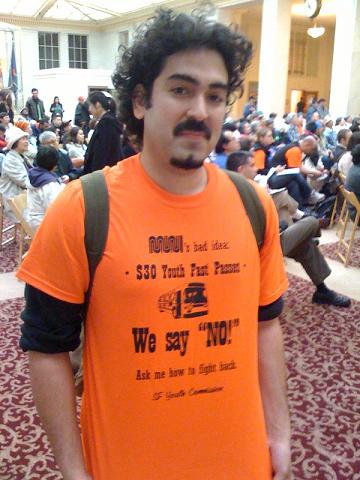
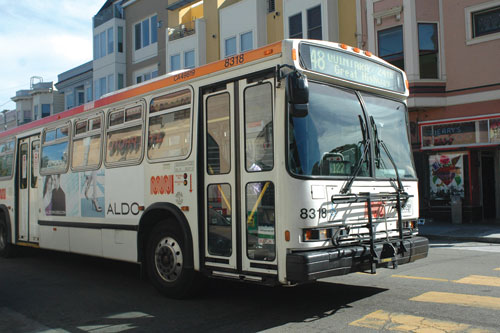
Widespread frustration with Muni service cuts and fare hikes – passionately expressed by the public on Friday at a San Francisco Municipal Transportation Agency meeting that continues tomorrow (Tuesday, March 2, starting at noon in City Hall Room 400) – has prompted a surprisingly diverse backlash.

From angry, street-level progressive activists to the downtown-friendly San Francisco Planning and Urban Research Association (SPUR), San Franciscans are criticizing the SFMTA’s budget plan (including the 10 percent service cuts approved on Friday, which could be revisited tomorrow) as short-sighted and unnecessarily divisive, prompting the biggest and most diffuse progressive organizing effort in years.

“I’ve never seen anything like this,” SFMTA spokesperson Judson True told me as he surveyed the huge, passionate crowd assembled for Friday’s meeting, adding, “It’s clear grassroots organizing is alive and well in San Francisco.”

It’s true that grassroots organizing helped with Friday’s massive turnout, with hundreds of people lined up to give almost five hours worth of public testimony, much of it expressing frustration with poor city leadership (particularly by Mayor Gavin Newsom and his appointed SFMTA board and director) and declining public services.

But these weren’t the talking points of a centrally organized effort, which is what’s so remarkable about this movement. While many progressive groups joined forces under the Transit Not Traffic banner (coordinated by MTA Citizens Advisory Board member Sue Vaughn and others), and there’s a new San Francisco transit riders union (coordinated by transportation activist Dave Synder), the huge turnout on Friday came also from disability rights groups, ethnically identified groups from the Mission and Chinatown, the Senior Action Network, San Francisco Tomorrow, the social justice group POWER, the antiwar ANSWER Coalition, and several other groups, with very little coordination among them.

“We are really seeing a diverse group of people arguing for transit justice,” said Marc Caswell of the San Francisco Bicycle Coalition, which was part of the Transit Not Traffic coalition.

In fact, with Muni fares increasing and services declining since Newsom became mayor, a wide variety of groups seems to have figured out independently that there’s something seriously wrong with Newsom’s no-new-taxes approach to running the city, particularly given declining transit funding from the state and feds.

“These aren’t solutions. They’re just pitting one group against another,” said Frank Lara of the ANSWER Coalition, which opposes a proposal for extended parking meter hours, much to the chagrin of progressive groups who want motorists to help close the budget gap by giving up their free parking on Sundays.

One SPUR proposal also seeks to eliminate this pitting of groups against each other, listing as its biggest dollar proposal the elimination of work orders from the San Francisco Police Department, which would save $12.2 million per year, which the SFPD charges SFMTA for unspecified services that it has yet to document, despite agreeing to as part of last year’s budget deal.

When asked about the work order proposal, Newsom press secretary Tony Winnicker said doing so would make Muni less safe by discouraging officers from riding buses, saying such work orders were a “good accounting practice” rather than the budgetary shell game that progressive supervisors and SPUR director Gabriel Metcalf have called it.

“The gamesmanship with work orders has got to stop,” Metcalf told the Guardian, criticizing the SFMTA for cutting service across the board and raising fares for express bus service and cable cars. “They don’t have to do that and they shouldn’t do that. They just need some political courage right now.”

The next largest SPUR proposals are to charge $300 per year for disabled placards that allow drivers to park for free (which would raise $10 million per year) and to enforce existing city codes that require garages to charge by the hour rather than all day (which would raise $6.85 million), followed by Muni work rule changes that would need union approval.

Winnicker said Newsom was aware of the big turnout on Friday and the anger voiced by the crowd, telling us, “He understands people are concerned and he shares those concerns.” But rather than accepting that many people blame Newsom, Winnicker blamed Muni’s Transportation Workers Union for voting down about $5 million worth of wage concessions and work rule changes. Yet many speakers criticized Newsom’s finger-pointing on Friday, saying he and the SFMTA were too focused on targeting workers rather than the downtown corporations that Newsom has refused to adequately tax.

“There was already a fare increase last year, so for the low-income popular, this is major,” Wing Hoo Leung, vice president of the Community Tenants Association, told me in Mandarin, translated by Tan Chow, an organizer with Chinatown Community Development Center. “In a bad economy, the low-income people can’t get hit again and again. We need to cut from the top.”

Tax measures will be a big part of tomorrow’s SFMTA discussion of the $100 million budget deficit looming for the next two years – such as a parcel tax, downtown transit assessment district, parking tax increase, or local vehicle license fee — and several SFMTA board members agreed with the statement made Friday by Trustee Malcolm Heinicke that, “We need to look for other sources of revenue.”

Even Winnicker said Newsom acknowledges the need to discuss tax measures, even though he philosophically opposes them: “He understands that many things have to be on the table to close next year’s budget gap.”

But he’s far from advocating for any revenue-side solutions.

“The mayor doesn’t think the tax measures will have much public support,” Winnicker said. Yet progressive groups say that’s because Newsom has undermined people’s faith in local government and actively opposed tax increases rather than trying to make the case to the public that they’re needed to present public transit and other vital services.

“Newsom has to be out there fighting, one at the state level, and he needs to show some leadership here,” said Bob Allen of the group Urban Habitat. “I don’t want to hear Gavin Newsom say again that this is a transit-first city if he’s not going to do anything to support it.”

But Allen said that if Newsom and other city leaders made the case for new taxes to support transit and ran a strong campaign, “This city will support a ballot measure to protect Muni and expand it.”

Yet right now, he said one of the things frustrating low-income San Franciscans is there is a basic inequity between motorists and Muni riders: “If parking is going to be free on Sunday, transit should be free on Sunday. If parking is going to be free in the evenings, transit should be free in the evenings.”  

Newsom has long voiced opposition to extended meter hours, only recently softening that position slightly to possibly allow for a small pilot program for Sundays. But his appointed trustees might be willing to go even further, with Bruce Oka saying on Friday, “I know the mayor doesn’t like it, but it has to be tried.”

Lucky 7: Listening in on the Strange Boys

0

The Strange Boys (playing at the Elbo Room on Sat/27) are as brave and cocky as their music would suggest, an obvious product of the southern state they call home. Hailing from Austin, Texas, their “don’t mess” attitude harmonizes perfectly with wailing garage rock and humid twang. Ryan Sambol’s nasally vocals remind me of a young Bob Dylan and complement the band’s ’60s sound. 

The four Texans started making music together in high school and have since developed a sound easily categorized alongside The Monks, The Seeds, The Black Lips, and San Francisco’s Girls. The tracks off their debut full length, The Strange Boys and Girls Club (In the Red), were recorded at their friend Orville’s house in Denton. They scratch and squeak, transmitted through an AM radio style filter, instructing listeners to throw back a few brews on the porch and let cigarettes burn down to their lips.

The Strange Boys don’t want to be the next hipster trend. They strive to be an outlet for escaping all the horrible shit that surrounds our daily lives: war, a rotting economy, and a twisted government. Standing atop their rusty soap box, the boys demand you stop your bitching and moaning long enough to hear what their guitars have to say.

I was curious about their sources of inspiration. Bassist Philip Sambol was kind enough to scribble down some items from of the member’s current playlists:

1. Abner Jay, various songs on some tapes

2. A mix tape a fan gave Ryan

3. Townes Van Zandt, Live at the Old Quarter, Houston, Texas (Tomato, 1977/ Fat Possum, 2009)

4. John ‘Bloodcut’ Joseph, The Evolution of a Cro Magnon (PUNKHOuse) audiobook

5. It’s Always Sunny in Philadelphia, season four

6. The Savage Love podcast

7. CCR
http://www.youtube.com/watch?v=4R6nmKjcSeU

The Strange Boys
Sat/27, 9 p.m., $10
Elbo Room
647 Valencia, SF.
www.elbo.com

Muni cuts spark popular backlash

2

Tomorrow’s big showdown over the latest round of Muni service cuts and fare hikes seems to be galvanizing transit supporters and giving birth to a rejuvenated progressive advocacy effort, including a new transit riders union led by noted alternative transportation advocate Dave Snyder. And that hearing is just a prelude to a taxi medallion privatization plan that will be heard in the afternoon and another big Muni budget blowout on Tuesday.

“We are asking everyone to show up and complain about the mayor and the MTA board’s failure to prepare for this and find alternatives to the drastic cuts they’re proposing,” Snyder told us, referring to the San Francisco Municipal Transportation Agency’s plans to close a $16.9 million mid-year budget deficit (which is what’s left after the $11 million from the taxi permit selloff, which the MTA has already figured into the budget) almost entirely on the backs of Muni riders, who have already seen their fares double since Gavin Newsom became mayor in 2004.

The hearing is Friday at 9 a.m. in City Hall Room 400. That afternoon, Snyder will meet with a broad-based advisory board that he’s assembled to lead (and to name) the new transit riders union that he’s been working on for months, and his tentative plan is to formally launch it on Monday.

For now, those interested in being part of this fledgling organization can sign up here. The new organization is being launched as the MTA board moves from tomorrow’s controversial meeting into another one on Tuesday, that one to start grappling with the huge budget deficit the agency will still face in the next fiscal year that begins in June, even if it’s successful in closing this year’s.  

Snyder is probably just the right person to lead this effort, having directed the San Francisco Bicycle Coalition in its formative years before founding Transportation for a Livable City (now known as Livable City) and then becoming the transportation policy director for the San Francisco Planning and Urban Research Association (SPUR), a post he left last year during a controversy surrounding Snyder’s appointment to the Golden Gate Bridge, Highway, and Transportation District Board of Directors. 

Snyder said Newsom and the MTA board have failed to plan for this foreseeable funding shortfall, saying they should have accelerated plans for extended parking meter hours (particularly ending the free parking on Sundays), a congestion pricing program, a local vehicle license fee, or measures like a gas tax, transit assessment fee, or a parcel tax – all of which the MTA board and mayor could have placed on the ballot for voter approval. Instead, they did nothing and are now pursuing a 10 percent reduction in Muni service, which could start a disastrous downward spiral.

“They need a stable, long-term funding source,” Snyder told us. “The charter actually says they’re supposed to aggressively seek new sources of funding.”

MTA spokesperson Judson True said that neither tax increases nor extended parking meter hours among the proposed solutions for Friday’s discussion, but they’re likely to be raised as part of a longer term strategy during the meeting on Tuesday: “It’s likely that the various tax measures will be part of that discussion.”

That could include reviving the extended parking meter hours proposal, which the MTA board heard last year during a rancorous public meeting, directing staff to do more community outreach on it. As True said, “We did a fair amount of outreach on it so we’ll see where the discussion goes on the two-year budget.”

Snyder is hardly alone in his local advocacy for budget solutions that spare Muni from deep cuts. In fact, the Transit Not Traffic coalition that successfully pushed the 2007 MTA reform measure Prop. A – which includes the Bike Coalition, Livable City, Walk SF, and other progressive groups – has revived itself in advance of tomorrow’s meeting and will be flying outside City Hall starting at 8:30 a.m.

There is broad support on the left for seeking more funding from drivers and the general public, but it’s not unanimous. The anti-war ANSWER Coalition frustrated many of its usual progressive allies last year by organizing against extended meter hours, claiming it was a hidden tax of low-income motorists. And Newsom has stubbornly resisted supporting new revenue measures, even in the face of unprecedented budget shortfalls, which makes the quest to win the support of two-thirds of voters difficult.

But the popular outrage that’s been expressed in recent weeks about how much Muni has been cut, year after year since Newsom became mayor, will likely put pressure on him and the MTA board (all of whom Newsom appointed) to pursue new revenue options.

True sounded weary as we spoke, noting how much anger has been expressed at the recent series of town hall meetings. “We know where people stand on these proposals,” True said. “The board is going to have some tough decisions to make, clearly.”

The battle for the forgotten district

24

sarah@sfbg.com

This November, when voters in District 10 — the largest, sunniest, and most diverse of the city’s 11 supervisorial districts — replace termed out Sup. Sophie Maxwell, they’ll be making a selection that could have pivotal implications for the entire city.

That’s because the next supervisor from southeast San Francisco inherits a district that is home to some of the city’s biggest environmental and public health challenges, as well as the most potential for development that will determine what kind of city San Francisco becomes.

District 10 is where you’ll find the most polluted and most underdeveloped lands in San Francisco, areas that could either be transformed into models of a sustainability or, in the words of Tony Kelly, the president of Potrero Boosters Neighborhood Association, “be turned into a toxic Foster City.”

District 10 is where the slaughterhouses, tanneries, and glue factories set up shop and used the bay as a dumping ground. It’s where the smokestacks of coal and oil fired power plants polluted the air. It’s where the Navy filled the Bay, built a shipyard at Hunters Point and loaded parts of the first atomic bomb onto the USS Indianapolis in 1945.

District 10 is where the bottom fell out of this industrial economy in 1974, when the Navy left, taking with it people’s jobs, pay, and hopes for a home of their own and a better future, particularly for what was then a predominantly African American population.

And District 10 is ground zero for plans that will triple the population and double the number of homes — homes that likely will only be “affordable” to Google executives and retirees from Marin, forever changing the face of San Francisco’s southeast sector. Critics fear that will accelerate what has been a steady exodus of black residents, replaced by megadeveloper Lennar’s vision for a new D10.

It’s against this dark history and difficult present that a wide open field of more than a dozen candidates are vying to replace Maxwell, who came to power in 2000 and has had a mixed voting record in her decade on the board. Sometimes, Maxwell was the eighth vote that let the progressive majority on the Board override Mayor Gavin Newsom’s veto and pass trailblazing legislation. Other times, she was the swing vote that allowed the moderate minority to carry Newsom’s water.

So, in addition to D10’s many internal challenges, this seat could determine the political balance of power on the Board of Supervisors, placing all the more importance on voters in this long-marginalized part of town.


DISTRICT OF DISCONTENT

Eric Smith, a biodiesel activist who has thrown his hat in the D10 ring, says that there is a lot of frustration in the air, and looking at the problems the district is facing, it’s hardly surprising that it has what nearly every candidate agrees is a fractured political culture.

“The Bayview, the Hunters Point Shipyard’s toxic Superfund site, the homicide rate, unemployment, poor public transportation, dwindling services and community resources have made D10 one of the city’s largest melting pots of discontent,” Smith said.

Smith’s words were spoken while the Elections Department was verifying signatures earlier this month on a second failed effort to qualify a petition to recall Maxwell.

Bayview resident and D10 candidate Marie Franklin didn’t support the attempt to recall Maxwell, but she understood it as “a frustration movement.”

“People are sinking in the sand, we’ve already lost so many of them, and they felt Sophie wasn’t doing anything for them,” said Franklin, who praised Maxwell for helping get Franklin’s apartment building complex renovated — a job that was completed 18 months ago, at a cost of $65 million, creating 500 local jobs.

“There are 654 units here, and they were uninhabitable,” Franklin said. “There was black mold, rain falling inside. We had people living worse than Haiti.”

Franklin, who said she is running because she “knows the history,” came here in 1978, when she and her son were living in a car after a fire left them homeless. She said the Bayview was a totally isolated area, barely part of mainstream San Francisco.

“There were no taxis, no services,” she recalled. “Nobody would come here, it was the stigmatized area where no one was accountable to provide services.”

The Bayview — which in some ways is the heart of D-!0 — wasn’t always a black community. But African Americans have been living here for 70 years, dealing with all the racism, denial of services, poverty, and pollution. And it bothers Franklin that 85 percent of the 10,500 homes that Lennar plans to develop won’t be affordable to the elderly, disabled, unemployed and low-income people who currently live in the Bayview.

“We need to preserve the diversity of the community and make sure their issues and information will flow to City Hall,” she said. “You must give the people a handle. If you don’t reach out, they’ll slip. That’s why folks out migrated.

Whoever succeeds Maxwell will be a central player in addressing some very big and dirty issues: the future of the Navy’s radiologically impacted shipyard at Hunters Point, Lennar’s massive redevelopment plan for the Shipyard and Candlestick Point, the polluting power plants, replacement of stinky digesters at the sewage plant, and the SF Hope public lousing rebuild.

There’s also the chance to address violence and crime. James Calloway, a candidate who has long worked in Bay Area schools, told us he believes that education and jobs are part of the keys to rejuvenating the district.

“Job opportunities are not as plentiful in the district,” Calloway said. “When I was a kid, you could walk down Third Street at 2 a.m. Now I wouldn’t walk down it at 9 p.m., and I know the area.”

Calloway is hopeful that the massive redevelopment plan, if done correctly, could start the district’s comeback. “Not a lot of black folks stay here when they have extensive education,” he said. “But it’s not only them. Many were displaced by redevelopment and had no way to go back.”


ELECTION UP FOR GRABS

The largest of the city’s 11 electoral districts, D10 is a huge triangular piece of land in the city’s southeast sector that was used as an industrial dumping zone for decades. Today, the district runs from the Giants stadium at AT&T Park to the 49ers stadium at Candlestick Point and encompasses Mission Bay, Potrero Hill, Dogpatch, India Basin, Portola, Little Hollywood, and Visitacion Valley. It’s also crossed by two freeways that isolate it from the rest of the city, and is home to a large number of crumbling housing projects that are in the process of being rebuilt.

Candidate Ed Donaldson grew up in the projects until he was 10 years old, when the Redevelopment Agency kicked his family out in the 1970s. “We landed on our feet, but others weren’t so lucky,” said Donaldson, who works as a housing counseling director at the San Francisco Housing Development Corporation.

“There is a sense that the Bayview and Visitacion Valley have not been included within the San Francisco family,” Donaldson said. “There is a sense of being forgotten.”

In 2007, Donaldson co-founded the Osiris Coalition to tackle the city’s dormant Certificate of Preference program, in which the Redevelopment Agency issued a document to displaced residents and businesses in the 1960s promising that they could return.

He also tried to rescue some 700 foreclosed properties and recycle them as affordable housing stock. And now he is trying to prevent the city from bulldozing seven SF Hope projects without guaranteeing residents that they have right to remain.

In 2007, Mayor Gavin Newsom and Maxwell convened an African American Outmigration Task Force that didn’t get a public hearing about its findings until August 2008. The timing angered some, who questioned why the report’s findings and implications for urban planning weren’t released before June 2008, when the residents of San Francisco voted for the Lennar-led Proposition G, a proposal to build 10,000 market rate homes at one of San Francisco’s last remaining black communities, which Newsom and Maxwell endorsed.

The taskforce didn’t publish its recommendations until the end of 2009, allegedly because of insider squabbling. Meanwhile, gentrification was going on actively, and many blamed Newsom, and by extension Maxwell, for failing to do anything with the group’s findings as D10 residents continued to suffer from high rates of asthma, cancer, unemployment and an ongoing black exodus.

It wasn’t always this way. In the 1940s, the district’s black population exploded when migrants from the south and World War II veterans came to work at the Hunters Point Naval Shipyard. Some moved to Alice Griffith Public Housing complex, or Double Rock, which was built as military housing in 1962. Others relocated to the Bayview when the Redevelopment Agency took over the Fillmore/Western Addition in the ’60s and ’70s as part of a controversial urban renewal effort.

But when the Navy abandoned the shipyard in 1974, unemployment hit the black community hard. Today, hundreds of the city’s lowest income residents live in Alice Griffith’s crumbling units and endure sewage backups, no heat, cloudy drinking water and leaking ceilings, as they wait for the projects to be rebuilt.

“Generations have been trapped in the silo of public housing and cannot get out, because of lack of opportunity and education, so when we legislate, we need to take that into consideration,” said candidate Malia Cohen, whose grandfather came from Texas to work at the shipyard where he met her grandmother, whose family came from New Orleans.

“My grandfather’s father was a longshoreman. He worked with the infamous Leroy King [a commissioner at the city’s Redevelopment Agency] and he has fantastically vivid stories of racism,” said Cohen, who works for the Federal Reserve Bank of San Francisco, previously served on the executive staff of Mayor Gavin Newsom, and has already raised over $18,000 in the D10 race and qualified for public matching funds.

“My family came here to work hard, they lived on Navy road in the projects, and then they bought a house here. My parents were born here, and we were all public schooled,” Cohen recalled as she took me on a tour of D10 that ended up in Visitacion Valley, an increasingly Chinese-American neighborhood that reflects a district-wide trend.

Census data show that by 2000, Asians were the largest racial group in the district (30 percent), followed by blacks (29 percent), whites (26 percent), and Latinos (19 percent). By 2003, according to the California Urban Issues project, the trend continued. Asians were the largest racial group (32 percent), followed by blacks (27 percent), whites (21 percent) and Latinos (17 percent) of the population.

This means that D10 candidates will have to garner support from more than one ethnic group to win. Over a dozen candidates have already filed papers in the race, but so far there is no clear front-runner.

Also frustrating the prognosticators is that fact that D10 has had the lowest voter turnout in the city, so the winner will also depend on who goes to the polls.

D10 candidate Geoffrea Morris, who is the grand daughter of longtime Bayview activist Charlie Walker, has been knocking on doors and participating in voter registration drives.

“We need new blood,” Morris said

Getting elected will be a complicated equation. Although Bayview’s population was 50 percent African American at the time of the 2000 census, it didn’t turn out the vote. In the 2006 election, only 14,000 of the district’s 37,000 registered voters went to the ballot, and 50 percent were from whiter, richer, and more Asian neighborhoods.

“It’s very important to the future of the city that the ethnicity diversity of the board be maintained and that the African American community have representation,” former Board President and current Democratic Party chair Aaron Peskin told the Guardian.

Maxwell recently told the Guardian that she’s not ready to endorse any D10 candidates yet. “I’m waiting for people to have a better understanding of what this community is, what the common thread running through it is, and how to use rank choice voting,” she told us.

The only candidate who currently holds elected office is BART director Lynette Sweet, who had her answers down pat when we reached her by phone, and even used wording that was eerily similar to Maxwell’s words.

“D10 is a pretty diverse district, but there is only one common thread: the need for economic development,” Sweet told me. “That’s true in Potrero Hill, Portola, Dog Patch and the Bayview. It’s the same mantra: a lot of small businesses need help, and the only way to help them is through economic development. In Potrero Hill it’s about land use. In the Bayview, it’s about the shipyard and better transportation and truancies.”


THE COMMON THREAD

District 10 is ground zero for the Lennar’s $2.2 billion plan to develop 10,500 market rate condos at the Shipyard and Candlestick Point. The plan will allegedly create thousands of jobs and new parks, deliver on an historic community benefits agreement that labor groups claim is so “lawyered up” that the developer can’t renege on its promises.

The package is framed as the one and only way to revitalize the southeast’s formerly vibrant economic engine. Indeed, any time anyone tries to slow down the process—to take time to thoroughly read the draft EIR and see if it adequately addresses the impacts of this massive urban reengineering project — a chorus of “no delays” starts up, either from residents of the housing projects desperate to see their homes rebuilt, or the labor contractors who hope to get jobs.

“It’s as if the city is playing checkers, while Lennar is playing three-dimensional chess,” Eric Smith observed.

Lennar has stated that it will contribute $711 million to finance this massive project. The remainder will be leveraged by Mello-Roos bonds, state taxes based on the use and size of a property and intended to raise money for needed services, and tax increment financing, which creates funding for projects by borrowing against future property tax revenues.

The conceptual plan won Maxwell’s backing but environmental groups are critical of the draft EIR.

During DEIR hearing, environmentalists questioned the wisdom and the cost of filling the Bay to build a bridge over Yosemite Slough, and building condos on Candlestick Point state recreation area, the only open major open space in the district.

But the city’s Planning Department also has 20,000-30,000 units of housing in its pipeline. This means that if all these plans get approved in the next decade, they’d account for 80 percent of residential development citywide. And D10’s population could triple, further skewing the district’s already shifting demographics.

In other words, D10 as we know it could become nothing more than a historic relic in a few years, and the next supervisor will play a key role in deciding whether that happens. SFHDC’s Ed Donaldson warns that any supervisor who does not understand the complexity of the city’s largest district can expect a similar recall backlash in future.

“There is no one homogenous voice in the community,” Donaldson said. “The grass-roots organizing that brought about the recall effort was a result of a changing political structure in the area, but is not yet on par with other districts in town. We still allow our politics to be controlled from downtown.”

Fellow candidate Eric Smith warns that the issues—and politics—are complex.

“People were emotional, angry, and desperate because they feel no one listens to them,” Smith said. “That’s part of the problem here; they would rather have a supervisor go down swinging for them, rather than watch one seemingly side with Lennar, PG&E and the mayor on issues contrary to their interests. That’s the terrible irony and one of the biggest problems in District 10. Folks are so mad, they’re willing to do whatever it takes to make them feel they have a voice in the outcome, even if it’s potentially worse.”

Smith cited the sequence of events that culminated last year in the Navy dissolving the community-based shipyard Restoration Advisory Board (RAB), which for years has reviewed technical documents and commented on the Navy’s clean-up proposals. But in December, the Navy made its official decision to disband the RAB, citing dysfunctional behavior and off-topic discussions that got in the way.

“Some of the same folks who were frustrated by the process, tried to send a signal to the Navy that they weren’t being heard and for all their well-intentioned efforts got the RAB dissolved,” Smith said. “I truly feel for them, it’s absolutely heartbreaking, but at times, they can be their own worst enemy.”

One of the looming issues about the shipyard is that the land has been polluted and needs to be cleaned. The shipyard contains radioactive debris from ships towed to the shipyard, after a 90-foot wave washed over them during an atomic test gone awry. The Navy burned 610,000 gallons of radioactively contaminated ship fuel at the shipyard, and workers showered on the shipyard, raising concerns that radioactive materials got into the drains and sewers. And questions have been raised about radiological tests on animals at the yard.


LEAKS AND FLOODS

It’s not just the shipyard that’s toxic. Even the buildings that were constructed to house workers 50 years ago are a serious mess.

Realtor Diane Wesley Smith, who grew up in public housing projects, took me on a walking tour of Alice Griffith last week to see conditions that tenants will likely have to endure until at least 2014, if the city sticks to its plan to relocate people into a new replacement unit in the same geographical area, if not the exact same site.

What we found was pretty messed up.

“The water sometimes comes out brown and feels like sand. It’s been like that for a year,” one resident said.

“The water is cloudy, the bath tub isn’t working and the sink keeps stopping up,” said another.

A woman named Silvia showed us how the water from the tap in her elderly mother’s kitchen flows out cloudy and then doesn’t settle properly, like foamy beer.

“The roof’s been leaking for years, the sewage backs up, but they just fixed the lights,” Silvia said. A neighbor named Linda was using her oven as a heater.

“The toilet backs up a lot, and my grandson’s been coughing a lot from asthma,” Linda said.

“Roaches is always a problem,” said a woman named Stormi, dressed in black sweats and a black T-shirt that read, “Can’t knock the hustle.”

“They’re trying,” said Stormi, a member of the Alice Griffith Residents Association, as a couple of Housing Authority trucks pulled up to do repairs.

“They promise that you will not have to leave your unit, but if they try to move us down to the waterfront, well, there’s a reason there’s no housing there, and it’s because the land will flood,” Stormi said.

“If we don’t end up at the table, we’ll end up on the menu,” Wesley Smith warned, as she stopped to chat with a group of young men, who were worried they would pushed out of the Alice Griffith rebuild through the criteria being established.

“Fred Blackwell, the executive director of the Redevelopment Agency, assures me that’s not the case, but Alice Griffith is a Housing Authority property, and empty promises have the potential to be great promises provided they are made in writing,” Wesley Smith said as we walked out of the projects and onto the road where a yellow and black sign announced “flooded” next to Candlestick Point park, where Lennar wants to build.

Malia Cohen expressed concern about Hope SF residents, as we drove through the Sunnydale housing project.

“We have to be diligent and mindful that people are not pushed out,” Cohen said, noting the sweeping views at Gleneagles golf course above Sunnydale, and the value of housing for a golf course community. “When public housing gets taken offline, we must work with Redevelopment and the Housing Authority to make sure no one is changing the rules halfway. We have to make sure the talks and walks line up. We need to be equal partners. We cannot be bulldozed by City Hall.”

Geoffrea Morris is a Calworks employee, at the Southeast Community College facility on Oakdale, which was built to mitigate the city’s expansion of the sewage plant in 1987. She cited concerns about the literacy levels of people who live in the 2200 public housing units that cluster D10. “A lot of people in Alice Griffith don’t even know the dates or when it’s going to be reconstructed,” Morris said. “Folks like to be told stuff like that, but the city gives you a stack of papers. Some will read them, but others rely on folks they think are trustworthy. They need stuff in layman’s terms written on one sheet of paper.”

Morris is a fan of the Internet who posted a community survey online, and made sure every housing project got some literature telling people to get informed. She worries about the digital divide in D10:

“A lot of folks don’t have computers and access to important information,” Morris said. “And let’s talk about the way ‘affordable’ is used to trick people.”

Michael Cohen, Newsom’s top economic adviser, recently stated in a memo that over the expected 15-20 year phased build out, Lennar’s Candlestick-Shipyard development would include, “up to 10,500 residential units, about 32 percent of which (3,345) will be offered at below market rates.”

“But 892 units of this ‘affordable category’ will be sold to folks earning $100,000,” Morris said. “So if you subtract 892 units from affordable unit category, you’re back to 25 percent affordable.”

Candidate Kristine Enea, an attorney and a former RAB member, chairs the India Basin Neighborhood Association, which administers a US EPA grant to hire experts to translate the Navy’s cleanup documents into plain English and comment on them She was frustrated by the Navy’s decision to dissolve the RAB.

“The lack of a forum does nothing to bolster the community’s trust in the cleanup or the redevelopment process,” Enea said.

Enea generally supports the Lennar project, but has concerns about whether it will adequately mitigate increased car traffic, or result in commercial development that benefits her neighborhood.

“India basin is a pocket of Hunters Point right along the shoreline,” Enea said. “Right now, we have no shops or restaurants, no ATM, no groceries, nothing beyond one liquor store and a few industrial businesses.

Potrero Boosters president Tony Kelly told us that District 10 residents can think for themselves. “D10 residents don’t need to rely on corporations to solve their problems,” he said.

“Folks in the eastern neighborhoods came up with a better revitalization plan than what the city proposed and community activists managed to close the power plant, after the city said it was impossible,” Kelly recalled.

And there’s no shortage of good ideas.

Kelly suggested that an urban agriculture center could immediately put low-skilled folks to work by erecting greenhouses on unused land. Smith said the industrial zone could be “incredible eco-park made from sustainable sources.

‘D 10 is the dumping ground for everything, including all the city’s waste,” he said. “We could be a shining example, not just for D 10, but the rest of the state.”

The D 10 candidate line up includes Calloway, Cohen, Donaldson, Smith, Enea: civil rights attorney Dewitt Lacy, Morris, Potrero View publisher Steve Moss; District 7 BART director Lynette Sweet, Wesley-Smith. Bill Barnes, who works for Sup. Michela Alioto-Pier, and Linda Richardson, who was appointed to the Human Rights Commission in 2007 by Mayor Newsom, have also expressed interest in the race.

In such a huge field, name identification will play a major role. Sweet is in office, but BART Board is not a high-profile job and won’t give her a huge advantage.

Cohen has a slight edge right now in that she’s raised $18,505, including $500 from former Newsom flak Peter Ragone, making her the first D. 10 candidate to qualify for campaign financing. The oldest of five girls, Cohen recalls how her mother got laid off from her city job as a school-based mental health worker and then rehired, as part of the city’s budget cuts.

“We felt that pinch and the frustrating games that are played out between the leadership and the rank and file,” she said.

Cohen who worked for Newsom in his first term as mayor, but has since left his administration , said she is uncomfortable at being framed as Newsom’s candidate.

“Because I’m not, but I am one of the few candidates who has seen how the mayor and the Board work—and don’t work—together,” she said.

Moss sees the city’s southeast as a “district in transition.” Over coffee at Farley’s in Potrero Hill, he told me that the southeastern neighborhoods could be “launching pads for environmentally sustainable growth.”

“The district’s been in a frozen period for 30 years, But despite the problems, people are deeply committed to and in love with their community.

“This district is the future of San Francisco and its social fabric—the diversity, income –and its problems are leftovers from the city’s industrial age.”


DISTRICT 10, BY THE NUMBERS

Total Acres: 5,650

Average household income: $85,000

Population: 73,000

Registered voters: 37,700

Average housing price: $335,000

Ethnicity (2003 figures): Asian 32%, African American, 27%, white 21%, Hispanic 17%

Development status of land: 18% residential, 38% is commercial, 38% undevelopable

All figures the latest available. Sources: SFGIS, Association of Bay Area Governments, U.S. Census, California Urban Issues Project. Ethnicity and income data is from 2003 and almost certainly has changed.


Is Chevron lying about its crude plans?

1

By Adam Lesser

William Rostov, the Earthjustice lawyer who represents three Bay Area environmental groups, broke it down: “The question is: will it be heavier and will that result in more pollution?” He was speaking about crude oil refining at Chevron’s Richmond refinery as he addressed California’s First Appellate Court in San Francisco this morning. Heavier crude oil is usually less expensive for oil companies to purchase but generates more pollution during the refining process.

Environmentalists, labor unions, lawyers and Chevron representatives packed the courtroom to hear opposing counsel spar over the project’s environmental impact report, which was invalidated by a Contra Costa Superior Court judge last June. The ruling stopped the refinery expansion that Richmond has approved.

Chevron attorney Ronald Van Buskirk hammered the point that “the project didn’t propose a crude switch.” When pressed on why Chevron declined to disclose the data behind the conclusion that there would be no switch to heavier grade crude, Van Buskirk countered that the data constituted “trade secrets” that are protected under law.

Rostov argued that “refinery experts showed this project allows the use of heavier crude” and that Chevron “misled the public” in its EIR. A key component of the environmentalists’ argument rests on the 2007 Chevron annual report to the U.S. Securities and Exchange Commission, which specifies that “design and engineering for a project to increase the flexibility to process lower API-gravity crude oils at the company’s Richmond, California, refinery continued in 2007.” API gravity is a measure of how heavy or light petroleum is. Lower API gravity corresponds to a heavier crude oil. But Van Buskirk countered that the plaintiff’s evidence amounted to “one sentence in a 10K report.”

Justice Patricia Sepulveda questioned Van Buskirk about whether the $61 million Community Benefits Agreement that Chevron offered to contribute to the city of Richmond gave the city “bias to approve the project.” But Van Buskirk said, “It wasn’t a quid pro quo, if that’s what you’re suggesting,” before ultimately conceding that it was fair suggest to that the gift had played a role in the approval.

Judge Ignacio Ruvolo presided over Chevron’s appeal. At the end of oral arguments, he spoke to the efforts the court has taken to expedite the case, pressing attorneys on whether there was any chance of a settlement.

“The parties are still very far apart,” said Van Buskirk, and Rostov nodded the same. For the first time all morning, everyone was in agreement.

The court will rule within 90 days.

Rep Clock

0

Schedules are for Wed/24–Tues/2 except where noted. Director and year are given when available. Double features are marked with a •. All times are p.m. unless otherwise specified.

AUTOBODY FINE ART GALLERY 1517 Park, Alameda; www.autobodyfineart.com. $5. "Hunger," short zombie films by Bay Area filmmakers, Sat, 8.

ARTISTS’ TELEVISION ACCESS 992 Valencia, SF; www.atasite.org. $6-10. Zeitgeist Addendum: The Resource-Based Economy, Thurs, 7. "Noise Pop Film Festival:" Blood Into Wine (Page and Pomerenke), Fri, 7; Downtown Calling (Nicholson), Fri, 9; •Lou Barlow: Goodnight Unknown (Harding) and The Mountain Goats: Life of the World to Come (Johnson), Sat, 2; Woodstock: Now and Then (Kopple), Sat, 4; The Secret to a Happy Ending (Weissman), Sun, 2; All My Friends Are Funeral Singers (Rutili), Sun, 4:15. For info on these screenings, visit www.noisepop.com.

CAFÉ OF THE DEAD 3208 Grand, Oakl; (510) 931-7945. Free. "Independent Filmmakers Screening Nite," Wed, 6:30.

CASTRO 429 Castro, SF; (415) 621-6120, www.castrotheatre.com. $7.50-10. My Son, My Son, What Have Ye Done (Herzog, 2009), Wed-Thurs, 7, 9:15 (also Wed, 2:30, 4:45). •Fight Club (Fincher, 1999), Fri, 7, and Donnie Darko (Kelly, 2001), Fri, 9:40. Up (Docter, 2009), Sat, 2, 4:30, 7, 9:15. "German Gems:" Tender Parasites (Becker and Schwabe, 2009), Sun, noon; Miss Stinnes (von Moeller, 2009), Sun, 2; Being Mr. Kotschie (Baumgarten, 2009), Sun, 4:15; Vision (von Trotta, 2009), Sun, 7; The Bone Man (Murnberger, 2009), Sun, 9:15. Call for Mon-Tues program information.

CHRISTOPHER B. SMITH RAFAEL FILM CENTER 1118 Fourth St, San Rafael; (415) 454-1222, www.cafilm.org. $6.50-10. Broken Embraces (Almodóvar, 2009), call for dates and times. An Education (Scherfig, 2009), call for dates and times. Fish Tank (Arnold, 2009), call for dates and times. North Face (Stölzl, 2008), call for dates and times. "2010 Oscar Nominated Short Films," Wed-Thurs, call for times. "The Cinema of Jan Troell:" Everlasting Moments (2008), Sat, 7:15; The Emigrants (1971), Sat, 2 and March 6, 2; The New Land (1972), Sun, 2 and March 6, 7; "Dancing," "Reflexion 2001," and "Their Frozen Dream," Sun, 7; As White as Snow (2001), Mon and March 4, 7; Il Capitano (1991), Tues, 7.

HERBST THEATRE 401 Van Ness, SF; (415) 392-4400. $20. Examined Life (Taylor, 2008), Thurs, 7:30.

HUMANIST HALL 390 27th St, Oakl; www.humanisthall.org. $5. •Shellmound and In the Light of Reverence, Wed, 7:30.

MECHANICS’ INSTITUTE 57 Post, SF; (415) 393-0100, rsvp@milibrary.org. $10. "CinemaLit Film Series: Reel Criminals — The Heist:" A Fish Called Wanda (Crichton, 1988), Fri, 6.

MEZZANINE 444 Jessie, SF; www.sffs.org. $15. "SF360 Film + Club," sneak preview of a film about Stephin Merritt of the Magnetic Fields, Sun, 8.

PACIFIC FILM ARCHIVE 2575 Bancroft, Berk; (510) 642-5249, www.bampfa.berkeley.edu. $5.50-9.50. "Film 50: History of Cinema:" Pursued (Walsh, 1947), Wed, 3. "African Film Festival:" In My Genes (Nyong’o, 2009), Wed, 7. "Before ‘Capraesque:’ Early Frank Capra:" The Younger Generation (1929), Thurs, 7; So This Is Love (1928), Fri, 7; The Bitter Tea of General Yen (1933), Fri, 8:30; It Happened One Night (1934), Sat, 6:30. "The Kids Are Alright: Post-Fifties Musicals and the Rise of Youth Culture:" Pink Floyd the Wall (Parker, 1982), Thurs, 8:35; True Stories (Byrne, 1986), Sat, 8:35; Fruit Fly (Mendoza, 2008), Sun, 5:30. "L@te: Friday Nights at BAM/PFA:" "Paul Clipson and Gregg Kowalsky; Keith Evans," Fri, 7:30. This event at the Berkeley Art Museum, 2626 Bancroft, Berk. "Celebrating Amateur Film:" "Sid’s Cinema: A Tribute to Amateur Filmmaker Sid Laverents (1963-85)," Sun, 3.

RED VIC 1727 Haight, SF; (415) 668-3994. $6-10. The Yes Men Fix the World (Ollman, Price, and Smith, 2009), Wed, 2, 7:15, 9:15. The Bad Lieutenant: Port of Call New Orleans (Herzog, 2009), Thurs-Sat, 7, 9:35 (also Sat, 2, 4:30. Small Change (Truffaut, 1976), Sun-Mon, 7:15, 9:30 (also Sun, 2, 4). The Beaches of Agnès (Varda, 2008), March 2-3, 7, 9:20 (also March 3, 2).

ROXIE 3117 and 3125 16th St, SF; (415) 863-1087, www.roxie.com. $5-9.75. "Noise Pop Film Festival:" Austin, TX: Live Music Capital of the World? (Christ), Wed, 7; P-Star Rising (Noble), Wed, 9:15. For info on these screenings, visit www.noisepop.com. Leonard Cohen: Live at the Isle of Wight 1970 (Lerner), Wed-Thurs, 6:40, 8, 9:30. Precious: Based on the Novel Push by Sapphire (Daniels, 2009), Thurs, 6:45. The Cove (Psihoyos, 2009), Thurs, 8:50. Call for Fri-Tues program information.

SAN FRANCISCO CINEMATHEQUE Yerba Buena Center for the Arts, 701 Mission, SF; www.sfcinema.org. $10. "Darkest Americana and Elsewhere: Films, Video, and Words of James Benning:" "James Benning: American Dreams," Fri, 7; "James Benning: Landscape Suicide," Fri, 8:15. "Australian Avant-Garde: A Historical Overview," Tues, 7:30. Presentation Theater, University of San Francisco, 2350 Turk, SF. Same price and contact info. "James Benning:" Ruhr (2009) with "Fire and Rain" (2009), Sat, 7:30. McBean Theater, Exploratorium, 3601 Lyon, SF. Same price and contact info. "James Benning: Milwaukee to Lincoln, Montana Lecture," Sun, 3.

SAN FRANCISCO PUBLIC LIBRARY Koret Auditorium, 100 Larkin, SF; www.sfpl.org. Free. "The Story of India:" Freedom (2007), Thurs, noon. Large-screen video presentation.

VICTORIA 2961 16th St, SF; www.downstreamthemovie.com. $12. Downstream (Bartesaghi, 2009), Fri-Sat, 8; Sun, 7.

VIZ CINEMA New People, 1746 Post, SF; www.newpeopleworld.com/films. $10-25. La Maison De Himiko (2005), through March 4, call for times. "Noise Pop Film Festival:" Blood Into Wine (Page and Pomerenke), Thurs, 7:30; The Heart is a Drum Machine (Pomerenke), Thurs, 9:30. For info on these screenings, visit www.noisepop.com.

YERBA BUENA CENTER FOR THE ARTS 701 Mission, SF; (415) 978-2787, www.ybca.org. $6-8. "Freaks, Punks, Skanks, and Cranks:" To My Great Chagrin: The Unbelievable Story of Brother Theodore (Sumerel, 2008), Thurs, 7:30; Gold (Levis, 1968), Sat, 7:30.

Economy vs. environment

0


By Adam Lesser

news@sfbg.com

GREEN CITY The Port of Oakland has long been a battleground that pits economic development against environmental justice, a dichotomy that has become all the more fraught with emotional baggage during the current recession.

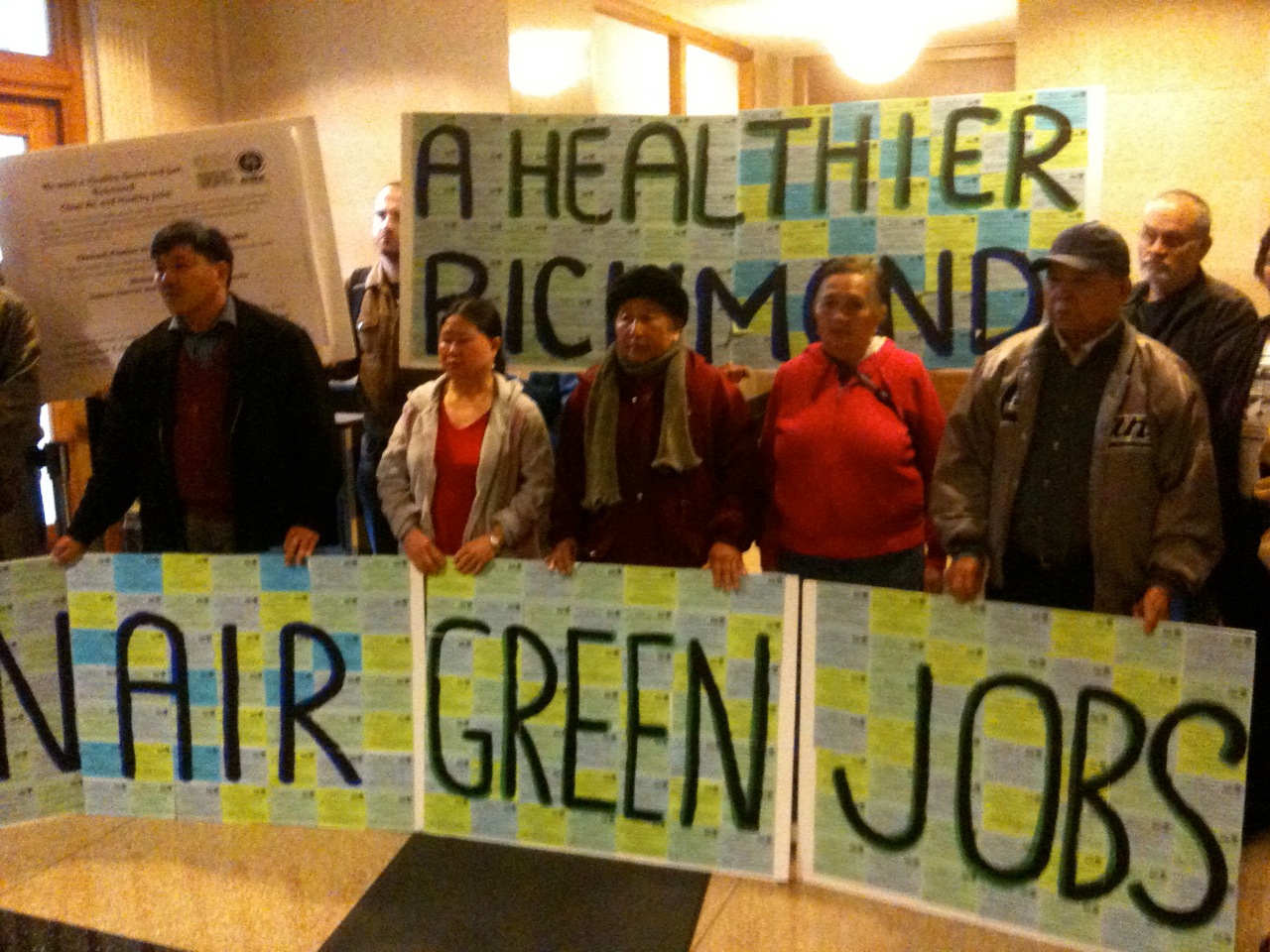
For years, West Oakland residents, environmentalists, and public health officials have demanded that government officials do something about the long lines of old, idling diesel trucks that spew toxic emissions that have sickened the surrounding community (see “The polluting Port,” 3/24/09).

When the state finally mandated expensive retrofits of the oldest trucks at the start of this year, truckers and their allies reacted angrily to what they called a job-killing regulation. But rather than viewing such fights in isolation, a new Bay Area movement is seeking to broaden the debates within what it labels the “toxic triangle” extending from the Port of Oakland to San Francisco’s Bayview-Hunters Point to the city of Richmond.

Citing concern for how to effectively address the cumulative impact of pollution, community groups including the West Oakland Environmental Indicators Project and Asian Pacific Environmental Network are sponsoring the Toxic Triangle Hearings. The first hearing was held Feb. 13 in Oakland; the next two hearings will take place later this year in the other two triangle points.

At the first hearing, supporters introduced their cumulative impact pledge, a request that agencies ranging from the Environmental Protection Agency to the California Air Resources Board work together to define emission limits for an entire area and to collectively adopt reduction strategies. The ultimate goal is an environmental justice ordinance that would require any new project to receive an “EJ permit” before a proposed project was allowed to move forward.

The city of Cincinnati approved a similar system last June, but it was put on hold this month due to concerns about the cost of implementing it during these hard economic times. The delay in Cincinnati points to an emerging theme in the narrative from lawmakers and corporations. With high unemployment and huge government budget deficits, can we afford to further regulate pollution?

California Assembly Member Nancy Skinner, who represents Richmond, was on hand at the Toxic Triangle Hearings. Questions arose about the ongoing legal battle between community groups and Chevron, which wants to expand its Richmond refinery. The refinery is the largest in Northern California, with a capacity of 240,000 barrels of crude oil per day.

The retrofit is on hold after a court rejected the project’s EIR, asking Chevron to clarify whether the expanded refinery would process heavy crude oil, which generates more pollution. A Jan. 19 editorial in the Contra Costa Times made the pro-business argument, claiming that Chevron “is poised to shut down its Richmond refinery operations” and laying blame on environmentalists.

“All we know is that the Chevron people have talked of change — there’s been a shift,” Skinner said. “They’re looking at all their North American operations. That doesn’t mean we just roll over. But it means that we have to be aware of that when we sit at the table.”

But environmentalists question whether closing the Richmond refinery is a realistic threat from Chevron, or merely a negotiating tactic. “There is no credible scenario in which this refinery will close anytime soon for business reasons,” said Greg Karras, a senior scientist for Communities for a Better Environment. “The issue is whether Chevron can move to heavier oil and whether they have to disclose that. It has nothing to do with jobs.”

The Toxic Triangle Hearings highlight this perceived conflict between the economy and the environment. But Karras called the dichotomy a “false choice,” arguing that the greatest potential for job growth lies in innovation and green jobs, not a refinery expansion.

APEN’s State Organizing Director Mari Rose Taruc agreed: “We want people to have jobs and make it out of the recession. But we’re not going to trade our health and the ailing conditions of our community for something worse.”

Taruc sounded frustrated, similar to the tone Karras expressed when faced with the question of the economic impact of environmental regulation. For now, she said the rationale for delay is the recession, but “when the economy is good, there would be another excuse.”

Hey Matier & Ross — PG&E is no security blanket

8

Today’s San Francisco Chronicle piece by Phillip Matier and Andrew Ross brought to mind a Pacific Gas & Electric Co.-sponsored Web site that was set up to undermine the city’s fledgling Community Choice Aggregation (CCA) program.

That’s because one of the key points in the story was that San Francisco’s CCA could result in higher customer bills. According to the Chronicle:

“A 2007 city controller’s report concluded that a typical residential utility bill under this type of plan could go up by 24 percent if only half the purchased energy is green. The cost would almost certainly go even higher if the city went totally green, the report said.”

This city controller’s report is referenced on the PG&E-funded Web site, too, and this supposed 24 percent increase was splashed prominently across colorful outsized postcards that the PG&E-sponsored “Common Sense Coalition” sent to businesses and residences throughout the city last December. However, San Francisco’s Local Agency Formation Commission (LAFCo), a city commission responsible for setting CCA in motion, maintains that the claim is misleading.

Why?

The controller’s was drafted in 2007, making it an outdated and unreliable source for an economic-impact projection at this time, according to LAFCo Senior Program Officer Jason Fried.

“PG&E is trying to confuse people now … because they know that in a month or two more, we’ll have a contract” with actual figures to go by, Fried told the Guardian. The city is still in negotiations with Power Choice LLC, the firm selected to handle power purchases, and so it has yet to determine a long-term pricing plan. Fried also pointed out that the 24-percent increase noted in the controller’s report only pertains to electricity generation charges, and not the entire customer bill.

While the report did caution against a potential increase in prices, it also made it clear that the figures were preliminary. Here’s an excerpt:

“San Francisco’s CCA process has not yet advanced to the stage where any definitive economic impact statement can be made. A detailed economic impact assessment will not be possible until the RFP process is complete, a structured long-term rate plan has been submitted, and an opt-out penalty has been set. [NOTE: As of February 2010, the RFP process is complete, but the other two steps haven’t been definitively nailed down yet.]

The proposed implementation of CCA could lead to greater competition in the City’s electricity markets, lower rates for consumers, and a greater reliance on local sources of renewable energy and conservation. Such an outcome would benefit the San Francisco economy and the global environment.”

Since this PG&E-sponsored propaganda campaign got underway, a figure unearthed from this three-year-old report is popping up everywhere, including in the Chronicle.

More importantly, the focus on a potential rate increase under CCA ignores an important question: Is the status quo any better?

Even if CCA did drive up prices, it seems that sticking with PG&E as the region’s sole electricity provider might not be any cheaper in the long run. For example, the following appeared a Feb. 19 article in the Wall Street Journal:

“In December, [PG&E] asked state regulators for permission to raise customer rates 19% or $1 billion in 2011, with additional rate hikes of about $550 million from 2012-13. … The outlook for the increases is unclear, as consumer advocates have vowed to fight them, citing PG&E’s already higher-than-average utility rates, California’s relatively high 12.4% unemployment rate and the state’s ailing economy.”

There are other factors to think about, too, like the dynamic environment we live in and how the cost of a finite energy resource will fluctuate in the long run. The Chronicle piece quotes Severin Borenstein, co-director of the Energy Institute at UC Berkeley’s Haas School of Business, as saying San Francisco’s CCA is “fraught with danger.” This statement seems to ignore what environmentalists have been saying for years, which is that the status quo itself is a treacherous path to go down.

A key difference between San Francisco’s CCA and PG&E’s energy mix is that CCA would rely more heavily on green energy sources, with a goal of offering 51 percent of its energy from renewable resources by 2017 with the plan to transition eventually to 100 percent renewable power. Meanwhile, PG&E is making snail-like progress toward a 33 percent renewable-energy standard by 2020 that is mandated by state law.

In the long run, many experts tell us that energy derived from fossil fuels will be more susceptible to price volatility than wind and solar — especially with added environmental pressures that scientists predict will result from climate change. A future characterized by less rainfall threatens to drive up energy prices, according to the Union of Concerned Scientists, because California gets about 20 percent of its electricity from hydropower, and could be forced to purchase from an outside provider in years of extreme drought. Hotter summers are also expected, which could lead to a higher demand for electricity when everyone is running air conditioners.

Energy analyst Laura Wisland of the California office of the Union of Concerned Scientists put it this way: “We can’t afford not to take advantage of the renewable-energy resources in our own backyard. We will save money, because we will become less dependent on fuels that have more volatile prices.

“We know that we have an exhaustible supply of fossil fuels,” Wisland added. “We know that we have an inexhaustible supply of wind and sun. In the long term, we see renewable energy as investing in … more price certainty and cleaner air — and that can benefit all Californians.”

Why taxes need to be on SF’s budget table

18

San Francisco missed an opportunity last fall. While communities around the Bay Area were approving new revenue plans, addressing devastating budget cuts in part by raising their own taxes, San Francisco’s mayor and supervisors were sitting on their hands, bewailing the fact that passing tax measures is tough.

But this year’s budget is even worse than last year’s, and the cuts are going to be even more brutal (particularly when you realize that the cuts will come on top of several years of previous cuts). And still, nobody at City Hall seems to be putting forward any plans to mount a campaign for new revenues in the fall.

It’s not that hard a sell, really. Brian Leubitz has an excellent report on Calitics about a new poll showing how people in California feel about pressing issues. Budget cuts are a serious concern; so is employment and the economy. Taxes don’t even rate.

In other words, even across California, where the population is far more conservative than it is in San Francisco, people worry more about budget cuts than about taxes.

If the supervisors and the mayor made even a half-serious effort to get the message out — you can raise these taxes or you can accept these cuts — I think more than half the voters (all you would need this November) would go for the new revenue, easy.

At this point in the budget cycle, this ought to be not only on the table but front and center. We should have half a dozen different revenue plans in the works; legislation should be floating around, the Budget and Finance Committee should be holding hearing, the Controller’s Office should be studying the impacts and issuing reports, and the supervisors should be preparing to include the potential revenue from a November ballot measure in their 2010-2011 budget calculations.

Why isn’t this happening? It’s almost March, and the mayor will be delivering a budget in less than three months, and at that point the supervisors will have a short few weeks to deal with devastating cuts. And it will be too late at that point to start the debate over new revenue sources.

This is the year, folks. Let’s get on the stick.  

Robert Skidelsky: The big bank fix

4

If reformers are to win, they must be prepared to fight the world/s most powerful vested interest

By Robert Skidelsky 

Robert Skidelsky, a member of the British House of Lords, is Professor emeritus of political economy at Warwick University, author of a prize-winning biography of the economist John Maynard Keynes, and a board member of the Moscow School of Political Studies.

LONDON – Two alternative approaches dominate current discussions about banking reform: break-up and regulation. The debate goes back to the early days of US President Franklin D. Roosevelt’s “New Deal,” which pitted “trust-busters” against regulators. 


In banking, the trust-busters won the day with the Glass-Steagall Act of 1933, which divorced commercial banking from investment banking and guaranteed bank deposits. With the gradual dismantling of Glass-Steagall, and its final repeal in 1999, bankers triumphed over both the busters and the regulators, while maintaining deposit insurance for the commercial banks. It was this largely unregulated system that came crashing down in 2008, with global repercussions.

At the core of preventing another banking crash is solving the problem of moral hazard – the likelihood that a risk-taker who is insured against loss will take more risks. In most countries, if a bank in which I place my money goes bust, the government, not the bank, compensates me. Additionally, the central bank acts as “lender of last resort” to commercial banks considered “too big to fail.” As a result, banks enjoying deposit insurance and access to central bank funds are free to gamble with their depositors’ money; they are “banks with casinos attached to them” in the words of John Kay.

The danger unleashed by sweeping away the Glass-Steagall barrier to moral hazard became clear after Lehman Brothers was allowed to fail in September 2008. Bail-out facilities were then extended ad hoc to investment banks, mortgage providers, and big insurers like AIG, protecting managers, creditors, and stock-holders against loss. (Goldman Sachs became eligible for subsidized Fed loans by turning itself into a holding company). The main part of the banking system was able to take risks without having to foot the bill for failure. Public anger apart, such a system is untenable.

Premature rejection of bank nationalization has left us with the same two alternatives as in 1933: break-up or regulation. Taking his cue from Paul Volcker, a former chairman of the US Federal Reserve, President Barack Obama has proposed a modern form of Glass-Steagall.

Under the Obama-Volcker proposals, commercial banks would be forbidden to engage in proprietary trading – trading on their own account – and from owning hedge funds and private-equity firms. Moreover, they would be limited in their holding of derivative instruments, and Obama has suggested that no commercial bank should hold more than 10% of national deposits. The main idea is to reduce the risks that can be taken by any financial institution that is backed by the federal government.

The alternative regulatory approach, promoted by Nobel Laureate Paul Krugman and the chairman of Britain’s Financial Service Authority, Adair Turner, seeks to use regulation to limit risk-taking without changing the structure of the banking system. A new portfolio of regulations would increase banks’ capital requirements, limit the debt that they could take on, and establish a Consumer Financial Protection Agency to protect naïve borrowers against predatory lending.

This is not an either-or matter. In testimony to the Senate Banking Committee in early February, MIT’s Simon Johnson endorsed the Volcker approach, but also favored strengthening commercial banks’ capital ratios “dramatically” – from about 7% to 25% – and improving bankruptcy procedures through a “living will,” which would freeze some assets, but not others.

Many details of the Obama package are unlikely to survive (if, indeed, the plan itself does). But there are powerful arguments against the principles of his approach. Critics point out that “plain old bad lending” by the commercial banks accounted for 90% of banks’ losses. The classic case is Britain’s Royal Bank of Scotland, which is not an investment bank.

The commercial banks’ main losses were incurred in the residential and commercial housing market. The remedy here is not to break up the banks, but to limit bank loans to this sector – say, by forcing them to hold a certain proportion of mortgages on their books, and by increasing the capital that needs to be held against loans for commercial real estate.

Moreover, many countries with integrated banking systems did not have to bail out any of their financial institutions. Canada’s banks were not too big to fail – just too boring to fail. There is nothing in Canada to rival the power of Wall Street or the City of London.  This enabled the government to swim against the tide of financial innovation and de-regulation. It is countries like the US and Britain, with politically dominant financial sectors competing to take over financial leadership of the world, that suffered the heaviest losses.

This is the point that the well-intentioned regulators miss. At root, the battle between the two approaches is a question of power, not of technical financial economics. As Johnson pointed out in his Congressional testimony, “solutions that depend on smarter, better regulatory supervision and corrective action ignore the political constraint on regulation and the political power of big banks.”

Such proposed solutions assume that regulators will be able to identify excess risks, prevent banks from manipulating the regulations, resist political pressure to leave the banks alone, and impose controversial corrective measures “that will be too complicated to defend in public.” They also assume that governments will have to the courage to back them as their opponents accuse them of socialism and crimes against freedom, innovation, dynamism, and so on. In fact, this chorus of abuse has already started, led by Goldman Sachs Chairman Lloyd Blankfein.

There is another interesting parallel with the New Deal. Roosevelt got the Glass-Steagall Act through Congress within a hundred days of his inauguration. Obama has waited over a year to suggest his bank reform, and it is unlikely to pass. This is not just because the banking crisis in 1933 was greater than today’s crisis; it is because much more powerful financial lobbies now stand between pen and policy. If reformers are to win, they must be prepared to fight the world’s most powerful vested interest.

Robert Skidelsky, a member of the British House of Lords, is Professor emeritus of political economy at Warwick University, author of a prize-winning biography of the economist John Maynard Keynes, and a board member of the Moscow School of Political Studies.

Copyright: Project Syndicate, 2010.
www.project-syndicate.org

California healthcare workers spar over medical facility rallies

4

By Rebecca Bowe

Service Employees International Union-United Healthcare Workers West (SEIU-UHW) is holding a series of rallies today at eight different Bay Area medical facilities to “mark the approval of their new contract and organize to enforce it; and throw out an outside organization that is trying to undermine their progress,” according to a press release.

The “outside organization” refers to the National Union of Healthcare Workers (NUHW), a young union formed early last year in the wake of a deep rift created when SEIU brought UHW workers under its representation through a trusteeship. NUHW later decried the move as a “hostile takeover.”

Workers at the hospitals, which include five medical centers in the Daughters of Charity Health System, are expected to vote soon on whether they would rather remain under the SEIU-UHW umbrella or break away to join NUHW. The eight medical centers employ roughly 3,500 SEIU-UHW members. SEIU-UHW also plans to deliver an open letter to NUHW tomorrow, Feb. 19, at NUHW’s offices in Emeryville.

In conversations with the Guardian about the events, representatives from SEIU-UHW and NUHW each charged that the other side was engaged in spreading lies.

Richard Gutierrez, a member of SEIU-UHW who has been working as a physical therapy aid at the Seton Coastside facility in Moss Beach for a little more than two years, said the rallies were meant to signal to management and NUHW “that we are a united front … united to work against management.”

Gutierrez said he’d been involved in contract negotiations for 18 months, but worried that the newly secured contract would be undermined by pending votes on union representation. “It’s not as strong, because management can drag their tail, and say that right now we’re not going to deal with it,” he said.

Kathleen Blocher, a union member who has worked in the radiology division at Seton Medical Facility in Daly City for more than 30 years, said she didn’t think much of SEIU-UHW’s rallies. “I don’t understand why we’re spending money on a picket when we already have a contract,” she said. “They’re picketing against NUHW, which is not the union of record — yet.” Blocher believes there is strong support for NUHW, in part because she said it is more member-driven than SEIU.

Blocher also took a dim view of the contract secured by SEIU-UHW, because she said certain provisions that were previously in place had been given up.

“To hear that is a slap in the face,” Gutierrez said when we shared this viewpoint. “97 percent of our membership voted to ratify the contract.” He said he believed the contract was strong, pointing to a provision that grants part-time workers eligibility for healthcare benefits, a rare perk in this economy and job market.

According to Gutierrez and Adriana Surfas, who handles communications for SEIU-UHW, NUHW has been trying to delay the vote on union representation because they fear a lack of support for transitioning to NUHW. “I hope it’s done soon,” Gutierrez said. “The sooner it is, the sooner it shows that we are actually SEIU-UHW.”

Blocher dismissed this charge as completely false. “That makes absolutely no freaking sense to me,” she said. “We should’ve had our vote more than a year ago. And SEIU has put up roadblocks the whole way.”

For more on local labor shakeups, read this week’s report.

Loose in Obamalandia: Dead man walking through CA

1

I am on a low-rent book tour with my new cult classic El Monstruo – Dread & Redemption In Mexico City.  For the next three months, I will stumble across this land from sea to stinking sea probing the underbelly of Obama’s America.  The findings will be posted on these pages.

1.
First stop was the near north woods, Humboldt County USA, to wheedle the medicos into granting me a clean bill of health before I hit the road.  A year ago this February, my doctor who has poked and probed my old broken cadaver for nearly 20 years, pronounced me dead. “Liver Cancer” he parsed gravely — but I am still alive and kicking. The class enemy be warned: I am not dead yet.

Humboldt had just been wracked by a 6.5 earthquake that cut a swath through Oldtown Eureka’s antique shops but was not quite Haiti.  Nonetheless, the shake-up worked its usual bad mojo and implanted the seeds of fear and loathing in every soul.  On January 22nd, three separate police agencies shut down the north end of Arcata and evacuated hundreds of residents after a scruffy hippie-type tried to fed ex a suspicious package to Berkeley that leaked, according to the clerk at Kinko’s, “a chemical odor.” The offending package was blown up in a back alley.

The next day, the local rag commonly known as the Times-Slander conceded in front-page headlines that the “bomb” was “Actually a brake light.” The paranoia was symptomatic.  A commercial jetliner to Kentucky was forced down by air force jet fighters after an orthodox Jewish kid pulled out his Tefillin to pray and, in a spasm of extreme religious irony, the panicked stewardess took him for some Muslim terrorist and confused the leather straps and little prayer boxes with bomb components that would blow the paying customers to kingdom come. 

Nine years ago, just weeks after 9/11, I got on the road to preach Zapatismo to the North Americanos. Flags flew from every home, a sort of Talisman against the terrorist devils.  It was not a healthy ambiance for spreading revolution and resistance in Amerikkka.  Prospects for the Monster Tour suddenly turned ominous.

2.  
San Francisco’s Mission District gets shabbier day by day as the “Great Recession” (read “Depression”) gallops towards economic Armageddon. The Miracle Mile is lined with empty storefronts and 98 Cent Stores (marked down from 99.)  The homeless sleep under their shopping carts – the Mission Local reports that 40 homeless families are living in 16th Street Single Room Occupancy hotels, twice the occupancy rate of a year ago.  In this Sanctuary City for the rich, the yuppie Mayor, who now aspires to be nothing more than a yuppie clerk in a yuppie wine store, is deporting undocumented teenagers convicted of no crime and the class divide seems more brutal than ever.

We posted up on Market Street in front of the Commonwealth Club, where torture enabler John Yoo was hawking his new book to the City’s elite. Financial District drones en route back to the ‘burbs asked Yoo Who?
I checked my watch.  It was time to hit the rails.

3.
The Central Valley was the first stop on the Monster Tour, the most deadly stretch of soil in North American California. The water plumes are all poisoned by agrochemicals and when one turns on the faucet on the west side of the valley, deformed babies pop out. 

This cesspool of chemical effluvia is populated by perhaps the most ethnically diverse crazyquilt in all of Obama’s America.  Anglo bigwigs and white Armenians rule the roost but down below Mixteco is spoken on the radio, communicating the bad news to the out-of-work Oaxacans who once toiled in the fields and packing sheds. The humongous Hmung community is up in arms over the FBI’s harassment of their spiritual leader, General Vang Pau who authorities accuse of conspiring to overthrow the doctrinaire Communist government of Laos.  Unemployed Palestinians and Pakistanis, Filipinos, white trash, and historic enclaves of Blacks, survive in this fulminating chemical stew by their wits. On every street corner, the down-at-the-heels don shabby green gowns and sagging Styrofoam Statue-of-Liberty crowns, holding up cardboard arrows pointing towards strip mall tax return scammers.

I stepped out into Catherine Campbell’s unplanted garden.  Police helicopters hovered overhead, searching out suspected gangbangers. Catherine is a veteran prison rights attorney who pays particular attention to what goes on behind bars at Corcoran and Chowchilla, two of the cruelest his & her lock-ups in the state. Recently, she put her know-how to work defending anarchists who had been beaten into the sidewalk by the Fresno pigs for handing out graphic leaflets depicting the torture of elephants during Ringling Brothers Barnum & Bailey’s annual visit to town, and she and a gaggle of advocates have been trying to keep the cops off a venerable homeless encampment. Now the City Council is seeking to felonize panhandling on Fresno’s median strips as a “safety hazard.” 

The Fresno gendarmes are particularly keen on persecuting young adults of color for alleged gang activities. An article in the Morning Bee reported on the so-called “Bulldog Gang” (the bulldog is the icon of the Fresno State football team so gang colors are readily available) whose members were accused of smashing windows and barking at the cops over on the decrepit west side.  Catherine says the bulldogs’ bark is more a growl.  Such are the sounds of hope in the second year of Obama’s lacerated reign.

Sam Stoker is a child of the Valley. One night last summer, I bought him a beer at the counter of my beloved Café La Blanca back home in the Centro Historico of Mexico City.  Sam, an acculturated Chicano, had journeyed to Mexico to connect with his family in Tamaulipas and bum around, sniffing out what was left of the 2006 rebellion in Oaxaca. When he went home to Winton near Merced, he spoke enough Spanish to delight his grandma. 

Sam is also an anarchist and a budding journalist who has been up to his neck in the struggle for justice for Oscar Grant in Oakland. Now he had come to the Valley to spread the virus of anarchism. Rebellion in the fields could bring California to its knees, he confided. I was only too happy to help out. 

Anarchism has a beachhead in Fresno at the Infoshop where 70 folks turned out to hear me preach revolution. Not all of the fellow workers were young punks. One gentleman in attendance told me he had been an organizer for Cuauhtemoc Cardenas’s foiled presidential campaign in 1988 in Sinaloa and fled Mexico when dozens of his companeros were gunned down by the mal gobierno.  He was still here, still waiting for the revolution. 

Over in Merced, I shouted out my poems in a long dark bar, The Partisan, on Superbowl Sunday.  A “digital remix” of Guy Debord’s “Society of The Spectacle ” preceded my incendiary words.  Maybe Sam Stoker’s pipedream is not as wacky as it sounds.

4.
So it was goodbye to Fresno and hello to Hollywood. I accessed the City of Fallen Angels over the Grapevine with a pit stop at Bob Hope airport and a bar in Santa Monica to watch the Lakers kick booty. My gigs were spread out all over this pedestrian unfriendly megalopolis and the signs of hard times were hard to avoid.  On the beach in Santa Monica, excruciatingly gaunt old men jogged against debilitating cancers and aging hippies scoured the sands with metal detectors for spare change.

Even out in ritzy Claremont, where I hobnobbed with a Palestinian restaurateur about the Nakba, Obama’s America seemed out of synch.  A student at Pomona College where I spieled had just been handcuffed and interrogated by transit security cops in Philadelphia for transporting 200 Arabic-English flashcards across state lines and some cad ripped off my cane down at the train station.  The Inland Empire, which abuts this restricted enclave, has the fifth highest mortgage foreclosure rates in the nation.

In Hollywood, where I spent a night on my favorite sofa, the glitz was tempered by the homeless with all their possessions piled high atop their shopping carts around the new Metro station. How many of them were out-of-work script doctors is not yet known.

Down in South Central, where anger is endemic, I spoke to a handful of Afro-Americans at Eso Won, an admirable black bookstore. The proprietor sported a prototypical pork pie hat and told me that when he sees the Mexicans coming over the border, he sees black people. We talked animatedly for a few hours about Afro-Mexicans who were a third of the population of Mexico at liberation from Spain in 1810 and whose history has been pointedly ignored south of the border.             

L.A. is gearing up for the trial of killer BART cop Johannes Mehserle, Oscar Grant’s assassin, that will be held in the same court house where O.J. won acquittal — if it’s not moved to Ensenada, taking a cue from outgoing Governor Terminator’s plan to build California prisons south of the border.

Students at Cal State L.A., the most Chicano university in Califas, honed in attentively when I expounded on the revolution that is brewing down south.  1810-1910-2010 – every hundred years on the tenth year of the century, Mexico explodes in violent social upheaval and even the Wall Street Journal is worried (see WSJ front pager January 15th.)

Looking at Obamalandia through the eyes of students is a useful handle for understanding what comes next.  Classes and services have been bludgeoned by budget cuts and the profs at Cal State furlough one day a week to make ends meet in this damaged economy that the President lies is booming again because only a half a million workers filed first time unemployment claims last month.  The light at the end of the tunnel is a bullet train pointed straight at the heart of the people.

All of this bad news is healthy for fightback.  The day I hit El Ley, Muslim students at U.C.-Irvine rose up against the Israeli consul ten times in a single speech until the university president sicced the campus cops on them. The next day a whole coast away, kids at Georgetown shouted down General Betrayus. Throw in the cutbacks and the furloughs and the hopelessness and it could be a long, hot spring semester and it won’t be just because of global warming.  I will do my best to fan the flames as I stumble front one campus to the next in the coming months.

On my last days in the late great golden state, I slept in a yoga house under a colorful banner of Ganesh, the elephant guy who gets fat eating others’ obstacles.  Lets hope he’s on my side. A year ago I was sentenced to death and although I’m still kicking, the future is laced with sharpened punji sticks, not the least of which incubates on my liver.

Talking truth to power is still the best medicine to beat back Nuestra Senora Santa Muerte.

John Ross and The Monstruo will be visiting the Narciso Martinez Cultural Center in the heart of the Rio Grande Valley Sat. Feb 20th. The Monster Tour plays El Paso, Las Cruces, and Albuquerque from Feb. 21st-28th.  Consult the Nation Books page for details or write johnross@igc.org

Budget looks: Buy it, bejewel it, fix it, wear it, do it

6

By Chhavi Nanda

The dismal economy may be prompting us to keep our wallets shut, but it can’t curb our fashion obsession. Widespread job losses, declines in personal income, declines in real GDP — we’re still managing to look fabulous and sharp. The only difference now? We’re on a budget. Here are three ways to spruce up your look without breaking that cute little piggy bank. (Hint: find a way to wear it.)


Task #1: We have to get an outfit together for less than $20, all items collected from a thrift store. I headed to Thrift Town (2101 Mission, SF. 415-861-1132, www.thrifttown.com), in the Mission.
Dress: $5.99
Shoes: $3.00
Vest: $3.99
Belt: $1.50
Grand Total: $14.48


Task #2:   I was approached with the issue,  ” I have so many accessories, but nothing to wear them with. I only have $5.00. Help!” My response was, ” Of course.” Again, we headed to Thrift Town, picked out a dress that was perfect for the client’s body type, personal style, and wallet.
Dress: $2.99
add your own accessories


Task #3:  You may have found that almost-perfect dress with a great print and fit, but there’s just something off about it. It’s easy to nonprofessionally alter a dress to achieve the fit and shape you desire. Once again at Thrift Town, I found this dress, but there was something awkward about the shape of it. All we did was tie it around the client’s body, as if it were a wrap dress, and voila! The makeover is complete, for a recession friendly bargain of $5.99.
Dress: $5.99
Get creative!

Awkward!

So much better!

Tuba

0

A score or so years ago, the corner of 22nd and Guerrero streets was one of the gastronomic hotspots of the city. (A score, as we will all recall from our civics class parsings of Lincoln’s Gettysburg Address, is 20 years.) On one corner stood, from 1989, Arnold Tordjman’s eclectic and imaginative Flying Saucer, replete with neon flying saucers in the windows, while across the street was Robert Reynolds’ Le Trou, which from the early 1980s offered a monthly rotation of regional French cooking. By the early 1990s, a glam trattoria called Mangiafuoco completed the triad.

But these sorts of convergences, like all magic, tend not to last too long. A city’s tectonic plates shift. Both Flying Saucer and Mangiafuoco vanished shortly after the turn of the millennium, becoming (respectively) Tao Café, a handsome Vietnamese restaurant, and (after some throat-clearing) La Provence, a handsome Provençal restaurant. These successors are good restaurants, but they are not as compelling as the restaurants they replaced.

Nowhere is this shift more apparent than in the Le Trou space. The first successor was the Moa Room, which served New Zealander food. Then came the dot-com edition of NeO, with its white walls, white tables, white everything — it was like being inside the sperm scene from Woody Allen’s movie Everything You Always Wanted to Know About Sex. All-white was evidently a bit much, for NeO was soon reinvented along Day Glo-Cubist lines before vanishing altogether. It was briefly succeeded by a good Indian restaurant whose owner ended up moving to Dallas, but not before painting the walls red, and those red walls constitute part of the inheritance of what is now a Turkish enterprise called Tuba.

Tuba opened early in the new year and is already packing them in. In a flaccid economy, it’s good to see any small business thriving, but Tuba, like its many predecessors, isn’t laid out to accommodate a crush of patrons. There is no host’s station or waiting area at the front; instead the door opens to rows of tables on either side and a clear if narrow path to the bar at the rear, where the staff congregates. On a crowded night, you might make it all the way back there before bumping into the host.

Why the big crowds? Part of the reason must be that the neighborhood, once edgy, is now well-to-do, and the array of restaurants (there’s also a nice sushi spot just a few doors down) draws strollers who scan posted menus. If this place doesn’t appeal, walk a few steps to that one or — in the extreme — cross the street. Tuba’s prices are also gentle; even the menu’s highest peaks scarcely rise to the mid-teens.

Then there’s the draw of the Turkish food itself. It’s Mediterranean, and eastern Mediterranean, with obvious affinities for the neighboring cuisines of Greece, Lebanon, and the Arab Middle East. It suggests simplicity, honesty, healthfulness; there is plenty of yogurt, lamb, and eggplant. At the same time, it has its own character and distinctive dishes.

The signature Turkish specialty in America might be sigara boregi ($7), cigar-like phyllo flutes filled with feta cheese and some spinach and deep-fried to a delicate, flaky crispness. When fresh, as at Tuba, their texture is wonderful; the cylinders are like edible (and still slightly molten) gold. But I found the feta’s assertiveness and saltiness to be near the border of acceptability, even as softened by the spinach. They’re also incredibly rich, which is a factor you have to weigh in relation to the fabulous round loaves of warm, focaccia-like bread you’re brought at the outset and might have trouble resisting. (The bread, unlike focaccia, contains no oil, our server told me. But it’s just as pillowy.)

White bean salads are common throughout the Mediterranean. Tuba’s is called piyaz ($6), and is heartily spiked with garlic, lemon, and parsley. Then there is the baked eggplant casserole musakka ($13) — layers of eggplant and potato dressed with cheese, a spicy tomato sauce, and béchamel sauce. Many of us probably think of this as a Greek dish while tending to forget that Greece was the subject of a hostile takeover by Turkey for several centuries.

Among the most appealing of the larger courses is beyti ($14), a flatbread rolled into a cylinder around a filling of spiced ground beef and lamb, sliced into disks and plated with yogurt and spicy tomato sauce. It’s very shareable, so don’t be shocked if others at your table score their fair share.

TUBA

Dinner: Sun.-Thurs., 5–10 p.m.; Fri.-Sat., 5-11 p.m.

1007 Guerrero, SF

(415) 826-8822

Alcohol pending

AE/MC/V

Noisy

Wheelchair accessible

Labor’s love lost

4

Note: This file has been corrected from an earlier version.

rebeccab@sfbg.com

Two recent events could have major implications for Service Employees International Union Local 1021 — San Francisco’s largest public-sector union and an important ally for progressives — for better or for worse. And this union’s fate seems closely tied to that of the progressive movement in San Francisco.

The first event was likened to a “nuclear bomb in the morning paper” by one observer, and might be interpreted as the kickoff to a fierce budget battle. Mayor Gavin Newsom announced that he is considering a plan to help solve next year’s budget deficit by laying off 10,000 full-time city workers and rehiring them at 37.5 hours, which would amount to a sweeping 6.25 percent pay cut for workers and an estimated $50 million in savings for a fiscally impaired city.

Though it was framed by Newsom spokesperson Tony Winnicker as one preliminary cost-saving option among many, the proposal received prominent front-page coverage in the San Francisco Chronicle, even before official discussions were called between the mayor and public sector unions. Since SEIU Local 1021 represents 17,000 members in San Francisco and a majority of the city’s 26,000 total employees, it would likely absorb the greatest impact if such a plan went through.

At the same time the mayor’s startling announcement hit newsstands, SEIU was in the midst of mailing out ballots to its membership for union elections. “I don’t know whether it’s a coincidence, or if the city is taking advantage of the fact that SEIU is absorbed in its elections,” Sin Yee Poon, an SEIU chapter president for Human Services Agency workers, told us while pointing out that the events happened simultaneously.

With three separate slates of candidates vying for control of SEIU Local 1021, grudges between warring internal factions have intensified into bitter sparring matches. The timing is unfortunate — just as SEIU’s internal turmoil is coming to a head, one of its greatest battles is pending over an unprecedented $522 million budget shortfall that looms like a dark cloud over the city. The deficit will surely result in job losses, and the public sector union’s ability to mount resistance even as it wrestles with internal strife is shaping up to be a key question.

This pivotal moment carries wider political implications considering that the progressive organization has in the past helped seal an alliance between San Francisco’s left-leaning leaders and organized labor through the San Francisco Labor Council.

With SEIU besieged by infighting and soon to be hurting from wage slashes and layoffs, more conservative factions of the labor community, such as the San Francisco Firefighters Union and the Building and Construction Trades Council, have recently been butting heads with progressive members of the Board of Supervisors.

At the same time, forces on all sides are beginning to eye the coveted seats up for election in June at the Democratic County Central Committee, a Democratic Party hub that is a cornerstone of local political influence, as well as the seats that will open up on the Board of Supervisors in November. Negotiations between unions and the mayor are ongoing, and mayoral spokesperson Tony Winnicker was quick to note that Newsom is open to options, other than reconfiguring 10,000 city jobs, that organized labor brings to the table. At the same time, the Guardian heard from numerous sources that city workers felt outraged and blindsided by Newsom’s decision to air the plan in the Chronicle instead of bringing stakeholders to the table.

SEIU Local 1021 President Damita Davis-Howard told us she thinks the idea of taking $50 million out of the pockets of working people in a rocky economy is wrong-headed.

“This was devastating,” said Davis-Howard, who is running for a newly created union position called chief elected officer, which is different from the union president, and similar to an executive-director post. “The mayor might as well have raised their taxes, because if you decrease their pay by 6.25 percent, they will still have the same amount of work, they will still have to pay the same mortgage, they will still have to buy the same food, the same PG&E, and they’ll be doing it with a lot less money. If any idea like this were to go through, it would actually remove the very fabric or fiber of San Francisco. It would really cut to the core of the very being of San Francisco. … I don’t see how anybody could believe that we could continue being the city that we love being with this kind of action.”

Winnicker, the mayoral spokesperson, cast it as a plan that could avert hundreds or even thousands of layoffs. “This year the easy decisions are behind us,” he noted in a recent discussion with the Guardian.

Solving last year’s fiscal shortfall was far from easy — budget tussles between frontline city workers and the mayor got ugly, and even then, the city received millions in federal stimulus dollars to cushion the blow. A similar plan of sweeping hourly cuts was floated then too, but it didn’t gain enough traction to move forward.

“The mayor is facing a huge budget deficit, there’s no question about it — but he has not lifted one finger to raise a dime in revenue,” charged SEIU member Ed Kinchley, who works at San Francisco General Hospital. As for how the union might respond if such a proposal went through, he speculated, “I think it’s the kind of thing that could lead to a strike. A big fight.”

While the city charter bars strikes by public employees, Kinchley’s comment indicates the level of frustration among SEIU’s rank-and-file.


The proposal could present a common enemy and a rallying point for a union in disarray. Internal jockeying for elected positions can be fierce in any organization, but for San Francisco’s service-workers union, the rifts are particularly deep.

The elections, which will be decided Feb. 28, mark the first time since a radical restructuring in 2007 that members will collectively decide who should lead. In 2007, the face of SEIU was changed across California when the international president, Andy Stern, began consolidating dozens of far-flung locals into centralized, beefier entities in a bid to maximize political effectiveness (California comprises roughly one-third of the entire union’s membership).

Local 1021 came into existence when 10 locals were conglomerated into one 54,000-member giant — hence the “10-to-one” label — representing health care and frontline service workers from the Bay Area to the Oregon border. 

In San Francisco, where a large segment of its members are based, the shift was interpreted by some as a power grab, and it triggered a period of ongoing strife between those allied with Stern and the international wing on one side, and those dissatisfied with changes they saw as antithetical to the democratic ideals championed by Local 790, its predecessor, on the other.

In the years following the reorganization, Stern began trying to aggregate members by raiding other unions to consolidate power. But campaigns to bring in members from United Healthcare Workers (UHW) and fend off membership losses to the newly created National Union of Healthcare Workers (NUHW) have consumed money and resources that some members told the Guardian would’ve been better spent bolstering national support for health-care reform and the Employee Free Choice Act. According to one source, SEIU spent $10 million on a Fresno battle against NUHW.*

A fight waged between SEIU Local 1021 and UNITE HERE Local 2, a hotel-workers union that was historically allied with Local 1021’s predecessor, left some members especially stung because it marred a longstanding relationship between two groups of frontline workers.

“Andy Stern has concentrated more and more power into the hands of a group of so-called elite members of the union,” Kinchley told the Guardian. Stern’s top-down leadership style and growth-oriented objectives “run pretty harshly against what many of us believe is in the best interest of our workers locally,” he added.

In recent weeks, divisions have deepened further. A staff person who preferred not to be identified for fear of retribution filed charges with the U.S. Department of Labor against a supervisor, who is aligned with the international faction, for alleged harassment and bullying. Another complaint was filed with union leadership alleging that union bylaws were violated when membership money was authorized, but not spent, to conduct a poll without proper approval.*

“There’s a fiscal rogue-ness about it. [Davis-Howard] does whatever she wants, and she spends our dues money without authorization from anybody,” Kinchley charged.

Stern appointed Davis-Howard, and now she is running for election on a slate aligned with the international wing. When the Guardian tried to reach her to discuss union elections, spokesperson Carlos Rivera told us that Davis-Howard found it inappropriate to publicly discuss internal divisions.

Sin Yee Poon is running as her opponent on a reform slate, formed by members disaffected by the international’s modus operandi. “For the whole reform group, we’re disappointed with the general direction of corporate unionism,” Poon told the Guardian. Stressing that she believes grassroots, democratic ideals have eroded since the restructuring, she said members in her camp are agitated when they see resources siphoned into raids on other unions such as UNITE HERE and UHW. “We want it to be member-driven,” she said. “The raiding of other unions is absolutely not OK.”


The internal strife could have a wider ripple effect. SEIU Local 1021 has historically been influential in securing an alliance between the city’s labor community and San Francisco’s progressive leadership. During the last round of elections for San Francisco’s Board of Supervisors, Sups. John Avalos and Eric Mar campaigned and ultimately were elected with strong fundraising support from the labor council.

Yet in recent weeks, several skirmishes pitted certain factions of the labor community against progressive members of the Board of Supervisors. Outrage bubbled up from the firefighters — and ultimately the labor council as a whole — against a charter amendment proposed by Sup. John Avalos that would have extended the minimum number of work hours for firefighters.

Billed as a cost-saving measure, the proposal might have ultimately resulted in fewer firefighter jobs, but it was designed to spread the pain of budget cuts more equitably by grazing public safety departments instead of just inflicting blows on frontline and healthcare workers.

After Labor Council Executive Director Tim Paulson came out strongly against it, Avalos abandoned the idea. A source from within the labor council, who spoke on background only, described it as an opportunity for the labor council to come together and unite on class interests.

The political posturing that came out of that fight shook even Sup. David Campos, who vocally called for equitably sharing the pain during last year’s budget debacle. “This isn’t the way to do it,” Campos said when asked about Avalos’ failed charter amendment. “And I worry about the negative impact on labor and the progressive board. There are larger issues at play here. The entire progressive agenda is at stake. We need to think long-term about the specific issues plus the future of the progressive movement.”

Sup. Sean Elsbernd’s bid to reform the pension system to save money has provoked yet another fight with SEIU Local 1021. Union members argue that if they are asked to contribute to their own retirement funds, which would become mandatory under this proposal, then they should be given the same wage increase that other unions were granted when they agreed to similar terms.

But when Sup. Eric Mar tried to amend Elsbernd’s proposal by inserting language guaranteeing that pay increase, Elsbernd said it would cost the city millions more. If Mar’s amended version goes forward, “you’ll be going to the voters by yourself,” Elsbernd told the progressive-leaning supervisor at a Feb. 9 board meeting.


Another fight has erupted over 555 Washington, a tower proposed to go up beside the TransAmerica Pyramid, which was debated at a joint hearing Feb. 11 between the Planning Commission and the Recreation and Park Commission. For members of the Building & Construction Trades Council, which represents unionized carpenters, plumbers, and other workers in development-related trades, the project represented jobs — the screaming priority in an economy where funding for new construction has trickled to almost nil.

“There is, in general in San Francisco progressive politicians, a knee-jerk reaction to development projects,” Building & Trades Council Secretary Treasurer Michael Theriault told us. As a council representing people whose livelihoods depend on private sector construction, “We have a particular quandary,” he said. “We need politicians who at the same time are friendly to labor and understand that development is an economic tool that can help the city.”

The arm of labor representing Theriault’s council has been slammed with job losses due to the economic downturn, and he’s publicly expressed frustration when projects of this scale are shot down.

“What the mayor did, what Elsbernd did, and what Avalos did are all the same thing: They all staked out a position, put a provocative idea on the table, and forced unions to have a discussion with a gun to their head in a non-constructive way,” Mike Casey, president of UNITE HERE Local 2 and a member of the labor council’s Executive Committee.

A source familiar with the inner workings of the labor council said the tension between building trades and firefighters versus more left-leaning members of the labor community has been in existence for decades, and it isn’t anything new — particularly in the months preceding election season.

Casey challenged the very notion that there is a subculture of the labor council that isn’t progressive, pointing out that labor came together as whole to support Sups. Avalos, Mar, and David Chiu — “and I personally would do it again in a heartbeat,” he added. Internal catfights and struggles for control come with the territory in a democratic, diverse organization, he said. “As a group of working people, I have great regard for the membership [of SEIU Local 1021],” he said. “Occasionally there’s a dustup. In my experience, after the dust settles, more often that not, unions come out stronger for it.”.

*Corrections made to the original file.

Editorial: How to create jobs in San Francisco

3

If Newsom decides to solve the city’s $520 million deficit with cuts alone, he will be taking more than $1 billion out of the local gross domestic product

EDITORIAL If Mayor Gavin Newsom is serious about stimulating the San Francisco economy, he ought to start with a basic number that the city’s own economist, Ted Egan, passed along to us this week. The number is 2.11 — and Egan says that’s the multiplier effect of cuts in local public spending.
In other words, every dollar Newsom cuts from the city budget has a ripple effect of taking $2.11 out of the San Francisco economy. Which means that if the mayor decides to solve the city’s $520 million deficit with cuts alone, he’ll be taking more than $1 billion out of the local gross domestic product.
And that, in a nutshell, is the problem with the mayor’s economic stimulus package: it’s entirely aimed at the private sector, with no regard for how it will hit public spending.
A dose of reality here — public-sector jobs are also jobs. People who work in the public sector pay rent and mortgages and buy clothes and food for their kids and go shopping in local stores and go to local clubs and restaurants and pay taxes — and have the same economic impacts on the economy as private-sector workers. If you lay off nurses and recreation directors, those people stop spending money in town, and you continue the vicious cycle that has made this recession so deep and painful.
And if your entire economic stimulus program is aimed at cutting private sector taxes, it’s going to lead to public sector job losses. And those losses will undermine much of the impact of any gains you might get from private sector job growth.
Egan predicts that Newsom’s program of eliminating the payroll tax for new hires would create 4,330 new jobs in the city. We find that something of a stretch — it’s hard to imagine how any struggling small business would find eliminating a small tax enough reason to hire a new worker, and small businesses provide the vast majority of the private-sector jobs in San Francisco. But even if it’s accurate, it’s a fairly tiny gain. The city’s lost more than 35,000 jobs since 2007, and when the economy rebounds in the next two years, Egan predicts about 20,000 new jobs in the city even without the stimulus.
Egan also acknowledged to us last year that “the consensus among economists is that most of the time government spending stimulates the economy more” [than tax cuts].”
That’s particularly true in a city where the largest employers are all in the public sector (see opinion piece this page).
If the mayor and the supervisors actually want to create jobs in San Francisco, there are plenty of things they can do — starting with finding ways to close as much of the budget gap as possible without layoffs. Here are some possible approaches.
• Put a major revenue measure on the November ballot that saves city jobs without costing private sector jobs. There are several ways to do this, but all of them start with the well-demonstrated concept that transferring wealth from the rich to the poor and middle-class — that is, giving money to people most likely to spend it — is good for job creation. One option: shift the payroll tax to a gross receipts tax and charge bigger companies a higher rate. Another: a commuter tax on income earned above $50,000 a year would charge wealthier people who use city services and don’t pay for them.
• Issue infrastructure bonds. The notion that cities can’t borrow money the way the federal government does to fund economic stimulus programs is just wrong. San Francisco can sell bonds for a wide range of projects, from affordable housing to alternative energy projects to public works programs that are badly needed and could put San Franciscans directly to work. But it can’t be small-time projects; to make a difference, direct stimulus needs to be big, perhaps $1 billion. San Francisco’s property owners, who ultimately are on the hook for the bonds, are by and large (thanks to Prop. 13) entirely able to handle more payments.
• Lend more money to small businesses. The biggest obstacle to small business hiring isn’t taxes but a lack of credit. The $73 million Newsom is going to spend on tax cuts would create far more jobs as part of a city-sponsored microloan fund. Newsom’s efforts on that front are still very small scale.
There’s so much more the city can do — but cutting taxes and losing city jobs is the wrong way to turn around the economy.

How to create jobs in SF

10

EDITORIAL If Mayor Gavin Newsom is serious about stimulating the San Francisco economy, he ought to start with a basic number that the city’s own economist, Ted Egan, passed along to us this week. The number is 2.11 — and Egan says that’s the multiplier effect of cuts in local public spending.

In other words, every dollar Newsom cuts from the city budget has a ripple effect of taking $2.11 out of the San Francisco economy. Which means that if the mayor decides to solve the city’s $520 million deficit with cuts alone, he’ll be taking more than $1 billion out of the local gross domestic product.

And that, in a nutshell, is the problem with the mayor’s economic stimulus package: it’s entirely aimed at the private sector, with no regard for how it will hit public spending.

A dose of reality here — public-sector jobs are also jobs. People who work in the public sector pay rent and mortgages and buy clothes and food for their kids and go shopping in local stores and go to local clubs and restaurants and pay taxes — and have the same economic impacts on the economy as private-sector workers. If you lay off nurses and recreation directors, those people stop spending money in town, and you continue the vicious cycle that has made this recession so deep and painful.

And if your entire economic stimulus program is aimed at cutting private sector taxes, it’s going to lead to public sector job losses. And those losses will undermine much of the impact of any gains you might get from private sector job growth.

Egan predicts that Newsom’s program of eliminating the payroll tax for new hires would create 4,330 new jobs in the city. We find that something of a stretch — it’s hard to imagine how any struggling small business would find eliminating a small tax enough reason to hire a new worker, and small businesses provide the vast majority of the private-sector jobs in San Francisco. But even if it’s accurate, it’s a fairly tiny gain. The city’s lost more than 35,000 jobs since 2007, and when the economy rebounds in the next two years, Egan predicts about 20,000 new jobs in the city even without the stimulus.

Egan also acknowledged to us last year that “the consensus among economists is that most of the time government spending stimulates the economy more” [than tax cuts].”

That’s particularly true in a city where the largest employers are all in the public sector (see opinion piece this page).

If the mayor and the supervisors actually want to create jobs in San Francisco, there are plenty of things they can do — starting with finding ways to close as much of the budget gap as possible without layoffs. Here are some possible approaches.

Put a major revenue measure on the November ballot that saves city jobs without costing private sector jobs. There are several ways to do this, but all of them start with the well-demonstrated concept that transferring wealth from the rich to the poor and middle-class — that is, giving money to people most likely to spend it — is good for job creation. One option: shift the payroll tax to a gross receipts tax and charge bigger companies a higher rate. Another: a commuter tax on income earned above $50,000 a year would charge wealthier people who use city services and don’t pay for them.

Issue infrastructure bonds. The notion that cities can’t borrow money the way the federal government does to fund economic stimulus programs is just wrong. San Francisco can sell bonds for a wide range of projects, from affordable housing to alternative energy projects to public works programs that are badly needed and could put San Franciscans directly to work. But it can’t be small-time projects; to make a difference, direct stimulus needs to be big, perhaps $1 billion. San Francisco’s property owners, who ultimately are on the hook for the bonds, are by and large (thanks to Prop. 13) entirely able to handle more payments.

Lend more money to small businesses. The biggest obstacle to small business hiring isn’t taxes but a lack of credit. The $73 million Newsom is going to spend on tax cuts would create far more jobs as part of a city-sponsored microloan fund. Newsom’s efforts on that front are still very small scale.

There’s so much more the city can do — but cutting taxes and losing city jobs is the wrong way to turn around the economy.


Newsom’s war on the public sector

2


By Calvin Welch

OPINION With the Feb. 10 release of the Controller’s Office economic analysis of Mayor Gavin Newsom’s proposed tax cuts to businesses, combined with its December 2009 analysis of the Newsom administration’s proposed fee cuts to market-rate condo developers, we now have a clear and objective measurement of this administration’s response to the biggest economic collapse in San Francisco since the Great Depression: the mayor hopes to create 4,400 jobs (of the 39,000 jobs lost in San Francisco since the start of the downturn) and 40 to 50 new market-rate condos over the next two years at the cost of $72 million in lost tax revenues.

The plan includes no affordable housing — zero, zip, nada — below-market rate housing for moderate-income San Franciscans. Instead, the developer fees that fund parks, transit, and other critical neighborhood infrastructure projects promised for the Market Street, Octavia Street, and eastern neighborhoods plan areas will be postponed indefinitely.

Those impacts don’t include the loss of public sector jobs and services. The report rather coyly notes that “the potential impacts of the city revenue decline on public services, and indirectly on the economy, is not considered because the city could adjust to that impact in many ways.” The analysis warns: “However, if the stimulus does not directly incentivize job creation, it may not overcome the loss of public sector employment that the subsidy’s revenue would pay for.”

That last point that needs some attention.

Newsom’s “stimulus” is targeted solely at the private sector, with no requirement that the companies slated to get tax breaks and fee reductions actually perform — either through job growth or housing development. It cuts public sector employment and public sector-led infrastructure development — affordable housing, transit lines, parks and playgrounds — when it’s clear that both public employment and infrastructure development would be a direct stimulus to the local economy.

Quick, name the biggest employer in San Francisco. How about the second biggest — or fourth, sixth, or seventh? Well, they’re all in the public sector: the City and County of San Francisco, the University of California, San Francisco, the State of California, the San Francisco Unified School District, and the U.S. Postal Service top the list. As of 2008, some 85,000 jobs in San Francisco — 15 percent of all jobs in the city — were in the public sector. More than half were in education, and the bulk of the rest were in health and human services.

The Newsom administration’s war, and it is a war, on the public sector is economic suicide. We should look at stimulus as saving as many public sector jobs — especially in education and health and human services — as we can and finance as much local infrastructure development as we can afford. That’s real economic stimulus. What Newsom is proposing is the same old, inside-the-box, tried and failed trickle-down that got us in this ditch in the first place.

Calvin Welch has spent the last four decades working for sane economic development policies in San Francisco.

Newsom’s $72 million corporate giveaway

1

City economist Ted Egan yesterday released his analysis of the payroll tax exemption for new hires that Mayor Gavin Newsom has proposed, one of several business tax cut proposals that we discuss in this week’s Guardian. Egan estimates that the net revenue loss (which takes into account taxes paid by the new hires) to the city would be $72 million over the next two years.

“The proposed policy will have a strong positive effect on local hiring, albeit at a steep costs the City’s General Fund,” Egan wrote, later adding, “The policy would also make the City’s serious current budget deficit worse, and likely lead to significant employment reductions in the City’s workforce.”

While the tax breaks amount to only about 1 percent of businesses’ payroll costs, Egan’s models predict they would spur the creation of 4,330 jobs, or about 5 percent of the jobs lost since 2007. Yet he also notes that the unemployment rate in San Francisco has been dropping in recent months and the economy is predicted to add about 20,000 jobs in the next two years even without this subsidy by taxpayers.

Both Newsom and Egan have tried to cast these tax breaks as similar to the approach being taken by President Obama. Egan writes, “The policy is a targeted tax cut that mirrors the President’s New Jobs Tax Credit, which is supported by a wide range of economists.”

But the big difference is that the federal government can deficit-spend and doesn’t have to reduce its own spending, which would have a negative impact on economy, as Egan’s report acknowledged a few pages later: “Because the City cannot run a fiscal deficit from one year to the next, the lost revenue would necessitate reductions in City staffing and services, like any revenue shortfall.”

The report specifically doesn’t analyze the impact of that reduced government spending on the local economy, with Egan writing that, “is not considered, because the City could adjust to that impact in many ways.” New taxes, for example, which Newsom has avoided proposing as a partial solution to the city’s gargantuan $520 million projected budget deficit.

In an interview with the Guardian this morning, Egan also affirmed what he has told us before, that the consensus among economists is that direct government spending stimulates the economy more than tax cuts, even though these tax cuts tied to new hiring are better than general tax cuts.

For example, Egan said that another current Newsom tax cut proposal – a $2,000 tax break for businesses that provide health care to employees – “would have a negative effect on the economy” because it doesn’t encourage hiring.

While the report is generally favorable to the notion of these targeted tax cuts, it doesn’t make a recommendation. And it does take away a key argument that Newsom and other believers in trickle down economics generally make, that the tax cuts will ultimately be paid for by increased economic activity. Instead, the report shows the cuts will cost $85 million of two years and the new hires will generate $12 million in increased sales, hotel, and other taxes. Even stretching that analysis out over 10 years, assuming the new hires remain employed after the tax exemption ends, the reports says the policy will still cost the city $42 million.

Sup. John Avalos, the chair of the Board of Supervisors Budget and Finance Committee who has been skeptical of Newsom’s tax cut proposals, has set a Feb. 24 hearing on the proposal.

Basically, this is a policy decision rooted in ideological beliefs: Should the city subsidize private companies at great cost to the public treasury, payroll, and services? Does the public sector exist solely to serve private corporations? Economic conservatives who are hostile to government generally think so, but progressives think it’s crazy to make deep cuts to government spending and services just to subsidize private sector economic growth, most of which is going to occur naturally anyway.