Economy

Turf politics

1

arts@sfbg.com

MUSIC Messy Marv, a.k.a. The Boy Boy Young Mess, is probably San Francisco’s most popular rapper. Within the city, fellow Fillmore District native San Quinn remains SF’s icon, but, as Will Bronson, head of SMC Recordings, says: “Once you cross that [Bay} Bridge, it’s Mess.” According to Saeed Crumpler, the rap buyer for Rasputin, the prolific Mess outsells everyone in the Bay save E-40 and The Jacka, often having three or four CDs among the store’s top 20 rap chart. SMC has thus tapped the raspy-voiced gangsta rapper to preside over the just-released compilation Thizz City, first of a Frisco-focused series paralleling the label’s Oakland-oriented imprint Town Thizzness.

“We’re trying to brand the city and showcase the talent and the up and coming talent,” Mess says of Thizz City, a partnership between SMC and Thizz Entertainment, hence the name. “People can get on my promotion as far as where I’m at in my career.”

True to this conception, Thizz City attempts to represent all of the city’s scattered hoods, with a lineup that ranges from enduring O.G.s like Lakeview’s Cellski to new acts like Roach Gigz, a white kid from the Fillmore. Yet behind this apparent display of unity lurks an inconvenient truth: SF rappers don’t get along. By comparison, Oakland is a rap utopia — not that there’s never beef so much as the prominent acts tend to find common cause in the endless quest to make it big.

“In Oakland, they come together,” says Killa Keise, also of Lakeview. Keise, who began recording with Cellski at 12 and later hooked up with Hunters Point’s Guce, is simultaneously a vet and a young act, one of several slated for a Thizz City album later this year. “We just did a video shoot in Oakland for Guce and all the Oakland rappers came out to support it,” Killa says. “But there really wasn’t that Frisco support.”

The lack of camaraderie in SF is evident, and neutrality is frequently not an option. I’ve confirmed stories, off the record, of people being threatened just for recording with another rapper’s rival, and never have I been forced to have so many off-the-record conversations to get a picture of what’s happening. In Oakland, threats are generally reserved for someone who owes someone money, not for guilt by association. But in SF, where the African American population has shrunk from 13 percent to 6.5 percent since 1970 (according to an Aug. 8, 2008 article in the San Francisco Chronicle), street politics tend to exert more pressure on its necessarily smaller rap scene.


MESSY SITUATIONS

Mess’s situation is instructive. Currently he’s prepping his first full-blown solo album in several years, Waken Dey Cook Game Up, due this month from his own company, Scalen LLC/Click Clack Records. Produced largely by Mess’s longtime collaborator Sean T, who also made Mac Dre’s classic “Fellin’ Myself,” Waken will be the Fillmore rapper’s first big release as The Boy Boy Young Mess. It’s also a serious bid for chart action, with singles featuring Keyshia Cole (whom Mess discovered in the late 1990s) and Houston rapper Chalie Boy, whose 2009 independent hit “I Look Good” snagged him a deal with Jive. Clearly Mess has similar major label ambitions, and Chalie Boy proves that despite rap’s youth bias, a 30-year-old underground legend like Mess himself can still fulfill them. (In the age of Jay-Z, 30 is the new 25.)

“If one of us makes it from Frisco, we all make it,” says Guce, articulating the regional rap logic that has turned once-fledgling scenes like Houston into national powerhouses. But the SF rap scene hasn’t rallied around Mess the way the entire Bay seemed to support Jacka for last year’s Billboard-charting Tear Gas (SMC). This is partly due to feuds that have divided the Fillmore itself. A vicious beef with San Quinn two years ago has left lingering tension. Their battle was shocking because Quinn and Mess literally grew up under the same roof — Mess lived with Quinn’s family for a time — and the two have recorded together since they were teens.

“It was an ugly fight because they knew too much about each other,” says Fillmore’s Big Rich, who is in the studio working on his new album, Built to Last, with his protégés, Evenodds. “When Rick Ross and 50-Cent beef, they don’t know each other like that. It’s very nonpersonal. But these two brothers, every line they said was real.”

Just as this beef was “officially” squashed, another exploded between Mess and his former associates the Taliban (Young Boo and Homewrecka), which the group airs on Thizz City. The reasons for the dispute are less clear than the duo’s mode of attack, which is to question Mess’ street cred due to his recent absence from the Bay. On probation after his second weapons conviction — one strike away from serious prison time — Mess relocated to Miami in 2008 to focus on his music and his new endeavors Scalen Clothing and Scalen Films.

“When you break away and do other things, you get negative shit: ‘He ain’t fuck with the hood no more. He ain’t got money no more,'<0x2009>” Mess says during our phone interview. “Ain’t nobody run me out of Fillmore. I go wherever the fuck I please. I got out of jail and moved myself because I don’t want to go through that situation no more.”

This is an eternal dilemma, not limited to SF. A gangsta rapper faces an unrealistic if not impossible demand: to maintain credibility, you’re supposed to simultaneously get rich and stay in the hood.

“A lot of my people are brainwashed to believe you’re supposed to be in the hood and stay there,” Mess says. “That’s not what it’s supposed to be. I want to break the cycle. I have a kid. I don’t want him to go through the shit I went through. So I’m doing what I need to do for what’s better for my kid.”


WESTERN SUBTRACTION

No rap scene is immune to street politics, but the degree to which they affect SF is more extreme than anywhere else in the Bay. To every rapper I spoke with, I put the same question: why? Big Rich links the widespread volatility to both the depressed economy and drug abuse.

“The turf war in SF hip-hop is because niggas ain’t eatin’ enough,” Rich says. “Only a few of us can live off rap. And a few aren’t livin’ the way they used to because of the economy. That’s problem No 2. Problem No. 1 is drugs. A lot of Frisco rappers do cocaine and ecstasy, and drugs alter your thought process and your actions. So you get the drugs mixed in with the street politics and the lack of money being circulated.”

Another answer comes from the Fillmore’s DaVinci, a rising star originally from Quinn’s Done Deal camp. In March, DaVinci released his debut, The Day the Turf Stood Still (SWTBRDS), one of the most powerful, thought-provoking recent Bay Area albums, using gangsta rap to explore the problems of urban life. (The album is available for purchase or for free at www.swtbrds.com/DaVinci) As on his album, DaVinci suggests that gentrification is the root of many problems that bleed into the SF’s rap scene.

“Not only did gentrification break up families, but families that stayed let personal problems get in the way of coming together,” DaVinci said. “Fillmore used to be a whole, and now it’s broken up into different sections. Families who were keeping it together moved or got bought out of they houses, and we’re left with sprinkles of people who don’t know each other well. Or the second generation from them isn’t able to connect the dots like, ‘Oh, my pops used to go to school with him; he’s cool.’ It wasn’t instantly beef, but it was more like, ‘I ain’t fuckin with them.'<0x2009>”

As the aforementioned Chronicle article notes, SF has the most rapidly dwindling black population in the country, and the Fillmore, prime real estate in the middle of one of the most expensive cities on earth, has particularly felt the squeeze.

“The neighborhood’s shrinking every year,” DaVinci says. “It’s like, first you had two blocks for your territory, now you only got half a block. You do whatever you can to protect your half-block, even if it means you just fuck with these two niggas on your block. People don’t trust each other. And that’s reflected in the music because the music always reflects what’s going on in the neighborhood.”

Everyone I spoke with agrees that the lack of unity in SF rap is a problem. It’s bad for business, even locally. Town Thizzness, for example, has been thriving since 2008 while Thizz City is just getting off the ground, though they were conceived at the same time. “It’s like there’s a dark cloud over the city,” DEO of Evenodds sighs.

Occasionally a ray of light breaks through. Berner, a Mexican Italian SF native whose duo projects with the likes of Jacka also made Billboard noise, recently brokered what seemed impossible: getting Mess and Quinn on the same track — twice! — for his new collaboration with Mess, Blow (Blocks and Boatdocks) from Bern One Entertainment.

“I’m a fan first,” Berner says. “To be able to bring them together after all the problems is the greatest feeling in the world.”

They may have recorded their parts on opposite coasts without personal interaction, but that Mess and Quinn agreed to appear together sends a powerful message. Yet the tension in SF rap runs far deeper than any one dispute and Rich, for one, is tired of it.

“People be like, ‘We need a meeting, all the rappers come out,'<0x2009>” he says. “Every meeting, niggas say ‘This is what we need to do, this is what we gonna do,’ then everyone puts their hand in the circle and we break out the huddle. And niggas go out that room like, ‘Fuck that nigga.’ So I gotta carve my own lane and stay in it.”

Alerts

0

alert@sfbg.com

WEDNESDAY, SEPT. 1

Outlaws live on


As a follow-up to Kate Bornstein’s 1995 book, Gender Outlaw, Bornstein and S. Bear Bergman edited the new anthology, Gender Outlaws: The Next Generation. The book gives voice to this generation’s trans and genderqueer forward thinkers as their narratives make their way from the margins to the mainstream. Readers include Serilyn Connelly, Sarah Dopp, Luis Gutierrez-Mock and Amir Rabiyah.

7 p.m., free

Modern Times Bookstore

888 Valencia, SF

www.mtbs.com

FRIDAY, SEPT. 3

Eco reads


Join the Political Ecology reading group, which focuses on issues of geopolitics, energy descent, decolonization, agroecology, and the emerging diagonal economy. The group meets the first and third Fridays of the month and plans to begin with Kevin Carson’s The Homebrew Industrial Revolution: A Low-Overhead Manifesto.

6:30 p.m., free

Near Fruitvale Bart Station, Oakl.

Email roadtosantiago@gmail.com for exact address and directions

SATURDAY, SEPT. 4

Catch the buzzzzzzz


Khaled Almaghafi, fourth-generation beekeeper and owner of Queen Sheba Farms, brings a small colony of bees to the North Oakland farmers market as a part of its Food ‘N’ Justice workshop series. Learn the tricks to becoming an urban Bay Area beekeeper.

Noon, free

Arlington Medical Center Parking Lot

5715 Market, Oakl.

(510) 689-3068

"Beyond Darkness and Light"


Attend the opening reception for artists Sonya Genel and Sallie Smith’s new exhibit, which invites you to reflect on the psyche of the 21st century with photos, drawings and paintings that "illuminate the beautifully stained parts of the human condition." There will also be a window installation by Poetry Store Poet, Silvi Alcivar.

7 p.m., free

Femina Potens Art Gallery

2199 Market, SF

TUESDAY, SEPT 7

Road warriors

Shot over the course of five years, American Gypsy tells the tale of one Romani family in the United States fighting a civil rights battle to defend Romani history and culture. The documentary also provides viewers with a glimpse into an immigrant world at a crucial turning point for survival.

7:30 p.m., $3–$5 sliding scale

Station 40

3030B 16th St., SF

www.americangypsy.com

Poking holes in ’em

Hear Rick Rowden, author of The Deadly Ideas of Neoliberalism, discuss the International Monetary Fund (IMF), global economic recession, and how citizens are mobilizing with a rights-based approach for alternative economic policies. Rowden is a senior policy analyst for ActionAid, an international advocacy NGO that works with women’s rights organizations, small farmers, and health and education activists in Africa, Asia, and Latin America.

Noon, free

Global Exchange

2017 Mission, SF

www.priorityafrica.org

Mail items for Alerts to the Guardian Building, 135 Mississippi St., SF, CA 94107; fax to (415) 437-3658; or e-mail alert@sfbg.com. Please include a contact telephone number. Items must be received at least one week prior to the publication date.

It’s not about taxes

3

I heard an executive from Coda Automotive, which makes electric cars, talking on NPR this morning about why the company is going to locate its manufacturing plant in Southern California. He talked about the quality of the workforce, about the demographics of the state, about the fact that Californians understand environmental issues … all sorts of reasons to build a plant here. And he never once mentioned taxes.


That’s not surprising — for all the whining the California Chamber of Commerce does, corporate taxes aren’t a major factor when businesses look at setting up shop in this state. We’d do a lot better to raise taxes to the level where we could afford to educate the next generation of workers. That’s far more important in building a strong economy.

Endorsement Interviews: Debra Walker

Editors note: The Guardian is interviewing candidates for the fall elections, and to give everyone the broadest possible understanding of the issues and our endorsement process, we’re posting the sound files of all the interviews on the politics blog. Our endorsements will be coming out Oct. 6th.

Debra Walker, a candidate for District 6, has obviously thought a lot about sustainable development — and she isn’t just focused on what building materials are being selected. In addition to planning in ways that would limit traffic congestion and still make sense years from now when the city is grappling with sea-level rise, affordability ranks near the top of her list of priorities.

“Can we agree that we are not building enough below-market housing?” she asked.

A tenant representative on the city’s Building Inspection Commission, Walker is interested in integrating an analysis of the socioeconomic effects of development into the city planning process. “We need to look at our development proposals through a different lens,” she said. “We need to come at planning from the perspective of what we need.”

She’d like to see the city look at the larger picture of what kind of a future is being crafted through its planning decisions. “Land use is the primary issue in District 6 and District 10,” she said. “If we do it wrong, it will exacerbate every problem we have. It’s the future of San Francisco.”

As someone whose primary mode of transportation is a bicycle, Walker looks at MUNI from the perspective of some one who might take transit more often if her busy schedule permitted it. “None of our policies encourage people to ride transit,” she pointed out, adding that she would be interested in exploring ways to boost ridership in order to improve MUNI service, and looking at measures such as a vehicle license fee to create additional funding for transit.

Walker also talked with us about revenue generating measures, why she would support a Bank of San Francisco as a way to prime the pump for our local economy, and how to address issues surrounding local hiring. Listen to the full interview below.

dwalker by tim94107

Leap into fall

0

Looking over the fall dance schedule, two ingredients jump out: celebration and experimentation. Given the depressed economy and vacuous political conversations, this optimism comes as a welcome surprise. But then dancers are a resilient lot; they are used to rock bottom or nonexistent budgets and functioning below the radar screen of the pundits who try to tell us which way the culture is tilting. They simply go about doing what they sense needs to be done and put their own stamp on the social ecology. Here is a glimpse at what you can expect until Nutcracker time. 

Flyaway Productions Jo Kreiter’s troupe of strong female warriors — one of our more innovative equipment-based ensembles — is taking to the air to celebrate the Women’s Building’s centennial. They have an open rehearsal Aug. 26 at 5:30 p.m. Sept. 10–18, Women’s Building; www.flyawayproductions.com.

Central Market Arts This is a truly exciting initiative by four Mid-Market Street arts organizations: Alonzo King’s LINES Dance Center, The Garage, Kunst-Stoff Arts and Project Bandaloop. Billed as “24 Days of Art, Music, Dance & Theater,” it presents art in the places where it is made. One idea is to show that the “theater district” exists on the streets. It kicks off with free performances by a who’s who of talents at the Mint Plaza by Fifth and Martet. Kunst-Stoff, LEVYdance, and Robert Moses Kin are the among those doing the honors. Sept. 24–Oct. 17, Market St. corridor; www.jonsimsctr.org.

San Francisco Hip-Hop Dancefest Taking its cue from the jam-packed auditions for the San Francisco Ethnic Festival, the San Francisco Hip-Hop Dance Fest is opening its local company auditions to the public. There are so many applicants, it had to create two separate Sept. 12 sessions at Cowell Theater: one from 11 a.m–2: 30 p.m. and another from 3:30 p.m. –7 p.m. (Out-of-town groups undergo separate evaluations.) This all-day event offers a fabulous opportunity to sample Bay Area hip-hop dance and should whet the appetite for the big event in November. Nov. 19–21, Palace of Fine Arts; www.sfhiphopdancefest.com.

West Wave Dance West Wave is back for its 19th season, this time structured as a monthly series falling on usually dance-free Sunday and Monday nights. Each program features five choreographers. Including a night devoted to dance on film, this is a must for anyone wanting a perspective on Bay Area dance. Sept.20–Dec. 13, Cowell Theater; www.westwavedancefestival.org.

Mark Morris Dance Company The much-welcome perennial returns with three West Coast premieres: this year’s Socrates, about dying; 2007’s Looky, about gallery-hopping; and 1990’s Behemoth, which has been described as “cold, abstract, and silent.” Doesn’t sound much like MM, does it? Sept. 30–Oct. 2, Zellerbach Hall, Berk; www.calperformances.org.

“Traditions Engaged: Dance, Drama, Rhythm” To celebrate its 30th anniversary, Chitresh Das Dance Company follows its 2006 “Kathak at the Crossroads” — which brought together an amazing assembly of dancers, teachers, scholars, and aficionados — with a performance that expands to other classical Indian dance forms: bharata natyam, kathakali, kuchipudi. and odissi. Oct. 1–3, Yerba Buena Center for the Arts; www.kathak.org.

Smuin Ballet Try McIntyre has made himself a reputation for skillful, congenial, and exuberantly danceable choreography. So his Smuin Ballet world premiere — set to indie rock by the Shins — is a good match for the company’s fine crop of dancers. It joins Michael Smuin’s Blue Grass/Slide (which involves pole dancing), and Brahms/Haydn Variation, one of Smuin’s more refined essays on a gorgeous piece of music. Oct. 1–19, Palace of Fine Arts; www.smuinballet.org.

ODC Theater (Oct. 1–3, ODC Theater, SF) is opening its new facilities with a firework of performances. First in line is the world premiere of Brenda Way’s “Architecture of Light”, then comes “JumpstART” (Oct. 16), a daylong celebration of dance, music, and theater, to be followed throughout the fall by a series of commissions, the first one for Kunst-Stoff and LEVYdance (Oct.21–28).

Na Lei Hulu I Ka Wekiu Happy 25th birthday to Patrick Makuakane’s company. If you have seen these remarkable hula dancers, you know that every concert by them is a celebration of contemporary and old-style Hawaiian culture. You can expect a cross-section of their repertoire as well as a special one-hour family matinee on closing day. Oct. 16–24, Palace of Fine Arts; www.naleihulu.org.

Scheherazade Today the Orientalism and racism of Mikhael Fokine’s 1910 extravaganza Scheherazade make the work just about unperformable. Not so, says Alonzo King of LINES Ballet Company, who accepted a commission from the Monaco Dance Forum to rethink the tale. Zakir Hussein does the honors for the Rimsky-Korsakov score. This is the U.S. premiere. Oct. 14–24, Yerba Buena Center for the Arts; www.ybca.org.

“Harvest: The Fall 2010 Choreographers Showcase” Dance Mission Theater’s fall showcase rides in on an unlikely premise. Unjuried and programmed on a first-come, first-serve basis, it includes beginners and experienced artists. The results should be surprising, and are frequently satisfying. Oct. 22–23, Dance Mission Theater; www.dancemission.com.

Sankai Juku For sheer elegance of presentation of a very demanding dance style, the 35-year-old Sankai Juku has few equals. It is bringing 2002’s mesmerizing Hibiki: Resonance from Far Away to San Francisco. If you want to see a newer work, head for Stanford, where it presents Tobari (As If In an Inexhaustible Flux), from 2008. Nov. 9, Memorial Auditorium, Stanford; www.livelyarts.stanford.edu. Nov. 11–13, Yerba Buena Center for the Arts; www.ybca.org.

Editor’s Notes

1

tredmond@sfbg.com

Every once in a while, The New York Times Magazine drops a profound and staggeringly important bit of information into a slot that typically reserved for softer articles. So I read at least the first few paragraphs of everything — and on Aug. 22 the opening essay by Judith Warner made a point that ought to be the center of the national debate on the Bush tax cuts, the value of philanthropy, and the direction of economic policy in a lingering recession.

Warner was struck, as I was (see Editor’s Notes, Aug. 18) by the massive praise heaped on Bill Gates and Warren Buffet for their vows to donate half their wealth to charity. "After all," she noted, "what better illustration could there be of the great social good that wealthy people can do when the government lets them keep their hard-earned dollars to spend as they please?"

Yet it turns out that Gates and Buffet are very much the exception. It’s odd and counterintuitive, but the truth is that most rich people give less of their money to charity than most poor people. Upper-class people, studies show, are much less compassionate toward others and more likely to be selfish with their money.

"This compassion deficit," she wrote, "is perhaps not so surprising in a society that for decades has seen the experiential gap between the well-off and the poor (or even the middle class) significantly widen."

In other words: we already know that cutting taxes on the rich hurts the economy, makes the deficit worse, and does little or nothing to improve the lot of others. Trickle-down economics has been widely proven a fraud.

But the new evidence shows that letting the very wealthy decide how the wealth of society should be divided doesn’t work well either. For one thing, very little of the charity coming from the rich goes to the poor; those tax write-off donations tend to wind up helping big cultural institutions or successful universities — and those gifts, Warner notes, "come with the not-inconsequential payoff of enhancing the donor’s status among his or her peers."

More important, it’s a public policy failure. You can’t trust the rich to make the right decisions about where the nation’s resources should go; that’s why we have elections, open government hearings, political debates. And that’s why that big, bad word "taxation" — taking the money from the rich and giving it out the way the representatives of the rest of us decide is best — is actually a far more efficient and fair way to go.

The real reason GOP is obssessing on the Ground Zero mosque

4

Daily Kos contributing editor Jed Lewison suggests that it’s because the Republican Party has nothing else to contribute to the conversation, as the election nears.

It’s an interesting theory.

As Lewison writes, “Despite polling that shows most Americans — including Democrats and even many liberals — oppose building a mosque two blocks from Ground Zero, Republicans are making a big mistake in building their fall campaign around the issue, in the process handing Democrats a big opportunity.

“GOPers obviously believe that the symbolism of the mosque issue makes it ripe of exploitation,” Lewison continues. “And it might be true that the mosque is the best issue they’ve got going for them, even if the public debate about it has been fueled by bigotry and false characterizations of the proposal. Nonetheless, their decision to exploit it says more about the fundamental weakness of GOP than it does about their political prowess.”

“Here’s why: the mosque issue is far less important than the economy, and every moment that the GOP spends focusing its message on the mosque provides Democrats with the chance to point out that Republicans are fundamentally unserious about doing what it takes to get the economy going again,” Lewison concludes. “Every poll shows the economy is priority #1, #2, and #3, yet Republicans haven’t offered a single economic plan other than to do nothing.”

Our Weekly Picks: August 11-17, 2010

0

WEDNESDAY 11

MUSIC

Carla Bozulich’s Evangelista

Anyone who’s witnessed Carla Bozulich live knows the former Geraldine Fibbers frontperson is a true force of nature, bravely following her muse into the flatlands of Texas, onto arena-sized stages, or to the ear-scorching reaches of experimental music. For the past month, the Bay Area has been home to the artistically restless Bozulich, who says she never stays anywhere for very long. Still, this is her refuge as she writes her fourth album with Evangelista for the respected Constellation imprint — recording once again with players in Godspeed You! Black Emperor — before she heads out again. This fall, she’ll be directing and performing at a massive multiday installation-performance in Krems, Austria. Godspeed you, Ms. Bozulich, who hopes to “shake things up a bit” at her favorite old haunt, Cafe Du Nord, with guests Ava Mendoza on guitar and John Eichenseer on viola. (Kimberly Chun)

With Common Eider, King Eider

9:30 p.m., $14

Café Du Nord

2170 Market, SF

(415) 861-5016

www.cafedunord.com


EVENT

Henry Lee

Once a prolific Chronicler of one of the biggest media snafus in recent Bay Area memory, Henry Lee adapted and expanded his coverage of the Hans Reiser murder case for his true crime book Presumed Dead. What elevates it beyond a sensationalist paperback is Lee’s cogent reportage and willingness to think more about the unthinkable (spousicide, for one) than most would ever dare. He starts with the life of murder victim Nina Sharanova and weaves his way into the nitty-gritty of the case. Even before this summer’s publication, Lee proved himself a stalwart for local journalism — and for all the other strong stomachs out there delivering cold, hard truths. (Ryan Lattanzio)

7 p.m., free

Books, Inc.

1760 Fourth St., Berk.

(510) 525-7777

www.booksinc.net


THURSDAY 12

EVENT


Infinite City: Right Wing of the Dove”

The release of Rebecca Solnit’s Infinite City: A San Francisco Atlas — a book that digs through the dense and dirty histories, cultures, and sites of the Bay Area with help from cartographers, artists, and writers — is preceded by a series of cartographic “live art” events at the San Francisco Museum of Modern Art and in the Bay Area at large. Part two of this series is a screening of In Smog and Thunder: The Great War of the Californias (2003), written and art-directed by Sandow Birk. Drawing from his own experience amid the antagonisms of these two cities, Birk satirically envisions a civil war between Los Angeles and SF, and his 100-plus artworks comically probe the ongoing geo-ideo-cultural tension. Afterward, Solnit leads a post-screening discussion on the contradictory relationship between our liberal values and local economy. That SF and LA are cultural foils is well-known. But Solnit points out, friction is being made closer to home. (Spencer Young)

7 p.m., free with museum admission ($9–$18)

SFMOMA

Phyllis Wattis Theater

151 Third St, SF

(415) 357-4000

www.sfmoma.org


THEATER/DANCE

Rapid Descent Physical Performance Company

Love ain’t easy. Relationships are intense, emotionally draining, and take up too much time. What then (besides cuddling) keeps us coupling up? New Zealand playwright Gary Henderson might have the answer. And thanks to choreographer Megan Finlay and her physical performance company Rapid Descent, you won’t have to go all the way to New Zealand to find out. Finlay brings Henderson’s Skin Tight to San Francisco and reworks the original script to incorporate dance as well as live music by trumpeter Aaron Priskorn. Centering around the enduring love of one couple (played by Beth Deitchman and Nathaniel Justiniano), Skin Tight exposes the visceral complexity of hostility and attachment. (Katie Gaydos)

Through Aug. 28

Thurs.–Sat., 8 p.m., $20–$35

CounterPULSE

1310 Mission, SF

www.counterpulse.org


ROCK

Dawes

The California Academy of Sciences, a place that puts nature on its proper pedestal, is a great venue for Dawes. The band has appreciation not just for its own musical genealogy, but also for the mysteries of the American landscape. This folk rock quartet, helmed by the Goldsmith brothers, saw Americana anew on the debut album North Hills, undoubtedly a nod to that small-town Louisiana region. The songcraft recalls the harmonic pastures of Crosby, Stills, and Nash. Like a pair of Levis, Dawes’ faded wear-and-tear is contrived — yet it feels genuine, and that’s what counts. A song like “Take Me Out Of The City” gives a microcosmic view of the band’s guitar-plucking, straw-gnawing aesthetic. (Lattanzio)

6 p.m., $12

California Academy of Sciences

55 Music Concourse Dr., SF

(415) 379-8000

www.calacademy.org


MUSIC

Reverend Horton Heat

It may be hard to believe, but the rockabilly juggernaut that is the Reverend Horton Heat will be hitting the 25 year mark soon — and as fans of the Texas trio know, the band’s strong suit is its live show. So in fitting fashion, it has decided to celebrate its upcoming milestone by filming a live set in our fair city’s legendary music venue, the Fillmore, for a special release next year. Although the band will be sure to touch on material from its latest album, Laughin’ and Cryin’ With The Reverend Horton Heat, expect Jim Heath, Jimbo Wallace, and Paul Simmons to dig into their back catalog for some oldies and goodies as well. (Sean McCourt)

With Split Lip Rayfield, Hillstomp

9 p.m., $25

Fillmore

1805 Geary, SF

www.thefillmore.com


FRIDAY 13

EVENT

Terry Zwigoff

On Aug. 10, there were two things of utmost importance you should’ve celebrated: National S’mores Day and the arrival of Terry Zwigoff’s 1995 documentary Crumb on Criterion Collection DVD. Zwigoff, personal hero of many (including myself), will be at Amoeba to sign copies of that new release plus his 1985 film Louie Blue, also slated for Criterion treatment. Blues musicians Frank Fairfield and Blind Boy Paxton will accompany, which fits the bill since Zwigoff has made the blues and its many subgenres a focus of his films. He probably saw some of himself in Seymour, the LP-loving and lovable schlub in Ghost World (2001), just as he understood artist R. Crumb’s grotesque genius. (Lattanzio)

6 p.m., free

Amoeba Music

1855 Haight, SF

(415) 831-1200

www.amoeba.com


COMEDY

Bobcat Goldthwait

Although he is perhaps most initially recognizable for his high-pitched, scratchy voice and wacky mannerisms from his appearances in 1980s movies and comedy specials, Bobcat Goldthwait is a man of many talents. From his breakout acting roles in flicks, including the Police Academy series, to his live album Meat Bob, to directing his first film Shakes The Clown in 1991, the versatile performer has had an ever-expanding resume. He even opened for Nirvana on its 1993 U.S. tour. Last year saw the release of his critically acclaimed film World’s Greatest Dad, and his newest project is directing a U.K. musical production based on the Kinks’ Schoolboys in Disgrace album. Be sure to catch the hilarious — and busy — man live on stage while you can. (McCourt)

Through Sat/14

8 p.m. and 10:15 p.m., $20.50

Cobb’s Comedy Club

915 Columbus, SF

(415) 928-4320

www.cobbscomedyclub.com


SATURDAY 14

MUSIC

Stone River Boys

Although their recent debut album Love On The Dial was born in the midst of enduring personal tragedies, the Stone River Boys created a collection of inspiring tunes that meld country with a host of other roots rock influences. Featuring guitarist Dave Gonzalez (the Paladins and the Hacienda Brothers) and singer Mike Barfield (the Hollisters), the group came together a couple of years ago while the two were trying to help raise money for friend and fellow musician Chris Gaffney’s cancer treatments. “Gaff” passed away before the benefit tour could begin, but the resulting music is a fitting tribute, carrying the torch and keeping the infectious spirit of their friendship alive. (McCourt)

With Carolyn Wonderland, Mother Truckers

9 p.m., $15

Slim’s

333 11th St., SF

(415) 255-0333

www.slims-sf.com


SUNDAY 15

MUSIC

Dan Sartain

How did a lip-stachioed rocker from Birmingham, Ala., become the poster child for the garage roots revival? Well, he didn’t really; Jack White already had that crown. But years of paying tribute to the gods of garage and blues eventually landed Sartain on a tour with the White Stripes in 2007 — the subsequent 7-inch release for White’s Third Man label now seems like your textbook well, of course! facepalm moment. The pair’s aesthetics of “garage-a-billy” with a Morricone spaghetti western tinge are invariably complementary. And although it may seem a disservice to all the time Sartain put into his sound before this epic meeting of minds, you have to admit there are worse career maneuvers than being linked to Jack White. (Peter Galvin)

With Leopold and His Fiction, Twinks

9 p.m., $8

Hemlock Tavern

1131 Polk, SF

(415) 923-0923

www.hemlocktavern.com


MUSIC

Rasputina

Fourteen years on from the advent of Rasputina’s cello-goth-lite musical stylings on Thanks for the Ether, the trio is touring behind its latest record Sister Kinderhook. Vocalist-songwriter-cellist Melora Creager is the only remaining original member (in fact, the band’s lineup has even changed since recording the album, with percussionist Catie D’Amica stepping down). Rasputina seems to be maintaining its historical fascination here — the album’s embroidered cover anachronistically purports that it was “wrought by Rasputina circa 1809.” They’re well-matched with supporting act Larkin Grimm, a skilled practitioner of weird folk and one-time member of Dirty Projectors whose riveting life story incorporates being born into a cult, studying at Yale, and spending time in Thailand and Guatemala. (Sam Stander)

With Larkin Grimm

8 p.m., $16

Great American Music Hall

859 O’Farrell, SF

(415) 885-0750

www.gamh.com


MONDAY 16

EVENT

Alison Gopnik

UC Berkeley psychology and philosophy professor Alison Gopnik is responsible for groundbreaking work exploring the ways young children think and learn. She’ll be reading from her latest book, The Philosophical Baby, just a few blocks from Berkeley campus. A Chronicle bestseller, the book continues to delve into developmental psychology for new insight into some momentous topics (it is, after all, subtitled What Children’s Minds Tell Us About Truth, Love, and the Meaning of Life). Heavy subject matter, to be sure. But since it’s also about babies, you can temper those overwhelmingly deep thoughts with cuteness and chortling. Oh, and an inborn template for the scientific method, apparently. (Stander)

7:30 p.m., free

Pegasus Books Downtown

2349 Shattuck, Berk.

(510) 649-1320

www.pegasusbookstore.com


TUESDAY 17

EVENT

“Idiolexicon”

It’s changed over the years, for better and for worse, but the Bay Area is still a hospitable place for poets. Just look at the newly opened café-performance space Rancho Parnassus. According to its website, RP’s goal is “to get the abundant untapped talent around Sixth Street working together.” Toward this end, the venue is hosting an installment of the “Idiolexicon” series, with readings from local poets Carrie Hunter, Della Watson, and Jessica Wickens. All three are billed as experimental, but their work also bears more than a hint of high-modernist influence. Watson’s unconventional syntax is reminiscent of Gertrude Stein, while Hunter’s “Kine(sta)sis” evokes Poundian Imagism. On the page, it’s all pretty effective stuff. Come to the reading, and you can decide how it plays live. (Zach Ritter)

7 p.m., free

Rancho Parnassus

132 Sixth St, SF

(415) 503-0700

www.idiolexicon.com 


The Guardian listings deadline is two weeks prior to our Wednesday publication date. To submit an item for consideration, please include the title of the event, a brief description of the event, date and time, venue name, street address (listing cross streets only isn’t sufficient), city, telephone number readers can call for more information, telephone number for media, and admission costs. Send information to Listings, the Guardian Building, 135 Mississippi St., SF, CA 94107; fax to (415) 487-2506; or e-mail (paste press release into e-mail body — no text attachments, please) to listings@sfbg.com. We cannot guarantee the return of photos, but enclosing an SASE helps. Digital photos may be submitted in jpeg format; the image must be at least 240 dpi and four inches by six inches in size. We regret we cannot accept listings over the phone.

Ideas that work: a plan for a new San Francisco

6

OPINION San Francisco is a city of tremendous riches and problems — a locus of wealth, inequality, innovation, creativity, and sometimes stifling resistance by political and economic power brokers. It’s time to break through. We have the ability, and opportunity, to create a whole new set of economic, social, and political relationships between people and government. On everything from municipal banking, to Muni reform, to public-controlled sustainable energy production and community-driven budgeting, we have a flood of ideas from thinkers and activists across the city.

The Aug. 14-15 Community Congress at the University of San Francisco will focus on turning those ideas into a political platform the city can implement. Last week, we described the vision; this week, we offer some proposals that will be discussed at the event; following the event, others will be posted at sfbg.com.

The event runs Aug. 14 from 9 a.m.–5 p.m. and Aug. 15 from 9 a.m.–1 p.m. at USF’s McLaren Conference Center. For information, go to www.sfsummitcongress.wordpress.com. (Karl Beitel and Christopher Cook)

1. A MUNICIPAL BANK


San Francisco is rich — it has $16.1 billion in assets, with a net worth of $6.5 billion, according to the city treasurer. With a little maneuvering and political will, roughly a half-billion of that money could be devoted to creating a municipal bank: a fiscally solvent, federally insured economic engine that would invest in community development projects serving underfunded activities and endeavors, providing significant economic and social benefits to the residents of San Francisco.

With its own public bank, San Francisco could begin to fund and promote more community-centered forms of economic development. Worker co-ops, for instance, could get loans for projects that are socially beneficial and economically viable. The bank could also help generate new homegrown industries that produce both revenue and social value to the city. This would help democratize the city economy, giving financial muscle to community-based projects and neighborhood-serving businesses.

Over a period of three to five years, a modest portion of the city’s liquid investments can be transferred to create to the new bank. The bank could use this pool of capital to extend low-interest, long-term loans for projects located in San Francisco. The bank would offer a full spectrum of retail banking services, such as money market accounts, to attract additional deposits to supplement funds from the city.

A municipal bank has potential to grow into a major economic force in the city for financing community-centered development. With the right up-front commitment from the city, the total asset portfolio of loans and other investments would grow far beyond this initial public investment — representing a significant infusion of loan capital into currently underserved segments of the credit market in San Francisco.

The municipal bank would be a member-owned, federally chartered, and federally insured credit union. It would engage in rigorous vetting of loan applicants. But because the bank would not run as a profit-maximizing enterprise, loan officers would explicitly consider projects in light of their economic viability and potential contribution to the economic, social, and cultural well being of San Francisco.

Priority could, for instance, be given to loans for affordable housing development and community economic development. In particular, the bank could prioritize businesses and enterprises that represent alternative models of ownership such as worker co-ops and worker collectives, and smaller, community-serving, locally-based, social enterprise-type businesses.

To ensure that the bank’s lending activities reflect the need for more democratic modes of credit and finance, governance and oversight could include representation from social groups and constituents normally excluded from corporate governance. The bank’s member-owners would elect the board of directors.

Municipal bank funds would be completely separate from the city’s general fund, with strict firewalls imposed to assure that lending activities do not become intermingled in any way with the annual appropriations process.

By creating its own bank, San Francisco would be a national model for community-based development and economic democracy. It would be a national first, and has the potential to transform how cities think about local economic development. (Beitel)

2. HOUSING SAN FRANCISCO


Since the beginning of the dot-com boom, San Francisco has seen displacement of low-income families from rent-controlled housing in alarming numbers. Much of this displacement has been happening through conversion of small residential apartment buildings (between four and 12 units) into tenancy in common units. Small-site displacement tends to target seniors, disabled people, and working class families — and many of the units that were converted were, under rent control, de facto affordable housing.

In addition, over the past 15 years the city has lost 4,370 units due to Ellis Act evictions. At the same time, the city’s housing production model favors larger projects because of the economies of scale possible for new construction of big projects, with 70 or more units. While these projects are important in adding to the city’s affordable housing stock, sites to accommodate giant developments are in short supply.

So how do we address San Francisco’s chronic affordable housing crisis. First, stabilize low-income communities and preserve diverse neighborhoods by encouraging the city to invest in developing a small sites acquisition and rehabilitation program that could help nonprofits take over and operate affordable rental housing for low-income tenants. That property could also be converted to limited equity housing cooperatives and community land trust properties.

Next, the city should ban all TICs from becoming condos. The city can give landlords and speculators a choice: If you want your property to be eligible for condo conversion, with all the economic benefits that come with that designation, then you need to follow the process and abide by tenant protections in the condo law. If you want to ignore the condo law, then you’re stuck with a TIC.

To further protect renters, prior to sale of a renter-occupied unit, the city could require the owner to offer tenants the right to buy the unit, at a price based on the last best offer from a bona fide purchaser.

The Rent Board also needs reform. The panel, which oversees rent increases, consists of five members: two landlords, two tenants, and one homeowner. All are appointed by the mayor. We suggest three tenants, two landlords, and two homeowners — with the appointments split between the mayor and the supervisors.

There also must be a permanent, local source of funding for affordable housing development. A progressive increase in the real estate transfer tax could generate $45 million annually.

We further support Sup. Ross Mirkarimi’s proposed legislation that would protect resident’s rights during relocation and ensure their right to return to buildings that have been redeveloped. (Amy Beinart and the Council of Community Housing Organizations)

3. THE CRISIS IN CARE


More than any other American city, San Francisco relies on a network of faith- and community-based nonprofits to deliver critical health and human services to its poorest and sickest residents. More than 15,000 people are employed in this sector, which had a total budget of almost $800 million in 2000.

Health and human service nonprofits play a significant role in providing a substantial portion of the city’s services for seniors, people with AIDS, the homeless, children and youth, people with special physical and mental needs, and those who suffer from substance abuse.

Yet this critical sector finds itself bearing the brunt of cuts and reduction in services caused by the fiscal crisis facing San Francisco.

So what can we do? Here are seven suggestions.

First, conduct a coordinated citywide health and human services needs assessment driven by neighborhoods and communities.

Second, working with service users, service providers, and city employees, create a 10-year plan for health and human services that can guide yearly budget considerations.

Third, as the city implements the 2009 ballot measure that calls for a two-year budget cycle informed by five-year financial plans, require department heads and commissions to include the perspective of professional service providers and service users, including a standards analysis plan and a narrative about the impact on services.

Fourth, open a dialogue with the foundation community on addressing the changing needs of the nonprofit human services community, including community needs, accountability, and funding cycles.

Fifth, depoliticize the request-for-proposals (RFP) process by moving it out of city departments and into the Controller’s Office.

Sixth, require city departments that contract with nonprofit health and human service providers to complete their implementation of the recommendations to streamline the city’s contracting and monitoring processes approved by the 2003 City Nonprofit Contracting Task Force, and ensure that current procedures and processes are consistent with those recommendations.

And seventh, preserve services for the most vulnerable San Franciscans by focusing on revenue solutions to the city’s ongoing structural budget deficit, including November 2010 campaigns to increase the hotel tax and the real property transfer tax. (Debbi Lerman, Human Services Network)

4. BUILDING WORKER COOPERATIVES


Although these are hard times, there’s an opportunity for San Francisco to realize a new model of economic sustainability — by supporting worker cooperatives.

The worker cooperative model is a business form well-suited to the diverse needs of urban areas and is already viable in a broad variety of sectors including manufacturing, service, and retail. A key aspect of worker cooperative development is that its goal is not just the creation of jobs; it’s also about making business ownership accessible.

An inspiring new model of economic development is currently taking place with the Evergreen Cooperatives in Cleveland. In an ambitious effort, anchor institutions such as the local universities, hospitals, and the City of Cleveland have established procurement agreements with developing worker cooperatives rooted in the struggling urban communities of Cleveland (where unemployment rates are as high as 25 percent). The goal is to redirect the estimated $3 billion that these anchor institutions spend on goods and services toward worker cooperatives in the communities where these institutions are located. The first two business models underway are a commercial laundry service and a solar installation company.

There’s also a lot of inspiring work already being done by the worker cooperative community in the Bay Area. The Arizmendi Association continues to develop new worker-owned bakeries despite the economic recession. This fall, Arizmendi will launch its second SF location in the Mission District, creating new jobs and opportunities for local residents to have ownership over their work. Rainbow Grocery and Other Avenues are two extremely successful, long-lasting worker-owned grocery stores in San Francisco.

The city ought to officially recognize the worker cooperative model as both viable and preferable, and include it in the city’s various efforts of economic development. And city officials should take a leadership role in reimagining what a vibrant economy could look like and begin to promote worker cooperatives as central to that vision. (Poonam Whabi, Rick Simon, Steve Rice, Inno Nagara, and Nadia Khastagir)

The Crisis Down Under

3

Joseph E. Stiglitz is University Professor at Columbia University and a Nobel laureate in Economics.

CANBERRA – The Great Recession of 2008 reached the farthest corners of the earth. Here in Australia, they refer to it as the GFC – the global financial crisis.

Kevin Rudd, who was prime minister when the crisis struck, put in place one of the best-designed Keynesian stimulus packages of any country in the world. He realized that it was important to act early, with money that would be spent quickly, but that there was a risk that the crisis would not be over soon. So the first part of the stimulus was cash grants, followed by investments, which would take longer to put into place.

Rudd’s stimulus worked: Australia had the shortest and shallowest of recessions of the advanced industrial countries. But, ironically, attention has focused on the fact that some of the investment money was not spent as well as it might have been, and on the fiscal deficit that the downturn and the government’s response created.

Of course, we should strive to ensure that money is spent as productively as possible, but humans, and human institutions, are fallible, and there are costs to ensuring that money is well spent. To put it in economics jargon, efficiency requires equating the marginal cost associated with allocation (both in acquiring information about the relative benefits of different projects and in monitoring investments) with the marginal benefits. In a nutshell: it is wasteful to spend too much money preventing waste. 

While the focus for the moment is on public-sector waste, that waste pales in comparison to the waste of resources resulting from a malfunctioning private financial sector, which in America already amounts to trillions of dollars. Likewise, the waste from not fully utilizing society’s resources – the inevitable consequence of not having had such a quick and strong stimulus – exceeds that of the public sector by an order of magnitude.

For an American, there is a certain amusement in Australian worries about the deficit and debt: their deficit as a percentage of GDP is less than half that of the US; their gross national debt is less than a third.

Deficit fetishism never makes sense – the national debt is only one side of a country’s balance sheet. Cutting back on high-return investments (like education, infrastructure, and technology) just to reduce the deficit is truly foolish, but especially so in the case of a country like Australia, whose debt is so low. Indeed, if one is concerned with a country’s long-run debt, as one should be, such deficit fetishism is particularly silly, since the higher growth resulting from these public investments will generate more tax revenues.

There is another irony: some of the same Australians who have criticized the deficits have also criticized proposals to increase taxes on mines. Australia is lucky to have a rich endowment of natural resources, including iron ore. These resources are part of the country’s patrimony. They belong to all the people. Yet in all countries, mining companies try to get these resources for free – or for as little as possible.

Of course, mining companies need to get a fair return on their investments. But the iron-ore companies have gotten a windfall gain as iron-ore prices have soared (nearly doubling since 2007). The increased profits are not a result of their mining prowess, but of China’s huge demand for steel.

There is no reason that mining companies should reap this reward for themselves. They should share the bonanza of higher prices with Australia’s citizens, and an appropriately designed mining tax is one way of ensuring that outcome.

This money should be set aside in a special fund, to be used for investment. The country will inevitably become poorer as it depletes its natural resources, unless the value of its human and physical capital increases.

Another issue playing out down under is global warming. If not a climate-change denier, the previous Australian government led by John Howard joined President George W. Bush in being a climate-change free rider: others would have to take responsibility for ensuring the planet’s survival.

This was especially strange, given that Australia has been one of the big beneficiaries of the Montreal convention, which banned ozone-destroying gases. Holes in the ozone layer exposed Australians to cancer-causing radiation. The international community banded together, banned the substances, and the holes are now closing. Nevertheless, the Howard government, like the Bush administration, was willing to expose the entire planet to the risks of global warming, which threaten the very existence of many island states.

Rudd campaigned on a promise to reverse that stance, but the failure of the climate-change talks in Copenhagen last December, when President Barack Obama refused to make the kind of commitment on behalf of the United States that was required, left Rudd’s government in an awkward position. The failure of US leadership has global consequences.

Citizens should consider the legacy they leave to their children, part of which is the financial debts they will pass down. But another part of our legacy is environmental. It is two-faced to claim to care about the future and then fail to ensure that the country is adequately compensated for the depletion of its resources, or ignore the degradation of the environment. It is even worse to leave our children without adequate infrastructure and the other public investments needed to be competitive in the twenty-first century.

Every country faces these issues. Sometimes, one can see them with greater clarity by observing how others are confronting them. How Australians vote in their coming election may be a harbinger of things to come. Let’s hope – for their sake and for the world’s – that they see through the rhetorical flourishes and personal foibles to the larger issues at stake.

Joseph E. Stiglitz is University Professor at Columbia University and a Nobel laureate in Economics. His latest book, Freefall: Free Markets and the Sinking of the Global Economy, is now available in French, German, Japanese, and Spanish.

Copyright: Project Syndicate, 2010.
www.project-syndicate.org

Reinventing San Francisco

8

By Christopher D. Cook, Karl Beitel, and Calvin Welch. 

OPINION It’s hard to trust hope these days — to imagine that our world, or even our city — could be different. But for the next 10 or 15 minutes, as you read this, we invite you to suspend the cynicism and disbelief that hang over contemporary life, and allow your mind to imagine that, yes, a different San Francisco is possible. Just for 15 minutes, although we hope this helps kick-start a much longer-term revival of hope and urban reimagining.

It’s time to create something new in San Francisco — a visionary movement for constructive change that’s bold and unapologetic. Imagine, for instance, if San Francisco became a national model for how cities can reinvest local profits (public and private) and assets to expand economic opportunity and social equity. Imagine if, instead of promoting a dispiriting and volatile blend of corporate development and Darwinian “free-market” anarchy, San Francisco transformed how American cities define success by creating concrete alternatives to the chaos of capitalism.

Now imagine that San Francisco had its own public bank — a fiscally solvent, interest-generating financial force (potentially a half-billion dollars strong) dedicated to public financing and economic stimulus, that functioned as a vigorous incubator for homegrown industries and sustainable, true-green job creation.

We are proposing no less than a reinvention of San Francisco — a dramatic shift in priorities, resources, politics, and culture that marries the very best in both creative innovation and urgently needed reforms to make our city socially equitable and sustainable, both ecologically and economically.

Toward this end, the Community Congress, Aug. 14-15 on the University of San Francisco campus, will stimulate ideas, discussion, and planning to reinvigorate civic engagement and inspiration and create a concrete, locally actionable agenda for reshaping the city. You’re invited. (Visit www.sfcommunitycongress.wordpress.com for more information.) The congress is a conversation starter and idea incubator — an opportunity to begin reimagining San Francisco as a socially equitable, racially inclusive, ecologically sustainable city that grows its own food, supplies its own energy, and is an affordable haven for working-class people, immigrants, artists, and creative folk of all stripes.

We humbly propose a city that embraces cosmopolitanism and international exchange while empowering its residents to achieve a decent and livable quality of urban life. We are not trying to turn back the clock; we are trying to create new forms of social and economic value that give people meaning and sustenance, and hope.


WHY A COMMUNITY CONGRESS—WHY NOW?

Couldn’t we save such sweeping aspirations for a rainy day? The sky isn’t falling yet, is it? Not quite, but the present constellation of crises San Francisco is ensnarled in — massive and rising structural deficits, a boom/bust economy that’s profoundly unstable and inequitable, deepening economic and social divides that destabilize communities, to name a few — is simply unsustainable.

San Francisco’s economic and fiscal crisis is not a passing moment. Rather, it signals long-term structural flaws in the city’s economic policies and planning. San Francisco has lost roughly 45,000 jobs since 2000, and each “recovery” is marked by steadily higher unemployment rates (currently resting at 9.2 percent). More critically, as jobs and wages have grown more precarious and housing prices have steadily risen (over the long term), thousands of San Franciscans have been displaced.

Any serious vision for change must incorporate race and class dynamics. Consider the economic evisceration of much of the city’s African American population, which has plummeted from 13.4 percent of the population in 1970 to just 6.5 percent today (more than 22,000 African Americans left the city between 1990 and 2008). The gutting of communities of color is intrinsically intertwined with issues of job and wage loss and soaring housing costs. This is particularly acute in the geographic and political dislocation of African Americans in San Francisco. Add to this picture intense overcrowding and poverty in Chinatown and in Latino and immigrant communities, and you get a set of inequities that are morally unacceptable and socially untenable.

Like other major American cities, San Francisco faces a crucial historical moment. Global warming and fast-dwindling oil supplies require a transformative shift in how we conceive (and implement) economic development far beyond the city’s current piecemeal approach to “green procurement.” The Peak Oil Preparedness Task Force, appointed by the Board of Supervisors in 2007, concluded that a full 86 percent of San Francisco’s energy use comes from fossil fuels, primarily petroleum and natural gas, and a small amount of coal. Given the world’s fading oil supplies and mounting climate chaos, this is simply unsustainable.

The specter of a looming energy and environmental crisis, combined with economic instability marked by persistently high unemployment, rising income inequality, systemically entrenched homelessness, consumer debt, and the deepening crisis of cutbacks to critically needed human services and affordable housing call for a radical shift in how society — and San Francisco’s economy — are run.

Transforming San Francisco into a truly sustainable city will mean dramatic shifts in what (and how) we produce and consume, and aggressive city policies that promote local renewable energy. Our economy — how our food, housing, transportation and other essential goods are made — will have to be rebuilt for a world without oil.

These and other limits mean we must redefine growth and profit—fast. Work and sustainability must become fully intertwined, and we must think creatively about how jobs can produce social and community value, instead of profits concentrated at the top.

Creating truly sustainable and equitable cities for the 21st century will also mean dramatic shifts in how we produce and consume. There is no better place to begin than here in San Francisco, long an incubator in progressive thinking and genuine grassroots action and innovation. In an earlier Community Congress in 1975, residents and groups from across San Francisco united in a movement of ideas and organizing that led to district supervisorial elections and successful campaigns to stem the tide of downtown corporate development, helping to democratize politics and economics in San Francisco.

The 2010 Community Congress is aimed at reinvigorating local movements for lasting change, both on the policy level and in the relationship between people and their government. We hope to inspire a spirited and creative shift in the city’s culture and politics — with concrete, politically actionable policies to democratize planning and development and a more sweeping transformation of our expectations — toward a far richer and deeper engagement of people and communities in their own governance.


A NEW FRAMEWORK FOR URBAN DEVELOPMENT

What would this City of Hope look like, and how would it work? Consider what we could accomplish with a municipal bank. The City and County of San Francisco currently has almost $2.6 billion in highly liquid reserves, about $500 million of which could be used to fund a Municipal Bank of San Francisco. Once established (and federally insured), the Municipal Bank could take additional deposits and use this to issue more loans. The bank could promote economically viable worker-run cooperatives that produce goods and services addressing community needs — be it day care, urban gardening, or ecologically sustainable light industry that creates meaningful employment for local residents. The bank could provide competitive small-interest loans to help stimulate small-business development — the key economic engine of the city. Currently, access to credit is one of the primary impediments to small business growth in San Francisco.

The city could also start a Municipal Development Corporation to produce goods and services that meet essential needs, boost local employment, and generate surpluses that would be available for local reinvestment. San Francisco could launch itself on the path to local energy self-reliance with funds from the Municipal Bank, together with revenue bonds—raising large pools of capital to finance large-scale alternative energy investments such as solar panels to generate energy for sale to local businesses and households.

The proceeds could help subsidize community-based development such as urban farming projects that could grow food for our public schools. The Municipal Development Corporation could explore other initiatives like large-scale medical marijuana cultivation and development of a commercial fiberoptic network. Other ideas can be developed; we need to engage our collective imagination to envision what can exist if there’s enough people power and political will.

By expanding access to credit, municipalizing a chunk of the city’s assets, establishing an economically viable municipal development enterprise, and democratizing city planning and development, San Francisco can enable long-disenfranchised communities to create sustainable and diversified development — instead of fighting over “jobs versus the environment” and other false choices and getting nowhere for decades.

It’s time for proactive, community-led economic development that addresses urgent needs, from local hiring and training, to creating a diverse base of neighborhood-serving businesses, to ecologically sustainable and healthful development and planning that is driven by communities and residents.

San Francisco’s job creation policies can be transformed to prioritize community needs over corporate profits by linking major development contracts to strict local hiring and training, community benefits agreements that invest in social goods like childcare and in-home health services, and ensuring dramatic increases in the city’s stock of affordable housing.

We need to build new forms of public participation in local government in ways that address people’s everyday needs. For instance, the congress will propose a new partnership between residents and Muni to make Muni work better, involving current riders and drivers in a new, more powerful role in how Muni lines function.

We need to find better ways to sustain a diverse population of working-class, people of color, artists, writers, musicians, and others. We need to make sure development isn’t just code for finding new ways to gentrify neighborhoods and displace existing residents.

Specific proposals will address how the city and community-based nonprofits deliver critical health and human services to our neediest residents. We propose making this an integrated part of the budget process, not a last-minute afterthought. Toward this end, the Community Congress will present actionable proposals to create innovative “resident/government” partnerships to improve local government responsiveness and efficiency.


RAISING—AND SPENDING—THE BENJAMINS

One of the keys to unlocking the city’s stagnating economy is progressive revenue generation and more democratic participation in budgeting. We must enlarge the public pie while reapportioning it in a way that stimulates job creation and shifts the tax burden onto the large businesses that reap vast private benefits from public goods and services. The city’s budget process must be dramatically reshaped and democratized. Communities need a seat at the fiscal table when the budget is being crafted — instead of lobbying tooth and nail at the end of the process just to retain funding that barely keeps programs afloat.

How can we build a participatory budgeting movement that brings residents and communities into the process? For instance, community budget councils composed of elected and appointed residents from every supervisorial district could assess neighborhood needs and incorporate them into drafting the budget. Whatever form this takes, the goal is to put the needs of residents at the forefront of how the city spends its resources.

The Community Congress can also help redefine fiscal responsibility. Taxing and spending must be accountable and transparent and respect the fact that this is the public’s money. Let’s be honest: much of what passes for government excess is due to management and executive bloat at the top, not salaries of frontline workers like bus drivers, social service providers, and hospital workers. True fiscal responsibility also means investing in prevention: education, healthcare, and services that help people build their lives.


RECLAIMING HOPE

It’s time to reclaim the public sector as the sphere of our shared interest. Rather than thinking in terms of the old paradigm that counterpoises “government” and “the market,” let us envision a new citizen movement to create a more participatory, democratic, and accountable system of self-government.

The San Francisco Community Congress is about bringing people together — community activists, those working in the trenches of our increasingly strained social services, our environmental visionaries, our artists, the urban gardeners and permaculturists, poets, bicycle enthusiasts, inventors … in short, assembling our pool of collective knowledge and wisdom, and yes, our differences — in a forum to discuss, debate, share concerns and viewpoints, and ultimately produce a working template that is both visionary and can be implemented.

The Community Congress will create a space for all of us to participate in defining our own vision of San Francisco. It is a first step toward reasserting popular control over economic development. It is an invitation to be visionary, rethinking in fundamental ways what it means to live in the 21st century city, and a forum for creating real, practical platforms and proposals that can be implemented using the powers of local government.

We want to propose a new vision of urban governance. Not more bureaucracy, more commissions, more departments, but the creation of new institutions that are democratically accountable and place new kinds of economic and political resources in the hands of ordinary citizens.

We don’t have any illusions. There are limits to what local government can do. Ultimately, deep change will require actions by higher levels of government. More profoundly, it will require a deeper change in citizen awareness, a rejection of life dominated by the pursuit of narrow self-interest, in favor of a more ecologically sustainable, socially just, and more democratic way of life.

But we can begin at the local level, here and now, to envision and implement the kind of changes that will need to take place if we want to insure that our city, our country, and our planet will be the kind of place we want our children to live. Please come. Bring your hopes, passions, and ideas. This is our collective project, our shared wisdom, our joint vision of the kind of city and society in which we want to live.

Christopher D. Cook is an author, journalist, and former Bay Guardian city editor (www.christopherdcook.com). Karl Beitel is a writer, scholar, and activist. Calvin Welch is the director of the San Francisco Information Clearinghouse and a long-time affordable housing advocate. This story was funded in part by www.spot.us


New debate surrounds New Mission Theater

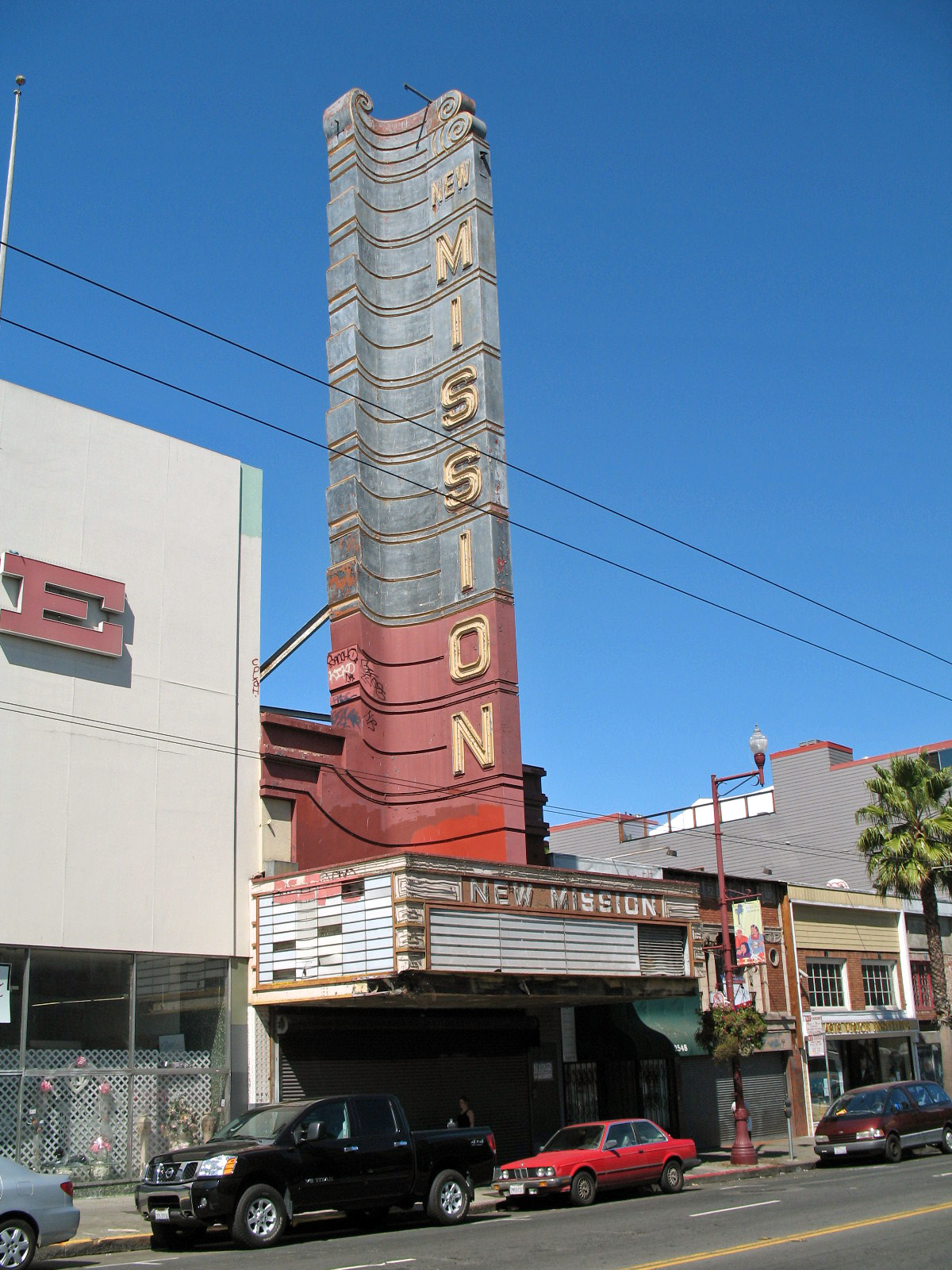
The New Mission Theater, a dilapidated landmark that sits on the 2500 block of Mission Street, has been vacant for years, but controversy surrounding its fate is alive as ever and will be discussed at this afternoon’s July 29 City College of San Francisco Board of Trustees meeting.

In 2004, the city designated the theater as historically significant for its ties to the Mission’s early 20th century “vaudeville and movie house district.” Once upon a time, patrons regularly circulated through its palacial interior, which features Art Deco-syle ornamental metalwork at the ballustrades, plaster moldings imprinted with Greek key motifs, etched Art Deco glass panel doors, ceiling ornaments with floral motifs, and a balcony adorned with a frieze of garlands and urns, according to a landmark designation file.

Plans to restore and reopen the theater have been in the works for several years, and a 100-percent affordable housing development adjacent to the theater could move forward if everything falls into place. That’s turning out to be a big ‘if.’

In 2005, CCSF sold the theater, along with an adjacent shuttered Giant Value store, to Gus Murad — Medjool restaurant owner and a former small business commissioner appointed by Mayor Gavin Newsom — for $4.35 million, according to CCSF counsel Greg Stubbs. Now, CCSF is considering initiating foreclosure proceedings against Murad due to nonpayment. He owes more than $2 million on the property, according to notice of default issued June 21. During open and closed sessions at the July 29 Board of Trustees meeting, trustees will decide whether to proceed with taking back the property from Murad or grant him a 120-day extension. Murad is expected to offer his pitch for an extension at the meeting.

CCSF board member John Rizzo told the Guardian he was fed up with the missed payments. “Gus Murad keeps assuring us, oh yes, it’s going to happen, we’re on the verge,” Rizzo said. “But the affordable housing is not being built,” he said. If CCSF took the property back, “we wouldn’t sell it for market-rate housing,” he added. “We would want to see affordable housing.”

P.J. Johnston, a spokesperson for Gus Murad, declined to answer questions about possible foreclosure but told the Guardian that the central goal is to create 85 to 100 affordable units in the heart of the Mission. “We’ve been working with Mission Housing and hopefully are very close to a reaching an agreement with Mission Housing and the Mayor’s Office of Housing, which would obviously be a chief funder of the project,” he said.

Securing financing and reaching a deal with Mission Housing and the Mayor’s Office of Housing would allow Murad to square things away with CCSF, get the ball rolling on the development, and get something out of his investment.

Murad initially planned to develop market-rate housing on the lot curently occupied by the Giant Value storefront, but switched to an affordable housing project 1.5 years ago, Johnston said. Plans have always included rehabbing the theater. Negotiations with Bernal Housing came close to a deal, but ultimately fell through, he said. Now, Murad is hopeful that CCSF will grant a 120-day extension and a deal with Mission Housing can be secured in time.

“It has been a challenging time for the economy as it relates to land use,” Johnston said. “And it’s been a very difficult couple of years for restaurants.”

Mayor’s Office on Housing Director Doug Shoemaker declined to comment for this story.

Chris Jackson, a trustee, said he worried that if CCSF were to move ahead with foreclosure, “it’ll probably scuttle the affordable housing project. I’d rather wait an extra four months to bring affordable housing than just put the screws to the guy,” Jackson said. “If it was a market-rate project, I’d be like no, give us the money.” Jackson said under state law, any funds generated by a sale of the property — which was originally purchased with bond money — would have to go back into the capital project fund, and couldn’t go into college’s operations budget. “It won’t go to save one class at City College,” he explained. “It just goes into capital project reserves.”

Rizzo noted that certain “political forces” aligned with Newsom had been contacting board members in advance of the meeting to try and persuade trustees to grant an extension for Murad, who will clearly benefit if he is allowed to hold onto the property. Murad has hosted campaign fundraisers for Newsom in the past and has contributed to campaigns of the mayor’s political allies. It isn’t the first time the New Mission Theater development has generated political buzz.

When an earlier incarnation of Murad’s plans for the New Mission Theater and adjacent lot came before the Board of Supervisors in Feburary of 2009, it generated some controversy. Murad had won approval from planning staff for a 20-foot height extension that would have brought his housing project to 85 feet, but that was rejected by the Board of Supervisors. In an odd twist, a typo kept the 85-foot limit intact, so the Board was required to vote again to bring it down to the 65 feet they approved. When Mayor Newsom vetoed the board’s second vote, Sup. Chris Daly lambasted Newsom for engaging in “pay-to-play politics.”

Rumors fly that Board can’t amend Lennar deal, after all

14

For the past month, fireworks and deals have been going on at City Hall as the Board prepares to vote on Lennar’s massive redevelopment plan for Candlestick Point-Hunters Point Shipyard. And recently, the Board vowed to make a slew of amendments to the plan, even as they approved the project’s environmental impact report.

But now it’s beginning to look like the only winners could be the developer—and perhaps those folks at city hall who are staking their political careers on jamming this deal over the finish line, come hell or high water, before the November election comes around and they go into the private sector as real estate developers.

I say this because two weeks ago, the progressives on the Board were saying that they had been told that they couldn’t amend the EIR July 14, but that they could amend the actual redevelopment plan when it comes before them on July 27. It was for this reason, they said, that they decided to vote to accept the EIR in an 8-3 vote, with only Sups. John Avalos, Chris Daly and Eric Mar, voting to reject the project’s key environmental document.

But today, with less than two working days before the Board’s July 27 meeting, I’m hearing rumors that the Board will only be able to take an up and down vote, when they consider Lennar’s actual redevelopment plan.

In other words, the only way the Board would be able to change anything would be to reject the plan in its entirety.But everyone knows that this is a pigs-may-fly scenario, given the massive pressure the Mayor’s Office, labor and Lennar have been exerting on the Board.

So, if these “up-and-down-vote only” rumors turn out to be true, folks who care about environmental and economic justice better start sounding the alarm. Because there is a plethora of unresolved issues that Sups. John Avalos, David Campos, Chris Daly, Eric Mar, and Ross Mirkarimi identified July 13 as needing shoring up, before the actual redevelopment plan would ever pass their sniff test.

These concerns included fears that the project’s financing plan amounts to daylight bank robbery, that the proposed bridge across the Yosemite Slough is unnecessary, and that the amount of projected air pollution related to the development is unacceptable.

And then there’s the fact that the Controller’s “economic benefits” report only used averaged figures, and therefore did not give any details about how many jobs and benefits the project would create in this economically depressed community in the next few years.

And did I mention the part about liquidated damages and watershed concerns? Or the fact that there are no maritime uses in the current plan, even though these uses could translate directly into relatively unskilled jobs, if old ships were broken up at the shipyard.

But despite the hours of discussion on July 13 that the Board sat through last week, I do not recall anyone from the Mayor’s or City Attorney’s Office advising the supervisors that they would not be able to amend the actual plan when it comes before them July 27.

Right now, a lot of confusion is swirling as folks point to the fact that Board President David Chiu introduced five amendments at a July 12 Land Use Committee hearing that eight supervisors subsequently voted to accept. This move led the rest of the Board to believe that they too could make amendments to the final plan.

But a review of Chiu’s amendments and the project’s EIR suggests that these changes are in fact repackaged pieces of the EIR, and that the move misled other supervisors into believing that that they would have a chance to amend the actual redevelopment plan.

So far, no one from the Mayor’s Office has returned my calls seeking clarification on this process. But if it turns out that the only way the Board can have input is to kick the plan to the curb, or ask the Planning Commission to make new findings, then democracy in San Francisco has been replaced with an empty charade.

“The Board can make changes along the line that David made in the Land Use Committee, “ Chiu’s legislative aide Judson True told me today. But he wasn’t clear on the process next week, and suggested that I call Cohen’s office, which I did (only to find myself shunted to Cohen’s voice mail.)

So, what gives? And why would the Board allow an out-of-town developer in partnership with the Mayor’s Office to sidestep its responsibility in this way?

“We were told we could not make amendments to the EIR, but could make amendments to the plan that we will be voting on this Tuesday,” Campos told me today, noting that he and Mirkarimi were prepared to make changes July 13, but were then told they could not do that.

“The biggest fear I have with this project, and any project this size in this economy, is that a lot is promised, but will anything get developed, or will we be stuck holding the bag,” Campos added.

Similar questions led the Alameda city council to kick developer SunCal to the curb last week. Ironically, the move could open the door to a developer like Lennar to try and swoop in and pick up the pieces in the island city across the Bay from San Francisco.

But folks in Alameda are pointing to San Francisco as an example of how difficult it is to nail down developers, noting that Michael Cohen, Mayor Gavin Newsom’s top financial advisor, recently admitted that investment money is scarce, even though the city’s EIR for the project has been approved.

Actually, Cohen went a step further by intimating that all the benefits that the community wants out of the plan would deter investors even more—comments that were perhaps just a precursor to this potential bombshell that the Board won’t actually be able to amend the deal, after all? Stay tuned.

Redevelopment requires “duty of loyalty” from Arc Ecology

0

As a longtime member of the Mayor’s Hunters Point Shipyard Citizens Advisory Committee (CAC), Scott Madison took exception to a “duty of loyalty” clause in Arc Ecology’s most recent contract with the Redevelopment Agency.

This new requirement in Arc’s contract came up for discussion during the CAC’s July 12 meeting, Madison said.The rest of CAC did not rise up in support of his concerns, Madison adds. But he is convinced the requirement will harm the community that surrounds the 770-acre area that the city and Lennar want to develop with their massive Candlestick-Shipyard redevelopment plan.

The Board of Supervisors will consider that plan at their July 27 meeting, along with suggestions that Arc and the Sierra Club have been making for years. These suggestions include strengthening the terms governing the transfer of Parcel E-2, the most polluted shipyard site, and removing what Arc and the Sierra Club believe is an unnecessary bridge over the environmentally sensitive Yosemite Slough.

Arc has been monitoring the environmental impacts of the shipyard since 1984, and has provided neighborhood groups with information and technical support related to cleanup and redevelopment since 1986. And more recently, Arc Ecology opened a “community window on the shipyard cleanup” on Third Street, which is also accessible online, to provide information and resources for more meaningful community involvement in the cleanup.

Arc hosts environmental education discussions and community workshops and submits written comments to the Navy about the cleanup and to appropriate agencies on related shipyard redevelopment and reuse plans.

“We are working with the BVHP community to ensure that the transfer, redevelopment, and reuse are to the maximum benefit of the neighboring community,” Arc’s website states.

But in the past few years, as Lennar’s political Candlestick-Shipyard juggernaut has been gathering speed, Arc has ruffled feathers in the Mayor’s Office by developing Alternatives For Study, a document that explores detailed alternativesto the current Candlestick-Shipyard plan.

None of ARC’s alternatives are opposed to the development, but they all suggest ways to improve it, including an option that would not involve building a bridge over the slough, or a stadium on the shipyard, and would prevent the taking of 23 acres of state park land which Lennar wants so it can build luxury waterfront condos in the middle of the current Candlestick Point State Recreation Area, a plan that would be unthinkable if it was proposed for Crissy Field.

But the city, and in particular Michael Cohen, Mayor Gavin Newsom’s top economic advisor, view these alternatives, as signs of disloyalty, as they seek to rush Lennar’s massive 770-acre redevelopment plan over the finishing line, while arguing that any further amendments will make the plan more difficult for Lennar to shop around to investors, especially in light of the depressed economy.

The growing coziness between the city and the developer was put on full public display last week, when Sup. David Campos asked the project’s proponents to step forward at the Board’s July 13 hearing on the project’s EIR.

As Lennar Urban’s Kofi Bonner began to rise from his seat in the public seating area, Cohen, who had just finished answering Campos’ questions about the bridge and the project’s financing liabilities from the city’s bullpen in the Board’s chambers, raced over to the podium before Bonner had a chance to speak.

This uneasy closeness between city and developer, along with Arc’s extensive background in shipyard related matters, are why Madison believes the city’s residents are best served when Arc can express its opinions freely, even if that involves critiquing plans that the city seems to have grown increasingly defensive about, ever since it entered into a partnership with the Florida-based Lennar.

“Yes, it’s true that the city is paying for this contract with Arc, but it seems to me that this particular contractor’s responsibility should be primarily to the Citizen’s Advisory Committee, and not the city,” Madison said. “What if Arc reaches a conclusion that is odd with the developer, city agencies and other consultants? Would Arc be prohibited from making it public?”

Madison says the city has claimed that Arc would not be prohibited from such activities, and that the contract contains standard language. But he also adds that certain parties who are boosters for the city’s redevelopment plan object to what Arc and Bloom are doing in terms of raising valid science-based concerns.

“At the meeting, Al Norman said he hopes the Redevelopment Agency handcuffs Saul, not just by the hands but by the ankles,” Madison claimed.

And Bloom said that after his group made a video of him walking around wearing a “Can I buy your park?” billboard to illustrate what Lennar’s plan will do to the only state park in San Francisco, he was told that if Willie Brown was still mayor, Arc would have lost its contract, and all department heads who had been supportive of awarding it to Arc, would have been fired, too

Bloom notes that under Mayor Brown, he was awarded several contracts and helped author Prop. P, the measure that voters approved in 2000, which called upon the Navy to clean up the shipyard to the highest levels practical.

“Even Willie understood the need for balance,” Bloom said.
 
Bloom protested the city’s “duty of loyalty” requirement at the CAC’s July 12 meeting, but has apparently decided that the clause isn’t an insurmountable obstacle, because he has apparently since signed the contract. UPDATE: I just spoke to Bloom who told me that he has not yet signed the contract and is still working to get Redevelopment to see the problem with this requirement.

“At the CAC meeting, the committee endorsed the proposal to give us the contract,” Bloom explained. “But it’s up to the Redevelopment Commission to approve the contract, something they are set to consider at their September 7 meeting. We are making the argument that they need to think about the contract in broader terms.”

And Madison notes that it’s common sense that if you want a truly independent voice advising Redevelopment on the shipyard cleanup plan, then that voice should be allowed to be genuinely independent.

“The fact that the city is paying the bill for the contract shouldn’t require an organization to sign an extraordinary Duty of Loyalty, which conflicts with its true loyalty to the surrounding community,” Madison said.

The Guardian’s recent immediate disclosure request to Redevelopment should reveal the exact terms of Arc’s Duty of Loyalty requirement. And Matt Dorsey, spokesperson for the City Attorney’s Office says such clauses are rare.

“We are unaware of any confidentiality requirements being made, except in very rare circumstances, such as contracts related to the airport where there may be terrorist concerns,” Dorsey said. Stay tuned.

Congress is acting stupidly

1

Dick Meister, former labor editor of the SF Chronicle and KQED-TV Newsroom, has covered labor and politics for a half-century. Contact him through his website, www.dickmeister.com, which includes more than 250 of his recent columns.

AFL-CIO President Rich Trumka has it right. It’s not the heat in Washington, D.C., that’s bothering him and many other advocates of working people. It’s the stupidity – the economic stupidity of Congress refusing to give financial aid to states that badly need help in order t o save the jobs of some 300,000 teachers, nurses, firefighters, police and other public service workers who are facing layoffs because of budget deficits.

The possible remedy is at hand – a pending $100 billion jobs bill.  Most of the money would go to states for quickly creating or saving up to one million jobs in public and private employment, restoring government services that have been cut, and averting other planned cuts, mostly in education, public safety and job training.

Republican opposition has kept the jobs bill from passage. The GOP also opposes a companion bill that deals with another bit of economic stupidity in Washington – the stupidity of Congress’ refusal to extend the unemployment insurance benefits of the 1.4 million Americans who will run out of benefits by the end of July, and the 325,000 who already have run out of benefits.

By year’s end, more than eight million workers will have exhausted their benefits. Their regular benefits, averaging $300 a week, ran out after 26 weeks and have not been extended as they usually have been during periods of heavy unemployment. The House voted for extension, and President Obama urged extension. But the Senate has refused to act.

The AFL-CIO’s Trumka calls the situation tragic, as well he should. He notes that almost 15 million Americans are currently unemployed, a number that’s been growing by about 250,000 workers per week.

So, 15 million people who need jobs – many who desperately need jobs – are unable to find them. About one million have been jobless for more than a year.

Overall, the jobless make up about 10 percent of the workforce. They’ve been out of work an average of 35 weeks. Another 11 million Americans are underemployed, including temporary and part-time workers and others who are underutilized and underpaid.

Nearly half of all the jobless have been out of work for more than six months.  As Trumka says, “Families are stretched to the limit and state budgets are under incredible strain, putting hundreds of thousands more jobs in danger. Yet the Republicans in Congress repeatedly have blocked efforts to take action, create jobs and rebuild our battered economy.” Although it’s mainly Republicans who’ve opposed extension of benefits, some conservative Democrats have also opposed extension.

Trumka, noting that many politicians, including every member of the House, will be on the ballot in the coming mid-term elections, urges union members to demand that the office seekers take concrete action to “rebuild our economy and create jobs now.” If they don’t take action, Trumka warns, “they may not be elected officials anymore.”

New York Times’ columnist Paul Krugman blames Congress’ failure to provide relief to the jobless on “a coalition of the heartless, the clueless and the confused.”

Krugman defines the heartless as “Republicans who have made the cynical calculation that blocking anything President Obama tries to do – especially anything that  might ease the country’s economic problems – improves their chances in the midterm elections.

And the clueless? Try Sharron Angle, the Republican candidate for senator from Nevada. She’s repeatedly claimed that the unemployed are deliberately choosing to stay jobless so they can keep collecting the benefits of a few hundred dollars a week.

The confused include politicians and others who apparently are too confused to understand the obvious – that the unemployed need money, and will quickly spend whatever they get in the way of extended benefits, thus boosting consumer spending, helping create jobs quickly and otherwise expanding the economy.

Except to the heartless, clueless and confused, saving money at the expense of the unemployed by denying them benefits is, as Paul Krugman says, “cruel as well as misguided.”

Dick Meister, former labor editor of the SF Chronicle and KQED-TV Newsroom, has covered labor and politics for a half-century. Contact him through his website, www.dickmeister.com, which includes more than 250 of his recent columns.

SFBG Radio: Why’s the stock market strong and the economy weak?

1

Today, Johny talks to economist and day trader Johnny Venom about why the stock market seems strong when unemployment is high and the economy is weak. You can listen after the jump.


sfbgradio7/15/2010 by jangel

Bad faith

3

steve@sfbg.com

Mayor Gavin Newsom and his business allies are actively trying to sabotage the various revenue measures that have been put forth by the labor movement and progressive members of the Board of Supervisors, employing deceptive rhetoric, sneaky tactics, and a refusal to bargain in good faith.

In fact, Newsom — the Democratic nominee for lieutenant governor — is so averse to supporting anything that could be called a “tax” that he rejected a hard-won compromise measure created by powerful developers, affordable housing advocates, a pro-business think tank, the building trades, and his own directors of housing and economic development.

Just as that story was breaking in the New York Times (produced by Bay Citizen) on July 9, members of the Board of Supervisors Budget and Finance Committee discovered that Newsom’s proposed ballot measure to close loopholes in the city’s hotel tax that favored airline employees and online travel companies — a widely supported change, but one worth just $6 million per year — contains language that would nullify any increases in the hotel tax. Earlier in the week, labor unions turned in signatures on an initiative to increase the hotel tax by 2 percent, which would bring in more than $30 million per year.

“This poison pill is an intentionally deceptive, underhanded move,” Gabriel Haaland, an organizer with Service Employees International Union Local 1021, which sponsored the hotel tax, told us. “It’s so frustrating. It’s not even a good faith fight. He’s trying to create confusion and fool the voters. If our measure passes fair and square, it should be implemented.”

Meanwhile, Newsom and business groups have been attacking a reform measure by Board President David Chiu that would make the currently flat payroll tax more progressive, exempt more small businesses from paying it, and create a commercial rent tax to spread the tax burden more widely than the 10 percent of businesses who now pay tax to the city.

Critics complained that the measure would hurt local businesses — but that’s just not true. The city’s Office of Economic Analysis concluded that Chiu’s original proposal would have no effect on private sector jobs and would generate $34 million annually for the city, preserving some government jobs and spending.

Then Chiu amended the measure to spare even more small businesses. Now the OEA says that the measure would actually create private sector jobs — and still bring $28 million in to the city. Yet Newsom and the business community are still withholding their support.

This trio of Machiavellian moves comes just a week after Newsom pulled out of budget negotiations with board progressives concerning about $40 million in board add-backs to programs that Newsom proposed to cut after they wouldn’t agree to his precondition that they withdraw unrelated measures proposed for the November ballot, such as splitting appointments to the Rent, Recreation and Park, and Municipal Transportation Agency boards and requiring police officers to do foot patrols.

The series of events has led many progressives to say that conservative ideological blinders — a knee-jerk opposition to anything that saves government jobs and services or that Republicans might criticize — is the only logical explanation for the intransigent stance adopted downtown and by Newsom.

“It’s ideological. It’s not economic, and it’s not even political,” said Calvin Welch, the affordable housing activist who helped negotiate the transfer tax compromise with developer Oz Erickson, San Francisco Planning Urban Research Association director Gabriel Metcalf, Mayor’s Office of Housing Director Doug Shoemaker, and others.

That measure would have created a transfer tax on sales of properties over $875,000 and generated approximately $50 million annually for affordable housing (funds that were drastically reduced in Newsom’s proposed 2010-11 budget) while cutting in half the current requirements and fees on market-rate developers to create below-market-rate units. The plan would have stimulated both types of housing and created desperately needed construction work — an approach those involved called an elegant solution to several problems.

“To me, this was a win-win, solving two problems that are each a big deal,” Metcalf told us. “I don’t know what his reasons were for not supporting it. I was surprised.”

But Welch said, “It collapsed straight up because the mayor didn’t want to support a tax.” Although Newsom told the Times it was because there wasn’t broad enough consensus yet, “the mayor’s reason is whole-cloth bullshit,” Welch said, noting the role of the Mayor’s Office in brokering the deal. “The mayor walks away from it because everyone wasn’t in the room? Well, it’s your room, motherfucker. Show some leadership.”

Newsom Press Secretary Tony Winnicker refused to discuss these issues by phone, responding to our written inquires by noting that Newsom opposes taxes and thinks the best way to address budget deficits are privatizing city services and pension reform (although he opposes Public Defender Jeff Adachi’s initiative, the only pension reform measure on the fall ballot).

“The mayor is opposed to the Board of Supervisors’ proposals to increase taxes because they’re not needed to balance the budget and they will strangle our still young economic recovery,” Winnicker wrote, refusing to answer follow-up questions or support a statement about Chiu’s measure that the OEA concludes is not accurate.

Like many political observers of all stripes, those from downtown and progressive circles, Welch criticized Newsom for his lack of engagement with city business and its long-term fiscal outlook, contrasting him with former Mayor Willie Brown, who met regularly with former Board of Supervisors President Tom Ammiano even as the two ran a bitter campaign for mayor against one another in 1999. “They dealt with the city’s business like two adults who cared about the city,” he said.

Welch acknowledged that there was still work to be done building political support for the transfer tax measure. He and other progressives would have had to win over city employee unions who wouldn’t like the budget set-aside aspect, and Erickson and Metcalf would need to placate some of their downtown allies who oppose taxes on ideological grounds. But given how downtown groups are behaving right now, that might not have been an easy sell.

“There are members of the small business community that are averse to any taxes,” said Regina Dick-Endrizzi, director of the city’s Office of Small Business and staffer to the Small Business Commission, which was withholding a recommendation on the Chiu measure but planned to meet again to consider it July 12 (look for an update on the sfbg.com Politics blog). She said the small business community is having tough times and “they are just not sensitive to keeping city workers employed.”

Larger commercial interests are being even more forceful in opposing the revenue measures. While a parade of workers, social service providers, and progressive activists testifying at the July 9 Budget Committee hearing implored supervisors to place all the proposed revenue measures on the ballot, representatives from the Building Owners and Managers Association (BOMA) and San Francisco Chamber of Commerce were the only two speakers urging supervisors to drop the measures and focus instead on creating private sector jobs.

“You’re trying to create a little revenue here and it’s not going to work,” said Ken Cleaveland, director of BOMA SF, arguing that big banks and financial services companies — entities exempt from the payroll tax that Chiu is hoping to target with the commercial rent tax — will buy their buildings to avoid paying the tax. “They aren’t going to create more jobs and they really aren’t going to create more revenue.”

Yet Chiu noted that it was the business community and fiscal conservatives who pushed to create the Office of Economic Analysis, whose work they have regularly used to attack progressive legislation. Now that the office has concluded that a piece of progressive legislation is good for the local economy, Chiu told Cleaveland and the Chamber spokesperson Rob Black at the hearing, “I ask you to respect the work this office has done.”

Black said the Chamber board will consider Chiu’s amended legislation, but said businesses are in no mood to help the city. “How many times have you gone to your neighborhood merchant and had them say, ‘Gee, my rent’s too cheap’?<0x2009>” he said during his testimony.

Yet Chiu said landlords of small tenants (those paying less than $65,000 in rent per year) are exempt from the rent tax and only 26 percent of SF businesses would pay any city business tax under his plan. “I hope the mayor will support this proposal and the business community will give it a good look,” Chiu said as the hearing ended.

At the beginning of the hearing, Chiu framed the dire situation facing San Francisco, citing Controller’s Office figures showing this year’s $500 million budget deficit (out of a $6 billion total budget) will be followed by a $700 million deficit next year and a $800 million gap the following budget cycle as a result of a deep structural budget imbalance.

“We have budget deficits as far as the eye can see,” Chiu said at the hearing. “We have to consider measures that will provide more stable sources of revenue.”

He also noted that city employee unions have agreed to give back about $250 million in salary and had their ranks reduced by about 2,000 workers in the last two years. So he and the other progressive supervisors say it’s time for the rest of San Francisco to help address the problem.

“We, as a city, should not be trying to balance this budget simply through cutting,” Sup. David Campos said.

Sup. John Avalos, the committee chair, amended his transfer tax measure in the wake of Newsom’s rejection of the deal by making it a simple 2 percent tax on properties that sell for more than $5 million, and 2.5 percent tax on properties over $10 million. He estimates it will bring in about $25 million per year from the city’s wealthiest corporations and landlords.

“That’s who we’re socking it to,” Avalos told us, saying he was disappointed the compromise fell through. “The amendment is going to be more progressive than what was originally planned.”

Even Sup. Sean Elsbernd, a strong fiscal conservative who announced early in the hearing, “You want to do that [balance future budgets] by adding taxes, but I want to do it through ongoing service cuts,” later told the Guardian that he was intrigued by the amendments Avalos and Chiu made to their measures and has not yet taken a position on them.

Sup. Ross Mirkarimi is also sponsoring a measure to increase the city’s tax on parking lot operators from 25 percent to 35 percent, the first change to that tax in 30 years, and will include valet parking for the first time. The measure would bring in up to $24 million per year, and OEA analysis shows it would decrease the number of cars trips by 1.3 percent, another benefit.

SFMTA supports the measure, with board member Cameron Beach testifying that the money will be used to subsidize Muni and “it links the use of private automobiles and is consistent with the city’s transit-first policy.” Mirkarimi, who chairs the Transportation Authority, also has proposed a $10 local vehicle license fee surcharge that would bring in another $5 million per year for Muni.

All the revenue measures require six votes by the full Board of Supervisors, which is scheduled to consider them July 20, after which they would need a simple majority approval by voters in November to take effect.

The mayor has the authority to directly place measures on the ballot, so the committee hearing on his hotel tax loophole measure and a $39 million general obligation bond that he’s proposing to create a revolving loan fund for private sector seismic improvements were mere formalities, so supervisors criticized aspects of each but were unable to make changes.

Avalos even grudgingly acknowledged the hotel tax poison pill was an effective way to kill that revenue source, saying at the hearing, “This is very smart. I don’t agree with it, but it’s very smart.”

Haaland was less charitable, criticizing a provision designed to confuse voters. “This kind of move means both measures won’t pass because now we have to oppose [Newsom’s measure],” he said, criticizing the mayor for running away from the hard decisions facing the city. “He won’t be around next year, when we have an even bigger structural budget deficit, to clean up this mess. Absent new revenue sources, this city starts to fall apart.”

Whitman criticized for opposing high-speed rail

10

By Brittany Baguio

Although Republican gubernatorial Meg Whitman claims job creation is one of her top priorities, she recently stated that she opposes the plan to build a high-speed rail system in California – a project that is being eagerly anticipated in San Francisco, its northern terminus.

Whitman says the state does not have enough money to fund the project because of the state’s current budget deficit, but labor, environmental, and other groups say it will be a boon to the state’s economy and environment. Voters approved Proposition 1A in November 2008, supporting the construction of a high-speed rail system with an initial investment of $9.95 billion in bond money.

Proponents say the project will alleviate freeway and airport congestion and provide a green transportation option that has both short- and long-term economic benefits. According to the California High-Speed Authority website, the project would create 160,000 constructed-related jobs as well as 450,000 more jobs by 2035. The construction of the rail system would also improve the movement of people, goods, and services throughout California and ultimately raise more than $1 billion in surplus revenue a year.

“We are eager to thoroughly brief whoever the next governor is on this project and work with him or her to make California’s high-speed rail system a reality,” California High-Speed Rail Authority representative Rachel Wall told the Guardian.

Supporters of the bullet train disagree with Whitman’s analysis and contend that the construction of a bullet train would create revenue and jobs. In a press release, California Labor Federation Executive Secretary-Treasurer Art Pulaski said, “In her glossy TV ads, Whitman says she understands the daily hardships facing our state’s unemployed, but it’s clear that’s just more campaign rhetoric. In opposing high-speed rail, she’s shown her true colors on jobs. It’s shocking that a candidate for Governor could be so detached from the economic hardships facing our state’s families. With one in eight Californians out of work, how can we afford not to invest in the creation of hundreds of thousands of permanent, good new jobs?”

Communications director of the California Labor Federation, Steve Smith, believed that Whitman’s opposition exhibited her political inexperience and uninformed decisions. “She’s out there talking a big game about job creation, but no specifics about how she would create jobs,” Smith told us. “Her proposals would be devastating to California and would lead to higher unemployment in California. She says that California can’t afford the project, but what we can’t afford is not to take advantage of improving our economy and environment.”

Whitman isn’t the only one opposing the project. Bay Area cities of Menlo Park, Palo Alto, Burlingame, Belmont, and Atherton have all voiced concerns about the project and the impact of trains move rapidly through those communities, filing a lawsuit seeking to halt the project.

The bullet train project was awarded $2.25 billion from the American Recovery and Reinvestment Act last January and is currently undergoing supplemental environmental reviews. Construction is scheduled to begin in 2012, with improvements such as rail electrification expected to improve rail service on the San Francisco peninsula even before the high-speed trains start running around 2020.

Assuming the public-private project isn’t derailed politically and can raise the estimated $40 billion total cost, the trains will travel at speeds of up to 220 mph and take passengers from the LA Union Station to San Francisco’s Transbay Terminal in less than 2 hours and 40 minutes.

On the cheap listings

0

On the Cheap listings are compiled by Paula Connelly. Submit items for the listings at listings@sfbg.com.

WEDNESDAY 14

Make Beer in Your Basement Bazaar Café, 5927 California, SF; (415) 831-5620. 7pm, free. Learn to make your own beer to both save money and get invited to more parties. Home brewer Caleb Shaffer presents an overview of the beer brewing process, complete with explanations on technique, equipment, and ingredients.

Vive le Film! Hotel Rex, 562 Sutter, SF; www.disposablefilmfest.com. 8pm, free. In honor of Bastille Day, the Disposable Film Festival will present a collection of disposable films with a French flare. Enjoy drink specials courtesy of Hotel Rex and valet bike parking provided by Globe Bikes.

THURSDAY 15

Hayes Valley Farm Tour Hayes Valley Farm, Laguna between Oak and Fell, SF; www.laborfest.net. 3pm, free. Attend this LaborFest sponsored tour of Hayes Valley Farm, an urban agriculture education and research project, and learn about the alliance of urban farmers, educators, and designers that comprise the Hayes Valley Farm Project Team and the innovative strategies used on the farm in order to meet the needs of our planet and the surrounding communities of San Francisco. Tours of the farm are held every Thursday and Sunday.

FRIDAY 16

Free Museum Weekend Various museums in San Francisco, visit www.onlyinsanfrancisco.com/target for exact dates and times. Fri.-Sun., free. The de Young Museum, Asian Art Museum, SFMOMA, Contemporary Jewish Museum, Museum of African Diaspora, Zeum, and the Yerba Buena Gardens Festival are all offering free admission days throughout the weekend for all ages along with hands-on art activities, and family friendly performances.

SATURDAY 17

“Art Show” Cat Club, 1190 Folsom, SF; (415) 703-8964. 5pm, $5 suggested donation. Watch interpretive drag performances devoted to the works of Keith Gaspari, who will be hosting along with the lovely Bebe Sweetbriar. Featuring works by local artists and performers, champagne toasts, a raffle, and special Bulleit bourbon cocktails to benefit Visual Aid, a non-profit that supports artists living with HIV.

“Beatles to Bowie” San Francisco Art Exchange, 458 Geary, SF; (415) 441-8840. 7pm, free. Attend the opening of this Rock n’ Roll photo exhibition displaying original photos showcasing the evolution of music from the British invasion to glam rock from 1962 to 1974. Featuring never before seen photos by Terry O’Neill.

Behind the Storefronts Chinese Cultural Center of San Francisco, 3rd floor, 750 Kearny, SF; (415) 252-2598. 2pm, free. Learn about how Art in Storefronts, a citywide project that temporarily places original art installations and murals into vacant storefront windows and exposed walls, from some of the artists and property owners who participated in the current Chinatown exhibition. An artist-led tour of the storefronts and murals will follow the discussion.

Night Light SOMArts Cultural Center, 934 Brannan, SF; (415) 552-1770. 9pm, $5 suggested donation. Get lost in a multimedia garden party featuring temporary multimedia, abstract sound, video, and film installation set in the garden of SOMArts. In conjunction with the current “Totally Unrealistic: the art of abstraction” exhibit.

Schools for Salone El Rio, 3158 Mission, SF; (415) 648-4767. 4pm, $10 suggested donation. Enjoy an afternoon of dancing, eating, drinking, and probable sunshine to benefit Schools for Salone, a non profit that build schools in Sierra Leone. Featuring music by DJs Marcos, Eschew, SpinCycle, PMS, and Ras Kanta, African food by Bissap Baobab, and raffle prizes.

Song and Poetry Swap The San Francisco Folk Music Club, 885 Clayton, SF; (415) 648-3457. 8pm, free. Join the Freedom Song Network to help keep the spirit of labor and political song alive in the Bay Area by bringing songs or poems to share at this swap of picket line, rally, and concert songs and poems. No musical training or talent required. Part of LaborFest 2010: www.laborfest.net.

Union Square Art Walk Participating galleries along Post and Sutter streets, SF; for exact locations visit http://artwalksf.com/. Noon-5pm, free. Take a free, self-guided walking tour of Union Square art galleries at this art walk featuring artist talks, performance art, live music, film screenings, refreshments, and more.

SUNDAY 18

Lots of Abundance Meet at CCA Farm, 8th St. at Hooper, SF; www.sfbike.org. 9:45am, $5 suggested donation. Discover local projects that reclaim abandoned lots and former freeways for public use and for the purpose of restoring connections to food on this two and a half hour bike tour led by TransitionSF and the San Francisco Permaculture Guild. The tour will highlight local efforts to create community and garner support for both the environment and the economy.

MONDAY 19

Ubu Roi Theater Pub, Café Royale, 800 Post, SF; www.sftheaterpub.wordpress.com. 8pm, free. Take in a one night performance of Alfred Jarry’s 1896 bawdy and nihilistic re-imagining of Macbeth, translated and modernized by Bennett Fisher. Enjoy this original work and workshop at the Café Royale bar featuring musical accompaniment by DJ Wait What.

For Lit, Talks, and Benefits listings, visit the Pixel Vision blog at www.sfbg.com/pixel_vision.

Tax cuts, unemployment and the deficit

10

Fifty-five thousand people a day are losing their unemployment insurance because Congress won’t extend benefits. Why? Well, gee, any federal spending will increase the deficit — and like Herbert Hoover, everyone in Washington is talking about cutting deficits.


But check out this handy chart from the Commitee on Budget and Policy Priorities (thanks, Calitics). The overwhelming factors in the current budget deficit are left over from the Bush administration: Two wars, massive tax cuts for the rich, and an economic meltdown. Unemployment insurance barely even counts.


So the obvious solution to the deficit problem is to get the hell out of Iraq and Afghanistan, cut the size of the military and end the tax cuts. Funny: The deficit hawks aren’t talking about any of those things. 


Sunday Streets creates public benefits from private labors

2

By Kristen Peters

San Francisco locals will take to the streets this weekend as main roads in the Mission neighborhood are closed to automobiles for the sixth installment of Sunday Streets. On July 11, a three-mile route from 17th and Valencia to Dolores Park to Potrero Avenue will be car-free from 10 am until 3pm.

Taken from Bogota’s weekly ciclovía, in which nearly 100 miles of city streets are reserved for pedestrians and other recreationalists, Sunday Streets began in San Francisco almost two years ago. Since then, the tradition has made its way to other California cities including Los Angeles and Oakland.

“In San Francisco we have our own unique style,” event coordinator Susan King, who works for the nonprofit group Livable City, said. “We have different routes and we hit different neighborhoods year after year. In each neighborhood, the featured events have their own flair.”

This Sunday, revelers can look forward to performances by Grupo Azteca as well as capoeira and salsa dancing lessons, not to mention the countless restaurants in the area opening their doors early to the public. While the event has some support from the city and its San Francisco Municipal Transportation Agency, mostly in the form of permit fee waivers, it is run by Livable City and funded from corporate donations.

“Our corporate sponsors provide everything from durable goods, in-kind donations and cold, hard cash,” King said.

City officials have even curtailed helping with hanging “no parking” signs, leaving that task to volunteers from the SF Bicycle Coalition. That job was usually designated to the San Francisco Department of Parking and Traffic, but they have now stopped providing that service to an event that Mayor Gavin Newsom trumpets as something he’s bringing to the people. But King still calls Sunday Streets a good example of a public-private partnership.

“Everybody brings something to the table,” King said. “It’s a real cooperative entity with everyone pulling together to produce something really special.”

According to King, the benefits are widespread. Not only is it refreshing for the public to ditch their cars for a few hours, but it also reinvigorates the local economy. “It’s a real boom for the city,” King said. “Lots of people on the street means lots of eating. It’s good for business and good for the community.”

Acting executive director for the SF Bicycle Coalition Renee Rivera said that the Mission in particular has benefited from the crowds at Sunday Streets. “Everyone is enjoying the outdoor activities the event has to offer but, at the same time, are going to get ice cream, stopping for tacos or getting to enjoy all the merchants on 24th and Valencia,” Rivera said.

There are three more Sunday Street events following the Mission neighborhood closure. The Great Highway and areas of Golden Gate Park will be closed on August 22 followed by the Western Addition on September 19. The series will conclude on October 24 with the closure of the Civic Center and Tenderloin areas.

Taming finance in an age of austerity

1

By Joseph E. Stiglitz

NEW YORK – It was not long ago that we could say, “We are all Keynesians now.” The financial sector and its free-market ideology had brought the world to the brink of ruin. Markets clearly were not self-correcting. Deregulation had proven to be a dismal failure.

The “innovations” unleashed by modern finance did not lead to higher long-term efficiency, faster growth, or more prosperity for all. Instead, they were designed to circumvent accounting standards and to evade and avoid taxes that are required to finance the public investments in infrastructure and technology – like the Internet – that underlie real growth, not the phantom growth promoted by the financial sector.

The financial sector pontificated not only about how to create a dynamic economy, but also about what to do in the event of a recession (which, according to their ideology, could be caused only by a failure of government, not of markets). Whenever an economy enters recession, revenues fall, and expenditures – say, for unemployment benefits – increase. So deficits grow.

Financial-sector deficit hawks said that governments should focus on eliminating deficits, preferably by cutting back on expenditures. The reduced deficits would restore confidence, which would restore investment – and thus growth. But, as plausible as this line of reasoning may sound, the historical evidence repeatedly refutes it.

When US President Herbert Hoover tried that recipe, it helped transform the 1929 stock-market crash into the Great Depression. When the International Monetary Fund tried the same formula in East Asia in 1997, downturns became recessions, and recessions became depressions.

The reasoning behind such episodes is based on a flawed analogy. A household that owes more money than it can easily repay needs to cut back on spending. But when a government does that, output and incomes decline, unemployment increases, and the ability to repay may actually decrease. What is true for a family is not true for a country.

More sophisticated advocates warn that government spending will drive up interest rates, thus “crowding out” private investment. When the economy is at full employment, this is a legitimate concern. But not now: given extraordinarily low long-term interest rates, no serious economist raises the “crowding out” issue nowadays.

In Europe, especially Germany, and in some quarters in the US, as government deficits and debt grow, so, too, do calls for increased austerity. If heeded, as appears to be the case in many countries, the results will be disastrous, especially given the fragility of the recovery. Growth will slow, with Europe and/or America possibly even slipping back into recession.

Stimulus spending, the deficit hawks’ favorite bogeyman, did not cause most of the increased deficits and debt, which are the result of “automatic stabilizers” – the tax cuts and spending increases that automatically accompany economic fluctuations. So, as austerity undermines growth, debt reduction will be marginal at best.

Keynesian economics worked: if not for stimulus measures and automatic stabilizers, the recession would have been far deeper and longer, and unemployment much higher. This does not mean that we should ignore the level of debt. But what matters is long-term debt.

There is a simple Keynesian recipe: First, shift spending away from unproductive uses – such as wars in Afghanistan and Iraq, or unconditional bank bailouts that do not revive lending – toward high-return investments. Second, encourage spending and promote equity and efficiency by raising taxes on corporations that don’t reinvest, for example, and lowering them on those that do, or by raising taxes on speculative capital gains (say, in real estate) and on carbon- and pollution-intensive energy, while cutting taxes for lower-income payers.

There are other measures that might help. For example, governments should help banks that lend to small- and medium-size enterprises, which are the main source of job creation – or establish new financial institutions that would do so – rather than supporting big banks that make their money from derivatives and abusive credit card practices.

Financial markets have worked hard to create a system that enforces their views: with free and open capital markets, a small country can be flooded with funds one moment, only to be charged high interest rates – or cut off completely – soon thereafter. In such circumstances, small countries seemingly have no choice: financial markets’ diktat on austerity, lest they be punished by withdrawal of financing.

But financial markets are a harsh and fickle taskmaster. The day after Spain announced its austerity package, its bonds were downgraded. The problem was not a lack of confidence that the Spanish government would fulfill its promises, but too much confidence that it would, and that this would reduce growth and increase unemployment from its already intolerable level of 20%. In short, having gotten the world into its current economic mess, financial markets are now saying to countries like Greece and Spain: damned if you don’t cut back on spending, but damned if you do as well.

Finance is a means to an end, not an end in itself. It is supposed to serve the interests of the rest of society, not the other way around. Taming financial markets will not be easy, but it can and must be done, through a combination of taxation and regulation – and, if necessary, government stepping in to fill some of the breaches (as it already does in the case of lending to small- and medium-size enterprises.)

Unsurprisingly, financial markets do not want to be tamed. They like the way things have been working, and why shouldn’t they? In countries with corrupt and imperfect democracies, they have the wherewithal to resist change. Fortunately, citizens in Europe and America have lost patience. The process of tempering and taming has begun. But there is far more yet to do.

Joseph E. Stiglitz is University Professor at Columbia University and a Nobel laureate in Economics. His latest book, Freefall: Free Markets and the Sinking of the Global Economy, is now available in French, German, Japanese, and Spanish.

Copyright: Project Syndicate, 2010.
www.project-syndicate.org
For a podcast of this commentary in English, please use this link:
http://media.blubrry.com/ps/media.libsyn.com/media/ps/stiglitz127.mp3

SF business community just opposes government

21

Mayor Gavin Newsom and his business community allies often accuse progressive members of the Board of Supervisors of being too “ideological” in their proposals, particularly when they involve revenue or regulations. But a looming battle over reforming the city’s business tax – one of three new revenues set for a special Budget & Finance Committee meeting tomorrow (7/9) at 11:30 am – shows that an ideological aversion to taxes of any kind drive Newsom and the business community more than their stated concern for “jobs” and the “economy.”

Board of Supervisors President David Chiu crafted his measure – which creates a progressive structure for the currently flat payroll taxes and uses small commercial rent tax to spread the tax burden among more businesses (only 10 percent of which now pay the payroll tax) — specifically to decrease the business tax burden on small businesses and protect private sector jobs while also bringing in about $35 million more into the city, which will save some city jobs and thus help the local economy.

City Economist Ted Egan and the Office of Economic Analysis confirmed that Chiu’s carefully crafted measure does just that, noting that it was based on recommendations made last month in a report by his office and two private accounting firms that was jointly commissioned by both Chiu and Newsom.

“The proposed legislation modifies the Progressive Payroll option in the Controller’s report, to achieve greater revenue growth while minimizing private sector job growth,” concludes Egan’s analysis. And that’s the idea of this legislation, to save some city jobs and services without hurting the private sector. Egan found this tax reform would on balance have no impact on private sector jobs.

But the Small Business Commission, driven by anti-government zealots in their community, wants even greater concessions and to minimize government revenues, demands that Chiu is now considering giving in to, with sources close to the negotiations saying they will amend the plan to exempt more small businesses and lower the revenue projection to more like $28 million.

“There are members of the small business community that are averse to any taxes,” Regina Dick-Endrizzi, director of the city’s Office of Small Business (which staffs the commission), told us.

She said the commission isn’t opposing or supporting the measure, and while she said the business community isn’t ideologically opposed to government, she did admit that “they are just not sensitive to keeping city workers employed.”

And that’s a terribly selfish and self-defeating attitude that hurts the local economy and the services we all depend on. The problem is the small business community — which is supported by the Bay Guardian and beloved by all as a key job creator — is being used by conservative ideologues and large corporations and lured into joining their anti-government crusade. This has to change, and this legislation is a good opportunity to talk about the real ideological barriers that are hindering common sense solutions to this city’s problems.