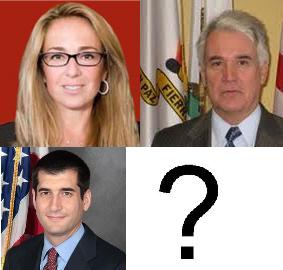
District Attorney

Chris Cunnie running for sheriff?

65

It appears that the race for San Francisco sheriff is about to get more competitive: Chris Cunnie, the former Police Officers Association president, the former undersheriff and chief district attorney investigator is getting close to deciding to run, numerous sources tell me.


I haven’t been able to reach Cunnie directly, but he’s been calling around to local political types and talking about the race, and several people close to him say he’s about ready to make the jump.


Cunnie was widely expected to run when incument Mike Hennessey appointed him as undersheriff more than a year ago, but Cunnie left that job for personal reasons and appeared to have no interest in trying for the top position.


But he’s apparently changed his mind, and he would be the third candidate in the race and likely to get more traction than Paul Miyamoto, a captain in the Sheriff”s Department who has no prior political experience.


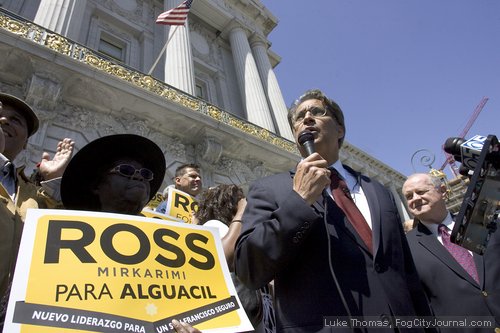
At this point, however, Hennessey has already endorsed Ross Mirkarimi, who is by any account the front-runner. He’s the only candidate with any electoral experience and he’ll have the progressives united behind his campaign. Cunnie’s time as the POA boss will hurt him on the left.


It’s not clear why Cunnie has decided to enter the race, but I think it’s safe to say that a lot of powerful people in this town are worried that Mirkarimi — a stalwart progressive who happens to have been very involved in law-enforcement issues — could wind up in a citywide office from which he might at some point seek to run for mayor. Cunnie would make it much safer for the more conservative types.


Human rights for felons

57

Matier and Ross have a way with making any story into something the national news media will use to say “only in San Francisco.” And here it is again; check out hte first paragraph of the July 13 item:


Ex-convicts may soon become a “protected class” in San Francisco – joining African Americans, Latinos, gays, transgender people, pregnant women and the disabled.


Right there in one sentence, everything Fox news loves to report: That crazy city that loves gays and trannies now wants to protect criminals.

And this is going to play out as an issue in the sheriff’s race, since Supervisor (and sheriff candidate) Ross Mirkarimi is the one carrying the legislation. You know, that crazy liberal — the guy who whant to give civil rights to ex-cons. I can see the ads now — if any of the other candidates decide to go negative on something that actually makes a lot of law-enforcement sense.

See, if people returning from prison can’t get a place to live or a job, they’re going to be homeless and back to a life of crime. Pretty basic math. And thanks to the governor’s realignment plan, a lot more prisoners are coming to San Francisco, and the next sheriff is going to have to make anti-recidivism programs a top priority. That’s really what this is.

And the fact that the district attorney and former police chief supports it was buried in the story.


Politicians have a limited time offer for you

0

As politicians push to maximize their campaign contributions before the semi-annual reporting deadline of tonight (Thu/30) at midnight – a big measure of the strength of their campaigns and sure-fire way to keep the money flowing in – our e-mail in-boxes at the Guardian have been flooded with urgent pleas for cash.

There’s a real art to these appeals, which generally rely on some combination of fear, humor, “we’re so close” appeals to “put us over the top,” and earnest calls for support in order to get people to open their wallets. We won’t find out how the campaigns really did for another month when the forms are due, but we thought we’d offer a sampling of our favorite pitches of the season.

President Barack Obama is offering to join you for dinner if you give his presidential campaign even a few bucks: “ I wanted to say thank you before the midnight deadline passes. And I’m looking forward to thanking four of you in person over dinner sometime soon. If you haven’t thrown your name in the hat yet, make a donation of $5 or more before midnight tonight — you’ll be automatically entered for a chance to be one of our guests.”

Democratic Party consultant James Carville sent out a funny one entitled “Backwards tattoo” on behalf of the Democratic Senatorial Campaign Committee: “FEC deadline is midnight, and here’s a number to ponder: 90%. It’s so important, you should tattoo it backwards on your forehead so you read it every time you brush your teeth:

  • 90% of donations to Karl Rove’s American Crossroads this year came from 3 billionaire donors bent on destroying President Obama.

  • 90% of donations to the DSCC come from grassroots supporters.”

Comedian and U.S. Sen. Al Franken always writes great appeals. I liked his previous one, “Oatmeal,” better than his current one, “Cake,” but it’s still pretty good: “Remember Election Night 2010? Remember watching Democrats you admired—progressive champions—giving concession speeches?  Remember shaking your head as radical right-wingers were declared winners?  Remember the first moment you realized that John Boehner was going to become Speaker of the House? Not fun memories.  But here’s the thing: In a lot of states, the cake was baked a long time before the polls closed—not in 2010, but in 2009. Every cycle, races are won and lost—months before anyone votes—because one side builds an early advantage that proves to be insurmountable.”

On the other side other aisle, the National Republican Senatorial Committee is offering signed lithographs of the U.S. Capitol (huh?) for donations of $125 or more, or you can give just $4 to help elect four more GOP senators because, “Even with the support of all 47 Republican Senators for a Balanced Budget Amendment, Harry Reid blocking its progress every step of the way will be nearly impossible to overcome.”

GOP presidential candidate Mitt Romney writes that, “Your donation will build the campaign needed to defeat the Obama juggernaut in 2012.”

Rep. Dennis Kucinich (D-Ohio) issued a national appeal for his efforts to stand “up to leaders of both parties” and the scheming capitalist forces: “Across the country, corporate forces have been pushing for draconian cuts to the social safety net, making it harder for all Americans to have a better quality of life.”

SF District Attorney candidate David Onek used his wife – Kara Dukakis, daughter of former Democratic presidential nominee Michael Dukakis – to make his fundraising plea today: “I’m writing today to ask for your help. As you already know, my husband, David Onek, is running to be San Francisco’s next District Attorney to reform our broken criminal justice system. The deadline for our fundraising period is midnight tonight and it is crucial that we make a strong showing.”

U.S. Sen. Barbara Boxer even acknowledged the barrage of funding appeals as she sought money for her PAC for Change: “I know you may be getting a flurry of these June 30 fundraising emails today, so let me get right to the point: We’ve already raised more than $44,000 toward our $50,000 end-of-quarter grassroots goal — but if we’re going to make it, and fight back against the millions that Karl Rove and our opponents are already spending against us, I need your support before midnight tonight.”

SF Mayoral candidate Leland Yee sent out an appeal this morning with the subject line, “An amazing couple months…14 hours to go before the deadline,” in which he touted his campaign’s endorsements and accomplishments but asked people to dig deeper: “Even if you have donated to the campaign already, a contribution before midnight tonight will make a huge difference. Every dollar counts and no amount is too small.”

Mayoral candidate Dennis Herrera exclaimed: “Wow! It’s been just seven hours since I sent an email to each of you asking for your support in sponsoring my field team’s 10,000 signatures by matching them with a fundraising goal of $10,000 – and we have made some serious progress. “

And then tomorrow, after a likely round of “thank you, we did it!” self-congratulatory messages, it’s back to summer as usual.

On the hook

4

rebeccab@sfbg.com

Unique Roberts squared back her shoulders and recalled what it was like when she first moved to San Francisco from East Oakland more than a decade ago. A tall, 33-year-old African American transgender woman with piercing eyes and a charming smile despite gaps of missing teeth, Roberts said she performed as a showgirl at clubs like Harvey’s and the Pendulum in the Castro. In those exciting days, “I fell in love with this boy, and he was an addict,” she explained. “I thought that if I did it, it would keep our relationship together.”

She recalled how awful her boyfriend felt when he found out she was using, telling her, “You don’t know what you’re doing to yourself.” He departed for Texas several years later, but addiction stuck with her as a way of life.

She says she’s tried to kick the habit, but it’s wrapped up in a battle against depression stemming from the loss of loved ones. Roberts was wearing one of the bright orange sweatshirts issued to inmates at San Francisco County Jail. She landed there after being arrested in April for allegedly selling a tiny rock of crack, weighing just 9/100s of a gram, to an undercover narcotics officer. According to the police report, the cop offered her $20 for it — but based on National Drug Intelligence Center street-value estimates, that amount is only worth about $2.50.

Roberts may go by the first name Unique, but her lawyer Tal Klement, who works for the San Francisco Public Defender’s Office, is fond of saying her case is hardly unique at all. She was one of several people arrested in the Tenderloin that day after interacting with the same plainclothes officer.

It was part of a coordinated sweep known as a buy-bust, a common practice under which an officer may pose as a homeless person, a clueless outsider, or a dope-sick fiend to lure people into selling crack, pills, meth, heroin, or marijuana. Once a transaction is made, a team of officers awaiting the signal immediately closes in and arrests the seller.

As of June 20, there were at least 109 open buy-bust cases in San Francisco. Based on defendants’ rap sheets, 92 percent had prior drug-use histories, according to a tally conducted by the Public Defender’s Office.

The officers posing as buyers — who often earn overtime — use street lingo, know which drugs can be obtained at which intersections, and sometimes offer higher prices than the accepted street value. Attorney Anne Irwin, also a public defender, is critical of the practice, saying it’s an expensive tactic that’s makes for easy arrests — because the money is irresistible to addicts who think they’re getting an opportunity to convert a personal stash into more drugs.

In a lean budget year, “they’re cutting social services left and right, and these are the very services that could help the addicts get off the street,” Irwin noted. She’s skeptical that the strategy stems the flow of substantial quantities of drugs.

Police Chief Greg Suhr, who said he participated in buy-busts for years as a narcotics officer, credits the tactic for helping to eradicate a rampant open-air drug market on Third Street in the Bayview, and says it can help prevent drug-related violence.

Klement, however, condemns it as a “war on crumbs,” saying it ensnares far more addicts than serious dealers and often ends up unnecessarily pinning felony convictions onto low-level offenders.


NUMBERS GAME

Buy-busts usually involve around eight officers, according to an average calculated by the Public Defender’s Office based on open cases, but have involved as many as 14 and as few as three. There’s the decoy buyer, who sometimes dresses in grimy sweatpants, goes without shaving, or dirties his face to look like a street addict in desperate need of a fix. There’s a “close cover” officer who follows the decoy, plus an arrest team that is also sometimes in plainclothes. Beforehand, officers will photocopy cash — usually $20 bills — to document the serial numbers so that the same marked city funds can be used as evidence once recovered from arrestees. Busts can happen within minutes of one another, and a single shift may net five or six arrests.

Irwin says the people snared aren’t typical drug dealers — certainly not big-time players. But they’re charged as dealers — and in many cases wind up branded as felons, with severe legal penalties such as multiyear prison sentences.

While the police department is able to show on paper that it’s brought hundreds of drug dealers into custody — and the district attorney can point to a boost in the conviction rate thanks to the program’s efficiency — Irwin says the amounts being peddled are tiny.

“In traditional narcotics operations, they cultivated snitches, used surveillance, and obtained search warrants” to go after major dealers, Irwin said. With buy-busts, “It’s like shooting fish in a barrel. Everyone agrees that we need cops on the streets to help keep us safe … But do we want to be paying hundreds of thousands of dollars for this?”

Sharon Woo, chief assistant of operations for the San Francisco District Attorney, told the Guardian that “we charge based on the conduct of the individual.” Woo went on to say that the DA tried to “exercise appropriate discretion” on a case-by-case basis when individuals are selling to support an addiction or due to being in dire financial straits.

Sometimes individuals are ushered into alternative programs such as drug court or a Back on Track program for first-time offenders, Woo said. And while the DA typically includes charges that make defendants ineligible for probation under state law if they have prior convictions for selling crack-cocaine — a discretionary practice that has drawn criticism from public defenders — Woo observed that “it doesn’t mean that’s how cases resolve.”

Police forces in nearly every major metropolitan area practice buy-busts, said Frank Zimring, a law professor at UC Berkeley’s Boalt Hall School of Law specializing in criminal justice issues. Yet he described the practice as costly and noted that paying overtime for it “makes what would ordinarily be a very expensive operation into a more expensive operation.”

Cost estimates for the entire program are tough to pin down. It costs $130 per day to house each prisoner in the county jail, amounting to more than $14,000 per day if all of the defendants with pending cases are in custody. If an average of eight officers per bust were paid $60 an hour each to spend six hours conducting a buy-bust, the current caseload represents more than $300,000 in officer pay — a conservative estimate — and that’s before lawyers in the offices of the public defender and district attorney are paid to prosecute and defend the suspects in court.

But no matter how you add it up, it’s a lot of money.

Suhr told the Guardian that apprehending street-level offenders occasionally leads officers to bigger fish. “Sometimes you get a low-level person, or a buyer if you will … if that same person would say, ‘But I know this guy and he has guns and he’s a big dealer and whatever.’ That is a good way to get to those bigger people.”

“We’ve never seen that happen in practice,” Klement countered.

One of Irwin’s clients, a homeless man, was charged with selling narcotics after he scraped out the contents of his pipe to sell 1/1,000th of a gram of crack to an undercover officer for $20. In a rare twist, the case was ultimately settled on a misdemeanor possession of narcotics.

Inspector Robert Doss, who served as the decoy in that case, has earned substantial amounts of overtime while going undercover to buy drugs, according to a court transcript. In 2009 Doss earned $35,488 in combined overtime and “other pay,” which includes time spent testifying in court, according to a San Francisco Chronicle database of municipal salaries.


ON THE STREET, OFF THE STREET

The Tenderloin is frequently targeted for buy-busts, with 65 percent of open cases as of June 13 having taken place in that neighborhood. The Haight ranked second, with nearly 12 percent of cases, and the Mission followed with 10 percent. Shortly after District Attorney George Gascón was sworn into his prior post as police chief in 2009, he announced a concerted effort to clean up the Tenderloin, and Klement maintains he’s seen a surge in cases stemming from buy-busts there ever since.

Drug dealing in the Tenderloin often makes the news as a source of frustration to merchants and residents. “You try and explain to the people of San Francisco that it’s okay for people to have open-air drug markets right in front of their stores,” Suhr said.

Yet Klement maintains that what is essentially a quality-of-life crime should not be treated as a felony. “There’s a lot of pressure from people who are invested in businesses [in the Tenderloin] who would love to see that neighborhood become the next Hayes Valley,” he said. “But what they don’t realize is that people are paying with prison for that agenda.”

Once someone has been labeled a drug dealer in the eyes of the law, he said, it becomes more difficult for them to access drug treatment — not to mention get a job, qualify for a student loan, or find housing.

Roberts’ case nearly went to trial. If convicted, she could have been sent to prison for a minimum of three and a maximum of 17 years due to extra penalties from prior convictions. On the eve of the trial, however, the case was settled on a possession charge for a year in jail, a rare outcome. Klement was hoping to have her placed in a treatment program.

Asked if she knew of others swept up in undercover operations, Roberts gave a wry chuckle and gestured to the jail corridor behind her, indicating that nearly everyone there had been taken down in similar fashion. Klement noted that the targets of the buy-busts are almost exclusively people of color, saying, “You walk into the holding cell and you think you’re in Alabama or Mississippi, not San Francisco.”

In an editorial on the subject that he wrote a couple years ago, Klement noted that by contrast, predominantly white middle class people with a fondness for illegal drugs are rarely targeted because they aren’t the ones selling drugs on the street. “The hard truth is that the police ignore most of the middle class drug use and dealing occurring out of private homes in every neighborhood or other public venues in the city — bars, nightclubs, concert halls. More drugs are being transported to Burning Man as we speak than will probably be seized during Gascón’s entire crackdown.”

For Klement, it’s just another symptom of a broken system. “A lot of these people are repeat players because we don’t have the right interventions at the right time,” he said. “We don’t understand addiction.”


Candidates land punches in first D.A. debate

5

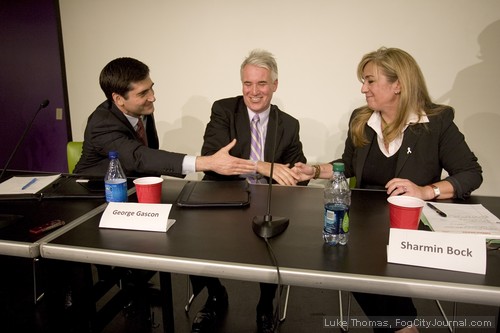
District Attorney and former SFPD Chief George Gascón, Alameda County Deputy District Attorney Sharmin Bock, and former San Francisco Police Commissioner David Onek all landed solid punches during a three-way District Attorney debate that was co-hosted by the San Francisco Young Democrats and the Alice B. Toklas LGBT Democratic Club, and moderated by Recorder editor Scott Graham. The primary sponsor of the debate was the City Democratic Club, according to CDC President Jim Reilly. So, thanks CDC for helping to pull off a great event.

The debate was framed as a choice between Bock, a veteran prosecutor with leadership experience, Gascón, a career cop with managerial experience, and Onek, a former San Francisco Police Commissioner and criminal justice reform expert. And above all it proved that if you lock three attorneys in the same room and pit them in a three-way fight, you’ll be rewarded with a blood sport spectacle.

Bock kicked off by noting that there are many similarities between the three candidates—except when it comes to independence and experience “Experience matters,” Bock said, throwing a one-two punch at Gascón and Onek. “The job of the District Attorney is not a management job, a police job or a job for someone with just a law degree. It needs a veteran prosecutor,” she said—remarks that resonated well with the crowd, judging from the applause.

But after a few niceties, Gascón shot right back at Bock and Onek. “I am the only one who has led large organizations and pushed public policy forward in an effective manner,” he said.

And Gascón struck a home run when he revealed that when he took the job of Chief of Police in Mesa, Arizona, he was “facing one of the most toxic environments” in terms of hatred towards people of color and the LGBT community–and that he did something about it, by standing up to anti-immigrant Sheriff Joe Arpaio of Maricopa County, and protecting the local LGBT community’s right to protest.

When it was his turn to speak, Onek fired off his own rounds at Bock and Gascón, noting that the state’s criminal justice system is broken—and claiming that it will take an outsider to fix it.
“This is a once-in-a-lifetime opportunity to reform the criminal justice system,” Onek said, laying out his reform-minded track record.

And then he stuck it to both Bock and Gascón by stating that the death penalty does not work. “I will never seek it in San Francisco under any circumstances,” Onek said, earning excited applause, as he noted that he’ll look at all policy question through the prism of three questions: ‘Does it make us safer, is it cost effective and is it fair and equitable?”

Onek also noted that neither the Supreme Court’s ruling that California must reduce its prison population by 30,000, nor Gov. Jerry Brown’s call for prisoner realignment, come with any money.
‘That’s a disaster,” observed Onek, as he stressed the need to demand resources to help deal with the upcoming load of prisoners that about to return to San Francisco.

Gascón fielded questions about whether they are enough people of color and LGBT background in management in the D.A.’s Office. “Well, I think there’s definitely always room for improvement in any organization,” he said, noting that he has a history in the Los Angeles Police Department, the Mesa, Arizona Police Department and the SFPD, “of pushing very aggressively to have diversity within the office.”
But he started a bit of a buzz when he said it was “really a surprise to me that I promoted the first male, black, police captain to the San Francisco Police Department.”
“You would think that there have been, you know, male African-Americans in that department for many years. It was hard for me to believe that actually in 2009 we had not had one,”  Gascón continued, a remark that got some debate observers asking afterwards, if this meant that Gascón really did not know that former SFPD Chief Earl Sanders was a black male.

Meanwhile, Bock was happily trampling all over the sit-lie legislation that then SFPD Chief Gascón and Mayor Newsom backed last fall, as she noted that more foot patrols and community policy are what’s actually needed. “Political hot-button measures don’t work,” Bock said. “Both sides agree it hasn’t worked. It’s the wrong response to the real problem.

Asked if he had a conflict of interest, when it comes to investigating allegations of police misconduct, Gascón claimed the problem is limited to a small number of officers, adding, “if the allegations are true.”

“In reality the majority of the SFPD are hard-working people doing the right thing,” he said. “And there has been only one challenge—and our office has prevailed,” Gascón said. “However, there have been a finite number of cases where I personally adjudicated the bad conduct—and those will be handled by the Attorney General’s office.”

Bock stressed that she was not in favor of sending drug offenders to prison and would focus on restorative justice, instead. Asked if she would have a panel on her staff review potential death penalty cases, Bock confirmed that she is committed to having a Special Circumstances Committee, as D.A. Kamala Harris did, to get input around the facts and from lawyers involved in such cases.“The ultimate decision is mine, and I oppose the death penalty,” Bock said, noting that she does not believe that 12 jurors will return a unanimous death penalty verdict. “But I do think as prosecutor you need to go case by case.”

Asked if he would have sought the death penalty in a case like the L.A. Night Stalker, who murdered 13 people, many of them elderly, Gascón said, “Probably not. All of us agree that the death penalty is not a good tool. But it is part of our system, and I continue to have the system Kamala Harris had in place. At the end of the day, it’s my decision, and I’m the only one in the room, who can say I’ve already turned down the death penalty.”

Agreeing with Bock that a jury is unlikely to go for the death penalty, Gascón maintained that the death penalty is “an illusory issue,” and that the real question is, “How do we rewrite the State Constitution [so the death penalty is not on the books]?”

Asked how he felt about marijuana, Gascón said he doesn’t believe folks should be incarcerated for use—and that folks are already being diverted to community courts in those instances.

But when Onek tried to wrap up by positioning himself as a the reformist-minded outsider, Gascón pounced, reminding folks that Onek was a Police Commissioner, when the Police Commission recommended Gascón to Mayor Newsom as the next SFPD Chief. “While David is someone I respect—and one of those who hired me, David has painted himself as an outsider, when the Police Commission is the policy-making body for the SFPD. There are no outsiders here. The question is, what have you done? There’s a difference between calling yourself a reformer and having other people call you a reformer.”

Bock for her part used her closing remarks to remind folks that there has been a crime lab scandal, alleged police misconduct, a DNA backlog, and about 100 cases dismissed as a result of these scandals, and a bunch of prisoners are about to be sent back to the community because of realignment. “We’re in challenging times, at a critical crossroads, with stormy weather ahead,” she said. “I’m not going to be trying things out at your expense. As a veteran progressive prosecutor, I’m fully prepared.”

Daly: SFBG profiled the wrong guy

88

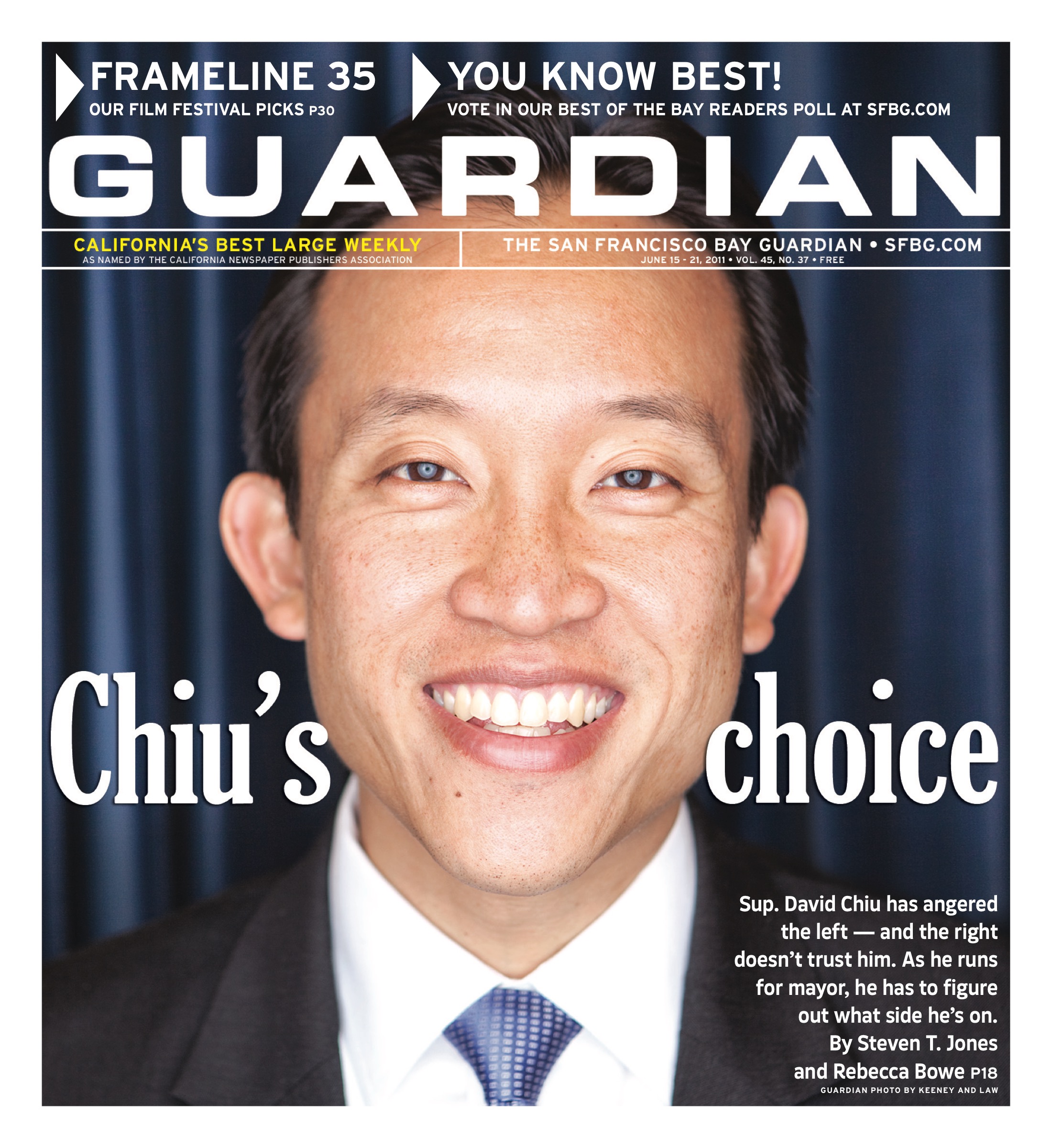
When I interviewed Chris Daly for this week’s cover story on David Chiu and the political realignment at City Hall, Daly said we were putting the wrong guy on the cover.

“If the story is about political realignment, it’s about David Ho,” Daly told me of the political consultant who once worked on his and other progressive campaigns, but who helped engineer a split in the progressive movement with the help of consultant Enrique Pearce and District 3 Sup. Jane Kim, whose campaign they worked on together last year, beating early progressive favorite Debra Walker.

Daly said the political realignment that has taken place at City Hall has more to do with Kim and Ho – in collusion with former Mayor Willie Brown, Chinatown Chamber head Rose Pak, and Tenderloin power broker Randy Shaw – than it does with Chiu, who Daly considers simply a pawn in someone else’s game. Ho is seeking to be Pak’s successor as Chinatown political boss, and he and Pearce have been out there doing the ground work Pak’s effort to convince Lee to remain mayor.

“Any realignment that exists is about David Ho and I think it has more to do with the District 6 race than the District 3 race,” Daly said. “As far as David Chiu and realignment, they are separate things.”

While Ho and Pearce have traditionally worked on progressive campaigns – particularly in high-profile contests like this year’s mayor’s race, where John Avalos is the clear progressive favorite – they are now some of the strongest behind-the-scenes backers of the campaign to convince Ed Lee to run. Neither Ho nor Pearce returned our calls for comment.

“That’s the whole realignment,” Daly said, explaining that it was the peeling of entities like Chinatown Community Development Corporation and the Tenderloin Housing Clinic away from the progressive coalition of the last decade that has cast progressive supervisors into the wilderness and empowered Chiu and Kim, who in turn brought Lee to power.

“It’s not a seismic realignment, it’s a minor realignment, it just happens to be who’s in power,” Daly said. “It was a minor political shift that caused a big change at City Hall.”

Power has now consolidated around Mayor Lee, as well as those who convinced Chiu to put him there, including the powerful players who helped elect Kim. “These people, as far I can tell, have disowned Chiu,” Daly said. “He did what they wanted but he failed the loyalty test in the process.”

Chiu has so quickly fallen from favor that even Planning Commission President Christina Olague, who spoke at Chiu’s campaign launch event on the steps of City Hall just two months ago, is now one of the co-chairs of a committee pushing Lee to run, along with others connected to CCDC and the Pak/Brown power center.

Kim has also notably withheld her mayoral endorsement. She tells us that she’s waiting until after budget season, but the real reason is likely to wait and see whether Lee gets into the race. Daly said this new political power center has been playing the long game, starting with supporting Chiu back in 2008.

“Peskin kind of brought him up, and then I – tactically or a strategic blunder – I made the mistake of not bringing someone up,” Daly said, insisting that he’s always questioned Chiu’s political loyalties. “I had doubts from the beginning. Ultimately, it was Jane Kim and David Ho who tag teamed me and got me on board.”

Daly said Chui’s last-minute move to cross his progressive colleagues and back Lee for mayor “irreparably harmed him with progressives,” while doing little to win over a new political base. “He miscalculated the damage it would do to him,” Daly said.

Chiu’s dependability was also called into question when he was openly considering a deal with Gavin Newsom to be named district attorney, which would have allowed Newsom to appoint his replacement in D3, a move that he didn’t check with Pak.

“He gave control of his political base to someone else,” Avalos told us, offering that if Chiu was going to be so narrowly ambitious then he should have taken Newsom’s offer to become district attorney.

Even those around Chiu have emphasized his independence from Pak, who has desperately been looking for someone she could count on to back and prevent Leland Yee from winning the mayor’s office. And if Lee doesn’t run, sources say she’s likely to back another political veteran such as Dennis Herrera or Michela Alioto-Pier.

But given how deftly Ho and his allies have grabbed power at City Hall, I’d say they have a pretty good chance of convincing Lee to run, despite the mayor’s resistance. And if Lee runs, Daly, USF Professor Corey Cook, and others we interviewed say he would probably win.

Tipping point

3

sarah@sfbg.com

On June 14, members of the Board of Supervisors will vote to appoint a new member of the Police Commission — in the wake of a messy string of alleged police misconduct scandals that, progressives argue, underscore why having strong civilian oversight is critical to ensuring a transparent, accountable police department the public can trust.

The appointment comes less than two months after San Francisco native Greg Suhr was sworn in as chief in the wake of Mayor Gavin Newsom’s decision to appoint former Chief George Gascón as the next district attorney — a move that has served to muddy the D.A. Office’s efforts to investigate the alleged police misconduct.

Further complicating the board’s choice is the heated battle that erupted over the appointment, led in part by members of two Democratic clubs that represent lesbian, gay, bisexual, and transgender communities.

The Alice B. Toklas LGBT Democratic Club has officially endorsed Julius Turman, a gay attorney and community activist who was a former assistant U.S. attorney and the first African American president of the Alice club. Turman currently works for Morgan, Lewis & Bockius, where he represents companies in actions for wrongful termination, employment discrimination, and unfair competition. He is also state Sen. Mark Leno’s (D-SF) proxy to the San Francisco Democratic County Central Committee and serves on the Human Rights Commission.

On the other side, members of the Harvey Milk LGBT Democratic Club, the voice of the city’s queer left, are supporting David Waggoner, an attorney and community activist who is a former Milk Club president. Waggoner has worked on police use-of-force policy and as a pro bono attorney for the National Lawyers Guild at the Oakland Citizen’s Police Review Board, and been a passionate advocate for the LGBT community, immigrants’ rights, people with disabilities, and the homeless.

The other two applicants for the post are Vanessa Jackson, a staffer at a women’s shelter with experience in counseling ex-offenders; and Phillip Hogan, a former police officer who serves on the board of the Nob Hill Association and has been trying to get on a commission for years.

Although both Jackson and Hogan have diverse experience with law enforcement — Jackson as an African American woman who claims the police have “no respect for people of color” and Hogan as a former police officer of Lebanese-Irish descent who manages real estate — neither has the support of the LGBT community. The position occupied by Deputy District Attorney James Hammer for the last two years, and Human Rights Commission director Theresa Sparks occupied before that, is widely considered to be an LGBT seat.


WHO’S THE REFORMER?

So now the fight is about whether Turman or Waggoner would be the strongest reformer.

In a recent open letter, former Board Presidents Harry Britt, Aaron Peskin. and Matt Gonzalez expressed support for Waggoner. “While most hardworking police officers perform their jobs admirably, insufficient oversight and poor management systems have led to significant problems,” their letter stated. “Despite these widely reported problems, the Police Commission has failed to adequately address these issues. San Francisco needs real reform, not more of the same. We believe David Waggoner will be that voice at this critical time.”

At the June 2 Rules Committee hearing, Waggoner proposed taking away master keys to single-resident occupancy (SRO) hotels from the police. “Significant abuse of that resulted in seriously tarnishing the department,” he said.

Turman made an equally impassioned — if less stridently reformist-sounding — speech. “Why would we allow an officer to enter a home, regardless of the master key rule, which I’m not a fan of?” Turman asked. He also said Tasers are dangerous weapons with unintended consequences. “I fear communities of color will suffer more from Taser use.”

Waggoner’s supporters noted that their candidate has more than 15 years of police accountability experience. Turman’s supporters vouched for his integrity, maturity, ability to build consensus, and “belief in strategically serving his community.”

In the end, Sups. Sean Elsbernd and Mark Farrell voted for Turman, while Rules Committee Chair Sup. Jane Kim voted for Waggoner.

That means Turman’s name has been forwarded to the full board with a recommendation. But because the Rules Committee interviewed all the candidates, the board can still appoint any of them.

At the Rules Committee, Sup. Scott Wiener voiced support for Turman. And Board President David Chiu recently told the Guardian that he has known Turman for years, has worked with him professionally, and will vote for him. “I found him to be fair, thoughtful, and compassionate,” Chiu said, noting that he believes the role of the commission is “to provide oversight and set policy.”

Sup. David Campos, one of the solid progressive votes on the board and a longtime Milk Club member, believes Waggoner would make an excellent commissioner but is a friend of Turman, and believes he’ll be a strong voice for reform. “Sean [Elsbernd] and Mark [Farrell] could be in for a big surprise if Julius gets appointed,” Campos mused shortly after Elsbernd and Farrell voted for Turman.

Campos recalled how he and Turman started working at the same firm years ago. “So I got to know him well,” he said, adding he is “like a family member.

“By virtue of his involvement with Alice, some folks think Julius will be a certain way,” Campos added. “But I believe he’ll take a progressive point of view on the issues. He has both the knowledge and the experience with the police, he understand the important role that police oversight and the Police Commission play in making the SFPD accountable.”

Kim told us that she primarily voted for Waggoner because she knows him the best, and not out of concern that Turman wouldn’t do a good job. “I’m more familiar with David and that’s what tipped the scale,” Kim said. “It’s great to have two strong LGBT attorneys who have a clear understanding of public safety issues, the law, and are advocates for the community.”

But Debra Walker, who ran against Kim last November, steadfastly supports Waggoner. “Julius has been active in the Alice B. Toklas club for a while, he’s a prosecutor, while David is more of a citizen’s defense attorney,” she said.

Turman continues to be dogged by reports of domestic violence, thanks to a lawsuit that Turman’s former domestic partner Philip Horne filed in March 2006 alleging that Turman came into his house when he was sleeping on New Year’s Day 2006 and tried to strangle him.

Horne claimed he “was terrified that the lack of air supply would cause him to pass out and potentially die at the hands of such a jealous and unmerciful former lover.” He alleged he was able to calm Turman down only to see him get enraged again and punch Horne in the face seven to 10 times. When Horne decided he needed to go to the emergency room, the complaint states, Turman grabbed his phone and keys saying, “If you leave, you’ll never see the cats (alive) again,” and “I will report you to the state bar.”

Horne claimed he ran outside screaming for help and that when SFPD arrived, they arrested Turman for domestic violence and called an ambulance for Horne.

Turman responded in July 2006 to what he described as Horne’s “unverified complaint,” arguing he acted in “self-defense” and that the conduct Horne complained of “constituted mutual combat.” He added that “damages, if any, suffered by Horne were caused in whole or in part by entities or persons other than Turman.”

In the end, no criminal charges were ever filed against Turman and the case was settled out of court. Turman now says “I’ve done nothing wrong and these allegations are false.”

Campos warns people not to jump to conclusions. “We need to remember that there is a presumption of innocence,” Campos said. “Yes, there was a court case, but there was never a conviction. Yes, there was a settlement, but people do that for a lot of reasons.”

Turman told the Rules Committee that the incident was from “an extremely difficult time that is now being used against me as a political sideshow.”

Meanwhile, Campos notes that without a reform-minded mayor, there will be only so much any board-appointed police commissioners can do. “What we really need to implement police reform is a mayor who is willing to do that,” he said. “Otherwise it’s going to be very difficult because the mayor still gets to appoint four commissioners and mayor still gets to control who is in charge of the police department.”


WHAT DIRECTION?

Civil liberties advocates praised as a “first step in the right direction” Suhr’s May 18 decision to issue an order clarifying that SFPD officers assigned to the FBI’s joint terrorism taskforce should adhere to SFPD policies and procedures set by the Police Commission, not FBI guidelines.

But in the coming months, the commission will have to decide whether to push a Portland-style resolution around SFPD involvement with the FBI. The commission also will be dealing with fallout from the other scandals, including the crime lab, the use of force against mentally ill suspects, and videos that allegedly show police conducting warrantless search and seizure raids in single residential occupancy hotels.

These scandals have progressives arguing that it’s critical that the board’s three seats on the commission are occupied by applicants with proven track records of reform.

Waggoner notes that in 2003, voters approved Prop. H., which changed the composition of the commission from five to seven members. Four are appointed by the mayor; three by the board.

Last year, he said, the commission made significant progress in the right direction when it adopted new rules after the Jan. 2 shooting of a man in a wheelchair in SoMa. “That was not the first time an unarmed person with a disability was killed,” he said. “After Prop. H and a crisis, the commission finally took steps. It remains to be seen if Chief Suhr will implement that.”

Waggonner said the current arrangement “creates tension between people who are more willing to defer to the chief on policy issues and being in an advisory capacity, as opposed to people who want to be in the forefront of setting policy.”

That tension played out when Commissioners James Hammer, Angela Chan, and Petra DeJesus tried to find consensus on the Taser controversy last year. “Overall they worked well together. But there’s been no progress yet on Tasers,” he said, noting that the commission eventually decided on a pilot project.

Waggoner said he would be in favor of the commission having a more active role and exerting its authority under the city charter to set policy, but in collaboration with the chief.

The Police Commission’s May 18 joint hearing with the Human Rights Commission about FBI spying concerns was a symbol of the broader issue at the Police Commission. The majority of the commission didn’t see any major problems — but the progressives were highly critical. “Is the commission there to set policy and take leadership, or is it there in an advisory capacity?” Waggoner asked.

With Hammer’s departure, Chan and DeJesus, both board-appointed women of color, are the most progressive members of the commission. Chan hopes Hammer’s replacement believes in strong civilian oversight. “We should never be a rubber stamp for the police department,” he said. “We need to take community concerns very seriously. When the police department is doing great things, we should support them — but if we see something wrong, we should not be afraid to speak out.”

Turman told the Guardian that “being the voice for reform and advising are not mutually exclusive roles — and an effective police commissioner needs to be both.

“I would advocate for series of meetings with representatives from the Arab community, the SFPD, and the FBI to increase communication and understanding of each side’s perspective on exactly what we need to implement in San Francisco,” Turman said.

Asked more about Tasers, Turman said that “one of the things I would be interested in pursuing is a recognition by some that female officers are less likely to incapacitate during an arrest, which could lead to learning for the larger police force.”

But does this means Turman will turn out to be a swing vote for Tasers? Only time — and the board’s June 14 vote — will tell.

Behind the all-smiles budget

2

news@sfbg.com

When Mayor Ed Lee released his 2011-12 budget proposal June 1, all was sweetness and light at City Hall.

The mayor delivered the document in person, to the supervisors, in the board chambers. Sup. Carmen Chu, chair of the Budget Committee, was standing to the mayor’s right. Board President David Chiu was to his left. There was none of the imperious attitude we’d come to expect in the Gavin Newsom era — and little of the typical hostility from the board.

As Sup. David Campos, who was elected in November 2008, remarked afterward: “It’s the first time since I’ve been elected that the mayor has taken the time to come to chambers. It’s reflective of how this has been a lot more of an inclusionary process.”

Lee went even further. “This is a pretty happy time,” he said. “There are no layoffs, and instead of closing libraries we’ll be opening them.” That earned him an ovation from assembled city leaders, including mayoral candidates City Attorney Dennis Herrera and Assessor-Recorder Phil Ting along with District Attorney George Gascón. “I think this budget represents a lot of hope.”

It’s true that this year’s cuts won’t be as bad as the cuts over the past five years. It’s also true that the pain is spread a bit more — the police and fire departments, which Newsom, always the ambitious politician, wouldn’t touch, are taking their share of cuts.

But before everybody stands up and holds hands and sings “Kumbaya,” there’s some important perspective that’s missing here.

Over the past half-decade, San Francisco has cut roughly $1 billion out of General Fund spending. The Department of Public Health has eliminated three- quarters of the acute mental health beds. Six homeless resource centers have closed. The waiting list for a homeless family seeking shelter is between six and nine months. Muni service has been reduced and fares have been raised. Recreation centers have been closed. Library hours have been reduced.

In other words, services for the poor and middle class have been slashed below acceptable levels, year after year — and Mayor Lee’s budget doesn’t even begin to restore any of those cuts.

“We’re not ready yet to restore old cuts,” Lee told the Guardian in a June 2 interview. “It was enough for us to accomplish a pretty steady course and keep as much. Particularly with the critical nonprofits that provide services to seniors and youth and homeless shelters, we kept them as close as we could to what last year’s funding was.”

But the current level of funding is woefully inadequate. As Debbi Lerman, administrator of the Human Services Network, noted, the people who work in the nonprofits Lee was talking about haven’t had a pay raise in four years — even though the cost of living continues to rise. “Our costs have gone up with cost of inflation,” she noted.

She said the cuts over the past few years have deeply eroded services for children, homeless people, substance abuse programs, and others. “There have been significant cuts to every area of health and human services.”

And in a city with 14 billionaires and thousands more very wealthy people, Lee’s budget is distinctly lacking in significant new ways to find revenue.


THE GOOD NEWS

Just about everyone agrees that the budget process this year has been far better than anything anyone experienced under Newsom. “He [Mayor Lee] listened to everybody,” Lerman said. “That doesn’t mean they fixed everything. Mayor Lee fixed as much as he could.”

At his press conference announcing the release of the budget, Lee thanked Police Chief Greg Suhr for having already made significant cuts through management restructuring and for considering an additional proposed cut of $20 million.

“We want to thank you for that great sacrifice,” Lee said, addressing Suhr, who sat in front row of public benches, dressed in uniform. Lee next acknowledged that adequate funding for social services also helps public safety. “Without those services, officers on the street would have a harder job,” he said.

Lee also praised the departments of Public Health and Human Services for helping to identify $39 million in federal dollars and $16 million in state dollars, to help keep services open and the city safer.

Lee noted that San Francisco no longer has a one-year budget process and has just released its first five-year financial plan as part of its decision to go in five-year planning cycles.

“To address this, I’ve asked for shared sacrifice, ” Lee continued, adding that he recently released his long-awaited pension reform charter amendment, emphasizing that it was built through a consensus and collaborative-based approach.

Lee also said he would consider asking voters to approve what he called “a recovery sales tax” in November if Gov. Jerry Brown is unable to extend the state’s sales tax. That would bring in $60 million — but it is only on the table as a way to backfill further state budget cuts.

Lee observed that San Francisco is growing, the economy is looking brighter, and unemployment is down from more than 10 percent last January to 8.5 percent today. He plugged the America’s Cup, the city’s local hire legislation, the Department of Public Works’ apprenticeship programs, and tourism, both in terms of earmarking funding in the budget for these programs and their potential to boost city revenues.

He said his budget proposed $308 million in infrastructure investments that include enhanced disability access, rebuilding jails, and energy efficiency, and is proposing a $248 million General Obligation bond for the November ballot to reduce the street repair backlog.

“We will get these streets repaired,” he promised.

“This submission of a budget is not an end at all, it’s the beginning of the process,” he continued, going on to recognize Chu for her work getting the process rolling and thanking Budget Analyst Harvey Rose in advance. “I do know his cooperation is critical.”

And he concluded by thanking each of the supervisors. “I will continue enjoying working with you — we need to keep the city family tight and together.”

The sentiment was welcomed by supervisors. “As he said, this is the beginning of the process, and it’s an important and symbolic step” Campos said. “The budget shows that a lot of good programs have been saved. But there is still work to do.

“There are still gaps in the safety network,” he added, singling out cuts to violence-prevention programs. “It’s my hope they will be restored.”


THE BAD NEWS

But even if the cuts for this year are restored, the city budget is nowhere near where it ought to be. “We still had to make cuts,” Lee acknowledged.

“We did consider very seriously a whole host of revenue ideas that we had,” he said. “They were not off the agenda at all.” At the same time, he noted that state law requires a two-thirds vote for new taxes (although that threshold drops to 50 percent in presidential election years). “We decided that it’s not that they were bad ideas, but that we wouldn’t be able to sell them at this time.”

Lee praised some of the revenue ideas that have been suggested in the past year, including the alcoholic beverage fee proposal by Sup. John Avalos, which Lee called “a pretty good idea.” He said that “a year or two from now” an additional sales tax and a parcel tax (for the police or for schools and open space) might be on the agenda.

The city now has a multiyear budget process and projections are supposed to go beyond a single year. But what’s missing — and what nobody is talking about — is a long-term plan to restore critical city services to a sustainable level. That means talking — now — about tax proposals for 2012 and beyond and including those revenue streams in long-term budget planning.

Because the city parks, the public health system, the libraries, the schools, affordable housing programs, and the social safety net are in terrible condition today, the result of year after year of all-cuts budgets. And while the supervisors and the mayor wrangle over the final details, and advocates try to win back a few dollars here and a few dollars there, it’s important to recognize that this budget does nothing to fix the damage.

“We’re about $10 million short of what we need right now to keep service providers at current levels,” noted Jennifer Freidenbach, who runs the Coalition on Homelessness. “But we also need to restore the health and human services system that was slaughtered under Gavin Newsom.”

FBI spying will be an issue for new Police Commissioner

1

When Police Chief Greg Suhr got sworn in at City Hall a month ago, reporters each got to ask one question during a hastily convened media roundtable inside Mayor Ed Lee’s office. And since the Guardian’s story about the FBI’s secret agreement with the San Francisco Police Department had just hit the streets, I asked the new Chief, if he would welcome clarification around the duties of SFPD officers assigned to the FBI’s Joint Terrorism Taskforce.

Chief Suhr said he believed an examination of the wording of the FBI’s most recent memorandum of understanding (MOU) with the department was already under way. “I believe that the MOU is being revisited,” Suhr said. “I have not been a part of that, but again I think we have a real good policy with regard to our intelligence gathering and that does supercede any ask of any other agency. The officers are bound by policies and procedures. And that policy was well thought out with tremendous community and group input years and years ago, from situations that have not since repeated themselves. I think a lot of people back then couldn’t believe they happened in the first place, but I think measures were well thought out and put in place to make sure we don’t have a problem again.”

Fast forward three weeks, and Suhr found himself in the hot seat at a May 18 joint meeting of the Human Rights Commission and the Police Commission, where commissioners got an update about the Police Department’s response to community concerns about surveillance, racial and religious profiling of Arab, Middle Eastern, Muslim, and South Asian Communities and the potential reactivation of SFPD Intelligence Gathering.

After Suhr introduced his new Command Staff—and stressed their great diversity–Police Commission President Thomas Mazzucco, who was Suhr’s football coach in high school, tried to assure folks that the Police Commission, the Human Rights Commission, the FBI, the SFPD, the American Civil Liberties Union and the Asian Law Caucus had already addressed the community’s intelligence-gathering concerns, in part through a bureau order that Chief Suhr then introduced during the hearing, in which Suhr clarified that SFPD policies trump FBI guidelines every time.

And Mazzucco,  a former Assistant U.S. Attorney for the Northern District of California and a former Assistant District Attorney for San Francisco, before Mayor Gavin Newsom appointed him to the Commission in 2008, noted that the community’s concerns were based on allegations. not factual findings.

But his comments got folks wondering whether Mazzucco’s prior involvement with the feds left him with a blind spot that is preventing the Police Commission from dealing with the issue in a timely and effective manner, particularly since Commissioner Jim Hammer’s term has expired, and the rest of the Commission is waiting for the Board’s Rules Committee to decide between nominating David Waggoner, L. Julius Turman, Phillip Hogan or Vanessa Jackson as the next new Police Commissioner.

For, as members of the public observed during the meeting, if the Police Commission President himself expresses no outrage at finding that the Commission’s policies have been undercut for the past four years by secret agreements between SFPD and the FBI, how can San Francisco claim to have a credible system of civilian oversight?

Instead, they felt that Mazzucco seemed more concerned about defending federal practices and officials, who were unwilling to show up at the May 18 hearing, than worrying about the role and authority of the civilian oversight body he now represents. And attorneys with the ACLU and the Asian Law Caucus noted that though Suhr characterized his new order as being based on the Portland resolution and a prior proposal from community advocates, they believe Suhr’s approach can only work with the written consent of the FBI, (which SFPD doesn’t have) if the FBI’s 2007 contract is left in place.

“That’s why there is a need for a transition to a non-MOU, Portland-style resolution,” ACLU’s John Crew told the Guardian, noting that ACLU’s willingness to work collaboratively with the commissioners and the new Chief should not be confused with a willingness on ACLU’s part to roll over and accept an approach that is based on wishful thinking rather than the realities of the MOU that’s still in place.

During the May 18 joint hearing, Chief Suhr acknowledged “the validity of the perceptions raised by the community,” even as he insisted that SFPD has “very strict policies” in place to ensure appropriate oversight for investigation- involving activities.

Suhr summarized the history of those policies, including ACLU’s John Crew’s involvement in creating Department General Order (DGO) 8.10, which establishes that there must be reasonable suspicion before SFPD intelligence gathering can occur.

Suhr noted that SFPD joined FBI’s Joint Terrorism Taskforce (JTTF) after the September 11, 2001 attacks, and SFPD officers assigned to the JTTF subsequently came under control of the Department of Homeland Security unit, but starting now, they are back under SFPD’s special investigations.

“I gave the order today that JTTF will be moved back under SFPD’s special investigation unit,” Suhr said. “They will have the security clearance necessary to oversee the activities. The members are required to comply with all department policies, even if they can conflict with FBI policies. Simply said, San Francisco policies, procedures, laws, and statute trump any federal policy or procedure. Our officers are bound by those.”

Suhr said that to ensure everyone is clear about the chain of command, he’d drafted his May 18 bureau order. “It essentially turns back the clock and emphasizes that officers are responsible for our policies and procedures first, and our officers are bound to identify themselves as San Francisco police officers,” Suhr said, further noting that he’d be happy to further amend his new order as needed.

And Mazzucco noted that SFPD has absolutely no jurisdiction whatsoever over the Transportation Security Administration’s activities at the airport.

But while Human Rights Commission Chair Michael Sweet said Suhr’s new bureau order,  “goes a long way toward helping to alleviate some of the concerns,” he and many commissioners noted that this was their first chance to read the order. And Sweet said he saw the May 18 joint hearing “as by no means the end of the discussion.”

HRC director Theresa Sparks, who was on the Police Commission when the FBI drafted its 2007 JTTF MOU, noted that the issue is not whether we should opt out, but what we can do to ensure that officers involved in activities have “strong civilian oversight of their activities and report activities through the established civilian oversight mechanisms and procedures defined in DGO 8.10.”

” Our approach to achieve this objective is to publish internal directives ensuring our officers only participate in activities that meet our local standards of reasonable suspicion,” Sparks stated, claiming that Suhr’s order will “ give the city control over misconduct charges and allegations of misconduct charges.”

Sparks noted that the May 18 hearing was a status report about “alleged violations by the FBI and SFPD, as well as airport police,” and that the HRC “did no independent investigation” to verify these allegations.

Sparks added that HRC and the Immigrant Rights Commission has a tentative agreement to move forward with townhall meetings to address community concerns, and will encourage the Board to appoint a special prosecutor to determine if the prosecution of terrorism cases is valid and fair, and discuss the need for an Ombudsman at the airport. And she talked about the need for SFPD to establish legal safeguards, mechanisms for greater transparency and oversight, and conduct more detailed yearly audits.

“Tonight was a real dialogue about the issues,” Sparks said, further noting that civilian oversight of local JTTFs is also a popular discussion in Oakland and in Portland, Oregon, which has decided to rejoin its local JTTF after opting out in March 2005. But she didn’t mention that Portland had entered into a resolution with the FBI, instead of signing a new MOU with the feds.

That explanation was left to Veena Dubal of the Asian Law Caucus and ACLU’s Crew– in between explaining why they believe Suhr’s Bureau Order isn’t enough. “The good news is that we all collectively agree that SFPD policies should apply to SFPD officers assigned to the JTTF,” Dubal said. “The bad news is that the recently released MOU, which was secret for four years, doesn’t reflect our collective desires.”

Dubal stated that the FBI won’t amend its 2007 MOU with the SFPD.
“And that is why the Chief issued the bureau order,” Dubal stated, claiming that the FBI Special Agent in Charge of JTTF involvement recently told ALC and the ACLU that the FBI will continue to block key parts of local policy central to accountability and oversight.

“But there’s a solution and it doesn’t necessitate a divorce from the joint terrorism task force,” Dubal continued, noting that there are now two ways for local law enforcement officers to participate in JTTFs: an MOU, in which SFPD resources are put into the hands of FBI with relatively no local control, as in the SFPD’s 2007 agreement with the FBI. Or via a resolution which the federal government just approved in Portland, which allows participation in the JTTF, but provides much better protection for civil rights and gives the police department and the police commission more control of the relationship.

Dubal noted that in the decade since 9/11, the FBI has expanded its intelligence powers, and its agents are now allowed to conduct intelligence without a factual connection to criminal activity.

“Given these massive shifts in FBI activity, the question is, what should the relationship between the SFPD and the FBI look like?” Dubal said.

“Unlike the FBI, the SFPD is not a national security organization, “ Dubal continued, noting that when SFPD signed up to work with the JTTF under an MOU that preserved local control and policies, “it wasn’t assuming that some of its officers, paid for by San Francisco taxpayers, could be transformed into national security agents.”

”The SFPD signed on without telling anyone, not even the police commission,” Dubal said, noting that SFPD cannot afford to participate in these practices. “We need community trust to keep all of our communities safe.”

ACLU’s Crew noted that the FBI came to the SFPD in 2007 with a new MOU. “And perhaps inadvertently, there was no review by the City Attorney, and no notice to the police commission,” Crew said. “And it’s a drastically different MOU, unfortunately.”

“Now, we didn’t know about that MOU because it was kept secret at the insistence of the FBI for four years,” Crew continued, further noting that when ACLU and ALC met with the SFPD in 2010, they were suddenly told that the police department couldn’t talk about these issues without FBI permission.

“That set off a warning sign,” Crew observed, noting that in early April, when the ACLU and ALC finally got the MOU released, their worst suspicions were confirmed.

“There was no public discussion of transforming the SFPD into a national intelligence gathering association,” Dubal said. “The problem is that the FBI changed the deal, and the SFPD signed it, without telling anyone.”

Dubal noted stark differences between the FBI’s 2002 MOU and the one the SFPD signed in 2007, along with stark changes to FBI guidelines that occurred in 2008, in the dying days of the Bush administration, and that now allow a new assessment category, that does not require reasonable suspicion and has been criticized by civil liberties groups.

And according to Crew, the FBI’s new MOU “puts at risk the very concept of civilian control.” As Crew noted, between the mid 1990s, when the SFPD developed DGO 8.10, which governs its officers’ intelligence-gathering policies and procedures, and 2007, when the FBI prepared a new JTTF MOU, there’d been little controversy over intelligence-gathering in San Francisco.

 “And then, perhaps inadvertently, the SFPD signed that MOU and it was drastically different and kept secret at the insistence of the FBI for four years,” Crew observed.

And in 2010, the SFPD suddenly said it couldn’t talk about the issue without the permission of the FBI, Crew added, noting that “Unnecessary secrecy breeds suspicion.”

“We don’t think the Bureau Order is sufficient,” Crew concluded. “This is an issue that has to be dealt with at the Police Commission level.”

Crew noted that the Portland City Council chose not to enter into an MOU, “specifically because it restricts the ability to provide local control and local oversight. “

“So, we are not saying opt out, but we are saying there needs to be a transition to a resolution that maintains local control over the assignment of officers and provides all these elements of civilian oversight,” Crew continued.

He claimed that the federal government says a resolution is possible, as long as you’re not doing it under an MOU.
“So the question is, if that level of protection is available now to the people in Oregon, why would San Francisco not take the same deal?” Crew said. “All you have to do is give 60 days’ notice to the FBI that are you going to start this transition to a resolution. That notice period allows the FBI to have any comments or express any concerns they want, I think it’s very regrettable that they chose not to participate tonight and unfortunately I think it says something in terms of how seriously they take these concerns.”

Crew concluded that such a transition would be a win-win situation.

”If we went to a resolution that merely asserted local policy, then they could keep doing exactly what they’re doing now,” Crew said. “On the other hand, if it turns out that there’s activities SFPD is involved in that they shouldn’t be involved in, don’t we want those stopped?

“The one comment I will make of the bureau of general order is that I’m thankful to hear it’s a work in progress,” Crew added, noting that ACLU and ALC “don’t think a bureau order is sufficient. That’s because it can be changed at any time without the notice of the police commission, without a public hearing.”

But Mazzucco disagrees with ACLU and ALC’s claims that FBI intelligence-gathering guidelines have been relaxed since 2008.
 “There are no random assessments, and there has to be a predicate of a criminal violation,” Mazzucco told commissioners, noting that ” with honorable people like Bob Mueller” (Mazzucco’s former boss) “running the FBI, there should be a level of confidence that there will not be any violations.

And in a follow-up call, Mazzucco told the Guardian that he thought Suhr’s bureau order clarifies that “local officers follow SFPD rules.”

Mazzucco also suggested that Police Commission oversight, “is more over policy and procedures and less about operations,” by way of explaining how the SFPD’s 2007 MOU  with the FBI never came before the Commission.
“But I suggested that we see the next MOU in this area,” Mazzucco added.

And he proposed “a simple solution” moving forward, namely transparency and educating the public,” about the JTTF.

“SFPD is probably the most diverse police department in the country,” Mazzucco said. “And there is civilian oversight. We won’t let anything untoward happen.”

And he praised the new US Attorney for Northern California Melinda Haag, and FBI Special Agent Stephanie Douglas for their participation in recent meetings with city officials about the community’s intelligence-gathering concerns.
“The good news is that nothing controversial is going on here,” he said, noting that out of the broad array of community advocates who showed up at the May 18 joint hearing, there were maybe five citizens who spoke about encounters with the FBI, and only one from the Bay Area. ”My goal is to make everyone feel comfortable,” he said.
 
But HRC Chair Sweet acknowledged at the May 18 joint hearing that it was “very difficult” to know from a first reading of Suhr’s Bureau Order if it fully addressed the community’s intelligence-gathering concerns. “I think a great deal of discussion really needs to take place on that particular issue,” he said.

And HRC Vice Chair Douglas Chan dug into the details, starting with the apparently now classified question of how many SFPD officers are currently assigned as deputized FBI officers.
”We don’t generally discuss the specific numbers, but I will tell that you we’ve never had less than two officers assigned to the JTTF,” Suhr replied.

And he told Chan more work can be done on the Bureau Order. 
“The intent of the order was to align it with DGO 8.10 and to close any gap that was in the 2007 MOU,” Suhr said.

Chan asked if SFPD has in mind “ a framework or an approach” if a case arises, wherein an officer, in order to defend himself against an allegation of misconduct, or a citizen seeking to discover facts and other evidence relating to an incident, bumps up against this need to know and the fact that apparently JTTF activities are, “under a federal classified information.”

“I think that would probably need to be flushed out in subsequent drafts of the bureau order,” Suhr replied. “I think we could turn the clock back to where the officers are ultimately accountable to the police department, the commission and the citizens of San Francisco.  I think that the most recent MOU, as has been discussed, there was somehow a mishap where it was not reviewed.”

 And while Police Commissioner Petra DeJesus said Suhr’s Bureau Order was, “a step in the right direction,” she added that she felt it needs to be amended to clarify how the Police Commission would truly have oversight of SFPD officers’ JTTF activities.
‘Even though a commissioner is going to look at what’s been done monthly, that commissioner doesn’t have the clearance, and we’d only see a sanitized version of the events,” she observed. “And we need to look at the auditing report part of it.”
 
 And Police Commissioner R. James Slaughter said he thought everyone was “frustrated that the FBI is not here to answer some of these questions.” I think that would help us.”

And now, with four candidates vying to replace Jim Marshall as the seventh Police Commissioner, it’s not clear what the Police Commission will do beyond Suhr’s Bureau Order. But clearly that question now becomes part of the commission selection process.

And so here is the basic direction of Suhr’s new Bureau Order:

 
Under Suhr’s new Bureau Order (not to be confused with an FBI order) SFPD officers assigned to the FBI’s terrorism task force must abide by local policies protecting civil rights rather than looser federal rules.

 “It is the responsibility of the Federal Bureau of Investigations (FBI) to prevent, investigate and respond to terrorism in the United States.” Suhr’s May 18 order states. “The FBI has established local Joint Terrorism Task Forces (JTTF) to share resources and coordinate among federal, state, tribal and local governments. It is the policy of the [San Francisco Police] Department to help prevent and investigate acts of terrorism, protect civil rights and civil libertes under United States and California law, and promote San Francisco as an open and inclusive community by participating in the FBI Joint Terrorism Task Force.”

“The Chief may assign SFPD offices to work on JTTF investigations that comply with the requirements stated above regardless of whether or not the investigation is based in the City & County of San Francisco,” Suhr’s order, which was issued by Deputy Chief Kevin Cashman, continued.

 “SFPD offices shall work with the JTTF only on investigations of suspected terrorism that have a criminal nexus,” Suhr’s Bureau Order concludes. “In situations where the statutory law of California is more restrictive of law enforcement than comparable federal law, the investigative methods employed by SFPD officers working on JTTF investigations shall conform to the requirements of such California statutes. While cross-designated and deputized as federal officers for the purposes of their JTTF assignments, when not operating in a covert or undercover capacity, SFPD officers shall always identify themselves to members of the public as SFPD officers.”

Or as Suhr told commissioners May 18, “Our officers will follow our department orders.”
.


Fatal stance

7

sarah@sfbg.com

Ever since Mayor Gavin Newsom appointed Police Chief George Gascón district attorney in January — when Gascón said he was “not categorically opposed to the death penalty and would consider it in appropriate cases” — capital punishment has become a big issue in a town where the last death penalty case was in 1989.

Gascón is running against former San Francisco Police Commissioner David Onek, who is the founding director of the Berkeley Center for Criminal Justice and has consistently promised since entering the race last summer that he will not seek the death penalty.

Both men also face a serious challenge from Alameda County Deputy D.A. Sharmin Bock, who opposes capital punishment but won’t categorically state that she would never seek it, as former DAs Kamala Harris and Terence Hallinan both did while running for office.

Bock said that Harris eventually formed a committee to review each capital case but never filed for the death penalty, including in the 2004 murder of San Francisco police officer Isaac Espinoza, the same approach Bock would take. But she doesn’t think it’s legally wise to make a categorical statement opposing the death penalty, saying it could be challenged in court, as some attorneys tried to do with Harris.

“But capital punishment is unjust, and can say that categorically,” she said.

In the week since Bock’s May 17 campaign launch, Gascón challenged her credibility on the issue by noting that Bock used the threat of the death penalty to secure a guilty plea from a sexual predator who tortured and killed women in Alameda County last year.

But Bock used that case to draw a distinction in their positions on the issue, telling us, “George Gascón says he’d use it for the most heinous cases, and I’ve seen the most heinous cases and I haven’t use it,” Bock said, emphasizing that she’s the only prosecutor in the race.

In a May 1 Chronicle op-ed, Gascón tried to neutralize Onek and those opposed to the death penalty by noting that he also has “serious misgivings” about capital punishment, including the potential for wrongful convictions, the disproportionate application on racial minorities, the roller-coaster the victims’ families endure as they wait decades for closure, and the financial impact on an already overburdened justice system.

But Gascón also tried to hide behind the “death penalty is state law” defense, even though prosecutors have extensive discretion in such matters. “Rather than refuse to enforce our laws, I believe the more appropriate approach is to accept the law and work to change it,” Gascón wrote. “I don’t believe district attorneys should be allowed to supplant the views of the state with those of their own.”

Bock criticized Gascón’s deferential stance, which was in sharp contrast to Sheriff Mike Hennessey, who recently announced that he will stop cooperating with federal immigration officials and start releasing undocumented immigrants jailed for minor offenses before they can be picked up for deportation, to comply with San Francisco’s sanctuary ordinance.

Gascón appeared to be trying to cast his position as a courageous stand. “Some have given me the political advice to simply say I will not seek the death penalty in San Francisco,” he wrote. “While I am not prepared to say that at this time, I can say that I do intend to be a district attorney committed to San Francisco values.”

And he promised that if he believes a case merits the death penalty, he would seek the advice and counsel of a panel of local prosecutors. “Ultimately, the decision will always rest on my shoulders, and it is a decision that I will not take lightly,” Gascón wrote.

But Onek accused Gascón of giving a politician’s answer. “Gascón is trying to have it both ways,” Onek told the Guardian. “The voters have the right to hear a clear answer to a fundamental question. And my answer is clear — I will not seek the death penalty in San Francisco and I will continue to work to change the law statewide. To me, it’s a yes or no question, and I won’t seek it. Period.”

Onek says his stance is informed by his belief that the death penalty solves nothing. “It doesn’t make us safer; it’s not fair and equitable; and it wastes enormous resources,” he said. “We are much better off spending our precious resources on things that actually make us safer, like more cops on the streets, more programs in our communities, and better services for victims.”

Gov. Jerry Brown made a similar comparison last month when he canceled a $356 million project for a new death row at San Quentin. “At a time when children, the disabled, and seniors face painful cuts to essential programs, the state of California cannot justify a massive expenditure of public dollars for the worst criminals in our state,” Brown said.

A recent David Binder research poll found 63 percent support statewide for commuting all of the 700 sentences of California’s death row inmates to life in prison without parole and requiring them to pay restitution to the victims’ families, while 70 percent of Bay Area voters support the plan, which would save the state $1 billion over five years.

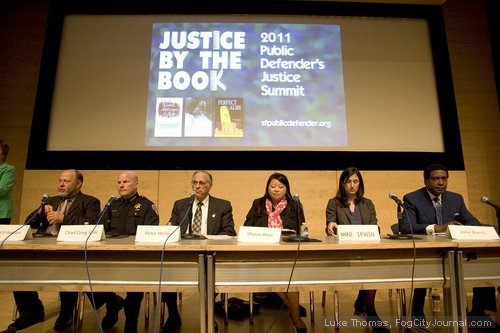
At a May 18 panel discussion on the death penalty, Public Defender Jeff Adachi’s criminal justice summit offered panel moderator Matt Gonzalez, a chief attorney in Adachi’s office, a timely opportunity to grill Gascón about his death penalty stance.

“Folks felt it might be a step backward,” Gonzalez said, noting that former D.A. Terence Hallinan pledged not to seek the death penalty when he ran for reelection in 2000, and Harris followed suit when she first ran for district attorney in 2003. “So — are you pro death?” Gonzalez asked.

“No, but I am a public official,” Gascón replied, even as he repeated his misgivings about the death penalty, including the fact that 62 percent of those on death row are minority populations, especially from African American and Latino communities.

The panel also provided a chance to see Gascón debate exonerated death row inmate JT Thompson, watch American Civil Liberties Union of Northern California attorney Natasha Minsker explain why the death penalty system is dysfunctional, and witness former San Quentin prison warden Jeanne Woodford describe how the impacts of the four executions that she reluctantly oversaw motivated her to sign on as director of Death Penalty Focus, a nonprofit dedicated to abolishing capital punishment.

“Who is responsible for the prosecutors that go bad?” asked Thompson, an African American man who spent 14 years on death row in Louisiana, and another four facing life without parole, because a prosecutor suppressed exculpatory evidence.

“When I was sentenced to death in 1985, for a crime I didn’t commit, I thought this would be rectified right away. But it took 18 years, and I watched 12 inmates being executed while I was there,” Thompson said, noting that he was holed up 23 hours a day.

Gascón said he would terminate prosecutors who withheld exculpatory evidence, but said he didn’t know if he could charge them with murder.

Thompson, founder of the New Orleans-based nonprofit Resurrection after Exoneration, argued that the debate needs to be recast from its current public safety frame.

“People need to be asked, ‘Under what conditions do you support giving the state the right to kill you?’ ” Thompson said.

Woodford recalled how she got sick after the last execution she presided over. “I focused on what my responsibility was. But in hindsight, I realize it had had much more of an impact,” she said. “These executions happen in California at least 20 years after the crime. And they don’t bring victims back.”

Minsker noted that 16 states do not have the death penalty, and that every day brings people closer to ending the practice in California. “People once thought opposing the death penalty would end political careers, but Kamala Harris showed that it is no longer a liability,” she said.

Reached by phone after the debate, Onek said ending capital punishment makes sense morally and financially. “We would have $1 billion to invest in things that actually make us safer,” Onek said. “The D.A. is given discretion around requesting the death penalty, and I will use my discretion to reflect San Francisco values. That’s why people in the trenches working on these issues, including Jeanne Woodford, support me in this race.” 


Perception of lost integrity costs police

1

Reporting by Sarah Phelan. Photograhy by Luke Thomas.

At the San Francisco Public Defender’s Office’s May 18 Justice Summit, the ethics of law enforcement were a central topic. And not surprisingly, the latest incidents of alleged police conduct in which SFPD officers are caught on surveillance video, which the Public Defender’s Office released, as they apparently steal personal property from suspects whose homes in the Julian Hotel they searched for drugs under possibly illegal circumstances, were on everyone’s minds, along with the crime lab and Henry Hotel scandals.

Asked if District Attorney George Gascón, who was Chief of Police until January, is considering a special prosecutor to look into these latest incidents, Sharon Woo, the D.A.’s Chief Assistant of Operations, said the D.A. looks into each case as it comes in. “We are trying to enhance the videos that came in from the Public Defender’s Office,” Woo said in a pre-summit interview. “Some are not as clear as we’d like.”

Earlier this year, when Gascón first became aware of the allegations against officers at the Henry Hotel, he directed the D.A.’s office to open an investigation into the officers and their alleged conduct. The move got David Onek, who is running against Gascón in the D.A.’s race, urging Gascón to turn the investigation over to an independent prosecutor.

But for a week, Gascón maintained that there was no conflict, and when he did finally announce that he was turning the investigation over to the to the U.S. Attorney’s Office – he claimed it was about “resources”. “New information has come to light that indicates it is better to turn over this investigation to the FBI,” Gascón said. “I have spoken to the U.S. Attorney, Melinda Haag, and she has agreed to take over the full investigation. We will of course cooperate fully with the FBI, and provide whatever assistance they need from us.”

At the time, Onek noted that Gascón’s decision was correct step. But he criticized Gascón for not making it his policy to recuse himself from any investigations that relate to his own tenure as chief. And Alameda Assistant D.A. Sharmin Bock, who recently sprung into the D.A.’ race, described Gascón’s situation on this matter as being “between a rock and a hard place.”

But yesterday, Woo noted that while it’s true that Gascón was SFPD Chief when many of the recent misconduct scandals occurred, Mayor Gavin Newsom had already appointed him D.A. when the Julian Hotel incidents occurred in February.

And Peter Herley, former chief of the Tiburon Police Department, told the Guardian that there “is always the Attorney General” to refer cases if D.A.’s feel conflicted. “George Gascón is a very upstanding individual who has also worked for the Los Angeles Police Department and was Chief of Meza, Arizona, and has done a good job in every place he’s been,” Herley said during a pre-summit interview. “So, if he sees a conflict arise, he’d probably recuse himself. It’s the public perception that’s key, that’s paramount.”

During the summit’s panel on ethics, retired San Francisco Superior Court judge Lee Baxter grilled panelists with incisive questions—as befits any self-respecting judge, retired or otherwise–on whether police misconduct is the product of a departmental culture. Noting that there had been a seemingly non-stop string of alleged police misconduct scandals in the Bay Area from drug thefts, dirty D.U.I cases, stolen drugs and setting up a brothel, Baxter observed, “If I saw a movie that included all those things, I’d think that this is not realistic.”

And there was a perhaps surprising amount of stated consensus about what needs to happen next from panelists Woo, Herley, defense attorney Stuart Hanlon, newly sworn-in SFPD Chief Greg Suhr, Anne Irwin, an attorney at the Public Defender’s Office, and John Burris, an Oakland-based civil rights attorney who is renowned for representing plaintiffs in police brutality cases.

Baxter asked the panelists why abuse of power happens, and whether, when we see media accounts of alleged police misconduct, we see the most extreme cases.

Hanlon kicked off by referring to the case of Elmer “Geronimo” Pratt, a former high ranking member of the Black Panther Party, who was tried and convicted of the kidnap and murder of Caroline Olsen in 1972, and spent 27 years in prison, eight in solitary confinement, until 1997 when his conviction was vacated on the grounds that the prosecution concealed evidence that might have exonerated him. In particular, the government had not disclosed that a key witness against Pratt, Julius Butler, was an informant for both the FBI and the LAPD. Pratt eventually received $4.5 million as settlement for false imprisonment—the city of L.A. paid $2.75 million, the U.S. Department of Justice paid $1.75 million.

“We learned that law enforcement officers had hidden evidence, let people commit perjury, and destroyed evidence to convict someone who was innocent, “ Hanlon recalled, noting how when he first worked on the case, folks wondered if Pratt’s claim of innocence was simply part of a big conspiracy theory. “But it was not, it was men and women who thought the ends justified the means” Hanlon said, noting that the “bad apples” theory is typically trotted out during investigations into alleged police misconduct. “But officers see people who they think are bad people, and they feel they must whatever it takes,” Hanlon continued. “Primarily, most law enforcement people are good, but sometimes you get good cops lying to protect bad cops. It’s a dilemma, this concept of ‘what we do we need to do, this ‘us versus them’ concept.”

Hanlon claimed that officers don’t think citizens who live in SROs (single room occupancy hotels) have the same rights as folks in Pacific Heights.
“They think it’s OK to break down doors because these are drug dealers,” he said. And he noted that the recent string of back-to-back scandals are unusual in their proximity but are not unusual, generally speaking. “I’m not an apologist for (Chief) Suhr or the D.A., but I’ve seen these problems forever, and without trust law enforcement doesn’t work,” Hanlon concluded.

Next, Baxter put Suhr in the hot seat by asking him what to do about the “ends justify the means concept”. At which point Suhr, who has been Chief for less than two weeks, observed that the summit, which was packed to the gills with defense and civil rights attorneys, was “a bit of an away game for me, but it’s O.K., I can handle it.” He noted that only 1 in 11 applicants make it through the SFPD Police Academy, where folks undergo 1,100 hours of training, including sessions on abuse of power and responsibilities. “But if something is proven, it’s my intention not to have those officers in the SFPD any more,” Suhr said.

Retired Tiburon Chief Pete Herley revealed that during his decades-long police career, he blew the whistle when three officers nearly beat a gay man to death. “I suffered the consequences for many years,” he said. “It’s very lonely getting death threats, it’s very lonely when you don’t get the backing of fellow officers.”

Herley claimed times have changed a lot. “Change starts in the Academy and the selection of officers, and you have no other law enforcement officers that get more scrutiny, background checks m psychological checks and an 18-month probation period,” he said.

He noted that police chiefs inherit a departmental culture, whether they come into the post from the inside or the outside of the department. And that while the number of officers involved in misconduct is small, “it makes good press.” 

“I really feel one needs to be more loyal to integrity than to people,” Herley continued, noting that his parents were Holocaust survivors, and that his father was aghast when he decided to become a police officer. “But I had certain values and I don’t expect anything less from other people. I expect that every department has something in their rules and regulations that directs their officers that if they see misconduct, it’ll be stopped and the action will be reported immediately to the Chief.

Baxter asked Woo what the D.A. should do, if there is a problem.“All we are is our integrity, our ability to communicate and put forth evidence to juries “ Woo observed, noting that she has been on the frontlines as allegations about the crime lab, the Henri Hotel, and now potential theft, surfaced. “We find ourselves very reactive,” Woo observed, noting that if officers are not being truthful, the D.A.’s office has to look at all the cases they were involved in. “So it really impacts public safety and how all of us view the criminal justice system,” Woo said, noting that officers involved in the Henri Hotel allegations taken off the street.“But we have no interest in prosecuting individuals if it’s not based on solid evidence,” Woo said.

She recommended proactive steps like getting involved in Police Academy training on the law, and what officers can and cannot do, and giving officers tools to make good decisions and arrests, so there is integrity in the system. “If there isn’t, we all lose, not just the criminal justice system, but the entire community,” Woo observed, noting that as SFPD Chief, “Gascón instituted lots of policies to make sure people are doing an appropriate level of review.”

Baxter asked Anne Irwin, an attorney in the Public Defender’s Office, about their office’s role in bringing abuse of power to the attention of the public. “The Public Defender has a unique and natural role as a messenger,” Irwin replied. “We have more meaningful interaction with the victims of police misconduct than anyone else in the criminal justice system. We get into the intimate details of their lives, we develop a relationship of trust, so they confide their stories about police misconduct. And those stories are commonplace.”

Irwin noted that these stories include a disrespect for the Fourth Amendment, perjury and theft. “When you hear those stories over and over, there’s a ring of truth, a consistency,” Irwin said, noting that this is not the first time officers have been captured on camera. “We didn’t say, let’s amass a bunch of evidence. We just basically did our job. Residents told us what someone said in a report is not what happened, so we got videos from Dec. 23 and Jan. 5, and lo and behold, every word was true, two for two.”

Irwin noted that there are many good officers in the SFPD, but questioned whether a culture develops in certain departments, including the plain-clothes units, that allows misconduct to happen. “Without the videos officers would not have had to answer for their conduct,” she observed.

Baxter asked Suhr what it is about the culture that makes some cops go rogue. “Did they work there too long, were the temptations too much?” she asked.

Suhr replied that he worked in narcotics for a long time, and recovered $1.4 million in cash from an apartment in the Western Addition. “I never took a dime, and I am confident that the officers I worked with were of the highest caliber,” he said. “To paint a 2,000-person organization with a broad brush is unfair,” he added. “In the legal profession, every once in a while, you see ugly stories there too.”

Burris, who filed a $25 million wrongful death claim against BART on behalf of Oscar Grant’s family, noted that he has been involved in about 1,000 police misconduct cases in the Bay Area. “A culture exists about how you treat minority communities, “ he said, noting that he had represented black and brown clients for over 20 years. “A culture where you beat people and nothing is done, and you get away with it.”

Burris believes the problem lies in how policies are imposed, as he claimed that when officers join departments they are told to forget what they were taught in the Academy.“This is what you do on the streets,” he said.

Baxter observed that she has seen movies about the code of silence and wondered if it actually exists in police departments. “I don’t think so generally,” Suhr said. “There’s peer pressure to be sure. A regular citizen has a right not to self incriminate, and in the Police Department you can say that, but you are immediately sent to Internal Affairs, where you are told, tell me what happened or you are fired. So, today, the light is shining on us 100 percent of the time.”

Herley noted that his concern lay with situations in which officers see something, but don’t say anything. “I never thought I’d sit here and agree with every word John Burris says, but it starts at the top, and has to be enforced throughout the organization.”

Herley said the two best tools to prevent indiscretions and ensure responsibility are tape recorders and video cameras. “There’s certification of exactly what happened.” As for questions of how much it would cost to outfit officers with this recording equipment, Herley said, “ What is the cost of a lawsuit, the cost the perception of a loss of integrity to a department?”

Finally, a prosecutor leaps into D.A.’s race

73

From the moment I walked into Sharman Bock’s District Attorney campaign launch and saw the roomful of “signs proclaiming, “A prosecutor for District Attorney”, I realized that Bock isn’t the type of candidate to hold her punches. And that makes perfect sense, because unlike the other candidates in the D.A.’s race, Bock, 48,  is a seasoned prosecutor.


Bock, as I soon found out, is also a longtime San Francisco resident, who moved here from Iran when she was four and has lived in the city for more than four decades. She went to high school here, returned after graduating cum laude from Georgetown University Law Center, and earned a clerkship with the Hon. D. Lowell Jensen of the Northern District of California, before starting her prosecutorial career in Alameda County, where she has served as an Assistant D.A. since 1989.  And she continues to live in San Francisco, where she is currently raising two kids with her husband in the Richmond District.


Joined by Congressmember Jackie Speier, Lulu Flores, President of the National Women’s Political Caucus, and Shronda Wallace, whose mother was brutally murdered in 1989, Bock made no bones about why she has decided to spring into the race.


“I’m running for San Francisco District Attorney because this is a job that requires a seasoned prosecutor who knows what it takes to put the most violent and dangerous criminals behind bars and keep them there,” Bock said. “I am a professional prosecutor. I want to give voters a real choice. No other candidate in this race has prosecuted even a single criminal case. This is no job for rookies. The stakes are too high and rookies make mistakes.”


When Bock noted that her conviction rate is over 90 percent, and that she has never lost a serious or violent jury trial, I wondered how successful the other main contenders–former SFPD Chief George Gascón, who Mayor Gavin Newsom appointed as D.A. in January, and former San Francisco Police Commissioner David Onek, are going to be when it comes to downplaying the fact that neither, as Bock wasn’t afraid to remind reporters, “has ever prosecuted a criminal case.”


“This is not a managerial, police or career job,” Bock continued, confronting head-on the arguments Gascón and Onek have already tossed out in response to questions about how they can be D.A. given their complete lack of prosecutorial experience.


“It’s certainly not a job for a rookie, and with 22 years of experience, I’m ready,” Bock commented.


“To lead an office of trial lawyers, you’d have to walk a mile in their shoes,” Bock added, noting that currently she is doing just that. “I’m responsible for supervising extremely experienced trial lawyers each day,” she said, referring to her job as Assistant D.A. in Alameda County.


Praising the record of former D.A. Kamala Harris, who was elected Attorney General in November, Bock observed that San Francisco “sets the national standard. Kamala did a good job, and I’d like to keep the momentum going. We can’t lose it.”


Next, Bock outlined some of the highlights of her prosecutorial career.


A national expert on efforts to combat human trafficking, Bock leads the Human Exploitation and Trafficking (HEAT) Unit, which prosecutes complex trafficking cases. In fact, Bock actually prosecuted the first human trafficking case in California.


Based on her expertise with DNA and other forensic evidence, Bock was tapped to lead the Cold Case Unit, which focuses on solving old murder and sexual assault cases.


Bock also oversees other specialized felony units, including Public Integrity, Child Sexual Assault, Sexually Violent Predator and Restitution, which recovered more than $15 million for victims of violent crime last year.


In 2009, Bock received the Fay Stender Award from the California Women’s Lawyers Association for her “ability to affect change and her commitment to representing the underprivileged. And in 2010, the California Legislature recognized Bock as “Woman of the Year” for her groundbreaking work to stop human trafficking.


“American children are being sold for sex in our own backyard,” Bock warned, as she talked about what she has learned from her decades as a prosecutor. She said solving cold cases “provides closure that is priceless for families of victims” and is part of keeping the community safe. She talked about the fact that she is an independent prosecutor, who won’t be conflicted by police misconduct and crime lab scandals, unlike our current D.A. And she wrapped up by voicing her desire to serve—and remain in—San Francisco. “I am committed to giving back and serving the city I love,” Bock said.


Meanwhile, across the city, D.A. Gascón had just a neighborhood prosecution program in the Bayview and Mission districts. According to a Gascón press release, the program, “brings immediacy to the resolution of crimes that diminish the livability of local communities by employing a restorative justice model” and “brings the D.A.’s Office into the community, positioning the office to be more directly and immediately responsive to the needs of community members.”


Gascón promised that the program will engage “residents in the process of determining an appropriate sanction focused on repairing the harm done to the community and setting the offender on the path to long-term productivity. This approach will bring a swifter and more certain resolution to offenses that have repeatedly gone unchecked for too long.”


The idea is that designated Assistant D.A’s will be assigned to  local police station to pre-screen eligible individuals and determine if the offenses they have been cited for by police are suitable to be heard in neighborhood courts. “Under the supervision of the District Attorney’s Office local residents are trained in restorative justice to adjudicate matters, instead of having cases charged and heard in criminal courts,” Gascón stated. “The adjudicators represent a wide swath of the community and include merchants, home owners retirees and students.”


Gascón says a range of non-violent offenses, including drinking in public, vandalism and petty theft, fit the criteria for matters that can be reviewed in the neighborhood court.“Eligible individuals cannot be under the supervision of the criminal justice system,” he stated. “Individuals who volunteer to have their matters heard in the neighborhood courts agree to abide by the prescribed outcomes that focus on restoring both the community and the offender. Individuals who are successful in meeting the terms avoid the blight of a mark on their criminal record. By taking this restorative justice approach, the program seeks to break the cycle of crime. It increases the accountability of the offenders to the community and the community’s stake in the offenders’ rehabilitation.”


Gascón claimed the program saves money by significantly shortening the length of time it takes to resolve offenses. “Typically the offenses being heard in a neighborhood court in one to two weeks from the time a citation is written would take nine months to a year to be heard in a criminal court,” he stated. “The average cost of having these cases charged and heard in a traditional criminal court would be $1500 per misdemeanor compared to $300 in a neighborhood court.”


Gascón concluded by noting that this new neighborhood prosecution program will operate under the direction of the newly-formed Collaborative Courts Division of the D.A.’s Office and is scheduled to spread citywide. “The Bayview and Mission district launches are part of D.A. Gascón’s initiative to increase accountability and integration of the former Community Court programs,” Gascón’s press release stated. “The neighborhood prosecution program model will eventually be adopted and employed city-wide, district by district as a replacement for the former model.”


Bock for her part seemed less than impressed by the fairness of Gascón’s program. “People dealing with quality of life crimes deserve a District Attorney,  a defense attorney and a judge,” she said. “You can’t shortchange justice “


And she wasn’t shy about sharing her thoughts on the conflict of interest Gascón faces when dealing with the ongoing police misconduct and crime lab scandals.“George Gascón is between a rock and a hard place,” Bock said. “He was in charge of the police district during that time period,” she observed. “And it’s important that the police don’t get thrown under the bus in the process.”


And unlike Gascón, Bock is personally opposed to the death penalty.“I will oppose any effort to further that law, and I would support ballot measures to change it,” Bock said. “It hasn’t had a deterrent effect, it doesn’t make the community safer, but it is the law of the state.”


As D.A., Bock would implement the same procedures that former D.A. Kamala Harris had in place—a committee where each case is reviewed in fact and law, and not reflective of a personal opinion. “I would look at each case,” Bock said.


“I want to make this city as safe to live in as I have fought in Oakland to achieve,” Bock continued, noting that when she graduated, she faced a choice of a corporate job or public service. “I chose public service,” she said.


Unlike Gascón, Bock does not think the city’s recently enacted sit-lie legislation has resolved anything. “Sit-lie is a perfect example of why political hot-button measures don’t work,” Bock said. “People should be able to use the sidewalks. But at the same time, there are people with serious mental health issues. Sit-lie hasn’t solved any problem. And the good news about me is that I am not a politician.”


Congressmember Jackie Speier enthusiastically endorsed Bock. “This is a very important race for San Francisco, and it’s not a political race,” Speier said. “It’s a race about safety and prosecution and making sure we have a District Attorney who is going to be here for thecommunity.”


Speier noted that Bock has worked for some of the finest law firms, has dedicated more than 20 years of her life to prosecuting heinous criminals, has deep roots in San Francisco, and is on the board of numerous non-profits.


“She has been successful in over 1,000 cases—tough cases, including murder, torture and sex trafficking,” Speier continued. “She is someone who has the capacity to handle this job like no one I’ve ever seen. Her passion for her work knows no bounds.”


“And she is truly committed to San Francisco,” Speier added. “It’s no secret that the present occupant of the D.A.’s office is interested in being a highly placed person in the F.B.I. I think Gaston will be good in some respects should he seek that.”


“Politics is a funny thing, the process works the way it does, but the people of San Francisco have an opportunity to compare and contrast—and this is a stark contrast,” Speier concluded, pointing to Bock’s “impeccable credentials and proven track record in the prosecution of criminals,” and describing her as “the best and brightest” as she lauded Bock’s leadership skills and talent as a prosecutor.


Lula Flores, who flew in from Washington, D.C. to announce the National Women’s Political Caucus early endorsement of Bock, described Bock as a “progressive forward-thinking candidate.”


“We need more women in leadership safety positions,” Flores said, noting that Bock “represents diversity and is the most qualified and most experienced candidate.”


“She will do the best job,” Flores continued. “San Francisco is home to a myriad of leaders, it is the place that has grown so many of our national leaders.”


And Shronda Wallace recalled how her mother’s 1989 murder had been “all but forgotten, but then Sharman Bock took charge.”
Wallace described how, using DNA from the crime, Bock “re-created the scene, identified the killer, proved he intended to kill my mother, convicted him, and put him in prison without parole for the rest of his life. Through her determined and relentless prosecution of this cold case, not only did Sharman Bock make me feel safer, but she brought me desperately needed closure, and that is something I will never forget.”


Gascón’s essential conflict

0

The latest video of a police arrest in a Tenderloin hotel room — this one apparently showing police officers entering a room without a warrant, attacking an unarmed bystander, and stealing a resident’s duffle bag — has set off a wide range of investigations. But what’s really disturbing is that the video is all too typical of what seems to be business as usual among undercover narcotics detectives. In fact, a series of recent security videos show San Francisco cops doing one thing — and reporting something else.

“We’ve yet to run across a single video that matches up with what the police swear to in their report,” noted Chief Public Defender Attorney Matt Gonzalez.

We’re not talking about one police station, one crew, or one rogue cop. This is, to all available evidence, a pattern of rotten behavior in the department. It’s impossible to believe that these are just a few isolated incidents — or that the problems are concentrated in the lower ranks. If command-level officers didn’t know what was going on, then they’re incompetent. If they knew — which is far more likely — then they were covering up.

That’s nothing new in the old boy’s club that is the San Francisco Police Department. While the criminal cases against senior cops in the Fajitagate scandal went nowhere, the evidence strongly suggested that a cover-up had been ordered and executed at all levels.

In that case, Terence Hallinan, the district attorney, took the lead in trying to hold the cops accountable. But now the person running the D.A.’s Office — former Police Chief George Gascón — is politically paralyzed. Gascón can’t investigate systemic corruption in a department that until recently he was running. He can’t, at this point, even seem to figure out which cases he can take and which he can’t. He hasn’t adopted and made public a conflict of interest policy for himself and his office. And any honest policy would make it impossible for him to get involved in any action involving his former employees.

This is, to put it mildly, the exact reason why police chiefs don’t become district attorneys, why Gavin Newsom’s parting shot to the city has badly damaged the credibility of local law enforcement. It’s also the strongest argument possible for the election of a new district attorney.

David Onek, one of the candidates challenging Gascón, has called for a conflict of interest policy saying, “The people of San Francisco deserve and demand a district attorney who will avoid clear conflicts of interest as a matter of policy — rather than personal whim.” That’s a no-brainer. But the problem goes deeper. As Sharmin Bock, a veteran Alameda County prosecutor who is also running for Gascón’s job, noted, there’s no policy that can address this problem. If Gascón punts all investigations of the SFPD to the FBI or the state attorney general, he’s not only giving up local jurisdiction, he’s vastly increasingly the likelihood that nothing will ever happen. The FBI has limited jurisdiction; the Attorney General’s Office isn’t set up to do this kind of work.

“The only answer,” she said, “is a different D.A.”

Gascón needs to deal with this situation immediately, publicly, and credibly. Perhaps the city needs an independent special prosecutor, someone outside Gascón’s office but with full authority to seek indictments (paid for out of Gascón’s budget, since he created this mess.) Because if he can’t find a solution, he’s going to have a hard time convincing anyone he deserves to stay on the job. 


Editorial: Gascón’s essential conflict

0


The latest video of a police arrest in a Tenderloin hotel room — this one apparently showing police officers entering a room without a warrant, attacking an unarmed bystander, and stealing a resident’s duffle bag — has set off a wide range of investigations. But what’s really disturbing is that the video is all too typical of what seems to be business as usual among undercover narcotics detectives. In fact, a series of recent security videos show San Francisco cops doing one thing — and reporting something else.

“We’ve yet to run across a single video that matches up with what the police swear to in their report,” noted Chief Public Defender Attorney Matt Gonzalez.

We’re not talking about one police station, one crew, or one rogue cop. This is, to all available evidence, a pattern of rotten behavior in the department. It’s impossible to believe that these are just a few isolated incidents — or that the problems are concentrated in the lower ranks. If command-level officers didn’t know what was going on, then they’re incompetent. If they knew — which is far more likely — then they were covering up.

That’s nothing new in the old boy’s club that is the San Francisco Police Department. While the criminal cases against senior cops in the Fajitagate scandal went nowhere, the evidence strongly suggested that a cover-up had been ordered and executed at all levels.

In that case, Terence Hallinan, the district attorney, took the lead in trying to hold the cops accountable. But now the person running the D.A.’s Office — former Police Chief George Gascón — is politically paralyzed. Gascón can’t investigate systemic corruption in a department that until recently he was running. He can’t, at this point, even seem to figure out which cases he can take and which he can’t. He hasn’t adopted and made public a conflict of interest policy for himself and his office. And any honest policy would make it impossible for him to get involved in any action involving his former employees.

This is, to put it mildly, the exact reason why police chiefs don’t become district attorneys, why Gavin Newsom’s parting shot to the city has badly damaged the credibility of local law enforcement. It’s also the strongest argument possible for the election of a new district attorney.

David Onek, one of the candidates challenging Gascón, has called for a conflict of interest policy saying, “The people of San Francisco deserve and demand a district attorney who will avoid clear conflicts of interest as a matter of policy — rather than personal whim.” That’s a no-brainer. But the problem goes deeper. As Sharmin Bock, a veteran Alameda County prosecutor who is also running for Gascón’s job, noted, there’s no policy that can address this problem. If Gascón punts all investigations of the SFPD to the FBI or the state attorney general, he’s not only giving up local jurisdiction, he’s vastly increasingly the likelihood that nothing will ever happen. The FBI has limited jurisdiction; the Attorney General’s Office isn’t set up to do this kind of work.

“The only answer,” she said, “is a different D.A.”

Gascón needs to deal with this situation immediately, publicly, and credibly. Perhaps the city needs an independent special prosecutor, someone outside Gascón’s office but with full authority to seek indictments (paid for out of Gascón’s budget, since he created this mess.) Because if he can’t find a solution, he’s going to have a hard time convincing anyone he deserves to stay on the job.<0x00A0><cs:5>2<c


Guardian poll: The next district attorney

0

George Gascon is the incumbent who should never have been given the job. David Onek is an outsider with plenty of ideas who has never prosecuted a case (of course, neither has Gascon). Sharmin Bock is a career prosecutor with no political experience. Who are you going to vote for? Or is the field still too thin? The Guardian Poll is after the jump.


Free polls from Go2poll.com

SF’s top cops differ on local control

7

The announcement by Sheriff Michael Hennessey that he won’t honor federal deportation holds for undocumented prisoners accused of low-level crimes is a great illustration of local control – which is the reason why we elect our sheriff and district attorney – but it is a concept that District Attorney George Gascon doesn’t seem to understand.

As the Guardian recently reported in a cover story by Sarah Phelan, Gascon ignored local control, civilian police oversight, and even standing police general orders as police chief by taking a highly deferential stance with the FBI and its domestic spying operations. Then, in a Chronicle op-ed on the death penalty last weekend, Gascon went even further in declaring himself to be merely a minion of higher government authorities.

While stating his opposition to capital punishment, Gascon said he wouldn’t rule out seeking the death penalty because he doesn’t think his own view or that of the vast majority of San Franciscans should determine his office’s actions. “I don’t believe district attorneys should be allowed to supplant the views of the state with those of their own,” he wrote.

That is a rather astounding statement that only an inexperienced prosecutor and an individual who has spent almost his entire career in the rigid hierarchies of police departments – rather than actually working as an attorney – would make.

“That’s where rookies make mistakes because they don’t have the experience to use their prosecutorial discretion,” said Sharmin Bock, a career prosecutor who works in the the Alameda County District Attorney’s Office, and who is running against Gascon (who did not return our calls for comment). “The DA has discretion over charging decisions and when you pick a DA it is for their discretion.”

For example, Bock cited the Three Strikes You’re Out law, which allows prosecutors to seek a sentence of 25 years to life even for the most minor crimes when they are committed by two-time felons. If all prosecutors used that full authority in every case, California’s severely overcrowded prison system would be even worse, which is one reason why prosecutors in places like San Francisco, Alameda County, and Los Angeles use their discretion and only seek Three Strikes sentencing standards for violent felons.

Similarly, in San Francisco, former DA Kamala Harris upheld her campaign pledge to never seek the death penalty, just as her predecessor Terence Hallinan used his prosecutorial discretion in dealing with local medical marijuana dispensaries or refusing to throw the book at those who committed low-level drug crimes.

Otherwise, the DA is nothing more than an administrative position, and San Francisco is forced to endure the same prosecutorial standards and values that are promulgated by intolerant conservatives from rural counties who have loaded up the Penal Code with costly and unjust new crimes and sentencing enhancements.

Hennessey understands that San Franciscans don’t want the same harsh treatment of our immigrant neighbors that the intolerant residents of Fresno, Orange, or Placer counties might demand. That why San Francisco’s elected officials made this a sanctuary city, and it’s why Hennessey told the Examiner, “I’m just doing our best to enforce local law. That’s my job.” But if Gascon thinks it’s his job to simply be an agent of the state and federal governments, perhaps San Francisco voters should cast their ballots accordingly.

Ross for boss (of the sheriff’s department)

3

City Hall’s steps were awash in multi-lingual black and yellow “Ross Mirkarimi for Sherrif” signs at noon today, as Mirkarimi supporters watched Sheriff Mike Hennessey, who is stepping down after 31 years of service and eight elections, endorse Sup. Mirkarimi as the next sheriff.  “New Leadership for a Safe San Francisco” was printed on the English version of the signs that Mirkarimi’s supporters carried. They included former Mayor Art Agnos, Sups. David Campos and Eric Mar, Tim Paulson of the Labor Council, Debra Walker, Linda Richardson, Sharen Hewitt, Terry Anders, and Mirkarimi’s partner Eliana Lopez and their almost two-year old son Theo. And everyone had plenty of great things to say about outgoing sheriff Hennessey and sheriff candidate Mirkarimi. And Hennessey even pinned a shiny toy sheriff’s badge onto the T-shirt of Mirkarimi’s son Theo, making him the happiest kid in town. At least for the day.

Campos kicked off the event by honoring Hennessey as the “most progressive and most effective sheriff in the country.”
“Mike Hennessey is also my neighbor in District 9. I see him taking out the trash so I know he’s a good neighbor,” Campos joked, as he listed the many achievements in Hennessey’s long career as an elected official in San Francisco. These achievements included Hennessey’s pioneering innovations in criminal justice and culminated in his decision to blow the whistle in 2010 on the federal government’s plan to activate its controversial Secure Communities program in San Francisco—without telling the public.
“He’s not afraid to stand up for what’s right,” Campos said.

‘This is the time for me to move on,” Hennessey announced, as he laid out his reasons for endorsing Mirkarimi as Sheriff, over other candidates in the field.
Hennessey described the Sheriff’s Department as a “large enterprise” that has over 1,000 employees, a $150 million budget and whose jail houses an average population of 2,000 folks in custody, on a daily basis.
“It’s not something that can be handled lightly,” Hennessey said. “That’s why I’m here to endorse Ross Mirkarimi as the next sheriff.”

Hennessey listed the many endeavors that he and Mirkarimi have worked closely on, including a number of criminal justice issues, and he cited Mirkarimi’s extensive law enforcement background, his significant legislative accomplishments in the areas of criminal justice and public safety, and his ability to find innovative solutions and overcome obstacles to progress, as reasons to support Mirkarimi.

Hennessey observed that criminal justice is “one of the thornier issues” that members of the Board of Supervisors are often asked to get involved in, but often duck.”But Ross has not shied away from working on them,” Hennessey said, citing Mirkarimi’s involvement in shaping the “No Violence Alliance Project” and his leadership in creating the Safe Communities Re-entry Council.

Hennessey also noted that in face of AB 109, the Governor’s plan to transfer state inmates to county jails, “it’s vitally important to have person in charge of sheriff’s office that understands these alliances and can make them work more effectively.”

Hennessey concluded by observing that the Sherrif’s Department has to deal with a lot of bureaucracy, so it’s important to understand how the Board, the budget process and other city departments, including the District Attorney’s office and the police, work.
‘And that’s why I’m endorsing Ross as Sheriff,” Hennessey said

Then it was the turn of Mirkarimi, who graduated from the San Francisco Police Academy, did Naval Reserve training and worked for more than 8 years as an investigator for the District Attorney’s office, to speak.

“I have never been at a loss for words,” Mirkarimi acknowledged, as he launched into a speech that began by thanking everyone for showing up at short notice “for one of the most important occasions of my political career.”

Mirkarimi did a great job of giving Hennessey the praise he deserves.
“He is a living legend,” Mirkarimi said. “It’s completely impossible to fill his shoes.”
Citing Hennessey’s integrity and his ability to innovate, Mirkarimi warned that, “Maybe it’s come to the point where we have taken him for granted. He’s the longest serving elected official in the history of San Francisco, and he’s probably the most understated.”

“And the most important endorsement in this race is that of Mike Hennessey,” Mirkarimi added, as he gave Hennessey his commitment “to build upon your legacy as effectively as possible.”

Mirkarimi cited some of the most immediate and serious challenges that face the next sheriff. These include AB 109, which Gov. Jerry Brown just signed, which. Mirkarimi said, threatens to increase the reentry prisoner level by 30 percent in California. “It will take creative ingenuity and resources to make sure we are effective in taking care of this population,” he said.

Mirkarimi also touched on the rising number of veterans that are ending up in the prison system, talked more about the No Violence Alliance Project, and suggested that certified deputy sheriffs could help serve warrants, transfer prisoners, and patrol Muni, “when the police department finds itself understaffed” so as to ensure that San Francisco is safe.

“For every four people arrested and jailed in San Francisco, three out of four are repeat offenders in a three-year period,” Mirkarimi warned, by way of explaining why he wants to advance a more collaborative spirit between SPPD and the Sheriff’s department.

Mirkarimi also noted that one out of every 15 African American males are in jail, at any time in the year, compared to I out of 300 males who are not black or brown. “So, we must step up our game in dealing with poverty,” he said, as he recommended increased access to job training and good jobs, “so work doesn’t become a seasonal hope but a permanent job.” He also made the connections between a lack of good housing, childcare, and schools and a rise in poverty, crime and recidivism.

Mirkarimi concluded by crediting Hennessey for “walking that fine pirouette” between upholding the principles of public safety and understanding the power of redemption at the same time.

I asked Sheriff Mike Hennessey what he considers to be the biggest challenges of running for sheriff/
“Letting people know what you are going to do, and what your issues are,” Hennessey said, noting that San Francisco has an intelligent, issues-driven electorate.

And Mirkarimi’s supporters weren’t shy about letting folks know the issues that the current D5 Supervisor has helped them with, over the years.

“Ross, as a supervisor and me, as someone who comes from a community of color, we know the habits that ex-offenders can bring with them, if there are no safety nets,” said Terry Anders who sits with Mirkarimi on the Safe Communities Reentry Council. “And I believe in what Ross stands for and the integrity of his person. He’s one of the first people to show up when there are crimes and victims, and he attends basketball games and boxing matches.”

Paulette Brown, whose son Aubrey Abraska Jr, was murdered in August 2006, but whose killers have still not been brought to justice.
“We shouldn’t have to run and leave our families, we should be protected,” Brown said. “Ross is my district supervisor and if he can get in, and do something about crime and solve unsolved homicides, then I’m for him. Maybe if he gets in, he’ll have more pull to do something about these unresolved cases.”

And then it was back to work, which for Mirkarimi now includes the somewhat daunting task of trying to raise money in an election year that also includes a mayor’s race, but does not include the help of public financing, at least not for the sherrif’s race….

Mirkarimi running for sheriff

27

OPINION Serving as San Francisco Sheriff is a huge civic responsibility. The sheriff has 1,000 employees, more than 2,000 pretrial and sentenced prisoners daily, and management responsibility for a budget of more than $150 million. And, like all department heads, the sheriff’s involved in a lot of politics.

I believe Sup. Ross Mirkarimi is the person best prepared to serve as San Francisco’s next sheriff.

Mirkarimi has the law enforcement experience of graduating from the San Francisco Police Academy (as class president) and more than eight years of on-the-job experience as an investigator for the San Francisco District Attorney. He was the lead investigator in one of the city’s all-time biggest white collar crime cases, against Old Republic National Title Insurance Company.

As a union labor representative in the D.A.’s office, he picked up some significant experience negotiating contracts for public safety personnel under the CALPERS retirement system.

He’s no stranger to the training and discipline of a paramilitary institution, having been certified in advanced environmental crime forensics from the Federal Law Enforcement Training Center in Glynco, Ga., as well as earning an honorable discharge from the U.S. Navy for serving in the reserves.

Equally important, Mirkarimi has demonstrated the progressive values required to maintain and expand San Francisco’s outstanding track record of diversity in hiring, innovation in criminal justice, and commitment to rehabilitation San Francisco deserves in our next sheriff.

Elected supervisor in 2004, and reelected in 2008 with 77 percent of the vote, Mirkarimi has been a very effective advocate for his district and for San Francisco — especially on public safety issues.

As a member of the Budget Committee for five years and twice chair of the Public Safety Committee, he is intimately familiar with the complicated issues confronting all partners in San Francisco’s criminal justice system, whose combined budgets account for well over $1 billion.

Mirkairmi and I have worked together on many criminal justice issues, including the creation of San Francisco’s Reentry Council and an innovative community-based program that provides case management services to ex-offenders who have a history of violence. That program — the No Violence Alliance — has significantly reduced recidivism among the program’s participants. It was a risky venture to take on violent offenders as a case management study, but both Mirkarimi and I felt that it was time San Francisco expanded its approach toward effective reentry.

It is this type of thoughtful, yet courageous approach to our criminal justice challenges that leads me to endorse Ross Mirkarimi to be my successor.

The San Francisco Sheriff’s Department has many difficult challenges ahead: a diminishing budget; the governor’s “prison realignment,” which will put many state prisoners in the county jail; preserving the jail’s rehabilitation programs; and finding cost-effective ways of managing the 40,000 individuals who come through San Francisco’s jails each year.

I believe Ross Mirkarimi brings the right combination of law enforcement training, legislative experience, and political acumen to meet these challenges. I am proud to support him in his bid to become our next sheriff.

Mike Hennessey is sheriff of San Francisco.

And the next chief is…yes, Suhr!

3

Mayor Ed Lee appointed a deeply emotional Captain Greg Suhr as Chief of the San Francisco Police Department during a swearing-in ceremony where the majority of folks were either elected officials, running for election, running each other’s electoral campaigns—or wearing SFPD uniforms.

And in the end it seemed that the choice may have been influenced by pressure from the powerful San Francisco Police Officers Association, judging from the comment Lee jokingly directed at SFPOA leader Gary Delagnes, saying, “Gary, it’s time to get quiet and go to work.”

Lee told a standing-room only crowd that when he returned from Hong Kong to San Francisco four months ago finding a new police chief was his top priority. And that initially it was suggested (Lee did not say by whom) that he leave the SFPD situation alone and allow an elected mayor to appoint the next Chief.

‘While I am an interim mayor, this is not an interim decision,” Lee told the crowd, signaling that while he may be out of office in January, Suhr may be here to stay as the city’s top cop.

“Today, I’ve chosen the best candidate,” Lee continued, thanking Acting Chief Jeff Godown for his work leading the SFPD since former Mayor Gavin Newsom made the shocking decision to appoint former Chief George Gascón as District Attorney.

But while Newsom’s move may have upset the apple cart in the D.A.’s race, it sure seems to be working out well for Suhr.

Describing Suhr as “a police and people’s Chief: and “a reformer from the inside out,” Lee ran through a long list of the new Chief’s contributions to the SFPD. These included Suhr’s 30 years of service, his climb through the ranks to become Captain of the Mission station, his gig as Captain of the San Francisco Public Utilities Commission in a Homeland Security capacity, and, since 2009, as Captain of the Bayview station.

Suhr began by saying he was “speechless.” Donning glasses to read a speech that he had prepared the night before, Suhr choked up when he talked of being “fourth-generation, born and raised in San Francisco.” Recovering his composure, Suhr smoothly changed gears, as he joked how his appointment therefore makes him “a local hire,”—an insider reference to Sup. John Avalos’ recently approved local hire legislation that Mayor Lee is helping enact citywide.

Suhr recalled how he started out as a rookie on the midnight shift in the Tenderloin in 1981. He thanked his family, his friends and his girlfriend Wendy. And then he asked for a moment of silence “ to honor the memory of all the brave officers who have given their lives in the line of duty.”

Lee reclaimed the podium long enough to jokingly ask Suhr  “to investigate the whereabouts of my birth certificate” as his first assignment as the new chief.

Then it was Board President David Chiu’s turn. Chiu described Suhr as someone, ”who knows our streets, walked the walk, and knows the beats, someone who we all feel confident will be able to bring the SFPD the reform that former Chief Godown, Chief Gascón and Chief Heather Fong initiated. “

San Francisco Superior Court Judge Katherine Feinstein, who is the daughter of Sen. Dianne Feinstein and the presiding judge of the Superior Court, recalled how she has known Suhr since the mid 1980s. “I have watched him as each of our careers have moved forward,” Feinstein said, noting how there were some “steps forward and some steps backward” and how, “there were those who thought this day would never come.” (Feinstein’s words were the only reference to some of the less sunny moments in Suhr’s long and distinguished career. These included his 2003 indictment as part of Fajitagate, an incident that involved off-duty officers, a bag of take-out food, a beer bottle and injuries sustained by two local residents. Suhr was cleared of wrongdoing the next year, but was reassigned by then Chief Heather Fong to the PUC position after an incident in 2005, in which a police officer was seriously injured at an anarchist protest, and videographer Josh Wolf was held in federal prison for 226 days after he refused to release unedited footage of the protest.)

Next up was D.A Gascón and his rooster-like shock of silver hair. Gascón noted that when he first came to San Francisco, in the summer of 2009, he had no allegiances to, and no prior knowledge of, people inside the SFPD.

“I looked at Greg Suhr and one of the things that impressed me is how he worked with and related to people,” Gascón said, explaining why he appointed Suhr as Bayview Captain “Not only has he exceeded all expectations he did an incredible job,” he said.

 Police Commission President Thomas Mazzucco said that in the 100 days since the Commission announced it was looking for a new chief, it became clear that Suhr has the support of SFPD’s rank-and-file.

Mazzuco noted that he met Suhr in high school. “I knew he could hold a ball,” Mazzuco added, noting that he subsequently became Suhr’s football coach, even though he is younger than Suhr. “What the Police Commission has brought to us is not only a native son but also a cop’s cop. It’s an honor to have him as his chief.”

And after the swearing-in, the sentiment among officers in blue appeared to be strongly in Suhr’s favor. Lt. Ken Lee of Central Station recalled how he and Suhr went through the police academy together about 30 years ago.

“We went to different assignments but we’ve maintained a friendship,” Lee said. “The moment I met him I liked him. He was a very stand-up person, and as a native San Franciscan like myself, you could tell he had strong ties to the city. He’s a hard worker, he’s very dedicated to what he does.”

Lt. Mario Delgadillo, also of Central Station, said Suhr hasn’t lost his connection to the street. “That also means a lot, when you have a boss who’s walking with you,” Delgadillo said.

Suhr takes over the SFPD as it’s grappling with the fallout from a recent spate of scandals, including videos that Public Defender Jeff Adachi released that appear to show police misconduct at residential hotels and that forced DA Gascón to hand over his investigation of this alleged police misconduct to the FBI. Asked during a media roundtable what his appointment means for Acting Chief Godown, Suhr said Godown has returned to being Assistant Chief of Operations, which was the post he held before Gascón, who recruited Godown from LAPD, was appointed DA.

In response to a question about his top priorities as police chief, Suhr noted, “When I sit down with the mayor this afternoon, the mayor’s going to tell me what his priorities are. My first priority will be blocking the door open on the 5th floor so that if you wanna come see me you can, like it used to be. Then I have to meet with the command staff and captains and get their take on where they think we are, where they think we’re moving forward best, and match that up against how I’ve seen from a position of Bayview, how that matches up. And then see if I can’t meet with different community groups, the different police employee groups and the command staff.”

He didn’t mince words when it came to indicating that SFPD officers are going to be asked to give back during upcoming budget negotiations
“I’m sure that there’s going to have to be adjustments and I look forward to working with a collaborative effort with the mayor and the board and the unions and the rank and file,” Suhr said. “When the economy’s been good we’ve benefited by it, and now that the economy has … gone the other way, to some extent I think that the officers are willing to give back to do whatever needs to be done to keep the city safe.”

So, how does Suhr think he differs from former Chief Gascón? 

”He has a gorgeous head of hair,” Suhr joked. “To put it in a sports analogy, he’s a quarterback shortstop guy, and I’m more of a catcher, lineman, linebacker kind of guy. But I admire him, I think he moved a lot of issues forward for the police department, and I look forward to continuing those initiatives and giving a few of them a shot in the arm that I think were beginning to wane a bit.”

Suhr also talked about how he has always wanted to become a police officer (a comment that suggests he’s not planning to use the Chief’s post as a stepping stone to the District Attorney’s Office).

”When I went into the police department. on Silver Avenue which is now Willie Brown Academy — that was the police academy back in 1991 when I came in — man, we looked at just the regular uniformed police officers with just stars in our eyes, because they were just the sharpest, classiest folks that we were aspiring to be,” Suhr said.

And he indicated that as Chief, he won’t tolerate dishonesty in the face of ongoing investigations into alleged police misconduct. ”The character of a police officer must be above reproach,” Suhr said. “And I think that the investigation will show what it ends up showing, but I don’t think that there’s a police officer in San Francisco that would want to have a dishonest cop and I’d be at the top of that list. So I want all my officers to be of character that is above reproach.

Asked if he welcome clarification around the duties of SFPD officers assigned to the FBI’s Joint Terrorism Taskforce, Suhr said he believed an examination of the wording of the FBI’s most recent memorandum of understanding (MOU) with the department was already under way.

“I believe that the MOU is being revisited,” Suhr said. “I have not been a part of that, but again I think we have a real good policy with regard to our intelligence gathering and that does supercede any ask of any other agency. The officers are bound by policies and procedures. And that policy was well thought out with tremendous community and group input years and years ago, from situations that have not since repeated themselves. I think a lot of people back then couldn’t believe they happened in the first place, but I think measures were well thought out and put in place to make sure we don’t have a problem again.”

And at the end of the day, Suhr expressed the hope that his tenure as Chief would endure long after the interim mayor is replaced by an elected mayor.

”I’m a native San Franciscan, and this is a dream come true,” he said. “It’s my first day. However this story ends, with a little bit of luck (raps on the wood tabletop) it’s not going to end today.”

Spies in blue

19

sarah@sfbg.com

San Francisco cops assigned to the FBI’s terrorism task force can ignore local police orders and California privacy laws to spy on people without any evidence of a crime.

That’s what a recently released memo appears to say — and it has sent shockwaves through the civil liberties community.

It also has members of the S.F. Police Commission asking why a carefully crafted set of rules on intelligence gathering, approved in the wake of police spy scandals in the 1990s, were bypassed without the knowledge or consent of the commission.

“It’s a bombshell,” said John Crew, a long-time police practices expert with the American Civil Liberties Union of Northern California.

The ACLU obtained the document April 4 under the California Public Records Act after a long battle. It’s a 2007 memorandum of understanding outlining the terms of an agreement between the city and the FBI for San Francisco’s participation in the Joint Terrorism Task Force.

And, according to Crew, it effectively puts local officers under the control of the FBI. “That means Police Commission policies do not apply,” Crew said. “It allows San Francisco police to circumvent local intelligence-gathering policies and follow more permissive federal rules.”

Veena Dubal, a staff attorney at the Asian Law Caucus, agreed: “This MOU confirms our worst fears,” she said.

Dubal noted that in the waning months of the Bush administration, the FBI changed its policies to allow federal authorities to collect intelligence on a person even if the subject is not suspected of a crime. The FBI is now allowed to spy on Americans who have done nothing wrong — and who may be engaged in activities protected by the First Amendment.

FBI activity under this new “assessment” category has since come under fire, and a recent report in The New York Times showed that the FBI has conducted thousands of assessments each month, and that these guidelines continue under Obama.

And if the feds do control San Francisco police policy, then the San Francisco cops could be spying on innocent people — a dramatic change from longstanding city policy. “The MOU is disturbing,” Police Commission member Petra DeJesus told the Guardian. “The department is assuring us that local policies are not being violated — but it looks as if it’s subject to interpretation.”

It’s the latest sign of a dangerous trend: San Francisco cops are working closely with the feds, often in ways that run counter to city policy.

And it raises a far-reaching question: With a district attorney who used to be police chief, a civilian commission that isn’t getting a straight story from the cops, and a climate of secrecy over San Francisco’s intimate relations with outside agencies, who is watching the cops?


SPIES LIKE US

San Francisco has a long — and ugly — history of police surveillance on political groups. SFPD officers spied on law-abiding organizations during the 1984 Democratic National Convention; kept files in the 1980s on 100 Bay Area civil, labor, and special interest groups; and carried out undercover surveillance of political groups focused on El Salvador and Central America.

Those abuses led the Police Commission to develop a departmental general order in 1990 known as DGO 8.10. The local intelligence guidelines require “articulable and reasonable suspicion” before SFPD officers are allowed to collect information on anyone.

Even those rules weren’t enough to halt the spies in blue. In 1993, police inspector Tom Gerard was caught spying on political groups — particularly Arab American and anti-apartheid organizations and groups Gerard described as “pinko” — and selling that information to agents for the Anti-Defamation League.

As the ACLU and Asian Law Caucus noted in a December 2010 letter to Cdr. Daniel Mahoney: “That scandal was not just about the fact that peaceful organizations and individuals were being unlawfully spied upon and their private information sold to foreign governments, but that the guidelines adopted in 1990 had never been fully implemented by SFPD. No officers had been trained on the new guidelines and no meaningful audit had ever been implemented.”

Over the years, the commission has tried to keep tabs on police intelligence and prevent more spy scandals. The general order mandates that local police officials have to request general authority from a commanding officer and the chief to investigate any activity that comes under First Amendment protections — and must specify in the request what the facts are that give rise to this suspicion of criminal activity. The order also states that the chief can’t approve any request that doesn’t include evidence of possible criminal activity.

Those requests are reviewed monthly by the Police Commission and there are annual audits of the SFPD files to monitor compliance — so the notion that the local cops are joining the FBI spy squad without commission oversight is more than a little disturbing.

Officials with the FBI and SFPD are doing their best to reassure the local community that there’s nothing to worry about. But so far their replies seem to duck questions about whether FBI guidelines trump local policies. For example, the MOU states that “when there is a conflict, [task force members] are held to the standard that provides the greatest organizational benefit.”

We asked Mahoney to clarify: does that mean the local cops could be held to the FBI’s standards?

“The San Francisco Police Officer(s) who are assigned to the Joint Terrorism Task Force always have and continue to be required to follow all SFPD’s policies and procedures,” Mahoney replied in a statement.

That’s confusing; do they follow SFPD policies, or obey the MOU?

We asked FBI special agent-in-charge Stephanie Douglas whether SFPD officers are involved in surveillance and “assessments” (that FBI code word for creating spy files on individuals and groups) and whether they are identifying as SFPD or FBI officers.

“The FBI only initiates investigations on allegations of criminal wrongdoing or threats to our national security,” Douglas replied April 21. “Our investigations are conducted in compliance with the Constitution, the laws of the United States, the Attorney General Guidelines, the Domestic Investigation and Operations Guide, and all other FBI policies.”

Okay, that’s typical FBI-speak. Here’s more: “The JTTF is a task force comprised of FBI special agents, agents from other federal agencies, and local police officers who have been officially deputized as federal task force officers (TFOs) who have the power and authority of a federal agent. Because all JTTF TFOs are actually de facto federal agents, they are required to operate under federal laws and policies when involved in a JTTF case.”

So the cops are actually feds. But wait: “Our standard JTTF MOU recognizes, however, that the JTTF TFOs do wear two hats, as it were, and directs JTTF TFOs to follow his or her own agency’s policy when it is stricter than the FBI policy under certain circumstances,” Douglas concluded.

Again: not exactly clear, and not exactly reassuring.

“At some point they need to say whether SFPD officers are engaged in assessments,” Crew said.

These questions have spurred the Police Commission and Human Rights Commission to schedule a joint hearing in May to discuss what the document means, why SFPD never alerted the civilian oversight authorities, and whether a clarifying addendum can be tacked onto the agreement.


SPY FOR US OR LEAVE

The concerns are likely to be intensified by recent developments in Portland, Ore.

Portland dropped out of the Joint Terrorism Task Force in 2005 over concerns that local cops would be violating privacy laws. But in November 2010, the FBI thwarted a bomb plot allegedly linked to terrorists, and city officials came under pressure to rejoin the JTTF.

But Mayor Sam Adams has insisted on language that would bar local cops from doing surveillance and assessments, which, apparently, won’t fly with the feds.

On April 20, Willamette Week, the Portland alternative paper, wrote that Adams “effectively scuttled” Portland’s reentry into its local JTTF because of his anti-spying language.

In an April 19 letter to Adams, U.S. Attorney for Oregon Dwight Holton stated that Adams’ proposal of only allowing officers with the Portland Police Bureau to be involved in investigations and not in FBI assessments was a deal-breaker.

“Unfortunately, as currently drafted, the proposed resolution does not provide a way in which the PPB can rejoin the team,” Holton wrote. “There is a single provision that stands as a roadblock to participation — specifically the provision that seeks to have the City Council delineate only certain investigative steps a task force officer can take part in. Specifically, the resolution seeks to dictate for the JTTF which stages of an investigation task force officers from the [Portland police] can work on.”

“Investigation and prevention of complex crimes and terrorism are typically fluid and fast-moving,” he added. “It makes no sense to ask [Portland police] officers to be in for one part of a conversation, but out for another part of the same conversation as investigators discuss findings from assessments, investigations, etc. in evaluating and addressing terrorist threats in Portland and beyond.”

The message isn’t lost on San Francisco civil liberties activists. If you don’t let your cops join the spy squad, they can’t be a part of the task force.

“It was one thing to join the JTTF 10 years ago when they were operating under guidelines that, while not to the ALCU’s taste, were at least tied to some level of suspicion,” Adams said. “But they have taken their procedures and guidelines and moved them to the far right. It’s one thing to say that it’s necessary for the FBI to do that, and quite another to say that local agencies have to forfeit their own policies — and with no public debate or decision-making.”


ASK THE FEDS FIRST

Further complicating the question of police oversight is the fact that George Gascón, who was police chief when civil liberties groups started asking for a copy of the MOU last fall, refused to turn over the document without asking the feds first.

In a Jan. 4 letter to the ACLU and ALC, Gascón and Mahoney stated that the SFPD could not speak to information about the duties, functions, and numbers of officers assigned to the Joint Terrorism Task Force “without conferring with our partners in the Federal Bureau of Investigation.”

“I am sure you can appreciate the delicate balance we hold in crafting policy that not only supports our mission in the ultimate protection of life, but also in advancing democratic values through collaboration with the communities we serve,” Gascón and Mahoney wrote.

And Gascón is now district attorney.

“It raises the question of accountability,” said Public Defender Jeff Adachi “We want to make sure that police officers working in the city, regardless of whether it be for the feds or the SFPD, are complying with general orders and policies established by the department. But when officers go on an assignment with the feds, we don’t know if they are operating under parameters set by local law.”

Unearthing the FBI’s hitherto clandestine MOU with the SFPD appears to be yet another sign that local police are increasingly being subjected to federal policies not in keeping with local procedures.

As the Guardian previously reported, the 2008 decimation of San Francisco’s sanctuary city legislation and the 2010 activation of the federal government’s controversial Secure Communities program, which both happened during former Mayor Gavin Newsom’s tenure, means that the city of St. Francis now ranks among the top 38 counties nationwide that are deporting “noncriminal aliens.”

Dubal also noted that the FBI came to the SFPD in 1996 asking for help with the task force, but also sought a waiver from the Police Commission so officers could participate without having to follow local rules. “And within two weeks, then Mayor Willie Brown said, not in our town,” Dubal said. “So in 1997, the SFPD said we are not going to join unless we can follow our own rules. And in 2001, when the SFPD joined, it was under an MOU that required them to comply with SFPD rules and was signed in 2002 by then-SFPD Chief [Earl] Saunders.”

Dubal said that after local law enforcement agencies sign an MOU with the FBI, they designate and assign officers to work from FBI headquarters. “In the past, two SFPD officers, paid with San Francisco tax dollars, physically worked in the FBI’s office in a secure room where you can only go if you have security clearance. But they still can’t spy without reasonable suspicion, and they also need audits.”

Crew and Dubal said that in a recent meeting, SFPD officials assured them that local police were following General Order 8.10, but that they are open to creating an MOU addendum to clarify this.

Crew and Dubal remain unsure if the FBI would be agreeable to signing off on that. They note that the FBI has previously stated that its JTTF has sensitive investigations going on so it can’t give the public all the information. “Fine, but the issue is, Are these investigations based on suspicion, or are they based on religious background, associations, ethnicity, and travel patterns?” Dubal said.

They also doubt that the MOU would even have surfaced if not for comments that then SFPD Chief Gascón made, first in October 2009, then in March 2010, that triggered an uproar in the local Muslim, Arab, and Pakistani and Afghani communities.

At the time, Gascón, who has a law degree and graduated from the FBI Academy, had just landed in San Francisco fresh from a stint as police chief for Meza, Ariz., where he drew praise for speaking out against Maricopa County Sheriff Joe Arpaio’s inhumane treatment of undocumented immigrants Given this seemingly progressive stance, Gascón shocked civil libertarians in San Francisco when he said he wanted to unearth SFPD’s intelligence unit, which was disbanded amid scandal in the early 1990s.

“We have to realize that in the post-9/11 world, San Francisco is an iconic city, like New York, Washington. and Los Angeles,” Gascón said. “If somebody wanted to make a big statement about something they disliked about America, doing it here would definitely get attention. We need to know what is going on under the surface of the city.”

But Gascón did not say how a revived police spy unit, which had been shut down in large part due to Crew’s work, would operate. And six months later, he upset Bay Area Muslims during a March 2010 breakfast by reportedly saying that the Hall of Justice building was not just susceptible to earthquakes, but also to an attack by members of the city’s Middle Eastern community who could park a van in front of it and blow it up.

Gascón subsequently claimed that he “never referred to Middle Easterners or Arab Americans,” but that he had instead singled out the Afghanistan and Yemen communities because they pose “potential terrorism risks”

“In light of Gascón’s comments and his desire to resurrect the intelligence unit, people were asking, ‘Is it possible that the SFPD is also doing the same thing?'” Dubal asked, noting that she started getting complaints in 2009 and throughout 2010 about the FBI.

“Folks were saying that the FBI was asking about their religious identity, their family situation, and their political activities,” she recalled. “I certainly saw an upswing in innocent people being contacted. People were saying, ‘What the hell? — the FBI knocked on my door at 5 a.m.'”


COMMUNITIES UNDER SIEGE

A 2011 Human Rights Commission report documents frequent complaints from Arab, Muslim, and South Asian communities facing racial and religious profiling while traveling and unwaraanted interrogation, surveillance, and infiltration by local and federal law enforcement personnel at their homes, places of worship, and workplaces.

The report recommended asking the supervisors and the Police Commission to “ensure that all SFPD officers, including those deputized to the Joint Terrorism Task Force, follow and comply with local and state privacy laws, including DGO 8.10.”

On April 5, the Board of Supervisors voted 10-0 to approve a resolution, sponsored by Sup. Ross Mirkarimi and cosponsored by Sups David Chiu, Eric Mar, David Campos, and John Avalos, to endorse the HRC report.

All this is happening against the backdrop of FBI guidelines that have been loosened twice since September 2011, first by U.S. Attorney General John Ashcroft in the wake of the 9/11 terrorist attacks, then by Attorney General Michael Mukasey in the dying days of the Bush administration, and now by the Obama administration.

And as The New York Times reported in March, records obtained through a Freedom of Information Act request show that between Dec. 2008 and March 2009, the FBI began 11,667 assessments of people and groups for criminal/terror links, completed 8,605 assessments, and launched more than 400 intensive investigations based on the assessments. The FBI also told the Times that agents continue to open assessments at about the same pace

Crew noted that Mukasey’s guidelines marked the first time since 1976 that the FBI has been allowed to do assessments and collect files without a suspicion that a crime has occurred.

Dubal observed that the most relevant documents to emerge from a recent FOIA request to determine if the FBI has engaged in disturbing intelligence gathering activities are those related to “geomapping.”

“The materials are not particular to Northern California, but they show how FBI maps communities based in ethnic concentrations,” Dubal said.

Dubal also pointed to the case of Yasir Afifi, an Egyptian American student from Santa Clara, who found an FBI tracking device on his car when he took it in for an oil change. In March 2011, CAIR filed suit in Washington, D.C., alleging that the FBI violated Afifi’s First, Fourth, and Fifth Amendment rights by failing to obtain a warrant.

DeJesus recently told the Guardian that the Police Commission was never made aware of the MOU’s existence. “The chief should have checked in with the commission president, at the very least,” she said. “The idea that they were not reporting this to anyone is disconcerting.”

“The SFPD does not have the authority to enter into a secret agreement with the FBI whereby some of its officers are allowed to conduct intelligence operations in violation of the Police Commission’s General Order 8.10,” Crew added.

In a Jan. 25 letter to Mahoney, representatives from the ACLU and the ALC noted that “in the past, the SFPD had not previously deferred to the FBI on whether or how to openly address how San Francisco police officers will be supervised and held to well-established and painstakingly and collaboratively crafted San Francisco general orders.”

“These are low-level investigations that require no criminal predicate, meaning that when initiating an assessment, FBI agents can conduct intrusive forms of investigation without any criminal suspicion,” Dubal said. “These include interviewing innocent Americans, infiltrating organizations, using open source data to spy and surveil, going into religious centers such as mosques to spy and surveil, and recruiting and using informants.”


5 Things: April 22, 2011

1


>>BLACK WHEELS Three reasons why African-Americans should ride bicycles, brought to you courtesy of community two-wheeler group Red Bike and Green. One, health: the exercise can counter obesity and chronic disease. Two, economics: why drop all your cash into a car pit when you can put it to brightening your present and future? Three, environment: environmental racism — including pollution in low-income communities — has gone on too long, and you can do you part to change it. Now that we have that out of the way, check out Red Bike and Green’s first “black Critical Mass” of the year in Oakland on Sat/23. Bikes: too many good reasons to ride them.

>>LOCAL BOY DONE GOOD Reynaldo Cayentano Jr. grew up on Sixth Street, and he’s not going anywhere. The City College student and photographer recently opened up gallery space with cohort Chris Beale in the old District Attorney’s office, but the two will be throwing their Sat/23 “Native Taste” party at the House Kombucha factory, where they’ll showcase the work of 13 local artists and the hip-hop stylings of Patience. Speaking of local boys, have you heard the new SF anthem by Equipto and Mike Marshall?

Equipto ft. Mike Marshall, “Heart and Soul”:

http://www.youtube.com/watch?v=F3Fh0dXpuco&feature=player_embedded

>>GOOD & PLENTY CHEAP There’s nothing we like better than good, cheap stuff. Not the cheap, cheap stuff of a Walmart or Kmart, or the good, pricey stuff of a Neiman Marcus or Bloomingdale’s. Good. Cheap. Stuff. And in pursuit of said stuff, we know that many of our fellow city dwellers have checked out a City Car Share car for the express purpose of driving to Serramonte Shopping Center in Daly City and hitting the Daiso store. Put away that gas tank: now we have our own Daiso store, newly opened in Japantown. Since most of the items cost $1.50, a $20 bill will get you a Santa Claus-size bagful of beautiful origami paper, clever lunch boxes, kitchenware, or whatever strikes your fancy from Daiso’s — no jive — selection of 70,000 good, cheap goods.

>>THEY WALK AMONG US It isn’t often that we indulge in a little unabashed fandom when a celebrity comes to our city/ashram. After all, we have our standards (smart, funny, left-leaning, maybe a pot bust or two), which rules out your Biebers, your Gagas, your Cruises ‘n’ Holmeses. We also believe that a man with a three-day stubble muttering to himself as he walks down the street has a right to his private musings. But when that man is Alec Baldwin, well, we have to stop, give him a deep Zen bow, tell him he’s welcome here, and report back. We have no idea why Baldwin is here – a Giants game? No, they’re on the road. SFIFF? No, we would have heard. Filming an episode of 30 Rock, Alcatraz Edition? Possibly –- and truthfully, we don’t care. We will take this no further. No tweets, no nothing. Because we want him to come back -– with Tina Fey.

>>THE GOOD BOOKS
A few minutes spent reading a good, cheap book can add some insight and perspective to anyone’s day, and this weekend presents a reason to look for said books. The San Francisco Public Library’s 50th Anniversary Book Sale is going on at the Fort Mason Center Festival Pavilion until Sun/24, with everything on sale for three dollars or less. Books, DVDs, CDs, tapes, and other media are available, and on the sale’s final day, nothing will cost more than a dollar.

Gascon’s futility

0

news@sfbg.com

If the April 12, 2011 breakfast meet-and-greet featuring appointed District Attorney George Gascón at a West Portal Avenue eatery constitutes a barometer of the campaign for that important public office, San Franciscans are in for a tepid exercise in municipal futility.

Sponsored by a prolific campaign contributor and restaurant owner, a Board of Permit Appeals appointee of former Mayor Gavin Newsom, and the owner of a new public relations/lobbying firm just awarded the $100,000 dollar public relations contract for Muni, the event attracted some 20 people, including Gascón’s campaign manager and fundraiser, and consisted of a stereotypical candidate presentation and a meager number of audience questions.

Revealing he’s “intrigued” by a chief of police becoming the District Attorney, Gascón described a Saturday afternoon meeting in early January with Newsom supposedly about the transition in local law enforcement arising from relinquishment of the DA’s office by the prior officeholder. According to Gascón, he was “really surprised” when Newsom declared he wanted to appoint him to the office — but Gascón had to accept the offer by 5 p.m. (Not a word did he provide his breakfast audience about Willie Brown-Rose Pak’s participation in promulgating the Newsom offer).

After claiming he “got some very good results” in his first year as police chief, Gascón recited the need for “separation” between his role as former chief and execution of prosecutorial duties. But he failed to specify, even by example, cases in which he has or will recuse himself from prosecuting in favor of the state’s attorney general — at added taxpayer cost, to be sure! (The Attorney General’s Office institutionally lacks trained criminal trial lawyers; the office responsibility pertains to defending the people in appeals from criminal trial court convictions.)

Asserting that the D.A.’s office is “understaffed and underfunded,” the political appointee then tried to describe the three sections of responsibility within the office, concentrating on so-called community courts for “low-level offenses” and “diversion courts.”

He referred to a section for “justice integrity” without defining its nature or scope. He proclaimed as novelty ” a pre-preliminary hearing” proceeding to resolve charges by “offers” for defendants pleading no contest or guilty to lesser crimes, an existing standard practice in Superior Court.

Audience questions involved the mentally ill, capital offenses, the Mental Health Court, domestic violence, and prosecution problems caused by a flawed drug laboratory, search and seizure police errors, and the like. Gascón conveyed his personal “misgivings about the death penalty,” asserted that 60 percent of Death Row prisoners are “minorities,” reminded listeners the death penalty is California law and must be followed and concluded: “I can’t say categorically I’d never seek the death penalty.” (There are currently seven cases in the District Attorney’s Office that qualify for capital punishment.)

Gascón finally stated he “is not a fan of” so-called consent searches and that he has established a 24-hour search warrant office capability for police — and he spoke of an unexplained relationship with Public Defender Jeff Adachi, who has criticized several warrantless Police Department searches.

Strikingly absent from the Gascón dissertation was any reference to attacking public corruption of the genre disclosed by the Guardian and many other sources. One also wonders whether punishment represents an object of this prosecutor’s office or whether social outcomes represent the dominant goal.

Never mentioned was the Special Prosecution Unit of the office (which once handled corruption cases), whether it still exists or, if so, what its current mission is. Never mentioned was the method of selecting judges for his proposed Community Courts.

And, as John Shanley, one-time spokesman for ex-District Attorney Terence Hallinan and a former deputy city attorney observes: “Anybody who thinks public corruption ended in San Francisco with the disgraced Ed Jew needs to reduce their dosage of medicinal marijuana.”

Lacking any questions or information on the candidate’s trial experience, prosecutorial successes, or experience as a lawyer, we still don’t know much about political appointee D.A. Gascón after one West Portal meet and greet.

Retired Superior Court Judge Quentin Kopp — a former San Francisco supervisor and state senator — has been engaged as a special correspondent for the Guardian covering selected political events and issues.